
Science Worksheets
45,024 subject resources
Resource Distribution Worksheet | NGSS Grade 6 Science Assessment
JCreated byJ.S SheetsLearning Objectives
- Understand the processes that influence the distribution of mineral, energy, and groundwater resources.
- Identify how geological history and hydrologic flow shape resource availability and patterns.
- Evaluate trade-offs in resource extraction considering demand, environmental impact, and technological constraints.
Also included in: Grade 6 Earth Systems and Human Impacts Science Lesson Bundle – NGSS +1 more
Instant download

Grade 6 Resource Distribution Worksheet | NGSS Earth Science & Answer Key
 Created byNorthstar Worksheets
Learning Objectives
- Explain how geoscience processes like plate tectonics, sedimentation, and weathering can affect where mineral and energy resources form.
- Describe how groundwater flow and hydrologic conditions influence the location and availability of aquifers.
- Evaluate how demand, extraction impacts, and technology affect trade-offs in resource allocation and long-term availability.
Also included in: Sustainability & Human Impacts Lesson Bundle | Grade 6 Science | NGSS +1 more
Instant download

Grade 6 Science | Resource Distribution - Daily Reading Comprehension
 Created byCoral Reef Learning
Learning Objectives
- Understand how mineral, energy, and groundwater resources form and are distributed
- Identify geological processes such as plate tectonics, sedimentation, and weathering that influence resource formation
- Recognize spatial patterns of ore deposits, petroleum basins, and aquifers
Instant download
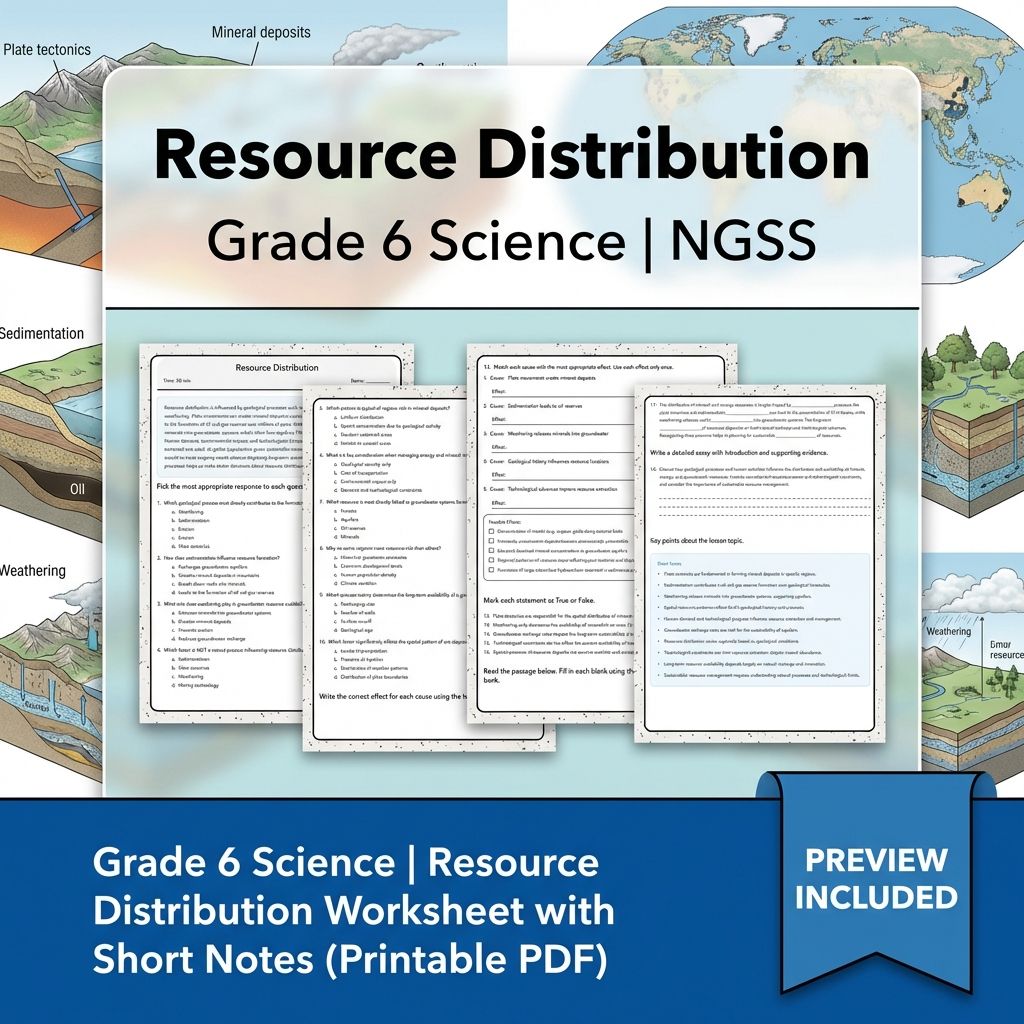
Grade 6 Science | Resource Distribution Worksheet with Short Notes (PDF)
 Created byMeadowlark Worksheets
Learning Objectives
- Understand the processes that influence the distribution of mineral, energy, and groundwater resources.
- Identify how geological history affects spatial patterns of resource deposits.
- Analyze the impacts of extraction and technological constraints on resource availability.
Also included in: Grade 6 Science | Earth and Human Activity Unit Bundle – NGSS Standards +1 more
Instant download
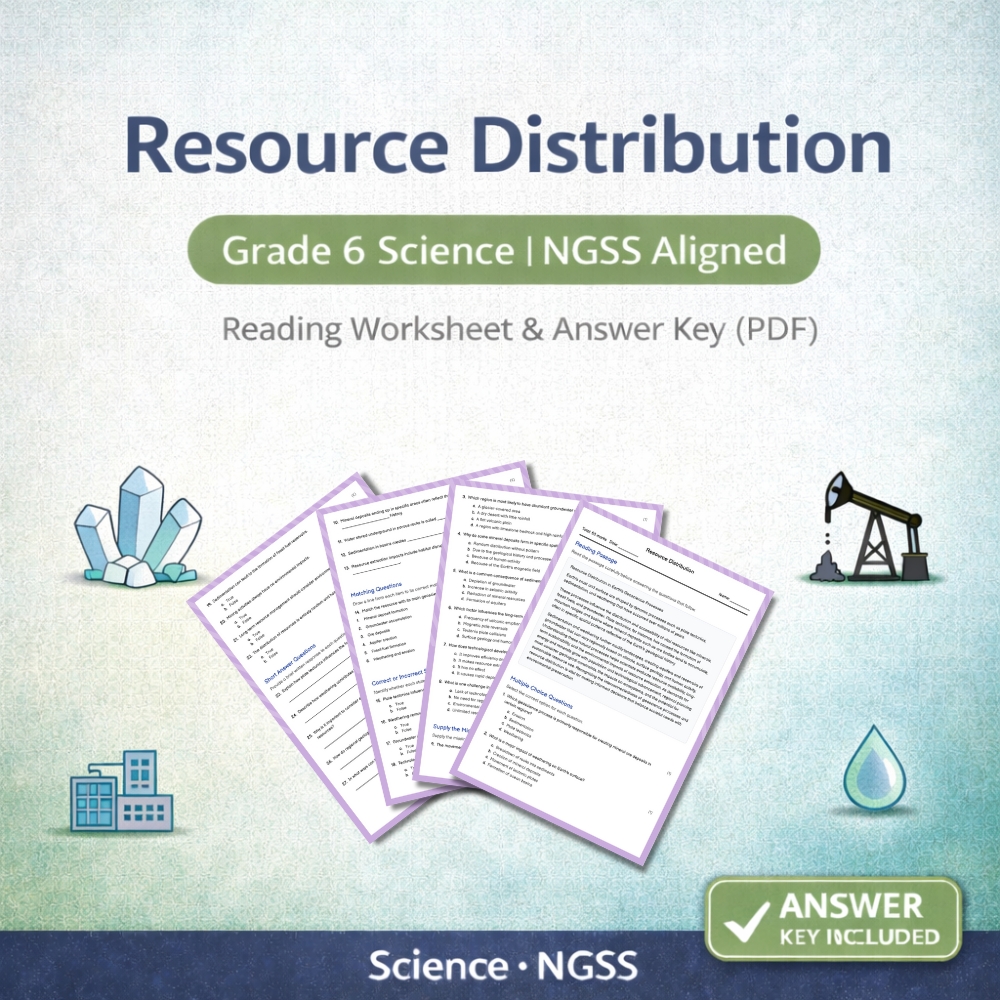
6th Grade Science | Resource Distribution | NGSS Worksheet & Answer Key
 Created byCedar Grove Learning
Learning Objectives
- Understand the geological processes that influence the distribution of mineral, energy, and groundwater resources.
- Analyze spatial patterns of resource deposits and evaluate trade-offs in resource management based on demand and environmental impacts.
- Explore how Earth's history and geoscience processes shape resource availability in regional and global contexts.
Also included in: Grade 6 Science Bundle | Sustainability, Hazards & Earth Systems NGSS Worksheets +1 more
Instant download

Geoscience Processes and Resource Distribution Worksheets Grade 6
 Created bythe curious pencil
Learning Objectives
- Explain how plate tectonics influences mineral resource distribution
- Describe how sedimentation affects where resources are found
- Explain how groundwater moves through aquifers
Also included in: Grade 6 Earth Science Worksheets Bundle | Earth & Human Activity NGSS +2 more
Instant download

Grade 10 Science – Ocean Dynamics & Currents | Daily Reading Worksheet
 Created byBright Mind Resources
Learning Objectives
- Understand the fundamental circulation patterns in ocean systems.
- Identify the roles of thermohaline circulation, gyres, and coastal upwelling.
- Recognize how observational tools like ARGO floats and satellites contribute to ocean studies.
Also included in: Earth Systems Grade 10 Science Daily Reading Worksheets Bundle | NGSS +2 more
Instant download

Grade 10 Science | Ocean Dynamics Worksheet + Answer Key (NGSS Aligned)
Created byBright Mind ResourcesLearning Objectives
- Understand the key circulation patterns and processes involved in ocean dynamics, including thermohaline circulation, gyres, and coastal upwelling.
- Recognize how observations from ARGO floats, satellite altimetry, and salinity-temperature profiles inform our understanding of ocean heat and mass transport.
- Explain how ocean circulation influences climate, sea-level variation, and coastal ecosystems.
Instant download

Ocean Dynamics Worksheet for Grade 10 Science | NGSS Practice and Assessment
JCreated byJ.S SheetsLearning Objectives
- Understand circulation patterns driven by density contrasts, wind forcing, and Earth's rotation.
- Identify key ocean phenomena such as thermohaline circulation, gyres, and coastal upwelling.
- Analyze how observations from ARGO floats, satellite altimetry, and salinity-temperature profiles inform ocean studies.
Instant download

Grade 10 Ocean Dynamics Science Worksheet | NGSS Earth Science Activity
 Created byBRIGHT PATH RESOURCES
Learning Objectives
- Identify main ocean circulation patterns such as thermohaline circulation, gyres, and coastal upwelling.
- Understand how observational tools like ARGO floats and satellites are used to study ocean heat and mass transport.
- Recognize the influence of ocean circulation on climate, sea level, and coastal ecosystems.
Also included in: Earth Systems Grade 10 Science Daily Reading Worksheets Lesson Bundle | NGSS +1 more
Instant download

Grade 10 Ocean Circulation Drivers Worksheet | NGSS Coastal Effects Activity
 Created byAmber Owl Education
Learning Objectives
- Explain how density contrasts, wind, and Earth’s rotation shape ocean circulation patterns.
- Describe how thermohaline circulation and gyres move heat and mass around the ocean.
- Connect coastal upwelling, tides, and storm surges to regional sea level and sediment transport.
Instant download
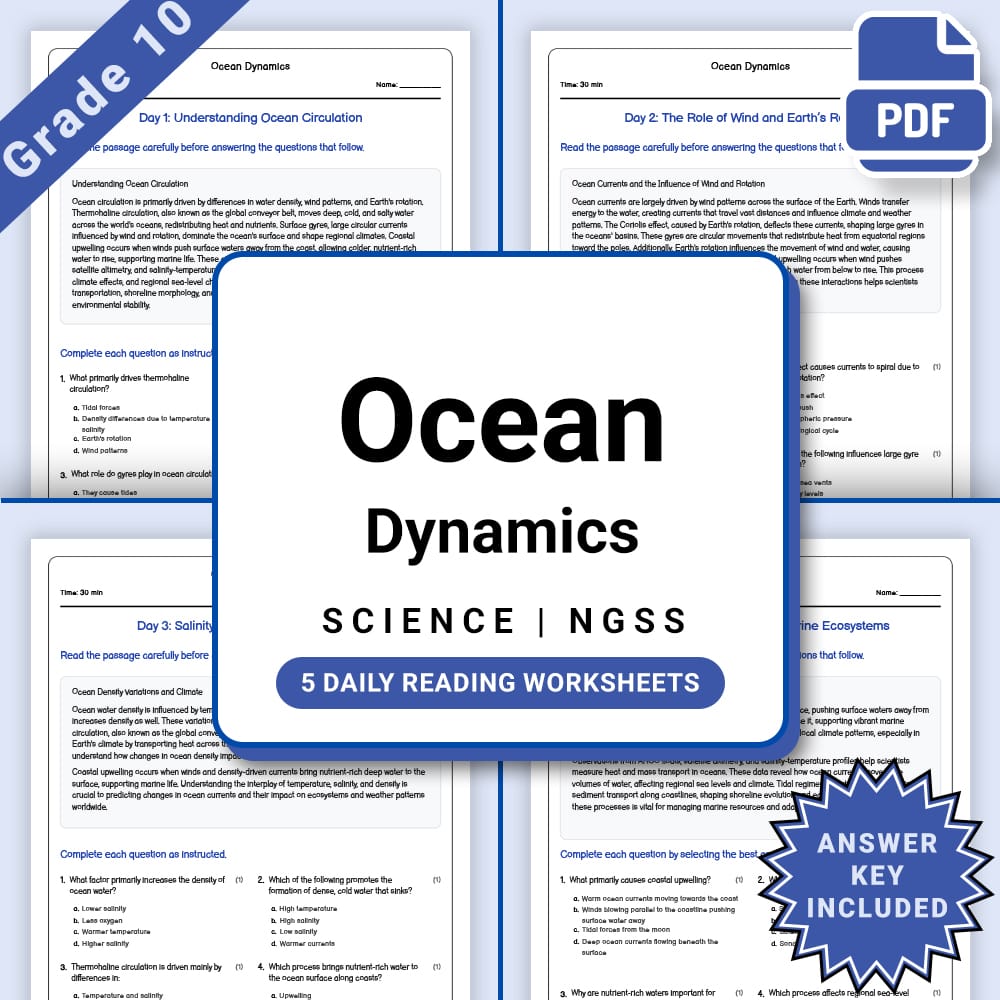
Grade 10 Science – Ocean Dynamics Worksheet (PDF +Answer Key)
 Created byCopper Leaf Classroom
Learning Objectives
- Understand the key circulation patterns in ocean dynamics
- Interpret data from ocean observation tools
- Identify the impact of ocean movement on climate and coastal features
Instant download
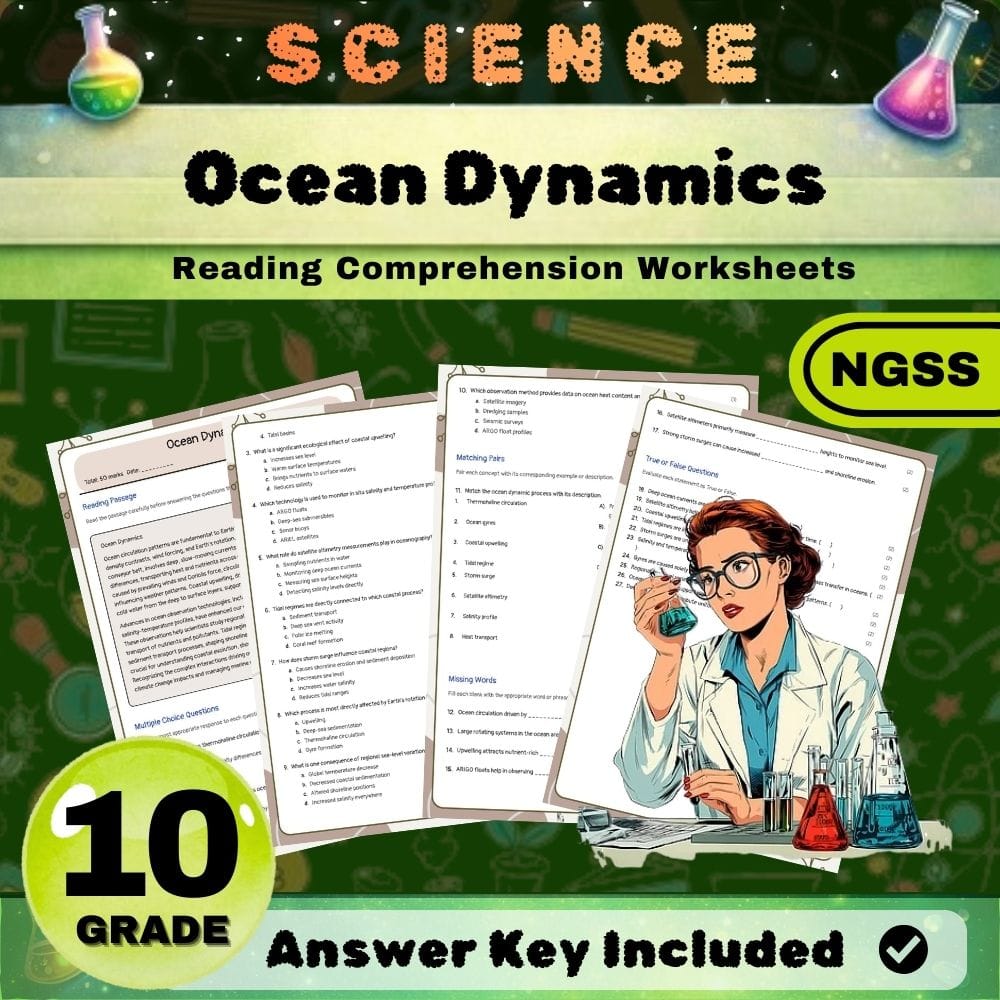
Grade 10 Science – Ocean Dynamics Worksheet (NGSS) (PDF)
 Created byMaple Path Learning
Learning Objectives
- Explain the key circulation patterns driven by density contrasts, wind, and Earth's rotation, including thermohaline circulation, gyres, and coastal upwelling.
- Describe how observations from ARGO floats, satellite altimetry, and salinity-temperature profiles inform our understanding of heat and mass transport in oceans.
- Analyze the impact of tidal regimes and storm surges on coastal sediment transport and shoreline morphology.
Also included in: Grade 10 Earth’s Systems Science Worksheets Bundle | NGSS +1 more
Instant download
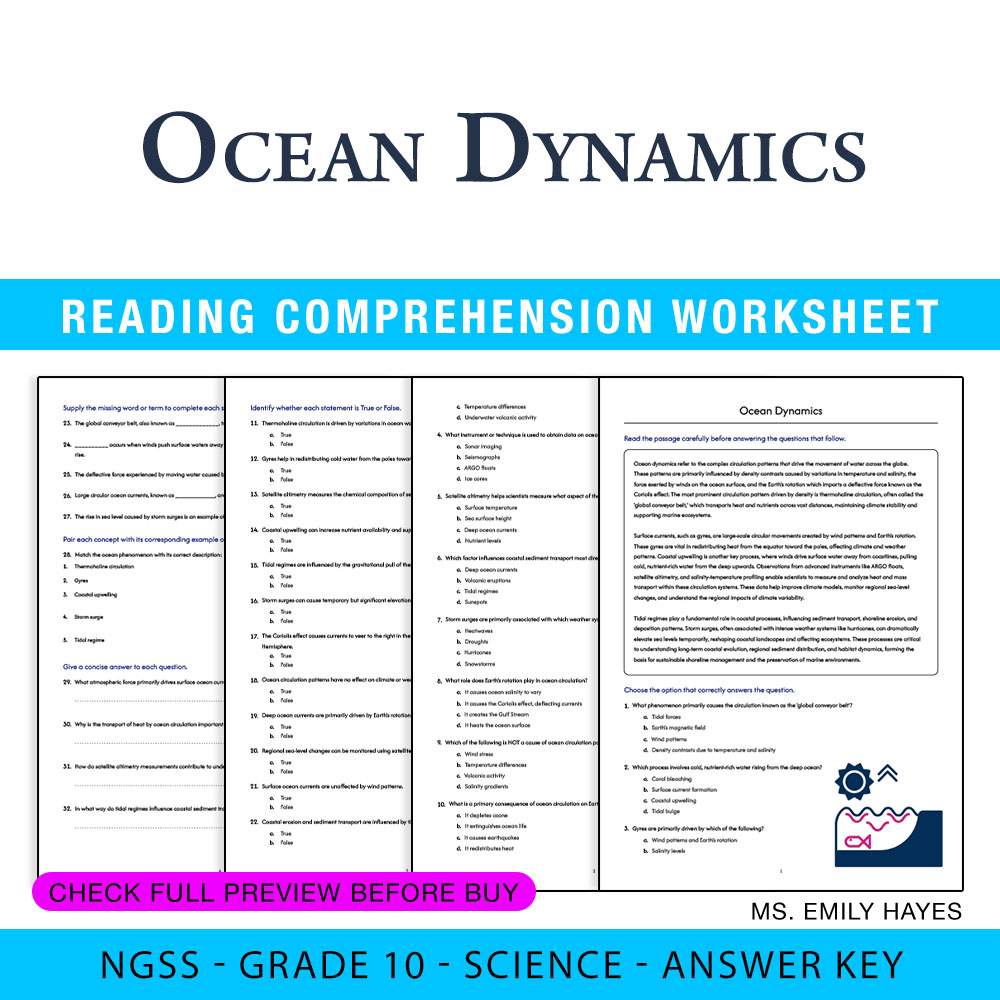
Grade 10 Science | Ocean Dynamics Worksheet (PDF+ Answer Key)
Created byCopper Leaf ClassroomLearning Objectives
- Describe the key circulation patterns in the ocean driven by density contrasts, wind forcing, and Earth's rotation.
- Explain how observations from ARGO floats, satellite altimetry, and salinity-temperature profiles help understand ocean heat and mass transport.
- Assess the impact of tidal regimes and storm surges on coastal sediment transport, shoreline morphology, and regional sea-level variations.
Instant download

Ocean Dynamics Test Prep Worksheets | Grade 10 Science NGSS
 Created byPrism Point Learning
Learning Objectives
- Explain how density differences, wind, and Earth’s rotation drive ocean circulation patterns.
- Describe major circulation features such as thermohaline circulation, gyres, and coastal upwelling.
- Connect ocean observations (e.g., ARGO floats and satellite altimetry) to heat and mass transport and regional sea level changes.
Also included in: Grade 10 Earth Systems Science lesson bundle: NGSS practice worksheets
Instant download

Grade 10 Science | Ocean Dynamics Reading Worksheet (PDF + Rubric) for NGSS
JCreated byJ.S SheetsLearning Objectives
- Understand the key circulation patterns in the ocean driven by density contrasts, wind forcing, and Earth's rotation.
- Describe the processes involved in thermohaline circulation, gyres, and coastal upwelling.
- Analyze how ocean observations from ARGO floats, satellites, and profiles inform climate and regional sea-level studies.
Also included in: Grade 10 Science Unit | Earth Systems & Climate Change Worksheets Bundle
Instant download

Ocean Circulation Drivers & Coastal Sea Changes Worksheets Grade 10
 Created byTeachers Club
Learning Objectives
- Explain how temperature and salinity differences drive thermohaline circulation
- Describe how wind and Earth’s rotation shape ocean current patterns
- Interpret satellite altimetry and profile data as evidence of ocean changes
Also included in: Grade 10 Earth Science Worksheets | NGSS Earth’s Systems Bundle +1 more
Instant download

Grade 10 Science – Ocean Dynamics Worksheet (NGSS) PDF
 Created bySilver Birch Teaching
Learning Objectives
- Describe circulation patterns driven by density contrasts, wind forcing, and Earth's rotation.
- Explain the roles of thermohaline circulation, gyres, and coastal upwelling in ocean dynamics.
- Analyze how observations from ARGO floats, satellite altimetry, and salinity-temperature profiles contribute to understanding ocean processes.
Also included in: Grade 10 Earth Systems Science Lesson Bundle for NGSS ngss10 Worksheets +1 more
Instant download
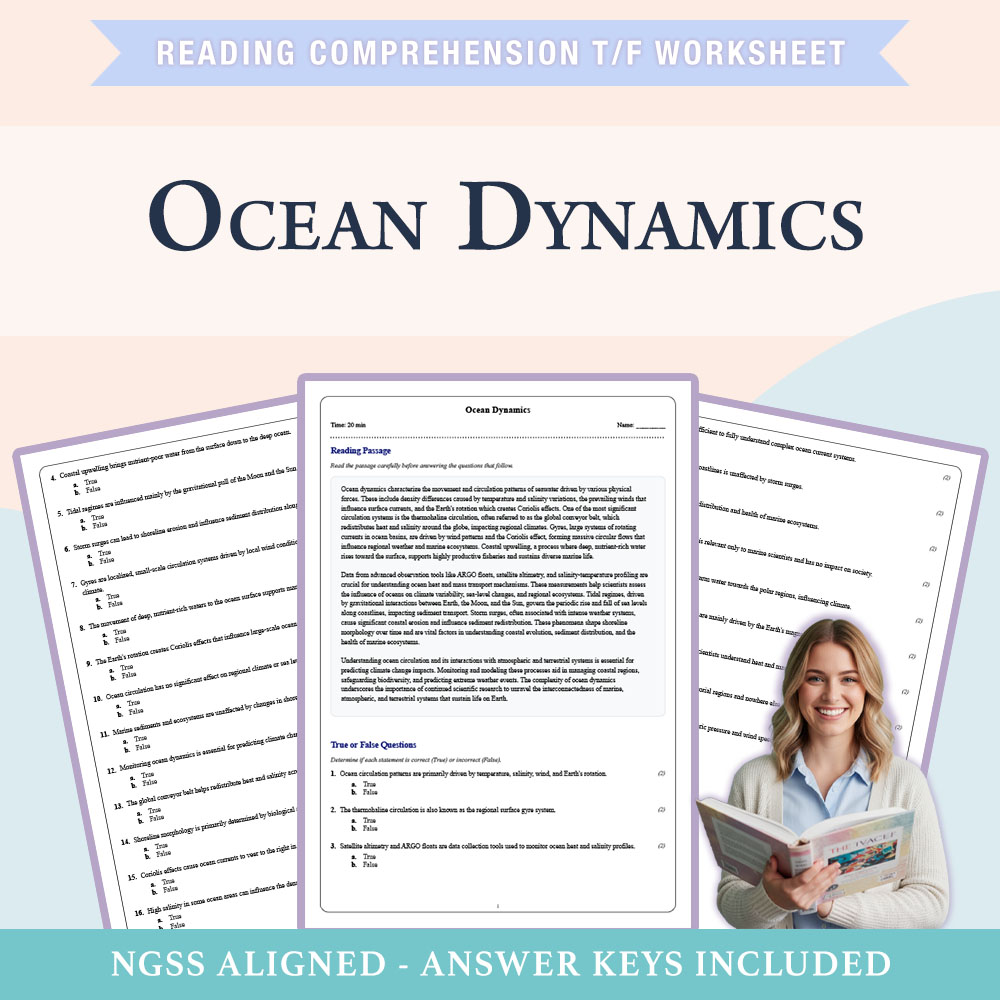
10th Grade Science | Ocean Dynamics Worksheet (PDF +Answer Key)
Created byCopper Leaf ClassroomLearning Objectives
- Understand the main circulation patterns driven by density contrasts, wind, and Earth's rotation
- Identify methods used to observe and analyze ocean currents and their effects on climate
- Explain how tidal regimes and storm surges influence coastal sediment transport and shoreline morphology
Also included in: Grade 10 Science | Earth Systems & Climate Change Bundle (PDF + Answer Key) +1 more
Instant download

Grade 10 Science | Ocean Dynamics - Daily Reading Comprehension
Created byCoral Reef LearningLearning Objectives
- Identify different types of ocean currents such as thermohaline circulation, gyres, and coastal upwelling.
- Understand the causes of ocean currents, including density contrasts, wind forcing, and Earth's rotation.
- Recognize how observations from ARGO floats, satellite altimetry, and salinity-temperature profiles help study ocean circulation.
Instant download

Grade 10 Science | Ocean Dynamics Worksheet & Answer Key NGSS Aligned
 Created byLumora Learning
Learning Objectives
- Understand the key circulation patterns in ocean dynamics, including thermohaline circulation, gyres, and upwelling.
- Identify how modern observation tools like ARGO floats and satellite profiles contribute to understanding ocean behavior.
- Explain the impact of ocean processes on climate, sea levels, and coastal environments.
Instant download
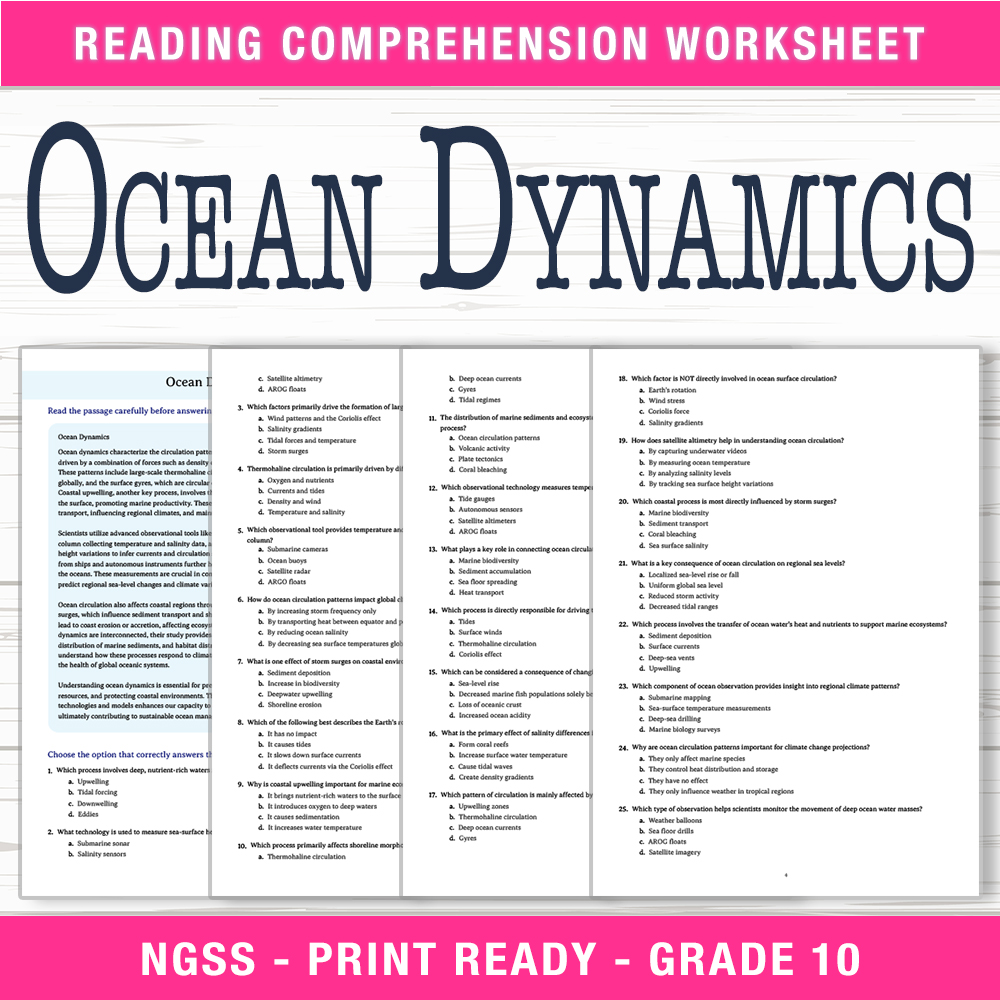
Grade 10 Science | Ocean Dynamics Worksheet (PDF + Answer Key)
 Created byRiverstone Classroom
Learning Objectives
- Explain the circulation patterns driven by density contrasts, wind forcing, and Earth's rotation.
- Describe the roles of thermohaline circulation, gyres, and coastal upwelling in ocean dynamics.
- Identify observational techniques such as ARGO floats, satellite altimetry, and salinity-temperature profiles and their applications.
Instant download

10th Grade Science Worksheet | Ocean Dynamics with Answer Key and Rubric
Created byCoral Reef LearningLearning Objectives
- Understand the key circulation patterns and mechanisms driving ocean dynamics.
- Identify how observations from various technologies contribute to knowledge of ocean behavior.
- Explain the influence of ocean circulation on climate, sea level, and coastal processes.
Also included in: Grade 10 Science Unit Bundle – Earth's Surface Atmosphere & Geology Worksheets +1 more
Instant download

Grade 8 Science | Properties Overview Worksheet with Short Notes (Printable PDF)
Created byMeadowlark WorksheetsLearning Objectives
- Identify and describe various physical properties of matter.
- Compare properties such as density, solubility, melting and boiling points, and conductivity.
- Understand how properties inform classification and separation techniques.
Instant download

Properties Overview Worksheet for Grade 8 Science
JCreated byJ.S SheetsLearning Objectives
- Identify measurable physical properties of matter, including density, solubility, melting point, boiling point, and conductivity.
- Compare substances using quantitative information such as mass, volume, and temperature.
- Explain how physical properties help classify and separate materials in lab and everyday situations.
Instant download

Grade 8 Science Worksheet – Properties of Matter & Measurements (PDF)
 Created byEvergreen Desk Education
Learning Objectives
- Identify and describe measurable properties of matter, including density, solubility, melting point, boiling point, and conductivity.
- Compare materials using quantitative physical characteristics (mass, volume, and temperature).
- Explain how physical properties help classify matter and support separation techniques.
Instant download

Properties Overview Worksheet Pack | Grade 8 Science Activities
Created byPrism Point LearningLearning Objectives
- Identify measurable physical properties of matter (density, solubility, melting point, boiling point, and conductivity).
- Compare properties to classify materials and predict physical behavior in everyday situations.
- Explain how quantitative measurements relate to observable changes such as melting, dissolving, and temperature changes.
Also included in: Grade 8 Matter & Reactions Science Lesson Bundle (TEKS Worksheets) +1 more
Instant download

Grade 8 Science – Properties Overview & Density | Daily Reading Worksheet
Created byBright Mind ResourcesLearning Objectives
- Understand the concept of density and how it varies among materials.
- Identify different physical properties of matter such as solubility, melting point, and conductivity.
- Compare materials based on measurable characteristics to classify and separate them.
Also included in: Grade 8 Energy Transfer & Heat Transfer Science Lesson Bundle | TEKS Daily +2 more
Instant download

Grade 8 TEKS Properties of Matter Science Daily Reading Worksheet
Created byBRIGHT PATH RESOURCESLearning Objectives
- Define measurable physical properties and explain why they help classify matter
- Identify properties such as density, solubility, melting point, boiling point, and conductivity from descriptions
- Connect quantitative measurements (mass, volume, temperature) to observable physical behavior
Also included in: Grade 8 Matter and Energy Science Reading Worksheets Bundle | TEKS +1 more
Instant download
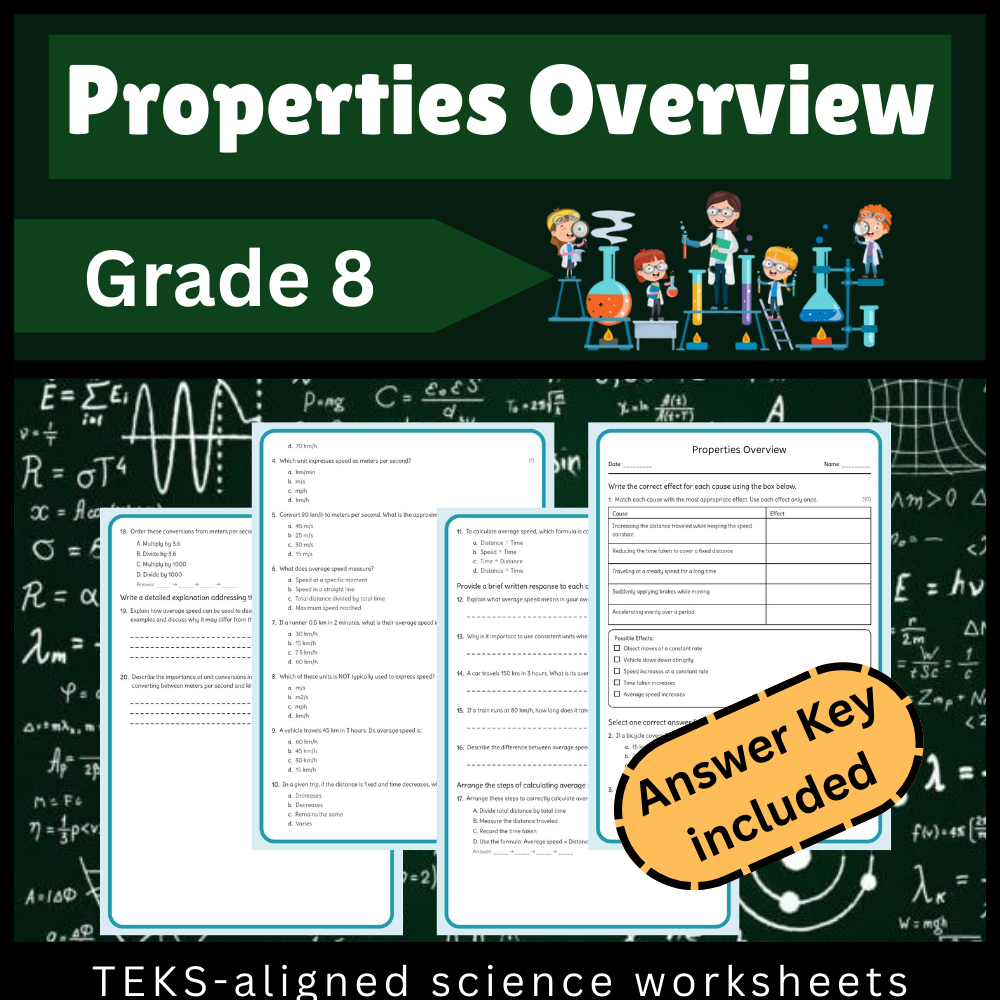
Grade 8 Science – Properties Overview Worksheets (Worksheet + Answer Key) | TEKS Standard
Created byBright Mind ResourcesLearning Objectives
- Identify and distinguish measurable physical characteristics of matter such as density, solubility, melting and boiling points.
- Compare the electrical and thermal conductivity of different materials.
- Understand how physical properties inform classification and separation techniques.
Also included in: Grade 8 Science Unit Bundle | States of Matter & Reaction Rates Worksheets- TEKS +1 more
Instant download

Properties of Matter Assessment for Grade 8 Science | TEKS Standards
Created byPrism Point LearningLearning Objectives
- Identify and compare physical properties of matter such as density, solubility, melting and boiling points.
- Explain how physical characteristics inform classification and separation techniques.
- Relate measurable quantities like mass, volume, and temperature to observed physical behaviors.
Also included in: Grade 8 Matter, Energy, and Reactions Science Lesson Bundle (TEKS)
Instant download
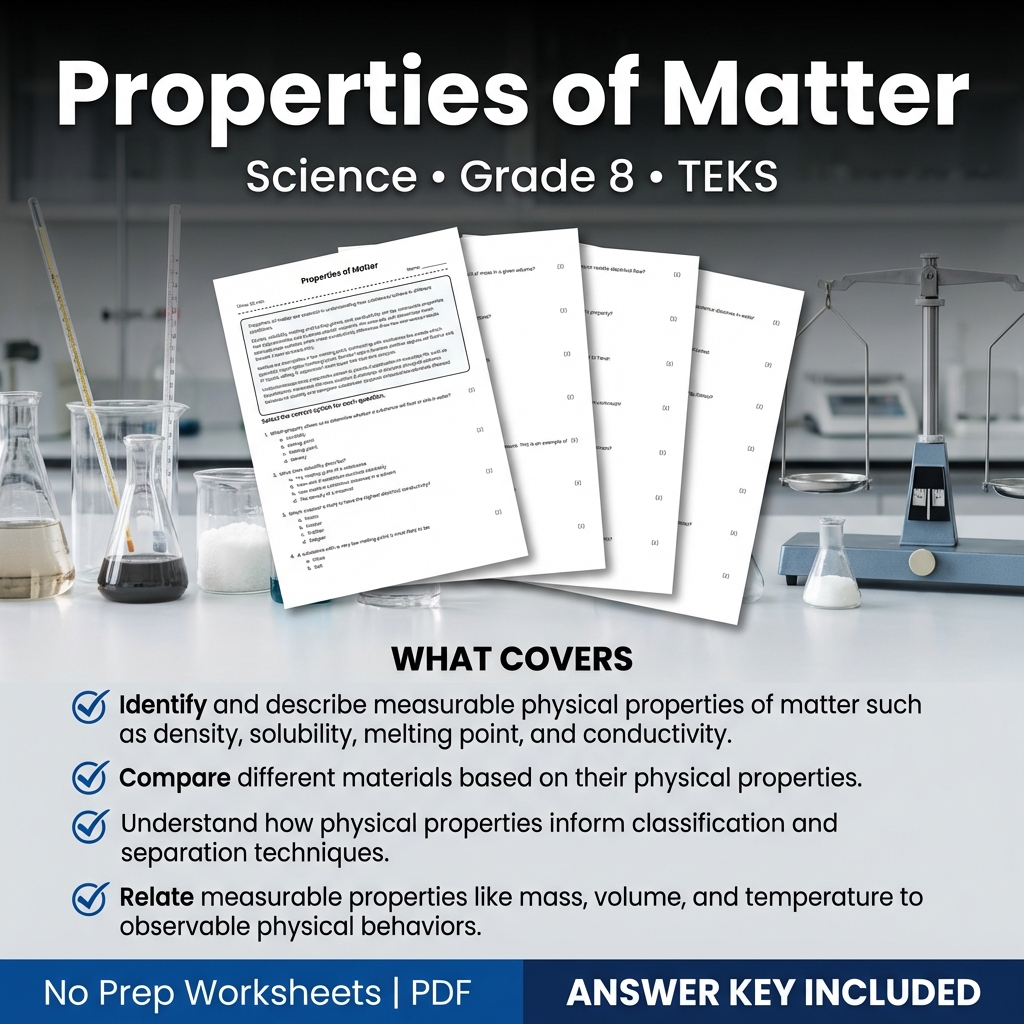
Properties of Matter Worksheet Grade 8 Science | TEKS Practice PDF
Created byCoral Reef LearningLearning Objectives
- Identify and describe measurable physical properties of matter such as density, solubility, melting point, and conductivity.
- Compare different materials based on their physical properties.
- Understand how physical properties inform classification and separation techniques.
Instant download
Grade 8 Science — Properties Overview Worksheet for Mastery | PDF + Answer Key
 Created byThe Resource Hub
Learning Objectives
- Identify and describe measurable physical properties of matter, such as density, solubility, melting point, and boiling point.
- Compare the conductivity of different materials and understand how these properties inform classification and separation techniques.
- Explain how measurable properties relate to observable physical behaviors in classroom-relevant phenomena.
Also included in: Grade 8 Science Unit Bundle – Matter, Reaction Rates & Energy Mastery Worksheets +1 more
Instant download

Grade 8 Science | Physical Properties of Matter - Daily Reading Comprehension
Created byCoral Reef LearningLearning Objectives
- Identify and describe key physical properties of matter such as density, solubility, melting point, boiling point, electrical and thermal conductivity.
- Compare how different materials behave based on their physical properties.
- Understand how physical properties help classify and separate substances.
Instant download
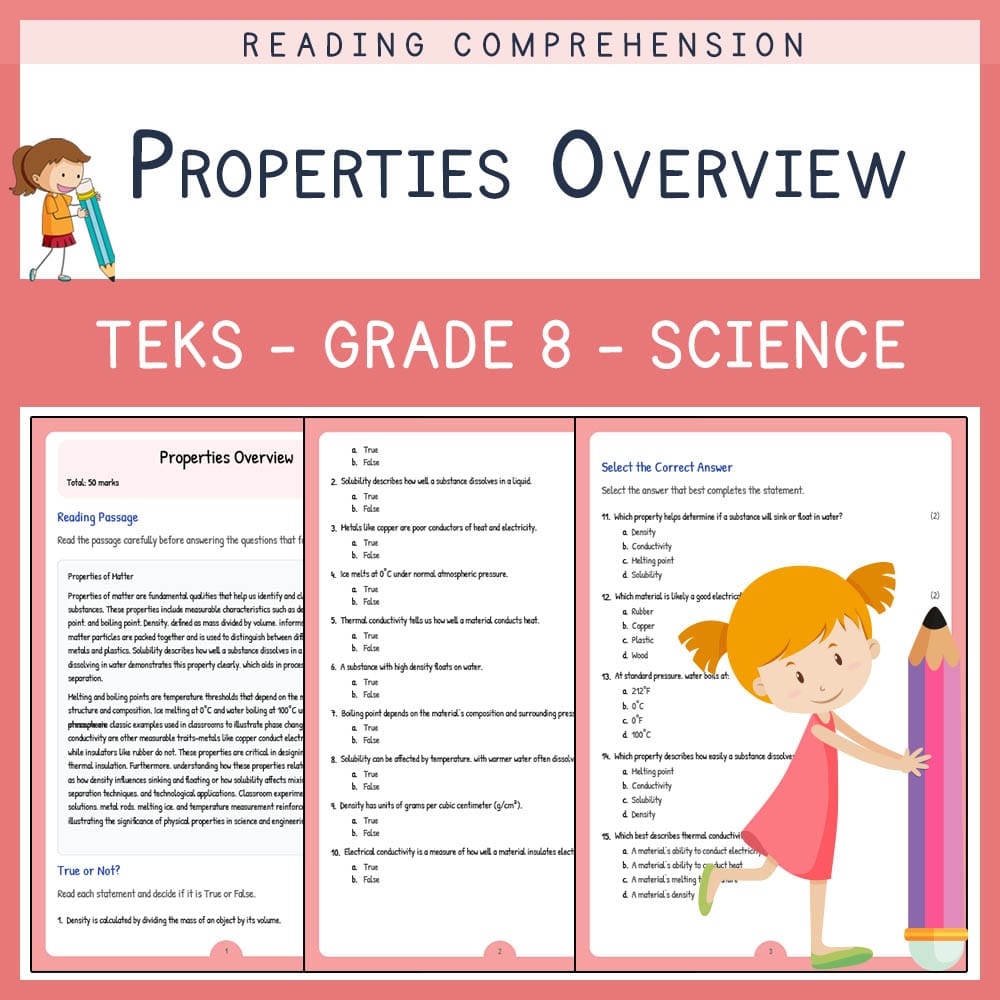
Grade 8 Science | Properties Overview Worksheet | TEKS Alligned
Created byLumora LearningLearning Objectives
- Describe physical properties of matter such as density, solubility, melting, and boiling points.
- Compare the electrical and thermal conductivity of different materials.
- Understand how physical properties are used to classify and separate substances.
Also included in: Grade 8 Science | Matter and Energy Lesson Bundle | TEKS Aligned
Instant download
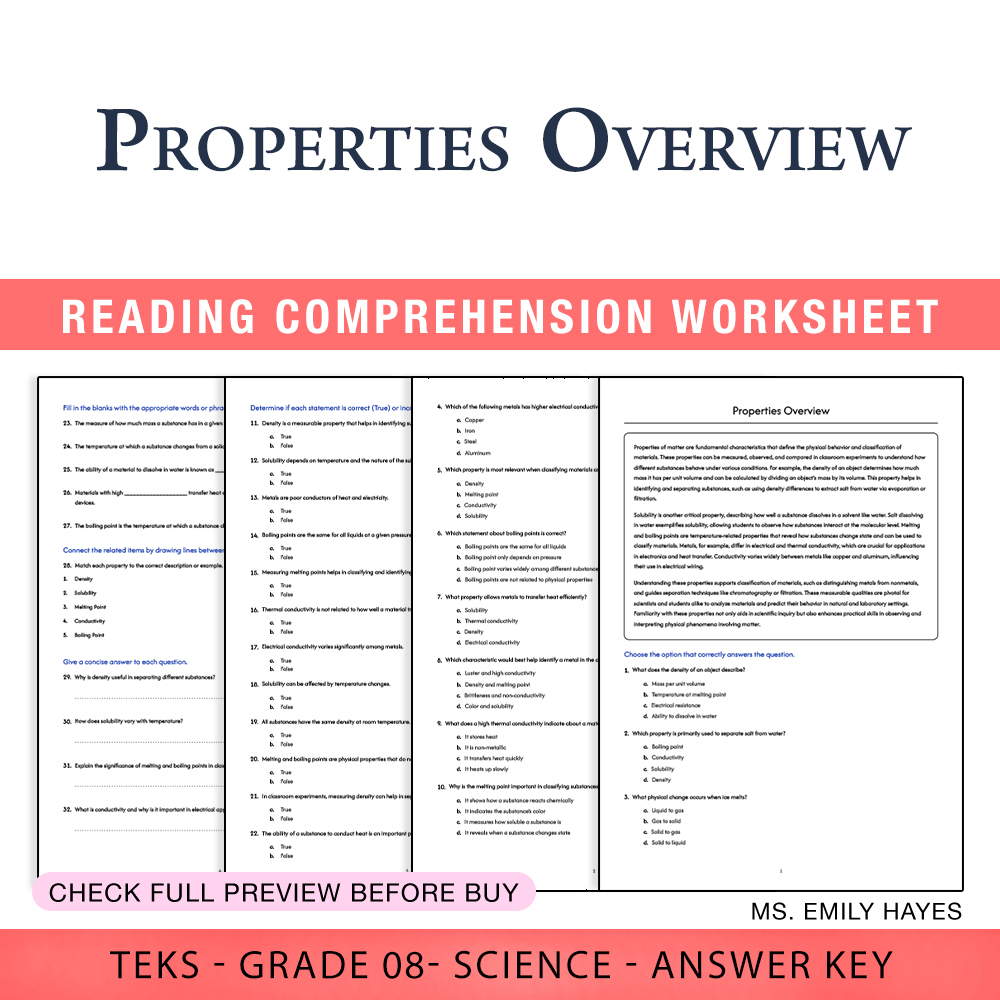
8th Grade Science | Properties Overview Worksheet (PDF+ Answer Key)
Created byCopper Leaf ClassroomLearning Objectives
- Identify and compare measurable physical properties such as density, solubility, melting and boiling points.
- Understand how properties like conductivity and solubility inform classification and separation techniques.
- Relate quantitative measures like mass, volume, and temperature to observed physical behavior.
Instant download

Grade 8 Science – Properties of Matter Daily Reading Worksheet + Answer Key
JCreated byJ.S SheetsLearning Objectives
- Identify and describe key measurable physical properties of matter
- Compare density, solubility, melting point, boiling point, conductivity
- Understand how these properties are used to classify and separate materials
Also included in: Grade 8 Science Lesson Bundle | TEKS Standards for Classroom Success +1 more
Instant download

Grade 5 Phase Change Processes Worksheet | NGSS Practice PDF
 Created byClear Sky Classroom
Learning Objectives
- Identify how energy changes can cause matter to shift between solid, liquid, and gas phases.
- Explain why phase changes are physical changes that do not create new substances.
- Match phase change terms (melting, freezing, evaporation, condensation, sublimation, deposition) to their descriptions.
Instant download

Energy Transformations Worksheet Grade 8 Science Activity & Assessment
Created byPrism Point LearningLearning Objectives
- Describe how energy changes form within a system during common events (bouncing, motors, friction/heating).
- Identify the initial and final energy forms in examples of energy transformations.
- Explain how energy is conserved by tracking energy as it moves and changes form.
Instant download

Energy Transformations Assessment for Grade 8 Science | NGSSS Standards
Created byPrism Point LearningLearning Objectives
- Explain how energy can change forms within a system while following energy conservation.
- Identify examples of transformations between potential, kinetic, electrical, and thermal energy.
- Use key terms and cause-effect reasoning to describe how energy transfers affect motion and temperature.
Instant download

Grade 8 Science | Energy Transformations Worksheet | NGSSS Standards
Created byLumora LearningLearning Objectives
- Explain how energy is transformed between potential, kinetic, electrical, and thermal forms within a system
- Use conservation of energy to describe why energy changes form even when motion increases or decreases
- Identify real-life examples of energy transformations, including bouncing balls, electric motors, and friction heating
Instant download

Grade 8 Science – Energy Transformations & Forms | Daily Reading Worksheet
Created byBright Mind ResourcesLearning Objectives
- Understand different forms of energy such as potential, kinetic, electrical, thermal, and mechanical.
- Identify how energy transforms from one form to another within systems.
- Apply knowledge of energy transformations to real-world examples like bouncing balls and electric motors.
Also included in: Grade 8 States of Matter Science Daily Reading Lesson Bundle | FL-NGSSS +1 more
Instant download

Energy Transformations Reading Comprehension Worksheet | Grade 8 Science
Created byEvergreen Desk EducationLearning Objectives
- Explain energy transformations by tracing how energy changes form within a system.
- Identify examples of potential, kinetic, electrical, mechanical, and thermal energy in real-world situations.
- Describe how energy is conserved as it moves even when motion changes.
Instant download

Energy Transformations Worksheet for Grade 8 Science | NGSSS Aligned
JCreated byJ.S SheetsLearning Objectives
- Explain how energy can change forms within a system during energy transformations.
- Use examples (bouncing balls, electric motors, and friction/heating) to identify potential, kinetic, electrical, and thermal energy.
- Describe how energy is transferred and redistributed even when motion changes.
Also included in: Grade 8 Energy, Motion, and Matter Changes Science Lesson Bundle: Florida NGSSS +1 more
Instant download

Grade 8 Energy Transformations Worksheet | Practice & Standards PDF
Created byClear Sky ClassroomLearning Objectives
- Explain how energy transforms between forms within a system (such as potential to kinetic or electrical to kinetic).
- Identify evidence of energy transformations using real-world examples like bouncing balls, electric motors, and frictional heating.
- Use words and models to describe energy movement and change while conserving total energy.
Instant download

Grade 8 Science | Energy Transformations - Daily Reading Comprehension
Created byCoral Reef LearningLearning Objectives
- Understand the concepts of potential and kinetic energy.
- Identify different types of energy transformations in everyday objects.
- Explain how energy changes from one form to another during motion.
Instant download

Grade 9 Science | Ocean Circulation Worksheet | BC Standard
Created byLumora LearningLearning Objectives
- Understand the mechanisms driving ocean circulation, including surface currents and thermohaline flow.
- Identify features such as gyres, upwelling zones, and boundary currents and their effects on climate and ecosystems.
- Analyze how changes in ocean circulation can impact climate regimes and weather patterns.
Also included in: Grade 9 Science | Earth Systems Unit Bundle | BC Aligned Worksheets
Instant download

Grade 9 Science Daily Reading Cardiopulmonary Interaction TEKS Worksheet
Created byBRIGHT PATH RESOURCESLearning Objectives
- Identify the main function of the respiratory system in gas exchange.
- Identify the main function of the cardiovascular system in transporting gases and nutrients.
- Explain how feedback helps coordinate heart and lung activity to support cellular respiration.
Also included in: Grade 9 Homeostasis and Body Systems Biology Worksheets Bundle | TEKS +1 more
Instant download
Browse more categories
About Science Worksheets
Find Science worksheets spanning core skills, practice, and review. All 45,024 resources are instant PDF downloads for the classroom or home.
Every worksheet on MyTeachingSheets is created by independent teacher-authors and reviewed before publication. All resources download as printable PDFs for classroom, homework, or at-home practice, and many include answer keys. Preview any worksheet free before buying.