
Science Worksheets
42,859 subject resources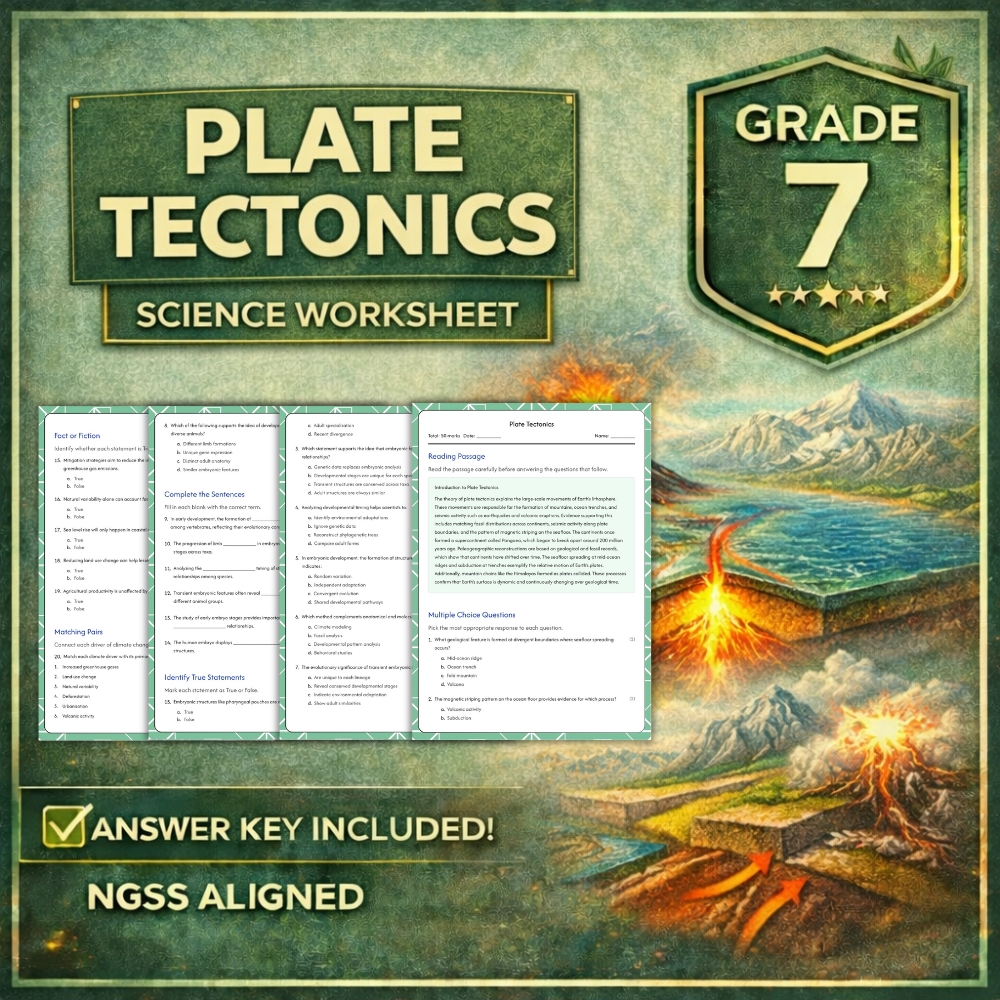
7th Grade Science | Plate Tectonics Worksheet (NGSS) – Lesson & Assessment PDF
 Created byCedar Grove Learning
Learning Objectives
- Explain how geologic evidence such as fossils, rock types, and seafloor features support the theory of plate tectonics.
- Identify key features of Earth's crust, including mid-ocean ridges, trenches, and mountain ranges, and connect them to plate movements.
- Evaluate how seismic activity, volcanic eruptions, and magnetic striping provide evidence for the relative motion of tectonic plates.
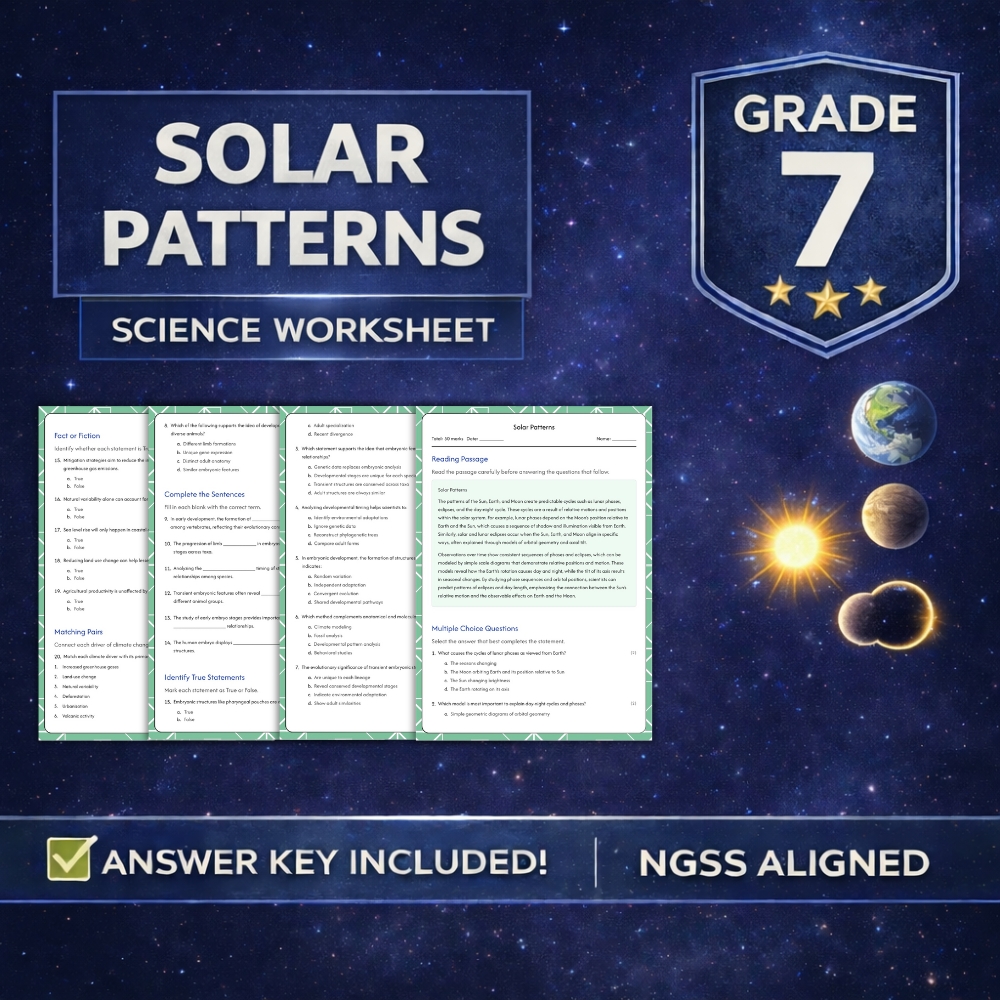
Grade 7 Science | Solar Patterns Worksheet with Answer Key (NGSS Aligned)
Created byCedar Grove LearningLearning Objectives
- Describe the cyclic patterns produced by the relative motions of the Sun, Earth, and Moon.
- Explain how diagrams of orbital geometry and axial tilt account for day-night cycles, phases, and eclipses.
- Connect observational records and phase sequences to predictable patterns within the solar system.
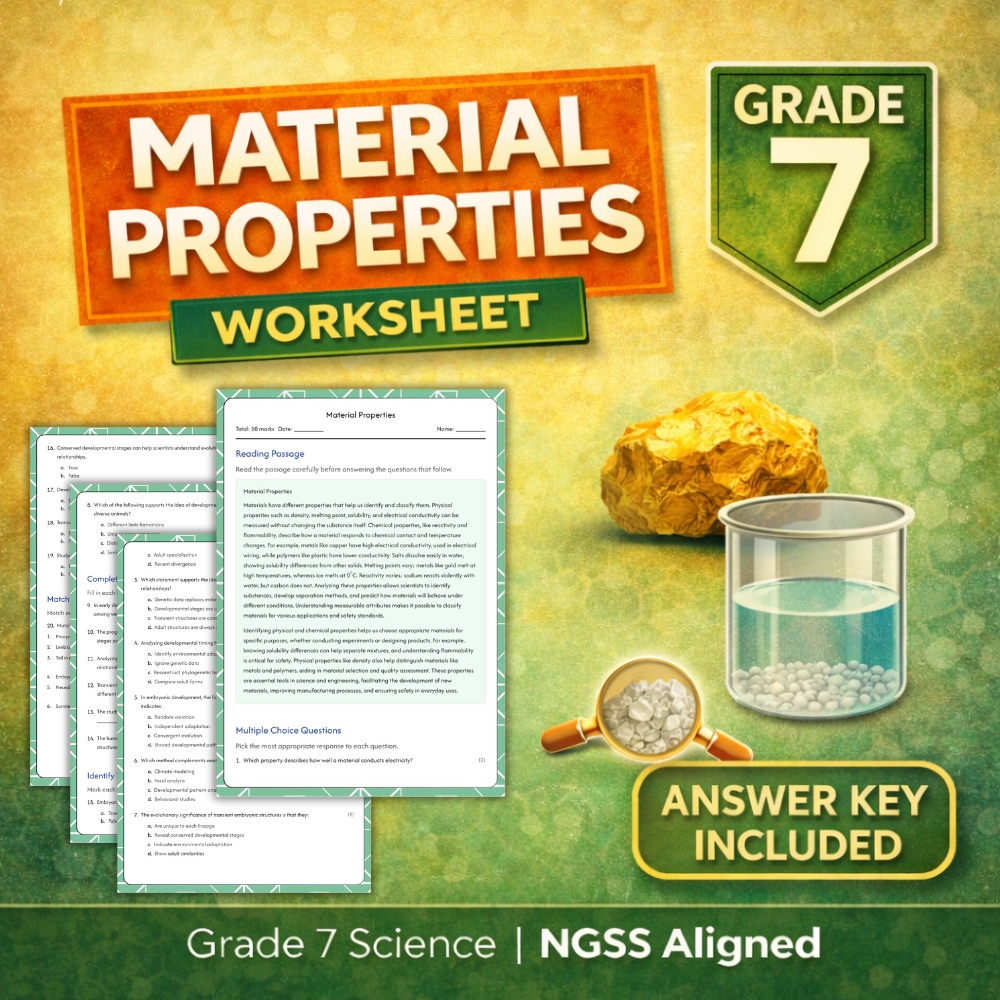
7th Grade Science | Material Properties Worksheet (NGSS & Answer Key)
Created byCedar Grove LearningLearning Objectives
- Distinguish between physical and chemical properties of materials.
- Identify measurable descriptors such as density, melting point, solubility, conductivity, reactivity, and flammability.
- Analyze property data to support material identification and separation strategies.
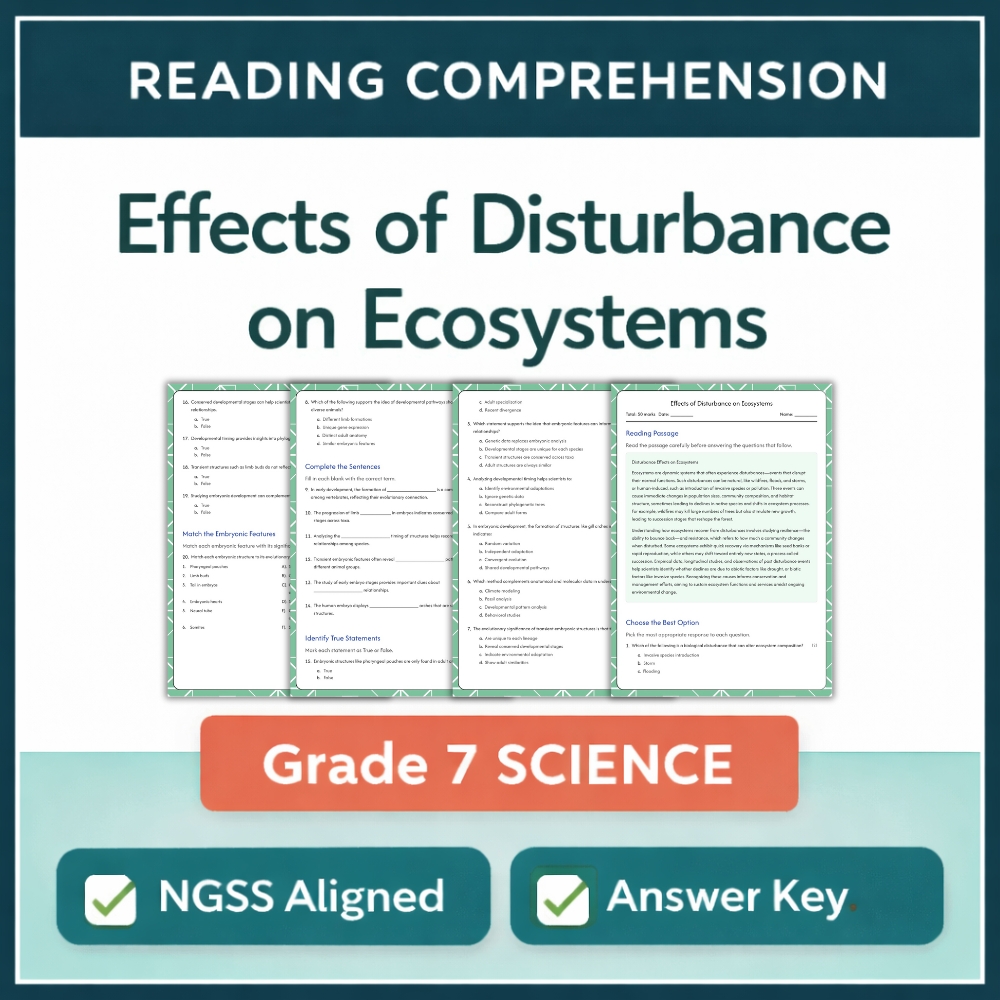
7th Grade Science | Effects of Disturbance on Ecosystems Worksheet (NGSS)
Created byCedar Grove LearningLearning Objectives
- Understand how physical and biological disturbances impact population sizes, community composition, and ecosystem functions.
- Identify examples of disturbances such as wildfires, flooding, invasive species, and disease outbreaks.
- Explain mechanisms of resilience, resistance, and succession in recovering ecosystems.
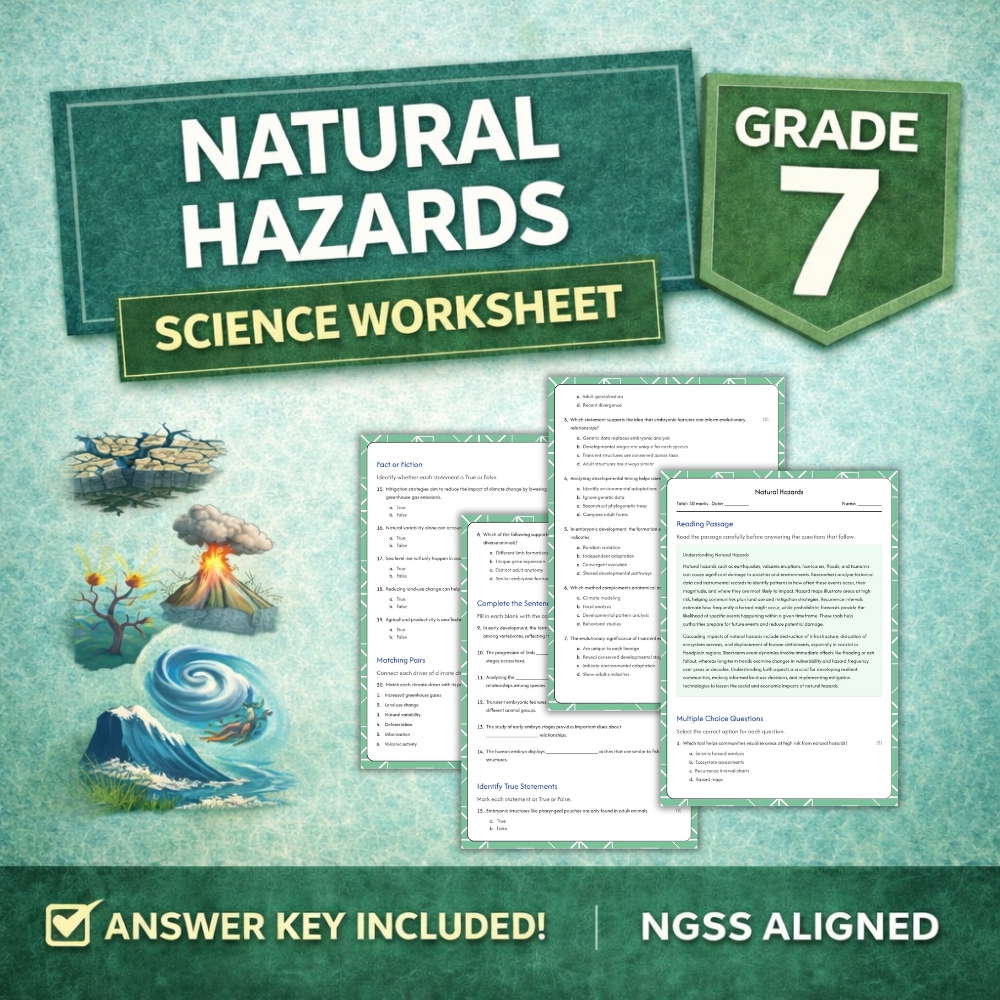
7th Grade Science | Natural Hazards Worksheet (NGSS-Aligned + Answer Key)
Created byCedar Grove LearningLearning Objectives
- Analyze patterns and data related to natural hazard events such as earthquakes, volcanic eruptions, hurricanes, floods, and tsunamis.
- Interpret hazard maps, recurrence intervals, and probabilistic forecasts to assess risk.
- Understand cascading impacts on infrastructure, ecosystems, and settlements caused by natural hazards.
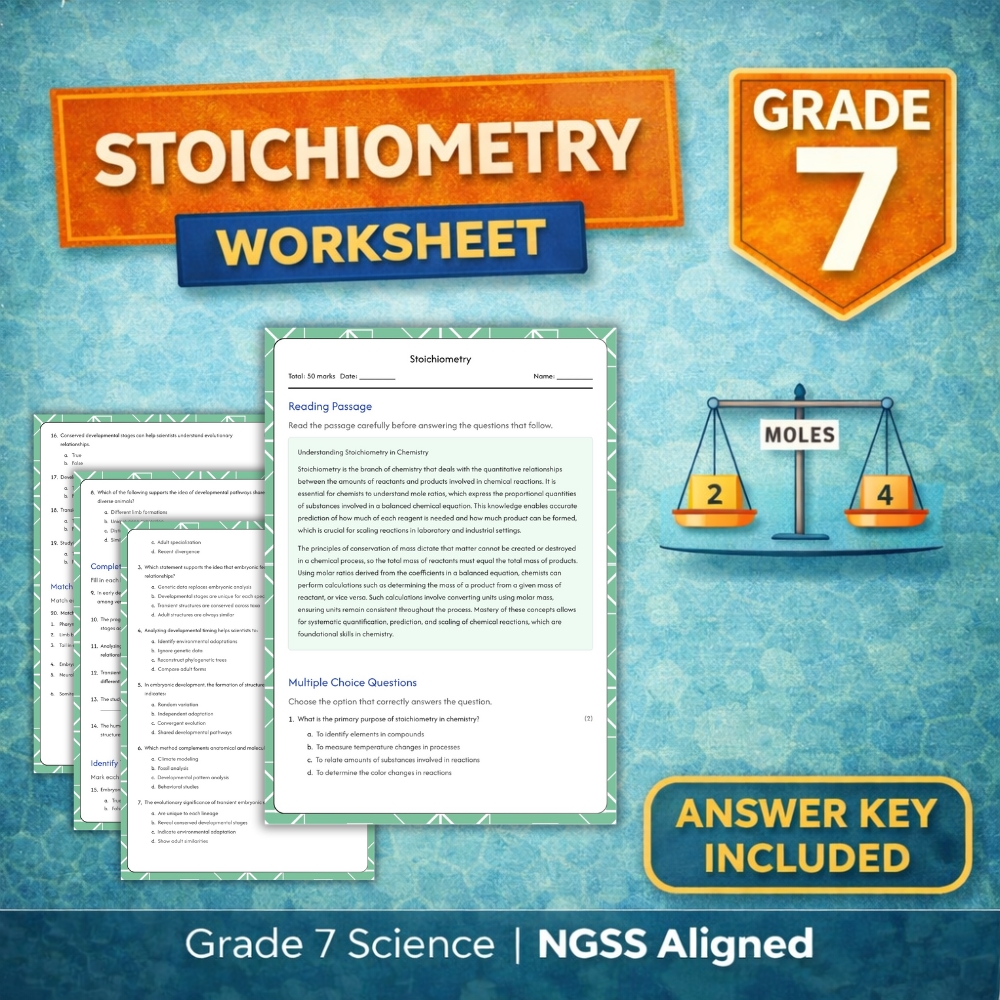
Grade 7 Science | Stoichiometry Practice Worksheet (NGSS Aligned, PDF)
Created byCedar Grove LearningLearning Objectives
- Describe quantitative relationships in chemical transformations using balanced symbolic equations and ratio reasoning.
- Perform mole-ratio calculations to determine relative mass relations among reactants and products.
- Apply conservation principles in proportional calculations to predict reagent needs and product yields.
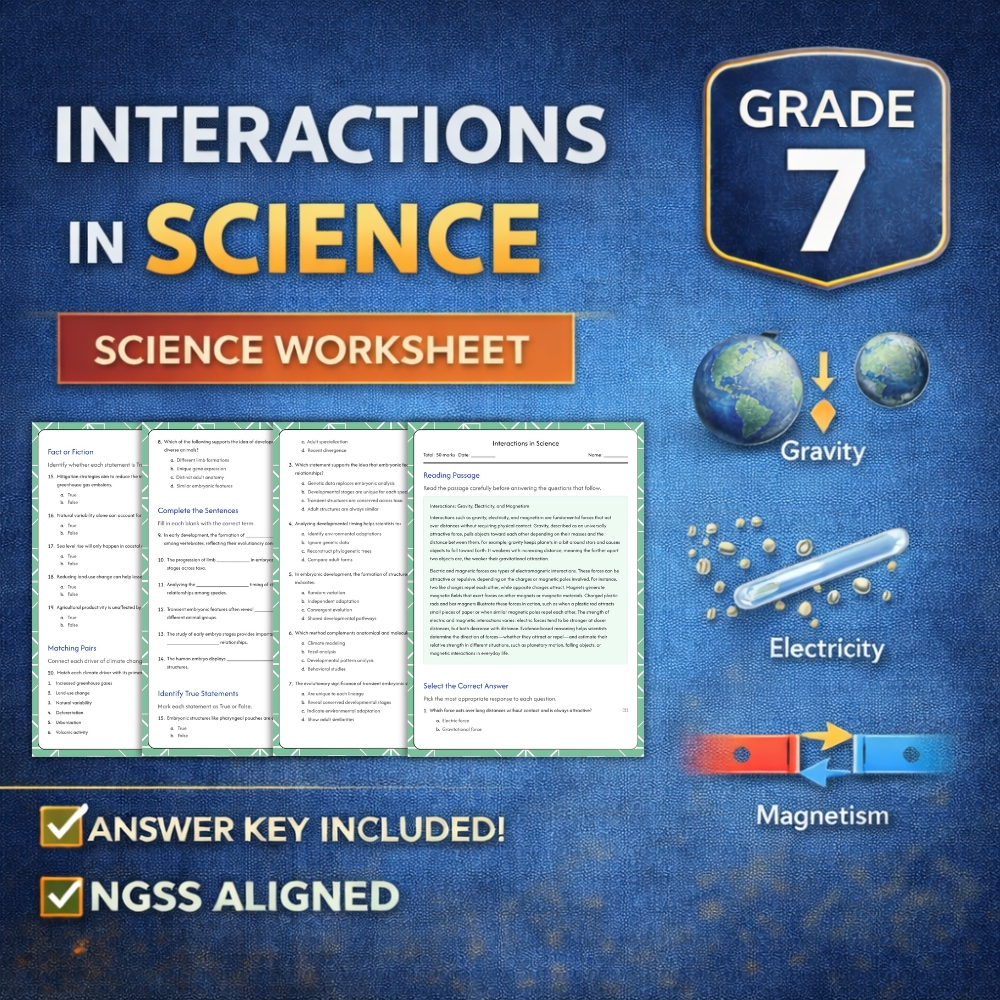
Grade 7 Science | Interactions in Science NGSS Worksheet (Printable PDF)
Created byCedar Grove LearningLearning Objectives
- Describe gravitational, electric, and magnetic interactions as long-range forces acting without contact.
- Explain how gravity is universally attractive and how electromagnetic forces can be attractive or repulsive.
- Relate gravitational attraction to mass and distance qualitatively and identify examples of electric and magnetic phenomena.
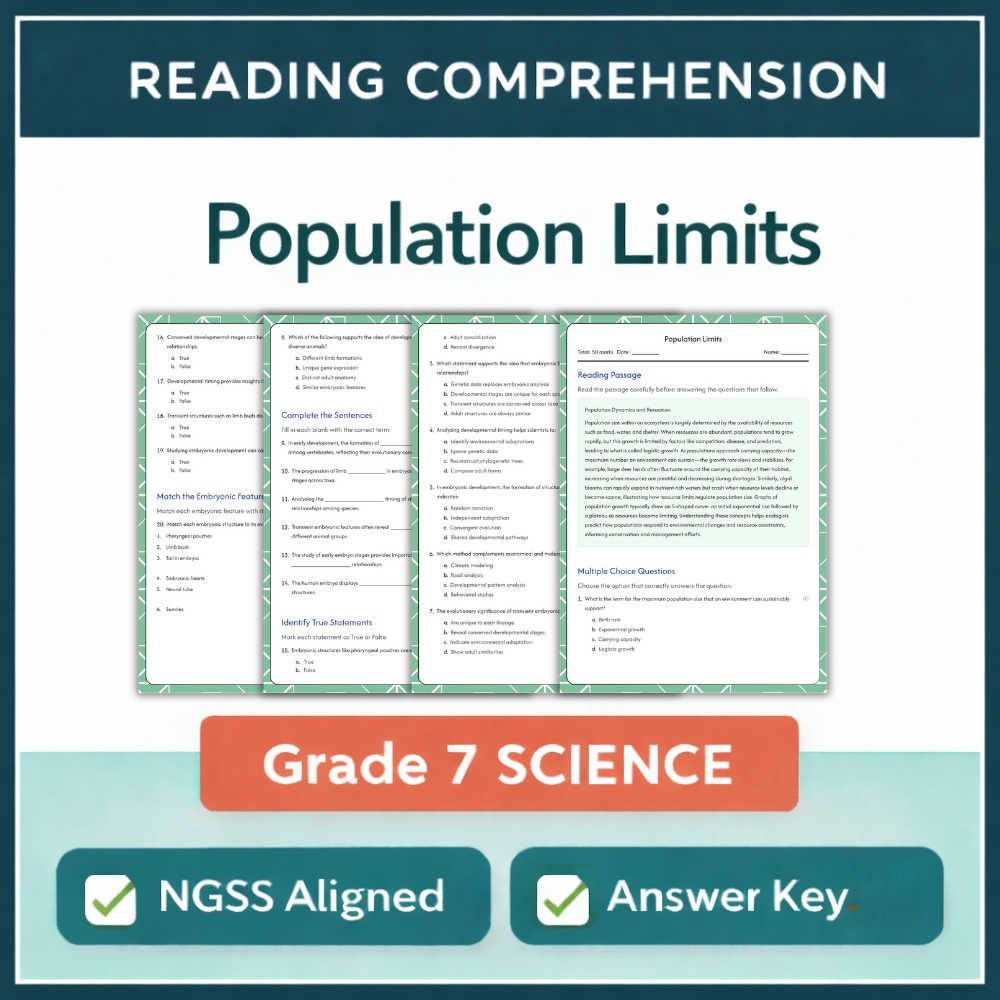
7th Grade Science | Population Limits Worksheet (NGSS Practice PDF)
Created byCedar Grove LearningLearning Objectives
- Understand how resource availability influences population growth and decline.
- Interpret logistic growth curves and concepts of carrying capacity.
- Analyze data on population responses to limited resources such as food, water, and shelter.
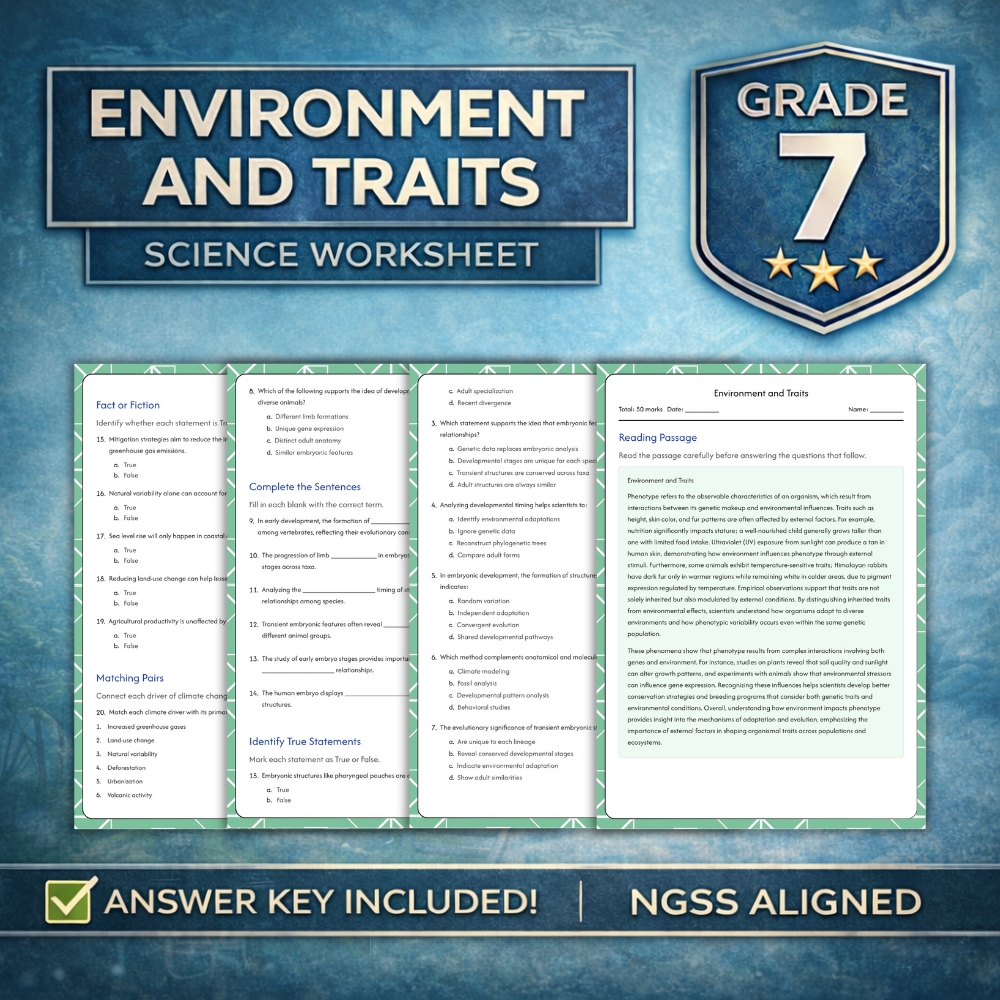
7th Grade Science | Environment and Traits NGSS Worksheet (Printable PDF)
Created byCedar Grove LearningLearning Objectives
- Understand how phenotype results from interactions between genetic makeup and environmental factors.
- Identify examples of traits influenced by environmental conditions.
- Distinguish between inherited genetic traits and environmentally modulated traits.
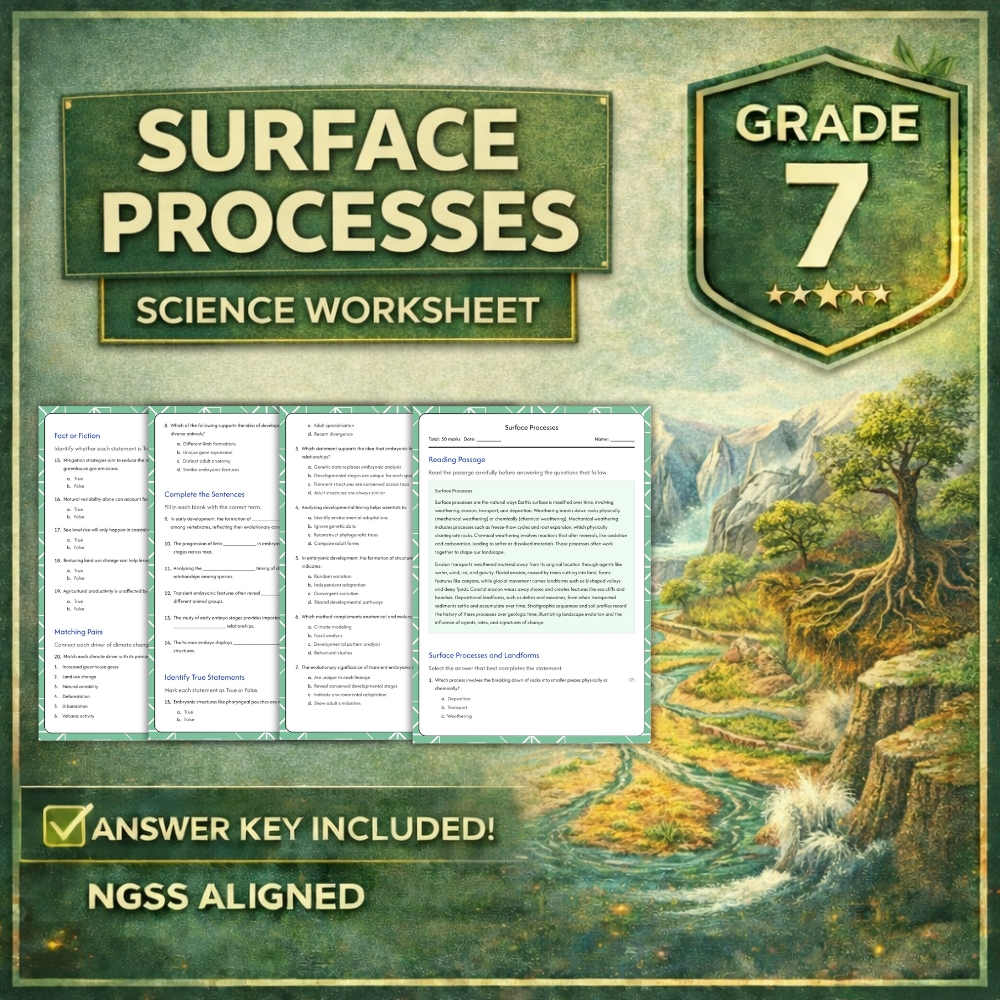
Grade 7 Science | Surface Processes Worksheet (NGSS-Aligned + Answer Key)
Created byCedar Grove LearningLearning Objectives
- Describe the key geologic processes that shape Earth's surface over short and long timescales.
- Distinguish between mechanical and chemical weathering and identify examples of each.
- Explain how erosion, transport, and deposition contribute to landscape features such as canyons, deltas, and landforms.
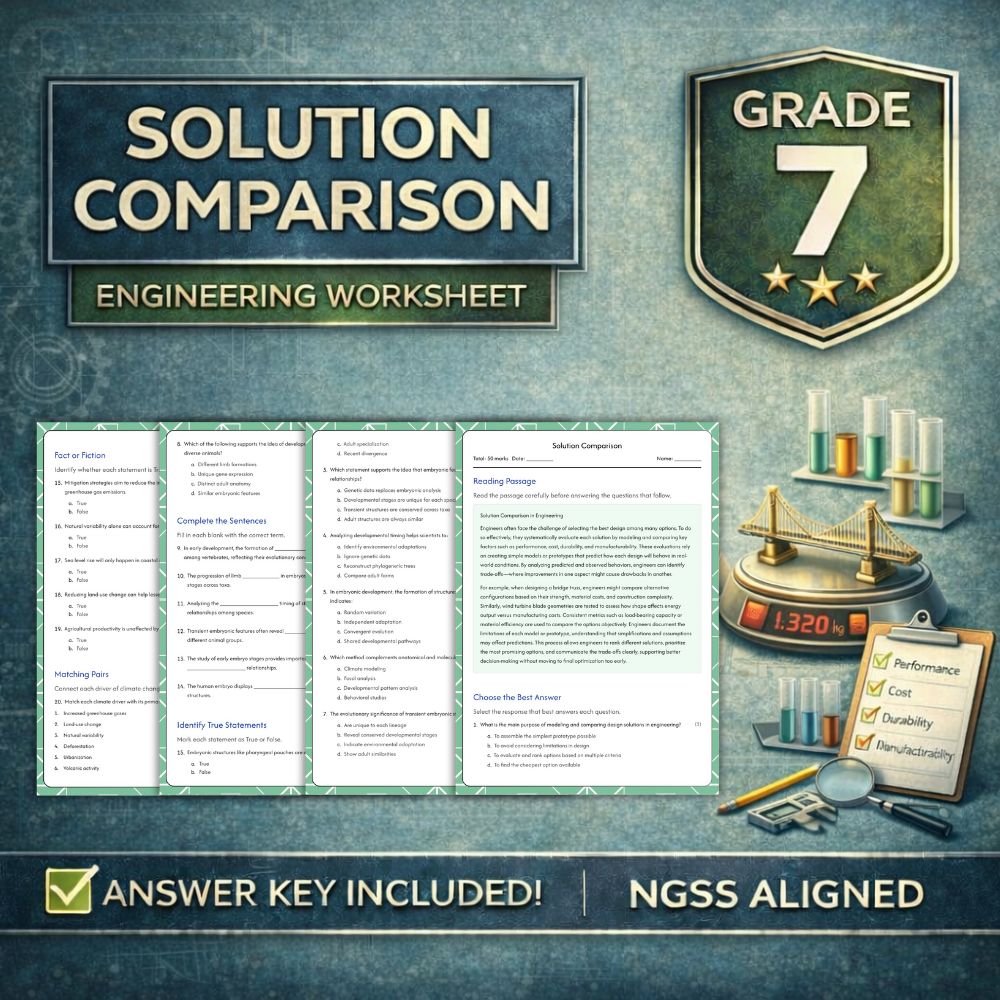
7th Grade Science | Solution Comparison NGSS Worksheet (Answer Key Included)
Created byCedar Grove LearningLearning Objectives
- Evaluate different design solutions by systematically comparing performance, cost, durability, and manufacturability.
- Analyze and model trade-offs among competing solution options using simple models and prototypes.
- Use consistent metrics and reasoning to rank options and identify limitations in design evaluations.
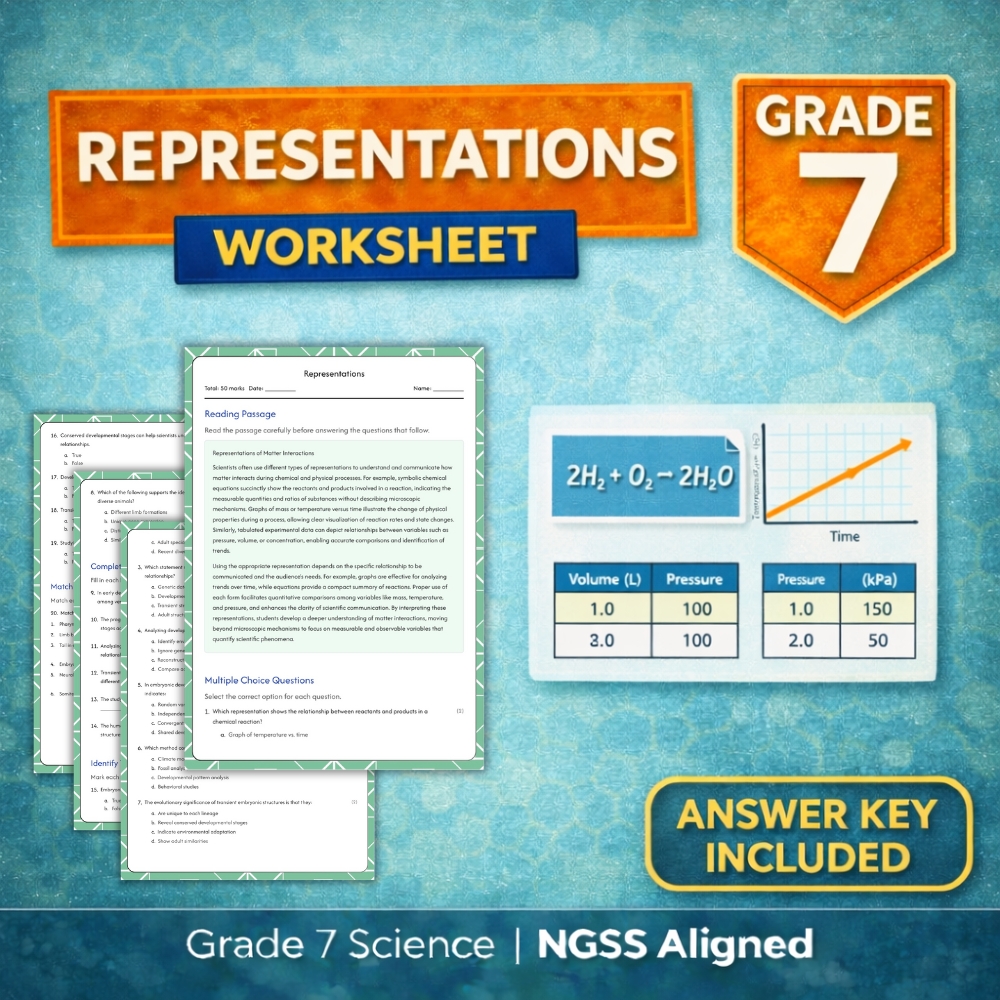
7th Grade Science | Representations Worksheet (NGSS) Printable PDF
Created byCedar Grove LearningLearning Objectives
- Describe how different representations convey matter interactions.
- Interpret and analyze symbolic chemical equations, graphs, and tabulated data.
- Select appropriate representations to compare quantities and express relationships.
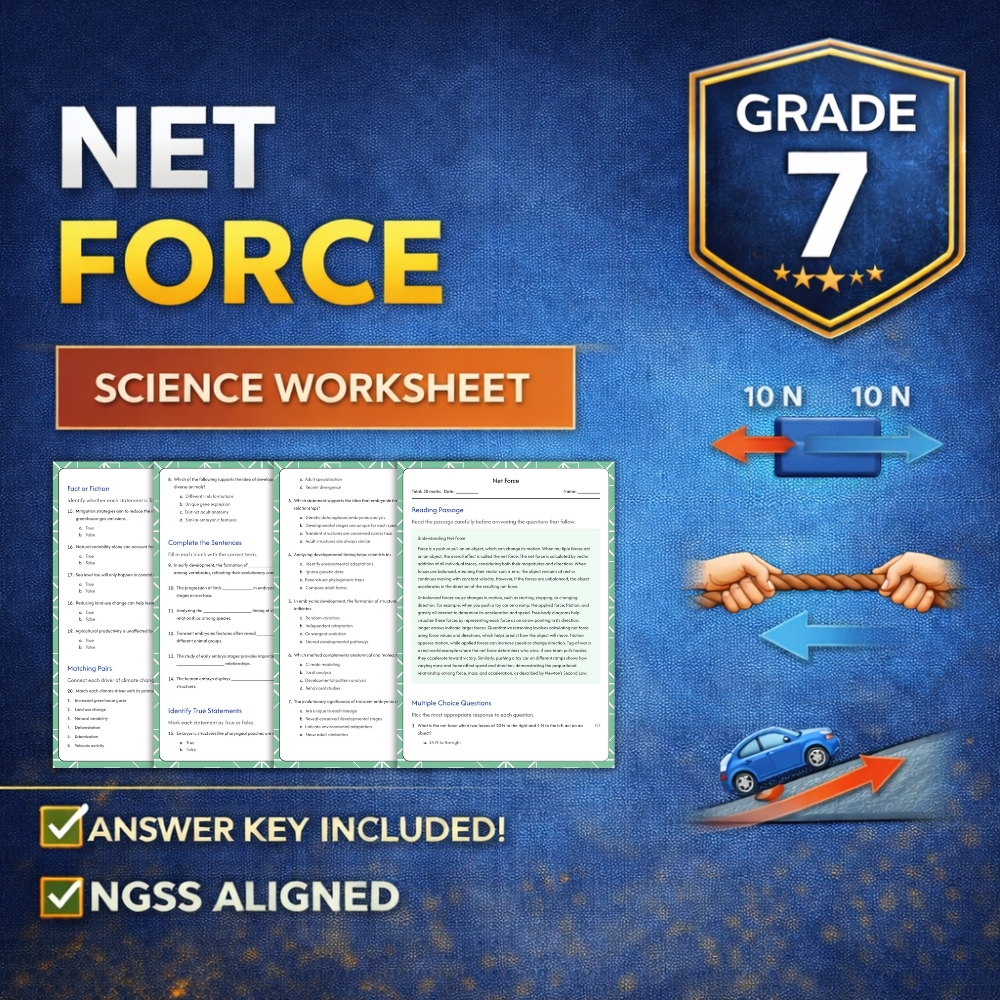
7th Grade Science | Net Force Practice Worksheet (Answer Key Included)
Created byCedar Grove LearningLearning Objectives
- Define net force as the vector sum of all forces acting on an object.
- Explain how unbalanced forces cause changes in motion.
- Use free-body diagrams and quantitative reasoning to analyze forces.
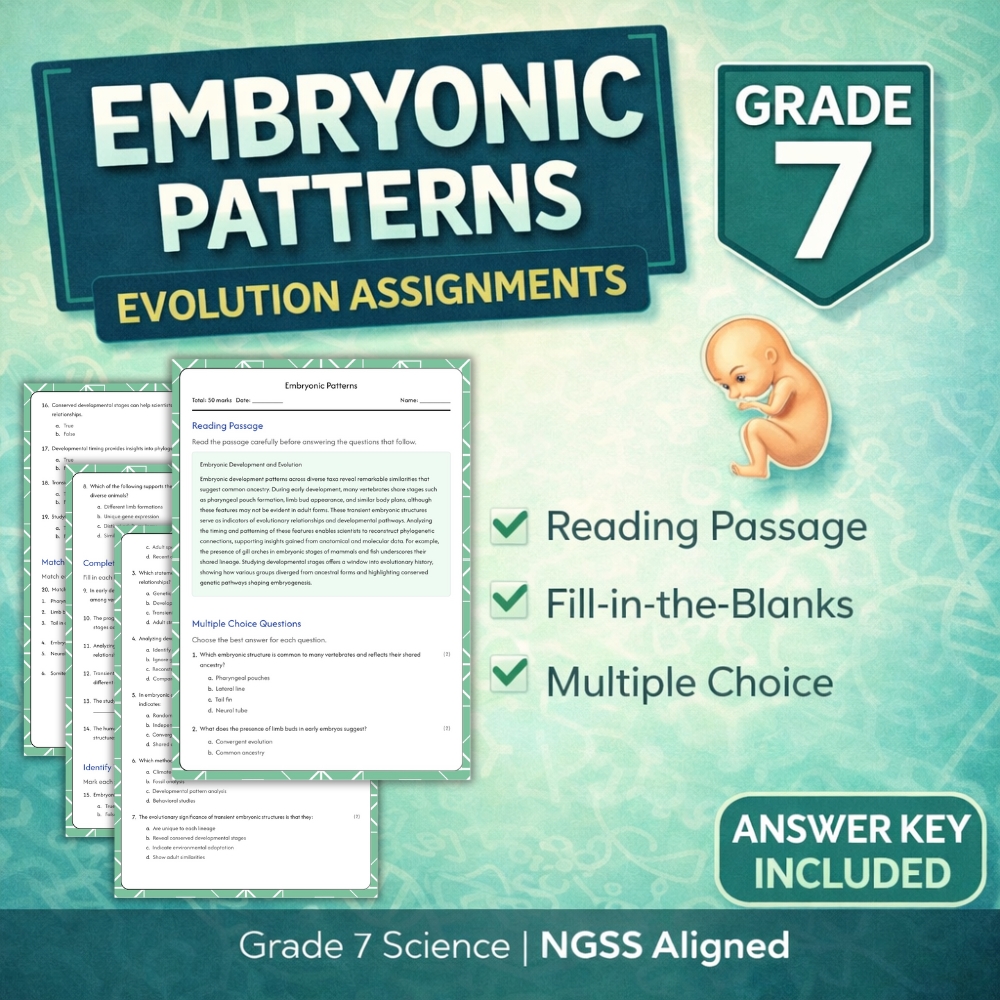
Grade 7 Science | Embryonic Patterns NGSS Worksheet (Answer Key) PDF
Created byCedar Grove LearningLearning Objectives
- Compare and identify developmental stages across different animal taxa.
- Explain the significance of conserved embryonic structures in evolutionary relationships.
- Analyze how patterning and timing support phylogenetic reconstruction.
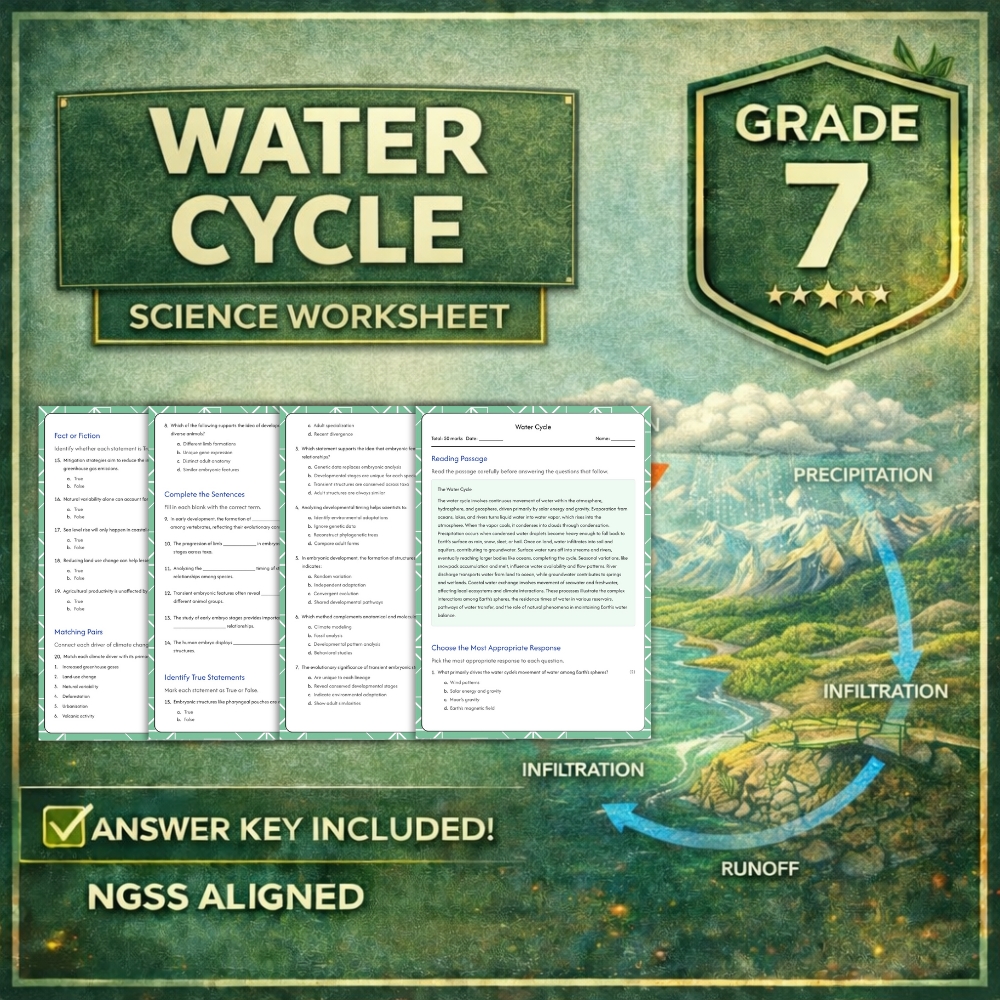
Grade 7 Science | Water Cycle Worksheet (NGSS) – Printable PDF & Answer Key
Created byCedar Grove LearningLearning Objectives
- Describe the key processes in the water cycle such as evaporation, condensation, and precipitation.
- Explain the interactions among Earth's atmosphere, hydrosphere, and geosphere in water movement.
- Identify pathways like river discharge, groundwater flow, and snowpack to understand water transfer.
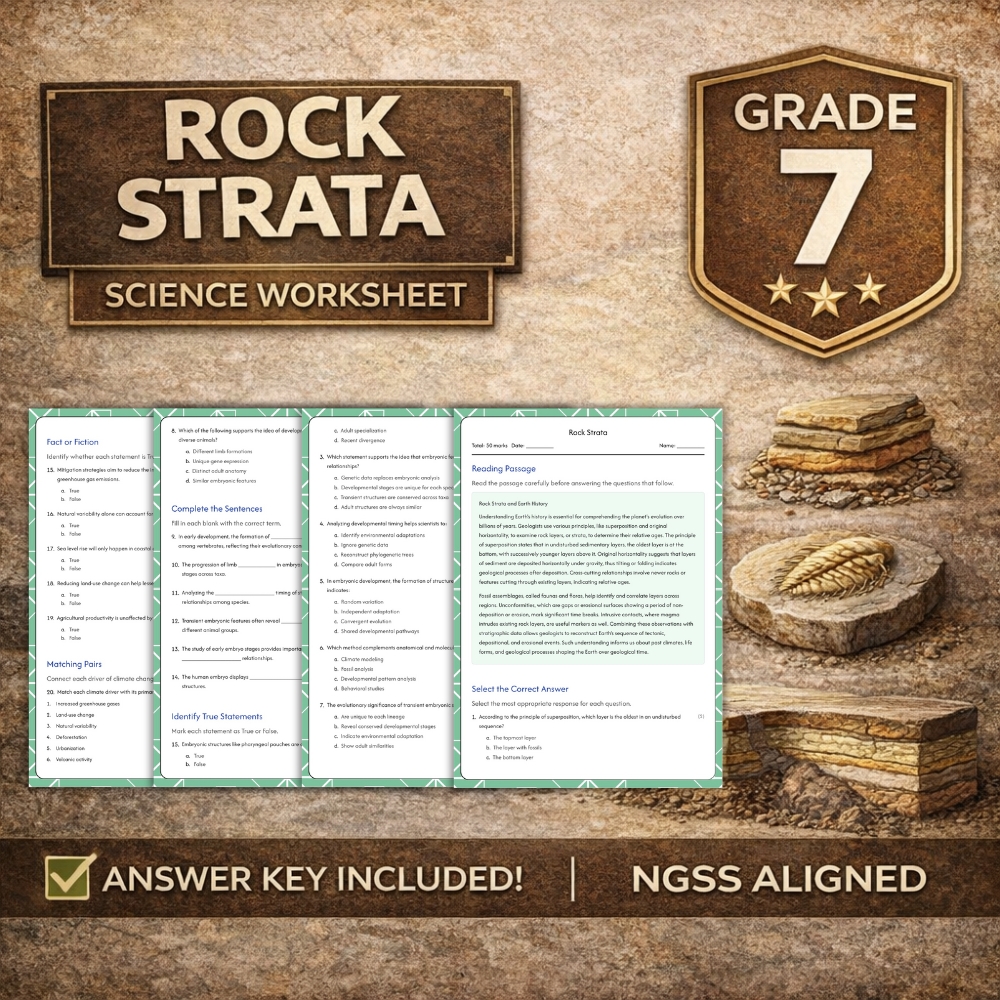
7th Grade Science | Rock Strata Worksheet (NGSS & Answer Key Included)
Created byCedar Grove LearningLearning Objectives
- Understand the principles of relative dating such as superposition, original horizontality, and cross-cutting relationships.
- Identify how fossils, unconformities, and intrusive contacts serve as markers for correlating rock layers.
- Explain how stratigraphic data can be used to construct sequences of Earth’s geological events.
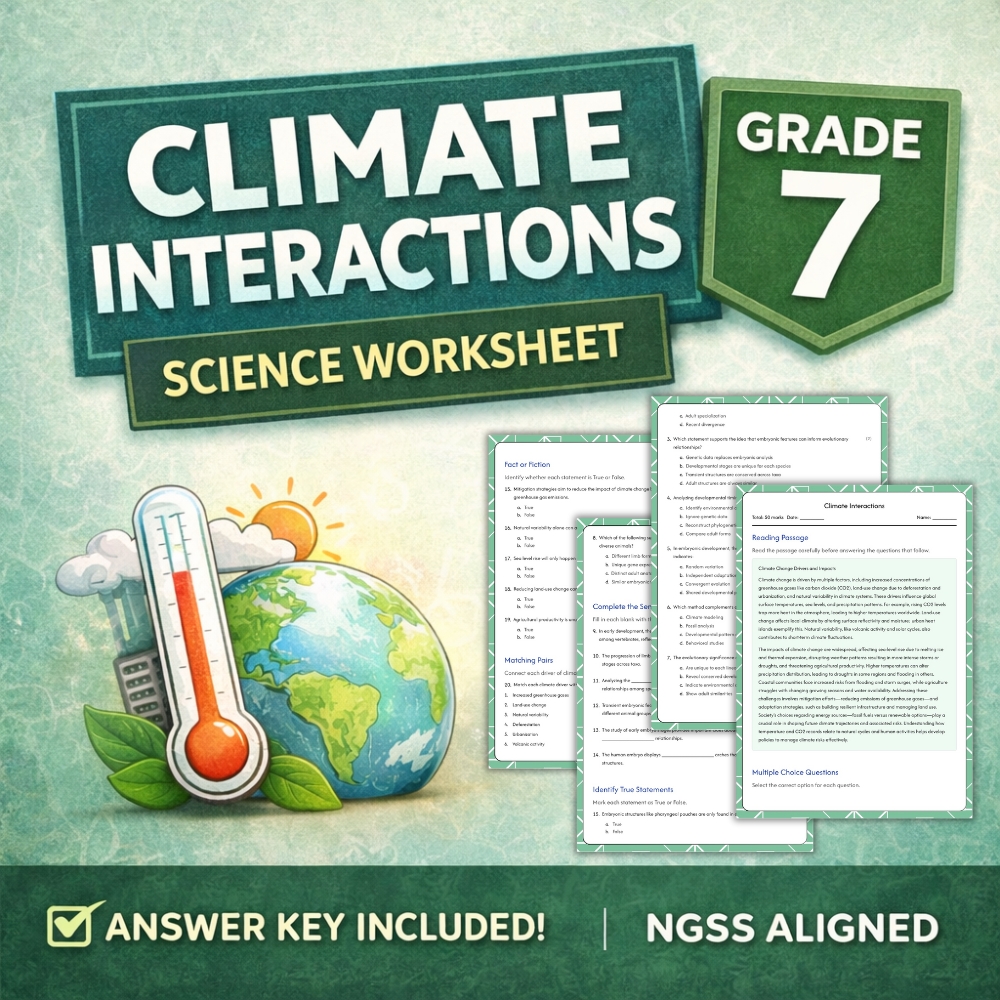
Grade 7 Science | Climate Interactions Worksheet (NGSS) Practice & Assessment
Created byCedar Grove LearningLearning Objectives
- Analyze evidence for climate change drivers such as greenhouse gas concentrations and land-use change.
- Assess impacts of climate change on sea levels, weather patterns, and agriculture.
- Interpret temperature and CO2 records and understand their role in climate systems.
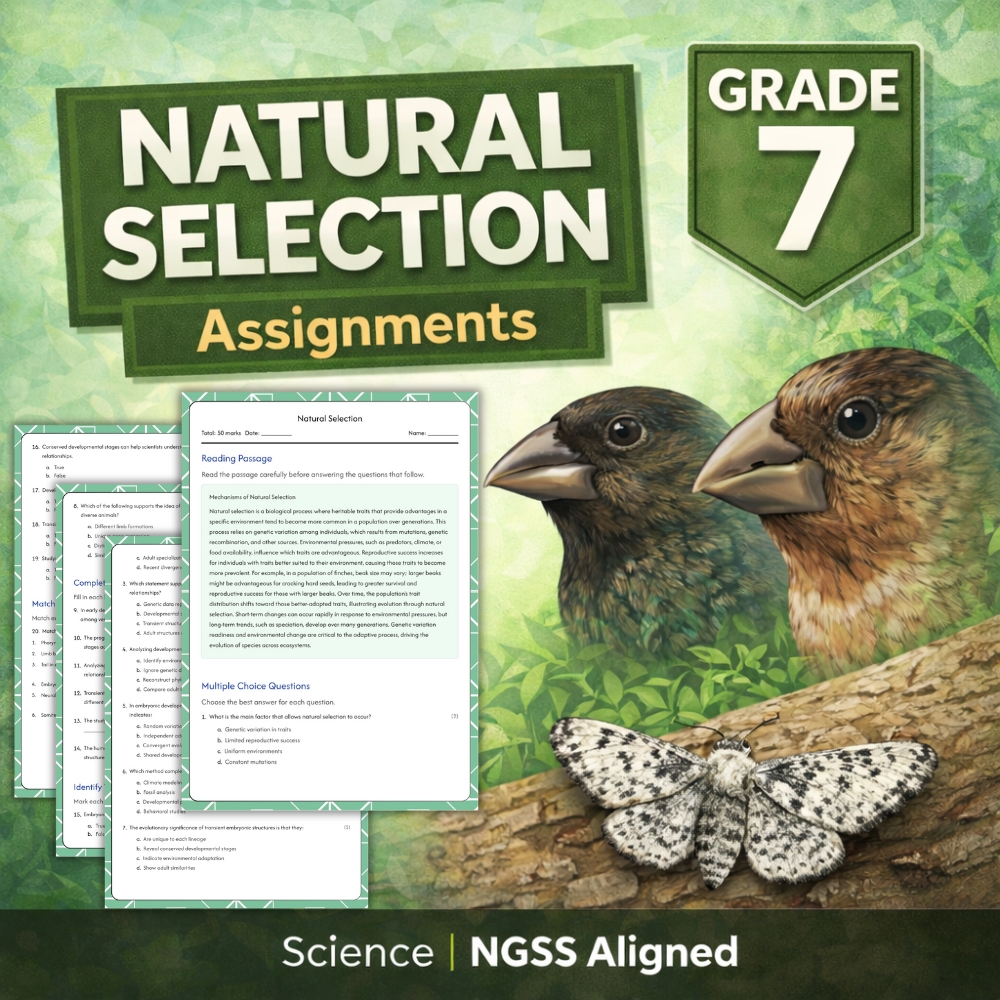
Grade 7 Science | Natural Selection (Worksheet + Answer Key) NGSS Aligned
Created byCedar Grove LearningLearning Objectives
- Describe how heritable variation and environmental pressures influence natural selection.
- Explain how differential survival and reproduction lead to adaptation over generations.
- Identify examples of natural selection, such as antibiotic resistance and beak size variation.
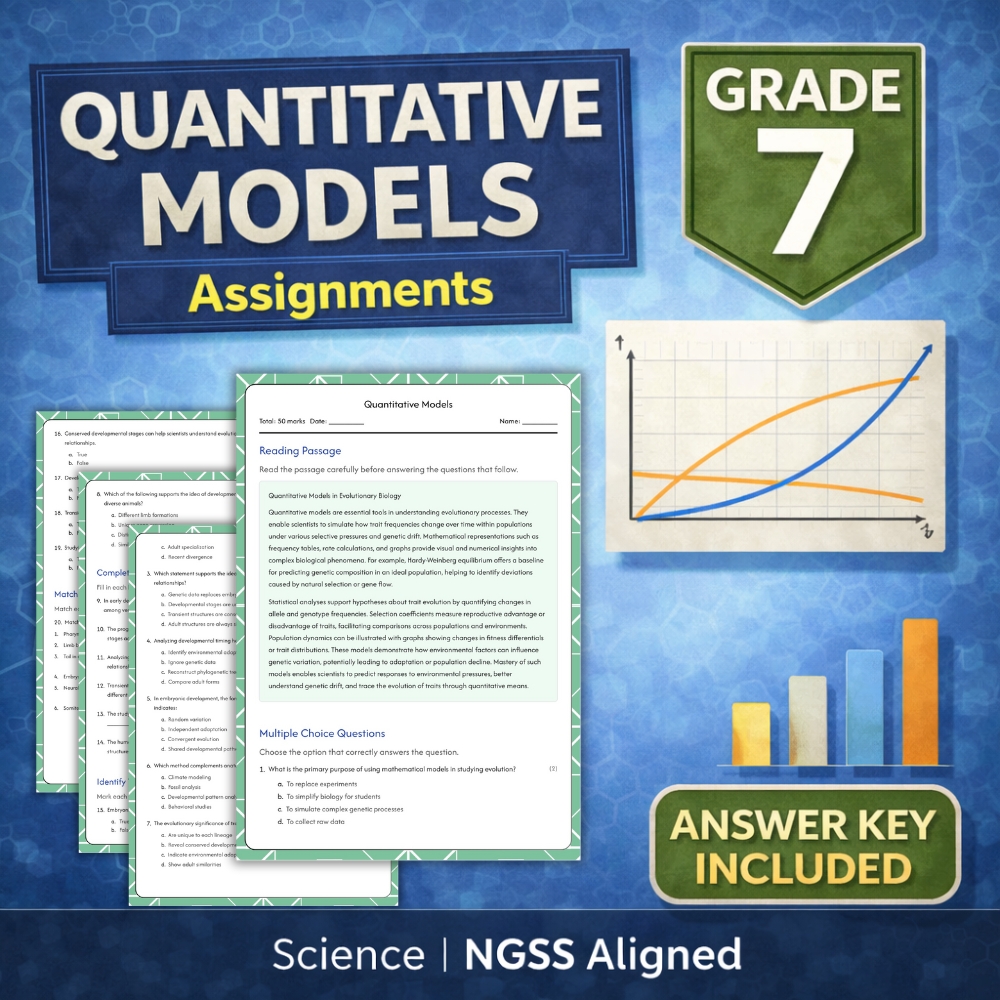
Grade 7 Science | Quantitative Models | NGSS Worksheet (Answer Key) PDF
Created byCedar Grove LearningLearning Objectives
- Describe how mathematical and statistical tools support understanding evolutionary processes.
- Analyze allele frequency changes, trait distributions, and population dynamics using models.
- Apply Hardy-Weinberg principles, rate calculations, and graphs to interpret genetic data.

Design Optimization Worksheet | NGSS Grade 7 Science Assessment
Created byCedar Grove LearningLearning Objectives
- Analyze test data to identify factors affecting design performance.
- Refine design parameters through iterative testing and data comparison.
- Use quantitative data to justify modifications that improve design within constraints.
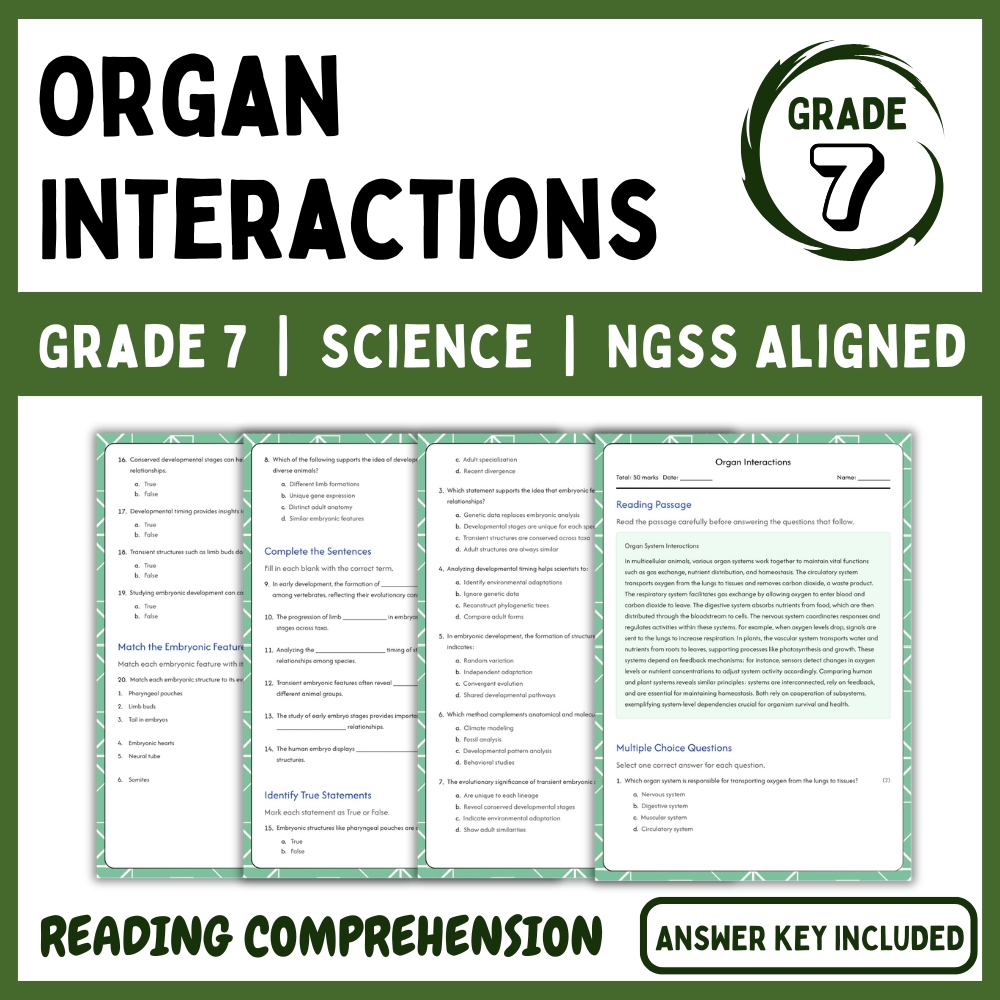
Grade 7 Science | Organ Interactions NGSS Worksheet PDF & Answer Key
Created byCedar Grove LearningLearning Objectives
- Describe the structure and function of major organ systems in multicellular animals.
- Explain how organ systems interact to support processes like gas exchange, nutrient transport, and homeostasis.
- Compare system interactions in mammals and plants, highlighting system dependencies and feedback mechanisms.
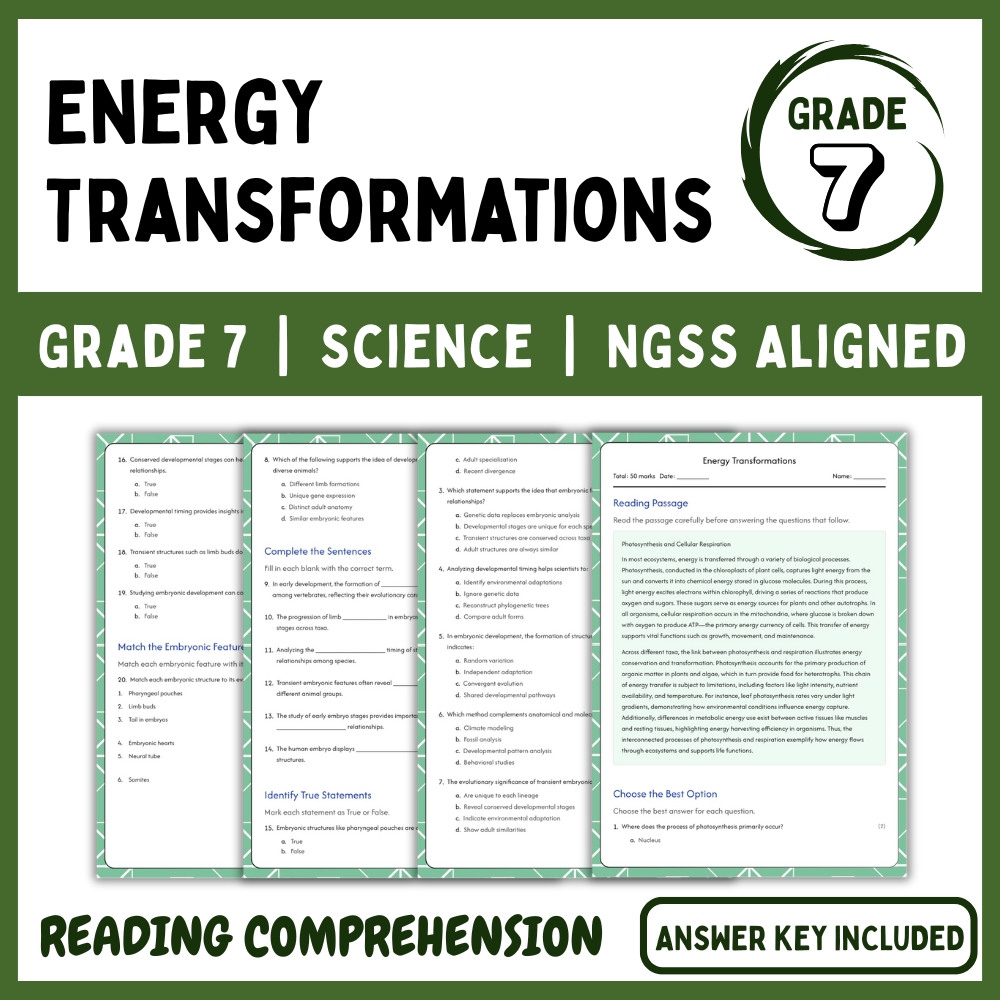
Grade 7 Science | Energy Transformations Worksheet (NGSS & Answer Key)
Created byCedar Grove LearningLearning Objectives
- Describe how light energy is converted into chemical energy during photosynthesis
- Explain how organisms harvest energy from food through cellular respiration
- Connect chloroplast-based sugar production with mitochondrial ATP generation across different taxa
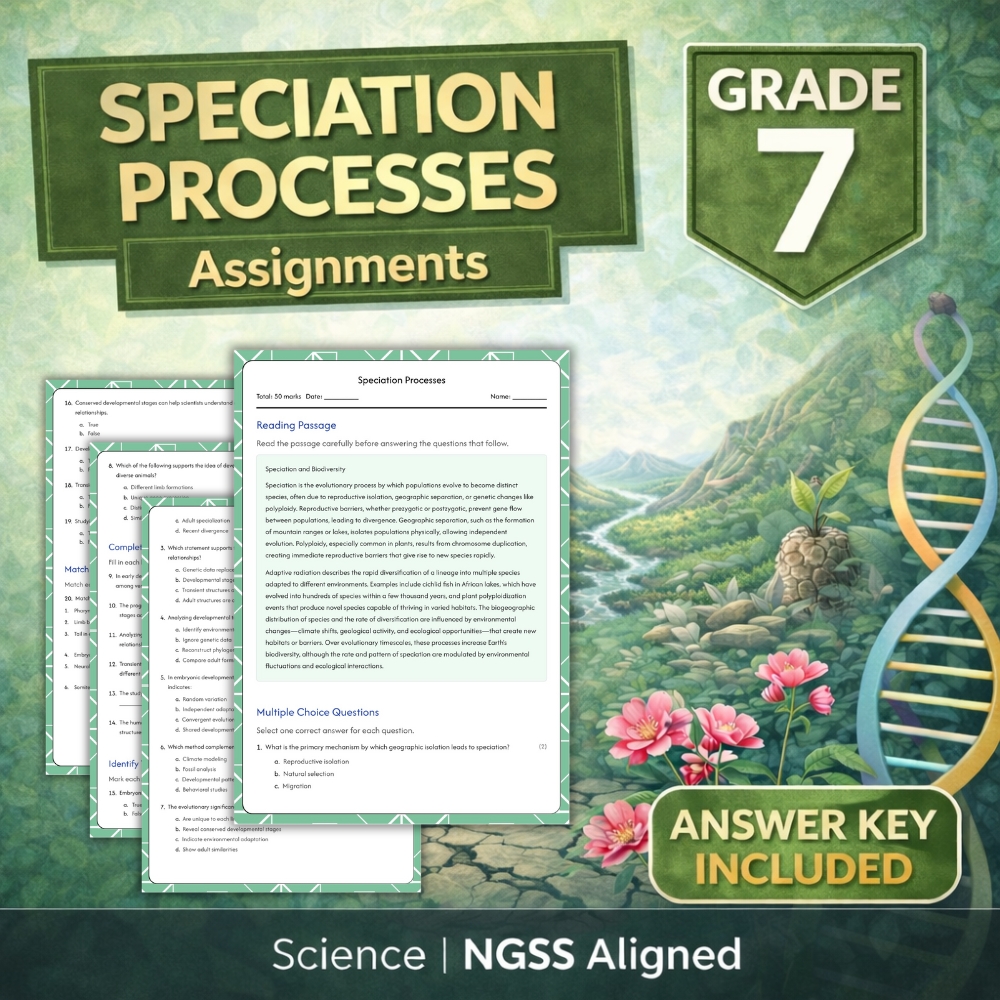
Grade 7 Science | Speciation Processes Worksheet (Answer Key) – NGSS Standards
Created byCedar Grove LearningLearning Objectives
- Describe the processes that lead to the formation of new species, including reproductive isolation and geographic separation.
- Explain how polyploidy and adaptive radiation contribute to biodiversity.
- Analyze examples of speciation such as cichlid radiations in African lakes and plant polyploidization.
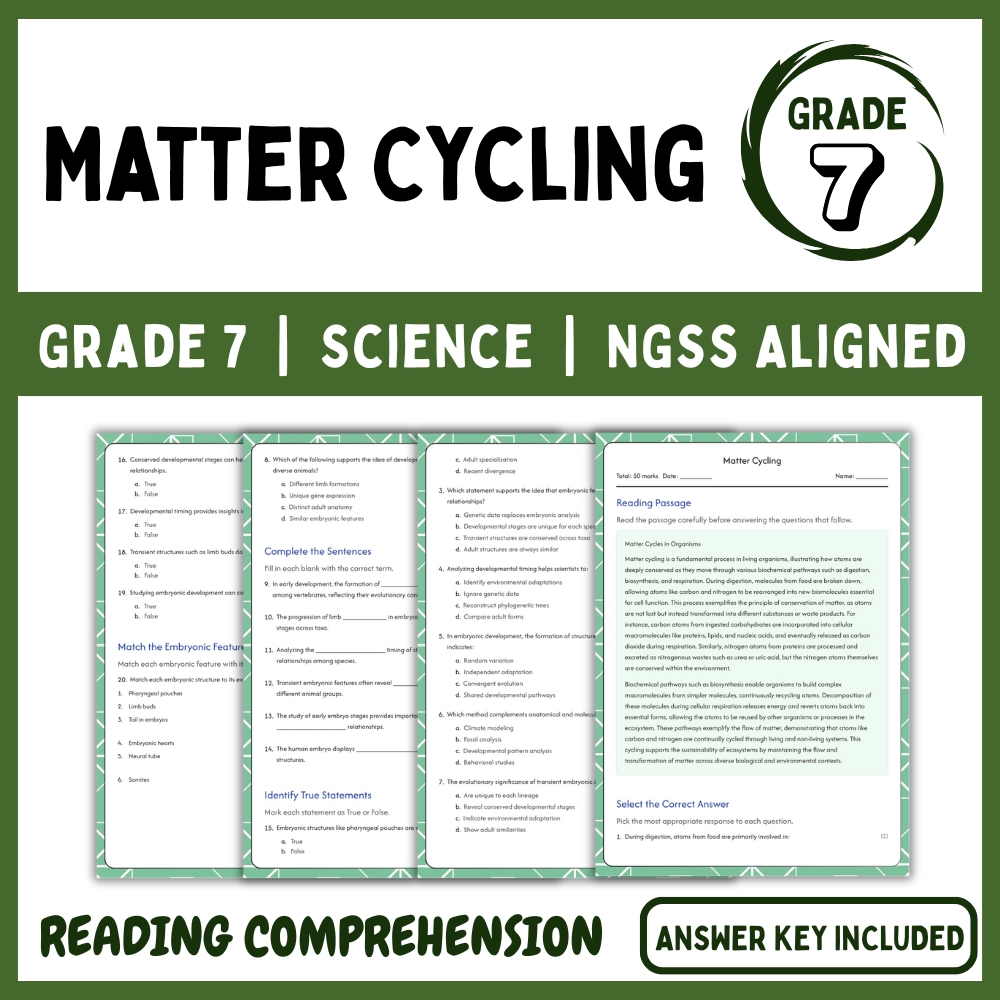
Grade 7 Science | Matter Cycling Worksheet (NGSS Practice & Assessment PDF)
Created byCedar Grove LearningLearning Objectives
- Describe how atoms are rearranged during digestion, biosynthesis, and respiration within organisms.
- Explain the conservation of matter during biochemical pathways like macromolecule synthesis and decomposition.
- Identify examples of carbon and nitrogen flow in biological processes.
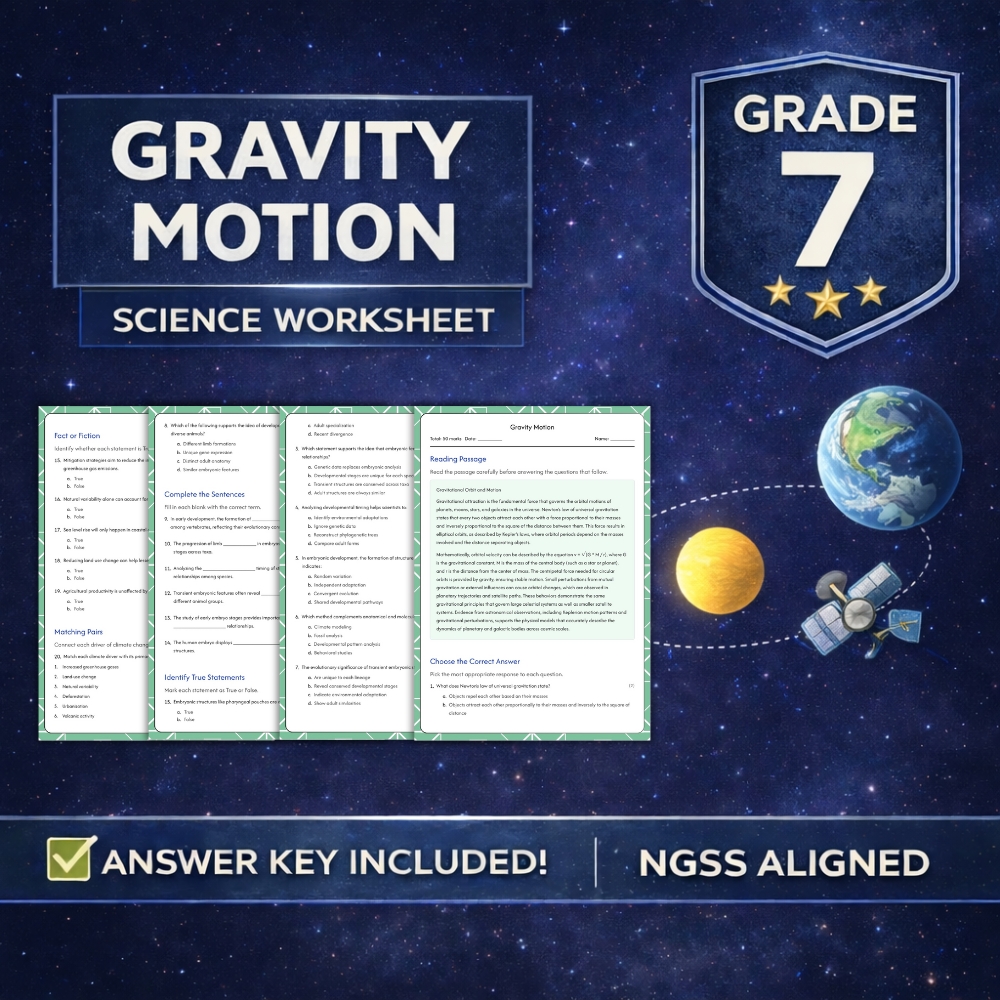
7th Grade Science | Gravity Motion Worksheet (NGSS Practice & Assessment PDF)
Created byCedar Grove LearningLearning Objectives
- Understand how gravity influences orbital motion within the solar system and galaxies.
- Explain the mathematical relationships that describe orbital velocity and centripetal force.
- Recognize observational evidence, such as orbital trajectories and Keplerian patterns, supporting gravitational motion theories.
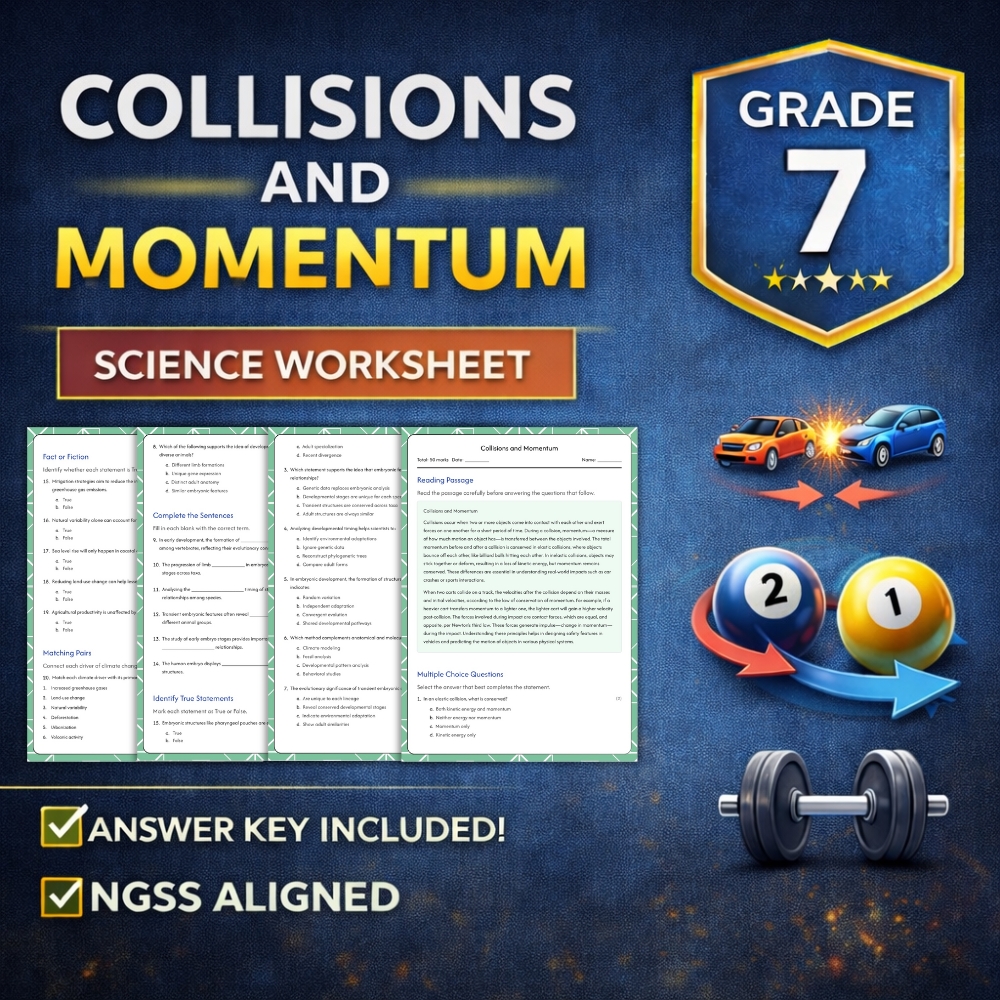
7th Grade Science | Collisions and Momentum Worksheet (NGSS Aligned +Answer Key)
Created byCedar Grove LearningLearning Objectives
- Explain how momentum is transferred during different types of collisions.
- Compare elastic and inelastic collisions and identify examples of each.
- Apply the principle of conservation of momentum to predict outcomes of collisions.
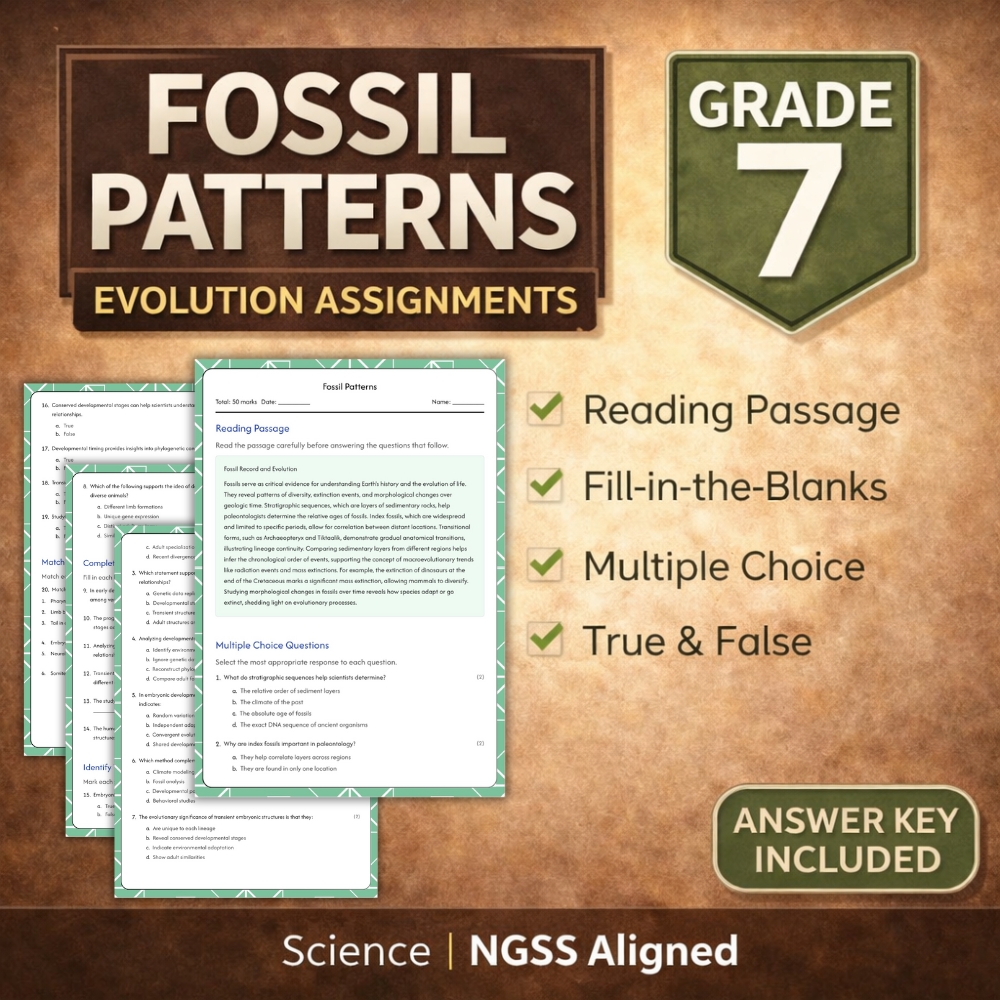
Grade 7 Science – Fossil Patterns & Evolution NGSS Worksheet (Answer Key)
Created byCedar Grove LearningLearning Objectives
- Identify different types of fossil evidence and their significance in studying evolutionary history.
- Analyze patterns of extinction, morphological change, and lineage continuity through fossil records.
- Understand stratigraphic sequencing, index fossils, and transitional forms in paleontology.
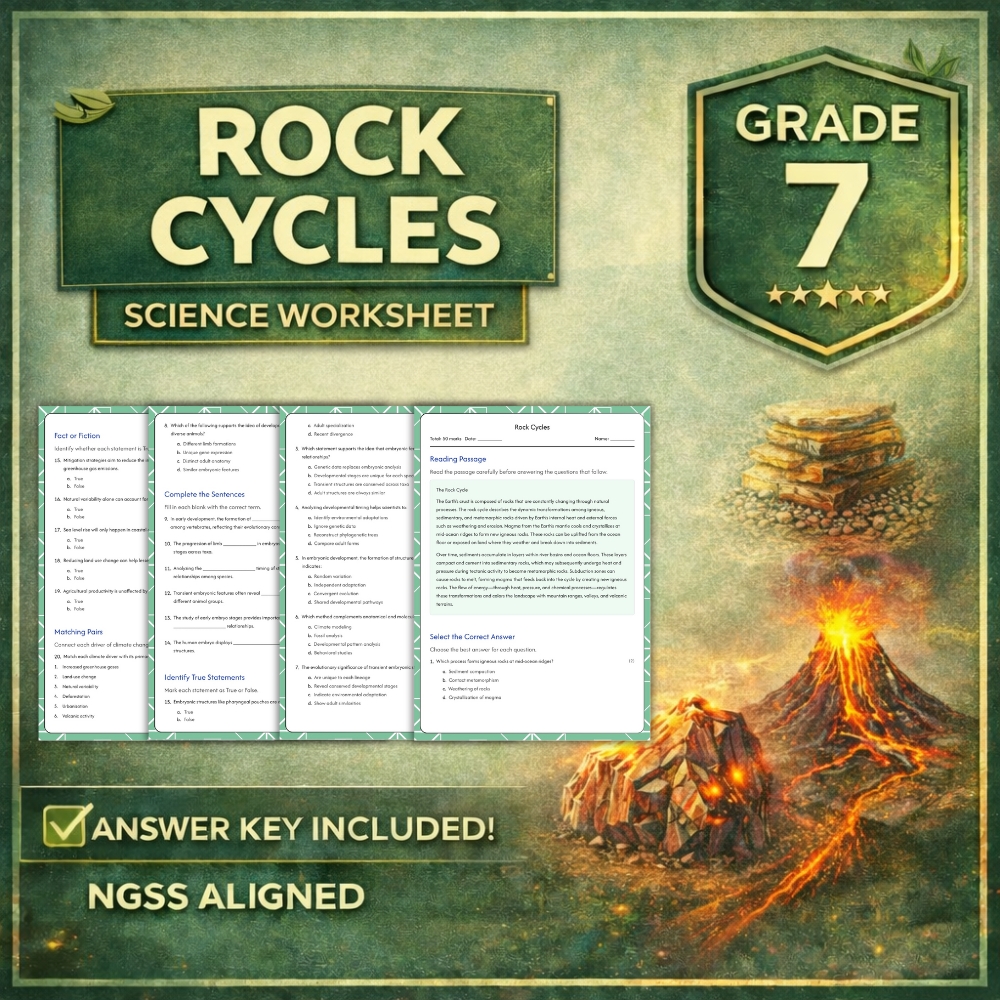
7th Grade Science | Rock Cycles Worksheet (NGSS Aligned) & Answer Key
Created byCedar Grove LearningLearning Objectives
- Describe the processes involved in the transformation of Earth's rocks within the rock cycle.
- Explain how geological forces such as melting, crystallization, weathering, and metamorphism contribute to rock transformations.
- Identify the examples and pathways that demonstrate the flow of energy driving the rock cycle.
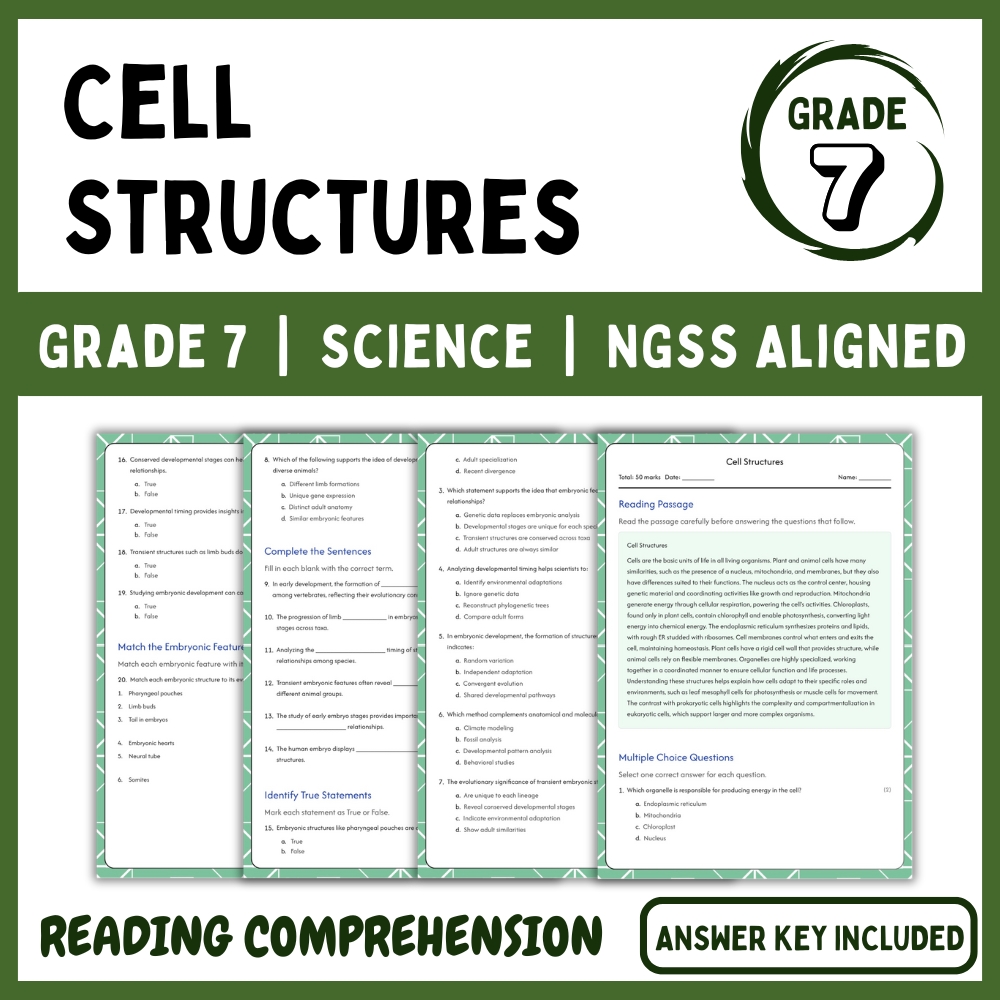
7th Grade Science | Cell Structures Worksheet (NGSS Practice & Review)
Created byCedar Grove LearningLearning Objectives
- Identify and describe the functions of key organelles in plant and animal cells.
- Differentiate between eukaryotic and prokaryotic cell organization.
- Connect cell structure features to their roles in processes like transport, synthesis, and compartmentalization.
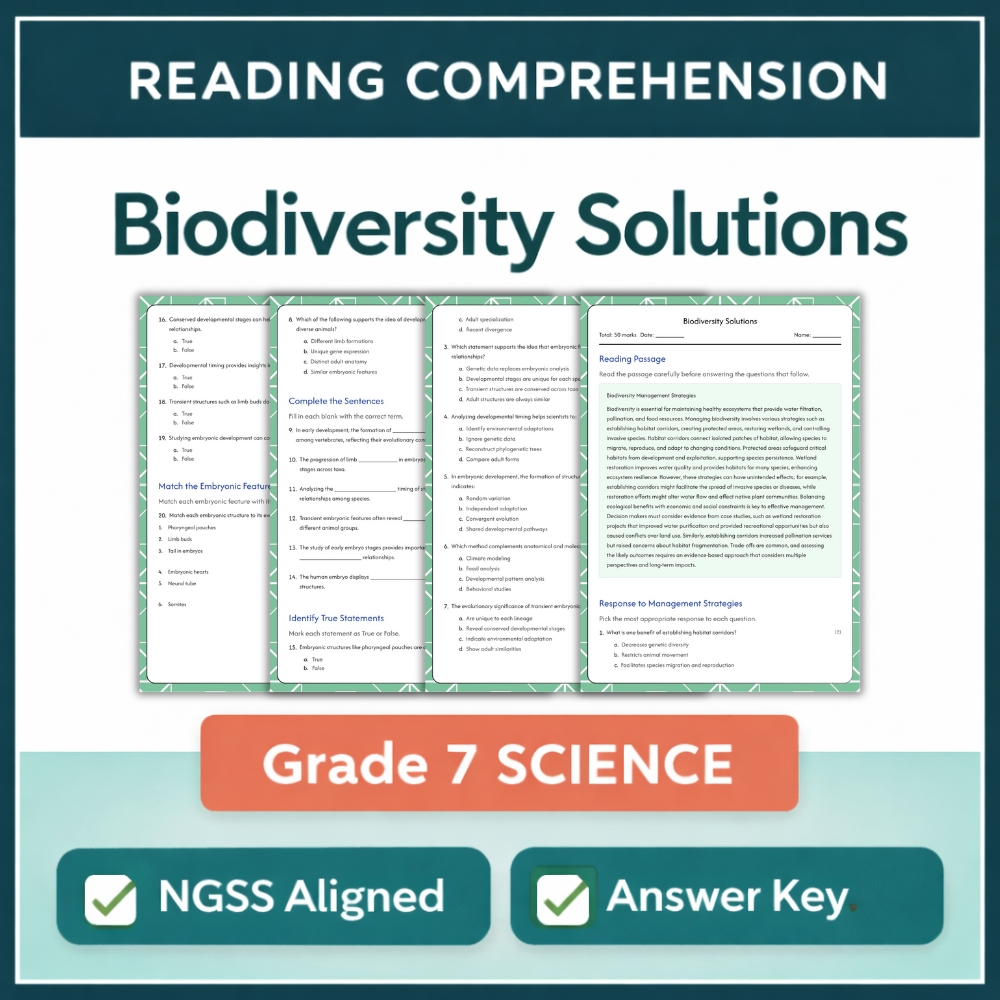
7th Grade Science | Biodiversity Solutions Worksheet – NGSS Practice PDF
Created byCedar Grove LearningLearning Objectives
- Explain management strategies used to maintain biodiversity and ecosystems.
- Evaluate trade-offs and unintended consequences of conservation approaches.
- Compare case examples of wetland restoration and habitat corridors.
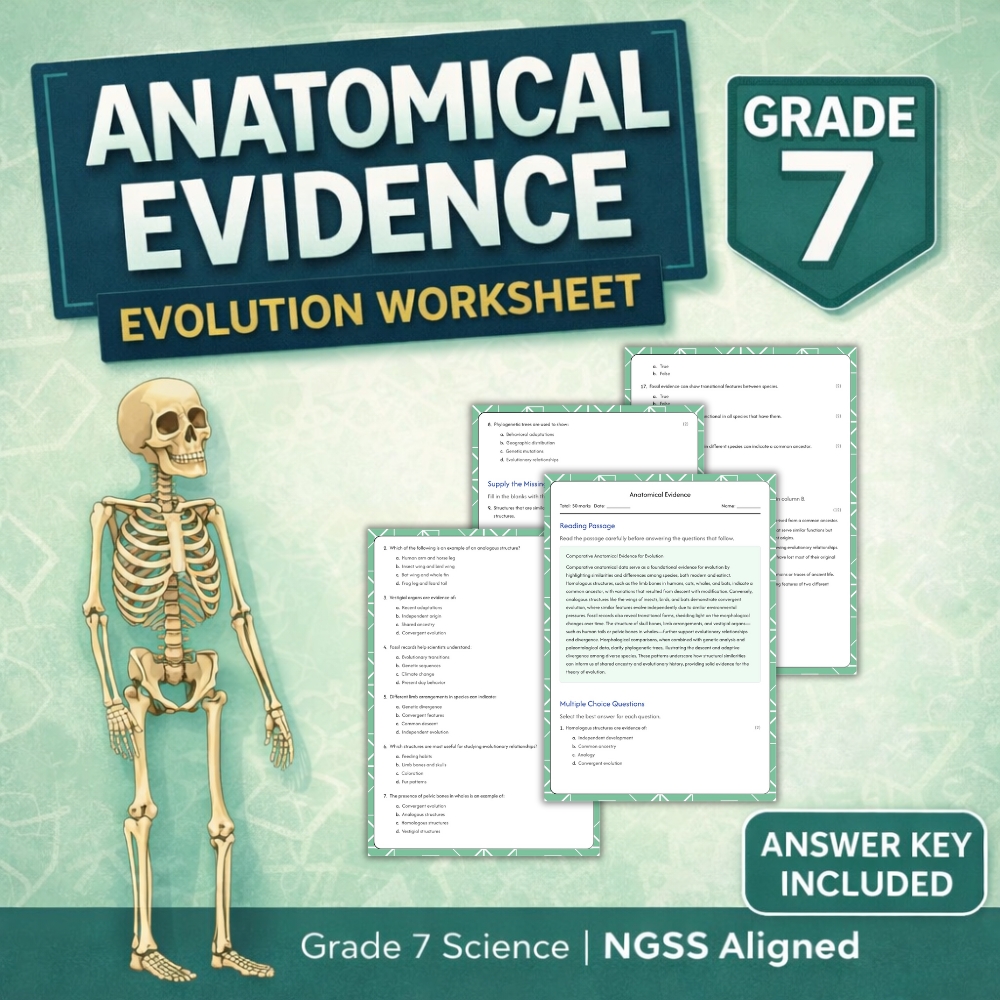
Grade 7 Science | Anatomical Evidence Worksheet (Answer Key) | NGSS Aligned
Created byCedar Grove LearningLearning Objectives
- Understand how comparative anatomical data provide evidence for evolution.
- Identify homologous and analogous structures among modern and fossil species.
- Analyze limb bone arrangements, skull morphology, and vestigial organs to infer evolutionary relationships.
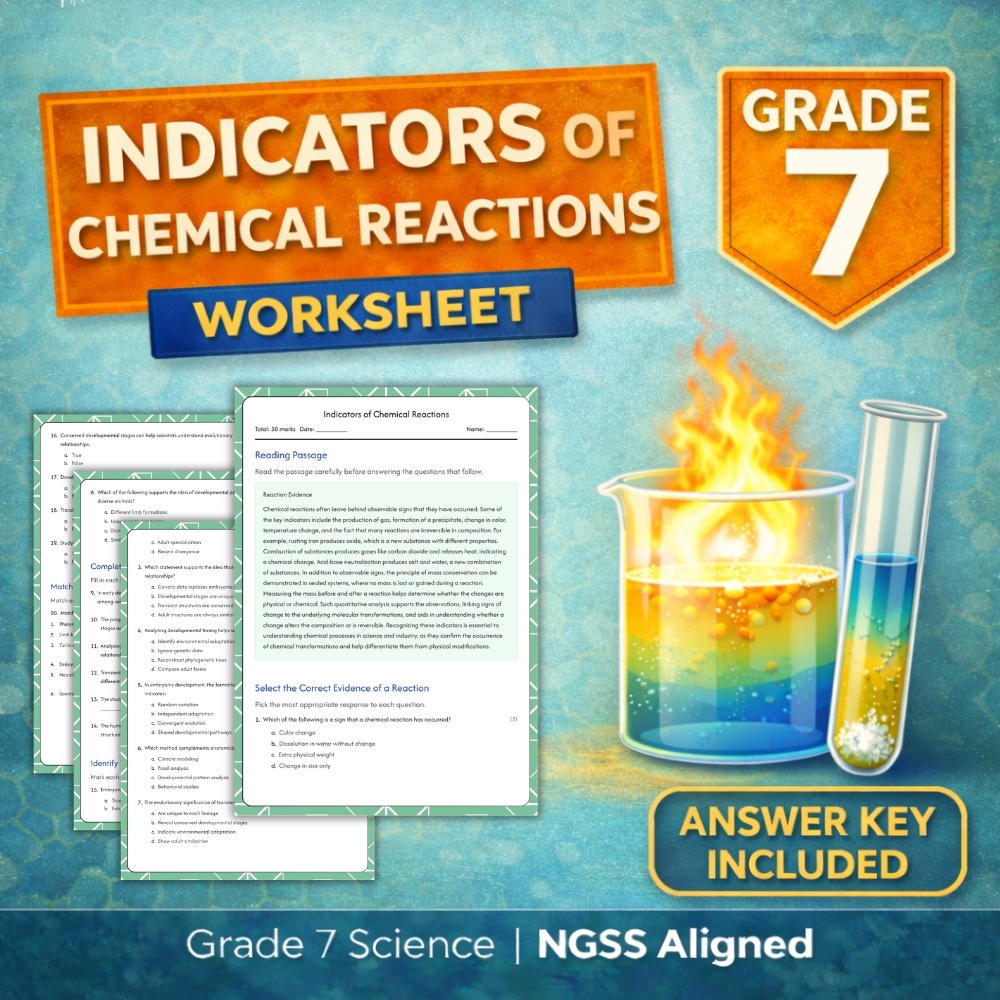
7th Grade Science | Indicators of Chemical Reactions Worksheet (NGSS) PDF
Created byCedar Grove LearningLearning Objectives
- Identify observable signs that indicate a chemical reaction has taken place.
- Describe different indicators such as gas production, precipitate formation, color change, temperature change, and irreversibility.
- Explain examples of chemical reactions including rusting, combustion, and acid–base neutralization.

Orbital Motion Worksheet | NGSS Grade 9 Science assessment printable PDF
Learning Objectives
- Explain the basic principles of orbital motion and gravitational interactions.
- Describe Kepler's laws of planetary motion and Newton's law of universal gravitation.
- Analyze the relationship between orbital period and semi-major axis in planetary and satellite orbits.
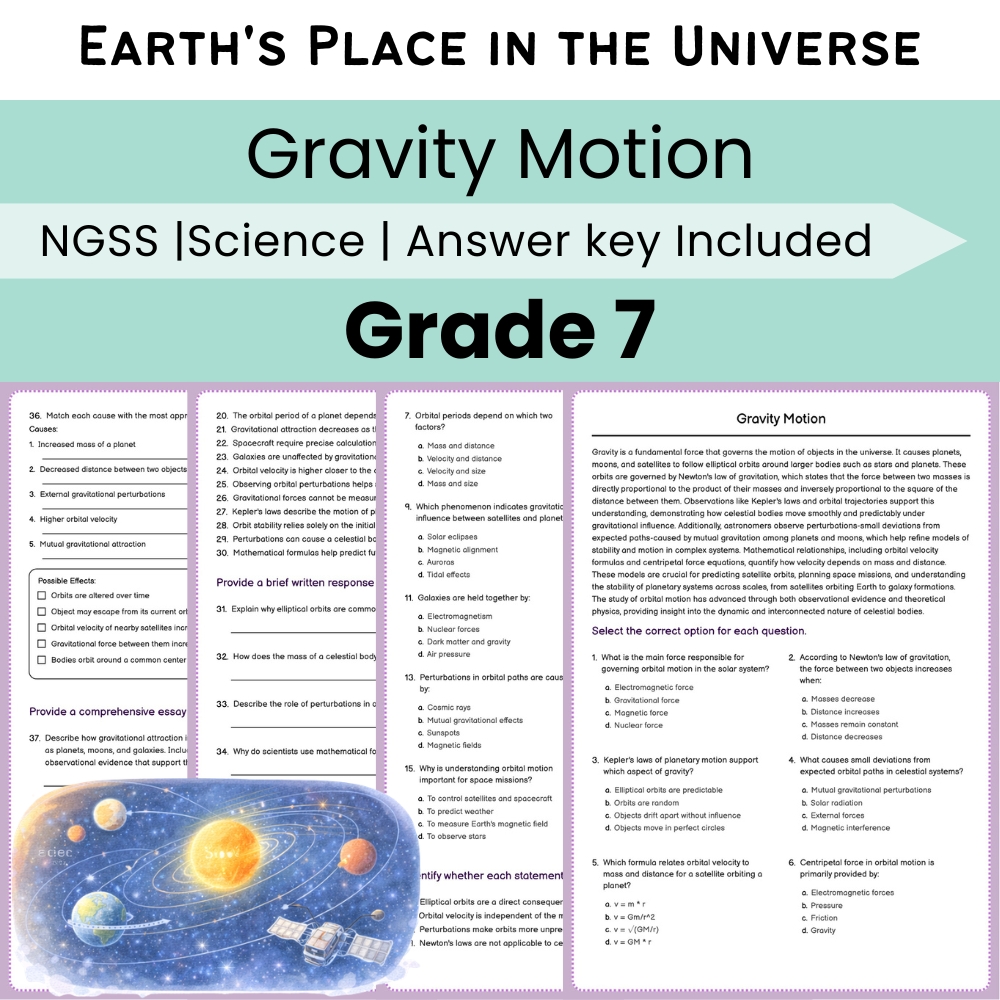
Gravity Motion Worksheet | Grade 7 Science Printable PDF Assessment
Learning Objectives
- Explain how gravitational attraction influences orbital motion within the solar system.
- Understand the mathematical relationships that describe orbital velocity and centripetal force.
- Identify observational evidence supporting theories of orbital motion, stability, and perturbations.
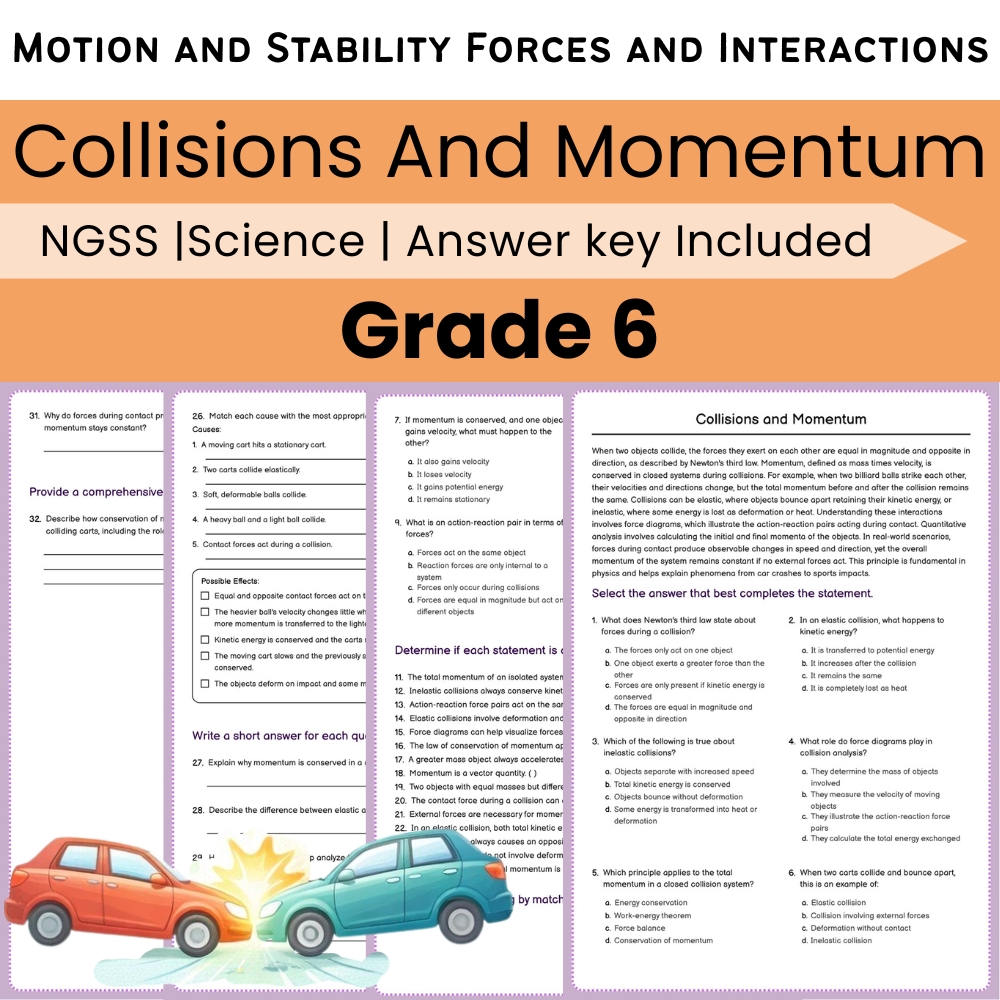
Collisions and Momentum Worksheet | Grade 6 Science NGSS Printable PDF
Learning Objectives
- Understand the law of conservation of momentum during two-body collisions.
- Identify the differences between elastic and inelastic collisions.
- Apply force diagrams to analyze action-reaction pairs during contact.

Population Models Worksheet | Grade 8 Science Printable PDF | NPSS
Learning Objectives
- Understand mathematical representations of population growth, including exponential and logistic models.
- Identify factors that influence population size such as resources, predation, and environmental capacity.
- Interpret graphical population curves and relate them to real-world scenarios like predator-prey cycles.
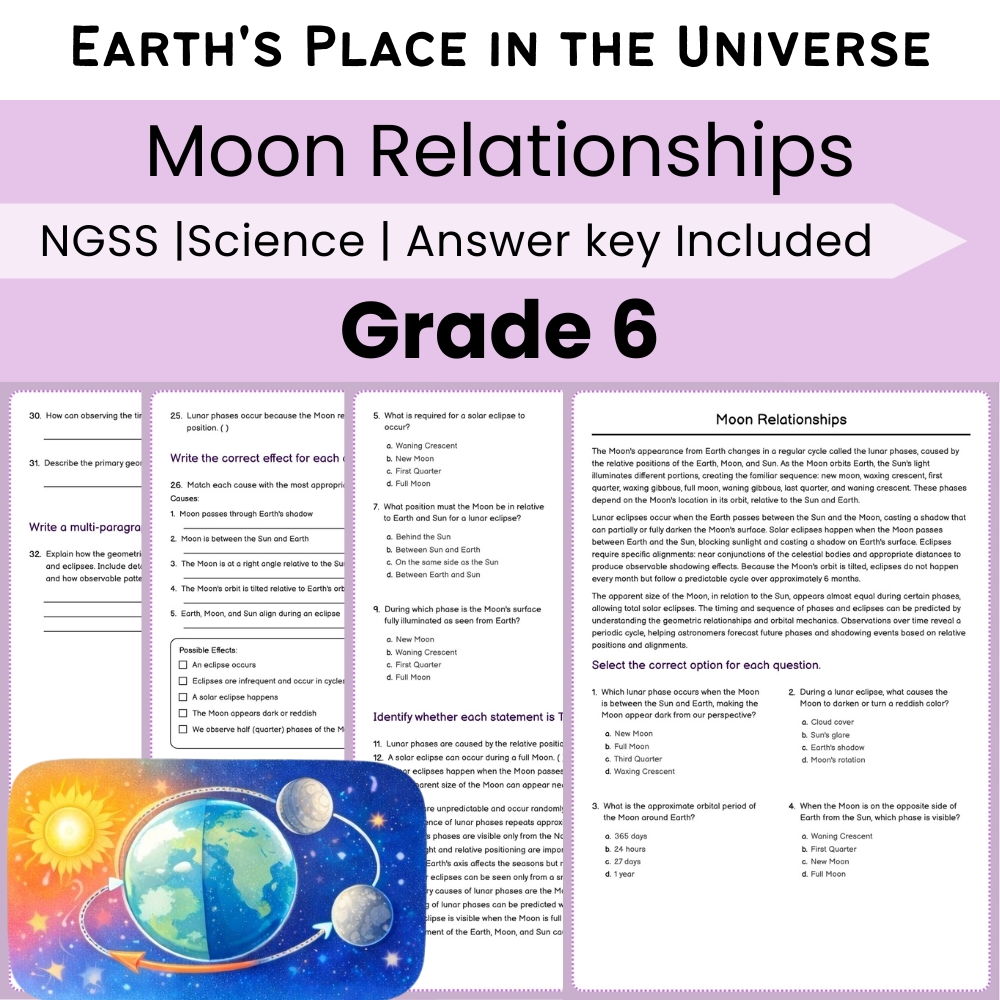
Moon Relationships Worksheet | NGSS Grade 6 Science Printable PDF
Learning Objectives
- Explain the geometric relationships among Earth, Moon, and Sun that produce lunar phases and eclipses.
- Identify the sequence of primary lunar phases and the conditions for solar and lunar eclipses.
- Describe how the apparent size and alignment of the Moon influence visibility of phases and eclipses.

Equilibrium Worksheet | Grade 7 Science Printable PDF | NGSS Aligned
Learning Objectives
- Define and characterize static and dynamic equilibrium in physical systems.
- Identify forces such as gravity, tension, and normal force involved in equilibrium scenarios.
- Use vector principles to analyze whether forces balance in different situations.

Mendelian Patterns Worksheet | Assessment & Student Practice Grade 8 Science
Learning Objectives
- Explain how dominant and recessive alleles influence observable traits.
- Predict genotypic and phenotypic ratios using Punnett squares.
- Describe allele segregation and its role in inheritance.
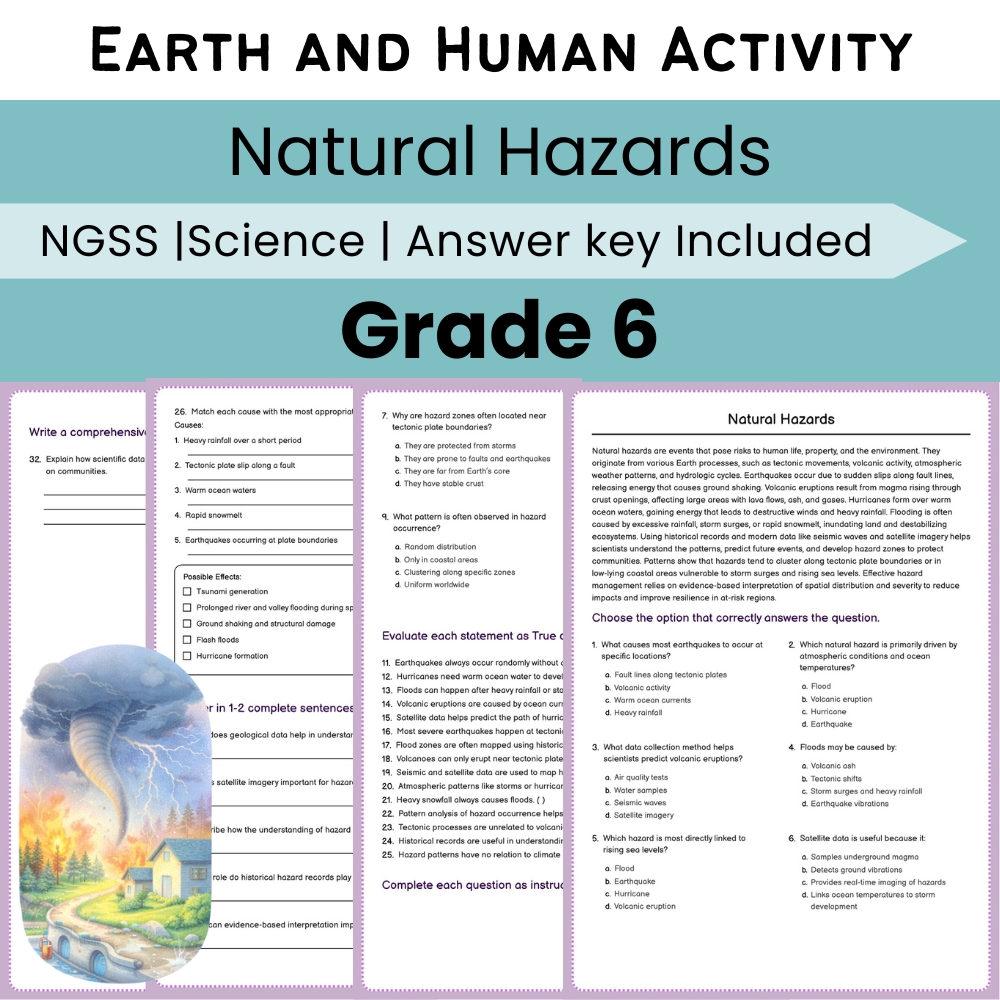
Natural Hazards Worksheet | Grade 6 Science Printable PDF & Assessment
Learning Objectives
- Understand the origins and patterns of natural hazards such as earthquakes, volcanoes, hurricanes, and floods.
- Analyze the effects of these hazards on communities and infrastructure.
- Evaluate relationships among tectonic, atmospheric, and hydrologic processes to explain hazard occurrence.
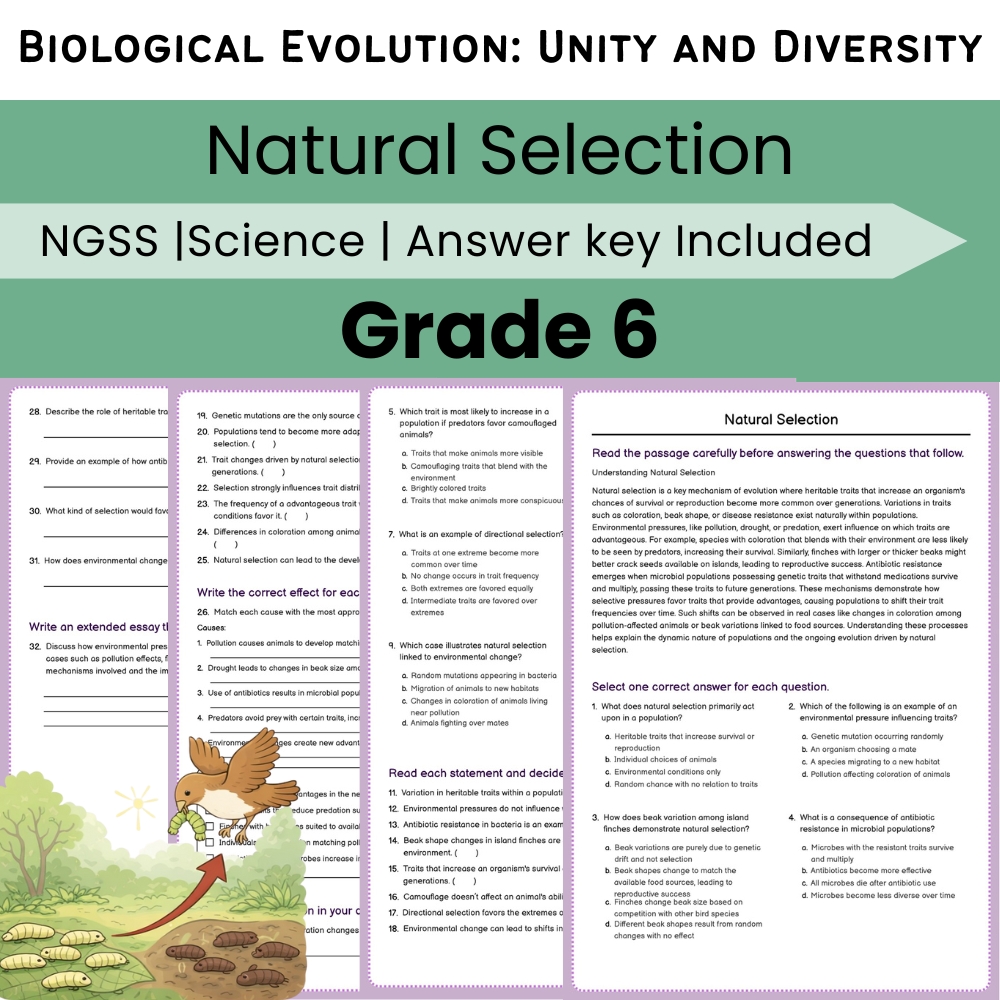
Grade 6 Science | Natural Selection Worksheet & Assessment (Printable PDF)
Learning Objectives
- Understand how heritable traits influence survival and reproduction.
- Identify examples of natural selection in environmental contexts.
- Explain how trait frequencies change over generations due to selection pressures.
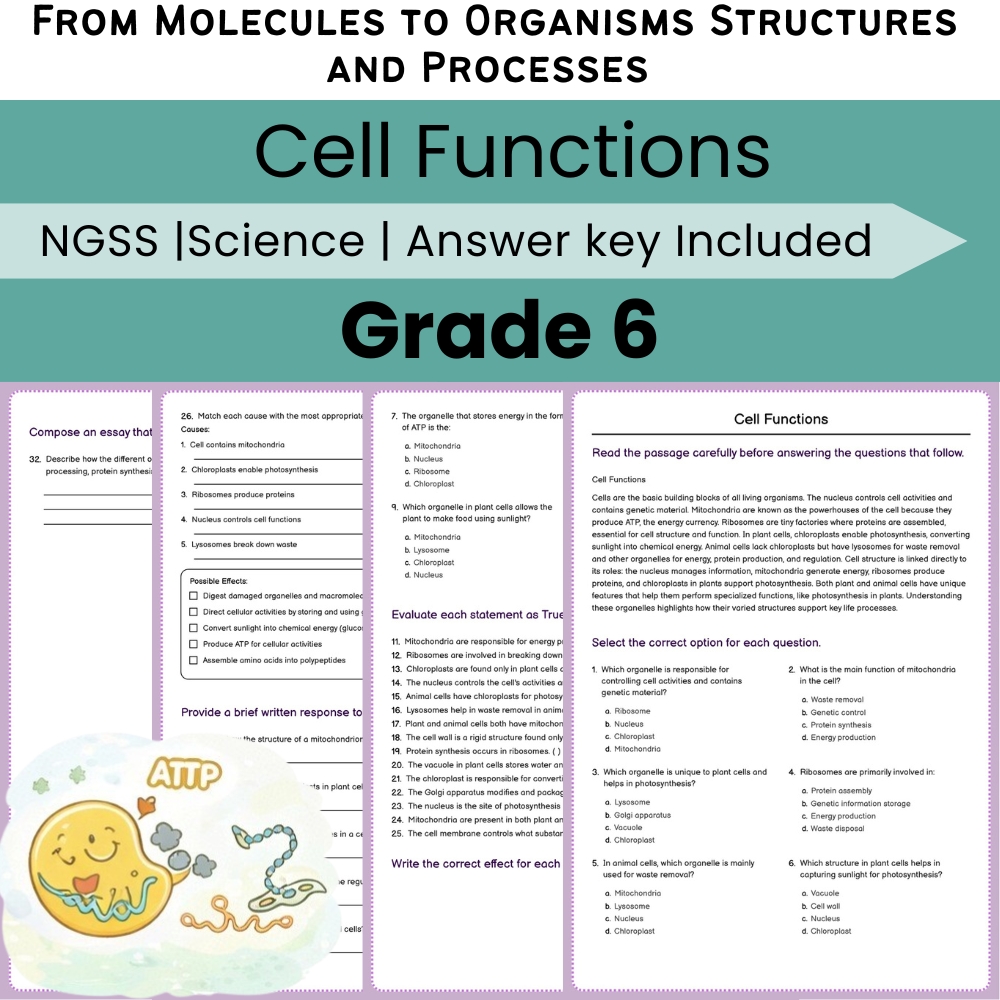
Cell Functions Worksheet | Grade 6 Science printable PDF | assessment
Learning Objectives
- Identify the main organelles of a cell and their functions.
- Understand how cell structure relates to its role in energy production, protein synthesis, and waste removal.
- Compare plant and animal cells to understand specialization of organelles.
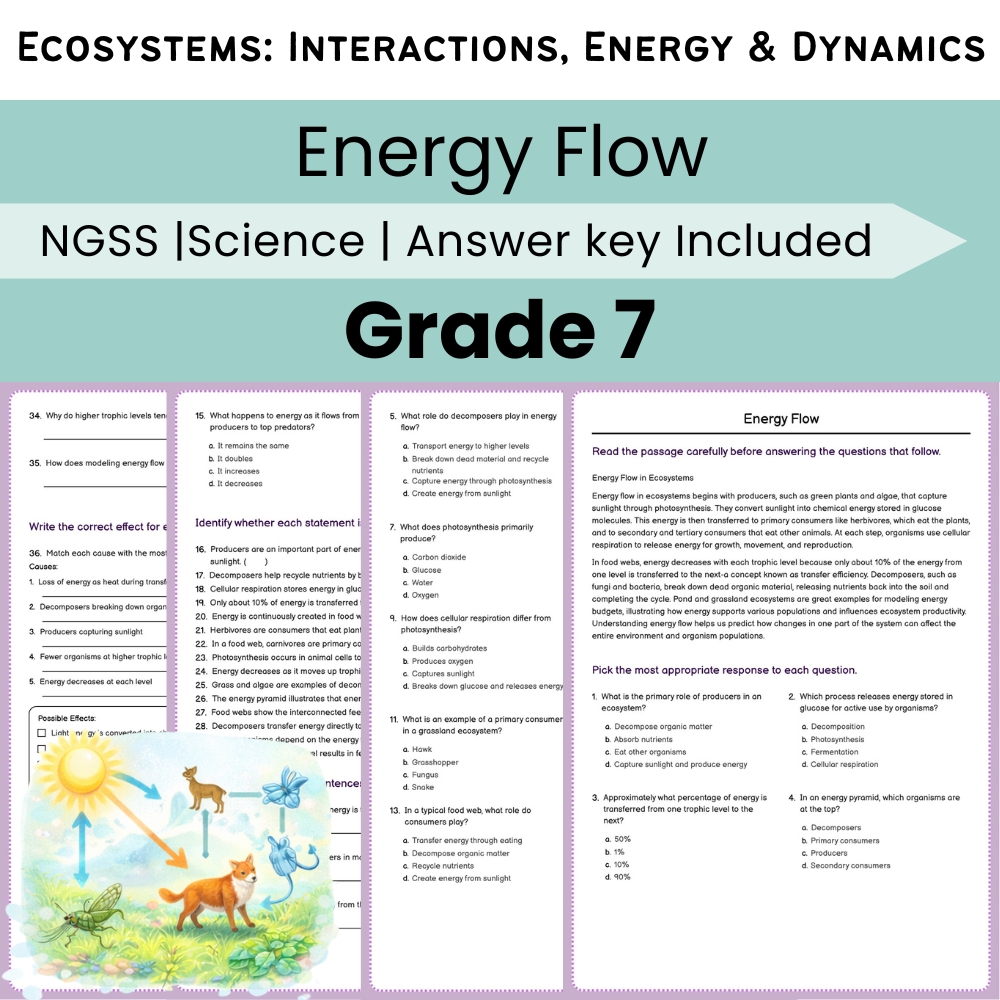
Energy Flow Worksheet for Grade 7 Science | NGSS Assessment & Student Practice
Learning Objectives
- Describe how energy transfers through different trophic levels in ecosystems.
- Explain the roles of producers, consumers, and decomposers in energy pyramids and food webs.
- Analyze the processes of photosynthesis and cellular respiration as mechanisms for energy capture and release.
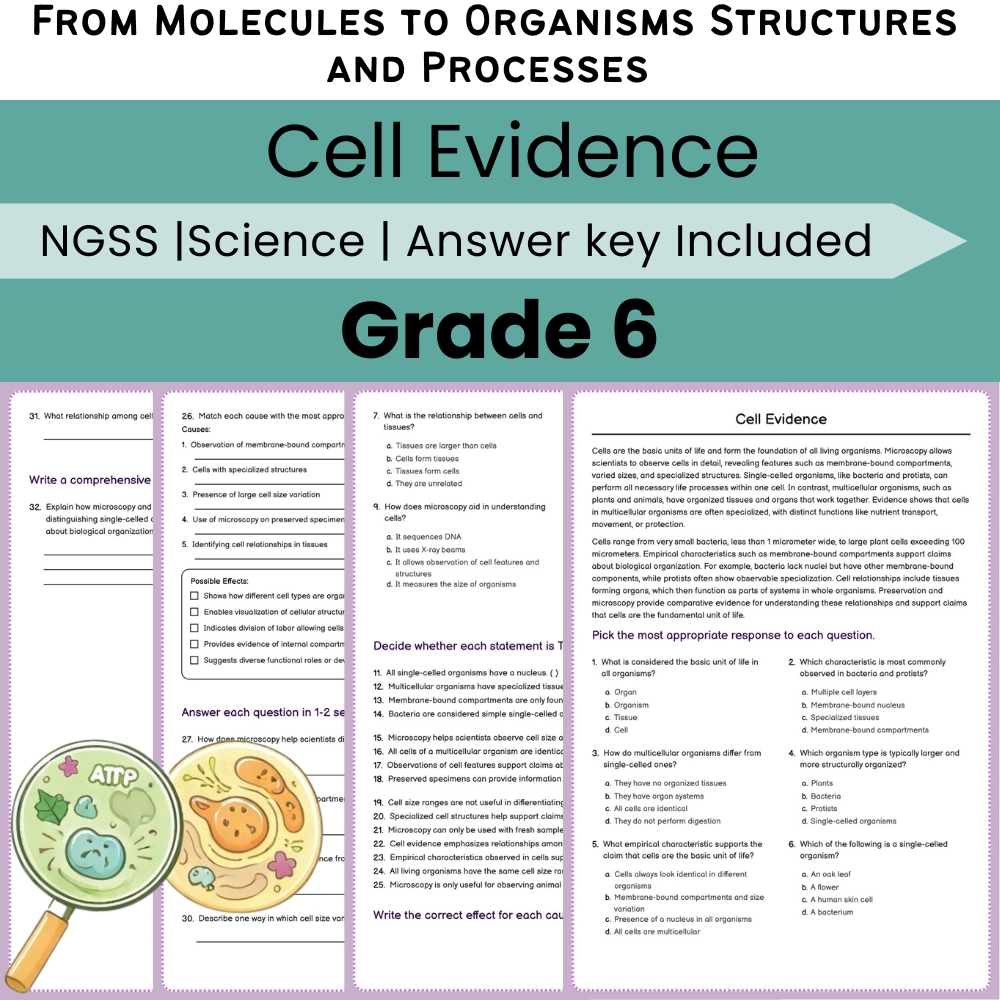
Cell Evidence Worksheet | Grade 6 Science printable PDF | NGSS aligned
Learning Objectives
- Identify observable features that distinguish single-celled and multicellular organisms.
- Understand the relationship between cells, tissues, organs, and whole organisms.
- Recognize empirical characteristics like membrane-bound compartments and cell size ranges.
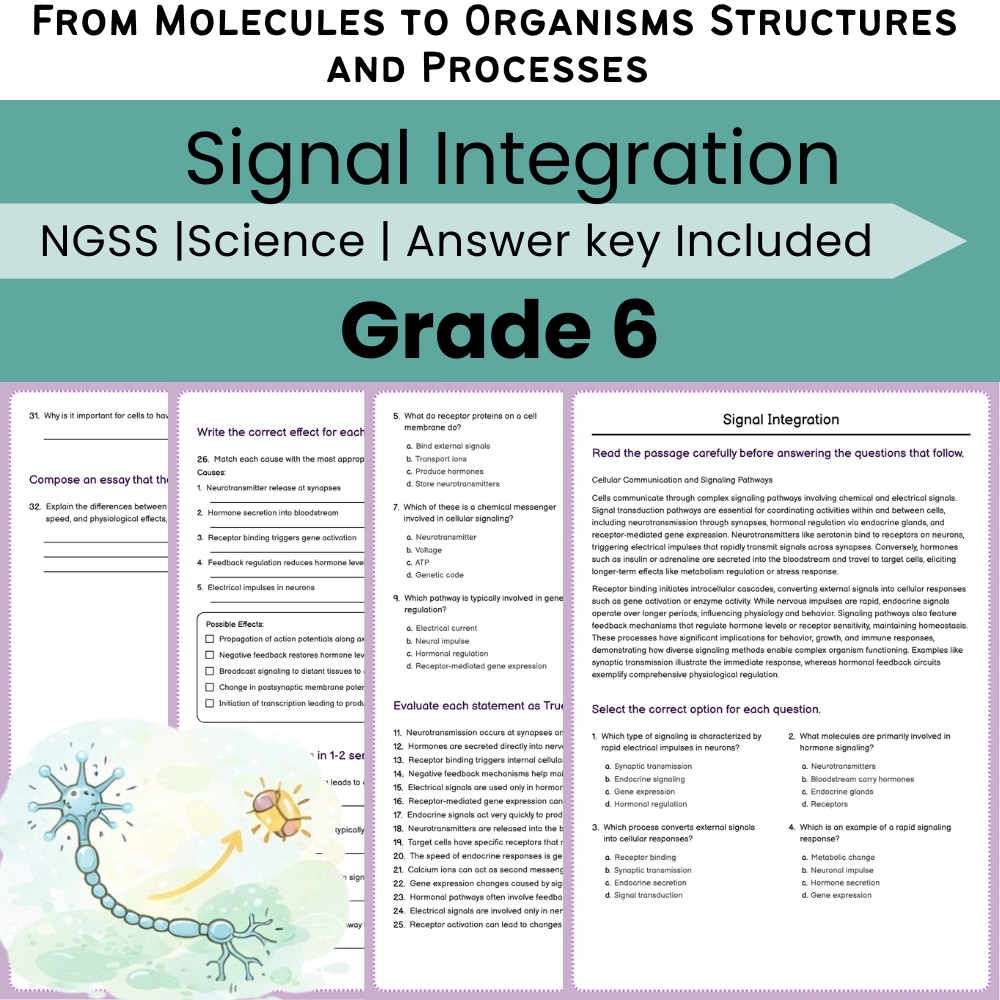
Signal Integration Worksheet | NGSS Grade 6 Science printable PDF
Learning Objectives
- Explain how cells communicate through chemical and electrical signals.
- Describe pathways such as neurotransmission, hormonal regulation, and signal transduction cascades.
- Compare rapid nerve impulses with slower endocrine responses.
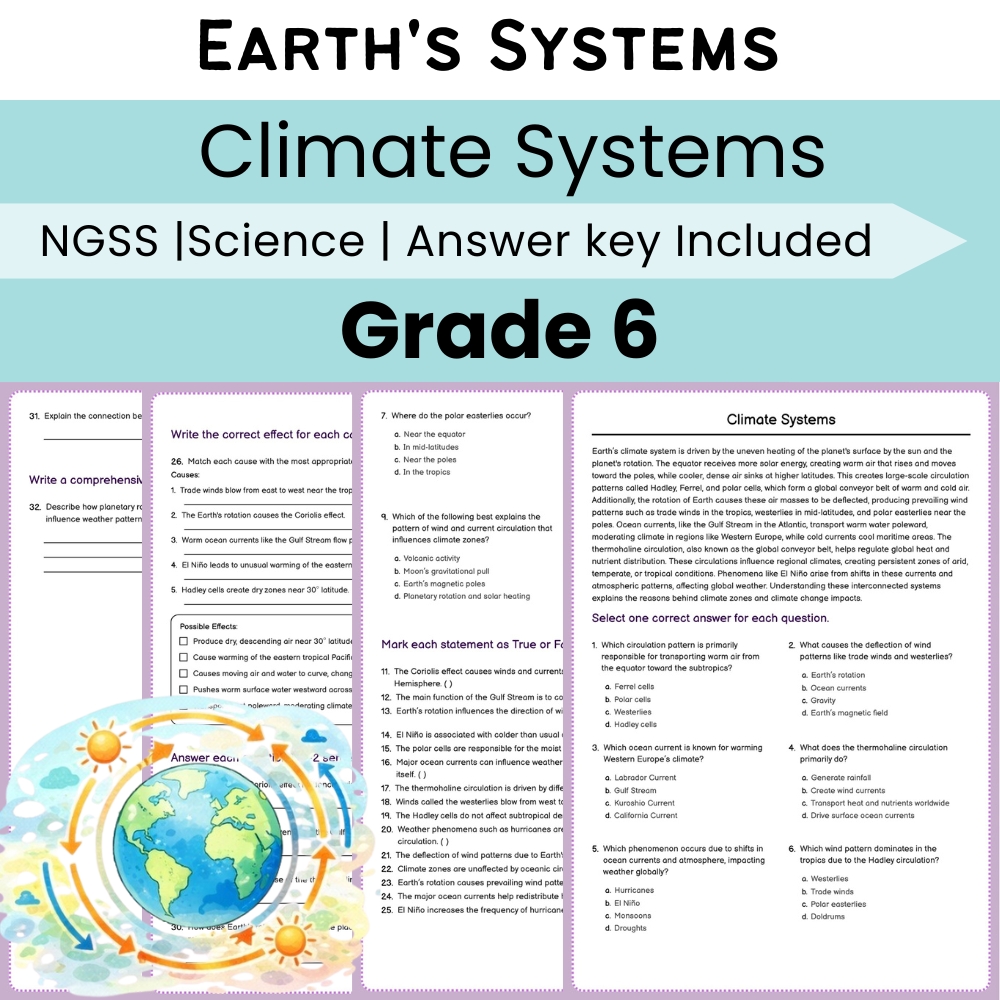
Climate Systems Worksheet | Science Assessment for Grade 6 NGSS Standards
Learning Objectives
- Explain how unequal solar heating and Earth's rotation give rise to global atmospheric and oceanic circulation patterns.
- Identify key circulation models like Hadley, Ferrel, and polar cells, and describe their effects on climate zones.
- Understand major wind patterns such as trade winds and westerlies and their influence on regional climates.
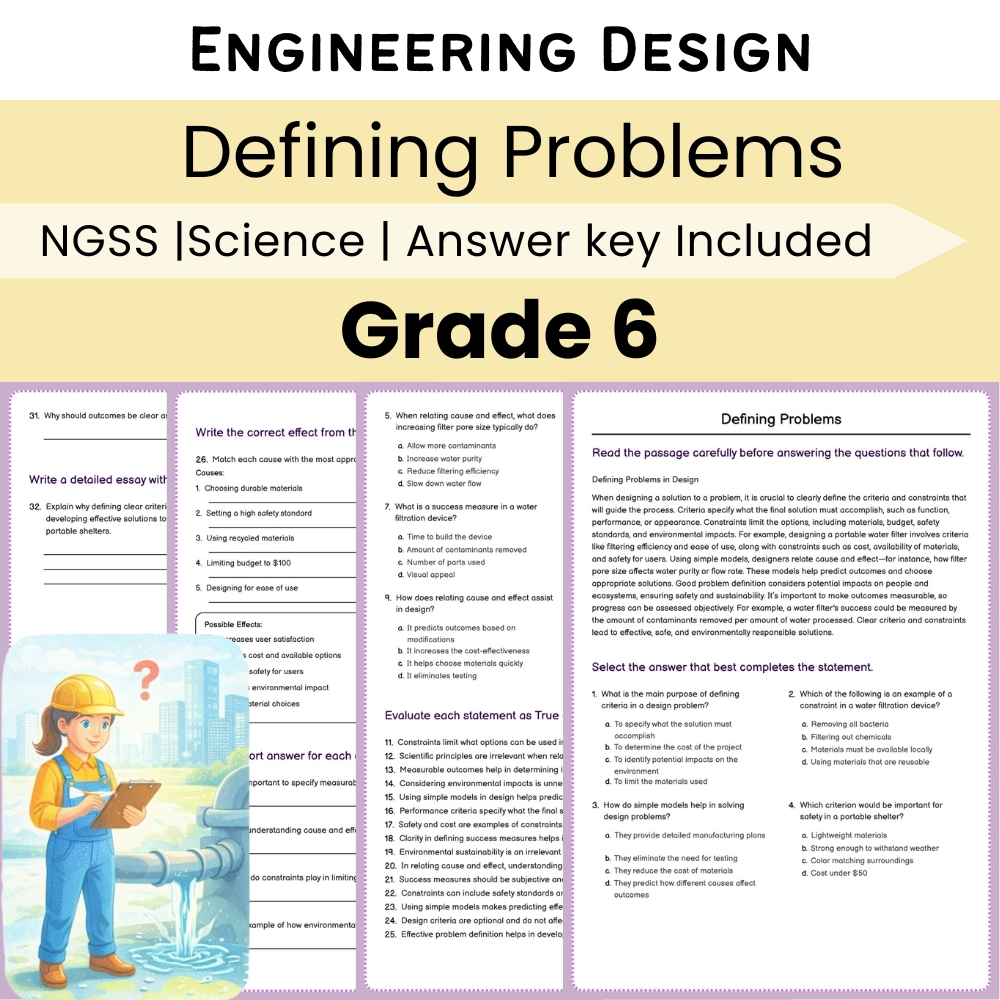
Defining Problems Worksheet | Grade 6 Science printable PDF | NGSS
Learning Objectives
- Understand how to specify criteria and constraints for a design problem.
- Learn to define success measures and limits such as materials, cost, and safety.
- Use simple models and scientific principles to relate cause and effect in problem solving.
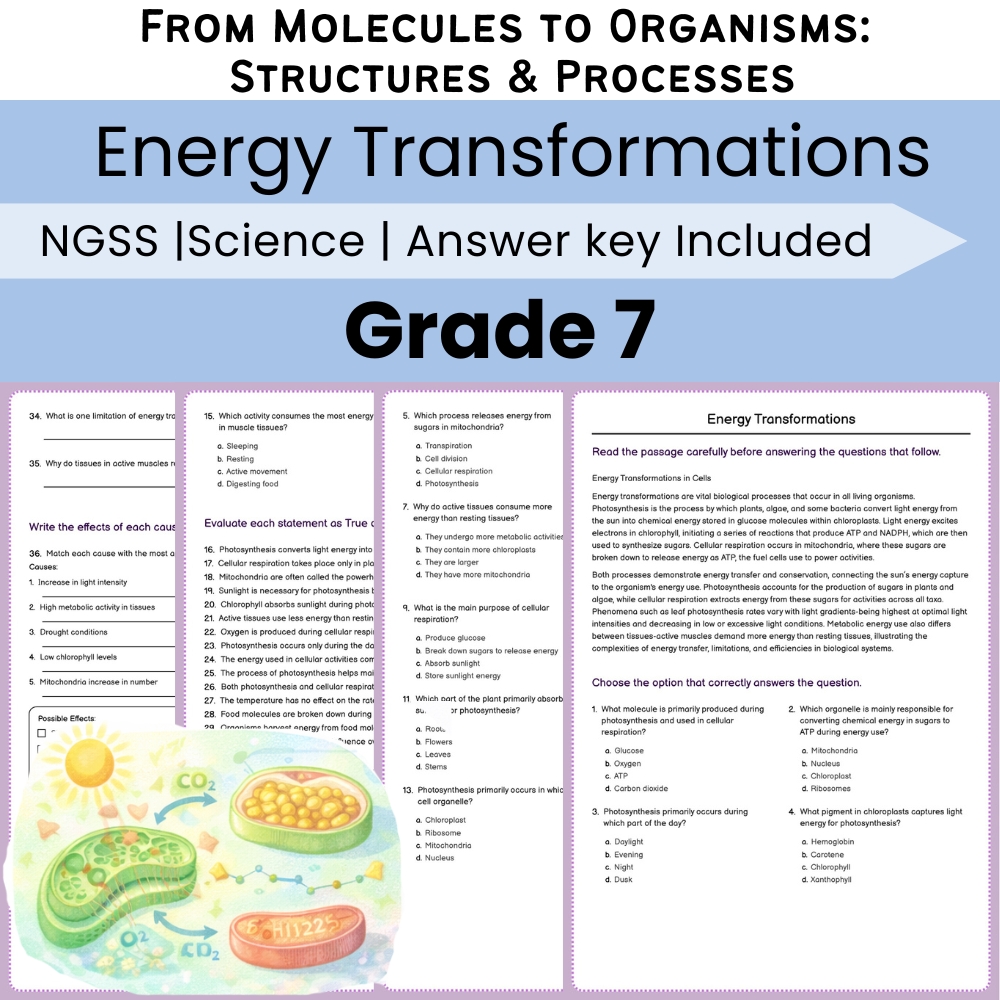
Energy Transformations Worksheet | Grade 7 Science printable PDF NGSS
Learning Objectives
- Explain how light energy is converted into chemical energy during photosynthesis.
- Describe how organisms harvest energy from food through cellular respiration.
- Connect processes in chloroplasts and mitochondria related to energy flow in autotrophs and heterotrophs.
Browse more categories
About Science Worksheets
Find Science worksheets spanning core skills, practice, and review. All 42,859 resources are instant PDF downloads for the classroom or home.
Every worksheet on MyTeachingSheets is created by independent teacher-authors and reviewed before publication. All resources download as printable PDFs for classroom, homework, or at-home practice, and many include answer keys. Preview any worksheet free before buying.