
Science Worksheets
42,685 subject resources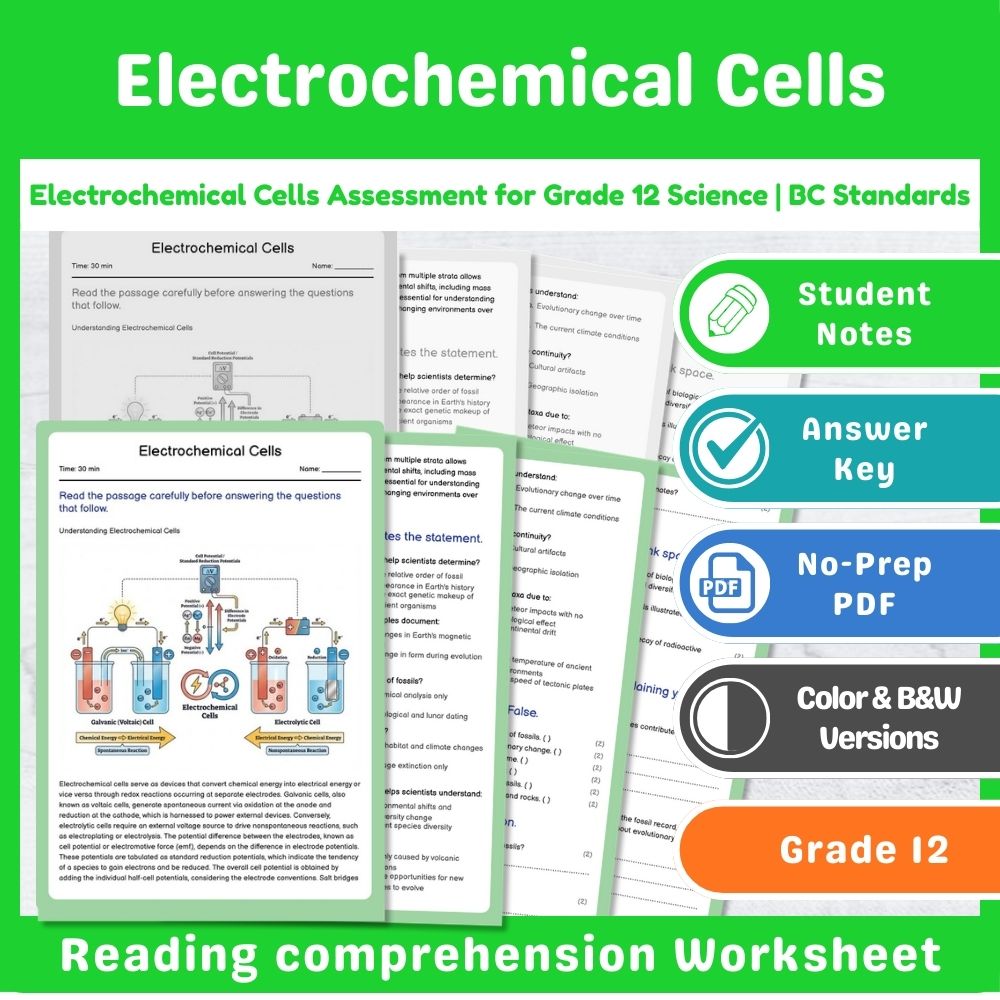
Electrochemical Cells Assessment for Grade 12 Science | BC Standards
 Created byPrism Point Learning
Learning Objectives
- Understand the principles of galvanic and electrolytic cells, including redox reactions and electrode processes.
- Calculate cell potential using standard reduction potentials and understand how to analyze galvanic and electrolytic systems.
- Explain the roles of salt bridges, electrode conventions, and potential differences in electrochemical reactions.

Interdependence Roles Assessment | Florida NGSSS Grade 6 Science
Created byPrism Point LearningLearning Objectives
- Explain how predators and prey are interdependent in an ecosystem
- Describe how competition and mutualism affect population changes
- Predict how changes in one population can ripple through a community
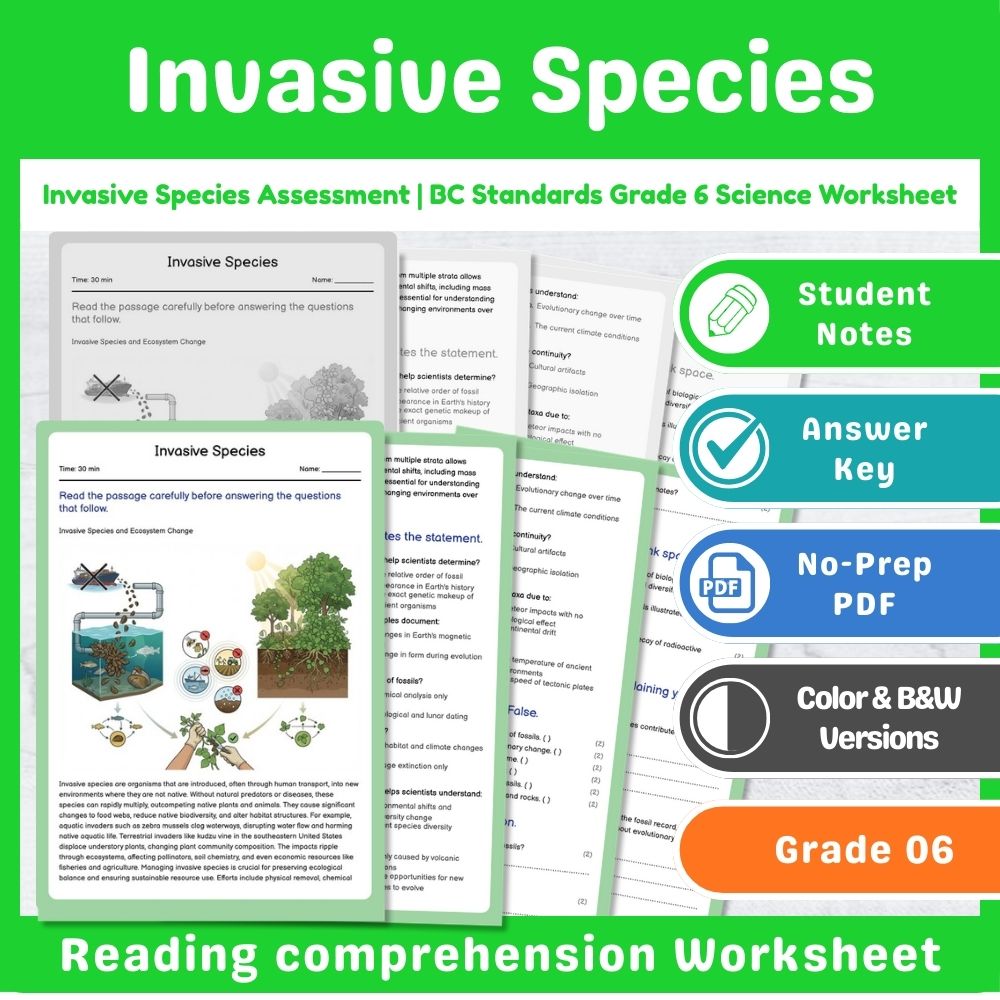
Invasive Species Assessment | BC Standards Grade 6 Science Worksheet
Created byPrism Point LearningLearning Objectives
- Understand the definition and characteristics of invasive species.
- Identify examples and impacts of invasive species on ecosystems.
- Analyze how invasive species outcompete native organisms and alter habitats.
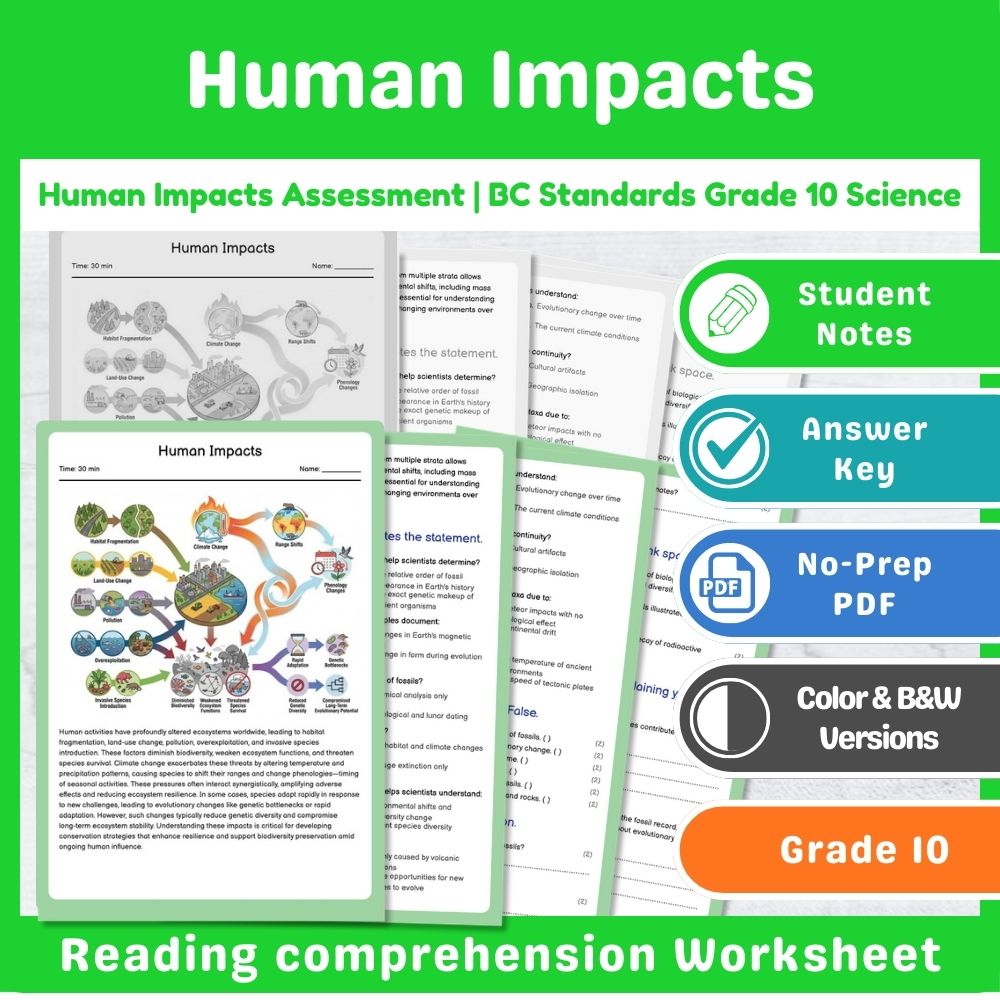
Human Impacts Assessment | BC Standards Grade 10 Science
Created byPrism Point LearningLearning Objectives
- Understand the various human activities that affect biodiversity and ecosystems.
- Explain how climate change influences species distribution and phenology.
- Identify interactions between human impacts and ecological resilience.

Science Assessment: Cloud And Precipitation Grade 6 | NGSSS Assessment
Created byPrism Point LearningLearning Objectives
- Explain how clouds form when water vapor cools and condenses
- Describe how precipitation forms and name different types of precipitation
- Use temperature, moisture, and atmospheric conditions to predict precipitation outcomes

Work and Power Assessment | Florida NGSSS Standards for Grade 11 Science
Created byPrism Point LearningLearning Objectives
- Explain the relationship between force, displacement, and work in everyday and physics contexts
- Compare power and work using rate concepts and time intervals
- Apply work-energy and power ideas to scenarios such as lifting and climbing

Newton Second Law Assessment Grade 11 Science NGSSS Standards
Created byPrism Point LearningLearning Objectives
- Explain Newton’s second law using the relationship between net force, mass, and acceleration
- Predict the direction and relative magnitude of acceleration based on net force and mass
- Apply Newton’s second law to situations involving identical pushes on different masses and multiple forces acting together

Science Assessment: El Niño Effects Grade 6 | NGSSS Assessment
Created byPrism Point LearningLearning Objectives
- Explain how El Niño and La Niña relate to changes in sea surface temperatures in the tropical Pacific Ocean.
- Describe how ocean-atmosphere changes can influence evaporation, cloud formation, and wind circulation.
- Predict how precipitation and temperature patterns may shift in some regions during El Niño or La Niña.

Testable Hypotheses Assessment | General Standards Grade 11 Science
Created byPrism Point LearningLearning Objectives
- Understand key concepts related to Science
- Apply knowledge through practice questions
- Demonstrate comprehension of the material

Ecosystem Interactions Assessment | Standards-Aligned Grade 12 Science
Created byPrism Point LearningLearning Objectives
- Explain how predation, competition, mutualism, and parasitism influence population dynamics within ecosystems.
- Describe how energy flows through trophic levels and how interactions form food webs.
- Predict how changes in one population can cascade to affect other species and community structure.

Energy Changes In Reactions Assessment | General Standards-Aligned Grade 11 Science
Created byPrism Point LearningLearning Objectives
- Understand how energy is transferred during chemical and physical changes.
- Distinguish between endothermic and exothermic reactions based on energy diagrams.
- Explain the concepts of energy conservation and energy redistribution in reactions.

Fossil Evidence Assessment | NGSSS Standards Grade 8 Science Worksheet
Created byPrism Point LearningLearning Objectives
- Explain how the fossil record provides evidence that life changes over long periods
- Compare fossils from older versus younger rock layers to infer patterns of change
- Use anatomical similarities and differences to support evolutionary relationships

Evaporation and Transpiration Assessment | California Standards Grade 6 Science
Created byPrism Point LearningLearning Objectives
- Explain how evaporation and transpiration add water vapor to the atmosphere
- Describe how temperature and available liquid water affect the amount of water vapor
- Connect phase changes to the water cycle, including condensation and precipitation

Evolving Knowledge Grade 9 Science Assessment | Florida NGSSS
Created byPrism Point LearningLearning Objectives
- Explain how scientific knowledge changes through new evidence, improved measurement, and revised models
- Identify how evidence, models, and measurement work together to support scientific conclusions
- Evaluate the role of transparency about assumptions and limitations in scientific reasoning

Mixtures and Changes Assessment for Grade 8 Science | NGSSS
Created byPrism Point LearningLearning Objectives
- Explain how mixtures differ from pure substances and how component properties affect the mixture.
- Describe solutions as mixtures and distinguish solute and solvent based on particle behavior.
- Differentiate physical changes from chemical changes using evidence and particle-level ideas.

Endothermic Processes Assessment | Florida NGSSS Grade 12 Science
Created byPrism Point LearningLearning Objectives
- Differentiate endothermic and exothermic chemical processes using energy changes and temperature observations
- Explain how bond energies and energy profiles support the idea of conservation of energy in chemical reactions
- Interpret particle-level and system-level energy exchange during endothermic reactions
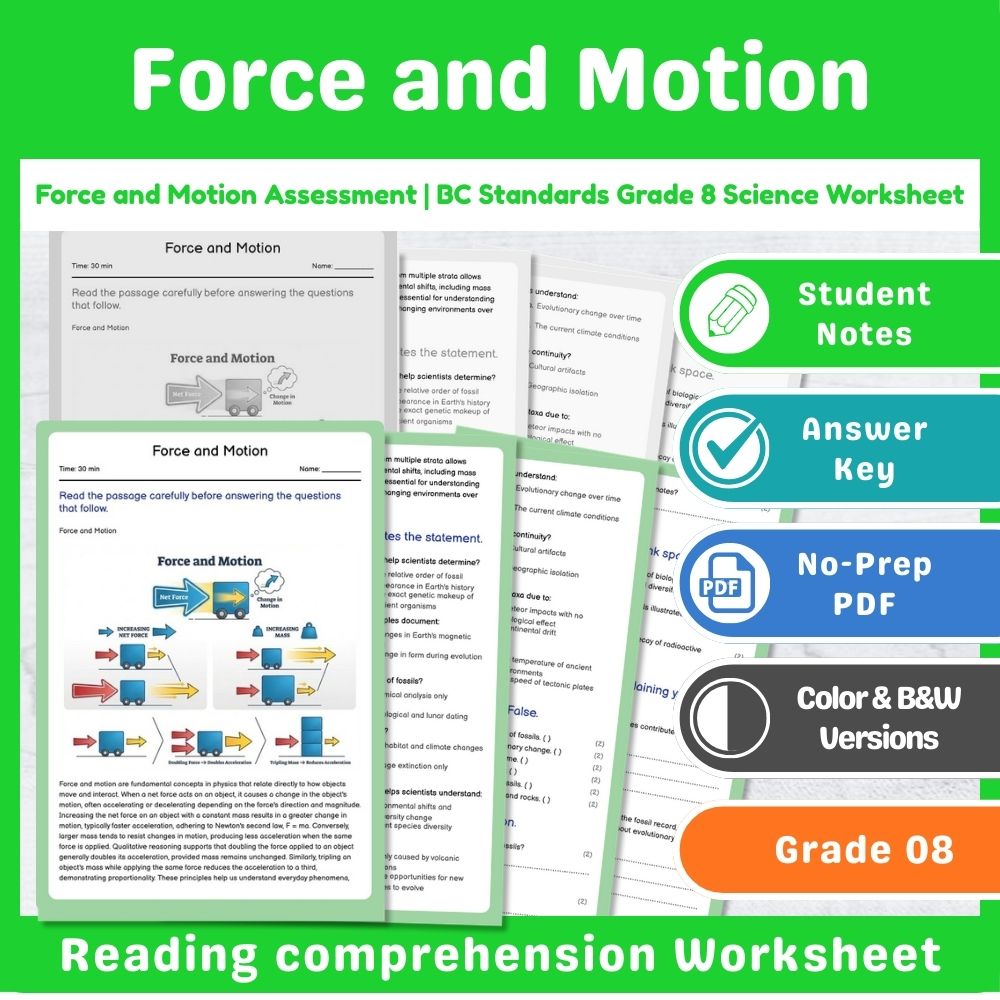
Force and Motion Assessment | BC Standards Grade 8 Science Worksheet
Created byPrism Point LearningLearning Objectives
- Understand the relationship between net force, mass, and acceleration.
- Explain qualitatively how increasing net force affects motion.
- Describe the effect of increased mass on acceleration under the same force.

Wave Energy Transfer Assessment for Grade 7 Science | Standards-Aligned
Created byPrism Point LearningLearning Objectives
- Understand how waves transfer energy without moving matter permanently.
- Differentiate between transverse and longitudinal waves based on particle motion.
- Explain the relationship between amplitude, wavelength, and energy in waves.

Rock Record Assessment | NGSSS Standards Grade 12 Science
Created byPrism Point LearningLearning Objectives
- Explain how stratigraphy and relative dating order geologic events in a rock record.
- Identify how unconformities and cross-cutting relationships reveal gaps and sequences of events.
- Interpret fossil succession to infer relative ages and past environmental change.

Plate Motions Assessment | NGSSS Florida Standards Grade 12 Science
Created byPrism Point LearningLearning Objectives
- Explain how Earth’s internal energy drives long-term tectonic plate motion.
- Compare the main types of plate boundaries and the geologic processes associated with each.
- Interpret evidence for plate motion, including seafloor magnetic stripes, matching rock ages, and earthquake patterns.
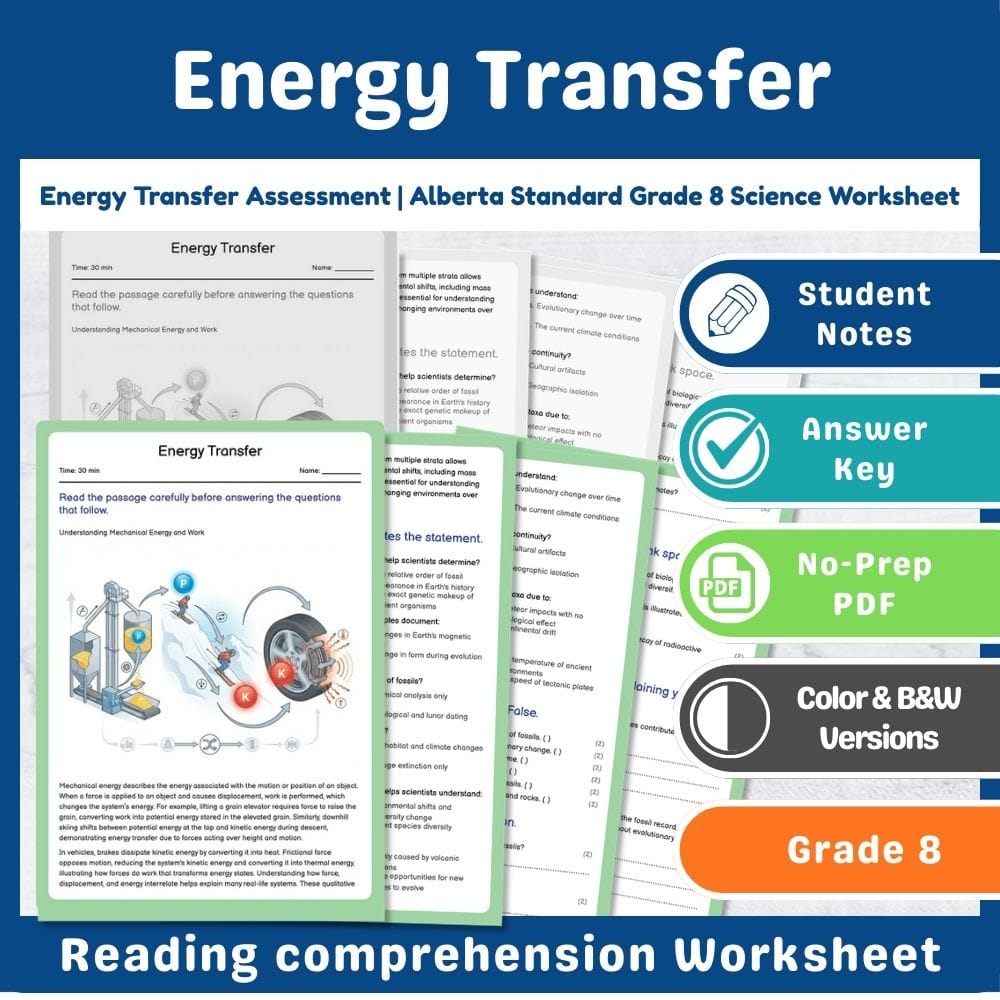
Energy Transfer Assessment | Alberta Standard Grade 8 Science Worksheet
Created byPrism Point LearningLearning Objectives
- Understand the concept of mechanical energy and how forces perform work on systems.
- Explain how potential and kinetic energy change during motion, using real-world examples.
- Qualitatively analyze force interactions and energy transformations in mechanical systems.
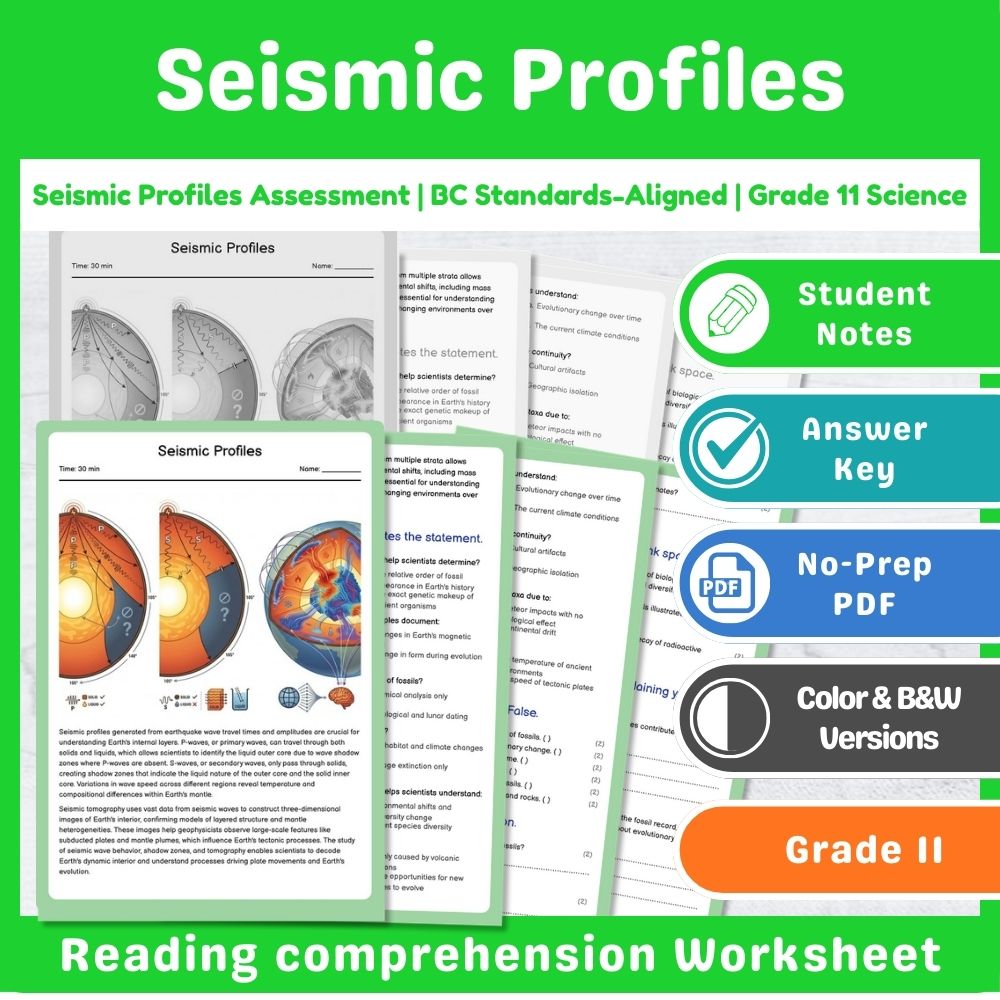
Seismic Profiles Assessment | BC Standards-Aligned | Grade 11 Science
Created byPrism Point LearningLearning Objectives
- Explain how seismic profiles reveal Earth's internal layering and structure.
- Identify the differences in wave travel and shadow zones caused by Earth's core composition.
- Describe how variations in seismic wave speed relate to Earth's temperature and composition.
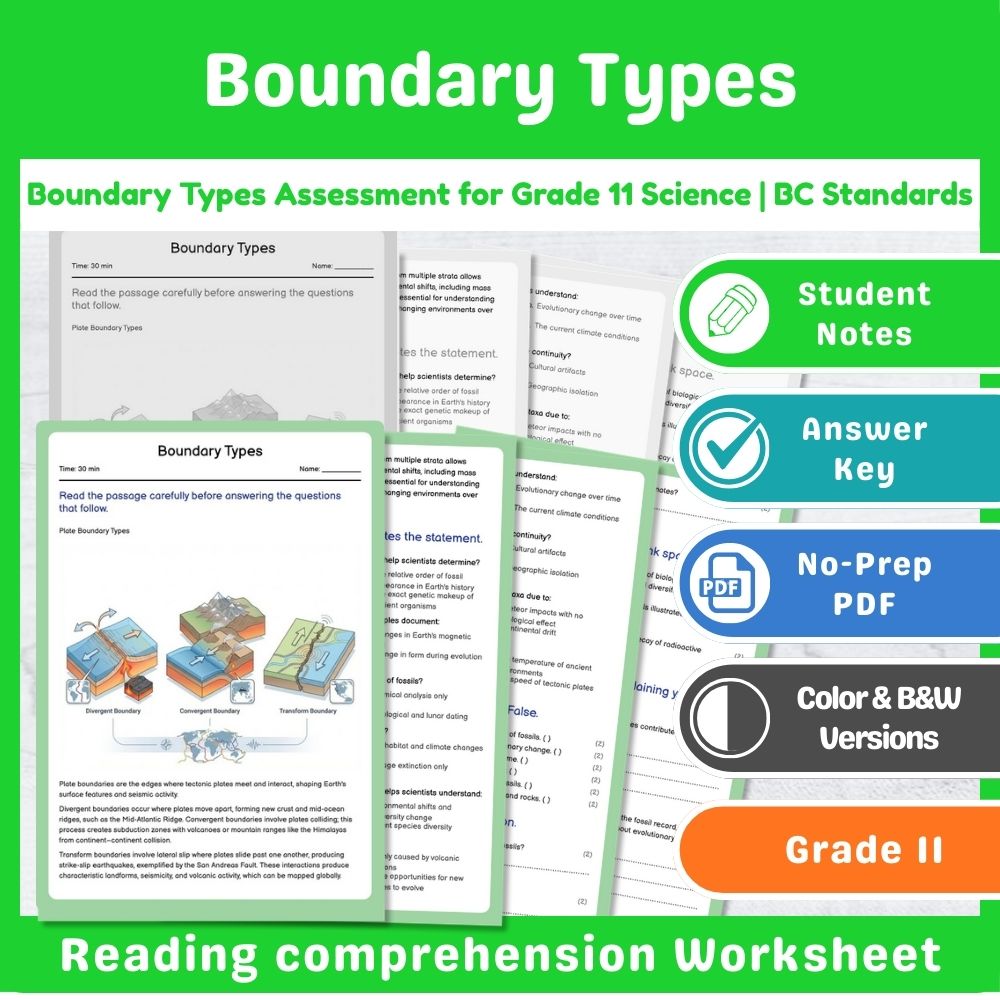
Boundary Types Assessment for Grade 11 Science | BC Standards
Created byPrism Point LearningLearning Objectives
- Identify the three primary types of plate boundaries and their characteristics.
- Explain the landforms, seismic activity, and volcanic activity associated with each boundary type.
- Analyze how surface landforms relate to underlying tectonic processes.
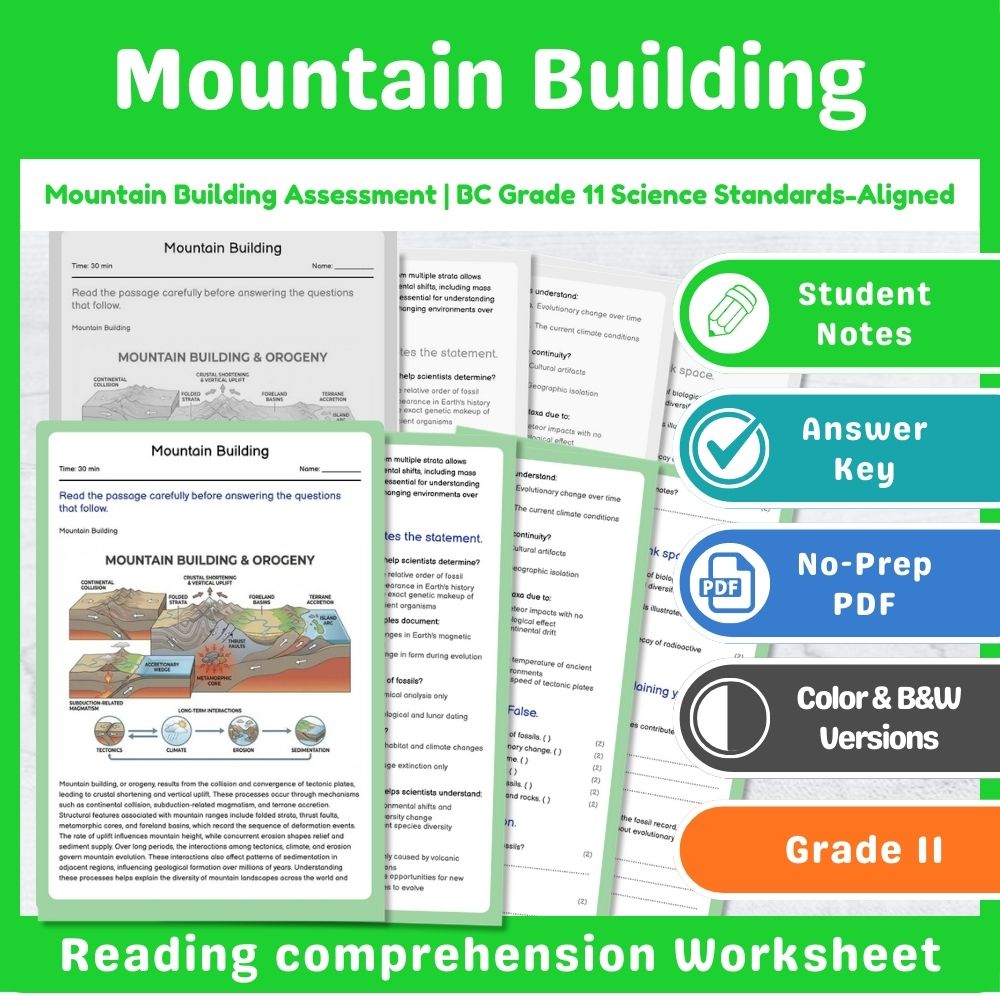
Mountain Building Assessment | BC Grade 11 Science Standards-Aligned
Created byPrism Point LearningLearning Objectives
- Explain the geological processes involved in mountain formation, including tectonic convergence, crustal shortening, and uplift.
- Identify structural features such as folded strata, thrust faults, metamorphic cores, and foreland basins associated with mountain ranges.
- Describe how rates of uplift and erosion influence mountain evolution and sediment distribution.
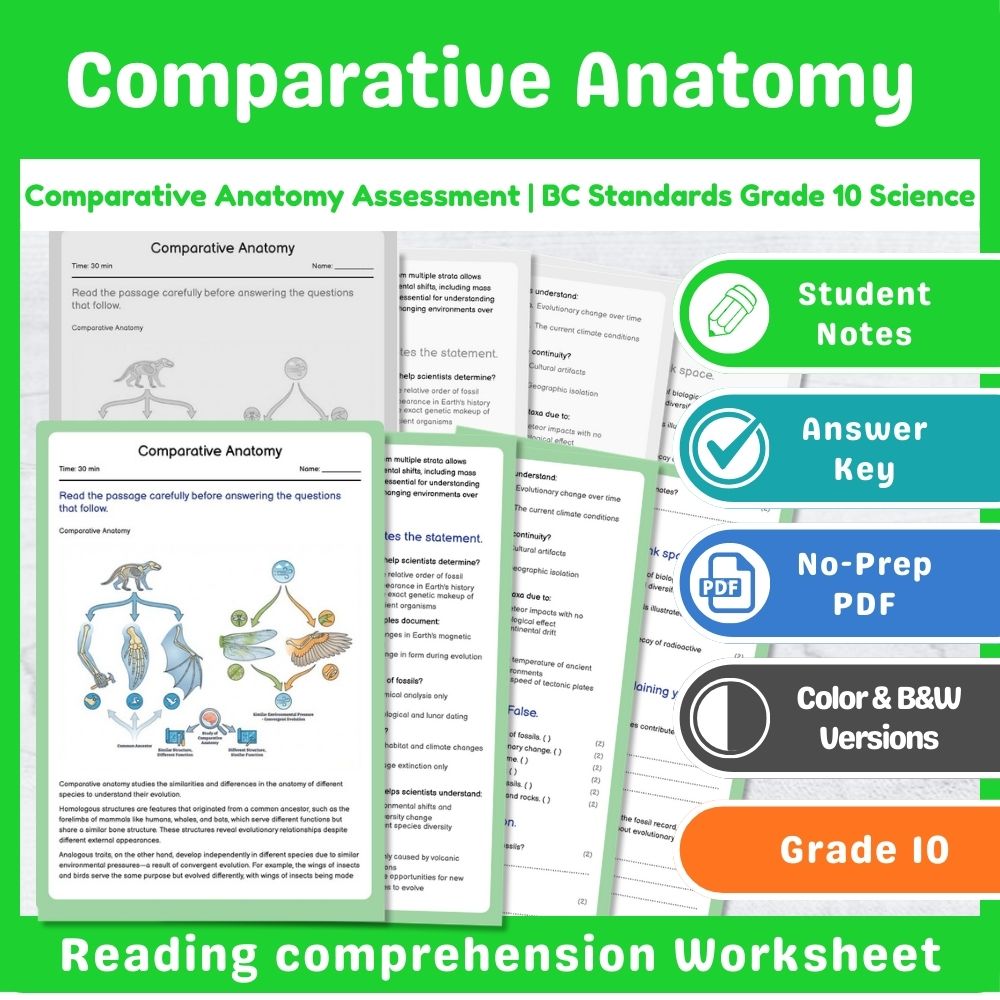
Comparative Anatomy Assessment | BC Standards Grade 10 Science
Created byPrism Point LearningLearning Objectives
- Understand the concepts of homologous and analogous structures and their significance in evolution.
- Identify vestigial organs and their implications for evolutionary history.
- Compare anatomical features across different organisms to infer phylogenetic relationships.
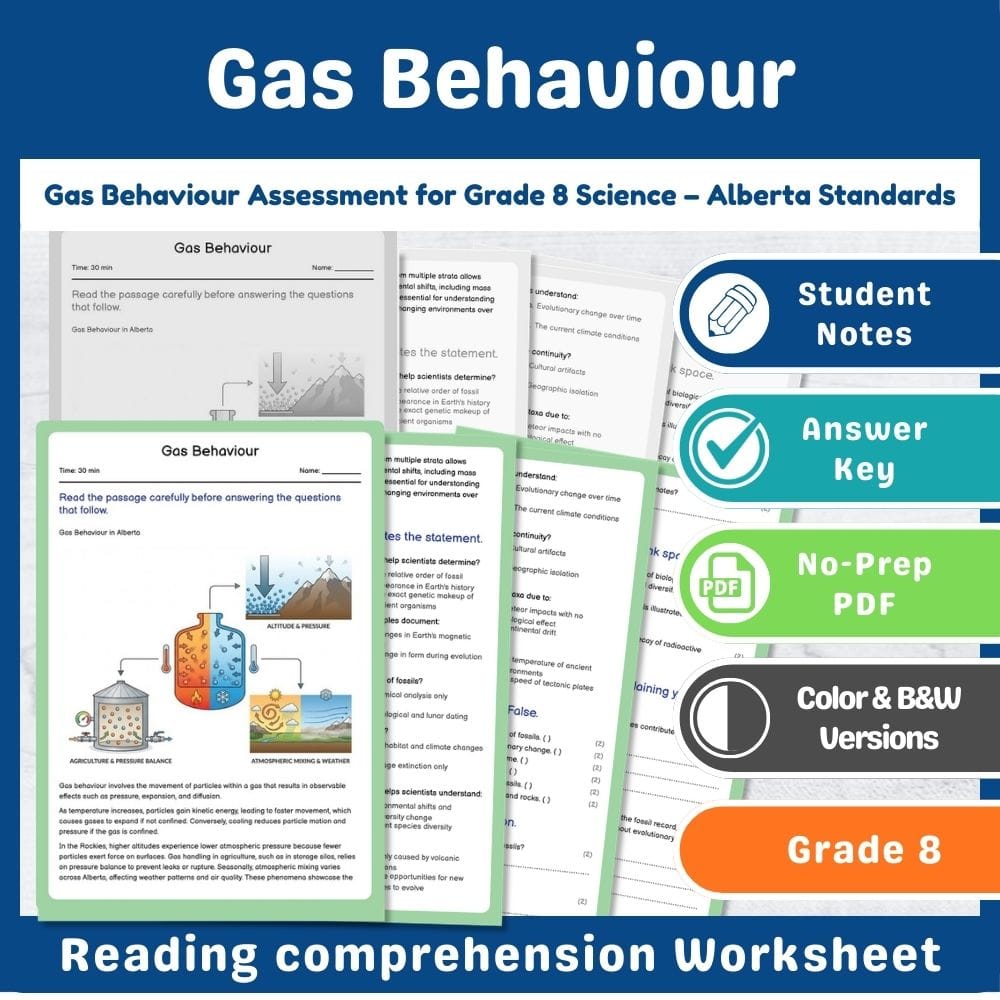
Gas Behaviour Assessment for Grade 8 Science – Alberta Standards
Created byPrism Point LearningLearning Objectives
- Explain how particle motion relates to gas pressure and temperature.
- Describe the effects of temperature changes on gas expansion and compression.
- Analyze real-world examples of gas behaviour in Alberta, such as atmospheric pressure variation with altitude and seasonal mixing.
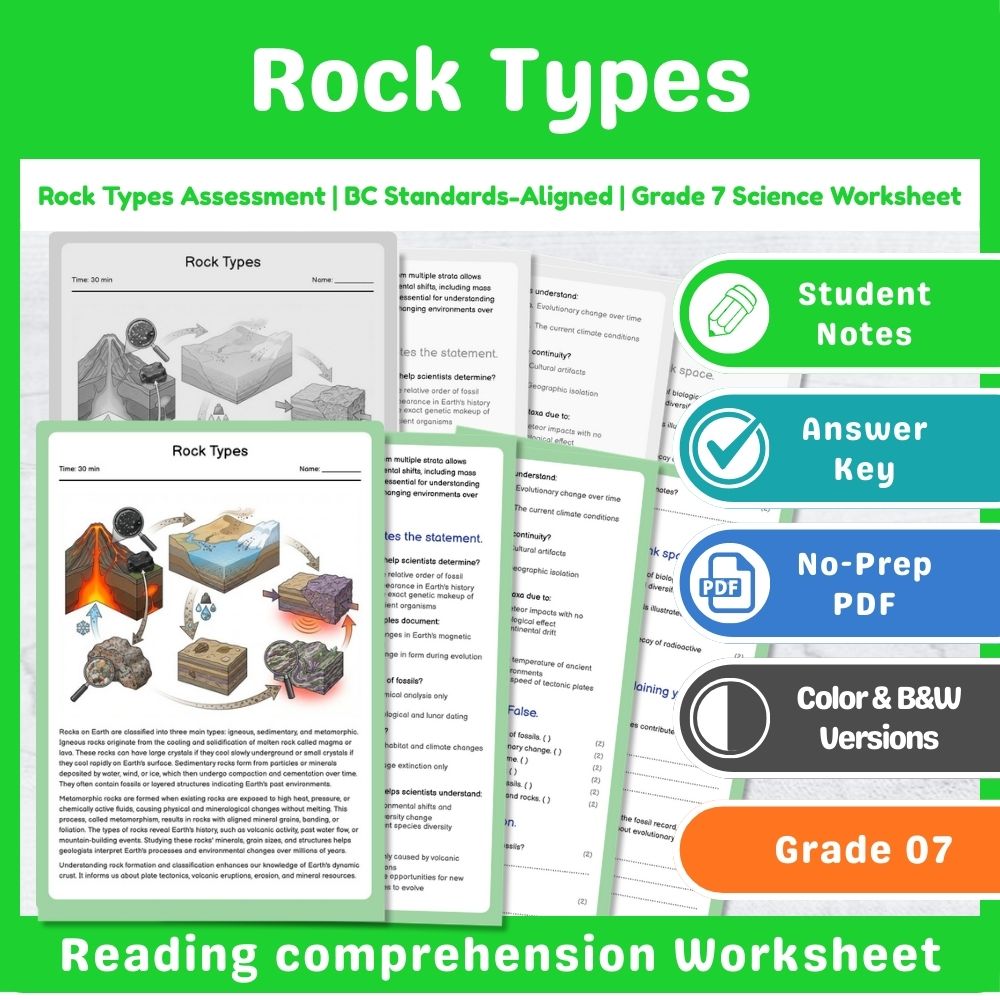
Rock Types Assessment | BC Standards-Aligned | Grade 7 Science Worksheet
Created byPrism Point LearningLearning Objectives
- Describe the three main types of rocks: igneous, sedimentary, and metamorphic.
- Explain the processes by which each type of rock forms.
- Identify distinguishing features of each rock type based on texture and mineral content.

Climate Evidence Trends Assessment | General Standards Grade 11 Science
Created byPrism Point LearningLearning Objectives
- Understand the various lines of scientific evidence used to evaluate climate change over time.
- Interpret data from temperature records, ice cores, sediment layers, and ocean observations.
- Distinguish between short-term weather variability and long-term climate patterns.

Climate Data Trends Assessment for Grade 8 Science | NGSSS Standards
Created byPrism Point LearningLearning Objectives
- Interpret climate indicators by comparing temperature, precipitation, and storm-frequency data over time.
- Distinguish long-term climate trends from short-term weather variability and single extreme events.
- Explain how El Niño and La Niña can affect rainfall patterns using evidence from data records.

Nutrient Transport Assessment | California Standards Grade 7 Science
Created byPrism Point LearningLearning Objectives
- Explain how nutrients move from digestion to body tissues through internal transport
- Describe how cells use transported nutrients for growth, repair, and energy
- Identify how the body removes wastes to maintain internal balance
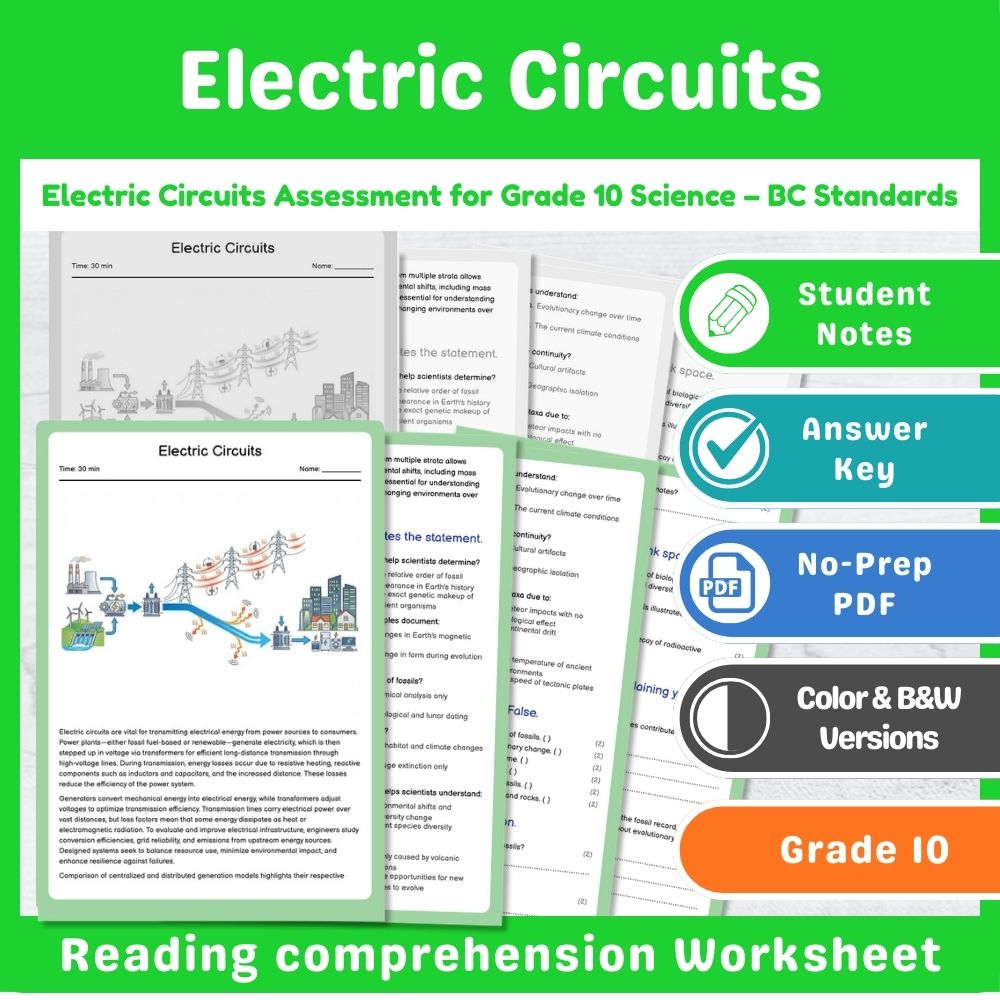
Electric Circuits Assessment for Grade 10 Science – BC Standards
Created byPrism Point LearningLearning Objectives
- Understand the basic components and functions of electric circuits.
- Evaluate the factors affecting system efficiency in electrical transmission.
- Compare centralized versus distributed energy generation methods.
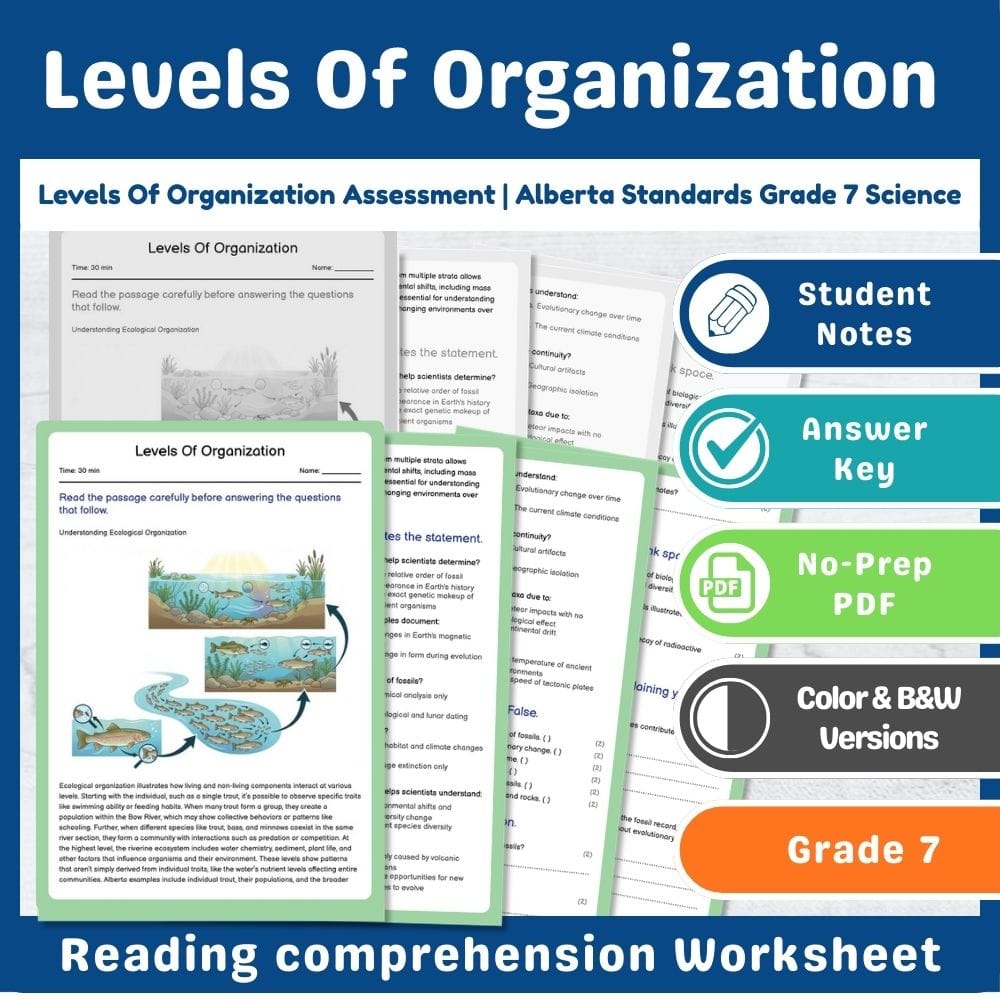
Levels Of Organization Assessment | Alberta Standards Grade 7 Science
Created byPrism Point LearningLearning Objectives
- Describe the different levels of ecological organization from individual organisms to ecosystems.
- Explain how properties and processes emerge at higher levels that are not evident at individual levels.
- Use Alberta examples to differentiate among levels such as individual trout, trout populations, communities, and ecosystems.
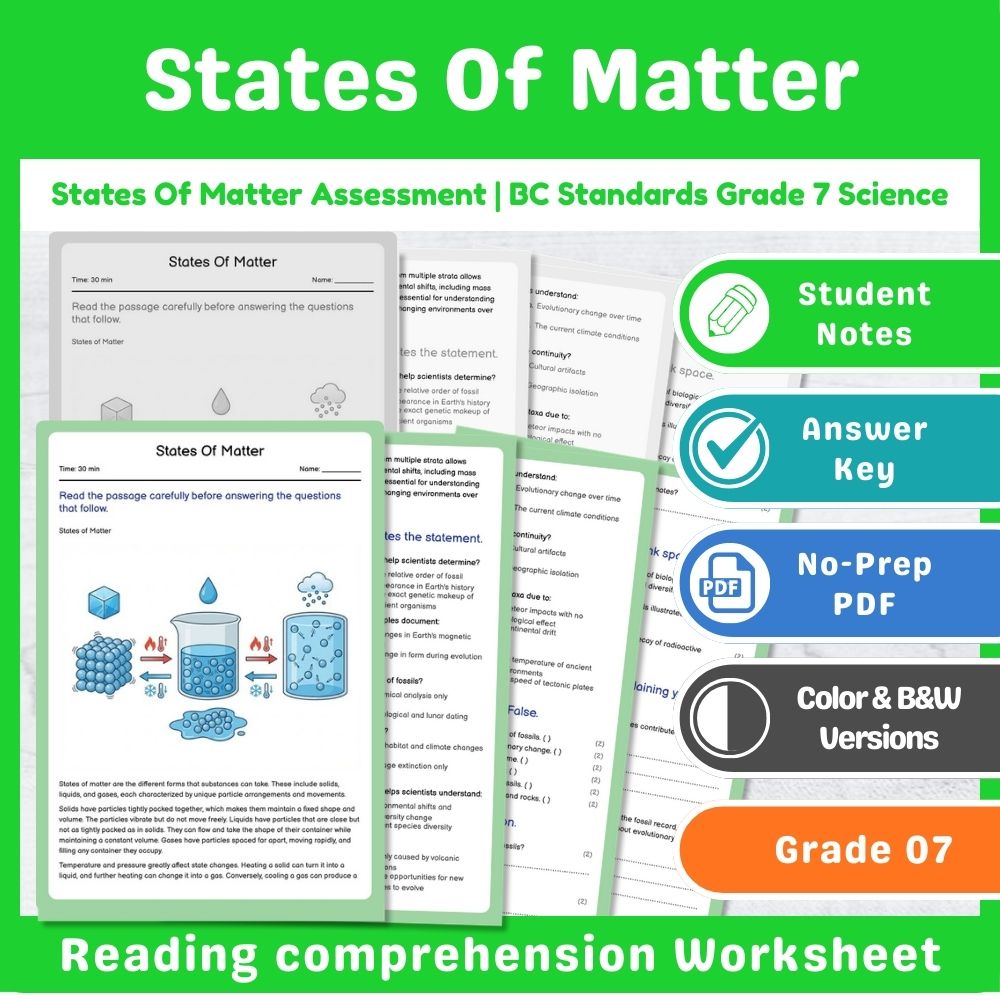
States Of Matter Assessment | BC Standards Grade 7 Science
Created byPrism Point LearningLearning Objectives
- Identify and describe the main characteristics of solids, liquids, and gases.
- Explain how particle arrangement, spacing, and movement differ among the states of matter.
- Understand how temperature and pressure influence changes between states.
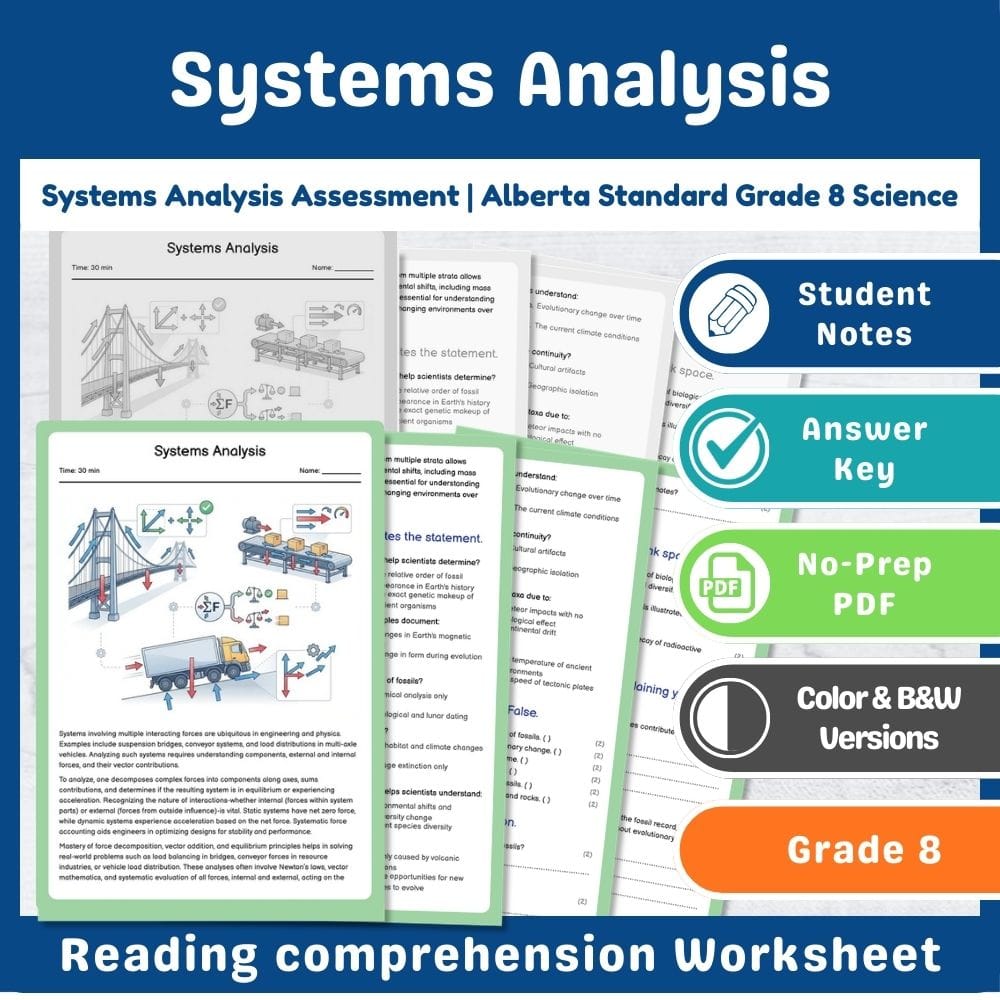
Systems Analysis Assessment | Alberta Standard Grade 8 Science
Created byPrism Point LearningLearning Objectives
- Identify the key components of complex systems involving multiple forces.
- Understand how to decompose system forces into vector components.
- Analyze static versus dynamic behavior by summing forces.
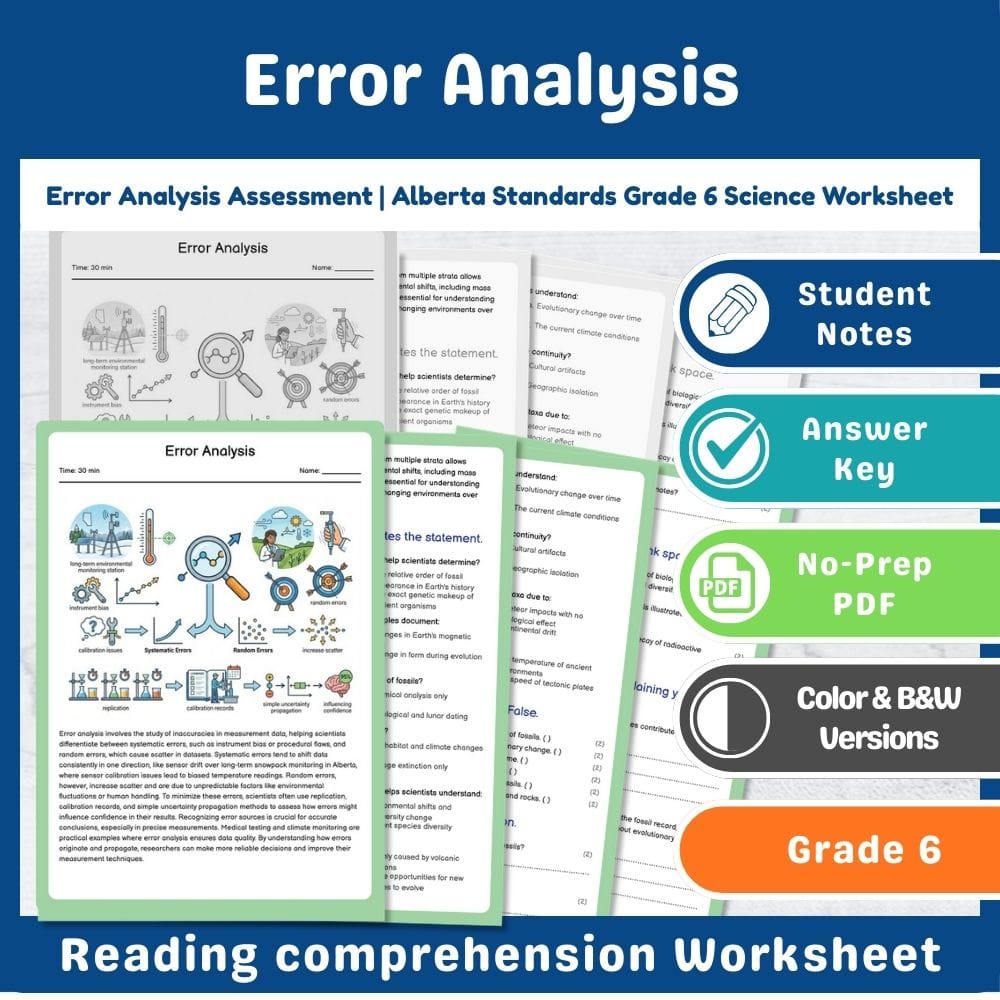
Error Analysis Assessment | Alberta Standards Grade 6 Science Worksheet
Created byPrism Point LearningLearning Objectives
- Understand sources of systematic and random error in scientific data.
- Identify methods used to estimate the effects of errors on results.
- Describe how environmental, procedural, and instrument-related errors impact data accuracy.
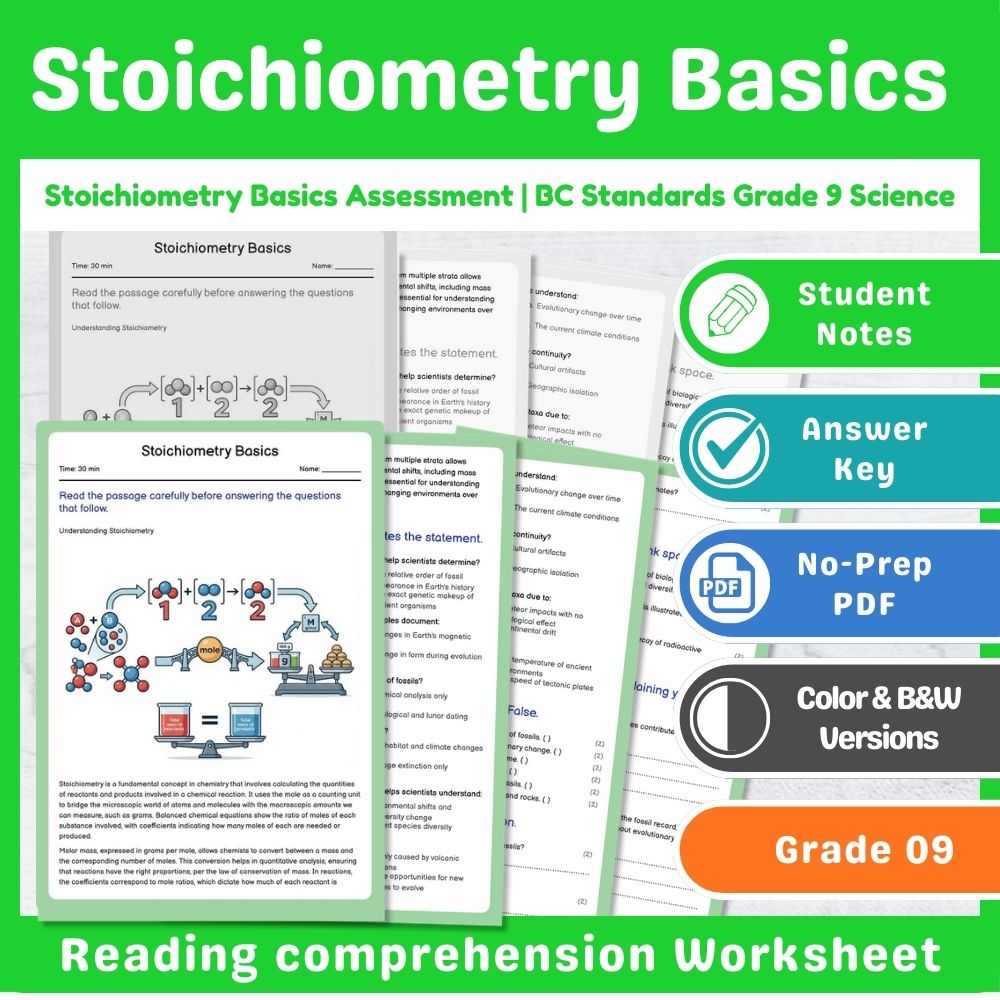
Stoichiometry Basics Assessment | BC Standards Grade 9 Science
Created byPrism Point LearningLearning Objectives
- Understand how mole relationships connect masses of reactants and products in balanced chemical equations.
- Learn to use molar mass to convert between mass and amount of substance.
- Interpret coefficients in balanced equations to determine mole ratios of reactants and products.
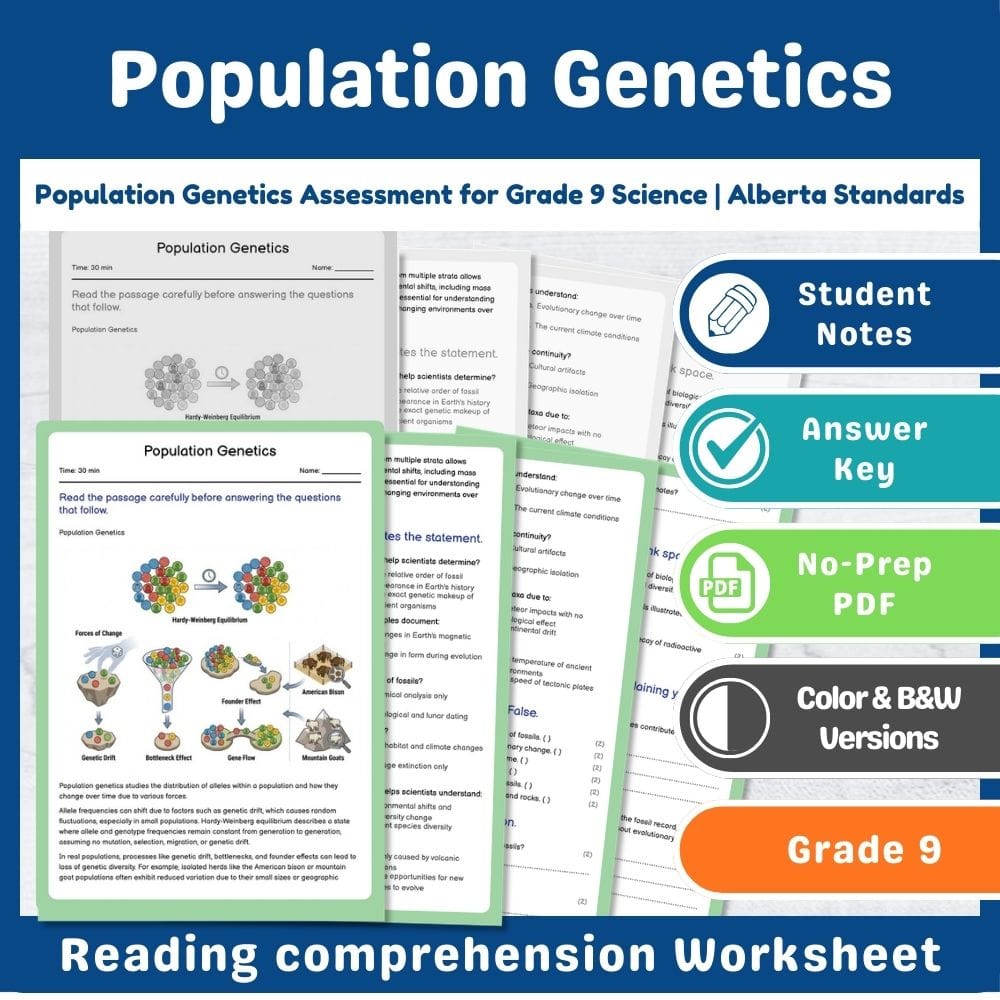
Population Genetics Assessment for Grade 9 Science | Alberta Standards
Created byPrism Point LearningLearning Objectives
- Explain the principles of allele frequency and Hardy-Weinberg equilibrium assumptions.
- Describe genetic drift, bottlenecks, and founder effects in small or isolated populations.
- Analyze how gene flow, selection coefficients, and stochastic processes influence evolutionary outcomes.
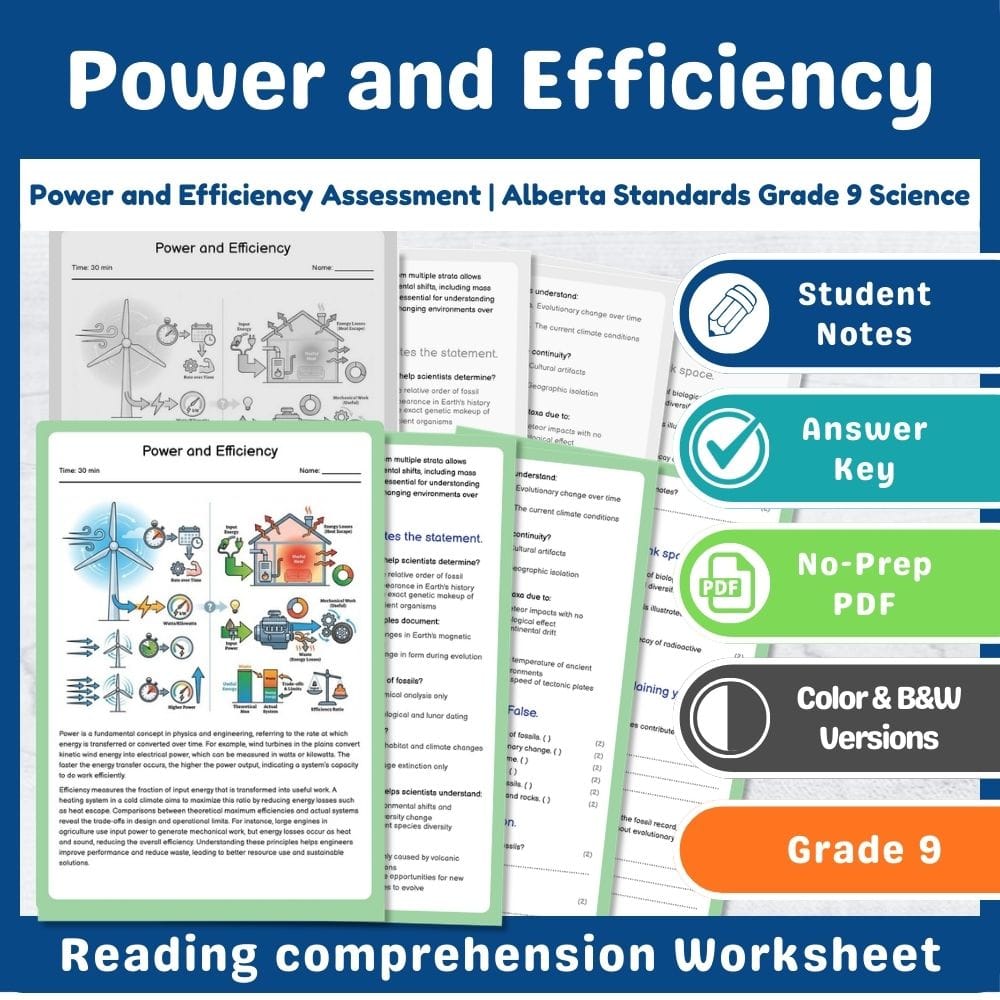
Power and Efficiency Assessment | Alberta Standards Grade 9 Science
Created byPrism Point LearningLearning Objectives
- Understand the concepts of power as the rate of energy transfer in various systems.
- Explain the meaning of efficiency in energy conversion and how it impacts system performance.
- Analyze real-world examples of power and efficiency in engineering applications like turbines, engines, and heating systems.

Ecosystem Energy Flow Assessment Grade 12 Science Florida NGSSS
Created byPrism Point LearningLearning Objectives
- Explain how energy flows through trophic levels in an ecosystem and why energy decreases at higher levels
- Describe the roles of producers, consumers, and decomposers in ecosystem function
- Use trophic relationships to predict how changes in one population may affect others
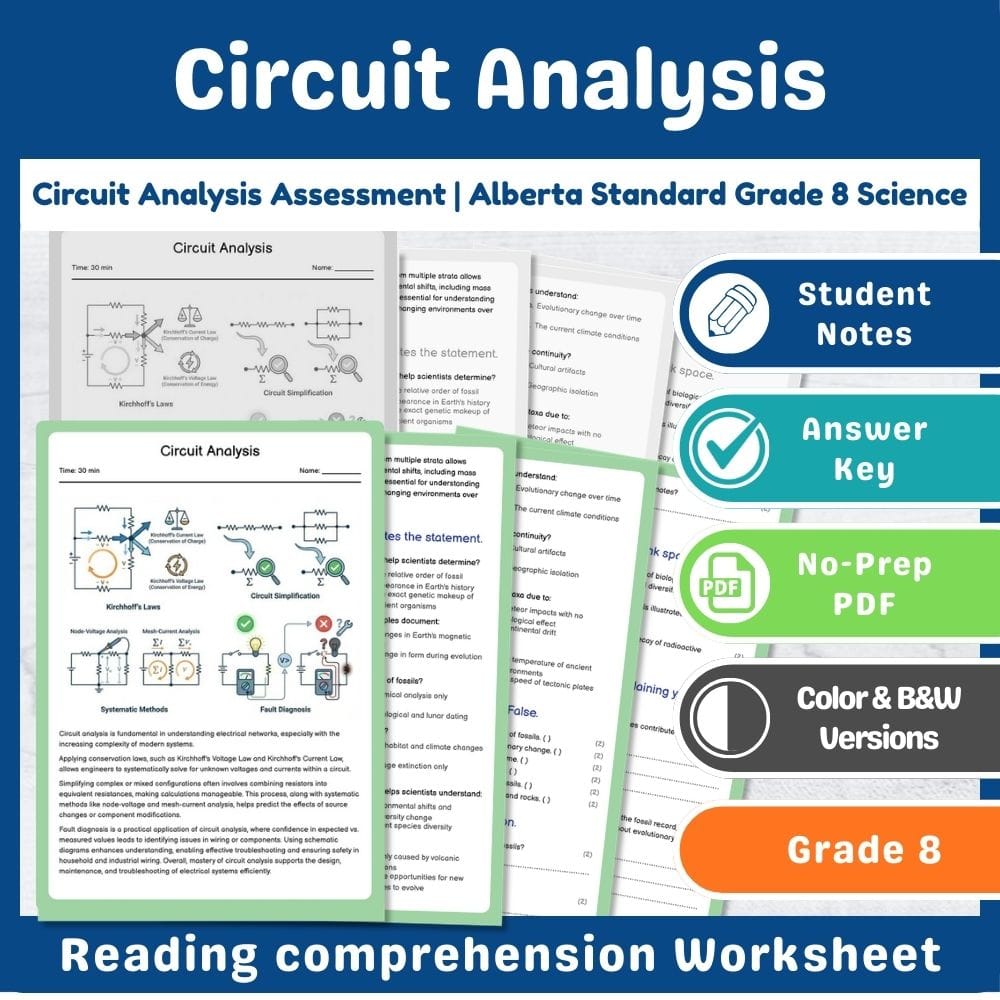
Circuit Analysis Assessment | Alberta Standard Grade 8 Science
Created byPrism Point LearningLearning Objectives
- Understand the principles of circuit analysis and conservation laws.
- Apply systematic methods to determine voltages, currents, and power in electrical networks.
- Use schematic diagrams and equivalent resistance reduction to simplify complex circuits.
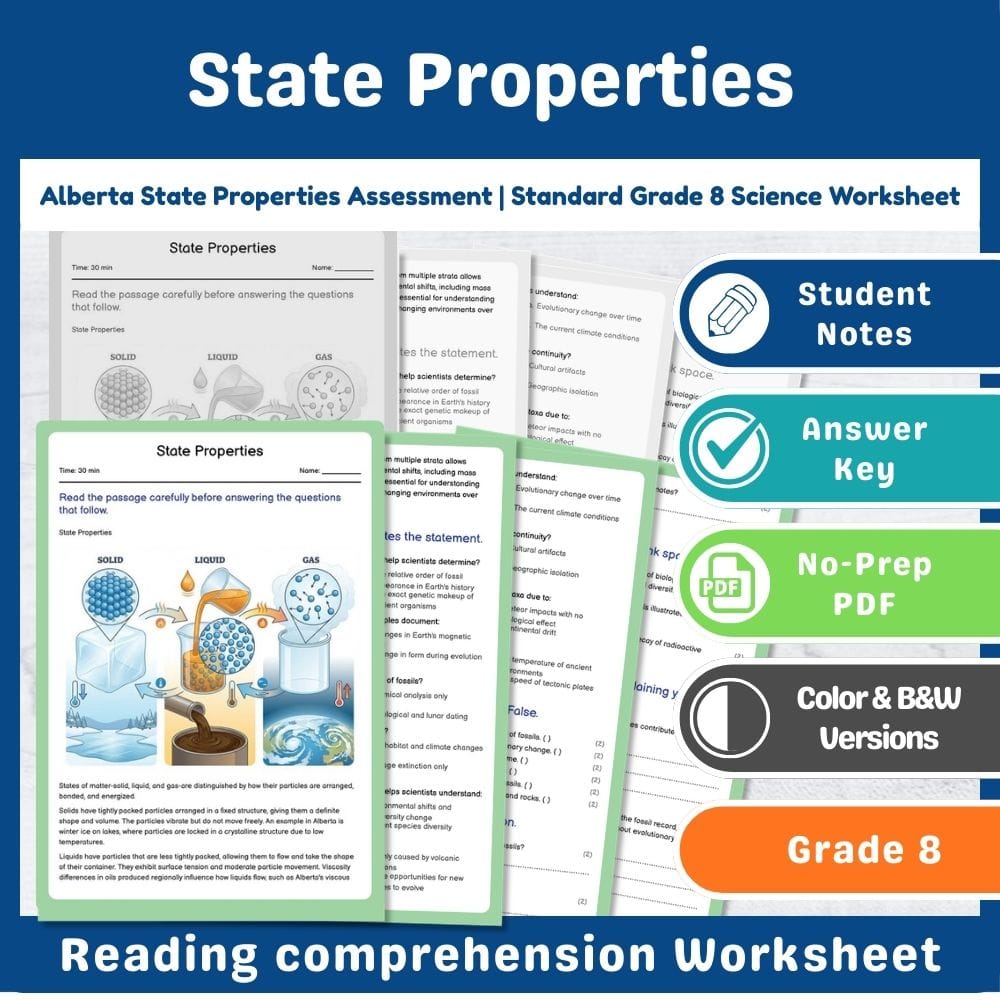
Alberta State Properties Assessment | Standard Grade 8 Science Worksheet
Created byPrism Point LearningLearning Objectives
- Describe the particle arrangement and energy differences in solids, liquids, and gases.
- Explain how particle bonding strength affects the state of matter.
- Identify examples of each state of matter in Alberta and regional contexts.
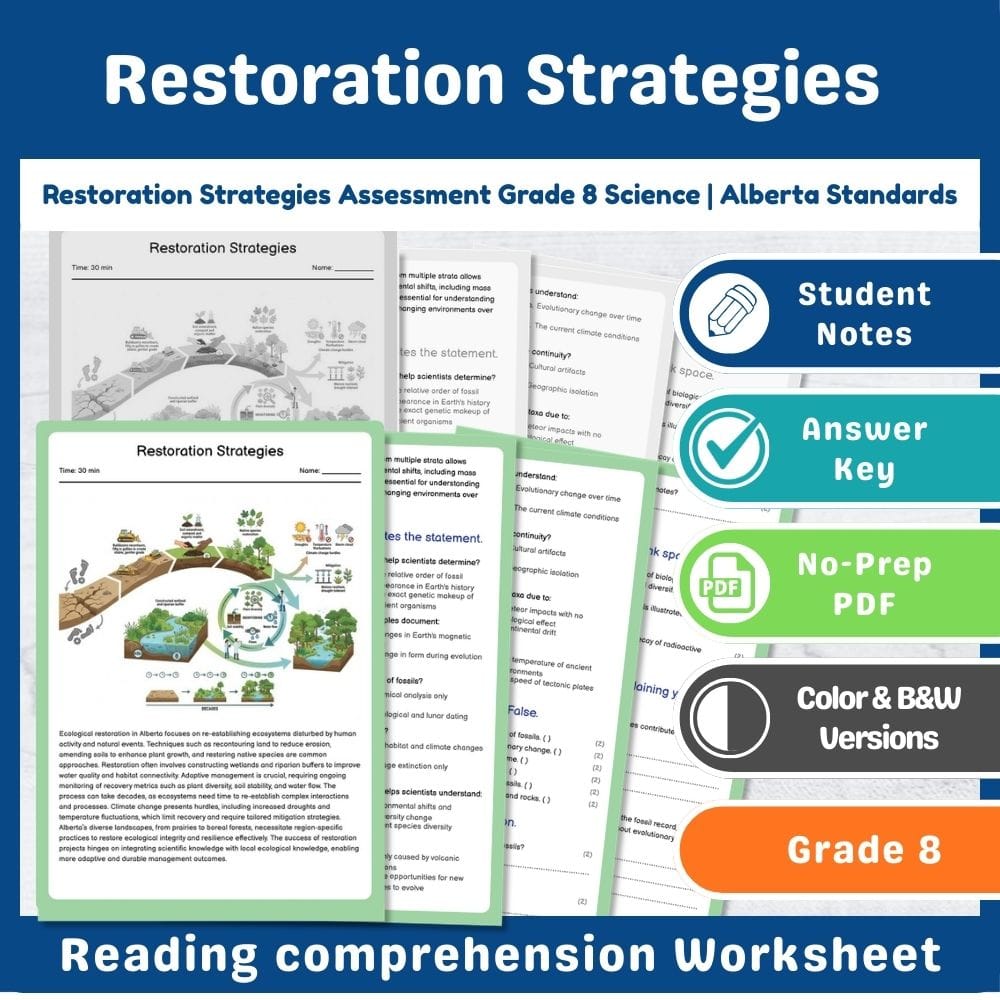
Restoration Strategies Assessment Grade 8 Science | Alberta Standards
Created byPrism Point LearningLearning Objectives
- Understand principles of ecological restoration in Alberta.
- Identify different restoration approaches such as habitat reclamation and species reintroduction.
- Explain monitoring and assessment techniques used in restoration projects.
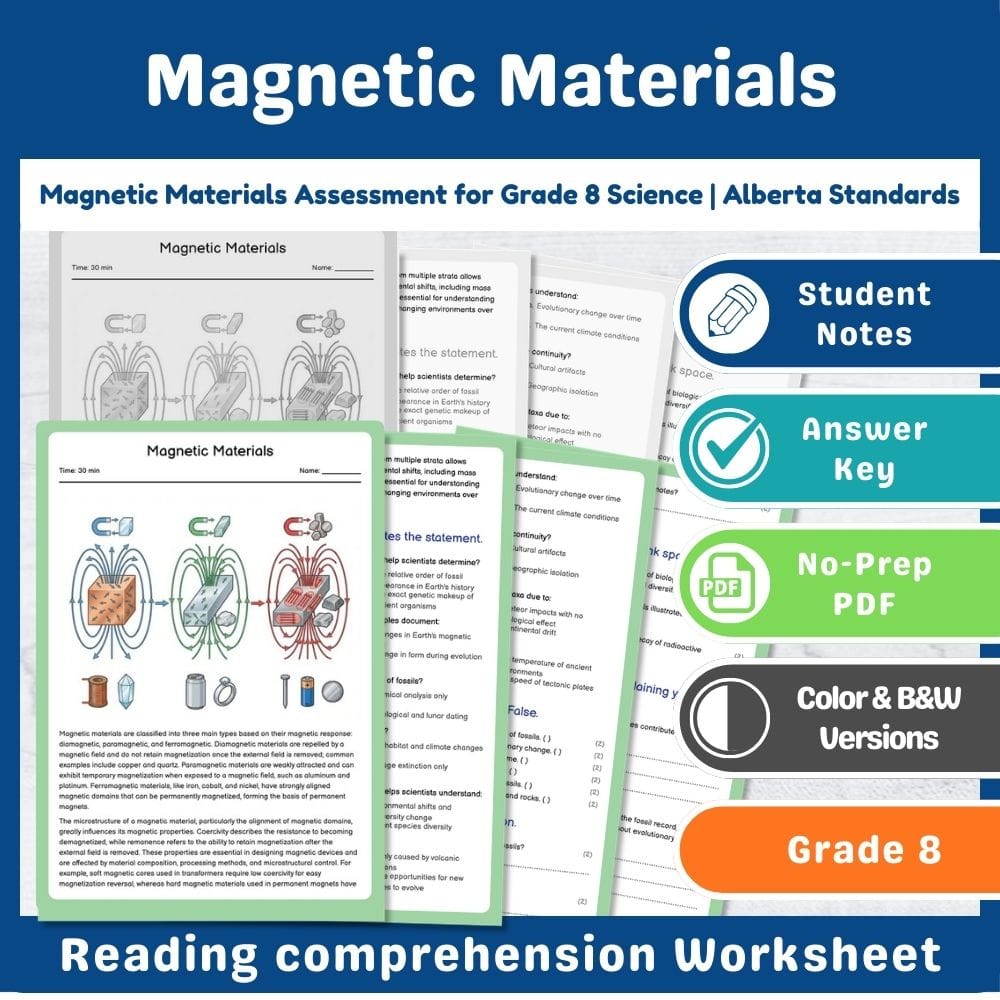
Magnetic Materials Assessment for Grade 8 Science | Alberta Standards
Created byPrism Point LearningLearning Objectives
- Describe the classification of materials based on their magnetic response.
- Explain how microstructural properties influence magnetic behavior such as coercivity and remanence.
- Identify practical applications of ferromagnetic, paramagnetic, and diamagnetic materials in industry.

Energy System Efficiency Assessment | General Standards Grade 12 Science
Created byPrism Point LearningLearning Objectives
- Explain energy system efficiency and identify common loss pathways in real systems
- Evaluate how design choices (insulation, surface area, and control systems) affect useful energy output
- Apply the efficiency concept to a solar-thermal collector by linking absorber and surface properties to stored thermal energy
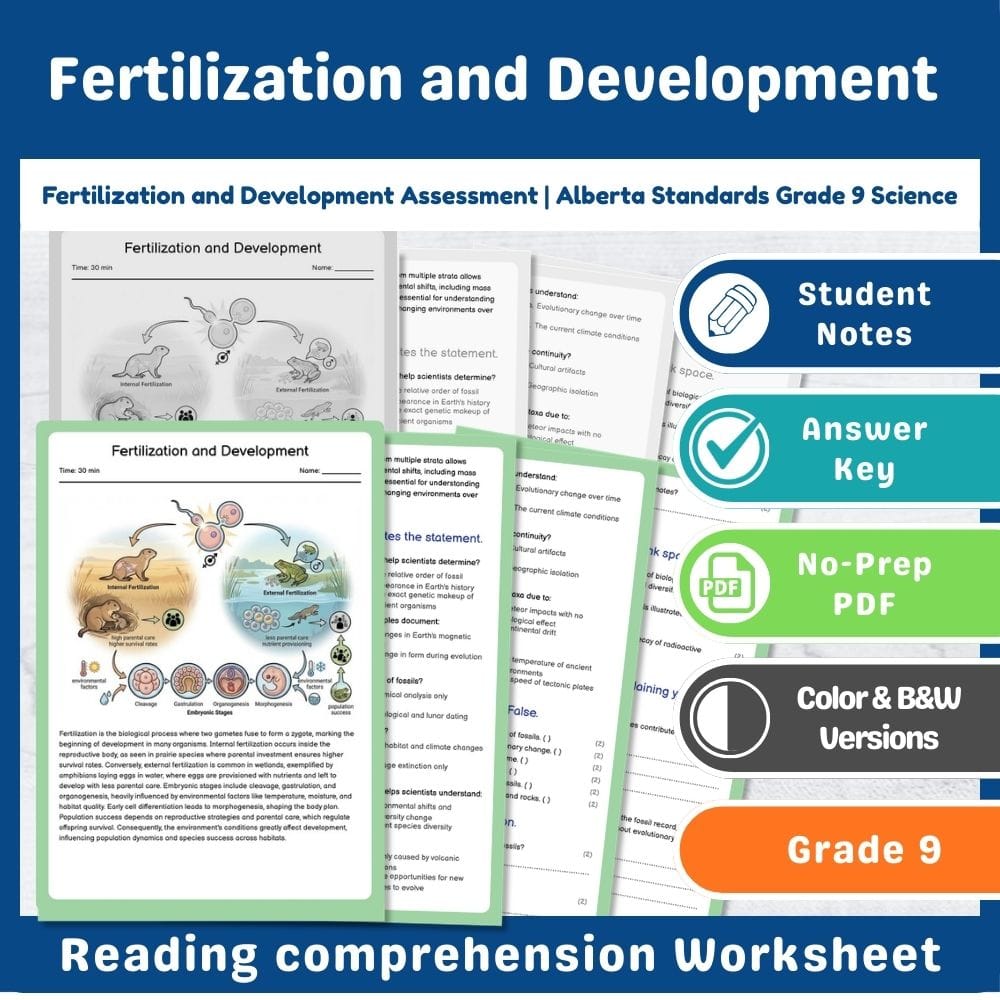
Fertilization and Development Assessment | Alberta Standards Grade 9 Science
Created byPrism Point LearningLearning Objectives
- Explain the process of fertilization and how it initiates development in organisms.
- Differentiate between internal and external fertilization strategies with examples.
- Describe the stages of embryonic development and factors influencing successful growth.
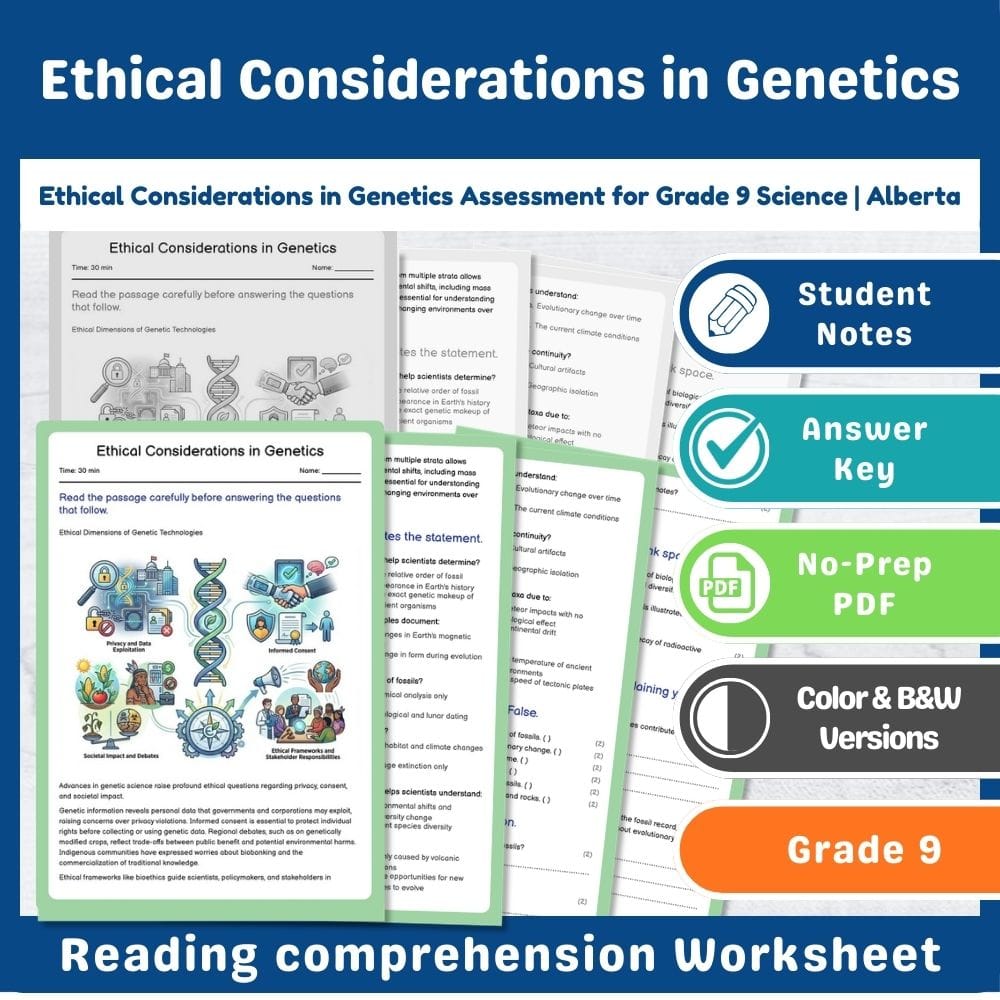
Ethical Considerations in Genetics Assessment for Grade 9 Science | Alberta
Created byPrism Point LearningLearning Objectives
- Analyze ethical and societal implications of genetic technologies.
- Identify stakeholder responsibilities and ethical frameworks related to genetics.
- Evaluate regional examples of genetic applications and their societal impacts.

Limiting Factors Assessment | Florida NGSSS Standards Grade 8 Science
Created byPrism Point LearningLearning Objectives
- Explain how limiting factors affect population growth, survival, and reproduction
- Describe carrying capacity and how populations behave when resources change
- Use evidence from scenarios to predict whether a population will grow, stabilize, or decline
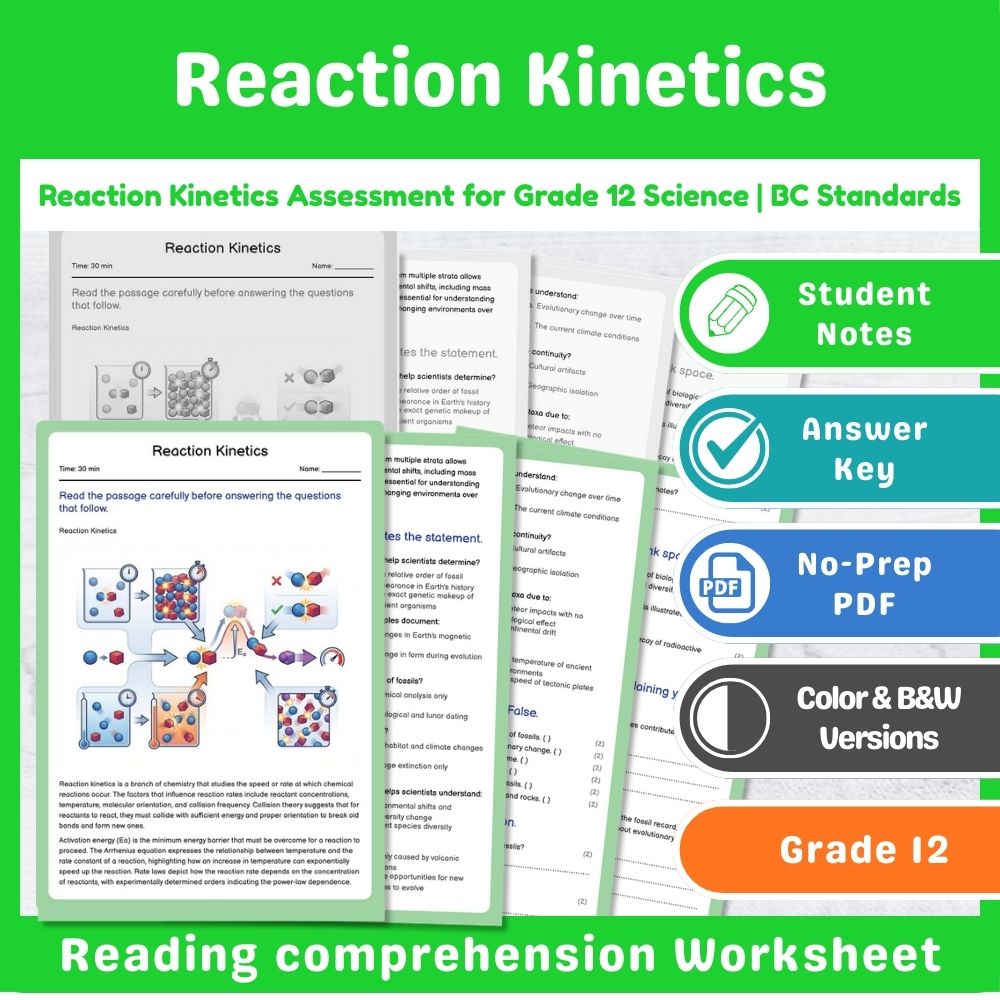
Reaction Kinetics Assessment for Grade 12 Science | BC Standards
Created byPrism Point LearningLearning Objectives
- Understand the factors influencing reaction rates including concentration, temperature, and molecular orientation.
- Explain collision theory and the concept of activation energy in chemical reactions.
- Interpret rate laws and how they relate reaction rate to reactant concentrations.
Browse more categories
About Science Worksheets
Find Science worksheets spanning core skills, practice, and review. All 42,685 resources are instant PDF downloads for the classroom or home.
Every worksheet on MyTeachingSheets is created by independent teacher-authors and reviewed before publication. All resources download as printable PDFs for classroom, homework, or at-home practice, and many include answer keys. Preview any worksheet free before buying.