
Science Worksheets
42,685 subject resources
Nucleic Acid Structure Assessment for Grade 9 Science | TEKS
 Created byPrism Point Learning
Learning Objectives
- Describe the chemical structures of DNA and RNA and the role of nucleotides.
- Explain the significance of double helix formation, antiparallel strands, and base pairing in DNA.
- Differentiate between DNA and RNA in terms of structure and function.
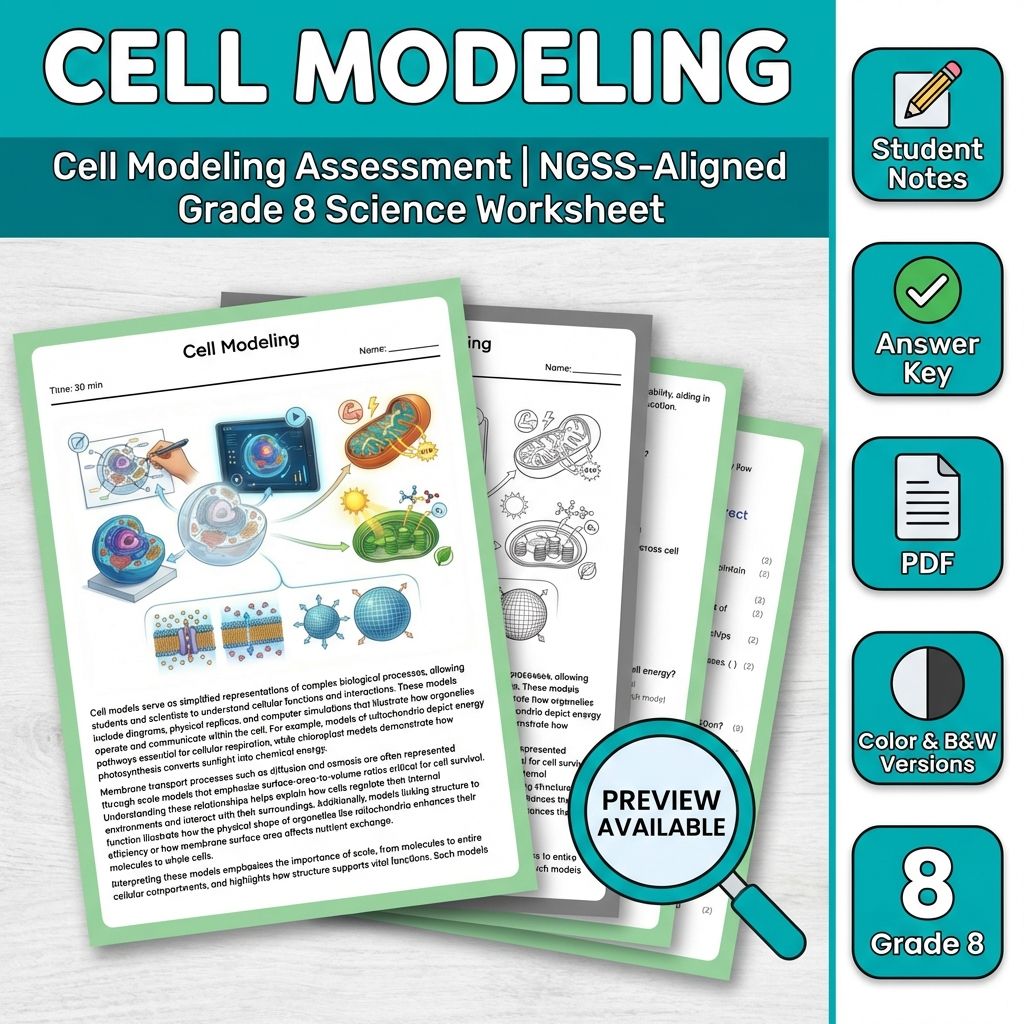
Cell Modeling Assessment | NGSS-Aligned Grade 8 Science Worksheet
Created byPrism Point LearningLearning Objectives
- Describe different models used to represent cellular processes and structures.
- Explain the roles of organelles like mitochondria and chloroplasts in cell function.
- Interpret how membrane transport mechanisms relate to cell viability and overall function.

Cell Components Assessment | TEKS Grade 11 Science Standards-Aligned
Created byPrism Point LearningLearning Objectives
- Identify the major organelles within eukaryotic cells and describe their functions.
- Explain how cell structures support processes like energy production, protein synthesis, and material transport.
- Differentiate between membrane-bound and non-membrane-bound organelles and their roles in cellular activities.

Human Impacts Assessment | TEKS Standards Grade 10 Science
Created byPrism Point LearningLearning Objectives
- Understand how human activities modify ecosystems through habitat alteration and pollution.
- Identify the effects of resource extraction, invasive species, and climate change on biodiversity.
- Explain how human activities influence energy flows and nutrient cycles in ecosystems.

Iterative Design Cycles Assessment | General Standards Grade 12 Science
Created byPrism Point LearningLearning Objectives
- Explain how iterative design cycles use criteria, constraints, and evidence to improve a solution.
- Identify the difference between early assumptions and evidence-based revisions in an engineering design process.
- Apply iterative design reasoning to a real-world product problem, such as preventing leaks in a sports water bottle lid.

Matter Cycling Carbon Assessment Grade 6 | Science Standards-Aligned
Created byPrism Point LearningLearning Objectives
- Explain how carbon atoms cycle through air, water, and living organisms in an ecosystem
- Distinguish between matter cycling (conservation of atoms) and energy flow (one-way transformation)
- Describe how carbon moves from plants to animals and returns to the environment through respiration and decomposition
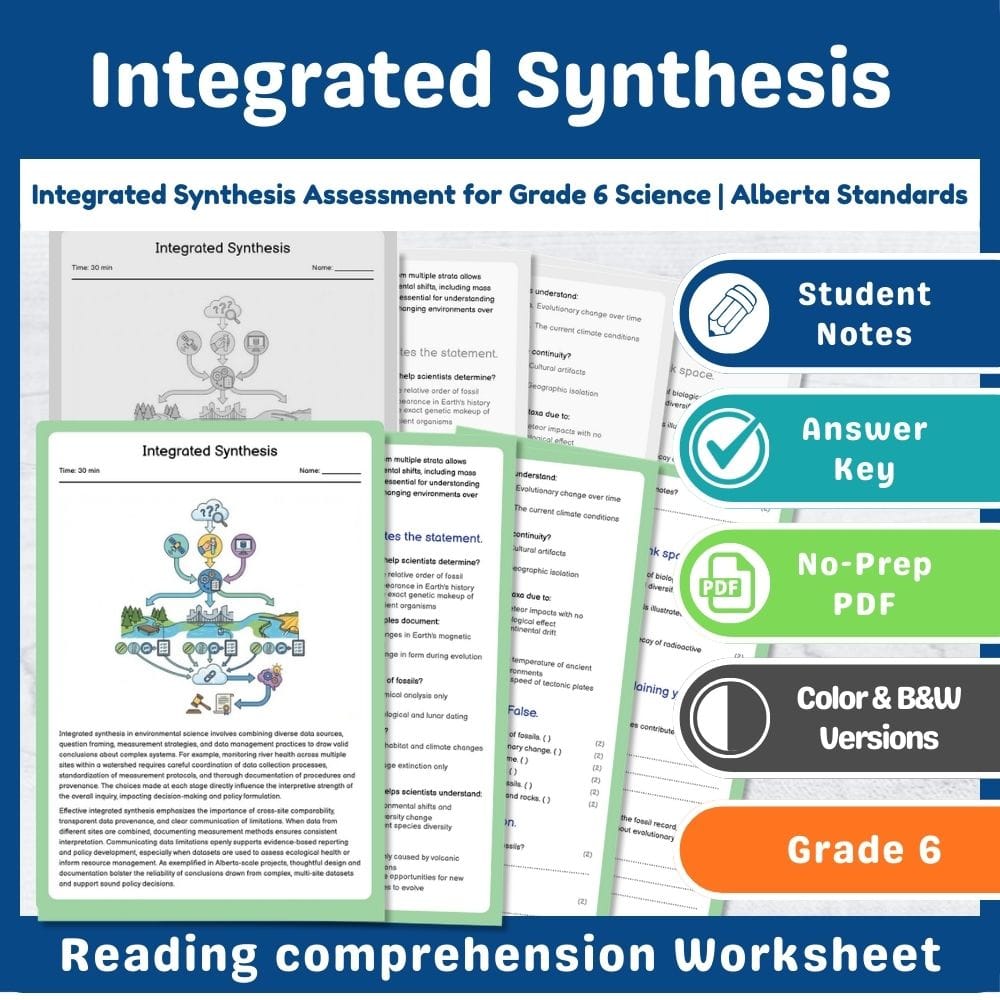
Integrated Synthesis Assessment for Grade 6 Science | Alberta Standards
Created byPrism Point LearningLearning Objectives
- Understand the key components involved in integrated synthesis within environmental monitoring.
- Evaluate the importance of documentation and data provenance in scientific inquiry.
- Analyze how measurement strategies influence the interpretation of multi-site environmental data.

Yield and Conditions Assessment | General Standards Ali gned Grade 12 Science
Created byPrism Point LearningLearning Objectives
- Interpret reaction yield as the extent of reactant conversion into products under specific conditions
- Explain how particle-model ideas (collisions, activation energy, depletion) affect reaction rate and final yield
- Evaluate how competing pathways can change product distribution and reduce desired yield
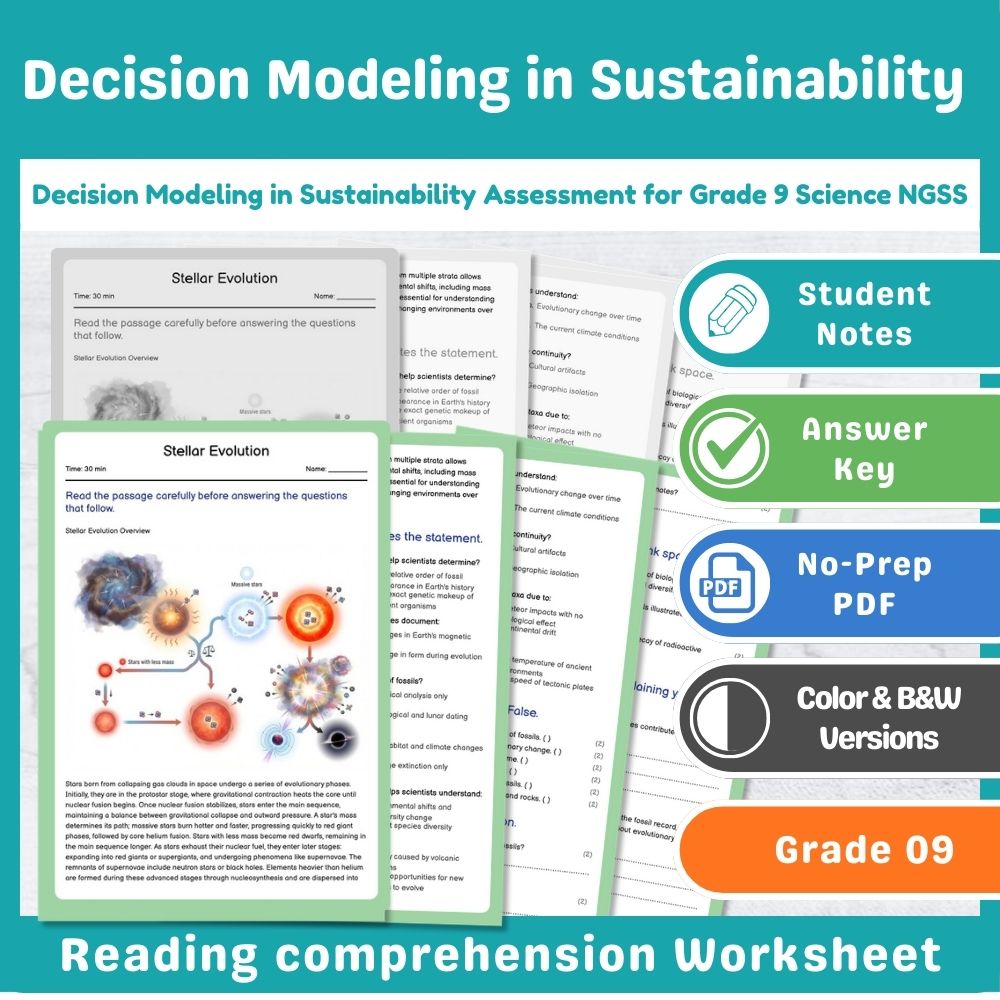
Decision Modeling in Sustainability Assessment for Grade 9 Science NGSS
Created byPrism Point LearningLearning Objectives
- Understand how decision models incorporate economic, environmental, and social variables.
- Analyze trade-offs among greenhouse gas reduction, public health, and economic development.
- Evaluate the role of policy instruments such as carbon pricing and land-use planning in mitigation strategies.
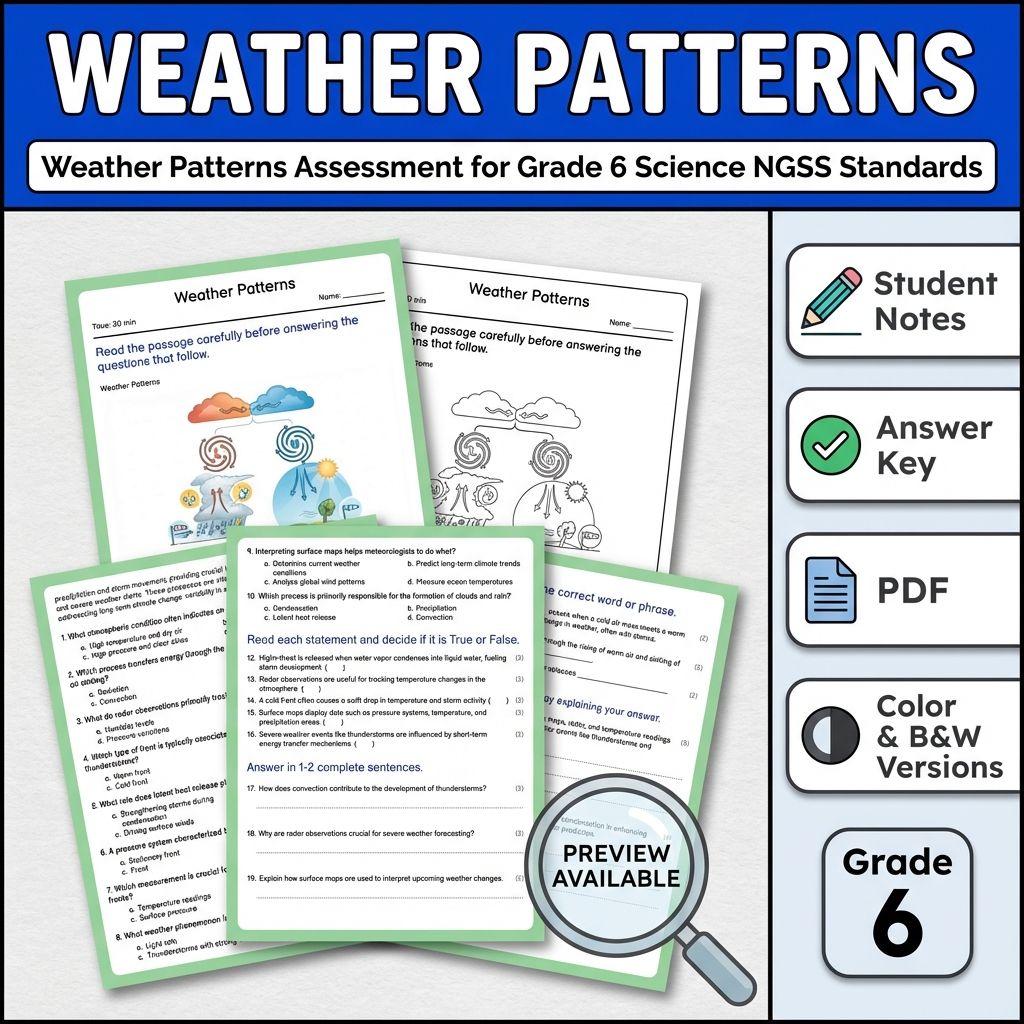
Weather Patterns Assessment for Grade 6 Science NGSS Standards
Created byPrism Point LearningLearning Objectives
- Understand atmospheric processes that influence local and regional weather.
- Interpret surface maps, temperature, and pressure data to analyze weather events.
- Identify and describe different types of weather fronts, wind shifts, and precipitation patterns.

Human System Feedbacks Assessment for Grade 7 Science | Standard General
Created byPrism Point LearningLearning Objectives
- Understand how human activities impact Earth's spheres and create feedback loops.
- Identify examples of human activities that influence the atmosphere, biosphere, and geosphere.
- Explain how feedback mechanisms can amplify or reduce environmental changes.
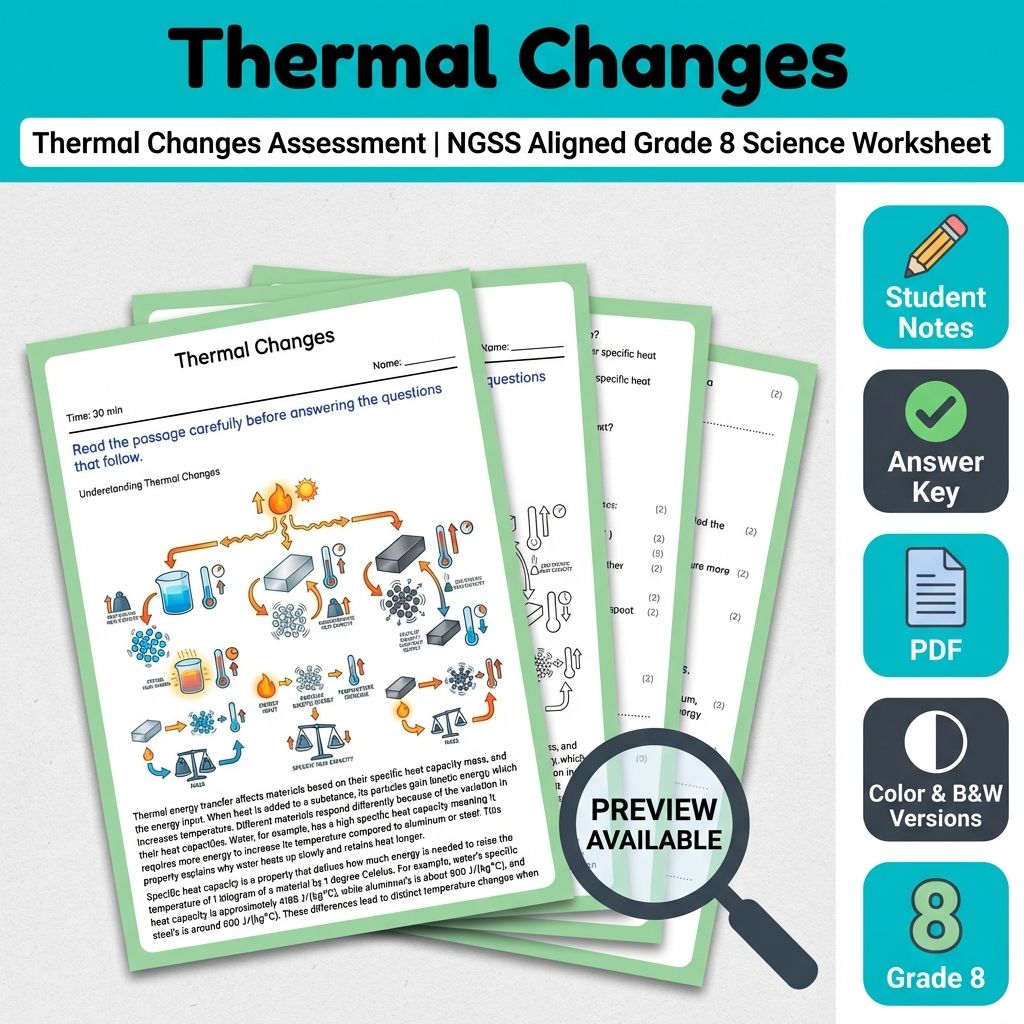
Thermal Changes Assessment | NGSS Aligned Grade 8 Science Worksheet
Created byPrism Point LearningLearning Objectives
- Understand the relationships among energy transfer, material type, mass, and temperature change.
- Explain the concept of specific heat capacity and how it affects temperature response.
- Apply calorimetric reasoning to compare heat capacities of different substances.
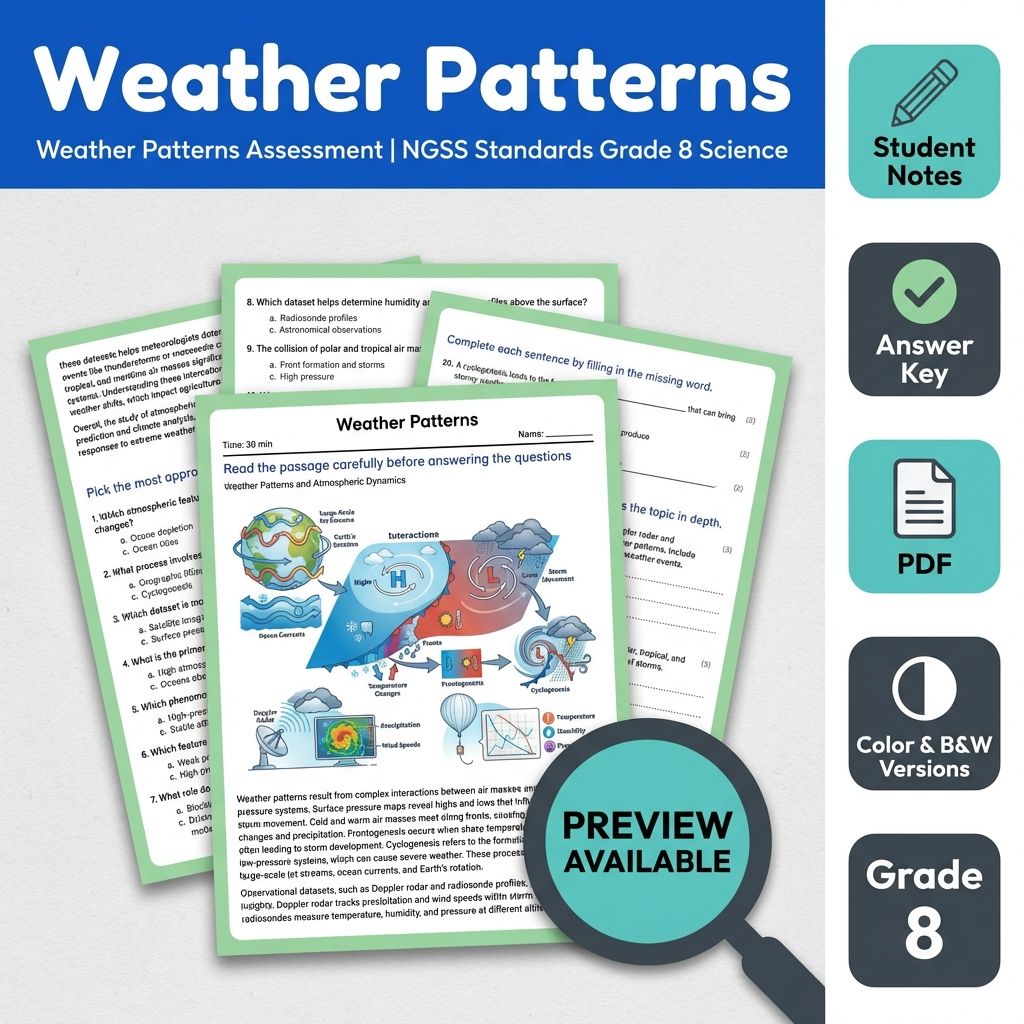
Weather Patterns Assessment | NGSS Standards Grade 8 Science
Created byPrism Point LearningLearning Objectives
- Understand the role of air mass motions in changing weather conditions.
- Identify key features of surface pressure systems and their influence.
- Explain processes such as frontogenesis and cyclogenesis in weather development.
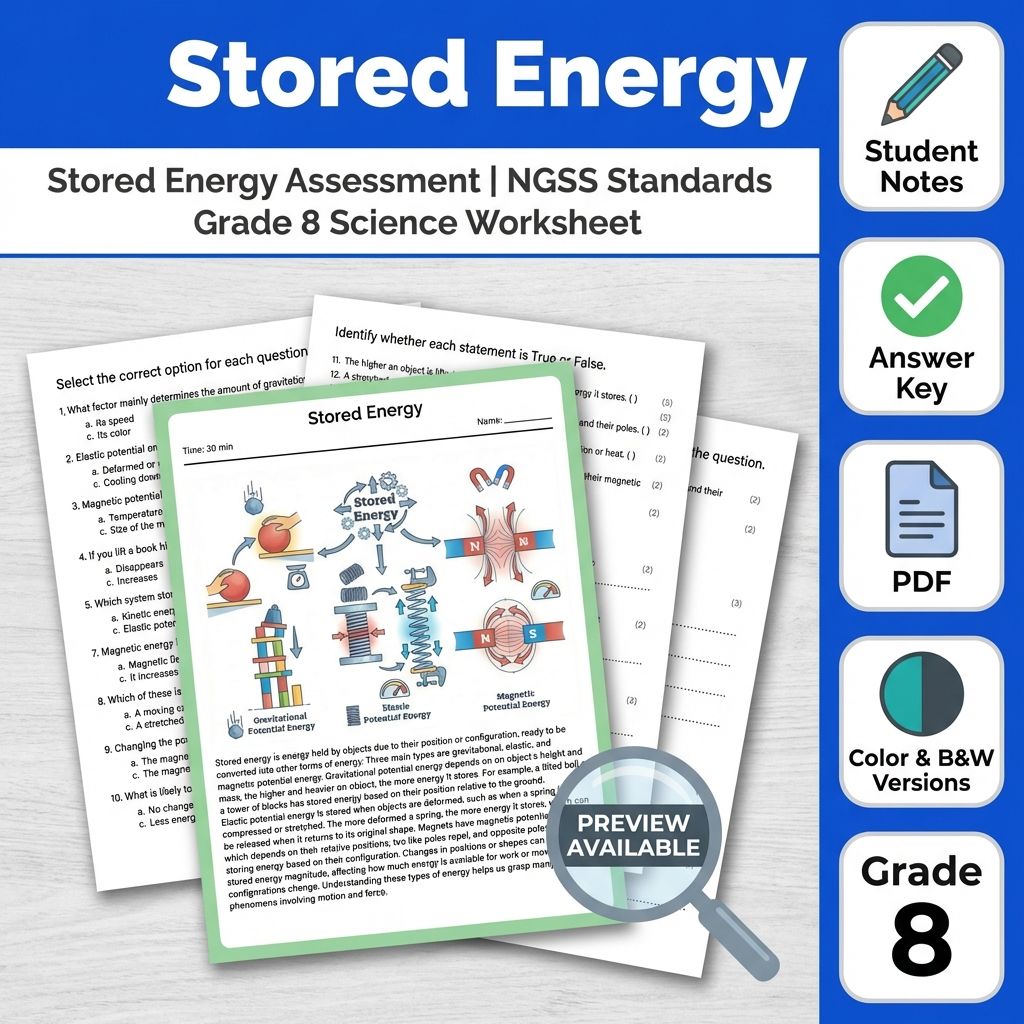
Stored Energy Assessment | NGSS Standards Grade 8 Science Worksheet
Created byPrism Point LearningLearning Objectives
- Define different forms of stored energy such as gravitational, elastic, and magnetic potential energy.
- Explain how changes in object positions and configurations alter stored energy in systems.
- Describe real-world examples of potential energy changes, including compressed springs, elevated objects, and magnets.

Understanding Measurement Uncertainty Assessment | Standards-Aligned Grade 10 Science
Created byPrism Point LearningLearning Objectives
- Explain how measurement uncertainty affects data interpretation.
- Identify factors contributing to measurement uncertainty.
- Evaluate whether differences in measurements are meaningful considering their uncertainty ranges.
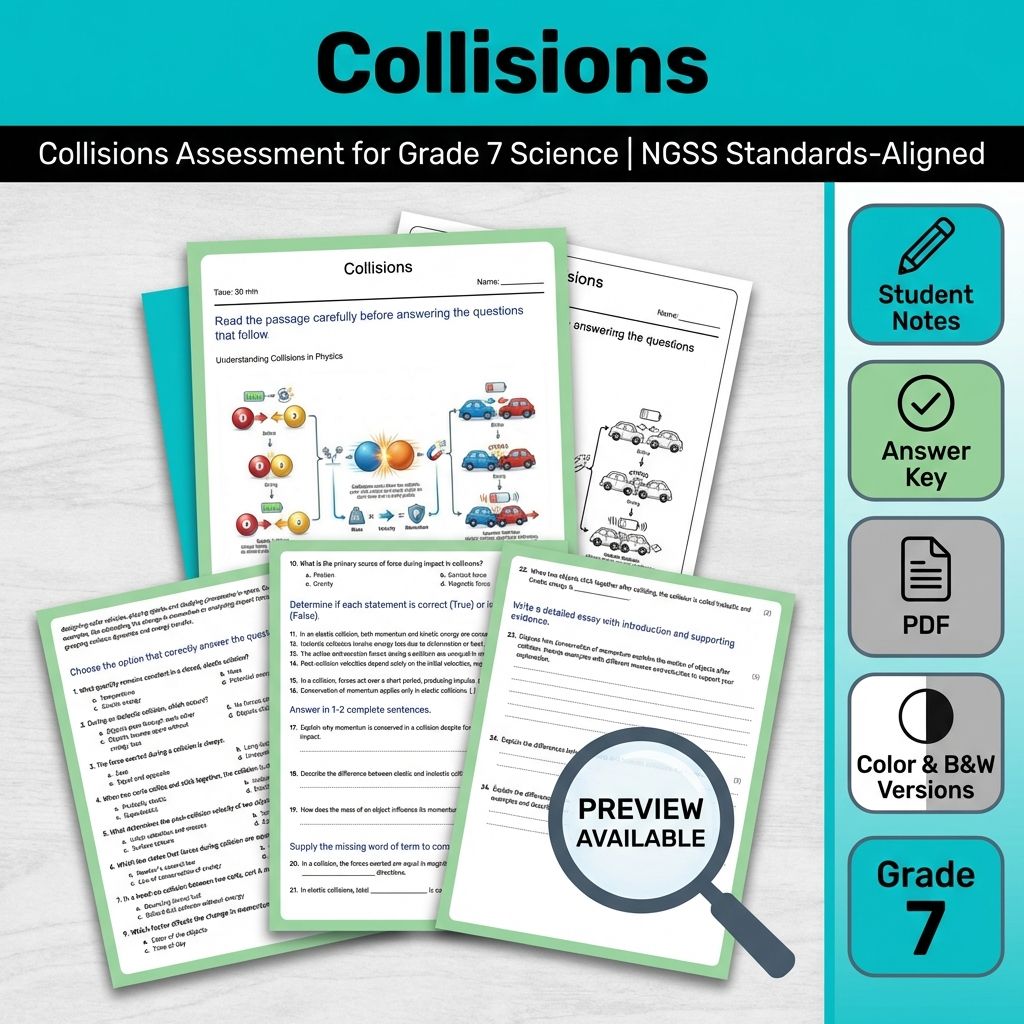
Collisions Assessment for Grade 7 Science | NGSS Standards-Aligned
Created byPrism Point LearningLearning Objectives
- Explain the principles of momentum conservation during collisions.
- Differentiate between elastic and inelastic collisions.
- Calculate post-collision velocities using mass and velocity data.
Natural Selection Assessment | BC Standards Grade 12 Science
Created byPrism Point LearningLearning Objectives
- Understand the fundamental principles of natural selection and how environmental pressures influence evolution.
- Identify different patterns of selection such as directional, stabilizing, and disruptive selection.
- Explain observable examples of natural selection, including antibiotic resistance and adaptation.
Membrane Transport Assessment | BC Standards Grade 9 Science
Created byPrism Point LearningLearning Objectives
- Describe the structure of the plasma membrane and its role in regulating material exchange.
- Differentiate between passive and active transport processes across cell membranes.
- Identify various membrane proteins involved in transport and communication.

Adaptation Over Time Assessment – NGSSS Standards-Aligned for Grade 12 Science
Created byPrism Point LearningLearning Objectives
- Explain how heritable variation and differential fitness lead to changes in allele frequencies over generations
- Distinguish directional selection from habitat-dependent variation in adaptation
- Analyze how ecological context influences which traits become more common in a population

Reaction Evidence Assessment | NGSSS Standard Grade 7 Science
Created byPrism Point LearningLearning Objectives
- Identify macroscopic evidence that indicates a chemical reaction is occurring.
- Differentiate chemical changes from physical changes using observable and irreversible signs.
- Explain how particle rearrangement connects to observations such as gas production, color change, and precipitate formation.
Natural Hazards Assessment for Grade 6 Science NGSS Standards
Created byPrism Point LearningLearning Objectives
- Understand methods for analyzing observational and instrumental data related to natural hazards.
- Identify patterns, recurrence intervals, and probable locations of hazards like earthquakes, tsunamis, and floods.
- Interpret data examples such as eruption histories and flood statistics to assess risks.
Collision Conservation Assessment | NGSS Standards Grade 10 Science
Created byPrism Point LearningLearning Objectives
- Understand the principles of conservation of momentum in multi-body collisions.
- Apply vector decomposition to resolve collision components in two dimensions.
- Differentiate between elastic and inelastic collisions based on energy transfer and post-collision behavior.
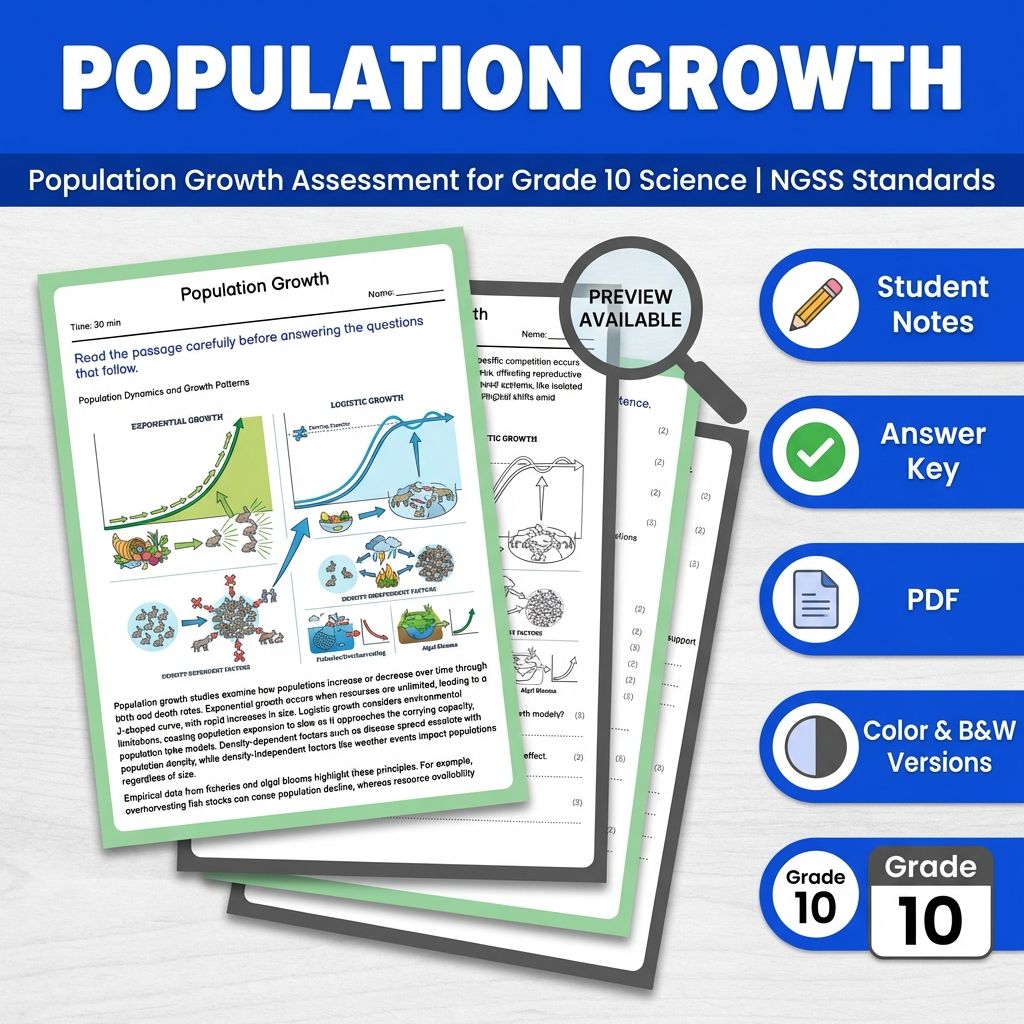
Population Growth Assessment for Grade 10 Science | NGSS Standards
Created byPrism Point LearningLearning Objectives
- Understand the principles of exponential and logistic population growth models.
- Analyze factors affecting population dynamics, including limiting factors and carrying capacity.
- Evaluate biological and environmental data to interpret population patterns and interactions.
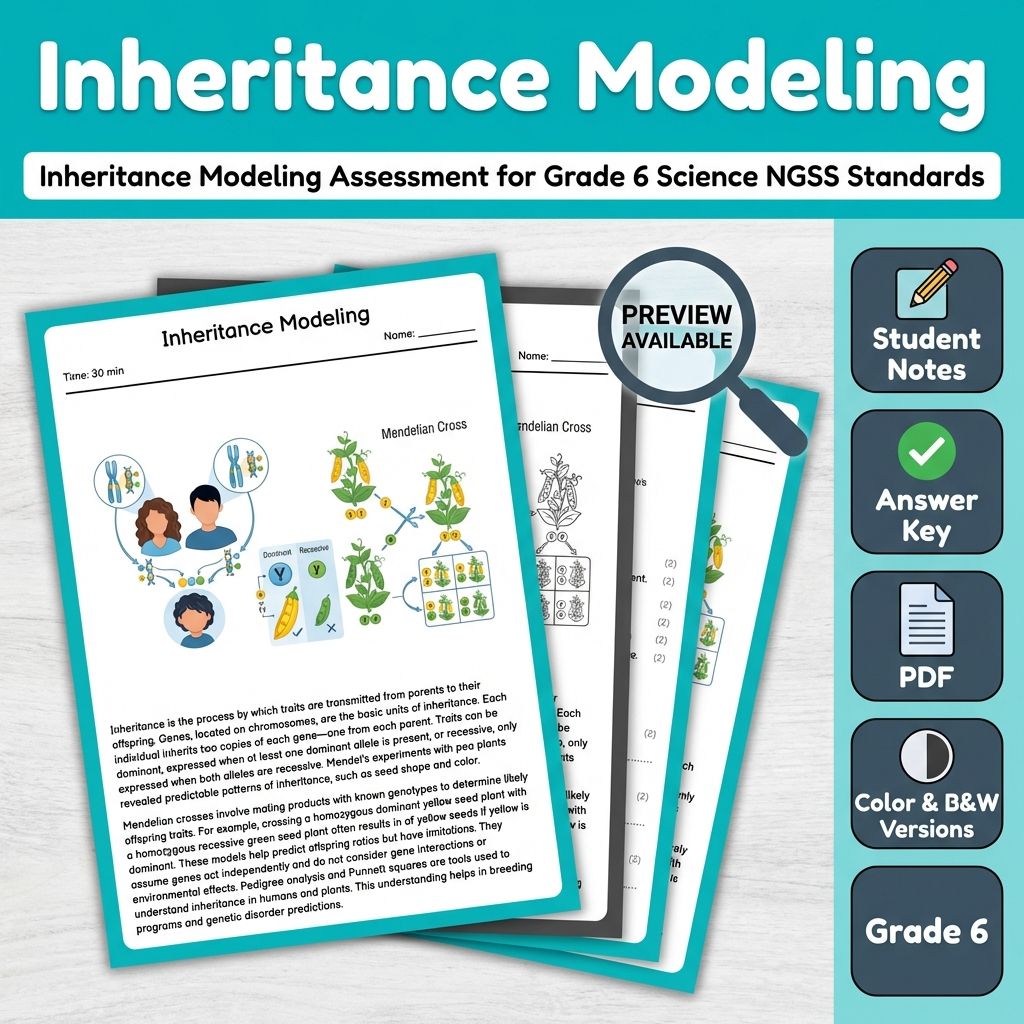
Inheritance Modeling Assessment for Grade 6 Science NGSS Standards
Created byPrism Point LearningLearning Objectives
- Understand how traits are transmitted from parents to offspring through genes.
- Identify the difference between dominant and recessive inheritance patterns.
- Use Punnett squares to predict offspring trait ratios in Mendelian cross examples.
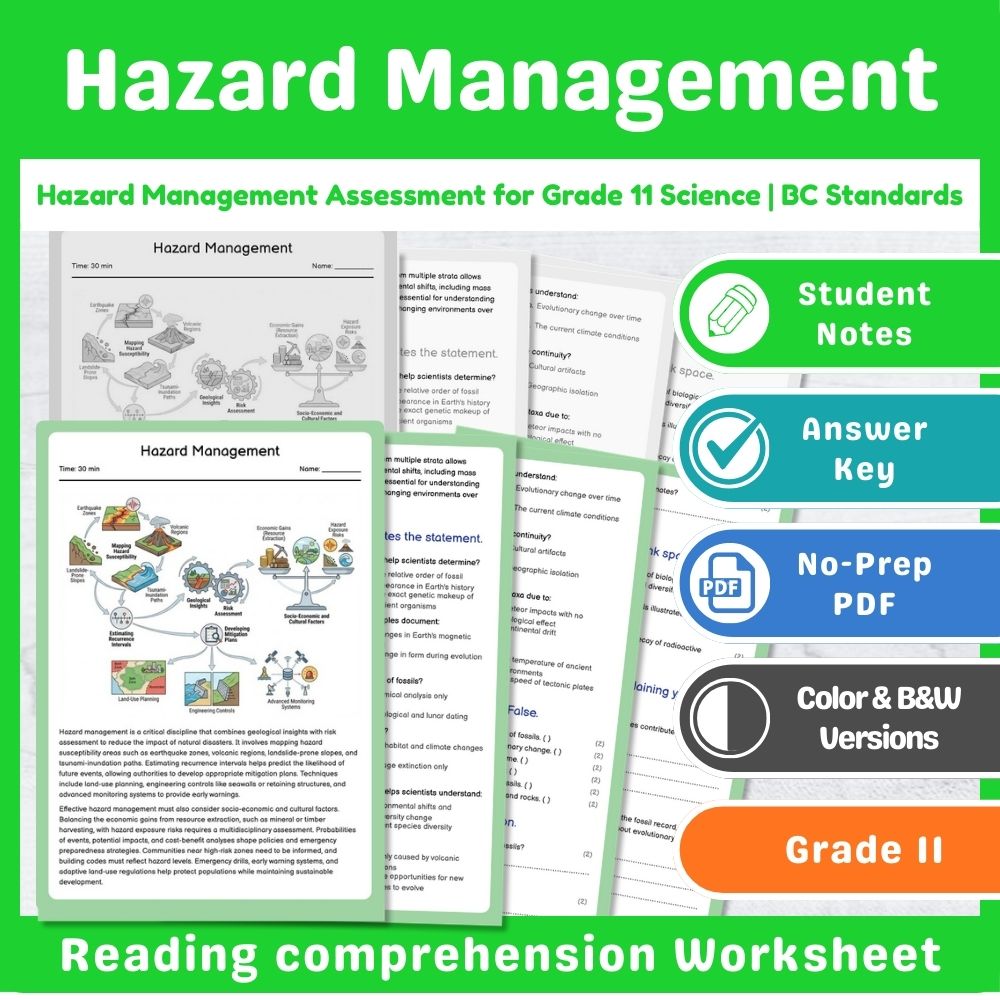
Hazard Management Assessment | BC Standards Grade 11 Science
Created byPrism Point LearningLearning Objectives
- Understand different hazard types and their management techniques.
- Identify risk assessment processes and mitigation strategies.
- Evaluate the balance between resource benefits and hazard exposure.
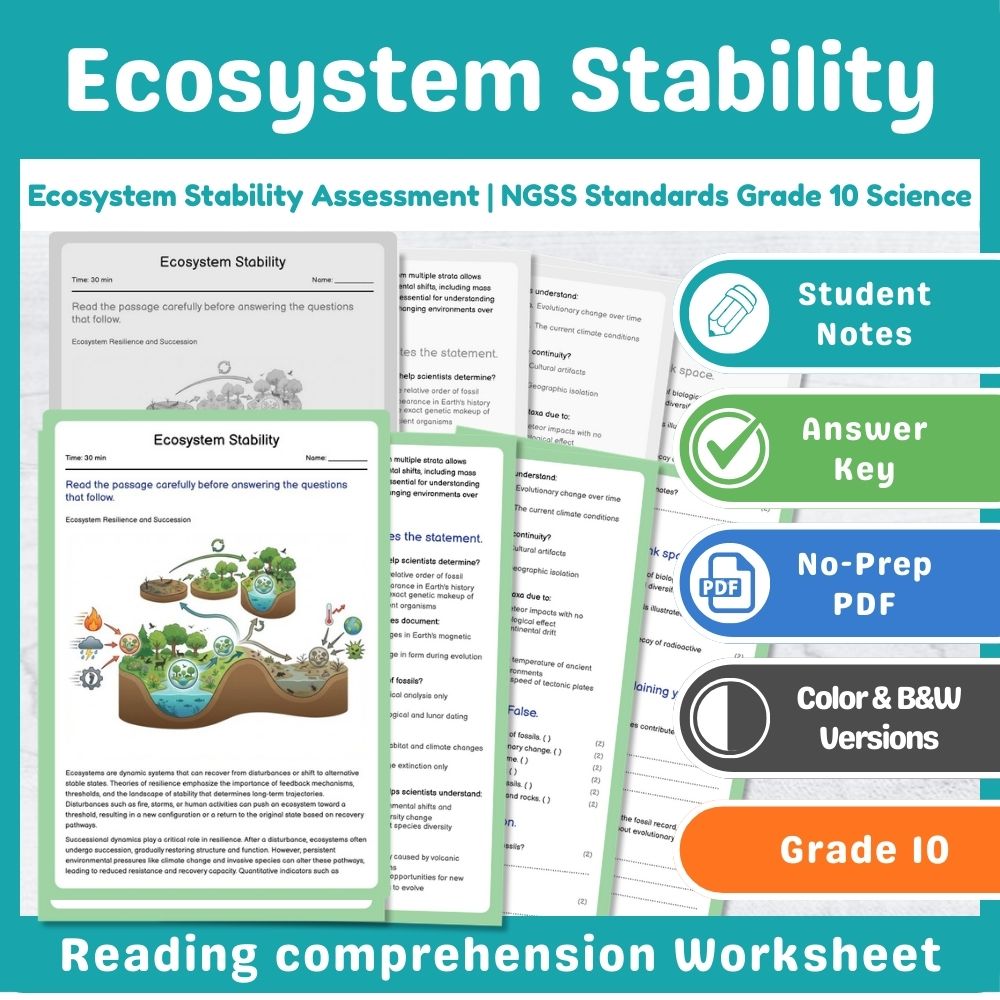
Ecosystem Stability Assessment | NGSS Standards Grade 10 Science
Created byPrism Point LearningLearning Objectives
- Understand the concepts of resilience and stability landscapes in ecosystems.
- Describe how natural and human disturbances affect ecosystem recovery pathways and thresholds.
- Identify indicators used to assess resistance, recovery time, and functional redundancy in ecosystems.
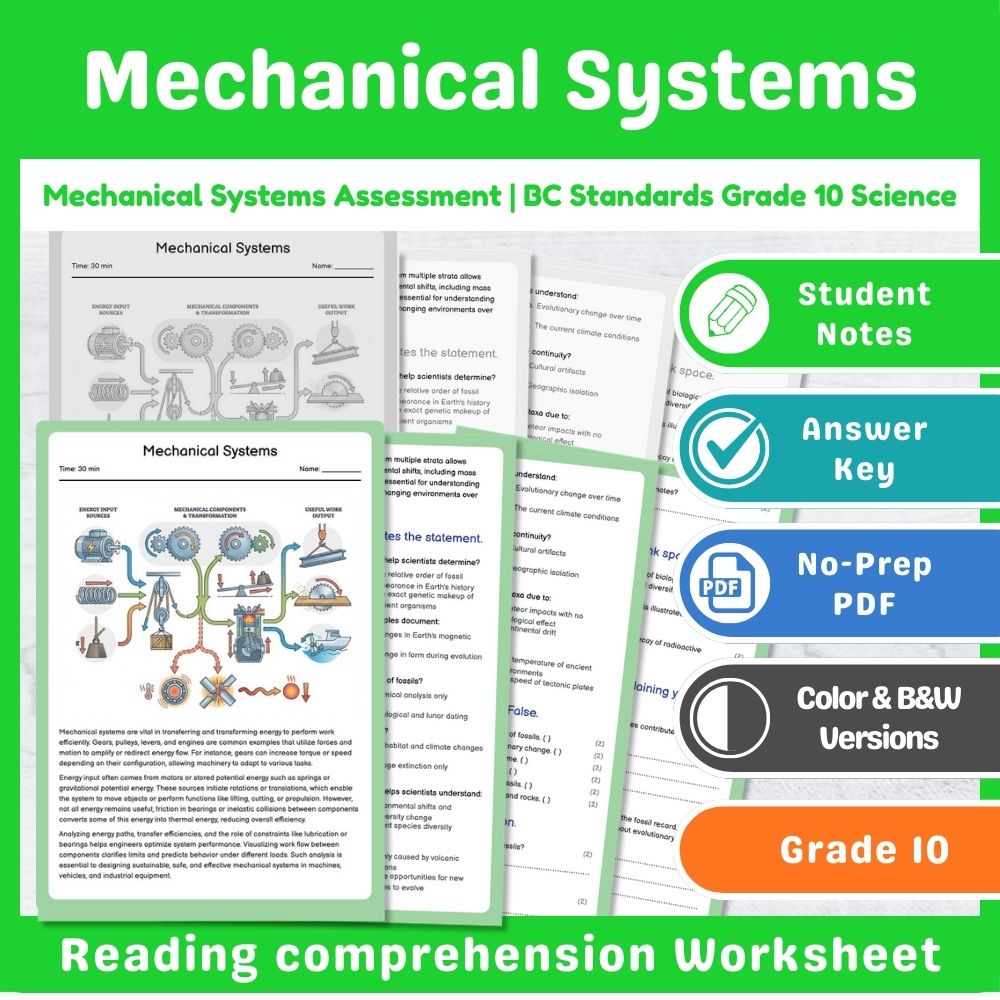
Mechanical Systems Assessment | BC Standards Grade 10 Science
Created byPrism Point LearningLearning Objectives
- Understand the transfer and transformation of energy in mechanical systems.
- Identify how forces, motions, and mechanical advantage operate in gears, pulleys, and levers.
- Analyze energy paths, transfer efficiencies, and effects of constraints such as bearings and lubrication.

Adaptation Mechanisms Assessment for Grade 8 Science | TEKS-Aligned
Created byPrism Point LearningLearning Objectives
- Describe different types of adaptation—structural, behavioral, and physiological—in various species.
- Explain how adaptations enhance survival and reproductive success in diverse environments.
- Differentiate between adaptation and acclimation, and understand the role of natural selection in evolution.
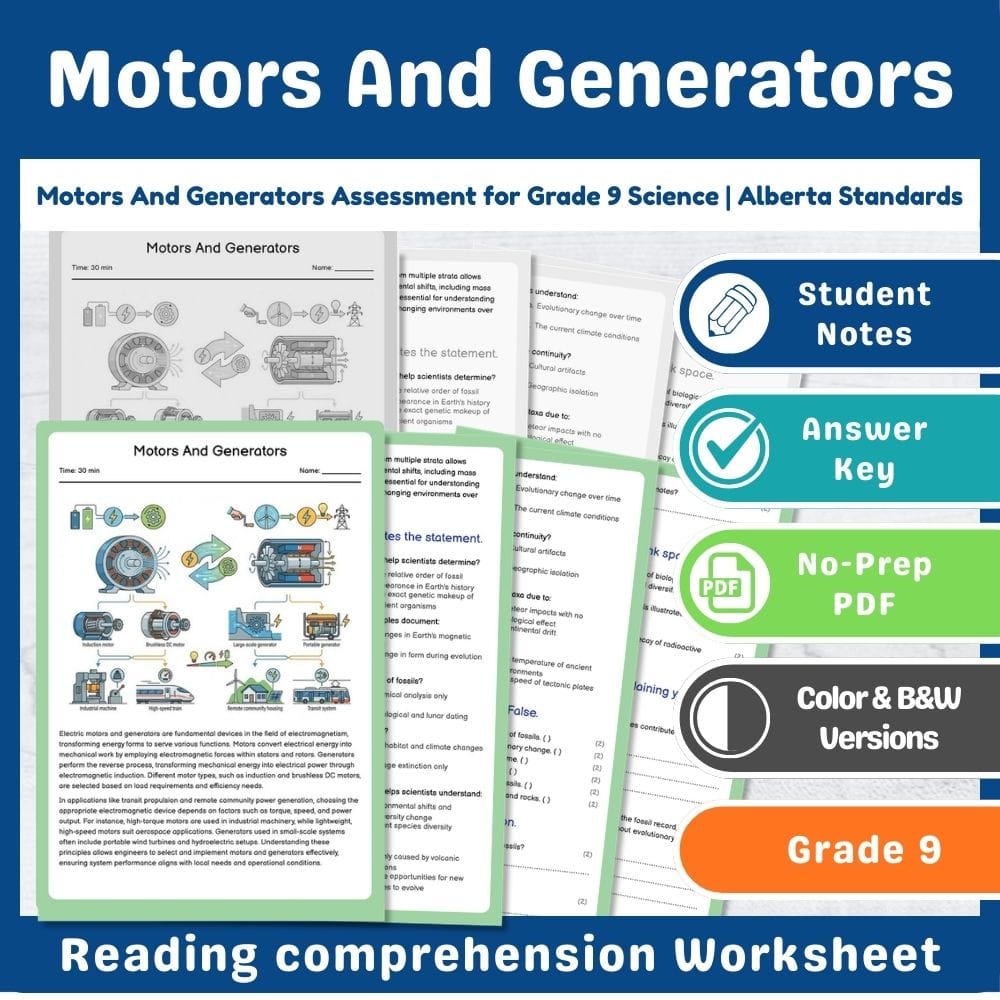
Motors And Generators Assessment for Grade 9 Science | Alberta Standards
Created byPrism Point LearningLearning Objectives
- Describe the basic principles of electric motors and generators.
- Identify different types of motors and their applications.
- Explain electromagnetic induction and its role in generating electricity.

Cell Structure Assessment | General Grade 6 Science Standards
Created byPrism Point LearningLearning Objectives
- Identify the main parts of a cell and their functions.
- Describe the roles of the cell membrane, cytoplasm, nucleus, and organelles.
- Explain how cell parts work together to support life processes.
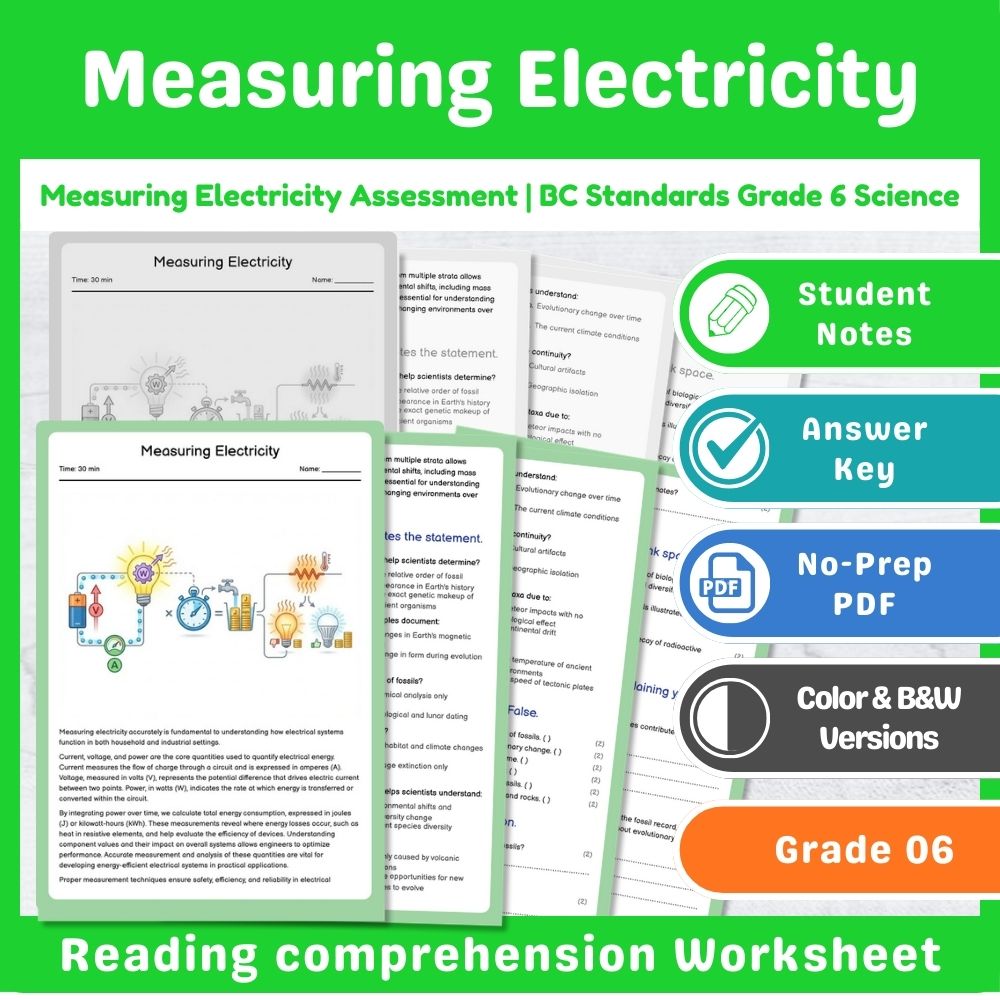
Measuring Electricity Assessment | BC Standards Grade 6 Science
Created byPrism Point LearningLearning Objectives
- Understand key electrical quantities such as current, voltage, and power.
- Identify how measurements of electricity determine energy transfer and system efficiency.
- Learn the relationship between instantaneous electrical quantities and cumulative energy consumption.

Inheritance Patterns Assessment | TEKS Grade 9 Science Standards
Created byPrism Point LearningLearning Objectives
- Describe Mendelian patterns like segregation and independent assortment.
- Identify and compare non-Mendelian inheritance patterns such as incomplete dominance and codominance.
- Recognize how environmental factors and gene linkage influence trait expression.
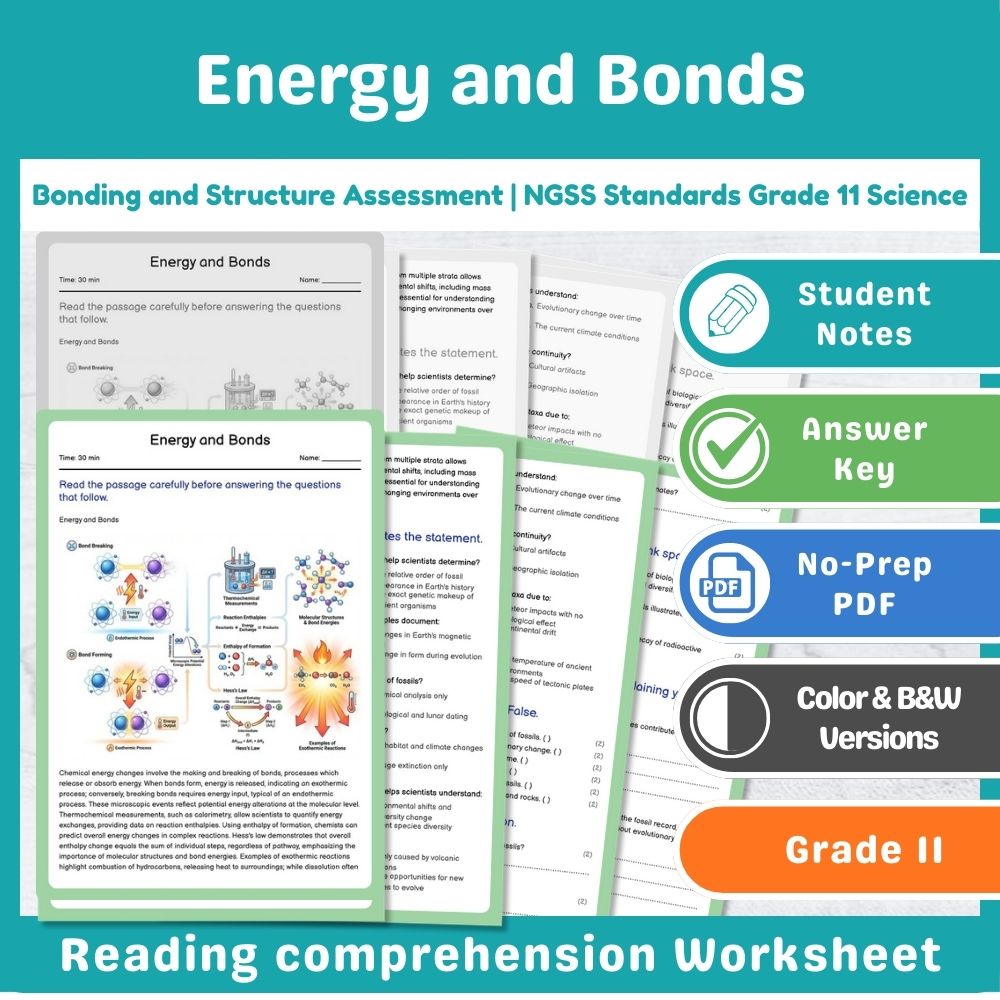
Energy and Bonds Assessment – NGSS Aligned Evaluation for Grade 11 Science
Created byPrism Point LearningLearning Objectives
- Understand the representation of chemical energy changes through bond formation and breaking.
- Explain how net enthalpy change relates to bond energies and molecular structure.
- Interpret thermochemical data, including calorimetry, formation enthalpies, and Hess's law.
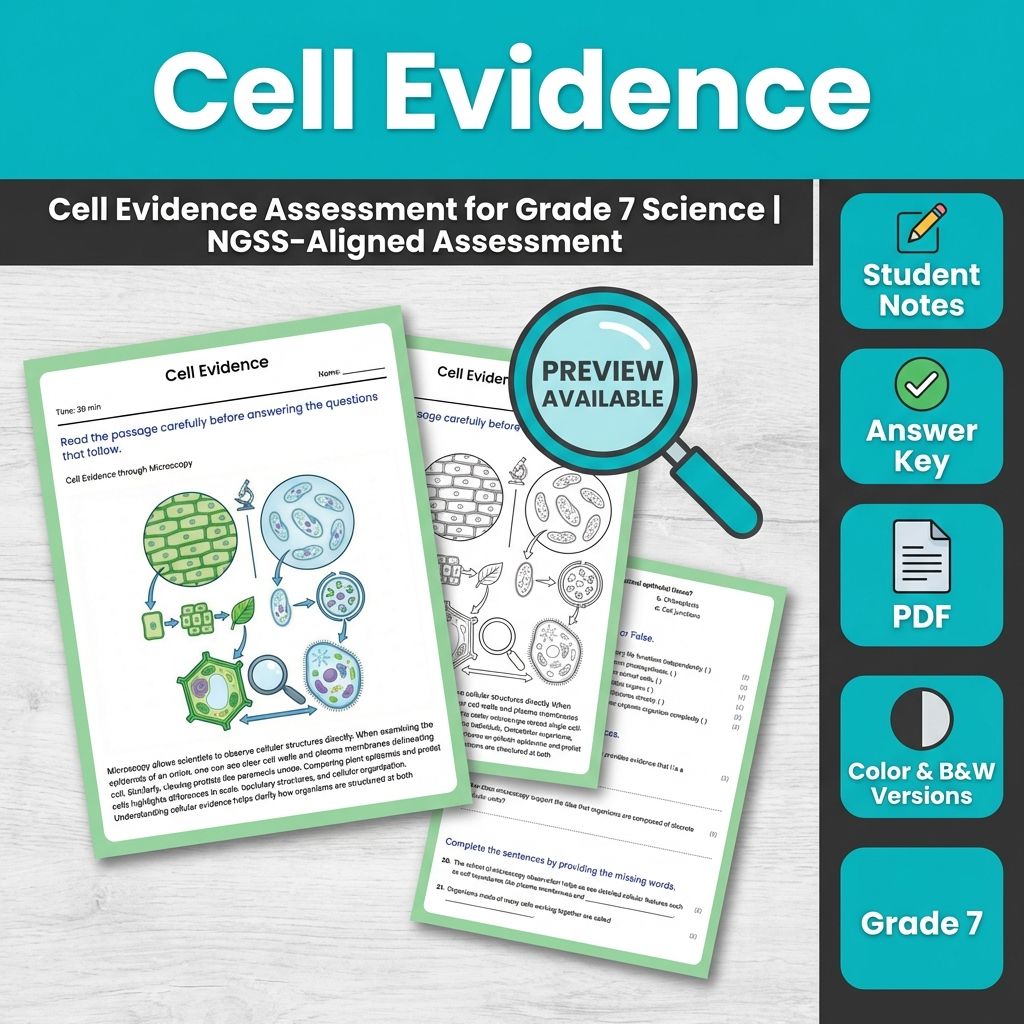
Cell Evidence Assessment for Grade 7 Science | NGSS-Aligned Assessment
Created byPrism Point LearningLearning Objectives
- Understand how microscopy provides evidence for cellular organization in organisms.
- Identify differences between unicellular and multicellular organisms through observations of plant and protist cells.
- Recognize cellular features such as cell boundaries, plasma membranes, and cell walls in microscopic images.
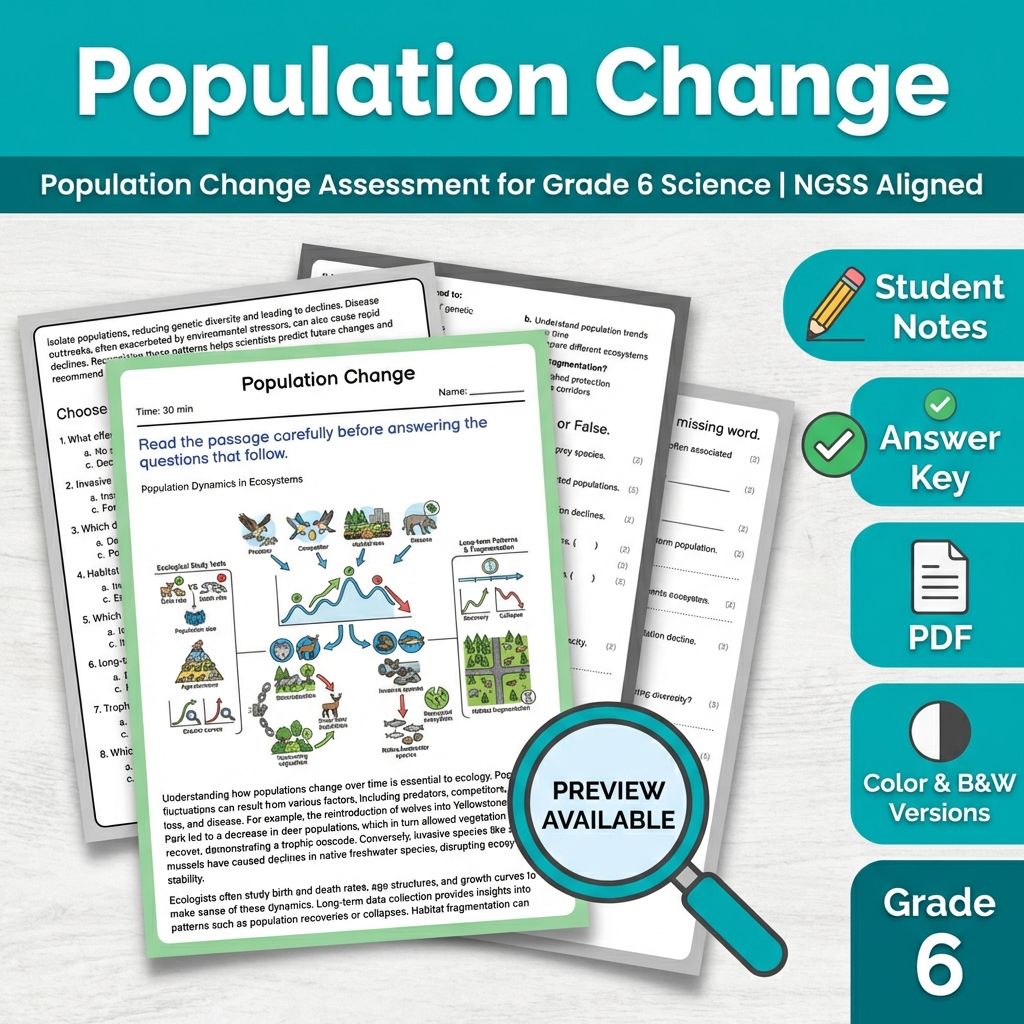
Population Change Assessment for Grade 6 Science | NGSS Aligned
Created byPrism Point LearningLearning Objectives
- Construct evidence-based arguments linking ecosystem alterations to population changes.
- Analyze case studies involving predator reintroduction, invasive species, habitat fragmentation, and disease outbreaks.
- Interpret empirical data sets and longitudinal observations to infer causal relationships in ecosystems.

Atom Conservation Assessment | Standards-Aligned Grade 6 Science Worksheet
Created byPrism Point LearningLearning Objectives
- Explain conservation of atoms during chemical reactions as rearrangements of atoms into new combinations
- Use particle diagrams to track atoms in reactants and products
- Predict whether a reaction description or diagram conserves atoms by counting atoms of each element
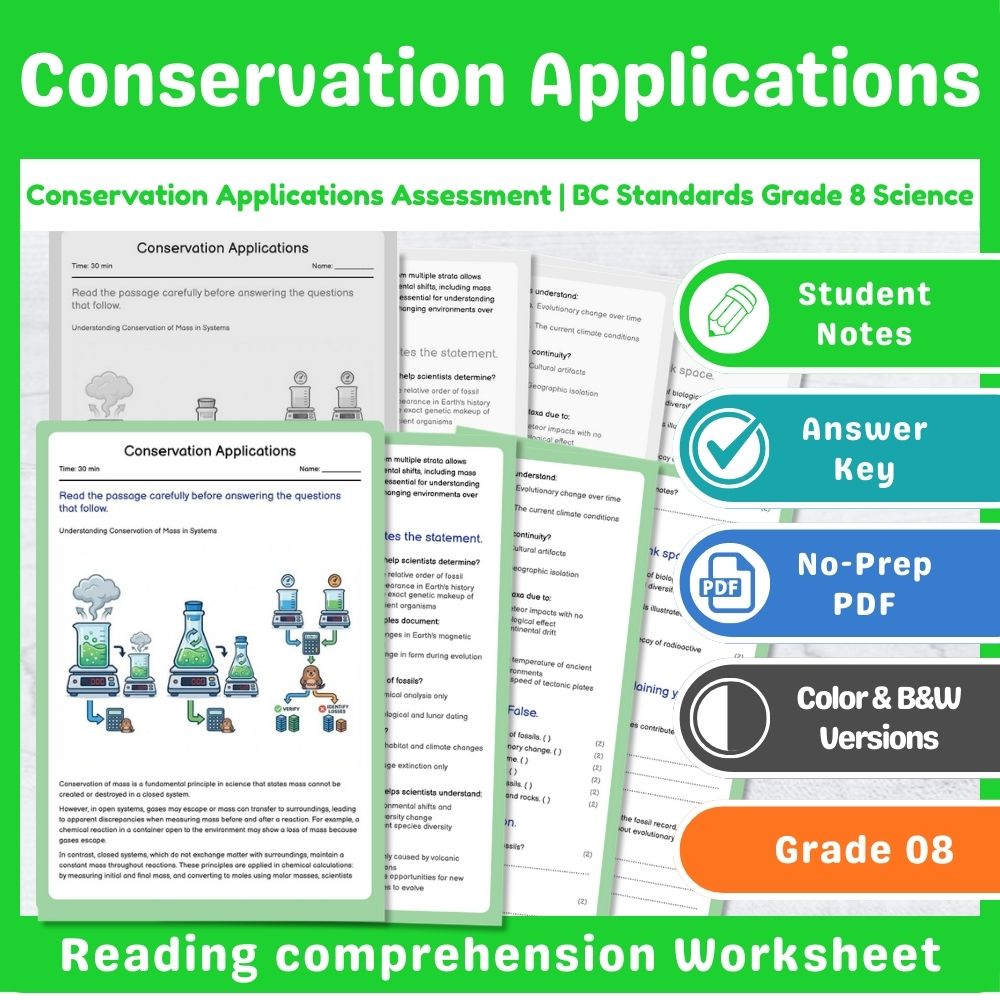
Conservation Principle Assessment | BC Standards Grade 8 Science
Created byPrism Point LearningLearning Objectives
- Understand the law of conservation of mass and its implications in chemical reactions.
- Explain how balanced chemical equations reflect mass conservation.
- Link mass measurements with mole concepts for predicting reaction outcomes.
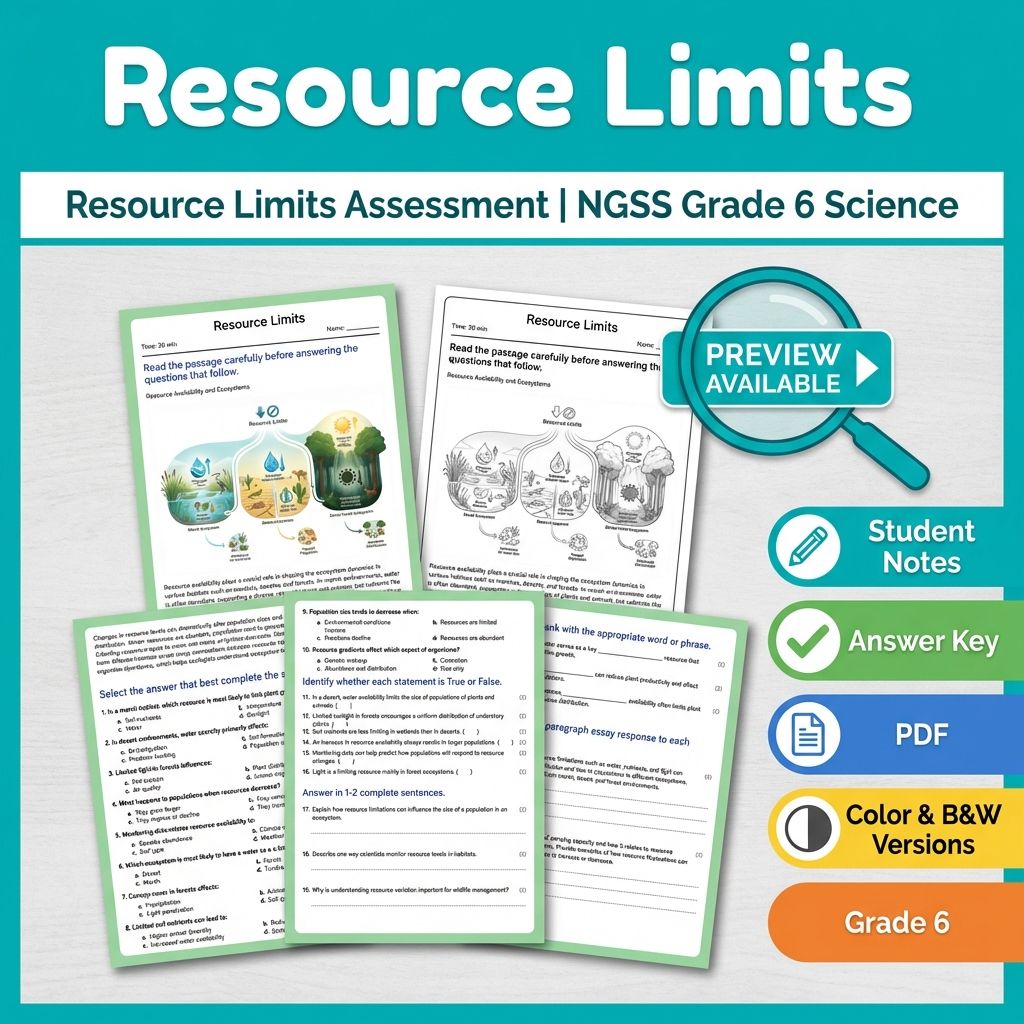
Resource Limits Assessment | NGSS Grade 6 Science
Created byPrism Point LearningLearning Objectives
- Describe how resource availability affects individual organisms and populations.
- Interpret data related to resource distribution and species abundance.
- Identify limiting resources in different ecosystems and explain their effects.
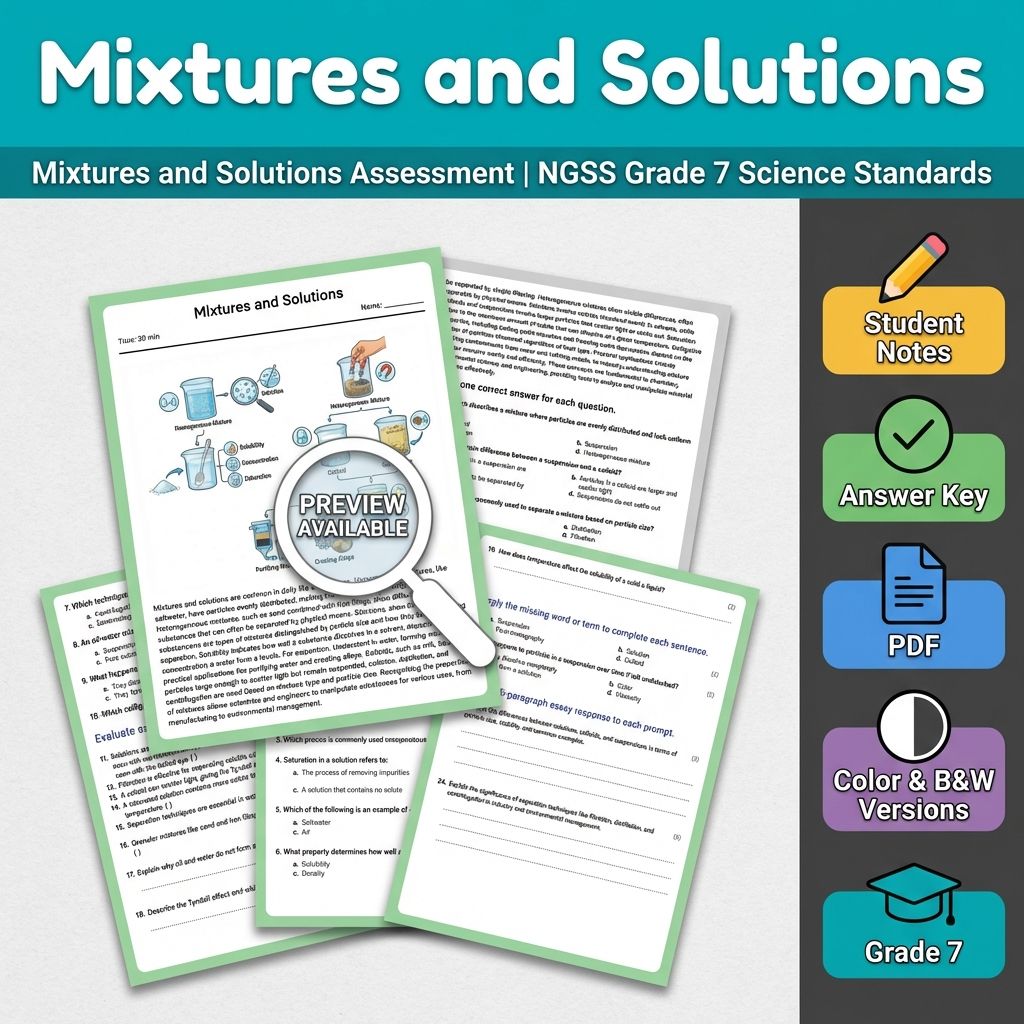
Mixtures and Solutions Assessment | NGSS Grade 7 Science Standards
Created byPrism Point LearningLearning Objectives
- Understand the differences between homogeneous and heterogeneous mixtures.
- Identify and explain properties like solubility, saturation, and concentration.
- Recognize examples of solutions, colloids, and suspensions based on particle size and separation methods.

Measurement Basics Assessment | TEKS Grade 8 Science Printable Worksheet
Created byPrism Point LearningLearning Objectives
- Understand key measurement conventions including accuracy, precision, SI units, and significant figures.
- Apply dimensional analysis and convert units correctly using appropriate instruments.
- Calculate density and rates by measuring mass, volume, length, and temperature with accuracy.
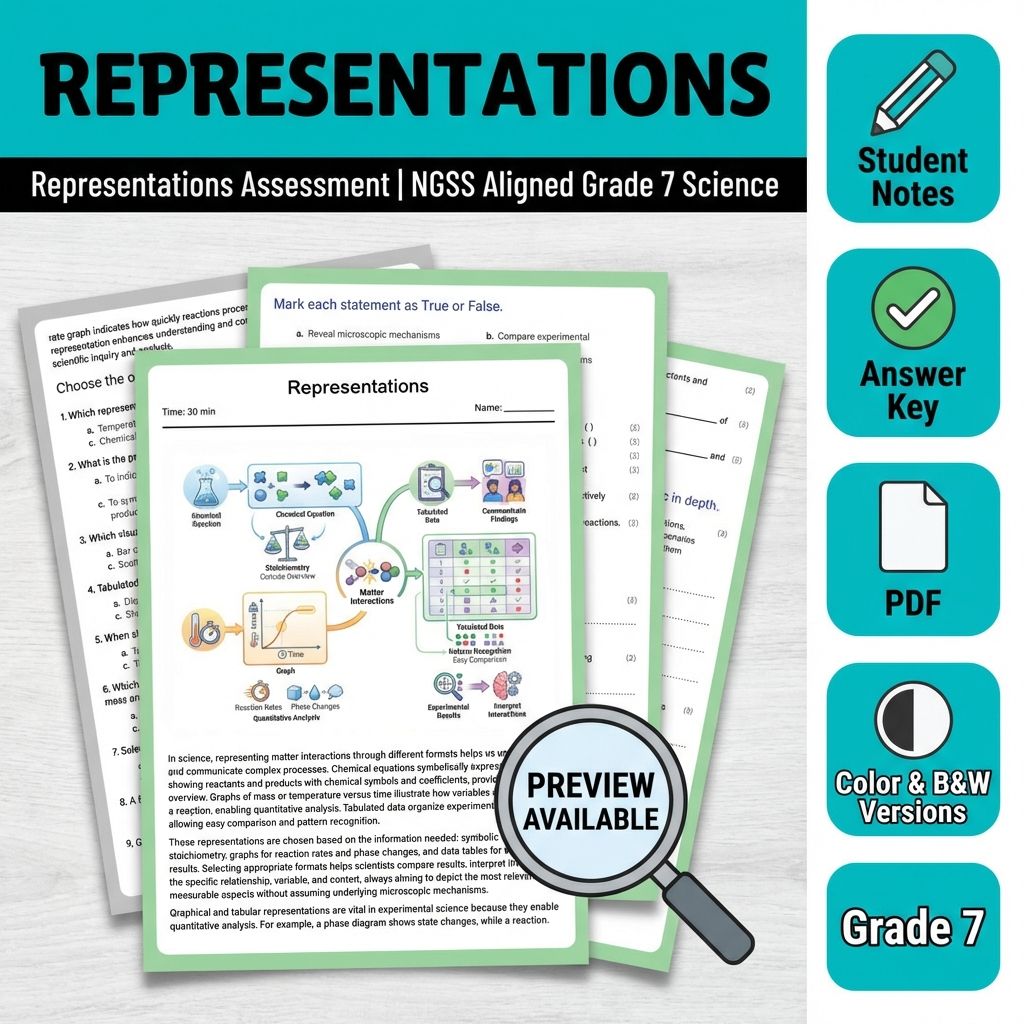
Representations Assessment | NGSS Aligned Grade 7 Science
Created byPrism Point LearningLearning Objectives
- Characterize how multiple representations convey matter interactions including symbolic chemical equations
- Interpret graphs of mass or temperature versus time in reaction contexts
- Analyze tabulated experimental data to understand matter interactions
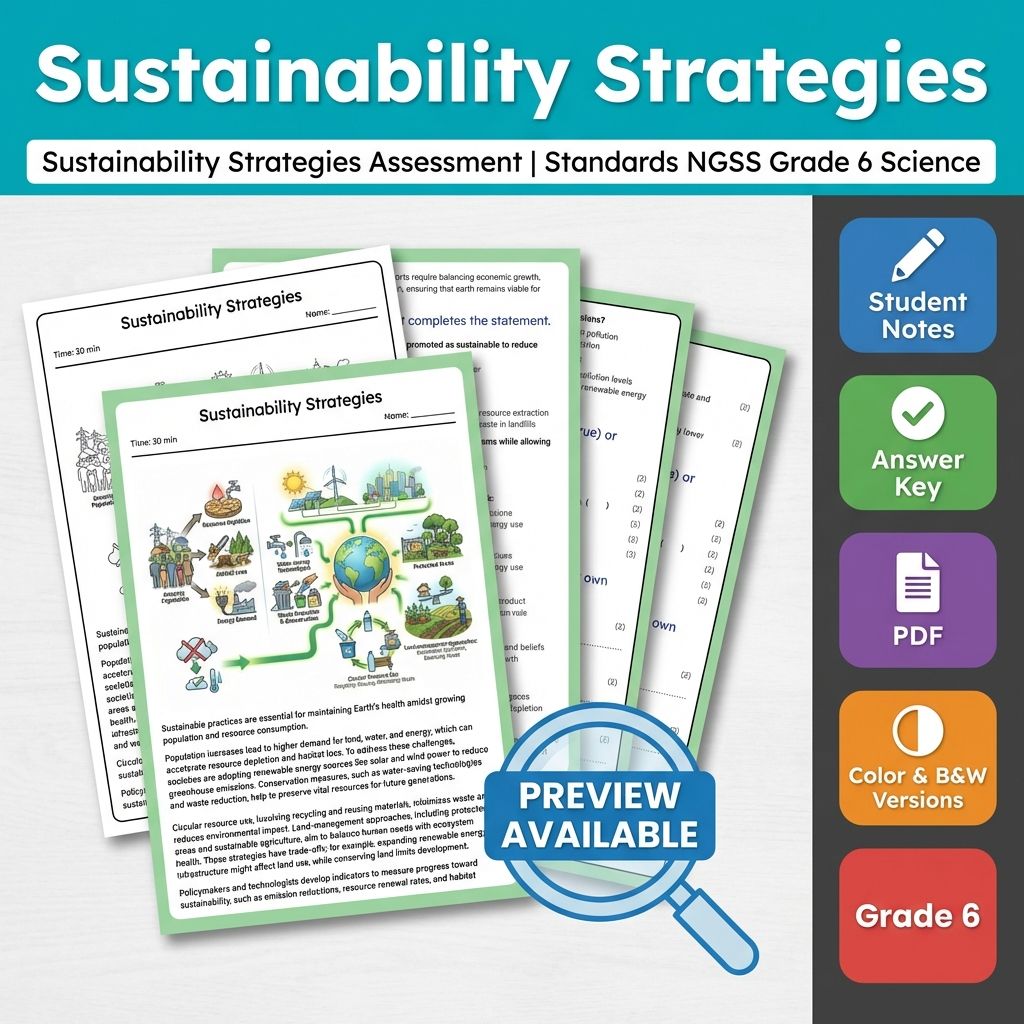
Sustainability Strategies Assessment | Standards NGSS Grade 6 Science
Created byPrism Point LearningLearning Objectives
- Evaluate how population trends and resource use impact earth systems and sustainability.
- Identify and compare different sustainable practices such as renewable energy, conservation, and land management.
- Analyze trade-offs among economic, social, and environmental priorities in sustainability planning.
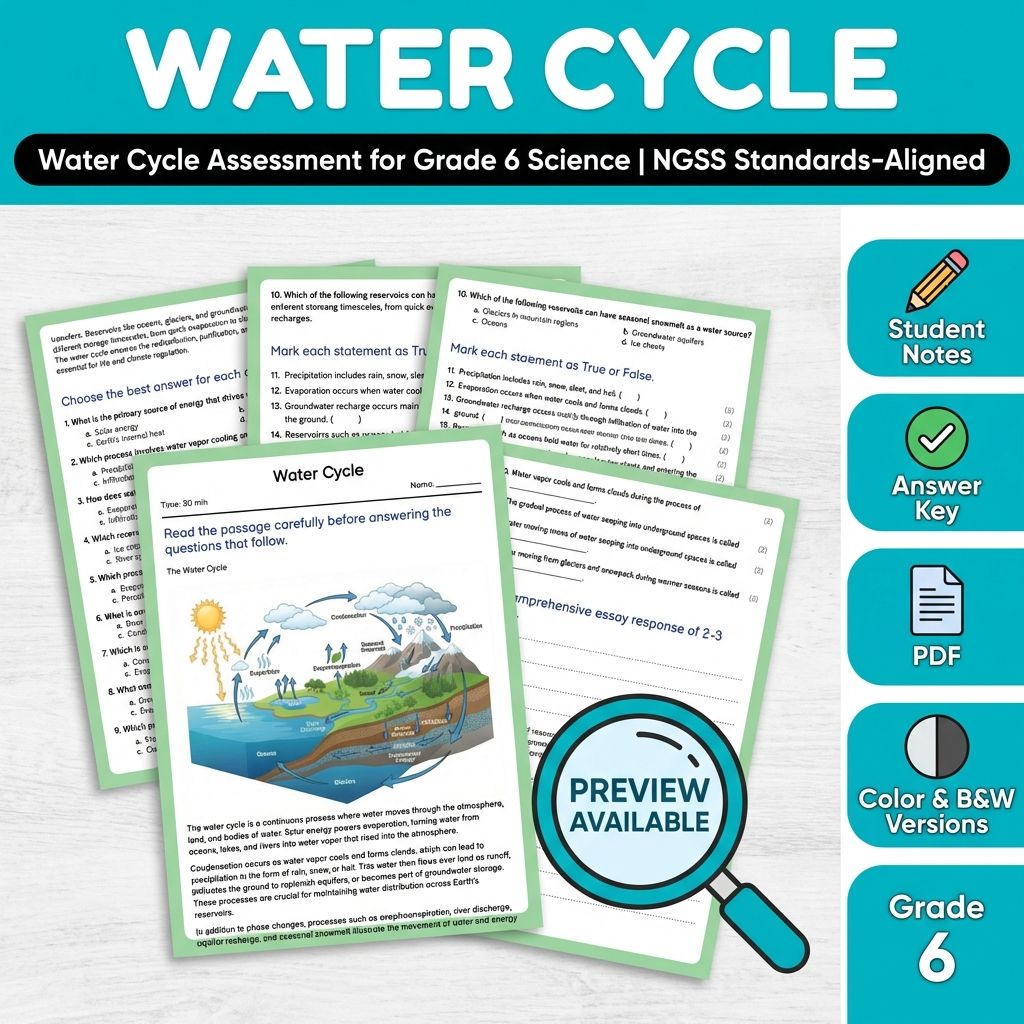
Water Cycle Assessment for Grade 6 Science | NGSS Standards-Aligned
Created byPrism Point LearningLearning Objectives
- Explain the processes involved in the water cycle, including evaporation, condensation, and precipitation.
- Identify the role of solar energy and gravity in water movement across the hydrosphere.
- Describe the cycling of water through different reservoirs such as oceans, ice, and groundwater.
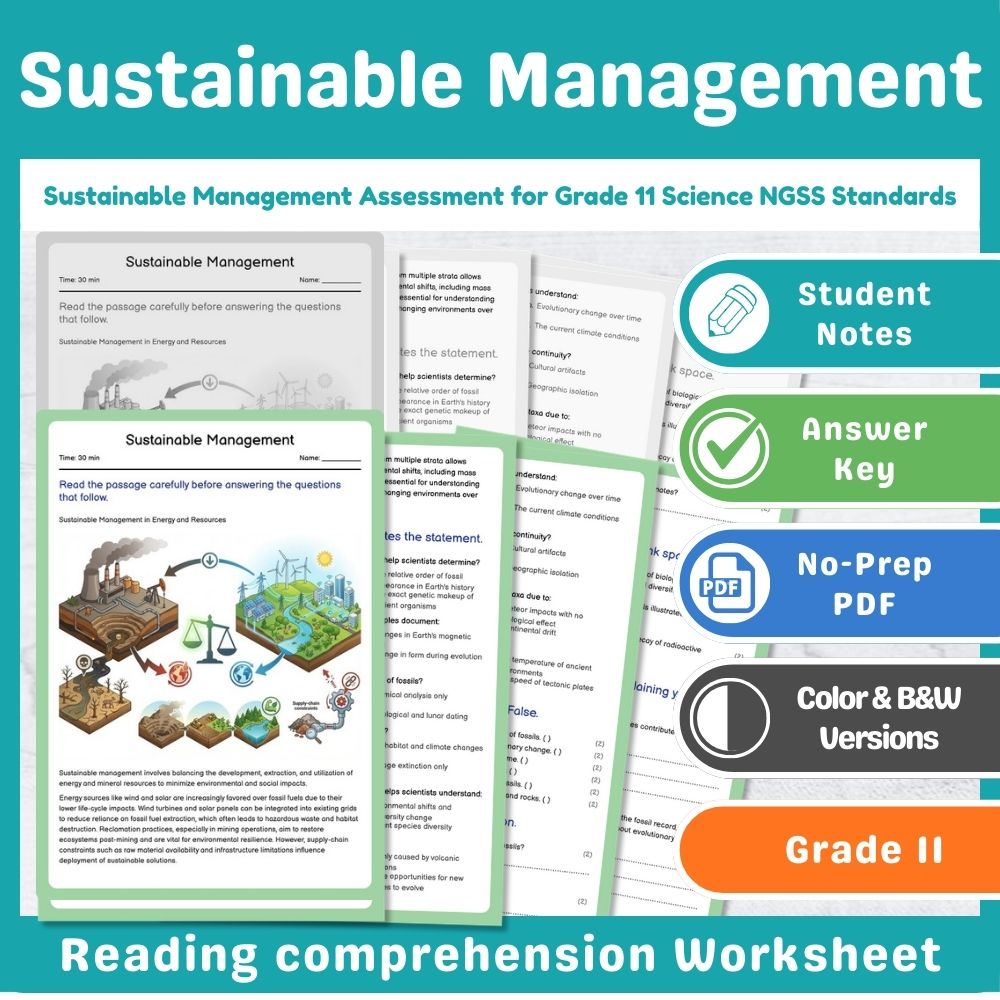
Sustainable Management Assessment for Grade 11 Science NGSS Standards
Created byPrism Point LearningLearning Objectives
- Compare technical and policy solutions for energy and mineral resource management considering life-cycle impacts.
- Evaluate reclamation practices and supply-chain constraints related to resource extraction and energy production.
- Analyze hazards and resilience metrics in ecological and social contexts for sustainable resource management.
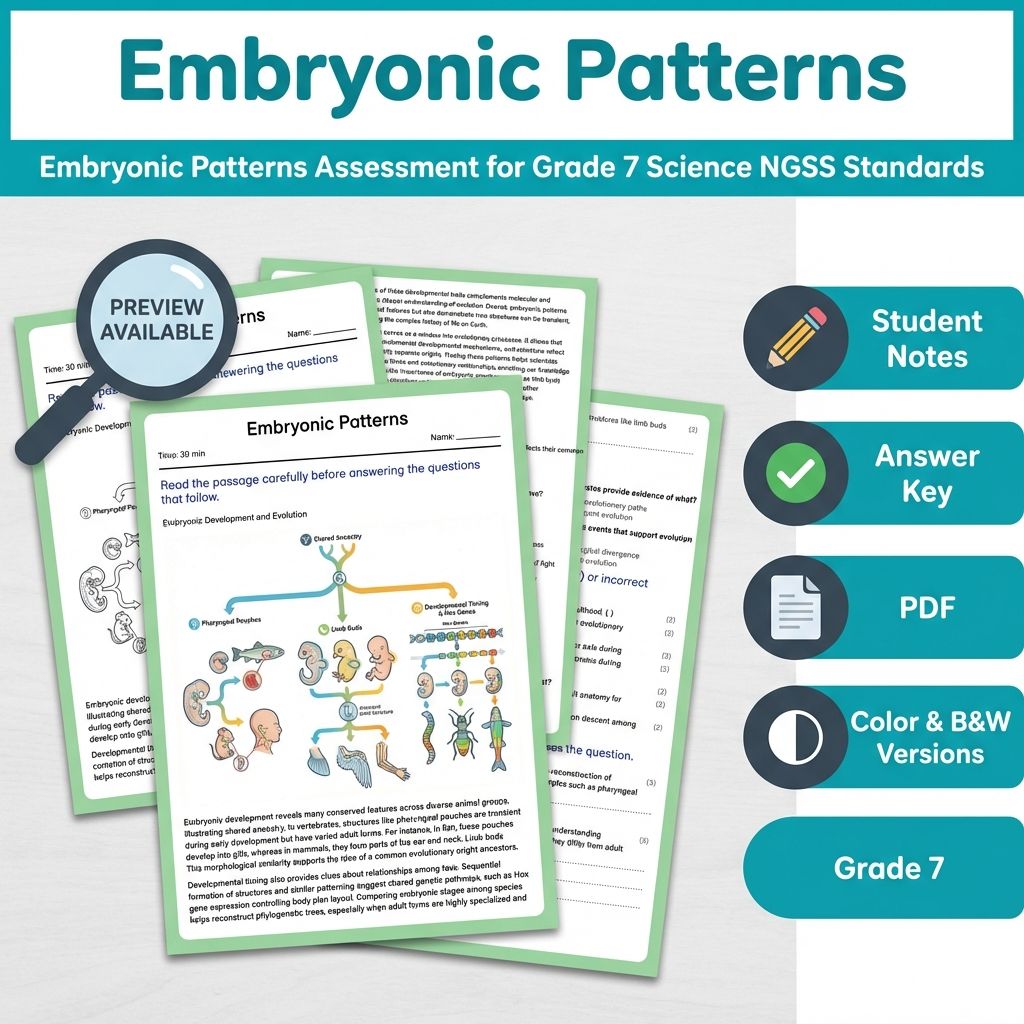
Embryonic Patterns Assessment for Grade 7 Science NGSS Standards
Created byPrism Point LearningLearning Objectives
- Compare embryonic development stages across different taxa to identify conserved features.
- Analyze morphological similarities in embryonic structures such as pharyngeal pouches and limb buds.
- Understand how developmental timing aids in reconstructing evolutionary relationships.
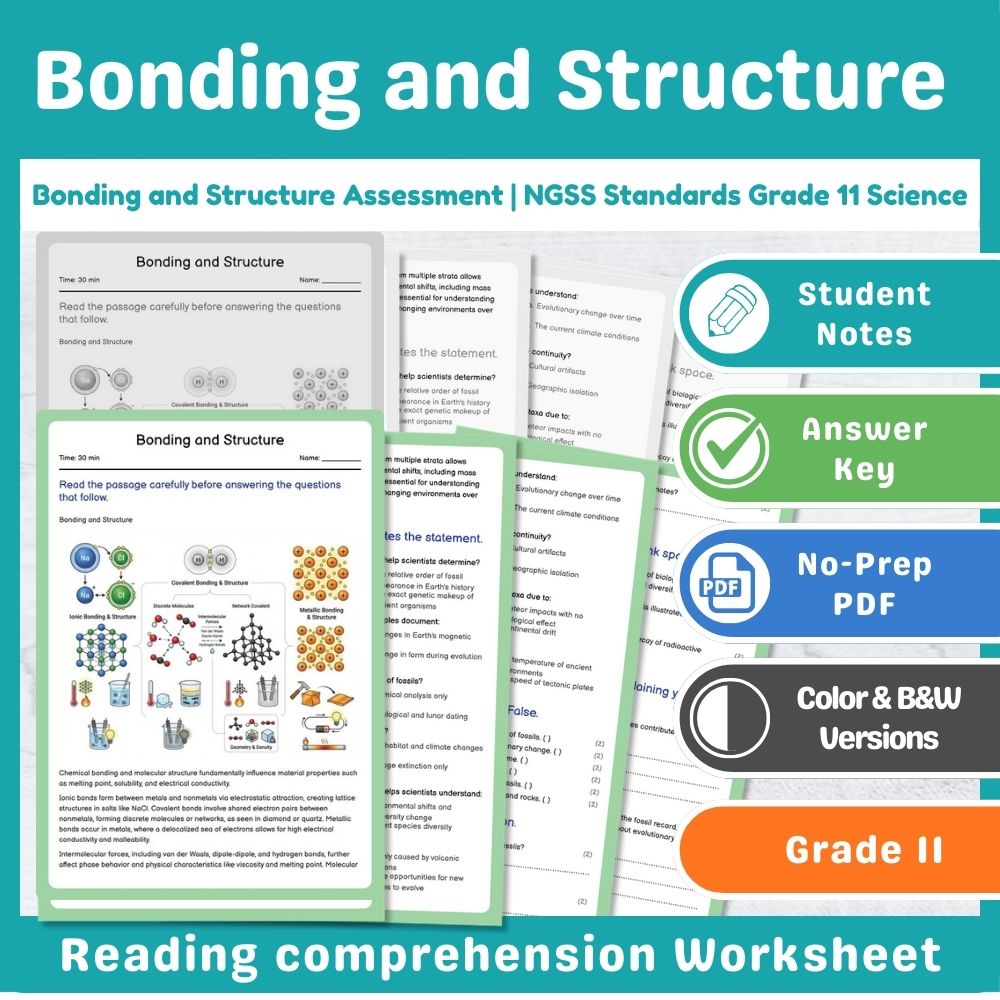
Bonding and Structure Assessment | NGSS Standards Grade 11 Science
Created byPrism Point LearningLearning Objectives
- Explain different types of chemical bonding and how they affect material properties.
- Identify the relationship between molecular structure and observable physical characteristics.
- Compare ionic, covalent, and metallic bonds in terms of lattice energy, melting point, and conductivity.
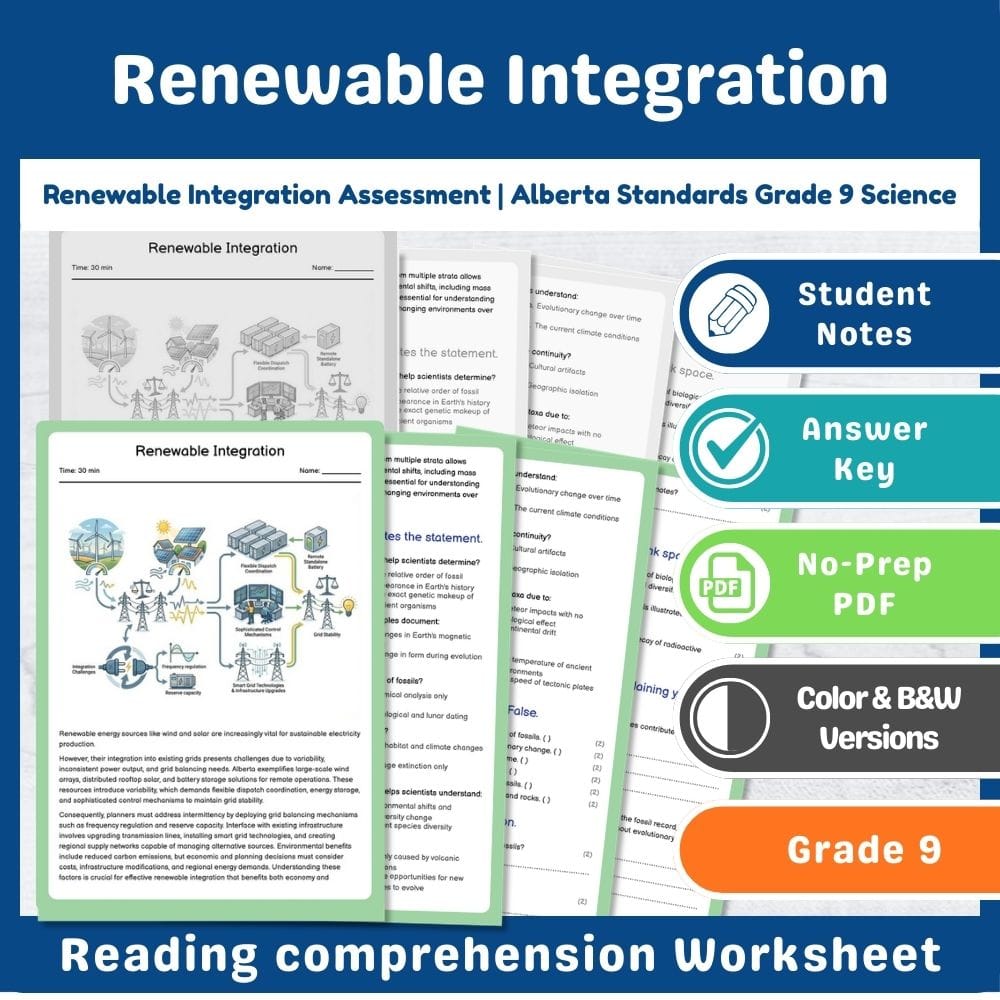
Renewable Integration Assessment | Alberta Standards Grade 9 Science
Created byPrism Point LearningLearning Objectives
- Understand the challenges of integrating wind and solar resources into the electrical grid.
- Identify mechanisms for grid balancing and storage needs related to renewable energy sources.
- Analyze the environmental and economic implications of renewable integration in regional power networks.

Forces and Motion Assessment | Standards-Aligned Grade 10 Science Worksheet
Created byPrism Point LearningLearning Objectives
- Understand how net force affects the motion of an object.
- Identify different types of forces such as gravity, contact forces, and friction.
- Explain the concept of inertia and its relation to motion.
Browse more categories
About Science Worksheets
Find Science worksheets spanning core skills, practice, and review. All 42,685 resources are instant PDF downloads for the classroom or home.
Every worksheet on MyTeachingSheets is created by independent teacher-authors and reviewed before publication. All resources download as printable PDFs for classroom, homework, or at-home practice, and many include answer keys. Preview any worksheet free before buying.