
Science Worksheets
42,685 subject resources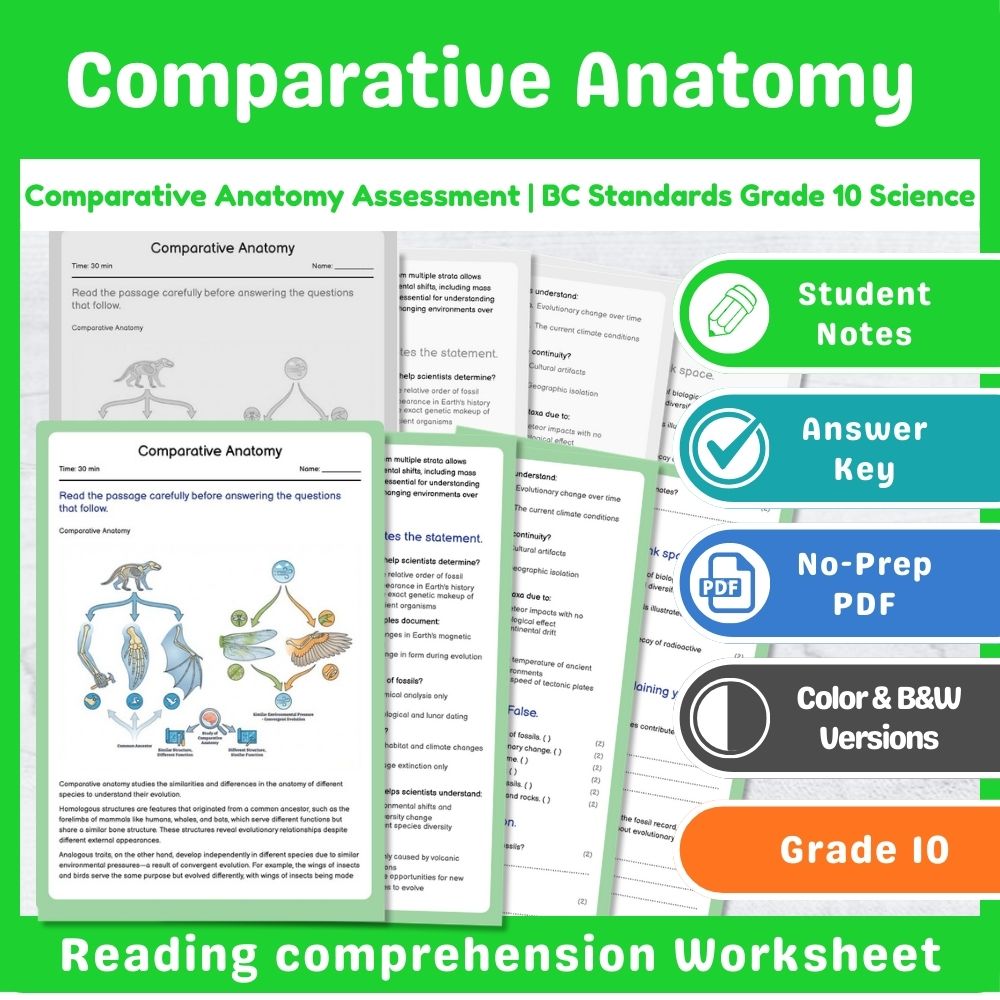
Comparative Anatomy Assessment | BC Standards Grade 10 Science
 Created byPrism Point Learning
Learning Objectives
- Understand the concepts of homologous and analogous structures and their significance in evolution.
- Identify vestigial organs and their implications for evolutionary history.
- Compare anatomical features across different organisms to infer phylogenetic relationships.

Matter Cycles Assessment for Grade 9 Science – Florida NGSSS Standards
Created byPrism Point LearningLearning Objectives
- Explain how chemical elements (carbon, nitrogen, and phosphorus) cycle through ecosystems between living things and the physical environment.
- Describe how processes like respiration, decomposition, and nutrient uptake connect trophic levels.
- Distinguish between how energy flows through ecosystems and how matter cycles in ecosystems.
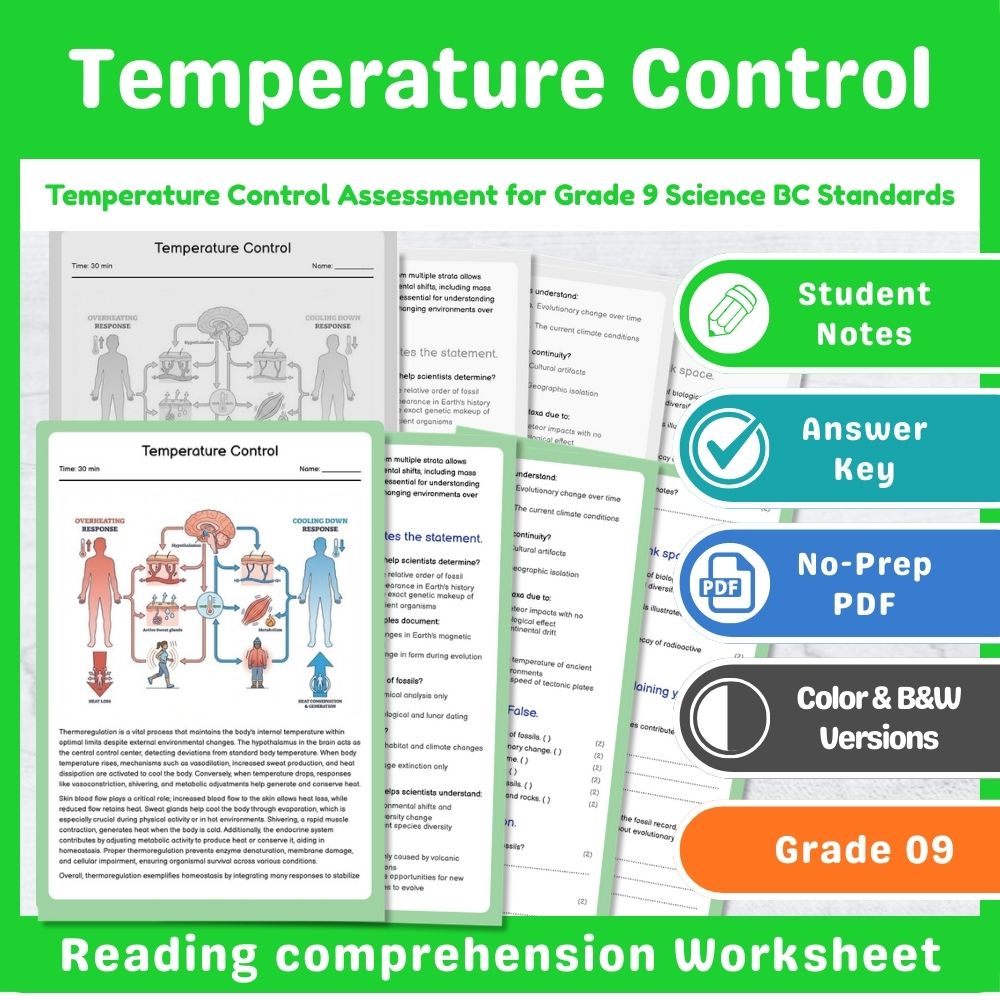
Temperature Control Assessment for Grade 9 Science BC Standards
Created byPrism Point LearningLearning Objectives
- Understand how the body maintains internal temperature through thermoregulation.
- Identify key mechanisms such as sweating, shivering, and blood flow adjustments.
- Explain the role of the hypothalamus in temperature regulation.
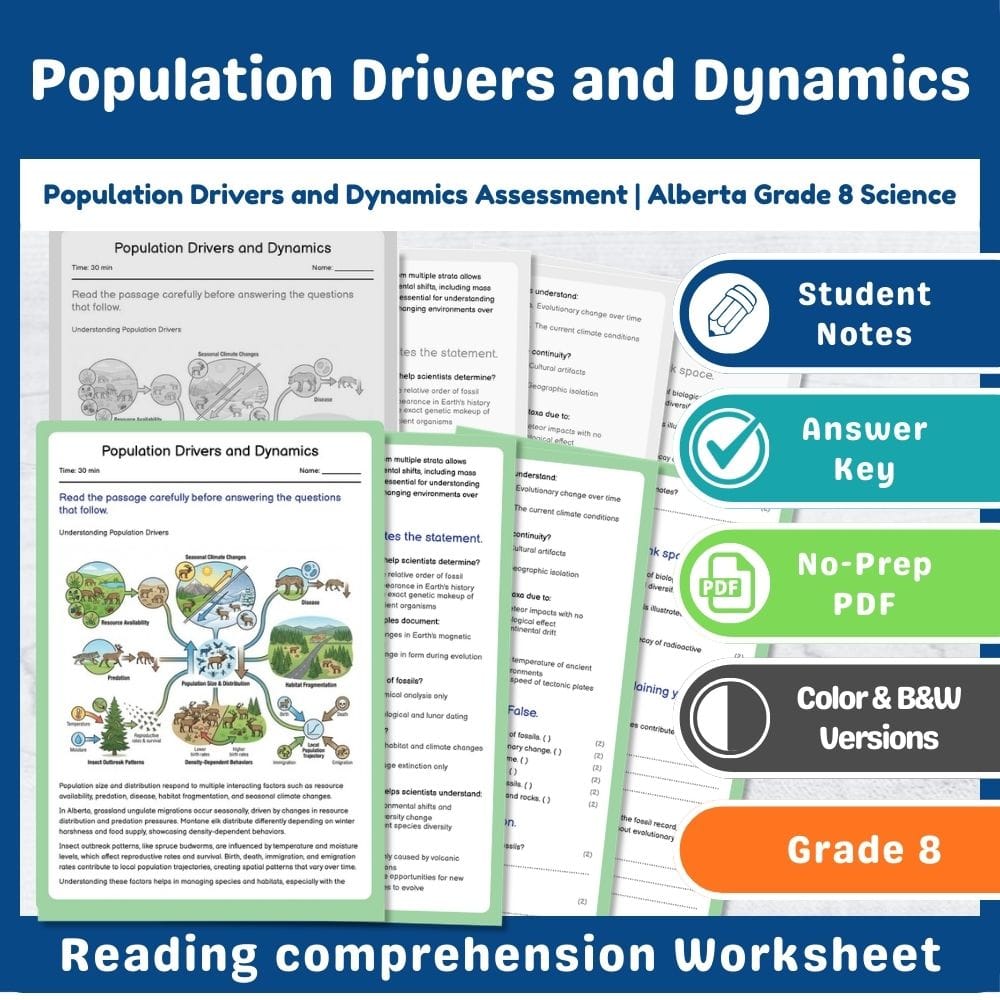
Population Drivers and Dynamics Assessment | Alberta Grade 8 Science
Created byPrism Point LearningLearning Objectives
- Understand the factors influencing population size and distribution in different environments.
- Recognize how abiotic and biotic factors interact to influence population changes.
- Analyze examples of population responses in Alberta ecosystems such as migrations and outbreaks.
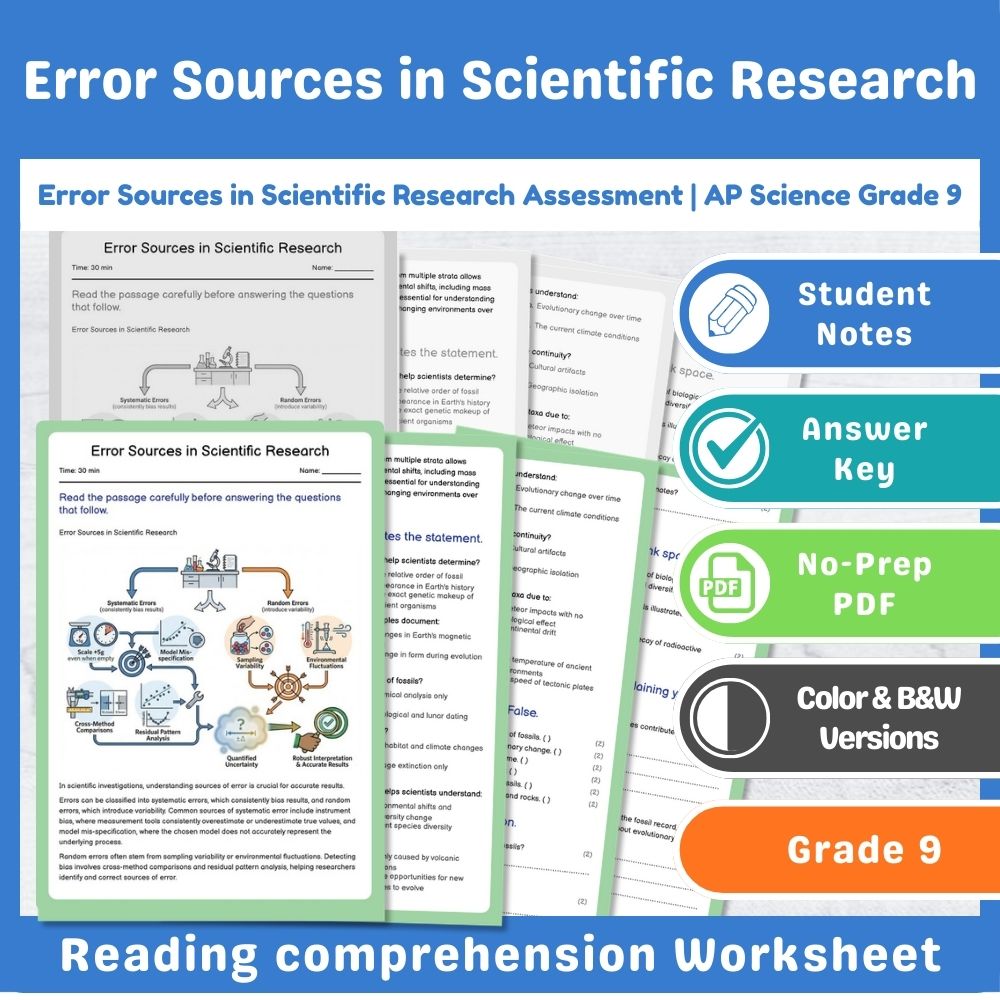
Error Sources in Scientific Research Assessment | AP Science Grade 9
Created byPrism Point LearningLearning Objectives
- Understand key concepts related to Science
- Apply knowledge through practice questions
- Demonstrate comprehension of the material

Endocrine Coordination Assessment for Grade 10 Science – TEKS Standards
Created byPrism Point LearningLearning Objectives
- Understand the role of hormones and glands in human physiology.
- Identify the feedback mechanisms involved in hormonal regulation.
- Explain how endocrine signals control growth, metabolism, and stress responses.

Clouds and Precipitation Assessment | California Standards Grade 7 Science
Created byPrism Point LearningLearning Objectives
- Explain how cooling air leads to condensation and cloud formation.
- Describe how temperature and moisture determine cloud type and precipitation type.
- Connect energy transfers during phase changes to weather patterns.

Genetic Systems Assessment Grade 11 | TEKS Science Standards-Aligned
Created byPrism Point LearningLearning Objectives
- Compare genome organization and gene expression mechanisms in prokaryotes and eukaryotes.
- Identify structural differences in prokaryotic and eukaryotic genomes.
- Explain how these differences influence gene regulation, transcription, and DNA replication.
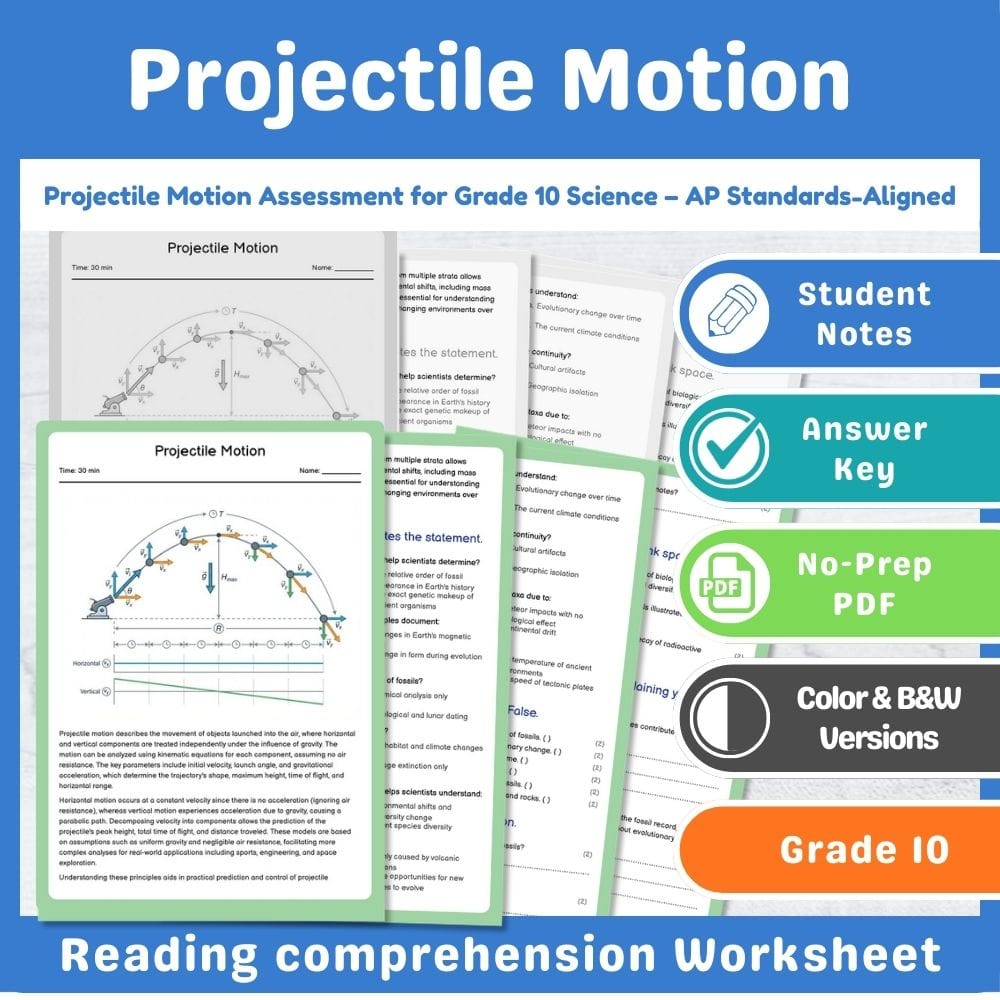
Projectile Motion Assessment for Grade 10 Science – AP Standards-Aligned
Created byPrism Point LearningLearning Objectives
- Understand the components of projectile motion and their independence.
- Apply vector decomposition to analyze projectile trajectories.
- Predict range, time of flight, and maximum height using kinematic equations.
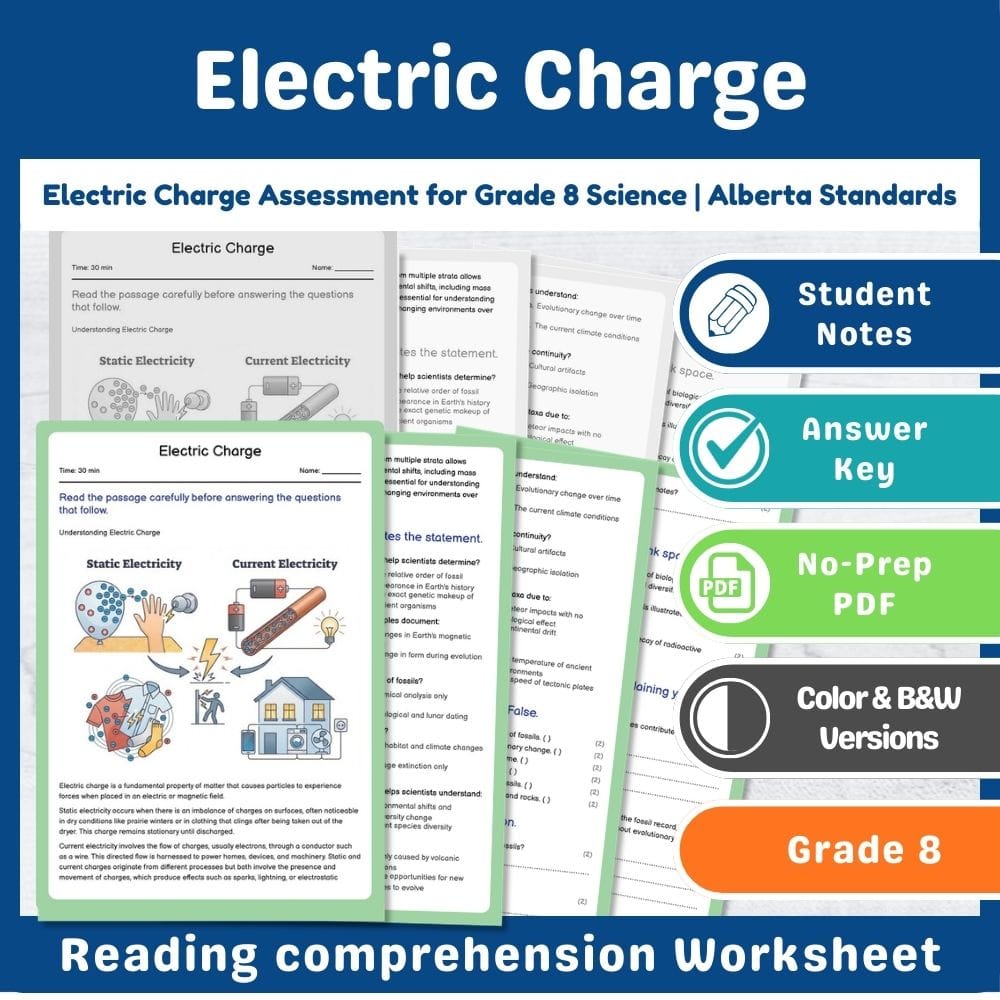
Electric Charge Assessment for Grade 8 Science | Alberta Standards
Created byPrism Point LearningLearning Objectives
- Describe the concept of electric charge and its intrinsic properties.
- Explain the differences between static electricity and current electricity.
- Identify real-world phenomena related to electrostatic effects and electric currents.
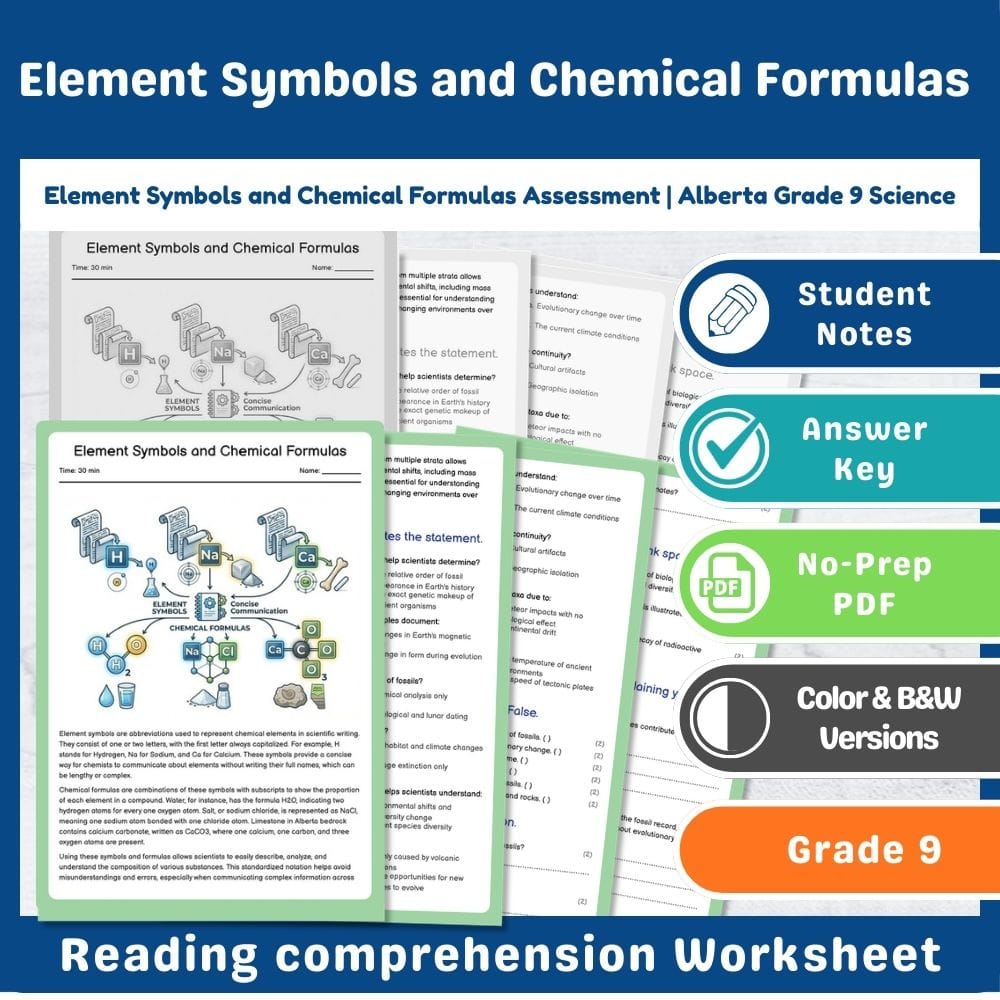
Element Symbols and Chemical Formulas Assessment | Alberta Grade 9 Science
Created byPrism Point LearningLearning Objectives
- Understand the use of element symbols and chemical formulas to represent elements and compounds.
- Identify and interpret common chemical formulas such as H2O, NaCl, and CaCO3.
- Explain how formulas indicate the proportions of elements in a substance.

Reaction Energetics Assessment | Alberta Standards for Grade 11 Science
Created byPrism Point LearningLearning Objectives
- Explain the concept of enthalpy changes during chemical reactions.
- Calculate reaction enthalpy using standard enthalpies of formation.
- Analyze heat transfer in exothermic and endothermic processes in industrial settings.

Density Evidence Assessment | General Grade 6 Science Standards
Created byPrism Point LearningLearning Objectives
- Understand how density relates mass to volume and its role in classifying substances.
- Identify how objects with different densities behave in water, such as floating or sinking.
- Explain that density depends on how tightly matter is packed and does not change the substance's identity.
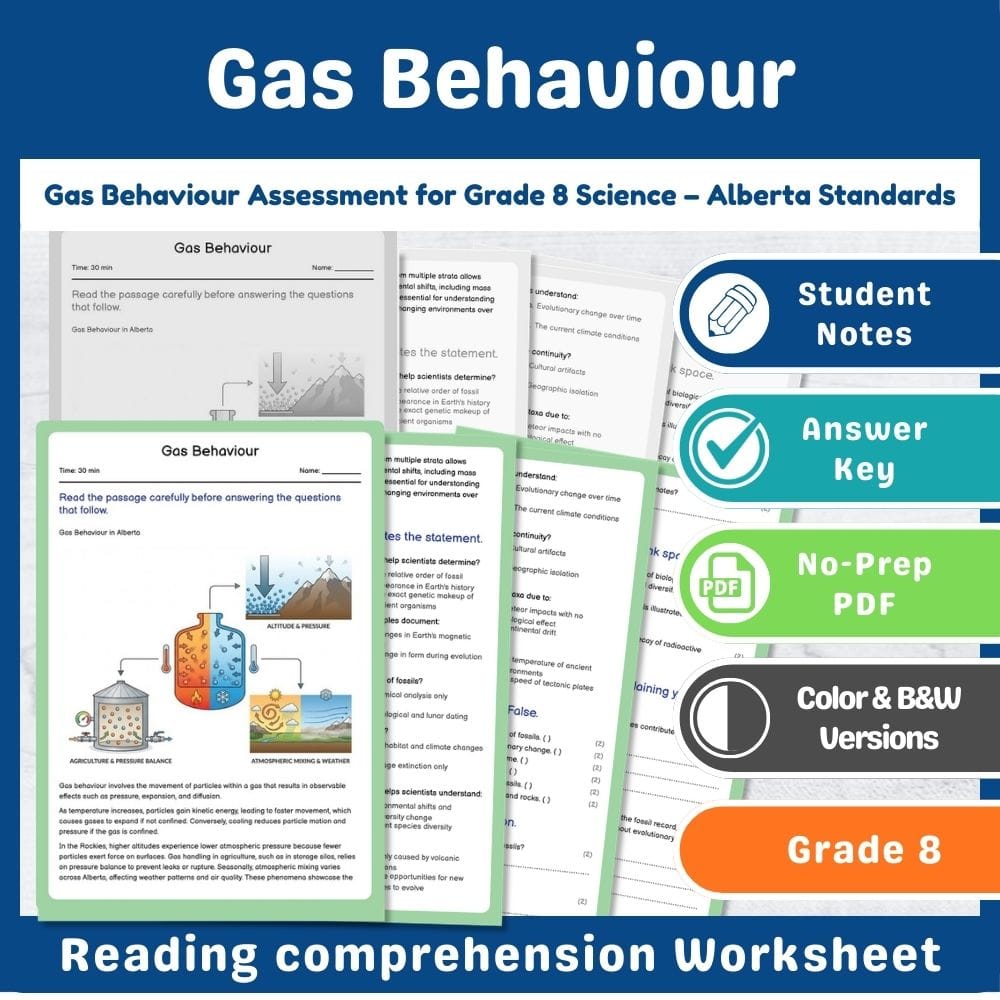
Gas Behaviour Assessment for Grade 8 Science – Alberta Standards
Created byPrism Point LearningLearning Objectives
- Explain how particle motion relates to gas pressure and temperature.
- Describe the effects of temperature changes on gas expansion and compression.
- Analyze real-world examples of gas behaviour in Alberta, such as atmospheric pressure variation with altitude and seasonal mixing.

Newtonian Laws Assessment Worksheet for Grade 8 Science TEKS Standards
Created byPrism Point LearningLearning Objectives
- Understand the three fundamental principles of Newton's laws of motion.
- Analyze how forces affect the motion of objects in various contexts.
- Apply proportional reasoning to relate force, mass, and acceleration.
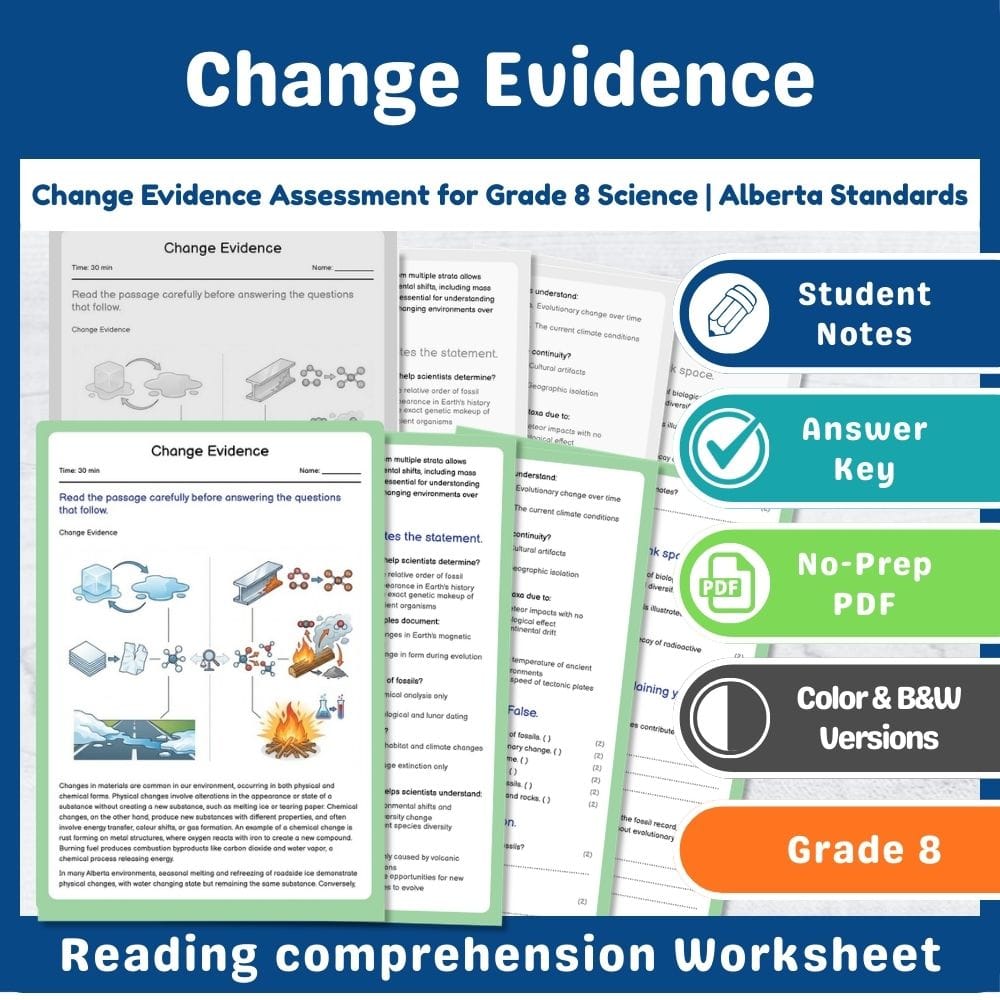
Change Evidence Assessment for Grade 8 Science | Alberta Standards
Created byPrism Point LearningLearning Objectives
- Identify differences between physical and chemical changes in materials.
- Recognize evidence indicating chemical reactions such as colour shifts, gas release, or energy transfer.
- Analyze examples of physical and chemical changes in Alberta environments.
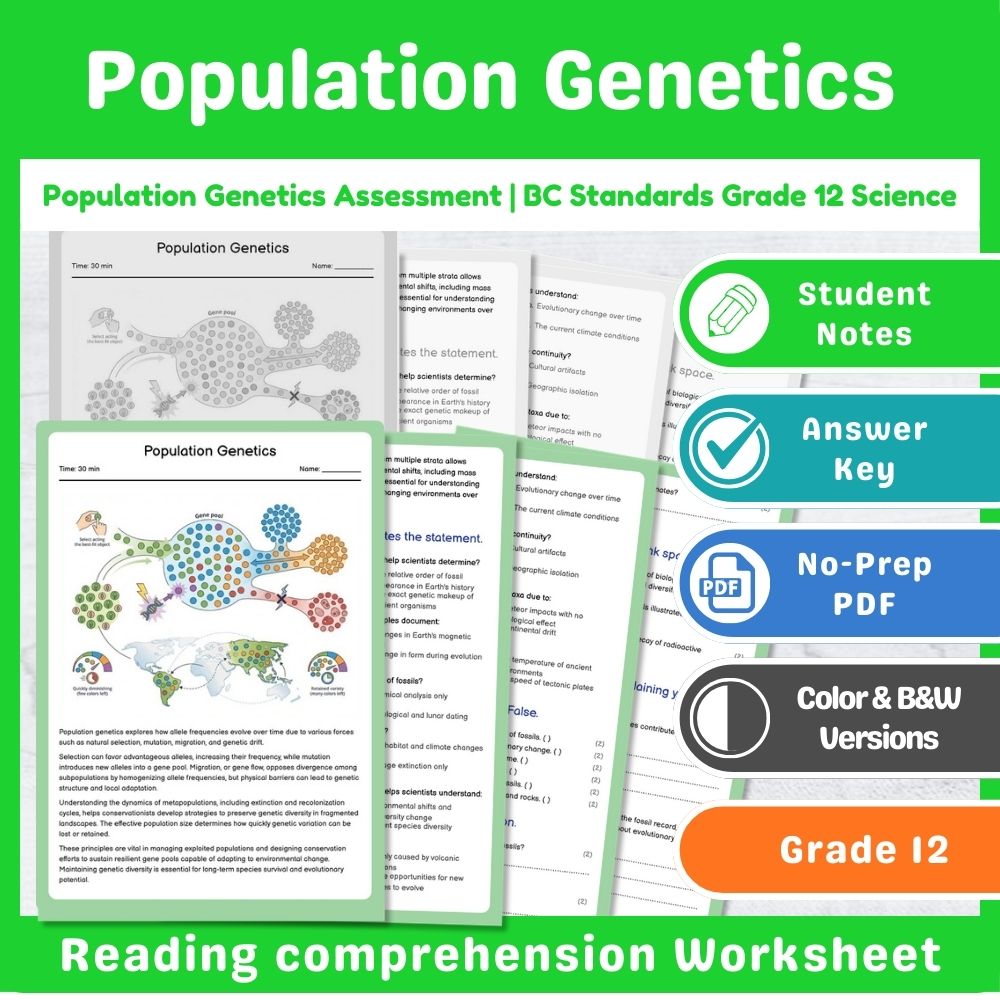
Population Genetics Assessment | BC Standards Grade 12 Science
Created byPrism Point LearningLearning Objectives
- Understand how allele frequencies are affected by evolutionary forces such as selection, mutation, migration, and drift.
- Describe the roles of gene flow, genetic structure, and local adaptation in populations.
- Explain concepts of metapopulation dynamics, extinction-recolonization cycles, and effective population size.

Decomposers and Nutrient Return Assessment | General Grade 6 Science
Created byPrism Point LearningLearning Objectives
- Understand the role of decomposers in nutrient cycling within ecosystems.
- Identify different types of decomposers such as fungi and bacteria.
- Explain how decomposers contribute to soil and water health.
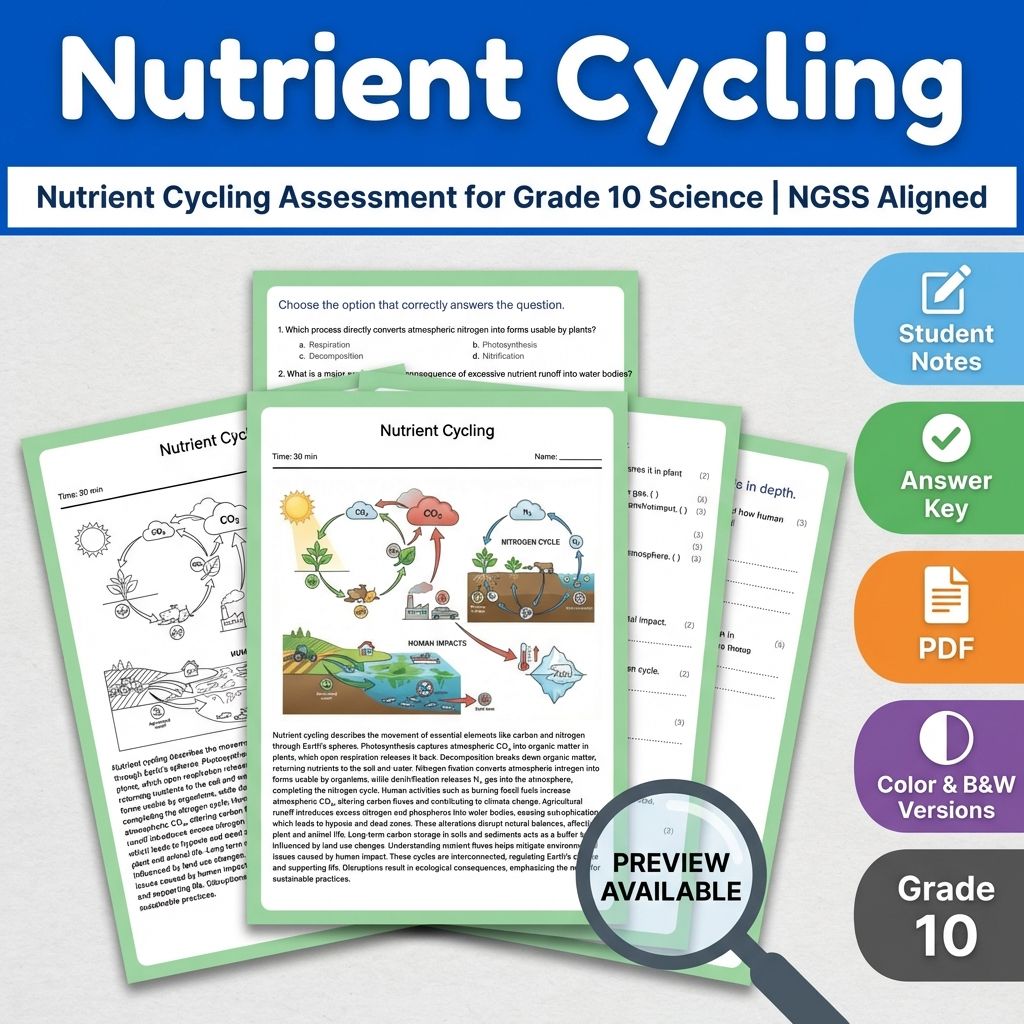
Nutrient Cycling Assessment for Grade 10 Science | NGSS Aligned
Created byPrism Point LearningLearning Objectives
- Understand the major biogeochemical cycles, including carbon and nitrogen fluxes.
- Describe the processes such as photosynthesis, respiration, nitrification, denitrification, and decomposition.
- Analyze how human activities alter nutrient reservoirs and flux rates.
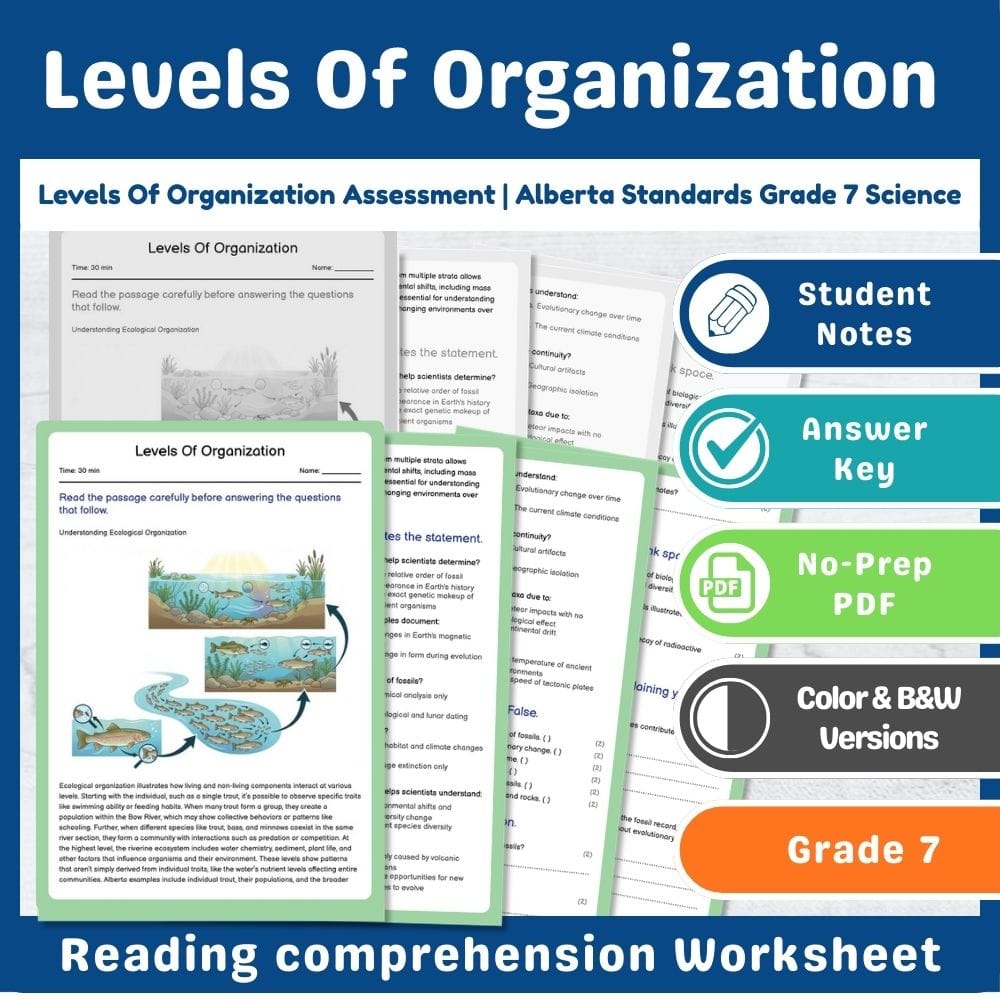
Levels Of Organization Assessment | Alberta Standards Grade 7 Science
Created byPrism Point LearningLearning Objectives
- Describe the different levels of ecological organization from individual organisms to ecosystems.
- Explain how properties and processes emerge at higher levels that are not evident at individual levels.
- Use Alberta examples to differentiate among levels such as individual trout, trout populations, communities, and ecosystems.
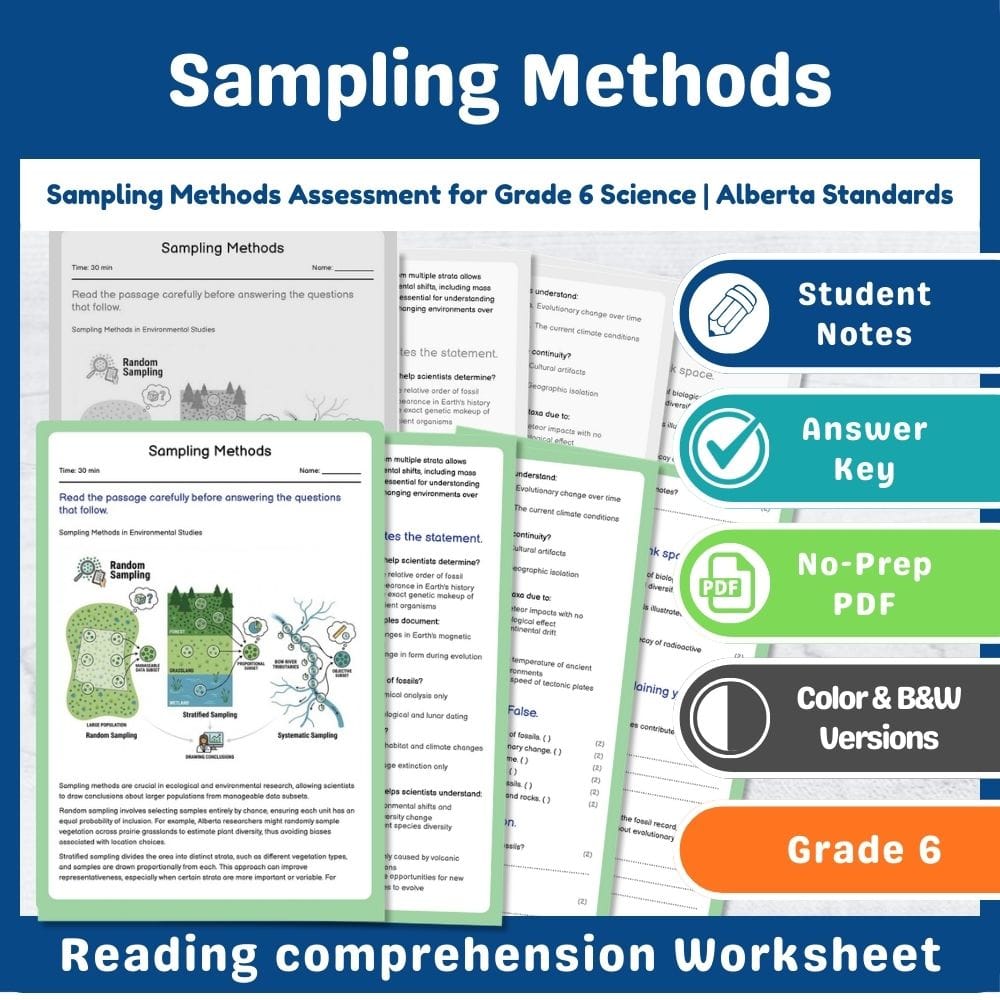
Sampling Methods Assessment for Grade 6 Science | Alberta Standards
Created byPrism Point LearningLearning Objectives
- Understand different sampling methods and their applications.
- Compare systematic, stratified, and random sampling techniques.
- Evaluate trade-offs between coverage, practicality, and interpretation in sampling.

Population Ecology Assessment Grade 9 Science TEKS
Created byPrism Point LearningLearning Objectives
- Understand the key factors that influence population growth and decline.
- Identify the differences between density-dependent and density-independent factors.
- Analyze how population patterns affect community structure and ecosystem dynamics.
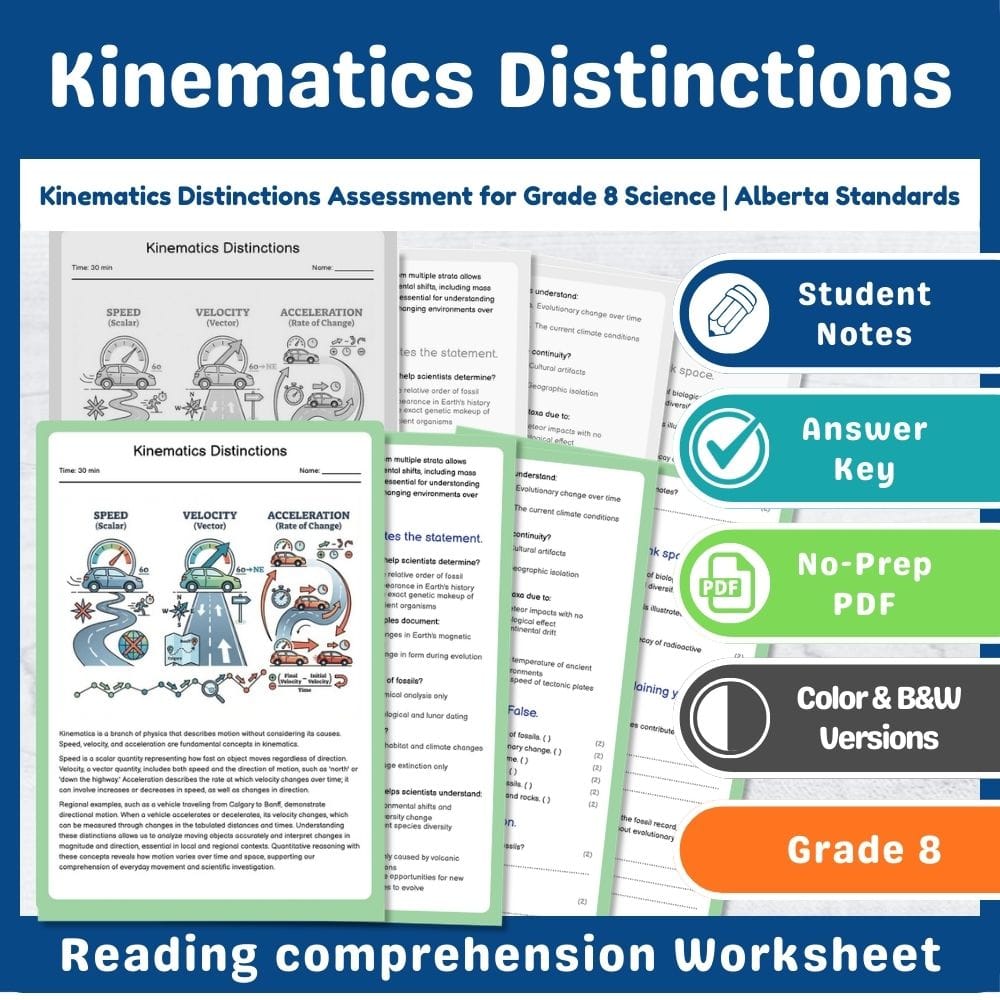
Kinematics Distinctions Assessment for Grade 8 Science | Alberta Standards
Created byPrism Point LearningLearning Objectives
- Define speed, velocity, and acceleration with precision and clarity.
- Differentiate between scalar and vector quantities in motion.
- Interpret real-world examples of directional motion in the context of regions such as Calgary and Banff.
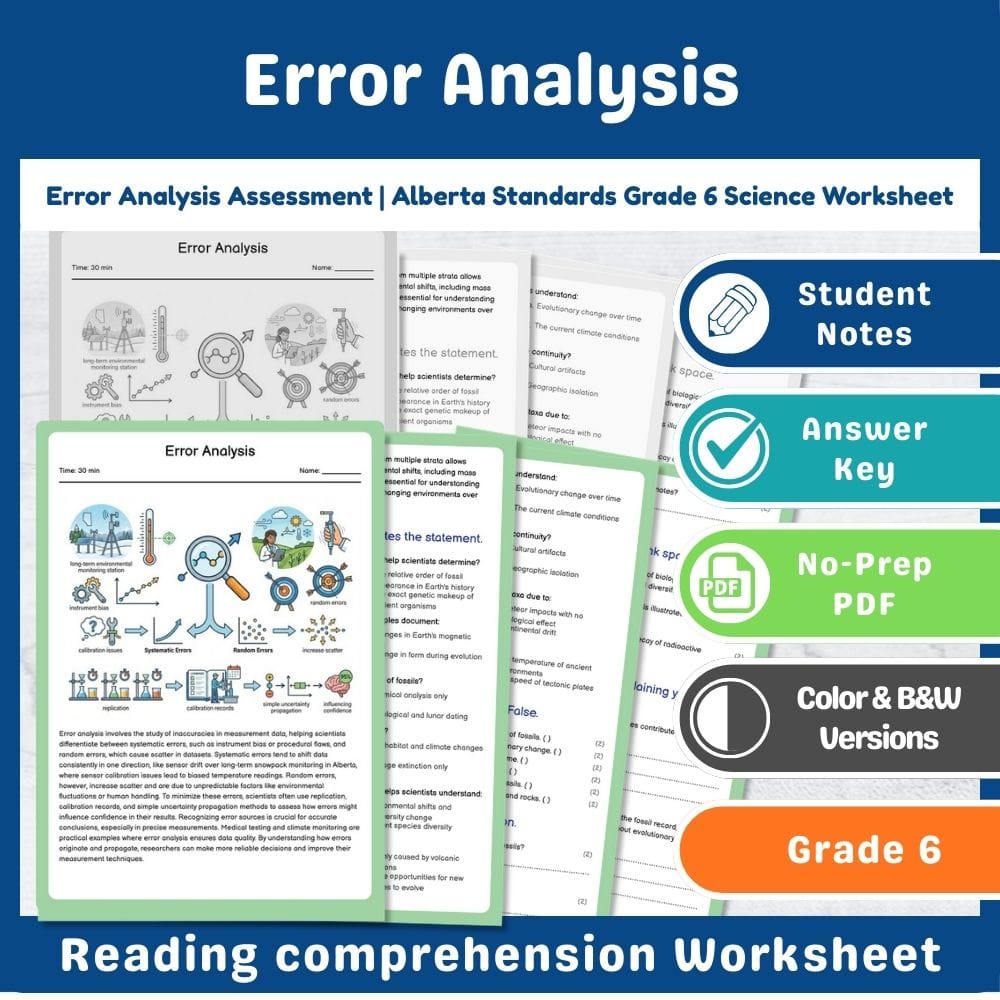
Error Analysis Assessment | Alberta Standards Grade 6 Science Worksheet
Created byPrism Point LearningLearning Objectives
- Understand sources of systematic and random error in scientific data.
- Identify methods used to estimate the effects of errors on results.
- Describe how environmental, procedural, and instrument-related errors impact data accuracy.
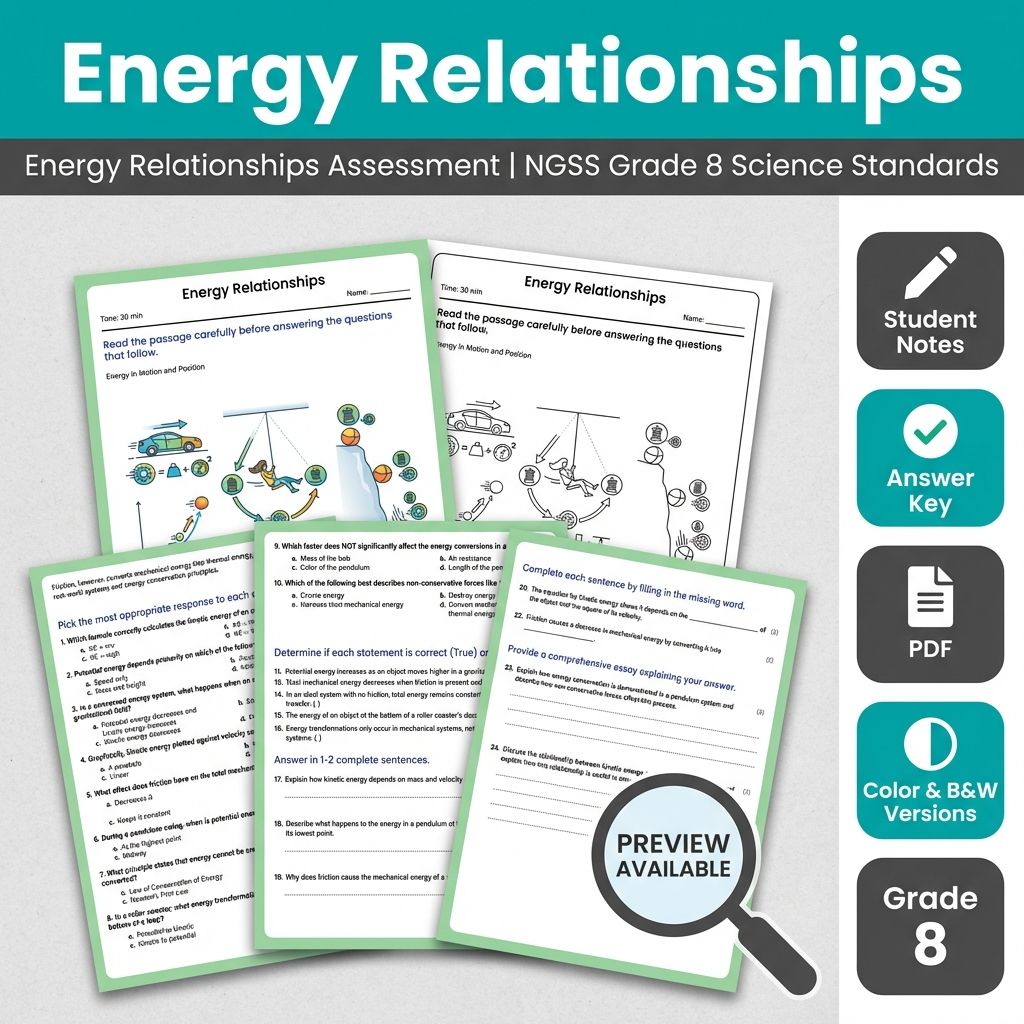
Energy Relationships Assessment | NGSS Grade 8 Science Standards
Created byPrism Point LearningLearning Objectives
- Describe the relationship between kinetic energy, potential energy, and their dependence on mass, speed, and position.
- Interpret graphs relating kinetic energy to mass and to the square of speed.
- Analyze energy interchange in systems like pendulums and roller coasters.

Buffer Capacity Assessment | Alberta Standards Assessment Grade 11 Science
Created byPrism Point LearningLearning Objectives
- Understand the concept of buffer capacity and its significance in environmental systems.
- Identify factors affecting buffer capacity in natural systems.
- Assess methods used to evaluate buffer capacity quantitatively.
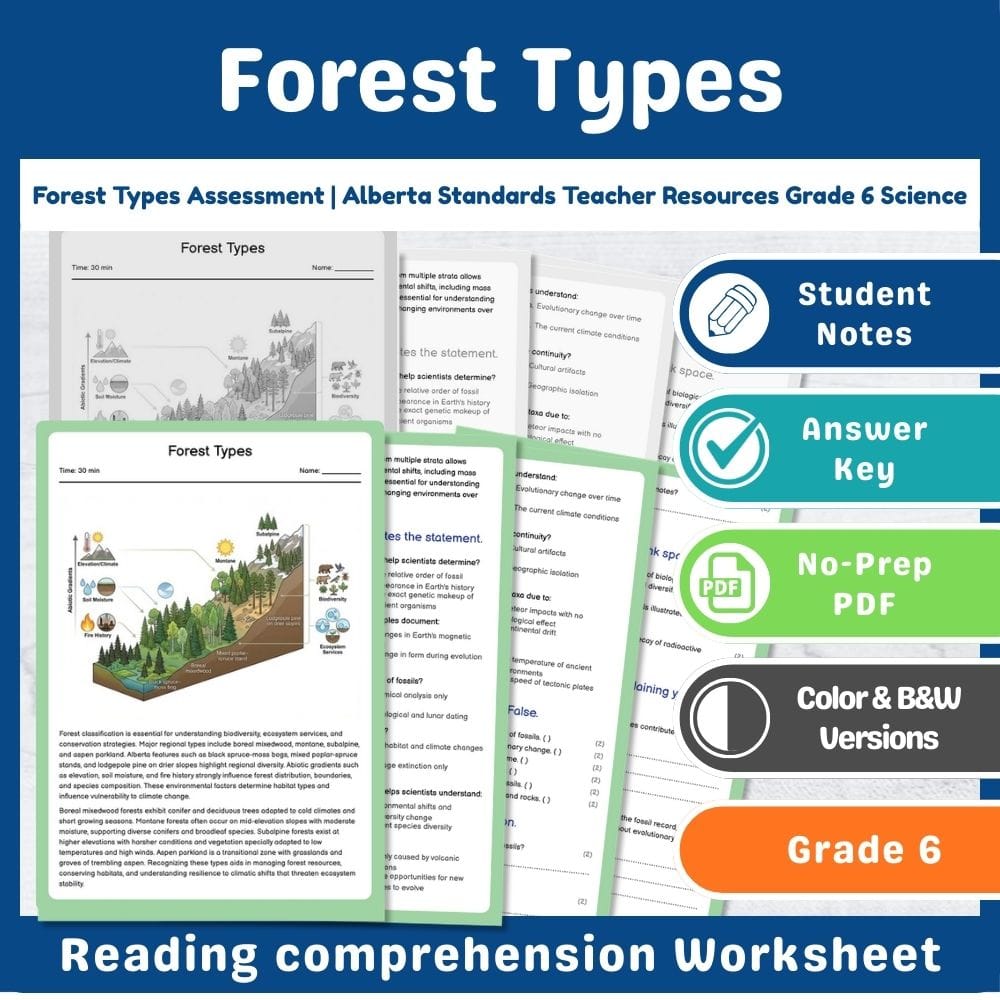
Forest Types Assessment | Alberta Standards Teacher Resources Grade 6 Science
Created byPrism Point LearningLearning Objectives
- Identify major regional forest types and their characteristic species
- Understand environmental factors shaping forest distribution
- Recognize different forest ecosystems and their ecological importance

Charge and Fields Assessment | Alberta Standard Grade 10 Science
Created byPrism Point LearningLearning Objectives
- Explain the concept of electric charge, including its sign and magnitude.
- Describe how electric fields are represented using field lines and superposition principles.
- Calculate electrostatic forces between charges using Coulomb's law in regional contexts.
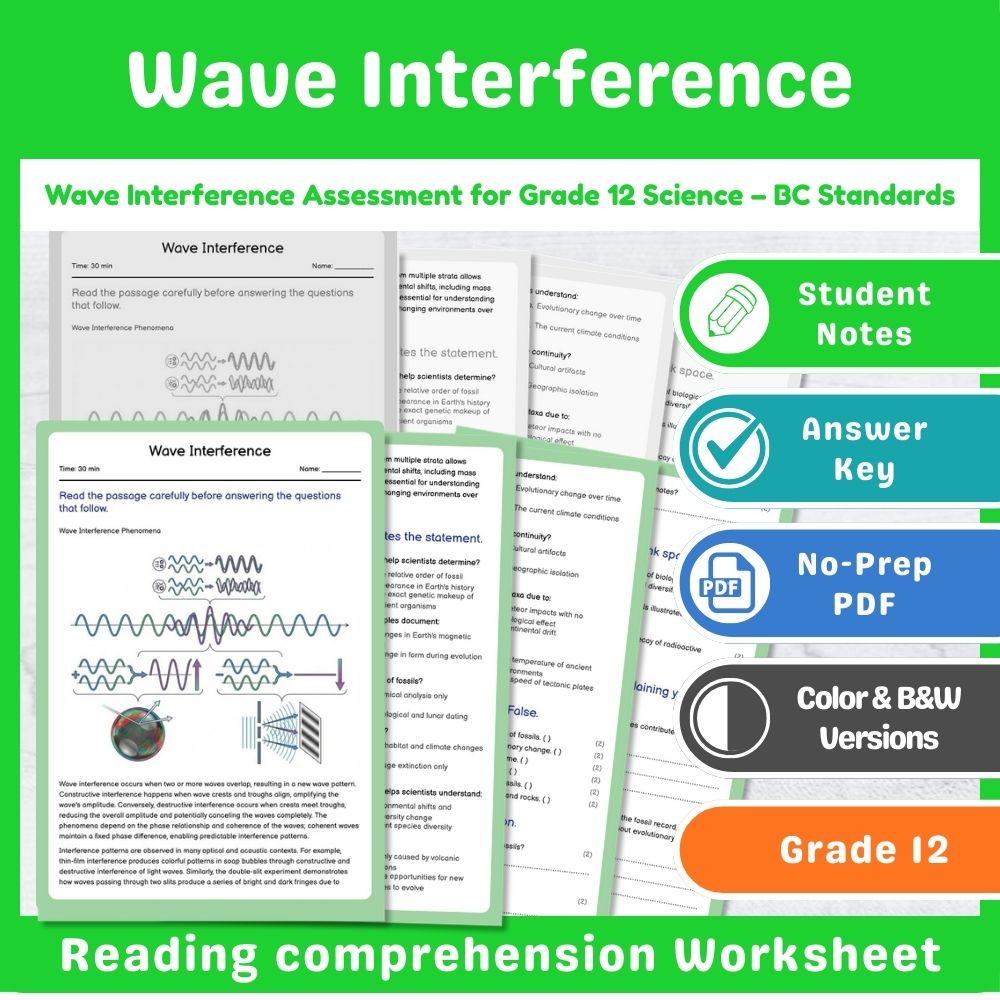
Wave Interference Assessment for Grade 12 Science – BC Standards
Created byPrism Point LearningLearning Objectives
- Explain the principles of wave interference, including constructive and destructive interference.
- Describe the conditions for coherence and how it affects interference patterns.
- Analyze how wavelength and aperture size influence diffraction and interference phenomena.
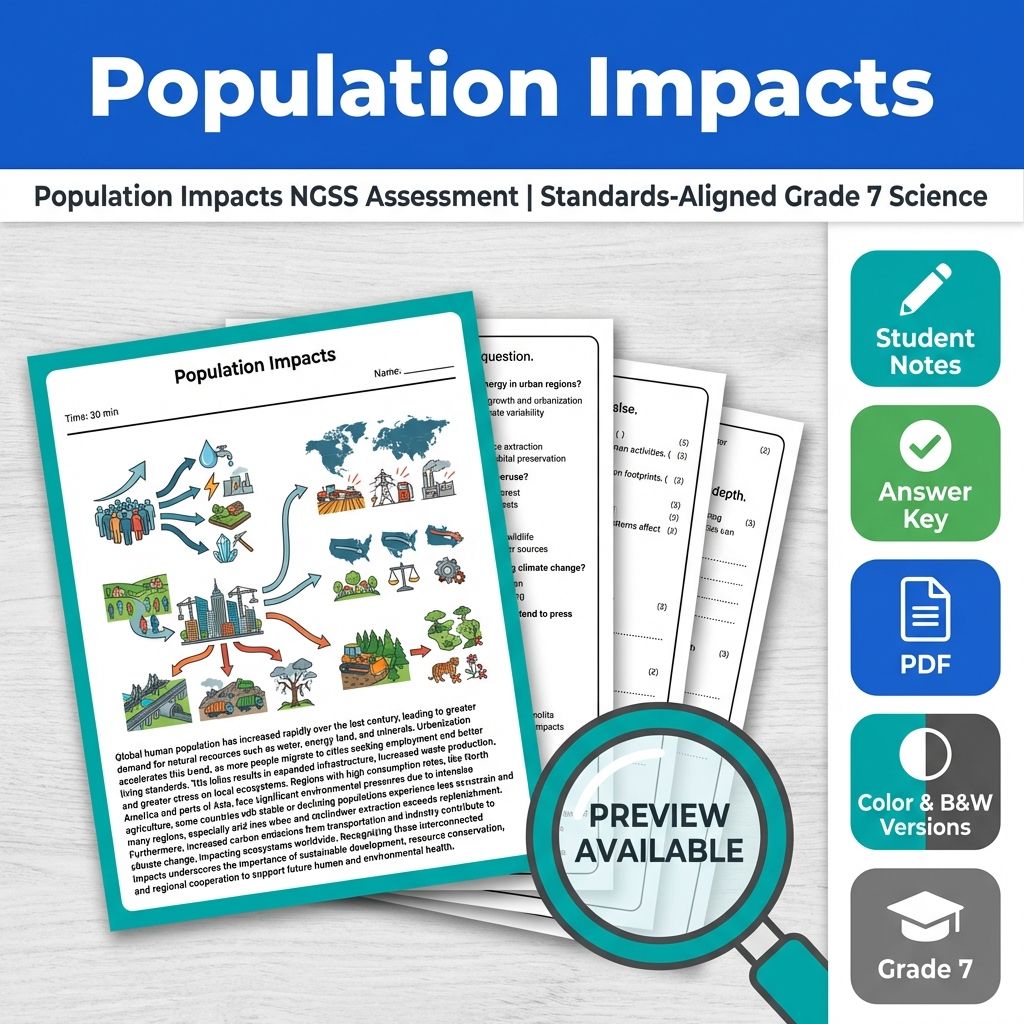
Population Impacts NGSS Assessment | Standards-Aligned Grade 7 Science
Created byPrism Point LearningLearning Objectives
- Understand how increased human population affects demand for water, energy, land, and raw materials.
- Analyze the consequences of population growth on ecosystems, biodiversity, and resource cycles.
- Evaluate regional examples to compare how consumption patterns influence environmental pressures.
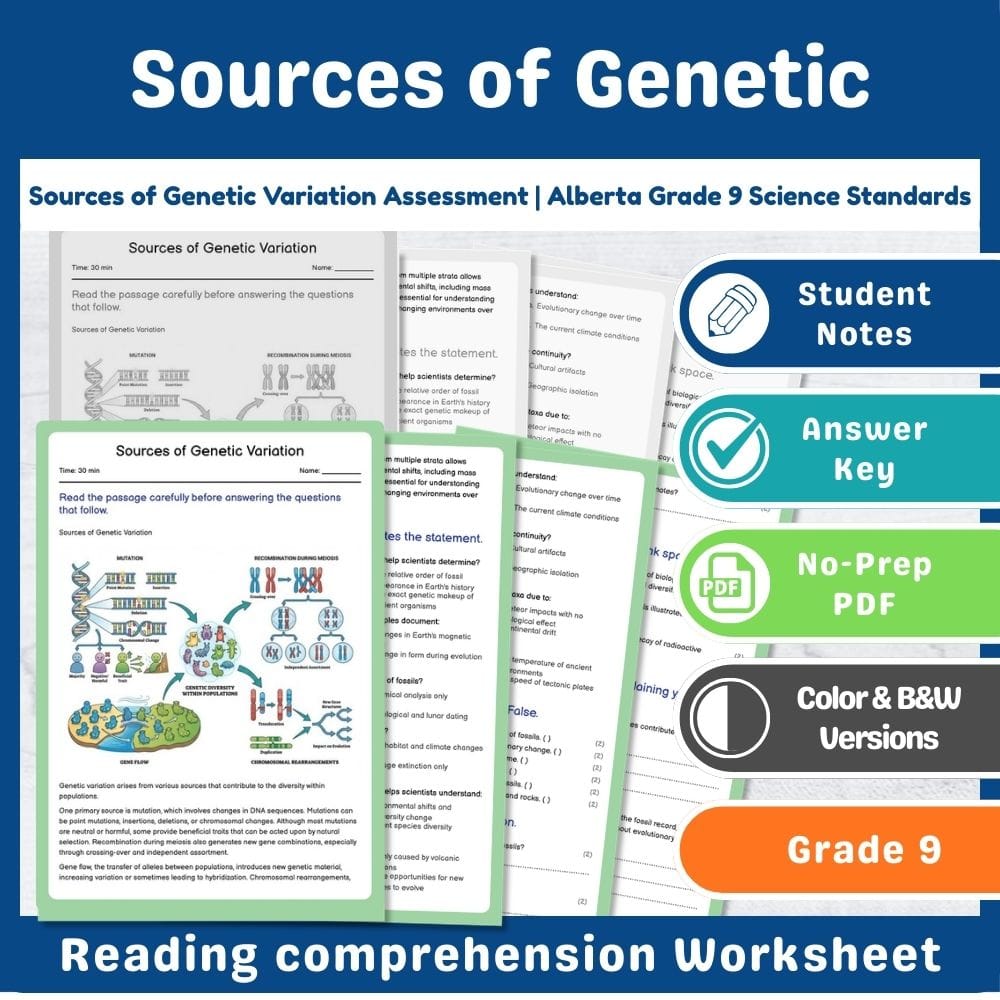
Sources of Genetic Variation Assessment | Alberta Grade 9 Science Standards
Created byPrism Point LearningLearning Objectives
- Identify different sources of genetic variation such as mutation, recombination, gene flow, and chromosomal rearrangements.
- Explain how mutation affects genetic diversity and understand different mutation types.
- Describe mechanisms like recombination and gene flow that increase genetic variation.
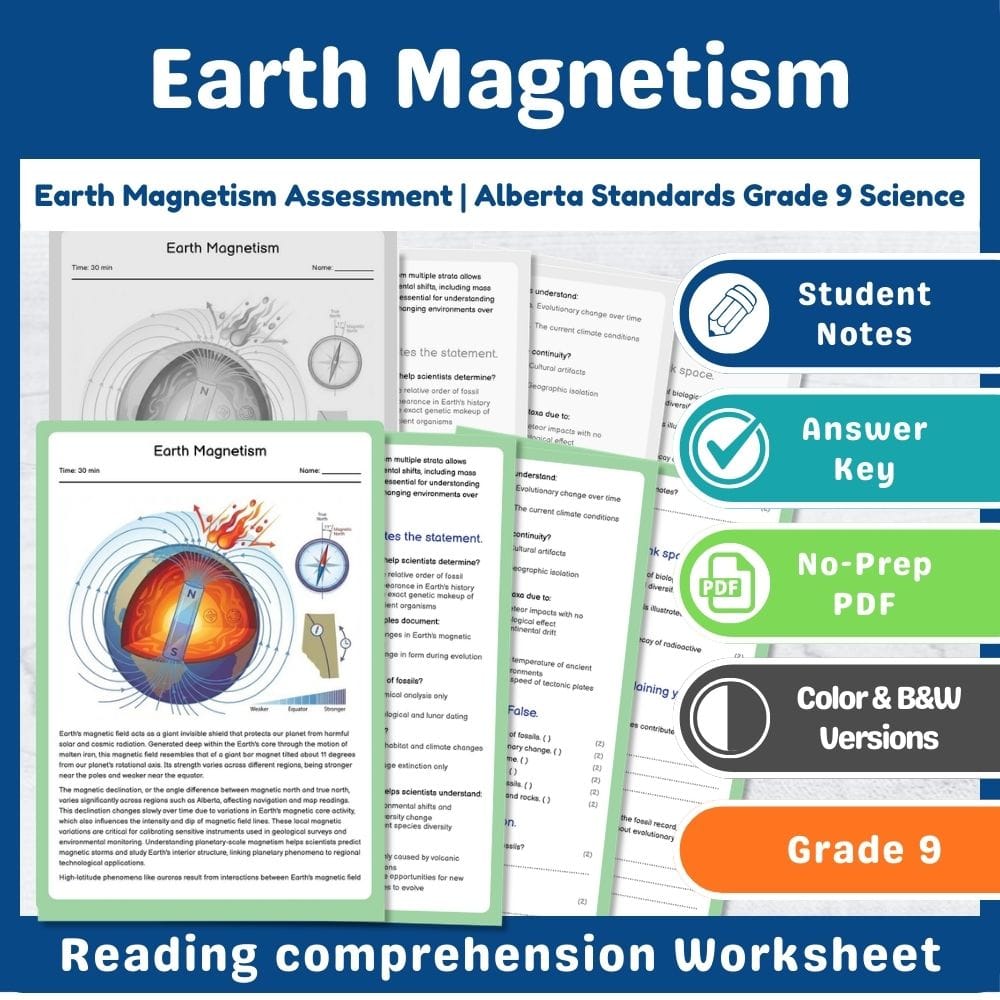
Earth Magnetism Assessment | Alberta Standards Grade 9 Science
Created byPrism Point LearningLearning Objectives
- Describe the origin and nature of Earth's magnetic field.
- Explain how declination varies regionally and affects navigation.
- Identify the technological applications of Earth's magnetism in surveying and environment monitoring.

Grade 11 Science | Momentum Conservation Worksheet | California Standards
 Created byLumora Learning
Learning Objectives
- Explain momentum as a vector quantity and use p = mv to predict direction and magnitude of motion.
- Apply conservation of momentum to analyze collisions and interactions in isolated systems.
- Connect impulse to changes in momentum and interpret action–reaction force pairs.

Grade 9 Science | Conservation Of Matter Worksheet | Florida NGSSS Aligned
Created byLumora LearningLearning Objectives
- Explain conservation of matter in terms of atoms being rearranged during chemical reactions
- Use balanced chemical equations to verify that the number of atoms of each element is conserved from reactants to products
- Connect conservation of mass in a closed system to particle-level models of reactions
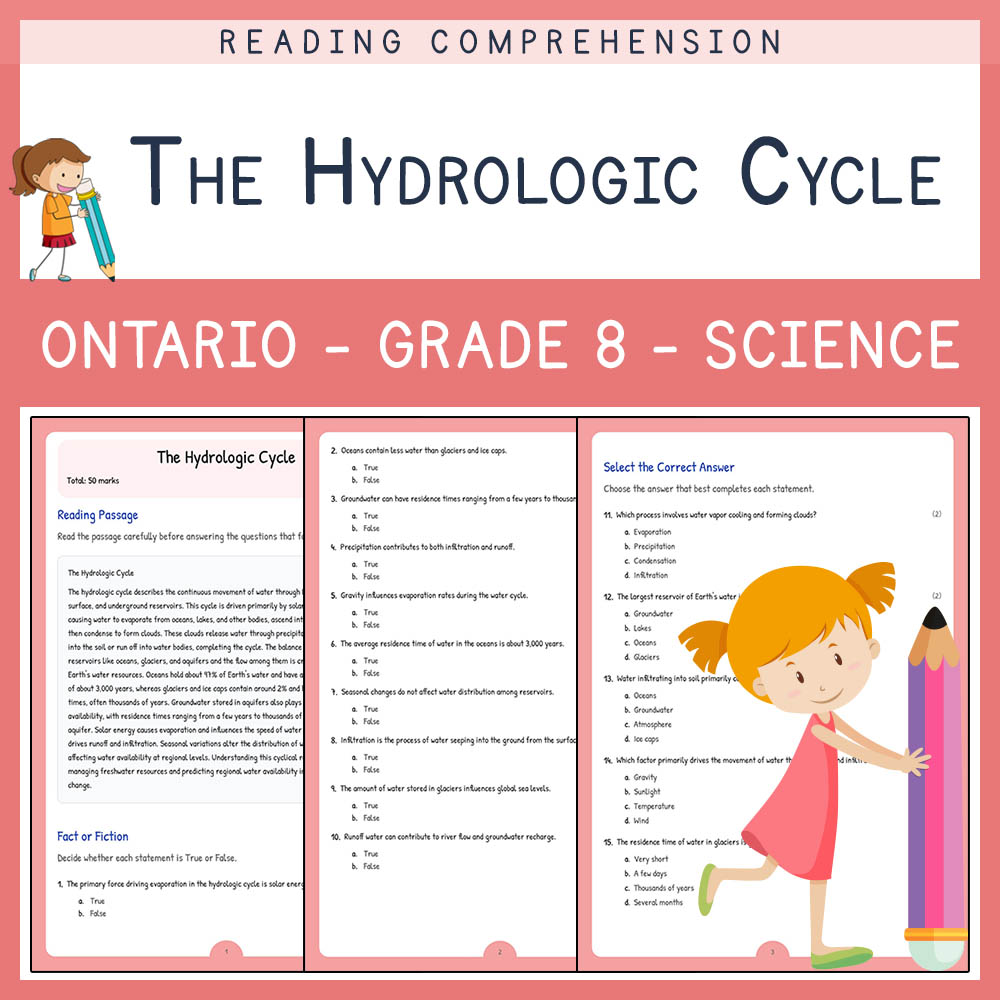
Grade 8 Science | The Hydrologic Cycle Worksheet Elena | Ontario
Created byLumora LearningLearning Objectives
- Describe the main processes involved in the hydrologic cycle.
- Explain the role of solar energy and gravity in water movement.
- Identify the different reservoirs of water and their residence times.
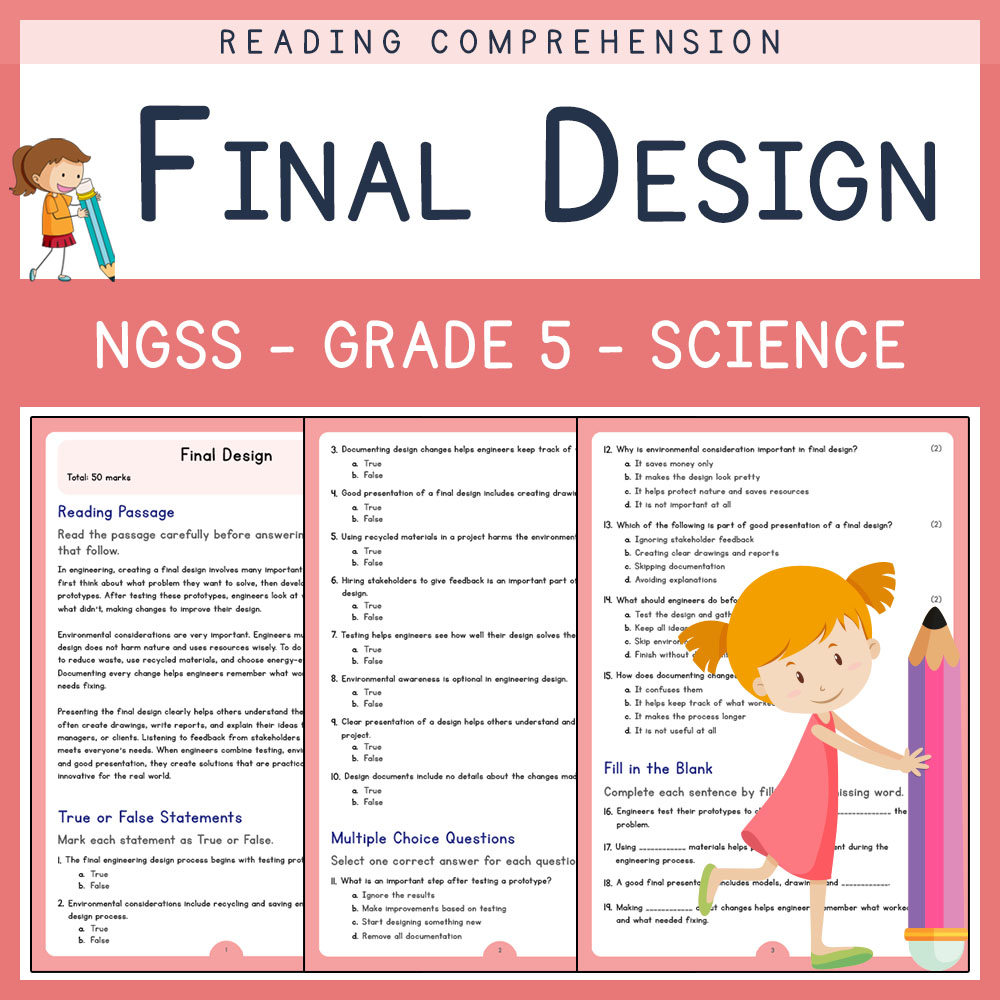
Grade 5 Science | Final Design Worksheet (PDF) | NGSS Aligned
Created byLumora LearningLearning Objectives
- Understand how to develop and refine an engineering solution
- Learn to test and evaluate design effectiveness
- Incorporate environmental and resource considerations into engineering

Grade 12 Science | Natural Selection Worksheet Elena | California Standards
Created byLumora LearningLearning Objectives
- Explain how heritable variation and differential reproductive success drive changes in allele frequencies over generations.
- Analyze how environmental pressures (climate, predators, pathogens, and competition) can shift trait distributions within populations.
- Differentiate natural selection from the idea that organisms adapt by changing their genes during their lifetimes.

Grade 6 Science | Decomposition Recycling Worksheet | NGSSS Aligned
Created byLumora LearningLearning Objectives
- Explain how decomposers (fungi and bacteria) break down dead organisms and waste
- Describe how decomposition returns nutrients to the environment for producers to use again
- Identify factors that affect the rate of decomposition (oxygen, moisture, temperature, and surface area)

Grade 10 Science | Optimizing Design Worksheet Elena | California Standards
Created byLumora LearningLearning Objectives
- Explain how optimization uses criteria and constraints to guide engineering design choices
- Identify trade-offs involved in bridge truss optimization (strength, weight, cost, and constructability)
- Apply optimization reasoning to evaluate whether a design meets required limits

Grade 10 Science | Specialized Cells Worksheet | NGSSS Aligned
Created byLumora LearningLearning Objectives
- Explain how specialized cell structures relate to specific cell functions in multicellular organisms
- Identify examples of specialized cells for transport, protection, absorption, and signaling and connect them to internal and surface features
- Describe how cell connections and communication pathways support tissue and system performance

Grade 6 Science | Watershed Pathways Worksheet Elena | California Standards
Created byLumora LearningLearning Objectives
- Explain how gravity, terrain, and land cover shape water movement within a watershed
- Describe how infiltration and soil storage affect runoff timing and streamflow
- Identify how vegetation influences erosion and sediment movement in watershed pathways

Grade 9 Science | Systems Thinking Worksheet | California Standards
Created byLumora LearningLearning Objectives
- Explain how a design functions as part of a larger system using matter, energy, and information flows
- Identify feedback and unintended effects that can occur when system components interact
- Use systems thinking to evaluate boundary conditions and how system behavior changes over time

Grade 8 Science | Water Cycle Worksheet Elena | California Standards
Created byLumora LearningLearning Objectives
- Explain the main processes of the water cycle, including evaporation, condensation, precipitation, and runoff.
- Describe how energy from the Sun and gravity drive the continuous movement of water through Earth systems.
- Connect water cycle processes to weather, climate, and habitats.
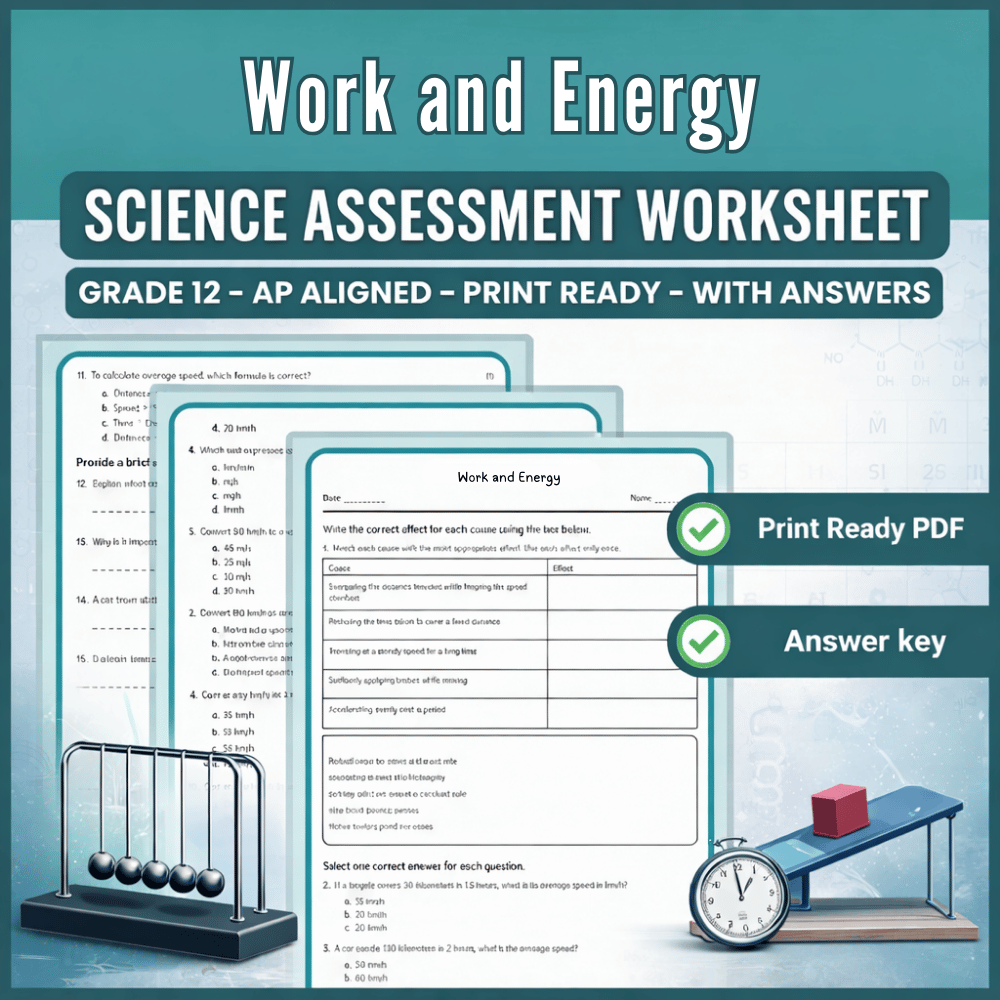
Grade 12 Science – Work and Energy Worksheet (AP Standard) (PDF)
 Created byBright Mind Resources
Learning Objectives
- Understand the concepts of work, energy, and power in mechanical systems.
- Apply the work–energy theorem to analyze energy transfer in various contexts.
- Differentiate between conservative and nonconservative forces and their effects on energy.
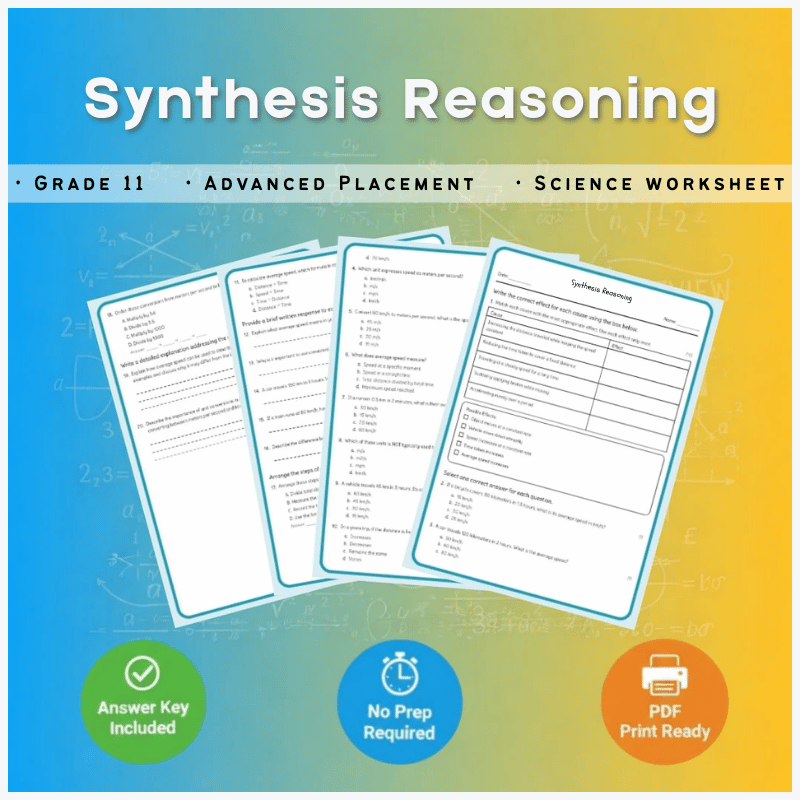
Grade 11 Science – Synthesis Reasoning Worksheet (AP Standards + PDF)
Created byBright Mind ResourcesLearning Objectives
- Understand how to integrate quantitative models and empirical data to evaluate complex phenomena.
- Develop skills in constructing coherent scientific arguments by juxtaposing models, observations, and constraints.
- Apply iterative refinement processes when conflicting evidence arises in scientific reasoning.
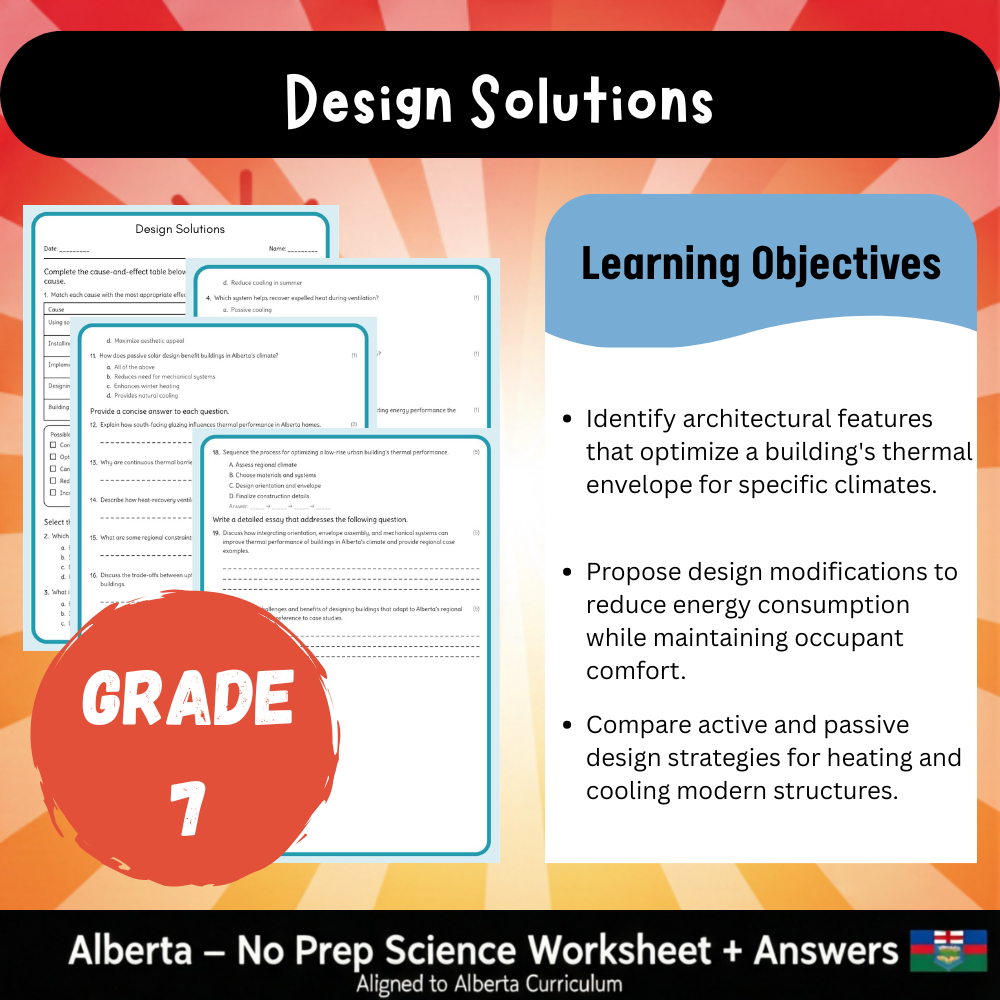
Grade 7 Science | Design Solutions Worksheet (PDF) – Alberta Standards
Created byBright Mind ResourcesLearning Objectives
- Understand how building design strategies influence thermal performance in Alberta's climate zones.
- Identify specific design components such as passive solar gains, thermal barriers, and ventilation.
- Evaluate case examples illustrating trade-offs between materials, energy, and comfort.
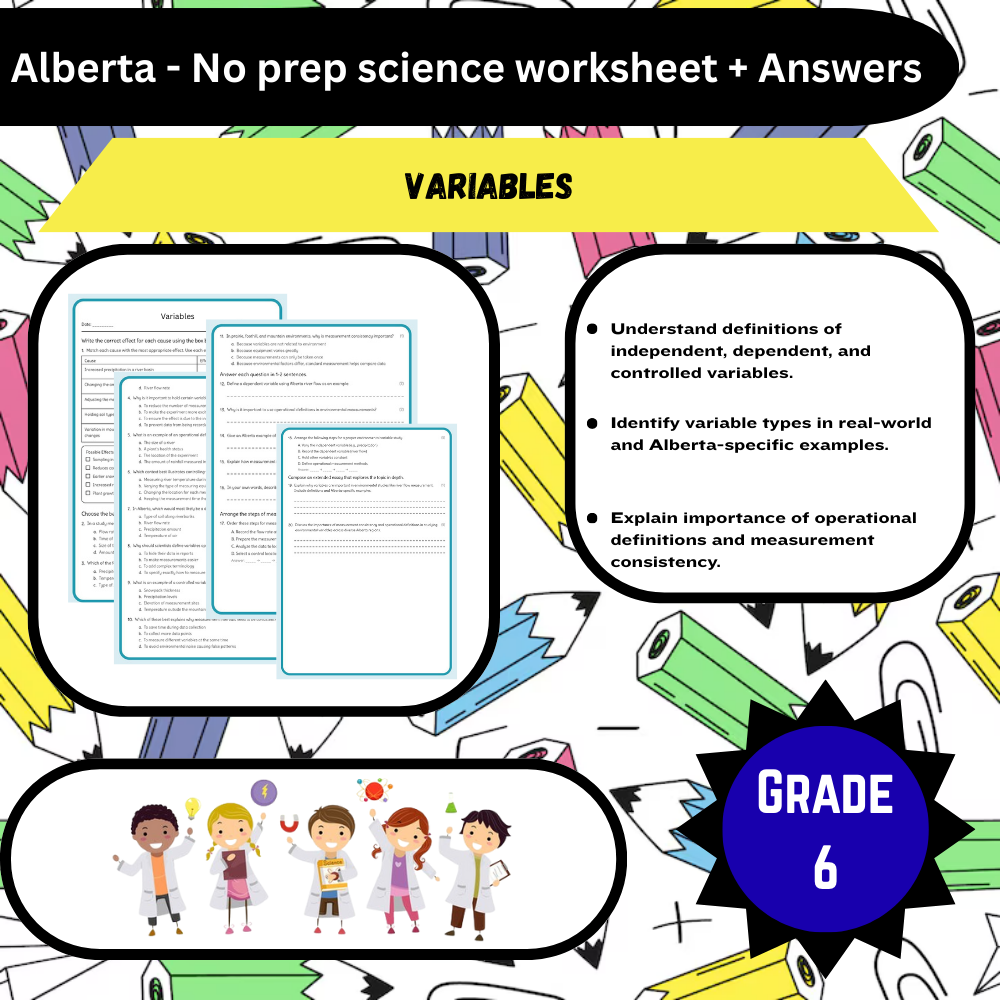
6th Grade Science | Variables Worksheet (PDF) – Alberta Standards
Created byBright Mind ResourcesLearning Objectives
- Understand the definitions of independent, dependent, and controlled variables in scientific experiments.
- Identify different types of variables in real-world and Alberta-specific examples.
- Explain the importance of operational definitions and measurement consistency in data collection.
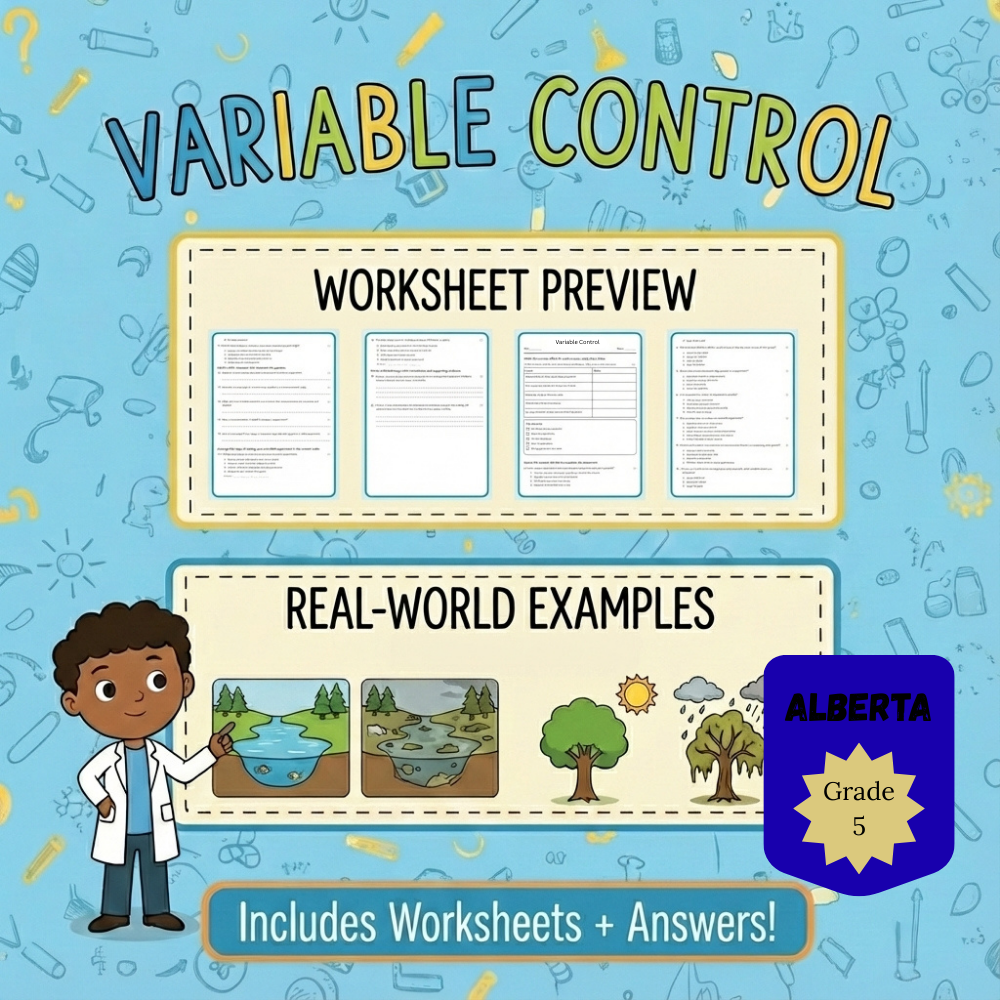
Grade 5 Science | Variable Control Worksheet (PDF) - Alberta Standards
Created byBright Mind ResourcesLearning Objectives
- Identify different types of variables in scientific experiments, including independent, dependent, and confounding variables.
- Understand how to control variables and why it is important for accurate scientific conclusions.
- Recognize examples of variable control in real-world experiments related to environmental science.
Browse more categories
About Science Worksheets
Find Science worksheets spanning core skills, practice, and review. All 42,685 resources are instant PDF downloads for the classroom or home.
Every worksheet on MyTeachingSheets is created by independent teacher-authors and reviewed before publication. All resources download as printable PDFs for classroom, homework, or at-home practice, and many include answer keys. Preview any worksheet free before buying.