
Science Worksheets
42,685 subject resources
Energy Flow Assessment for Grade 9 Science | TEKS Standards-Aligned
 Created byPrism Point Learning
Learning Objectives
- Explain how energy moves through ecosystems from primary producers to consumers and decomposers.
- Describe the process of photosynthesis and its role in transferring energy within an ecosystem.
- Understand the concept of energy transfer efficiency and how energy pyramids illustrate trophic levels.

Plant Matter Inputs Assessment | California Standards Grade 6 Science
Created byPrism Point LearningLearning Objectives
- Explain how carbon dioxide, water, and gases from the atmosphere provide raw materials for plant growth
- Describe how roots, leaves, and plant cells use environmental inputs to build biomass
- Use evidence from text to answer questions about matter entering and leaving plant systems
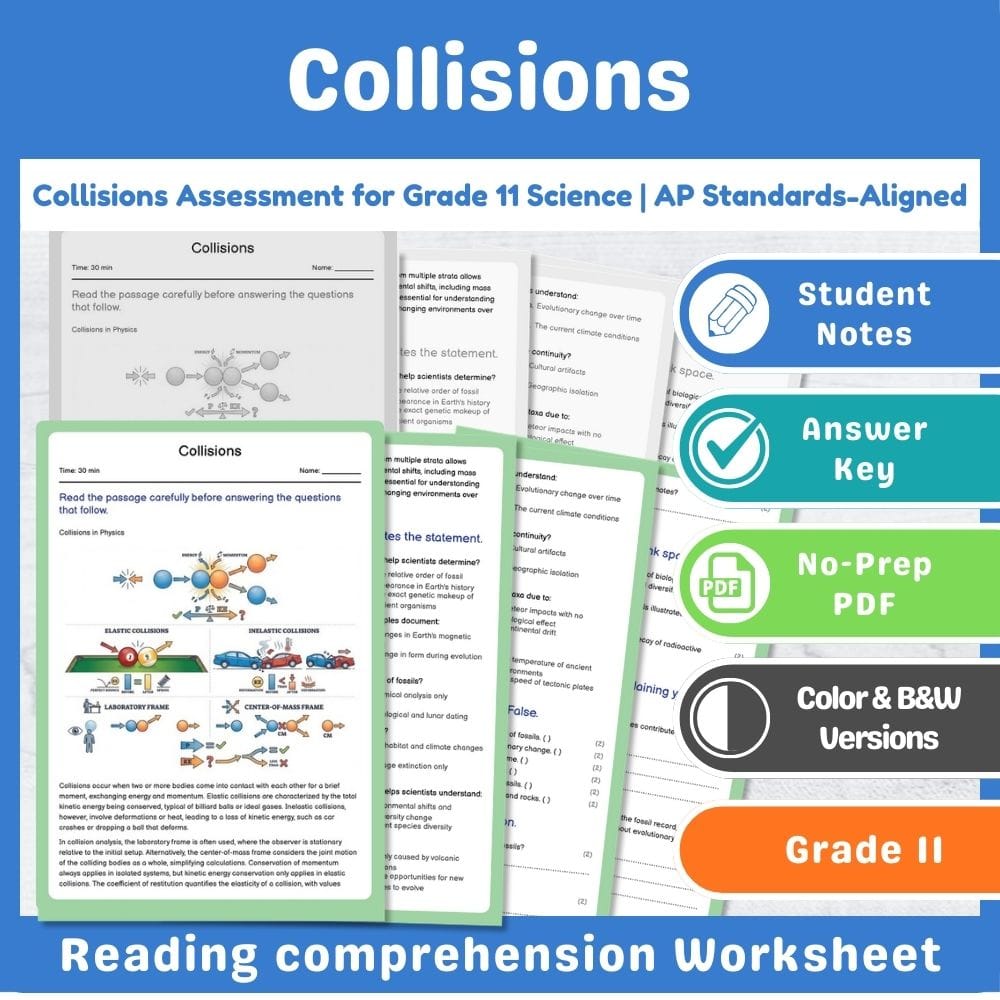
Collisions Assessment for Grade 11 Science | AP Standards-Aligned
Created byPrism Point LearningLearning Objectives
- Analyze elastic and inelastic collisions in one and two dimensions using conservation of momentum and kinetic energy.
- Compare laboratory and center-of-mass reference frames in collision analysis.
- Employ algebraic and vector methods to predict post-collision velocities.
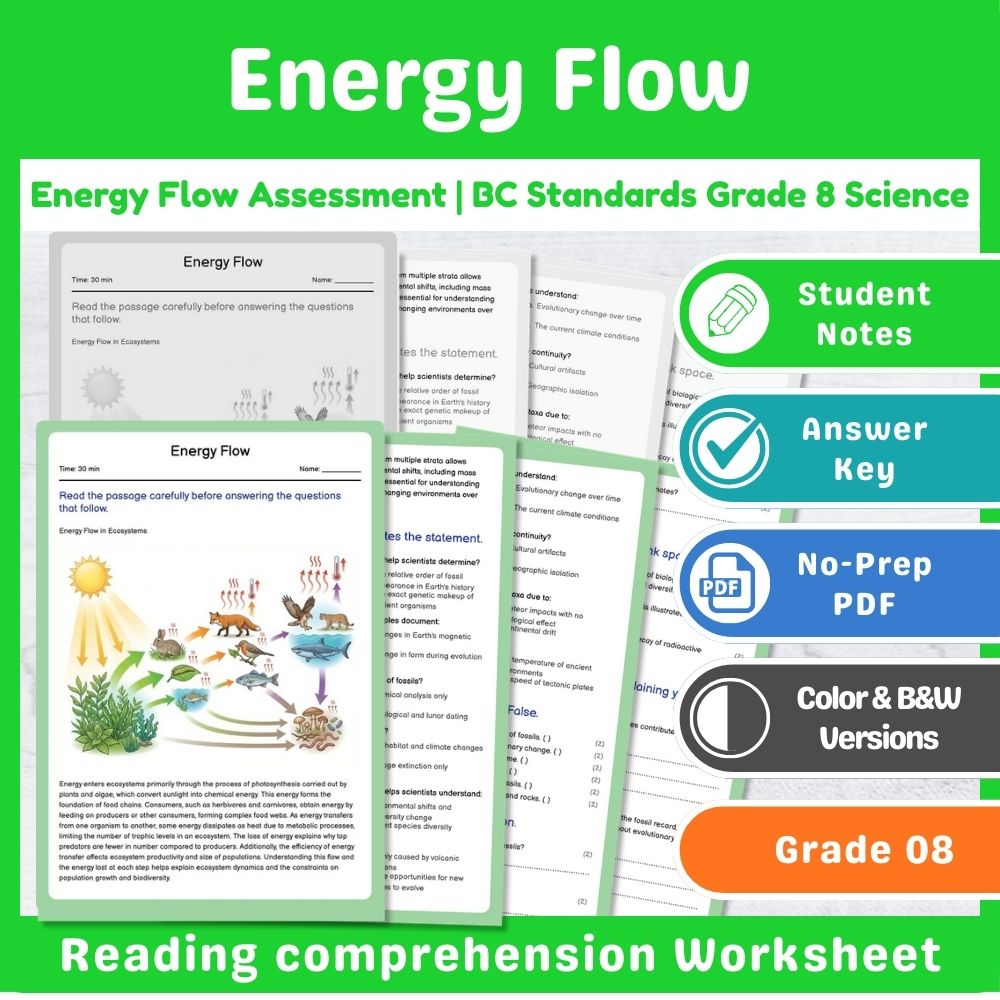
Energy Flow Assessment | BC Standards Grade 8 Science
Created byPrism Point LearningLearning Objectives
- Understand how energy enters ecosystems through photosynthesis.
- Explain the flow of energy through food chains and food webs.
- Describe how energy dissipates as heat at each transfer in an ecosystem.
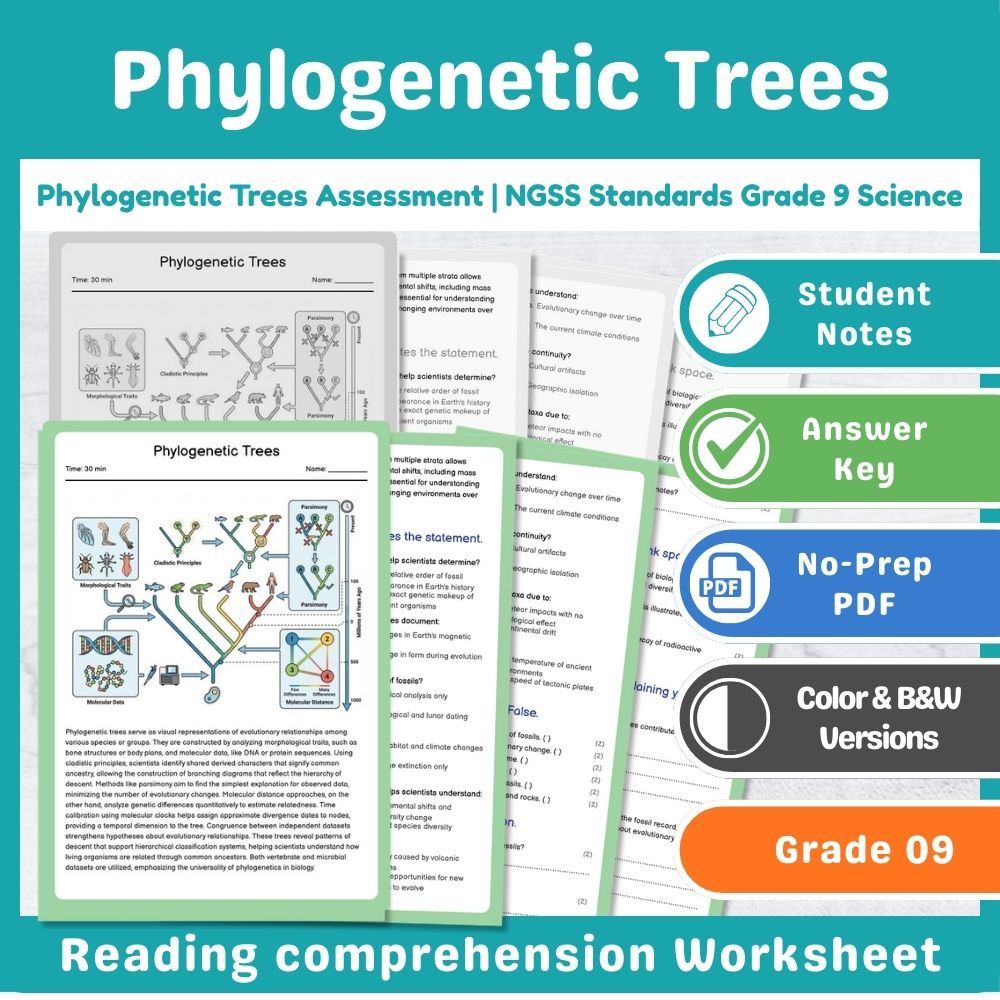
Phylogenetic Trees Assessment | NGSS Standards Grade 9 Science
Created byPrism Point LearningLearning Objectives
- Understand the construction principles of phylogenetic trees and their significance in evolutionary biology.
- Interpret branching diagrams to identify common ancestors and shared derived characters.
- Learn different methods of tree-building such as parsimony and molecular distance analyses.
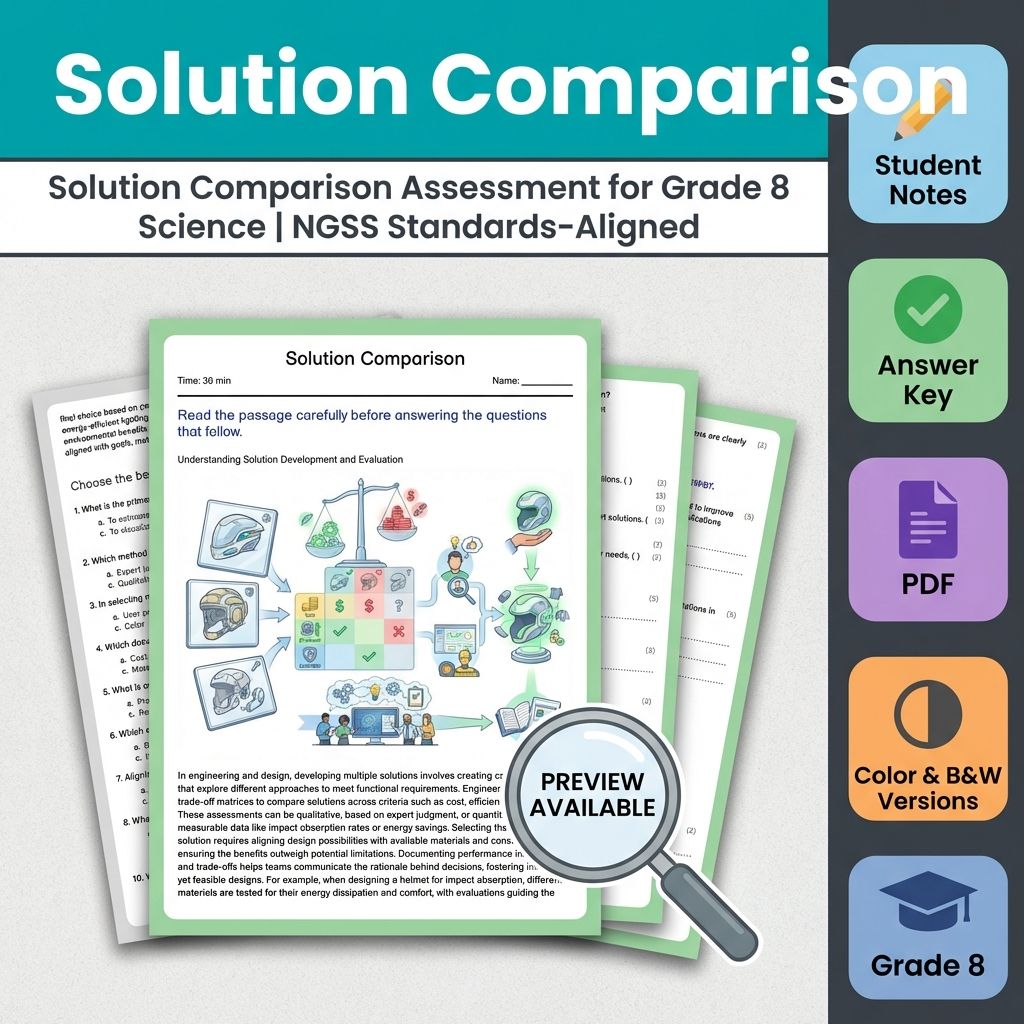
Solution Comparison Assessment for Grade 8 Science | NGSS Standards-Aligned
Created byPrism Point LearningLearning Objectives
- Understand the principles of designing and evaluating multiple solutions based on criteria and constraints.
- Learn to develop concept sketches, trade-off matrices, and compare solutions qualitatively and quantitatively.
- Identify key performance indicators and document benefits and limitations of design concepts.
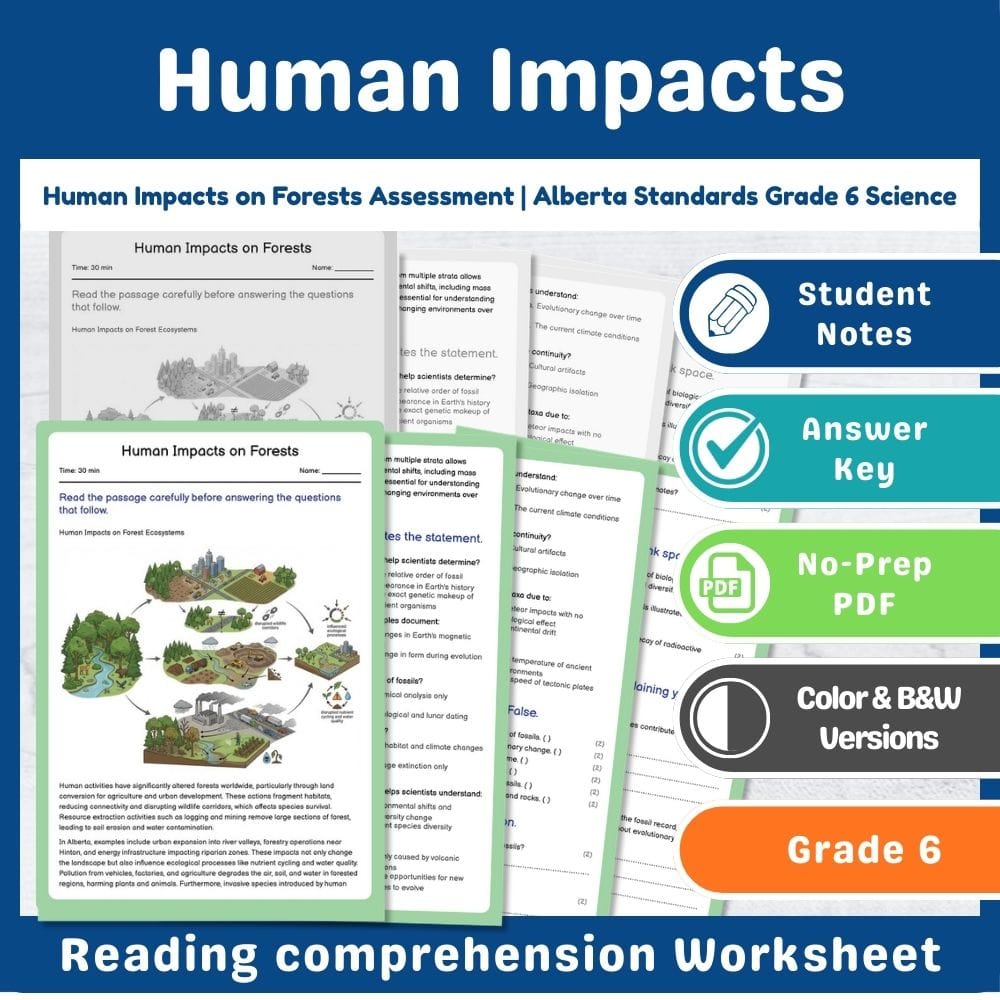
Human Impacts on Forests Assessment | Alberta Standards Grade 6 Science
Created byPrism Point LearningLearning Objectives
- Understand various human activities that impact forest ecosystems.
- Identify how urban expansion, resource extraction, and pollution affect forests.
- Evaluate the cumulative environmental effects caused by human impacts.
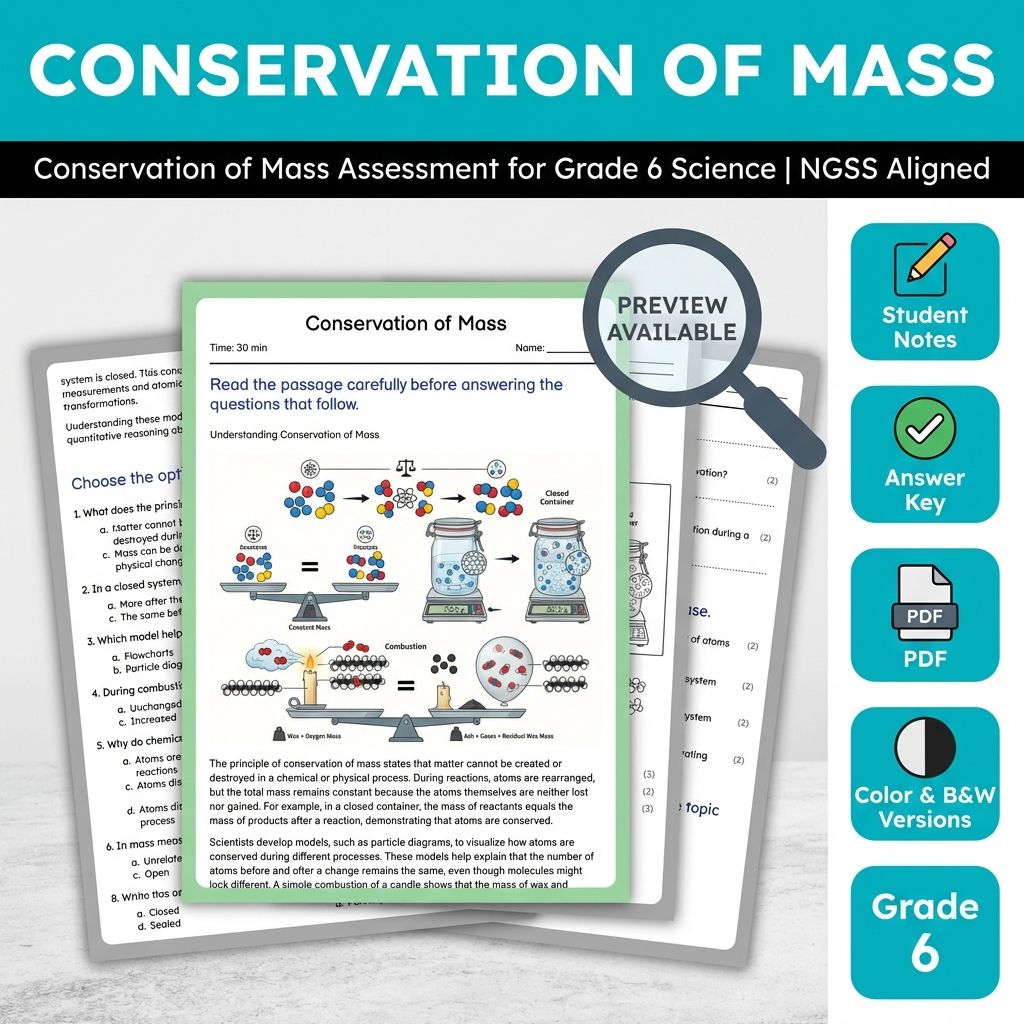
Conservation of Mass Assessment for Grade 6 Science | NGSS Aligned
Created byPrism Point LearningLearning Objectives
- Explain the principle of the conservation of mass through physical and chemical changes.
- Identify models and diagrams that demonstrate atom count constancy during reactions.
- Connect mass measurements before and after matter transformations to the concept of atom conservation.
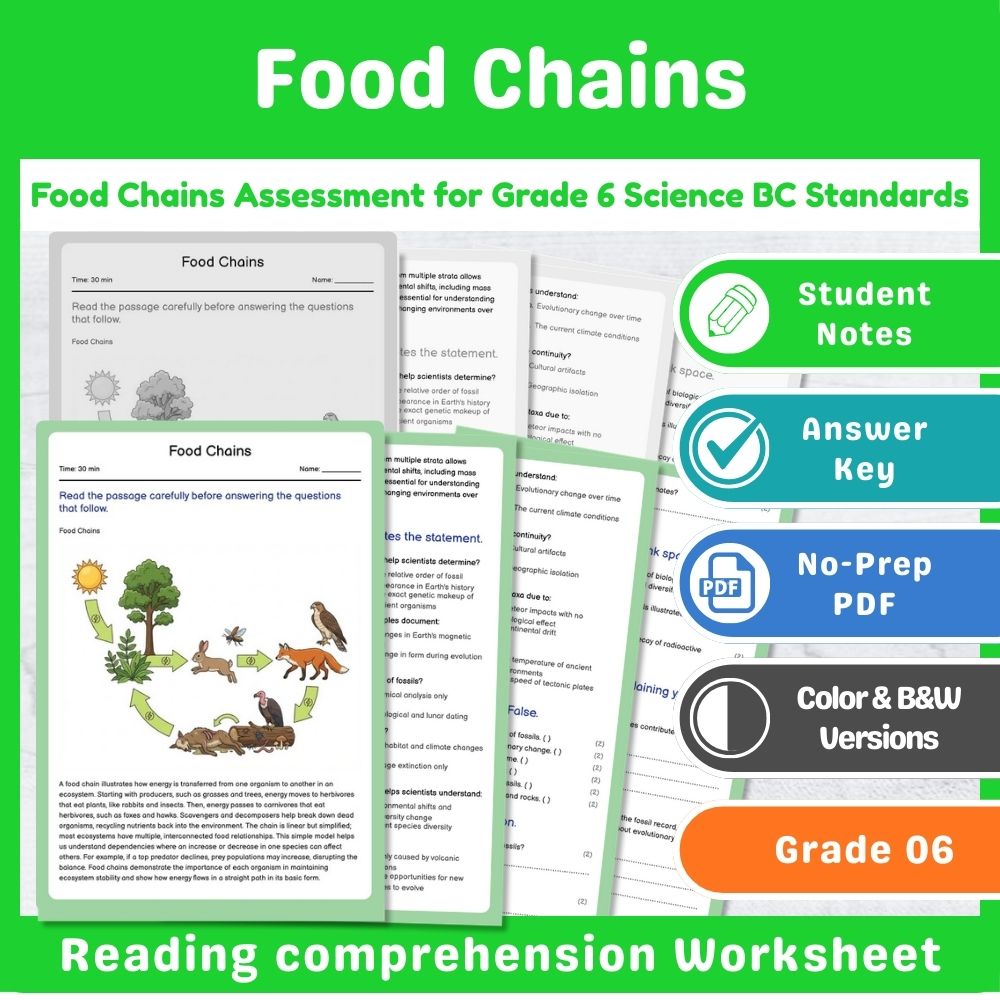
Food Chains Assessment for Grade 6 Science BC Standards
Created byPrism Point LearningLearning Objectives
- Describe the concept of a food chain and how energy transfers from producers to consumers.
- Identify examples of organisms at different trophic levels in a food chain.
- Understand the dependencies between organisms in a food chain and how changes affect ecosystems.

Bonding Types Assessment | Alberta Standard Grade 11 Science Worksheet
Created byPrism Point LearningLearning Objectives
- Compare electron transfer, sharing, and delocalized models in bonding.
- Identify structural motifs linked to ionic, covalent, and metallic bonds.
- Relate bond types to properties such as electrical conductivity, hardness, and solubility.
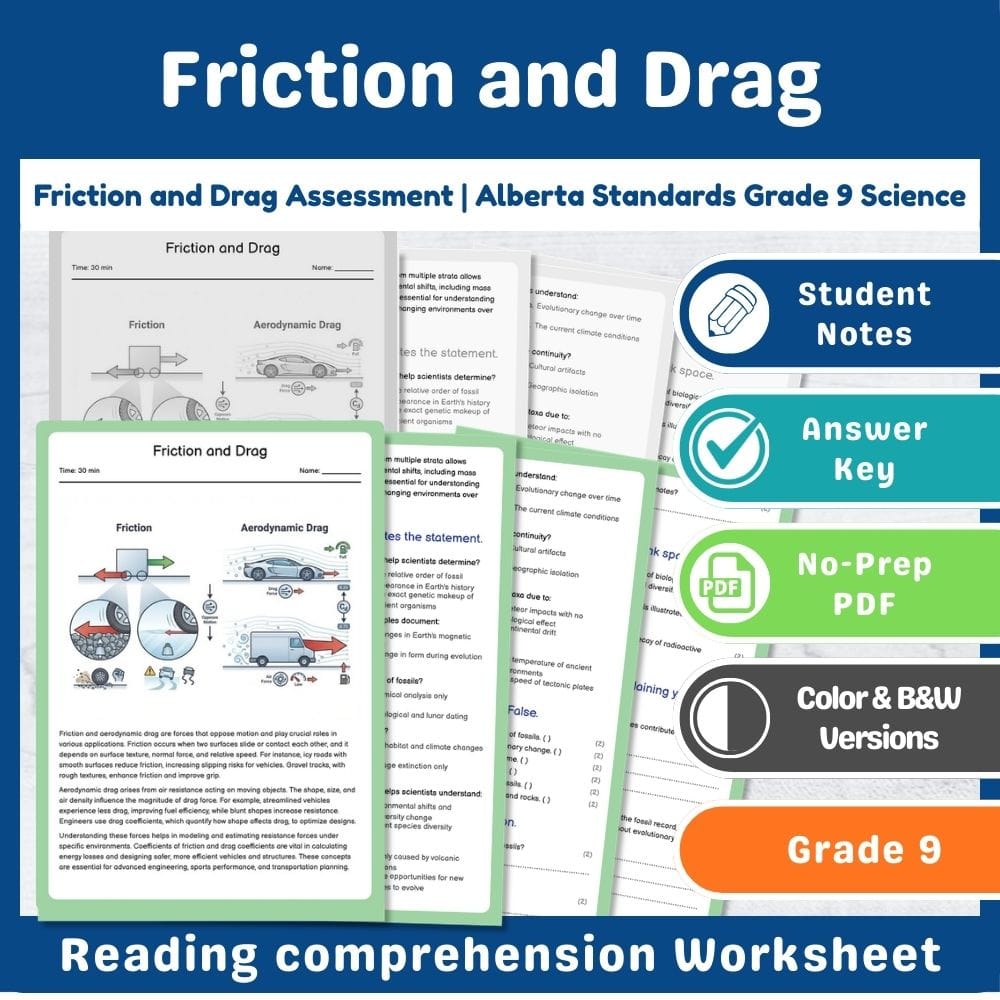
Friction and Drag Assessment | Alberta Standards Grade 9 Science
Created byPrism Point LearningLearning Objectives
- Explain how friction and aerodynamic drag oppose motion and convert mechanical energy into thermal energy.
- Describe the factors affecting friction on icy roads and gravel tracks.
- Identify the variables influencing aerodynamic drag on various structures.
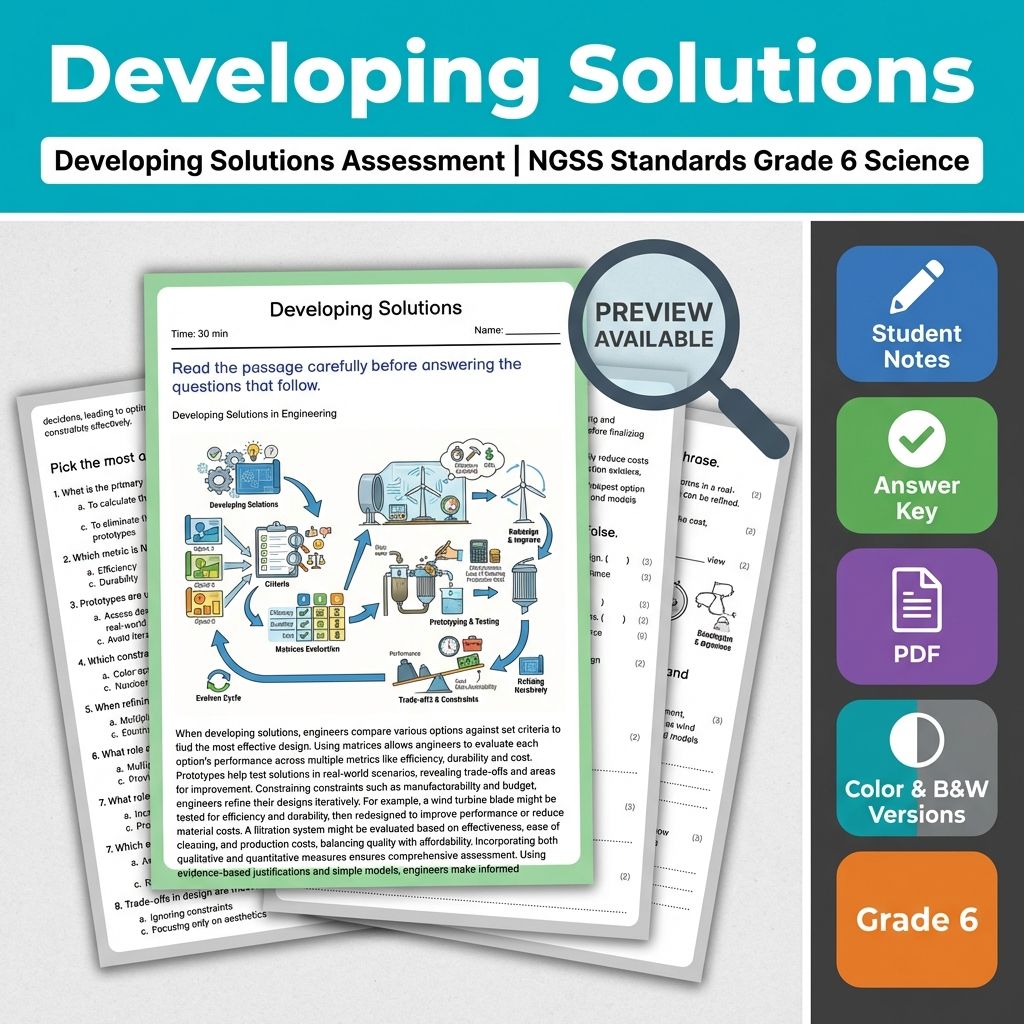
Developing Solutions Assessment | NGSS Standards Grade 6 Science
Created byPrism Point LearningLearning Objectives
- Compare multiple design solutions using matrices, rubrics, and prototypes.
- Evaluate solutions based on quantitative and qualitative metrics such as efficiency, durability, and cost.
- Analyze trade-offs between different configurations and understand their influence on solution selection.
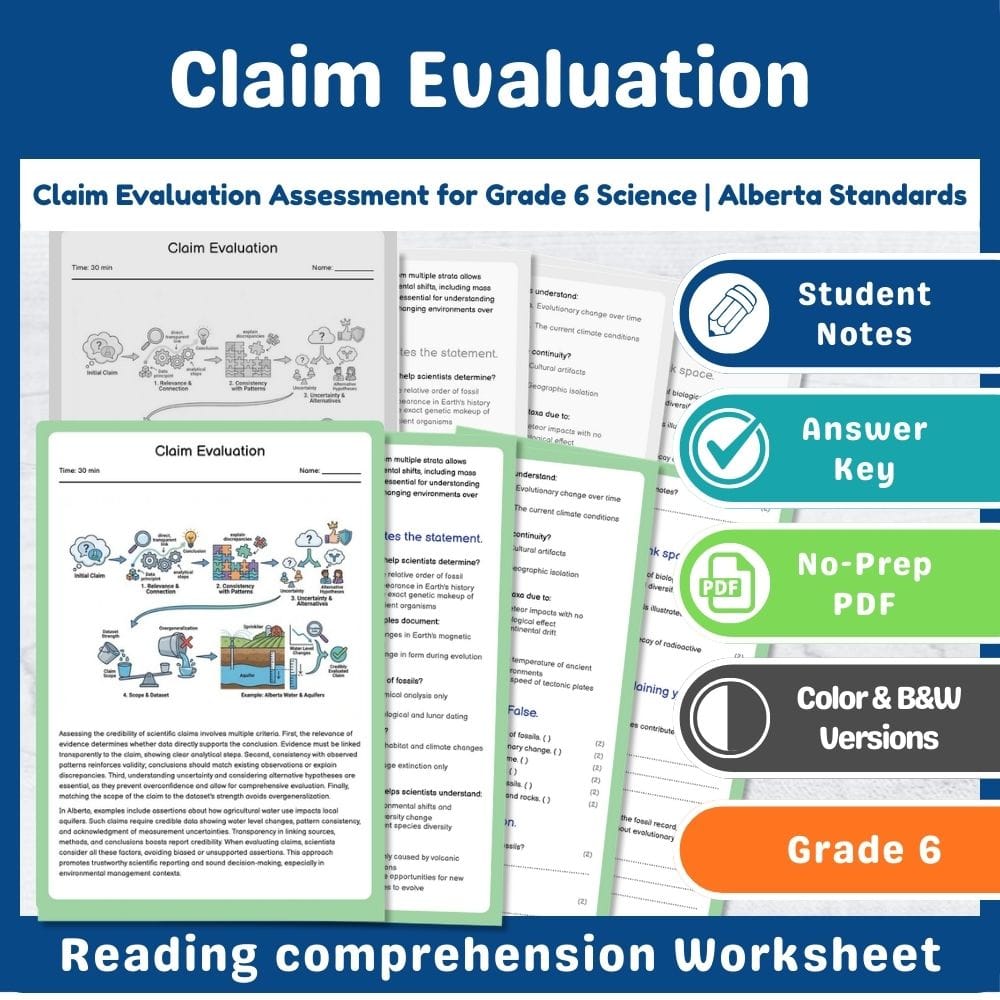
Claim Evaluation Assessment for Grade 6 Science | Alberta Standards
Created byPrism Point LearningLearning Objectives
- Understand criteria for assessing the relevance and consistency of evidence in claims.
- Evaluate the scope of claims in relation to data strength and uncertainty.
- Analyze examples of claim assessment in environmental contexts, such as agriculture and water use.
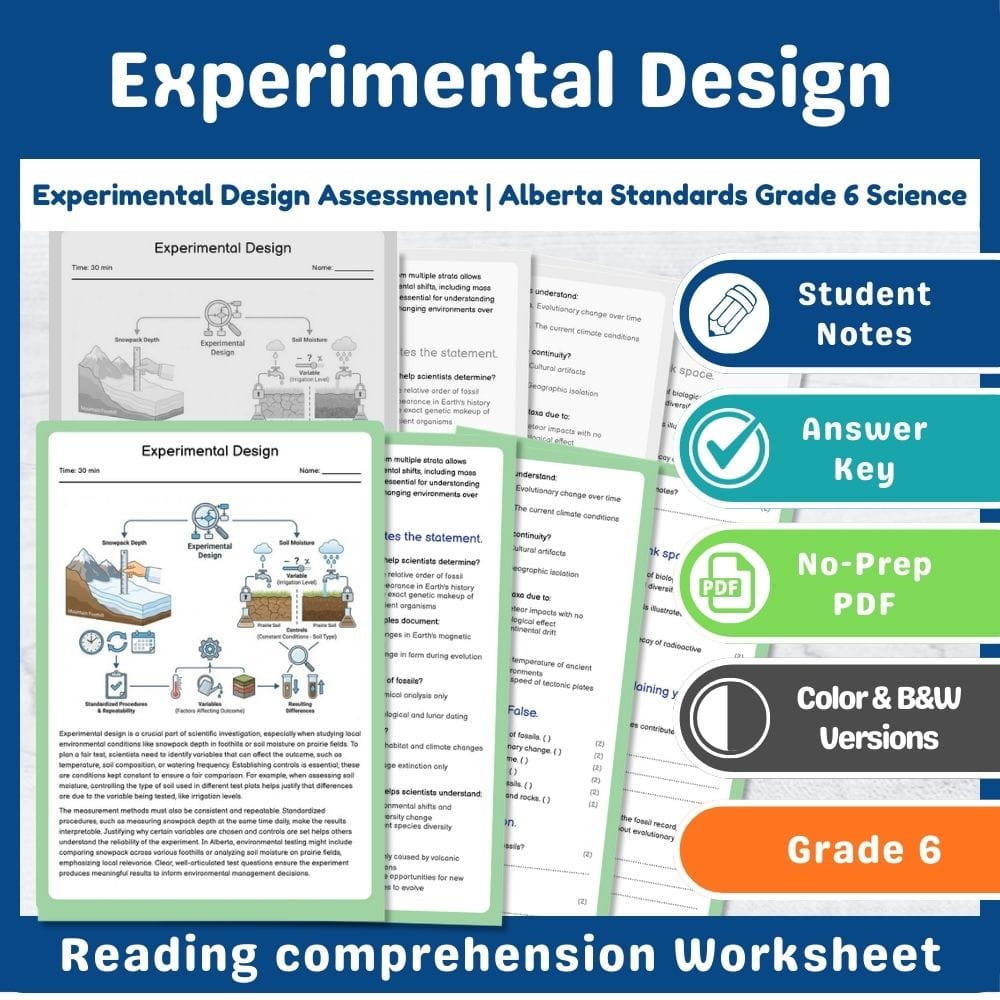
Experimental Design Assessment | Alberta Standards Grade 6 Science
Created byPrism Point LearningLearning Objectives
- Understand the importance of variables, controls, and measurement procedures in experimental design.
- Identify and justify appropriate control conditions in fair tests.
- Describe how to formulate testable questions that yield interpretable results in local environmental studies.
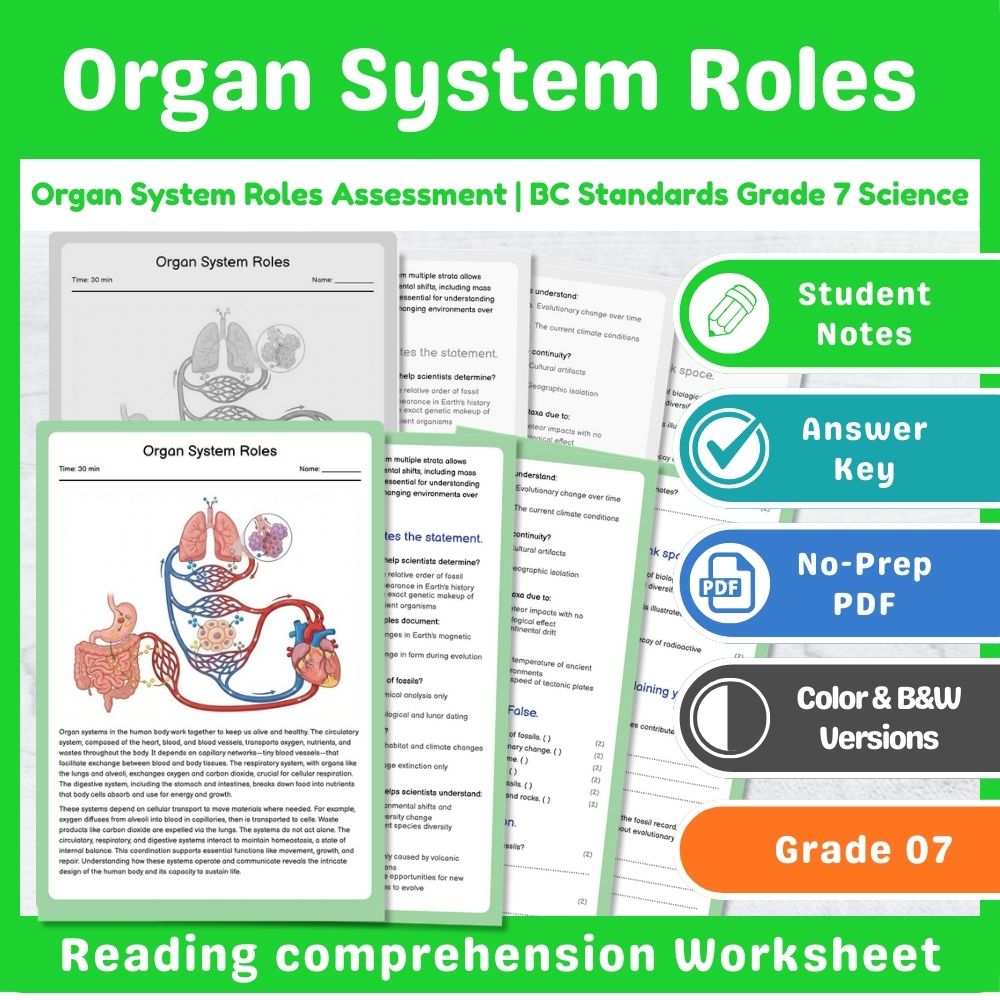
Organ System Roles Assessment | BC Standards Grade 7 Science
Created byPrism Point LearningLearning Objectives
- Understand the functions of different organ systems in the human body.
- Identify structures such as capillaries and alveoli that contribute to life processes.
- Explain how organ systems work together to maintain internal stability.

Nutrient Cycling Assessment for Grade 8 Science | Alberta Standards
Created byPrism Point LearningLearning Objectives
- Describe the processes involved in nutrient cycling within ecosystems.
- Explain the roles of decomposers, nitrogen fixation, and sedimentation.
- Analyze how environmental factors like temperature and moisture influence nutrient cycles.
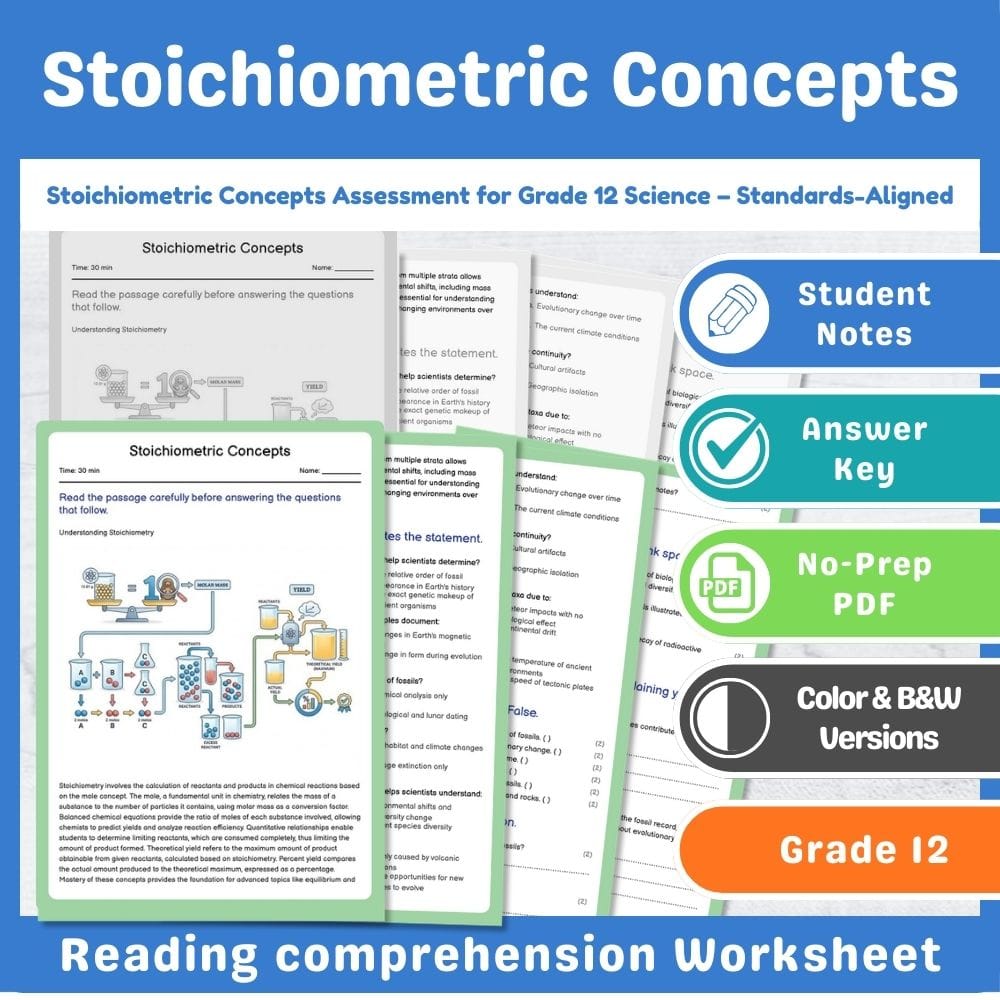
Stoichiometric Concepts Assessment for Grade 12 Science – Standards-Aligned
Created byPrism Point LearningLearning Objectives
- Define and understand the mole concept, molar mass, and balanced chemical equations.
- Calculate limiting reactants, theoretical yield, and percent yield from experimental data.
- Relate mass, particle counts, and molar relationships using symbolic and arithmetic methods.
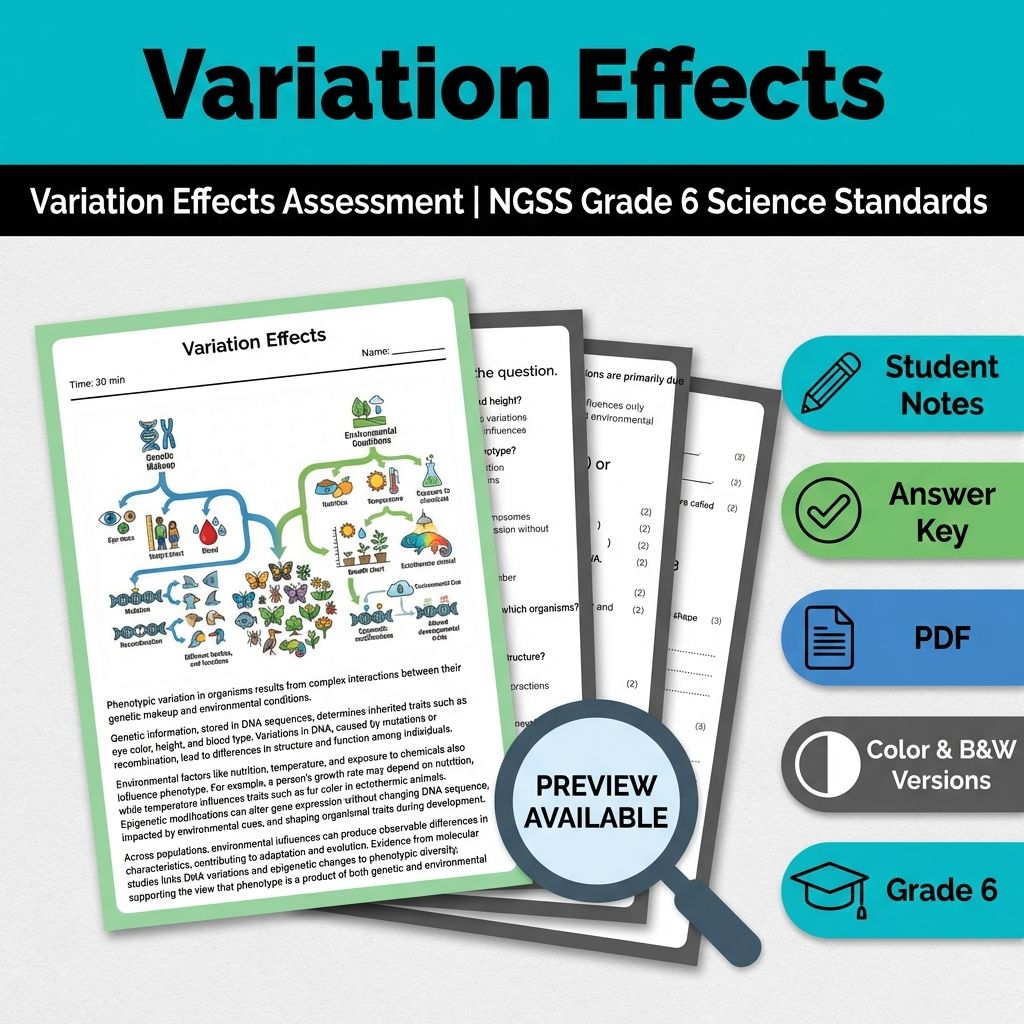
Variation Effects Assessment | NGSS Grade 6 Science Standards
Created byPrism Point LearningLearning Objectives
- Understand how phenotypic variation results from genetic and environmental interactions.
- Identify examples of inherited traits, environmental influences, and temperature-dependent gene expression.
- Explain the links between DNA sequence variation, macromolecular processes, and organismal differences.
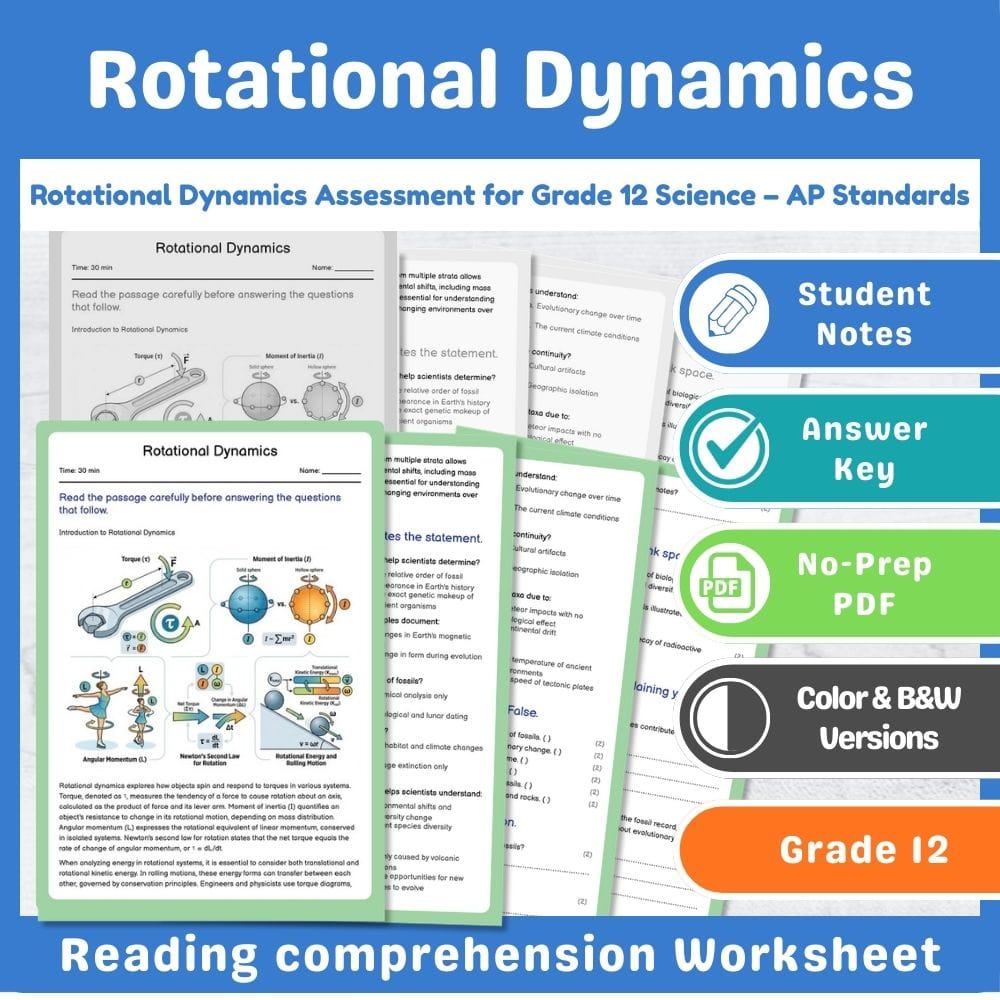
Rotational Dynamics Assessment for Grade 12 Science – AP Standards
Created byPrism Point LearningLearning Objectives
- Understand the concept of torque and how it relates to rotational motion.
- Define and explain the significance of moment of inertia and angular momentum in rigid bodies.
- Develop and apply equations linking net torque to angular acceleration.
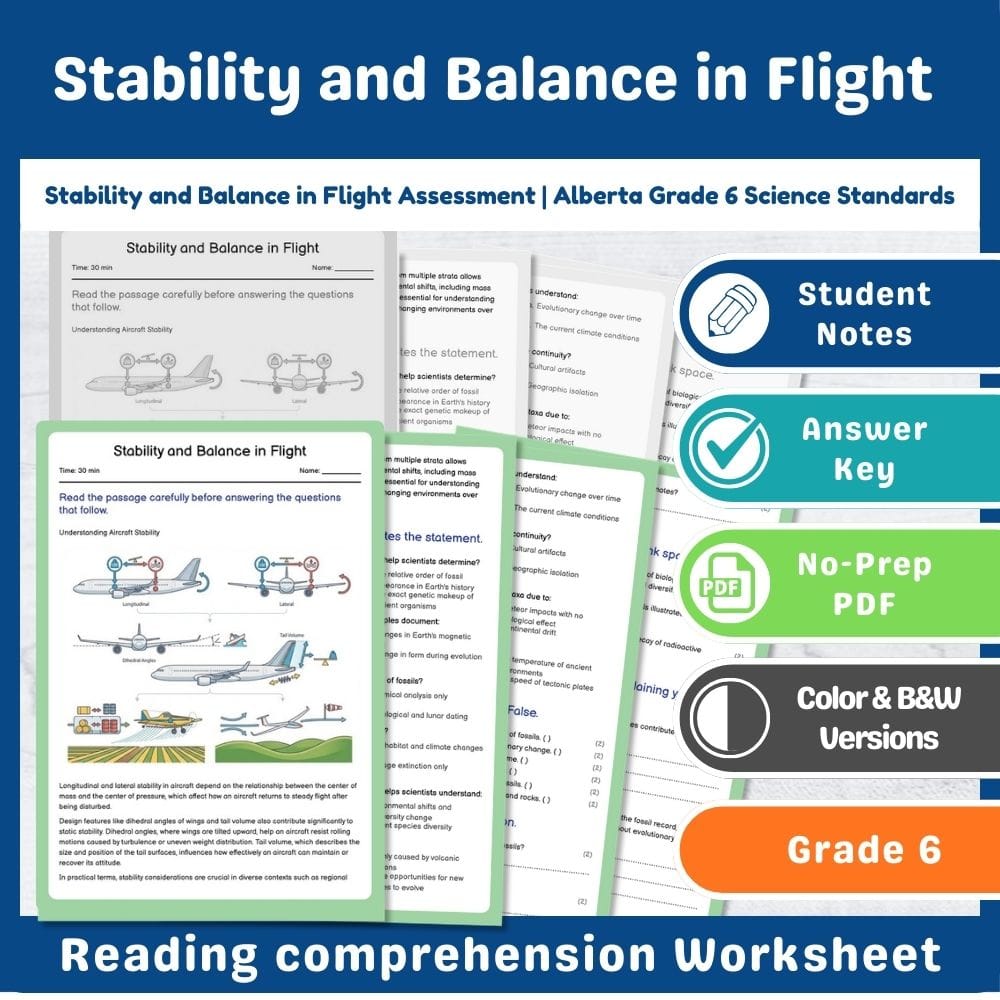
Stability and Balance in Flight Assessment | Alberta Grade 6 Science Standards
Created byPrism Point LearningLearning Objectives
- Understand how center of mass and center of pressure affect aircraft stability.
- Explain how design features like dihedral angles and tail volume influence static stability.
- Describe how balance impacts aircraft behavior under different payloads and wind conditions.
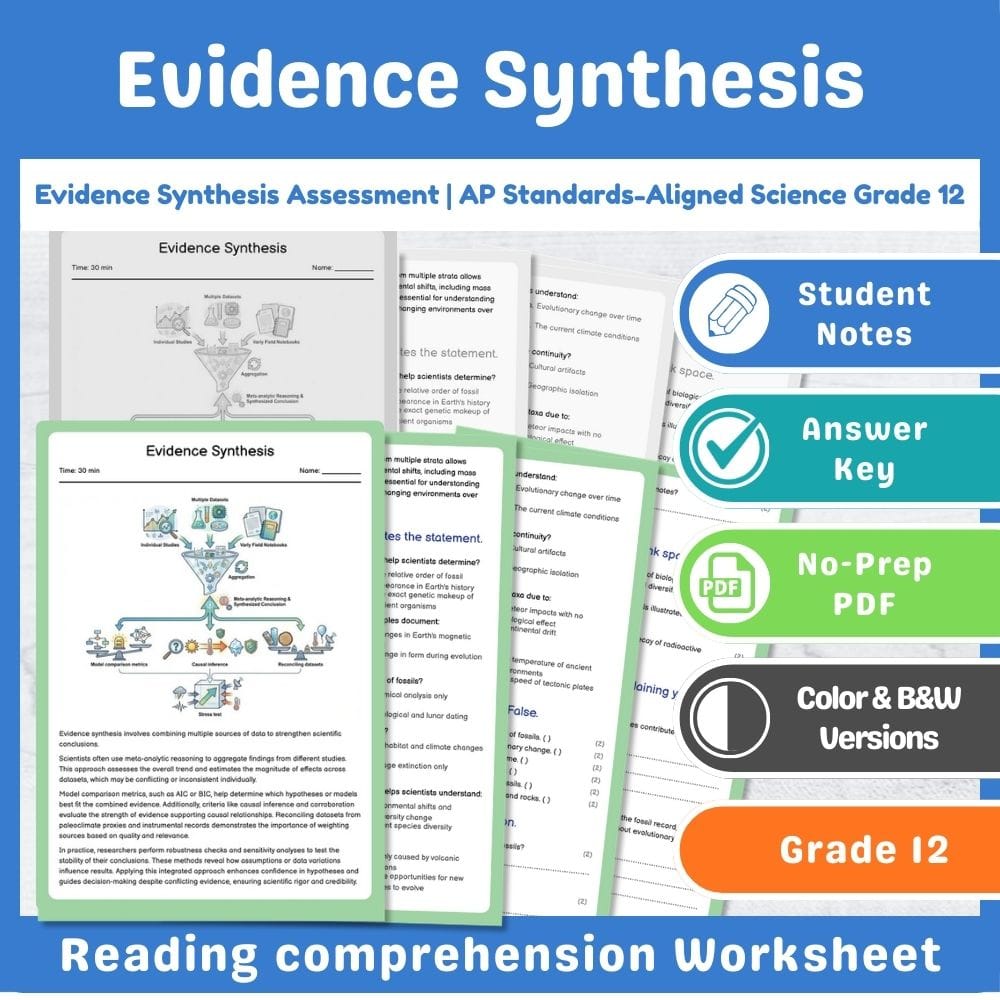
Evidence Synthesis Assessment | AP Standards-Aligned Science Grade 12
Created byPrism Point LearningLearning Objectives
- Understand methods for integrating multiple lines of evidence in scientific research.
- Analyze contrasting datasets and assess their compatibility using model comparison metrics.
- Evaluate how combined evidence influences confidence in hypotheses and conclusions.
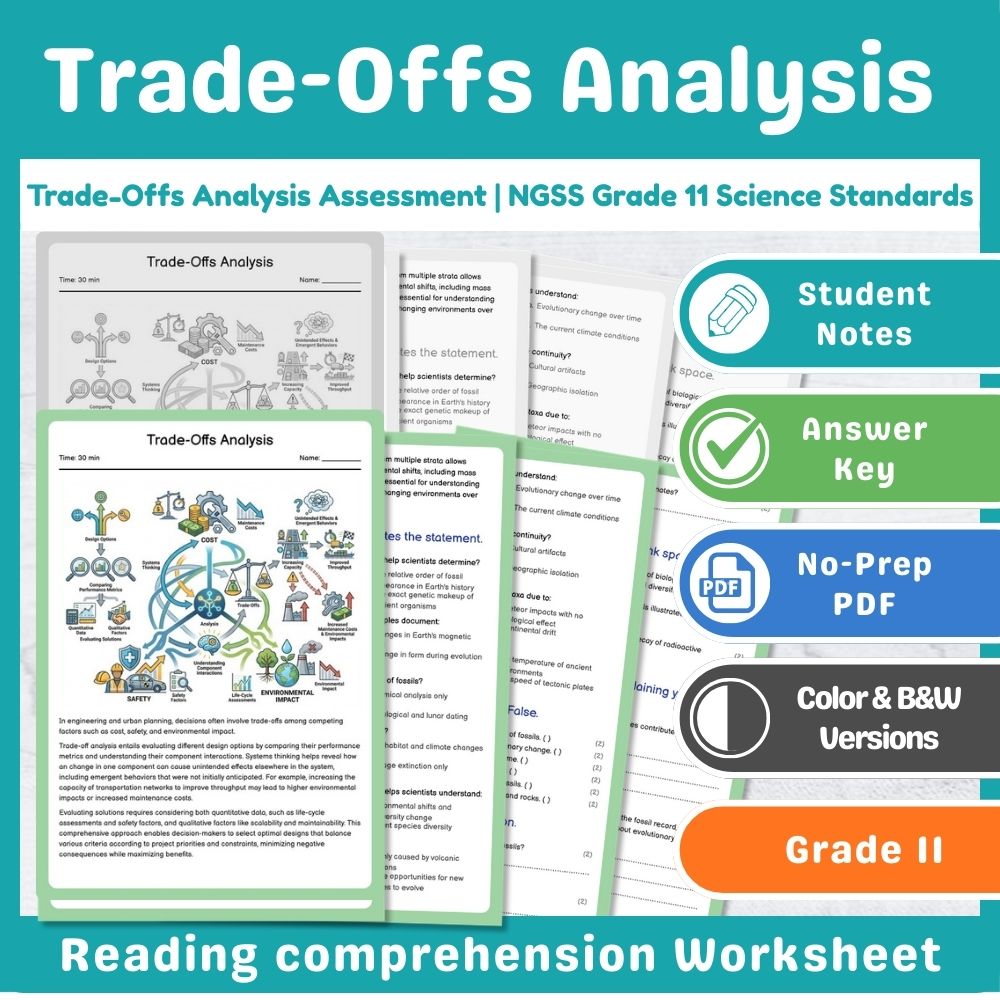
Trade-Offs Analysis Assessment | NGSS Grade 11 Science Standards
Created byPrism Point LearningLearning Objectives
- Evaluate proposed solutions against specified criteria and constraints using quantitative and qualitative methods.
- Apply systems thinking to analyze component interactions, emergent behavior, and unintended consequences in complex systems.
- Examine trade-offs among cost, safety, environmental impact, scalability, and maintainability in engineering and urban systems.
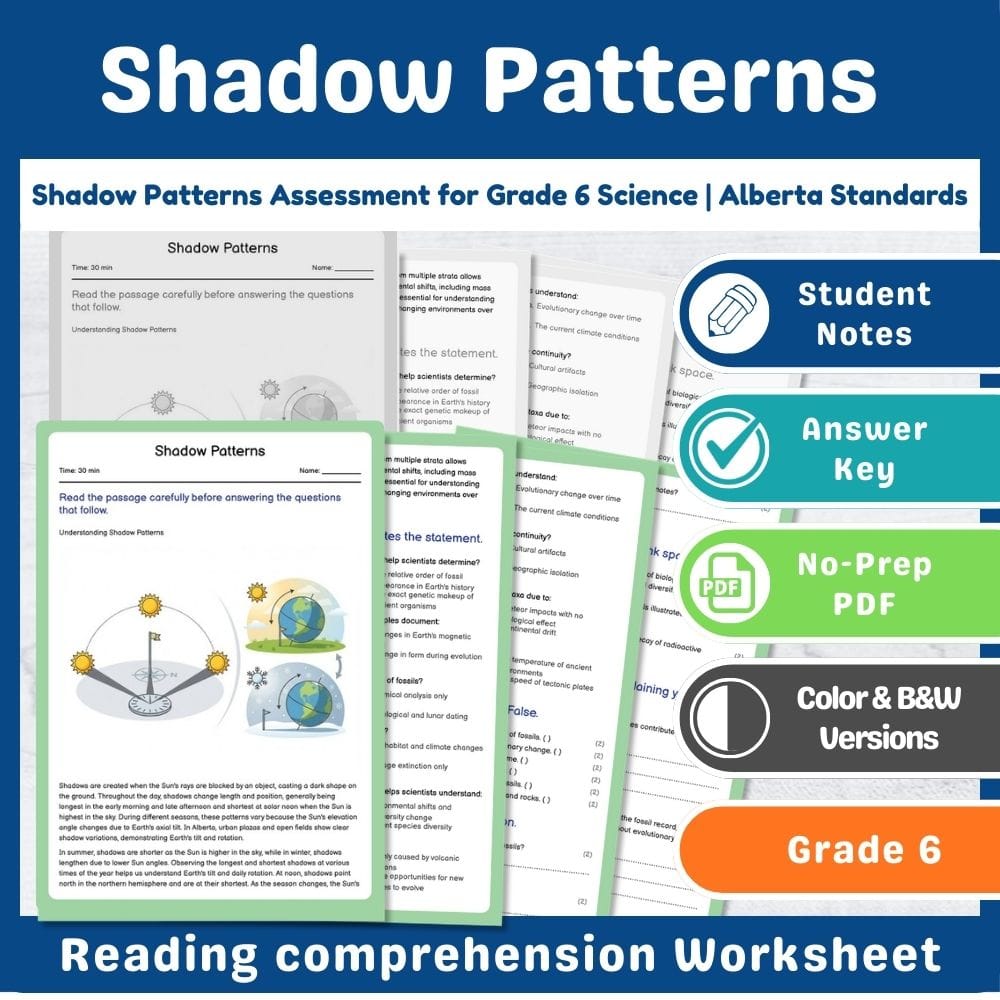
Shadow Patterns Assessment for Grade 6 Science | Alberta Standards
Created byPrism Point LearningLearning Objectives
- Describe how daily and seasonal changes in Sun angle affect shadow length and direction.
- Identify different shadow patterns such as noon shadows, longest shadows, and shortest shadows.
- Explain how Earth's motion and axial tilt influence shadow characteristics across seasons.
The Apparent Sun Path Grade 6 Science Assessment | Alberta Standards
Created byPrism Point LearningLearning Objectives
- Understand how the Sun's apparent path varies with seasons and latitude.
- Describe how solar elevation at noon affects day length and intensity.
- Compare the Sun's apparent motion in different geographic locations, like Calgary and northern communities.
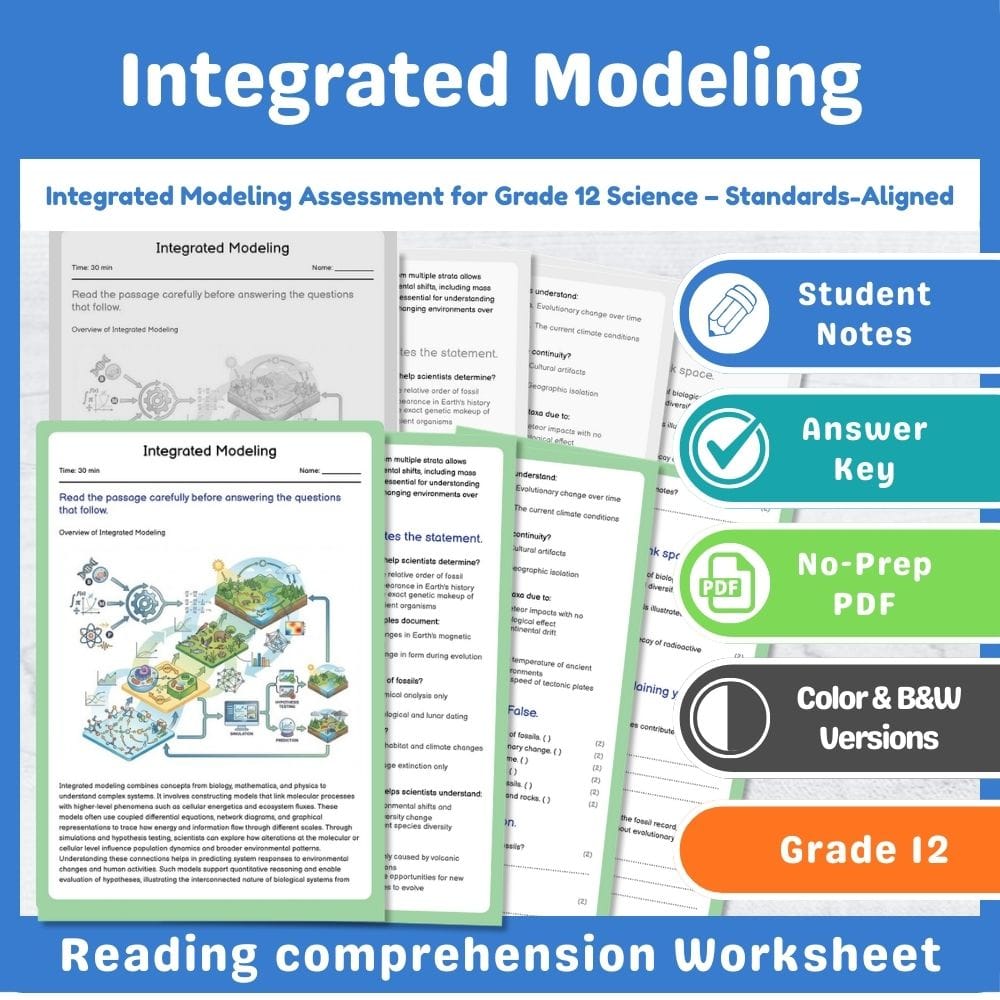
Integrated Modeling Assessment for Grade 12 Science – Standards-Aligned
Created byPrism Point LearningLearning Objectives
- Understand how molecular processes influence cellular energetics and genetic regulation.
- Describe the use of mathematical models such as differential equations and network diagrams in biological systems.
- Explain how changes at one biological level propagate to others within ecosystems.
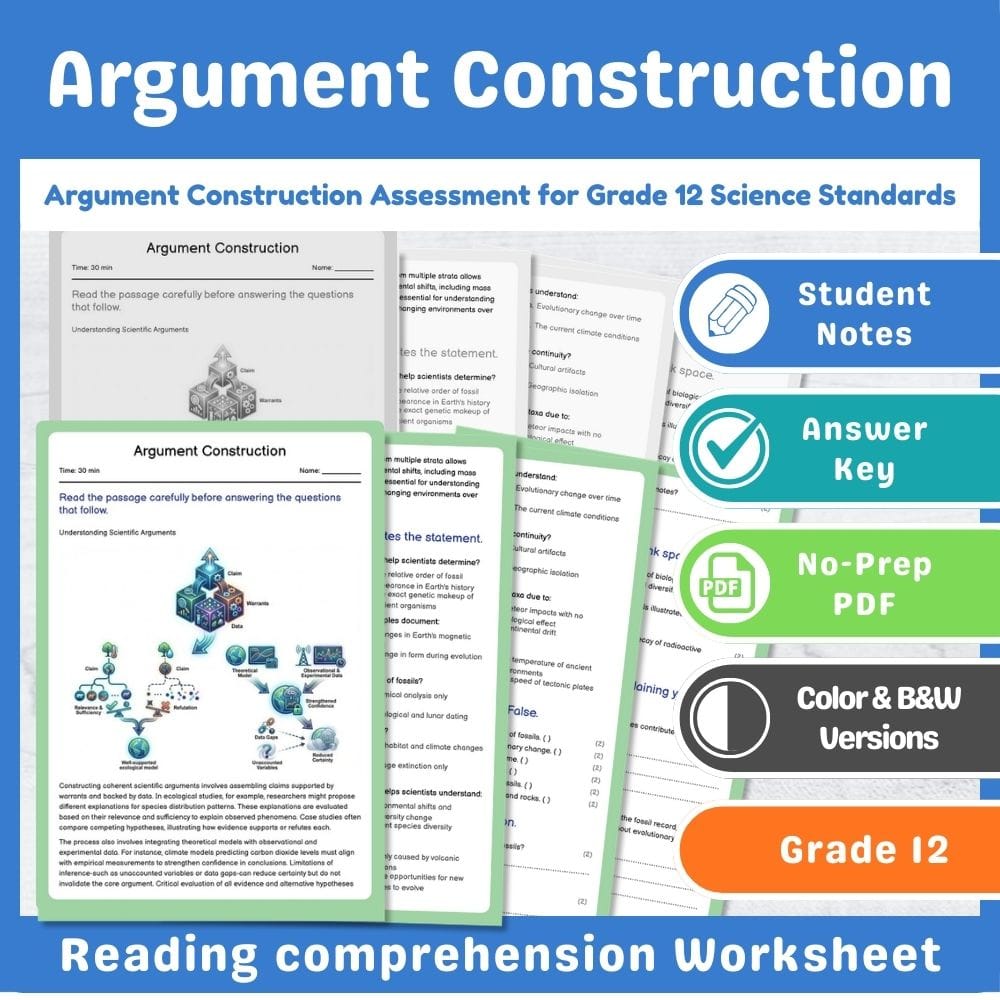
Argument Construction Assessment for Grade 12 Science Standards
Created byPrism Point LearningLearning Objectives
- Understand how to construct evidence-based arguments in scientific contexts.
- Identify components such as claims, warrants, and backing in case studies.
- Evaluate relevance, sufficiency, and alternative hypotheses in argumentation.
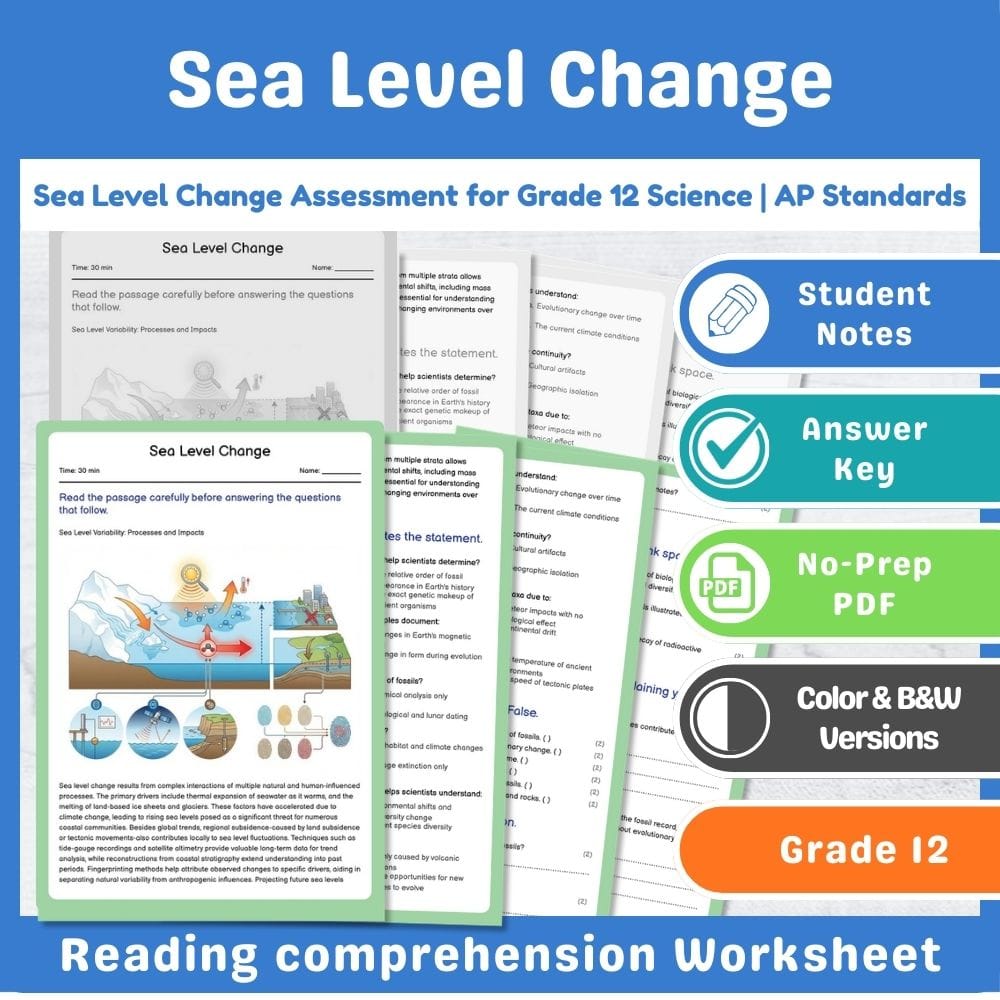
Sea Level Change Assessment for Grade 12 Science | AP Standards
Created byPrism Point LearningLearning Objectives
- Understand the key drivers that influence sea level variability, including thermal expansion, land-ice melt, and glacio-isostatic adjustment.
- Interpret data from tide gauges and satellite altimetry records to analyze sea level trends.
- Explain how human activities and regional factors affect sea level changes and coastal systems.
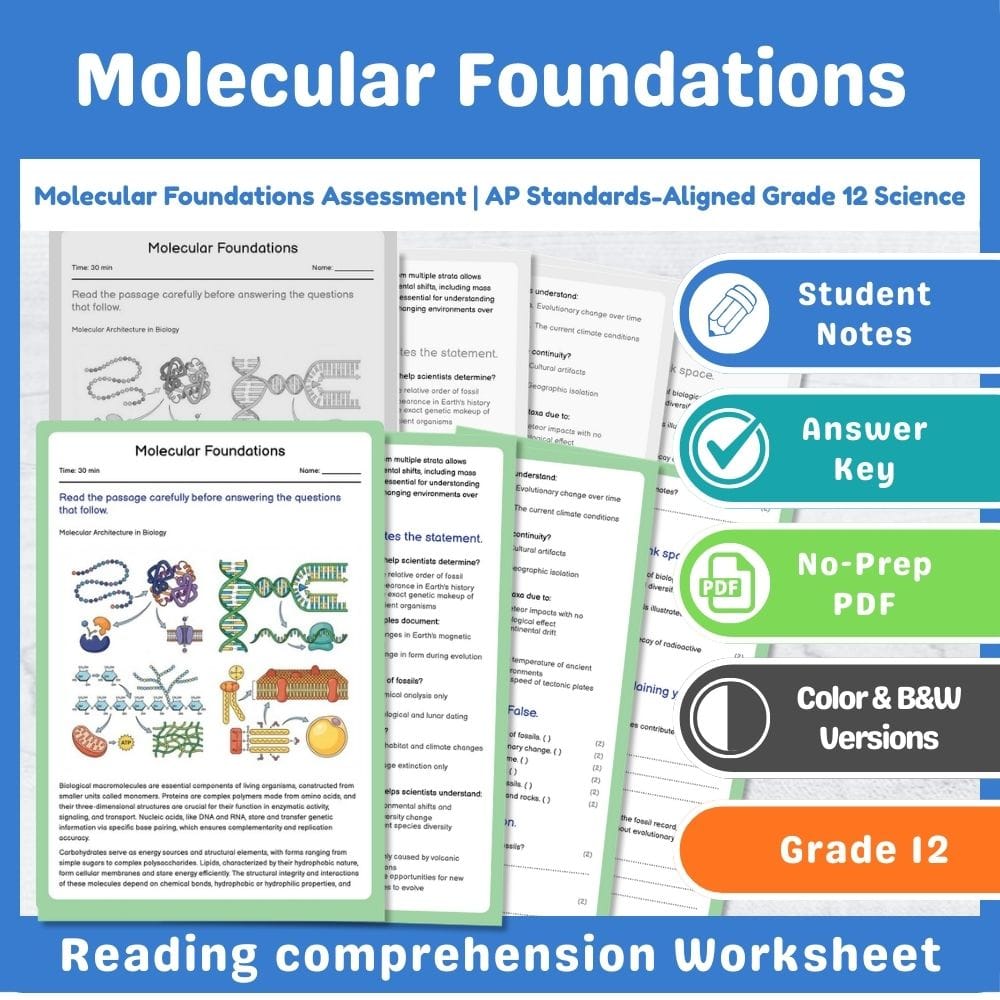
Molecular Foundations Assessment | AP Standards-Aligned Grade 12 Science
Created byPrism Point LearningLearning Objectives
- Explain the relationship between molecular structure and function in biological macromolecules.
- Identify key types of macromolecules and their roles in cellular processes.
- Analyze how molecular interactions and bonds influence stability and specificity.
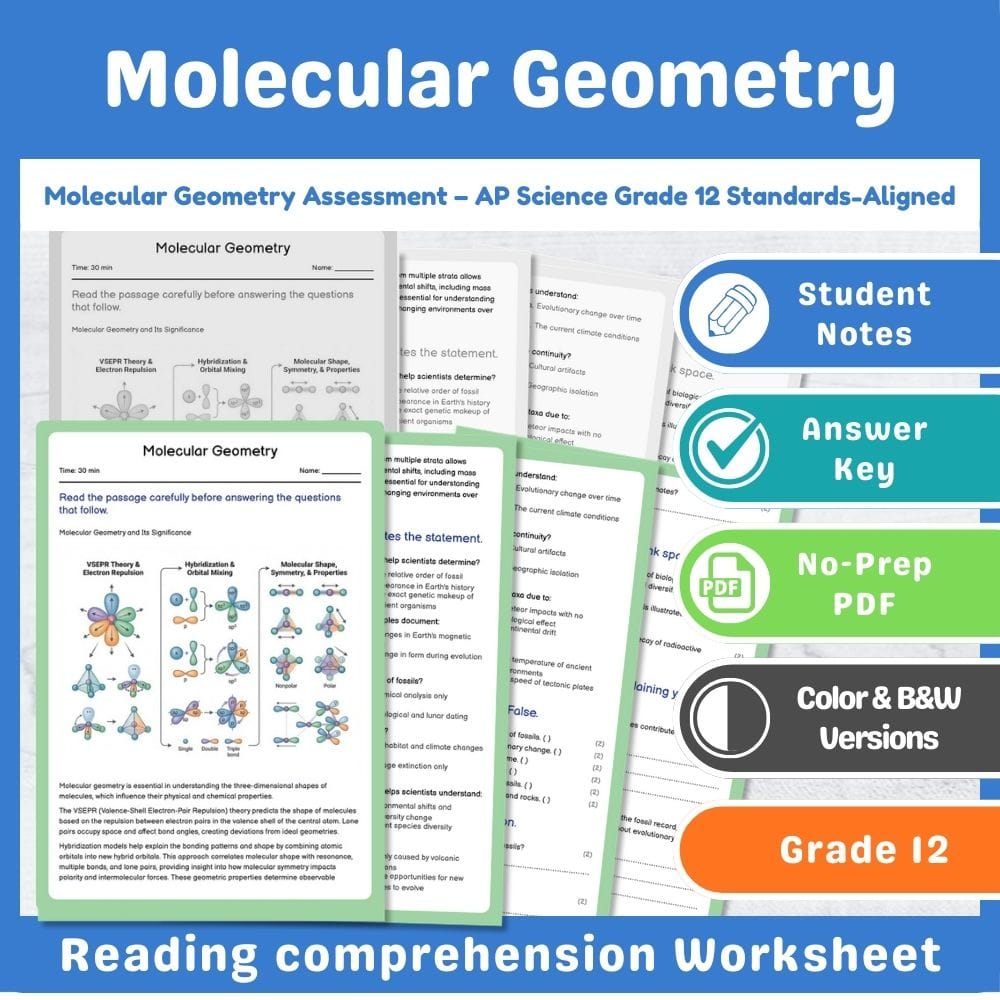
Molecular Geometry Assessment – AP Science Grade 12 Standards-Aligned
Created byPrism Point LearningLearning Objectives
- Explain the VSEPR model to predict molecular shapes and Bond angles.
- Describe the effects of lone pairs, multiple bonds, and resonance on molecular geometry.
- Relate molecular geometry to polarity, symmetry, and observable properties such as dipole moments.
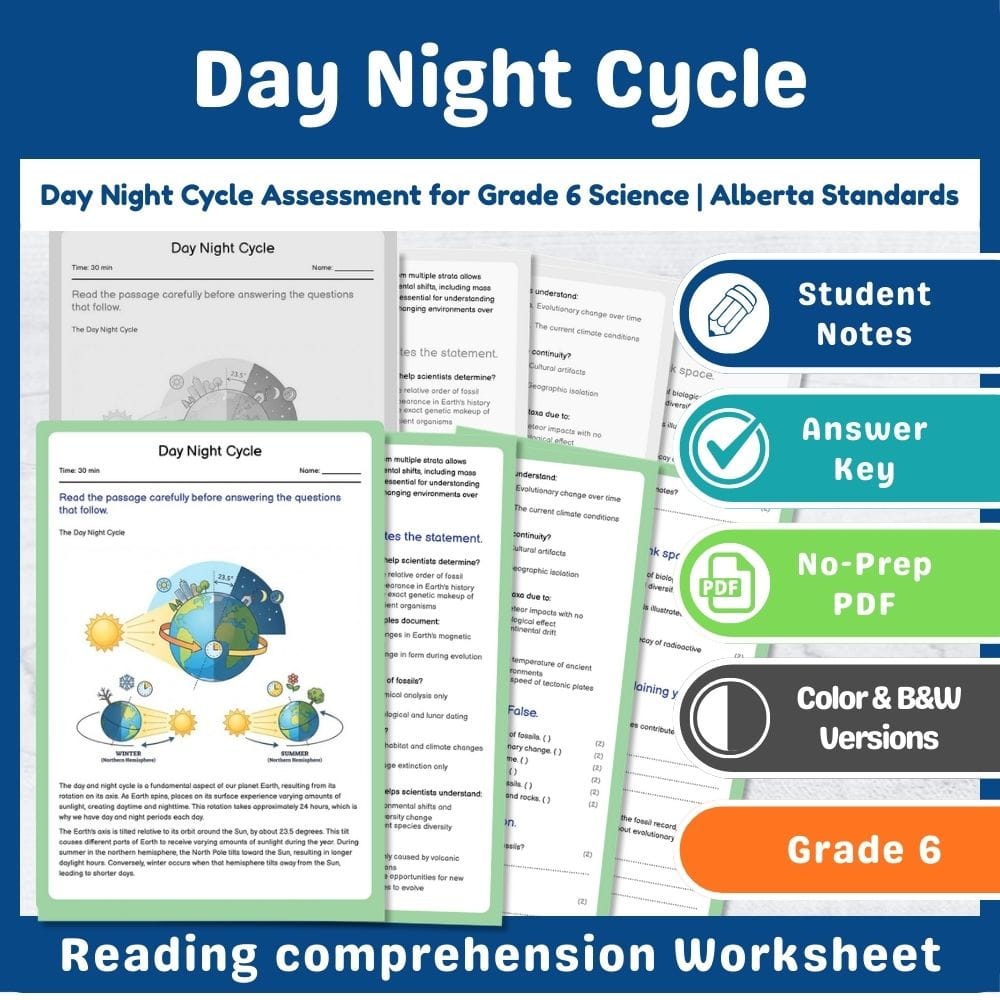
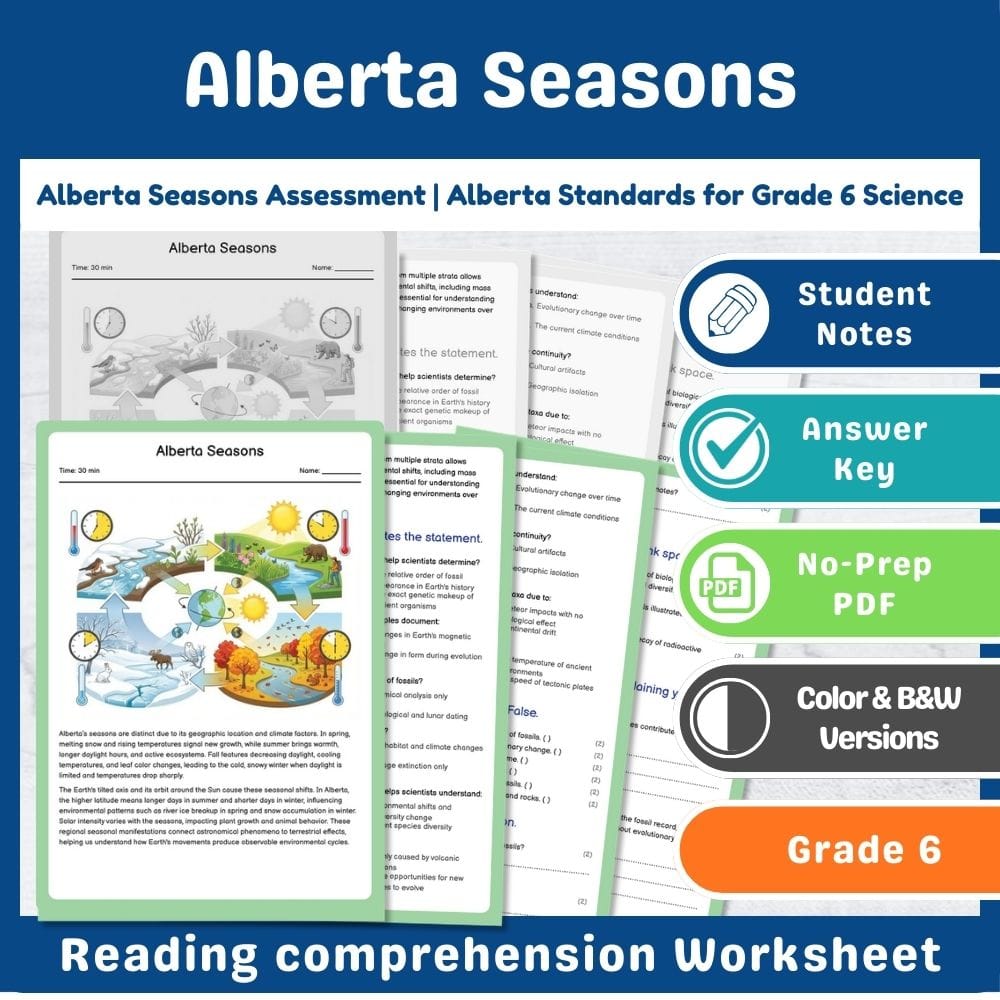
Day Night Cycle Assessment for Grade 6 Science | Alberta Standards
Created byPrism Point LearningLearning Objectives
- Explain how Earth's rotation causes day and night.
- Describe the effect of Earth's axial tilt on daylight duration throughout the year.
- Relate observed day length patterns in Alberta to Earth's position and movement around the Sun.
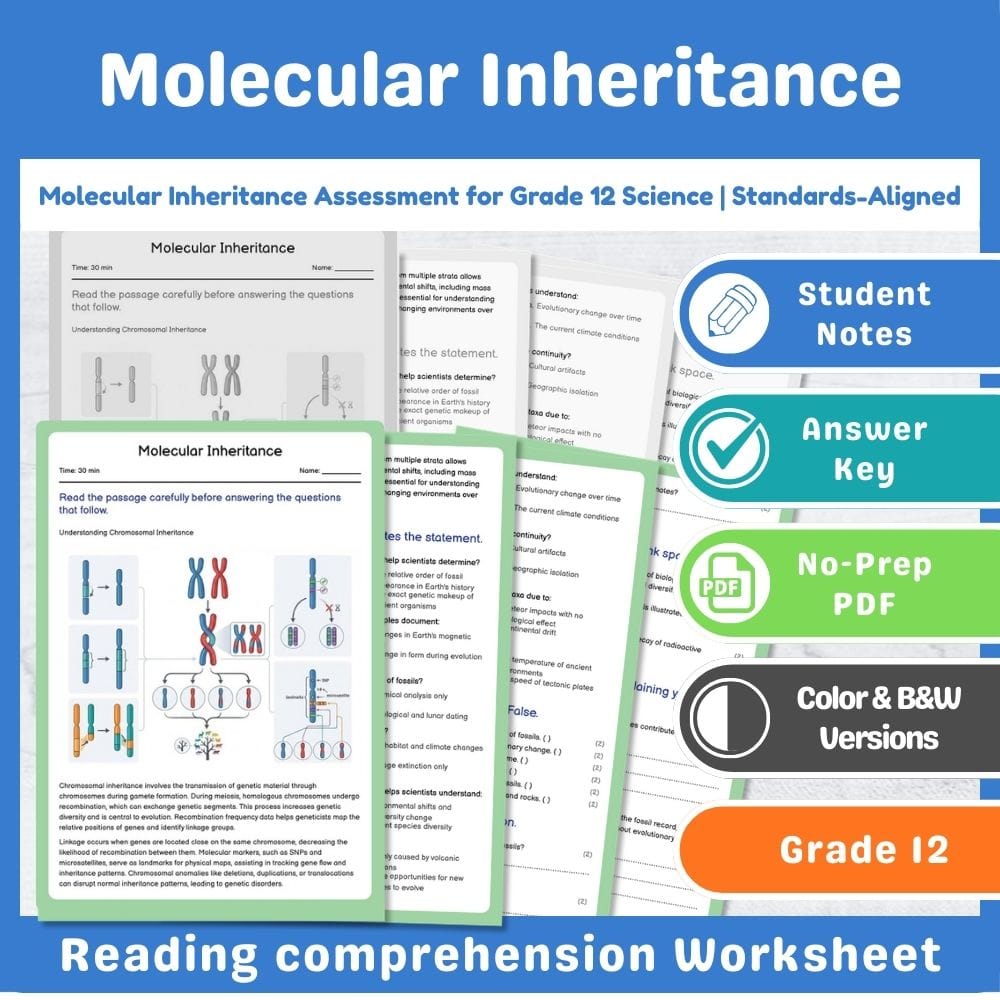
Molecular Inheritance Assessment for Grade 12 Science | Standards-Aligned
Created byPrism Point LearningLearning Objectives
- Understand chromosomal behavior and mechanisms of inheritance.
- Explain the concepts of recombination, linkage, and molecular markers.
- Differentiate between single-gene effects and polygenic influences on inheritance patterns.
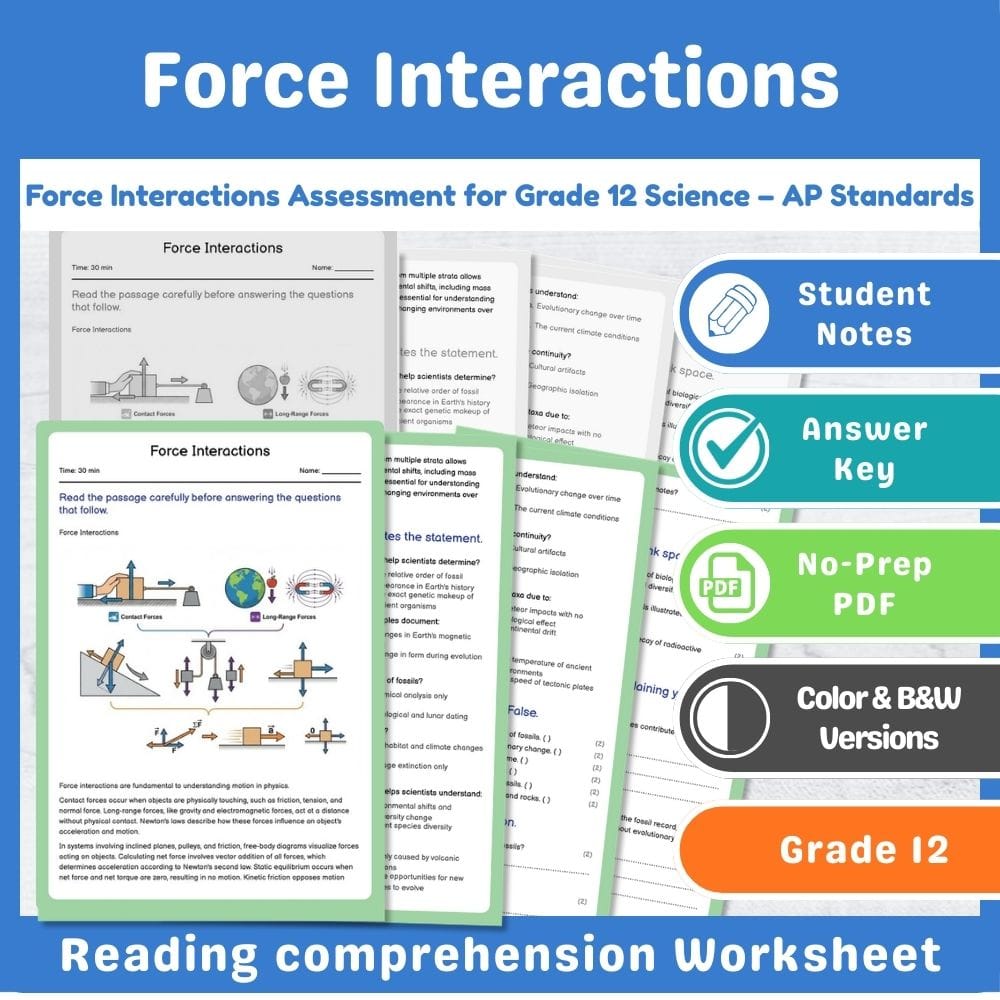
Force Interactions Assessment for Grade 12 Science – AP Standards
Created byPrism Point LearningLearning Objectives
- Describe contact and long-range force interactions and their laws.
- Analyze free-body diagrams and apply Newton's laws to various systems.
- Calculate net forces and accelerations on objects in equilibrium and non-equilibrium.
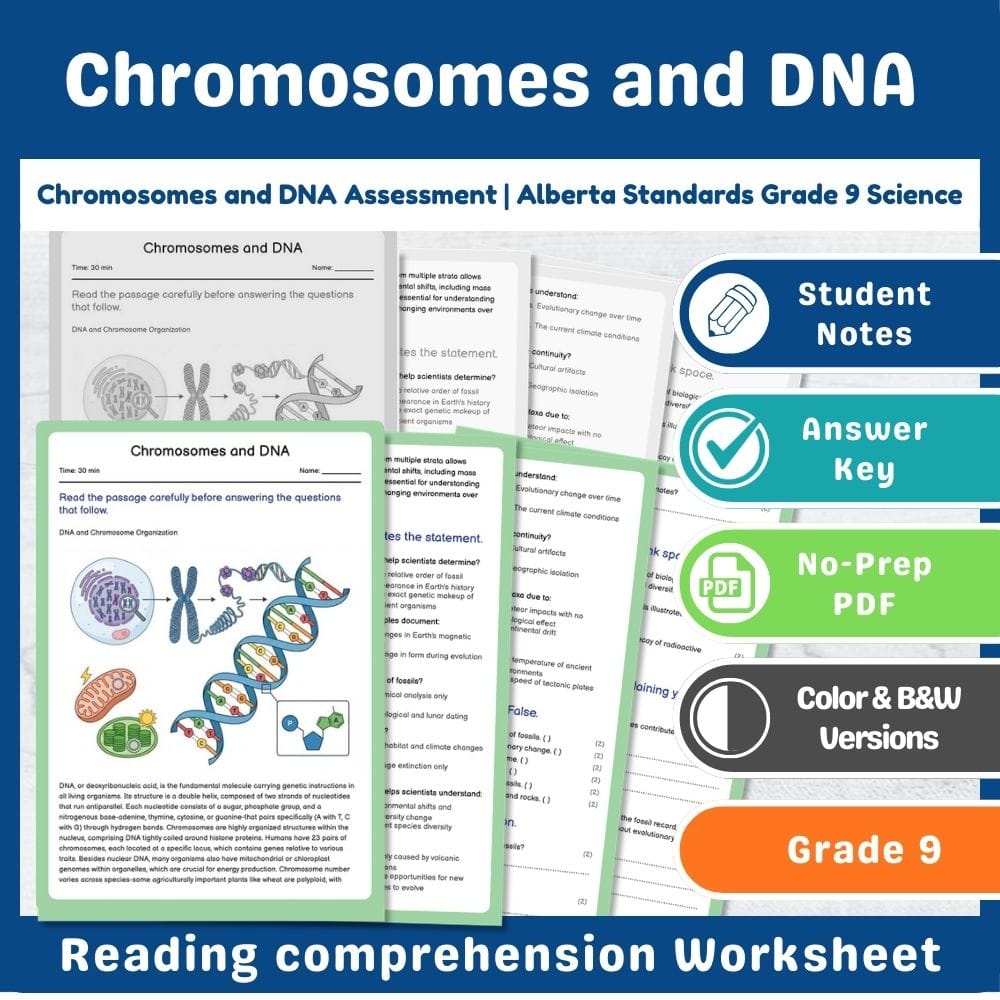
Chromosomes and DNA Assessment | Alberta Standards Grade 9 Science
Created byPrism Point LearningLearning Objectives
- Describe the structure of DNA and its double-helix formation.
- Explain how chromosomes organize genetic information within cells.
- Distinguish between nuclear and organelle genomes and their roles.
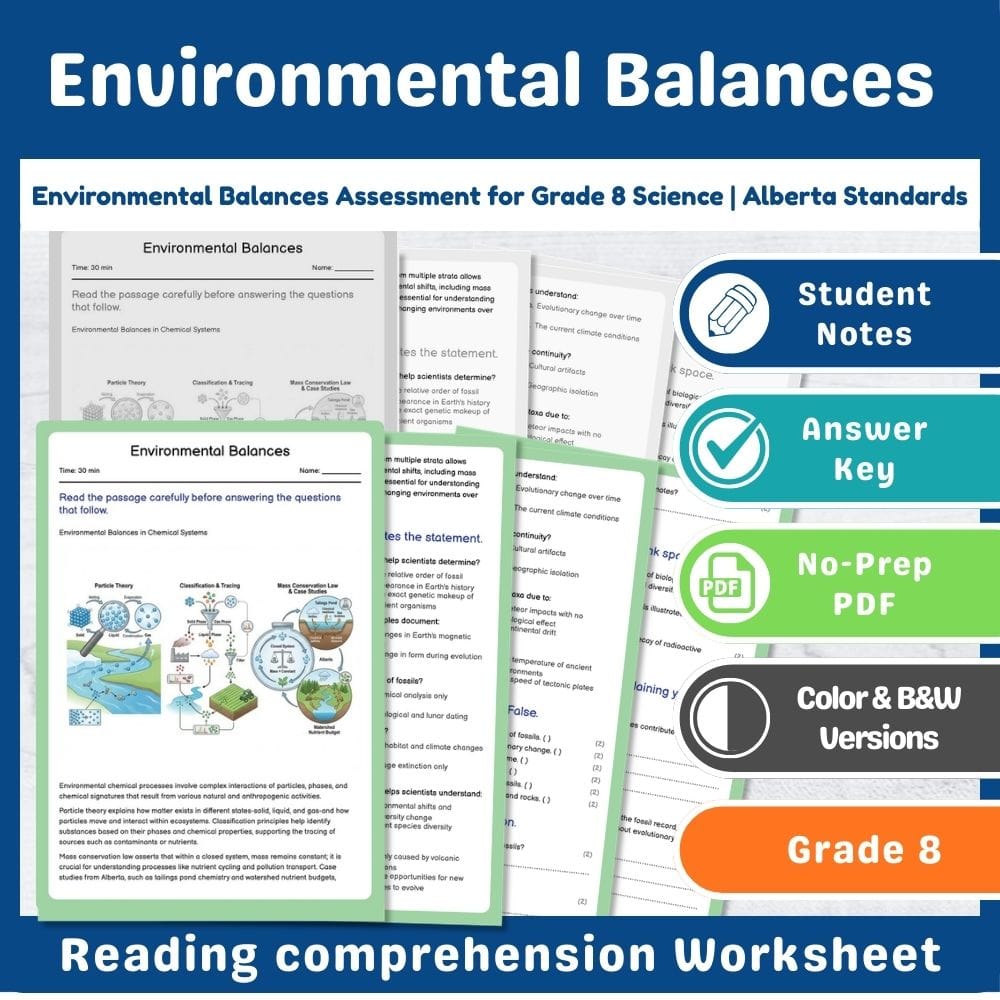
Environmental Balances Assessment for Grade 8 Science | Alberta Standards
Created byPrism Point LearningLearning Objectives
- Understand how particle theory and classification principles help interpret environmental chemical processes.
- Explain the concepts of nutrient cycling, contamination transport, and mass conservation within ecosystems.
- Apply knowledge of phases, mixtures, and chemical signatures to trace sources and sinks in environmental systems.
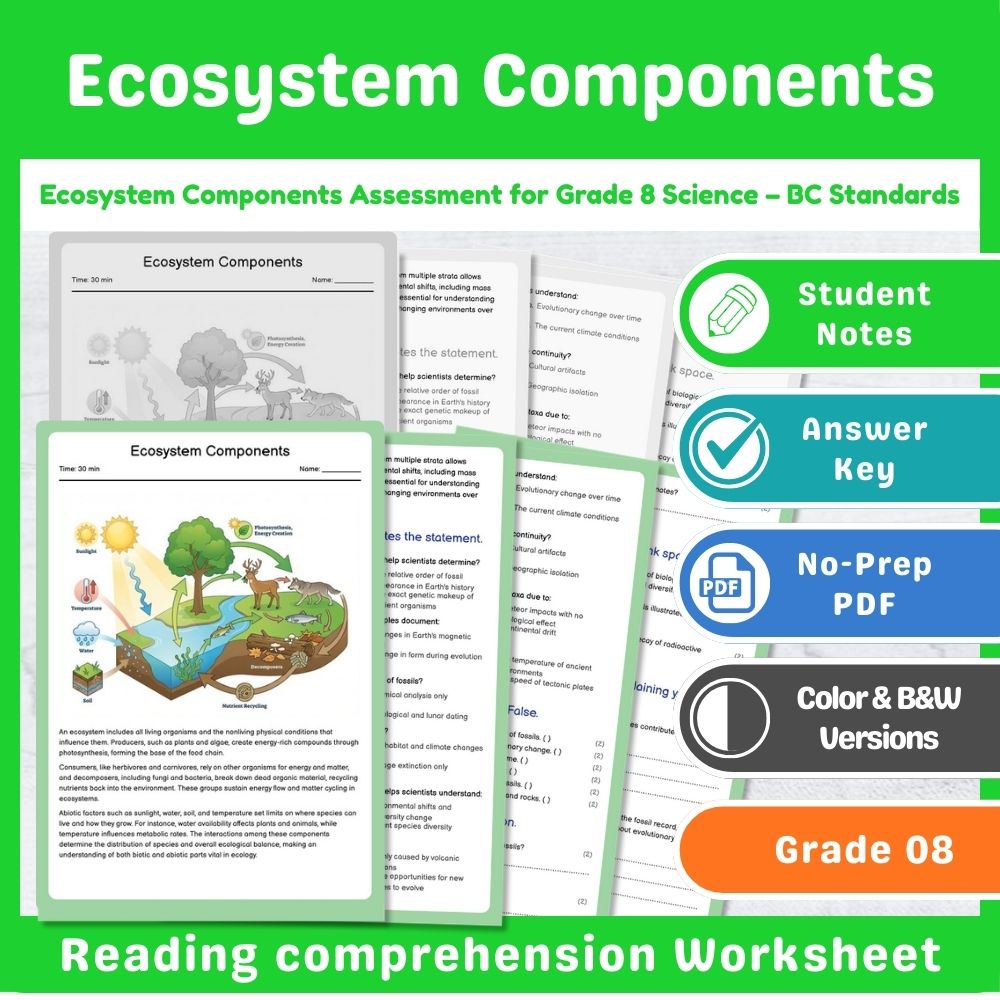
Ecosystem Components Assessment for Grade 8 Science – BC Standards
Created byPrism Point LearningLearning Objectives
- Identify the key parts of an ecosystem, including both living and nonliving elements.
- Explain the roles of producers, consumers, and decomposers in energy cycling.
- Describe how abiotic factors such as sunlight, water, soil, and temperature influence ecosystems.
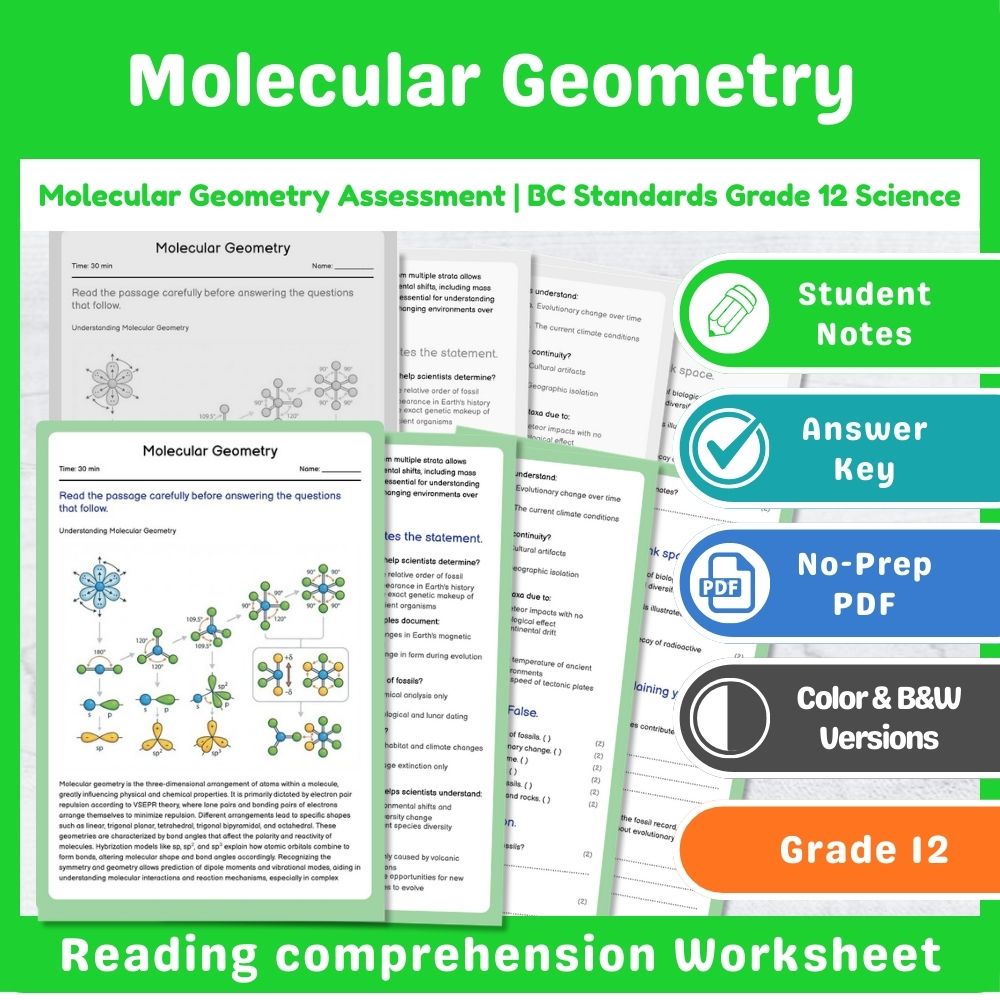
Molecular Geometry Assessment | BC Standards Grade 12 Science
Created byPrism Point LearningLearning Objectives
- Explain the principles of VSEPR theory and how electron pair repulsion determines molecular shape.
- Identify and describe various molecular geometries and their bond angles.
- Predict molecule polarity based on geometry and symmetry considerations.
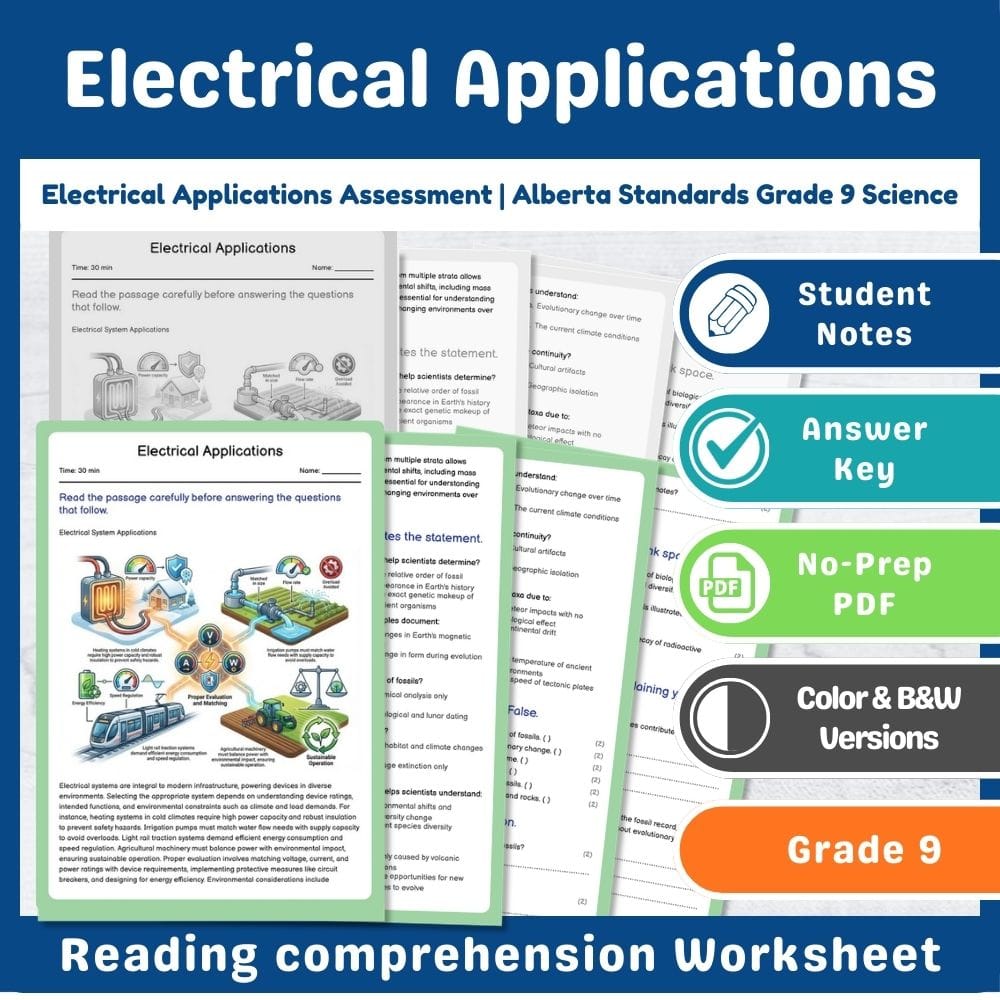
Electrical Applications Assessment | Alberta Standards Grade 9 Science
Created byPrism Point LearningLearning Objectives
- Identify key safety measures and device ratings for electrical systems.
- Understand how to match supply characteristics with device requirements.
- Evaluate the appropriateness of electrical protective measures in different settings.
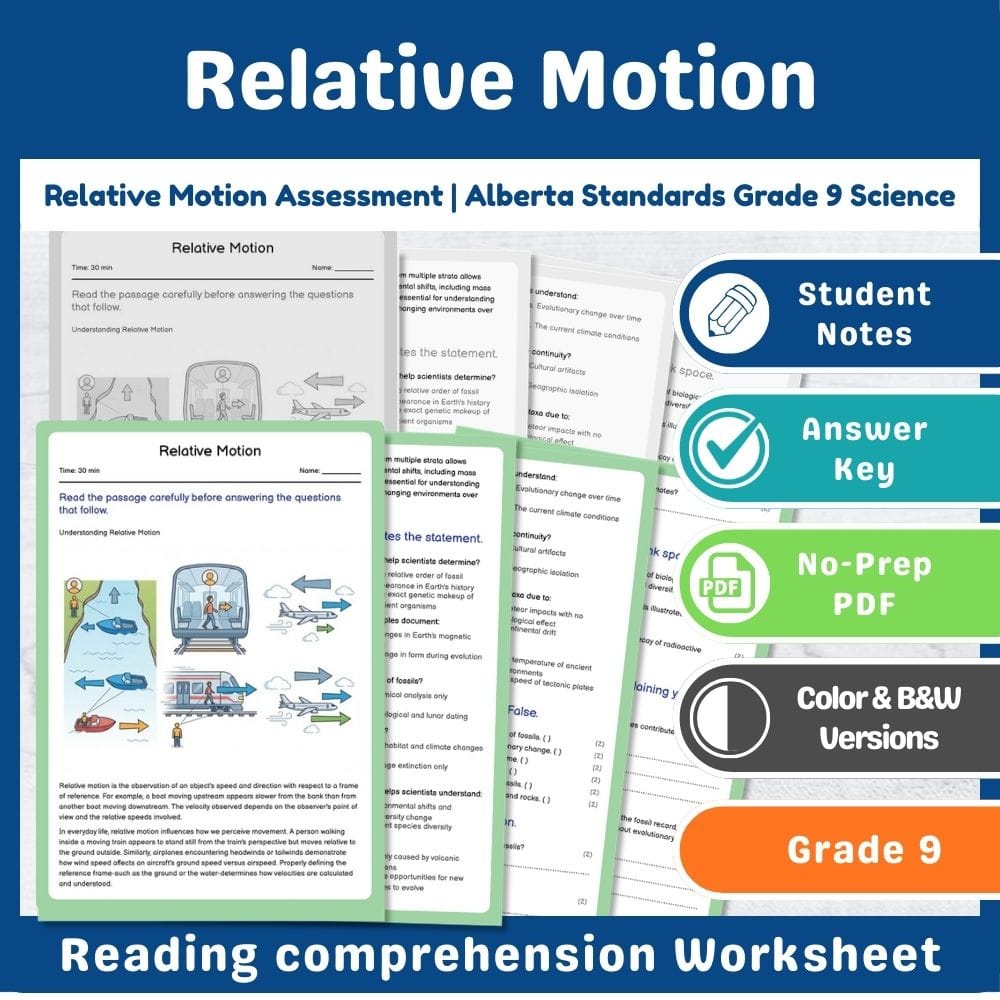
Relative Motion Assessment | Alberta Standards Grade 9 Science
Created byPrism Point LearningLearning Objectives
- Understand the concept of relative motion and how velocities combine in different reference frames.
- Describe how observed speed and direction depend on the observer's frame of reference.
- Apply vector addition principles to various motion scenarios involving boats, trucks, and aircraft.
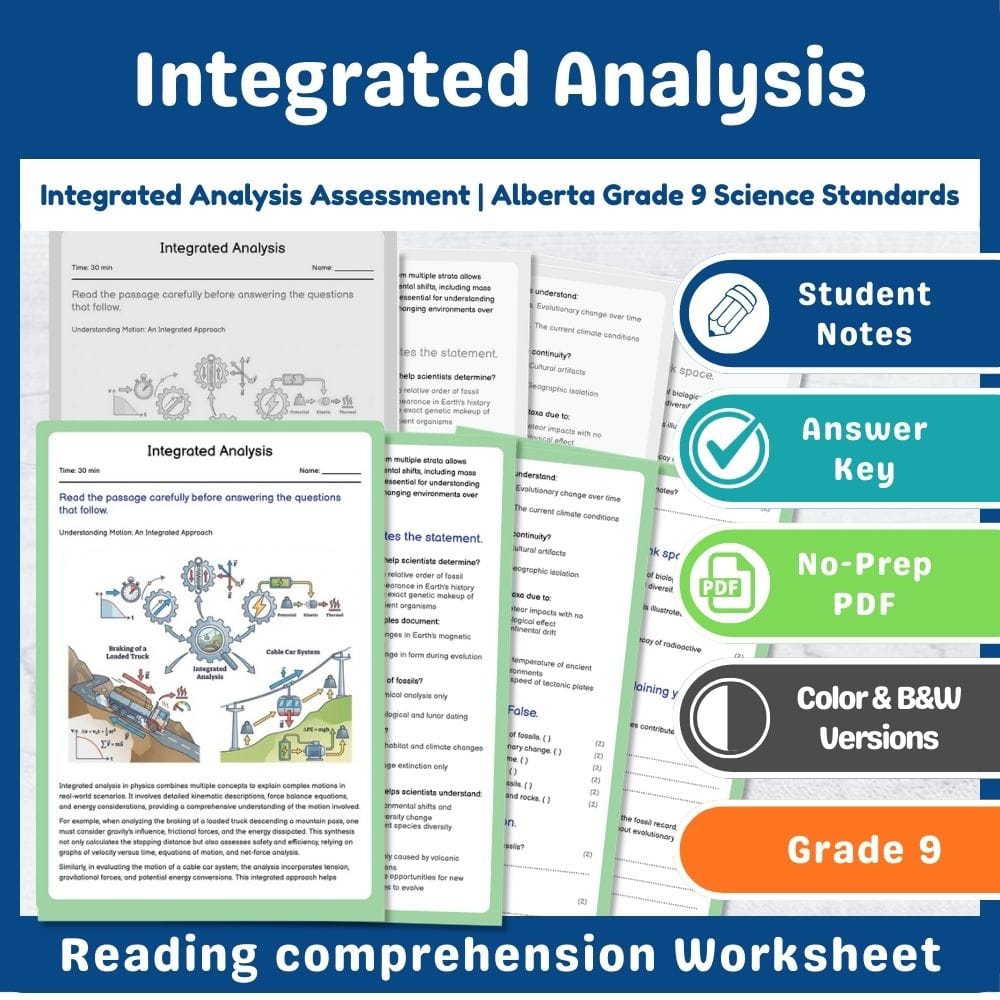
Integrated Analysis Assessment | Alberta Grade 9 Science Standards
Created byPrism Point LearningLearning Objectives
- Explain how kinematic descriptions, force balances, and energy considerations integrate to analyze complex motion scenarios.
- Apply graphs, equations, and net-force reasoning to predict motion outcomes in transport contexts.
- Interpret combined physical principles in real-world Alberta transportation and recreational situations.

Genetic Traits Evidence Assessment | General Grade 8 Science Standards
Created byPrism Point LearningLearning Objectives
- Understand how observable traits are influenced by genetic instructions and gene variations.
- Explain patterns of dominant and recessive traits and their inheritance across generations.
- Analyze how similarities among related organisms provide evidence of heredity.
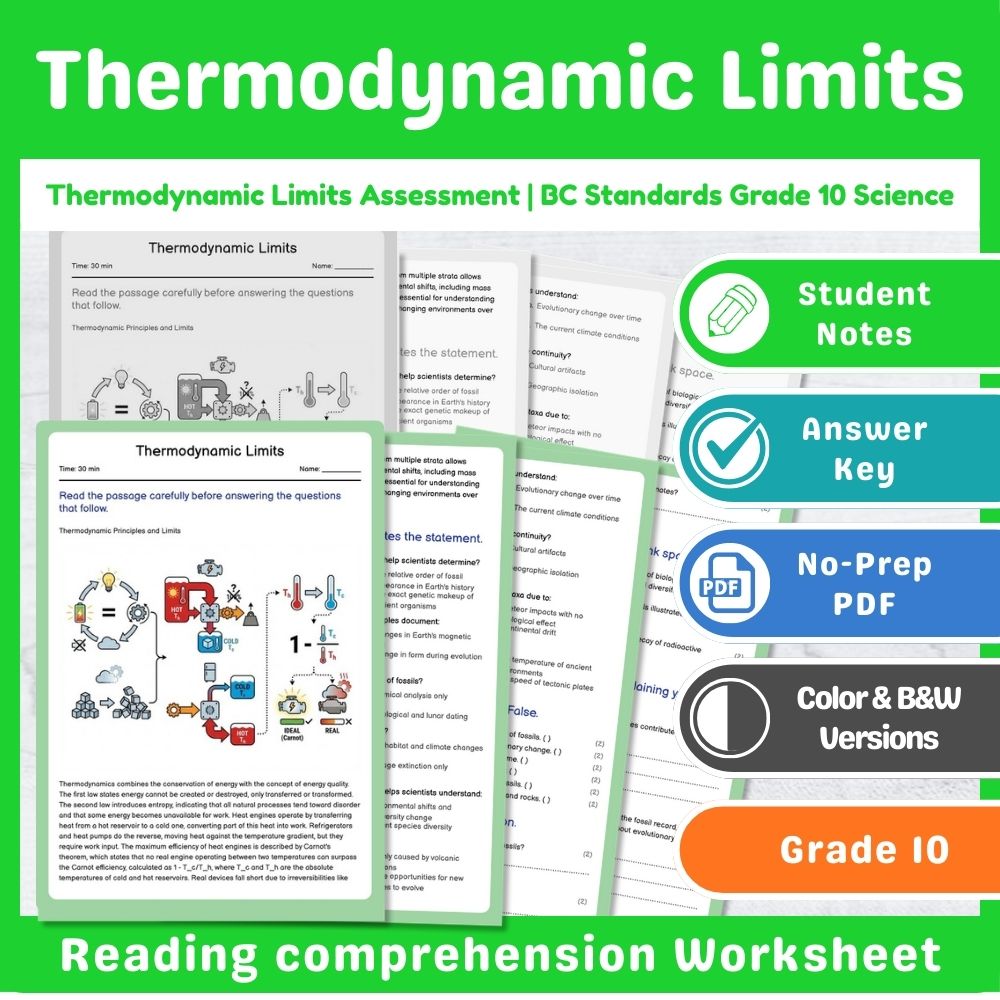
Thermodynamic Limits Assessment | BC Grade 10 Science Standards
Created byPrism Point LearningLearning Objectives
- Explain the fundamental principles of thermodynamics, including energy conservation and entropy.
- Describe how heat engines and refrigerators operate between temperature reservoirs.
- Calculate the maximum efficiency of heat engines based on Carnot's theorem.

Cell Division Assessment | TEKS Standards Grade 12 Science Evaluation
Created byPrism Point LearningLearning Objectives
- Describe the processes of mitosis and meiosis and their roles in cell division.
- Explain chromosome segregation, homologous recombination, and the consequences of nondisjunction.
- Analyze chromosomal alterations, karyotype analysis, and indicators of aneuploidy in inheritance and phenotype.
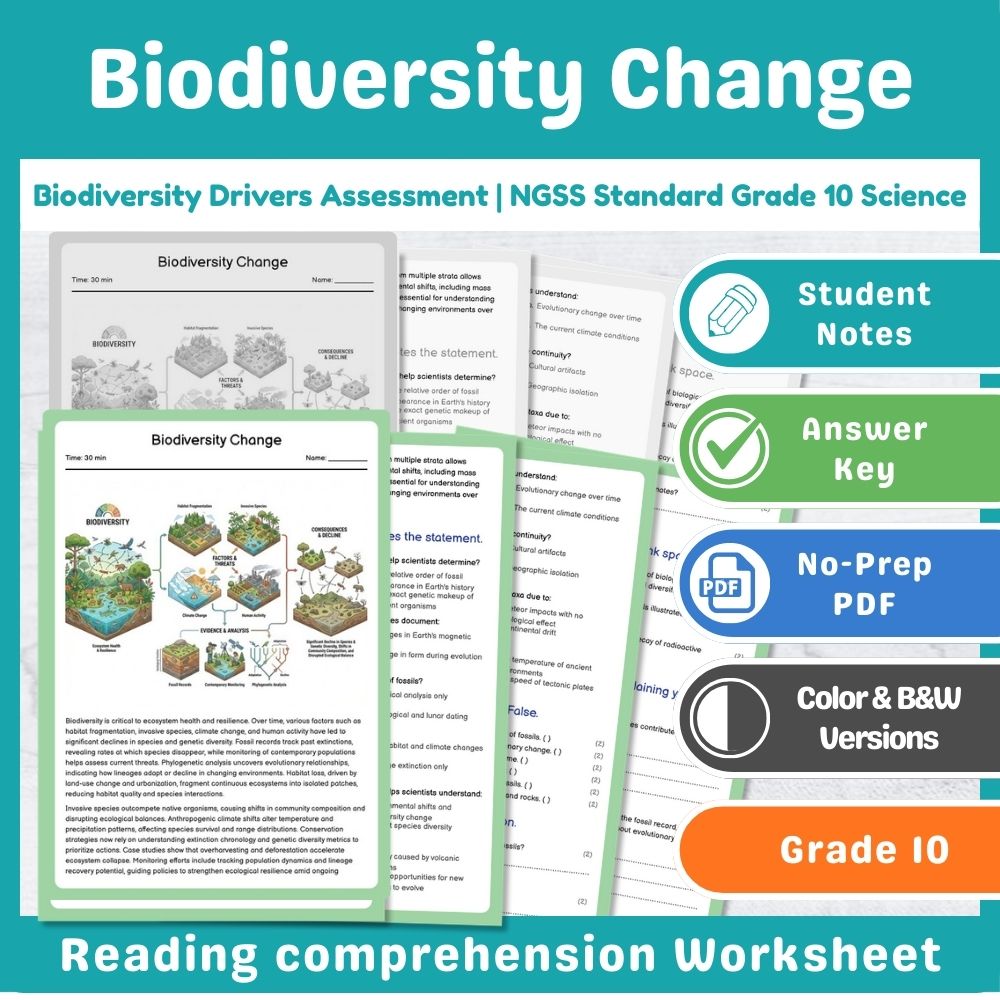
Biodiversity Change Assessment for Grade 10 Science NGSS Standards
Created byPrism Point LearningLearning Objectives
- Understand the factors that influence biodiversity loss and ecosystem change.
- Identify evidence and methods used to monitor biodiversity and extinction rates.
- Analyze the impacts of human actions on ecological resilience and genetic diversity.
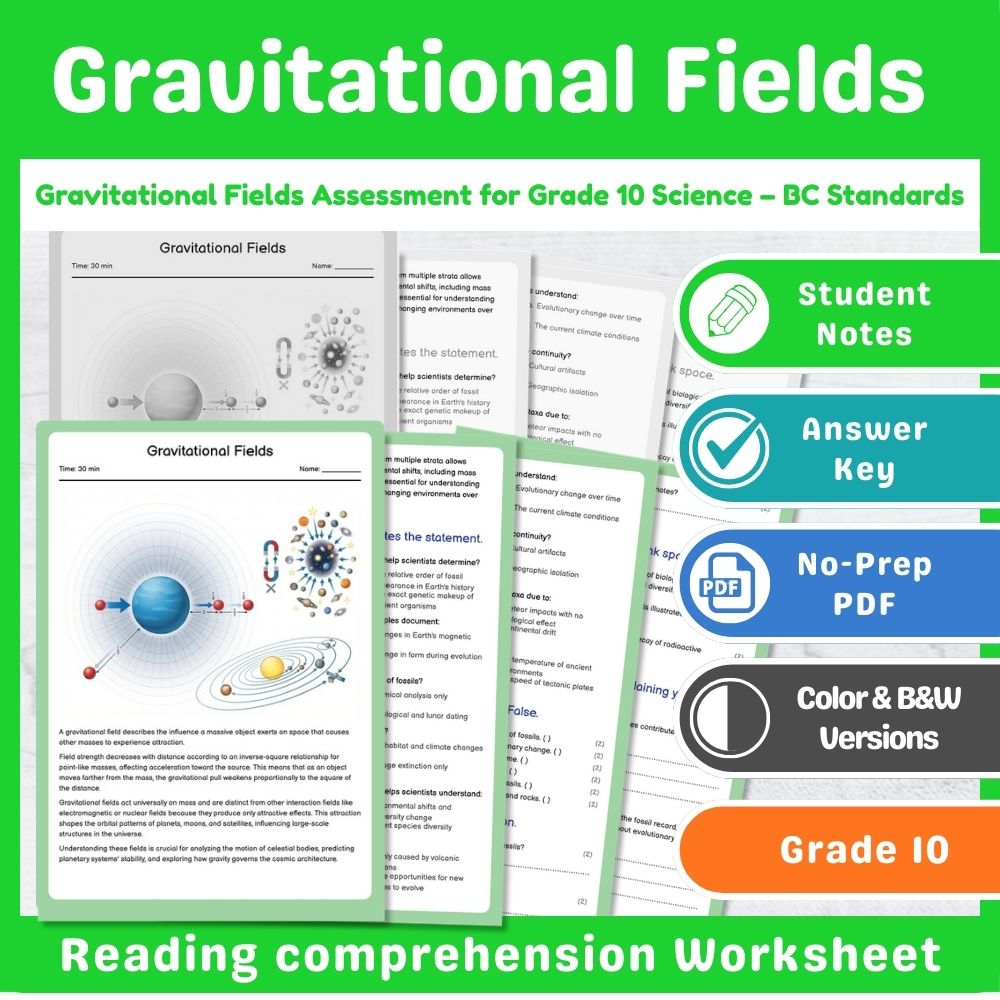
Gravitational Fields Assessment for Grade 10 Science – BC Standards
Created byPrism Point LearningLearning Objectives
- Understand the concept of gravitational fields and their influence.
- Explain how field strength varies with distance.
- Describe the effects of gravitational fields on objects in space.
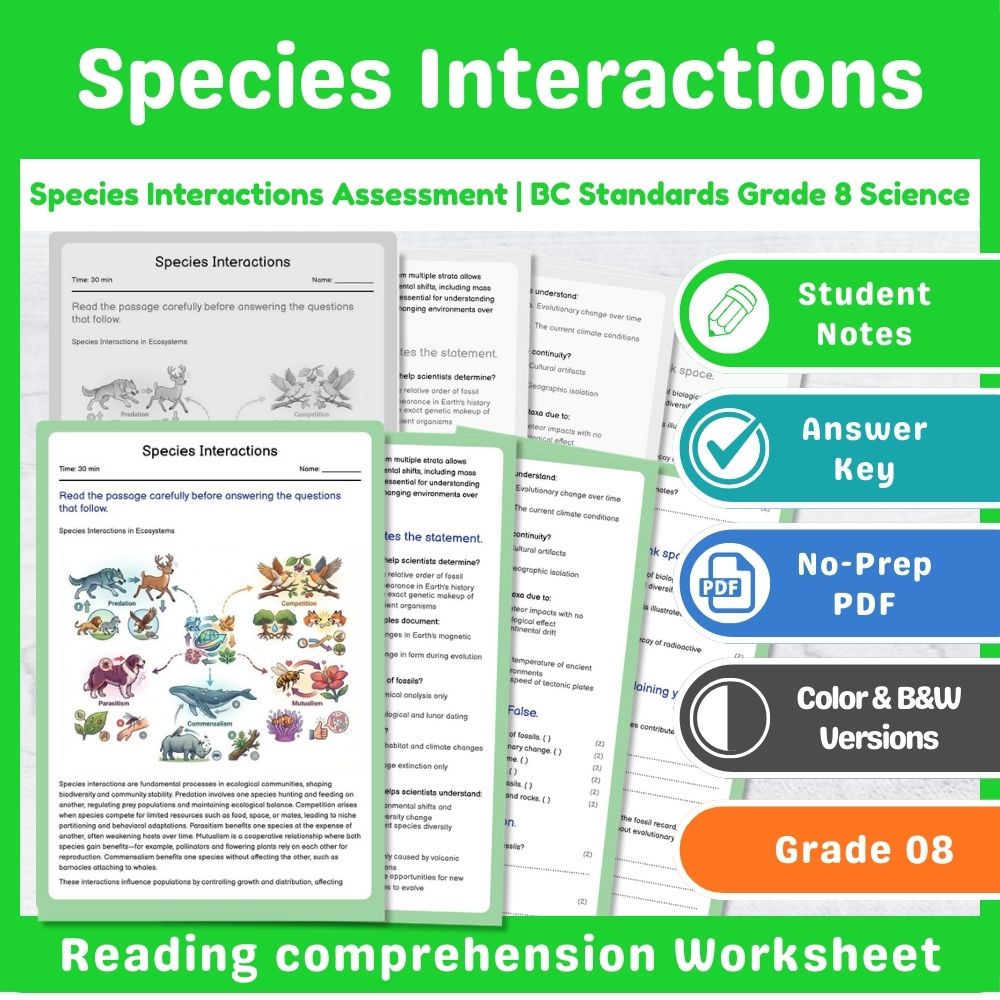
Species Interactions Assessment | BC Standards Grade 8 Science
Created byPrism Point LearningLearning Objectives
- Describe different types of species interactions such as predation, competition, parasitism, mutualism, and commensalism.
- Explain how species interactions influence population dynamics and community structure.
- Analyze the role of predation and mutualism in ecosystem regulation and species survival.
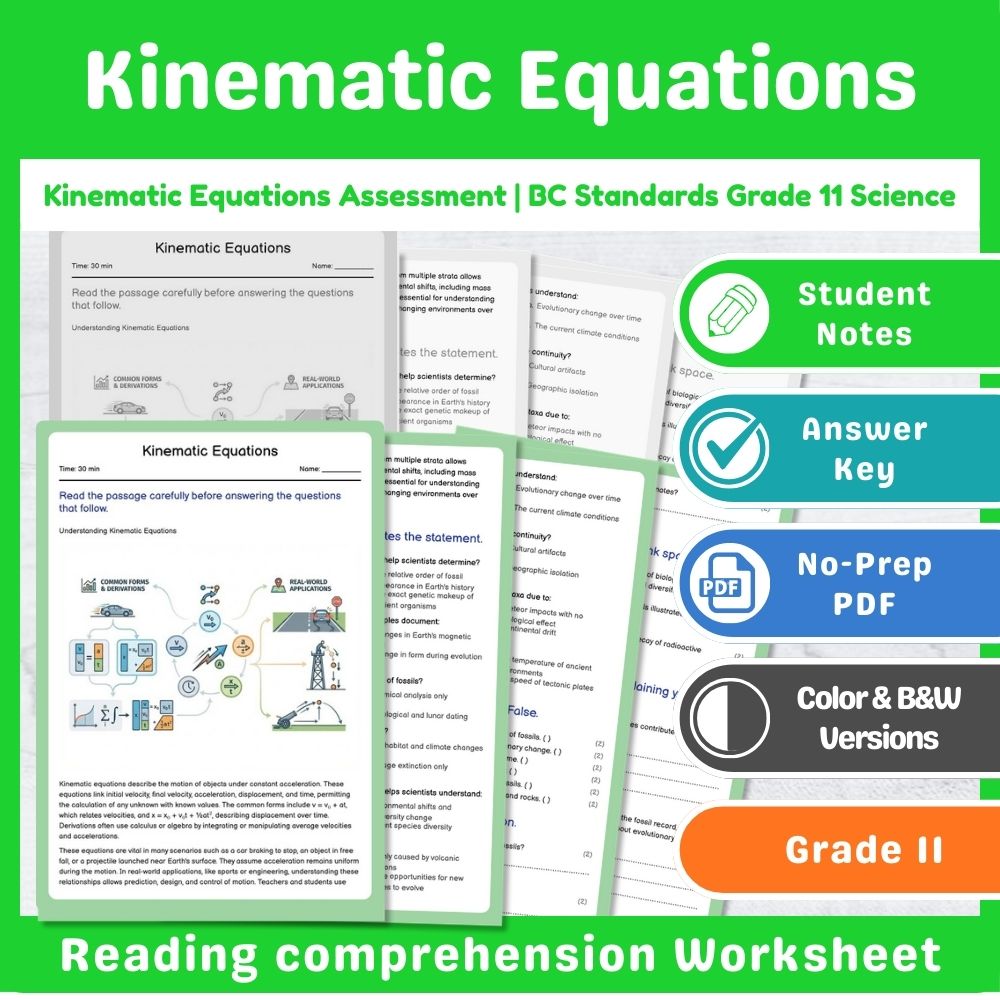
Kinematic Equations Assessment | BC Standards Grade 11 Science
Created byPrism Point LearningLearning Objectives
- Understand the fundamental kinematic equations used for constant acceleration motion.
- Apply the equations to solve for displacement, velocity, acceleration, and time in one-dimensional motion.
- Derive the equations using algebraic and calculus methods.
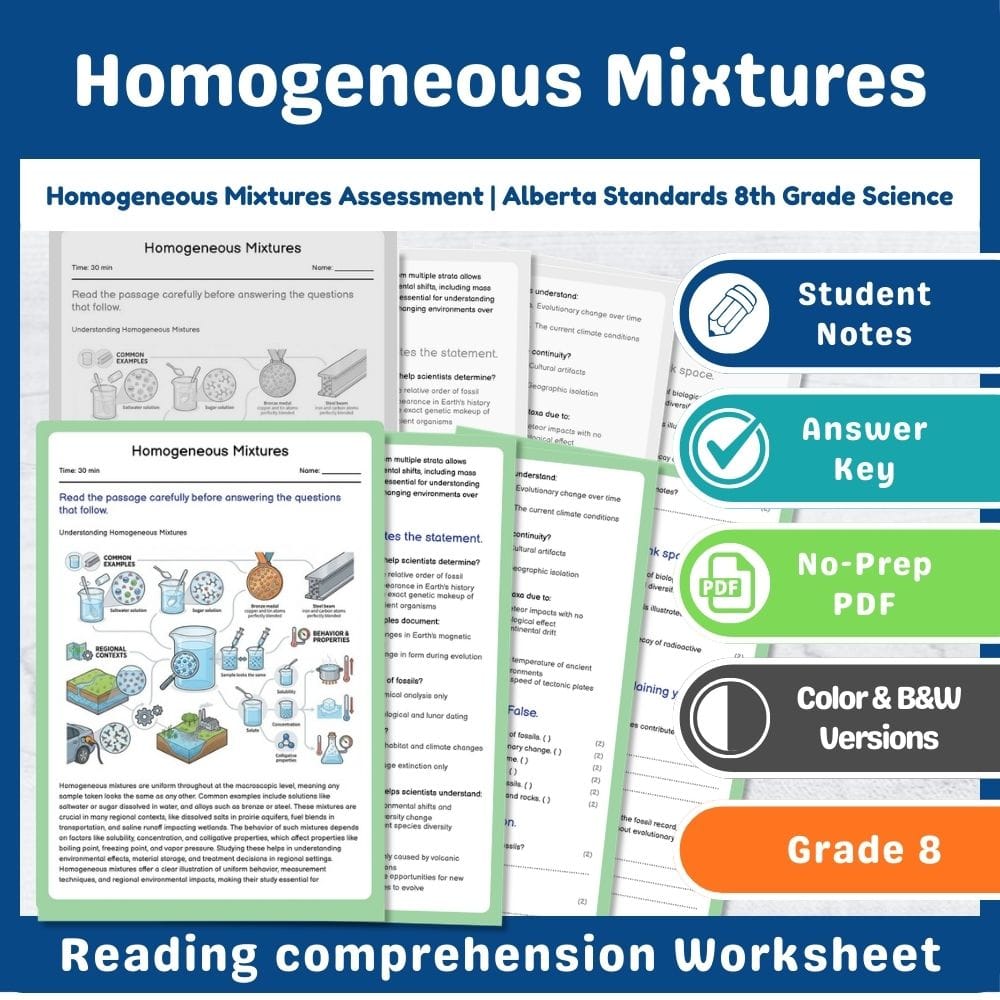
Homogeneous Mixtures Assessment | Alberta Standards 8th Grade Science
Created byPrism Point LearningLearning Objectives
- Understand the concept of homogeneous mixtures and their common examples.
- Identify factors influencing the behavior of solutions and alloys.
- Explain regional examples of uniform mixtures and their environmental impacts.
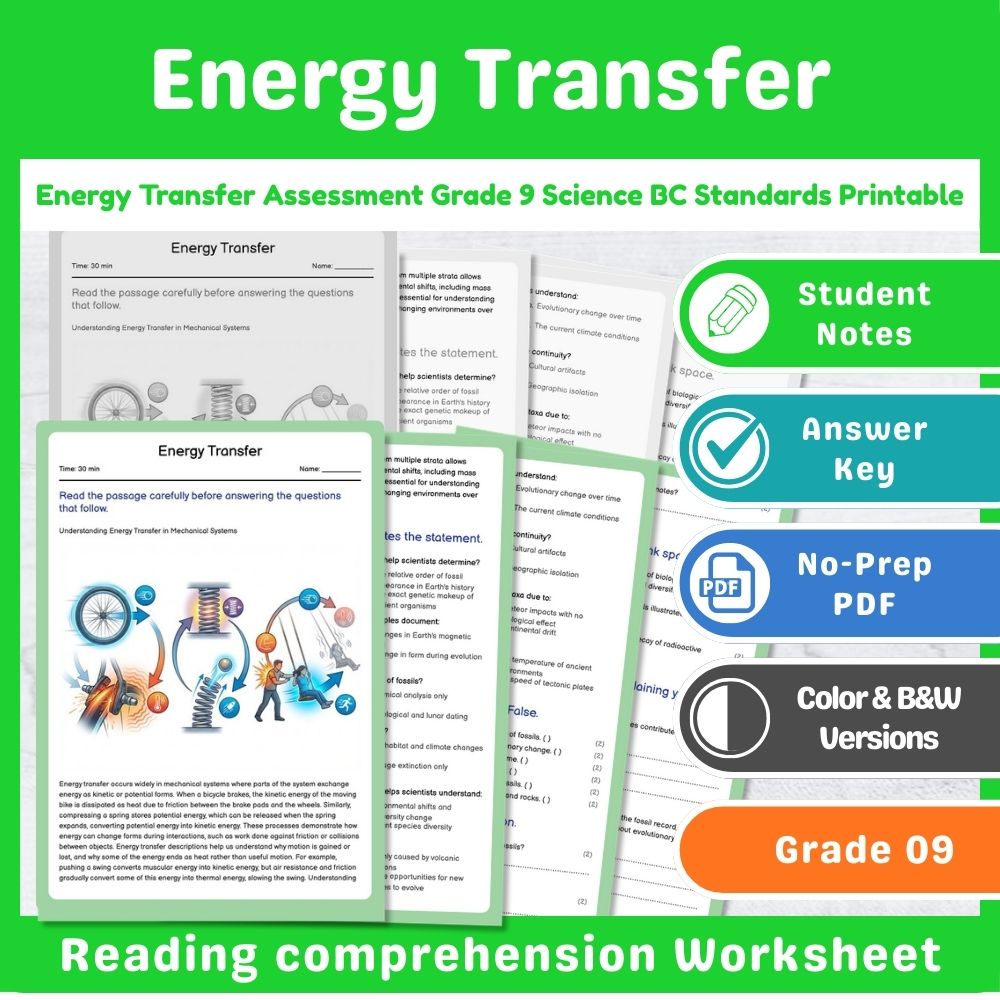
Energy Transfer Assessment Grade 9 Science BC Standards Printable
Created byPrism Point LearningLearning Objectives
- Explain how mechanical systems transfer energy through work, collisions, and friction.
- Describe how energy is gained or lost in moving systems and why some energy converts to heat.
- Analyze real-world examples like braking a bicycle or compressing a spring to understand energy pathways.
Browse more categories
About Science Worksheets
Find Science worksheets spanning core skills, practice, and review. All 42,685 resources are instant PDF downloads for the classroom or home.
Every worksheet on MyTeachingSheets is created by independent teacher-authors and reviewed before publication. All resources download as printable PDFs for classroom, homework, or at-home practice, and many include answer keys. Preview any worksheet free before buying.