
Science Worksheets
42,685 subject resources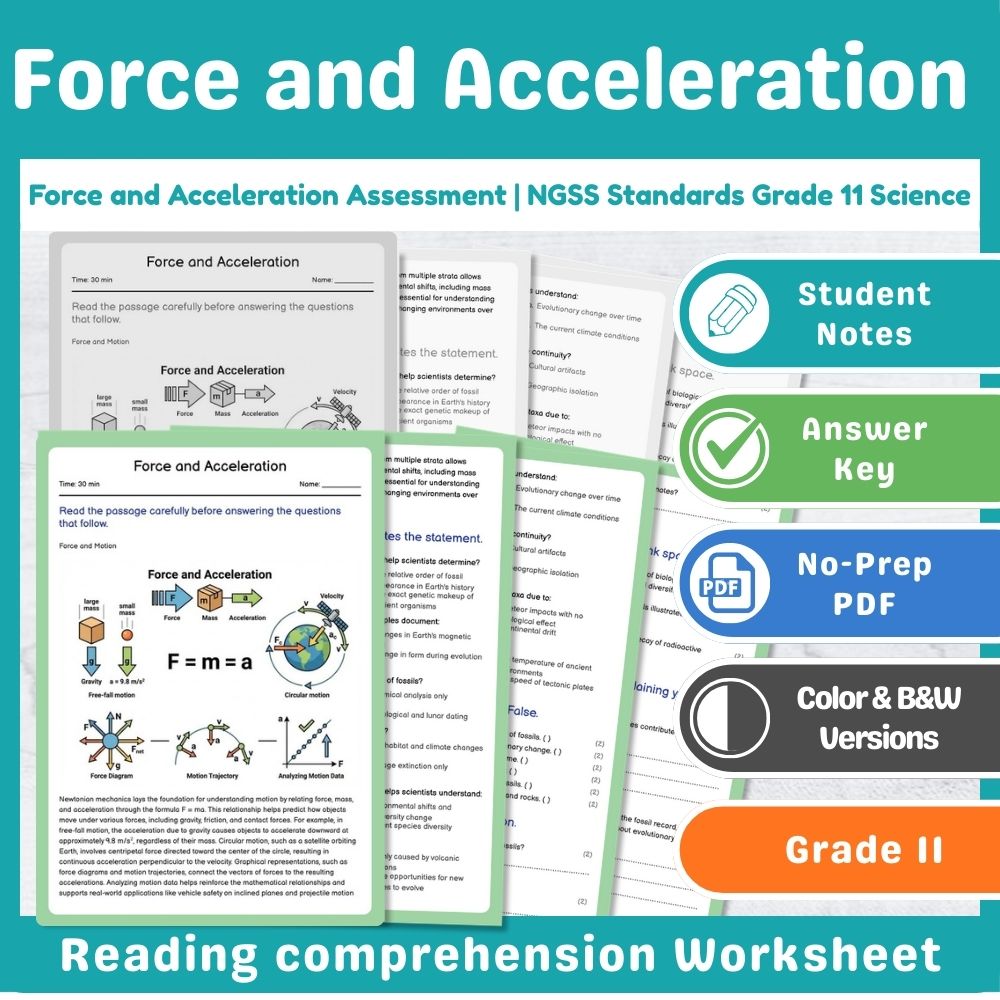
Force and Acceleration Assessment | NGSS Standards Grade 11 Science
 Created byPrism Point Learning
Learning Objectives
- Explain the fundamental relationship between force, mass, and acceleration using Newton's second law.
- Analyze the effects of free-fall motion and uniform circular motion through graphical and algebraic representations.
- Interpret motion data within terrestrial scenarios involving frictional and contact forces, such as inclined planes and projectile motion.
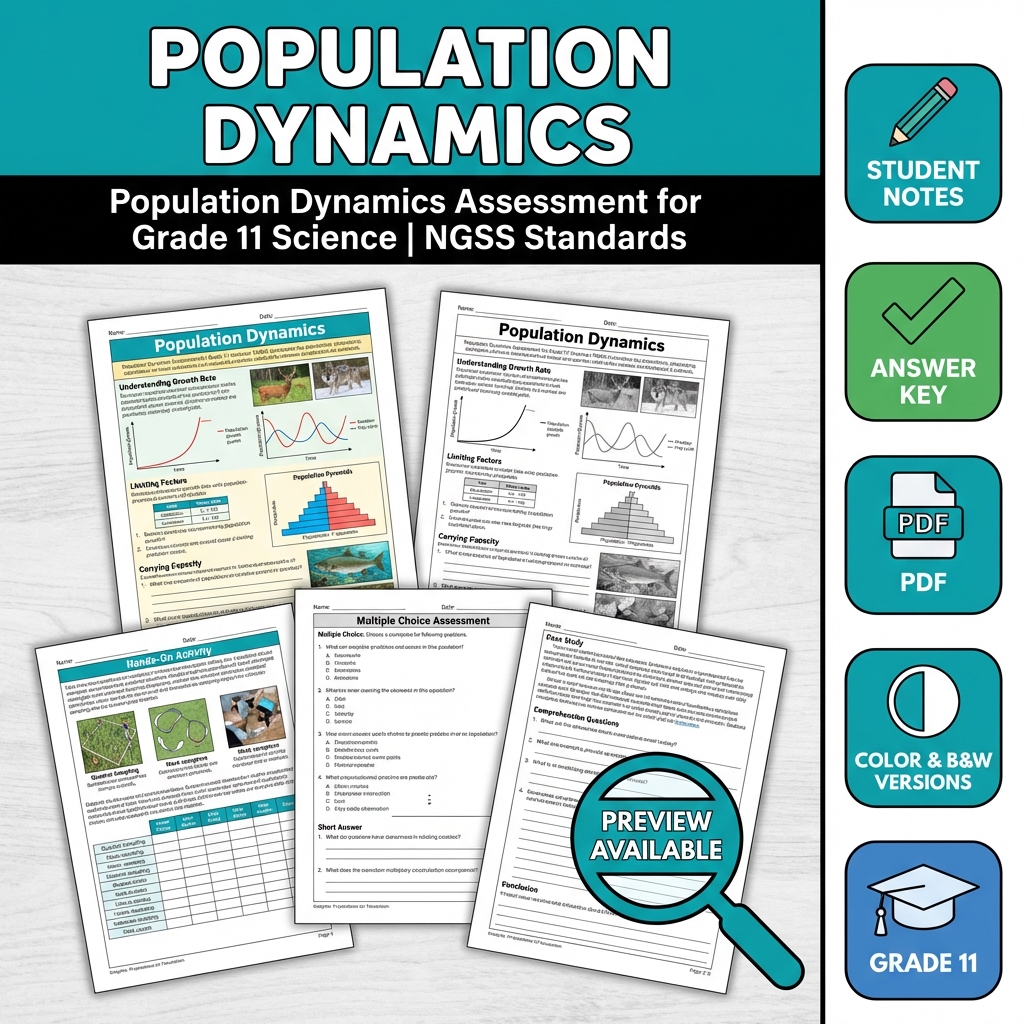
Population Dynamics Assessment for Grade 11 Science | NGSS Standards
Created byPrism Point LearningLearning Objectives
- Describe the key factors influencing population size changes including birth/death rates and migration.
- Explain different models of population growth such as exponential and logistic trajectories.
- Analyze the impact of predator-prey interactions, environmental disturbances, and regulation mechanisms on populations.
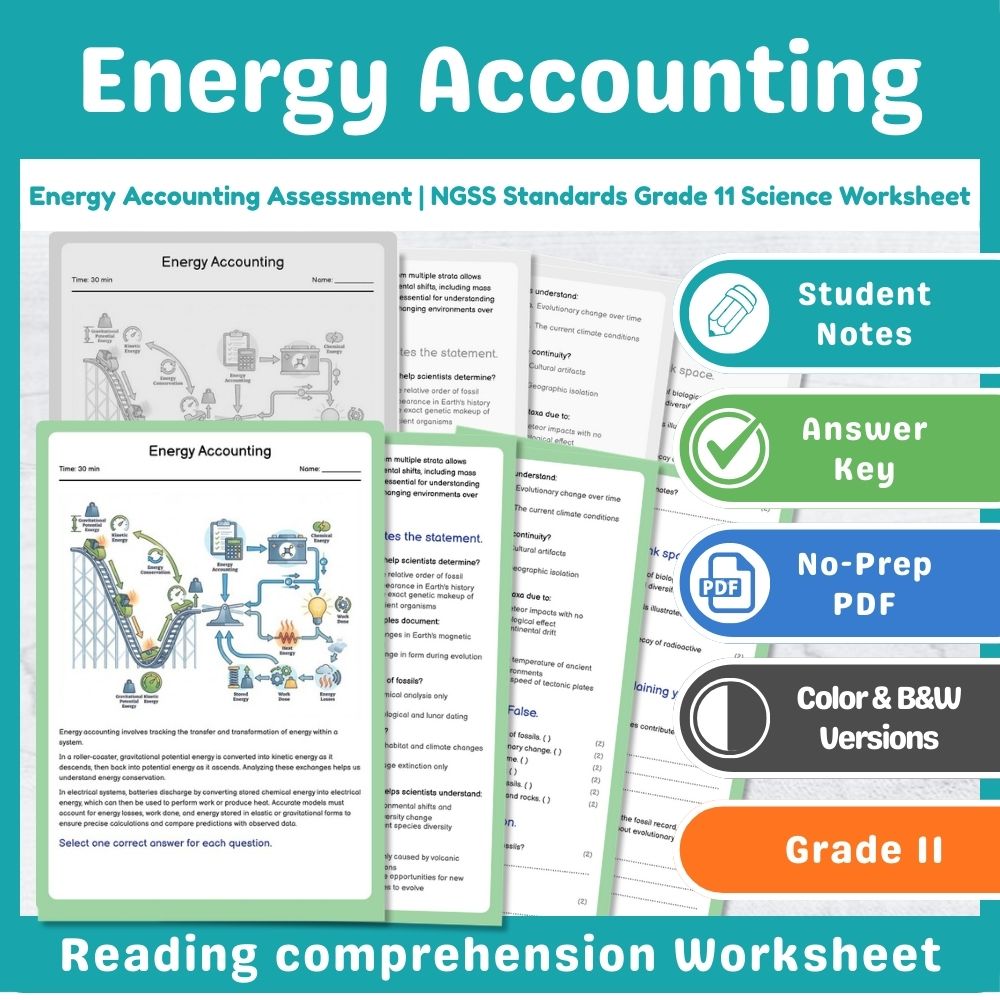
Energy Accounting Assessment | NGSS Standards Grade 11 Science Worksheet
Created byPrism Point LearningLearning Objectives
- Create computational models to analyze energy transfers among system components.
- Use computational representations to relate heat, work, and energy stored in gravitational or elastic forms.
- Compare predicted energy exchanges to data, emphasizing total energy conservation.

Circulatory Function Assessment for Grade 11 Science TEKS | Printables
Created byPrism Point LearningLearning Objectives
- Describe the primary components and functions of the circulatory system.
- Explain how blood pressure and vessel resistance affect tissue perfusion.
- Identify the roles of plasma proteins and cellular elements in clotting and immune defense.
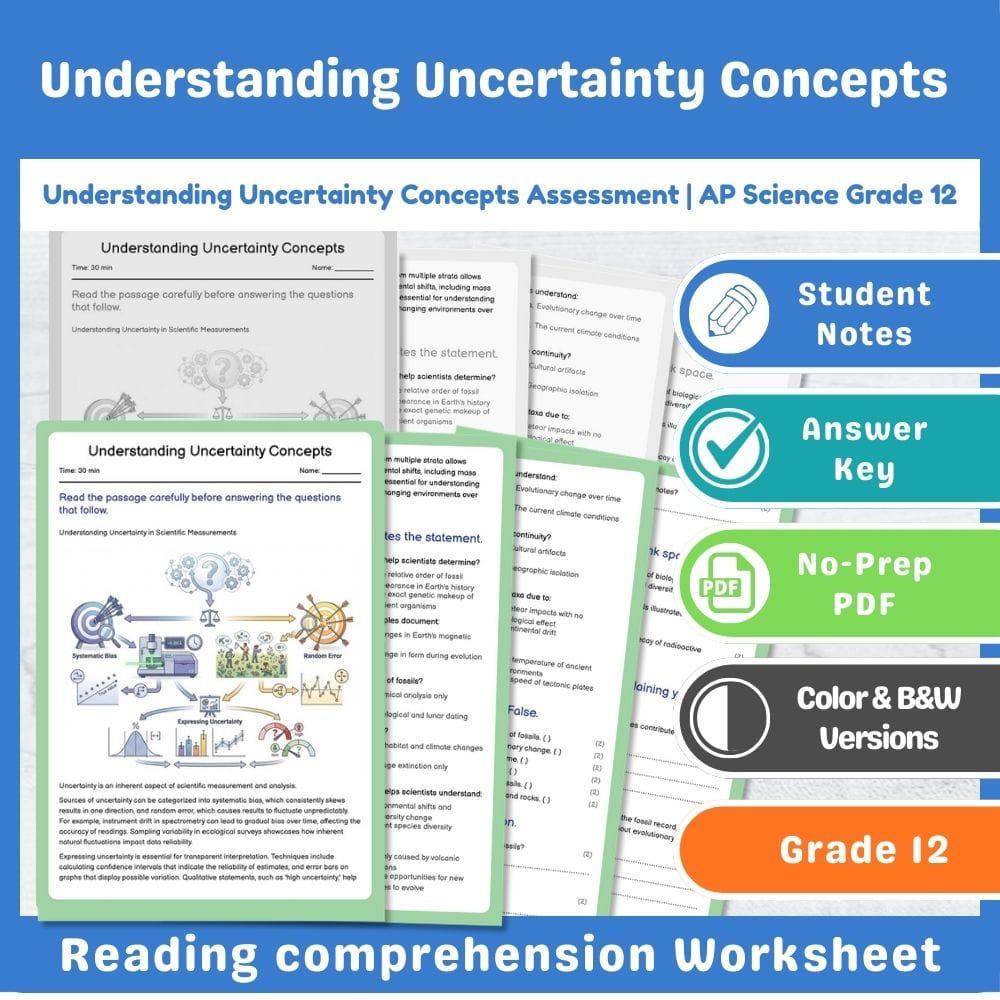
Understanding Uncertainty Concepts Assessment | AP Science Grade 12
Created byPrism Point LearningLearning Objectives
- Identify different sources and types of uncertainty in scientific contexts.
- Distinguish between systematic bias, random error, and conceptual model uncertainty.
- Explain exemplars such as instrument drift and sampling variability to illustrate propagation effects.
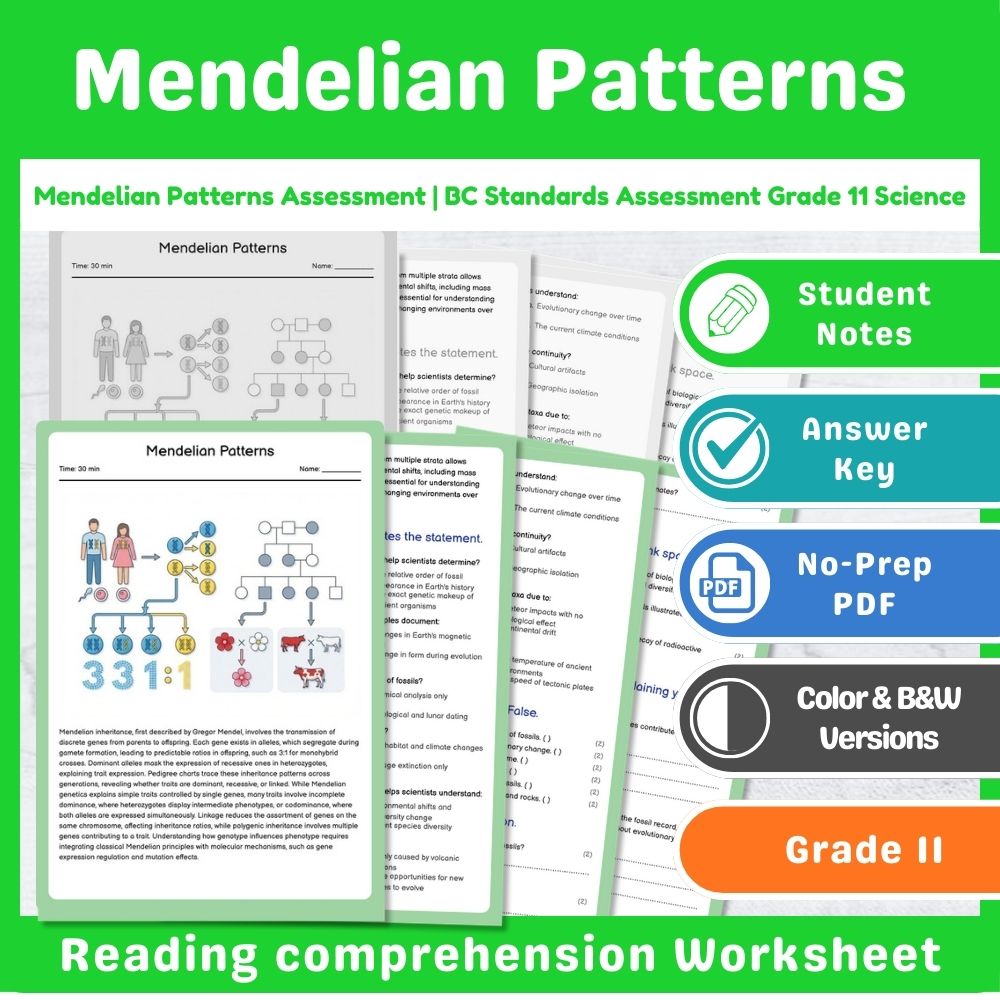
Mendelian Patterns Assessment | BC Standards Assessment Grade 11 Science
Created byPrism Point LearningLearning Objectives
- Understand the principles of Mendelian inheritance and the segregation of alleles.
- Identify dominant and recessive patterns and predict genotype and phenotype ratios.
- Trace inheritance patterns across generations using pedigrees.
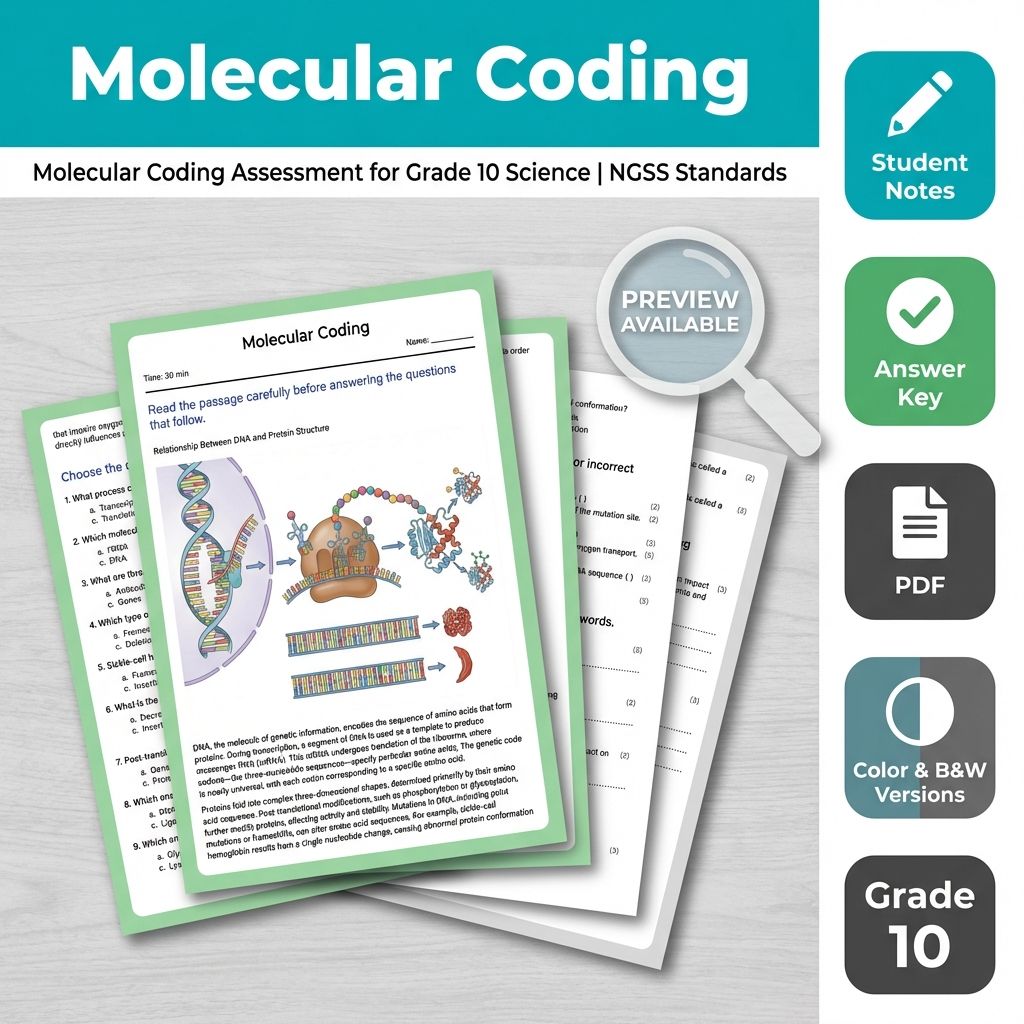
Molecular Coding Assessment for Grade 10 Science | NGSS Standards
Created byPrism Point LearningLearning Objectives
- Explain how DNA sequences determine amino acid sequences during protein synthesis.
- Describe the processes of transcription and translation in gene expression.
- Illustrate the effects of point mutations and frameshifts on protein structure.
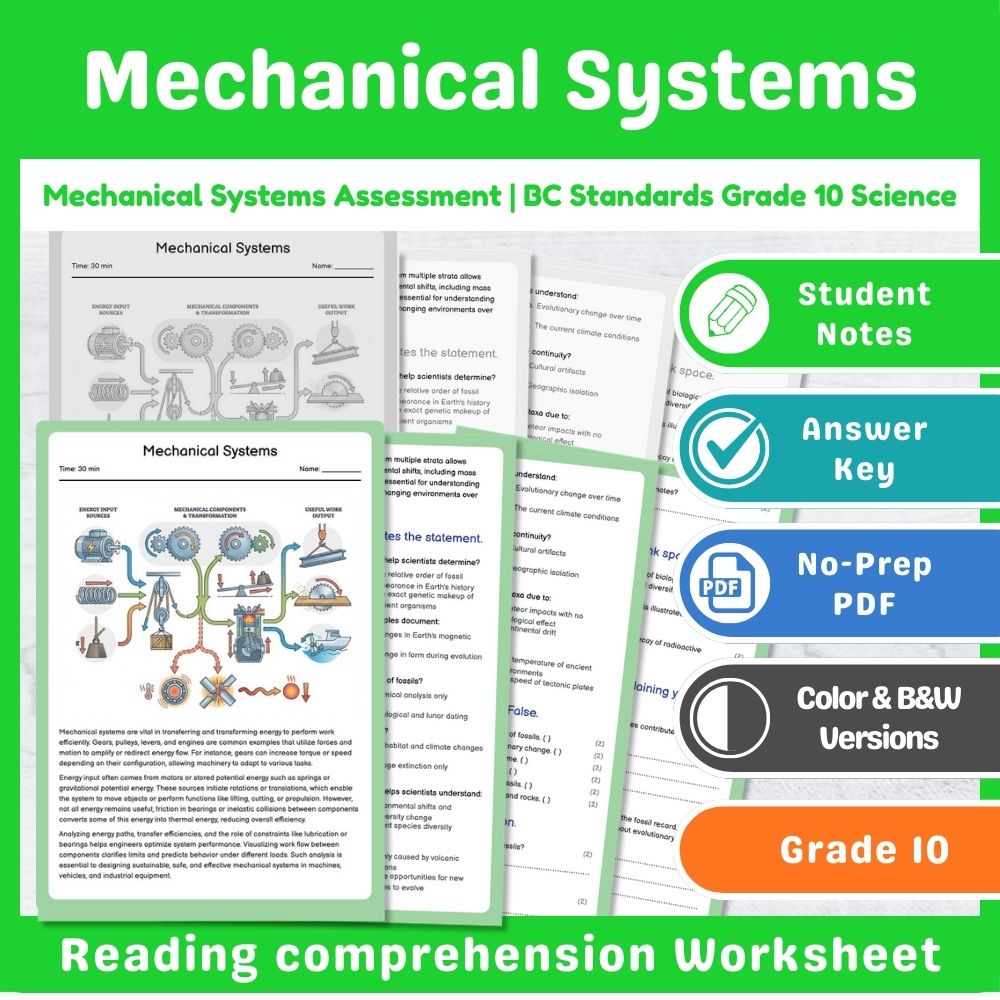
Mechanical Systems Assessment | BC Standards Grade 10 Science
Created byPrism Point LearningLearning Objectives
- Understand the transfer and transformation of energy in mechanical systems.
- Identify how forces, motions, and mechanical advantage operate in gears, pulleys, and levers.
- Analyze energy paths, transfer efficiencies, and effects of constraints such as bearings and lubrication.
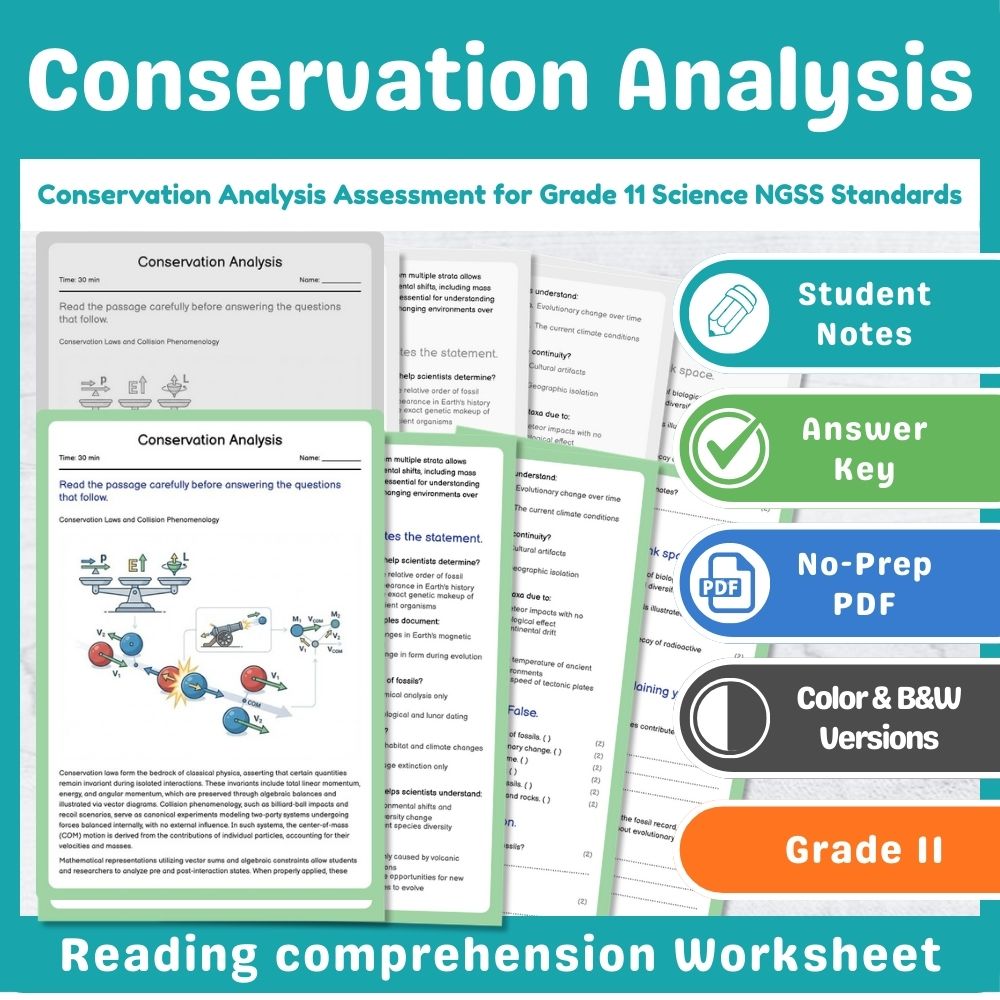
Conservation Analysis Assessment for Grade 11 Science NGSS Standards
Created byPrism Point LearningLearning Objectives
- Understand the principles of conservation laws in physics.
- Analyze collision phenomenology using algebraic balances and vector diagrams.
- Extract center-of-mass motion from system contributions and constraints.

Adaptation Mechanisms Assessment for Grade 8 Science | TEKS-Aligned
Created byPrism Point LearningLearning Objectives
- Describe different types of adaptation—structural, behavioral, and physiological—in various species.
- Explain how adaptations enhance survival and reproductive success in diverse environments.
- Differentiate between adaptation and acclimation, and understand the role of natural selection in evolution.
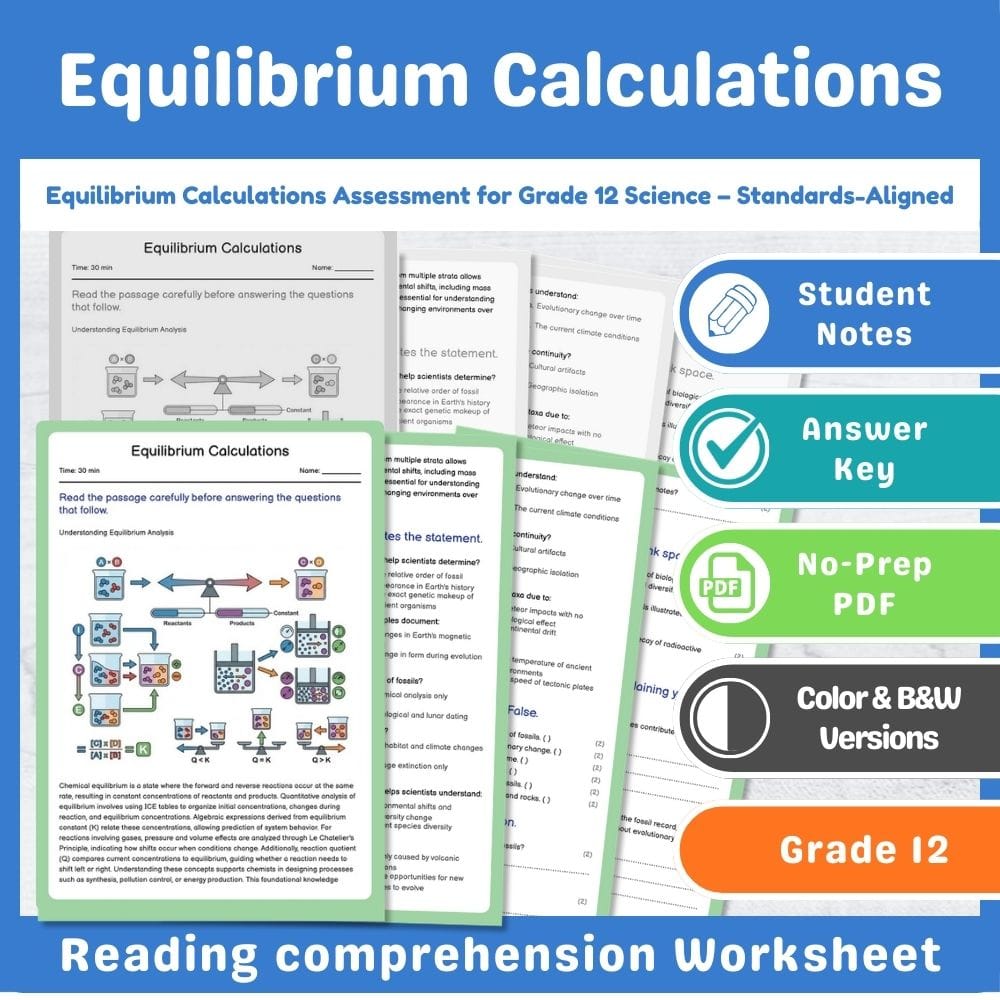
Equilibrium Calculations Assessment for Grade 12 Science – Standards-Aligned
Created byPrism Point LearningLearning Objectives
- Develop skills in using ICE tables and reaction quotient to analyze chemical equilibria.
- Apply algebraic methods to determine equilibrium concentrations and equilibrium constants.
- Extend equilibrium calculations to pressure-dependent systems and common-ion effects.
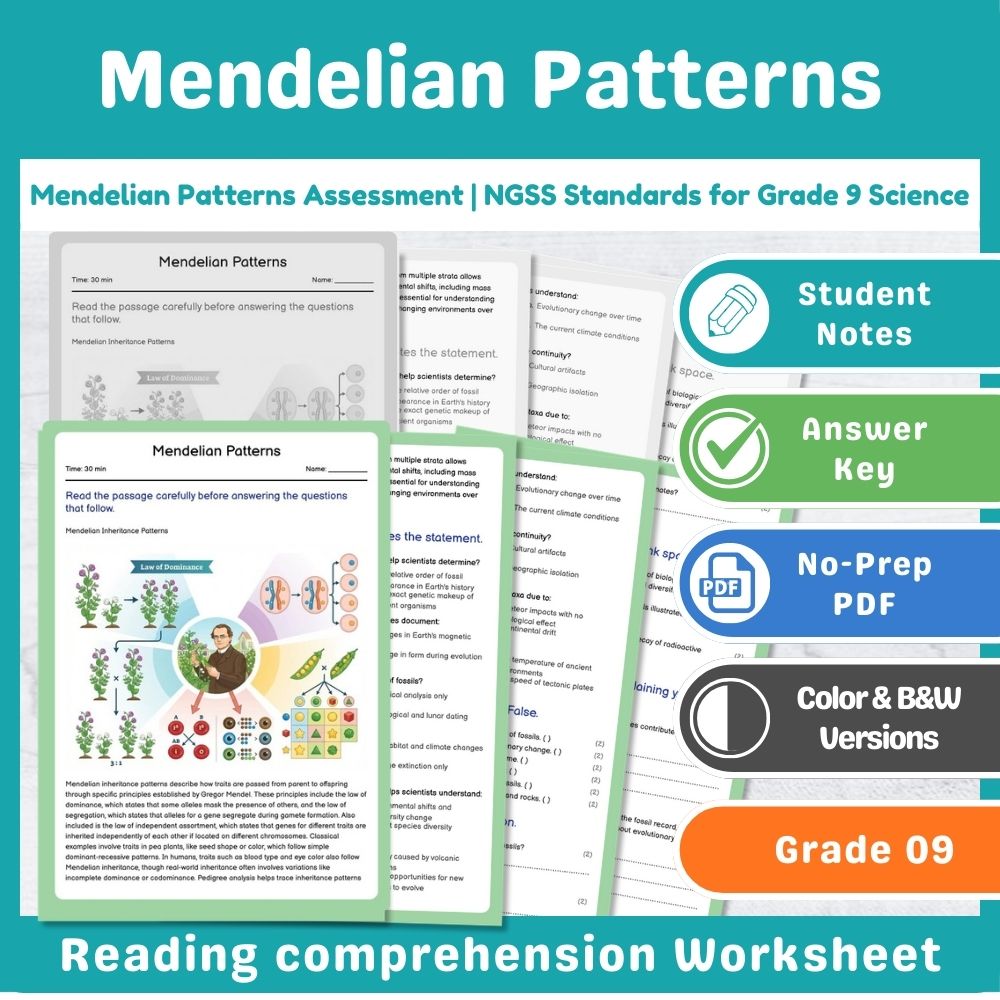
Mendelian Patterns Assessment | NGSS Standards for Grade 9 Science
Created byPrism Point LearningLearning Objectives
- Describe the basic principles of Mendelian inheritance, including dominance, segregation, and independent assortment.
- Use Punnett squares to predict genotype and phenotype ratios of monohybrid and dihybrid crosses.
- Interpret pedigree charts to analyze inheritance patterns.
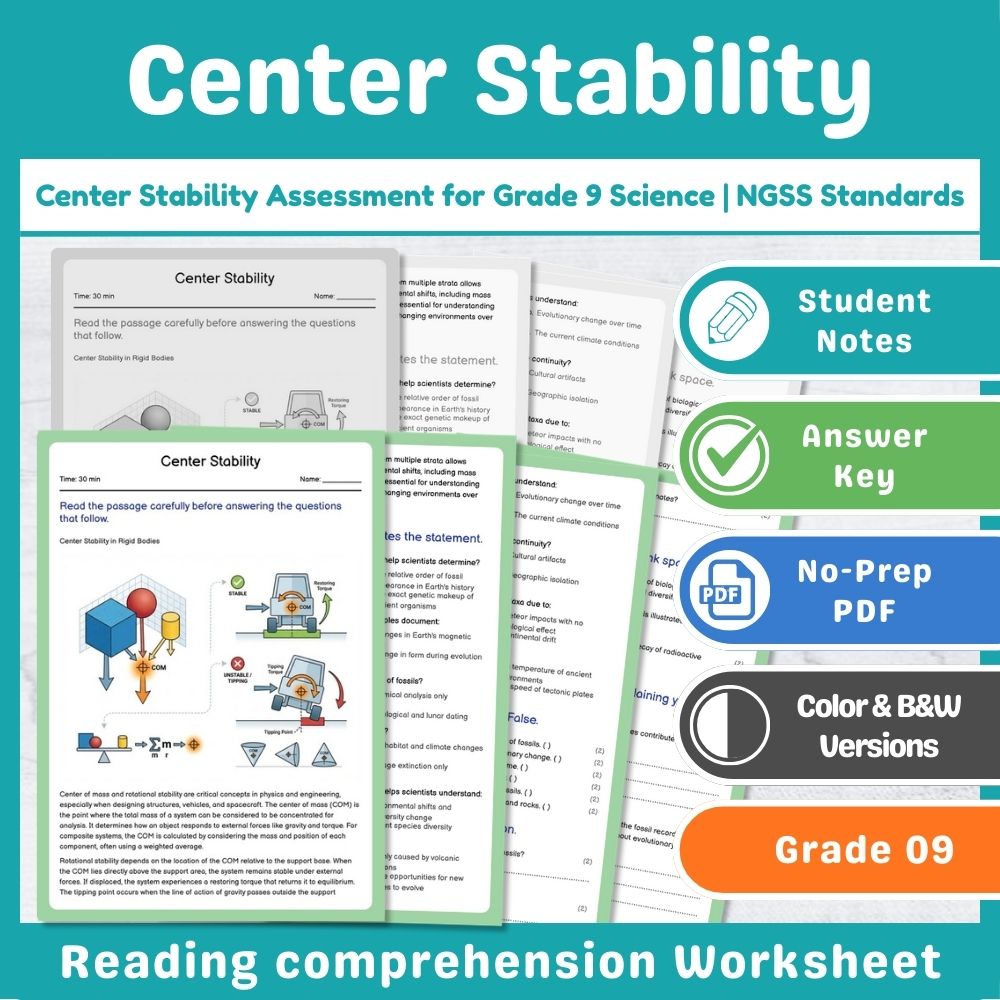
Center Stability Assessment for Grade 9 Science | NGSS Standards
Created byPrism Point LearningLearning Objectives
- Understand the principles of center of mass and its effect on stability.
- Calculate the center of mass for composite systems.
- Apply torque and equilibrium conditions to determine stability thresholds.
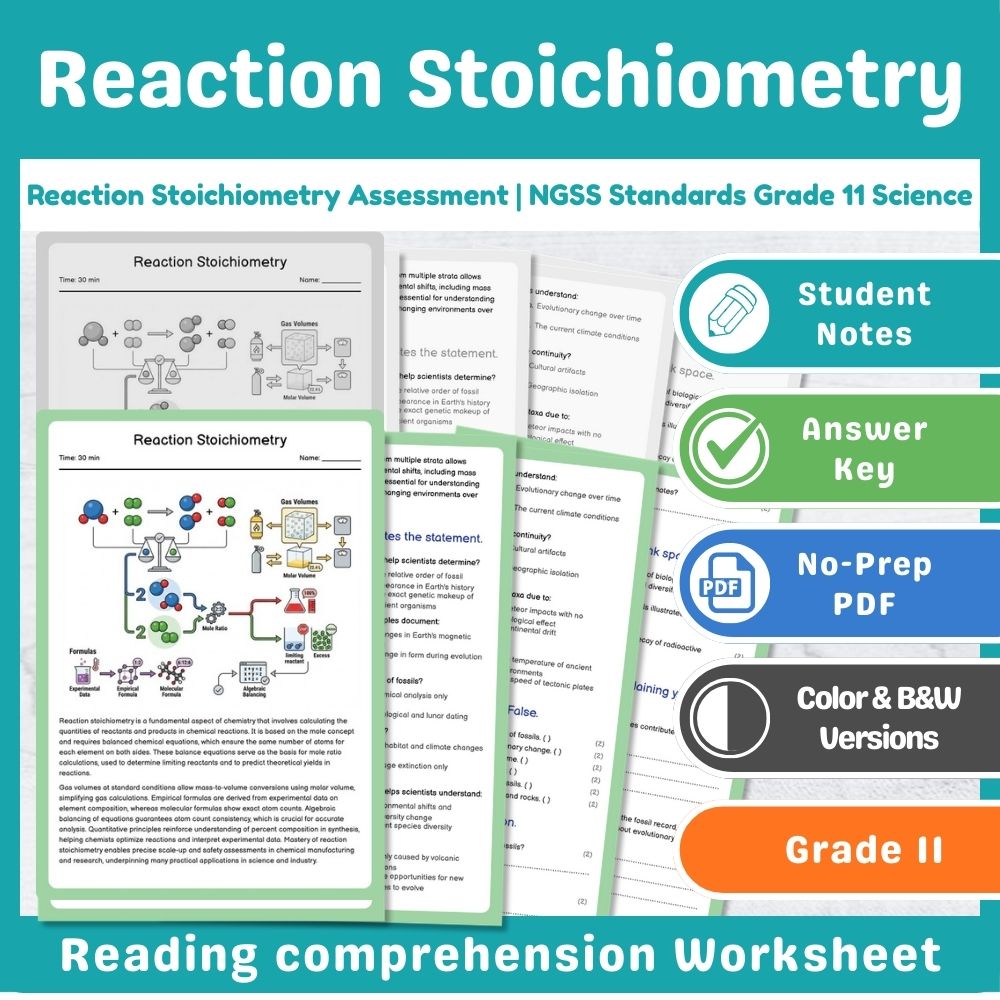
Reaction Stoichiometry Assessment | NGSS Standards Grade 11 Science
Created byPrism Point LearningLearning Objectives
- Understand and apply mole concepts and balanced chemical equations in stoichiometric calculations.
- Determine limiting reactants and calculate theoretical yields in chemical reactions.
- Perform mass-to-mass, mass-to-mole, and molar volume conversions for gases under standard conditions.
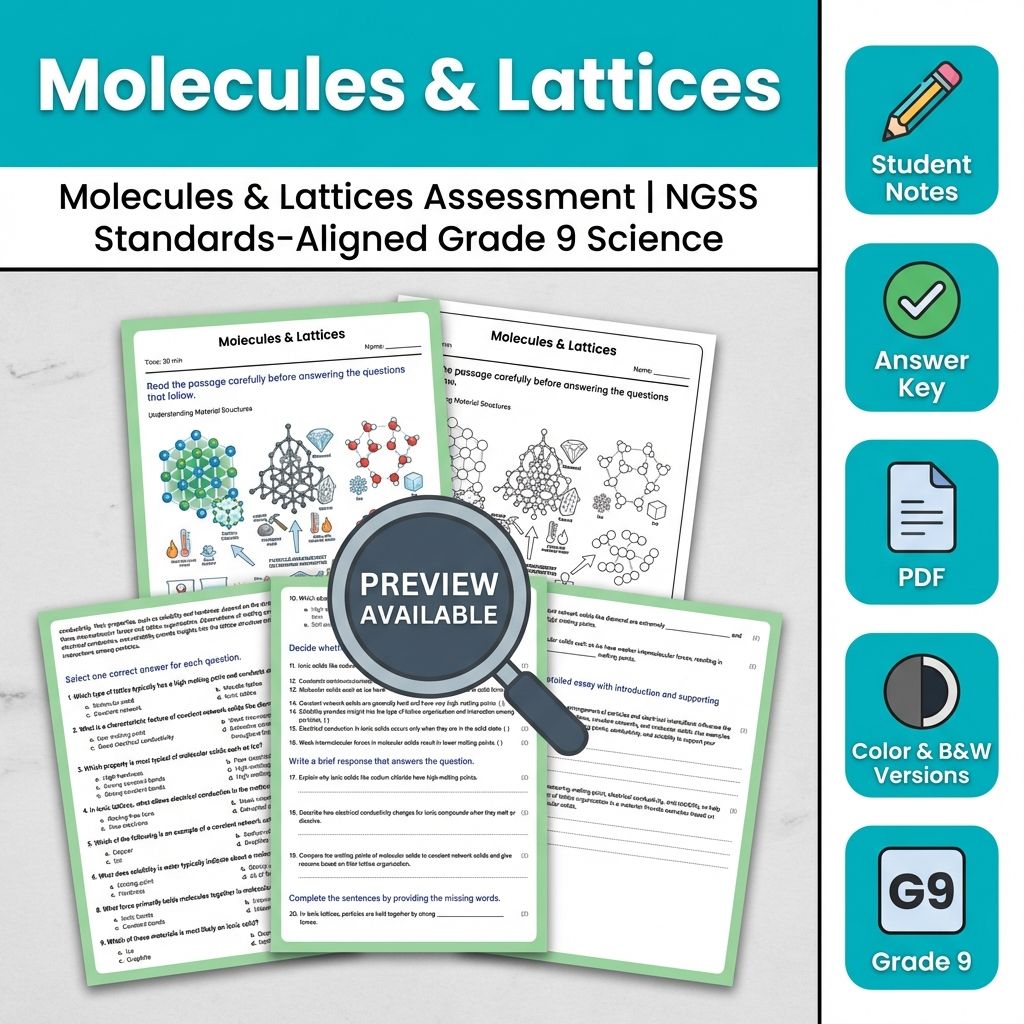
Molecules & Lattices Assessment | NGSS Standards-Aligned Grade 9 Science
Created byPrism Point LearningLearning Objectives
- Understand the relationship between particle arrangement and material properties in different lattice types.
- Identify characteristics of ionic, covalent network, and molecular solids based on their structure and observed physical properties.
- Analyze how melting point, electrical conductivity, hardness, and solubility reflect lattice organization and interparticle forces.
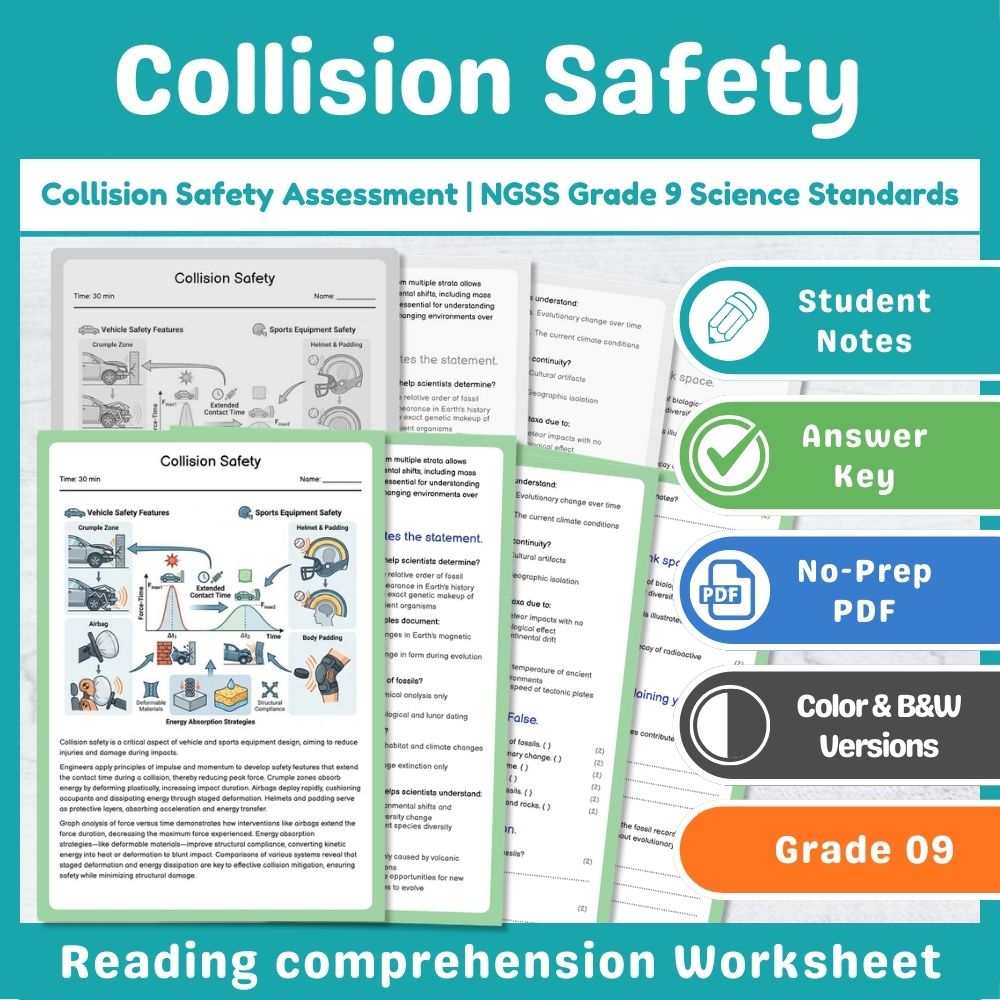
Collision Safety Assessment | NGSS Grade 9 Science Standards
Created byPrism Point LearningLearning Objectives
- Understand how impulse and force-time tradeoffs influence collision mitigation strategies.
- Identify engineering design features such as crumple zones, airbags, and helmets for safer high-impact interactions.
- Analyze force-time graphs and energy absorption techniques to evaluate shock absorption effectiveness.

Balancing Reactions Assessment for Grade 12 Science | TEKS Standards
Created byPrism Point LearningLearning Objectives
- Understand the representation of chemical change through symbolic equations.
- Apply the law of conservation of mass to balance chemical equations.
- Classify reaction types including synthesis, decomposition, single and double replacement, and combustion.

Action-Reaction Forces Assessment for Grade 7 Science – California Standards
Created byPrism Point LearningLearning Objectives
- Explain Newton’s third law using the action-reaction force pair for interacting objects
- Identify how equal and opposite forces relate to contact and noncontact interactions
- Use mass and Newton’s second law to reason about why accelerations may differ
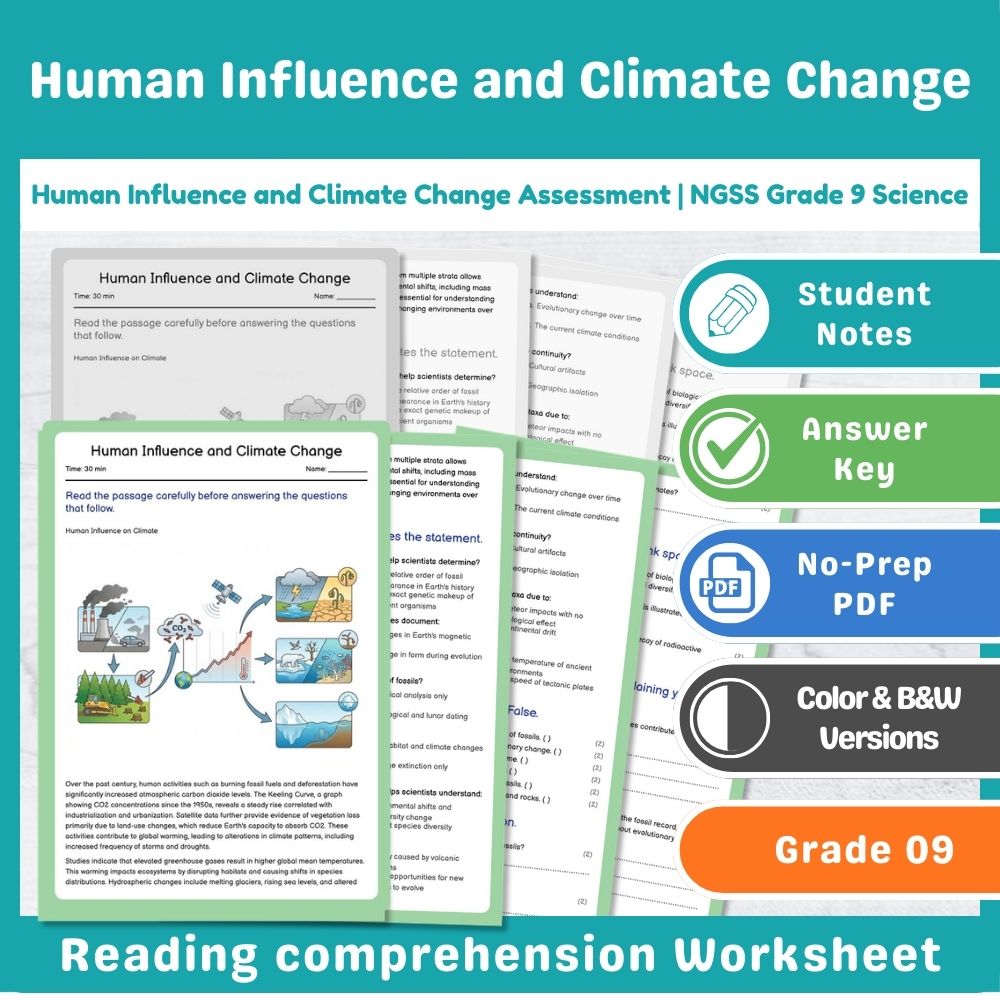
Human Influence and Climate Change Assessment | NGSS Grade 9 Science
Created byPrism Point LearningLearning Objectives
- Analyze historical atmospheric CO2 records and land-use change data.
- Identify the effects of anthropogenic activities on the biosphere and hydrosphere.
- Evaluate evidence linking human emissions to climate variable alterations.
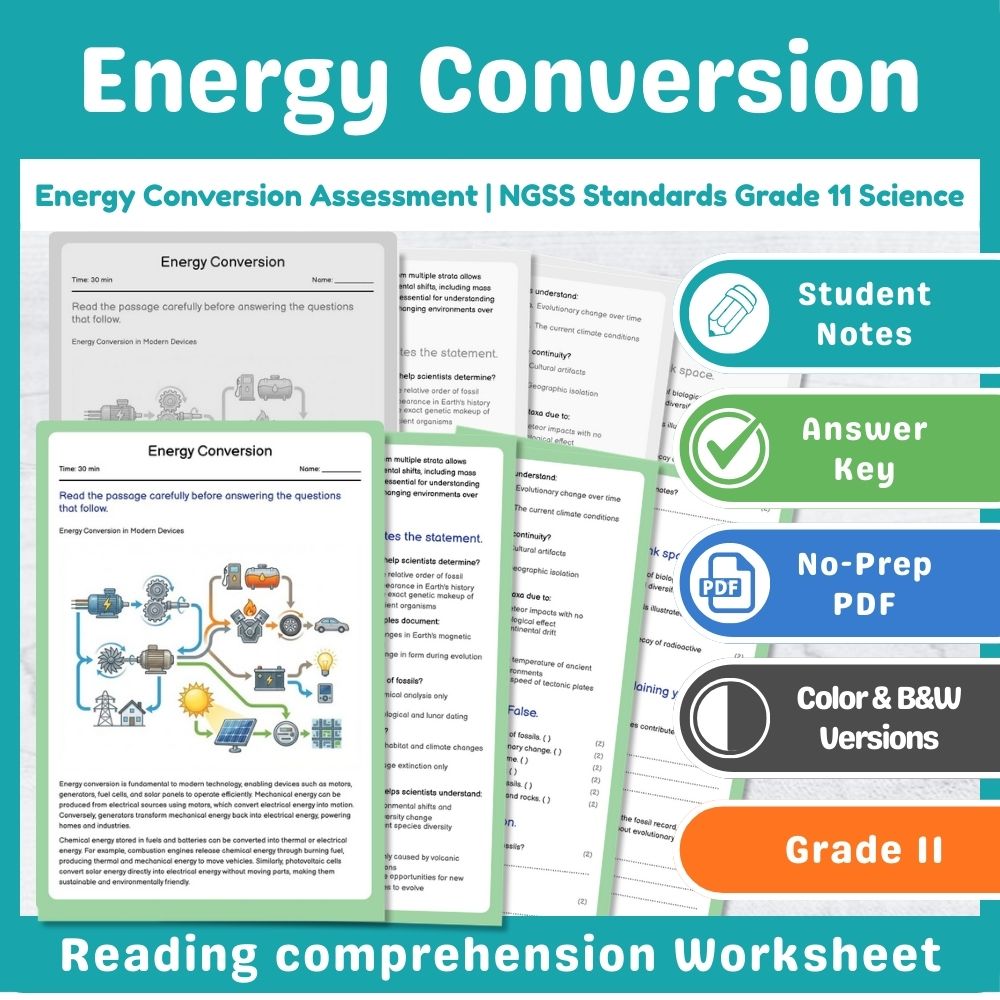
Energy Conversion Assessment | NGSS Standards Grade 11 Science
Created byPrism Point LearningLearning Objectives
- Understand the different forms of energy and their conversions
- Design and evaluate devices that convert energy between mechanical, electrical, chemical, and thermal forms
- Analyze efficiency and energy losses in energy conversion systems
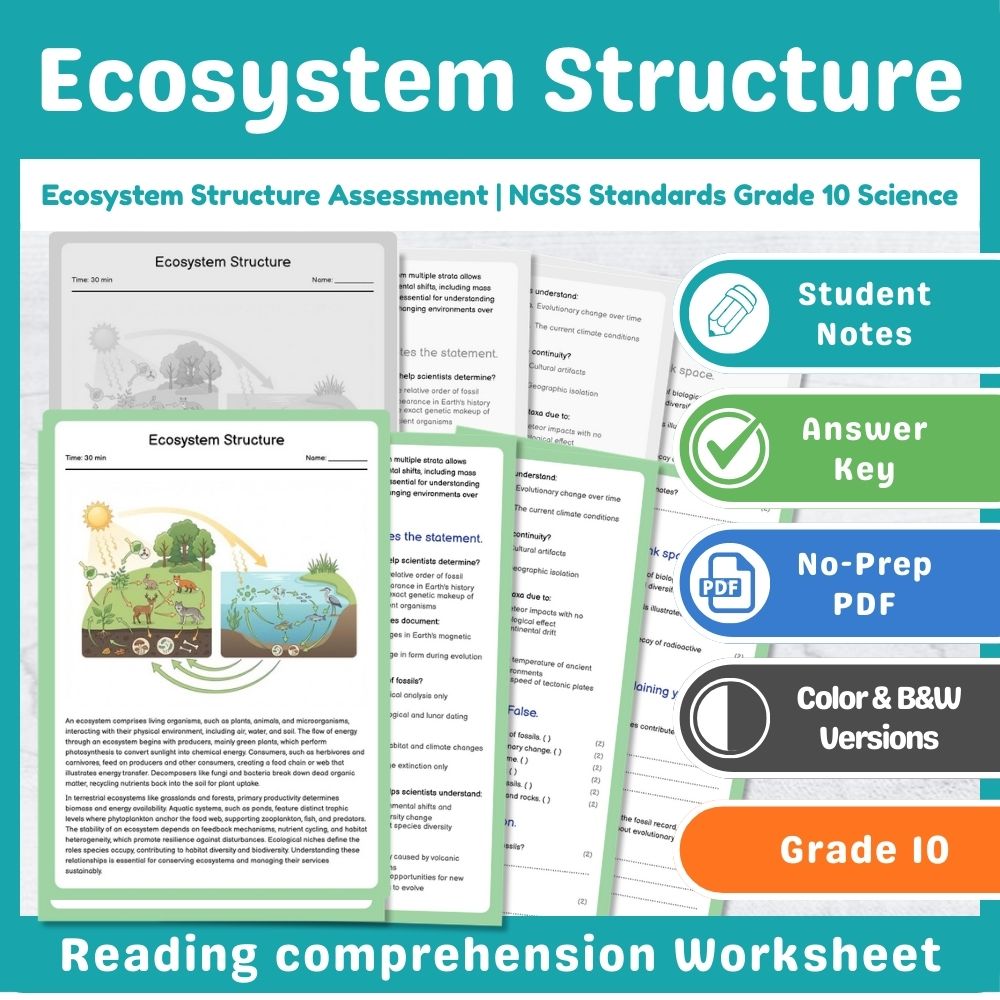
Ecosystem Structure Assessment for Grade 10 Science NGSS Standards
Created byPrism Point LearningLearning Objectives
- Explain the roles of biotic and abiotic components in ecosystems.
- Identify and analyze food webs, trophic levels, and energy flow within ecosystems.
- Understand the concepts of ecosystem stability, feedback loops, and ecological niches.
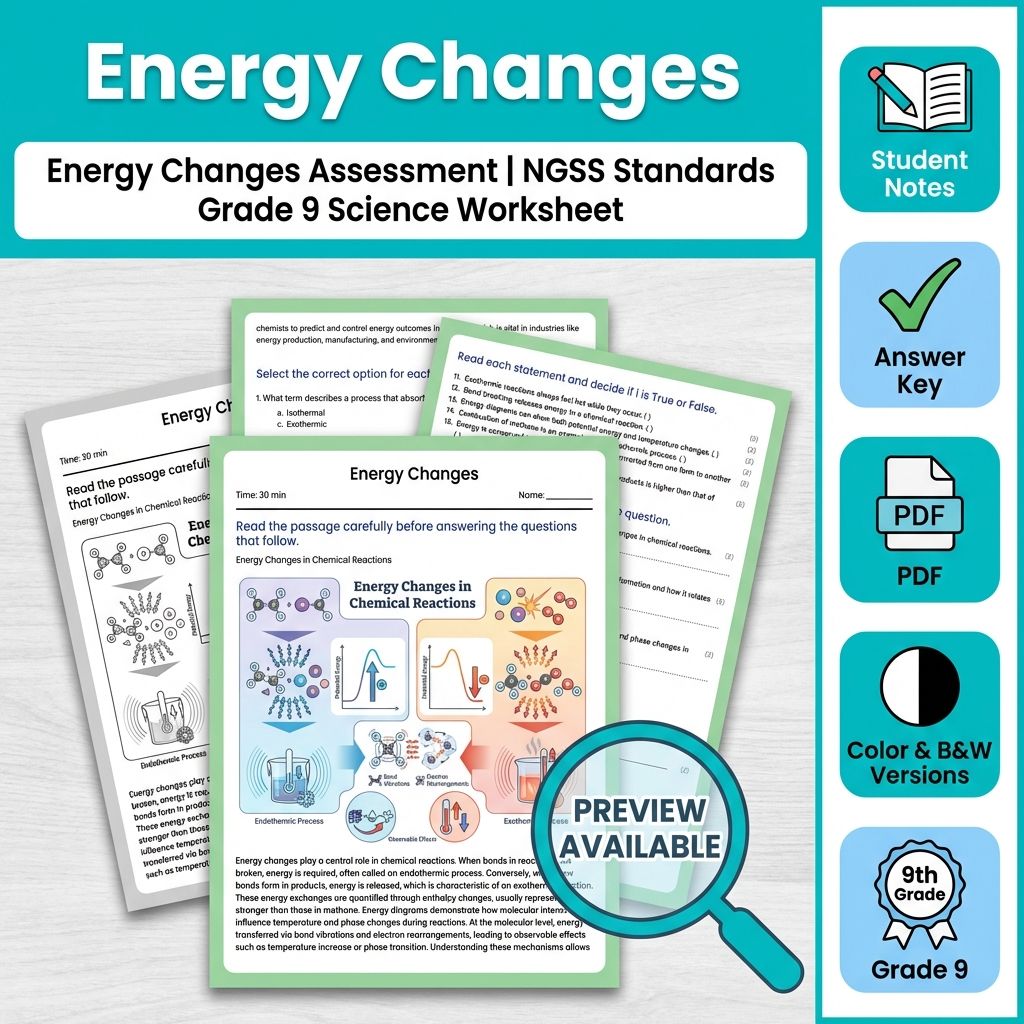
Energy Changes Assessment | NGSS Standards Grade 9 Science Worksheet
Created byPrism Point LearningLearning Objectives
- Understand the principles of energy changes during chemical reactions, including bond breaking and formation.
- Differentiate between endothermic and exothermic processes using energy diagrams and enthalpy concepts.
- Analyze real-world examples such as combustion reactions to identify energy release and absorption.
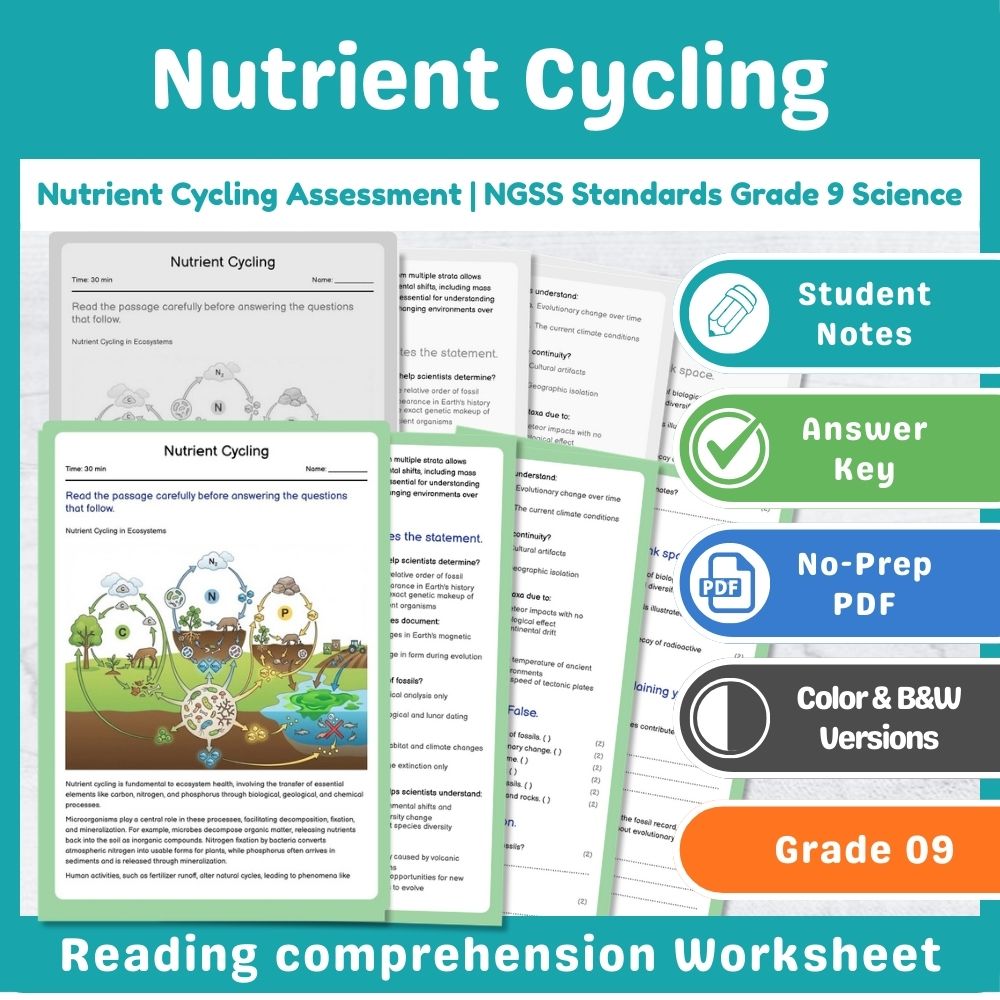
Nutrient Cycling Assessment | NGSS Standards Grade 9 Science
Created byPrism Point LearningLearning Objectives
- Understand the processes involved in the cycling of carbon, nitrogen, and phosphorus within ecosystems.
- Identify human activities that disrupt nutrient cycles and recognize their ecological impacts.
- Explain how changes in nutrient cycling rates influence ecosystem productivity and soil carbon storage.
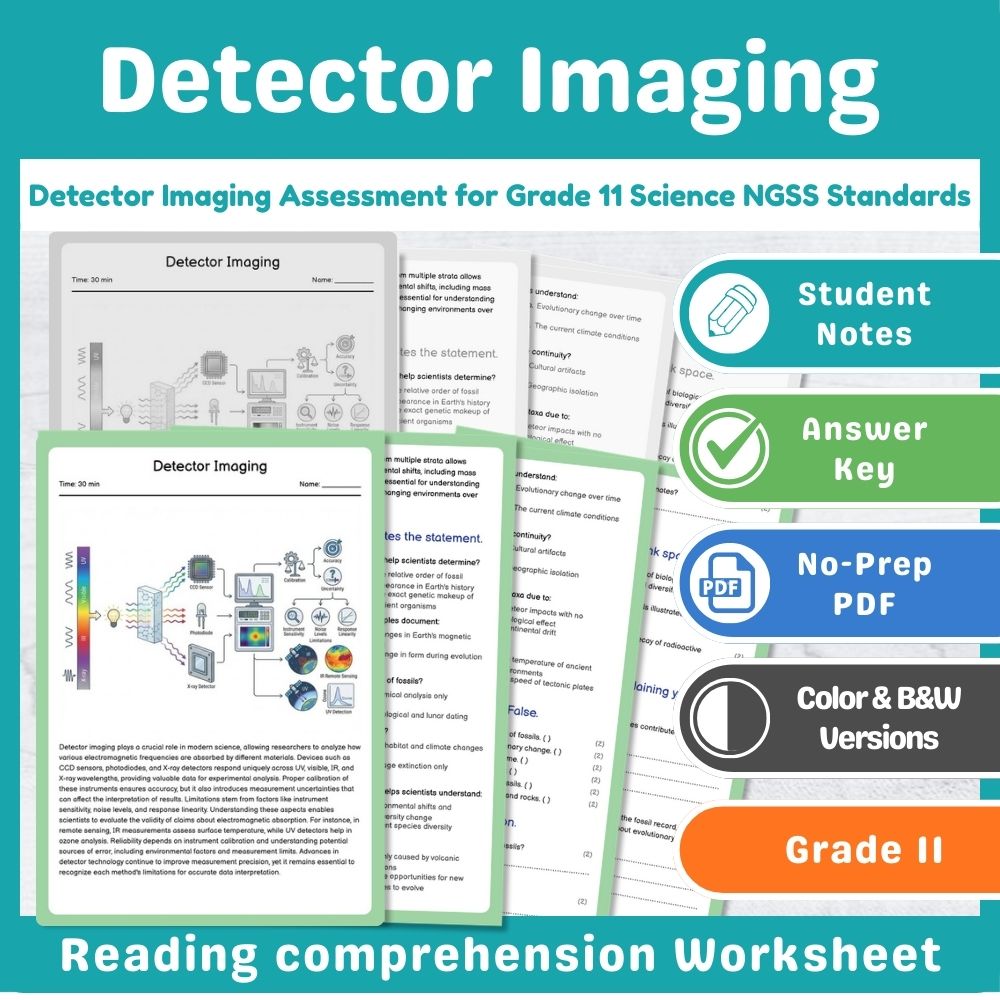
Detector Imaging Assessment for Grade 11 Science NGSS Standards
Created byPrism Point LearningLearning Objectives
- Evaluate the validity and reliability of claims about electromagnetic absorption across different bands.
- Analyze detector responses like CCD and photodiodes in UV, visible, IR, and X-ray spectra.
- Understand calibration procedures, uncertainties, and instrument limitations in detector imaging.
Cosmic Timescales Assessment for Grade 9 Science | NGSS Standards-Aligned
Created byPrism Point LearningLearning Objectives
- Understand key observational evidence constraining the age and expansion of the universe
- Identify the significance of redshift surveys, Hubble's law, and cosmic microwave background measurements
- Describe processes related to primordial element abundances and their role in cosmic chronology
Inheritance Patterns Assessment NGSS | Standard Grade 11 Science
Created byPrism Point LearningLearning Objectives
- Understand the basic principles of Mendelian inheritance and how traits are passed through generations.
- Identify and describe various inheritance patterns beyond simple dominance, such as incomplete dominance, codominance, sex linkage, and polygenic inheritance.
- Interpret pedigrees and predict inheritance outcomes using probability and meiotic mechanisms.

Explanation Development Assessment | Florida NGSSS Grade 8 Science
Created byPrism Point LearningLearning Objectives
- Explain how scientific explanations connect evidence to cause-and-effect or causal mechanisms
- Use observations, patterns in measurements, and model-based reasoning to support a claim
- Differentiate correlation from causation by evaluating whether evidence supports a causal mechanism
Earth Materials Assessment | NGSS Grade 8 Science Standards
Created byPrism Point LearningLearning Objectives
- Describe the processes involved in Earth's material cycles, including melting, crystallization, uplift, weathering, transport, and deposition.
- Explain the energy sources driving Earth's geosphere, such as internal heat and gravitational potential.
- Model the interactions between Earth's geosphere, hydrosphere, and atmosphere in surface processes and material flow.
Momentum Collisions Assessment for Grade 8 Science NGSS Standards
Created byPrism Point LearningLearning Objectives
- Understand the principles of momentum exchange during collisions.
- Distinguish between elastic and inelastic collisions through conservation of kinetic energy.
- Analyze real-world examples involving impacts and velocity changes.
Reaction Stoichiometry Assessment for Grade 9 Science NGSS Standards
Created byPrism Point LearningLearning Objectives
- Understand the principles of mole ratios in balanced chemical equations.
- Apply molar mass conversions to relate mass and moles in reactions.
- Analyze limiting reagents and determine theoretical yields in chemical reactions.
Natural Selection Assessment for Grade 8 Science | NGSS Standards-Aligned
Created byPrism Point LearningLearning Objectives
- Understand the mechanisms of variation and natural selection that drive adaptive change in populations.
- Identify examples of natural selection such as industrial melanism, antibiotic resistance, and beak variation.
- Link phenotypic variation and environmental factors to changes in trait frequencies over generations.

Ethical Review Assessment | TEKS Grade 12 Science Standards-Aligned
Created byPrism Point LearningLearning Objectives
- Understand the principles of responsible conduct in research and ethical review.
- Identify conflicts of interest and proper data management practices.
- Explain authorship conventions and protections for human and animal subjects.
Seafloor Spreading Assessment | BC Standards for Grade 11 Science
Created byPrism Point LearningLearning Objectives
- Describe the process of seafloor spreading and how it shapes ocean basins.
- Explain how magnetic stripe patterns provide evidence for seafloor spreading.
- Analyze how age and bathymetric data support plate tectonic theory.
DNA and Traits Assessment | NGSS Standards Grade 8 Science Worksheet
Created byPrism Point LearningLearning Objectives
- Explain the relationship between DNA sequences and protein synthesis.
- Identify how mutations can alter amino acid sequences and affect traits.
- Describe gene structure, transcription, translation, and mutation effects.
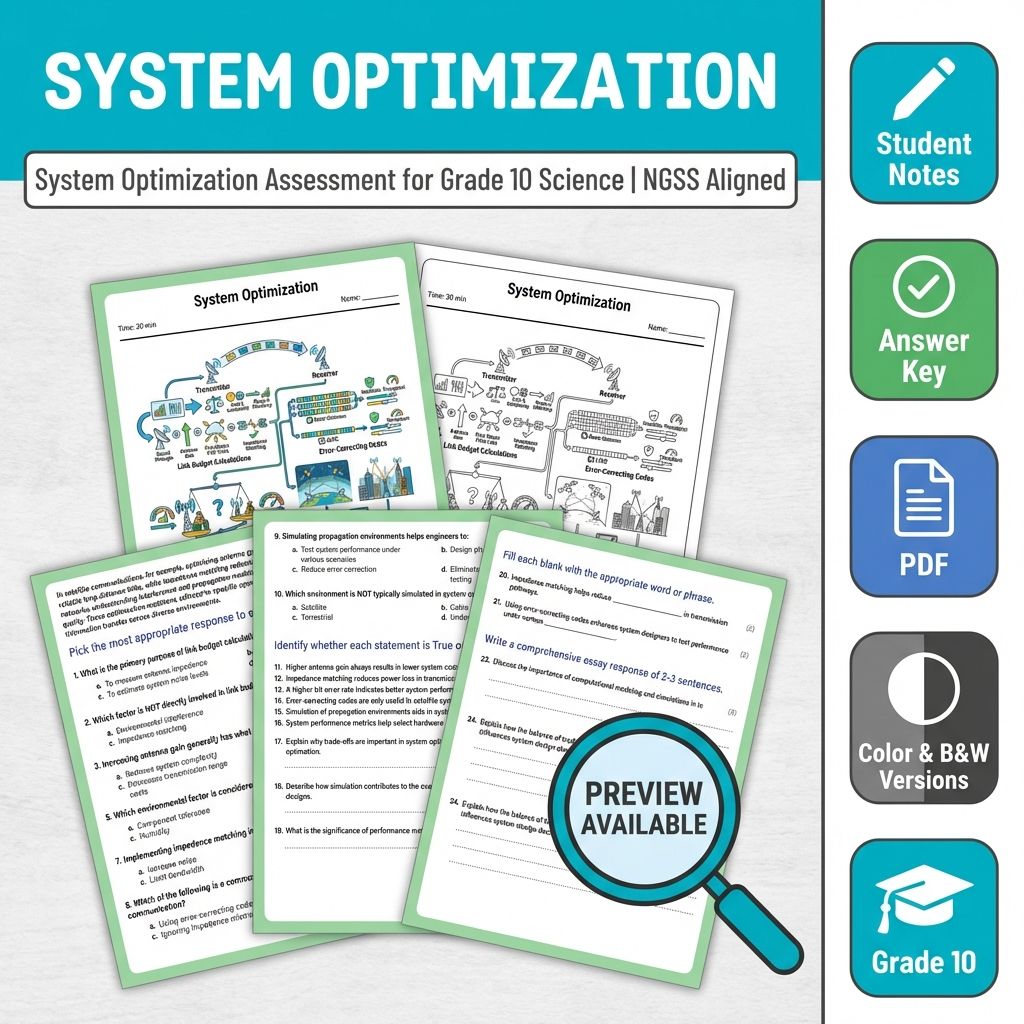
System Optimization Assessment for Grade 10 Science | NGSS Aligned
Created byPrism Point LearningLearning Objectives
- Understand mathematical models used for system optimization in communication networks.
- Analyze trade-offs among range, throughput, and reliability in system design.
- Apply concepts of antenna gain, impedance matching, and error correction to optimize performance.
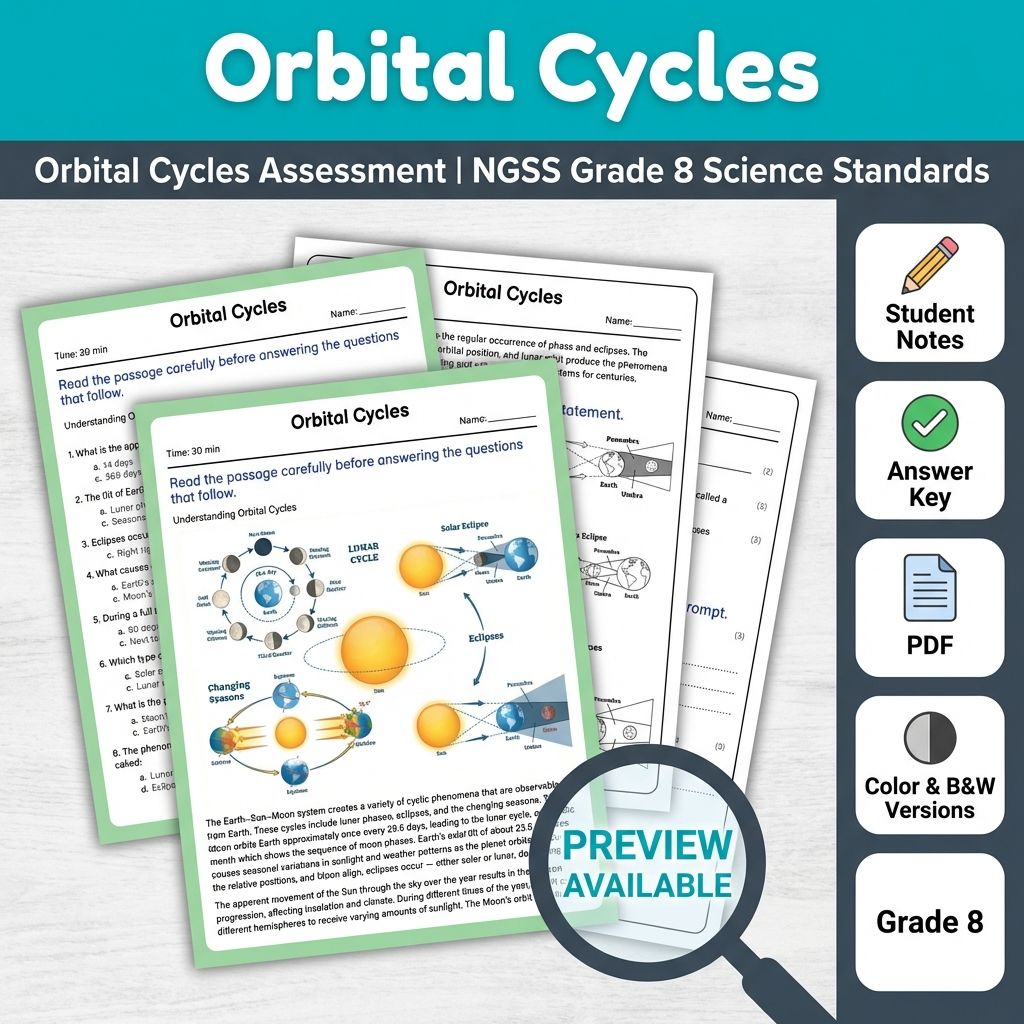
Orbital Cycles Assessment | NGSS Grade 8 Science Standards
Created byPrism Point LearningLearning Objectives
- Describe the relative positions and motions of the Earth, Moon, and Sun that produce lunar phases, eclipses, and seasonal changes.
- Explain how orbital geometry and axial tilt influence observable sky phenomena and calendar cycles.
- Analyze the relationship between Earth's orbit, the lunar cycle, and seasonal insolation differences.

Acid Base Reactions Assessment for Grade 12 Science TEKS Standards
Created byPrism Point LearningLearning Objectives
- Understand the different definitions of acids and bases: Arrhenius, Brønsted–Lowry, and Lewis.
- Identify strong versus weak acids and bases and their conjugate pairs.
- Interpret pH and pOH relationships and analyze titration curves.
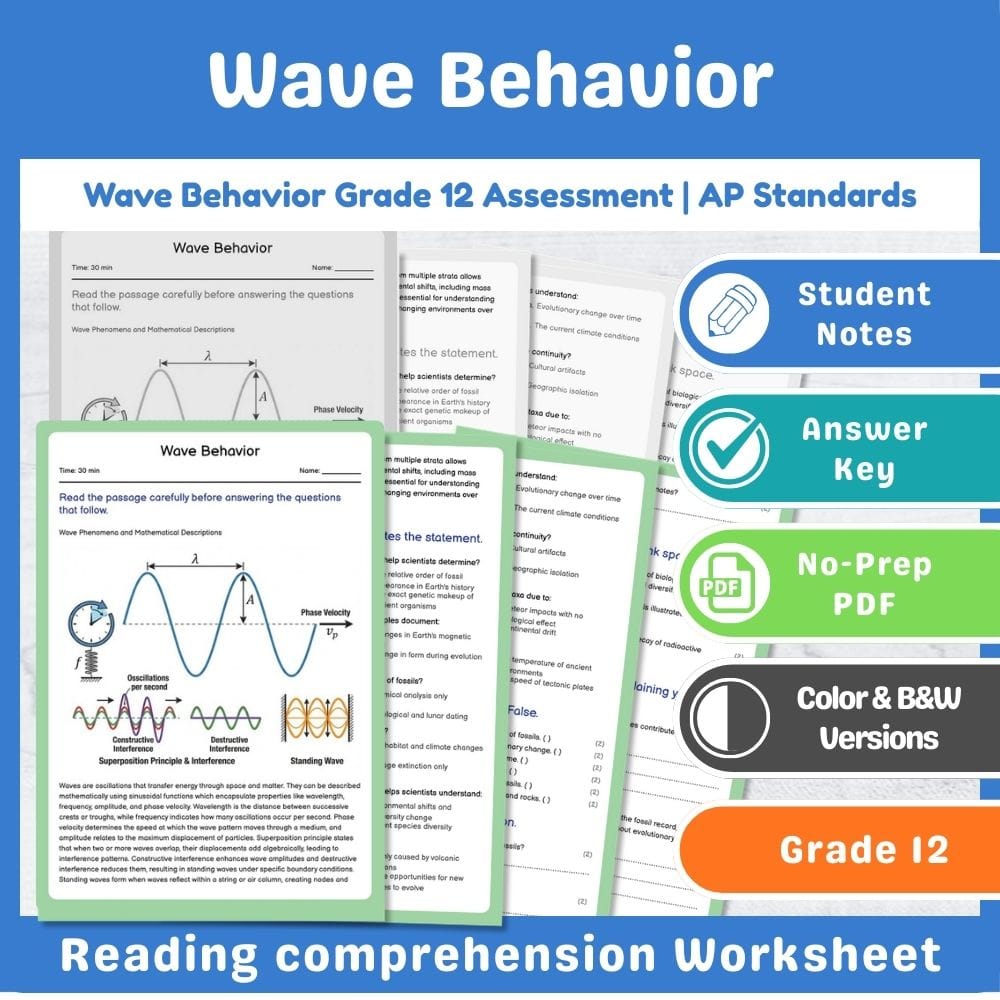
Wave Behavior Grade 12 Assessment | AP Standards-Aligned Assessment in Science
Created byPrism Point LearningLearning Objectives
- Describe wave phenomena using mathematical descriptions of wavelength, frequency, phase velocity, and amplitude.
- Explain the principles of superposition, interference, and standing waves in strings and air columns.
- Apply sinusoidal representations and phasor reasoning to analyze wave patterns and energy transport.
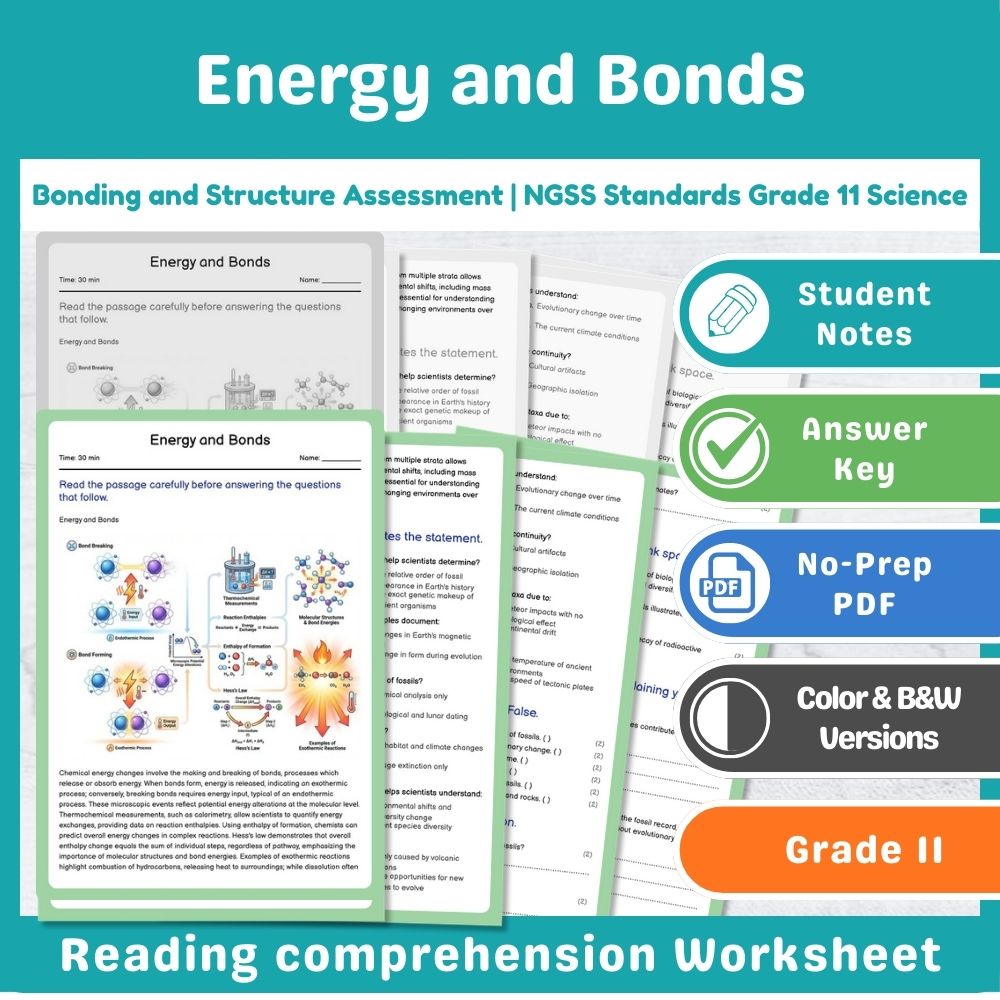
Energy and Bonds Assessment – NGSS Aligned Evaluation for Grade 11 Science
Created byPrism Point LearningLearning Objectives
- Understand the representation of chemical energy changes through bond formation and breaking.
- Explain how net enthalpy change relates to bond energies and molecular structure.
- Interpret thermochemical data, including calorimetry, formation enthalpies, and Hess's law.

Graphical Reasoning Assessment Grade 8 Science TEKS Standards-Aligned
Created byPrism Point LearningLearning Objectives
- Interpret slopes, areas under curves, and rates of change in mathematical graphs.
- Connect graphical representations with physical phenomena such as motion and energy transfer.
- Translate between equations, data tables, and graphical formats to analyze scientific data.
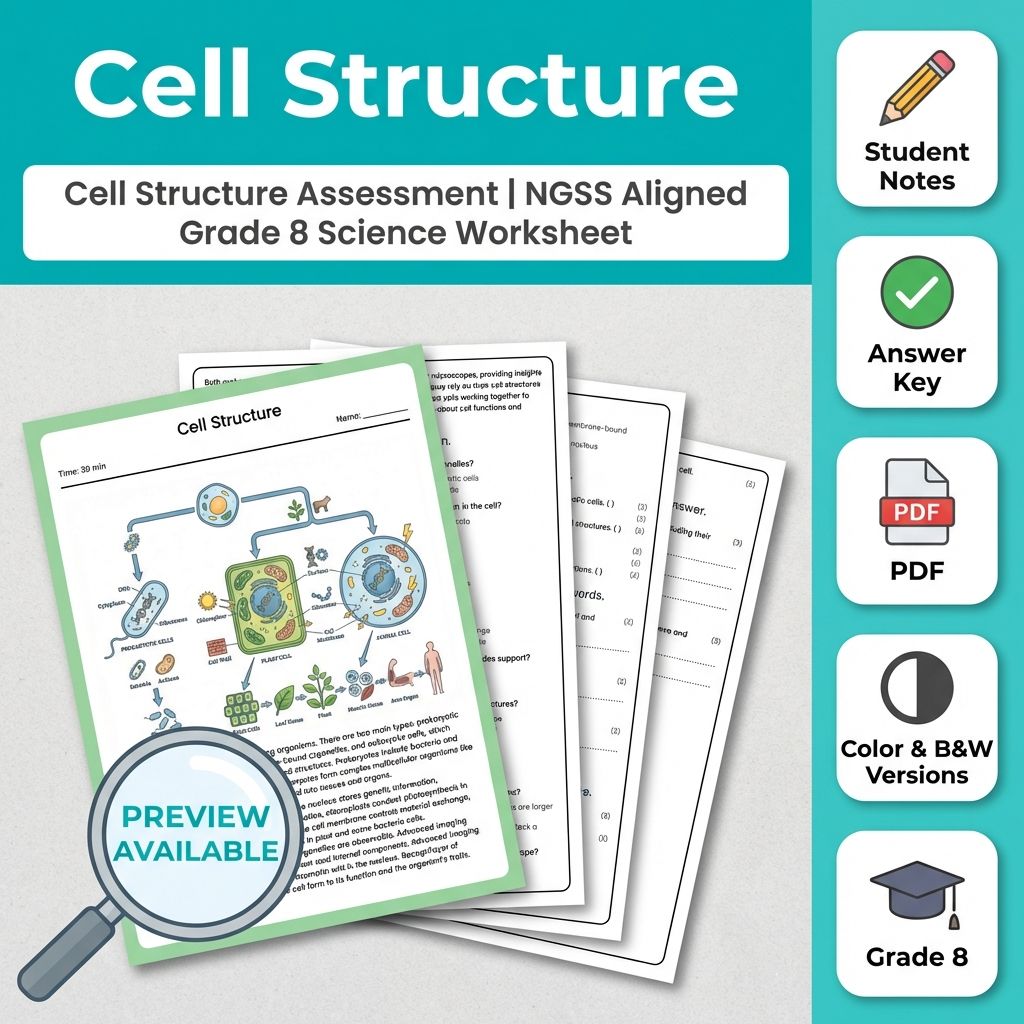
Cell Structure Assessment | NGSS Aligned Grade 8 Science Worksheet
Created byPrism Point LearningLearning Objectives
- Describe the anatomical and functional features of different cell organelles.
- Compare prokaryotic and eukaryotic cells, highlighting key differences.
- Differentiate between single-celled and multicellular organisms based on cellular organization.
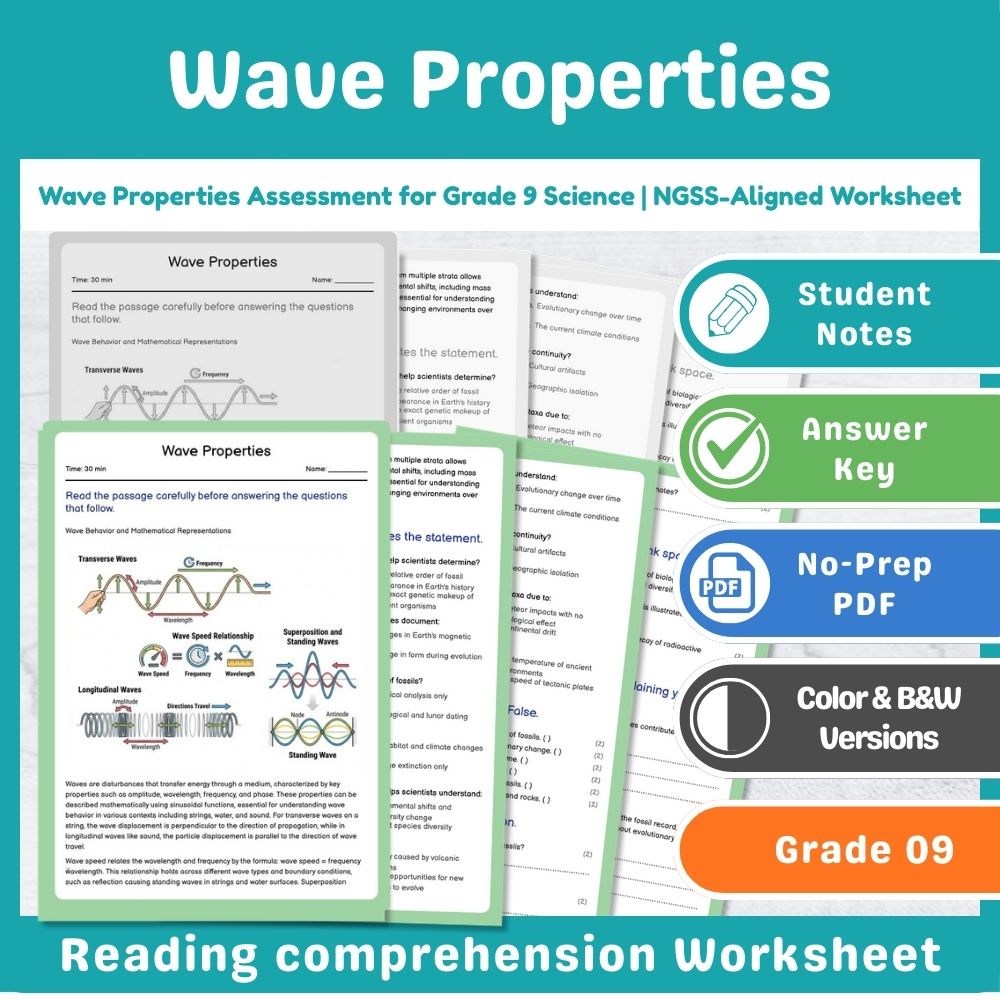
Wave Properties Assessment for Grade 9 Science | NGSS-Aligned Worksheet
Created byPrism Point LearningLearning Objectives
- Understand the mathematical representations of wave behavior including amplitude, frequency, wavelength, and phase.
- Apply the wave speed formula: wave speed = frequency × wavelength in practical scenarios.
- Describe how sinusoidal functions and superposition explain interference and standing waves.
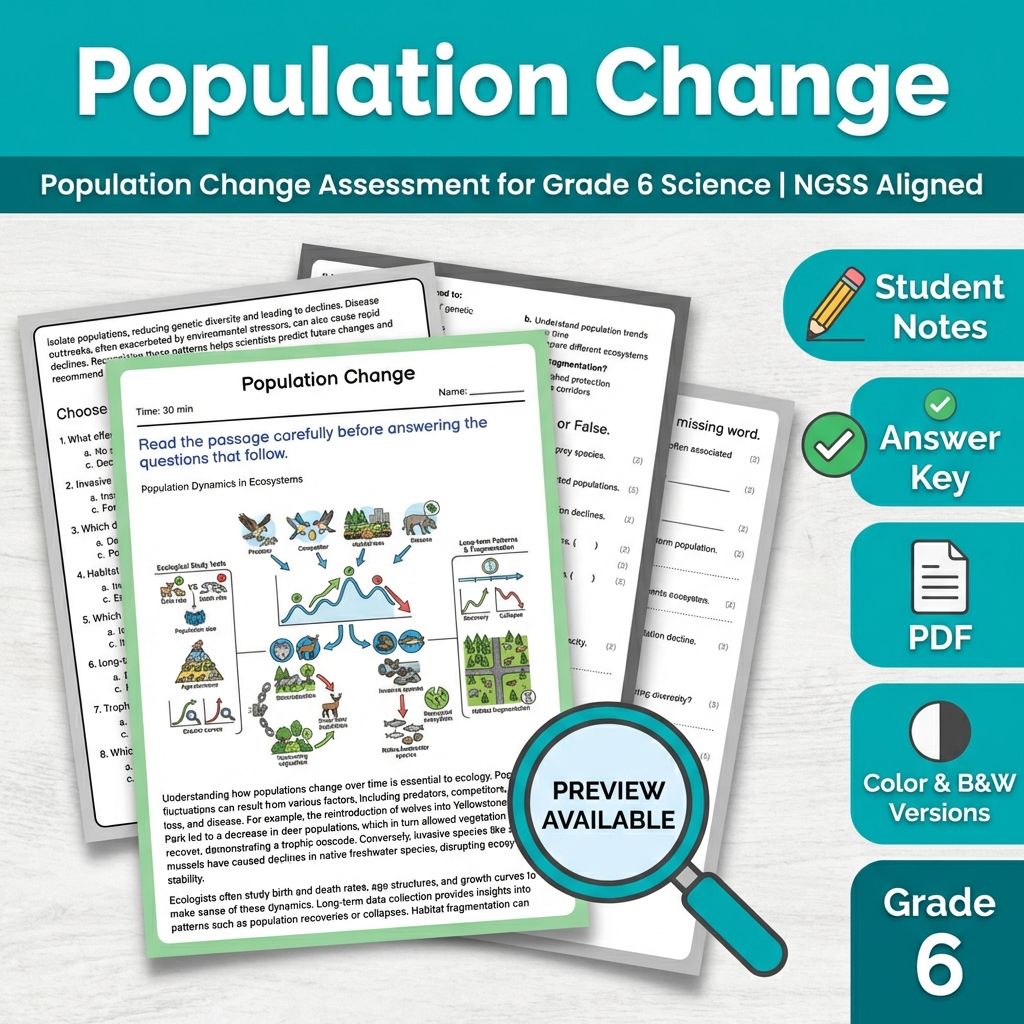
Population Change Assessment for Grade 6 Science | NGSS Aligned
Created byPrism Point LearningLearning Objectives
- Construct evidence-based arguments linking ecosystem alterations to population changes.
- Analyze case studies involving predator reintroduction, invasive species, habitat fragmentation, and disease outbreaks.
- Interpret empirical data sets and longitudinal observations to infer causal relationships in ecosystems.
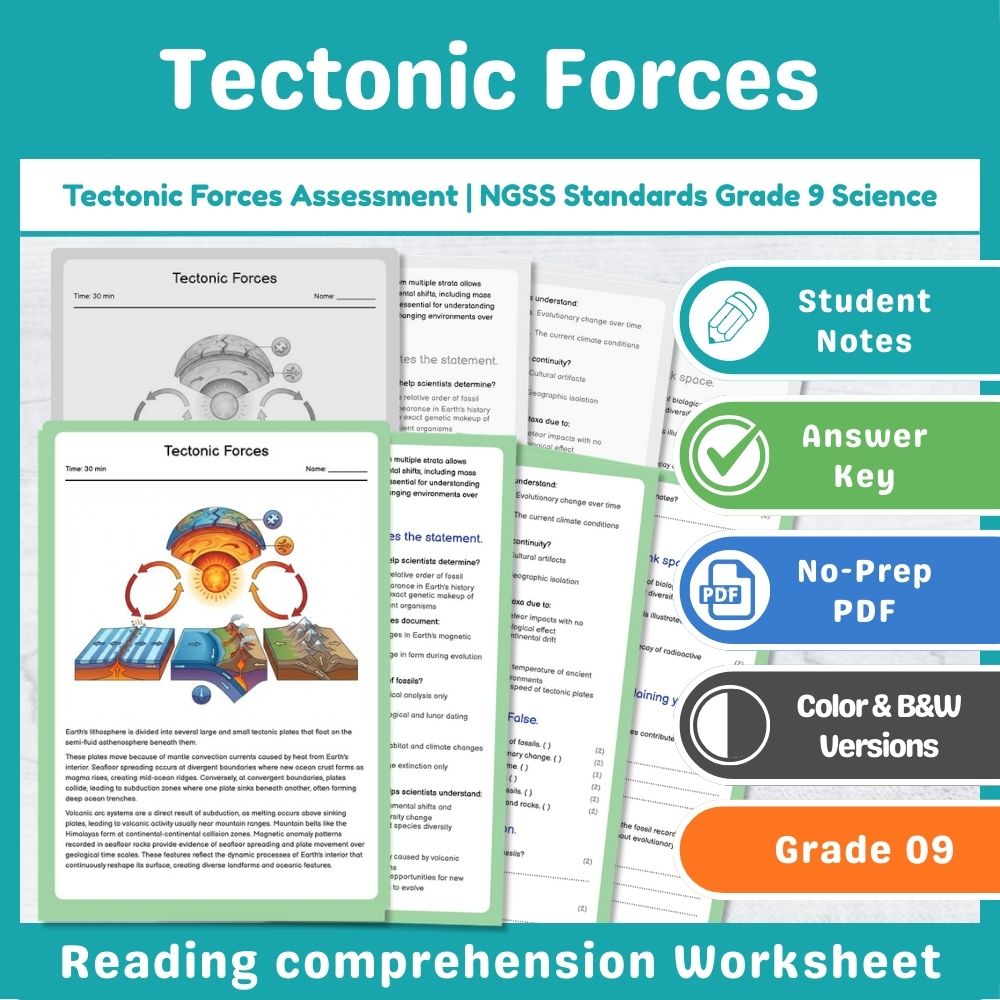
Tectonic Forces Assessment | NGSS Standards Grade 9 Science
Created byPrism Point LearningLearning Objectives
- Explain the processes of seafloor spreading, subduction zones, and volcanic arc systems.
- Connect mantle convection and faulting with surface features like mountain belts and bathymetry.
- Analyze geologic cross-sections and magnetic anomaly patterns as evidence for plate tectonics.
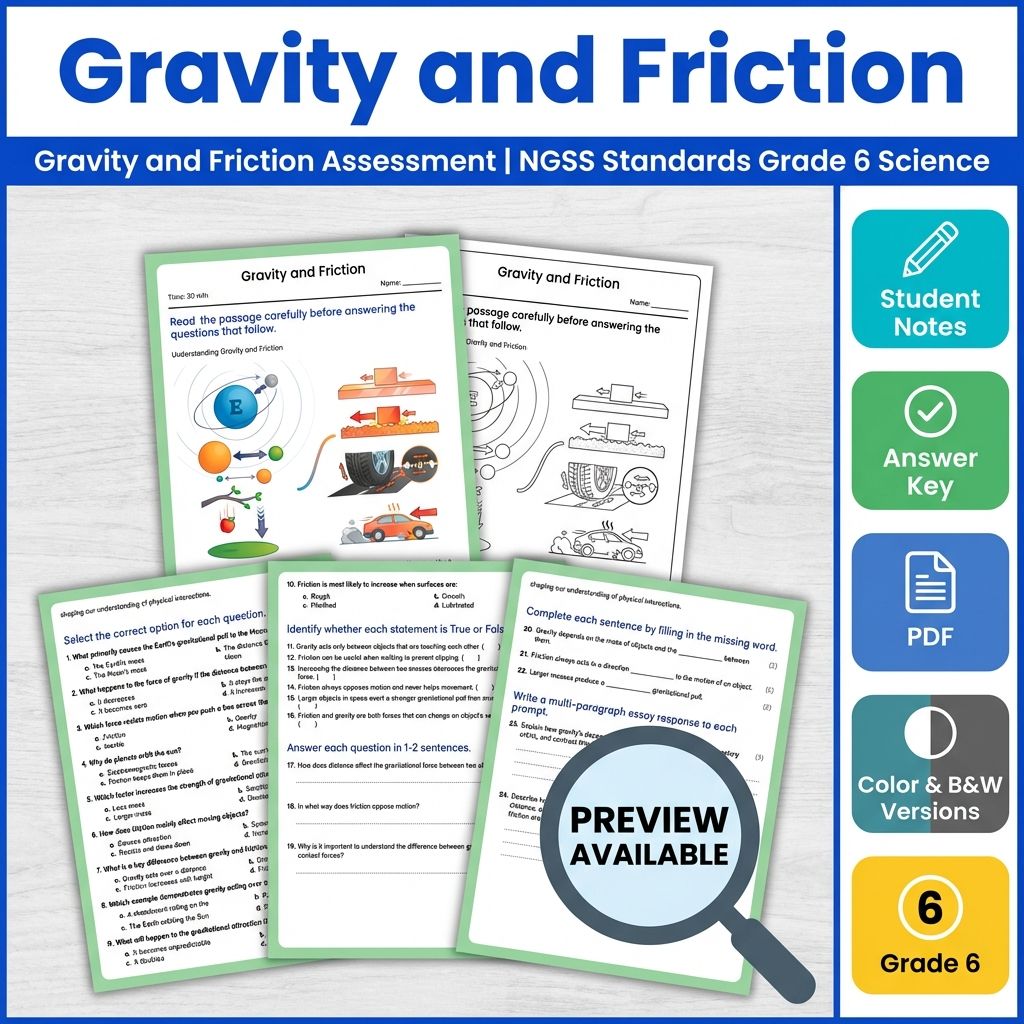
Gravity and Friction Assessment | NGSS Standards Grade 6 Science
Created byPrism Point LearningLearning Objectives
- Explain how gravity depends on mass and distance, using examples like Earth-Moon interactions and planetary orbits.
- Describe how contact forces like friction resist motion and differ from gravitational forces.
- Analyze quantitative patterns showing stronger attraction with larger masses and weaker attraction with increased distance.
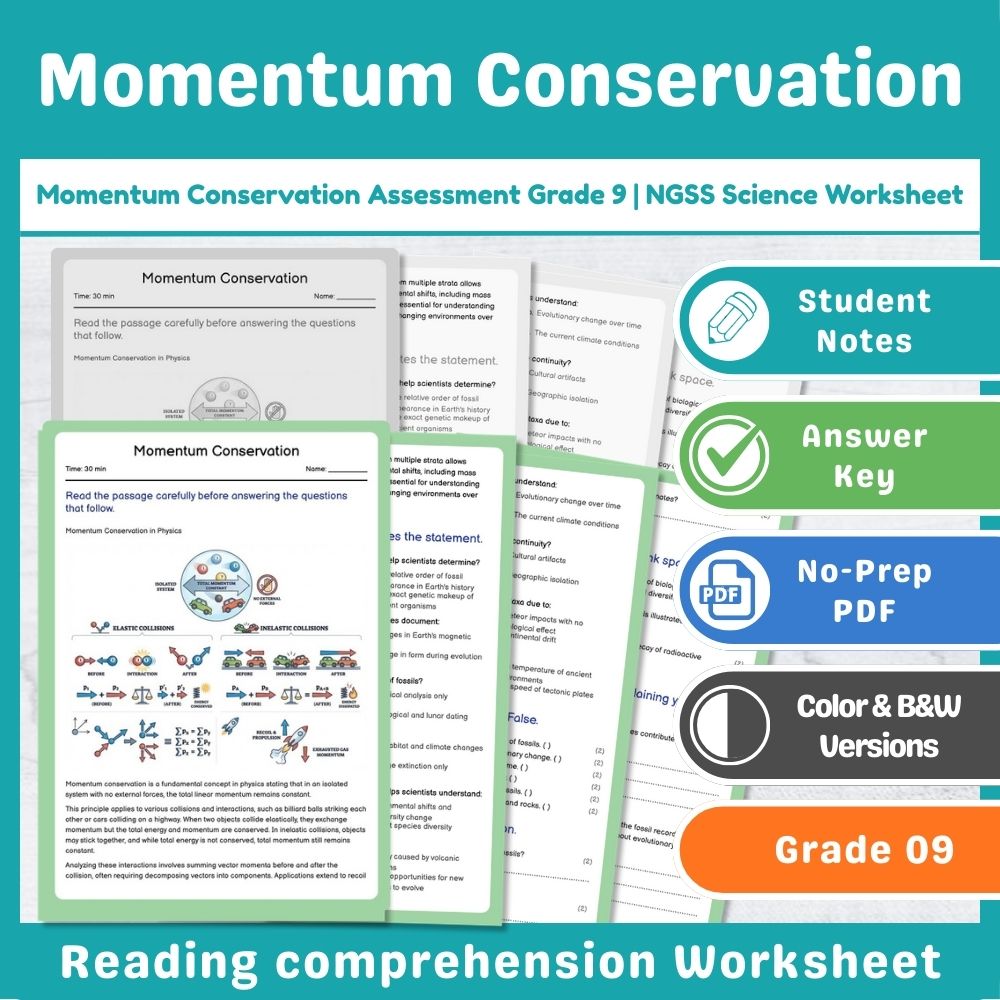
Momentum Conservation Assessment Grade 9 | NGSS Science Worksheet
Created byPrism Point LearningLearning Objectives
- Understand the principle of conservation of linear momentum in isolated systems.
- Differentiate between elastic and inelastic collisions using vector sums.
- Calculate total momentum before and after interactions in various scenarios.
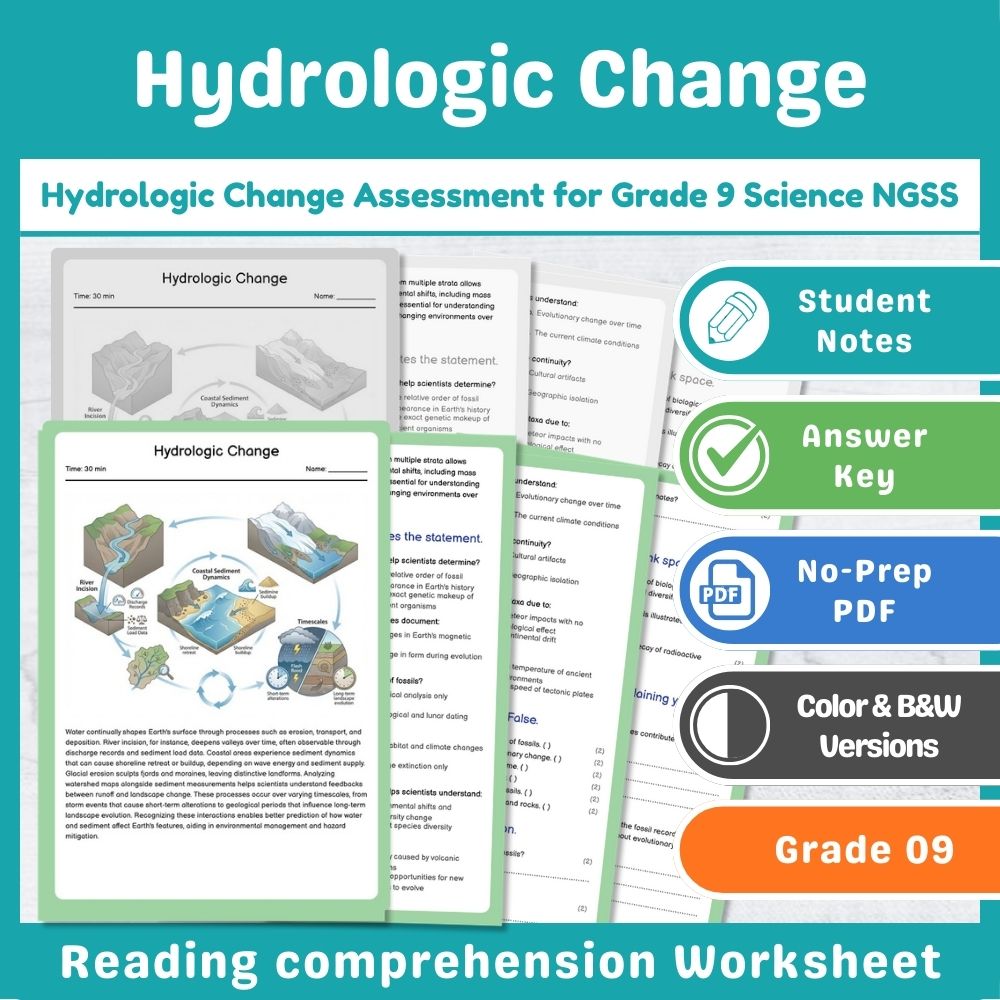
Hydrologic Change Assessment for Grade 9 Science NGSS
Created byPrism Point LearningLearning Objectives
- Analyze and interpret hydrologic data related to erosion, transport, and deposition.
- Identify how river incision, coastal sediment dynamics, and glacial erosion shape landscapes.
- Understand how discharge records, sediment load measurements, and watershed maps support hydrologic studies.

Protein Synthesis Assessment | TEKS Standards Grade 10 Science Worksheet
Created byPrism Point LearningLearning Objectives
- Describe the process of transcription and translation in protein synthesis.
- Identify the roles of DNA, RNA, ribosomes, and tRNA during protein synthesis.
- Explain the stages of transcription and translation, including initiation, elongation, and termination.
Browse more categories
About Science Worksheets
Find Science worksheets spanning core skills, practice, and review. All 42,685 resources are instant PDF downloads for the classroom or home.
Every worksheet on MyTeachingSheets is created by independent teacher-authors and reviewed before publication. All resources download as printable PDFs for classroom, homework, or at-home practice, and many include answer keys. Preview any worksheet free before buying.