
Science Worksheets
42,685 subject resources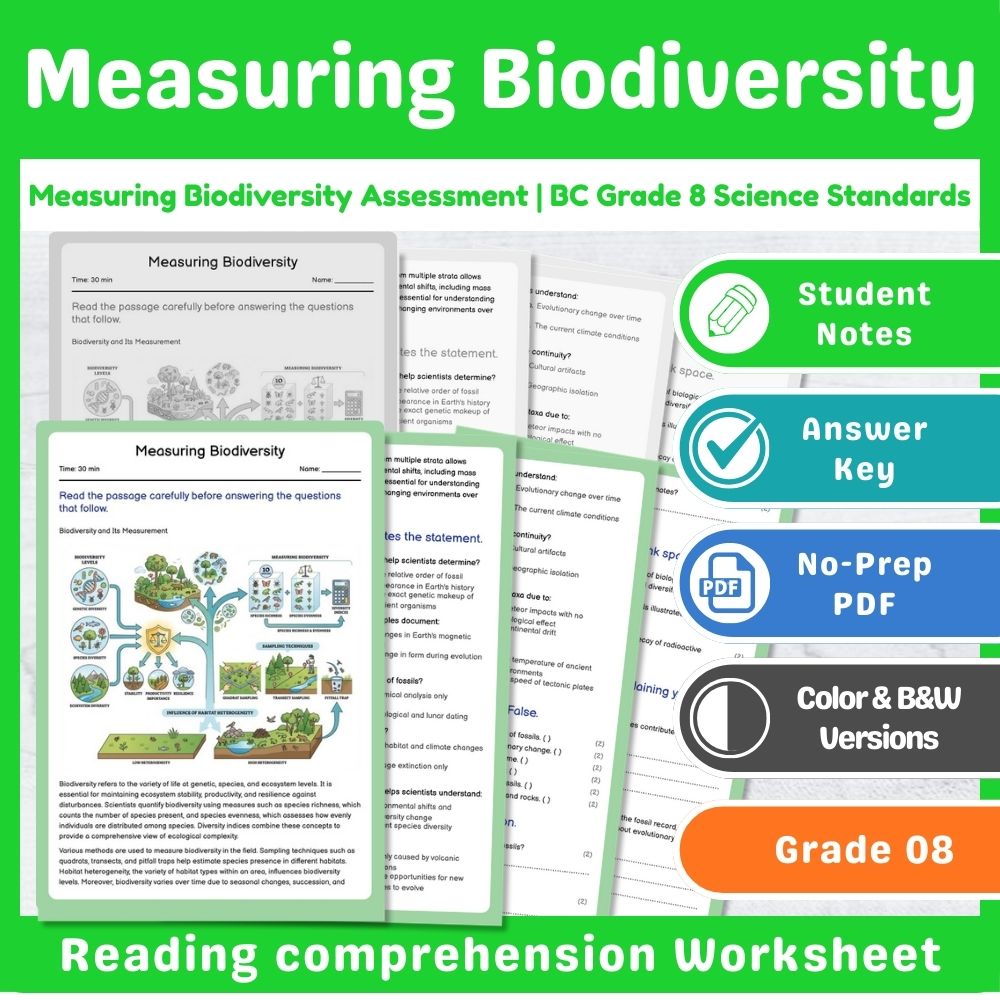
Measuring Biodiversity Assessment | BC Grade 8 Science Standards
 Created byPrism Point Learning
Learning Objectives
- Understand the concepts of biodiversity, species richness, evenness, and diversity indices.
- Identify methods used to measure biodiversity in different ecosystems.
- Analyze how sampling techniques, habitat heterogeneity, and temporal variation influence biodiversity measurements.
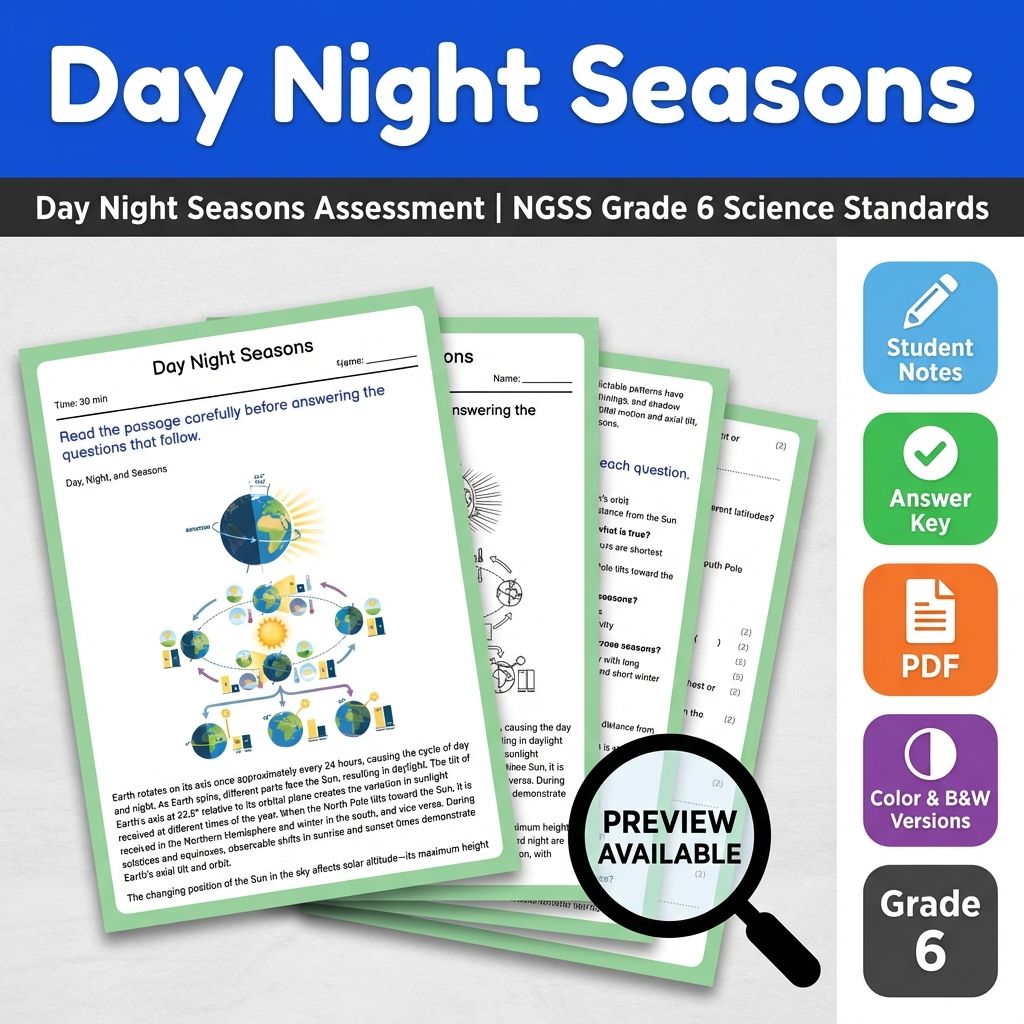
Day Night Seasons Assessment | NGSS Grade 6 Science Standards
Created byPrism Point LearningLearning Objectives
- Explain Earth's rotation and how it produces day and night.
- Describe Earth's orbit around the Sun and how axial tilt causes seasonal changes.
- Identify key observational markers such as solstices and equinoxes.
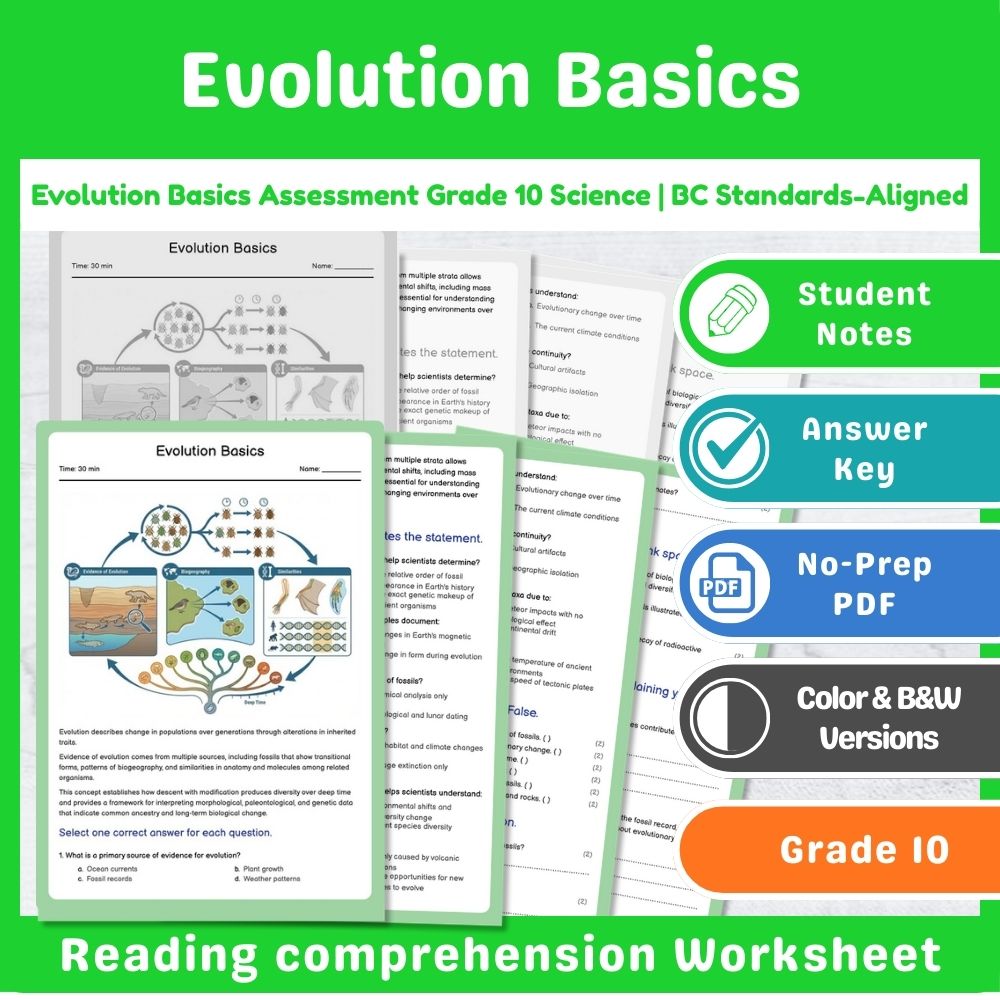
Evolution Basics Assessment Grade 10 Science | BC Standards-Aligned
Created byPrism Point LearningLearning Objectives
- Describe the concept of evolution and its importance in biological history.
- Identify sources of evidence that support the theory of evolution.
- Explain how morphological, paleontological, and genetic data demonstrate common ancestry.

Metabolic Regulation Assessment | TEKS Standards Grade 11 Science
Created byPrism Point LearningLearning Objectives
- Understand the mechanisms of enzyme regulation in metabolic pathways.
- Identify different types of enzyme modifications such as allosteric modulation and covalent changes.
- Explain how compartmentalization and membrane transport influence metabolic flux.
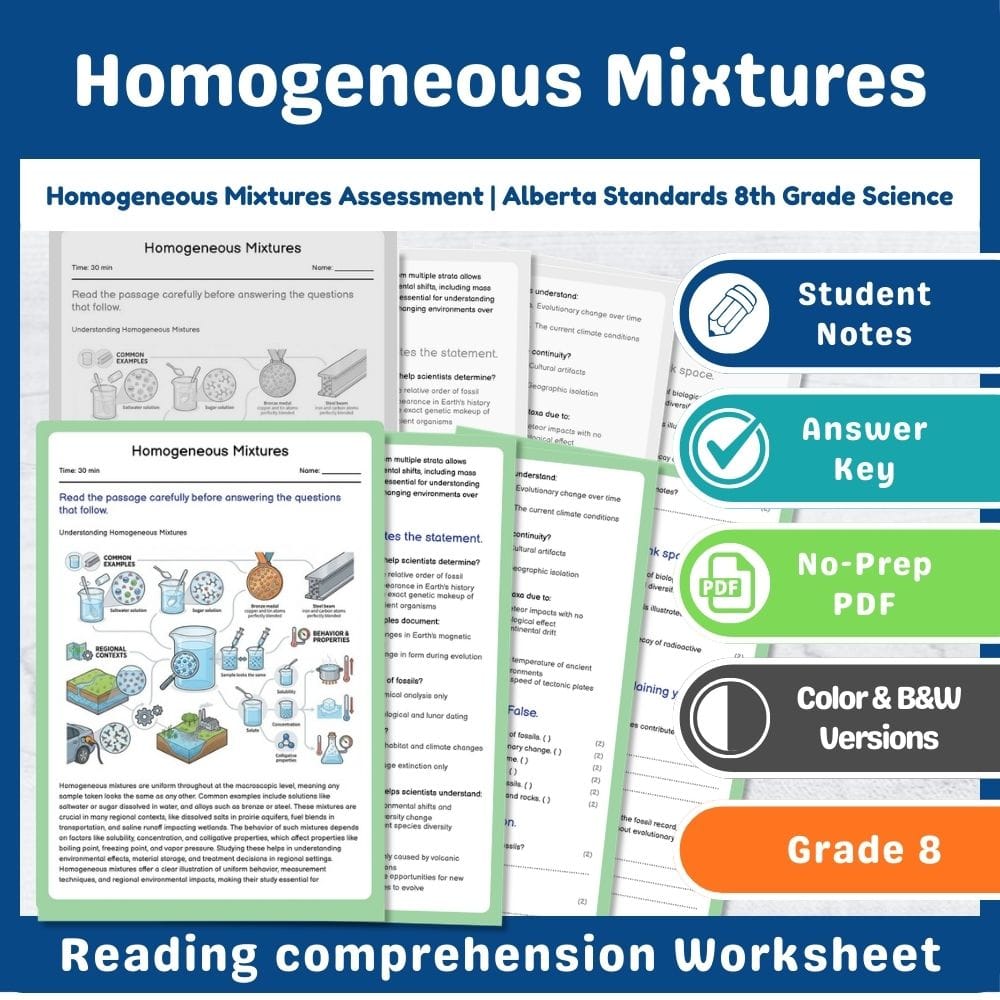
Homogeneous Mixtures Assessment | Alberta Standards 8th Grade Science
Created byPrism Point LearningLearning Objectives
- Understand the concept of homogeneous mixtures and their common examples.
- Identify factors influencing the behavior of solutions and alloys.
- Explain regional examples of uniform mixtures and their environmental impacts.
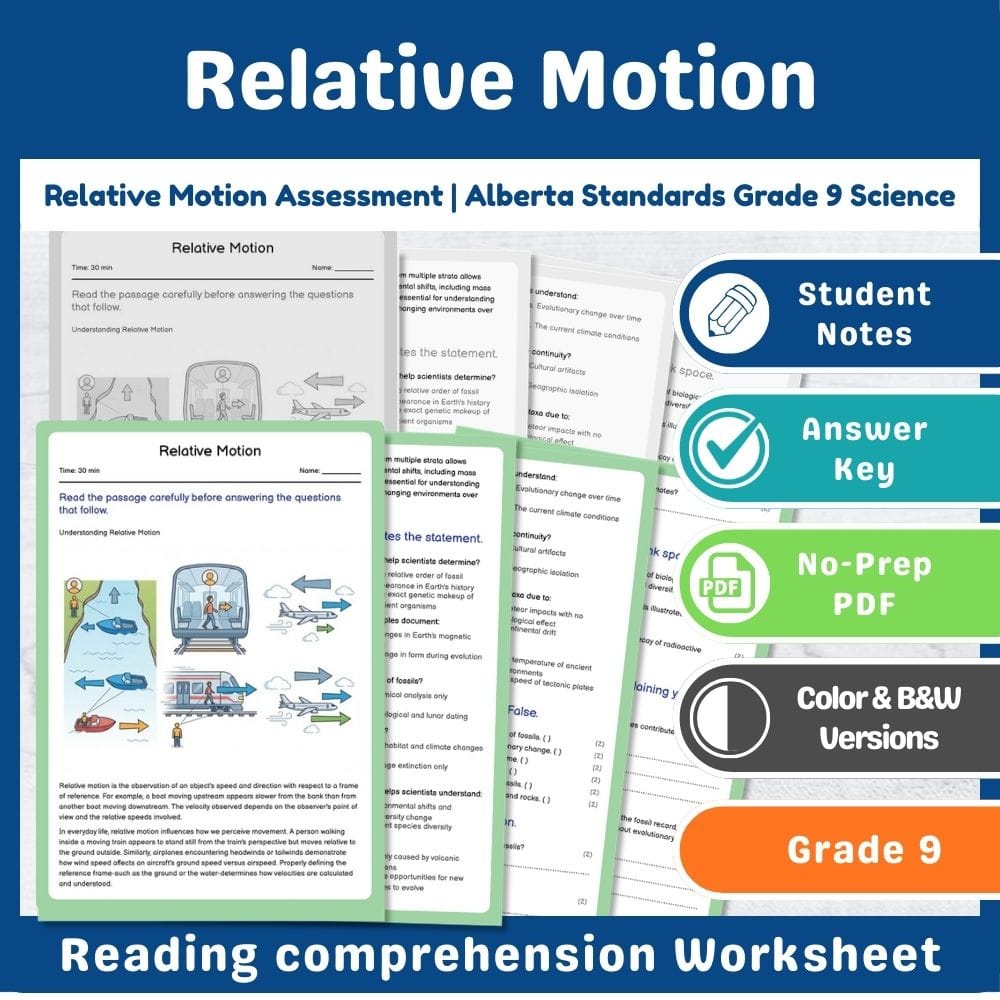
Relative Motion Assessment | Alberta Standards Grade 9 Science
Created byPrism Point LearningLearning Objectives
- Understand the concept of relative motion and how velocities combine in different reference frames.
- Describe how observed speed and direction depend on the observer's frame of reference.
- Apply vector addition principles to various motion scenarios involving boats, trucks, and aircraft.
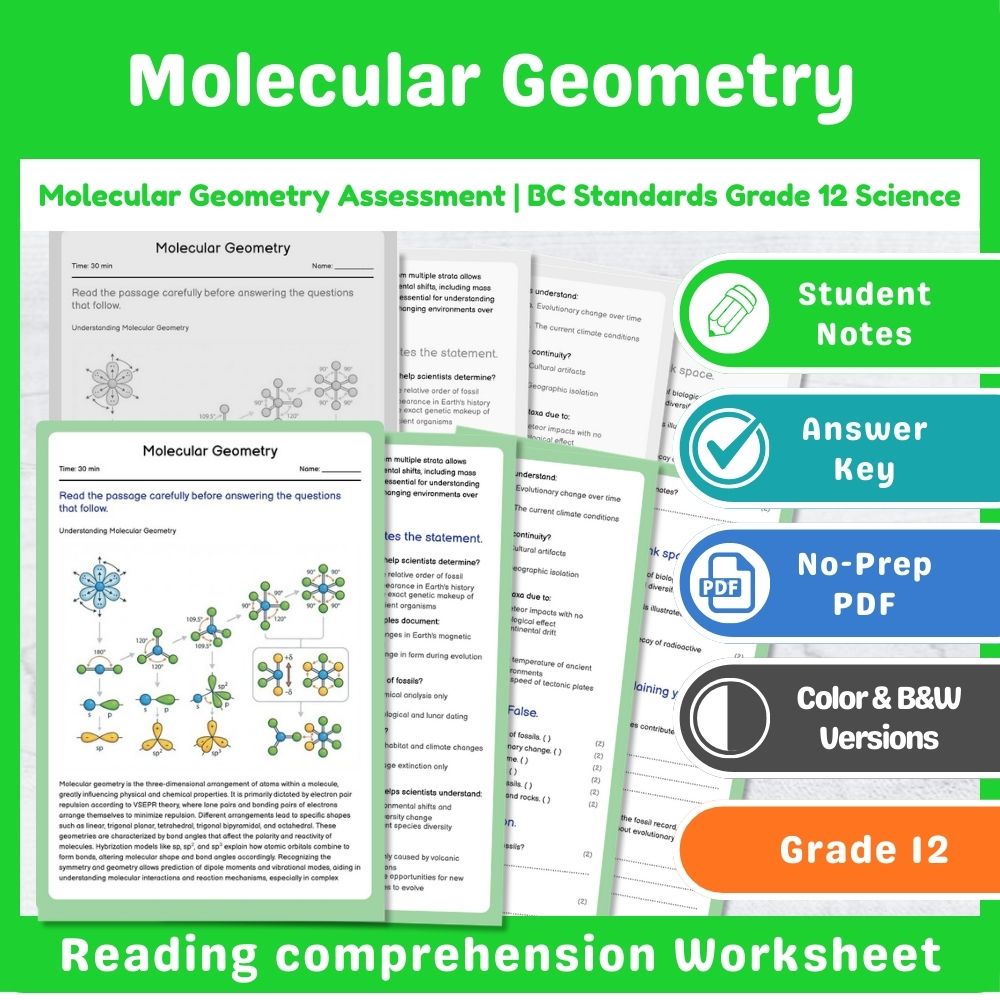
Molecular Geometry Assessment | BC Standards Grade 12 Science
Created byPrism Point LearningLearning Objectives
- Explain the principles of VSEPR theory and how electron pair repulsion determines molecular shape.
- Identify and describe various molecular geometries and their bond angles.
- Predict molecule polarity based on geometry and symmetry considerations.
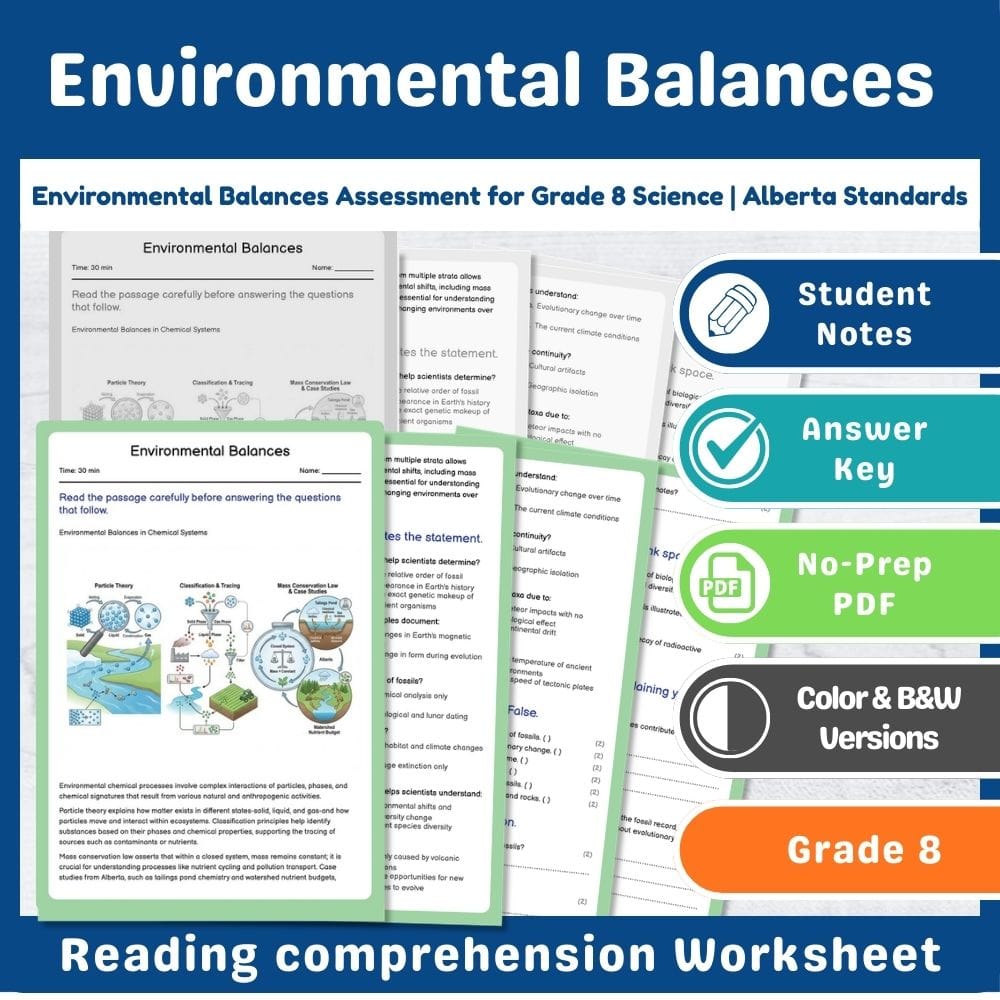
Environmental Balances Assessment for Grade 8 Science | Alberta Standards
Created byPrism Point LearningLearning Objectives
- Understand how particle theory and classification principles help interpret environmental chemical processes.
- Explain the concepts of nutrient cycling, contamination transport, and mass conservation within ecosystems.
- Apply knowledge of phases, mixtures, and chemical signatures to trace sources and sinks in environmental systems.
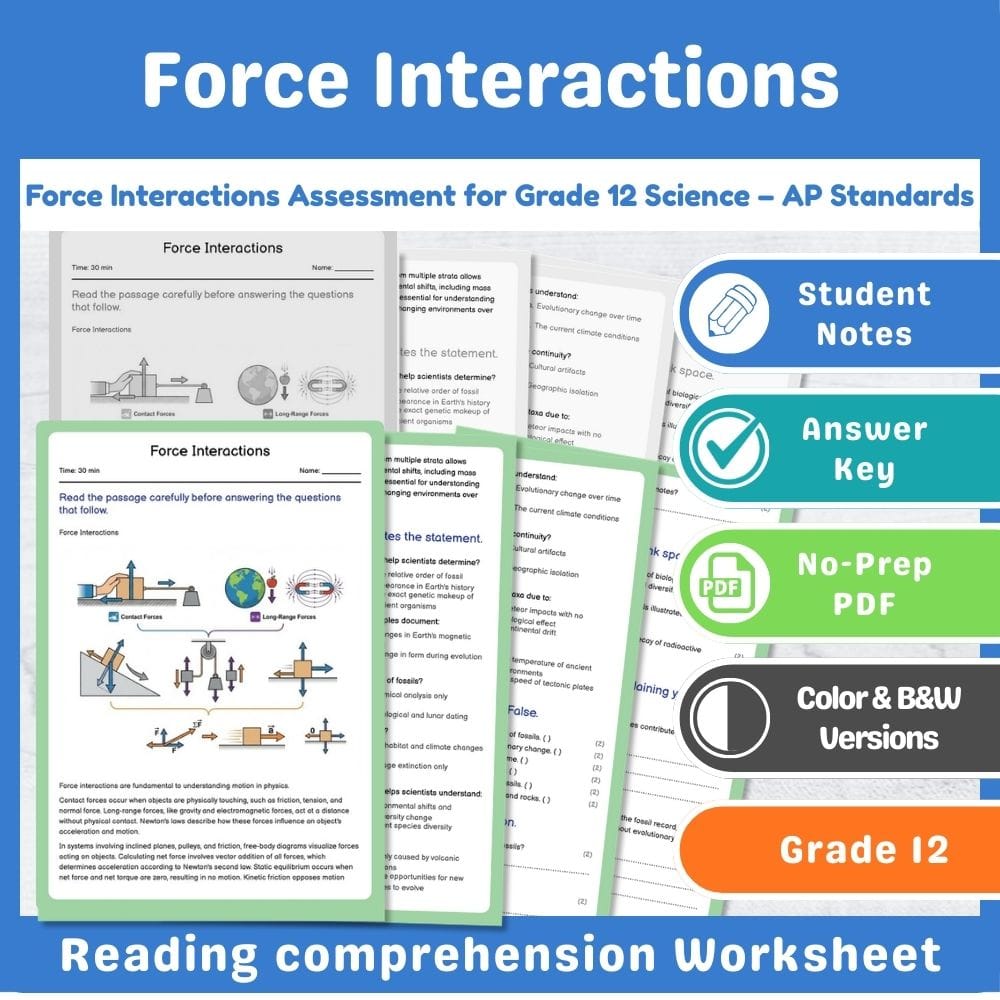
Force Interactions Assessment for Grade 12 Science – AP Standards
Created byPrism Point LearningLearning Objectives
- Describe contact and long-range force interactions and their laws.
- Analyze free-body diagrams and apply Newton's laws to various systems.
- Calculate net forces and accelerations on objects in equilibrium and non-equilibrium.
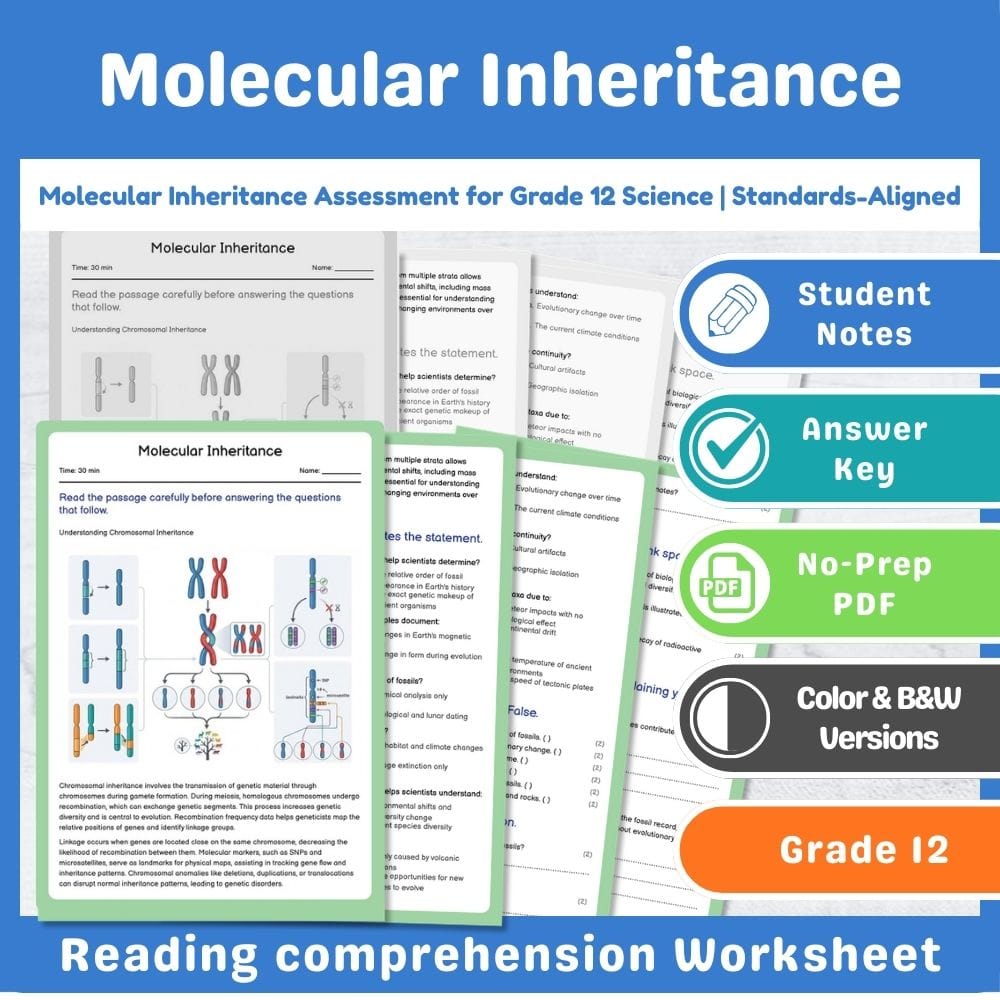
Molecular Inheritance Assessment for Grade 12 Science | Standards-Aligned
Created byPrism Point LearningLearning Objectives
- Understand chromosomal behavior and mechanisms of inheritance.
- Explain the concepts of recombination, linkage, and molecular markers.
- Differentiate between single-gene effects and polygenic influences on inheritance patterns.
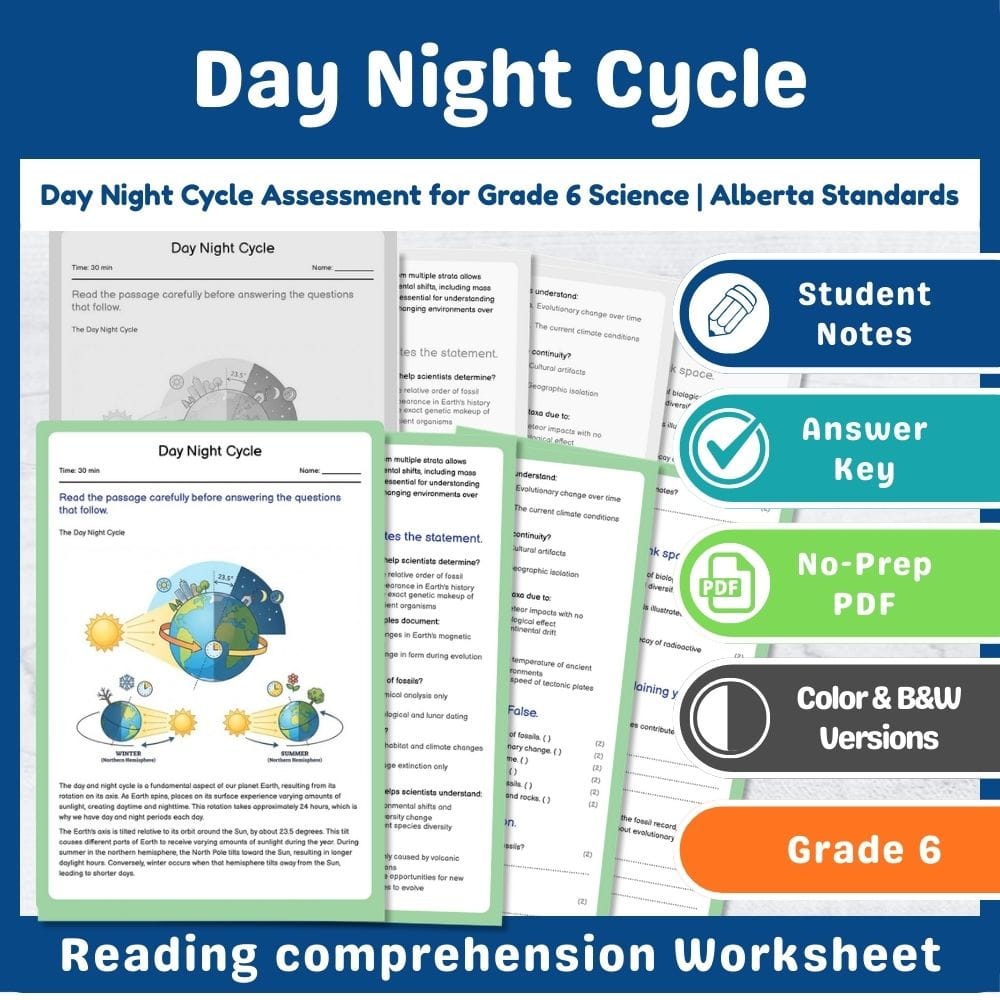
Day Night Cycle Assessment for Grade 6 Science | Alberta Standards
Created byPrism Point LearningLearning Objectives
- Explain how Earth's rotation causes day and night.
- Describe the effect of Earth's axial tilt on daylight duration throughout the year.
- Relate observed day length patterns in Alberta to Earth's position and movement around the Sun.
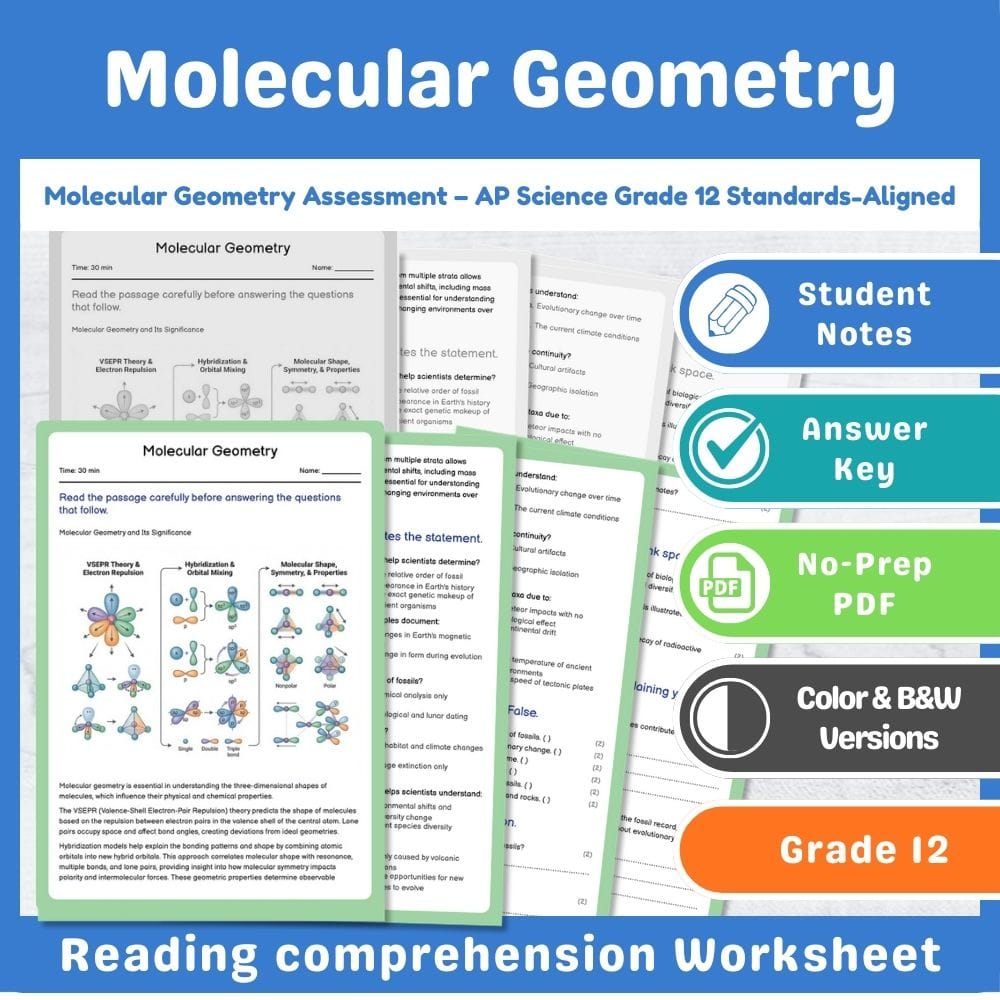
Molecular Geometry Assessment – AP Science Grade 12 Standards-Aligned
Created byPrism Point LearningLearning Objectives
- Explain the VSEPR model to predict molecular shapes and Bond angles.
- Describe the effects of lone pairs, multiple bonds, and resonance on molecular geometry.
- Relate molecular geometry to polarity, symmetry, and observable properties such as dipole moments.
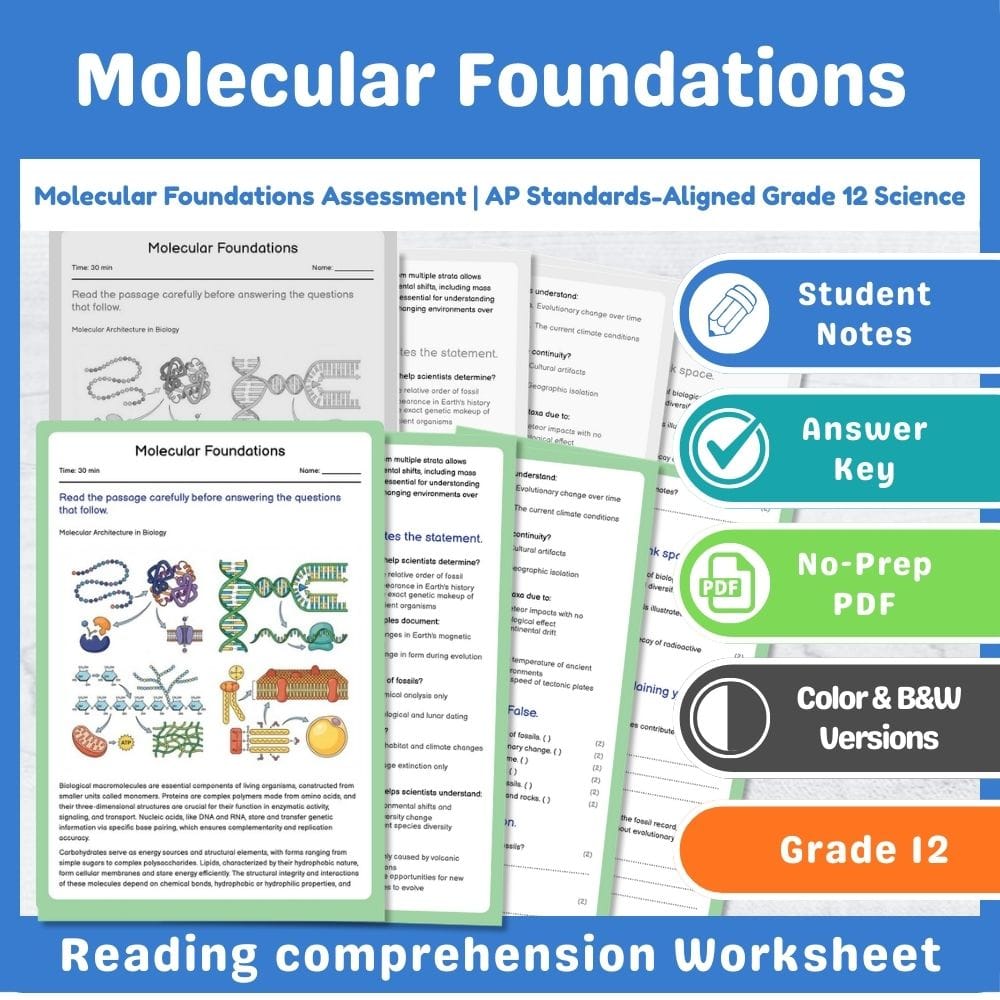
Molecular Foundations Assessment | AP Standards-Aligned Grade 12 Science
Created byPrism Point LearningLearning Objectives
- Explain the relationship between molecular structure and function in biological macromolecules.
- Identify key types of macromolecules and their roles in cellular processes.
- Analyze how molecular interactions and bonds influence stability and specificity.
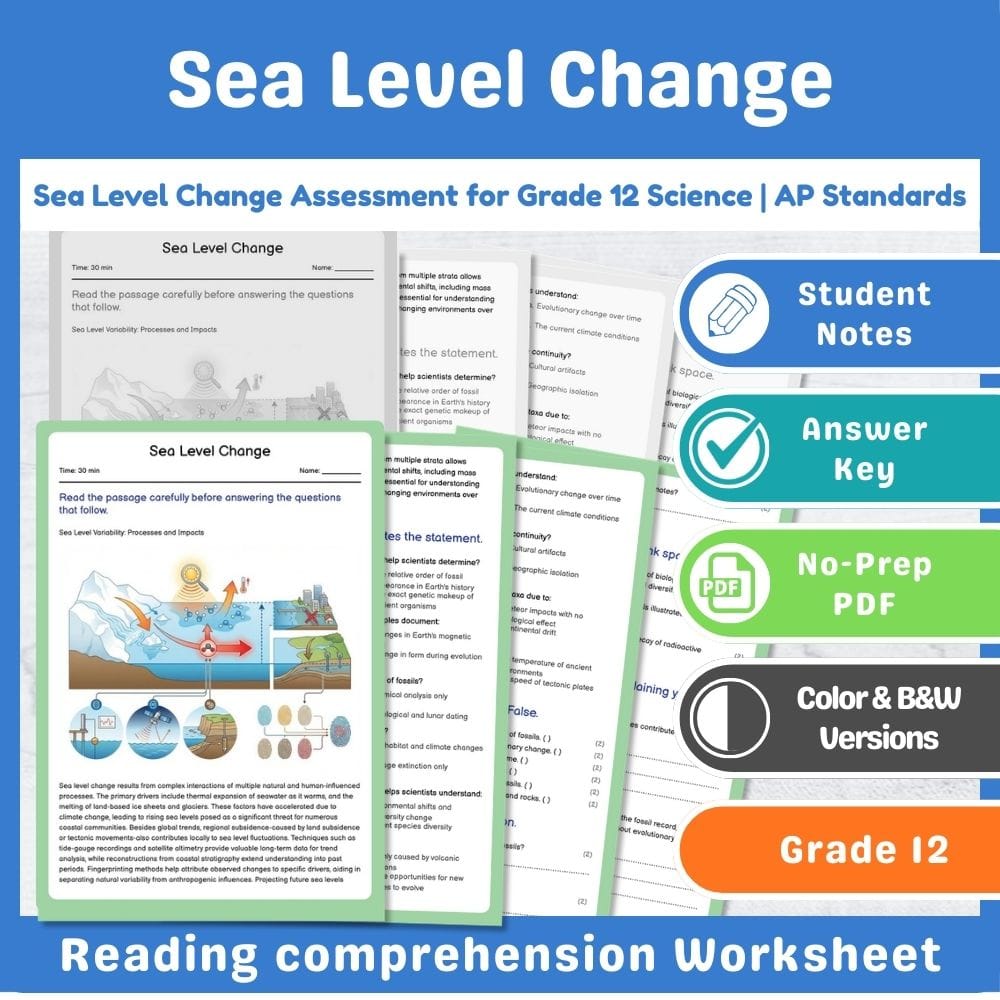
Sea Level Change Assessment for Grade 12 Science | AP Standards
Created byPrism Point LearningLearning Objectives
- Understand the key drivers that influence sea level variability, including thermal expansion, land-ice melt, and glacio-isostatic adjustment.
- Interpret data from tide gauges and satellite altimetry records to analyze sea level trends.
- Explain how human activities and regional factors affect sea level changes and coastal systems.
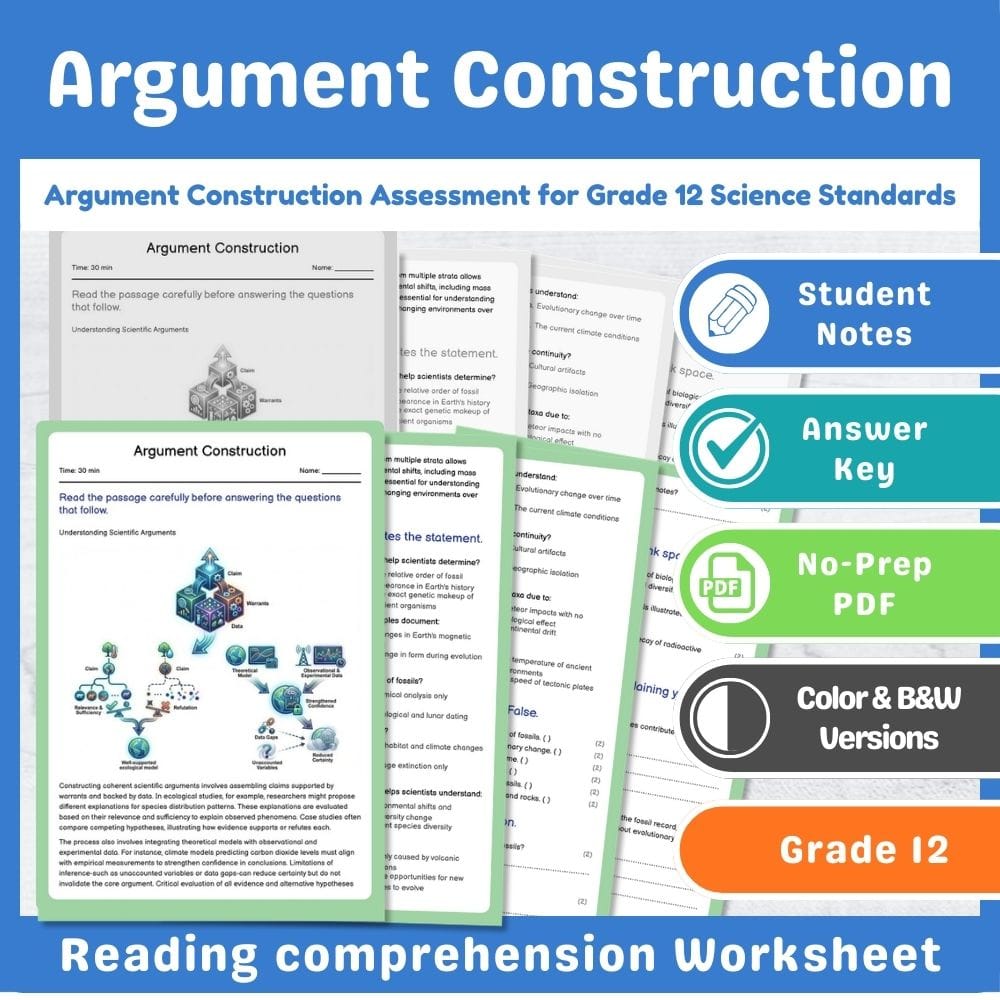
Argument Construction Assessment for Grade 12 Science Standards
Created byPrism Point LearningLearning Objectives
- Understand how to construct evidence-based arguments in scientific contexts.
- Identify components such as claims, warrants, and backing in case studies.
- Evaluate relevance, sufficiency, and alternative hypotheses in argumentation.
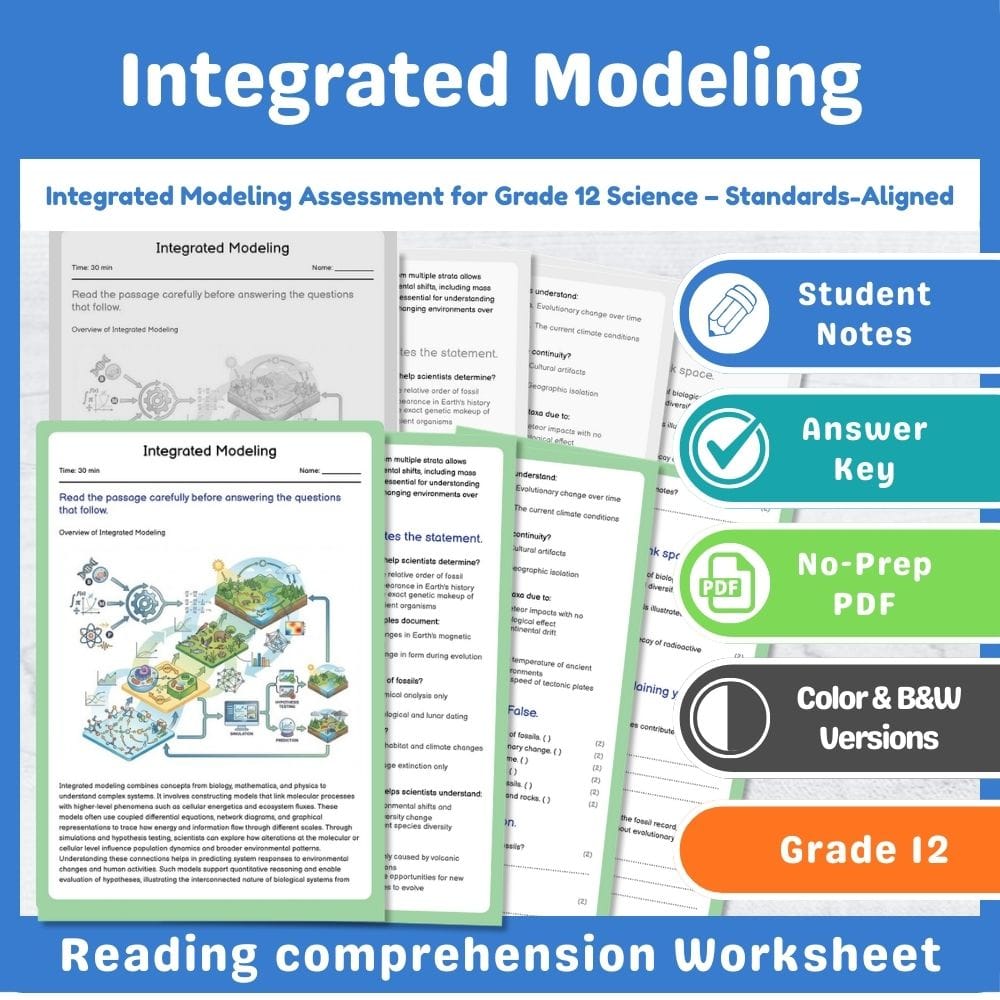
Integrated Modeling Assessment for Grade 12 Science – Standards-Aligned
Created byPrism Point LearningLearning Objectives
- Understand how molecular processes influence cellular energetics and genetic regulation.
- Describe the use of mathematical models such as differential equations and network diagrams in biological systems.
- Explain how changes at one biological level propagate to others within ecosystems.
The Apparent Sun Path Grade 6 Science Assessment | Alberta Standards
Created byPrism Point LearningLearning Objectives
- Understand how the Sun's apparent path varies with seasons and latitude.
- Describe how solar elevation at noon affects day length and intensity.
- Compare the Sun's apparent motion in different geographic locations, like Calgary and northern communities.
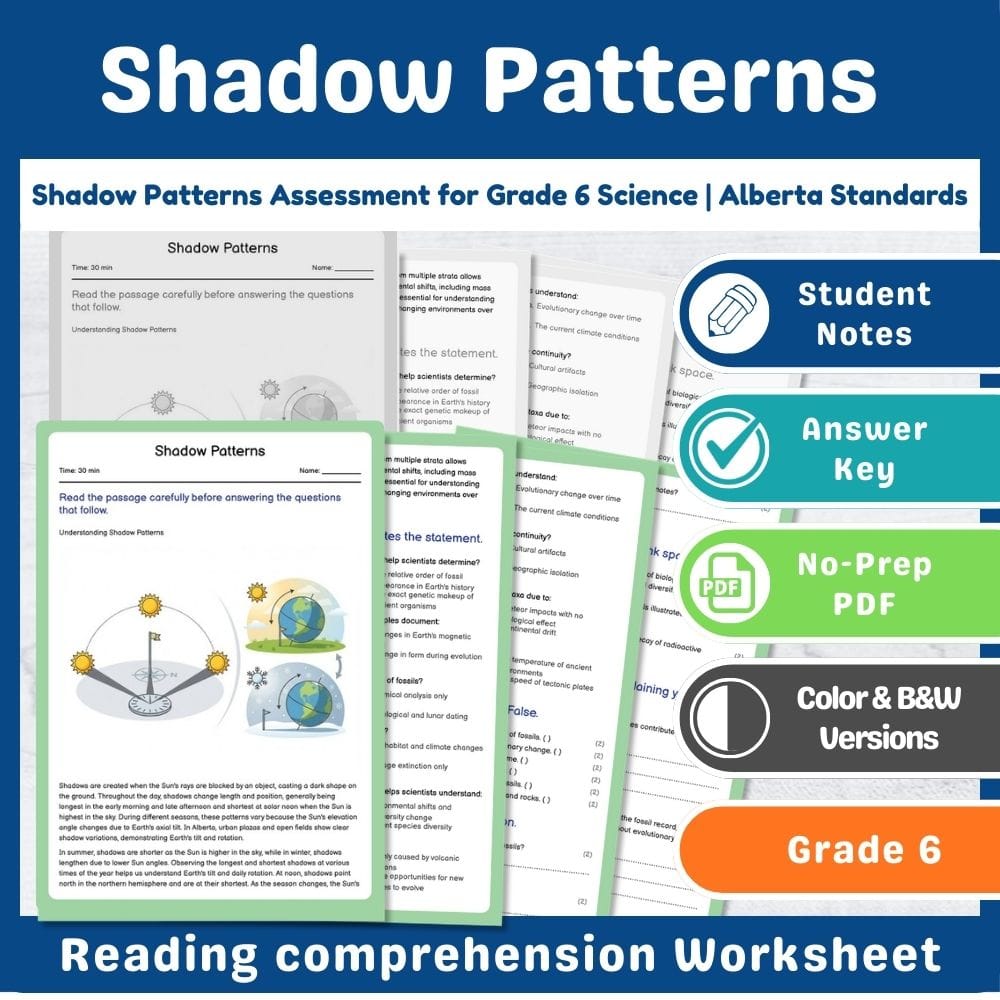
Shadow Patterns Assessment for Grade 6 Science | Alberta Standards
Created byPrism Point LearningLearning Objectives
- Describe how daily and seasonal changes in Sun angle affect shadow length and direction.
- Identify different shadow patterns such as noon shadows, longest shadows, and shortest shadows.
- Explain how Earth's motion and axial tilt influence shadow characteristics across seasons.
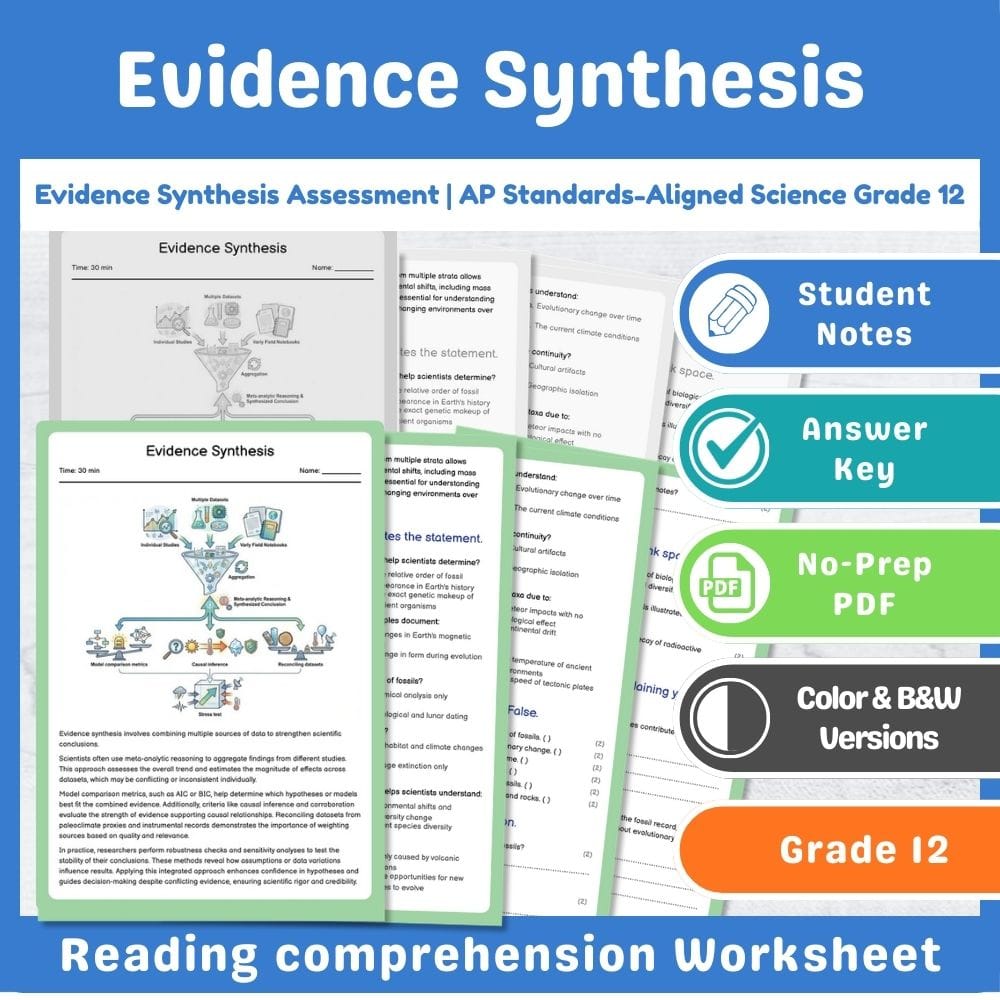
Evidence Synthesis Assessment | AP Standards-Aligned Science Grade 12
Created byPrism Point LearningLearning Objectives
- Understand methods for integrating multiple lines of evidence in scientific research.
- Analyze contrasting datasets and assess their compatibility using model comparison metrics.
- Evaluate how combined evidence influences confidence in hypotheses and conclusions.
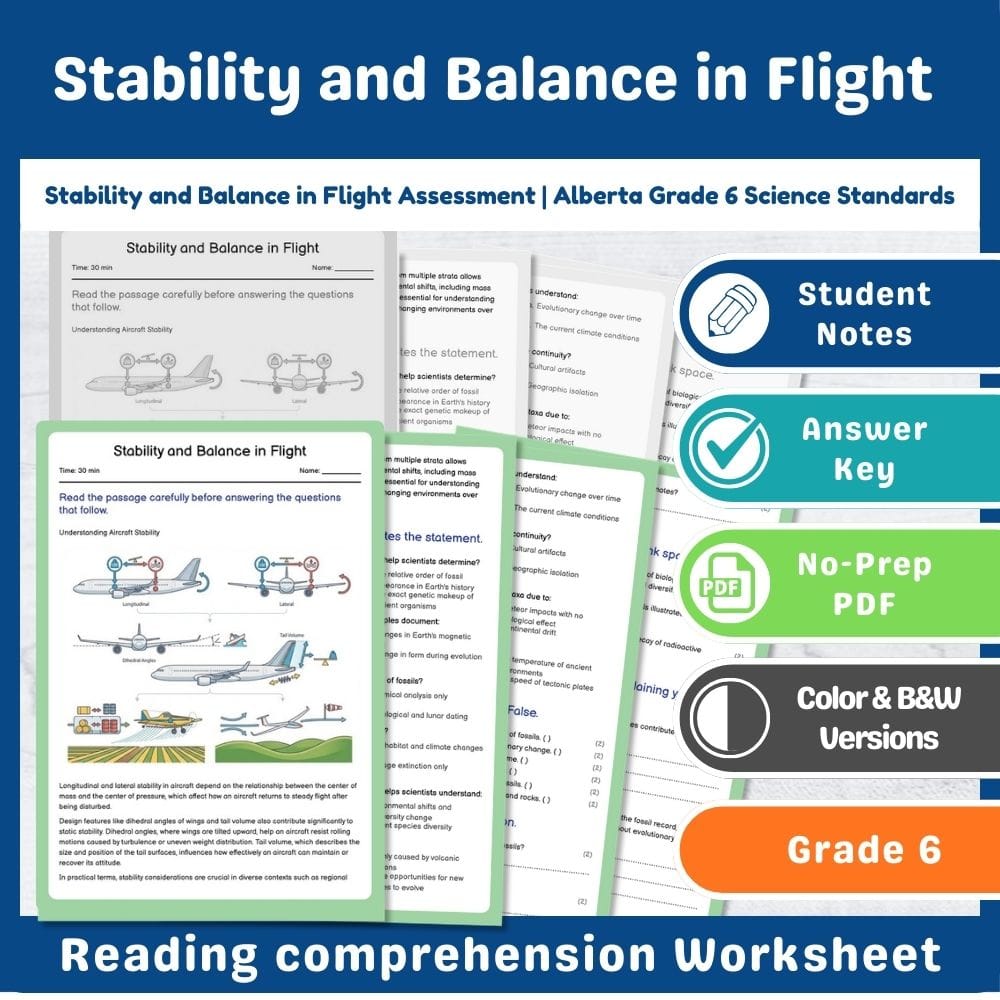
Stability and Balance in Flight Assessment | Alberta Grade 6 Science Standards
Created byPrism Point LearningLearning Objectives
- Understand how center of mass and center of pressure affect aircraft stability.
- Explain how design features like dihedral angles and tail volume influence static stability.
- Describe how balance impacts aircraft behavior under different payloads and wind conditions.
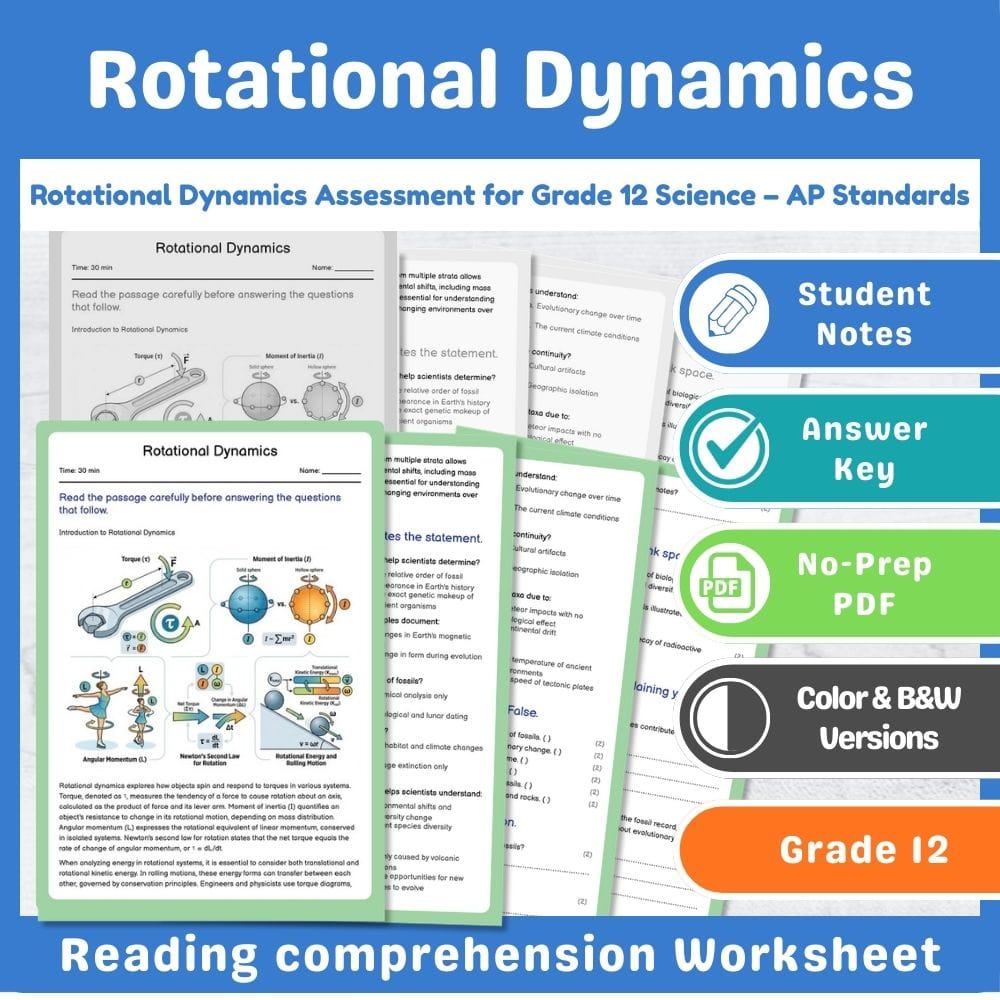
Rotational Dynamics Assessment for Grade 12 Science – AP Standards
Created byPrism Point LearningLearning Objectives
- Understand the concept of torque and how it relates to rotational motion.
- Define and explain the significance of moment of inertia and angular momentum in rigid bodies.
- Develop and apply equations linking net torque to angular acceleration.
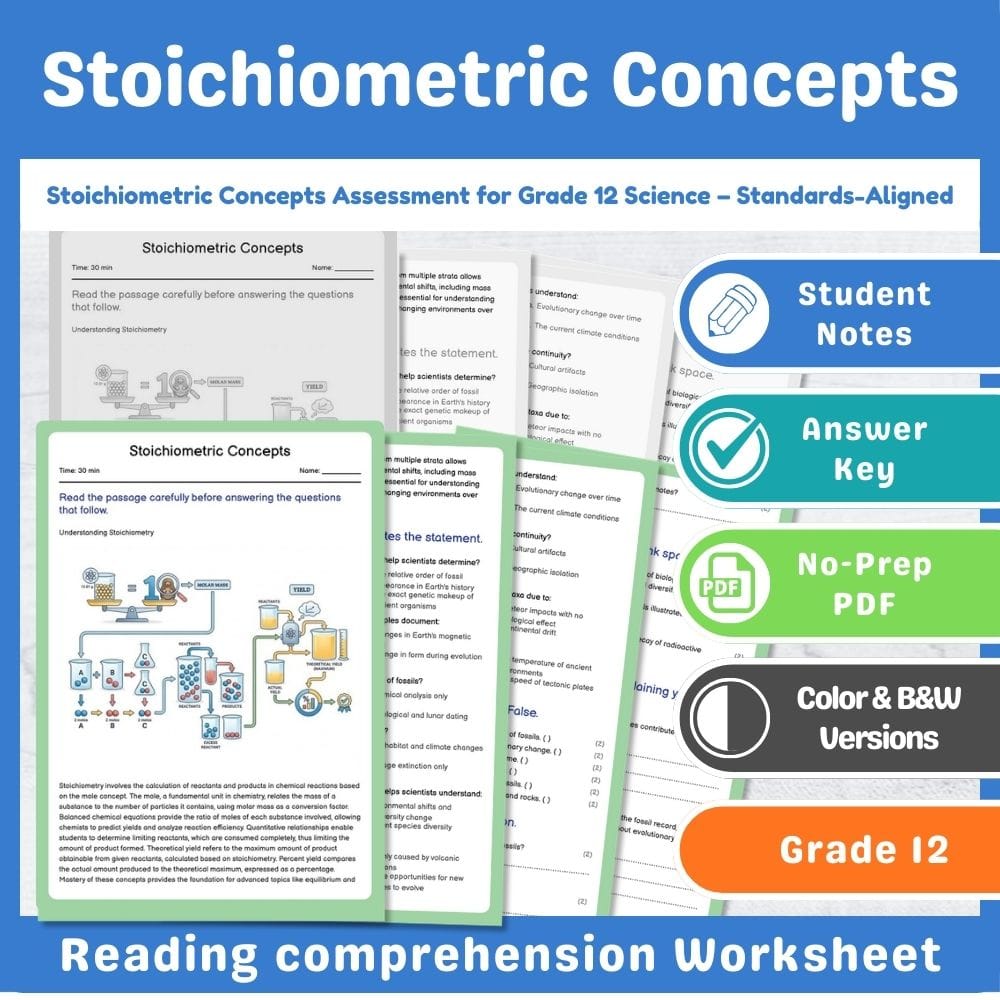
Stoichiometric Concepts Assessment for Grade 12 Science – Standards-Aligned
Created byPrism Point LearningLearning Objectives
- Define and understand the mole concept, molar mass, and balanced chemical equations.
- Calculate limiting reactants, theoretical yield, and percent yield from experimental data.
- Relate mass, particle counts, and molar relationships using symbolic and arithmetic methods.
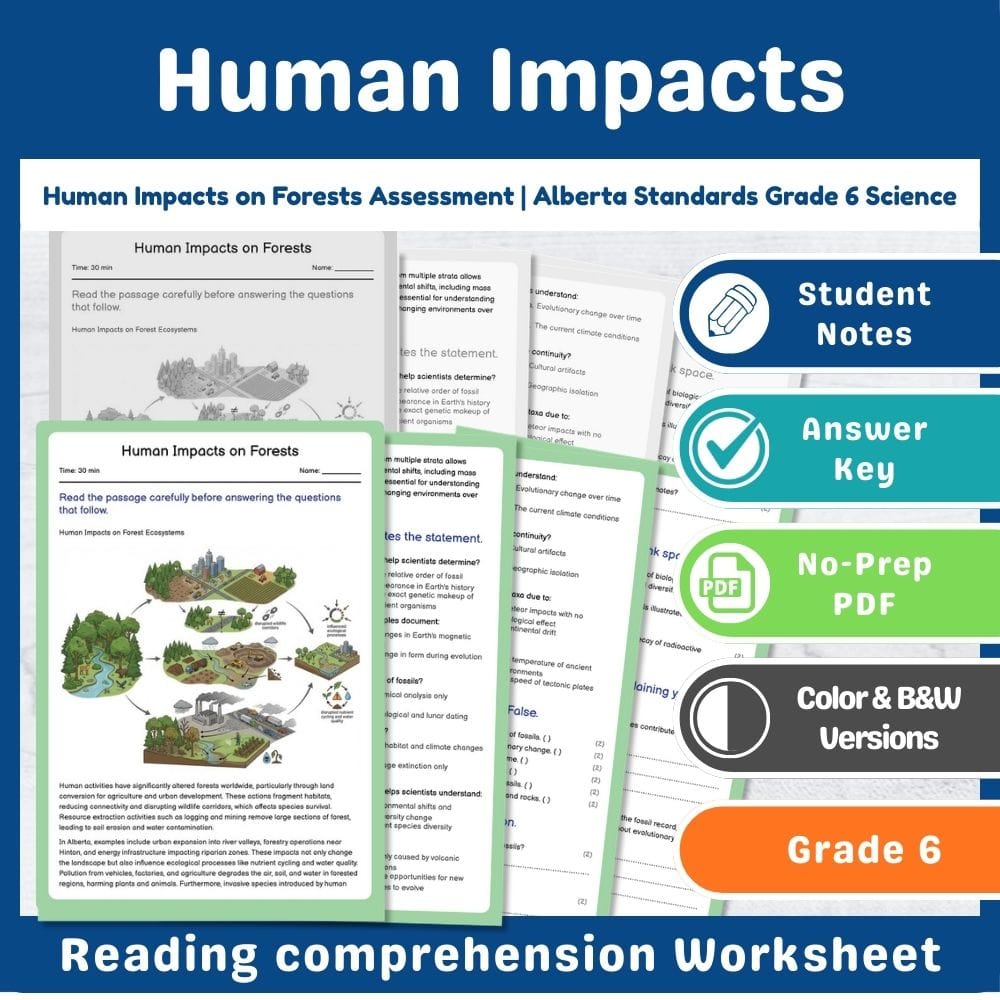
Human Impacts on Forests Assessment | Alberta Standards Grade 6 Science
Created byPrism Point LearningLearning Objectives
- Understand various human activities that impact forest ecosystems.
- Identify how urban expansion, resource extraction, and pollution affect forests.
- Evaluate the cumulative environmental effects caused by human impacts.

Plant Matter Inputs Assessment | California Standards Grade 6 Science
Created byPrism Point LearningLearning Objectives
- Explain how carbon dioxide, water, and gases from the atmosphere provide raw materials for plant growth
- Describe how roots, leaves, and plant cells use environmental inputs to build biomass
- Use evidence from text to answer questions about matter entering and leaving plant systems
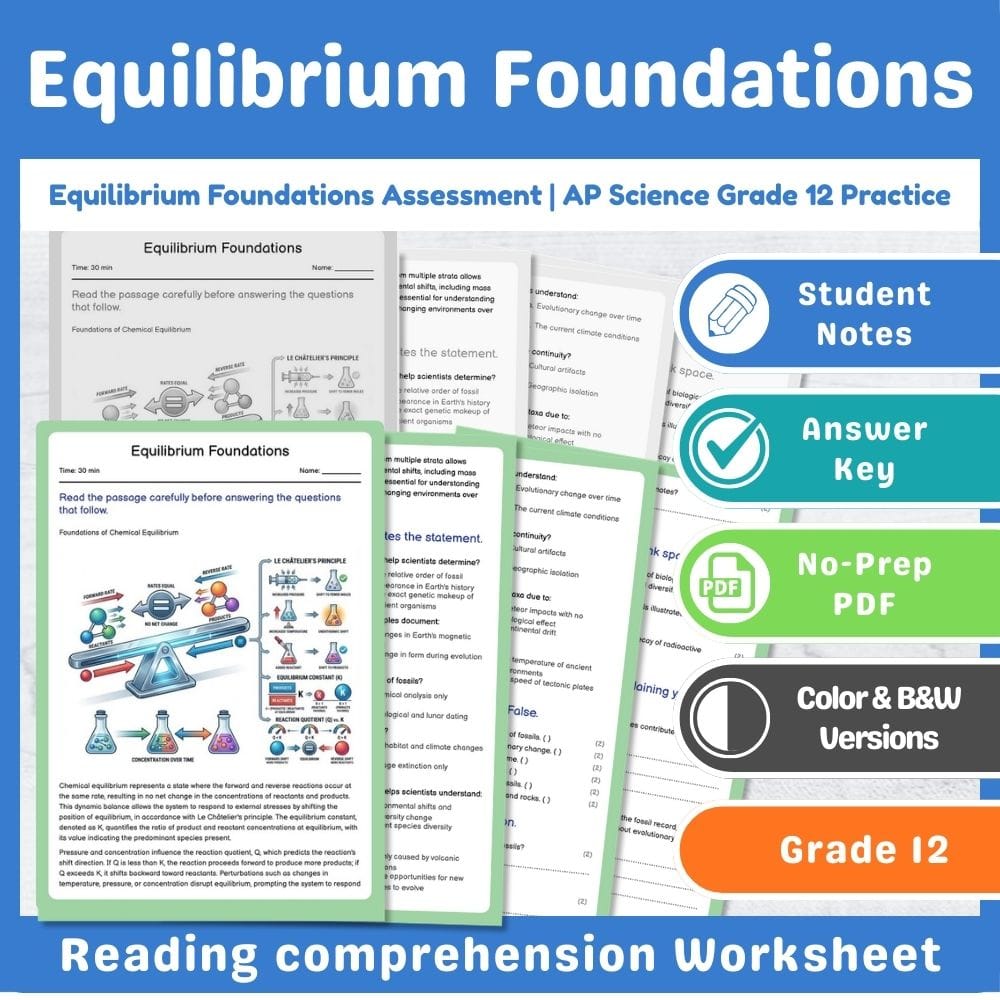
Equilibrium Foundations Assessment | AP Science Grade 12 Practice
Created byPrism Point LearningLearning Objectives
- Explain the concept of chemical equilibrium as a dynamic balance between forward and reverse reactions.
- Define and interpret the equilibrium constant (K) as a quantitative measure of reaction position.
- Relate concentration- and pressure-based expressions to reaction directionality and predict system responses to perturbations.
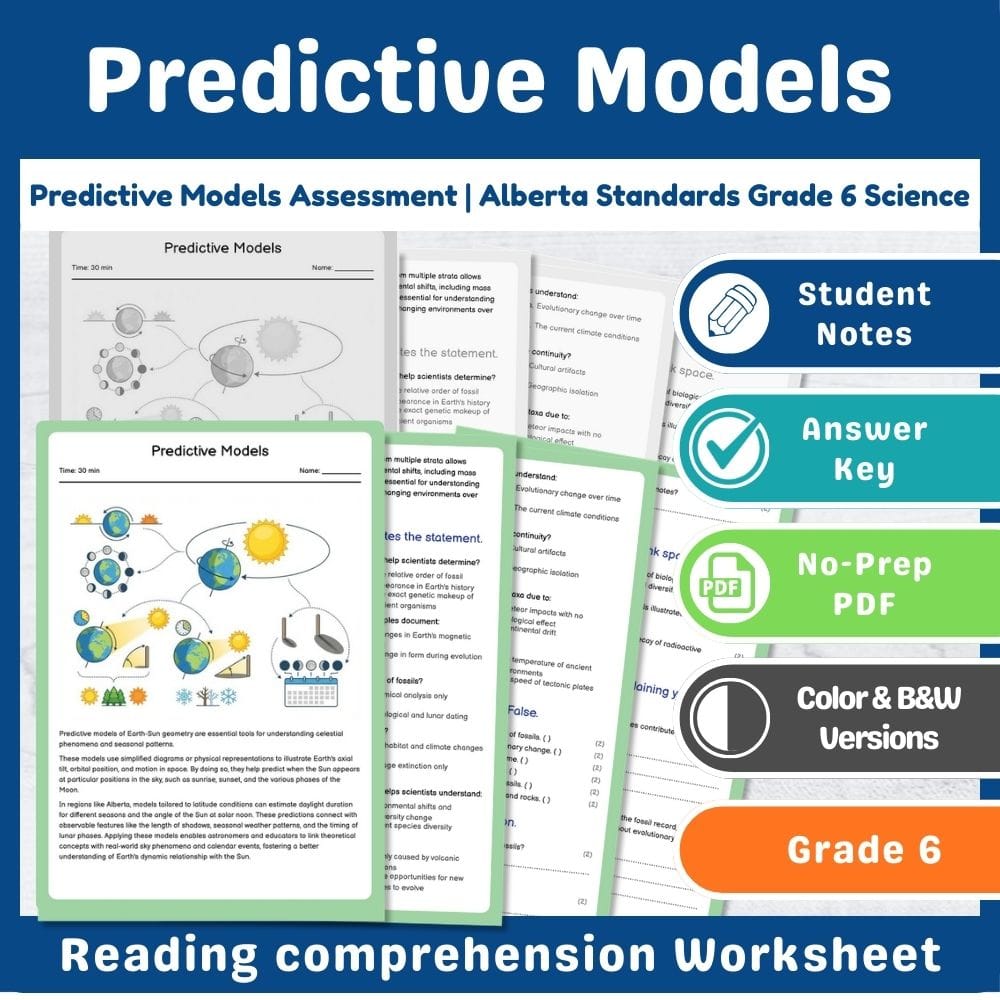
Predictive Models Assessment | Alberta Standards Grade 6 Science
Created byPrism Point LearningLearning Objectives
- Understand how models represent Earth–Sun geometry to predict celestial phenomena.
- Identify the use of simplified physical or diagrammatic models for forecasting sunrise, sunset, and lunar phases.
- Explore how latitude-specific models predict daylight hours and seasonal solar angles.
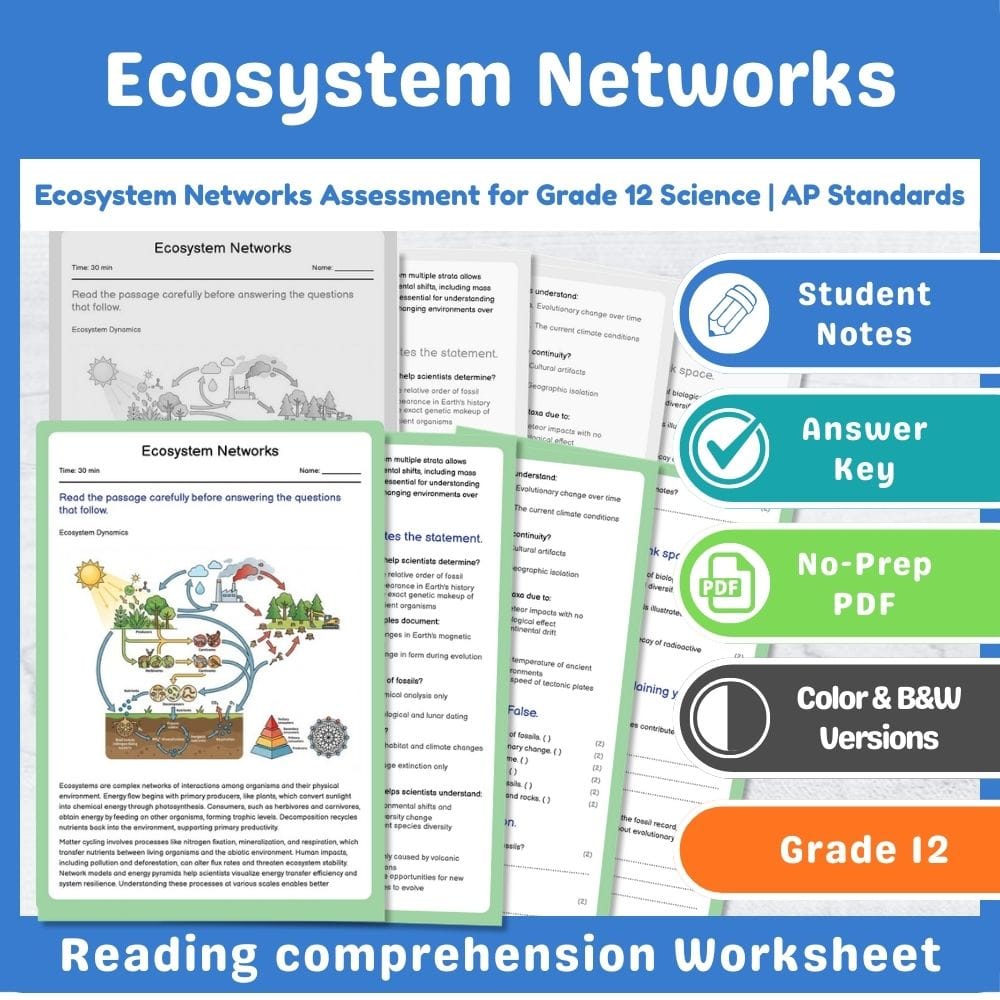
Ecosystem Networks Assessment for Grade 12 Science | AP Standards
Created byPrism Point LearningLearning Objectives
- Describe energy flow and matter cycling within ecosystems.
- Explain the roles of trophic structures, primary productivity, and decomposition.
- Analyze how biogeochemical cycles and human activities influence nutrient fluxes.
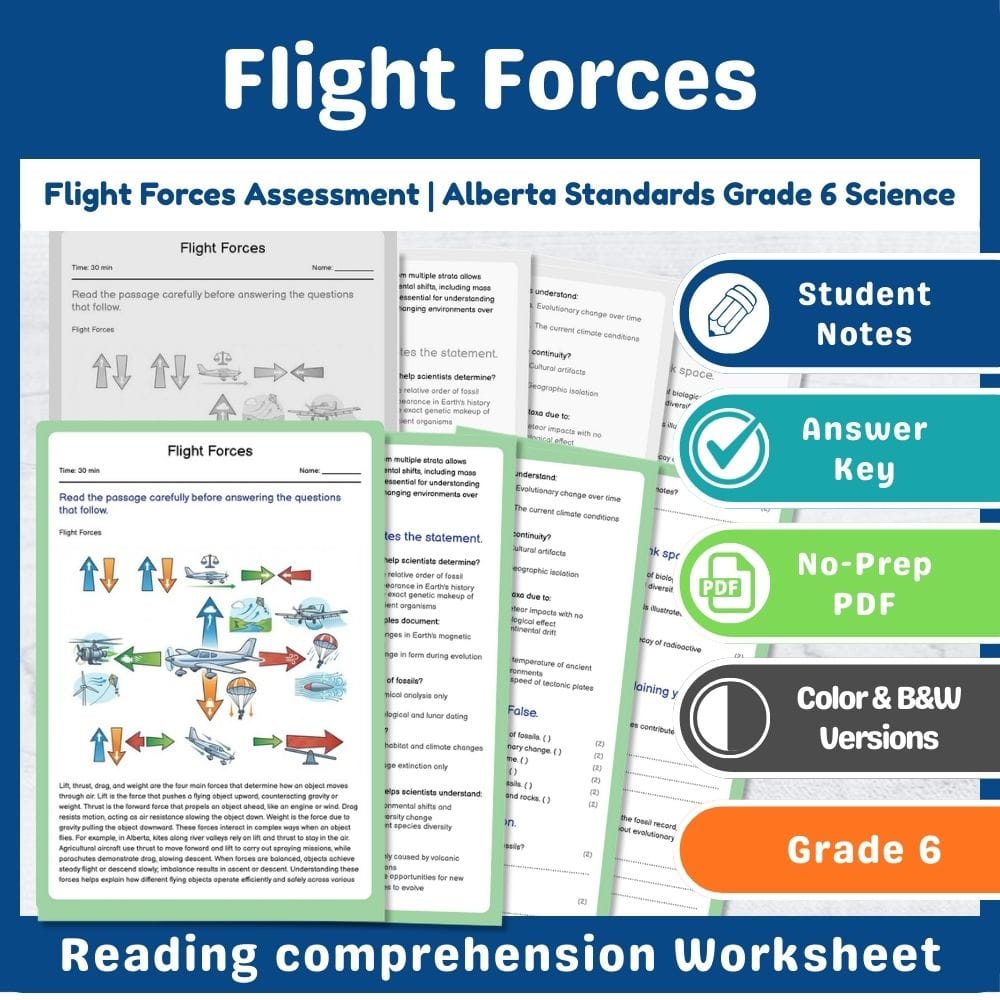
Flight Forces Assessment | Alberta Standards Grade 6 Science
Created byPrism Point LearningLearning Objectives
- Understand the four primary forces involved in flight: lift, thrust, drag, and weight.
- Describe how these forces interact to produce steady flight or descent.
- Identify examples of flight forces in real-world Alberta situations, such as kites, aircraft, and parachutes.
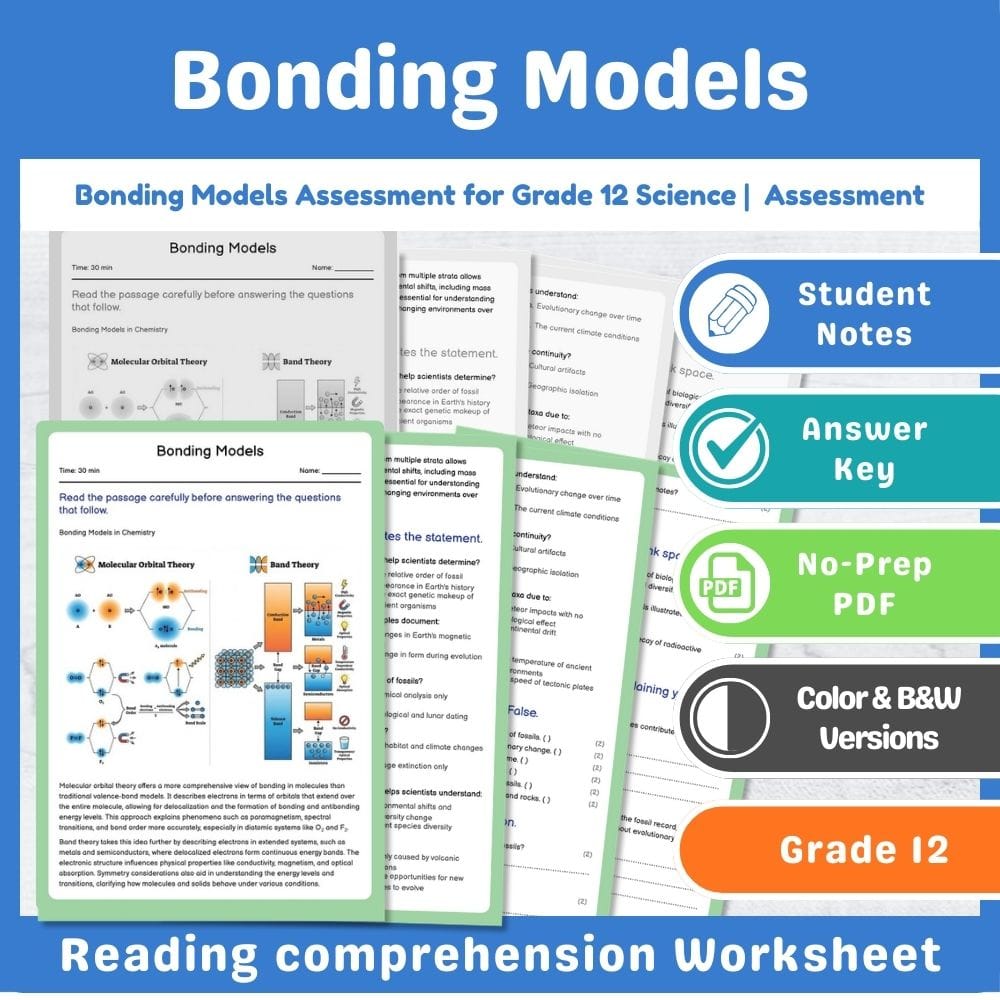
Bonding Models Assessment for Grade 12 Science | Standards-Aligned Assessment
Created byPrism Point LearningLearning Objectives
- Understand molecular orbital theory and how it extends valence-bond models.
- Explain bonding order, delocalization, and electronic structures in diatomic and extended systems.
- Use energy-level diagrams and symmetry considerations to predict magnetic, bonding, and electronic transition properties.

Periodic Patterns Assessment for Grade 10 Science – AP Standards-Aligned
Created byPrism Point LearningLearning Objectives
- Analyze the organization of the periodic table and interpret trends such as atomic radius, ionization energy, and electronegativity.
- Understand how electron configurations and nuclear effects influence periodic patterns.
- Compare elements across periods and groups to predict their chemical behavior and reactivity.
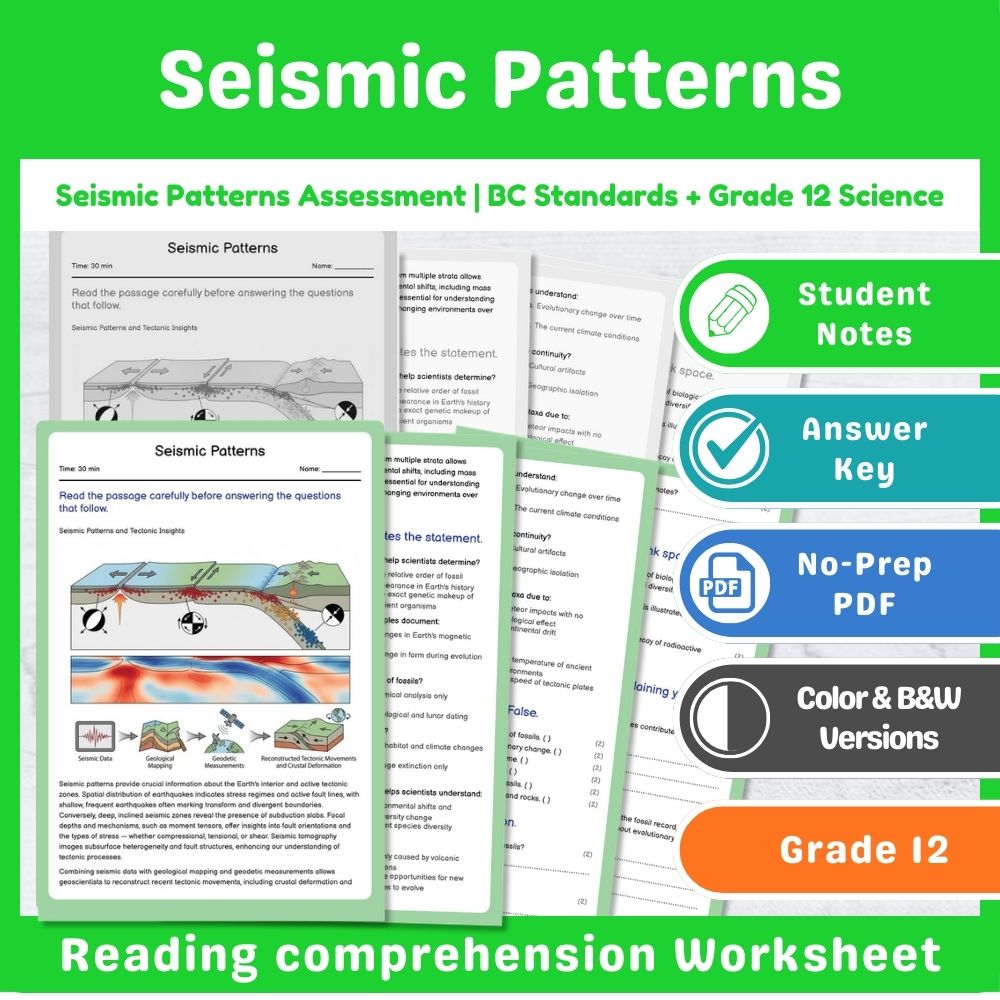
Seismic Patterns Assessment | BC Standards + Grade 12 Science
Created byPrism Point LearningLearning Objectives
- Understand the different seismic patterns including spatial distribution, focal depths, and focal mechanisms.
- Identify how seismicity reveals active tectonic structures and stress regimes within Earth's crust and mantle.
- Interpret seismic data in conjunction with geological mapping and geodetic measurements to analyze tectonic movements.
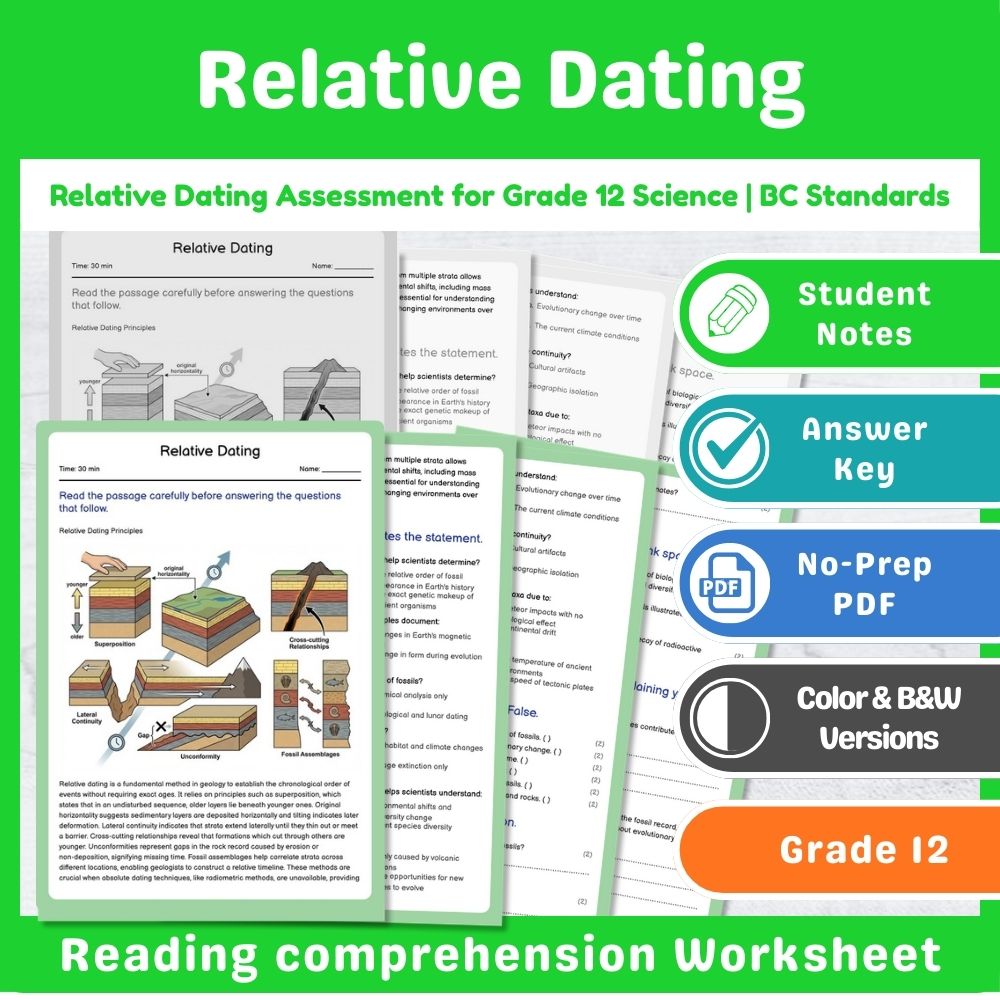
Relative Dating Assessment for Grade 12 Science | BC Standards
Created byPrism Point LearningLearning Objectives
- Understand the principles of relative dating such as superposition, original horizontality, lateral continuity, and cross-cutting relationships.
- Identify types of unconformities and their significance in geological history.
- Explain how fossil assemblages correlate strata across regions.
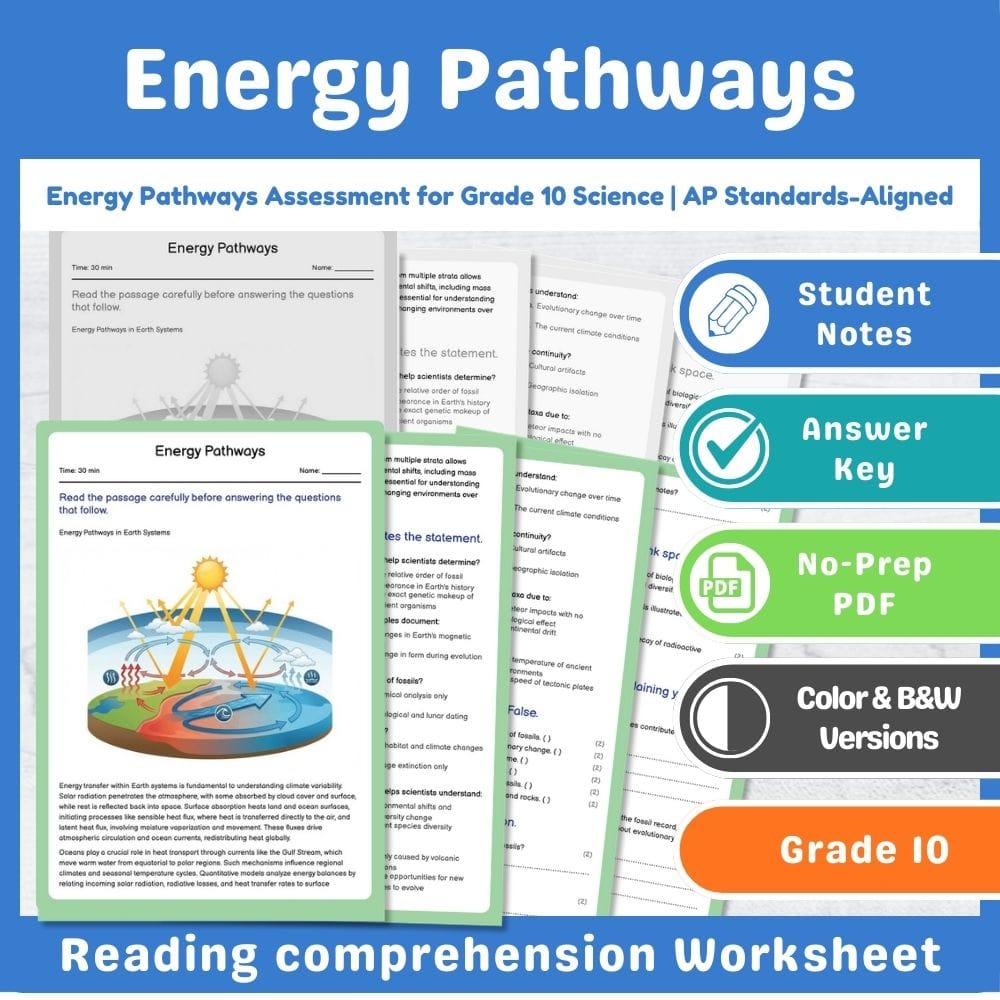
Energy Pathways Assessment for Grade 10 Science | AP Standards-Aligned
Created byPrism Point LearningLearning Objectives
- Analyze how solar radiation is absorbed and transferred within Earth systems.
- Describe the roles of sensible and latent heat fluxes in energy transfer.
- Explain oceanic heat transport mechanisms and their effects on regional climates.
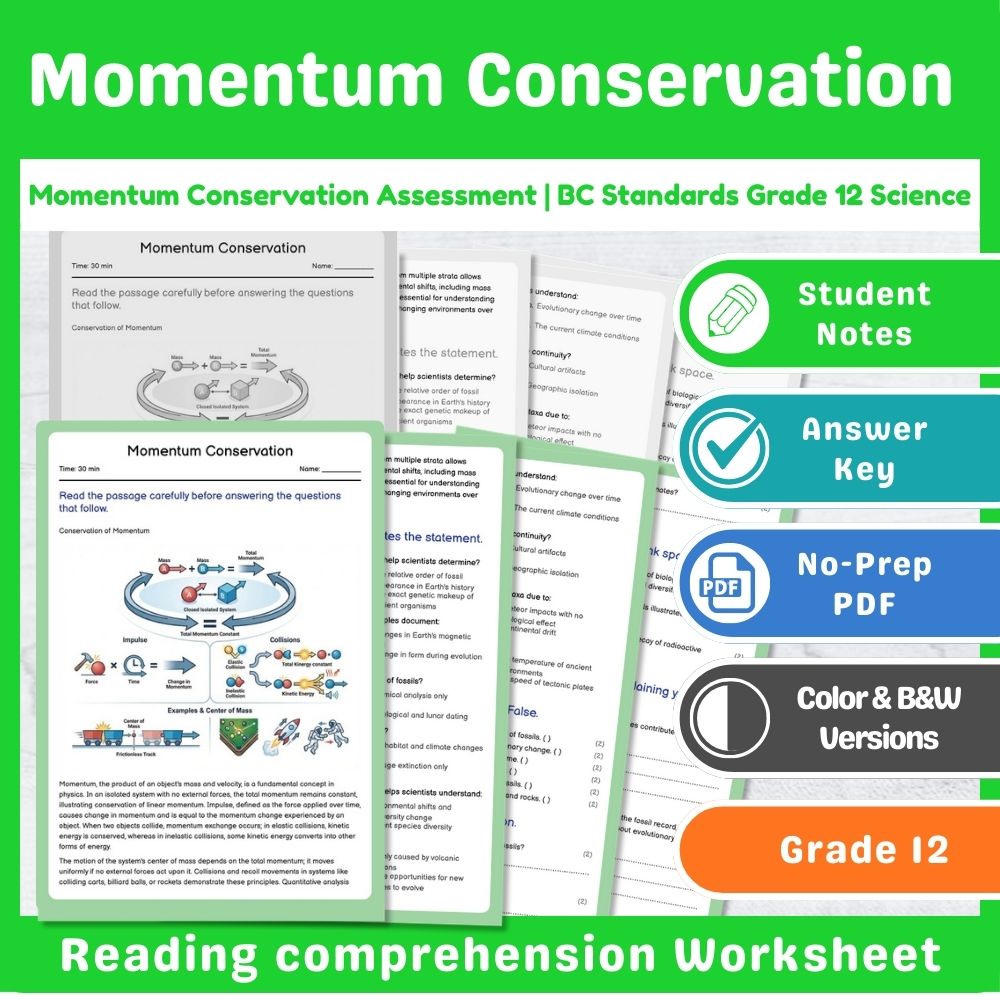
Momentum Conservation Assessment | BC Standards Grade 12 Science
Created byPrism Point LearningLearning Objectives
- Explain the principle of conservation of linear momentum in isolated systems.
- Define and calculate momentum and impulse in various collision scenarios.
- Describe the motion of the center of mass during collisions and recoil.
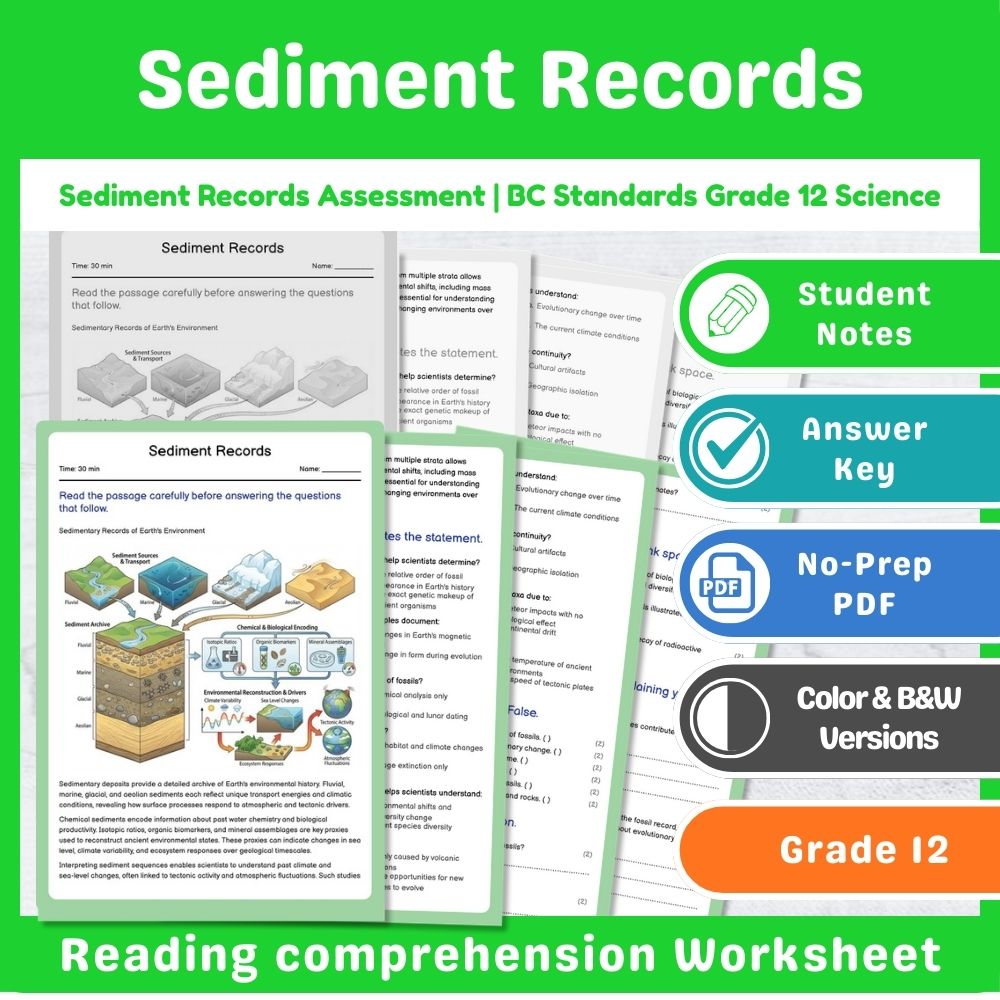
Sediment Records Assessment | BC Standards Grade 12 Science
Created byPrism Point LearningLearning Objectives
- Understand how sedimentary deposits record environmental interactions such as water, atmosphere, and life.
- Identify different types of sediments and what they reveal about past climates and sea levels.
- Explain how isotopic ratios, biomarkers, and mineral assemblages serve as proxies for reconstructing environmental history.
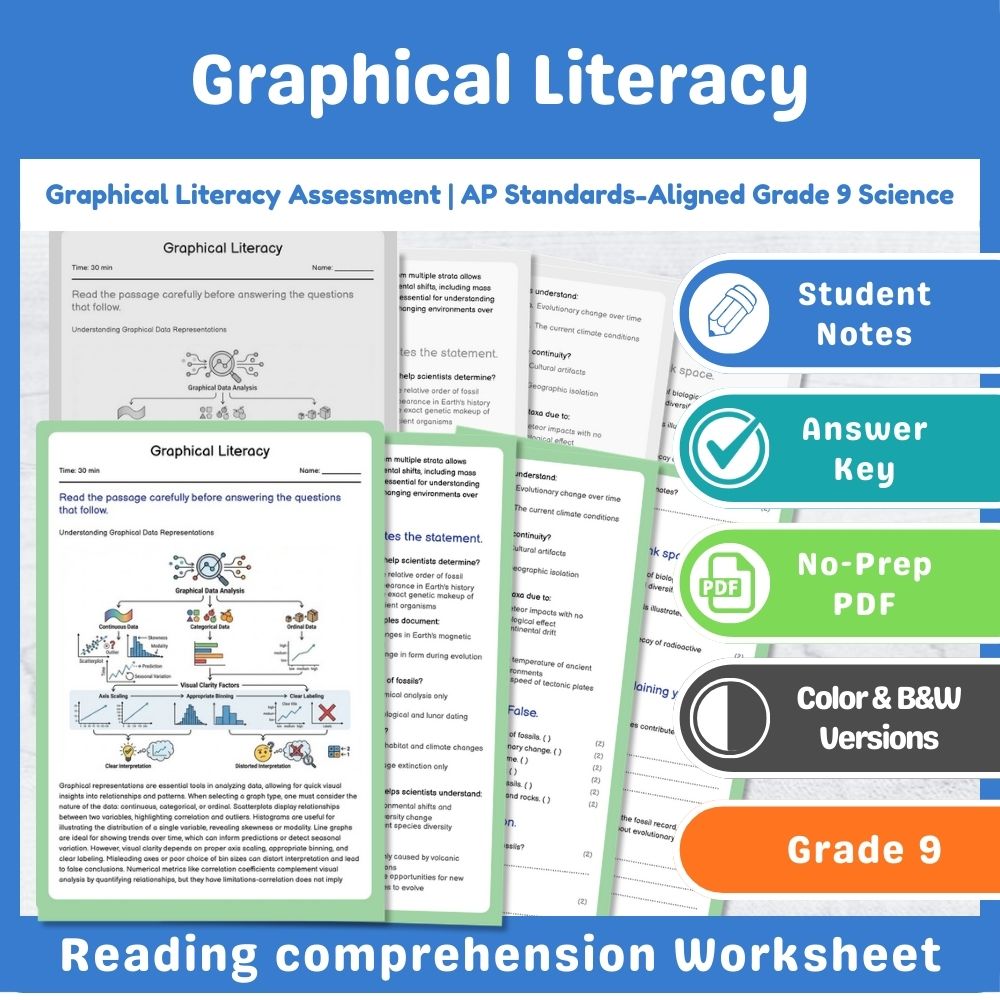
Graphical Literacy Assessment | AP Standards-Aligned Grade 9 Science
Created byPrism Point LearningLearning Objectives
- Identify various types of graphical representations used in data analysis.
- Construct accurate and effective graphs such as scatterplots, histograms, and line graphs.
- Interpret visual patterns, outliers, and trends in data visualizations.
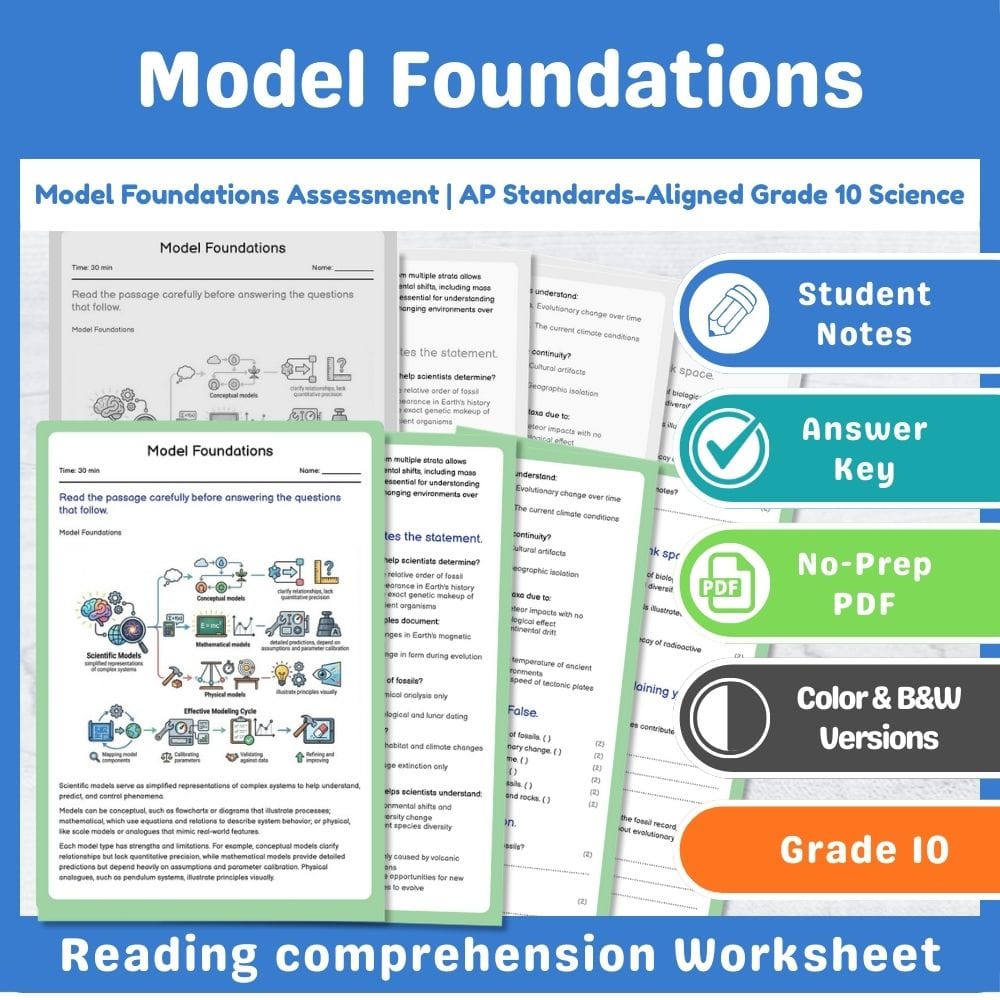
Model Foundations Assessment | AP Standards-Aligned Grade 10 Science
Created byPrism Point LearningLearning Objectives
- Explain the purpose and forms of scientific models including conceptual diagrams, mathematical relations, and physical analogues.
- Compare strengths and limitations of various types of models with examples such as pendulum motion and linear approximations.
- Understand how model components relate to observable features and how parameters and assumptions influence model applicability.
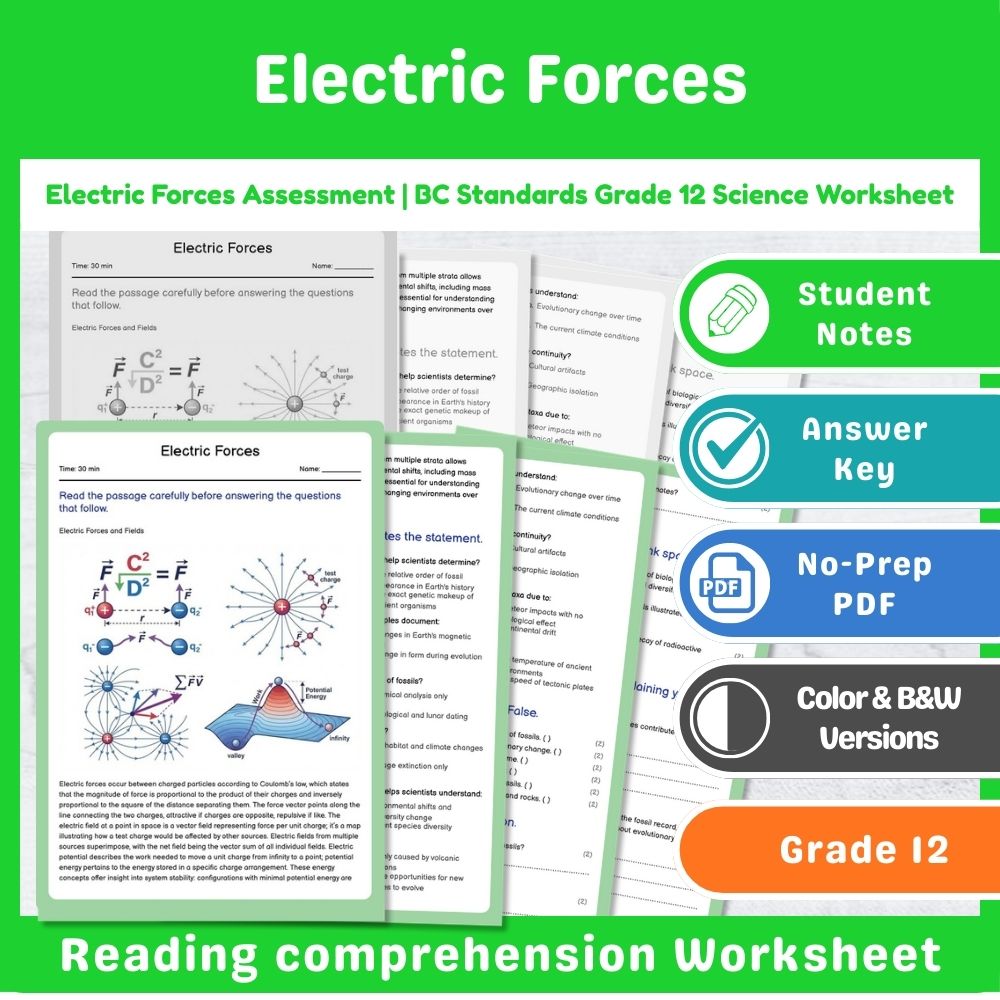
Electric Forces Assessment | BC Standards Grade 12 Science Worksheet
Created byPrism Point LearningLearning Objectives
- Explain Coulomb’s law and how it determines the magnitude and direction of electric forces between point charges.
- Describe the concept of electric field as a spatial force distribution and understand superposition of fields.
- Define electric potential and potential energy, and analyze energy configurations of charged systems.
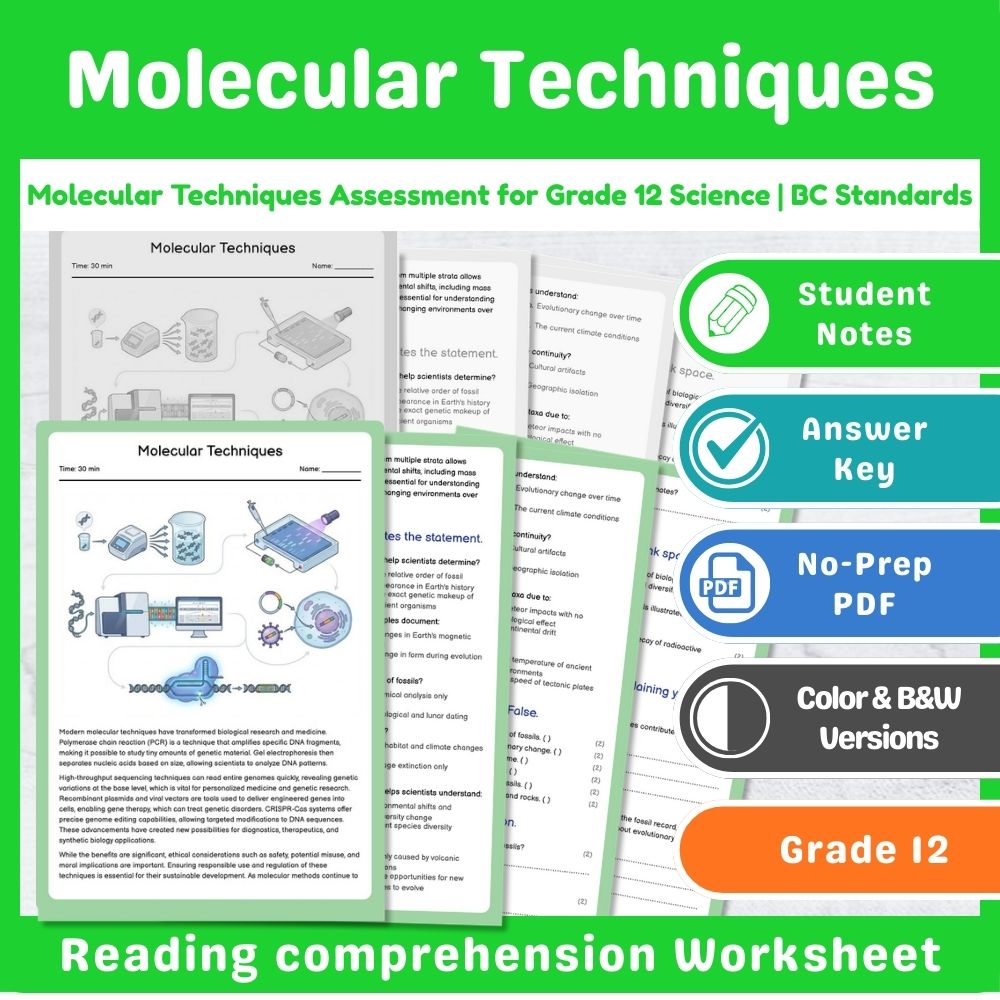
Molecular Techniques Assessment for Grade 12 Science | BC Standards
Created byPrism Point LearningLearning Objectives
- Explain key molecular techniques used in genetics and biotechnology.
- Identify the purpose and applications of PCR, gel electrophoresis, high-throughput sequencing, recombinant DNA, and CRISPR-Cas systems.
- Evaluate the ethical and safety considerations associated with modern molecular techniques.
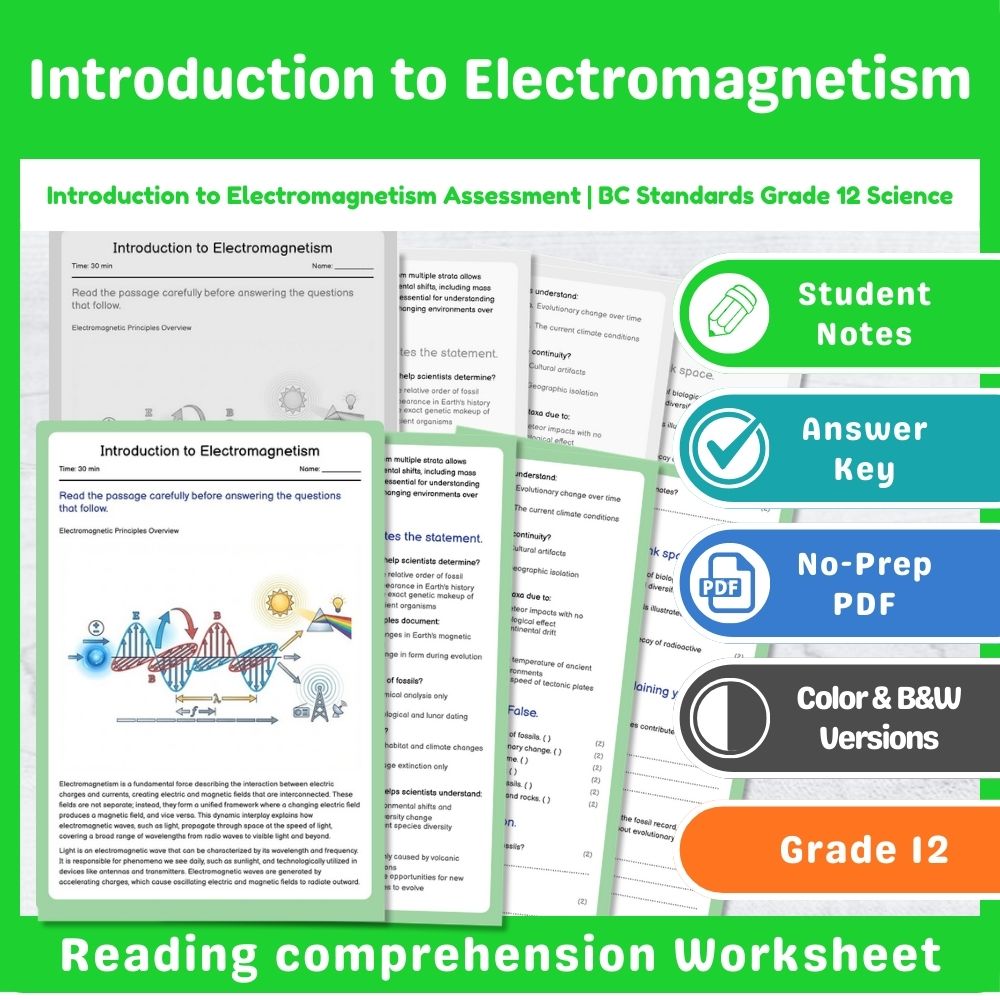
Introduction to Electromagnetism Assessment | BC Standards Grade 12 Science
Created byPrism Point LearningLearning Objectives
- Understand the fundamental principles linking electric charges, currents, electric and magnetic fields.
- Explain how time-varying fields produce electromagnetic waves.
- Identify real-world applications of electromagnetic principles such as antennas and circuits.
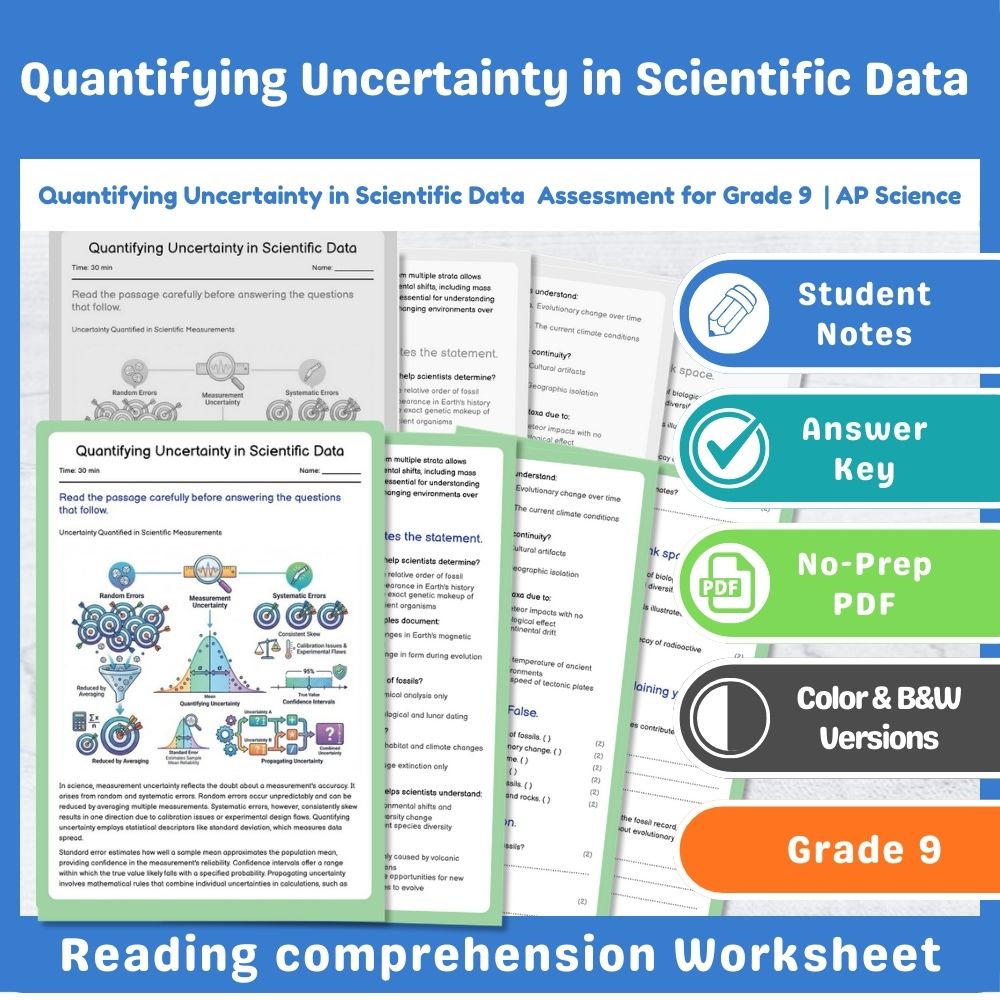
Quantifying Uncertainty in Scientific Data Assessment | Standard Aligned Grade 9 Science
Created byPrism Point LearningLearning Objectives
- Understand how to quantify and interpret random and systematic uncertainties in measurements.
- Learn to apply statistical descriptors such as standard deviation, standard error, and confidence intervals.
- Explore procedures for propagating uncertainty through calculations and combined data.
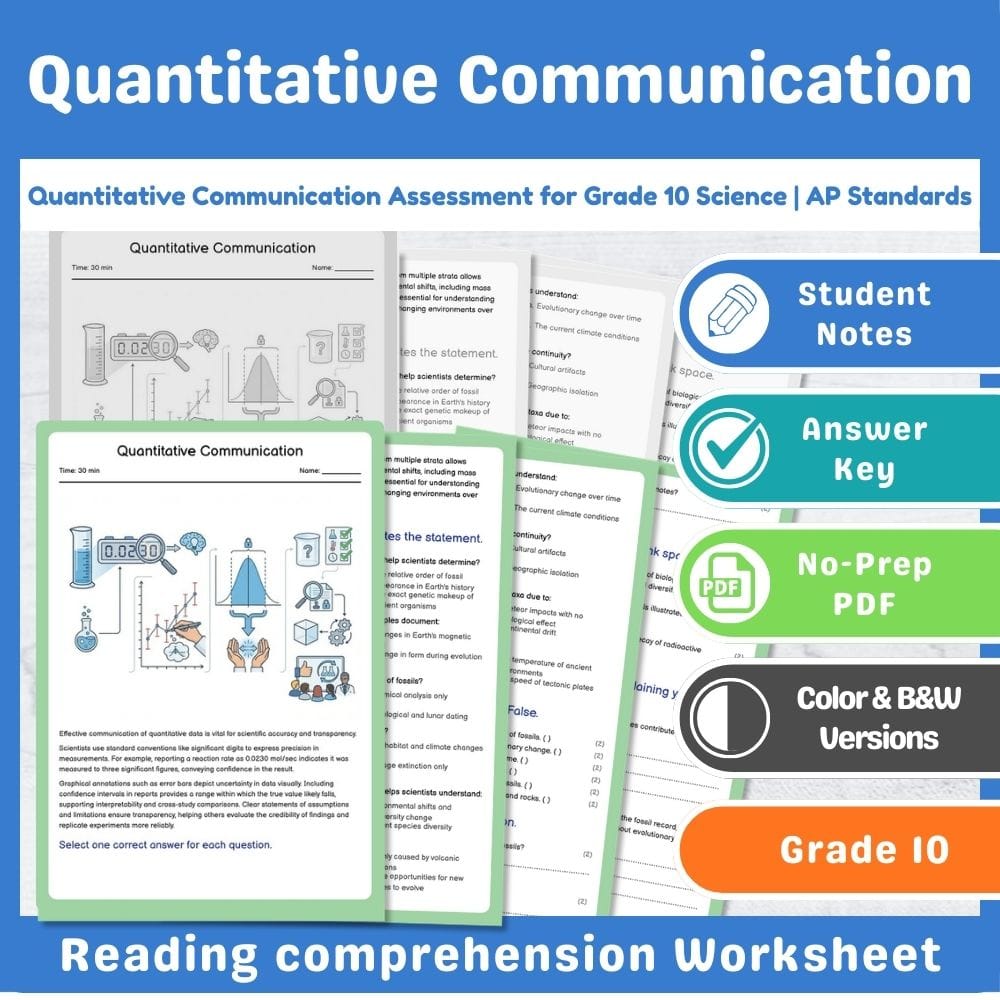
Quantitative Communication Assessment for Grade 10 Science | AP Standards
Created byPrism Point LearningLearning Objectives
- Understand conventions for reporting quantitative results, including uncertainty notation and significant digits.
- Learn strategies for visualizing data using graphs and annotations effectively.
- Identify how to articulate assumptions, limitations, and confidence intervals transparently.
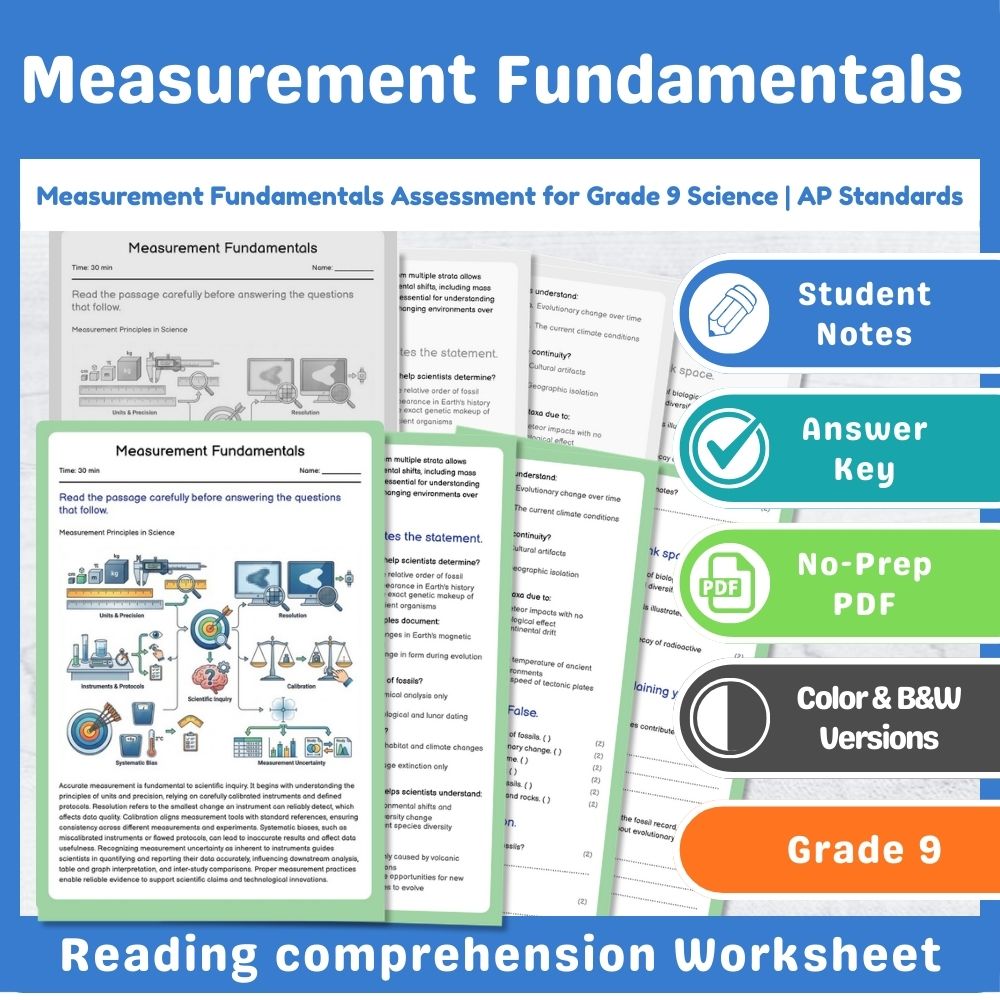
Measurement Fundamentals Assessment for Grade 9 Science | AP Standards
Created byPrism Point LearningLearning Objectives
- Understand the principles of metric measurement and instrument resolution.
- Recognize the importance of calibration in obtaining reliable data.
- Connect raw measurements to data representations and assess measurement uncertainty.
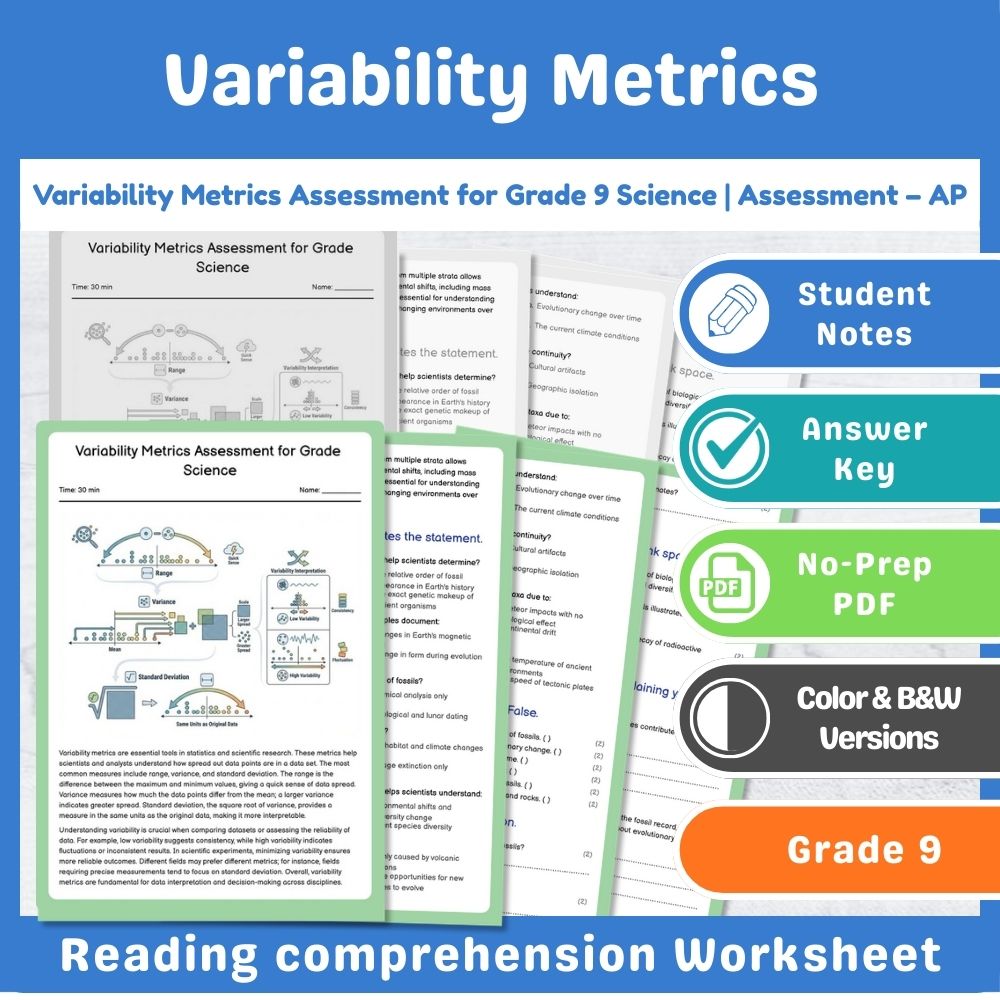
Variability Metrics Assessment for Grade 9 Science | Assessment – AP
Created byPrism Point LearningLearning Objectives
- Understand the concept of variability metrics and their application in data analysis.
- Identify various measures of variability such as range, variance, and standard deviation.
- Analyze data sets to calculate variability metrics and interpret their significance.
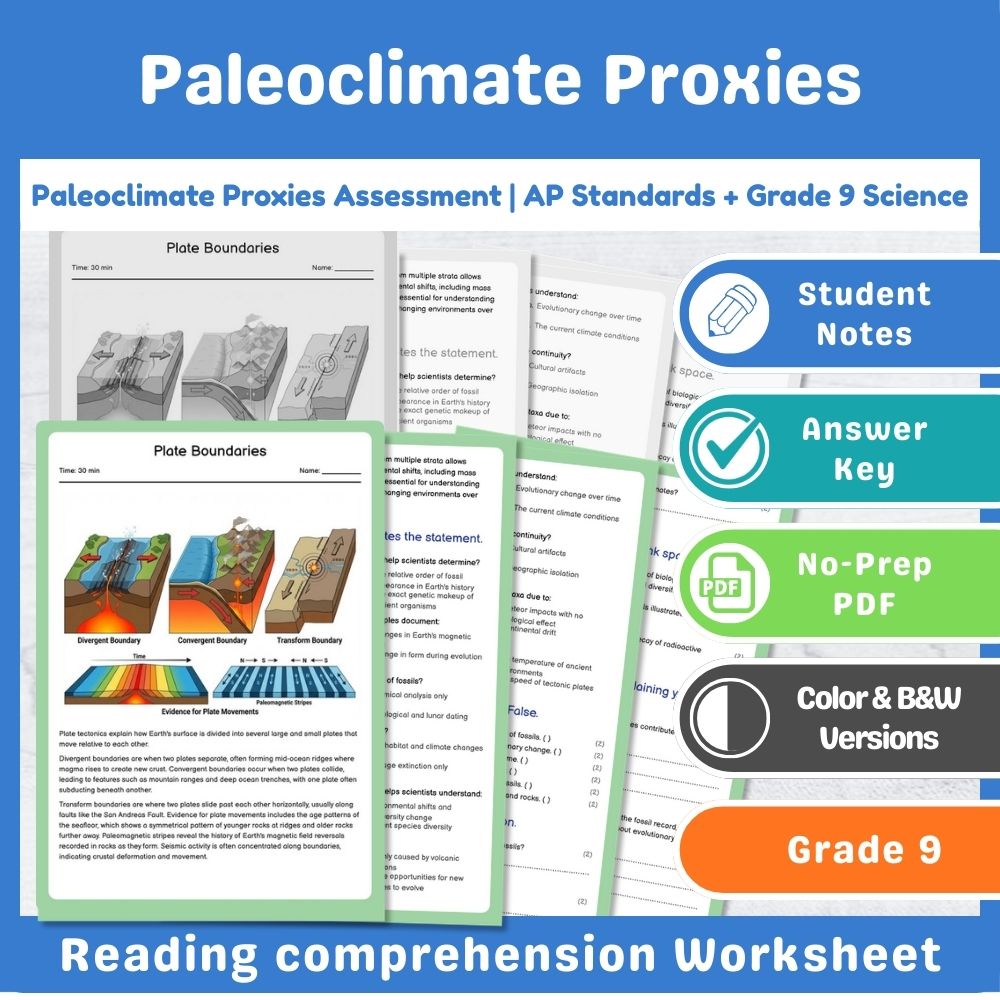
Paleoclimate Proxies Assessment | AP Standards + Grade 9 Science
Created byPrism Point LearningLearning Objectives
- Interpret paleoclimate evidence from ice cores, tree rings, marine sediments, and speleothems using proxy indicators.
- Relate proxy records to past climate variability including glacial-interglacial cycles and abrupt events.
- Employ age models and quantify uncertainties to link proxy signals to climate forcing mechanisms.
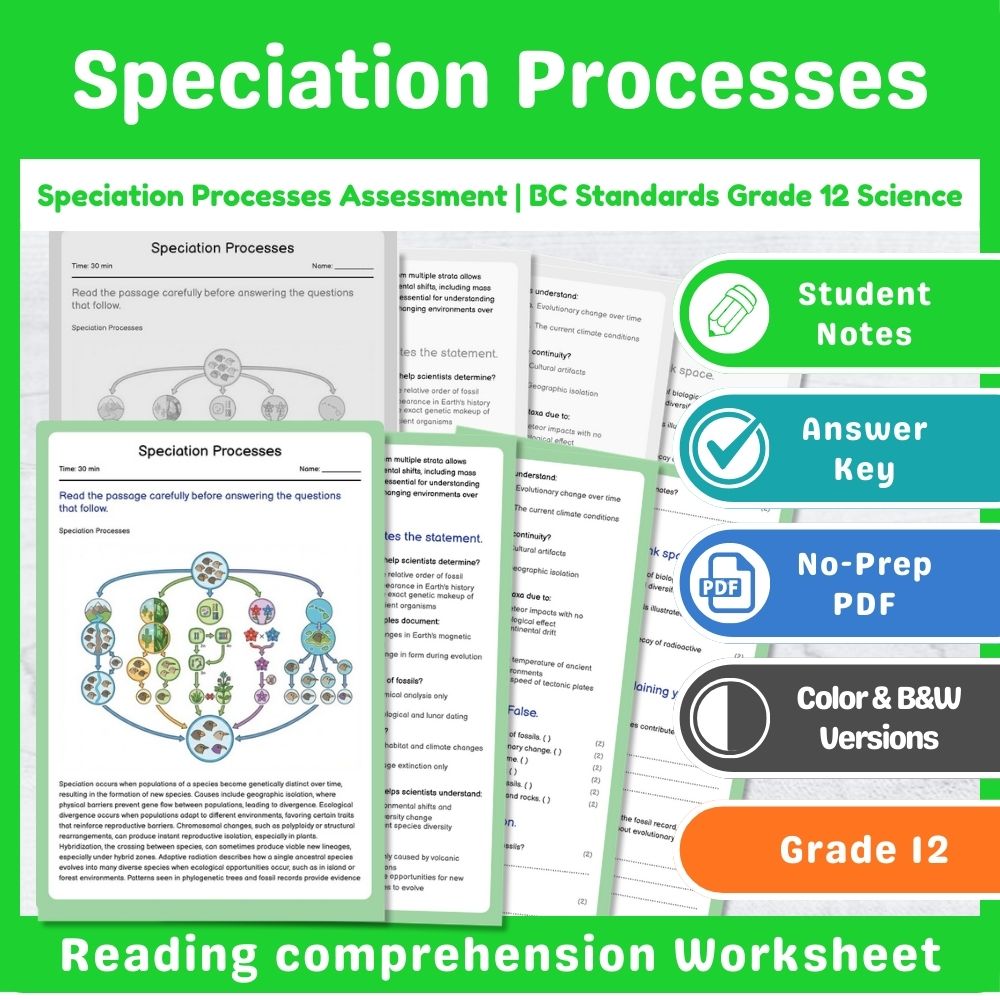
Speciation Processes Assessment | BC Standards Grade 12 Science
Created byPrism Point LearningLearning Objectives
- Understand the mechanisms that lead to the formation of new species.
- Identify different patterns and evidence supporting speciation events.
- Explain the roles of geographic isolation, ecological divergence, and chromosomal changes.
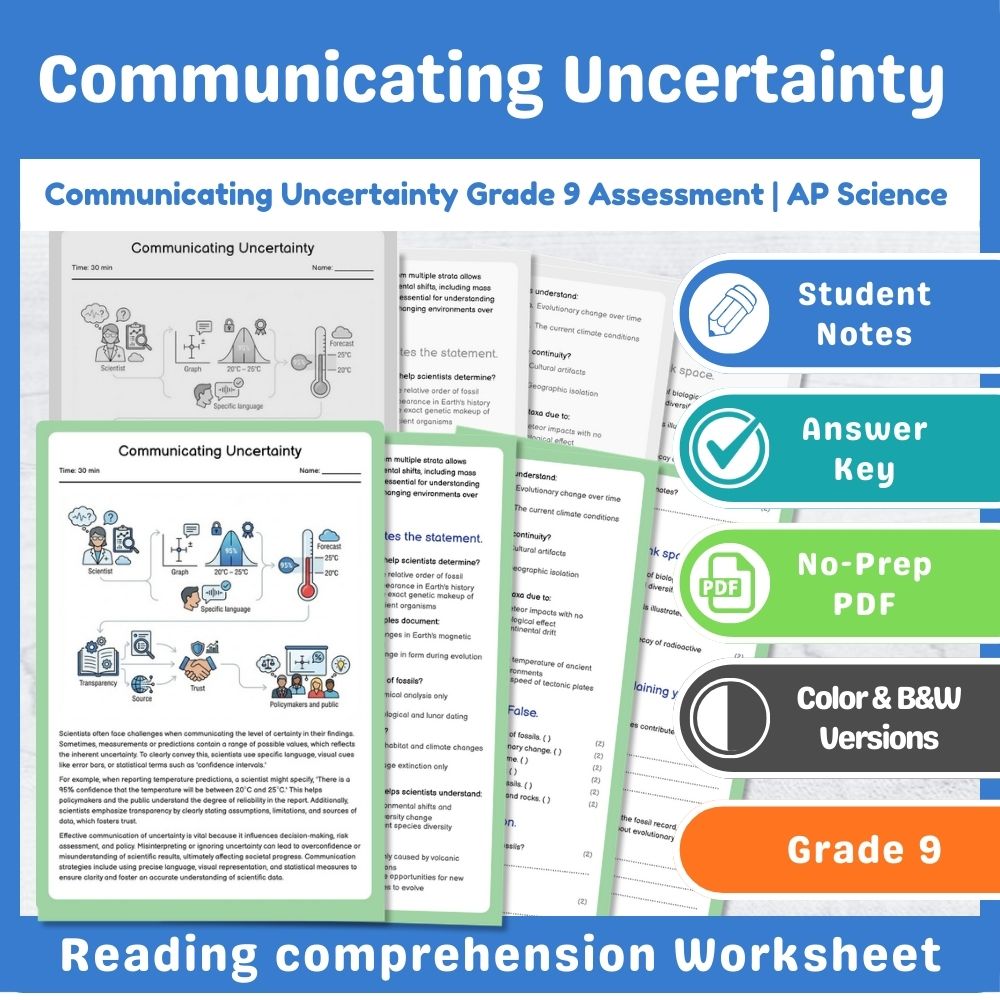
Communicating Uncertainty Grade 9 Assessment | AP Science Standards-Aligned
Created byPrism Point LearningLearning Objectives
- Understand how scientists communicate uncertainty in data and results.
- Identify different methods used to express uncertainty.
- Evaluate the importance of transparency and clarity when communicating scientific findings.
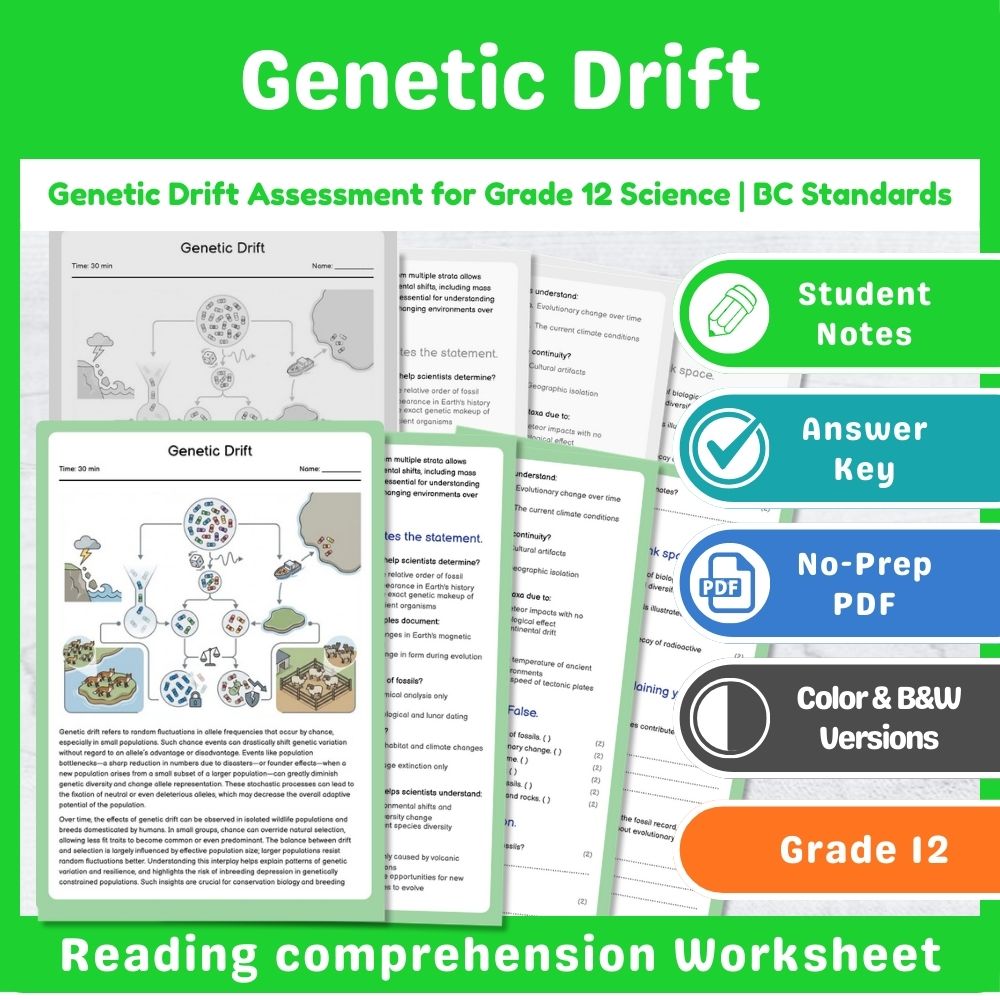
Genetic Drift Assessment for Grade 12 Science | BC Standards
Created byPrism Point LearningLearning Objectives
- Describe the concept of genetic drift and its effects on allele frequencies in populations.
- Explain how bottlenecks and founder events influence genetic diversity.
- Analyze the role of genetic drift in small isolated populations and domesticated breeds.
Browse more categories
About Science Worksheets
Find Science worksheets spanning core skills, practice, and review. All 42,685 resources are instant PDF downloads for the classroom or home.
Every worksheet on MyTeachingSheets is created by independent teacher-authors and reviewed before publication. All resources download as printable PDFs for classroom, homework, or at-home practice, and many include answer keys. Preview any worksheet free before buying.