
Science Worksheets
42,685 subject resources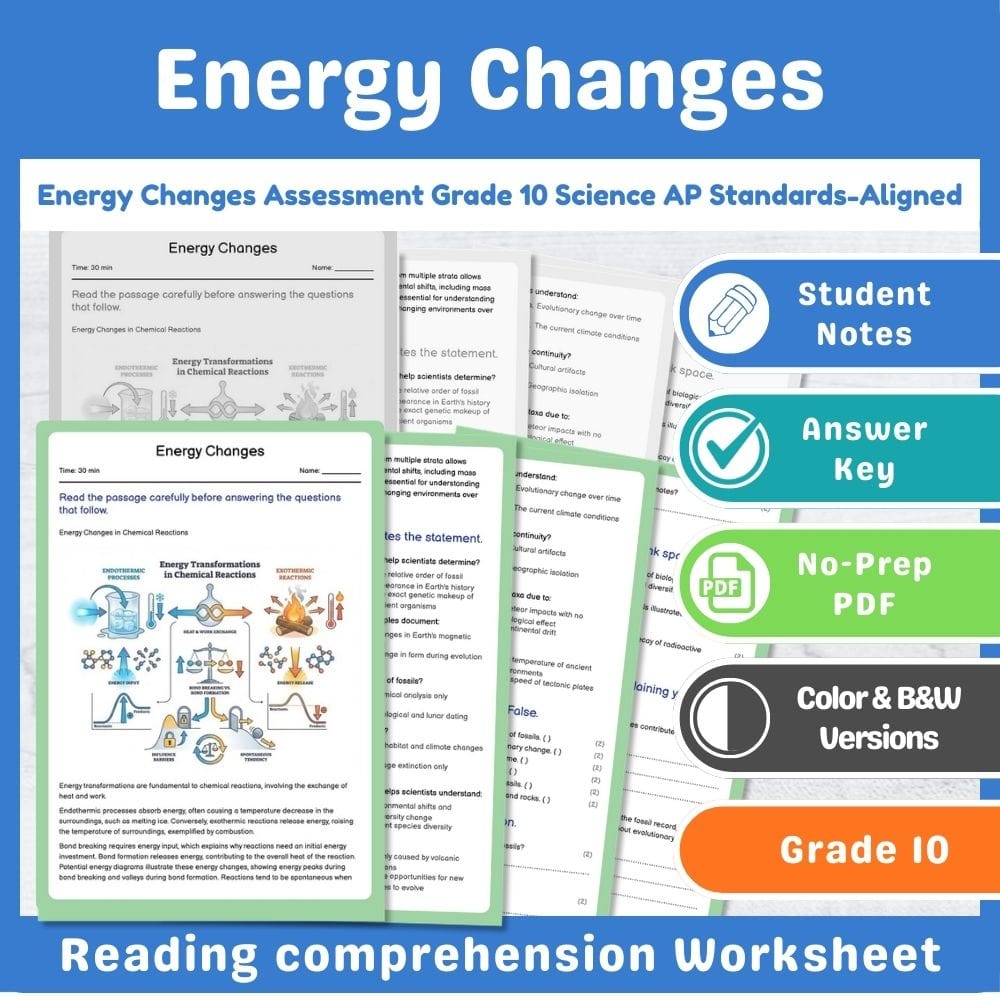
Energy Changes Assessment Grade 10 Science AP Standards-Aligned
 Created byPrism Point Learning
Learning Objectives
- Describe the differences between endothermic and exothermic processes.
- Understand how bond breaking and formation relate to reaction heat.
- Explain the concepts of enthalpy and potential energy diagrams.
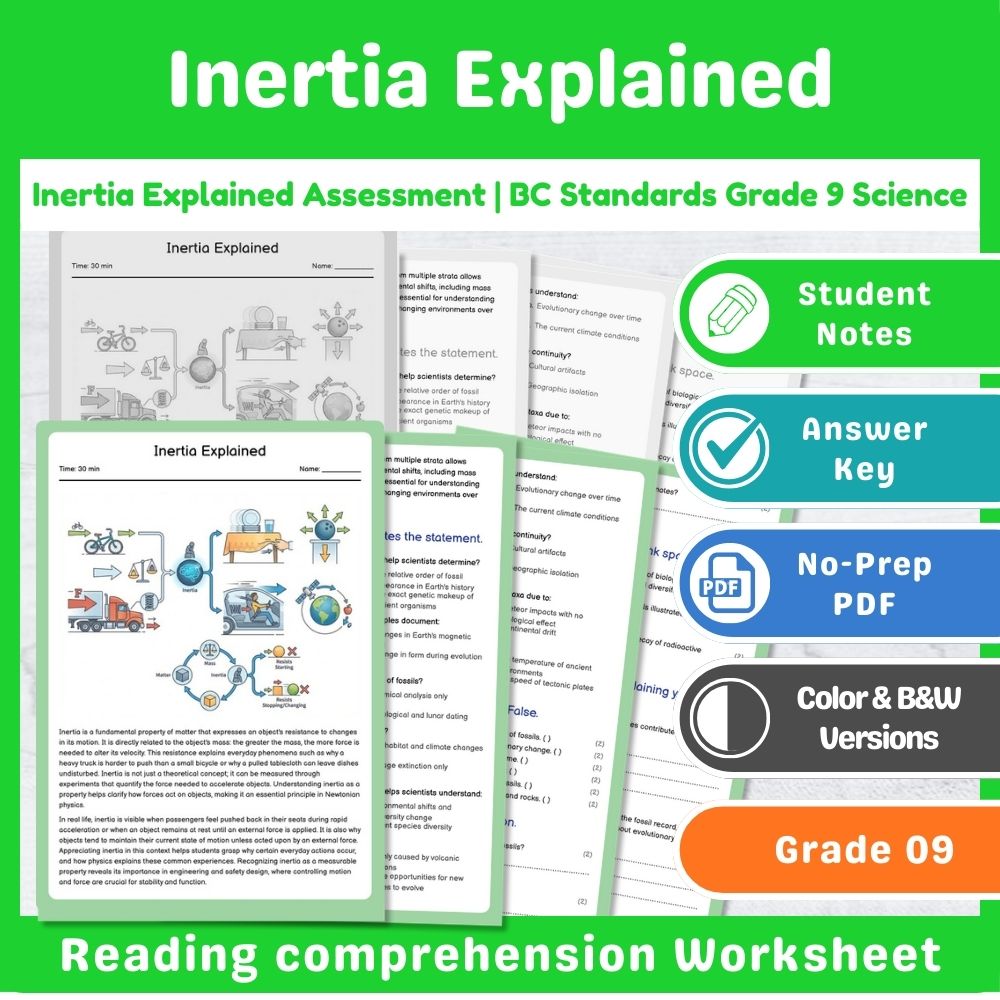
Inertia Explained Assessment | BC Standards Grade 9 Science
Created byPrism Point LearningLearning Objectives
- Define inertia and explain its relation to an object's mass.
- Describe real-world examples of inertia in everyday life.
- Analyze how forces overcome inertia to change an object's motion.
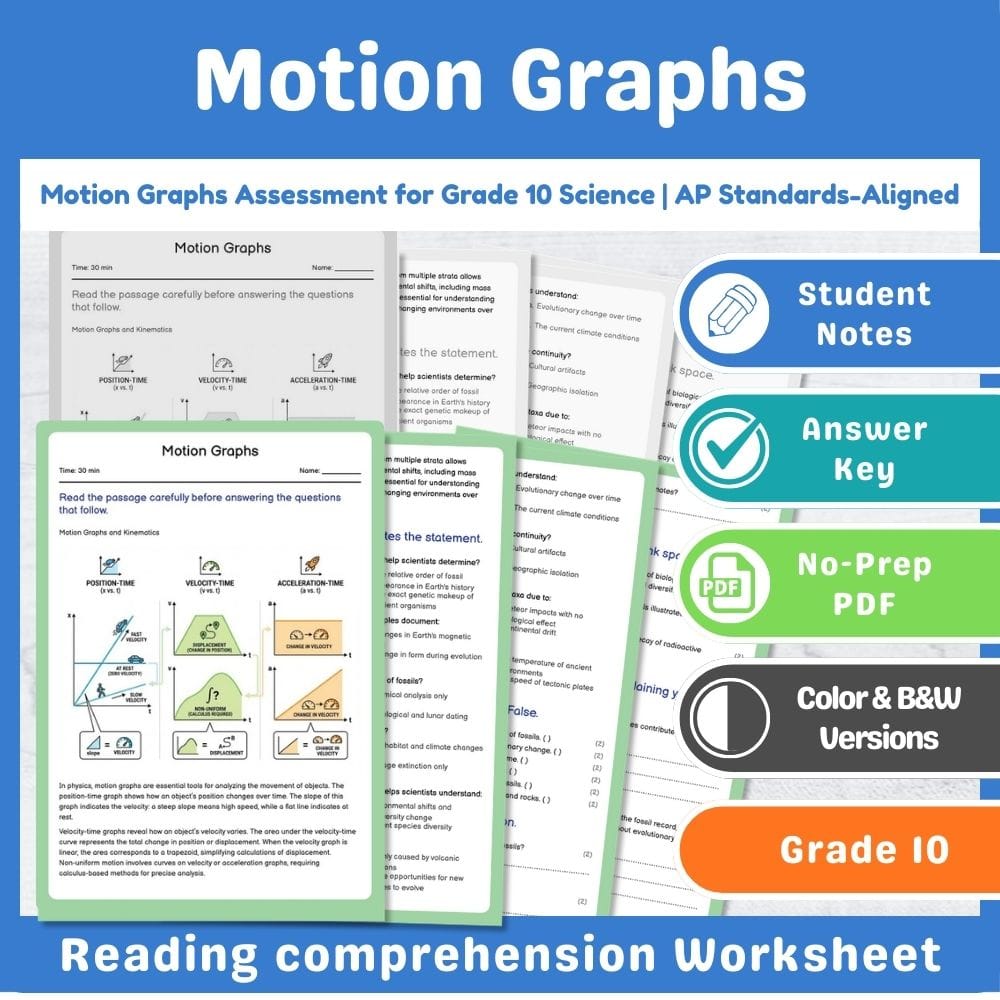
Motion Graphs Assessment for Grade 10 Science | AP Standards-Aligned
Created byPrism Point LearningLearning Objectives
- Understand how the slope of a motion graph relates to velocity and acceleration.
- Interpret areas under motion graphs to determine total displacement and change in velocity.
- Connect features of position, velocity, and acceleration graphs to physical quantities in motion analysis.
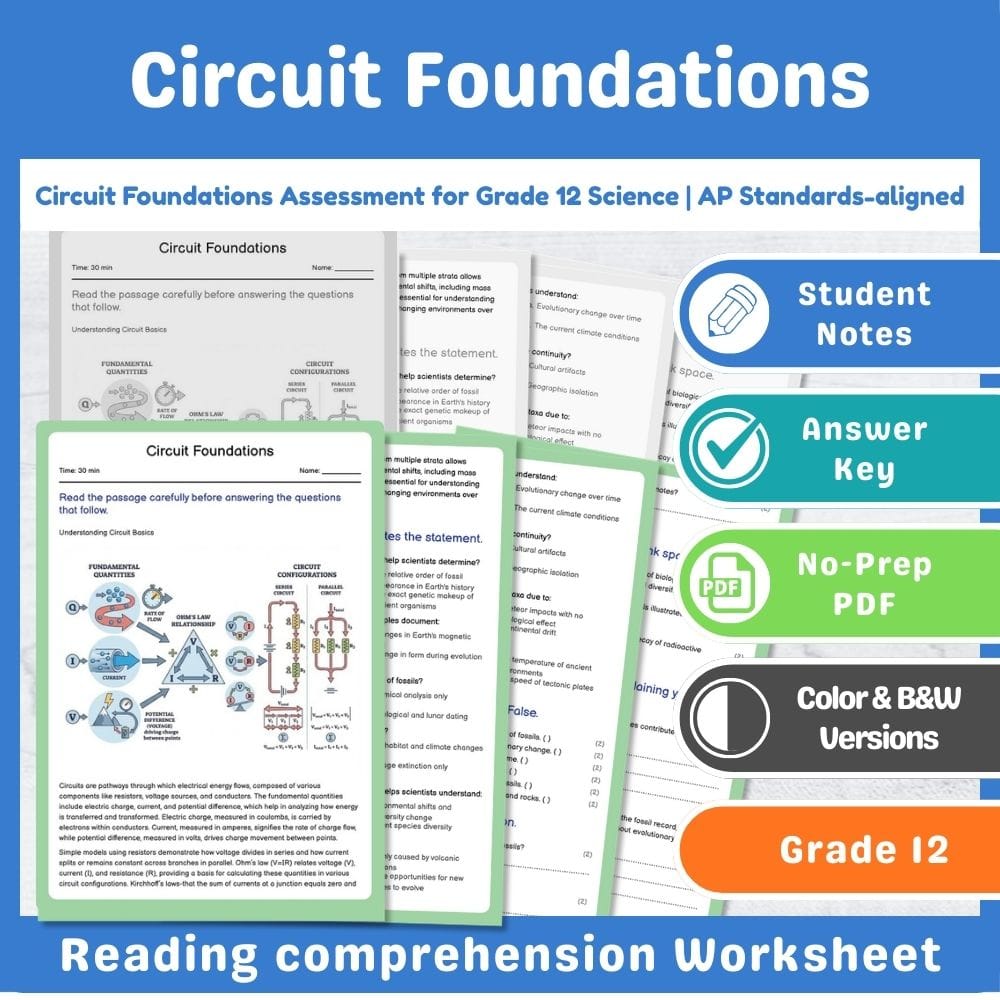
Circuit Foundations Assessment for Grade 12 Science | AP Standards-aligned
Created byPrism Point LearningLearning Objectives
- Understand the basic quantities of electric charge, current, and potential difference in circuits.
- Describe simple circuit models using resistors, voltage sources, and conductors.
- Apply Ohm’s law and analyze series and parallel resistor combinations.

Immune Integration Assessment for Grade 10 Science TEKS Standards
Created byPrism Point LearningLearning Objectives
- Explain how the immune system contributes to homeostasis and physiological balance.
- Identify key responses such as inflammation and fever in immune regulation.
- Describe how chronic immune activation can affect overall human health and organ systems.

Genomic Technologies Assessment | TEKS Grade 10 Science Standards
Created byPrism Point LearningLearning Objectives
- Explain how polymerase chain reaction amplifies specific DNA sequences.
- Describe the process of DNA sequencing and its applications.
- Understand the mechanism and uses of CRISPR for gene editing.
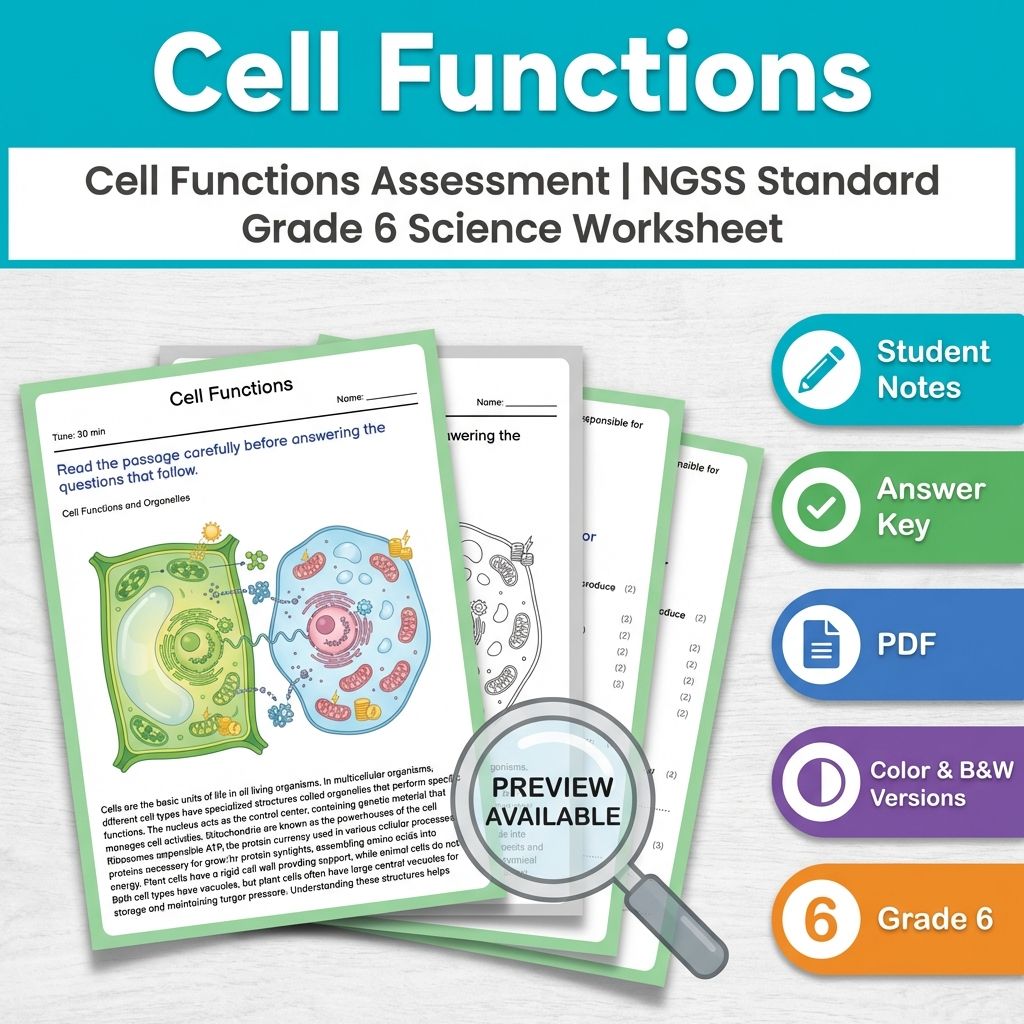
Cell Functions Assessment | NGSS Standard Grade 6 Science Worksheet
Created byPrism Point LearningLearning Objectives
- Identify the major organelles in plant and animal cells and their functions.
- Explain how cell structures relate to their specific roles in energy production, protein synthesis, waste removal, and regulation.
- Compare and contrast cell functions in plant and animal cells to understand specialization.
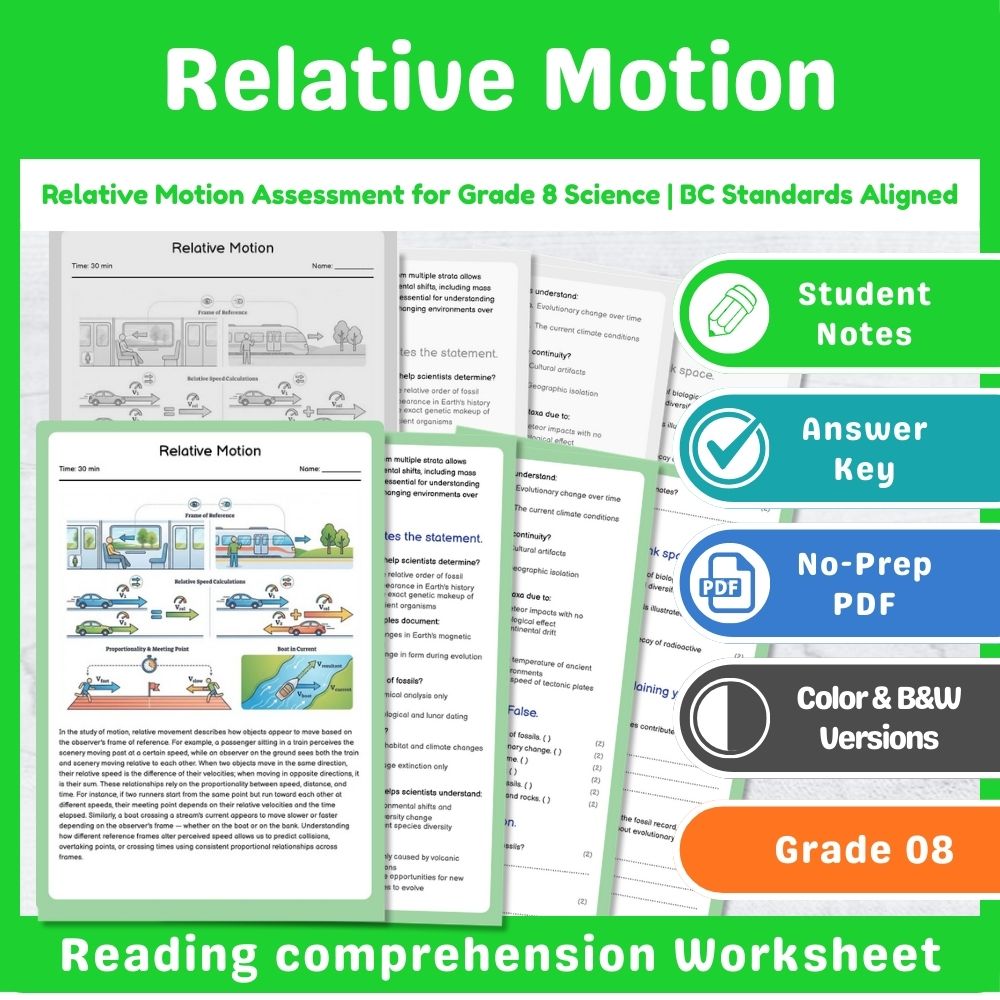
Relative Motion Assessment for Grade 8 Science | BC Standards Aligned
Created byPrism Point LearningLearning Objectives
- Understand the concept of relative motion and how velocity depends on reference frames.
- Apply proportional relationships among speed, distance, and time within different frames.
- Analyze simple scenarios such as two walkers moving towards each other or a boat crossing a stream to determine apparent speeds.
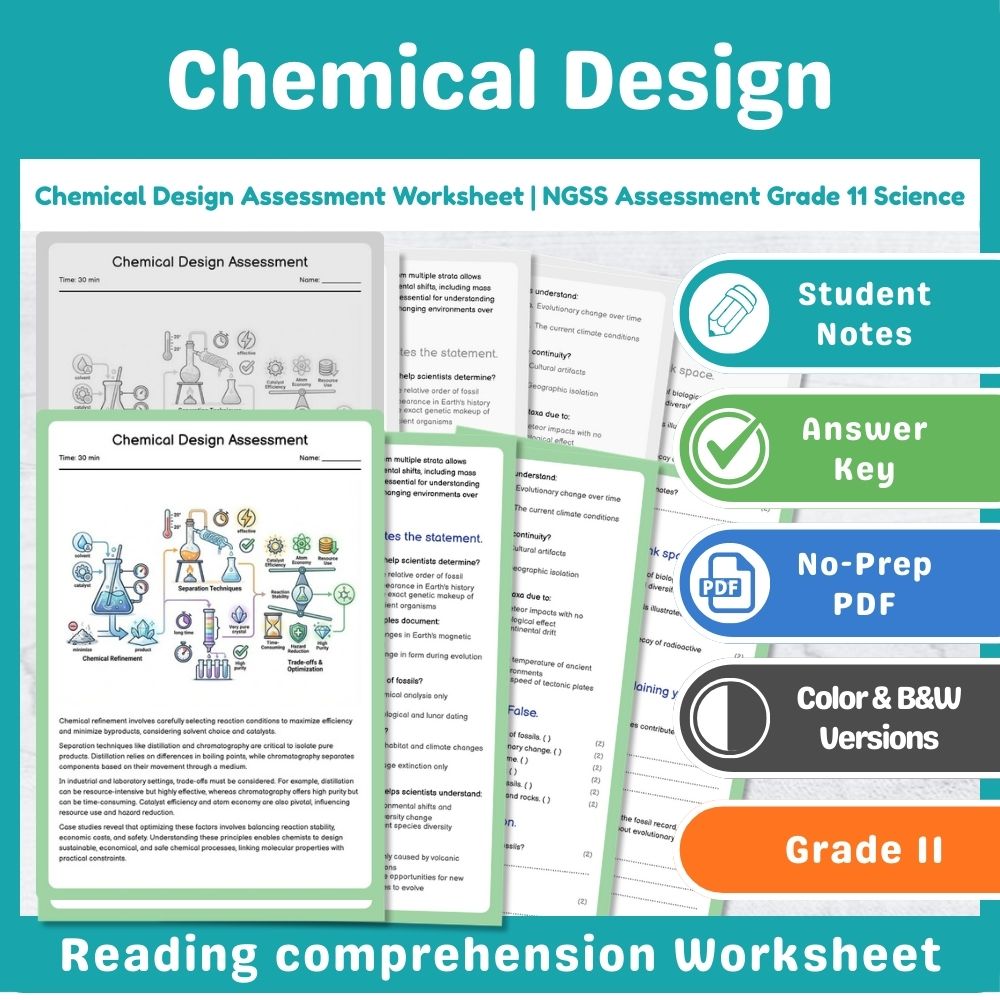
Chemical Design Assessment Worksheet | NGSS Assessment Grade 11 Science
Created byPrism Point LearningLearning Objectives
- Understand key reaction conditions and purification methods used in chemical systems.
- Evaluate factors influencing separation techniques such as distillation and chromatography.
- Analyze trade-offs in industrial synthesis regarding efficiency, purity, resources, and hazards.
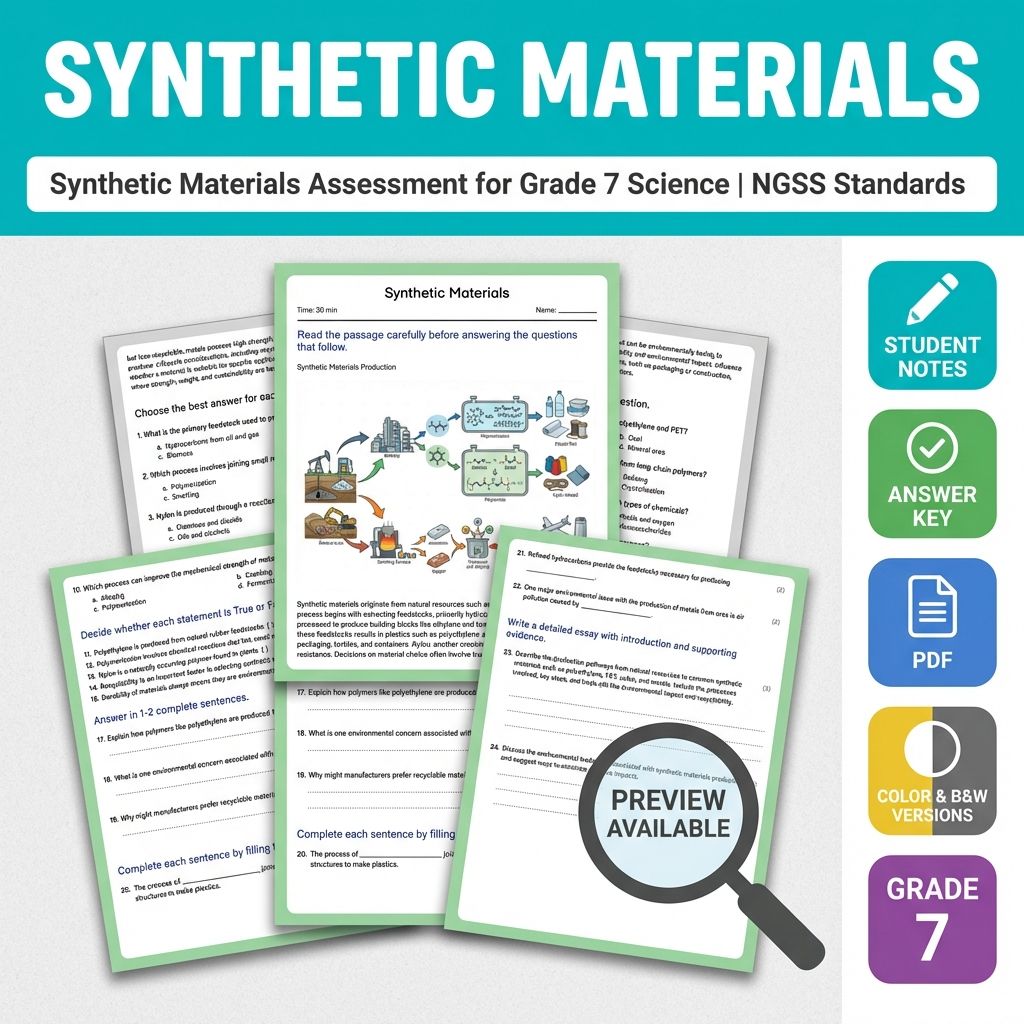
Synthetic Materials Assessment for Grade 7 Science | NGSS Standards
Created byPrism Point LearningLearning Objectives
- Describe how natural resources are transformed into synthetic materials through production pathways including feedstocks, polymerization, and refining steps.
- Identify examples such as polyethylene, PET, nylon, and metals derived from ores, and explain their manufacturing processes.
- Discuss the advantages and disadvantages, including durability, recyclability, and environmental impacts, of various synthetic materials.
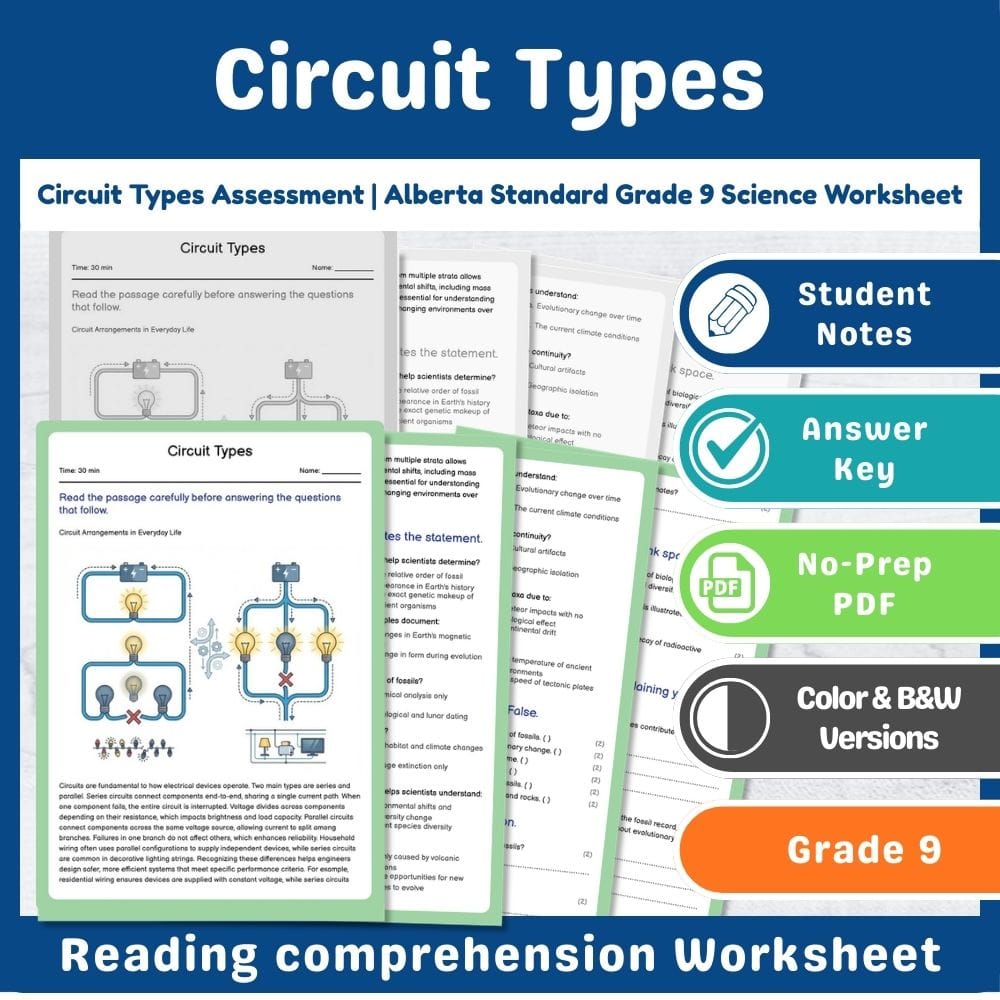
Circuit Types Assessment | Alberta Standard Grade 9 Science Worksheet
Created byPrism Point LearningLearning Objectives
- Understand the difference between series and parallel circuits.
- Identify the behavior of current and voltage in different circuit arrangements.
- Analyze the effects of circuit configuration on brightness, reliability, and performance.
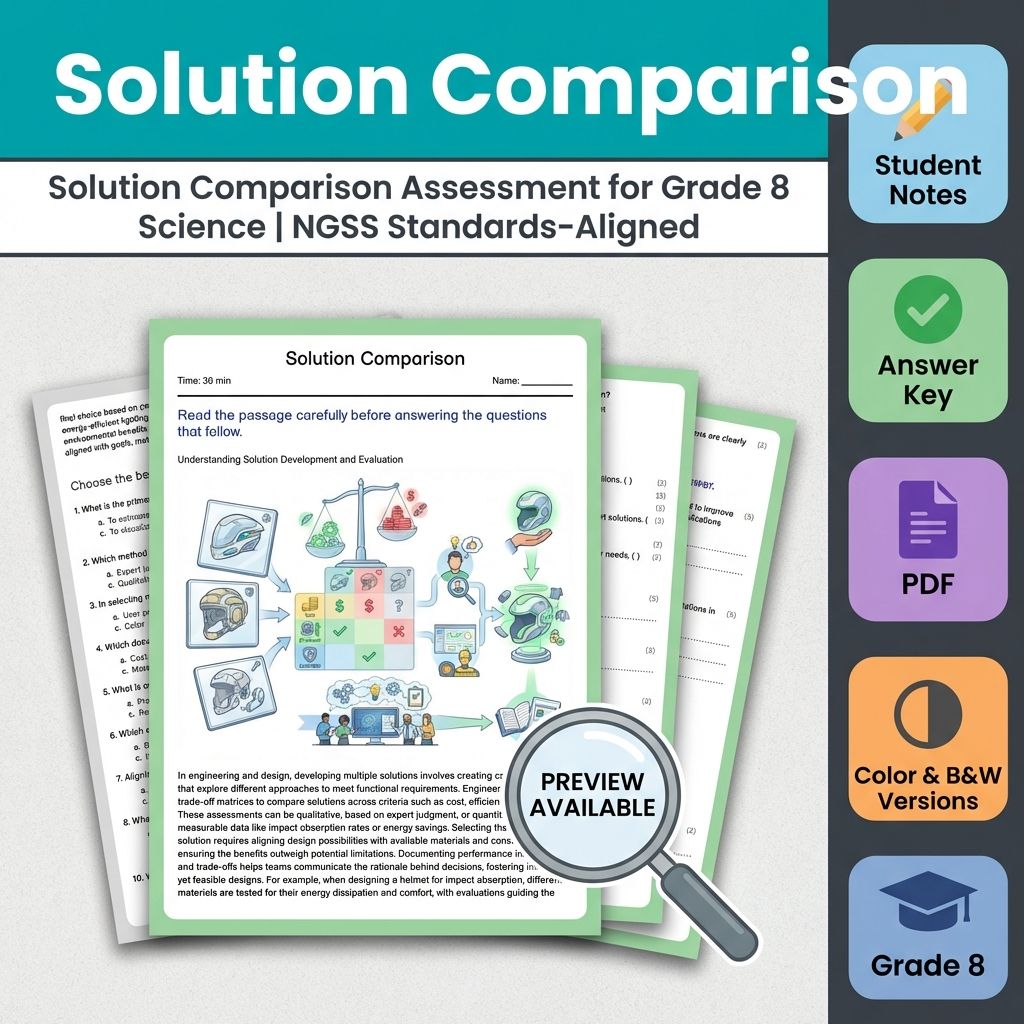
Solution Comparison Assessment for Grade 8 Science | NGSS Standards-Aligned
Created byPrism Point LearningLearning Objectives
- Understand the principles of designing and evaluating multiple solutions based on criteria and constraints.
- Learn to develop concept sketches, trade-off matrices, and compare solutions qualitatively and quantitatively.
- Identify key performance indicators and document benefits and limitations of design concepts.
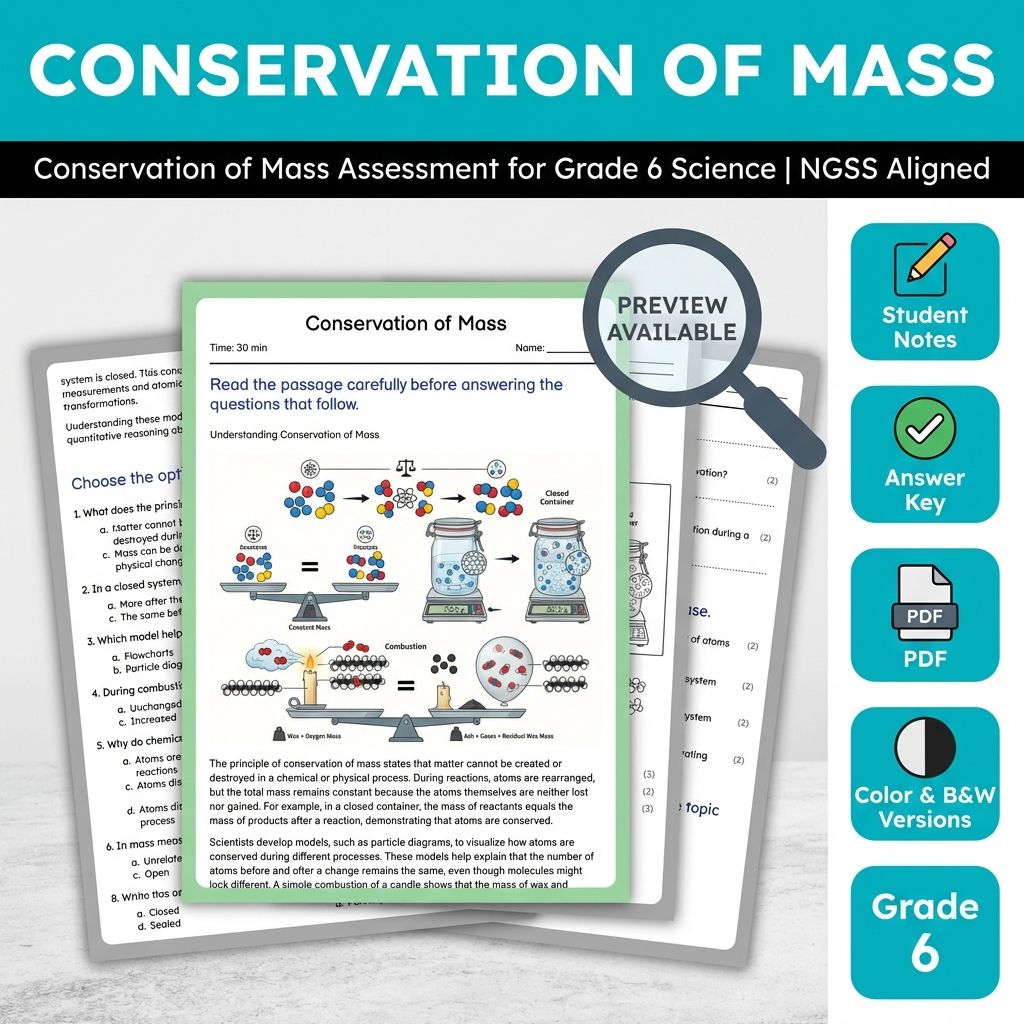
Conservation of Mass Assessment for Grade 6 Science | NGSS Aligned
Created byPrism Point LearningLearning Objectives
- Explain the principle of the conservation of mass through physical and chemical changes.
- Identify models and diagrams that demonstrate atom count constancy during reactions.
- Connect mass measurements before and after matter transformations to the concept of atom conservation.
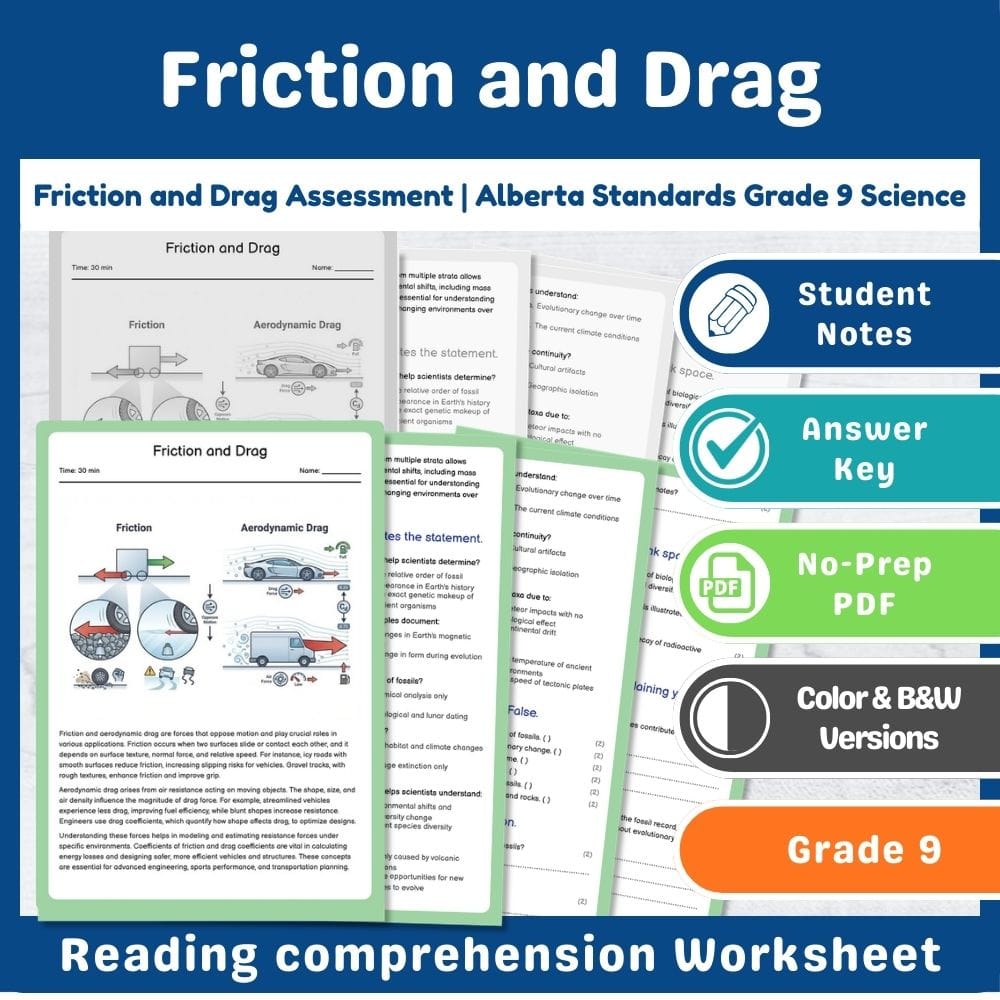
Friction and Drag Assessment | Alberta Standards Grade 9 Science
Created byPrism Point LearningLearning Objectives
- Explain how friction and aerodynamic drag oppose motion and convert mechanical energy into thermal energy.
- Describe the factors affecting friction on icy roads and gravel tracks.
- Identify the variables influencing aerodynamic drag on various structures.

Nutrient Cycling Assessment for Grade 8 Science | Alberta Standards
Created byPrism Point LearningLearning Objectives
- Describe the processes involved in nutrient cycling within ecosystems.
- Explain the roles of decomposers, nitrogen fixation, and sedimentation.
- Analyze how environmental factors like temperature and moisture influence nutrient cycles.
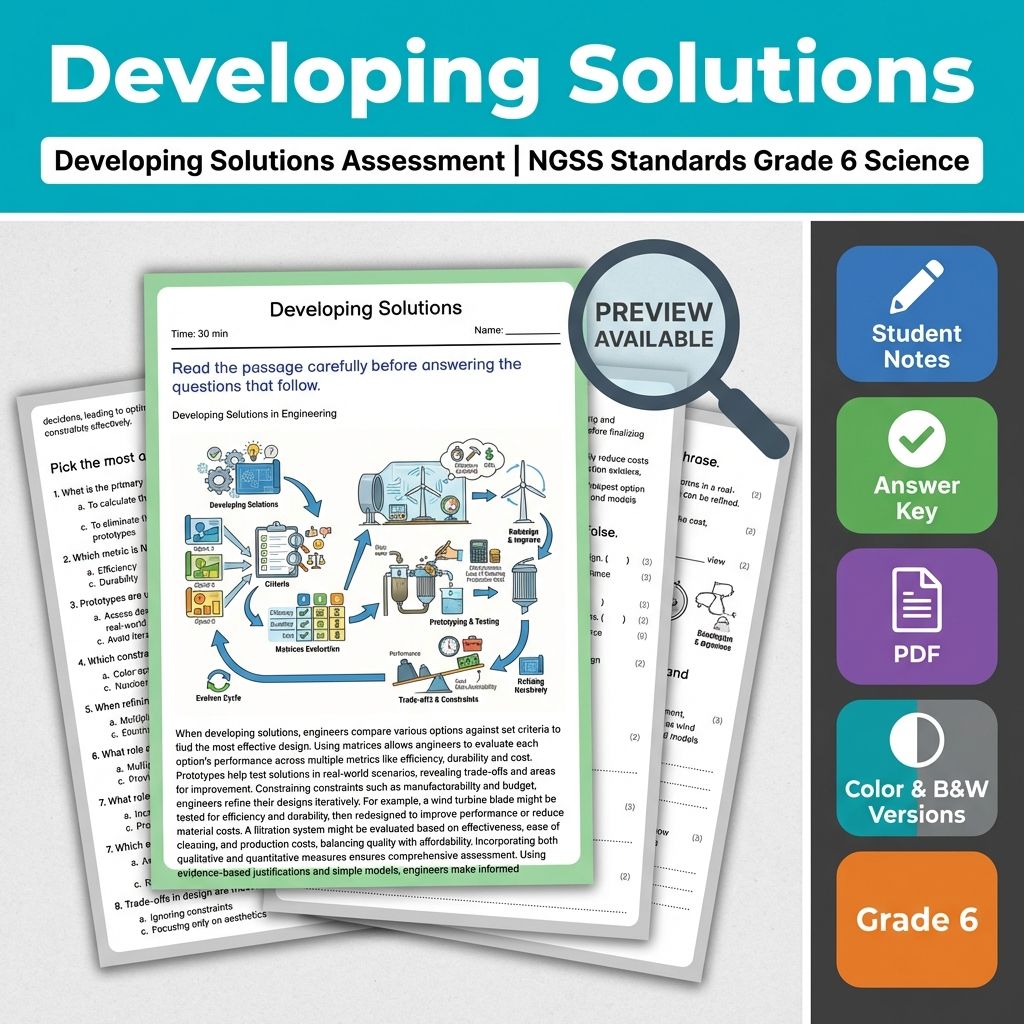
Developing Solutions Assessment | NGSS Standards Grade 6 Science
Created byPrism Point LearningLearning Objectives
- Compare multiple design solutions using matrices, rubrics, and prototypes.
- Evaluate solutions based on quantitative and qualitative metrics such as efficiency, durability, and cost.
- Analyze trade-offs between different configurations and understand their influence on solution selection.
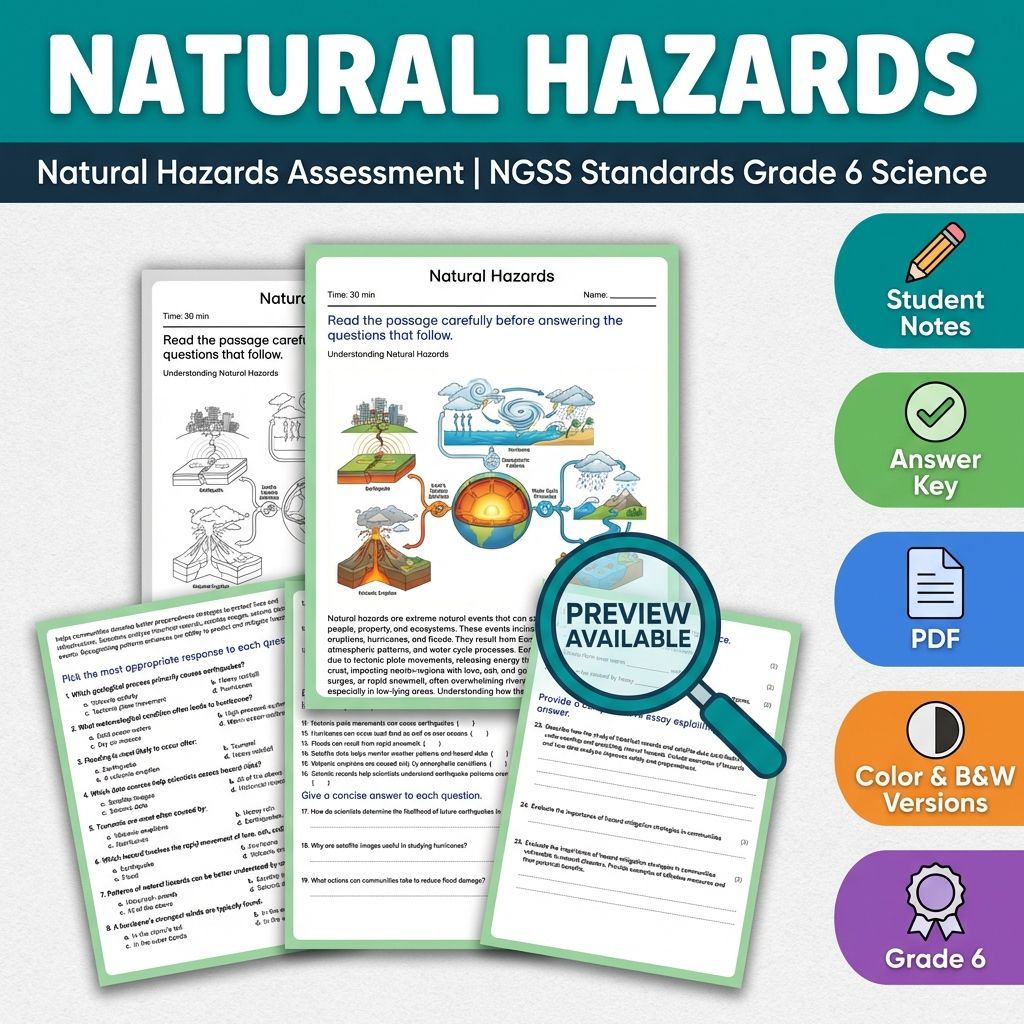
Natural Hazards Assessment | NGSS Standards Grade 6 Science
Created byPrism Point LearningLearning Objectives
- Analyze the origins, patterns, and effects of natural hazards such as earthquakes, volcanic eruptions, hurricanes, and floods.
- Understand the relationships among tectonic processes, atmospheric dynamics, and hydrologic cycles in hazard occurrence.
- Evaluate historical records, seismic data, satellite images, and hazard maps to interpret cause-effect links and impacts on communities.

Earth Sun Cycles Assessment | General Grade 7 Science Standards
Created byPrism Point LearningLearning Objectives
- Describe how Earth's tilt and orbit influence seasons and day length.
- Explain the relationship between Earth's position relative to the sun and observable patterns in daylight and temperature.
- Understand how the apparent motion of the sun supports calendar and timekeeping systems.
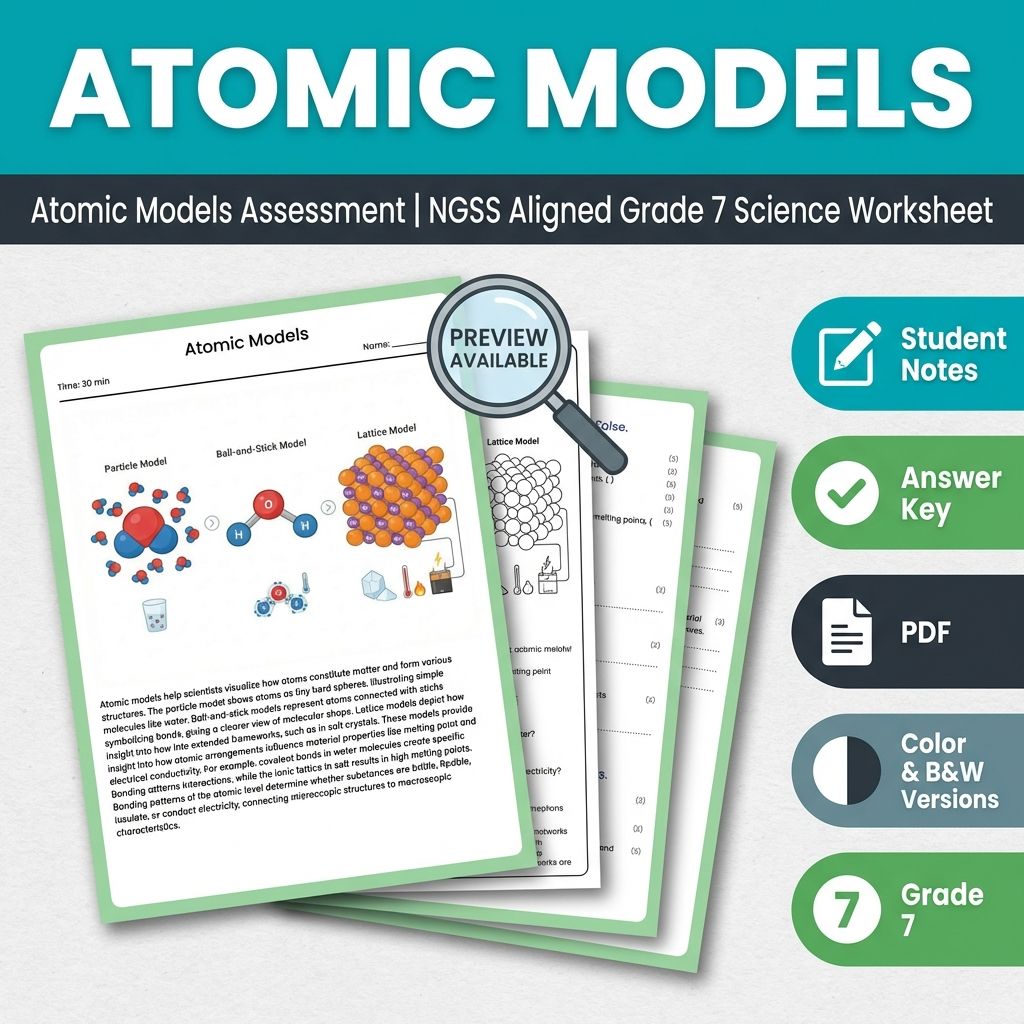
Atomic Models Assessment | NGSS Aligned Grade 7 Science Worksheet
Created byPrism Point LearningLearning Objectives
- Understand different atomic model representations such as particle, ball-and-stick, and lattice models.
- Identify how atoms form molecules and extended structures through bonding patterns.
- Explain the relationship between subatomic particles, atomic number, and material properties.
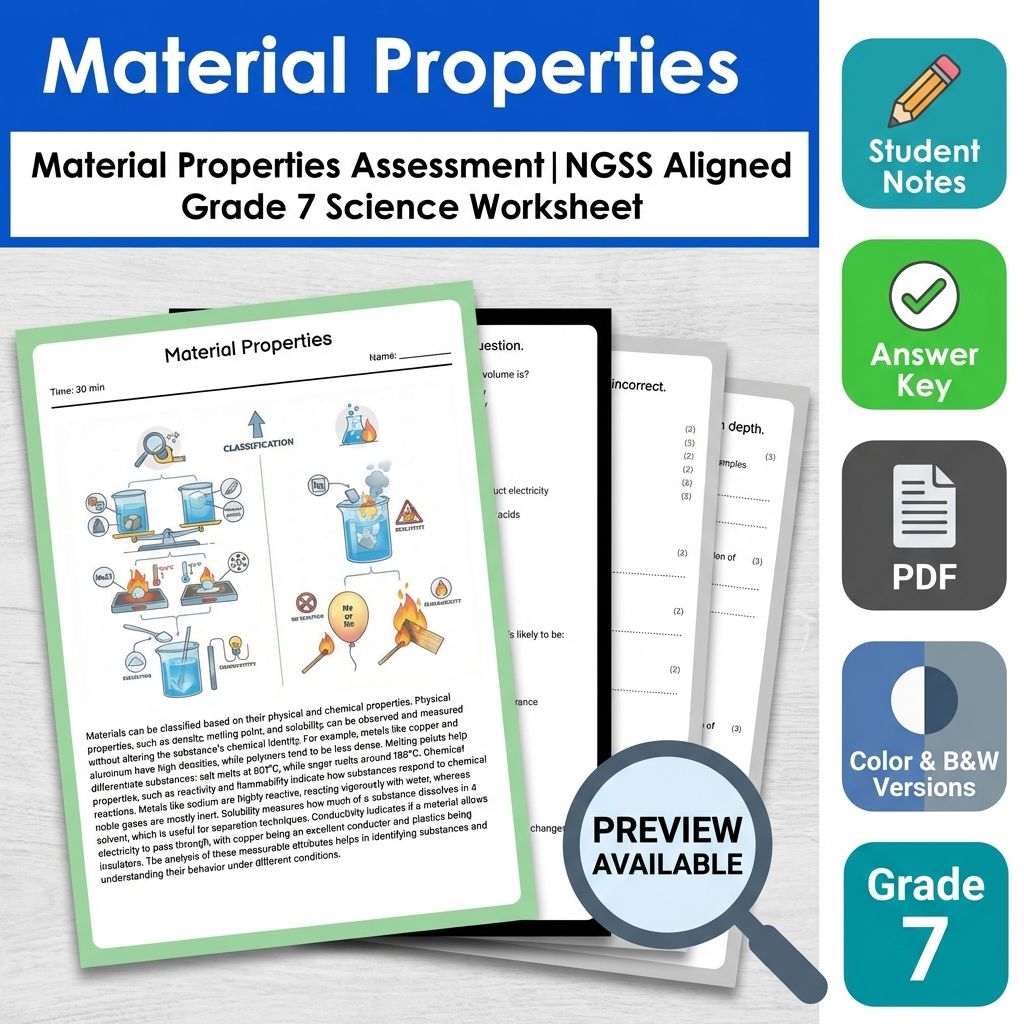
Material Properties Assessment | NGSS Aligned Grade 7 Science Worksheet
Created byPrism Point LearningLearning Objectives
- Distinguish between physical and chemical properties of materials.
- Identify measurable descriptors such as density, melting point, solubility, electrical conductivity, reactivity, and flammability.
- Analyze property data to classify materials and predict their responses to temperature and chemical contact.
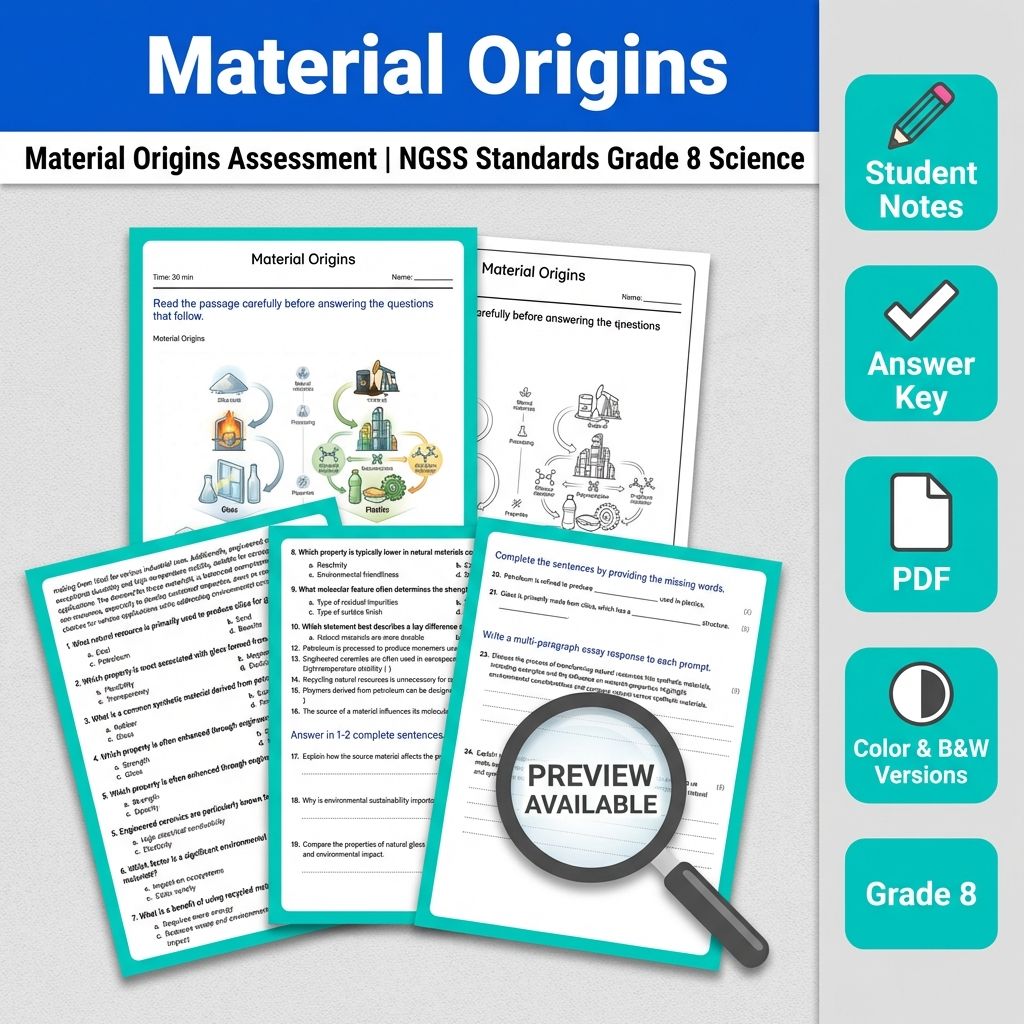
Material Origins Assessment | NGSS Standards Grade 8 Science
Created byPrism Point LearningLearning Objectives
- Explain how natural resources are transformed into synthetic materials.
- Describe the relationship between source materials, molecular structure, and material properties.
- Analyze environmental and resource considerations in sourcing and modifying materials.
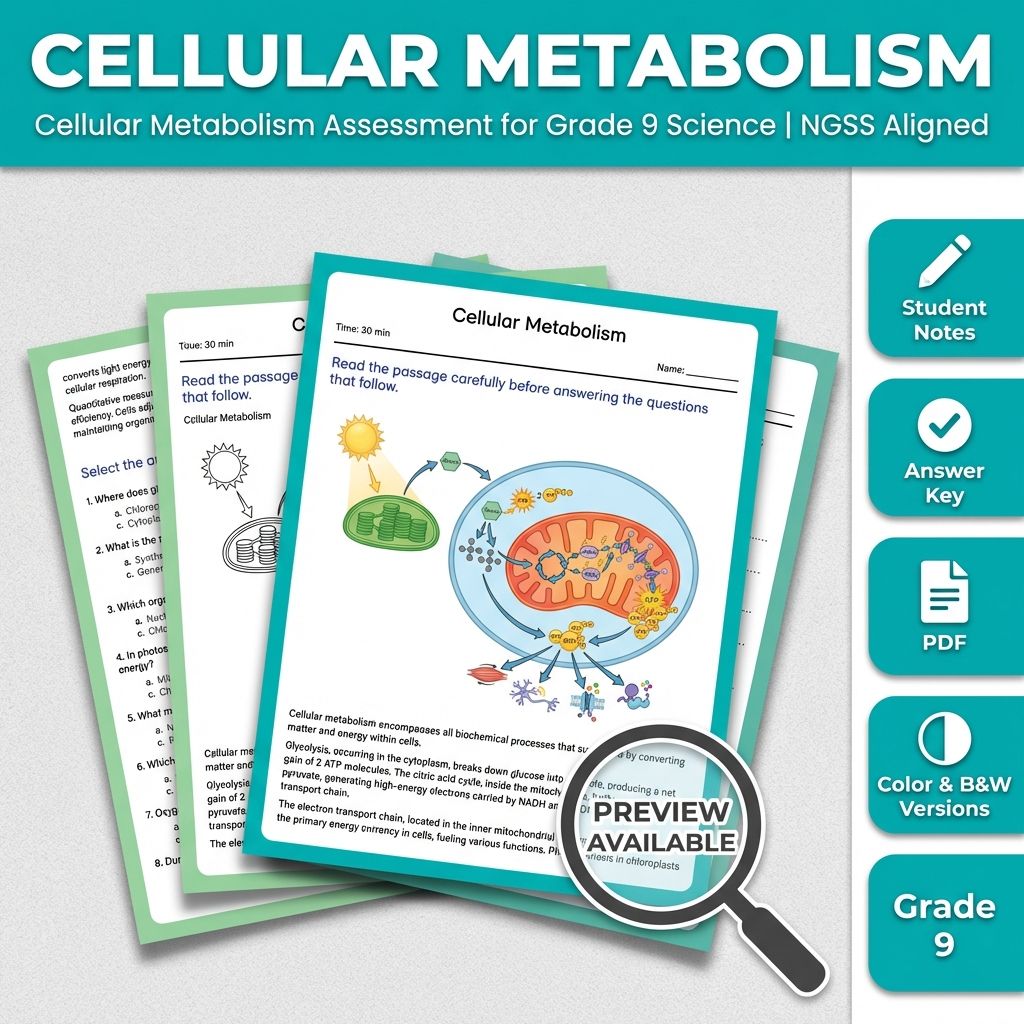
Cellular Metabolism Assessment for Grade 9 Science | NGSS Aligned
Created byPrism Point LearningLearning Objectives
- Explain the main biochemical pathways involved in cellular energy production, including glycolysis, the citric acid cycle, and electron transport chain.
- Describe the role of ATP in energy coupling within cells and relate metabolic fluxes to organismal energy balance.
- Analyze quantitative data related to reactants and products of metabolic pathways, such as oxygen consumption and ATP yield.
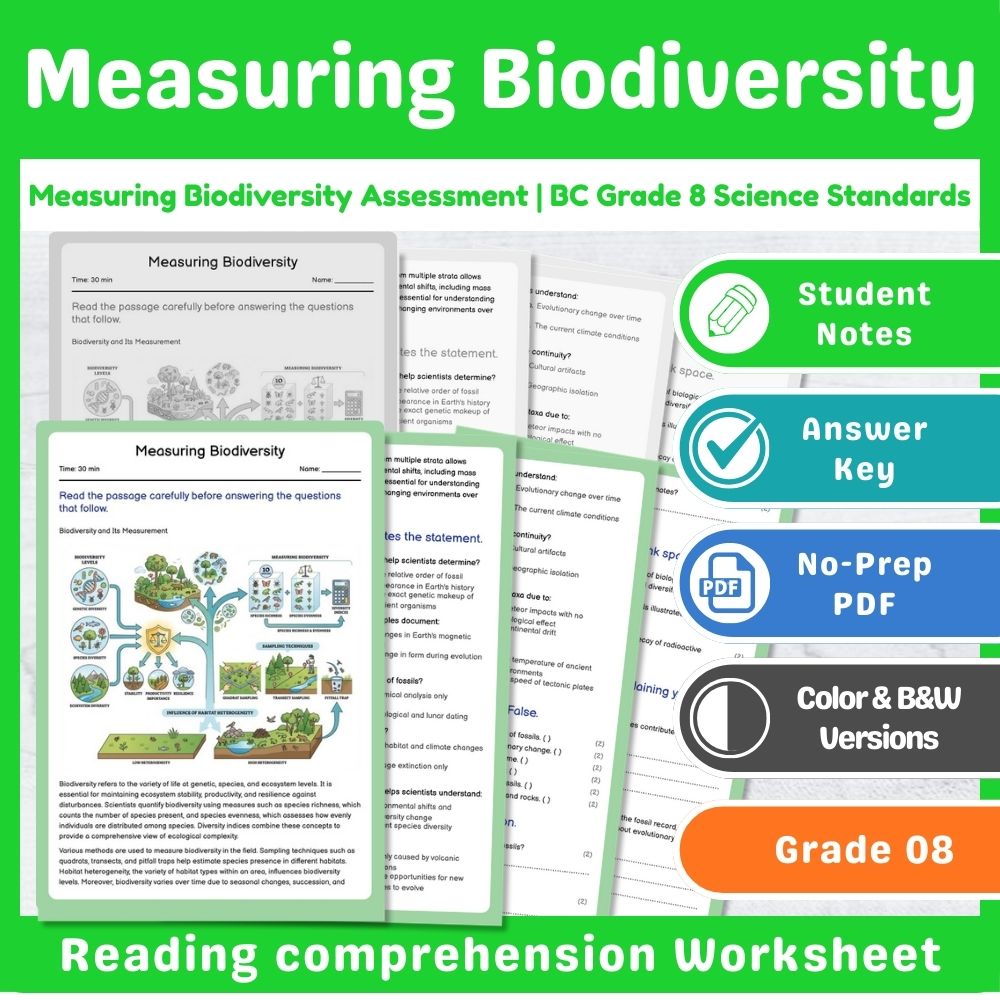
Measuring Biodiversity Assessment | BC Grade 8 Science Standards
Created byPrism Point LearningLearning Objectives
- Understand the concepts of biodiversity, species richness, evenness, and diversity indices.
- Identify methods used to measure biodiversity in different ecosystems.
- Analyze how sampling techniques, habitat heterogeneity, and temporal variation influence biodiversity measurements.
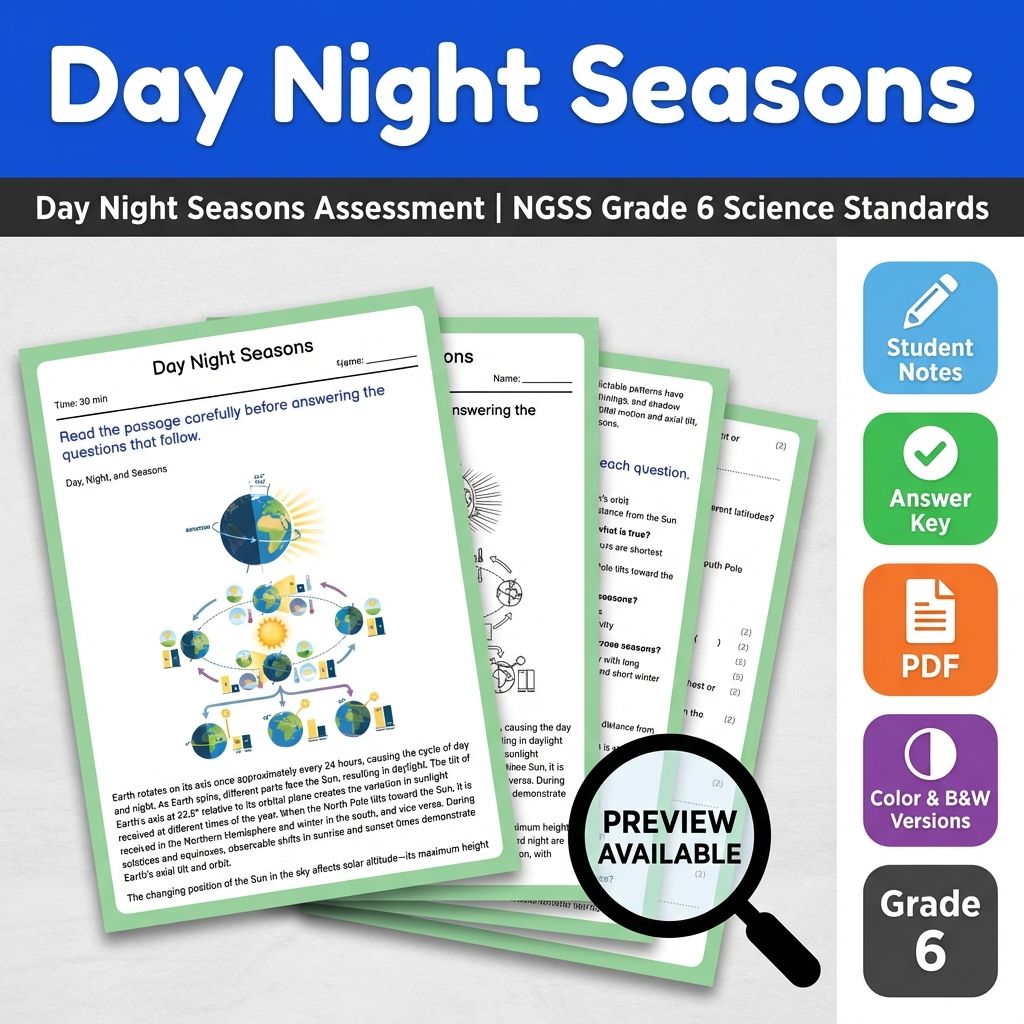
Day Night Seasons Assessment | NGSS Grade 6 Science Standards
Created byPrism Point LearningLearning Objectives
- Explain Earth's rotation and how it produces day and night.
- Describe Earth's orbit around the Sun and how axial tilt causes seasonal changes.
- Identify key observational markers such as solstices and equinoxes.

Metabolic Regulation Assessment | TEKS Standards Grade 11 Science
Created byPrism Point LearningLearning Objectives
- Understand the mechanisms of enzyme regulation in metabolic pathways.
- Identify different types of enzyme modifications such as allosteric modulation and covalent changes.
- Explain how compartmentalization and membrane transport influence metabolic flux.
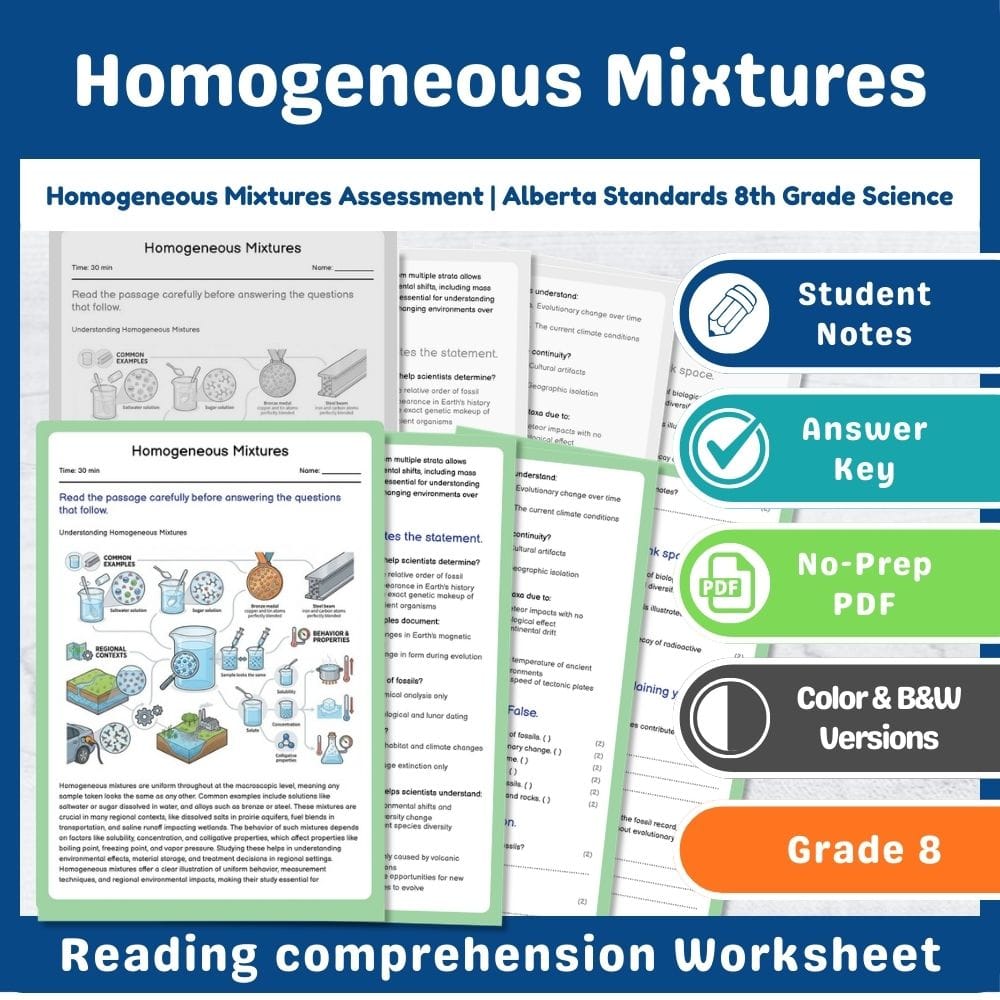
Homogeneous Mixtures Assessment | Alberta Standards 8th Grade Science
Created byPrism Point LearningLearning Objectives
- Understand the concept of homogeneous mixtures and their common examples.
- Identify factors influencing the behavior of solutions and alloys.
- Explain regional examples of uniform mixtures and their environmental impacts.
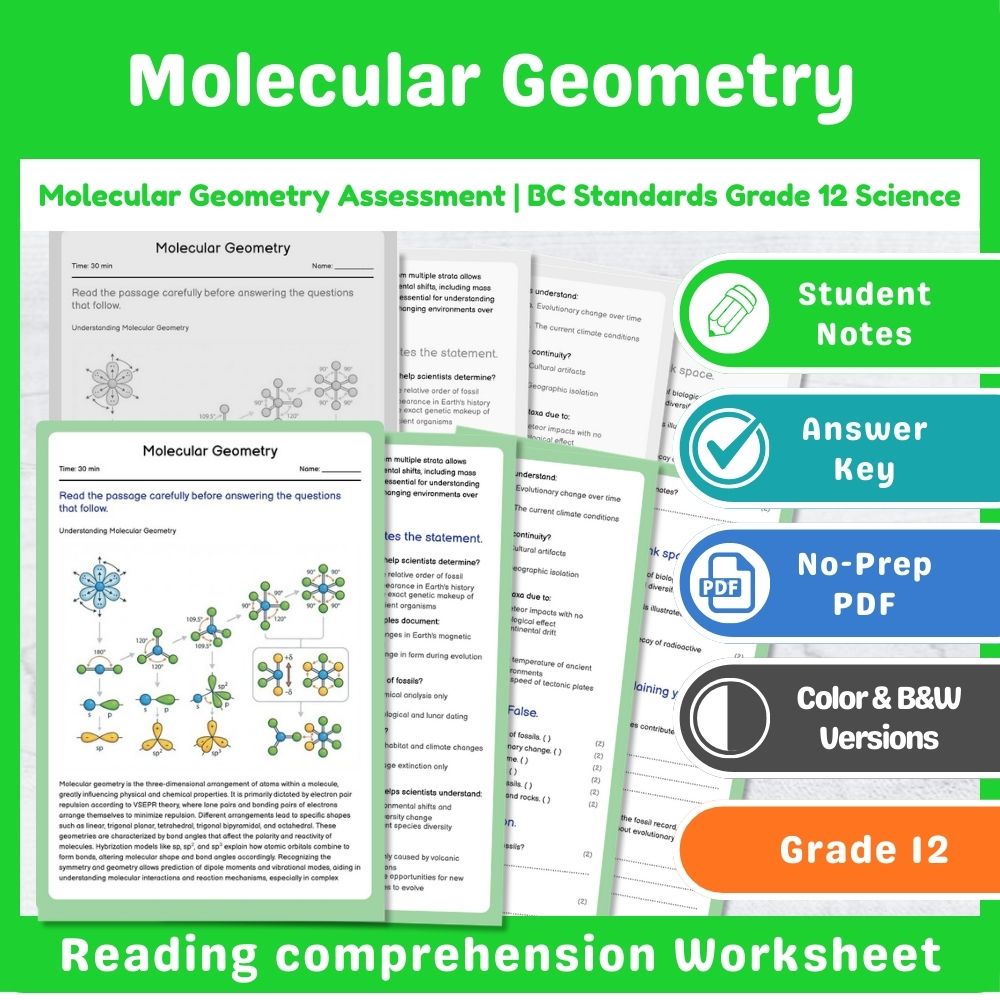
Molecular Geometry Assessment | BC Standards Grade 12 Science
Created byPrism Point LearningLearning Objectives
- Explain the principles of VSEPR theory and how electron pair repulsion determines molecular shape.
- Identify and describe various molecular geometries and their bond angles.
- Predict molecule polarity based on geometry and symmetry considerations.
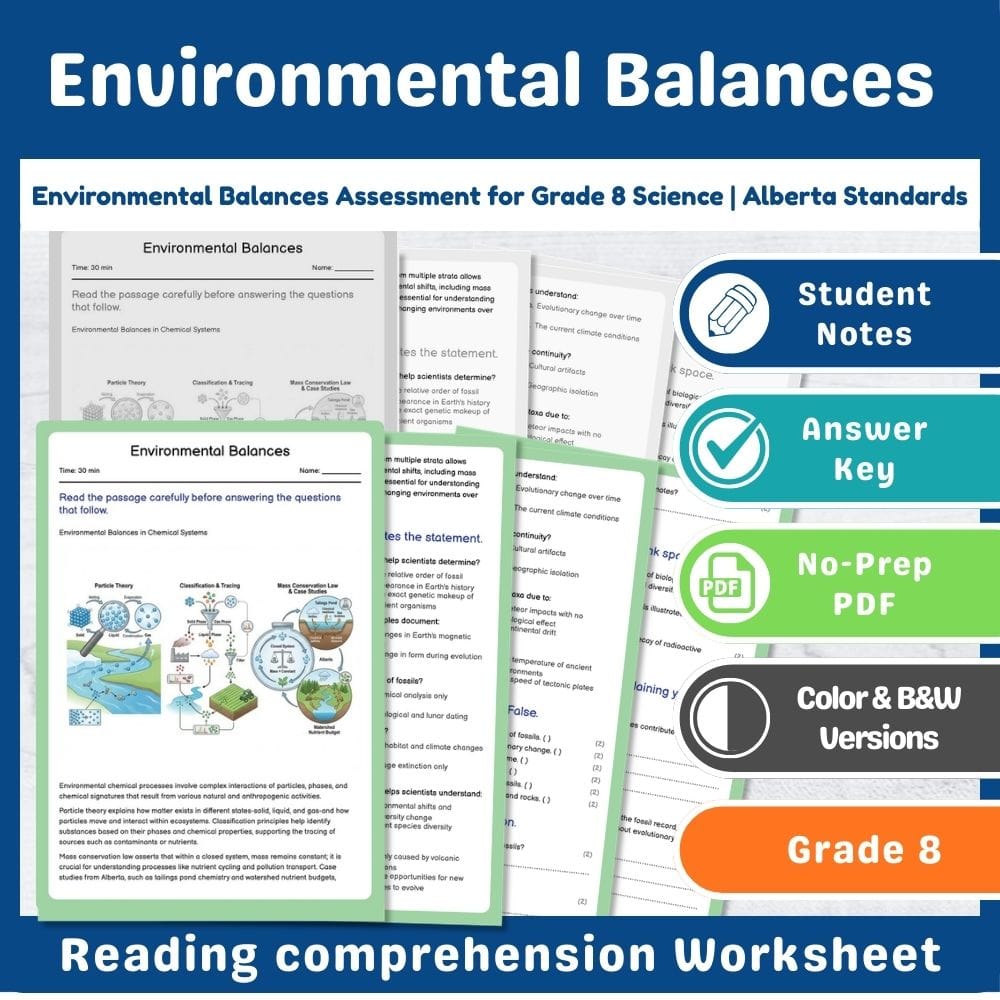
Environmental Balances Assessment for Grade 8 Science | Alberta Standards
Created byPrism Point LearningLearning Objectives
- Understand how particle theory and classification principles help interpret environmental chemical processes.
- Explain the concepts of nutrient cycling, contamination transport, and mass conservation within ecosystems.
- Apply knowledge of phases, mixtures, and chemical signatures to trace sources and sinks in environmental systems.
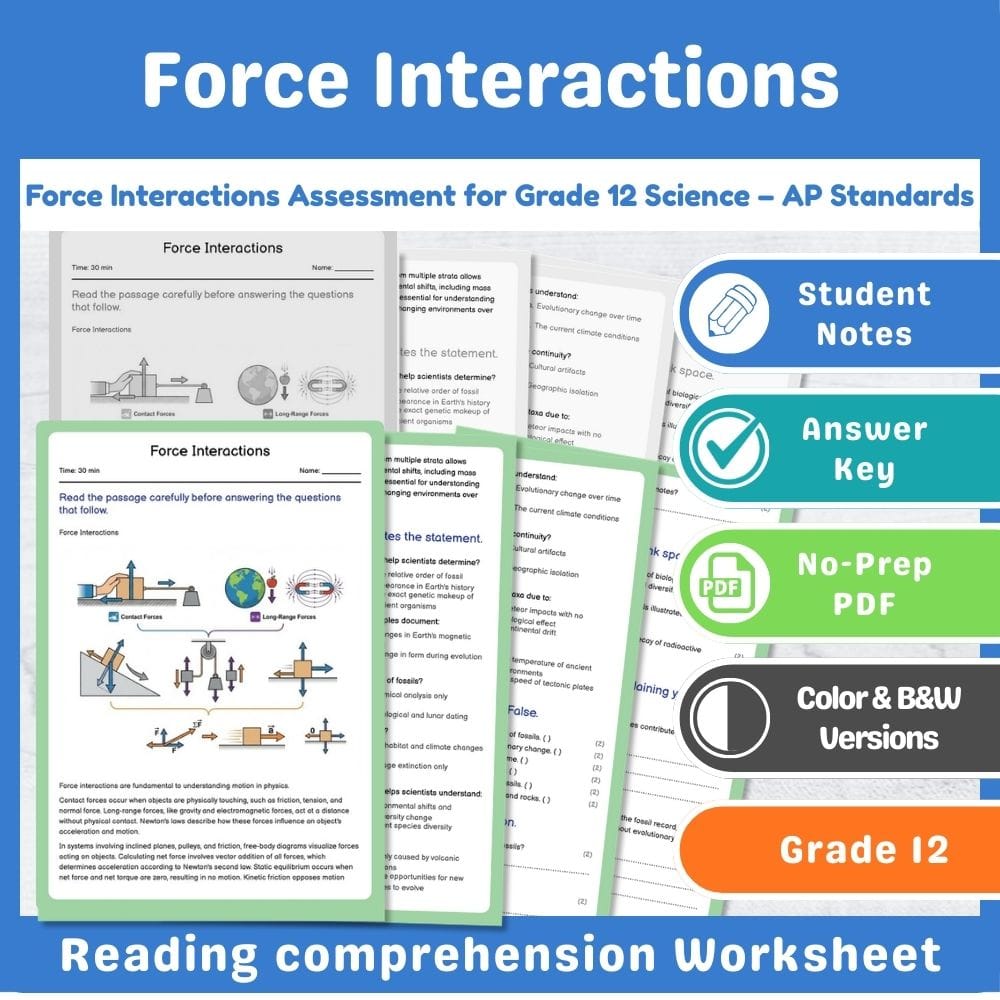
Force Interactions Assessment for Grade 12 Science – AP Standards
Created byPrism Point LearningLearning Objectives
- Describe contact and long-range force interactions and their laws.
- Analyze free-body diagrams and apply Newton's laws to various systems.
- Calculate net forces and accelerations on objects in equilibrium and non-equilibrium.
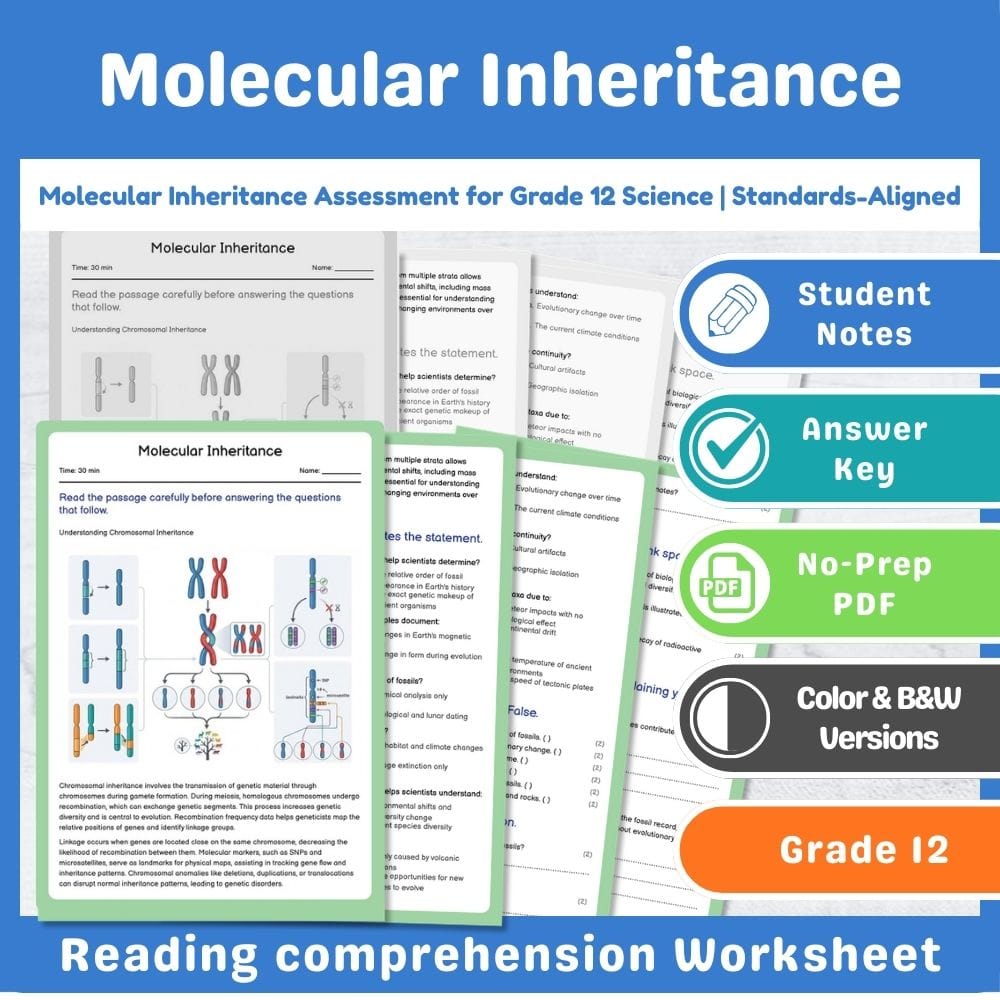
Molecular Inheritance Assessment for Grade 12 Science | Standards-Aligned
Created byPrism Point LearningLearning Objectives
- Understand chromosomal behavior and mechanisms of inheritance.
- Explain the concepts of recombination, linkage, and molecular markers.
- Differentiate between single-gene effects and polygenic influences on inheritance patterns.
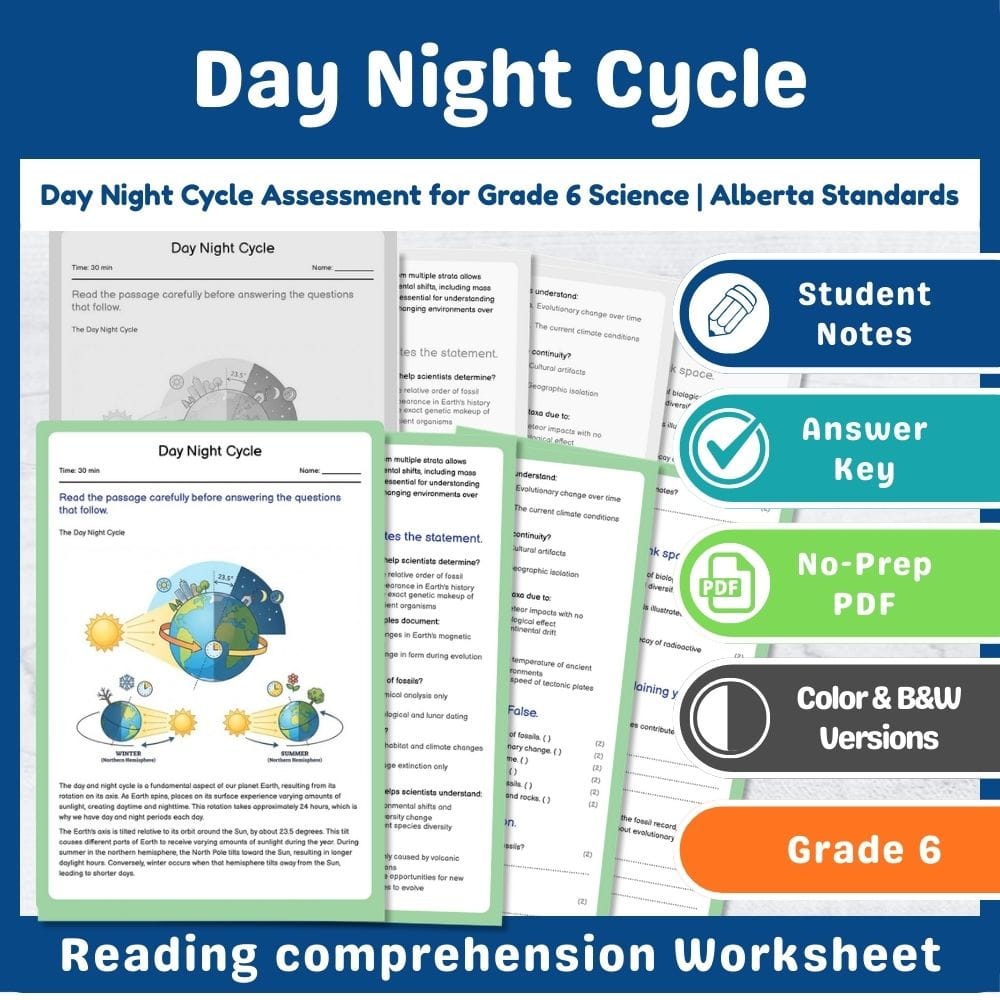
Day Night Cycle Assessment for Grade 6 Science | Alberta Standards
Created byPrism Point LearningLearning Objectives
- Explain how Earth's rotation causes day and night.
- Describe the effect of Earth's axial tilt on daylight duration throughout the year.
- Relate observed day length patterns in Alberta to Earth's position and movement around the Sun.
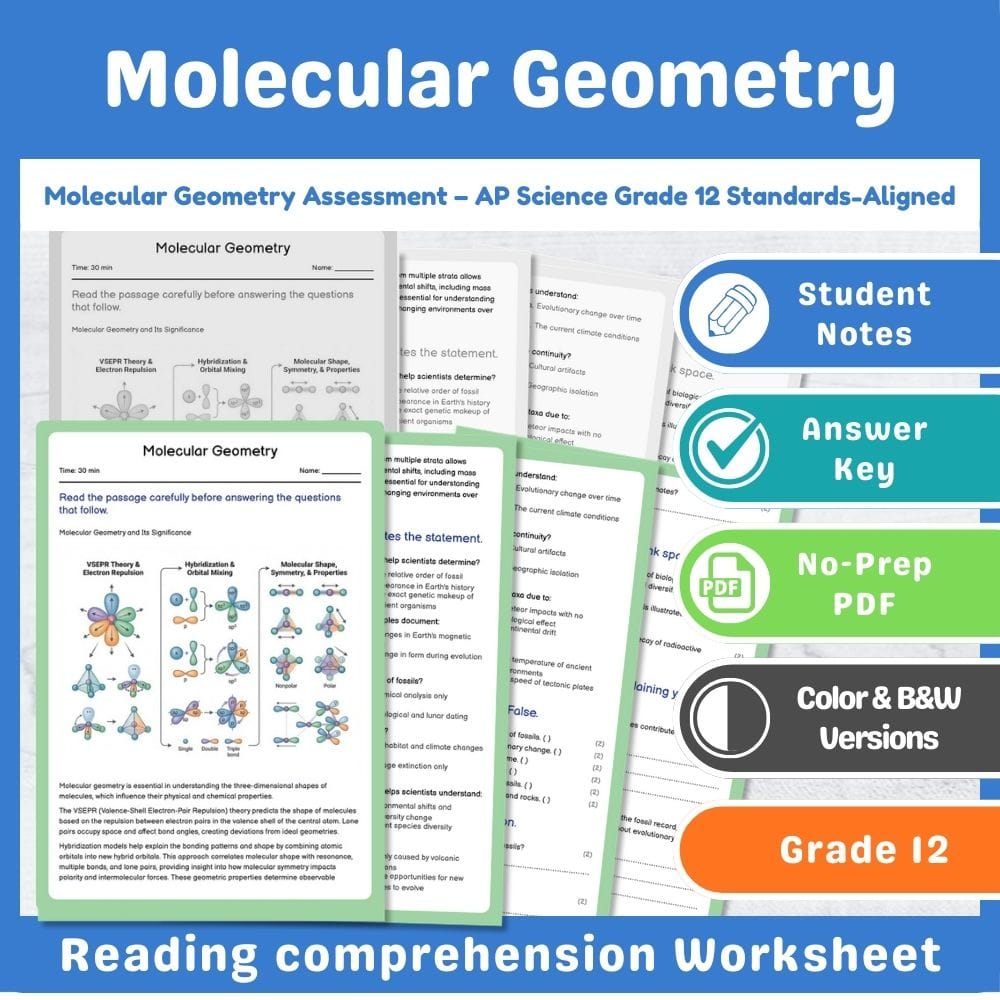
Molecular Geometry Assessment – AP Science Grade 12 Standards-Aligned
Created byPrism Point LearningLearning Objectives
- Explain the VSEPR model to predict molecular shapes and Bond angles.
- Describe the effects of lone pairs, multiple bonds, and resonance on molecular geometry.
- Relate molecular geometry to polarity, symmetry, and observable properties such as dipole moments.
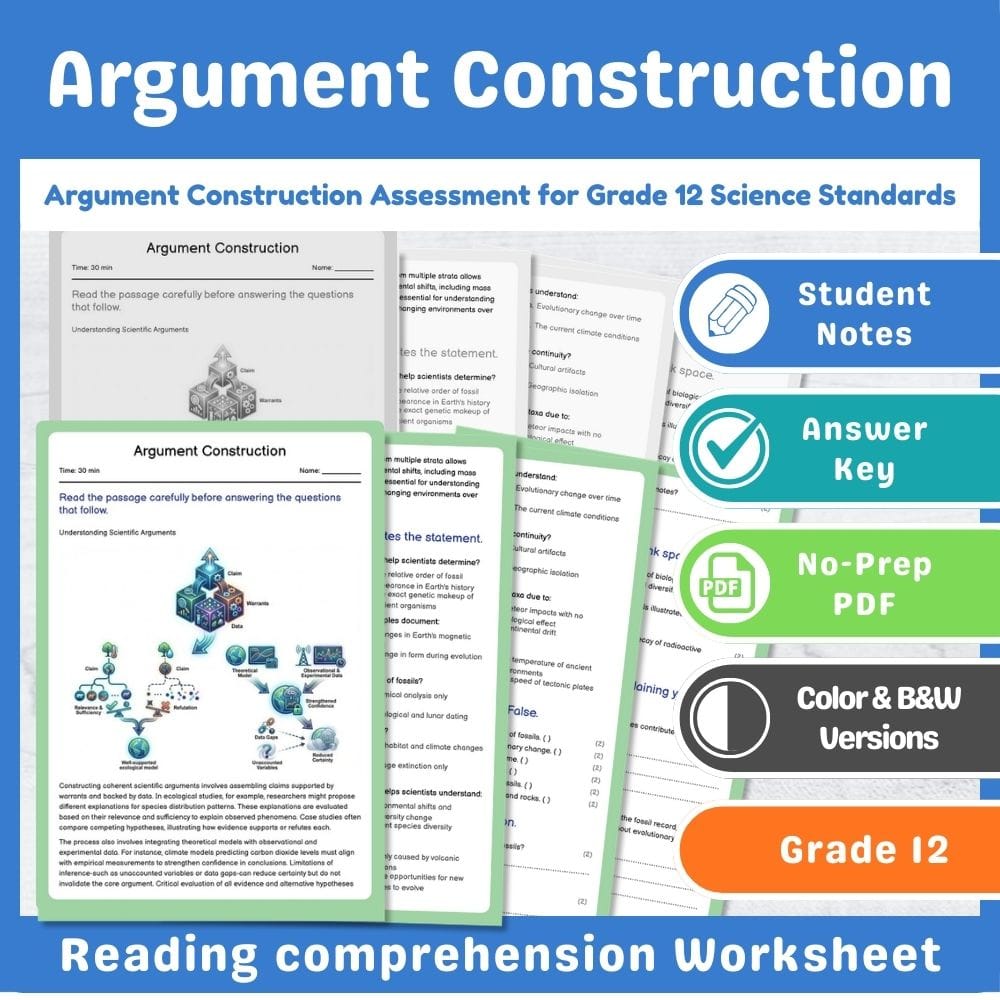
Argument Construction Assessment for Grade 12 Science Standards
Created byPrism Point LearningLearning Objectives
- Understand how to construct evidence-based arguments in scientific contexts.
- Identify components such as claims, warrants, and backing in case studies.
- Evaluate relevance, sufficiency, and alternative hypotheses in argumentation.
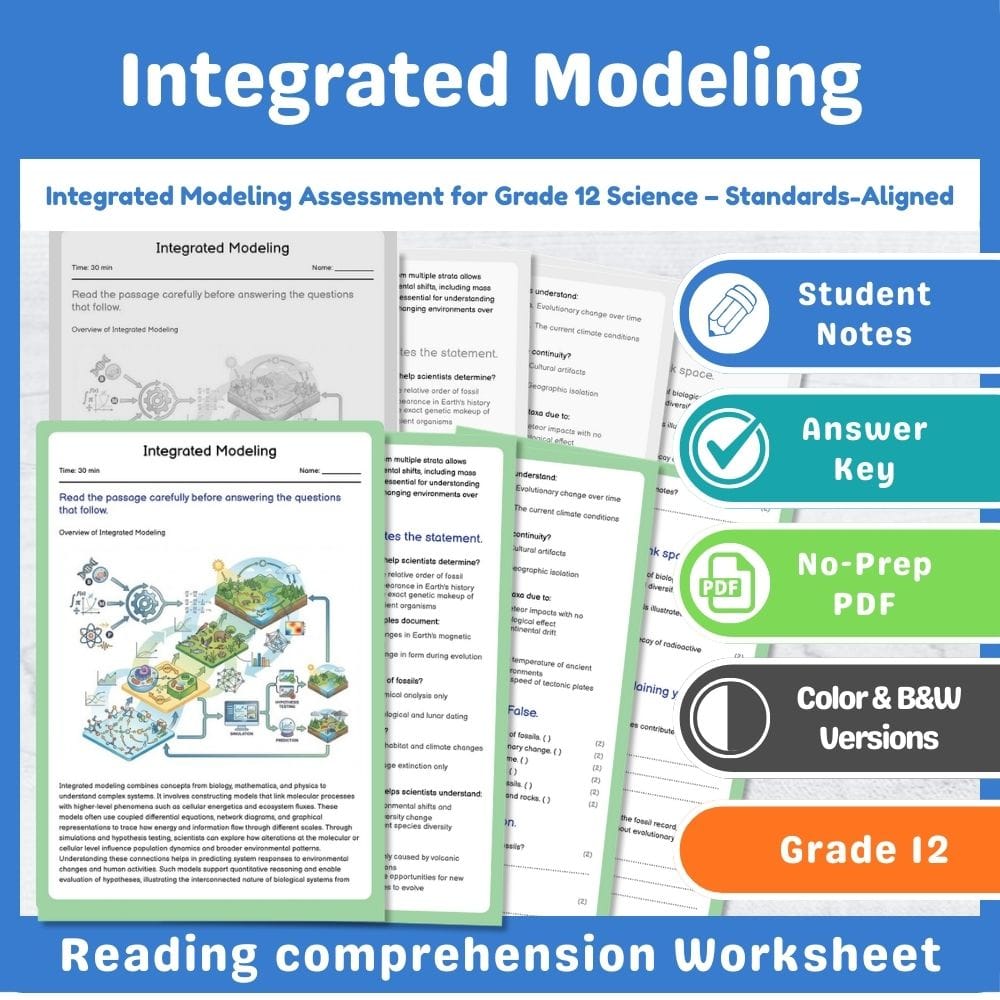
Integrated Modeling Assessment for Grade 12 Science – Standards-Aligned
Created byPrism Point LearningLearning Objectives
- Understand how molecular processes influence cellular energetics and genetic regulation.
- Describe the use of mathematical models such as differential equations and network diagrams in biological systems.
- Explain how changes at one biological level propagate to others within ecosystems.
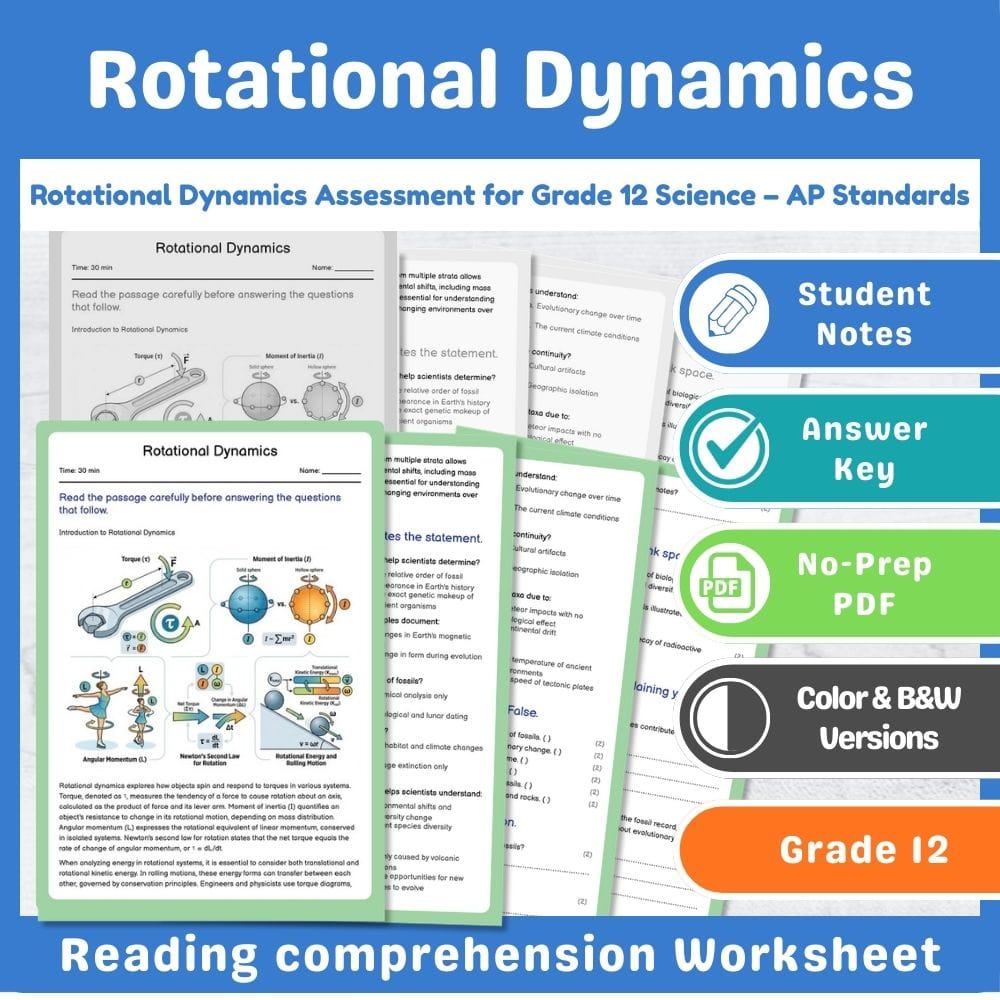
Rotational Dynamics Assessment for Grade 12 Science – AP Standards
Created byPrism Point LearningLearning Objectives
- Understand the concept of torque and how it relates to rotational motion.
- Define and explain the significance of moment of inertia and angular momentum in rigid bodies.
- Develop and apply equations linking net torque to angular acceleration.
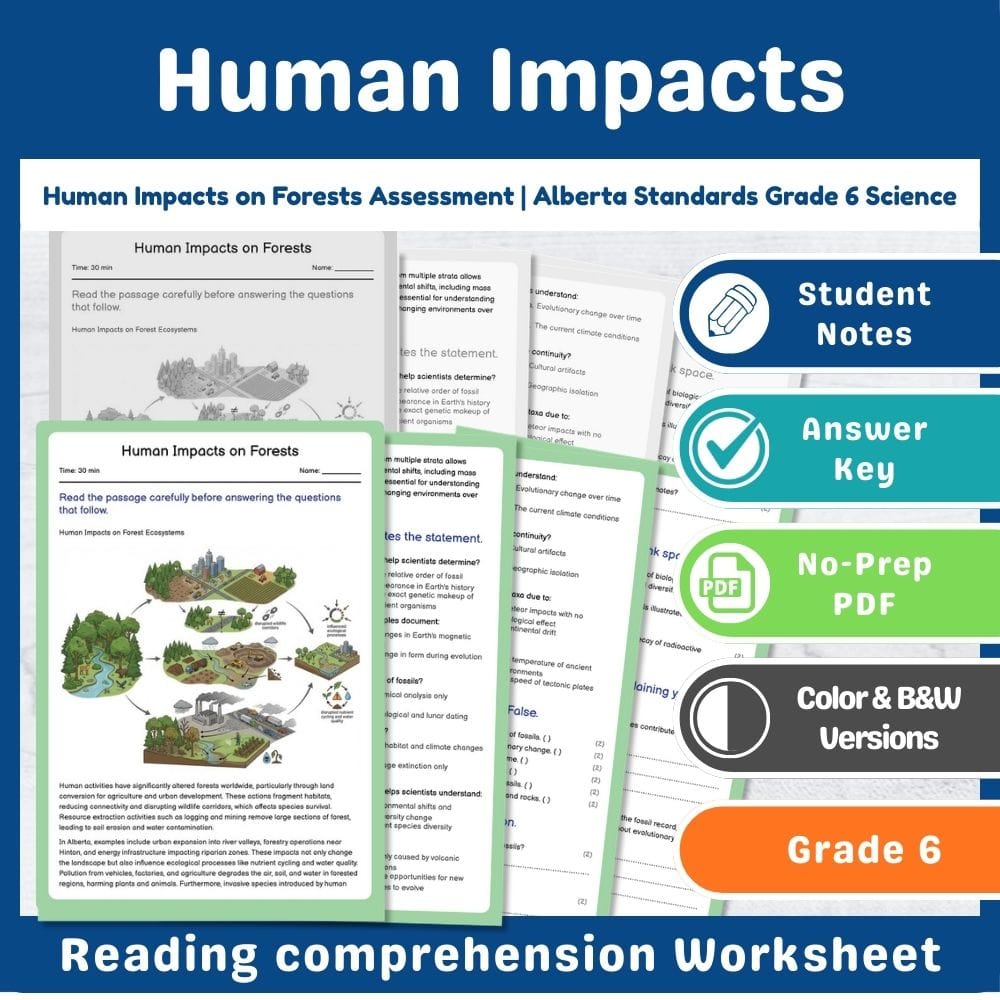
Human Impacts on Forests Assessment | Alberta Standards Grade 6 Science
Created byPrism Point LearningLearning Objectives
- Understand various human activities that impact forest ecosystems.
- Identify how urban expansion, resource extraction, and pollution affect forests.
- Evaluate the cumulative environmental effects caused by human impacts.
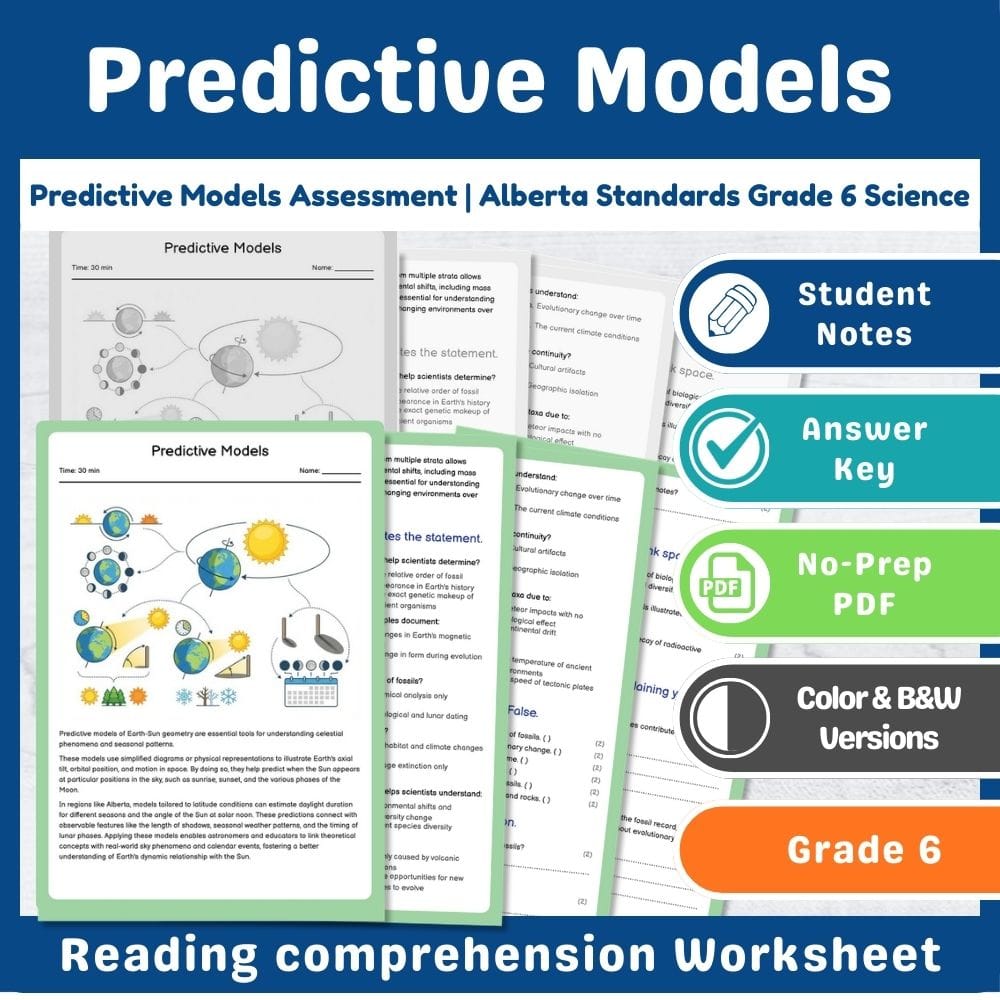
Predictive Models Assessment | Alberta Standards Grade 6 Science
Created byPrism Point LearningLearning Objectives
- Understand how models represent Earth–Sun geometry to predict celestial phenomena.
- Identify the use of simplified physical or diagrammatic models for forecasting sunrise, sunset, and lunar phases.
- Explore how latitude-specific models predict daylight hours and seasonal solar angles.
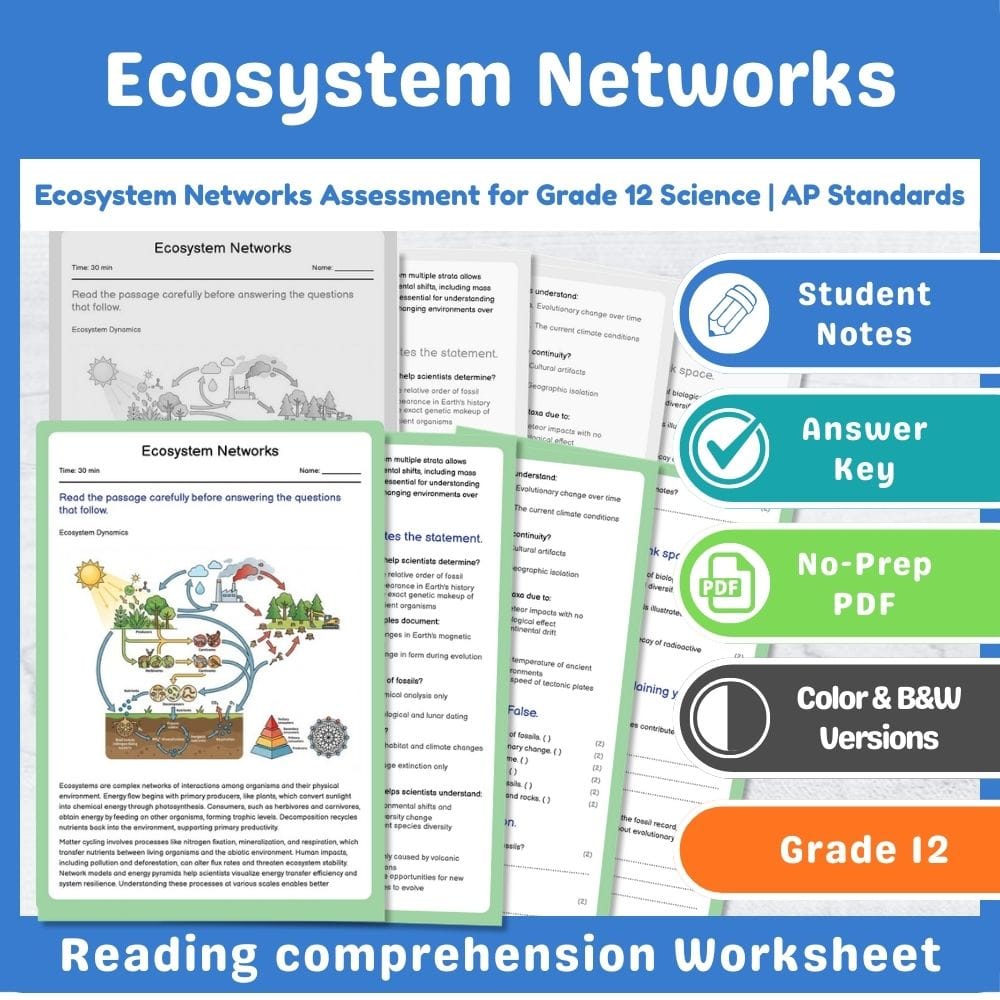
Ecosystem Networks Assessment for Grade 12 Science | AP Standards
Created byPrism Point LearningLearning Objectives
- Describe energy flow and matter cycling within ecosystems.
- Explain the roles of trophic structures, primary productivity, and decomposition.
- Analyze how biogeochemical cycles and human activities influence nutrient fluxes.
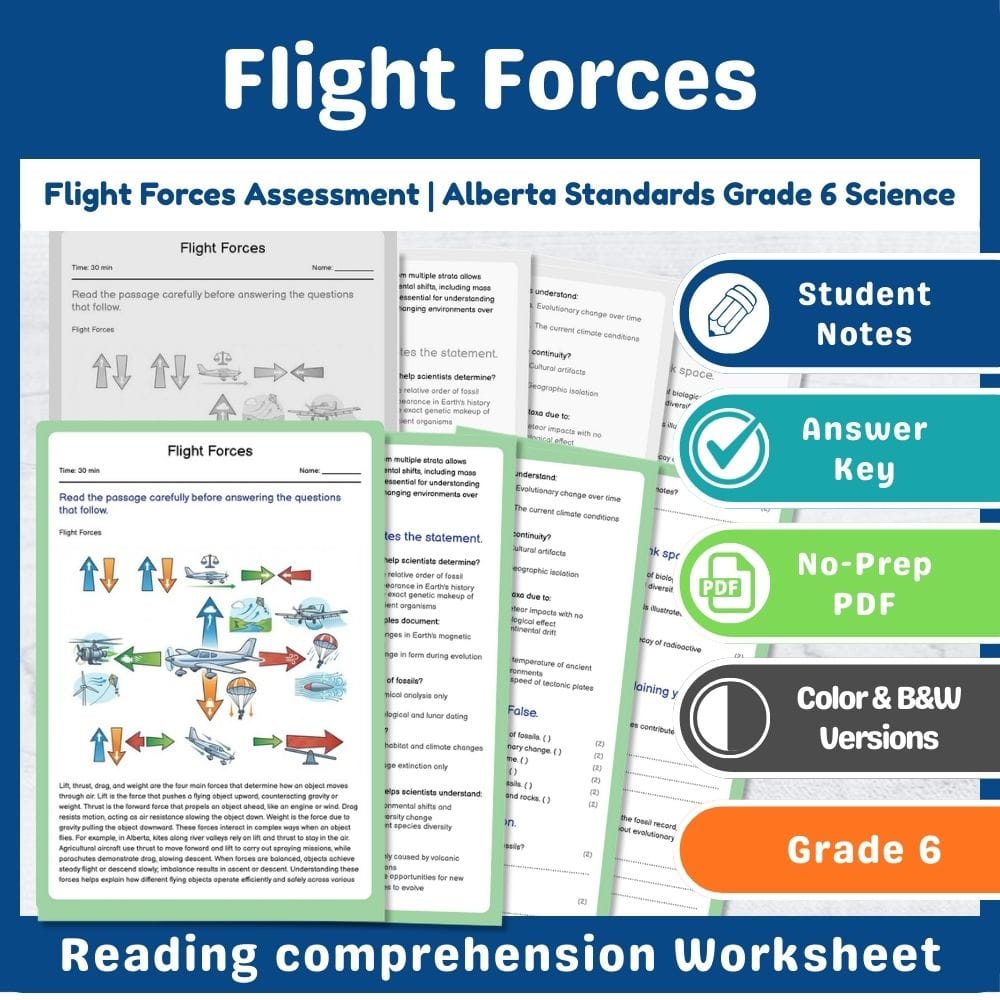
Flight Forces Assessment | Alberta Standards Grade 6 Science
Created byPrism Point LearningLearning Objectives
- Understand the four primary forces involved in flight: lift, thrust, drag, and weight.
- Describe how these forces interact to produce steady flight or descent.
- Identify examples of flight forces in real-world Alberta situations, such as kites, aircraft, and parachutes.
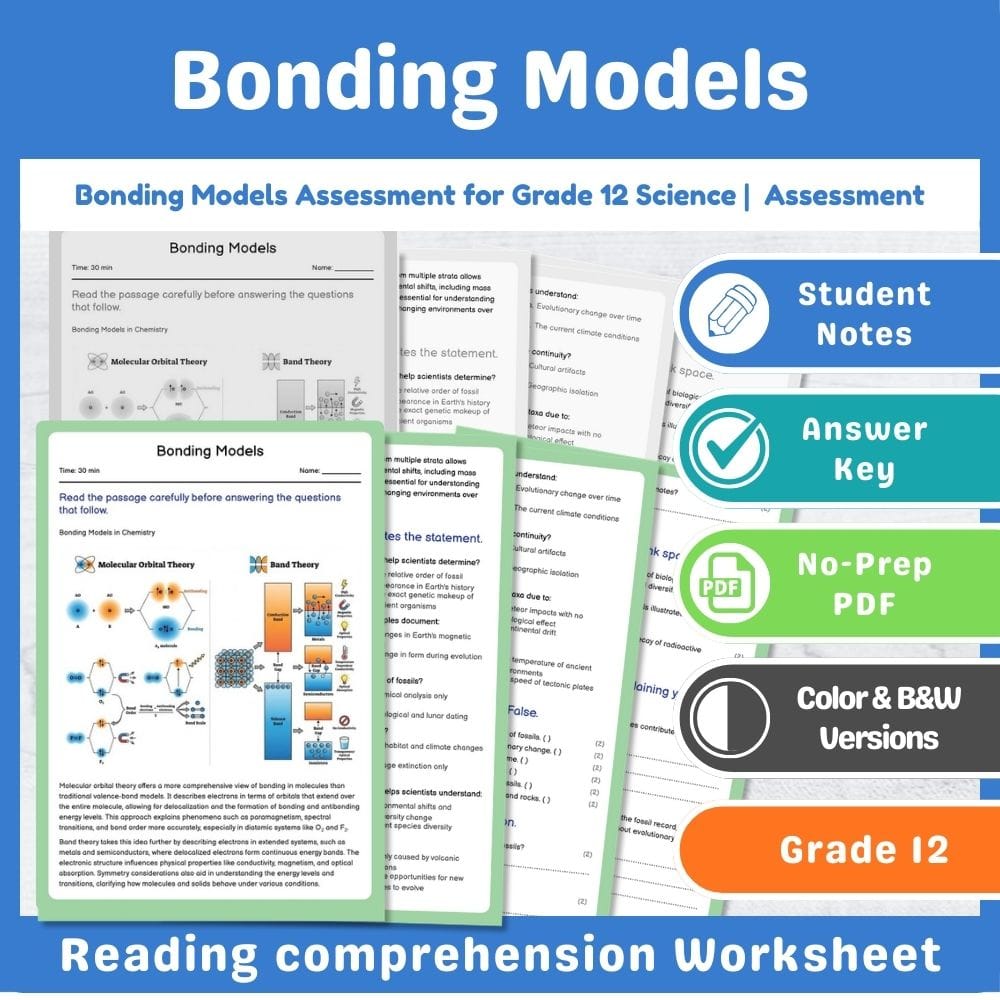
Bonding Models Assessment for Grade 12 Science | Standards-Aligned Assessment
Created byPrism Point LearningLearning Objectives
- Understand molecular orbital theory and how it extends valence-bond models.
- Explain bonding order, delocalization, and electronic structures in diatomic and extended systems.
- Use energy-level diagrams and symmetry considerations to predict magnetic, bonding, and electronic transition properties.

Endocrine Coordination Assessment for Grade 10 Science – TEKS Standards
Created byPrism Point LearningLearning Objectives
- Understand the role of hormones and glands in human physiology.
- Identify the feedback mechanisms involved in hormonal regulation.
- Explain how endocrine signals control growth, metabolism, and stress responses.
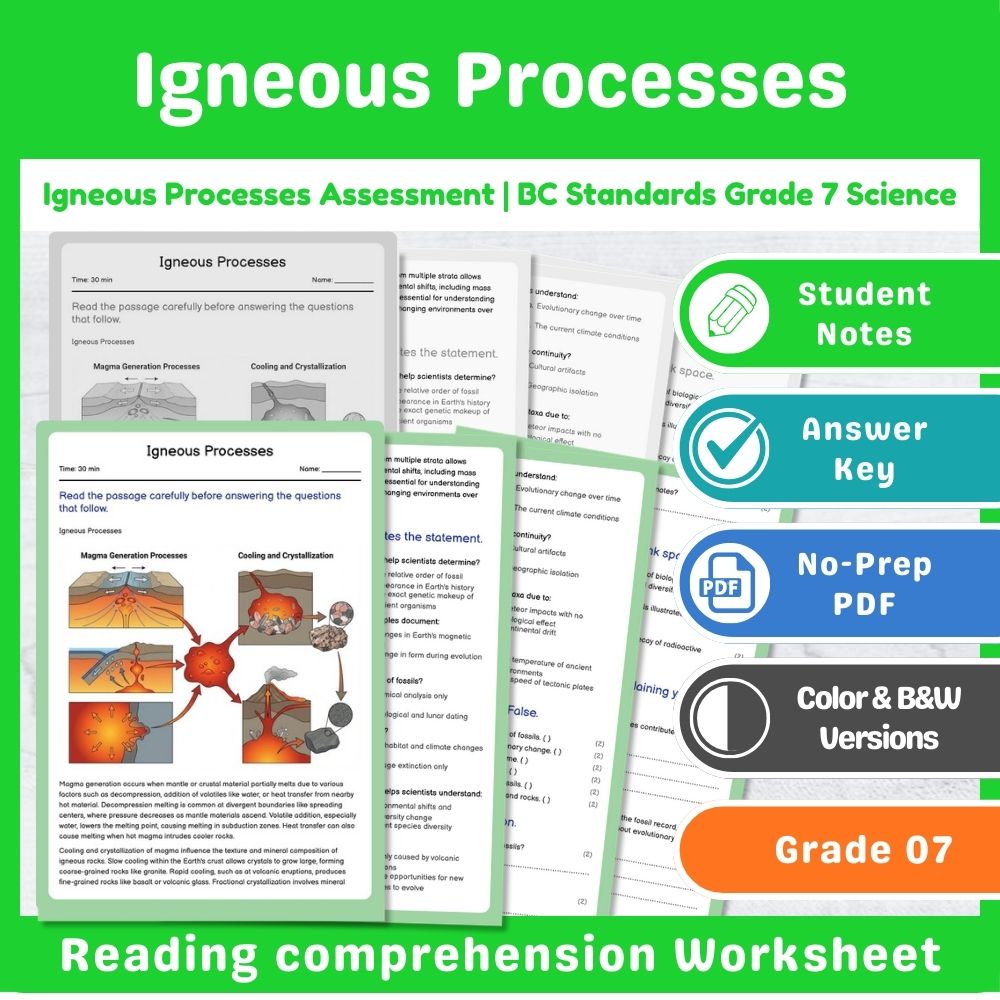
Igneous Processes Assessment | BC Standards Grade 7 Science
Created byPrism Point LearningLearning Objectives
- Describe how magma forms through partial melting due to decompression, volatiles, or heat transfer.
- Explain the processes of cooling and crystallization that determine rock textures and mineral assemblages.
- Identify the roles of fractional crystallization and magma mixing in producing diverse igneous rocks.
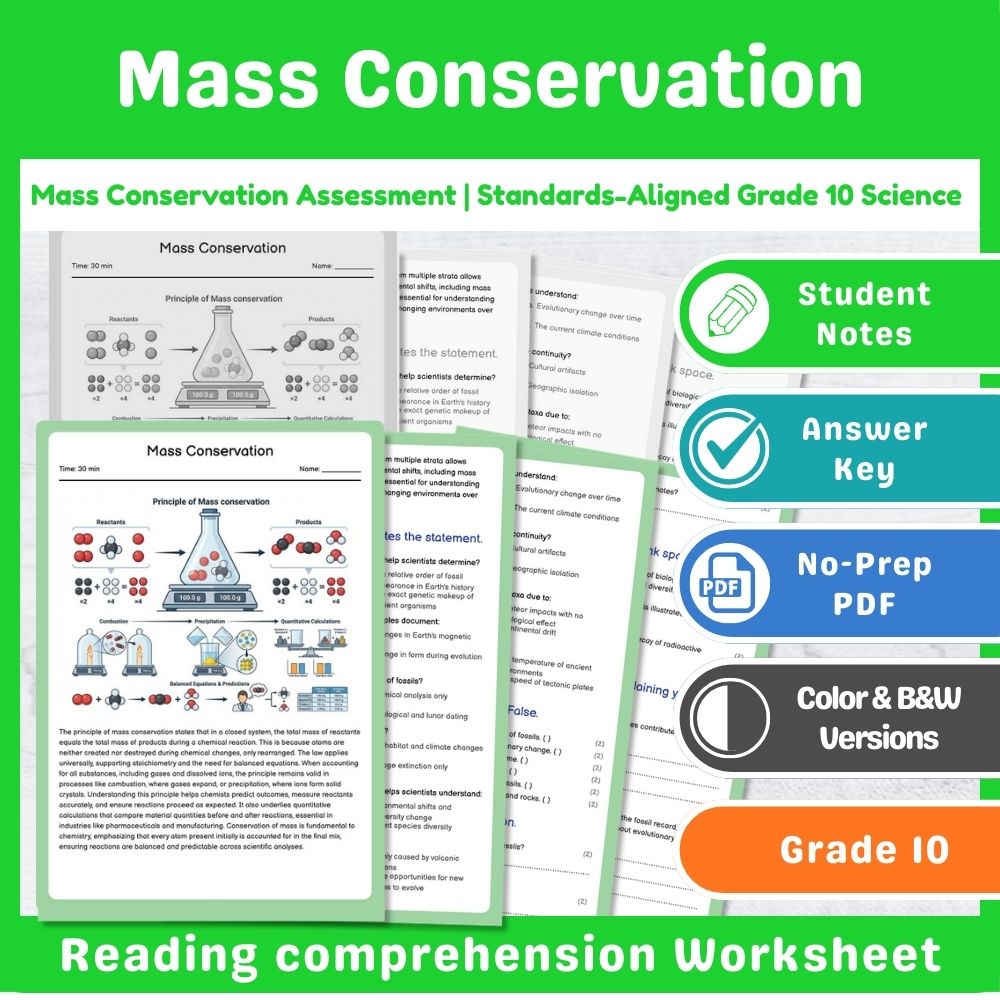
Mass Conservation Assessment | Standards-Aligned Grade 10 Science Worksheet
Created byPrism Point LearningLearning Objectives
- Understand the principle of conservation of mass in chemical reactions.
- Identify how mass is conserved in different types of chemical processes.
- Apply the concept of mass conservation to balance chemical equations.
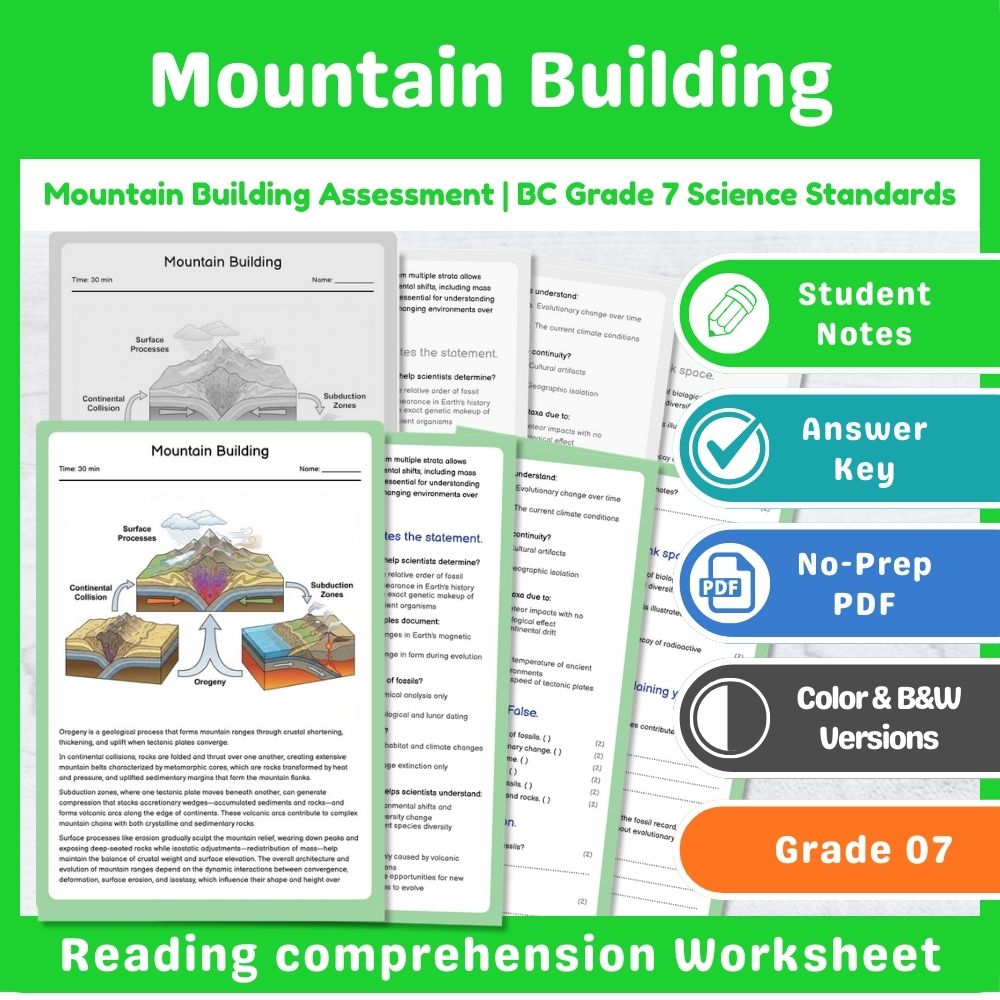
Mountain Building Assessment | BC Grade 7 Science Standards
Created byPrism Point LearningLearning Objectives
- Understand the processes involved in orogeny and mountain formation.
- Identify key geological features associated with mountain belts and subduction zones.
- Explain how surface processes shape mountain regions over time.
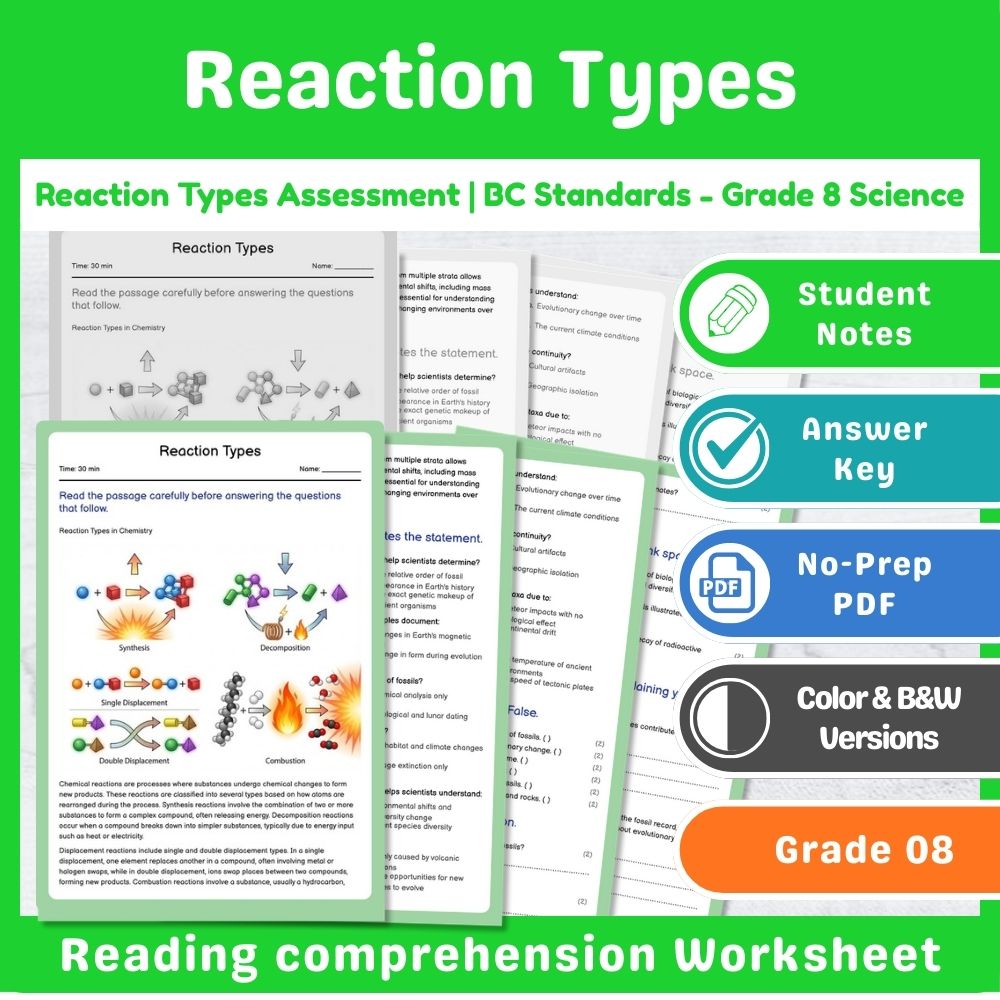
Reaction Types Assessment | BC Standards - Grade 8 Science
Created byPrism Point LearningLearning Objectives
- Identify the various types of chemical reactions and their characteristic patterns.
- Explain how atoms rearrange during synthesis, decomposition, displacement, and combustion reactions.
- Predict possible products based on reaction type.
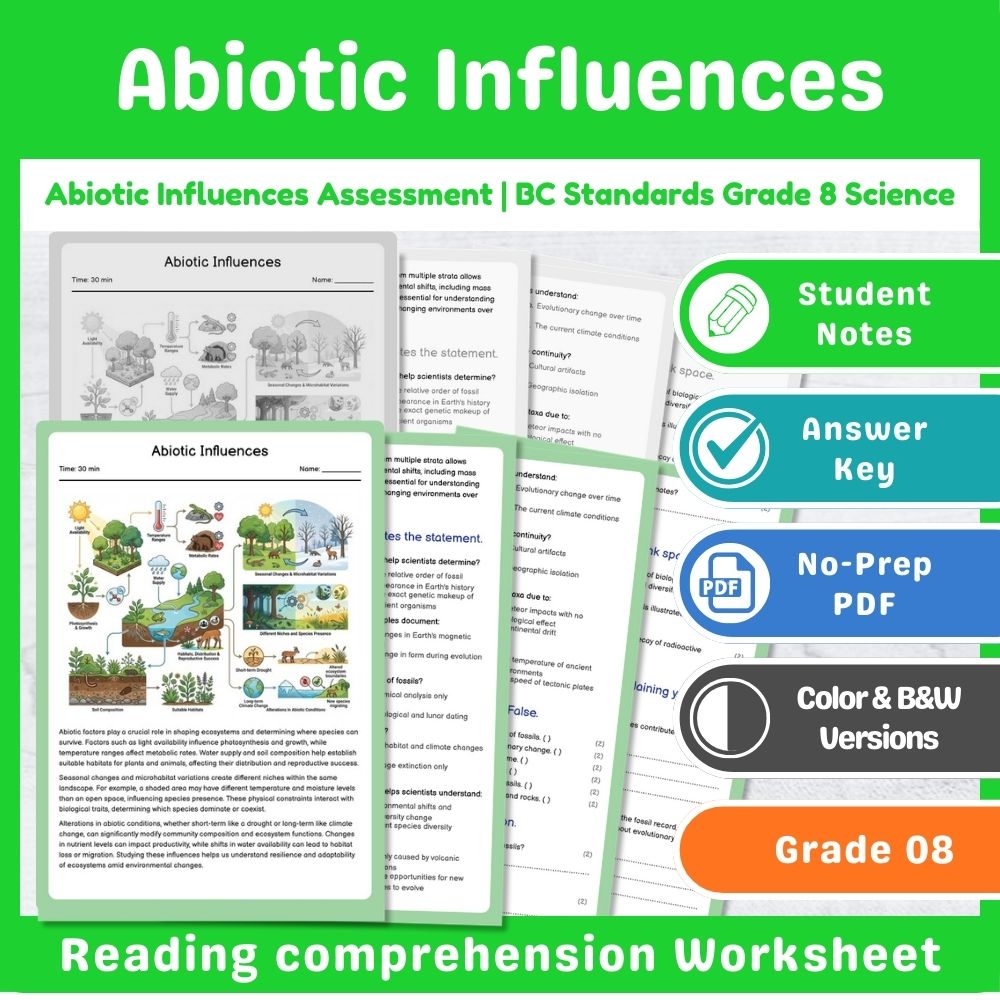
Abiotic Influences Assessment | BC Standards Grade 8 Science
Created byPrism Point LearningLearning Objectives
- Understand how abiotic factors influence species distribution and physiology.
- Identify different abiotic factors such as light, temperature, water, and soil composition.
- Analyze the impact of seasonal and microhabitat variations on ecosystems.

Water Cycle Models Assessment | General Grade 8 Science
Created byPrism Point LearningLearning Objectives
- Describe the main processes involved in Earth's water cycle.
- Identify different reservoirs and pathways that transfer water across Earth systems.
- Explain how modeling water flow helps understand Earth's environment.
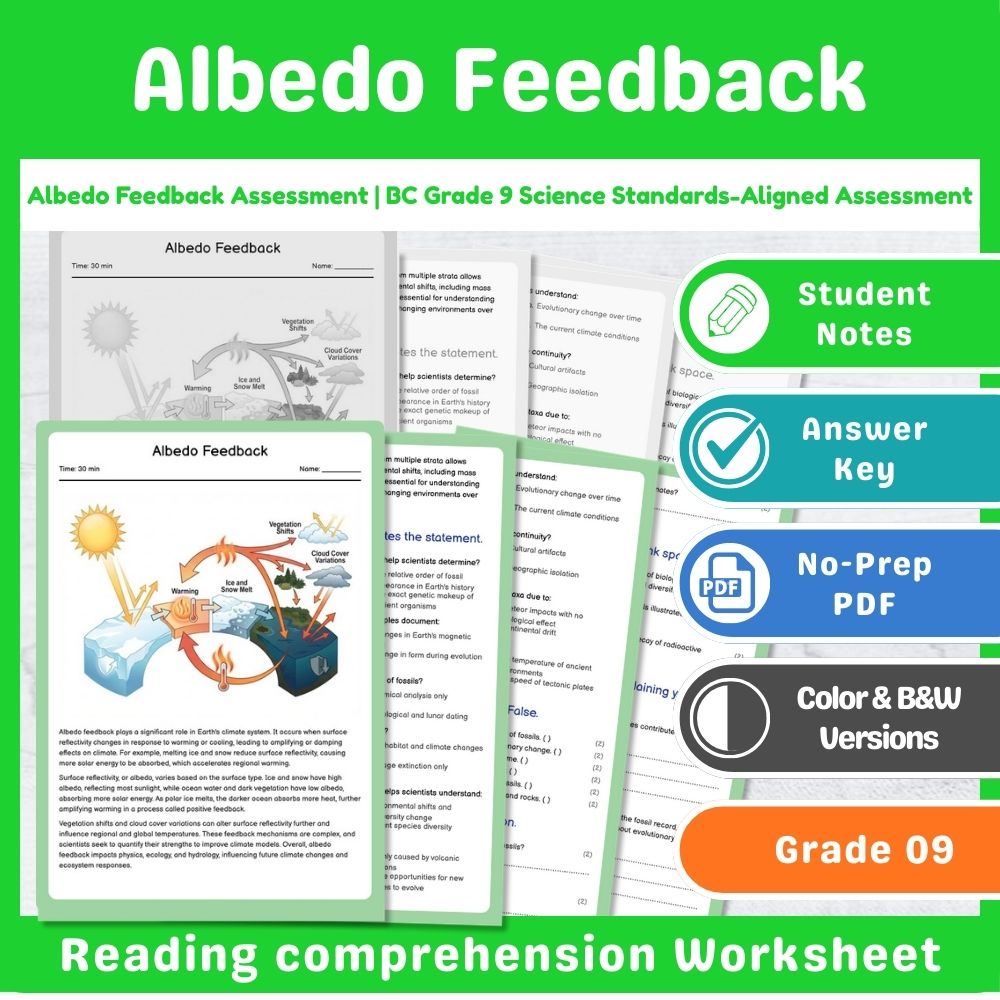
Albedo Feedback Assessment | BC Grade 9 Science Standards-Aligned Assessment
Created byPrism Point LearningLearning Objectives
- Understand the concept of albedo feedback and its role in climate change.
- Identify factors that influence surface reflectivity and their effects.
- Analyze how changes in ice, snow, vegetation, and clouds contribute to climate feedbacks.
Browse more categories
About Science Worksheets
Find Science worksheets spanning core skills, practice, and review. All 42,685 resources are instant PDF downloads for the classroom or home.
Every worksheet on MyTeachingSheets is created by independent teacher-authors and reviewed before publication. All resources download as printable PDFs for classroom, homework, or at-home practice, and many include answer keys. Preview any worksheet free before buying.