
Science Worksheets
42,685 subject resources
Deep Time Processes Assessment | Florida NGSSS Grade 12 Science
 Created byPrism Point Learning
Learning Objectives
- Explain how weathering, erosion, and deposition shape landscapes over geologic time.
- Describe how plate tectonics and catastrophic events (volcanoes and earthquakes) modify Earth’s surface.
- Use evidence from rocks and landforms to infer relationships between process rate and deep time.

Species Interactions Assessment for Grade 8 Science | Florida NGSSS
Created byPrism Point LearningLearning Objectives
- Explain how competition, predation, mutualism, commensalism, and parasitism affect survival and reproduction
- Describe how species interactions can change population sizes over time
- Use evidence from examples to identify the type of species interaction and its ecosystem impact

Reaction Balancing Assessment | General Standards + Grade 9 Science
Created byPrism Point LearningLearning Objectives
- Understand the conservation of atoms in chemical reactions.
- Learn how to balance simple chemical equations accurately.
- Explain the significance of coefficients in representing particle ratios.

Design Criteria Assessment | General Standards + Grade 7 Science
Created byPrism Point LearningLearning Objectives
- Understand the concept of design criteria and how they guide project development.
- Identify measurable and observable criteria in design solutions.
- Analyze trade-offs when meeting multiple design constraints.

Atomic Models Assessment for Grade 12 Science | TEKS Standards-Aligned
Created byPrism Point LearningLearning Objectives
- Understand the historical development of atomic models from Dalton to Bohr.
- Explain empirical evidence such as cathode ray experiments and gold foil scattering.
- Describe concepts of nuclear charge, mass number, and isotopic abundance.

Modeling Systems Assessment for Grade 12 Science | TEKS Standards
Created byPrism Point LearningLearning Objectives
- Understand the principles of constructing both conceptual and quantitative models in scientific systems.
- Analyze the differences between deterministic and stochastic modeling frameworks.
- Apply dimensional analysis, scaling, and sensitivity testing to evaluate model robustness.

Governance Futures Assessment | TEKS Grade 12 Science Standards
Created byPrism Point LearningLearning Objectives
- Understand the role of regulatory standards and risk assessment in shaping scientific policy.
- Analyze the importance of international agreements and adaptive governance models in technology oversight.
- Evaluate foresight methods and scenario analysis in anticipatory planning for governance.

Design Principles Assessment | TEKS Grade 7 Science Standards-Aligned
Created byPrism Point LearningLearning Objectives
- Understand key concepts of designing fair and reproducible experiments.
- Identify variables, operational definitions, and control conditions in experiments.
- Recognize ethical, safety, and sample size considerations in research design.

Evaporation and Transpiration Assessment | California Standards Grade 6 Science
Created byPrism Point LearningLearning Objectives
- Explain how evaporation and transpiration add water vapor to the atmosphere
- Describe how temperature and available liquid water affect the amount of water vapor
- Connect phase changes to the water cycle, including condensation and precipitation

Physiological Regulation Assessment for Grade 11 Science TEKS
Created byPrism Point LearningLearning Objectives
- Describe the mechanisms involved in maintaining internal stability in the human body.
- Explain the roles of sensors, control centers, and effectors in physiological regulation.
- Identify examples of negative and positive feedback mechanisms in human physiology.

Weather Data Patterns Assessment | General Grade 7 Science Standards
Created byPrism Point LearningLearning Objectives
- Understand how weather data patterns are identified and compared over time and location.
- Explain the factors that influence climate variability and long-term weather trends.
- Analyze pressure changes and air mass movements to interpret weather patterns.
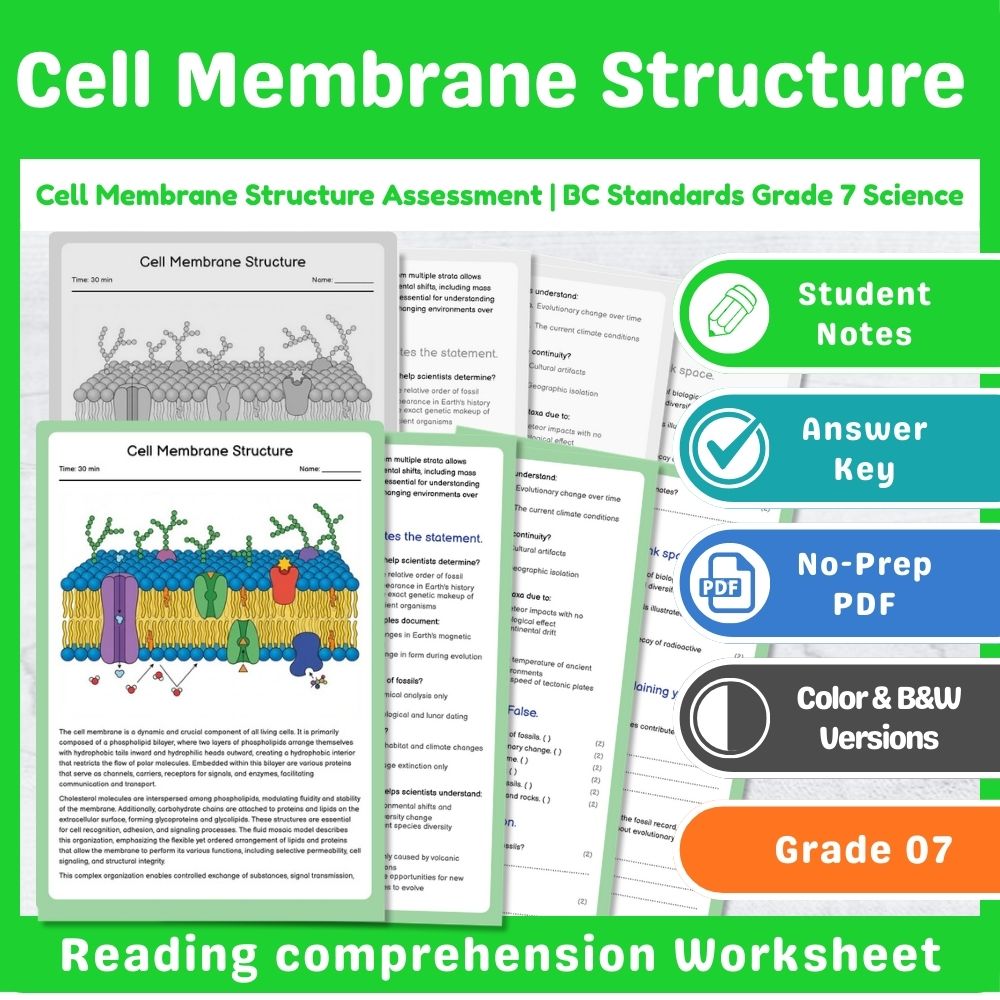
Cell Membrane Structure Assessment | BC Standards Grade 7 Science
Created byPrism Point LearningLearning Objectives
- Describe the composition of the cell membrane as a phospholipid bilayer with embedded proteins, cholesterol, and carbohydrates.
- Explain the fluid mosaic model of cell membrane organization.
- Identify the functions of membrane proteins, cholesterol, and carbohydrate chains.
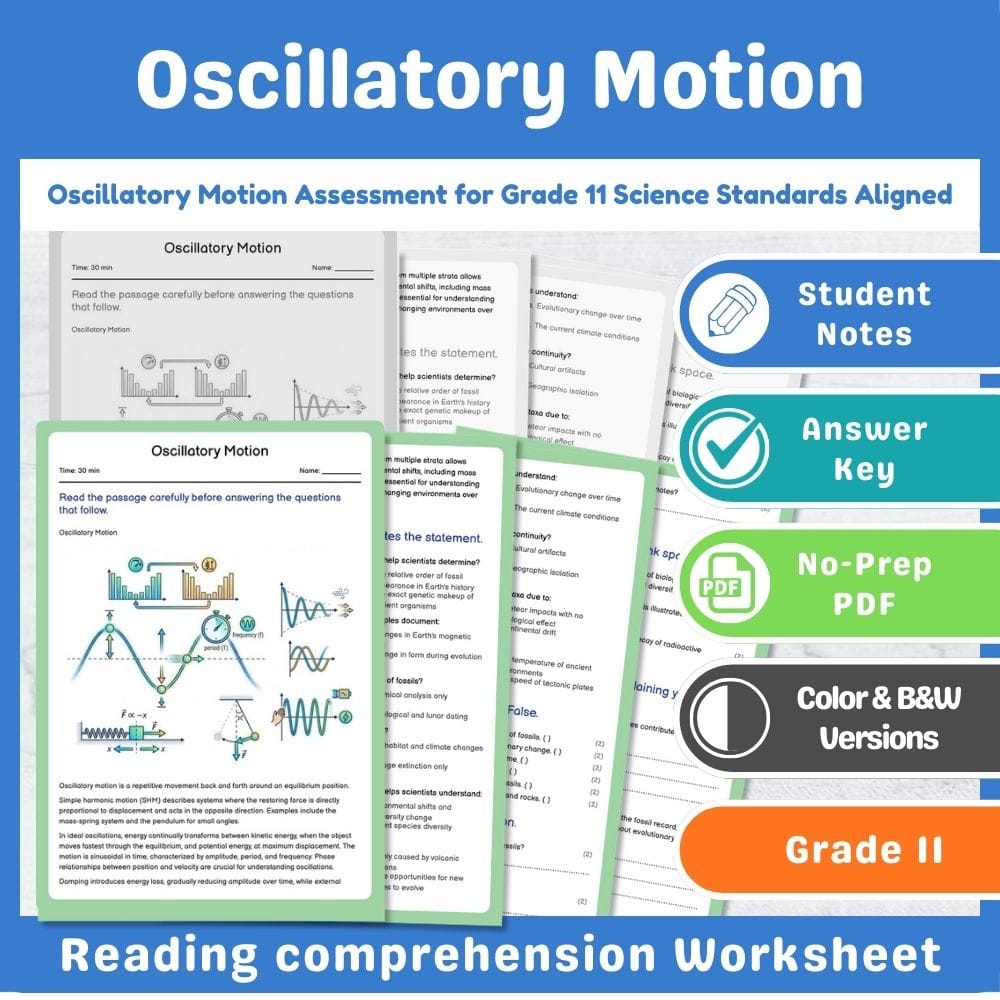
Oscillatory Motion Assessment for Grade 11 Science Standards Aligned
Created byPrism Point LearningLearning Objectives
- Understand the principles of simple harmonic motion in mass–spring systems and pendulums.
- Derive and analyze equations of motion related to oscillatory systems.
- Connect restoring force linearity to sinusoidal solutions and interpret phase relationships.
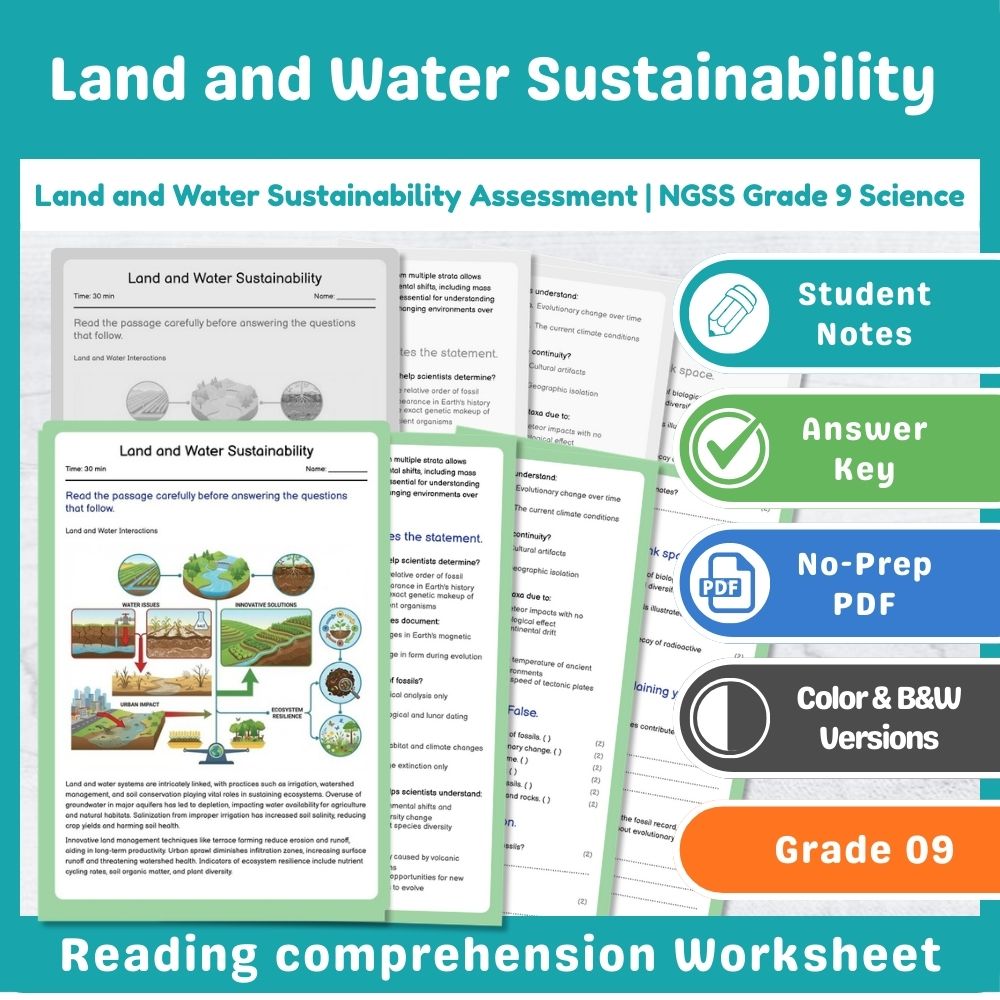
Land and Water Sustainability Assessment | NGSS Grade 9 Science
Created byPrism Point LearningLearning Objectives
- Understand how soil conservation, irrigation, and watershed management contribute to land sustainability.
- Identify indicators of ecosystem resilience, nutrient cycling, and productivity under land-use scenarios.
- Evaluate trade-offs among food production, biodiversity, and watershed health in land management practices.
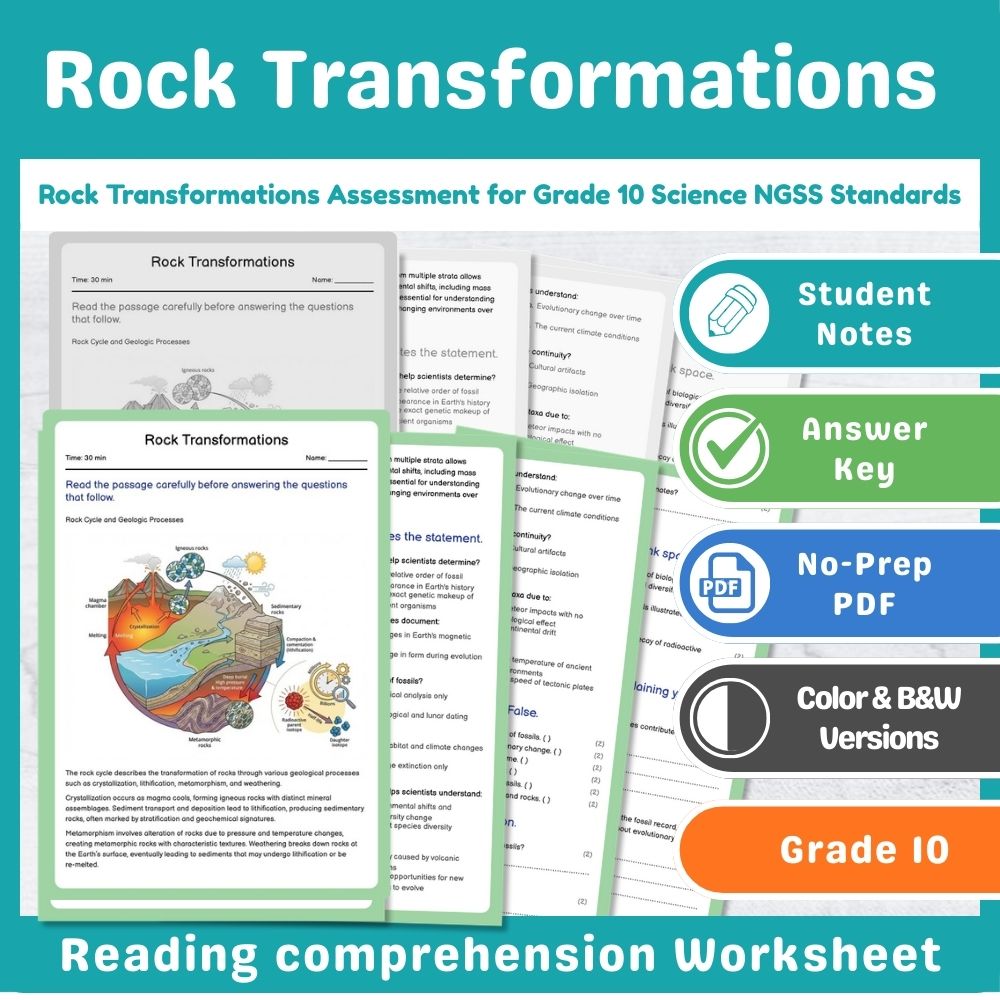
Rock Transformations Assessment for Grade 10 Science NGSS Standards
Created byPrism Point LearningLearning Objectives
- Describe the processes involved in the rock cycle including crystallization, lithification, metamorphism, and weathering.
- Explain how petrologic indicators such as mineral assemblages and geochemical signatures are used to interpret geological histories.
- Understand how radiometric dating and stratigraphic correlation aid in ordering geological events.
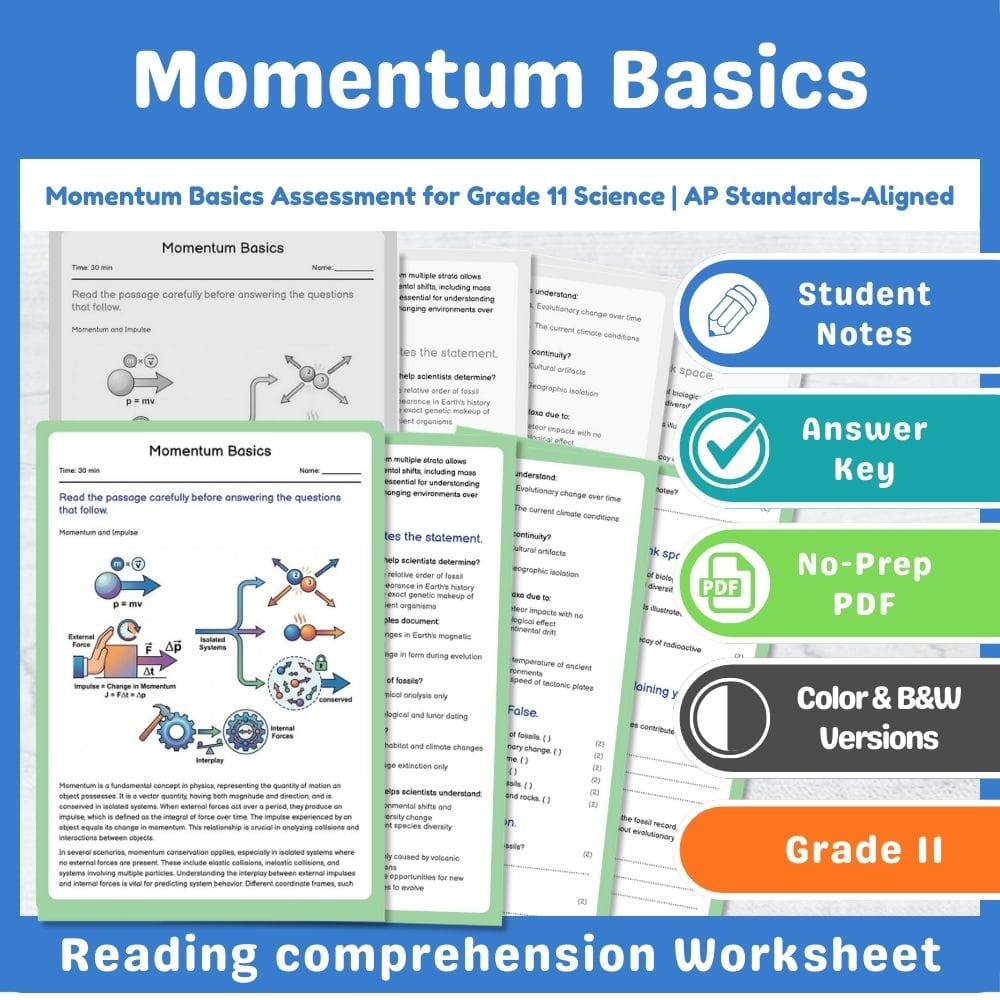
Momentum Basics Assessment for Grade 11 Science | AP Standards-Aligned
Created byPrism Point LearningLearning Objectives
- Understand linear momentum as a conserved vector quantity.
- Explain impulse as the time integral of force and relate it to changes in momentum.
- Apply algebraic conservation relations for isolated systems.

Plate Motion and Surfaces Assessment | General Grade 8 Science Standards
Created byPrism Point LearningLearning Objectives
- Understand the different types of plate boundaries and their effects on Earth's surface.
- Identify evidence that supports the theory of plate tectonics.
- Explain how geological features like mountains, earthquakes, and volcanoes are related to plate movements.
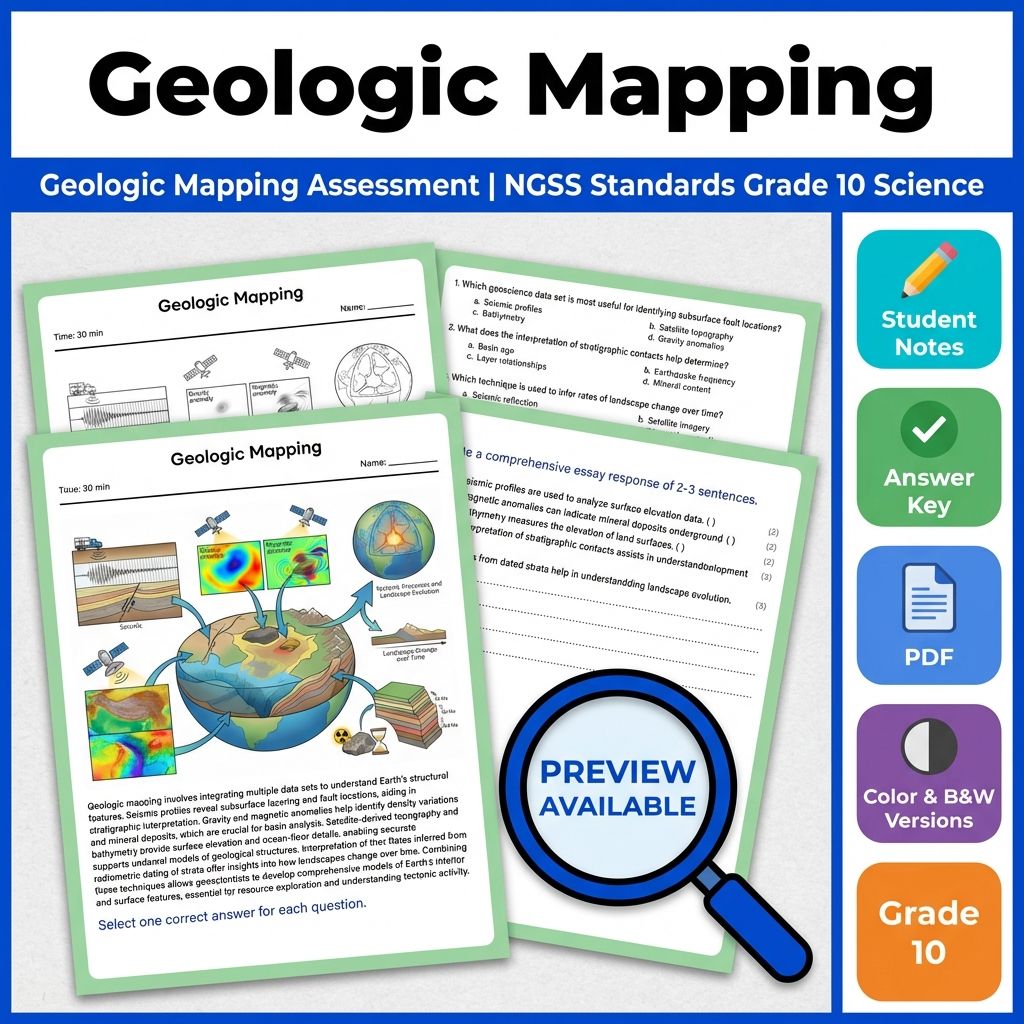
Geologic Mapping Assessment | NGSS Standards Grade 10 Science
Created byPrism Point LearningLearning Objectives
- Understand the components and data sources used in geologic mapping.
- Interpret stratigraphic contacts, fault systems, and basin structures from geological data.
- Explain how rates from geochronology support landscape evolution models.

Properties and Classification Assessment | TEKS Grade 7 Science Worksheet
Created byPrism Point LearningLearning Objectives
- Define physical and chemical properties used to classify substances.
- Identify measurable attributes such as density, solubility, hardness, and conductivity.
- Distinguish between elements, compounds, and mixtures based on observable properties.
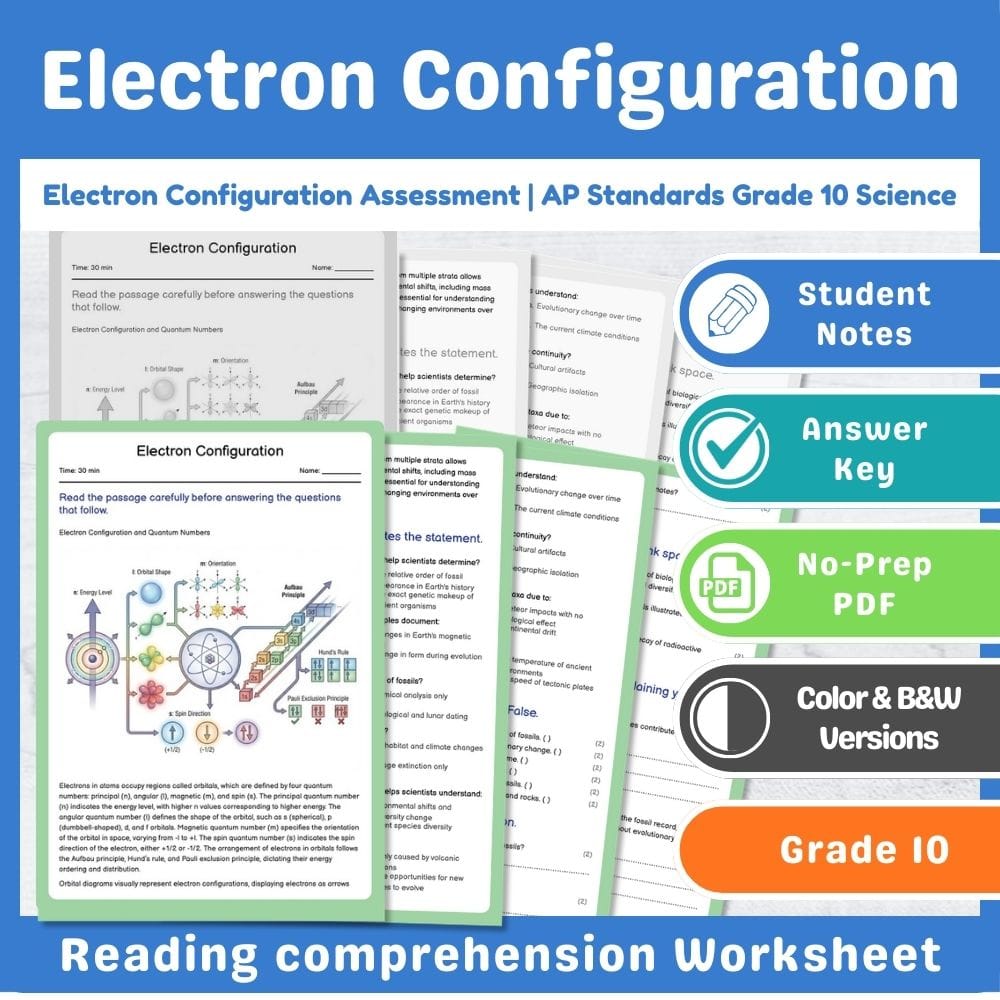
Electron Configuration Assessment | AP Standards Grade 10 Science
Created byPrism Point LearningLearning Objectives
- Understand quantum numbers and how they describe electron distribution in atoms
- Identify orbital shapes and energy ordering for electrons in atoms
- Link microscopic electron arrangements to spectral lines and chemical properties

The Solar System Assessment | TEKS Grade 7 Science Standards
Created byPrism Point LearningLearning Objectives
- Describe the origins and formation processes of the solar system.
- Compare properties of terrestrial and gas giant planets, including atmospheres and surface features.
- Explain planetary motions, phases, and eclipses using observational data.
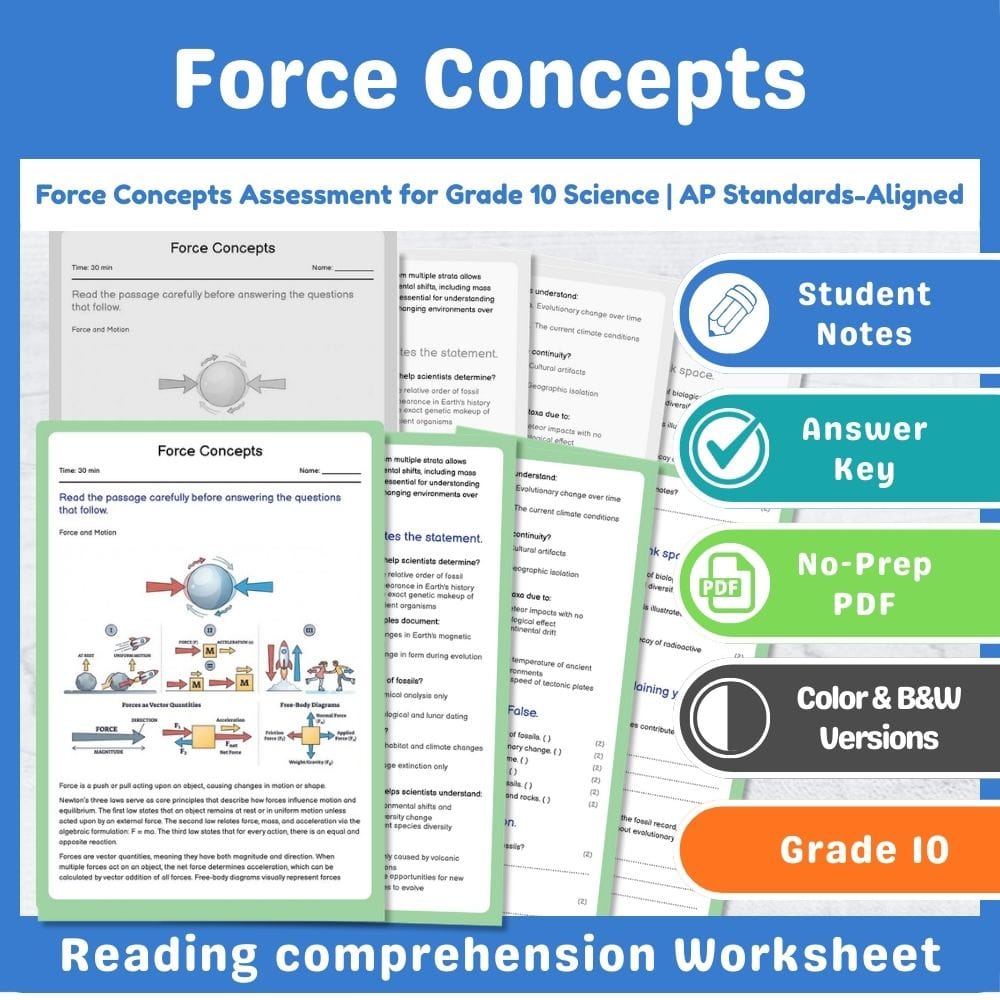
Force Concepts Assessment for Grade 10 Science | AP Standards-Aligned
Created byPrism Point LearningLearning Objectives
- Understand the vector nature of forces and how to determine net force in various scenarios.
- Explain Newton's three laws and their applications to motion and equilibrium.
- Interpret free-body diagrams and algebraic formulations of forces.
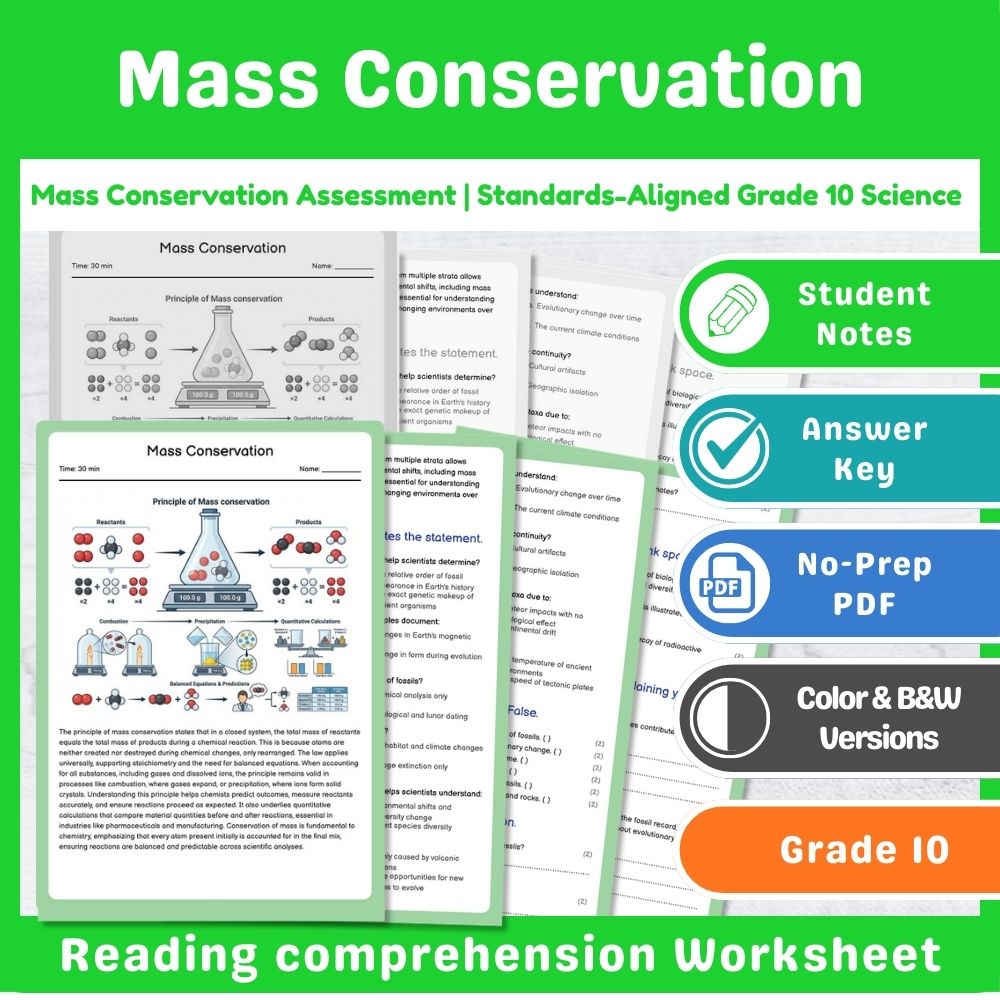
Mass Conservation Assessment | Standards-Aligned Grade 10 Science Worksheet
Created byPrism Point LearningLearning Objectives
- Understand the principle of conservation of mass in chemical reactions.
- Identify how mass is conserved in different types of chemical processes.
- Apply the concept of mass conservation to balance chemical equations.
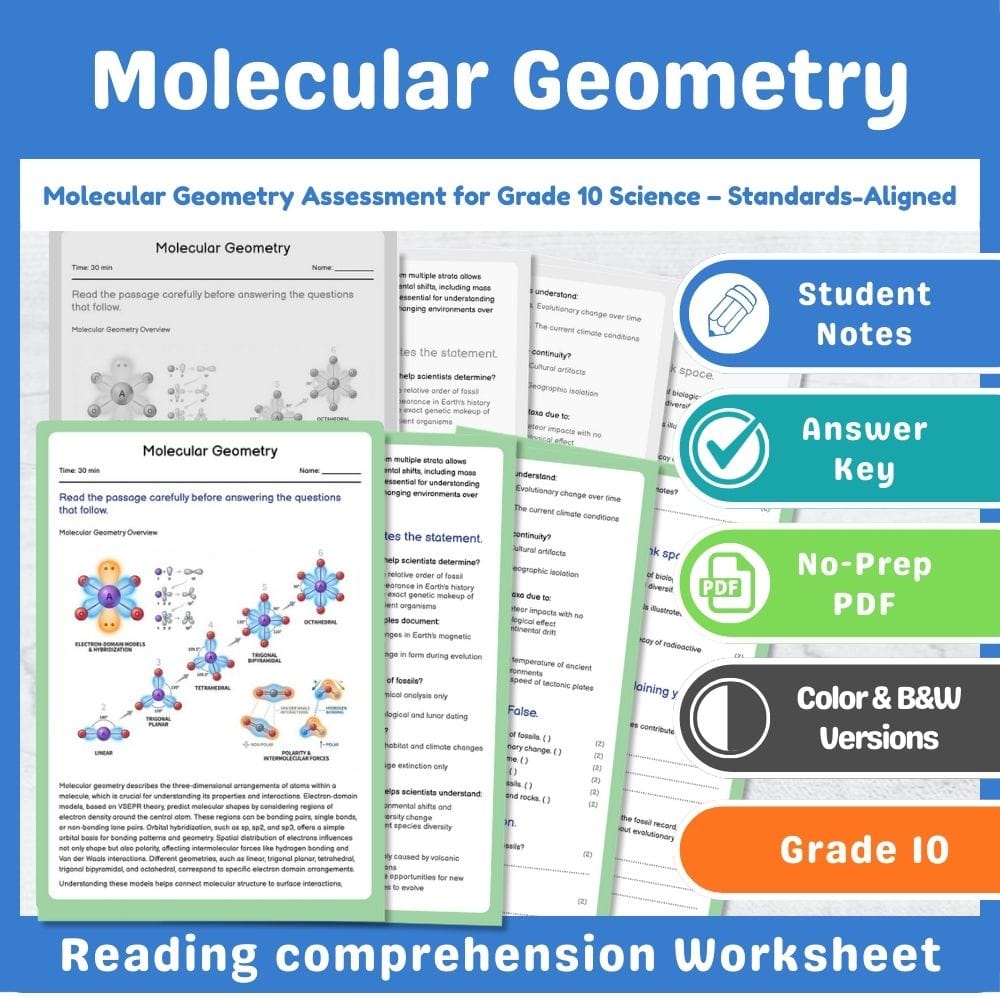
Molecular Geometry Assessment for Grade 10 Science – Standards-Aligned
Created byPrism Point LearningLearning Objectives
- Define molecular geometry using electron-domain models and orbital hybridization.
- Explain how electron domain arrangements determine molecular shapes and polarity.
- Connect molecular structures to intermolecular forces and macroscopic properties.
Scale and Patterns in the Solar System Assessment | NGSS Grade 8 Science
Created byPrism Point LearningLearning Objectives
- Interpret quantitative data related to solar system objects such as diameters, distances, and orbital periods.
- Compare and analyze patterns and relationships among planets, dwarf planets, moons, and the Sun using scaled data and astronomical units.
- Identify orders of magnitude differences in planetary radii and interplanetary distances.

Cellular Specialization Assessment | TEKS Grade 10 Science Worksheet
Created byPrism Point LearningLearning Objectives
- Understand how cells develop distinct structures and organelle compositions for specific functions.
- Identify relationships between organelle abundance and cell function, such as mitochondria in muscle cells.
- Explain how specialized cells form tissues and organ systems in multicellular organisms.

Population Dynamics Assessment for Grade 8 Science TEKS Standards
Created byPrism Point LearningLearning Objectives
- Analyze factors that influence population size and distribution.
- Explain growth patterns and oscillations in populations using graphs and data.
- Evaluate case examples of invasive species impacts and recovery after disturbances.

Clouds and Precipitation Assessment | California Standards Grade 7 Science
Created byPrism Point LearningLearning Objectives
- Explain how cooling air leads to condensation and cloud formation.
- Describe how temperature and moisture determine cloud type and precipitation type.
- Connect energy transfers during phase changes to weather patterns.

Charge and Fields Assessment | Alberta Standard Grade 10 Science
Created byPrism Point LearningLearning Objectives
- Explain the concept of electric charge, including its sign and magnitude.
- Describe how electric fields are represented using field lines and superposition principles.
- Calculate electrostatic forces between charges using Coulomb's law in regional contexts.

Gene Expression Pathway Assessment for Grade 12 Science | Standards-Aligned
Created byPrism Point LearningLearning Objectives
- Explain how transcription and translation enable cells to express genetic information as proteins.
- Describe how regulation at multiple steps can create different phenotypes from the same genome.
- Analyze how timing and cell-type specific control of gene expression influence traits.

Groundwater and Baseflow Assessment | California Standards Grade 6 Science
Created byPrism Point LearningLearning Objectives
- Explain how precipitation can infiltrate, percolate, and recharge groundwater aquifers.
- Describe how groundwater contributes to streamflow as baseflow during dry periods.
- Interpret how permeability and landscape geometry affect the groundwater–surface water connection.

Transport and Sediment Assessment | General Standards Grade 6 Science
Created byPrism Point LearningLearning Objectives
- Understand how streams and wind transfer particles of different sizes based on energy and strength.
- Explain the process of sorting of sediments during transportation and deposition.
- Identify natural structures formed by sediment sorting, such as sandbars and deltas.

Innovation History Assessment | TEKS Grade 7 Science Standards
Created byPrism Point LearningLearning Objectives
- Trace the causes and diffusion of technological inventions across history.
- Identify factors that enable invention, such as needs, materials, and incremental improvements.
- Differentiate between invention and innovation through historical examples.
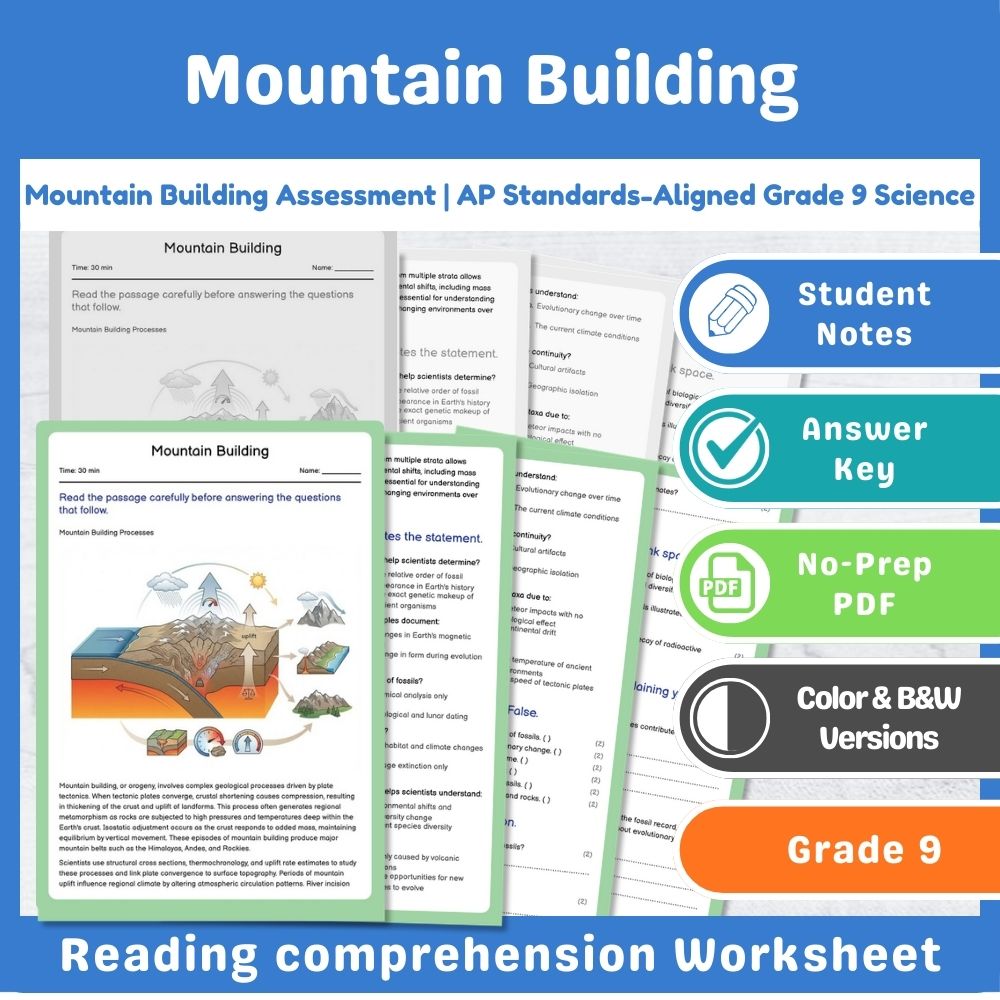
Mountain Building Assessment | AP Standards-Aligned Grade 9 Science
Created byPrism Point LearningLearning Objectives
- Understand the geological processes involved in mountain formation, including crustal shortening, thickening, and metamorphism.
- Explain how isostatic adjustment influences mountain uplift and erosion patterns.
- Link plate convergence to changes in surface topography and regional climate effects.

Energy Flow Assessment for Grade 10 Science TEKS Standards
Created byPrism Point LearningLearning Objectives
- Explain how sunlight enters ecosystems and is used by photosynthetic organisms.
- Describe the transfer and loss of energy through trophic levels in food chains and webs.
- Analyze how energy constraints influence biomass and population sizes in ecosystems.

Ionic and Covalent Bonding Assessment for Grade 11 Science
Created byPrism Point LearningLearning Objectives
- Explain the differences between ionic and covalent bonds in terms of electron distribution.
- Describe how bonding types influence properties like melting point, electrical conductivity, and solubility.
- Identify examples of materials with ionic and covalent bonds and analyze their structural differences.

Momentum Collisions Assessment for Grade 8 Science TEKS Standards
Created byPrism Point LearningLearning Objectives
- Define linear momentum and impulse in the context of collisions.
- Apply conservation principles to analyze elastic and inelastic collisions in one dimension.
- Distinguish between elastic and inelastic collisions using real-world examples.

Reaction Evidence Assessment | TEKS Grade 7 Science Standards-Aligned Assessment
Created byPrism Point LearningLearning Objectives
- Identify observable indicators of chemical reactions such as gas evolution, precipitate formation, color change, and temperature change.
- Connect qualitative evidence of reactions to underlying mass and energy changes.
- Understand how reactant transformations are represented by simple symbolic formulas.
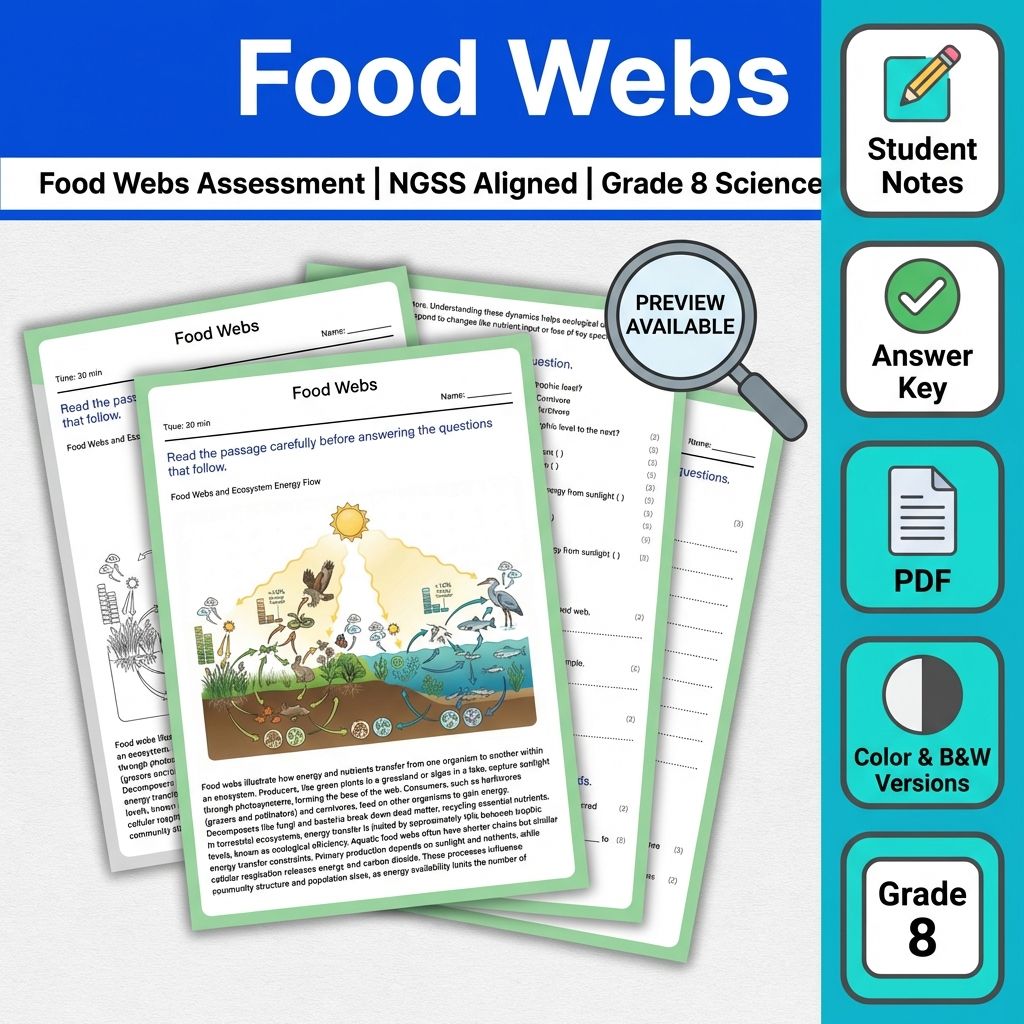
Food Webs Assessment | NGSS Aligned | Grade 8 Science Worksheet
Created byPrism Point LearningLearning Objectives
- Understand the components of food webs including producers, consumers, and decomposers.
- Explain the flow of energy through different trophic levels in terrestrial and aquatic ecosystems.
- Analyze how energy loss affects population sizes and community structure.
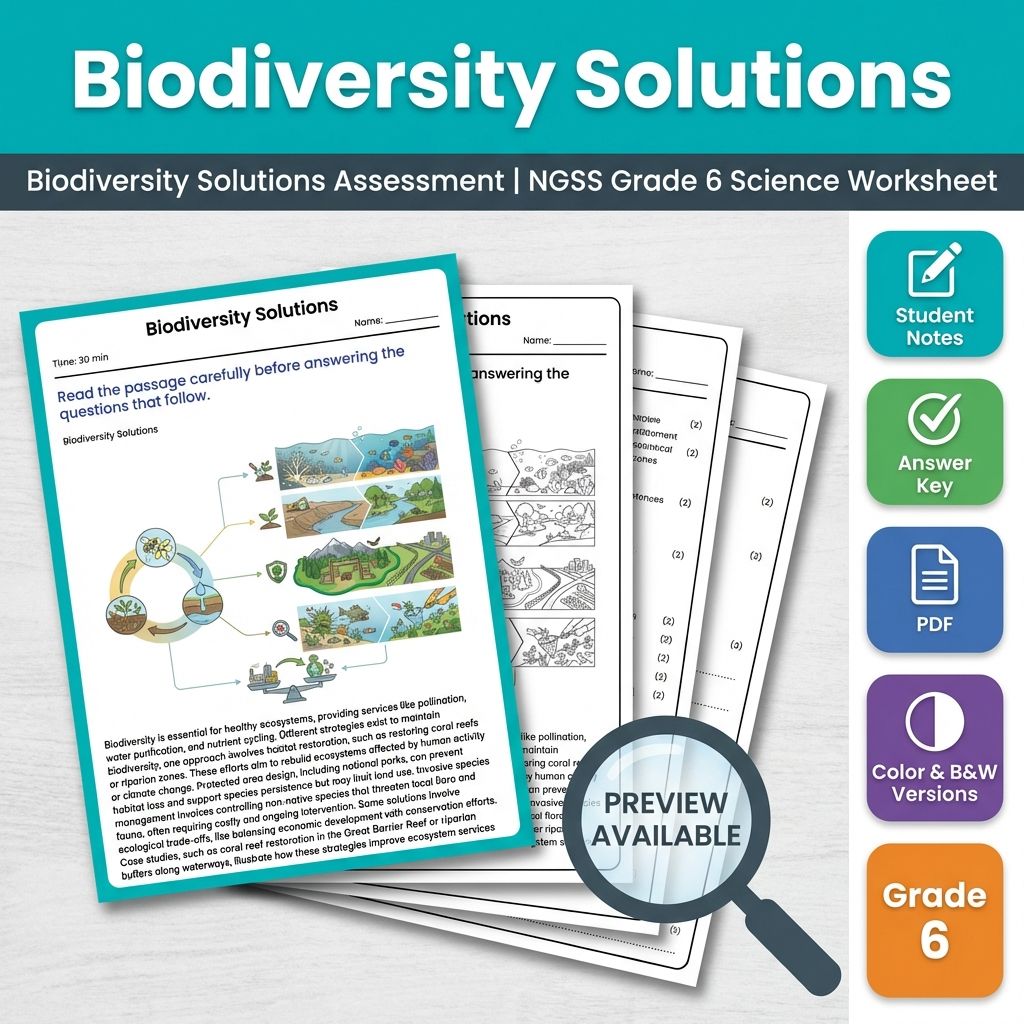
Biodiversity Solutions Assessment | NGSS Grade 6 Science Worksheet
Created byPrism Point LearningLearning Objectives
- Compare different conservation strategies and their ecological trade-offs.
- Analyze case studies like coral reef restoration and riparian buffers.
- Evaluate the effectiveness of various biodiversity maintenance solutions.

AC Circuits Assessment for Grade 12 Science | Alberta Standards
Created byPrism Point LearningLearning Objectives
- Understand the concept of impedance, reactance, and phase relationships in AC circuits.
- Calculate power, real and reactive components, and power factor in resistive, inductive, and capacitive networks.
- Analyze RLC circuits for resonance conditions and energy transfer in power systems.

Biotechnology Ethics Assessment for Grade 12 Science | Alberta Standards
Created byPrism Point LearningLearning Objectives
- Analyze key ethical issues related to biotechnology applications such as cloning and genome editing.
- Evaluate legal and social considerations surrounding biotechnology deployment in Alberta.
- Identify regulatory frameworks and community engagement processes shaping biotechnology innovations.

Recombinant Methods Assessment | Alberta Grade 12 Science Standards
Created byPrism Point LearningLearning Objectives
- Understand the principles behind recombinant DNA techniques including vector assembly, restriction enzymes, and ligases.
- Identify various applications of recombinant DNA methods in agriculture and diagnostics.
- Explain ethical and regulatory considerations associated with applied biotechnology.

Adaptation Patterns Assessment | TEKS Grade 6 Science Standards-Aligned
Created byPrism Point LearningLearning Objectives
- Identify different types of adaptation (morphological, physiological, behavioral).
- Explain how specific traits help organisms survive in their environments.
- Recognize examples of adaptations such as leaf modifications, fur insulation, migration, and dormancy.

Measurement Accuracy Assessment | General Grade 9 Science Standards
Created byPrism Point LearningLearning Objectives
- Understand the importance of appropriate scales, calibrated instruments, and units in measurement.
- Explain how significant figures reflect measurement precision and how to record data consistently.
- Recognize the importance of converting units accurately and expressing uncertainty ranges for fair comparisons.

Cell Basics Assessment | Alberta Standards Grade 10 Science
Created byPrism Point LearningLearning Objectives
- Understand the fundamental structures and functions of cells.
- Identify key features such as membranes, cytoplasm, and genetic material in cells.
- Compare cellular features in regional examples like canola leaf cells and moss cells.

Titration Analysis Assessment | Alberta Grade 11 Science Standards
Created byPrism Point LearningLearning Objectives
- Understand the mathematical principles behind titration calculations involving molarity and reaction stoichiometry.
- Apply algebraic manipulation to determine unknown solution concentrations in titration experiments.
- Interpret equivalence point relationships and their applications in water quality control and reagent standardization.

Tissue Structure Assessment | TEKS Grade 9 Science Worksheet
Created byPrism Point LearningLearning Objectives
- Understand the organization of different tissue types and their cellular features.
- Identify the functions related to epithelial, connective, muscle, and nervous tissues.
- Link microscopic features of tissues to their roles in organ systems.
Browse more categories
About Science Worksheets
Find Science worksheets spanning core skills, practice, and review. All 42,685 resources are instant PDF downloads for the classroom or home.
Every worksheet on MyTeachingSheets is created by independent teacher-authors and reviewed before publication. All resources download as printable PDFs for classroom, homework, or at-home practice, and many include answer keys. Preview any worksheet free before buying.