
Science Worksheets
42,685 subject resources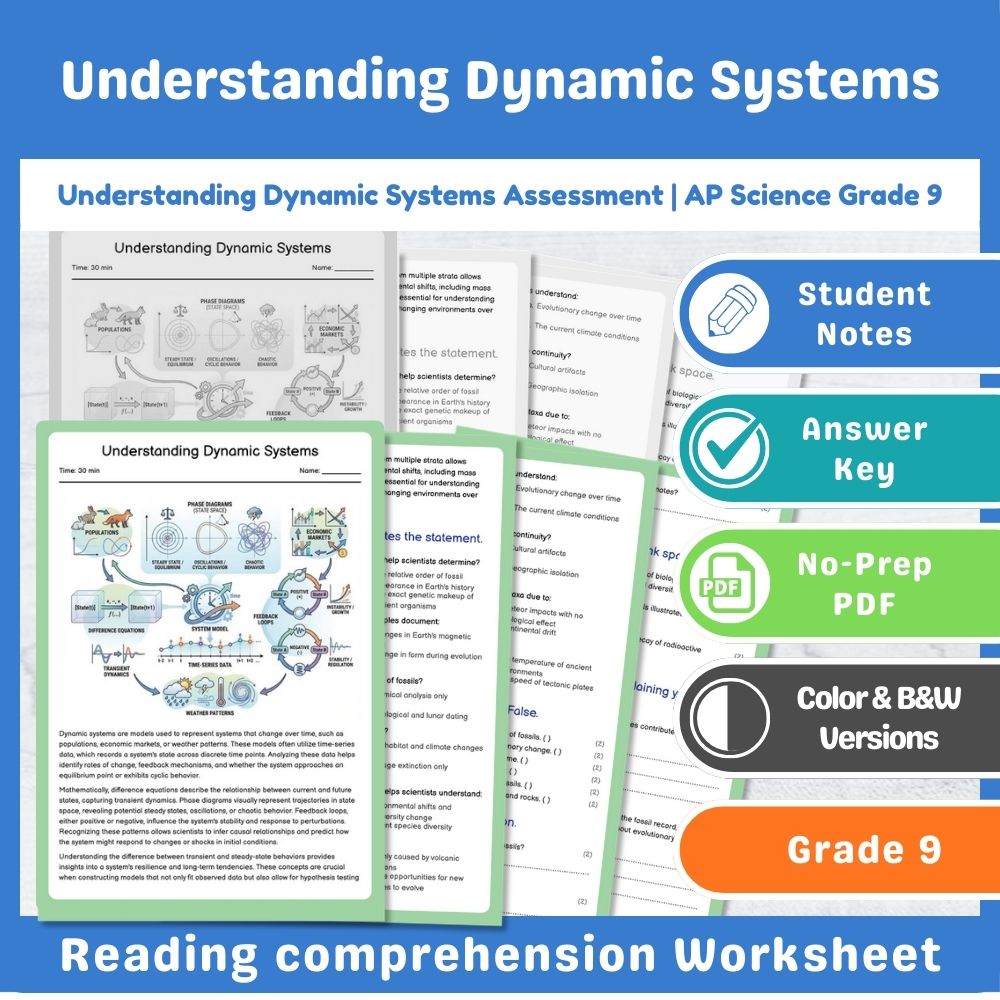
Understanding Dynamic Systems Assessment for Grade 9 Science AP
 Created byPrism Point Learning
Learning Objectives
- Explain how time-series data can be used to analyze changing systems
- Describe the role of difference equations and phase diagrams in modeling dynamics
- Identify feedback loops, equilibrium points, and causal structures in empirical data
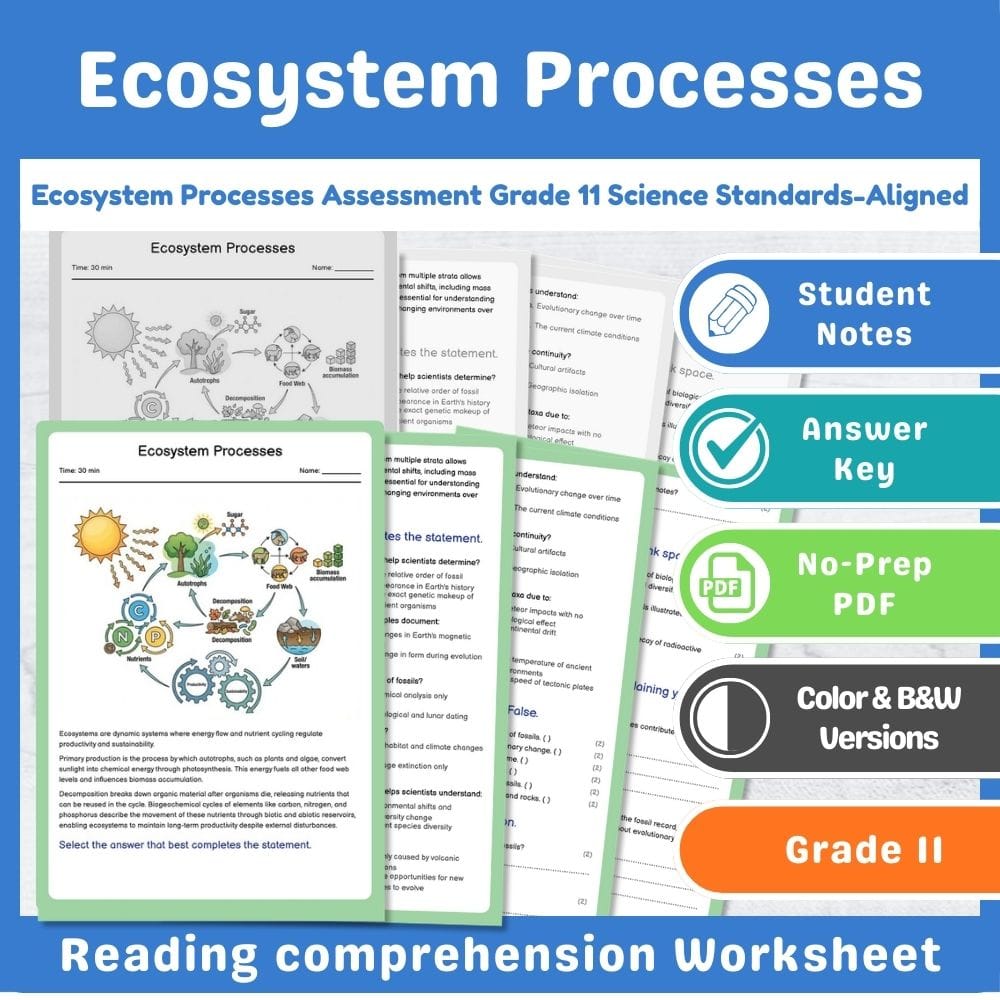
Ecosystem Processes Assessment Grade 11 Science Standards-Aligned
Created byPrism Point LearningLearning Objectives
- Explain the key processes that regulate energy flow and material cycling within ecosystems.
- Describe the roles of primary production, decomposition, and biogeochemical cycles of carbon, nitrogen, and phosphorus.
- Analyze how land-use change, nutrient inputs, and climate variability alter ecosystem cycle rates and affect ecosystem health.
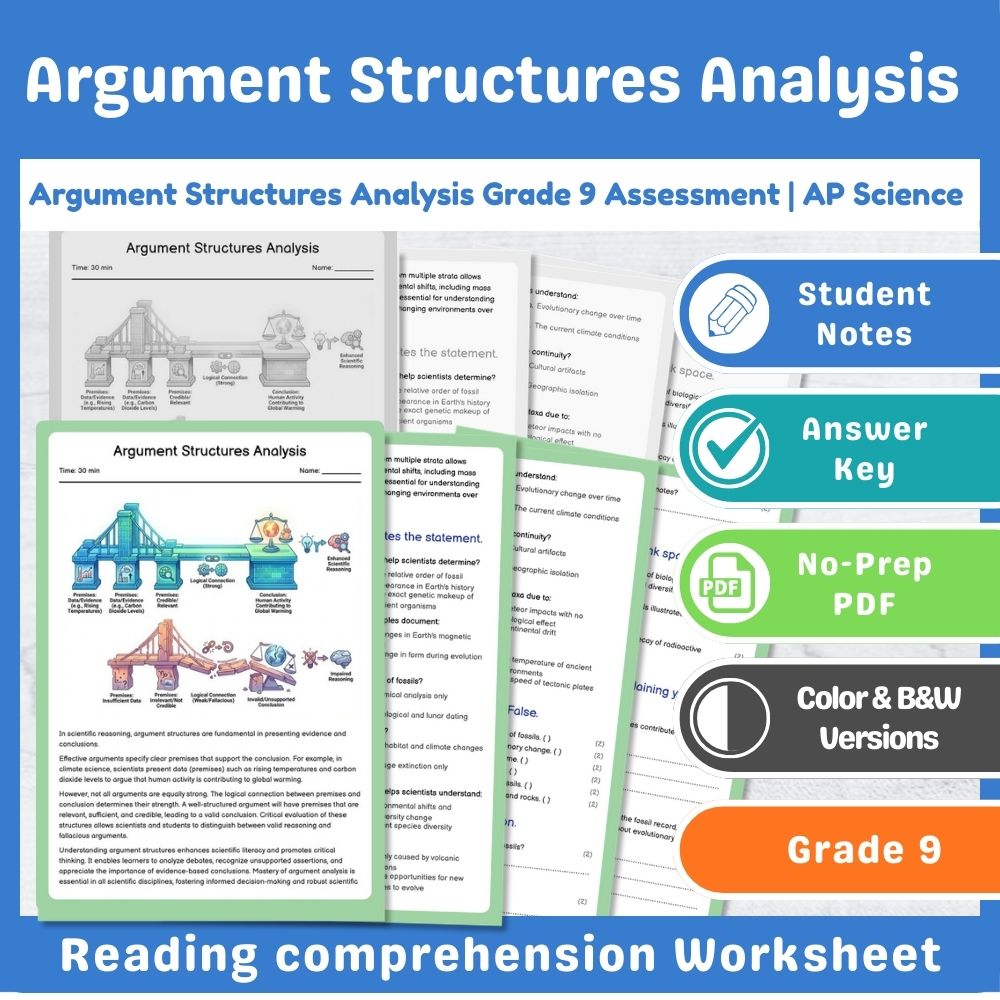
Argument Structures Analysis Assessment | Advanced Placement Grade 9 Science
Created byPrism Point LearningLearning Objectives
- Analyze different argument structures used in scientific reasoning.
- Identify premises and conclusions in argument-based texts.
- Evaluate the strength and validity of argument components.
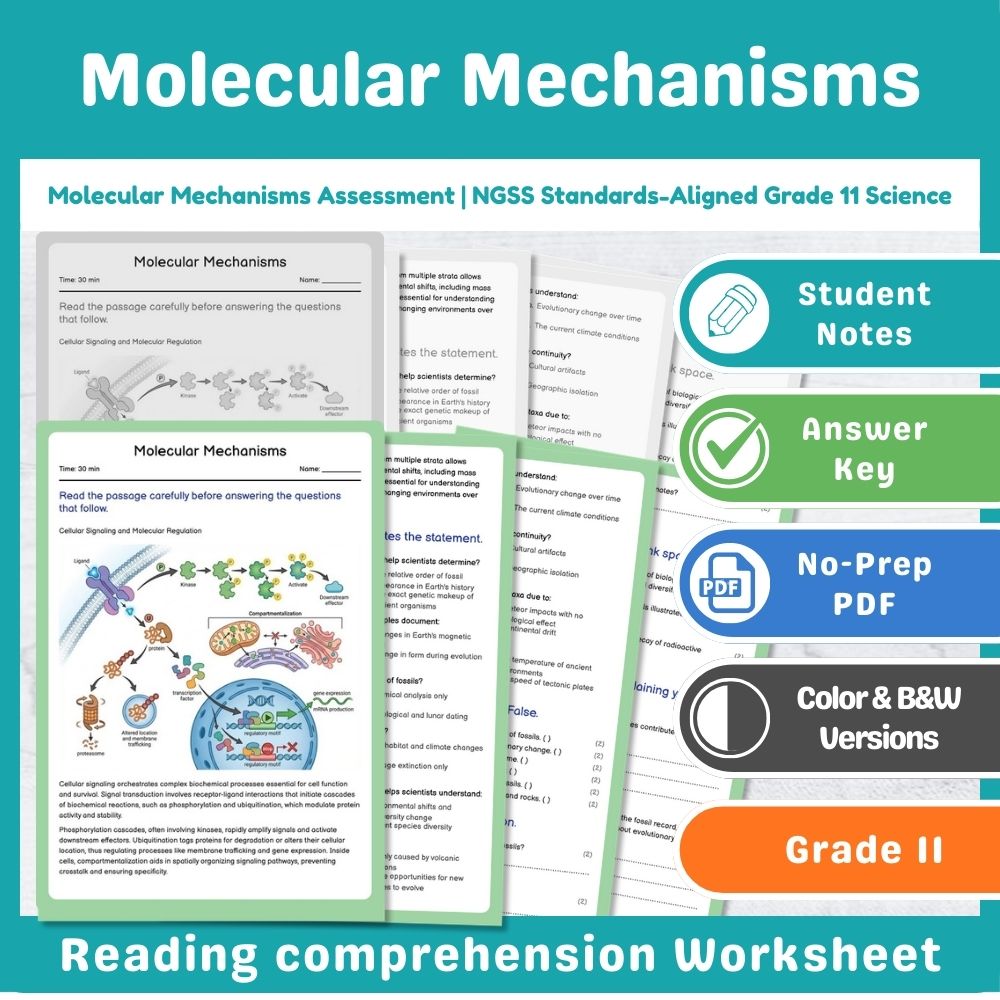
Molecular Mechanisms Assessment | NGSS Standards-Aligned Grade 11 Science
Created byPrism Point LearningLearning Objectives
- Explain the biochemical mechanisms involved in cellular signaling pathways.
- Identify key motifs and processes such as phosphorylation cascades, ubiquitination, and transcriptional regulation.
- Describe how intracellular compartmentalization and membrane transport influence molecular mechanisms.
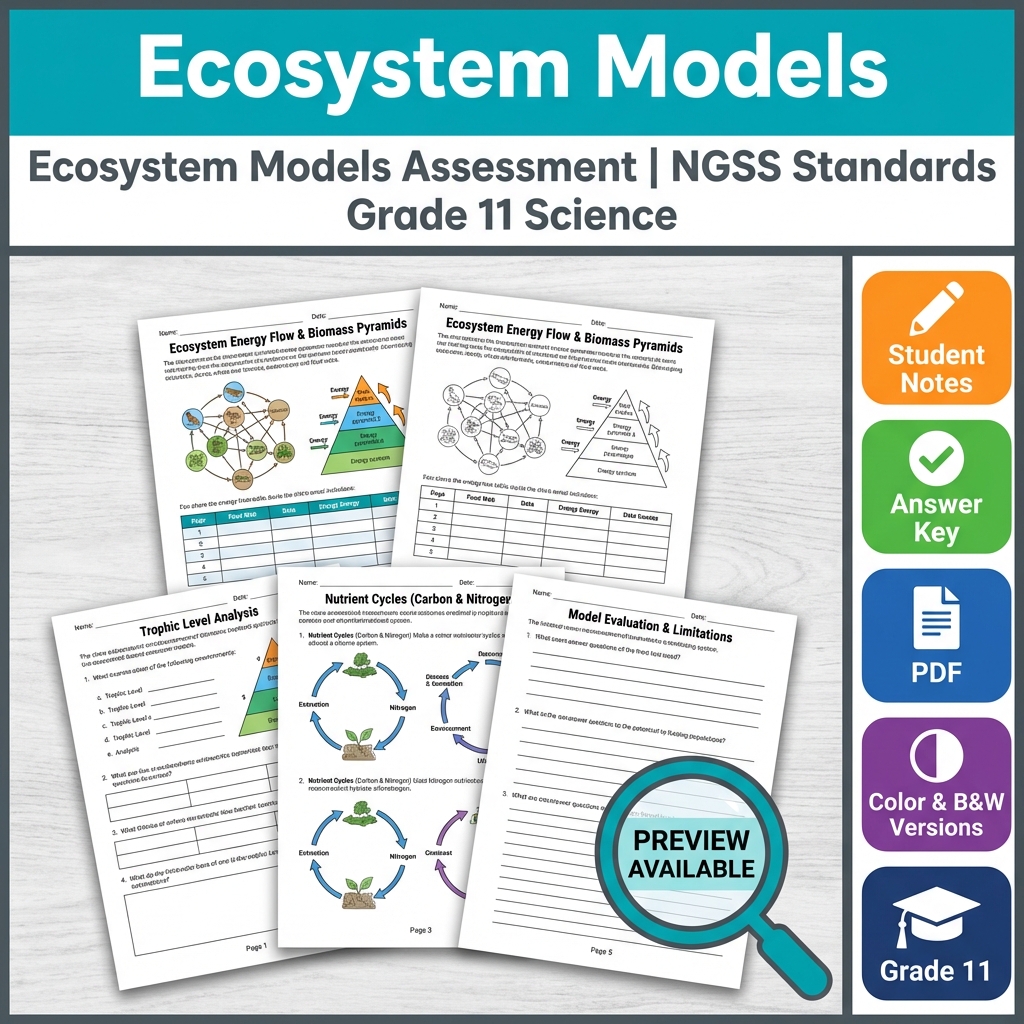
Ecosystem Models Assessment | NGSS Standards Grade 11 Science
Created byPrism Point LearningLearning Objectives
- Understand different types of ecosystem models and their applications.
- Analyze how models represent ecological interactions and predict system behavior.
- Evaluate the parameters and feedback mechanisms in ecosystem modeling.
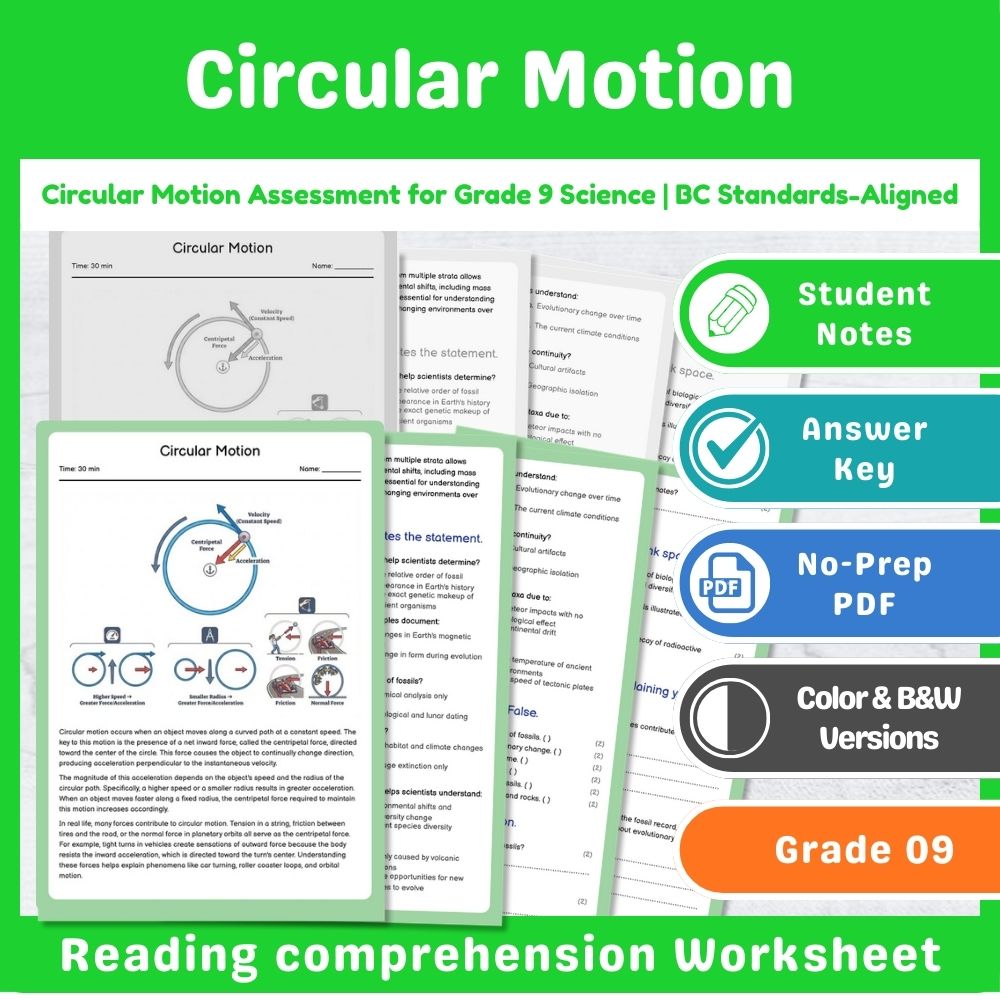
Circular Motion Assessment for Grade 9 Science | BC Standards-Aligned
Created byPrism Point LearningLearning Objectives
- Explain the concept of centripetal force and its role in circular motion.
- Describe how speed and radius affect the acceleration in circular motion.
- Analyze the forces, such as tension and friction, that keep objects moving in a circular path.

Climate and Controls Assessment | Florida NGSSS Grade 9 Science
Created byPrism Point LearningLearning Objectives
- Differentiate climate from short-term weather and explain why climate is based on long-term patterns
- Describe how latitude, atmospheric circulation, and distance from water influence temperature and precipitation
- Explain how local factors (elevation and prevailing winds) shape regional climate and related ecosystems
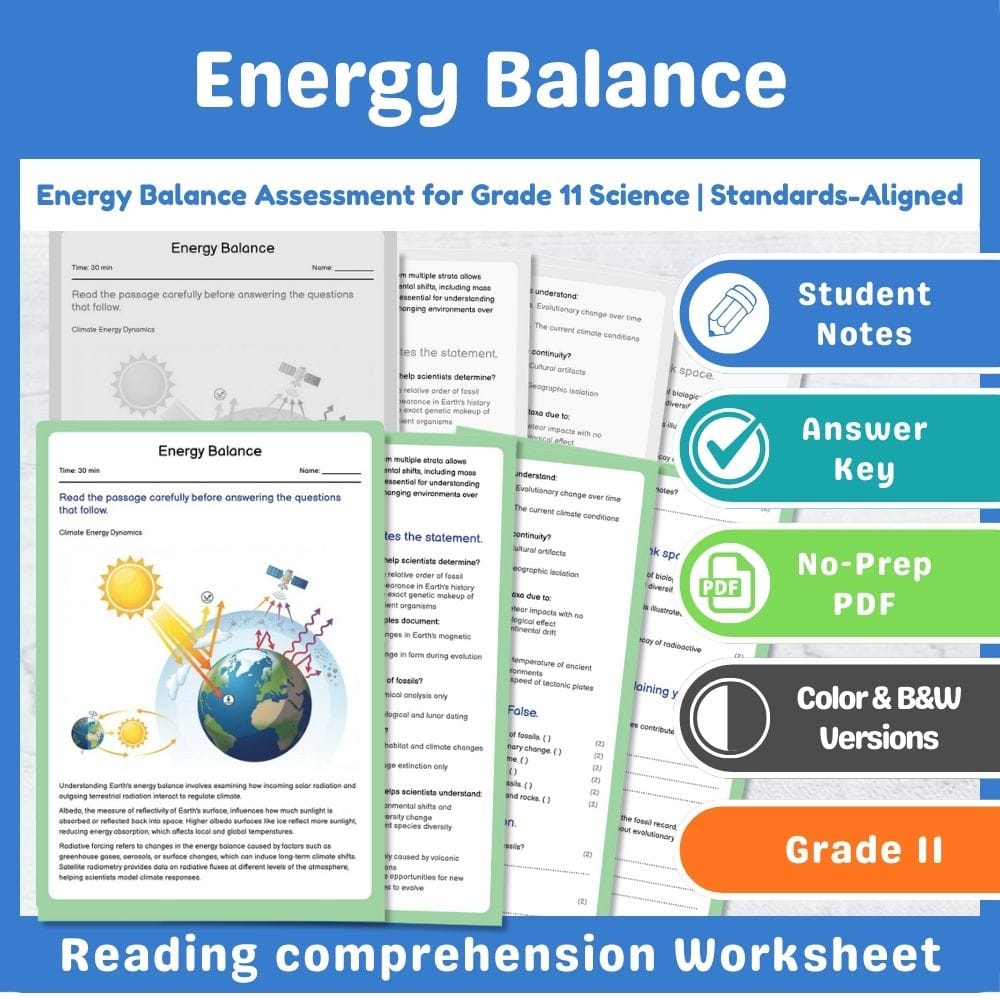
Energy Balance Assessment for Grade 11 Science | Standards-Aligned
Created byPrism Point LearningLearning Objectives
- Explain the concepts of energy balance and radiative forcing in climate systems.
- Interpret albedo maps, radiative flux diagrams, and simple energy budget models.
- Analyze phenomena such as seasonal cycles and polar amplification through feedback mechanisms.
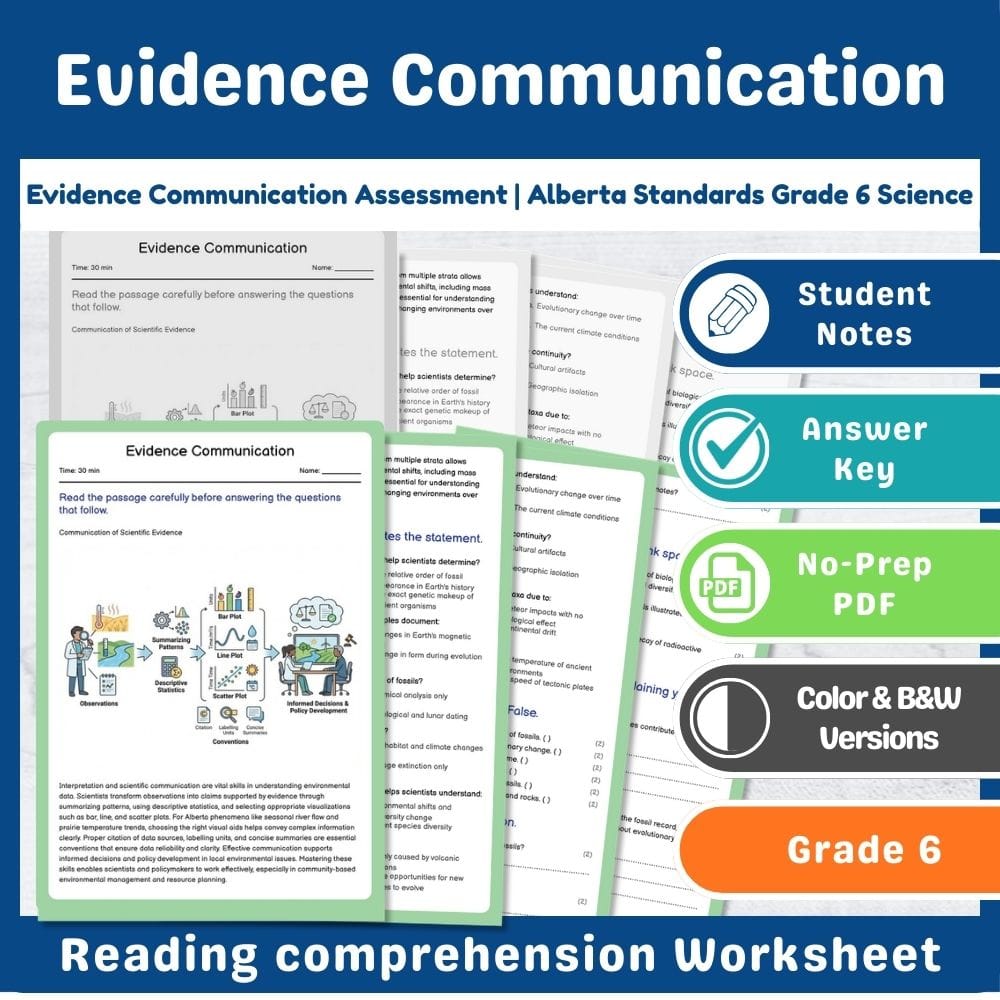
Evidence Communication Assessment | Alberta Standards Grade 6 Science
Created byPrism Point LearningLearning Objectives
- Understand methods for summarizing patterns using descriptive statistics.
- Learn how to select appropriate visual representations like bar, line, and scatter plots.
- Identify proper conventions for citing data sources and labelling units.
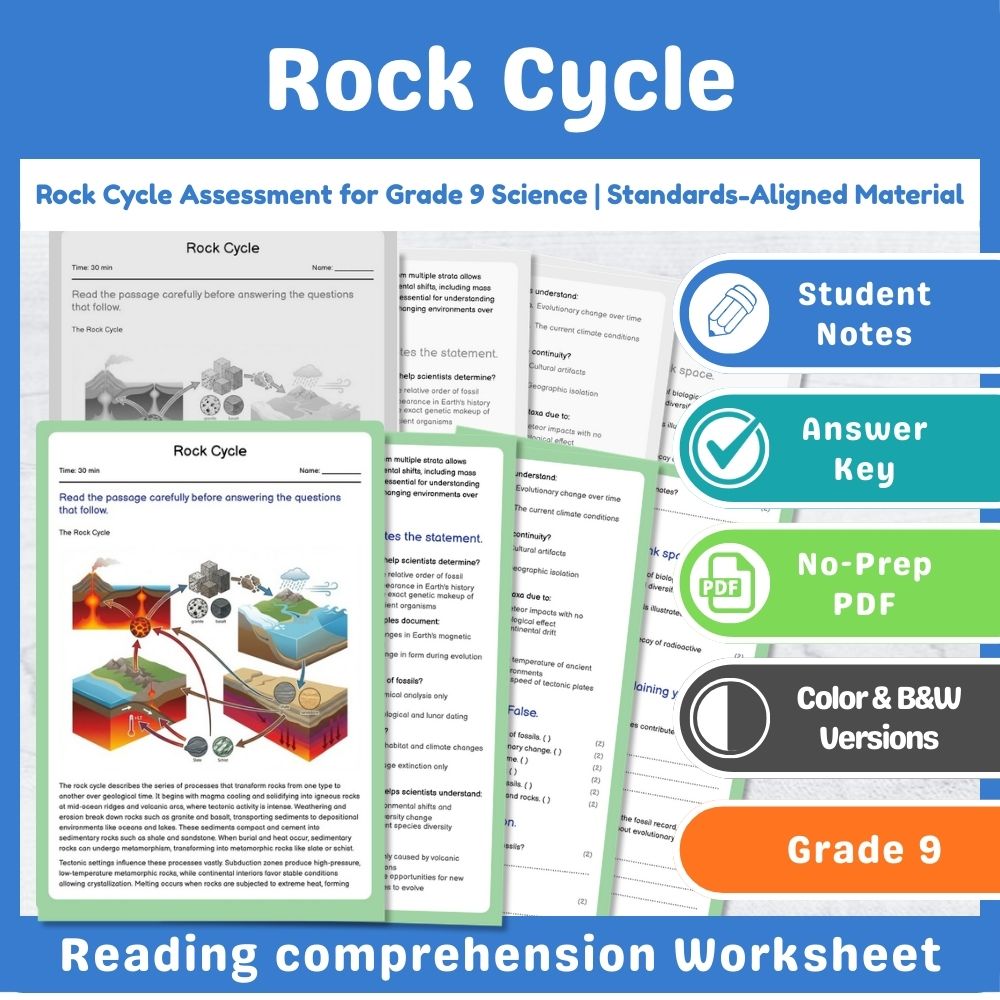
Rock Cycle Assessment for Grade 9 Science | Standards-Aligned Material
Created byPrism Point LearningLearning Objectives
- Describe the processes involved in the rock cycle and how different rocks transform through geological mechanisms.
- Explain the role of tectonic settings such as mid-ocean ridges, subduction zones, and continental interiors in rock formation.
- Identify the physical and chemical processes that drive changes in rocks and their link to landscape evolution.

Weather Elements Assessment | Florida NGSSS Grade 6 Science
Created byPrism Point LearningLearning Objectives
- Identify major weather elements (temperature, precipitation, wind speed/direction, cloud cover, humidity) and explain what each one describes.
- Use observations of multiple weather elements to describe current weather conditions and understand why forecasts can change.
- Interpret simple statements about weather elements using evidence from observations and basic cause-and-effect relationships.
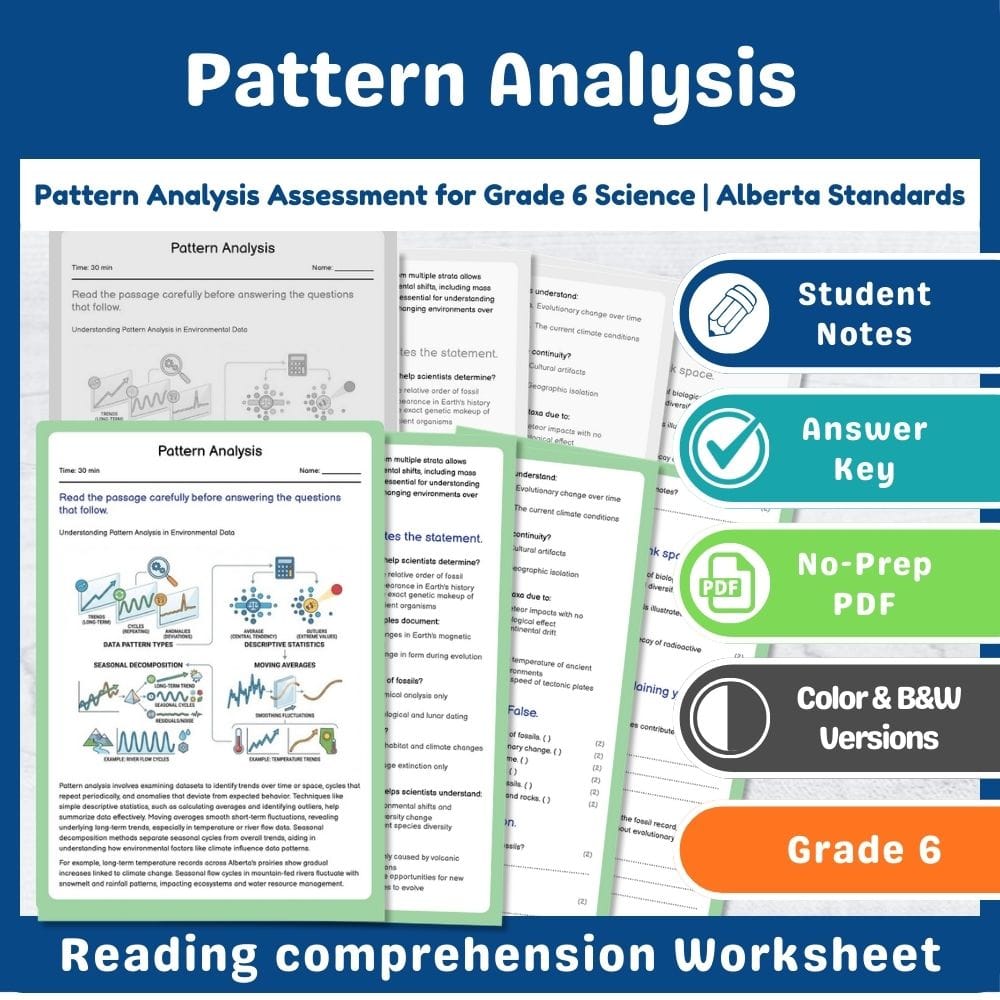
Pattern Analysis Assessment for Grade 6 Science | Alberta Standards
Created byPrism Point LearningLearning Objectives
- Understand methods used to detect trends, cycles, and anomalies in datasets.
- Recognize the role of descriptive statistics, moving averages, and seasonal decomposition in pattern analysis.
- Link observed data patterns to environmental drivers through examples such as temperature trends and river flow cycles.
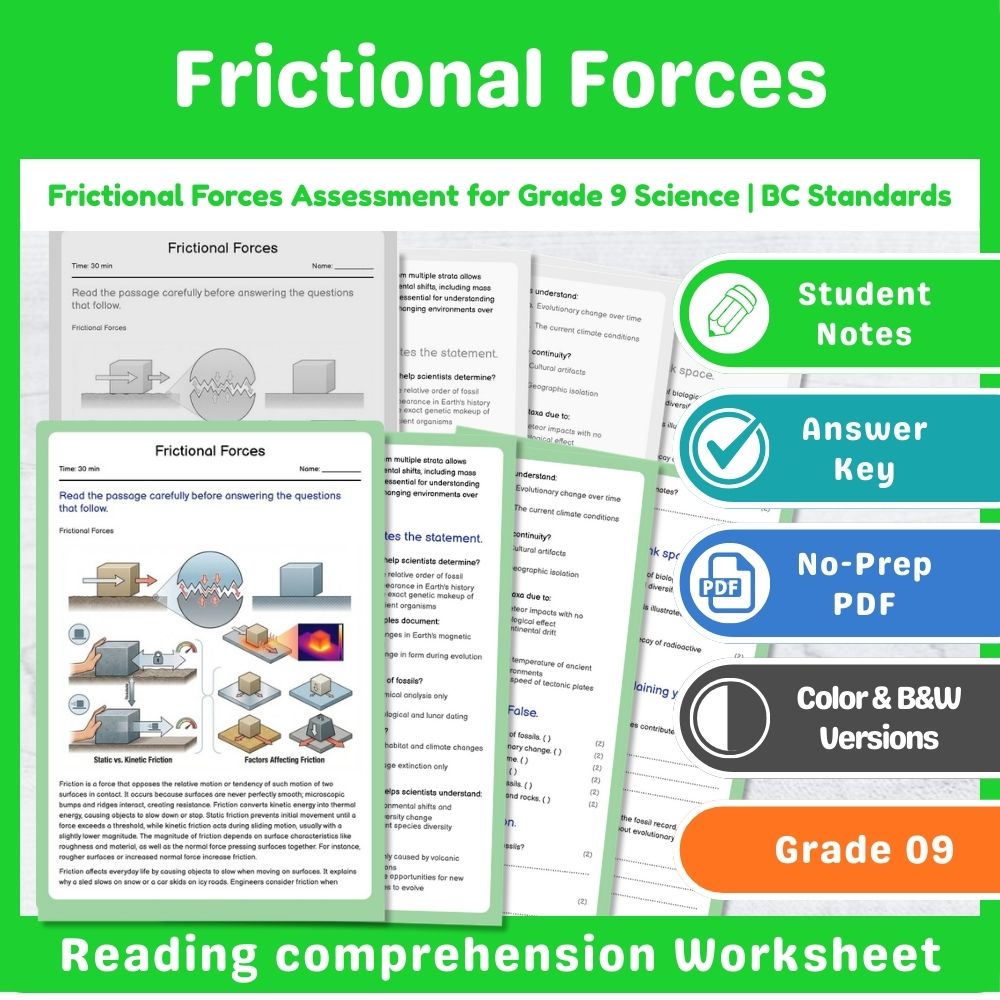
Frictional Forces Assessment for Grade 9 Science | BC Standards
Created byPrism Point LearningLearning Objectives
- Explain the concept of friction and how it opposes motion.
- Differentiate between static and kinetic friction.
- Describe factors influencing the magnitude of frictional force.

Mass Wasting and Coasts Assessment | Florida NGSSS Grade 7 Science
Created byPrism Point LearningLearning Objectives
- Explain how gravity and water-driven forces contribute to mass wasting and coastal erosion
- Describe how prolonged rain can trigger landslides by changing soil or rock stability
- Identify how waves and storm surge reshape coastlines by moving and removing sediment

Energy Transfer Limits Assessment | NGSSS Grade 6 Science
Created byPrism Point LearningLearning Objectives
- Explain why energy transfer between trophic levels is inefficient
- Describe how heat loss affects the amount of energy available to organisms at higher levels
- Predict how removing a species or food source can impact populations across a food web

Humidity and Clouds Assessment | Florida NGSSS Standards Grade 9 Science
Created byPrism Point LearningLearning Objectives
- Explain how lifting and cooling lead to condensation and cloud formation
- Interpret relative humidity as an indicator of proximity to saturation
- Describe how atmospheric stability and vertical motion influence cloud types and precipitation

Greenhouse Feedbacks Assessment | Florida NGSSS Grade 9 Science
Created byPrism Point LearningLearning Objectives
- Explain how changes in greenhouse gases can trigger climate feedbacks that amplify or reduce warming.
- Describe at least three feedback pathways involving water vapor, ice/snow albedo, and clouds.
- Use cause-and-effect reasoning to connect atmospheric processes to Earth’s energy balance (absorbed sunlight vs. outgoing infrared).
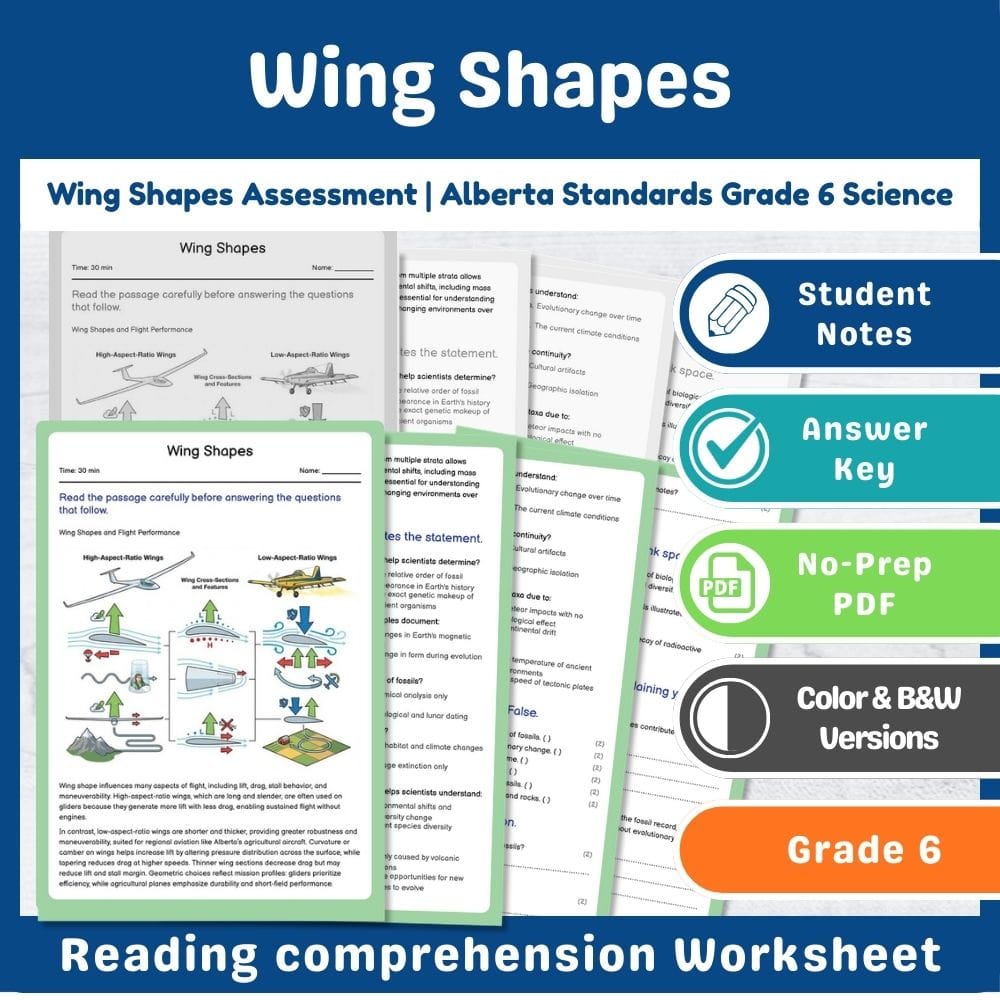
Wing Shapes Assessment | Alberta Standards Grade 6 Science
Created byPrism Point LearningLearning Objectives
- Understand how wing shape influences lift, stall behavior, and maneuverability.
- Identify features such as camber, thickness, and aspect ratio that affect flight performance.
- Compare high-aspect-ratio wings used on gliders with low-aspect wings on agricultural aircraft.

Evolution Evidence Assessment for Grade 12 Science | NGSSS Standards
Created byPrism Point LearningLearning Objectives
- Explain how fossils, comparative anatomy, biogeography, and genetics provide evidence for evolution and common descent
- Distinguish homologous structures from analogous structures and interpret what each implies
- Use multiple evidence sources to justify why species change over time
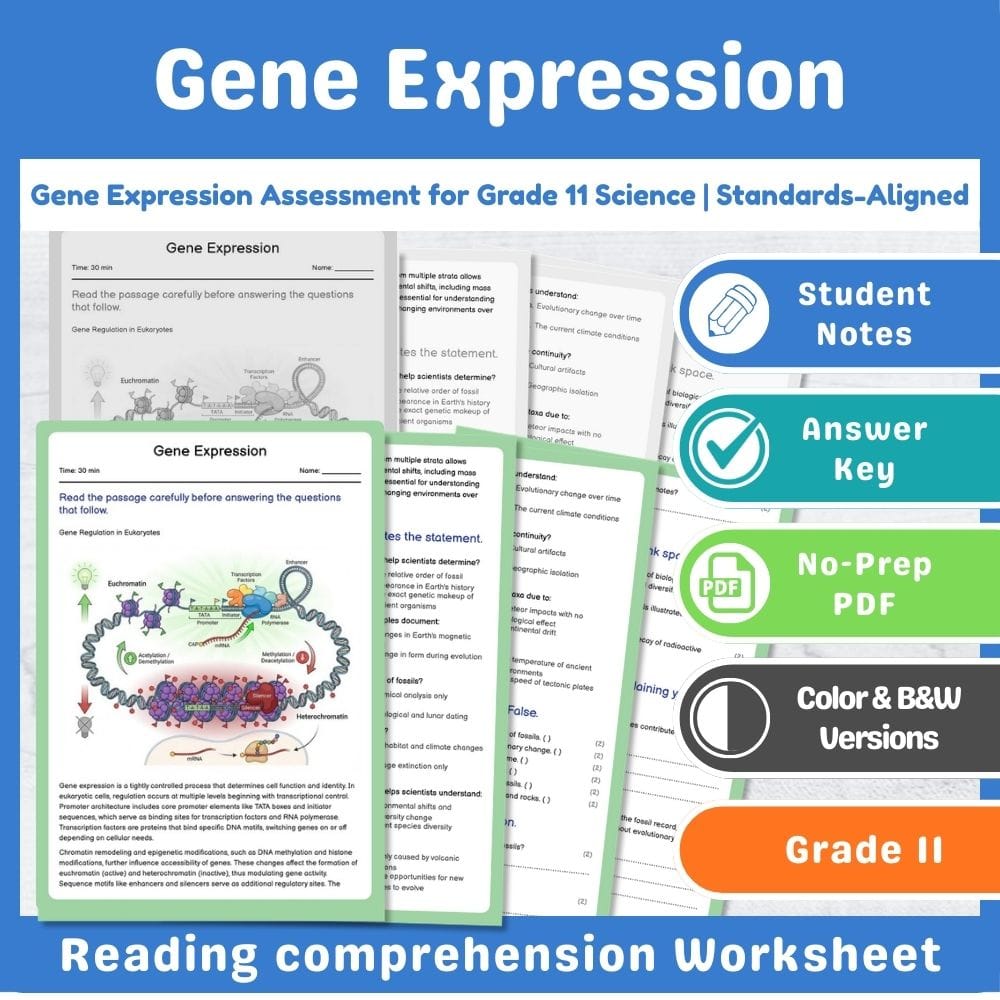
Gene Expression Assessment for Grade 11 Science | Standards-Aligned
Created byPrism Point LearningLearning Objectives
- Explain the mechanisms controlling gene expression from transcription to post-transcriptional modification and translation.
- Identify the roles of promoter architecture, transcription factors, chromatin remodeling, and epigenetic marks.
- Analyze how regulatory architecture influences phenotypic outcomes and cellular diversity.

Work And Kinetic Energy Assessment | NGSSS Standards Grade 9 Science
Created byPrism Point LearningLearning Objectives
- Explain how work is related to energy transfer and changes in kinetic energy
- Predict how the direction of a net force (with or against motion) affects speed using the work-energy idea
- Differentiate situations where energy transfer goes mainly into kinetic energy versus stored potential energy

Conservation Of Matter Assessment | Florida NGSSS Grade 9 Science
Created byPrism Point LearningLearning Objectives
- Explain how conservation of atoms and conservation of mass apply to chemical reactions.
- Use word descriptions to predict particle-level changes and possible product amounts.
- Interpret balanced chemical equations as evidence that atoms are neither created nor destroyed.

Heat and Temperature Assessment | NGSSS Standards Grade 6 Science
Created byPrism Point LearningLearning Objectives
- Explain the difference between heat and temperature using particle motion and energy transfer.
- Use everyday examples (hot water, warm air, cooling objects) to predict how energy moves.
- Interpret warming and cooling patterns by reasoning about temperature differences.
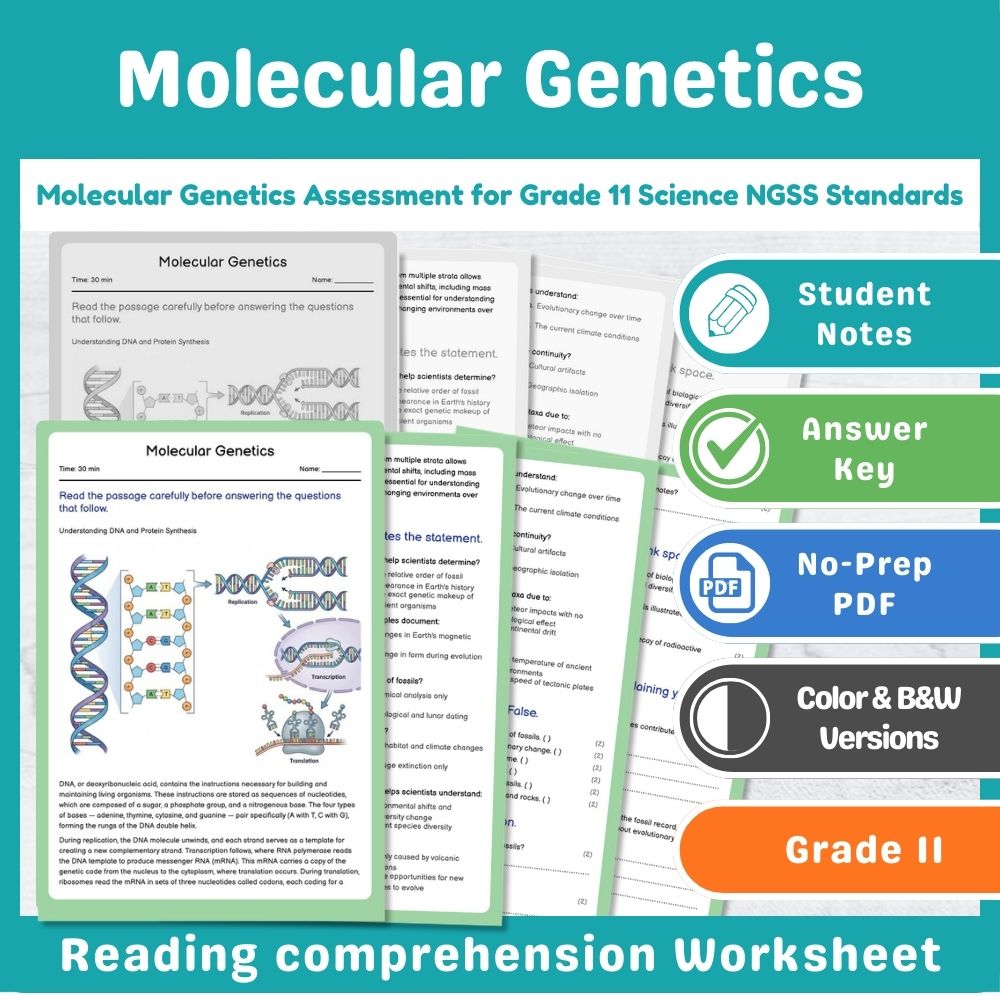
Molecular Genetics Assessment for Grade 11 Science NGSS Standards
Created byPrism Point LearningLearning Objectives
- Understand the relationship between DNA sequences and protein synthesis through replication, transcription, and translation.
- Describe the structure of DNA and the genetic code.
- Explain how chromosomal organization links molecular information to observable traits.
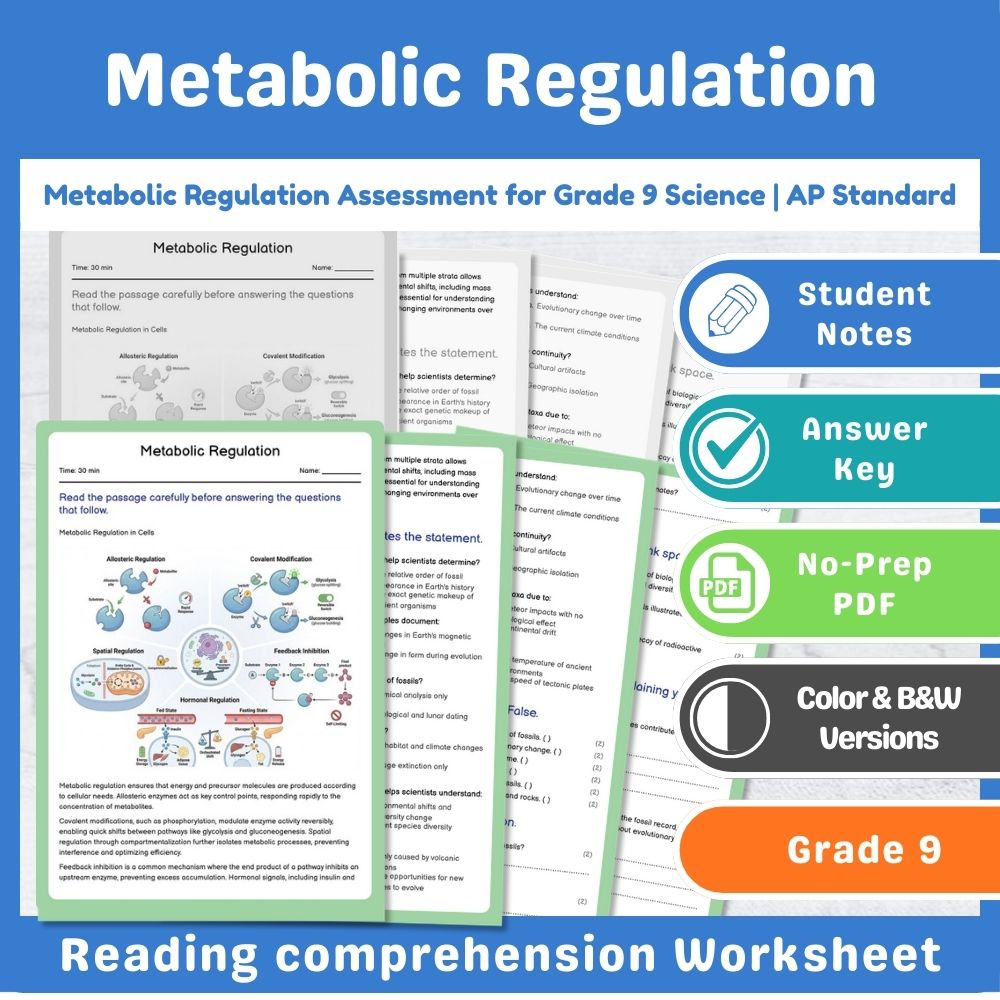
Metabolic Regulation Assessment for Grade 9 Science | AP Standard
Created byPrism Point LearningLearning Objectives
- Describe the various mechanisms of metabolic pathway regulation including allosteric control, covalent modifications, and compartment-specific regulation.
- Explain feedback inhibition and hormonal signals that shift metabolic flux between catabolism and anabolism.
- Model enzyme kinetics and substrate concentrations to understand pathway rates and system responses to perturbations.

Niche Relationships Assessment for Grade 6 Science | Florida NGSSS
Created byPrism Point LearningLearning Objectives
- Explain what a niche is and how it describes an organism’s role in an ecosystem.
- Identify how different niches can allow two species to coexist in the same habitat.
- Analyze how niche overlap can increase competition when resources become limited.

Water Cycle Flux Assessment for Grade 11 Science | NGSSS Standards
Created byPrism Point LearningLearning Objectives
- Explain how water moves between the atmosphere and hydrosphere using the major processes of the water cycle flux.
- Analyze how ocean currents and sea surface temperature affect evaporation, humidity, and atmospheric stability.
- Evaluate how long-term and seasonal ocean-atmosphere interactions can change regional precipitation patterns, including El Niño and La Niña.

Science Assessment: Climate and Patterns (Grade 6) | NGSSS Assessment
Created byPrism Point LearningLearning Objectives
- Explain how climate differs from short-term weather using long-term averages and typical ranges.
- Identify key factors that influence climate, including latitude, altitude, distance from water, ocean currents, and prevailing winds.
- Use climate ideas to describe why different environments (deserts, grasslands, rain forests) form in different regions.

Stellar Evolution Assessment | Florida NGSSS Grade 10 Science Worksheet
Created byPrism Point LearningLearning Objectives
- Explain how a star’s mass influences its main-sequence life and later evolutionary stages
- Describe how fusion changes as a star’s fuel supply decreases
- Connect stellar deaths (red giant, planetary nebula, supernova) to element production and enrichment of space
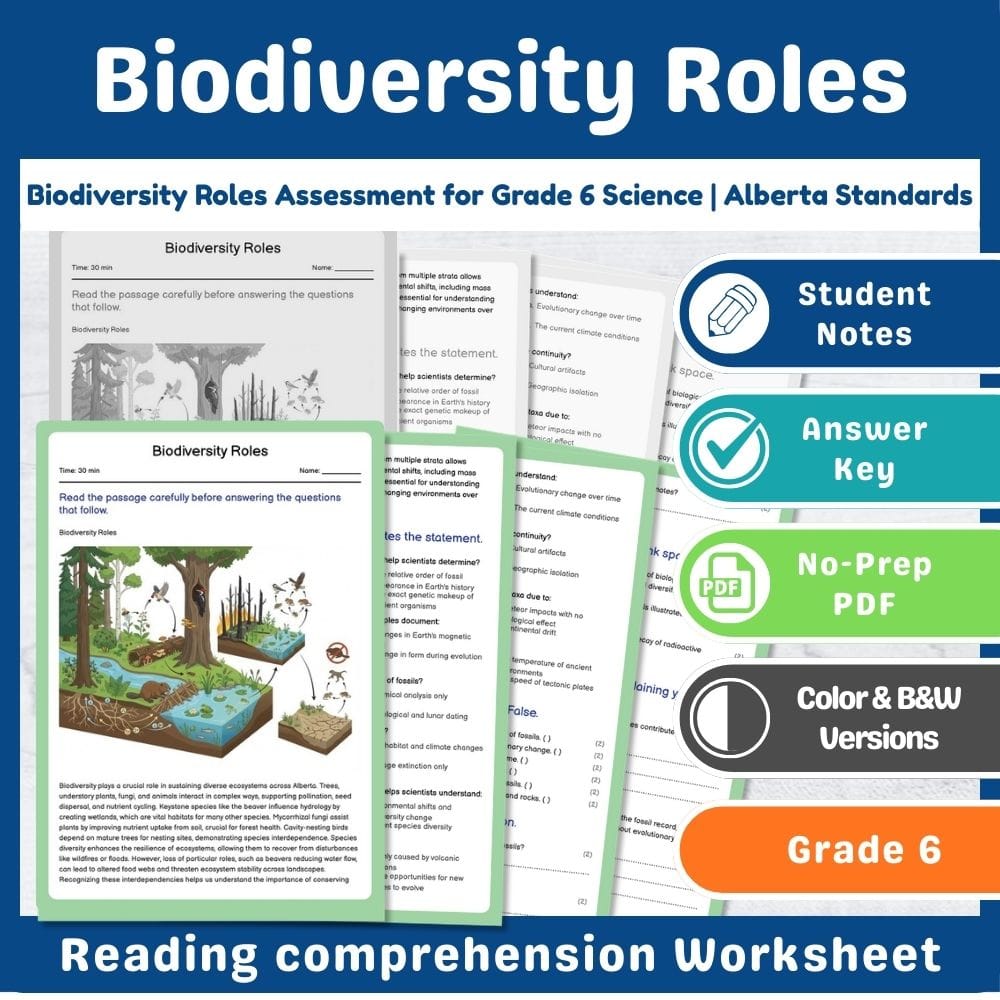
Biodiversity Roles Assessment for Grade 6 Science | Alberta Standards
Created byPrism Point LearningLearning Objectives
- Understand how different species contribute to ecosystem functions like pollination, seed dispersal, and nutrient cycling.
- Identify the roles of keystone and indicator species within Alberta ecosystems.
- Explain how species diversity impacts ecosystem resilience and stability.

Food Chains Assessment for Grade 6 Science | Florida NGSSS Standards
Created byPrism Point LearningLearning Objectives
- Identify the roles of producers and consumers in a food chain
- Explain how energy transfers between trophic levels
- Describe why real ecosystems often form food webs instead of single pathways

Physical vs Chemical Assessment | Florida NGSSS Grade 11 Science
Created byPrism Point LearningLearning Objectives
- Differentiate physical changes from chemical changes based on whether chemical identity changes.
- Use evidence such as gas production, temperature change, color change, and precipitate formation to infer chemical reactions.
- Predict whether a process is reversible by considering whether the chemical composition remains the same.

Plate Tectonics Assessment | NGSSS Standards Grade 11 Science
Created byPrism Point LearningLearning Objectives
- Explain how internal heat drives mantle convection and leads to plate motion.
- Distinguish divergent, convergent, and transform plate boundaries using key features and outcomes.
- Describe how earthquakes and volcanism provide evidence for ongoing tectonic activity.

Conservation of Mass Assessment | Florida NGSSS Grade 11 Science
Created byPrism Point LearningLearning Objectives
- Explain the conservation of mass in terms of closed systems and atomic rearrangement.
- Use balanced chemical equations to connect reactant and product amounts to measurable mass.
- Apply conservation of mass to interpret evidence from experiments involving solids and gases.

Carrying Capacity Assessment for Grade 11 Science | NGSSS Standards
Created byPrism Point LearningLearning Objectives
- Explain how birth rate, death rate, immigration, and emigration affect population change over time
- Define carrying capacity and describe how limiting factors slow population growth
- Interpret how competition, predation, and disease influence survival and reproduction

Heredity Through Meiosis Assessment | Florida NGSSS Grade 11 Science
Created byPrism Point LearningLearning Objectives
- Explain how meiosis reduces chromosome number to form haploid gametes
- Describe how random alignment of homologous chromosomes contributes to genetic diversity
- Connect fertilization to restoring the diploid chromosome set and producing new allele combinations
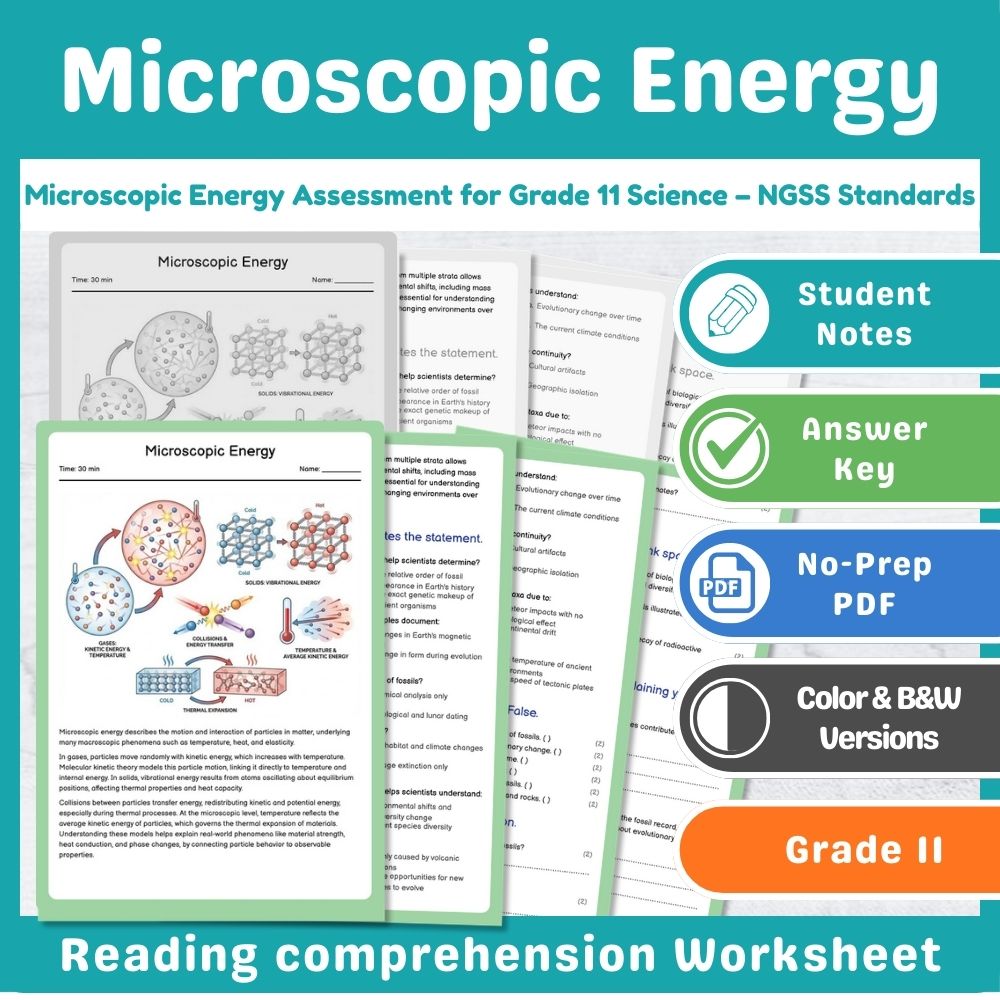
Microscopic Energy Assessment for Grade 11 Science – NGSS Standards
Created byPrism Point LearningLearning Objectives
- Explain the representation of energy at the microscopic scale and how it relates to macroscopic phenomena.
- Describe molecular kinetic theory and how it connects particle motion to temperature.
- Analyze energy redistribution during collisions in gases and vibrations in solids.

Earth Systems Assessment for Grade 11 Science | Florida NGSSS Standards
Created byPrism Point LearningLearning Objectives
- Explain how Earth’s geosphere, hydrosphere, atmosphere, and biosphere interact through energy flow and matter cycling
- Use cause-and-effect reasoning to describe how unequal heating drives atmospheric and ocean circulation
- Describe major processes such as the water cycle and biogeochemical cycling and connect them to regional or global patterns

Seasons and Orbits Assessment | Florida NGSSS Grade 11 Science
Created byPrism Point LearningLearning Objectives
- Explain how Earth’s tilt and orbital motion affect the angle and intensity of solar radiation at different latitudes.
- Connect Earth’s rotation and revolution to day length and seasonal temperature patterns.
- Describe how the Moon’s orbit and gravity produce observable effects such as tides.

DNA Information Assessment for Grade 11 Science | NGSSS Standards
Created byPrism Point LearningLearning Objectives
- Explain how DNA stores genetic information and how that information leads to protein production
- Describe the structure of DNA and the importance of complementary base pairing
- Analyze how accurate DNA replication preserves inheritance during cell division

Photosynthesis Assessment | Florida NGSSS Grade 11 Science Worksheet
Created byPrism Point LearningLearning Objectives
- Explain how photosynthesis converts light energy into chemical energy stored in organic molecules
- Describe the roles of chlorophyll, electron transport, ATP/NADPH, and the Calvin cycle
- Interpret how photosynthesis affects oxygen release and global carbon cycling

Earth System Feedbacks Assessment for Grade 11 Science | NGSSS Standards
Created byPrism Point LearningLearning Objectives
- Explain how positive and negative feedback mechanisms affect Earth system changes
- Identify examples of feedbacks involving atmosphere, cryosphere, hydrosphere, and land cover
- Analyze how human actions can strengthen or weaken Earth system feedback pathways

Scientific Inquiry Assessment | Florida NGSSS Grade 6 Science Standards
Created byPrism Point LearningLearning Objectives
- Explain how scientific inquiry begins with careful observations and leads to testable questions
- Identify how measurement and evidence support reliable explanations in investigations
- Use logical reasoning to connect results to conclusions and communicate findings clearly

Physical Chemical Changes Assessment | Florida NGSSS Grade 7 Science
Created byPrism Point LearningLearning Objectives
- Differentiate between physical changes and chemical changes using evidence from observations.
- Identify indicators of chemical change such as gas production, precipitate formation, color change, or temperature change.
- Explain how matter can change form or state without creating a new substance.
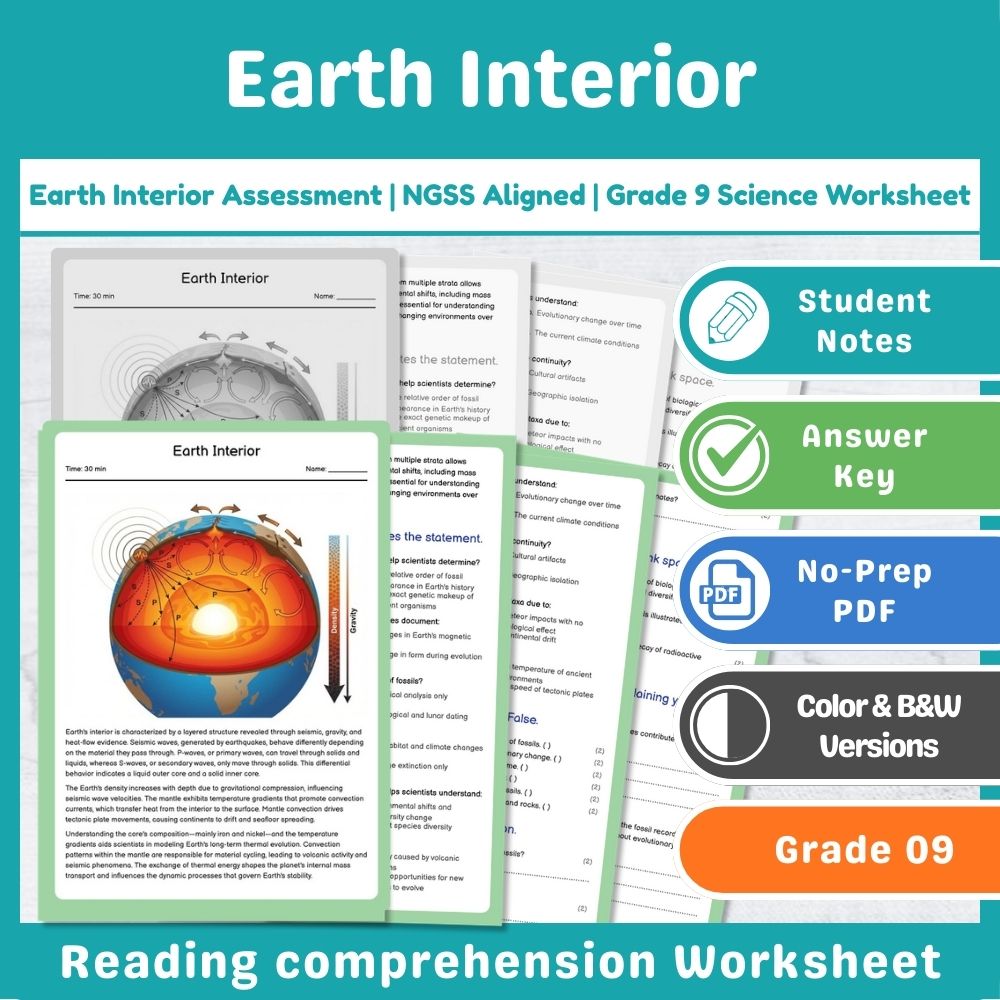
Earth Interior Assessment | NGSS Aligned | Grade 9 Science Worksheet
Created byPrism Point LearningLearning Objectives
- Describe the layered structure of Earth's interior based on seismic evidence.
- Interpret the behaviors of P-waves and S-waves to understand Earth's composition.
- Explain the transfer of thermal energy within Earth and its impact on planetary processes.
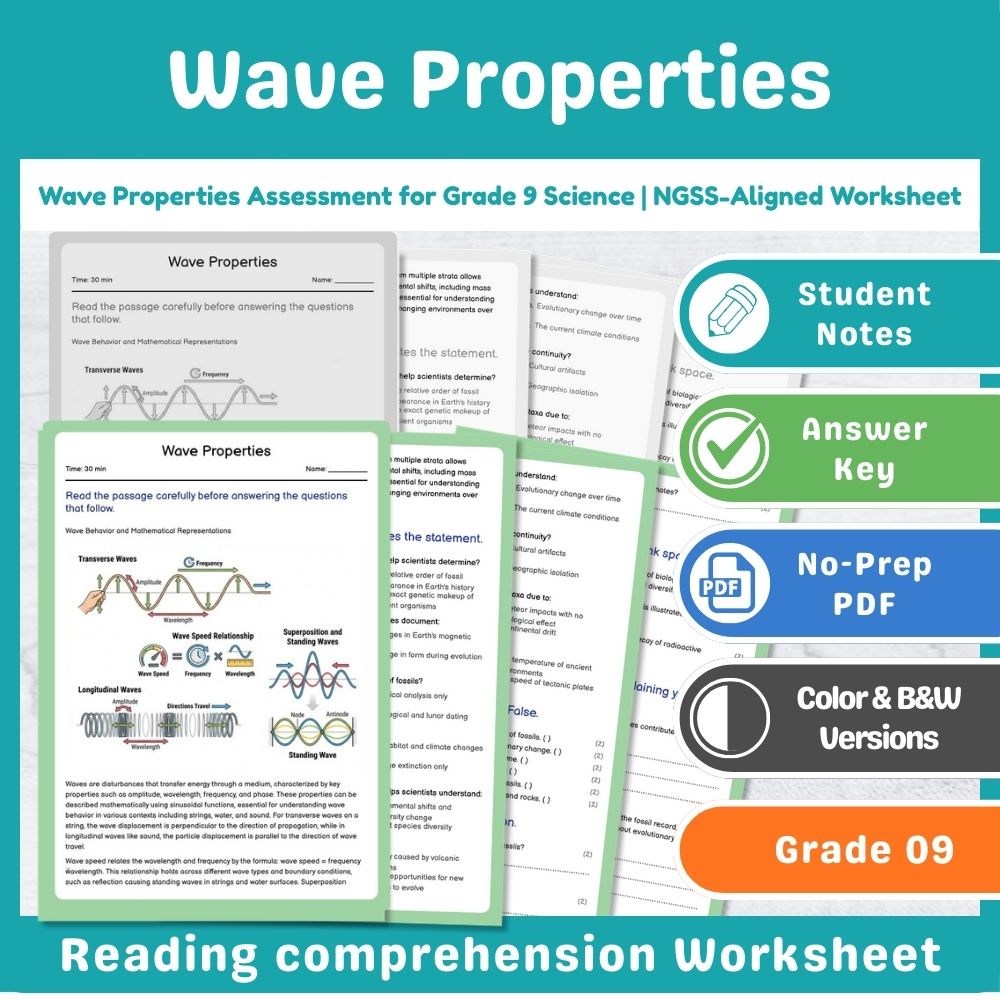
Wave Properties Assessment for Grade 9 Science | NGSS-Aligned Worksheet
Created byPrism Point LearningLearning Objectives
- Understand the mathematical representations of wave behavior including amplitude, frequency, wavelength, and phase.
- Apply the wave speed formula: wave speed = frequency × wavelength in practical scenarios.
- Describe how sinusoidal functions and superposition explain interference and standing waves.

Density And Volume Assessment | NGSSS Standards Grade 7 Science Worksheet
Created byPrism Point LearningLearning Objectives
- Explain how density relates mass and volume to identify and compare materials.
- Calculate and interpret density using appropriate units.
- Distinguish intensive properties from extensive properties using density as an example.

Forces And Motion Assessment | Florida NGSSS Grade 7 Science Worksheet
Created byPrism Point LearningLearning Objectives
- Explain how forces (pushes and pulls) can change an object’s motion.
- Differentiate balanced forces from unbalanced forces using the idea of net force.
- Use examples such as friction to predict how an object’s speed or direction will change.
Browse more categories
About Science Worksheets
Find Science worksheets spanning core skills, practice, and review. All 42,685 resources are instant PDF downloads for the classroom or home.
Every worksheet on MyTeachingSheets is created by independent teacher-authors and reviewed before publication. All resources download as printable PDFs for classroom, homework, or at-home practice, and many include answer keys. Preview any worksheet free before buying.