
Science Worksheets
42,685 subject resources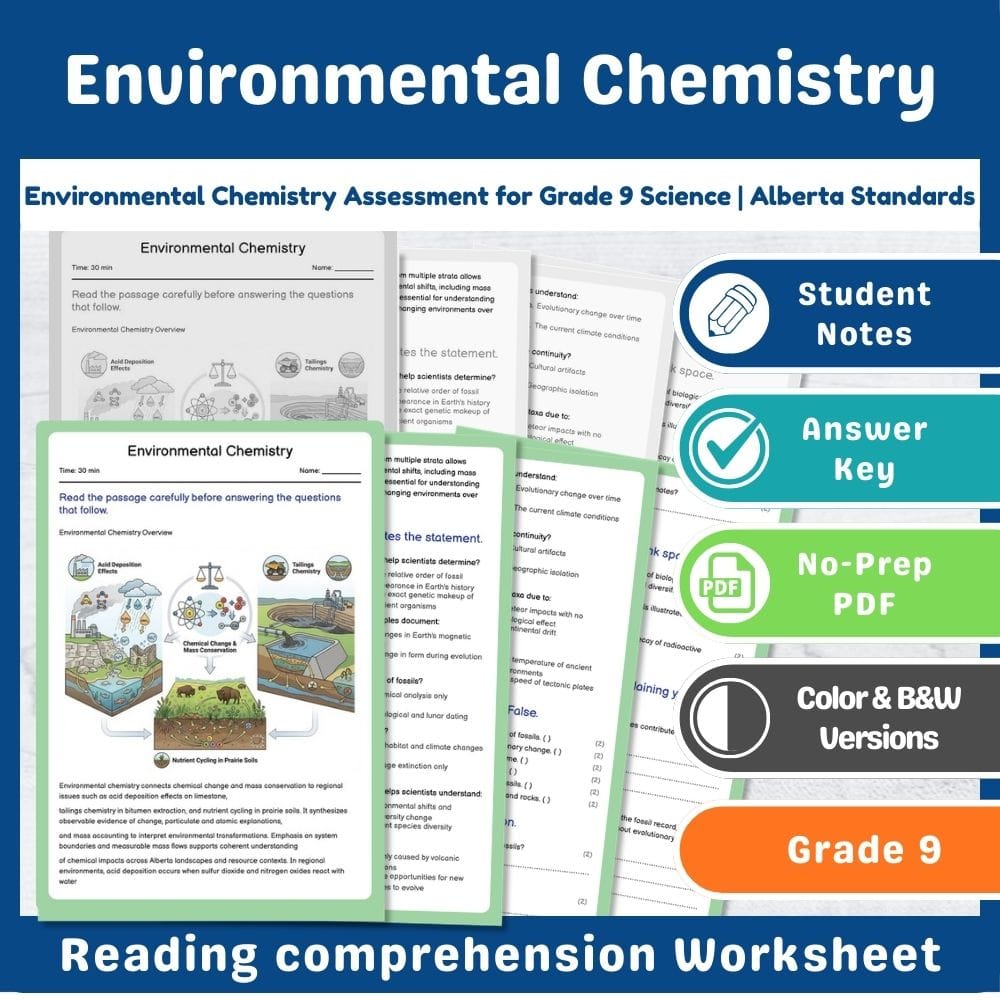
Environmental Chemistry Assessment for Grade 9 Science | Alberta Standards
 Created byPrism Point Learning
Learning Objectives
- Understand how chemical change and mass conservation relate to environmental issues.
- Analyze regional environmental impacts such as acid deposition and nutrient cycling.
- Interpret observable evidence of environmental transformations through particulate and atomic explanations.
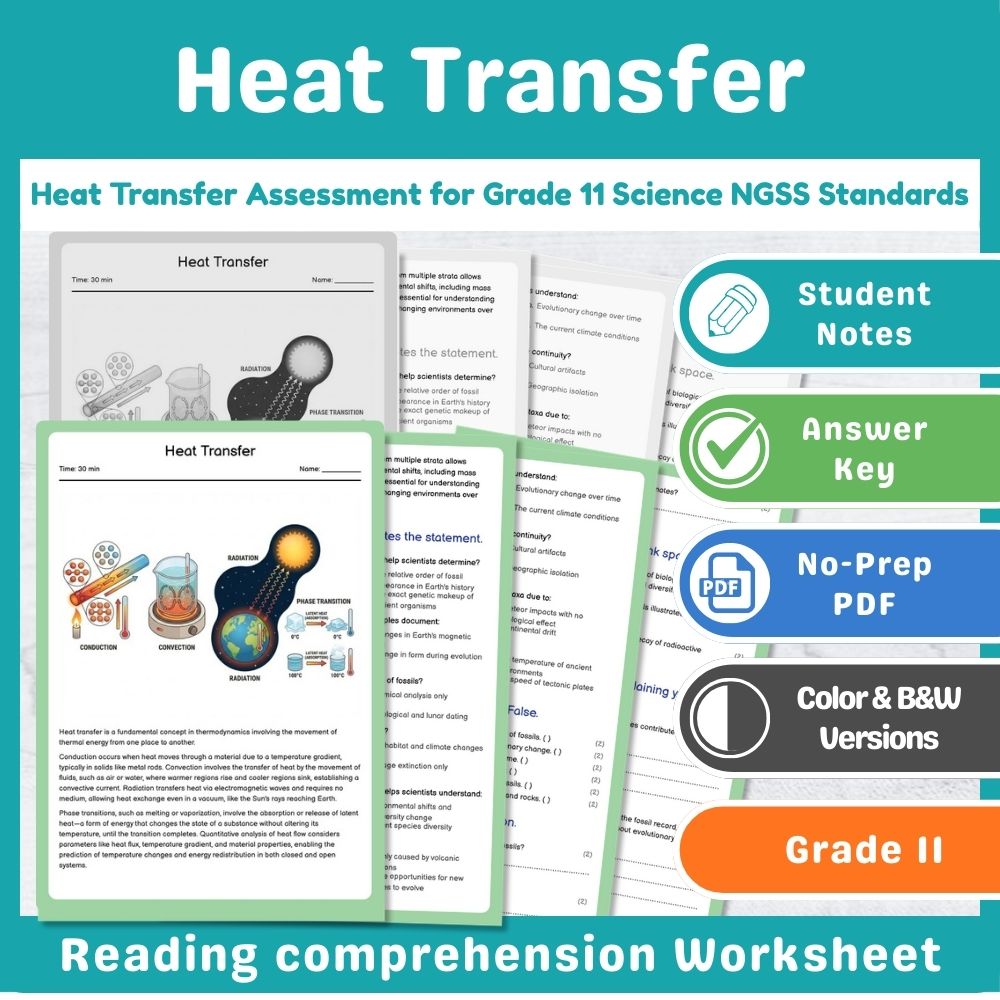
Heat Transfer Assessment for Grade 11 Science NGSS Standards
Created byPrism Point LearningLearning Objectives
- Explain the mechanisms of heat transfer: conduction, convection, and radiation.
- Apply thermodynamic principles to analyze heat flow in different systems.
- Describe phase transitions involving heat exchange, including latent heat.
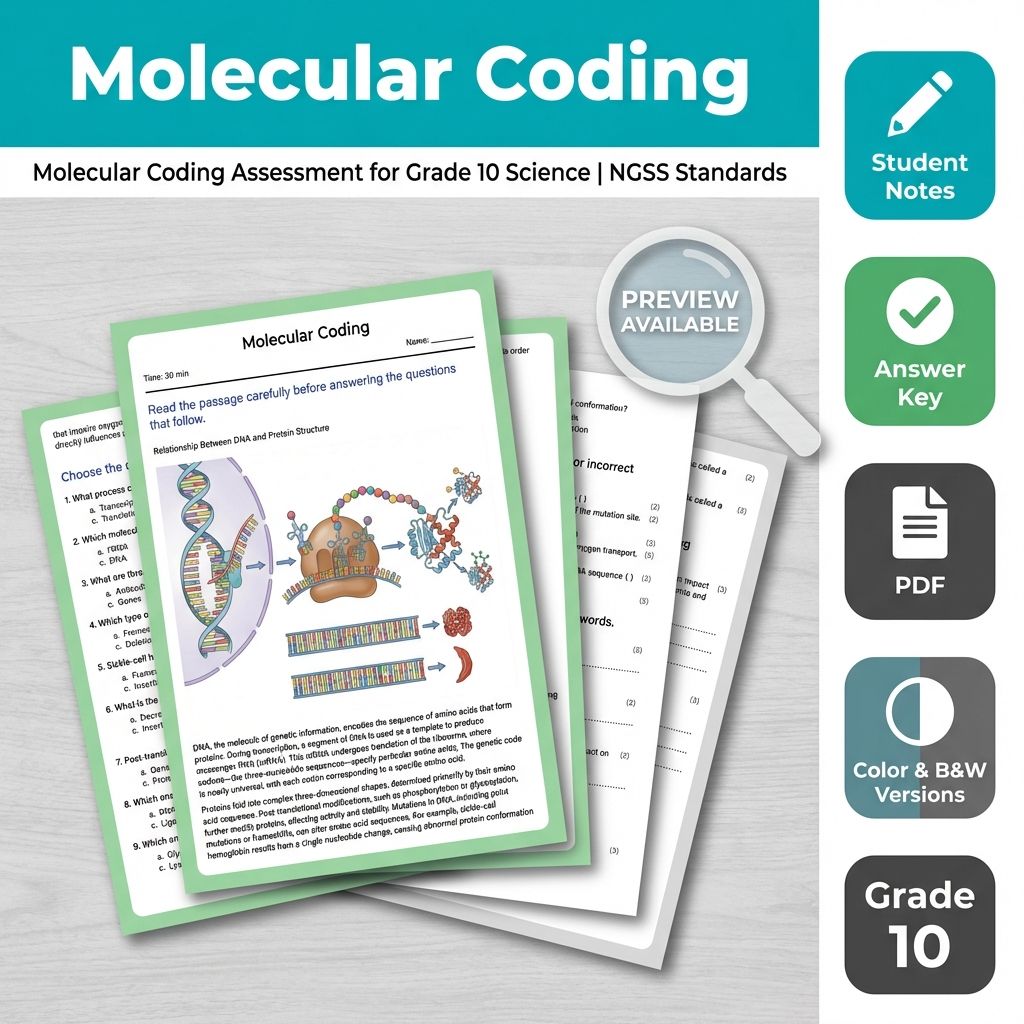
Molecular Coding Assessment for Grade 10 Science | NGSS Standards
Created byPrism Point LearningLearning Objectives
- Explain how DNA sequences determine amino acid sequences during protein synthesis.
- Describe the processes of transcription and translation in gene expression.
- Illustrate the effects of point mutations and frameshifts on protein structure.
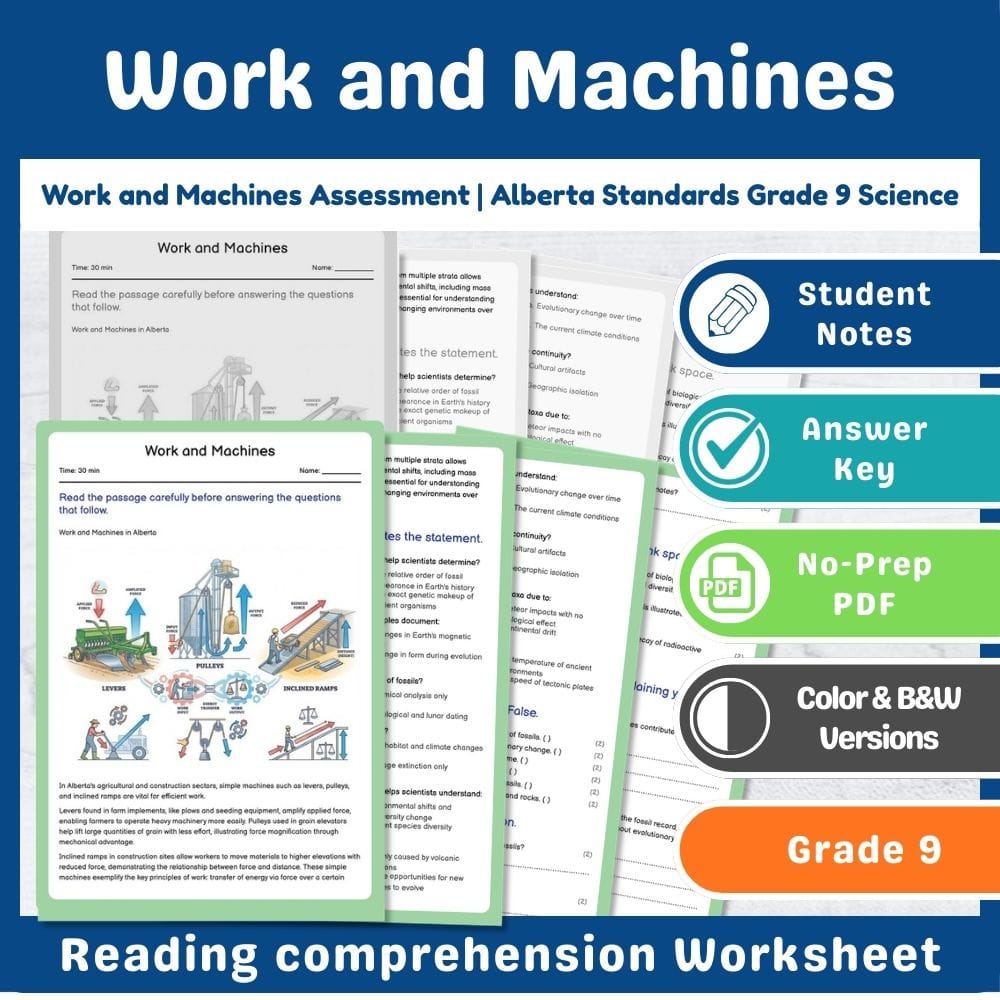
Work and Machines Assessment | Alberta Standards Grade 9 Science
Created byPrism Point LearningLearning Objectives
- Explain the concept of work as energy transfer caused by a force acting through a distance.
- Describe how simple machines alter force, distance, and mechanical advantage in real-world Alberta contexts.
- Analyze the trade-offs between force reduction and distance increase in machine design and performance.
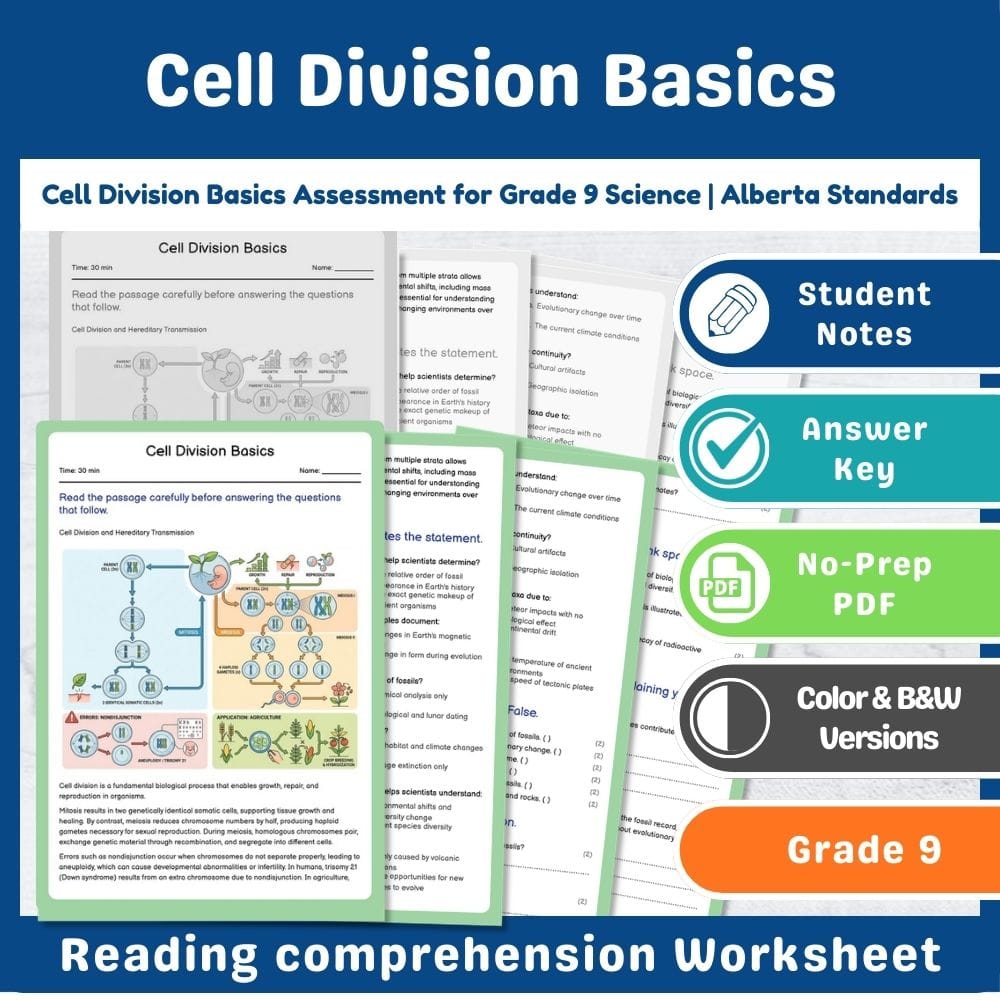
Cell Division Basics Assessment for Grade 9 Science | Alberta Standards
Created byPrism Point LearningLearning Objectives
- Understand the processes of mitosis and meiosis and their roles in the life cycle.
- Identify key features of chromosome pairing, segregation, and errors such as nondisjunction.
- Explain the implications of cell division processes in heredity, growth, and agriculture.
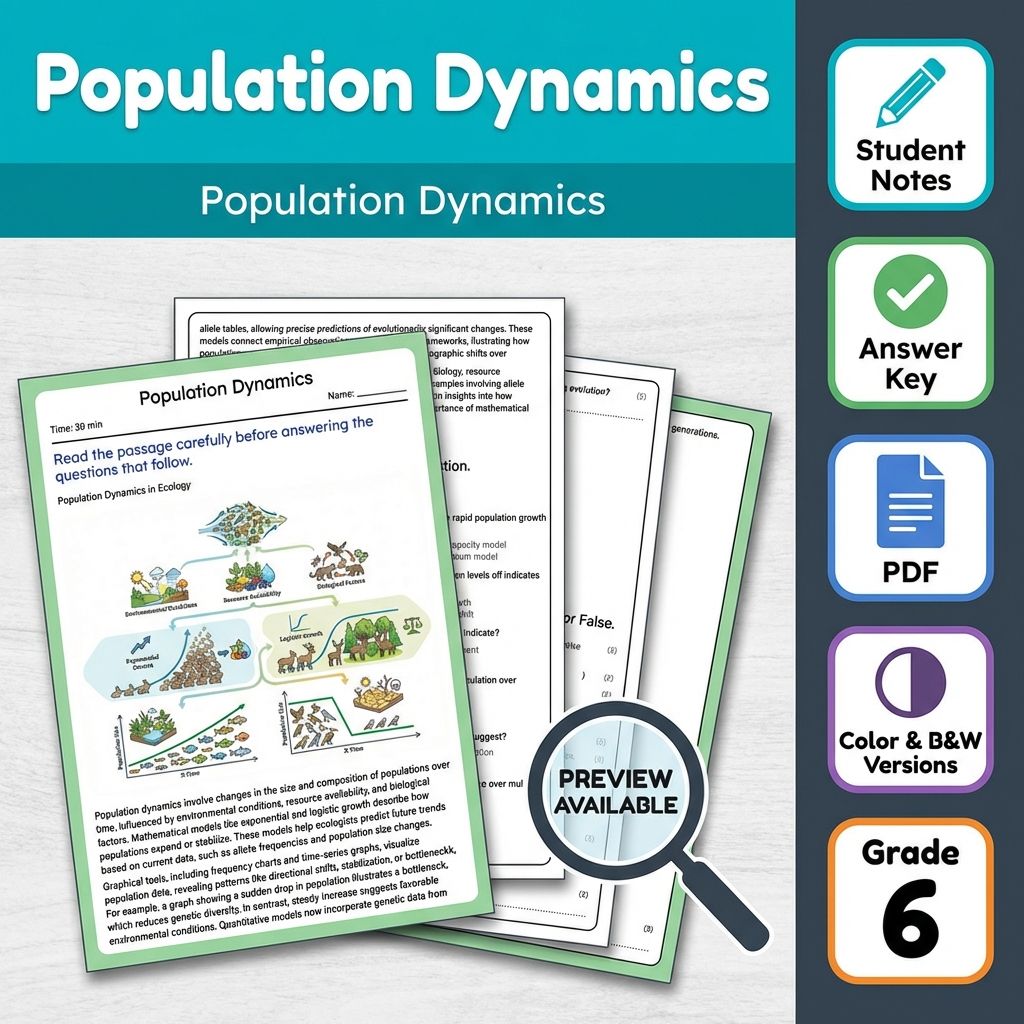
Population Dynamics Assessment for Grade 6 | NGSS Science Standards
Created byPrism Point LearningLearning Objectives
- Understand how mathematical representations and graphs illustrate changes in population over generations.
- Analyze how environmental and demographic factors influence trait frequencies and population sizes.
- Apply proportional reasoning, interpret frequency charts, and analyze time-series graphs related to population change.
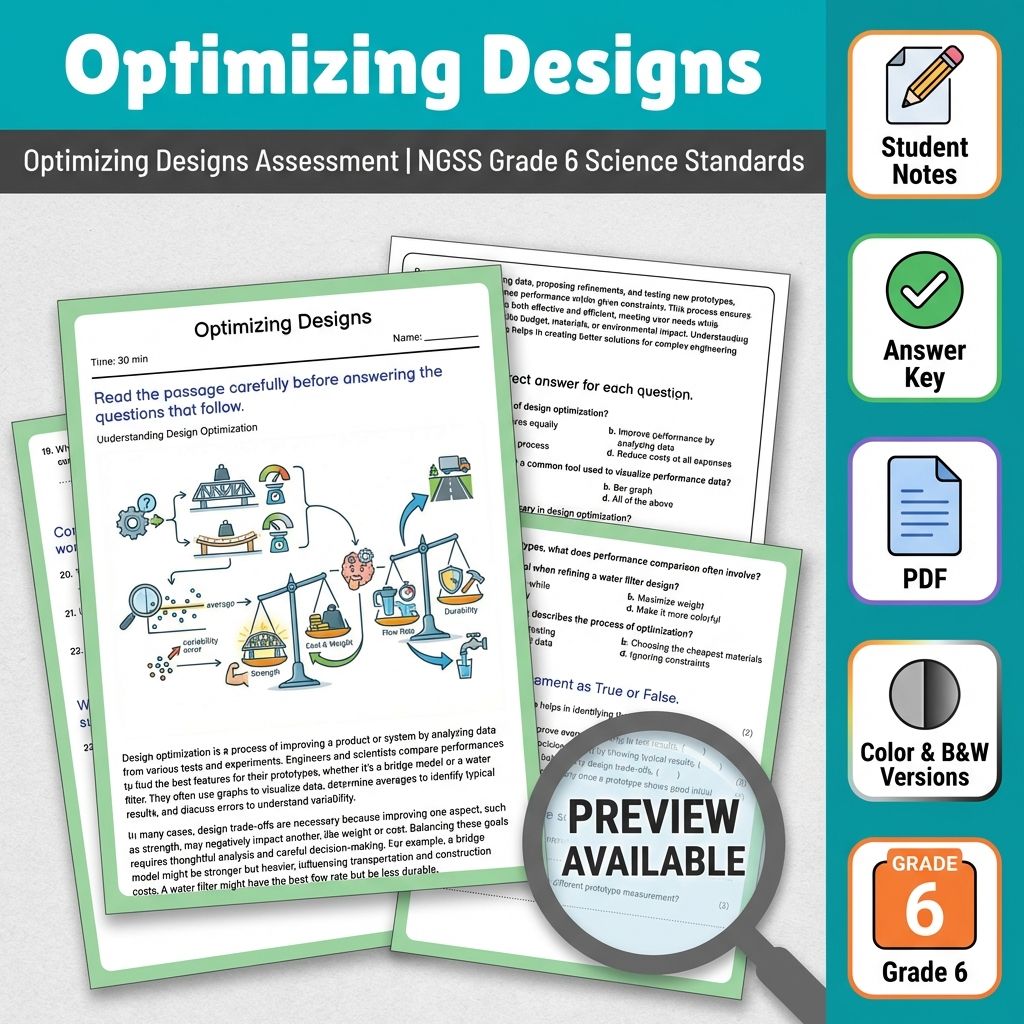
Optimizing Designs Assessment | NGSS Grade 6 Science Standards
Created byPrism Point LearningLearning Objectives
- Analyze data from comparative tests to evaluate performance characteristics of different designs.
- Use graphs, averages, and error discussions to support decision-making in design optimization.
- Understand trade-offs involved in balancing competing goals such as strength versus weight, or cost versus durability.
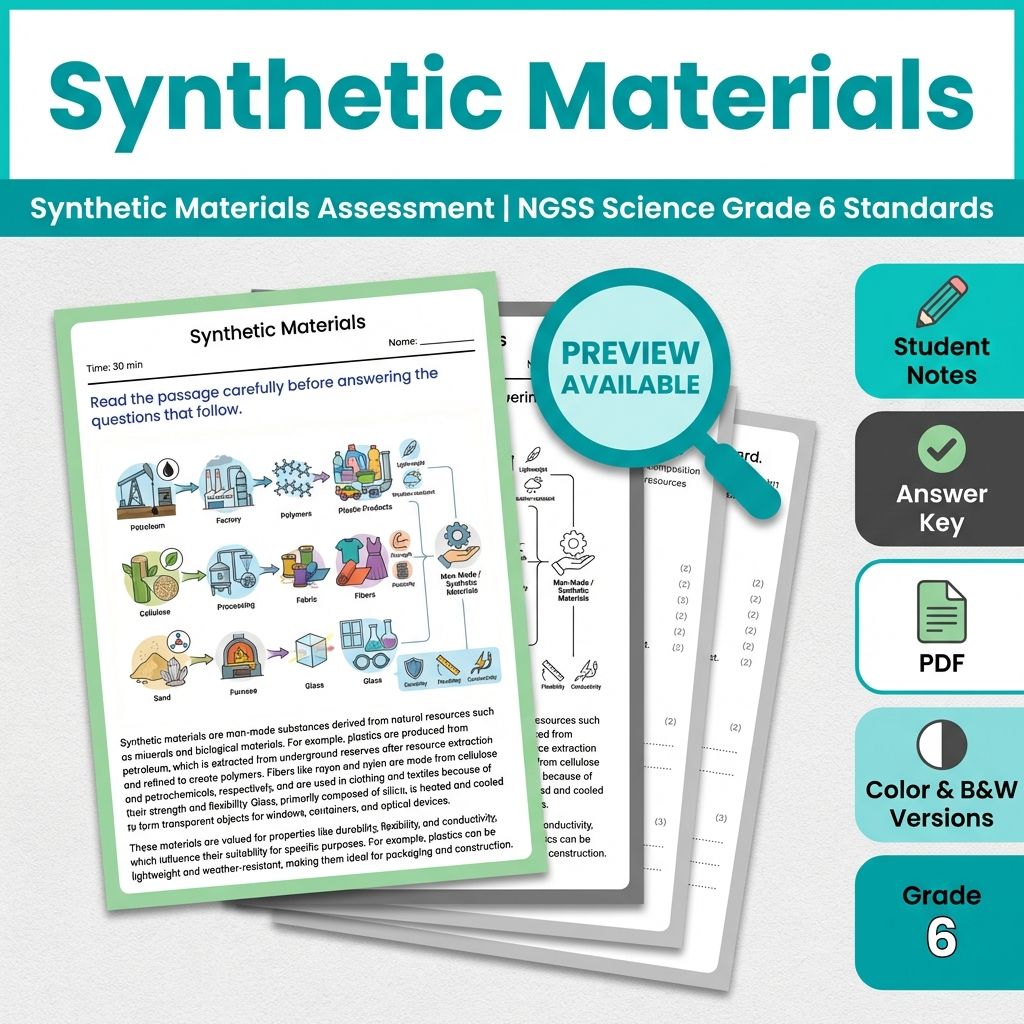
Synthetic Materials Assessment | NGSS Science Grade 6 Standards
Created byPrism Point LearningLearning Objectives
- Identify natural resources used to produce synthetic materials.
- Compare properties of natural and synthetic substances for specific applications.
- Understand processes involved in resource extraction and material manufacturing.
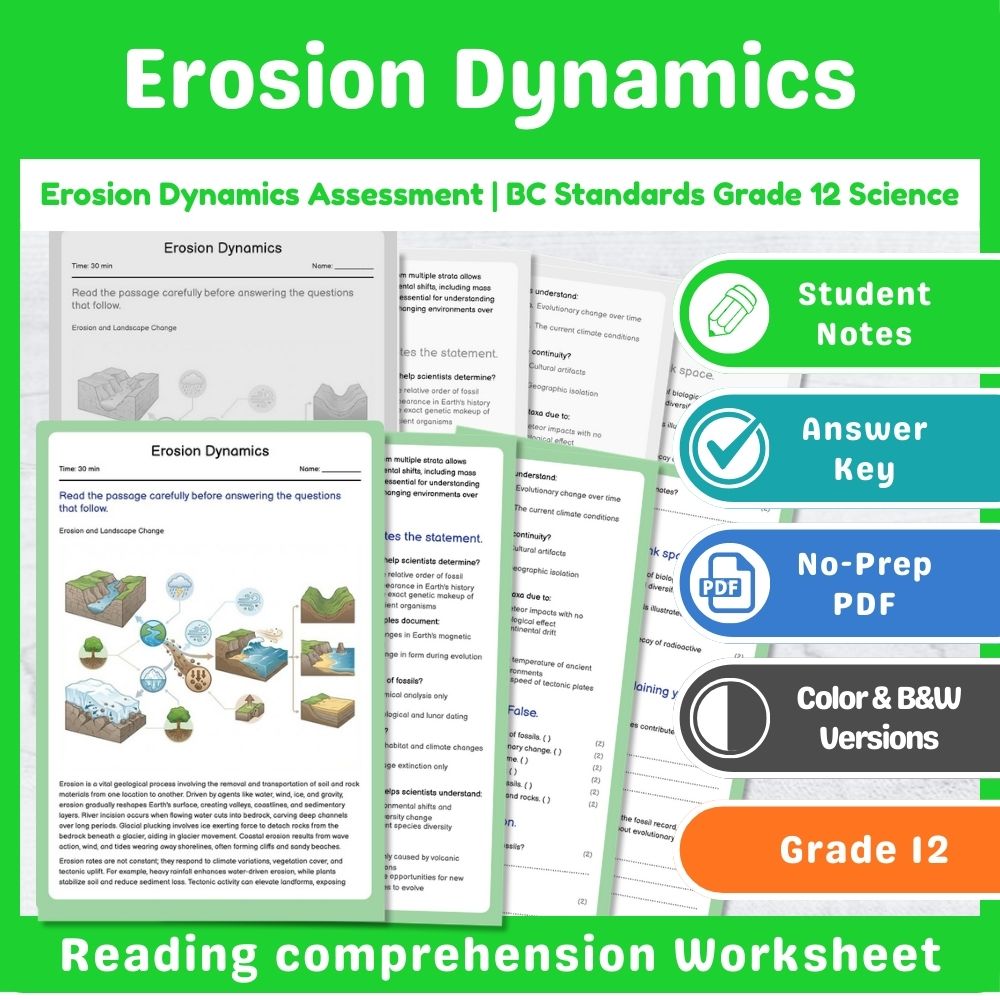
Erosion Dynamics Assessment | BC Standards Grade 12 Science
Created byPrism Point LearningLearning Objectives
- Understand the processes involved in erosion, including detachment, transport, and deposition of sediments.
- Identify the main agents of erosion such as water, ice, wind, and gravity.
- Analyze how erosion shapes landscapes and impacts ecosystems over time.

Heating Curve Phases Assessment | standards-aligned assessment Grade 7 Science
Created byPrism Point LearningLearning Objectives
- Describe the temperature-time behavior of matter during heating curve phases (warming, melting plateau, liquid warming, boiling plateau).
- Explain why temperature can remain constant during phase changes even while heat energy is added.
- Use heating curve data to connect particle-level changes to observable temperature patterns.
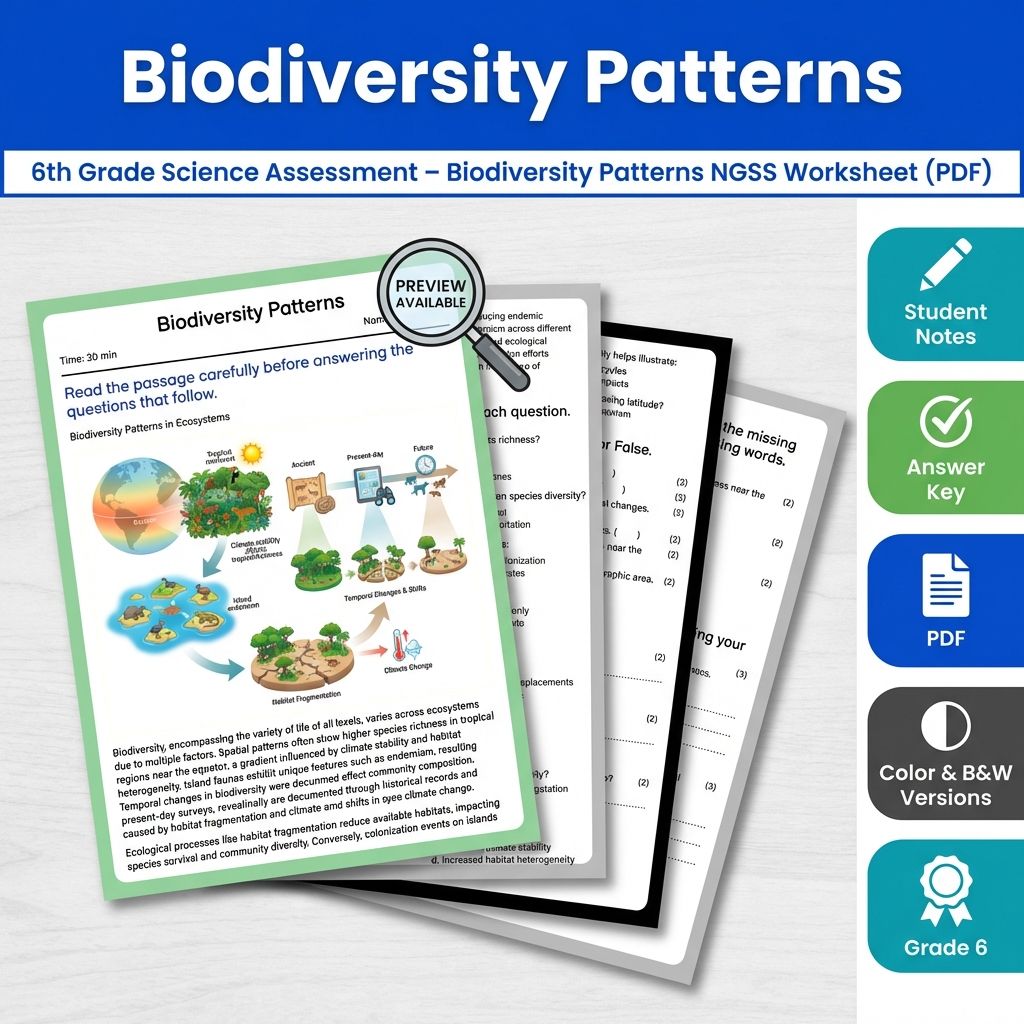
Biodiversity Patterns Assessment | NGSS Grade 6 Science Worksheet
Created byPrism Point LearningLearning Objectives
- Understand how species occurrence and richness reveal biodiversity patterns across ecosystems.
- Compare spatial and temporal biodiversity among different habitats and regions.
- Interpret ecological and historical factors that influence biodiversity distribution.
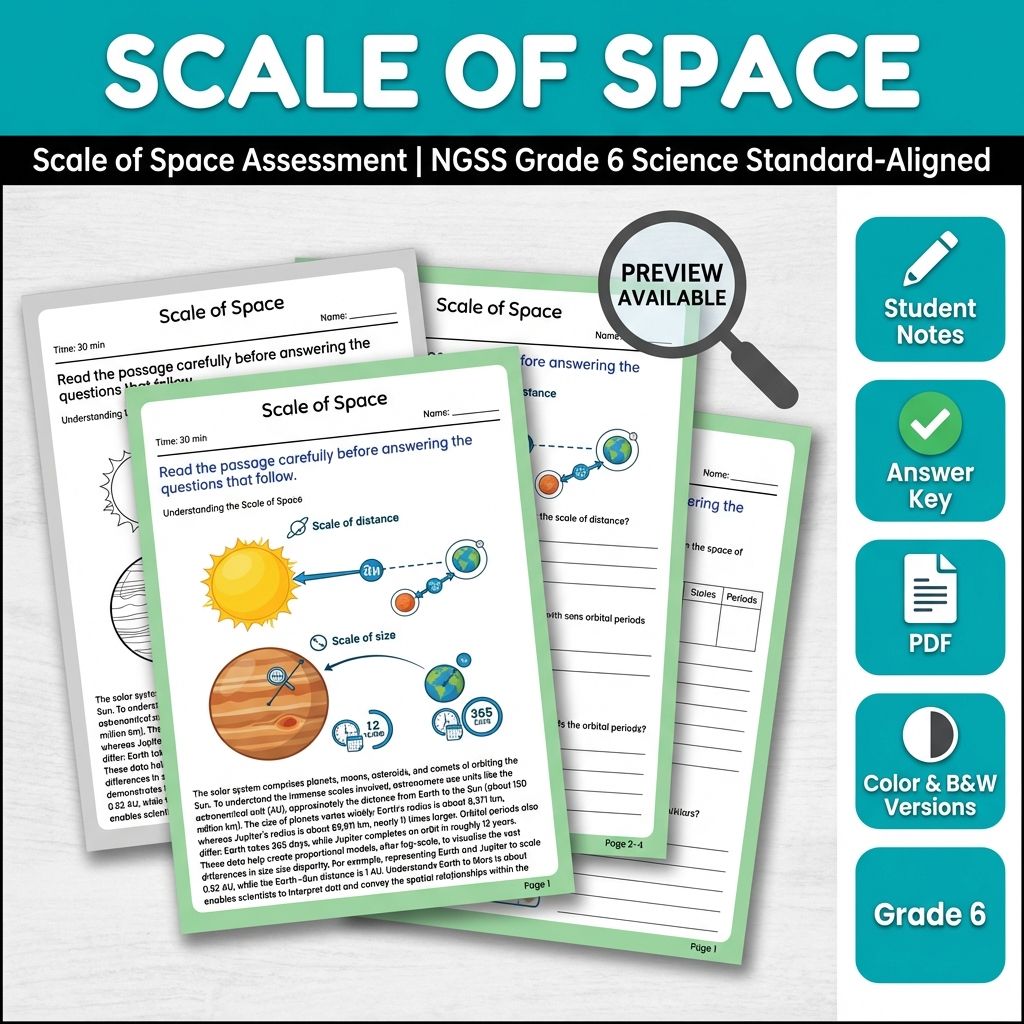
Scale of Space Assessment | NGSS Grade 6 Science Standard-Aligned
Created byPrism Point LearningLearning Objectives
- Understand the concept of astronomical units, planetary radii, and orbital periods to compare celestial bodies.
- Analyze relative sizes and distances within the solar system using scale models and data interpretation.
- Describe the differences between terrestrial planets and gas giants based on scale and orbital data.
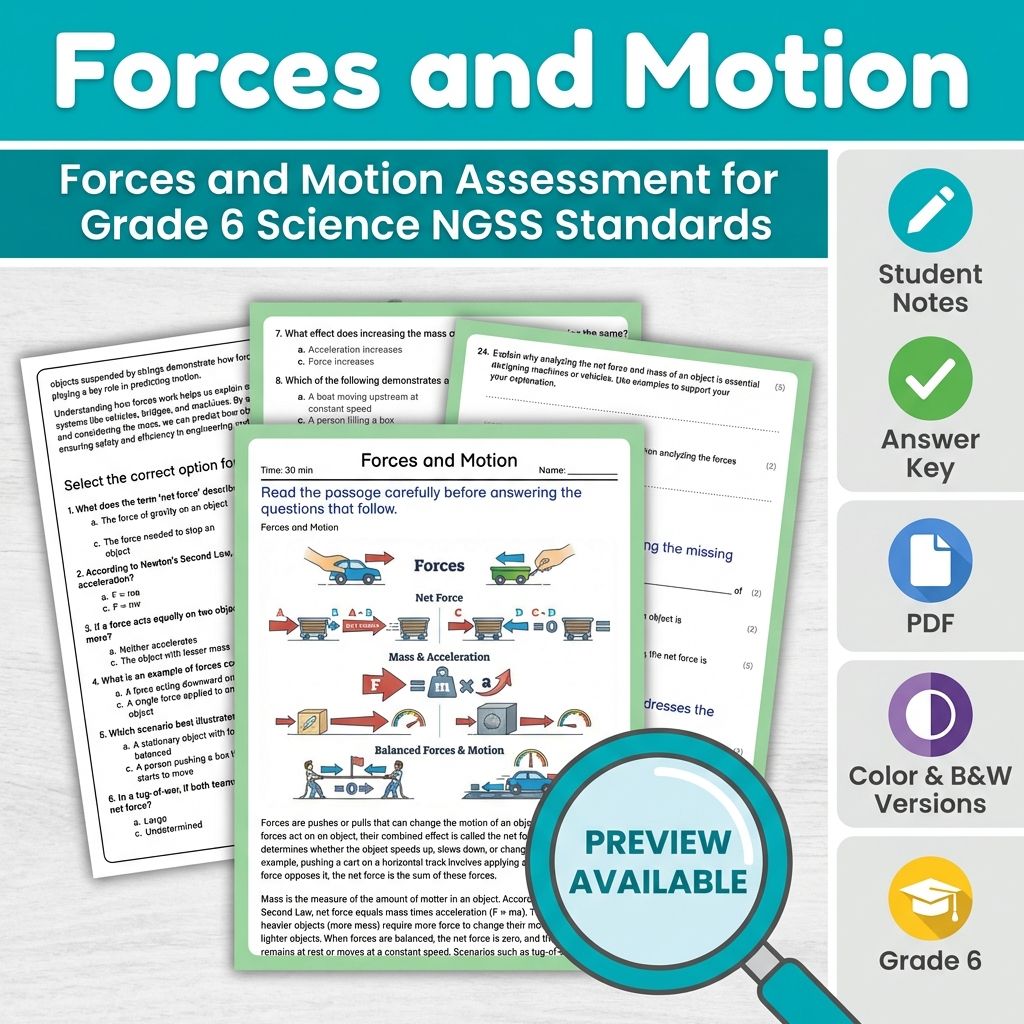
Forces and Motion Assessment for Grade 6 Science NGSS Standards
Created byPrism Point LearningLearning Objectives
- Explain how net force and mass influence the motion of objects.
- Describe real-life scenarios involving forces, such as carts on tracks and tugging systems.
- Apply the formula net force equals mass times acceleration to analyze motion.
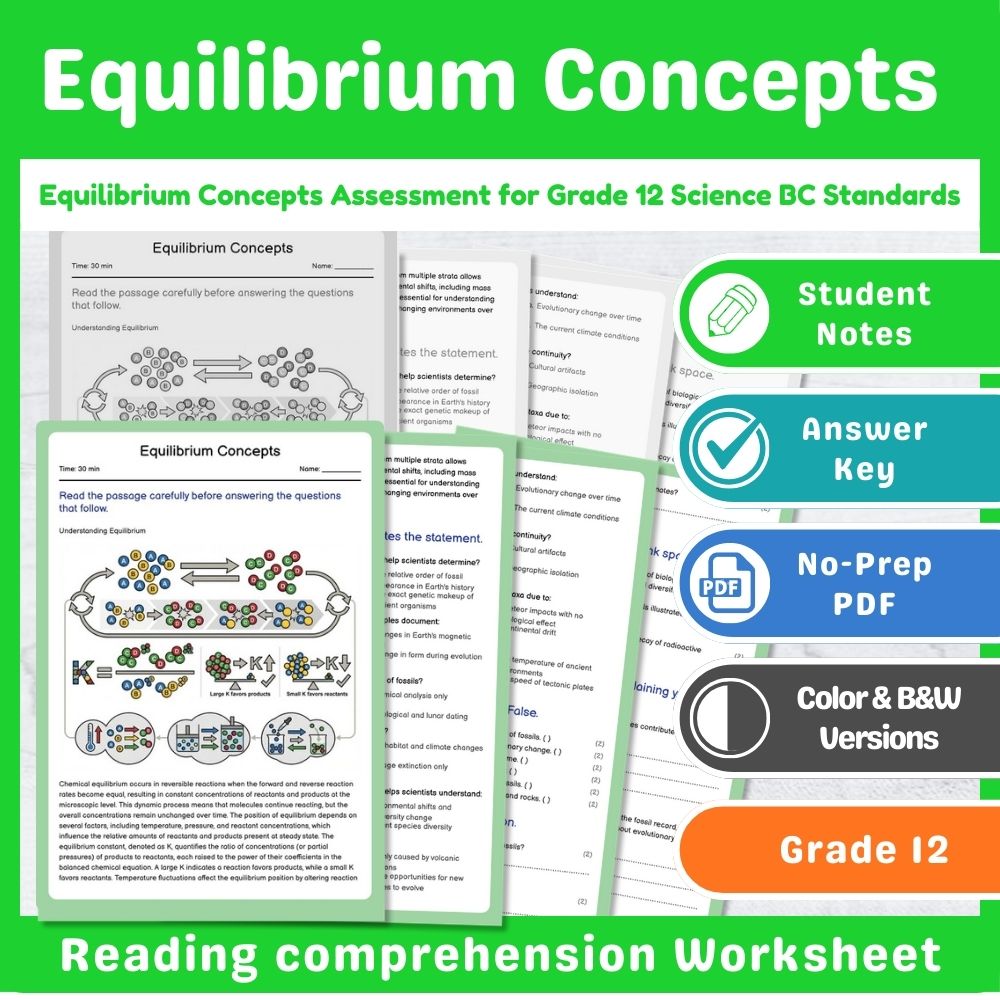
Equilibrium Concepts Assessment for Grade 12 Science BC Standards
Created byPrism Point LearningLearning Objectives
- Explain the principle of chemical equilibrium in reversible reactions.
- Describe how reaction conditions influence the position of equilibrium.
- Relate the magnitude of the equilibrium constant to the favored side of a reaction.
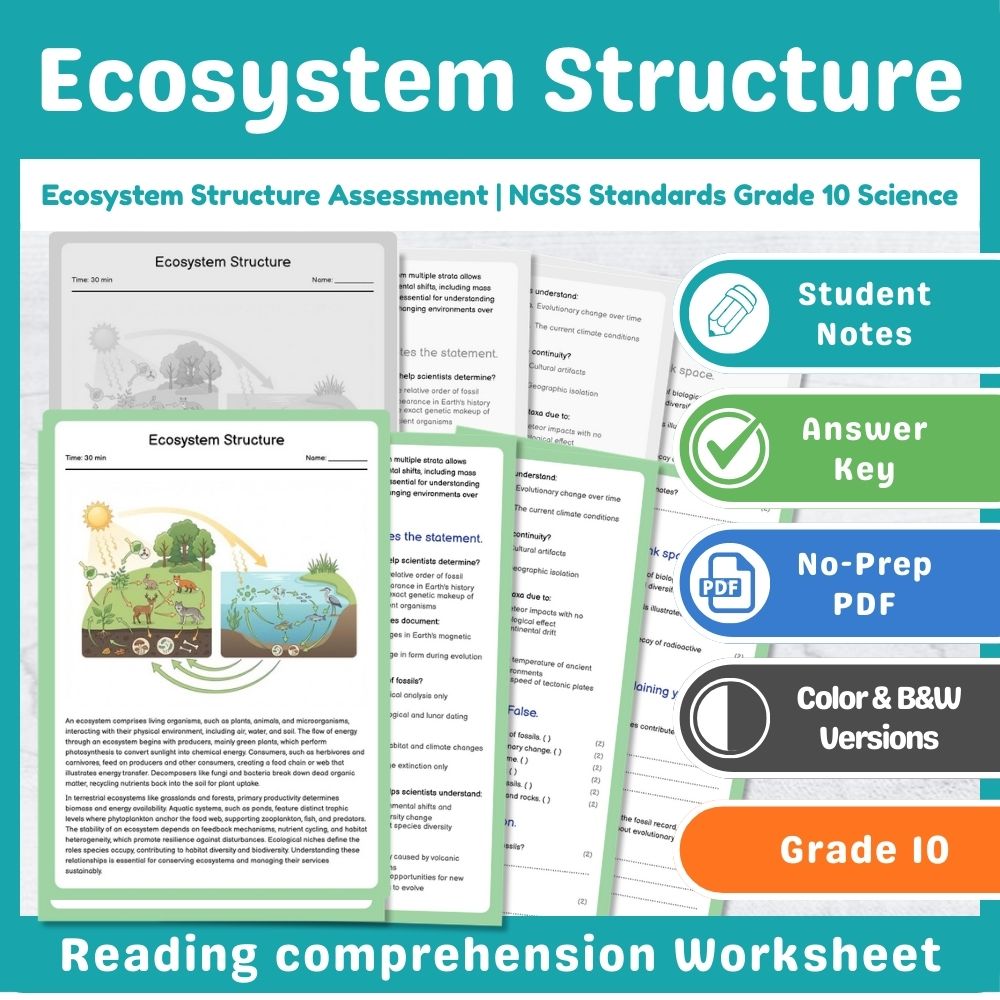
Ecosystem Structure Assessment for Grade 10 Science NGSS Standards
Created byPrism Point LearningLearning Objectives
- Explain the roles of biotic and abiotic components in ecosystems.
- Identify and analyze food webs, trophic levels, and energy flow within ecosystems.
- Understand the concepts of ecosystem stability, feedback loops, and ecological niches.
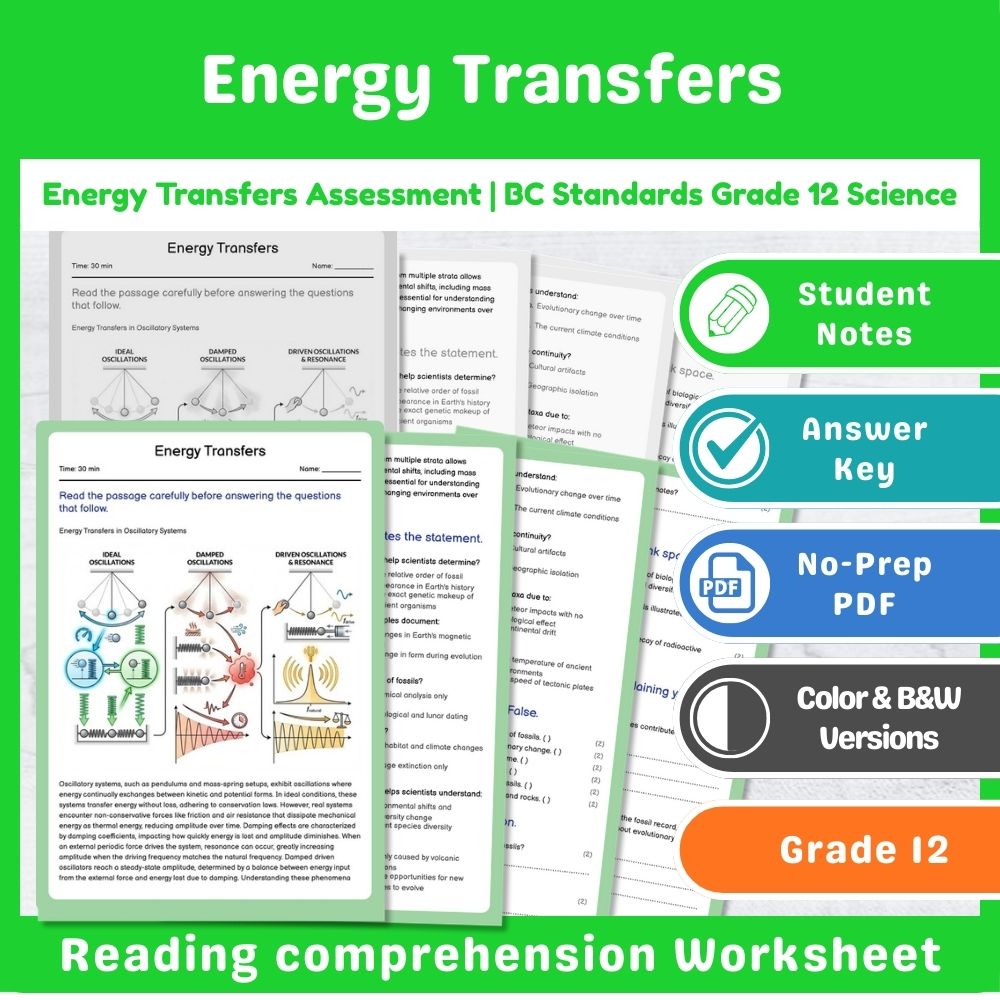
Energy Transfers Assessment | BC Standards Grade 12 Science
Created byPrism Point LearningLearning Objectives
- Explain the concepts of simple harmonic motion, resonance, and damping in oscillatory systems.
- Describe how non-conservative forces such as friction and air resistance affect energy transfer and amplitude in oscillations.
- Analyze how driven oscillators exchange energy with external drivers and determine steady-state amplitudes based on system parameters.
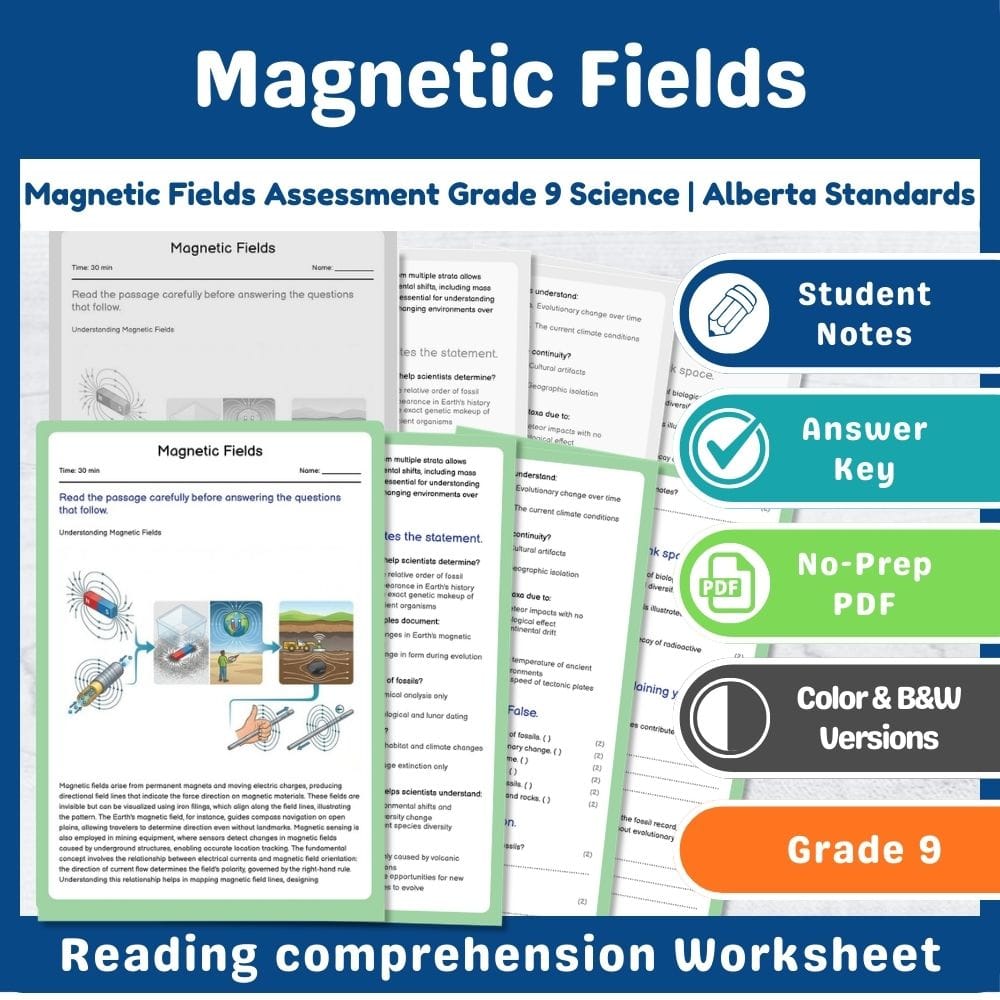
Magnetic Fields Assessment Grade 9 Science | Alberta Standards
Created byPrism Point LearningLearning Objectives
- Explain how magnetic fields are generated by permanent magnets and moving electric charges.
- Describe the concept of magnetic field lines and their directional properties.
- Connect regional phenomena like compass navigation and magnetic sensing in industry to magnetic fields.

Air Masses Fronts Assessment | California Standards Grade 7 Science
Created byPrism Point LearningLearning Objectives
- Explain how air masses with different temperature and moisture properties interact to create weather changes
- Describe how fronts form boundaries where air rises, cools, and can produce clouds and precipitation
- Interpret how wind shifts and temperature changes often occur near a front
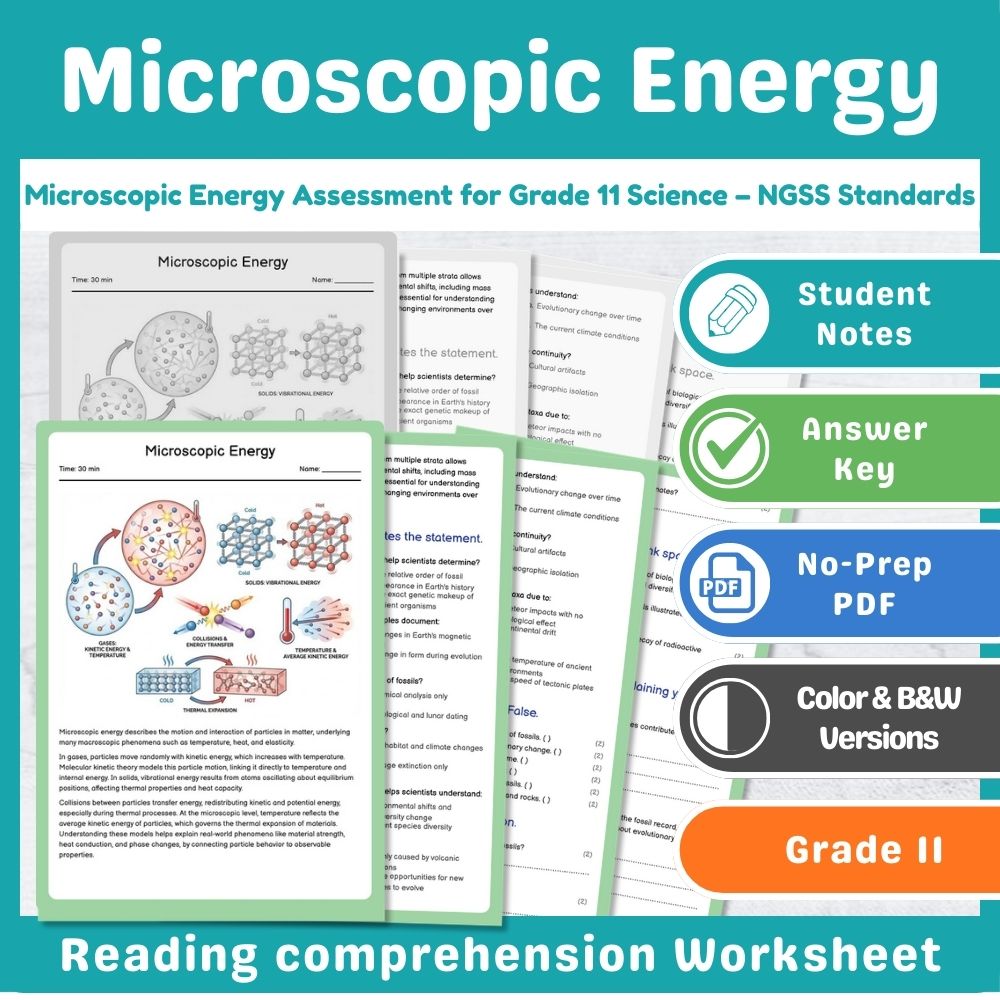
Microscopic Energy Assessment for Grade 11 Science – NGSS Standards
Created byPrism Point LearningLearning Objectives
- Explain the representation of energy at the microscopic scale and how it relates to macroscopic phenomena.
- Describe molecular kinetic theory and how it connects particle motion to temperature.
- Analyze energy redistribution during collisions in gases and vibrations in solids.
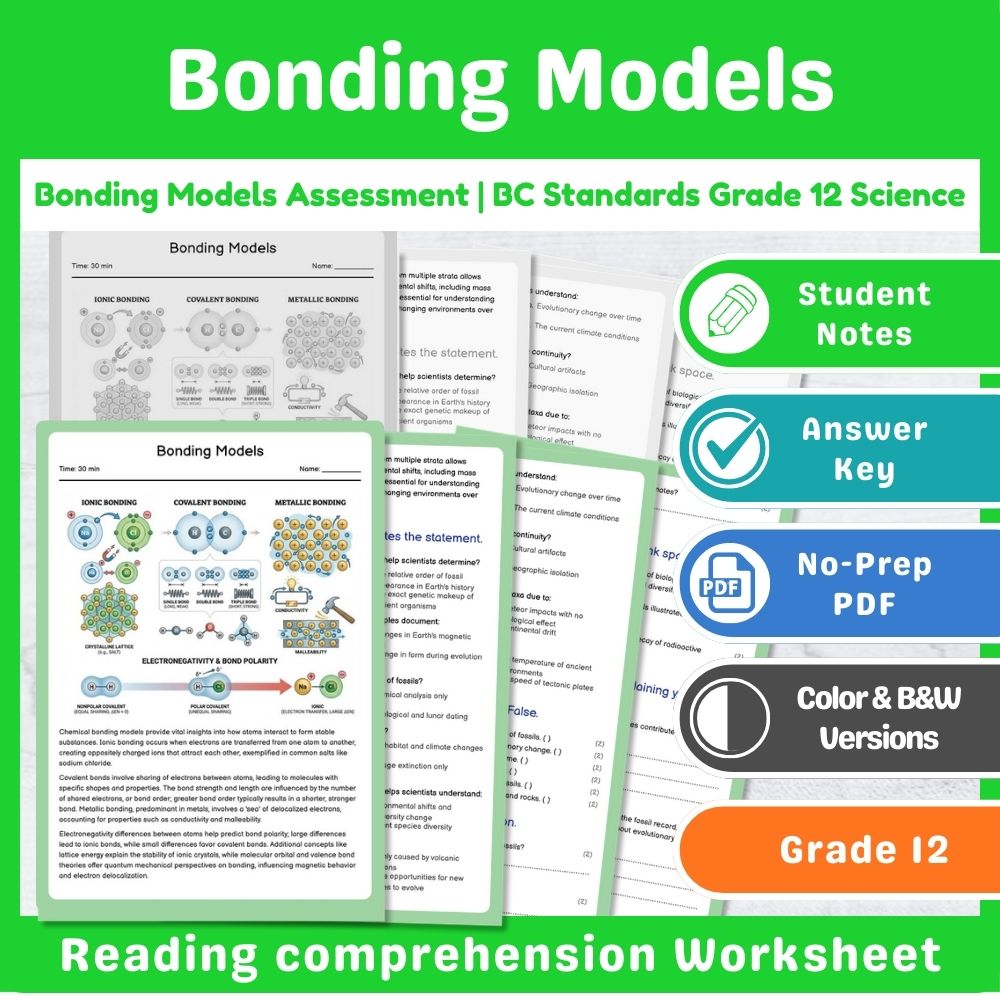
Bonding Models Assessment | BC Standards Grade 12 Science
Created byPrism Point LearningLearning Objectives
- Understand different models of chemical bonding and how they explain the behavior of atoms in molecules.
- Identify the principles behind ionic, covalent, and metallic bonding, including how electrons are shared or transferred.
- Explain how electronegativity differences predict bond polarity and how bond order and energy relate to bond length and strength.

Reaction Rates Assessment | Alberta Standards Grade 12 Science
Created byPrism Point LearningLearning Objectives
- Understand how concentration affects reaction rate.
- Explain the influence of temperature, surface area, and catalysts on reaction speed.
- Interpret rate laws and reaction order from experimental data.
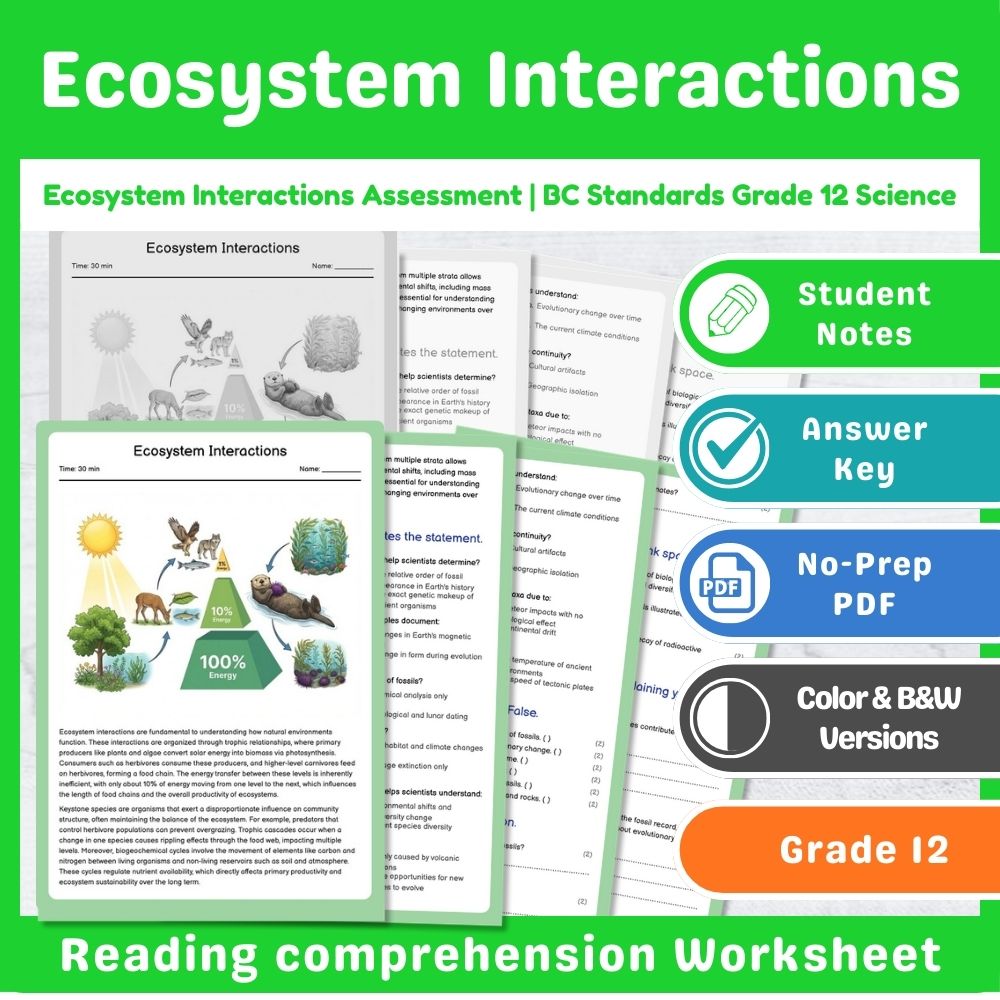
Ecosystem Interactions Assessment | BC Standards Grade 12 Science
Created byPrism Point LearningLearning Objectives
- Explain the flow of energy through trophic levels and its impact on ecosystem productivity.
- Identify key species and their roles within ecological communities, including keystone species.
- Describe trophic cascades and how changes at one level affect others.
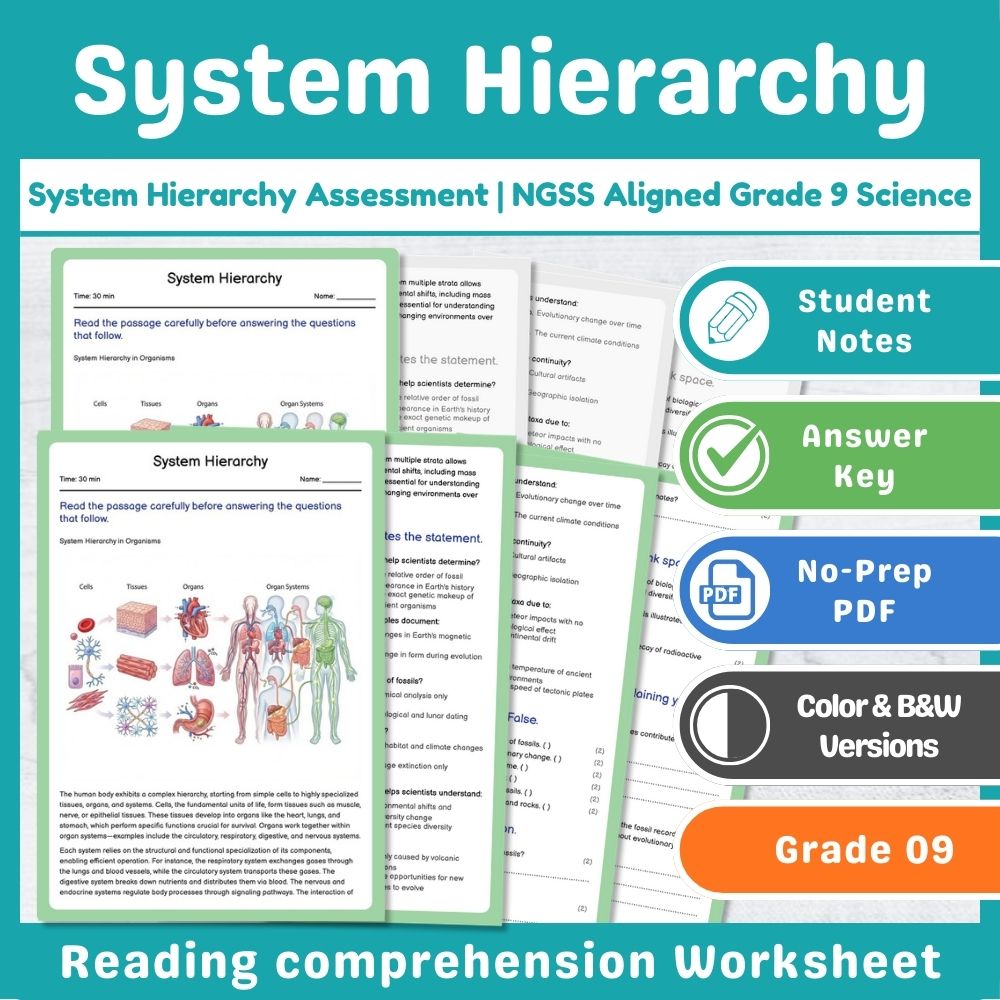
System Hierarchy Assessment | NGSS Aligned Grade 9 Science
Created byPrism Point LearningLearning Objectives
- Describe the hierarchical organization of the body from cells to organ systems.
- Explain how tissues, organs, and organ systems interact to maintain organismal functions.
- Identify examples of physiological coupling, such as circulatory-respiratory and digestive-vascular systems.
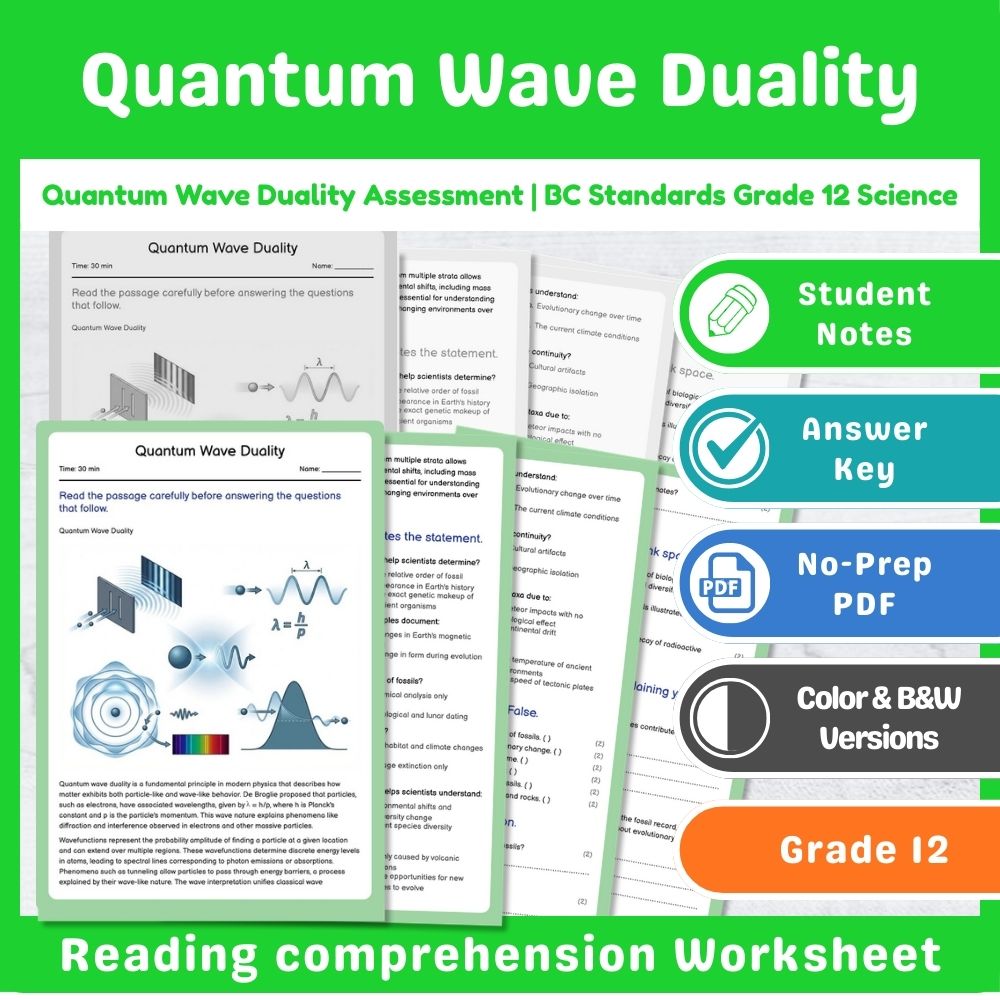
Quantum Wave Duality Assessment | BC Standards Grade 12 Science
Created byPrism Point LearningLearning Objectives
- Understand the concept of wave-particle duality in quantum mechanics.
- Describe how de Broglie wavelength relates to particles and their wave properties.
- Explain phenomena like diffraction, interference, and tunneling using wavefunctions.

Testable Claims Assessment | General Standard Grade 8 Science
Created byPrism Point LearningLearning Objectives
- Understand what makes a claim testable through evidence-based observations.
- Identify variables and how they influence observable outcomes.
- Construct clear hypotheses that specify relationships between factors.
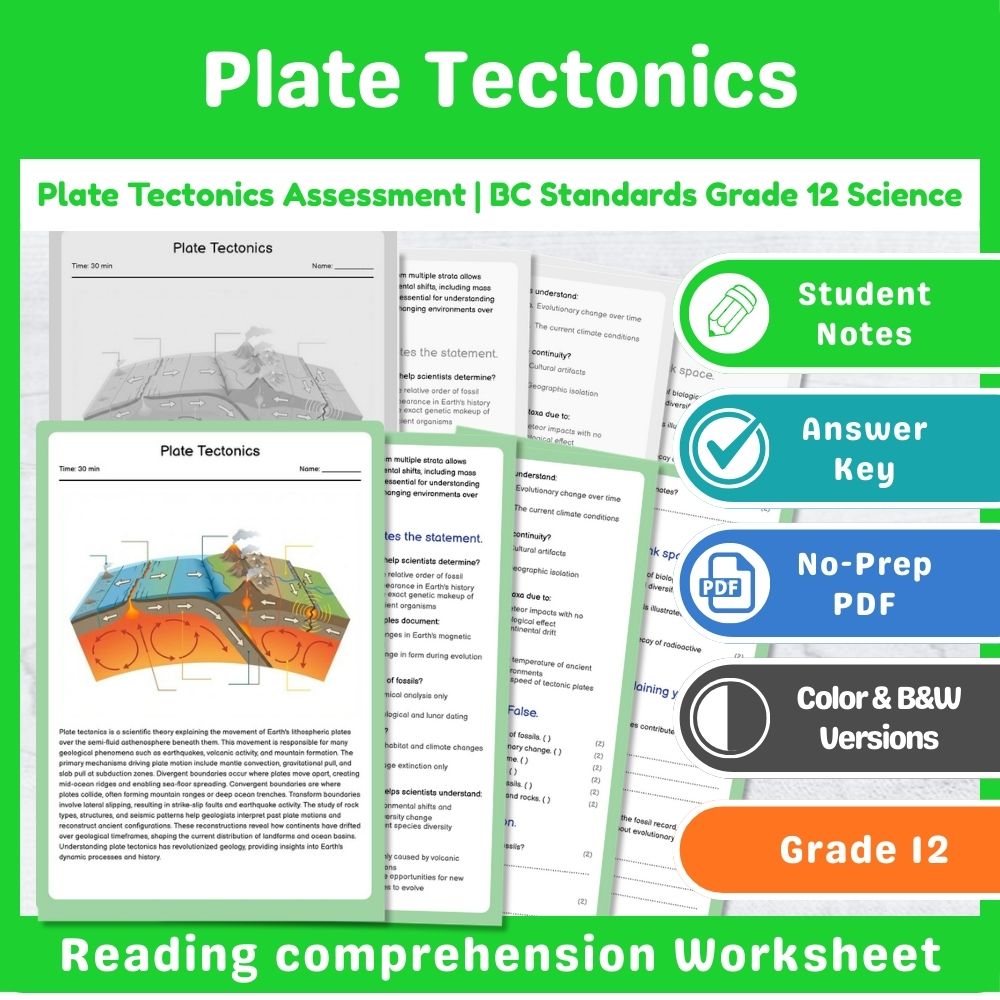
Plate Tectonics Assessment | BC Standards Grade 12 Science
Created byPrism Point LearningLearning Objectives
- Understand the fundamental concepts of plate tectonics and the mechanisms driving the movement of Earth's lithospheric plates.
- Identify different types of plate boundaries and associated geological features.
- Interpret structural relationships and distribution of rocks to reconstruct past plate configurations.
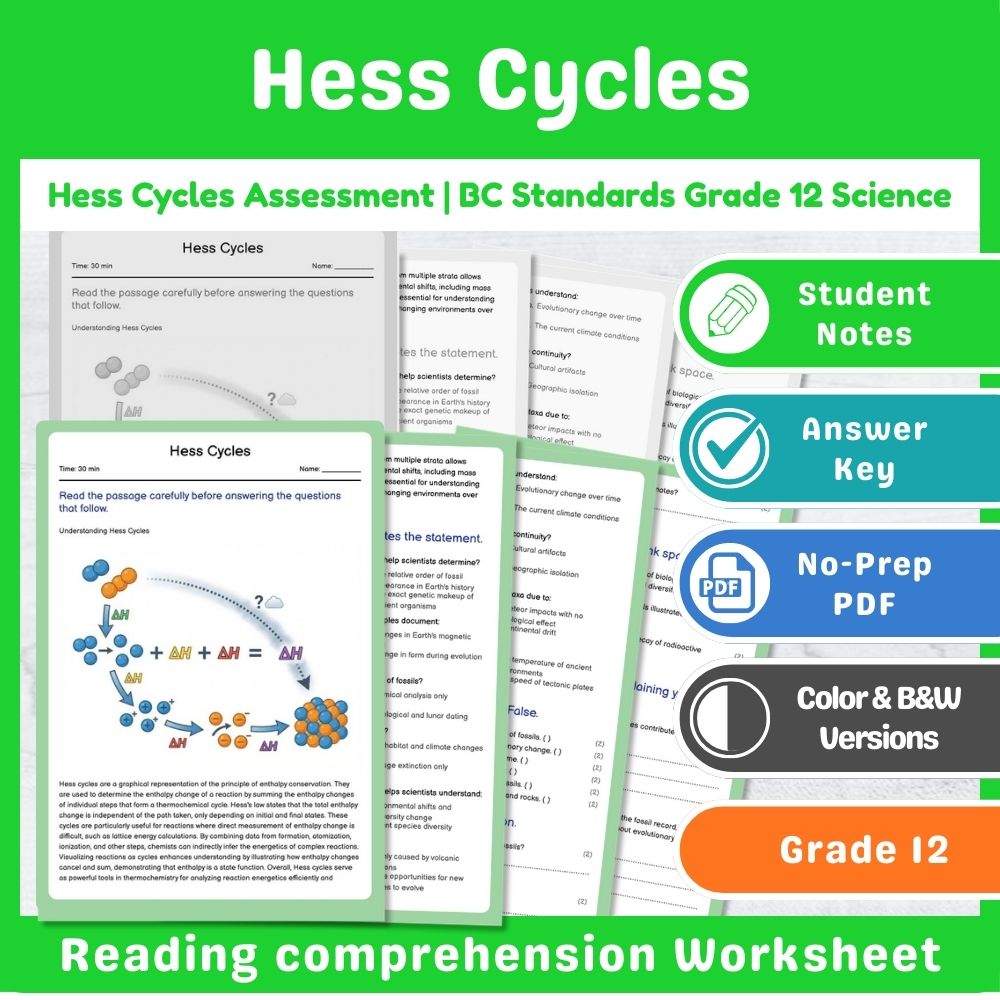
Hess Cycles Assessment | BC Standards Grade 12 Science
Created byPrism Point LearningLearning Objectives
- Understand the principle of enthalpy conservation as applied in Hess cycles.
- Analyze how thermochemical cycles can be used to determine reaction energetics indirectly.
- Explain the significance of state functions and how enthalpy changes cancel in cycles.
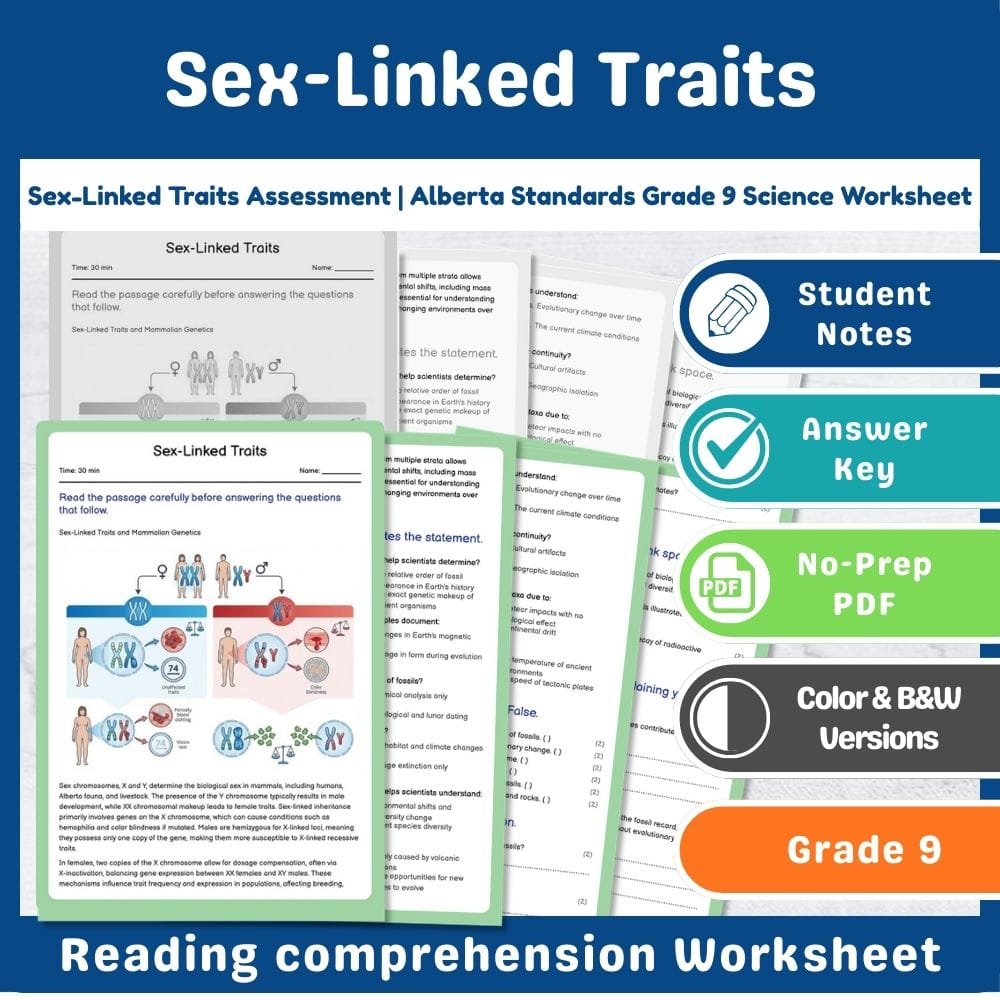
Sex-Linked Traits Assessment | Alberta Standards Grade 9 Science Worksheet
Created byPrism Point LearningLearning Objectives
- Explain the role of sex chromosomes in inheritance.
- Identify characteristics of sex-linked traits and their inheritance patterns.
- Understand mechanisms like hemizygosity and dosage compensation in mammals.
Momentum Conservation Assessment Grade 9 | NGSS Science Worksheet
Created byPrism Point LearningLearning Objectives
- Understand the principle of conservation of linear momentum in isolated systems.
- Differentiate between elastic and inelastic collisions using vector sums.
- Calculate total momentum before and after interactions in various scenarios.
Hardy-Weinberg Assessment | BC Standards Grade 12 Science Practice
Created byPrism Point LearningLearning Objectives
- Understand the principles and assumptions of the Hardy-Weinberg equilibrium.
- Calculate expected genotype frequencies using allele frequencies.
- Analyze deviations from Hardy-Weinberg expectations to infer evolutionary forces.
Integrated Reconstruction Assessment | BC Standards Grade 12 Science
Created byPrism Point LearningLearning Objectives
- Understand the various evidence types used in integrated geological reconstruction.
- Analyze how stratigraphy, radiometric data, paleomagnetic records, structural relationships, and fossils are synthesized to interpret Earth's history.
- Evaluate the significance of multiple evidence correlation in constraining tectonic and paleoenvironments.
Sea-Floor Spreading Assessment | BC Standards Grade 12 Science
Created byPrism Point LearningLearning Objectives
- Explain how seafloor spreading creates symmetric magnetic stripes on oceanic crust.
- Describe how magnetic anomalies and radiometric age data support the theory of plate tectonics.
- Analyze the process of ocean basin growth, recycling, and seafloor formation over geological time.
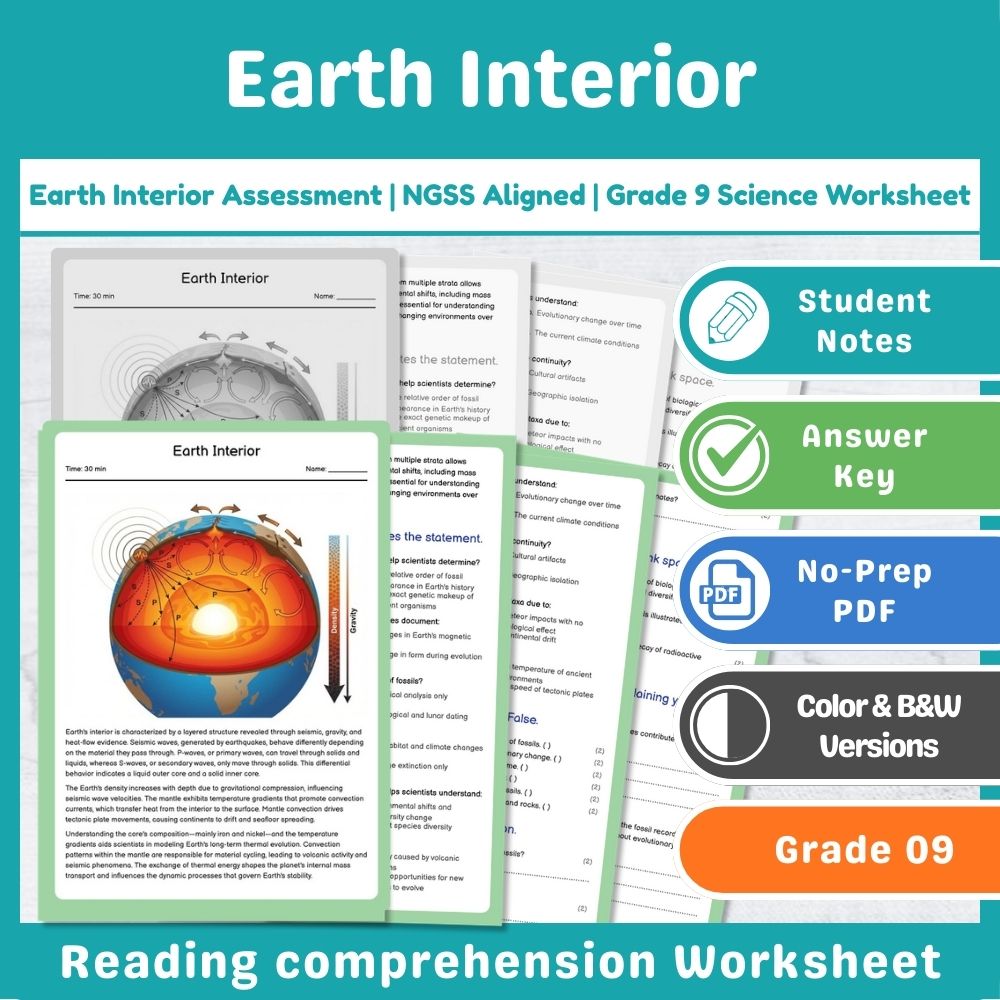
Earth Interior Assessment | NGSS Aligned | Grade 9 Science Worksheet
Created byPrism Point LearningLearning Objectives
- Describe the layered structure of Earth's interior based on seismic evidence.
- Interpret the behaviors of P-waves and S-waves to understand Earth's composition.
- Explain the transfer of thermal energy within Earth and its impact on planetary processes.

Genomic Applications Assessment Geometry | BC Grade 12 Science Standards
Created byPrism Point LearningLearning Objectives
- Understand the scope and significance of genomic applications in modern medicine and conservation.
- Identify ethical, ecological, and regulatory considerations related to genomic technologies.
- Analyze benefits and risks associated with population-scale sequencing, personalized medicine, and gene drives.

Cell Essential Functions Assessment for Grade 9 Science | Standards-Aligned
Created byPrism Point LearningLearning Objectives
- Understand the key functions of cell membranes and their role in regulating transport.
- Describe how cellular energy powers chemical reactions vital for cell survival and growth.
- Connect cell structure to function through models of internal balance, growth, and environmental response.

Wave Property Links Assessment | General Grade 9 Science Standards-Aligned
Created byPrism Point LearningLearning Objectives
- Understand how changes in wave parameters affect wave signatures.
- Relate wave frequency, wavelength, and amplitude to energy and pattern spacing.
- Interpret different wave representations and how a single source can produce varied signatures.
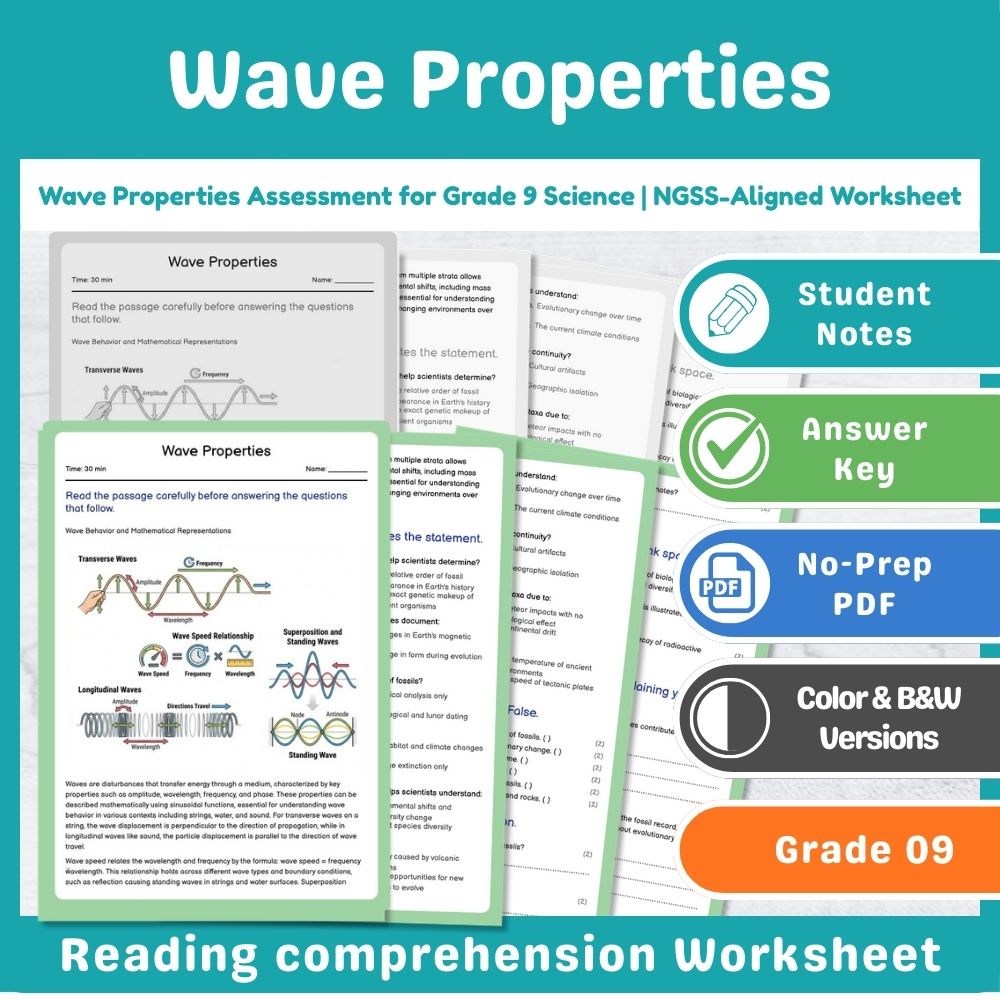
Wave Properties Assessment for Grade 9 Science | NGSS-Aligned Worksheet
Created byPrism Point LearningLearning Objectives
- Understand the mathematical representations of wave behavior including amplitude, frequency, wavelength, and phase.
- Apply the wave speed formula: wave speed = frequency × wavelength in practical scenarios.
- Describe how sinusoidal functions and superposition explain interference and standing waves.

Inheritance Patterns Assessment | General Grade 9 Science Standards
Created byPrism Point LearningLearning Objectives
- Understand how genes and alleles influence traits in heredity.
- Identify the difference between dominant and recessive traits.
- Explain how genotypes relate to phenotypes across generations.
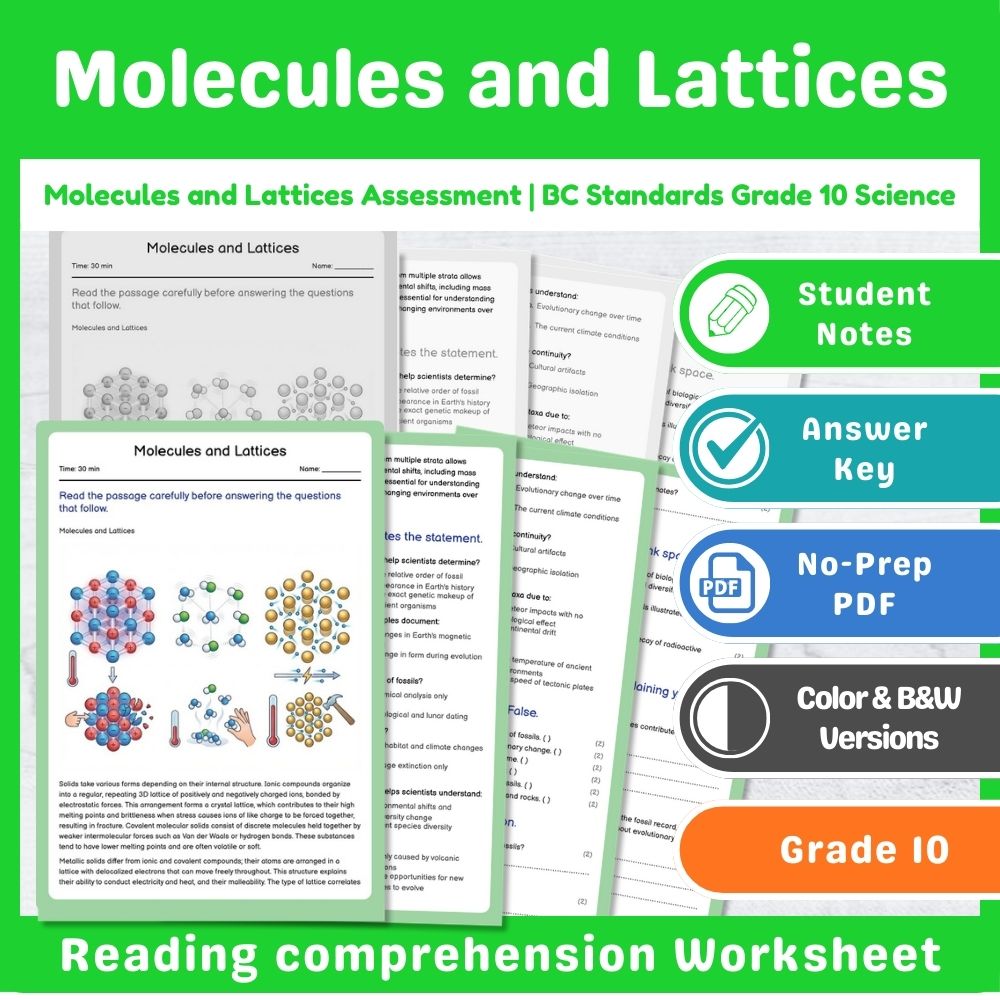
Molecules and Lattices Assessment | BC Standards Grade 10 Science
Created byPrism Point LearningLearning Objectives
- Describe the structural differences among ionic, covalent molecular, and metallic lattices.
- Explain how lattice structures influence material properties such as melting point, hardness, and conductivity.
- Correlate element positions on the periodic table with types of chemical bonding and lattice arrangements.
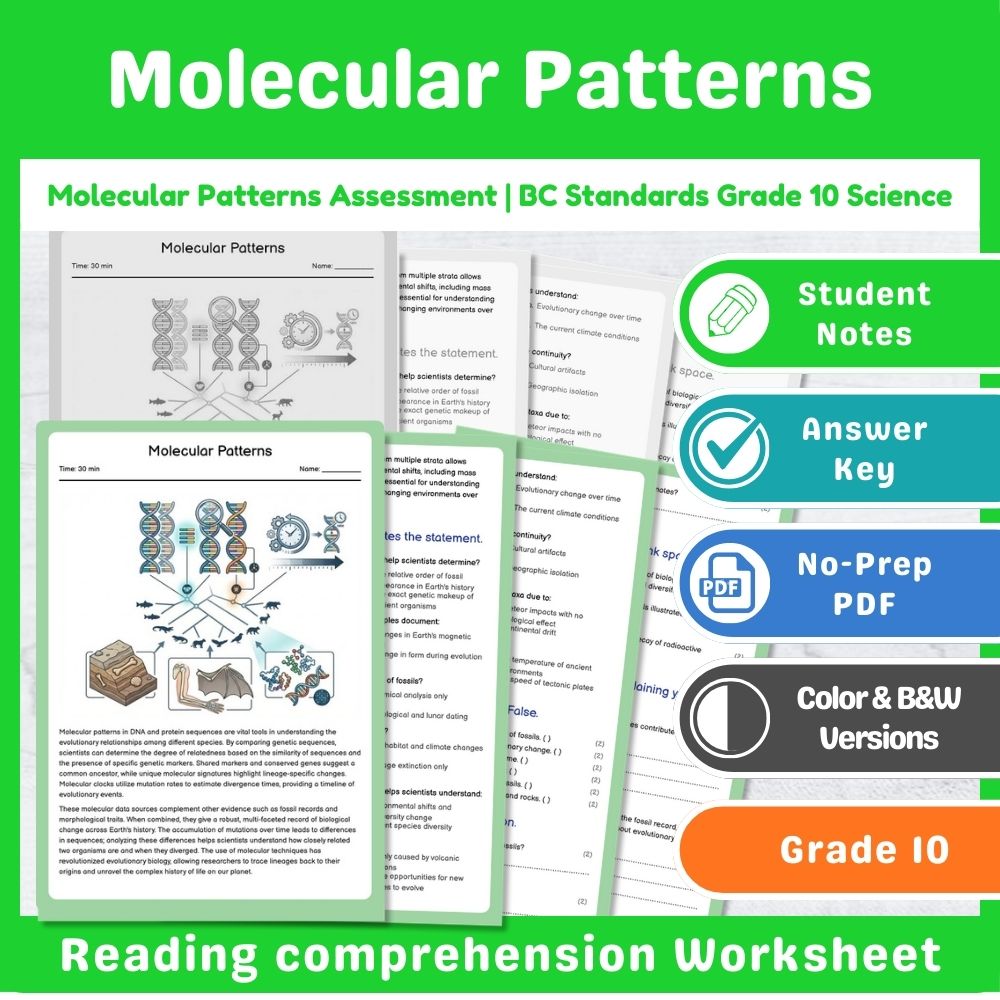
Molecular Patterns Assessment | BC Standards Grade 10 Science
Created byPrism Point LearningLearning Objectives
- Explain how molecular patterns in DNA and proteins reveal genetic relatedness among organisms.
- Describe how molecular clocks estimate divergence times and the significance of shared genetic markers.
- Identify conserved genes and lineage-specific molecular signatures as evidence of common ancestry.
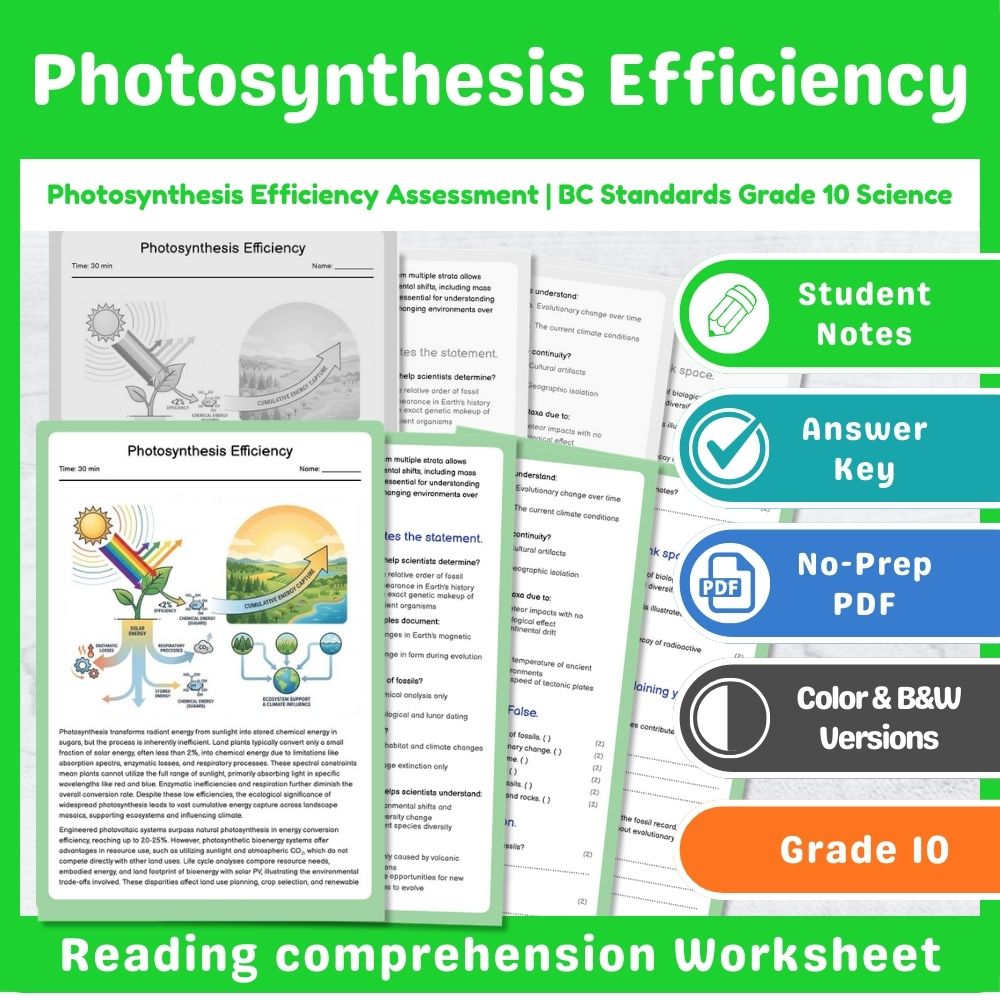
Photosynthesis Efficiency Assessment | BC Standards Grade 10 Science
Created byPrism Point LearningLearning Objectives
- Understand the concept of photosynthesis and its energy conversion efficiency.
- Analyze factors affecting photosynthesis efficiency such as spectra, enzymes, and respiration.
- Compare natural photosynthetic systems with engineered solar technologies.
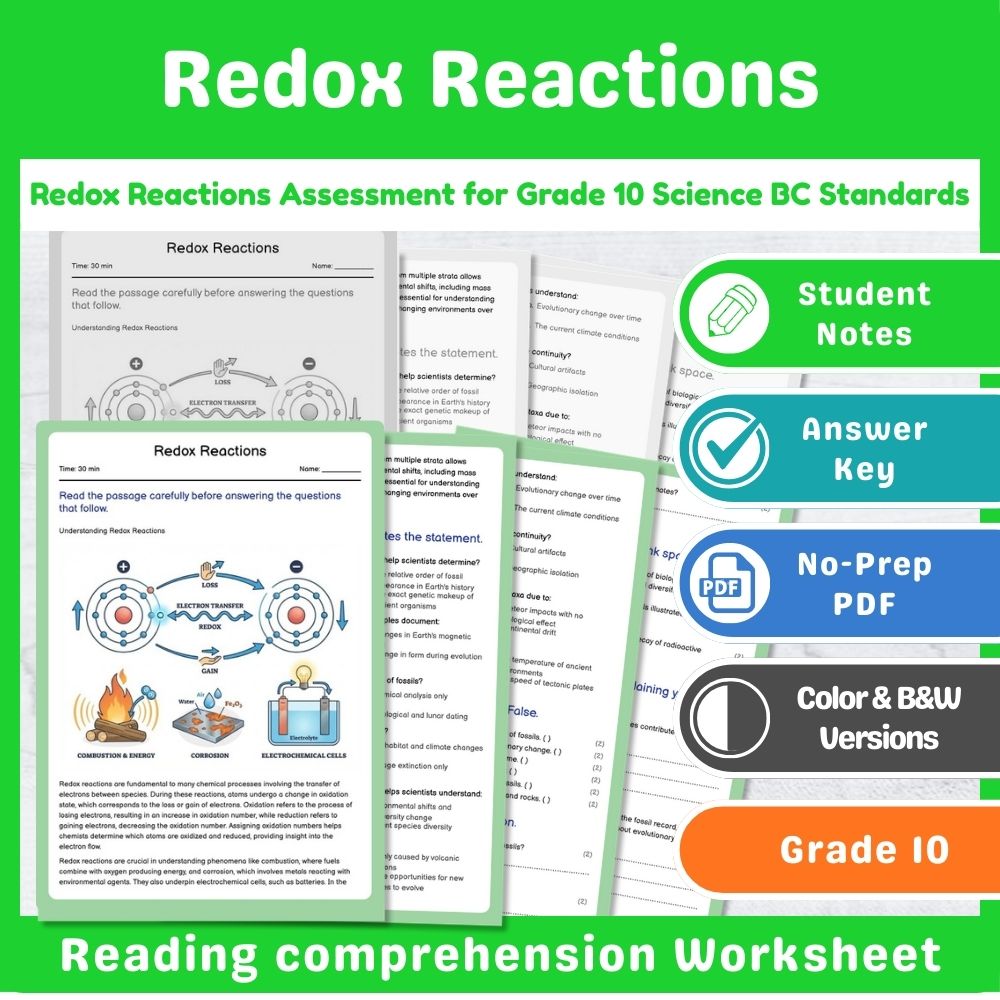
Redox Reactions Assessment for Grade 10 Science BC Standards
Created byPrism Point LearningLearning Objectives
- Understand the concept of oxidation and reduction in chemical reactions.
- Identify oxidation numbers and track electron transfer during redox processes.
- Explain the significance of redox reactions in everyday phenomena like combustion and corrosion.
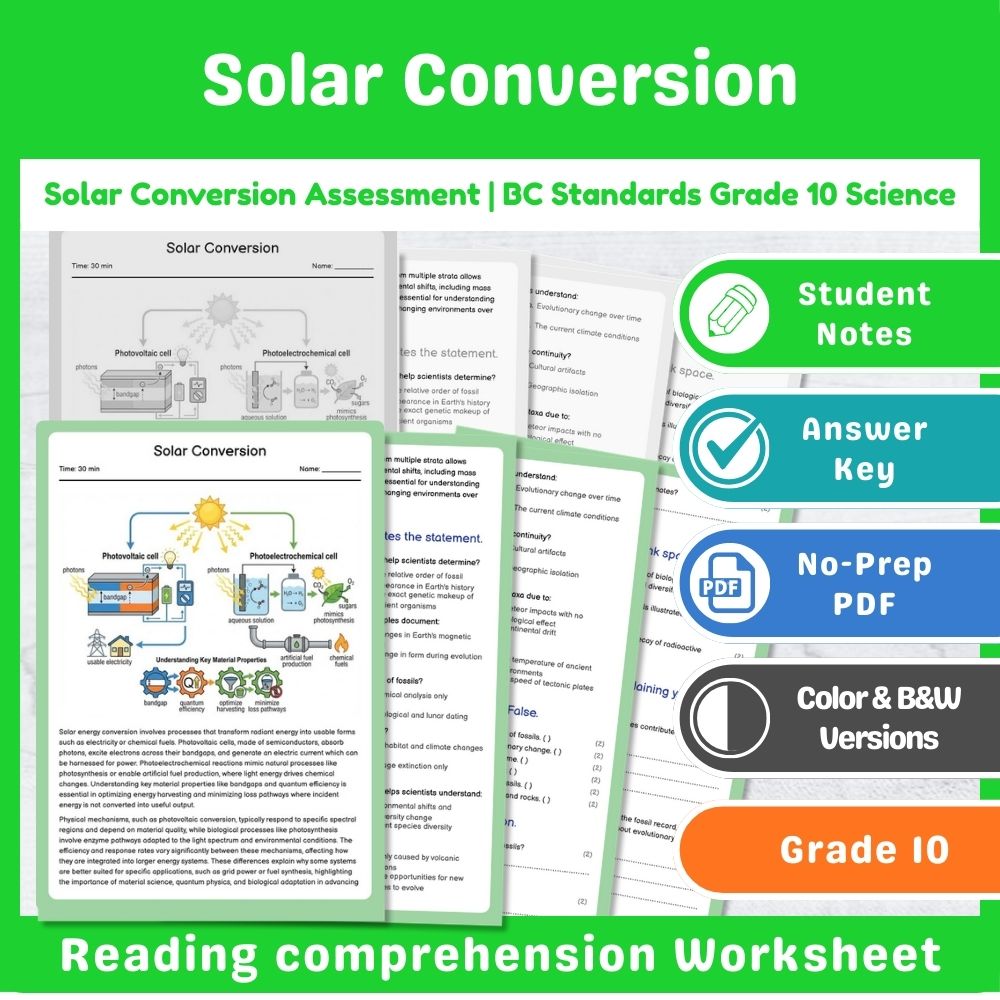
Solar Conversion Assessment Grade 10 Science | BC Standards-Aligned
Created byPrism Point LearningLearning Objectives
- Explain the processes involved in solar energy conversion, including photovoltaic and photoelectrochemical methods.
- Describe how semiconductors absorb photons and generate electrical current.
- Understand material properties such as bandgaps and quantum efficiency relevant to solar conversion.
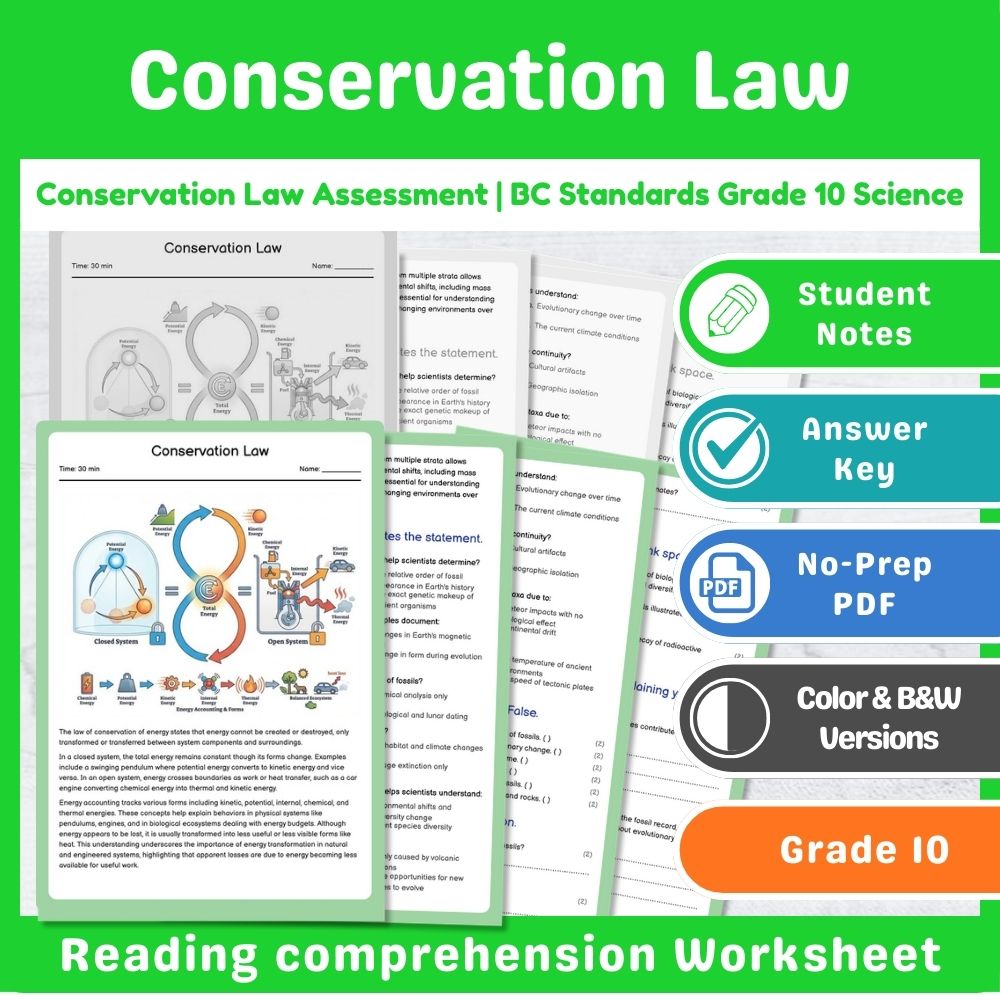
Conservation Law Assessment | BC Standards Grade 10 Science
Created byPrism Point LearningLearning Objectives
- Understand the principle of conservation of energy and its implications.
- Identify different forms of energy and how they transform within systems.
- Explain how energy transfer affects physical and biological processes.
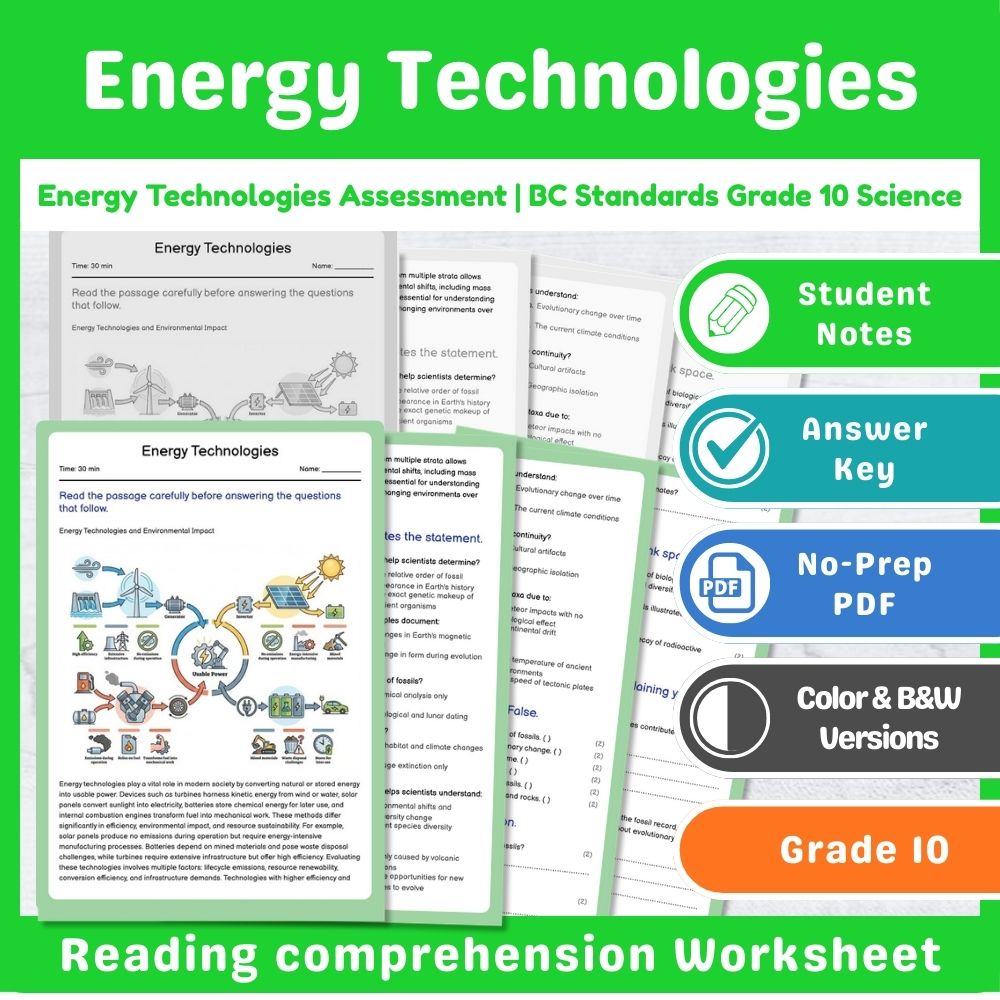
Energy Technologies Assessment | BC Standards Grade 10 Science
Created byPrism Point LearningLearning Objectives
- Understand the different types of energy technologies and their functions.
- Evaluate the efficiencies and environmental impacts of various energy conversion methods.
- Compare renewable and non-renewable energy sources in terms of sustainability and emissions.
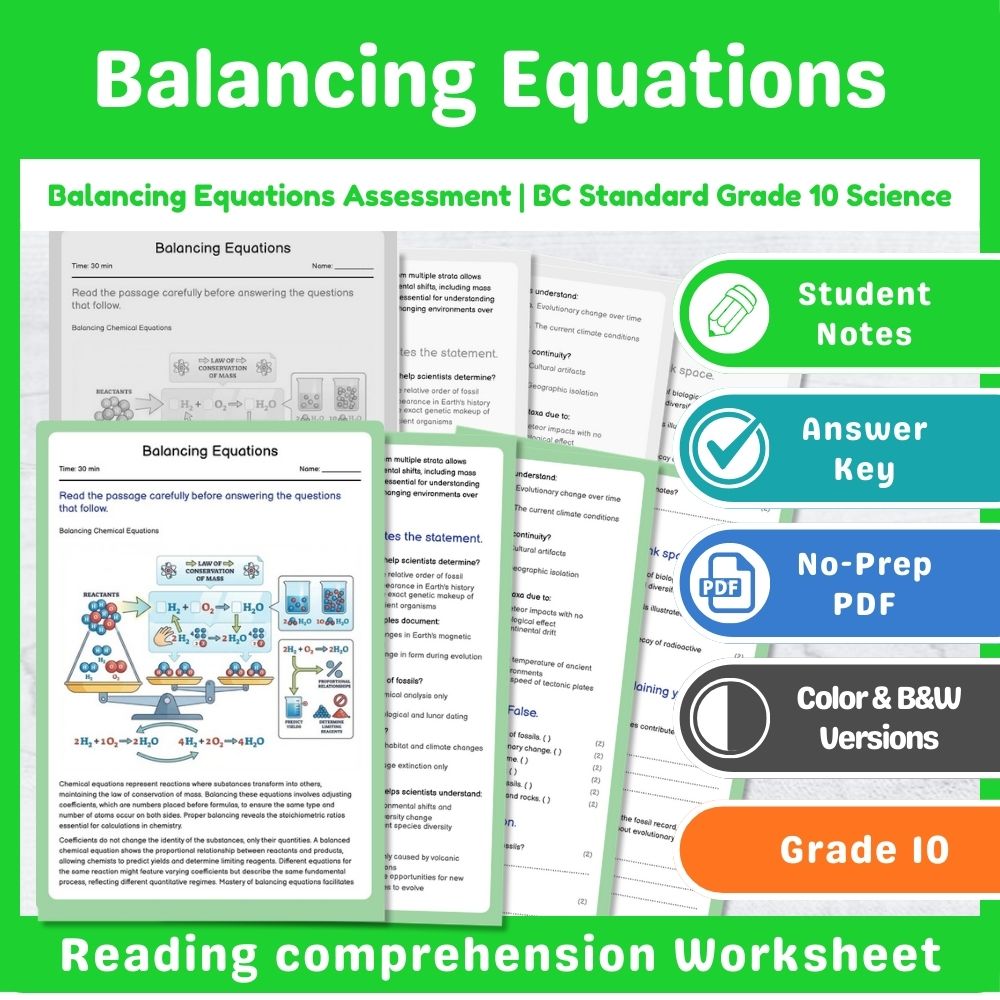
Balancing Equations Assessment | BC Standard Grade 10 Science
Created byPrism Point LearningLearning Objectives
- Understand the purpose and significance of balancing chemical equations.
- Identify the role of coefficients in representing stoichiometric relationships.
- Practice balancing various chemical equations to illustrate conservation of mass.
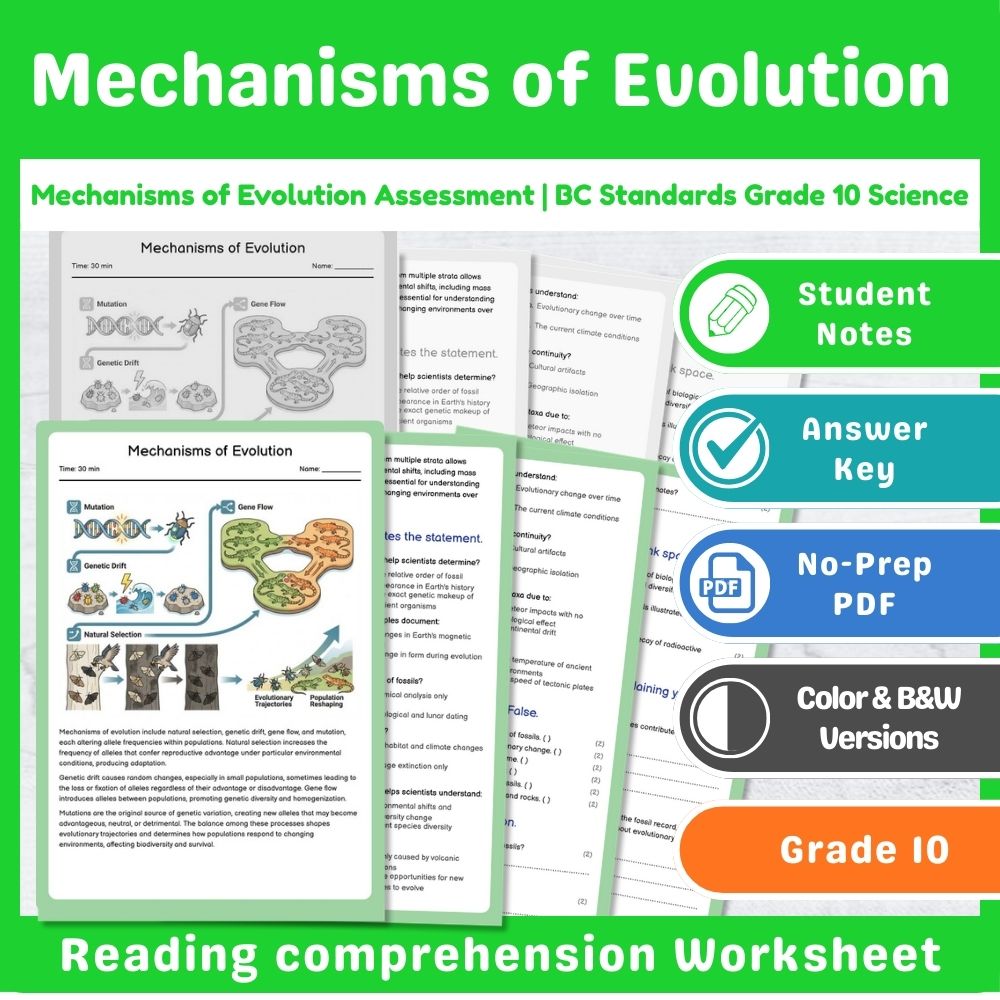
Mechanisms of Evolution Assessment | BC Standards Grade 10 Science
Created byPrism Point LearningLearning Objectives
- Describe the main mechanisms that drive evolutionary change.
- Understand how natural selection, genetic drift, gene flow, and mutation influence populations.
- Explain how these mechanisms interact and affect allele frequencies over time.
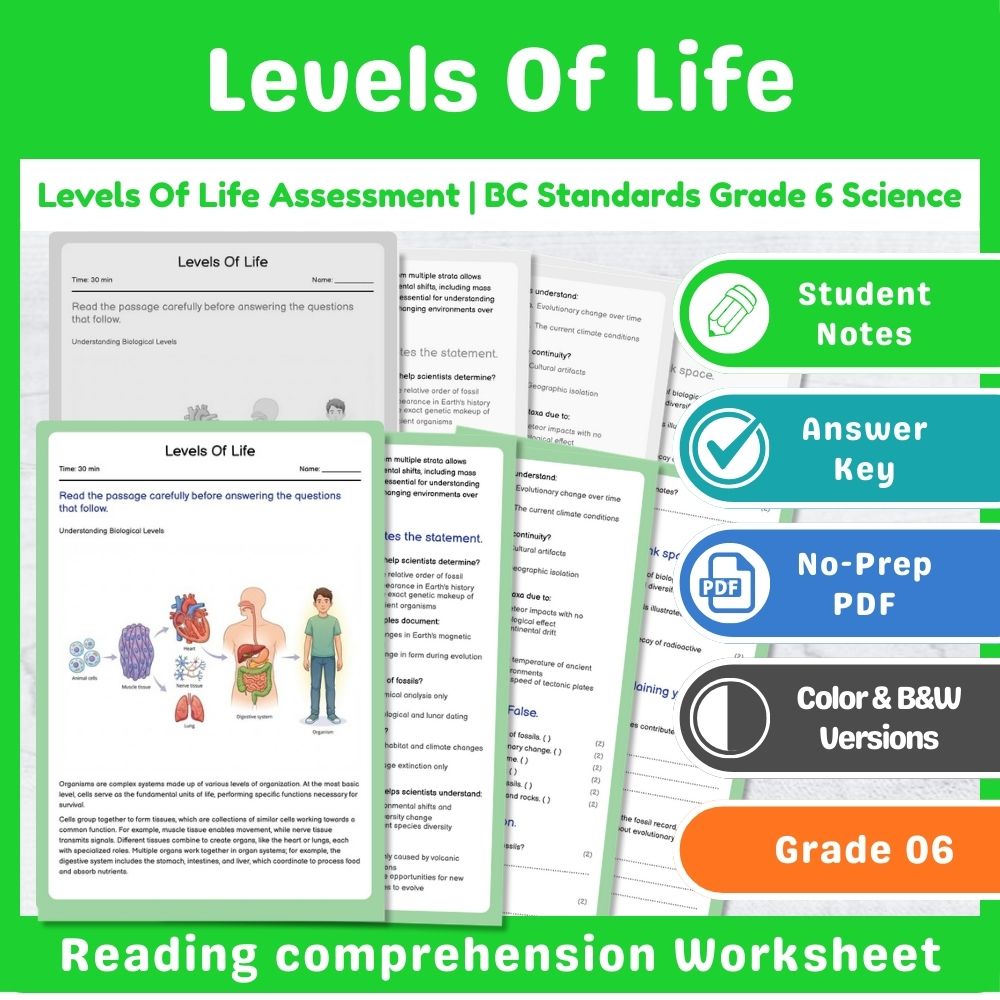
Levels Of Life Assessment | BC Standards Grade 6 Science
Created byPrism Point LearningLearning Objectives
- Understand the hierarchical levels of biological organization from cells to organisms.
- Identify how tissues, organs, and organ systems work together to support life.
- Explain the relationship between cells, tissues, organs, and organisms.
Browse more categories
About Science Worksheets
Find Science worksheets spanning core skills, practice, and review. All 42,685 resources are instant PDF downloads for the classroom or home.
Every worksheet on MyTeachingSheets is created by independent teacher-authors and reviewed before publication. All resources download as printable PDFs for classroom, homework, or at-home practice, and many include answer keys. Preview any worksheet free before buying.