
Science Worksheets
42,685 subject resources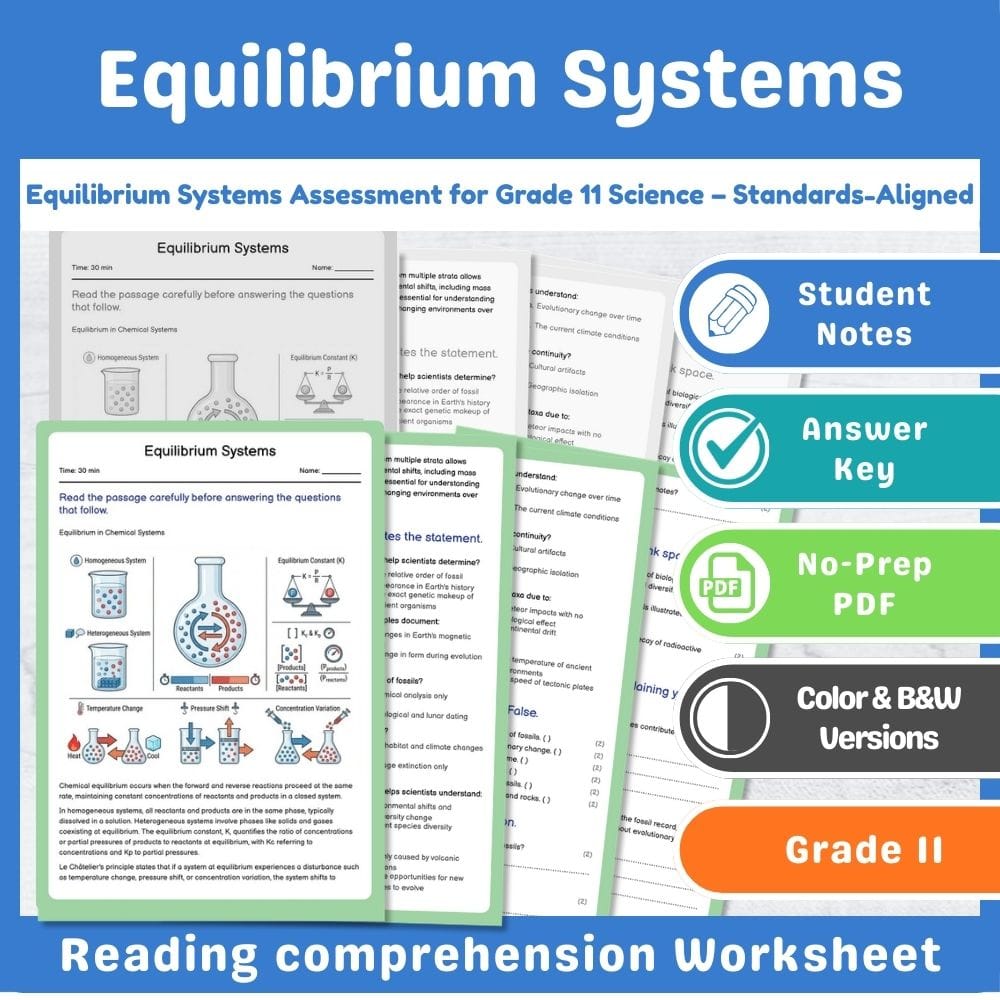
Equilibrium Systems Assessment for Grade 11 Science – Standards-Aligned
 Created byPrism Point Learning
Learning Objectives
- Understand the principles of dynamic chemical equilibrium in homogeneous and heterogeneous systems.
- Apply equilibrium constants (Kc and Kp) to predict the direction of reactions and final compositions.
- Use reaction quotient (Q) comparisons, Le Châtelier's principle, and stoichiometry to analyze shifts in equilibrium.
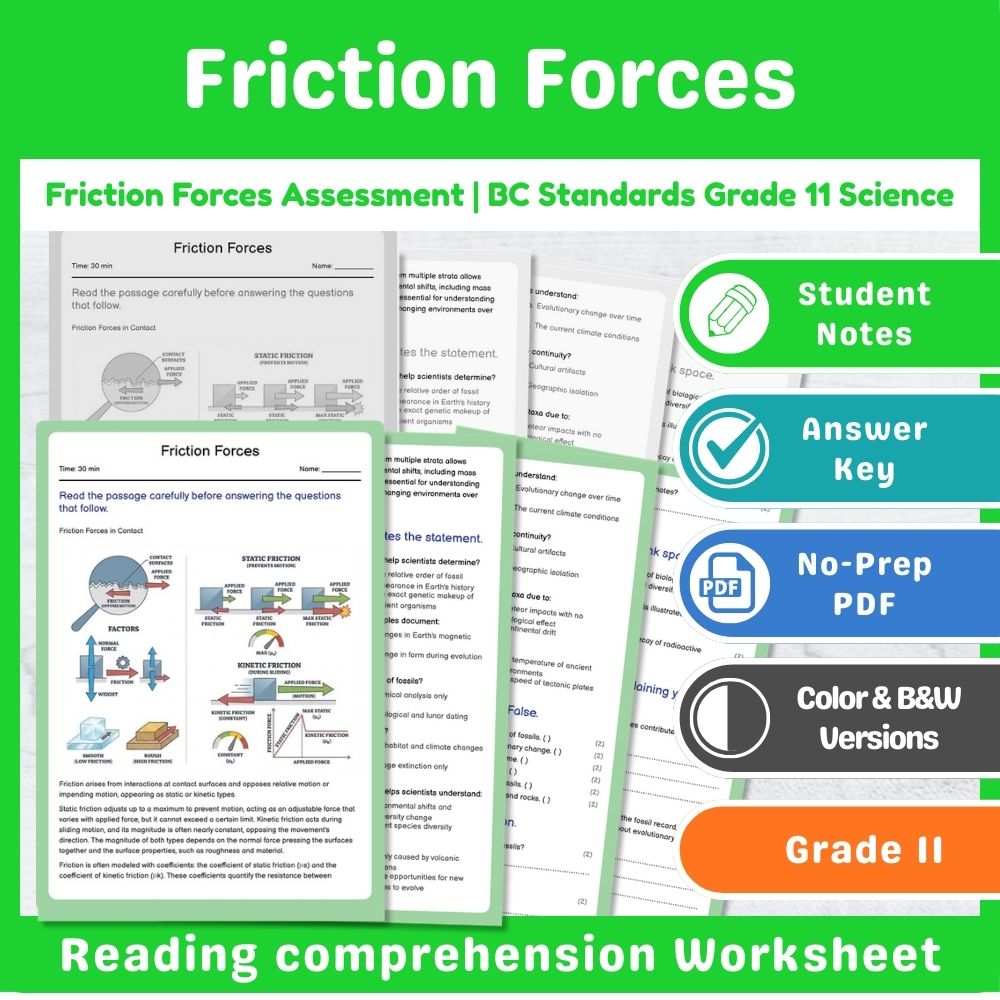
Friction Forces Assessment | BC Standards Grade 11 Science
Created byPrism Point LearningLearning Objectives
- Understand the types of friction and how they oppose motion.
- Describe the factors affecting static and kinetic friction.
- Explain how surface properties and normal force influence frictional resistance.

Climate Drivers Assessment | NGSS Grade 9 Science Standards-Aligned
Created byPrism Point LearningLearning Objectives
- Explain how solar flux, albedo differences, greenhouse gases, and ocean heat transport influence Earth’s climate.
- Analyze observational records, radiative transfer calculations, and paleoclimate proxies to attribute climate variability.
- Describe phenomena such as ice-sheet dynamics, El Niño–Southern Oscillation, and seasonal monsoon shifts in terms of climate drivers.

Pure Mixtures Assessment | General Grade 6 Science Standards
Created byPrism Point LearningLearning Objectives
- Understand what constitutes a mixture and recognize different types of mixtures.
- Identify observable properties that distinguish mixtures from pure substances.
- Learn different separation techniques based on mixture properties.
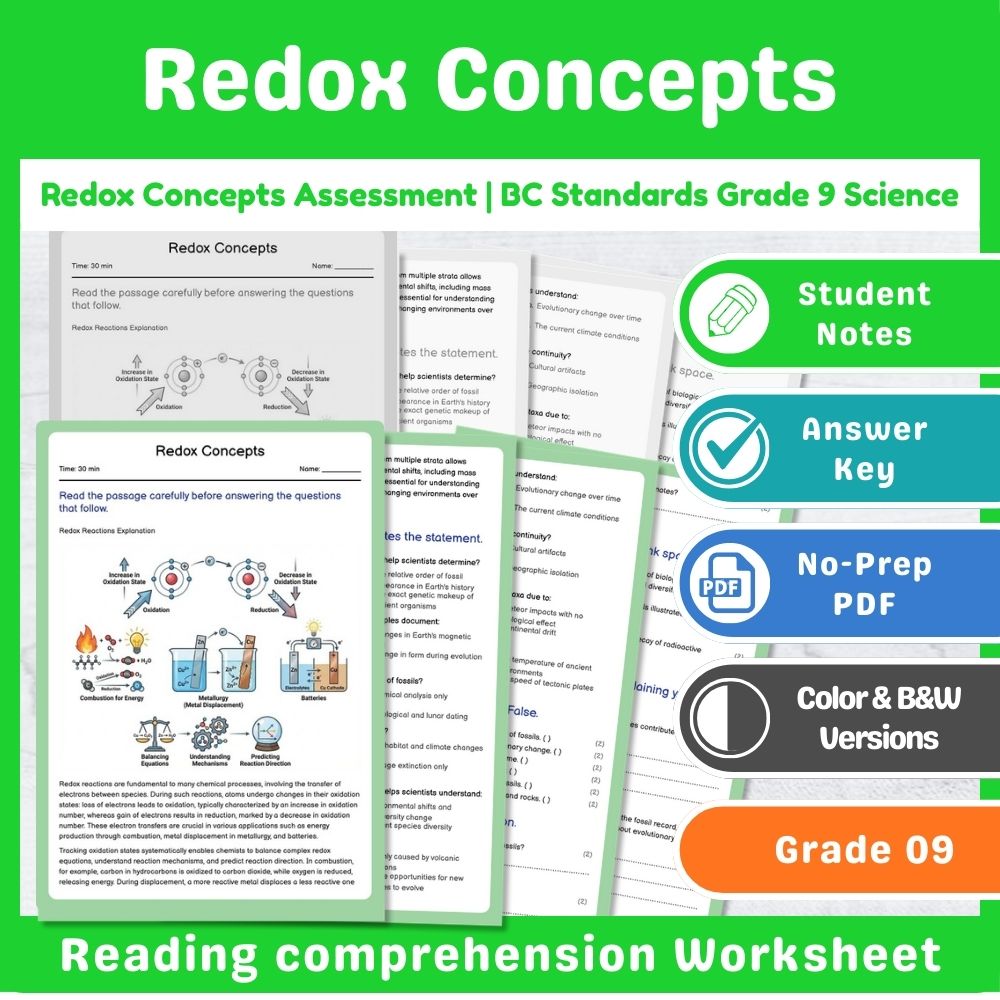
Redox Concepts Assessment | BC Standards Grade 9 Science
Created byPrism Point LearningLearning Objectives
- Explain the fundamental principles of oxidation and reduction in chemical reactions.
- Track changes in oxidation states to identify oxidizing and reducing agents.
- Balance redox equations involved in combustion and displacement reactions.
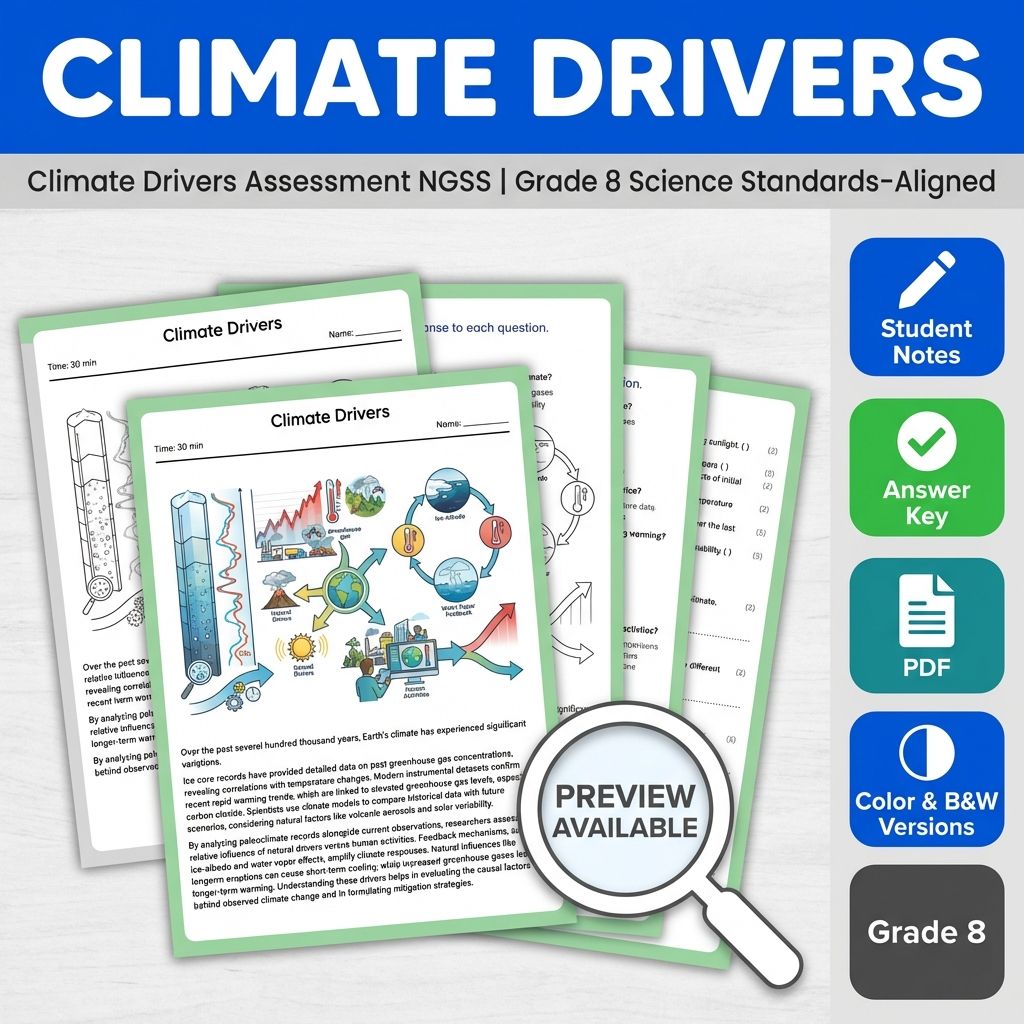
Climate Drivers Assessment NGSS | Grade 8 Science Standards-Aligned
Created byPrism Point LearningLearning Objectives
- Identify the main factors influencing global temperature changes over time.
- Evaluate multiple lines of evidence related to climate change.
- Differentiate between natural and anthropogenic climate drivers.
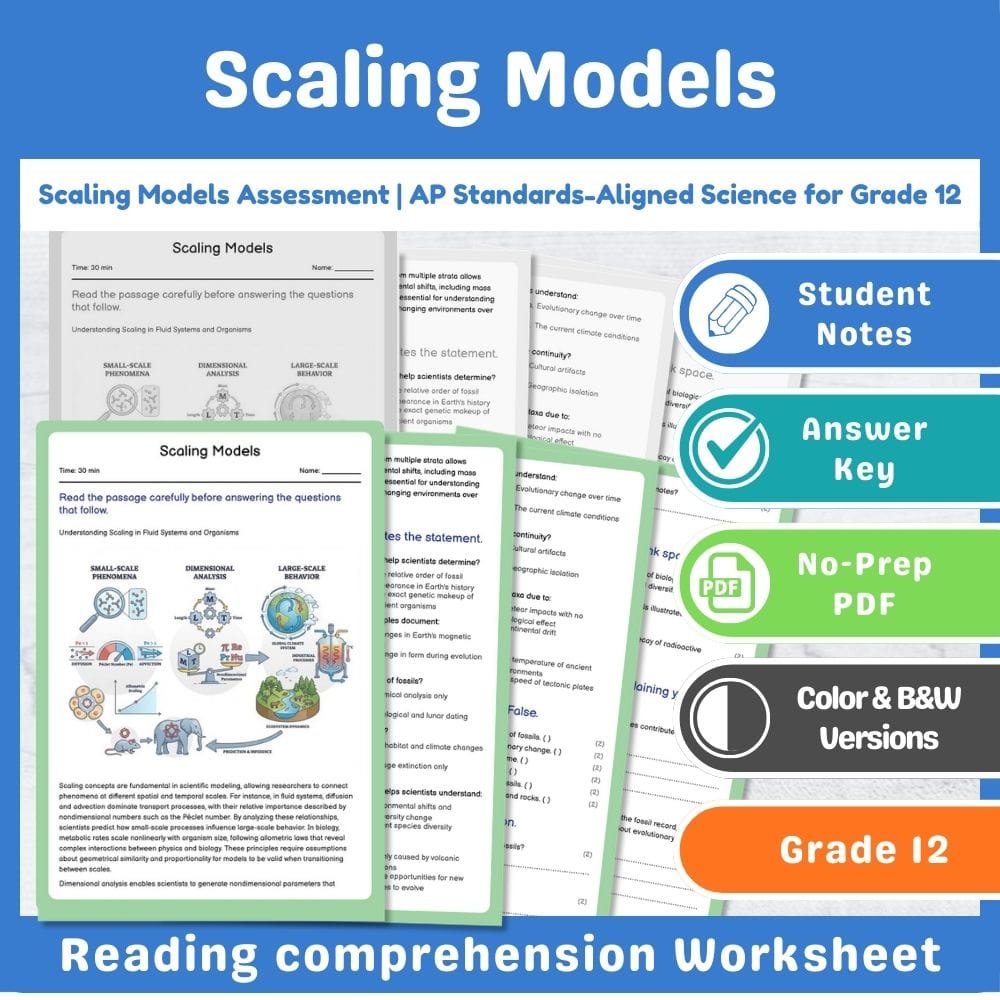
Scaling Models Assessment | AP Standards-Aligned Science for Grade 12
Created byPrism Point LearningLearning Objectives
- Understand the concept of scaling relationships and their use in scientific modeling.
- Analyze how dimensional analysis connects models across different spatial and temporal scales.
- Explore phenomena such as diffusion, advection, and metabolic scaling to illustrate nonlinearities and emergent behaviors.

Trophic Efficiency Assessment for Grade 10 Science TEKS | Science Worksheet
Created byPrism Point LearningLearning Objectives
- Understand the concept of trophic efficiency and its significance in ecosystems.
- Analyze how energy transfer affects biomass pyramids and food web structures.
- Evaluate factors influencing variations in trophic efficiency among different ecosystems.
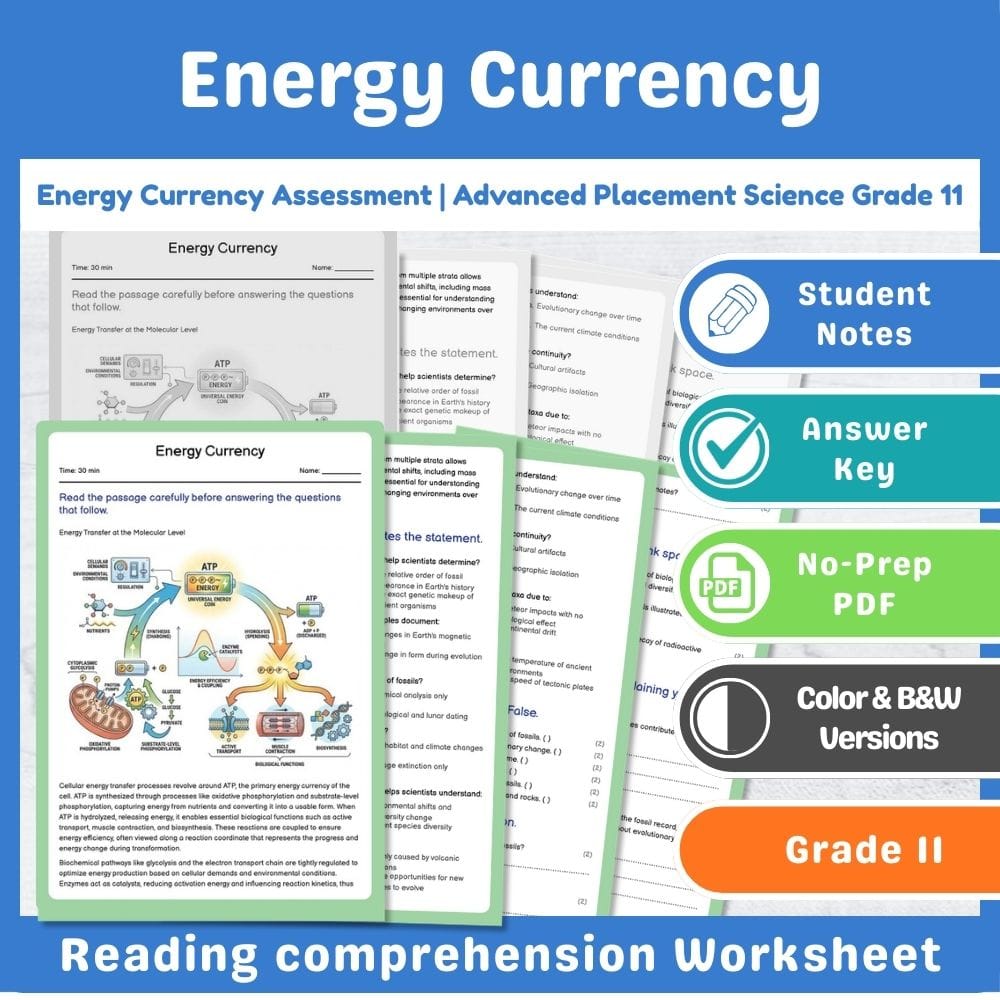
Energy Currency Assessment | Advanced Placement Science Grade 11
Created byPrism Point LearningLearning Objectives
- Describe the principles of energy transfer and transformation at molecular and cellular levels.
- Explain how ATP synthesis and hydrolysis contribute to cellular energy management.
- Interpret biochemical pathways involving energy conservation and distribution.
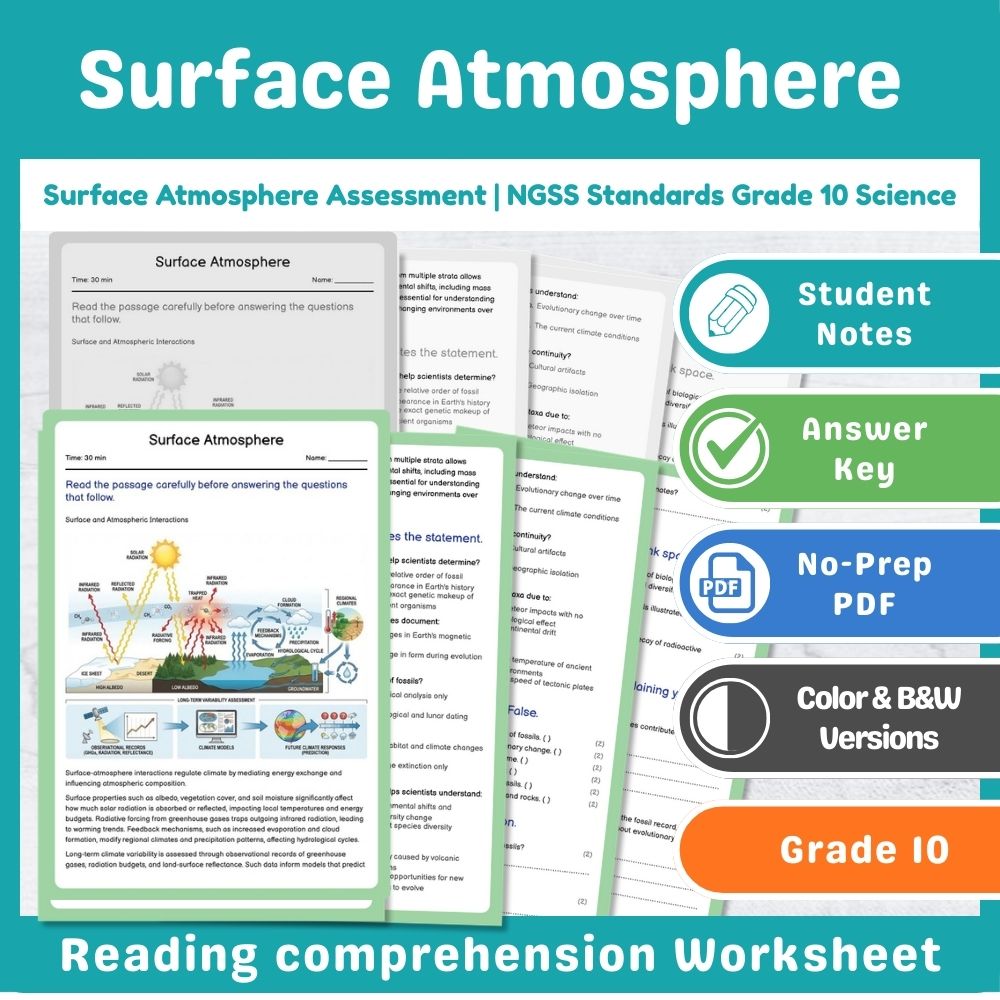
Surface Atmosphere Assessment | NGSS Standards Grade 10 Science
Created byPrism Point LearningLearning Objectives
- Explain the interactions between surface properties and atmospheric processes.
- Describe the concepts of energy exchange, albedo effects, and radiative forcing.
- Analyze the coupling of atmospheric circulation with surface processes such as evapotranspiration.
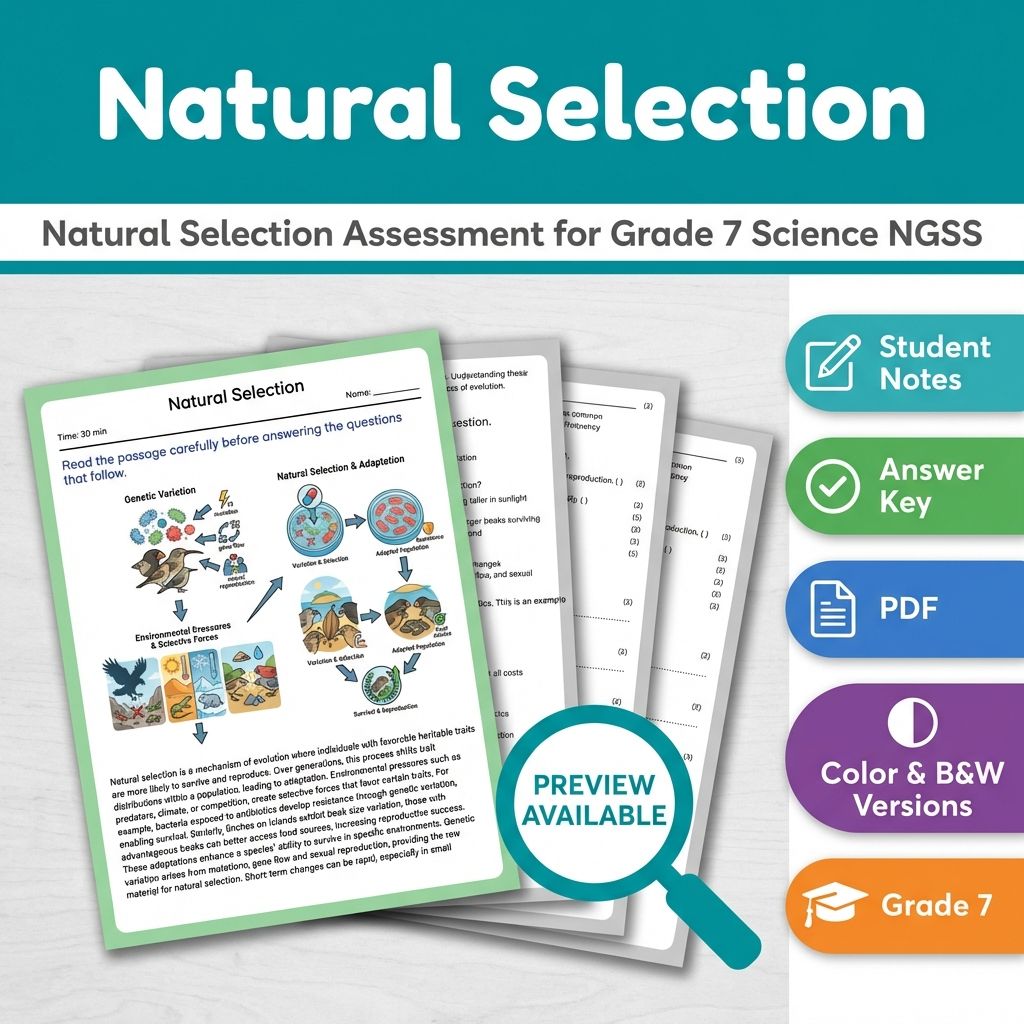
Natural Selection Assessment for Grade 7 Science NGSS
Created byPrism Point LearningLearning Objectives
- Explain how heritable variation and environmental pressures influence natural selection.
- Identify examples of adaptation in different species.
- Describe how reproductive success and selective pressures shape evolution.
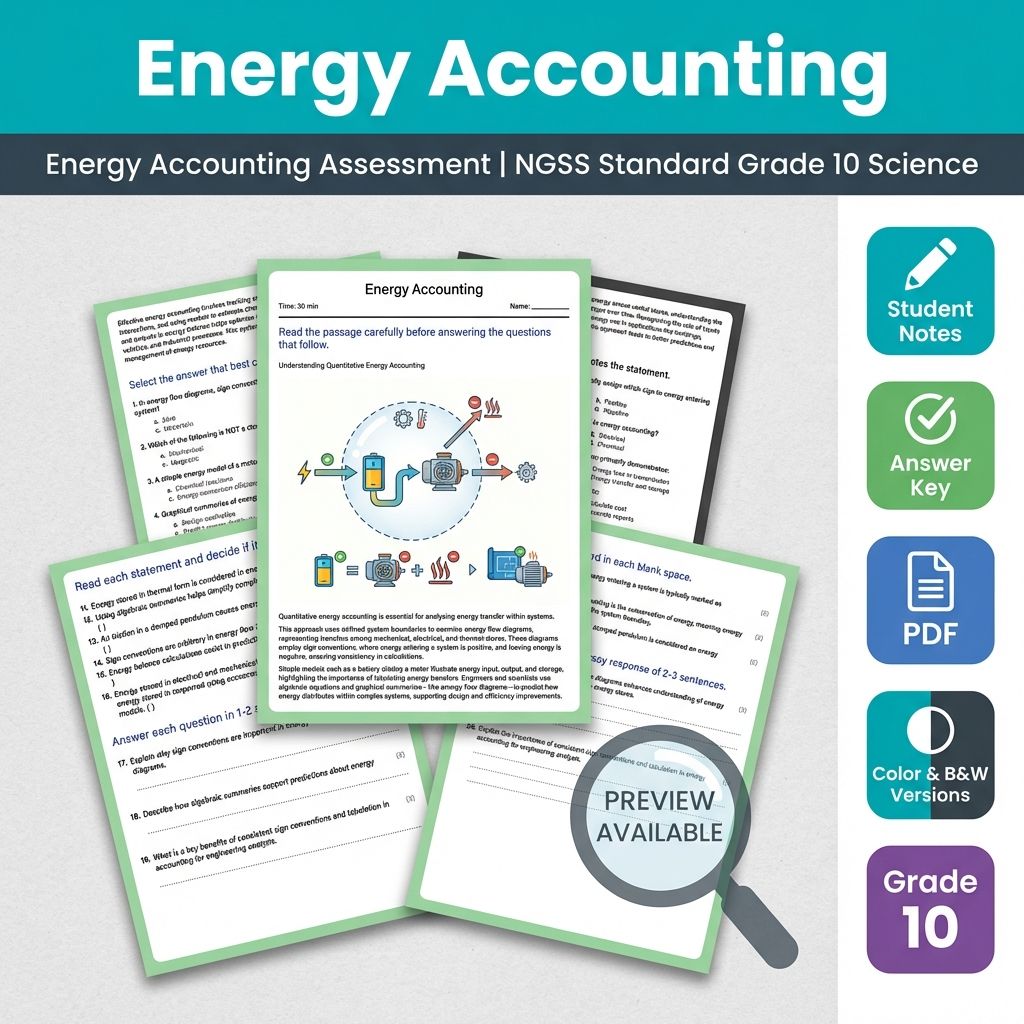
Energy Accounting Assessment | NGSS Standard Grade 10 Science
Created byPrism Point LearningLearning Objectives
- Understand and apply system boundaries, energy flow diagrams, and computational models in energy accounting.
- Identify energy transfer processes among mechanical, electrical, and thermal stores.
- Use sign conventions and tabulate energy transfers to analyze system energy distribution.

Surface Process Evidence Assessment | General Grade 7 Science
Created byPrism Point LearningLearning Objectives
- Understand how Earth's surface is shaped by internal and external processes.
- Identify evidence of surface processes in landform patterns and rock formations.
- Explain how landforms such as deltas and floodplains are formed through external processes.
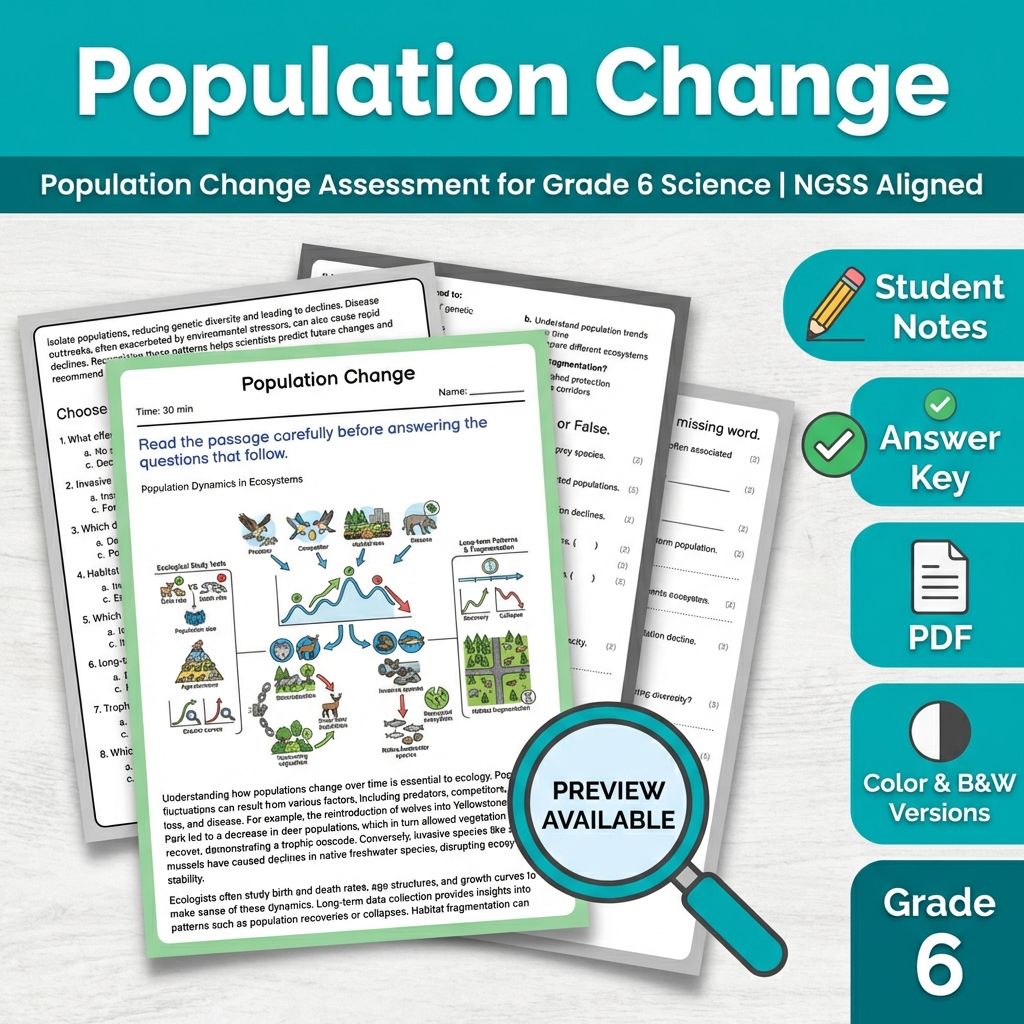
Population Change Assessment for Grade 6 Science | NGSS Aligned
Created byPrism Point LearningLearning Objectives
- Construct evidence-based arguments linking ecosystem alterations to population changes.
- Analyze case studies involving predator reintroduction, invasive species, habitat fragmentation, and disease outbreaks.
- Interpret empirical data sets and longitudinal observations to infer causal relationships in ecosystems.
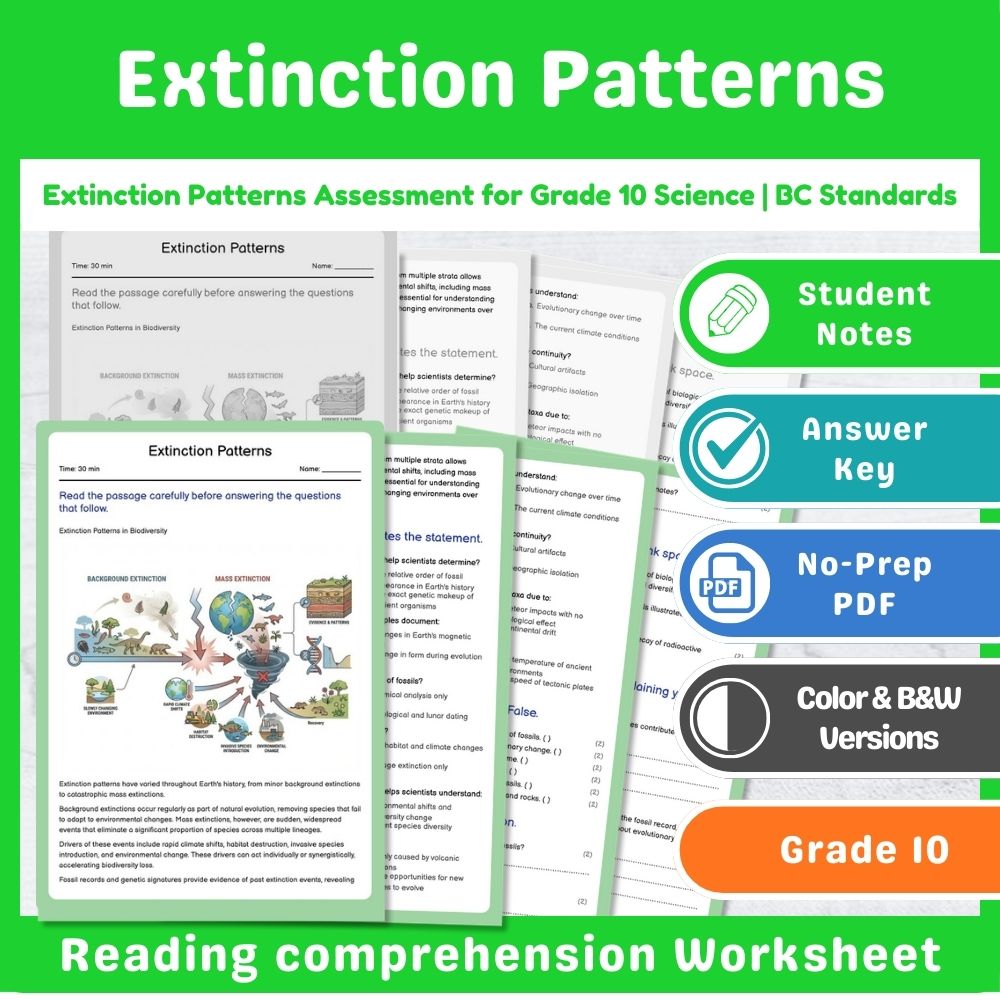
Extinction Patterns Assessment for Grade 10 Science | BC Standards
Created byPrism Point LearningLearning Objectives
- Understand various extinction patterns from background losses to mass extinctions.
- Identify causes and drivers of extinction events such as environmental changes and invasive species.
- Explain how fossil and genetic signatures reveal past biodiversity crises.

Measurement Precision Assessment | TEKS Grade 6 Science Standards
Created byPrism Point LearningLearning Objectives
- Understand the conventions for reporting measurements in scientific experiments.
- Identify and interpret sources of measurement uncertainty and error.
- Apply appropriate significant figures and unit notation in recording data.
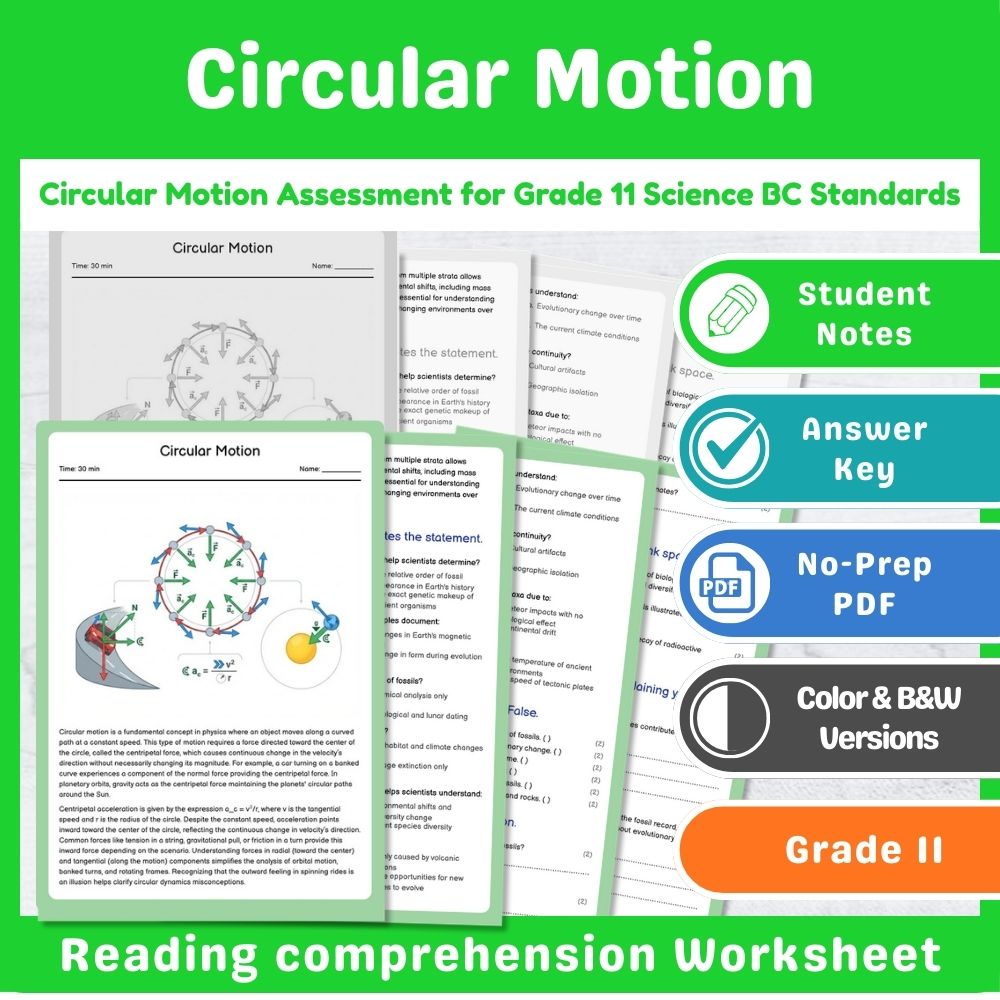
Circular Motion Assessment for Grade 11 Science BC Standards
Created byPrism Point LearningLearning Objectives
- Explain the concept of centripetal force and its role in uniform circular motion.
- Derive and calculate centripetal acceleration using the formula v²/r.
- Identify forces such as tension, gravity, and friction that provide centripetal force in various contexts.

Data Representation Assessment | TEKS Grade 6 Science Printable Worksheet
Created byPrism Point LearningLearning Objectives
- Understand key concepts related to Science
- Apply knowledge through practice questions
- Demonstrate comprehension of the material

Ecological Succession Assessment for Grade 10 Science TEKS Standards
Created byPrism Point LearningLearning Objectives
- Understand the concepts of primary and secondary succession in ecosystems.
- Identify the processes involved in succession such as colonization, competition, and facilitation.
- Explain how disturbance frequency and intensity influence succession pathways and biodiversity.

Aerobic Versus Anaerobic Assessment | TEKS Grade 10 Science Printable
Created byPrism Point LearningLearning Objectives
- Compare and contrast aerobic and anaerobic respiration pathways.
- Identify the products and energy yields of aerobic and anaerobic processes.
- Explain the significance of oxygen in cellular respiration.

Trait Prediction Across Generations Assessment | General Grade 9 Science
Created byPrism Point LearningLearning Objectives
- Understand how inheritance patterns influence trait prediction across multiple generations.
- Apply probability concepts to forecast phenotype ratios based on parental alleles.
- Analyze how dominant and recessive traits are expressed and masked in offspring.
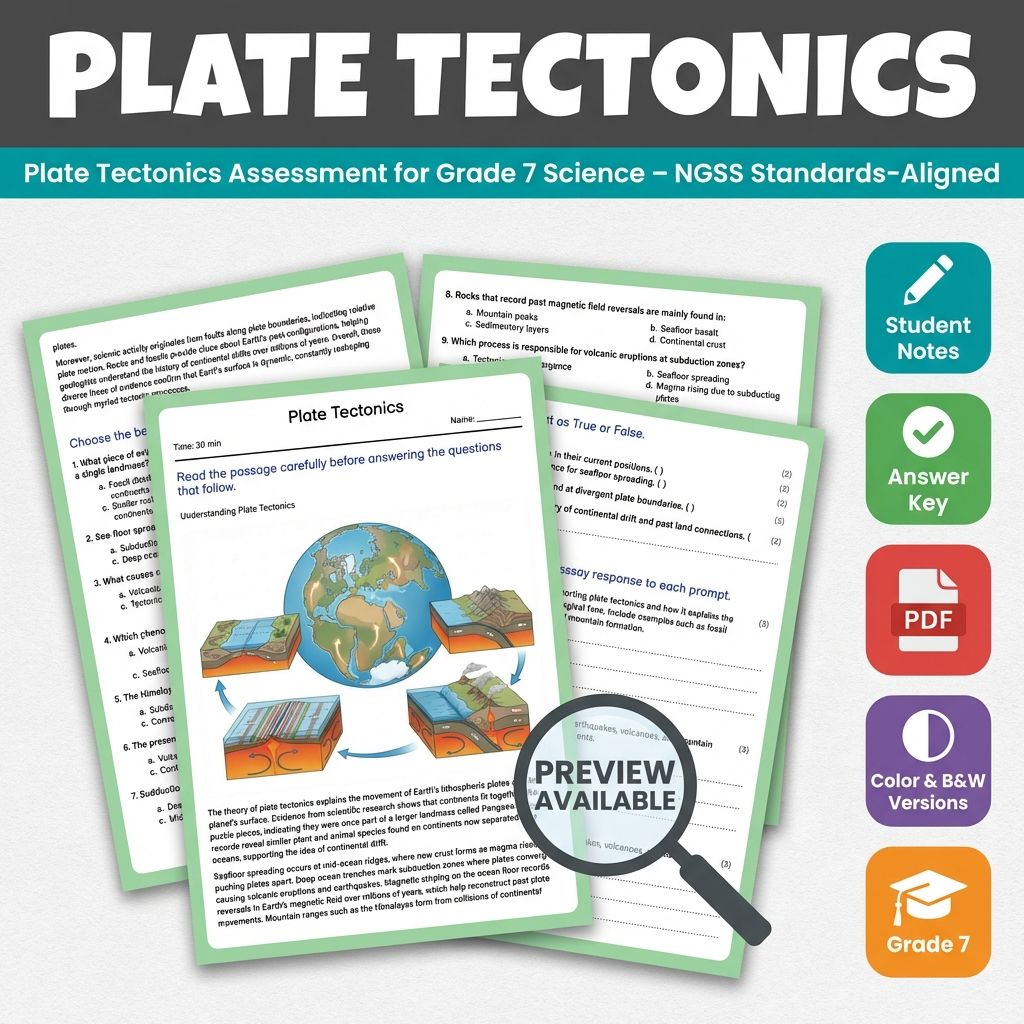
Plate Tectonics Assessment for Grade 7 Science – NGSS Standards-Aligned
Created byPrism Point LearningLearning Objectives
- Understand how geologic and fossil evidence supports the theory of plate tectonics and continental movement.
- Identify features such as mid-ocean ridges, trenches, and mountain ranges as evidence of tectonic activity.
- Explain how rock types, fossil distribution, and seafloor structures record Earth's geological history.

Climate Drivers Over Time Assessment | General Grade 7 Science
Created byPrism Point LearningLearning Objectives
- Understand how natural records and measurements are used to assess past and present climate conditions.
- Identify key climate drivers that influence long-term climate change.
- Explain how factors like greenhouse gases, ocean currents, and volcanic activity affect Earth's energy balance.

Atmospheric Structure Assessment | TEKS Grade 8 Science Standards
Created byPrism Point LearningLearning Objectives
- Understand key concepts related to Science
- Apply knowledge through practice questions
- Demonstrate comprehension of the material
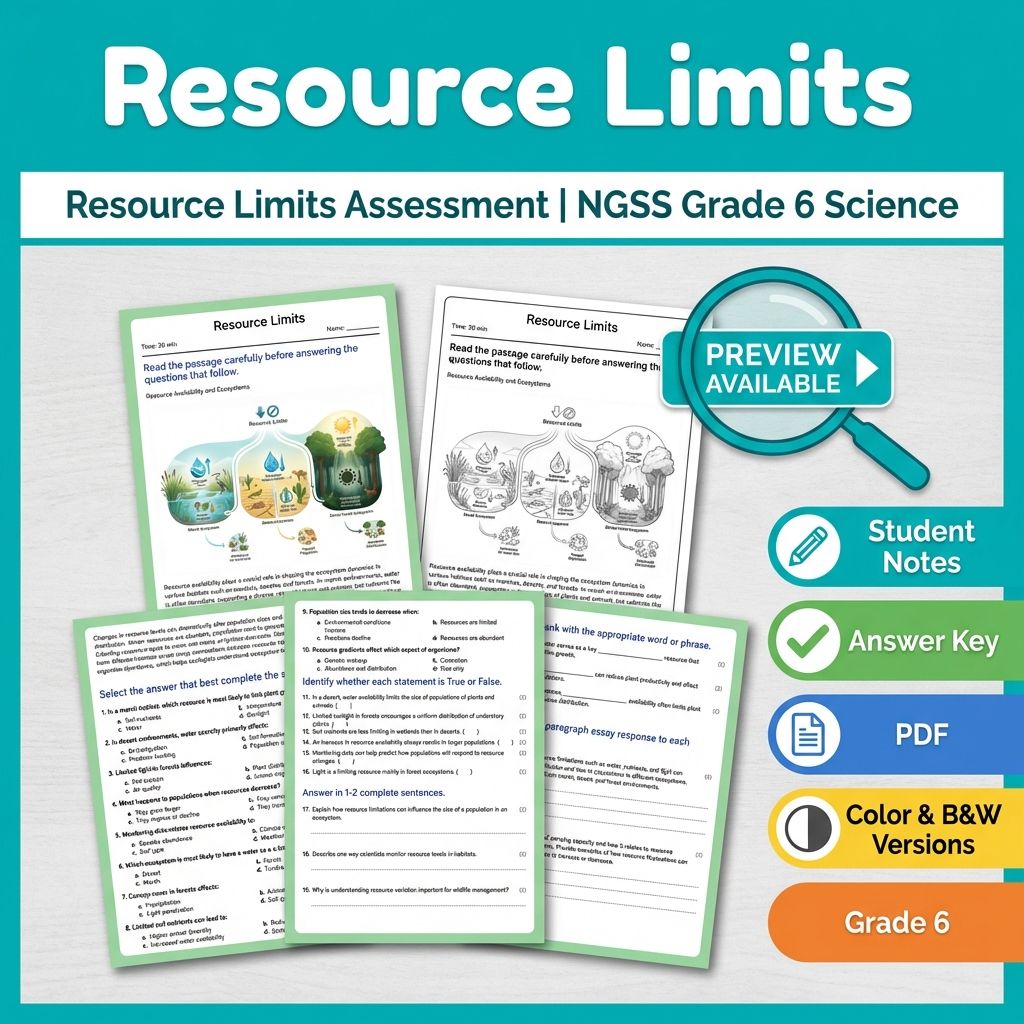
Resource Limits Assessment | NGSS Grade 6 Science
Created byPrism Point LearningLearning Objectives
- Describe how resource availability affects individual organisms and populations.
- Interpret data related to resource distribution and species abundance.
- Identify limiting resources in different ecosystems and explain their effects.
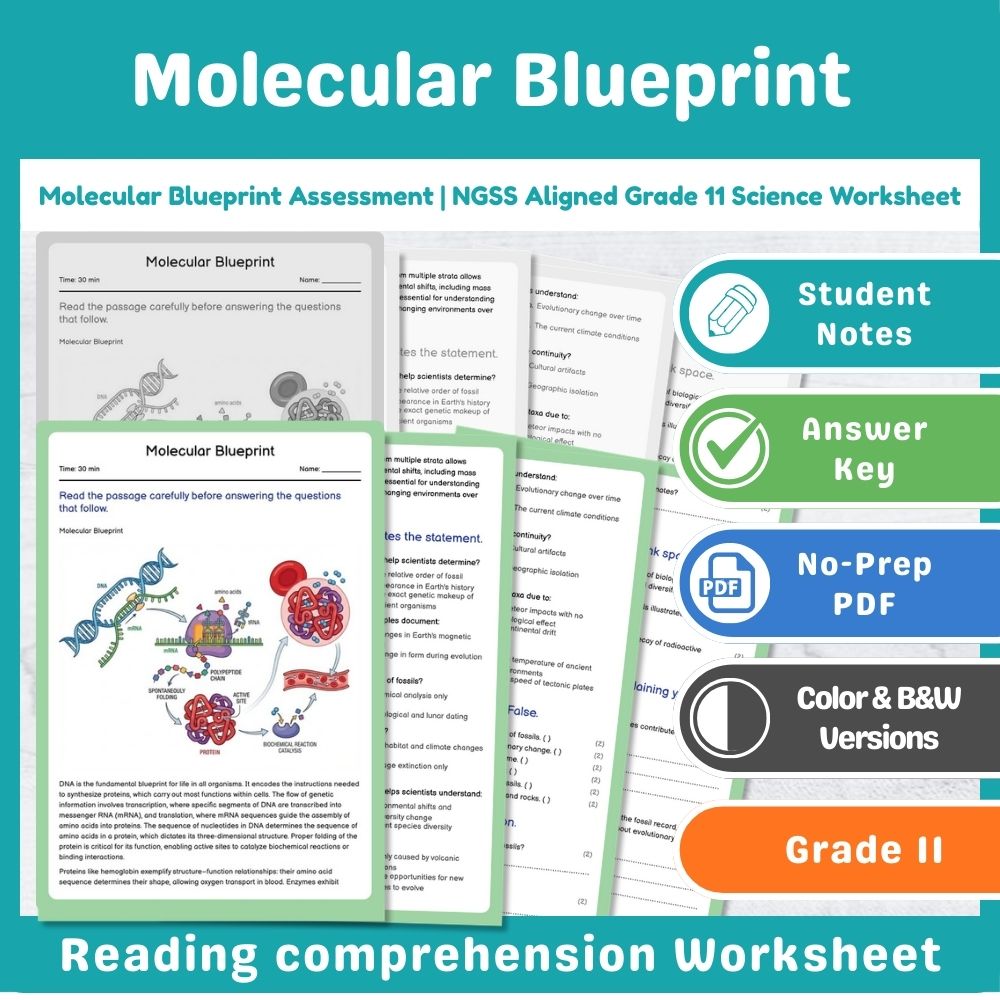
Molecular Blueprint Assessment | NGSS Aligned Grade 11 Science Worksheet
Created byPrism Point LearningLearning Objectives
- Explain how DNA sequence directs the synthesis of specific proteins through transcription and translation.
- Describe the relationship between amino acid sequences, protein folding, and active site function.
- Connect genotype variations to changes in protein conformation and their physiological effects.
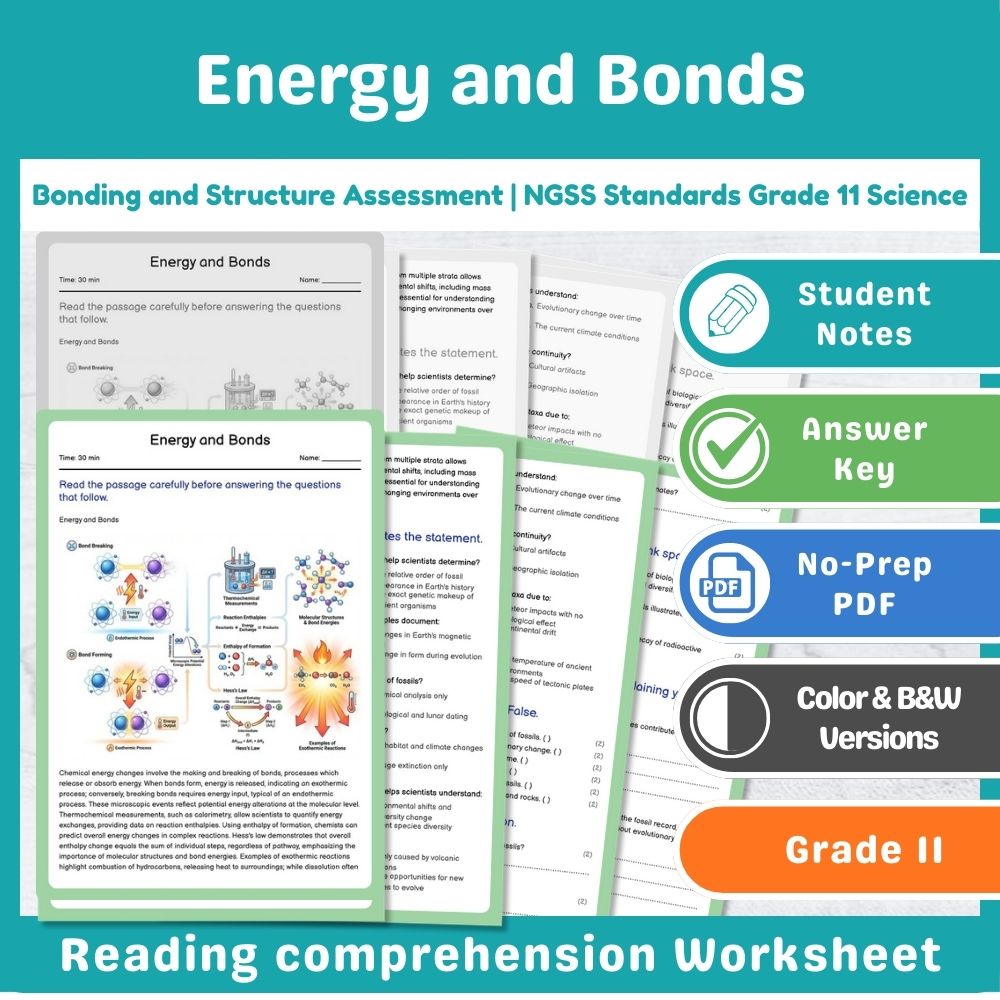
Energy and Bonds Assessment – NGSS Aligned Evaluation for Grade 11 Science
Created byPrism Point LearningLearning Objectives
- Understand the representation of chemical energy changes through bond formation and breaking.
- Explain how net enthalpy change relates to bond energies and molecular structure.
- Interpret thermochemical data, including calorimetry, formation enthalpies, and Hess's law.

Seasons and Day Length Assessment | General Grade 9 Science Standards
Created byPrism Point LearningLearning Objectives
- Understand how Earth's axial tilt and orbit around the Sun cause seasonal changes.
- Explain how the angle of sunlight and day length vary with Earth's position in its orbit.
- Describe the relationship between solar energy received and Earth's seasons.

Thermoregulation Assessment | TEKS Grade 9 Science Evaluation
Created byPrism Point LearningLearning Objectives
- Understand the mechanisms involved in body temperature regulation.
- Identify physiological responses that maintain thermoregulation.
- Explain the roles of skin, vasculature, and nervous pathways in heat balance.
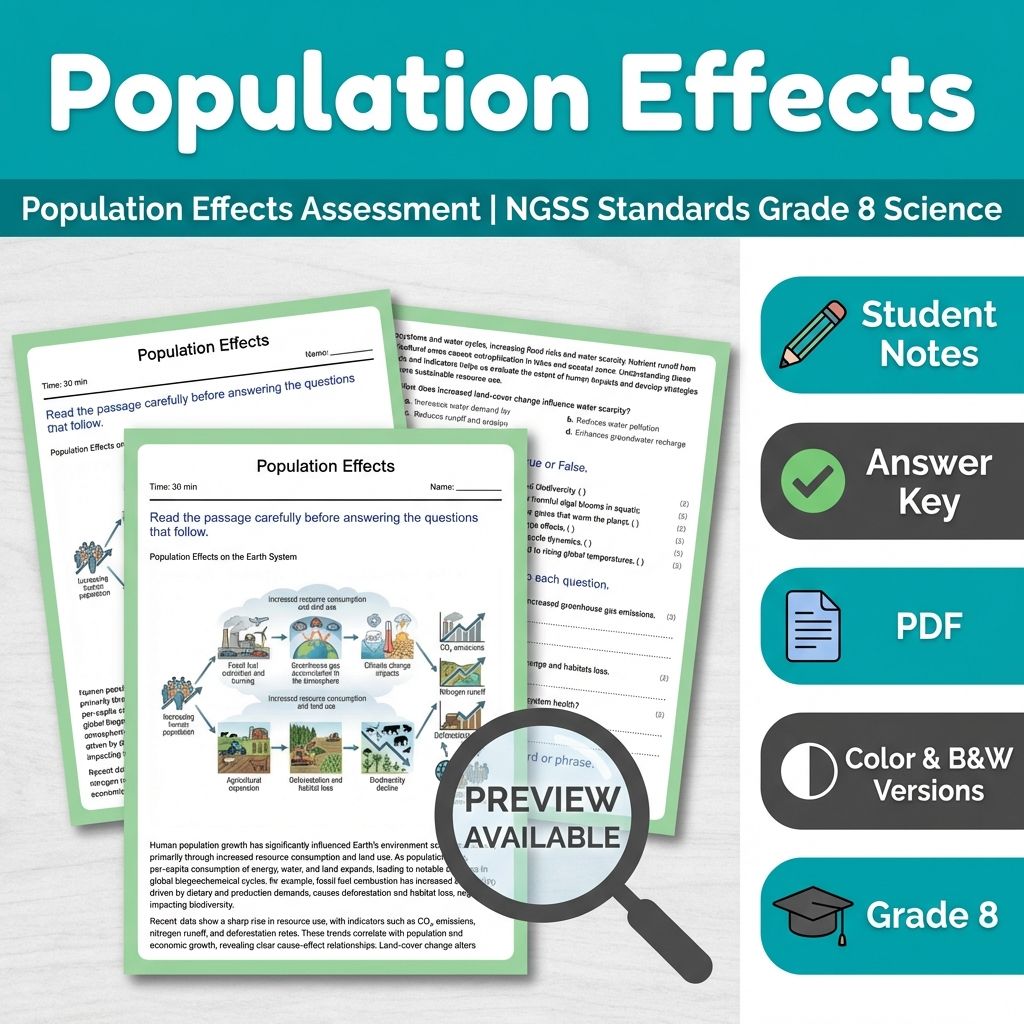
Population Effects Assessment | NGSS Standards Grade 8 Science
Created byPrism Point LearningLearning Objectives
- Analyze the links between population growth, resource consumption, and environmental change.
- Evaluate quantitative indicators and data trends related to climate, land use, and biogeochemical fluxes.
- Apply cause–effect reasoning to assess how demographic and consumption patterns impact Earth systems.
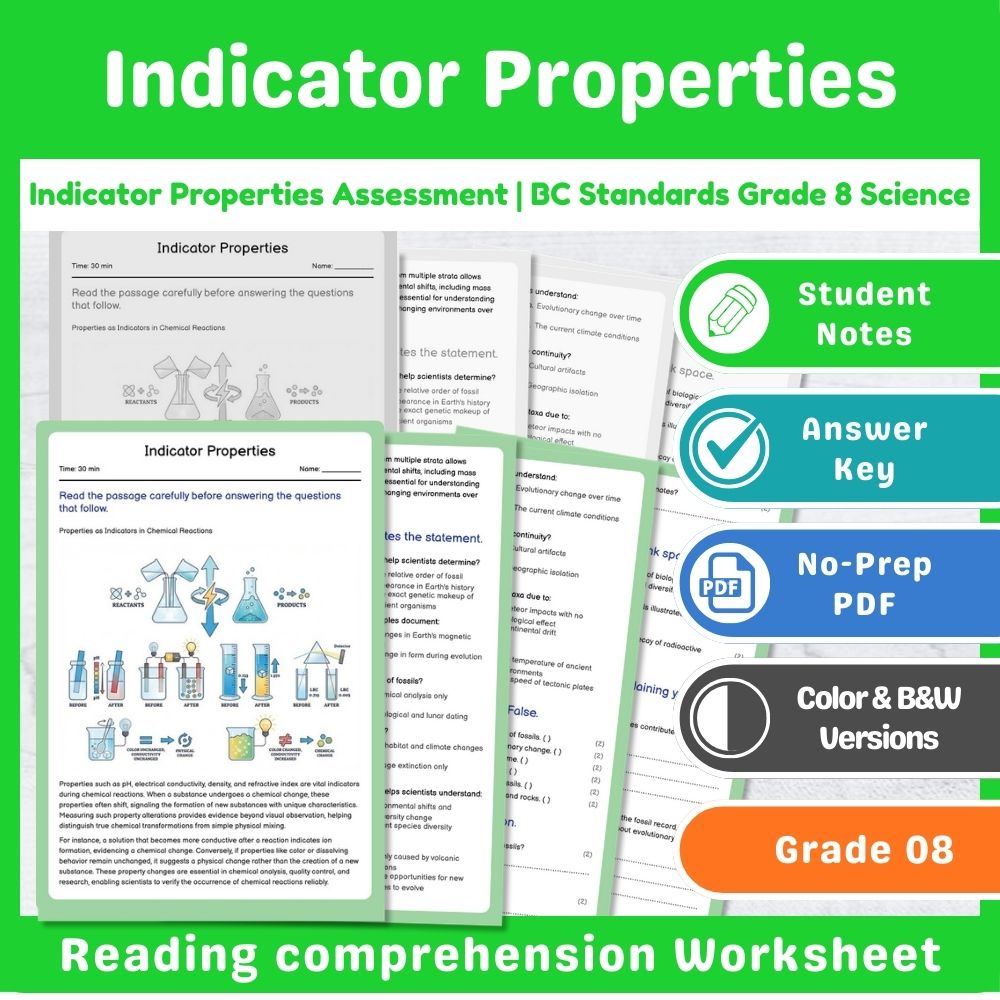
Indicator Properties Assessment | BC Standards Grade 8 Science
Created byPrism Point LearningLearning Objectives
- Understand how properties such as pH, conductivity, density, and refractive index change during chemical reactions.
- Identify property shifts indicating formation of new substances with distinct traits.
- Differentiate between physical and chemical changes using property measurements.
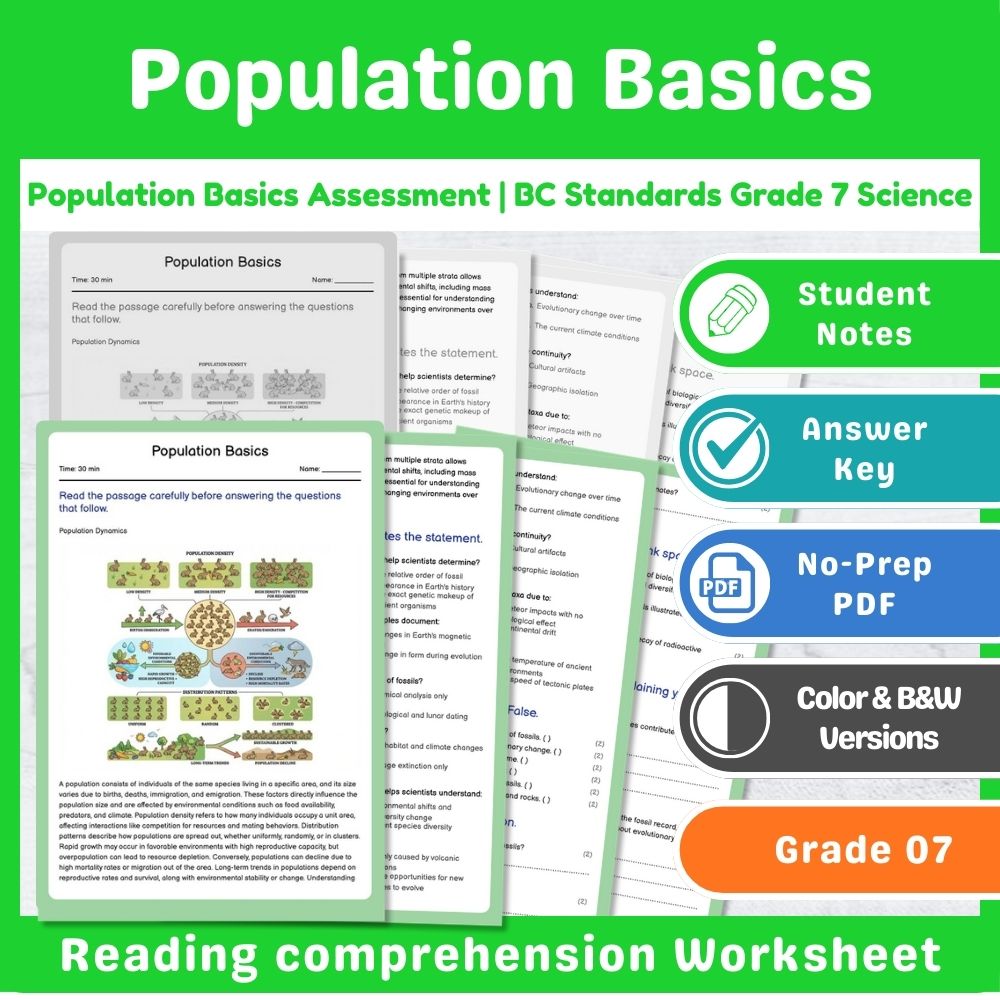
Population Basics Assessment | BC Standards Grade 7 Science
Created byPrism Point LearningLearning Objectives
- Understand the core metrics used to describe populations, such as size, density, and distribution patterns.
- Explain how demographic factors like births, deaths, immigration, and emigration influence population change.
- Analyze how environmental conditions interact with population dynamics over short-term and long-term scales.
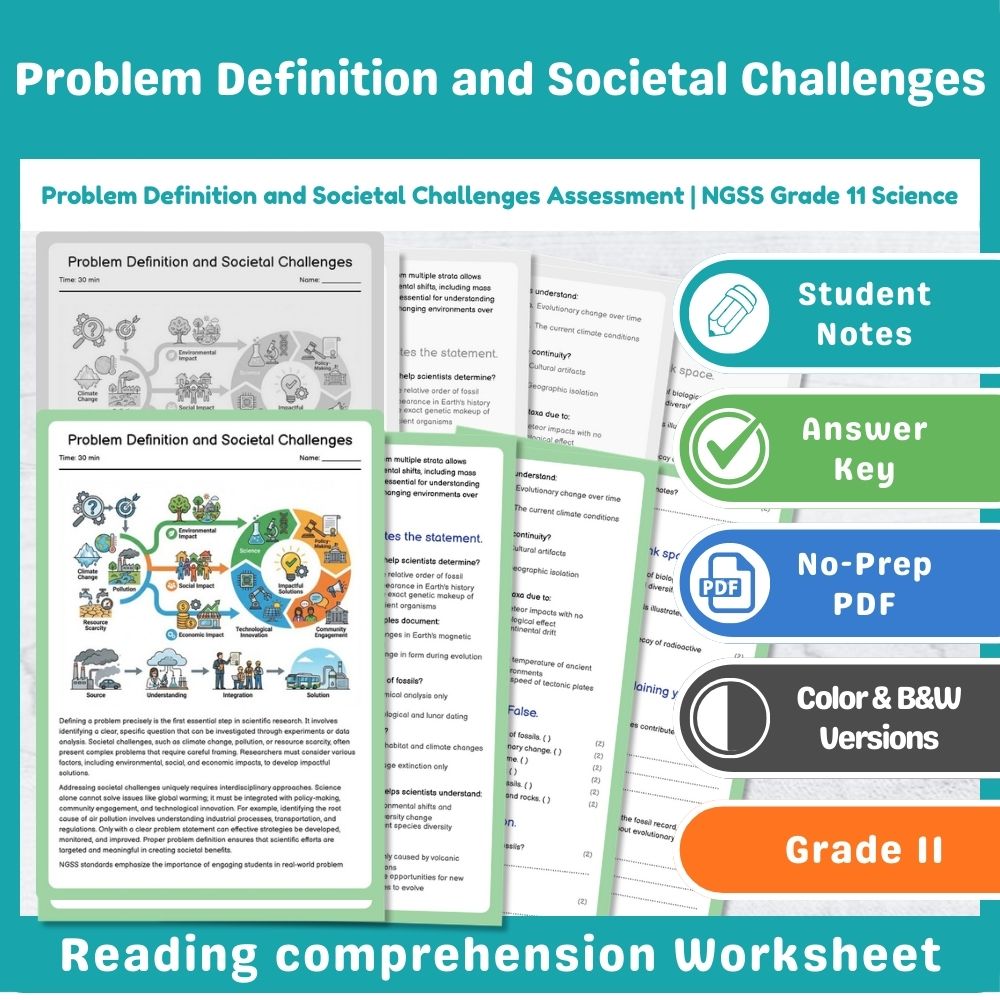
Problem Definition and Societal Challenges Assessment | NGSS Grade 11 Science
Created byPrism Point LearningLearning Objectives
- Understand the importance of clear problem definition in scientific research.
- Analyze how societal challenges influence scientific problem framing.
- Evaluate different approaches to addressing global issues through science.
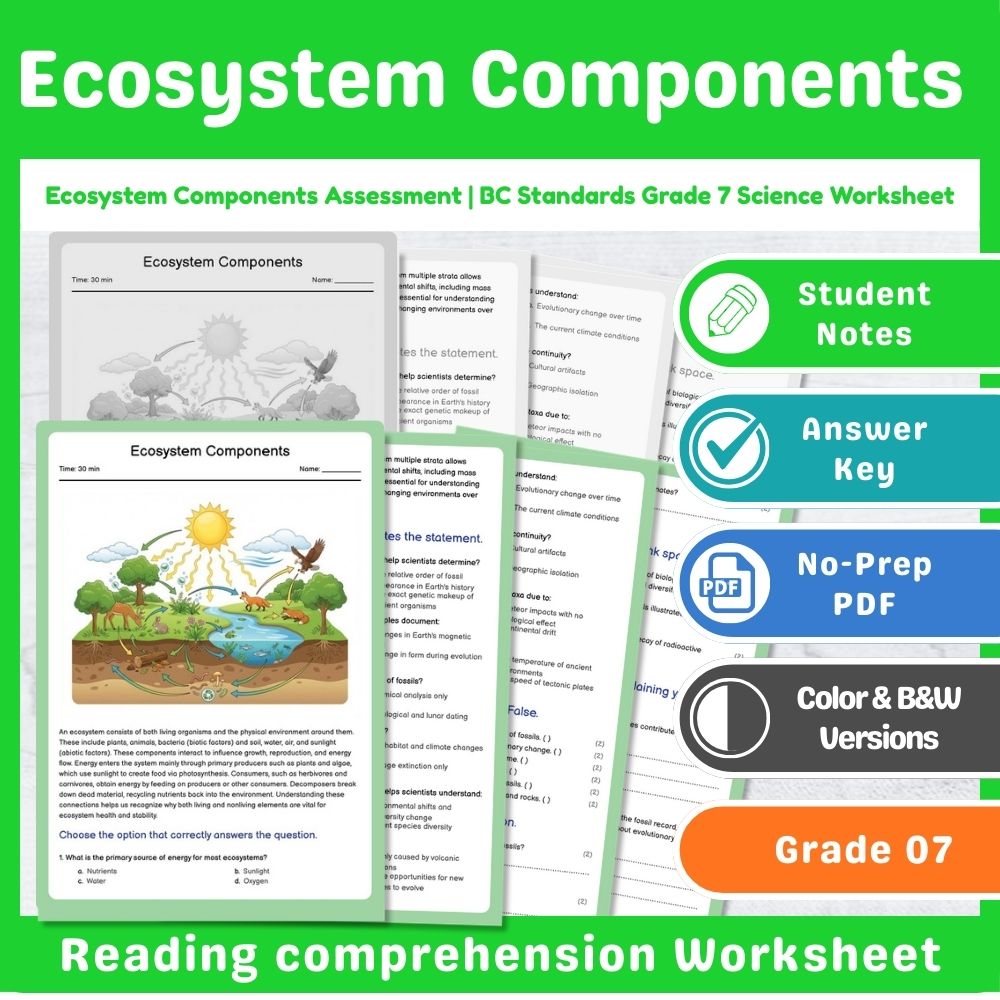
Ecosystem Components Assessment | BC Standards Grade 7 Science Worksheet
Created byPrism Point LearningLearning Objectives
- Describe the key components of an ecosystem, including both living and nonliving factors.
- Explain how biotic and abiotic components interact within an ecosystem.
- Understand the flow of energy through producers and consumers in an ecosystem.
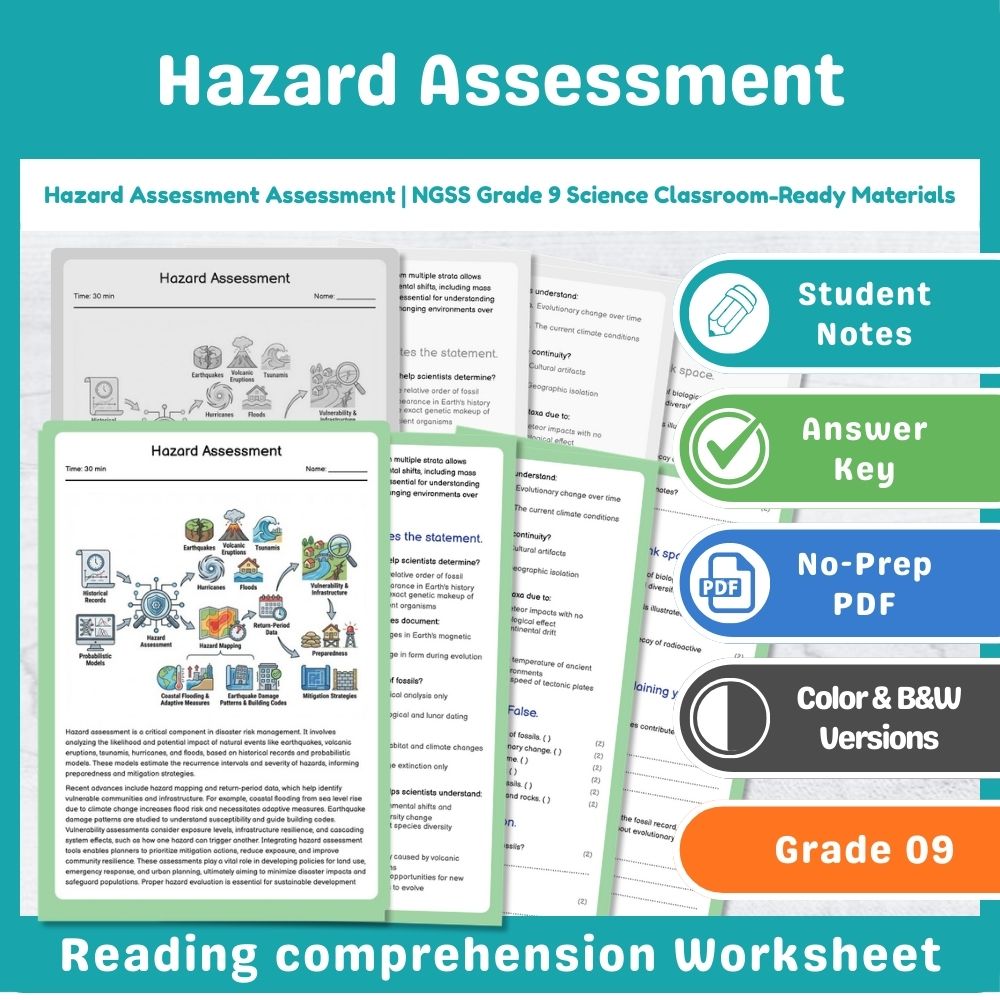
Hazard Assessment Assessment | NGSS Grade 9 Science Classroom-Ready Materials
Created byPrism Point LearningLearning Objectives
- Understand the methods used to evaluate hazard risks such as earthquakes, volcanoes, tsunamis, hurricanes, and floods.
- Analyze hazard occurrence, frequency, and consequences using historical data and probabilistic models.
- Recognize the importance of hazard mapping, return-period data, and mitigation strategies in assessing community susceptibility.
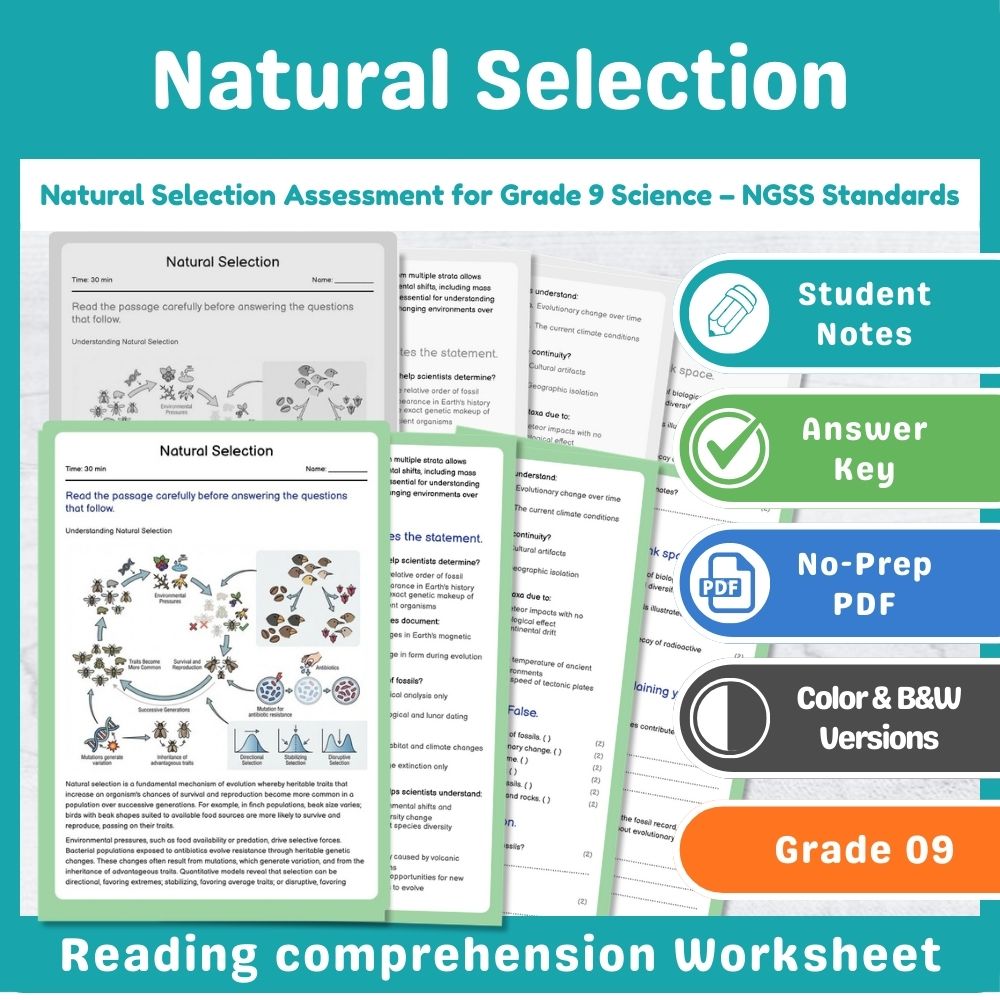
Natural Selection Assessment for Grade 9 Science – NGSS Standards
Created byPrism Point LearningLearning Objectives
- Explain the mechanisms of natural selection, including variation, inheritance, and selection pressures.
- Identify classic examples of natural selection, such as finch beak morphology and bacterial resistance.
- Describe how models of fitness and allele frequency determine different types of selection.
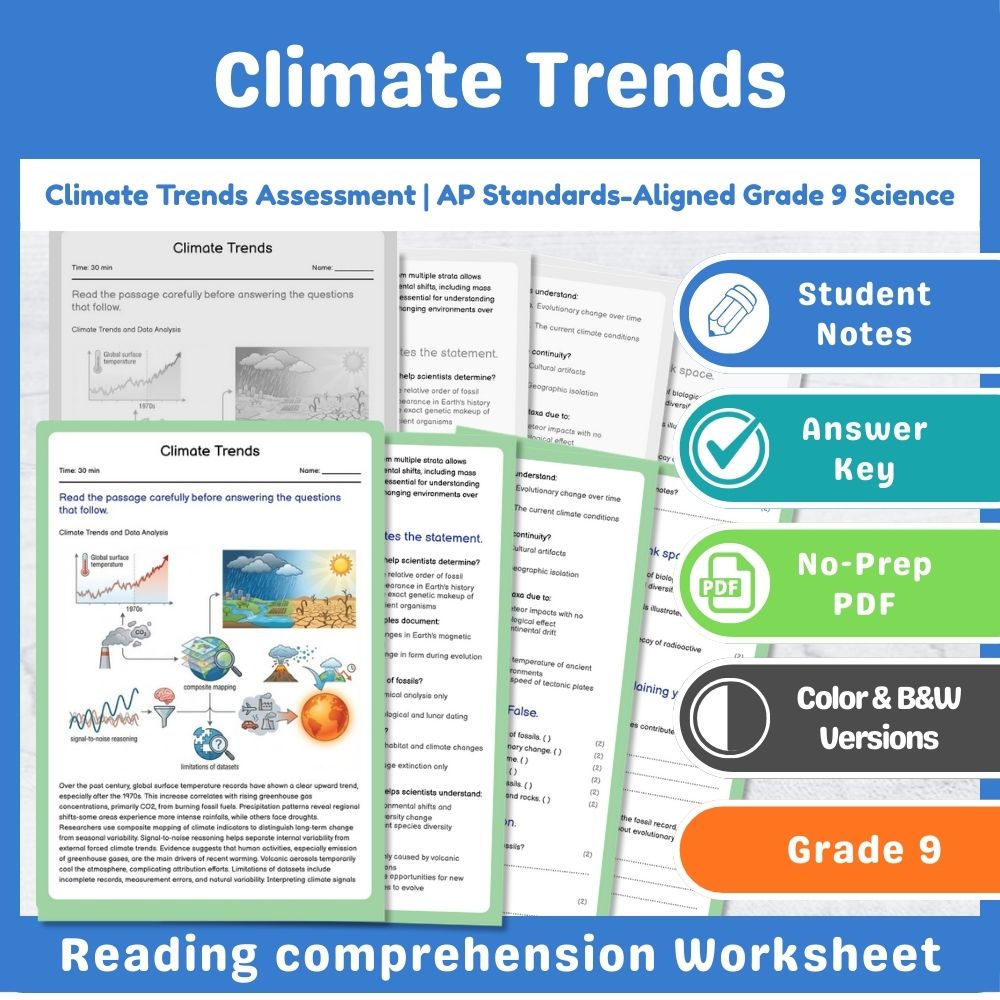
Climate Trends Assessment | AP Standards-Aligned Grade 9 Science
Created byPrism Point LearningLearning Objectives
- Analyze spatial and temporal climate datasets to identify trends and anomalies.
- Apply statistical trend analysis and composite mapping techniques.
- Interpret potential climate drivers by comparing datasets with external forcings.
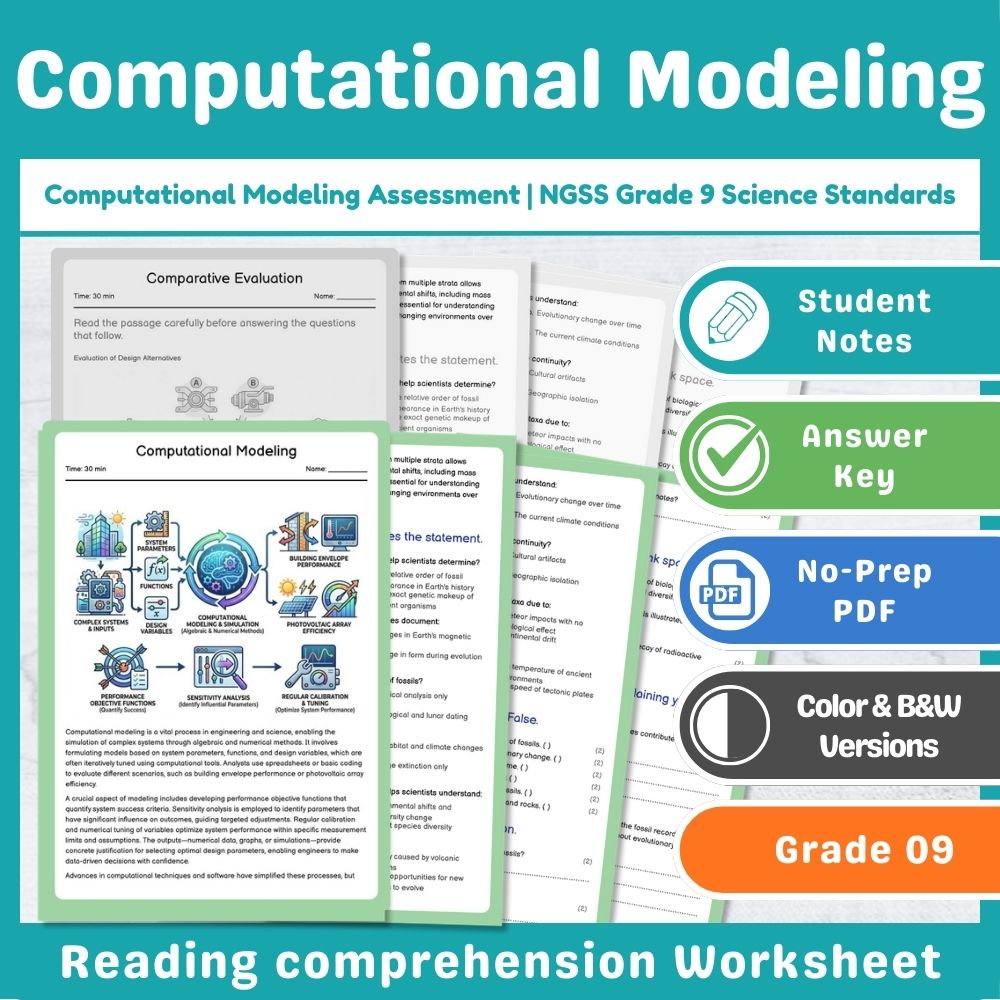
Computational Modeling Assessment | NGSS Grade 9 Science Standards
Created byPrism Point LearningLearning Objectives
- Understand the application of mathematical and computational methods in system modeling.
- Analyze how parameters and variables influence system performance.
- Develop and evaluate models using spreadsheets and simple code simulations.

Reasoning Claims Assessment for Grade 6 Science TEKS – Printable PDF
Created byPrism Point LearningLearning Objectives
- Understand the process of connecting evidence to explanatory claims in scientific reasoning.
- Interpret data patterns such as distance-time graphs for motion analysis.
- Assess the strength of inferences based on available evidence.
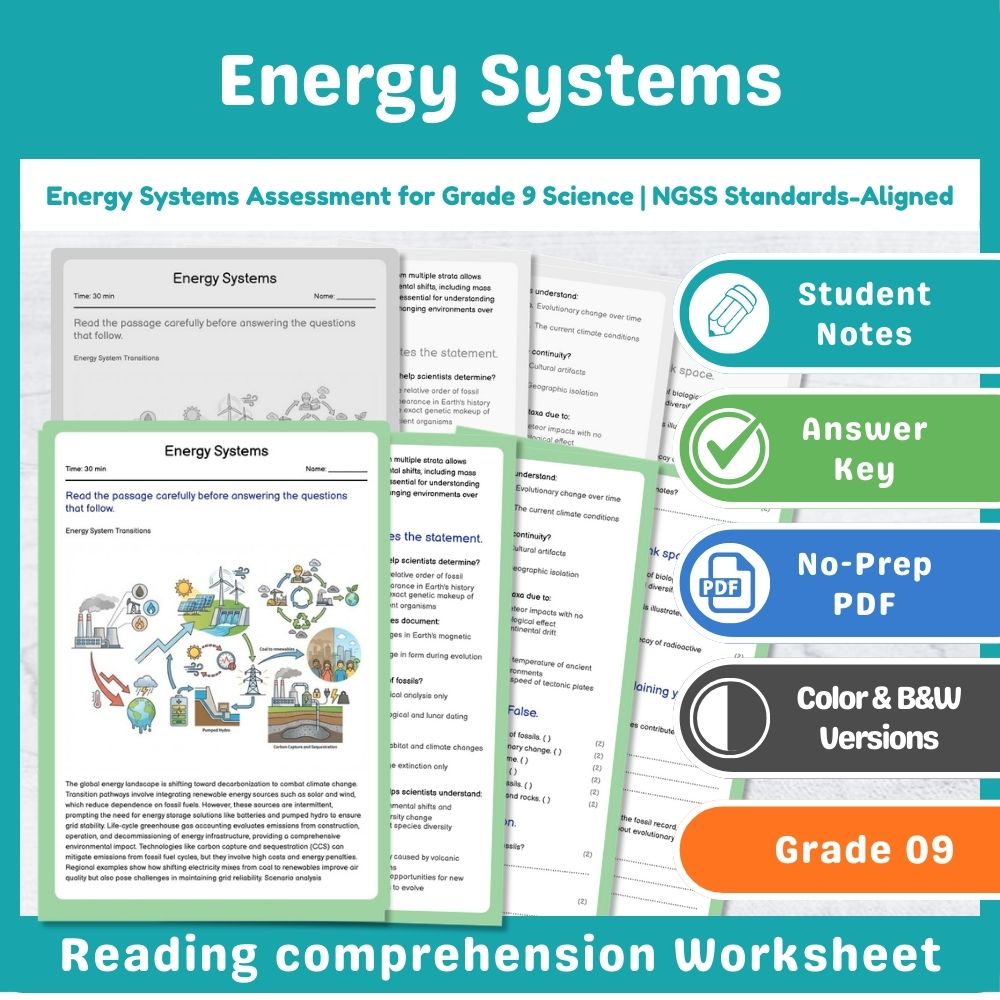
Energy Systems Assessment for Grade 9 Science | NGSS Standards-Aligned
Created byPrism Point LearningLearning Objectives
- Explain the processes involved in energy system transitions and decarbonization pathways.
- Analyze life-cycle greenhouse gas emissions for various energy technologies.
- Evaluate the trade-offs between reliability, affordability, and emissions reductions in energy planning.
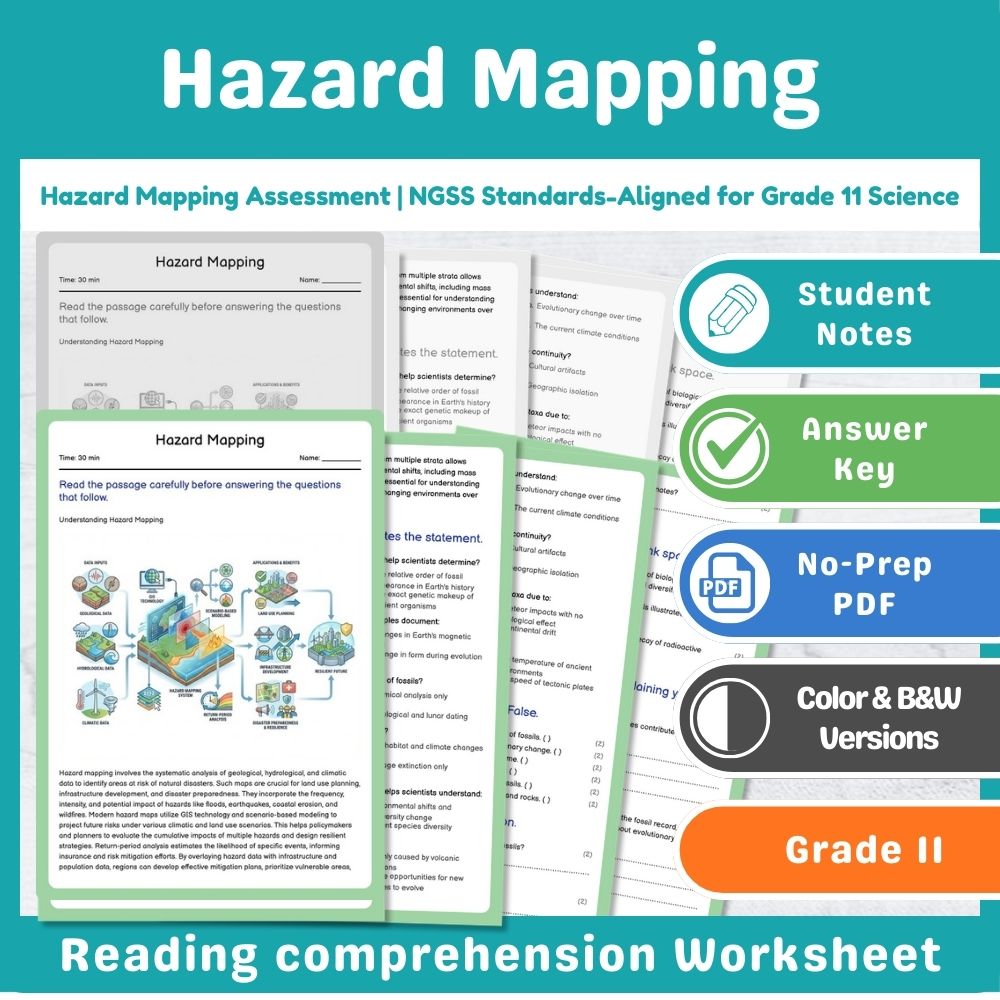
Hazard Mapping Assessment | NGSS Standards Grade 11 Science Worksheet
Created byPrism Point LearningLearning Objectives
- Understand various natural hazards and their spatial distribution
- Analyze the role of hazard mapping in regional planning and resilience
- Evaluate different data sources used in hazard assessment
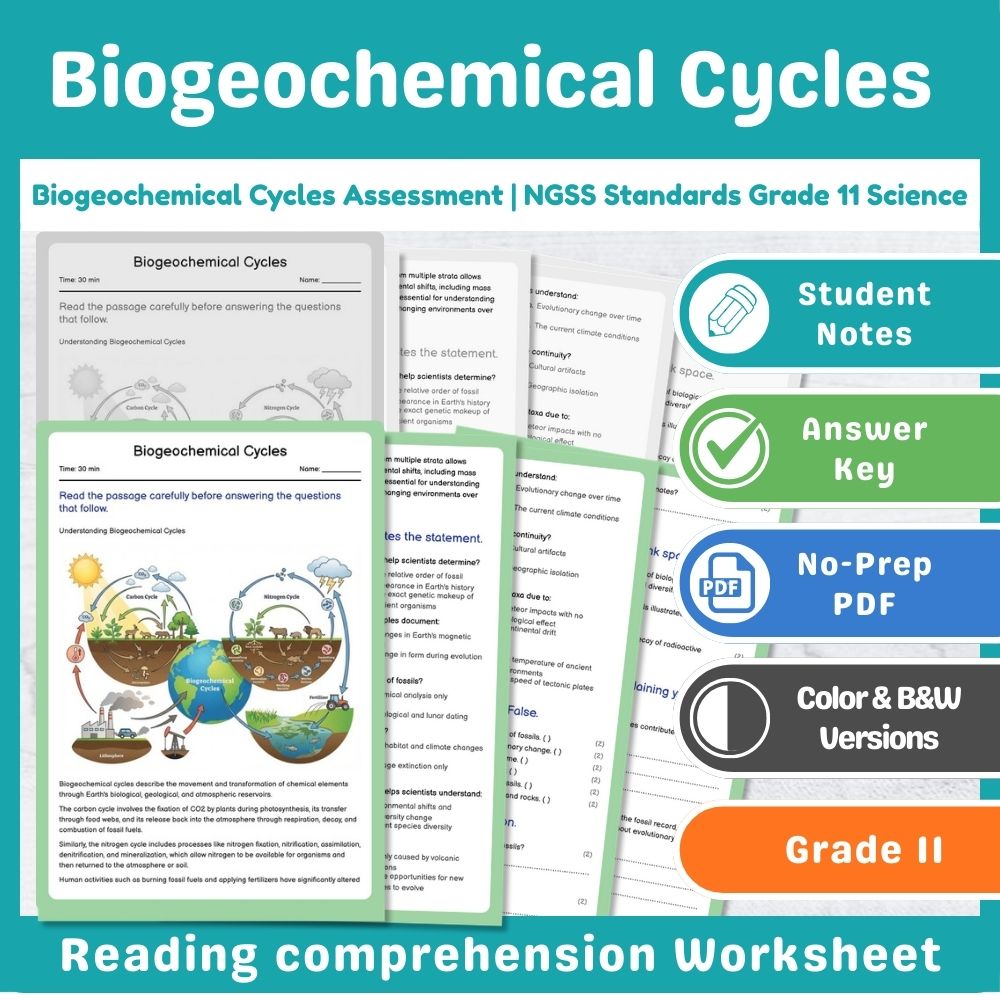
Biogeochemical Cycles Assessment | NGSS Standards Grade 11 Science
Created byPrism Point LearningLearning Objectives
- Understand the key processes involved in biogeochemical cycles such as carbon, nitrogen, phosphorus, and water.
- Identify the reservoirs and flow pathways of elements through biological, geological, and atmospheric systems.
- Explain human impacts like fossil fuel combustion and fertilizer use on nutrient pools and fluxes.
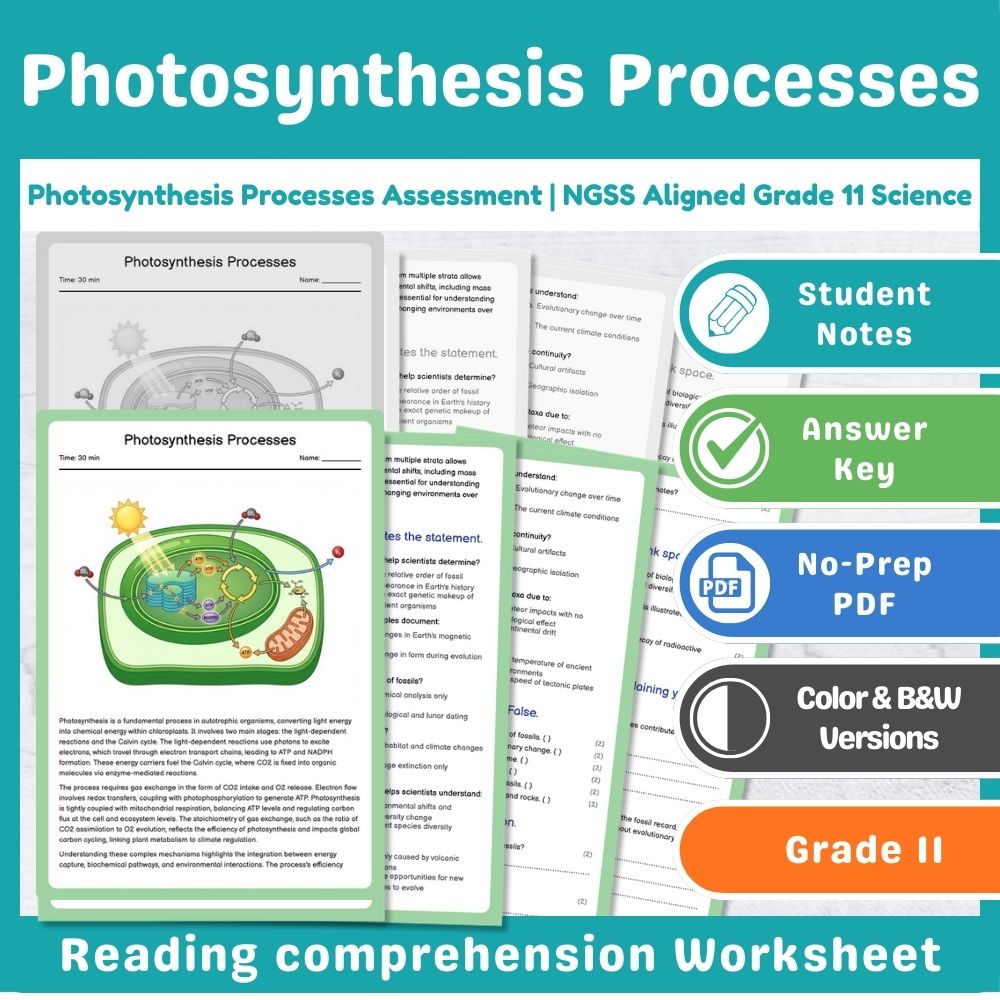
Photosynthesis Processes Assessment | NGSS Aligned Grade 11 Science
Created byPrism Point LearningLearning Objectives
- Explain the light-driven and biochemical stages of photosynthesis, including electron transport, photophosphorylation, and the Calvin cycle.
- Describe the integration of photosynthesis with mitochondrial respiration, focusing on gas exchange, ATP balance, and carbon flux.
- Analyze the stoichiometry of CO2 uptake and O2 release during photosynthesis and respiration.
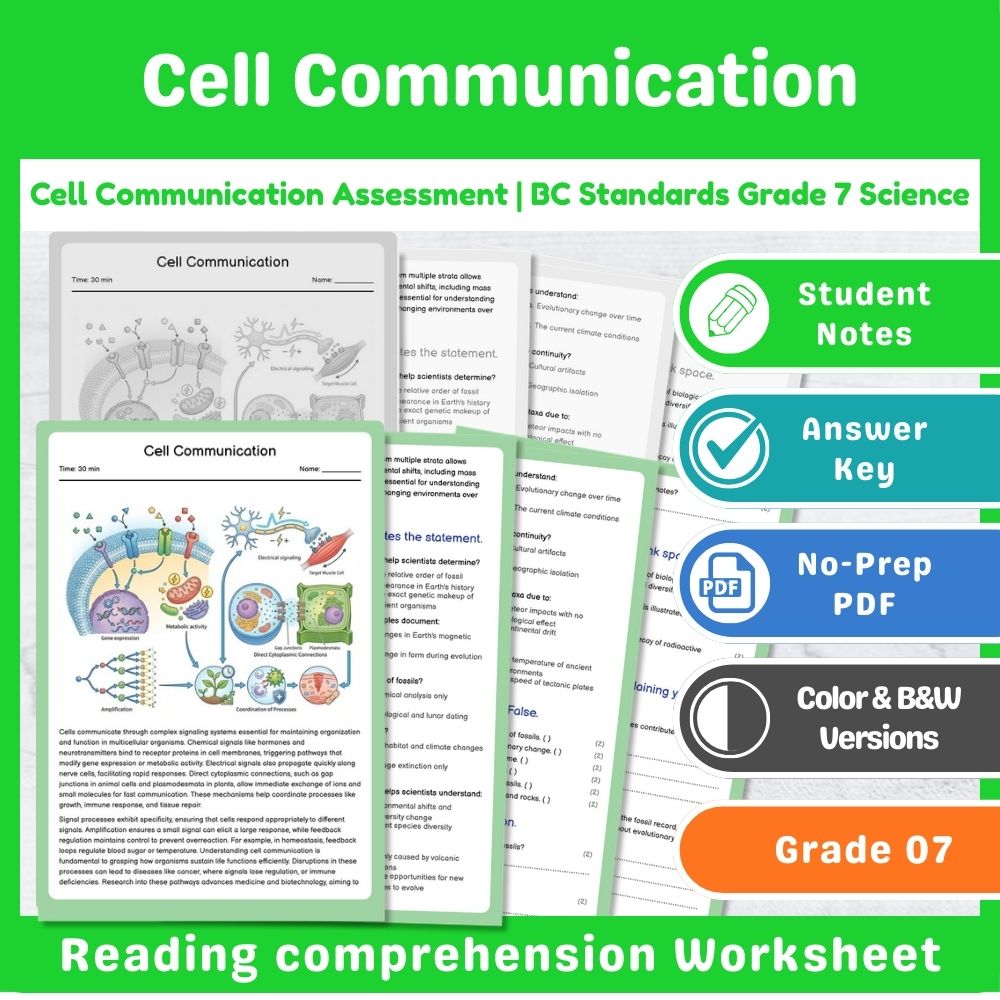
Cell Communication Assessment | BC Standards Grade 7 Science
Created byPrism Point LearningLearning Objectives
- Describe how cells communicate via chemical and electrical signals.
- Identify the roles of receptor proteins, gap junctions, and plasmodesmata in cell signaling.
- Explain how signal specificity, amplification, and feedback regulation control bodily processes.
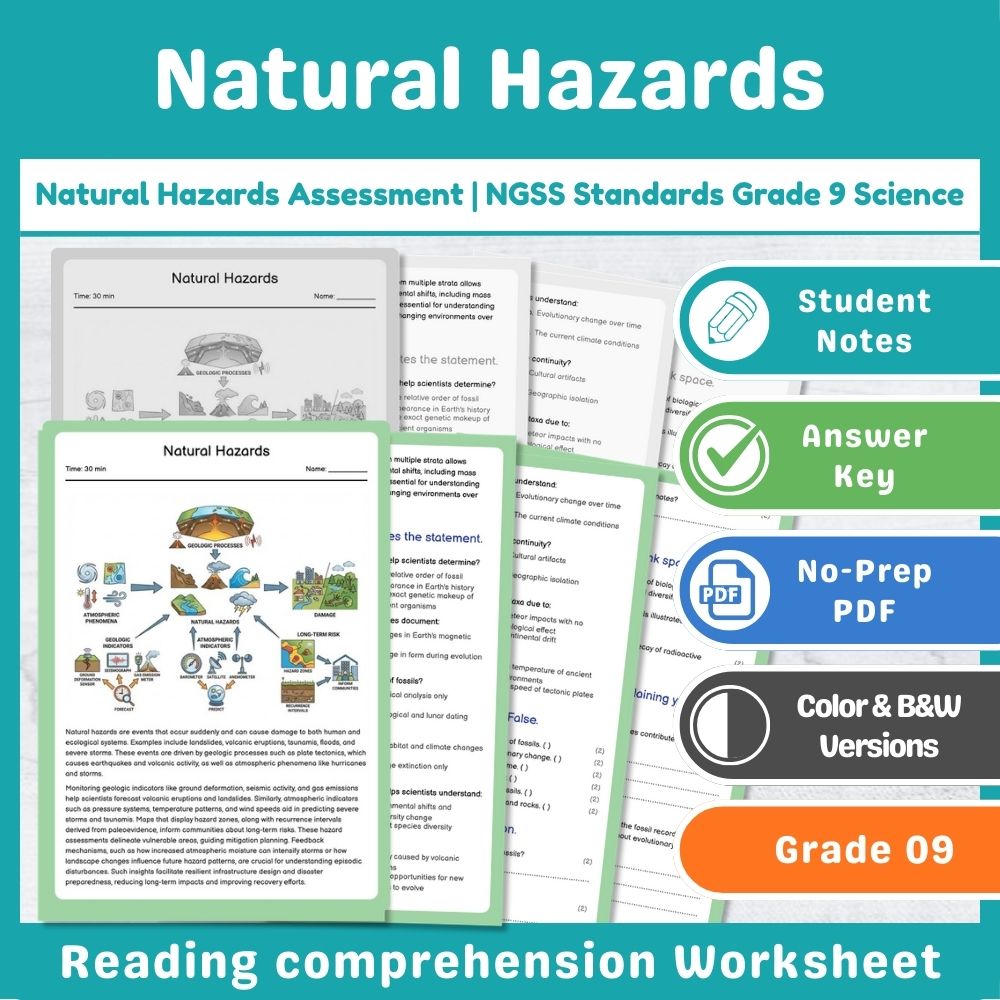
Natural Hazards Assessment | NGSS Standards Grade 9 Science
Created byPrism Point LearningLearning Objectives
- Describe the various types of natural hazards and their causes.
- Identify geologic and atmospheric indicators used to assess hazard risk.
- Interpret hazard maps and recurrence intervals to evaluate potential impacts.
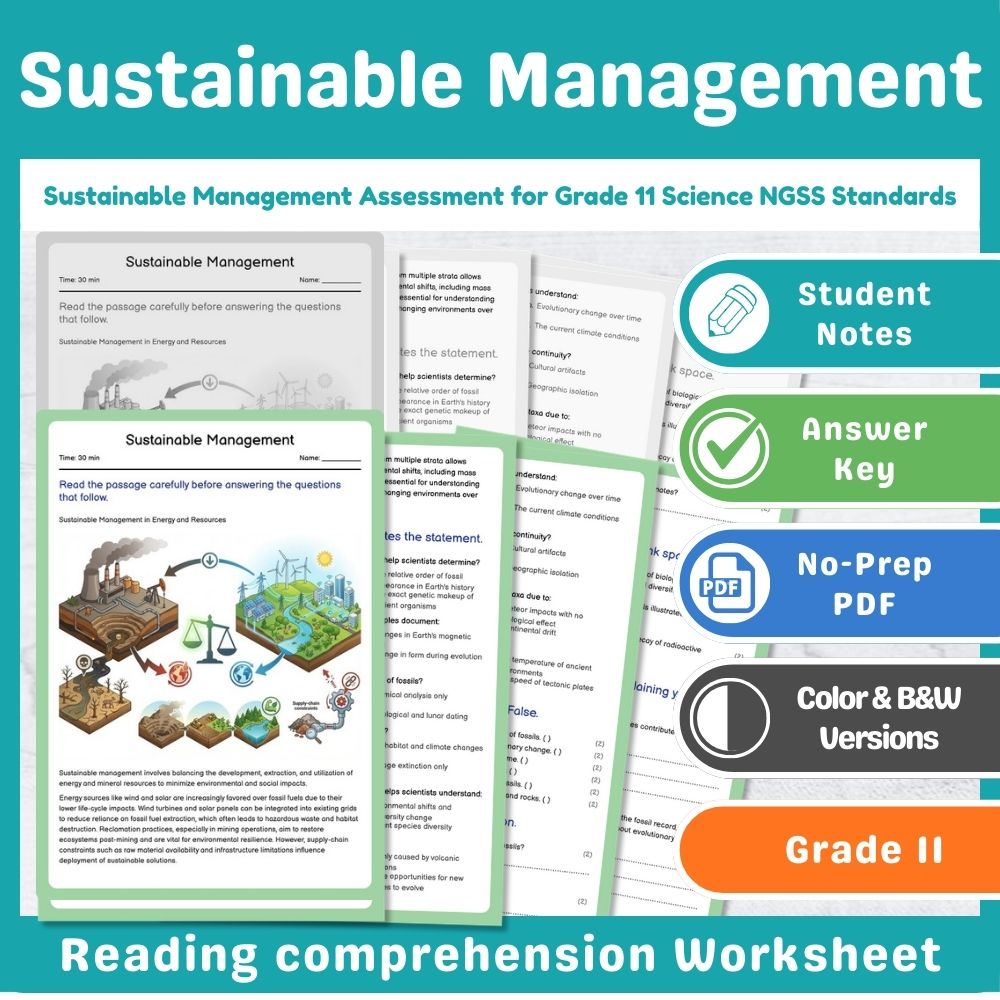
Sustainable Management Assessment for Grade 11 Science NGSS Standards
Created byPrism Point LearningLearning Objectives
- Compare technical and policy solutions for energy and mineral resource management considering life-cycle impacts.
- Evaluate reclamation practices and supply-chain constraints related to resource extraction and energy production.
- Analyze hazards and resilience metrics in ecological and social contexts for sustainable resource management.
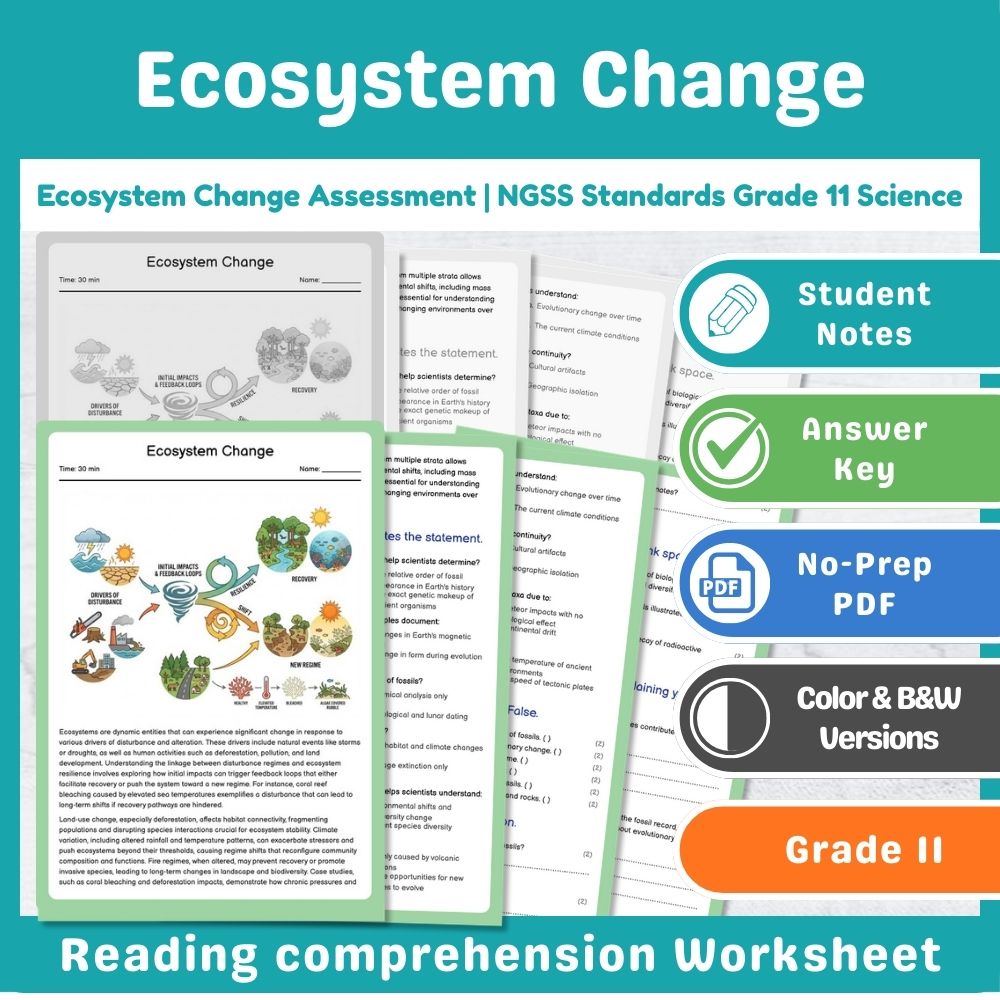
Ecosystem Change Assessment | NGSS Standards Grade 11 Science
Created byPrism Point LearningLearning Objectives
- Understand the drivers of ecosystem stability and how disturbance regimes influence change.
- Assess the impacts of land-use change, connectivity loss, and climate variation on ecosystems.
- Interpret case studies involving coral reef bleaching, deforestation, and fire regime alterations.

Mutation Impacts Assessment | Alberta Standards-Aligned Assessment Grade 12 Science
Created byPrism Point LearningLearning Objectives
- Understand the different types of genetic mutations and their mechanisms.
- Identify the effects mutations can have on gene functions and organism traits.
- Analyze how mutational outcomes influence agriculture, livestock, and pathogen variation.
Browse more categories
About Science Worksheets
Find Science worksheets spanning core skills, practice, and review. All 42,685 resources are instant PDF downloads for the classroom or home.
Every worksheet on MyTeachingSheets is created by independent teacher-authors and reviewed before publication. All resources download as printable PDFs for classroom, homework, or at-home practice, and many include answer keys. Preview any worksheet free before buying.