
Science Worksheets
45,233 subject resources
Life Cycle Diversity & Seasonal Timing Worksheets | Grade 3 Science
 Created byPrism Point Learning
Learning Objectives
- Compare how annuals, biennials, perennials, and woody plants differ in germination, flowering, seed set, and dormancy timing.
- Explain how seeds use dormancy and how seasonal cues help plants begin growth when conditions improve.
- Describe how seed banking and multi-year survival strategies help plant populations persist after unfavorable seasons.
Also included in: Plant Growth & Reproduction Lesson Bundle | Grade 3 Science | Ontario
Instant download

Measures of Central Tendency Worksheet | AP Science Grade 9 Practice
Learning Objectives
- Understand the differences between mean, median, and mode and their appropriate use cases.
- Explain how skewness, outliers, and multimodal distributions influence the choice of a measure of central tendency.
- Connect the selection of a central tendency to assumptions about data distribution and underlying processes.
Also included in: Grade 9 Science Lesson Group | AP Standards Practice Bundle
Instant download

Cell Organization Worksheet for Grade 11 Science | TEKS Practice
Created byPrism Point LearningLearning Objectives
- Explain hierarchical organization in multicellular organisms from cells to organ systems
- Describe how cell differentiation leads to specialized structures and functions
- Connect regulated gene expression, intercellular signaling, and the extracellular matrix to cell specialization
Also included in: Cell Structure & Function Lesson Bundle | Grade 11 Science | teks
Instant download

Classification Basics Worksheet | Grade 6 Science Review & Practice
Created byPrism Point LearningLearning Objectives
- Explain how observable characteristics help scientists group living things
- Use a simple dichotomous key to identify organisms
- Describe how hierarchical classification moves from broader categories to species
Also included in: Grade 6 Biodiversity & Adaptation Science Lesson Bundle Ontario
Instant download

Grade 9 Molecules and Lattices Worksheet | NGSS Practice & PDF
 Created byClear Sky Classroom
Learning Objectives
- Understand the differences between ionic lattices, covalent networks, and molecular solids.
- Analyze how particle arrangement affects properties like melting point and electrical conductivity.
- Interpret observations of material properties to infer lattice organization and interparticle forces.
Also included in: Grade 9 Reaction Stoichiometry and Energy Science Lesson Bundle (NGSS) +1 more
Instant download

Grade 8 Science Worksheet on Aerodynamic Drag | Standards-Aligned Practice
Learning Objectives
- Understand the concept of aerodynamic drag and its dependence on shape, area, and flow conditions.
- Identify real-world applications where drag influences design and efficiency.
- Explain how shape modifications can reduce drag and improve performance in vehicles and turbines.
Also included in: Grade 8 Forces & Motion Science Lesson Bundle – Alberta framework worksheets +1 more
Instant download

Evolution Basics Worksheet | Grade 10 Science Practice
Created byPrism Point LearningLearning Objectives
- Explain how evolution describes change in populations over generations through inherited traits
- Identify key evidence for evolution, including fossils, biogeography, and comparative anatomy and molecules
- Distinguish between common ancestry and adaptation as outcomes of descent with modification
Also included in: Grade 10 Evolution, Speciation & Biodiversity Lesson Bundle | BC Science +1 more
Instant download

Science Worksheet Evidence-Based Explanations Grade 8
Learning Objectives
- Explain how to connect a claim to evidence and a mechanism using scientific reasoning.
- Identify reasoning that supports evidence without replacing it with opinions.
- Compare alternative explanations using what evidence supports, rules out, and what new evidence would discriminate between ideas.
Also included in: Grade 8 Scientific Reasoning and CER Science Lesson Bundle | General +1 more
Instant download

Adaptation Tradeoffs Practice Worksheet | Grade 6 Science BC Standards
Created byPrism Point LearningLearning Objectives
- Explain how adaptation trade-offs happen when a trait increases one benefit but creates a cost
- Compare costs and benefits of traits to predict how they help organisms survive in specific environments
- Use examples to describe how trade-offs can shape where species live and how they reproduce
Also included in: Multicellular Systems & Functions Lesson Bundle | Grade 6 Science | BC +1 more
Instant download

Mechanisms of Gene Regulation Worksheet | Grade 11 Biology | TEKS
 Created byBRIGHT PATH RESOURCES
Learning Objectives
- Identify the main idea of a passage about gene regulation.
- Explain how promoters, enhancers, transcription factors, and chromatin affect gene expression.
- Describe how epigenetic marks can change gene expression without changing DNA sequence.
Instant download

Grade 11 Land Use Change Science Worksheet Ontario Curriculum
Created byClear Sky ClassroomLearning Objectives
- Characterize major anthropogenic land-use transformations (agriculture, urbanization, resource extraction, and infrastructure) and their ecological effects.
- Explain how edge effects and habitat fragmentation influence species movement, connectivity, and gene flow.
- Interpret how landscape metrics and corridor design can reduce cumulative impacts and support biodiversity conservation.
Instant download

Grade 8 Science | Climate Effects - Daily Reading Comprehension
 Created byCoral Reef Learning
Learning Objectives
- Understand how climate change influences temperature patterns
- Identify the impacts of temperature variations on ecosystems
- Describe the relationship between climate drivers and biodiversity
Instant download

Grade 9 Watershed Change Worksheet | Ontario Science Environmental Systems
Created byClear Sky ClassroomLearning Objectives
- Evaluate how urbanization, deforestation, agriculture, and infrastructure change watershed processes such as runoff, sediment load, nutrient fluxes, and groundwater recharge.
- Explain how watershed alterations affect channel morphology, flood frequency, and aquatic ecosystem health.
- Use measurement indicators (turbidity, discharge) to describe changes in watershed function.
Instant download
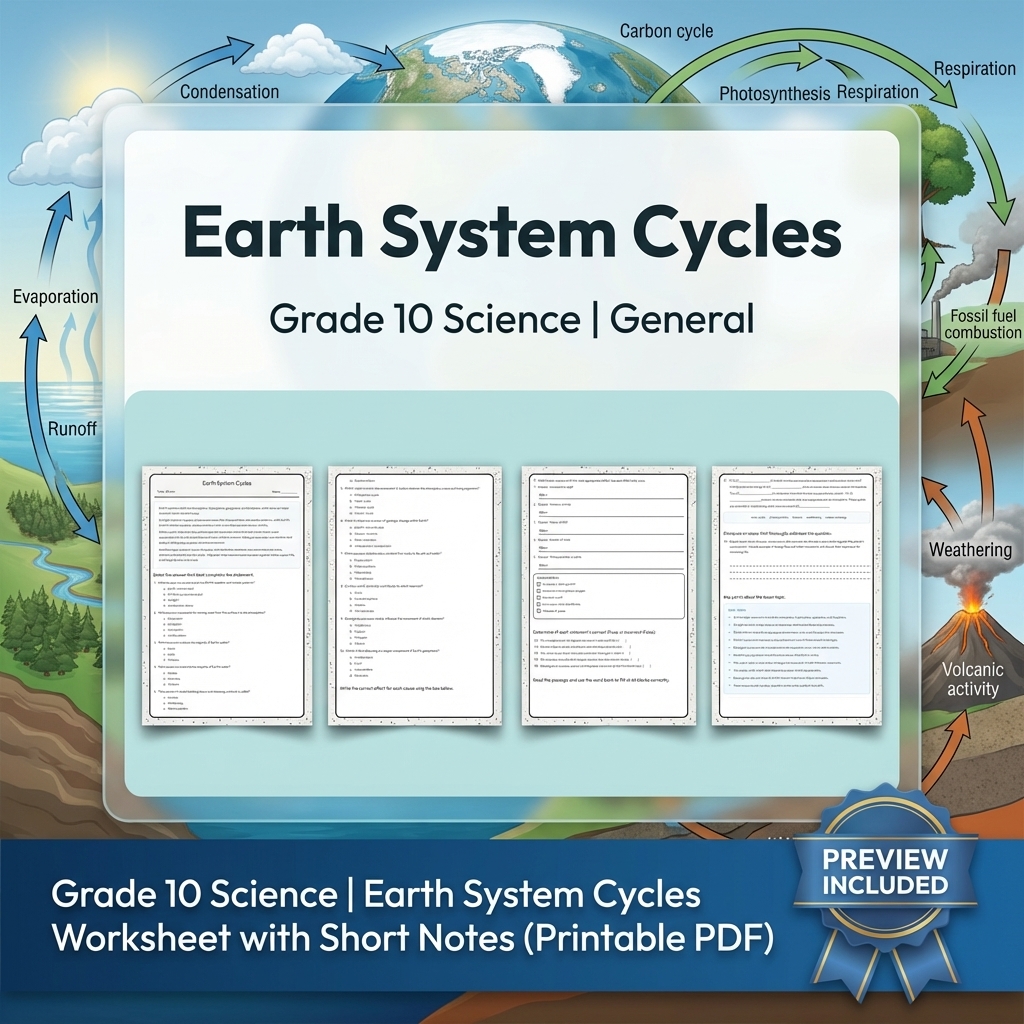
Grade 10 Science | Earth System Cycles Worksheet with Short Notes
 Created byMeadowlark Worksheets
Learning Objectives
- Describe the major reservoirs in Earth's system including atmosphere, hydrosphere, geosphere, and biosphere.
- Explain how energy from the Sun and Earth's internal heat drive various Earth cycles.
- Identify the processes involved in matter cycling through evaporation, precipitation, runoff, and chemical exchange.
Also included in: Grade 10 Earth Systems Science Lesson Bundle: General Framework Worksheets +1 more
Instant download

Grade 11 Science | Electron Arrangement & Polarity - Reading Comprehension
Created byCoral Reef LearningLearning Objectives
- Understand the concept of valence electrons in molecules.
- Explain how electron distribution influences molecular polarity.
- Differentiate between polar and nonpolar molecules using examples.
Also included in: Matter and Chemical Bonding Lesson Bundle – Grade 11 Science Alberta +1 more
Instant download

Science Evidence Explanations Worksheet | Standard-Aligned Grade 6 Science
Learning Objectives
- Explain the difference between a claim, evidence, and a scientific idea that provides the reasoning link.
- Describe evidence in terms of trends, ranges, or matches between expected and observed results.
- Evaluate competing explanations by comparing which one is better supported by the evidence.
Also included in: Grade 6 Scientific Investigation Science lesson bundle: General Framework +1 more
Instant download

Acceleration From Data Worksheet | Grade 9 Science Practice
Created byPrism Point LearningLearning Objectives
- Interpret speed-time and distance-time data to infer acceleration and its direction.
- Use changes in speed over equal time intervals to determine whether acceleration is roughly constant or changing.
- Explain how the shape or slope of data curves relates to acceleration.
Instant download
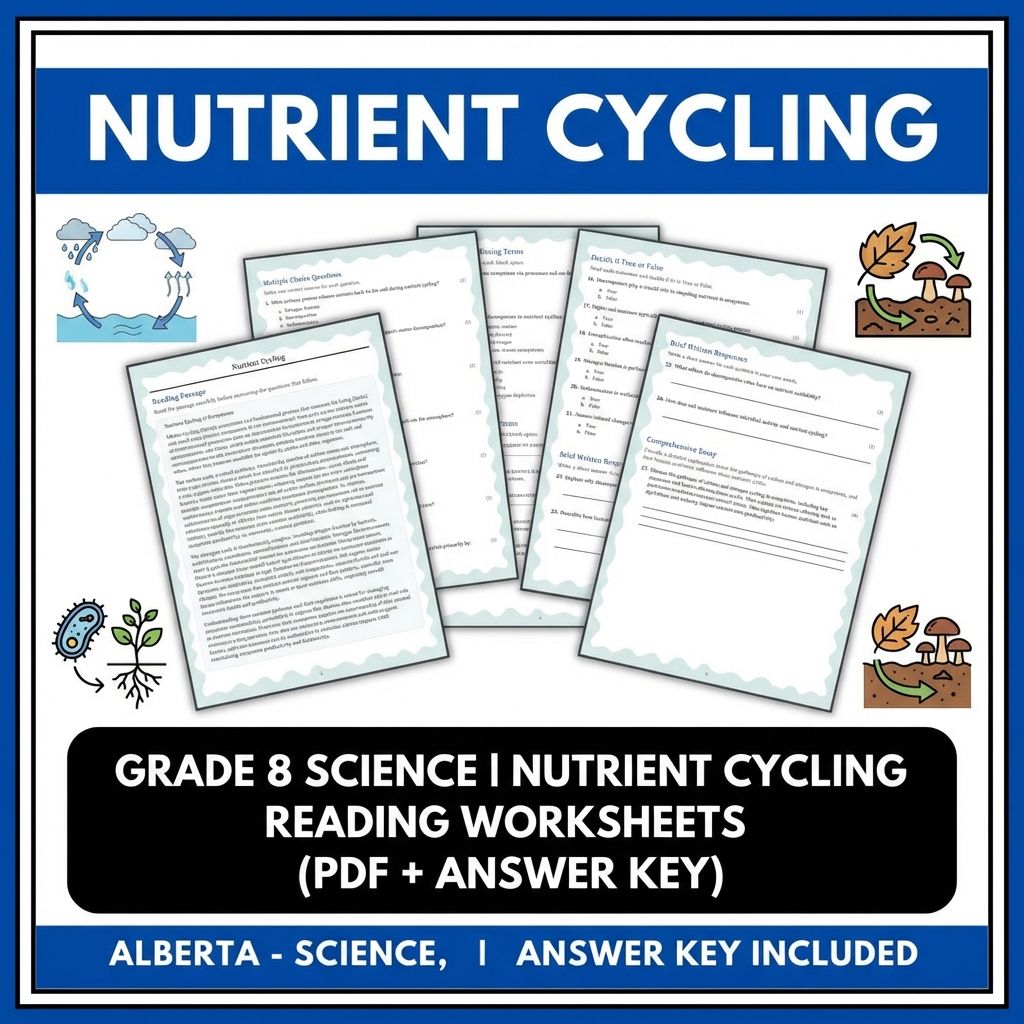
Grade 8 Science | Nutrient Cycling Reading Worksheets (PDF + Answer Key)
Learning Objectives
- Describe the processes involved in nutrient cycling within ecosystems.
- Explain how carbon and nitrogen pathways influence ecosystem productivity.
- Analyze the roles of decomposers and the impact of environmental factors on nutrient cycling.
Also included in: Grade 8 Science Bundle | Ecosystem Dynamics & Environmental Impact Worksheets +1 more
Instant download

Grade 3 Shadows and Transparency Worksheet | General Use Practice PDF
Created byClear Sky ClassroomLearning Objectives
- Explain how shadows form when objects block some light.
- Describe how opaque, translucent, and transparent materials affect light and visibility.
- Use observations about light to make and support simple science explanations.
Instant download

Insulator Behavior and Electrical Safety Worksheets Grade 6
Created byPrism Point LearningLearning Objectives
- Explain how bound electrons limit charge flow through insulators
- Compare bulk insulation with surface charge behavior
- Identify materials commonly used as electrical insulators
Also included in: Grade 6 Electricity Lesson Bundle | Ontario Science Framework
Instant download

Grade 7 Science | Structural Basics in Civil Engineering - Reading Comprehension
Created byCoral Reef LearningLearning Objectives
- Understand the importance of foundations in supporting structures
- Identify different types of structural loads such as compression, tension, and shear
- Recognize the roles of supports in ensuring stability of buildings
Also included in: Forces, Structures and Motion Lesson Bundle | Grade 7 Science Alberta +1 more
Instant download

Center Of Mass Practice Worksheet | Grade 11 Science | Ontario
Created byPrism Point LearningLearning Objectives
- Explain how the center of mass formalism simplifies motion in multi-particle systems
- Use the relationship between net external force and center-of-mass acceleration
- Apply momentum and impulse ideas to collision and recoil scenarios
Also included in: Grade 11 Science Review & Test Prep Lesson Bundle for Ontario
Instant download

Grade 11 Science | Electronegativity - Daily Reading Comprehension
Created byCoral Reef LearningLearning Objectives
- Understand the concept of electronegativity and its significance in chemical bonding.
- Identify how electronegativity varies across a period and down a group in the periodic table.
- Differentiate between polar and nonpolar covalent bonds based on electronegativity differences.
Also included in: Matter and Chemical Bonding Lesson Bundle – Grade 11 Science Alberta +1 more
Instant download

Bonding Types Worksheet for Grade 11 Science | Alberta Standards Practice
Learning Objectives
- Compare ionic, covalent, and metallic bonding based on electron transfer, sharing, and delocalization.
- Link each bonding type to characteristic structural motifs such as lattices, molecules, and electron seas.
- Relate bond types to Alberta phenomena like road salt, hydrocarbons in bitumen, and pipeline steels.
Instant download

Limiting Reactants Assessment | BC Standards Grade 9 Science Worksheet
Created byPrism Point LearningLearning Objectives
- Understand the concept of limiting reactants and how they determine maximum product formation.
- Calculate theoretical yield using molar ratios and molar masses.
- Differentiate between actual yield and theoretical yield and compute percent yield.
Instant download

Transport Dynamics Worksheet | Grade 11 Science Practice
Created byPrism Point LearningLearning Objectives
- Explain how electrochemical gradients and membrane properties control ion movement across cell membranes
- Compare active transport, secondary active transport, and coupled transporters in terms of energy use
- Describe how tonicity and selective permeability influence cell volume and signaling
Also included in: Cell Structure & Function Lesson Bundle | Grade 11 Science | teks
Instant download

Operational Measurements Worksheets for Grade 12 Science Practice
Created byBRIGHT PATH RESOURCESLearning Objectives
- Explain how operational definitions make measurements consistent
- Identify common sources of measurement error
- Describe how calibration and protocols reduce measurement error
Also included in: Grade 12 Science Scientific Evidence & Experimental Design Bundle +4 more
Instant download

Grade 6 Science | Sun, Earth, Moon - Daily Reading Comprehension
Created byCoral Reef LearningLearning Objectives
- Understand how the Sun influences the Earth and Moon.
- Identify the relative sizes and distances among the Sun, Earth, and Moon.
- Explain the gravitational interactions that produce stable orbits.
Instant download
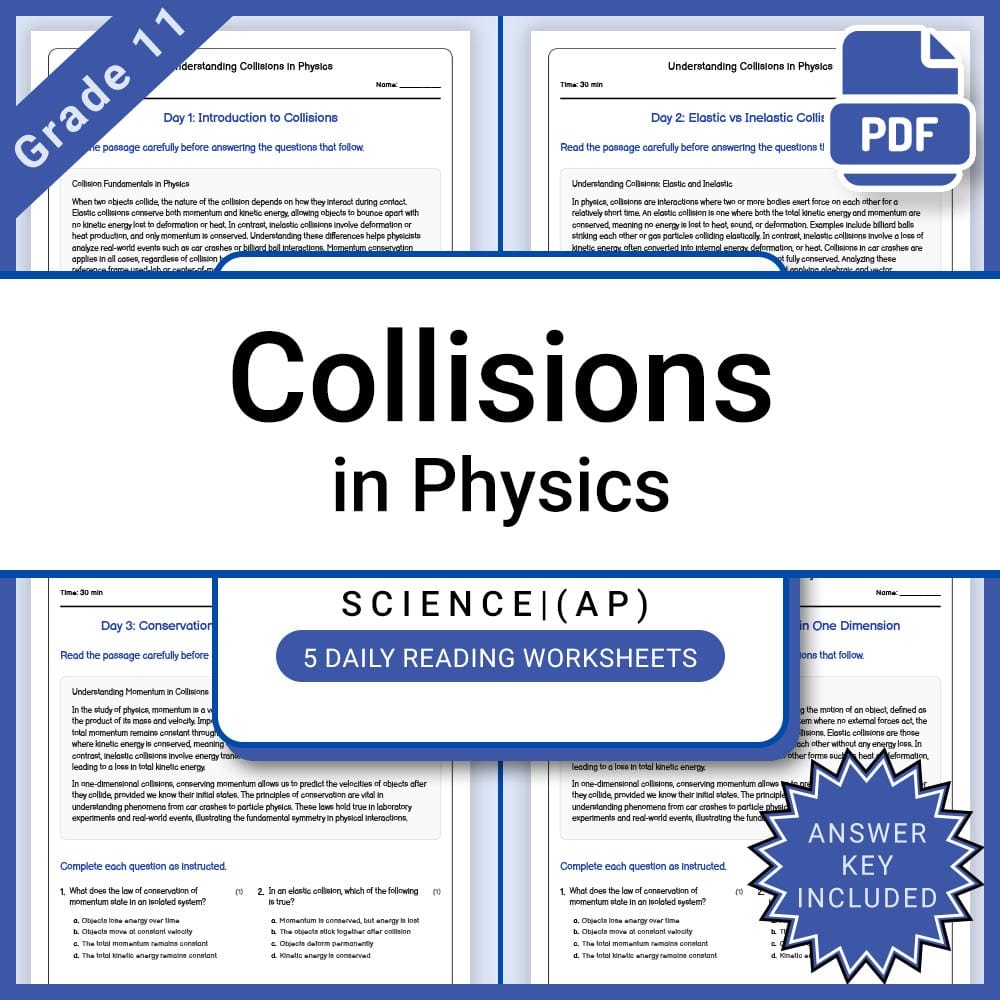
Grade 11 Science – Collisions Daily Reading Worksheet & Answer Key
Learning Objectives
- Define and differentiate between elastic and inelastic collisions.
- Explain conservation of momentum in one and two dimensions.
- Describe the concept of kinetic energy conservation and when it applies.
Also included in: AP Physics Principles Activities & Worksheets | Grade 11 Advanced Placement +1 more
Instant download

Grade 10 Science | Population Dynamics Worksheet | BC Aligned
 Created byLumora Learning
Learning Objectives
- Understand the principles of population genetics and how they relate to evolution.
- Identify the factors that influence changes in allele frequencies over time.
- Explain models such as Hardy-Weinberg equilibrium and what deviations indicate.
Also included in: Grade 10 Science | Evolution & Biodiversity Lesson Bundle | BC Framework
Instant download

Genetic Drift Worksheet | Grade 9 Science Activities
Created byPrism Point LearningLearning Objectives
- Explain how genetic drift changes allele frequencies through chance events, especially in small populations
- Identify how bottlenecks and founder effects can reduce genetic diversity and alter evolutionary outcomes
- Compare the roles of genetic drift, natural selection, and gene flow in shaping allele frequencies
Also included in: Grade 9 Evolution & Speciation Lesson Bundle | TEKS Science
Instant download

Grade 9 Balancing Chemical Equations Worksheet | Conservation of Mass
 Created byChalk and Compass
Learning Objectives
- Explain why chemical equations must be balanced to conserve atoms and mass
- Interpret balanced equations as particle-level ratios represented by coefficients
- Use reactant and product formulas to identify which substances are consumed and produced
Also included in: Matter and Chemical Change - Grade 9 Bundle +1 more
Instant download

Grade 7 Science Worksheet – Understanding Acceleration (PDF)
 Created byEvergreen Desk Education
Learning Objectives
- Explain what acceleration means in terms of how velocity changes over time
- Distinguish between positive and negative acceleration using the direction (sign) of velocity change
- Identify constant versus changing acceleration from patterns in velocity over time
Also included in: Grade 7 Energy Transfer & Motion Science Lesson Bundle Worksheets (General) +1 more
Instant download

Tree Anatomy Worksheet | Grade 6 Science Practice
Created byPrism Point LearningLearning Objectives
- Identify major parts of a tree (roots, trunk, branches, leaves, buds, and bark) and describe their functions.
- Explain how form–function relationships help trees survive in different habitats.
- Use tree anatomy vocabulary to answer science questions accurately.
Also included in: Trees and Forests Lesson Bundle | Grade 6 Science | Alberta Framework
Instant download

Grade 11 Science – Industrial Impacts of Water Chemistry | Reading Worksheet
 Created byBright Mind Resources
Learning Objectives
- Understand how dissolved ions influence water solubility and corrosion.
- Analyze the effects of temperature and organic contaminants on solubility equilibria.
- Interpret chemical data related to industrial water systems in Alberta.
Also included in: Grade 11 Solutions Science Daily Reading Worksheets lesson bundle | Alberta +1 more
Instant download

12th Grade Science | Ecosystem Interactions Reading Worksheet (PDF + Rubric)
Learning Objectives
- Understand trophic relationships and energy flow in ecosystems
- Identify key species and their influence on community structure
- Describe biogeochemical cycles and their role in ecosystem productivity
Instant download

Grade 12 Integrated Synthesis Science Worksheet | Alberta Ready
Created byEvergreen Desk EducationLearning Objectives
- Explain how biological nutrient cycles, chemical speciation, and physical transport interact to create emergent environmental outcomes.
- Use integrated cross-disciplinary reasoning to interpret complex regional phenomena in Alberta landscapes.
- Apply systems thinking to propose management-relevant predictions and trade-offs for real environmental cases.
Instant download

Conservation Principle Assessment | Alberta Grade 11 Science Standard
Created byPrism Point LearningLearning Objectives
- Understand the concept of the conservation principle in chemistry and environmental contexts.
- Identify how mass and element conservation are applied in chemical reactions and industrial processes.
- Connect the law of conservation to reaction stoichiometry, emissions monitoring, and regulatory reporting.
Also included in: Grade 11 Chemical Reactions & Stoichiometry Science Lesson Bundle – Alberta +1 more
Instant download

Water Chemistry and Industrial Impacts Worksheets – Grade 11 Science
 Created bySunny Desk Resources
Learning Objectives
- Explain how dissolved ions influence solubility equilibria in water systems
- Explain how temperature affects solubility equilibria in water
- Describe how changing water chemistry causes precipitation and corrosion
Also included in: Full Year Science • Grade 11 • Alberta
Instant download

Soil Formation and Soil Horizons Grade 4 Science Worksheets
Created byPrism Point LearningLearning Objectives
- Describe how soil forms from weathered parent rock, organic matter, climate, topography, and time.
- Explain how soil horizons can differ in color, texture, and fertility.
- Predict how climate, slope, and drainage affect soil depth and development.
Also included in: Grade 4 Weathering, Soil & Rock Cycle Lesson Bundle | Ontario Science
Instant download

Grade 11 Science | Understanding the Mole Concept - Daily Reading Comprehension
Created byCoral Reef LearningLearning Objectives
- Define what a mole is and explain Avogadro's number.
- Relate the mole concept to microscopic particles and macroscopic quantities.
- Perform basic calculations involving moles, mass, and number of particles.
Instant download

Phylogenetic Trees Worksheet | Grade 9 Science Practice
Created byPrism Point LearningLearning Objectives
- Explain how phylogenetic trees represent hypothesized evolutionary relationships using branching patterns and common ancestors.
- Differentiate monophyletic, paraphyletic, and polyphyletic groups and predict what each implies about sampling.
- Interpret rooted vs. unrooted trees and describe how characters (including synapomorphies) help determine tree topology.
Also included in: Grade 9 Evolution & Speciation Lesson Bundle | TEKS Science
Instant download

6th Grade Science | Modeling Systems Worksheet (Ontario) (PDF)
Created byEvergreen Desk EducationLearning Objectives
- Explain how scientists use physical, diagrammatic, and mathematical models to represent real systems.
- Identify model assumptions and define model boundaries to determine what a model can (and cannot) predict.
- Compare model predictions with observable outcomes to evaluate limitations and guide model refinement.
Also included in: Grade 6 Science Inquiry and Data Collection Lesson Bundle | Ontario +1 more
Instant download

Grade 6 Science – Eclipses & Tides Daily Reading Worksheet | Ontario Standards
Created byBright Mind ResourcesLearning Objectives
- Understand the geometric alignment during solar and lunar eclipses
- Distinguish between umbra and penumbra effects
- Explain how the positions of the Earth, Moon, and Sun cause eclipses
Also included in: Space Systems Grade 6 Science Daily Reading Worksheets Bundle | Ontario +1 more
Instant download

Renal Regulation Worksheet | Grade 11 Science Activities
Created byPrism Point LearningLearning Objectives
- Explain how nephrons regulate fluid volume, electrolyte balance, and acid-base status through filtration, reabsorption, secretion, and excretion.
- Describe how aldosterone and antidiuretic hormone (ADH) change sodium, potassium, and water handling to influence blood pressure and osmolarity.
- Interpret how renal clearance and physiological feedback systems (including the renin-angiotensin system) help maintain internal stability.
Also included in: Homeostasis & Body Systems Lesson Bundle | Grade 11 Science | Texas TEKS
Instant download

Grade 9 Stoichiometry Basics Worksheet | Practice & Assessment PDF
Created byClear Sky ClassroomLearning Objectives
- Explain how balanced chemical equations and mole ratios connect reactant amounts to product amounts.
- Use molar mass to convert between mass (grams) and amount of substance (moles).
- Apply conservation of mass reasoning to interpret why atoms are conserved in chemical reactions.
Instant download

Environmental Balances Worksheet | Grade 8 Science Activities
Created byPrism Point LearningLearning Objectives
- Explain how mass conservation helps interpret chemical and physical changes in environmental systems.
- Apply particle theory to describe how contamination and remediation can change over time.
- Classify environmental substances and processes (e.g., sources, sinks, mixtures, and phases) using system-level evidence.
Also included in: Grade 8 Matter & Chemical Change Lesson Bundle | Alberta Science
Instant download

Earth Sun Cycles Worksheet | Grade 7 Science Practice
Created byPrism Point LearningLearning Objectives
- Explain how Earth’s orbit and axial tilt affect seasons and the amount of solar energy received
- Describe how changes in day length connect to patterns in the calendar and timekeeping
- Use vocabulary such as axial tilt, hemisphere, and day length to interpret Earth–sun diagrams
Instant download
Browse more categories
About Science Worksheets
Find Science worksheets spanning core skills, practice, and review. All 45,233 resources are instant PDF downloads for the classroom or home.
Every worksheet on MyTeachingSheets is created by independent teacher-authors and reviewed before publication. All resources download as printable PDFs for classroom, homework, or at-home practice, and many include answer keys. Preview any worksheet free before buying.