
Grade 10 Science Worksheets
7,038 worksheets
Communicating Results Practice Worksheet | Grade 10 Science Ontario
 Created byPrism Point Learning
Learning Objectives
- Write clear, evidence-based research reports that connect data to claims using structured summaries.
- Explain how to present limitations and uncertainty so others can evaluate and reproduce results.
Also included in: Grade 10 Evidence-Based Science Data Analysis Lesson Bundle: Ontario
Instant download

Dynamic Equilibrium Worksheet | Science Practice for Grade 10 Alberta Standards
JCreated byJ.S SheetsLearning Objectives
- Understand the concept of chemical dynamic equilibrium and the factors affecting it.
- Interpret equilibrium constants and predict system shifts in response to external changes.
- Apply quantitative methods to analyze equilibrium expressions and predict net changes.
Also included in: Grade 10 Science Practice Worksheets: Alberta Science Full-Year Bundle
Instant download

Rock Cycle Processes Worksheet Grade 10 Earth Science NGSSS Activity
Created byPrism Point LearningLearning Objectives
- Explain how weathering and erosion break down rocks and move material through the rock cycle.
- Describe how heat and pressure can change existing rocks into metamorphic rocks without melting.
- Connect magma formation and cooling to the formation of igneous rocks in the rock cycle.
Also included in: Space & Earth Systems Lesson Bundle | Grade 10 Science | Florida NGSSS
Instant download

System Responses Worksheet for Grade 10 Science | Alberta Standards Practice
JCreated byJ.S SheetsLearning Objectives
- Understand how cellular processes, organ functions, and environmental signals coordinate to produce adaptive responses.
- Identify signaling networks and resource reallocation mechanisms involved in system responses.
- Analyze limits of plasticity and trade-offs between short-term compensation and long-term fitness.
Also included in: Grade 10 Cell Systems & Homeostasis Science Lesson Bundle | Alberta +1 more
Instant download

Energy Changes Worksheet | Advanced Placement Science Grade 10 Practice
JCreated byJ.S SheetsLearning Objectives
- Understand the difference between endothermic and exothermic reactions.
- Describe how bond breaking and formation affect reaction heat.
- Interpret basic potential energy diagrams for chemical reactions.
Also included in: Grade 10 Chemistry Lesson Bundle – AP Chemistry Concepts & Practice
Instant download
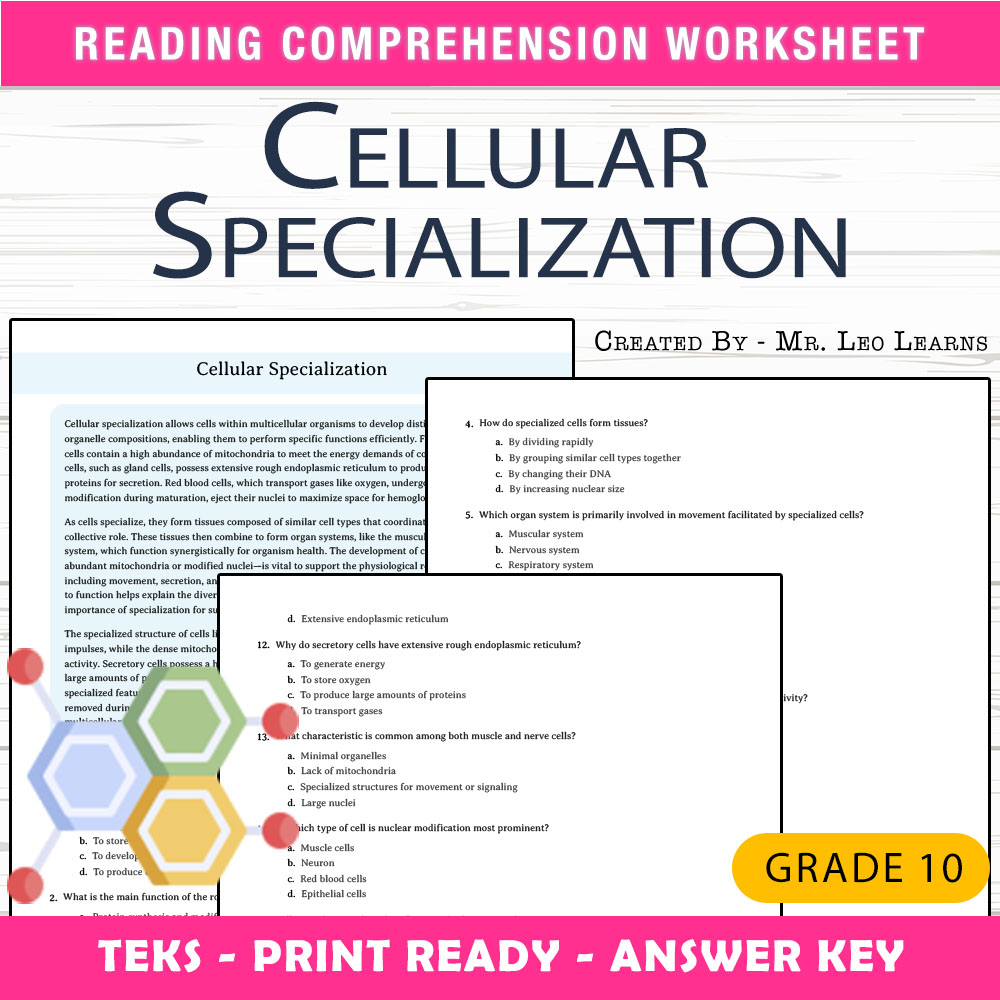
Grade 10 Science – Cellular Specialization Worksheet for Mastering Cell Functions
 Created byThe Resource Hub
Learning Objectives
- Understand how organelle abundance relates to cell function in specialized cells.
- Explain the process by which cells develop distinct structures to perform specific roles.
- Connect subcellular features to physiological activities like contraction, secretion, and gas transport.
Also included in: Grade 10 Science Cell Biology Unit | Cell Structures & Functions Worksheet Pack +1 more
Instant download
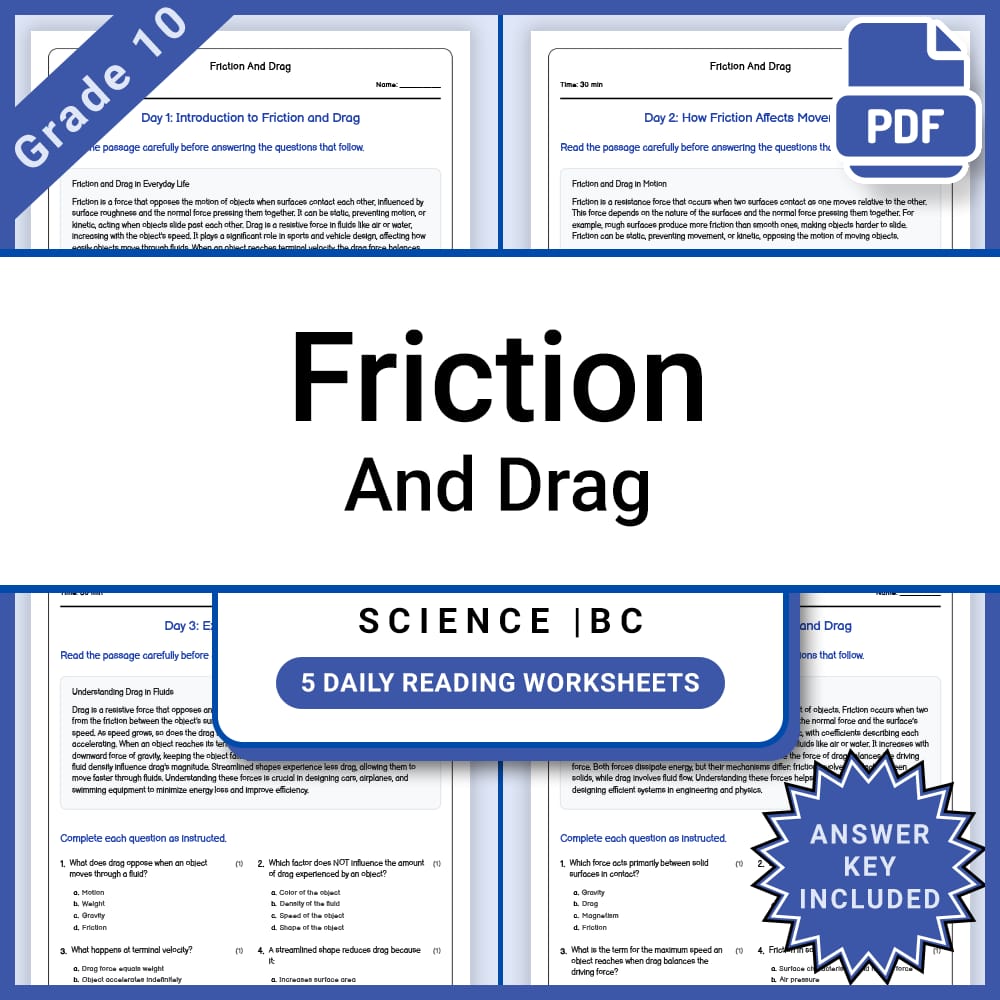
Grade 10 Science – Friction and Drag Daily Reading Worksheet with Answer Key
JCreated byJ.S SheetsLearning Objectives
- Understand the differences between friction and drag forces.
- Identify how friction depends on surfaces and normal force.
- Explain how drag acts in fluids and increases with speed.
Also included in: Grade 10 Science Lesson Group Bundle – Physics and Fields +1 more
Instant download
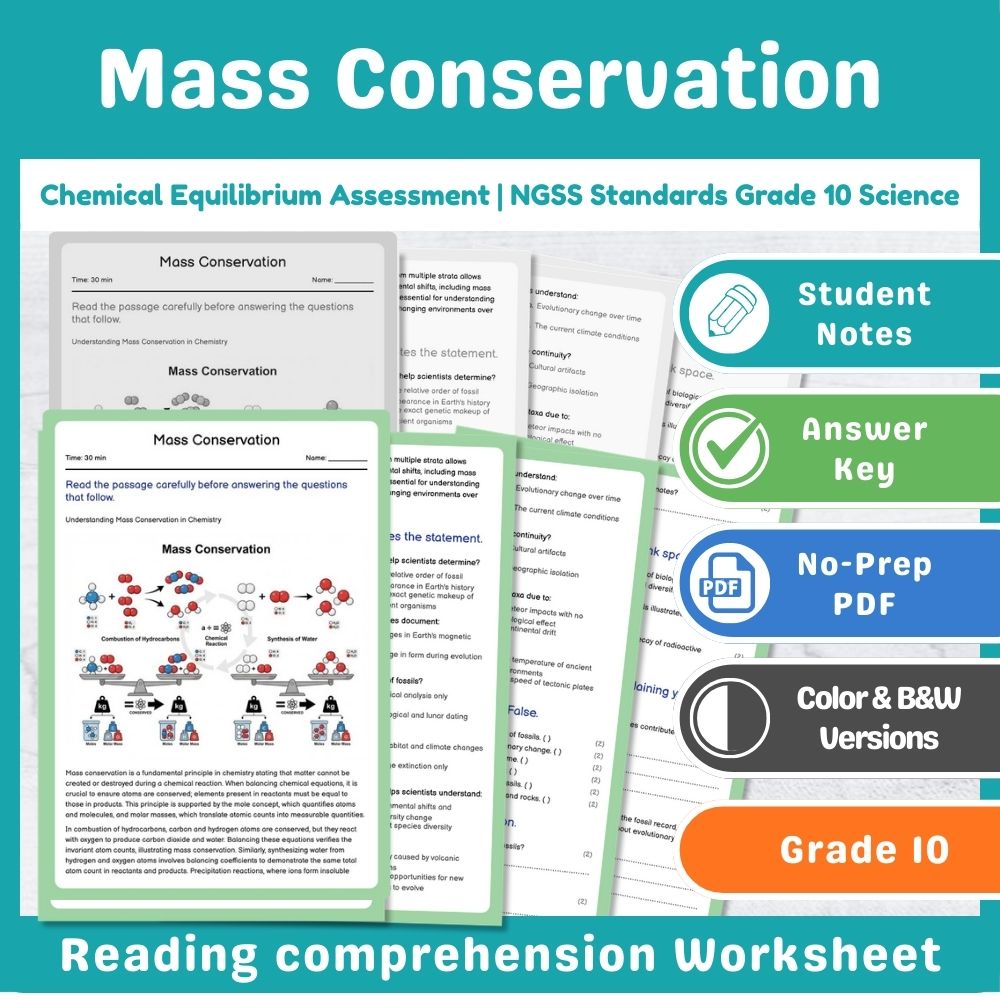
Mass Conservation Assessment for Grade 10 Science NGSS Standards
Created byPrism Point LearningLearning Objectives
- Understand the concept of atomic and mass conservation during chemical reactions.
- Apply balancing techniques to demonstrate atom count invariance across reactions.
- Utilize quantitative representations like mole concepts and molar masses to verify mass invariance.
Instant download
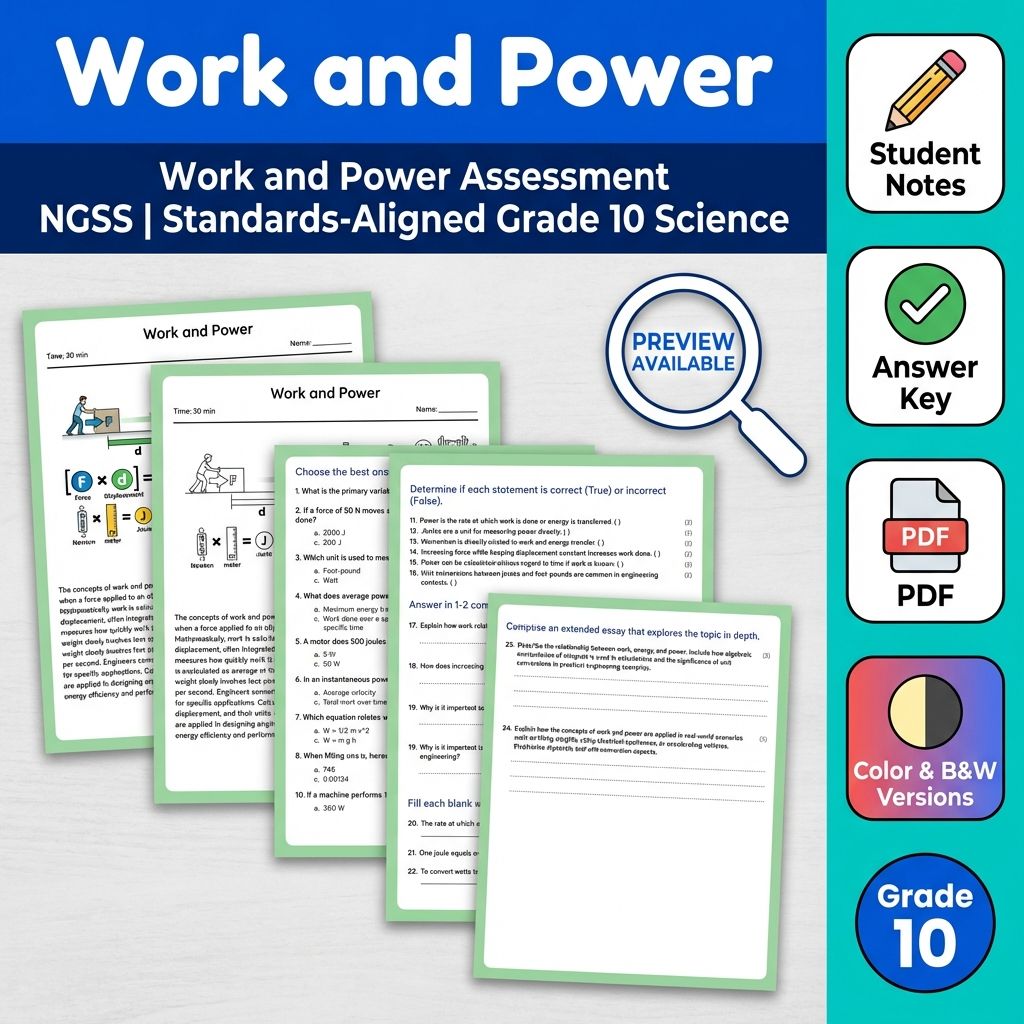
Work and Power Assessment NGSS | Standards-Aligned Grade 10 Science
Created byPrism Point LearningLearning Objectives
- Explain the relationship between force, displacement, and energy using the work–energy theorem.
- Calculate work and power in various contexts, including lifting weights and vehicle acceleration.
- Manipulate work integrals algebraically and convert units between joules, watts, and engineering units.
Also included in: Grade 10 Science | Work & Power NGSS Assessment Mini Bundle – Printable
Instant download
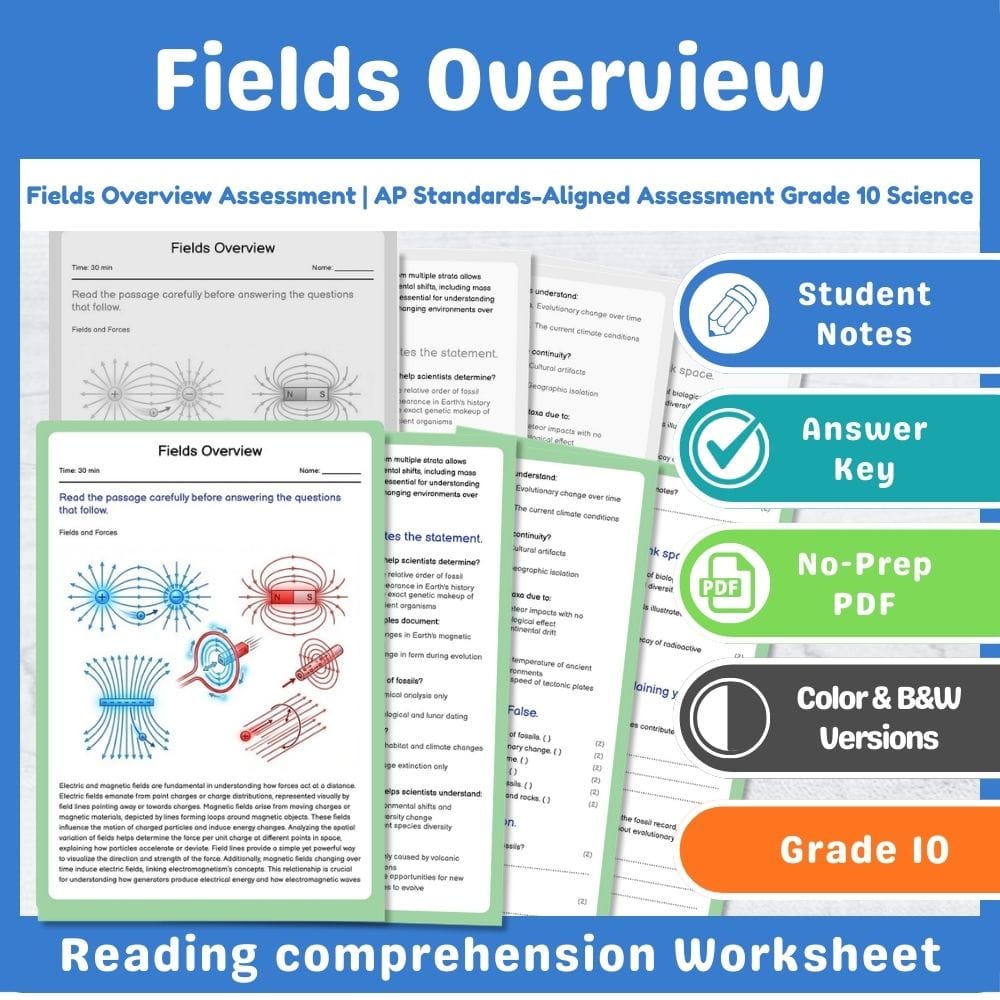
Fields Overview Assessment | AP Standards-Aligned Assessment Grade 10 Science
Created byPrism Point LearningLearning Objectives
- Understand the basic concepts of electric and magnetic fields and their representations.
- Describe how fields influence force on charges and potential energy.
- Relate field concepts to forces, motion, and electrical effects in circuits.
Also included in: Lesson Grade 10 Science Assessment Bundle | AP Standards-Aligned
Instant download
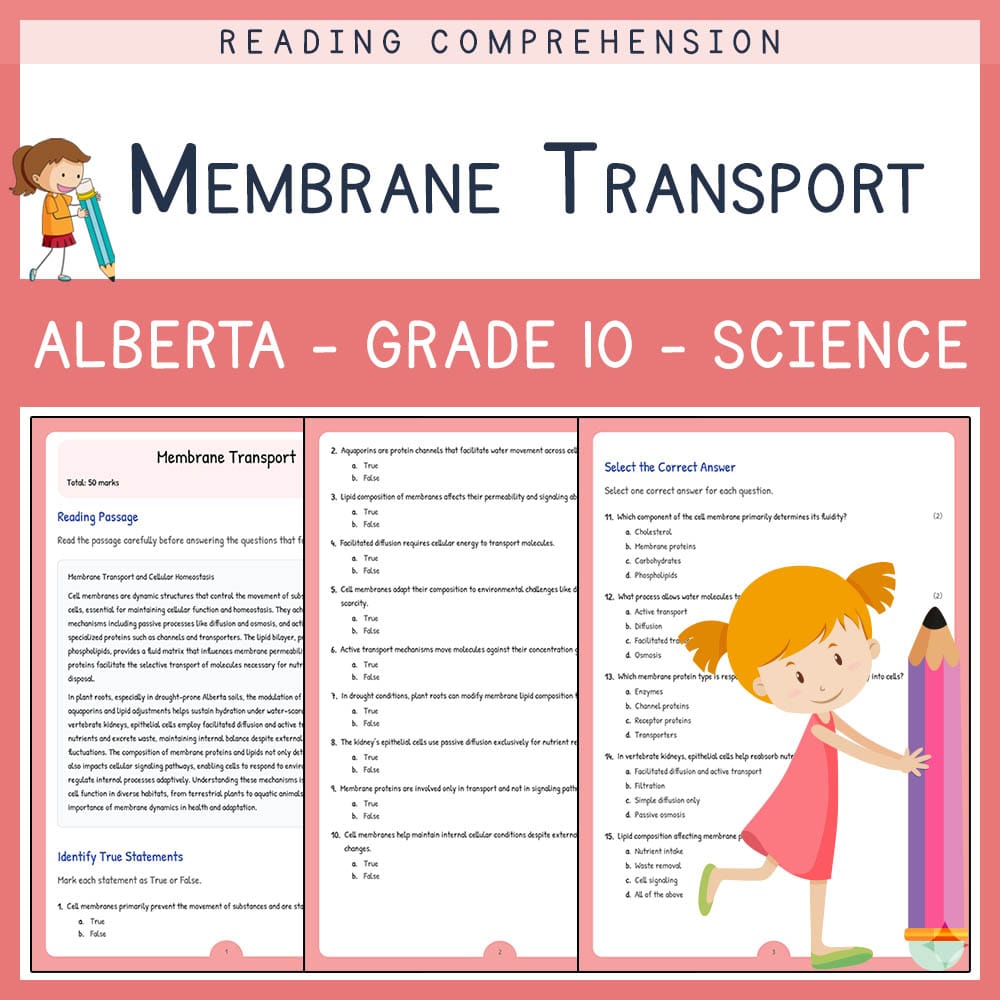
Grade 10 Science | Membrane Transport Worksheet | Alberta Standards
 Created byLumora Learning
Learning Objectives
- Understand the mechanisms of membrane transport such as diffusion, osmosis, and facilitated transport.
- Explain how membrane proteins and lipid composition influence permeability and cellular signaling.
- Connect membrane transport processes to cellular homeostasis, nutrient uptake, and waste removal in different habitats.
Also included in: Grade 10 Science | Cells and Systems Custom Bundle Worksheets | Alberta
Instant download

Grade 10 Science Worksheet | Solar Context Standards-Aligned Practice
JCreated byJ.S SheetsLearning Objectives
- Understand how the Sun's position and orbital geometry influence Earth's seasons and daily energy input.
- Describe the gravitational interactions among Earth, Moon, and Sun and their effects on planetary motions.
- Explain the impact of solar irradiance and solar angles on regional ecosystems such as prairie and alpine environments.
Also included in: Grade 10 Earth Systems & Climate Science Lesson Bundle – Alberta Framework +1 more
Instant download

Genetics and Inheritance Worksheets: Alleles & Genotypes Grade 10
 Created byBRIGHT PATH RESOURCES
Learning Objectives
- Explain how DNA and chromosomes carry genetic information
- Distinguish genotype from phenotype in inherited traits
- Describe how dominant and recessive alleles affect traits
Also included in: Grade 10 Life Science Worksheets Bundle | Evolution & Genetics +4 more
Instant download
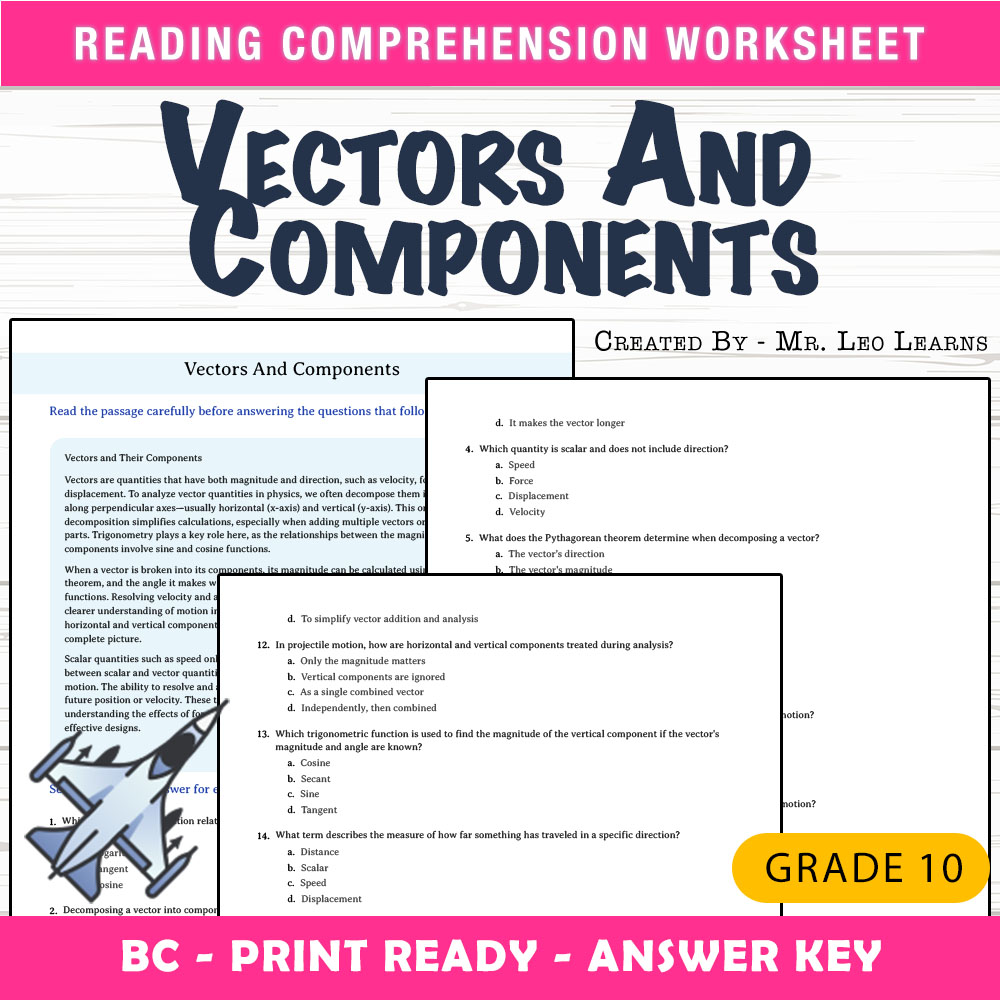
Grade 10 Science — Worksheet MCQ Paper for Mastering Vectors and Components
Created byThe Resource HubLearning Objectives
- Understand how to decompose a vector into perpendicular components along axes.
- Apply trigonometric functions to relate vector components to overall magnitude and direction.
- Solve problems involving two-dimensional motion by resolving velocity and acceleration into components.
Also included in: Grade 10 Science | Forces, Motion & Fields UNIT Worksheet Bundle +1 more
Instant download

Grade 10 Science | Energy Conservation Worksheet | AP Aligned
Created byLumora LearningLearning Objectives
- Develop potential energy models for gravitational and elastic systems.
- Understand energy transfer, conversions, and the influence of nonconservative forces.
- Explain power as a rate of energy transfer using algebraic and graphical methods.
Instant download

Grade 10 Science – Laboratory Protocols | Daily Reading Worksheet
 Created byBright Mind Resources
Learning Objectives
- Understand the importance of proper personal protective equipment (PPE) in laboratory settings.
- Identify appropriate safety attire and gear for various laboratory activities.
- Learn standard procedures for handling laboratory reagents, waste, and emergencies.
Also included in: Inquiry Grade 10 Science Daily Reading Worksheets Lesson Bundle | Ontario +1 more
Instant download
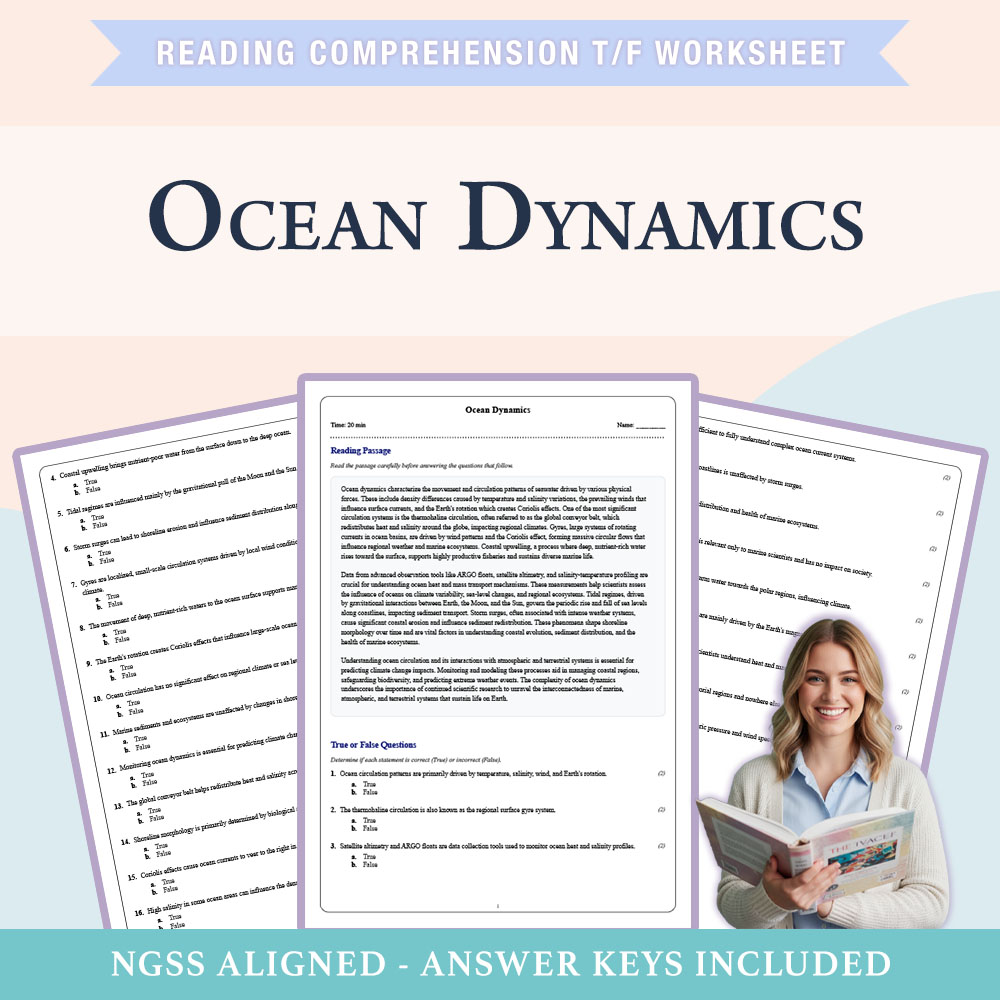
10th Grade Science | Ocean Dynamics Worksheet (PDF +Answer Key)
 Created byCopper Leaf Classroom
Learning Objectives
- Understand the main circulation patterns driven by density contrasts, wind, and Earth's rotation
- Identify methods used to observe and analyze ocean currents and their effects on climate
- Explain how tidal regimes and storm surges influence coastal sediment transport and shoreline morphology
Also included in: Grade 10 Science | Earth Systems & Climate Change Bundle (PDF + Answer Key) +1 more
Instant download
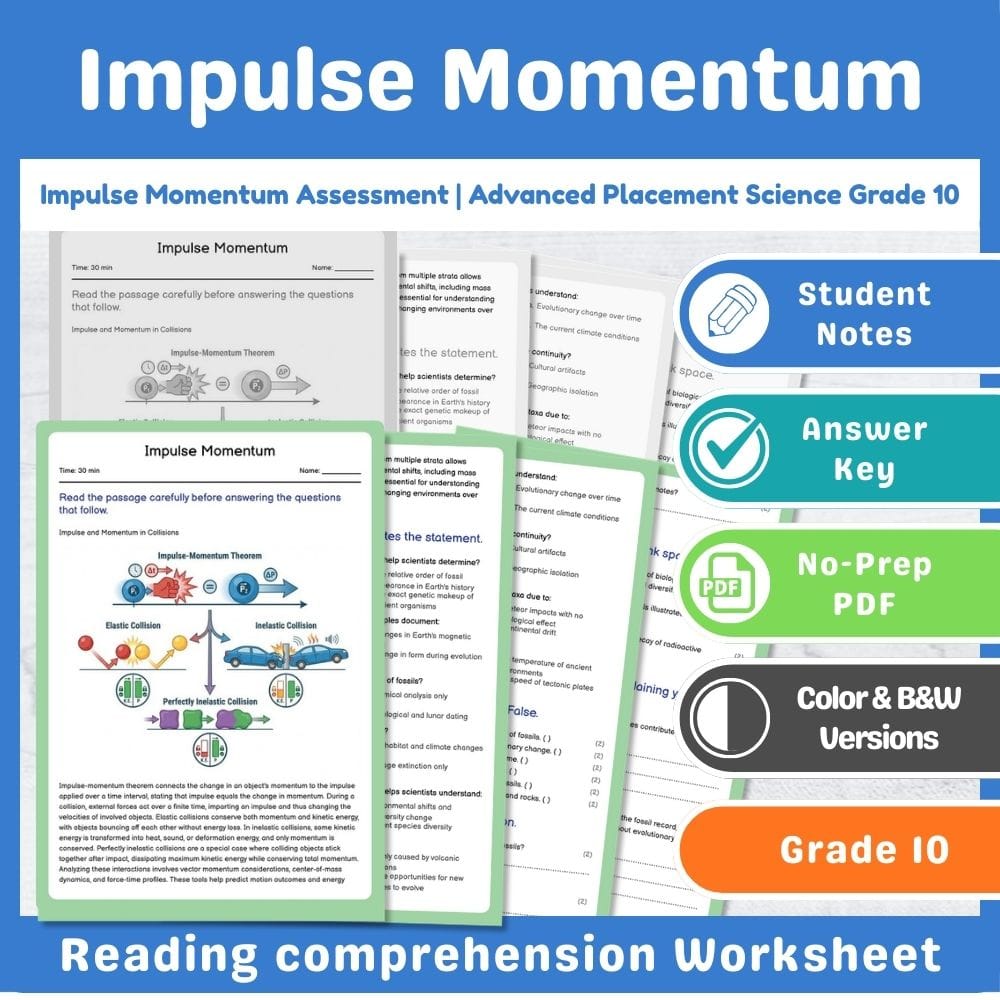
Impulse Momentum Assessment | Advanced Placement Science Grade 10
Created byPrism Point LearningLearning Objectives
- Explain the relationship between impulse and change in momentum in collision events.
- Differentiate between elastic, inelastic, and perfectly inelastic collisions based on energy and momentum conservation.
- Describe how force-time profiles relate to changes in object momentum during transient events.
Also included in: Lesson Grade 10 Science Assessment Bundle | AP Standards-Aligned
Instant download
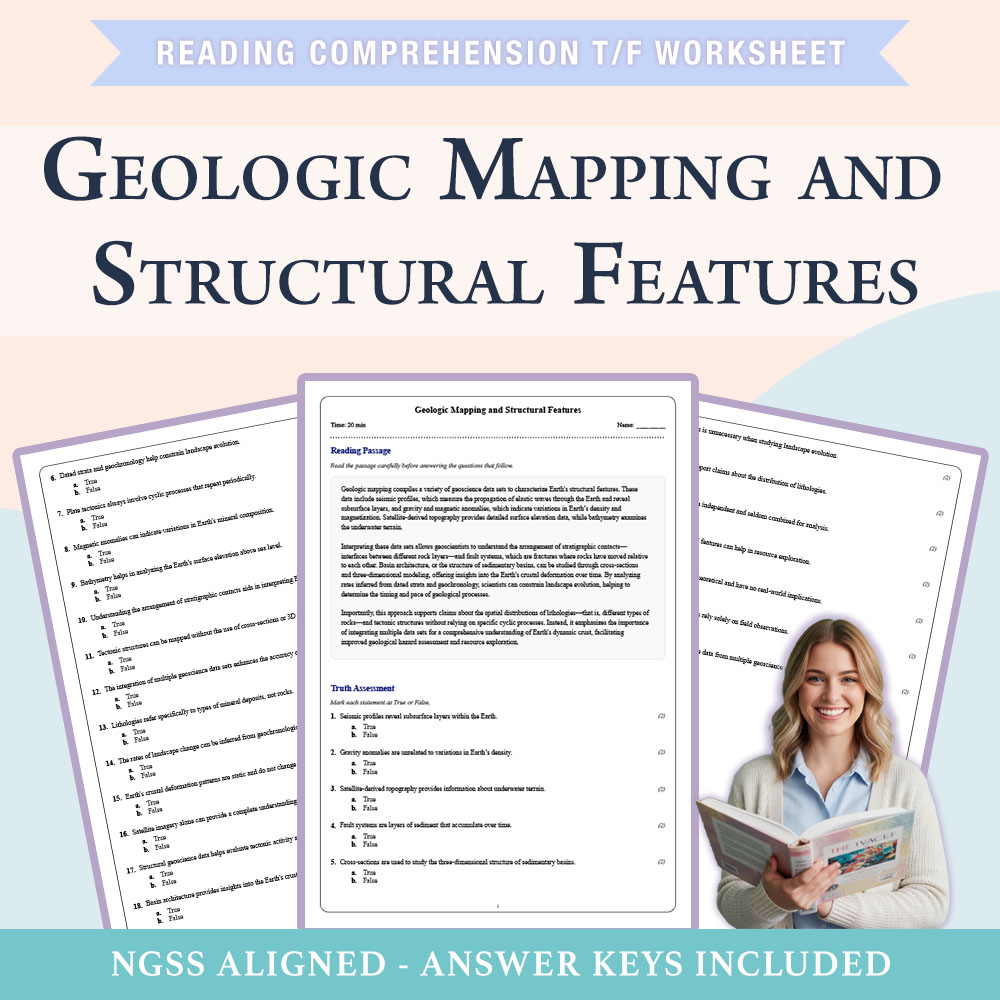
Grade 10 Science | Geologic Mapping and Structural Features (PDF +Answer Key)
Created byCopper Leaf ClassroomLearning Objectives
- Understand the purpose and methods involved in geologic mapping.
- Identify key concepts related to Earth's structural features and their interpretation.
- Evaluate statements about geologic mapping to determine their factual accuracy.
Also included in: Grade 10 Science | Earth Systems & Climate Change Bundle (PDF + Answer Key) +1 more
Instant download
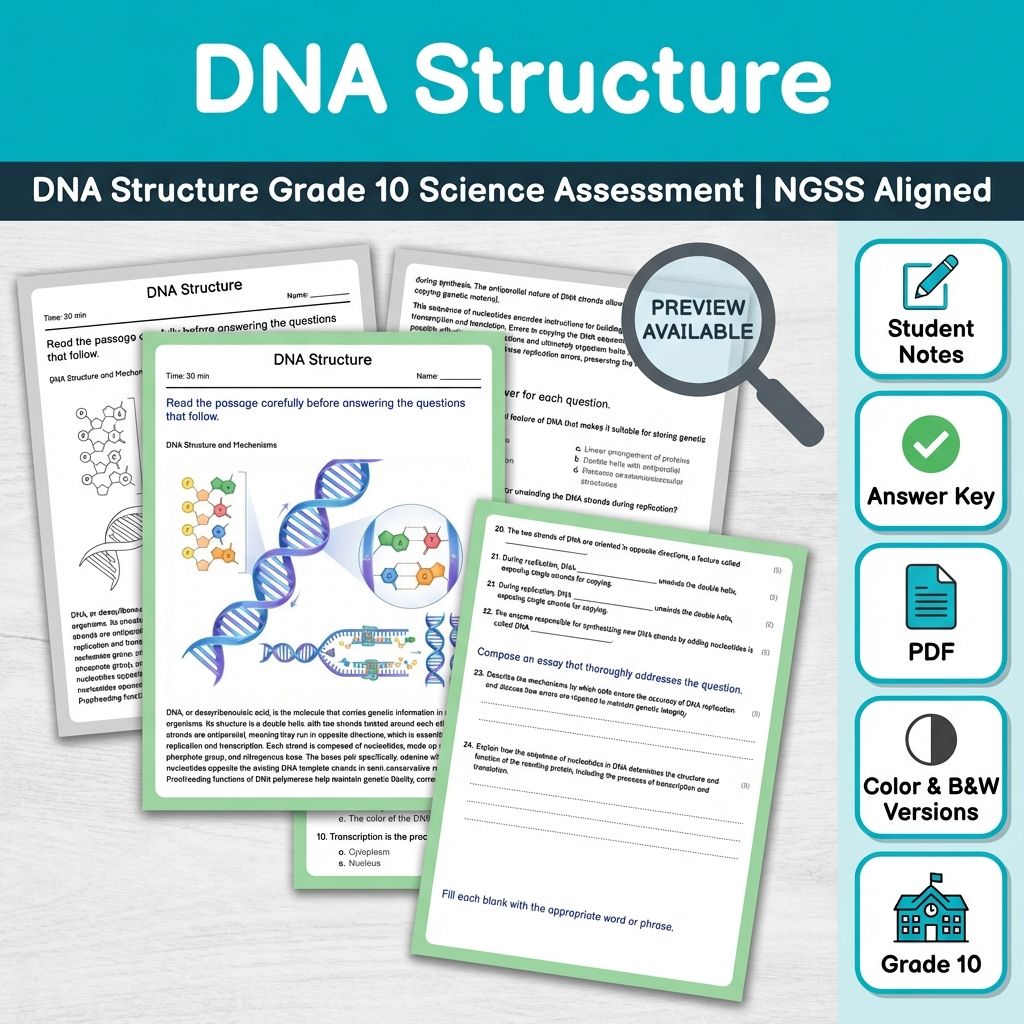
DNA Structure Grade 10 Science Assessment | NGSS Aligned
Created byPrism Point LearningLearning Objectives
- Describe the structural features of DNA, including double helix geometry, complementary base pairing, and antiparallel strands.
- Explain mechanisms of DNA replication, including the roles of DNA polymerase and helicase, and mechanisms that ensure fidelity such as proofreading and repair.
- Connect DNA sequence information to processes of transcription and translation, illustrating how nucleotide sequences encode polypeptides and how replication errors may impact gene expression.
Also included in: Grade 10 Science | DNA, Mendelian Patterns & Mutation NGSS Assessment
Instant download

Science Design Fundamentals Variables & Testable Questions Grade 10 Ontario
 Created byChalk and Compass
Learning Objectives
- Write a testable research question with clear criteria for measurement and reproducibility.
- Identify independent, dependent, and controlled variables in an investigation plan.
- Use operational definitions to make variables measurable and consistent across trials.
Also included in: Grade 10 Science Variables & Control Data Analysis Lesson Bundle | Ontario +1 more
Instant download

Grade 10 Science Worksheet – Climate Feedbacks with Answer Key (PDF)
 Created byEvergreen Desk Education
Learning Objectives
- Explain how greenhouse gases can amplify warming through water-vapor feedbacks
- Describe the ice-albedo and cloud feedbacks and why their effects can differ
- Evaluate how aerosols influence radiation and can affect temperature and precipitation patterns
Also included in: Grade 10 Weather & Climate Science Lesson Bundle - General Framework +1 more
Instant download

Grade 10 Friction and Resistance Worksheet | Ontario Physics Forces
Created byChalk and CompassLearning Objectives
- Differentiate static friction from kinetic friction and explain how they relate to motion starting versus sliding.
- Use the ideas of coefficients of friction, normal force, and surface properties to predict friction changes.
- Describe how air resistance and viscous drag depend on velocity and connect this to terminal speed.
Also included in: Grade 10 Science Motion, Forces & Momentum Lesson Bundle – Ontario Framework +1 more
Instant download
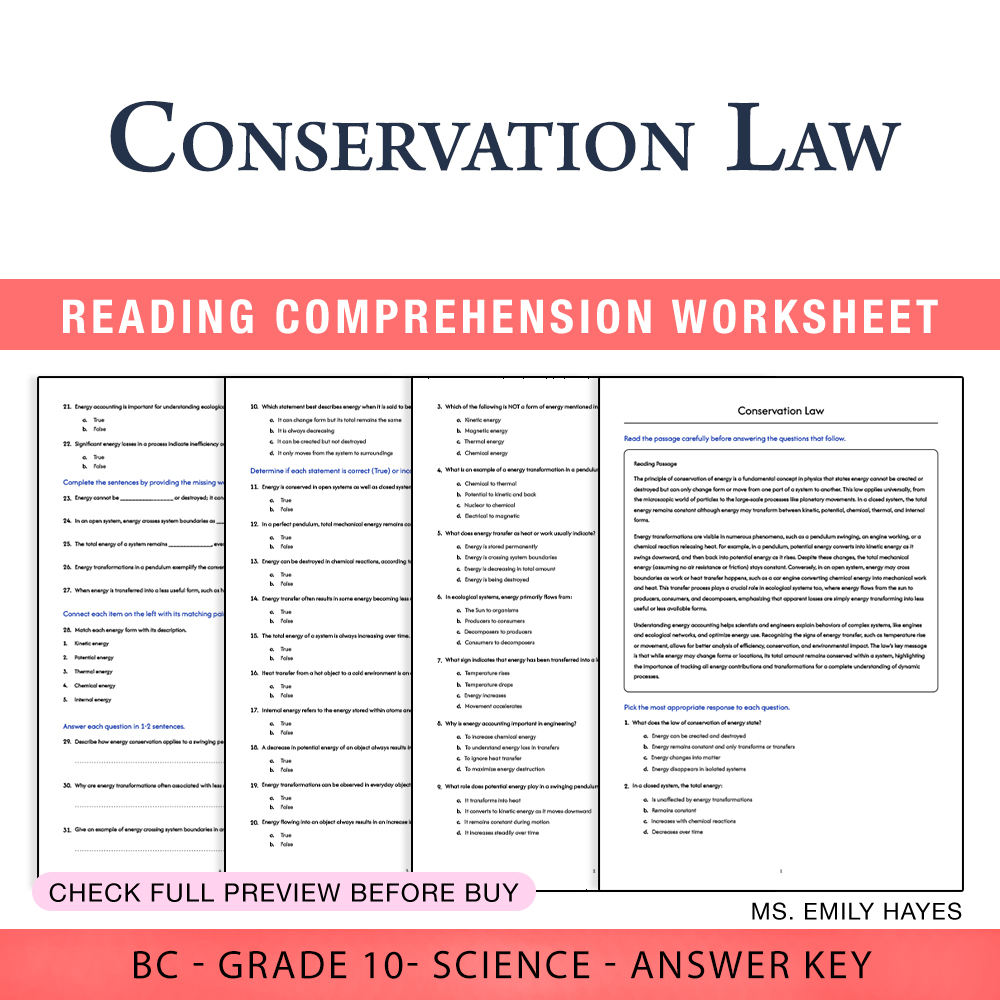
Grade 10 Science | Conservation Law Worksheet (PDF + Answer Key)
Created byCopper Leaf ClassroomLearning Objectives
- Understand the principles of the conservation of energy and how energy is transferred and transformed in different systems.
- Identify types of energy and their contributions in physical and chemical processes.
- Explain how energy conservation applies to real-world systems such as engines, pendulums, and ecological energy flows.
Also included in: Grade 10 Science BC – Energy, Thermodynamics & Ecosystems (PDF + Answer Key) +1 more
Instant download
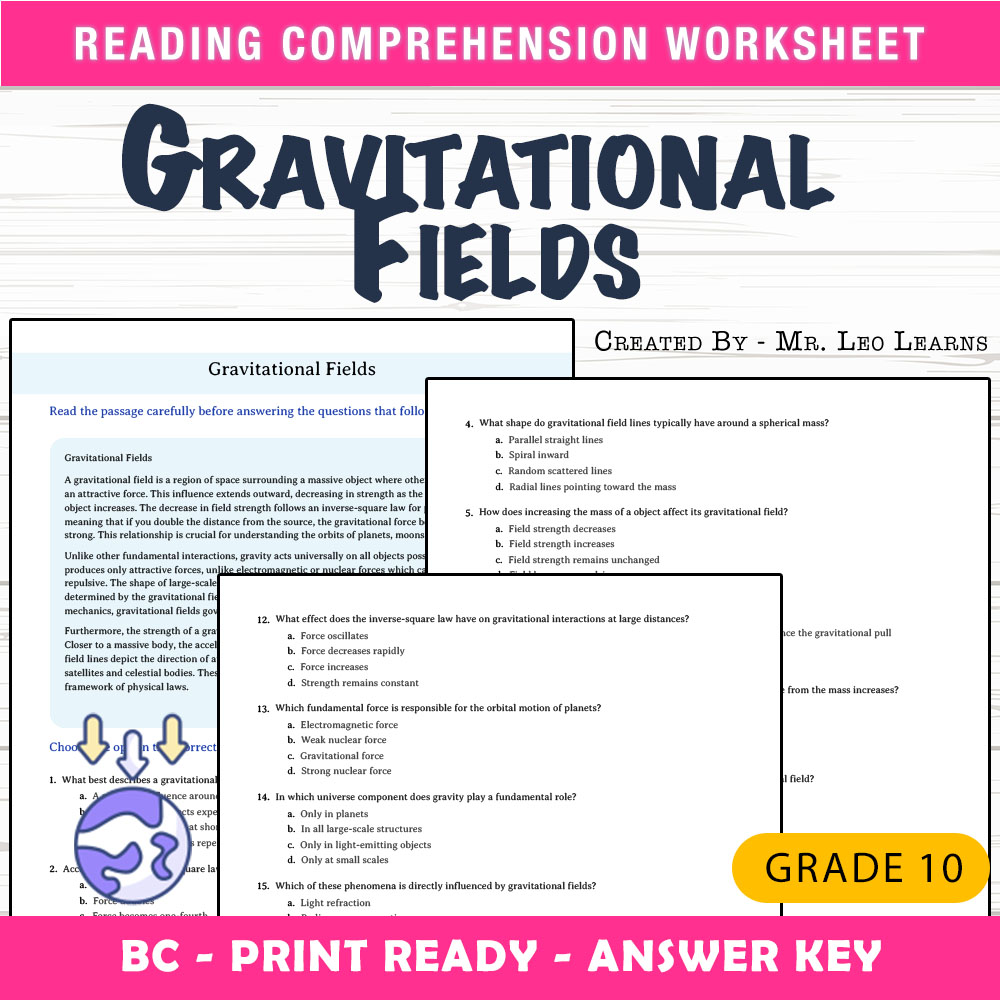
Grade 10 Science — Worksheet MCQ Paper for Mastering Gravitational Fields
Created byThe Resource HubLearning Objectives
- Understand the concept of gravitational fields and their influence on space.
- Explain how field strength varies with distance from a massive object.
- Describe the effects of gravitational fields on orbital motion and attraction.
Also included in: Grade 10 Science | Forces, Motion & Fields UNIT Worksheet Bundle +1 more
Instant download
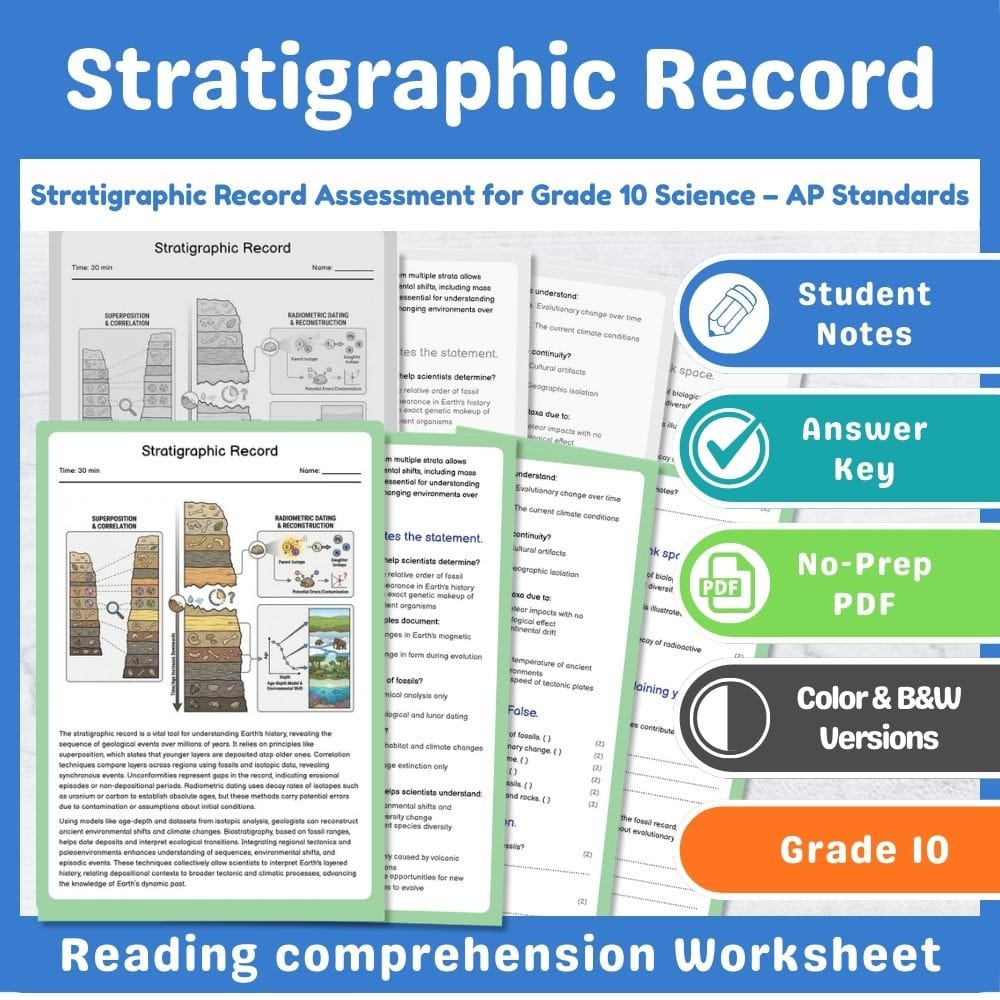
Stratigraphic Record Assessment for Grade 10 Science – AP Standards
Created byPrism Point LearningLearning Objectives
- Interpret stratigraphic sequences and fossil assemblages to infer Earth's historical timeline.
- Understand principles such as superposition, correlation, and unconformities.
- Evaluate radiometric decay methods and error considerations in determining absolute ages.
Also included in: Lesson Bundle | Grade 10 Science Earth and Space Standards-Aligned
Instant download

Reaction Rates & Collision Theory Worksheet | Grade 10 NGSS Science
 Created byAmber Owl Education
Learning Objectives
- Explain how collision theory connects particle motion to reaction speed.
- Use rate law ideas to predict how temperature, concentration, surface area, and catalysts change reaction rates.
- Interpret how activation energy and effective collisions affect observed rate constants.
Instant download

Grade 10 Science – Resource Availability & Tradeoffs | Daily Reading Worksheet
Created byBright Mind ResourcesLearning Objectives
- Understand the difference between renewable and non-renewable resources
- Identify examples of natural resources
- Analyze how resource limitations impact ecosystems and human activities
Also included in: Grade 10 Climate Linkages Science Daily Reading Worksheets Bundle | CA Standards +1 more
Instant download
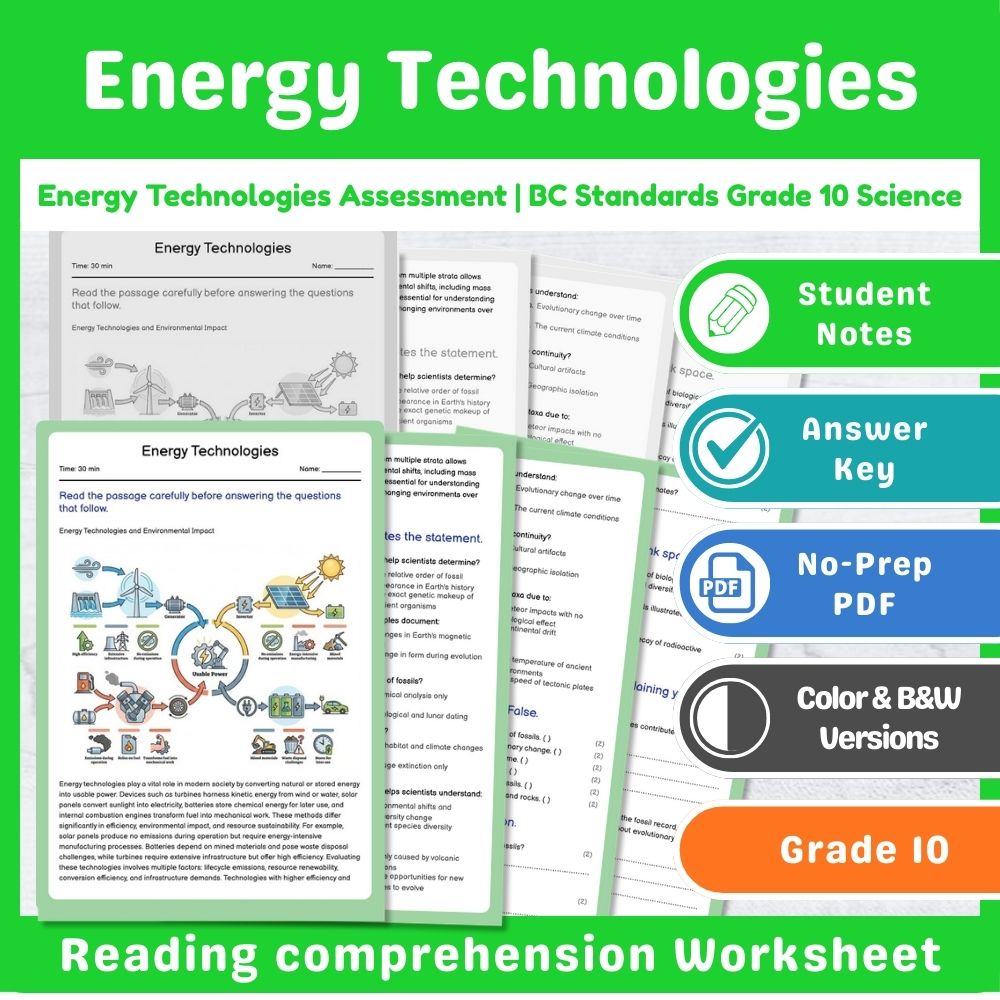
Energy Technologies Assessment | BC Standards Grade 10 Science
Created byPrism Point LearningLearning Objectives
- Understand the different types of energy technologies and their functions.
- Evaluate the efficiencies and environmental impacts of various energy conversion methods.
- Compare renewable and non-renewable energy sources in terms of sustainability and emissions.
Also included in: Grade 10 Science | Energy Assessment - BC Standards-Aligned Mini Bundle
Instant download

Grade 10 Science Worksheet B: Feedback Control & Homeostasis Worksheet | NGSs
 Created byClear Sky Classroom
Learning Objectives
- Explain how sensors, control centers, and effectors work together in feedback control systems
- Distinguish negative feedback from positive feedback and predict their effects on internal stability
- Use examples from blood glucose, body temperature, and blood pH to describe set points and dynamic regulation
Also included in: Grade 10 Cellular Regulation and Energy Pathways Science Lesson Bundle | NGSS +1 more
Instant download
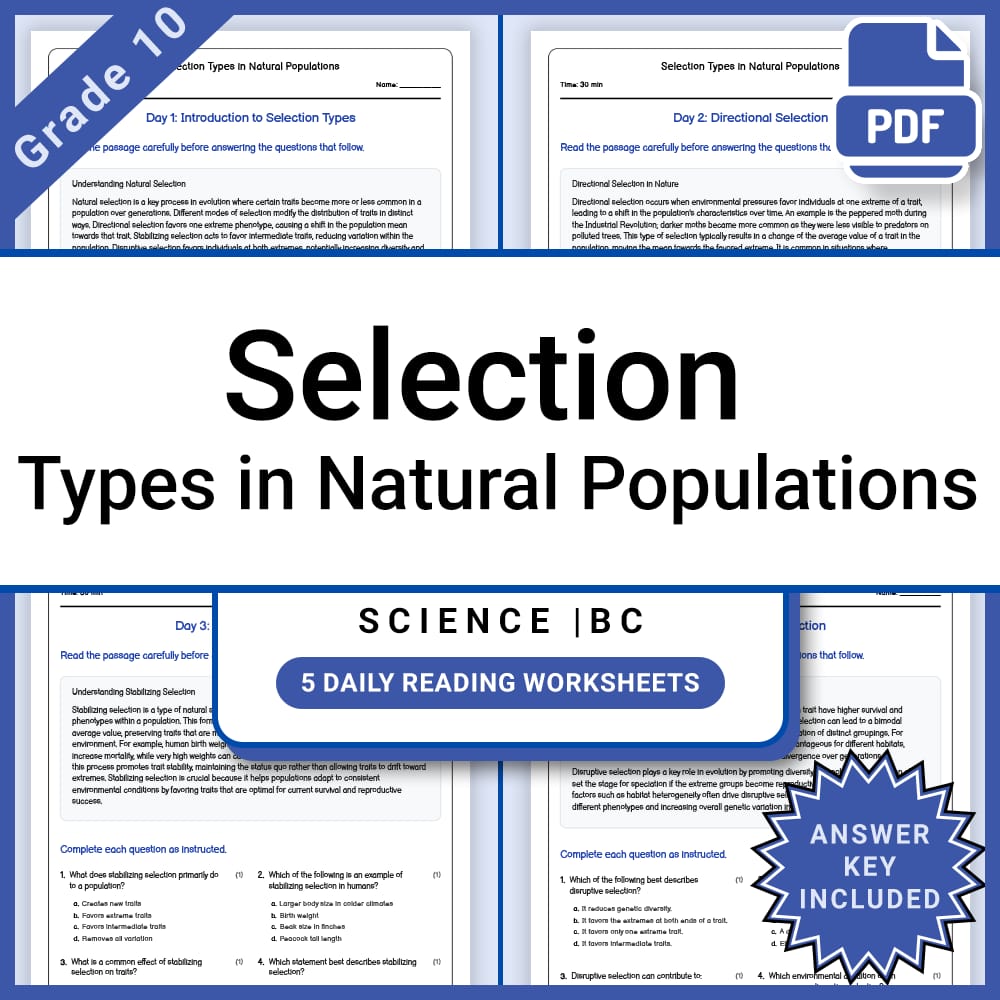
Grade 10 Science – Selection Types Daily Reading Worksheet with Answer Key
JCreated byJ.S SheetsLearning Objectives
- Understand the concepts of directional, stabilizing, and disruptive selection
- Differentiate between types of natural selection based on their effects on traits
- Recognize the roles of frequency-dependent and sexual selection in evolution
Also included in: Grade 10 Science Lesson Bundle | Genetics, Evolution, Biodiversity & More +1 more
Instant download
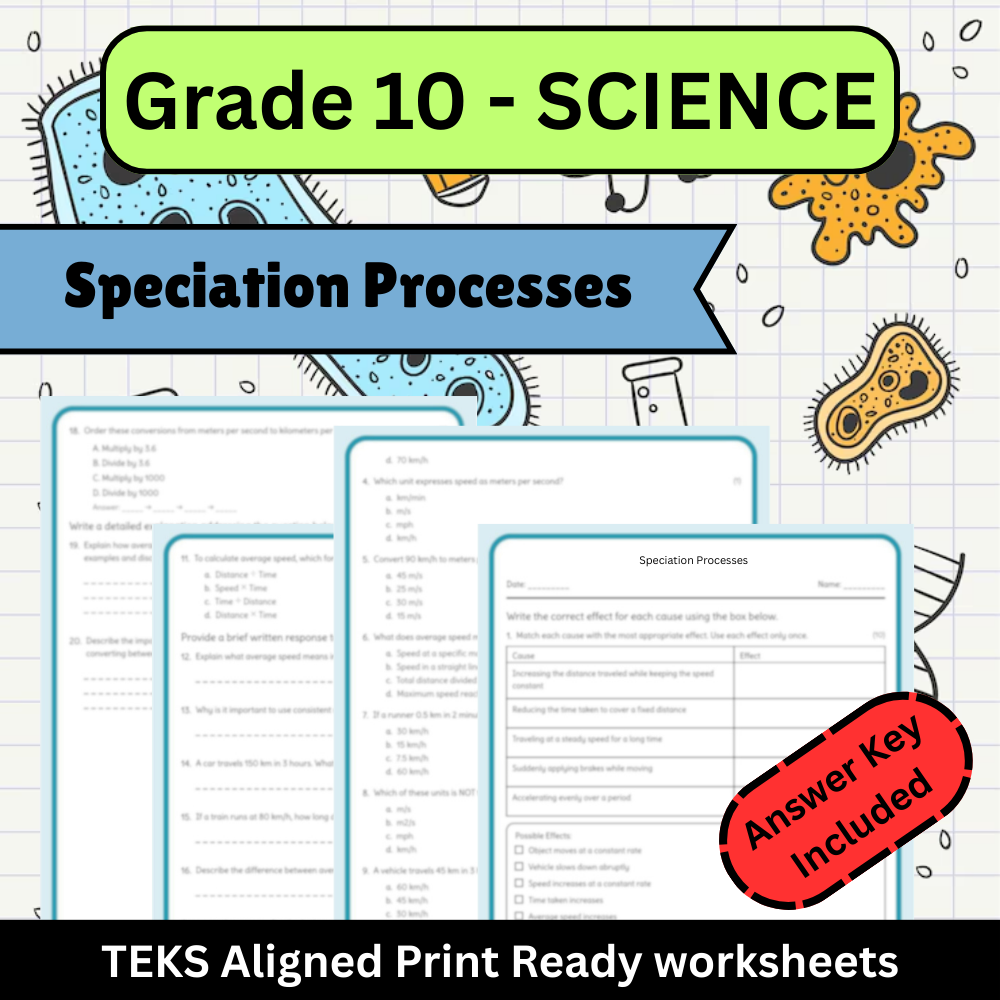
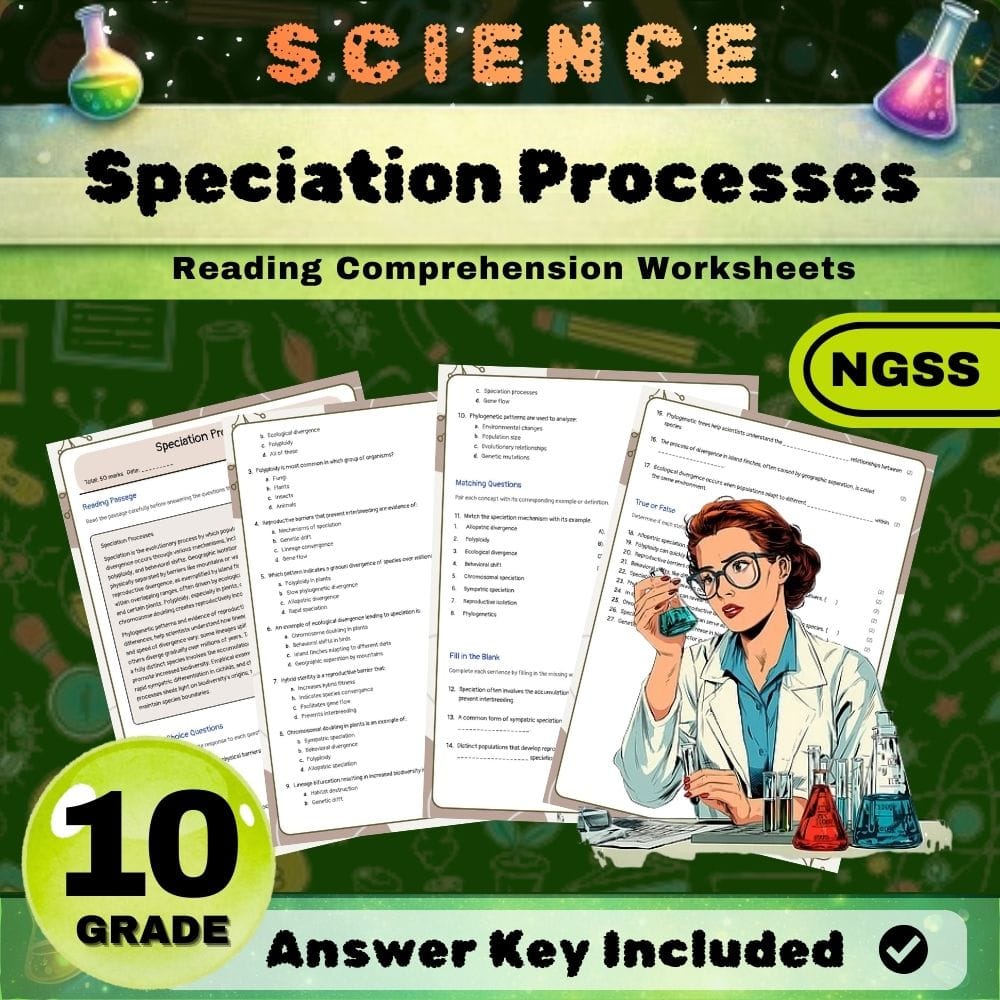
Grade 10 Science | Speciation Processes Worksheet (Answer Key) | TEKS Aligned
Created byBright Mind ResourcesLearning Objectives
- Understand the mechanisms and factors involved in the process of speciation.
- Identify different reproductive barriers and modes of divergence.
- Explain the roles of genetic change, hybrid zones, and polyploidy in speciation.
Also included in: Grade 10 Science | Evolution & Heredity Unit Worksheet Bundle (TEKS Aligned) +5 more
Instant download

Grade 10 Science | Carbon Cycling Worksheet with Short Notes (Printable PDF)
 Created byMeadowlark Worksheets
Learning Objectives
- Understand the components and fluxes involved in the global carbon cycle.
- Identify sources and sinks of atmospheric carbon dioxide.
- Explain feedback mechanisms that influence climate change.
Also included in: Grade 10 Science NGSS Earth & Human Activity Unit | Worksheet Pack +1 more
Instant download
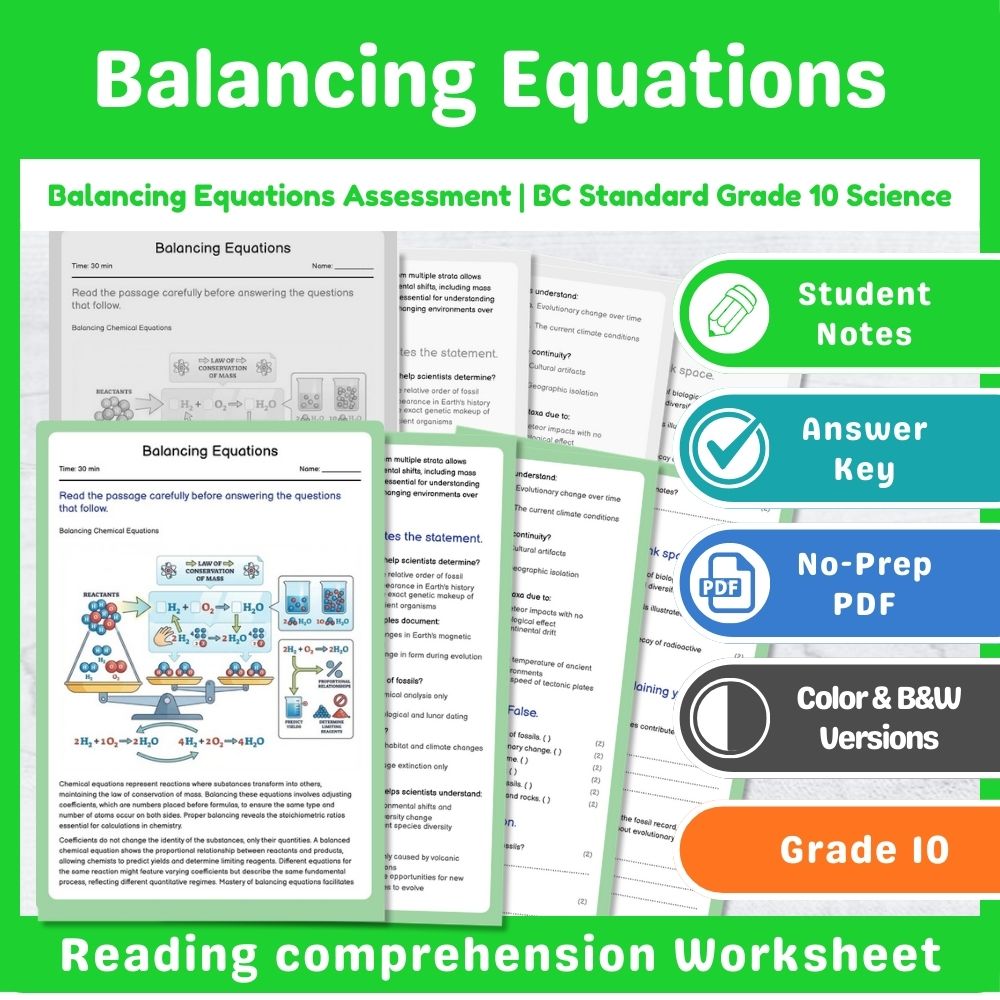
Balancing Equations Assessment | BC Standard Grade 10 Science
Created byPrism Point LearningLearning Objectives
- Understand the purpose and significance of balancing chemical equations.
- Identify the role of coefficients in representing stoichiometric relationships.
- Practice balancing various chemical equations to illustrate conservation of mass.
Instant download
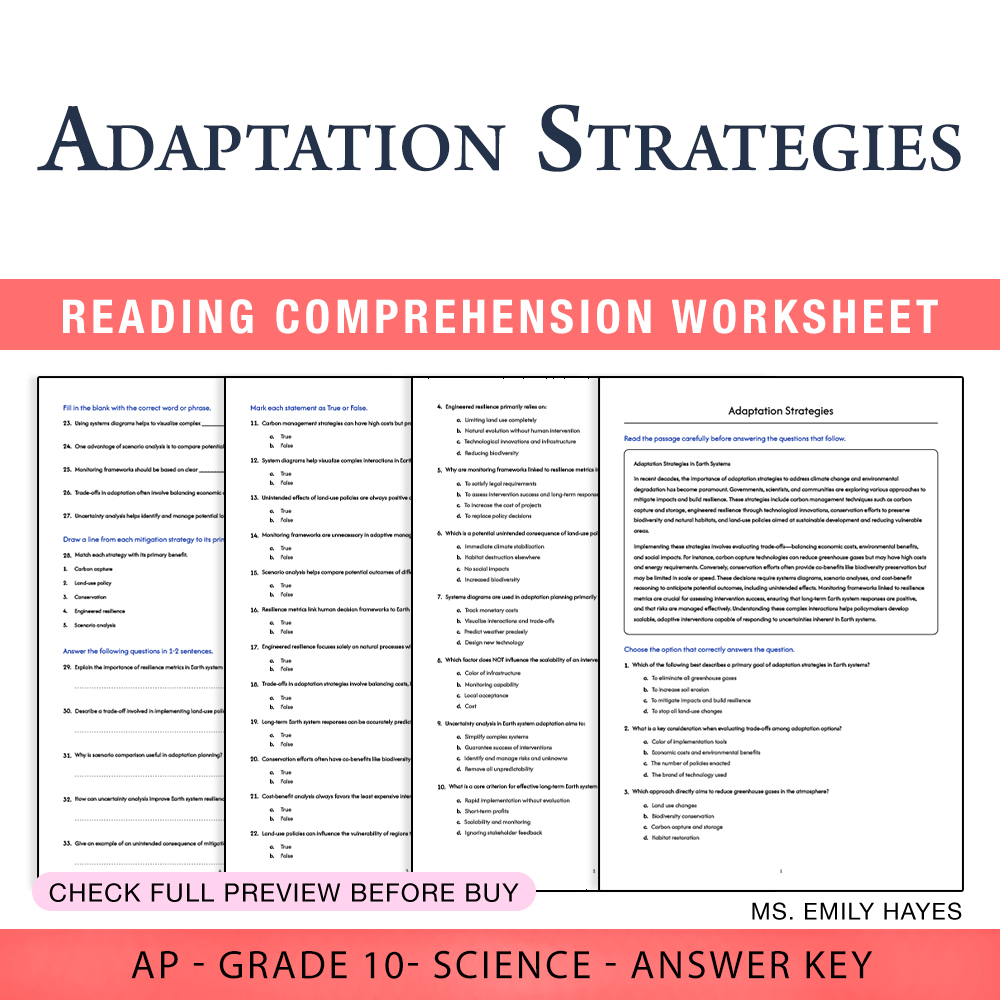
10th Grade Science | Adaptation Strategies Worksheet (PDF+ Answer Key)
Created byCopper Leaf ClassroomLearning Objectives
- Evaluate conceptual approaches for mitigation and adaptation within Earth systems.
- Analyze trade-offs among carbon management, engineered resilience, and land-use policies.
- Apply systems diagrams and scenario comparisons to assess intervention effectiveness.
Also included in: Grade 10 Science AP – Surface Processes & Earth Systems (PDF + Answer Key) +1 more
Instant download
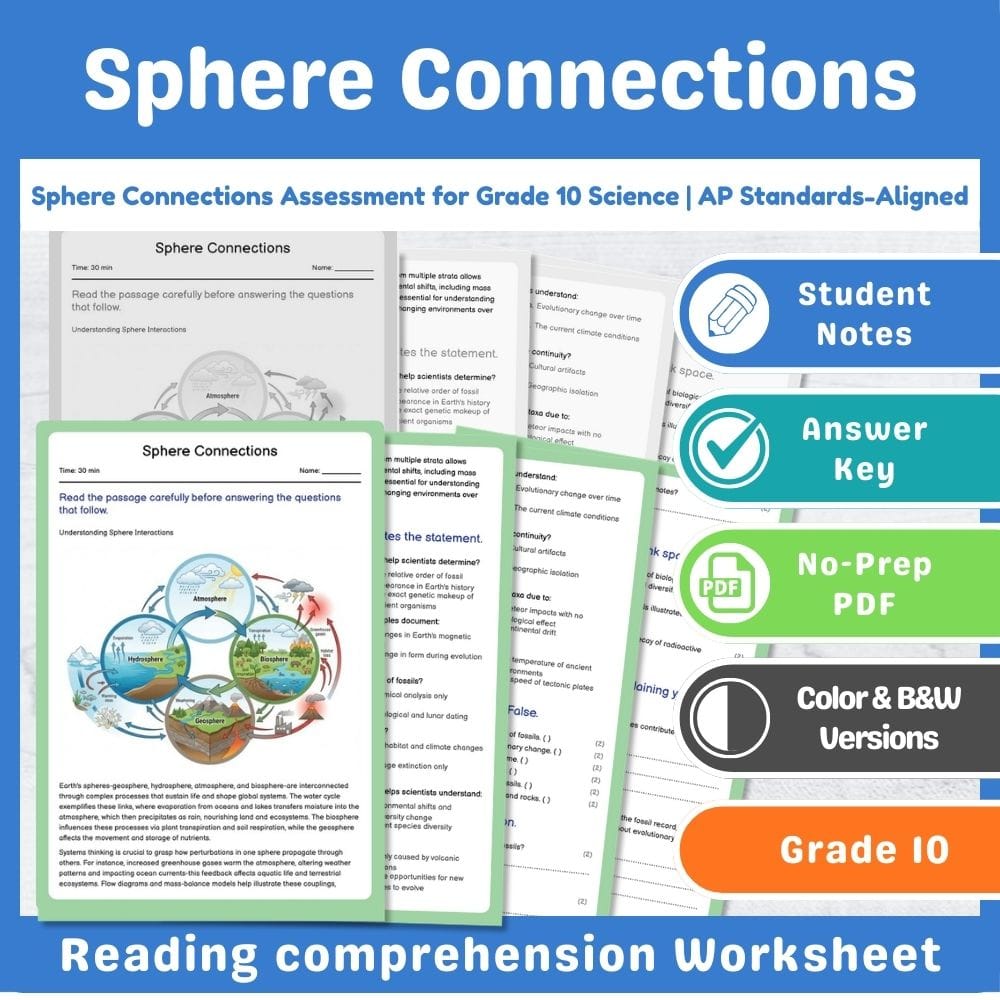
Sphere Connections Assessment for Grade 10 Science | AP Standards-Aligned
Created byPrism Point LearningLearning Objectives
- Explain how the Earth's spheres interact through processes like the water cycle, biogeochemical fluxes, and ocean-atmosphere exchange.
- Use systems thinking tools such as flow diagrams and mass-balance reasoning to illustrate sphere interactions.
- Analyze how perturbations in one sphere can propagate and cause observable changes in other spheres.
Also included in: Lesson Bundle | Grade 10 Science Earth and Space Standards-Aligned
Instant download
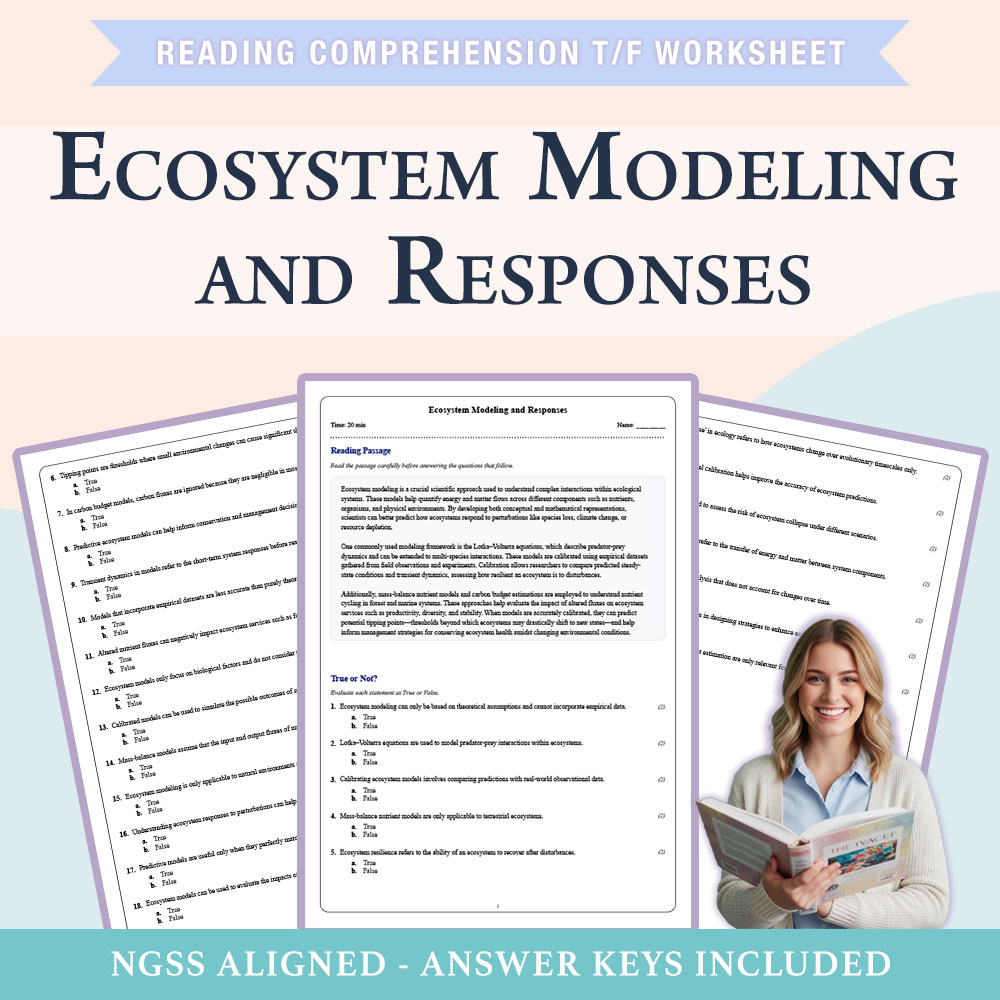
Grade 10 Science | Ecosystem Modeling and Responses Worksheet (PDF + Answer Key)
Created byCopper Leaf ClassroomLearning Objectives
- Understand the fundamental concepts of ecosystem modeling, including flow of energy and matter.
- Interpret different types of ecosystem models such as Lotka–Volterra equations and mass-balance nutrient models.
- Analyze how empirical data is used to calibrate models and predict system behavior under various perturbations.
Also included in: Grade 10 Science Unit | Ecosystem Dynamics & Biodiversity (PDF +Answer Key) +1 more
Instant download

Grade 10 Science — Worksheet MCQ Paper for Reaction Stoichiometry
Created byThe Resource HubLearning Objectives
- Understand and interpret chemical reaction equations representing matter conservation.
- Perform molar mass calculations and mass-to-mass conversions using mole ratios.
- Identify limiting reagents and calculate theoretical yields in chemical reactions.
Also included in: Grade 10 Science Chemistry Foundations Lesson Bundle for AP Curriculum +1 more
Instant download
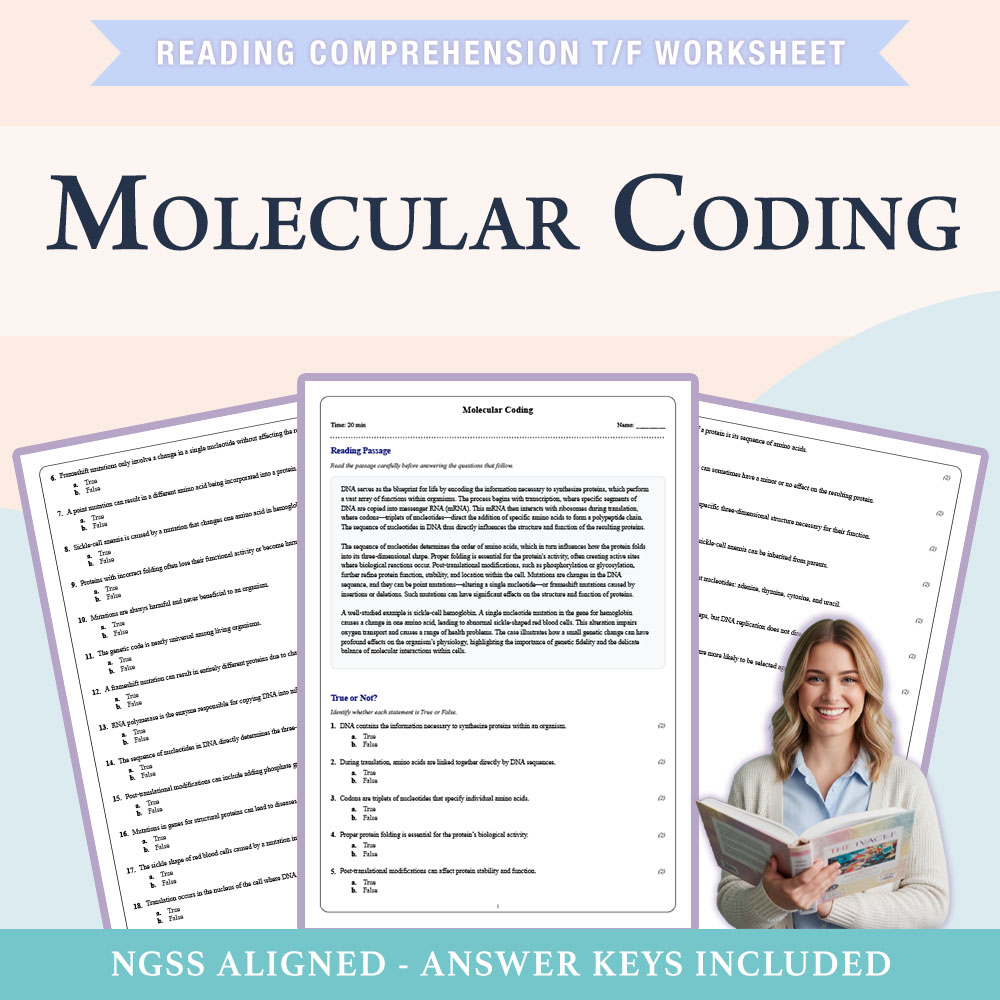
Grade 10 Science | Molecular Coding Worksheet (PDF + Answer Key)
Created byCopper Leaf ClassroomLearning Objectives
- Understand how DNA sequences determine amino acid sequences and protein structures through transcription and translation.
- Explain the effects of point mutations and frameshifts on protein function and organismal health.
- Describe the process of protein folding, post-translational modification, and formation of functional active sites.
Also included in: Grade 10 Science Bundle | Cellular Systems & Energy Pathways (PDF + Answer Key) +1 more
Instant download
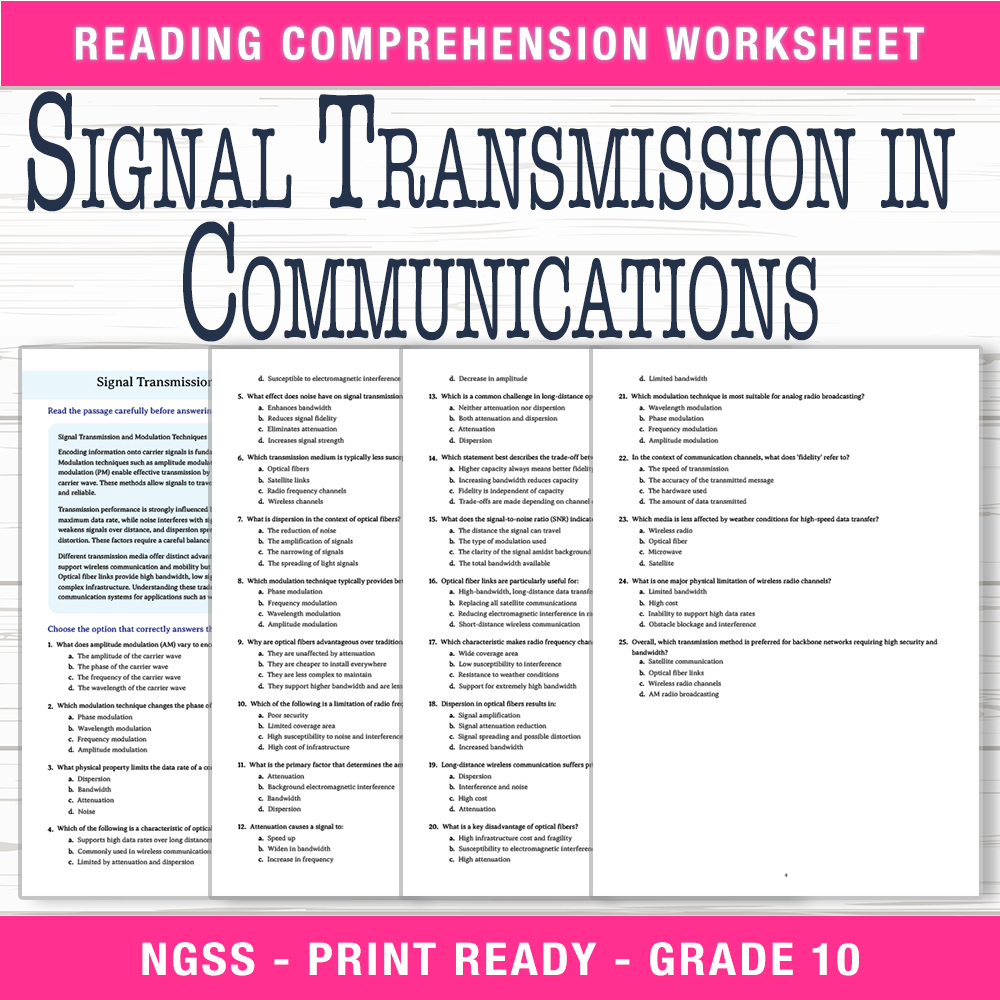
Grade 10 Science | Signal Transmission in Communications Worksheet (PDF + Answer Key)
 Created byRiverstone Classroom
Learning Objectives
- Explain the principles of amplitude, frequency, and phase modulation techniques used in signal transmission.
- Identify the effects of channel constraints such as bandwidth, noise, attenuation, and dispersion on communication systems.
- Compare different transmission modes like radio frequency channels and optical fiber links in terms of advantages and limitations.
Also included in: Grade 10 Science Unit | Wave & Signal Transmission Worksheets
Instant download
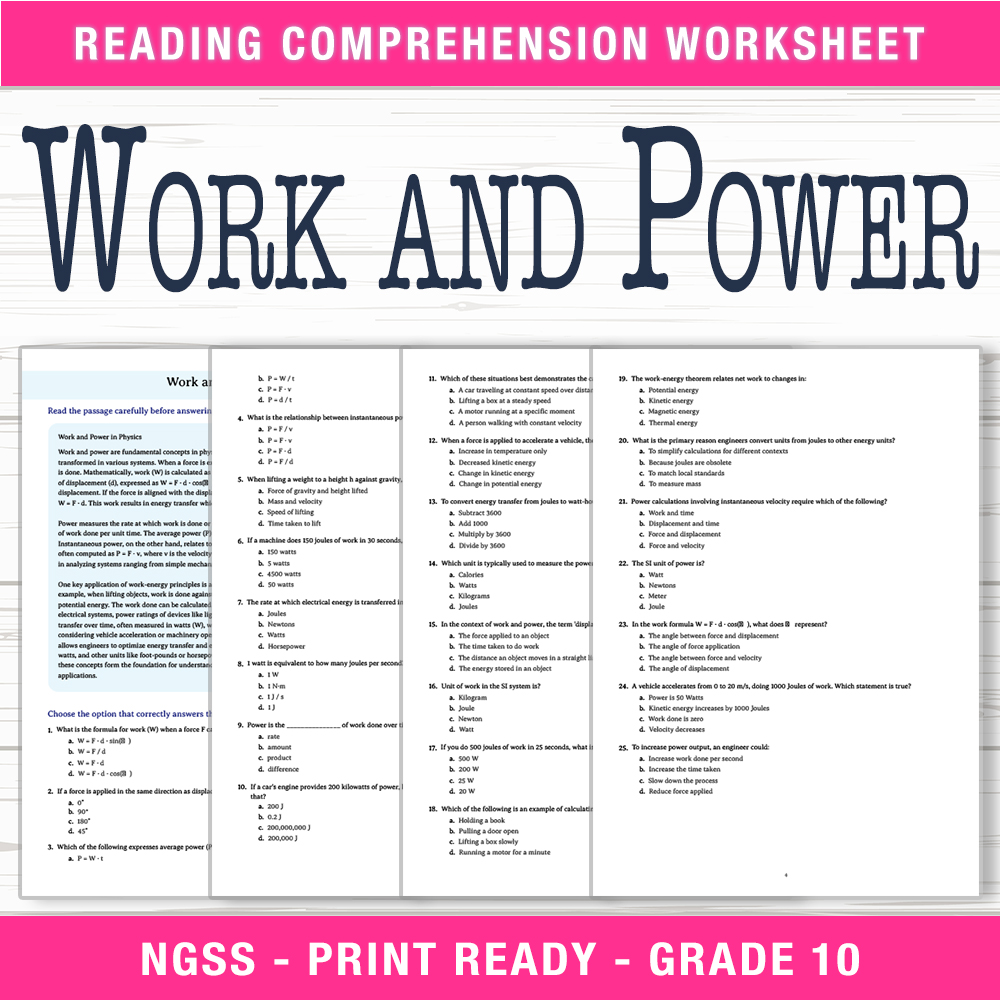
Grade 10 Science | Work and Power Worksheet (PDF + Answer Key)
Created byRiverstone ClassroomLearning Objectives
- Understand the relationship between force, displacement, work, and energy using the work–energy theorem.
- Apply algebraic techniques to calculate work and power in various physical contexts.
- Convert between units such as joules, watts, and other common engineering units.
Instant download

Grade 10 Worksheet B: Mendelian Patterns and Inheritance Practice | NGSS PDF
Created byClear Sky ClassroomLearning Objectives
- Use Mendelian principles (dominance, segregation, and independent assortment) to predict offspring phenotypes from parental genotypes.
- Interpret pedigree information and relate inheritance patterns to probability outcomes.
- Apply Punnett-square reasoning to single-gene traits and identify common misconceptions.
Also included in: Grade 10 Genetic Variation and Inheritance Science Lesson Bundle: NGSS +1 more
Instant download
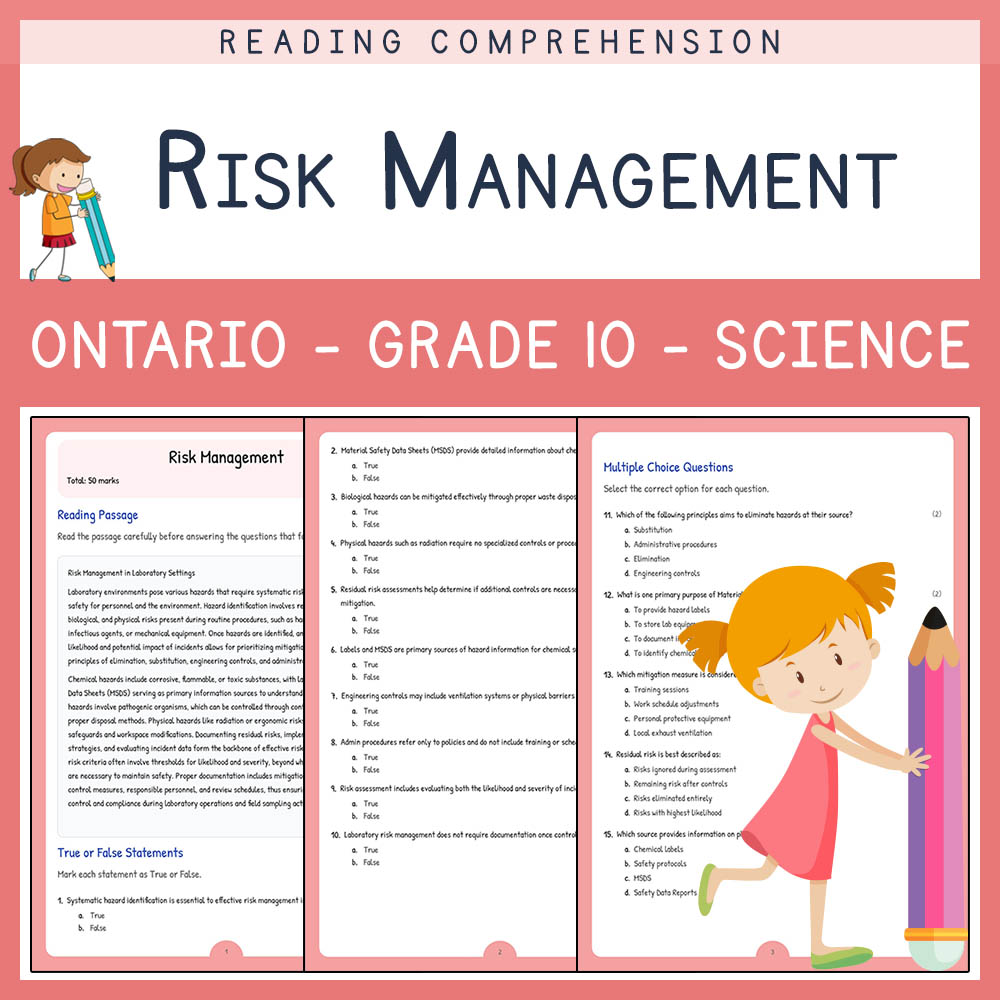
Grade 10 Science | Risk Management Worksheet | Ontario Standards
Created byLumora LearningLearning Objectives
- Understand systematic hazard identification and risk assessment methods in laboratory settings.
- Identify chemical, biological, and physical hazards and appropriate mitigation strategies.
- Explain principles of hazard elimination, substitution, engineering controls, and administrative procedures.
Instant download
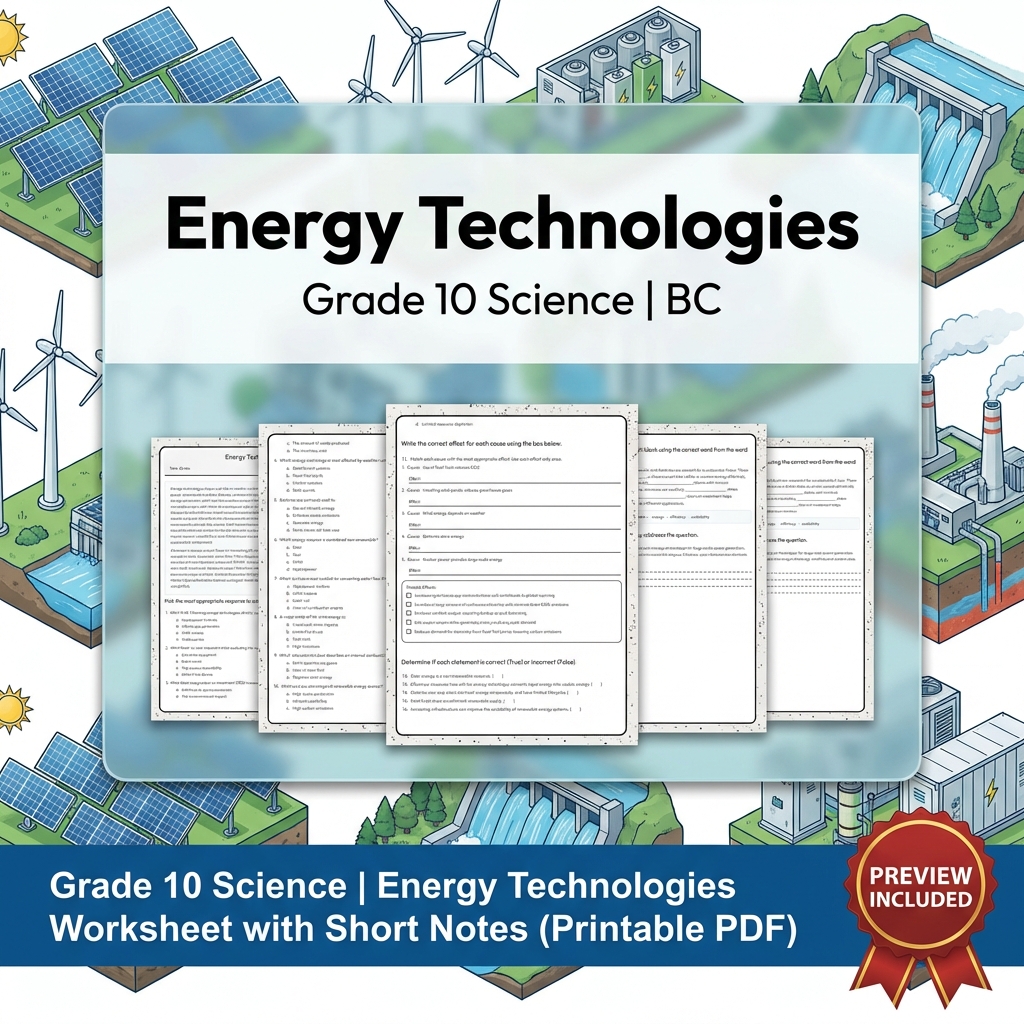
Grade 10 Science | Energy Technologies Worksheet with Short Notes (PDF)
Created byMeadowlark WorksheetsLearning Objectives
- Understand various energy technologies and their conversion mechanisms.
- Evaluate efficiency, sustainability, and environmental impact of different energy devices.
- Compare renewable and non-renewable energy sources used in technologies.
Also included in: Grade 10 Science Lesson Bundle | Energy & Thermodynamics Worksheets +1 more
Instant download

Grade 10 Science – Fossil Formation Daily Reading Worksheet + Answer Key
JCreated byJ.S SheetsLearning Objectives
- Understand the processes involved in fossil formation
- Identify different types of fossil preservation
- Learn how fossils provide information about Earth's history
Also included in: Grade 10 Science Lesson Bundle: Evolution and Genetics TEKS Framework +1 more
Instant download
Grade 10 Science | Natural Selection Worksheet (NGSS) – PDF
 Created byMaple Path Learning
Learning Objectives
- Understand how variation in heritable traits influences natural selection.
- Explain the role of environmental pressures in shaping adaptive changes in populations.
- Identify real-world examples of evolution due to selective mechanisms, such as antibiotic resistance and industrial melanism.
Also included in: Grade 10 Science | Biological Evolution Unity and Diversity Lesson Bundle | NGSS +1 more
Instant download
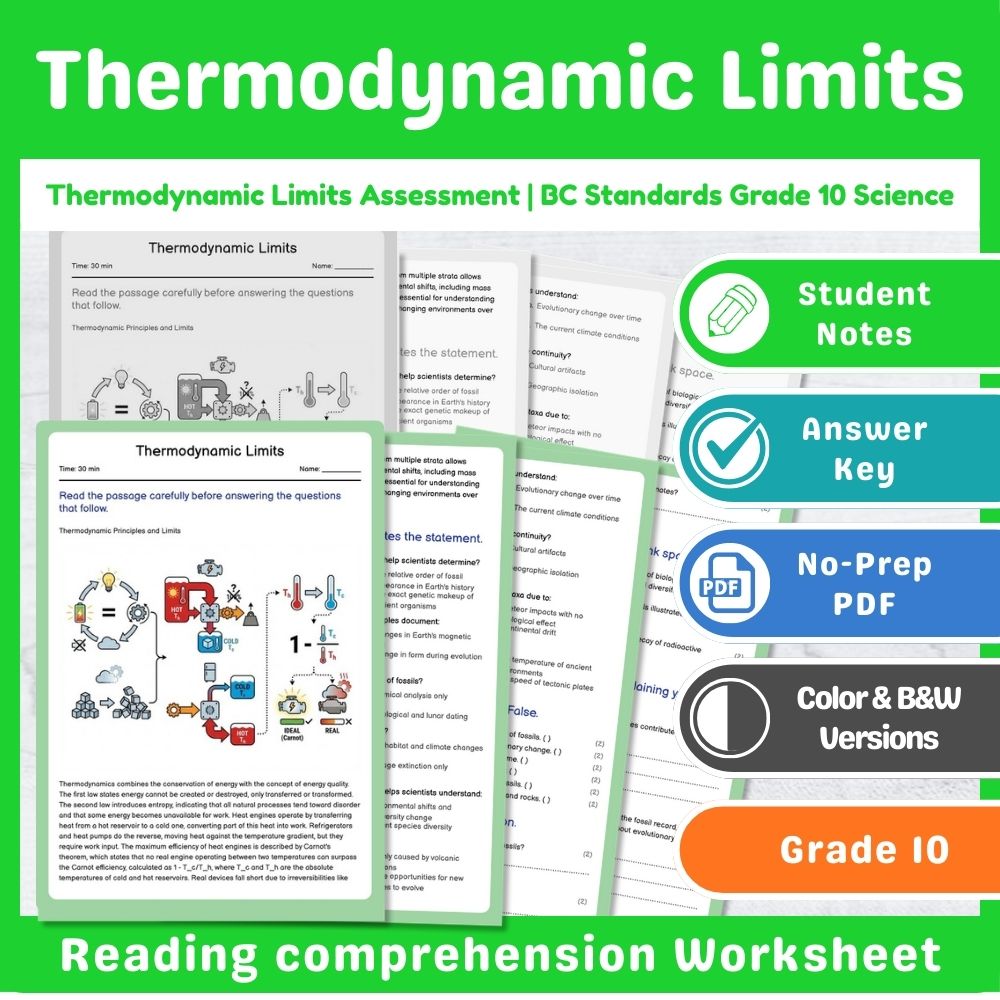
Thermodynamic Limits Assessment | BC Grade 10 Science Standards
Created byPrism Point LearningLearning Objectives
- Explain the fundamental principles of thermodynamics, including energy conservation and entropy.
- Describe how heat engines and refrigerators operate between temperature reservoirs.
- Calculate the maximum efficiency of heat engines based on Carnot's theorem.
Also included in: Grade 10 Science | Energy Assessment - BC Standards-Aligned Mini Bundle
Instant download
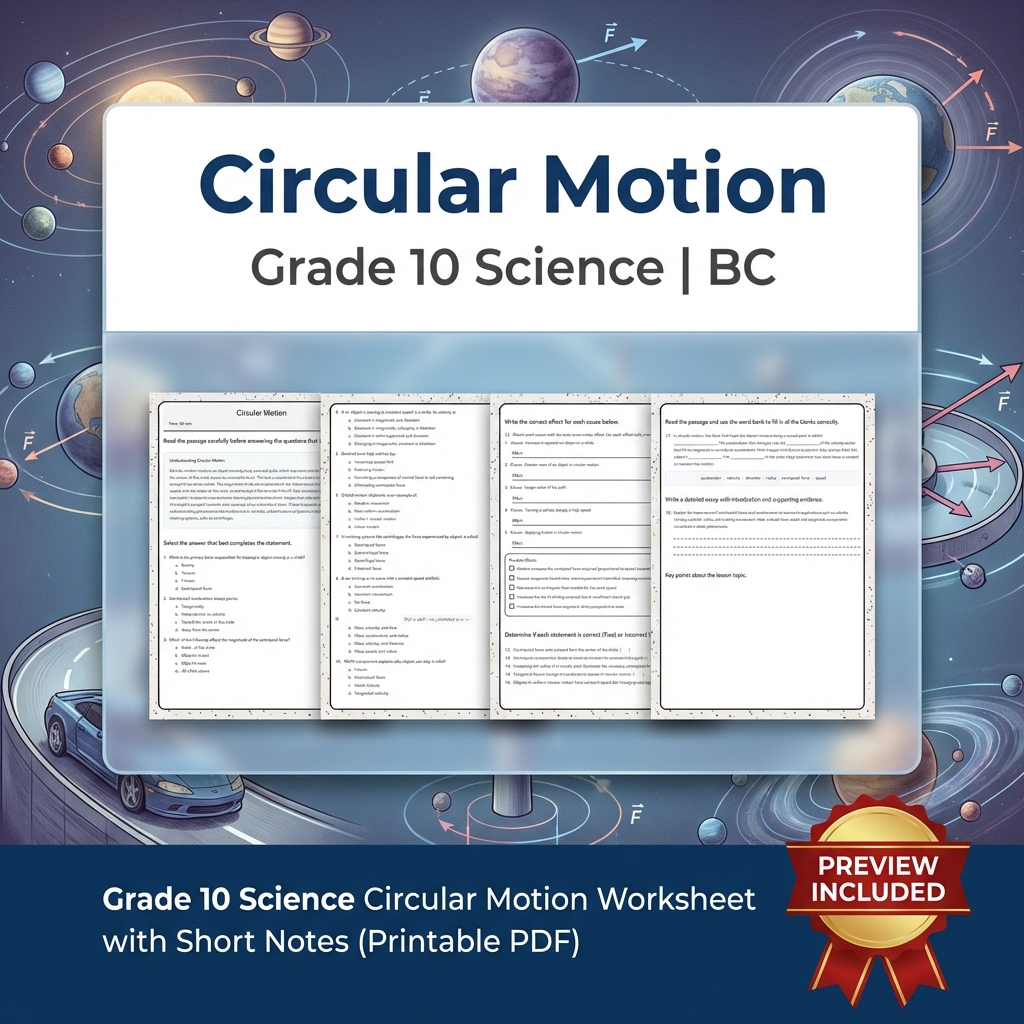
Grade 10 Science Circular Motion Worksheet with Short Notes (Printable PDF)
Created byMeadowlark WorksheetsLearning Objectives
- Understand the concept of centripetal force and its role in circular motion.
- Describe the difference between centripetal acceleration and tangential acceleration.
- Explain how radial and tangential components affect phenomena like banked turns and orbital motion.
Also included in: Grade 10 Science Lesson Bundle | Physics and Forces Worksheets | BC Framework +1 more
Instant download
About Grade 10 Science Worksheets
Find Science worksheets built for Grade 10. All 7,038 cover core skills, practice, and review, each an instant PDF download.
Every worksheet on MyTeachingSheets is created by independent teacher-authors and reviewed before publication. All resources download as printable PDFs for classroom, homework, or at-home practice, and many include answer keys. Preview any worksheet free before buying.