
Grade 10 Science Worksheets
7,038 worksheets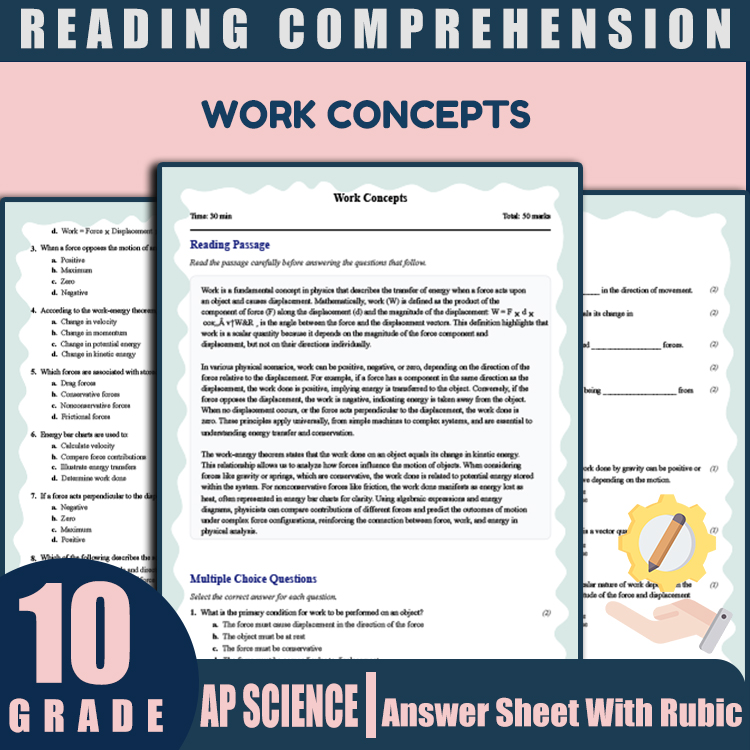
Grade 10 Science | Work Concepts Reading Worksheets (PDF + Rubric)
JCreated byJ.S SheetsLearning Objectives
- Explain the definition of work as the product of force and displacement along the direction of movement.
- Describe the scalar nature of work and how it applies in different physical contexts.
- Connect the concept of work to changes in kinetic energy using the work-energy theorem.
Also included in: Grade 10 Science Unit Bundle | Motion, Forces & Energy Worksheets (PDF) +1 more
Instant download

Grade 10 Science | Pattern Analysis in Earth & Space Phenomena - Daily Reading
 Created byCoral Reef Learning
Learning Objectives
- Understand how observational data reveals regularities and anomalies in climate and space phenomena.
- Learn methods for identifying temporal and spatial patterns in environmental data.
- Recognize the importance of data quality, sampling frequency, and statistical analysis in pattern detection.
Also included in: Earth and Space Systems Lesson Bundle – Grade 10 Science Alberta +1 more
Instant download
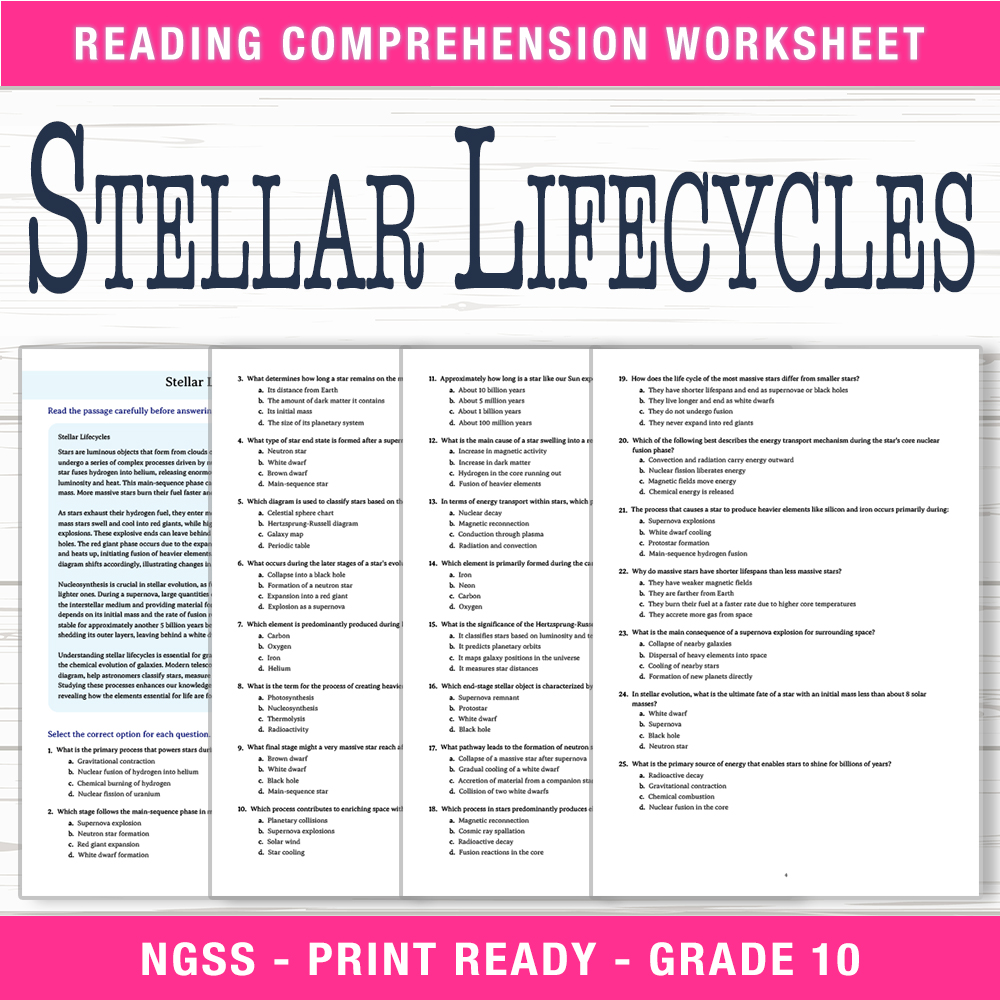
Grade 10 Science | Stellar Lifecycles Worksheet (PDF + Answer Key)
 Created byRiverstone Classroom
Learning Objectives
- Describe the process of nuclear fusion in stellar cores and its role in stellar evolution.
- Identify different stages in the lifecycle of stars and their end states such as white dwarfs, neutron stars, and supernovae.
- Explain how the Hertzsprung-Russell diagram relates to stellar properties and evolution.
Also included in: Grade 10 Science Unit | Stellar, Planetary & Geologic Worksheets bundle
Instant download

Grade 10 Free-Body Analysis Worksheet | Ontario Physics Forces
 Created byChalk and Compass
Learning Objectives
- Construct a free-body diagram by identifying all forces acting on an isolated object.
- Resolve forces into components using a consistent coordinate axis and sign convention.
- Combine force vectors to determine the resultant force and relate it to acceleration direction.
Also included in: Grade 10 Science Motion, Forces & Momentum Lesson Bundle – Ontario Framework +1 more
Instant download

Grade 10 Science | Energy Loss and Efficiency Worksheet | California Standards
 Created byLumora Learning
Learning Objectives
- Explain energy transfers and unavoidable energy losses in real devices using conservation of energy.
- Differentiate useful energy transfer from energy that becomes less accessible (often as thermal energy).
- Calculate or interpret efficiency as the fraction of total energy transfer that results in intended useful output.
Instant download

Grade 10 Science – Work & Power Daily Reading Worksheet | NGSS Aligned
 Created byBright Mind Resources
Learning Objectives
- Understand the definitions of work and power in physics.
- Relate force, displacement, and energy through the work–energy theorem.
- Calculate work and power in various contexts such as lifting, appliances, and movement.
Also included in: Grade 10 Energy Science Lesson Bundle Daily Reading Worksheets | NGSS +2 more
Instant download

Grade 10 Science – Hydrologic Cycle Daily Reading Worksheet | Alberta Standards
Created byBright Mind ResourcesLearning Objectives
- Identify the main processes of the water cycle
- Understand water movement from snowpack to aquifers
- Recognize regional factors affecting water flow
Also included in: Grade 10 Sustainability Science Daily Reading Worksheets lesson bundle | Alberta +1 more
Instant download

Grade 10 Energy Loss and Efficiency Worksheet | California Standards Practice PDF
 Created byClear Sky Classroom
Learning Objectives
- Explain energy transfer using the idea that some energy becomes less useful due to unavoidable losses.
- Calculate and interpret efficiency as the fraction of total energy transfer that produces intended useful outcomes.
- Analyze how design choices (e.g., friction reduction, insulation) affect efficiency by changing loss mechanisms.
Instant download
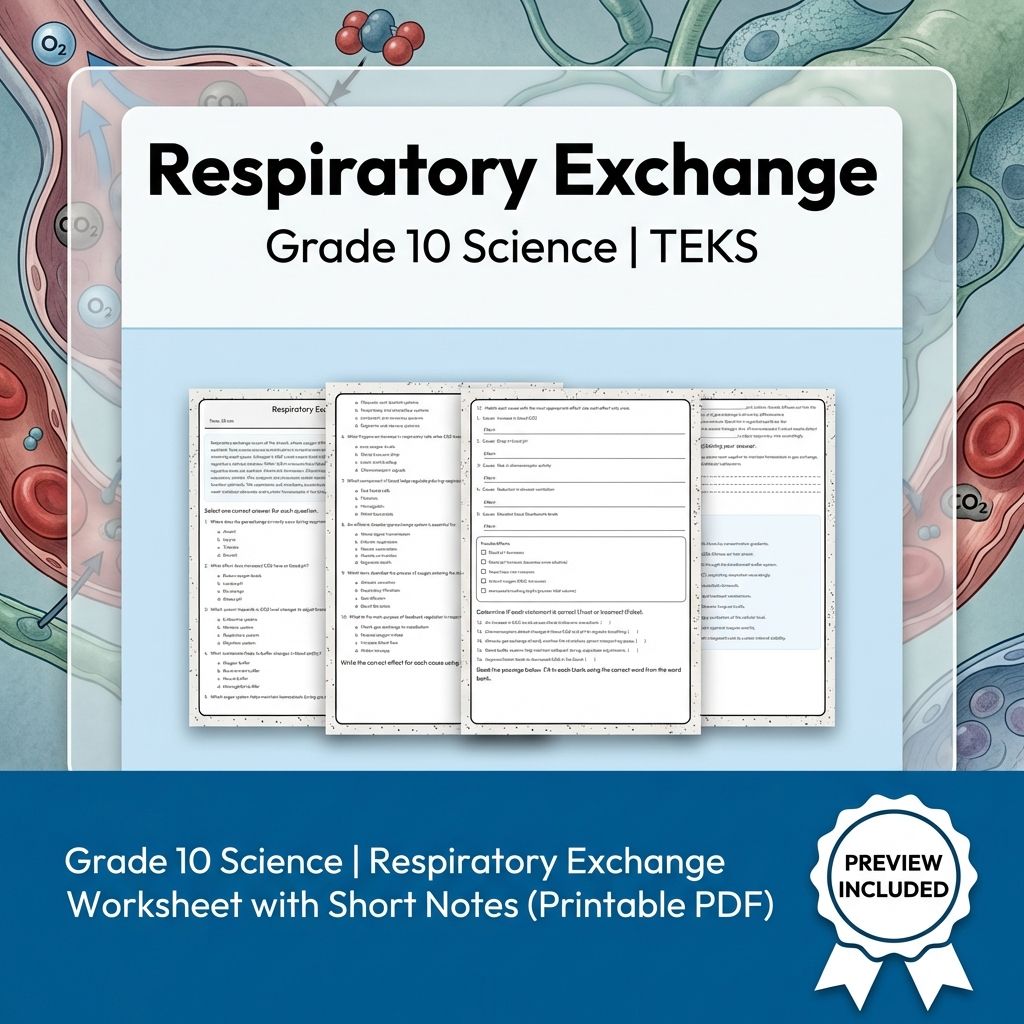
Grade 10 Science | Respiratory Exchange Worksheet with Short Notes (PDF)
 Created byMeadowlark Worksheets
Learning Objectives
- Understand the process of alveolar gas diffusion and its role in respiration.
- Explain how changes in CO2 concentrations affect blood pH and respiratory regulation.
- Describe the interaction between respiratory and circulatory systems in maintaining homeostasis.
Instant download

Grade 10 Science | Statistical Reasoning Worksheet | AP Standards
Created byLumora LearningLearning Objectives
- Understand methods to summarize and compare datasets using measures of central tendency and spread.
- Interpret confidence intervals and effect sizes in the context of data analysis.
- Apply concepts of null models and hypothesis testing to evaluate observed differences.
Instant download

Grade 10 Statistical Reasoning Worksheet | Practice & Assessment PDF
Created byClear Sky ClassroomLearning Objectives
- Summarize quantitative datasets using measures of central tendency and spread.
- Explain how confidence intervals and effect sizes support or weaken claims about differences.
- Apply basic null-model and hypothesis logic to decide whether observed results exceed expected variability.
Also included in: Grade 10 Science Practices in Science: Lesson Bundle for Advanced Placement (AP) +1 more
Instant download

Grade 10 Science – Sustainable Resource Use & Management | Reading Worksheet
Created byBright Mind ResourcesLearning Objectives
- Understand the principles of sustainability and circular economy.
- Identify methods for reducing environmental footprints of resource extraction.
- Explain lifecycle assessment and its role in sustainable practices.
Also included in: Earth Science Grade 10 Science Daily Reading Worksheets Lesson Bundle | Ontario +1 more
Instant download
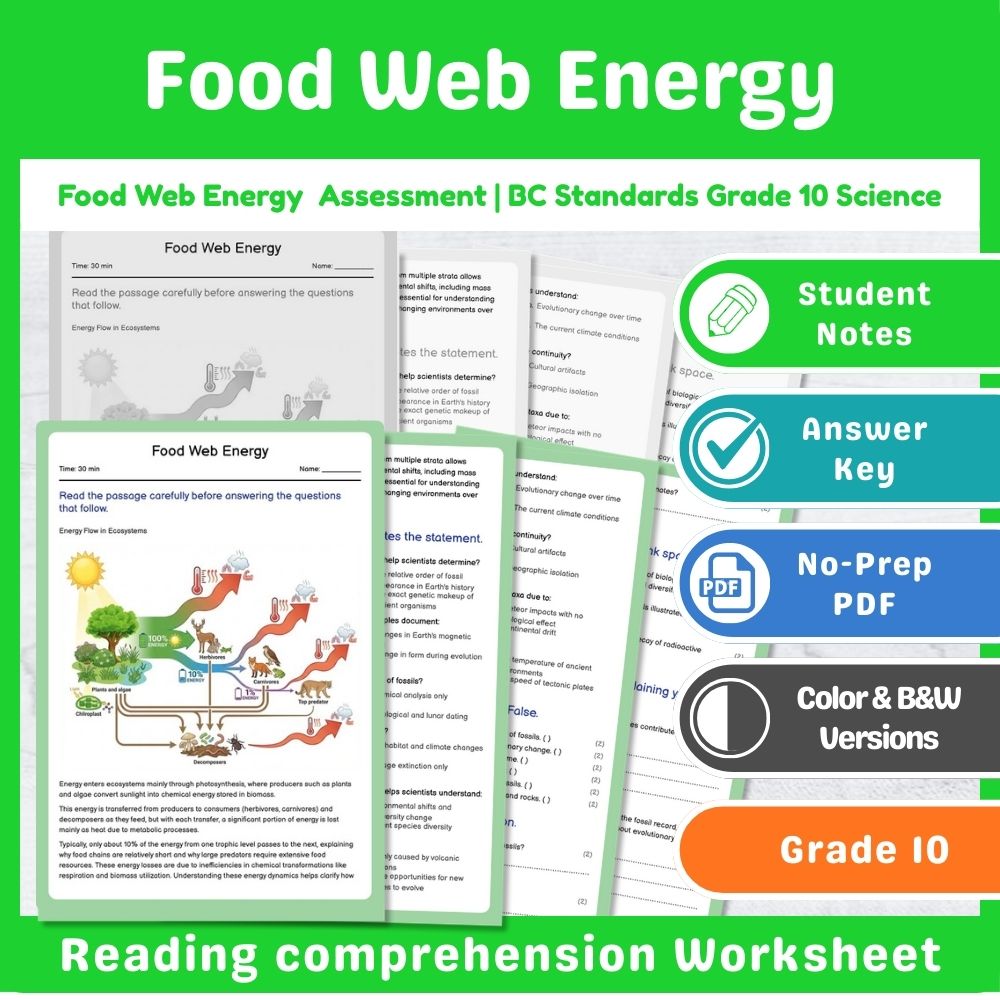
Food Web Energy Assessment | BC Standards Grade 10 Science
 Created byPrism Point Learning
Learning Objectives
- Understand how energy flows through ecosystems via food webs.
- Identify the primary sources and transfers of energy in food chains.
- Explain the concept of energy loss at each trophic level and its ecological significance.
Also included in: Grade 10 Science | Energy Assessment - BC Standards-Aligned Mini Bundle
Instant download

Mass Conservation Worksheet | Grade 10 Science Activities
Created byPrism Point LearningLearning Objectives
- Explain conservation of mass in chemical reactions and identify what must be included for a closed system mass balance.
- Use balanced chemical equations and correct bookkeeping of reactants and products to predict how mass is accounted for.
- Describe how gases and dissolved ions affect total mass measurements in real laboratory systems.
Also included in: Grade 10 Science Chemical Reactions & Atomic Structure Lesson Bundle | Bc +1 more
Instant download

Spheres Overview Worksheet | Grade 10 Science Activities
Created byPrism Point LearningLearning Objectives
- Identify the geosphere, hydrosphere, atmosphere, and biosphere and describe their basic properties.
- Explain how matter and energy move between Earth’s spheres using examples from Alberta.
- Use evidence from landscapes and climate patterns to make cause-and-effect connections among the spheres.
Instant download

Gene Regulation Assessment for Grade 10 Science | TEKS Standards
Created byPrism Point LearningLearning Objectives
- Describe mechanisms of gene regulation at transcriptional and post-transcriptional levels.
- Identify the roles of promoters, enhancers, and transcription factors in gene expression.
- Explain how epigenetic modifications influence chromatin accessibility and gene activity.
Also included in: Lesson Grade 10 Genetics: DNA, RNA, Protein Science Lesson Bundle TEKS
Instant download
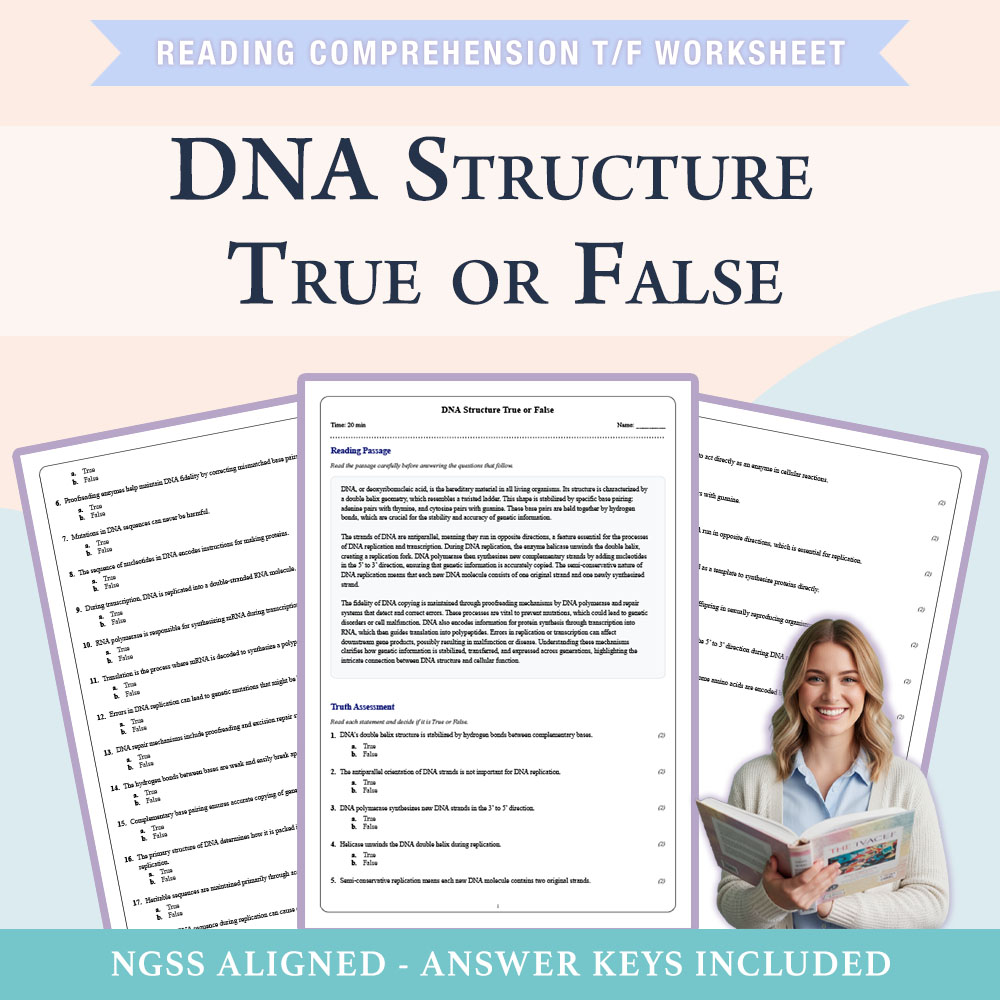
10th Grade Science | DNA Structure True or False Worksheet (PDF + Answer Key)
 Created byCopper Leaf Classroom
Learning Objectives
- Understand the structural features of DNA, including double helix geometry and complementary base pairing.
- Explain the mechanisms of DNA replication, including the roles of DNA polymerase and helicase.
- Describe how DNA fidelity is maintained through proofreading and repair mechanisms.
Also included in: Grade 10 Science | Genetics & DNA Unit Worksheet Pack (PDF +Answer Key) +1 more
Instant download
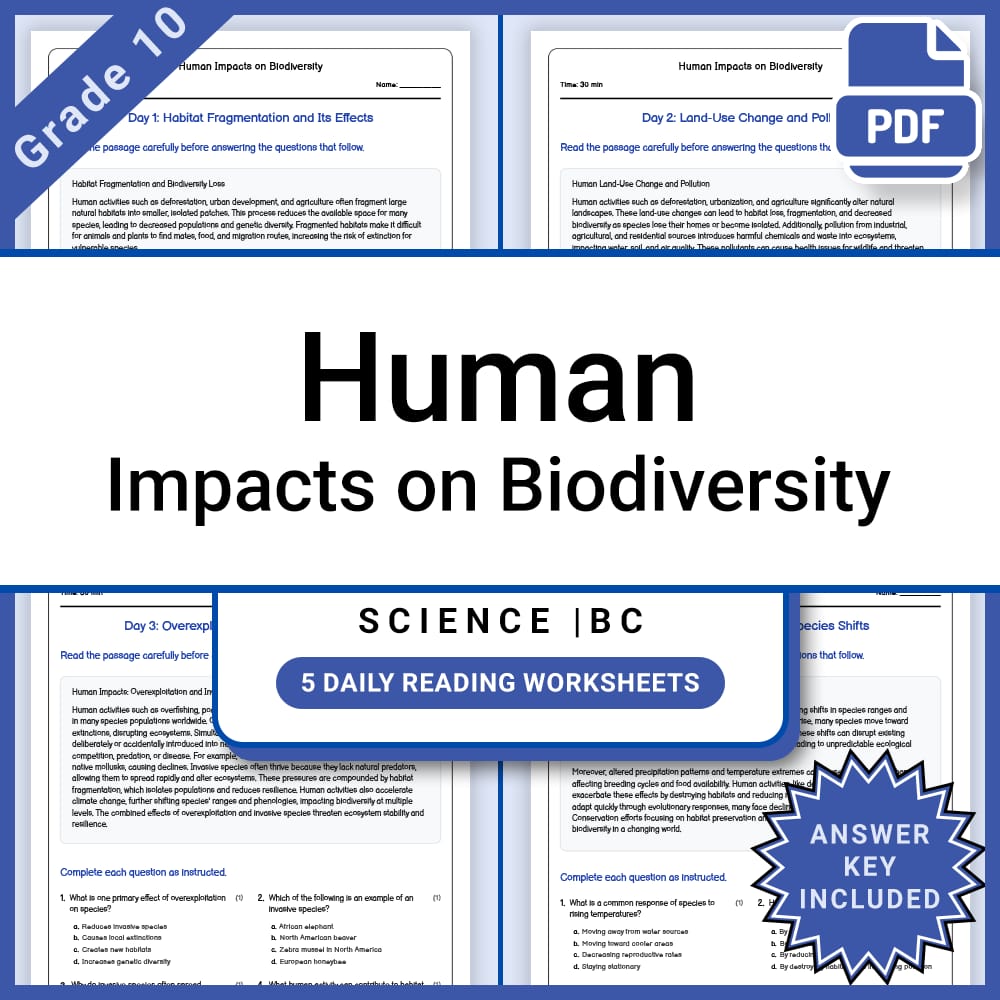
Grade 10 Science – Human Impacts on Biodiversity Worksheet + Answer Key
JCreated byJ.S SheetsLearning Objectives
- Understand the concept of habitat fragmentation
- Identify the effects of human activities on ecosystems
- Analyze how climate change interacts with habitat loss
Also included in: Grade 10 Science Lesson Bundle | Genetics, Evolution, Biodiversity & More +1 more
Instant download
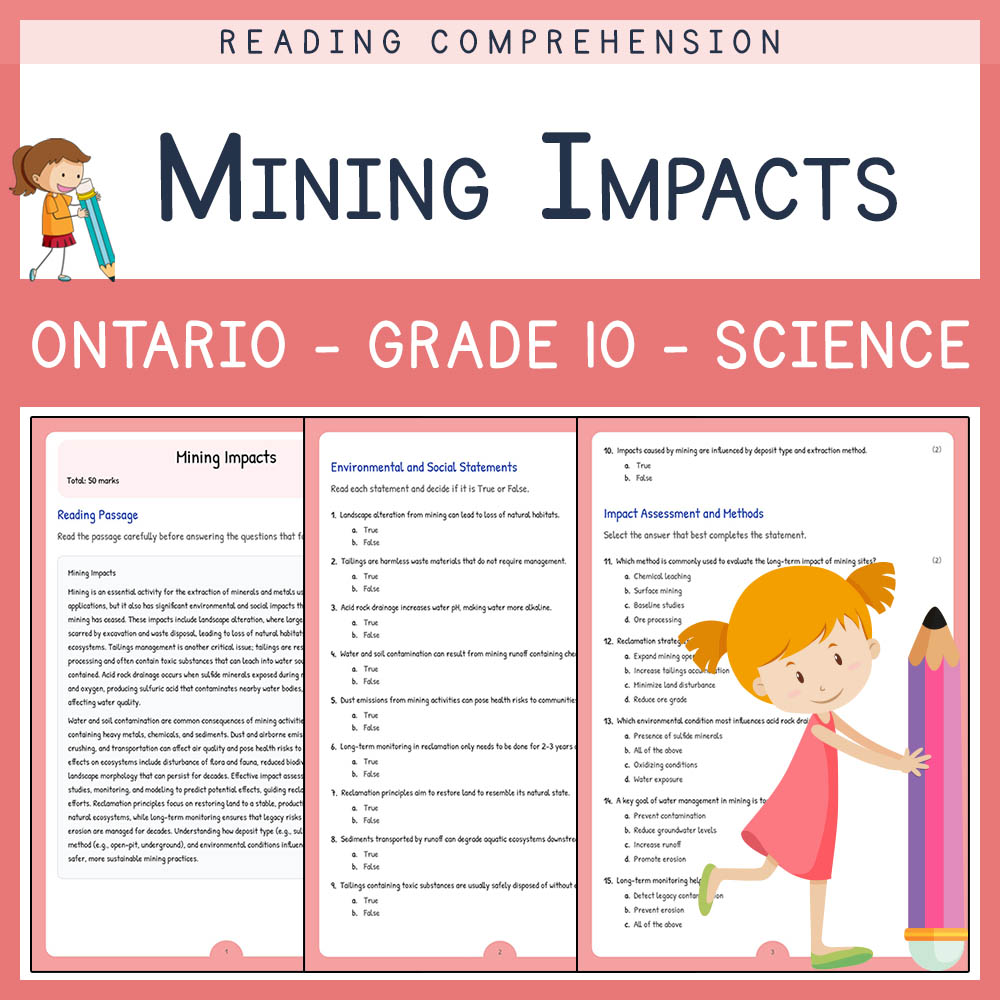
Grade 10 Science | Mining Impacts Worksheet Elena | Ontario Assessment
Created byLumora LearningLearning Objectives
- Understand the environmental consequences of mineral extraction and their causes.
- Identify methods used for impact assessment and reclamation in mining sites.
- Analyze the relationship between deposit type, extraction method, and environmental outcomes.
Instant download

Grade 10 Science – Selection Types & Evolution | Daily Reading Worksheet
Created byBright Mind ResourcesLearning Objectives
- Define and describe directional selection.
- Identify examples of directional selection in nature.
- Explain how traits change in populations due to selection.
Also included in: Grade 10 Evolution & Genetics Science Daily Reading Lesson Bundle | BC +1 more
Instant download

Enzymes And Rates Practice Test Prep | Grade 10 Science Worksheet
Created byPrism Point LearningLearning Objectives
- Explain how enzymes increase reaction rates by lowering activation energy and using specific active sites with induced fit.
- Describe how temperature, pH, substrate concentration, and inhibitors affect enzyme activity and reaction rate.
- Differentiate between competitive and non-competitive inhibition and predict their effects on enzyme rate.
Also included in: Grade 10 Cells & Energy Science Lesson Bundle Ontario Framework Pack
Instant download

Grade 10 Trophic Efficiency and Energy Transfer Worksheet TEKS
 Created byBRIGHT PATH RESOURCES
Learning Objectives
- Identify the main idea about how energy moves between trophic levels.
- Explain how trophic efficiency affects biomass pyramids and the number of trophic levels.
- Support claims with details about energy loss and ecosystem structure.
Also included in: Grade 10 Ecology & Environmental Interactions Science Worksheets | TEKS +1 more
Instant download

Grade 10 Science | Electron Configuration & Atomic Orbitals - Daily Reading
Created byCoral Reef LearningLearning Objectives
- Understand the shape and significance of s, p, d, and f orbitals.
- Identify the four quantum numbers and their roles in electron configuration.
- Relate orbital shapes and quantum numbers to spectral lines and chemical behavior.
Also included in: Chemistry Foundations Lesson Bundle: Grade 10 Science Advanced Placement (AP) +1 more
Instant download
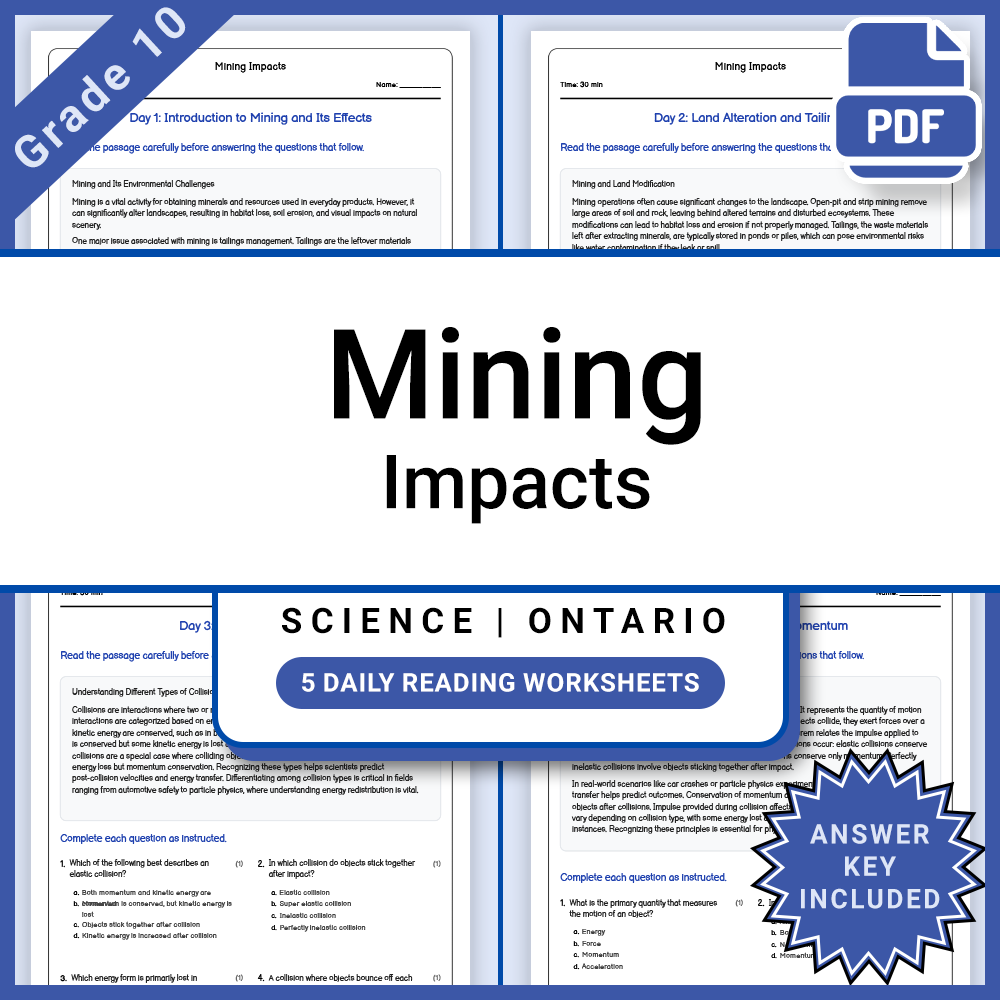
Grade 10 Science – Mining Impacts Daily Reading Worksheet with Answer Key
JCreated byJ.S SheetsLearning Objectives
- Understand the environmental effects of mineral extraction.
- Identify landscape alterations caused by mining activities.
- Recognize potential contamination issues related to mining.
Also included in: Grade 10 Science Lesson Bundle | Earth and Resource Management +1 more
Instant download

Grade 10 Science – Carbon Cycling & Responses | Daily Reading Worksheet
Created byBright Mind ResourcesLearning Objectives
- Define carbon cycling and its importance in Earth's systems.
- Identify the main reservoirs and processes involved in carbon movement.
- Explain how human activities influence carbon fluxes and climate.
Also included in: Grade 10 Energy in Biological Systems Science Daily Reading Lesson Bundle | TEKS +2 more
Instant download
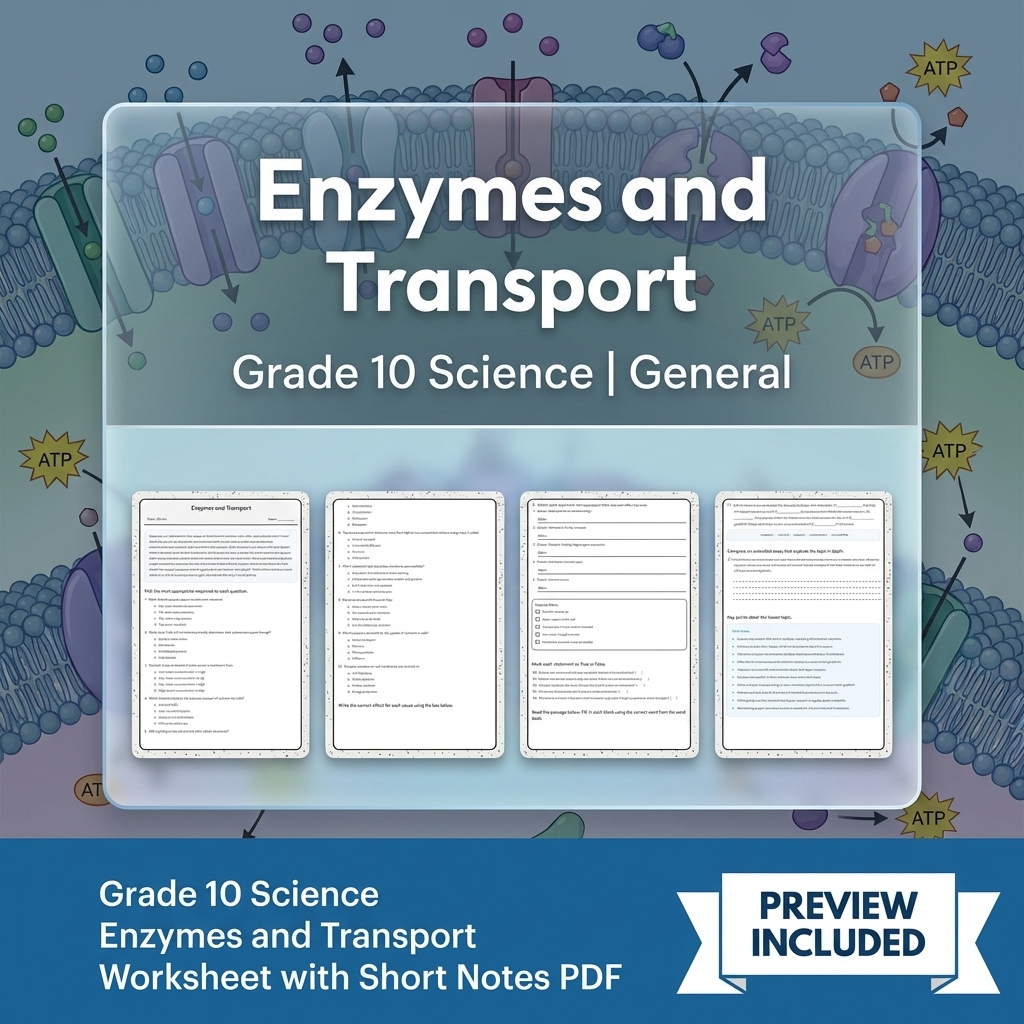
Grade 10 Science Enzymes and Transport Worksheet with Short Notes PDF
Created byMeadowlark WorksheetsLearning Objectives
- Understand the role of enzymes as biological catalysts in cellular reactions.
- Describe how membrane structure influences permeability and transport mechanisms.
- Explain the processes of diffusion and osmosis in cells.
Also included in: Grade 10 Natural Selection & Heredity Science Lesson Bundle - General +1 more
Instant download

Hydrologic Systems Worksheet for Grade 10 Science | NGSS-Aligned Practice
JCreated byJ.S SheetsLearning Objectives
- Describe the processes involved in hydrologic systems, including precipitation, infiltration, surface runoff, and groundwater flow.
- Explain the concepts of aquifer recharge and discharge, water-table fluctuation, and residence times in porous media.
- Analyze how fluxes are constrained by precipitation records, isotopic tracers, and stream-gauge data to assess freshwater availability.
Instant download

Grade 10 Science | Resource Tradeoffs Worksheet (NGSS) (PDF)
 Created bySilver Birch Teaching
Learning Objectives
- Analyze different energy and mineral resource options considering economic, environmental, and sustainability criteria.
- Evaluate trade-offs among resource development strategies such as fossil fuels, solar, wind, and mining reclamation.
- Apply criteria like resource depletion, ecosystem impact, and emissions to compare resource management strategies.
Also included in: Grade 10 Climate Change & Land Use Science Lesson Bundle Worksheets – NGSS +1 more
Instant download
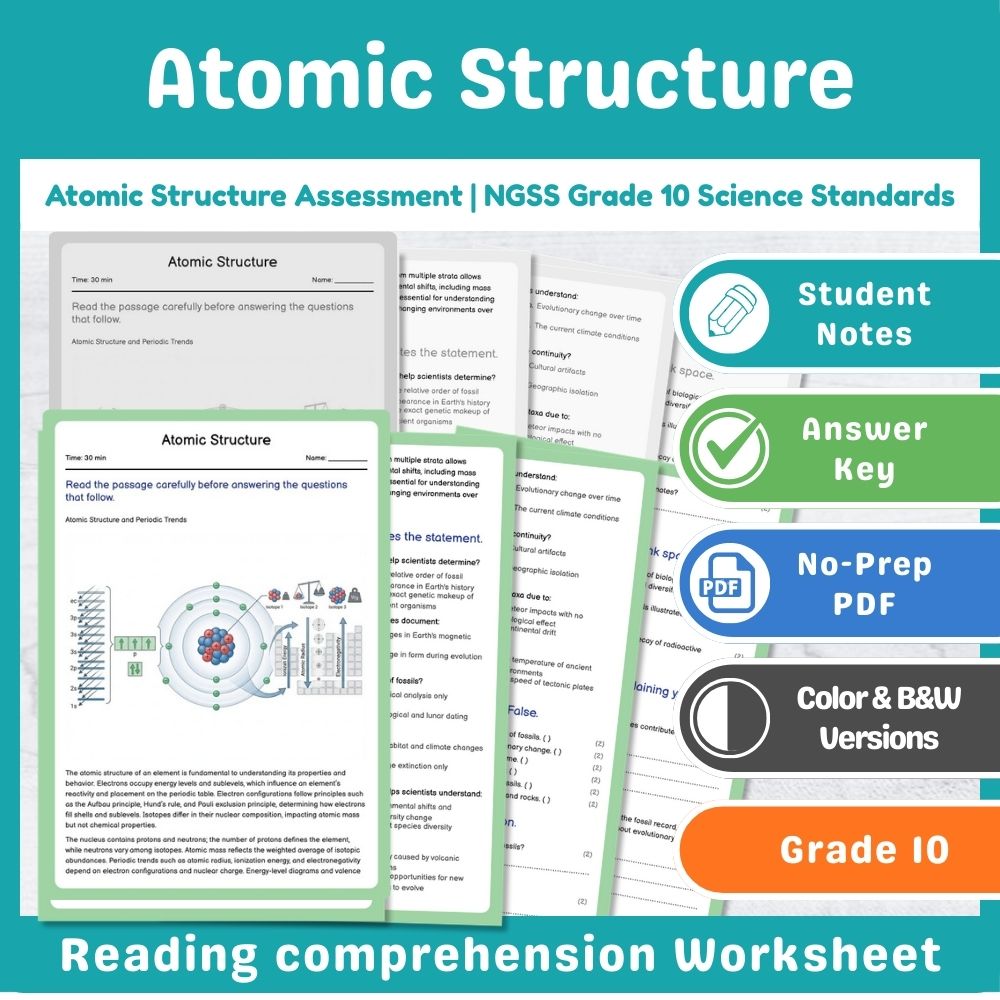
Atomic Structure Assessment | NGSS Grade 10 Science Standards
Created byPrism Point LearningLearning Objectives
- Explain the electron configuration and how it relates to periodic trends.
- Describe the relationship between nuclear composition, isotopes, and atomic mass.
- Interpret energy-level diagrams, electron shells, and sublevel occupancy to predict elemental properties.
Instant download

Trophic Relationships Worksheet | Science Grade 10 NGSS printable PDF
Learning Objectives
- Explain how energy and biomass transfer between trophic levels and why energy generally decreases up a food chain
- Interpret biomass and energy pyramids and describe what they imply about trophic efficiency
- Analyze how trophic cascades and keystone species can restructure communities through top-down and bottom-up effects
Also included in: Grade 10 Ecosystem Dynamics Lesson Bundle | NGSS Science Ecology
Instant download

Periodic Trends Worksheet | Grade 10 Science Activities
Created byPrism Point LearningLearning Objectives
- Explain how changes in nuclear charge and electron shielding produce periodic trends across periods and down groups
- Predict whether atomic radius increases or decreases and whether ionization energy and electronegativity increase or decrease
- Use periodic trends to reason about bonding, metallic character, and reactivity
Also included in: Grade 10 Science Chemical Reactions & Atomic Structure Lesson Bundle | Bc +1 more
Instant download

Grade 10 Science – Measurement Uncertainty & Data Analysis | Reading Worksheet
Created byBright Mind ResourcesLearning Objectives
- Define measurement uncertainty and explain its significance in scientific experiments.
- Identify the sources of measurement uncertainty including instrument resolution, experimental variation, and reading error.
- Interpret ranges of measured values and evaluate their overlaps to determine the confidence of results.
Also included in: Measurement Uncertainty Grade 10 Science Reading Worksheets Bundle | General +1 more
Instant download

Grade 10 Circuit Fundamentals Worksheet | Practice & Assessment PDF
Created byClear Sky ClassroomLearning Objectives
- Explain how current, voltage, resistance, and power relate in simple DC circuits using Ohm’s law and algebraic expressions.
- Analyze series and parallel resistor configurations to determine equivalent resistance and predict circuit behavior.
- Use energy bookkeeping to connect electrical power dissipation to energy transfer over time.
Also included in: Grade 10 Physics Concepts Science Lesson Bundle: Advanced Placement (AP) +1 more
Instant download

Grade 10 Enzymes and Rates Worksheet | Active Sites & Factors Ontario
Created byChalk and CompassLearning Objectives
- Explain how enzyme active sites and induced fit lower activation energy to speed up metabolic reactions.
- Predict how temperature, pH, and substrate concentration affect enzyme activity and reaction rate.
- Describe how inhibitors (competitive and non-competitive) change enzyme activity.
Also included in: Cells, Photosynthesis, Respiration & Microbes Lesson Bundle – Grade 10 Science +1 more
Instant download

System Interactions Worksheet for Grade 10 Science | Alberta Standards
JCreated byJ.S SheetsLearning Objectives
- Explain how biological systems exchange materials and information to produce emergent properties.
- Identify examples of system coupling in ecosystems, such as pollination networks and predator–prey dynamics.
- Describe how organ systems respond to external signals and how resource flows connect different organisms.
Also included in: Grade 10 Cell Systems & Homeostasis Science Lesson Bundle | Alberta +1 more
Instant download

Grade 10 Science – Inheritance Patterns Daily Reading Worksheet with Answer Key
JCreated byJ.S SheetsLearning Objectives
- Understand the concepts of dominant and recessive alleles
- Identify how heterozygous and homozygous genotypes influence traits
- Learn about Mendel's principles of segregation and independent assortment
Also included in: Grade 10 Science Lesson Group Bundle – TEKS | Genetics & Genomic Technologies +1 more
Instant download

Grade 10 Science – Understanding Two-Dimensional Motion | Daily Worksheet
 Created byQuiet Forest Education
Learning Objectives
- Explain the concept of motion in a plane and how it is characterized by orthogonal components.
- Decompose initial velocity vectors into horizontal and vertical components.
- Derive equations for range, maximum height, and time of flight in projectile motion.
Also included in: Motion and Forces Grade 10 Science Daily Reading Worksheets Bundle | Ontario +1 more
Instant download

Grade 10 Science – Geologic Time & Dating Principles | Daily Reading Worksheet
Created byBright Mind ResourcesLearning Objectives
- Understand the principles of relative dating in geology.
- Identify key features of the rock record.
- Recognize the significance of fossils and unconformities.
Also included in: Stellar Evolution Grade 10 Science Daily Reading Worksheets Bundle | FL NGSSS +1 more
Instant download
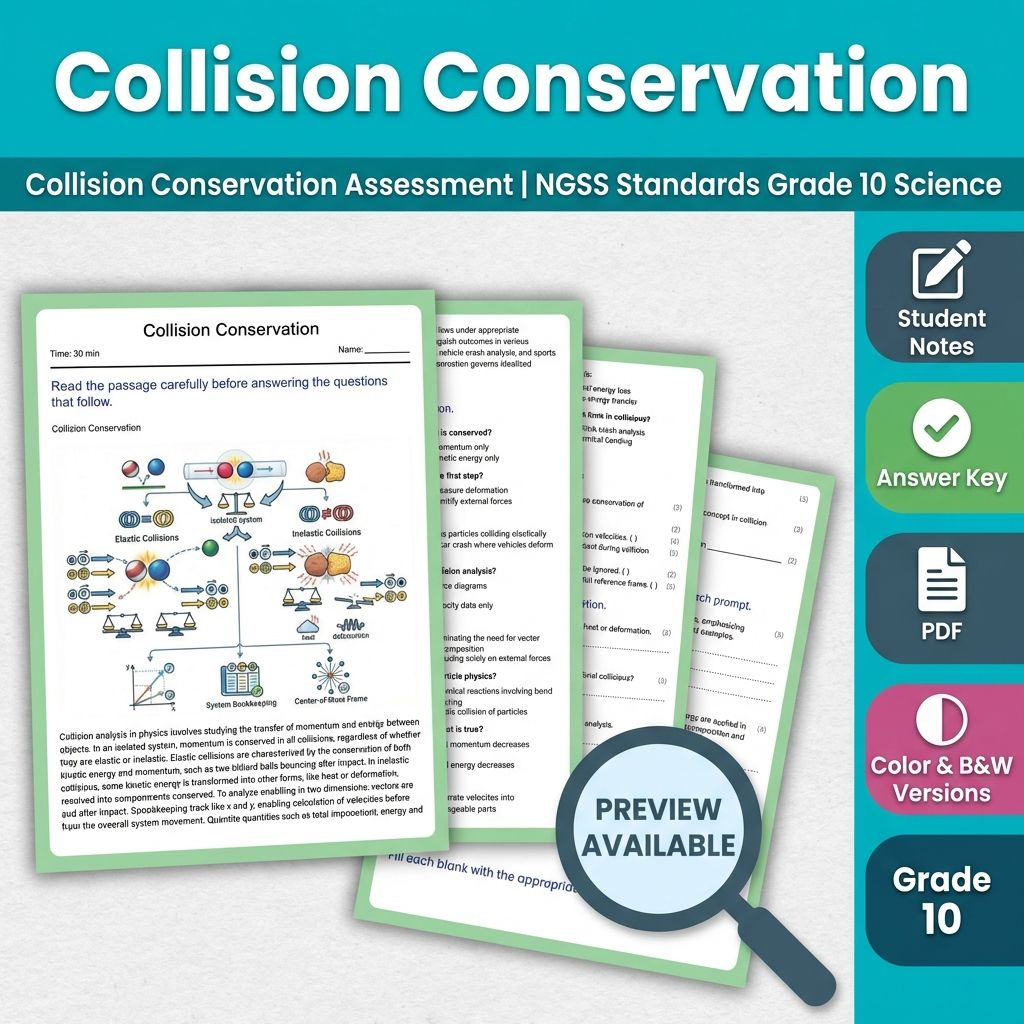
Collision Conservation Assessment | NGSS Standards Grade 10 Science
Created byPrism Point LearningLearning Objectives
- Understand the principles of conservation of momentum in multi-body collisions.
- Apply vector decomposition to resolve collision components in two dimensions.
- Differentiate between elastic and inelastic collisions based on energy transfer and post-collision behavior.
Instant download

Biodiversity Drivers Worksheet | Grade 10 Science Printable PDF Assessment
Learning Objectives
- Explain how habitat fragmentation, invasive species, land-use change, and climate-driven range shifts can change species richness and community composition.
- Describe how genetic diversity and metapopulation connectivity influence extinction risk and recovery.
- Evaluate how evidence from studies of habitat loss and conservation interventions can inform ecosystem function and long-term viability.
Also included in: Grade 10 Ecosystem Dynamics Lesson Bundle | NGSS Science Ecology
Instant download

Grade 10 Science — Worksheet MCQ Paper for Mastering Variables and Constraints
 Created byThe Resource Hub
Learning Objectives
- Understand the different types of variables used in scientific investigations, including independent, dependent, and controlled variables.
- Learn how to identify constraints and boundary conditions that influence experimental design and data interpretation.
- Explore criteria for selecting variables and strategies for controlling factors to establish causal relationships.
Also included in: Grade 10 Science Bundle: Master Scientific Modeling & Data Analysis +1 more
Instant download

Meiosis Worksheet | Grade 10 Science Practice TEKS Standards
Created byPrism Point LearningLearning Objectives
- Describe how meiosis reduces chromosome number by half to form haploid gametes
- Explain how homologous chromosome pairing and exchange of segments increase genetic diversity
- Connect meiotic events (independent assortment and segregation) to patterns of inheritance
Also included in: Genetics & Molecular Biology Lesson Bundle | Grade 10 Science | TEKS
Instant download

Grade 10 Science – Seismic Tomography & Waves | Daily Reading Worksheet
Created byQuiet Forest EducationLearning Objectives
- Understand the different types of seismic waves and their properties.
- Interpret how seismic wave travel times and attenuation reveal Earth's internal structure.
- Explain how seismic data are used to image crustal and mantle features such as subduction zones and mantle plumes.
Also included in: Earth Science Grade 10 Daily Reading Worksheets Bundle | Ontario Framework +1 more
Instant download

Grade 10 Science Worksheet Reaction Particles | Standards-Aligned Practice
JCreated byJ.S SheetsLearning Objectives
- Explain reaction rate using the collision (particle) model of reactants and successful collisions
- Connect activation energy barriers to whether collisions can rearrange bonds and form products
- Describe how temperature, concentration, and catalysts affect collision frequency and collision energy
Also included in: Grade 10 Conservation Laws and Stoichiometry Science Lesson Bundle | General +1 more
Instant download
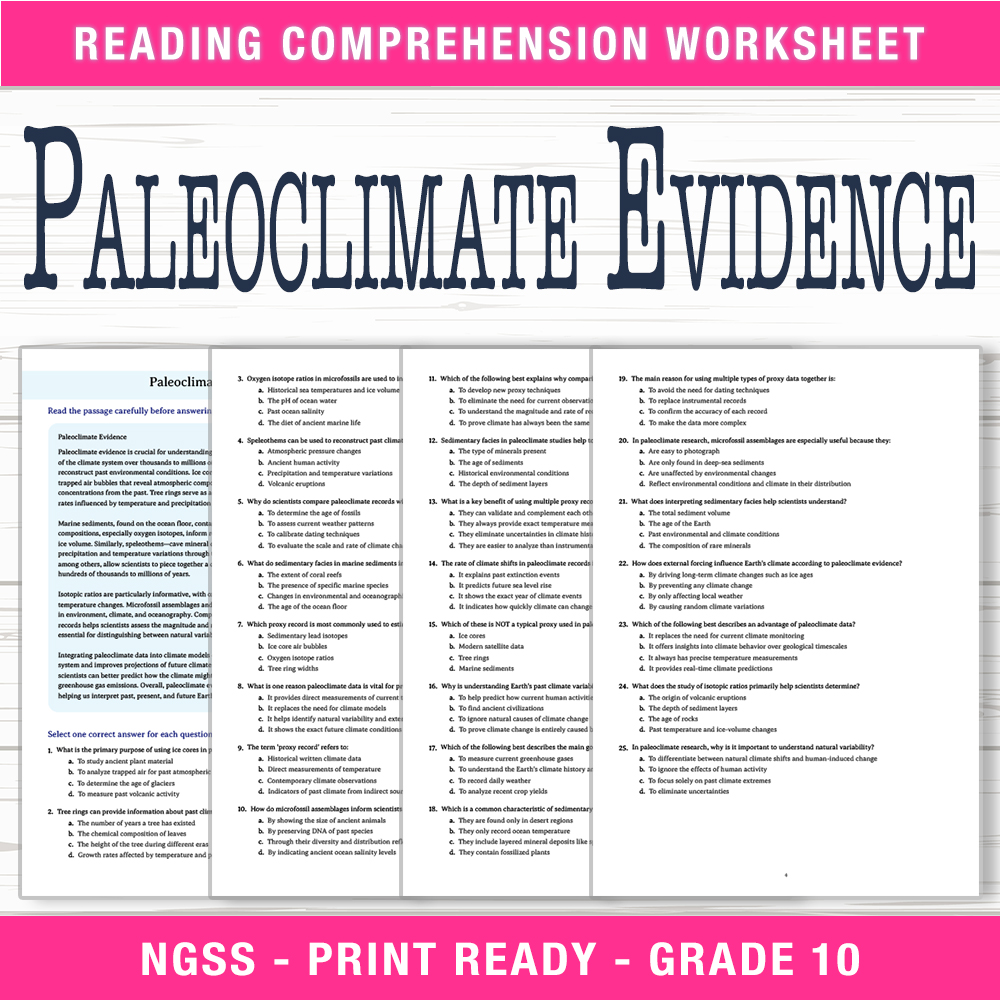
Grade 10 Science – Paleoclimate Evidence Worksheet (PDF + Answer Key)
Created byRiverstone ClassroomLearning Objectives
- Understand the types of proxy records used to reconstruct past climates, such as ice cores, tree rings, marine sediments, and speleothems.
- Explain how isotopic ratios, microfossil assemblages, and sedimentary facies provide information about historical climate changes.
- Evaluate how paleoclimate records are compared with instrumental data to analyze recent climate trends and variability.
Instant download

Grade 10 Science – Collisions & Momentum | Daily Reading Worksheet
Created byBright Mind ResourcesLearning Objectives
- Define and explain the concepts of momentum and impulse.
- Describe different types of collisions: elastic, inelastic, and perfectly inelastic.
- Apply impulse–momentum relations to analyze collision scenarios.
Also included in: Grade 10 Force & Motion Science Daily Reading Lesson Bundle – Ontario +1 more
Instant download

Grade 10 Science — Worksheet MCQ Paper for Mastering Stratigraphic Record
Created byThe Resource HubLearning Objectives
- Understand the principles of stratigraphy such as superposition, correlation, and unconformities.
- Interpret stratigraphic sequences and fossil assemblages to determine relative and absolute ages of Earth events.
- Evaluate radiometric decay methods and error considerations within geochronology.
Also included in: Grade 10 Earth and Space Sciences Lesson Bundle | AP Curriculum +1 more
Instant download

Grade 10 Science Evidence-Based Communication Worksheet (PDF)
 Created byEvergreen Desk Education
Learning Objectives
- Explain how scientific claims are supported by evidence through logical reasoning (CER).
- Use precise scientific language and appropriate representations to justify conclusions.
- Evaluate alternative interpretations and recognize limits of evidence in explanations.
Also included in: Grade 10 Uncertainty & Evidence Data Science Lesson Bundle (General) +1 more
Instant download
About Grade 10 Science Worksheets
Find Science worksheets built for Grade 10. All 7,038 cover core skills, practice, and review, each an instant PDF download.
Every worksheet on MyTeachingSheets is created by independent teacher-authors and reviewed before publication. All resources download as printable PDFs for classroom, homework, or at-home practice, and many include answer keys. Preview any worksheet free before buying.