
Grade 6 Worksheets
8,578 grade resources
Cellular Respiration Worksheet Grade 6 Science Activities Pack
 Created byPrism Point Learning
Learning Objectives
- Describe how cellular respiration converts energy in food into energy cells can use
- Explain the role of oxygen and the exchange of gases during cellular respiration
- Connect products of cellular respiration to what leaves the body as waste
Also included in: Animals Matter Lesson Bundle | Grade 6 Science | California Standards
Instant download

Grade 6 ELA – Daily Reading Worksheet | Understanding Audience Fit in Writing
 Created byQuiet Forest Education
Learning Objectives
- Identify different types of audiences for writing.
- Explain how tone and content change based on audience.
- Practice writing a friendly letter suited to a general audience.
Also included in: Grade 6 Daily Reading for Writing Purpose & Tone ELA Lesson Bundle | Ontario +1 more
Instant download

Grade 6 ELA – Understanding Purpose & Audience in Writing | Daily Reading Worksheet
Created byQuiet Forest EducationLearning Objectives
- Identify the main purpose of a given text.
- Recognize how purpose influences writing style and content.
- Apply understanding of purpose to analyze short passages.
Also included in: Research Writing & Editing Daily Reading Lesson Bundle | Grade 6 ELA | TeKS +1 more
Instant download

Forces That Control Flight Worksheets Grade 6 Air Forces and Aerodynamics
 Created bySunny Desk Resources
Learning Objectives
- Define lift, thrust, drag, and weight and describe how each affects motion through air
- Explain how balanced forces can cause steady flight or slow descent
- Identify which force increases or decreases in common flight examples such as kites and parachutes
Also included in: Air and Aerodynamics Grade 6 Alberta Science Worksheets Bundle +1 more
Instant download

Dialogue Punctuation Worksheet Grade 6 ELA Grammar Practice + Answer Key
 Created byLumora Learning
Learning Objectives
- Use quotation marks to correctly show a character’s exact spoken words in narratives.
- Place commas, periods, question marks, and exclamation points in the correct position with dialogue.
- Use dialogue tags (said/asked/replied) with correct comma placement before or after quoted speech.
Instant download

Grade 6 Science | Ecosystem Components - Daily Reading Comprehension
 Created byCoral Reef Learning
Learning Objectives
- Identify the key components of an ecosystem
- Differentiate between abiotic and biotic factors
- Understand the roles of producers, consumers, and decomposers
Instant download

Eclipses & Tides Worksheets Grade 6 Earth-Moon-Sun System
Created byPrism Point LearningLearning Objectives
- Explain how Earth-Moon-Sun alignment causes solar and lunar eclipses
- Distinguish the umbra and penumbra in eclipse shadows
- Explain why eclipses do not occur every month
Also included in: Grade 6 Space Science Lesson Bundle | Ontario Science Framework
Instant download
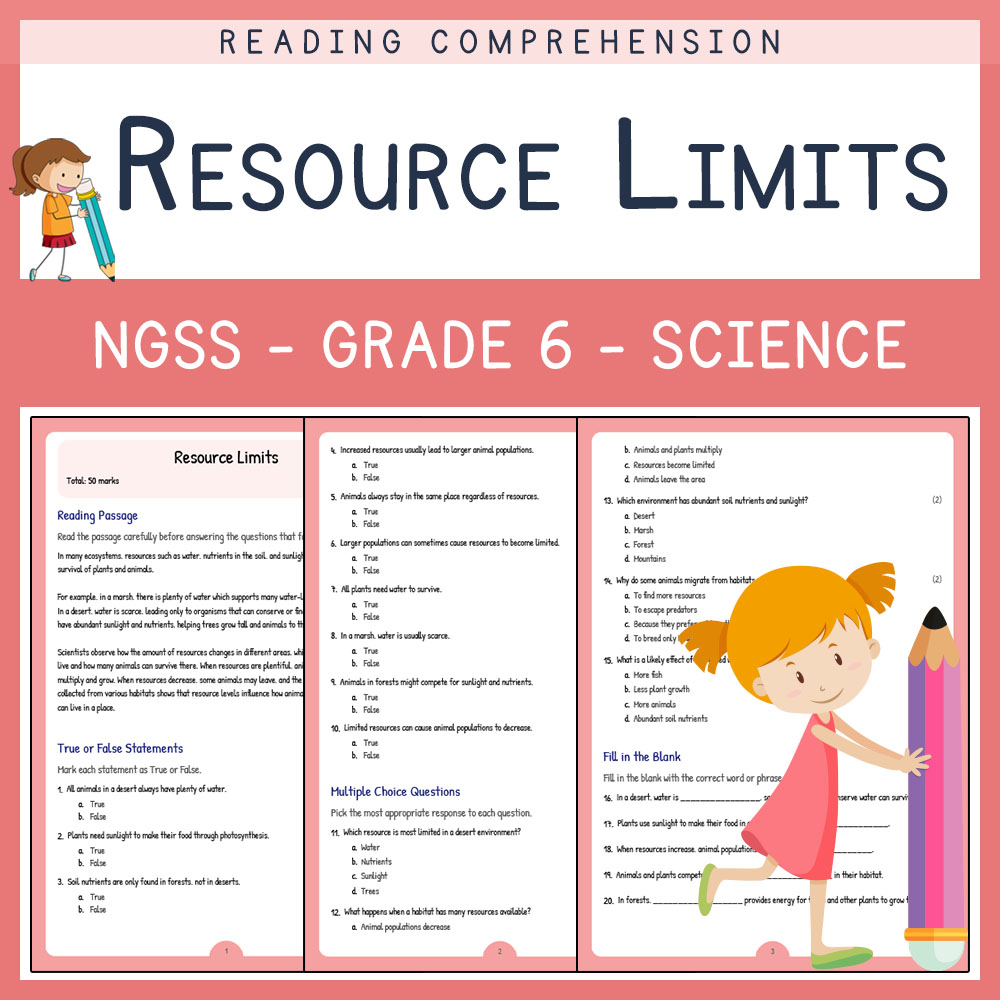
Grade 6 Science | Resource Limits Worksheet (PDF) | NGSS Aligned
Created byLumora LearningLearning Objectives
- Understand how resource availability affects individual organisms and populations.
- Interpret data patterns related to resource distribution in different environments.
- Identify limiting resources such as water, soil nutrients, and light across habitats.
Instant download

Grade 6 Health Inclusive Participation in Physical Activities Worksheet
Created byPrism Point LearningLearning Objectives
- Explain how inclusive participation supports safety, confidence, and enjoyment in physical activities.
- Identify respectful behaviors that help people feel included and valued during games and movement tasks.
- Describe ways to modify activities so different abilities can participate fairly.
Instant download

Grade 6 Text Structure Purpose Worksheet | ELA Reading Skills Practice
Created bySunny Desk ResourcesLearning Objectives
- Explain how an informational text’s structure helps the author achieve a purpose.
- Identify common structural features (headings, transitions, and sequence) and describe how they guide reader understanding.
- Use placement and organization (beginning, middle, end) to infer emphasis and main ideas.
Also included in: Reading Informational Grade 6 ELA Lesson Bundle | General ELA +1 more
Instant download

Text Structure Purpose Worksheet | General ELA Grade 6 Standards
JCreated byJ.S SheetsLearning Objectives
- Identify common text structures in informational texts (such as cause/effect, problem/solution, and sequence) and describe how they support the author’s purpose.
- Explain how transitions, headings, and the placement of key information shape emphasis, pacing, and clarity.
- Use evidence from a text to determine what the author is trying to achieve and how the structure helps achieve that goal.
Instant download

Filtration and Mixtures Worksheets Grade 6 Science
 Created byBRIGHT PATH RESOURCES
Learning Objectives
- Describe how filtration separates a mixture using particle size and whether particles can pass through a barrier
- Identify what happens to the solid residue and what happens to the liquid that flows through the filter
- Use evidence such as sediment thickness and liquid clarity to explain filtration results
Also included in: Grade 6 Physical Science Worksheets Bundle | Heat, Matter & Forces +2 more
Instant download

Signal Integration Worksheet & Doodle Notes | NGSS Grade 6 Science
 Created byAmber Owl Education
Learning Objectives
- Explain how cells communicate using chemical and electrical signals.
- Describe how receptors translate signals into cellular responses, including signal transduction cascades.
- Differentiate rapid nervous impulses from longer-term endocrine effects.
Also included in: Cells & Scientific Evidence Lesson Bundle – Grade 6 Science NGSS +1 more
Instant download

Grade 6 ELA – Source Credibility & Information Evaluation | Daily Worksheet
Created byQuiet Forest EducationLearning Objectives
- Identify signals of credible sources
- Differentiate between fact and opinion
- Evaluate evidence supporting claims
Also included in: Grade 6 Media Literacy ELA Daily Reading Worksheets Lesson Bundle | Alberta +1 more
Instant download

Grade 6 Scientific Methods Daily Reading Worksheet | TEKS Science Activity
Created byBRIGHT PATH RESOURCESLearning Objectives
- Identify the purpose of observations and how they lead to testable questions.
- Differentiate descriptive and comparative approaches in scientific investigations.
- Connect hypotheses to measurable outcomes and choose appropriate methods for observable phenomena.
Also included in: Scientific Methods 6th Science Daily Reading Worksheets Lesson Bundle | TeKS +1 more
Instant download

Grade 6 Social Studies — Traditions and Practices Worksheet MCQ PDF + Answer Key
 Created byThe Resource Hub
Learning Objectives
- Understand the role of cultural traditions and practices in community identity.
- Identify different types of rituals, ceremonies, and everyday customs across societies.
- Analyze how traditions contribute to cultural continuity and social cohesion.
Also included in: Grade 6 Social Studies Bundle: Cultures and Identities – BC Framework +1 more
Instant download

Flight Control Coupling Worksheets | Roll, Pitch & Yaw Grade 6
Created byPrism Point LearningLearning Objectives
- Explain how roll, pitch, and yaw inputs create coupled responses
- Identify how differential drag produces adverse yaw during roll
- Describe how elevator–aileron coupling affects pitch-roll maneuvers
Also included in: Flight Lesson Bundle | Grade 6 Science | Ontario Framework
Instant download

Robotic Missions Science Worksheet Grade 6 Space Exploration Ontario
 Created byChalk and Compass
Learning Objectives
- Describe major types of robotic space missions (flyby, orbiter, lander, and sample-return) and what each can accomplish.
- Explain how engineering constraints such as distance and communication delay affect mission design and operations.
- Connect mission design choices (gravity assists, propulsion, instrumentation, and data return) to the types of measurements collected.
Also included in: Space - Grade 6 Bundle +1 more
Instant download

Angle of Attack, Lift and Stall Worksheets | Grade 6 Flight Science
Created byPrism Point LearningLearning Objectives
- Describe how angle of attack changes airflow and lift production
- Identify linear and post-stall lift regimes as angle increases
- Explain how wing incidence changes effective angle of attack
Also included in: Flight Lesson Bundle | Grade 6 Science | Ontario Framework
Instant download

Grade 6 Community Stewardship Science Worksheet | Ontario Scientific Methods
 Created byTeacher's Corner
Learning Objectives
- Describe how the scientific method can be used to solve a local stewardship problem.
- Explain the importance of consent, cultural sensitivity, and respectful communication when collecting community observations.
- Use evidence evaluation skills to validate community-contributed records.
Instant download

Earth System Spheres Assessment – Grade 6 Science California Standards
Created byPrism Point LearningLearning Objectives
- Explain how Earth’s four system spheres—geosphere, hydrosphere, atmosphere, and biosphere—interact
- Describe how matter and energy move between spheres through processes such as weathering, evaporation, cloud formation, and biological activity
- Use gravity and energy concepts to predict how changes in one sphere can affect other spheres
Also included in: Grade 6 Water in Earth Systems Science Lesson Bundle: California Standards +1 more
Instant download

Science Grade 6 Food Webs Worksheet | Trophic Relationships Practice
JCreated byJ.S SheetsLearning Objectives
- Identify producers, consumers, and decomposers in food webs
- Explain how energy transfers between trophic levels and why energy decreases
- Describe how removing or adding species can change a food web’s balance
Instant download

Grade 6 Transport and Sediment Worksheet | General Practice PDF
 Created byClear Sky Classroom
Learning Objectives
- Explain how stream and wind energy affects the size of sediment particles that can be transported.
- Describe how decreasing energy leads to sorting and deposition of larger particles first.
- Identify real-world landforms (such as stream bars and sandbars) that result from sediment sorting.
Instant download

Model Limitations in Science Worksheets | Grade 6 Scientific Inquiry
Created byBRIGHT PATH RESOURCESLearning Objectives
- Explain how scientific models help make predictions while still having limitations.
- Identify assumptions in a model description and describe how they affect conclusions.
- Use evidence to check whether a model’s predictions match observations.
Also included in: Grade 6 Scientific Inquiry Science Worksheets Bundle | General Science +2 more
Instant download

Grade 6 ELA – Understanding Personal Meaning in Media Messages | Daily Worksheet
Created byQuiet Forest EducationLearning Objectives
- Identify emotional connections in media and stories
- Analyze how characters' decisions reflect real-world dilemmas
- Evaluate the relevance of themes based on personal experience
Also included in: Grade 6 Media Literacy ELA Daily Reading Worksheets Lesson Bundle | BC +1 more
Instant download

Grade 6 Science Worksheet – Predator-Prey Dynamics (PDF)
 Created byEvergreen Desk Education
Learning Objectives
- Explain how predator and prey populations affect each other in an ecosystem
- Identify examples of prey adaptations that reduce predator capture
- Describe cause-and-effect feedback loops in food webs
Also included in: Grade 6 Life Processes & Ecosystem Interactions Science Lesson Bundle: General +1 more
Instant download

Cohesive Devices Worksheet Grade 6 ELA Ontario | Transitions & Text Cohesion
Created byLumora LearningLearning Objectives
- Identify how cohesive devices (transitional words, pronouns, and repeated key terms) connect ideas within and across paragraphs.
- Choose the most effective sentence-level connection method to improve clarity and flow.
- Use cause-effect and sequence language appropriately to strengthen logical relationships in writing.
Instant download

Grade 6 Science | Criteria And Constraints Worksheet with Short Notes
 Created byMeadowlark Worksheets
Learning Objectives
- Understand the difference between criteria and constraints in the design process.
- Identify examples of criteria and constraints in real-world design scenarios.
- Analyze how constraints limit possible solutions while criteria define success.
Also included in: Grade 6 Science Lesson Bundle | Critical Thinking & Problem Solving +1 more
Instant download

Grade 6 Hispanic Heritage Month Arts and Expressions Worksheet
 Created byShaNova Worksheets
Learning Objectives
- Identify key ideas from a passage about Hispanic artistic traditions and cultural storytelling.
- Use evidence from statements to determine whether information is true or false.
- Complete sentences with vocabulary related to arts, culture, and community.
Instant download

Chemical Energy Release Assessment | California Standards Grade 6 Science
Created byPrism Point LearningLearning Objectives
- Explain how chemical energy in food molecules is transformed to power life processes.
- Describe how energy is conserved in organisms as it changes form (useful energy and heat).
- Use evidence from a scientific passage to support claims about how feeding supports sustained functioning.
Also included in: Grade 6 Energy and Matter Cycles Science Lesson Bundle | California Standards +1 more
Instant download
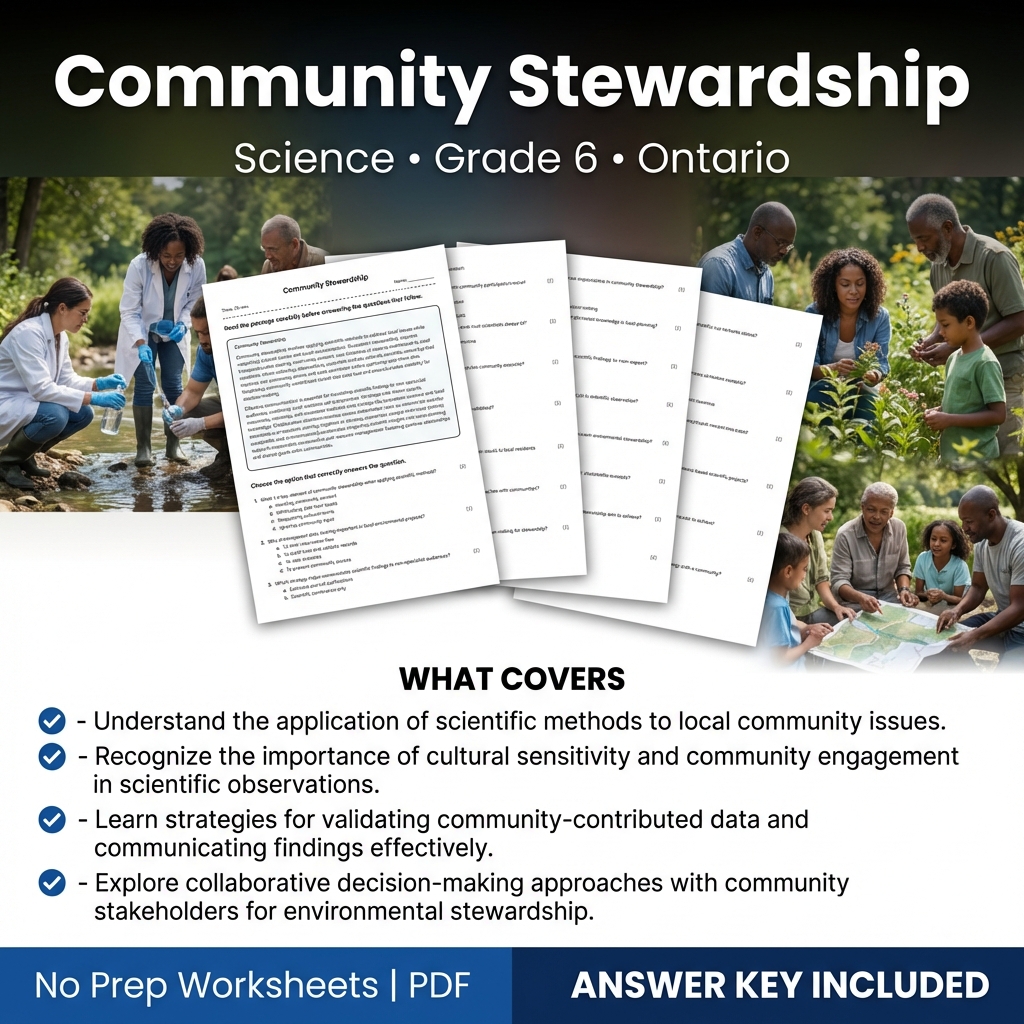
Grade 6 Science Worksheet on Community Stewardship – Ontario Standards
Created byCoral Reef LearningLearning Objectives
- Understand the application of scientific methods to local community issues.
- Recognize the importance of cultural sensitivity and community engagement in scientific observations.
- Learn strategies for validating community-contributed data and communicating findings effectively.
Instant download

Erosion and Deposition Worksheet | Standards-Aligned Grade 6 Science Practice
JCreated byJ.S SheetsLearning Objectives
- Explain how moving water causes erosion and deposition of Earth materials.
- Identify features formed by erosion and deposition such as deltas and river terraces.
- Describe factors that influence the process of erosion and deposition, including water volume and surface materials.
Also included in: Grade 6 Earth & Space Science Lesson Bundle: California Standards +1 more
Instant download

Physical and Political Features Worksheet | TEKS Grade 6 Social Studies
JCreated byJ.S SheetsLearning Objectives
- Identify major physical features (mountain ranges, rivers, plains) and explain their basic characteristics.
- Recognize how political boundaries (countries, states, cities) can align with physical features.
- Describe how physical geography can influence transportation routes and human activity near borders.
Instant download

Day Night Seasons Worksheet | NGSS Grade 6 Earth Science Activity
Created byAmber Owl EducationLearning Objectives
- Explain how Earth’s rotation causes day and night.
- Describe how Earth’s 23.5° axial tilt and orbit produce seasonal changes in sunlight and temperature.
- Identify solstices and equinoxes as predictable observational events tied to daylight patterns.
Also included in: Grade 6 Science Moon Relationships & Day Night Seasons Lesson Bundle | NGSS +1 more
Instant download

Grade 6 Science | El Niño and Its Effects - Daily Reading Comprehension
Created byCoral Reef LearningLearning Objectives
- Understand what El Niño is and how it affects global weather patterns.
- Learn scientific vocabulary related to ocean-atmosphere interactions.
- Develop reading comprehension skills through scientific texts.
Instant download
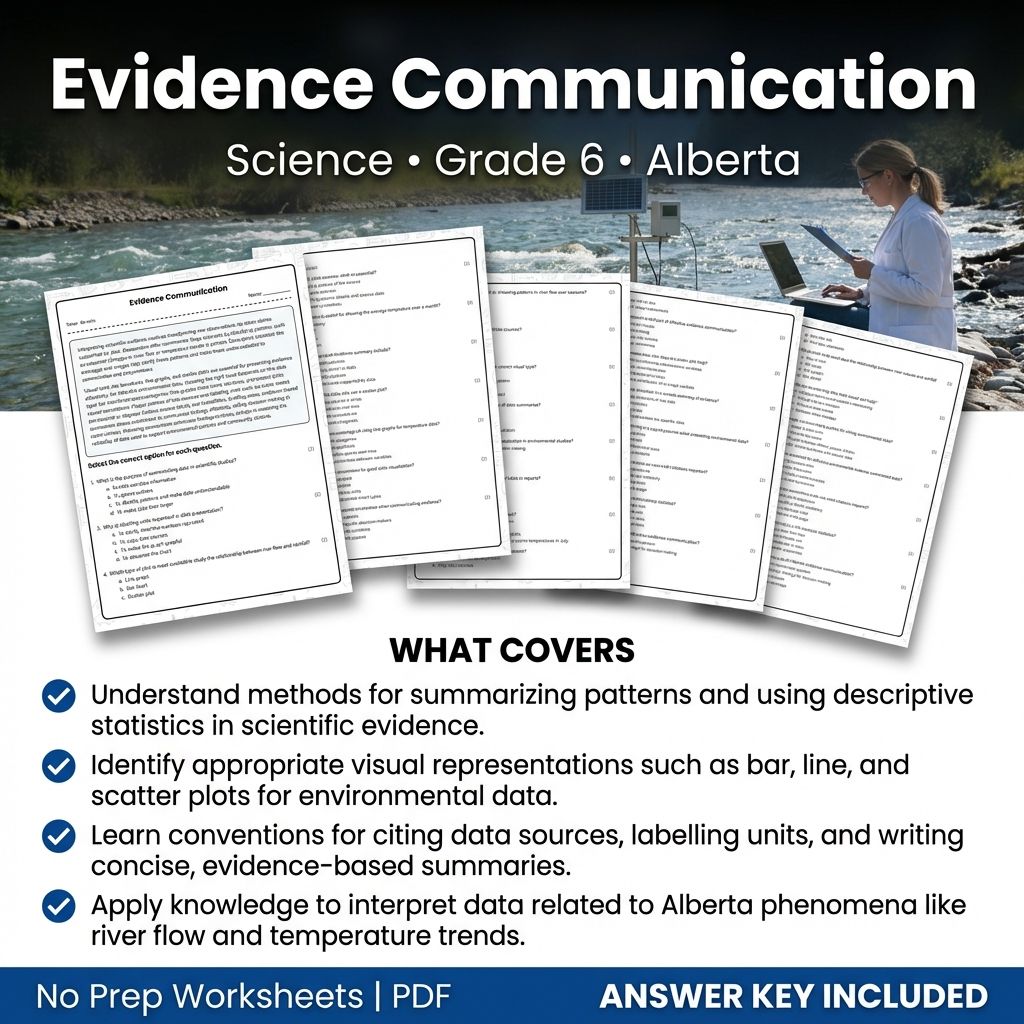
Grade 6 Science Worksheet on Evidence Communication | Alberta Standards
Created byCoral Reef LearningLearning Objectives
- Understand methods for summarizing patterns and using descriptive statistics in scientific evidence.
- Identify appropriate visual representations such as bar, line, and scatter plots for environmental data.
- Learn conventions for citing data sources, labelling units, and writing concise, evidence-based summaries.
Instant download

Grade 6 ELA – Point Of View & Narrative Texts | Daily Reading Worksheet
Created byQuiet Forest EducationLearning Objectives
- Identify first-person point of view in a text.
- Distinguish between first-person and third-person narration.
- Understand how perspective influences the reader's interpretation.
Also included in: Grade 6 Infomational Text Daily Reading Worksheets ELA Lesson Bundle | Ontario +1 more
Instant download

Grade 6 ELA – Claim Statements & Reading Practice | Daily Reading Worksheet
Created byQuiet Forest EducationLearning Objectives
- Understand the definition of a claim statement in argumentative writing.
- Identify clear and arguable claims within texts.
- Differentiate between statements that are claims and those that are not.
Also included in: Writing Grade 6 ELA Daily Reading Worksheets Bundle | CCSS +1 more
Instant download

6th Grade Math Worksheet – Representing Figures (PDF) – Ontario Standards
Created byClear Sky ClassroomLearning Objectives
- Understand various methods for constructing and representing geometric figures.
- Apply tools and techniques to accurately draw and interpret figures in different contexts.
- Develop reasoning skills to justify construction choices and analyze geometric relationships.
Also included in: Grade 6 Geometry and Spatial Sense Lesson Bundle for Ontario Maths +1 more
Instant download

Grade 6 ELA – Analyzing Literature & Literary Elements | Daily Reading Worksheet
Created byQuiet Forest EducationLearning Objectives
- Understand key concepts related to ELA
- Apply knowledge through practice questions
- Demonstrate comprehension of the material
Also included in: Reading Literature Grade 6 Daily Reading Worksheets Bundle | CCSS +1 more
Instant download

Grade 6 ELA – Point of View & Perspectives in Literature | Daily Worksheet
Created byQuiet Forest EducationLearning Objectives
- Understand what an author's point of view is.
- Learn to identify different perspectives in a story or informational text.
- Recognize bias and how language choices influence the reader.
Also included in: Reading: Informational Text Grade 6 ELA Daily Reading Worksheets Bundle | CCSS +1 more
Instant download

Grade 6 ELA – Understanding Text Categories & Daily Reading Worksheet
Created byQuiet Forest EducationLearning Objectives
- Identify key features of narrative and informational texts
- Distinguish between storytelling and factual writing based on purpose, style, and structure
- Analyze different types of texts to determine their category
Also included in: Grade 6 Infomational Text Daily Reading Worksheets ELA Lesson Bundle | Ontario +1 more
Instant download

Grade 6 Revising Clarity Worksheet | Ontario ELA Writing Revision Skills
Created bySunny Desk ResourcesLearning Objectives
- Revise a draft by improving clarity through organization and logical flow.
- Use evidence-based sentence-level edits (tense, person, punctuation, and accuracy).
- Identify what to cut, move, or expand to better meet a specific purpose and audience.
Instant download

Grade 6 Information Flow Worksheet | ELA Reading & Text Structure Skills
Created bySunny Desk ResourcesLearning Objectives
- Identify how topic sentences and paragraph subtopics organize an explanatory text.
- Use transitions to track how ideas change within and across sections.
- Explain how consistent terminology supports clarity and comprehension.
Also included in: Grade 6 Writing Lesson Bundle | General ELA | Editing, Narrative, Argument +1 more
Instant download

Point of View Worksheet Grade 6 ELA Reading Comprehension + Answer Key
Created byLumora LearningLearning Objectives
- Identify and describe first-person and third-person point of view and how narrative distance shapes meaning
- Analyze how a narrator’s or writer’s perspective affects reliability, emphasis, and reader interpretation
- Use textual evidence (word choice, details selected or omitted, and focus shifts) to support claims about perspective
Instant download

Dichotomous Keys & Multi-Access Keys Biodiversity Worksheets Grade 6
Created byPrism Point LearningLearning Objectives
- Identify contrasting traits suitable for binary identification branches
- Construct decision points for dichotomous and multi-access keys
- Revise identification keys to improve classification clarity
Instant download

Natural Hazards Evidence and Patterns Worksheets Grade 6 Science
 Created byTeachers Club
Learning Objectives
- Explain how tectonic processes can lead to natural hazards
- Interpret seismic data and maps as evidence of hazards
- Describe how hazard zones affect communities and infrastructure
Also included in: Earth and Human Activity Grade 6 Science NGSS Worksheets Bundle +2 more
Instant download

Grade 6 Erosion and Deposition Worksheet | NGSS Practice PDF
Created byClear Sky ClassroomLearning Objectives
- Explain how flowing water erodes and transports Earth materials.
- Describe how changes in water energy lead to deposition.
- Identify common landforms formed by erosion and deposition, such as river terraces and deltas.
Instant download
Browse more categories
About Grade 6 Worksheets
Browse 8,578 printable Grade 6 worksheets across math, ELA, science, and social studies — each a ready-to-print PDF with optional answer keys.
MyTeachingSheets worksheets are made by real teacher-authors and checked before they go live. Download any as a print-ready PDF for lessons, homework, or independent practice — most include answer keys, and previews are always free.