
Grade 6 Science Worksheets
5,969 worksheets
6th Grade Science | Design Refinement Worksheet (Alberta Standards) (PDF)
 Created bySilver Birch Teaching
Learning Objectives
- Explain how incremental design changes can improve aerodynamic performance and safety.
- Use criteria and trade-offs to evaluate design modifications related to speed, stability, and payload.
- Describe simple ways to measure and observe flight path consistency during refinement.
Also included in: Grade 6 Aerodynamics & Flight Forces Science Lesson Bundle: Alberta +1 more
Instant download

Grade 6 Science – Experimental Design Worksheet (Alberta Standards) (PDF)
Created bySilver Birch TeachingLearning Objectives
- Identify variables (independent, dependent, and controlled) in an environmental fair test
- Select appropriate controls and measurement procedures to make comparisons fair and interpretable
- Explain how repeatable criteria and clear observations support valid conclusions
Also included in: Grade 6 Scientific Inquiry & Data Analysis Science Lesson Bundle: Alberta +1 more
Instant download

Grade 6 Science Measurement Tools Worksheet (Alberta Standards) (PDF)
Created bySilver Birch TeachingLearning Objectives
- Identify common measurement tools and match them to the appropriate quantity (temperature, pH, length).
- Explain why calibration and choosing correct units improve the accuracy of data.
- Record observations consistently so data can be represented in graphs later.
Also included in: Grade 6 Scientific Inquiry & Data Analysis Science Lesson Bundle: Alberta +1 more
Instant download

Grade 6 Science Shadow Patterns Worksheet (PDF) | Alberta Standards
Created bySilver Birch TeachingLearning Objectives
- Explain how Sun angle changes during the day and how that affects shadow length and direction
- Describe how Earth’s axial tilt and orbit cause predictable seasonal changes in noon shadow length
- Use observations and simple measurements to support scientific explanations about day/night and seasons
Also included in: Grade 6 Celestial Motion & Seasons Science Lesson Bundle | Alberta +1 more
Instant download

Grade 6 Science Observational Instruments Worksheet | Ontario Standards
 Created byCedar Grove Learning
Learning Objectives
- Describe how optical, radio, and space-based telescopes help scientists observe the solar system.
- Explain how different wavelengths (visible, infrared, and radio) reveal information about composition, motion, and temperature.
- Compare ground-based and space-based observatories, including how Earth’s atmosphere affects observations.
Also included in: Grade 6 Earth and Space Systems Science Lesson Bundle: Ontario +1 more
Instant download

Angle Effects Worksheet | Ontario Grade 6 Science Assessment
Created byCedar Grove LearningLearning Objectives
- Explain how increasing angle of attack changes airflow and lift on an airfoil
- Describe the difference between the linear lift regime and the post-stall regime
- Identify factors that change critical angle, including wing incidence, flap settings, and Reynolds number
Also included in: Grade 6 Aerodynamics | Flight - Science Lesson Bundle – Ontario Framework +1 more
Instant download

Control Surfaces Worksheet | Ontario Grade 6 Science Assessment
Created byCedar Grove LearningLearning Objectives
- Identify primary and secondary control surfaces on an aircraft and describe the motion each one influences (roll, pitch, and yaw).
- Explain how deflection of a control surface changes local lift, drag, and moments.
- Describe control authority and how factors like surface sizing and hinge moments affect responsiveness and energy cost.
Also included in: Grade 6 Aerodynamics | Flight - Science Lesson Bundle – Ontario Framework +1 more
Instant download

Design Process Worksheet | Ontario Grade 6 Science Assessment
Created byCedar Grove LearningLearning Objectives
- Explain the iterative design process used to improve aircraft and glider performance
- Describe how engineers use measurements of lift and drag to refine prototypes
- Identify trade-offs among lift, drag, weight, and stability during design decisions
Also included in: Grade 6 Aerodynamics | Flight - Science Lesson Bundle – Ontario Framework +1 more
Instant download

Thrust Systems Worksheet | Ontario Grade 6 Science PDF Assessment
Created byCedar Grove LearningLearning Objectives
- Explain how propellers create thrust by accelerating air and how jet engines create thrust by accelerating exhaust
- Compare how thrust-to-weight ratio affects acceleration and climb
- Describe how propulsion efficiency and design trade-offs (noise, fuel, and weight distribution) vary with speed
Also included in: Grade 6 Aerodynamics | Flight - Science Lesson Bundle – Ontario Framework +1 more
Instant download

Population Dynamics Worksheet | Ontario Grade 6 Science Assessment
Created byCedar Grove LearningLearning Objectives
- Explain how birth rates, death rates, immigration, and emigration affect population size
- Distinguish between exponential growth and logistic growth using carrying capacity and limiting factors
- Identify density-dependent and density-independent influences on populations in terrestrial and aquatic systems
Also included in: Grade 6 Biodiversity and Adaptations Science Lesson Bundle Ontario +1 more
Instant download

Stability Modes Worksheet | Ontario Grade 6 Science Assessment
Created byCedar Grove LearningLearning Objectives
- Explain the difference between static and dynamic stability in aircraft
- Describe how center of gravity (CG) position relates to pitch stability
- Identify how wing dihedral angle and tail/fin design affect roll and yaw stability
Also included in: Grade 6 Aerodynamics | Flight - Science Lesson Bundle – Ontario Framework +1 more
Instant download
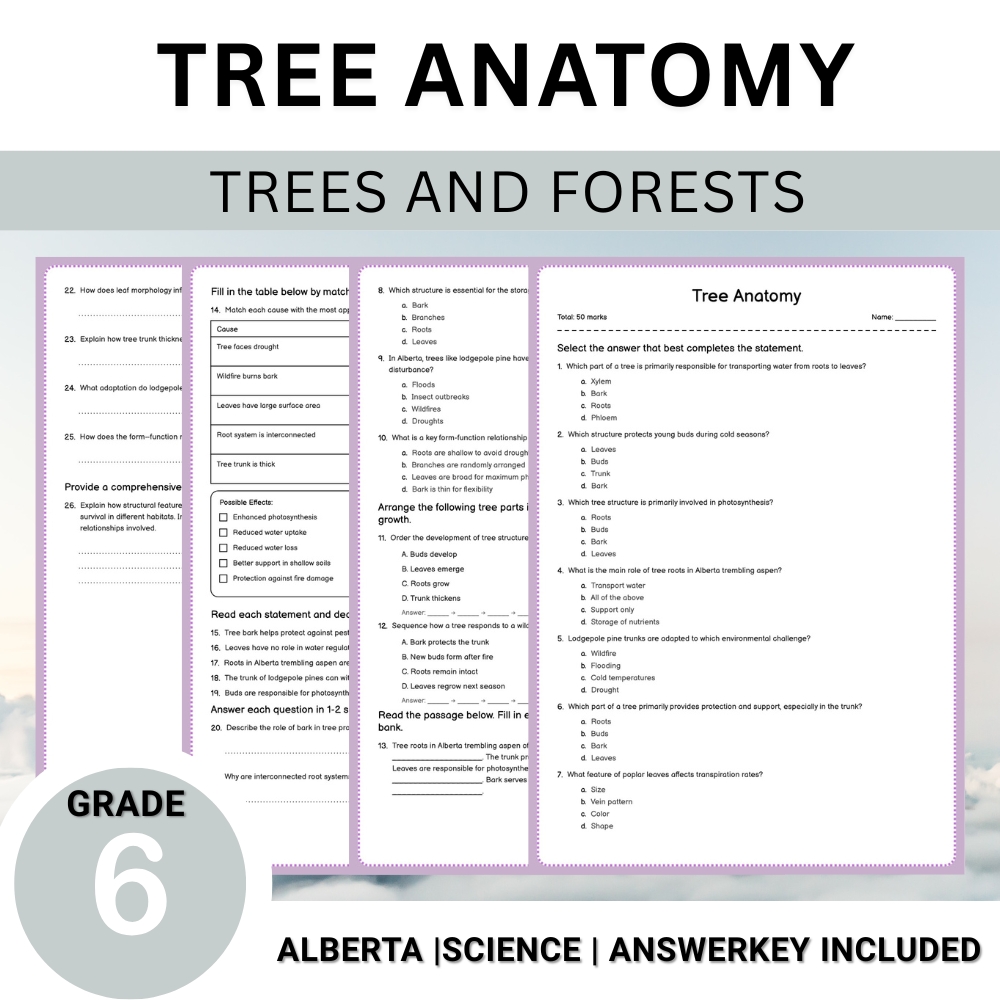
Grade 6 Science | Tree Anatomy Worksheet (Assessment & Student Practice PDF)
Learning Objectives
- Identify major structures of trees such as roots, trunk, branches, leaves, buds, and bark.
- Explain the functions of different tree structures in support, transport, storage, and protection.
- Describe form–function relationships in tree adaptations to Alberta habitats.
Also included in: Grade 6 Science | Tree Anatomy, Ecology & Conservation Unit Worksheet Bundle +1 more
Instant download
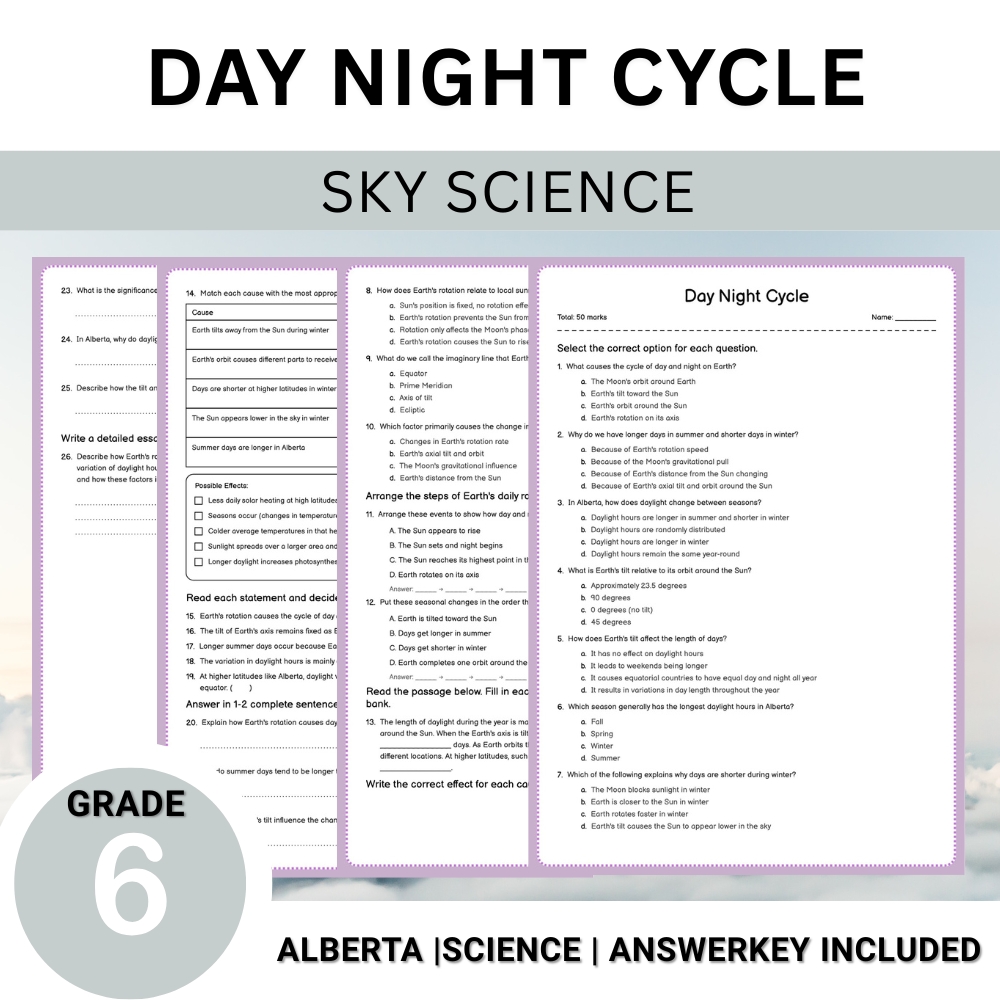
Grade 6 Science | Day Night Cycle Worksheet (Printable PDF with Answer Key)
Learning Objectives
- Understand how Earth's rotation causes day and night.
- Explain the role of Earth's tilt and orbit in changing day length through the year.
- Describe how latitude affects daily daylight hours within Alberta.
Also included in: Grade 6 Science | Celestial & Space Phenomena UNIT Worksheet Bundle (Assessment & Practice) +1 more
Instant download
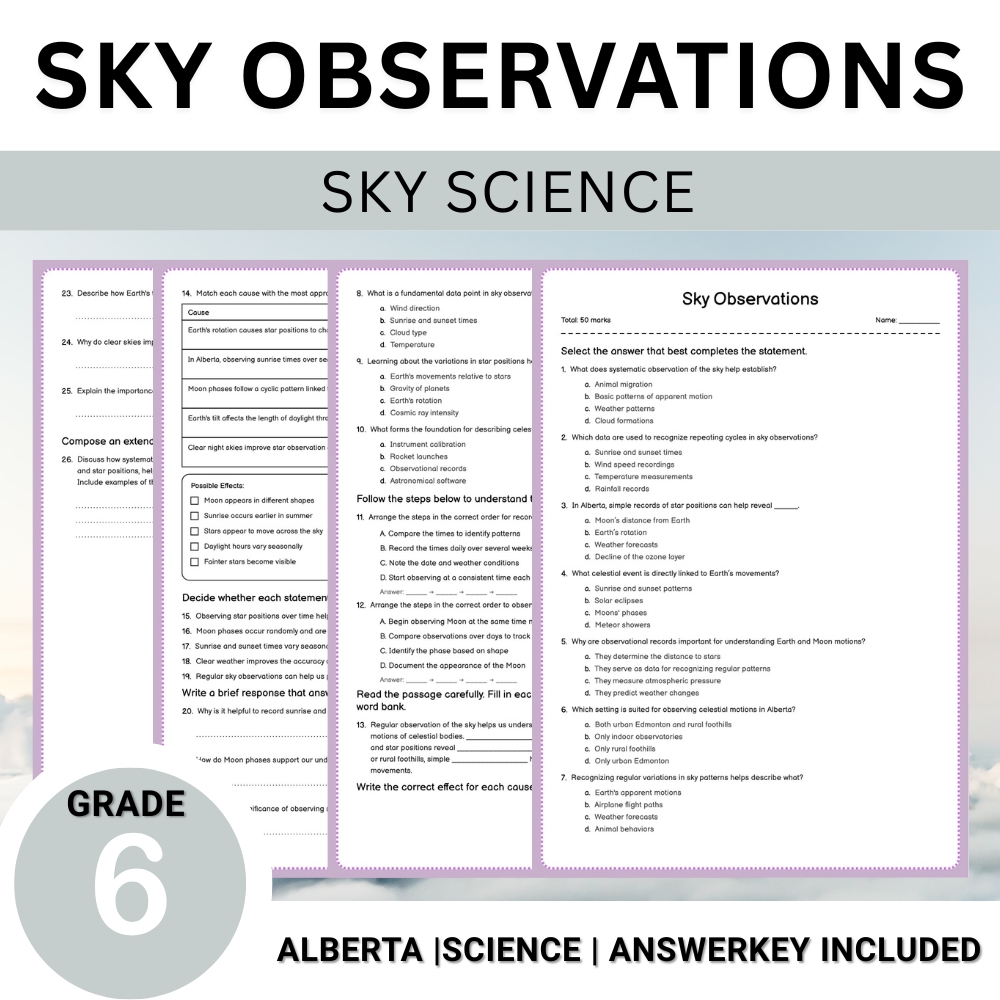
Grade 6 Science | Sky Observations Worksheet (Printable PDF & Assessment)
Learning Objectives
- Understand how systematic observations of the sky can reveal patterns of Earth's apparent motion.
- Record and interpret data related to sunrise and sunset times, Moon phases, and star positions.
- Recognize the cyclic nature of celestial movements and how they relate to Earth's movements.
Also included in: Grade 6 Science | Celestial & Space Phenomena UNIT Worksheet Bundle (Assessment & Practice) +1 more
Instant download
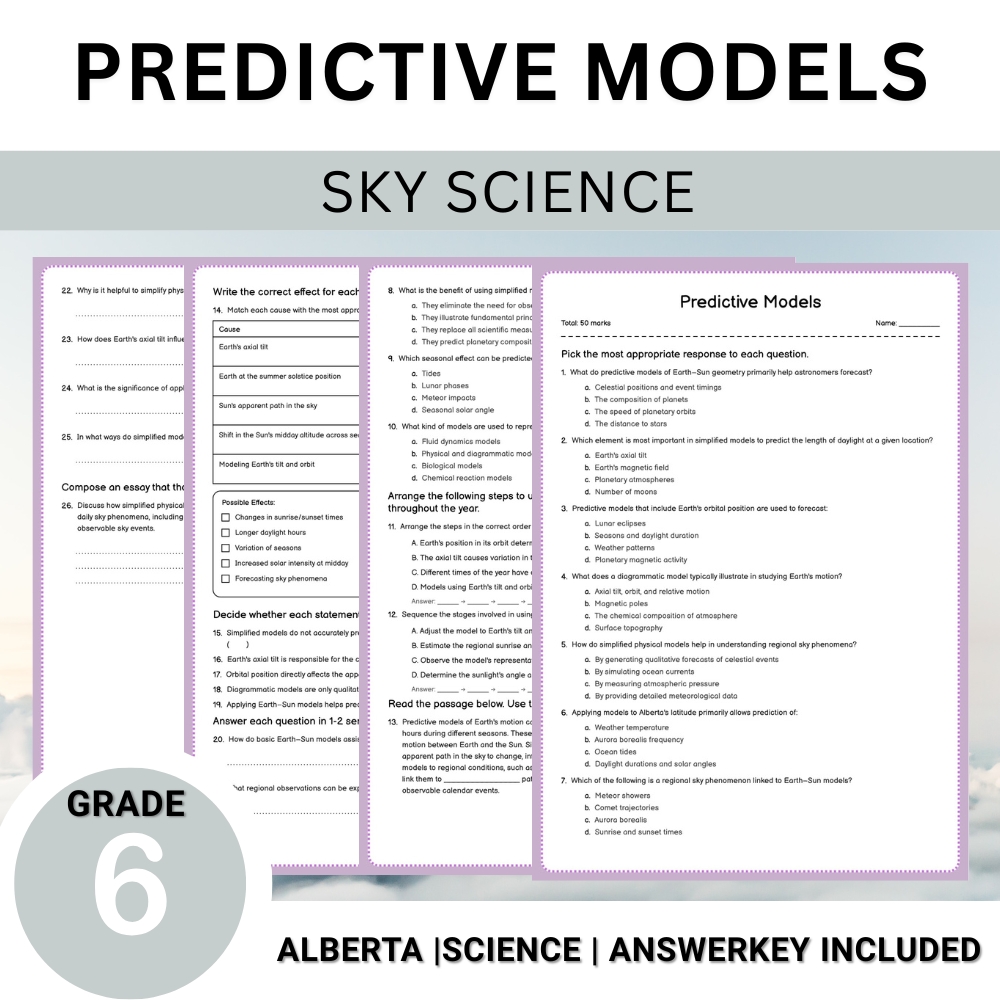
Grade 6 Science | Predictive Models Worksheet (Assessment & Student Practice) PDF
Learning Objectives
- Understand how models can simulate Earth–Sun geometry to predict celestial phenomena.
- Identify different types of simplified physical and diagrammatic models used in astronomy.
- Apply knowledge of axial tilt and orbital position to regional daylight and solar angles.
Also included in: Grade 6 Science | Celestial & Space Phenomena UNIT Worksheet Bundle (Assessment & Practice) +1 more
Instant download
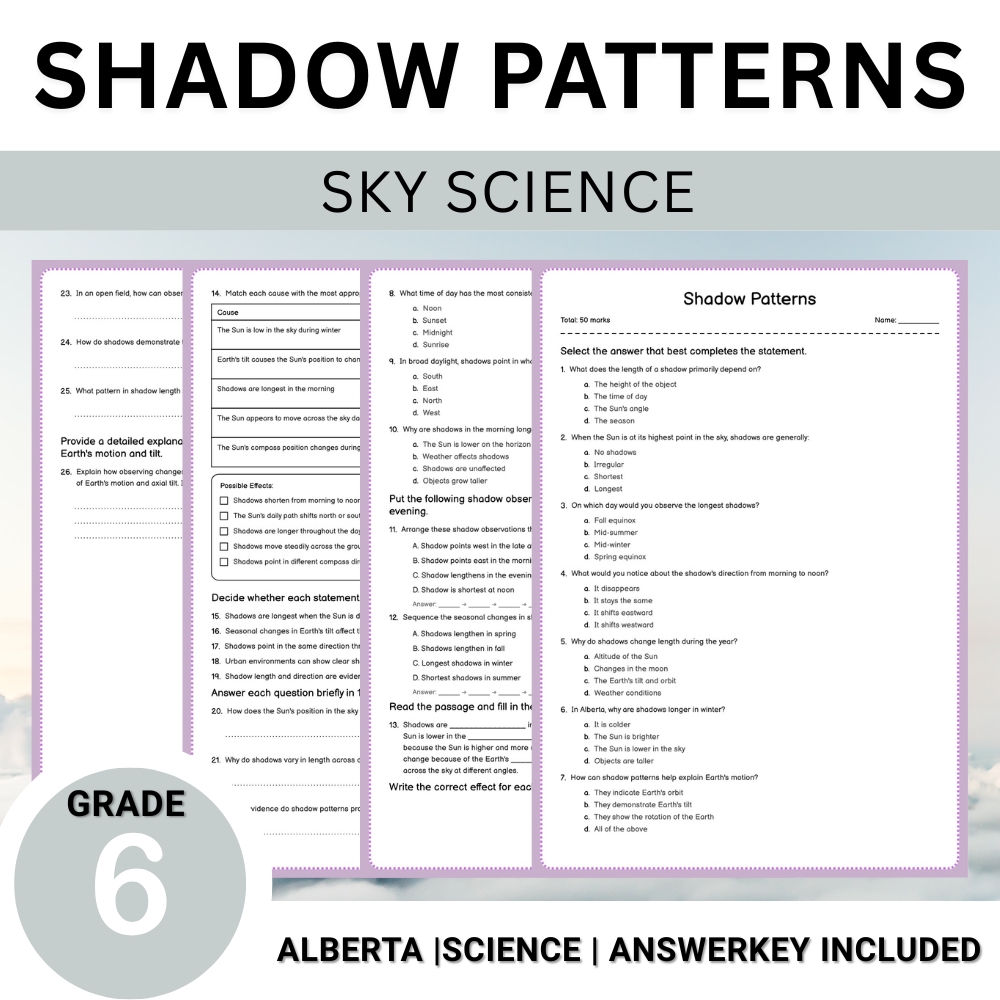
Grade 6 Science | Shadow Patterns Worksheet (Printable PDF & Assessment)
Learning Objectives
- Understand how daily and seasonal changes in the Sun's angle affect shadow length and direction.
- Observe and describe patterns of shadows at different times of the day and year.
- Explain how shadow changes provide evidence of Earth's motion and tilt.
Also included in: Grade 6 Science | Celestial & Space Phenomena UNIT Worksheet Bundle (Assessment & Practice) +1 more
Instant download
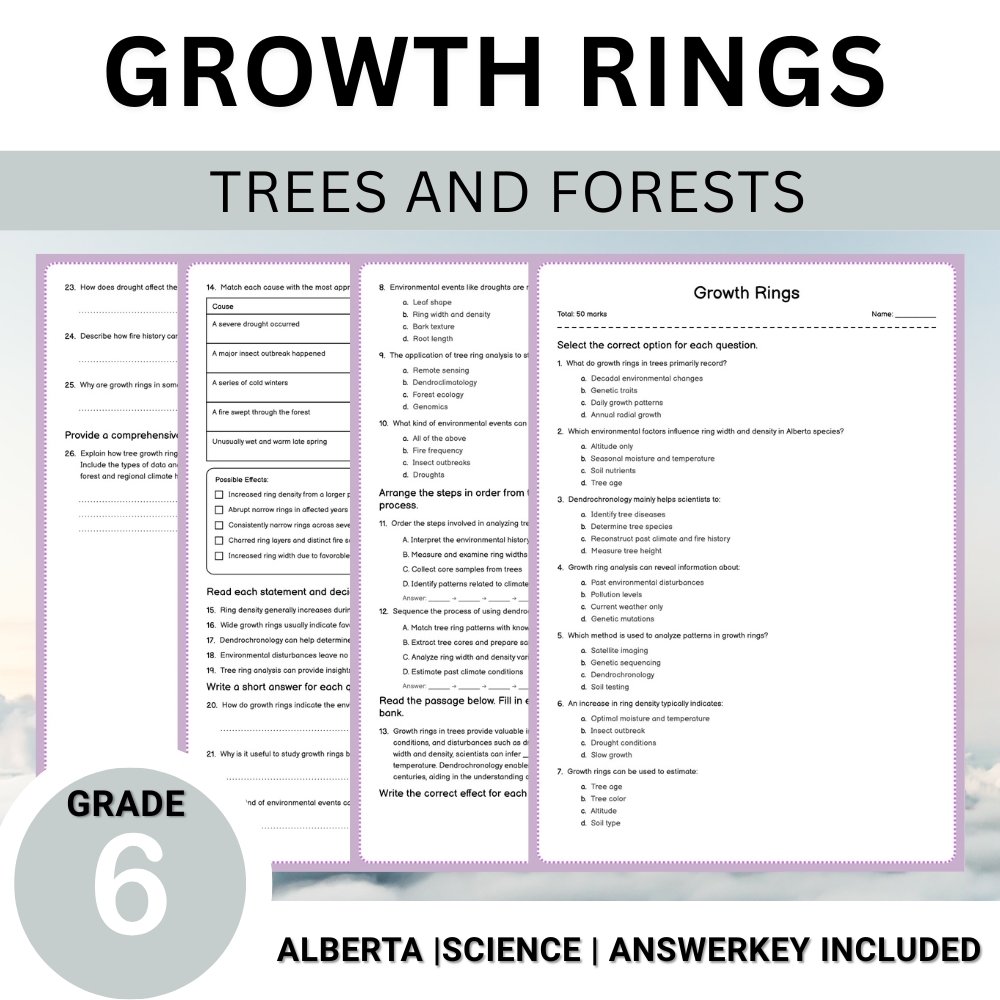
Grade 6 Science | Growth Rings Worksheet (Assessment & Student Practice) PDF
Learning Objectives
- Understand how growth rings record annual growth and environmental conditions.
- Identify factors influencing ring width and density in trees.
- Learn how dendrochronology reconstructs past climate and disturbance events.
Also included in: Grade 6 Science | Tree Anatomy, Ecology & Conservation Unit Worksheet Bundle +1 more
Instant download
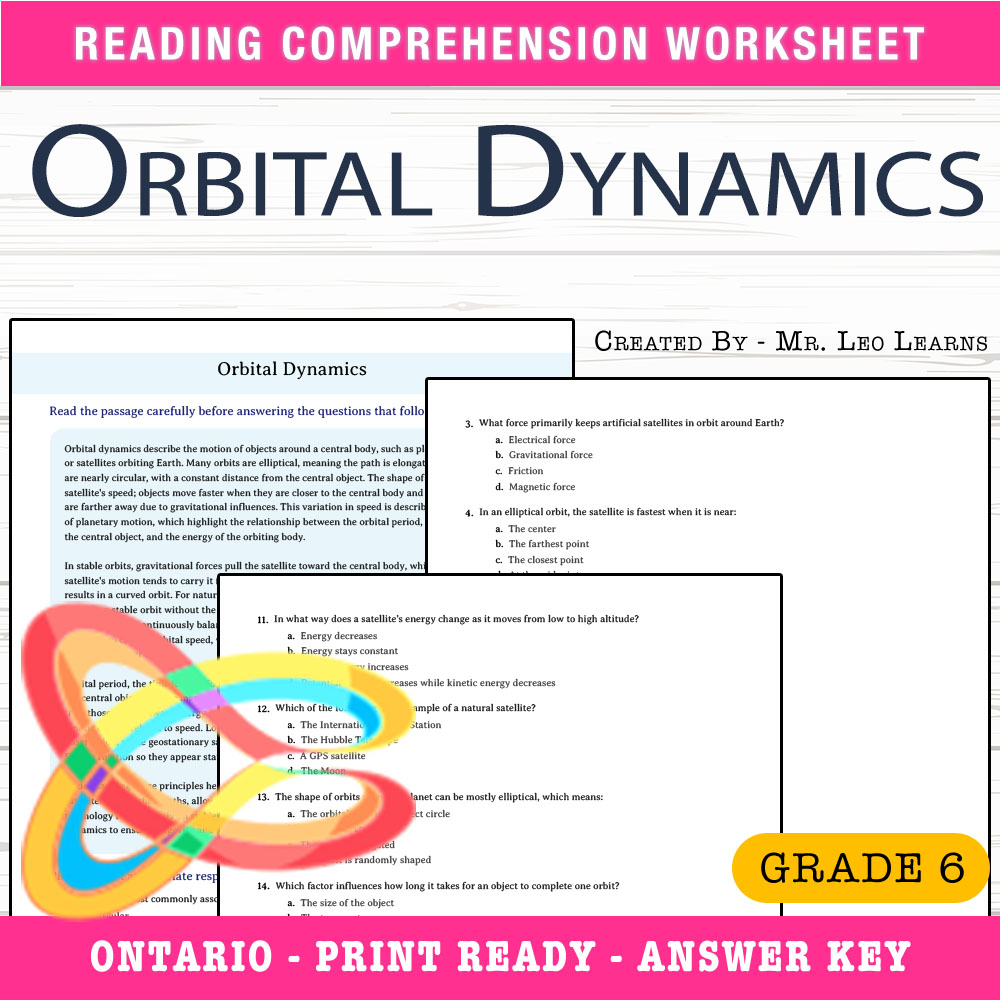
Grade 6 Science — Orbital Dynamics Worksheet for Mastery
 Created byThe Resource Hub
Learning Objectives
- Understand the basic concepts of elliptical and near-circular orbits.
- Explain how orbital speed varies with distance from the central body.
- Describe the balance of gravitational force and inertial motion in producing orbits.
Also included in: Grade 6 Science Unit | Space Systems & Orbital Mechanics Worksheet Pack +1 more
Instant download
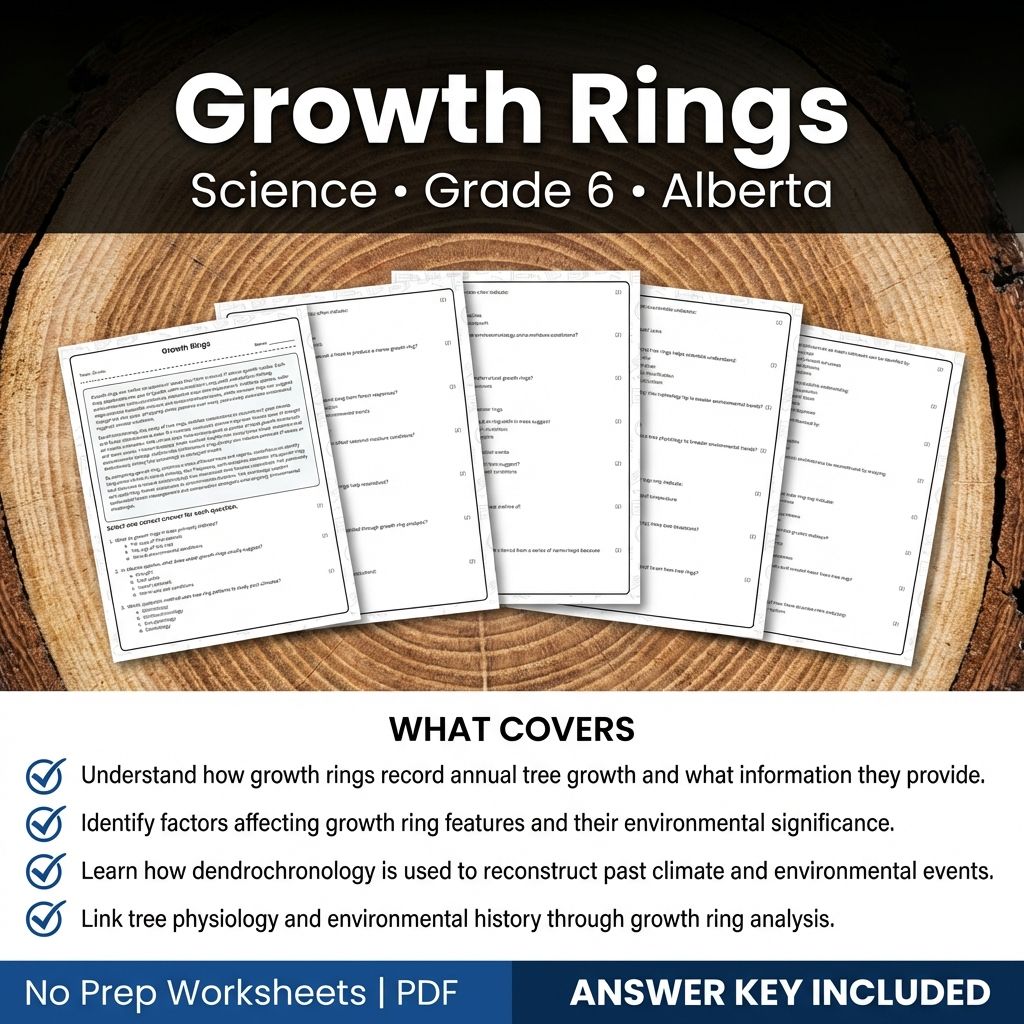
Grade 6 Science Worksheet on Growth Rings | Alberta Standards
 Created byCoral Reef Learning
Learning Objectives
- Understand how growth rings record annual tree growth and what information they provide.
- Identify factors affecting growth ring features and their environmental significance.
- Learn how dendrochronology is used to reconstruct past climate and environmental events.
Instant download
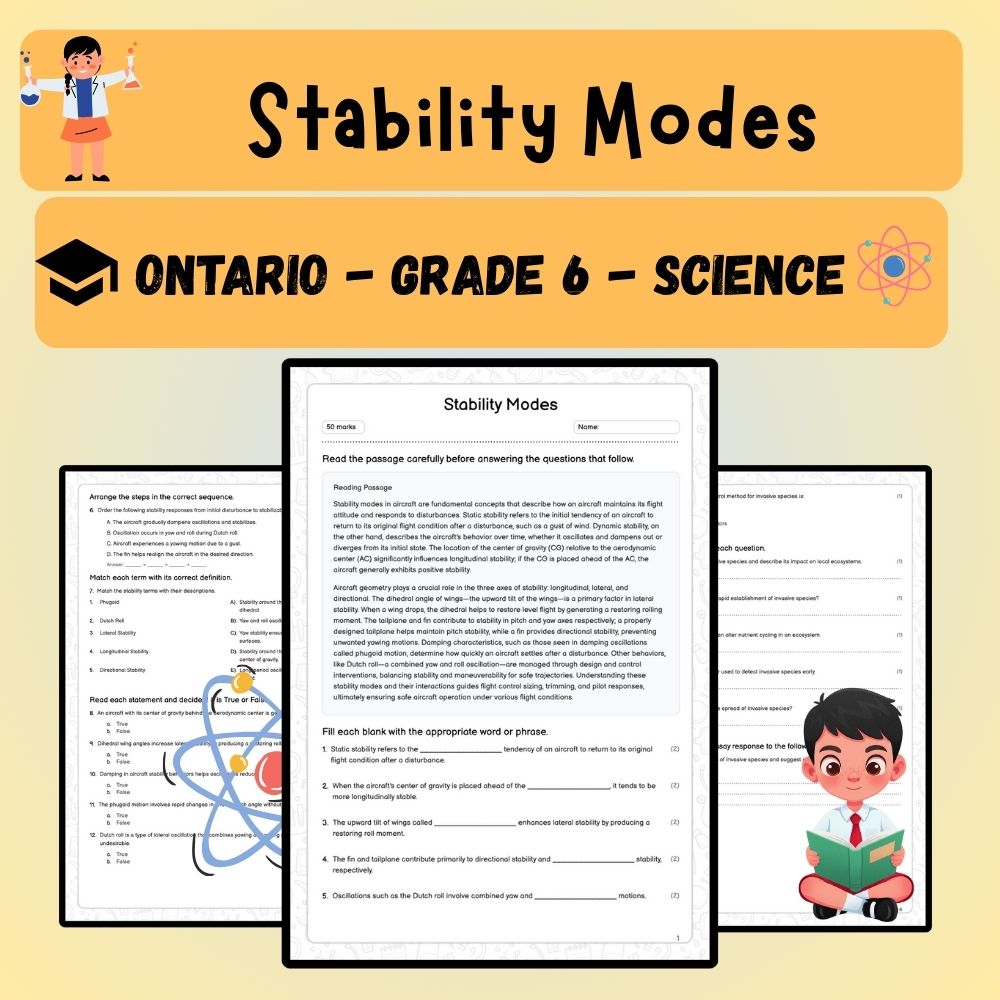
Grade 6 Science | Stability Modes Worksheet (Worksheet + Answer Key) – Ontario Standards
 Created byPrism Point Learning
Learning Objectives
- Explain the difference between static and dynamic stability in aircraft.
- Identify how aircraft geometry influences longitudinal, lateral, and directional stability.
- Describe the effects of center of gravity, dihedral angles, and tail designs on stability behaviors.
Instant download
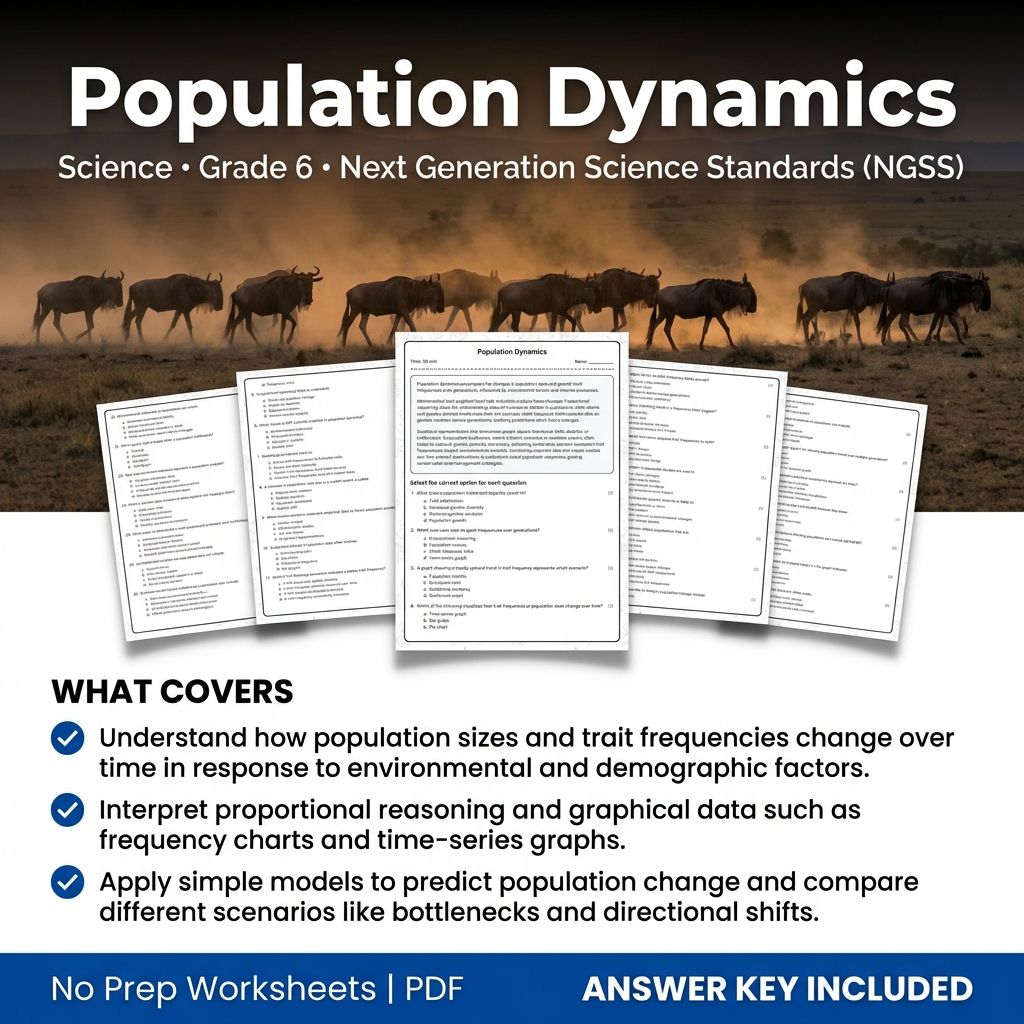
Grade 6 Science | Population Dynamics Worksheet & Answer Key (Printable PDF)
Created byCoral Reef LearningLearning Objectives
- Understand how population sizes and trait frequencies change over time in response to environmental and demographic factors.
- Interpret proportional reasoning and graphical data such as frequency charts and time-series graphs.
- Apply simple models to predict population change and compare different scenarios like bottlenecks and directional shifts.
Instant download
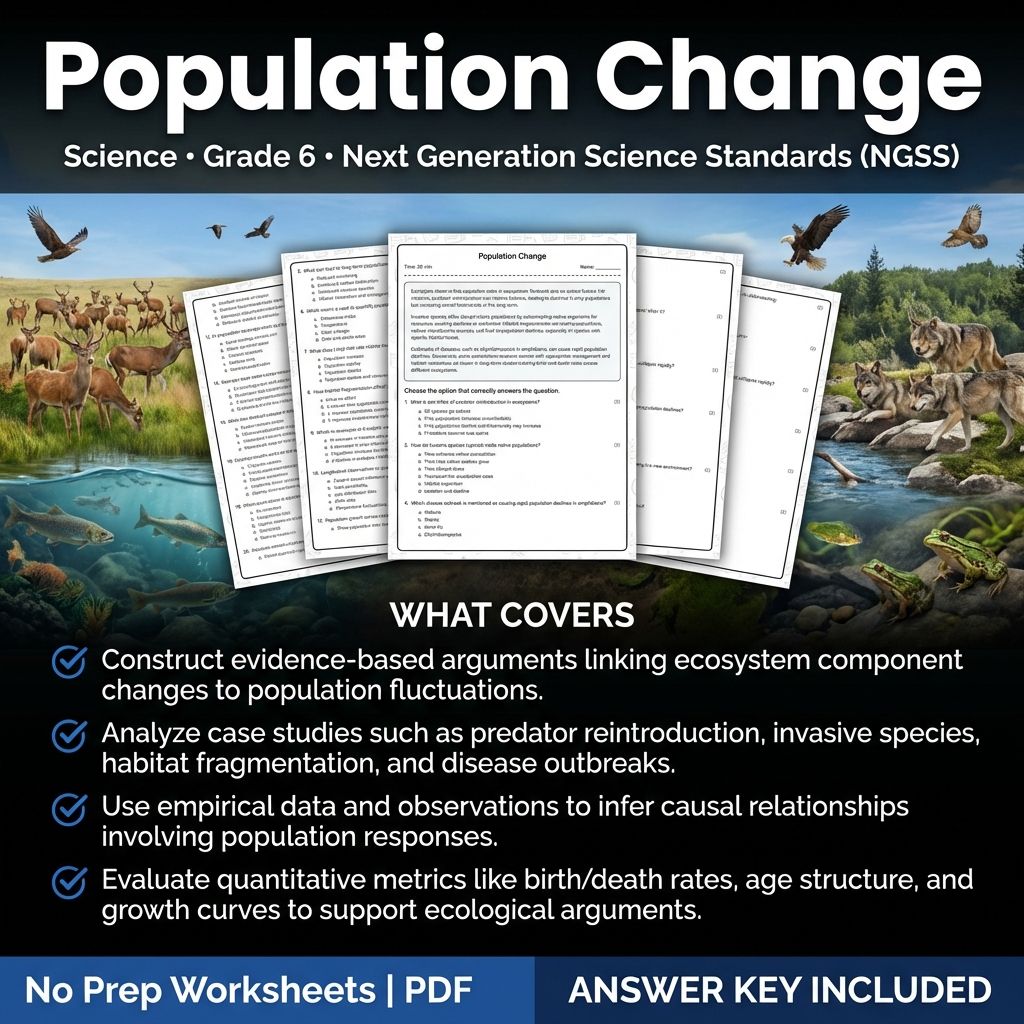
6th Grade Science | Population Change Worksheet + Answer Key (Printable PDF)
Created byCoral Reef LearningLearning Objectives
- Construct evidence-based arguments linking ecosystem component changes to population fluctuations.
- Analyze case studies such as predator reintroduction, invasive species, habitat fragmentation, and disease outbreaks.
- Use empirical data and observations to infer causal relationships involving population responses.
Instant download
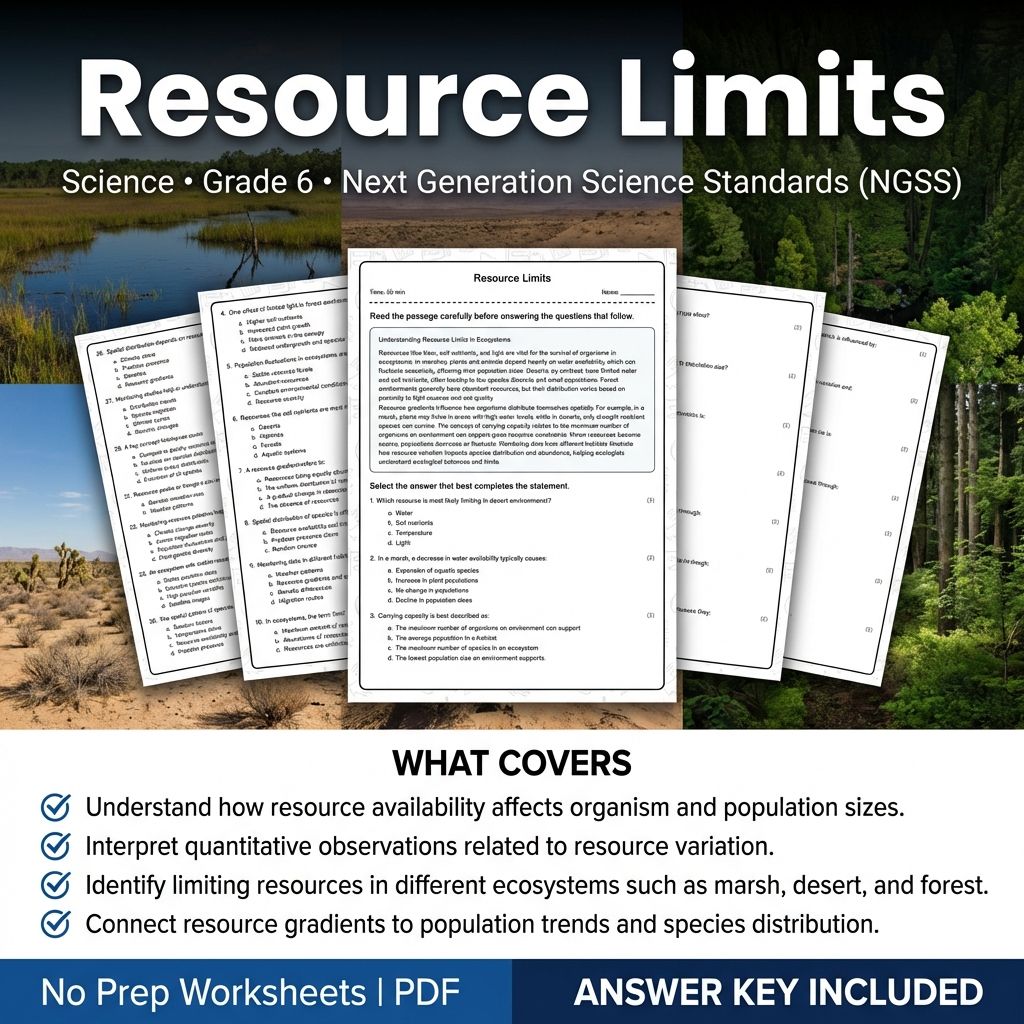
6th Grade Science | Resource Limits Worksheet with Answer Key (Printable PDF)
Created byCoral Reef LearningLearning Objectives
- Understand how resource availability affects organism and population sizes.
- Interpret quantitative observations related to resource variation.
- Identify limiting resources in different ecosystems such as marsh, desert, and forest.
Instant download
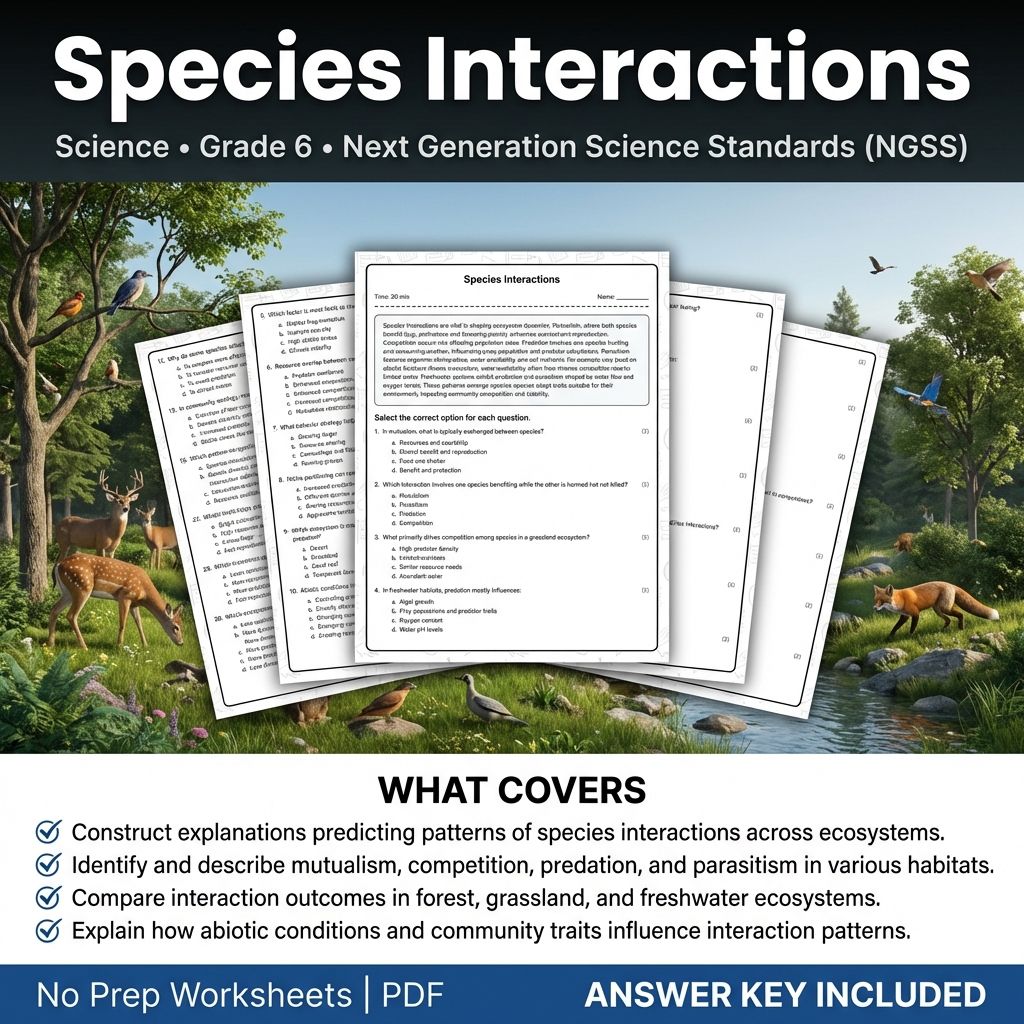
6th Grade Science | Species Interactions Worksheet & Answer Key (Printable PDF)
Created byCoral Reef LearningLearning Objectives
- Construct explanations predicting patterns of species interactions across ecosystems.
- Identify and describe mutualism, competition, predation, and parasitism in various habitats.
- Compare interaction outcomes in forest, grassland, and freshwater ecosystems.
Instant download
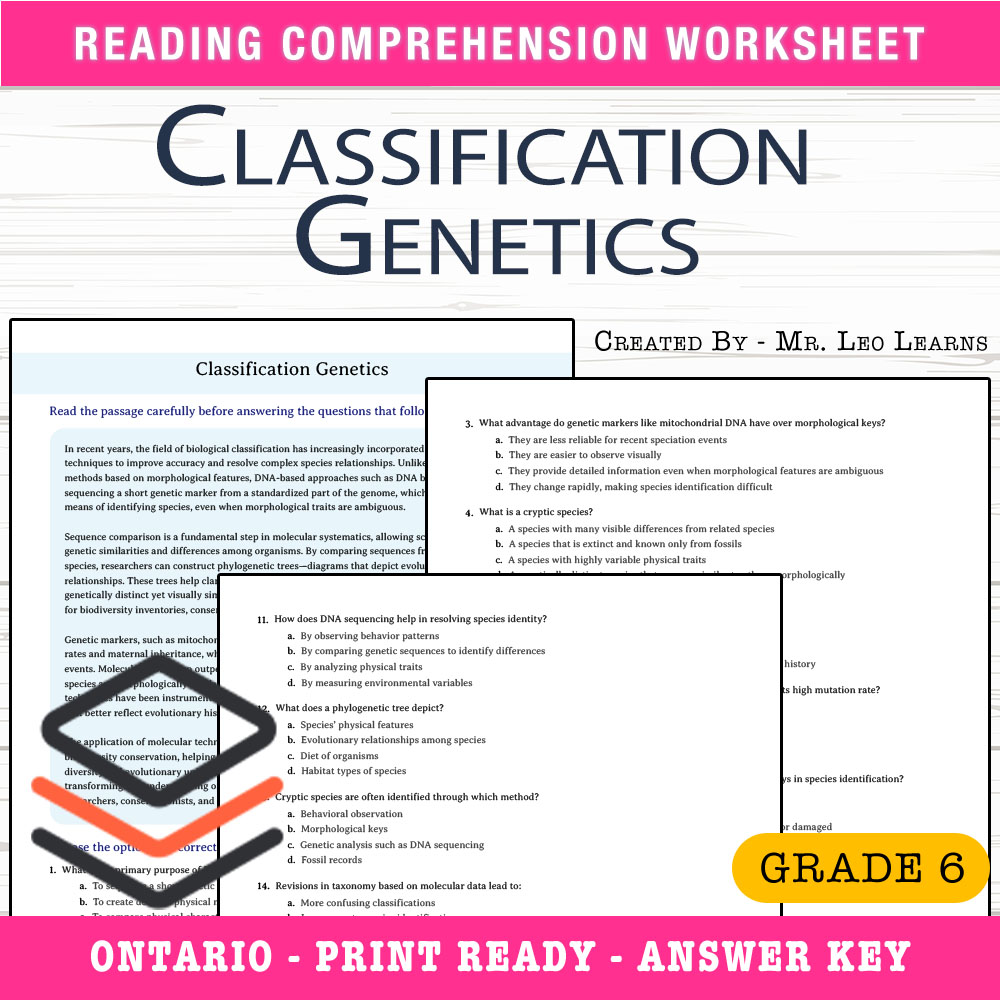
Grade 6 Science — Classification Genetics Worksheet for Mastery | PDF + Answer Key
Created byThe Resource HubLearning Objectives
- Understand the molecular methods used for species classification such as DNA barcoding and sequence comparison.
- Explain how genetic markers and phylogenetic trees aid in resolving species relationships.
- Compare morphological identification techniques with genetic approaches.
Also included in: Grade 6 Science Unit Bundle | Ecosystems, Genetic Traits & Environmental Impact +1 more
Instant download
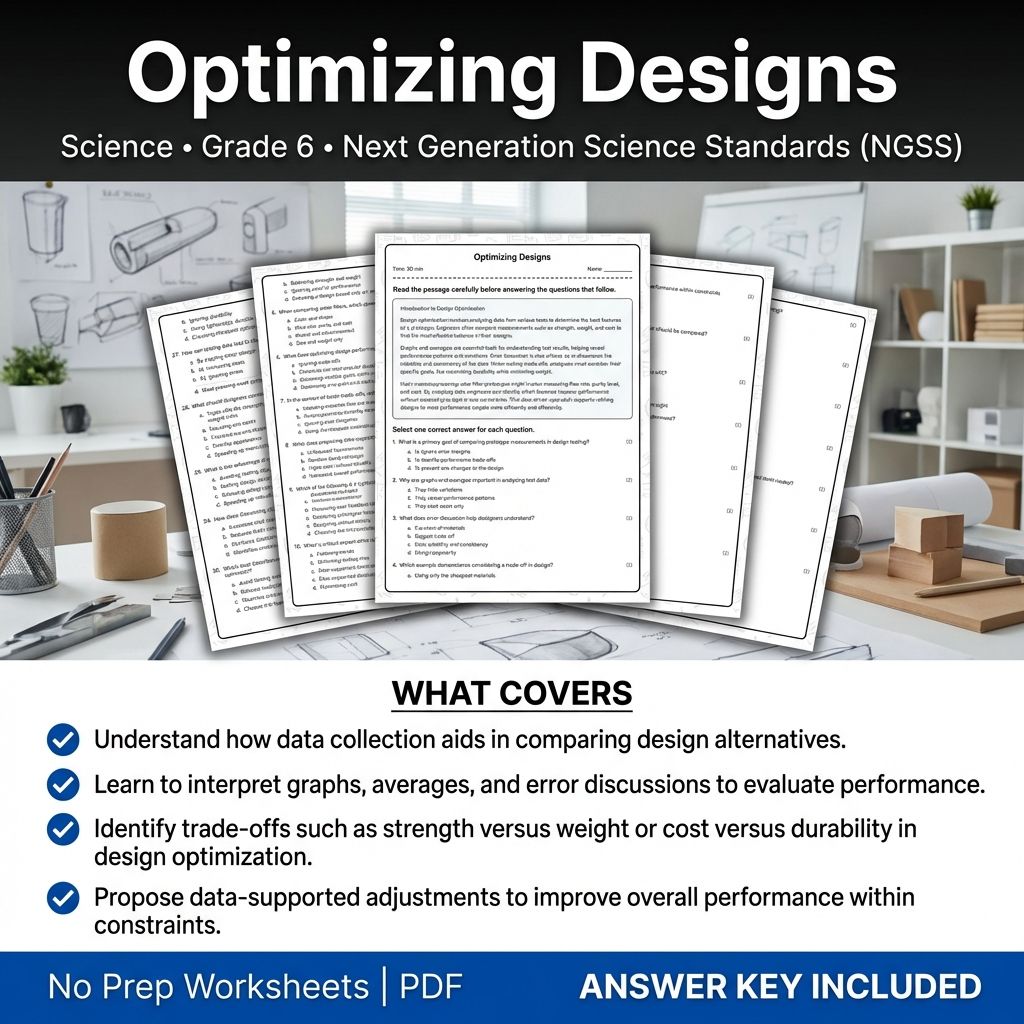
6th Grade Science Worksheet | Optimizing Designs – Practice & Answer Key (Printable PDF)
Created byCoral Reef LearningLearning Objectives
- Understand how data collection aids in comparing design alternatives.
- Learn to interpret graphs, averages, and error discussions to evaluate performance.
- Identify trade-offs such as strength versus weight or cost versus durability in design optimization.
Instant download
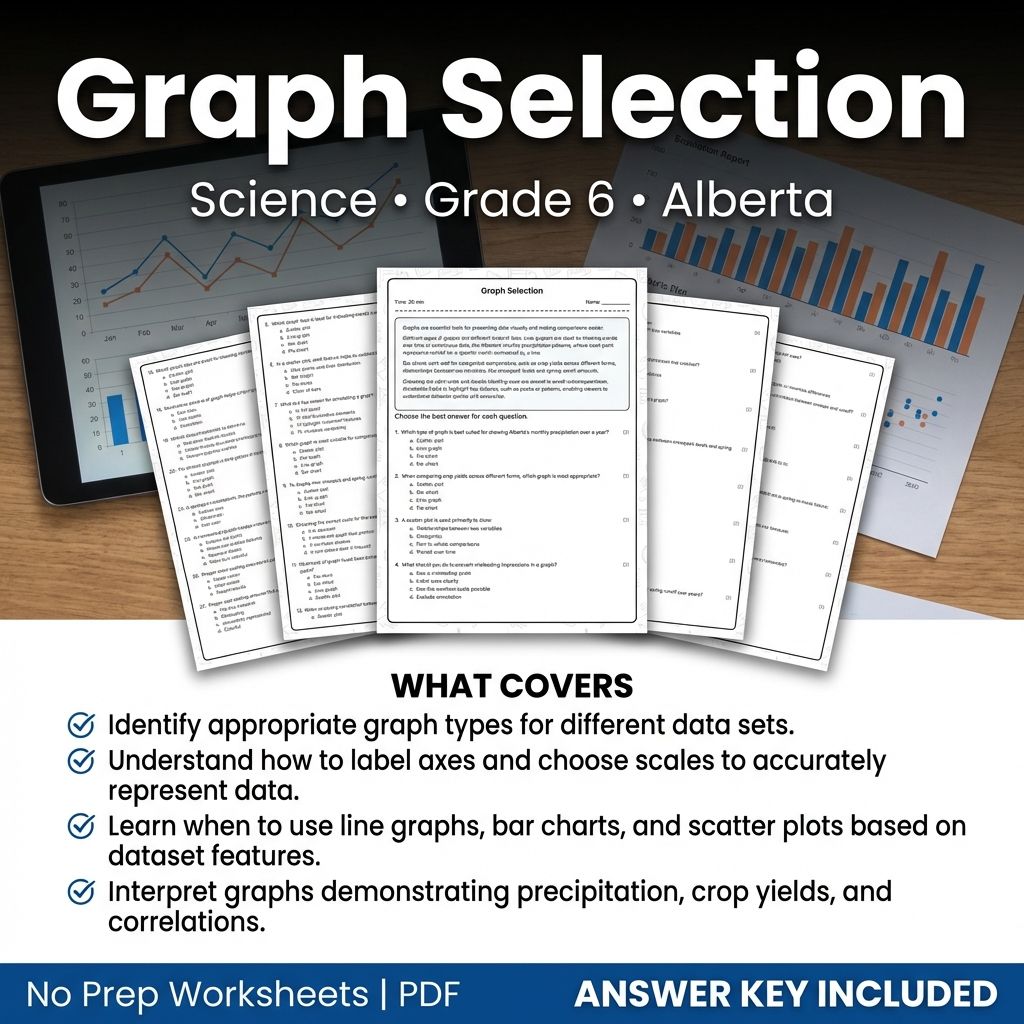
Grade 6 Science Worksheet on Graph Selection | Alberta Standards
Created byCoral Reef LearningLearning Objectives
- Identify appropriate graph types for different data sets.
- Understand how to label axes and choose scales to accurately represent data.
- Learn when to use line graphs, bar charts, and scatter plots based on dataset features.
Instant download
Grade 6 Science – Drag Components Worksheet for Mastering Fluid Forces
Created byThe Resource HubLearning Objectives
- Explain the different components of drag in aerodynamics, including parasitic and induced drag.
- Describe how form drag, skin-friction drag, and interference drag contribute to parasitic drag.
- Understand the concept of induced drag and its dependence on wing span and lift distribution.
Also included in: Grade 6 Science | Aerodynamics & Engineering Unit Workbook (Worksheet Pack) +1 more
Instant download
Grade 6 Science — Invasive Species Worksheet for Mastery
Created byThe Resource HubLearning Objectives
- Understand the pathways through which invasive species are introduced into new ecosystems.
- Identify the ecological impacts of invasive species on native plants and animals.
- Analyze how invasive species alter nutrient cycling, habitat structure, and food webs.
Also included in: Grade 6 Science Unit Bundle | Ecosystems, Genetic Traits & Environmental Impact +1 more
Instant download
Grade 6 Science – Habitat Fragmentation Worksheet for Comprehension | PDF + Answer Key
Created byThe Resource HubLearning Objectives
- Understand the concept of habitat fragmentation and its causes.
- Identify the ecological impacts of habitat fragmentation on species and ecosystems.
- Learn how landscape division affects gene flow, species interactions, and biodiversity.
Also included in: Grade 6 Science Unit Bundle | Ecosystems, Genetic Traits & Environmental Impact +1 more
Instant download
Grade 6 Science — Solar System Survey Worksheet for Mastery
Created byThe Resource HubLearning Objectives
- Identify and describe major components of the solar system, including planets, dwarf planets, asteroids, and belts.
- Differentiate between terrestrial and gas giant planets based on their characteristics.
- Understand orbital zones, planetary atmospheres, surface conditions, and how they influence classification.
Also included in: Grade 6 Science Unit | Space Systems & Orbital Mechanics Worksheet Pack +1 more
Instant download
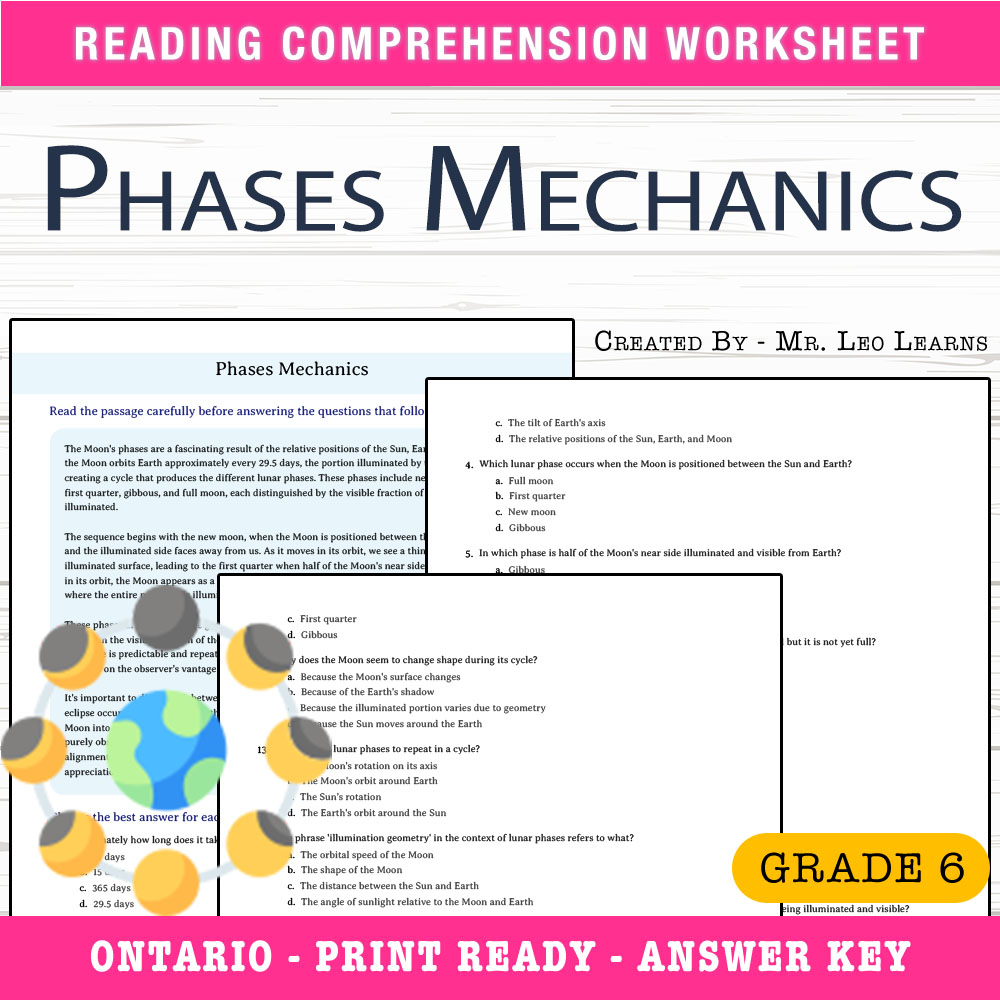
Grade 6 Science — Phases Mechanics Worksheet for Mastering Lunar Phases
Created byThe Resource HubLearning Objectives
- Describe the sequence of lunar phases and the relative positions of the Sun, Earth, and Moon.
- Explain how the geometry of illumination causes different visible fractions of the Moon during its phases.
- Identify the difference between lunar phases and eclipse circumstances based on observational patterns.
Also included in: Grade 6 Science Unit | Space Systems & Orbital Mechanics Worksheet Pack +1 more
Instant download
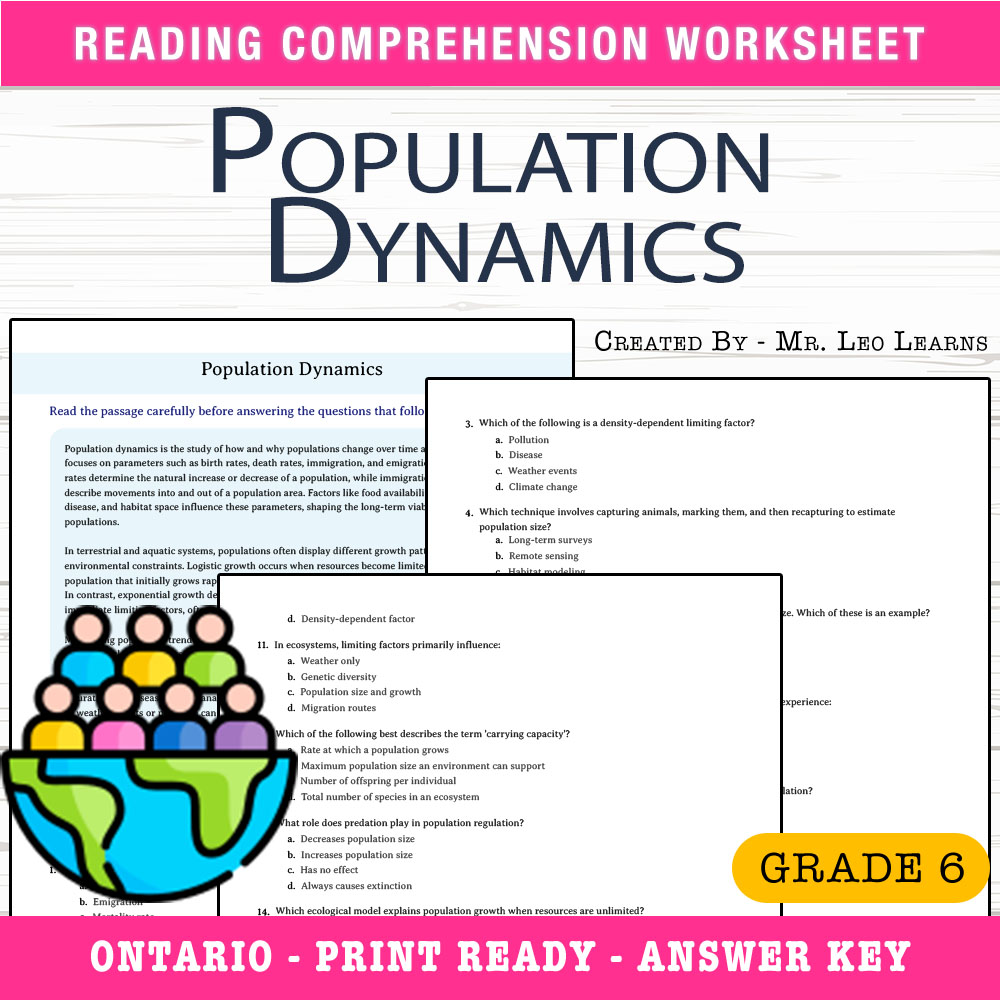
Grade 6 Science – Population Dynamics Worksheet for Mastery
Created byThe Resource HubLearning Objectives
- Describe the key parameters that influence population growth and decline.
- Differentiate between logistic and exponential growth models within ecosystems.
- Identify the factors that limit populations and affect biodiversity.
Also included in: Grade 6 Science Unit Bundle | Ecosystems, Genetic Traits & Environmental Impact +1 more
Instant download
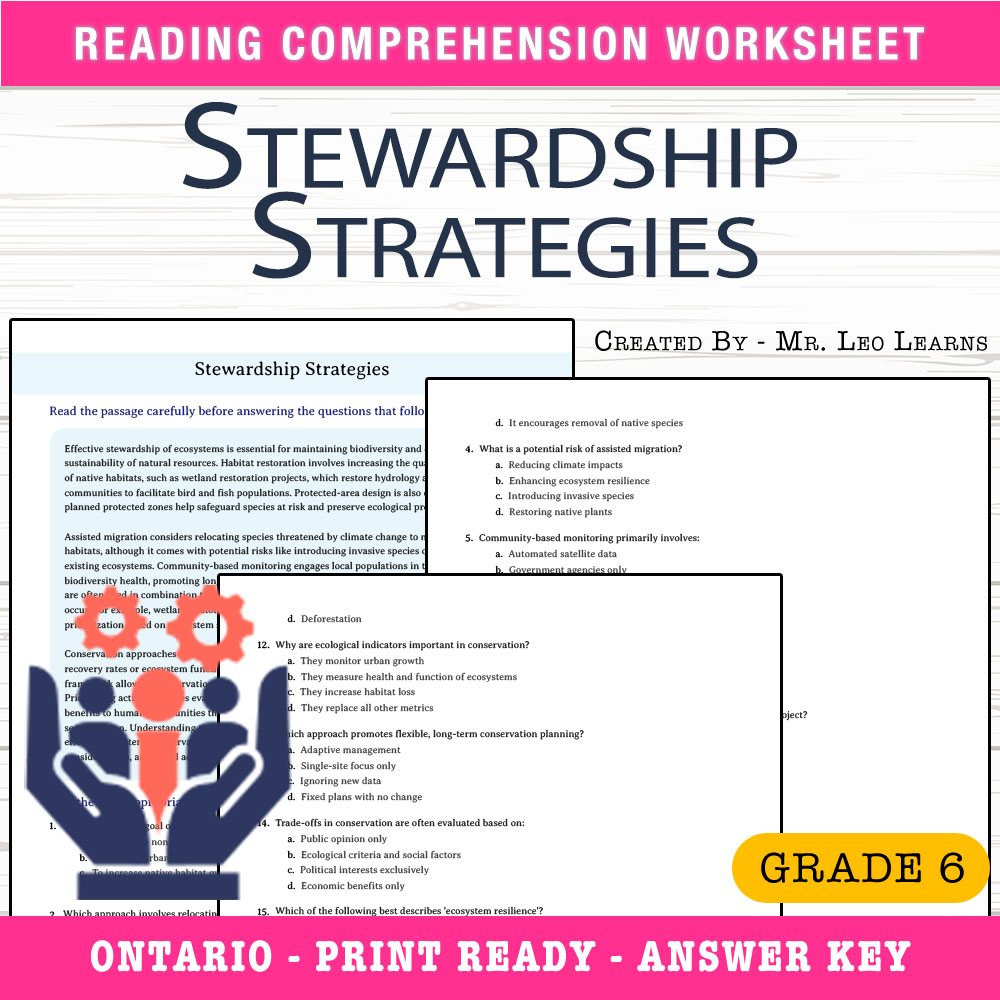
Grade 6 Science — Stewardship Strategies Worksheet for Environmental Responsibility
Created byThe Resource HubLearning Objectives
- Understand various habitat restoration techniques and their role in biodiversity conservation.
- Analyze trade-offs among different stewardship approaches and prioritize actions based on ecological criteria.
- Evaluate metrics and adaptive management principles used to measure success in conservation efforts.
Also included in: Grade 6 Science Unit Bundle | Ecosystems, Genetic Traits & Environmental Impact +1 more
Instant download
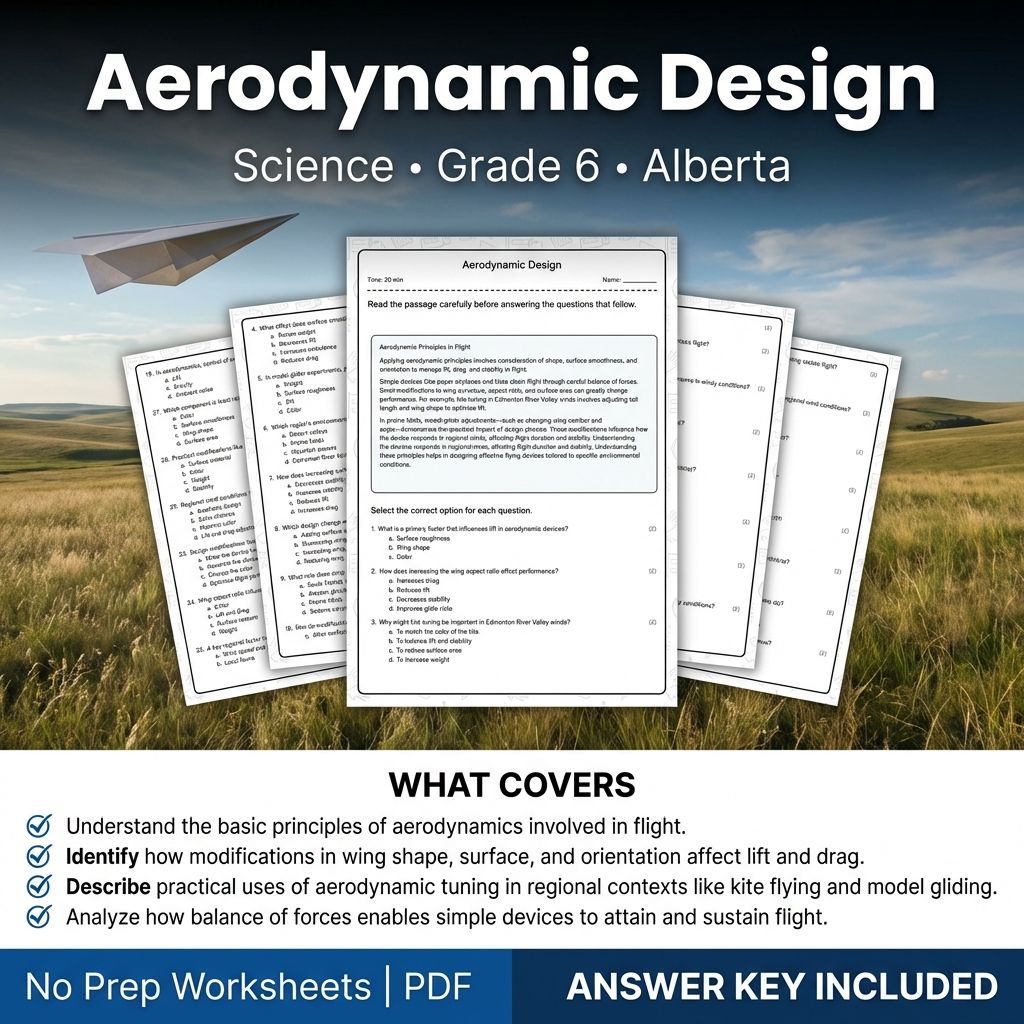
Grade 6 Science Worksheet on Aerodynamic Design | Alberta Standards
Created byCoral Reef LearningLearning Objectives
- Understand the basic principles of aerodynamics involved in flight.
- Identify how modifications in wing shape, surface, and orientation affect lift and drag.
- Describe practical uses of aerodynamic tuning in regional contexts like kite flying and model gliding.
Instant download
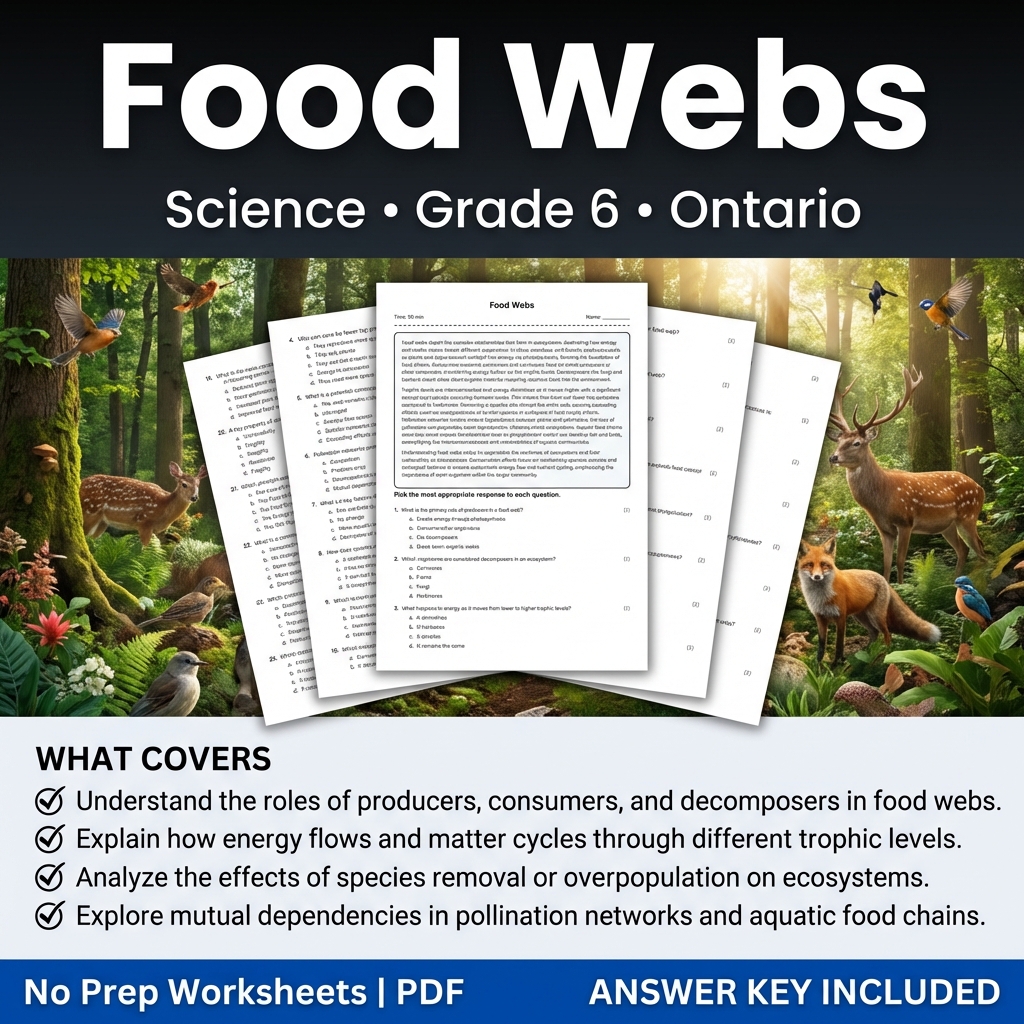
Food Webs Worksheet for Grade 6 Science | Ontario Standards Practice
Created byCoral Reef LearningLearning Objectives
- Understand the roles of producers, consumers, and decomposers in food webs.
- Explain how energy flows and matter cycles through different trophic levels.
- Analyze the effects of species removal or overpopulation on ecosystems.
Instant download
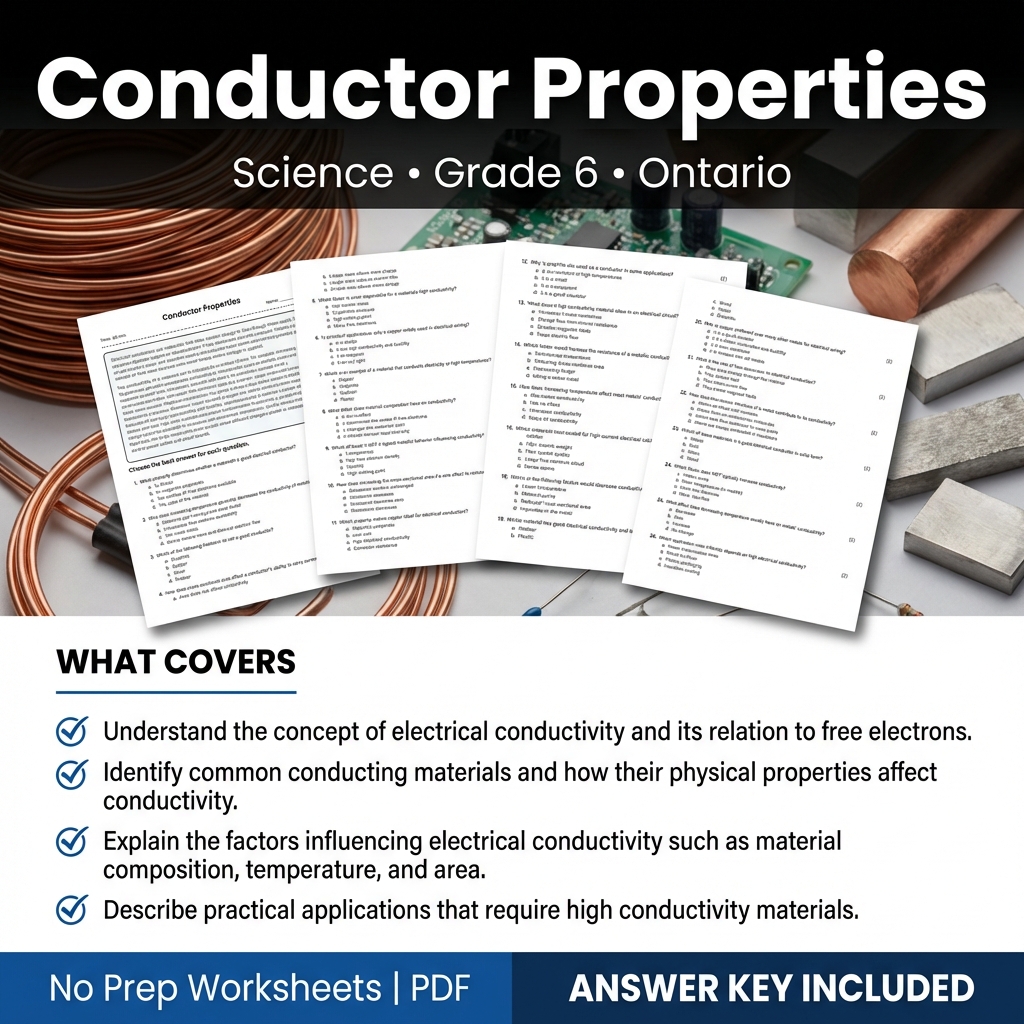
Grade 6 Science Worksheet on Conductor Properties | Ontario Standards
Created byCoral Reef LearningLearning Objectives
- Understand the concept of electrical conductivity and its relation to free electrons.
- Identify common conducting materials and how their physical properties affect conductivity.
- Explain the factors influencing electrical conductivity such as material composition, temperature, and area.
Instant download
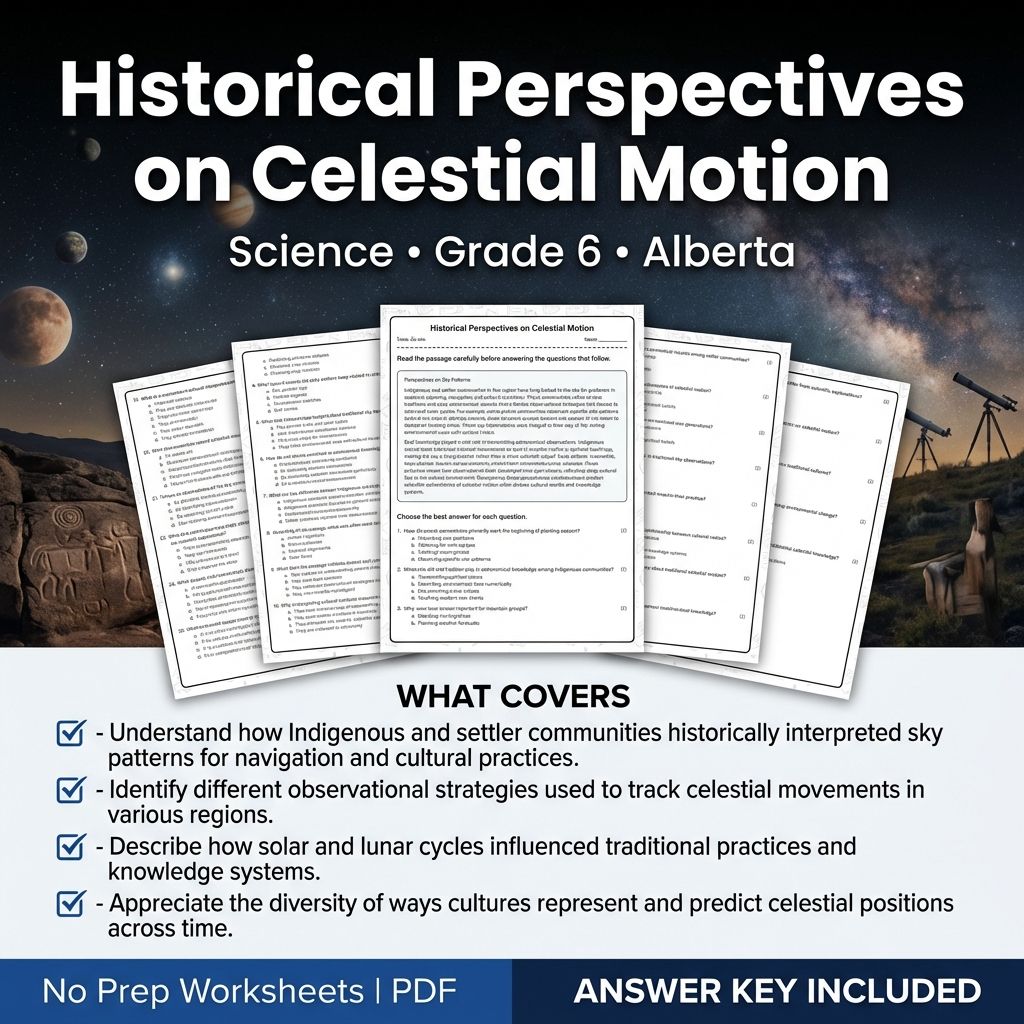
Grade 6 Science Worksheet on Historical Perspectives on Celestial Motion | Alberta
Created byCoral Reef LearningLearning Objectives
- Understand how Indigenous and settler communities historically interpreted sky patterns for navigation and cultural practices.
- Identify different observational strategies used to track celestial movements in various regions.
- Describe how solar and lunar cycles influenced traditional practices and knowledge systems.
Instant download
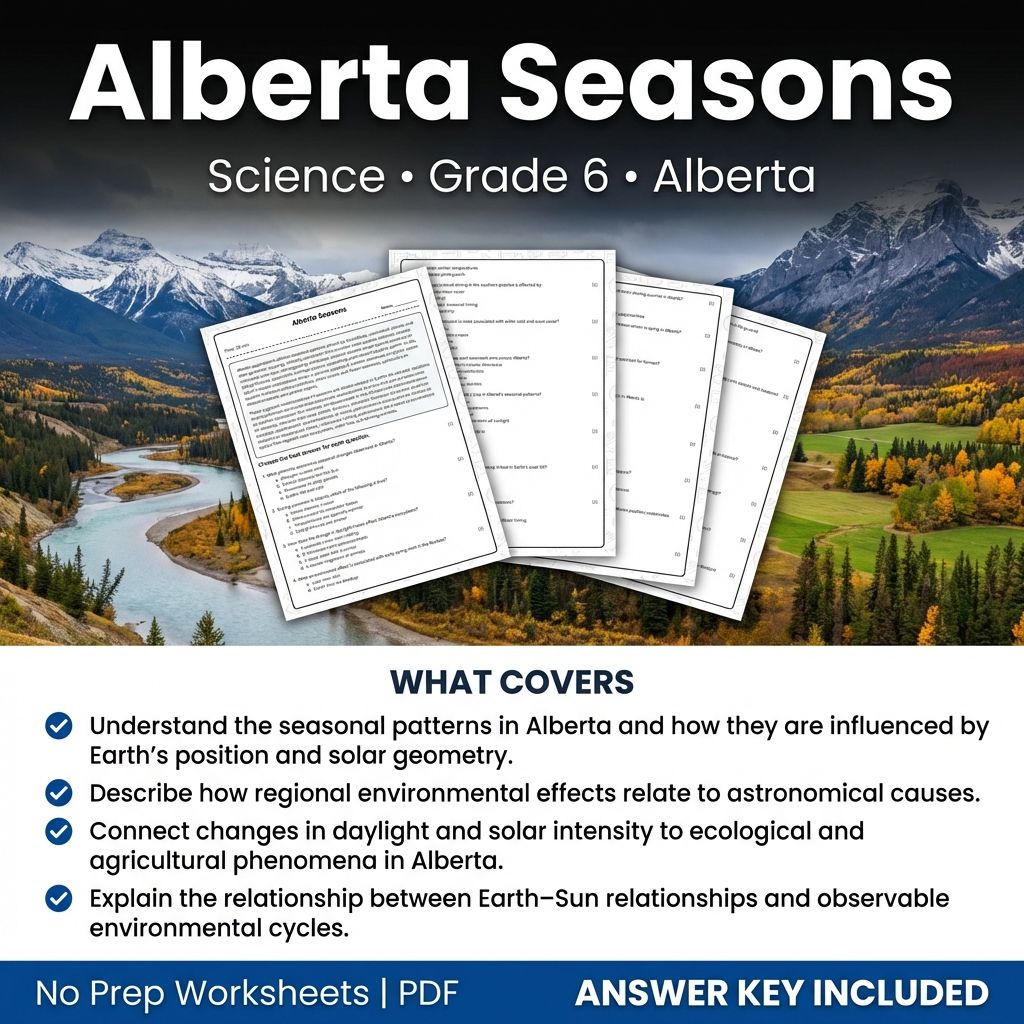
Alberta Seasons Grade 6 Science Worksheet | Standards-Aligned Practice
Created byCoral Reef LearningLearning Objectives
- Understand the seasonal patterns in Alberta and how they are influenced by Earth's position and solar geometry.
- Describe how regional environmental effects relate to astronomical causes.
- Connect changes in daylight and solar intensity to ecological and agricultural phenomena in Alberta.
Instant download
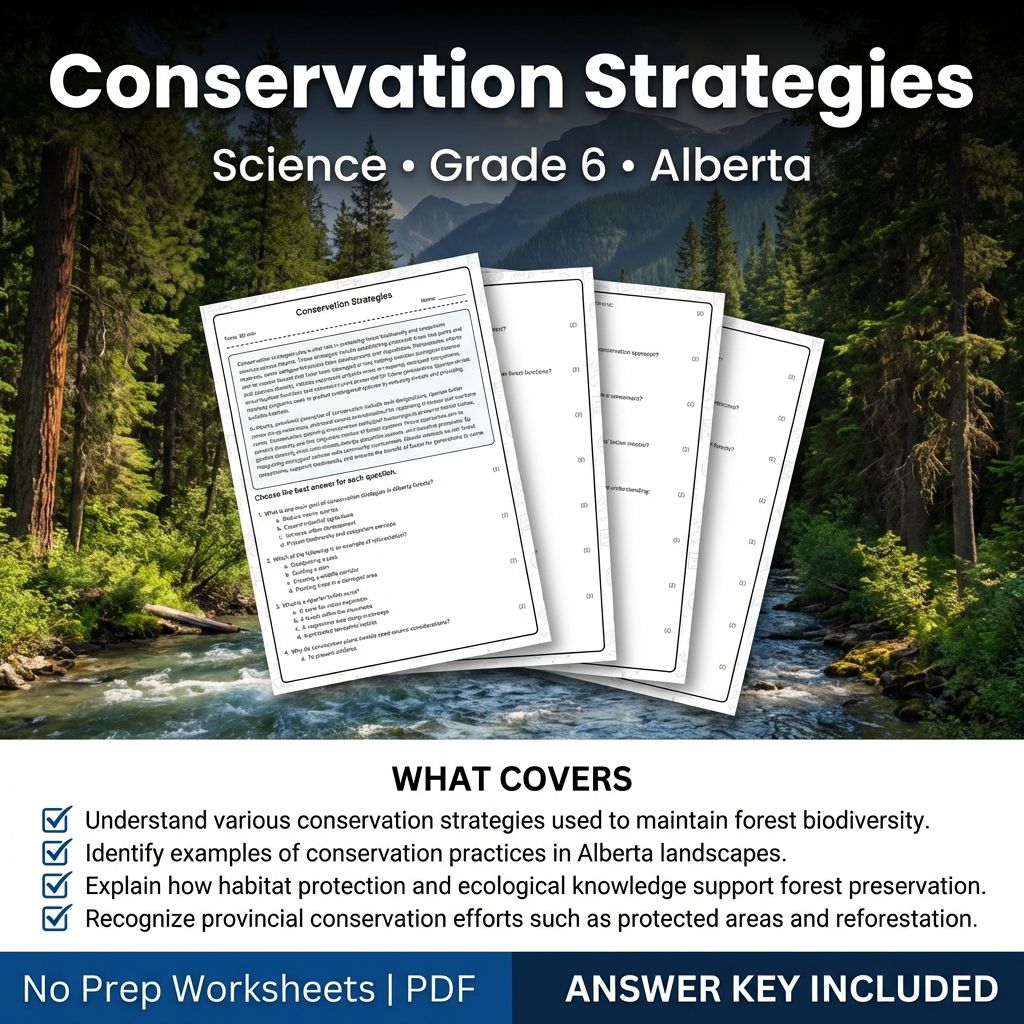
Grade 6 Science Worksheet on Conservation Strategies | Alberta Standards
Created byCoral Reef LearningLearning Objectives
- Understand various conservation strategies used to maintain forest biodiversity.
- Identify examples of conservation practices in Alberta landscapes.
- Explain how habitat protection and ecological knowledge support forest preservation.
Instant download
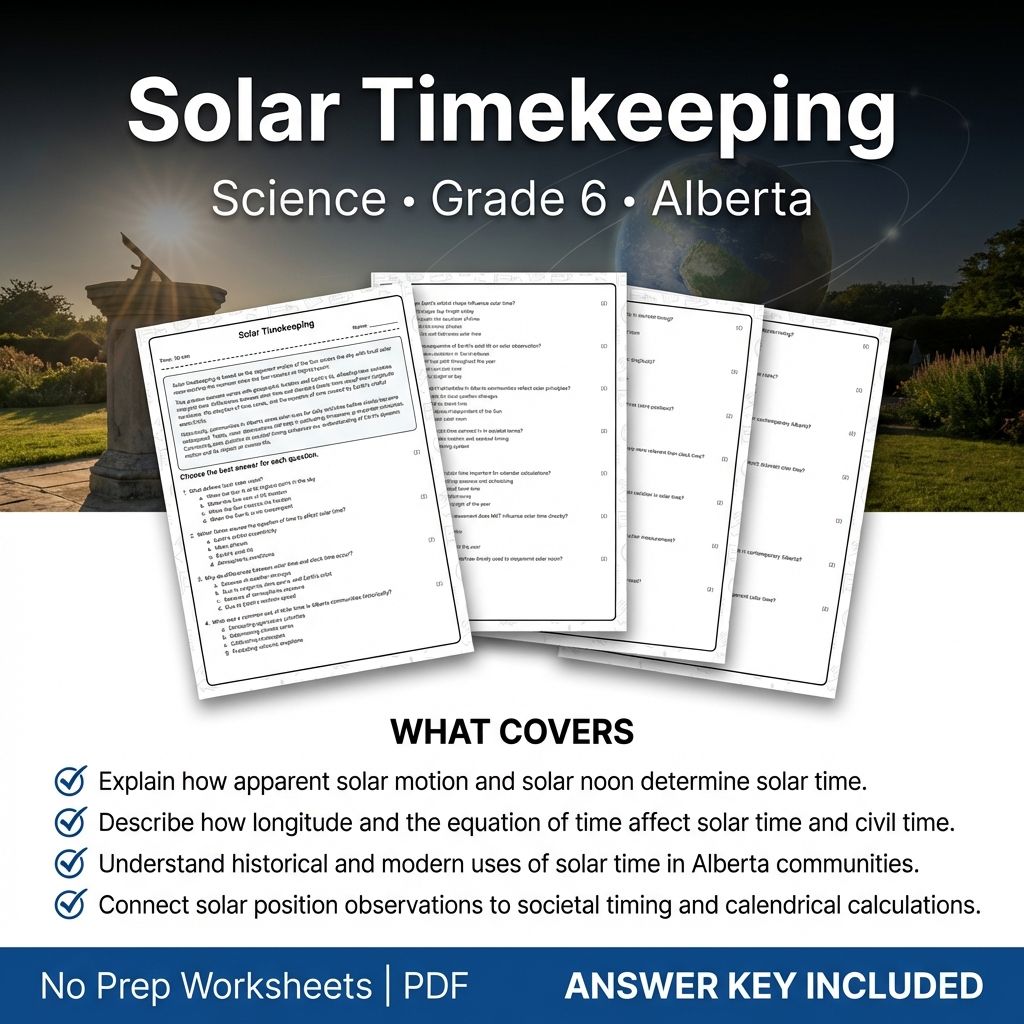
Grade 6 Science Worksheet on Solar Timekeeping | Alberta Standards
Created byCoral Reef LearningLearning Objectives
- Explain how apparent solar motion and solar noon determine solar time.
- Describe how longitude and the equation of time affect solar time and civil time.
- Understand historical and modern uses of solar time in Alberta communities.
Instant download
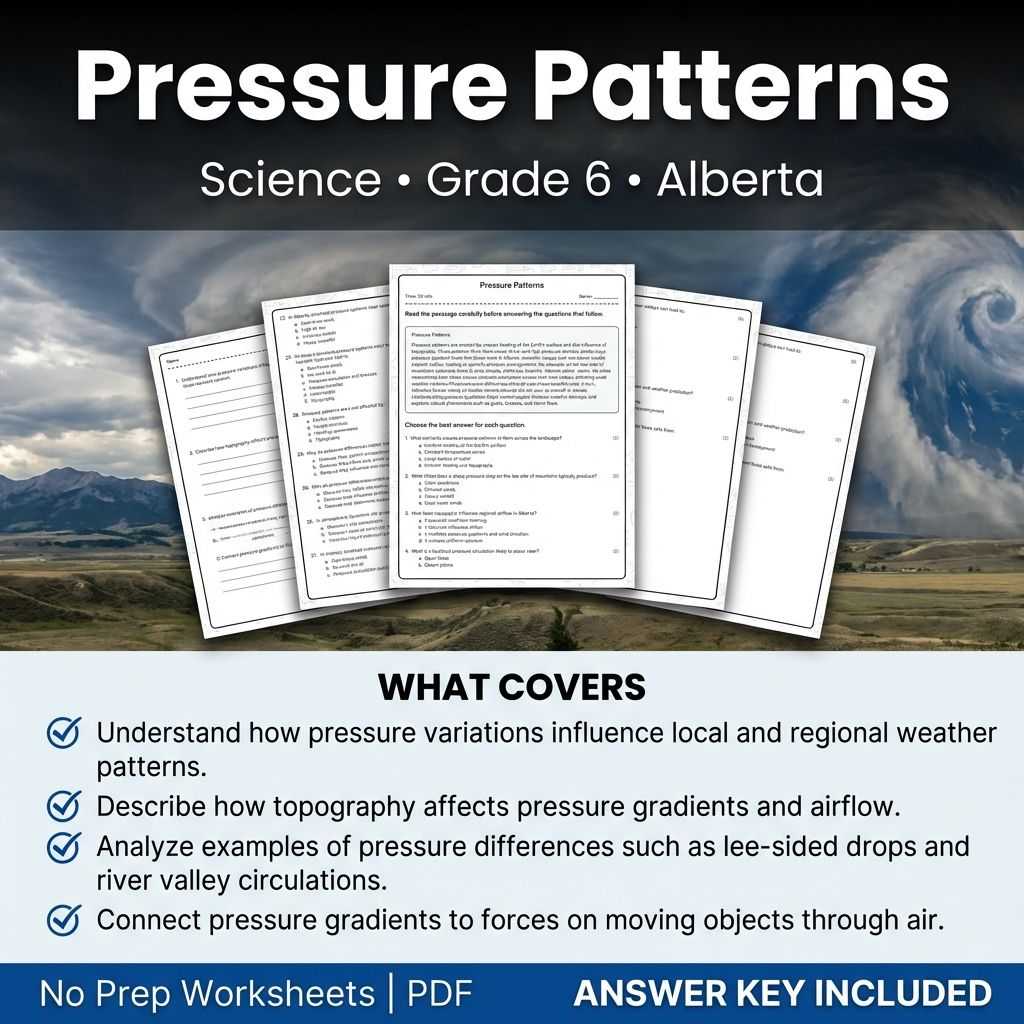
Pressure Patterns Grade 6 Science Worksheet | Alberta Standards
Created byCoral Reef LearningLearning Objectives
- Understand how pressure variations influence local and regional weather patterns.
- Describe how topography affects pressure gradients and airflow.
- Analyze examples of pressure differences such as lee-sided drops and river valley circulations.
Instant download
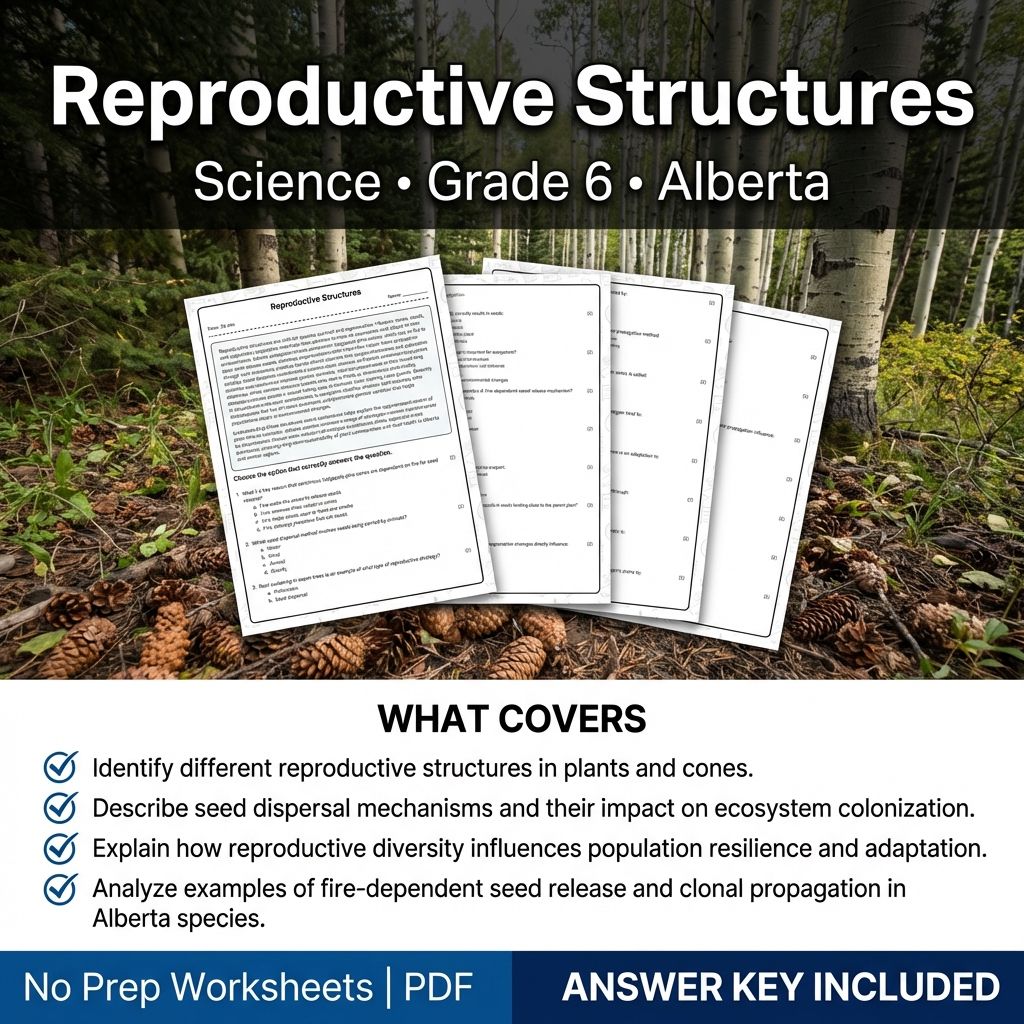
Grade 6 Science Worksheet on Reproductive Structures | Alberta Standards
Created byCoral Reef LearningLearning Objectives
- Identify different reproductive structures in plants and cones.
- Describe seed dispersal mechanisms and their impact on ecosystem colonization.
- Explain how reproductive diversity influences population resilience and adaptation.
Instant download
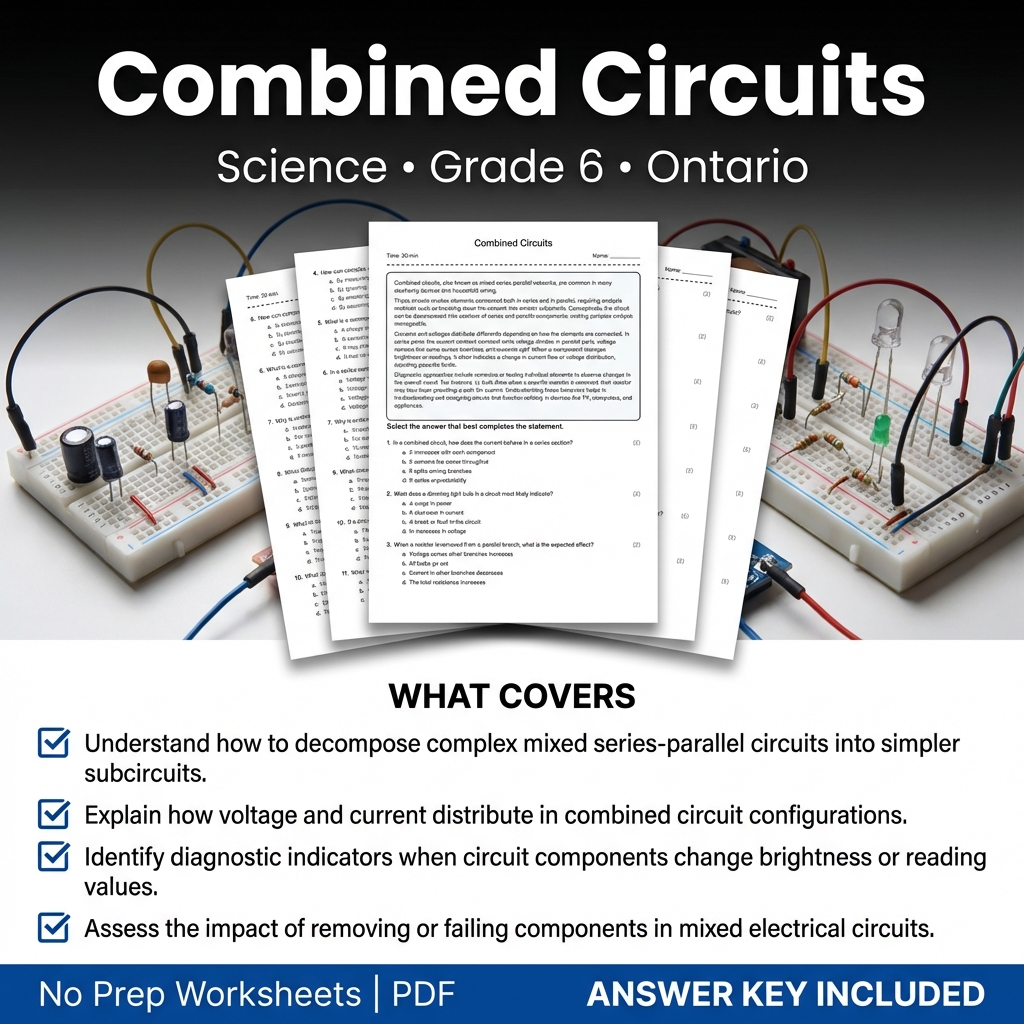
Grade 6 Science Worksheet on Combined Circuits - Printable PDF & Answer Key
Created byCoral Reef LearningLearning Objectives
- Understand how to decompose complex mixed series-parallel circuits into simpler subcircuits.
- Explain how voltage and current distribute in combined circuit configurations.
- Identify diagnostic indicators when circuit components change brightness or reading values.
Instant download
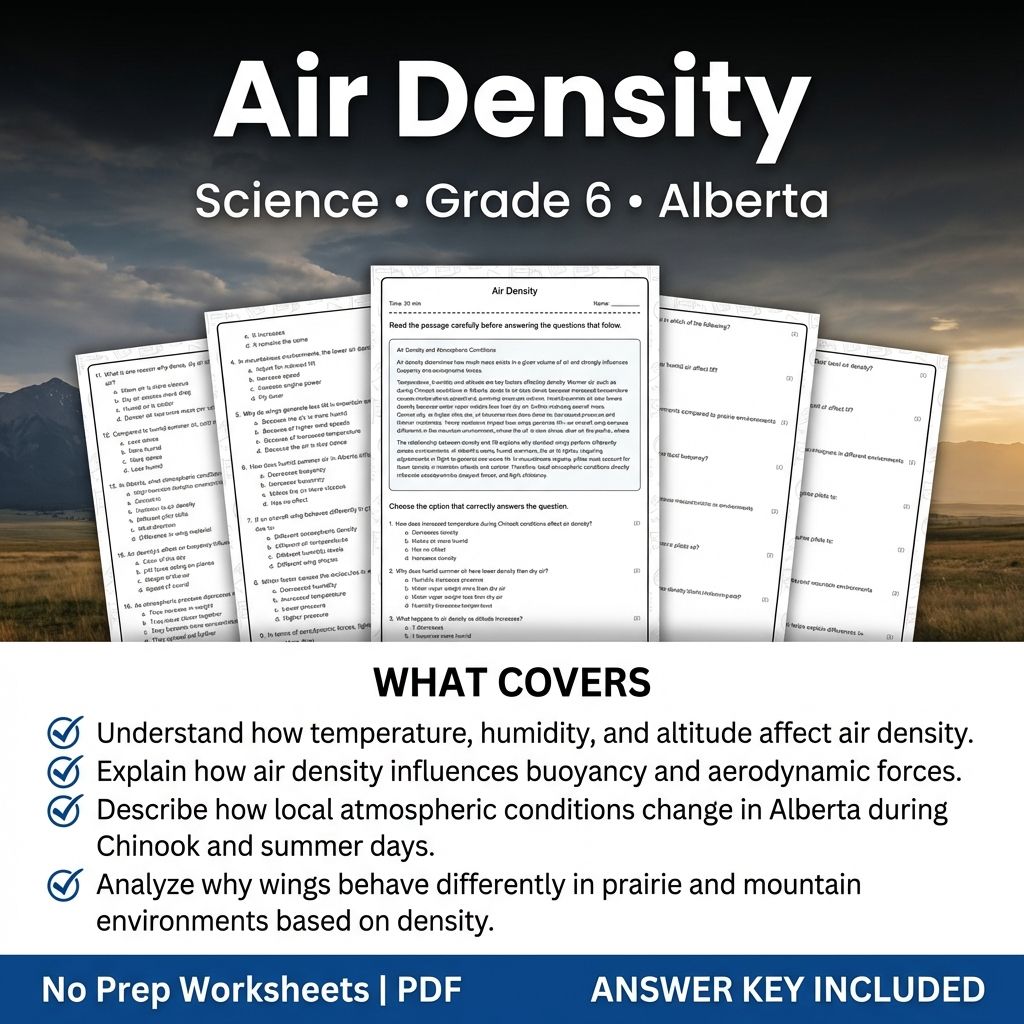
Grade 6 Science Worksheet on Air Density | Alberta Standards Practice
Created byCoral Reef LearningLearning Objectives
- Understand how temperature, humidity, and altitude affect air density.
- Explain how air density influences buoyancy and aerodynamic forces.
- Describe how local atmospheric conditions change in Alberta during Chinook and summer days.
Instant download
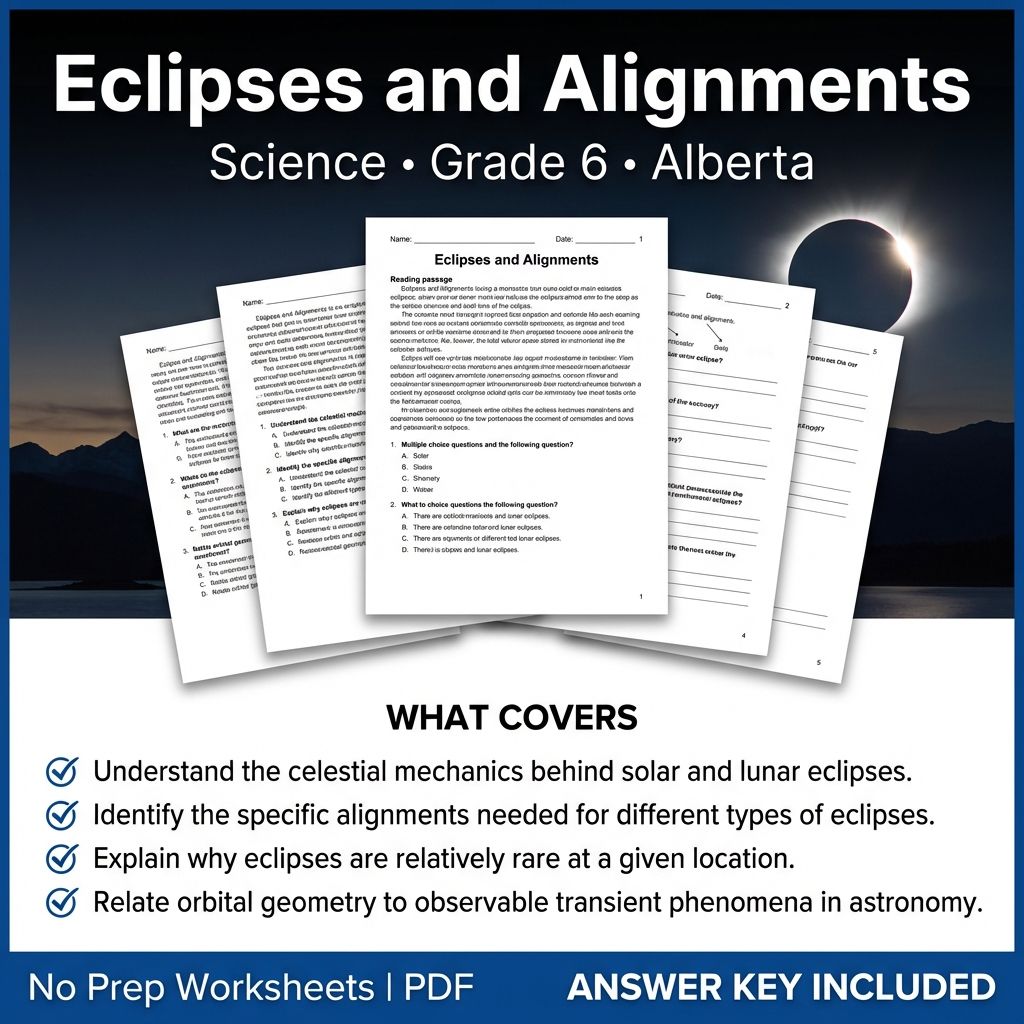
Grade 6 Science Worksheet on Eclipses and Alignments | Alberta Standards
Created byCoral Reef LearningLearning Objectives
- Understand the celestial mechanics behind solar and lunar eclipses.
- Identify the specific alignments needed for different types of eclipses.
- Explain why eclipses are relatively rare at a given location.
Instant download
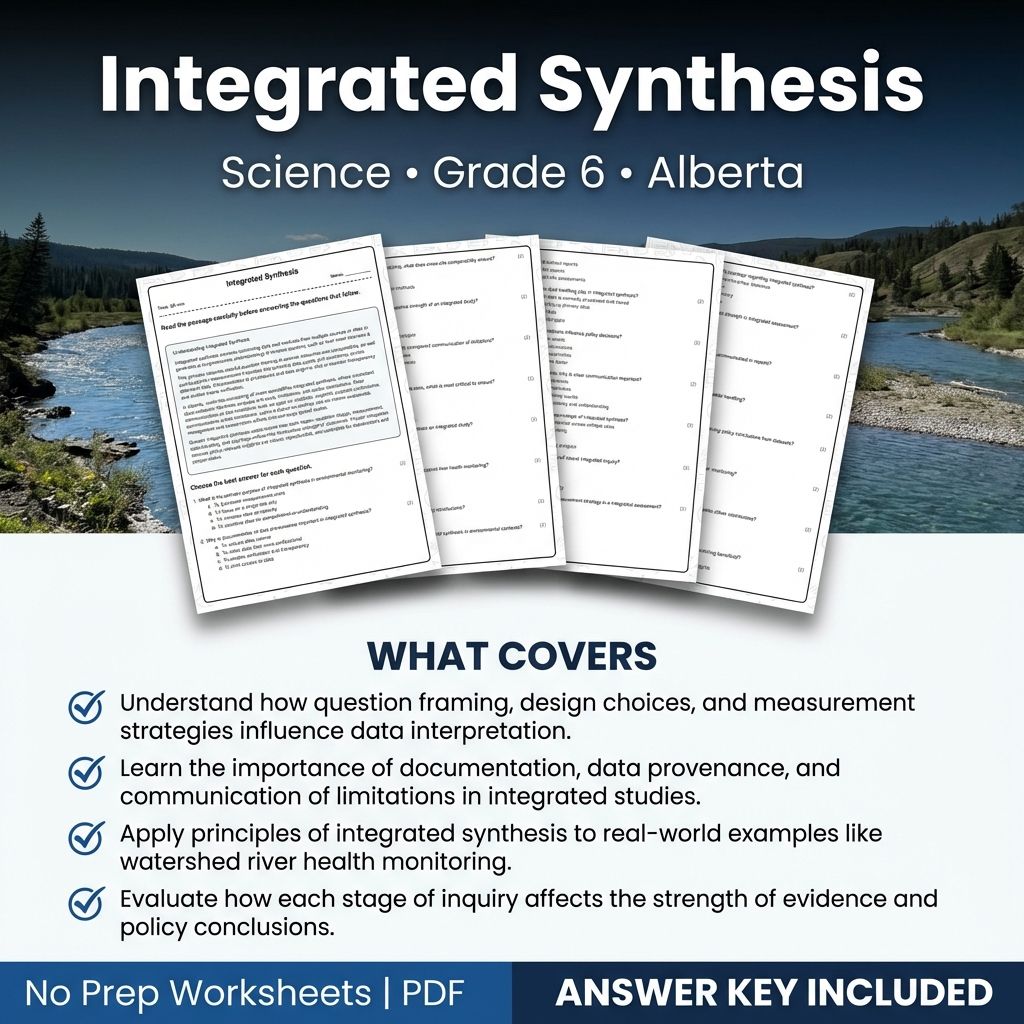
Grade 6 Science Worksheet on Integrated Synthesis | Alberta Standards
Created byCoral Reef LearningLearning Objectives
- Understand how question framing, design choices, and measurement strategies influence data interpretation.
- Learn the importance of documentation, data provenance, and communication of limitations in integrated studies.
- Apply principles of integrated synthesis to real-world examples like watershed river health monitoring.
Instant download
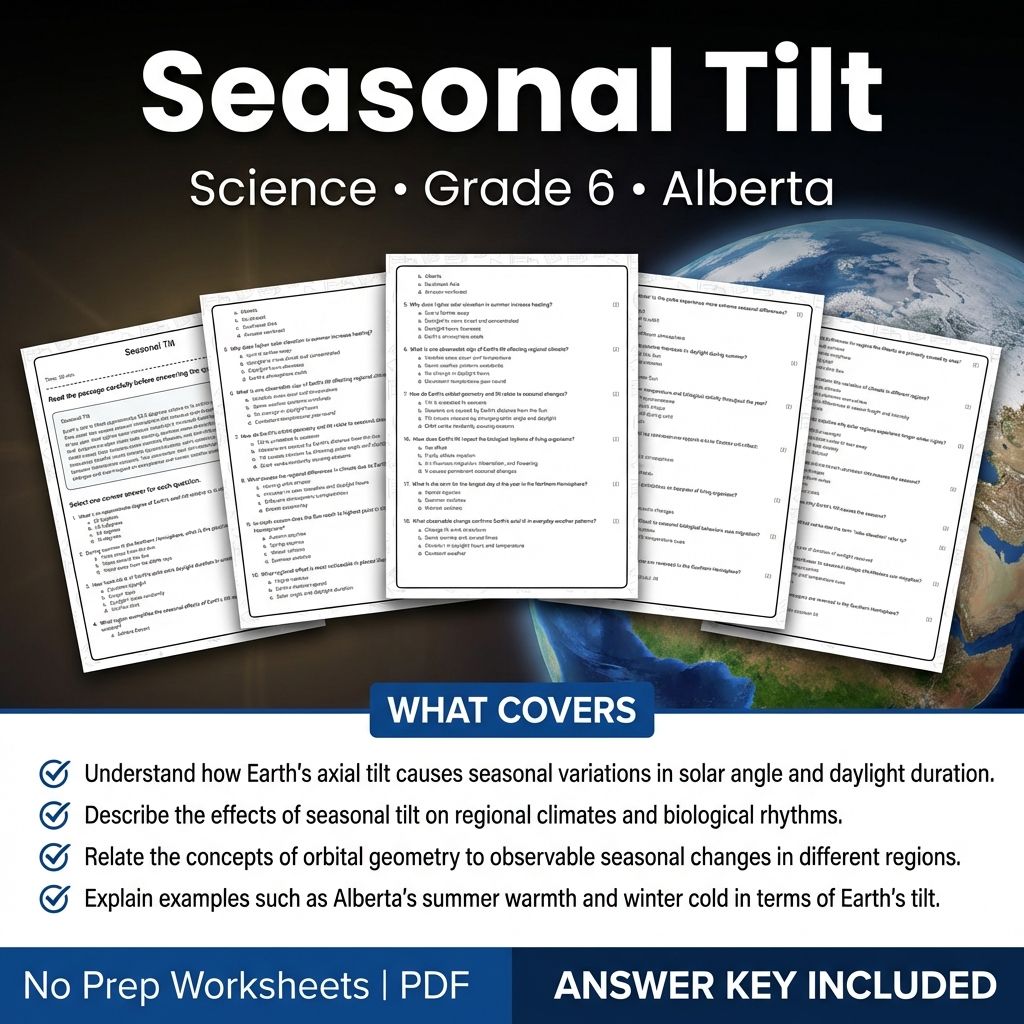
Grade 6 Science Worksheet on Seasonal Tilt | Alberta Standards
Created byCoral Reef LearningLearning Objectives
- Understand how Earth's axial tilt causes seasonal variations in solar angle and daylight duration.
- Describe the effects of seasonal tilt on regional climates and biological rhythms.
- Relate the concepts of orbital geometry to observable seasonal changes in different regions.
Instant download
About Grade 6 Science Worksheets
Explore Grade 6 Science worksheets for classwork, homework, or review. Our 5,969 printables download instantly as PDFs.
MyTeachingSheets worksheets are made by real teacher-authors and checked before they go live. Download any as a print-ready PDF for lessons, homework, or independent practice — most include answer keys, and previews are always free.