
Grade 6 Science Worksheets
5,735 worksheets
Grade 6 Science – System Thinking & Components | Daily Reading Worksheet
 Created byBright Mind Resources
Learning Objectives
- Understand the basic components of a system.
- Identify how parts of a system interact and influence each other.
- Learn cause-and-effect reasoning in system design.

Grade 6 Science – Density & Materials | Daily Reading Worksheet
Created byBright Mind ResourcesLearning Objectives
- Understand the concept of density and how it relates mass and volume
- Observe how objects with different densities behave in water
- Identify the factors influencing whether objects sink or float

Grade 6 Science – Evaporation & Water Changes | Daily Reading Worksheet
Created byBright Mind ResourcesLearning Objectives
- Explain what evaporation is and how it separates substances
- Identify evidence of evaporation in experiments
- Differentiate evaporation from other separation methods

Grade 6 Science – Properties of Matter & Materials | Daily Reading Worksheet
Created byBright Mind ResourcesLearning Objectives
- Identify observable properties such as color, hardness, and texture of different materials.
- Describe physical characteristics of common materials like copper, wood, and glass.
- Understand how properties help classify substances and predict behavior.

Grade 6 Science – Heat & States of Matter | Daily Reading Worksheet
Created byBright Mind ResourcesLearning Objectives
- Understand how heat transfer causes changes in matter's state
- Identify everyday examples of melting, evaporation, and condensation
- Describe the process of energy absorption in matter

Grade 6 Science – Density & Properties of Materials | Daily Reading Worksheet
Created byBright Mind ResourcesLearning Objectives
- Define what density is and explain its significance.
- Understand how mass and volume relate to density.
- Identify objects with different densities based on their properties.

Grade 6 Science – Food Molecules Daily Reading Worksheet | California Standards
Created byBright Mind ResourcesLearning Objectives
- Identify different types of food molecules
- Understand the functions of carbohydrates, proteins, and fats
- Learn how digestive processes break down food molecules into smaller parts

Grade 6 Science – Scientific Inquiry & Observation | Daily Reading Worksheet
Created byBright Mind ResourcesLearning Objectives
- Understand the importance of careful observations in science.
- Learn how to describe observations using measurement and descriptive terms.
- Recognize the role of evidence and logical reasoning in forming scientific explanations.

Grade 6 Science – Measurement & Precision Daily Reading Worksheet | NGSSS
Created byBright Mind ResourcesLearning Objectives
- Identify different measurement tools used in science experiments.
- Understand the importance of units and scales in obtaining accurate measurements.
- Distinguish between precision and accuracy in measurement.

Grade 6 Science – Building Knowledge & Scientific Inquiry | Reading Worksheet
Created byBright Mind ResourcesLearning Objectives
- Understand how scientific evidence influences explanations
- Recognize the process of refining scientific ideas
- Differentiate between scientific theories and laws

Grade 6 Science – Trophic Levels Ecosystems Reading Worksheet | NGSSS Aligned
Created byBright Mind ResourcesLearning Objectives
- Identify producers and explain their role in the ecosystem.
- Describe the different trophic levels and their characteristics.
- Understand how energy flows through a food chain.

Grade 6 Science – Survival Changes & Adaptations | Daily Reading Worksheet
Created byBright Mind ResourcesLearning Objectives
- Understand key concepts related to Science
- Apply knowledge through practice questions
- Demonstrate comprehension of the material

Grade 6 Science – Respiration & Digestion | Daily Reading Worksheet
Created byBright Mind ResourcesLearning Objectives
- Understand the structure and function of the respiratory system, especially the lungs.
- Learn how gases are exchanged in the lungs through diffusion.
- Understand the role of the respiratory and digestive systems in supporting cellular energy.
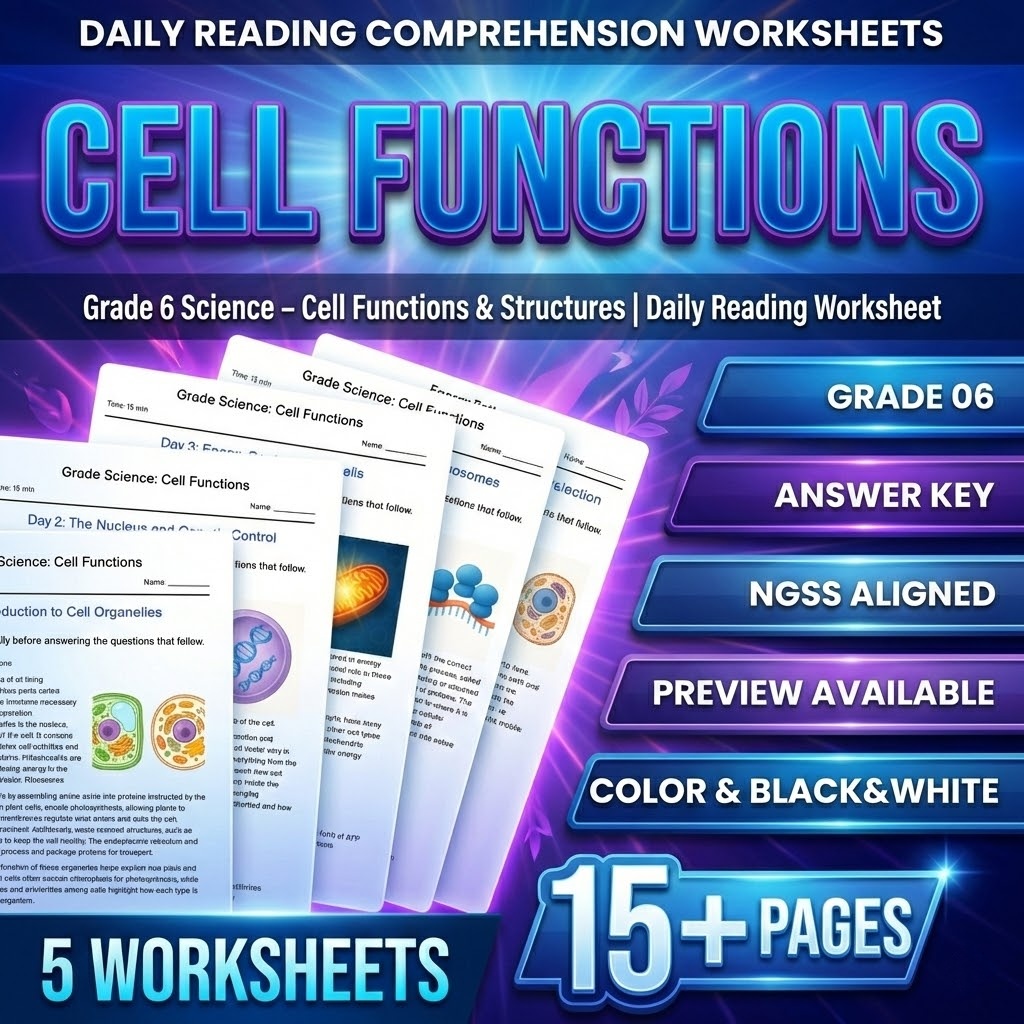
Grade 6 Science – Cell Functions & Structures | Daily Reading Worksheet
 Created byElena Brooks
Learning Objectives
- Identify the main organelles in plant and animal cells.
- Describe the functions of key cell organelles.
- Understand how cell structure relates to organelle function.
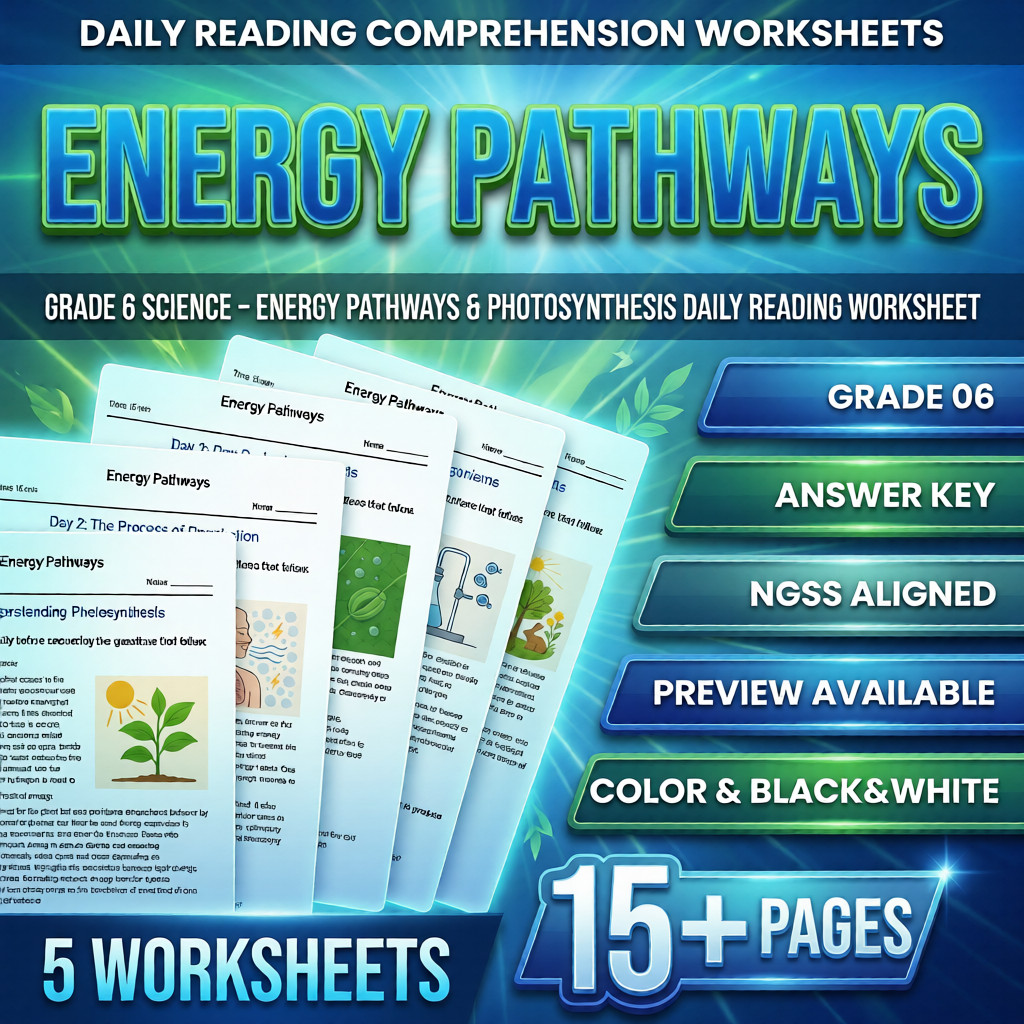
Grade 6 Science – Energy Pathways & Photosynthesis Daily Reading Worksheet
Created byElena BrooksLearning Objectives
- Understand how plants convert sunlight into chemical energy through photosynthesis.
- Identify the roles of chloroplasts and mitochondria in energy transformation.
- Describe the process of gas exchange in leaves and its importance in energy production.
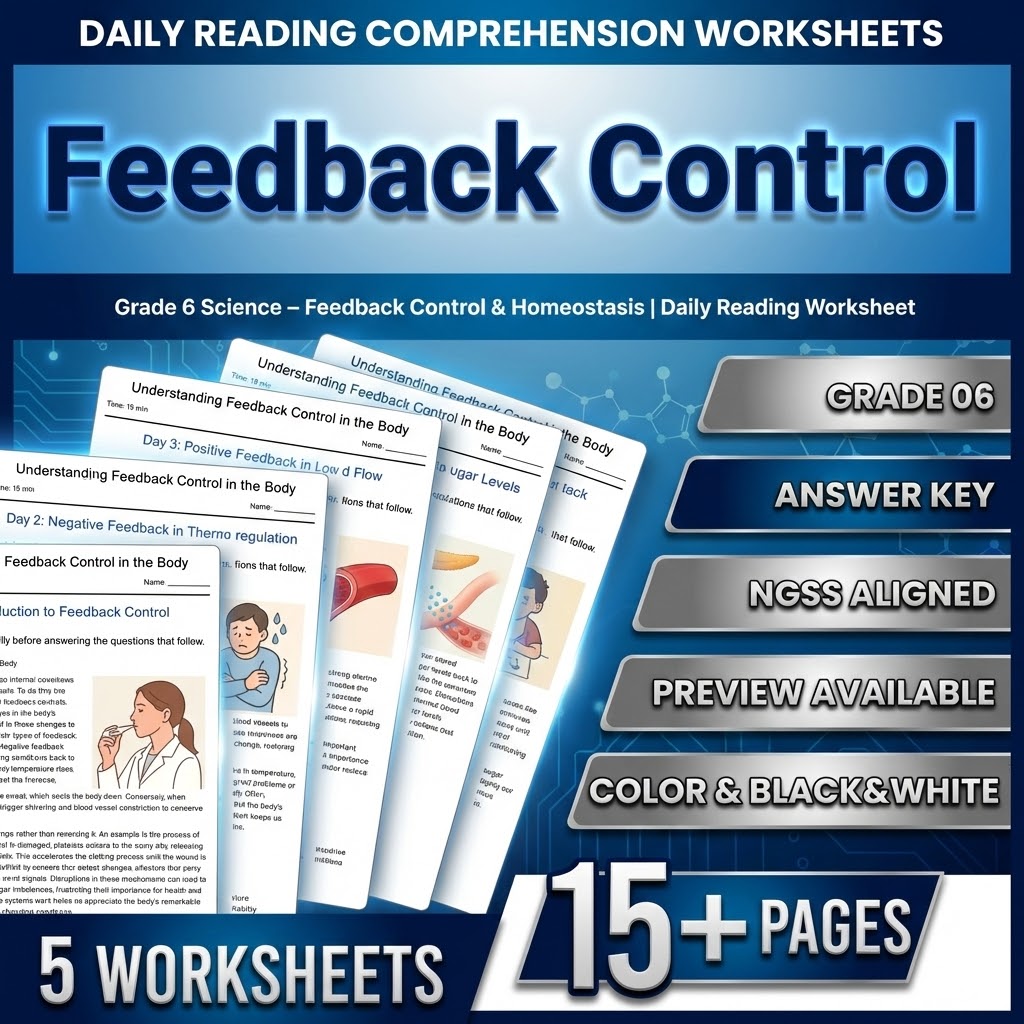
Grade 6 Science – Feedback Control & Homeostasis | Daily Reading Worksheet
Created byElena BrooksLearning Objectives
- Define feedback control mechanisms involved in maintaining internal stability.
- Describe the difference between negative and positive feedback.
- Identify examples of feedback control such as temperature regulation and blood sugar regulation.
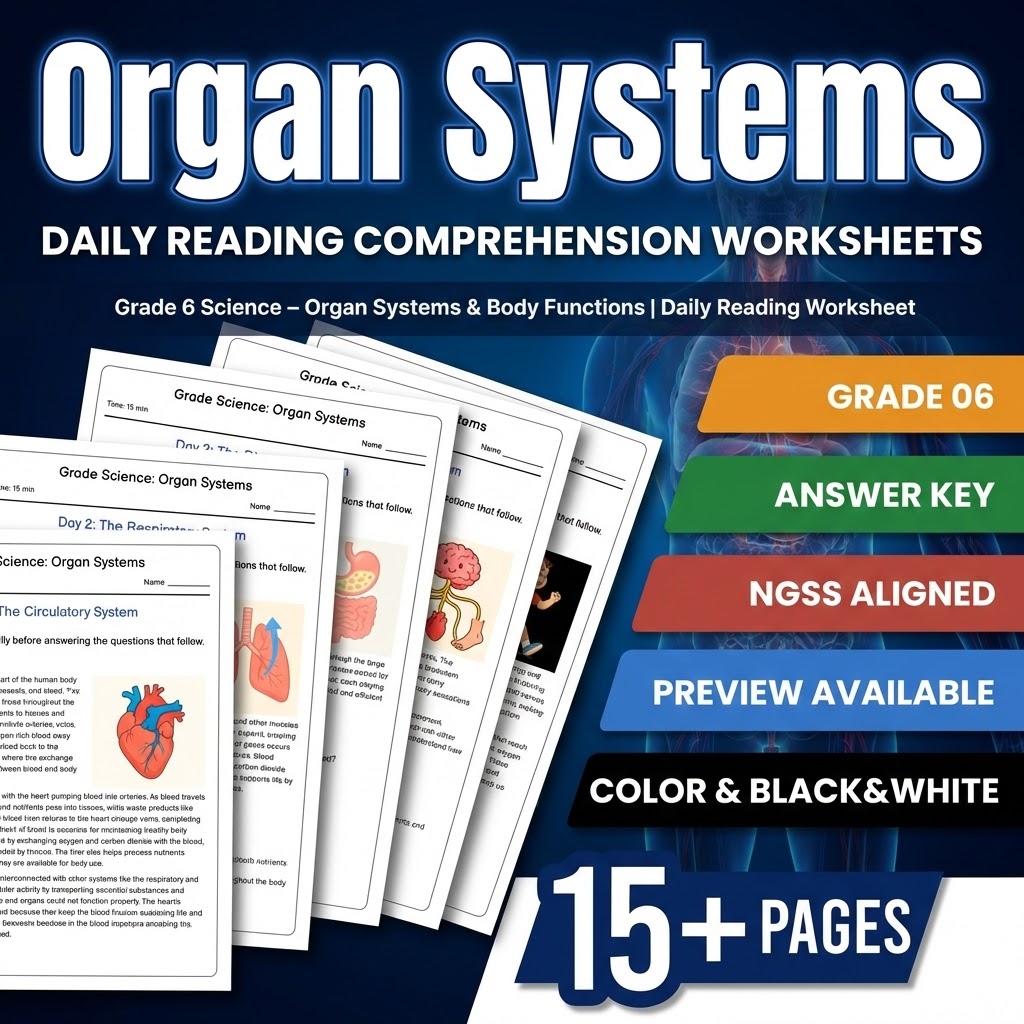
Grade 6 Science – Organ Systems & Body Functions | Daily Reading Worksheet
Created byElena BrooksLearning Objectives
- Understand the basic functions of the circulatory system, including the roles of the heart and blood vessels.
- Identify how blood moves throughout the body and why the heart is essential.
- Describe the interaction between the circulatory system and other organ systems.

Grade 6 Science – Surface Change & Mountain Formation | Daily Reading Worksheet
Created byElena BrooksLearning Objectives
- Identify the geological processes involved in mountain formation.
- Differentiate between rapid and slow geological events.
- Describe observable indicators of landscape evolution.
Grade 6 Science – Resource Distribution & Earth's Resources | Daily Reading
Created byElena BrooksLearning Objectives
- Understand how Earth's geoscience processes create natural resources
- Identify the formation of mineral, energy, and groundwater resources
- Recognize the influence of plate tectonics, sedimentation, and weathering on resource availability

Grade 6 Science – Adaptation Patterns & Desert Plants | Daily Reading Worksheet
Created byBright Mind ResourcesLearning Objectives
- Understand the morphological features of desert plants
- Identify how plant adaptations help survival in arid environments
- Apply knowledge of adaptation traits to real-world examples

Grade 6 Science – Abiotic Influences on Habitats Daily Reading Worksheet
Created byBright Mind ResourcesLearning Objectives
- Understand how temperature influences the distribution of plants and animals.
- Learn about the ways physical factors shape habitats.
- Identify examples of how temperature variations affect metabolic rates and organism survival.

Grade 6 Science – Population Dynamics & Growth | Daily Reading Worksheet
Created byBright Mind ResourcesLearning Objectives
- Understand different types of population growth curves
- Identify factors influencing population change
- Differentiate between density-dependent and density-independent factors

Grade 6 Science – Human Impacts & Ecosystem Preservation | Reading Worksheet
Created byBright Mind ResourcesLearning Objectives
- Understand how habitat fragmentation impacts wildlife populations.
- Identify different sources of environmental pollution.
- Analyze how land-use change affects ecosystems.

Grade 6 Science – Atmospheric Patterns & Weather Phenomena | Reading Worksheet
Created byBright Mind ResourcesLearning Objectives
- Understand the structure of Earth's atmosphere and the factors that influence weather patterns.
- Identify common atmospheric phenomena such as fronts, pressure systems, and winds.
- Explain how heat transfer and the greenhouse effect impact regional climates.

Grade 6 Science – Symbiotic Relations & Mutualism | Daily Reading Worksheet
Created byBright Mind ResourcesLearning Objectives
- Understand the concept of mutualism in symbiotic relationships.
- Identify examples of mutualism in nature.
- Analyze how mutualistic interactions benefit both species involved.

Grade 6 Science – Geologic Time & Dating Methods | Daily Reading Worksheet
Created byBright Mind ResourcesLearning Objectives
- Understand the concept of Earth's age and the geologic time scale
- Identify key principles of relative and absolute dating
- Recognize how fossils and stratigraphy are used to interpret Earth's history

Grade 6 Science – Earth Structure & Plate Tectonics | Daily Reading Worksheet
Created byBright Mind ResourcesLearning Objectives
- Understand the layers of the Earth and their properties
- Identify different types of plate boundaries
- Explain the geological processes involved in Earthquakes, volcanic eruptions, and mountain formation

Grade 6 Science – Ecosystems & Interactions Daily Reading Worksheet
Created byBright Mind ResourcesLearning Objectives
- Identify biotic components in various ecosystems
- Identify abiotic components in ecosystems
- Describe the roles of different components in habitat structure

Grade 6 Science – Space Tools Daily Reading Worksheet | TEKS Aligned
Created byBright Mind ResourcesLearning Objectives
- Understand the purpose and types of ground-based telescopes used in space observation.
- Learn about the differences between ground-based and orbital telescopes.
- Explore how telescopes contribute to understanding Earth and planetary systems.

Grade 6 Science – Change Evidence & Content | Daily Reading Worksheet
Created byBright Mind ResourcesLearning Objectives
- Identify observable signs of physical changes
- Differentiate physical changes from chemical changes
- Recognize examples of physical and chemical evidence in everyday phenomena

Grade 6 Science – Natural Resources & Conservation | Daily Reading Worksheet
Created byBright Mind ResourcesLearning Objectives
- Identify different types of natural resources
- Understand the distribution and formation of natural resources
- Recognize environmental and economic implications of resource use

Grade 6 Science – Energy Transfer & Heat Methods | Daily Reading Worksheet
Created byBright Mind ResourcesLearning Objectives
- Understand the three main mechanisms of heat transfer: conduction, convection, and radiation.
- Identify real-life examples of each heat transfer method.
- Connect observable temperature changes to different energy transfer processes.

Grade 6 Science – Energy Forms & Concepts | Daily Reading Worksheet
Created byBright Mind ResourcesLearning Objectives
- Identify different forms of energy such as kinetic, potential, thermal, chemical, and electrical.
- Relate everyday phenomena to energy forms, like a rolling ball or a lit bulb.
- Differentiate between motion, position, and internal energy in objects.

Grade 6 Science – Conservation & Mass Principles Daily Reading Worksheet
Created byBright Mind ResourcesLearning Objectives
- Understand the principle of conservation of mass in closed systems.
- Identify examples of conservation in physical and chemical processes.
- Recognize the limitations of conservation principles in open systems.

Grade 6 Science – Minerals & Rocks Daily Reading Worksheet | TEKS Aligned
Created byBright Mind ResourcesLearning Objectives
- Identify the physical and chemical properties of minerals
- Understand how minerals are classified based on properties
- Learn about the formation and types of rocks: igneous, sedimentary, and metamorphic

Grade 6 Science – Communication & Reporting in Science | Daily Reading Worksheet
Created byBright Mind ResourcesLearning Objectives
- Understand the importance of clear communication in scientific work
- Learn how to formulate claims supported by evidence and reasoning
- Identify and interpret visual summaries like graphs

Grade 6 Science – Forces & Contact and Non-Contact Forces | Reading Worksheet
Created byBright Mind ResourcesLearning Objectives
- Understand the difference between contact and non-contact forces
- Identify examples of gravity, friction, and normal force
- Explain the concept of balanced and unbalanced forces in simple terms

Grade 6 Science – Variables Control & Effects on Plant Growth | Worksheet
Created byBright Mind ResourcesLearning Objectives
- Identify independent, dependent, and controlled variables in plant growth experiments.
- Understand operational definitions and their importance.
- Recognize potential confounding influences in scientific testing.

Grade 6 Science – Electrostatic Phenomena & Static Electricity | Worksheet
Created byBright Mind ResourcesLearning Objectives
- Understand the basic principles of static electricity.
- Identify sources of electrostatic charge in everyday materials.
- Describe phenomena such as attraction, repulsion, and sparks.

Grade 6 Science – Communicating Evidence & Data Presentation | Reading Worksheet
Created byBright Mind ResourcesLearning Objectives
- Understand how to interpret and use graphs and charts to support scientific claims.
- Learn effective ways to present data visually for clear communication.
- Develop skills to analyze evidence and construct logical scientific arguments.

Grade 6 Science – Careers in Science Daily Reading Worksheet | TEKS Aligned
Created byBright Mind ResourcesLearning Objectives
- Understand key concepts related to Science
- Apply knowledge through practice questions
- Demonstrate comprehension of the material

Grade 6 Science – Series Circuit Characteristics Daily Reading Worksheet
Created byBright Mind ResourcesLearning Objectives
- Understand the basic concept of series circuits
- Identify a series circuit from a schematic diagram
- Explain current flow in series circuits

Grade 6 Science – Scientific Ethics & Responsibility Daily Reading Worksheet
Created byBright Mind ResourcesLearning Objectives
- Understand the importance of privacy in medical data handling.
- Identify ethical considerations in digital measurement and data use.
- Analyze scenarios involving environmental stewardship and biotechnology decisions.
Grade 6 Science – Understanding Key Construction Daily Reading Worksheet
 Created byQuiet Forest Education
Learning Objectives
- Learn the purpose of dichotomous keys in biological classification.
- Identify the basic structure and components of a dichotomous key.
- Understand how contrasting traits are used to create binary decision points.
Grade 6 Science – Niche Dynamics & Ecosystem Roles | Daily Reading Worksheet
Created byQuiet Forest EducationLearning Objectives
- Understand the concept of ecological niches, including fundamental and realized niches
- Identify abiotic factors that influence habitat and resource use
- Describe how interspecific interactions shape resource partitioning and habitat occupation
Grade 6 Science – Pollution Effects Nutrient & Eutrophication | Daily Worksheet
Created byQuiet Forest EducationLearning Objectives
- Understand how nutrient loading impacts aquatic ecosystems
- Identify the process of eutrophication in lakes
- Recognize measurable indicators of water quality related to pollution

Grade 6 Science – Tissue Types & Structures | Daily Reading Worksheet
Created byBright Mind ResourcesLearning Objectives
- Understand key concepts related to Science
- Apply knowledge through practice questions
- Demonstrate comprehension of the material
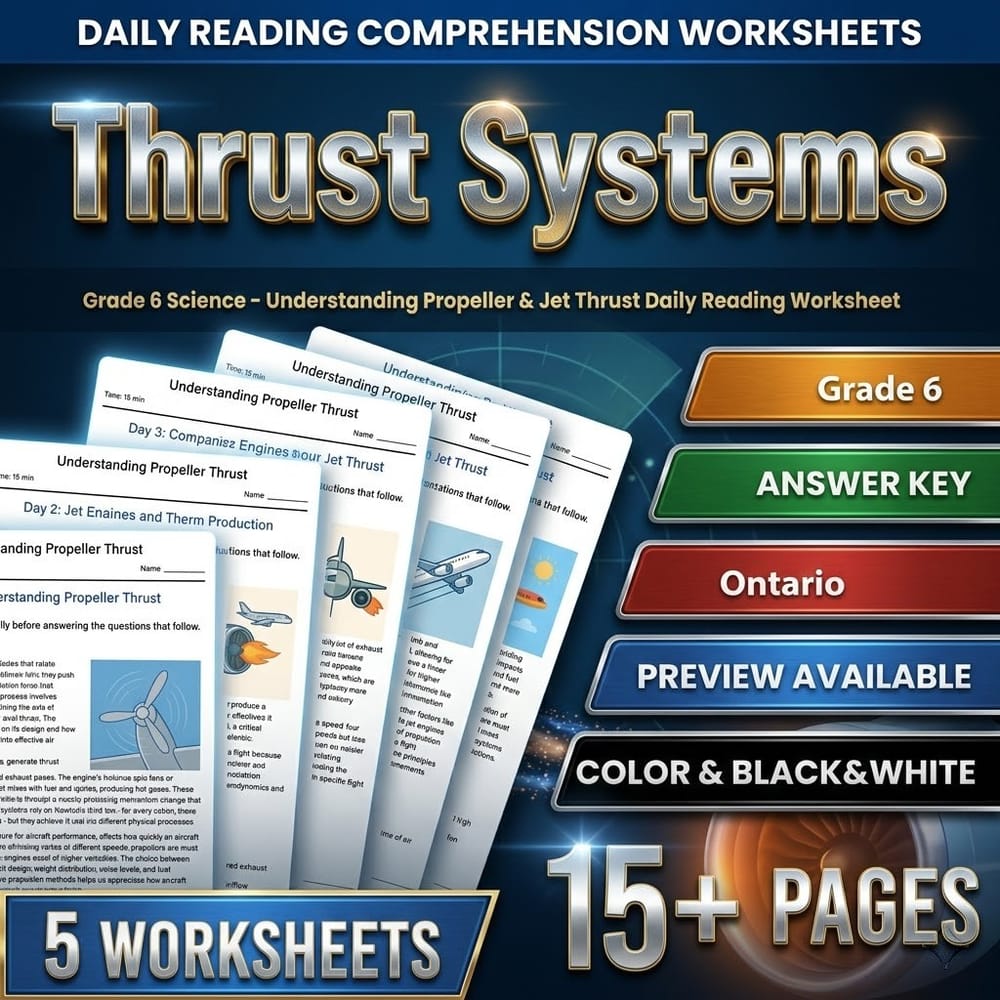
Grade 6 Science – Understanding Propeller & Jet Thrust Daily Reading Worksheet
Created byQuiet Forest EducationLearning Objectives
- Explain how propellers generate thrust to move an aircraft forward.
- Identify the role of air acceleration in producing axial thrust.
- Distinguish between propeller-driven and jet-driven propulsion systems.
About Grade 6 Science Worksheets
Explore Grade 6 Science worksheets for classwork, homework, or review. Our 5,735 printables download instantly as PDFs.
MyTeachingSheets worksheets are made by real teacher-authors and checked before they go live. Download any as a print-ready PDF for lessons, homework, or independent practice — most include answer keys, and previews are always free.