
Grade 6 Science Worksheets
5,735 worksheets
Grade 6 Science – Exploring Mars with Robots & Space Exploration Daily Worksheet
 Created byQuiet Forest Education
Learning Objectives
- Understand key concepts related to Science
- Apply knowledge through practice questions
- Demonstrate comprehension of the material

Grade 6 Science – Body Organization & Systems | Daily Reading Worksheet
 Created byBright Mind Resources
Learning Objectives
- Understand the different levels of body organization: cells, tissues, organs, and systems.
- Identify the functions of each level in maintaining health and supporting bodily functions.
- Describe how small structures build larger systems and affect overall body performance.
Grade 6 Science – Conservation of Mass & Atoms Daily Reading Worksheet
 Created byElena Brooks
Learning Objectives
- Understand that atoms are the basic building blocks of matter.
- Learn that atoms are conserved during physical and chemical changes.
- Identify how mass remains constant even when molecules rearrange.

Grade 6 Science – Moon & Phases Daily Reading Worksheet | NGSS Standards Aligned
Created byElena BrooksLearning Objectives
- Understand the relative positions of Earth, Moon, and Sun during different lunar phases.
- Identify the primary lunar phases based on Moon's position relative to Earth and Sun.
- Explain how lunar phases and eclipses occur and what causes changes in the Moon's appearance.

Grade 6 Science – Design Problem & Inquiry Questions | Daily Reading Worksheet
Created byBright Mind ResourcesLearning Objectives
- Understand what a design problem is and the importance of defining needs and constraints.
- Identify different components that influence the design of a protective case.
- Develop skills to analyze design requirements carefully.

Grade 6 Science – Testable Questions & Inquiry Skills | Daily Reading Worksheet
Created byBright Mind ResourcesLearning Objectives
- Understand what makes a question testable in scientific experiments.
- Learn how to identify variables and measurable outcomes in questions.
- Develop skills to formulate testable scientific questions from observations.

Grade 6 Science – Trade-off Decisions & Material Selection | Reading Worksheet
Created byBright Mind ResourcesLearning Objectives
- Explain what trade-offs are in selecting materials.
- Identify how choosing stronger materials can affect weight and cost.
- Analyze different material properties and their impacts on design choices.

Grade 6 Science – Competition & Resource Use in Nature | Daily Reading Worksheet
Created byBright Mind ResourcesLearning Objectives
- Identify different types of competition among organisms
- Understand how competition influences survival and population dynamics
- Analyze examples of competition in various ecosystems

Grade 6 Science – Niche Relationships & Ecosystems | Daily Reading Worksheet
Created byBright Mind ResourcesLearning Objectives
- Define what a niche is in an ecosystem.
- Identify different niche types based on resource use and behavior.
- Explain how species coexist by occupying different niches.

Grade 6 Science – Biodiversity Patterns & Ecosystem Health | Reading Worksheet
Created byBright Mind ResourcesLearning Objectives
- Understand the concept of species richness and how it varies across different ecosystems.
- Learn sampling methods like transects and quadrats used to measure biodiversity.
- Interpret regional biodiversity data and relate it to habitat heterogeneity.

Grade 6 Science – Keystone Species & Ecosystems | Daily Reading Worksheet
Created byBright Mind ResourcesLearning Objectives
- Define what a keystone species is and explain its role in an ecosystem.
- Identify examples of keystone species based on case studies.
- Describe the cascading effects caused by keystone species on biodiversity and habitat structure.

Grade 6 Science – Adaptation Basics & Reading Worksheet | Ontario Standards
Created byBright Mind ResourcesLearning Objectives
- Understand what structural adaptations are in animals
- Identify different examples of adaptations in nature
- Explain how adaptations help animals survive in their environments

Grade 6 Science – Stewardship Strategies & Biodiversity Conservation | Worksheet
Created byBright Mind ResourcesLearning Objectives
- Understand the concept of habitat restoration and its significance.
- Identify different stewardship strategies used to protect ecosystems.
- Analyze the trade-offs involved in various conservation approaches.

Grade 6 Science – Design Process & Aircraft Development | Reading Worksheet
Created byBright Mind ResourcesLearning Objectives
- Understand the stages of the design process for aircraft and gliders.
- Identify how prototypes and simulations are used to improve aerodynamics.
- Explain the importance of measurements like lift and drag in design refinement.

Grade 6 Science – Control Surfaces & Flight Mechanisms | Daily Reading Worksheet
Created byBright Mind ResourcesLearning Objectives
- Identify primary and secondary control surfaces such as ailerons, elevators, rudder, and flaps.
- Understand the role of ailerons in controlling roll movement.
- Explain how control surfaces affect airplane stability and maneuverability.

Grade 6 Science – Pressure Maps & Aerodynamics | Daily Reading Worksheet
Created byBright Mind ResourcesLearning Objectives
- Understand key concepts related to Science
- Apply knowledge through practice questions
- Demonstrate comprehension of the material

Grade 6 Science – Satellite Systems & Orbits | Daily Reading Worksheet
Created byBright Mind ResourcesLearning Objectives
- Understand different types of artificial satellites and their functions
- Identify the various orbits used by satellites and their purposes
- Explain how satellites contribute to Earth observation, communication, and scientific monitoring

Grade 6 Science – Solar System Survey & Daily Reading Worksheet
Created byBright Mind ResourcesLearning Objectives
- Understand the structure and layout of the solar system
- Identify major planets and components of the solar system
- Distinguish between terrestrial and gas giant planets

Grade 6 Science – Digital Instrumentation & Sensors | Daily Reading Worksheet
Created byBright Mind ResourcesLearning Objectives
- Identify different types of electronic sensors
- Understand the basic function of electronic sensors
- Learn about data loggers and digital probes
Grade 6 Science – Adaptation Tradeoffs in Ecology Daily Reading Worksheet
Created byQuiet Forest EducationLearning Objectives
- Understand the concept of ecological niches and how specialization affects organisms' survival.
- Compare the benefits and costs of being a specialist versus a generalist.
- Analyze different adaptation strategies in plants and animals, especially in changing environments.
Grade 6 Science – Understanding the Sun, Earth, & Moon | Daily Reading Worksheet
Created byQuiet Forest EducationLearning Objectives
- Learn about the relative sizes and positions of the Sun, Earth, and Moon.
- Understand how gravity influences their orbital relationships.
- Identify key concepts such as the Earth–Moon barycenter and the Sun's gravitational role.

Grade 6 Science – Solar System & Celestial Motions | Daily Reading Worksheet
Created byBright Mind ResourcesLearning Objectives
- Identify key objects in the solar system and their positions relative to the Sun
- Describe the basic motions of planets, moons, and the Sun
- Understand how Earth's rotation and revolution cause day, night, and seasons

Grade 6 Science – Data Representation & Graphs | Daily Reading Worksheet
Created byBright Mind ResourcesLearning Objectives
- Understand how to organize data using tables.
- Interpret data from organized tables.
- Identify trends and outliers in data sets.

Grade 6 Science – Mass & Density Daily Reading Worksheet | TEKS Aligned
Created byBright Mind ResourcesLearning Objectives
- Define and measure mass and volume of objects.
- Understand how density relates mass and volume.
- Calculate density with simple formulas.
Grade 6 Science – Current Fundamentals & Circuits | Daily Reading Worksheet
Created byQuiet Forest EducationLearning Objectives
- Understand the concept of electric current as organized movement of charges
- Differentiate between conventional current direction and electron flow
- Explain potential difference as the driving force of current
Grade 6 Science – Molecular Building Blocks | Daily Reading Worksheet
Created byElena BrooksLearning Objectives
- Understand key concepts related to Science
- Apply knowledge through practice questions
- Demonstrate comprehension of the material

Grade 6 Science – Climate Data Patterns & Trends | Daily Reading Worksheet
Created byBright Mind ResourcesLearning Objectives
- Understand how to interpret temperature and precipitation graphs
- Identify daily and seasonal temperature trends
- Analyze patterns in climate data over time

Grade 6 Science – Weather & Climate | Daily Reading Worksheet
Created byBright Mind ResourcesLearning Objectives
- Understand the difference between weather and climate.
- Identify various weather conditions based on a description.
- Describe how weather can change throughout a day.

Grade 6 Science – Understanding Mixture Separation Daily Reading Worksheet
Created byBright Mind ResourcesLearning Objectives
- Define what mixtures are and how they differ from chemical compounds.
- Identify different physical properties used to separate mixtures.
- Explain common separation techniques, such as filtration, evaporation, and density differences.
Grade 6 Science – Optimization & Tradeoffs in Engineering | Daily Worksheet
Created byQuiet Forest EducationLearning Objectives
- Understand the concept of tradeoffs in engineering design.
- Identify key factors influencing optimization tradeoffs.
- Analyze how different design choices impact overall performance.
Grade 6 Science – Component Functions in Circuits | Daily Reading Worksheet
Created byQuiet Forest EducationLearning Objectives
- Identify various power sources in electrical circuits
- Describe the role of a power source in circuit operation
- Link schematic symbols to physical components

Grade 6 Science – Phase Energy & Changes | Daily Reading Worksheet
Created byBright Mind ResourcesLearning Objectives
- To understand how phase changes involve energy transfer without altering chemical identity
- To explain how melting and boiling require energy, while freezing and condensation release energy
- To relate latent heat to particle motion and bonding during phase changes
Grade 6 Science – Resource Limits & Ecosystems | Daily Reading Worksheet
Created byElena BrooksLearning Objectives
- Understand how water availability influences plant and animal life in deserts
- Interpret data and patterns related to resource scarcity
- Connect resource limitations to population and species distribution

Grade 6 Science – Forces & Motion | Daily Reading Worksheet
Created byElena BrooksLearning Objectives
- Identify different types of forces and understand their effects on objects
- Explain how net force influences the motion of objects
- Relate force, mass, and acceleration using mathematical concepts
Grade 6 Science – Optimizing Bridge Designs & Data Analysis | Daily Reading
Created byElena BrooksLearning Objectives
- Analyze data from different prototype tests to compare structural strength.
- Interpret graphs and averages to assess design performance.
- Discuss trade-offs involved in optimizing bridge models such as weight versus strength.

Grade 6 Science – Criteria & Constraints in Design | Daily Reading Worksheet
Created byBright Mind ResourcesLearning Objectives
- Understand the difference between criteria and constraints in a design process.
- Identify criteria and constraints in given design scenarios.
- Explain how criteria help determine success and constraints restrict options.

Grade 6 Science – Food Web & Energy Paths | Daily Reading Worksheet
Created byBright Mind ResourcesLearning Objectives
- Understand key concepts related to Science
- Apply knowledge through practice questions
- Demonstrate comprehension of the material
Grade 6 Science – Water Cycle & Processes | Daily Reading Worksheet
Created byElena BrooksLearning Objectives
- Understand the processes involved in the water cycle including evaporation, condensation, precipitation, runoff, infiltration, and groundwater storage.
- Identify the roles of solar energy and gravity in moving water through the hydrosphere.
- Explain how reservoirs like oceans, ice, and groundwater store water and transfer mass and energy.
Grade 6 Science – Variation Factors in Genetics Daily Reading Worksheet
Created byElena BrooksLearning Objectives
- Understand how genetic differences influence observable traits in organisms.
- Identify examples of genetic variation and environmental influence on phenotype.
- Learn about allele combinations, mutations, and environmental factors affecting traits.

Grade 6 Science – Societal Impacts & Water Treatment | Daily Reading Worksheet
Created byBright Mind ResourcesLearning Objectives
- Understand how water treatment processes improve public health
- Analyze the societal benefits of environmental regulations
- Evaluate scientific data related to resource management

Grade 6 Science – Measuring Circuits & Electrical Measurements | Worksheet
Created byBright Mind ResourcesLearning Objectives
- Understand the purpose of measurement instruments in electrical circuits.
- Identify correct instrument placement for measuring current and voltage.
- Interpret typical readings to analyze circuit performance.

Grade 6 Science – Earth System Spheres Reading Worksheet | Standards-Aligned
Created byBright Mind ResourcesLearning Objectives
- Identify the components of Earth's geosphere
- Understand how the geosphere interacts with other spheres
- Explore processes that change Earth's land
Grade 6 Science – Tree Evidence & Evolution | Daily Reading Worksheet
Created byElena BrooksLearning Objectives
- Understand what homologous structures are and how they indicate evolutionary relationships.
- Identify homologous structures in different species based on anatomical features.
- Analyze the significance of molecular traits such as conserved DNA sequences in evolution.

Grade 6 Science – Charge Concepts & Electricity | Daily Reading Worksheet
Created byBright Mind ResourcesLearning Objectives
- Define electric charge and understand its properties
- Distinguish between static and current electricity
- Identify phenomena caused by electrical charges

Grade 6 Science – Current Fundamentals & Circuits | Daily Reading Worksheet
Created byBright Mind ResourcesLearning Objectives
- Recognize and describe what electric current is and how charges move through conductors.
- Distinguish between conventional current direction and electron flow.
- Explain potential difference as a driving force for charge movement.
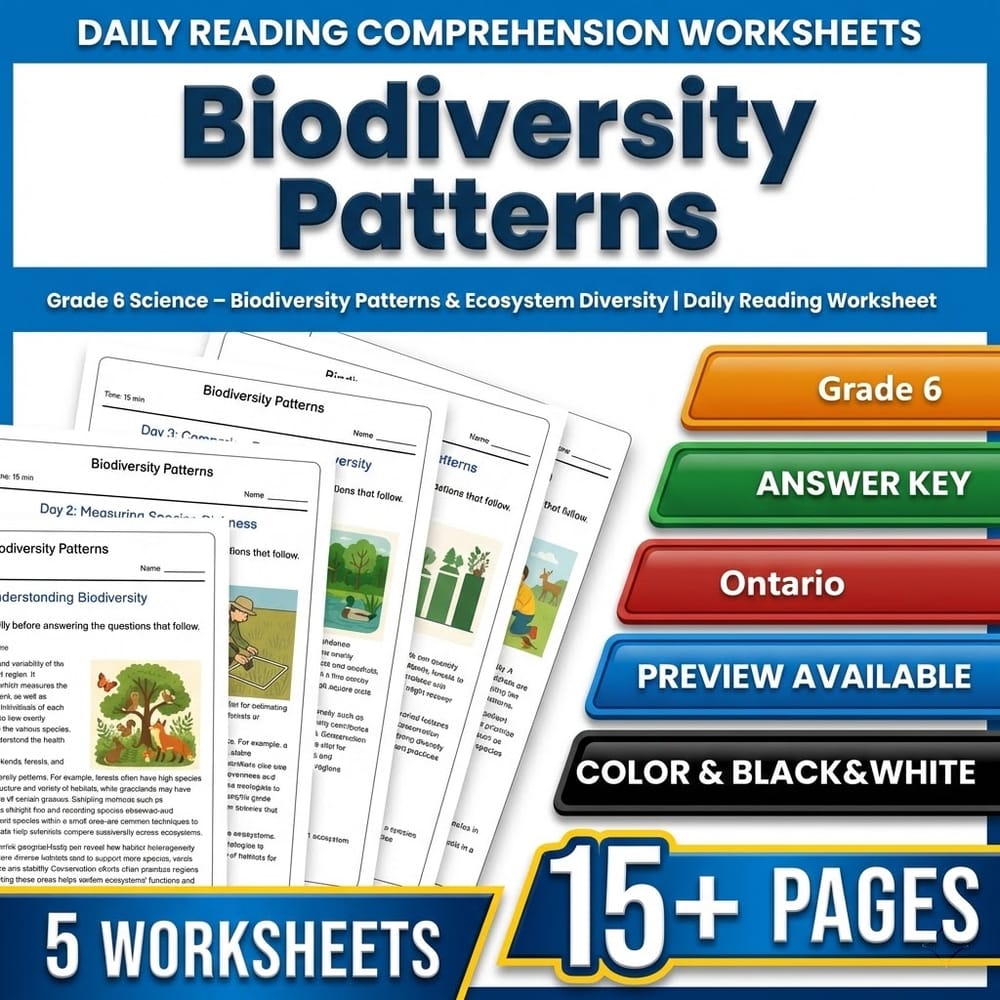
Grade 6 Science – Biodiversity & Ecosystem Diversity | Daily Reading Worksheet
Created byQuiet Forest EducationLearning Objectives
- Understand the concept of biodiversity and its importance in ecosystems.
- Identify different species and their roles within an ecosystem.
- Interpret biodiversity data collected via sampling methods.
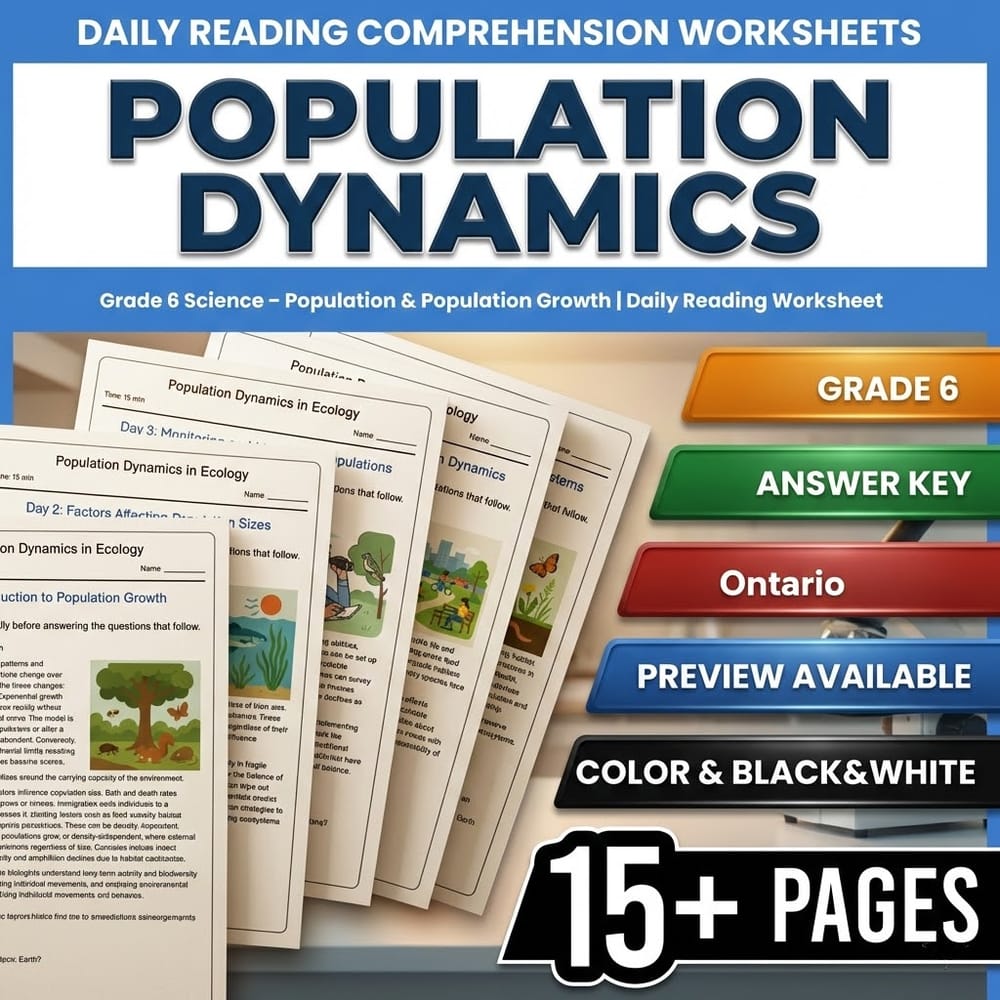
Grade 6 Science – Population & Population Growth | Daily Reading Worksheet
Created byQuiet Forest EducationLearning Objectives
- Understand the concepts of population growth models including exponential and logistic growth.
- Identify factors influencing population size such as birth rates, death rates, immigration, and emigration.
- Differentiate between density-dependent and density-independent limiting factors.
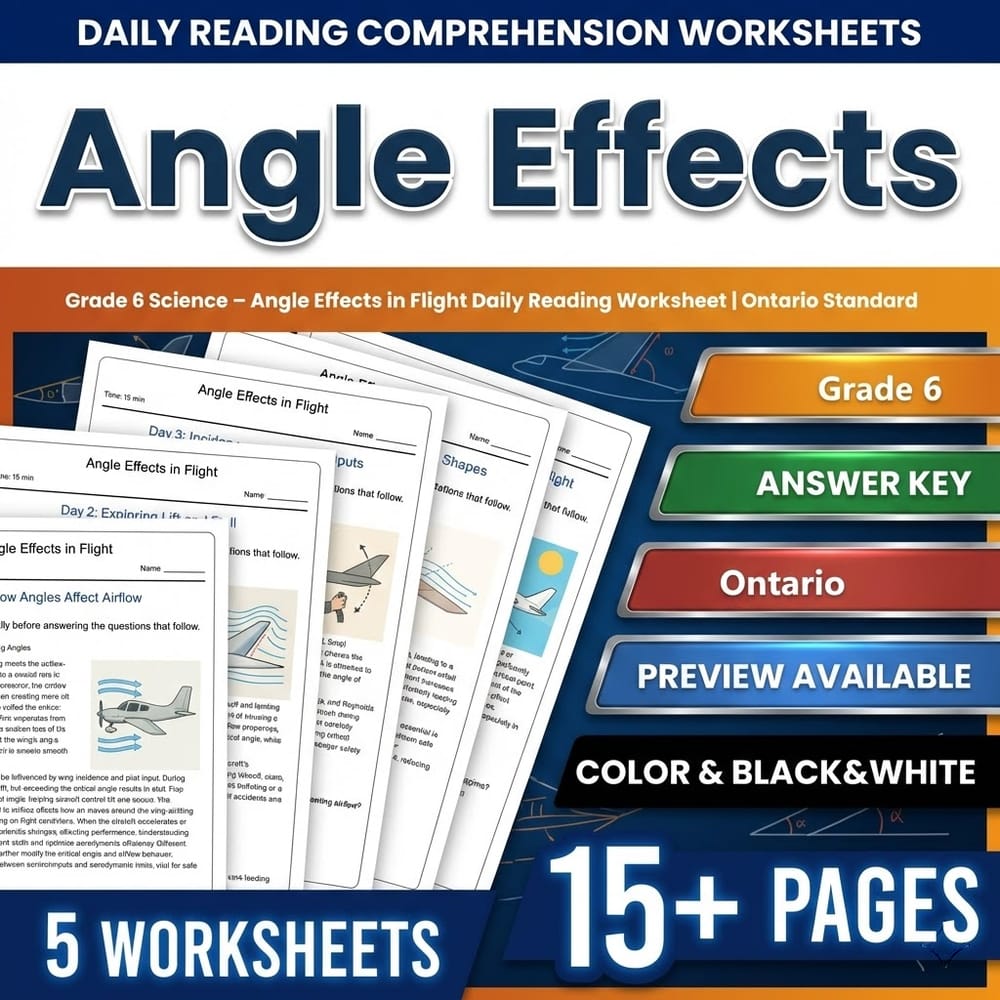
Grade 6 Science – Angle Effects in Flight Daily Worksheet | Ontario Standard
Created byQuiet Forest EducationLearning Objectives
- Understand how different angles of attack influence airflow over wings
- Identify the relationship between wing angle, lift, and stall onset
- Recognize factors that modify the critical angle in flight performance
About Grade 6 Science Worksheets
Explore Grade 6 Science worksheets for classwork, homework, or review. Our 5,735 printables download instantly as PDFs.
MyTeachingSheets worksheets are made by real teacher-authors and checked before they go live. Download any as a print-ready PDF for lessons, homework, or independent practice — most include answer keys, and previews are always free.