
Grade 7 Science Worksheets
6,039 worksheets
Grade 7 Science | Physical Change Worksheet | BC-Aligned
 Created byLumora Learning
Learning Objectives
- Define and differentiate physical change from chemical change.
- Identify common examples of physical changes in everyday life.
- Describe the properties that change during physical changes.
Also included in: Grade 7 Science | Matter & Chemical Change Unit Bundle | BC Aligned
Instant download

Grade 7 Energy Transfer Overview Worksheet | NGSS Practice PDF
 Created byClear Sky Classroom
Learning Objectives
- Explain how energy transfers from higher-energy objects or systems to lower-energy ones
- Describe how energy can change form during a transfer (energy transformation)
- Connect energy transfers to observable effects such as temperature change, motion, or light emission
Instant download

Phase Changes and Particle Motion: Energy Worksheets Grade 7 Science
 Created bySunny Desk Resources
Learning Objectives
- Describe how melting, freezing, evaporation, and condensation involve changes in particle kinetic and potential energy
- Connect phase changes to energy absorption or release as particles rearrange
- Explain latent heat as energy transferred during a phase change without changing chemical identity
Also included in: Matter and Chemical Change Grade 7 Alberta Science Worksheets Bundle +1 more
Instant download
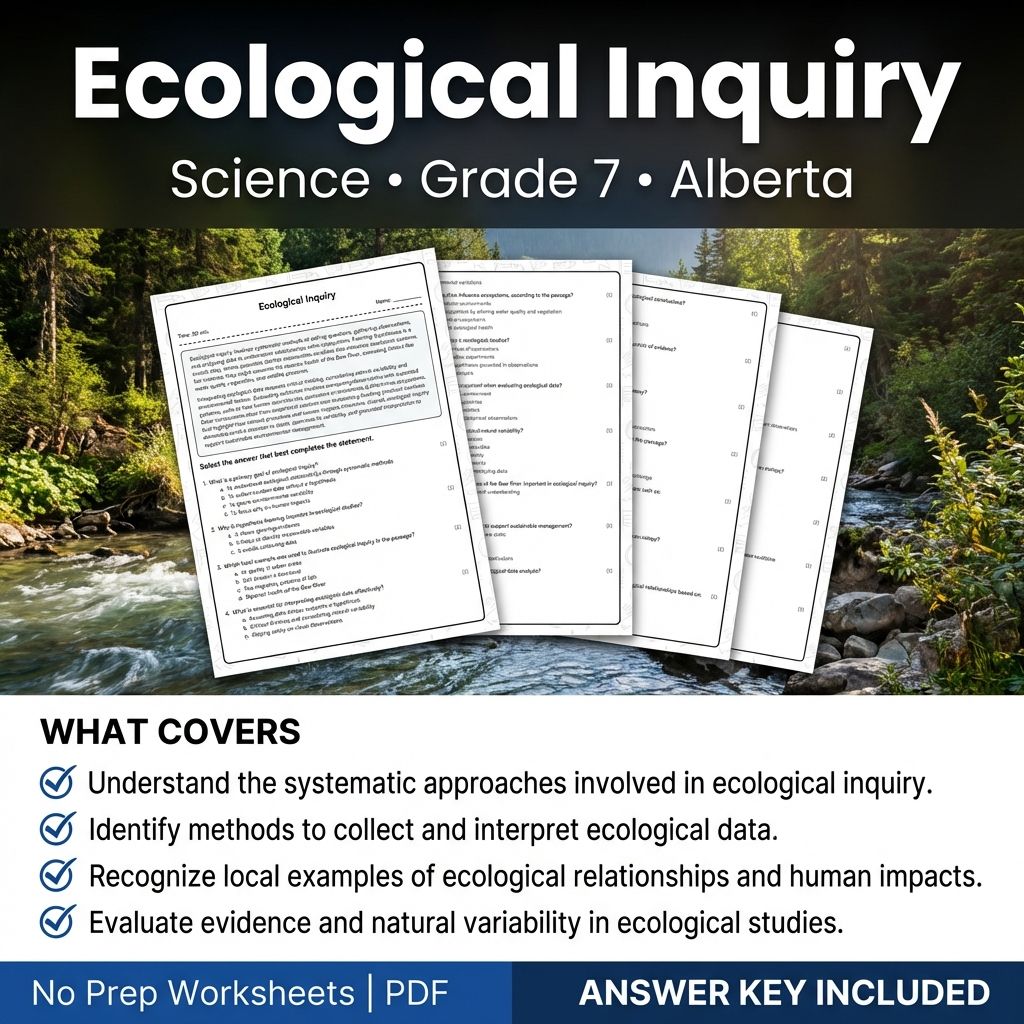
Ecological Inquiry Grade 7 Science Worksheet with Answer Key | Alberta Standards
 Created byCoral Reef Learning
Learning Objectives
- Understand the systematic approaches involved in ecological inquiry.
- Identify methods to collect and interpret ecological data.
- Recognize local examples of ecological relationships and human impacts.
Instant download

Systems Modeling Worksheet for Grade 7 Science | Standards-Aligned Practice
JCreated byJ.S SheetsLearning Objectives
- Explain how systems modeling uses diagrams, scale models, and quantitative representations to predict behavior
- Interpret model outputs (e.g., forces, currents, or energy flow) and describe what assumptions enable or limit those predictions
- Compare different representations of systems (free-body diagrams, circuit schematics, and block diagrams) and identify the relationships each model emphasizes
Instant download
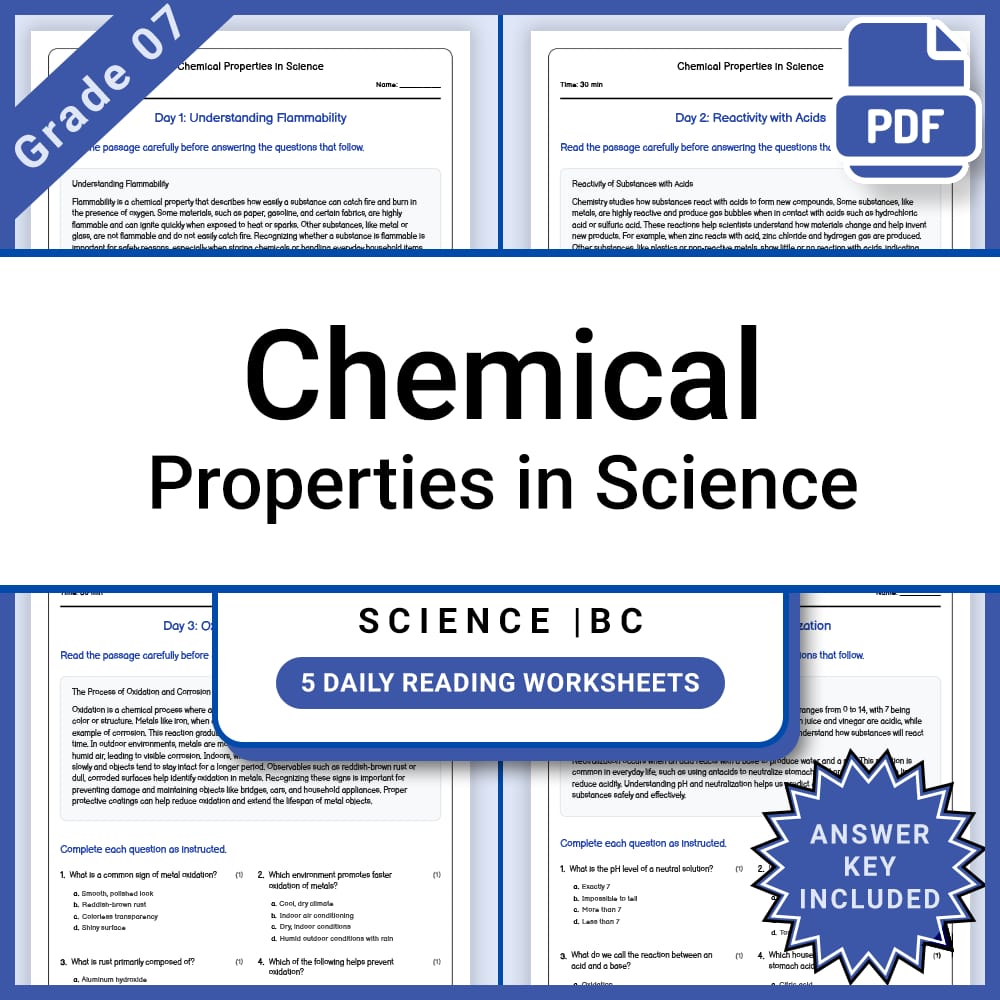
Grade 7 Science – Chemical Properties Daily Reading Worksheet with Answer Key
JCreated byJ.S SheetsLearning Objectives
- Understand the concept of flammability as a chemical property.
- Identify substances that are flammable based on descriptions and examples.
- Learn how chemical properties like reactivity and pH influence material behavior.
Also included in: Grade 7 Science Lesson Group Bundle | States, Reactions & Properties +1 more
Instant download

Air Masses and Fronts Worksheet | Weather Systems & Storms | Grade 7 Science
 Created byEvergreen Desk Education
Learning Objectives
- Explain how air masses with different temperatures and moisture levels interact to form fronts.
- Describe what happens to temperature, wind, clouds, and precipitation near a front.
- Differentiate cold fronts and warm fronts using observable weather patterns.
Instant download
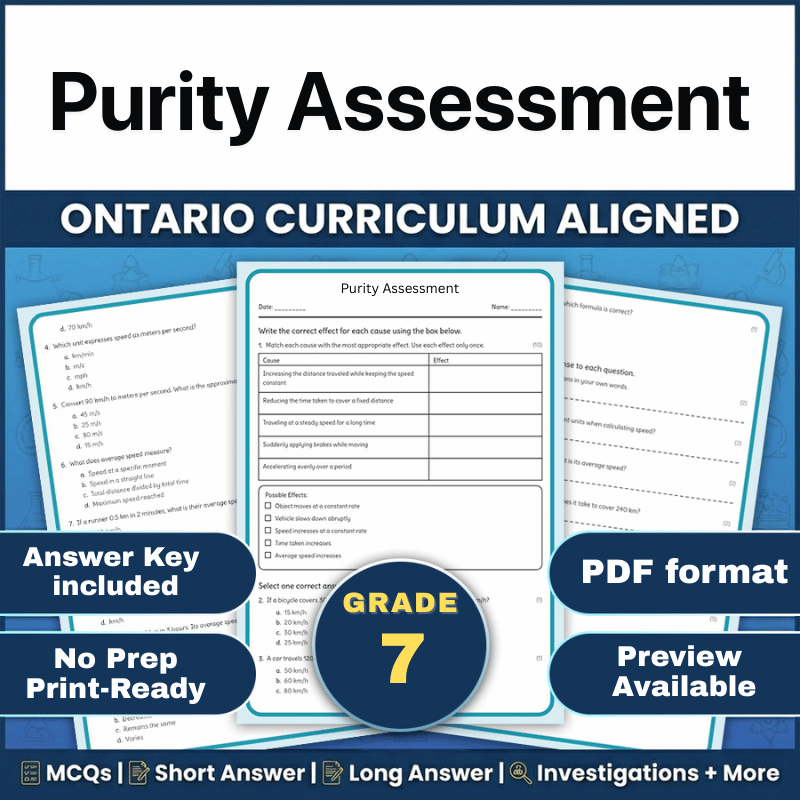
Grade 7 Science – Physical Properties Worksheet (Ontario, PDF)
 Created byBright Mind Resources
Learning Objectives
- Define and identify key physical properties such as mass, volume, density, melting and boiling points, conductivity, and optical clarity.
- Link macroscopic measurements to molecular structures and intermolecular forces.
- Explain how density helps differentiate substances and how phase-change temperatures relate to purity.
Instant download

Migration Patterns Worksheet | Grade 7 Science Activities
 Created byPrism Point Learning
Learning Objectives
- Explain how seasonal and annual migrations connect distant habitats
- Identify common drivers of migration such as food availability and breeding needs
- Describe how timing cues and energy demands affect survival during migration
Also included in: Grade 7 Ecosystems & Biodiversity Science Lesson Bundle | Alberta
Instant download

Grade 7 Heat Transfer Worksheet | Conduction, Convection & Radiation NGSS
 Created byAmber Owl Education
Learning Objectives
- Identify and compare the three main modes of heat transfer: conduction, convection, and radiation.
- Use temperature changes and evidence from real-life situations to explain how heat energy moves.
- Distinguish how transfer rates differ across materials and environments.
Also included in: Energy Transfer Worksheets Lesson Bundle – Grade 7 Science NGSS +1 more
Instant download

Energy Accounting Worksheet for Grade 7 Science NGSS Standards PDF
JCreated byJ.S SheetsLearning Objectives
- Explain how energy transfers affect an object's motion energy during different scenarios.
- Identify examples of energy transfer, such as braking, collisions, and bouncing.
- Describe the concept of energy bookkeeping in tracking changes in motion energy.
Also included in: Grade 7: Energy Transformations and Accounting Science Lesson Bundle NGSS +1 more
Instant download
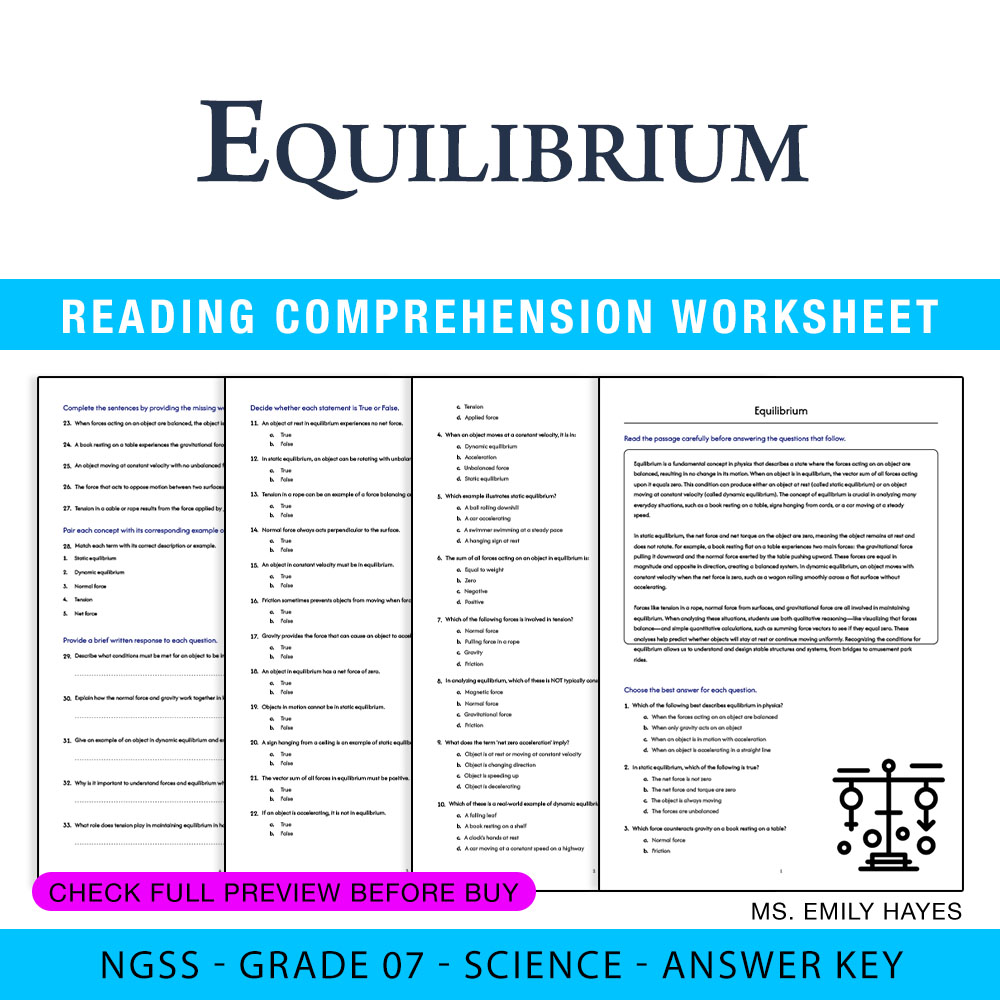
7th Grade Science | Equilibrium Worksheet (PDF+ Answer Key)
 Created byCopper Leaf Classroom
Learning Objectives
- Understand the concept of equilibrium as the balance of forces acting on an object
- Differentiate between static and dynamic equilibrium
- Identify real-world examples of equilibrium in everyday objects
Instant download

Motion Principles Assessment for Grade 7 Science – Standards-Aligned
Created byPrism Point LearningLearning Objectives
- Understand the basic concepts of speed, velocity, and acceleration in motion.
- Distinguish between scalar and vector quantities related to motion.
- Interpret motion scenarios qualitatively and relate them to displacement, time, and rate of change.
Also included in: Grade 7 Motion and Energy Science: Lesson Bundle TEKS Unit Assessment
Instant download

Design Criteria Worksheet for Grade 7 Science | Standards-Aligned Practice
JCreated byJ.S SheetsLearning Objectives
- Understand the importance of clear criteria and constraints in the design process.
- Identify different types of design criteria and constraints.
- Analyze how criteria and constraints influence design choices.
Also included in: Grade 7 Engineering, Technology, and Applications of Science Lesson Bundle +1 more
Instant download

Reaction Evidence Assessment | TEKS Grade 7 Science Standards-Aligned Assessment
Created byPrism Point LearningLearning Objectives
- Identify observable indicators of chemical reactions such as gas evolution, precipitate formation, color change, and temperature change.
- Connect qualitative evidence of reactions to underlying mass and energy changes.
- Understand how reactant transformations are represented by simple symbolic formulas.
Also included in: Grade 7 Matter and Energy Science Lesson Bundle: TEKS assessments
Instant download
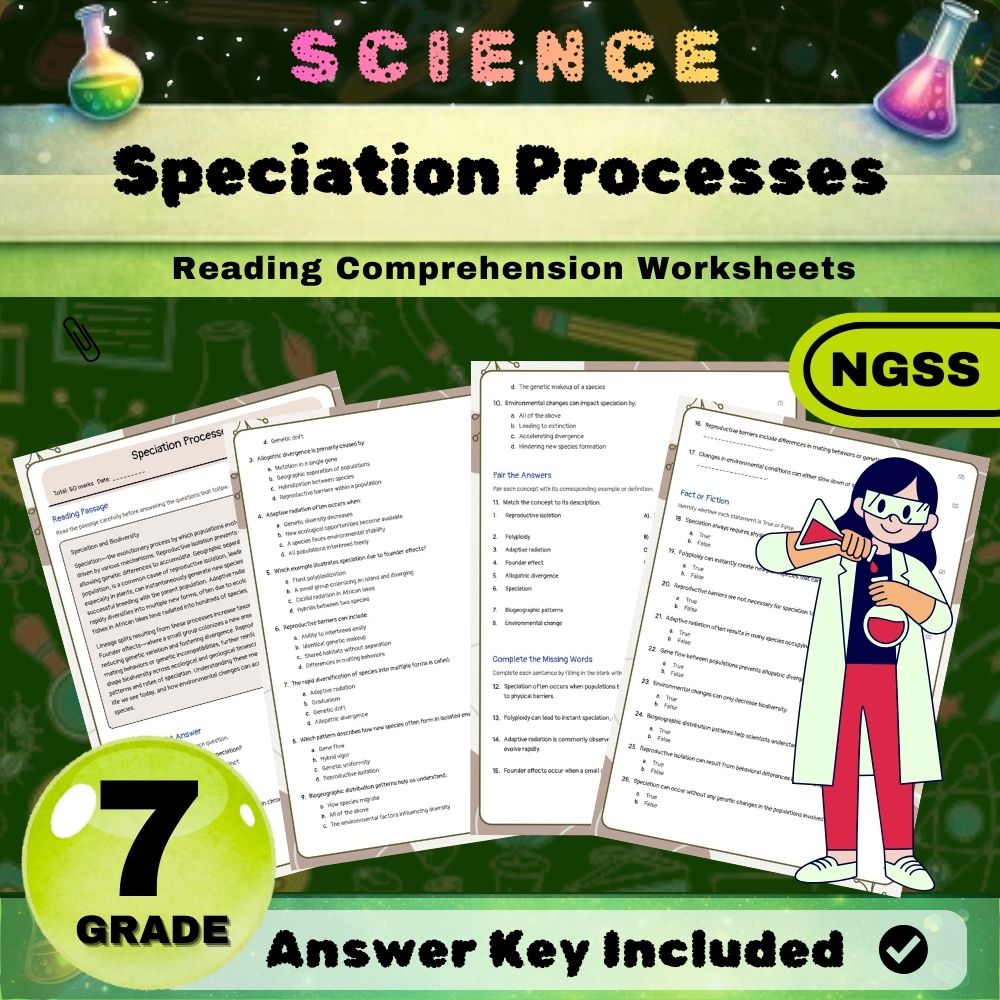
Grade 7 Science | Speciation Processes NGSS Worksheet (PDF)
 Created byMaple Path Learning
Learning Objectives
- Understand the mechanisms that lead to the formation of new species, including reproductive isolation, geographic separation, polyploidy, and adaptive radiation.
- Explain how lineage splits increase biodiversity through processes such as allopatric divergence and founder effects.
- Analyze examples of speciation in real-world contexts like cichlid radiations and plant polyploidization.
Also included in: Grade 7 Science | Evolution & Adaptation NGSS Worksheet Bundle +1 more
Instant download

Grade 7 Friction And Resistance Worksheet | NGSS Practice PDF
Created byClear Sky ClassroomLearning Objectives
- Explain how friction and other resistive forces oppose motion.
- Compare how surface texture and air resistance affect how quickly objects slow down.
- Use direction of net force to describe realistic (not ideal) motion.
Instant download

Grade 7 Science | Mass Relationships in Chemical Reactions - Daily Reading Comp.
Created byCoral Reef LearningLearning Objectives
- Understand the principle of conservation of mass in chemical reactions
- Identify how mass is balanced in reactions
- Predict product masses based on reactant quantities
Also included in: Matter and Chemical Change Lesson Bundle: Grade 7 Science Alberta +1 more
Instant download
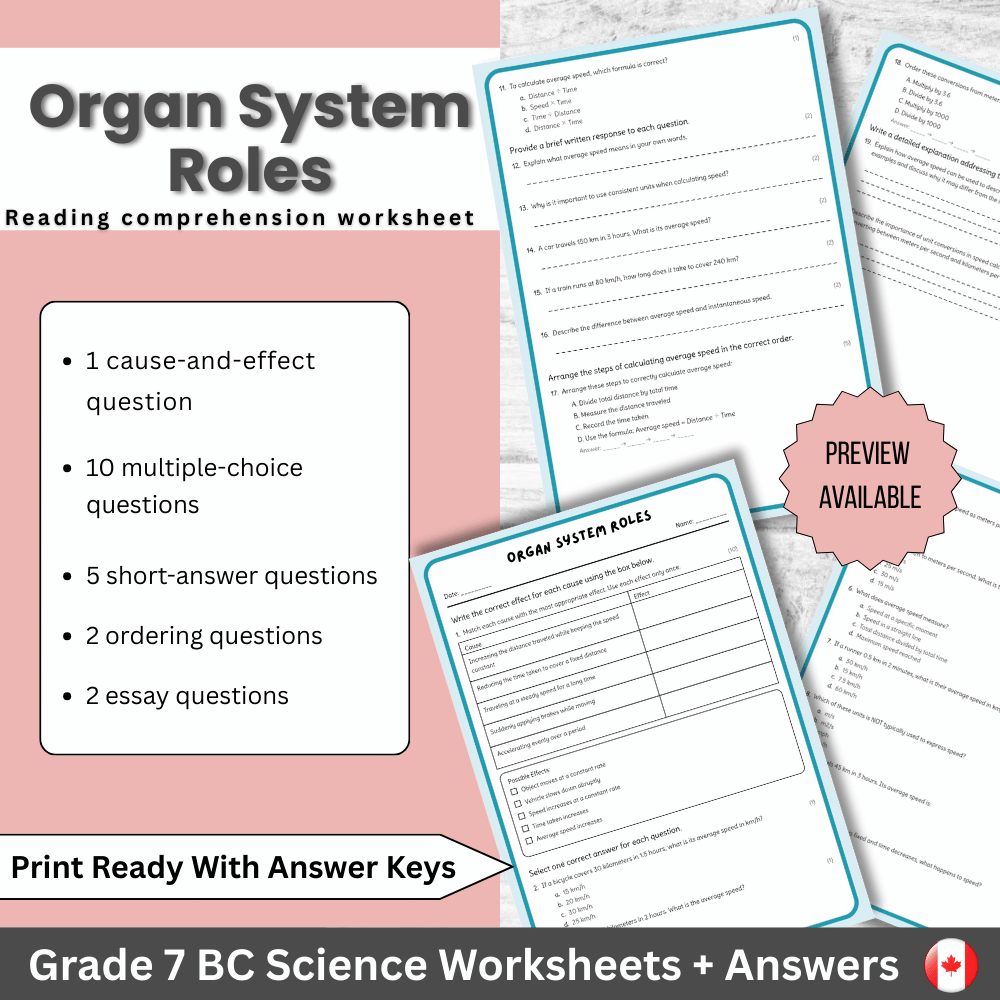
Grade 7 Science | Organ System Roles Worksheet (PDF) – BC Standard/Framework
Created byBright Mind ResourcesLearning Objectives
- Identify the main functions of the circulatory, respiratory, and digestive systems.
- Understand how organ systems work together to maintain internal stability.
- Describe specialized structures like alveoli and capillary networks that enhance exchange efficiency.
Instant download

Grade 7 Material Properties Worksheet | Ontario Science Practice PDF
Created byClear Sky ClassroomLearning Objectives
- Explain how density, strength (tensile and compressive), stiffness (modulus), ductility, toughness, and thermal expansion affect how materials behave under load and temperature changes.
- Use material-property reasoning to compare wood, steel, and reinforced concrete in terms of strength-to-weight, deformation, and typical failure modes.
- Connect beam and column performance to property selection for serviceability, durability, and anticipated loading conditions.
Instant download

Science Worksheet Climate Drivers Over Time Grade 7 | Standards Aligned
JCreated byJ.S SheetsLearning Objectives
- Explain how natural records (ice cores, sediment layers, and tree rings) provide evidence of past climate
- Describe how modern instruments help scientists track recent climate trends
- Identify long-term climate drivers and how they can change Earth’s energy balance and circulation
Also included in: Grade 7 Earth Systems, Cycles & Feedbacks Science lesson bundle – General +1 more
Instant download
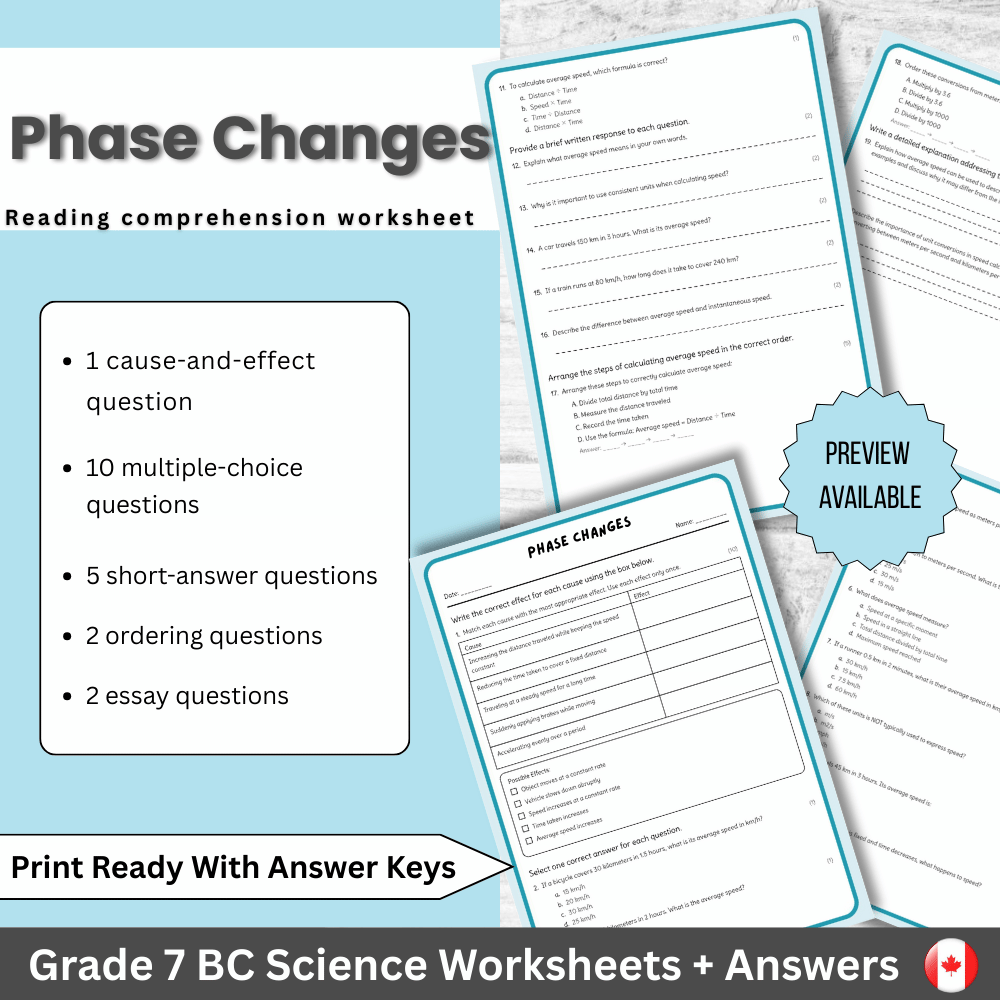
Grade 7 Science | Phase Changes Worksheet + Answer Key (BC Standards)
Created byBright Mind ResourcesLearning Objectives
- Explain the different types of phase changes such as melting, freezing, vaporization, and condensation.
- Describe how temperature and pressure influence phase transitions.
- Understand the concept of latent heat during phase changes.
Instant download

Grade 7 Science | Graphical Representation Worksheet with Short Notes (PDF)
 Created byMeadowlark Worksheets
Learning Objectives
- Understand the different types of graphs used for data visualization.
- Identify suitable graph types for categorical and continuous data.
- Interpret features of graphs such as trend lines, error bars, and proportional scales.
Also included in: Grade 7 Science Lesson Group Bundle – Ontario Framework Worksheets +1 more
Instant download

Grade 7 Science | Model Evaluation Worksheet | General Standard
Created byLumora LearningLearning Objectives
- Explain why model evaluation compares predictions to evidence.
- Identify how incorrect or missing assumptions can cause a model to disagree with observations.
- Use simulation-style reasoning to test which inputs most affect model outputs.
Instant download

Grade 7 Separating Matter Worksheet | General Practice PDF
Created byClear Sky ClassroomLearning Objectives
- Distinguish between separations and chemical changes by linking outcomes to matter properties
- Explain how density differences can cause settling and layering during physical separation
- Use solubility differences to predict how mixtures can be separated by dissolving selectively
Instant download
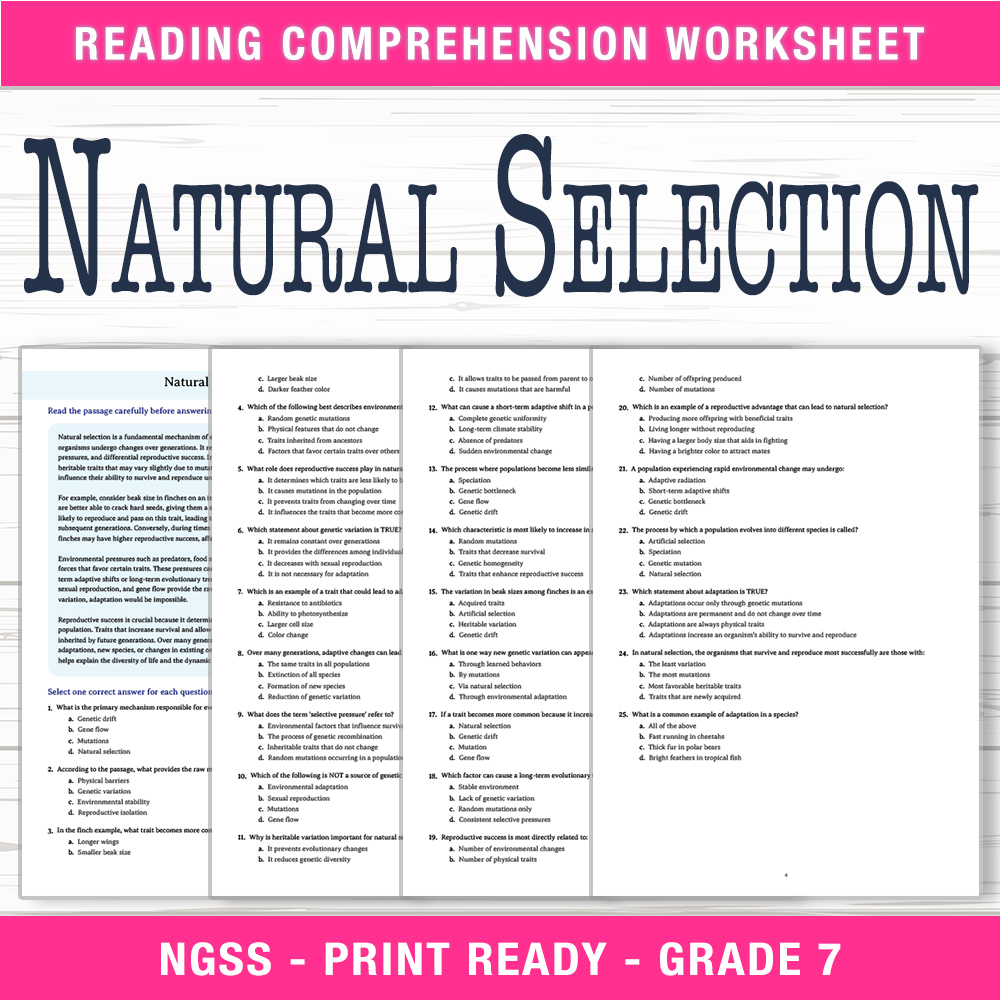
Grade 7 Science | Natural Selection Worksheet (PDF + Answer Key)
 Created byRiverstone Classroom
Learning Objectives
- Explain the mechanisms of natural selection and how they lead to adaptation in populations.
- Identify key sources of genetic variation and describe their roles in evolution.
- Analyze how environmental pressures influence the survival and reproductive success of organisms.
Instant download

Design Process Assessment for Grade 7 Science | TEKS Standards-Aligned
Created byPrism Point LearningLearning Objectives
- Understand the iterative nature of the technological design process.
- Identify key steps such as problem definition, criteria setting, brainstorming, prototyping, evaluation, and optimization.
- Recognize examples like water filtration, electrical circuits, and mechanisms to illustrate trade-offs and refinement.
Instant download
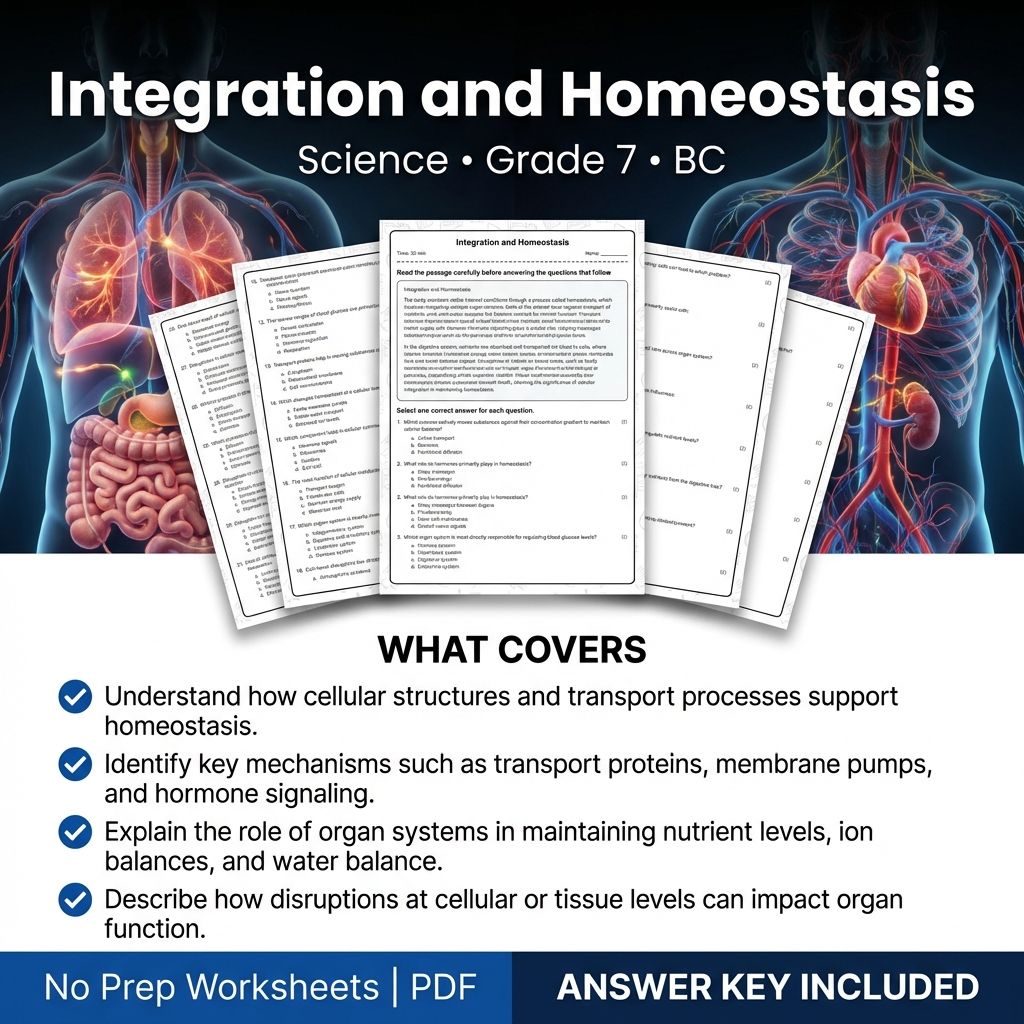
Grade 7 Science Worksheet | Integration and Homeostasis Practice & Answer Key (PDF)
Created byCoral Reef LearningLearning Objectives
- Understand how cellular structures and transport processes support homeostasis.
- Identify key mechanisms such as transport proteins, membrane pumps, and hormone signaling.
- Explain the role of organ systems in maintaining nutrient levels, ion balances, and water balance.
Instant download

Grade 7 Resource Distribution Worksheet | NGSS Practice PDF
Created byClear Sky ClassroomLearning Objectives
- Understand how geologic processes influence the distribution of mineral, energy, and groundwater resources.
- Connect plate tectonics, sedimentation, weathering, and biological activity to resource locations.
- Evaluate the impacts of resource extraction and sustainability considerations.
Also included in: Grade 7 Ecosystems & Human Impacts Science Lesson Bundle Worksheet B (NGSS) +1 more
Instant download

Seasonal Sun Patterns Assessment for Grade 7 Science | California Standards
Created byPrism Point LearningLearning Objectives
- Explain how Earth’s tilt and orbit change the Sun’s apparent height and daylight length over the year.
- Describe how seasonal patterns differ between the Northern and Southern hemispheres.
- Use evidence about day length and solar angle to support claims about seasons.
Also included in: Grade 7 Earth Systems Science Lesson Bundle Assessments | California Standards +1 more
Instant download

Grade 7 Science | Net Force Effects Worksheet | California Standards
Created byLumora LearningLearning Objectives
- Explain how magnitude and direction combine to determine net force
- Predict how unbalanced and balanced forces affect an object’s velocity (speed and/or direction)
- Apply net force ideas to everyday situations such as starting, stopping, or redirecting objects
Instant download

Energy Relationships Worksheet | Grade 7 Science Aligned to Alberta Standards
JCreated byJ.S SheetsLearning Objectives
- Understand how potential and kinetic energy relate to forces and motion in mechanical systems.
- Identify factors such as elevation, mass, and speed that influence energy transfer and conservation.
- Analyze real-world examples of energy conversion, such as sled descents and conveyor systems.
Instant download

Grade 7 Science – Conservation Status & Assessment | Daily Reading Worksheet
Created byBright Mind ResourcesLearning Objectives
- Understand the criteria used to evaluate species' conservation status.
- Interpret evidence related to species population trends, threats, and recovery potential.
- Analyze regional examples of conservation status assessments.
Also included in: Grade 7 Ecosystems Science Lesson Bundle for Daily Reading Worksheets | Alberta +2 more
Instant download

Chemical Properties Worksheet | Grade 7 Science Standards-Aligned PDF
JCreated byJ.S SheetsLearning Objectives
- Understand and describe various chemical properties of substances.
- Identify observable indicators of chemical reactions.
- Differentiate between physical and chemical changes based on properties.
Instant download

Data Organization Worksheet Grade 7 Science | Ontario Standard Assessment
 Created byCedar Grove Learning
Learning Objectives
- Identify how to organize categorical and numerical data using clear tabular structures
- Apply consistent units, column headings, and timestamp conventions for time-series data
- Describe metadata, sampling frames, and replication records to preserve data provenance and context
Also included in: Grade 7 Scientific Inquiry and Data Analysis Science Lesson Bundle - Ontario +1 more
Instant download

Science Grade 7 Worksheet | Design Process—Requirements, Constraints & Tools
JCreated byJ.S SheetsLearning Objectives
- Explain how functional requirements and constraints guide the steps of the design process.
- Use performance objectives (load capacity, stiffness, serviceability) to compare and select design options.
- Describe how decision matrices, sketches, and trade-off analysis support choosing a preferred solution.
Instant download

Grade 7 States Of Matter Worksheet | BC Use Practice PDF
Created byClear Sky ClassroomLearning Objectives
- Explain how particle arrangement, spacing, and movement define solids, liquids, and gases
- Describe how temperature and pressure can cause transitions between states of matter
- Use observable properties (shape, volume, flow, compressibility) to identify the state of a substance
Instant download

Matter Basics Worksheet | Grade 7 Science Activities
Created byPrism Point LearningLearning Objectives
- Classify matter as a pure substance (element or compound), a mixture, or a solution based on its properties and uniformity.
- Explain how fixed composition and characteristic melting points help identify elements and compounds.
- Describe how mixtures and solutions differ in composition and particle scale (visible vs molecular level).
Instant download

Grade 7 Science – Ecosystem Dynamics & Energy Flow | Daily Reading Worksheet
Created byBright Mind ResourcesLearning Objectives
- Understand the basic components of ecosystems and their functions.
- Explain how energy flows through an ecosystem from the Sun to various organisms.
- Recognize factors that influence nutrient cycling and matter movement.
Also included in: Grade 7 Energy Transfer Science Daily Reading: Lesson Bundle | California Std. +1 more
Instant download

Grade 7 Matter Cycling Worksheet | NGSS Practice PDF
Created byClear Sky ClassroomLearning Objectives
- Describe how matter is recycled within organisms through processes like digestion, biosynthesis, and respiration.
- Explain the flow of carbon and nitrogen in biological systems and their transformation during metabolic pathways.
- Identify key biochemical pathways involved in matter cycling, such as macromolecule synthesis and decomposition.
Also included in: Grade 7 Cell Systems Science Lesson Bundle: NGSS Worksheet B +1 more
Instant download

Grade 7 Science Worksheet | Mass Relationships & Conservation (PDF)
Created byEvergreen Desk EducationLearning Objectives
- Explain how conservation of mass applies to closed-system reactions
- Use mass accounting to relate reactant masses to product masses
- Compare theoretical yields with measured yields using input-output mass data
Instant download

Grade 7 Science Natural Selection and Adaptation Worksheet |NGSS Grade 7 Science
 Created bySkylark Worksheets
Learning Objectives
- Explain how heritable variation and environmental pressures drive natural selection.
- Describe how differential survival and reproduction can shift trait distributions over generations.
- Use real-world examples (antibiotic resistance and island finches) to identify selective pressures and adaptations.
Also included in: Grade 7 Speciation and Evolution Evidence Science Lesson Bundle NGSS +1 more
Instant download

Grade 7 Ecosystem Components and Energy Flow Worksheet | Ontario Science
 Created byTeacher's Corner
Learning Objectives
- Define biotic and abiotic components of an ecosystem and explain how they interact
- Identify producers, consumers, and decomposers and describe their roles
- Explain how energy moves through a food chain starting with sunlight
Instant download
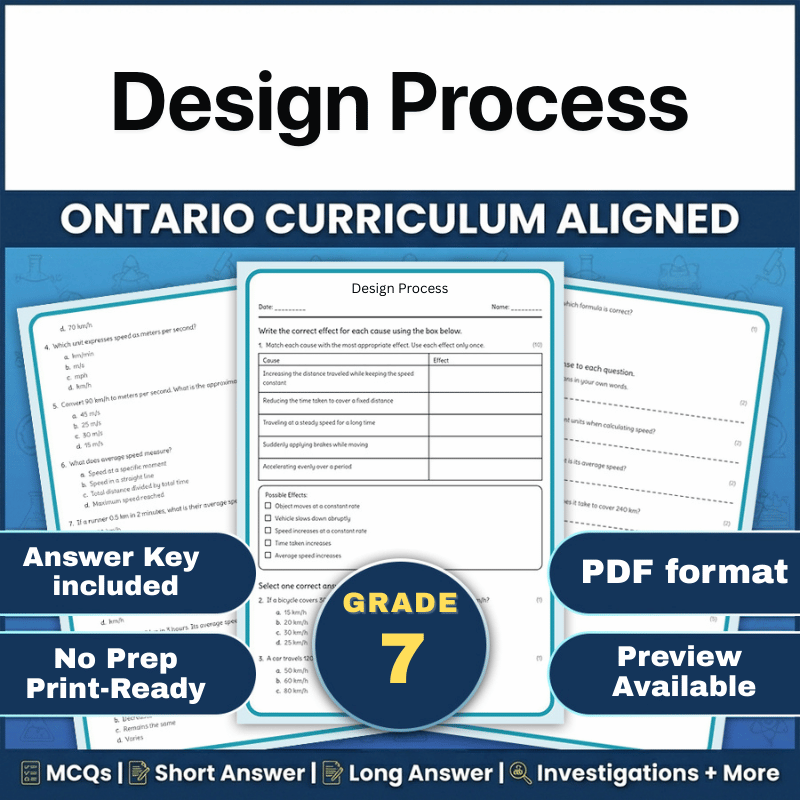
Grade 7 Science – Design Process Worksheet (Ontario) (PDF)
Created byBright Mind ResourcesLearning Objectives
- Understand the steps involved in the design process from requirements to decision-making.
- Identify and evaluate design constraints, specifications, and performance objectives.
- Apply decision matrices and sketches to compare alternative solutions.
Instant download

Independent, Dependent, and Controlled Variables Worksheets Grade 7 Science
 Created byBRIGHT PATH RESOURCES
Learning Objectives
- Identify the independent variable, dependent variable, and controlled variables in an investigation plan.
- Explain how measurable evidence links to a scientific question.
- Use consistent measurement methods to make fair comparisons across trials.
Also included in: Grade 7 Science Worksheets Bundle | Models, Variables & Evidence +2 more
Instant download

Grade 7 Population Change Science Daily Reading Worksheet | TEKS Activity
Created byBRIGHT PATH RESOURCESLearning Objectives
- Identify main ideas about why populations change over time.
- Use key vocabulary: birth rate, death rate, immigration, emigration, carrying capacity, and limiting factors.
- Explain how birth and death and movement into and out of a habitat affect population size.
Also included in: Grade 7 Ecosystems Science Daily Reading Worksheets Bundle | TEKS +1 more
Instant download

Grade 7 Science | Energy & Change Worksheet (BC Standards) PDF
Created byEvergreen Desk EducationLearning Objectives
- Explain how energy changes in chemical reactions can be detected through temperature changes.
- Differentiate exothermic and endothermic reactions using the idea of bond breaking and bond formation.
- Use energy evidence along with other signs to distinguish chemical change from physical change.
Instant download

Grade 7 Environmental Impacts Worksheet PDF | California Science Standards
Created byEvergreen Desk EducationLearning Objectives
- Explain how constraints in a design problem can affect both people and the natural environment.
- Identify environmentally responsible choices by connecting scientific cause-and-effect reasoning to real materials and processes.
- Distinguish between solutions that are technically feasible and those that are socially and environmentally responsible.
Instant download
About Grade 7 Science Worksheets
Browse 6,039 printable Grade 7 Science worksheets — ready-to-print PDFs with answer keys where available.
Every worksheet on MyTeachingSheets is created by independent teacher-authors and reviewed before publication. All resources download as printable PDFs for classroom, homework, or at-home practice, and many include answer keys. Preview any worksheet free before buying.