
Grade 7 Science Worksheets
6,039 worksheets
Pollution Pathways and Ecosystem Impacts Worksheets Grade 7 Science
 Created bySunny Desk Resources
Learning Objectives
- Describe how nutrient runoff, hydrocarbons, and airborne deposition can enter ecosystems.
- Explain how pollutants can affect organism health and alter food web interactions.
- Identify the role of bioaccumulation and biomagnification in aquatic and terrestrial systems.
Also included in: Interactions & Ecosystems Grade 7 Alberta Science Worksheets Bundle +1 more
Instant download
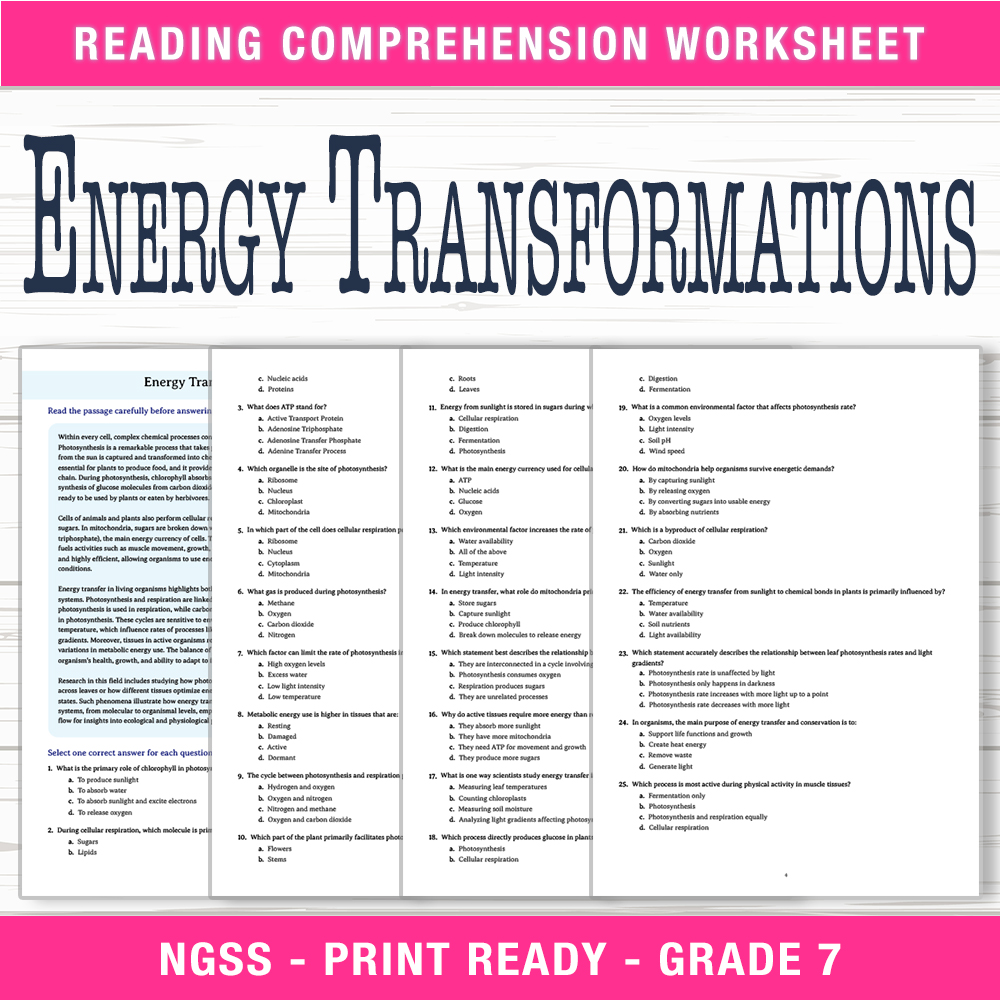
Grade 7 Science – Energy Transformations Worksheet (PDF + Answer Key)
 Created byRiverstone Classroom
Learning Objectives
- Describe how light energy is converted into chemical energy during photosynthesis.
- Explain the process of cellular respiration and how organisms harvest energy from food.
- Connect chloroplast-based sugar production to mitochondrial ATP generation across different taxa.
Instant download

Grade 7 Phase Energy and Melting Worksheet | Alberta Science Heat Energy
 Created byBRIGHT PATH RESOURCES
Learning Objectives
- Explain how particle kinetic and potential energy change during melting
- Describe energy absorption during melting using the idea of latent heat
- Distinguish physical phase changes from chemical changes
Also included in: Grade 7 Alberta Science Matter and Chemical Change Worksheet Bundle +1 more
Instant download
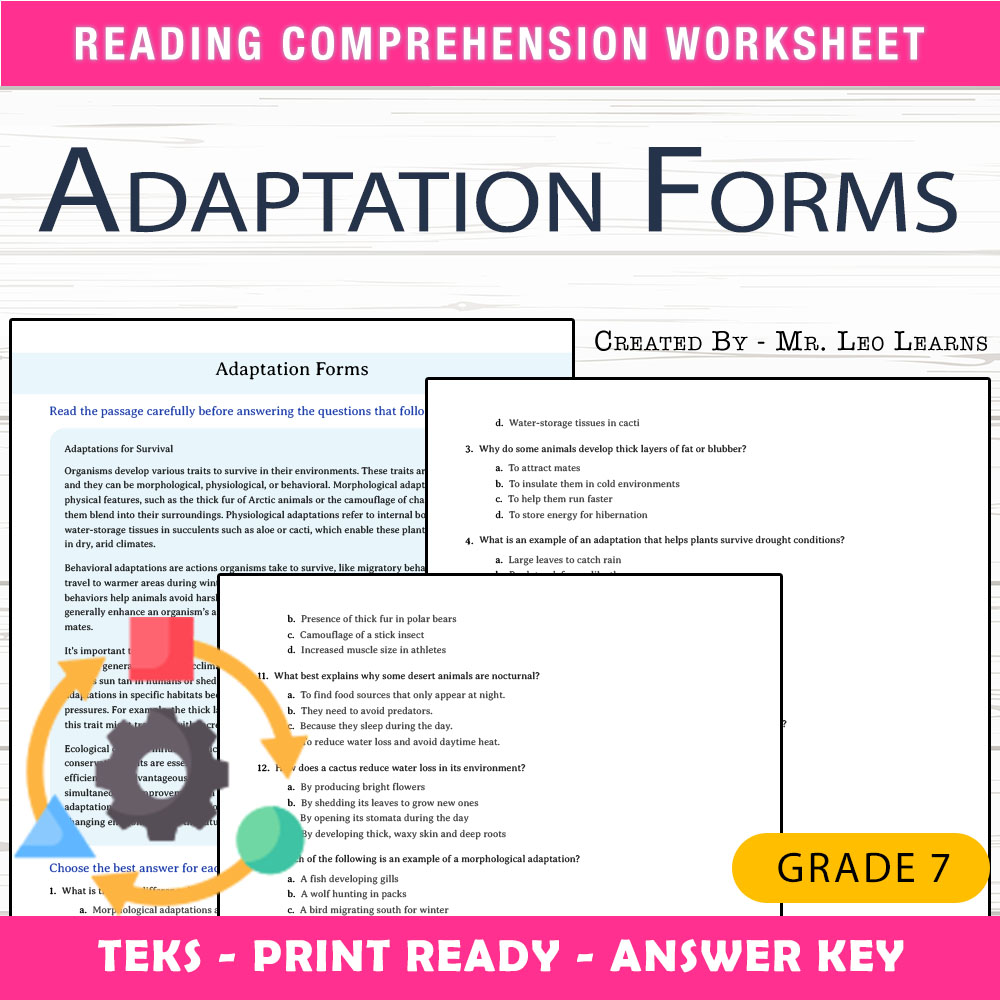
Grade 7 Science | Adaptation Forms Worksheet for Mastery
 Created byThe Resource Hub
Learning Objectives
- Understand different types of adaptations: morphological, physiological, and behavioral.
- Identify examples of adaptations in various organisms and environments.
- Explain how adaptations improve survival and reproductive success.
Also included in: Grade 7 Science Unit Bundle – Ecosystems, Cells & Adaptations Worksheet Pack +1 more
Instant download

Grade 7 Design Criteria Worksheet | NCSS Practice PDF
 Created byClear Sky Classroom
Learning Objectives
- Explain how design criteria describe what a solution must achieve in measurable ways.
- Differentiate design criteria from constraints and identify common examples of each.
- Use criteria and constraints to evaluate whether a design is acceptable, safe, and effective.
Instant download

Grade 7 Science | Levels of Organization in Ecosystems - Reading Comprehension
 Created byCoral Reef Learning
Learning Objectives
- Understand the hierarchy of biological organization from individuals to the biosphere
- Identify roles of producers, consumers, and decomposers in an ecosystem
- Explain the flow of energy through different trophic levels
Instant download
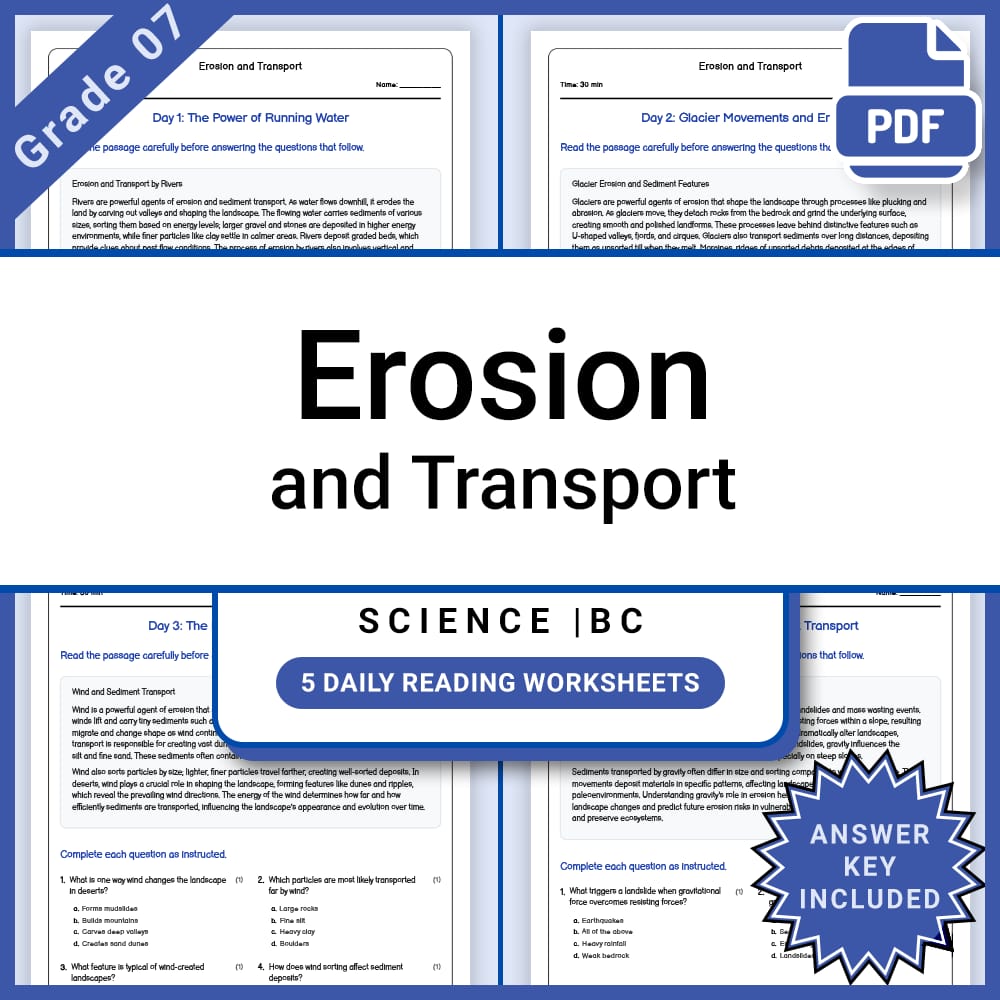
Grade 7 Science – Erosion and Transport Daily Reading Worksheet + Answer Key
JCreated byJ.S SheetsLearning Objectives
- Understand how running water causes erosion and transports sediments
- Identify the features formed by river erosion
- Describe the process of sediment sorting and deposition by rivers
Also included in: Grade 7 Science Lesson Group: Earth Processes & Landforms Bundle +1 more
Instant download
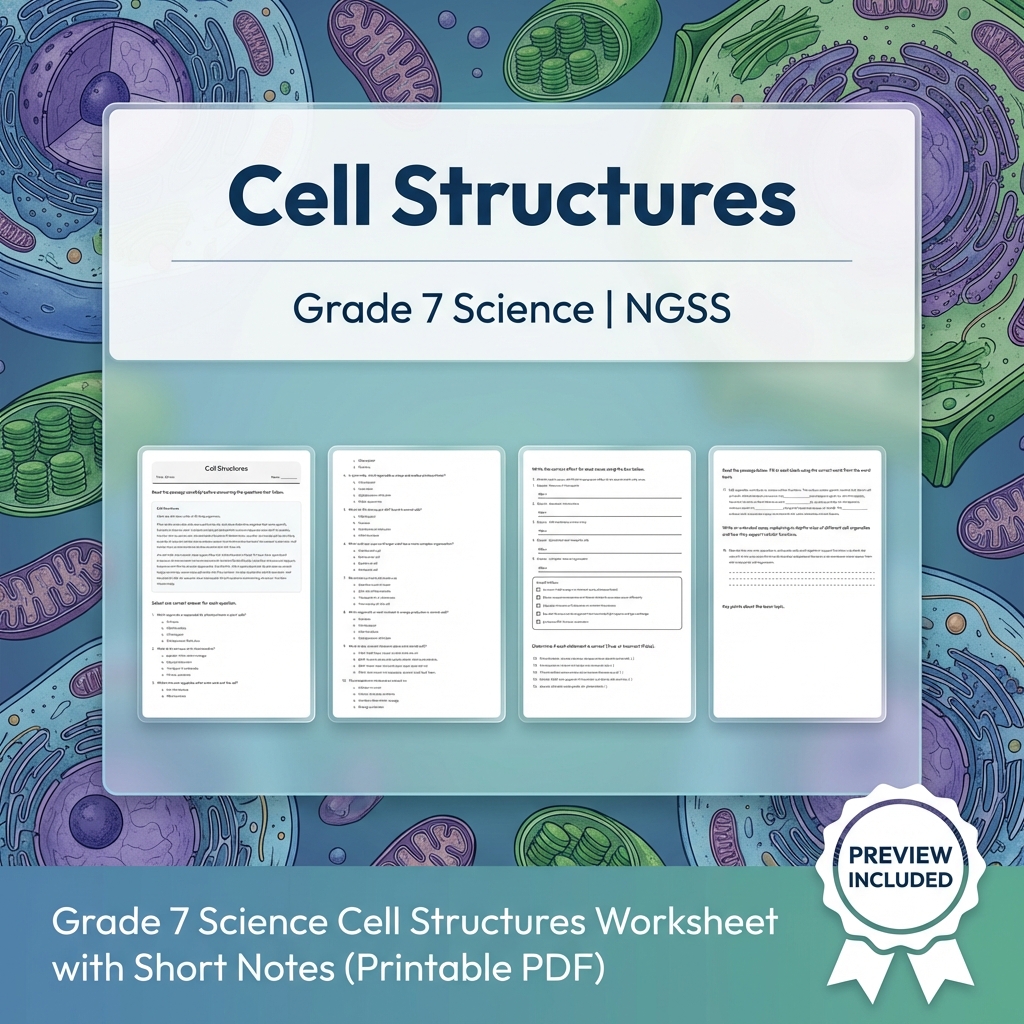
Grade 7 Science Cell Structures Worksheet with Short Notes (Printable PDF)
 Created byMeadowlark Worksheets
Learning Objectives
- Identify key organelles in plant and animal cells and understand their functions.
- Describe the differences between eukaryotic and prokaryotic cells.
- Connect cell structure features to their roles in cell processes like transport, synthesis, and compartmentalization.
Also included in: Grade 7 Science NGSS Unit Bundle Molecules to Organisms: Structures & Processes +1 more
Instant download
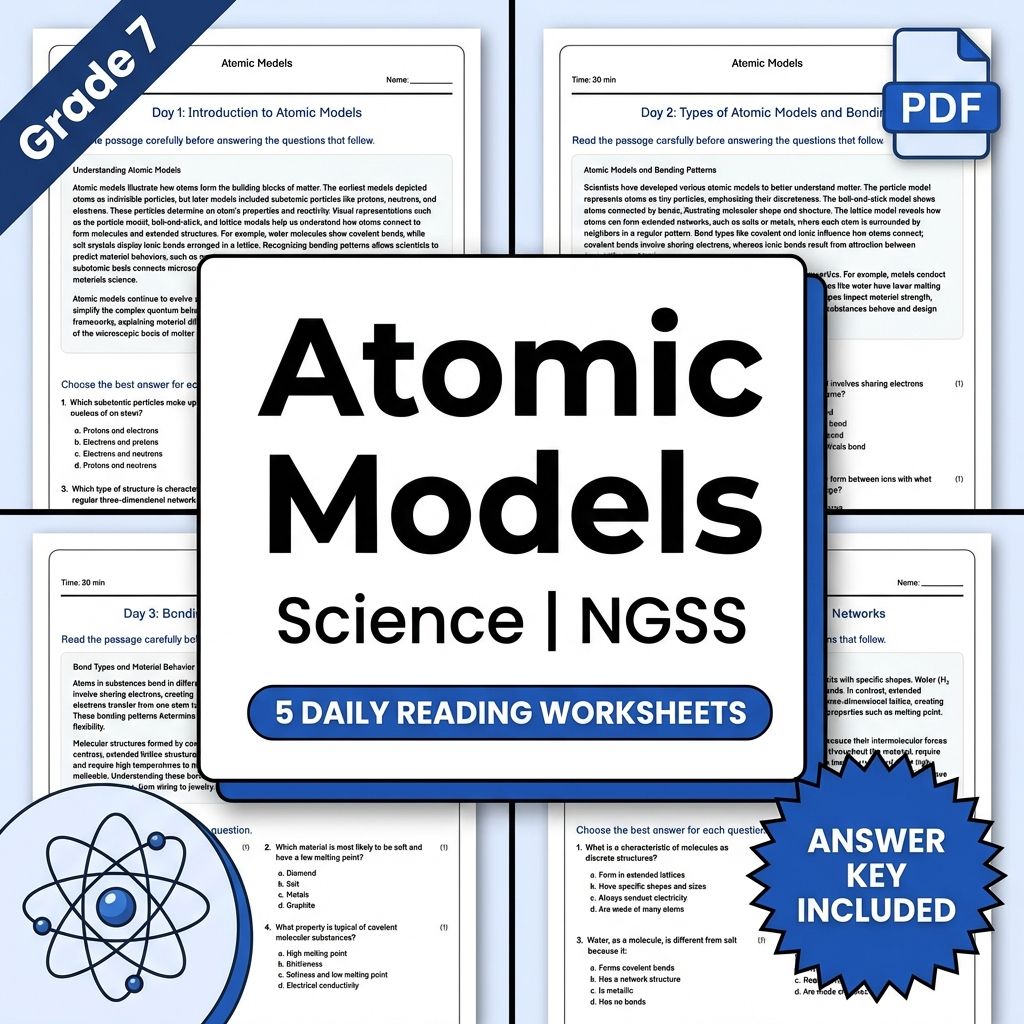
7th Grade Science | Atomic Models Worksheet(PDF + Answer Key)
 Created byCopper Leaf Classroom
Learning Objectives
- Understand how atomic models represent the structure of atoms and molecules.
- Identify different types of atomic models: particle, ball-and-stick, and lattice structures.
- Explain the relationship between subatomic particles, atomic number, and chemical formulas.
Instant download

Grade 7 Data Organization Worksheet | Ontario Science Data & Graphing
Created byClear Sky ClassroomLearning Objectives
- Identify how to organize categorical and numerical data using consistent table headings and units
- Use metadata standards and timestamp conventions to support credible scientific recording
- Create observational logs that include replication details and annotated raw data for later validation
Instant download

Scientific Models: Evaluation and Refinement Worksheet | Grade 7
Created byBRIGHT PATH RESOURCESLearning Objectives
- Explain how model evaluation compares predicted outcomes to evidence.
- Identify assumptions and missing factors that can cause a model to disagree with data.
- Describe how changing input parameters in a simulation can change outputs.
Also included in: Grade 7 Science Worksheets Bundle | Models, Variables & Evidence +2 more
Instant download
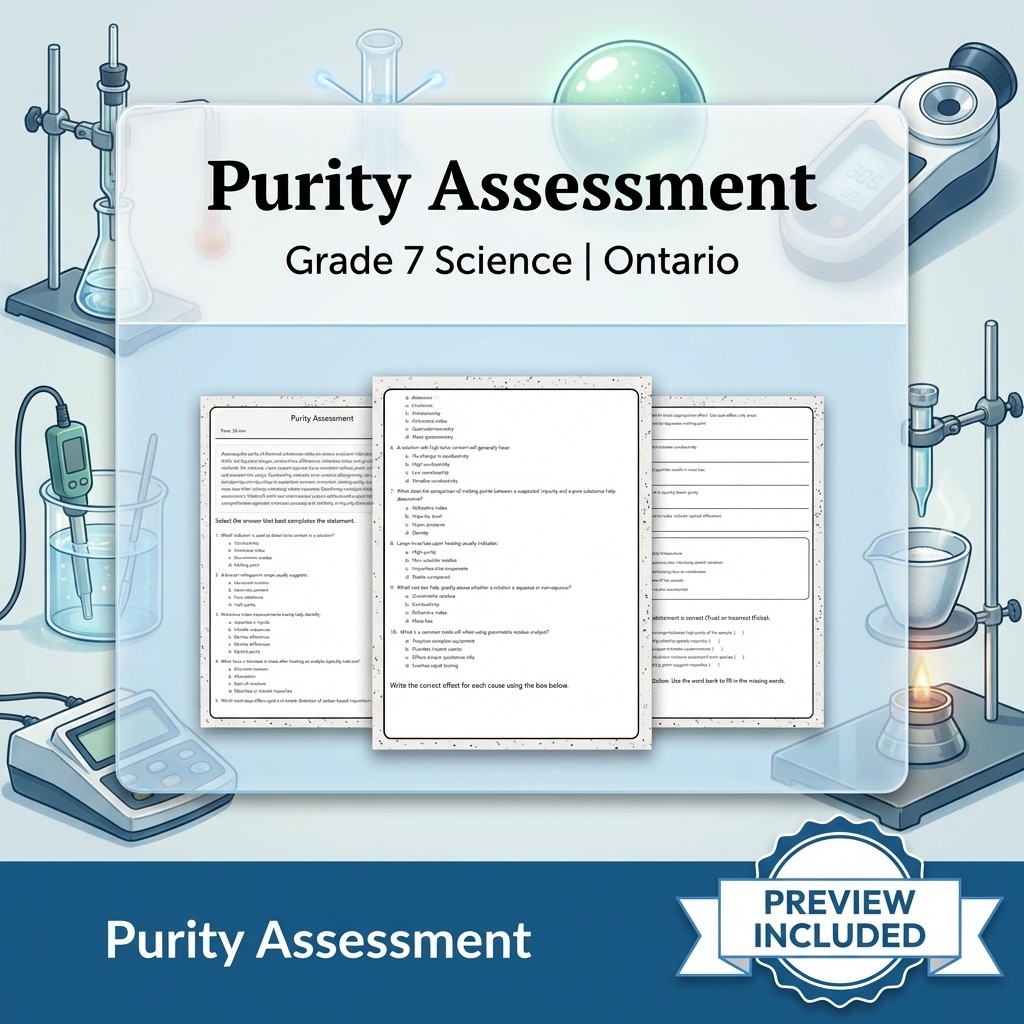
Grade 7 Science | Purity Assessment Worksheet with Short Notes (Printable PDF)
Created byMeadowlark WorksheetsLearning Objectives
- Understand different analytical indicators used to assess the purity of a substance.
- Recognize methods such as melting point, boiling point, conductivity, refractive index, and gravimetric residue.
- Evaluate how multiple criteria support robust purity assessments.
Also included in: Grade 7 Science Lesson Group Bundle – Ontario Curriculum Worksheets +1 more
Instant download

Grade 7 Graphing Motion Worksheet | Practice & Assessment PDF
Created byClear Sky ClassroomLearning Objectives
- Translate distance–time and speed–time data tables into graphs of motion.
- Interpret graph features such as slope (rate) and compare how different curves show different motion.
- Use graphs to estimate average rate and reason about changing speed using familiar scenarios.
Instant download

Grade 7 Plate Tectonics Worksheet | NGSS Earth Science Activity
Created byBRIGHT PATH RESOURCESLearning Objectives
- Understand the concept of plate tectonics and continental movement
- Identify geologic evidence supporting plate movements
- Explain the significance of seafloor features like mid-ocean ridges and trenches
Also included in: Earth Systems Grade 7 Science Daily Reading Worksheets Lesson Bundle | NGSS +2 more
Instant download

Grade 7 Science | Rock Cycle Integration Worksheet | BC-Aligned
 Created byLumora Learning
Learning Objectives
- Understand the processes and components involved in the rock cycle.
- Identify how tectonic activity and surface processes influence rock transformation.
- Explain the roles of uplift, erosion, burial, and melting in shaping Earth's crust.
Instant download

Grade 7 Science Worksheet | Plate Tectonics & Earth's Crust (PDF)
 Created byEvergreen Desk Education
Learning Objectives
- Describe Earth’s lithospheric plates and how they move on the ductile mantle.
- Compare divergent, convergent, and transform plate boundaries and predict associated geologic hazards.
- Use plate-motion ideas to explain large-scale patterns such as mountain chains and earthquake zones.
Instant download

Reaction Evidence Worksheet for Grade 7 Science | TEKS-Aligned Practice PDF
JCreated byJ.S SheetsLearning Objectives
- Identify common observable indicators of chemical reactions, including gas evolution, precipitate formation, color change, and temperature change
- Connect reaction evidence to underlying changes in chemical composition represented by symbolic formulas
- Explain how mass and energy relationships are consistent with observable evidence during chemical reactions
Instant download

Scientific Variables Worksheet Grade 7 Science | NGSSS Controlled Experiments Practice
Created byEvergreen Desk EducationLearning Objectives
- Identify the independent variable, dependent variable, and controlled variables in a scientific investigation.
- Use tables and graphs to explain how the dependent variable changes in response to the independent variable.
- Describe how controlling variables improves the fairness and trustworthiness of experimental results.
Instant download

Global Circulation Worksheet Grade 7 NGSS | Atmosphere & Ocean Currents
 Created byAmber Owl Education
Learning Objectives
- Explain how unequal solar heating and Earth’s rotation drive global atmospheric circulation patterns (cells, winds, and the Coriolis effect).
- Describe how large-scale ocean gyres and major currents redistribute heat and influence regional climate.
- Connect circulation features to expected patterns in precipitation and temperature.
Also included in: Earth's Systems Lesson Bundle | Grade 7 Science | Next-Gen Science Standards +1 more
Instant download
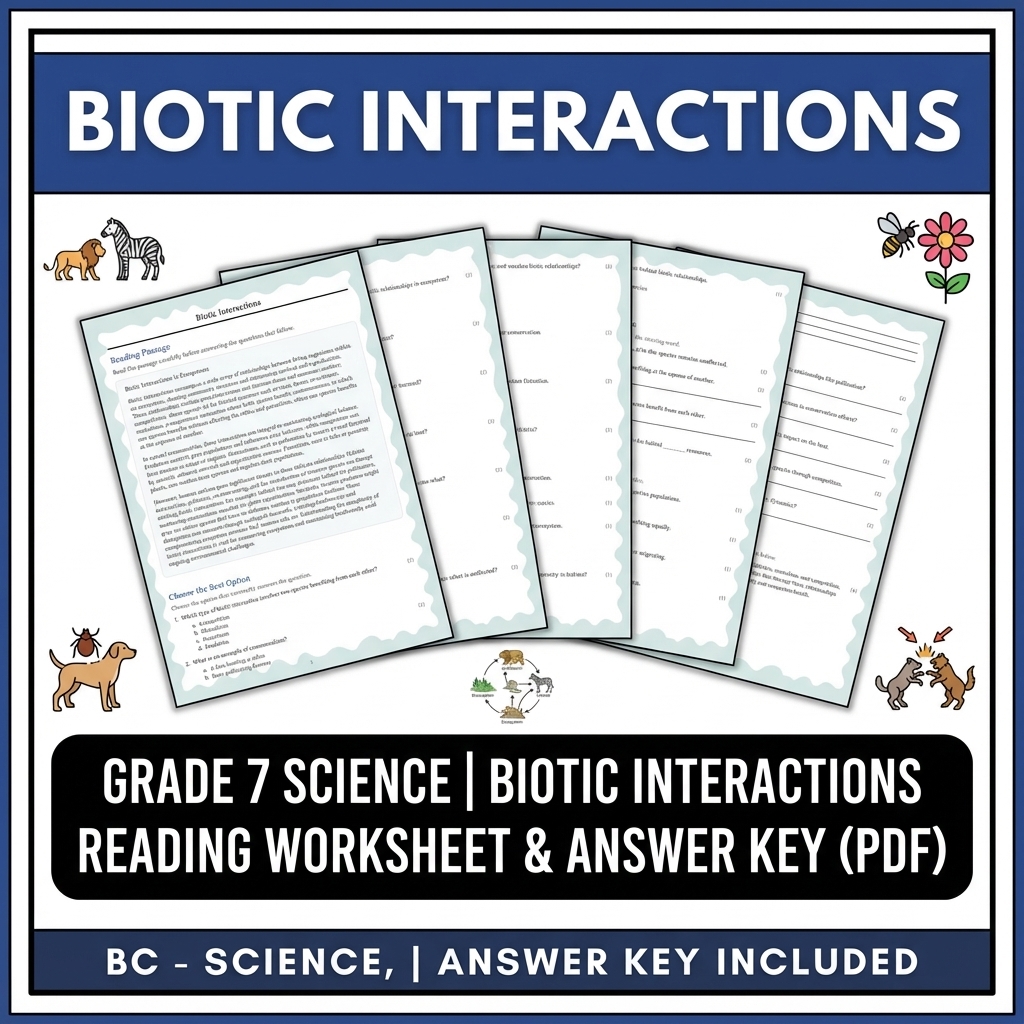
Grade 7 Science | Biotic Interactions Reading Worksheet & Answer Key (PDF)
JCreated byJ.S SheetsLearning Objectives
- Understand different types of biotic interactions such as predation, competition, mutualism, commensalism, and parasitism.
- Explain how human actions can disrupt biotic relationships and affect ecosystems.
- Analyze the effects of biotic interactions on community structure and biodiversity.
Instant download
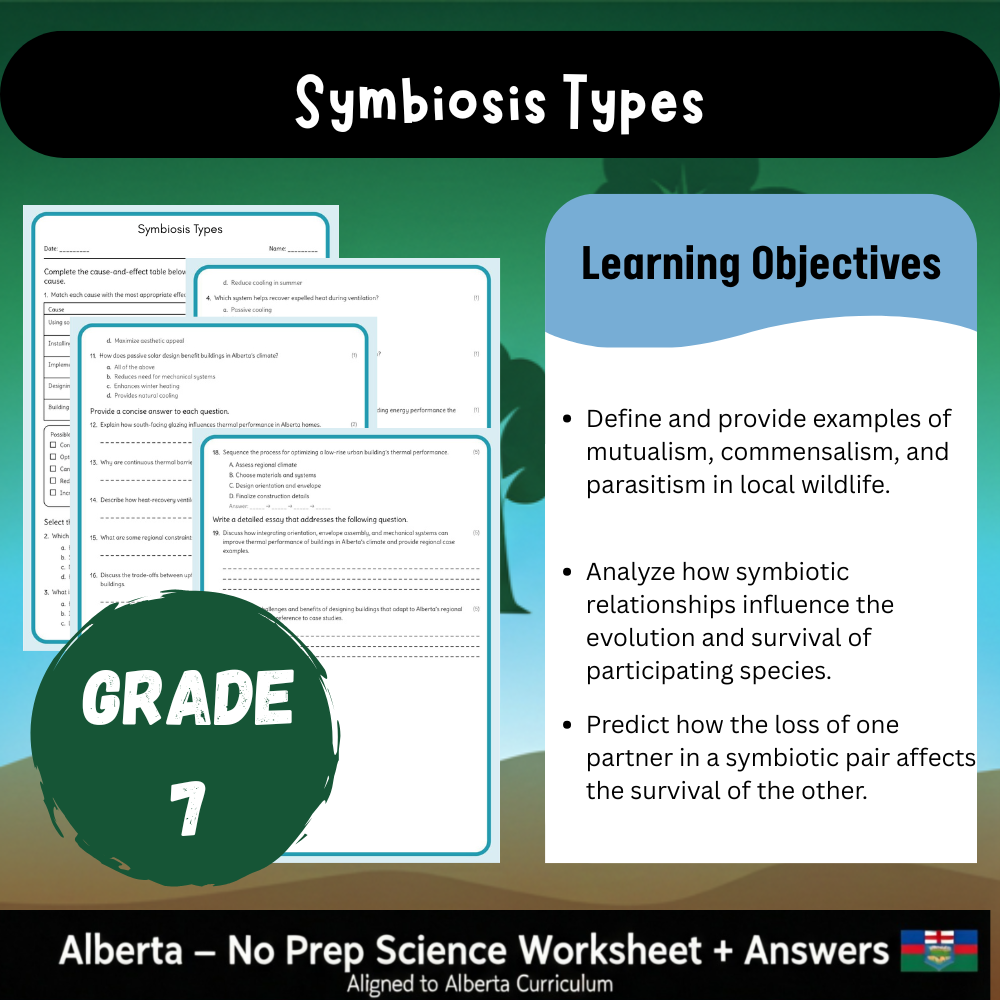
Grade 7 Science | Symbiosis Types Worksheet (PDF) – Alberta Standards
 Created byBright Mind Resources
Learning Objectives
- Explain the different types of symbiosis: mutualism, commensalism, and parasitism.
- Identify Alberta-specific examples of symbiotic relationships.
- Understand ecological impacts of inter-species relationships on populations and habitats.
Instant download

Reflective Surfaces and Radiative Heat Exchange Worksheets Grade 7
 Created byPrism Point Learning
Learning Objectives
- Explain how albedo affects reflected and absorbed solar radiation
- Describe how emissivity affects long-wave thermal radiation
- Compare how colours and coatings influence solar gain
Also included in: Thermal Energy & Heat Transfer Lesson Bundle | Grade 7 Science | Ontario +1 more
Instant download
Grade 7 Science – Synthetic Materials Daily Reading Worksheet with Answer Key
Created byCopper Leaf ClassroomLearning Objectives
- Understand the production processes of common synthetic materials from natural resources.
- Identify different pathways like polymerization, refining, and chemical modification.
- Compare the properties, uses, and environmental impacts of materials like polyethylene, PET, nylon, and metals.
Instant download
Grade 7 Science Worksheet | Seasonal Cycles | Alberta Standards
Created byLumora LearningLearning Objectives
- Understand the role of seasonal thermal cycles in regional climate and ecosystems.
- Identify how solar radiation, albedo effect, and phase changes influence energy storage and transfer.
- Explain the processes responsible for snowpack insulation, soil freeze-thaw, and lake stratification.
Instant download

Transfer Mechanisms And Forms Assessment | NGSSS Grade 7 Science
Created byPrism Point LearningLearning Objectives
- Explain how energy transfers occur through conduction, convection, and radiation
- Identify and compare the evidence of different energy transfer mechanisms in everyday situations
- Describe how energy can transform from one form into another in common devices
Also included in: Grade 7 Matter, Forces & Energy Science Lesson Bundle | Florida NGSSS
Instant download

Grade 7 Science | Potential Energy in Systems - Daily Reading Comprehension
Created byCoral Reef LearningLearning Objectives
- Understand key concepts related to Science
- Apply knowledge through practice questions
- Demonstrate comprehension of the material
Instant download

Grade 7 Science – Modelling Ecosystems & Ecological Models | Reading Worksheet
Created byBright Mind ResourcesLearning Objectives
- Understand the basic concepts of ecological modeling
- Identify different types of models used in ecology
- Recognize the applications and limitations of ecological models
Also included in: Grade 7 Ecosystems Science Lesson Bundle for Daily Reading Worksheets | Alberta +2 more
Instant download

Grade 7 Science – Ecosystem Restoration Strategies Worksheet (PDF)
Created byEvergreen Desk EducationLearning Objectives
- Explain ecological restoration principles, including reference conditions, active vs. passive approaches, and evidence-based goals
- Describe how species selection, genetic considerations, and habitat connectivity influence restoration planning
- Identify trade-offs between short-term recovery and long-term resilience, and connect restoration to monitoring and adaptive management
Also included in: Grade 7 Ecosystem Dynamics Science Lesson Bundle (Ontario) Worksheets +1 more
Instant download

Grade 7 Science | Design Criteria in Science - Daily Reading Comprehension
Created byCoral Reef LearningLearning Objectives
- Understand the importance of clear criteria for success in designing solutions.
- Identify measurable and observable goals in a design problem.
- Learn how trade-offs affect meeting different design criteria.
Instant download

Grade 7 Reflective Surfaces Worksheet | Ontario Science Light Unit Activity
Created byClear Sky ClassroomLearning Objectives
- Explain how surface albedo and emissivity affect radiative heat exchange between structures and the environment.
- Describe how color and surface coatings (e.g., reflective roofs, low-emissivity glazing) change net radiative heat flux.
- Predict how diurnal and seasonal changes in irradiance influence the effectiveness of radiative heat strategies.
Instant download

Grade 7 Heating Curve Phases Worksheet | California Standards Practice PDF
Created byClear Sky ClassroomLearning Objectives
- Describe what happens to temperature during solid warming, melting, liquid warming, and boiling.
- Explain how particle arrangement and energy use differ during phase changes compared to temperature increases.
- Interpret features of a heating curve (rising segments vs. plateaus) using the particle model.
Instant download

Grade 7 Science | Reaction Observations Worksheet (Alberta Standards) (PDF)
 Created bySilver Birch Teaching
Learning Objectives
- Identify common observable indicators of chemical reactions, such as gas production, heat change, colour shifts, and precipitate formation.
- Describe reaction observations using clear scientific language and connect observations to possible reaction pathways and mass changes.
- Interpret qualitative evidence from real-world contexts (e.g., combustion emissions and spoilage-related gas release) to support explanations of chemical processes.
Also included in: Grade 7 Matter, Concentration & Reactions Science Lesson Bundle - Alberta +1 more
Instant download
Grade 7 Science – Understanding Net Force | Daily Reading Worksheet
 Created byElena Brooks
Learning Objectives
- Define net force as the vector sum of all forces acting on an object.
- Explain how unbalanced forces cause changes in motion.
- Use free-body diagrams to visualize forces.
Also included in: Force and Motion Grade 7 Science Daily Reading Worksheets Bundle | NGSS +1 more
Instant download

Grade 7 Science – Evidence of Adaptation & Population Changes | Worksheet
Created byBright Mind ResourcesLearning Objectives
- Identify different types of evidence for adaptation in various populations
- Understand how trait differences among populations support the concept of natural selection
- Describe how fossil records and environmental responses provide evidence for adaptation
Also included in: Populations & Traits Grade 7 Science Daily Reading Lesson Bundle | Florida NGSSS +1 more
Instant download

Science Worksheet Abiotic Drivers and Environmental Templates Grade 7
JCreated byJ.S SheetsLearning Objectives
- Identify abiotic drivers (temperature gradients, light availability, soil composition, moisture regimes, and pH) and describe how they affect organisms.
- Explain how abiotic variability creates microhabitats and influences resource distribution and physiological constraints.
- Connect abiotic regimes to organism tolerance ranges and predict how species occurrence can change across physical gradients.
Instant download

Grade 7 Science – Solubility Principles Reading Worksheet | Ontario Standards
Created byBright Mind ResourcesLearning Objectives
- Understand the basic concept of solubility.
- Identify factors affecting solubility such as temperature, pressure, and solvent polarity.
- Interpret solubility curves and concepts like saturation and supersaturation.
Also included in: Grade 7 Matter Science Daily Reading Worksheets Lesson Bundle | Ontario +1 more
Instant download

Thermal Basics Practice Worksheet | Grade 7 Science Review and Assessment
Created byPrism Point LearningLearning Objectives
- Distinguish temperature from internal energy and explain temperature as a measure of average kinetic energy
- Describe how thermal energy flows from higher to lower internal energy and why this flow stops at thermal equilibrium
- Explain that energy is conserved during heat exchange (energy transfers, it is not created or destroyed)
Instant download

Grade 7 Science | Levers & Pulleys - Daily Reading Comprehension
Created byCoral Reef LearningLearning Objectives
- Identify the main parts of levers
- Classify levers into first, second, and third classes
- Understand how pulleys change direction of force
Also included in: Forces, Structures and Motion Lesson Bundle | Grade 7 Science Alberta +1 more
Instant download

Designing Water Systems Worksheet Grade 7 Science | Engineering Design
Created byPrism Point LearningLearning Objectives
- Evaluate freshwater management options by identifying tradeoffs in cost, reliability, energy use, and environmental impact.
- Explain how design constraints (water quality, infrastructure limits, and altered flow patterns) affect water system decisions.
- Propose improvements that reduce risk from scarcity and pollution while supporting long-term sustainability.
Instant download

Weather vs Climate Worksheet | Grade 7 Science Practice Activity
Created byPrism Point LearningLearning Objectives
- Differentiate weather from climate using time scales and patterns
- Explain how temperature, precipitation, humidity, and wind help describe weather
- Describe how geography and global energy patterns influence a region’s climate
Also included in: Grade 7 Weather & Climate Science Lesson Bundle | Florida NGSSS
Instant download

Grade 7 Science – Recoil & Thrust Daily Reading Worksheet | California Standards
Created byBright Mind ResourcesLearning Objectives
- Understand the concepts of action and reaction forces
- Identify examples of Newton's Third Law in everyday life
- Explain how forces produce acceleration in systems like rockets and skaters
Also included in: Grade 7 Matter & Forces Science Reading Lesson Bundle | California Standards +1 more
Instant download

Grade 7 Science | Weather Data Patterns - Daily Reading Comprehension
Created byCoral Reef LearningLearning Objectives
- Understand basic weather data and how it varies over time and location.
- Learn to identify weather patterns by analyzing temperature, wind, humidity, and pressure data.
- Recognize the difference between weather and climate.
Instant download

Grade 7 Science – Advanced Materials Worksheet (Ontario Standards) (PDF)
Created byEvergreen Desk EducationLearning Objectives
- Explain how engineered and composite materials (cross-laminated timber, fibre-reinforced polymers, and high-performance concrete) achieve improved strength, stiffness, and durability.
- Describe how manufacturing methods and microstructure influence material performance and long-term reliability.
- Evaluate trade-offs among cost, fabrication complexity, and performance when selecting advanced materials for buildings and bridge retrofits.
Also included in: Grade 7 Engineering Design & Materials Science Lesson Bundle Ontario +1 more
Instant download

Convection Dynamics Worksheet Grade 7 Science Heat Transfer Ontario
 Created byChalk and Compass
Learning Objectives
- Explain how buoyancy and density differences drive convective heat transfer in fluids
- Describe how temperature gradients create circulation cells in air and water
- Use examples (sea/land breezes, thermals, lake overturning) to connect convection to environmental phenomena
Also included in: Grade 7 Science Heat Transfer and Thermal Energy Lesson Bundle | Ontario +1 more
Instant download

Grade 7 Member Behaviour Worksheet | Ontario Science Activity PDF
Created byClear Sky ClassroomLearning Objectives
- Describe how beams and cantilevers respond to loads through bending, shear, and deflection
- Relate support conditions and load placement to internal force distribution (bending moment and shear force)
- Contrast bending-dominated members with axial-dominated members such as columns and truss bars
Instant download

Grade 7 Science | Climate Drivers Worksheet | NGSSS Aligned
Created byLumora LearningLearning Objectives
- Explain how latitude affects the angle of sunlight and long-term temperature patterns
- Describe how elevation can lower temperature and influence precipitation
- Connect distance from water and ocean currents to changes in temperature and rainfall
Instant download

Grade 7 Science – Matter Classification & Identification | Reading Worksheet
Created byBright Mind ResourcesLearning Objectives
- Understand the difference between pure substances and mixtures
- Identify elements, compounds, and mixtures in everyday items
- Distinguish between homogeneous and heterogeneous mixtures
Also included in: Grade 7 Daily Reading Science Worksheets Lesson Bundle | Florida NGSSS +1 more
Instant download

Nutrient Cycles Assessment for Grade 7 Science | Standards-Aligned Test
Created byPrism Point LearningLearning Objectives
- Understand how matter cycles through ecosystems via different nutrient pathways.
- Identify the roles of carbon, nitrogen, and phosphorus in nutrient cycling.
- Explain processes such as photosynthesis, respiration, decomposition, and bacterial transformations.
Instant download
About Grade 7 Science Worksheets
Browse 6,039 printable Grade 7 Science worksheets — ready-to-print PDFs with answer keys where available.
Every worksheet on MyTeachingSheets is created by independent teacher-authors and reviewed before publication. All resources download as printable PDFs for classroom, homework, or at-home practice, and many include answer keys. Preview any worksheet free before buying.