
Grade 7 Science Worksheets
6,039 worksheets
Carrying Capacity Practice Worksheet | Grade 7 Science Review
 Created byPrism Point Learning
Learning Objectives
- Explain what carrying capacity means in an ecosystem.
- Identify limiting factors that control population size over time.
- Describe how populations change when they exceed or fall below carrying capacity.
Also included in: Ecosystems & Interactions Lesson Bundle – Grade 7 Science BC Framework +1 more
Instant download
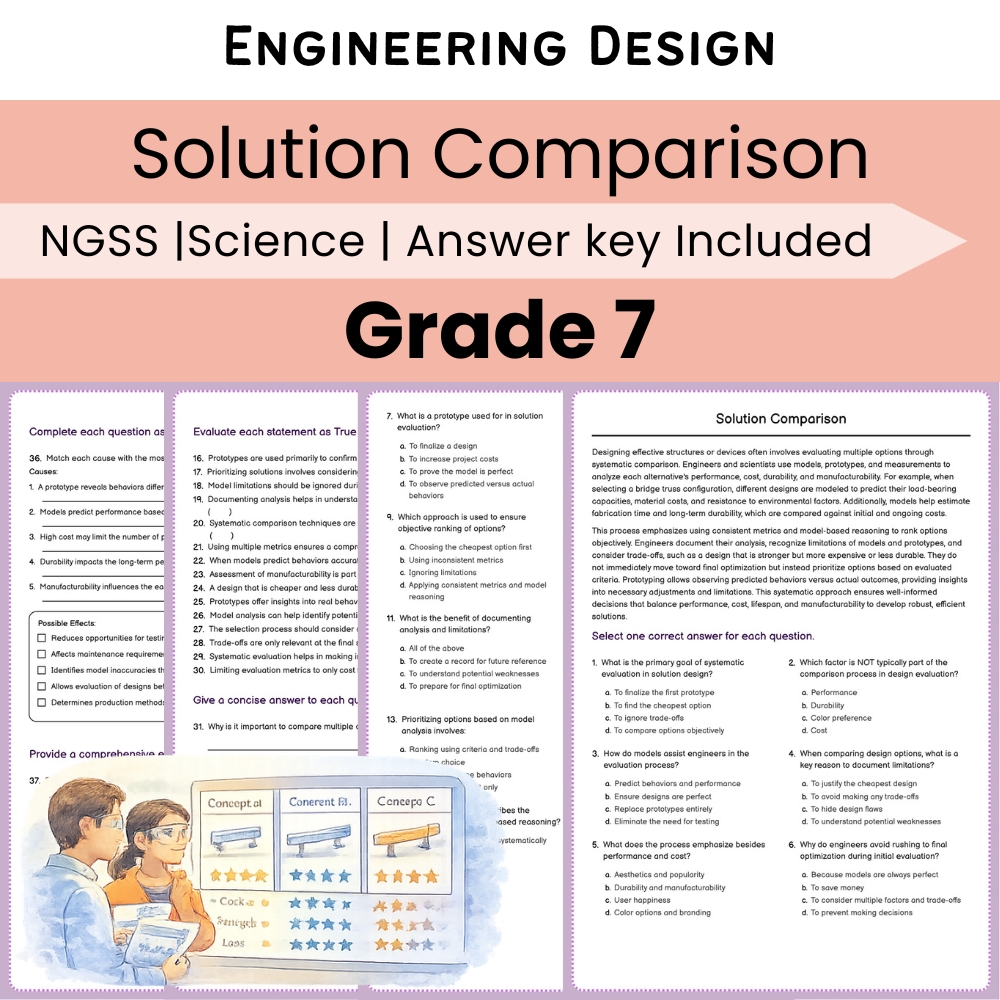
Solution Comparison Worksheet for Grade 7 Science | NGSS Printable PDF
Learning Objectives
- Understand the process of systematically evaluating different design solutions.
- Apply modeling and comparative analysis techniques to assess trade-offs.
- Identify and quantify factors such as performance, cost, durability, and manufacturability.
Also included in: Grade 7 Science NGSS Engineering Design Lesson Bundle | Worksheets +1 more
Instant download

Grade 7 Science | Accuracy and Uncertainty Worksheet | General Standards
 Created byLumora Learning
Learning Objectives
- Explain the difference between accuracy and uncertainty in scientific measurements
- Identify how tool resolution and repeated trials affect measurement uncertainty
- Use uncertainty ranges to judge whether differences in results are meaningful
Instant download

Grade 7 Science – Investigation Variables & Data Collection | Reading Worksheet
 Created byBright Mind Resources
Learning Objectives
- Understand the concept of variables in scientific investigations
- Identify independent, dependent, and controlled variables in experiments
- Learn how to plan experiments by controlling variables and measuring key evidence
Also included in: Scientific Models & Evidence Grade 7 Science Reading Lesson Bundle | General +1 more
Instant download
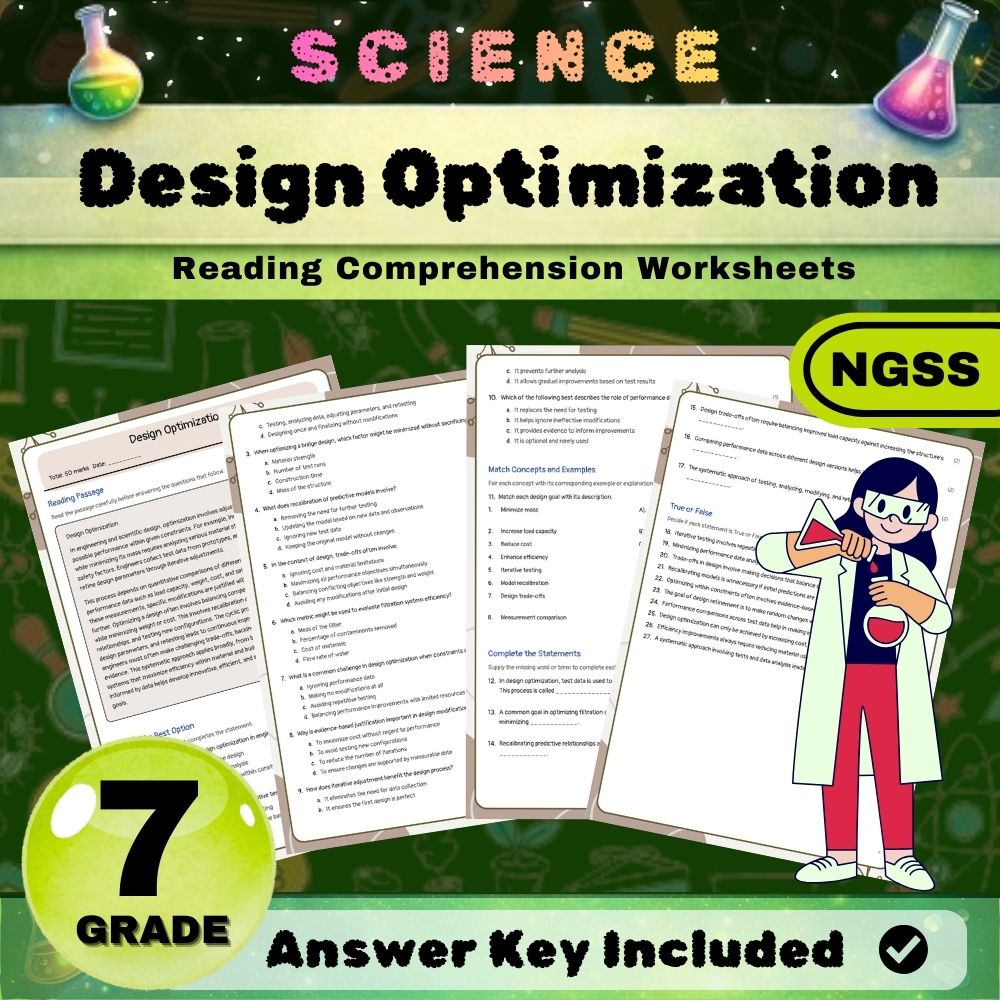
Grade 7 Science | Design Optimization NGSS Worksheet (Answer Key)
 Created byMaple Path Learning
Learning Objectives
- Analyze test data to assess the performance of design parameters.
- Refine and adjust design variables based on quantitative comparisons.
- Apply iterative problem-solving methods to improve design features within constraints.
Instant download

Change Indicators Worksheet for Grade 7 Science | Standards-Aligned Practice
JCreated byJ.S SheetsLearning Objectives
- Identify observable signs of chemical change such as gas formation, color change, temperature change, precipitate formation, and irreversible transformation.
- Understand that multiple indicators together provide stronger evidence of a chemical change than any single sign.
- Recognize how measurements and observations confirm chemical reactions occurring.
Instant download

Friction and Gravity Assessment | TEKS Grade 7 Science Worksheet
Created byPrism Point LearningLearning Objectives
- Understand how friction opposes motion and affects objects on different surfaces.
- Explain the role of gravity as a force pulling objects toward planetary surfaces.
- Differentiate between contact forces and long-range forces, with observable effects.
Also included in: Grade 7 Motion and Energy Science: Lesson Bundle TEKS Unit Assessment
Instant download

Plate Basics Worksheet for Grade 7 Science | Standards-Aligned Practice
JCreated byJ.S SheetsLearning Objectives
- Understand the different types of plate boundaries and their effects on Earth's surface.
- Identify the geological features associated with divergent, convergent, and transform boundaries.
- Explain how plate movements influence earthquakes, volcanoes, and mountain formation.
Instant download

Population Impacts Worksheet for Grade 7 Science | NGSS-Aligned Assessment
JCreated byJ.S SheetsLearning Objectives
- Analyze how human population growth and consumption influence demand for water, energy, land, and resources.
- Evaluate the environmental consequences of increased population and resource use, including biodiversity loss and carbon emissions.
- Compare regional examples to understand how consumption patterns affect ecosystems and resource cycles.
Also included in: Grade 7 Human Impacts on Earth Systems Science Lesson Bundle – NGSS +1 more
Instant download

Grade 7 Science | Human System Feedbacks Worksheet | General Standards
Created byLumora LearningLearning Objectives
- Explain how human activities can alter Earth system interactions across the atmosphere, biosphere, and geosphere
- Describe positive and negative feedbacks using examples from temperature, water cycle, erosion, and ecosystems
- Use cause-and-effect reasoning to predict how changes in one part of a system can influence other parts
Instant download
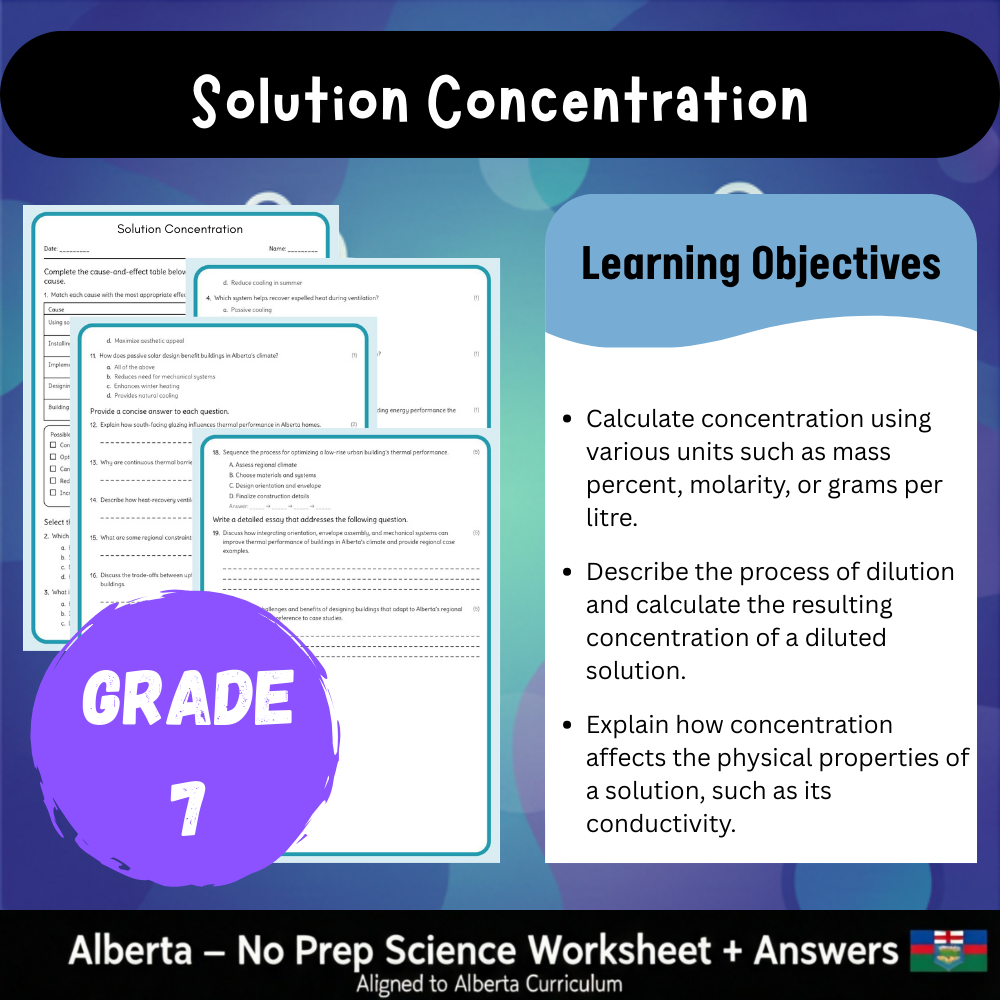
Grade 7 Science – Solution Concentration Worksheet (PDF) – Alberta Standard
Created byBright Mind ResourcesLearning Objectives
- Understand that solution concentration quantifies the amount of solute relative to solvent.
- Identify common measures of concentration such as mass percent and grams per litre.
- Explain how concentration affects physical properties like boiling point and freezing point.
Instant download

Grade 7 Thermal Expansion Worksheet | Practice & Standards PDF
 Created byClear Sky Classroom
Learning Objectives
- Explain how heating increases particle kinetic energy and spacing, causing thermal expansion in solids and liquids.
- Describe how cooling decreases particle motion and can lead to contraction.
- Predict how temperature changes can affect gas pressure in confined spaces.
Instant download

Grade 7 Science | Evidence Based Evaluation - Daily Reading Comprehension
 Created byCoral Reef Learning
Learning Objectives
- Understand the criteria used to evaluate design solutions.
- Identify constraints and tradeoffs in technical testing.
- Interpret test results to determine design success or failure.
Instant download
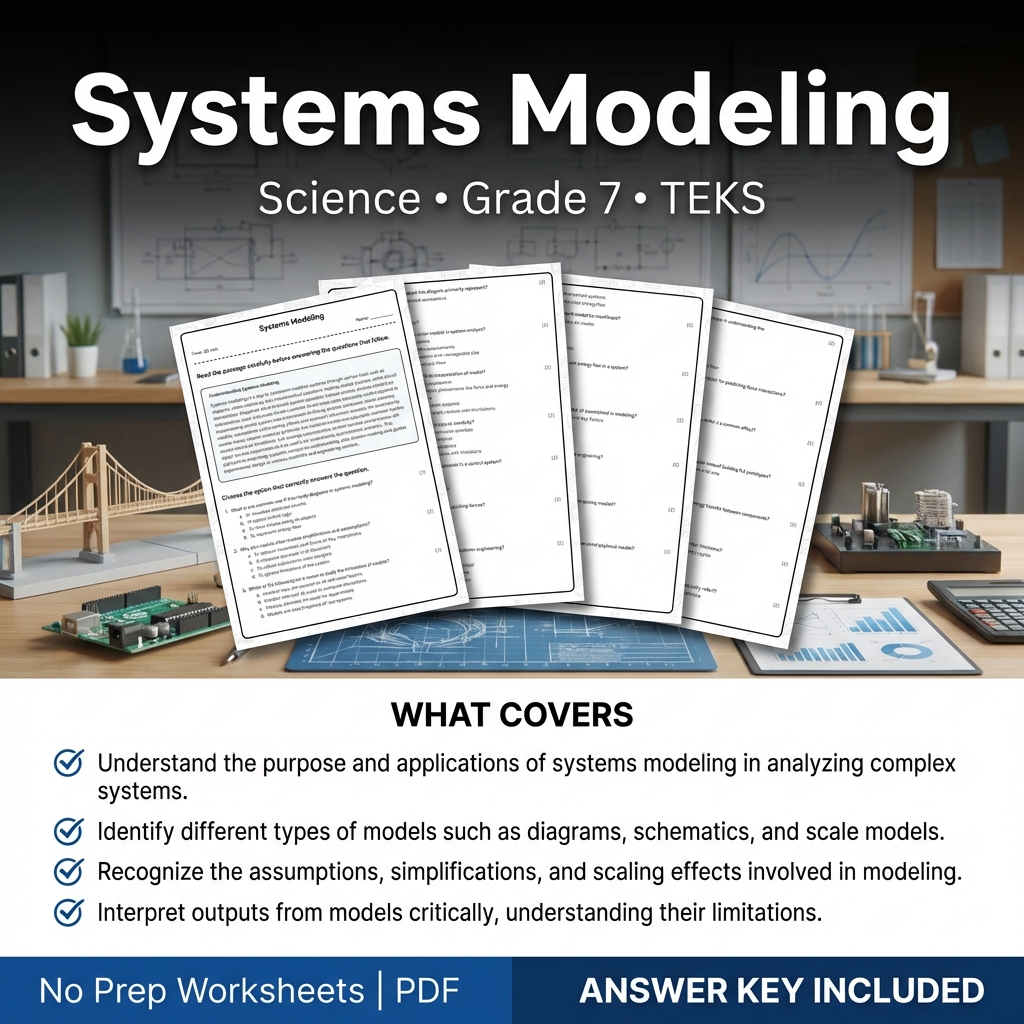
Grade 7 Science Worksheet on Systems Modeling | TEKS-Aligned Practice
Created byCoral Reef LearningLearning Objectives
- Understand the purpose and applications of systems modeling in analyzing complex systems.
- Identify different types of models such as diagrams, schematics, and scale models.
- Recognize the assumptions, simplifications, and scaling effects involved in modeling.
Instant download

Grade 7 Science | Modeling & Simulation in Science - Daily Reading Practice
Created byCoral Reef LearningLearning Objectives
- Define what a scientific model is and explain its purpose.
- Identify different types of models used in science, such as conceptual and computational models.
- Describe the process of abstraction, assumption identification, and scaling in modeling.
Instant download

Evidence Arguments Worksheet Pack | Grade 7 Science Activities
Created byPrism Point LearningLearning Objectives
- Identify the parts of a scientific evidence argument: observation, evidence, claim, and reasoning
- Use data values or graph features to connect evidence to a claim
- Evaluate whether an argument is supported by evidence and scientific principles, not unsupported cause-and-effect
Instant download

Grade 7 Evidence Arguments Worksheet | Practice & PDF
Created byClear Sky ClassroomLearning Objectives
- Explain how evidence supports a scientific claim using a clear chain from observations to reasoning.
- Identify when an argument uses specific data values, graph features, or direct observations rather than unsupported statements.
- Revise scientific arguments to improve accuracy by addressing limitations and avoiding incorrect cause-and-effect claims.
Instant download

7th Grade Science | Motion Principles Worksheet (TEKS & PDF)
 Created byEvergreen Desk Education
Learning Objectives
- Distinguish speed, velocity, and acceleration using everyday motion examples.
- Classify quantities as scalars or vectors and explain why direction matters for velocity.
- Interpret motion scenarios qualitatively and relate displacement, time, and rate of change.
Instant download

Grade 7 Science Worksheet | Substance Basics (PDF) Ontario Standards
Created byEvergreen Desk EducationLearning Objectives
- Classify substances as elements, compounds, or mixtures based on composition and uniformity
- Explain the differences between pure substances and mixtures using observable properties
- Identify examples of pure substances and mixtures in everyday contexts and justify the classification
Also included in: Grade 7 Substances and Mixtures Science Lesson Bundle Worksheet (Ontario) +1 more
Instant download

Grade 7 Science | Climate Drivers - Daily Reading Comprehension
Created byCoral Reef LearningLearning Objectives
- Understand how the Sun influences Earth's climate patterns.
- Identify the main components affecting climate: energy, ocean processes, and atmospheric circulation.
- Recognize short-term weather versus long-term climate patterns.
Instant download

Grade 7 Science | Modelling Ecosystems Worksheet (PDF) Alberta Standards
 Created bySilver Birch Teaching
Learning Objectives
- Describe how ecological models represent relationships among ecosystem components using simplified variables and assumptions
- Distinguish between conceptual and quantitative ecological models and explain how each is used to predict outcomes
- Identify common model inputs and limitations, and explain why model predictions should be checked against real observations
Also included in: Grade 7 Ecosystems & Biodiversity Science Lesson Bundle for Alberta Framework +1 more
Instant download

Matter Cycling Worksheet | Grade 7 NGSS Carbon & Nitrogen Cycling Activity
 Created byAmber Owl Education
Learning Objectives
- Explain how matter (atoms) is conserved as it moves through organisms during digestion, biosynthesis, and respiration
- Trace how carbon and nitrogen from food become cellular macromolecules and then return to the environment as CO2 or nitrogenous waste
- Use biochemical vocabulary (macromolecule, digestion, respiration) to describe transformation of atoms across living systems
Also included in: Grade 7 Science Matter Cycling & Energy Transformations Lesson Bundle | NGSS +1 more
Instant download

Grade 7 Science Interactions Worksheet | NGSS Forces & Interactions Activity
 Created byNorthstar Worksheets
Learning Objectives
- Explain how gravity, electric, and magnetic forces can act at a distance without direct contact.
- Describe the qualitative relationship between gravity and mass and between gravity and distance.
- Identify when electric and magnetic forces can be attractive or repulsive using real-world examples.
Also included in: Grade 7 Science Forces & Motion Lesson Bundle | NGSS Equilibrium & Collisions +1 more
Instant download
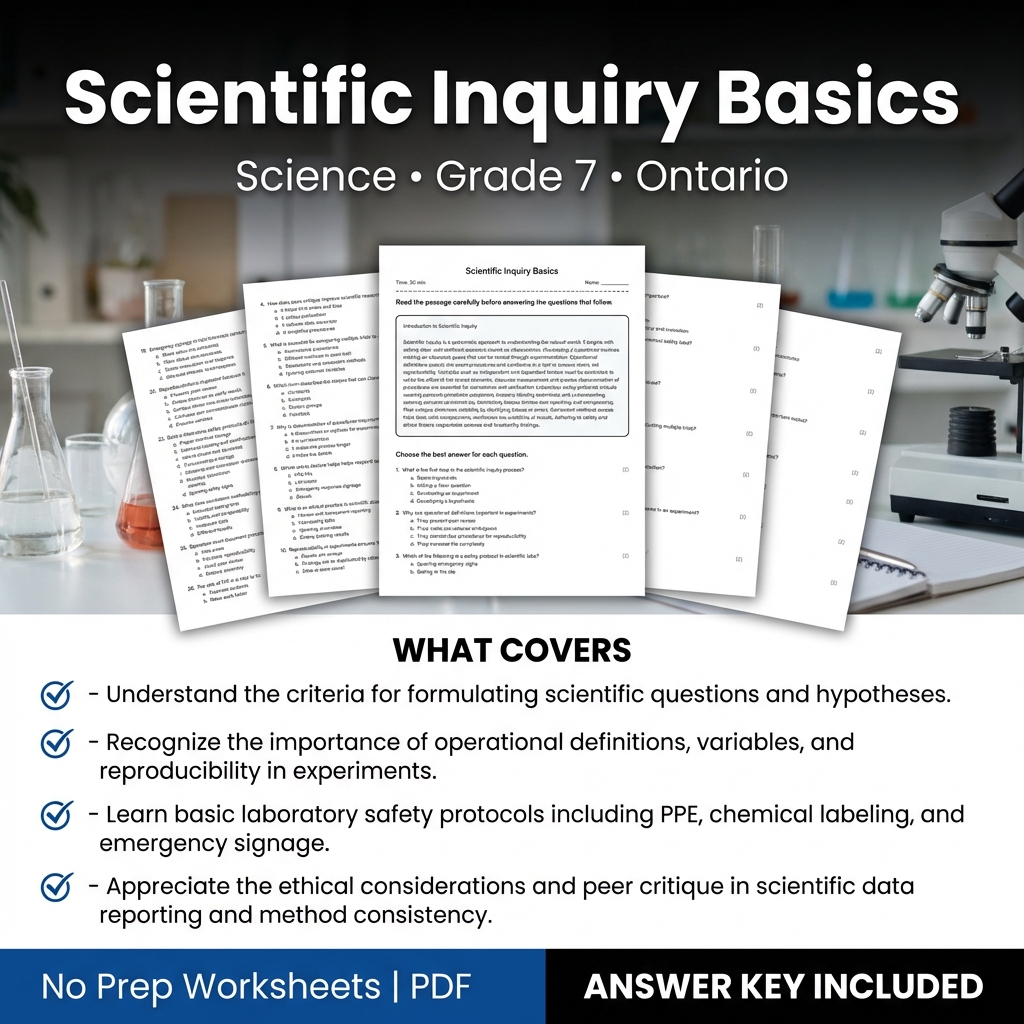
Scientific Inquiry Basics Worksheet Grade 7 Science Ontario
Created byCoral Reef LearningLearning Objectives
- Understand the criteria for formulating scientific questions and hypotheses.
- Recognize the importance of operational definitions, variables, and reproducibility in experiments.
- Learn basic laboratory safety protocols including PPE, chemical labeling, and emergency signage.
Instant download

Grade 7 Science | Indigenous Knowledge Worksheet (PDF) - Alberta Standards
Created byEvergreen Desk EducationLearning Objectives
- Explain how traditional ecological knowledge (TEK) uses observation, classification, and seasonal patterns to support environmental understanding
- Describe how oral histories and place-based knowledge help people interpret species interactions and habitat indicators
- Compare how Indigenous and scientific knowledge systems can complement each other when studying long-term ecosystem change
Instant download

Nutrient Cycles Worksheet for Grade 7 Science Practice
Created byPrism Point LearningLearning Objectives
- Explain how nutrients cycle through ecosystems and why matter is reused.
- Describe the major processes that move carbon, nitrogen, and phosphorus between organisms and the environment.
- Identify how nutrient availability can limit plant productivity.
Instant download

Grade 7 Science – Separation Methods & Techniques | Daily Reading Worksheet
Created byBright Mind ResourcesLearning Objectives
- Understand the concept of filtration as a separation technique.
- Identify different physical properties used to separate mixtures.
- Apply knowledge of filtration to real-world water purification scenarios.
Also included in: Grade 7 Solutions Science Daily Reading Worksheets Lesson Bundle | Alberta +2 more
Instant download

Nucleus Function Practice Worksheet | Grade 7 Science Review
Created byPrism Point LearningLearning Objectives
- Explain how the nucleus stores genetic material and controls cell activities.
- Describe how chromosomes, genes, and nuclear envelope/nuclear pores support gene expression and protein synthesis.
- Analyze how changes in nuclear function can affect cell division and differentiation.
Also included in: Cellular Structure & Function Lesson Bundle | Grade 7 Science | Bc +1 more
Instant download

Grade 7 Saturation Concepts Worksheet | Practice & Assessment PDF
Created byClear Sky ClassroomLearning Objectives
- Explain saturation and unsaturated states in terms of dissolved solute at a given temperature and pressure.
- Describe what happens when more solute is added to a saturated solution and why crystals may form.
- Interpret supersaturation as a temporary condition that can lead to sudden precipitation.
Instant download
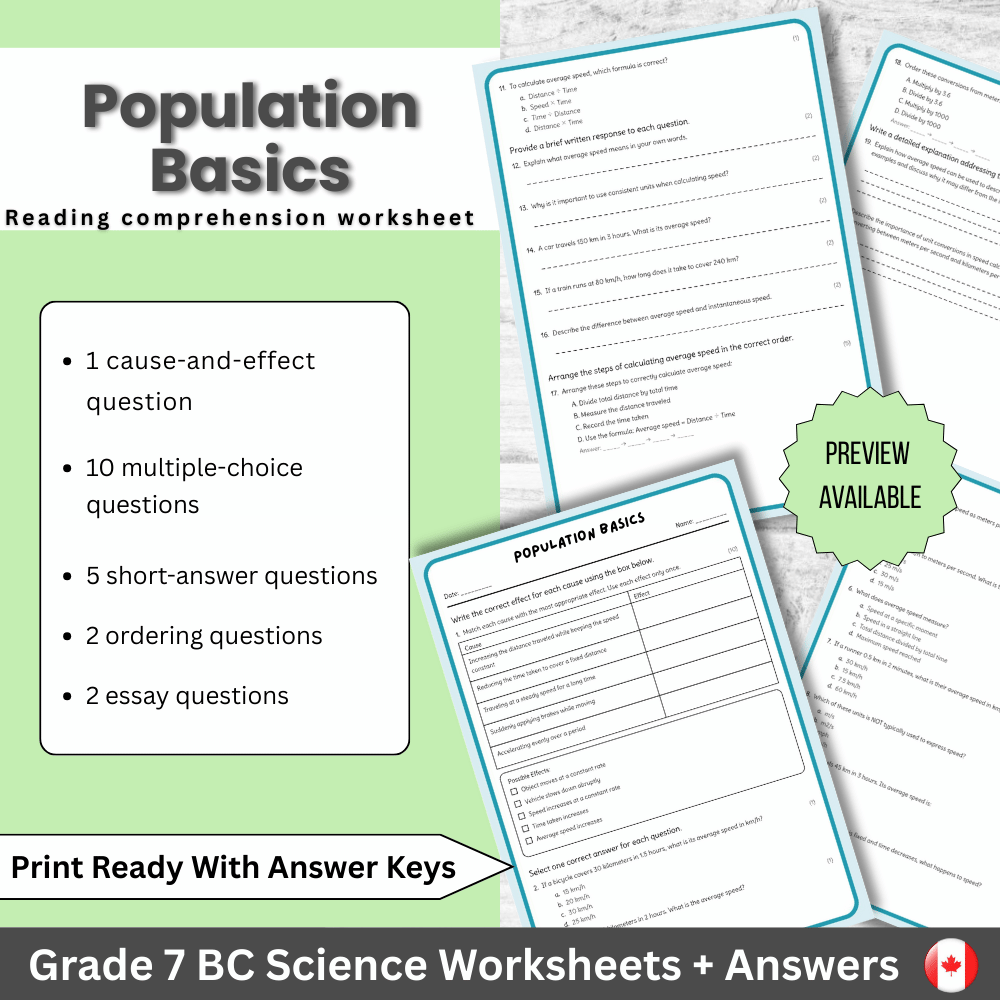
Grade 7 Science | Population Basics Worksheet + Answer Key (PDF) - BC Framework
Created byBright Mind ResourcesLearning Objectives
- Understand the fundamental components that define populations.
- Analyze factors affecting population size and distribution.
- Interpret demographic data and metrics related to populations.
Instant download
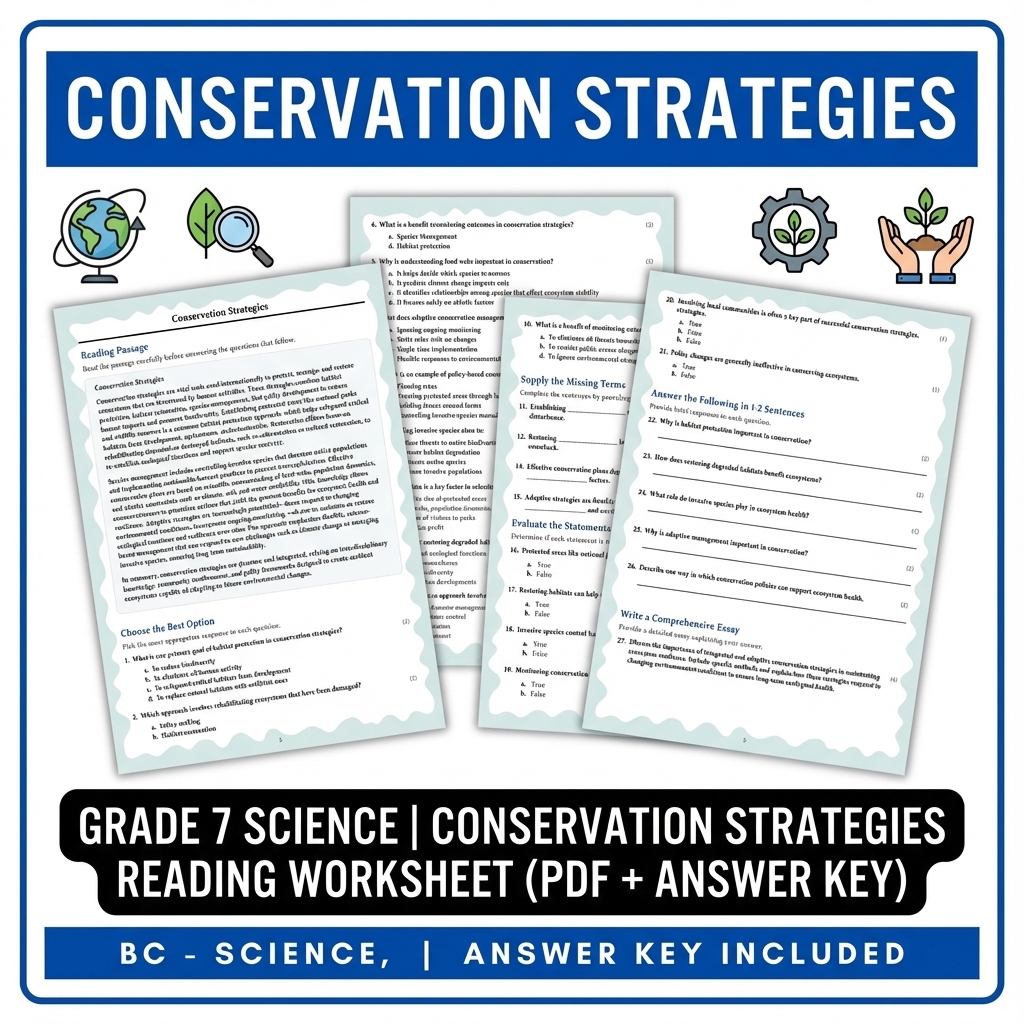
Grade 7 Science | Conservation Strategies Reading Worksheet (PDF + Answer Key)
JCreated byJ.S SheetsLearning Objectives
- Understand various conservation strategies used to protect ecosystems.
- Identify methods for habitat restoration, species management, and policy implementation.
- Explain how food webs, population dynamics, and abiotic factors influence conservation efforts.
Instant download

Grade 7 Science | Chemical Properties Worksheet | BC Aligned
Created byLumora LearningLearning Objectives
- Understand what chemical properties are and how they describe a substance's reactions.
- Identify different chemical properties such as flammability, reactivity with acids or bases, oxidation, and pH behavior.
- Predict reaction outcomes based on observable chemical property evidence.
Also included in: Grade 7 Science | Matter & Chemical Change Unit Bundle | BC Aligned
Instant download

Grade 7 Science | Cell Organization Worksheet | BC Aligned
Created byLumora LearningLearning Objectives
- Understand how cells organize into tissues, organs, and systems.
- Identify different tissue types and their functions.
- Explain the role of tissues in supporting organism activities.
Instant download

Grade 7 Science – Survival Structures in Organisms | Daily Reading Worksheet
Created byBright Mind ResourcesLearning Objectives
- Understand how internal systems support animal survival
- Identify external features that protect and aid animals
- Explain how traits improve resource acquisition and reproduction
Also included in: Trophic Energy Grade 7 Science Daily Reading Worksheets Lesson Bundle | General +1 more
Instant download

Conservation Strategies Worksheet for Grade 7 Science
JCreated byJ.S SheetsLearning Objectives
- Understand various conservation strategies used to protect ecosystems and biodiversity.
- Identify key components such as habitat protection, restoration, and species management.
- Explain how adaptive approaches respond to changing environmental conditions.
Instant download

Balanced vs Unbalanced Forces Worksheet | Grade 7 Science Practice
Created byPrism Point LearningLearning Objectives
- Explain how balanced forces lead to zero net force and constant velocity.
- Describe how unbalanced forces produce nonzero net force and acceleration.
- Use a tug-of-war scenario to predict how motion changes when forces differ.
Also included in: Physical Science Lesson Bundle | Grade 7 Science | Florida NGSSS
Instant download
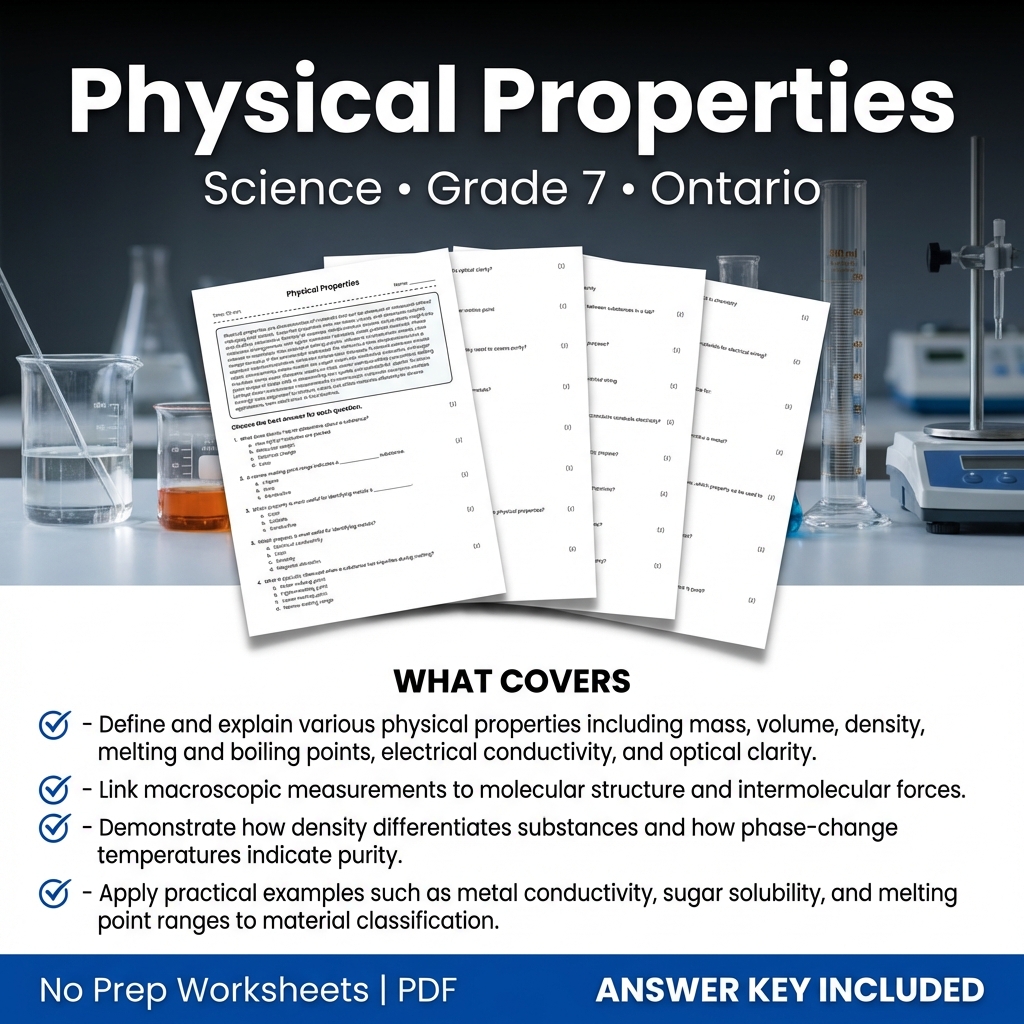
Grade 7 Science Worksheet on Physical Properties with Answer Key – Ontario
Created byCoral Reef LearningLearning Objectives
- Define and explain various physical properties including mass, volume, density, melting and boiling points, electrical conductivity, and optical clarity.
- Link macroscopic measurements to molecular structure and intermolecular forces.
- Demonstrate how density differentiates substances and how phase-change temperatures indicate purity.
Instant download
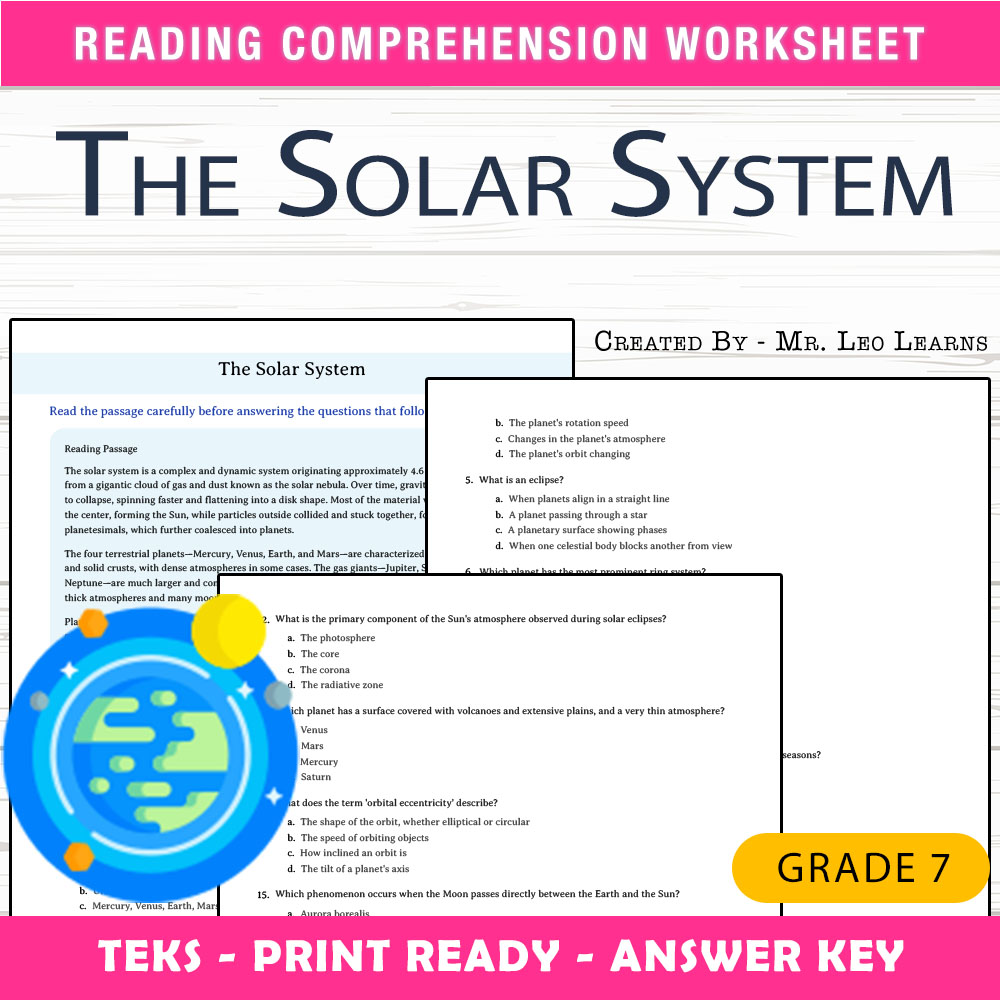
Grade 7 Science – The Solar System Worksheet for Mastering Celestial Bodies
 Created byThe Resource Hub
Learning Objectives
- Explain the origins and formation processes of the solar system.
- Identify key properties of planets, including atmospheres, geology, and orbital characteristics.
- Describe phenomena such as planetary phases, eclipses, and axial tilts based on observational data.
Also included in: Grade 7 Science UNIT Bundle | Earth & Space Systems Mastery Worksheets +1 more
Instant download
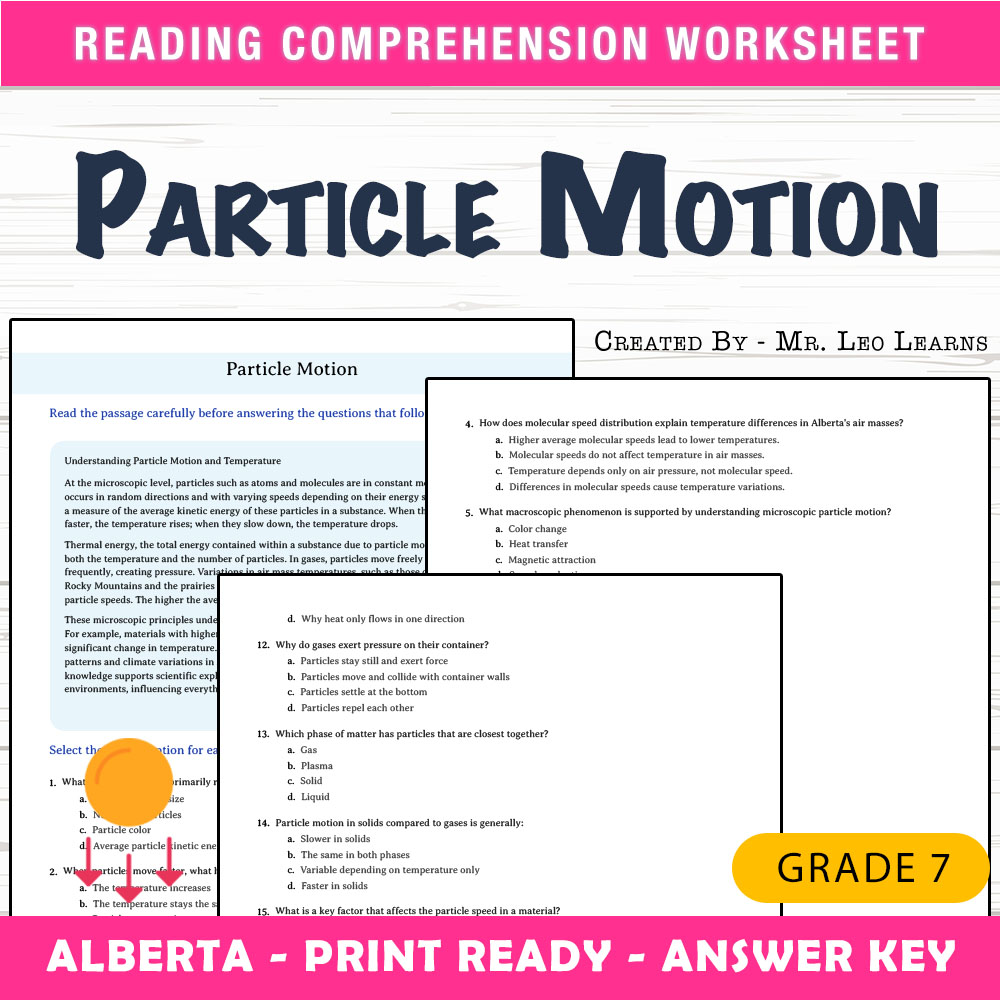
Grade 7 Science — Particle Motion MCQ Worksheet for Mastery
Created byThe Resource HubLearning Objectives
- Understand how microscopic particle motion relates to temperature and thermal energy.
- Explain how particle speed distributions differ with temperature variations in Alberta's air masses.
- Describe the connection between particle motion and macroscopic heat transfer processes.
Also included in: Grade 7 Science Alberta Energy Heat Thermal Processes Worksheet Bundle +1 more
Instant download

Grade 7 Mass Wasting and Coasts Worksheet | NGSS Practice PDF
Created byClear Sky ClassroomLearning Objectives
- Explain how gravity and water-driven forces move Earth's surface material during mass wasting and coastal erosion.
- Describe how saturation from prolonged rain can destabilize slopes and trigger landslides.
- Compare ways waves and storm surge reshape coastlines by removing sand and changing shoreline shape.
Instant download

Grade 7 Quantitative Models Worksheet | NGSS Practice PDF
Created byClear Sky ClassroomLearning Objectives
- Understand how mathematical and statistical tools are used to analyze evolutionary processes.
- Apply concepts like allele frequency, Hardy-Weinberg equilibrium, and population dynamics to real data.
- Interpret graphical displays of fitness and trait changes over time.
Also included in: Grade 7 Natural Selection & Adaptation Science Lesson Bundle for NGSS +1 more
Instant download
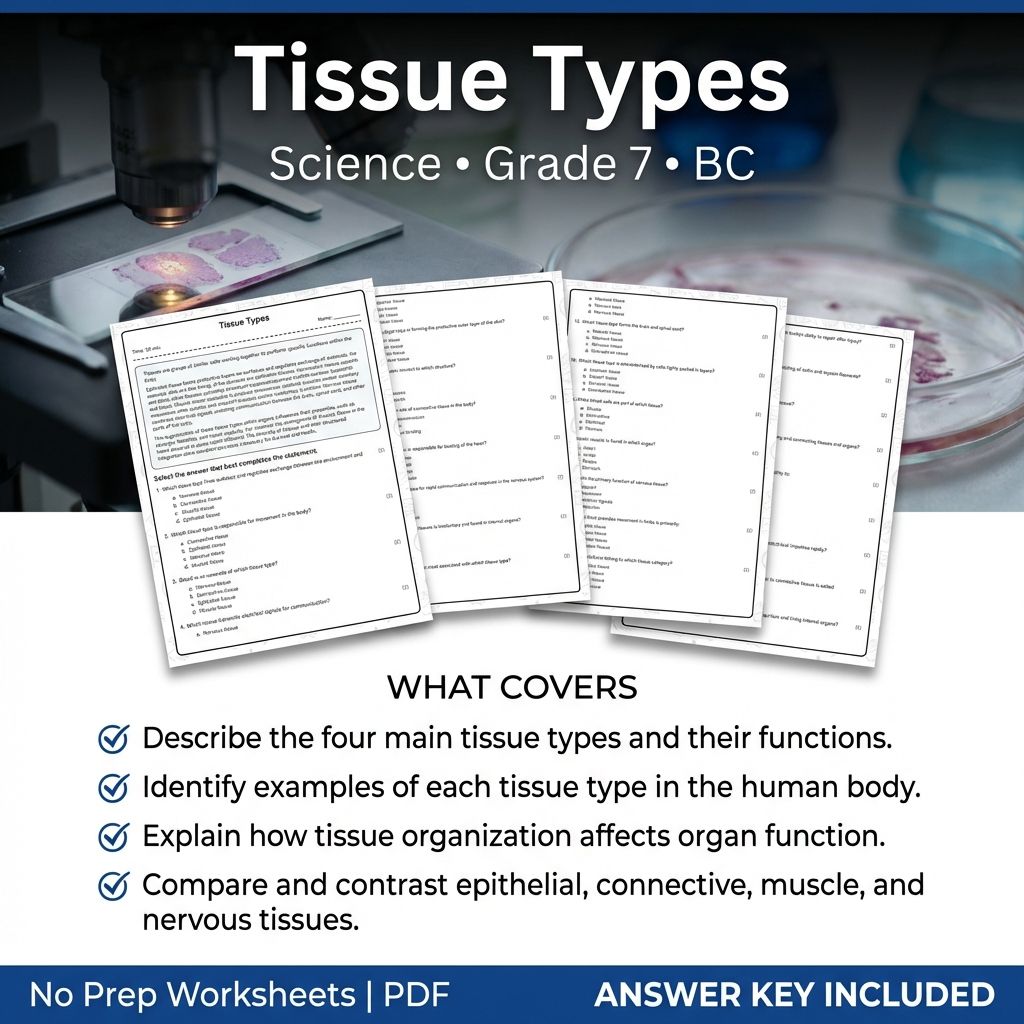
Grade 7 Science | Tissue Types Worksheet with PDF Answer Key and Rubric
Created byCoral Reef LearningLearning Objectives
- Describe the four main tissue types and their functions.
- Identify examples of each tissue type in the human body.
- Explain how tissue organization affects organ function.
Instant download

Closed Systems Practice Worksheet | Grade 7 Science Review and Assessment
Created byPrism Point LearningLearning Objectives
- Differentiate between open and closed systems by identifying whether matter can cross the system boundary
- Use the idea of mass conservation to explain how rearrangement of particles affects mass in a closed system
- Predict and interpret observed mass changes when gases or dissolved substances can enter or leave a system
Also included in: Matter & Chemical Change Lesson Bundle — Grade 7 Science British Columbia +1 more
Instant download

Grade 7 Earth Resources Science Daily Reading Worksheet | TEKS Activity
 Created byBRIGHT PATH RESOURCES
Learning Objectives
- Identify key details about freshwater reservoirs and their roles in the water cycle
- Explain how rivers, lakes, ice, and groundwater store and move water
- Use text structure clues to connect processes to resource availability
Also included in: Earth Resources & Space Systems Grade 7 Science Lesson Bundle | TEKS +1 more
Instant download
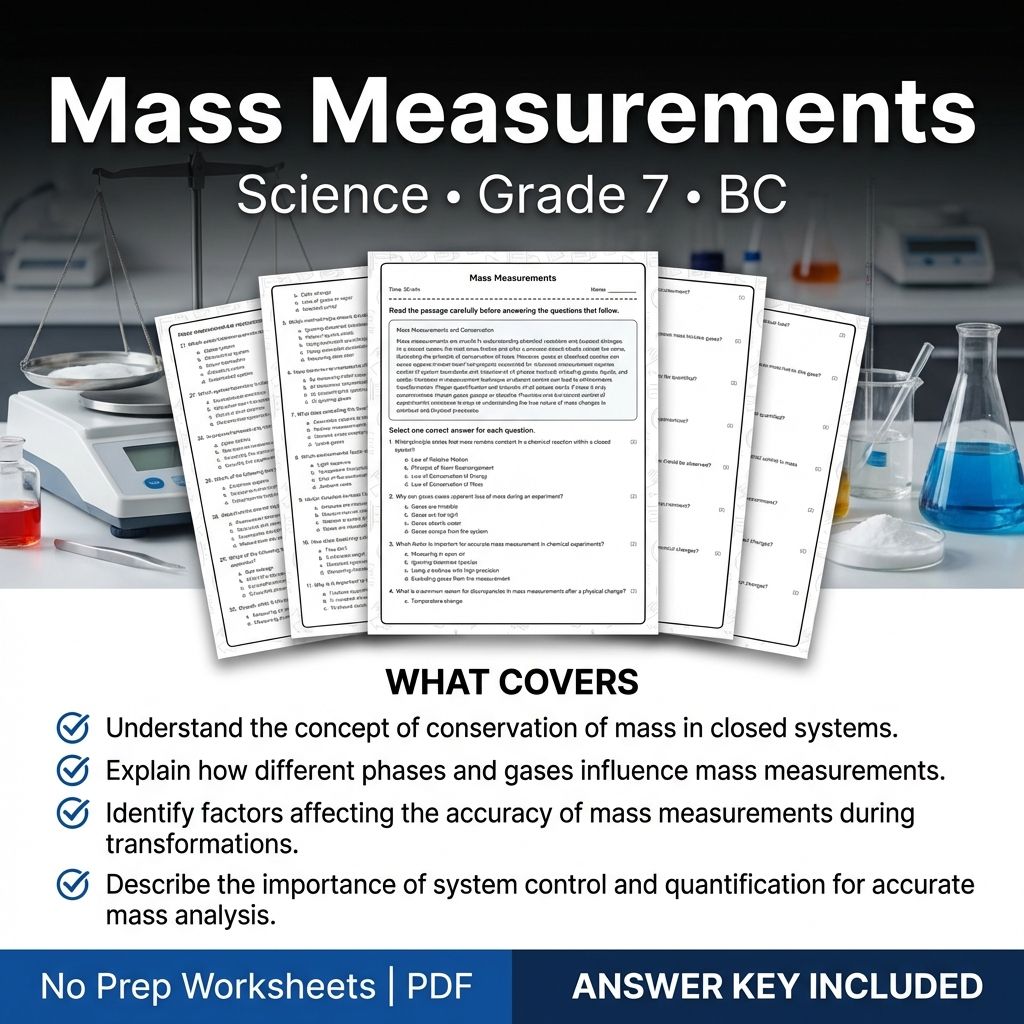
Grade 7 Science | Mass Measurements Worksheet with Answer Key (Printable PDF)
Created byCoral Reef LearningLearning Objectives
- Understand the concept of conservation of mass in closed systems.
- Explain how different phases and gases influence mass measurements.
- Identify factors affecting the accuracy of mass measurements during transformations.
Instant download

Grade 7 Science – Change Indicators & Chemical Reactions | Reading Worksheet
Created byBright Mind ResourcesLearning Objectives
- Identify different signs indicating chemical and physical changes based on reading and observation.
- Understand how to differentiate between physical and chemical changes using evidence.
- Describe observable signs such as gas formation, color change, temperature change, precipitate formation, and irreversible transformation.
Also included in: Grade 7 States of Matter & Reactions Science Daily Reading Lesson Bundle | BC +1 more
Instant download
Grade 7 Science | Tissue Types Reading Worksheet with Answer Key (PDF)
JCreated byJ.S SheetsLearning Objectives
- Describe the primary functions of the four tissue types: epithelial, connective, muscle, and nervous tissue.
- Identify examples and locations of each tissue type in the human body.
- Explain how tissue types work together within organs to perform specific functions.
Instant download
Grade 7 Science – Fossil Patterns Daily Reading Worksheet(PDF + Answer Key)
 Created byCopper Leaf Classroom
Learning Objectives
- Understand key concepts related to Science
- Apply knowledge through practice questions
- Demonstrate comprehension of the material
Instant download
About Grade 7 Science Worksheets
Browse 6,039 printable Grade 7 Science worksheets — ready-to-print PDFs with answer keys where available.
Every worksheet on MyTeachingSheets is created by independent teacher-authors and reviewed before publication. All resources download as printable PDFs for classroom, homework, or at-home practice, and many include answer keys. Preview any worksheet free before buying.