
Grade 8 Science Worksheets
6,006 worksheets
Solution Comparison Worksheet | NGSS Aligned Grade 8 Science Practice
JCreated byJ.S SheetsLearning Objectives
- Understand the development and evaluation of multiple design concepts based on criteria and constraints.
- Differentiate solutions using sketches, trade-off matrices, and qualitative versus quantitative assessments.
- Analyze how functional requirements align with feasible materials and document benefits and limitations.
Also included in: Grade 8 Design Optimization and Tradeoff Analysis Science Lesson Bundle – NGSS +1 more
Instant download

Phase Changes and Energy Exchange Worksheets | Grade 8 Science
 Created bySunny Desk Resources
Learning Objectives
- Describe how energy exchange causes matter to change between solid, liquid, and gas during phase transitions.
- Identify examples of melting, freezing, vaporization, and condensation in everyday Alberta contexts.
- Explain how pressure and energy changes affect particle arrangement and phase behavior.
Also included in: Matter & Chemical Change Grade 8 Science Bundle | Alberta Worksheets +1 more
Instant download

Species Interactions Worksheets for Grade 8 Life Science
 Created byBRIGHT PATH RESOURCES
Learning Objectives
- Describe how predation, competition, mutualism, and parasitism affect survival and reproduction
- Explain how interactions between species can change population size over generations
- Use evidence from a passage to identify relationships that increase or decrease survival
Also included in: Grade 8 Life Science Bundle | Homeostasis, Genetics & Ecosystems +2 more
Instant download

Natural Hazards Review & Practice Worksheets | Grade 8 Science
 Created byPrism Point Learning
Learning Objectives
- Interpret natural hazard data using earthquake catalogs, fault maps, and eruption histories to understand patterns over time and space.
- Explain how paleoseismology, satellite geodesy, and tsunami records help estimate recurrence intervals and hazard likelihood.
- Use statistical and geospatial reasoning to describe potential impacts and evaluate engineering, land-use, and early-warning choices.
Instant download

Properties Overview Worksheet for Grade 8 Science
JCreated byJ.S SheetsLearning Objectives
- Identify measurable physical properties of matter, including density, solubility, melting point, boiling point, and conductivity.
- Compare substances using quantitative information such as mass, volume, and temperature.
- Explain how physical properties help classify and separate materials in lab and everyday situations.
Instant download

Energy Efficiency Worksheet | Grade 8 Science Activities
Created byPrism Point LearningLearning Objectives
- Explain how energy is transferred between trophic levels and why energy decreases at each step.
- Use typical efficiency ranges to estimate how much energy becomes available to higher trophic levels.
- Describe how energy availability influences biomass pyramids, population sizes, and biodiversity in different ecosystems.
Instant download

Phase Changes Assessment | Florida NGSSS Grade 8 Science Standards
Created byPrism Point LearningLearning Objectives
- Explain how energy transfer is involved in phase changes such as melting, freezing, evaporation, and condensation.
- Describe particle-level arrangements and motion during different phase changes.
- Use evidence from everyday examples (ice melting, water droplets forming) to identify the phase change occurring.
Instant download

Grade 8 Science | Weather and Climate Data Worksheet (PDF)
 Created byEvergreen Desk Education
Learning Objectives
- Distinguish short-term weather patterns from long-term climate patterns using data records
- Interpret graphs and summary statistics to identify variability versus change over time
- Explain how precipitation, temperature, and storm frequency can differ from day-to-day to decade-to-decade
Also included in: Grade 8 Earth and Space Science Lesson Bundle - General Framework +1 more
Instant download

Climate Drivers Worksheet | NGSS Grade 8 Science Assessment
 Created bySkylark Worksheets
Learning Objectives
- Explain why scientists compare multiple lines of evidence when evaluating changes in global temperature over time.
- Distinguish between natural and anthropogenic climate drivers (greenhouse gases, volcanic aerosols, and solar variability).
- Describe how climate feedbacks can amplify or reduce warming and why models are used to test hypotheses.
Also included in: Grade 8 Earth and Human Activity Science Lesson Bundle (NGSS) +1 more
Instant download

Organ Systems Survival Assessment Grade 8 Science | Standards-Aligned
Created byPrism Point LearningLearning Objectives
- Understand the functions of different organ systems in maintaining homeostasis.
- Identify how organ systems collaborate to support survival needs like nutrient intake, gas exchange, and movement.
- Explain the relationship between structure and function in various organs.
Also included in: Grade 8 Life Science Science Lesson Bundle – General Framework Resources
Instant download

Grade 8 Science | Gas Exchange Worksheet + Answer Key (PDF)
 Created byBright Mind Resources
Learning Objectives
- Explain how thin, moist surfaces facilitate gas exchange in organisms.
- Identify structures involved in gas exchange such as alveoli and stomata.
- Describe how cellular adaptations support efficient diffusion of gases.
Instant download

Gas Exchange Worksheet Pack | Grade 8 Science Activities
Created byPrism Point LearningLearning Objectives
- Explain how diffusion drives gas exchange between the environment and internal fluids.
- Describe how thin, moist surfaces and large surface area increase the rate of gas exchange.
- Identify gas-exchange adaptations in lungs and leaves and relate them to function.
Also included in: Grade 8 Science Full-Year Bundle | BC Science Framework
Instant download

Problem Definition in Engineering Worksheet | NGSS Grade 8 Science
 Created byCedar Grove Learning
Learning Objectives
- Understand how to define criteria and constraints for engineering problems.
- Identify measurable performance goals, safety, and environmental considerations.
- Analyze trade-offs among time, cost, and durability in problem scenarios.
Instant download

Grade 8 Science | Density & Buoyancy - Daily Reading Comprehension
 Created byCoral Reef Learning
Learning Objectives
- Understand key concepts related to Science
- Apply knowledge through practice questions
- Demonstrate comprehension of the material
Instant download

Population Patterns Worksheet | Alberta Grade 8 Science Assessment
JCreated byJ.S SheetsLearning Objectives
- Understand key concepts of population dynamics including exponential growth, logistic regulation, and cyclical fluctuations.
- Link theoretical population curves to real-world case studies like snowshoe hare–lynx cycles and forest insect outbreaks.
- Explain how carrying capacity, reproductive strategies, and time lags influence population trajectories.
Instant download

Grade 8 Science Worksheet | Membrane Structure & Cell Membranes (Ontario)
Created byEvergreen Desk EducationLearning Objectives
- Explain how the phospholipid bilayer forms a selective barrier for cells
- Identify the roles of integral and peripheral membrane proteins in transport, signaling, and structural support
- Describe how cholesterol, carbohydrates, and membrane fluidity affect permeability and cell interactions
Also included in: Grade 8 Cell Structure & Homeostasis Science Lesson Bundle (Ontario) +1 more
Instant download

Grade 8 Science | Action–Reaction Forces Worksheet | California Standards
 Created byLumora Learning
Learning Objectives
- Explain Newton’s third law using action–reaction force pairs acting on two different objects
- Identify that action–reaction forces are equal in magnitude, opposite in direction, and occur at the same time
- Predict how different masses change acceleration even when force magnitudes are equal
Instant download

Grade 8 Variables and Controls Science Daily Reading Worksheet | TEKS
Created byBRIGHT PATH RESOURCESLearning Objectives
- Identify independent, dependent, and controlled variables in a science scenario.
- Recognize how a fair test keeps some variables constant while changing one factor.
Also included in: Grade 8 Science Skills Daily Reading Worksheets Bundle | TEKS +1 more
Instant download
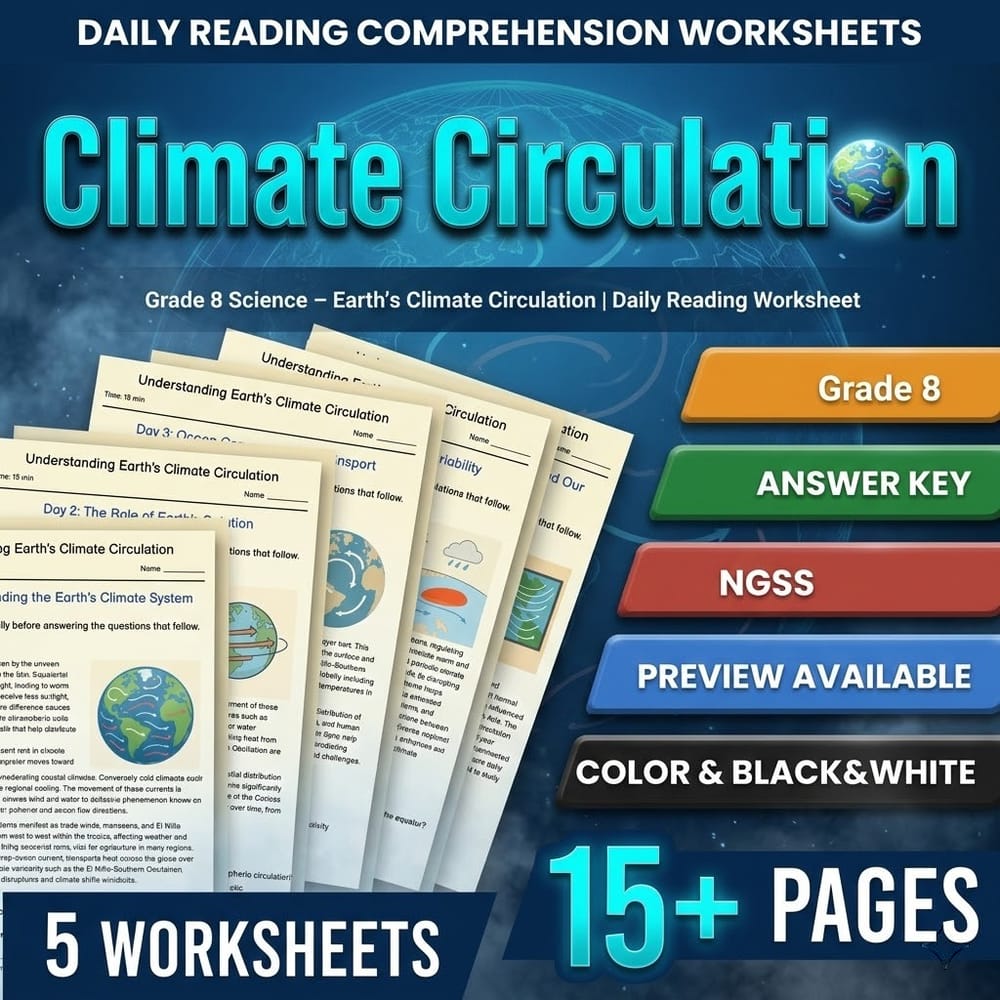
Grade 8 Science – Earth's Climate Circulation | Daily Reading Worksheet
 Created byElena Brooks
Learning Objectives
- Identify major atmospheric circulation cells
- Explain how ocean currents affect regional climates
- Analyze the influence of planetary rotation on wind patterns
Instant download

Energy Transfer Worksheet | Grade 8 Science Activities
Created byPrism Point LearningLearning Objectives
- Explain how mechanical energy changes between kinetic and potential forms during motion.
- Describe how applied force and displacement relate qualitatively to the energy transferred to an object.
- Connect real-world examples (elevators, skiing, braking) to work done by forces on a system.
Also included in: Forces, Motion & Energy Lesson Bundle | Grade 8 Science | Alberta
Instant download

Variables and Controls Assessment | TEKS Grade 8 Science Worksheet
Created byPrism Point LearningLearning Objectives
- Identify independent, dependent, and controlled variables in experiments.
- Understand the importance of fair testing and proper controls.
- Describe factors influencing reproducibility and accuracy in scientific investigations.
Also included in: Grade 8 Scientific Inquiry & Data Analysis Science Lesson Bundle TEKS
Instant download

Hydraulic Systems Worksheet Grade 8 Science Ontario | Pascal's Principle
 Created byClear Sky Classroom
Learning Objectives
- Explain how pressure in a confined fluid can transmit force in a hydraulic system
- Use the force–area relationship to determine output force and input pressure in piston assemblies
- Evaluate how design factors (viscosity, seals, and compressibility) affect hydraulic performance
Instant download

Friction Effects Test Prep Printables | Grade 8 Science
Created byPrism Point LearningLearning Objectives
- Explain how static and kinetic friction affect motion and energy loss in real systems.
- Describe how normal force and surface texture influence the size of frictional forces.
- Evaluate how aerodynamic drag changes the performance of moving objects.
Also included in: Grade 8 Work, Energy & Forces Science Lesson Bundle – Ontario Test Prep
Instant download

Grade 8 Science – Bernoulli Principle & Fluid Flow | Daily Reading Worksheet
Created byBright Mind ResourcesLearning Objectives
- Understand the basic concepts of fluid flow and pressure
- Learn how Bernoulli's principle relates fluid speed and pressure
- Apply Bernoulli's principle to real-world scenarios like airfoils and piping
Also included in: Grade 8 Fluid Mechanics & Pressure Science Lesson Bundle | Ontario +1 more
Instant download

Grade 8 DNA and Traits Worksheet | NGSS Genetics Science Activity PDF
Created byBRIGHT PATH RESOURCESLearning Objectives
- Identify and describe the main components of DNA.
- Explain how DNA sequences determine protein structure.
- Understand how gene mutations can alter traits.
Also included in: Genetics DNA Traits Grade 8 Science Daily Reading Worksheets Bundle | NGSS +2 more
Instant download

Grade 8 Science – Communication Skills & Data Analysis | Daily Reading Worksheet
Created byBright Mind ResourcesLearning Objectives
- Understand key elements of scientific communication
- Identify clear explanations supported by evidence
- Apply the claim–evidence–reasoning structure in scientific writing
Also included in: Experiments Grade 8 Science Daily Reading Worksheets Lesson Bundle | TEKS +2 more
Instant download

Conservation Approaches Worksheet | Grade 8 Science Activities
Created byPrism Point LearningLearning Objectives
- Explain how conservation approaches like protected areas, restoration, and habitat corridors help maintain biodiversity and ecosystem stability.
- Describe how sustainable resource management and threat reduction (pollution, overharvesting) increase long-term resilience.
- Evaluate conservation effectiveness using monitoring and adaptive management.
Also included in: Ecosystems & Biodiversity Lesson Bundle | Grade 8 Science | BC +1 more
Instant download

Grade 8 Science | Friction and Drag Worksheet | BC Standards
Created byLumora LearningLearning Objectives
- Explain the concepts of friction and fluid drag as resistive forces opposing motion.
- Identify factors influencing friction and drag, such as surface types, speed, and fluid properties.
- Describe how resistive forces convert mechanical energy into thermal energy.
Also included in: Grade 8 Science | Forces and Motion Custom Bundle | BC Standards
Instant download

Grade 8 Science | Graphical Reasoning in Science - Daily Reading Comprehension
Created byCoral Reef LearningLearning Objectives
- Understand how to interpret the slope of distance-time graphs to determine speed
- Connect graphical representations with concepts of motion and rate of change
- Identify the relationship between the slope of a graph and the physical quantity it represents
Instant download

Grade 8 Science – Force Diagrams & Forces | Daily Reading Worksheet
 Created byQuiet Forest Education
Learning Objectives
- Understand the purpose and components of free-body diagrams
- Identify different types of forces acting on objects
- Draw basic free-body diagrams for systems under contact and non-contact forces
Also included in: Energy Grade 8 Science Daily Reading Worksheets Bundle | Ontario Framework +1 more
Instant download

Grade 8 Simple Machines Worksheet | BC Practice PDF
Created byClear Sky ClassroomLearning Objectives
- Explain how simple machines change forces and motion by using mechanical advantage and work concepts
- Describe ideal vs. real machine behavior, including efficiency and frictional losses
- Connect examples (levers, pulleys, gears, winches, bicycles, seesaws) to input/output forces and distances
Instant download

Grade 8 Science Organelles Roles Worksheet | Cell Organelles Ontario
 Created byChalk and Compass
Learning Objectives
- Explain how major cell organelles contribute to energy conversion, protein synthesis, and material transport.
- Describe the interdependence of organelles by linking structure to function.
- Predict how organelle dysfunction can affect overall cell performance.
Also included in: Grade 8 Science Cell Organization, Transport & Homeostasis Lesson Bundle – Ontario +1 more
Instant download

Grade 8 Science – Predictive Models & Scientific Thinking | Reading Worksheet
Created byBright Mind ResourcesLearning Objectives
- Understand what components make up a simple scientific model
- Learn how models are used to predict outcomes in scientific phenomena
- Recognize the importance of assumptions in scientific models
Also included in: Scientific Thinking & Evidence Grade 8 Science Lesson Bundle | General +1 more
Instant download

Water Cycle Worksheet Grade 8 Science Activities Earth Systems Practice
Created byPrism Point LearningLearning Objectives
- Describe the main processes of the water cycle and how they move water through Earth systems
- Explain how the Sun provides energy and gravity helps move water through the cycle
- Connect water-cycle processes to weather and environmental impacts
Instant download

Grade 8 Hydrostatic Variation Worksheet | Pressure, Density & Depth Ontario
Created byChalk and CompassLearning Objectives
- Explain how hydrostatic pressure depends on fluid density and depth using p = ρgh
- Compare pressure at different heights in a fluid and predict where the pressure is greatest
- Describe how hydrostatic pressure principles apply to communicating vessels and real structures
Also included in: Fluids, Pressure & Flow Lesson Bundle — Grade 8 Science Ontario +1 more
Instant download

Grade 8 Science | Genes & Traits - Daily Reading Comprehension
Created byCoral Reef LearningLearning Objectives
- Understand what genes are and how they influence traits
- Identify how genes are inherited from parents
- Learn about different alleles and their roles in inheritance
Instant download

Grade 8 Science – Measurement Basics Worksheet (TEKS) (PDF)
Created byEvergreen Desk EducationLearning Objectives
- Use SI units to measure and report length, mass, volume, and temperature correctly.
- Convert units using dimensional analysis and appropriate conversion factors.
- Determine the number of significant figures in measurements and explain why accuracy and precision matter.
Instant download

Grade 8 Science – Circuit Fundamentals Reading Worksheet | Alberta Standards
Created byBright Mind ResourcesLearning Objectives
- Identify key components of basic electric circuits
- Understand the function of sources, conductors, loads, and control elements
- Recognize schematic symbols for circuit components
Also included in: Grade 8 Electricity Science Daily Reading Worksheets Lesson Bundle | Alberta +2 more
Instant download

Grade 8 Science | Organ Formation Worksheet (PDF) BC Standards
Created byEvergreen Desk EducationLearning Objectives
- Explain how different tissues work together to form an organ with a specific function.
- Describe how organ architecture (layering, junctions, and channels) supports efficient performance.
- Use organ formation concepts to predict how tissue interactions create organ-level properties.
Instant download

Gravity Attraction Worksheet | Standards-Based Practice for Grade 8 Science
JCreated byJ.S SheetsLearning Objectives
- Understand how gravitational force depends on mass and distance.
- Explain why objects with larger mass exert stronger gravity.
- Describe how increasing distance decreases gravitational attraction.
Also included in: Grade 8 Forces, Energy & Matter Science Lesson Bundle | California Standards +1 more
Instant download
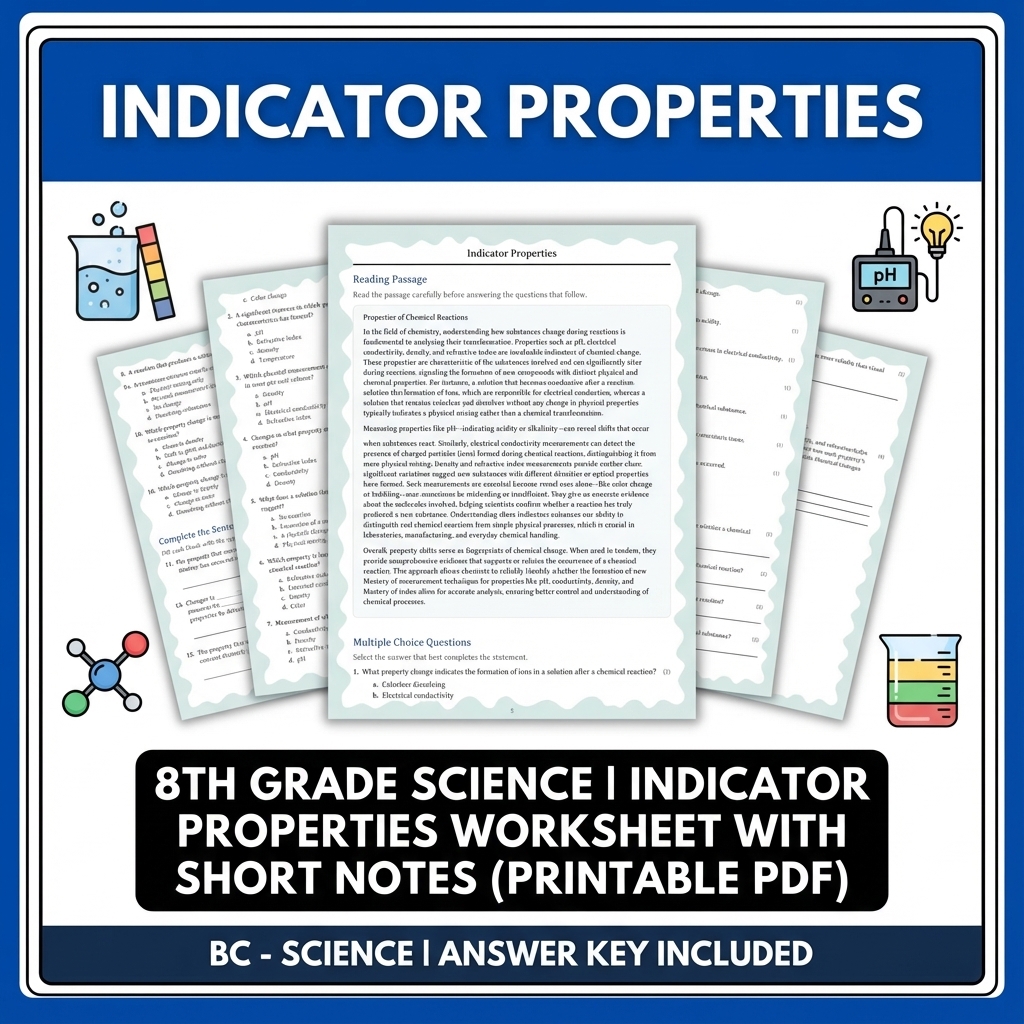
Grade 8 Science Reading Worksheets | Indicator Properties Mastery (PDF)
JCreated byJ.S SheetsLearning Objectives
- Understand how properties such as pH, conductivity, density, and refractive index change during chemical reactions.
- Learn how property shifts serve as evidence of chemical changes beyond visual cues.
- Differentiate between physical mixing and true chemical transformation using property measurements.
Instant download

Atmospheric Effects Practice Worksheet | Grade 8 Science Review Assessment
Created byPrism Point LearningLearning Objectives
- Explain how atmospheric pressure affects boiling temperature and sealed systems
- Describe how barometers measure air pressure and how weather instruments use pressure differences
- Predict how pressure changes with altitude and how pressure gradients drive wind
Instant download

Aquifer Dynamics Worksheet Grade 8 Science | Groundwater Flow and Vulnerability
JCreated byJ.S SheetsLearning Objectives
- Explain how porosity, permeability, and hydraulic head control groundwater storage and movement.
- Distinguish between confined and unconfined aquifers and identify recharge and discharge zones.
- Relate sediment and bedrock properties to groundwater velocity, well yield, and contamination risk.
Instant download

Flotation Stability Worksheet Grade 8 Science Ontario | Buoyancy & Density
Created byClear Sky ClassroomLearning Objectives
- Explain how the centre of gravity (CG) and centre of buoyancy (CB) affect whether a floating body returns upright.
- Describe the role of metacentric height (GM) in upright equilibrium and righting moments.
- Predict how loading and trim can increase or decrease stability and the risk of capsizing.
Instant download

Population Models Worksheet | Grade 8 Science Printable PDF | NPSS
Learning Objectives
- Understand mathematical representations of population growth, including exponential and logistic models.
- Identify factors that influence population size such as resources, predation, and environmental capacity.
- Interpret graphical population curves and relate them to real-world scenarios like predator-prey cycles.
Also included in: Grade 8 Biological Evolution Lesson Bundle: Unity and Diversity +1 more
Instant download
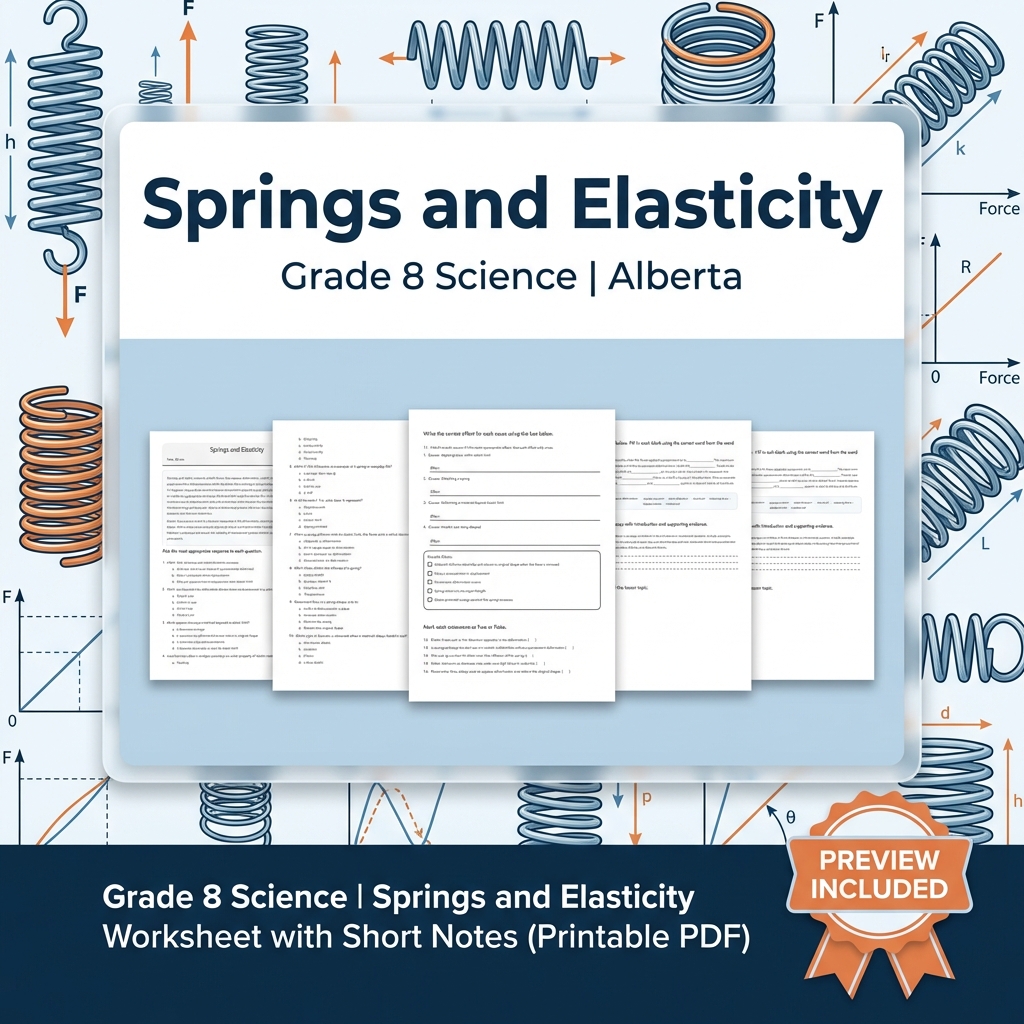
Grade 8 Science | Springs and Elasticity Worksheet with Short Notes (PDF)
 Created byMeadowlark Worksheets
Learning Objectives
- Understand the proportional relationship between force and displacement in springs.
- Identify real-world examples of elastic forces in mechanical systems.
- Explain the concepts of linear elastic behavior limits and restorative forces.
Also included in: Grade 8 Science Forces & Motion UNIT Bundle – Alberta Curriculum +1 more
Instant download

Grade 8 Science – Rock Evidence Types & Formation | Daily Reading Worksheet
Created byBright Mind ResourcesLearning Objectives
- Identify and describe the main types of rocks: igneous, sedimentary, and metamorphic.
- Understand the processes involved in the rock cycle such as melting, cooling, sedimentation, compaction, and metamorphism.
- Recognize how geological features like strata, fossils, and radiometric dating provide evidence of Earth's history.
Also included in: Grade 8 Earth & Space Science Daily Reading Worksheets Lesson Bundle | TEKS +2 more
Instant download

Earthquake Patterns Worksheet Grade 8 Science Seismic Activity Practice
Created byPrism Point LearningLearning Objectives
- Explain how earthquake locations relate to plate boundaries and fault zones.
- Describe how seismic data patterns can provide evidence of Earth’s internal structure and ongoing tectonic motion.
- Use wave behavior to reason about why seismic observations are not random around the globe.
Instant download
About Grade 8 Science Worksheets
Explore Grade 8 Science worksheets for classwork, homework, or review. Our 6,006 printables download instantly as PDFs.
Each resource here is built by an independent educator and reviewed for quality. Worksheets print straight from PDF and suit classroom use, homework, or extra practice; most come with answer keys, and you can preview before purchasing.