
Grade 8 Science Worksheets
6,006 worksheets
Mass Conservation Worksheet | Grade 8 Science NGSS Practice and Review
 Created byPrism Point Learning
Learning Objectives
- Explain mass conservation by accounting for matter in closed chemical systems
- Connect macroscopic measurements (mass before and after) to microscopic particle conservation (atoms)
- Use balanced symbolic equations to represent that atoms and total mass are conserved
Also included in: Grade 8 Matter & Chemical Reactions Science Lesson Bundle (NGSS)
Instant download
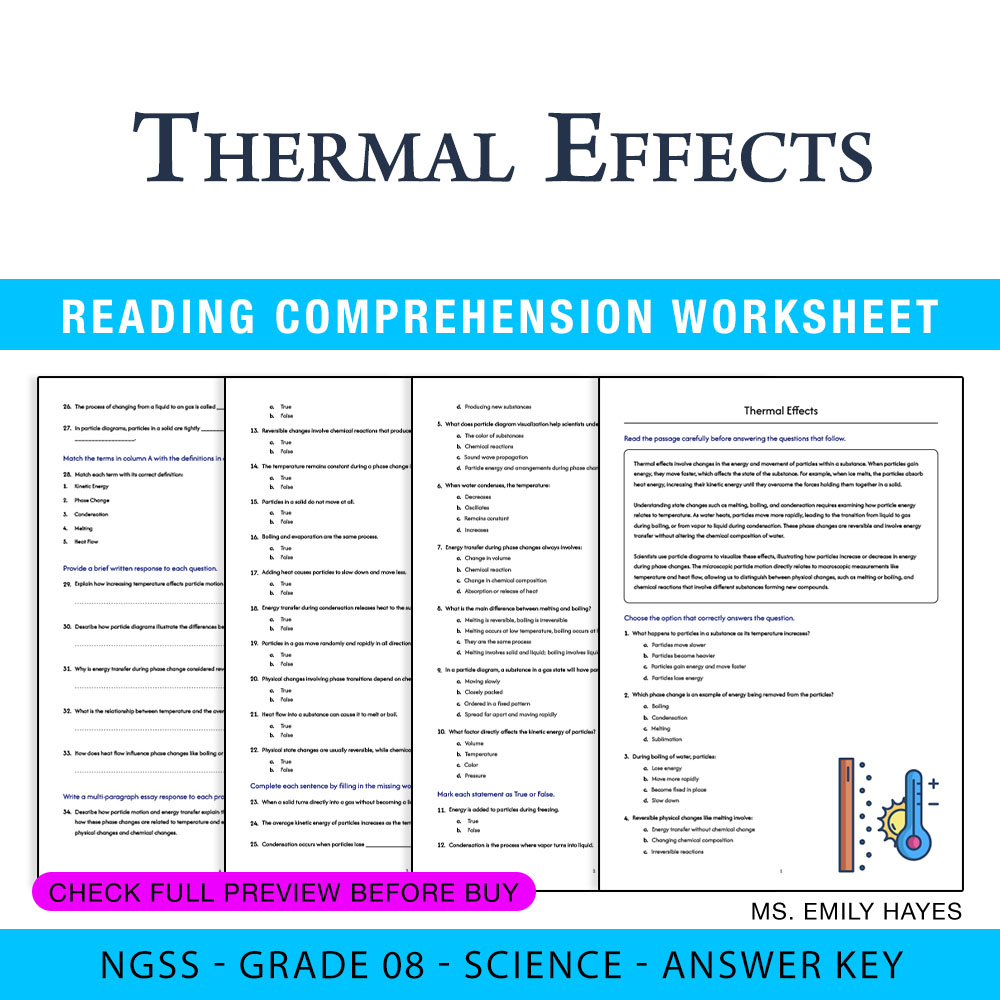
8th Grade Science | Thermal Effects Worksheet (PDF+ Answer Key)
 Created byCopper Leaf Classroom
Learning Objectives
- Understand how particle motion, temperature, and energy transfer influence states of matter and phase changes for pure substances.
- Explain melting, boiling, and condensation through particle diagrams and temperature-phase behavior.
- Relate macroscopic measurements of temperature and heat flow to microscopic particle motion and distinguish reversible physical changes from chemical changes.
Instant download

Mechanical Advantage Worksheet Pack | Grade 8 Science Activities
Created byPrism Point LearningLearning Objectives
- Calculate ideal and real mechanical advantage using input/output forces and distances
- Use work and efficiency ideas to compare different machine configurations
- Check unit consistency and apply simple algebra to solve for unknown forces or distances
Also included in: Grade 8 Force, Motion & Energy Science Lesson Bundle for TEKS Practice +1 more
Instant download
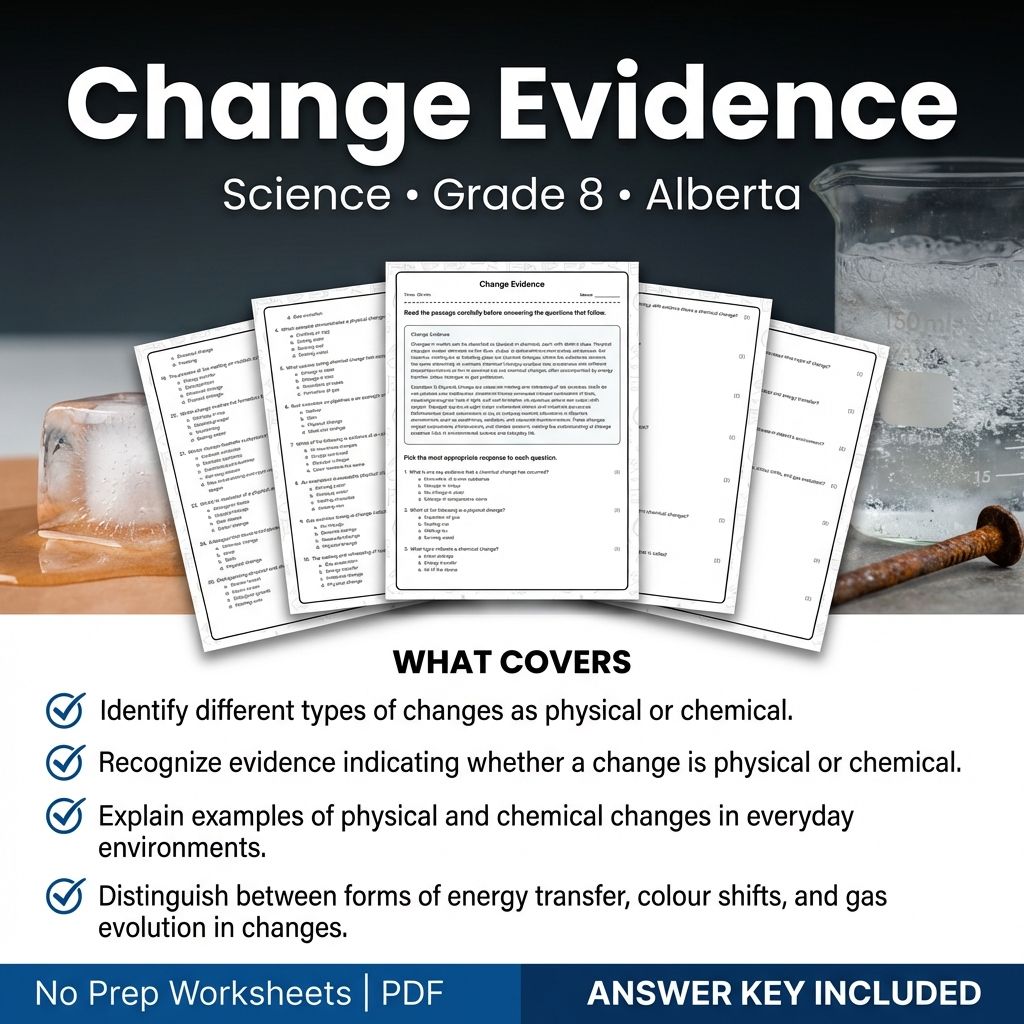
Change Evidence Worksheet for Grade 8 Science | Alberta Standards Practice
 Created byCoral Reef Learning
Learning Objectives
- Identify different types of changes as physical or chemical.
- Recognize evidence indicating whether a change is physical or chemical.
- Explain examples of physical and chemical changes in everyday environments.
Instant download

Grade 8 Earth Motions Day and Night Science Daily Reading | TEKS
 Created byBRIGHT PATH RESOURCES
Learning Objectives
- Explain the cause-and-effect relationship between Earth’s rotation and day and night.
- Describe how the length of daylight changes as Earth moves around the Sun.
- Use terms like rotation, revolution, and axial tilt in accurate explanations.
Also included in: Grade 8 Earth and Space Science Daily Reading Worksheets Bundle | TEKS +1 more
Instant download

Grade 8 Science | Force Diagrams - Daily Reading Comprehension
Created byCoral Reef LearningLearning Objectives
- Understand key concepts related to Science
- Apply knowledge through practice questions
- Demonstrate comprehension of the material
Instant download
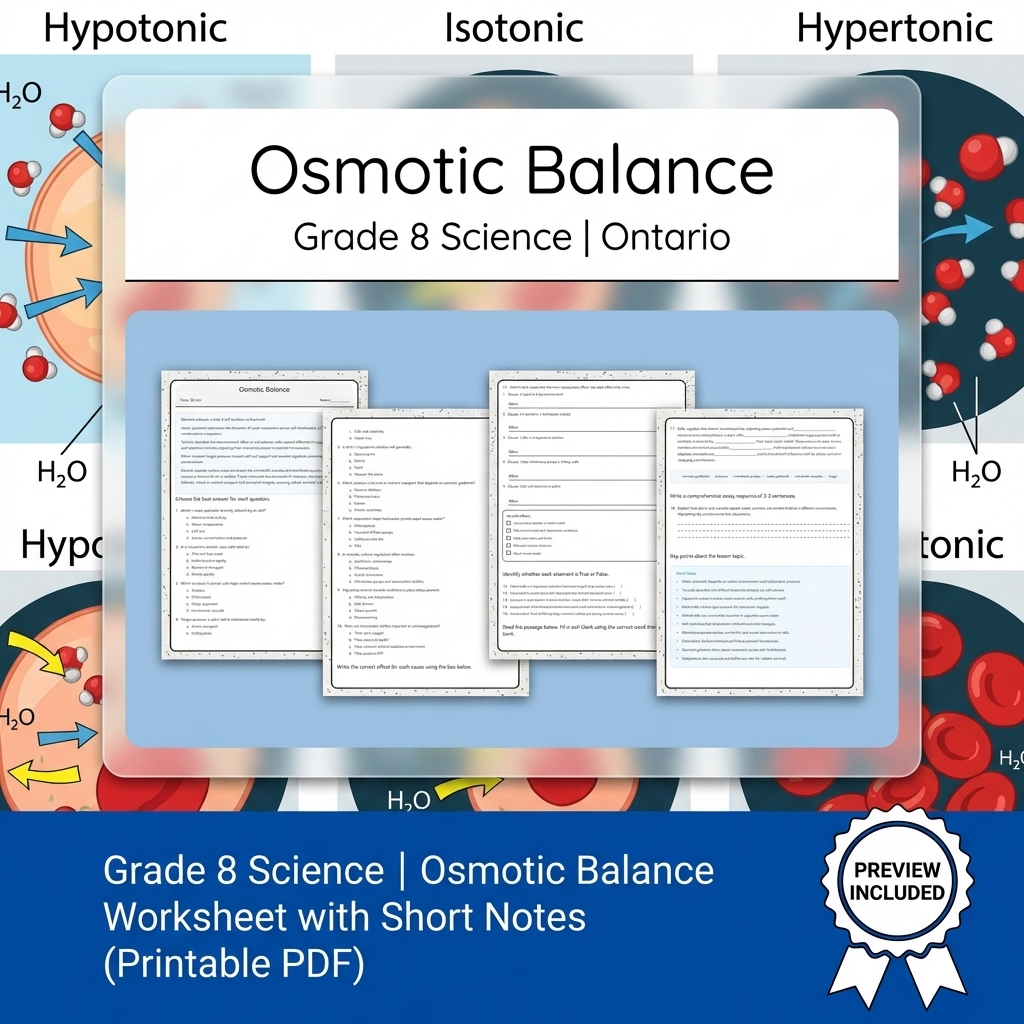
Grade 8 Science | Osmotic Balance Worksheet with Short Notes (Printable PDF)
 Created byMeadowlark Worksheets
Learning Objectives
- Explain the principles of water potential, tonicity, and cellular response mechanisms.
- Describe how plant and animal cells maintain volume and turgor pressure under different environments.
- Identify adaptations like contractile vacuoles, membrane pumps, and extracellular fluid buffering in osmoregulation.
Also included in: Grade 8 Science Lesson Group Bundle | Ontario Curriculum Worksheets +1 more
Instant download

Grade 8 Science | Understanding Population Drivers - Daily Reading Comprehension
Created byCoral Reef LearningLearning Objectives
- Identify key factors influencing population size and distribution
- Explain how abiotic and biotic components interact to shape populations
- Relate real-world examples such as migration, habitat, and climate effects
Also included in: Interactions and Ecosystems Lesson Bundle Grade 8 Science – Alberta +1 more
Instant download

Grade 8 Chemical Indicators & Reactions Worksheet PDF | California Standards
 Created byEvergreen Desk Education
Learning Objectives
- Explain how chemical indicators provide evidence of chemical changes at the particle level.
- Differentiate physical and chemical changes by using observations such as color change, gas formation, and precipitate formation.
- Use evidence-based reasoning to decide whether new substances are formed during an experiment.
Instant download

Cell Structure Worksheet | NGSS Grade 8 Science Assessment
 Created bySkylark Worksheets
Learning Objectives
- Compare prokaryotic and eukaryotic cells by identifying major structural differences and their functional consequences.
- Describe the functions of key organelles (nucleus, mitochondria, chloroplasts, ribosomes, cell membrane, cell wall) and how they support cell survival.
- Connect microscopy and cell imaging observations to visible traits of organisms.
Also included in: Grade 8 Molecules to Organisms Structures & Processes Science Lesson Bundle NGSS +1 more
Instant download

Grade 8 Science – Weather & Climate | Daily Reading Worksheet
 Created byBright Mind Resources
Learning Objectives
- Understand the difference between weather and climate.
- Identify examples of short-term atmospheric conditions.
- Describe how long-term patterns define climate.
Also included in: Grade 8 Earth Science Daily Reading Worksheets Lesson Bundle | Florida NGSSS +1 more
Instant download

Grade 8 Conservation of Energy Worksheet | NGSS Practice PDF
 Created byClear Sky Classroom
Learning Objectives
- Explain conservation of energy using the idea that energy is transferred and transformed in physical processes.
- Identify how mechanical energy can change form when friction or other forces act.
- Use energy-conversion reasoning to predict what happens to kinetic energy as motion slows.
Instant download

Grade 8 Science – Flotation Stability Worksheet (PDF) – Ontario Standards
Created byEvergreen Desk EducationLearning Objectives
- Explain how centre of gravity (CG) and centre of buoyancy (CB) relate to upright equilibrium of a floating body
- Describe how metacentric height (GM) influences stability and the risk of capsizing
- Apply stability ideas to real loading and hull-shape situations using righting and tipping moments
Also included in: Grade 8 Fluid Pressure & Forces Science Lesson Bundle: Ontario Worksheet Set +1 more
Instant download

Grade 8 Science | Springs and Elasticity Worksheet (PDF) – Alberta Standards
 Created bySilver Birch Teaching
Learning Objectives
- Explain how elastic forces can be restorative and relate to displacement in many springs
- Identify when a spring or elastic material behaves approximately linearly and when that relationship breaks down
- Use force-balance ideas to describe how elastic components affect mechanical systems
Also included in: Grade 8 Forces, Motion, and Energy Science Lesson Bundle for Alberta +1 more
Instant download

Measuring Biodiversity Worksheet | Science Assessment Grade 8 BC Standards
JCreated byJ.S SheetsLearning Objectives
- Understand different methods used to measure biodiversity at genetic, species, and ecosystem levels.
- Identify factors that influence biodiversity estimates, such as sampling techniques and habitat heterogeneity.
- Compare and interpret biodiversity metrics like species richness, evenness, and diversity indices.
Instant download

Grade 8 Science – Homogeneous Mixtures & Content Understanding | Worksheet
Created byBright Mind ResourcesLearning Objectives
- Define homogeneous mixtures and identify examples in daily life.
- Understand the properties that distinguish homogeneous mixtures from heterogeneous ones.
- Learn how solubility and concentration affect homogeneous solutions.
Also included in: Matter Change Grade 8 Science Daily Reading Worksheets Lesson Bundle | Alberta +2 more
Instant download

Kinetic and Potential Energy Worksheet Pack | Grade 8 Science Activities
Created byPrism Point LearningLearning Objectives
- Differentiate kinetic energy and gravitational potential energy using evidence from motion and position
- Explain how energy can change forms while the total energy stays the same
- Use examples (like a roller coaster) to describe energy transfer between kinetic and potential energy
Instant download

Grade 8 Science – Electric & Magnetic Fields | Daily Reading Worksheet
Created byBright Mind ResourcesLearning Objectives
- Understand key concepts related to Science
- Apply knowledge through practice questions
- Demonstrate comprehension of the material
Also included in: Physical Science Grade 8 Science Daily Reading Worksheets Lesson Bundle | NGSS +1 more
Instant download

Grade 8 Organ System Coordination Worksheet | Practice & Assessment PDF
Created byClear Sky ClassroomLearning Objectives
- Explain how major body organ systems work together to support cell survival and homeostasis.
- Describe the roles of the circulatory, respiratory, digestive, nervous, and endocrine systems in coordination.
- Use evidence from a passage to identify main ideas and evaluate scientific statements.
Instant download

Grade 8 Surface Forces Worksheet | Ontario Science Fluids Activity
Created byClear Sky ClassroomLearning Objectives
- Explain how hydrostatic pressure depends on depth and how that leads to forces on submerged surfaces
- Determine net hydrostatic force and describe how the centre of pressure relates to resultant force location
- Analyze how hydrostatic load creates torque on structures such as dams and bulkheads
Instant download

Variation From Meiosis Worksheet | Grade 8 Science NGSSS Genetics + Key
Created byEvergreen Desk EducationLearning Objectives
- Explain how meiosis creates genetic variation through recombination and random assortment
- Describe how gametes formed by meiosis contribute to differences among offspring
- Connect genetic variation to the raw material needed for evolution over time
Instant download

Transport Systems Worksheet | Standards-Aligned Grade 8 Science Practice
JCreated byJ.S SheetsLearning Objectives
- Understand the structure and function of vascular networks and circulatory systems in plants and animals.
- Identify key cellular components involved in transport roles within organ systems.
- Explain how tissue and organ architecture facilitate bulk flow and diffusion for cellular metabolism.
Instant download

Grade 8 Science | Mutation Effects - Daily Reading Comprehension
Created byCoral Reef LearningLearning Objectives
- Identify different types of genetic mutations
- Understand the causes of mutations
- Recognize how mutations impact organisms and evolution
Instant download

Grade 8 Science – Conservation of Mass & Chemical Reactions | Reading Worksheet
Created byBright Mind ResourcesLearning Objectives
- Understand the principle of conservation of mass in chemical reactions
- Recognize that atoms are neither created nor destroyed during reactions
- Interpret balanced chemical equations showing equal atoms on both sides
Also included in: Grade 8 Chemical Reactions Science Lesson Bundle: Daily Reading | BC +1 more
Instant download

Science Worksheet Membrane Structure Grade 8 | Standards-Aligned Practice
JCreated byJ.S SheetsLearning Objectives
- Explain how the phospholipid bilayer forms a selectively permeable boundary in cells.
- Identify the roles of integral and peripheral membrane proteins in transport and cell communication.
- Describe how cholesterol and carbohydrates contribute to membrane stability and cell-cell recognition.
Instant download
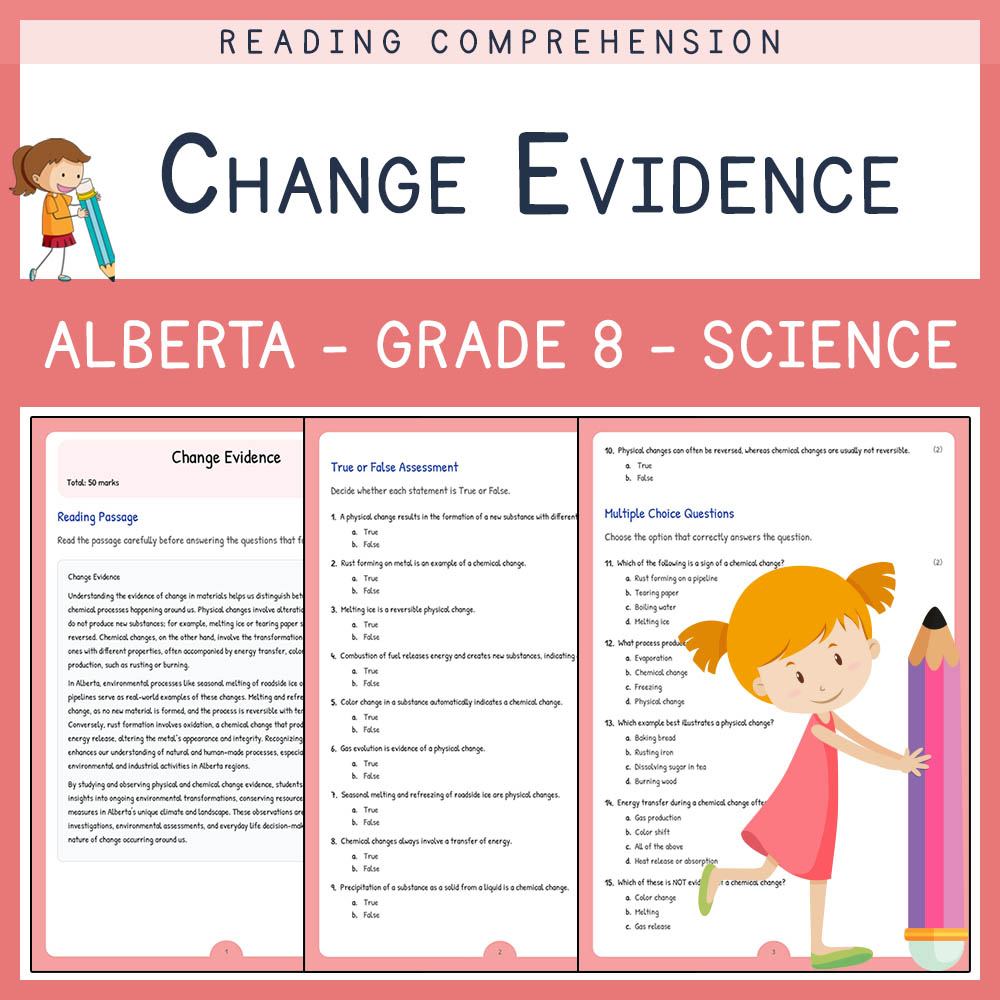
Grade 8 Science | Change Evidence Worksheet Elena | Alberta Standard
 Created byLumora Learning
Learning Objectives
- Identify the differences between physical and chemical changes based on evidence.
- Recognize examples of physical and chemical changes in everyday scenarios.
- Describe the energy transfer, color shifts, and gas production associated with chemical changes.
Instant download

Simple Machines Worksheet | Grade 8 Science Practice
Created byPrism Point LearningLearning Objectives
- Explain how simple machines trade force magnitude for distance to accomplish work.
- Describe how levers, pulleys, and gears change input and output forces and motion.
- Connect efficiency and friction to energy transformation in real mechanical systems.
Also included in: Forces, Motion & Energy Lesson Bundle | Grade 8 Science | BC +1 more
Instant download

Grade 8 Science | Gravity Attraction - Daily Reading Comprehension
Created byCoral Reef LearningLearning Objectives
- Understand the basic concept of gravity.
- Recognize how mass and distance influence gravitational force.
- Describe everyday examples of gravitational effects.
Instant download

Grade 8 Science | Tissue Organization in the Human Body - Reading Comprehension
Created byCoral Reef LearningLearning Objectives
- Identify different types of epithelial tissues and their specific functions
- Understand the structural features of epithelial tissues
- Recognize the importance of tissue organization in organ and body functions
Instant download

Grade 8 Science – Measuring Electricity Worksheet (PDF) | Alberta Standards
Created byEvergreen Desk EducationLearning Objectives
- Describe how voltage, current, and resistance are measured using common instruments in a circuit.
- Select appropriate meter connections, ranges, and units to avoid incorrect readings.
- Explain how meter impedance can affect circuit measurements and results.
Instant download

Grade 8 Science – Understanding Succession & Ecology | Daily Reading Worksheet
Created byBright Mind ResourcesLearning Objectives
- Define ecological succession and distinguish between primary and secondary succession.
- Identify key factors that influence succession pathways.
- Recognize the importance of succession in ecosystem recovery and biodiversity.
Also included in: Grade 8 Ecosystems Daily Reading Worksheets Lesson Bundle | BC +1 more
Instant download

Measuring Electricity Worksheet for Grade 8 Science | Standards-Aligned Practice
JCreated byJ.S SheetsLearning Objectives
- Understand the principles of measuring voltage, current, and resistance in electrical circuits.
- Identify proper instrument ranges and connection conventions for accurate measurements.
- Explain how meter impedance influences circuit readings and measurement accuracy.
Also included in: Grade 8 Electricity & Circuits Science Lesson Bundle: Alberta Framework +1 more
Instant download

Force and Motion Worksheet | Grade 8 Science Standards-Aligned Practice
JCreated byJ.S SheetsLearning Objectives
- Understand how net force influences the rate of change in an object's motion.
- Explain the relationship between mass and acceleration when a constant force is applied.
- Qualitatively analyze how doubling force or tripling mass affects motion and acceleration.
Instant download

Grade 8 Science | Immune Defense Worksheet (BC Standards) PDF
Created byEvergreen Desk EducationLearning Objectives
- Explain how innate and adaptive immune defenses work together to protect the body from pathogens.
- Describe the roles of phagocytes, antigen-presenting cells, and lymphocytes in immune responses.
- Use tissue-level and circulatory pathways to trace how immune cells coordinate during infection.
Instant download
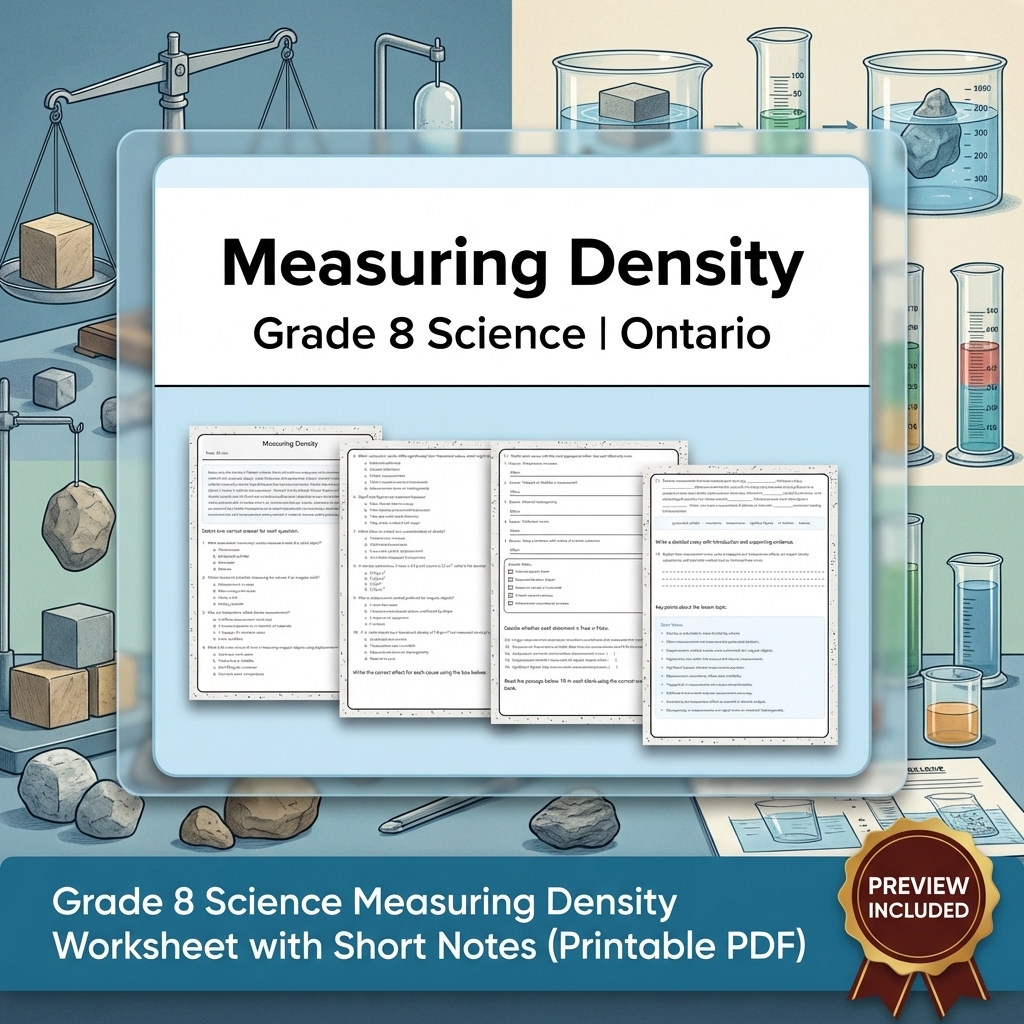
Grade 8 Science Measuring Density Worksheet with Short Notes (Printable PDF)
Created byMeadowlark WorksheetsLearning Objectives
- Understand different methods for measuring the density of solids and liquids.
- Learn to calculate density from mass and volume data.
- Interpret measurement discrepancies caused by experimental factors.
Also included in: Grade 8 Science Lesson Group Bundle | Hydrostatics & Fluid Mechanics +1 more
Instant download
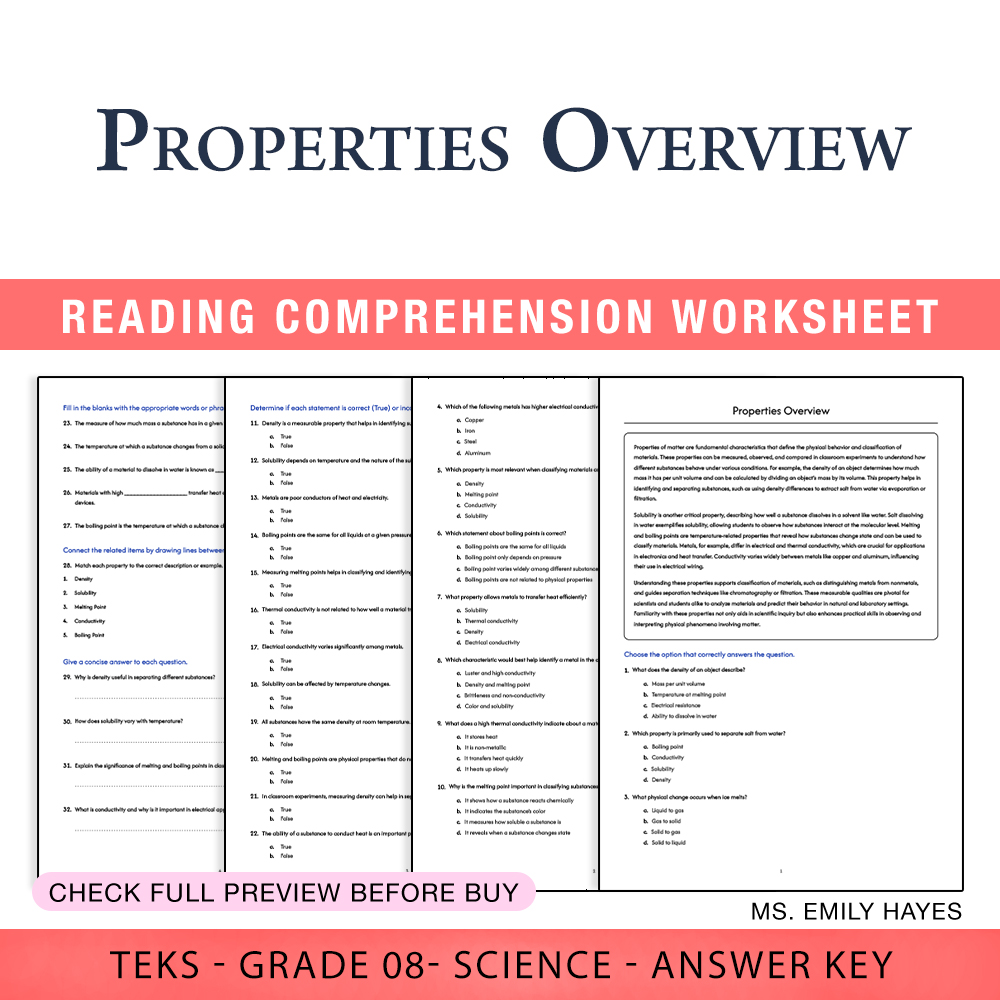
8th Grade Science | Properties Overview Worksheet (PDF+ Answer Key)
Created byCopper Leaf ClassroomLearning Objectives
- Identify and compare measurable physical properties such as density, solubility, melting and boiling points.
- Understand how properties like conductivity and solubility inform classification and separation techniques.
- Relate quantitative measures like mass, volume, and temperature to observed physical behavior.
Instant download

Immune Responses Worksheets: Innate and Adaptive Immunity Grade 8
Created byPrism Point LearningLearning Objectives
- Describe how neutrophils and macrophages defend tissues
- Explain how antigen presentation activates adaptive immune responses
- Compare antibody action with cytotoxic T cell responses
Also included in: Cells Lesson Bundle | Grade 8 Science | Ontario Framework +1 more
Instant download

Density Effects Worksheet for Grade 8 Science | Standards-Aligned Practice
JCreated byJ.S SheetsLearning Objectives
- Understand how density-dependent factors influence population change.
- Differentiate between density-dependent and density-independent factors.
- Identify examples of resource competition, disease transmission, weather events, and human impact on populations.
Instant download

Grade 8 Science – Conservation Approaches & Ecosystem Management | Worksheet
Created byBright Mind ResourcesLearning Objectives
- Understand different strategies used in conservation.
- Identify the importance of protected areas, restoration, and corridors.
- Recognize factors influencing the effectiveness of conservation efforts.
Also included in: Grade 8 Ecosystems Daily Reading Worksheets Lesson Bundle | BC +1 more
Instant download

Grade 8 Science | Design Problem Framing - Daily Reading Comprehension
Created byCoral Reef LearningLearning Objectives
- Understand the importance of defining clear real-world needs in engineering.
- Learn how to set measurable goals for design challenges.
- Identify the elements that connect practical limitations to innovative solutions.
Instant download

Voltage Concepts Worksheet | Grade 8 Science Activities
Created byPrism Point LearningLearning Objectives
- Explain voltage (electric potential difference) as energy per unit charge and relate it to current and resistance
- Use reference points to interpret potential differences across circuit elements
- Compare voltage sources (cells, batteries, generators) and describe how multi-source circuits affect circuit behaviour
Also included in: Grade 8 Science Electricity & Electromagnetism Lesson Bundle | Alberta
Instant download

Science Evidence-Based Claims Worksheet | Grade 8 NGSSS Standards
JCreated byJ.S SheetsLearning Objectives
- Explain how evidence strengthens scientific claims.
- Differentiate between claims, observations, and measurements.
- Use patterns and reasonable interpretations to evaluate evidence-based explanations.
Also included in: Grade 8 Evidence-Based Scientific Inquiry Science Lesson Bundle | Florida NGSSS +1 more
Instant download

Circular Motion Worksheet | Grade 8 Science Activities
Created byPrism Point LearningLearning Objectives
- Explain how centripetal force enables an object to change direction while moving along a curved path
- Describe how centripetal force depends on mass, turn radius, and speed
- Predict what happens when centripetal force is too small for a given turn
Also included in: Forces, Motion & Energy Lesson Bundle | Grade 8 Science | Alberta
Instant download

Force Diagrams Worksheet | Grade 8 Science Practice for TEKS
Created byPrism Point LearningLearning Objectives
- Represent forces on objects using free-body diagrams with correct vector directions.
- Identify and distinguish gravitational, normal, frictional, and tension forces in real scenarios.
- Use force components to determine net force and predict motion on inclines and at rest.
Also included in: Grade 8 Force, Motion & Energy Science Lesson Bundle for TEKS Practice +1 more
Instant download

Grade 8 Science | Comparative Cells Plant & Animal - Daily Reading Practice
Created byCoral Reef LearningLearning Objectives
- Identify the key features of plant and animal cells
- Compare and contrast plant and animal cellular structures
- Understand the functions of specialized cell components
Instant download
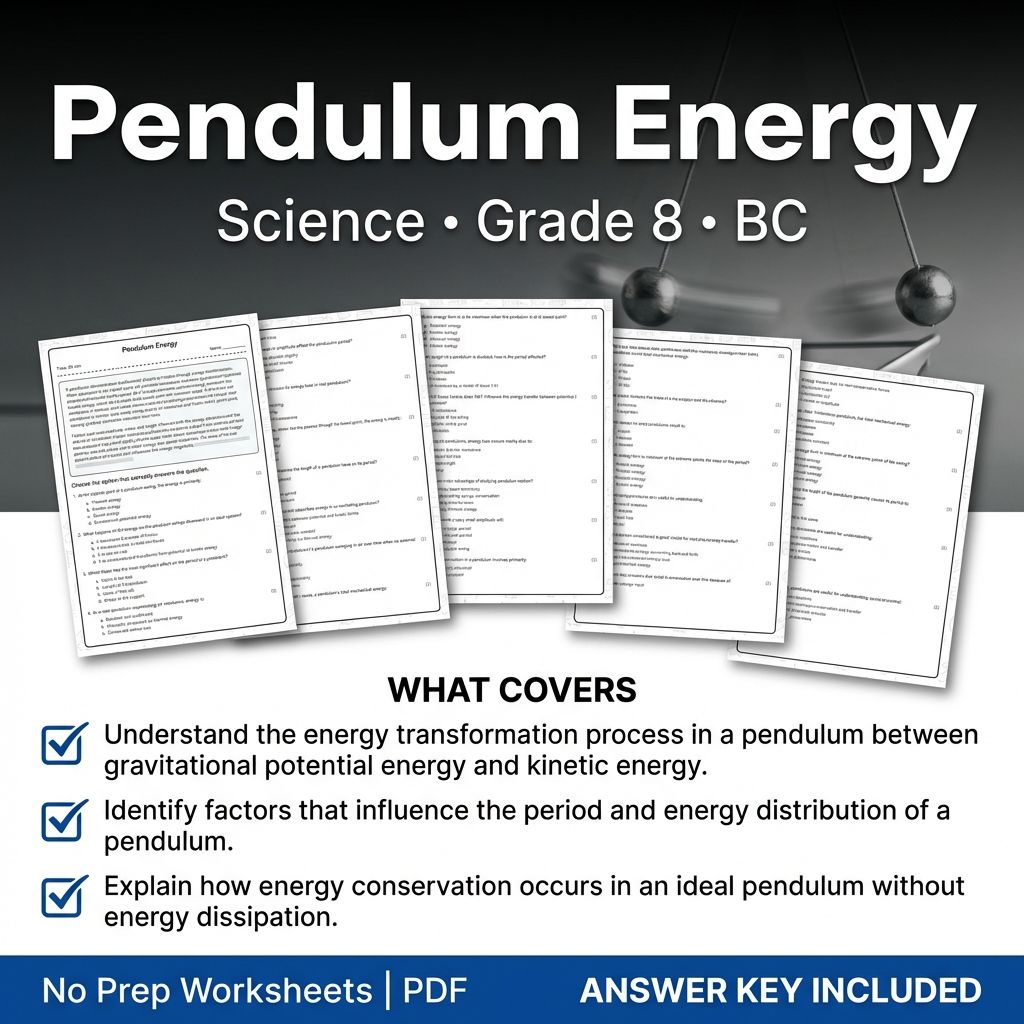
Grade 8 Science | Pendulum Energy Worksheet & Answer Key (Printable PDF)
Created byCoral Reef LearningLearning Objectives
- Understand the energy transformation process in a pendulum between gravitational potential energy and kinetic energy.
- Identify factors that influence the period and energy distribution of a pendulum.
- Explain how energy conservation occurs in an ideal pendulum without energy dissipation.
Instant download

Grade 8 Tradeoff Analysis Worksheet | NGSS Practice PDF
Created byClear Sky ClassroomLearning Objectives
- Understand how to evaluate competing constraints using decision-making tools.
- Apply methods like weighted scoring and pareto comparison to project choices.
- Analyze tradeoffs among performance, manufacturability, and sustainability in engineering design.
Also included in: Grade 8 Engineering Design Tradeoff Analysis Science Lesson Bundle NGSS +1 more
Instant download

Grade 8 Science | Mendelian Patterns in Genetics - Daily Reading Comprehension
Created byCoral Reef LearningLearning Objectives
- Understand the concepts of dominant and recessive alleles
- Learn to predict trait inheritance using Punnett squares
- Interpret phenotypic and genotypic ratios in inheritance patterns
Instant download
About Grade 8 Science Worksheets
Explore Grade 8 Science worksheets for classwork, homework, or review. Our 6,006 printables download instantly as PDFs.
Each resource here is built by an independent educator and reviewed for quality. Worksheets print straight from PDF and suit classroom use, homework, or extra practice; most come with answer keys, and you can preview before purchasing.