
Grade 9 Worksheets
9,323 grade resources
Grade 9 Science – Mass Measurement & Conservation | Daily Reading Worksheet
 Created byBright Mind Resources
Learning Objectives
- Understand the principle of conservation of mass during chemical reactions.
- Identify how gaseous products can affect apparent mass changes.
- Recognize external factors influencing mass measurements.
Also included in: Grade 9 Chemical Reactions Science Lesson Bundle: Daily Reading (BC) +1 more
Instant download

Grade 9 Science – Phylogenetic Trees & Evolution | Daily Reading Worksheet
Created byBright Mind ResourcesLearning Objectives
- Identify main components of a phylogenetic tree
- Explain the significance of branching points and branch lengths
- Distinguish between monophyletic, paraphyletic, and polyphyletic groups
Also included in: Grade 9 Evolution Science Daily Reading Worksheets Lesson Bundle | TEKS +2 more
Instant download

Empirical Evidence Worksheet Grade 9 Science NGSSS Critical Thinking
 Created byEvergreen Desk Education
Learning Objectives
- Explain why empirical evidence strengthens scientific claims.
- Distinguish observable/measurable data from opinions or beliefs.
- Describe how patterns in data support, refine, or challenge scientific interpretations.
Instant download

Resource Choices Test Prep Worksheets | Grade 9 Science
 Created byPrism Point Learning
Learning Objectives
- Compare how different energy sources and mineral extraction methods affect the environment and society across the life cycle.
- Evaluate trade-offs among emissions, land disturbance, water use, and remediation when making resource choices.
- Use supply constraints and long-term planning to justify more sustainable regional decisions.
Also included in: Grade 9 Test Prep Science Lesson Bundle NGSS: Energy Systems & Modeling
Instant download

Genes and Proteins Worksheet | Grade 9 Science Practice
Created byPrism Point LearningLearning Objectives
- Explain how genes (DNA segments) can determine protein production and influence observable traits (phenotypes).
- Describe the basic steps of gene expression: transcription and translation.
- Identify how gene regulation and environmental factors can change protein amounts or functions, leading to phenotypic variation.
Instant download

Grade 9 Atomic Structure Worksheet | NGSS Chemistry Science Activity
 Created byBRIGHT PATH RESOURCES
Learning Objectives
- Identify and describe the basic components of an atom: protons, neutrons, and electrons.
- Understand electron configurations and energy levels.
- Explain how the periodic table groups elements by valence electrons.
Also included in: Atomic Structure & Chemical Reactions Lesson Bundle | Grade 9 Science | NGSS +1 more
Instant download

Science Worksheet Unbalanced Forces Grade 9 | Standards-Aligned Practice
JCreated byJ.S SheetsLearning Objectives
- Explain how individual forces combine to determine net force, including both magnitude and direction
- Predict the direction and presence of acceleration when forces oppose each other
- Distinguish between balanced and unbalanced forces using the net force being zero or nonzero
Also included in: Grade 9 Energy, Waves, and Motion Science Lesson Bundle: General Framework +1 more
Instant download

Grade 9 Speciation Introduction Daily Reading Worksheet | TEKS Science
Created byBRIGHT PATH RESOURCESLearning Objectives
- Define speciation and species using key vocabulary
- Identify reproductive isolation as a barrier to interbreeding
- Explain how geographic separation can reduce gene flow
Also included in: Grade 9 Evolution and Classification Biology Reading Worksheets Bundle | TEKS +1 more
Instant download

Grade 9 Science Decision Modeling Worksheet | Mitigation & Adaptation NGSS
 Created byAmber Owl Education
Learning Objectives
- Explain how decision models use scenarios to compare mitigation and adaptation options over time and space.
- Evaluate trade-offs among economic, environmental, and social outcomes using cost-benefit and lifecycle ideas.
- Apply systems thinking to policy instruments such as carbon pricing, land-use planning, and infrastructure investment.
Also included in: Grade 9 Science Sustainability & Climate Risk Lesson Bundle | NGSS +1 more
Instant download

Grade 9 Science | Understanding the Carbon Cycle - Daily Reading Comprehension
 Created byCoral Reef Learning
Learning Objectives
- Identify the main pathways of carbon movement in ecosystems.
- Explain how microorganisms contribute to carbon cycling.
- Analyze human impacts on the carbon cycle, such as fossil fuel combustion and deforestation.
Instant download

Grade 9 Ecosystem Change And Resilience Worksheet | Practice & PDF
 Created byClear Sky Classroom
Learning Objectives
- Explain how disturbances (habitat loss, invasive species, and climate shifts) can change ecosystem interactions and stability
- Describe how feedback processes, recovery rates, and resilience influence whether an ecosystem returns to a prior state
- Use evidence from long-term population trends and community structure to reason about gradual versus rapid ecosystem shifts
Instant download

Grade 9 Science | Tissue Types Worksheet (Ontario Standards PDF)
Created byEvergreen Desk EducationLearning Objectives
- Compare the four principal tissue classes (epithelial, connective, muscle, nervous) by describing key cellular and extracellular features.
- Explain how tissue structure (including extracellular matrix and specialized epithelia) relates to tissue and organ function.
- Differentiate muscle types by their contractile mechanisms and typical roles in the body.
Also included in: Grade 9 Human Body Systems & Cellular Processes Science Lesson Bundle: Ontario +1 more
Instant download

Future Nurses Worksheet | Assessment and Student Practice for Grades 9 - 10
Learning Objectives
- Identify how technology can support nursing care while still requiring clinical judgment and compassion.
- Explain why ethical responsibilities (such as confidentiality and informed explanations) matter in future healthcare.
- Describe emerging roles and skills that future nurses may need, including lifelong learning and adaptability.
Also included in: Grades 9 - 10 Holiday Nursing Pathways Custom Bundle +2 more
Instant download

Grade 9 Science – Mendel's Laws & Genetic Crosses | Daily Reading Worksheet
Created byBright Mind ResourcesLearning Objectives
- Identify dominant and recessive traits using Punnett squares
- Understand the concepts of segregation and independent assortment
- Apply probability models to predict inheritance ratios
Also included in: Grade 9 Genetics Science Daily Reading Worksheets Lesson Bundle | NGSS +2 more
Instant download

Science Worksheet for Grade 9 | Rock Transformations Assessment NGSS
 Created bySkylark Worksheets
Learning Objectives
- Explain the rock cycle by tracing how igneous, sedimentary, and metamorphic rocks transform through melting, crystallization, erosion, compaction, and metamorphism.
- Describe how pressure and temperature conditions affect metamorphism and mineral formation.
- Use clues from radiometric ages and process rates to infer the likely sequence of events in rock histories.
Also included in: Grade 9 Science Lesson Bundle Earth Systems & Tectonic Forces | NGSS +1 more
Instant download

Grade 9 Science – DNA Replication Daily Reading Worksheet with Answer Key
JCreated byJ.S SheetsLearning Objectives
- Understand the basic steps of DNA replication
- Identify key enzymes involved in DNA replication
- Describe the division of leading and lagging strands
Also included in: Grade 9 Science Lesson Bundle on Genetics and DNA TEKS Aligned +1 more
Instant download

Grade 9 Science – Scientific Models & Theories Daily Reading Worksheet
Created byBright Mind ResourcesLearning Objectives
- Define and distinguish between models, explanations, and theories in science.
- Explain how models represent phenomena at different levels of detail.
- Understand the role of theories in scientific frameworks and their openness to revision.
Also included in: Grade 9 Data & Measurement Science Daily Reading lesson bundle | Florida NGSSS +1 more
Instant download

Grade 9 Science Worksheet: Variation Mechanisms (Genetic Diversity) Practice | NGSS + PDF
Created byClear Sky ClassroomLearning Objectives
- Explain how point mutations, chromosomal rearrangements, meiotic recombination, and independent assortment create heritable genetic variation.
- Describe how recombination and mutation can change alleles, gene expression, and protein function to influence phenotype.
- Connect individual genetic changes to population-level variation and shifts in allele frequency over generations.
Also included in: Grade 9 Heredity Inheritance & Variation of Traits Science Lesson Bundle NGSS +1 more
Instant download
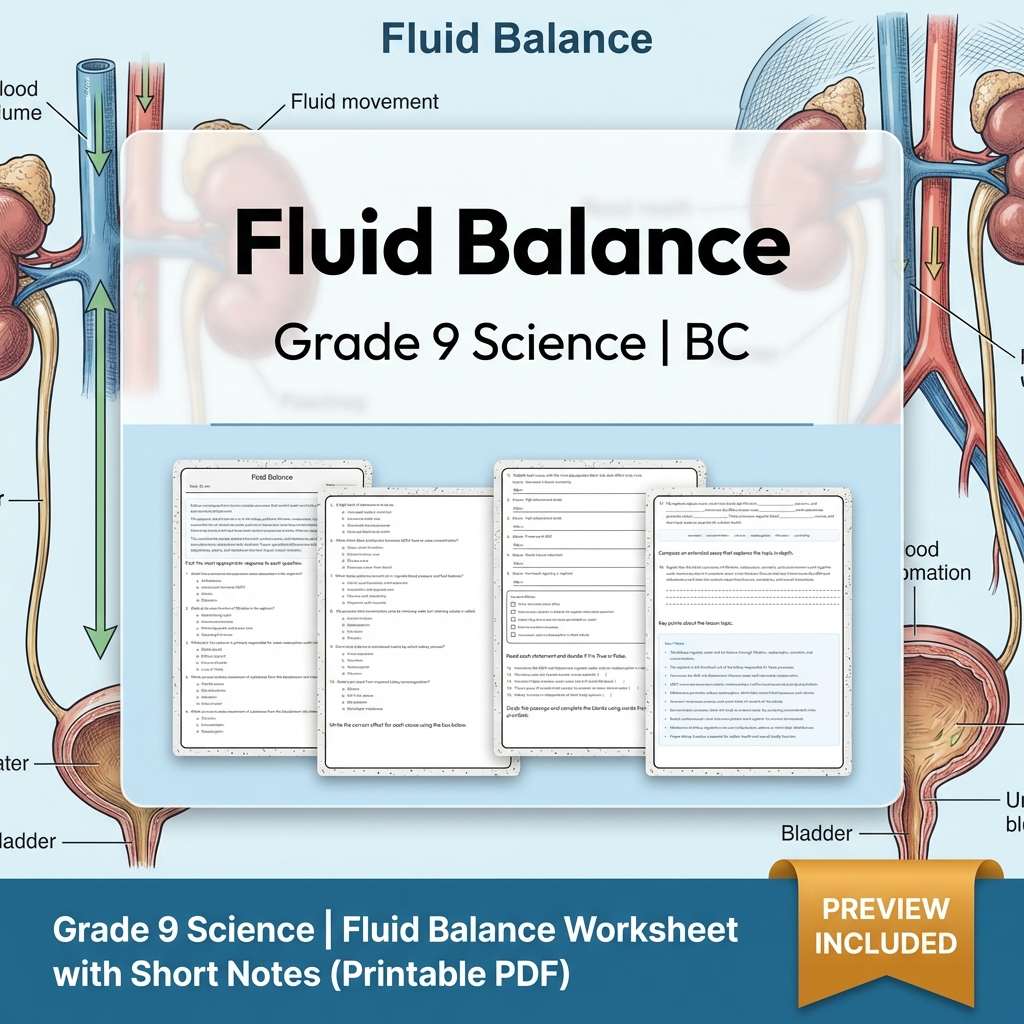
Grade 9 Science | Fluid Balance Worksheet with Short Notes (Printable PDF)
 Created byMeadowlark Worksheets
Learning Objectives
- Understand how kidneys regulate water and ion balance through osmoregulation.
- Identify processes such as filtration, reabsorption, secretion, and concentration in the nephron.
- Explain the role of hormones like antidiuretic hormone (ADH) and aldosterone in fluid regulation.
Also included in: Grade 9 Science Lesson Bundle | BC Framework Worksheets (15-Piece Collection) +1 more
Instant download

Grade 9 Math – Linear Equations Solutions Worksheet (Ontario Standards) (PDF)
Created byClear Sky ClassroomLearning Objectives
- Understand and apply algebraic methods to solve linear equations.
- Interpret solutions of equations within real-world contexts such as budgeting and measurements.
- Develop problem-solving skills through multi-step reasoning and application.
Also included in: Grade 9 Maths Lesson Bundle: Linear Functions & Modelling Ontario Standards +1 more
Instant download

Resource Choices Worksheet for Grade 9 Science NGSS Standards | PDF Practice
JCreated byJ.S SheetsLearning Objectives
- Compare different energy and mineral resource options based on environmental and economic factors.
- Analyze the life-cycle impacts of resource extraction and use for sustainability.
- Evaluate trade-offs involved in resource management strategies within regional and long-term contexts.
Also included in: Grade 9 Resource Choices & Sustainability Science Lesson Bundle NGSS +1 more
Instant download

Grade 9 Social Studies | Regional Development Worksheet (PDF)
 Created bySunny Desk Resources
Learning Objectives
- Explain how access to natural and human resources can influence regional development and economic growth.
- Analyze how infrastructure (transport, energy, and communication) affects settlement patterns and quality of life.
- Evaluate how government policies and geographic constraints can create opportunities or barriers to development.
Also included in: Grade 9 Regional Geography Social Studies Lesson Bundle Worksheets for TEKS +1 more
Instant download

Earth Material Cycling Worksheet for Grade 9 Science
JCreated byJ.S SheetsLearning Objectives
- Describe how water, carbon, and nutrients cycle through Earth's systems.
- Explain the processes of evaporation, condensation, and precipitation in water cycling.
- Identify the interactions among atmosphere, oceans, organisms, and rocks in nutrient cycles.
Also included in: Grade 9 Earth and Space Science Lesson Bundle: California Standards +1 more
Instant download
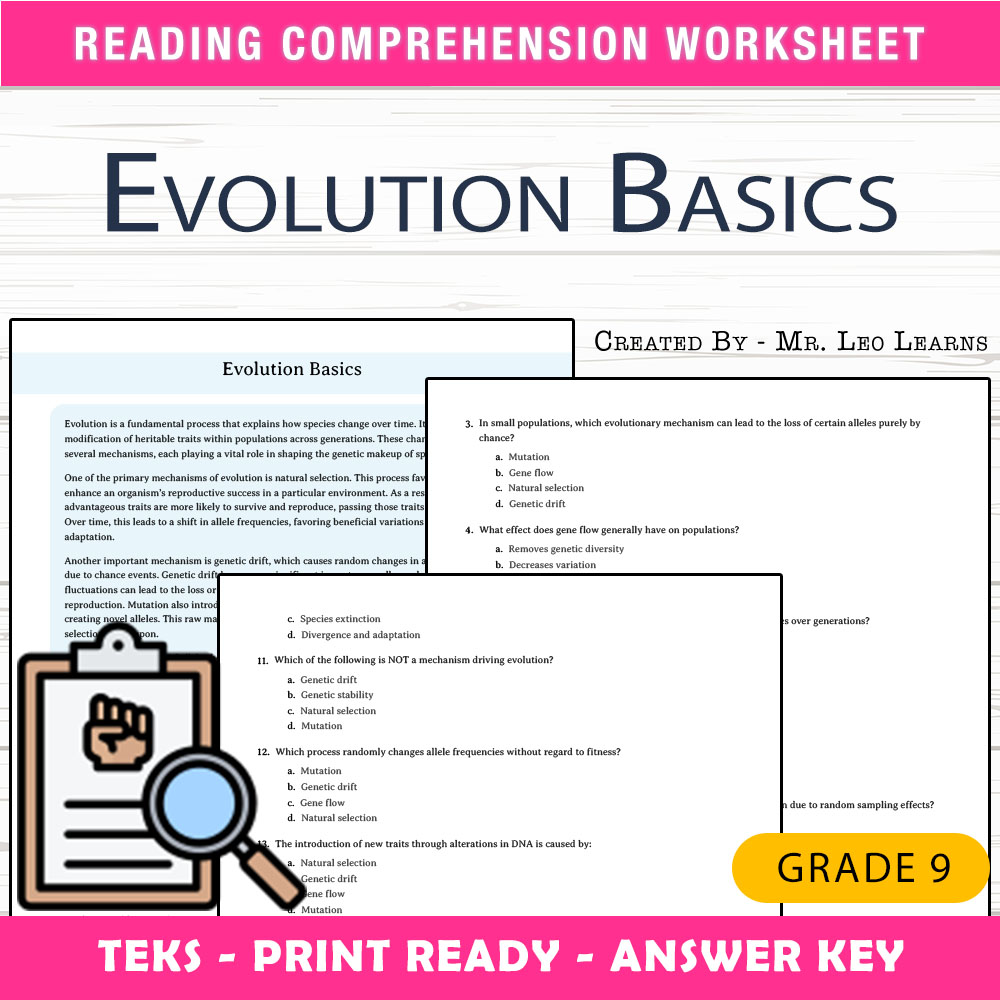
Grade 9 Science — Evolution Basics Worksheet for Mastery
 Created byThe Resource Hub
Learning Objectives
- Understand the fundamental mechanisms of evolution such as natural selection, genetic drift, mutation, and gene flow.
- Explain how these mechanisms influence allele frequencies and contribute to the diversity of populations.
- Describe the roles of mutation and gene flow in introducing new traits and transferring alleles between populations.
Also included in: Grade 9 Science Evolution & Classification Unit Worksheet Pack +1 more
Instant download

Newton Second Law Test Prep Printable | Grade 9 Science
Created byPrism Point LearningLearning Objectives
- Explain Newton’s second law using the relationship between net force, mass, and acceleration.
- Use vector ideas to distinguish direction of net force from direction of acceleration.
- Differentiate mass and weight and relate each to the correct SI units and contexts.
Also included in: Grade 9 Work, Energy & Forces Science Lesson Bundle Ontario Curriculum
Instant download

Machine Learning Training Data Worksheet | AI Concepts Grade 9
Created byBright Mind ResourcesLearning Objectives
- Define machine learning, training data, models, and patterns accurately
- Explain how training data quality affects model performance
- Identify data problems that can weaken model results
Instant download

Electron Transport Chain Assessment for Grade 9 Science TEKS
Created byPrism Point LearningLearning Objectives
- Explain the process of electron transport in mitochondria and chloroplasts.
- Identify the role of electron carriers and proton gradients in ATP synthesis.
- Compare mitochondrial and thylakoid electron transport mechanisms.
Instant download

Grade 9 Homeostasis Feedback Worksheet | NGSS Practice & PDF
Created byClear Sky ClassroomLearning Objectives
- Explain how homeostasis maintains internal stability using feedback mechanisms.
- Differentiate negative feedback from other responses by describing how it reduces change.
- Identify common body examples of homeostasis (temperature, blood glucose, oxygen delivery).
Instant download

Grade 9 Greenhouse Feedbacks Worksheet | NGSS Practice PDF
Created byClear Sky ClassroomLearning Objectives
- Explain how changes in greenhouse gases can create positive and negative climate feedbacks.
- Describe how water vapor and ice/snow surface reflectivity can amplify or reduce warming.
- Analyze how clouds and atmospheric circulation affect the balance between absorbed sunlight and outgoing infrared radiation.
Instant download

Grade 9 Science – Wave Energy Properties Reading Worksheet | Standards-Aligned
Created byBright Mind ResourcesLearning Objectives
- Understand the basic properties of waves: frequency, wavelength, and amplitude.
- Relate wave properties to the energy carried by the wave.
- Identify wave characteristics through reading and questions.
Also included in: Waves & Forces Grade 9 Science Daily Reading Worksheets Lesson Bundle | General +1 more
Instant download

Grade 9 Science – Energy Changes & Bond Processes | Daily Reading Worksheet
Created byBright Mind ResourcesLearning Objectives
- Understand the concepts of endothermic and exothermic reactions.
- Identify energy absorption and release during chemical processes.
- Interpret energy diagrams related to chemical bonds.
Also included in: Grade 9 Chemical Reactions Science Daily Reading Worksheets Lesson Bundle | NGSS +2 more
Instant download

States of Matter Worksheet | Grade 9 Science Activities
Created byPrism Point LearningLearning Objectives
- Describe the physical properties of solids, liquids, and gases and connect them to particle behavior.
- Explain how temperature and pressure changes cause phase transitions between states of matter.
- Use examples from the environment to predict and justify material state changes.
Instant download

Grade 9 Energy Molecules ATP Daily Reading Worksheet | TEKS Biology Science
Created byBRIGHT PATH RESOURCESLearning Objectives
- Identify key details about the structure of ATP from an informational text.
- Describe how ATP contains energy-storing phosphate groups.
Also included in: Grade 9 Metabolism and Energy Processes Biology Worksheets Bundle | TEKS +1 more
Instant download

Cosmic Timescales Worksheet | Grade 9 Science Printable PDF Assessment
Learning Objectives
- Understand the observational evidence that constrains the age and evolution of the universe.
- Identify key concepts such as redshift surveys, cosmic microwave background, and primordial abundances.
- Explain how different measurements contribute to the understanding of cosmic timescales.
Also included in: Grade 9 Science Earth's Place in the Universe Lesson Bundle NGSS +1 more
Instant download

Grade 9 Science – Human Influence & Climate Change | Daily Reading Worksheet
Created byBright Mind ResourcesLearning Objectives
- Analyze trends in atmospheric carbon dioxide levels over time.
- Interpret data from historical records such as the Keeling Curve.
- Identify human activities that contribute to changes in atmospheric CO2.
Also included in: Grade 9 Environmental Impact Science Daily Reading Worksheets Lesson Bundle | NGSS +2 more
Instant download

Grade 9 Social Studies — Worksheet MCQ Paper for Mastering The Roman Empire
Created byThe Resource HubLearning Objectives
- Explain how the Roman Empire expanded and maintained control over diverse regions.
- Identify key features of Roman governance, law, military organization, and infrastructure.
- Analyze factors that contributed to the decline of the Western Roman Empire.
Instant download

Grade 9 Science Worksheet – Watershed Changes (Ontario Standards) (PDF)
Created byEvergreen Desk EducationLearning Objectives
- Explain how urbanization, deforestation, agriculture, and infrastructure alter watershed processes such as runoff, sediment transport, nutrient flux, and groundwater recharge.
- Describe how watershed changes can affect channel morphology, flood frequency, and aquatic ecosystem health.
- Use turbidity and discharge as indicators to interpret water-quality and flow changes in a watershed.
Also included in: Grade 9 Earth and Space Science Lesson Bundle for Ontario Framework +1 more
Instant download
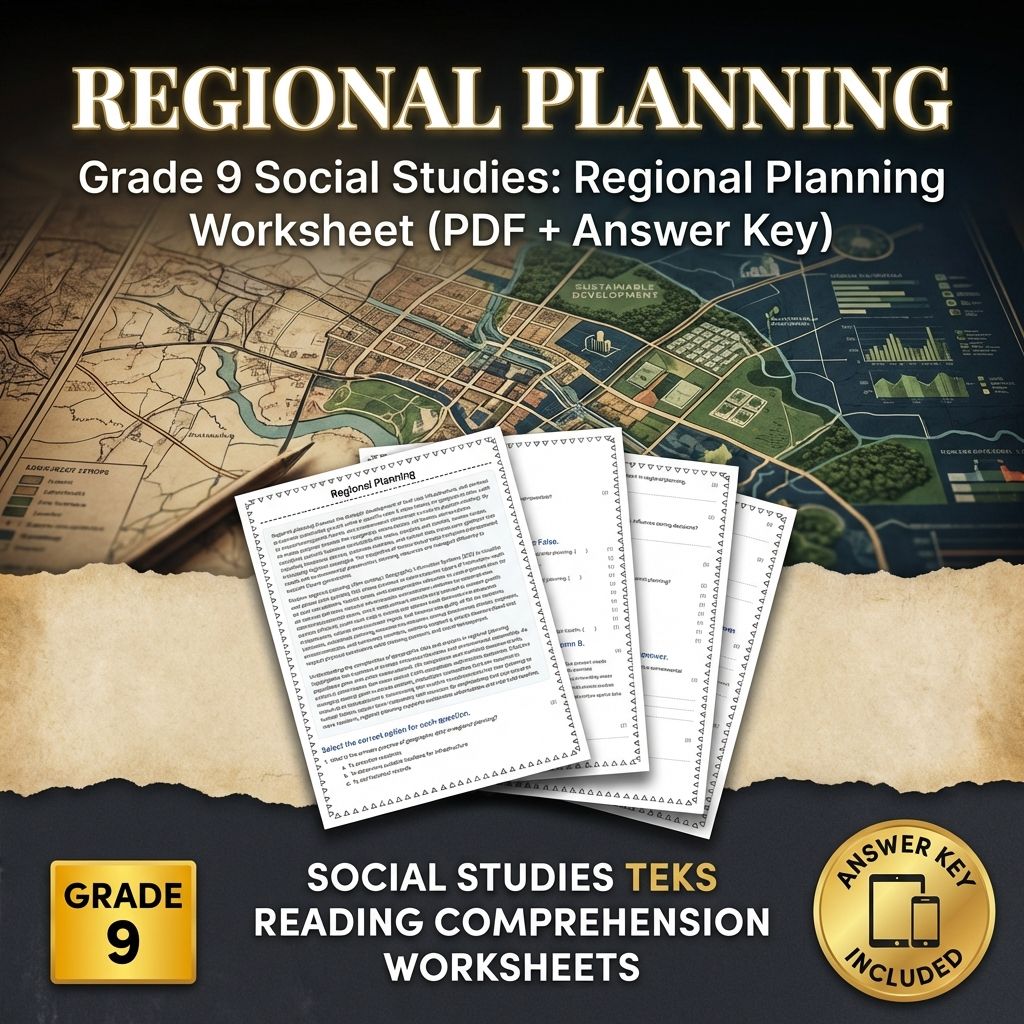
Grade 9 Social Studies: Regional Planning Worksheet (PDF + Answer Key)
JCreated byJ.S SheetsLearning Objectives
- Understand how geographic data informs regional planning decisions.
- Identify the factors influencing infrastructure development and zoning.
- Explain the importance of sustainable growth and resource management.
Instant download

Grade 9 Signal Encoding Worksheet | NGSS Practice PDF
Created byClear Sky ClassroomLearning Objectives
- Understand the principles of information encoding using modulation and multiplexing techniques.
- Compare different encoding schemes such as pulse-code modulation and amplitude modulation.
- Analyze the impact of encoding choices on channel capacity, fidelity, and noise susceptibility.
Also included in: Grade 9 Electromagnetic Radiation Science Lesson Bundle for NGSS +1 more
Instant download

Grade 9 Science | Energy Pathways in Cells - Daily Reading Comprehension
Created byCoral Reef LearningLearning Objectives
- Understand the role of ATP as the main energy currency in cells.
- Describe the basic processes of cellular respiration and photosynthesis.
- Identify the electron transport chains in mitochondria and chloroplasts.
Also included in: Biology and Ecosystems Lesson Bundle – Grade 9 Science AP Daily Reading +1 more
Instant download

Grade 9 Science – Earth's Seasons & Orbital Cycles | Daily Reading Worksheet
Created byBright Mind ResourcesLearning Objectives
- Explain how Earth's axial tilt influences seasons
- Describe the effects of Earth's orbit on climate and daylight
- Identify the causes of lunar phases and tides
Also included in: Grade 9 Earth Systems Science Daily Reading Worksheets Lesson Bundle | BC +1 more
Instant download

Gravity and Orbits Worksheet | Grade 9 Space Science Practice Activity
Created byPrism Point LearningLearning Objectives
- Explain how gravitational force depends on mass and distance.
- Describe how orbital speed and distance work together to create stable orbits.
- Use observed orbital patterns to support claims about predictable motion in space.
Instant download

Grade 9 Science – States of Matter Worksheet (Alberta Standard) (PDF)
 Created bySilver Birch Teaching
Learning Objectives
- Describe the particle model for solids, liquids, and gases using lattice, fluidity, and compressibility ideas.
- Explain how temperature and pressure changes cause phase transitions between states of matter.
- Interpret real-world examples (freezing, evaporation, condensation) using energy and particle motion.
Also included in: Grade 9 Chemical Reactions Science Lesson Bundle: Alberta Framework +1 more
Instant download

Grade 9 Cloud Computing and Online Storage Computer Science Worksheet
Created byPrism Point LearningLearning Objectives
- Explain how cloud computing uses remote servers to provide storage and services.
- Describe how online storage supports backups, sharing, and syncing across devices.
- Use key vocabulary accurately, including cloud computing, server, storage, and sync.
Also included in: Grade 9 Computer Science Networks, Internet & Cloud Tools Lesson Bundle
Instant download

Grade 9 Social Studies Worksheet – Regional Economies (PDF) – BC Standards
Created bySunny Desk ResourcesLearning Objectives
- Explain how industrialization encouraged regional economic specialization in Canada.
- Describe how resource-based industries contributed to regional identities and disparities.
- Analyze how Indigenous perspectives affect understandings of land use and economic participation.
Also included in: Grade 9 Urbanization & Social Change Social Studies Lesson Bundle (BC) +1 more
Instant download

Grade 9 Plate Tectonics Worksheet | Ontario Science Earth Systems Activity
 Created byChalk and Compass
Learning Objectives
- Explain how lithospheric plate motion creates divergent, convergent, and transform boundaries
- Describe how subduction and continental collision build features such as ocean basins and mountain ranges
- Use earthquake and volcanic patterns to infer plate interactions
Also included in: Earth Systems & Space Lesson Bundle – Grade 9 Science Ontario Framework +1 more
Instant download

Milankovitch Cycles Worksheet | Grade 9 Science Activities
Created byPrism Point LearningLearning Objectives
- Explain how orbital eccentricity, axial tilt, and precession change Earth’s incoming solar energy over long timescales.
- Describe how variations in insolation influence the growth and melting of ice sheets and seasonal patterns.
- Connect geological evidence (glacial and interglacial periods) to orbital forcing and climate feedbacks.
Also included in: Earth and Space Systems Lesson Bundle | Grade 9 Science | BC Framework +1 more
Instant download

Grade 9 Science – Systems Interactions & Mechanical Systems | Reading Worksheet
Created byBright Mind ResourcesLearning Objectives
- Identify the key components of simple mechanical systems
- Understand the forces acting upon objects within these systems
- Apply basic principles of Newton’s laws to analyze motion
Also included in: Grade 9 Forces, Motion & Energy Science Lesson Bundle for Daily Reading | BC +1 more
Instant download
Browse more categories
About Grade 9 Worksheets
Browse 9,323 printable Grade 9 worksheets across algebra, biology, literature, and history — each a ready-to-print PDF with optional answer keys.
Every worksheet on MyTeachingSheets is created by independent teacher-authors and reviewed before publication. All resources download as printable PDFs for classroom, homework, or at-home practice, and many include answer keys. Preview any worksheet free before buying.