
Grade 9 Science Worksheets
6,926 worksheets
Energy Pathways Worksheet for Grade 9 Science | AP Standards Practice
JCreated byJ.S SheetsLearning Objectives
- Describe the main processes involved in atmospheric and oceanic energy transfer.
- Interpret global energy budget diagrams and flux tables to understand climate variability.
- Relate energy partitioning to observable climate indicators such as surface temperature and sea surface temperature anomalies.
Instant download
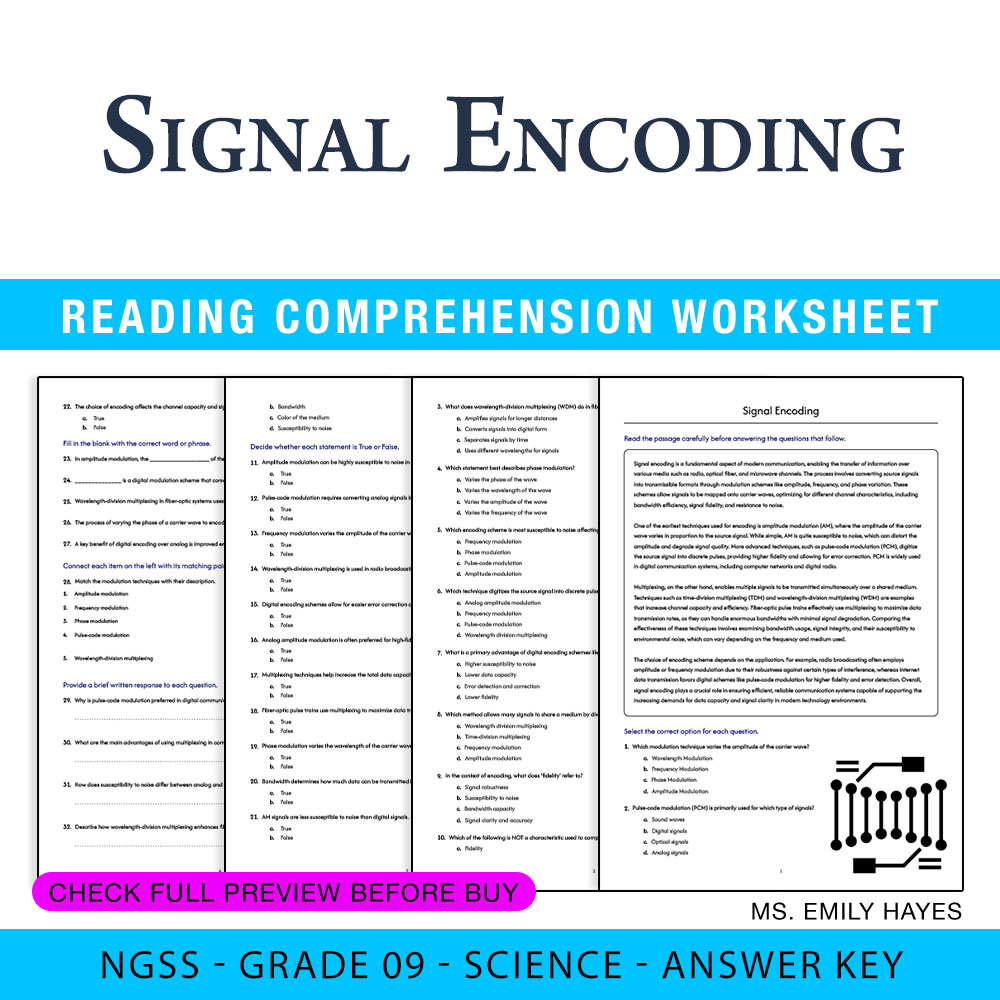
Grade 9 Science | Signal Encoding Worksheet (PDF+ Answer Key)
 Created byCopper Leaf Classroom
Learning Objectives
- Explain how signals are encoded using modulation and multiplexing techniques.
- Compare different encoding schemes such as amplitude modulation, frequency modulation, and pulse-code modulation.
- Identify practical applications of signal encoding in communication channels.
Instant download

Sexual and Asexual Reproduction Worksheets Grade 9 Science
 Created bySunny Desk Resources
Learning Objectives
- Compare sexual and asexual reproduction in terms of genetic variation and how offspring are produced.
- Explain how reproductive strategies can affect population growth and genetic diversity over generations.
- Identify examples of asexual reproduction and describe the mechanisms involved.
Also included in: Genetics & Heredity Lesson Bundle | Grade 9 Science | Alberta Framework +1 more
Instant download

Grade 9 Science – Intermolecular Forces & BC Standards | Daily Reading Worksheet
 Created byBright Mind Resources
Learning Objectives
- Identify different types of intermolecular forces
- Understand how molecular structure influences intermolecular forces
- Explain the effect of intermolecular forces on physical properties
Also included in: Grade 9 Chemical Reactions Science Lesson Bundle: Daily Reading (BC) +1 more
Instant download
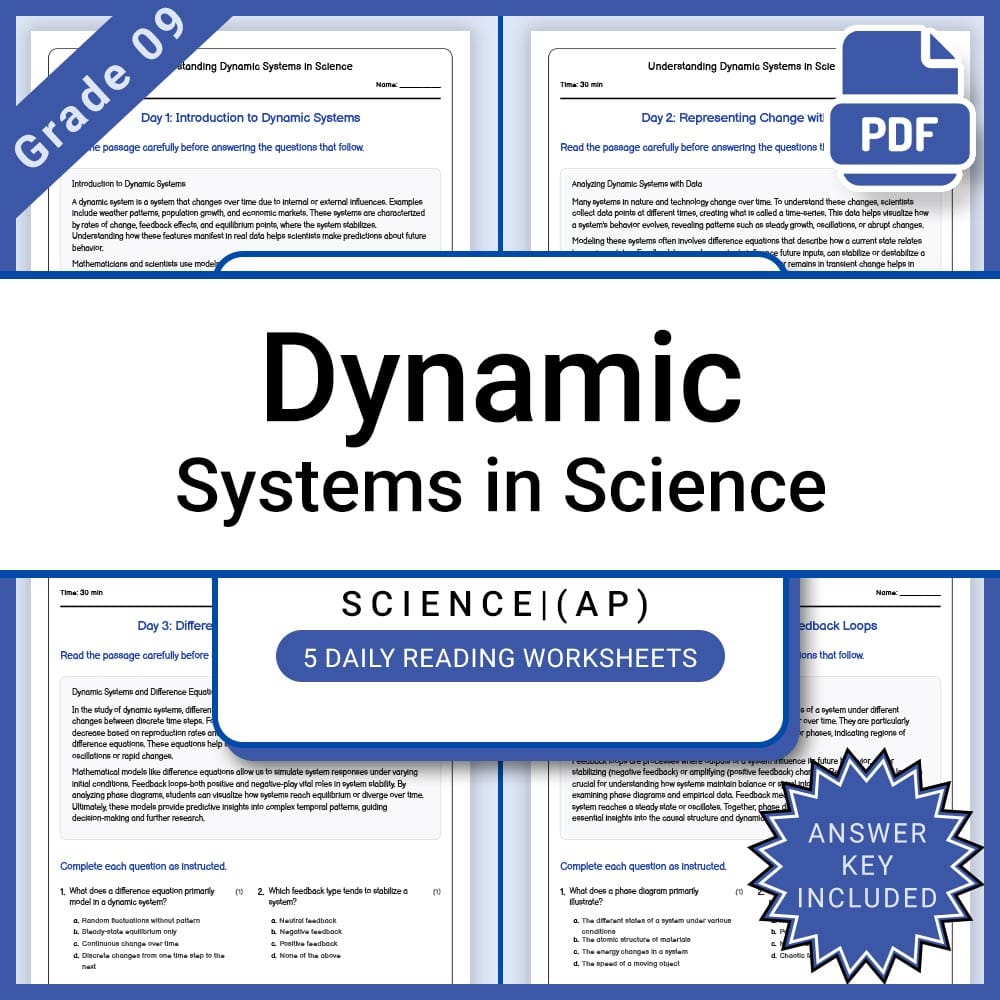
Grade 9 Science – Dynamic Systems Worksheet with Answer Key
JCreated byJ.S SheetsLearning Objectives
- Define what a dynamic system is and explain its key features.
- Identify how rates, feedback loops, and equilibrium manifest in real-world data.
- Differentiate between transient and steady-state behaviors in systems.
Also included in: Grade 9 Science Lesson Group - AP Framework Daily Reading Worksheets +1 more
Instant download
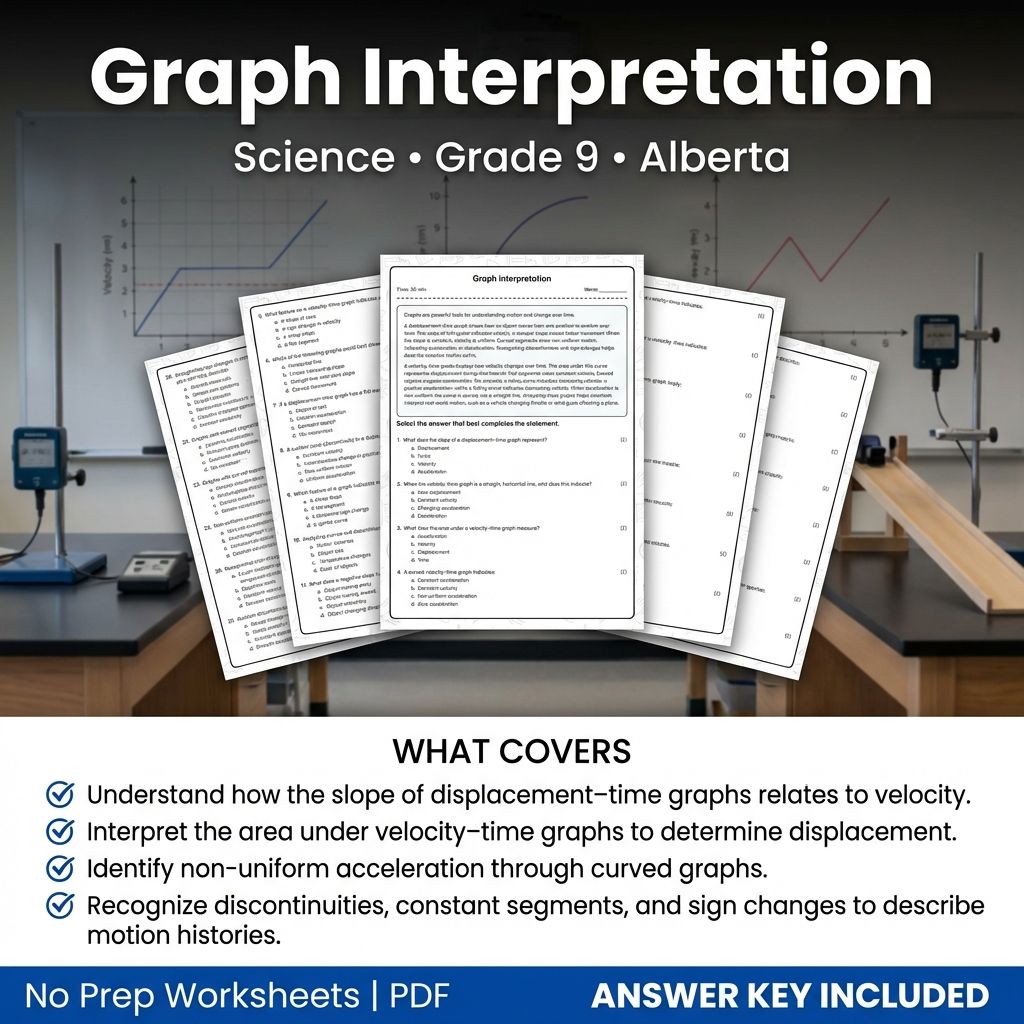
Grade 9 Science Worksheet on Graph Interpretation | Alberta Standards
 Created byCoral Reef Learning
Learning Objectives
- Understand how the slope of displacement–time graphs relates to velocity.
- Interpret the area under velocity–time graphs to determine displacement.
- Identify non-uniform acceleration through curved graphs.
Instant download
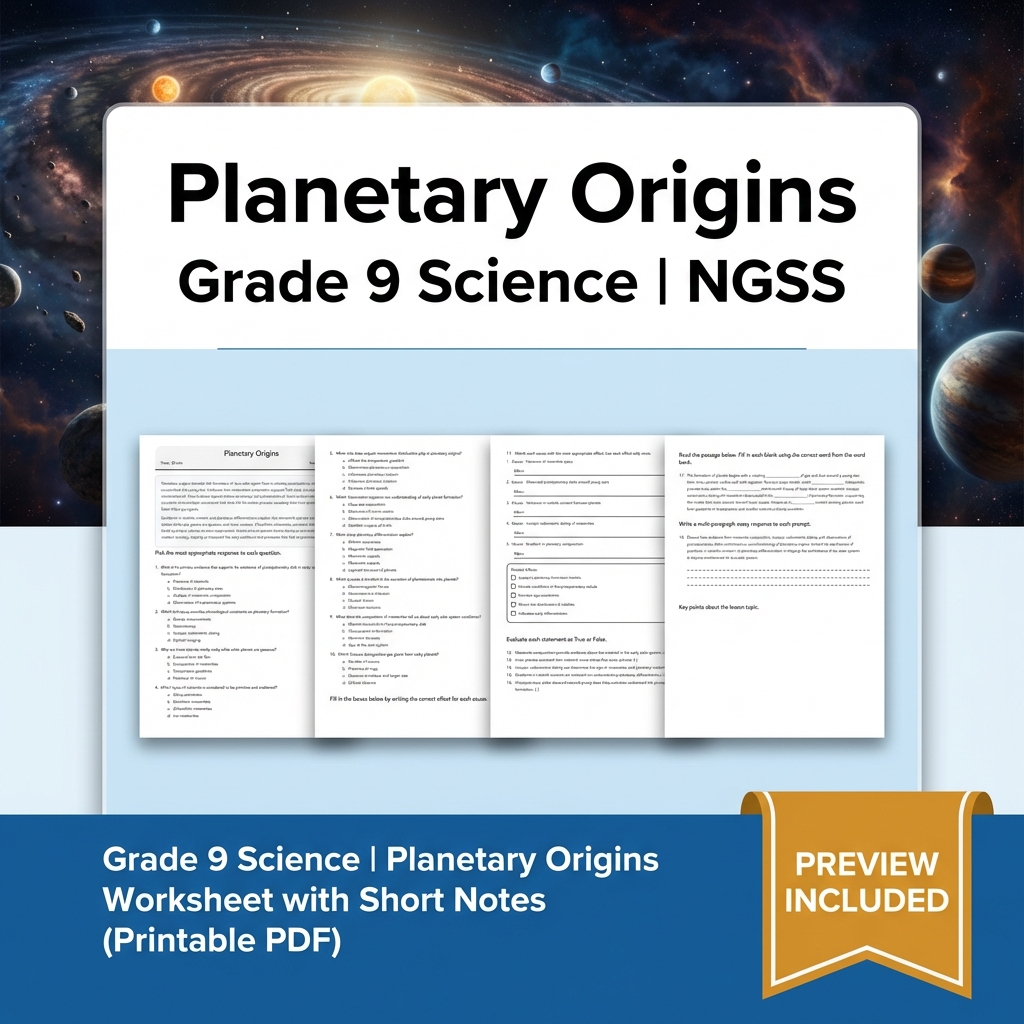
Grade 9 Science | Planetary Origins Worksheet with Short Notes (Printable PDF)
 Created byMeadowlark Worksheets
Learning Objectives
- Understand the processes involved in planetary formation from a protoplanetary disk.
- Identify key evidence supporting models of planetary origins, such as meteorite composition and isotopic dating.
- Explain the differences in composition and structure between inner rocky planets and outer gas giants.
Also included in: Grade 9 Science NGSS Earth’s Place in the Universe Unit Bundle – Worksheet Pack +1 more
Instant download

Neuroendocrine Control Worksheet | Grade 9 Science Practice
 Created byPrism Point Learning
Learning Objectives
- Explain the pathway from brain neural inputs to hormone release in the neuroendocrine system
- Describe how anatomical interfaces (portal vessels and fenestrated capillaries) help control timing and hormone magnitude
- Connect neuroendocrine control to body functions such as metabolism, growth, reproduction, and stress responses
Instant download
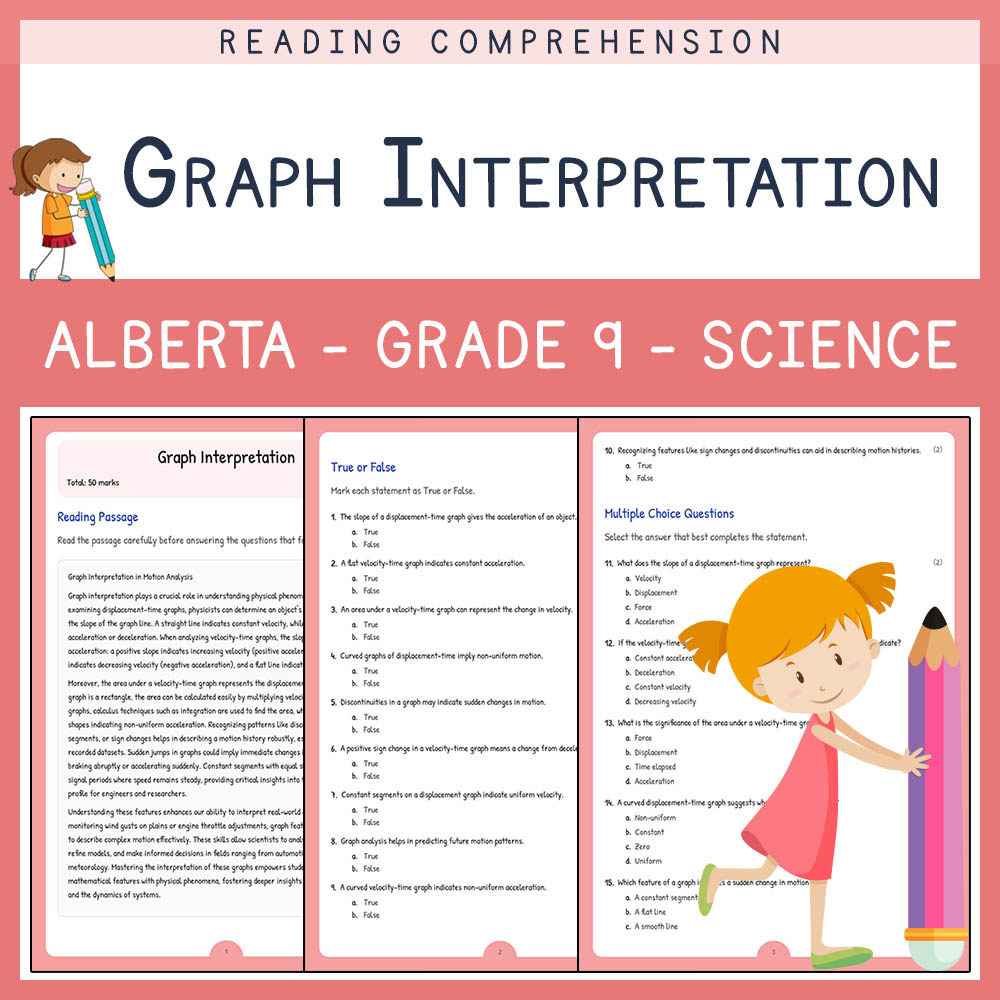
Grade 9 Science | Graph Interpretation Worksheet | Alberta Standards
 Created byLumora Learning
Learning Objectives
- Understand how the slope of displacement-time graphs relates to velocity.
- Interpret areas under velocity-time graphs to determine displacement.
- Identify non-uniform acceleration from curved graphs and discontinuities.
Instant download

Grade 9 Science Solution Behaviour Worksheet | Solubility & Solutions Ontario
 Created byChalk and Compass
Learning Objectives
- Describe dissolution in terms of solute–solvent interactions and qualitative solubility behaviour
- Differentiate unsaturated, saturated, and supersaturated solutions using simple examples
- Explain how temperature and agitation affect solubility qualitatively
Also included in: Matter and Chemical Change - Grade 9 Bundle +1 more
Instant download

Grade 9 Tissue Types Worksheet | Epithelial, Connective, Muscle & Nervous
Created byChalk and CompassLearning Objectives
- Compare the four principal tissue classes by cellular organization and key functions.
- Explain how extracellular matrix properties relate to connective tissue mechanics.
- Differentiate muscle tissue types based on contractile behavior and control.
Also included in: Homeostasis and Human Body Systems Lesson Bundle | Grade 9 Science | Ontario +1 more
Instant download

Grade 9 Chemical Changes Worksheet | Evidence & Indicators | Ontario Science
Created byChalk and CompassLearning Objectives
- Describe chemical change as a process that forms new substances with different properties and composition.
- Identify observable indicators of chemical change such as temperature change, gas production, precipitate formation, and persistent color change.
- Explain, at a microscopic level, how reactants rearrange to form products, and distinguish chemical evidence from physical changes.
Also included in: Matter and Chemical Change - Grade 9 Bundle +1 more
Instant download

Grade 9 Renal Regulation and Homeostasis Worksheet | Ontario Science
Created byChalk and CompassLearning Objectives
- Explain how glomerular filtration is driven by hydrostatic and oncotic pressures
- Describe nephron processes of selective reabsorption, secretion, and urine concentration
- Connect kidney regulation of electrolytes, acid–base balance, and blood pressure to homeostasis and endocrine signals
Also included in: Homeostasis and Human Body Systems Lesson Bundle | Grade 9 Science | Ontario +1 more
Instant download

Motion Equations Worksheet Pack | Grade 9 Science Activities
Created byPrism Point LearningLearning Objectives
- Use constant-acceleration equations to relate displacement, velocities, acceleration, and time.
- Apply a sign convention to choose correct positive/negative values in motion problems.
- Substitute values into kinematic equations to predict stopping distance or travel distance.
Also included in: Forces, Motion & Energy Lesson Bundle | Grade 9 Science (Alberta)
Instant download

Field Dynamics Worksheet | NGSS Grade 9 Science Assessment
 Created byCedar Grove Learning
Learning Objectives
- Describe the behavior of electric and magnetic fields and how they interact with charges and currents.
- Explain the concept of superposition and how field vectors combine.
- Analyze forces on moving charges in magnetic fields and predict their trajectories using vector relationships.
Instant download
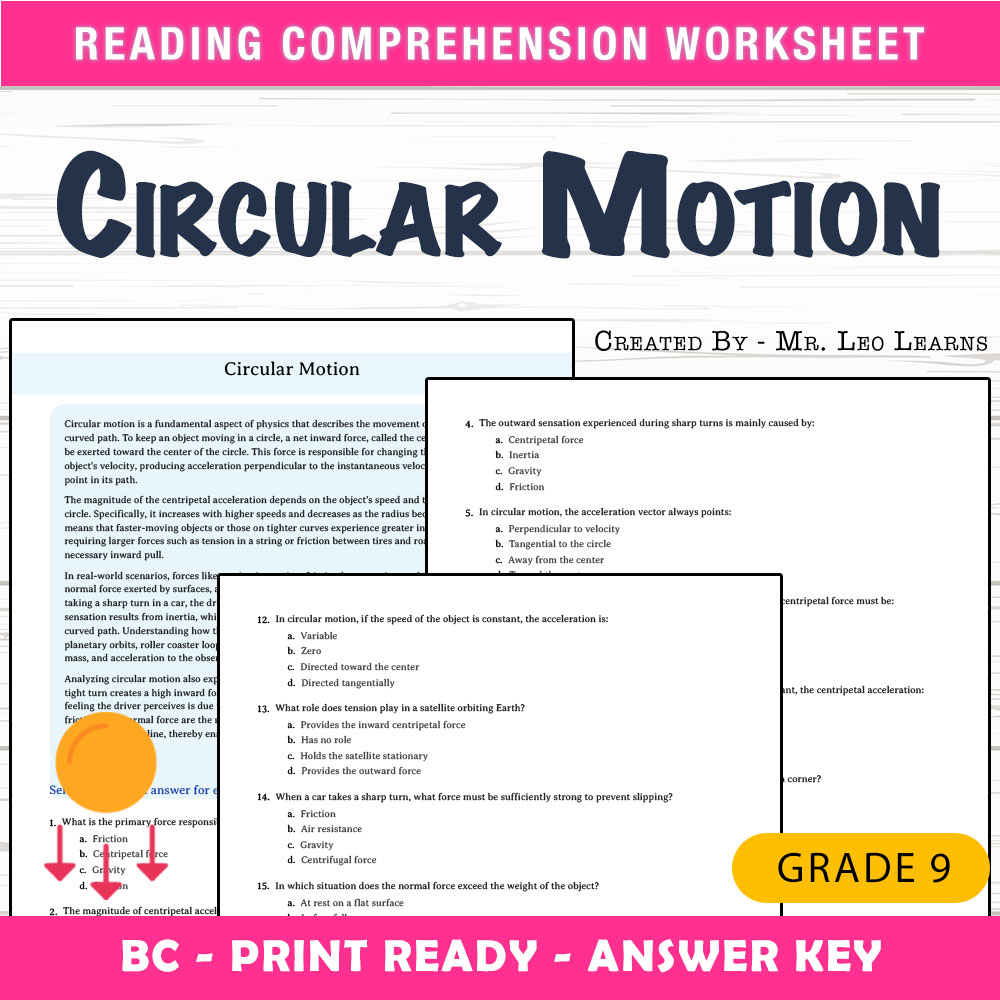
Grade 9 Science — Worksheet MCQ Paper for Mastering Circular Motion
 Created byThe Resource Hub
Learning Objectives
- Explain the concept of centripetal force and how it affects objects in circular motion.
- Describe the relationship between velocity, radius, and acceleration in circular paths.
- Analyze the roles of tension, friction, and normal force in maintaining circular motion.
Also included in: Grade 9 Science Forces & Motion Worksheet Bundle – BC Curriculum (15 Worksheets) +1 more
Instant download
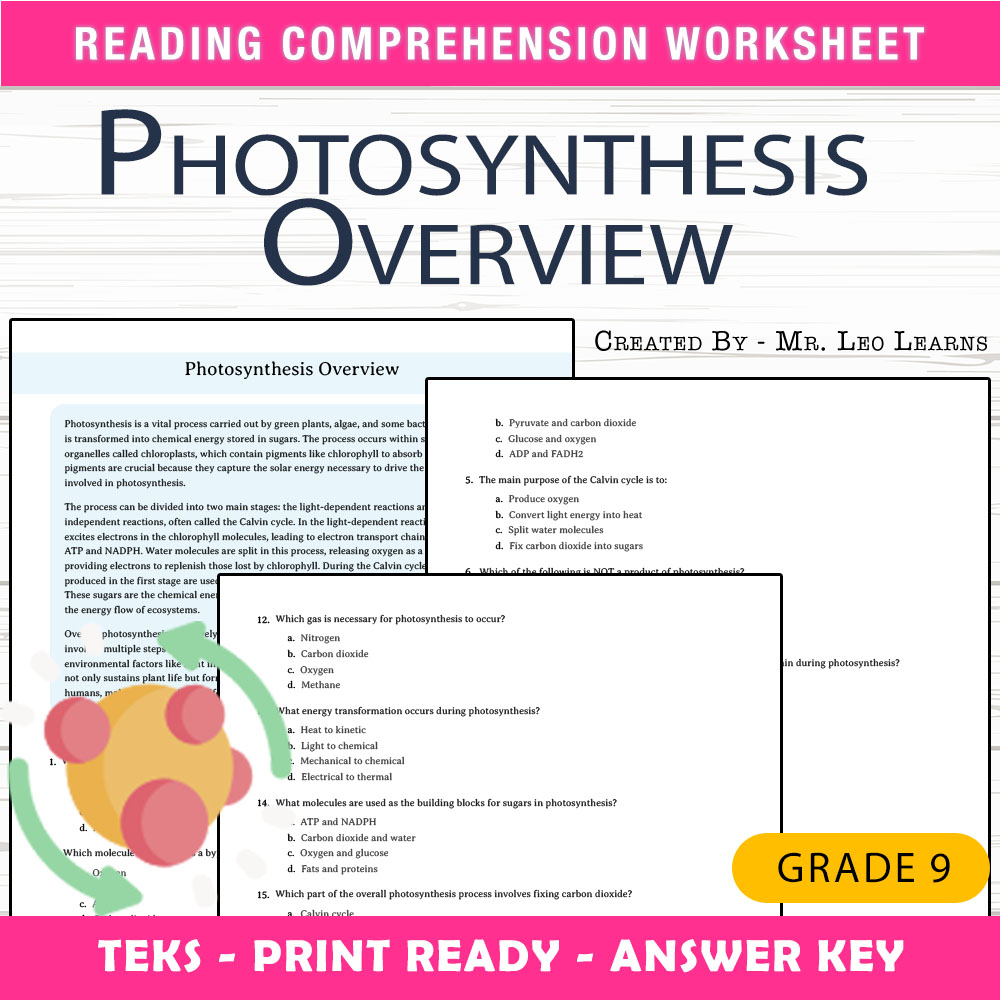
Grade 9 Science – Photosynthesis Overview Worksheet for Mastery
Created byThe Resource HubLearning Objectives
- Understand the basic process of photosynthesis and its significance.
- Identify the inputs, outputs, and main steps involved in photosynthesis.
- Explain how light energy is converted into chemical energy within chloroplasts.
Also included in: Grade 9 Science | Enzymes, Photosynthesis & Metabolic Pathways Unit Bundle +1 more
Instant download
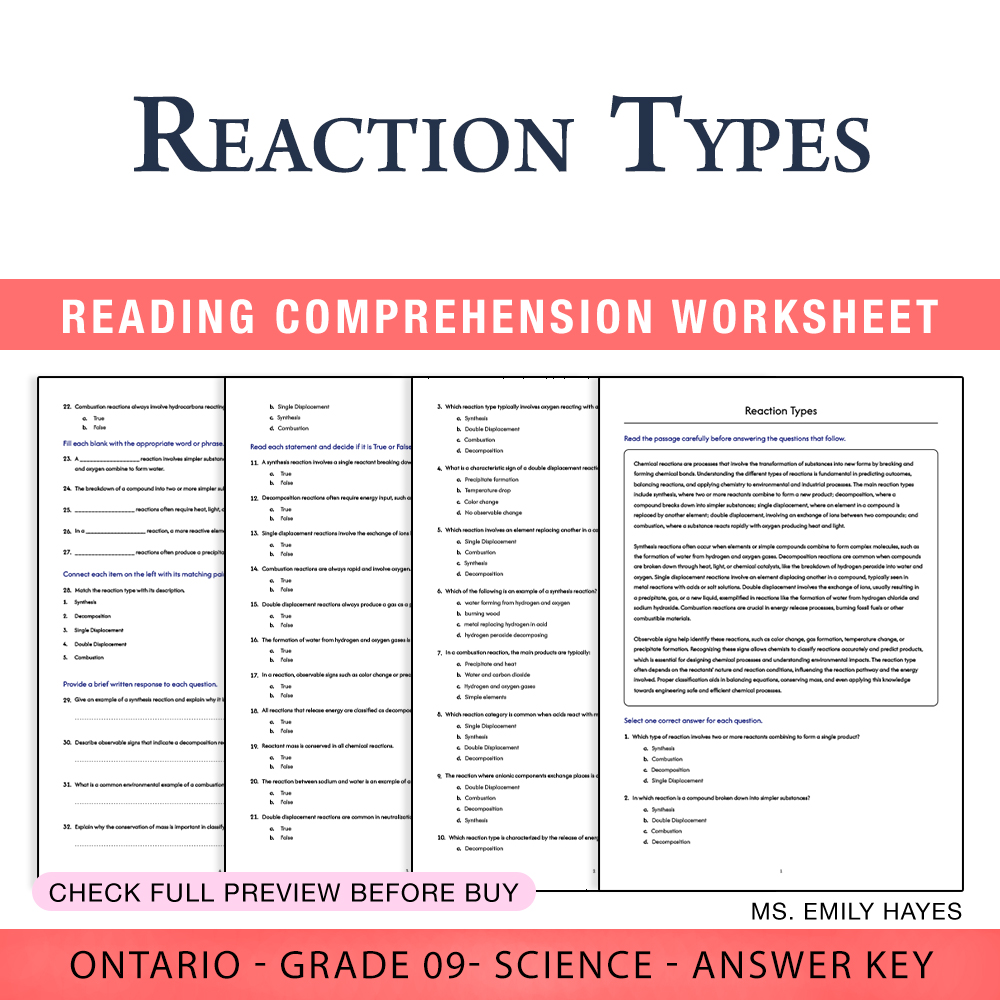
9th Grade Science | Reaction Types Worksheet (PDF + Answer Key)
Created byCopper Leaf ClassroomLearning Objectives
- Identify and describe the main types of chemical reactions: synthesis, decomposition, single displacement, double displacement, and combustion.
- Recognize observable signs and patterns that distinguish different reaction types.
- Predict products based on reaction patterns and understand mass conservation principles.
Instant download

Glucose Regulation Worksheet | Grade 9 Science TEKS Practice
Created byPrism Point LearningLearning Objectives
- Explain how insulin and glucagon help maintain blood glucose within a healthy range.
- Describe the negative feedback loop involved in glucose regulation and identify its set point, sensors, and effectors.
- Connect hormone signals to changes in glycogen synthesis, glycogen breakdown, and glucose production.
Instant download
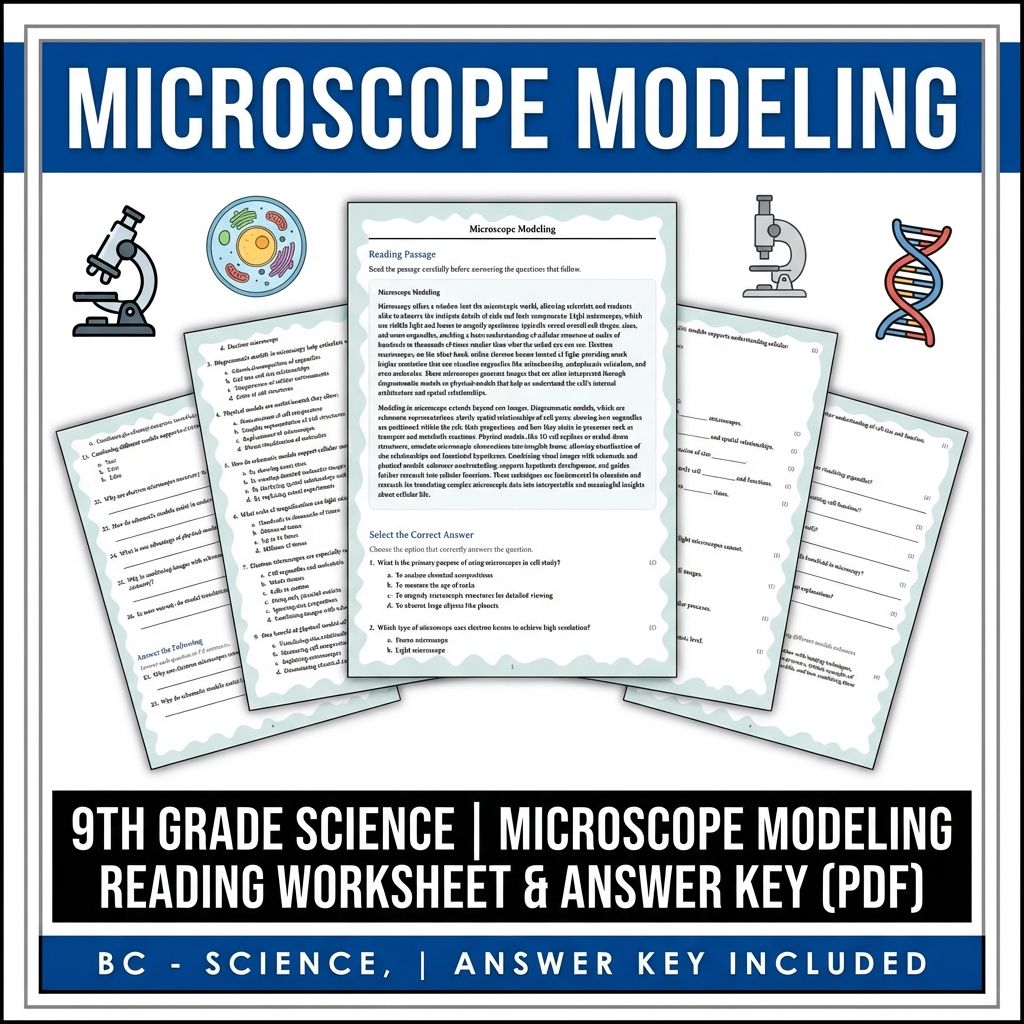
9th Grade Science | Microscope Modeling Reading Worksheet & Answer Key (PDF)
JCreated byJ.S SheetsLearning Objectives
- Understand how microscopy provides visual cell models and scales.
- Identify different types of microscopes and their features.
- Explain how diagrammatic and physical models aid in understanding cellular structures.
Instant download

Grade 9 Science | Systems Thinking in Science - Daily Reading Comprehension
Created byCoral Reef LearningLearning Objectives
- Understand the concept of systems thinking and its importance in science.
- Identify components and interactions within a system.
- Recognize how changes in one part of a system can affect the whole.
Instant download
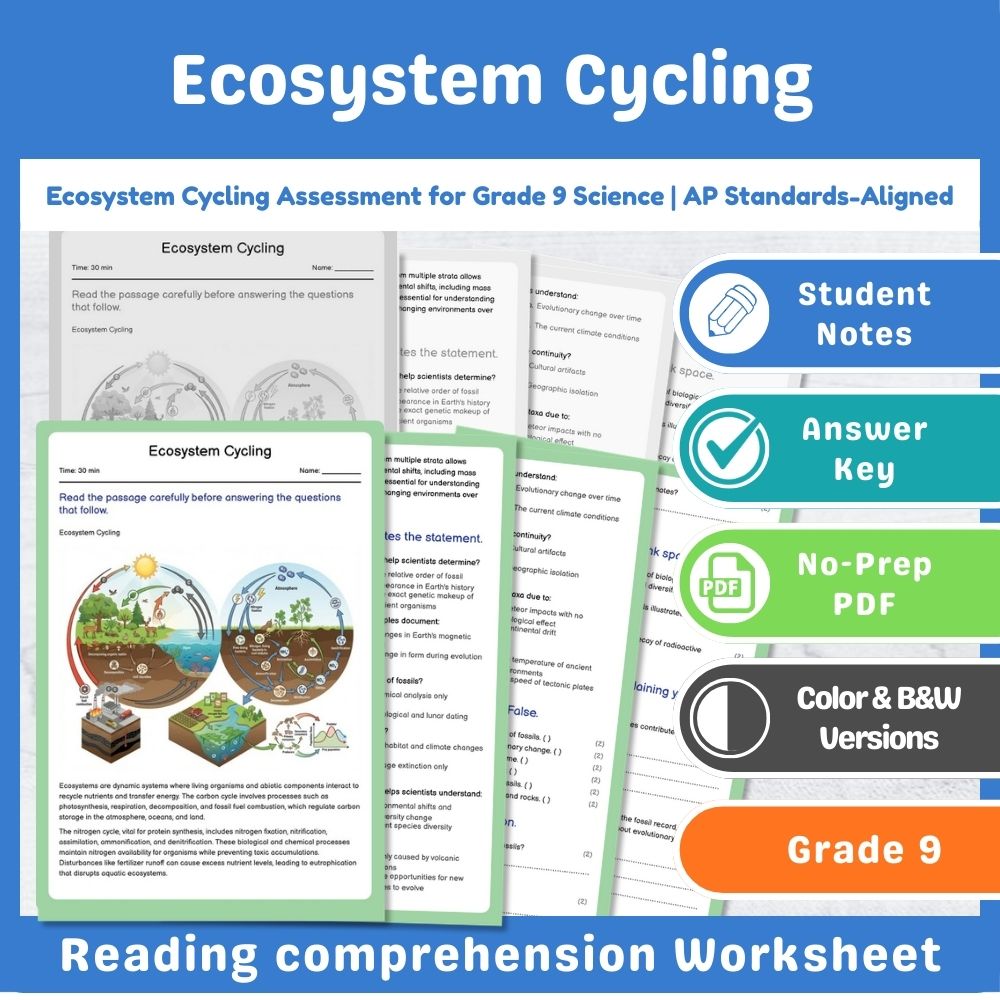
Ecosystem Cycling Assessment for Grade 9 Science | AP Standards-Aligned
Created byPrism Point LearningLearning Objectives
- Describe how organisms and abiotic components interact to drive material cycling and energy flow in ecosystems.
- Explain the roles of carbon and nitrogen cycles in maintaining ecosystem health.
- Analyze the impact of perturbations such as nutrient enrichment, habitat alteration, and invasive species on community structure and ecosystem function.
Also included in: Grade 9 Science Mini Bundle | Biology & Ecosystems Unit AP Standards
Instant download
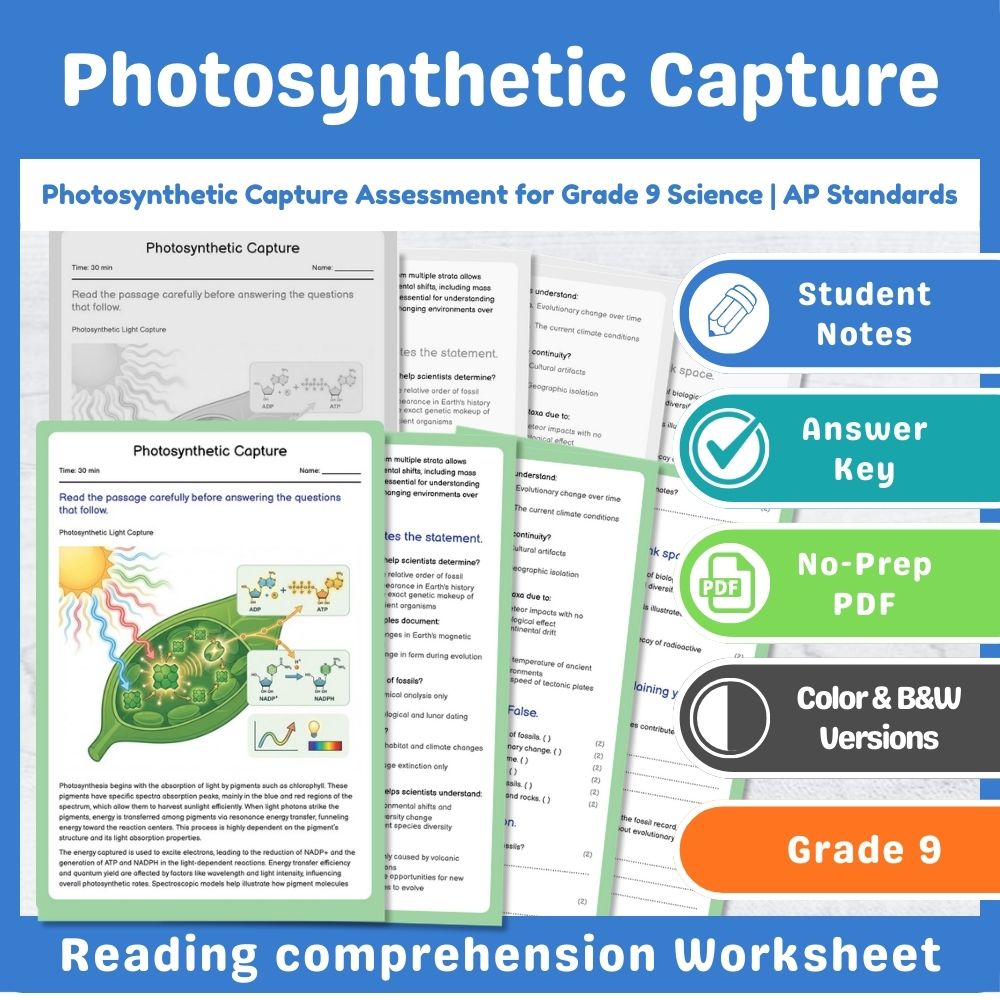
Photosynthetic Capture Assessment for Grade 9 Science | AP Standards
Created byPrism Point LearningLearning Objectives
- Describe how pigments absorb light and transfer energy in photosynthesis.
- Explain the relationship between light wavelength, energy transfer, and photosystem function.
- Analyze how environmental factors like light intensity influence photosynthetic rates.
Also included in: Grade 9 Science Mini Bundle | Biology & Ecosystems Unit AP Standards
Instant download
Ecosystem Dynamics Assessment for Grade 9 Science – AP Standards Aligned
Created byPrism Point LearningLearning Objectives
- Understand the concept of trophic interactions and feedback loops within ecosystems.
- Analyze how environmental factors influence ecosystem responses and resilience.
- Evaluate management scenarios affecting biodiversity and ecosystem services.
Also included in: Grade 9 Science Mini Bundle | Biology & Ecosystems Unit AP Standards
Instant download
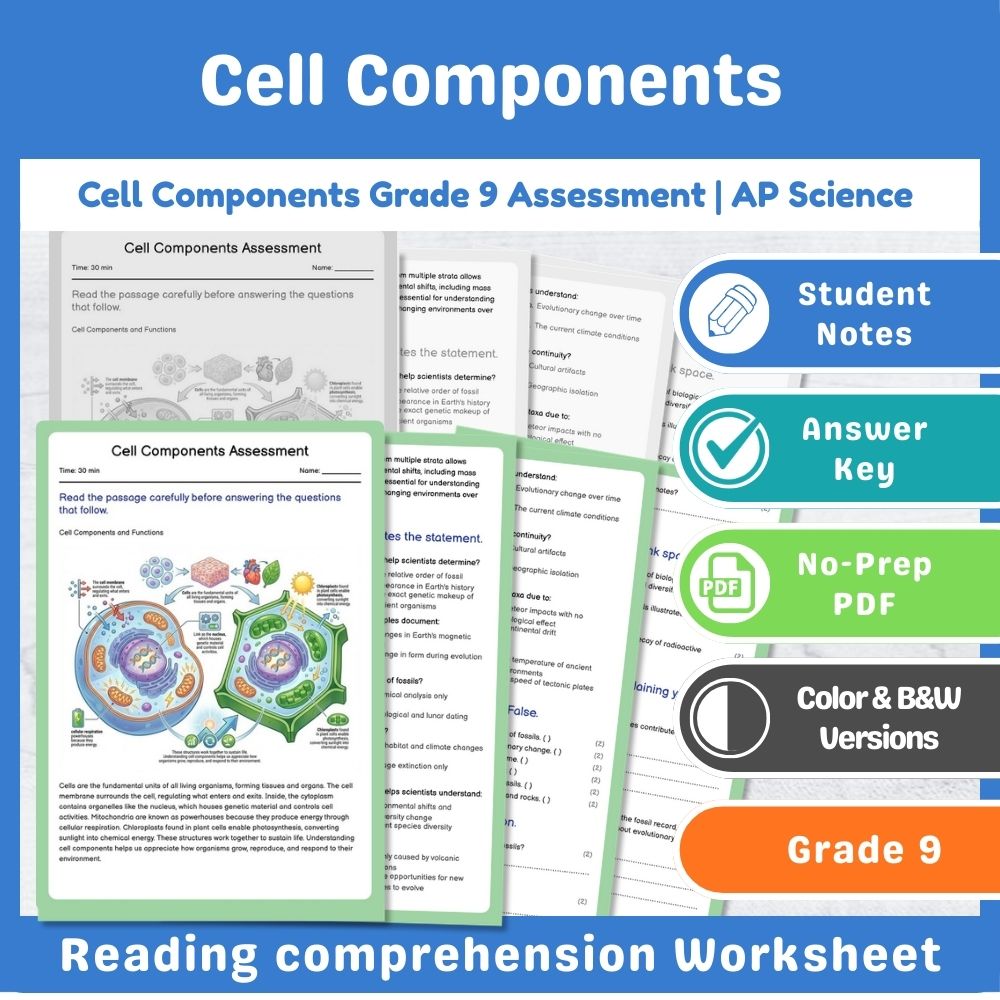
Cell Components Assessment Worksheet | AP Standards-Aligned Assessment Grade 9 Science
Created byPrism Point LearningLearning Objectives
- Identify the key components of a cell and their functions.
- Explain the differences between plant and animal cell components.
- Analyze the structure and role of cell organelles in cellular processes.
Also included in: Grade 9 Science Mini Bundle | Biology & Ecosystems Unit AP Standards
Instant download
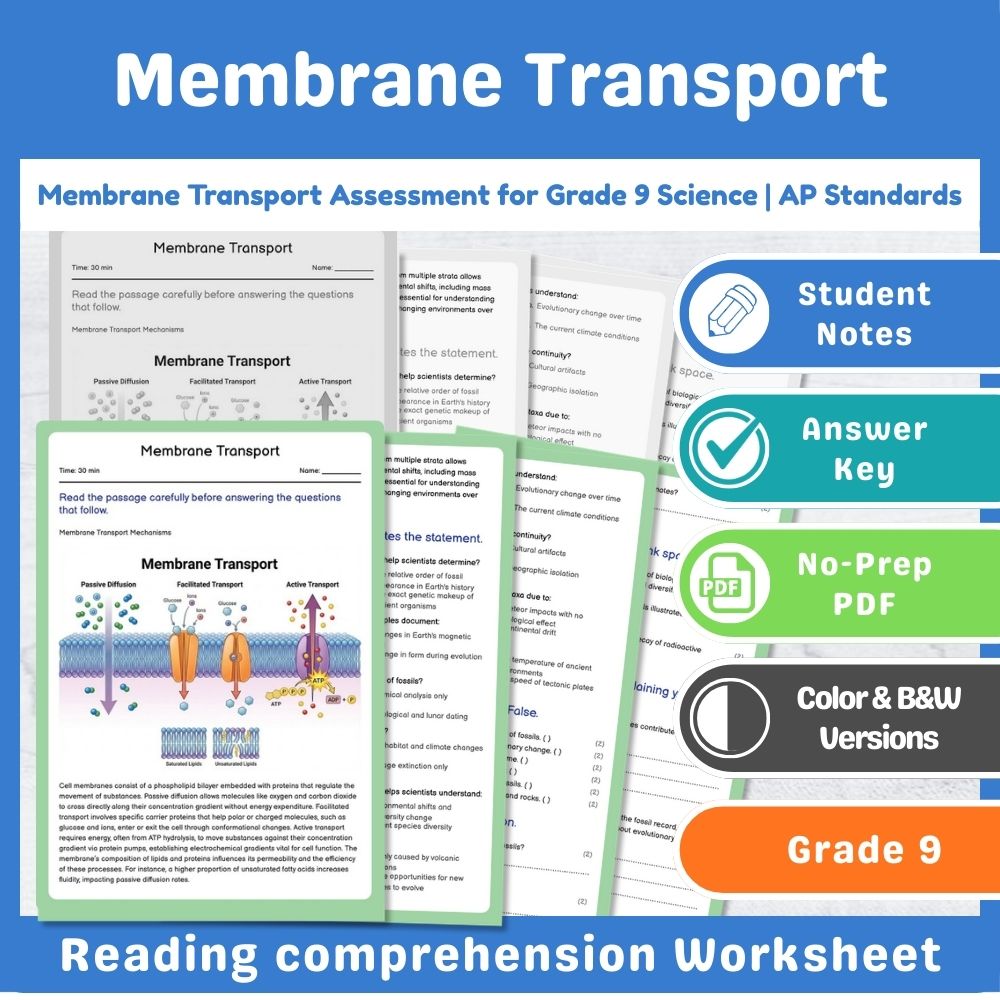
Membrane Transport Assessment for Grade 9 Science | AP Standards
Created byPrism Point LearningLearning Objectives
- Explain the mechanisms of passive diffusion, facilitated transport, and active transport across cell membranes.
- Describe how membrane composition and transporters influence cellular homeostasis and electrochemical gradients.
- Apply quantitative reasoning to predict the effects of structural modifications on membrane transport efficiency.
Also included in: Grade 9 Science Mini Bundle | Biology & Ecosystems Unit AP Standards
Instant download
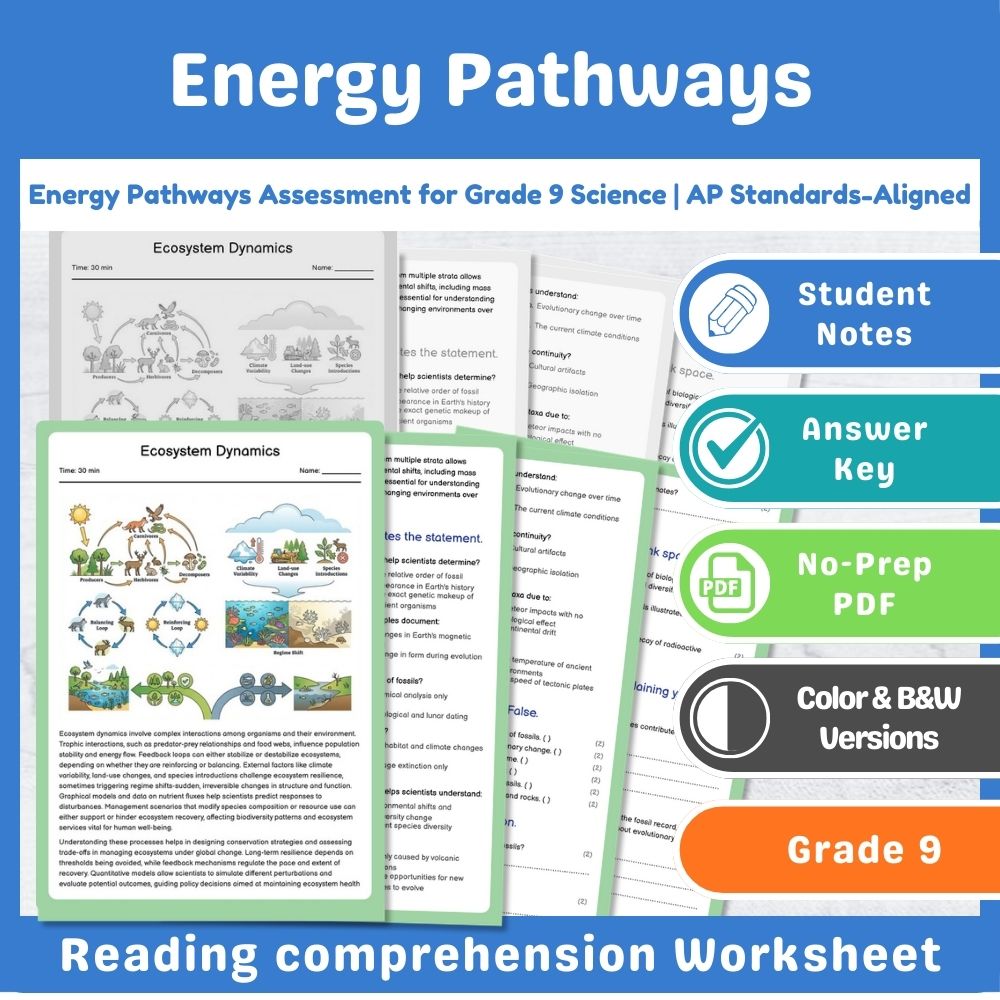
Energy Pathways Assessment for Grade 9 Science | AP Standards-Aligned
Created byPrism Point LearningLearning Objectives
- Understand key concepts related to Science
- Apply knowledge through practice questions
- Demonstrate comprehension of the material
Also included in: Grade 9 Science Mini Bundle | Biology & Ecosystems Unit AP Standards
Instant download
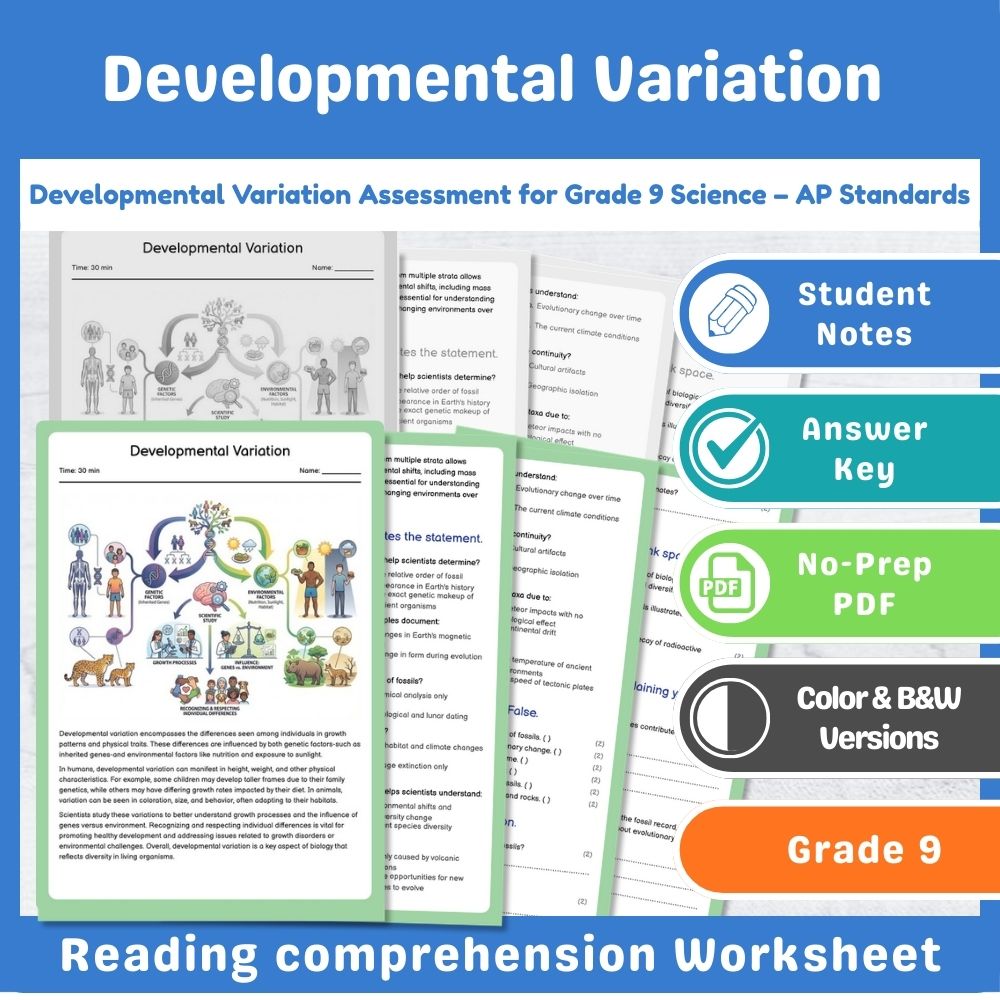
Developmental Variation Assessment for Grade 9 Science – AP Standards
Created byPrism Point LearningLearning Objectives
- Understand the concept of developmental variation in humans and animals.
- Identify factors that contribute to differences in development among individuals.
- Analyze how genetics and environment influence developmental traits.
Also included in: Grade 9 Science Mini Bundle | Biology & Ecosystems Unit AP Standards
Instant download

Trophic Dynamics Test Prep Printable | Grade 9 Science NGSS Review
Created byPrism Point LearningLearning Objectives
- Explain how energy and biomass move through trophic levels in a food web
- Use ecological efficiency and production-to-biomass ideas to describe energy loss at each step
- Interpret trophic pyramids and connect top-down and bottom-up control to predator-prey outcomes
Also included in: Grade 9 Ecosystem Dynamics Science Lesson Bundle: NGSS Review Worksheets
Instant download

Grade 9 Acceleration From Data Worksheet | Practice & PDF
 Created byClear Sky Classroom
Learning Objectives
- Interpret acceleration from speed–time and distance–time data graphs
- Determine whether acceleration is approximately constant or changing based on graph shape and slope
- Explain how the sign of acceleration relates to whether speed is increasing or decreasing
Instant download
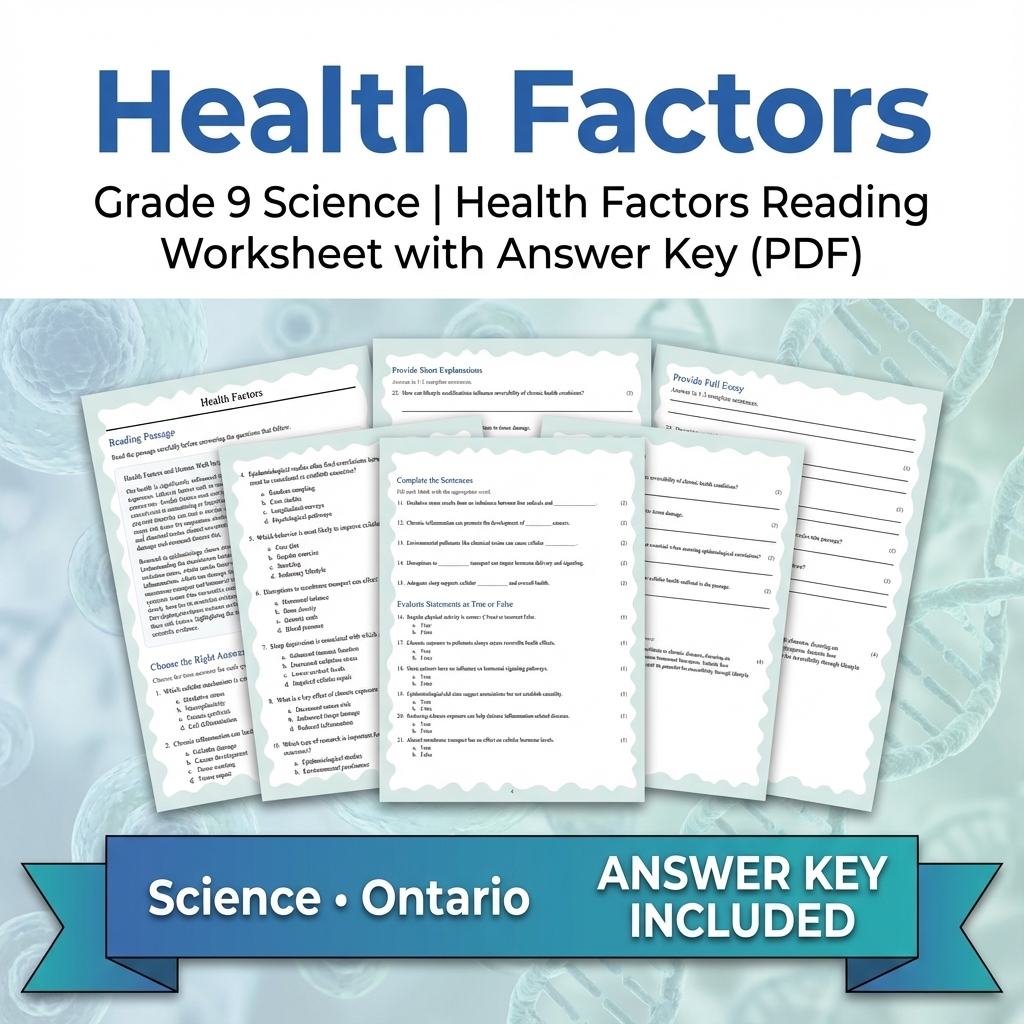
Grade 9 Science | Health Factors Reading Worksheet with Answer Key (PDF)
JCreated byJ.S SheetsLearning Objectives
- Understand how lifestyle and environmental factors impact human health.
- Interpret epidemiological data and physiological mechanisms related to chronic conditions.
- Analyze the effects of nutrition, activity, tobacco, pollutants, and sleep on cellular and systemic health.
Also included in: Grade 9 Science Unit Bundle | Human Body Systems & Cell Functions +1 more
Instant download
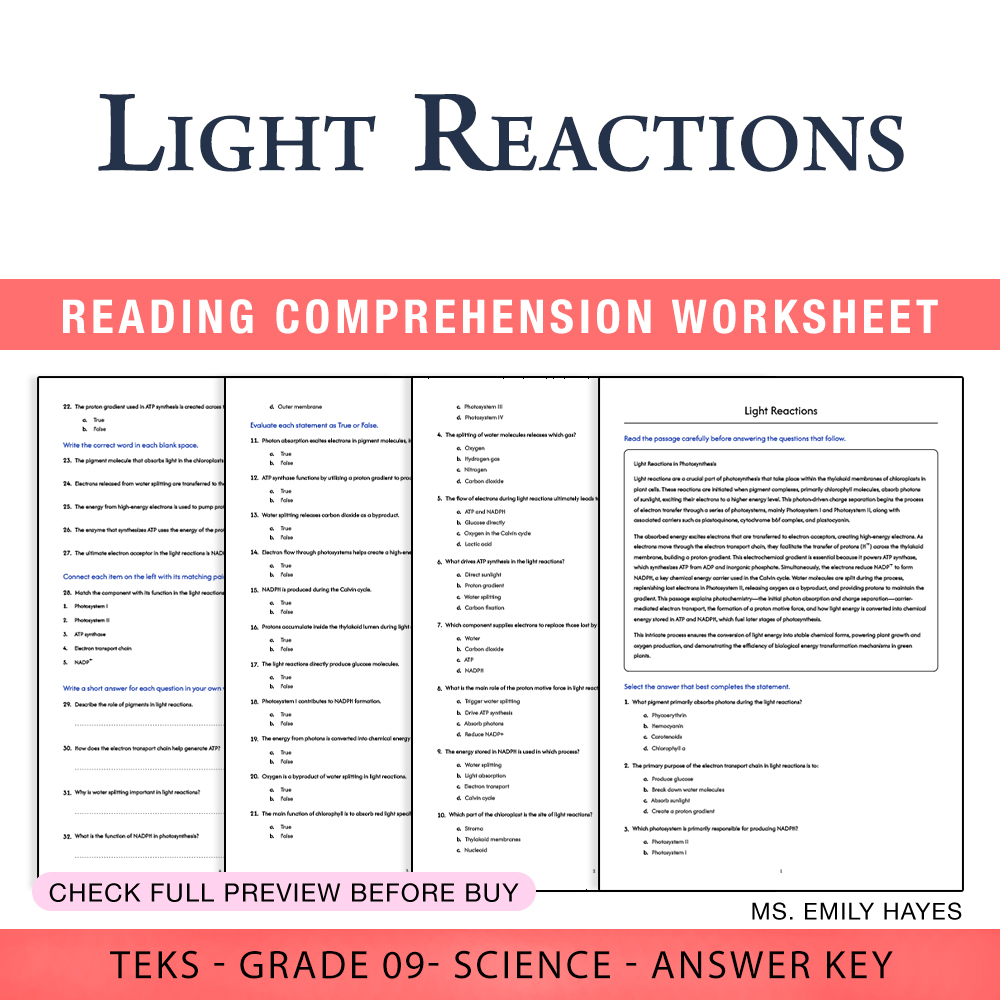
9th Grade Science | Light Reactions Worksheet (PDF+ Answer Key)
Created byCopper Leaf ClassroomLearning Objectives
- Explain the process occurring in the thylakoid membranes during light reactions.
- Identify the role of pigment complexes and photosystems in photon absorption.
- Describe how electron flow, proton gradient, and ATP/NADPH formation are interconnected.
Instant download
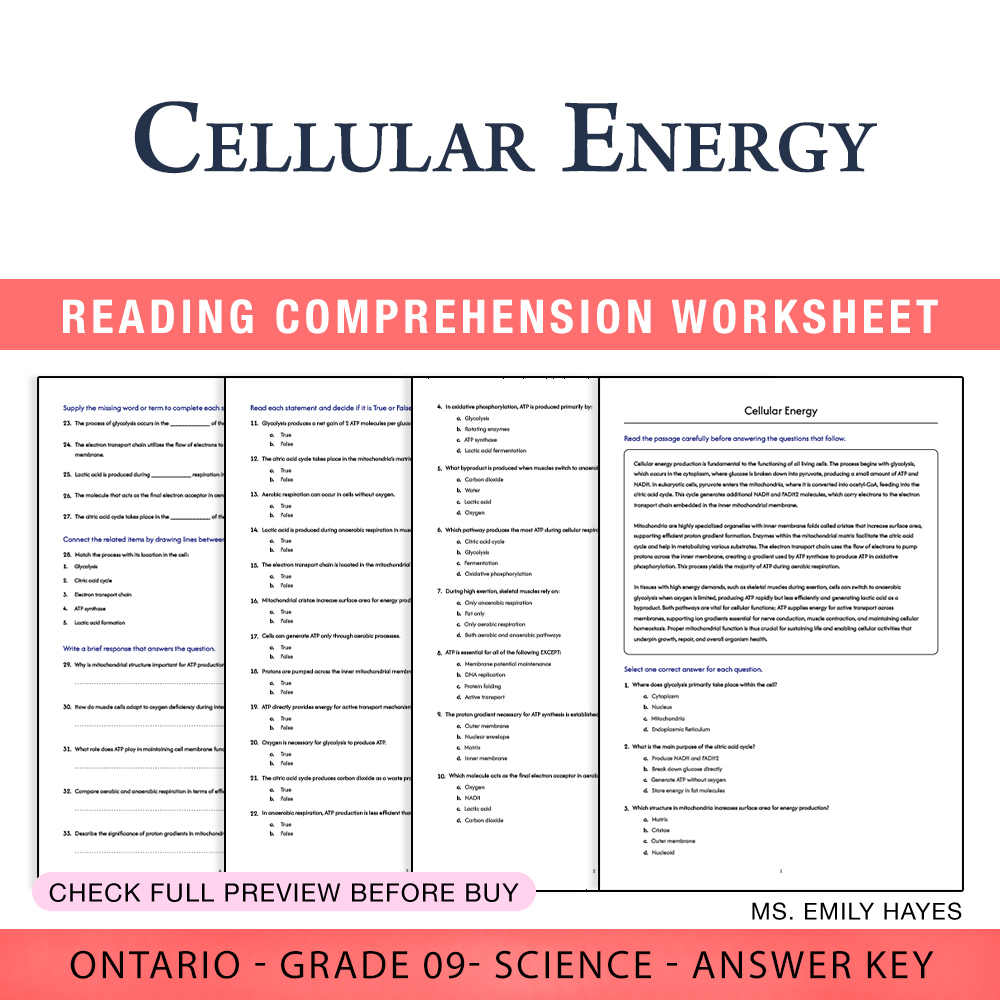
Grade 9 Science | Cellular Energy Worksheet (PDF + Answer Key)
Created byCopper Leaf ClassroomLearning Objectives
- Describe the processes of glycolysis, the citric acid cycle, and oxidative phosphorylation in cellular energy metabolism.
- Explain how mitochondrial structure supports ATP production, including the roles of inner membrane folds and enzymes in the matrix.
- Differentiate between aerobic and anaerobic pathways and their relevance in various tissues, such as skeletal muscle during exertion.
Instant download

Grade 9 Science | Electrical Quantities in Science - Daily Reading Comprehension
Created byCoral Reef LearningLearning Objectives
- Understand the concept of electric current, voltage, and resistance.
- Learn the units and symbols used for electrical quantities.
- Recognize typical magnitudes of electrical quantities in regional systems.
Also included in: Electricity and Magnetism Lesson Bundle – Grade 9 Science Alberta +1 more
Instant download
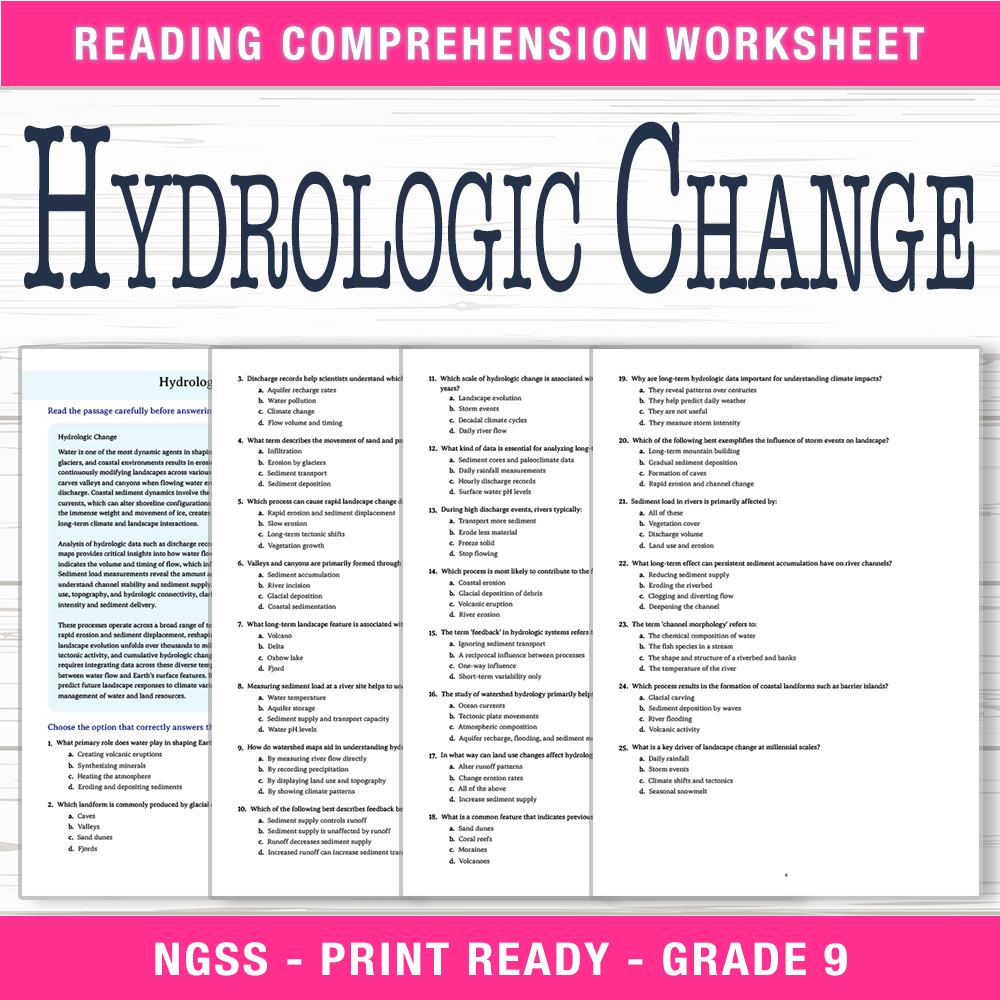
Grade 9 Science | Hydrologic Change Worksheet (PDF + Answer Key)
 Created byRiverstone Classroom
Learning Objectives
- Describe how water flow influences landscape features through erosion, transport, and deposition.
- Interpret hydrologic data such as discharge records and sediment measurements to assess landscape evolution.
- Explain the feedback mechanisms between runoff, sediment supply, and river channel morphology.
Also included in: Grade 9 Science Unit | Earth Processes & Climate Worksheet Bundle
Instant download

Adaptive Radiation Worksheet | Standards-Based Science Practice for Grade 9
JCreated byJ.S SheetsLearning Objectives
- Define adaptive radiation and describe how a single ancestral lineage can diversify into multiple species.
- Explain the roles of ecological niches, key innovations, and selective pressures in driving diversification.
- Use evidence and models to describe how gene flow, genetic drift, and natural selection shape evolutionary patterns.
Instant download
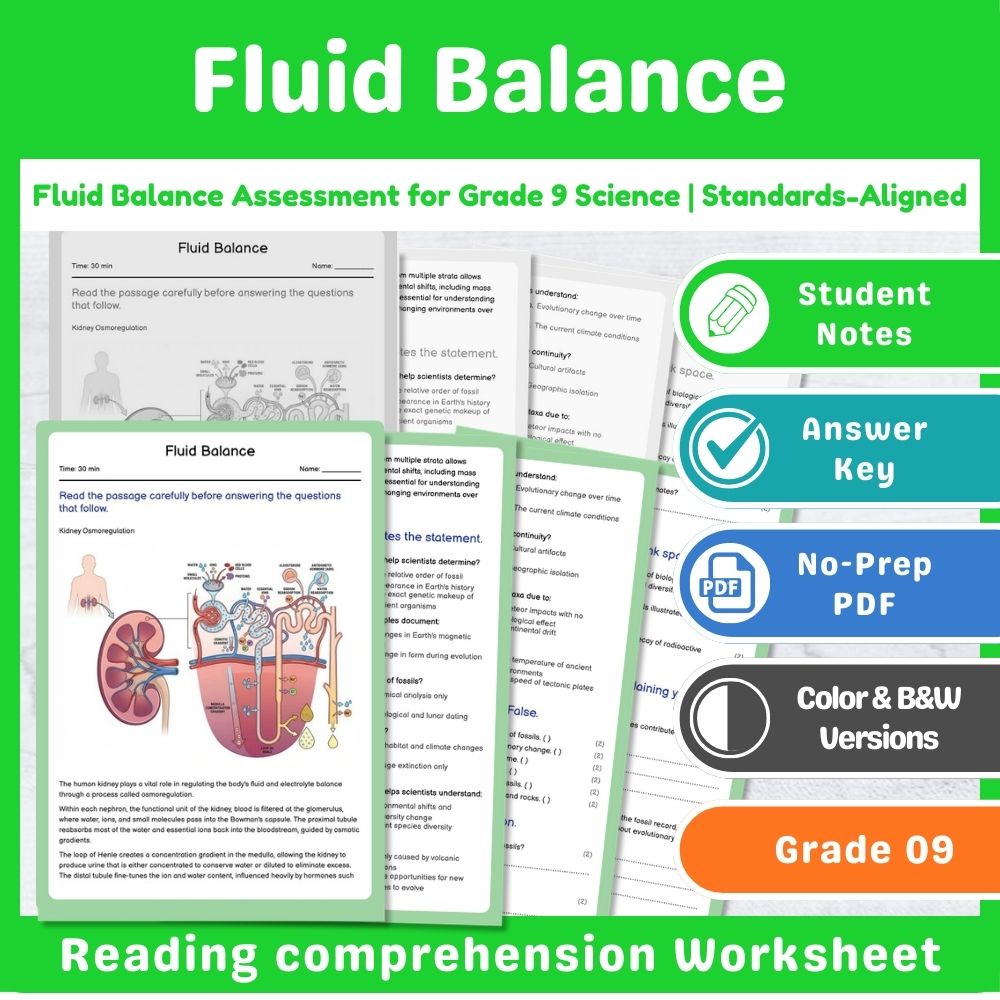
Fluid Balance Assessment for Grade 9 Science | Standards-Aligned
Created byPrism Point LearningLearning Objectives
- Understand the process of kidney osmoregulation and its role in maintaining water and ion balance.
- Identify the functions of filtration, reabsorption, secretion, and concentration in nephrons.
- Explain how hormones like antidiuretic hormone (ADH) and aldosterone regulate fluid and electrolyte balance.
Instant download
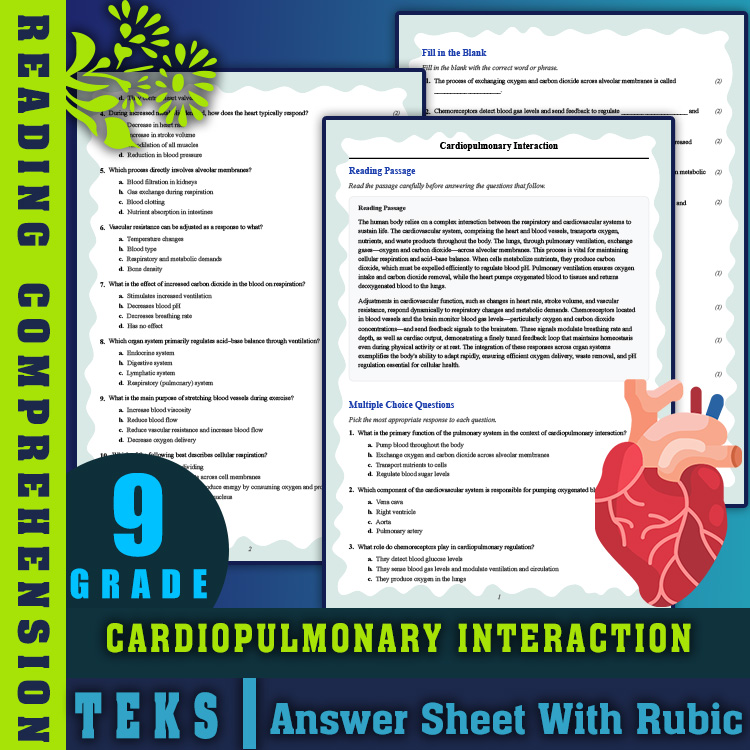
9th Grade Science | Cardiopulmonary Interaction Reading (PDF + Answer Key)
JCreated byJ.S SheetsLearning Objectives
- Explain how the heart and lungs work together to oxygenate blood and remove carbon dioxide.
- Describe the processes of pulmonary ventilation and cardiovascular transport of gases.
- Identify how the body adjusts heart rate, stroke volume, and vascular resistance during respiratory changes.
Instant download
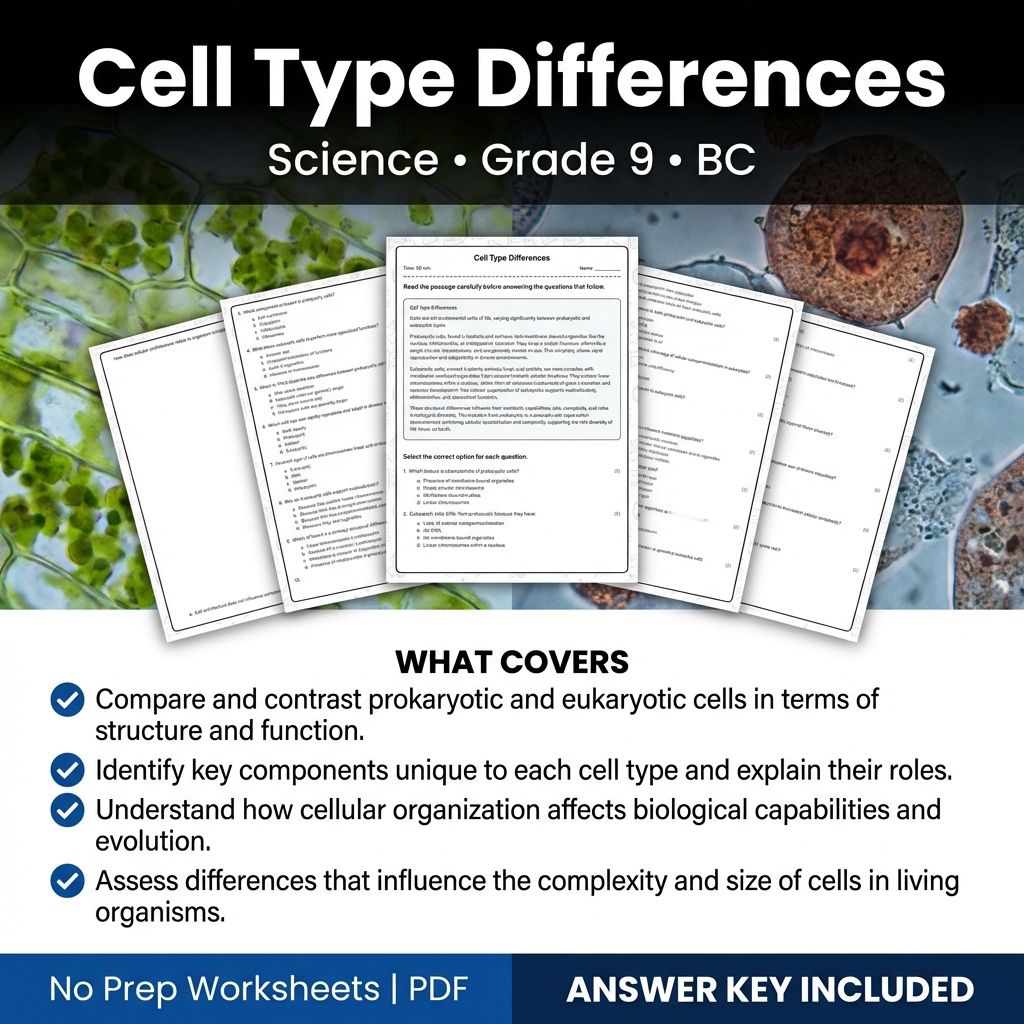
Cell Type Differences Worksheet for Grade 9 Science | BC Standards
Created byCoral Reef LearningLearning Objectives
- Compare and contrast prokaryotic and eukaryotic cells in terms of structure and function.
- Identify key components unique to each cell type and explain their roles.
- Understand how cellular organization affects biological capabilities and evolution.
Instant download

Grade 9 Homeostasis Basics Worksheet | Practice BC PDF
Created byClear Sky ClassroomLearning Objectives
- Explain how homeostasis maintains internal conditions within narrow ranges despite external changes
- Describe how sensors, integrating centers, and effectors work together in feedback mechanisms
- Connect specific body systems (respiratory, circulatory, endocrine, renal, nervous) to maintaining stable internal conditions
Instant download
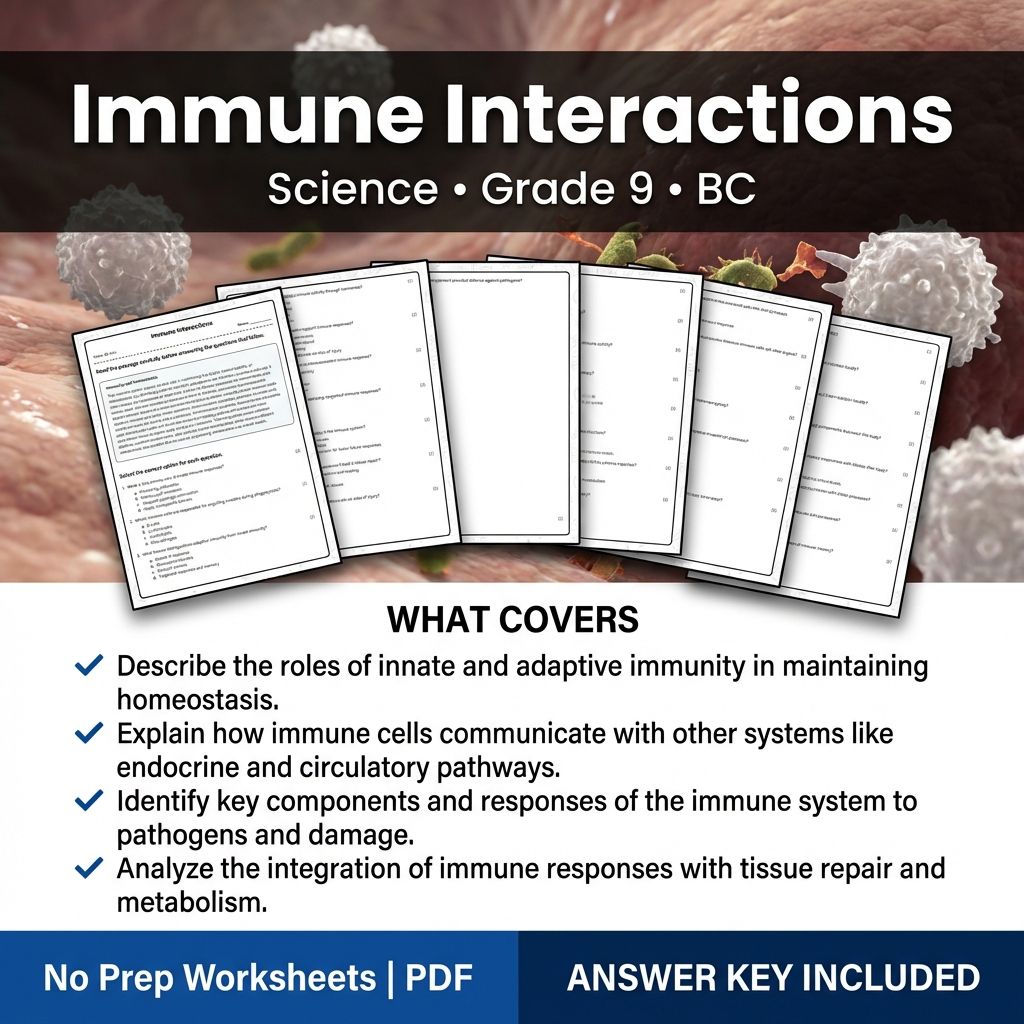
Immune Interactions Science Worksheet | Grade 9 BC Standards
Created byCoral Reef LearningLearning Objectives
- Describe the roles of innate and adaptive immunity in maintaining homeostasis.
- Explain how immune cells communicate with other systems like endocrine and circulatory pathways.
- Identify key components and responses of the immune system to pathogens and damage.
Instant download
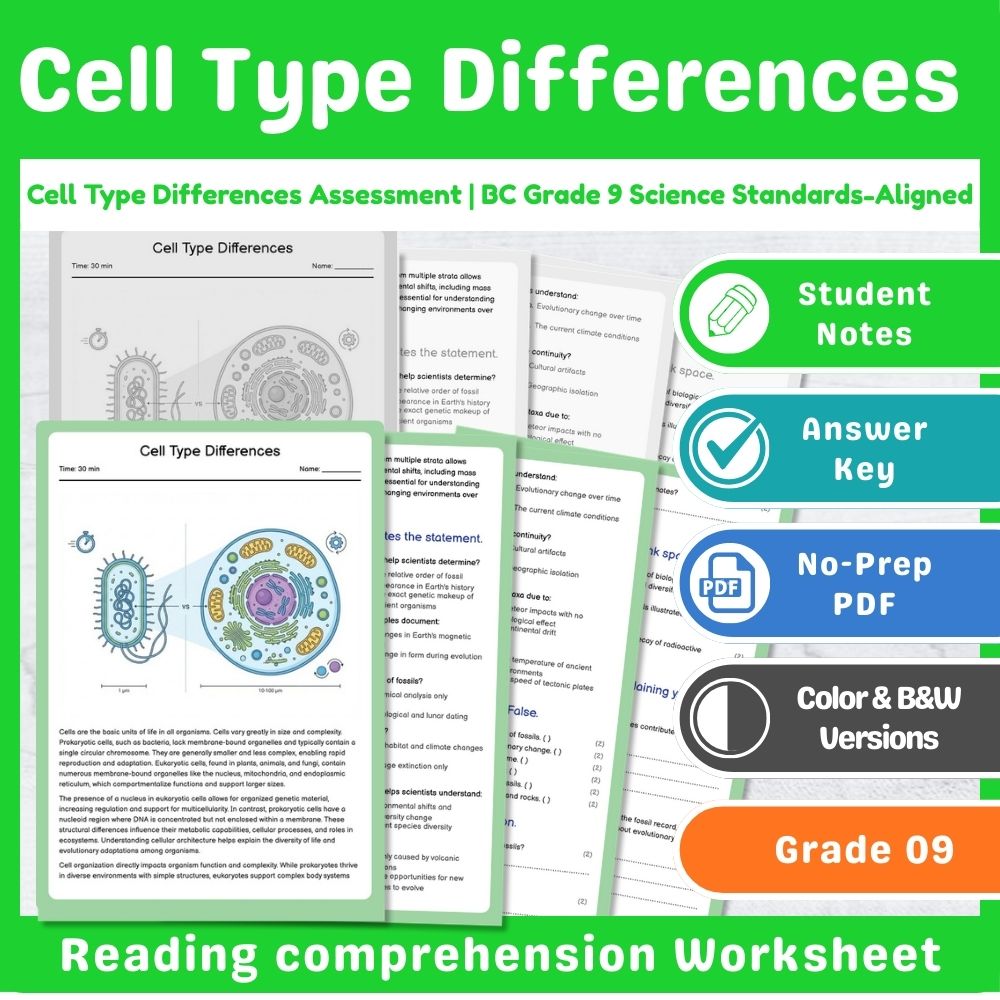
Cell Type Differences Assessment | BC Grade 9 Science Standards-Aligned
Created byPrism Point LearningLearning Objectives
- Understand the structural differences between prokaryotic and eukaryotic cells.
- Identify key components unique to each cell type.
- Explain how cell structure relates to function and organism complexity.
Instant download

Grade 9 Science – Immune Interactions Worksheet (PDF) BC Standards
 Created byEvergreen Desk Education
Learning Objectives
- Explain how innate and adaptive immunity work together to maintain homeostasis during infection or injury
- Describe how immune cells coordinate inflammation and repair using chemical and cellular signals
- Connect immune function with circulatory and endocrine system roles in transporting signals and regulating body processes
Instant download
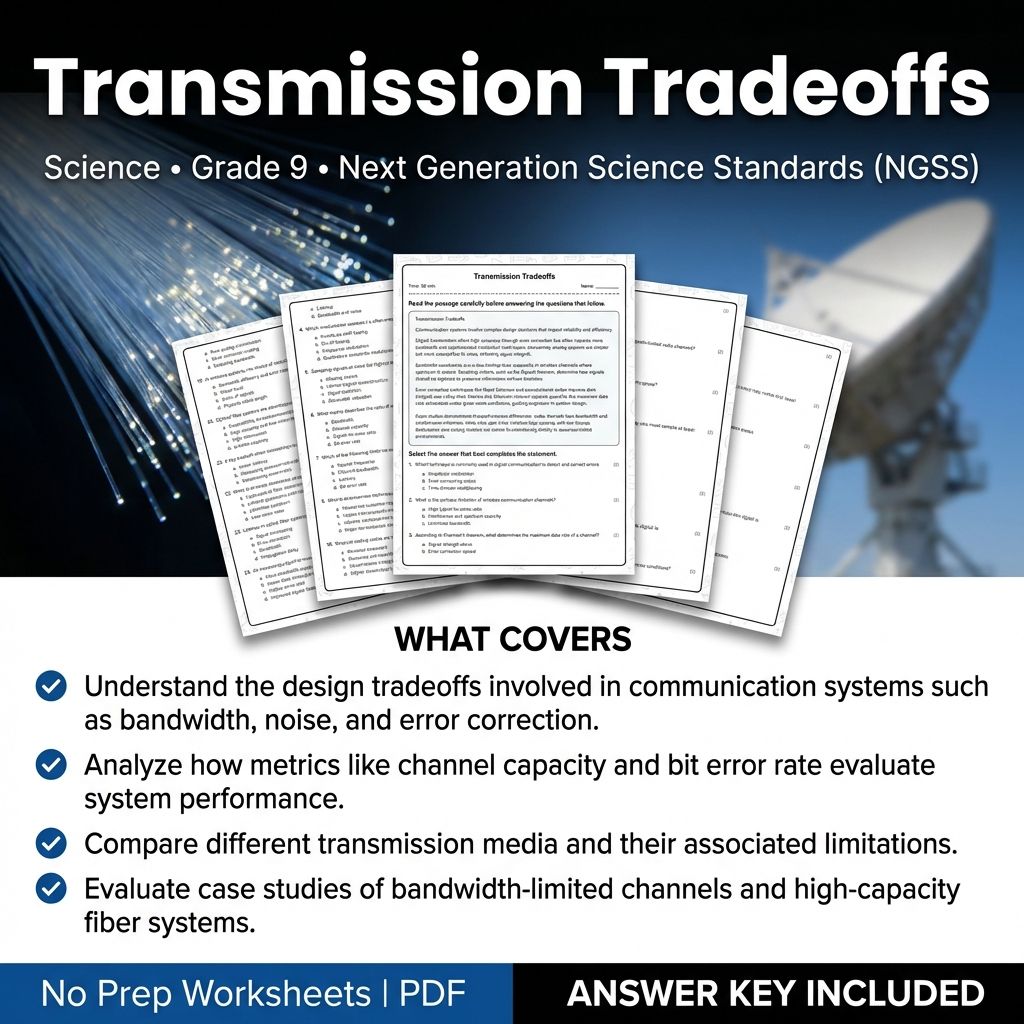
9th Grade Science Worksheet | Transmission Tradeoffs – NGSS Practice
Created byCoral Reef LearningLearning Objectives
- Understand the design tradeoffs involved in communication systems such as bandwidth, noise, and error correction.
- Analyze how metrics like channel capacity and bit error rate evaluate system performance.
- Compare different transmission media and their associated limitations.
Also included in: Grade 9 Science | Wave Properties & Electromagnetic Radiation Worksheet Bundle +1 more
Instant download
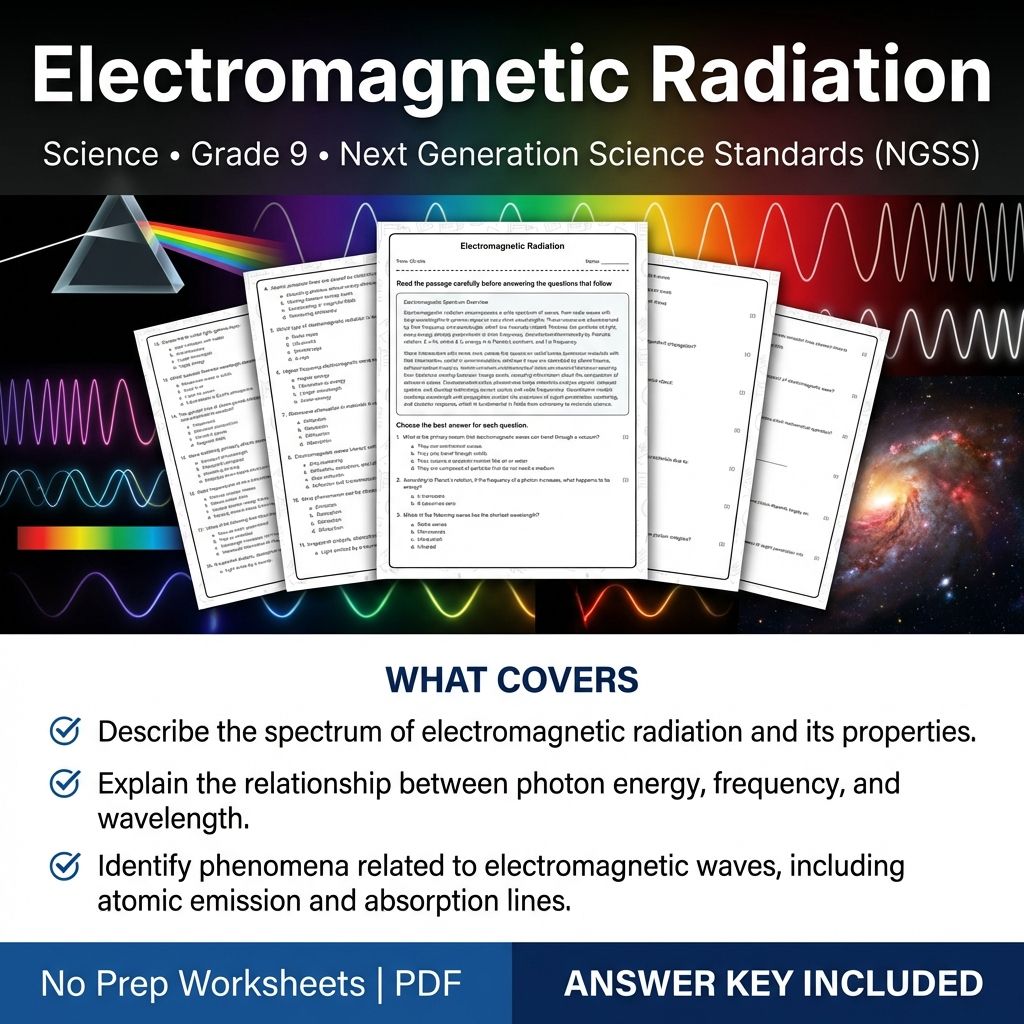
Grade 9 Science Worksheet | Electromagnetic Radiation Practice PDF & Answer Key
Created byCoral Reef LearningLearning Objectives
- Describe the spectrum of electromagnetic radiation and its properties.
- Explain the relationship between photon energy, frequency, and wavelength.
- Identify phenomena related to electromagnetic waves, including atomic emission and absorption lines.
Also included in: Grade 9 Science | Wave Properties & Electromagnetic Radiation Worksheet Bundle +1 more
Instant download
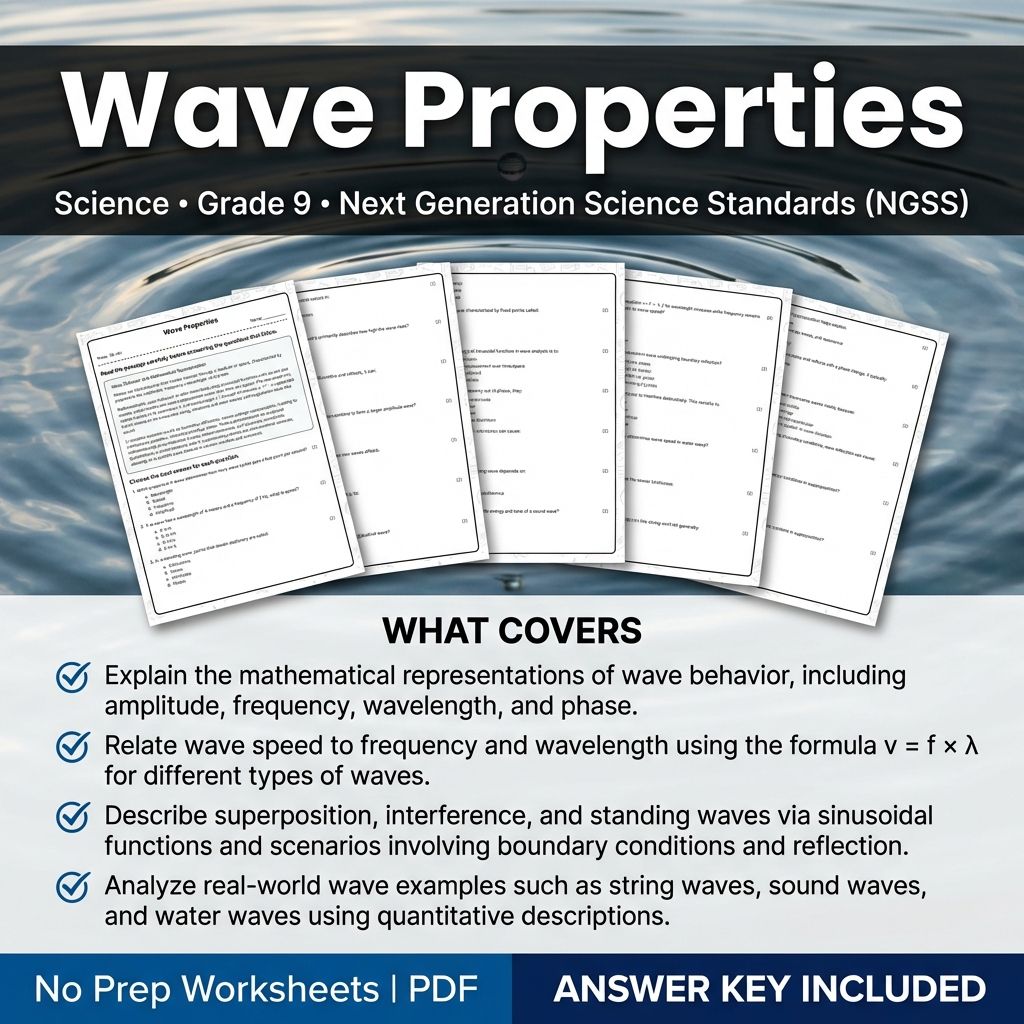
Grade 9 Science | Wave Properties Worksheet & Answer Key (Printable PDF)
Created byCoral Reef LearningLearning Objectives
- Explain the mathematical representations of wave behavior, including amplitude, frequency, wavelength, and phase.
- Relate wave speed to frequency and wavelength using the formula v = f × λ for different types of waves.
- Describe superposition, interference, and standing waves via sinusoidal functions and scenarios involving boundary conditions and reflection.
Also included in: Grade 9 Science | Wave Properties & Electromagnetic Radiation Worksheet Bundle +1 more
Instant download

Grade 9 Science | Cell Essential Functions Worksheet | General Standards
Created byLumora LearningLearning Objectives
- Explain how cell membranes regulate transport to support homeostasis
- Describe how cellular energy use powers chemical reactions needed for growth and maintenance
- Use evidence (uptake rates and growth patterns) to connect cellular structure to function
Instant download
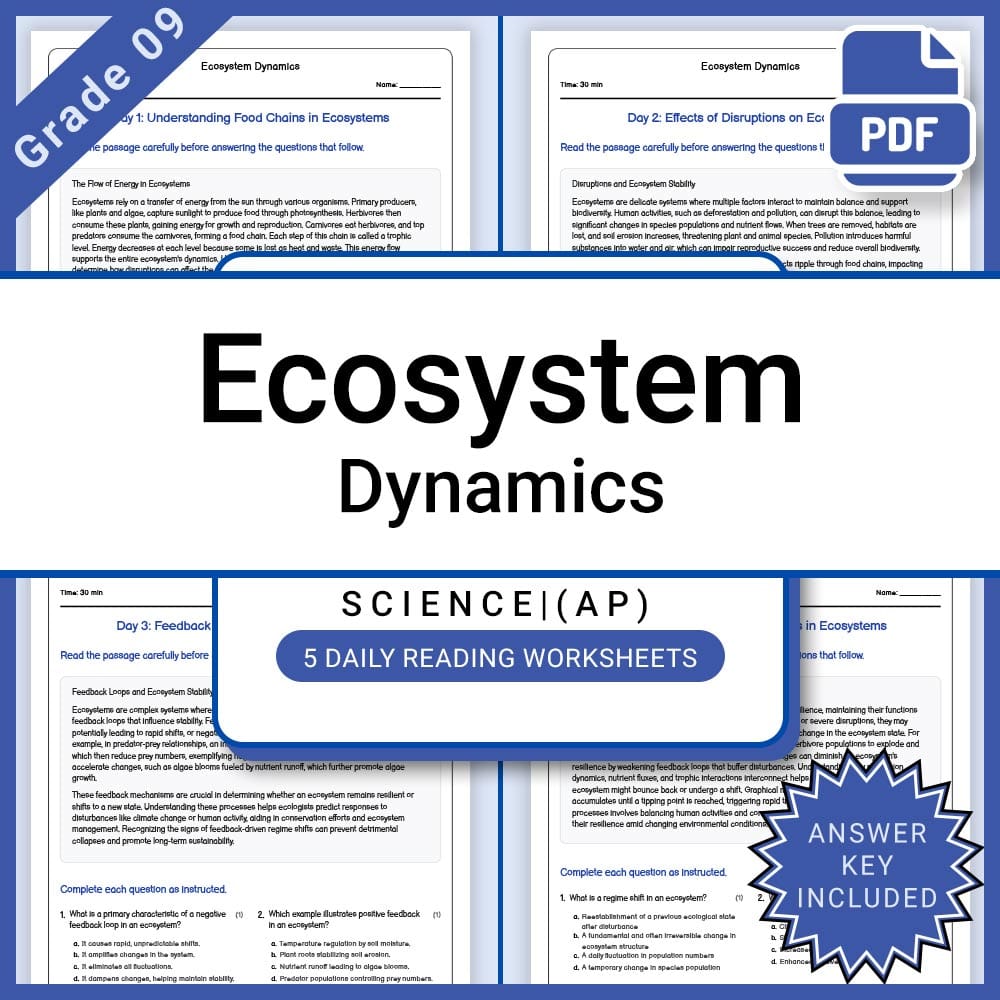
Grade 9 Science – Ecosystem Dynamics Daily Reading Worksheet + Answer Key
JCreated byJ.S SheetsLearning Objectives
- Identify trophic levels within food chains.
- Understand the flow of energy through ecosystems.
- Analyze how multiple factors influence ecosystem stability.
Also included in: Grade 9 Science Lesson Bundle | AP Curriculum Worksheets for Key Topics +1 more
Instant download
About Grade 9 Science Worksheets
Find Science worksheets built for Grade 9. All 6,926 cover core skills, practice, and review, each an instant PDF download.
Every worksheet on MyTeachingSheets is created by independent teacher-authors and reviewed before publication. All resources download as printable PDFs for classroom, homework, or at-home practice, and many include answer keys. Preview any worksheet free before buying.