
Science Worksheets
44,342 subject resources
Conservation of Matter Worksheet Grade 9 Science Activity | NGSSS
 Created byPrism Point Learning
Learning Objectives
- Explain conservation of atoms during chemical reactions using particle-level reasoning.
- Use conservation of mass in a closed system to justify why total mass does not change.
- Connect reactant quantities to possible product quantities through atom accounting.
Instant download
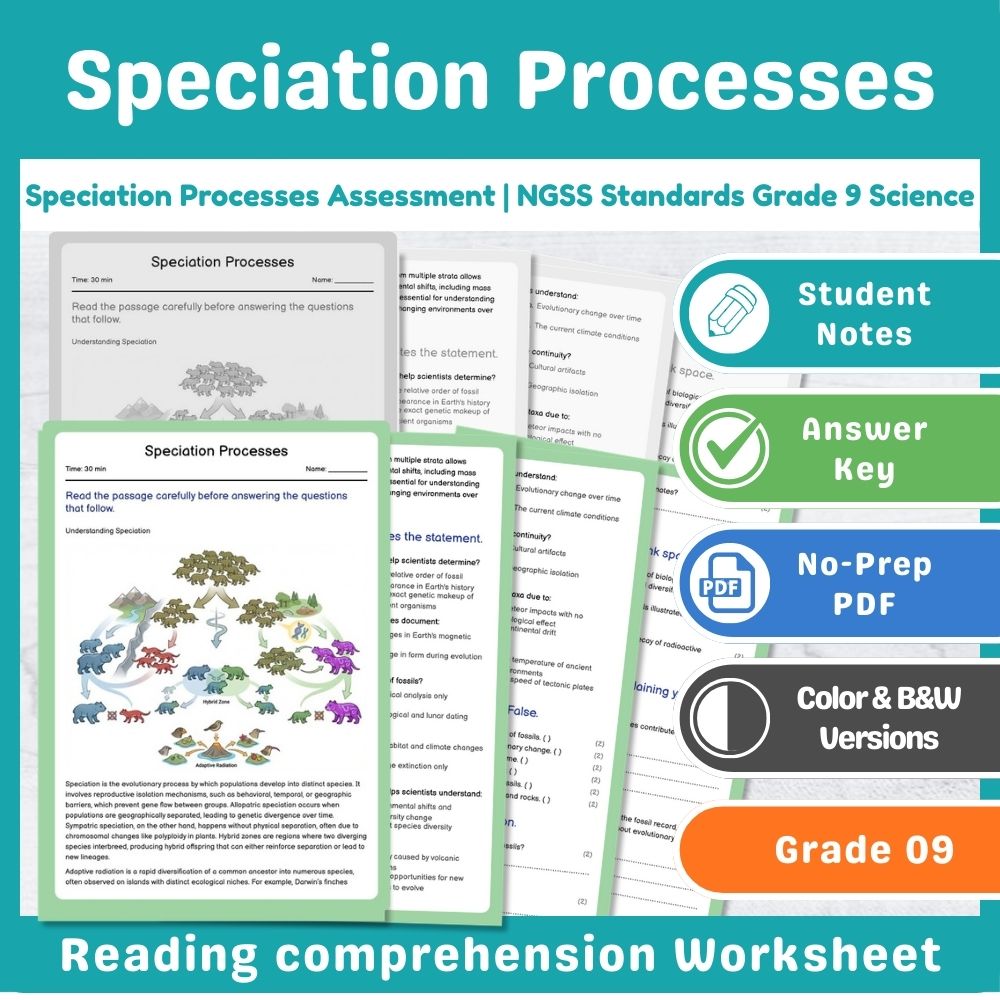
Speciation Processes Assessment | NGSS Standards Grade 9 Science
Created byPrism Point LearningLearning Objectives
- Explain the mechanisms leading to the formation of new species, including reproductive isolation and genetic divergence.
- Differentiate between allopatric and sympatric speciation models with examples.
- Describe how hybrid zones, polyploidy, and adaptive radiation contribute to speciation.
Instant download
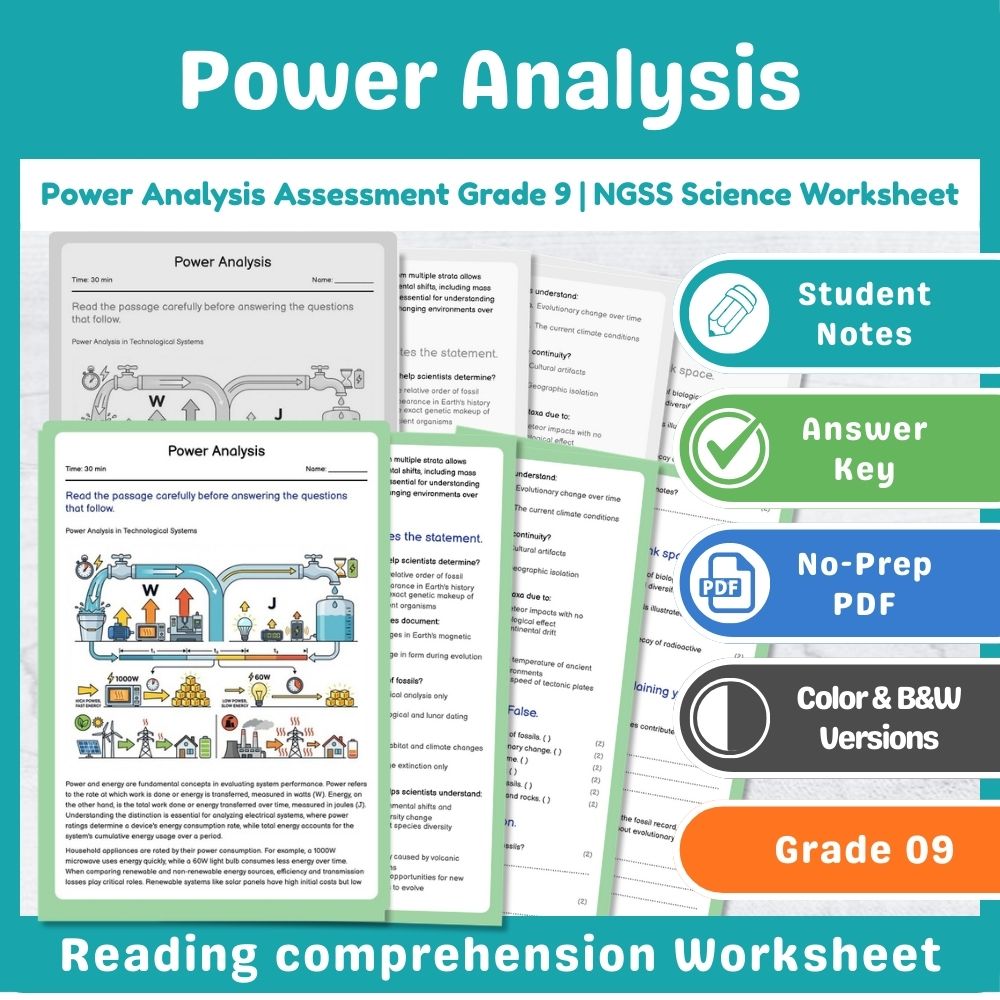
Power Analysis Assessment Grade 9 | NGSS Science Worksheet
Created byPrism Point LearningLearning Objectives
- Understand the difference between power and energy in system analysis.
- Calculate energy demand over time considering efficiency and system losses.
- Compare the power ratings of household appliances and their impact on energy consumption.
Instant download
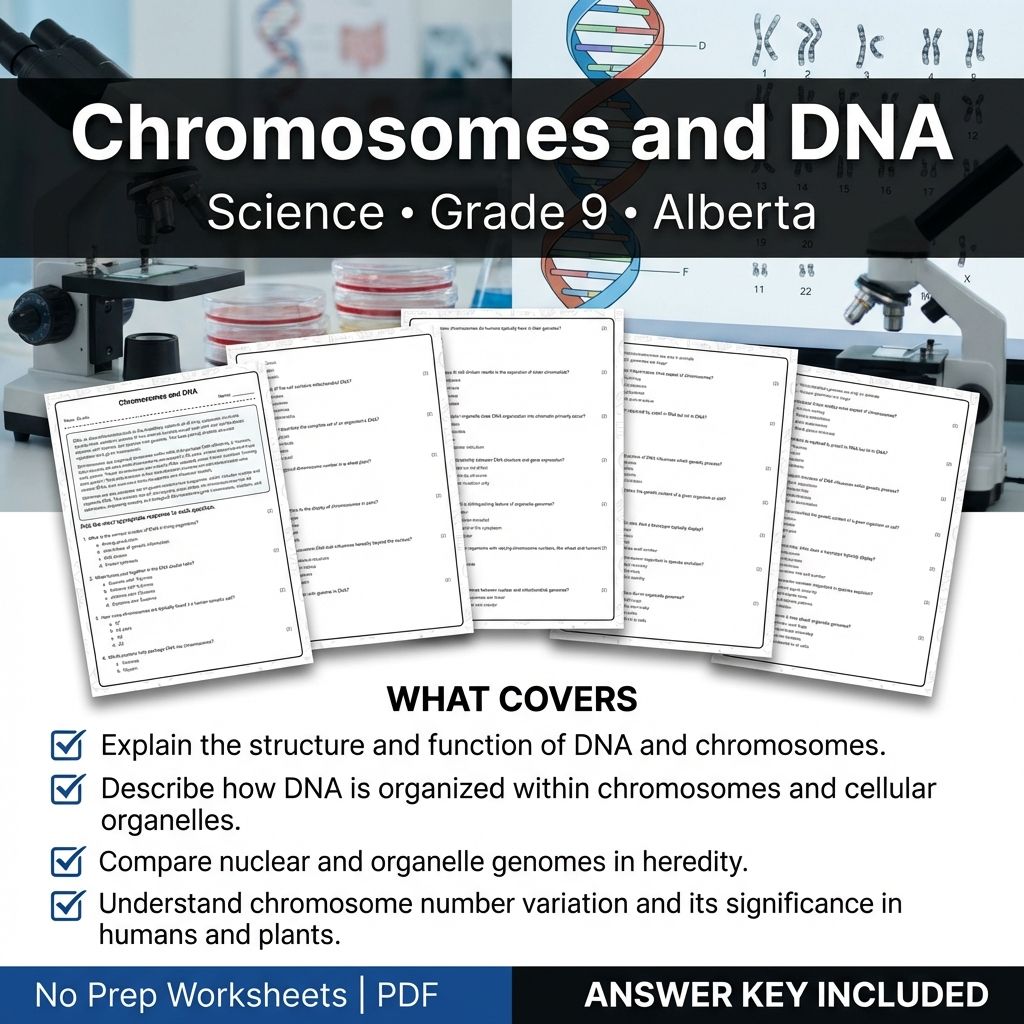
Chromosomes and DNA Worksheet | Grade 9 Science | Alberta
 Created byCoral Reef Learning
Learning Objectives
- Explain the structure and function of DNA and chromosomes.
- Describe how DNA is organized within chromosomes and cellular organelles.
- Compare nuclear and organelle genomes in heredity.
Instant download

Hazard Assessment Worksheet Practice Test | Grade 9 Science NGSS
Created byPrism Point LearningLearning Objectives
- Explain how hazard risk depends on occurrence, frequency, and consequences for natural events
- Use exposure, vulnerability, and cascading system effects to evaluate community and infrastructure susceptibility
- Connect hazard mapping and return-period information to mitigation and planning decisions
Also included in: Grade 9 Test Prep Science Lesson Bundle NGSS: Energy Systems & Modeling
Instant download

Grade 11 Science | Anatomical Clues Worksheet | TEKS Aligned
 Created byLumora Learning
Learning Objectives
- Understand the importance of comparative anatomy in inferring evolutionary relationships.
- Identify homologous and analogous structures in different species.
- Explain the significance of vestigial organs and embryonic patterns in evolutionary studies.
Instant download

Grade 11 Science | Classification Methods Worksheet | TEKS Aligned
Created byLumora LearningLearning Objectives
- Explain how cladistic analysis groups organisms based on shared derived characters.
- Differentiate between phenetic and phylogenomics approaches in biological classification.
- Describe how hierarchical taxonomic systems reflect evolutionary relationships.
Instant download

Grade 12 Science | Inheritance Patterns Worksheet (PDF) aligned to BC standards
 Created byEvergreen Desk Education
Learning Objectives
- Explain how dominant/recessive inheritance, incomplete dominance, and sex linkage affect genotype and phenotype outcomes
- Use recombination frequency to infer relative chromosomal positions and predict trait assortments
- Interpret pedigrees to determine the most likely inheritance pattern and identify possible carriers
Instant download
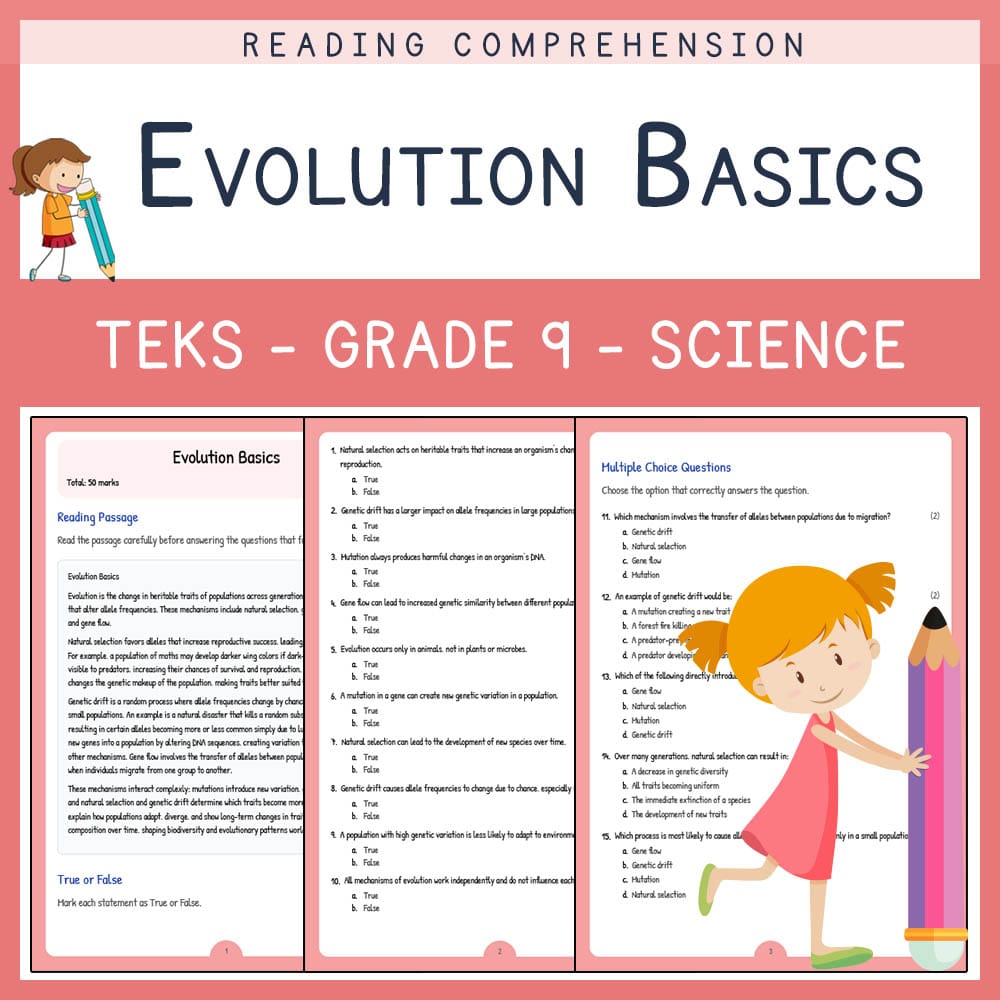
Grade 9 Science | Evolution Basics Worksheet | TEKS Aligned
Created byLumora LearningLearning Objectives
- Understand the fundamental mechanisms of evolution, including natural selection, genetic drift, mutation, and gene flow.
- Explain how these mechanisms interact to produce long-term changes in populations.
- Identify examples of evolution in real-world scenarios.
Instant download
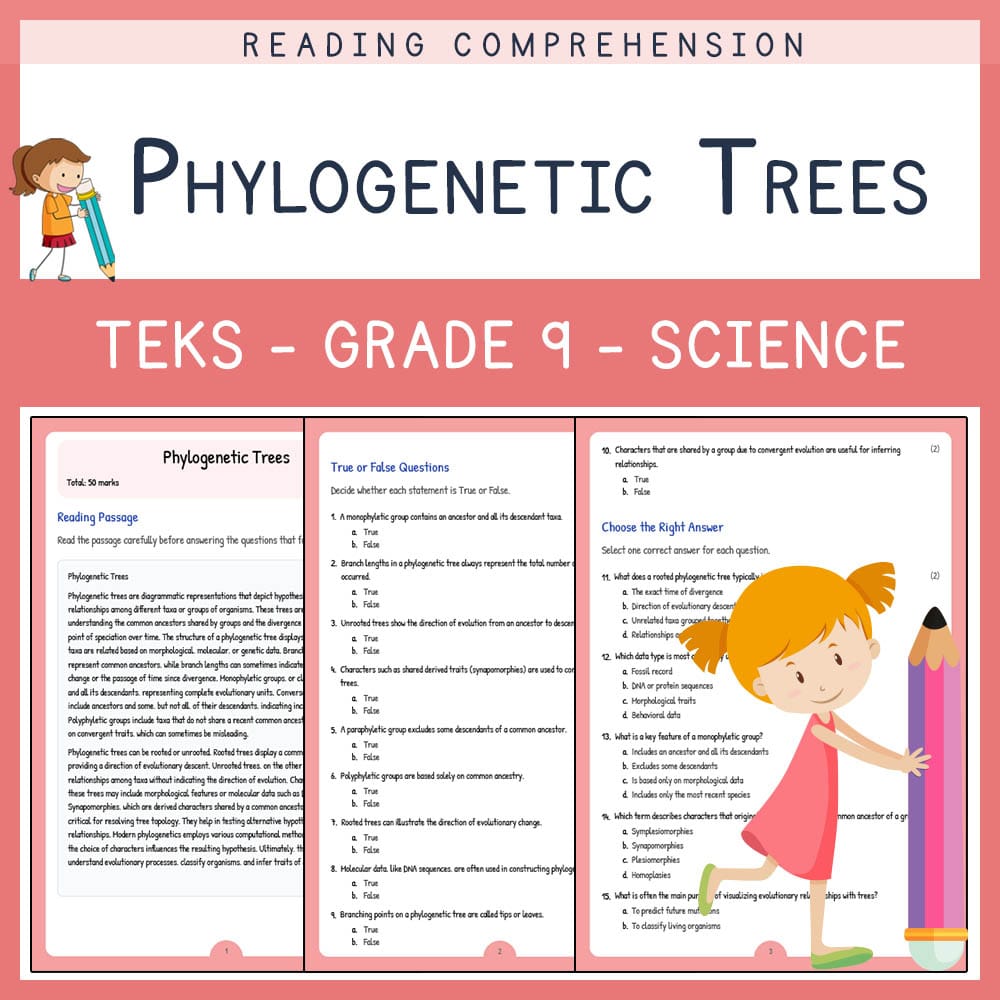
Grade 9 Science | Phylogenetic Trees Worksheet | TEKS Aligned
Created byLumora LearningLearning Objectives
- Understand the structure and purpose of phylogenetic trees in evolutionary biology.
- Identify monophyletic, paraphyletic, and polyphyletic groups within trees.
- Distinguish between rooted and unrooted phylogenetic trees and interpret branch lengths.
Instant download
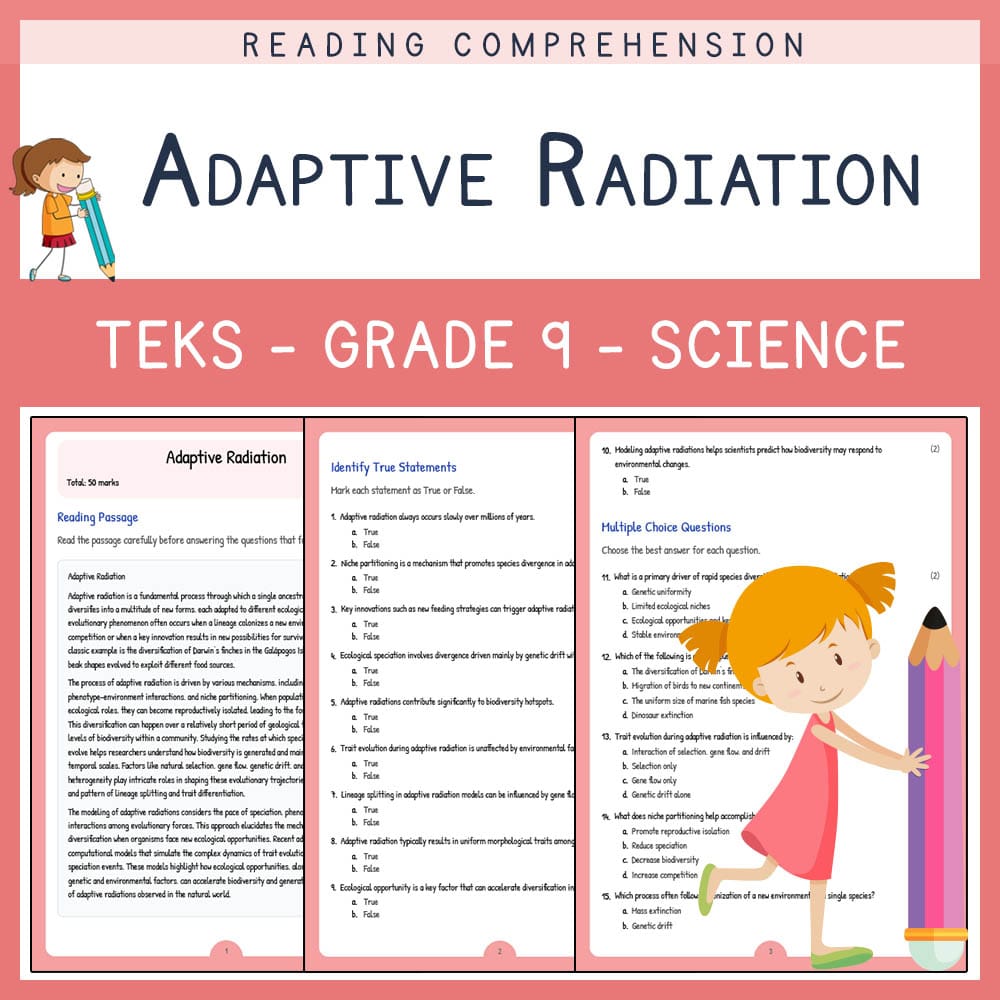
Grade 9 Science | Adaptive Radiation Worksheet | TEKS-Aligned
Created byLumora LearningLearning Objectives
- Define adaptive radiation and describe its key features.
- Identify examples of adaptive radiation in nature.
- Understand the role of ecological niches and key innovations in speciation.
Instant download
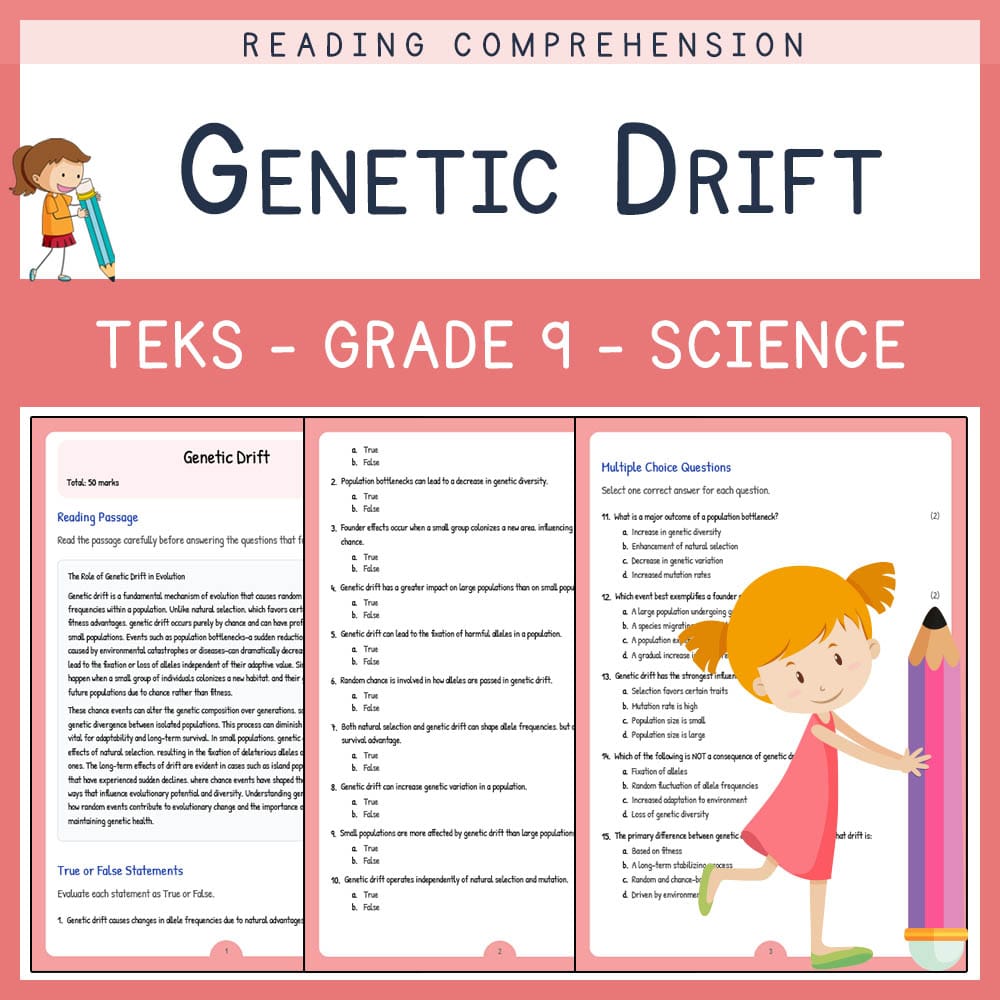
Grade 9 Science | Genetic Drift Worksheet | TEKS-Aligned
Created byLumora LearningLearning Objectives
- Understand the concept of genetic drift and how it affects small populations.
- Identify different events that can lead to genetic drift such as bottlenecks and founder effects.
- Explain how chance events influence allele frequencies over time.
Instant download

Grade 11 Science | Natural Selection Worksheet | TEKS-Aligned
Created byLumora LearningLearning Objectives
- Understand the mechanisms of natural selection and how they influence evolution.
- Identify different modes of selection and their effects on traits within populations.
- Recognize examples of natural selection, such as antibiotic resistance and camouflage.
Instant download
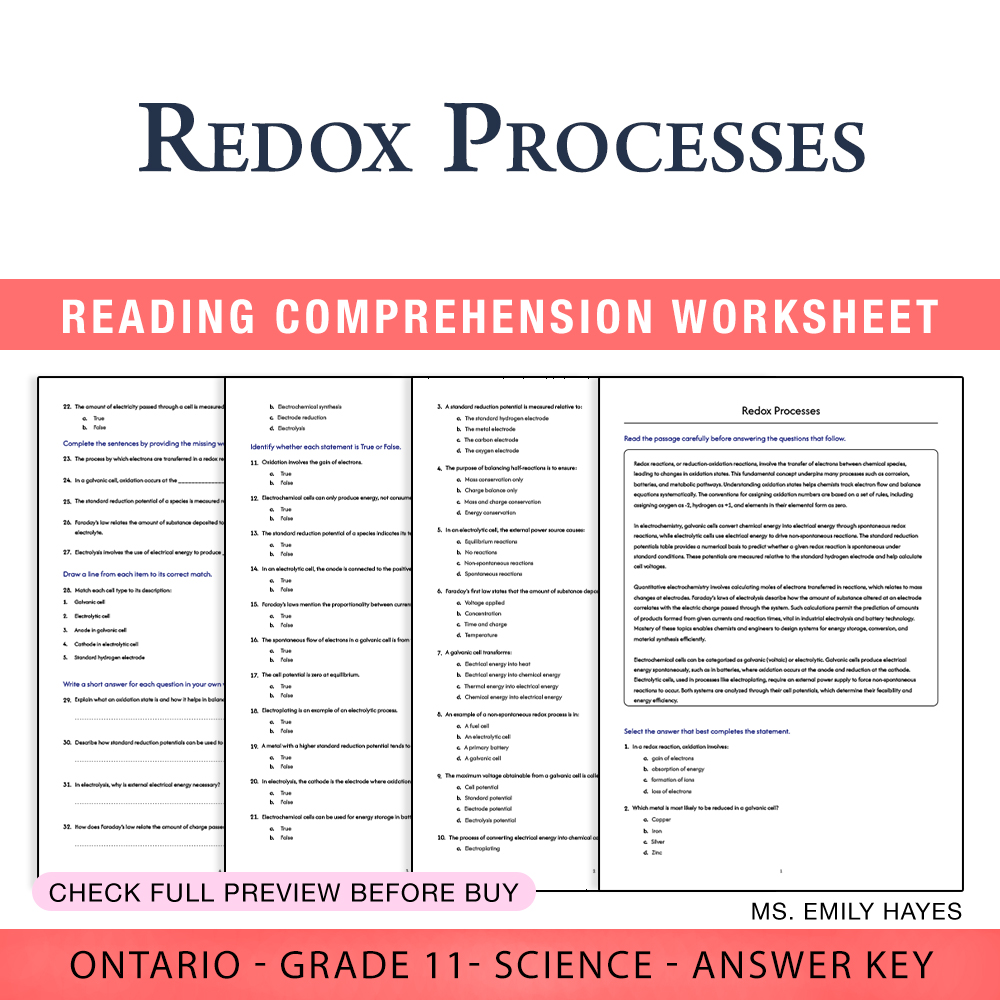
11th Grade Science | Redox Processes Worksheet (PDF + Answer Key)
 Created byCopper Leaf Classroom
Learning Objectives
- Explain the concept of oxidation states and assign oxidation numbers in chemical compounds.
- Formulate and balance half-reactions in redox processes systematically.
- Describe the functioning of galvanic and electrolytic cells and relate standard reduction potentials to cell spontaneity.
Instant download
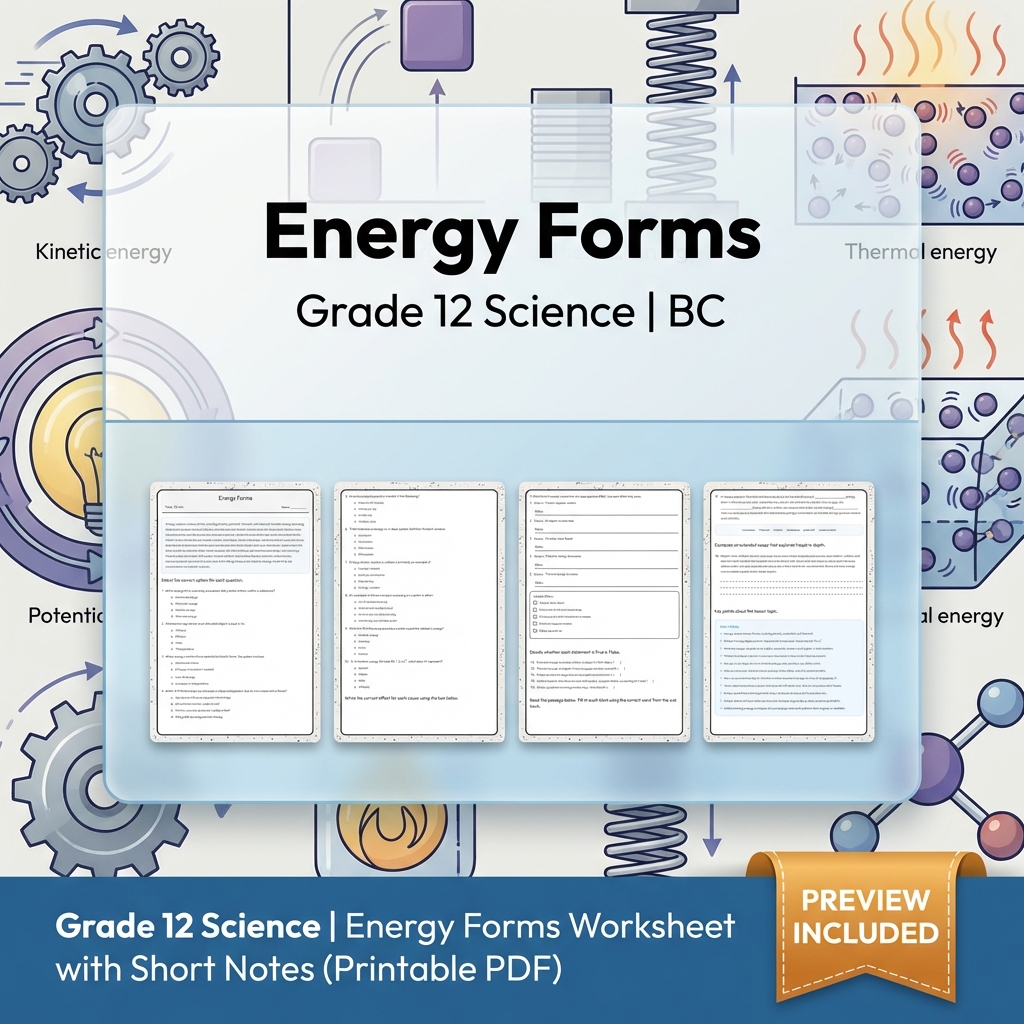
Grade 12 Science | Energy Forms Worksheet with Short Notes (Printable PDF)
 Created byMeadowlark Worksheets
Learning Objectives
- Define various forms of energy such as kinetic, potential, and thermal.
- Explain how energy transforms between different forms during motion, collisions, and deformation.
- Understand the quantitative relationships that describe energy conservation and transfer.
Also included in: Grade 12 Science Lesson Bundle | Wave, Quantum, Electromagnetism Worksheets +1 more
Instant download

Grade 9 Electromagnetic Radiation Worksheet | NGSS Science Waves Activity
 Created byBRIGHT PATH RESOURCES
Learning Objectives
- Identify different types of electromagnetic radiation and their positions in the spectrum.
- Describe the characteristics of electromagnetic waves, including frequency and wavelength.
- Explain how photons relate to electromagnetic wave energy and matter interactions.
Also included in: Waves & Communication Systems Grade 9 Science Daily Reading Lesson Bundle | NGSS +1 more
Instant download
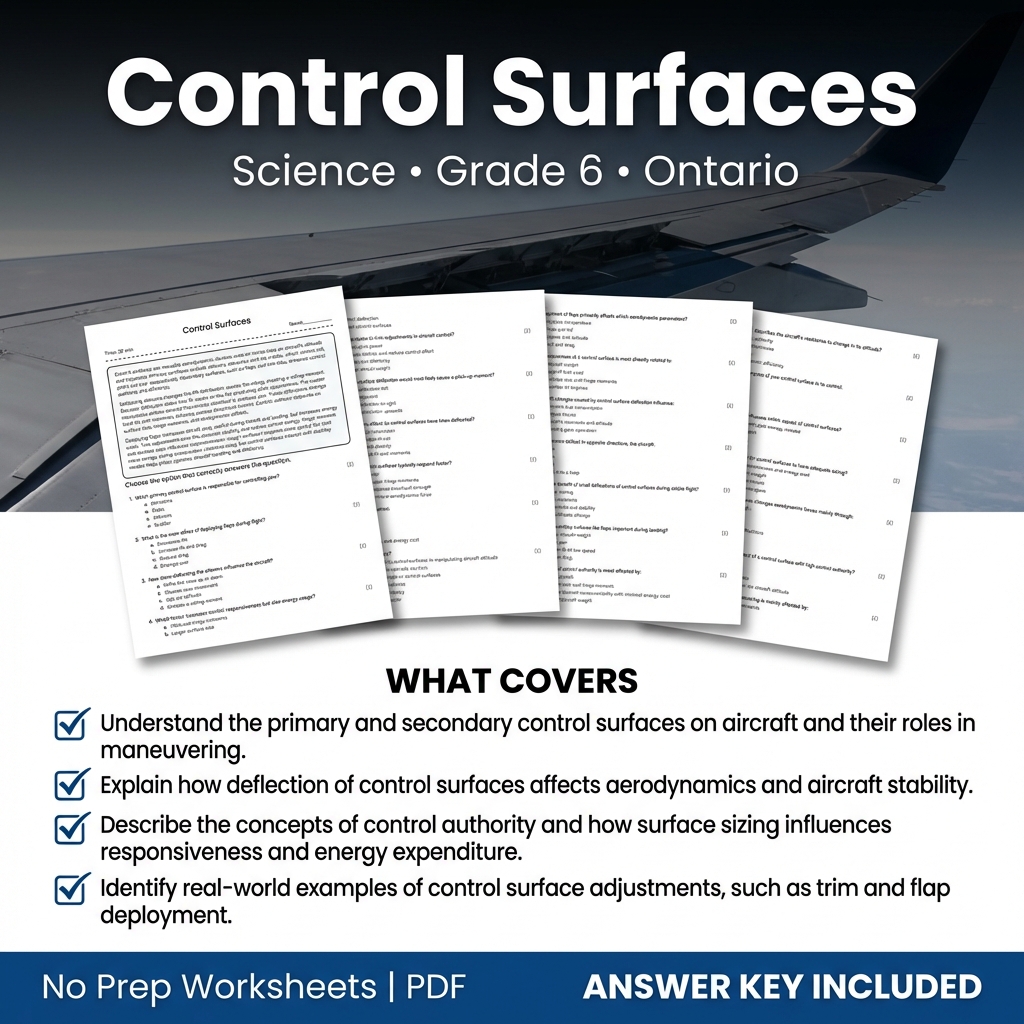
Control Surfaces Science Worksheet Grade 6 | Ontario Standards
Created byCoral Reef LearningLearning Objectives
- Understand the primary and secondary control surfaces on aircraft and their roles in maneuvering.
- Explain how deflection of control surfaces affects aerodynamics and aircraft stability.
- Describe the concepts of control authority and how surface sizing influences responsiveness and energy expenditure.
Instant download
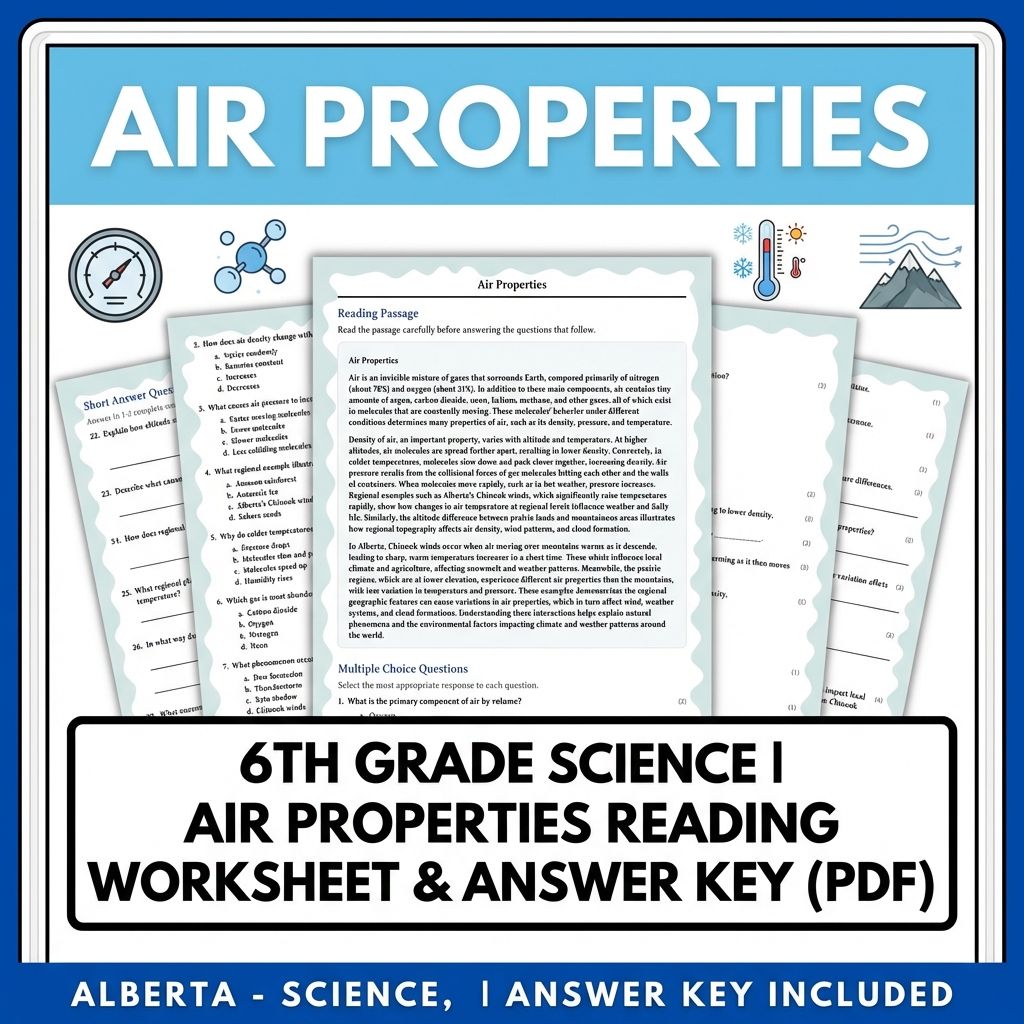
6th Grade Science | Air Properties Reading Worksheet & Answer Key (PDF)
JCreated byJ.S SheetsLearning Objectives
- Understand the molecular composition of air and how it influences its properties.
- Explain how temperature, pressure, and altitude affect air density and behavior.
- Describe regional examples such as Chinook winds and altitude differences to illustrate air property variations.
Also included in: Grade 6 Science | Flight Physics & Aerodynamics UNIT Pack (Answer Keys Included) +1 more
Instant download

Grade 7 Science Worksheet on Atomic Structure | TEKS Aligned
Created byCoral Reef LearningLearning Objectives
- Describe the basic subatomic particles of an atom: protons, neutrons, and electrons.
- Explain how atomic number and mass number relate to element identity and isotopes.
- Identify simple electron arrangements and understand their role in chemical properties.
Instant download

6th Grade Science Energy Drives Change Worksheet | California Standards PDF
Created byEvergreen Desk EducationLearning Objectives
- Explain how energy from the Sun drives changes in water state, including evaporation and cloud formation
- Describe how gravity influences the movement and accumulation of water and sediment on slopes
- Connect energy to Earth material cycling, including weathering rates and how sediments and soils change over time
Instant download
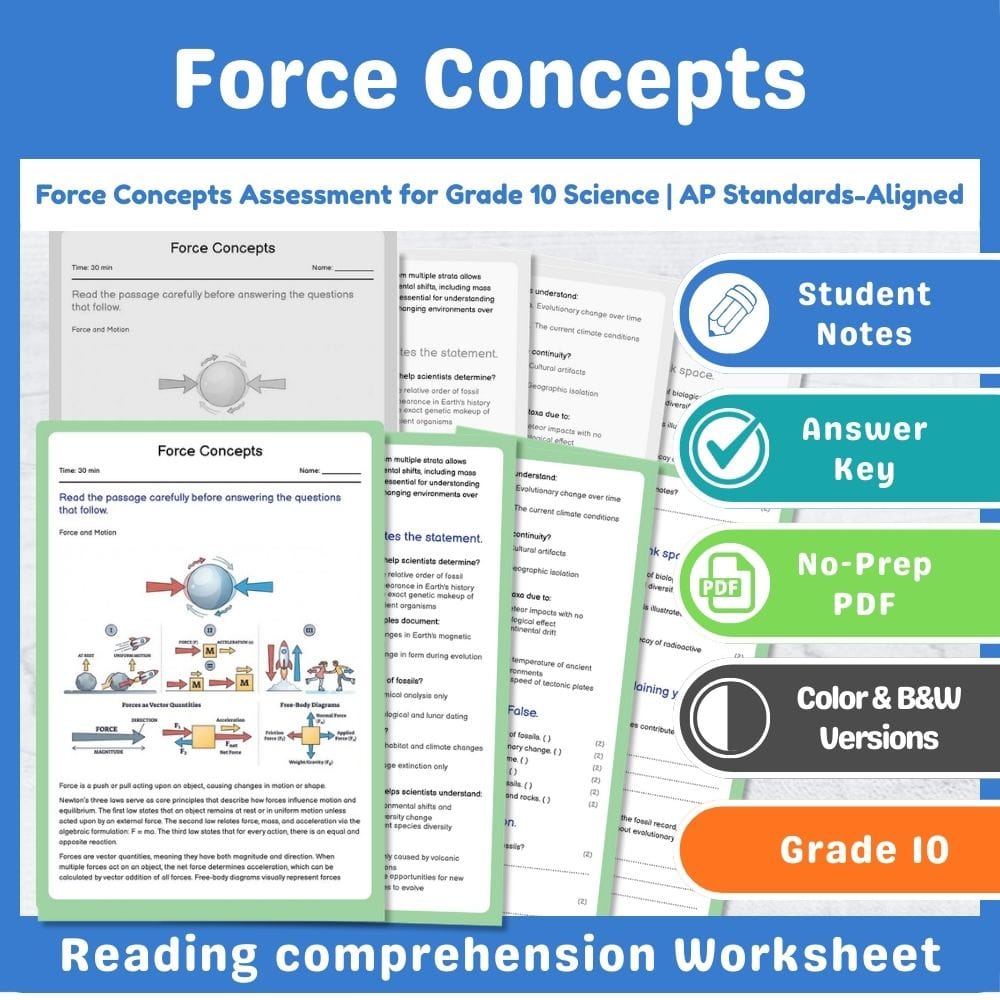
Force Concepts Assessment for Grade 10 Science | AP Standards-Aligned
Created byPrism Point LearningLearning Objectives
- Understand the vector nature of forces and how to determine net force in various scenarios.
- Explain Newton's three laws and their applications to motion and equilibrium.
- Interpret free-body diagrams and algebraic formulations of forces.
Also included in: Lesson Grade 10 Science Assessment Bundle | AP Standards-Aligned
Instant download

Governance Futures Assessment | TEKS Grade 12 Science Standards
Created byPrism Point LearningLearning Objectives
- Understand the role of regulatory standards and risk assessment in shaping scientific policy.
- Analyze the importance of international agreements and adaptive governance models in technology oversight.
- Evaluate foresight methods and scenario analysis in anticipatory planning for governance.
Also included in: Grade 12 Science Technology and Society Science Lesson Bundle: TEKS
Instant download
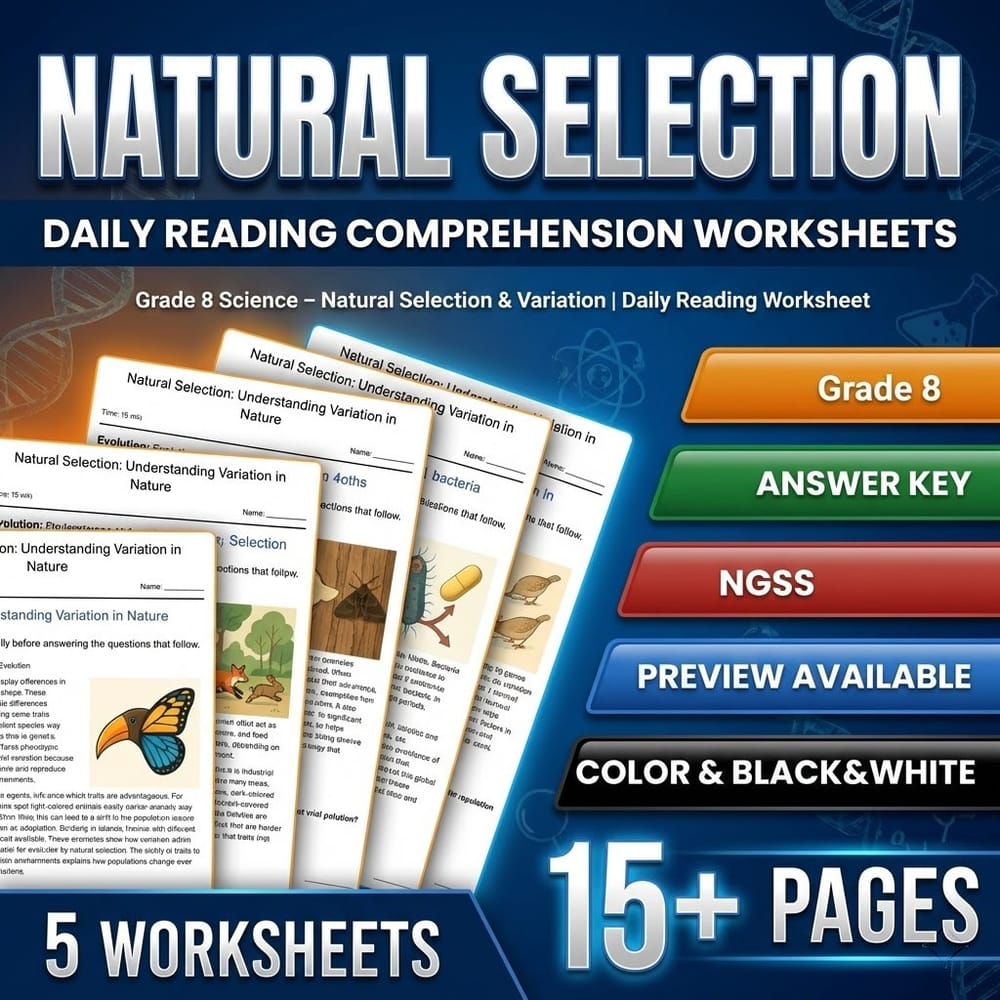
Grade 8 Science – Natural Selection & Variation | Daily Reading Worksheet
 Created byElena Brooks
Learning Objectives
- Identify phenotypic variation among organisms
- Explain how traits are inherited
- Understand environmental factors influencing natural selection
Instant download
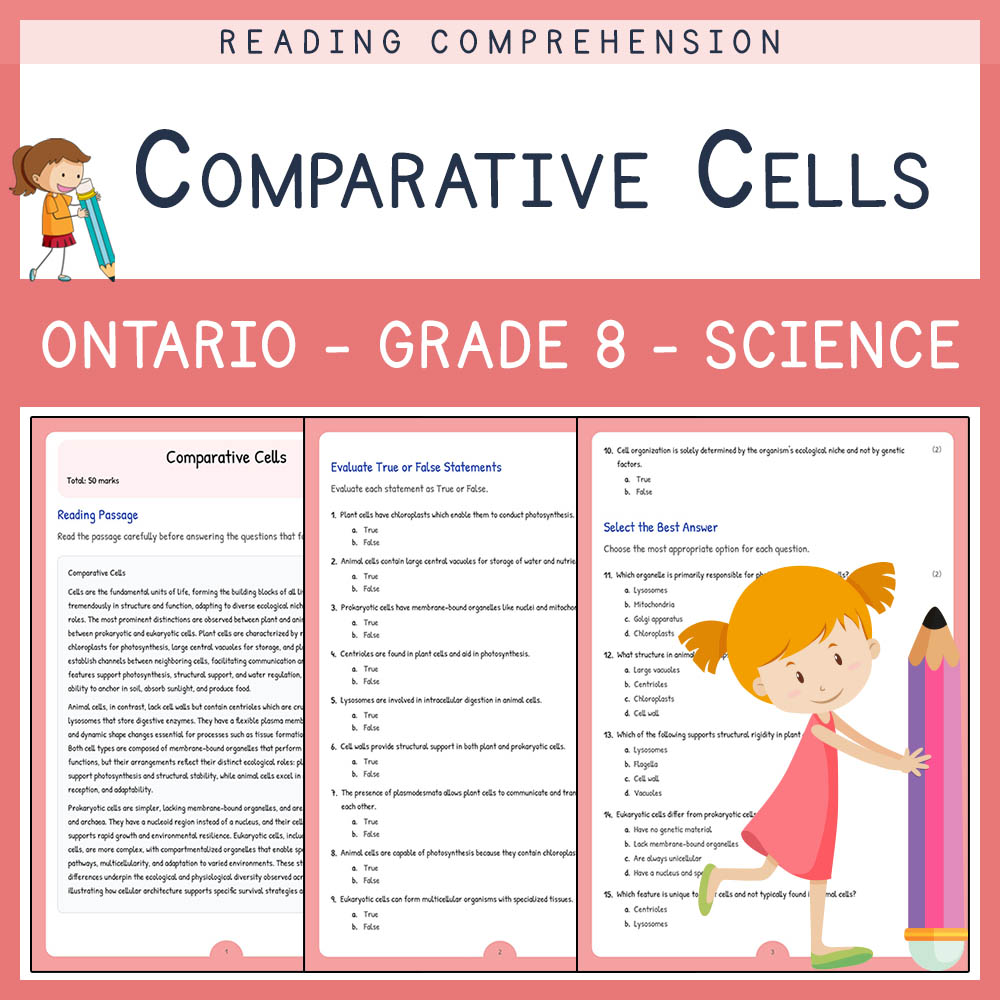
Grade 8 Science | Comparative Cells Worksheet Elena | Ontario Standards
Created byLumora LearningLearning Objectives
- Identify the structural differences between plant and animal cells and their functional implications.
- Compare prokaryotic and eukaryotic cells in terms of organization and roles in ecosystems.
- Explain how cellular structures like cell walls, chloroplasts, and lysosomes support specific physiological functions.
Instant download
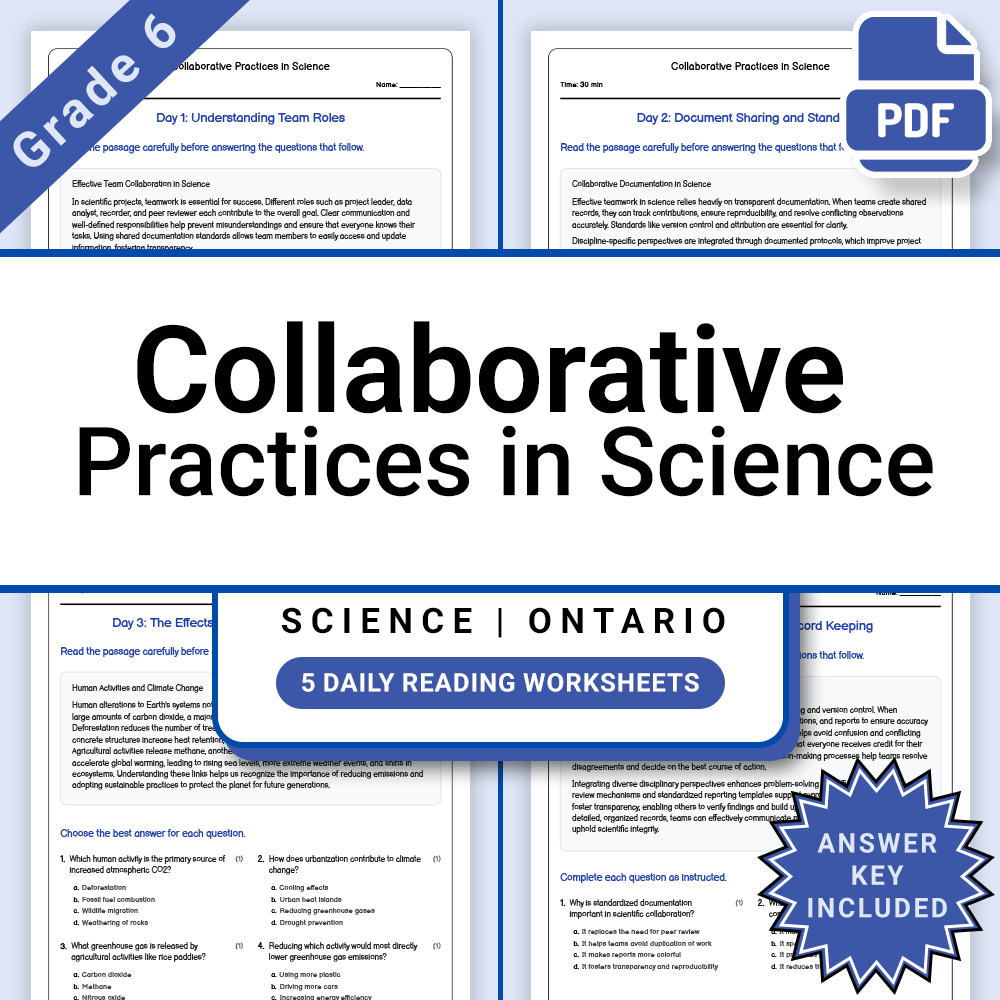
Grade 6 Science – Collaborative Practices Daily Worksheet with Answer Key
JCreated byJ.S SheetsLearning Objectives
- Understand different roles within a scientific team
- Recognize the importance of shared documentation and protocols
- Identify principles that enhance collaboration and project efficiency
Also included in: Grade 6 Science STEM Skills and Connections Lesson Bundle with Ontario Framework +1 more
Instant download
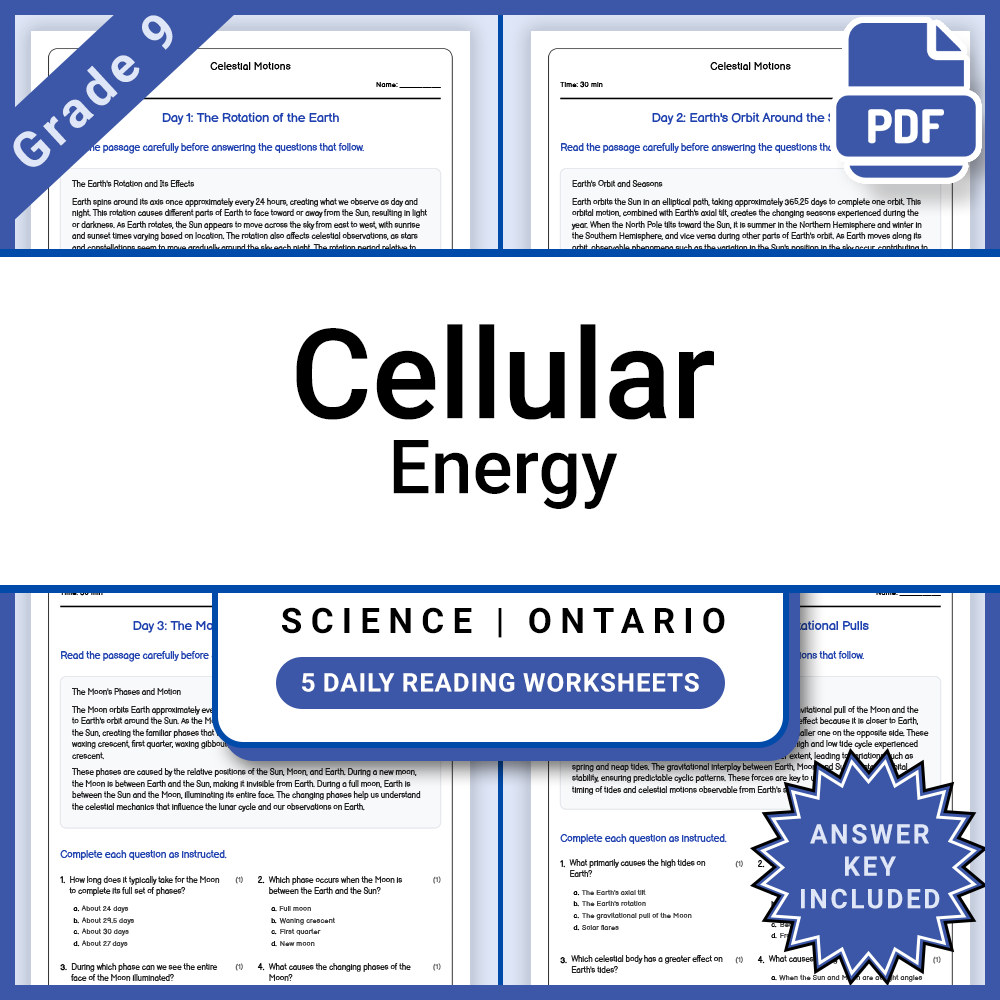
Grade 9 Science Cellular Energy Daily Reading Worksheet with Answer Key
JCreated byJ.S SheetsLearning Objectives
- Understand the process of cellular energy production
- Identify the key stages of cellular respiration
- Explain the role of mitochondria in energy metabolism
Also included in: Grade 9 Science Lesson Group | Human Body Systems, Environment & Energy +1 more
Instant download
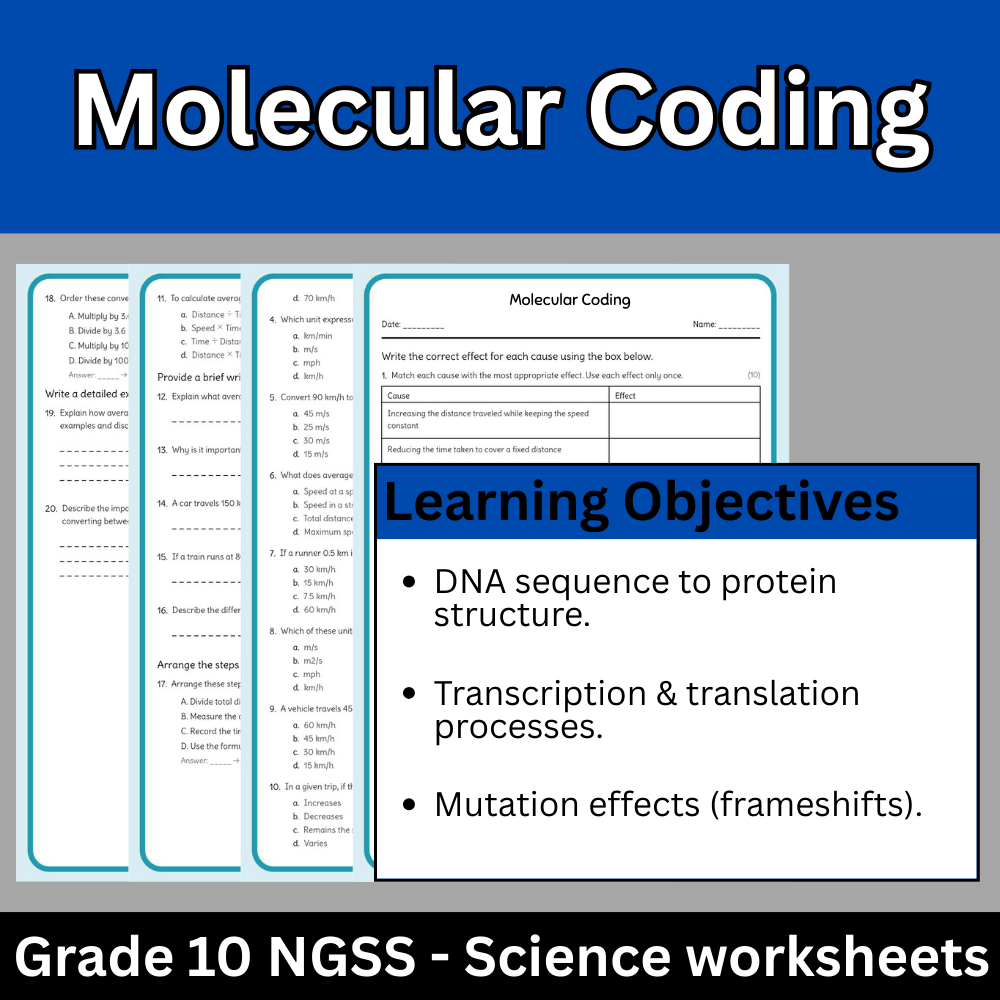
Grade 10 Science | Molecular Coding Worksheet (NGSS Aligned, PDF) Practice Set
 Created byBright Mind Resources
Learning Objectives
- Describe how DNA sequence determines the amino acid sequence and protein structure.
- Explain the processes of transcription and translation in protein synthesis.
- Identify how mutations, such as point mutations and frameshifts, affect protein structure and function.
Instant download
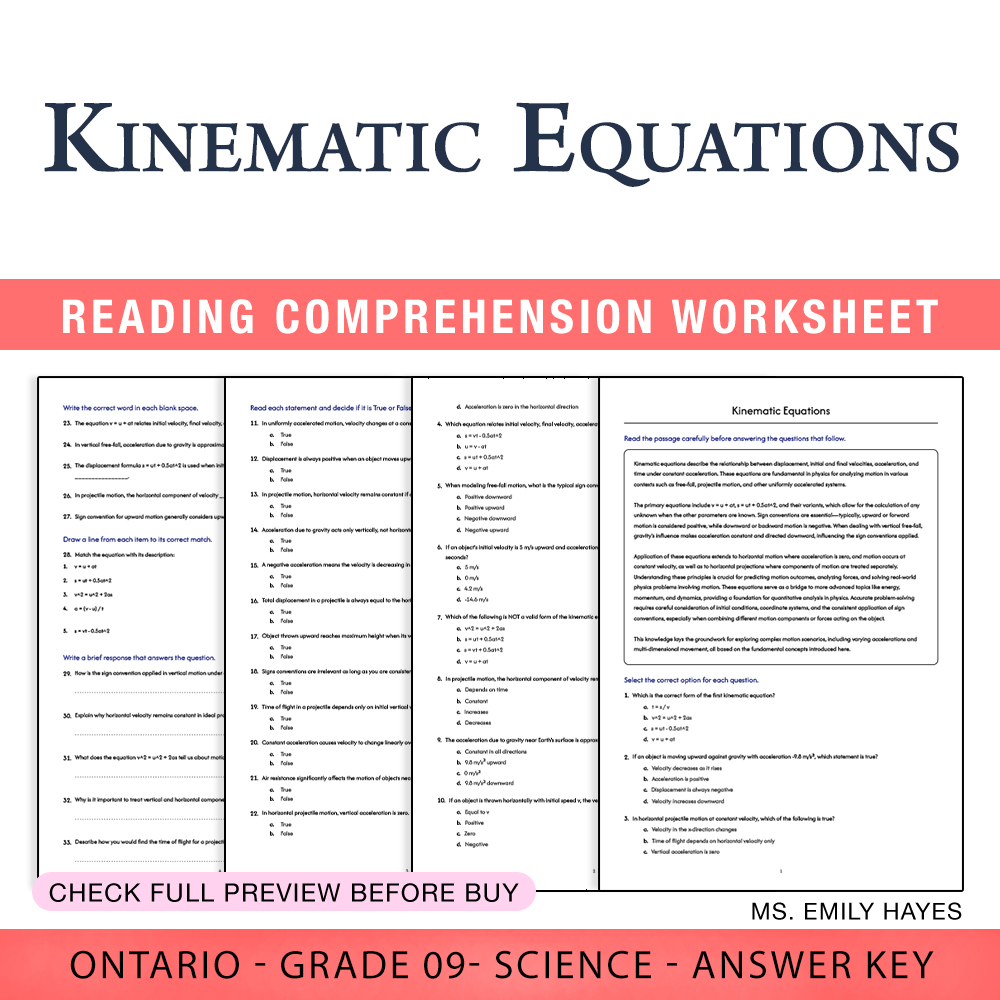
9th Grade Science | Kinematic Equations Worksheet (PDF + Answer Key)
Created byCopper Leaf ClassroomLearning Objectives
- Understand and explain the key kinematic equations involving constant acceleration.
- Apply the equations to analyze vertical free-fall motion and horizontal projectile motion.
- Interpret sign conventions and component-wise treatment in motion problems.
Instant download

Grade 12 Science – Kinematics Vectors Daily Reading Worksheet| Alberta Standards
Created byBright Mind ResourcesLearning Objectives
- Understand the concept of vectors and their components in motion
- Interpret vector quantities like displacement, velocity, and acceleration
- Apply vector decomposition and parametric equations to analyze projectile motion
Also included in: Grade 12 Waves and Electricity Science Lesson Bundle | Alberta Daily Reading +1 more
Instant download
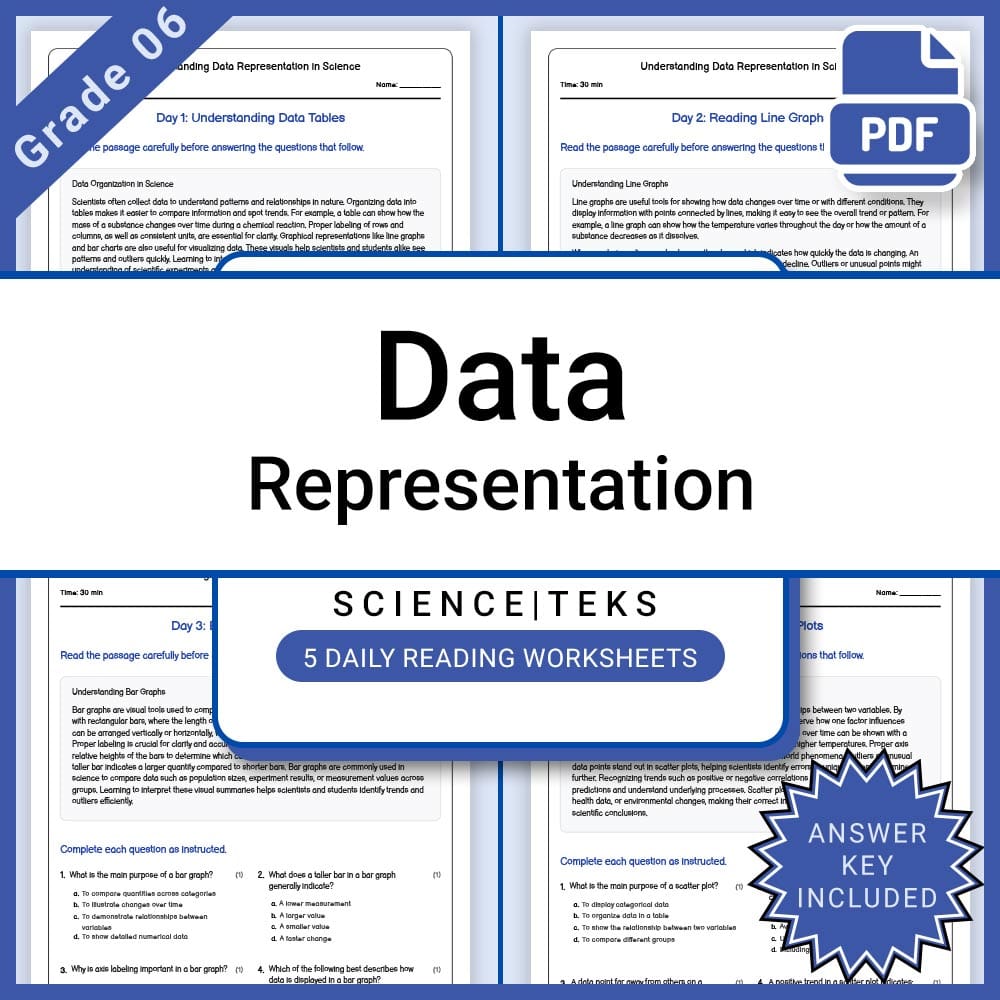
Grade 6 Science – Data Representation Daily Reading Worksheet with Answer Key
JCreated byJ.S SheetsLearning Objectives
- Learn how to organize data into tables
- Interpret data from various graph types
- Identify trends and outliers in data sets
Also included in: Grade 6 Science Lesson Group Bundle TEKS Standards +1 more
Instant download

Grade 8 Science – Mass Conservation & Systems | Daily Reading Worksheet
Created byBright Mind ResourcesLearning Objectives
- Explain the principle of mass conservation in chemical reactions.
- Identify real-world examples of mass conservation in industry and environmental settings.
- Apply the principle to analyze closed system reactions and processes.
Also included in: Matter Change Grade 8 Science Daily Reading Worksheets Lesson Bundle | Alberta +2 more
Instant download

Grade 10 Atomic Structure Worksheet | Practice & NGSS PDF
 Created byClear Sky Classroom
Learning Objectives
- Identify and describe the roles of protons, neutrons, and electrons in an atom
- Explain isotopes using proton number and neutron number and relate this to atomic mass
- Use electron energy-level ideas to describe how atoms absorb and emit energy
Instant download
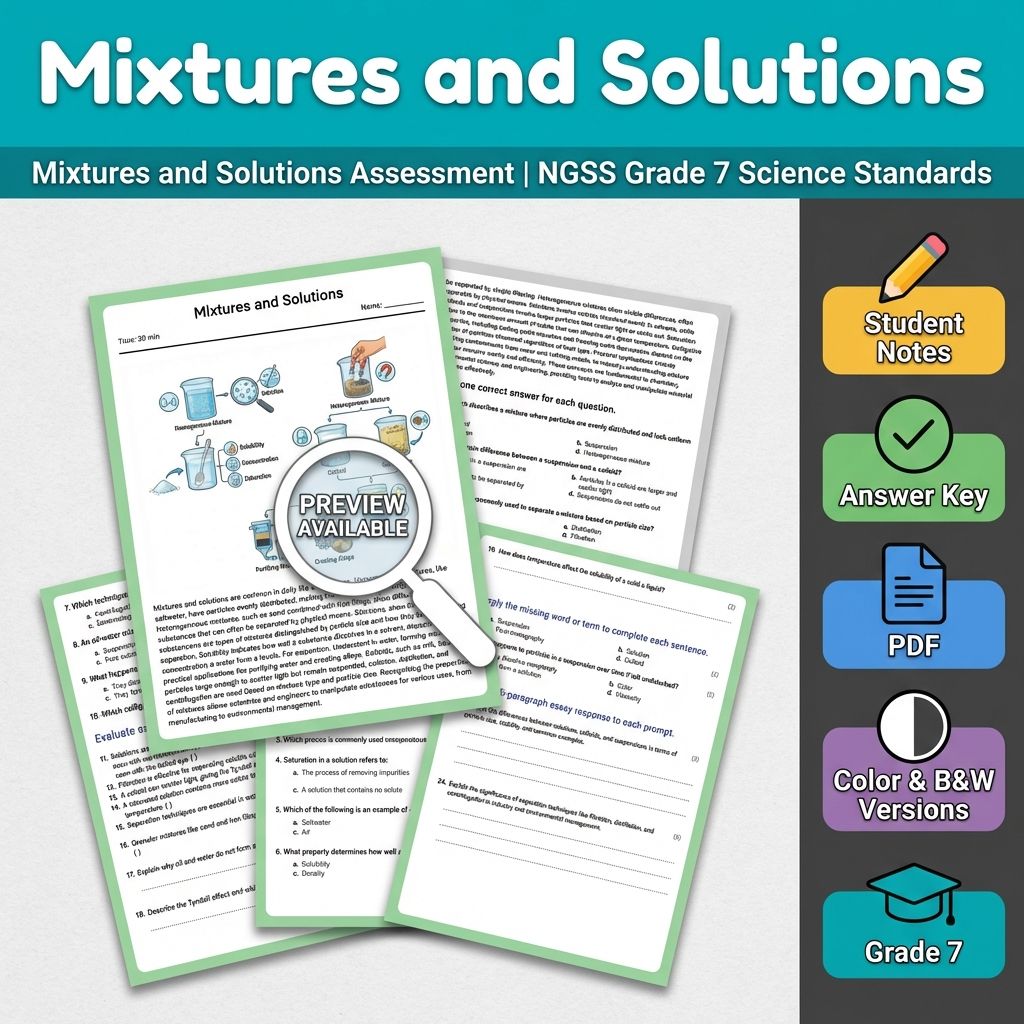
Mixtures and Solutions Assessment | NGSS Grade 7 Science Standards
Created byPrism Point LearningLearning Objectives
- Understand the differences between homogeneous and heterogeneous mixtures.
- Identify and explain properties like solubility, saturation, and concentration.
- Recognize examples of solutions, colloids, and suspensions based on particle size and separation methods.
Also included in: Grade 7 Science Lesson | Matter and Its Interactions Standards +1 more
Instant download
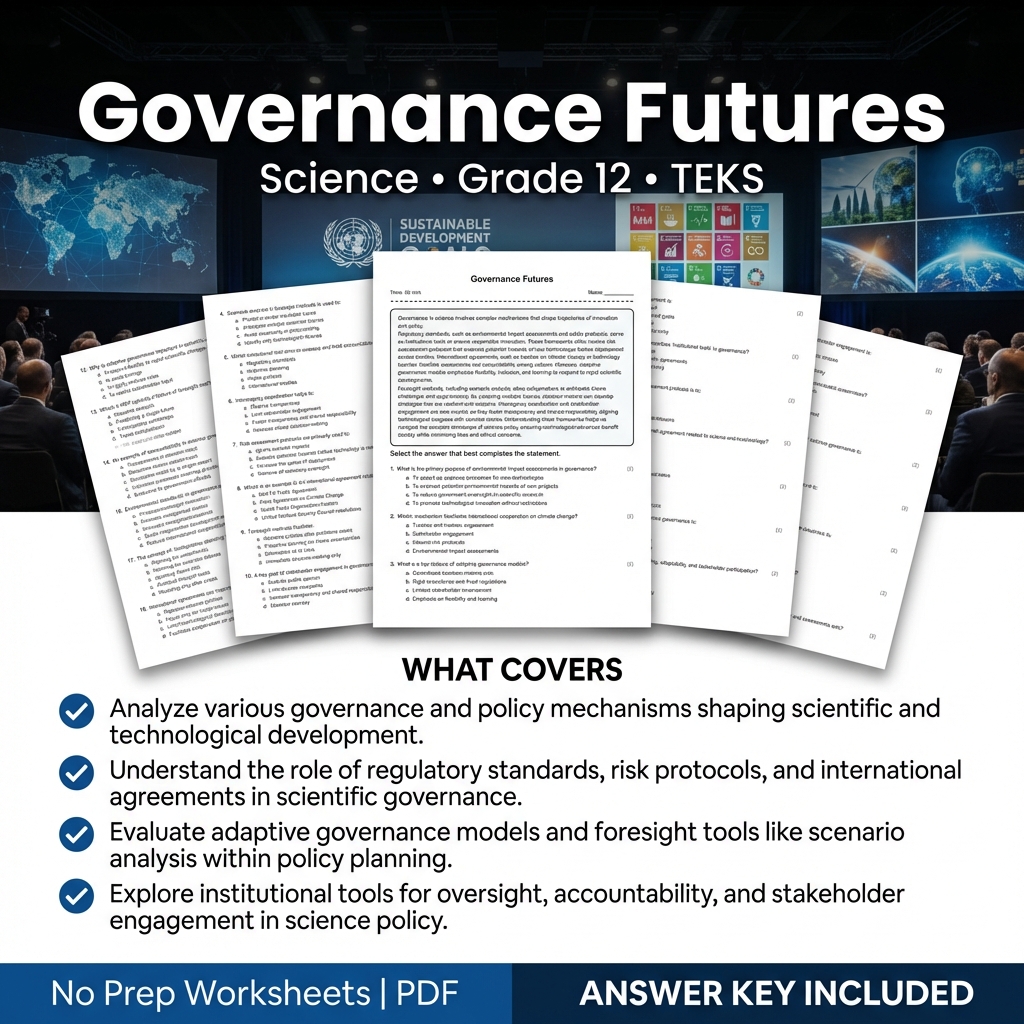
Governance Futures Science Worksheet for Grade 12 | TEKS-Aligned
Created byCoral Reef LearningLearning Objectives
- Analyze various governance and policy mechanisms shaping scientific and technological development.
- Understand the role of regulatory standards, risk protocols, and international agreements in scientific governance.
- Evaluate adaptive governance models and foresight tools like scenario analysis within policy planning.
Instant download
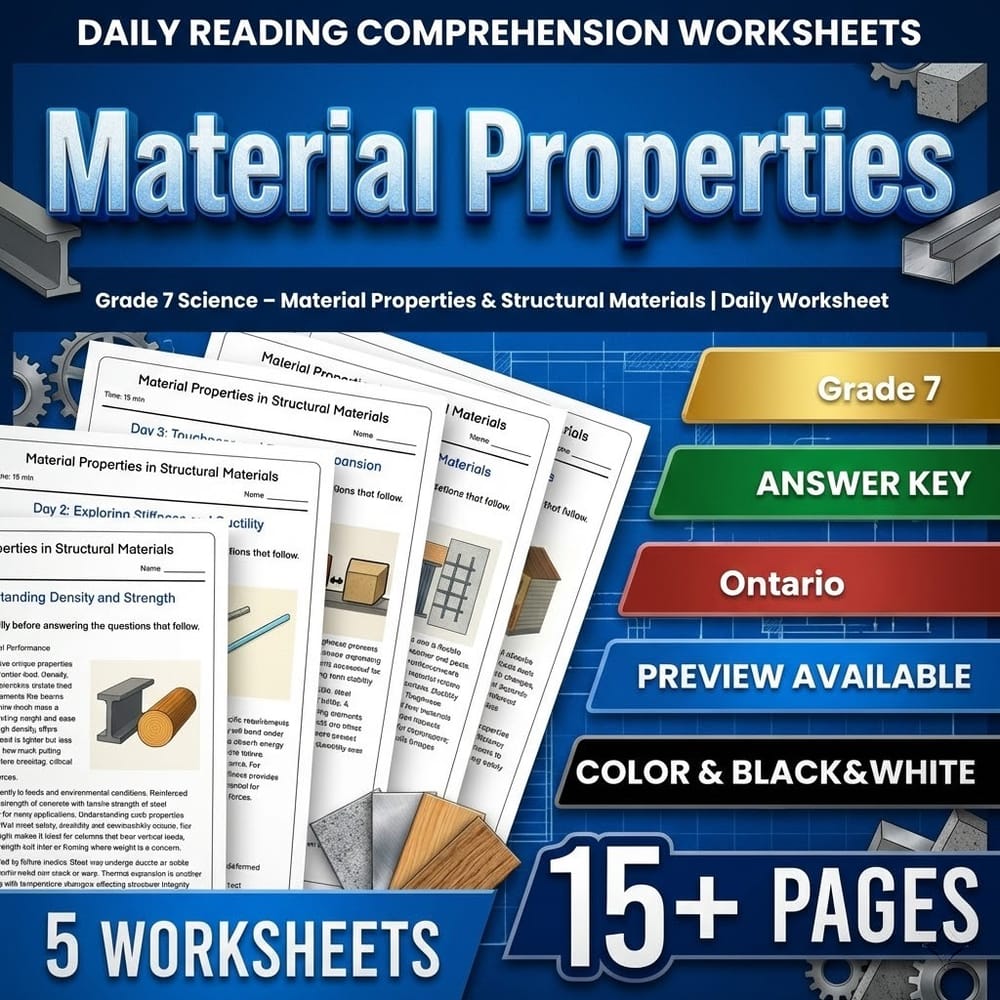
Grade 7 Science – Material Properties & Structural Materials | Daily Worksheet
 Created byQuiet Forest Education
Learning Objectives
- Understand the concept of density and how it affects material selection
- Identify tensile strength and its importance in structural performance
- Compare properties of wood, steel, and reinforced concrete
Also included in: Structural Engineering Grade 7 Science Daily Reading Worksheets Bundle | Ontario +1 more
Instant download
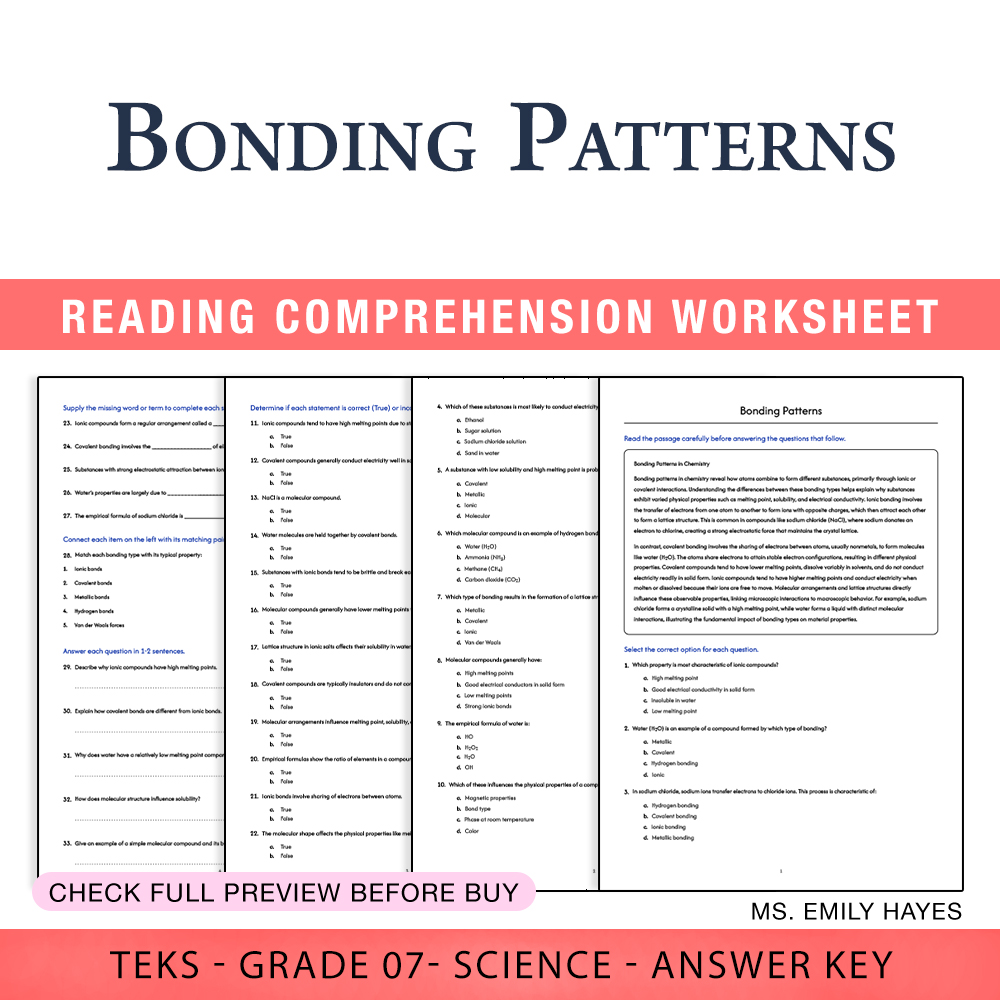
7th Grade Science | Bonding Patterns Worksheet (PDF+ Answer Key)
Created byCopper Leaf ClassroomLearning Objectives
- Distinguish between ionic and covalent bonding based on properties and formation.
- Relate bonding types to macroscopic properties such as melting point, solubility, and electrical conductivity.
- Describe the formation of simple binary ionic salts and molecular compounds using empirical formulas.
Instant download

Grade 8 Science Watershed Systems Worksheet | Standards-Aligned Practice
JCreated byJ.S SheetsLearning Objectives
- Explain how watershed boundaries determine where water flows within and between drainage basins
- Describe how land cover, slope, and soil type influence infiltration and runoff generation
- Analyze how stream networks form a hierarchical system of tributaries that affects downstream impacts
Instant download

Grade 6 Aerodynamic Forces & Vector Balance in Flight Science Worksheet Ontario
 Created byTeacher's Corner
Learning Objectives
- Identify lift, drag, thrust, and weight as aerodynamic or gravitational forces in flight.
- Explain how the direction and magnitude of forces affect climb, steady level flight, and descent.
- Use vector addition to describe equilibrium when net force is zero.
Instant download
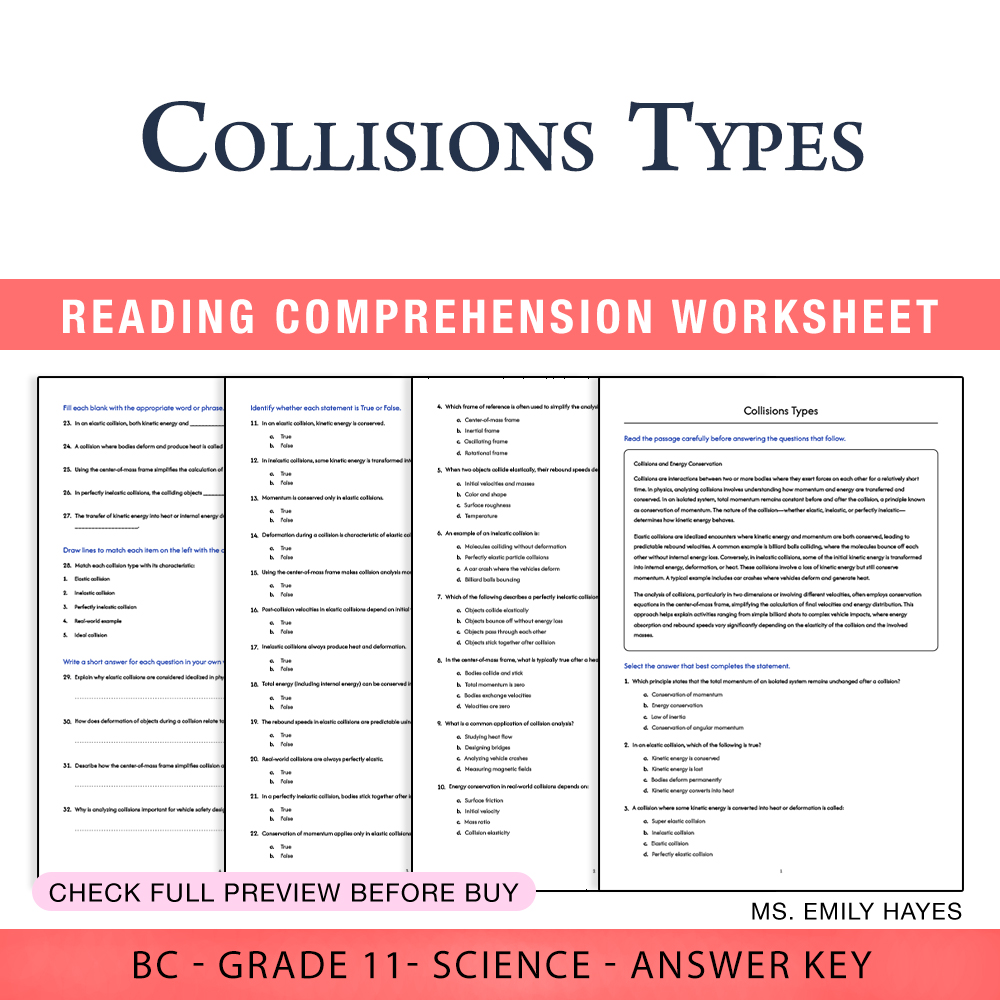
Grade 11 Science | Collisions Types Worksheet (PDF + Answer Key)
Created byCopper Leaf ClassroomLearning Objectives
- Understand the principles of momentum conservation in different types of collisions
- Differentiate between elastic and inelastic collisions based on energy transfer
- Apply conservation laws and center-of-mass frames to analyze collision scenarios
Also included in: Grade 11 Science BC | Motion, Energy & Force Concepts (PDF+ Answer Keys) +1 more
Instant download

Layered Fluids Density Stratification and Mixing Worksheet | Ontario Grade 8
JCreated byJ.S SheetsLearning Objectives
- Explain how density differences from temperature and salinity create layered (stratified) fluids and pycnoclines
- Describe how buoyancy acts to resist vertical displacement and what buoyancy frequency tells us about stability
- Predict how mixing limitations affect pollutant dispersion and thermal layering in natural waters and reservoirs
Instant download

Grade 11 Science – Speciation Mechanisms Daily Reading Worksheet + Answer Key
JCreated byJ.S SheetsLearning Objectives
- Understand the concept of geographic isolation in speciation
- Identify different mechanisms leading to allopatric speciation
- Recognize reproductive barriers that contribute to speciation
Also included in: Grade 11 Science Lesson Group Bundle TEKS | Evolution & Classification +1 more
Instant download
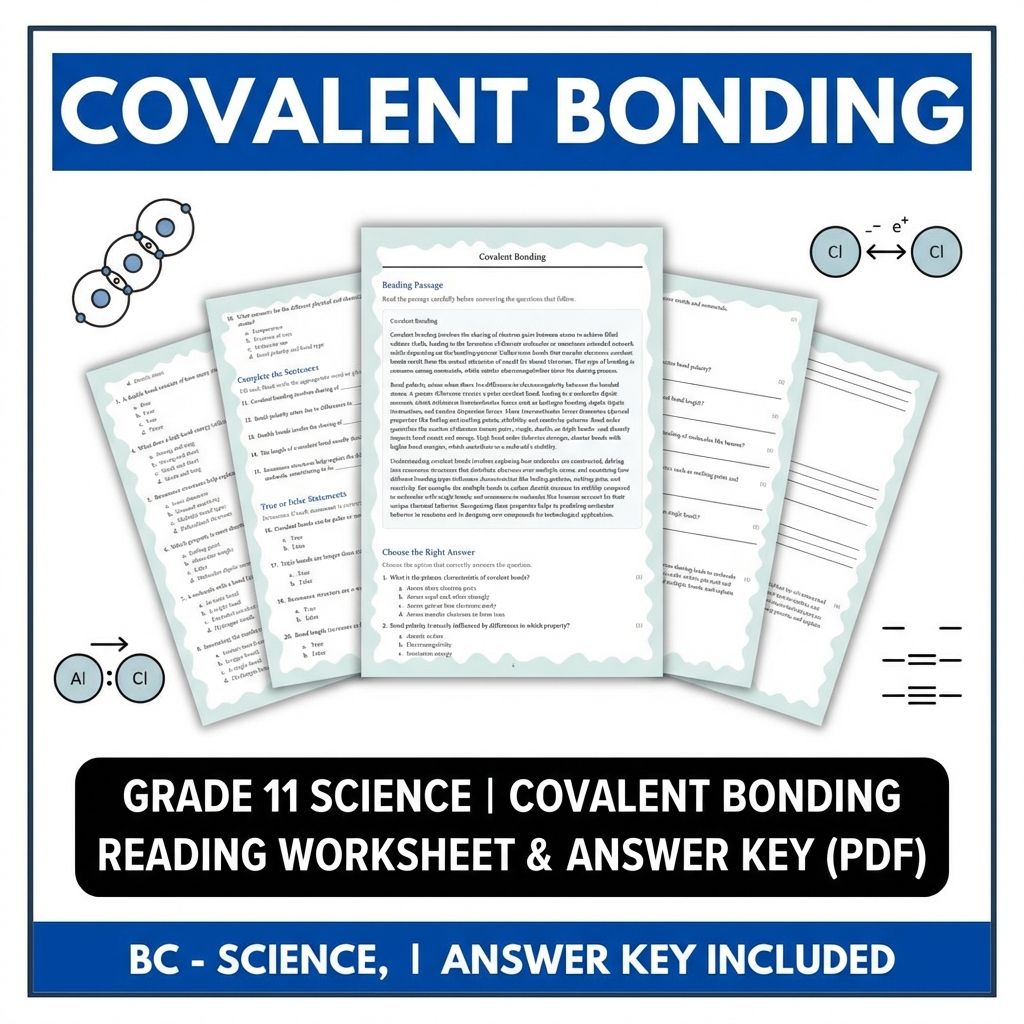
Grade 11 Science | Covalent Bonding Reading Worksheet & Answer Key (PDF)
JCreated byJ.S SheetsLearning Objectives
- Explain the concept of covalent bonding and how atoms share electron pairs to achieve stability.
- Describe the factors that influence bond polarity, including differences in electronegativity.
- Understand how bond order, bond length, and bond energy affect molecular stability and properties.
Instant download

Grade 7 Science Worksheet: Plate Tectonics and Continental Movement Assessment
 Created bySkylark Worksheets
Learning Objectives
- Explain how evidence such as fossils, rock types, and continental shapes supports plate tectonics.
- Identify key seafloor features (mid-ocean ridges, trenches) and relate them to plate motion.
- Use earthquake, volcanic, and magnetic striping patterns to describe how plates move over time.
Also included in: Grade 7 Earth Systems Science Worksheet Lesson Bundle for NGSS Assessment +1 more
Instant download
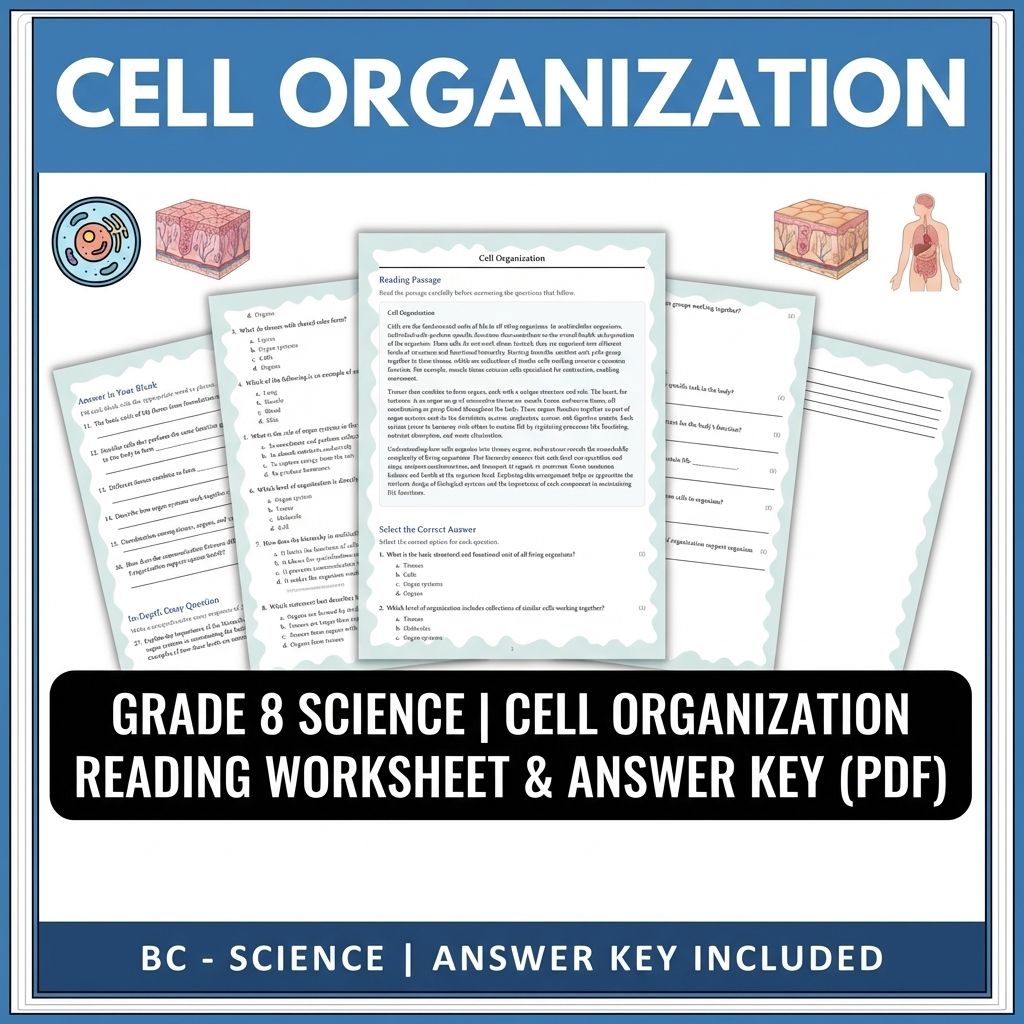
Grade 8 Science | Cell Organization Reading Worksheet & Answer Key (PDF)
JCreated byJ.S SheetsLearning Objectives
- Describe the hierarchical levels of cell organization in multicellular organisms.
- Explain how similar cells form tissues with shared functions.
- Identify how tissues combine to form organs with specific roles.
Instant download
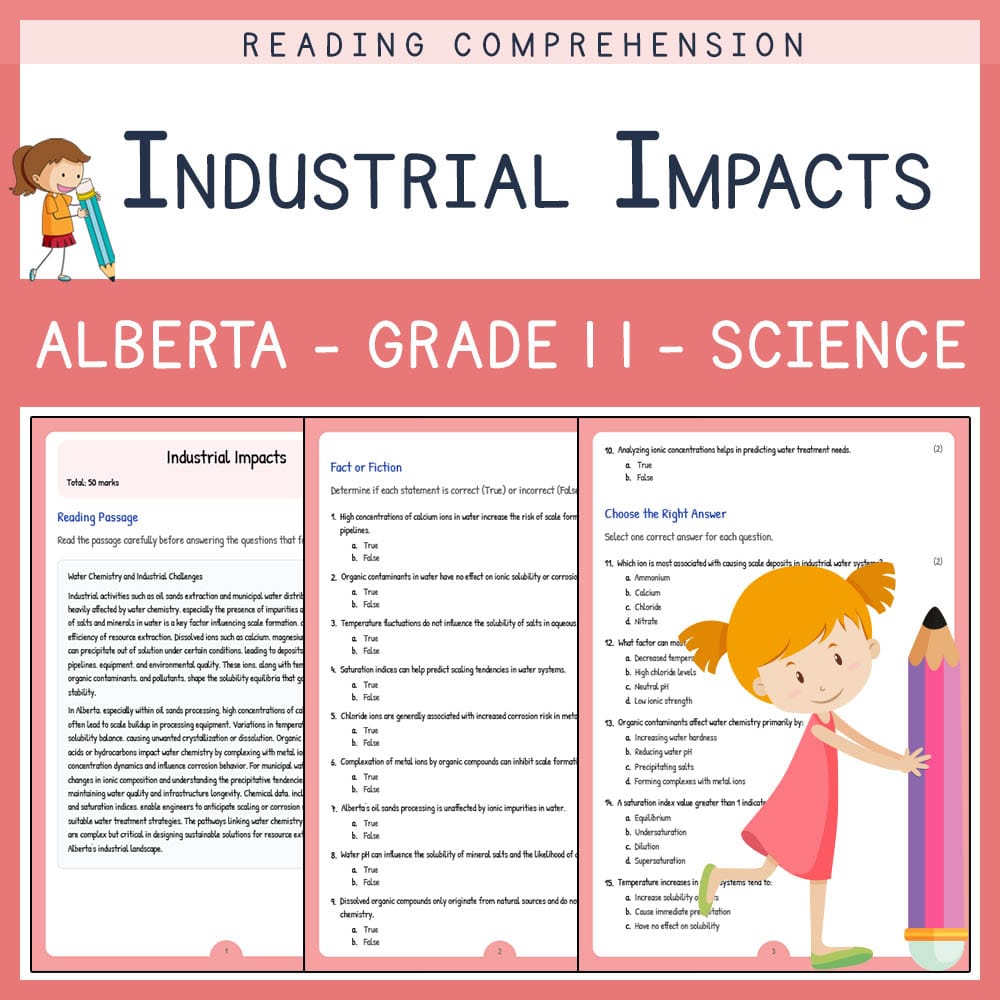
Grade 11 Science | Industrial Impacts Worksheet | Alberta Standards
Created byLumora LearningLearning Objectives
- Understand how dissolved ions, temperature shifts, and organic contaminants influence solubility equilibria in water systems.
- Interpret chemical data to evaluate operational challenges related to scale formation, corrosion, and impurity effects.
- Analyze the impact of environmental impurities on infrastructure, especially in Alberta's oil sands processing and municipal water systems.
Instant download
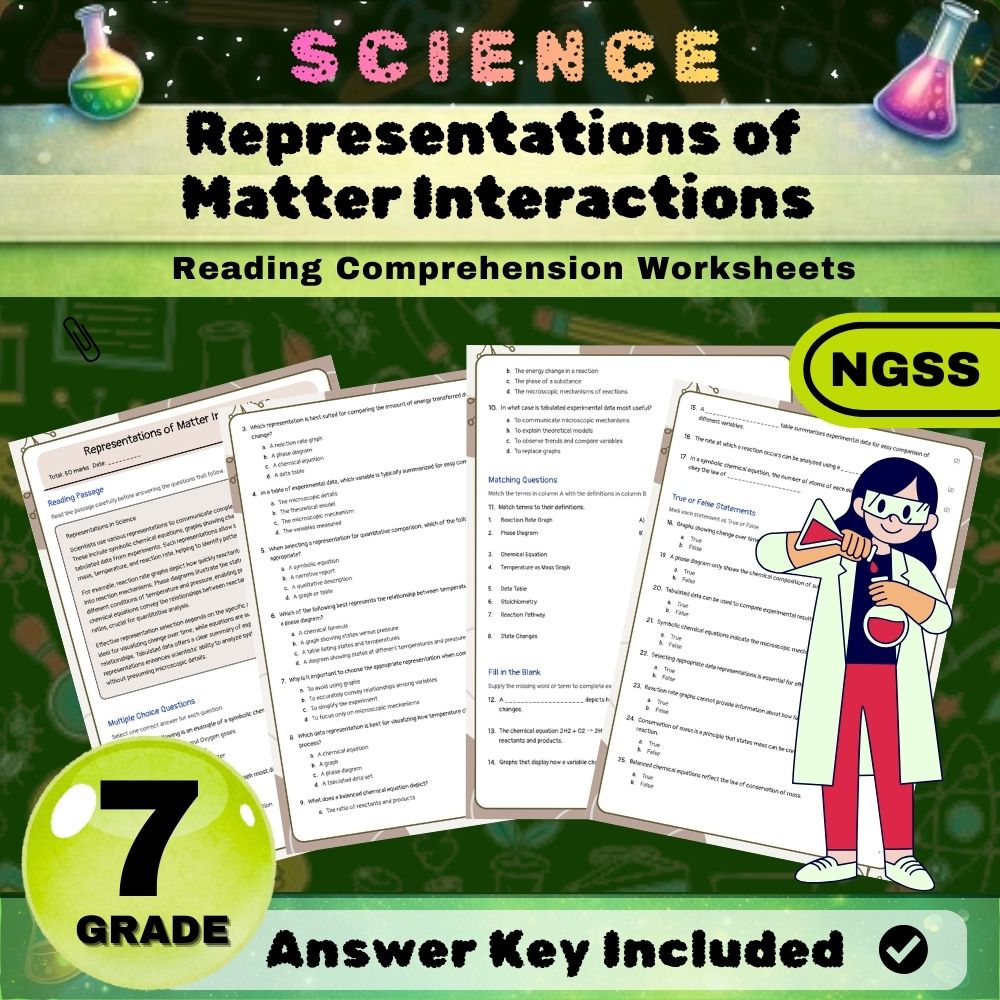
Grade 7 Science | Representations of Matter Interactions NGSS Worksheet (PDF)
 Created byMaple Path Learning
Learning Objectives
- Explain how different representations, such as graphs, equations, and tables, convey information about matter interactions.
- Identify appropriate representations for comparing variables and communicating relationships among measurable variables.
- Interpret various types of data representations including chemical equations, reaction rate graphs, and phase diagrams.
Instant download
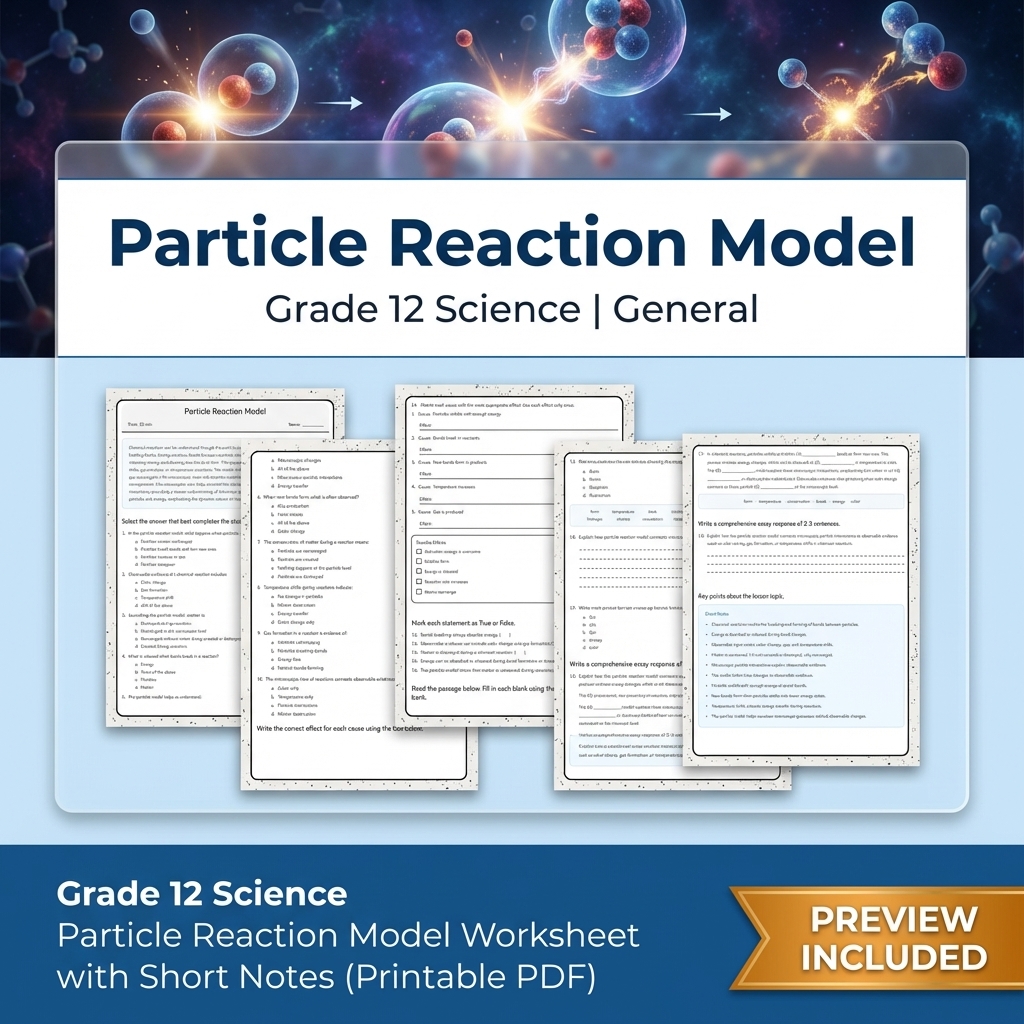
Grade 12 Science Particle Reaction Model Worksheet with Short Notes
Created byMeadowlark WorksheetsLearning Objectives
- Describe the particle reaction model and how it explains chemical reactions.
- Identify microscopic changes such as bond breaking, formation, and energy shifts during reactions.
- Connect observable evidence like color change, gas formation, and temperature shifts to microscopic particle interactions.
Instant download
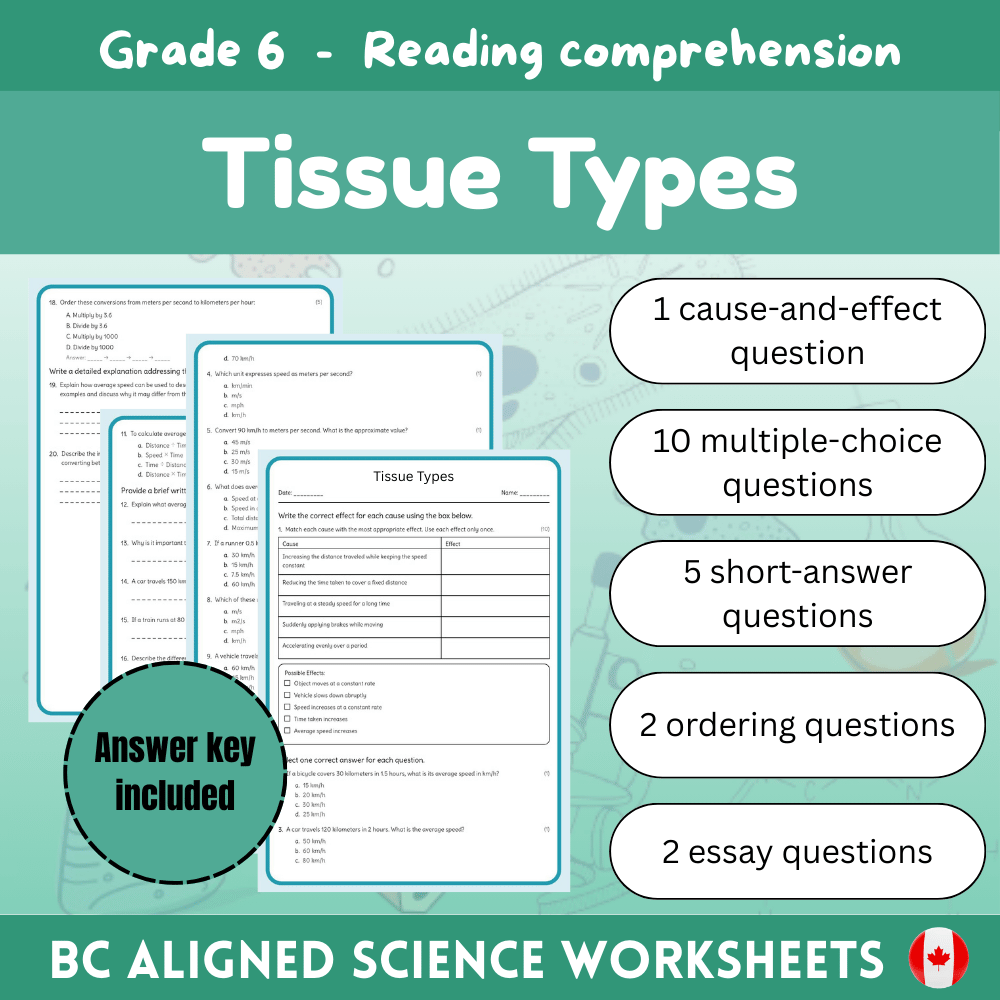
6th Grade Science | Tissue Types Worksheet + Answer Key (BC Standard)
Created byBright Mind ResourcesLearning Objectives
- Identify the four main tissue types in animals and their functions.
- Describe the structure and role of epithelial, connective, muscle, and nervous tissues.
- Explain how tissue types contribute to organ function and overall animal health.
Instant download
Browse more categories
About Science Worksheets
Find Science worksheets spanning core skills, practice, and review. All 44,342 resources are instant PDF downloads for the classroom or home.
Every worksheet on MyTeachingSheets is created by independent teacher-authors and reviewed before publication. All resources download as printable PDFs for classroom, homework, or at-home practice, and many include answer keys. Preview any worksheet free before buying.