
Science Worksheets
44,628 subject resources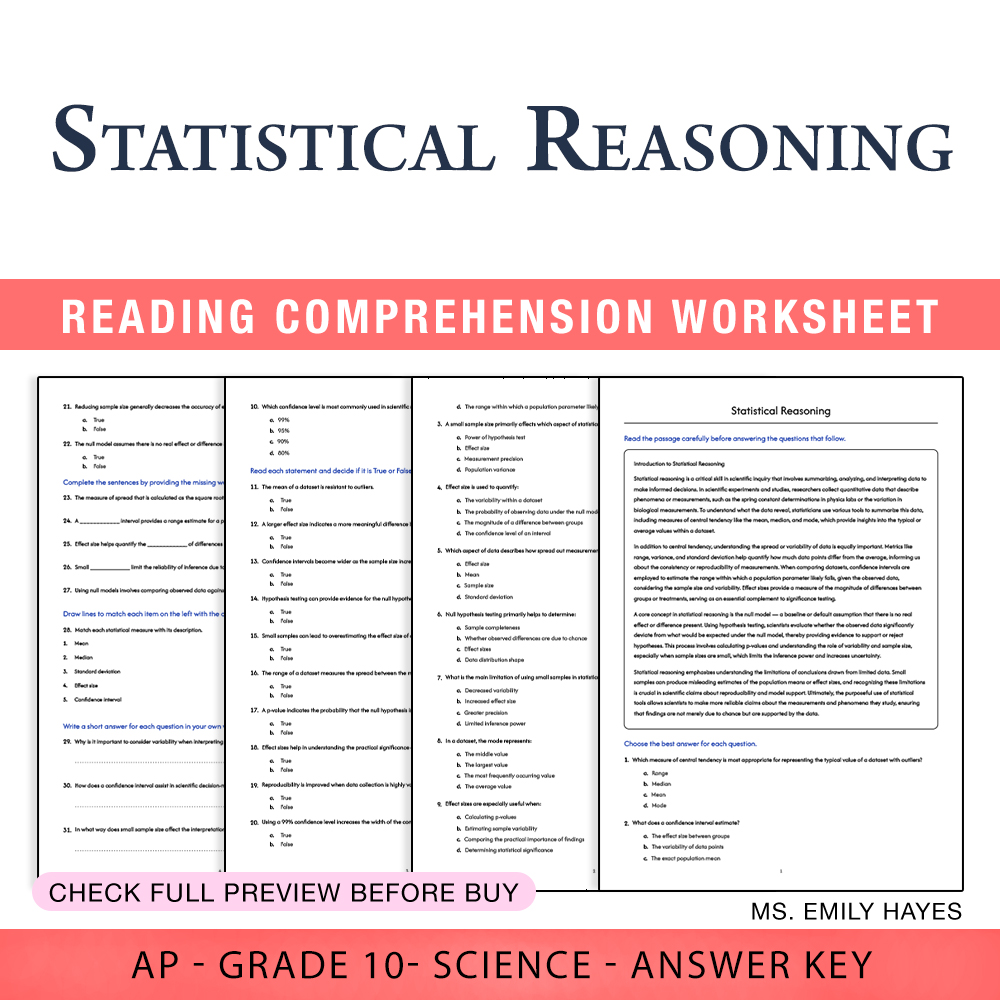
Grade 10 Science | Statistical Reasoning Worksheet (PDF+ Answer Key)
 Created byCopper Leaf Classroom
Learning Objectives
- Understand how to summarize datasets using measures of central tendency and variability.
- Interpret and construct confidence intervals and effect sizes in statistical analysis.
- Apply null model concepts and hypothesis testing to evaluate observed data against expected variability.
Also included in: Grade 10 Science AP | Data Analysis & Modeling Skills (PDF + Answer Key) +1 more
Instant download
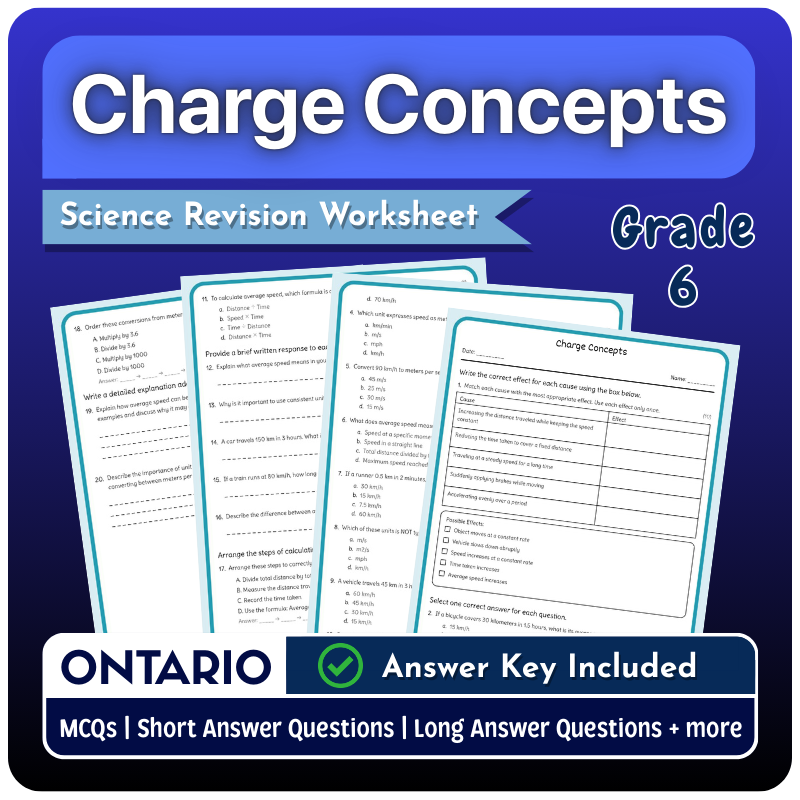
6th Grade Science | Charge Concepts Worksheet (PDF) – Ontario Standards
 Created byBright Mind Resources
Learning Objectives
- Explain the difference between static and current electricity.
- Define electric charge and charge separation.
- Describe how charge imbalance relates to phenomena like sparks and hair attraction.
Instant download
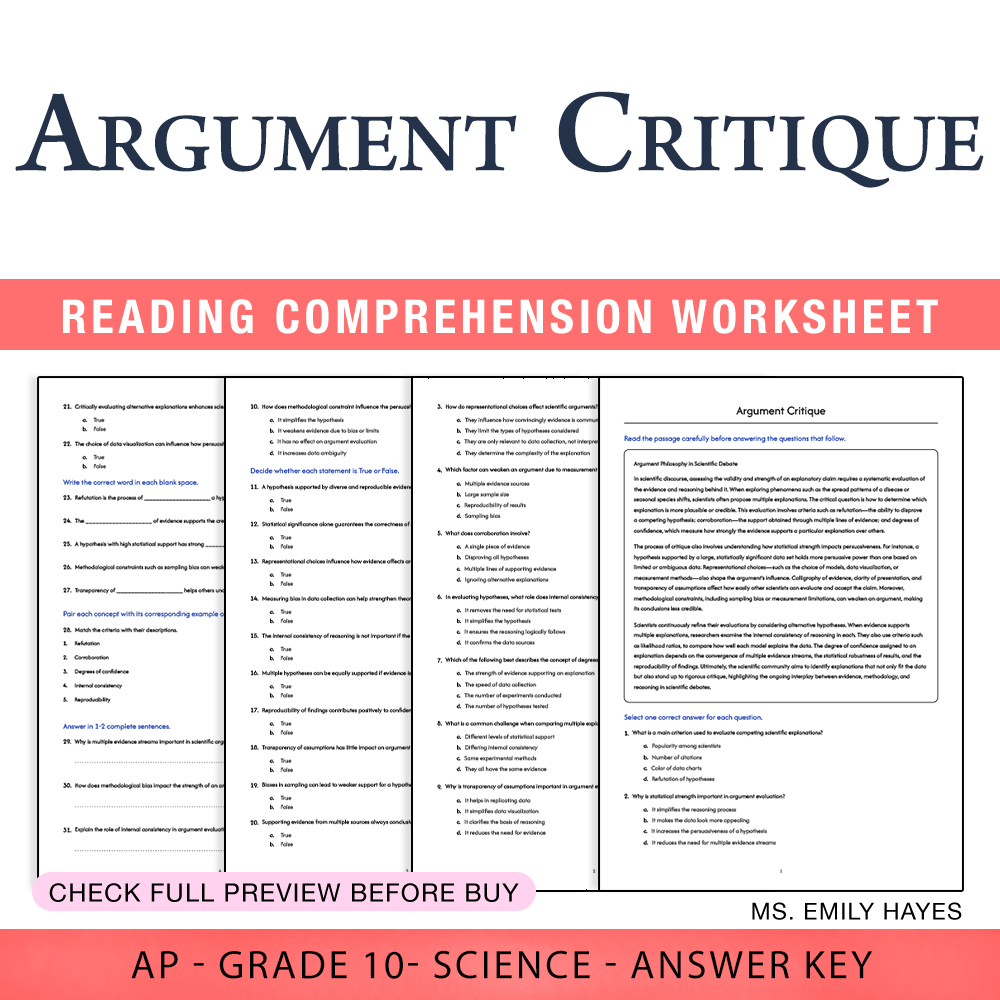
10th Grade Science | Argument Critique Worksheet (PDF+ Answer Key)
Created byCopper Leaf ClassroomLearning Objectives
- Evaluate explanatory claims systematically by examining evidence quality, alternative hypotheses, and reasoning internal consistency.
- Identify criteria such as refutation, corroboration, and confidence levels in scientific arguments.
- Understand how statistical strength, methodological constraints, and representational choices influence argument persuasiveness.
Also included in: Grade 10 Science AP | Data Analysis & Modeling Skills (PDF + Answer Key) +1 more
Instant download

Grade 10 Science Newton's Laws Worksheet (Ontario) – Practice Set with Answer Key
 Created byEvergreen Desk Education
Learning Objectives
- Explain how inertia relates to the first law of motion and predict motion when net force is zero.
- Use Newton’s second law to calculate acceleration from net force and mass.
- Apply Newton’s third law to action–reaction pairs and interpret what forces do in real interactions.
Also included in: Grade 10 Kinematics Forces & Mechanics Science Lesson Bundle Ontario Worksheets +1 more
Instant download
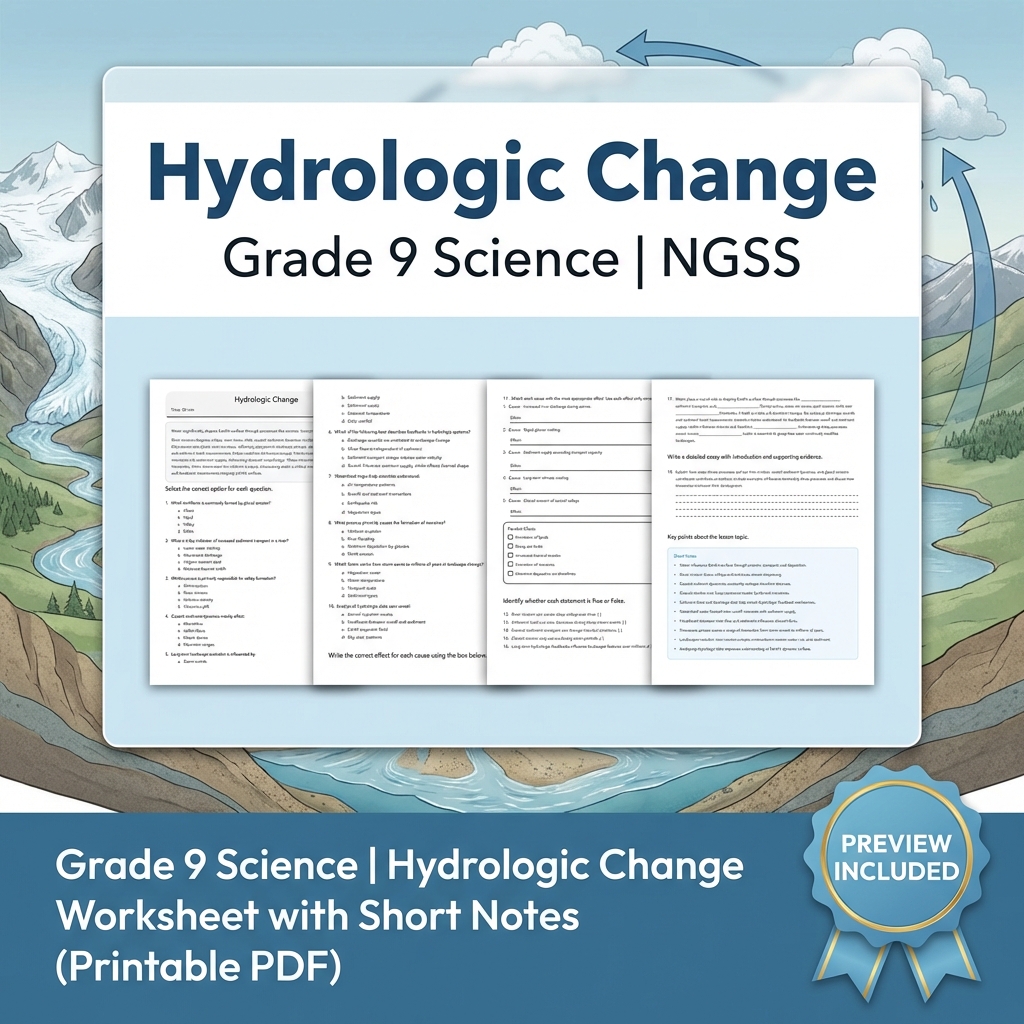
Grade 9 Science | Hydrologic Change Worksheet with Short Notes (Printable PDF)
 Created byMeadowlark Worksheets
Learning Objectives
- Analyze hydrologic data to understand water's role in Earth's surface processes.
- Identify examples of landscape change caused by water erosion, transport, and deposition.
- Interpret discharge records, sediment measurements, and watershed maps to assess hydrologic feedbacks.
Also included in: Grade 9 Science | Earth's Systems Unit Bundle NGSS 7 Worksheets (Resource Pack) +1 more
Instant download
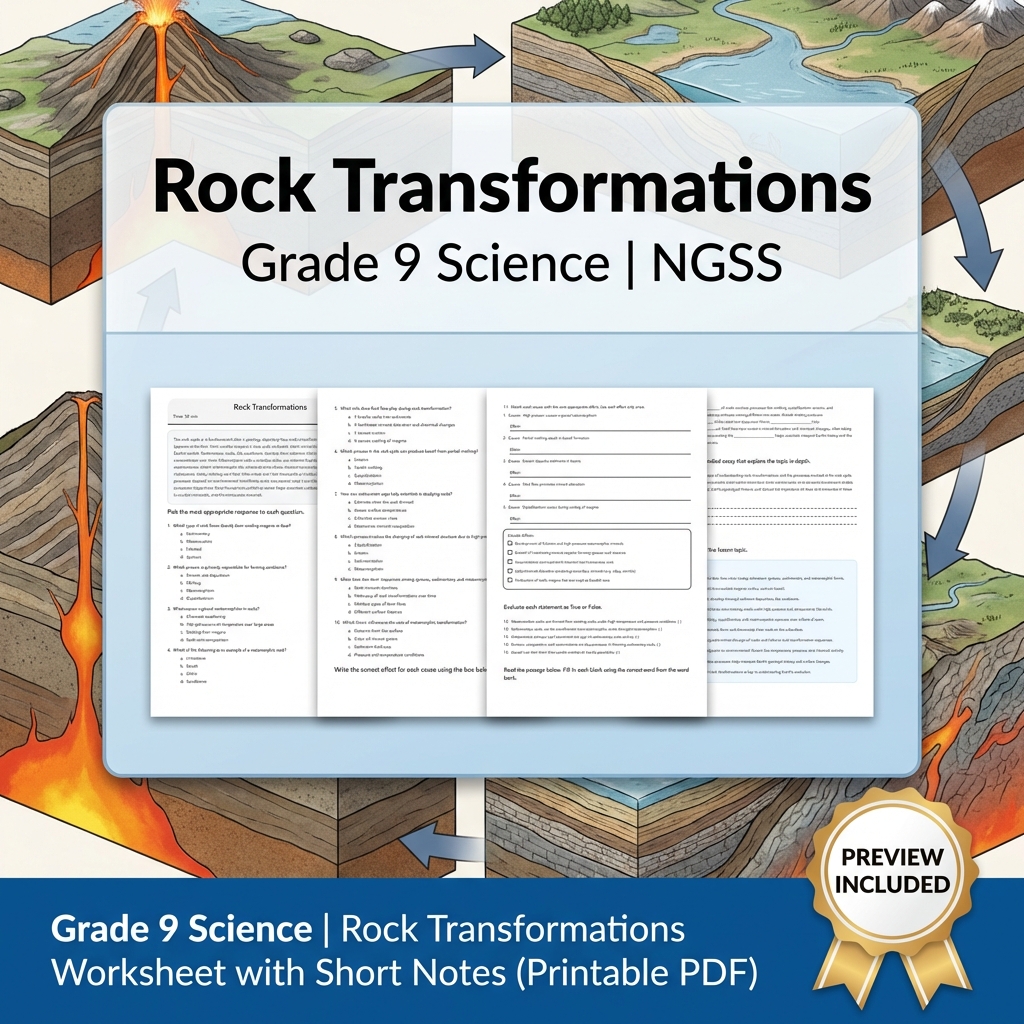
Grade 9 Science | Rock Transformations Worksheet with Short Notes (PDF)
Created byMeadowlark WorksheetsLearning Objectives
- Describe the processes involved in the rock cycle, including melting, crystallization, erosion, and metamorphism.
- Identify examples of rock transformations, such as basalt from partial melting and sandstone from sediment deposition.
- Explain how rates, pressure, temperature, and radiometric ages affect the sequencing of rock cycle events.
Also included in: Grade 9 Science | Earth's Systems Unit Bundle NGSS 7 Worksheets (Resource Pack) +1 more
Instant download
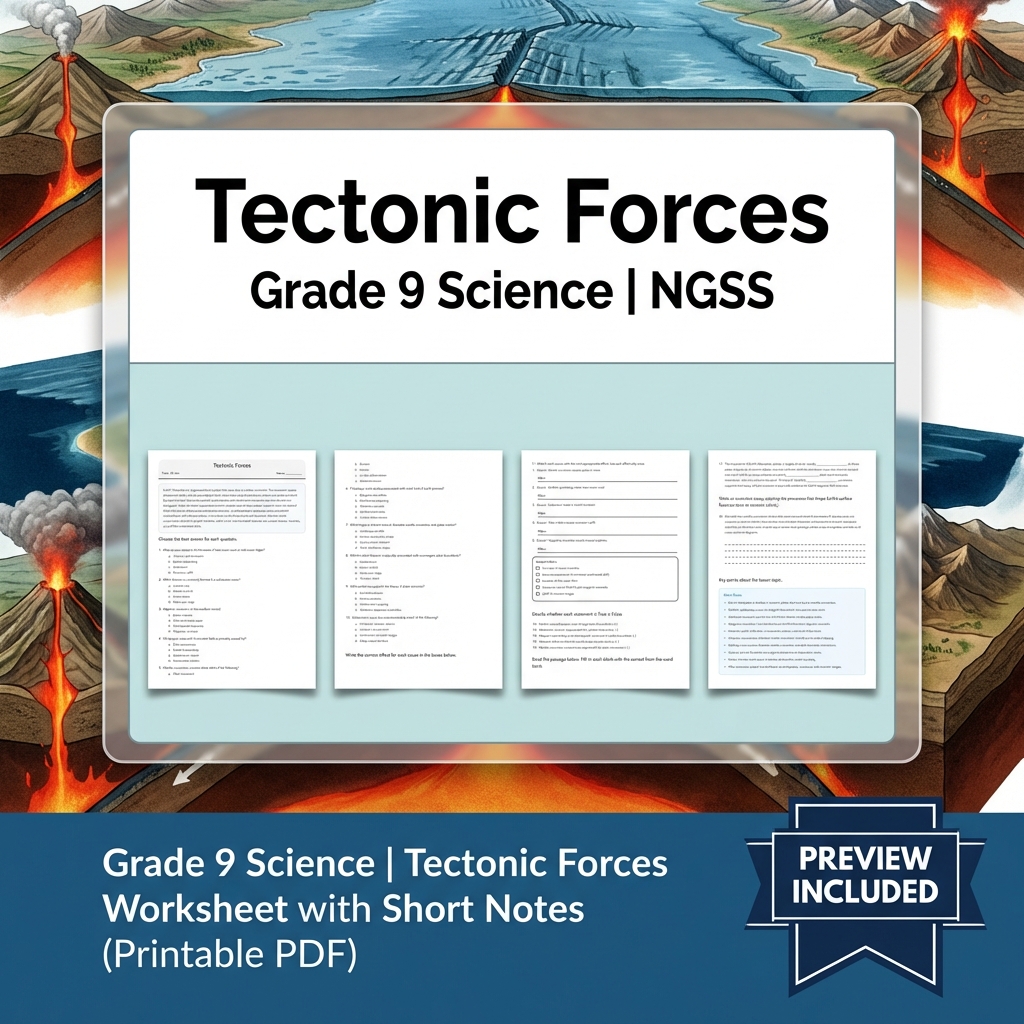
Grade 9 Science | Tectonic Forces Worksheet with Short Notes (Printable PDF)
Created byMeadowlark WorksheetsLearning Objectives
- Explain the processes of seafloor spreading, subduction zones, volcanic arcs, and mountain uplift.
- Connect mantle convection, crustal deformation, and faulting to surface features.
- Use geologic cross-sections and magnetic anomaly patterns as evidence for plate tectonics.
Also included in: Grade 9 Science | Earth's Systems Unit Bundle NGSS 7 Worksheets (Resource Pack) +1 more
Instant download
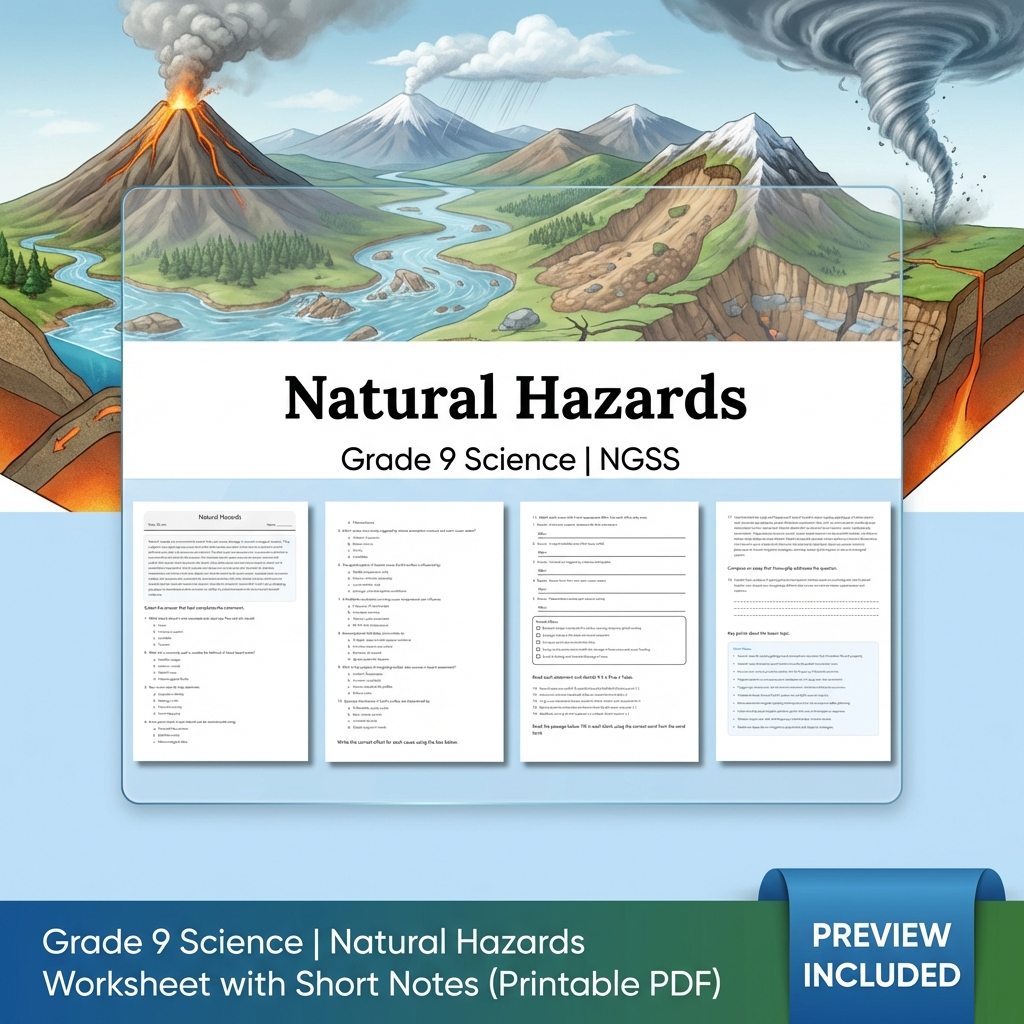
Grade 9 Science | Natural Hazards Worksheet with Short Notes (Printable PDF)
Created byMeadowlark WorksheetsLearning Objectives
- Understand how geologic and atmospheric indicators are used to assess natural hazards.
- Identify different types of natural hazards, their triggers, and impacts.
- Learn how hazard maps, recurrence intervals, and paleoevidence inform risk assessment.
Also included in: Grade 9 Science | Earth's Systems Unit Bundle NGSS 7 Worksheets (Resource Pack) +1 more
Instant download
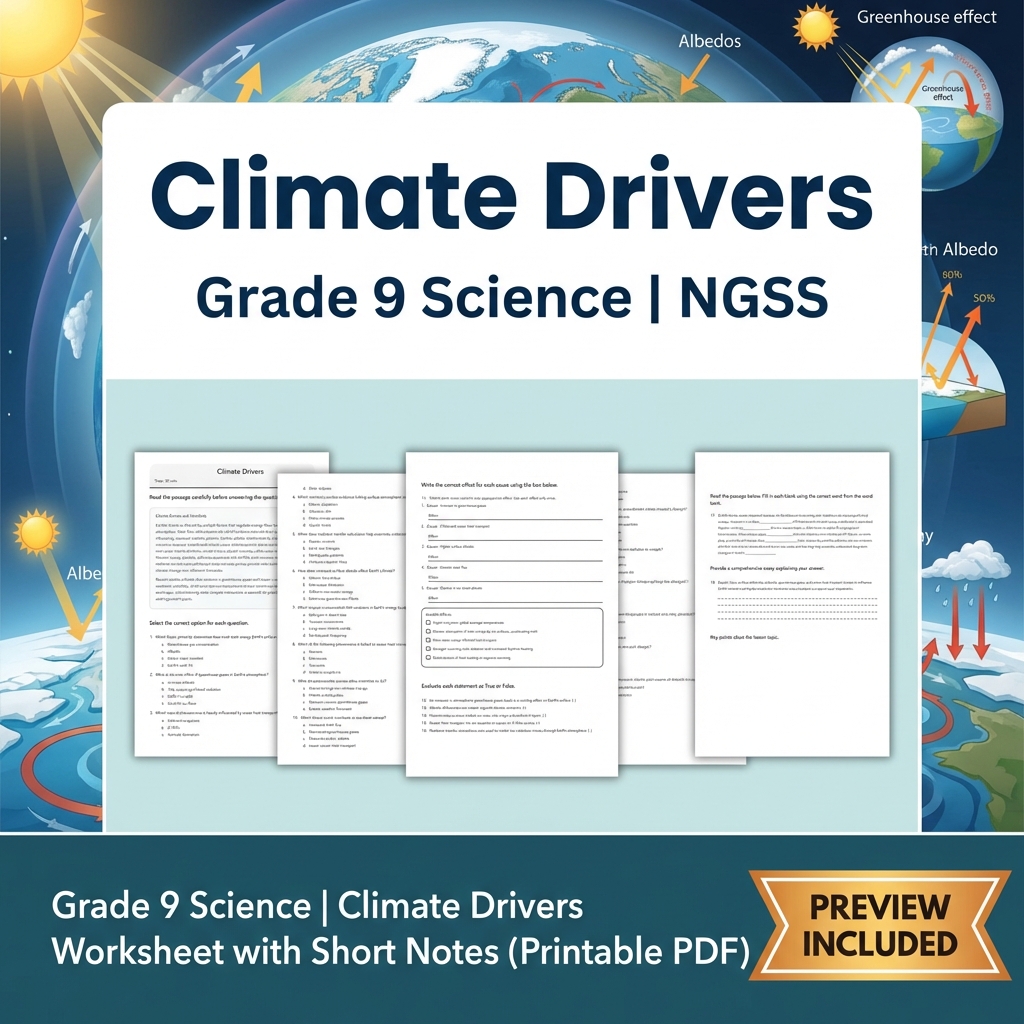
Grade 9 Science | Climate Drivers Worksheet with Short Notes (Printable PDF)
Created byMeadowlark WorksheetsLearning Objectives
- Understand the key factors influencing Earth's climate and weather patterns.
- Interpret quantitative models related to Earth's energy budget and surface-atmosphere interactions.
- Analyze how solar flux, albedo, greenhouse gases, and ocean heat transport affect climate variability.
Also included in: Grade 9 Science | Earth's Systems Unit Bundle NGSS 7 Worksheets (Resource Pack) +1 more
Instant download
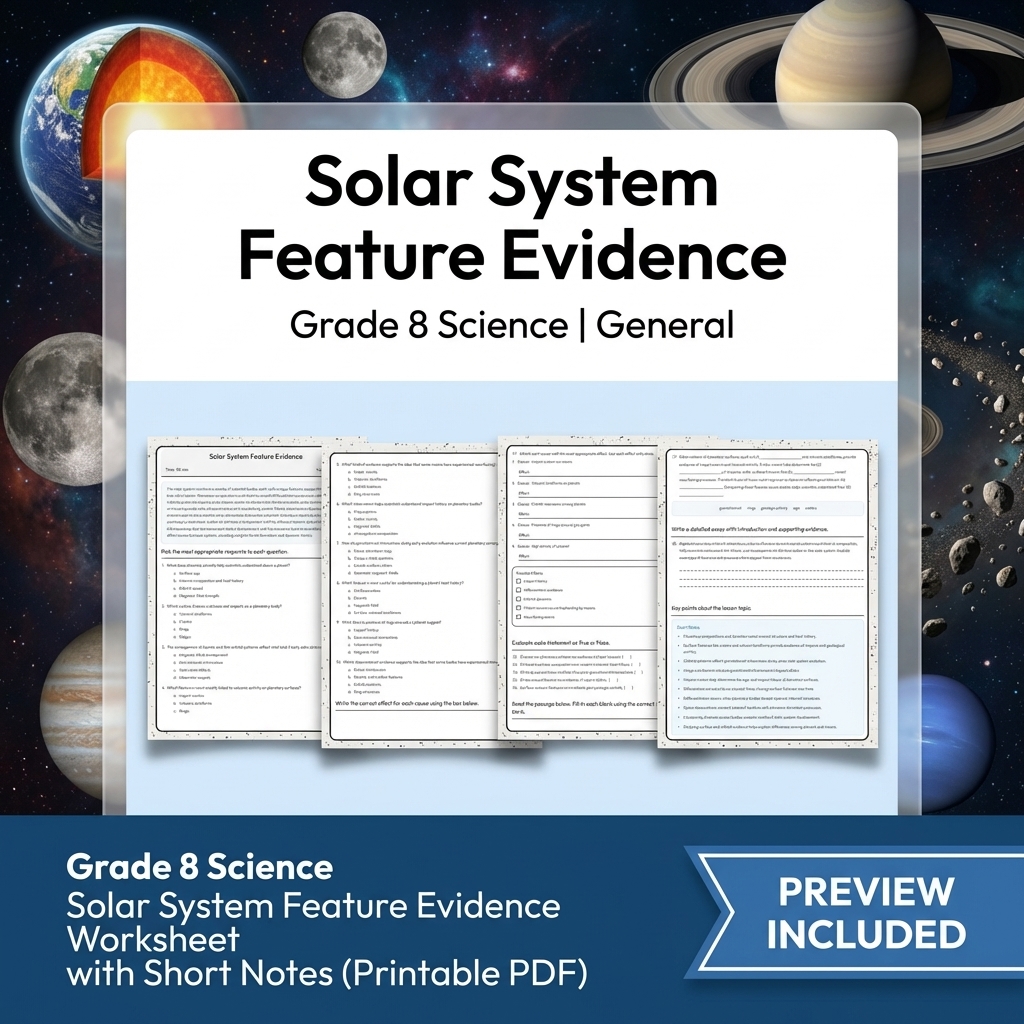
Grade 8 Science Solar System Feature Evidence Worksheet with Short Notes
Created byMeadowlark WorksheetsLearning Objectives
- Identify key features of the solar system and the evidence supporting their characteristics.
- Understand how planetary compositions, densities, and surface features relate to planetary history.
- Analyze orbital patterns and the arrangement of planets to infer gravitational interactions during early solar system evolution.
Also included in: Grade 8 Weather and Climate Science Lesson Bundle: General Framework +1 more
Instant download

Grade 3 Science Worksheet | Understanding Weathering Patterns (PDF)
Created byEvergreen Desk EducationLearning Objectives
- Explain how weathering slowly changes rocks and soil
- Identify patterns in weathering caused by wind, water, sunlight, and temperature changes
- Distinguish weathering from weather
Also included in: Grade 3 Weather & Earth Materials Science Lesson Bundle: General Framework +1 more
Instant download
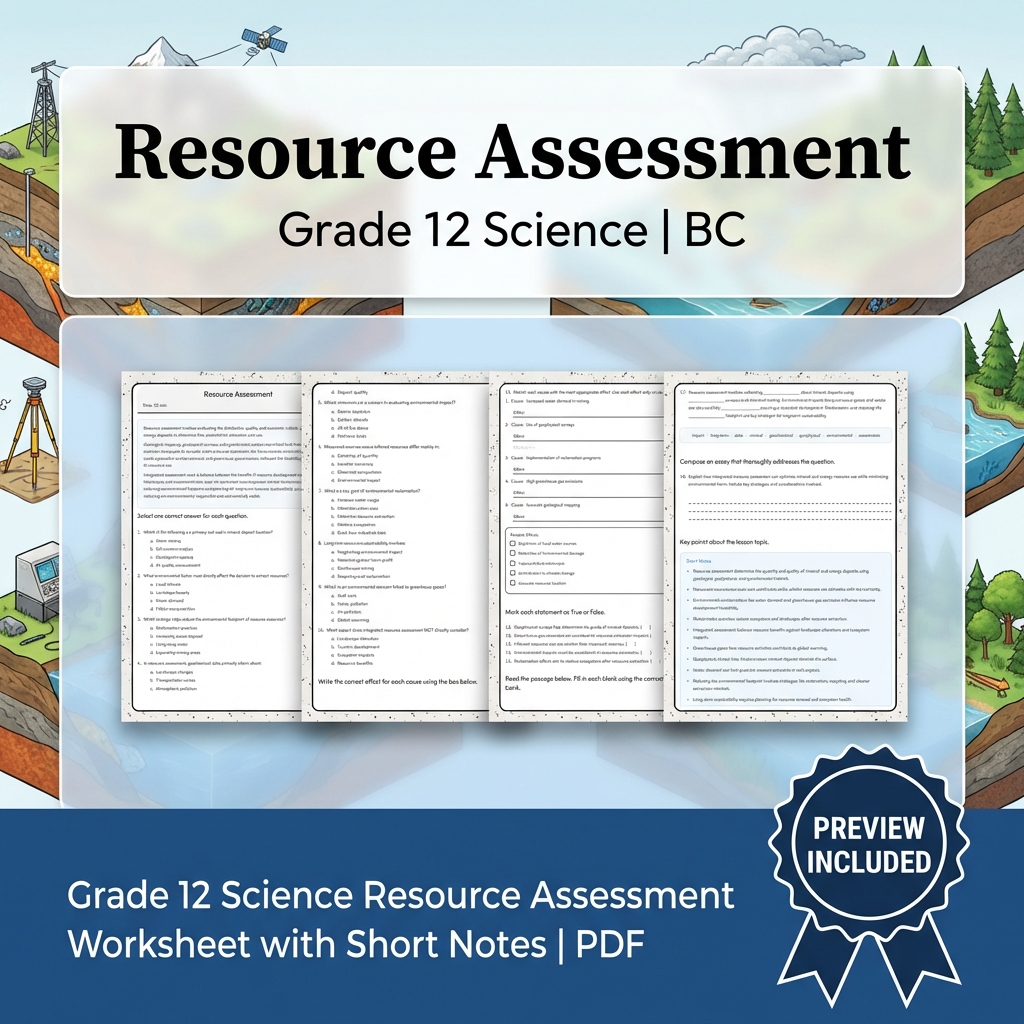
Grade 12 Science Resource Assessment Worksheet with Short Notes | PDF
Created byMeadowlark WorksheetsLearning Objectives
- Understand key methods used in resource assessment of mineral and energy deposits.
- Identify environmental considerations involved in resource extraction and evaluation.
- Analyze the balance between resource benefits and environmental impacts.
Also included in: Grade 12 Science Lesson Bundle | Earth Systems & Plate Tectonics Worksheets +1 more
Instant download
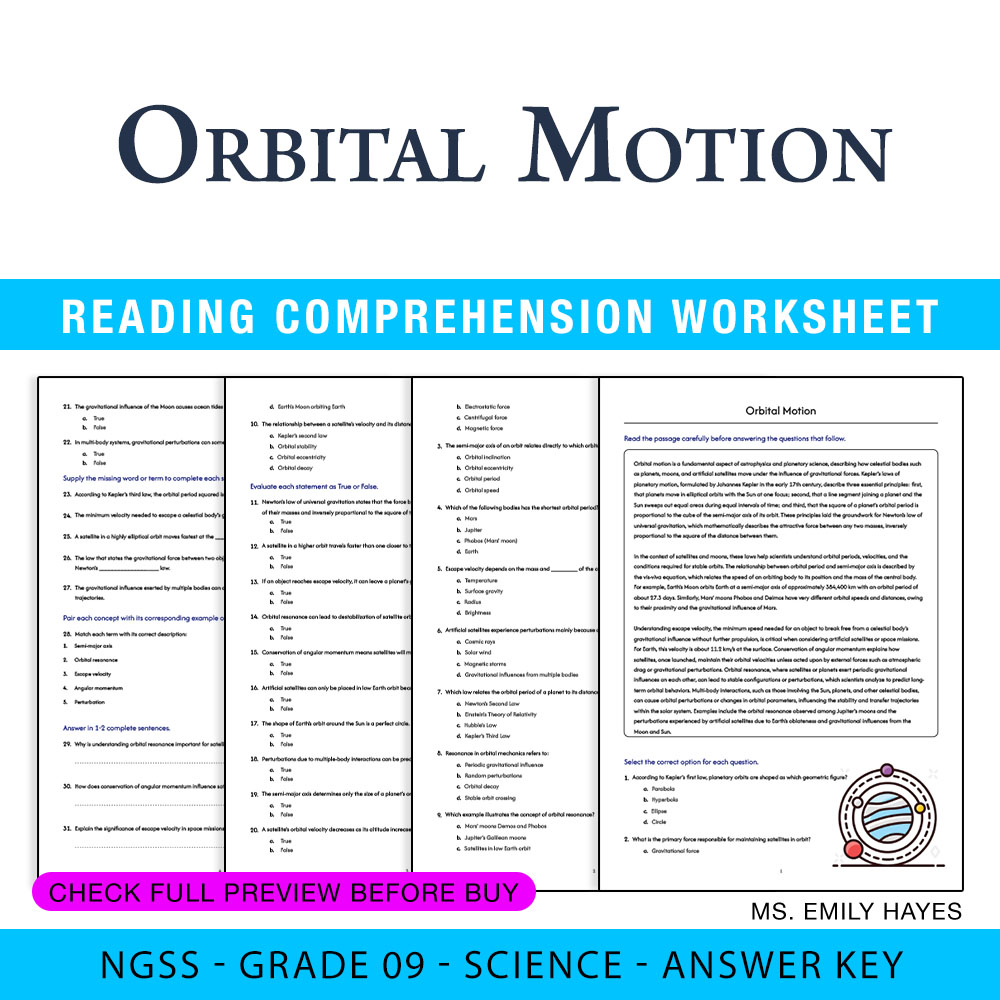
9th Grade Science | Orbital Motion Worksheet (PDF+ Answer Key)
Created byCopper Leaf ClassroomLearning Objectives
- Explain the principles of Kepler's laws and Newton's law of universal gravitation as they relate to orbital motion.
- Describe how orbital period relates to semi-major axis, and explain concepts like escape velocity and angular momentum in planetary and satellite contexts.
- Analyze examples such as Earth's Moon, Mars' moons, and artificial satellites to understand orbital stability, resonance, and perturbations.
Instant download

Grade 6 Science | Parallel Circuit Characteristics Worksheet (PDF + Answer Key)
 Created byLumora Learning
Learning Objectives
- Understand the concept of parallel circuits and their branching pathways.
- Explain how potential difference is equal across all branches in a parallel circuit.
- Describe how overall current is the sum of branch currents.
Also included in: Grade 6 Science | Electricity Unit Custom Bundle | Ontario Framework
Instant download
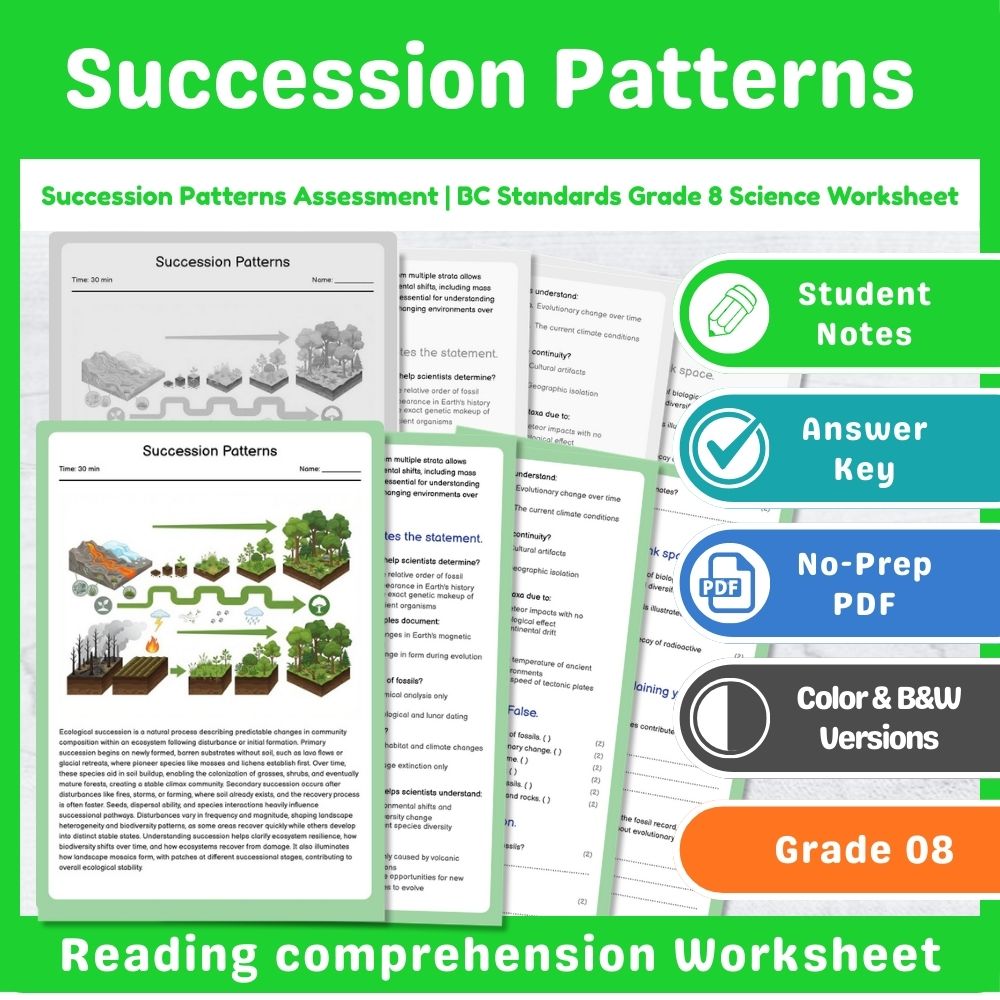
Succession Patterns Assessment | BC Standards Grade 8 Science Worksheet
 Created byPrism Point Learning
Learning Objectives
- Understand the stages and types of ecological succession, including primary and secondary succession.
- Identify factors that influence successional pathways in ecosystems.
- Analyze how disturbances impact landscape heterogeneity and community development.
Instant download

Succession Patterns Worksheet | Grade 8 Science Standards-Aligned
JCreated byJ.S SheetsLearning Objectives
- Describe the stages and types of ecological succession, including primary and secondary succession.
- Explain how species traits and disturbances influence successional pathways.
- Analyze how succession impacts biodiversity and ecosystem stability.
Instant download
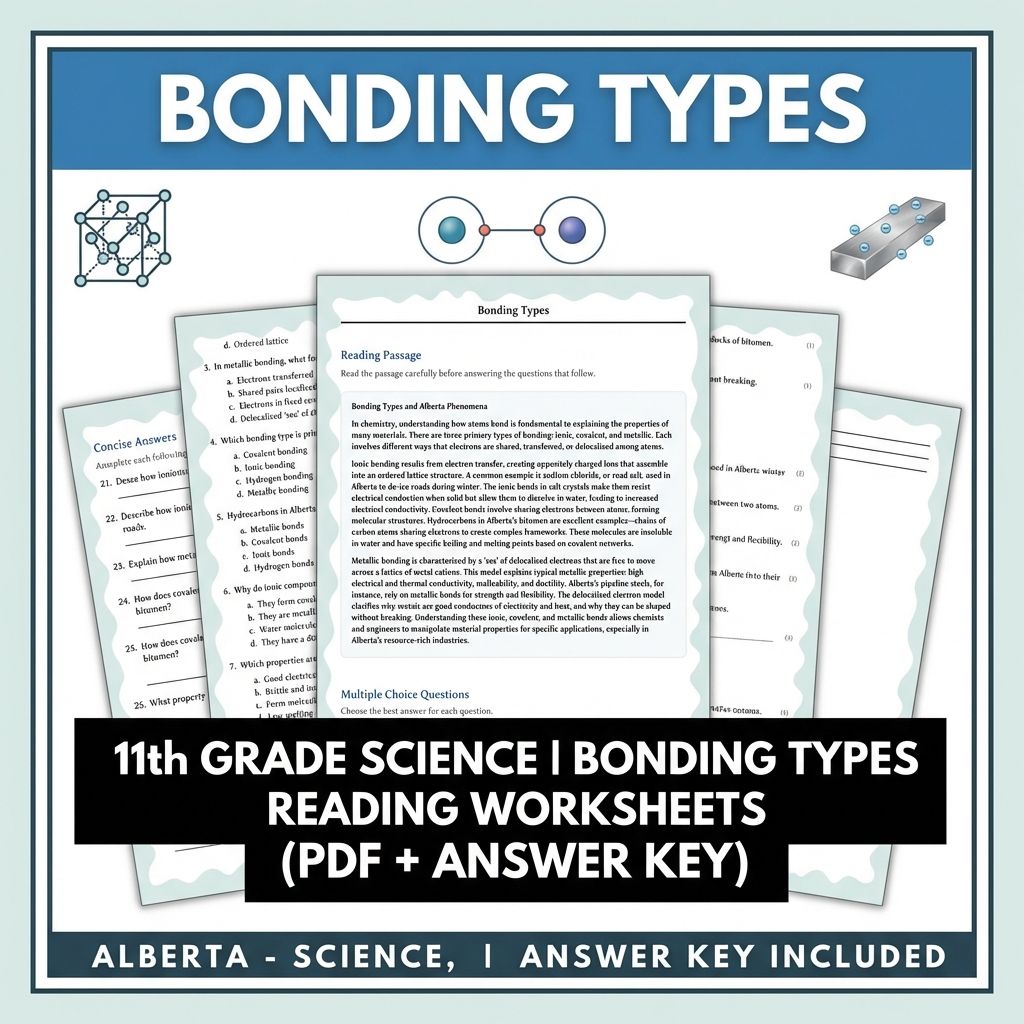
11th Grade Science | Bonding Types Reading Worksheets (PDF + Answer Key)
JCreated byJ.S SheetsLearning Objectives
- Compare electron transfer, electron sharing, and delocalized electron models in ionic, covalent, and metallic bonds.
- Understand how bonding types influence the structure and properties of materials such as salt, hydrocarbons, and steel.
- Link real Alberta phenomena to bonding models, including road salt, bitumen, and pipeline steel.
Instant download
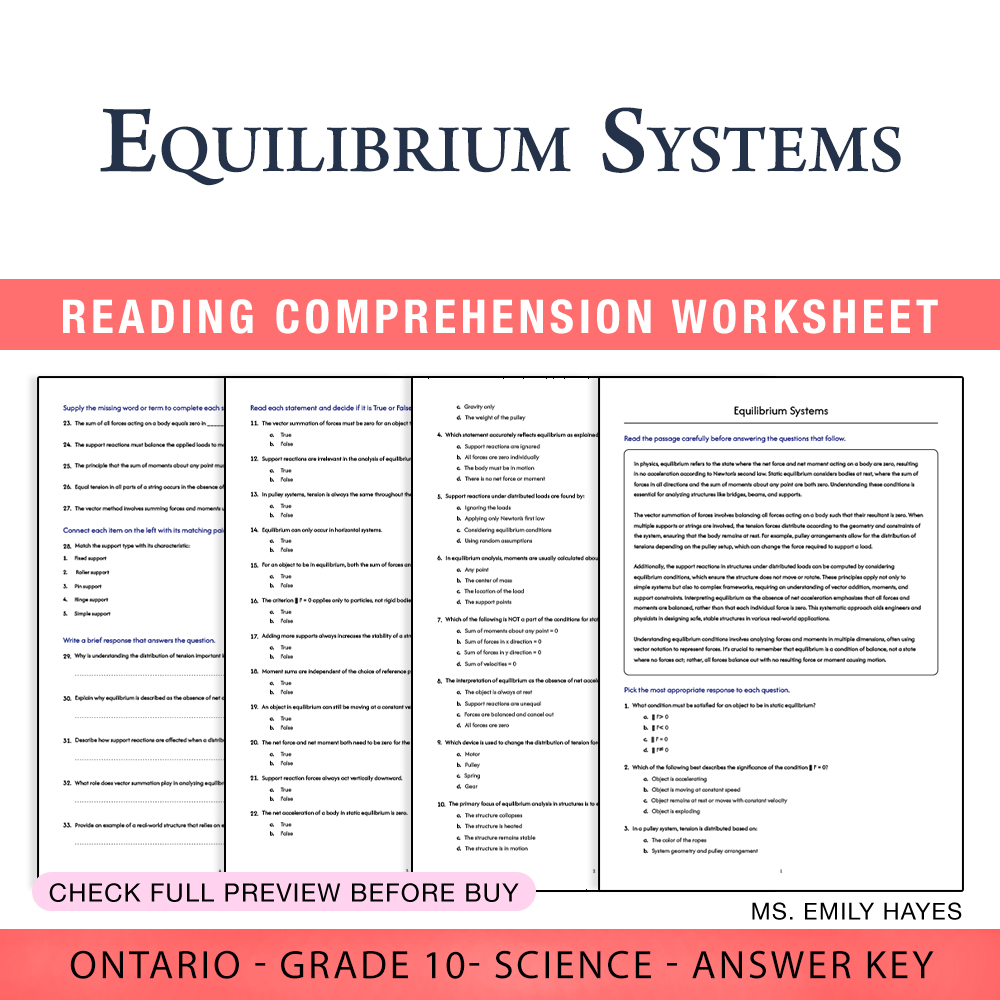
10th Grade Science | Equilibrium Systems Worksheet (PDF + Answer Key)
Created byCopper Leaf ClassroomLearning Objectives
- Explain the conditions required for static equilibrium using vector summation of forces and moments.
- Apply the criteria ΣF = 0 to analyze the support reactions in rigid bodies.
- Describe the distribution of tension in pulley systems and the effects of supports under various loads.
Instant download
7th Grade Science | Homeostasis Reading Worksheets Complete Practice Set
JCreated byJ.S SheetsLearning Objectives
- Understand the concept of homeostasis and its importance in living organisms
- Identify organs and systems involved in regulating internal conditions
- Explain feedback mechanisms such as thermoregulation
Instant download
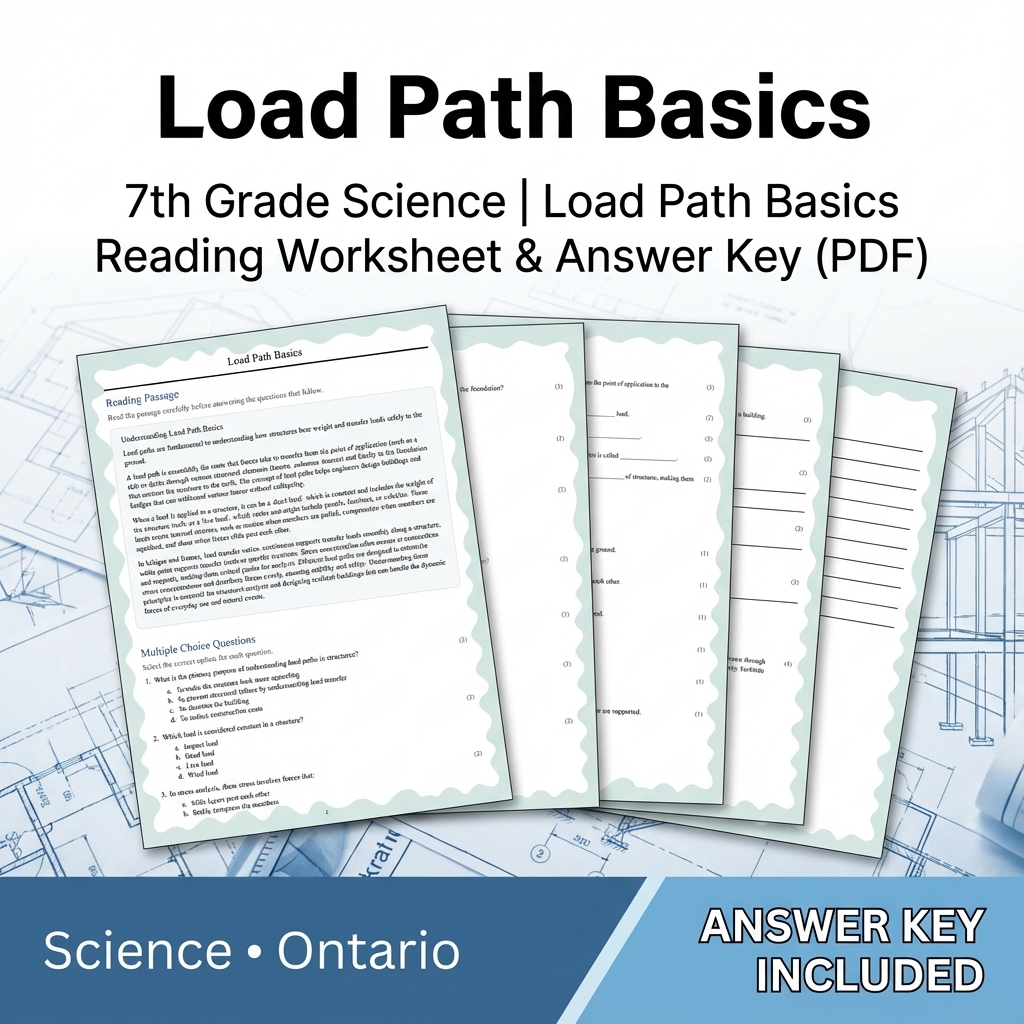
7th Grade Science | Load Path Basics Reading Worksheet & Answer Key (PDF)
JCreated byJ.S SheetsLearning Objectives
- Define the primary structural elements involved in load transfer within structures.
- Distinguish between dead loads and live loads and explain how they affect structures.
- Identify the types of stress—tension, compression, shear—in structural members.
Also included in: Grade 7 Science Unit Bundle – Structural Engineering & Material Testing +1 more
Instant download
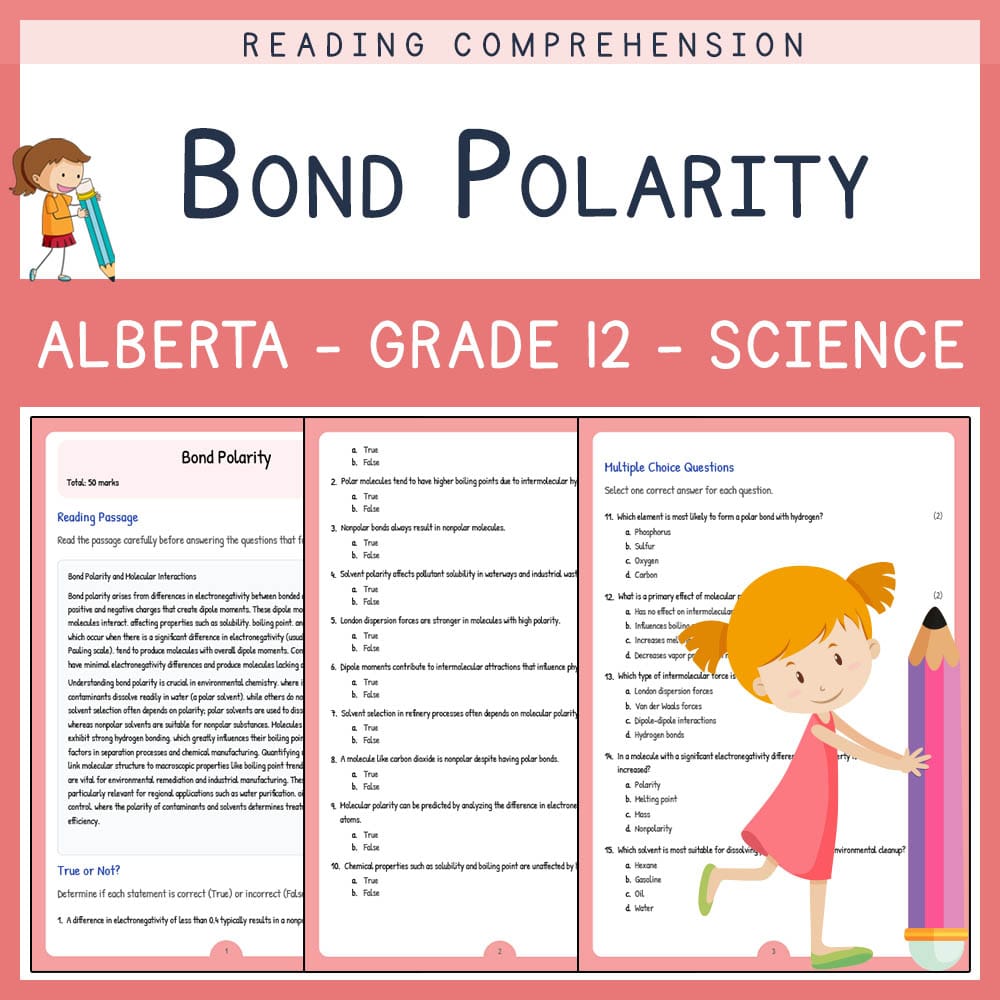
Grade 12 Science Worksheet | Bond Polarity | Alberta Standards
Created byLumora LearningLearning Objectives
- Explain the concept of bond polarity and how differences in electronegativity create dipole moments.
- Identify and classify bonds as polar or nonpolar based on molecular structure and electronegativity differences.
- Apply understanding of bond polarity to predict solvent behaviors, molecular interactions, and industrial applications.
Instant download
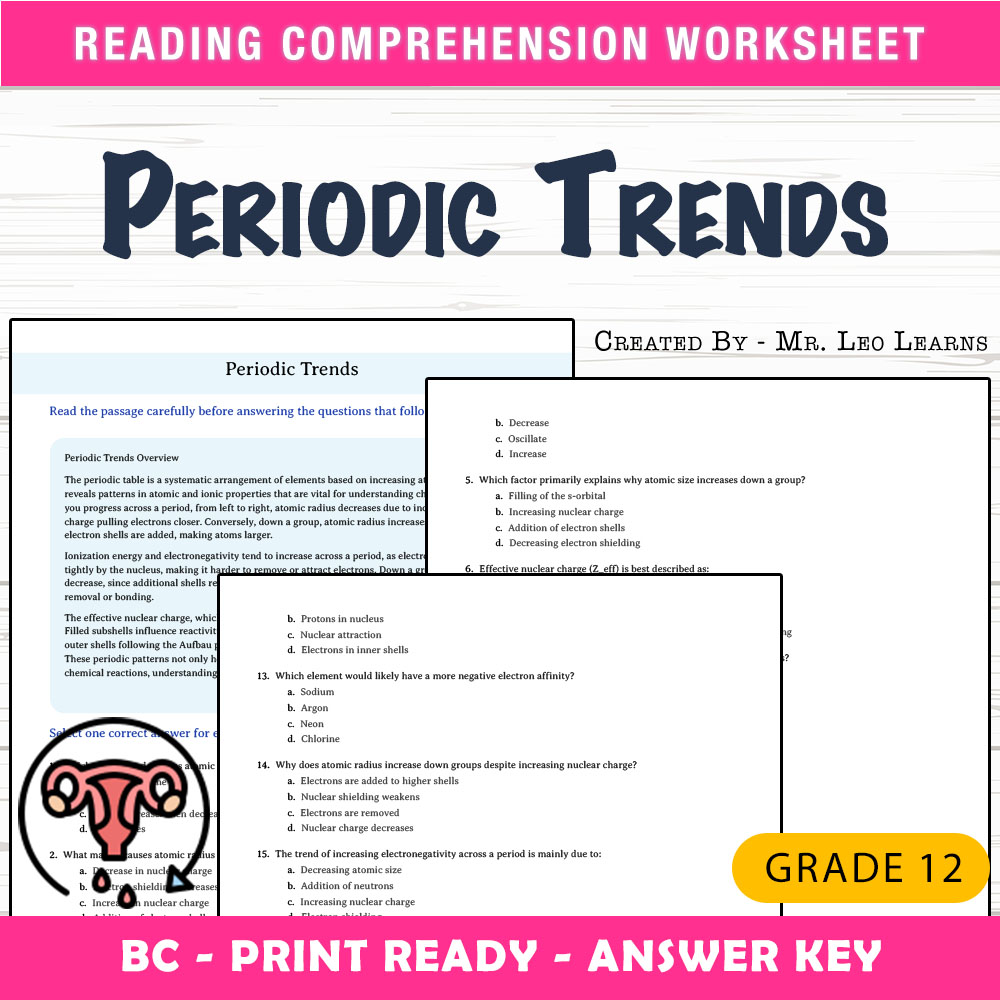
Grade 12 Science — Worksheet MCQ Paper for Mastering Periodic Trends
 Created byThe Resource Hub
Learning Objectives
- Understand how atomic radius, ionization energy, and electronegativity vary across the periodic table.
- Explain the underlying factors like nuclear charge and electron shielding that influence periodic trends.
- Predict element reactivity, ionic sizes, and bond tendencies based on periodic properties.
Also included in: Grade 12 Science | Chemistry 12 MCQ Worksheet Bundle – BC Curriculum Review Pack +1 more
Instant download

Grade 10 Science – Tension and Normal Forces Worksheet (PDF) for BC Standards
Created byEvergreen Desk EducationLearning Objectives
- Explain how tension acts along a connector and how it is represented on free-body diagrams
- Determine the direction and role of the normal force when an object rests on or moves along an incline
- Connect tension and normal-force representations to Newton’s second law predictions about motion
Instant download

Inclined Planes Review Worksheet | Grade 8 Science Ontario
Created byPrism Point LearningLearning Objectives
- Explain how an inclined plane reduces the input force needed to lift an object compared with lifting it vertically.
- Calculate ideal mechanical advantage using slope length and height, and relate it to real-world situations involving friction.
- Describe how the normal force and the component of gravitational force along the slope affect whether an object slides.
Also included in: Grade 8 Work, Energy & Forces Science Lesson Bundle – Ontario Test Prep
Instant download
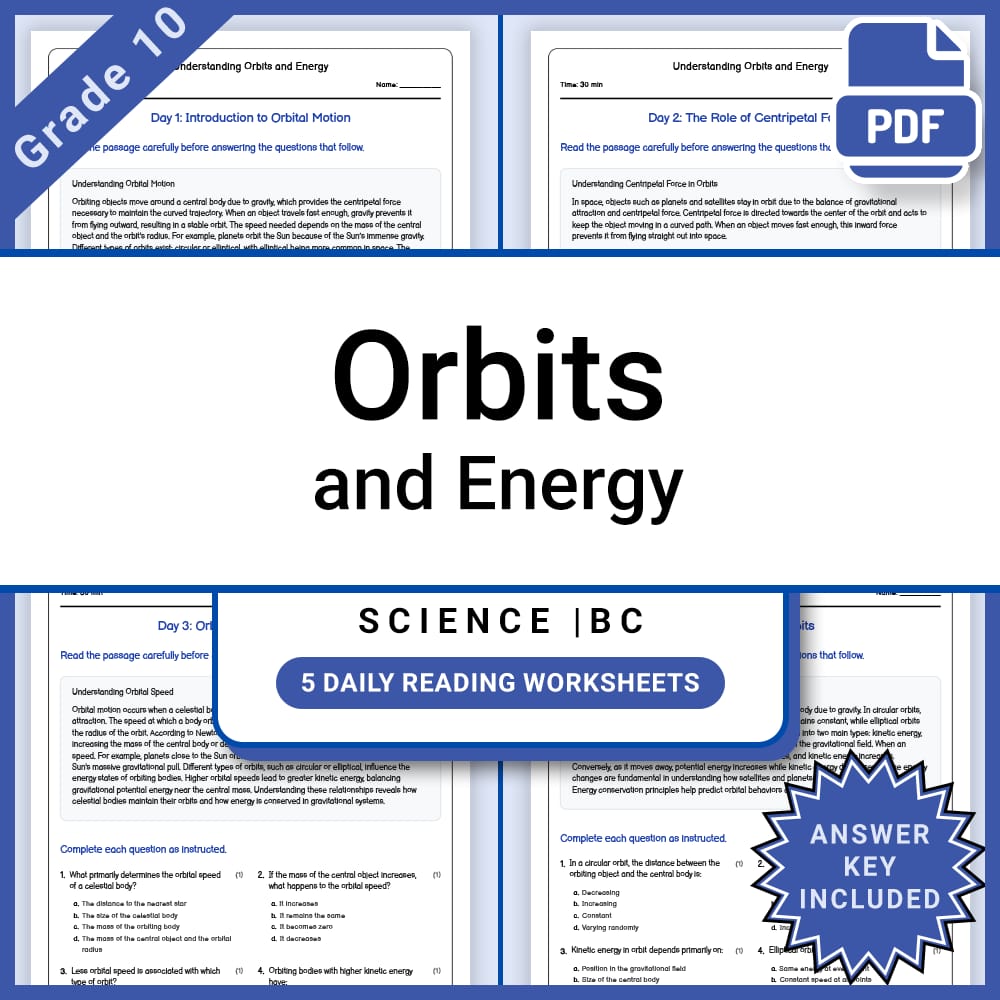
Grade 10 Science – Orbits and Energy Daily Reading Worksheet + Answer Key
JCreated byJ.S SheetsLearning Objectives
- Explain how gravitational attraction causes objects to orbit
- Describe the relationship between orbital speed, central mass, and radius
- Differentiate between circular and elliptical orbits
Also included in: Grade 10 Science Lesson Group Bundle – Physics and Fields +1 more
Instant download

Advanced Models Worksheet | Grade 11 Chemistry Practice
Created byPrism Point LearningLearning Objectives
- Explain how molecular orbital theory and band theory together describe delocalization and bonding in solids and transition-metal complexes.
- Relate orbital overlap and band structure to metallic conduction and semiconductor behavior.
- Use molecular symmetry and orbital/band models to predict spectroscopic features and reactivity trends.
Also included in: VSEPR & Chemical Bonding Lesson Bundle | Grade 11 Science | Alberta
Instant download

Dipole Interactions Worksheet | Grade 11 Science Activities
Created byPrism Point LearningLearning Objectives
- Explain how dipole–dipole attractions form between polar molecules and how orientation affects intermolecular forces
- Predict how temperature changes dipole interactions and related physical properties in solutions and condensed phases
- Use dipole interactions to justify examples such as miscibility and boiling-point differences in Alberta-relevant contexts
Also included in: VSEPR & Chemical Bonding Lesson Bundle | Grade 11 Science | Alberta
Instant download

VSEPR Basics Worksheet | Grade 11 Science Activities
Created byPrism Point LearningLearning Objectives
- Use VSEPR electron-pair repulsion to predict molecular geometry from bonding and nonbonding pairs.
- Relate molecular shape to bond angles and predict relative polarity based on symmetry.
- Identify the electron-pair geometry vs. the molecular geometry for common VSEPR families.
Also included in: VSEPR & Chemical Bonding Lesson Bundle | Grade 11 Science | Alberta
Instant download

Hydrogen Bonding Worksheet | Grade 11 Science Practice Assessments
Created byPrism Point LearningLearning Objectives
- Explain how hydrogen bonding forms between a hydrogen atom and a lone pair on an acceptor atom
- Describe how hydrogen bonding affects physical properties such as melting and boiling points
- Connect hydrogen bonding to the behavior of water, ice, proteins, and polymers
Also included in: VSEPR & Chemical Bonding Lesson Bundle | Grade 11 Science | Alberta
Instant download

Grade 12 Science – Planetary Geology Daily Reading Worksheet with Answer Key
JCreated byJ.S SheetsLearning Objectives
- Understand surface features such as craters, volcanoes, and tectonic signs on planetary bodies.
- Analyze how surface processes reveal planetary thermal and geological history.
- Learn how remote sensing, sample analysis, and in situ measurements contribute to planetary geology.
Also included in: Grade 12 Science Lesson Group Bundle with TEKS Framework +1 more
Instant download

Grade 12 Science – Astronomy Overview Daily Reading Worksheet with Answer Key
JCreated byJ.S SheetsLearning Objectives
- Understand the processes involved in the formation of the Solar System
- Identify the stages of planetary accretion and differentiation
- Relate observational data to solar nebula models and planetary diversity
Also included in: Grade 12 Science Lesson Group Bundle with TEKS Framework +1 more
Instant download

Grade 12 Science – Climate Modeling Daily Reading Worksheet + Answer Key
JCreated byJ.S SheetsLearning Objectives
- Understand the basic components of climate models.
- Identify different approaches used in climate modeling.
- Recognize the importance of model validation and the methods used.
Also included in: Grade 12 Science Lesson Group Bundle with TEKS Framework +1 more
Instant download
Grade 8 Science – Hydrostatic Pressure Daily Reading Worksheet + Answer Key
JCreated byJ.S SheetsLearning Objectives
- Understand key concepts related to Science
- Apply knowledge through practice questions
- Demonstrate comprehension of the material
Also included in: Grade 8 Science Lesson Bundle: Fluids, Pressure, and Density Topics +1 more
Instant download
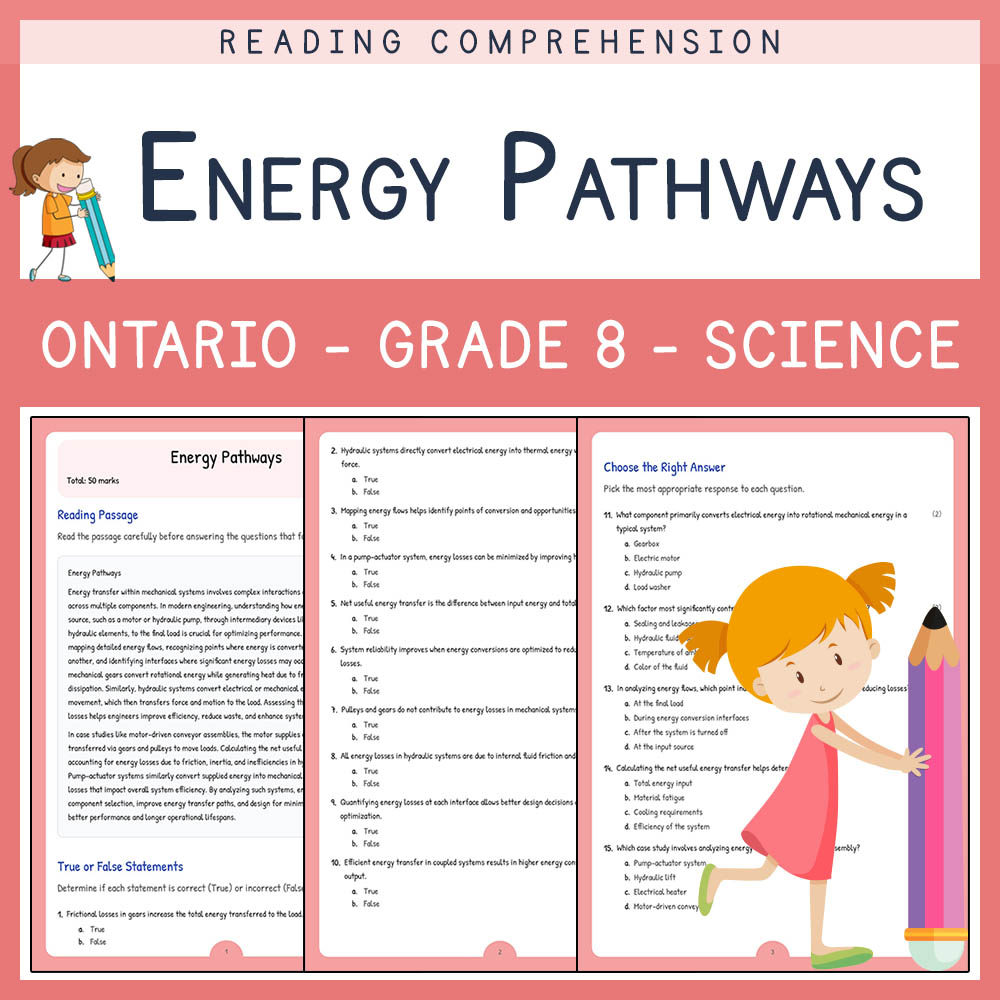
Grade 8 Science Assessment | Energy Pathways Worksheet Elena | Ontario
Created byLumora LearningLearning Objectives
- Understand how energy is transferred through coupled mechanical systems such as gears, pulleys, and hydraulic elements.
- Identify points of energy conversion and quantify energy losses at each interface.
- Analyze case studies involving motor-driven conveyors and pump–actuator systems to assess system efficiency.
Also included in: Grade 8 Science | Systems in Action Lesson Bundle | Ontario Framework
Instant download
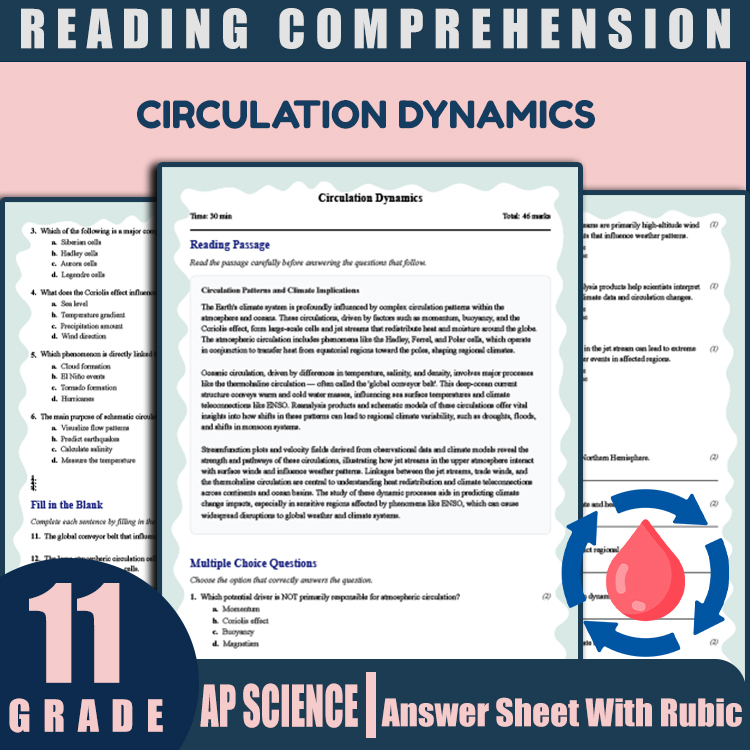
Grade 11 Science | Circulation Dynamics Reading Worksheet & Answer Key PDF
JCreated byJ.S SheetsLearning Objectives
- Understand atmospheric and oceanic circulation patterns and their drivers.
- Interpret streamfunction plots, velocity fields, and schematic models related to circulation.
- Link circulation features like jet streams, trade winds, and thermohaline circulation to climate impacts.
Also included in: Grade 11 Science Unit Bundle | Earth Systems & Climate Change Worksheets +1 more
Instant download

Science Grade 7: Solution Comparison Worksheet | NGSS Assessment
 Created bySkylark Worksheets
Learning Objectives
- Compare competing design solutions by using consistent metrics and model-based reasoning.
- Identify and quantify trade-offs among performance, cost, durability, and manufacturability.
- Use predicted vs. observed behavior from simple prototypes to rank options and document limitations.
Also included in: Grade 7 Engineering Design Science Lesson Bundle: NGSS +1 more
Instant download
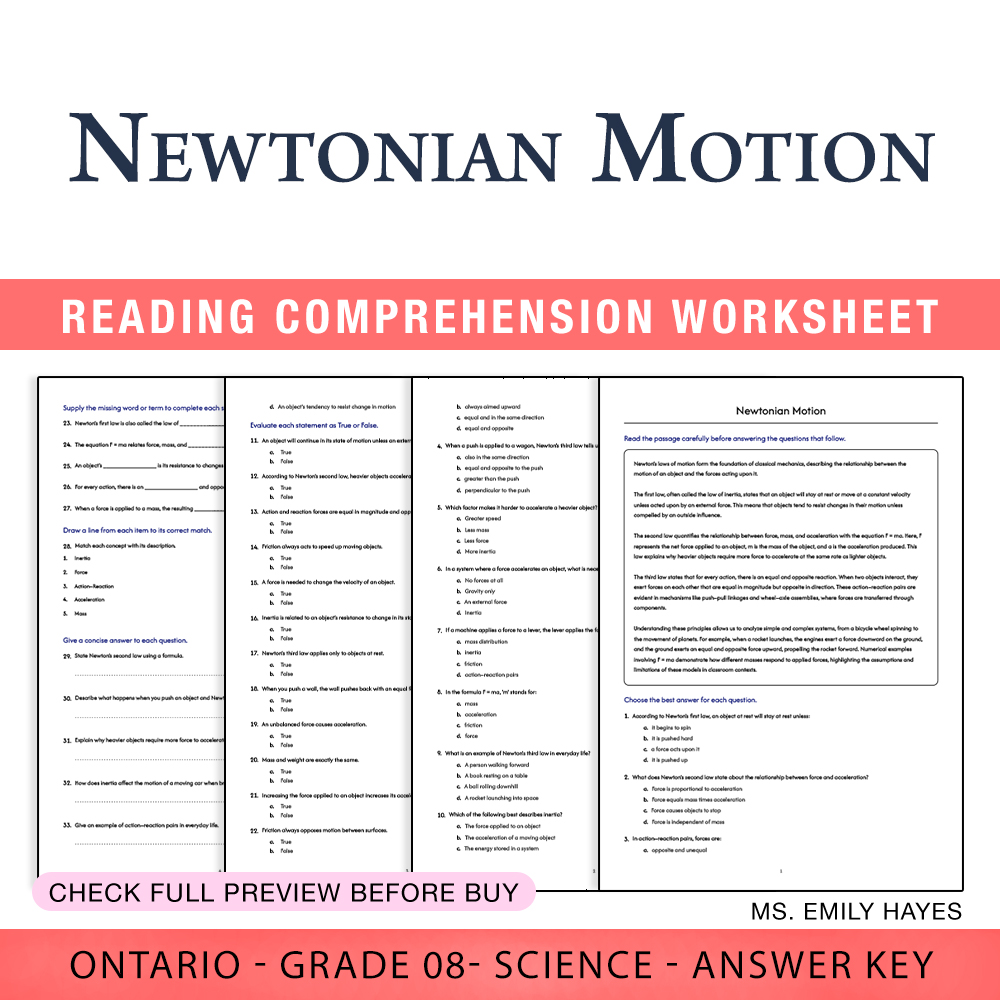
Grade 8 Science | Newtonian Motion Worksheet (PDF+ Answer Key)
Created byCopper Leaf ClassroomLearning Objectives
- Explain Newton’s three laws of motion and their application to mechanical systems.
- Quantitatively relate force, mass, and acceleration using F = ma in different scenarios.
- Understand the concepts of inertia and action-reaction pairs within mechanical mechanisms.
Instant download
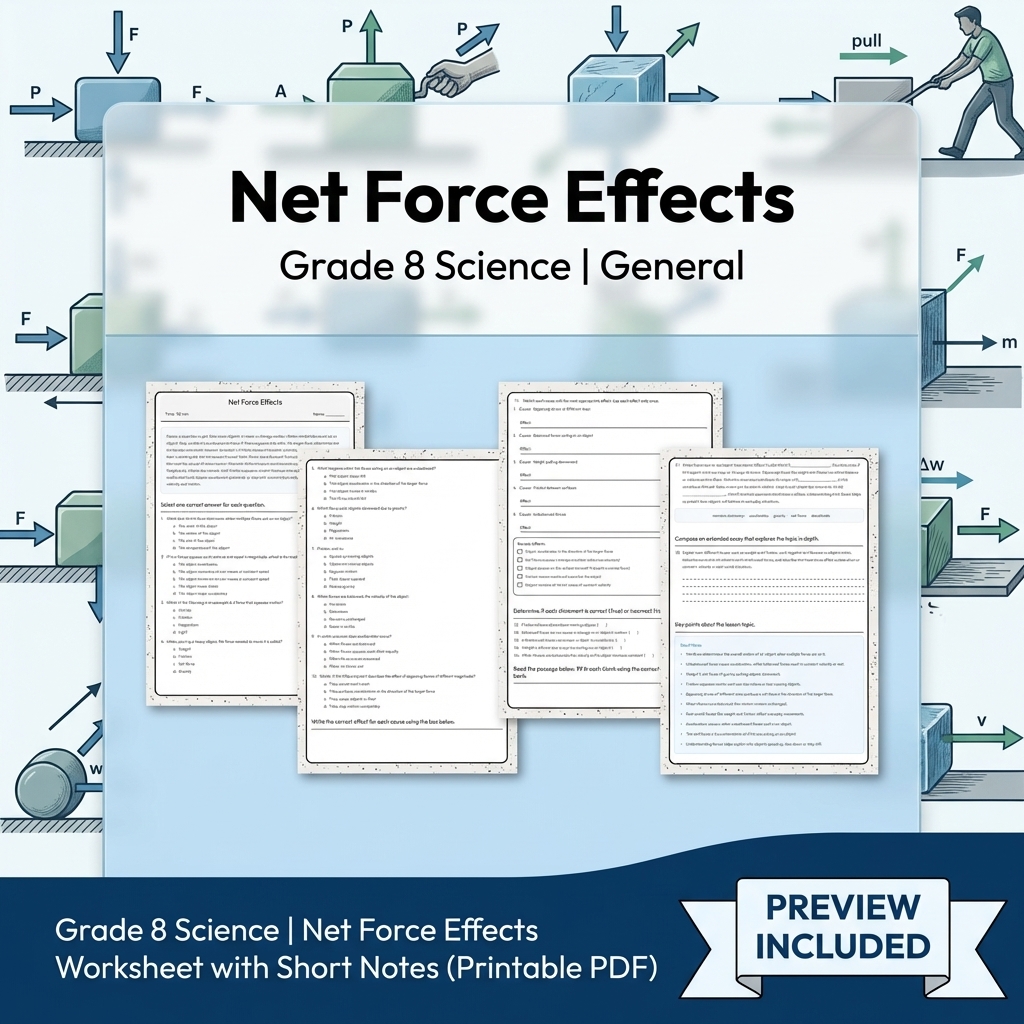
Grade 8 Science | Net Force Effects Worksheet with Short Notes (Printable PDF)
Created byMeadowlark WorksheetsLearning Objectives
- Understand how multiple forces acting together influence an object's motion.
- Identify the effects of opposing forces and how they determine net force.
- Connect real-world examples like weight and friction to force patterns and velocity changes.
Also included in: Grade 8 Matter and Chemical Reactions Science lesson bundle +1 more
Instant download
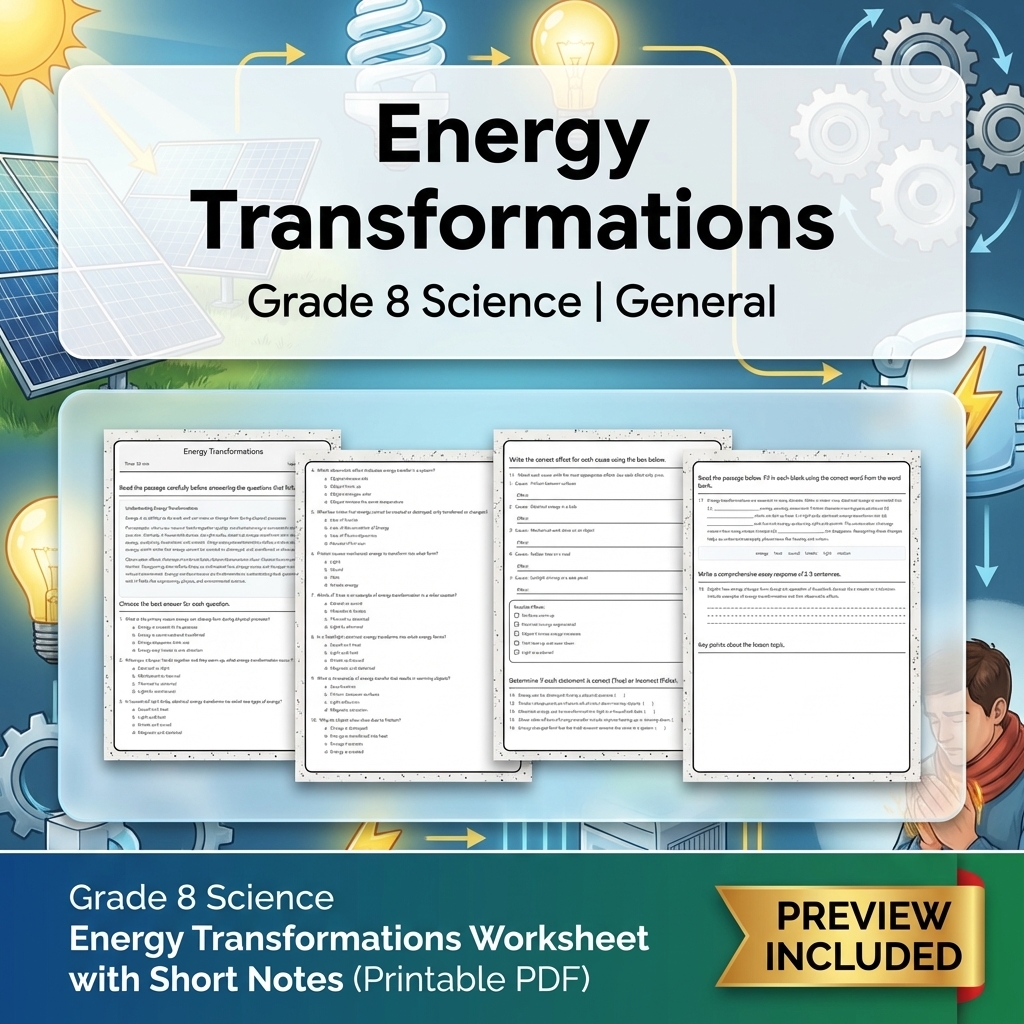
Grade 8 Science Energy Transformations Worksheet with Short Notes
Created byMeadowlark WorksheetsLearning Objectives
- Understand how energy changes form during physical processes.
- Identify examples of energy transformations in real-world scenarios.
- Explain the law of conservation of energy in different contexts.
Also included in: Grade 8 Matter and Chemical Reactions Science lesson bundle +1 more
Instant download

States of Matter Worksheet Grade 7 Science | Matter and Phase Changes
Created byPrism Point LearningLearning Objectives
- Explain how energy transfer during phase changes affects particle motion and arrangement
- Distinguish melting, freezing, evaporation, and condensation using the particle model
- Describe why temperature stays relatively steady during a phase change
Instant download

Grade 7 Science – Population Change Daily Reading Worksheet with Answer Key
JCreated byJ.S SheetsLearning Objectives
- Understand the key factors that influence population size and distribution.
- Differentiate between exponential and logistic growth patterns.
- Identify how predator-prey relationships affect population oscillations.
Also included in: Grade 7 Science Lesson Bundle | Ecosystems, Cell Structure & Adaptations +1 more
Instant download

Grade 9 Science | Third Law Pairs Worksheet | NGSSS Assessment
Created byLumora LearningLearning Objectives
- Explain Newton’s Third Law using the idea of action–reaction force pairs that act on different objects.
- Identify whether two forces form a Third Law pair by checking the interacting objects and direction.
- Use Third Law pairs to analyze everyday situations such as rockets, walking, and pushing against walls.
Instant download
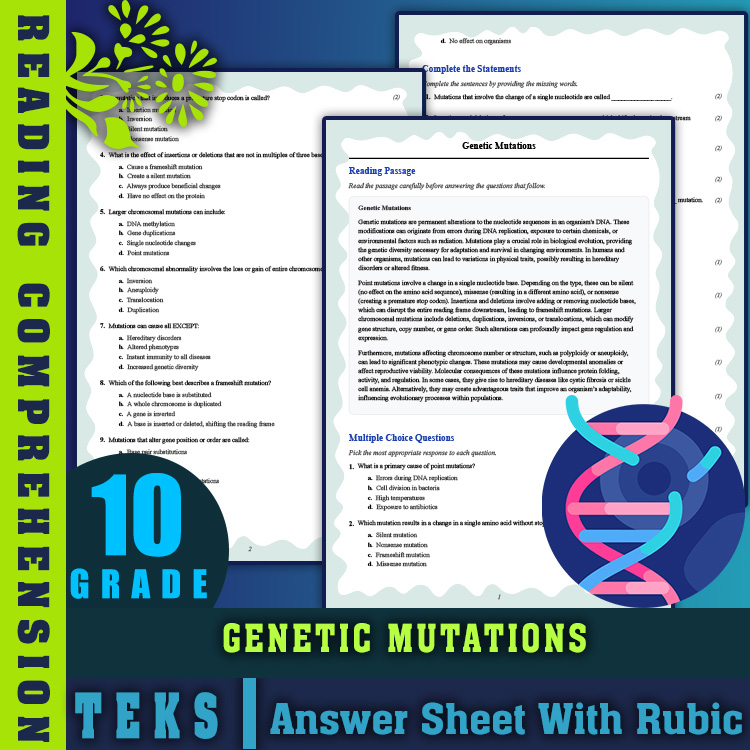
Grade 10 Science | Genetic Mutations Reading Worksheet (PDF + Answer Key)
JCreated byJ.S SheetsLearning Objectives
- Describe different types of genetic mutations and their effects on DNA.
- Explain how mutations can impact gene expression and protein function.
- Identify examples of mutations and their potential phenotypic outcomes.
Instant download
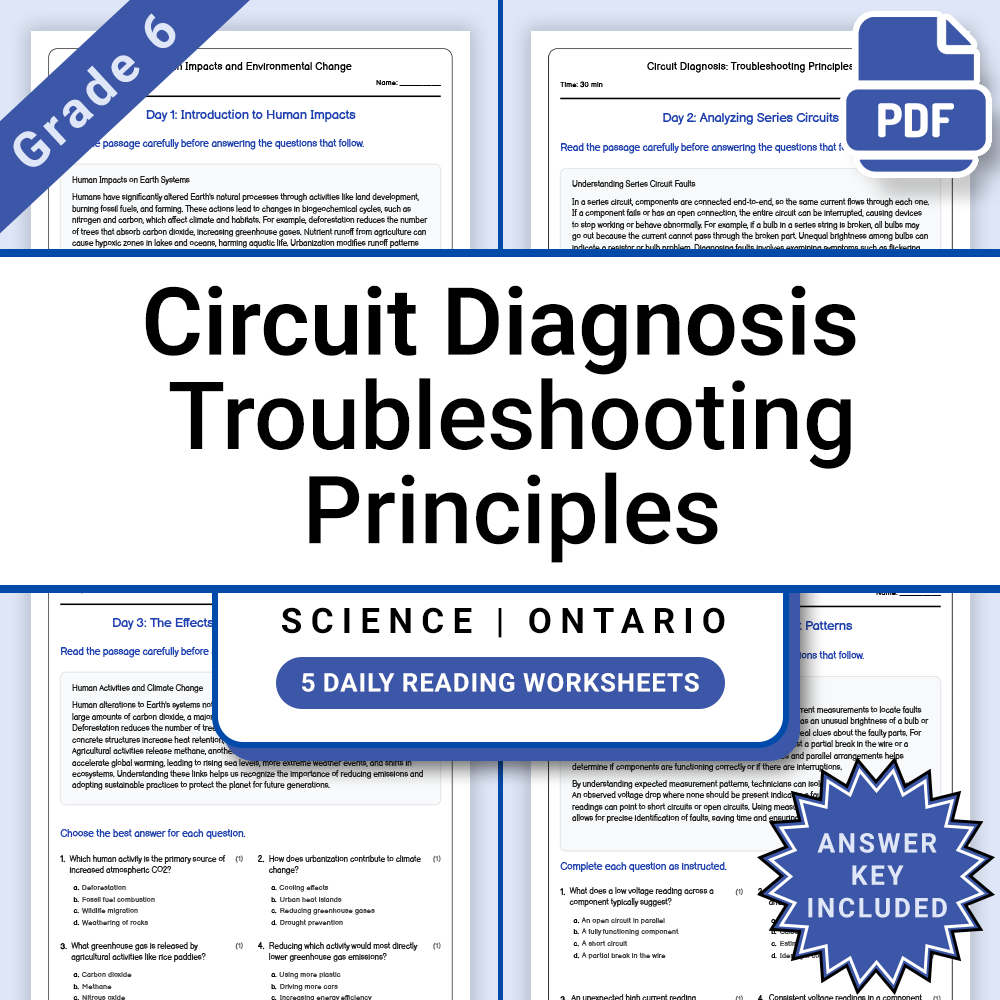
Grade 6 Science – Circuit Diagnosis Troubleshooting Daily Worksheet + Answer Key
JCreated byJ.S SheetsLearning Objectives
- Understand how to observe and interpret symptoms in electrical circuits.
- Apply reasoning to identify faults based on circuit behaviour.
- Differentiate between series and parallel circuit issues.
Also included in: Grade 6 Science Lesson Group – Circuits and Energy Ontario Framework +1 more
Instant download

Moon Phases & Eclipse Geometry Worksheets Grade 9 Science
 Created byBRIGHT PATH RESOURCES
Learning Objectives
- Explain how Earth, the Moon, and the Sun create a predictable cycle of Moon phases.
- Describe why eclipses do not happen every month even though the Moon orbits Earth regularly.
- Identify alignment conditions needed for solar and lunar eclipses.
Also included in: Grade 9 Earth Science Worksheets Bundle: Climate, Cycles & Space +1 more
Instant download

Specialized Cells Worksheet Grade 10 Science | Form Fits Function Ontario
 Created byChalk and Compass
Learning Objectives
- Explain how specialized cells have morphological adaptations that support specific functions.
- Describe how tissues show organization based on the roles of different specialized cells.
- Connect stem cell differentiation to changes in gene expression and cell structure.
Also included in: Cells, Photosynthesis, Respiration & Microbes Lesson Bundle – Grade 10 Science +1 more
Instant download

Grade 12 Science Worksheet | Integrated Reconstruction (PDF) Standards BC
Created byEvergreen Desk EducationLearning Objectives
- Explain how stratigraphy, radiometric ages, paleomagnetism, structural relationships, and fossils are combined to reconstruct orogenic and basin histories.
- Use multiple lines of geologic evidence to build a coherent temporal sequence of deformation, magmatism, and sedimentation.
- Evaluate plate-motion models by checking consistency between paleomagnetic rotations, structural timing, and fossil-constrained environments.
Instant download
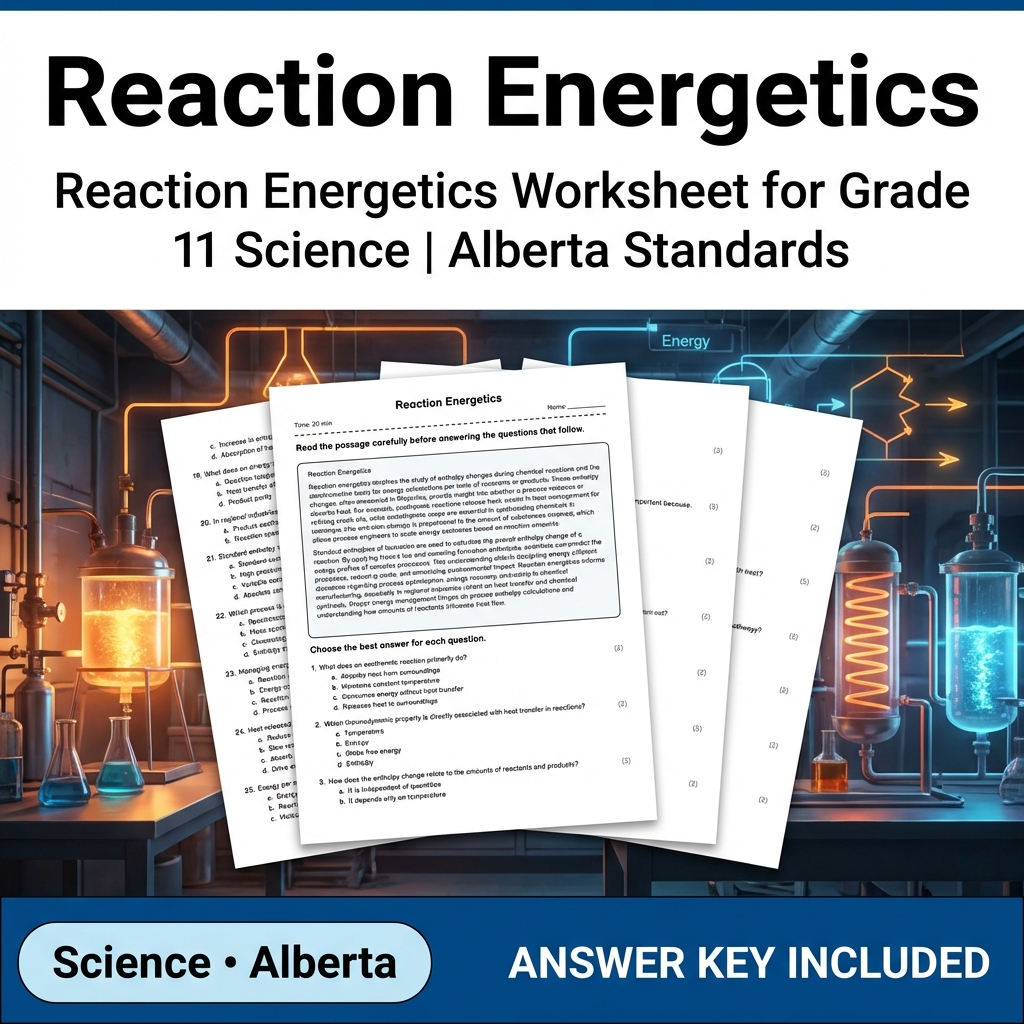
Reaction Energetics Worksheet for Grade 11 Science | Alberta Standards
 Created byCoral Reef Learning
Learning Objectives
- Explain the concept of enthalpy change in chemical reactions and its relation to energy transfer.
- Calculate reaction enthalpy using standard enthalpies of formation.
- Understand how reaction enthalpy varies with reactant and product quantities and process design implications.
Instant download
Browse more categories
About Science Worksheets
Find Science worksheets spanning core skills, practice, and review. All 44,628 resources are instant PDF downloads for the classroom or home.
Every worksheet on MyTeachingSheets is created by independent teacher-authors and reviewed before publication. All resources download as printable PDFs for classroom, homework, or at-home practice, and many include answer keys. Preview any worksheet free before buying.