
Science Worksheets
42,859 subject resources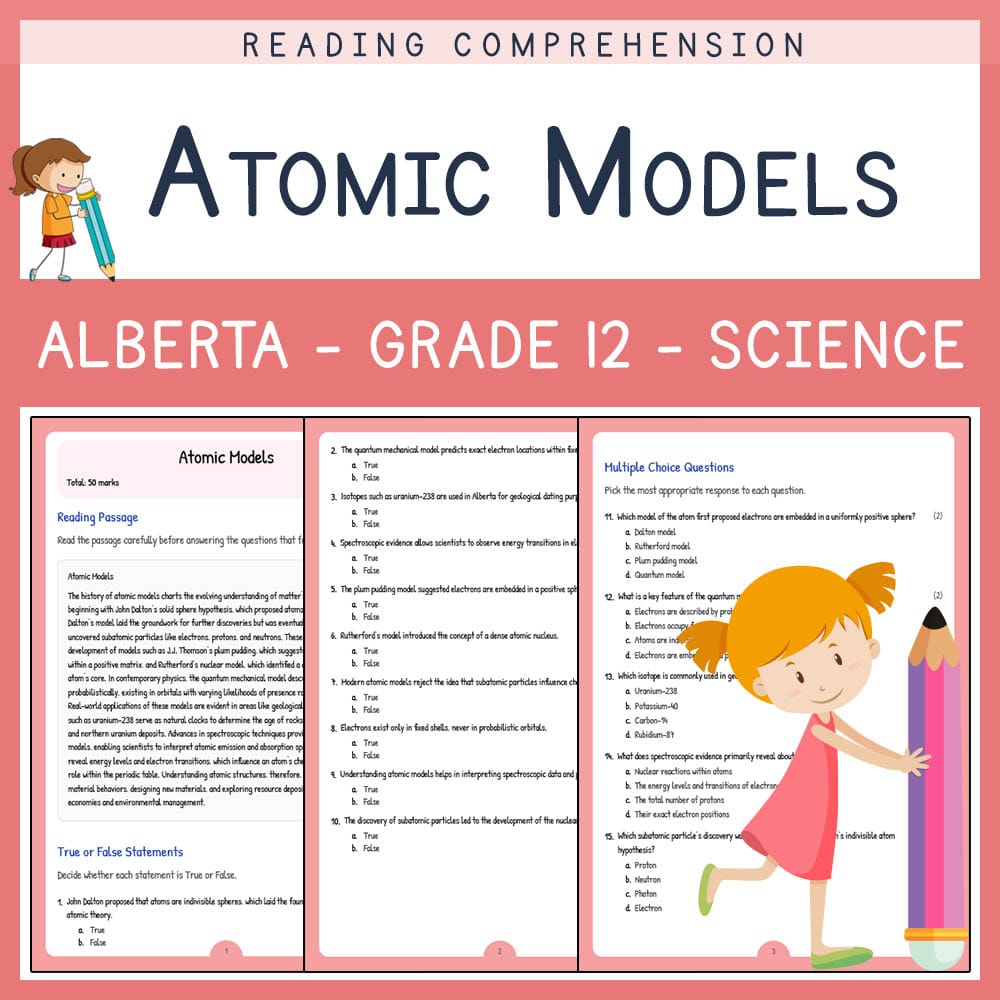
Grade 12 Science | Atomic Models Worksheet Elena | Alberta Standards
 Created byLumora Learning
Learning Objectives
- Describe the development of atomic models from Dalton to quantum mechanical models.
- Explain how subatomic particles influence atomic mass and behavior.
- Apply understanding of isotopes in geological and resource contexts.
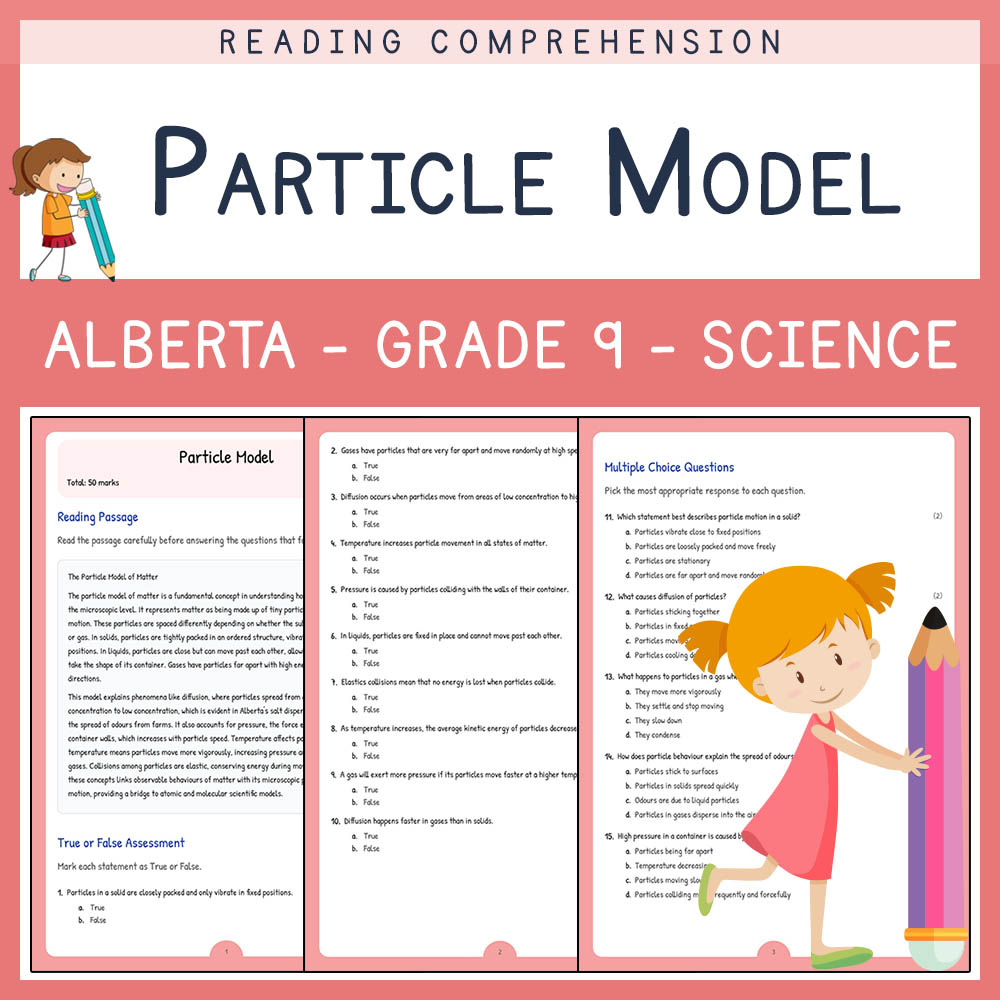
Grade 9 Science | Particle Model Worksheet | Alberta Standards
Created byLumora LearningLearning Objectives
- Explain the basic concepts of the particle model of matter, including particle spacing and motion.
- Describe how the particle model accounts for diffusion, pressure, and temperature changes.
- Relate particle behaviour in solids, liquids, and gases to their particle arrangements and movement.

Grade 12 Science Data Visuals Worksheet | TEKS Standards (PDF)
 Created byEvergreen Desk Education
Learning Objectives
- Select an appropriate data visualization (scatter plot, histogram, boxplot, time series) that matches the type of question and data.
- Construct clear graphs and charts using correct axis scaling, labeling, legends, and statistically meaningful annotations.
- Interpret uncertainty and model comparisons by reading error bars, confidence intervals, and log-scale transformations accurately.

6th Grade Science Worksheet | Stewardship Practices (PDF) Aligned with Alberta Standards
Created byEvergreen Desk EducationLearning Objectives
- Describe how different stewardship practices (community planting, shelterbelts, urban canopy programs, and Indigenous knowledge) support local landscapes.
- Explain how stewardship actions can improve habitat connectivity, carbon storage, and water regulation.
- Identify stewardship examples from Alberta and connect them to the environmental benefits they provide.

Grade 7 Inherited Traits Science Worksheet | Florida NGSSS + Answer Key
Created byEvergreen Desk EducationLearning Objectives
- Explain how inherited traits are passed from parents to offspring using genetic information in reproductive cells
- Distinguish between inherited traits and environmental causes of differences among individuals
- Use predictable patterns to interpret offspring trait outcomes based on parental variation

Grade 12 Science | Oral Presentation Worksheet (TEKS) with Answer Key (PDF)
Created byEvergreen Desk EducationLearning Objectives
- Create concise, evidence-based scientific abstracts and oral openings that clearly state a testable hypothesis.
- Apply slide design norms and timing constraints to support audience understanding during oral presentations.
- Interpret and respond to data-based questions using precise technical terminology appropriate for disciplinary audiences.

Grade 9 Science | Patterns of Inheritance Worksheet (Alberta Standard) (PDF)
Created byEvergreen Desk EducationLearning Objectives
- Explain how dominant and recessive alleles determine genotype and phenotype in single-gene traits
- Use simple Punnett square logic to predict offspring probabilities for inherited characteristics
- Distinguish genotype from phenotype and predict inheritance outcomes from allele combinations

Grade 8 Science Worksheet | Braking Distance & Stopping Power (PDF)
Created byEvergreen Desk EducationLearning Objectives
- Explain how reaction time and braking time combine to determine stopping distance.
- Describe how tire-road friction affects decelerating force and stopping distance in different road conditions.
- Compare how unbalanced forces and brake fade can increase the distance needed to stop.

Grade 12 Science Data Analysis Worksheet (TEKS) – Comprehensive Practice (PDF)
Created byEvergreen Desk EducationLearning Objectives
- Interpret and describe patterns in scientific data using graphs, descriptive statistics, and trend language.
- Fit and compare mathematical models using residuals and goodness-of-fit metrics while checking assumptions.
- Communicate uncertainty and limitations clearly, including how error bars and decision thresholds affect conclusions.

Grade 11 Science | Metabolic Regulation Worksheet (PDF)
Created byEvergreen Desk EducationLearning Objectives
- Explain how enzyme regulation mechanisms (allosteric modulation, covalent modification, and compartmentalization) control metabolic flux.
- Use feedback inhibition to predict how metabolite levels affect pathway activity.
- Describe how phosphorylation and small-molecule effectors can change enzyme conformation and catalytic rate.

Grade 12 Science Resource Impacts Worksheet (BC Standards) (PDF)
Created byEvergreen Desk EducationLearning Objectives
- Explain how human resource use can change Earth systems through soil, water, air, and ecosystems.
- Analyze trade-offs between economic benefits and long-term system resilience.
- Evaluate strategies that reduce impacts and support restoration and sustainable management.

Grade 9 Science | Motors and Generators Worksheet (Alberta Standards) (PDF)
Created byEvergreen Desk EducationLearning Objectives
- Explain how electric motors convert electrical energy into mechanical work.
- Describe how generators produce electrical energy using electromagnetic induction.
- Compare motor and generator operation by tracing key energy conversions and magnetic interactions.

Grade 11 Science – Integrated Cycles Worksheet (TEKS) (PDF)
Created byEvergreen Desk EducationLearning Objectives
- Explain how photosynthesis and cellular respiration are interconnected biochemical cycles involving carbon and energy transfer.
- Describe how day-night changes and tissue specialization affect sugar storage, transport, and respiration rates.
- Use a pathway model to predict how changes in light or temperature can alter net energy budgets in plants and ecosystems.

Grade 10 Science Worksheet | Transport Mechanisms TEKS (PDF)
Created byEvergreen Desk EducationLearning Objectives
- Distinguish between passive, active, and bulk transport based on energy use and concentration gradients
- Explain how facilitated diffusion and ATP-driven pumps move molecules and ions across membranes
- Analyze how osmotic effects influence cells such as red blood cells and plant vacuoles

Grade 9 Science | Classification Foundations Worksheet (TEKS) (PDF)
Created byEvergreen Desk EducationLearning Objectives
- Explain why biological classification uses hierarchical ranks and how organisms are grouped based on shared characteristics.
- Compare traditional classification (taxonomic ranks and morphology) with modern classification (evolutionary relationships and clades).
- Use binomial nomenclature concepts to interpret and communicate scientific names for species.

Grade 12 Science | Design Principles Worksheet (TEKS) PDF
Created byEvergreen Desk EducationLearning Objectives
- Identify independent and dependent measures and explain why their operational definitions matter for valid inference.
- Apply experimental design strategies such as control, replication, randomization, and blocking to reduce bias and confounding.
- Plan and justify statistical analyses (e.g., ANOVA, regression) by checking assumptions and interpreting results within valid limits.

Grade 11 Science | Integrated Systems Worksheet (TEKS) (PDF)
Created byEvergreen Desk EducationLearning Objectives
- Explain how cellular specialization and intercellular communication can produce emergent tissue, organ, and organism functions
- Compare chemical signaling, gap junction communication, and extracellular matrix organization in coordinating cell behavior
- Use systems thinking to predict how disruption of signaling or organization could affect organism-level health

Grade 9 Science | Earth Magnetism Worksheet (Alberta Standards) (PDF)
Created byEvergreen Desk EducationLearning Objectives
- Explain how the Earth’s magnetic field is related to compass direction and navigation.
- Describe dip (inclination) and declination and how they change with location.
- Connect auroras and ionospheric phenomena to Earth’s magnetism.

Grade 10 Science – Variation and Heredity Worksheet (TEKS) (PDF)
Created byEvergreen Desk EducationLearning Objectives
- Explain how mutation, recombination, and gene flow create genetic variation within populations
- Describe how heritable traits influence survival and reproduction in particular environments
- Analyze how natural selection changes allele frequencies across generations without directed intent

Grade 9 Science | Complex Inheritance Worksheet (TEKS) Practice Set
Created byEvergreen Desk EducationLearning Objectives
- Explain how polygenic inheritance, epistasis, and pleiotropy can cause deviations from simple Mendelian ratios
- Describe how variable penetrance and expressivity affect whether and how genotypes show up as phenotypes
- Evaluate how linkage and environmental factors can change observed inheritance patterns in families and populations

Grade 8 Science Worksheet | Intermolecular Forces (PDF) – Alberta Standards
Created byEvergreen Desk EducationLearning Objectives
- Explain how intermolecular forces affect melting point, boiling point, and vapour pressure.
- Connect intermolecular forces to solubility by comparing attractions between different particles.
- Use real-world Alberta examples to describe how force strength influences phase change and evaporation.

Grade 9 Science Worksheet on Electrical Quantities (PDF) | Alberta Standards
Created byEvergreen Desk EducationLearning Objectives
- Define electric current, voltage, and resistance and describe what each quantity represents in a circuit
- Use SI units, symbols, and typical magnitudes to interpret and compare values in real electrical systems
- Apply relationships between voltage, current, and resistance to reason about energy transfer and component choice

Grade 7 Science | Inclined Planes Worksheet (Alberta Standard) (PDF)
Created byEvergreen Desk EducationLearning Objectives
- Explain how inclined planes change the effective force needed to move a load.
- Identify and describe force components parallel and perpendicular to a ramp.
- Calculate mechanical advantage using load and input force.

Grade 9 Science – Membrane Transport Worksheet (BC Standard) (PDF)
Created byEvergreen Desk EducationLearning Objectives
- Explain how the plasma membrane’s selectively permeable phospholipid bilayer and proteins regulate the movement of substances in and out of cells.
- Differentiate passive transport (diffusion and osmosis) from active transport and predict movement based on concentration and energy use.
- Describe the functions of membrane channels, pumps, and receptor proteins in cellular communication and metabolic coordination.

Grade 8 Science Worksheet | Phase Transitions (Alberta Standard) PDF
Created byEvergreen Desk EducationLearning Objectives
- Describe how phase transitions change particle arrangement and energy without forming new substances
- Differentiate melting, freezing, vaporization, and condensation and identify the direction of energy flow
- Explain how phase transitions influence real-world systems such as river flow, snowpack melt timing, and condensation in cities

Equilibrium Constants Worksheet Grade 11 Chemistry Alberta PDF
Created byEvergreen Desk EducationLearning Objectives
- Explain how acid dissociation constants (Ka) and base dissociation constants (Kb) describe the position of equilibrium for proton-transfer reactions
- Connect Ka and Kb to pKa and pKb values and use them to compare acid/base strength
- Use the relationship Kw = Ka·Kb to find missing constants and relate conjugate pairs

Concentration Calculations Worksheet Grade 11 Chemistry Alberta PDF
Created byEvergreen Desk EducationLearning Objectives
- Convert between pH (or pOH) and hydrogen (or hydroxide) ion concentration using base-10 logarithms and inverse logarithms.
- Use Kw (and pKw or 14.00 at 25°C) to interrelate [H+] and [OH-] and check calculation consistency.
- Apply significant figures and correct units (mol/L) when reporting ionic concentrations from pH/pOH data.

Grade 10 Science – Mass Conservation Worksheet (PDF) BC Standards
Created byEvergreen Desk EducationLearning Objectives
- Explain the law of conservation of mass and describe when it applies (closed systems).
- Analyze chemical reactions to account for total mass of reactants and products, including gases and dissolved ions.
- Use mass conservation to evaluate and interpret balanced equations and quantitative results.

Energy Forms Worksheet Grade 10 Science Alberta | Thermal Kinetic Chemical
Created byEvergreen Desk EducationLearning Objectives
- Differentiate kinetic energy and potential energy in real-world examples
- Explain how mechanical energy conservation works in idealized systems
- Predict how non-conservative forces change the distribution of kinetic and potential energy

Grade 11 Science – Friction Forces Worksheet (BC Standards) (PDF)
Created byEvergreen Desk EducationLearning Objectives
- Explain how static and kinetic friction differ and predict how friction responds to impending motion and sliding.
- Use ideas of normal force and surface properties (coefficients) to reason about frictional force magnitude.
- Interpret friction-related situations (e.g., tires, brakes, pushing crates) using free-body-force reasoning and energy dissipation concepts.

Chemical Bonding Worksheet | NGSS Grade 9 Science Assessment
 Created bySkylark Worksheets
Learning Objectives
- Explain ionic, covalent, and metallic bonding using electron transfer, electron sharing, and electron mobility models.
- Use bond energy and polarity ideas to predict relative stability, melting point, and conductivity of substances.
- Interpret Lewis structures and connect atomic electron configurations to molecular geometry and intermolecular attractions.

Grade 8 Science Worksheet | Understanding Circular Motion (PDF) – Alberta Standards
Created byEvergreen Desk EducationLearning Objectives
- Explain why an object moving at constant speed can still require a net inward (centripetal) force
- Analyze how centripetal force depends on mass, speed, and turn radius
- Predict what happens when the inward force is insufficient during a turn

Grade 12 Science – Variables Control Worksheet (TEKS) (PDF)
Created byEvergreen Desk EducationLearning Objectives
- Identify independent, dependent, and confounding variables in biological and environmental investigations.
- Select appropriate strategies to control confounding variables, including randomization and matched controls.
- Explain how blinding and replication reduce bias and improve the reliability of conclusions.

Grade 10 Science – Electron Configuration Worksheet (PDF) | BC Standards
Created byEvergreen Desk EducationLearning Objectives
- Describe how electrons fill energy levels and orbitals in an atom using quantized rules.
- Identify valence electrons from an electron configuration and explain their role in bonding and reactivity.
- Relate electron configuration patterns to groups and periods on the periodic table.

Grade 6 Science | Gas Pressure Worksheet (BC Standards) (PDF)
Created byEvergreen Desk EducationLearning Objectives
- Explain gas pressure using the particle model and collisions with container walls
- Describe how changing particle speed, collision frequency, and gas volume affects pressure
- Predict how temperature and pressure are related in sealed and unsealed situations

Grade 11 Science | Genetic Mutations Worksheet (TEKS) with Answer Key (Printable PDF)
Created byEvergreen Desk EducationLearning Objectives
- Explain how genetic mutations change DNA and how those changes can alter protein structure and function.
- Differentiate silent, missense, nonsense, and frameshift mutations based on their effects on reading frames and amino acids.
- Describe common sources of mutations and predict how mutations may affect phenotype, regulation, or genetic variation.

Grade 11 Science Worksheet – Cellular Respiration (PDF) | BC Standards
Created byEvergreen Desk EducationLearning Objectives
- Explain the major stages of cellular respiration and what happens to electrons and protons at each stage.
- Describe how chemiosmotic coupling and ATP synthase convert an electrochemical gradient into ATP.
- Interpret quantitative models of ATP yield per glucose and the role of oxygen as the final electron acceptor.

Grade 8 Science worksheet on Material Corrosion (Alberta Standards) (PDF)
Created byEvergreen Desk EducationLearning Objectives
- Explain how corrosion involves chemical change and forms new substances on materials.
- Describe how moisture and salinity (salt) influence the rate and location of corrosion.
- Identify evidence that corrosion has occurred, based on mass change and observable changes.

Grade 10 Science | Electric Fields Worksheet (PDF) BC Standards
Created byEvergreen Desk EducationLearning Objectives
- Explain what an electric field represents and how it relates to force on a charge
- Interpret electric field line direction for positive and negative charges and infer relative field strength
- Use the principle of superposition to reason about net electric fields from multiple charges

Grade 12 Science | Energy Conservation Worksheet (TEKS) Practice (PDF)
Created byEvergreen Desk EducationLearning Objectives
- Integrate the first and second laws of thermodynamics to analyze chemical energy changes using internal energy, enthalpy, and entropy.
- Predict reaction spontaneity and equilibrium direction using Gibbs free energy and its temperature dependence.
- Explain how energy conservation and coupled reactions influence overall energy flow in combustion and electrochemical systems.

Grade 10 Science | Electric Circuits Worksheet (PDF) | BC Standards
Created byEvergreen Desk EducationLearning Objectives
- Explain how electrical energy is converted and transferred in an electric power system (generators, transformers, transmission lines, and loads).
- Analyze how resistive losses, reactive effects, and transmission distance reduce delivered energy and overall system efficiency.
- Compare centralized and distributed generation in terms of efficiency trade-offs, resilience, grid reliability, and environmental impact.

Transmission Tradeoffs Worksheet | NGSS Grade 9 Science Assessment
Created bySkylark WorksheetsLearning Objectives
- Explain how bandwidth, sampling criteria, and signal-to-noise ratio affect communication performance
- Compare digital and analog transmission by using quantitative ideas like bit error rate and channel capacity
- Evaluate how modulation, coding, and error-correcting techniques improve reliability under noise and interference

Grade 7 Ecosystem Energy Flow Worksheet | Food Webs | Florida NGSSS
Created byEvergreen Desk EducationLearning Objectives
- Explain how energy moves through ecosystems from producers to consumers to decomposers.
- Describe why each energy transfer to the next trophic level reduces the amount of usable energy.
- Use trophic-level ideas to predict how changes in one organism group can affect other groups.

Grade 9 Science – Free Body Diagrams Worksheet (BC Standards) (PDF)
Created byEvergreen Desk EducationLearning Objectives
- Identify and label all external forces acting on an isolated object in a free body diagram.
- Determine the direction of each force vector and distinguish forces that cancel from forces that produce net force.
- Use net force and Newton’s second law concepts to predict acceleration and motion outcomes.

Grade 7 Science | Bonding Patterns Worksheet (TEKS) PDF
Created byEvergreen Desk EducationLearning Objectives
- Distinguish ionic from covalent bonding using particle-level evidence and bonding patterns.
- Relate bonding type to macroscopic properties such as melting point, solubility, and electrical conductivity.
- Construct simple binary ionic salts and molecular compounds using empirical formulas.

Grade 8 Science – Nervous Coordination Worksheet (PDF) | BC Standards
Created byEvergreen Desk EducationLearning Objectives
- Explain how neurons convert stimuli into electrical signals and transmit them through axons and synapses
- Describe how myelination and synaptic vesicle release increase the speed and reliability of nervous signaling
- Connect cellular-level processes to organism-level responses such as reflexes, voluntary movement, and gland secretion

Grade 12 Science – Momentum Conservation Worksheet (BC) PDF
Created byEvergreen Desk EducationLearning Objectives
- Define linear momentum and impulse and explain how they relate to changes in motion.
- Apply conservation of momentum to isolated systems and interpret direction using vectors.
- Differentiate elastic and inelastic collisions using momentum conservation and kinetic energy outcomes.

Grade 6 Science – Human Influences Worksheet (TEKS) | Practice Set (PDF)
Created byEvergreen Desk EducationLearning Objectives
- Explain how habitat fragmentation, pollution, land-use change, nonnative species, and resource extraction can affect community composition and population viability.
- Describe how human impacts can reduce genetic diversity and change species distribution and ecological balance.
- Evaluate mitigation strategies such as conservation and restoration for supporting long-term persistence of native communities.
Browse more categories
About Science Worksheets
Find Science worksheets spanning core skills, practice, and review. All 42,859 resources are instant PDF downloads for the classroom or home.
Every worksheet on MyTeachingSheets is created by independent teacher-authors and reviewed before publication. All resources download as printable PDFs for classroom, homework, or at-home practice, and many include answer keys. Preview any worksheet free before buying.