
Science Worksheets
44,912 subject resources
Grade 12 Science | Atmosphere & Ocean Exchange - Daily Reading Comprehension
 Created byCoral Reef Learning
Learning Objectives
- Understand the components of Earth's atmosphere and their roles in weather formation.
- Identify how atmospheric interactions influence climate patterns.
- Recognize the significance of atmospheric and oceanic exchanges in maintaining Earth's climate balance.
Instant download

Grade 12 Atmosphere Ocean Exchange Worksheet | Practice & PDF
 Created byClear Sky Classroom
Learning Objectives
- Explain how the atmosphere and oceans exchange heat, moisture, and gases to influence weather and climate
- Describe how global circulation and ocean currents redistribute energy across Earth
- Analyze how feedbacks between ocean temperatures and atmospheric conditions can amplify climate trends
Instant download

Grade 12 Atmosphere Ocean Exchange Worksheet | Earth Science | California Standards
 Created byEvergreen Desk Education
Learning Objectives
- Explain how ocean currents, upwelling, and sea surface temperatures influence regional weather and climate.
- Describe how global atmospheric circulation redistributes heat and moisture across Earth’s surface.
- Analyze feedbacks between atmospheric conditions and ocean temperatures that can amplify climate trends.
Instant download

Grade 12 Atmosphere Ocean Exchange Worksheet | Earth Science Resource
 Created byPrism Point Learning
Learning Objectives
- Explain how ocean currents and upwelling affect regional temperature and moisture.
- Describe how atmospheric circulation redistributes heat and interacts with ocean conditions.
- Use cause-and-effect reasoning to predict how coupled atmosphere-ocean changes can shift climate patterns.
Instant download

Mass Conservation Assessment Grade 6 Science Standards-Aligned Worksheet
Created byPrism Point LearningLearning Objectives
- Explain mass conservation in terms of conserved atoms within a closed system.
- Connect particle-level conservation of atoms to macroscopic measurements of mass.
- Use vocabulary such as reactants, products, and closed system to describe conservation events.
Also included in: Grade 6 Atoms and Chemical Change Science lesson bundle | California Standards +1 more
Instant download

Grade 6 Science Mass Conservation Worksheet | California Standards PDF
Created byEvergreen Desk EducationLearning Objectives
- Explain mass conservation by connecting conservation of atoms to conservation of mass in a closed system.
- Use particle-level reasoning to justify why total mass of reactants equals total mass of products.
- Interpret everyday examples of conservation of mass and distinguish closed-system from open-system situations.
Instant download
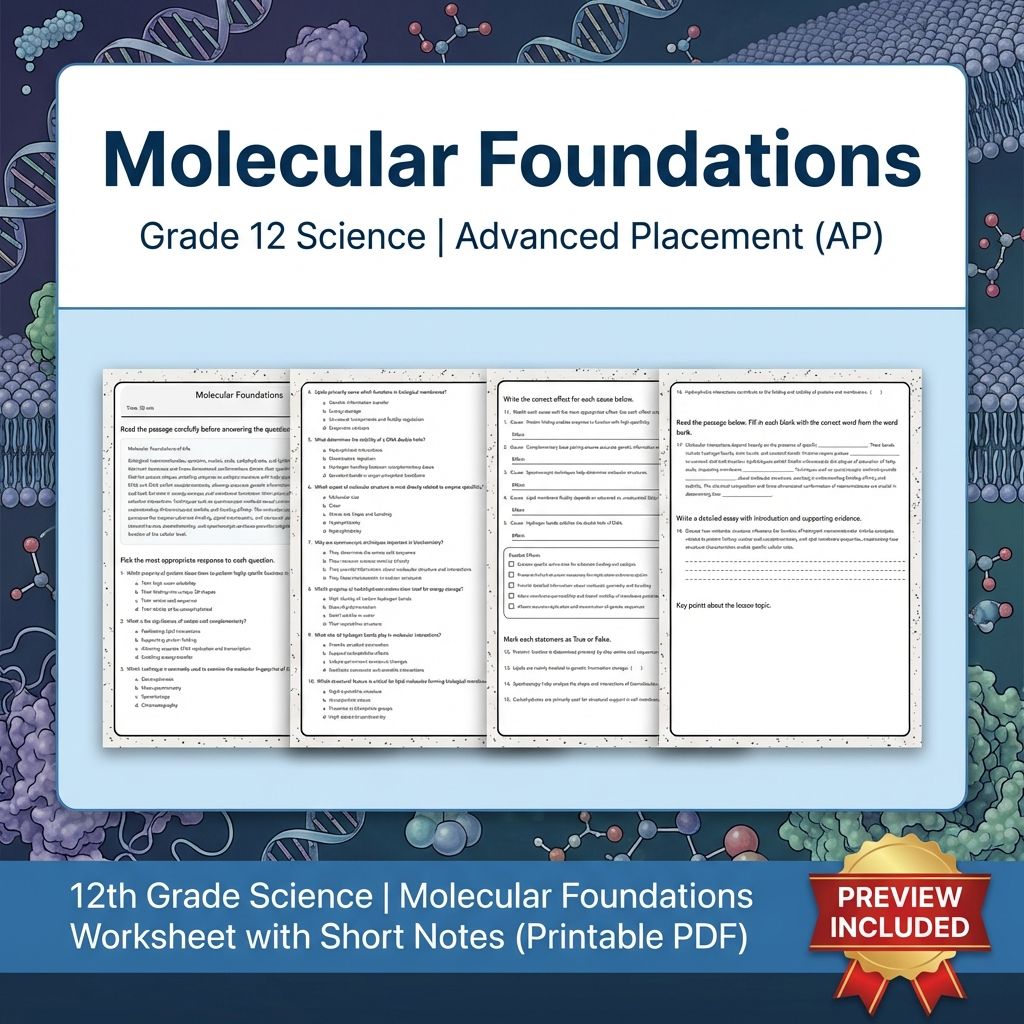
12th Grade Science | Molecular Foundations Worksheet with Short Notes (PDF)
 Created byMeadowlark Worksheets
Learning Objectives
- Understand the chemical basis of biological macromolecules and how their structure determines function.
- Explain protein folding, nucleic acid complementarity, and the roles of carbohydrates and lipids.
- Describe the physicochemical properties influencing molecular interactions and cellular processes.
Also included in: Grade 12 Science Unit Worksheet Pack – Molecular Biology & Ecosystems (PDF) +1 more
Instant download

Mass Conservation Worksheet for Grade 6 Science | Standards-Aligned Practice
JCreated byJ.S SheetsLearning Objectives
- Understand the principle of mass conservation at the particle and macroscopic levels.
- Explain why total mass remains constant in a closed system during a chemical reaction.
- Identify real-world examples of mass conservation in chemical and physical processes.
Also included in: Grade 6 Physical Science Lesson Bundle for Science – California Standards +1 more
Instant download

Grade 6 Science | Mass Conservation Worksheet | California Standards
 Created byLumora Learning
Learning Objectives
- Explain mass conservation in a closed system using the idea of conserved atoms
- Connect particle-level rearrangement of atoms to macroscopic mass measurements
- Use balanced chemical equations to support conservation of mass
Instant download

Grade 3 Measuring Matter Worksheet | NGSS Practice & PDF
Created byClear Sky ClassroomLearning Objectives
- Explain how scientists use measurements to compare properties of matter.
- Identify what mass, volume, temperature, and size measurements describe.
- Use appropriate units and measurement tools to support fair comparisons.
Instant download

Grade 10 Science – Human Impacts on Ecosystems Daily Worksheet + Answer Key
JCreated byJ.S SheetsLearning Objectives
- Understand how urbanization affects natural habitats.
- Identify various human activities that modify ecosystems.
- Recognize the consequences of habitat loss and pollution.
Also included in: Grade 10 Science Lesson Group – Ecosystems and Environmental Impact Worksheets +1 more
Instant download
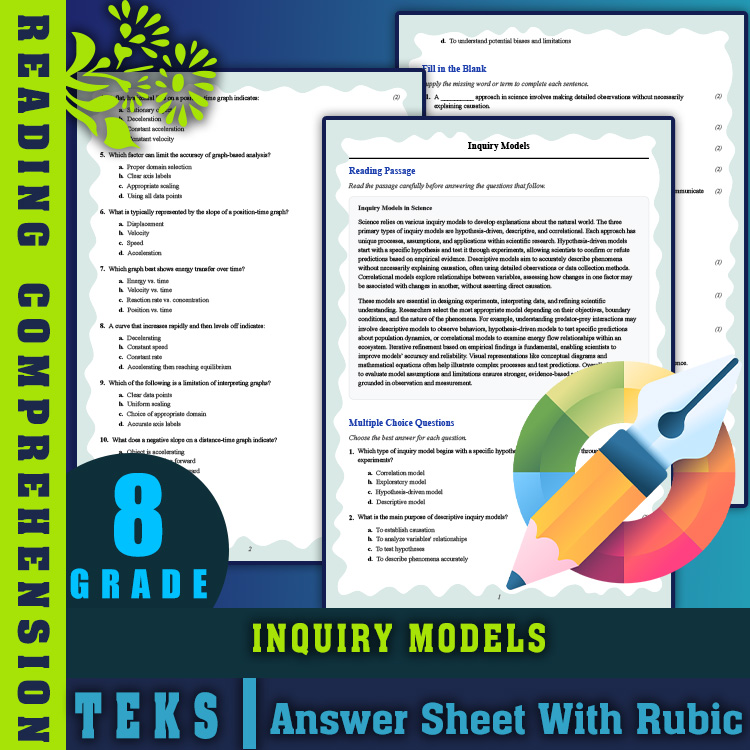
Grade 8 Science | Inquiry Models Reading Worksheet & Answer Key (PDF)
JCreated byJ.S SheetsLearning Objectives
- Understand the differences between hypothesis-driven, descriptive, and correlational inquiry models.
- Analyze how scientific explanations are developed and refined using different inquiry approaches.
- Evaluate the strengths and limitations of various models in scientific research.
Instant download
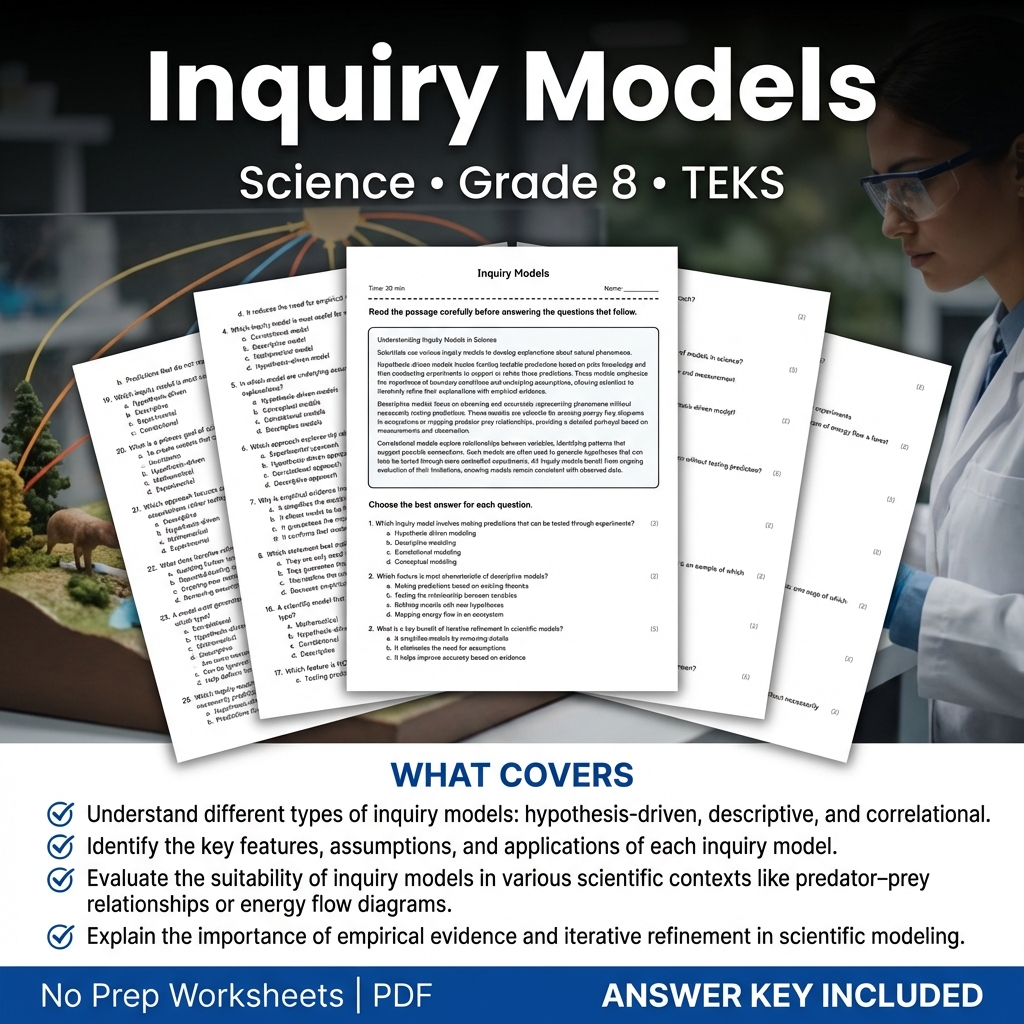
Inquiry Models Worksheet PDF with Answer Key | TEKS Grade 8 Science
Created byCoral Reef LearningLearning Objectives
- Understand different types of inquiry models: hypothesis-driven, descriptive, and correlational.
- Identify the key features, assumptions, and applications of each inquiry model.
- Evaluate the suitability of inquiry models in various scientific contexts like predator–prey relationships or energy flow diagrams.
Instant download

Inquiry Models Worksheet for Grade 8 Science | Standards-Aligned Practice
JCreated byJ.S SheetsLearning Objectives
- Compare hypothesis-driven, descriptive, and correlational inquiry models and identify what each can (and cannot) claim.
- Use boundary conditions and underlying assumptions to evaluate when a scientific model is likely to be valid.
- Connect conceptual and mathematical representations to generate testable predictions from models.
Instant download

Grade 8 Science | Inquiry Models Worksheet (PDF) — TEKS Standards-Aligned
 Created byBright Mind Resources
Learning Objectives
- Understand the differences between hypothesis-driven, descriptive, and correlational inquiry models.
- Identify the key features and appropriate contexts for each inquiry model.
- Evaluate model assumptions, boundary conditions, and testable predictions in scientific explanations.
Also included in: Grade 8 Science Unit Bundle | Scientific Inquiry, Data & Measurement Skills +1 more
Instant download
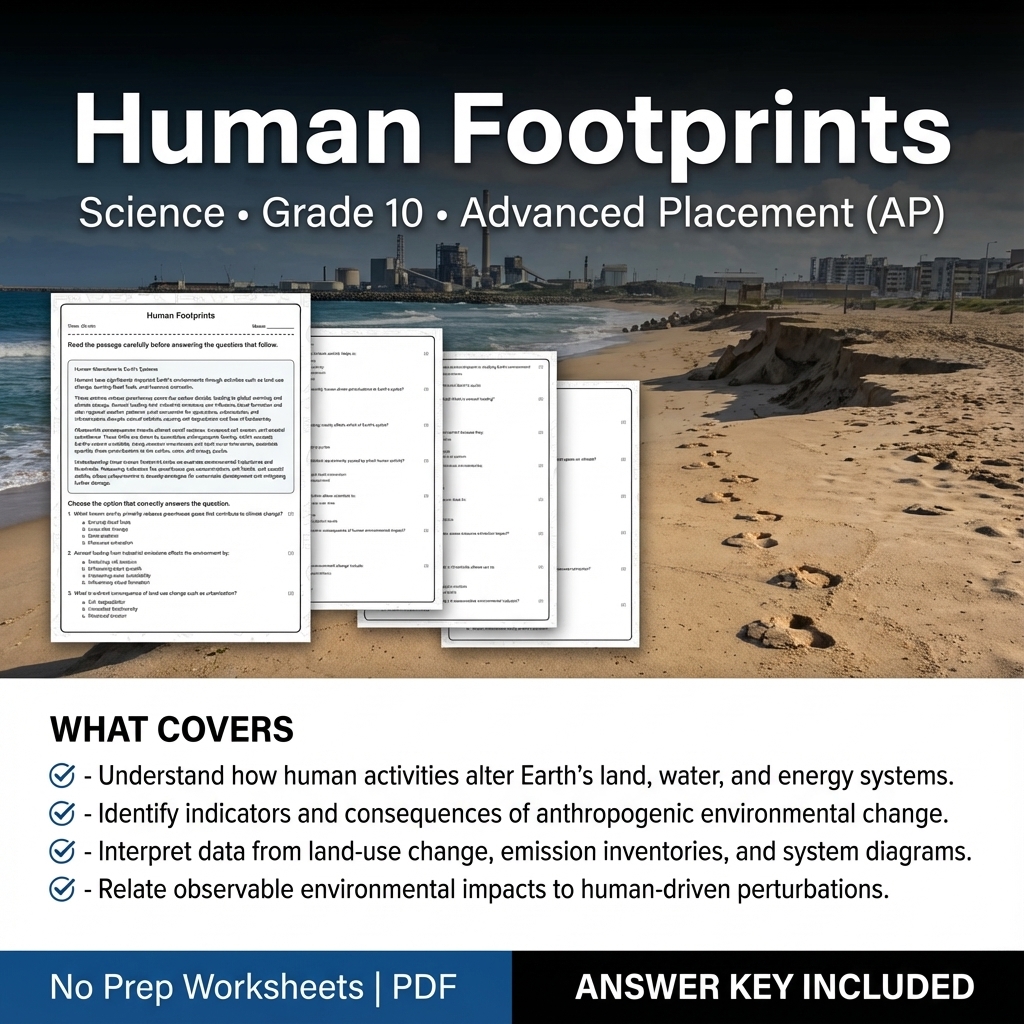
10th Grade Science | Human Footprints Worksheet (Printable PDF + Answer Key)
Created byCoral Reef LearningLearning Objectives
- Understand how human activities alter Earth's land, water, and energy systems.
- Identify indicators and consequences of anthropogenic environmental change.
- Interpret data from land-use change, emission inventories, and system diagrams.
Also included in: Grade 10 Science Unit Worksheet Bundle – Geology, Climate, Plate Tectonics +1 more
Instant download
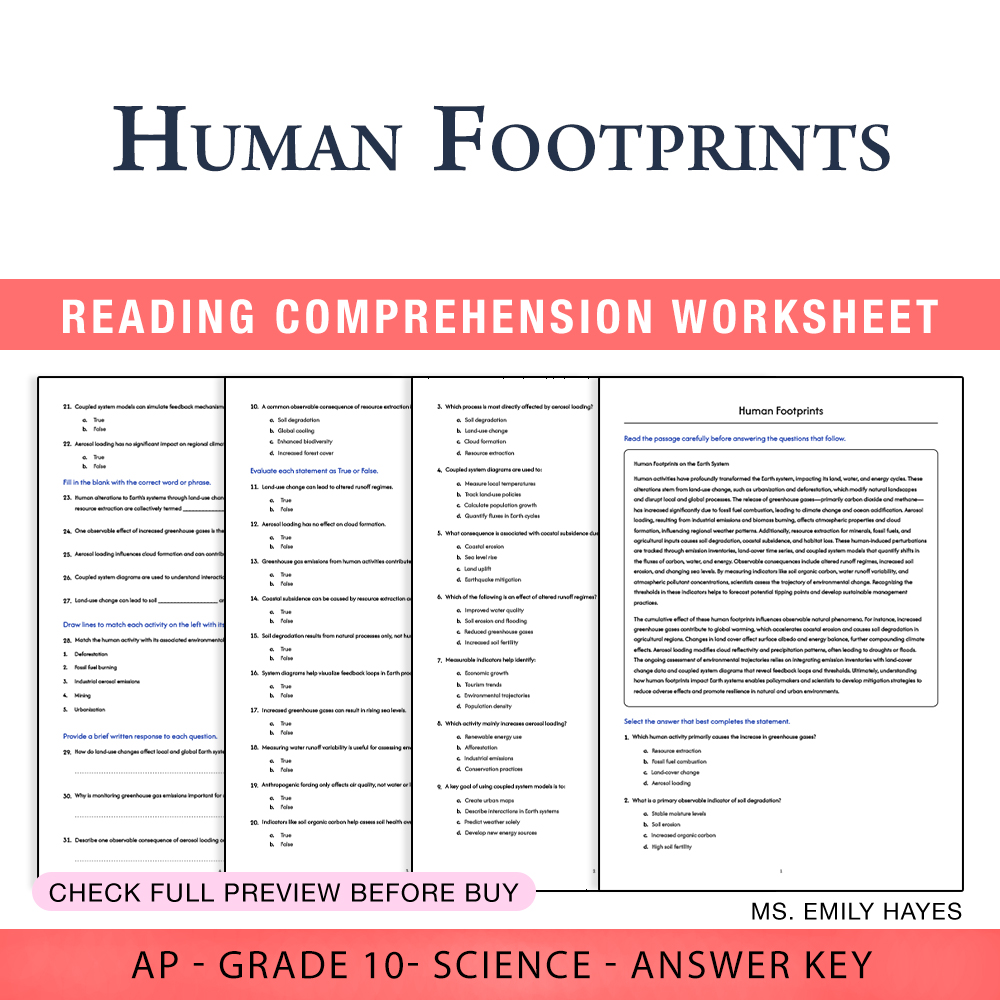
10th Grade Science | Human Footprints Worksheet (PDF+ Answer Key)
 Created byCopper Leaf Classroom
Learning Objectives
- Understand how human activities alter Earth's land, water, and energy systems.
- Learn to identify indicators used to measure environmental changes due to anthropogenic forcing.
- Analyze the impacts of land-use change, greenhouse gas emissions, aerosol loading, and resource extraction.
Also included in: Grade 10 Science AP – Surface Processes & Earth Systems (PDF + Answer Key) +1 more
Instant download
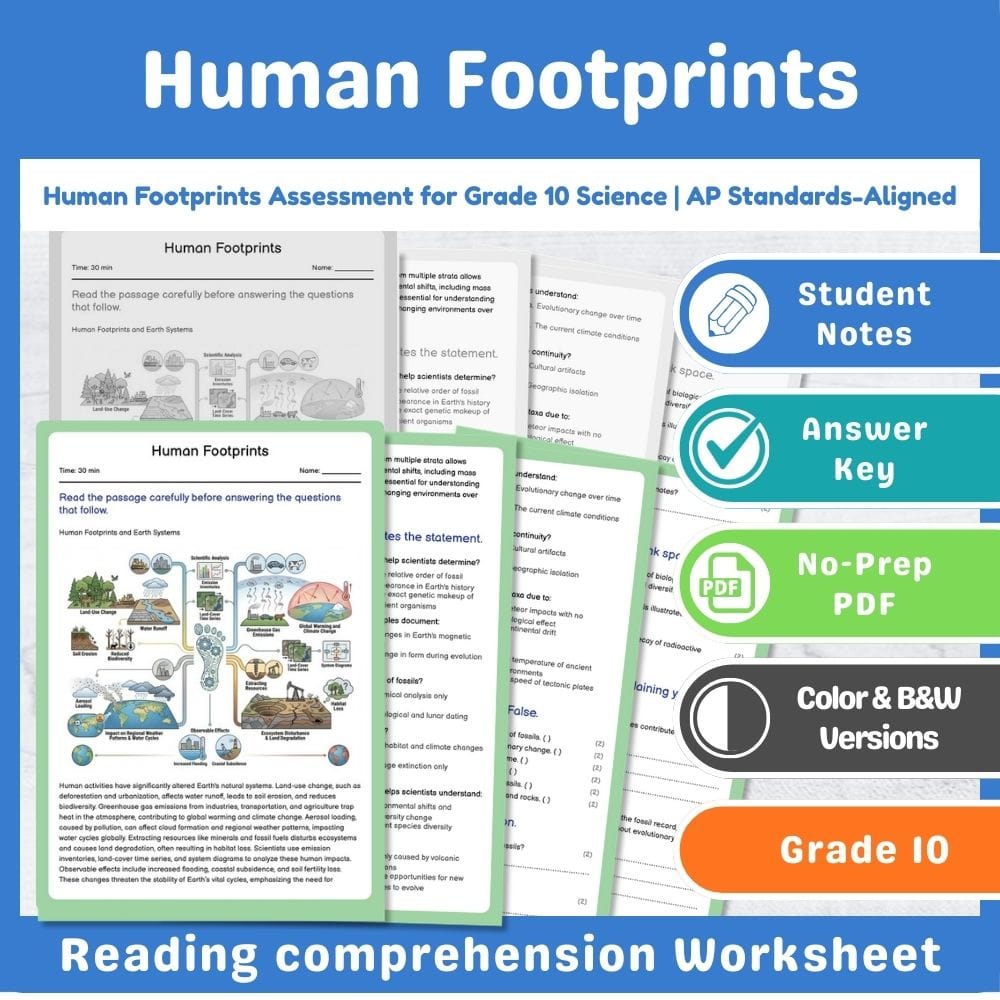
Human Footprints Assessment for Grade 10 Science | AP Standards-Aligned
Created byPrism Point LearningLearning Objectives
- Understand how human activities alter Earth's land, water, and air systems.
- Identify indicators and signs of environmental change caused by human actions.
- Analyze data and diagrams to evaluate human impact on ecosystems.
Also included in: Lesson Bundle | Grade 10 Science Earth and Space Standards-Aligned
Instant download
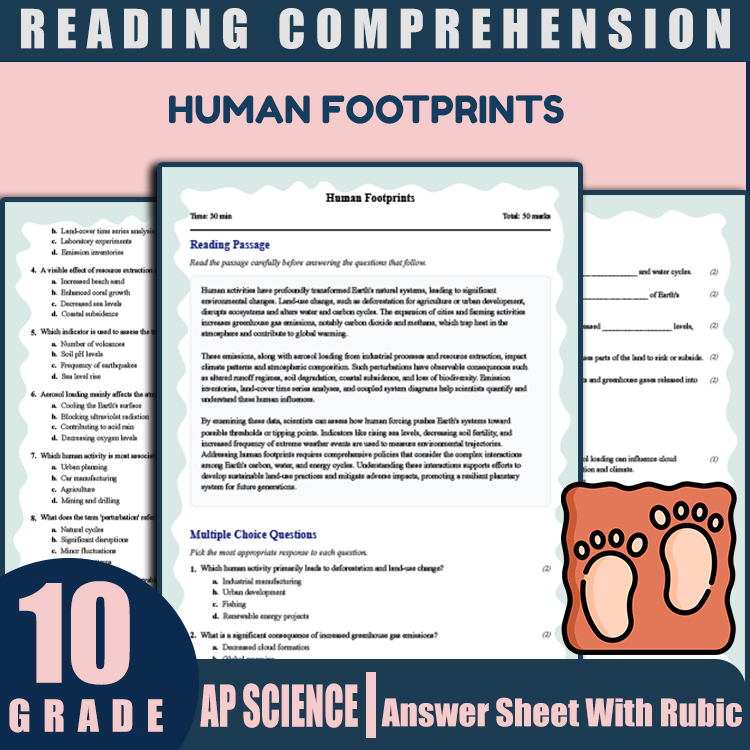
10th Grade Science | Human Footprints Reading Worksheet (PDF & Answer Key)
JCreated byJ.S SheetsLearning Objectives
- Understand the various ways human activities alter Earth's systems such as land use, greenhouse gases, and resource extraction.
- Analyze how these alterations impact environmental cycles and observable consequences like soil degradation and coastal subsidence.
- Learn to interpret emission inventories, land-cover time series, and system diagrams related to human environmental impact.
Also included in: Grade 10 Science Unit | Earth Processes & Climate Worksheets (PDF + Answer Key) +1 more
Instant download

Grade 10 Science — Worksheet MCQ Paper for Human Footprints
 Created byThe Resource Hub
Learning Objectives
- Understand how human activities alter Earth's land, water, and atmospheric systems.
- Identify key indicators used to assess environmental changes caused by humans.
- Analyze the relationships between land-use change, greenhouse gas emissions, and environmental impacts.
Also included in: Grade 10 Earth and Space Sciences Lesson Bundle | AP Curriculum +1 more
Instant download

Ecosystem Basics Worksheet | Ontario Grade 7 Science Assessment
 Created byCedar Grove Learning
Learning Objectives
- Identify biotic and abiotic components of an ecosystem and explain how each affects living things
- Describe trophic categories (producers, consumers, decomposers) and their roles in energy and matter flow
- Use examples from ponds and forests to explain simple food chains and how nutrients are recycled
Also included in: Grade 7 Ecosystem Dynamics Science worksheets lesson bundle Ontario +1 more
Instant download

Grade 10 Science – Data Visualization & Reading Worksheet | Daily Reading
Created byBright Mind ResourcesLearning Objectives
- Understand the principles of graphical data representation
- Interpret scatterplots to identify correlation patterns
- Recognize elements such as trend lines and error bars in plots
Also included in: Grade 10 Scientific Reasoning Science Lesson Bundle | AP Daily Reading +2 more
Instant download

Data Visualization Worksheet for Grade 10 Science | AP Standards-Aligned
JCreated byJ.S SheetsLearning Objectives
- Understand principles and conventions for graphical and tabular data representation.
- Identify different types of data visualizations such as scatterplots, histograms, and boxplots.
- Interpret patterns, variability, outliers, and the role of error bars or confidence intervals in data analysis.
Instant download
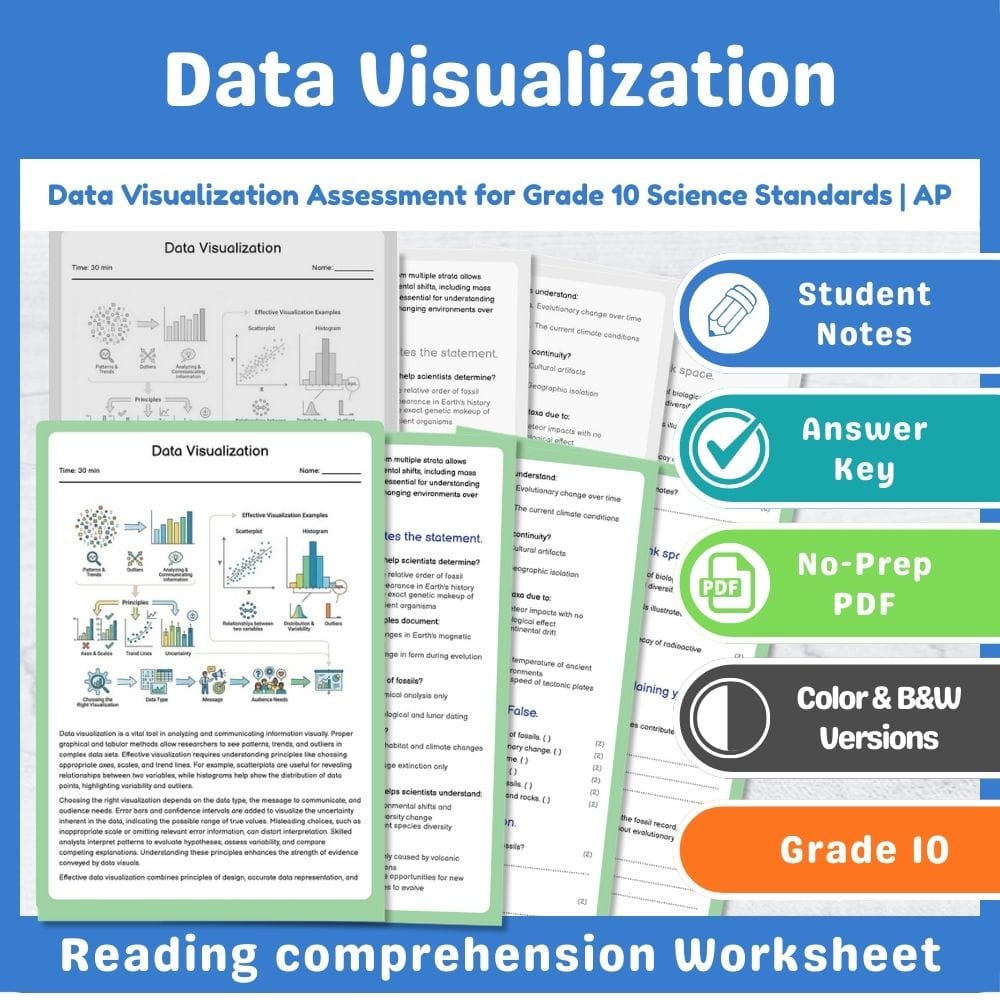
Data Visualization Assessment for Grade 10 Science Standards | AP
Created byPrism Point LearningLearning Objectives
- Describe principles and conventions for graphical and tabular representation of data.
- Identify and interpret various data visualization types such as scatterplots, histograms, and boxplots.
- Evaluate the appropriateness of different visualization choices like axes, scale, and trend lines.
Instant download

Grade 10 Science Data Visualization Worksheet (AP Standards) PDF
Created byEvergreen Desk EducationLearning Objectives
- Identify appropriate graphical and tabular representations for quantitative and qualitative data
- Select effective axis choices and scales and justify design decisions (including trend lines and uncertainty displays)
- Interpret scatterplots, residual plots, histograms, and boxplots by describing patterns, variability, and outliers
Also included in: Grade 10 Scientific Modeling & Quantitative Reasoning Science Lesson Bundle (AP) +1 more
Instant download
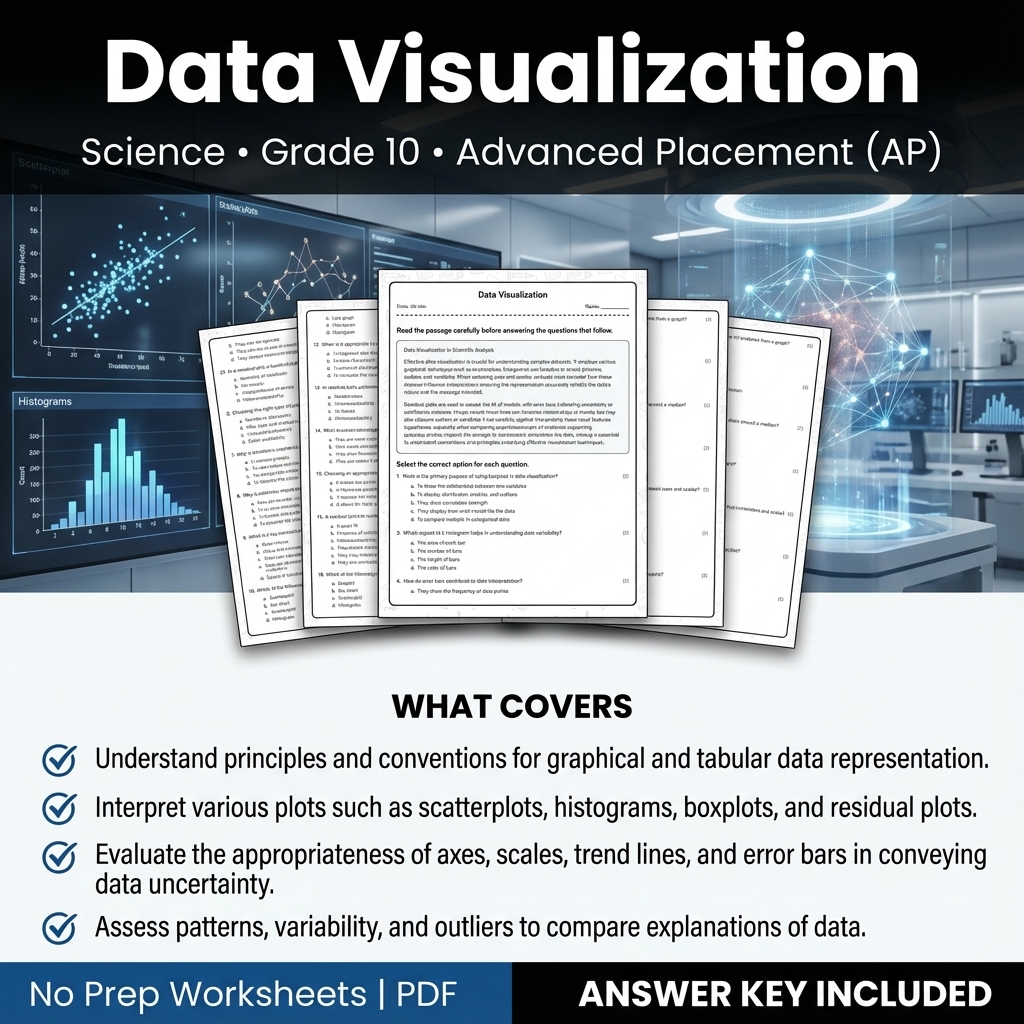
10th Grade Science | Data Visualization Worksheet (Printable PDF + Answer Key)
Created byCoral Reef LearningLearning Objectives
- Understand principles and conventions for graphical and tabular data representation.
- Interpret various plots such as scatterplots, histograms, boxplots, and residual plots.
- Evaluate the appropriateness of axes, scales, trend lines, and error bars in conveying data uncertainty.
Also included in: Grade 10 Science Unit Worksheet Bundle | Data Analysis & Scientific Modeling +1 more
Instant download

Grade 10 Science | Data Visualization Worksheet | AP Aligned
Created byLumora LearningLearning Objectives
- Understand principles and conventions for graphical and tabular data representation.
- Identify appropriate visualization techniques for different data types and contexts.
- Interpret patterns, variability, outliers, and uncertainty in data visualizations.
Instant download
Grade 10 Science | Data Visualization Worksheet (AP Standards) – PDF
Created byBright Mind ResourcesLearning Objectives
- Understand principles and conventions of graphical and tabular data representation.
- Identify different types of data visualizations such as scatterplots, histograms, and boxplots.
- Interpret patterns, variability, and outliers in data visualizations.
Instant download

Hydrostatic Forces Worksheets: Submerged Surfaces and Pressure Grade 8
Created byPrism Point LearningLearning Objectives
- Explain how fluid pressure changes with depth on submerged surfaces
- Determine the center of pressure for simple submerged surface shapes
- Interpret pressure distributions on planar vertical surfaces
Also included in: Fluids, Pressure & Buoyancy Lesson Bundle | Grade 8 Science | Ontario +1 more
Instant download

Grade 7 Science | Organ Interactions Worksheet with Short Notes (Printable PDF)
Created byMeadowlark WorksheetsLearning Objectives
- Describe the functions and interactions of the circulatory, respiratory, digestive, and nervous systems in multicellular animals.
- Understand system-level dependencies such as oxygen transport and nutrient absorption.
- Compare human organ systems with plant vascular interactions.
Also included in: Grade 7 Science NGSS Unit Bundle Molecules to Organisms: Structures & Processes +1 more
Instant download

Grade 10 Science | Energy Component Accounting - Daily Reading Comprehension
Created byCoral Reef LearningLearning Objectives
- Identify different forms of energy and understand their roles in energy flow
- Describe how energy transfers occur within a system
- Explain the principle of energy conservation in the context of energy redistribution
Instant download

Energy Component Accounting Worksheet | Grade 10 Science Practice
JCreated byJ.S SheetsLearning Objectives
- Understand how energy flows between components in a system and how to model energy conservation.
- Identify different forms of energy and how changes relate to energy transfers like work and energy exchange.
- Apply quantitative reasoning to energy budgets to verify energy conservation across different representations.
Also included in: Grade 10 Energy, Forces, and Reactions Science Lesson Bundle +1 more
Instant download

Energy Component Accounting Worksheet Grade 10 Science Practice Activity
Created byPrism Point LearningLearning Objectives
- Model energy conservation by tracking how energy changes between system components using an energy budget.
- Connect observed changes in component energy to specified energy transfers (work, heat, and energy flow between system and surroundings).
- Use consistency between representations to explain why total energy remains constant during redistribution.
Instant download

Grade 10 Science – Energy Components & Conservation | Daily Reading Worksheet
Created byBright Mind ResourcesLearning Objectives
- Understand different forms of energy within a system
- Learn how energy transfers between components
- Represent energy conservation visually and quantitatively
Also included in: Grade 10 Energy & Models Science Lesson Bundle | CA Standards Daily Reading +1 more
Instant download

Resource Distribution Worksheet NGSS G8 Science Practice Assessment
Created byCedar Grove LearningLearning Objectives
- Analyze the geological processes that influence uneven resource distribution.
- Explain how different resources form within geological structures like sedimentary basins and aquifers.
- Evaluate the implications of resource accessibility and quality for sustainable extraction.
Instant download
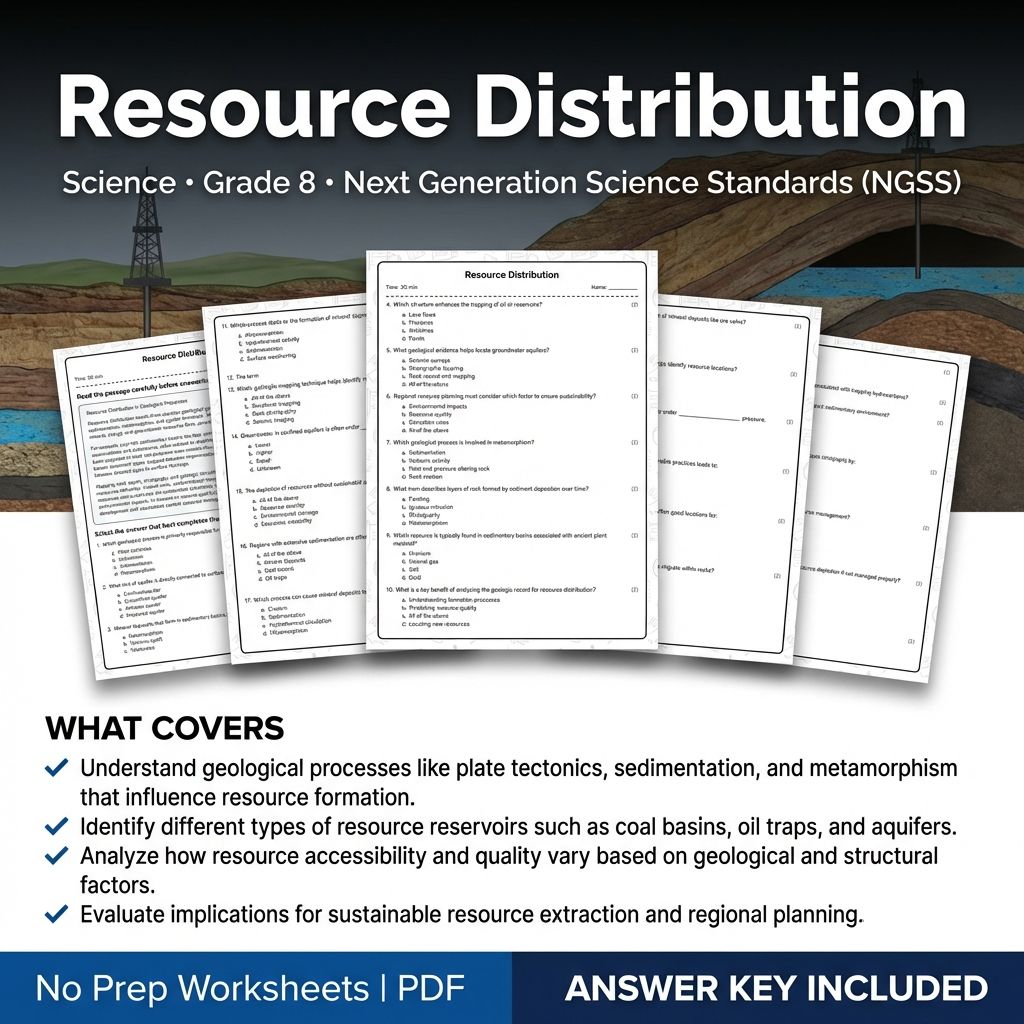
Grade 8 Science Worksheet | Resource Distribution & Geology Practice PDF
Created byCoral Reef LearningLearning Objectives
- Understand geological processes like plate tectonics, sedimentation, and metamorphism that influence resource formation.
- Identify different types of resource reservoirs such as coal basins, oil traps, and aquifers.
- Analyze how resource accessibility and quality vary based on geological and structural factors.
Instant download
Grade 8 Science – Resource Distribution Worksheet (NGSS) PDF
 Created byMaple Path Learning
Learning Objectives
- Understand geological processes that lead to uneven resource distribution.
- Identify types of mineral, energy, and groundwater resources and how they form.
- Analyze factors affecting accessibility and quality of natural resources.
Also included in: Grade 8 Science | Earth and Human Activity NGSS Unit Bundle +1 more
Instant download

Resource Distribution and Geologic Processes: Grade 8 Worksheets
 Created bythe curious pencil
Learning Objectives
- Explain how geologic processes influence natural resource distribution.
- Compare confined and unconfined aquifers using physical features.
- Interpret rock layers and geologic evidence to locate resources.
Also included in: Earth and Human Activity Grade 8 Science Worksheets NGSS Bundle +2 more
Instant download

Grade 11 Worksheet B: Metabolic Integration (Enzymes, Regulation, Flux) | NGSS
Created byClear Sky ClassroomLearning Objectives
- Explain how anabolic and catabolic pathways integrate to regulate flow of matter and chemical energy.
- Describe how enzyme kinetics and allosteric regulation influence pathway flux during carbohydrate, lipid, and protein metabolism.
- Analyze how pathway branching and tissue context coordinate metabolic supply and demand (e.g., fermentation, gluconeogenesis).
Also included in: Grade 11 Photosynthesis & Cellular Processes Science Lesson Bundle NGSS +1 more
Instant download
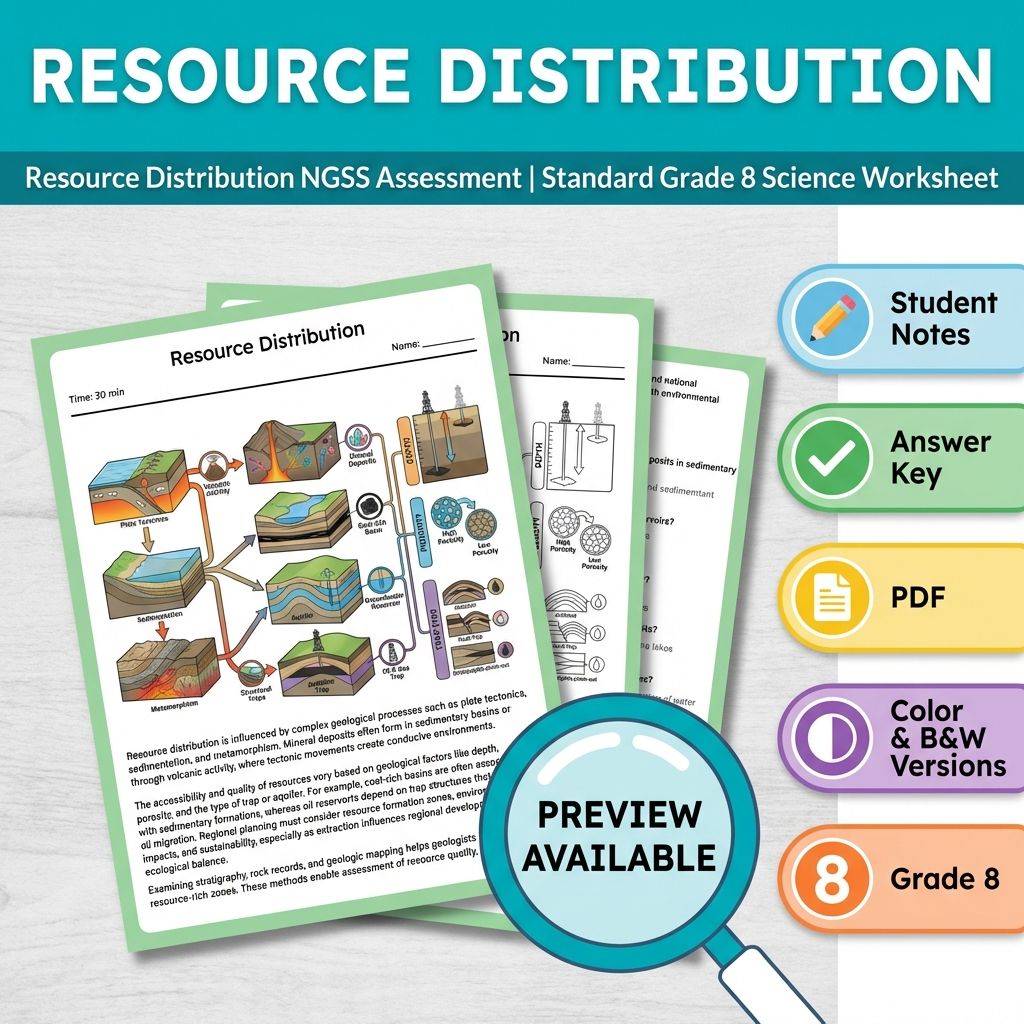
Resource Distribution NGSS Assessment | Standard Grade 8 Science Worksheet
Created byPrism Point LearningLearning Objectives
- Analyze the geological processes influencing resource formation and distribution.
- Identify key types of mineral, energy, and groundwater resources and their locations.
- Understand the factors affecting resource accessibility and quality.
Also included in: Lesson Grade 8 Science Mini Bundle – Earth & Human Activity Standards-Aligned +1 more
Instant download

Grade 8 Resource Distribution Worksheet | NGSS Practice PDF
Created byClear Sky ClassroomLearning Objectives
- Understand geological processes that influence resource formation.
- Identify different types of mineral, energy, and groundwater resources.
- Analyze how resource accessibility and quality vary regionally.
Also included in: Grade 8 Climate Drivers and Environmental Monitoring Science Lesson Bundle NGSS +1 more
Instant download

Grade 8 Science | Resource Distribution – Daily Reading Comprehension
Created byCoral Reef LearningLearning Objectives
- Understand how mineral, energy, and groundwater resources form
- Identify geological processes such as plate tectonics, sedimentation, metamorphism, and aquifer formation
- Analyze examples of resource reservoirs like sedimentary basins, oil traps, and aquifers
Instant download

Grade 8 Resource Distribution in Geology NGSS Science Worksheet Activity
 Created byBRIGHT PATH RESOURCES
Learning Objectives
- Understand how geological processes influence mineral and water resource formation.
- Identify various types of mineral deposits and aquifers.
- Analyze geologic maps, rock records, and stratigraphy to explain resource locations.
Also included in: Earth Systems Grade 8 Science Daily Reading Worksheets Lesson Bundle | NGSS +2 more
Instant download

Resource Distribution Practice Worksheet | Grade 8 Science NGSS Review
Created byPrism Point LearningLearning Objectives
- Explain how plate tectonics and sedimentation influence where mineral and energy resources form.
- Describe how geologic structures affect where oil and other hydrocarbons are trapped.
- Compare confined and unconfined aquifers and explain why groundwater accessibility and quality vary.
Instant download

Net Acceleration Worksheet for Grade 9 Science | Standards-Aligned Practice
JCreated byJ.S SheetsLearning Objectives
- Understand how unbalanced forces produce acceleration in the direction of the net force.
- Explain the relationship between force, mass, and acceleration as described by Newton's second law.
- Recognize how changing force magnitude or duration affects velocity and acceleration.
Also included in: Grade 9 Conservation of Energy and Forces Science Lesson Bundle +1 more
Instant download

Grade 9 Science | Understanding Net Acceleration - Daily Reading Comprehension
Created byCoral Reef LearningLearning Objectives
- Define net acceleration and explain how it is affected by unbalanced forces.
- Identify the effects of applying different forces on objects in motion.
- Understand the vector nature of force and how it influences acceleration.
Instant download
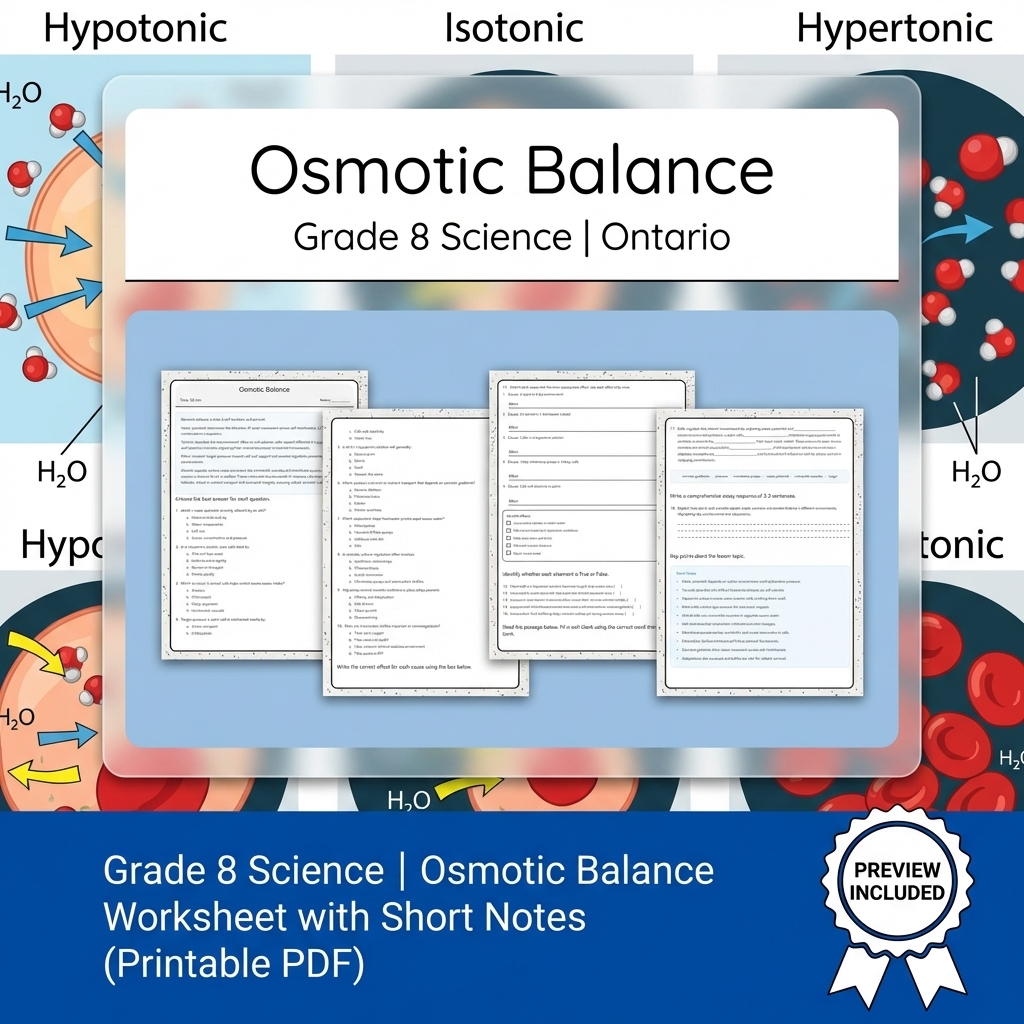
Grade 8 Science | Osmotic Balance Worksheet with Short Notes (Printable PDF)
Created byMeadowlark WorksheetsLearning Objectives
- Explain the principles of water potential, tonicity, and cellular response mechanisms.
- Describe how plant and animal cells maintain volume and turgor pressure under different environments.
- Identify adaptations like contractile vacuoles, membrane pumps, and extracellular fluid buffering in osmoregulation.
Also included in: Grade 8 Science Lesson Group Bundle | Ontario Curriculum Worksheets +1 more
Instant download

Net Acceleration Worksheet | Grade 9 Science Standardized Assessment
Created byPrism Point LearningLearning Objectives
- Explain Newton’s second law using the relationship between net force, mass, and acceleration
- Determine how unbalanced forces and their directions affect acceleration and motion
- Use vector ideas to reason about combining forces and predicting acceleration changes over time
Instant download
Browse more categories
About Science Worksheets
Find Science worksheets spanning core skills, practice, and review. All 44,912 resources are instant PDF downloads for the classroom or home.
Every worksheet on MyTeachingSheets is created by independent teacher-authors and reviewed before publication. All resources download as printable PDFs for classroom, homework, or at-home practice, and many include answer keys. Preview any worksheet free before buying.