
Science Worksheets
44,981 subject resources
Grade 7 Science | Instrumentation Accuracy Worksheet (PDF) Ontario Standards
 Created byBright Mind Resources
Learning Objectives
- Understand how sensor response time influences temperature measurement accuracy.
- Compare different temperature sensing technologies and their calibration needs.
- Identify common error sources and ways to minimize measurement uncertainty.
Instant download

Grade 7 Science Worksheet: Instrumentation Accuracy | Ontario Standards
JCreated byJ.S SheetsLearning Objectives
- Explain how calibration and traceable reference standards improve the accuracy of temperature measurements.
- Identify common sources of measurement error, including response time, spatial placement, radiation effects, and thermal contact.
- Use uncertainty and resolution concepts to interpret temperature readings appropriately.
Instant download

Grade 7 Instrumentation Accuracy Worksheet | Ontario Science PDF
 Created byClear Sky Classroom
Learning Objectives
- Explain how calibration and traceable reference points improve temperature measurement accuracy.
- Identify common sources of error (sensor placement, radiation shielding, thermal contact, and response time) and how they affect readings.
- Interpret temperature results using uncertainty, resolution limits, and error budgets.
Instant download

Grade 7 Science – Temperature Sensors Daily Reading Worksheet with Answer Key
JCreated byJ.S SheetsLearning Objectives
- Identify different types of temperature sensors used in environmental monitoring
- Explain the basic functions of thermocouples, resistance temperature detectors, and infrared sensors
- Describe factors affecting sensor accuracy such as response time, placement, and shielding
Also included in: Grade 7 Science Lesson Group: Ontario Curriculum | Thermal & Heat Transfer +1 more
Instant download

Temperature Measurement Accuracy Worksheets Grade 7 Science
 Created byPrism Point Learning
Learning Objectives
- Explain how calibration and uncertainty affect temperature measurement accuracy
- Describe how sensor response time affects changing temperature measurements
- Explain how spatial placement changes the temperature a sensor reports
Also included in: Thermal Energy & Heat Transfer Lesson Bundle | Grade 7 Science | Ontario +1 more
Instant download

DNA Information Assessment for Grade 11 Science | NGSSS Standards
Created byPrism Point LearningLearning Objectives
- Explain how DNA stores genetic information and how that information leads to protein production
- Describe the structure of DNA and the importance of complementary base pairing
- Analyze how accurate DNA replication preserves inheritance during cell division
Also included in: Grade 11 Population, Genetics & Energy Systems Science Lesson Bundle: Florida NGSSS +1 more
Instant download

DNA Information Worksheet Grade 11 Biology Genetics NGSSS Activity
Created byPrism Point LearningLearning Objectives
- Explain how DNA stores genetic information and how complementary base pairing supports accurate copying.
- Describe how DNA sequence relates to protein production and inherited traits.
- Evaluate how variation in DNA among individuals can influence phenotypes and contribute to evolutionary change.
Also included in: Ecology, Evolution & Genetics Lesson Bundle | Grade 11 Science NGSSS
Instant download

Grade 11 DNA Information Worksheet | Practice & Assessment PDF
Created byClear Sky ClassroomLearning Objectives
- Explain how DNA stores genetic information through complementary base pairing and nucleotide sequence
- Describe how DNA sequence is copied during cell division to preserve genetic instructions
- Analyze how genetic variation can influence traits, survival, and evolutionary change
Instant download

Grade 11 Science | DNA Information Worksheet | Standard-Aligned
 Created byLumora Learning
Learning Objectives
- Explain how DNA stores genetic information and how base-pair sequence provides instructions for cellular processes
- Describe complementary base pairing and how it supports accurate DNA replication during cell division
- Analyze how genetic variation influences traits, inheritance, and evolutionary change
Instant download

Grade 11 Science – DNA Structure & Function | Daily Reading Worksheet
Created byBright Mind ResourcesLearning Objectives
- Identify the components of DNA and their functions
- Understand the structure of DNA as a double helix with complementary base pairing
- Explain how DNA carries genetic information for cellular functions and inheritance
Also included in: Life Science Grade 11 Science Reading Worksheets Lesson Bundle | Florida NGSSS +1 more
Instant download

Grade 11 Science | DNA The Blueprint of Life - Daily Reading Practice
 Created byCoral Reef Learning
Learning Objectives
- Describe the structure of DNA including its nucleotide components and complementary base pairing.
- Explain how DNA encodes genetic information to produce proteins.
- Understand the process of DNA replication and its importance in cell division.
Instant download

Grade 11 DNA Information Worksheet | Genetics Biology Activity + Answer Key
 Created byEvergreen Desk Education
Learning Objectives
- Explain how DNA stores genetic information using complementary base pairing and nucleotide sequence.
- Describe how DNA sequence directs protein and functional-molecule production through transcription and translation.
- Analyze how DNA replication, mutation, and inheritance contribute to genetic variation and evolutionary change.
Instant download

Chemical Energy Release Worksheet for Grade 6 Science
JCreated byJ.S SheetsLearning Objectives
- Understand how chemical energy stored in food molecules is transformed to support organism activities.
- Describe the process of energy change and transfer within living organisms during cellular work.
- Explain why feeding is essential for sustained bodily functions over time.
Also included in: Grade 6 Life Science Science Lesson Bundle – California Standards +1 more
Instant download

Grade 6 Science | Chemical Energy Release Worksheet Elena | California Standards
Created byLumora LearningLearning Objectives
- Explain how chemical energy stored in food is transformed to power life processes in organisms
- Use the idea of energy changing form (not being created or destroyed) to describe what happens during feeding
- Distinguish between useful energy used by cells and energy released as heat
Instant download

Grade 6 Science – Chemical Energy & Food Energy | Daily Reading Worksheet
Created byBright Mind ResourcesLearning Objectives
- Understand how chemical energy is stored in food molecules
- Learn how organisms convert chemical energy into usable energy
- Recognize the process of energy transfer and heat loss in living organisms
Also included in: Grade 6 Ecosystems and Energy Science Lesson Bundle | California Standards +1 more
Instant download

Grade 6 Chemical Energy Release Worksheet | NGSS Practice PDF
Created byClear Sky ClassroomLearning Objectives
- Explain how chemical energy in food is transformed to power life processes in organisms.
- Describe energy transfer and the idea that energy changes form rather than being created or destroyed in the body.
- Connect chemical bond breaking to energy release and cellular work.
Instant download

Chemical Energy Release Assessment | California Standards Grade 6 Science
Created byPrism Point LearningLearning Objectives
- Explain how chemical energy in food molecules is transformed to power life processes.
- Describe how energy is conserved in organisms as it changes form (useful energy and heat).
- Use evidence from a scientific passage to support claims about how feeding supports sustained functioning.
Also included in: Grade 6 Energy and Matter Cycles Science Lesson Bundle | California Standards +1 more
Instant download

Grade 6 Chemical Energy Release Worksheet | California Science PDF
Created byEvergreen Desk EducationLearning Objectives
- Explain how chemical energy stored in food can be transformed to power life processes in organisms.
- Describe how energy is conserved during cellular work (energy changes form, not created or destroyed).
- Distinguish between useful energy for body functions and energy lost as heat.
Instant download

Chemical Energy Release Worksheet Grade 6 Science Activities Pack
Created byPrism Point LearningLearning Objectives
- Explain how chemical energy stored in food is released to power life processes.
- Describe how energy changes form in organisms (including heat loss).
- Use the idea that matter/energy is not created or destroyed to interpret food-energy changes.
Also included in: Animals Matter Lesson Bundle | Grade 6 Science | California Standards
Instant download

Grade 8 Energy & Temperature Relationship Worksheet | Thermal Energy Review
Created byPrism Point LearningLearning Objectives
- Explain how energy transfer causes changes in temperature of a material.
- Describe how thermal equilibrium is reached in interacting systems.
- Use energy conservation ideas to predict warming and cooling amounts.
Instant download

Grade 8 Science | Energy–Temperature Link Worksheet | California Standards
Created byLumora LearningLearning Objectives
- Explain how energy transfer causes temperature changes in materials
- Use the ideas of thermal energy and thermal equilibrium to predict warming and cooling
- Relate everyday observations of hot and cold to the direction of heat (energy) flow
Instant download

Grade 8 Science | Energy Temperature Link - Daily Reading Comprehension
Created byCoral Reef LearningLearning Objectives
- Understand how energy transfer affects temperature.
- Recognize the connection between thermal effects and energy flow.
- Explain why different materials change temperature differently under similar conditions.
Instant download

Grade 8 Energy Temperature Link Worksheet PDF | California Standards
Created byEvergreen Desk EducationLearning Objectives
- Explain how thermal energy transfer leads to temperature increases or decreases in materials.
- Describe thermal equilibrium and net energy transfer using the idea of energy conservation.
- Use temperature change and evidence from everyday situations to predict the direction of heat flow.
Instant download

Grade 8 Energy Temperature Link Worksheet | California Standards Practice PDF
Created byClear Sky ClassroomLearning Objectives
- Explain how energy transfer into and out of matter affects temperature changes.
- Use conservation of energy to describe why different materials warm or cool by different amounts.
- Describe thermal equilibrium and the direction of heat flow in everyday situations.
Instant download

Energy Temperature Link Worksheet | Standards-Aligned Grade 8 Science Practice
JCreated byJ.S SheetsLearning Objectives
- Understand the relationship between temperature change and energy transfer.
- Explain how energy transfer affects the thermal state of materials.
- Relate everyday observations of warming and cooling to energy flow.
Also included in: Grade 8 Forces, Energy & Matter Science Lesson Bundle | California Standards +1 more
Instant download

Grade 8 Science – Energy & Temperature Link | Daily Reading Worksheet
Created byBright Mind ResourcesLearning Objectives
- Understand how energy transfer affects the temperature of materials.
- Recognize the relationship between energy flow and thermal changes.
- Explain the concept of thermal equilibrium in different systems.
Also included in: Grade 8 Energy, Forces & Matter Lesson Bundle - Daily Reading | Calif. Std. +1 more
Instant download
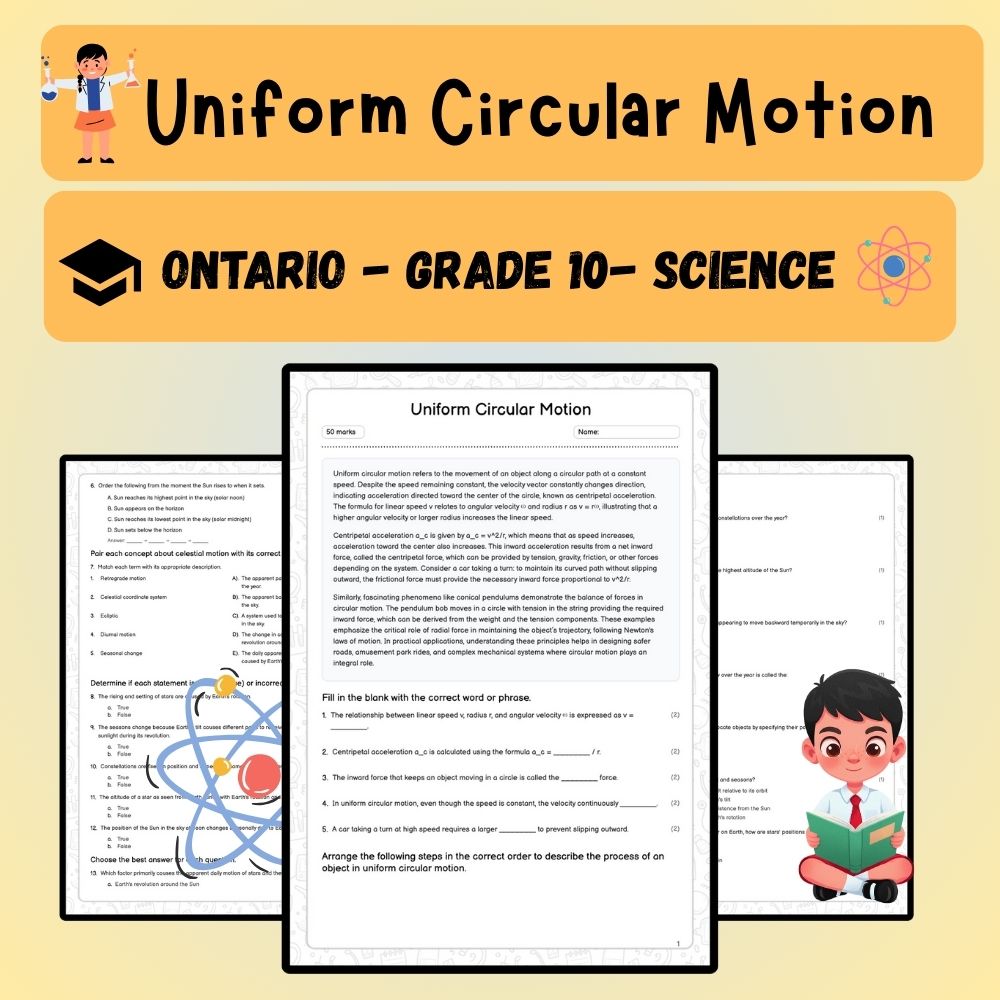
Grade 10 Science | Uniform Circular Motion Worksheet (PDF) for Ontario Standards
Created byPrism Point LearningLearning Objectives
- Explain the relationship between linear speed, angular velocity, and radius in uniform circular motion.
- Describe how centripetal acceleration depends on velocity and radius.
- Apply the formulas v = rω and a_c = v^2/r to solve problems involving circular motion.
Also included in: Grade 10 Science Unit Bundle | Motion, Forces & Mechanics Worksheets (Ontario Standards) +1 more
Instant download

Grade 10 Science – Uniform Circular Motion | Daily Reading Worksheet
Created byBright Mind ResourcesLearning Objectives
- Explain the concept of uniform circular motion
- Identify the relationship between linear velocity, angular velocity, and radius
- Describe the role of centripetal force in maintaining circular motion
Also included in: Grade 10 Force & Motion Science Daily Reading Lesson Bundle – Ontario +1 more
Instant download
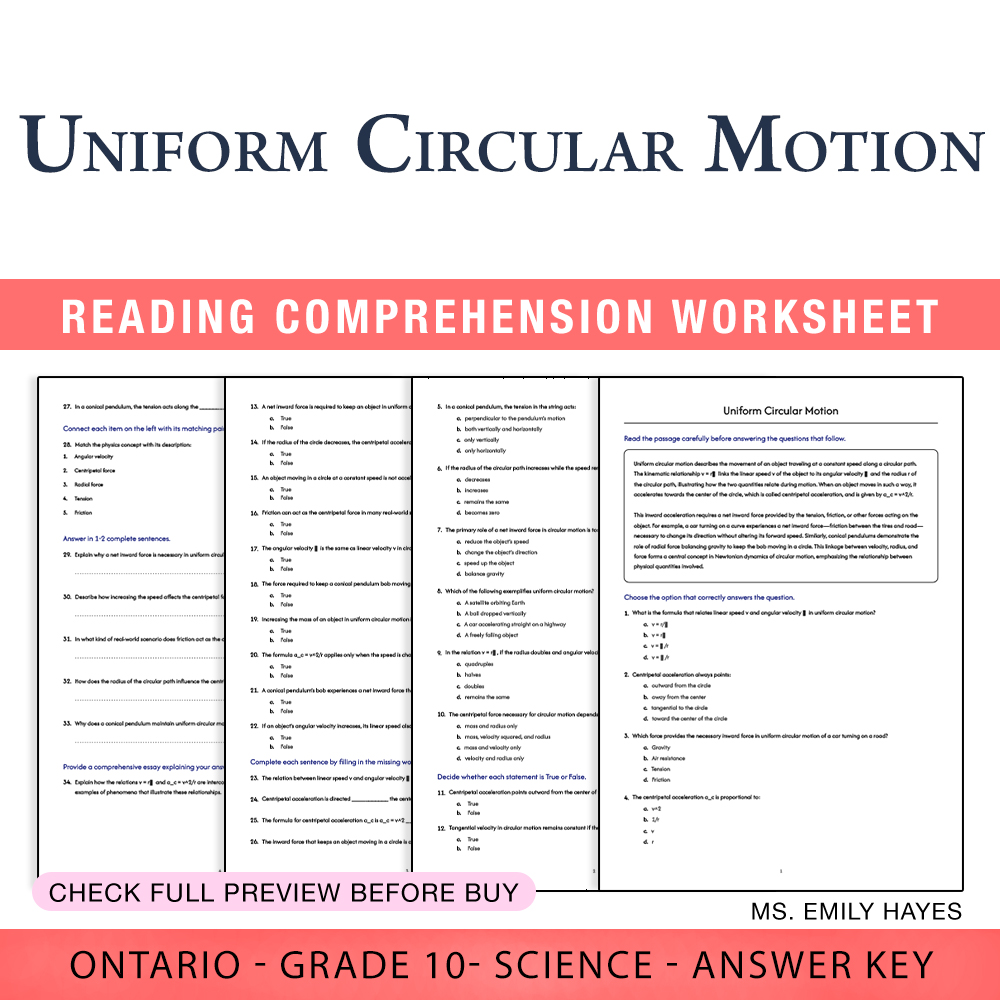
10th Grade Science | Uniform Circular Motion Worksheet (PDF + Answer Key)
 Created byCopper Leaf Classroom
Learning Objectives
- Explain the kinematic relationships v = rω and a_c = v^2/r for objects moving in a circle.
- Describe how centripetal force acts towards the center of a circular path to maintain curved motion.
- Apply mathematical relations to real-world phenomena such as vehicle turning and conical pendulums.
Instant download

Grade 10 Science – Uniform Circular Motion Worksheet (Ontario) PDF
Created byEvergreen Desk EducationLearning Objectives
- Explain how angular measures relate to linear speed in uniform circular motion using v = rω
- Connect net inward (centripetal) force to centripetal acceleration a_c = v^2/r and Newton’s second law
- Interpret and predict motion outcomes for real systems such as car turns and a conical pendulum
Also included in: Grade 10 Kinematics Forces & Mechanics Science Lesson Bundle Ontario Worksheets +1 more
Instant download

Grade 10 Uniform Circular Motion Worksheet | Ontario Science Physics
Created byClear Sky ClassroomLearning Objectives
- Explain how angular quantities relate to linear speed in uniform circular motion.
- Use v = rω and a_c = v^2/r to calculate speed and centripetal acceleration.
- Apply Newton’s second law to argue why a net inward (centripetal) force is required for curved motion.
Instant download

Grade 10 Uniform Circular Motion Worksheet | Angular & Radial Motion Ontario
 Created byChalk and Compass
Learning Objectives
- Explain how angular speed relates to linear speed in uniform circular motion using v = rω.
- Determine the centripetal acceleration and required inward net force for motion on a circular path.
- Interpret why a net inward force is necessary to keep an object moving along a curved trajectory.
Also included in: Grade 10 Science Motion, Forces & Momentum Lesson Bundle – Ontario Framework +1 more
Instant download
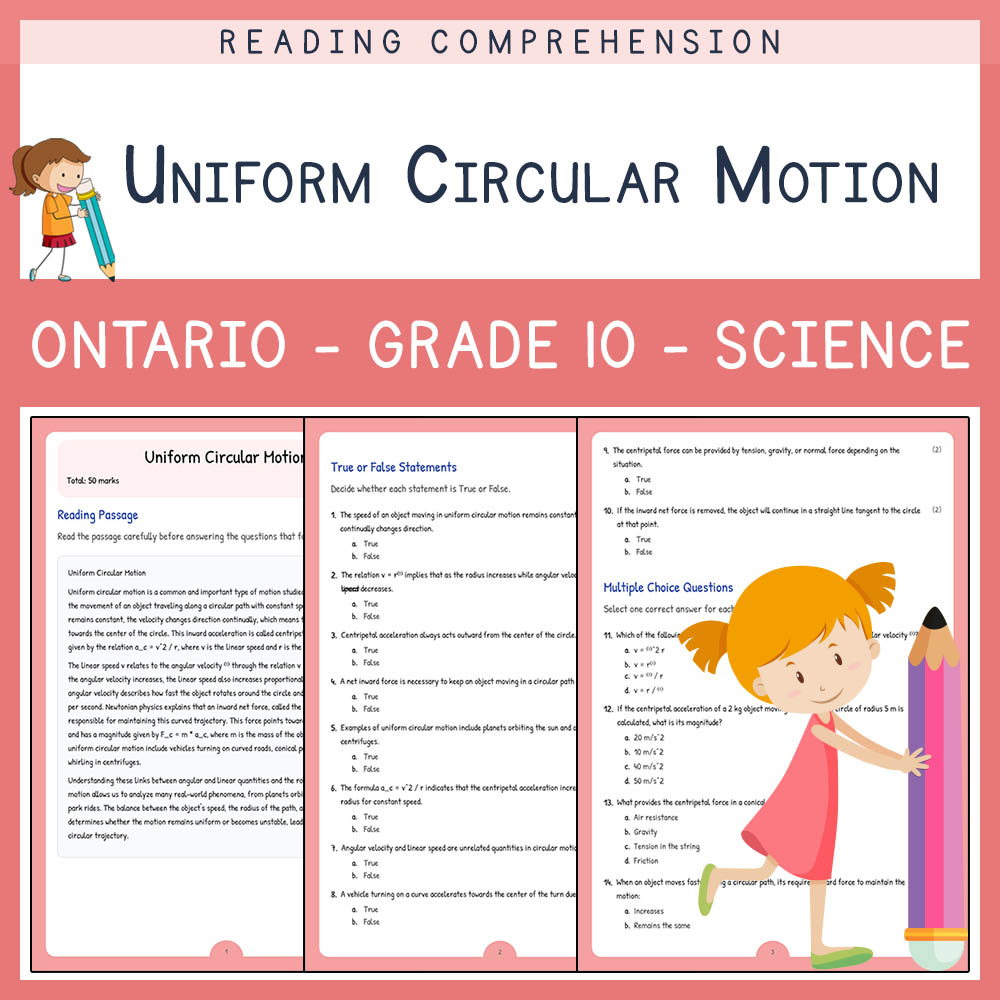
Grade 10 Science | Uniform Circular Motion Worksheet Elena | Ontario Standard
Created byLumora LearningLearning Objectives
- Describe the kinematic and dynamic aspects of uniform circular motion.
- Explain the relationships v = rω and a_c = v^2/r and how they connect linear and angular measures.
- Understand the role of a net inward force in maintaining circular motion.
Also included in: Grade 10 Science | Motion & Forces Lesson Bundle | Ontario Standards
Instant download

Grade 10 Science – Understanding Uniform Circular Motion | Daily Worksheet
 Created byQuiet Forest Education
Learning Objectives
- Define uniform circular motion and identify its key features.
- Explain the role of centripetal force in maintaining circular motion.
- Derive and understand the relationships v = rω and a_c = v^2/r.
Also included in: Motion and Forces Grade 10 Science Daily Reading Worksheets Bundle | Ontario +1 more
Instant download
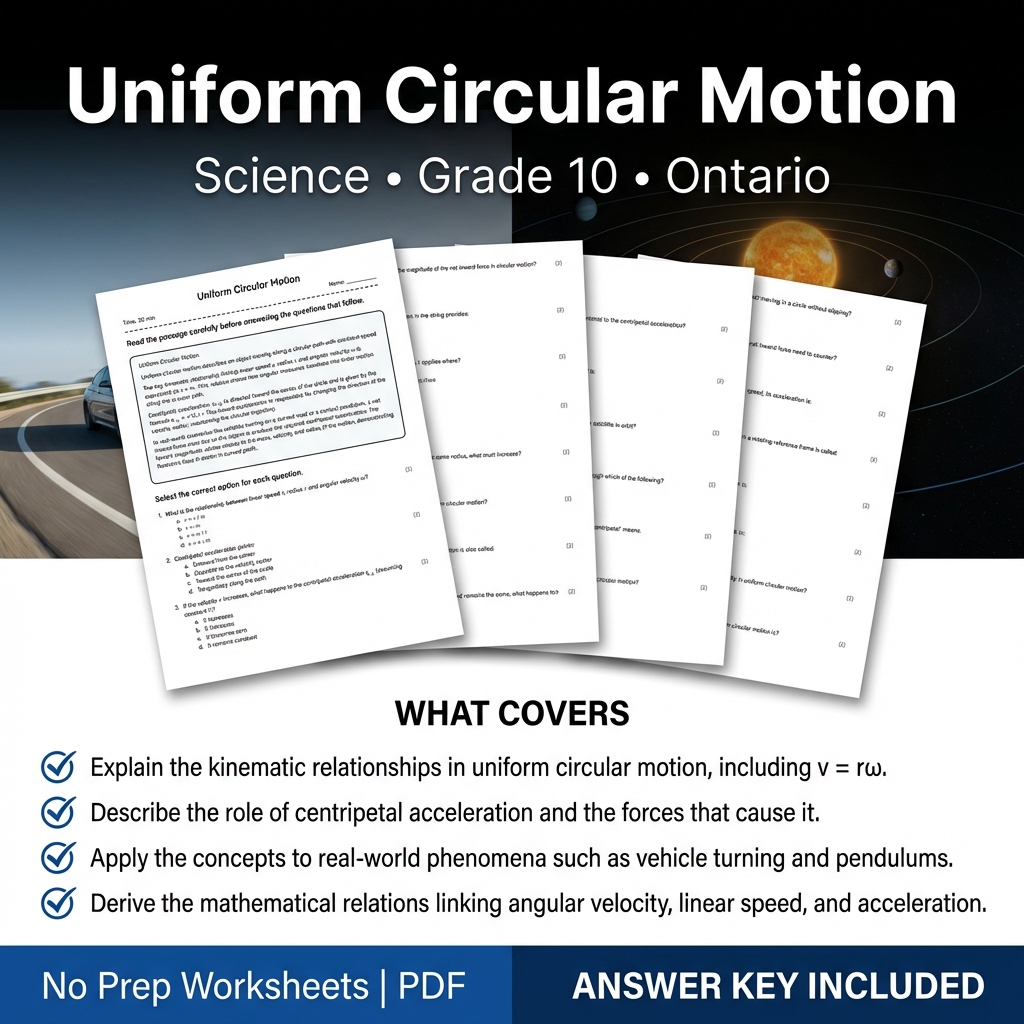
Grade 10 Science Worksheet on Uniform Circular Motion | Ontario Standards
Created byCoral Reef LearningLearning Objectives
- Explain the kinematic relationships in uniform circular motion, including v = rω.
- Describe the role of centripetal acceleration and the forces that cause it.
- Apply the concepts to real-world phenomena such as vehicle turning and pendulums.
Instant download

Grade 10 Science – Uniform Circular Motion Worksheet (Ontario Standard) (PDF)
Created byBright Mind ResourcesLearning Objectives
- Describe the kinematic and dynamic aspects of motion on a circular path.
- Explain the relationship between angular velocity, linear speed, and centripetal acceleration.
- Derive and apply the formulas v = rω and a_c = v^2/r in solving problems.
Instant download

Uniform Circular Motion Worksheet | Science Practice for Grade 10 Ontario
JCreated byJ.S SheetsLearning Objectives
- Explain how angular speed relates to linear speed in uniform circular motion using v = rω
- Determine centripetal acceleration and centripetal force requirements for motion along a circular path
- Connect the inward (net) force to Newton’s second law and curved trajectories
Instant download

Uniform Circular Motion Worksheets: Grade 10 Science
Created byPrism Point LearningLearning Objectives
- Calculate linear speed using radius and angular speed
- Calculate centripetal acceleration using speed and radius
- Explain why centripetal force acts toward the circle's center
Also included in: Grade 10 Science Worksheets Ontario Forces and Motion Bundle
Instant download
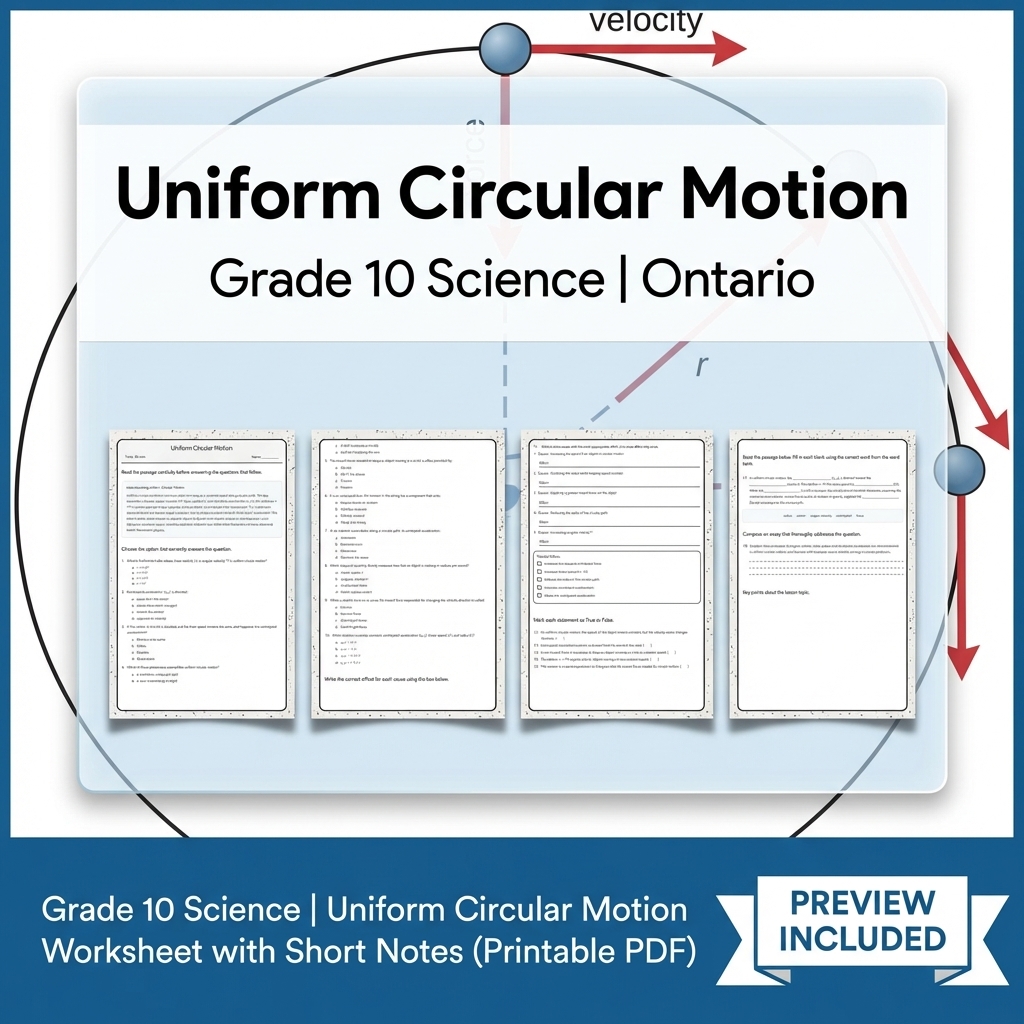
Grade 10 Science | Uniform Circular Motion Worksheet with Short Notes
 Created byMeadowlark Worksheets
Learning Objectives
- Understand the kinematic relations v = rω and a_c = v^2/r in circular motion.
- Explain how inward net force maintains curved trajectories.
- Link angular velocity to linear speed and centripetal acceleration.
Also included in: Grade 10 Science Lesson Group: Motion & Forces Ontario Curriculum Bundle +1 more
Instant download

Grade 10 Science | Uniform Circular Motion - Daily Reading Comprehension
Created byCoral Reef LearningLearning Objectives
- Define uniform circular motion and identify its key features.
- Explain the relationship between angular speed, linear speed, and radius.
- Describe the concept of centripetal acceleration and the role of inward force.
Instant download

9th Grade Science | Seismic Records Reading Worksheet (PDF + Rubric)
JCreated byJ.S SheetsLearning Objectives
- Understand how seismic waveforms are used to interpret Earth's subsurface structures.
- Compare P- and S-wave arrivals, waveform amplitudes, and frequency content to identify earthquake characteristics.
- Analyze travel-time curves and epicenter maps to determine earthquake depth and fault behavior.
Instant download

Seismic Records Worksheet for Grade 9 Science – Standards-Aligned Practice
JCreated byJ.S SheetsLearning Objectives
- Interpret earthquake waveforms, travel-time curves, and epicenter maps to understand subsurface structures.
- Distinguish between P- and S-wave arrivals, waveform amplitudes, and frequency content to identify shallow versus deep seismic events.
- Connect seismicity patterns to tectonic environments and surface hazard phenomena such as tsunamis using instrument-based records.
Instant download

Grade 9 Seismic Records Worksheet | Practice & Assessment PDF
Created byClear Sky ClassroomLearning Objectives
- Interpret seismic waveforms to identify likely P- and S-wave arrivals and describe what they indicate about earthquake depth and distance.
- Use travel-time ideas and epicenter mapping concepts to explain how seismographs help locate rupture zones.
- Connect patterns of seismicity and instrument-based evidence to tectonic environments and surface hazards such as tsunamis.
Also included in: Grade 9 Earth and Space Sciences Science lesson bundle (AP framework) +1 more
Instant download

Grade 9 Science | Seismic Records Worksheet | AP Aligned
Created byLumora LearningLearning Objectives
- Interpret earthquake waveforms, travel-time curves, and epicenter maps to analyze subsurface structures.
- Distinguish between P- and S-wave arrivals, waveform amplitudes, and frequency content to identify shallow versus deep seismic events.
- Connect seismicity patterns to tectonic environments and surface hazard phenomena such as tsunamis using instrument-based records.
Also included in: Grade 9 Science | Earth and Space Science Custom Bundle | AP Aligned
Instant download

Grade 9 Science — Seismic Records Worksheet MCQ Paper for Mastery
 Created byThe Resource Hub
Learning Objectives
- Interpret earthquake waveforms, travel-time curves, and epicenter maps to understand subsurface structures.
- Differentiate between P- and S-wave arrivals, waveform amplitudes, and frequency content.
- Locate rupture zones and connect seismicity patterns to tectonic environments and surface hazard phenomena.
Also included in: Grade 9 Earth and Space Sciences AP Bundle | Science Worksheets and Activities +1 more
Instant download

Grade 9 Science | Seismic Records Worksheet with Short Notes (Printable PDF)
Created byMeadowlark WorksheetsLearning Objectives
- Interpret earthquake waveforms and distinguish P- and S-wave arrivals.
- Analyze travel-time curves and epicenter maps to understand subsurface structures.
- Compare waveform amplitude and frequency content to identify earthquake depth.
Also included in: Grade 9 Science | Earth Systems & Geology Unit Worksheet Bundle (Printable PDFs) +1 more
Instant download
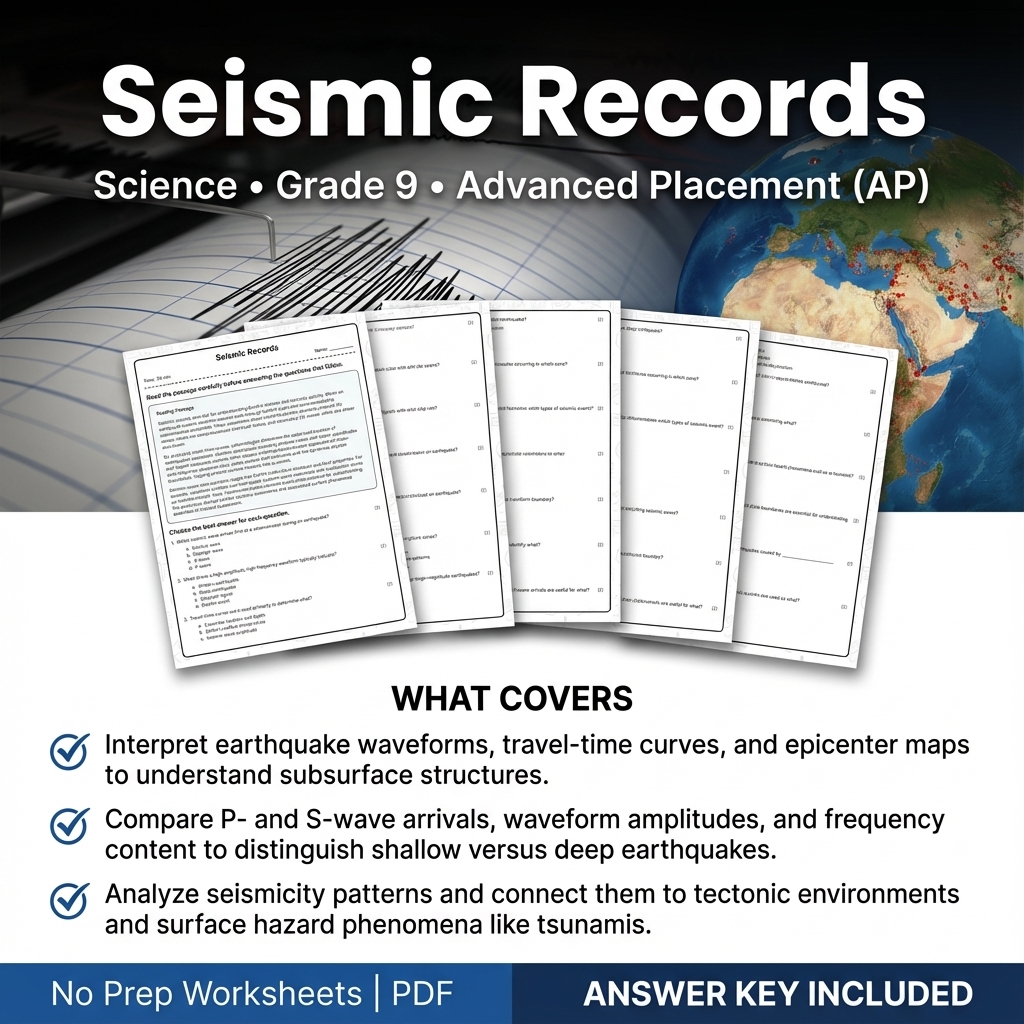
9th Grade Science | Seismic Records Worksheet (Printable PDF + Answer Key)
Created byCoral Reef LearningLearning Objectives
- Interpret earthquake waveforms, travel-time curves, and epicenter maps to understand subsurface structures.
- Compare P- and S-wave arrivals, waveform amplitudes, and frequency content to distinguish shallow versus deep earthquakes.
- Analyze seismicity patterns and connect them to tectonic environments and surface hazard phenomena like tsunamis.
Also included in: Grade 9 Science Unit | Earth Processes & Climate Worksheets Pack (PDF & Answer Keys) +2 more
Instant download
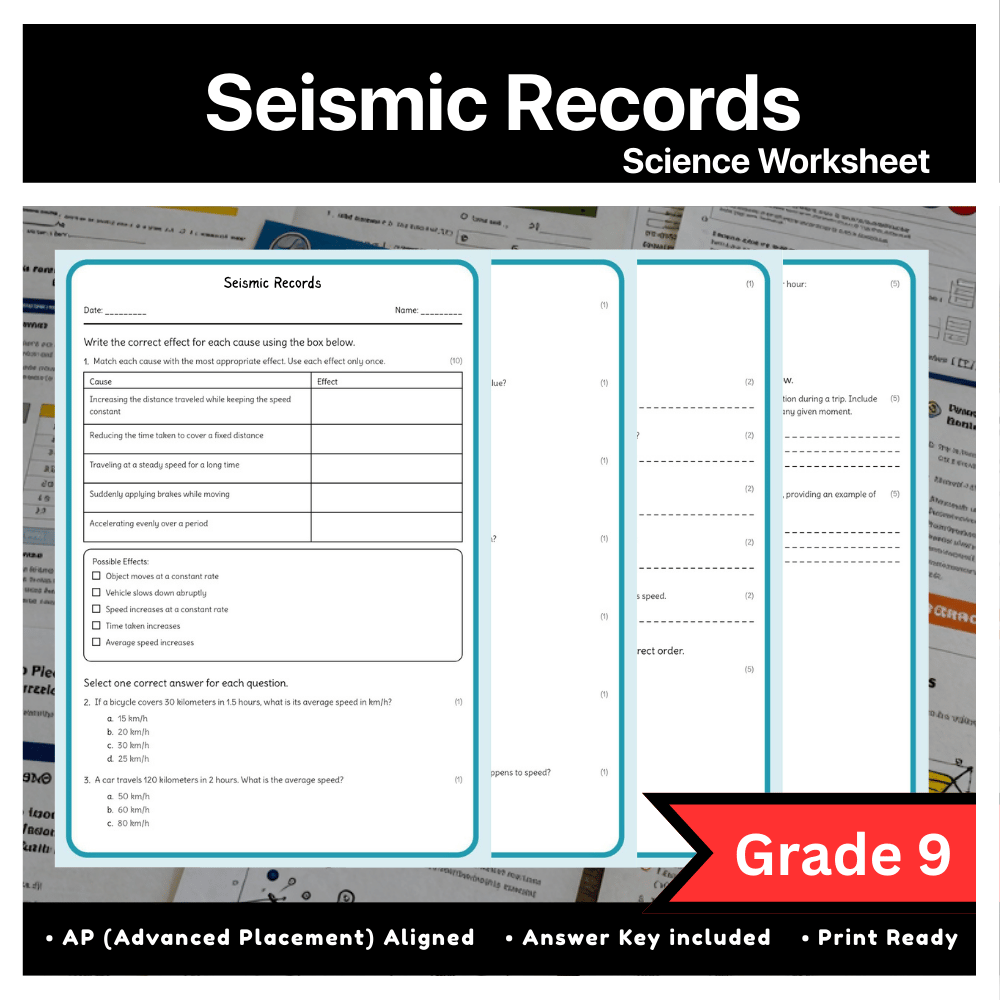
Grade 9 Science – Seismic Records Worksheet (AP Standards + Answer Key)
Created byBright Mind ResourcesLearning Objectives
- Interpret earthquake waveforms, travel-time curves, and epicenter maps to analyze subsurface structures.
- Distinguish between shallow and deep seismic events using waveform characteristics.
- Compare P- and S-wave arrivals to locate earthquake epicenters and understand fault behavior.
Instant download
Browse more categories
About Science Worksheets
Find Science worksheets spanning core skills, practice, and review. All 44,981 resources are instant PDF downloads for the classroom or home.
Every worksheet on MyTeachingSheets is created by independent teacher-authors and reviewed before publication. All resources download as printable PDFs for classroom, homework, or at-home practice, and many include answer keys. Preview any worksheet free before buying.