
Science Worksheets
44,980 subject resources
Net Force, Mass, and Acceleration Worksheets for Grade 7 Science
 Created bythe curious pencil
Learning Objectives
- Calculate net force from forces acting in opposite directions.
- Explain how unbalanced forces change an object's motion.
- Relate net force and mass to acceleration.
Also included in: Motion and Stability Grade 7 Science Worksheets | NGSS Forces Bundle +2 more
Instant download

Net Force and Motion Changes Worksheets for Grade 7 Science NGSS
 Created byTeachers Club
Learning Objectives
- Define net force as the vector sum of forces acting on an object
- Identify balanced and unbalanced forces using free-body diagrams
- Explain how force and mass relate to acceleration
Also included in: Grade 7 Science Worksheets NGSS Forces and Motion Bundle +2 more
Instant download
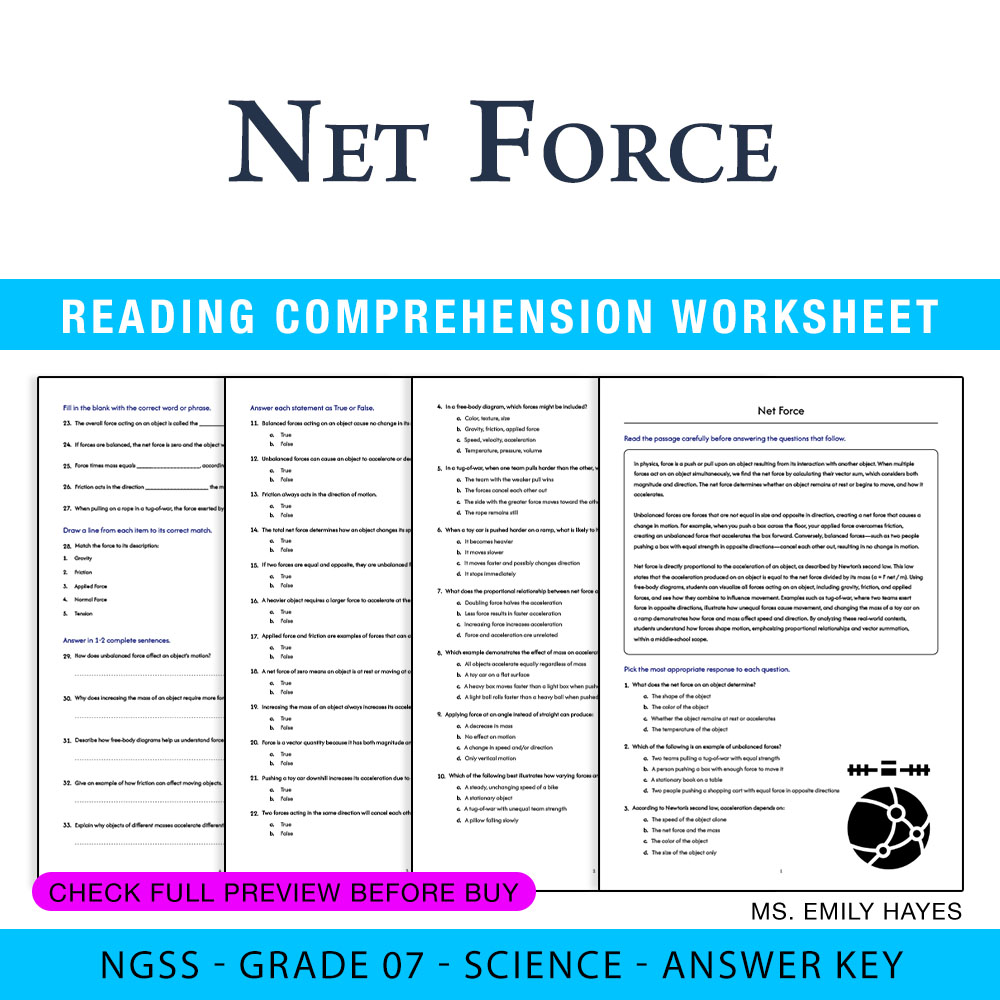
7th Grade Science | Net Force Worksheet (PDF+ Answer Key)
 Created byCopper Leaf Classroom
Learning Objectives
- Define net force as the vector sum of all forces acting on an object.
- Describe how unbalanced forces produce changes in motion.
- Explain the relationship among net force, mass, and acceleration using diagrams and reasoning.
Instant download

Grade 7 Science | Introduction to Net Force - Daily Reading Comprehension
 Created byCoral Reef Learning
Learning Objectives
- Understand the concept of net force as the vector sum of all forces acting on an object.
- Identify different types of forces such as frictional and applied forces.
- Explain how unbalanced forces cause changes in motion.
Instant download

Grade 7 Net Force Worksheet | NGSS Practice & PDF
 Created byClear Sky Classroom
Learning Objectives
- Define net force as the vector sum of all forces acting on an object.
- Explain how unbalanced forces cause changes in motion.
- Describe the relationship between net force, mass, and acceleration using diagrams and reasoning.
Also included in: Grade 7 Net Force, Interactions, Collisions Science Lesson Bundle (NGSS) +1 more
Instant download

Science Worksheet: Net Force and Motion Assessment | NGSS Grade 7 Science
 Created bySkylark Worksheets
Learning Objectives
- Define net force as the vector sum of all forces acting on an object.
- Explain how unbalanced forces change an object’s motion (speed and/or direction).
- Use quantitative reasoning with proportional relationships between net force, mass, and acceleration.
Also included in: Grade 7 Forces & Motion Science Lesson Bundle: NGSS Worksheets +1 more
Instant download
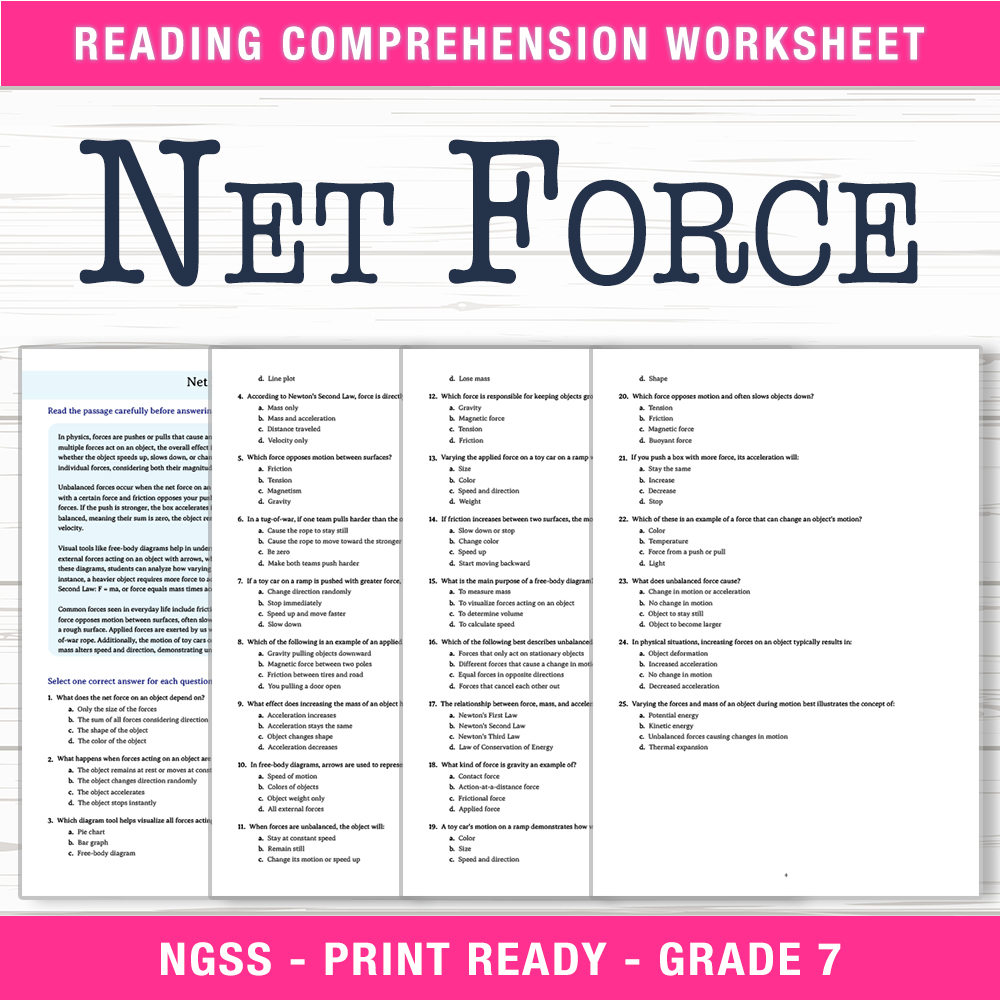
Grade 7 Science | Net Force Worksheet (PDF + Answer Key)
 Created byRiverstone Classroom
Learning Objectives
- Define net force as the vector sum of all forces acting on an object.
- Explain how unbalanced forces cause changes in an object's motion.
- Describe the relationship among net force, mass, and acceleration using diagrams and reasoning.
Instant download
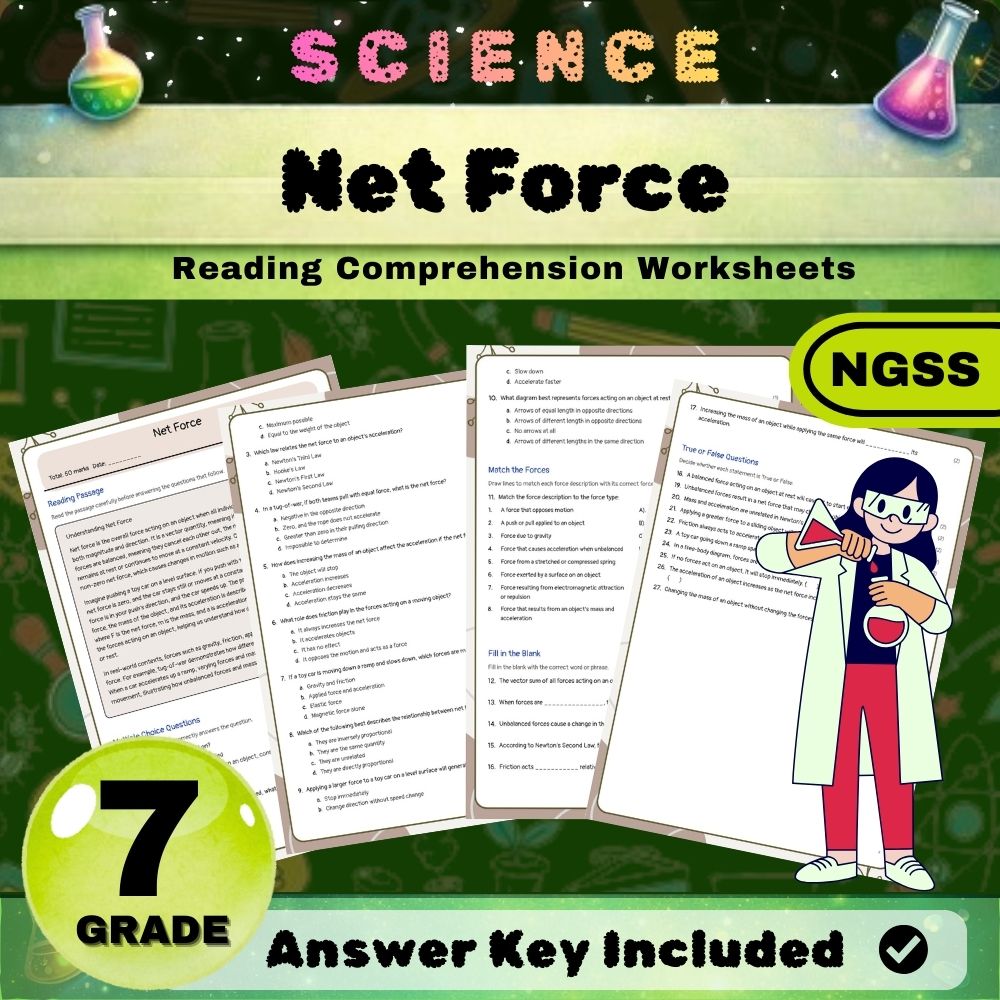
Grade 7 Science | Net Force Worksheet (NGSS-Aligned) – Answer Key PDF
 Created byMaple Path Learning
Learning Objectives
- Define net force as the vector sum of all forces acting on an object.
- Describe how unbalanced forces cause changes in an object's motion.
- Interpret free-button diagrams to analyze forces acting on objects.
Instant download
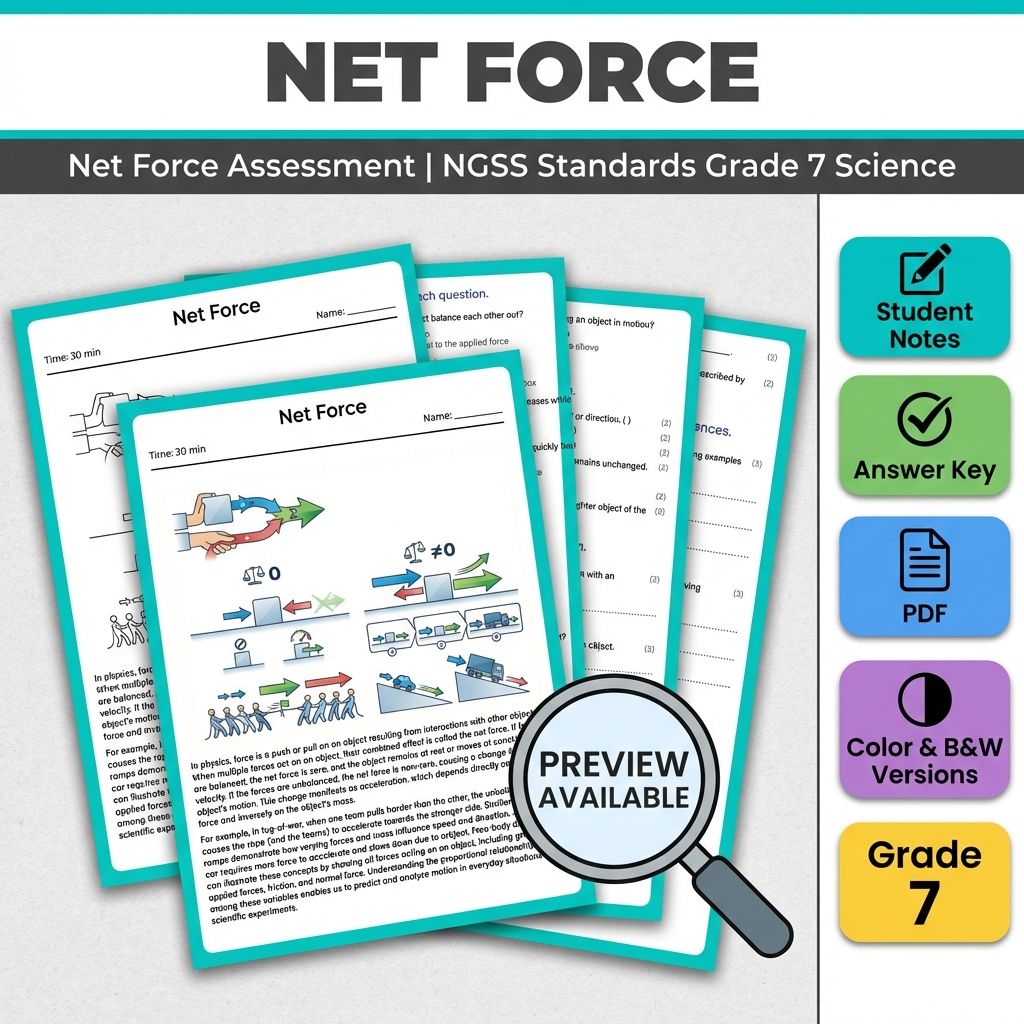
Net Force Assessment | NGSS Standards Grade 7 Science
 Created byPrism Point Learning
Learning Objectives
- Define net force as the vector sum of forces acting on an object.
- Explain how unbalanced forces cause changes in motion using free-body diagrams.
- Relate net force, mass, and acceleration proportionally through quantitative reasoning.
Also included in: Grade 7 Science Mini Bundle – Forces & Interactions NGSS Unit (Printable) +1 more
Instant download
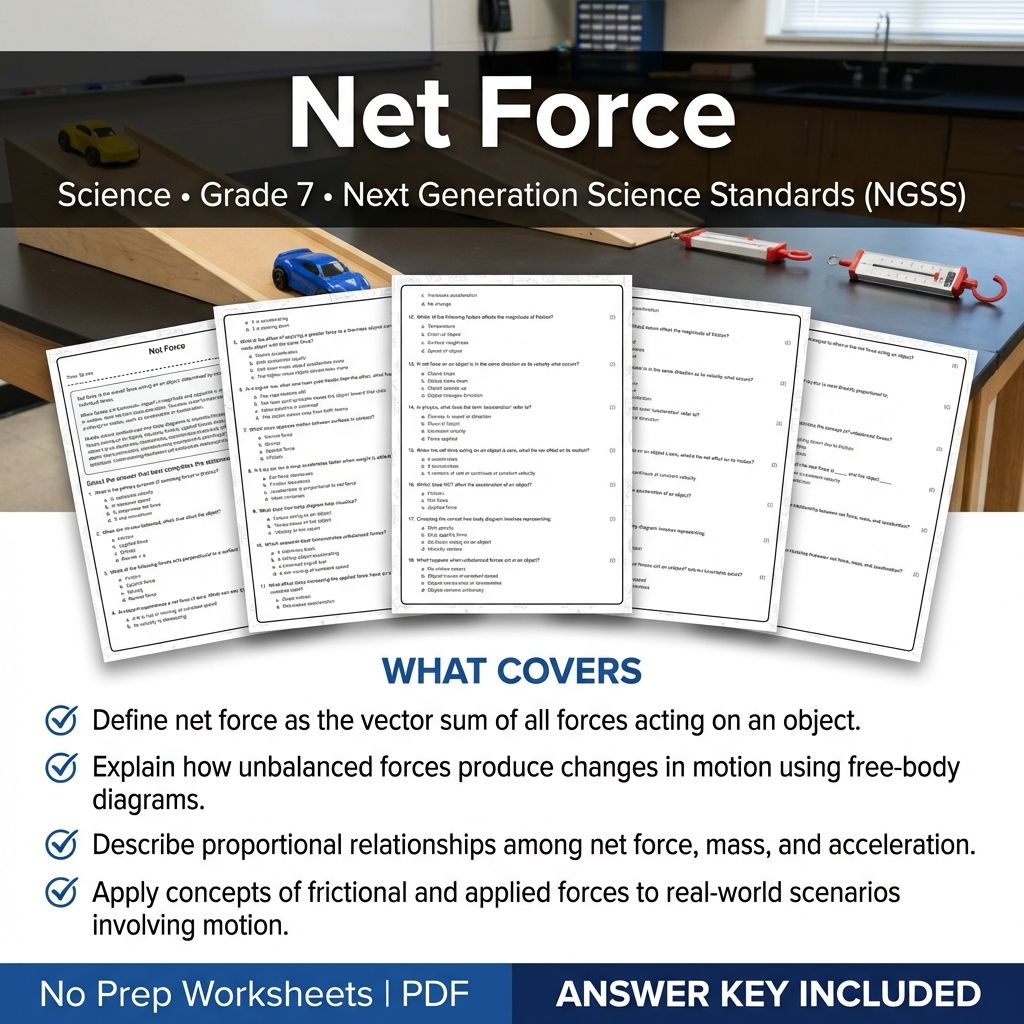
7th Grade Science | Net Force Worksheet & Answer Key (Printable PDF)
Created byCoral Reef LearningLearning Objectives
- Define net force as the vector sum of all forces acting on an object.
- Explain how unbalanced forces produce changes in motion using free-body diagrams.
- Describe proportional relationships among net force, mass, and acceleration.
Instant download

Net Force Worksheet | Grade 7 Science NGSS Forces and Motion Activity
 Created byAmber Owl Education
Learning Objectives
- Define net force as the vector sum of all forces acting on an object and explain the effect of balanced vs. unbalanced forces on motion.
- Use free-body diagrams to identify forces (including applied forces and friction) and determine the direction of the net force.
- Describe how net force relates to acceleration and how mass affects acceleration using proportional reasoning within Grade 7 scope.
Also included in: Grade 7 Science Forces and Motion Lesson Bundle – NGSS Worksheets +1 more
Instant download
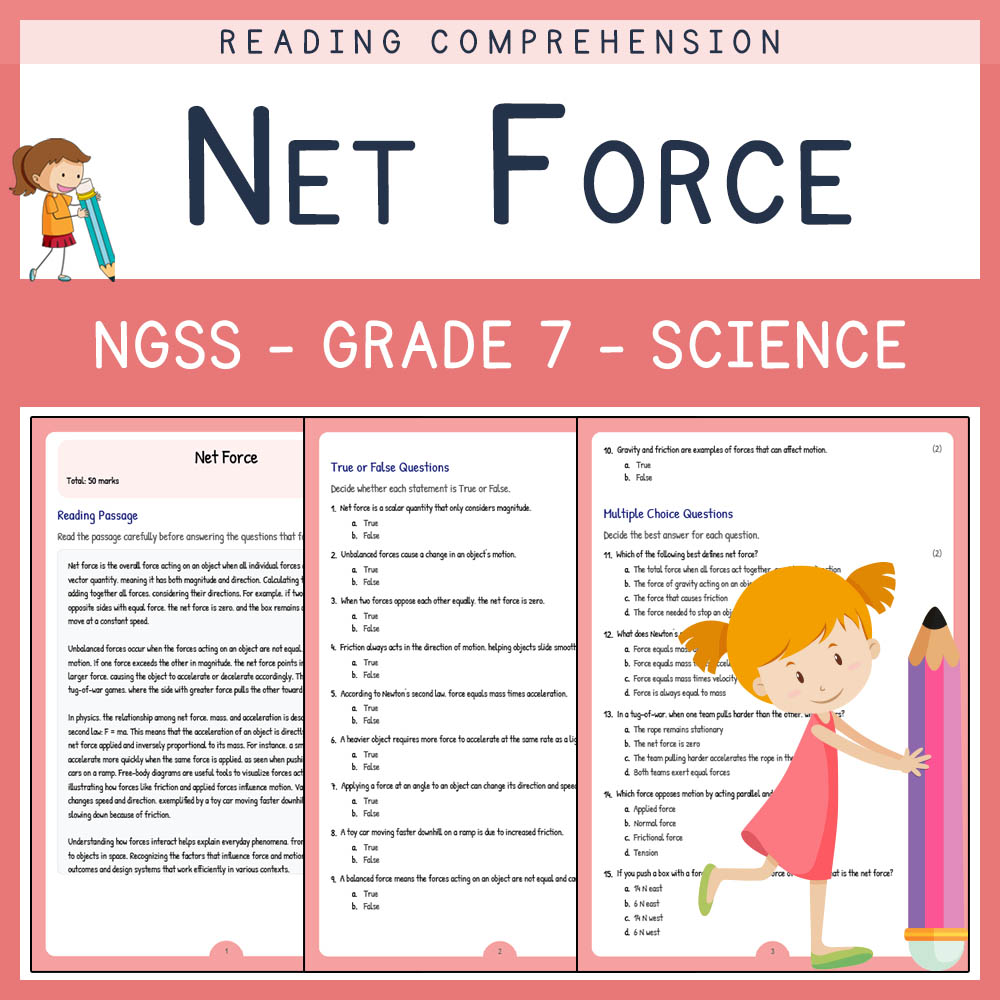
Grade 7 Science | Net Force Worksheet & Answer Key | NGSS Aligned
 Created byLumora Learning
Learning Objectives
- Define net force as the vector sum of all forces acting on an object.
- Explain how unbalanced forces produce changes in an object's motion.
- Understand the relationship between net force, mass, and acceleration using free-body diagrams.
Instant download

Net Force Worksheet | Standards-Aligned Practice for Grade 7 Science
JCreated byJ.S SheetsLearning Objectives
- Define net force as the vector sum of all forces acting on an object.
- Explain how unbalanced forces cause changes in motion using examples like tug-of-war and toy cars.
- Describe the relationship between net force, mass, and acceleration through diagrams and reasoning.
Also included in: Grade 7 Forces and Interactions Science Lesson Bundle: NGSS Practice Set +1 more
Instant download
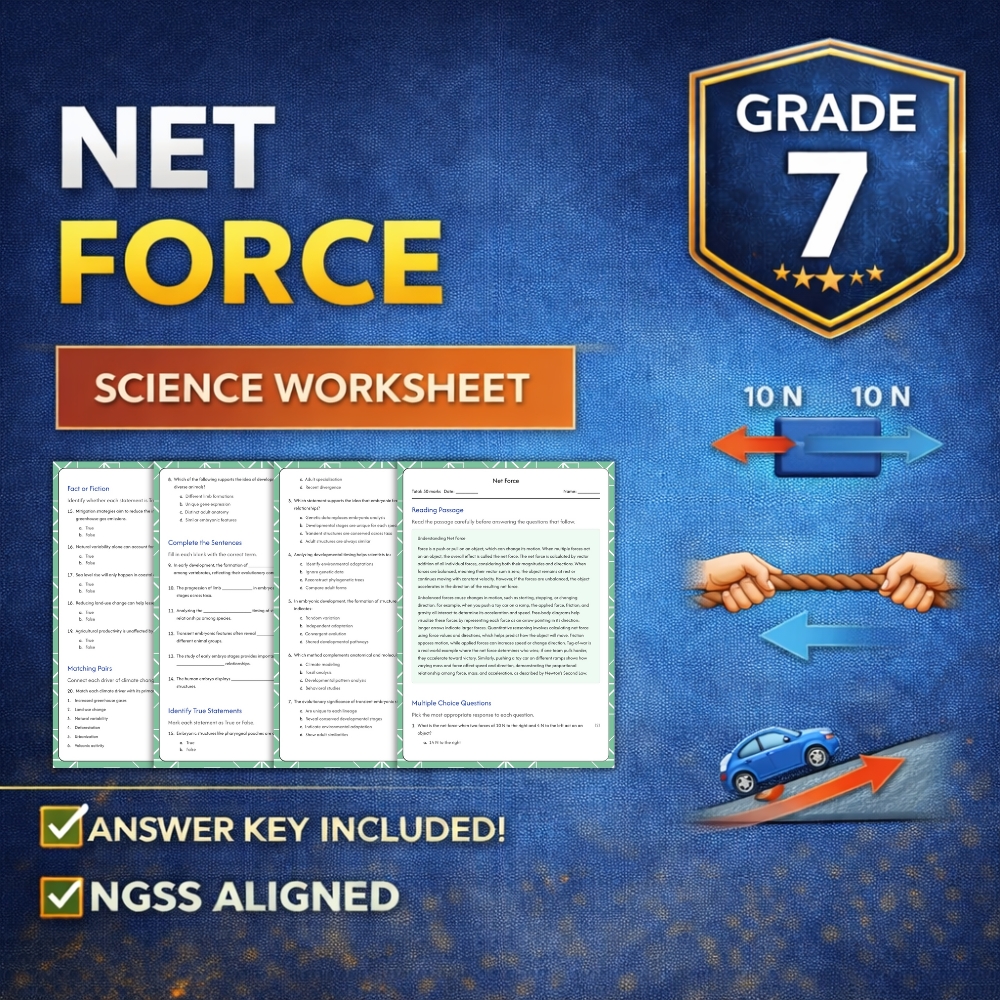
7th Grade Science | Net Force Practice Worksheet (Answer Key Included)
 Created byCedar Grove Learning
Learning Objectives
- Define net force as the vector sum of all forces acting on an object.
- Explain how unbalanced forces cause changes in motion.
- Use free-body diagrams and quantitative reasoning to analyze forces.
Instant download
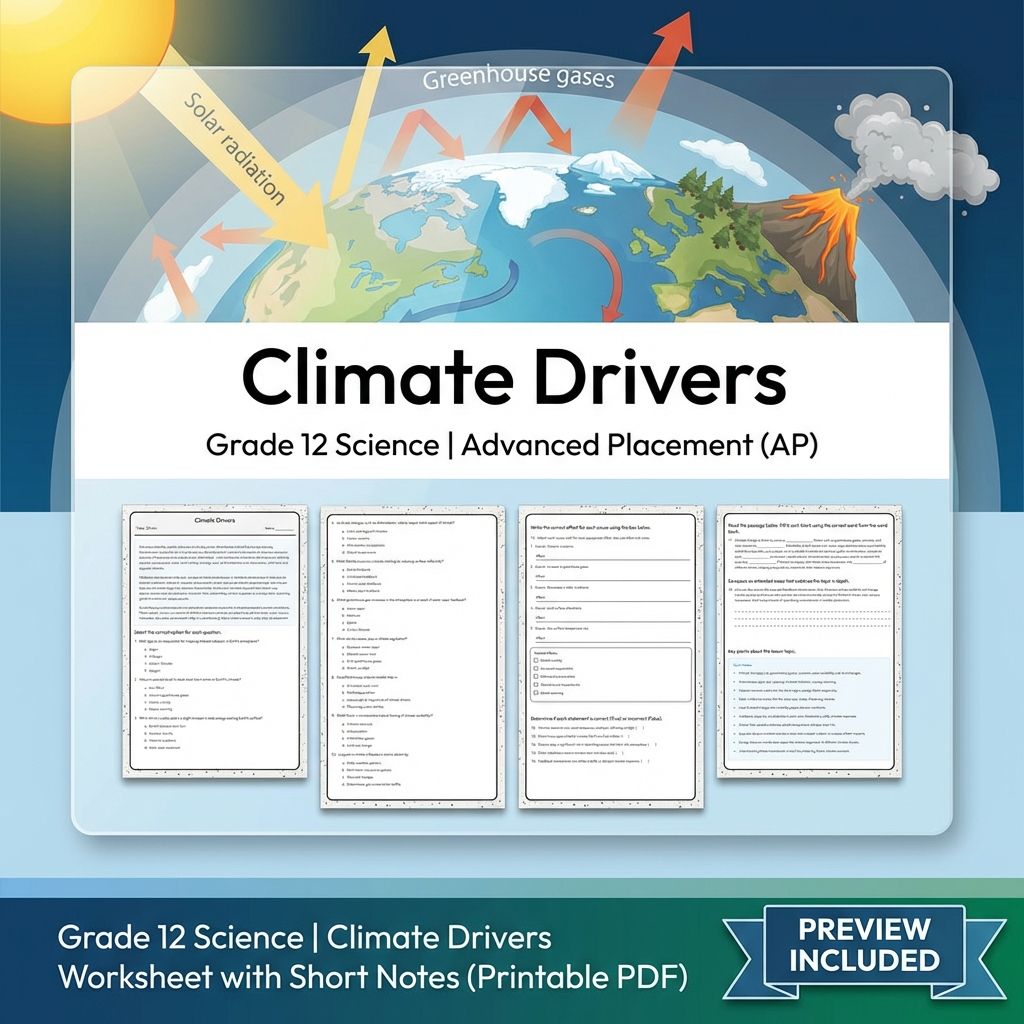
Grade 12 Science | Climate Drivers Worksheet with Short Notes (Printable PDF)
 Created byMeadowlark Worksheets
Learning Objectives
- Understand the main forcings driving climate variability and change.
- Identify different climate forcing mechanisms such as greenhouse gases, volcanic aerosols, and solar irradiance.
- Explain feedback processes like ice-albedo and water vapor feedbacks.
Also included in: Grade 12 Science Unit Bundle: Earth Systems, Climate & Tectonics Worksheet Pack +1 more
Instant download

Climate Drivers Worksheet | Grade 12 AP Science Climate Change Activity
Created byPrism Point LearningLearning Objectives
- Explain how greenhouse gas, volcanic, solar, and land-surface changes affect climate through radiative forcing.
- Use basic energy-balance ideas to compare the relative magnitude and timing of different climate drivers.
- Describe key feedbacks (ice-albedo and water vapor) and how uncertainty is quantified in climate projections.
Instant download

Grade 12 Science – Climate Drivers Greenhouse Gases Daily Worksheet + Answer Key
JCreated byJ.S SheetsLearning Objectives
- Understand key concepts related to Science
- Apply knowledge through practice questions
- Demonstrate comprehension of the material
Also included in: Grade 12 Earth and Space Sciences Lesson Bundle for AP Curriculum +1 more
Instant download
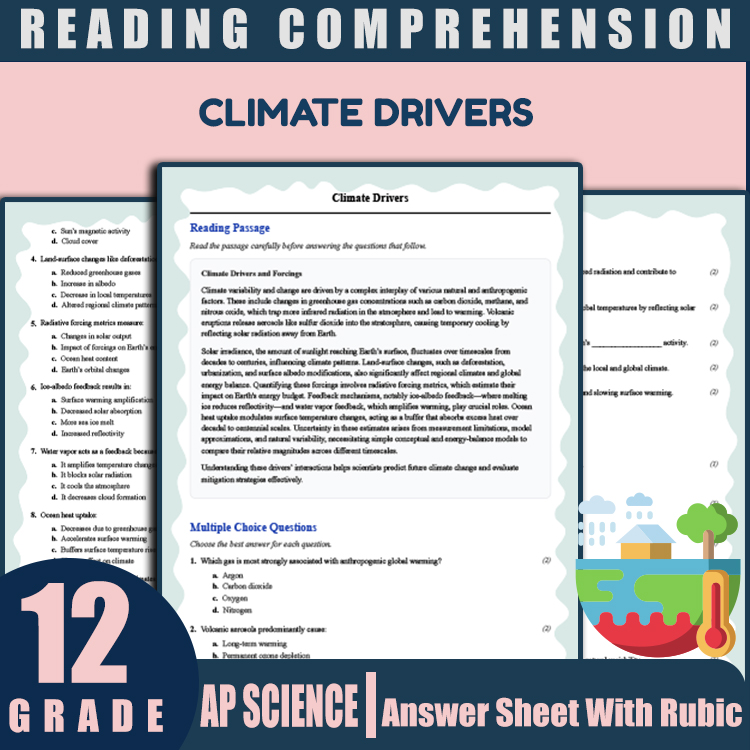
12th Grade Science | Climate Drivers Reading Worksheet (PDF + Answer Key)
JCreated byJ.S SheetsLearning Objectives
- Understand the main forcings that influence climate variability and change.
- Analyze the roles of greenhouse gases, volcanic aerosols, solar irradiance, and land-surface alterations in climate forcing.
- Interpret radiative forcing metrics and feedback mechanisms such as ice-albedo and water vapor effects.
Also included in: Grade 12 Science Unit | Earth Systems & Climate Change Worksheet Bundle (PDF) +1 more
Instant download
Grade 12 Science | Climate Drivers Worksheet (AP Standards) (PDF)
 Created byBright Mind Resources
Learning Objectives
- Identify the main forcings that influence climate variability and change.
- Understand the concepts of radiative forcing and feedback loops such as ice-albedo and water vapor responses.
- Compare the roles of different climate drivers across various timescales using simple models.
Instant download
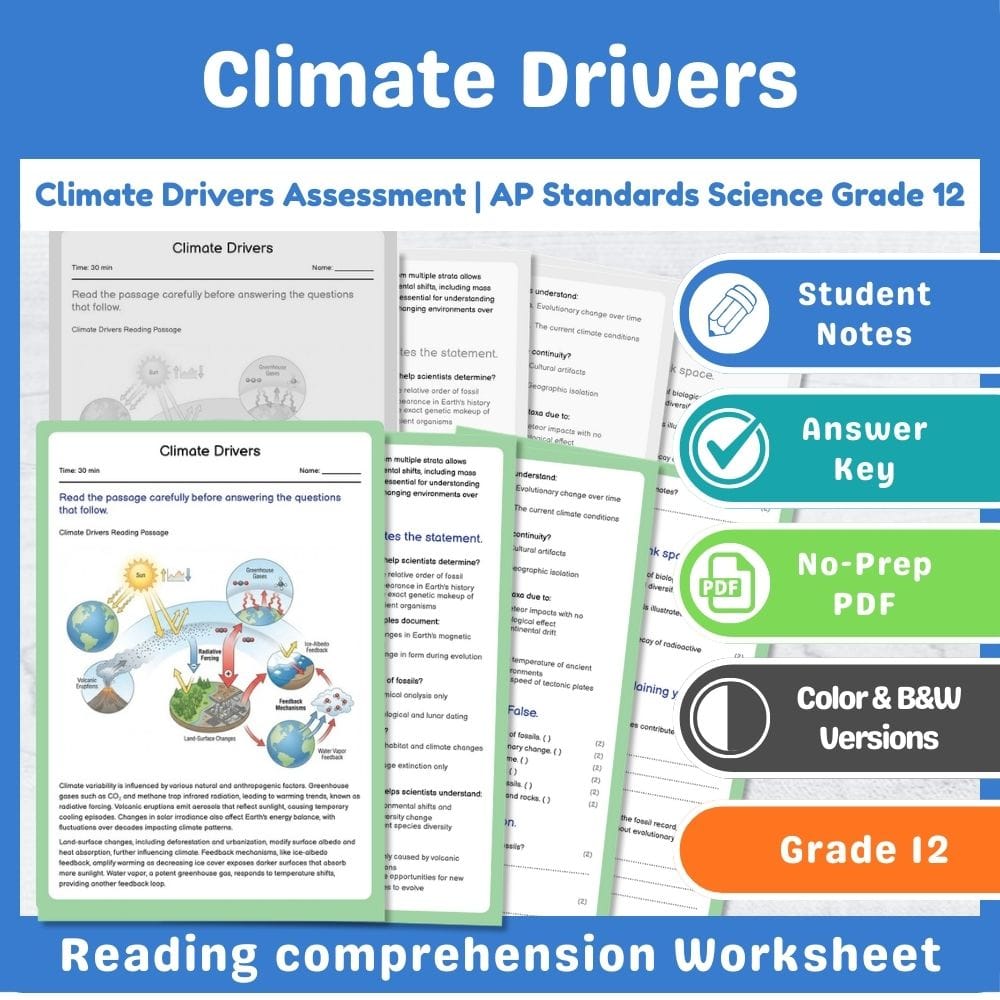
Climate Drivers Assessment | AP Standards Science Grade 12
Created byPrism Point LearningLearning Objectives
- Identify the main forcings that drive climate variability and change.
- Understand radiative forcing metrics and feedback mechanisms.
- Analyze the role of ocean heat uptake and land-surface alterations in climate dynamics.
Instant download

Grade 12 Science | Climate Drivers Worksheet | AP Aligned
Created byLumora LearningLearning Objectives
- Identify the key forcings that influence climate variability and change.
- Explain feedback mechanisms such as ice-albedo and water vapor feedback.
- Understand how radiative forcing metrics quantify climate drivers.
Also included in: Grade 12 Science | Earth Systems Science Custom Bundle | AP Aligned
Instant download

Grade 12 Science — Worksheet MCQ Paper for Climate Drivers
 Created byThe Resource Hub
Learning Objectives
- Understand the key forcings that influence climate variability and change.
- Analyze the roles of greenhouse gases, volcanic aerosols, solar irradiance, and land surface changes in climate forcing.
- Evaluate feedback mechanisms such as ice-albedo and water vapor feedbacks.
Also included in: Grade 12 Science AP Custom Bundle: Earth Systems, Climate, and Tectonics +1 more
Instant download

Grade 12 Climate Drivers Worksheet | Practice & Assessment PDF
Created byClear Sky ClassroomLearning Objectives
- Explain how greenhouse gas concentrations, volcanic aerosols, and solar irradiance changes affect radiative forcing and climate variability.
- Use radiative forcing and simple energy-balance ideas to compare the relative importance of different climate drivers across timescales.
- Describe key feedbacks (ice-albedo and water vapor) and how ocean heat uptake influences observed warming and uncertainty.
Also included in: Grade 12 Earth Systems and Climate Science Bundle – Advanced Placement (AP) +1 more
Instant download
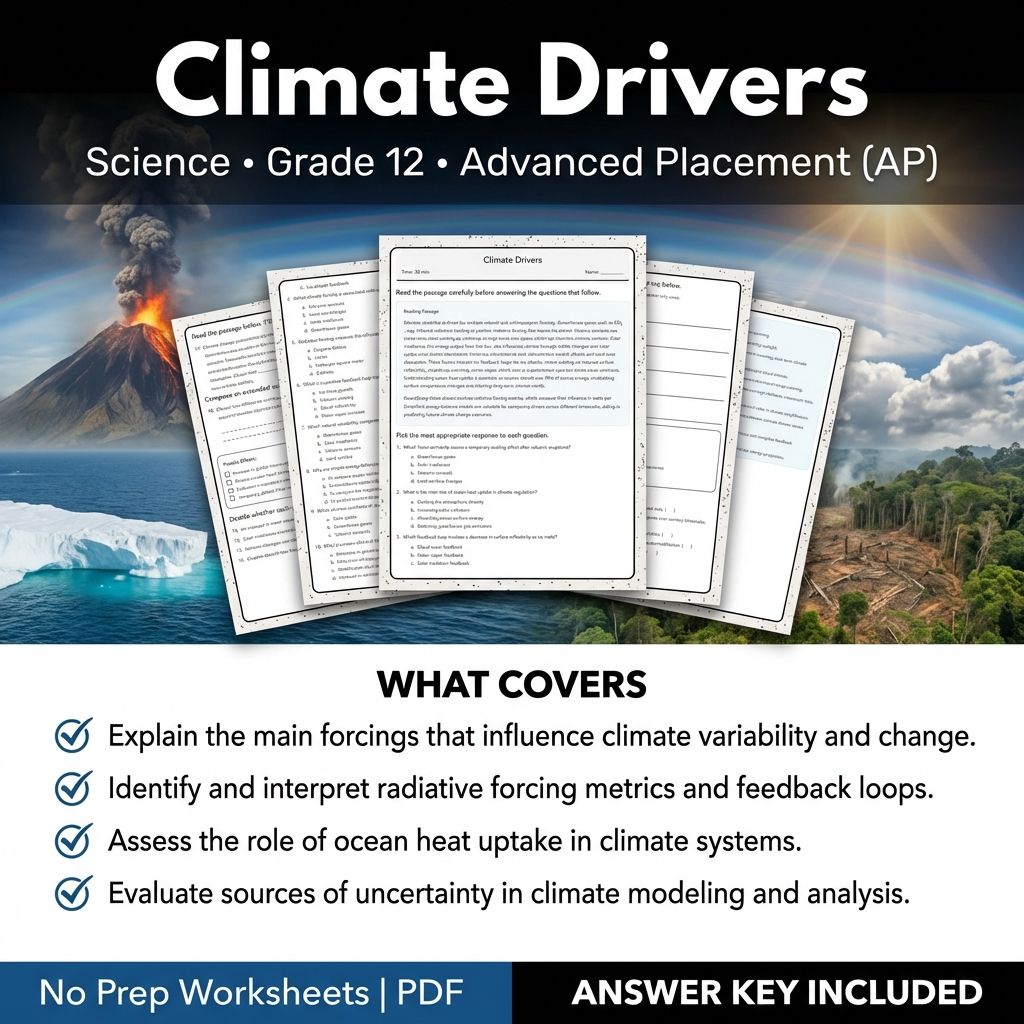
12th Grade Science | Climate Drivers Worksheet & Answer Key (Printable PDF)
Created byCoral Reef LearningLearning Objectives
- Explain the main forcings that influence climate variability and change.
- Identify and interpret radiative forcing metrics and feedback loops.
- Assess the role of ocean heat uptake in climate systems.
Also included in: Grade 12 Science Unit Worksheets Pack | Earth's Systems & Surface Processes +1 more
Instant download

Grade 12 Science | Climate Change Forcing Worksheet (AP Standards)(PDF)
 Created byEvergreen Desk Education
Learning Objectives
- Explain how greenhouse gas concentrations, volcanic aerosols, solar irradiance, and land-surface change contribute to climate variability and long-term change.
- Use radiative forcing concepts to compare the relative influence of different climate drivers and identify key feedback mechanisms.
- Interpret simple conceptual and energy-balance models to reason about ocean heat uptake and uncertainty in climate projections.
Also included in: Grade 12 Earth and Space Sciences Science Lesson Bundle | Advanced Placement (AP) +1 more
Instant download

Climate Drivers Worksheet for Grade 12 Science | AP Standards Practice
JCreated byJ.S SheetsLearning Objectives
- Identify key factors that influence climate variability and change.
- Explain the concepts of radiative forcing and feedback loops in climate science.
- Analyze the roles of greenhouse gases, volcanic aerosols, solar irradiance, and land-surface changes.
Instant download

Ocean–Atmosphere Coupling Worksheet | AP Science Grade 9
JCreated byJ.S SheetsLearning Objectives
- Understand the mechanisms linking oceanic and atmospheric variability, including phenomena like ENSO.
- Analyze how sea surface temperature anomalies influence atmospheric convection and climate patterns.
- Interpret time-series analyses, lag-correlation maps, and energy-budget perspectives related to ocean–atmosphere interactions.
Instant download
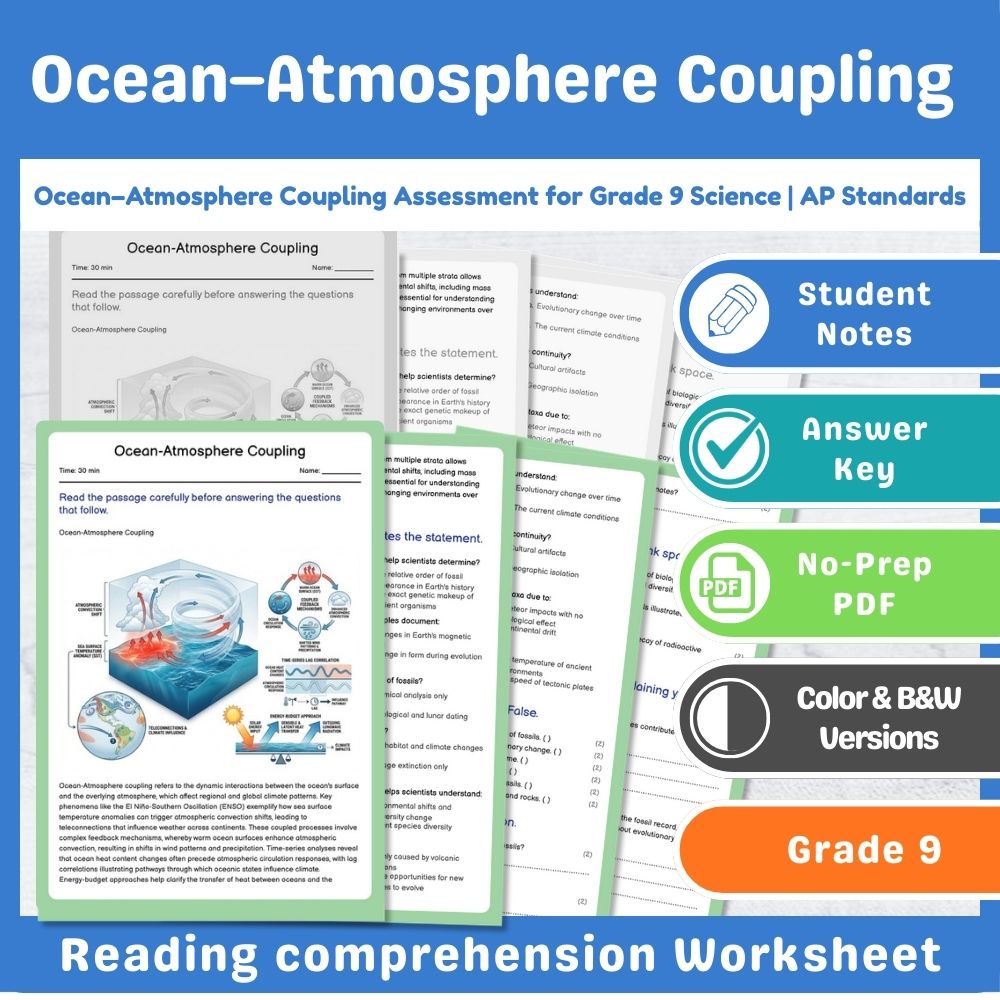
Ocean–Atmosphere Coupling Assessment for Grade 9 Science | AP Standards
Created byPrism Point LearningLearning Objectives
- Explain the processes of ocean–atmosphere interactions and their impact on climate variability.
- Identify phenomena such as ENSO and understand their mechanisms and effects on regional weather patterns.
- Analyze time-series data and interpret lag-correlation maps related to ocean–atmosphere coupling.
Also included in: Grade 9 Science Mini Bundle | Earth and Space Sciences AP Standards
Instant download
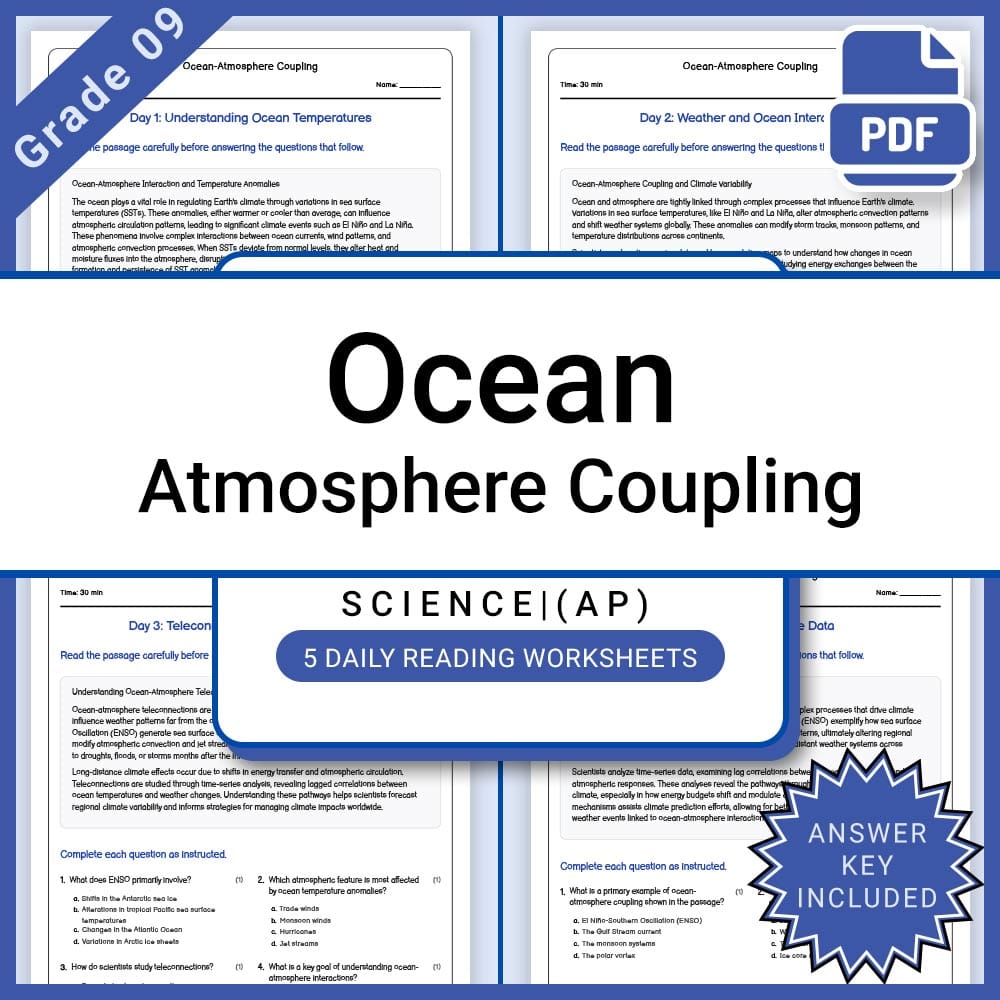
Grade 9 Science – Ocean–Atmosphere Coupling Daily Reading Worksheet + Answer Key
JCreated byJ.S SheetsLearning Objectives
- Understand the mechanisms of sea surface temperature anomalies.
- Identify how oceanic variability influences atmospheric patterns.
- Examine teleconnections and their role in regional climate.
Also included in: Grade 9 Science Lesson Bundle – AP Framework Daily Reading Worksheets +1 more
Instant download

Grade 9 Science – Ocean–Atmosphere Coupling & Climate Study | Reading Worksheet
Created byBright Mind ResourcesLearning Objectives
- Understand the role of sea surface temperature anomalies in climate variability.
- Identify mechanisms by which oceanic changes influence atmospheric circulation.
- Interpret time-series and lag-correlation data related to ocean-atmosphere interactions.
Also included in: Grade 9 Earth Systems Science Daily Reading Worksheets Lesson Bundle | AP +2 more
Instant download
Grade 9 Science | Ocean-Atmosphere Coupling Worksheet (AP Standards) PDF
Created byBright Mind ResourcesLearning Objectives
- Understand the mechanisms linking ocean surface temperatures and atmospheric variability.
- Identify phenomena such as ENSO and their impacts on regional and global climate patterns.
- Describe methods like time-series analysis and lag-correlation to study ocean-atmosphere interactions.
Instant download

Ocean-Atmosphere Coupling Worksheet for Grade 9 AP Science Practice
Created byPrism Point LearningLearning Objectives
- Explain how changes in ocean sea surface temperature and ocean heat content can influence atmospheric convection and circulation.
- Describe how ENSO-related anomalies create teleconnections that affect regional climate patterns.
- Use time-lag and energy-budget reasoning to connect ocean variability to weather and longer-term climate signals.
Also included in: Earth Systems & Climate Evidence Lesson Bundle | Grade 9 Science | AP
Instant download

Grade 9 Science — Worksheet MCQ Paper for Ocean–Atmosphere Coupling
Created byThe Resource HubLearning Objectives
- Understand the mechanisms linking oceanic and atmospheric variability such as ENSO.
- Identify how sea surface temperature anomalies influence atmospheric convection and climate patterns.
- Analyze time-series and lag-correlation data to interpret ocean–atmosphere interactions.
Also included in: Grade 9 Earth and Space Sciences AP Bundle | Science Worksheets and Activities +1 more
Instant download

Grade 9 Ocean–Atmosphere Coupling Worksheet | AP Practice & PDF
Created byClear Sky ClassroomLearning Objectives
- Explain how sea surface temperature (SST) anomalies can influence atmospheric convection and wind patterns
- Describe ENSO-related teleconnections and how they can affect regional climate
- Use energy-budget and lag-correlation ideas to connect ocean heat content to atmospheric circulation responses
Also included in: Grade 9 Earth and Space Sciences Science lesson bundle (AP framework) +1 more
Instant download
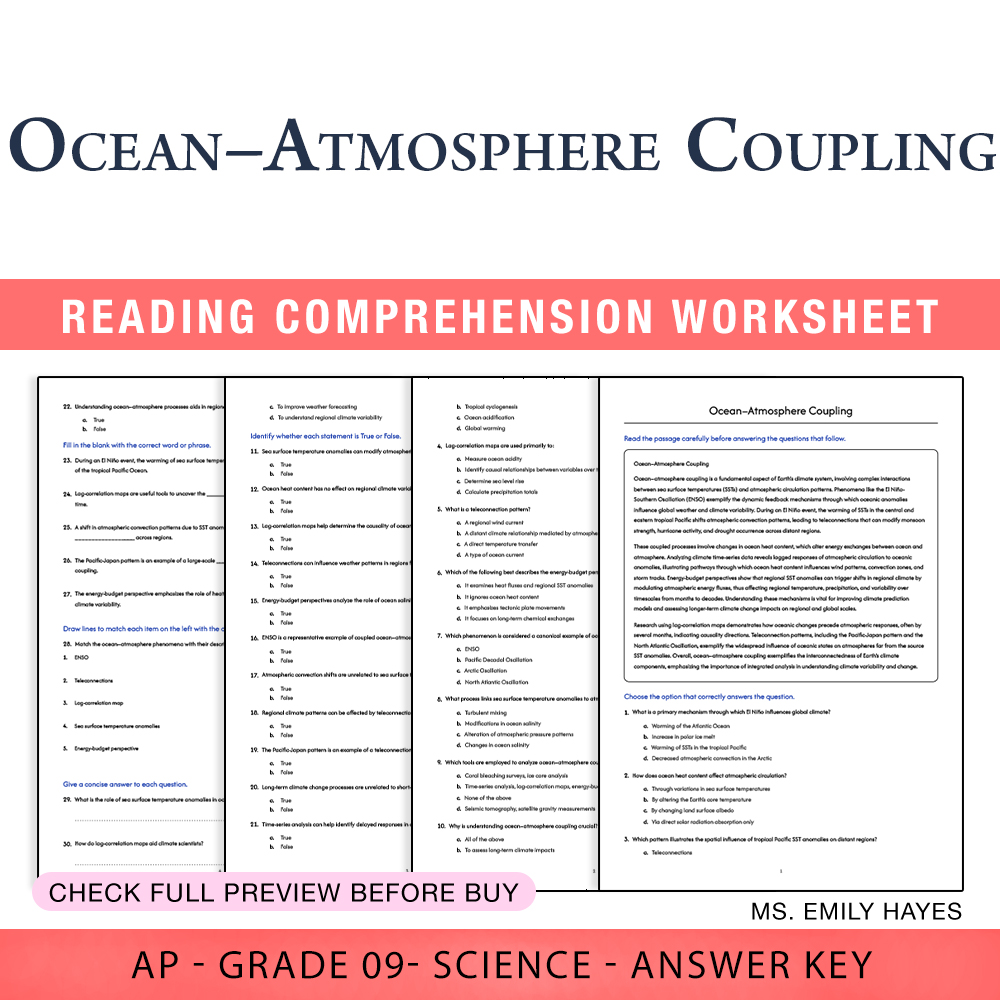
9th Grade Science | Ocean–Atmosphere Coupling Worksheet (PDF+ Answer Key)
Created byCopper Leaf ClassroomLearning Objectives
- Describe the mechanisms linking oceanic and atmospheric variability in climate systems.
- Explain phenomena such as ENSO and how sea surface temperature anomalies influence global weather patterns.
- Analyze time-series data, lag-correlation maps, and energy-budget perspectives related to ocean–atmosphere interactions.
Also included in: Grade 9 Science | Earth and Space Sciences AP Worksheet (PDF + Answer Key) +1 more
Instant download
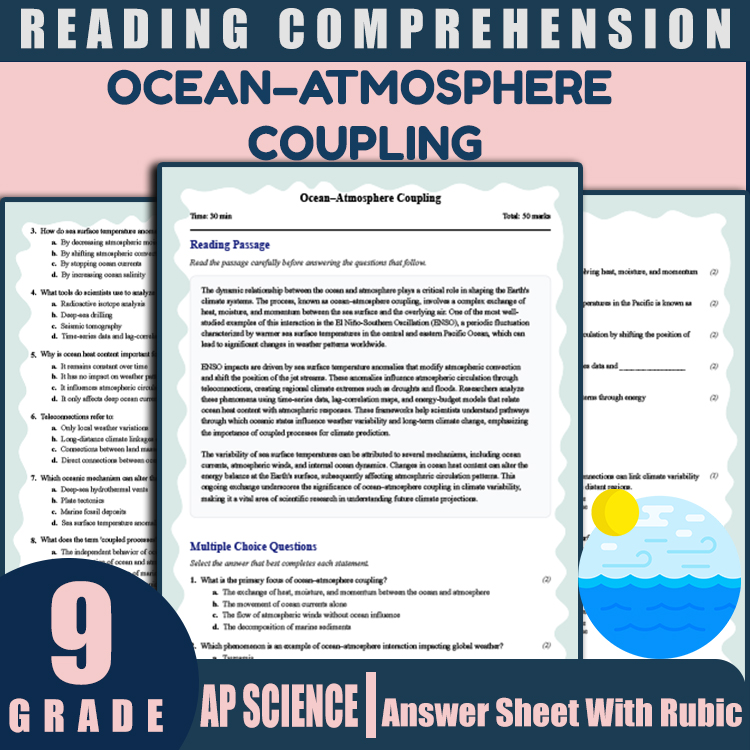
Grade 9 Science | Ocean–Atmosphere Coupling Reading Worksheet (PDF + Answer Key)
JCreated byJ.S SheetsLearning Objectives
- Describe the mechanisms of ocean–atmosphere interactions and their impact on regional climate patterns.
- Explain phenomena such as ENSO and their effects on weather variability.
- Analyze how sea surface temperature anomalies influence atmospheric circulation and teleconnections.
Instant download

Grade 9 Science | Ocean–Atmosphere Coupling | AP Aligned
Created byLumora LearningLearning Objectives
- Understand the mechanisms linking oceanic and atmospheric variability, including phenomena like ENSO.
- Analyze time-series data, lag-correlation maps, and energy-budget perspectives related to ocean–atmosphere interactions.
- Describe how sea surface temperature anomalies influence atmospheric convection and regional climate patterns.
Also included in: Grade 9 Science | Earth and Space Science Custom Bundle | AP Aligned
Instant download
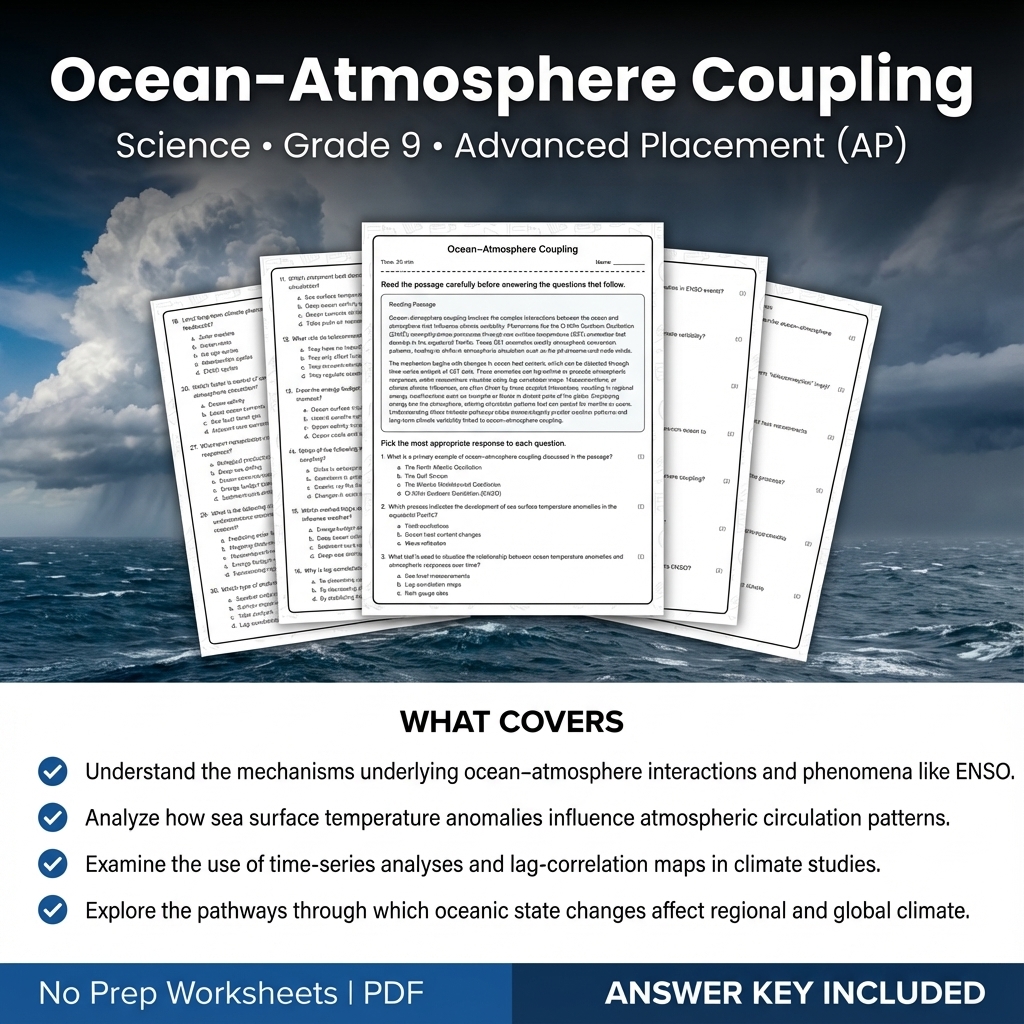
Grade 9 Science | Ocean–Atmosphere Coupling Worksheet (Printable PDF + Answer Key)
Created byCoral Reef LearningLearning Objectives
- Understand the mechanisms underlying ocean–atmosphere interactions and phenomena like ENSO.
- Analyze how sea surface temperature anomalies influence atmospheric circulation patterns.
- Examine the use of time-series analyses and lag-correlation maps in climate studies.
Also included in: Grade 9 Science Unit | Earth Processes & Climate Worksheets Pack (PDF & Answer Keys) +2 more
Instant download

Grade 9 Science | Ocean–Atmosphere Coupling Worksheet (AP Standards) (PDF)
Created byEvergreen Desk EducationLearning Objectives
- Explain how changes in sea surface temperature (SST) can influence atmospheric convection and winds.
- Describe how ENSO works as a canonical example of ocean–atmosphere coupling and why its effects are delayed.
- Use lag-correlation and teleconnection ideas to relate ocean states to regional climate patterns.
Also included in: Earth Systems & Climate Grade 9 Science Lesson Bundle AP Worksheets +1 more
Instant download

Ocean–Atmosphere Coupling Worksheet Pack | Grade 9 AP Science Practice
 Created byBright Quill Resources
Learning Objectives
- Explain how sea surface temperature (SST) anomalies can change atmospheric convection and circulation
- Describe the ENSO mechanism as a canonical example of ocean–atmosphere coupling
- Use ideas from time-series and lag correlation to connect ocean heat content changes to atmospheric responses
Instant download

Grade 9 Science | Ocean–Atmosphere Coupling - Daily Reading Comprehension
Created byCoral Reef LearningLearning Objectives
- Understand the basic mechanisms linking oceanic and atmospheric systems
- Identify phenomena such as ENSO and their impacts on regional climate
- Analyze how sea surface temperature anomalies influence weather patterns
Also included in: Earth and Space Sciences Daily Reading Lesson Bundle – Grade 9 Science AP +1 more
Instant download

Grade 9 Science | Cell Components Worksheet (AP Science 1) PDF
Created byBright Mind ResourcesLearning Objectives
- Identify the major components of a cell and their functions.
- Explain how cell membrane structure influences transport and communication.
- Describe the roles of organelles in cellular metabolism and support.
Instant download

Cell Components Worksheet | AP Science Grade 9 Practice PDF
JCreated byJ.S SheetsLearning Objectives
- Identify the major components of a cell and their functions.
- Explain how structural features like membranes and organelles contribute to cellular processes.
- Analyze the impact of alterations in membrane composition and organelle integrity on cell function.
Also included in: Grade 9 Science | DNA and Ecosystems Lesson Group Bundle
Instant download

Grade 9 Cell Components Worksheet | Practice & Assessment PDF
Created byClear Sky ClassroomLearning Objectives
- Describe how cell membranes and organelles contribute to selective transport and compartmentalized function.
- Explain how the cytoskeleton provides structural support and helps position organelles within the cell.
- Analyze how changes in membrane composition or organelle integrity can affect diffusion, transport rates, and metabolic efficiency.
Also included in: Grade 9 Biology and Ecosystems Science Lesson Bundle for Advanced Placement (AP) +1 more
Instant download

Grade 9 Science – Cell Components Daily Reading Worksheet + Answer Key
JCreated byJ.S SheetsLearning Objectives
- Identify the structure of the cell membrane and its components
- Explain the functions of various organelles within the cell
- Understand how cell structure relates to cell function and transport
Also included in: Grade 9 Science Lesson Bundle | AP Curriculum Worksheets for Key Topics +1 more
Instant download

Grade 9 Science — Cell Components Worksheet for Mastery
Created byThe Resource HubLearning Objectives
- Understand the structural features of cell membranes, organelles, and the cytoskeleton.
- Relate cellular structures to their specific functions such as transport, metabolism, and support.
- Explain how changes in membrane composition or organelle integrity affect cell processes.
Also included in: Grade 9 Science Biology and Ecosystems Lesson Bundle for AP Curriculum +1 more
Instant download

Grade 9 Science – Cell Components & Functions | Daily Reading Worksheet
Created byBright Mind ResourcesLearning Objectives
- Identify major cell organelles and their functions
- Explain how cell structures contribute to cellular activities
- Recognize the importance of membranes, organelles, and cytoskeleton in cell health
Also included in: Grade 9 Daily Reading Science Worksheets Lesson Bundle | AP +2 more
Instant download

Cell Components Worksheet Pack | Grade 9 Science Practice
Created byBright Quill ResourcesLearning Objectives
- Identify major cell components (membranes, organelles, cytoskeleton) and describe how they support cellular functions.
- Explain how compartmentalization affects diffusion, selective transport, and metabolism.
- Analyze how membrane or organelle damage can change diffusion/transport rates and reduce metabolic efficiency.
Instant download
Browse more categories
About Science Worksheets
Find Science worksheets spanning core skills, practice, and review. All 44,980 resources are instant PDF downloads for the classroom or home.
Every worksheet on MyTeachingSheets is created by independent teacher-authors and reviewed before publication. All resources download as printable PDFs for classroom, homework, or at-home practice, and many include answer keys. Preview any worksheet free before buying.