
Science Worksheets
44,980 subject resources
Structural Traits Worksheet Grade 6 Science Florida NGSSS Adaptations
 Created byPrism Point Learning
Learning Objectives
- Explain how structural adaptations help organisms survive in their environments.
- Describe how body structures can support feeding, movement, protection, and camouflage.
- Use evidence from examples to connect traits to habitat and survival needs.
Instant download

Grade 6 Science | Structural Traits in Animals - Daily Reading Comprehension
 Created byCoral Reef Learning
Learning Objectives
- Identify different structural adaptations animals have for protection
- Understand how body parts assist in survival
- Recognize examples of adaptations like shells, webbed feet, and camouflage
Instant download

Wave Behavior Worksheet AP Science Practice and Mastery
JCreated byJ.S SheetsLearning Objectives
- Describe the fundamental properties of waves including wavelength, frequency, amplitude, and phase velocity.
- Explain the principles of superposition, interference, and standing waves in different media.
- Apply mathematical representations and concepts such as sinusoidal functions and phasor reasoning to analyze wave phenomena.
Instant download
Grade 12 Science | Wave Behavior Worksheet (AP Standard) (PDF)
 Created byBright Mind Resources
Learning Objectives
- Understand and describe the key properties of waves such as wavelength, frequency, amplitude, and phase velocity.
- Apply principles of superposition and interference to wave phenomena.
- Analyze standing wave formation and boundary conditions in strings and air columns.
Instant download
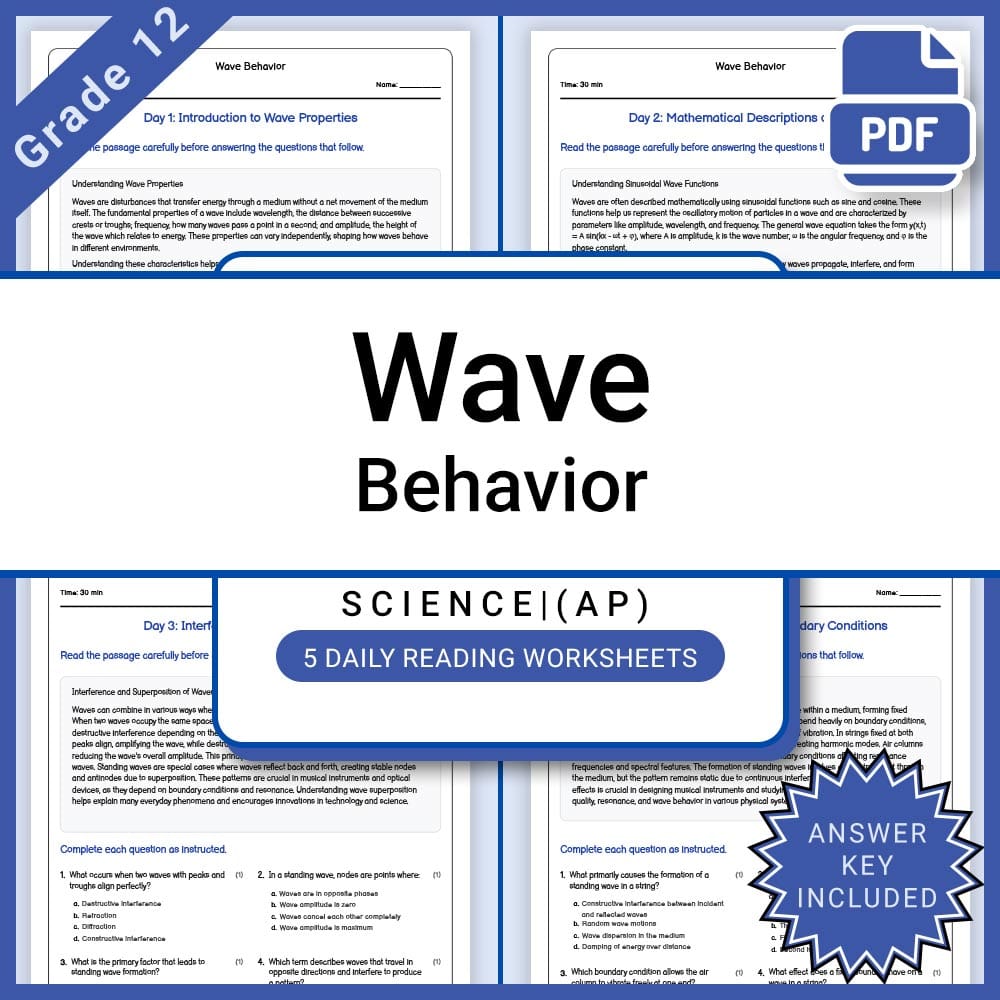
Grade 12 Science – Wave Behavior Daily Reading Worksheet + Answer Key
JCreated byJ.S SheetsLearning Objectives
- Identify basic wave characteristics such as wavelength, frequency, and amplitude
- Understand the principles of superposition, interference, and standing waves
- Represent sinusoidal waves mathematically and conceptually
Also included in: Grade 12 Physics Principles Lesson Bundle – AP Science Curriculum +1 more
Instant download

Wave Behavior Practice Worksheet Pack AP Physics Grade 12 Waves
Created byPrism Point LearningLearning Objectives
- Describe periodic wave motion using amplitude, wavelength, frequency, and phase relationships.
- Use the superposition principle to predict interference patterns for waves on strings and in air.
- Explain standing-wave formation with boundary conditions and relate mode structure to resonance frequencies.
Also included in: AP Physics Grade 12 Science Mechanics & Electricity Lesson Bundle | AP
Instant download
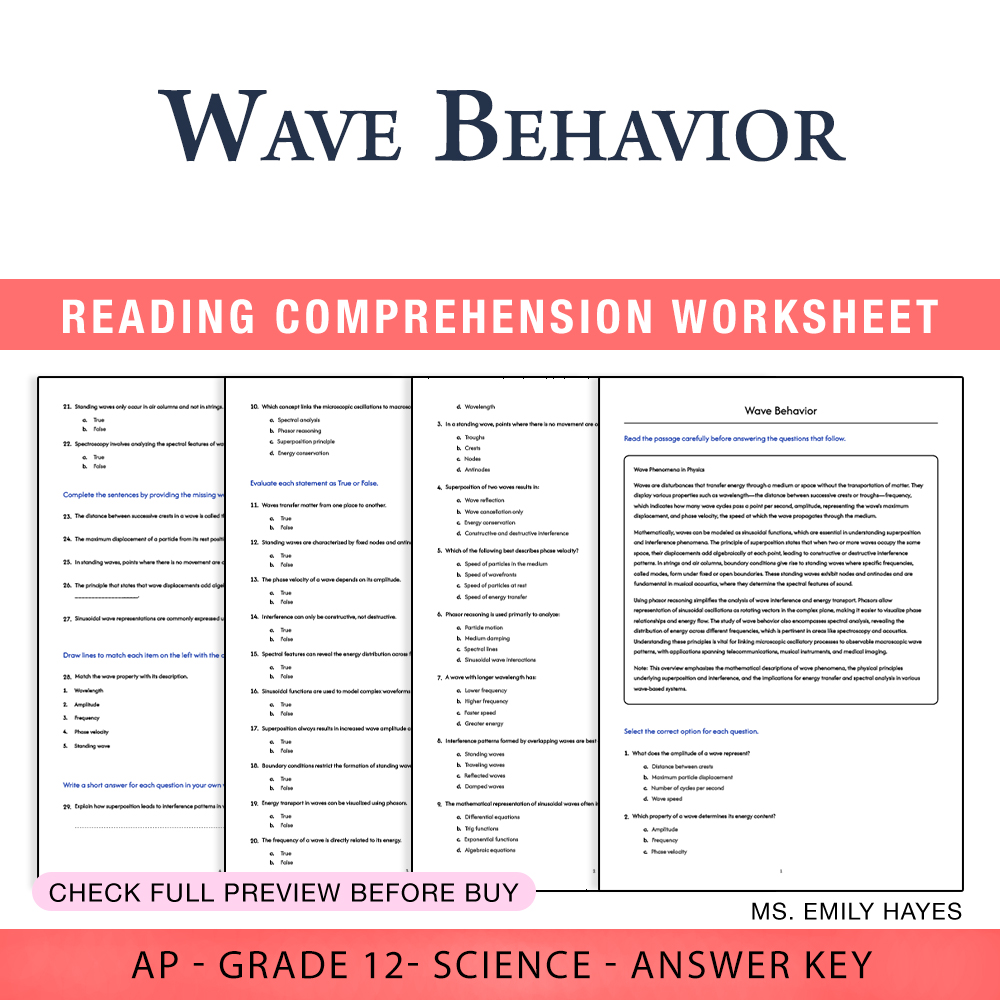
Grade 12 Science | Wave Behavior Worksheet (PDF+ Answer Key)
 Created byCopper Leaf Classroom
Learning Objectives
- Understand the fundamental properties of waves, including wavelength, frequency, phase velocity, and amplitude.
- Explain the principles of superposition and interference in wave phenomena.
- Analyze standing wave formation, boundary conditions, and mode structures in strings and air columns.
Also included in: Grade 12 Science AP – Energy, Motion & Electricity Mastery(PDF+ Answer Key) +1 more
Instant download

Grade 12 Wave Behavior Worksheet | Practice & NGSS PDF
 Created byClear Sky Classroom
Learning Objectives
- Characterize sinusoidal wave behavior using wavelength, frequency, amplitude, and phase.
- Apply superposition and interference principles to predict resulting displacement patterns.
- Use boundary conditions to determine standing-wave modes in strings and air columns.
Also included in: Grade 12 Physics Science Lesson Bundle: Motion, Energy (Advanced Placement (AP)) +1 more
Instant download

Grade 12 Science | Wave Behavior - Daily Reading Comprehension
Created byCoral Reef LearningLearning Objectives
- Identify basic wave characteristics such as wavelength, frequency, amplitude, and phase velocity.
- Understand the principles of superposition, interference, and standing waves.
- Apply sinusoidal models and phasor reasoning to wave phenomena.
Also included in: Daily Reading Comprehension Skills Lesson Bundle | Grade 12 Science AP +1 more
Instant download

Grade 12 Science – Wave Behavior & Properties | Daily Reading Worksheet
Created byBright Mind ResourcesLearning Objectives
- Identify different types of waves and their basic properties
- Understand the concept of wave displacement, wavelength, frequency, and amplitude
- Describe wave superposition, interference, and standing waves
Also included in: AP Science Grade 12 Daily Reading Worksheets Lesson Bundle | AP +2 more
Instant download

Grade 12 Science | Wave Behavior Worksheet | AP Aligned
 Created byLumora Learning
Learning Objectives
- Describe wave phenomena using mathematical descriptions such as wavelength, frequency, phase velocity, and amplitude.
- Explain the principles of superposition, interference, and standing waves in strings and air columns.
- Apply sinusoidal representations, phasor reasoning, and energy transport concepts to analyze wave patterns.
Instant download

Grade 8 TEKS Biodiversity Conservation Science Reading Worksheet
 Created byBRIGHT PATH RESOURCES
Learning Objectives
- Identify the main idea of a passage about biodiversity conservation and explain supporting details.
- Describe how biodiversity helps ecosystems function.
- Distinguish between genetic, species, and ecosystem diversity using evidence from a text.
Also included in: Grade 8 Organisms & Environments Science Reading Worksheets Bundle | TEKS +1 more
Instant download

Biodiversity Conservation Worksheet | Grade 8 Science TEKS-Aligned
Created byPrism Point LearningLearning Objectives
- Explain how genetic, species, and ecosystem diversity support ecosystem functions and services.
- Describe conservation strategies such as habitat connectivity, protected areas, and restoration and how they affect biodiversity outcomes.
- Evaluate trade-offs and adaptive management decisions using real-world examples.
Also included in: Grade 8 Ecosystems & Cellular Processes Science Lesson Bundle TEKS +1 more
Instant download
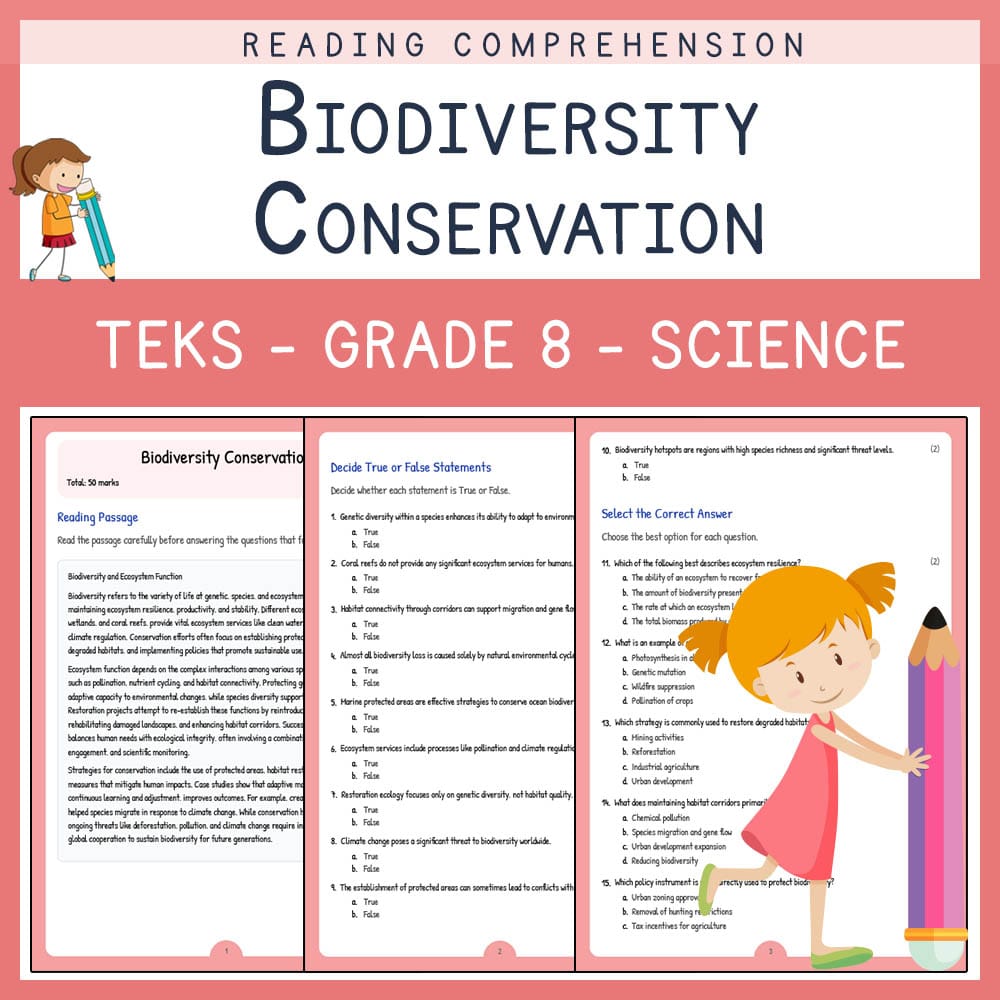
Grade 8 Science | Biodiversity Conservation Worksheet | TEKS Aligned
Created byLumora LearningLearning Objectives
- Understand the concept of biodiversity and its measurement.
- Identify ecological functions and ecosystem services.
- Evaluate strategies for species and habitat conservation.
Also included in: Grade 8 Science | Organisms and Environments Unit Bundle | TEKS Aligned
Instant download

Grade 8 Science Worksheet | Biodiversity Conservation TEKS (PDF)
 Created byEvergreen Desk Education
Learning Objectives
- Explain how biodiversity at genetic, species, and ecosystem levels supports ecosystem function and stability.
- Describe ways to measure biodiversity and evaluate ecosystem services linked to living systems.
- Compare conservation strategies, including habitat connectivity and protected areas, and predict possible trade-offs.
Instant download

Grade 8 Science – Biodiversity & Conservation | Daily Reading Worksheet
Created byBright Mind ResourcesLearning Objectives
- Understand the concept of biodiversity and its importance in ecosystems.
- Identify different levels of biodiversity: genetic, species, and ecosystem.
- Recognize basic conservation strategies and challenges.
Also included in: Grade 8 Ecosystems & Cells Science Daily Reading Lesson Bundle | TEKS +2 more
Instant download

8th Grade Science | Biodiversity Conservation Worksheet (PDF+ Answer Key)
Created byCopper Leaf ClassroomLearning Objectives
- Understand the key concepts of species diversity, ecosystem function, and conservation strategies.
- Learn how to measure biodiversity and assess ecosystem services.
- Explore principles of habitat connectivity, protected areas, and policy influences on conservation.
Instant download
8th Grade Science – Biodiversity Conservation Worksheet for Mastery | PDF + Answer Key
 Created byThe Resource Hub
Learning Objectives
- Understand the different levels and measurement of biodiversity in ecosystems.
- Identify key strategies used in conserving species, genetic, and ecosystem diversity.
- Evaluate the role of protected areas, habitat connectivity, and policy in biodiversity conservation.
Also included in: Grade 8 Science Unit | Ecosystems, Evolution & Cell Processes Worksheet Pack +1 more
Instant download

8th Grade Science Biodiversity Conservation Worksheet with Short Notes ( PDF)
 Created byMeadowlark Worksheets
Learning Objectives
- Understand the concept of biodiversity and its importance in ecosystem health.
- Identify different strategies and policies utilized for biodiversity conservation.
- Analyze case examples of restoration and management processes.
Instant download

Biodiversity Conservation Assessment for Grade 8 Science TEKS
Created byPrism Point LearningLearning Objectives
- Understand the components of biodiversity at genetic, species, and ecosystem levels.
- Evaluate restoration strategies and their trade-offs in conservation.
- Analyze ecosystem services and factors influencing conservation outcomes.
Instant download

Grade 8 Science Worksheet on Biodiversity Conservation
JCreated byJ.S SheetsLearning Objectives
- Explain biodiversity at genetic, species, and ecosystem levels and how each level contributes to ecosystem function.
- Describe how scientists measure biodiversity and use biodiversity to evaluate ecosystem services.
- Apply conservation strategies (protected areas, habitat connectivity, and restoration) to real-world scenarios.
Instant download

Grade 8 Science | Biodiversity Conservation - Daily Reading Comprehension
Created byCoral Reef LearningLearning Objectives
- Identify different types of biodiversity—genetic, species, and ecosystem-level.
- Explain why biodiversity is vital for ecosystem health and human well-being.
- Recognize conservation strategies and their roles in protecting biodiversity.
Instant download

8th Grade Science | Biodiversity Conservation Reading (PDF & Answer Key)
JCreated byJ.S SheetsLearning Objectives
- Understand the key concepts of biodiversity at genetic, species, and ecosystem levels.
- Describe how ecosystems provide services and benefits to humans.
- Analyze different conservation strategies and management practices.
Instant download
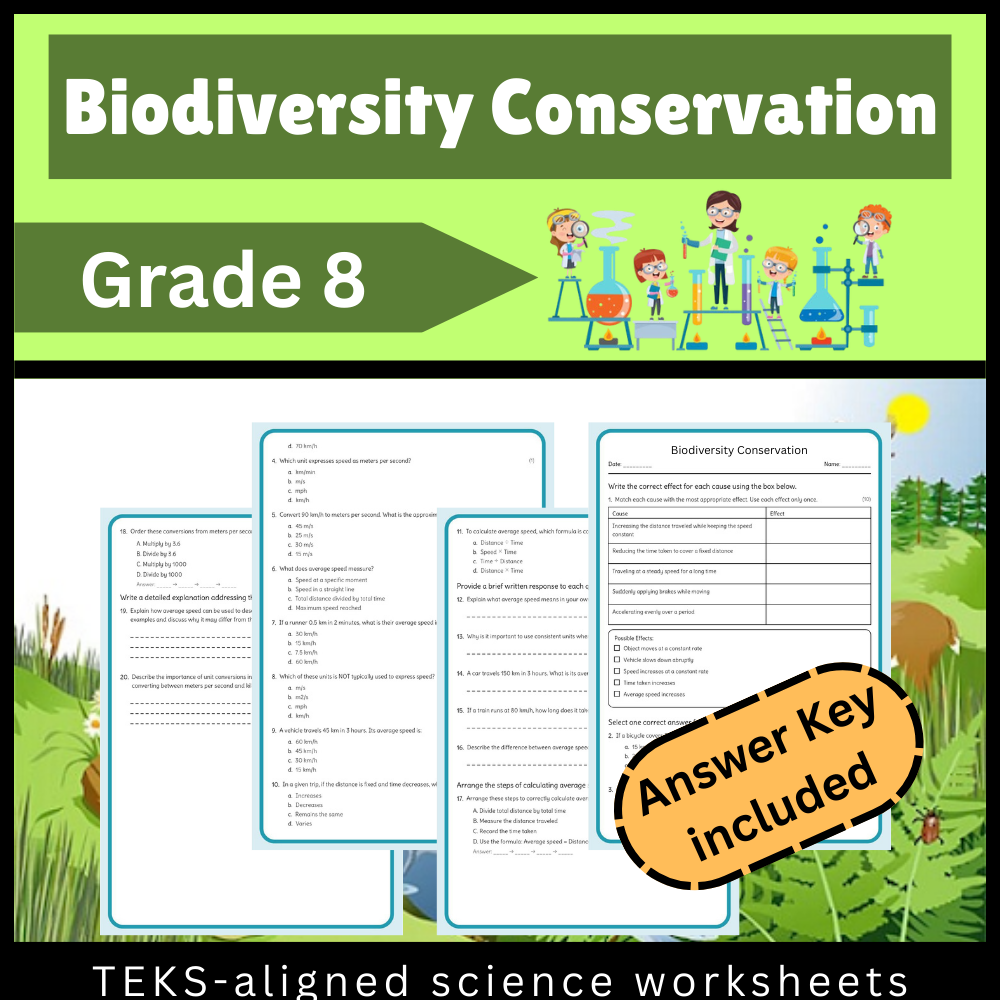
Grade 8 Science | Biodiversity Conservation Worksheet (Answer Key) – TEKS Aligned
Created byBright Mind ResourcesLearning Objectives
- Understand the importance of species diversity, ecosystem function, and conservation strategies.
- Identify measurement methods of biodiversity and analyze ecosystem services.
- Evaluate various conservation and restoration strategies and their trade-offs.
Also included in: Grade 8 Science Unit Bundle | Ecosystems,Evolution & Cell Processes TEKS Aligned +1 more
Instant download

Grade 8 Science – Biodiversity Conservation Daily Reading Worksheet + Answer Key
JCreated byJ.S SheetsLearning Objectives
- Understand the different levels of biodiversity: genetic, species, and ecosystem.
- Recognize the importance of biodiversity for ecosystem function and services.
- Identify conservation strategies and their roles in maintaining biodiversity.
Also included in: Grade 8 Science Lesson Bundle – TEKS-aligned Reading Worksheets +1 more
Instant download

Grade 12 Science | Criteria & Constraints in Engineering Design - Daily Reading
Created byCoral Reef LearningLearning Objectives
- Understand the concept of criteria and constraints in engineering
- Identify societal needs and how they influence engineering solutions
- Recognize measurable limits such as cost, safety, and environmental boundaries
Instant download

Grade 12 Science – Criteria & Constraints in Engineering | Reading Worksheet
Created byBright Mind ResourcesLearning Objectives
- Define what constraints are in engineering design.
- Identify various types of engineering constraints in real-world problems.
- Explain the importance of criteria in guiding engineering solutions.
Also included in: Grade 12 Systems & Eng. Science Daily Rd Lesson Bundle | California Standards +1 more
Instant download

Criteria Constraints Worksheet | Standards-Aligned Science Practice for Grade 12
JCreated byJ.S SheetsLearning Objectives
- Understand how societal needs are translated into measurable criteria and constraints for engineering solutions.
- Identify key qualitative and quantitative criteria such as cost, safety, energy use, and environmental boundaries.
- Analyze examples of criteria application in real-world engineering challenges like water access during droughts.
Also included in: Grade 12 Systems Thinking Trade-Offs Science Lesson Bundle +1 more
Instant download

Grade 12 Science Criteria and Constraints Worksheet CA Standards
Created byPrism Point LearningLearning Objectives
- Translate a real-world engineering challenge into clear qualitative and quantitative criteria and measurable constraints.
- Connect societal needs and wants to specific limits such as cost, reliability, safety, energy use, and environmental impact.
- Evaluate design trade-offs by interpreting criteria, constraints, and regulatory or resource boundaries.
Instant download

Grade 12 Science | Criteria Constraints Worksheet Elena | California Standards
Created byLumora LearningLearning Objectives
- Understand how societal needs are translated into measurable criteria and constraints in engineering solutions.
- Identify key qualitative and quantitative criteria used in designing solutions for global challenges.
- Analyze the importance of balancing societal needs with environmental, safety, and cost constraints.
Instant download

Grade 12 Science Worksheet Bundle | California Standards Biology Practice & Critical Thinking
Created byEvergreen Desk EducationLearning Objectives
- Explain how societal needs become engineering criteria and how constraints limit solutions.
- Identify qualitative and quantitative criteria used to evaluate an engineering design.
- Use measurable targets and limits to justify design decisions and trade-offs.
Instant download

Net Force Worksheet | Standards-Aligned Practice for Grade 7 Science
JCreated byJ.S SheetsLearning Objectives
- Define net force as the vector sum of all forces acting on an object.
- Explain how unbalanced forces cause changes in motion using examples like tug-of-war and toy cars.
- Describe the relationship between net force, mass, and acceleration through diagrams and reasoning.
Also included in: Grade 7 Forces and Interactions Science Lesson Bundle: NGSS Practice Set +1 more
Instant download
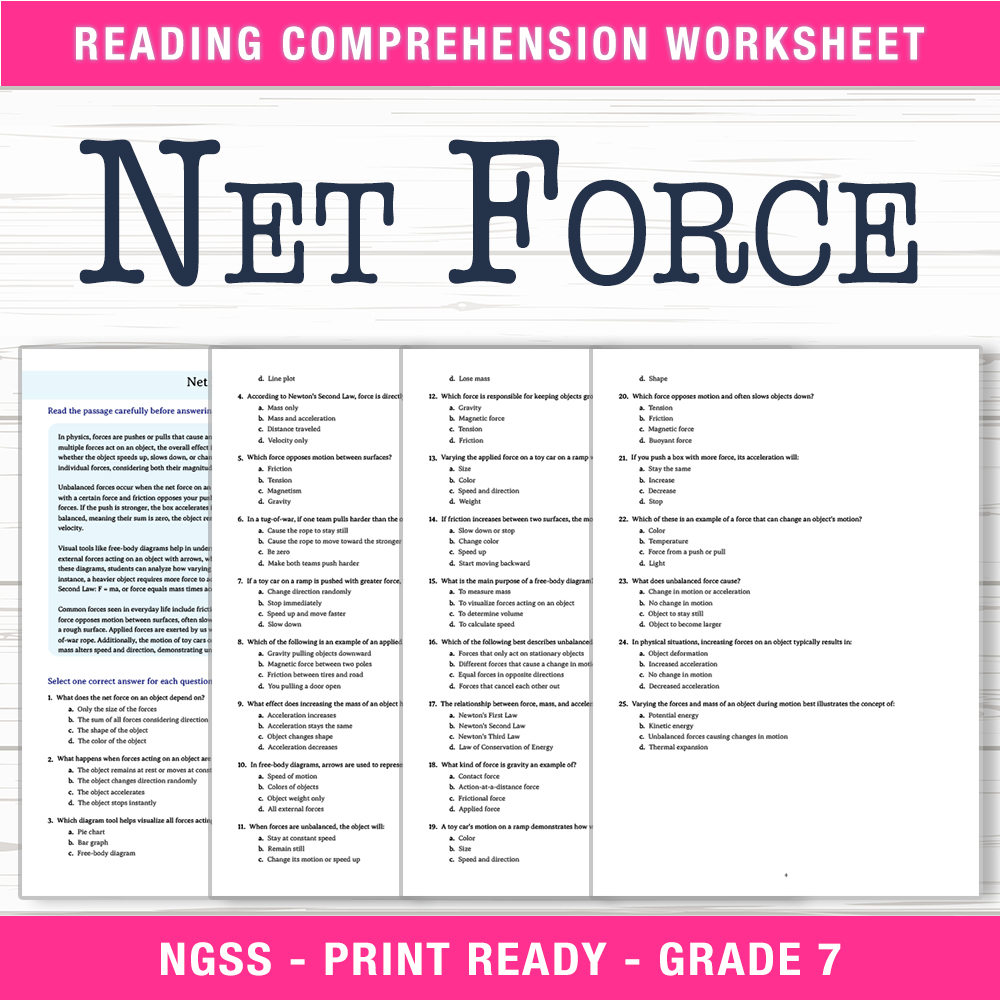
Grade 7 Science | Net Force Worksheet (PDF + Answer Key)
 Created byRiverstone Classroom
Learning Objectives
- Define net force as the vector sum of all forces acting on an object.
- Explain how unbalanced forces cause changes in an object's motion.
- Describe the relationship among net force, mass, and acceleration using diagrams and reasoning.
Instant download
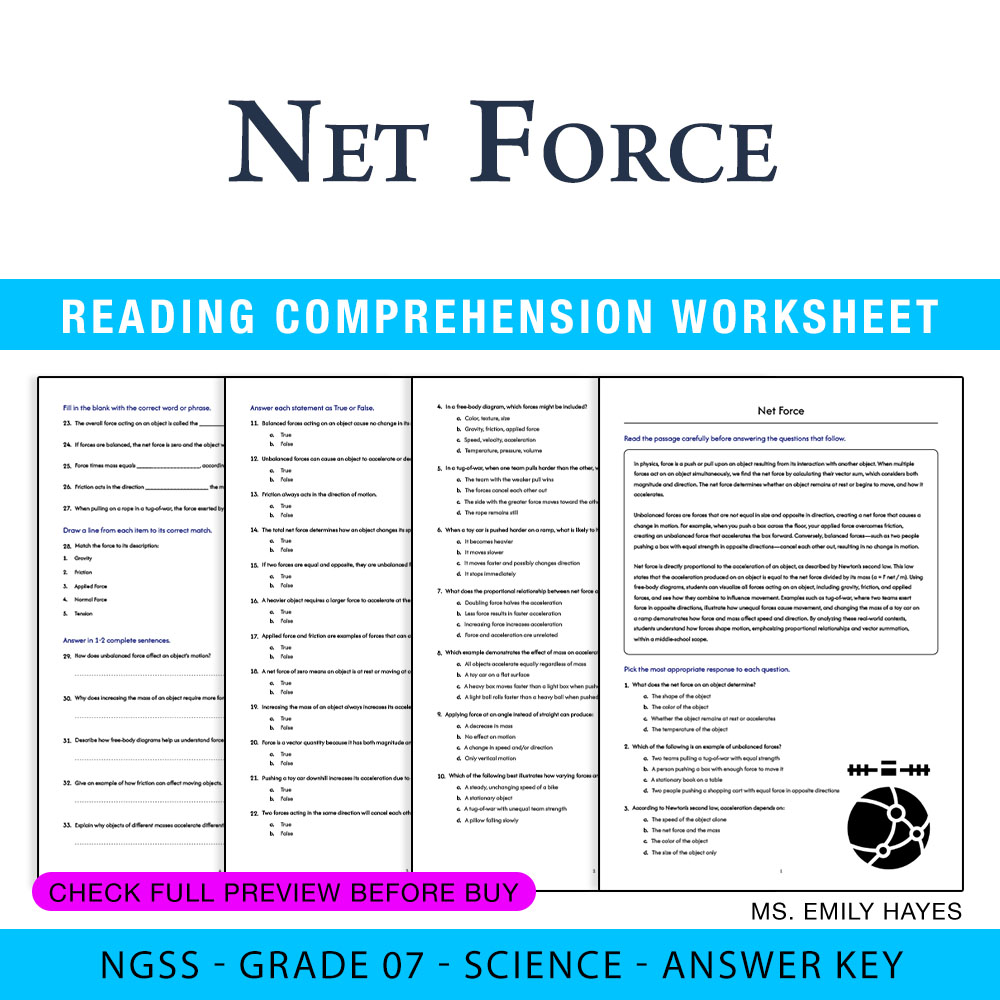
7th Grade Science | Net Force Worksheet (PDF+ Answer Key)
Created byCopper Leaf ClassroomLearning Objectives
- Define net force as the vector sum of all forces acting on an object.
- Describe how unbalanced forces produce changes in motion.
- Explain the relationship among net force, mass, and acceleration using diagrams and reasoning.
Instant download

Science Worksheet: Net Force and Motion Assessment | NGSS Grade 7 Science
 Created bySkylark Worksheets
Learning Objectives
- Define net force as the vector sum of all forces acting on an object.
- Explain how unbalanced forces change an object’s motion (speed and/or direction).
- Use quantitative reasoning with proportional relationships between net force, mass, and acceleration.
Also included in: Grade 7 Forces & Motion Science Lesson Bundle: NGSS Worksheets +1 more
Instant download
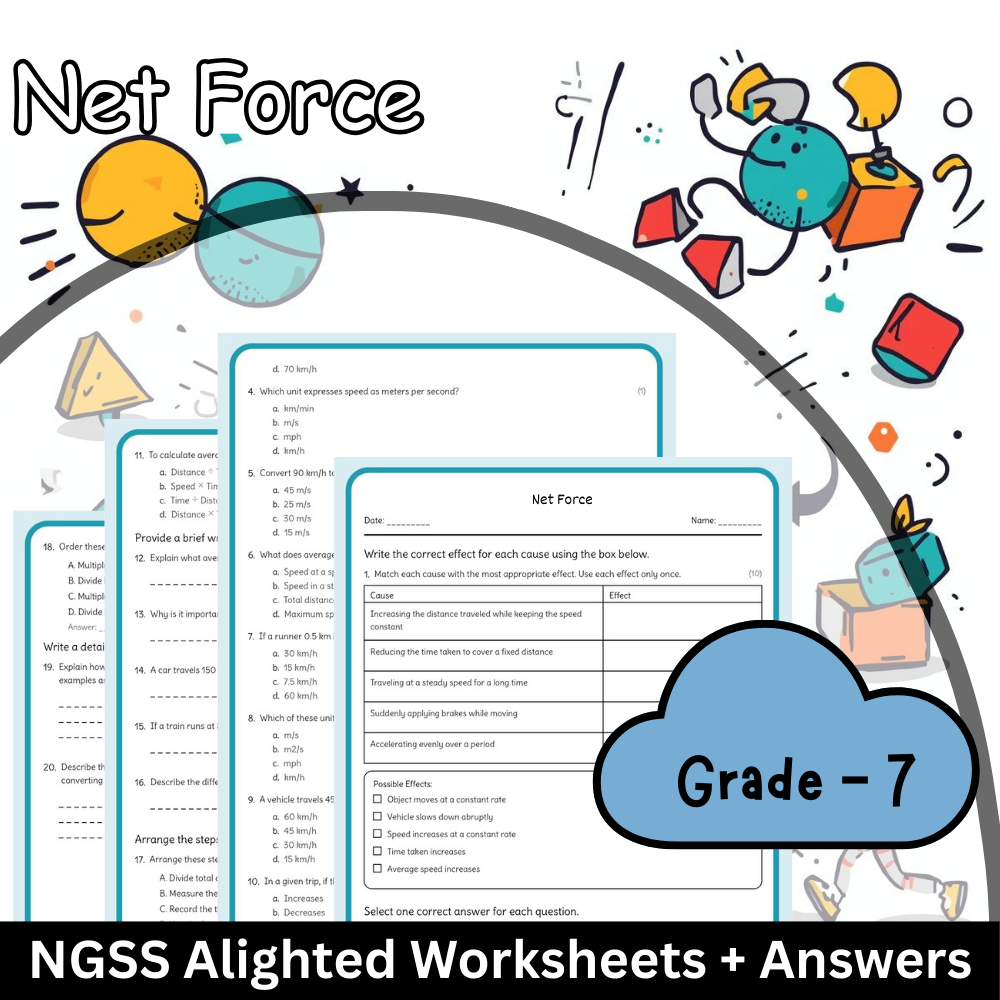
7th Grade Science | Net Force Worksheet (Worksheet + Answer Key) – NGSS Aligned
Created byBright Mind ResourcesLearning Objectives
- Define net force as the vector sum of all forces acting on an object.
- Explain how unbalanced forces can change an object's motion.
- Describe the relationship between net force, mass, and acceleration through examples and diagrams.
Instant download
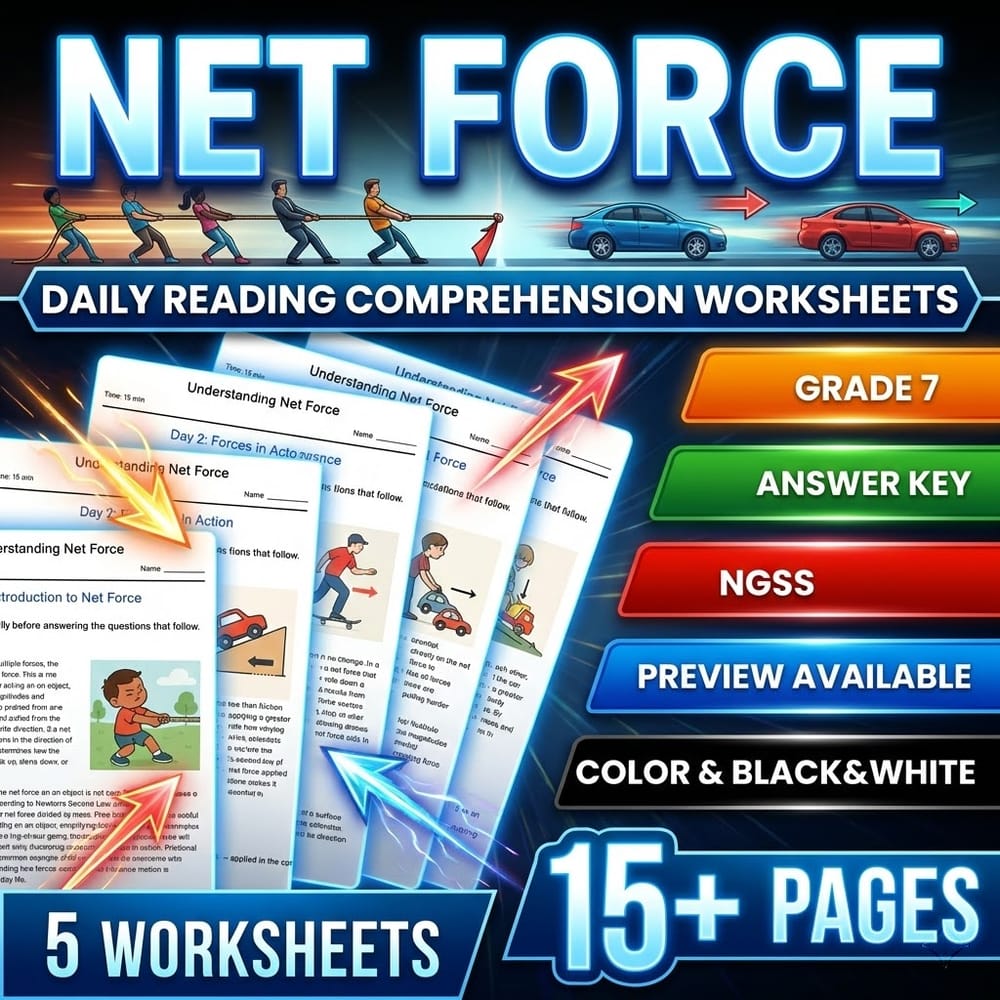
Grade 7 Science – Understanding Net Force | Daily Reading Worksheet
 Created byElena Brooks
Learning Objectives
- Define net force as the vector sum of all forces acting on an object.
- Explain how unbalanced forces cause changes in motion.
- Use free-body diagrams to visualize forces.
Also included in: Force and Motion Grade 7 Science Daily Reading Worksheets Bundle | NGSS +1 more
Instant download

Net Force and Motion Changes Worksheets for Grade 7 Science NGSS
 Created byTeachers Club
Learning Objectives
- Define net force as the vector sum of forces acting on an object
- Identify balanced and unbalanced forces using free-body diagrams
- Explain how force and mass relate to acceleration
Also included in: Grade 7 Science Worksheets NGSS Forces and Motion Bundle +2 more
Instant download
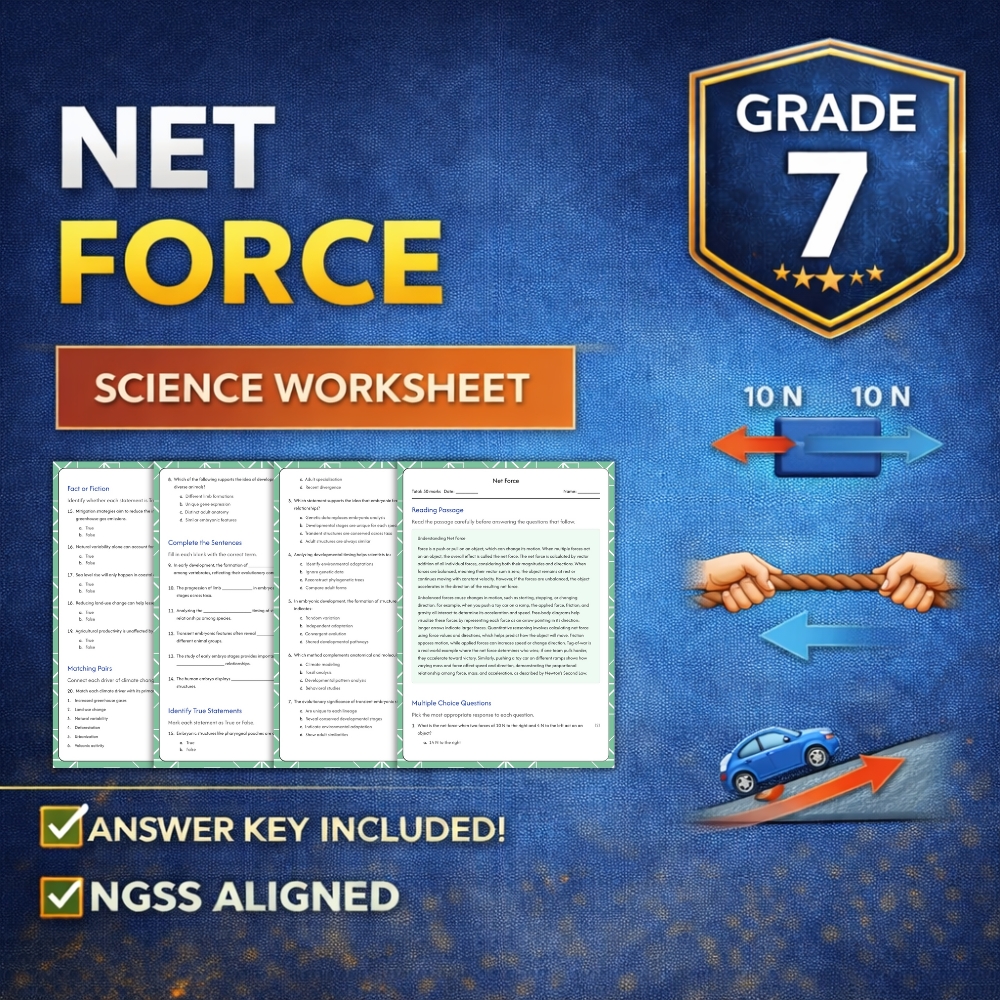
7th Grade Science | Net Force Practice Worksheet (Answer Key Included)
 Created byCedar Grove Learning
Learning Objectives
- Define net force as the vector sum of all forces acting on an object.
- Explain how unbalanced forces cause changes in motion.
- Use free-body diagrams and quantitative reasoning to analyze forces.
Instant download

Net Force Worksheet | Grade 7 Science NGSS Forces and Motion Activity
 Created byAmber Owl Education
Learning Objectives
- Define net force as the vector sum of all forces acting on an object and explain the effect of balanced vs. unbalanced forces on motion.
- Use free-body diagrams to identify forces (including applied forces and friction) and determine the direction of the net force.
- Describe how net force relates to acceleration and how mass affects acceleration using proportional reasoning within Grade 7 scope.
Also included in: Grade 7 Science Forces and Motion Lesson Bundle – NGSS Worksheets +1 more
Instant download
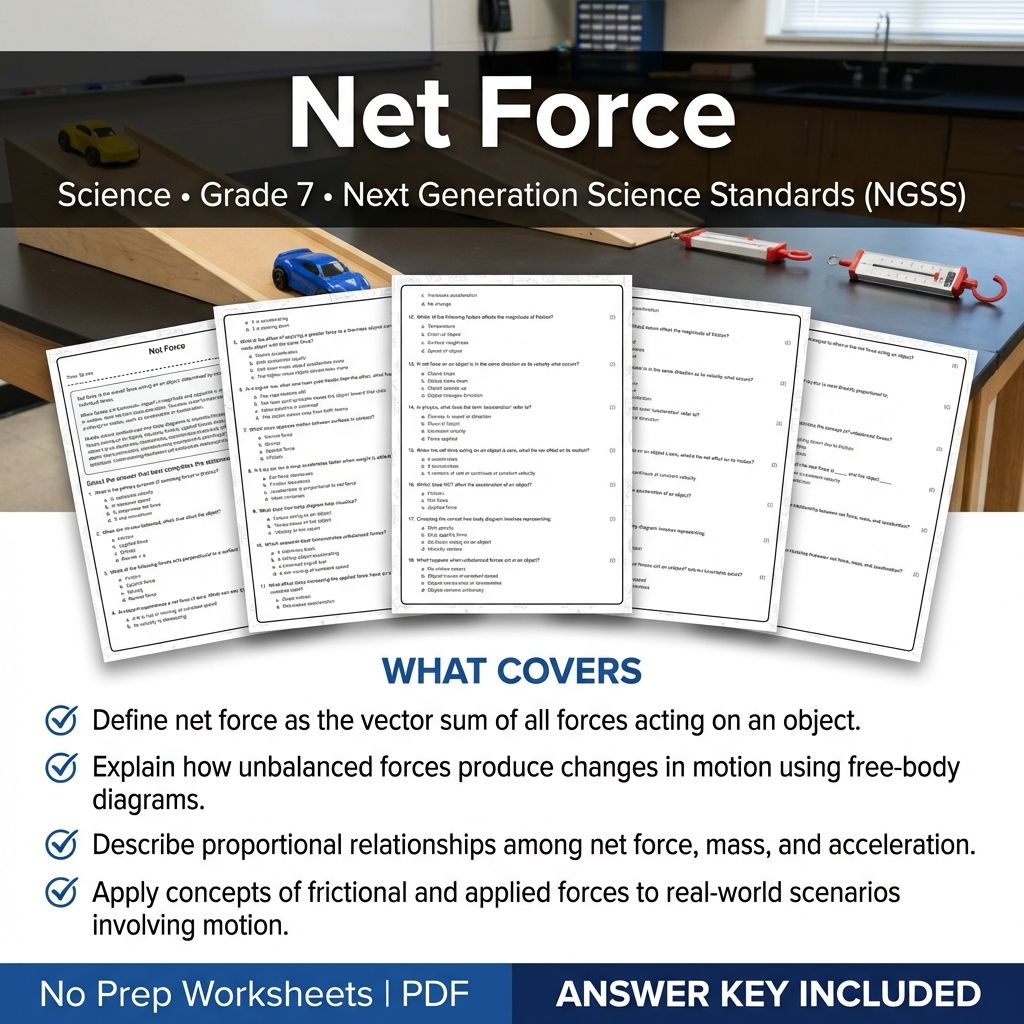
7th Grade Science | Net Force Worksheet & Answer Key (Printable PDF)
Created byCoral Reef LearningLearning Objectives
- Define net force as the vector sum of all forces acting on an object.
- Explain how unbalanced forces produce changes in motion using free-body diagrams.
- Describe proportional relationships among net force, mass, and acceleration.
Instant download
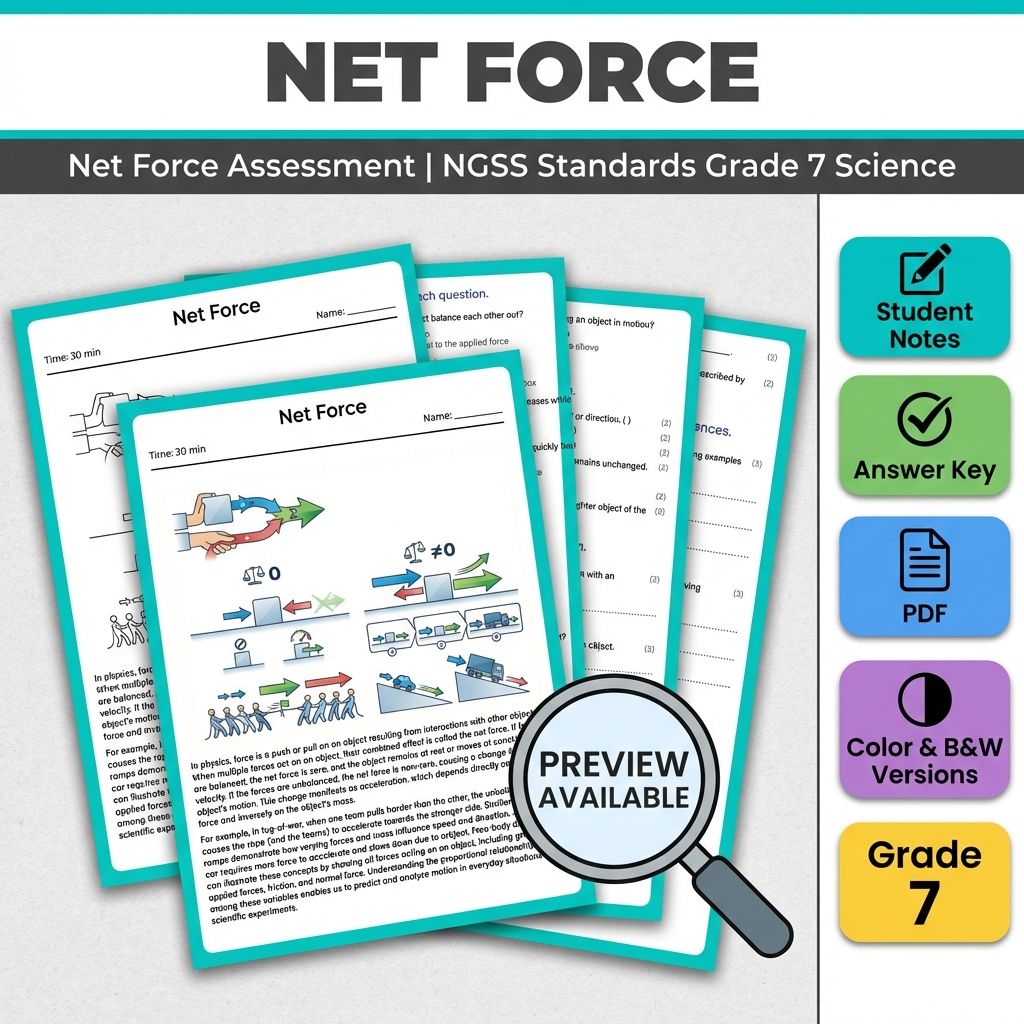
Net Force Assessment | NGSS Standards Grade 7 Science
Created byPrism Point LearningLearning Objectives
- Define net force as the vector sum of forces acting on an object.
- Explain how unbalanced forces cause changes in motion using free-body diagrams.
- Relate net force, mass, and acceleration proportionally through quantitative reasoning.
Also included in: Grade 7 Science Mini Bundle – Forces & Interactions NGSS Unit (Printable) +1 more
Instant download
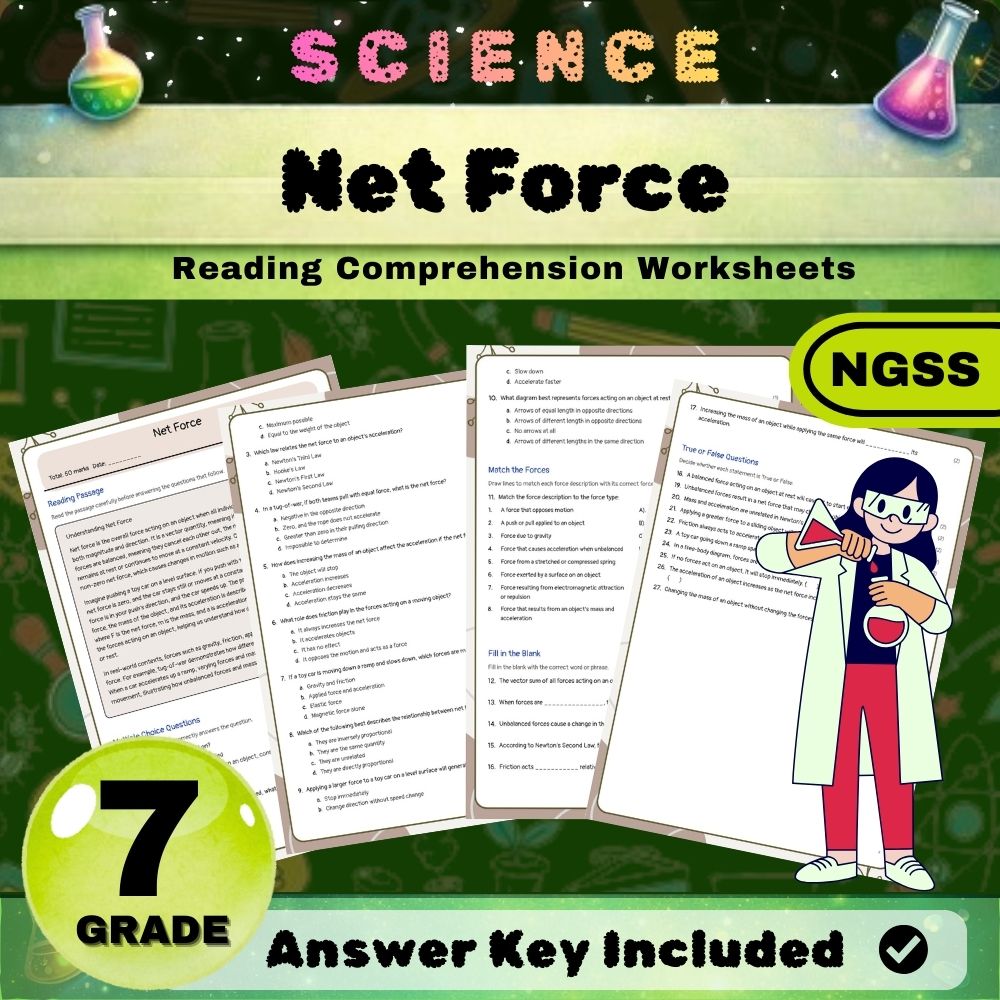
Grade 7 Science | Net Force Worksheet (NGSS-Aligned) – Answer Key PDF
 Created byMaple Path Learning
Learning Objectives
- Define net force as the vector sum of all forces acting on an object.
- Describe how unbalanced forces cause changes in an object's motion.
- Interpret free-button diagrams to analyze forces acting on objects.
Instant download

Grade 7 Net Force Worksheet | NGSS Practice & PDF
Created byClear Sky ClassroomLearning Objectives
- Define net force as the vector sum of all forces acting on an object.
- Explain how unbalanced forces cause changes in motion.
- Describe the relationship between net force, mass, and acceleration using diagrams and reasoning.
Also included in: Grade 7 Net Force, Interactions, Collisions Science Lesson Bundle (NGSS) +1 more
Instant download

Net Force Worksheet | Grade 7 Science | Review & Assessment
Created byPrism Point LearningLearning Objectives
- Define net force as the vector sum of all forces acting on an object
- Explain how unbalanced forces change an object’s motion, including direction and speed
- Use free-body diagrams to identify forces and reason quantitatively about net force and acceleration
Also included in: Grade 7 Forces & Interactions Science Lesson Bundle for NGSS Review
Instant download

Grade 7 Science Net Force Worksheet | NGSS Balanced & Unbalanced Forces
 Created byNorthstar Worksheets
Learning Objectives
- Define net force as the vector sum of all forces acting on an object.
- Explain how unbalanced forces change an object's motion, including changes in speed and direction.
- Use free-body diagrams to identify forces and determine the direction of the net force.
Also included in: Grade 7 Science Forces & Motion Lesson Bundle | NGSS Equilibrium & Collisions +1 more
Instant download

Grade 7 Science | Introduction to Net Force - Daily Reading Comprehension
Created byCoral Reef LearningLearning Objectives
- Understand the concept of net force as the vector sum of all forces acting on an object.
- Identify different types of forces such as frictional and applied forces.
- Explain how unbalanced forces cause changes in motion.
Instant download

Net Force, Mass, and Acceleration Worksheets for Grade 7 Science
 Created bythe curious pencil
Learning Objectives
- Calculate net force from forces acting in opposite directions.
- Explain how unbalanced forces change an object's motion.
- Relate net force and mass to acceleration.
Also included in: Motion and Stability Grade 7 Science Worksheets | NGSS Forces Bundle +2 more
Instant download
Browse more categories
About Science Worksheets
Find Science worksheets spanning core skills, practice, and review. All 44,980 resources are instant PDF downloads for the classroom or home.
Every worksheet on MyTeachingSheets is created by independent teacher-authors and reviewed before publication. All resources download as printable PDFs for classroom, homework, or at-home practice, and many include answer keys. Preview any worksheet free before buying.