
Science Worksheets
42,859 subject resources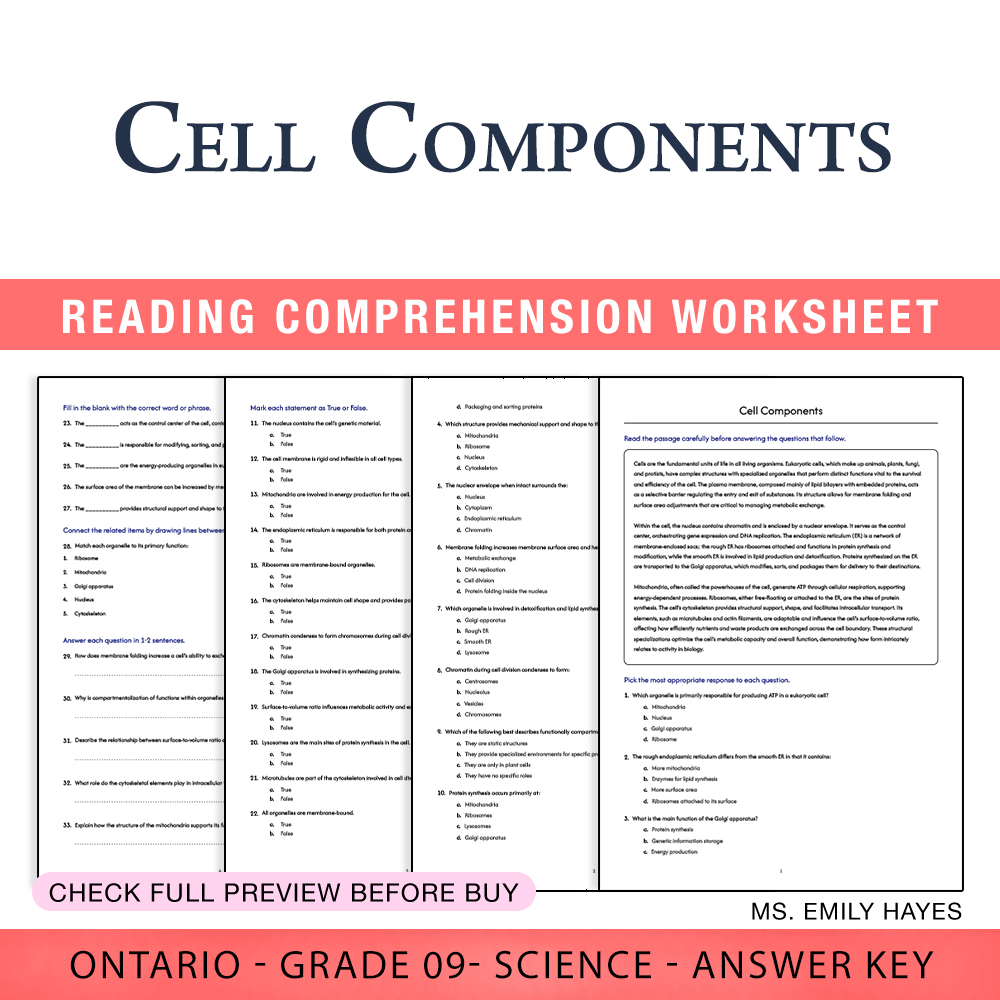
9th Grade Science | Cell Components Worksheet (PDF + Answer Key)
 Created byCopper Leaf Classroom
Learning Objectives
- Describe the major organelles of eukaryotic cells and their functions.
- Explain how structural features like membrane folding and compartmentalization influence metabolic rates and exchange across cell boundaries.
- Relate the morphology of cell components to their roles in cellular processes.
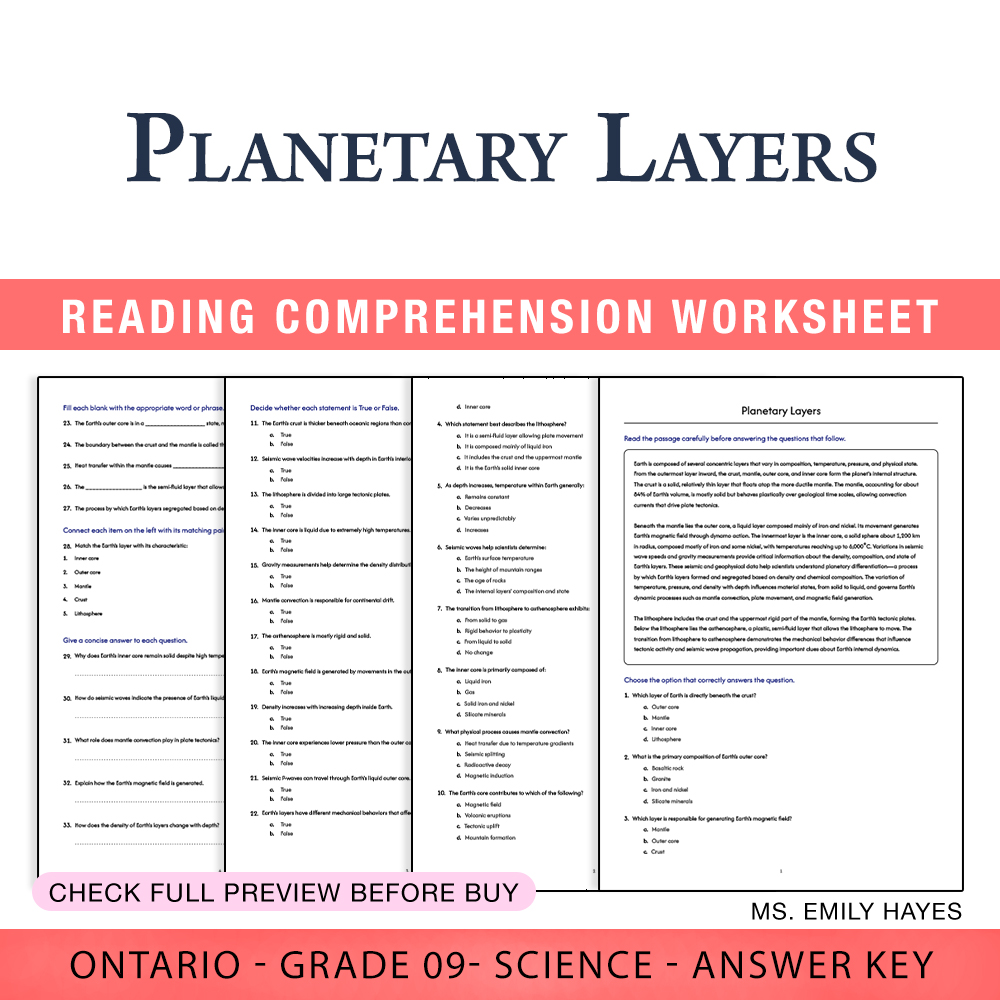
Grade 9 Science | Planetary Layers Worksheet (PDF + Answer Key)
Created byCopper Leaf ClassroomLearning Objectives
- Describe Earth's concentric layers including crust, mantle, and core.
- Differentiate between lithosphere and asthenosphere in mechanical behavior.
- Explain how density, temperature, and pressure vary with depth in Earth.
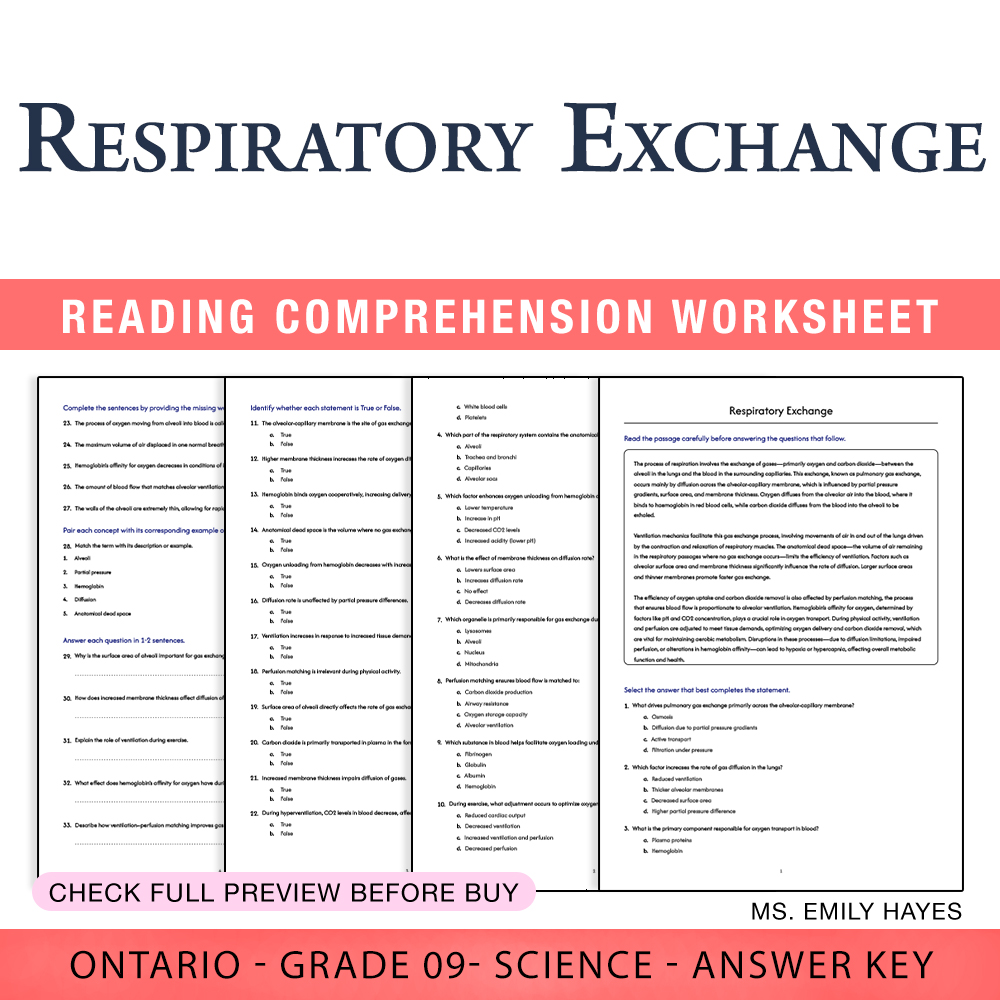
Grade 9 Science | Respiratory Exchange Worksheet (PDF + Answer Key)
Created byCopper Leaf ClassroomLearning Objectives
- Explain the process of pulmonary gas exchange at the alveolar–capillary interface, including the roles of partial pressure gradients, surface area, and membrane thickness.
- Describe the mechanics of ventilation and the factors affecting oxygen uptake and carbon dioxide removal, such as haemoglobin affinity and perfusion matching.
- Analyze how ventilation–perfusion relationships and diffusion limitations influence oxygen delivery to tissues and their integration with circulatory adjustments to sustain aerobic metabolism.
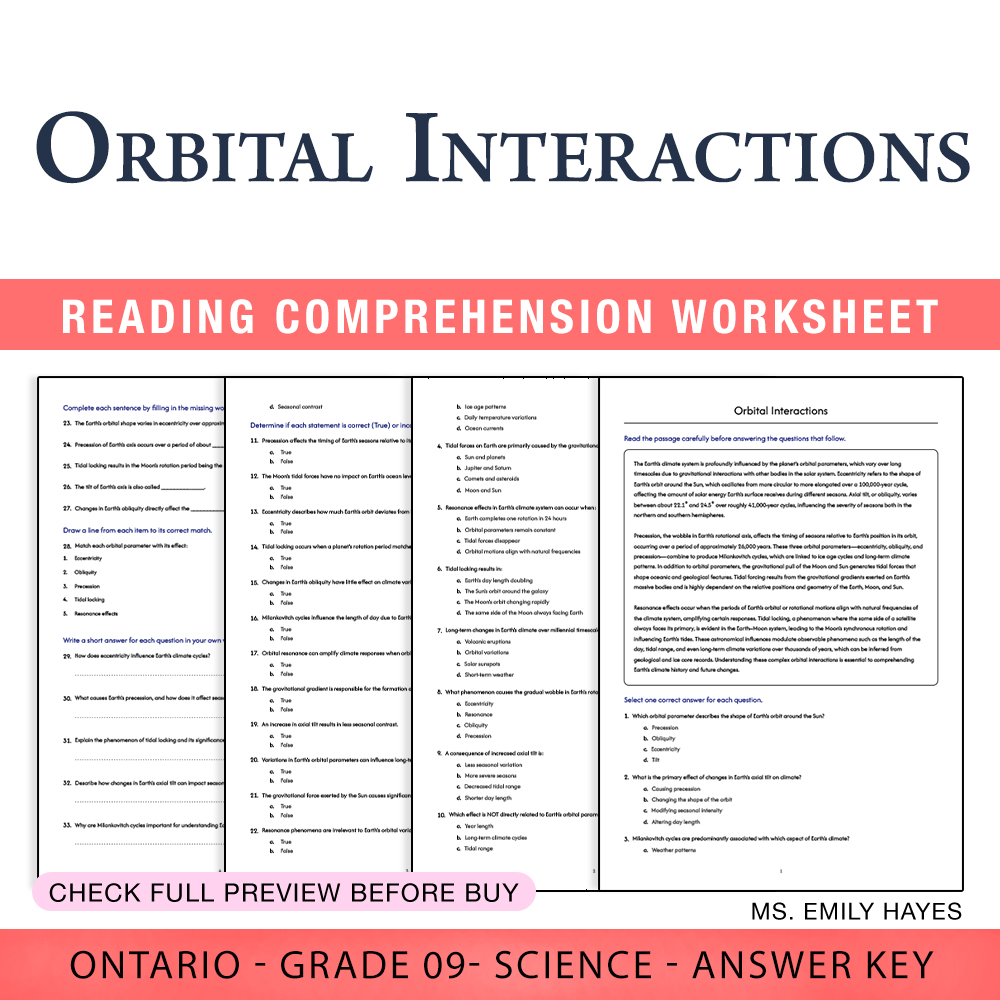
Grade 9 Science | Orbital Interactions Worksheet (PDF + Answer Key)
Created byCopper Leaf ClassroomLearning Objectives
- Describe how eccentricity, axial tilt, and precession influence seasonal insolation patterns and climate variability.
- Explain tidal forcing from the Moon and Sun in terms of gravitational gradients and relative geometry.
- Discuss resonance effects and tidal locking phenomena in celestial bodies.
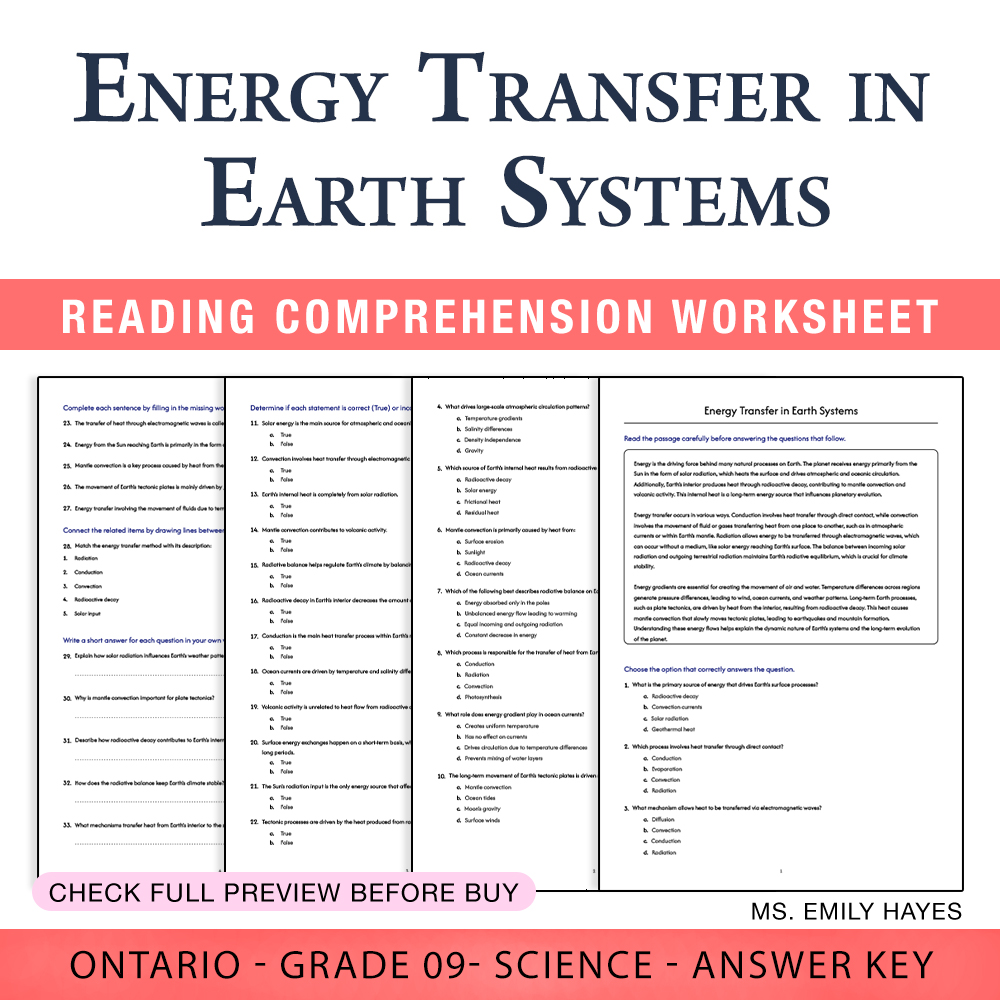
Grade 9 Science | Energy Transfer in Earth Systems Worksheet (PDF + Answer Key)
Created byCopper Leaf ClassroomLearning Objectives
- Describe the different sources of energy within Earth systems, including solar radiation and geothermal heat.
- Explain the mechanisms of energy transfer such as conduction, convection, and radiation.
- Analyze how energy gradients influence atmospheric, oceanic, and geological processes.
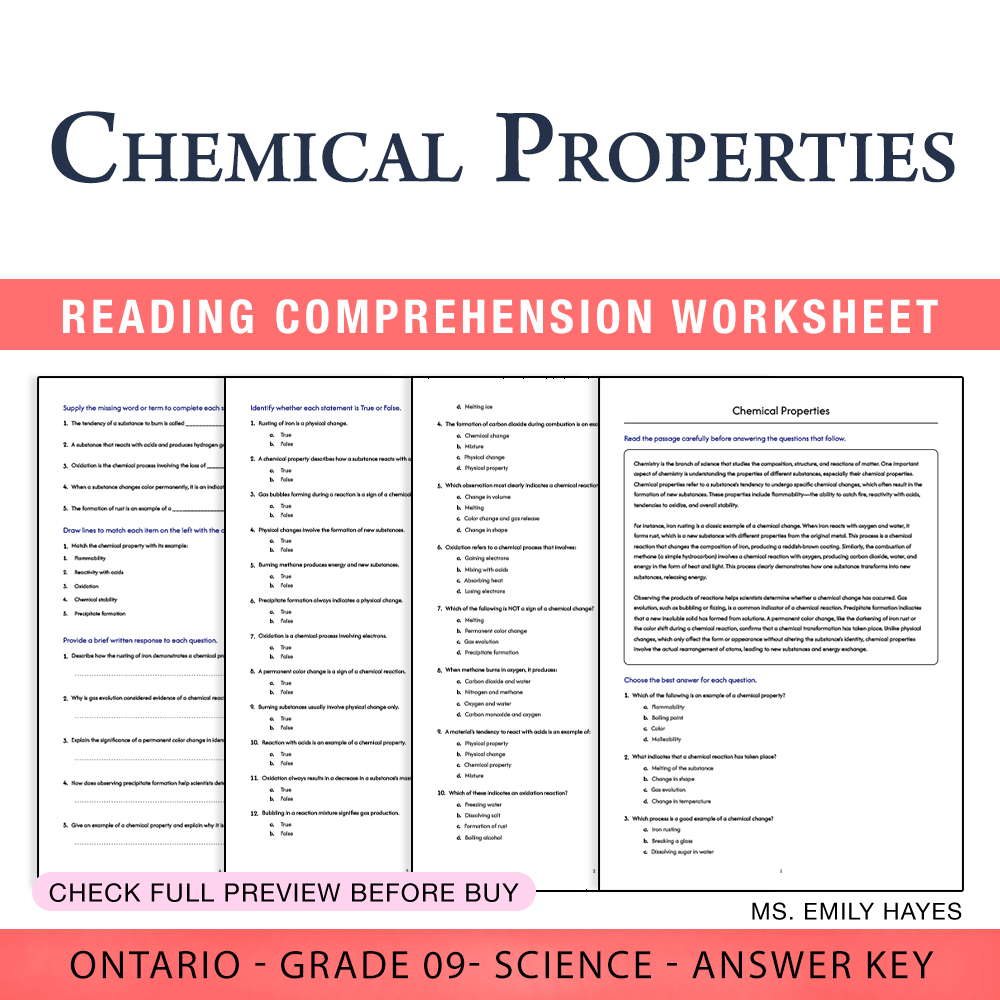
Grade 9 Science | Chemical Properties Worksheet (PDF + Answer Key)
Created byCopper Leaf ClassroomLearning Objectives
- Understand the definition of chemical properties and how they differ from physical properties.
- Identify common chemical properties such as flammability, reactivity, oxidation, and stability.
- Interpret observations indicating chemical reactions, including gas evolution, precipitate formation, and color change.
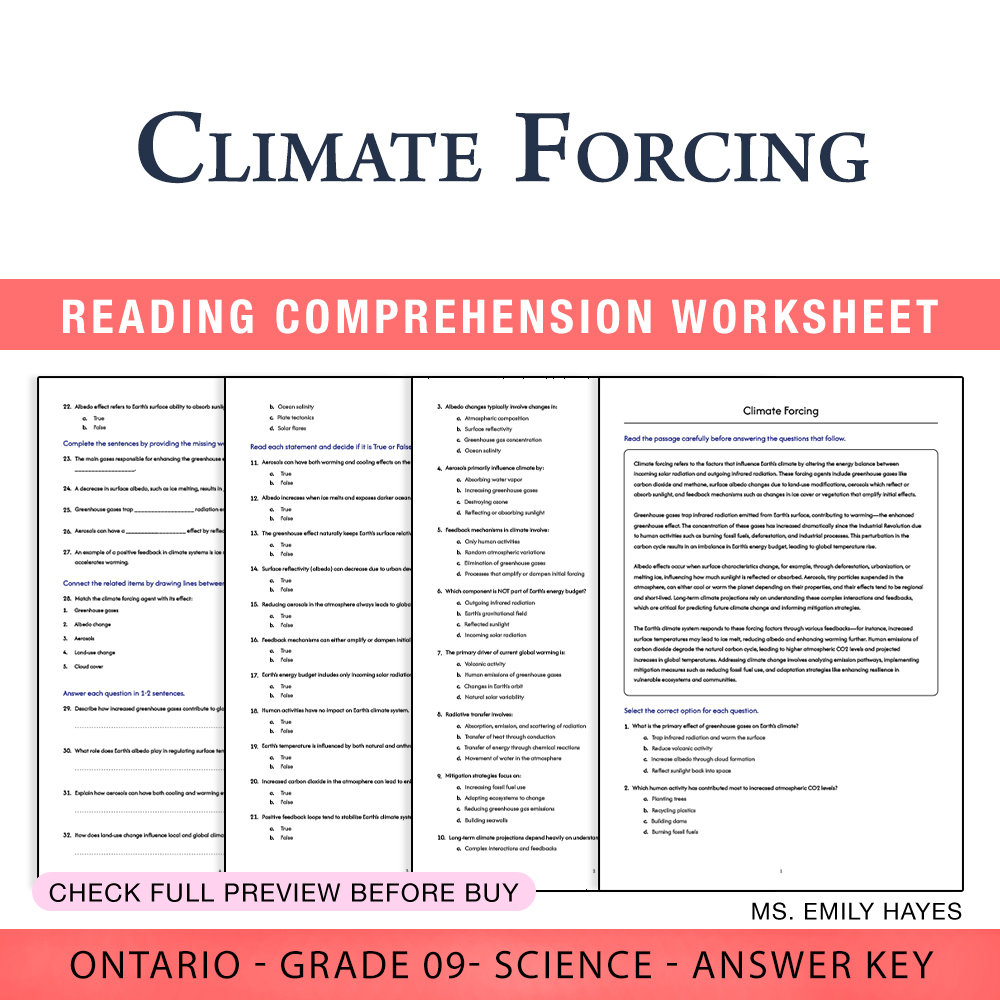
9th Grade Science | Climate Forcing Worksheet (PDF + Answer Key)
Created byCopper Leaf ClassroomLearning Objectives
- Explain the key drivers of climate change including greenhouse gases, albedo effect, and aerosols.
- Describe the basic concepts of radiative transfer and Earth's energy budget.
- Analyze human influence on the carbon cycle and climate projections.
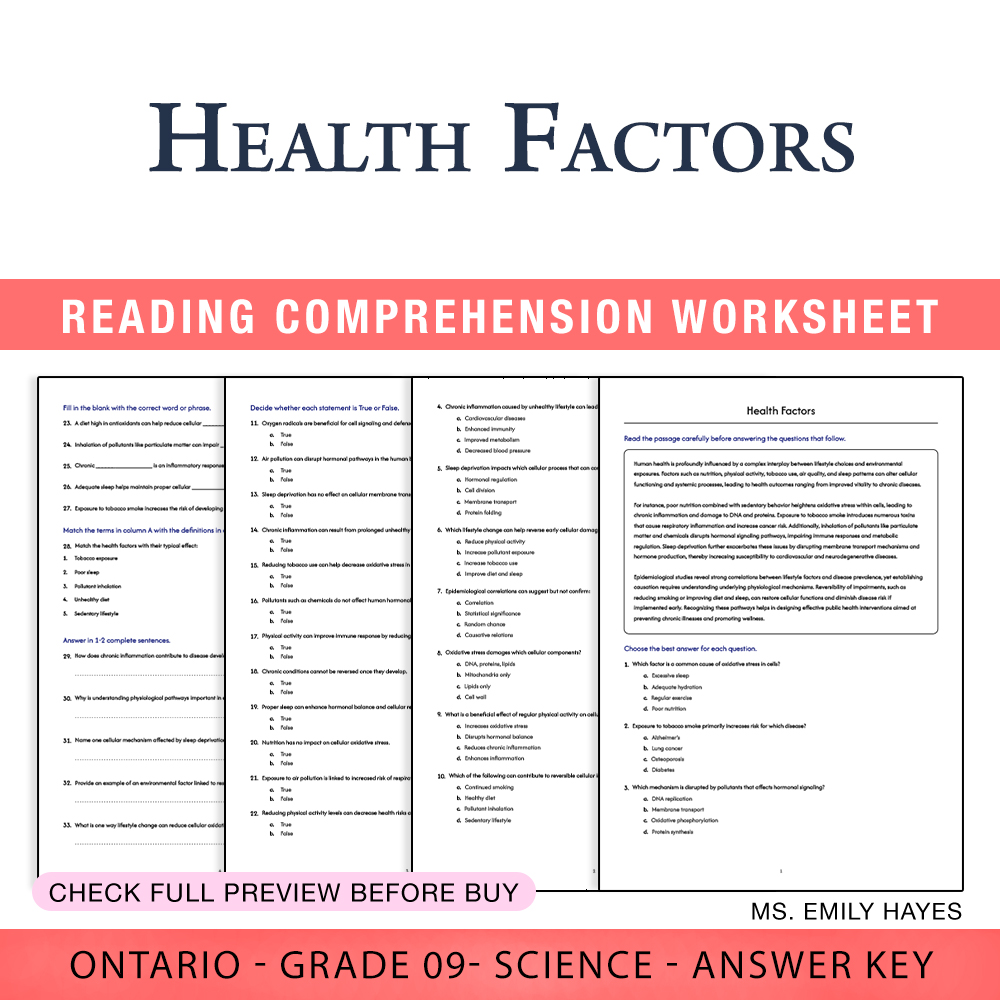
Grade 9 Science | Health Factors Worksheet (PDF + Answer Key)
Created byCopper Leaf ClassroomLearning Objectives
- Analyze how lifestyle choices such as nutrition, physical activity, and sleep influence human health.
- Evaluate the roles of environmental exposures like tobacco and pollutants in disease development.
- Interpret epidemiological data and understand physiological mechanisms underlying chronic conditions.
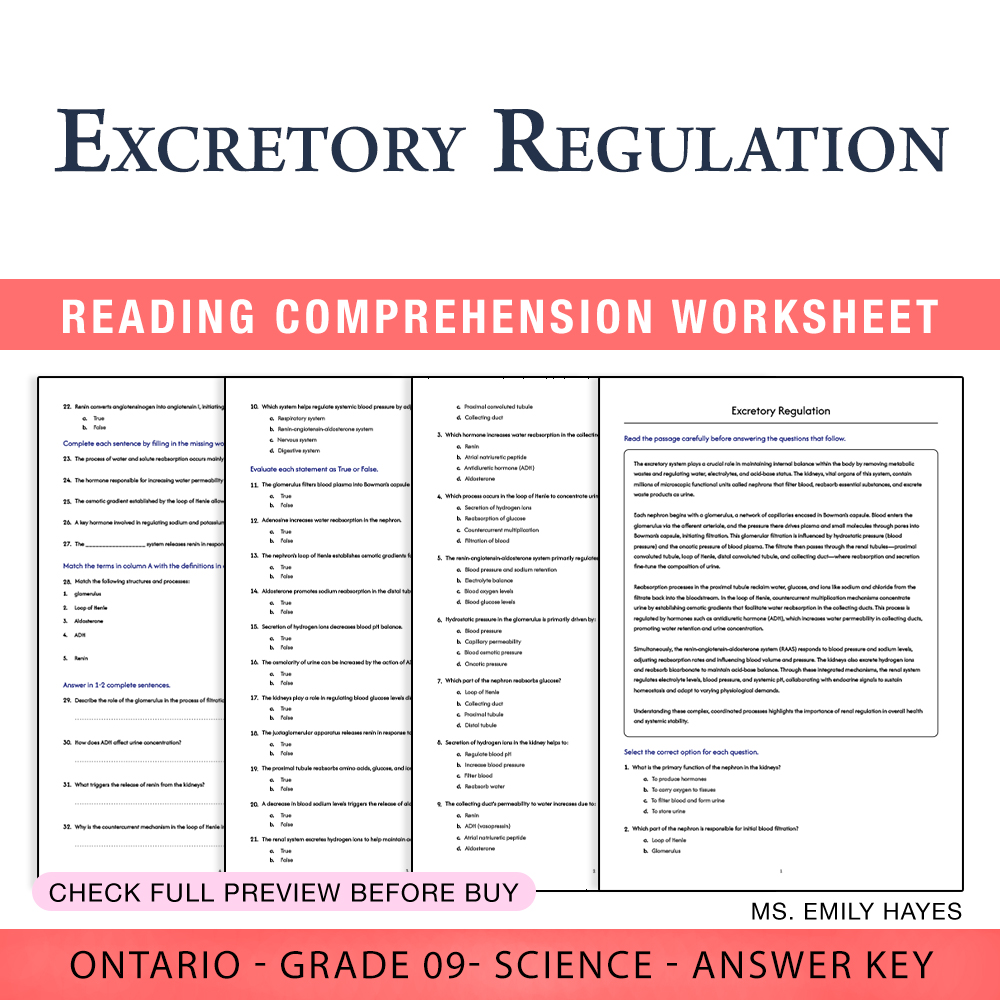
Grade 9 Science | Excretory Regulation Worksheet (PDF + Answer Key)
Created byCopper Leaf ClassroomLearning Objectives
- Explain the structure and function of the nephron in blood filtration and urine formation.
- Describe the processes of glomerular filtration, reabsorption, secretion, and urine concentration.
- Analyze how renal regulation maintains electrolyte balance, acid-base status, and blood pressure through hormonal control.
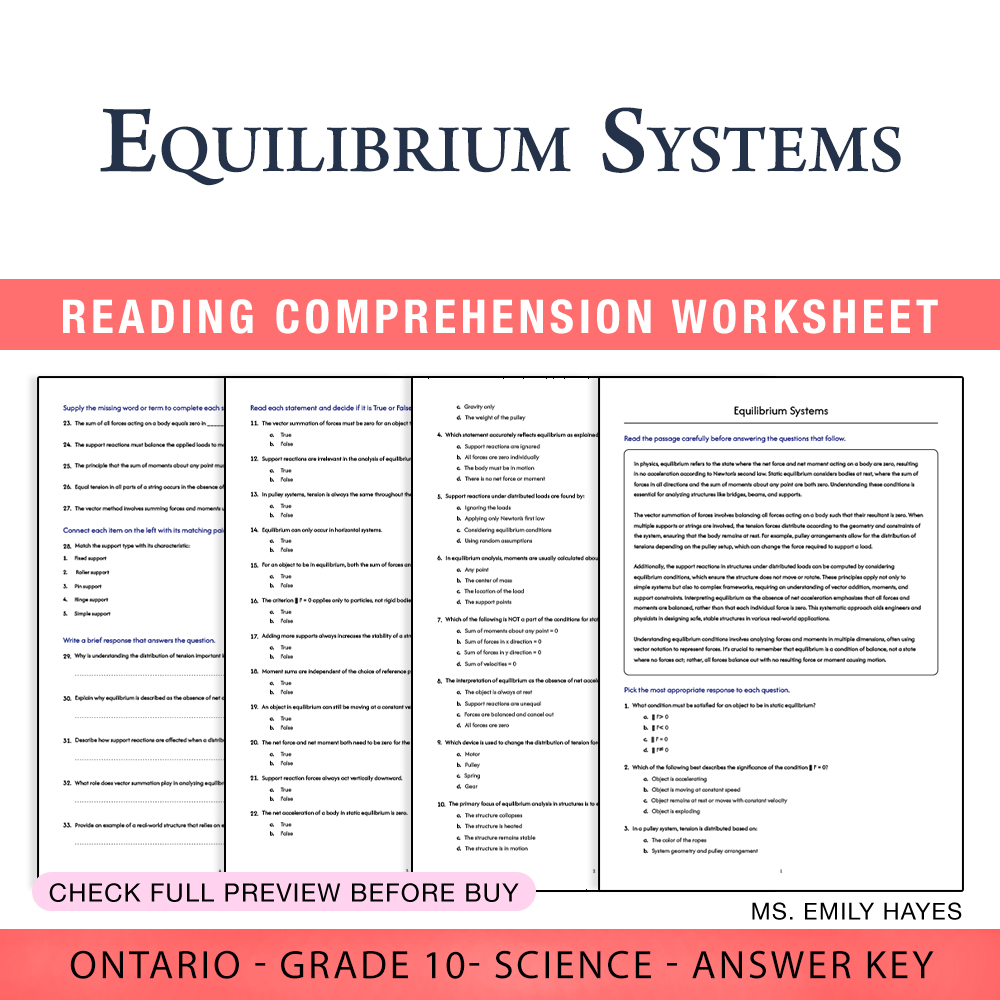
10th Grade Science | Equilibrium Systems Worksheet (PDF + Answer Key)
Created byCopper Leaf ClassroomLearning Objectives
- Explain the conditions required for static equilibrium using vector summation of forces and moments.
- Apply the criteria ΣF = 0 to analyze the support reactions in rigid bodies.
- Describe the distribution of tension in pulley systems and the effects of supports under various loads.
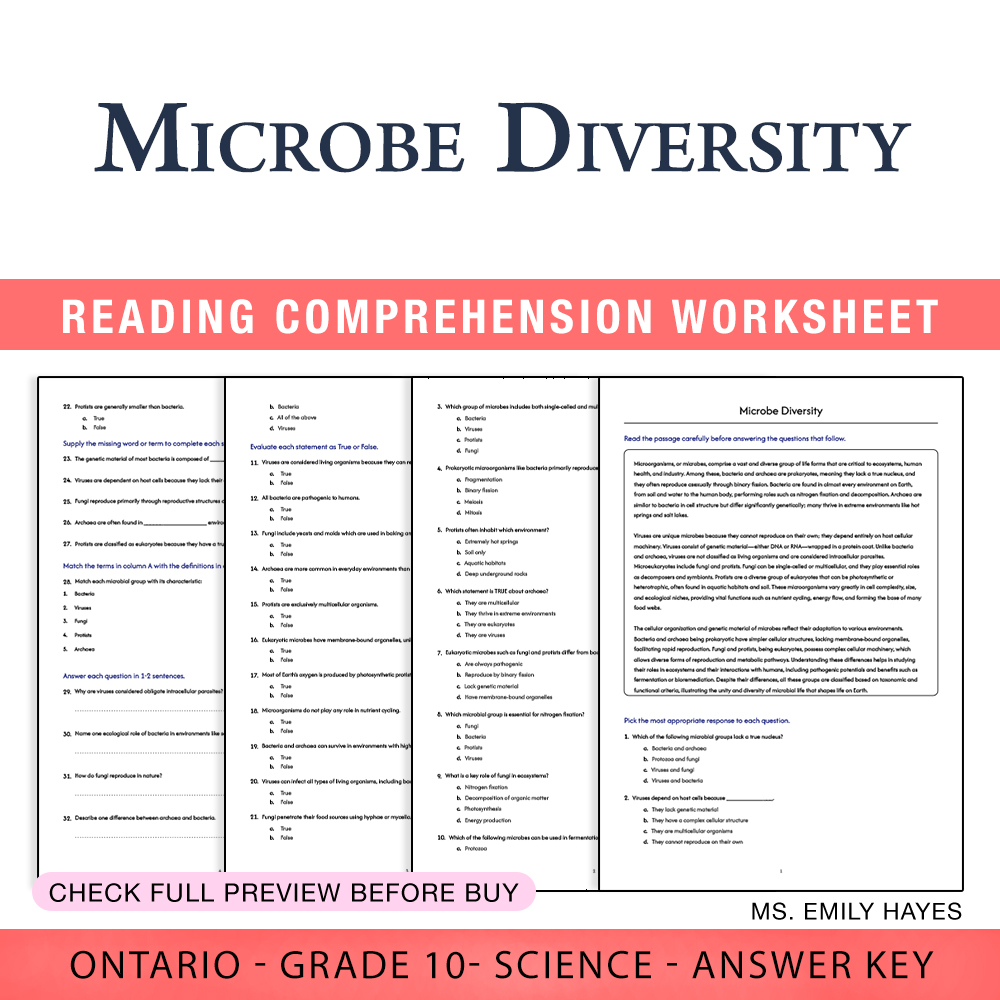
10th Grade Science | Microbe Diversity Worksheet (PDF + Answer Key)
Created byCopper Leaf ClassroomLearning Objectives
- Describe the major groups of microorganisms including bacteria, archaea, viruses, fungi, and protists.
- Compare cellular organization and genetic material among different microbial groups.
- Explain reproduction strategies and ecological roles of microbes.
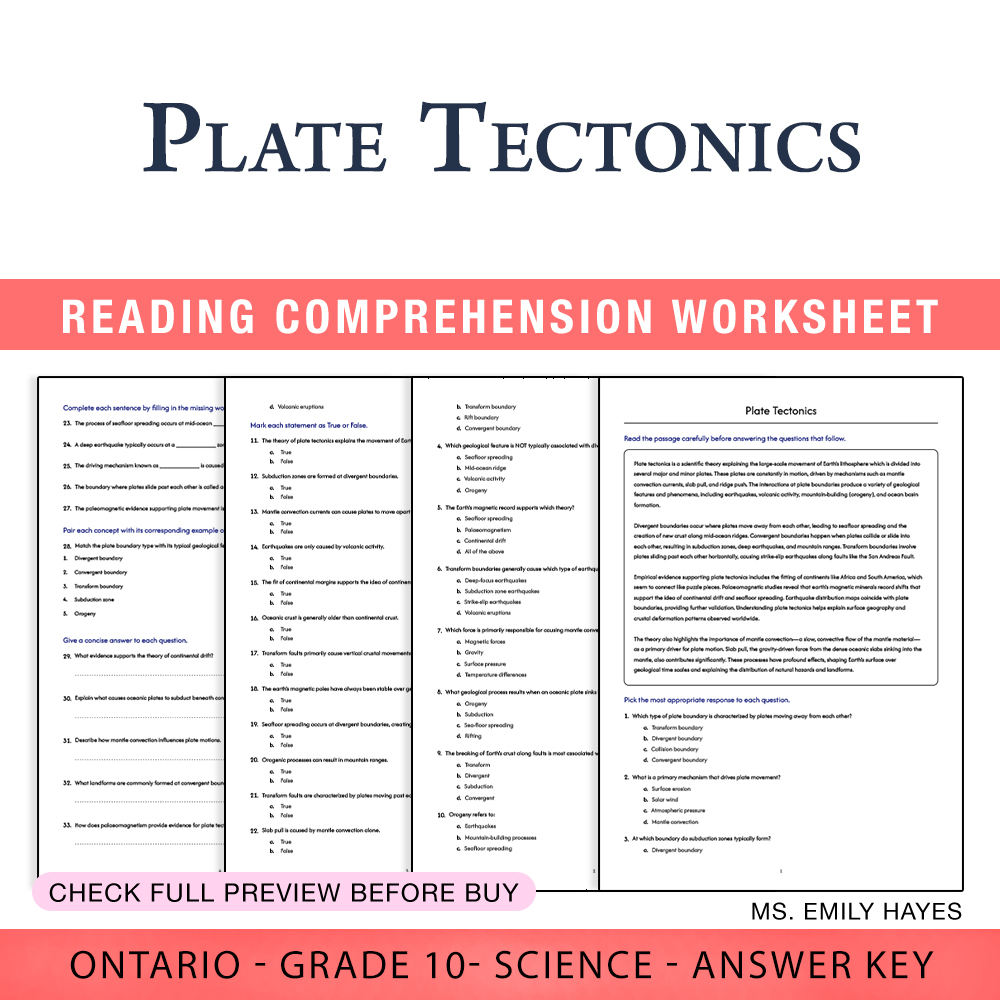
10th Grade Science | Plate Tectonics Worksheet (PDF + Answer Key)
Created byCopper Leaf ClassroomLearning Objectives
- Describe the main types of plate boundaries and their movement directions.
- Explain the driving mechanisms behind plate motions, including mantle convection and slab pull.
- Identify geological features and processes resulting from plate interactions such as seafloor spreading, subduction, and orogeny.
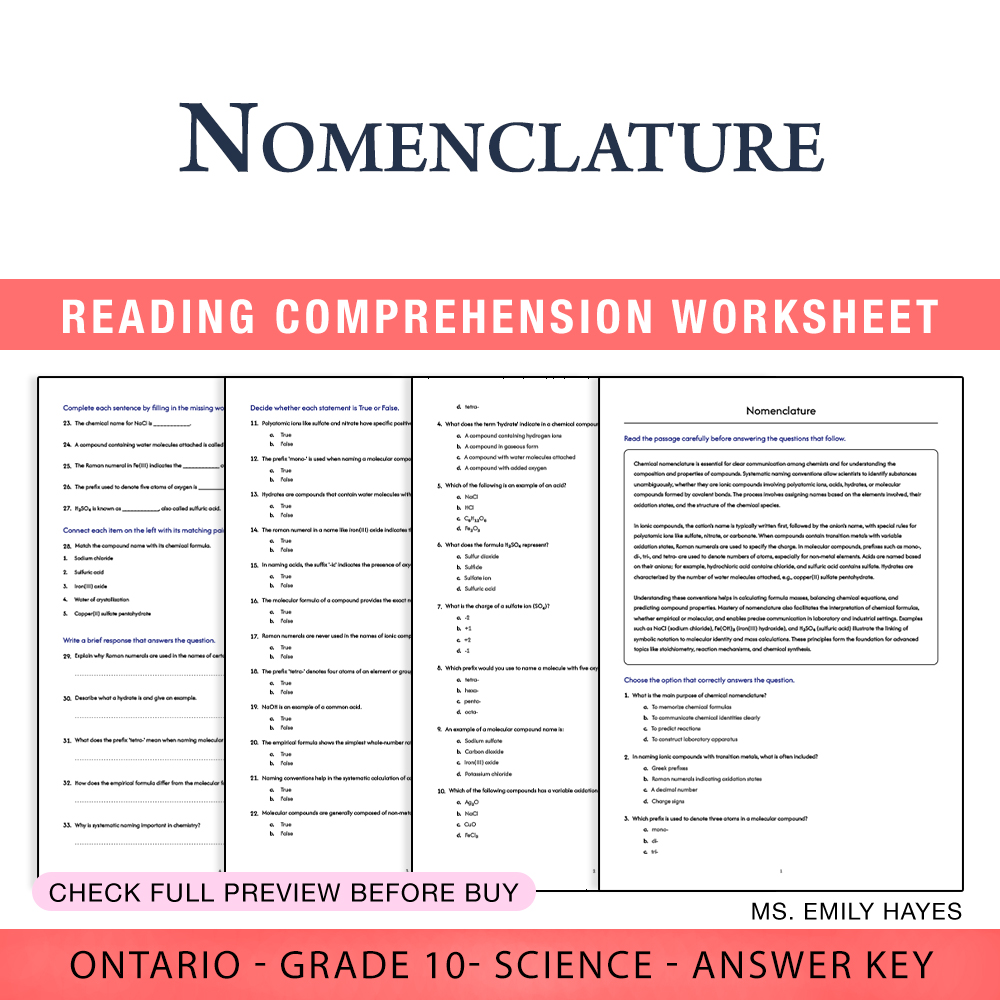
Grade 10 Science | Nomenclature Worksheet (PDF + Answer Key)
Created byCopper Leaf ClassroomLearning Objectives
- Understand and apply systematic naming conventions for ionic and molecular compounds.
- Identify and name polyatomic ions, acids, hydrates, and compounds with variable oxidation states.
- Construct and interpret empirical and molecular formulas based on charge balance and formula mass.
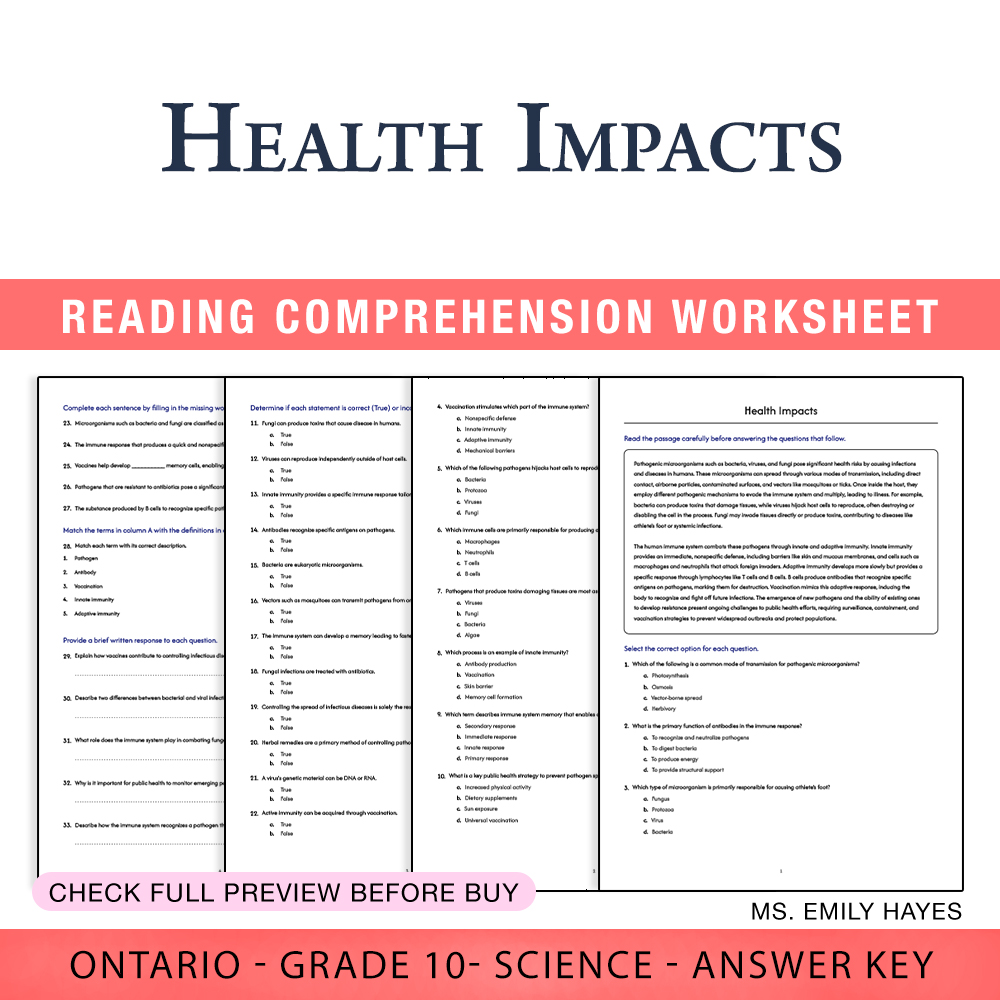
Grade 10 Science | Health Impacts Worksheet (PDF + Answer Key)
Created byCopper Leaf ClassroomLearning Objectives
- Describe the modes of transmission and pathogenic mechanisms of microorganisms.
- Differentiate bacterial, viral, and fungal disease processes.
- Explain the principles of innate and adaptive immunity, including antibody recognition.
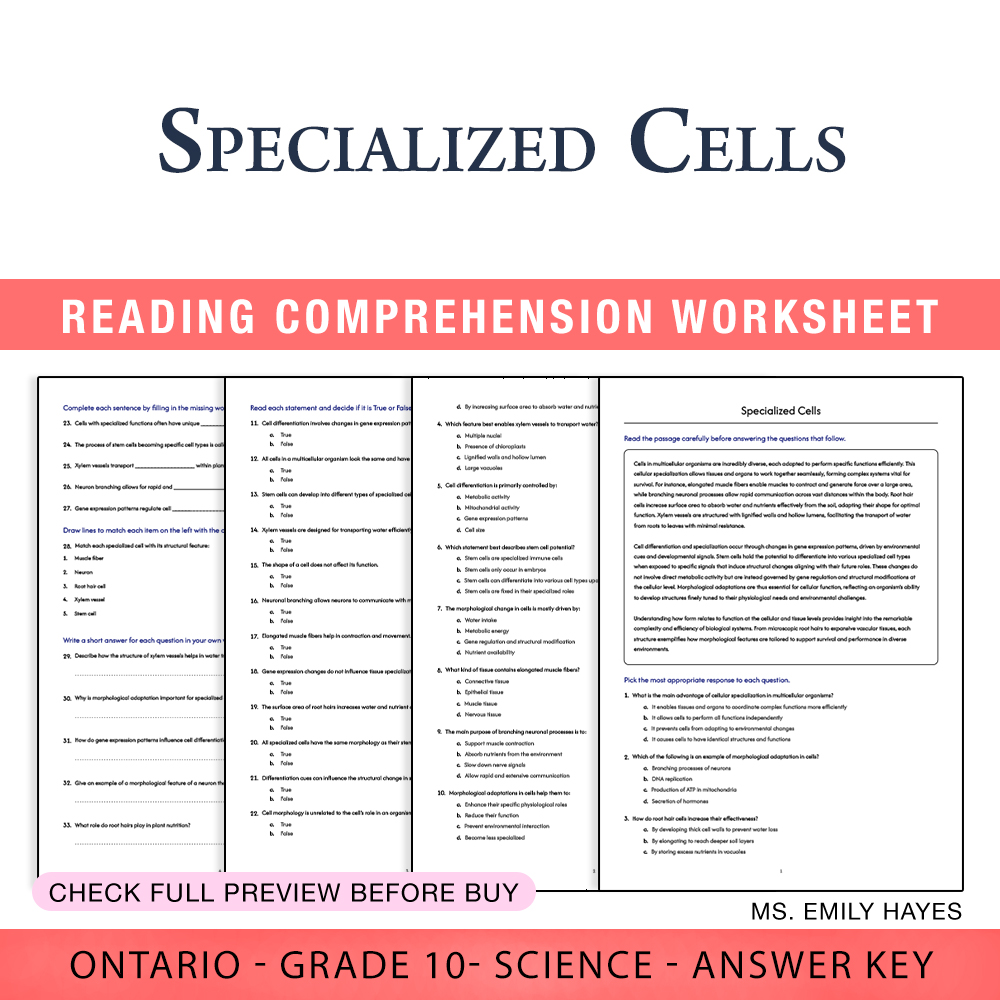
10th Grade Science | Specialized Cells Worksheet (PDF + Answer Key)
Created byCopper Leaf ClassroomLearning Objectives
- Understand the concept of cellular specialization and how tissue organization relates to function.
- Identify morphological adaptations in cells that enhance their specific physiological roles.
- Describe examples of specialized cells such as muscle fibers, neurons, root hairs, and xylem vessels.
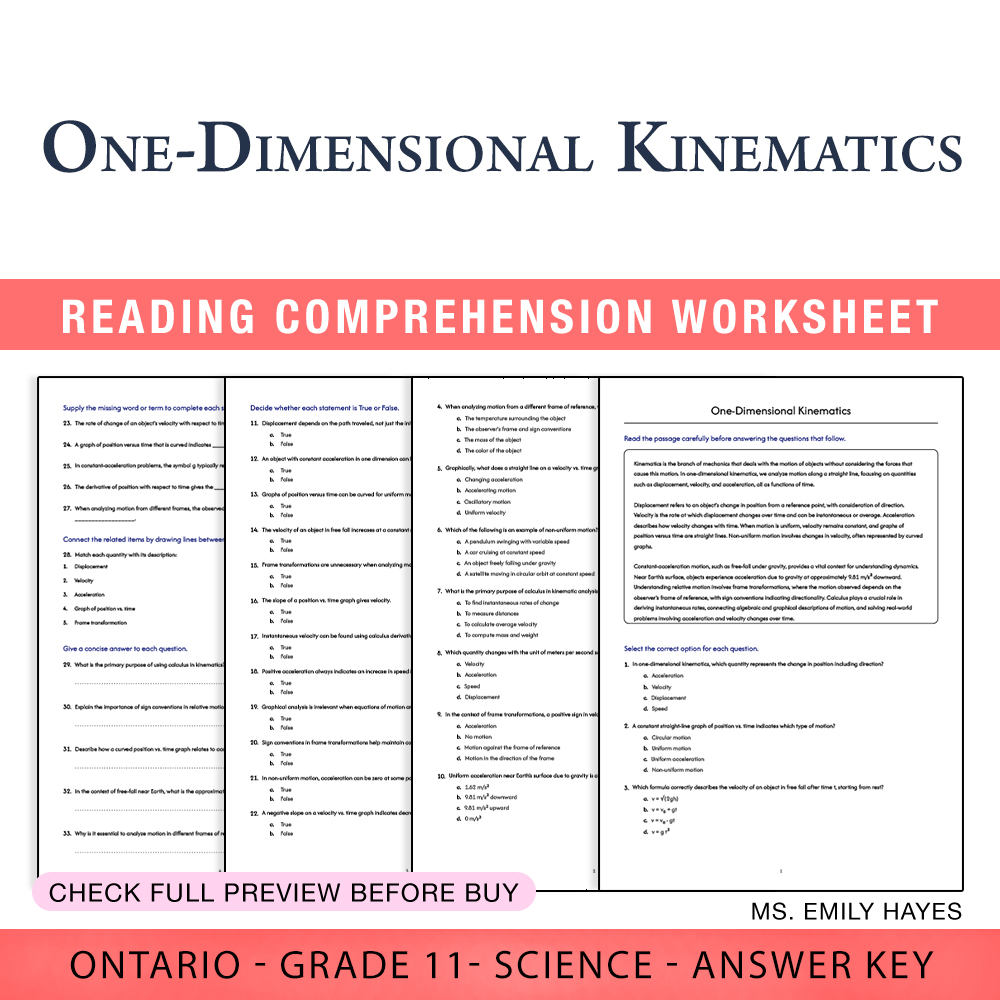
Grade 11 Science | One-Dimensional Kinematics Worksheet (PDF + Answer Key)
Created byCopper Leaf ClassroomLearning Objectives
- Describe the fundamental concepts of displacement, velocity, and acceleration as functions of time.
- Differentiate between uniform and non-uniform motion using algebraic and graphical methods.
- Apply constant-acceleration formulas to free-fall and relative motion scenarios, including frame transformations.
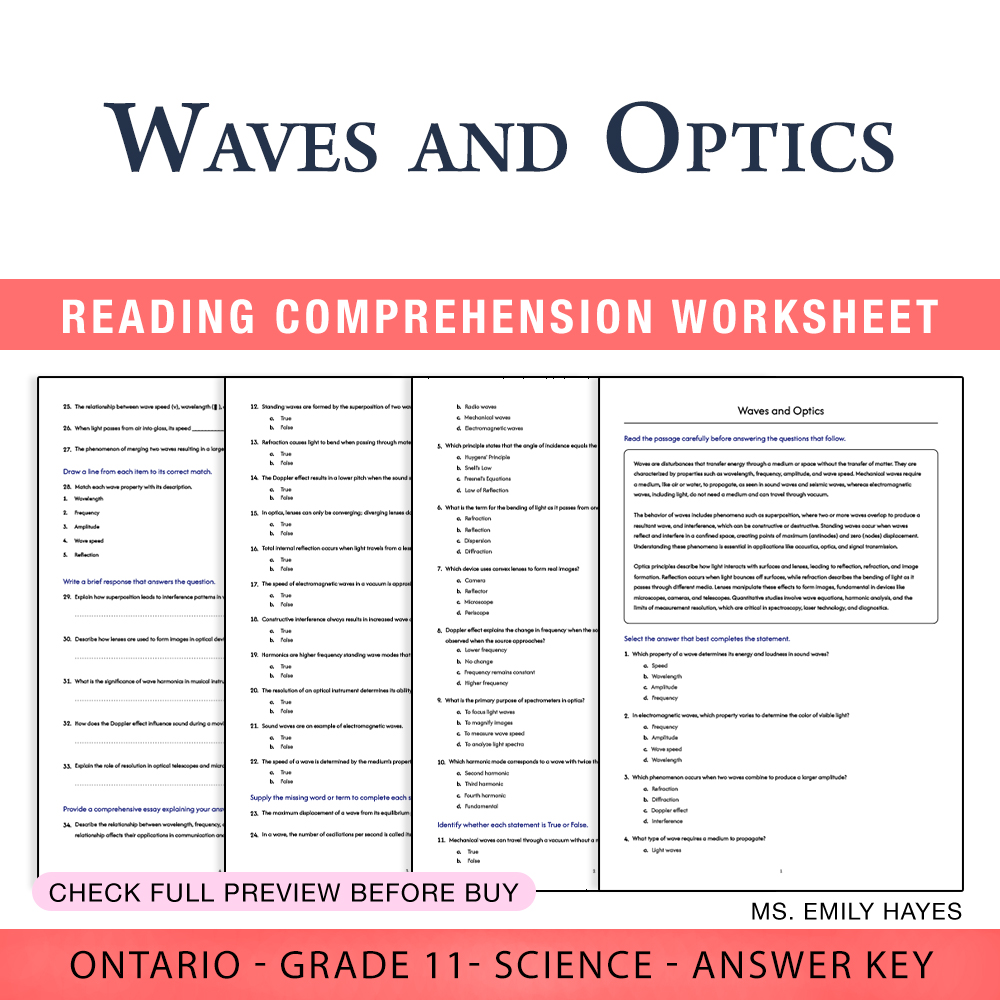
11th Grade Science | Waves and Optics Worksheet (PDF + Answer Key)
Created byCopper Leaf ClassroomLearning Objectives
- Describe the fundamental properties of waves, including wavelength, frequency, amplitude, and wave speed.
- Explain the principles of superposition, interference, and standing waves in various wave domains.
- Apply basic optics principles such as reflection, refraction, and lens imaging to real-world situations.
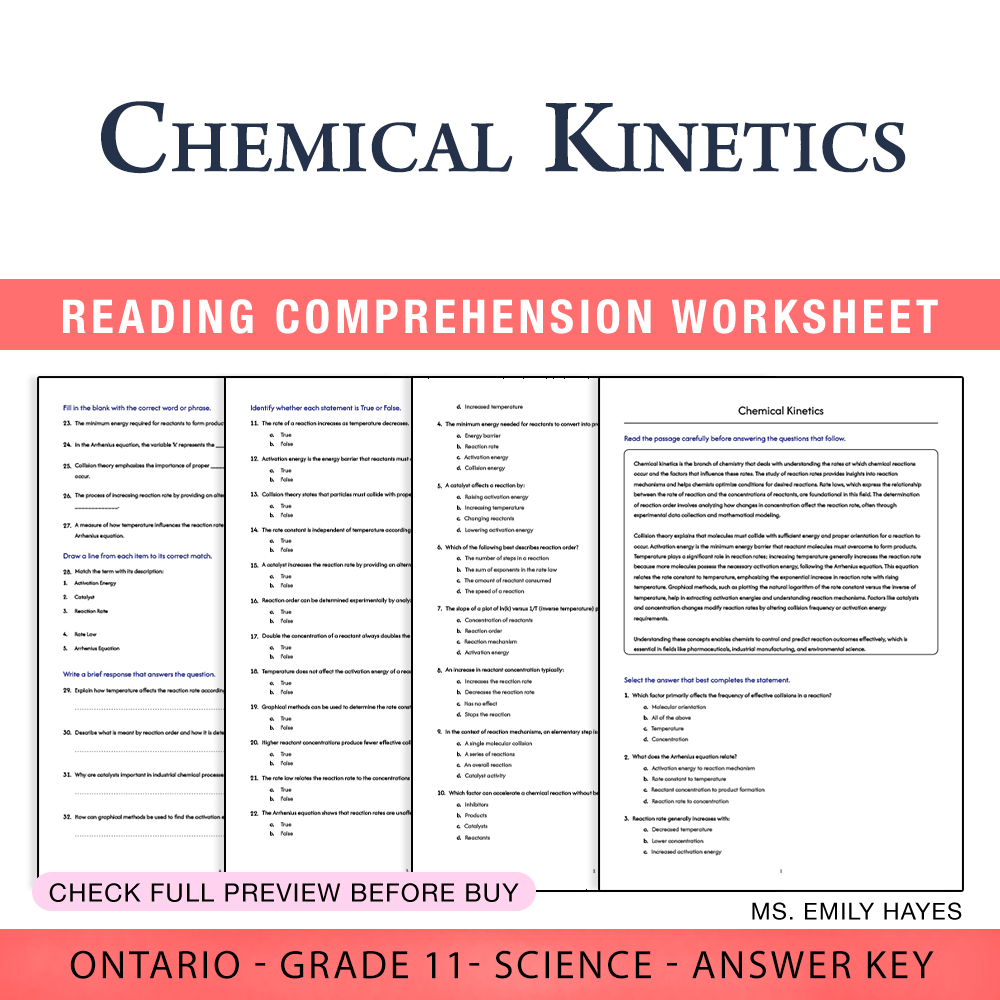
Grade 11 Science | Chemical Kinetics Worksheet (PDF + Answer Key)
Created byCopper Leaf ClassroomLearning Objectives
- Understand the principles of reaction rates and how they are characterized.
- Interpret experimental data to determine reaction orders and rate constants.
- Explain collision theory, activation energy, and their roles in reaction mechanisms.
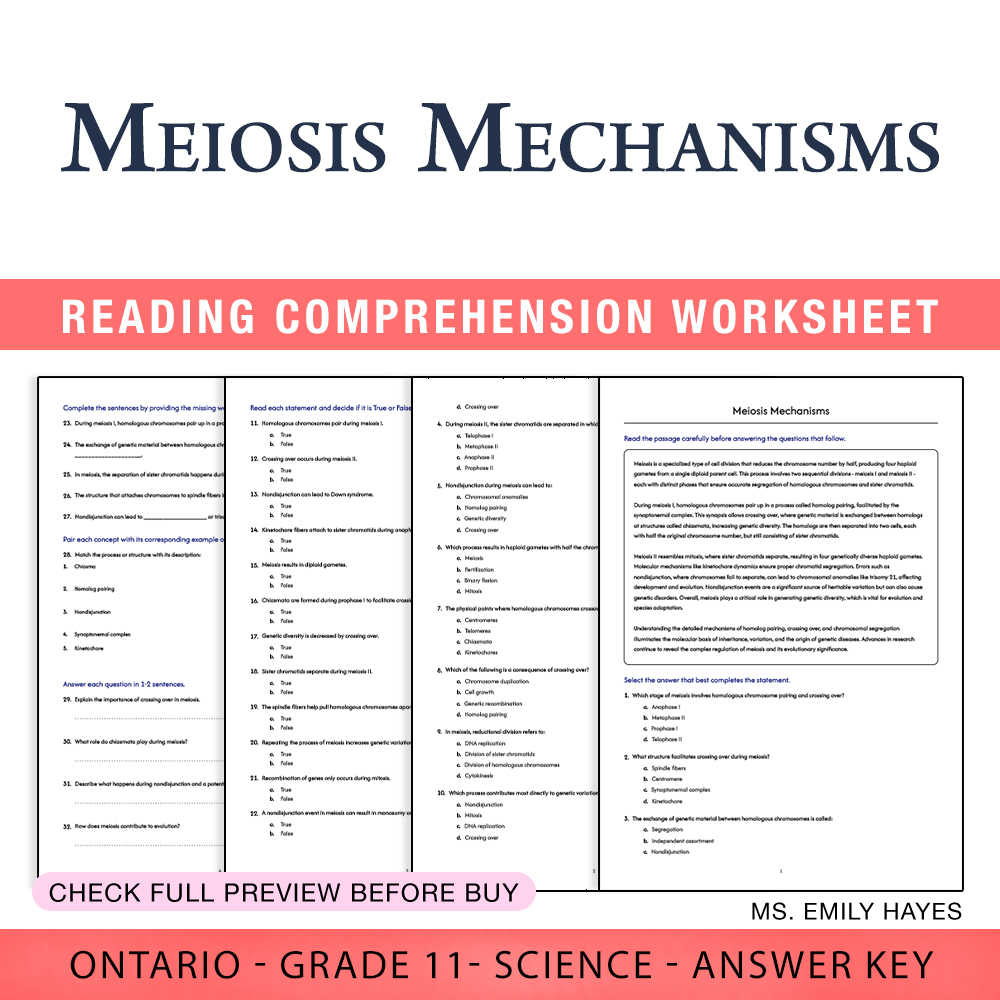
Grade 11 Science | Meiosis Mechanisms Worksheet (PDF + Answer Key)
Created byCopper Leaf ClassroomLearning Objectives
- Explain the stages of meiosis I and II and their molecular mechanisms.
- Describe the processes of homolog pairing, synapsis, crossing over, and chiasmata formation.
- Analyze how meiosis contributes to genetic variation and heritable traits.
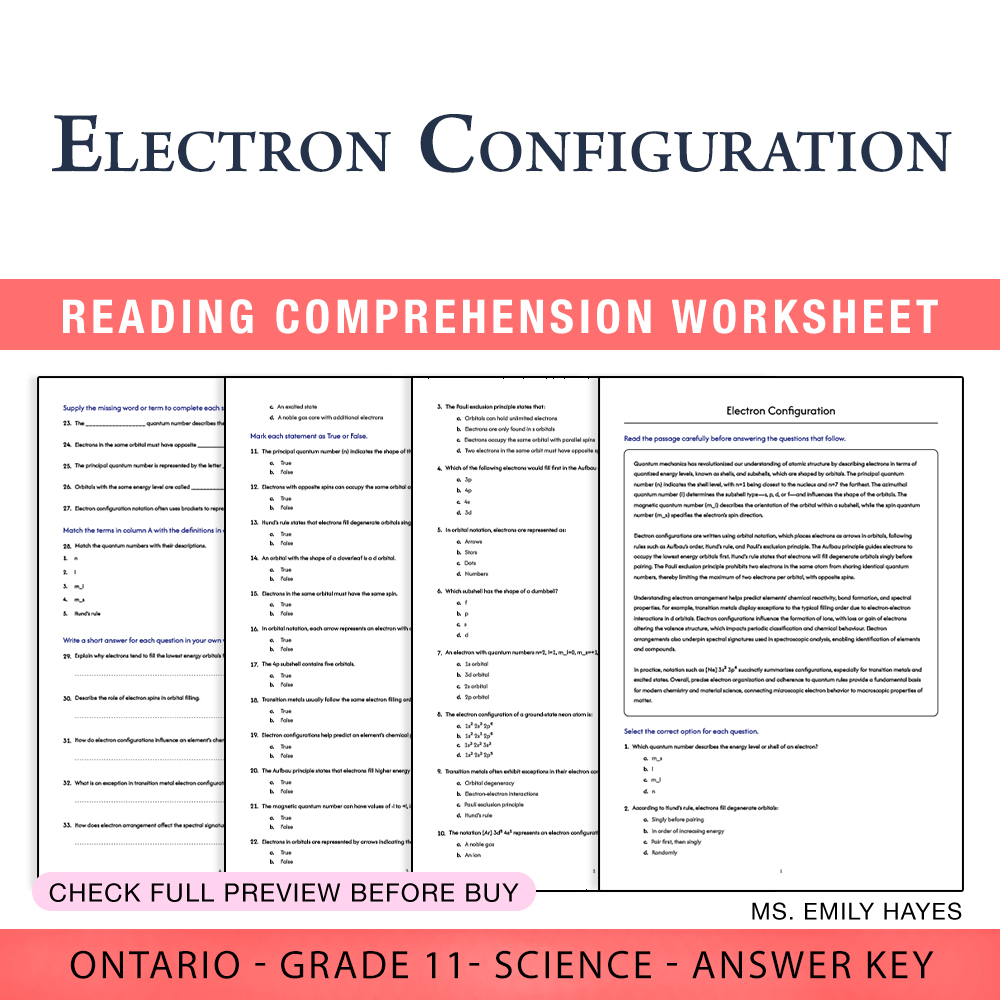
11th Grade Science | Electron Configuration Worksheet (PDF + Answer Key)
Created byCopper Leaf ClassroomLearning Objectives
- Describe the principles of quantum numbers, orbital notation, and electron organization.
- Apply Aufbau’s rule, Hund’s rule, and the Pauli exclusion principle to determine electron configurations.
- Link electronic configurations to valence structures and predict chemical behaviour.
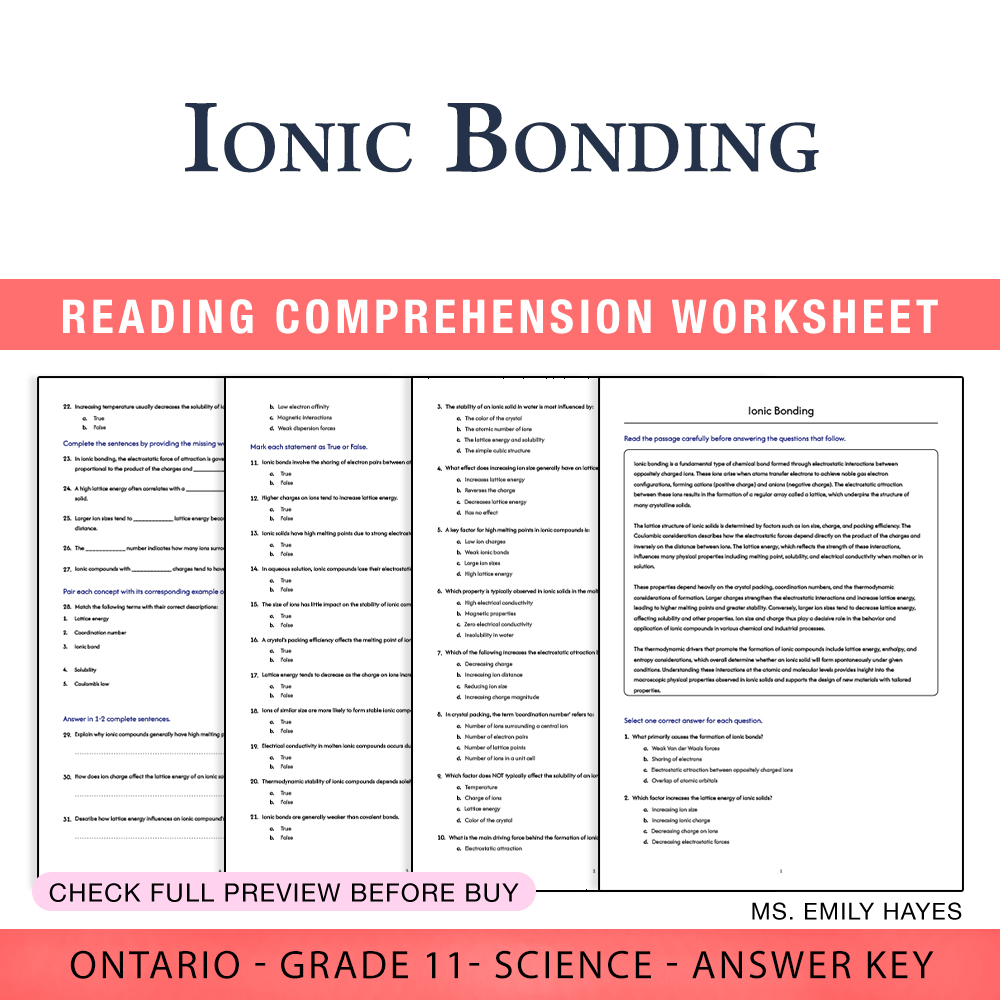
Grade 11 Science | Ionic Bonding Worksheet (PDF + Answer Key)
Created byCopper Leaf ClassroomLearning Objectives
- Describe the electrostatic interactions that lead to lattice formation in ionic compounds.
- Explain the role of Coulombic considerations and lattice energy in the stability of ionic solids.
- Analyze how ion size and charge influence the properties and stability of ionic compounds.
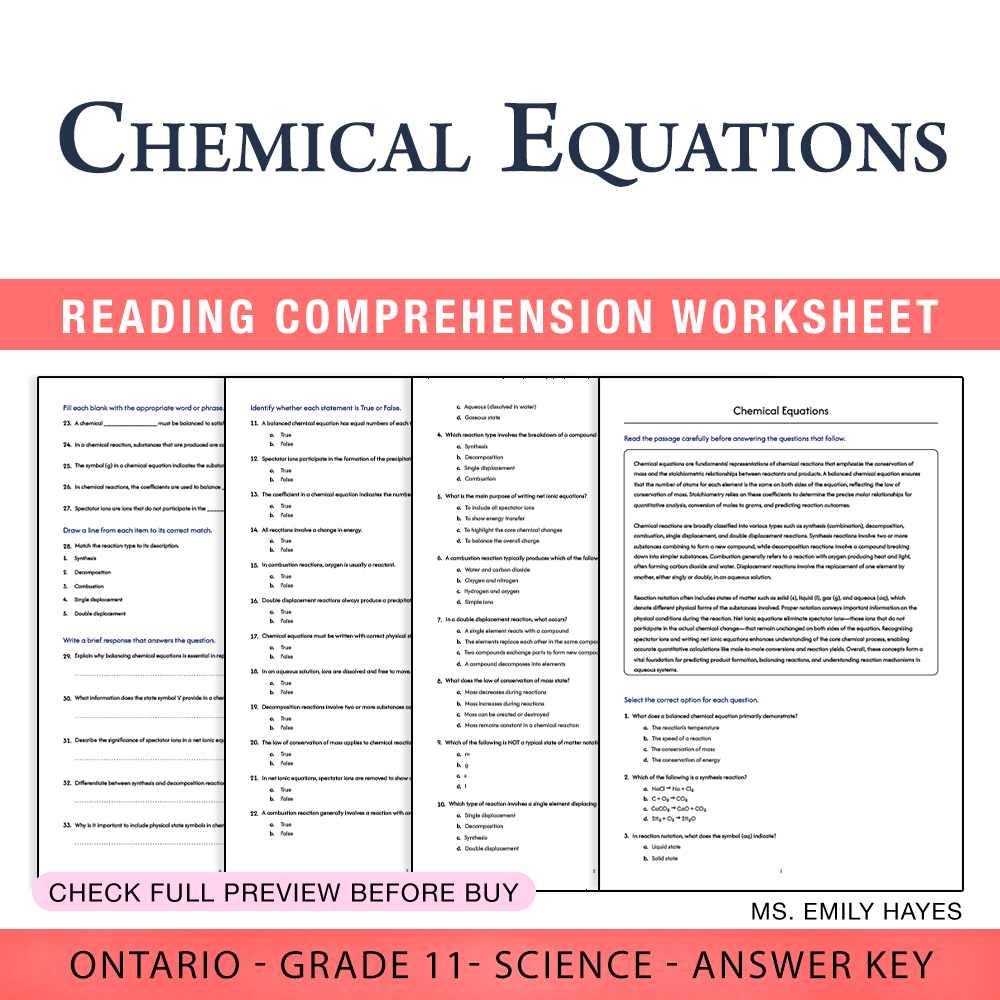
11th Grade Science | Chemical Equations Worksheet (PDF + Answer Key)
Created byCopper Leaf ClassroomLearning Objectives
- Understand the representation of chemical change through balanced symbolic equations and stoichiometric coefficients.
- Classify different types of chemical reactions including synthesis, decomposition, combustion, and displacement reactions.
- Analyze reaction notation, including states of matter and phase considerations.
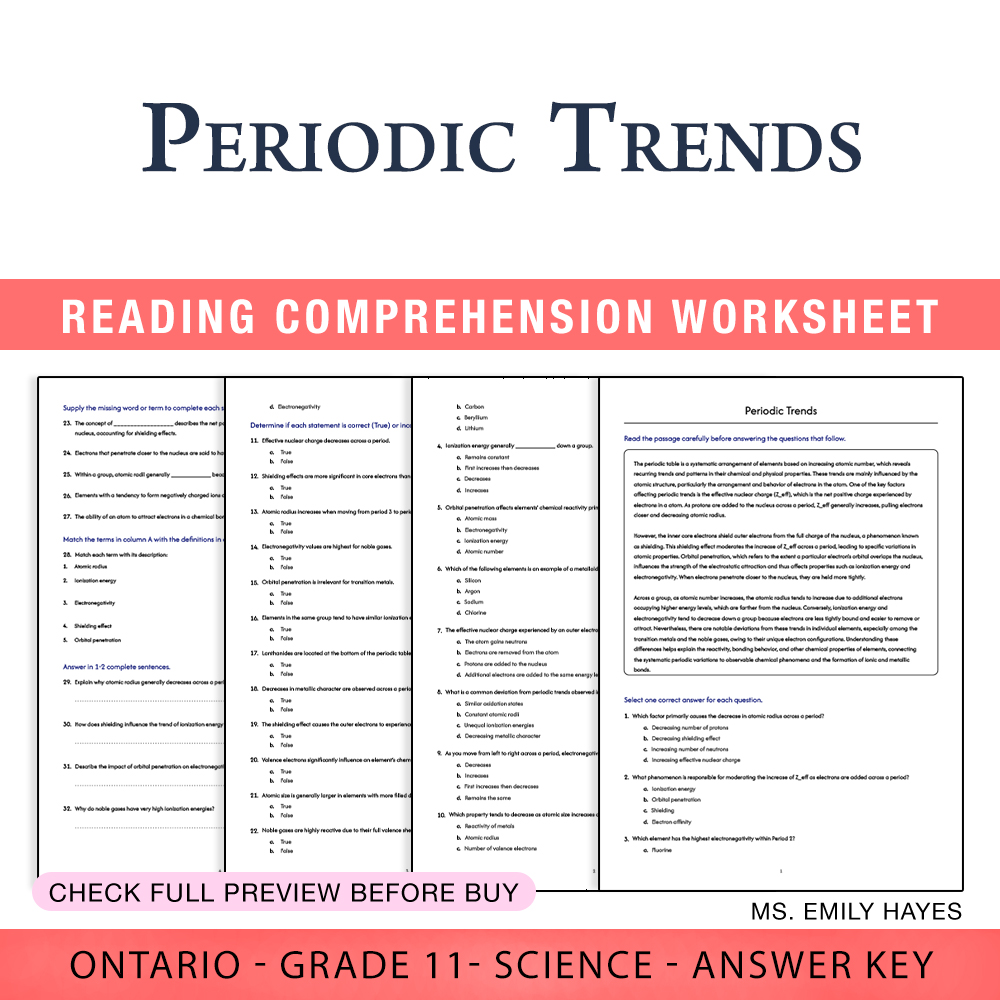
11th Grade Science | Periodic Trends Worksheet (PDF + Answer Key)
Created byCopper Leaf ClassroomLearning Objectives
- Explain the concepts of effective nuclear charge, shielding, and orbital penetration and their roles in periodic trends.
- Analyze how atomic radius, ionization energy, and electronegativity vary across periods and groups.
- Identify deviations from idealized periodic trends in representative elements and relate these to their chemical properties and behaviors.
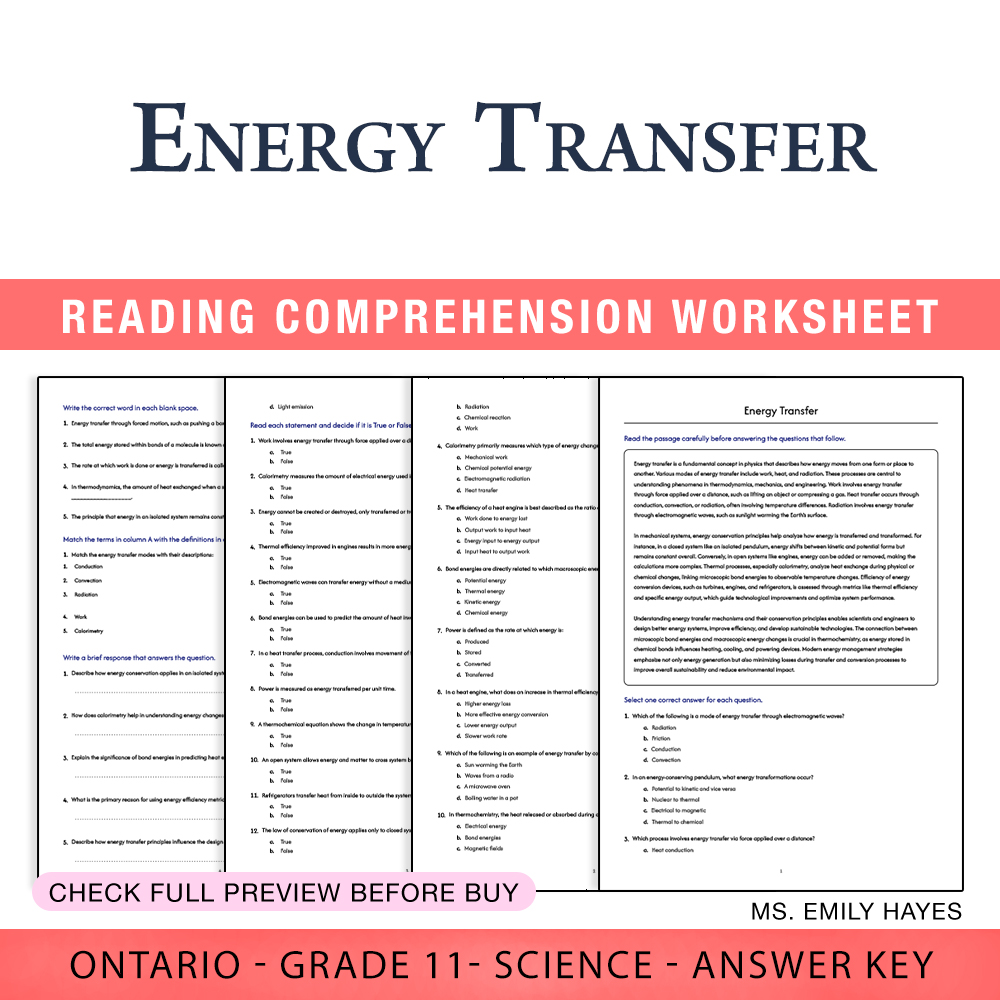
Grade 11 Science | Energy Transfer Worksheet (PDF + Answer Key)
Created byCopper Leaf ClassroomLearning Objectives
- Explain the different forms of energy and how energy is transferred in various systems.
- Analyze energy conservation principles in both closed and open systems.
- Apply quantitative methods like calorimetry and work-energy analysis to real-world problems.
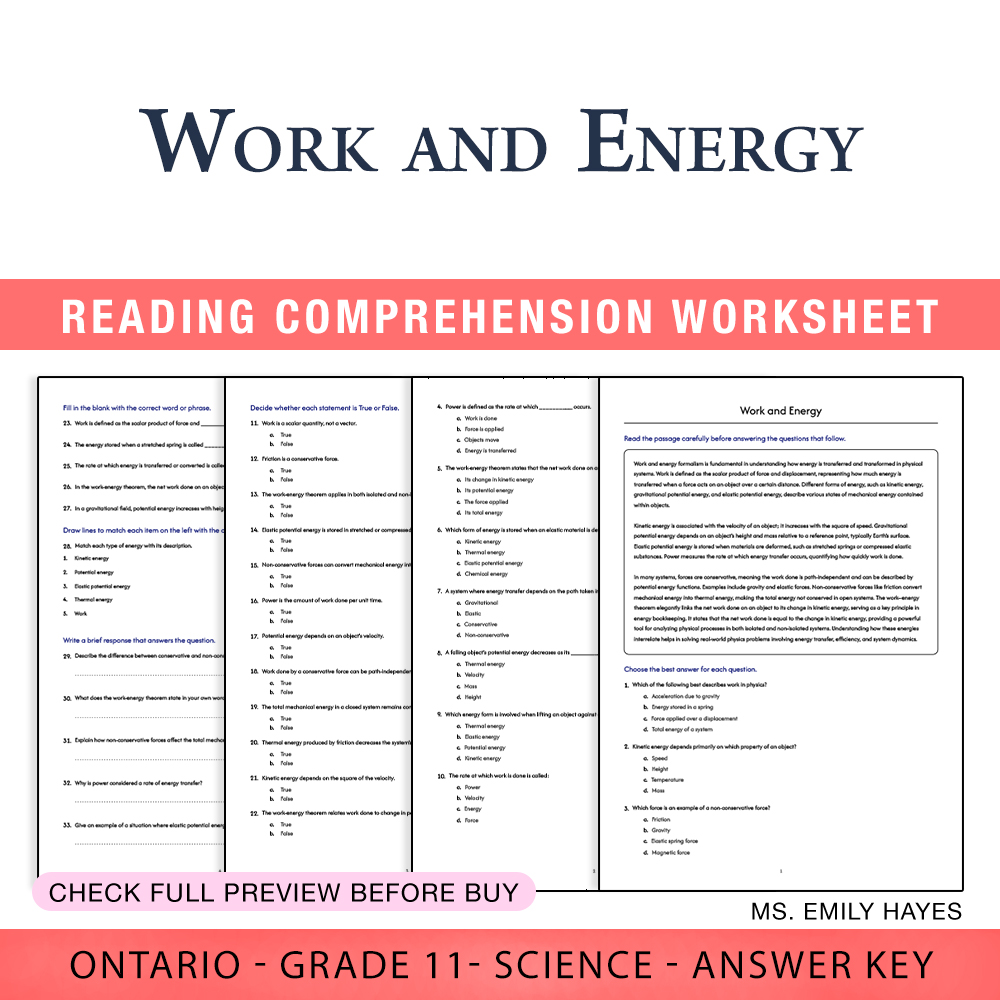
Grade 11 Science | Work and Energy Worksheet (PDF + Answer Key)
Created byCopper Leaf ClassroomLearning Objectives
- Explain the concept of work in physics as force applied over a displacement.
- Distinguish between different forms of energy—kinetic, gravitational potential, and elastic potential.
- Apply the work–energy theorem to solve related physics problems.
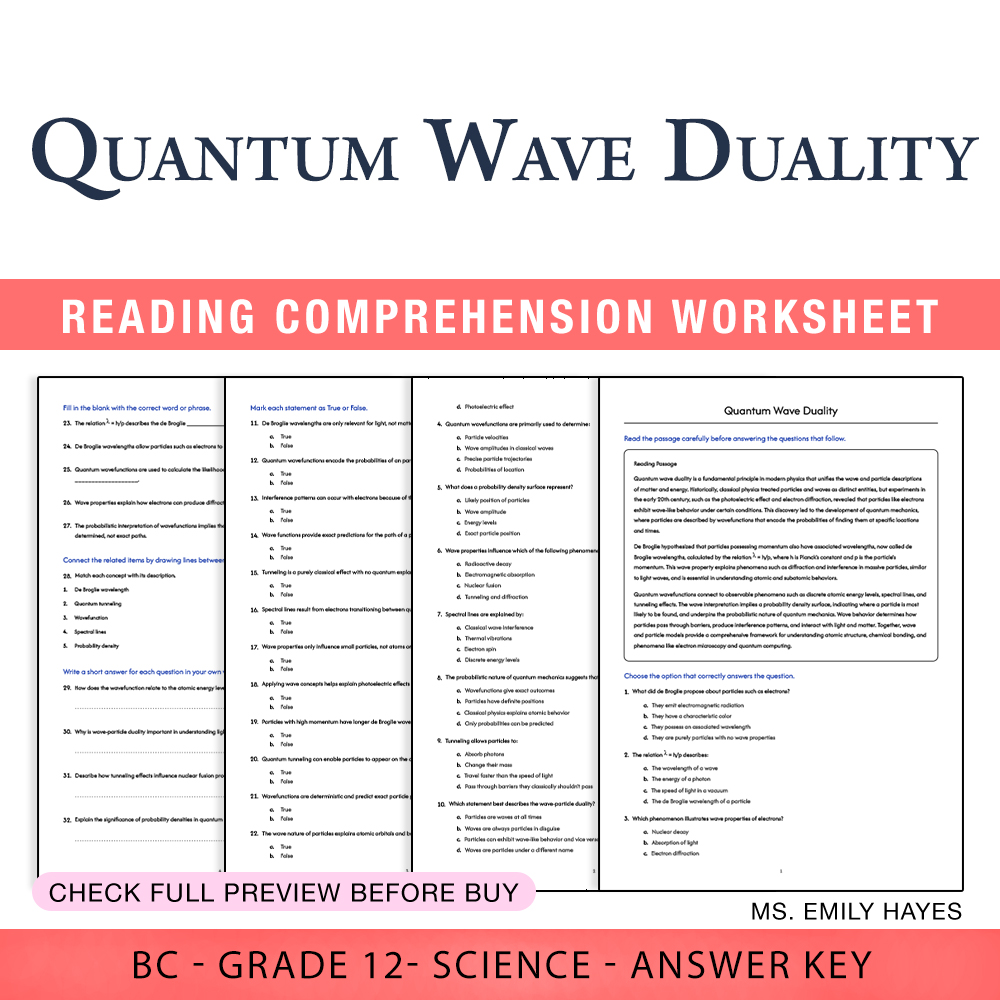
Grade 12 Science | Quantum Wave Duality Worksheet (PDF+ Answer Key)
Created byCopper Leaf ClassroomLearning Objectives
- Understand the concept of matter-wave duality and how it combines wave and particle models.
- Explain de Broglie wavelengths and their significance in quantum physics.
- Describe how wave properties influence diffraction, interference, and tunneling phenomena.
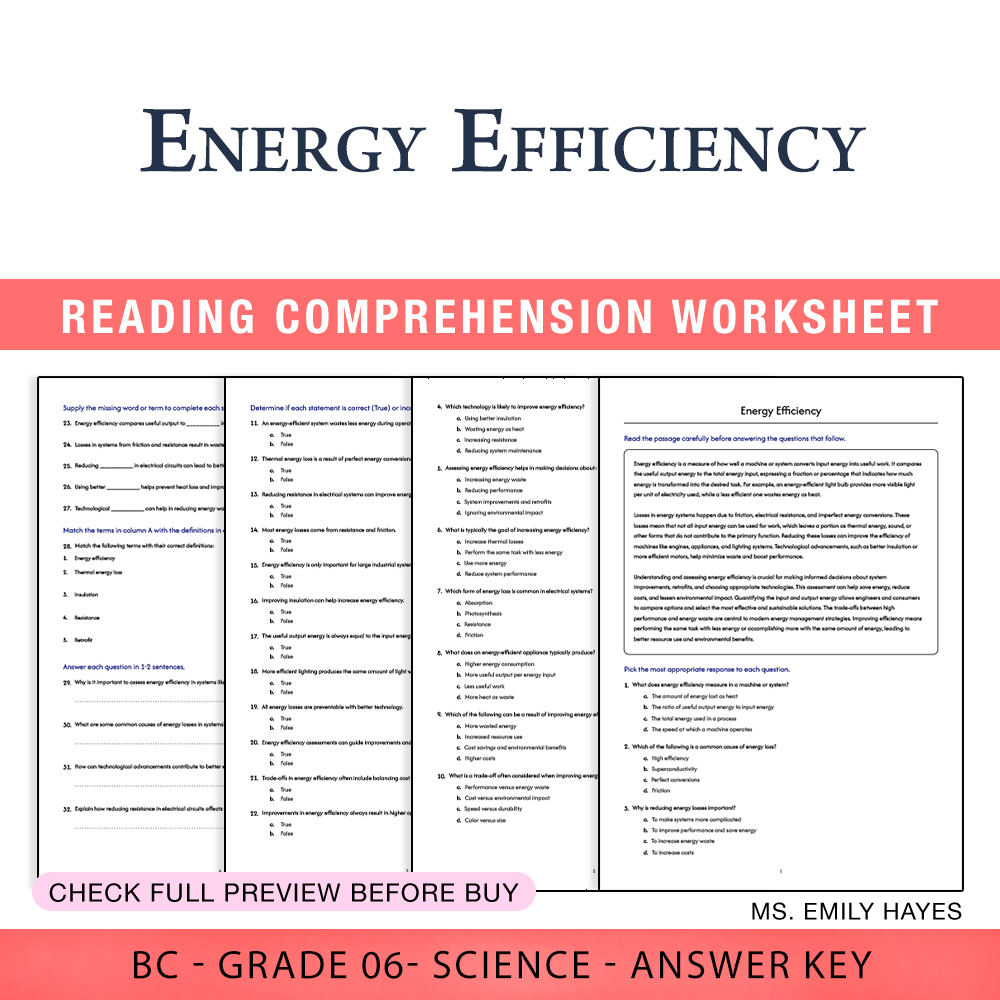
Grade 6 Science | Energy Efficiency Worksheet (PDF+ Answer Key)
Created byCopper Leaf ClassroomLearning Objectives
- Define energy efficiency and explain its importance in systems like machines and lighting.
- Identify common energy losses and understand their causes.
- Calculate the efficiency of a system by comparing useful output to total input energy.
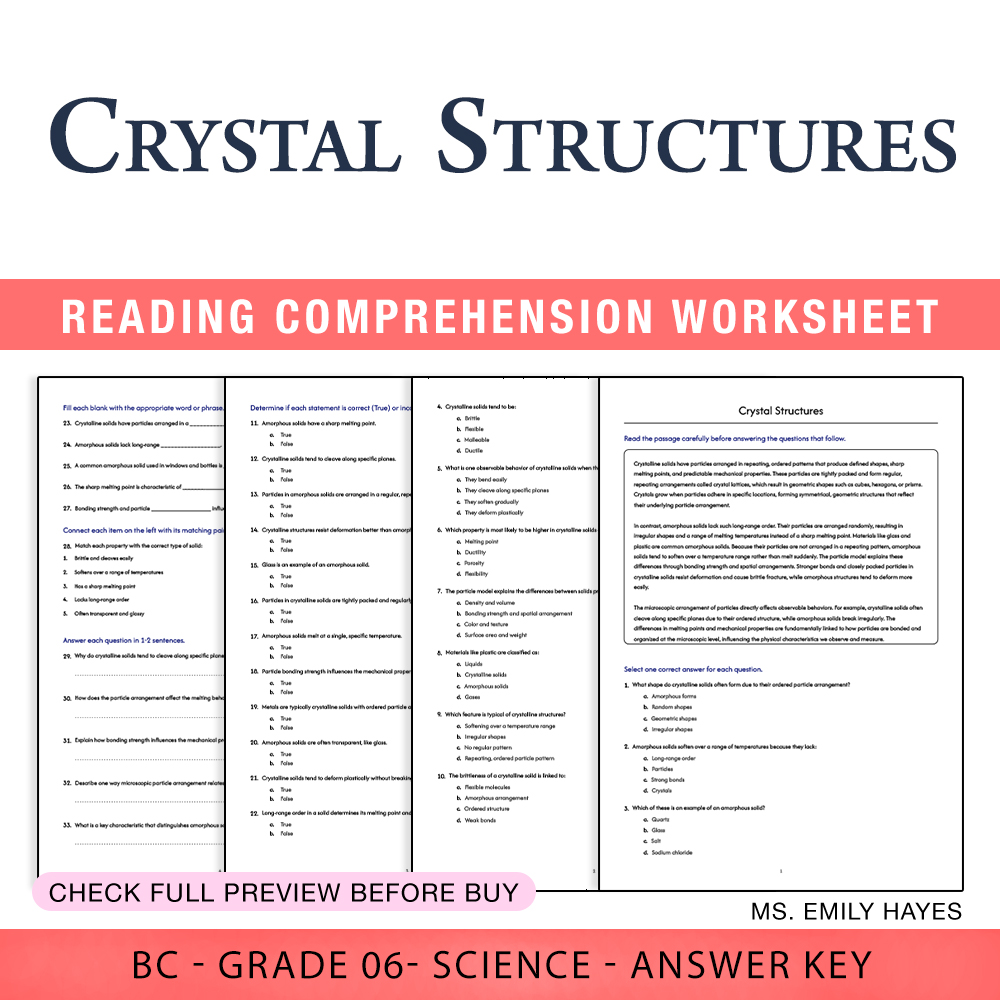
6th Grade Science | Crystal Structures Worksheet (PDF+ Answer Key)
Created byCopper Leaf ClassroomLearning Objectives
- Describe the arrangement of particles in crystalline and amorphous solids.
- Explain how particle arrangement affects the properties of solids such as melting point and brittleness.
- Compare microscopic structures to observable characteristics like cleavage and melting points.
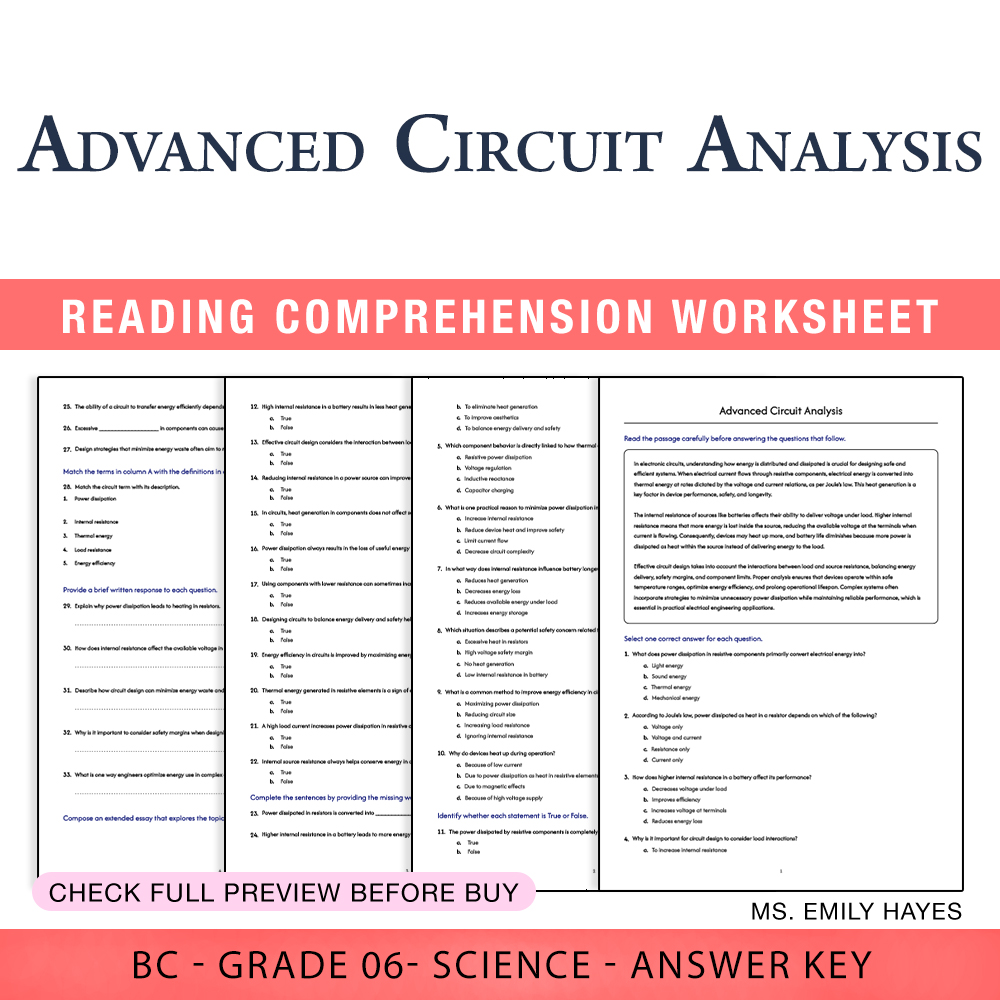
Grade 6 Science | Advanced Circuit Analysis Worksheet (PDF+ Answer Key)
Created byCopper Leaf ClassroomLearning Objectives
- Understand the relationship between power dissipation and thermal energy in resistive components.
- Explain how internal resistance affects voltage supply and device operation.
- Analyze how load interactions influence energy distribution and safety considerations in circuits.
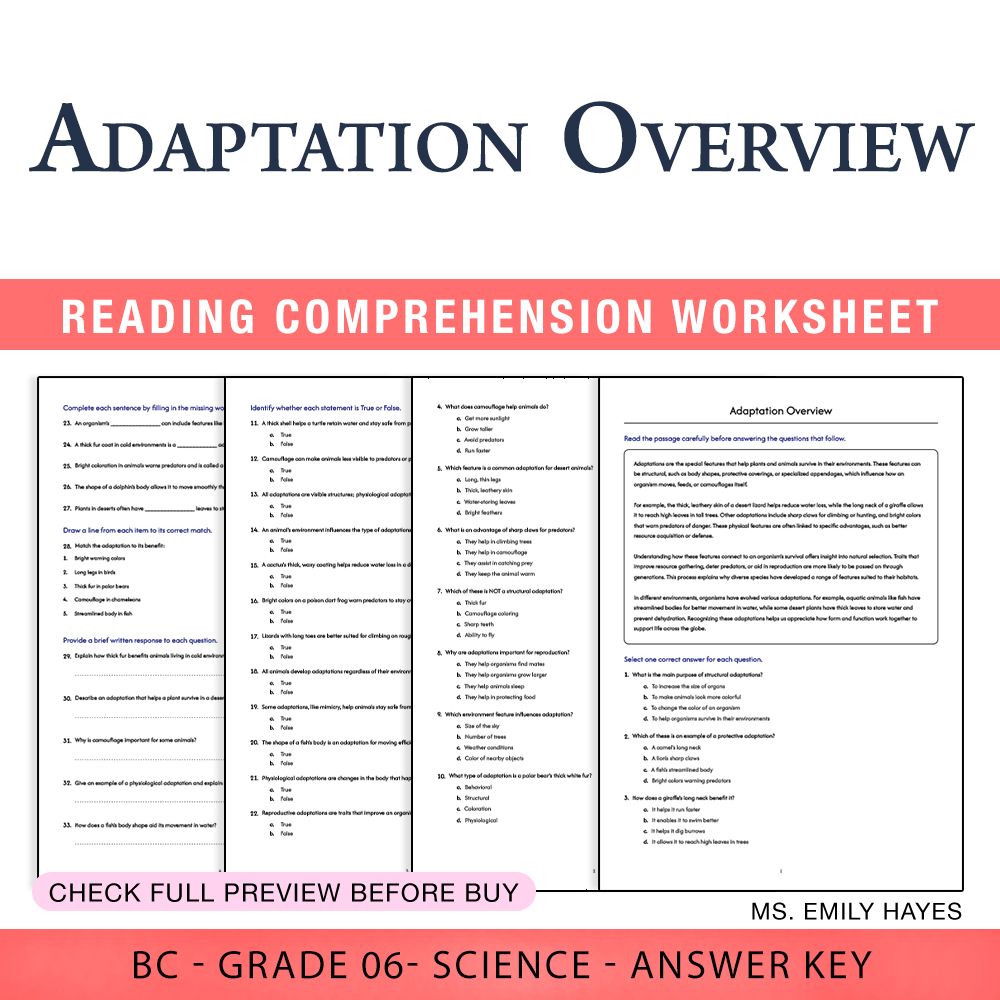
6th Grade Science | Adaptation Overview Worksheet (PDF+ Answer Key)
Created byCopper Leaf ClassroomLearning Objectives
- Identify different types of structural adaptations and understand their functions.
- Explain how adaptations help organisms survive and thrive in their environments.
- Describe relationships between specific features and their advantages for species.
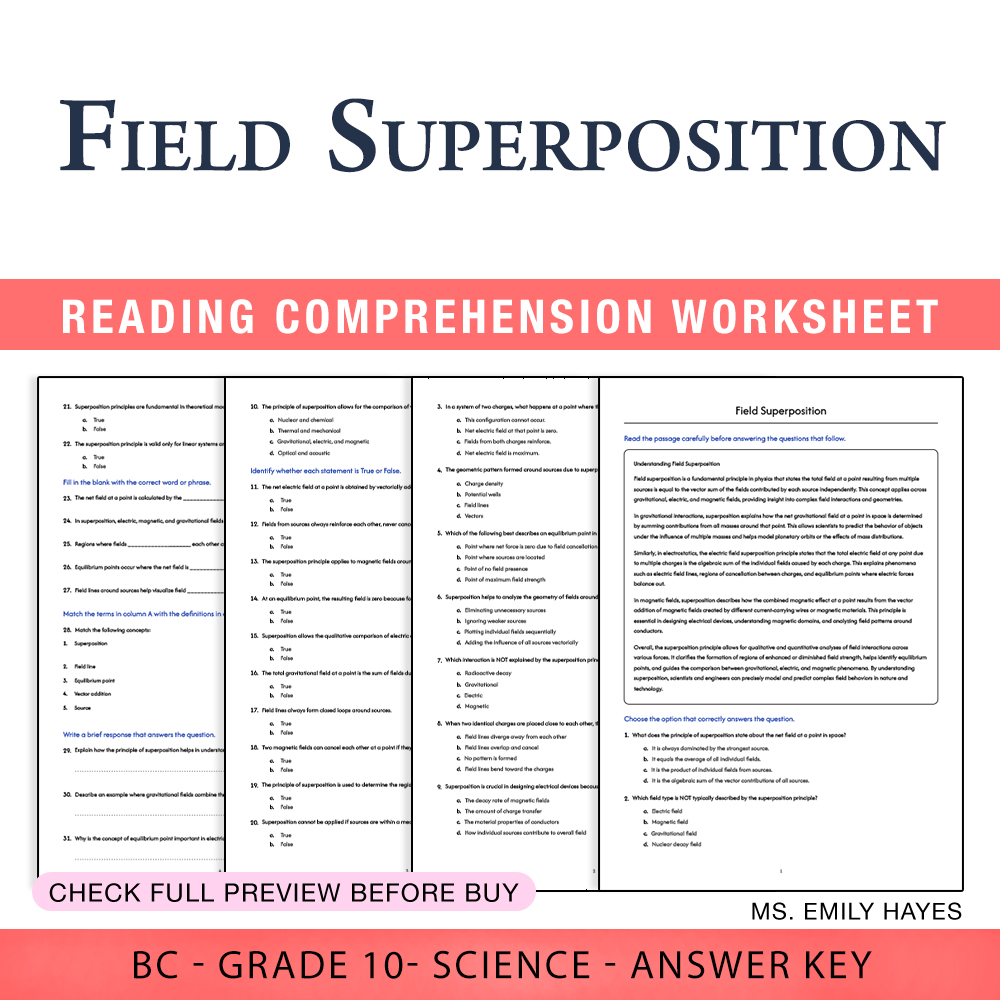
Grade 10 Science | Field Superposition Worksheet (PDF+ Answer Key)
Created byCopper Leaf ClassroomLearning Objectives
- Understand the principle of field superposition and its application in physics.
- Calculate the resultant field at a point due to multiple sources.
- Identify regions where fields reinforce or cancel each other.
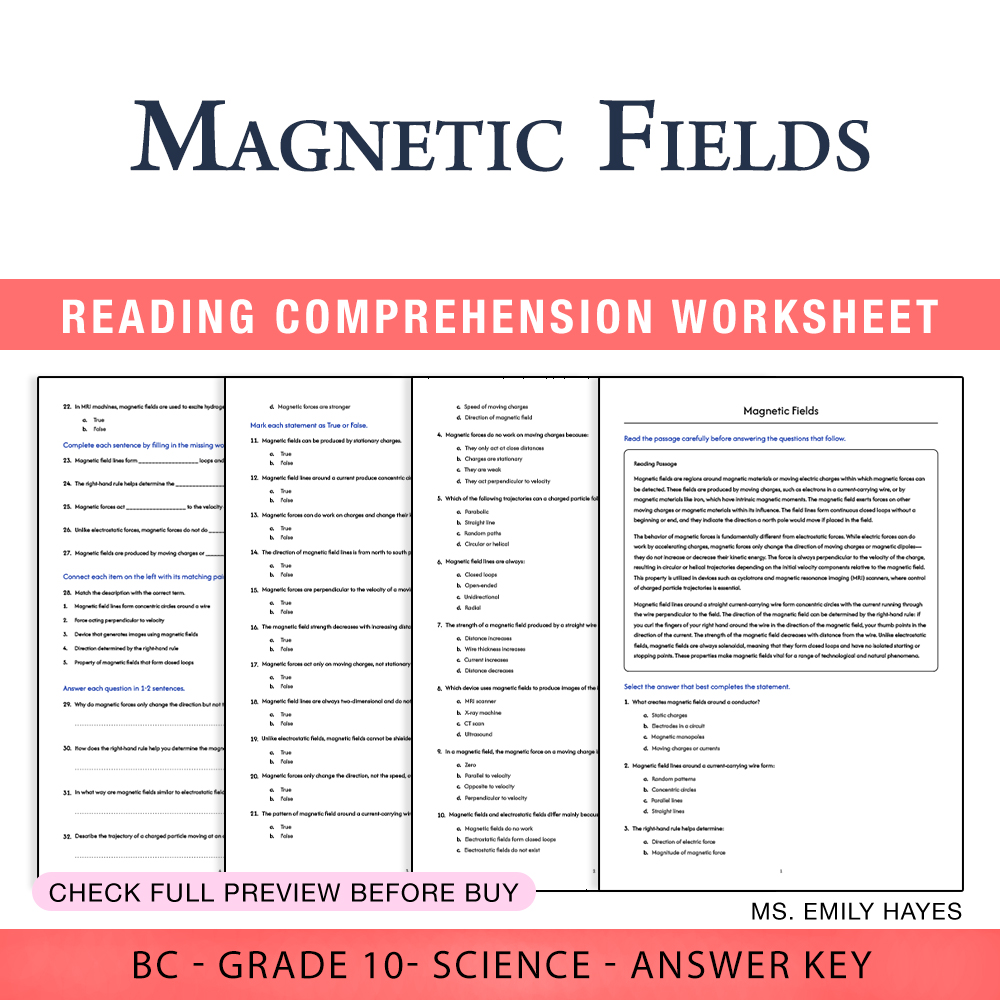
10th Grade Science | Magnetic Fields Worksheet (PDF+ Answer Key)
Created byCopper Leaf ClassroomLearning Objectives
- Explain how magnetic fields are generated by moving charges and electric currents.
- Interpret the representation of magnetic field lines and their direction.
- Describe the effects of magnetic forces on moving charges and their trajectories.
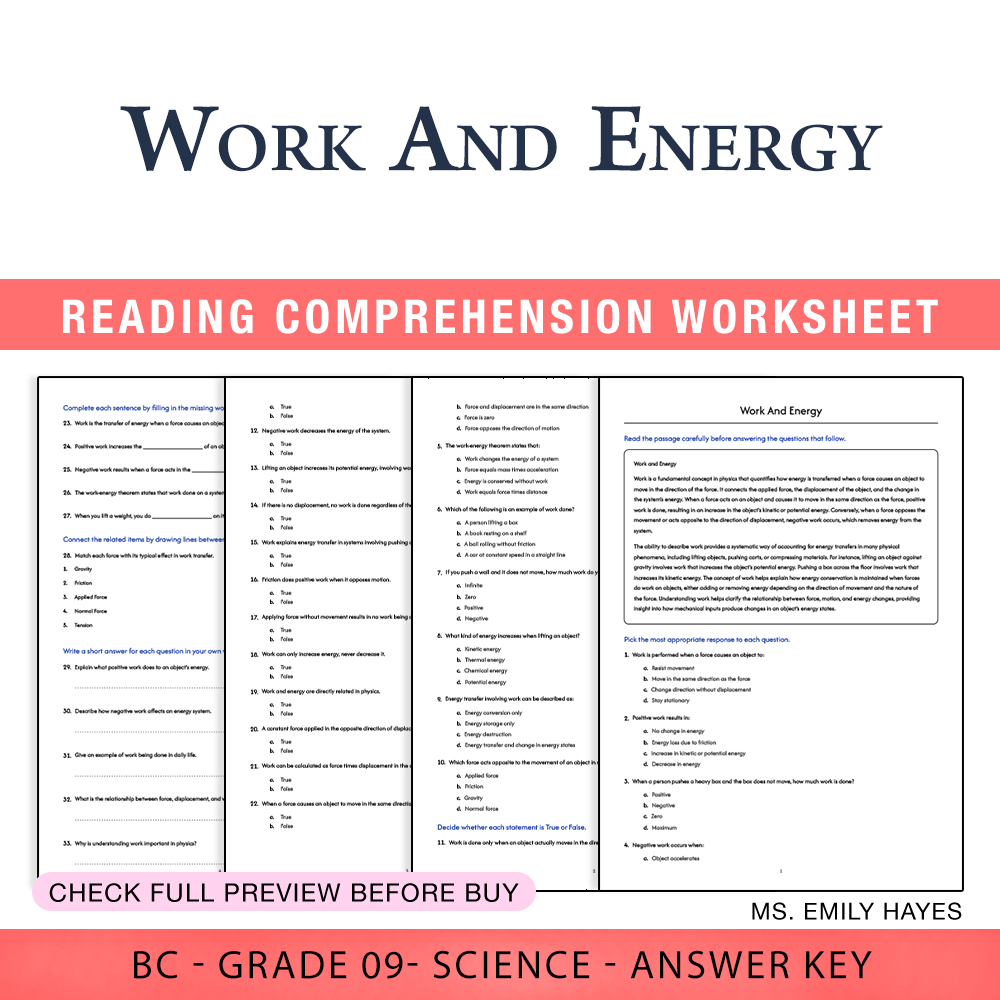
9th Grade Science | Work & Energy Worksheet (PDF+ Answer Key)
Created byCopper Leaf ClassroomLearning Objectives
- Understand the concept of work in relation to force, displacement, and energy transfer.
- Distinguish between positive and negative work and their effects on energy.
- Apply the work-energy theorem to simple physics problems.
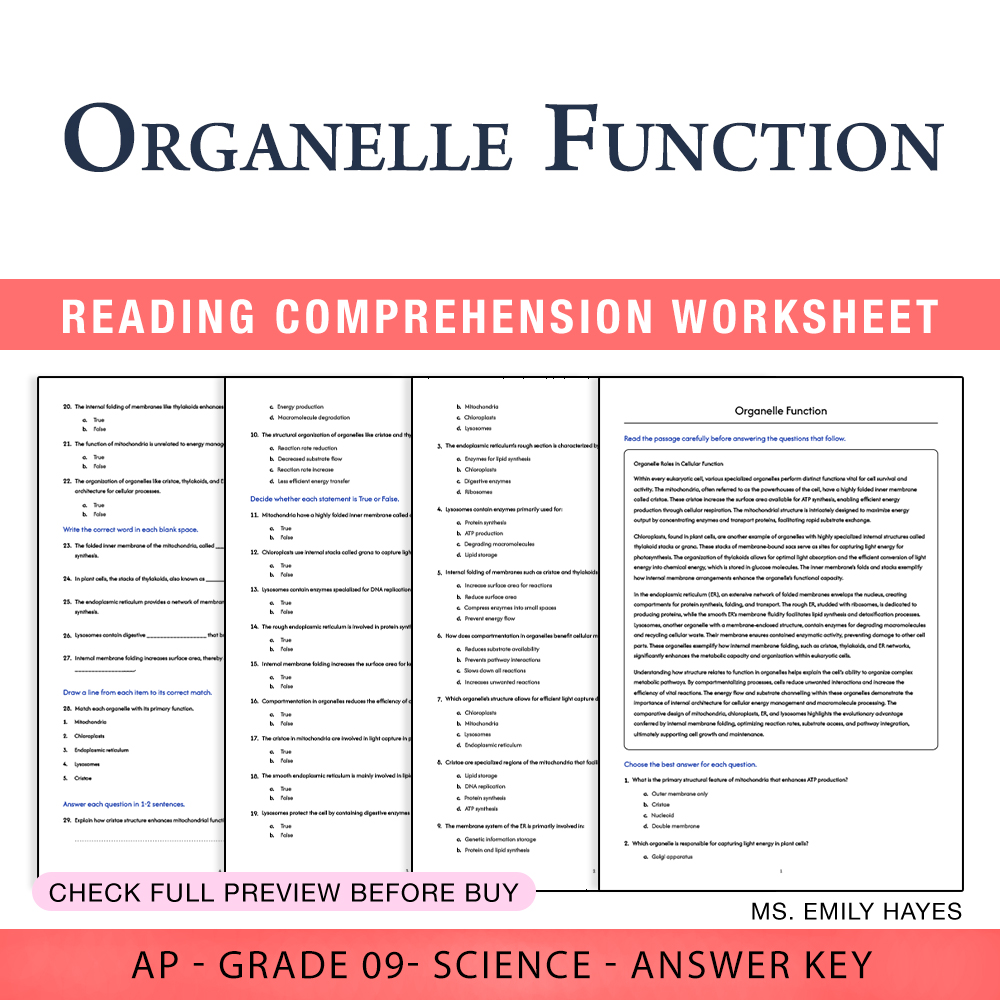
9th Grade Science | Organelle Function Worksheet (PDF+ Answer Key)
Created byCopper Leaf ClassroomLearning Objectives
- Identify the major organelles involved in cellular processes and their specific functions.
- Explain how internal structures like folded membranes contribute to metabolic efficiency.
- Compare and contrast organelle structures such as mitochondria and chloroplasts.
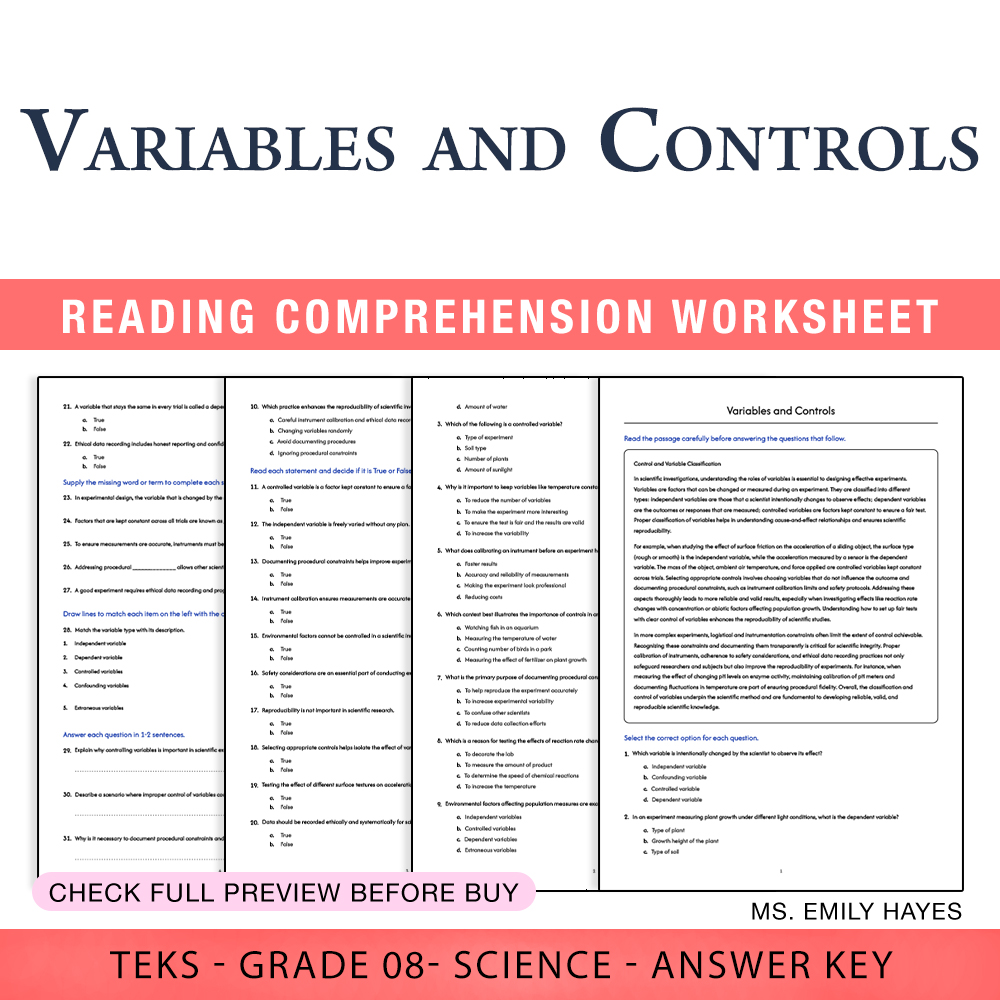
8th Grade Science | Variables and Controls Worksheet (PDF+ Answer Key)
Created byCopper Leaf ClassroomLearning Objectives
- Understand the differences between independent, dependent, and controlled variables in scientific investigations.
- Learn how to establish fair tests by selecting appropriate controls and documenting procedural constraints.
- Identify examples of variables and controls in real-world experiments involving friction, reaction rates, and environmental factors.
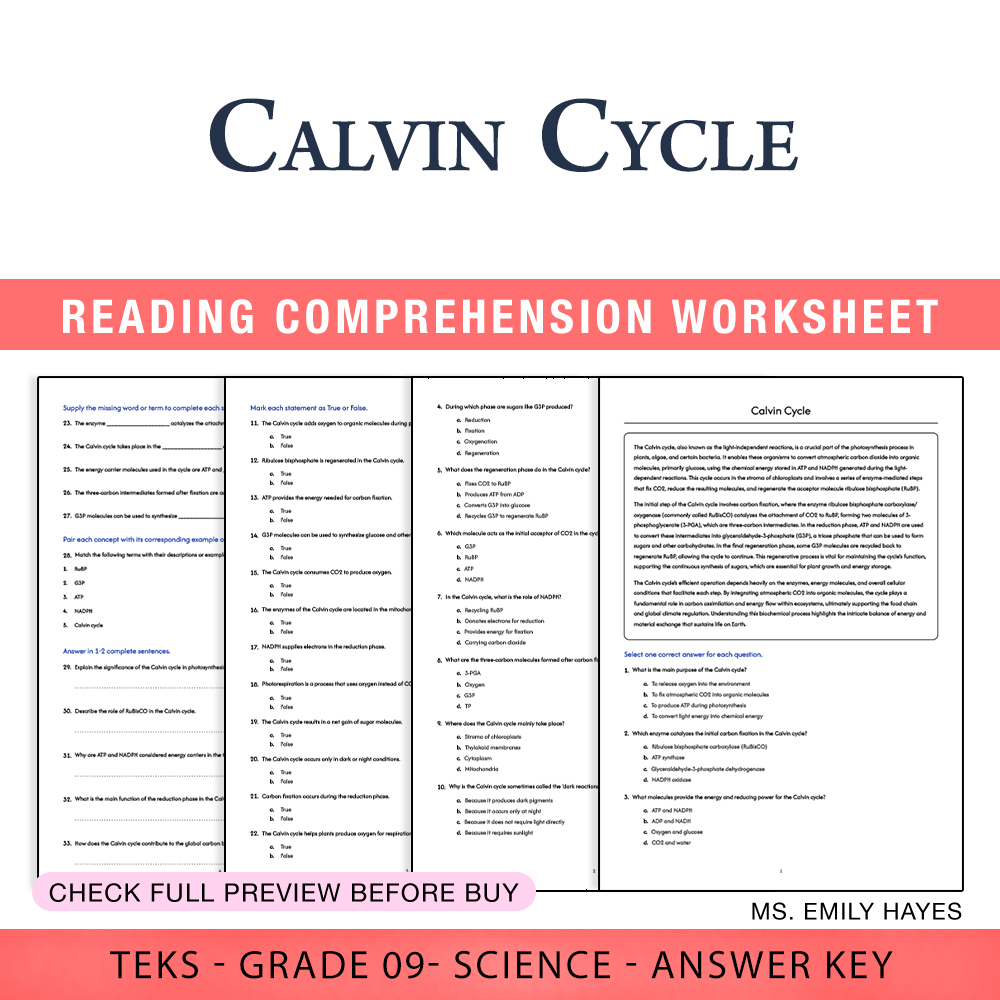
Grade 9 Science | Calvin Cycle Worksheet (PDF+ Answer Key)
Created byCopper Leaf ClassroomLearning Objectives
- Describe the steps and purpose of the Calvin cycle in photosynthesis.
- Explain the role of enzymes such as ribulose bisphosphate carboxylase in carbon fixation.
- Identify the energy carriers ATP and NADPH and their roles in the cycle.
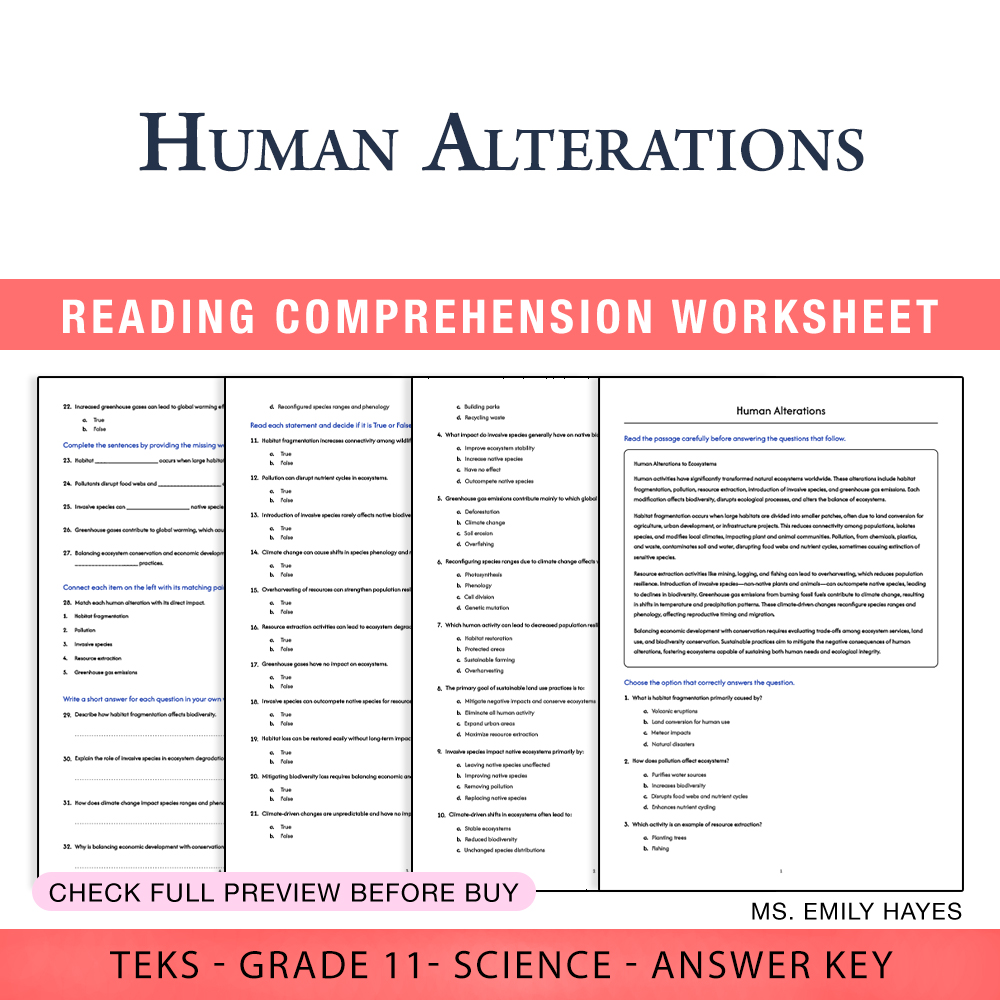
Grade 11 Science | Human Alterations Worksheet (PDF+ Answer Key)
Created byCopper Leaf ClassroomLearning Objectives
- Understand different human alterations to ecosystems and their impacts on biodiversity.
- Identify and describe various human activities that modify ecological processes.
- Analyze the trade-offs between human development and ecosystem conservation.
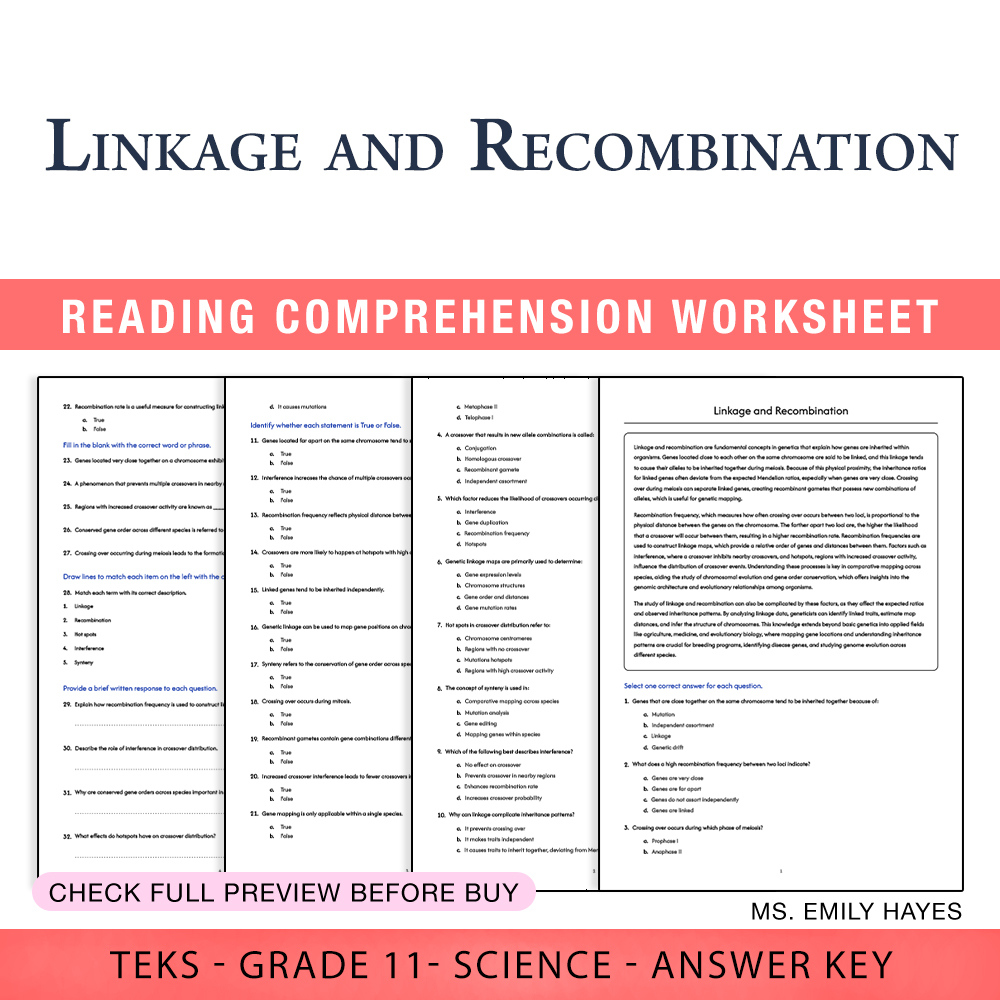
Grade 11 Science | Linkage and Recombination Worksheet (PDF+ Answer Key)
Created byCopper Leaf ClassroomLearning Objectives
- Explain the concepts of linkage and how genes on the same chromosome tend to be inherited together.
- Describe how recombination frequency reflects physical distance between gene loci.
- Analyze factors such as interference and hotspots that influence crossover distribution.
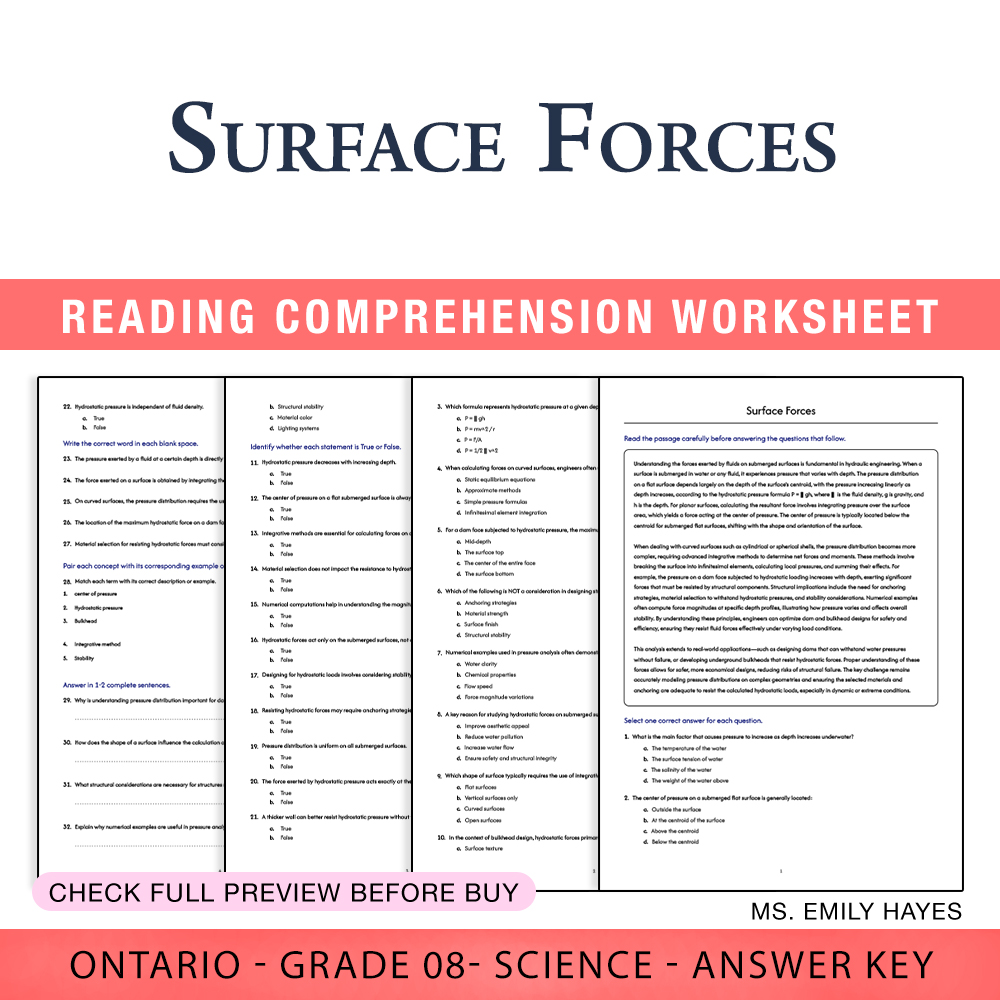
8th Grade Science | Surface Forces Worksheet (PDF+ Answer Key)
Created byCopper Leaf ClassroomLearning Objectives
- Understand the principles of pressure distribution on submerged surfaces
- Analyze how forces act on planar and curved surfaces underwater
- Apply integrative methods to calculate net forces and centers of pressure
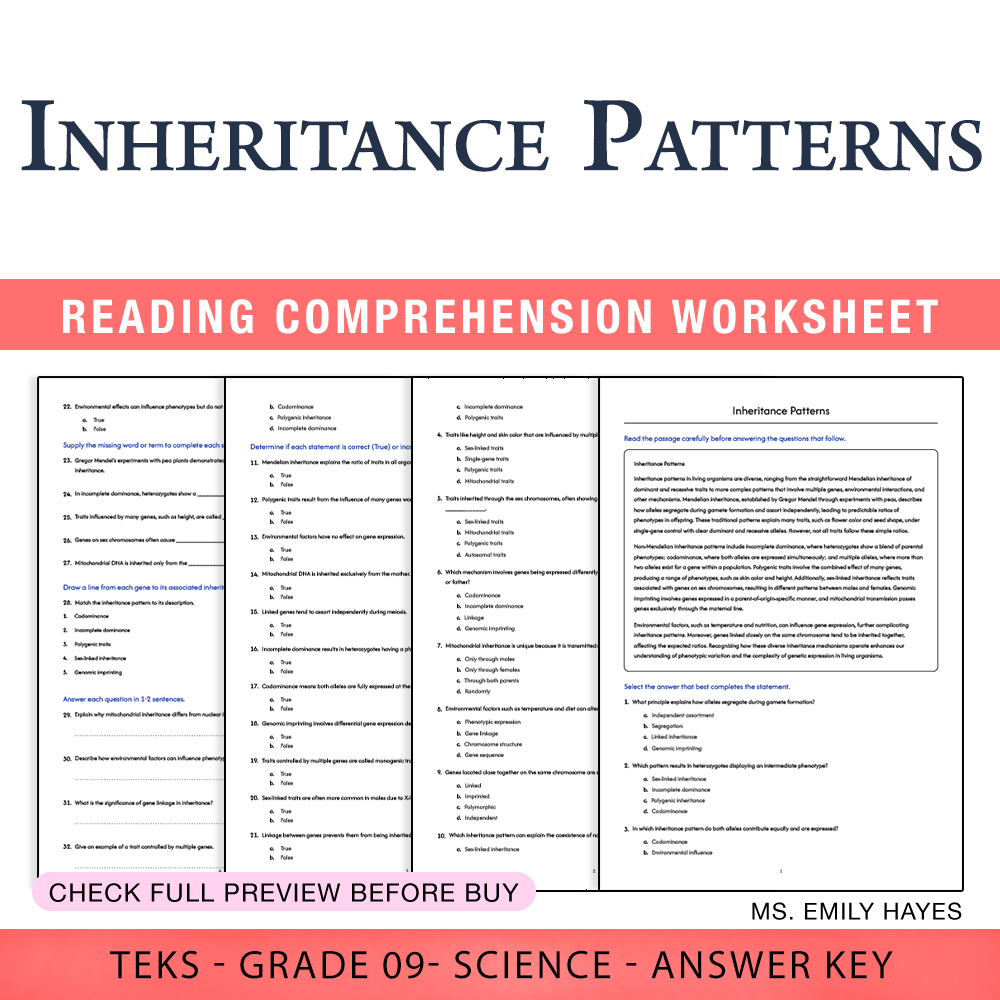
9th Grade Science | Inheritance Patterns Worksheet (PDF+ Answer Key)
Created byCopper Leaf ClassroomLearning Objectives
- Explain the basic principles of Mendelian inheritance, including segregation and independent assortment.
- Identify and describe non-Mendelian inheritance patterns such as incomplete dominance, codominance, and polygenic traits.
- Recognize how environmental factors and gene linkage modify phenotypic expression.
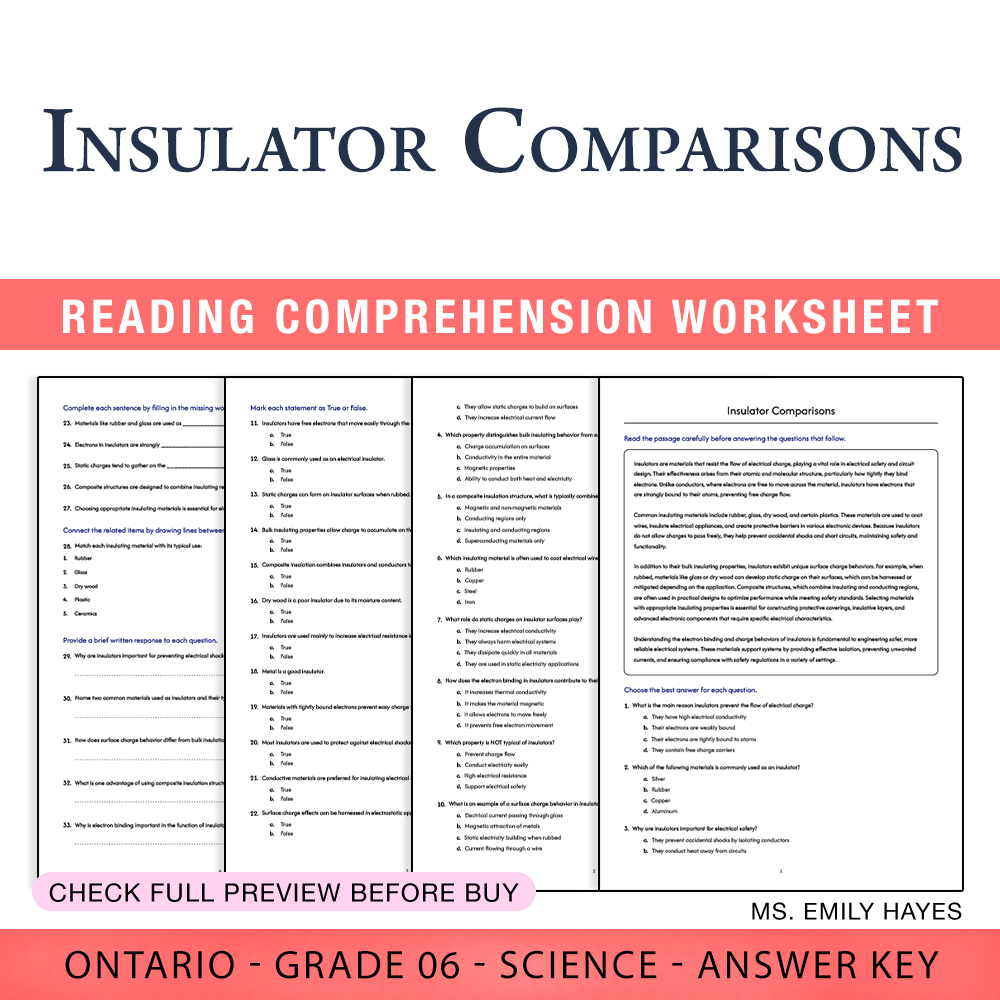
6th Grade Science | Insulator Comparisons Worksheet (PDF + Answer Key)
Created byCopper Leaf ClassroomLearning Objectives
- Understand the molecular structure of insulators and how electron binding prevents charge flow.
- Identify common insulating materials such as rubber, glass, and dry wood and their applications.
- Explain how insulators contribute to electrical safety through effective isolation.

7th Grade Science | Niche Interactions Worksheet (PDF+ Answer Key)
Created byCopper Leaf ClassroomLearning Objectives
- Describe different types of species interactions such as competition, predation, mutualism, and parasitism.
- Explain how niche partitioning reduces competition among species.
- Identify examples of keystone species and their influence on community structure.
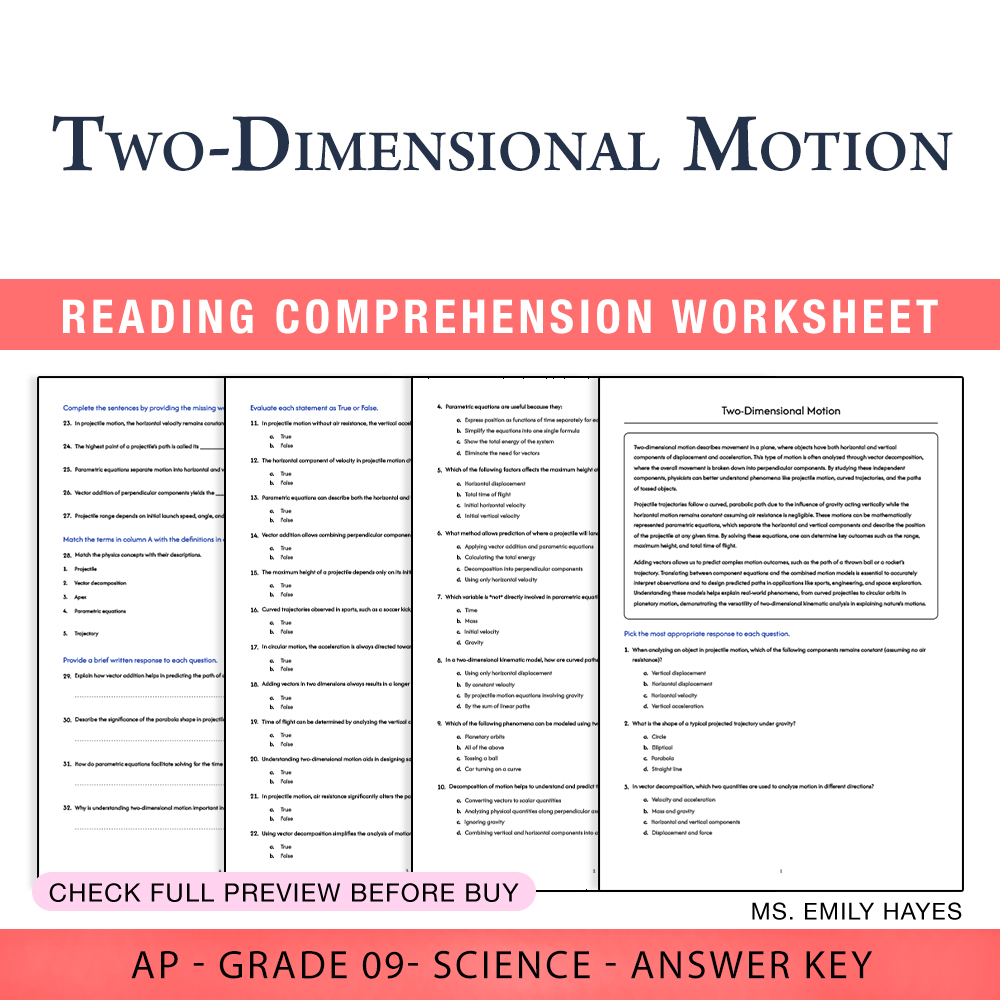
Grade 9 Science | Two-Dimensional Motion Worksheet (PDF+ Answer Key)
Created byCopper Leaf ClassroomLearning Objectives
- Understand the principles of motion in a plane using vector decomposition.
- Apply parametric equations to analyze projectile trajectories and predict motion outcomes.
- Use vector addition to determine range, apex, and time-of-flight for projectiles.
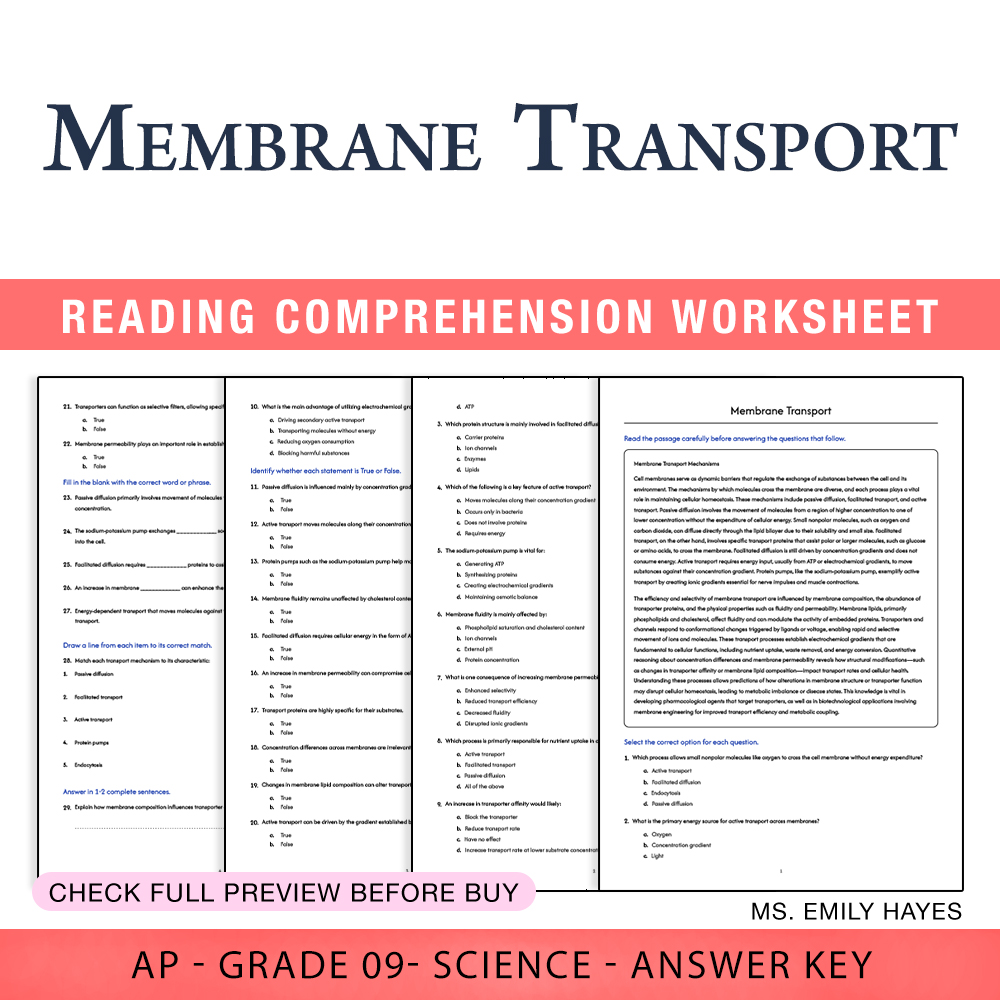
9th Grade Science | Membrane Transport Worksheet (PDF+ Answer Key)
Created byCopper Leaf ClassroomLearning Objectives
- Describe mechanisms of transmembrane movement including passive diffusion, facilitated transport, and active transport.
- Explain the role of membrane composition and transport proteins in cellular homeostasis.
- Analyze how concentration gradients and membrane permeability influence transport efficiency.
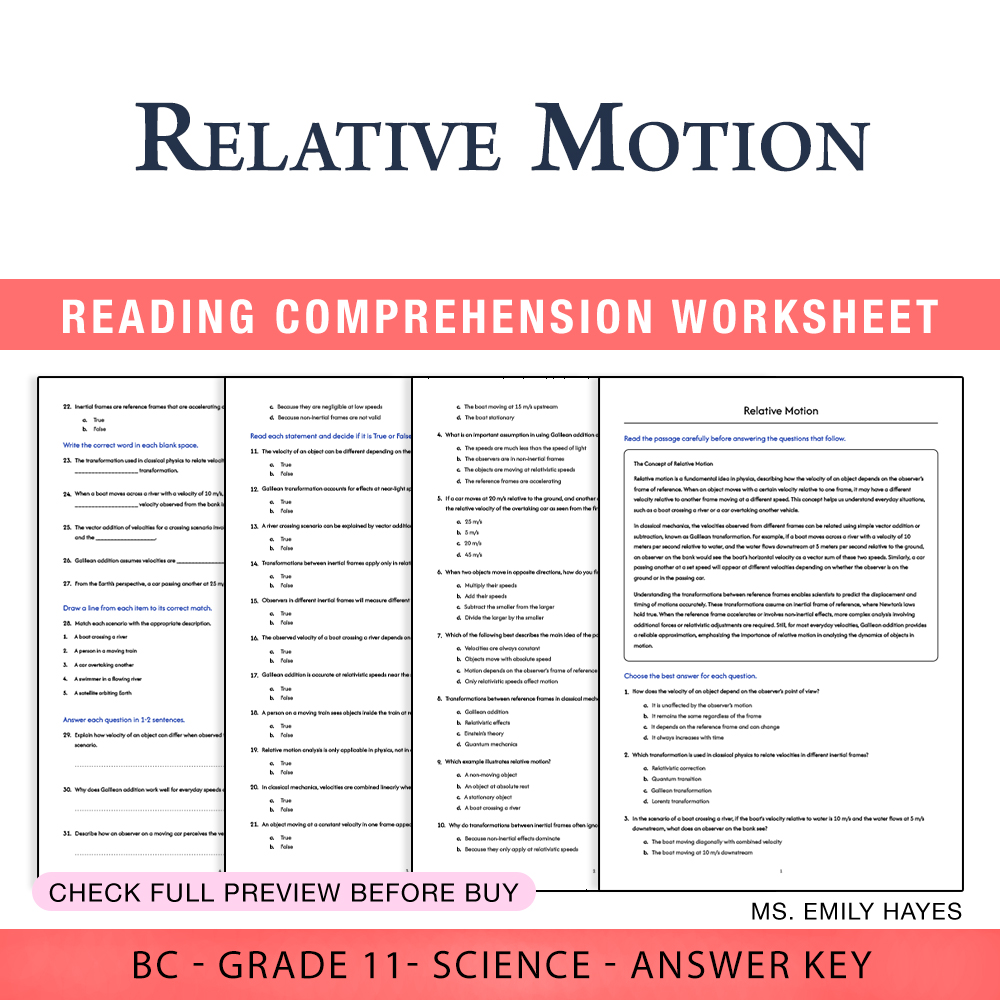
11th Grade Science | Relative Motion Worksheet (PDF + Answer Key)
Created byCopper Leaf ClassroomLearning Objectives
- Understand the concept of relative motion and how velocities depend on reference frames.
- Apply vector addition and subtraction to relate observations from different viewpoints.
- Analyze scenarios involving objects moving relative to water, ground, or other objects.
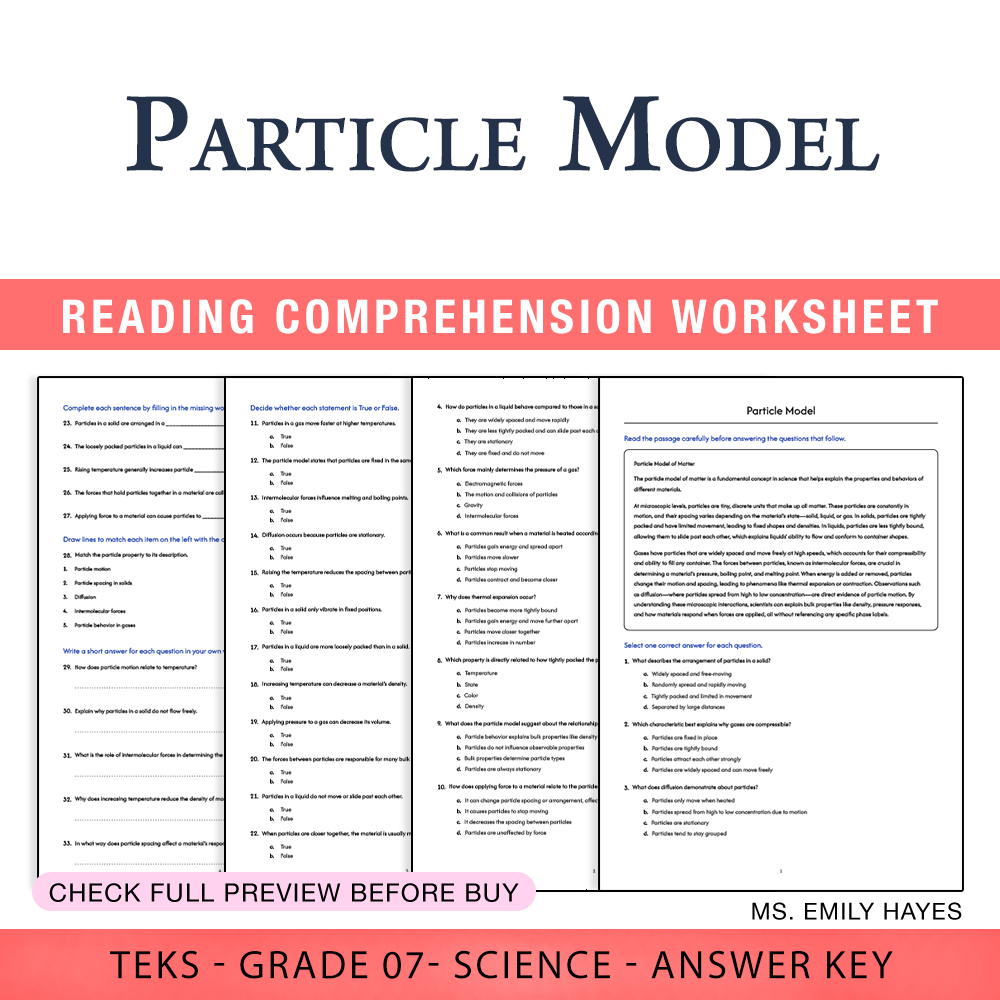
7th Grade Science | Particle Model Worksheet (PDF+ Answer Key)
Created byCopper Leaf ClassroomLearning Objectives
- Explain the basic principles of the particle model of matter and how particles behave in different states
- Describe how particle spacing, motion, and forces account for observable properties like density, pressure, and compressibility
- Relate micro-scale particle interactions to macro-scale measurements such as diffusion, thermal expansion, and response to applied forces
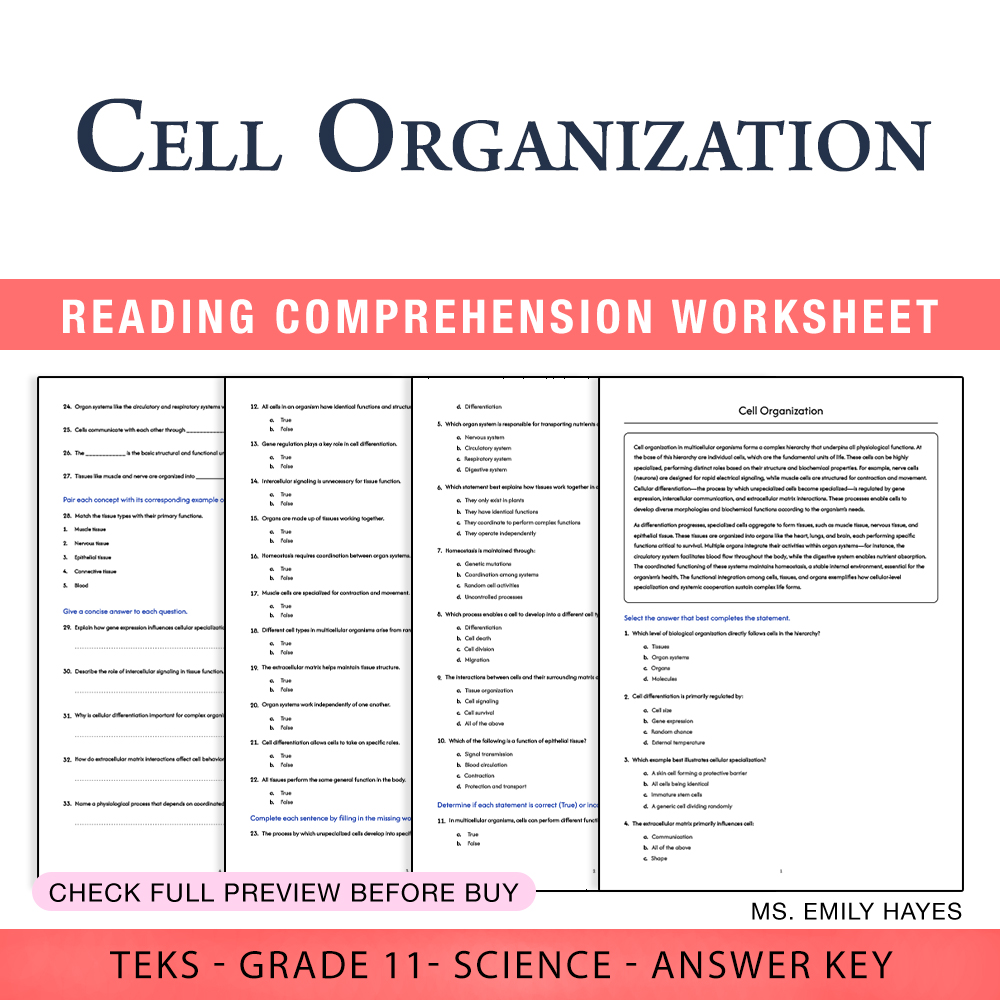
11th Grade Science | Cell Organization Worksheet (PDF+ Answer Key)
Created byCopper Leaf ClassroomLearning Objectives
- Understand the hierarchical levels of cell organization from cells to organ systems.
- Describe how cellular differentiation leads to specialized functions in multicellular organisms.
- Explain mechanisms of cellular specialization such as gene expression and intercellular signaling.
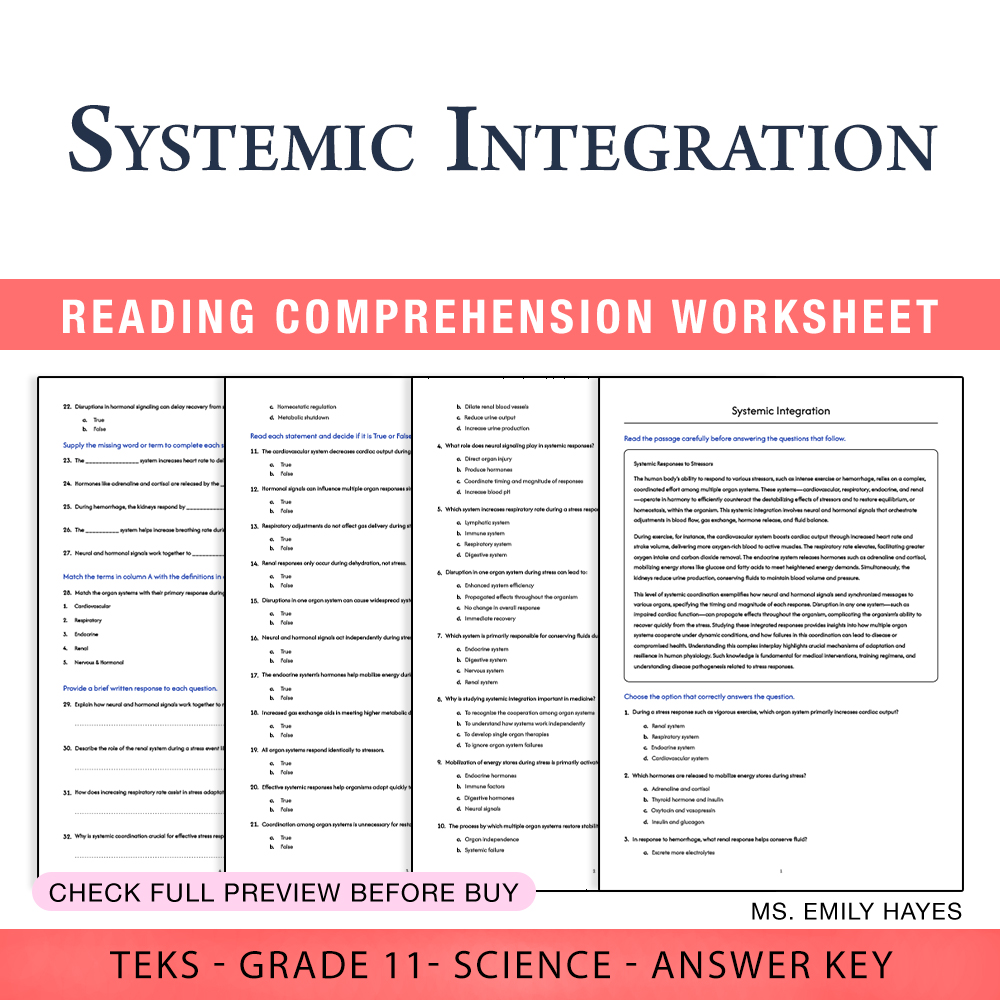
11th Grade Science | Systemic Integration Worksheet (PDF+ Answer Key)
Created byCopper Leaf ClassroomLearning Objectives
- Understand the coordination among physiological systems during stress responses.
- Describe how organ systems communicate to restore homeostasis under stress.
- Analyze the roles of cardiovascular, respiratory, endocrine, and renal systems in stress adaptation.
Browse more categories
About Science Worksheets
Find Science worksheets spanning core skills, practice, and review. All 42,859 resources are instant PDF downloads for the classroom or home.
Every worksheet on MyTeachingSheets is created by independent teacher-authors and reviewed before publication. All resources download as printable PDFs for classroom, homework, or at-home practice, and many include answer keys. Preview any worksheet free before buying.