
Science Worksheets
42,685 subject resources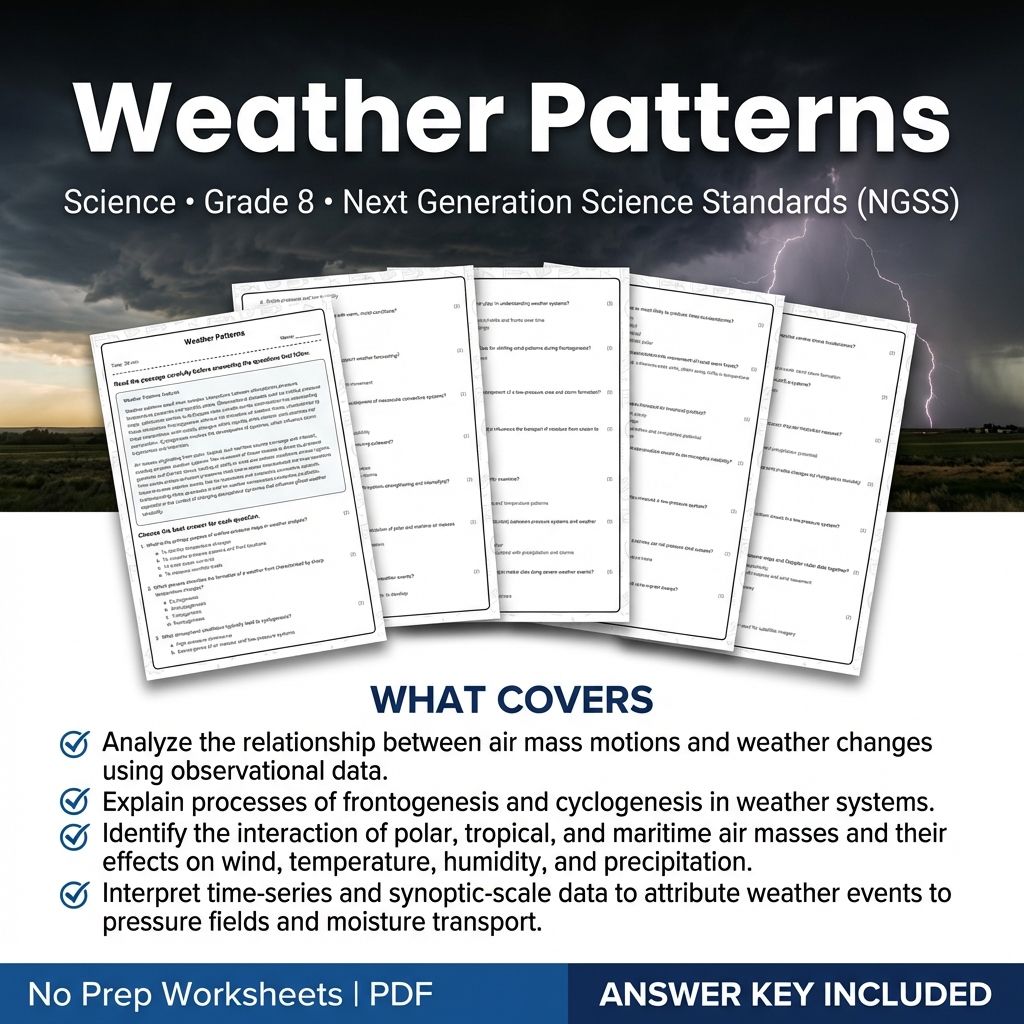
8th Grade Science | Weather Patterns Worksheet & Answer Key (Printable PDF)
 Created byCoral Reef Learning
Learning Objectives
- Analyze the relationship between air mass motions and weather changes using observational data.
- Explain processes of frontogenesis and cyclogenesis in weather systems.
- Identify the interaction of polar, tropical, and maritime air masses and their effects on wind, temperature, humidity, and precipitation.
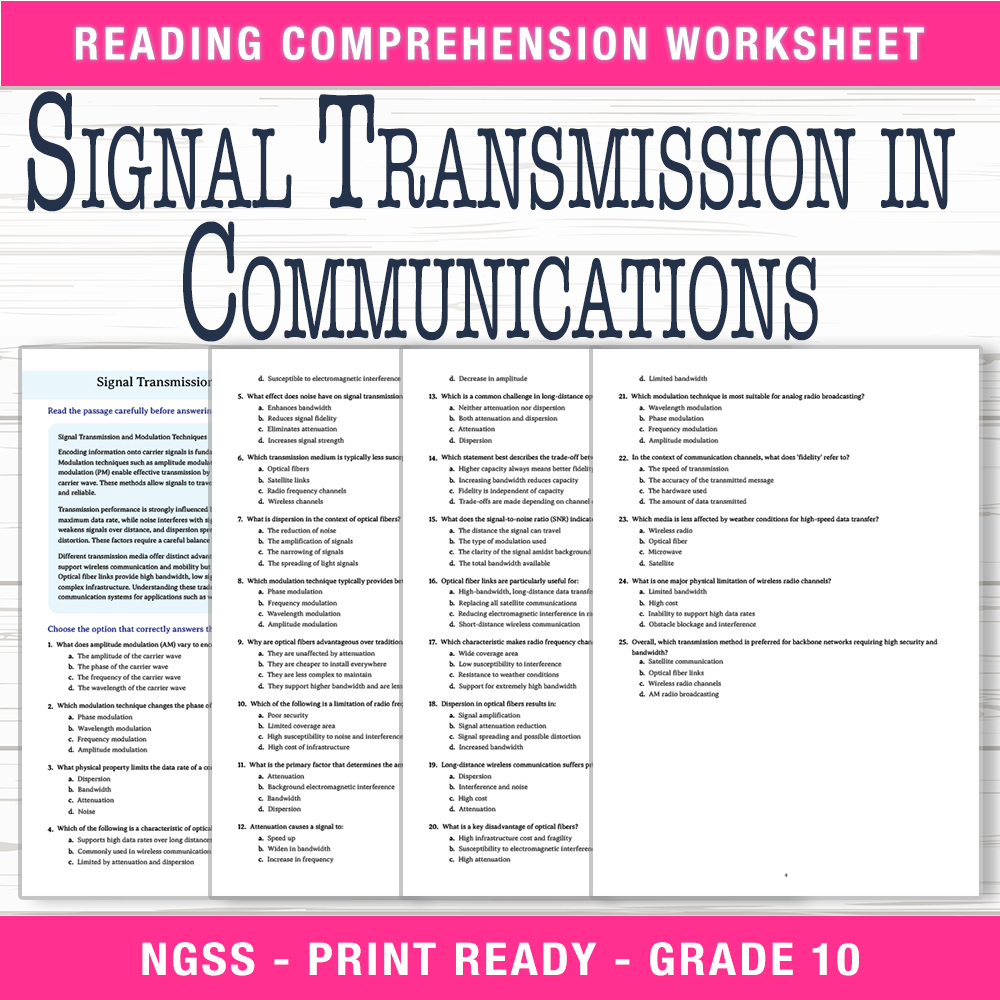
Grade 10 Science | Signal Transmission in Communications Worksheet (PDF + Answer Key)
 Created byRiverstone Classroom
Learning Objectives
- Explain the principles of amplitude, frequency, and phase modulation techniques used in signal transmission.
- Identify the effects of channel constraints such as bandwidth, noise, attenuation, and dispersion on communication systems.
- Compare different transmission modes like radio frequency channels and optical fiber links in terms of advantages and limitations.
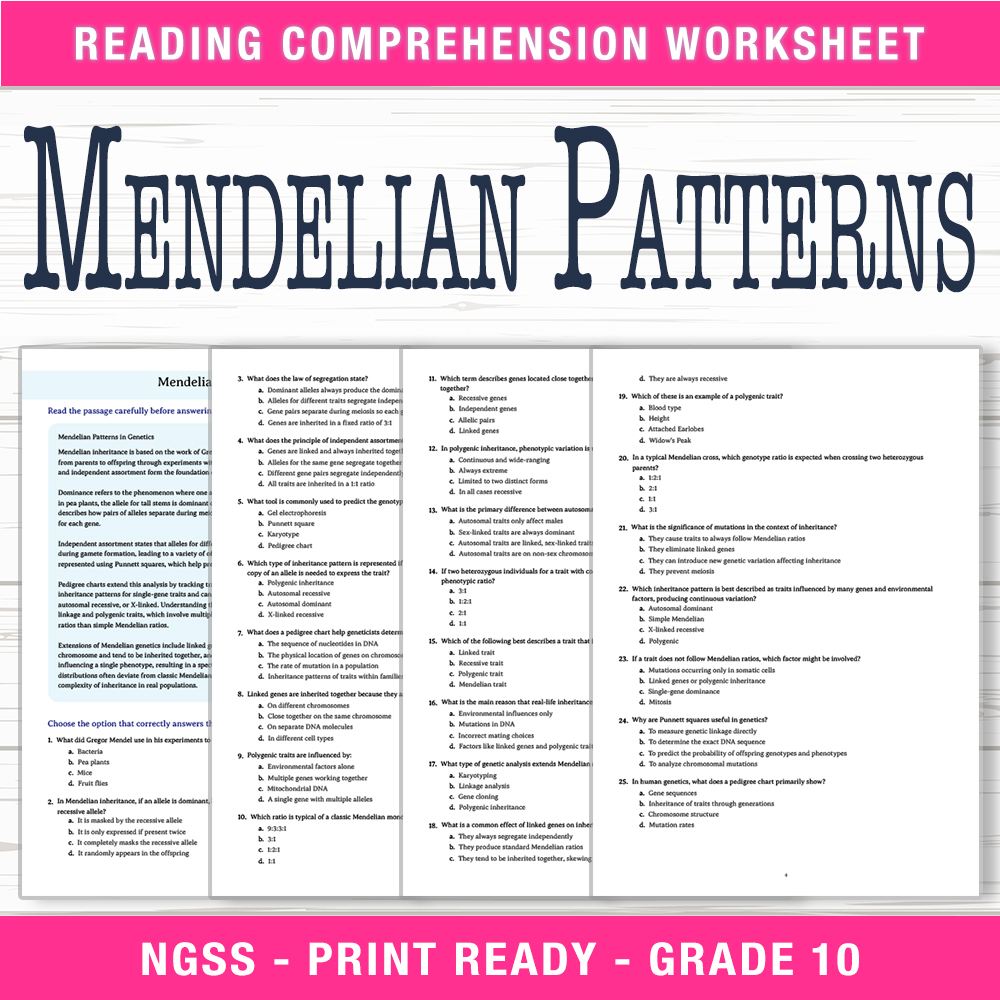
Grade 10 Science | Mendelian Patterns Worksheet (PDF + Answer Key)
Created byRiverstone ClassroomLearning Objectives
- Explain the principles of dominance, segregation, and independent assortment in Mendelian genetics.
- Use Punnett squares to predict offspring genotypes and phenotypes from parental crosses.
- Analyze inheritance patterns using pedigree charts for single-gene traits.
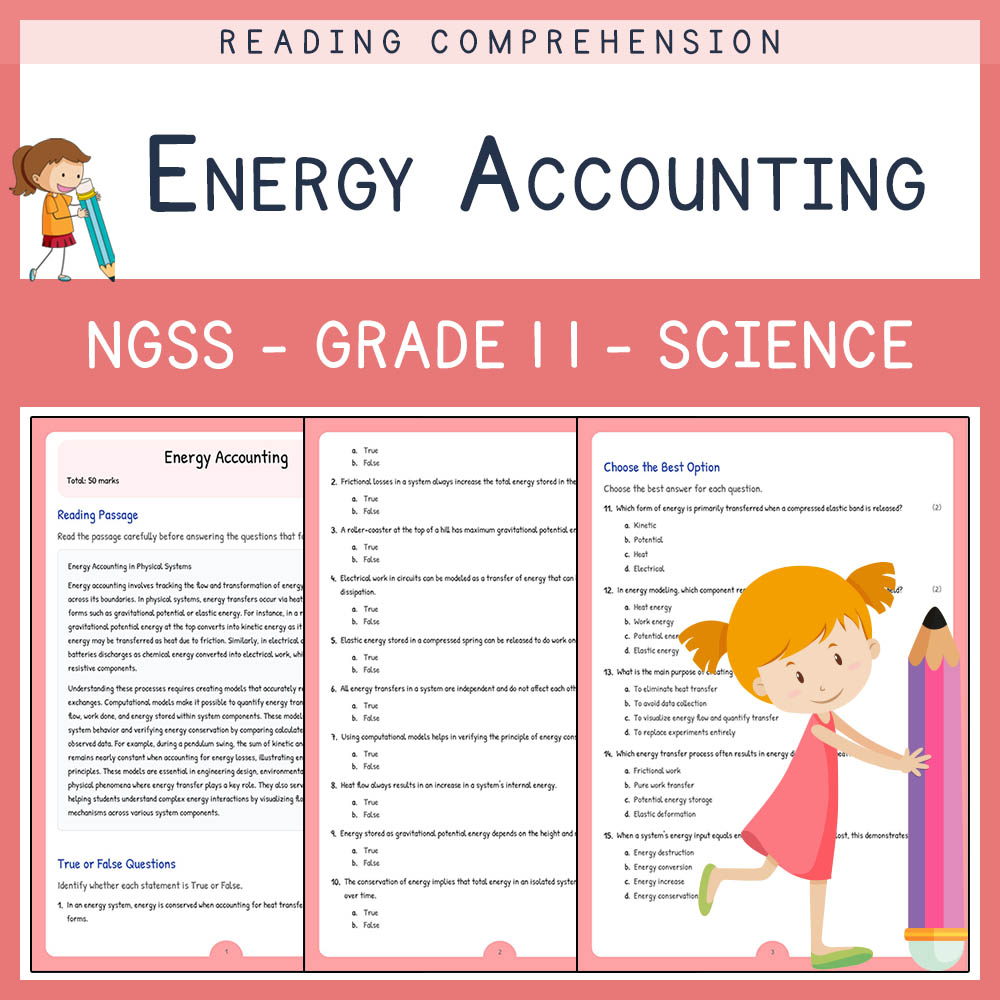
Grade 11 Science | Energy Accounting Worksheet (PDF + Answer Key) – NGSS aligned
 Created byLumora Learning
Learning Objectives
- Understand how to construct computational models for energy transfer among system components.
- Apply formulas to calculate heat, work, and energy stored in gravitational or elastic forms.
- Use computational representations to relate energy exchanges and verify total energy conservation.
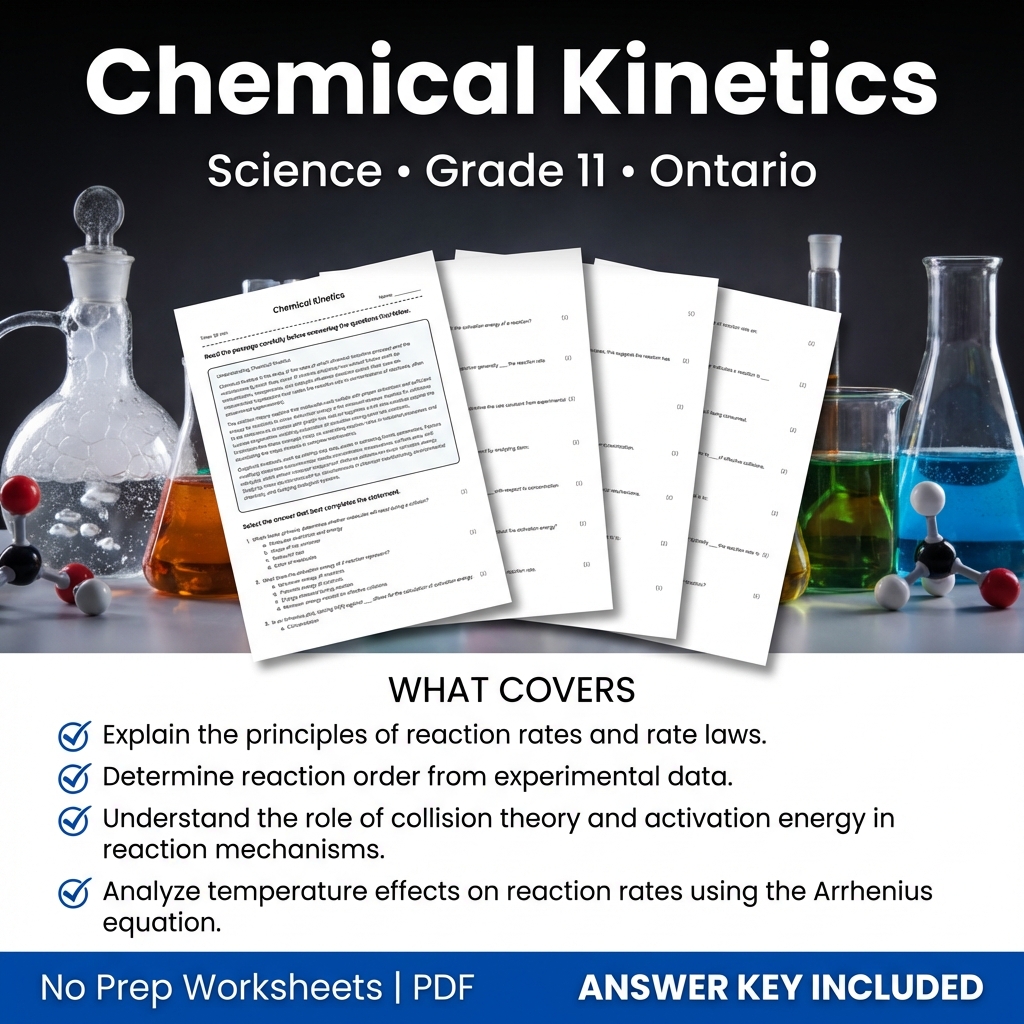
Chemical Kinetics Worksheet for Grade 11 Science Ontario Standards
Created byCoral Reef LearningLearning Objectives
- Explain the principles of reaction rates and rate laws.
- Determine reaction order from experimental data.
- Understand the role of collision theory and activation energy in reaction mechanisms.
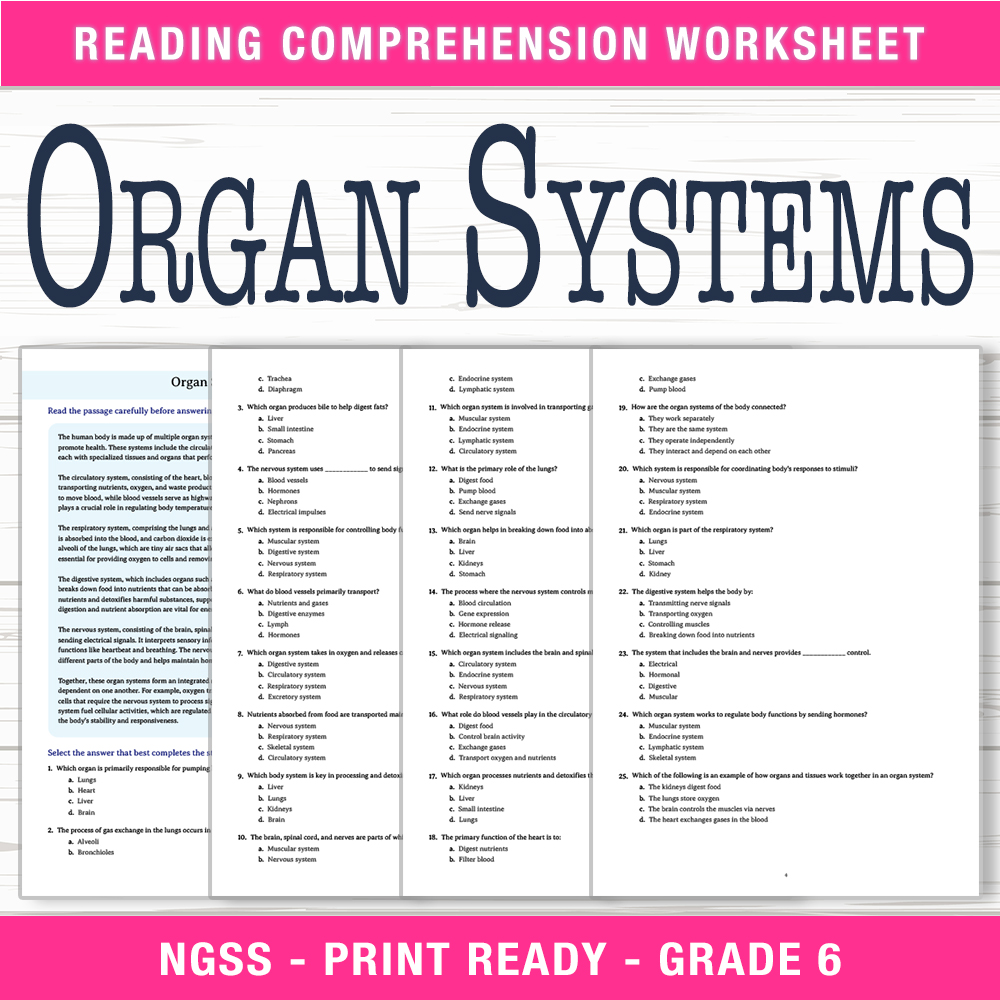
6th Grade Science | Organ Systems Worksheet (PDF + Answer Key)
Created byRiverstone ClassroomLearning Objectives
- Describe the major human organ systems involved in circulation, respiration, digestion, and nervous function.
- Explain how tissues and organs interact within each organ system to support body functions.
- Connect cellular activities to system-level processes such as nutrient transport, gas exchange, and coordination.
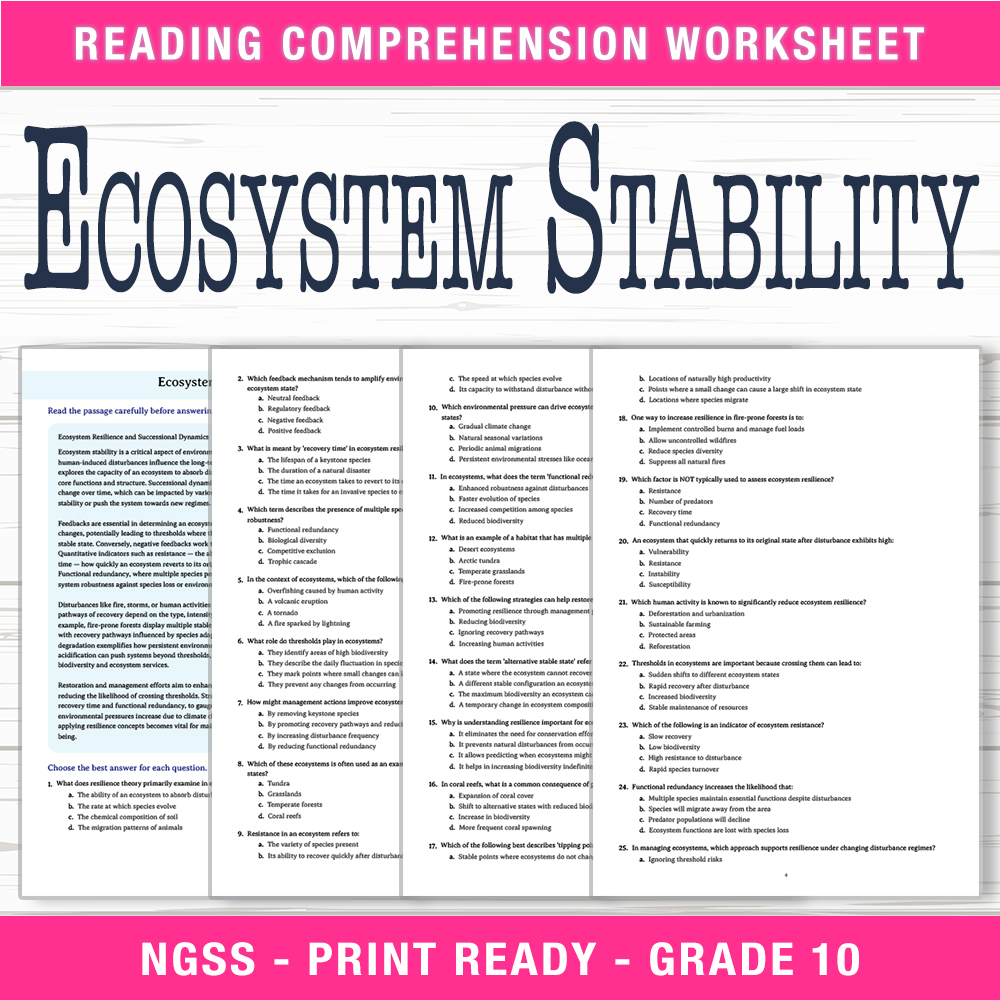
Grade 10 Science – Ecosystem Stability Worksheet (PDF + Answer Key)
Created byRiverstone ClassroomLearning Objectives
- Understand the concepts of resilience theory and successional dynamics in ecosystems.
- Analyze how disturbances impact ecosystem stability landscapes and thresholds.
- Evaluate recovery pathways, alternative stable states, and restoration outcomes in various ecosystems.
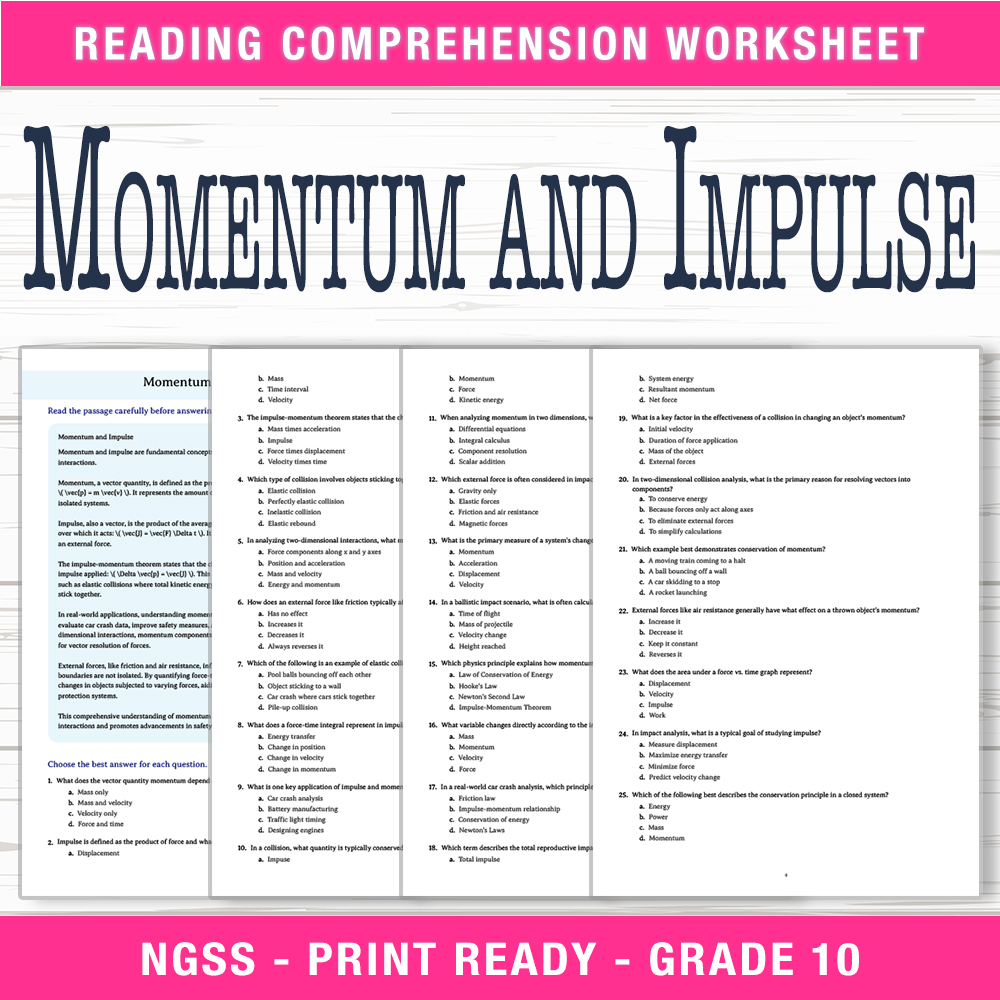
Grade 10 Science | Momentum and Impulse Worksheet (PDF + Answer Key)
Created byRiverstone ClassroomLearning Objectives
- Explain the relationship between impulse and momentum and derive the impulse-momentum theorem.
- Analyze elastic and inelastic collisions using the concepts of momentum and impulse.
- Describe the effects of external forces on a system's momentum in two-dimensional interactions.
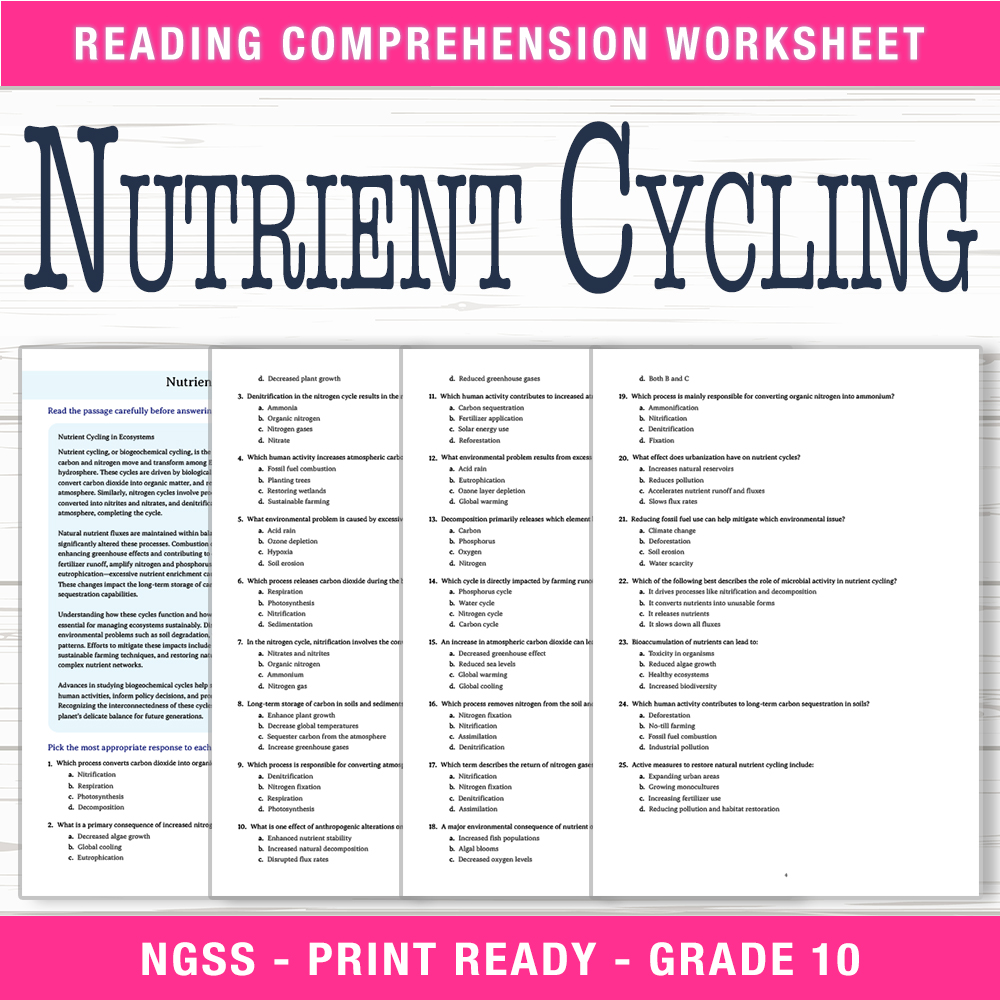
Grade 10 Science | Nutrient Cycling Worksheet (PDF + Answer Key)
Created byRiverstone ClassroomLearning Objectives
- Explain the processes involved in major biogeochemical cycles, including carbon and nitrogen fluxes among Earth's spheres.
- Analyze how human activities such as fossil fuel combustion and agricultural runoff affect nutrient reservoirs and flux rates.
- Evaluate the environmental consequences of altered nutrient cycling, such as eutrophication, hypoxia, and carbon sequestration.
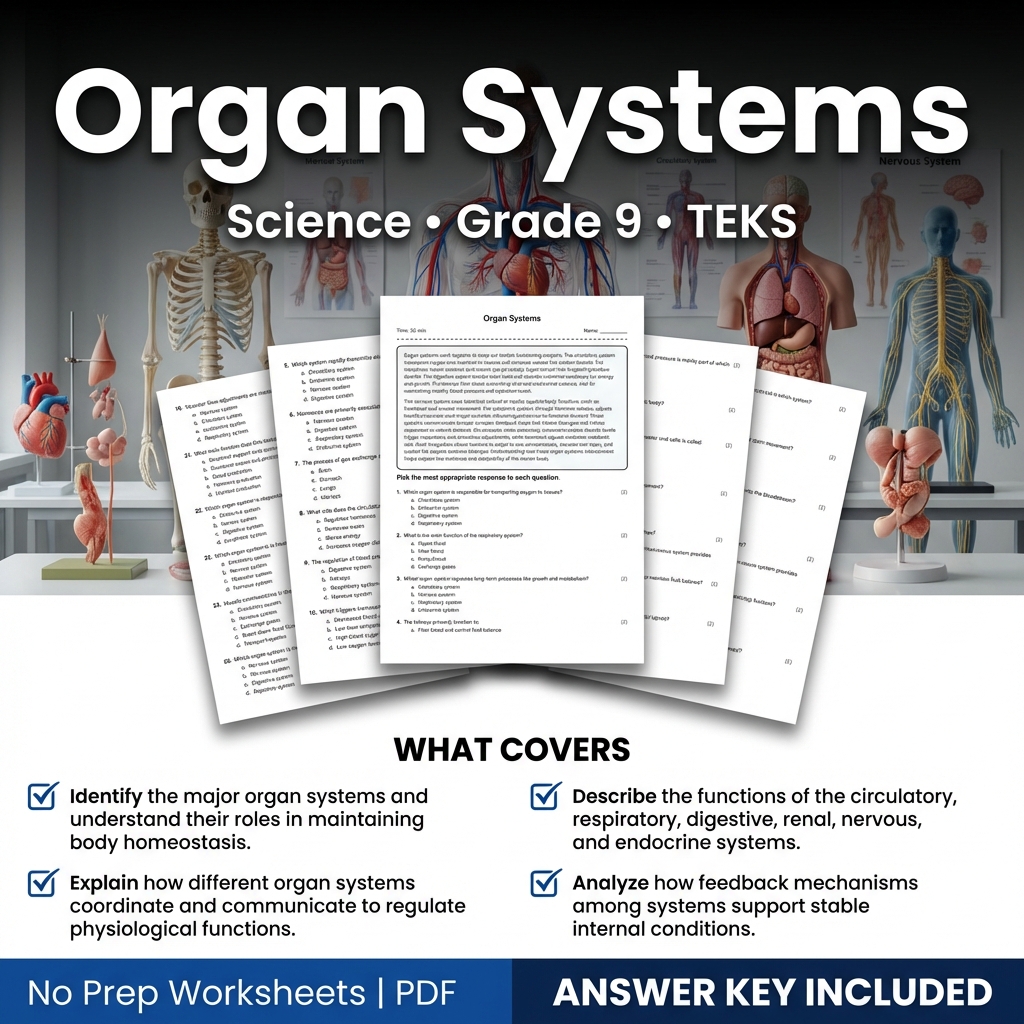
Grade 9 Science Worksheet on Organ Systems | TEKS-Aligned Practice
Created byCoral Reef LearningLearning Objectives
- Identify the major organ systems and understand their roles in maintaining body homeostasis.
- Explain how different organ systems coordinate and communicate to regulate physiological functions.
- Describe the functions of the circulatory, respiratory, digestive, renal, nervous, and endocrine systems.
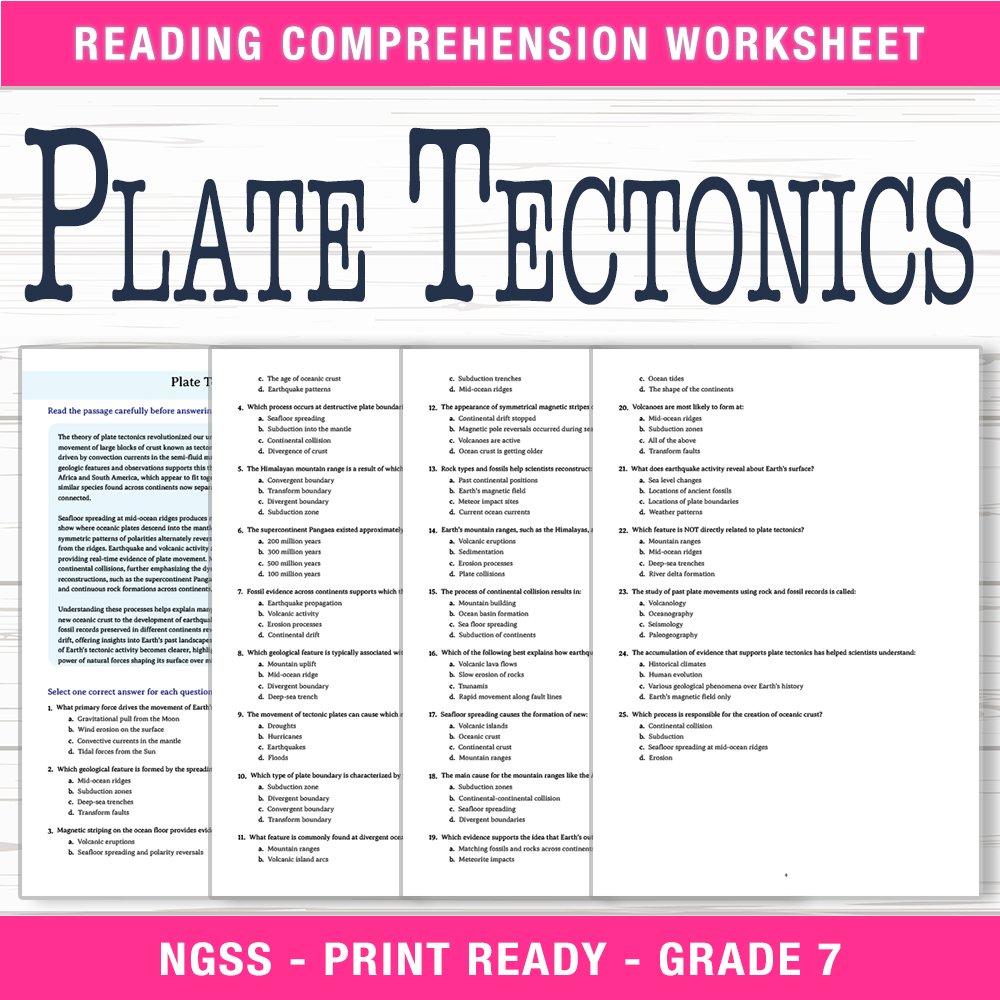
Grade 7 Science | Plate Tectonics Worksheets (PDF + Answer Key)
Created byRiverstone ClassroomLearning Objectives
- Explain the evidence supporting the theory of plate tectonics, including fossil distribution and matching continental margins.
- Identify key geologic features such as mid-ocean ridges, trenches, and mountain ranges related to plate movements.
- Describe how magnetic striping, earthquake, and volcanic activity provide evidence for seafloor spreading and plate motion.
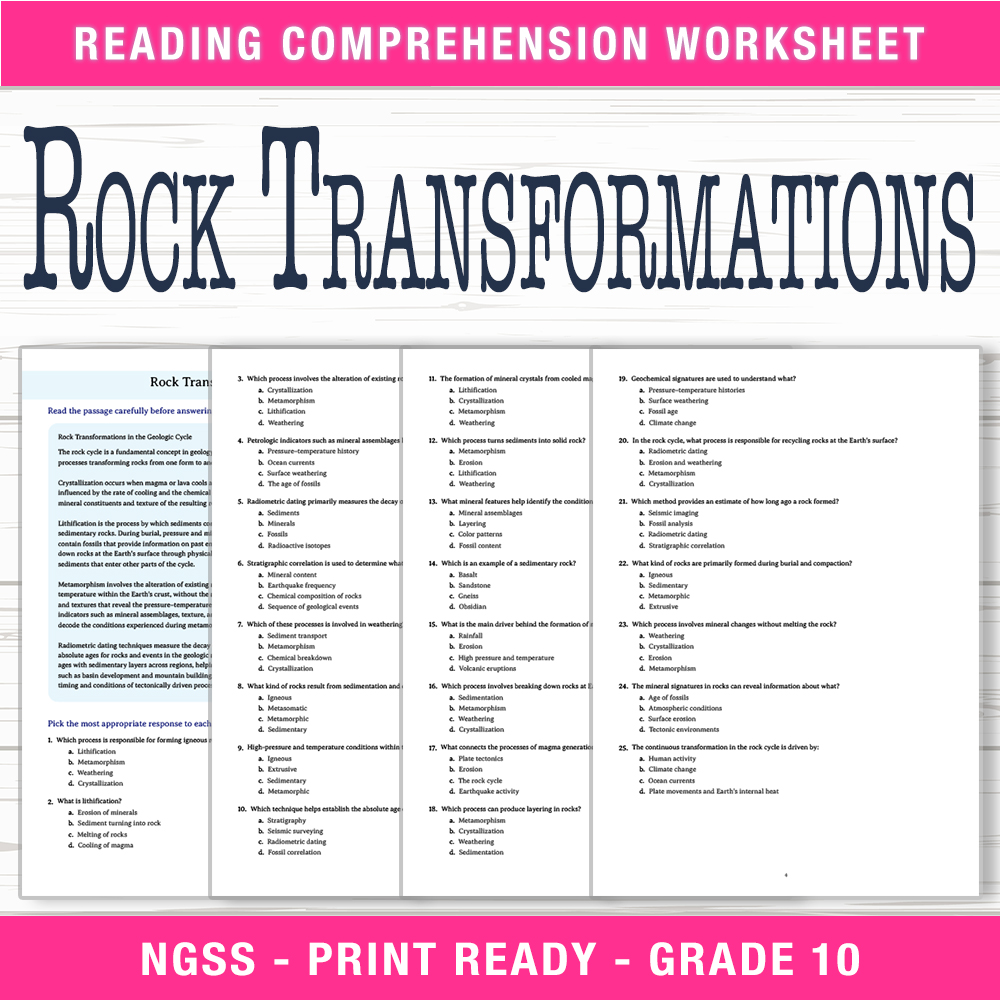
Grade 10 Science | Rock Transformations Worksheet (PDF + Answer Key)
Created byRiverstone ClassroomLearning Objectives
- Explain the processes of crystallization, lithification, metamorphism, and weathering in the rock cycle.
- Identify petrologic indicators such as mineral assemblages, texture, and geochemical signatures that inform tectonic histories.
- Describe how radiometric dating and stratigraphic correlation are used to reconstruct regional geologic events.
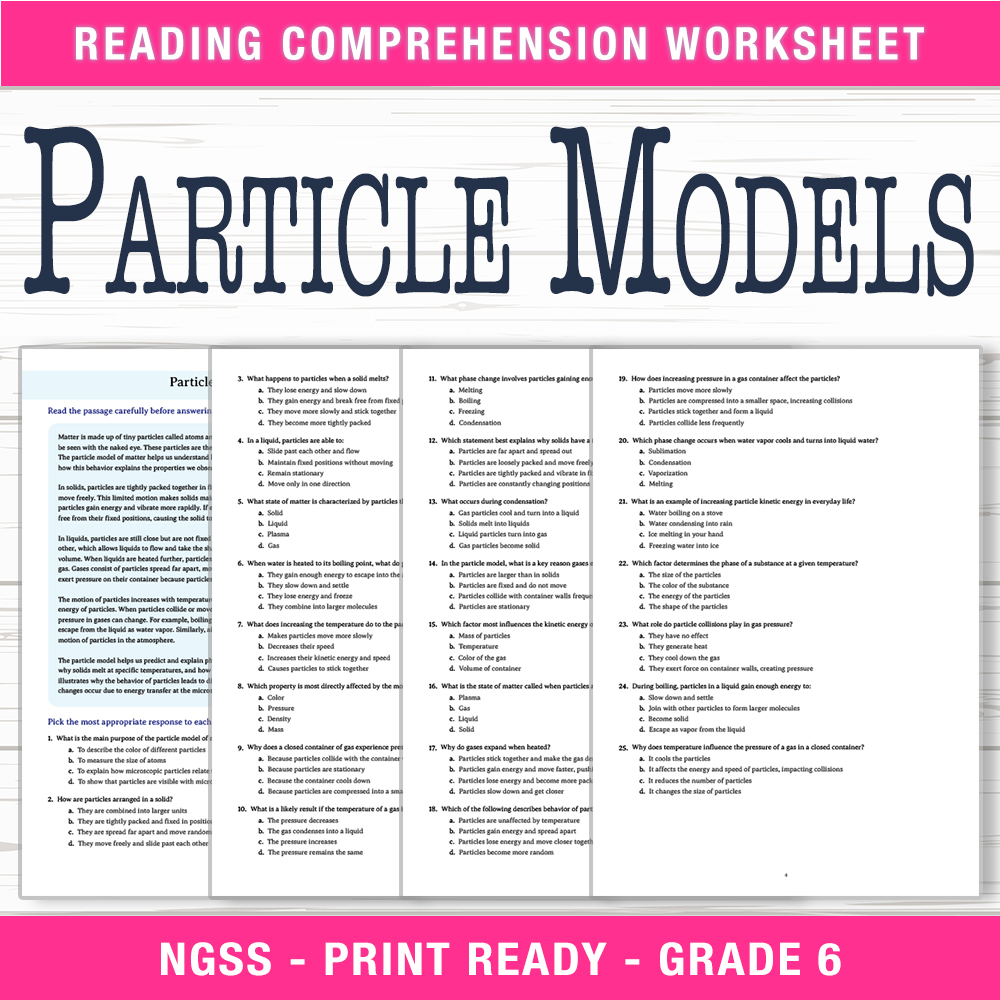
6th Grade Science | Particle Models Worksheet (PDF +Answer Key)
Created byRiverstone ClassroomLearning Objectives
- Explain how particles make up matter and how their behavior relates to the properties of solids, liquids, and gases.
- Describe how temperature affects particle motion and how this relates to changes of state such as melting, freezing, boiling, and condensation.
- Relate the microscopic behavior of particles to macroscopic phenomena like pressure changes and thermal energy effects.
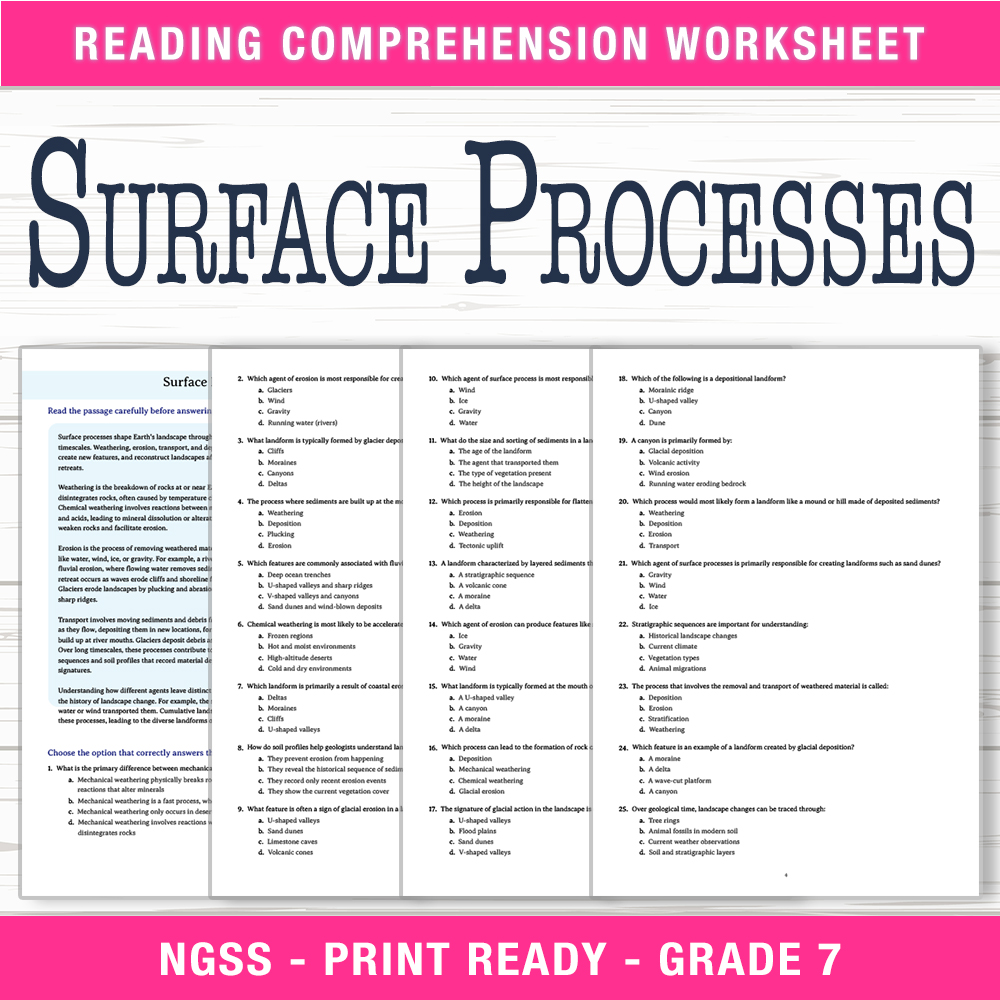
Grade 7 Science | Surface Processes Worksheet (PDF + Answer Key)
Created byRiverstone ClassroomLearning Objectives
- Understand the key geologic surface processes such as weathering, erosion, transport, and deposition
- Identify the differences between mechanical and chemical weathering and their impacts on landscapes
- Explain how landforms like canyons, deltas, and moraines are created by different agents over time
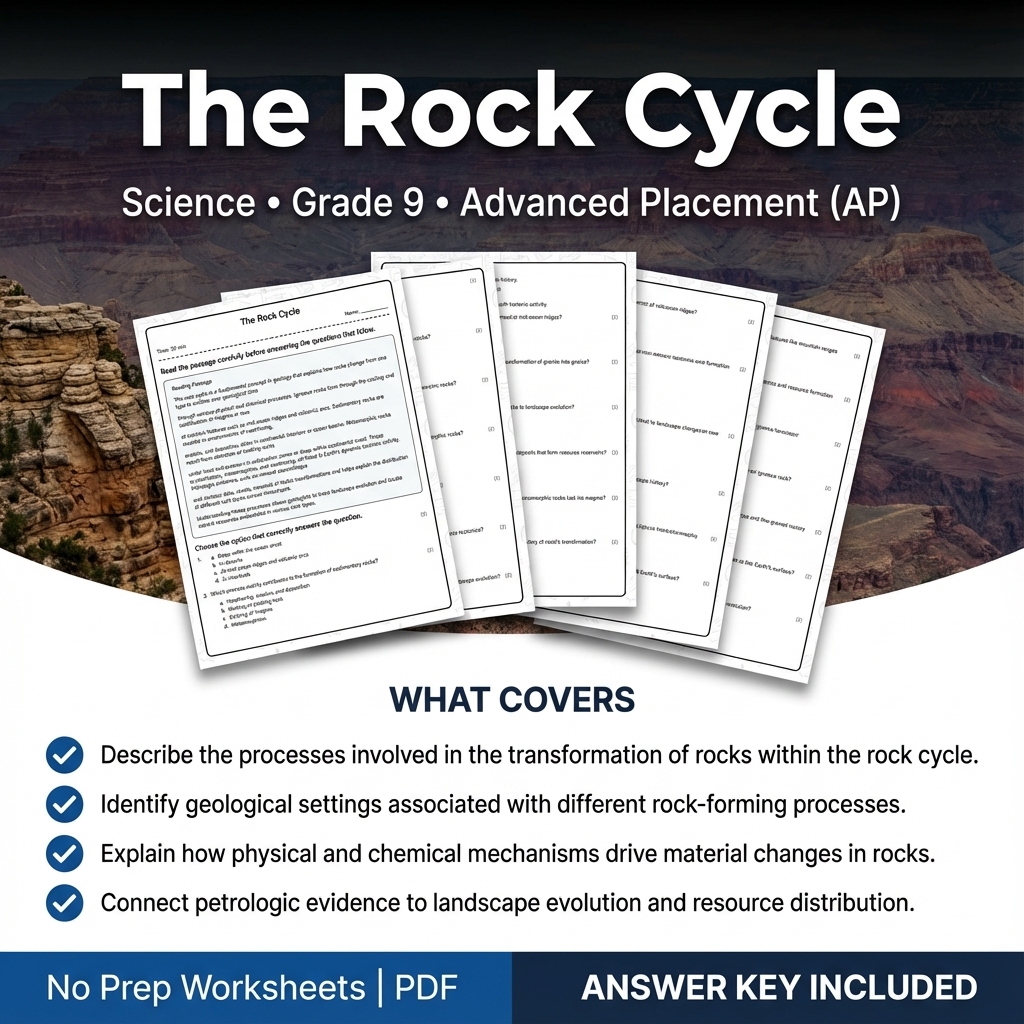
Grade 9 Science | The Rock Cycle Worksheet (Printable PDF + Answer Key)
Created byCoral Reef LearningLearning Objectives
- Describe the processes involved in the transformation of rocks within the rock cycle.
- Identify geological settings associated with different rock-forming processes.
- Explain how physical and chemical mechanisms drive material changes in rocks.
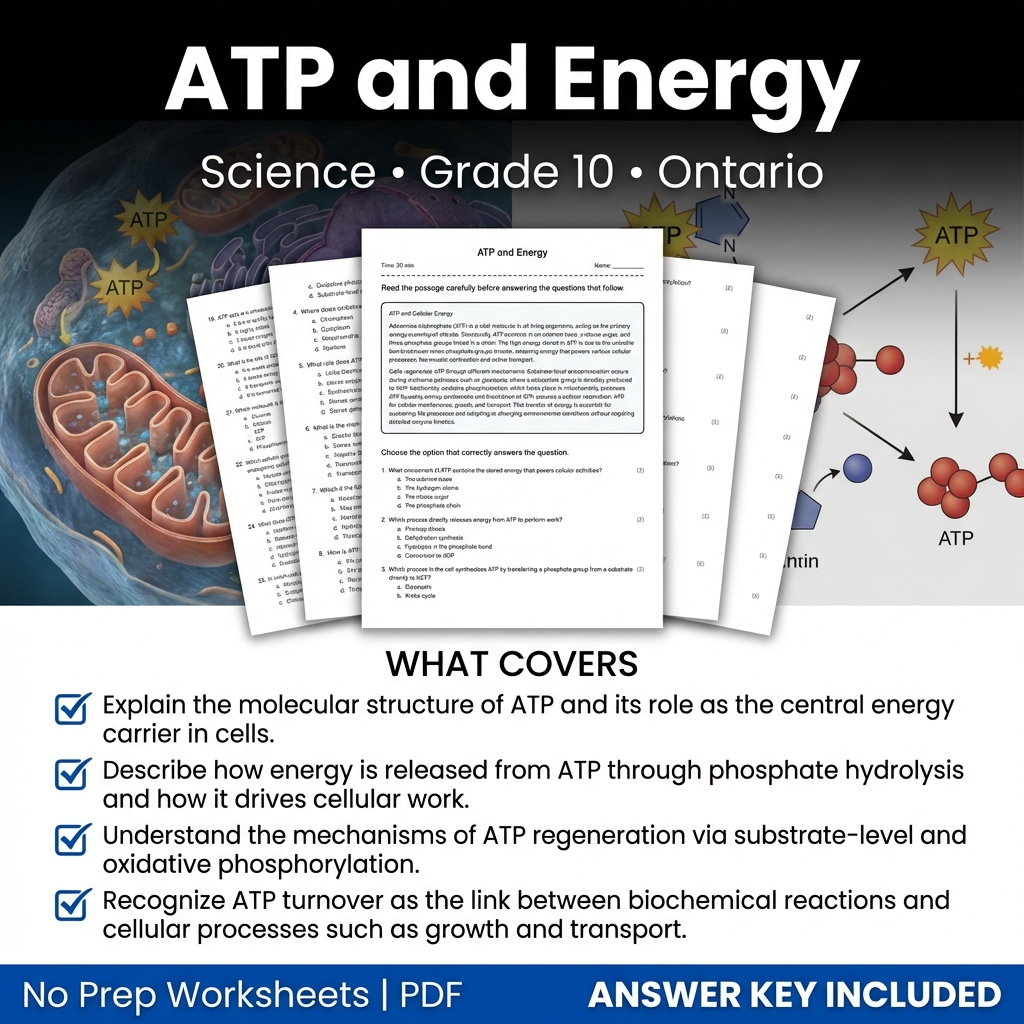
ATP and Energy Worksheet for Grade 10 Science | Ontario Standards Practice
Created byCoral Reef LearningLearning Objectives
- Explain the molecular structure of ATP and its role as the central energy carrier in cells.
- Describe how energy is released from ATP through phosphate hydrolysis and how it drives cellular work.
- Understand the mechanisms of ATP regeneration via substrate-level and oxidative phosphorylation.
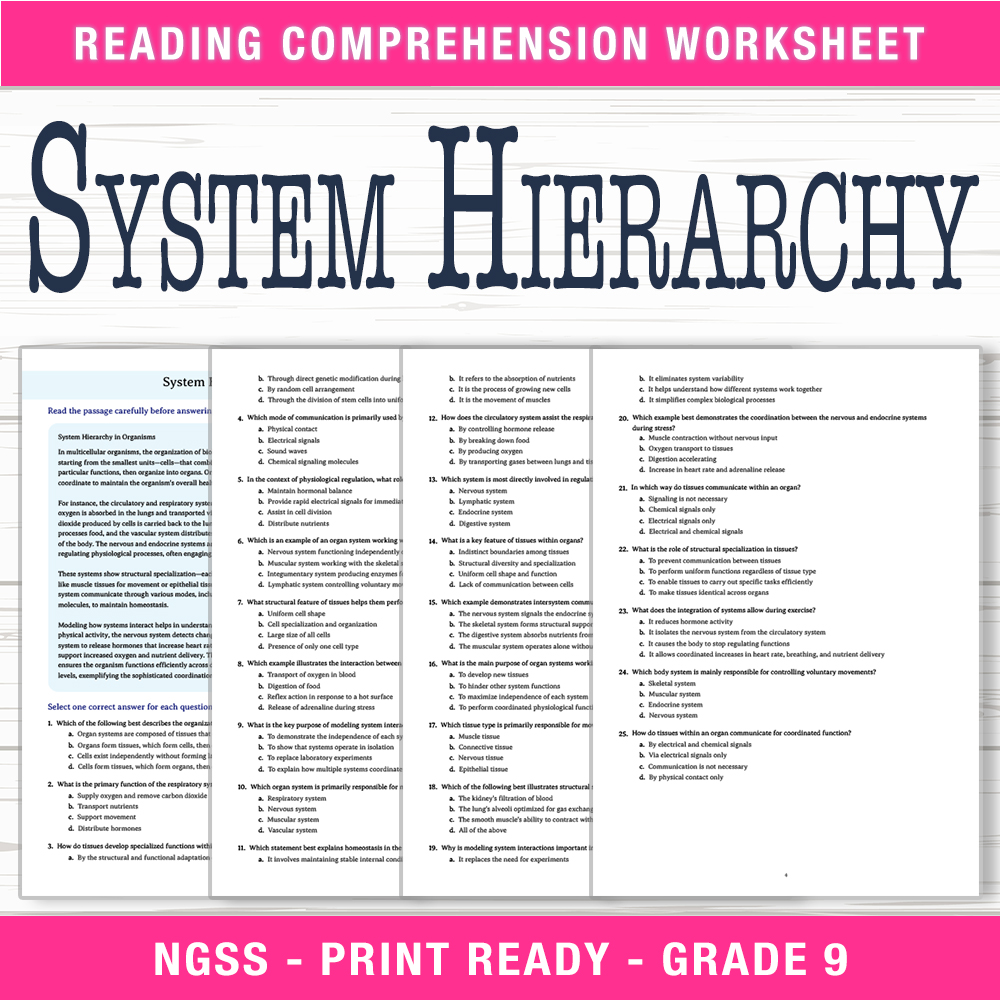
Grade 9 Science – System Hierarchy Worksheet (PDF + Answer Key)
Created byRiverstone ClassroomLearning Objectives
- Explain the organization of biological systems from cells to organism-wide systems.
- Identify key examples of how different systems interact to perform vital physiological functions.
- Describe the structural specialization of tissues and organs within organ systems.
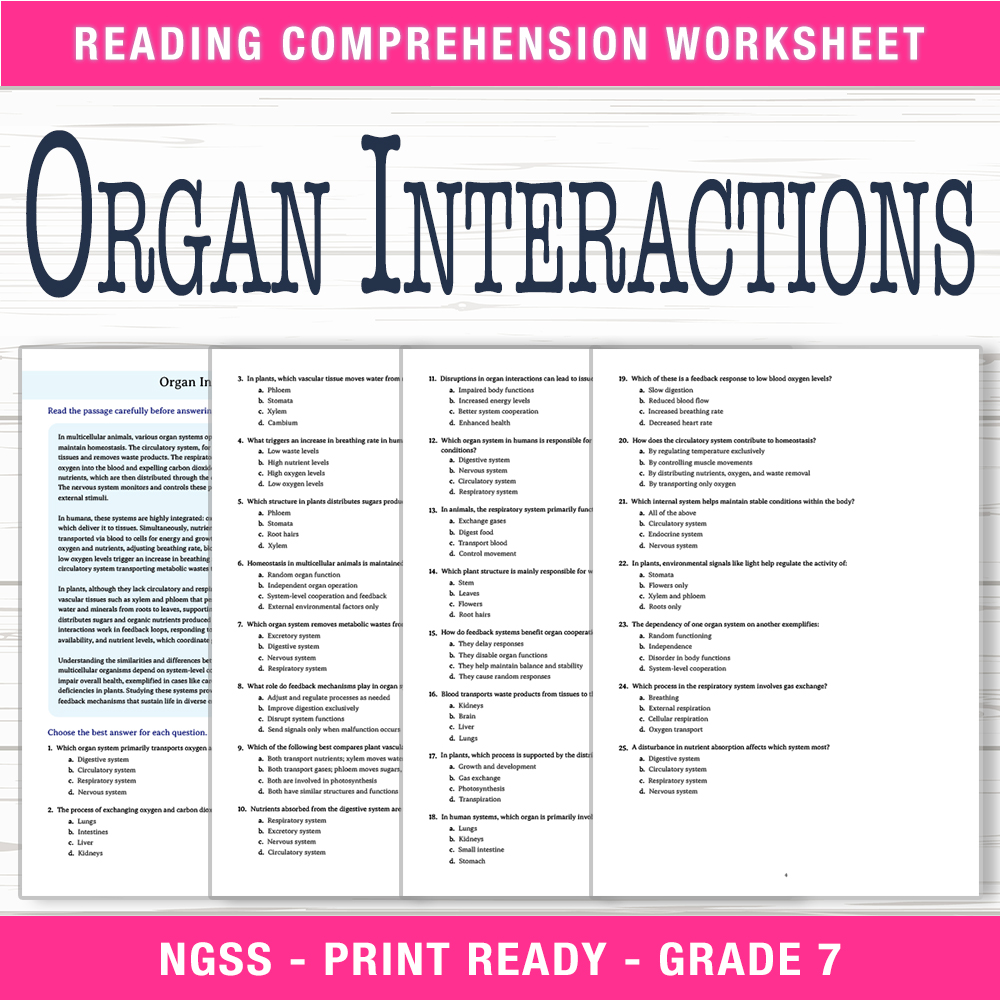
Grade 7 Science | Organ Interactions Worksheet (PDF + Answer Key)
Created byRiverstone ClassroomLearning Objectives
- Describe how different organ systems in multicellular animals work together to support vital functions.
- Explain mechanisms of cooperation such as oxygen transport, nutrient absorption, and waste removal within organ systems.
- Compare the organ system interactions in humans and plants to understand system-level dependencies and feedback.
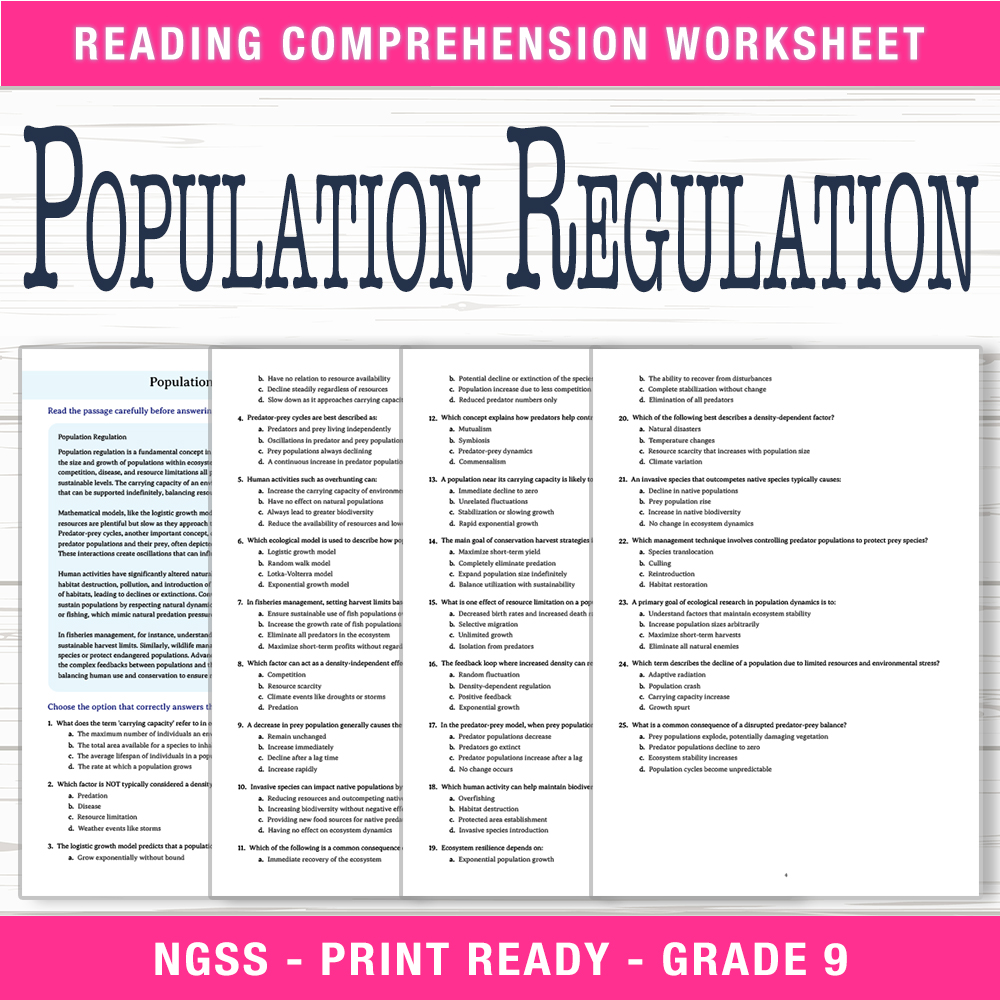
Grade 9 Science | Population Regulation Worksheet (PDF + Answer Key)
Created byRiverstone ClassroomLearning Objectives
- Explain the factors that influence population growth and size, including carrying capacity, predation, competition, and resource availability.
- Analyze mathematical models such as logistic growth and predator-prey cycles to understand population dynamics.
- Evaluate the impact of human activities on natural populations and discuss conservation strategies related to population regulation.
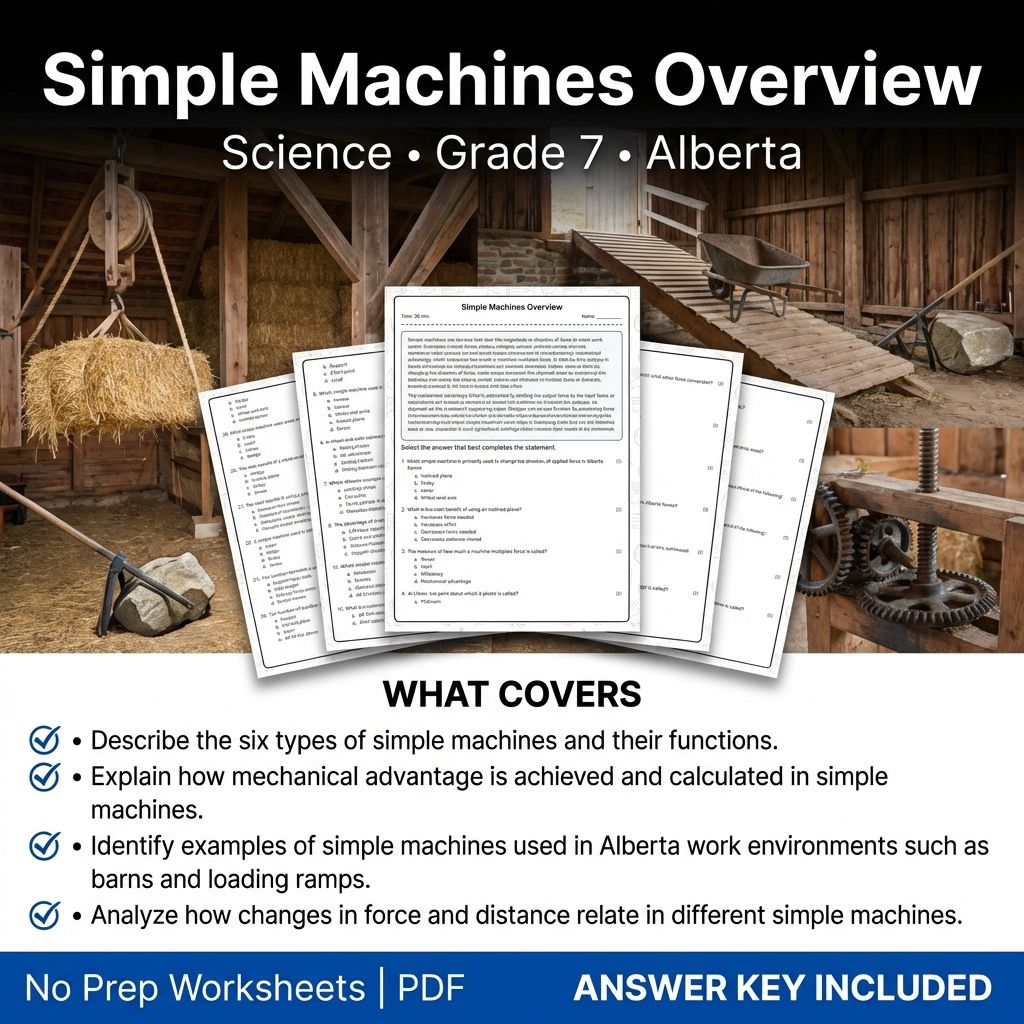
Grade 7 Science Worksheet | Simple Machines Overview | Alberta Standards
Created byCoral Reef LearningLearning Objectives
- Describe the six types of simple machines and their functions.
- Explain how mechanical advantage is achieved and calculated in simple machines.
- Identify examples of simple machines used in Alberta work environments such as barns and loading ramps.
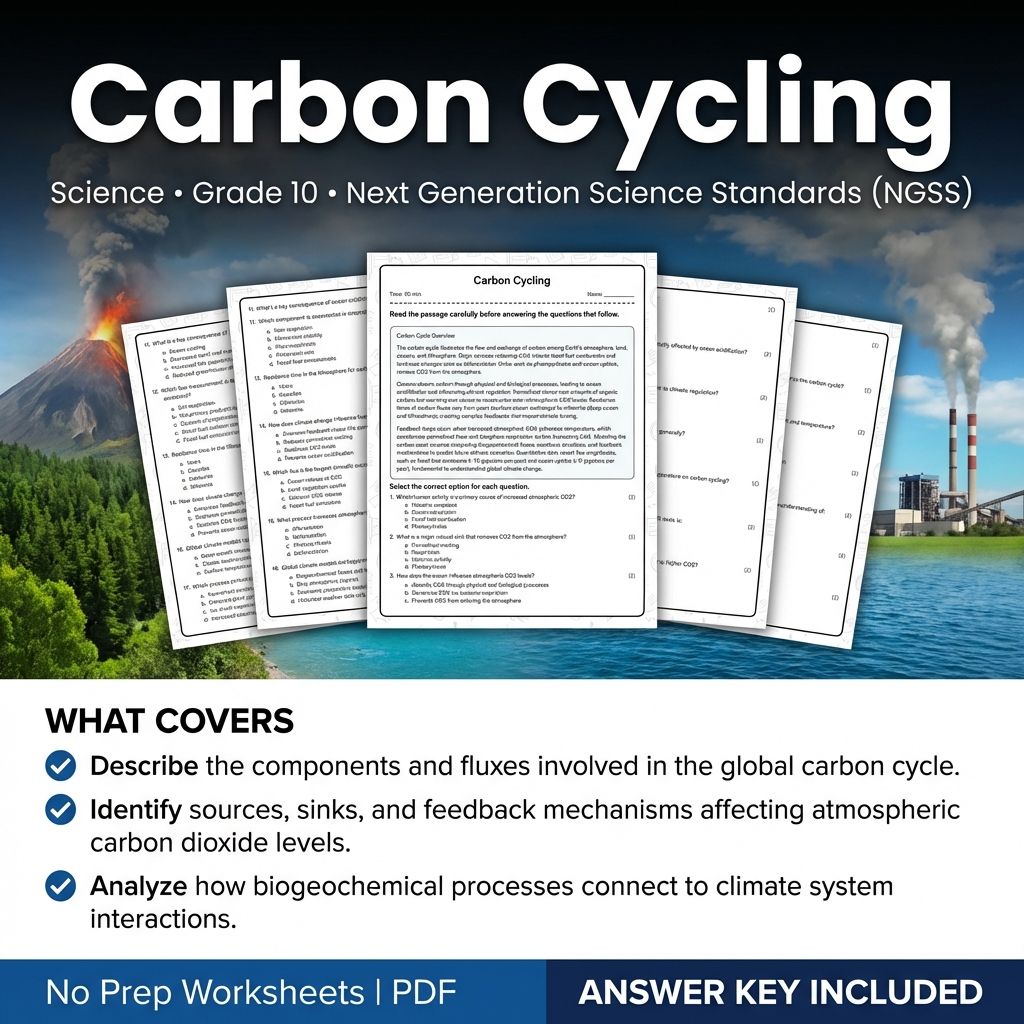
10th Grade Science | Carbon Cycling Worksheet & Answer Key (Printable PDF)
Created byCoral Reef LearningLearning Objectives
- Describe the components and fluxes involved in the global carbon cycle.
- Identify sources, sinks, and feedback mechanisms affecting atmospheric carbon dioxide levels.
- Understand the magnitude of fluxes and residence times within the carbon cycle.
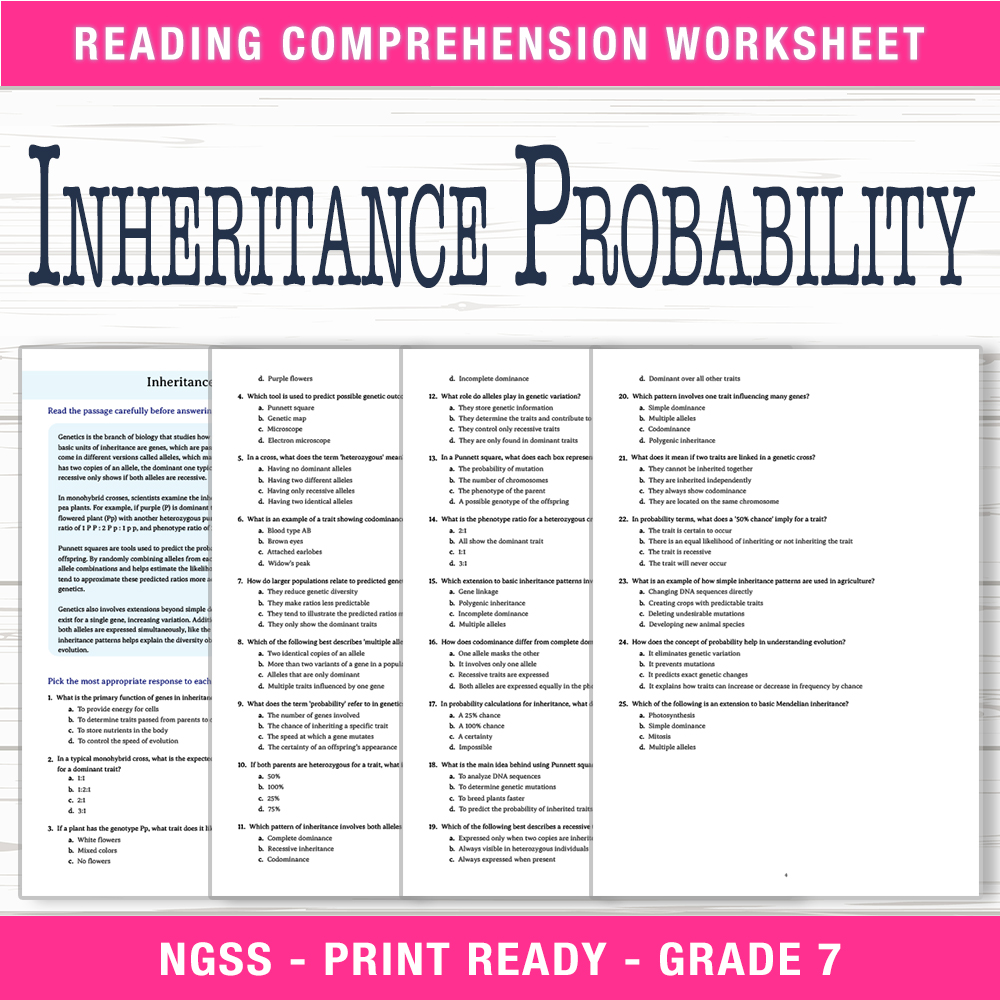
Grade 7 Science – Inheritance Probability Worksheet (PDF + Answer Key)
Created byRiverstone ClassroomLearning Objectives
- Understand and apply probability concepts to predict genetic variation among offspring.
- Interpret Punnett square outcomes to determine genotype and phenotype ratios.
- Calculate expected proportions of inherited traits in monohybrid crosses.
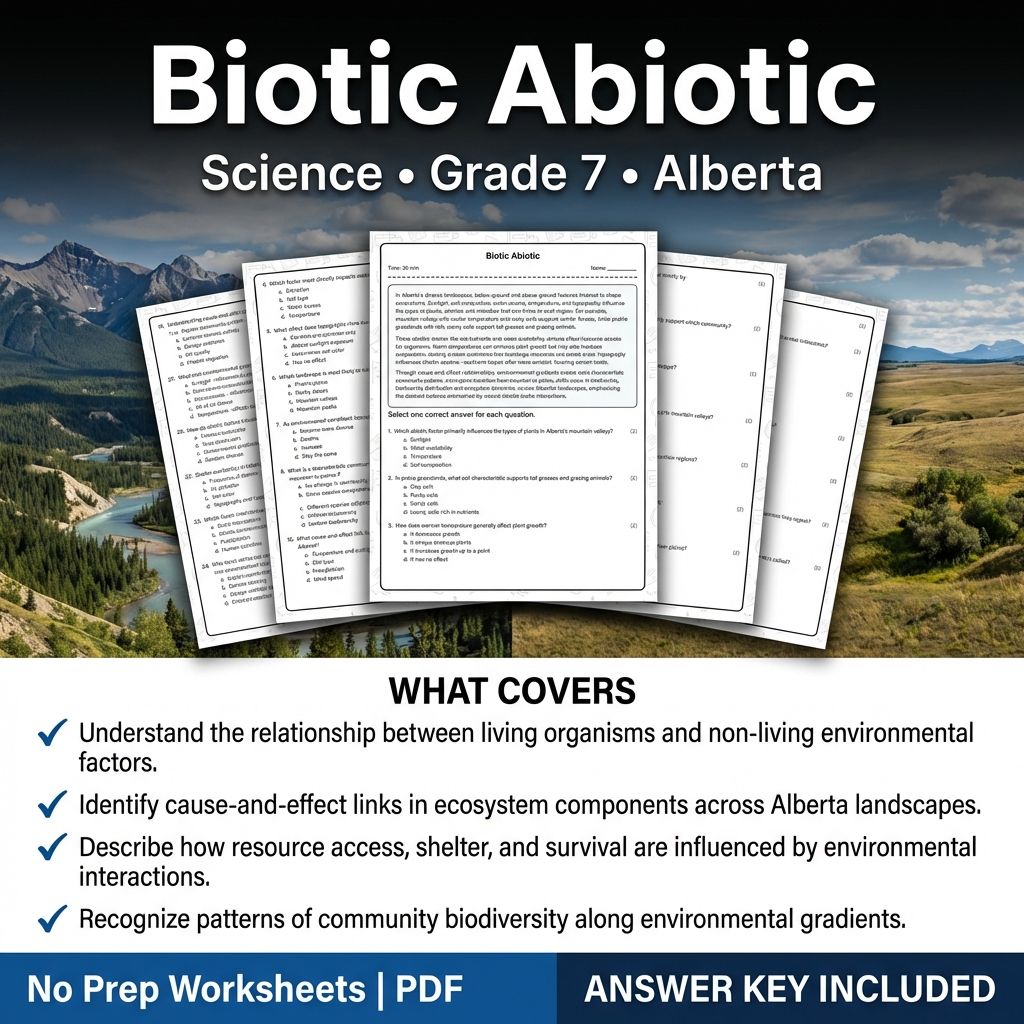
Grade 7 Science Worksheet | Biotic Abiotic | Alberta Standards | Worksheet
Created byCoral Reef LearningLearning Objectives
- Understand the relationship between living organisms and non-living environmental factors.
- Identify cause-and-effect links in ecosystem components across Alberta landscapes.
- Describe how resource access, shelter, and survival are influenced by environmental interactions.
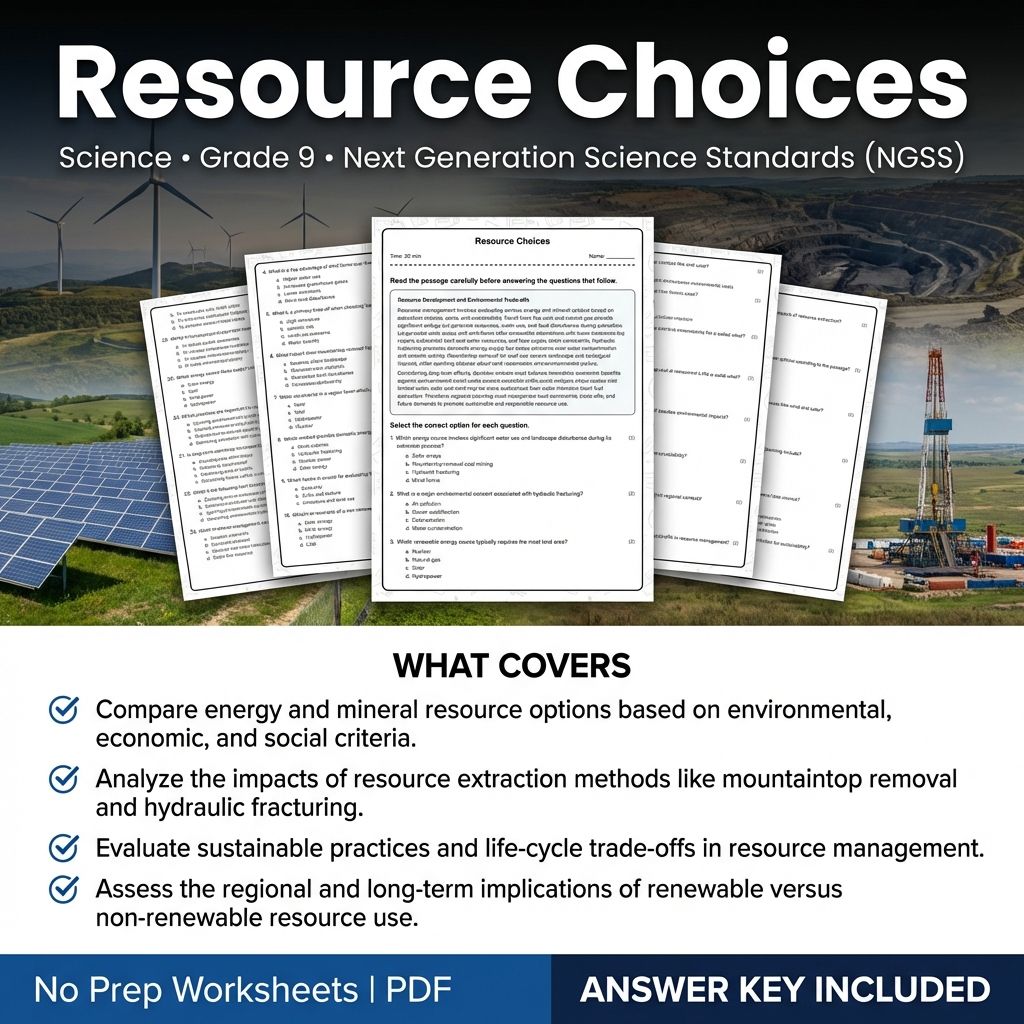
9th Grade Science | Resource Choices Worksheet + Answer Key (Printable PDF)
Created byCoral Reef LearningLearning Objectives
- Compare energy and mineral resource options based on environmental, economic, and social criteria.
- Analyze the impacts of resource extraction methods like mountaintop removal and hydraulic fracturing.
- Evaluate sustainable practices and life-cycle trade-offs in resource management.
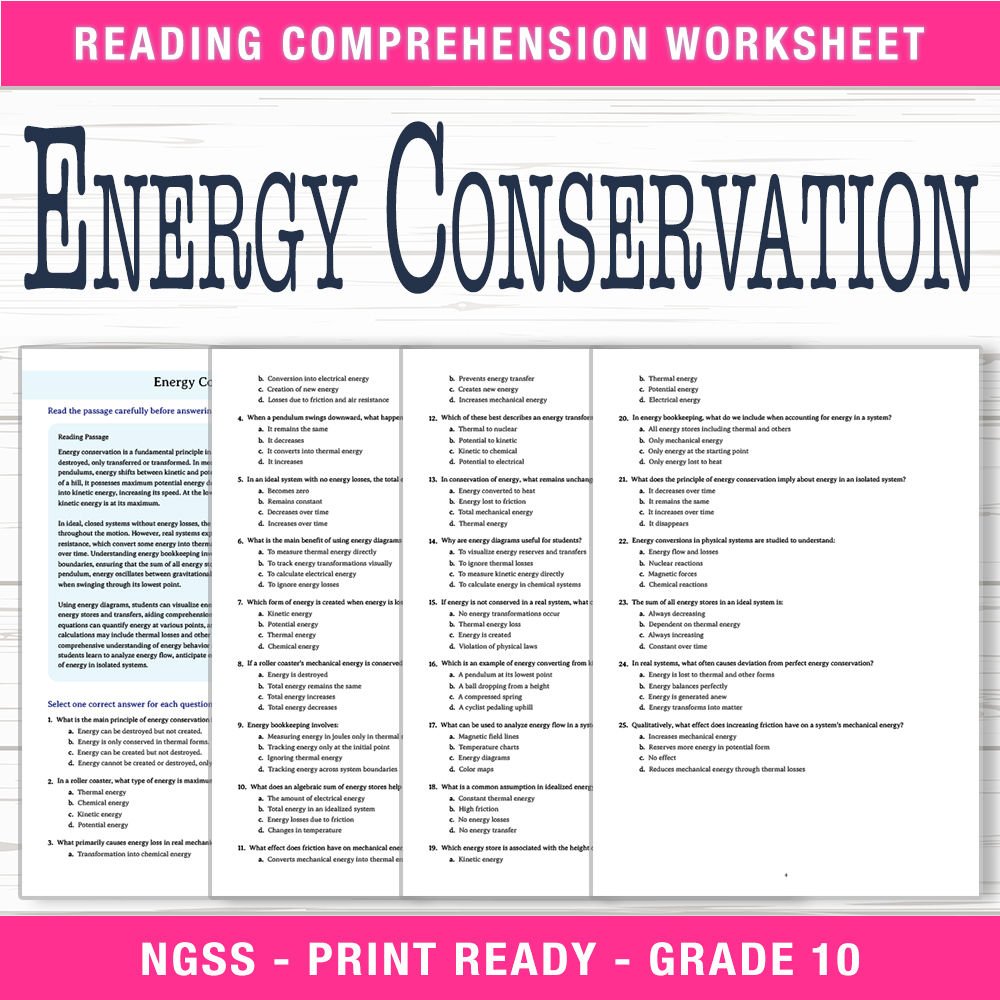
Grade 10 Science | Energy Conservation Worksheet (PDF + Answer Key)
Created byRiverstone ClassroomLearning Objectives
- Understand the principles of energy conservation in mechanical systems.
- Identify and describe energy transformations between kinetic and potential energy.
- Apply energy bookkeeping concepts to analyze energy transfer and losses in closed systems.
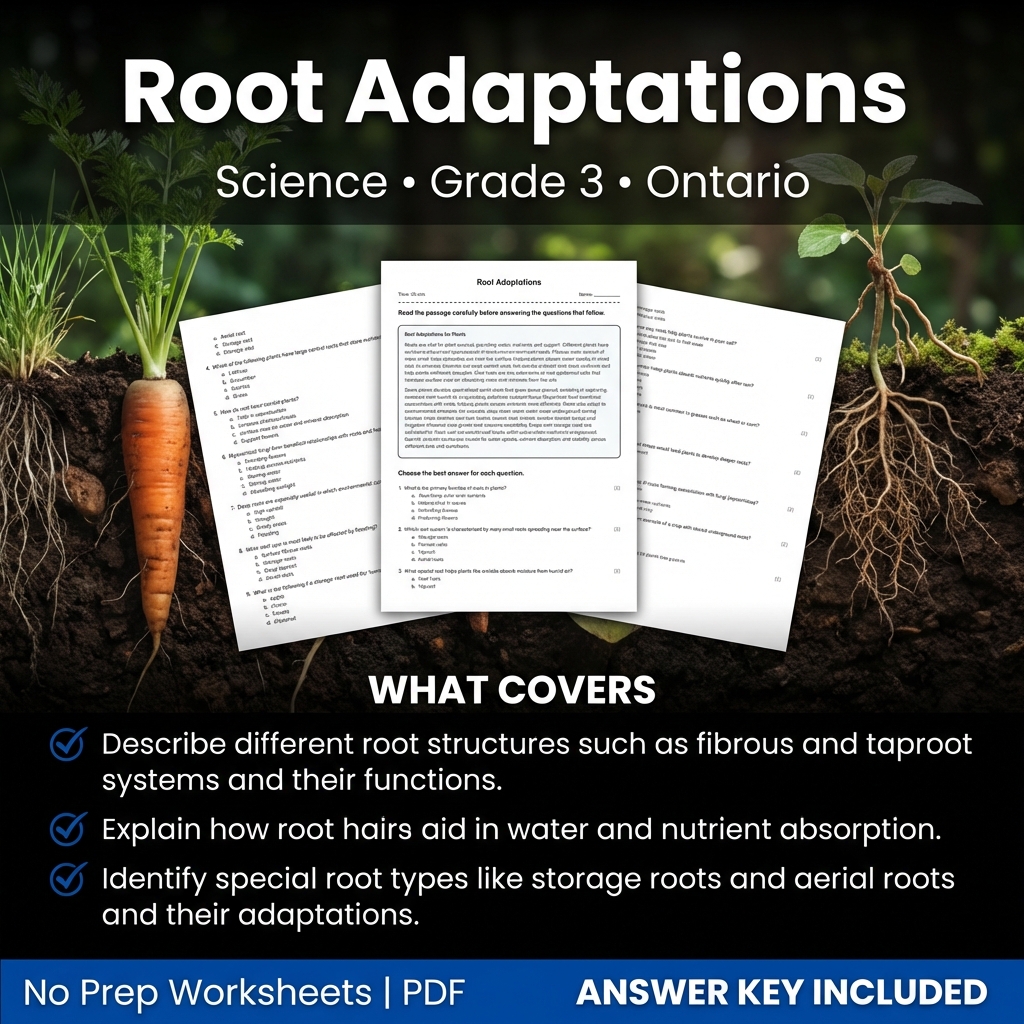
Root Adaptations Science Worksheet for Grade 3 | Ontario Standards
Created byCoral Reef LearningLearning Objectives
- Describe different root structures such as fibrous and taproot systems and their functions.
- Explain how root hairs aid in water and nutrient absorption.
- Identify special root types like storage roots and aerial roots and their adaptations.
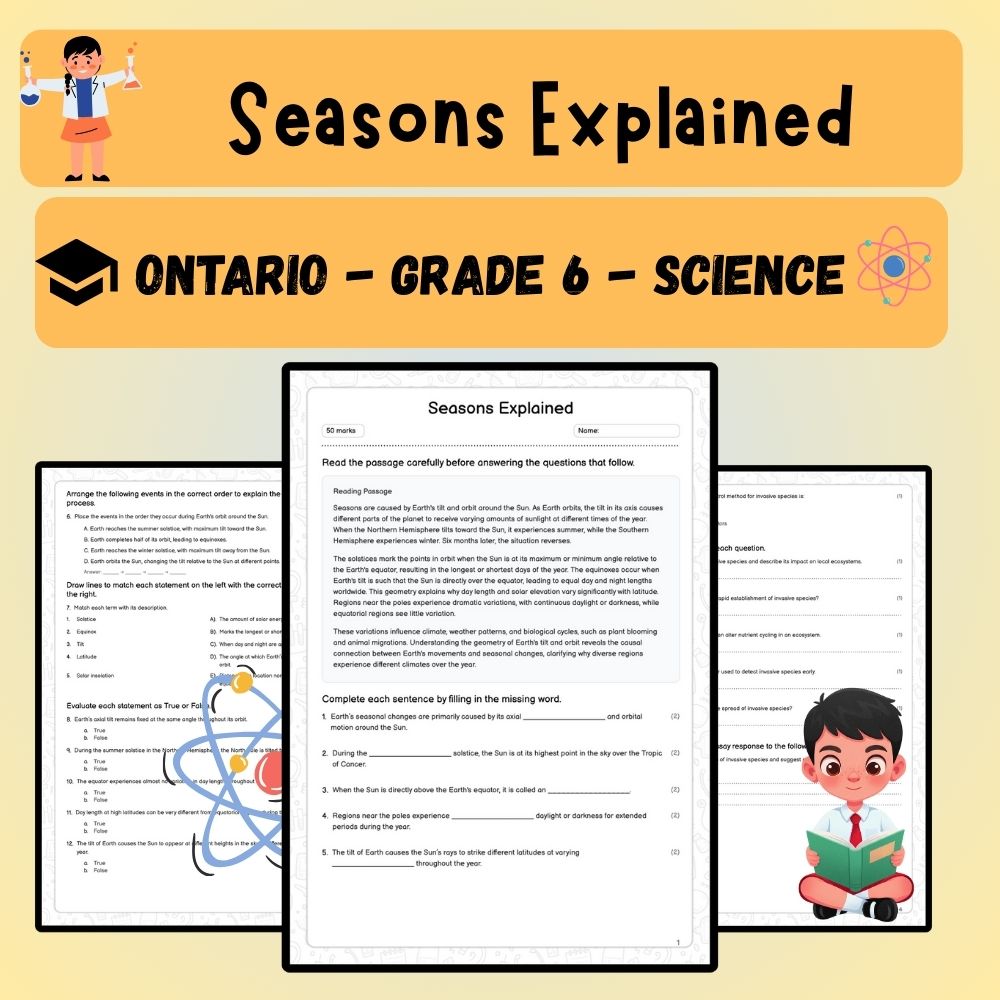
6th Grade Science – Seasons Explained Worksheet (PDF )
 Created byPrism Point Learning
Learning Objectives
- Explain how Earth's axial tilt and orbital motion cause seasonal changes.
- Describe why hemispheres experience opposite seasons and how day length varies across the year.
- Identify key concepts such as solstices and equinoxes and their geometry.
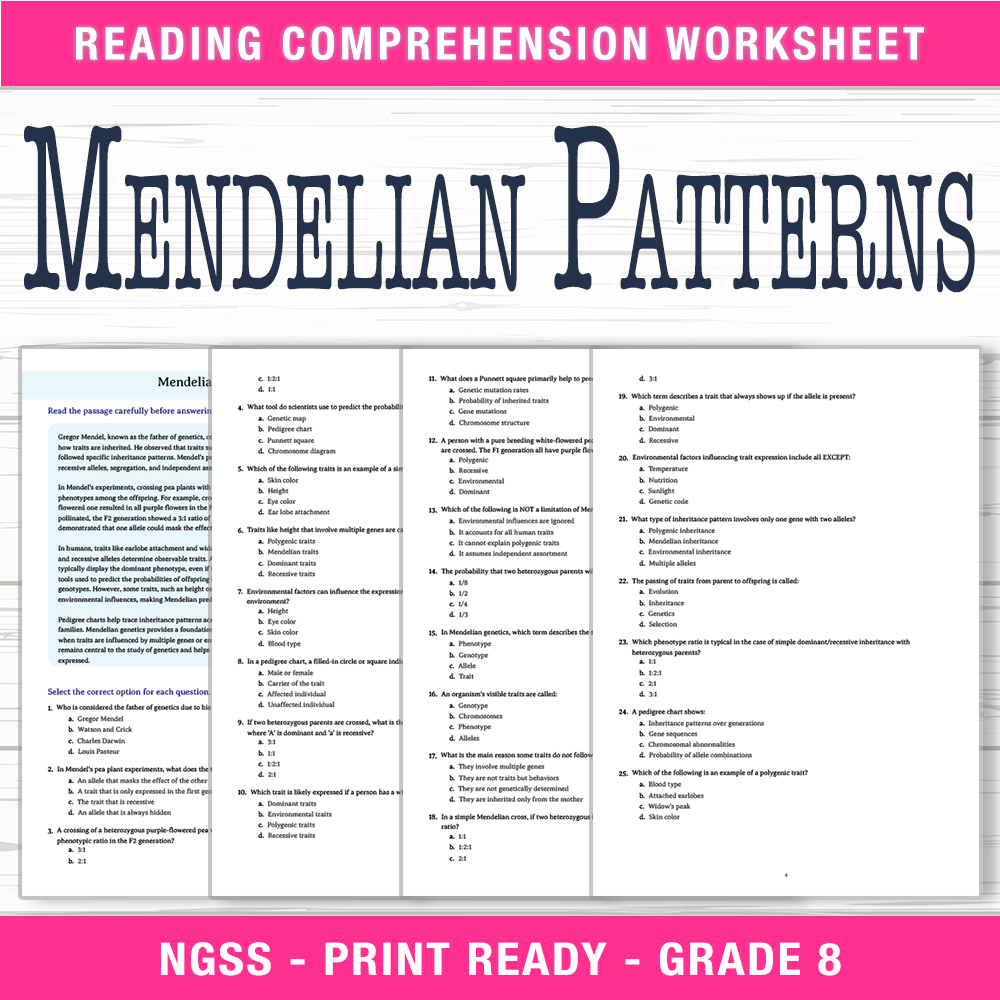
Grade 8 Science | Mendelian Patterns Worksheet (PDF + Answer Key)
Created byRiverstone ClassroomLearning Objectives
- Explain how dominant and recessive alleles influence observable traits.
- Predict phenotypic and genotypic ratios using Punnett squares.
- Interpret basic pedigrees to determine inheritance patterns.
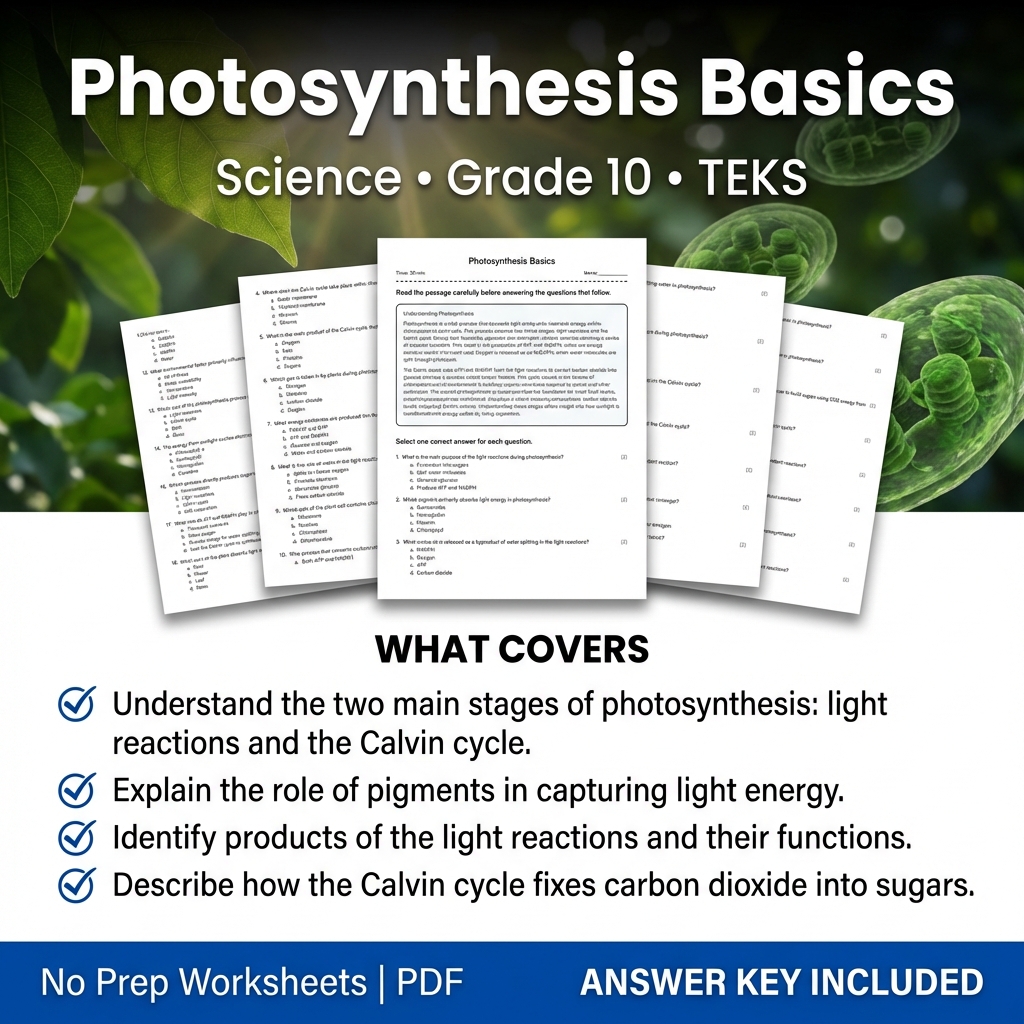
Photosynthesis Basics Worksheet for Grade 10 Science TEKS Practice
Created byCoral Reef LearningLearning Objectives
- Understand the two main stages of photosynthesis: light reactions and the Calvin cycle.
- Explain the role of pigments in capturing light energy.
- Identify products of the light reactions and their functions.
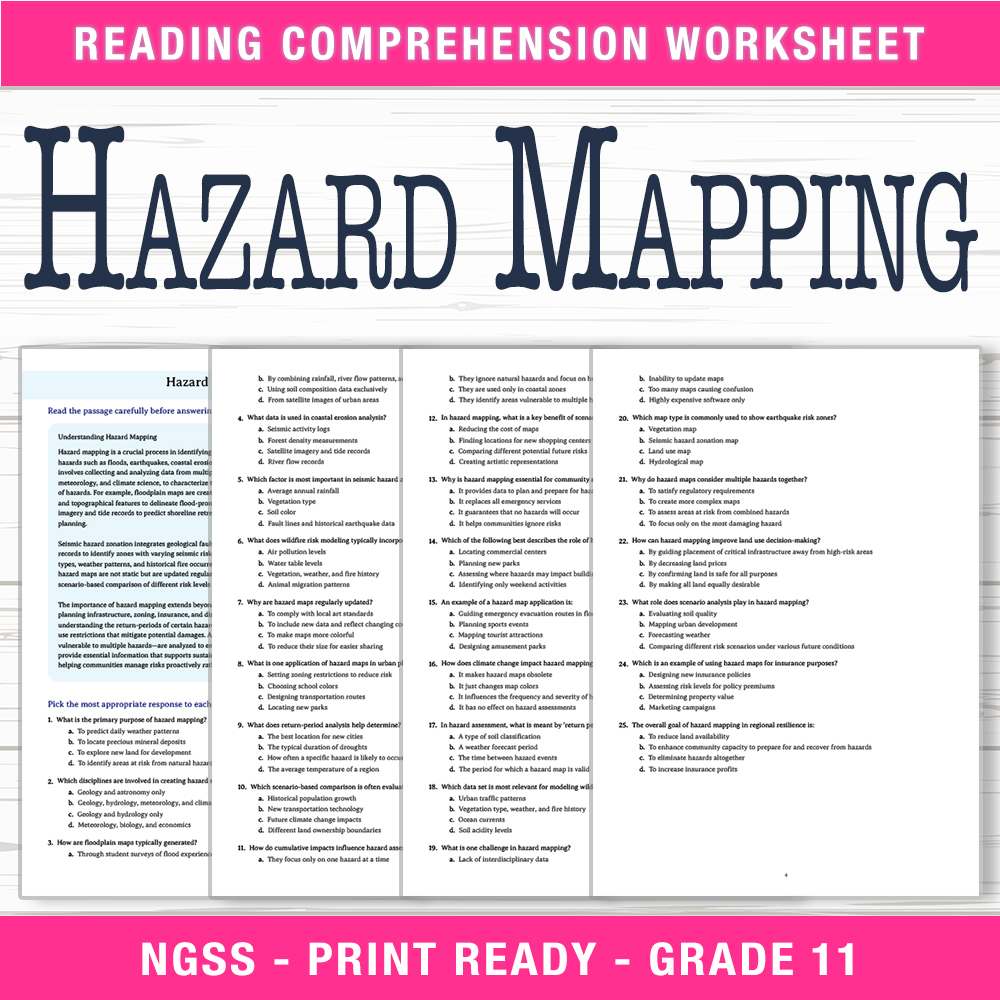
Grade 11 Science – Hazard Mapping Worksheet (PDF + Answer Key)
Created byRiverstone ClassroomLearning Objectives
- Understand the role of hazard mapping in assessing natural risks such as floods, earthquakes, and wildfires.
- Analyze how geological, hydrological, and climatic data are integrated to produce hazard maps.
- Evaluate the applications of hazard mapping in land use planning, disaster preparedness, and resilience building.
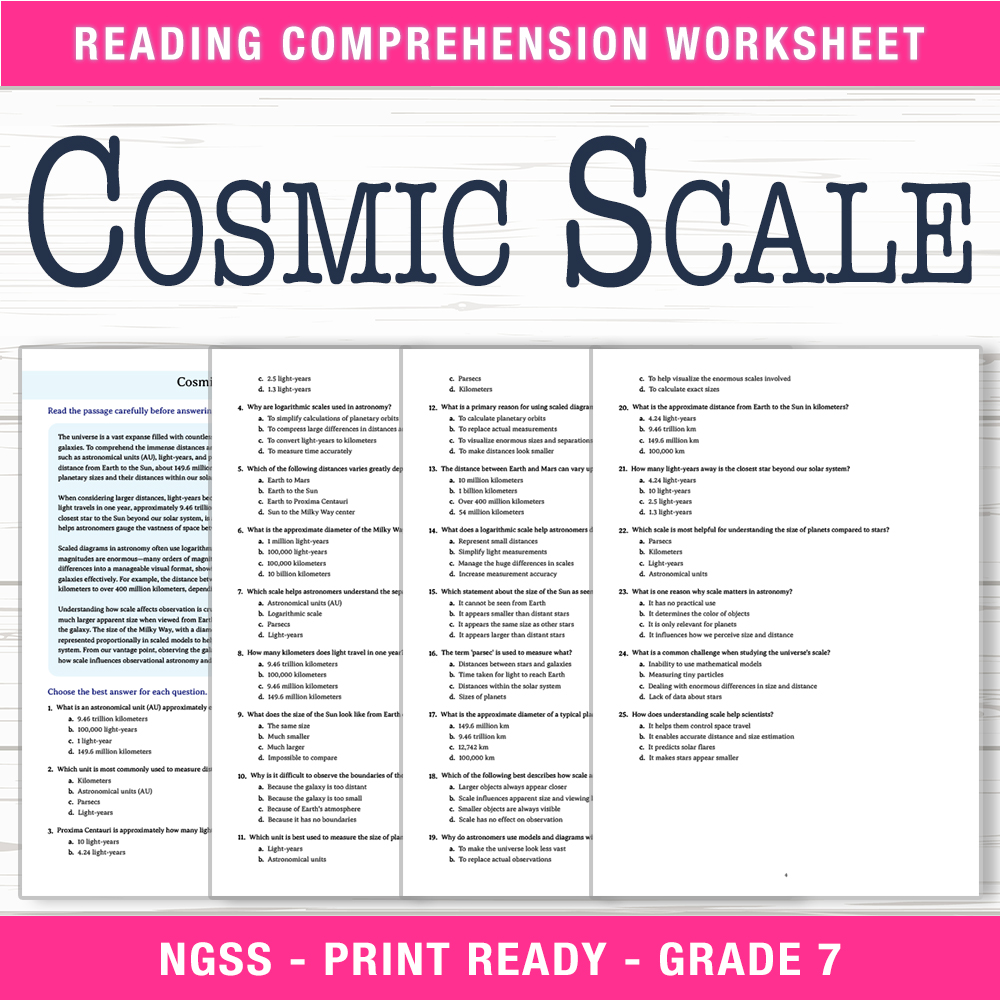
Grade 7 Science | Cosmic Scale Worksheet (PDF + Answer Key)
Created byRiverstone ClassroomLearning Objectives
- Understand the concept of astronomical units, planetary diameters, and light-years used to express cosmic distances and sizes.
- Interpret scaled diagrams and logarithmic representations illustrating the separation between celestial objects.
- Analyze orders of magnitude differences to comprehend how scale affects observation and measurement in astronomy.
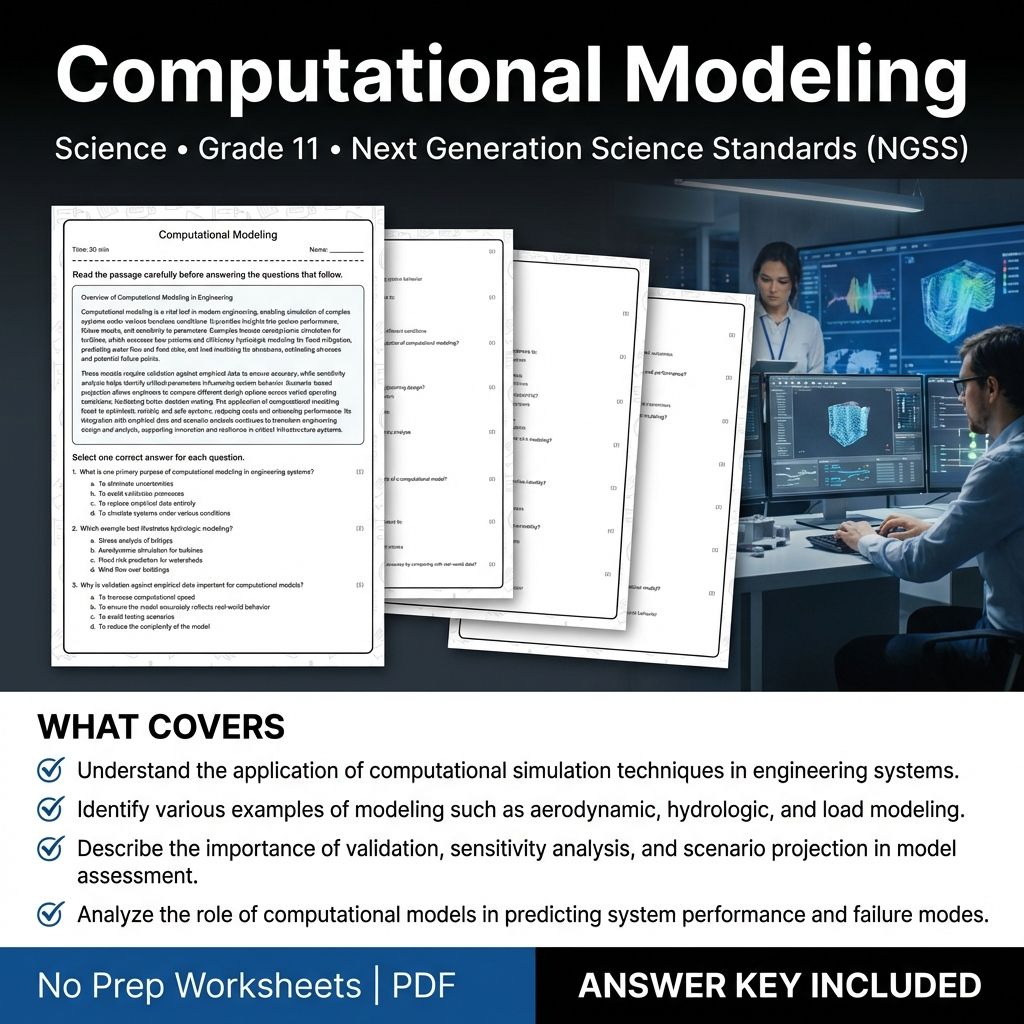
Grade 11 Science | Computational Modeling Worksheet & Answer Key PDF
Created byCoral Reef LearningLearning Objectives
- Understand the application of computational simulation techniques in engineering systems.
- Identify various examples of modeling such as aerodynamic, hydrologic, and load modeling.
- Describe the importance of validation, sensitivity analysis, and scenario projection in model assessment.
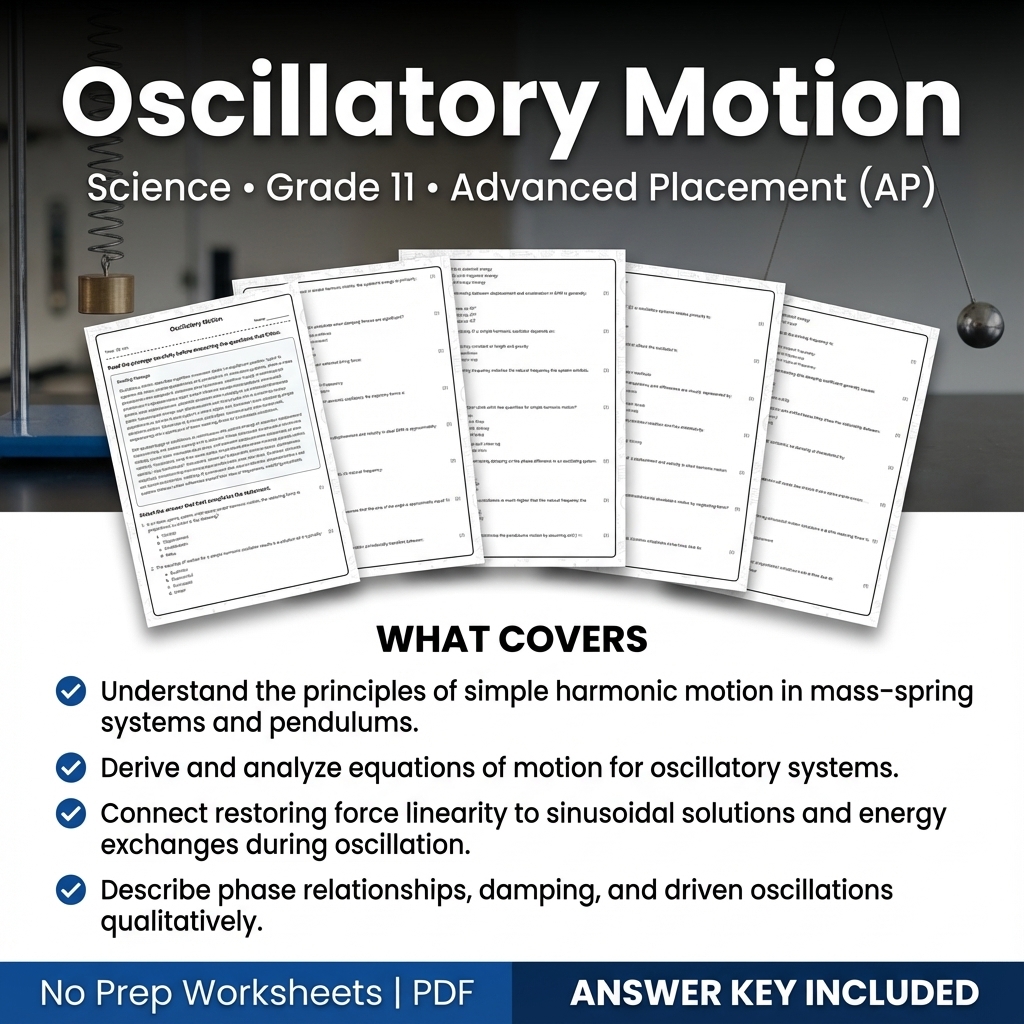
Grade 11 Science | Oscillatory Motion Worksheet (Printable PDF + Answer Key)
Created byCoral Reef LearningLearning Objectives
- Understand the principles of simple harmonic motion in mass–spring systems and pendulums.
- Derive and analyze equations of motion for oscillatory systems.
- Connect restoring force linearity to sinusoidal solutions and energy exchanges during oscillation.
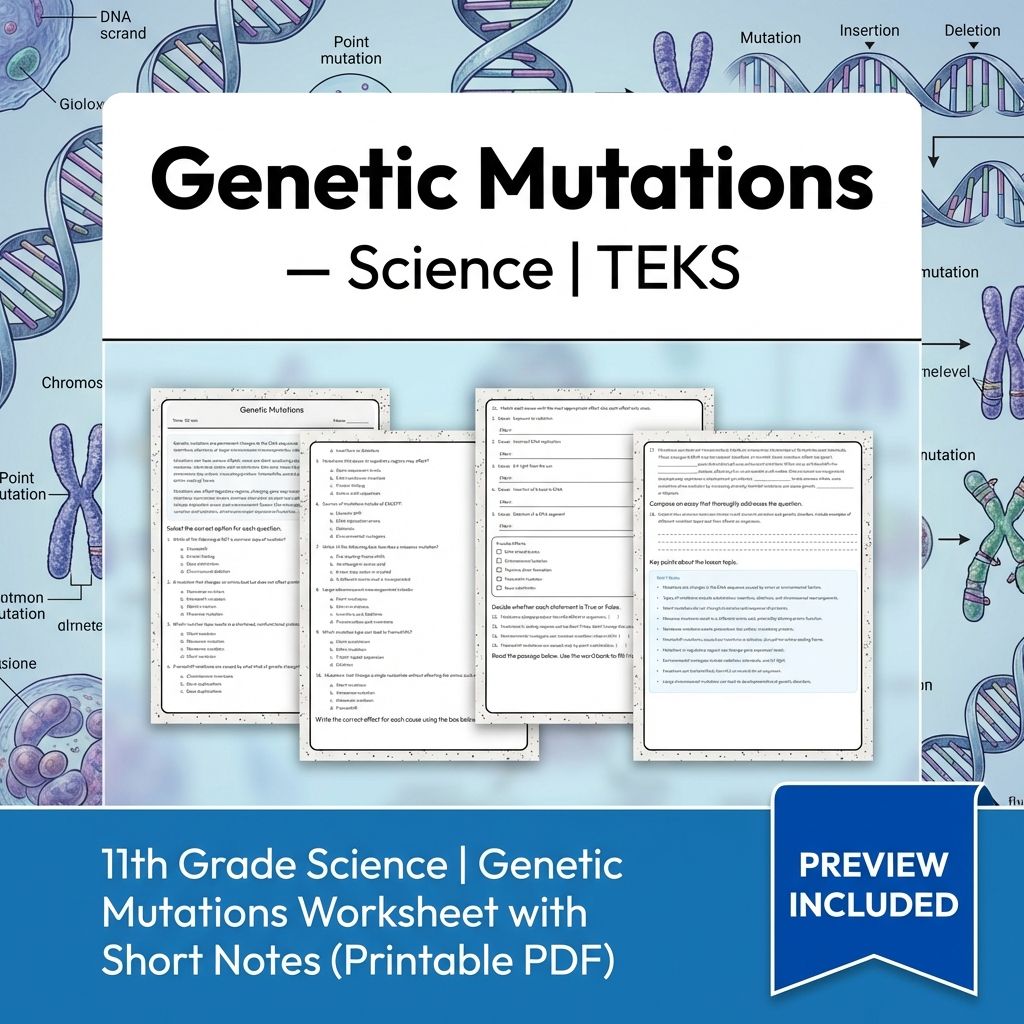
11th Grade Science | Genetic Mutations Worksheet with Short Notes (PDF)
 Created byMeadowlark Worksheets
Learning Objectives
- Understand different types of genetic mutations and their effects on DNA and proteins.
- Identify sources and consequences of mutations at the molecular and phenotypic levels.
- Distinguish between mutations that modify gene expression versus coding sequences.
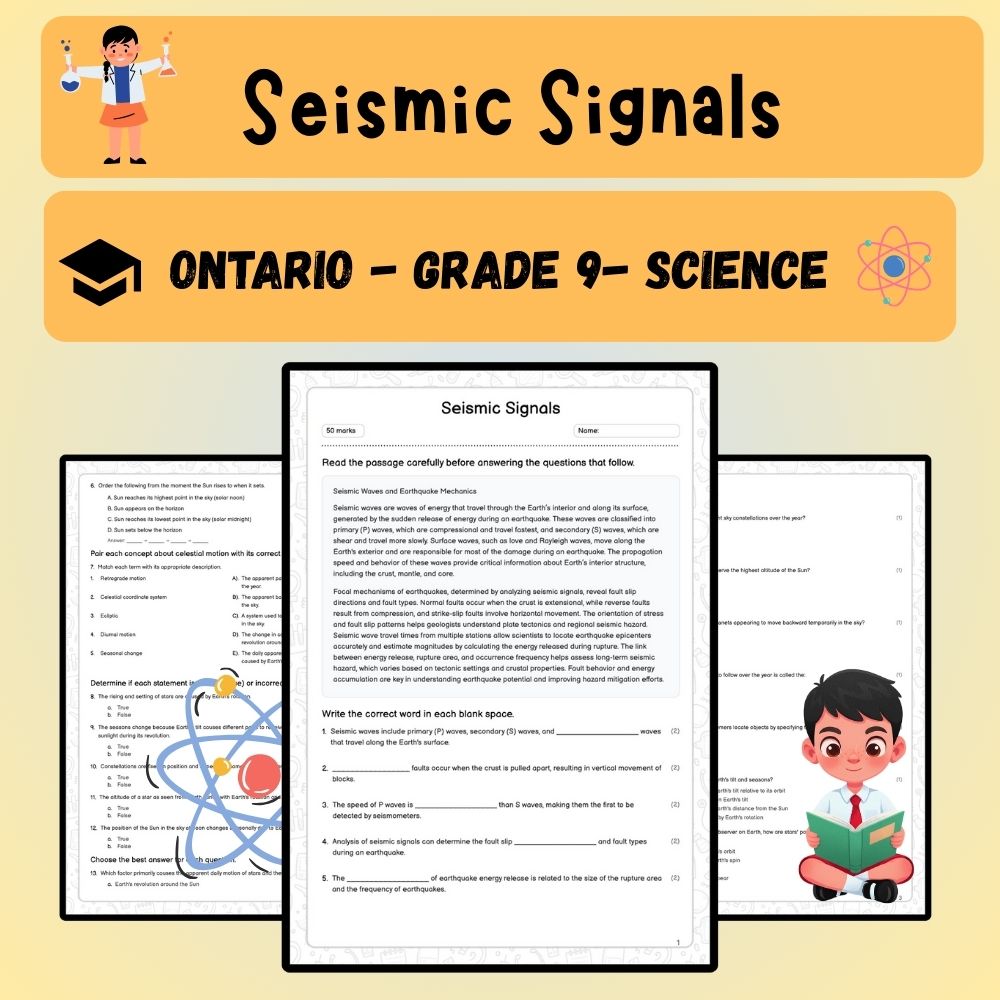
Grade 9 Science | Seismic Signals Worksheet (Worksheet + Answer Key) – Ontario Standards
Created byPrism Point LearningLearning Objectives
- Understand the types and propagation characteristics of seismic waves.
- Explain how earthquake focal mechanisms reveal fault types and stress orientations.
- Relate seismic wave travel times to Earth's interior structure and methods for locating epicentres.
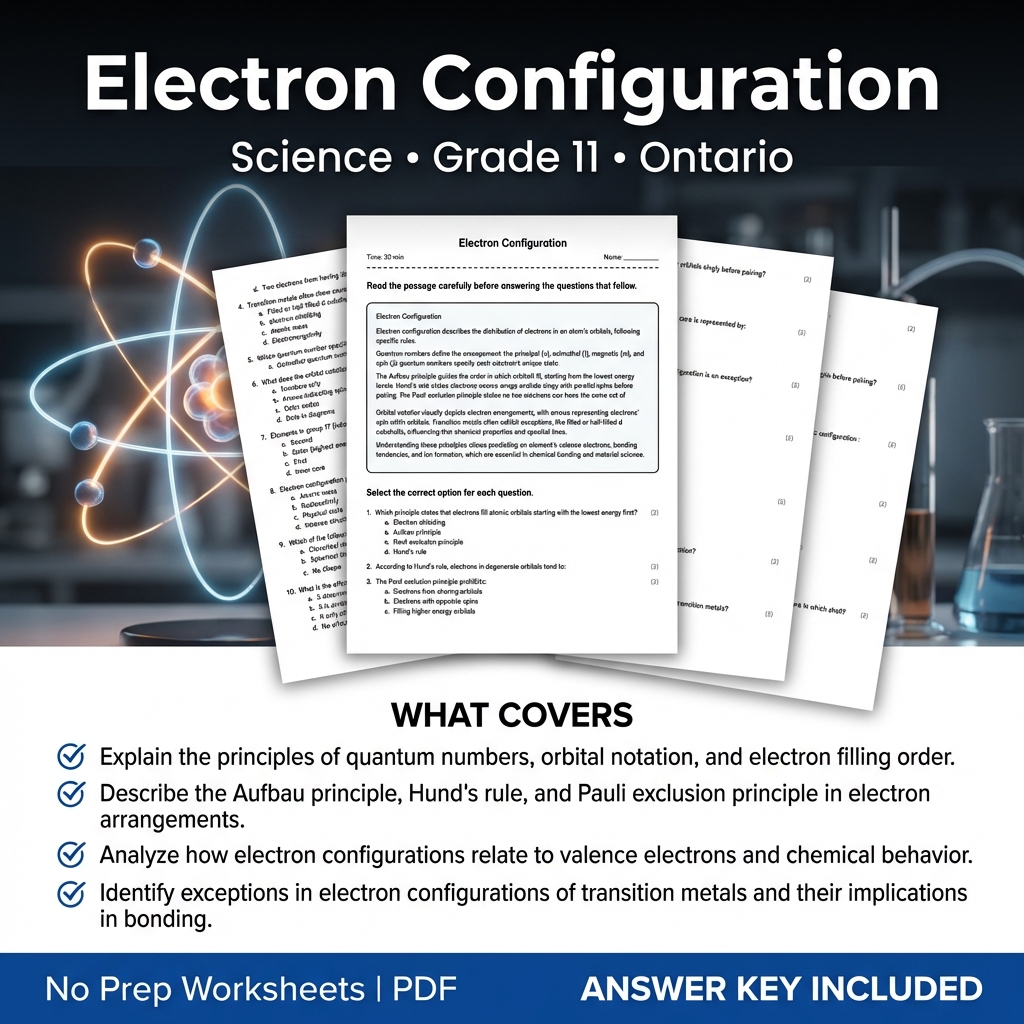
Electron Configuration Worksheet for Grade 11 Science | Ontario Standards
Created byCoral Reef LearningLearning Objectives
- Explain the principles of quantum numbers, orbital notation, and electron filling order.
- Describe the Aufbau principle, Hund’s rule, and Pauli exclusion principle in electron arrangements.
- Analyze how electron configurations relate to valence electrons and chemical behavior.
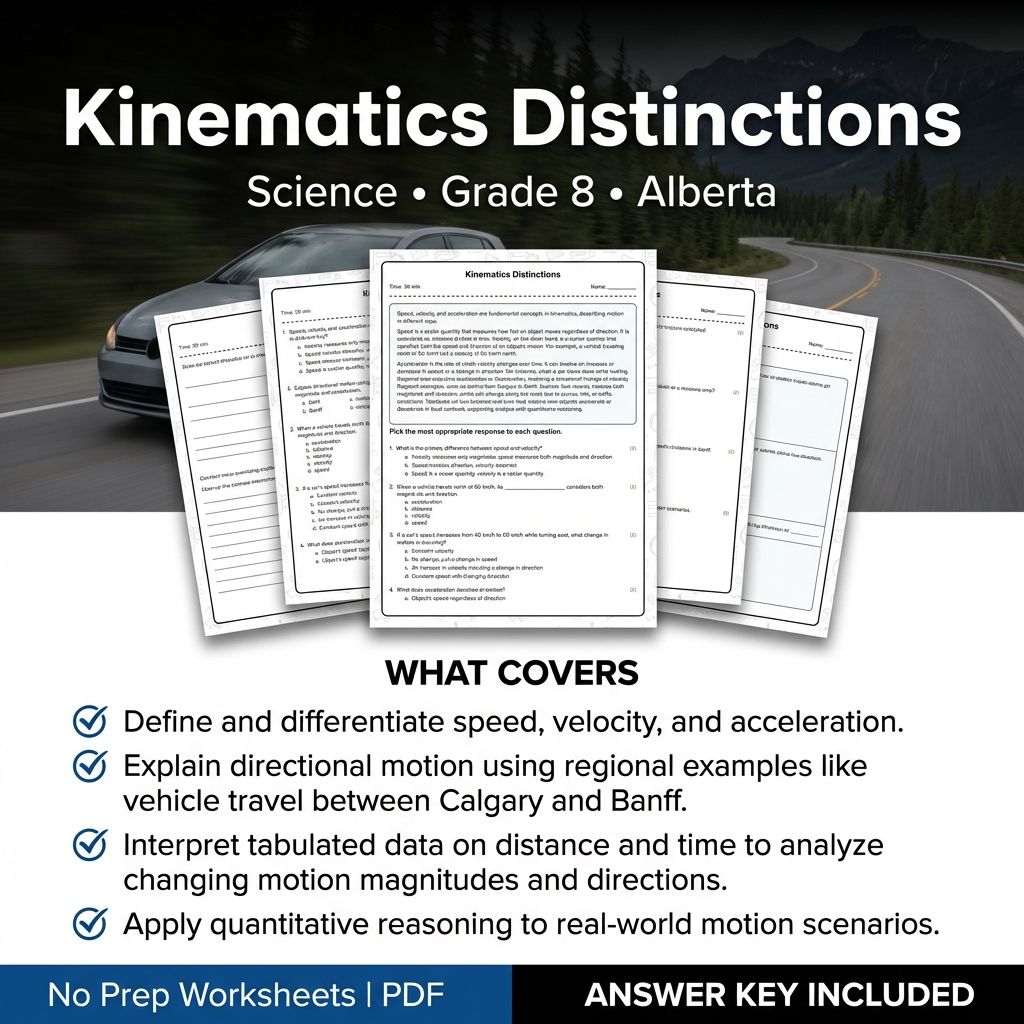
Grade 8 Science Worksheet on Kinematics Distinctions | Alberta Standards
Created byCoral Reef LearningLearning Objectives
- Define and differentiate speed, velocity, and acceleration.
- Explain directional motion using regional examples like vehicle travel between Calgary and Banff.
- Interpret tabulated data on distance and time to analyze changing motion magnitudes and directions.
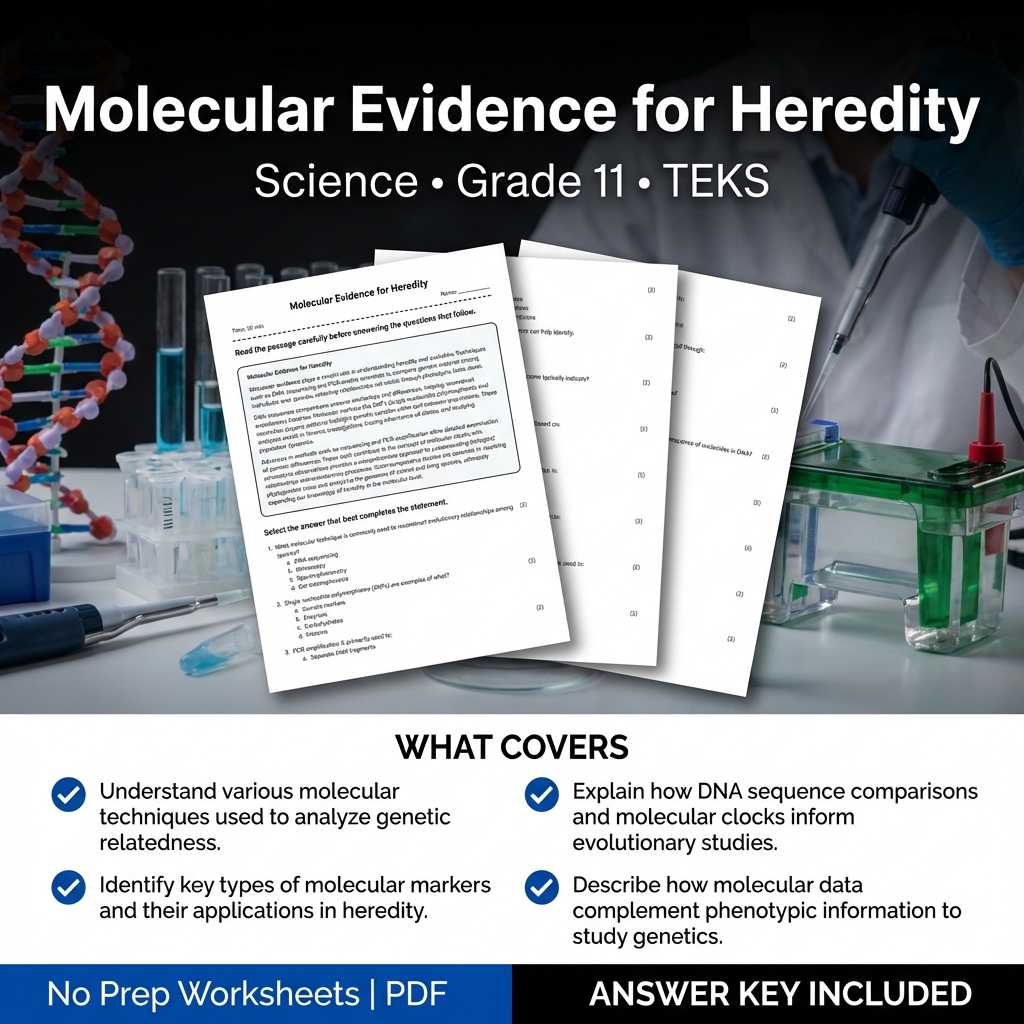
Molecular Evidence for Heredity Worksheet Grade 11 Science TEKS
Created byCoral Reef LearningLearning Objectives
- Understand various molecular techniques used to analyze genetic relatedness.
- Identify key types of molecular markers and their applications in heredity.
- Explain how DNA sequence comparisons and molecular clocks inform evolutionary studies.
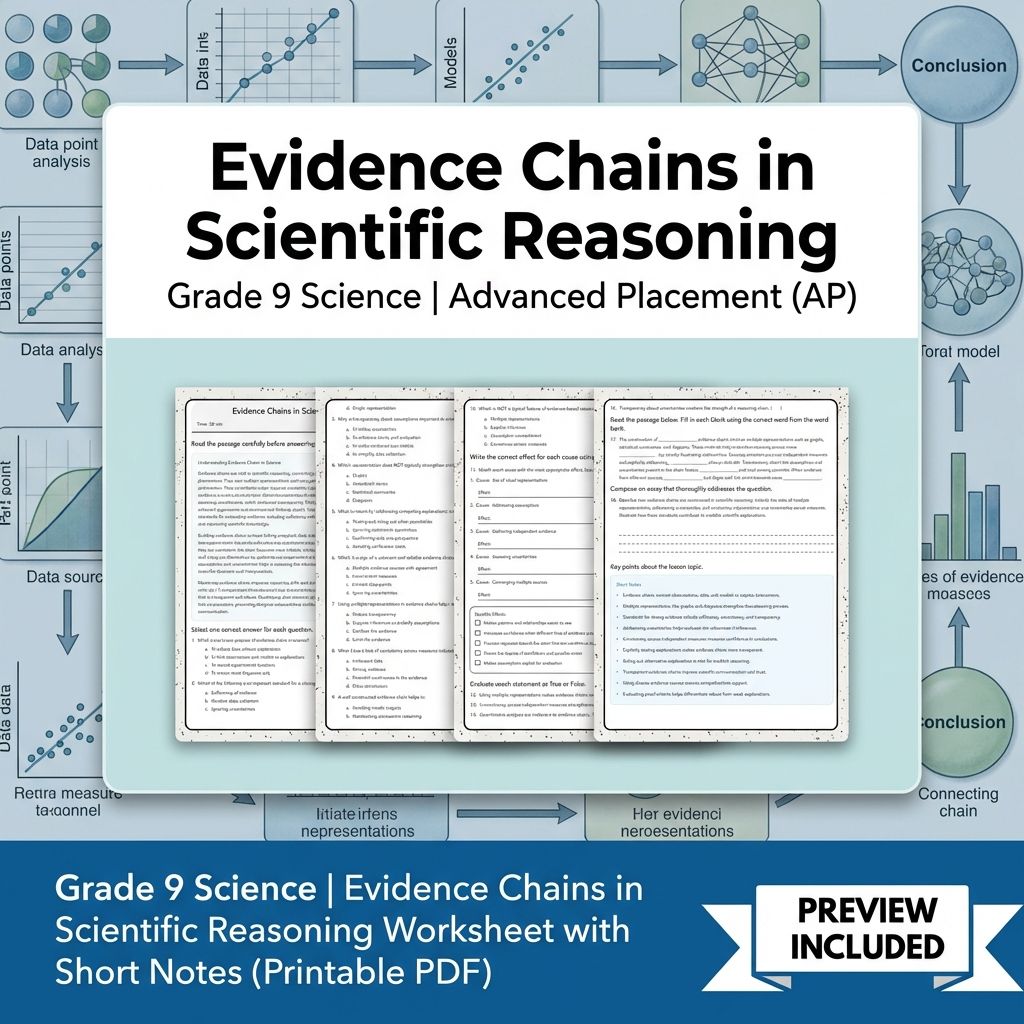
Grade 9 Science | Evidence Chains in Scientific Reasoning Worksheet (PDF)
Created byMeadowlark WorksheetsLearning Objectives
- Understand the structure of evidence-based reasoning in science.
- Identify different types of evidence and their roles in supporting claims.
- Analyze how multiple representations strengthen inference chains.
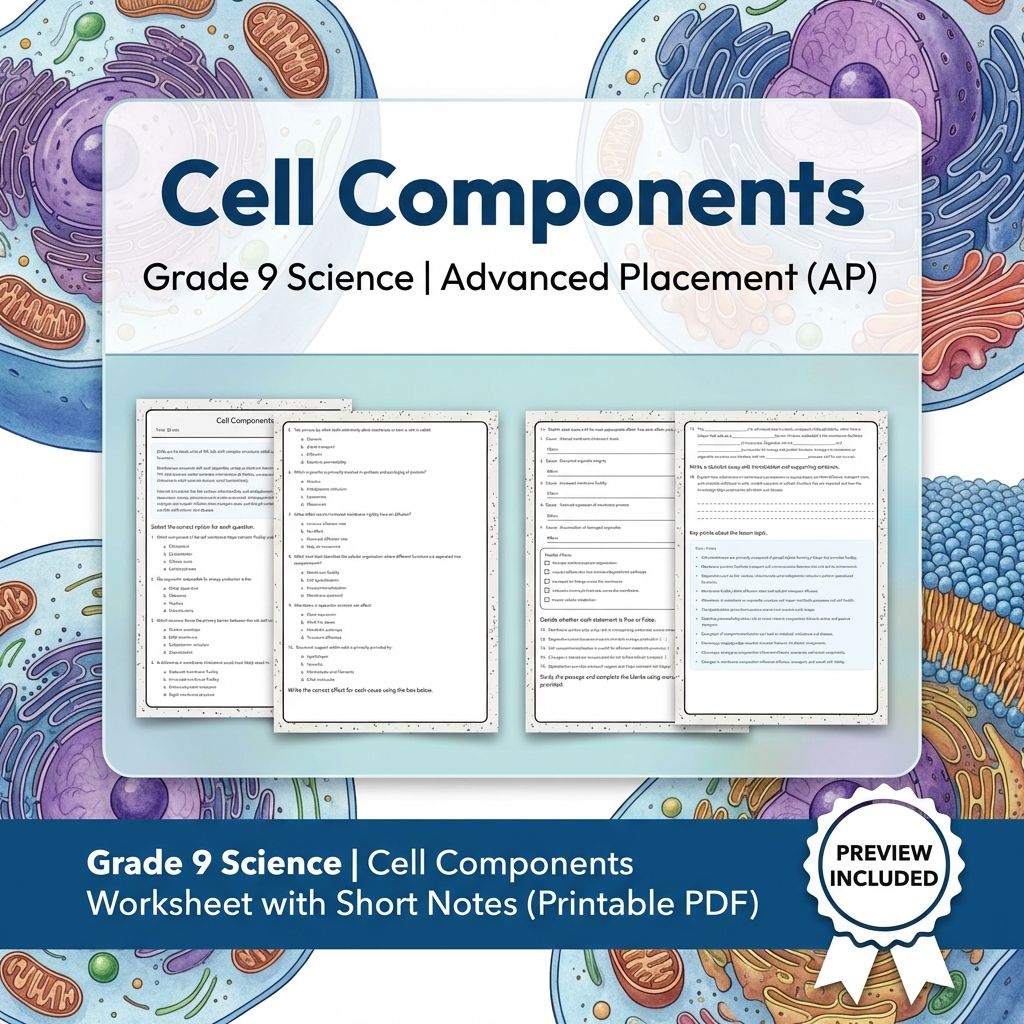
Grade 9 Science | Cell Components Worksheet with Short Notes (Printable PDF)
Created byMeadowlark WorksheetsLearning Objectives
- Describe the structure and function of cellular membranes and organelles.
- Explain how cellular compartmentalization affects metabolic processes.
- Identify the impact of alterations in membrane composition on diffusion and transport.
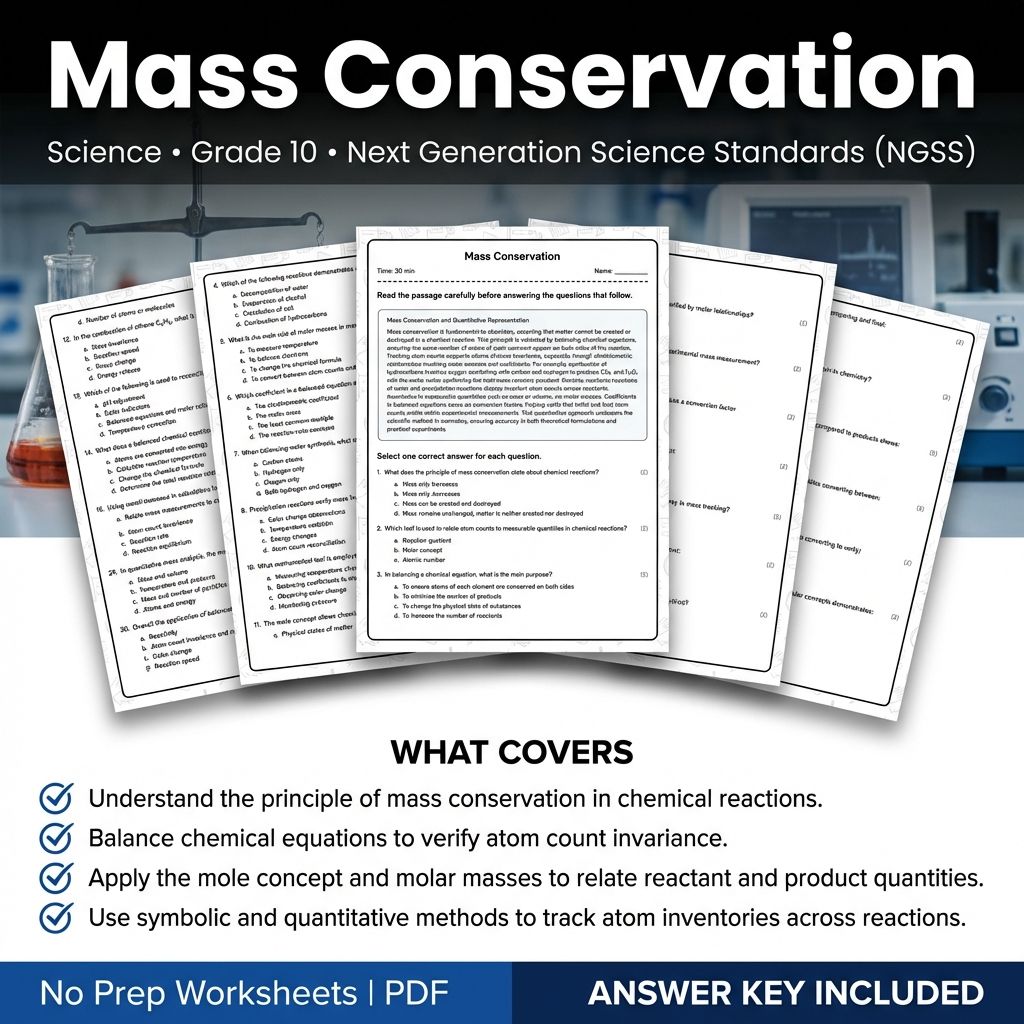
10th Grade Science | Mass Conservation Worksheet & Answer Key (Printable PDF)
Created byCoral Reef LearningLearning Objectives
- Understand the principle of mass conservation in chemical reactions.
- Balance chemical equations to verify atom count invariance.
- Apply the mole concept and molar masses to relate reactant and product quantities.
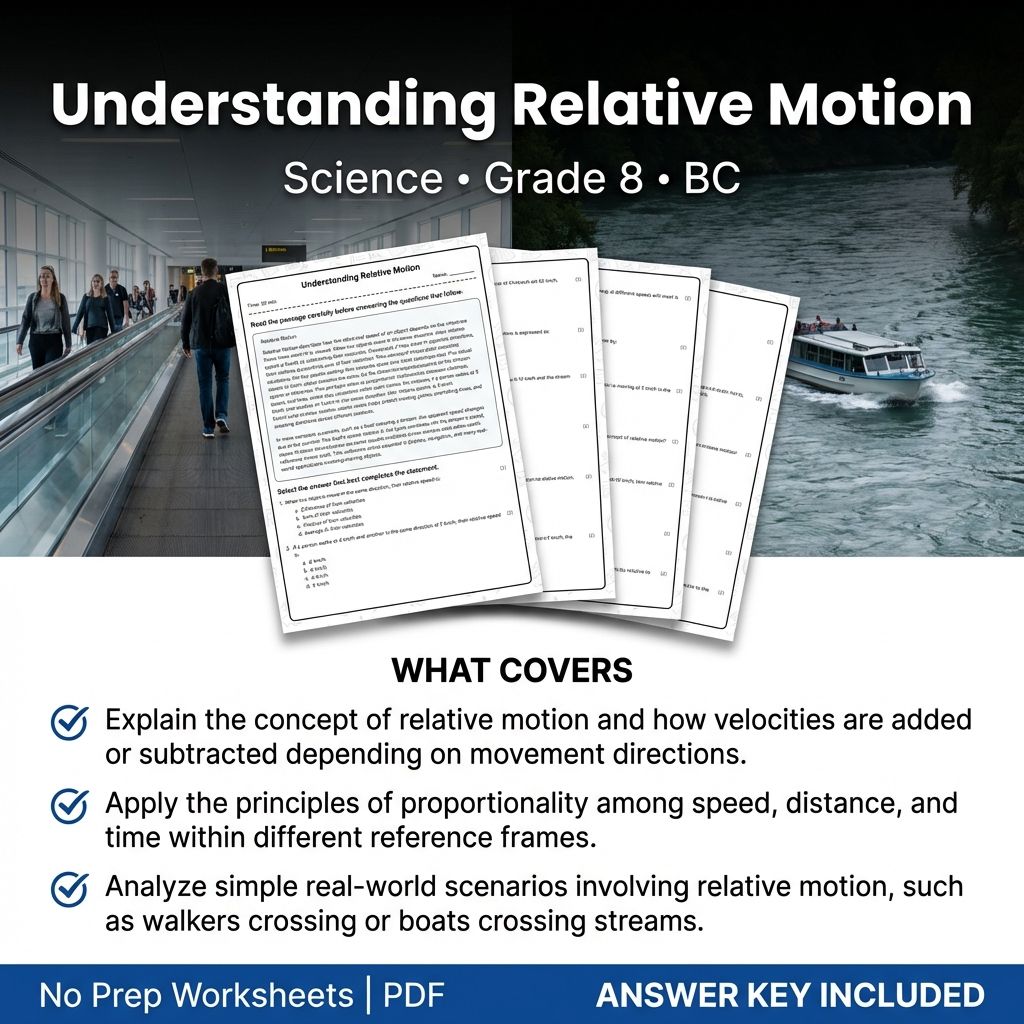
Understanding Relative Motion Grade 8 Science Worksheet & Answer Key
Created byCoral Reef LearningLearning Objectives
- Explain the concept of relative motion and how velocities are added or subtracted depending on movement directions.
- Apply the principles of proportionality among speed, distance, and time within different reference frames.
- Analyze simple real-world scenarios involving relative motion, such as walkers crossing or boats crossing streams.
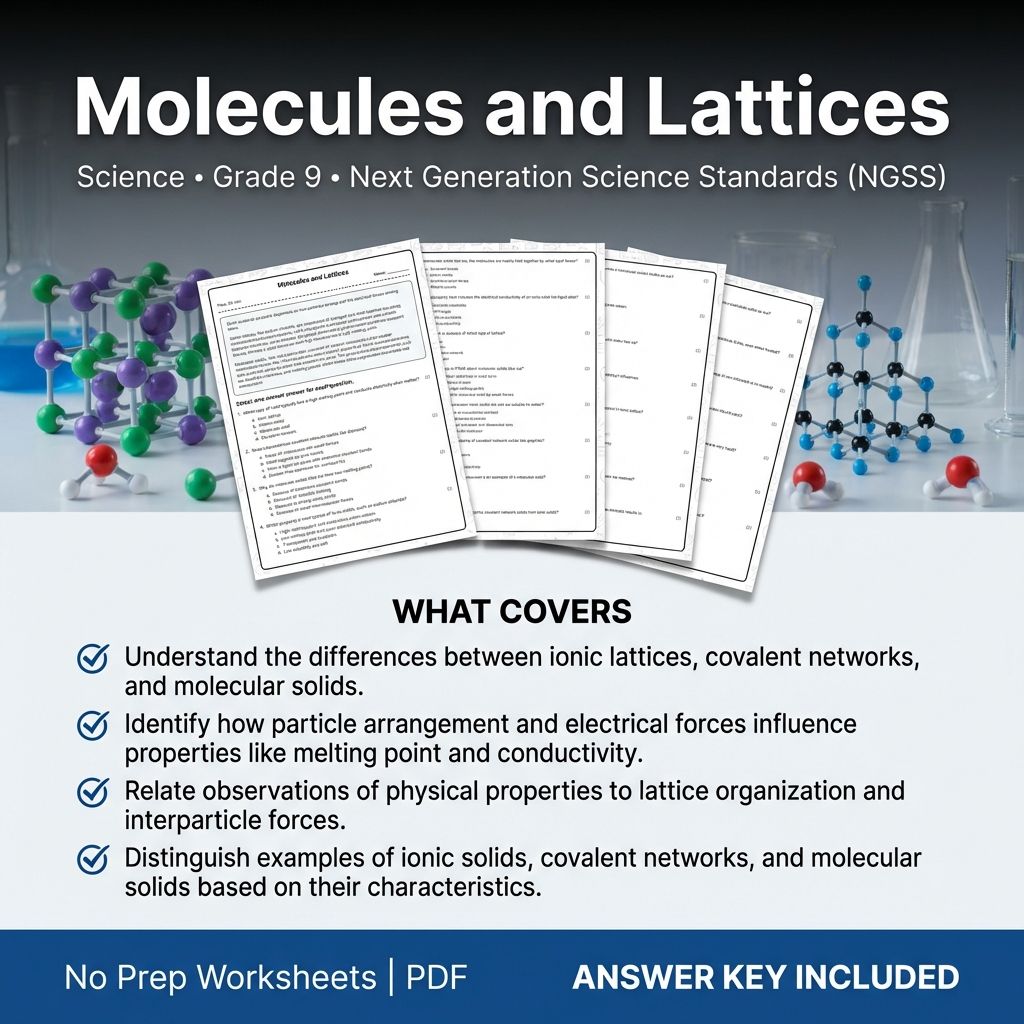
9th Grade Science | Molecules and Lattices Worksheet & Answer Key(Printable PDF)
Created byCoral Reef LearningLearning Objectives
- Understand the differences between ionic lattices, covalent networks, and molecular solids.
- Identify how particle arrangement and electrical forces influence properties like melting point and conductivity.
- Relate observations of physical properties to lattice organization and interparticle forces.
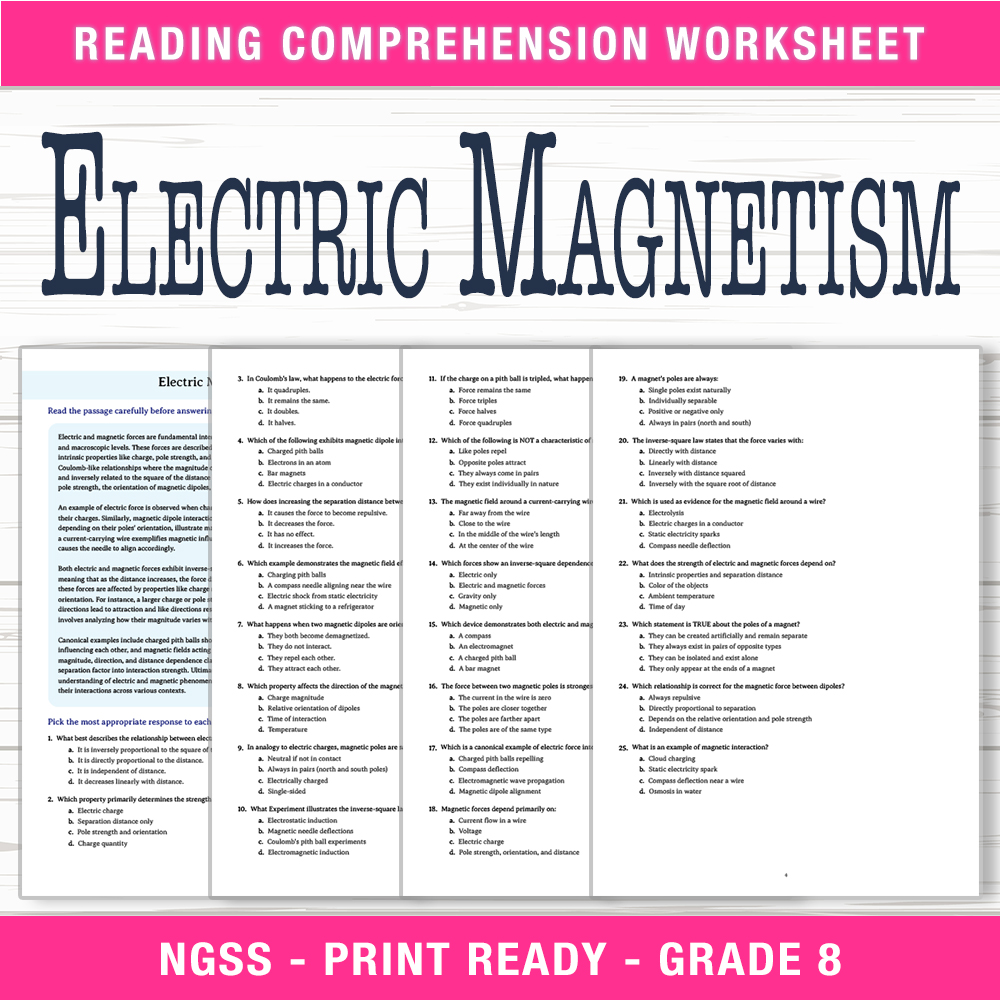
Grade 8 Science | Electric Magnetism Worksheet (PDF + Answer Key)
Created byRiverstone ClassroomLearning Objectives
- Explain the fundamental forces involved in electric and magnetic interactions.
- Describe how electric and magnetic forces depend on properties like charge, pole strength, and distance.
- Identify real-world examples of electric and magnetic forces and analyze factors affecting their strength.
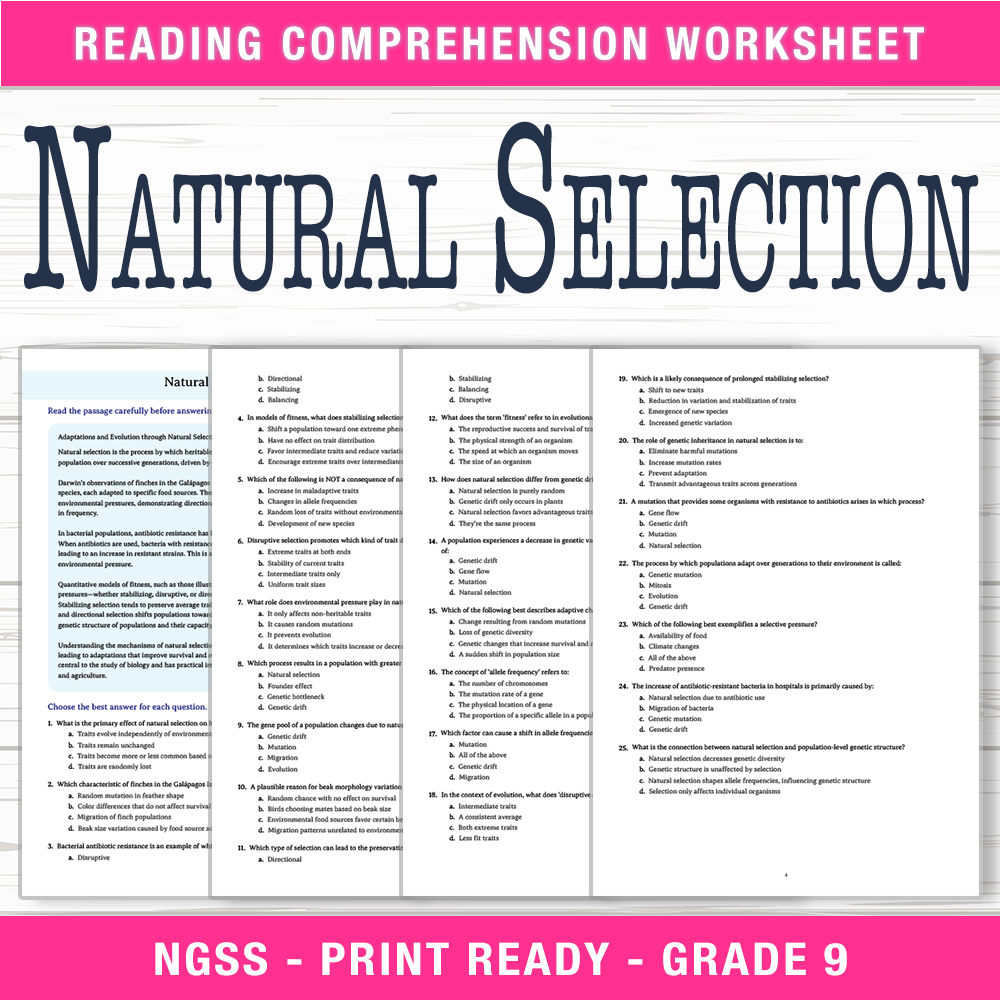
Grade 9 Science | Natural Selection Worksheet (PDF + Answer Key)
Created byRiverstone ClassroomLearning Objectives
- Understand the mechanisms by which heritable variation contributes to differential survival and reproduction
- Identify and explain examples of natural selection, such as beak morphology shifts and bacterial resistance
- Analyze models of fitness and allele frequency changes related to different types of selection
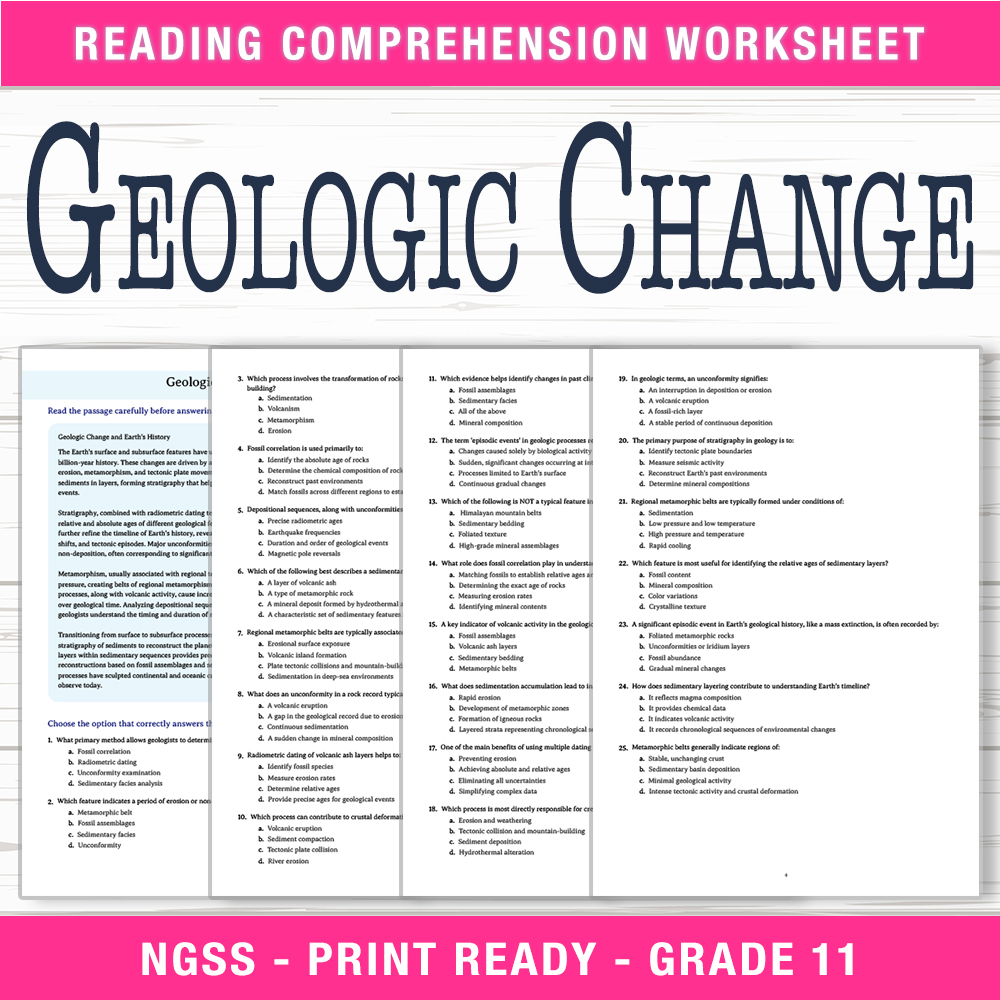
Grade 11 Science – Geologic Change Worksheet (PDF + Answer Key)
Created byRiverstone ClassroomLearning Objectives
- Understand the processes driving surface and subsurface geologic changes over time
- Interpret stratigraphic sequences, sedimentation patterns, and metamorphic evidence
- Explain how radiometric dating, fossil correlation, and sedimentary facies constrain Earth's history
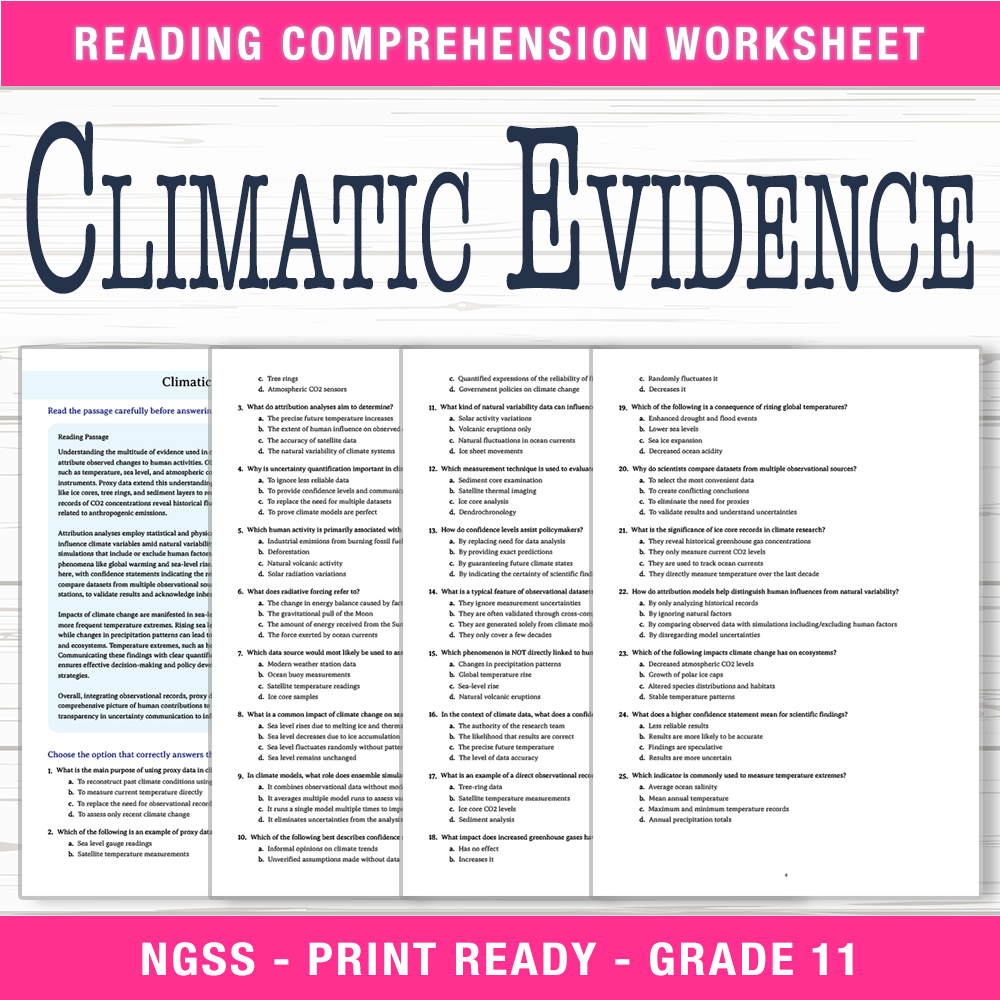
Grade 11 Science | Climatic Evidence Worksheet (PDF + Answer Key)
Created byRiverstone ClassroomLearning Objectives
- Understand the types of observational records and proxy data used in climate science.
- Analyze how attribution analyses distinguish human contributions from natural variability in climate change.
- Interpret the significance of uncertainty quantification and confidence statements in climate data.
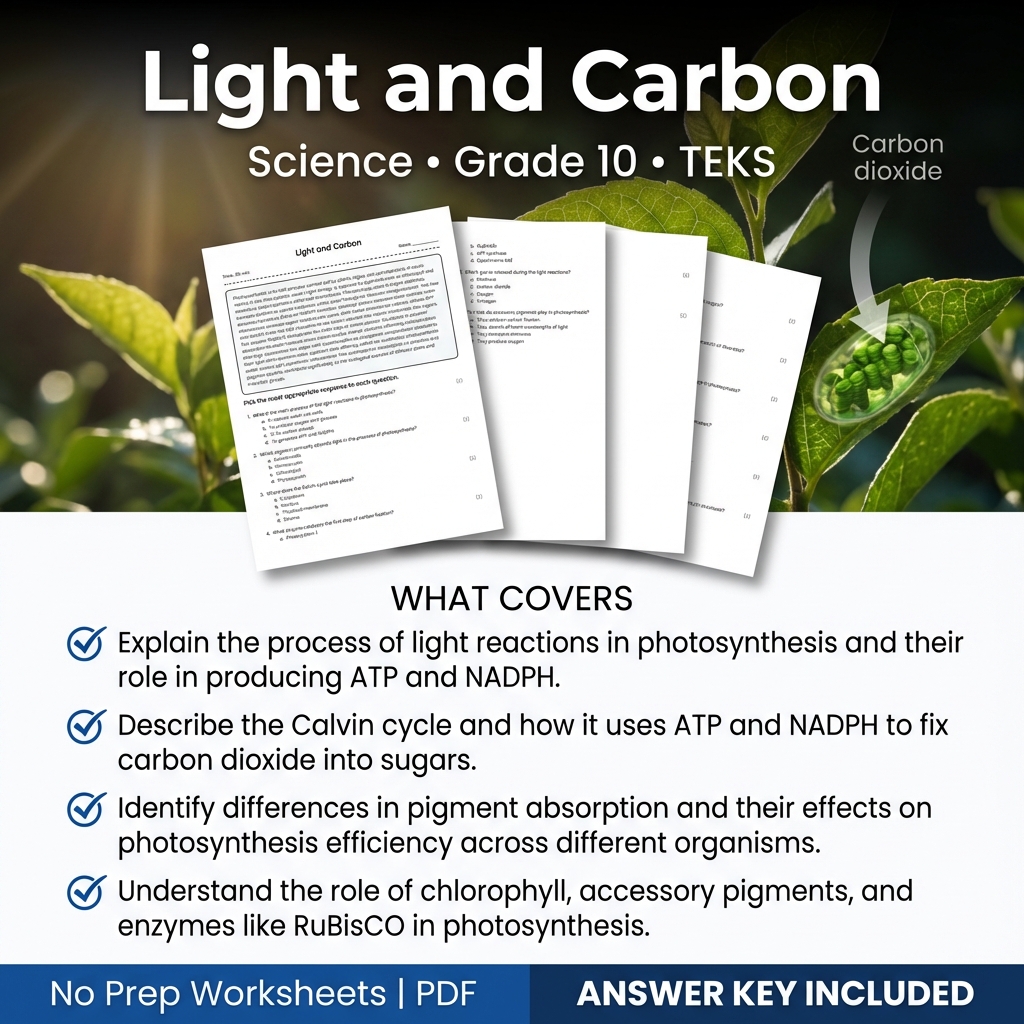
Light and Carbon Science Worksheet | TEKS Grade 10 Practice
Created byCoral Reef LearningLearning Objectives
- Explain the process of light reactions in photosynthesis and their role in producing ATP and NADPH.
- Describe the Calvin cycle and how it uses ATP and NADPH to fix carbon dioxide into sugars.
- Identify differences in pigment absorption and their effects on photosynthesis efficiency across different organisms.
Browse more categories
About Science Worksheets
Find Science worksheets spanning core skills, practice, and review. All 42,685 resources are instant PDF downloads for the classroom or home.
Every worksheet on MyTeachingSheets is created by independent teacher-authors and reviewed before publication. All resources download as printable PDFs for classroom, homework, or at-home practice, and many include answer keys. Preview any worksheet free before buying.