
Science Worksheets
42,685 subject resources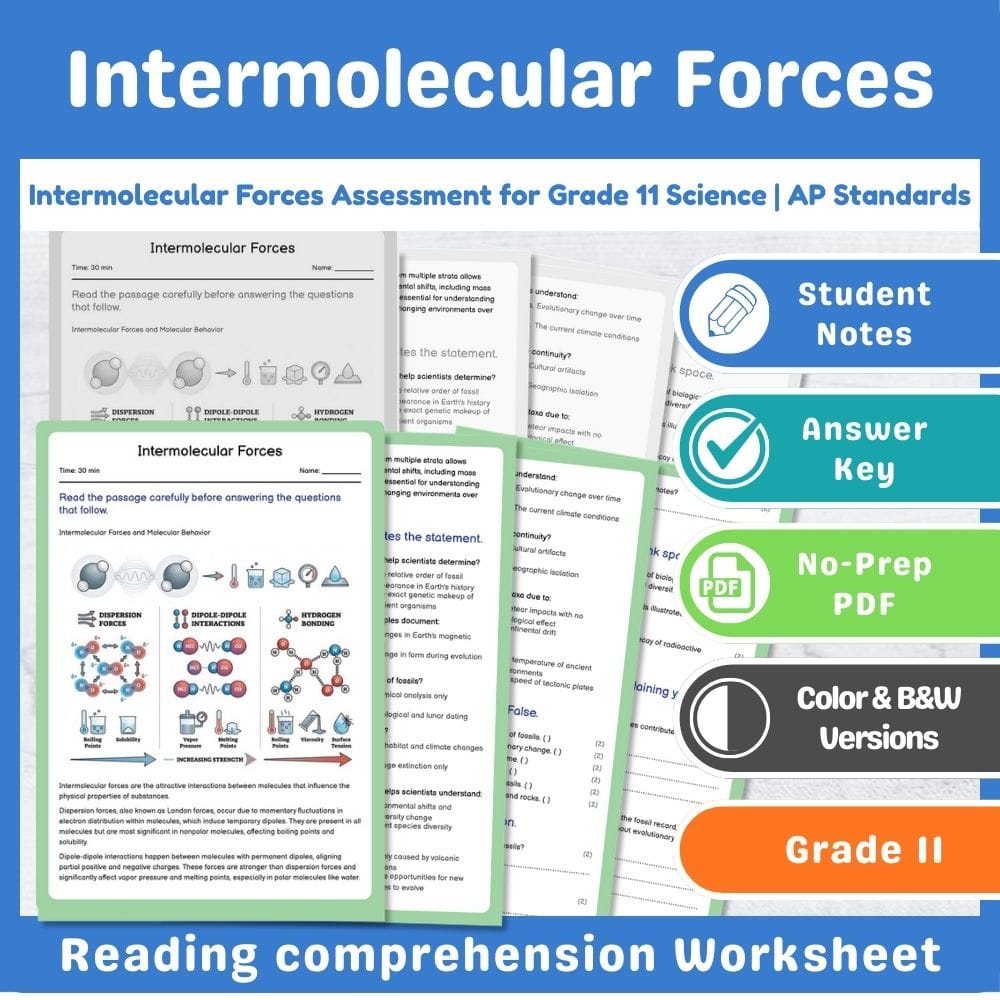
Intermolecular Forces Assessment for Grade 11 Science | AP Standards
 Created byPrism Point Learning
Learning Objectives
- Describe the different types of intermolecular forces: dispersion, dipole-dipole, and hydrogen bonding.
- Explain how intermolecular forces influence boiling point, vapor pressure, and solubility.
- Relate molecular polarity and surface interactions to phase behavior and macroscopic trends.
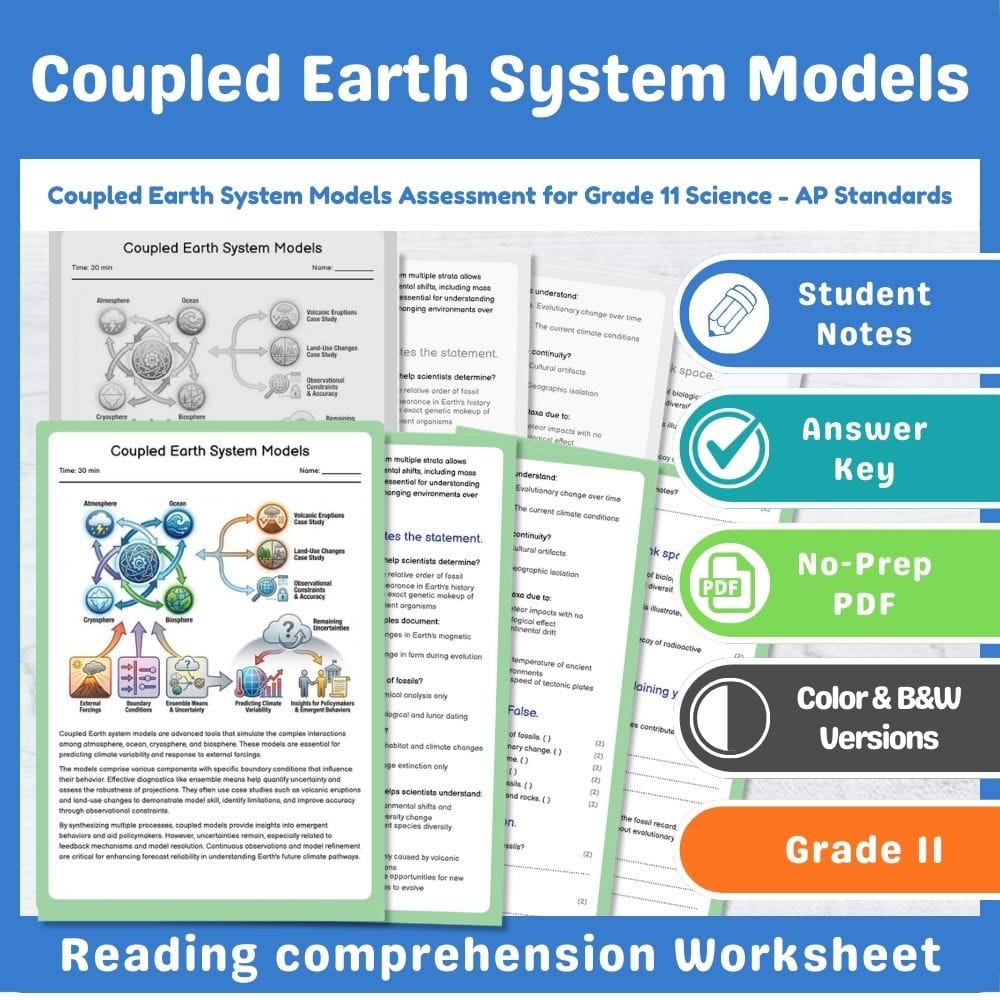
Coupled Earth System Models Assessment for Grade 11 Science - AP Standards
Created byPrism Point LearningLearning Objectives
- Understand the components and functions of coupled Earth system models.
- Describe how atmosphere, ocean, cryosphere, and biosphere processes are integrated.
- Explain the role of boundary conditions and diagnostics in model evaluation.
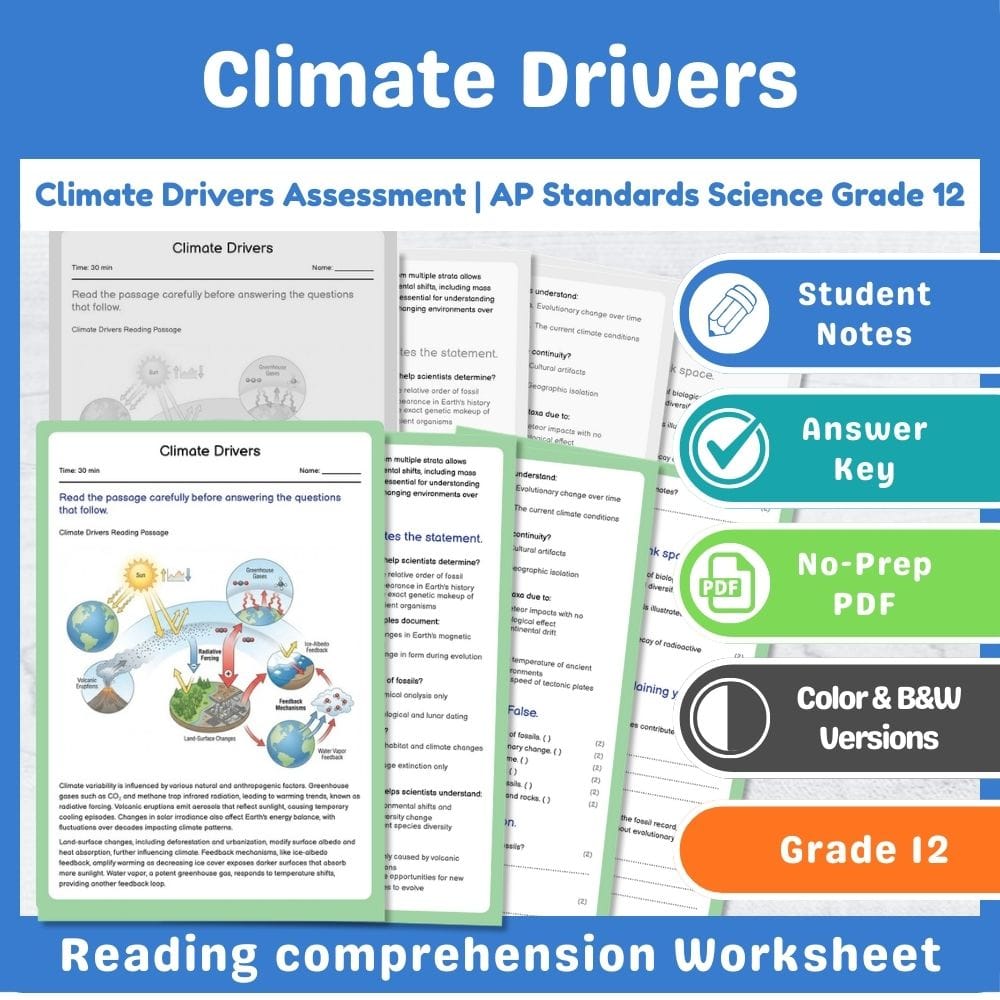
Climate Drivers Assessment | AP Standards Science Grade 12
Created byPrism Point LearningLearning Objectives
- Identify the main forcings that drive climate variability and change.
- Understand radiative forcing metrics and feedback mechanisms.
- Analyze the role of ocean heat uptake and land-surface alterations in climate dynamics.
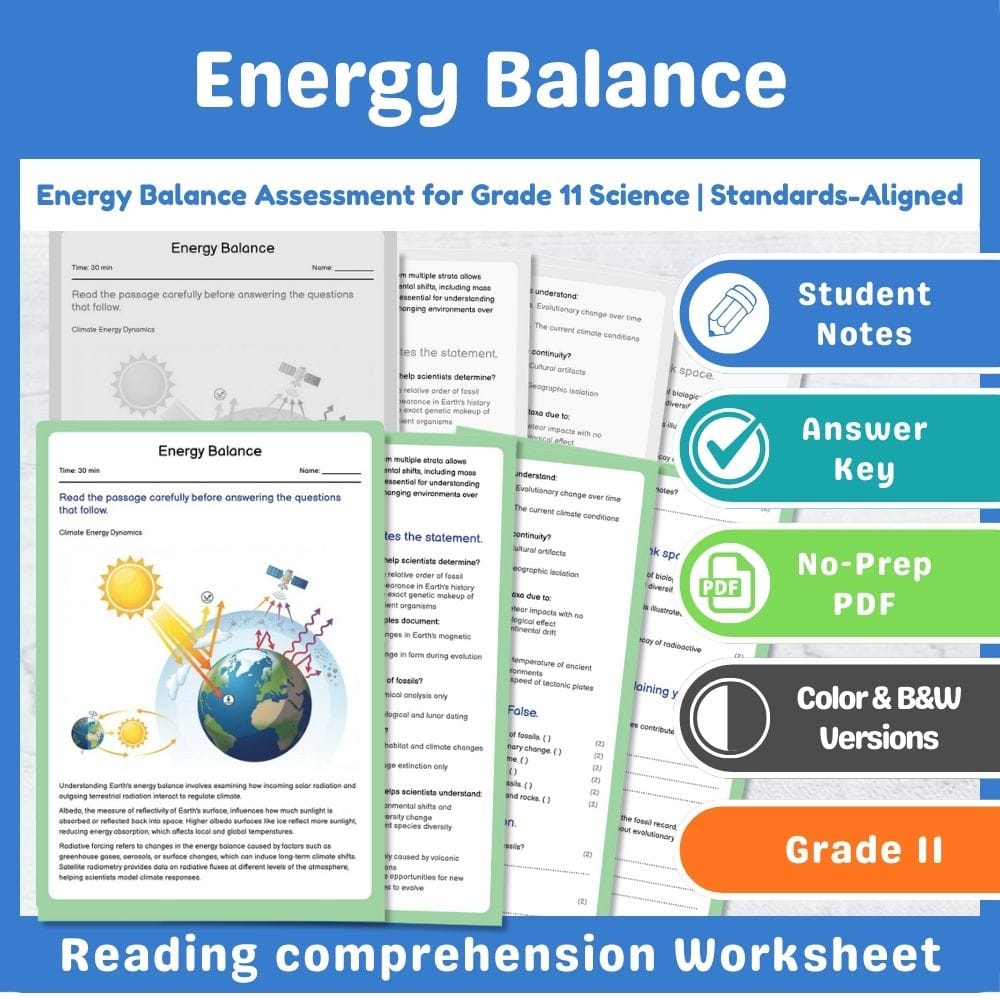
Energy Balance Assessment for Grade 11 Science | Standards-Aligned
Created byPrism Point LearningLearning Objectives
- Explain the concepts of energy balance and radiative forcing in climate systems.
- Interpret albedo maps, radiative flux diagrams, and simple energy budget models.
- Analyze phenomena such as seasonal cycles and polar amplification through feedback mechanisms.
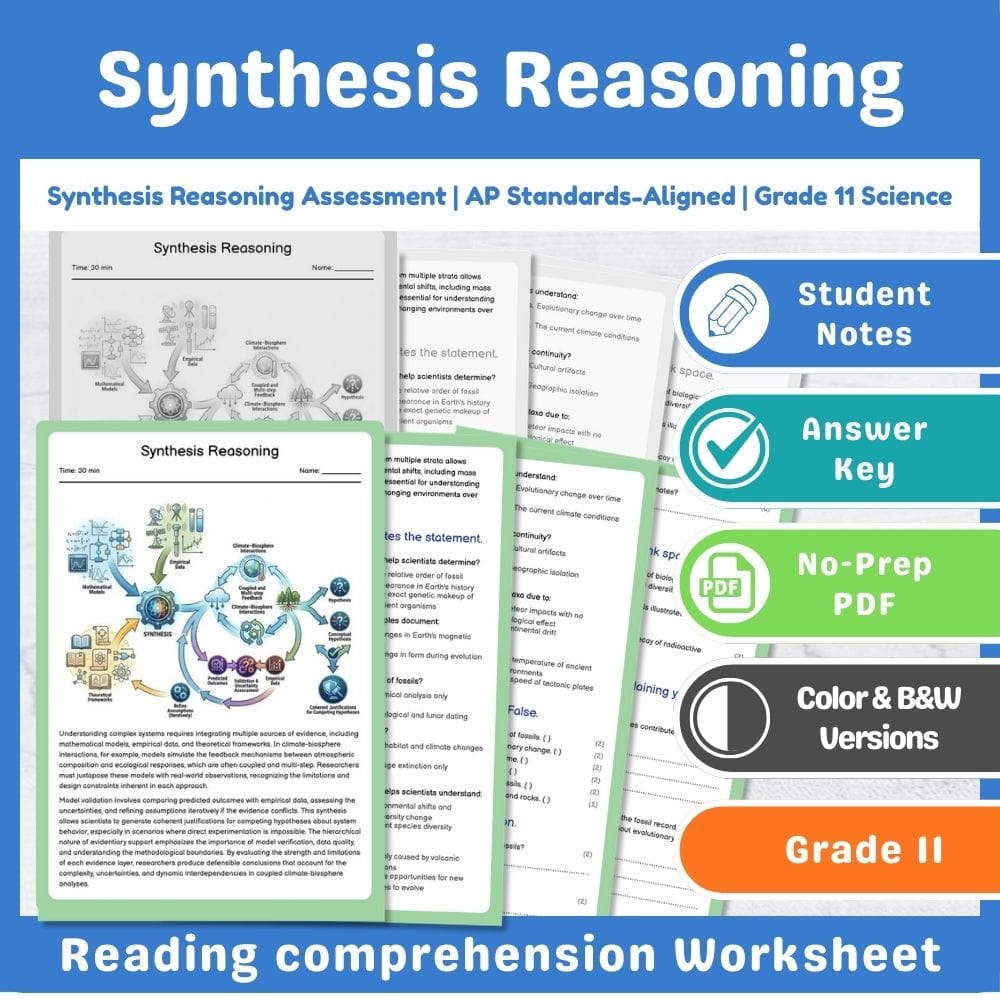
Synthesis Reasoning Assessment | AP Standards-Aligned | Grade 11 Science
Created byPrism Point LearningLearning Objectives
- Evaluate complex phenomena through model-based inference and quantitative reasoning.
- Integrate empirical summaries, model expectations, and design constraints for hypothesis testing.
- Apply uncertainty quantification and validation outcomes to support scientific conclusions.
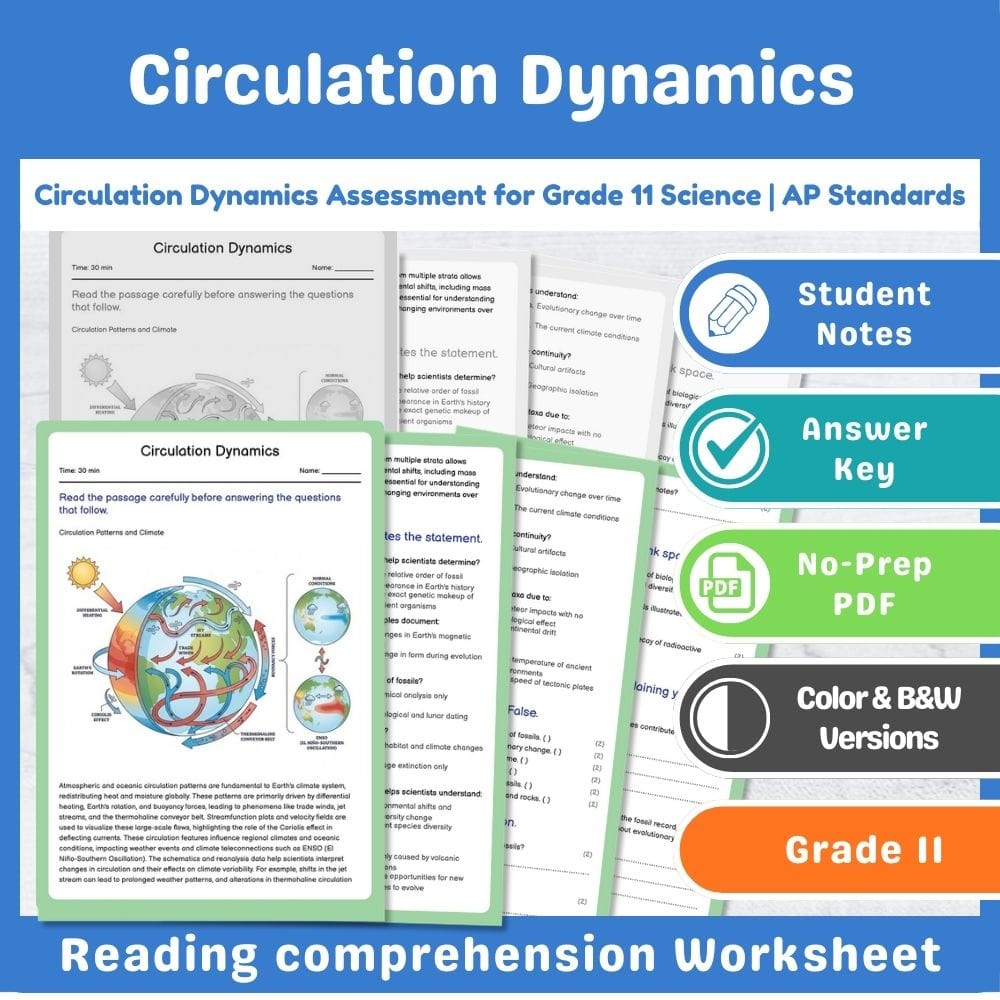
Circulation Dynamics Assessment for Grade 11 Science | AP Standards
Created byPrism Point LearningLearning Objectives
- Explain the principles of atmospheric and oceanic circulation patterns.
- Interpret streamfunction plots and velocity fields related to climate systems.
- Identify key phenomena such as jet streams, trade winds, and thermohaline circulation.
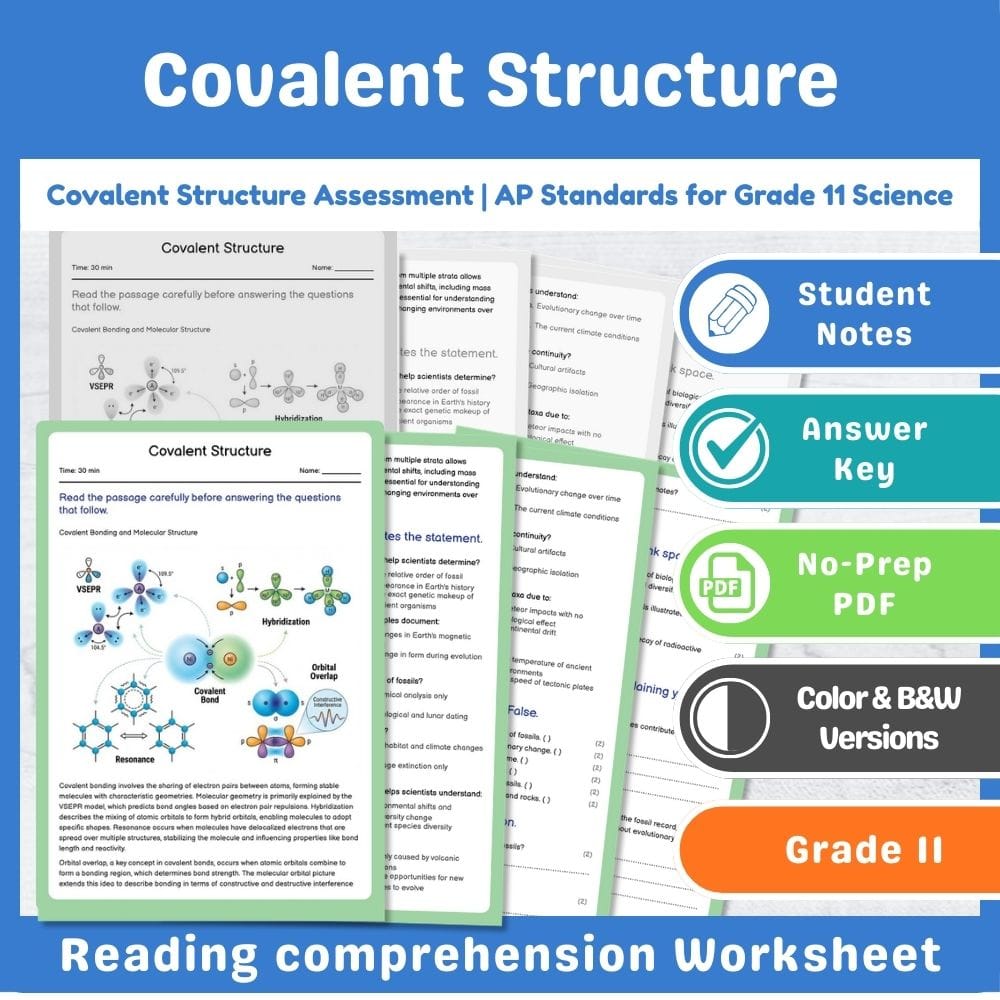
Covalent Structure Assessment | AP Standards for Grade 11 Science
Created byPrism Point LearningLearning Objectives
- Understand molecular geometry, hybridization, and resonance in covalent bonds.
- Interpret Lewis structures and VSEPR models to predict bond angles and polarity.
- Describe the significance of orbital overlap and molecular orbital theory in bonding.
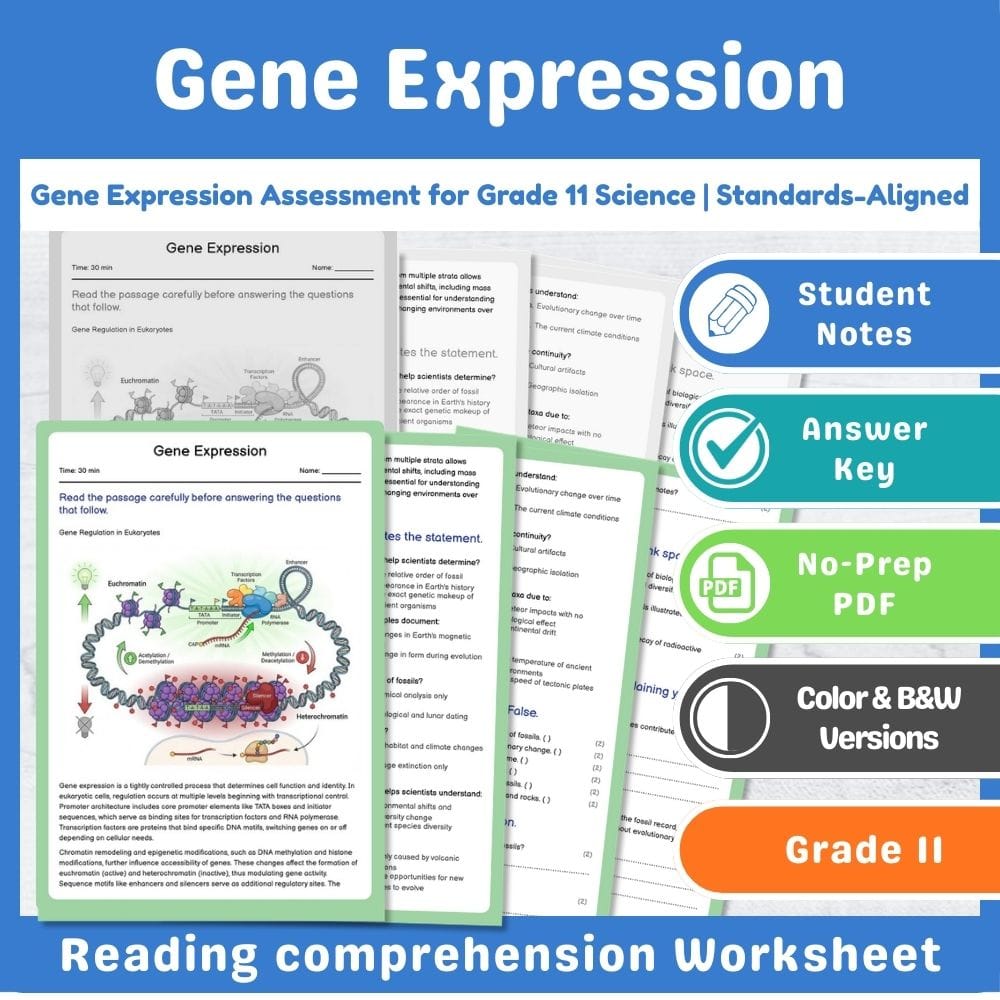
Gene Expression Assessment for Grade 11 Science | Standards-Aligned
Created byPrism Point LearningLearning Objectives
- Explain the mechanisms controlling gene expression from transcription to post-transcriptional modification and translation.
- Identify the roles of promoter architecture, transcription factors, chromatin remodeling, and epigenetic marks.
- Analyze how regulatory architecture influences phenotypic outcomes and cellular diversity.
Population Patterns Assessment | AP Standard Grade 11 Science
Created byPrism Point LearningLearning Objectives
- Describe principles of population dynamics including exponential and logistic growth models.
- Interpret population fluctuations through graphical models, life-history tables, and reproductive strategies.
- Analyze case examples like invasive species and predator-prey cycles to understand population trajectories.
Predator–Prey Balance Assessment for Grade 8 Science | Alberta Standards
Created byPrism Point LearningLearning Objectives
- Explain how predator-prey relationships influence population dynamics.
- Identify behavioural adaptations in predator and prey species.
- Analyze cascading effects caused by the absence or recolonization of top predators.
Springs and Elasticity Assessment for Grade 8 Science | Alberta Standards
Created byPrism Point LearningLearning Objectives
- Understand how elastic forces depend on deformation of materials.
- Identify examples of springs and elastic components in real-world systems.
- Explain the concept of linear elastic behavior limits and force direction.
Model Refinement Assessment for Grade 10 Science | AP Standards-Aligned
Created byPrism Point LearningLearning Objectives
- Understand how iterative comparisons and residual analysis guide model improvements.
- Explain the role of parameter estimation and inclusion of additional processes like damping in refining models.
- Evaluate the criteria for choosing between simpler and more complex models based on their explanatory power and predictive accuracy.
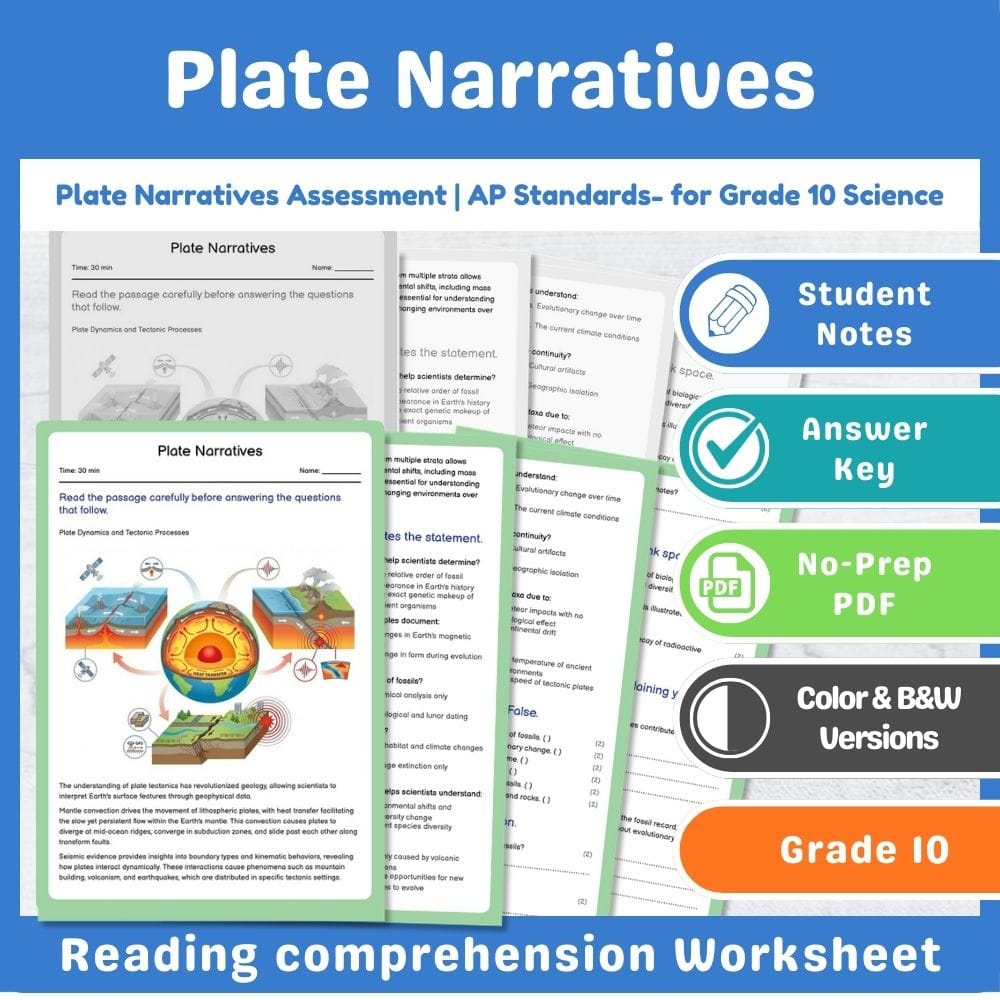
Plate Narratives Assessment | AP Standards-Aligned Evaluation for Grade 10 Science
Created byPrism Point LearningLearning Objectives
- Explain mechanisms of plate motion, mantle convection, and subduction.
- Interpret tectonic settings using maps, cross-sections, and seismic evidence.
- Connect plate interactions to mountain building, volcanism, and earthquake distribution.
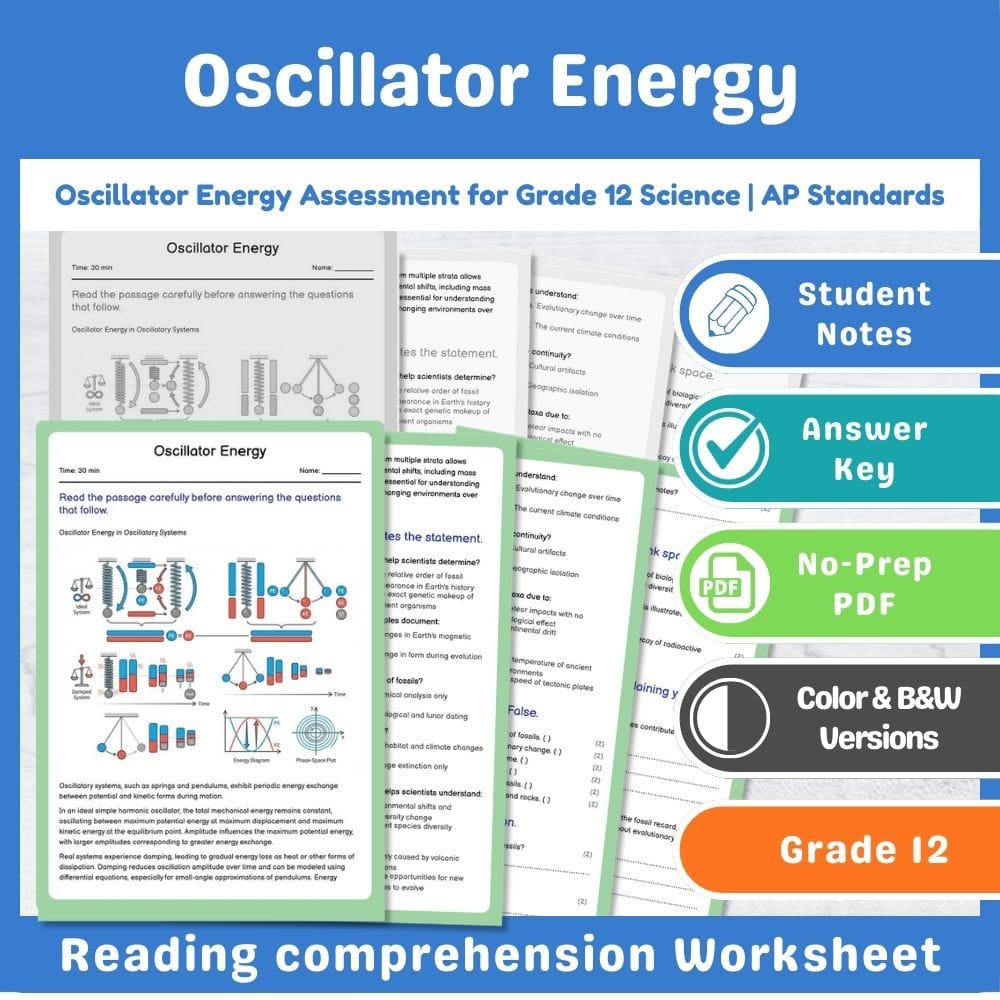
Oscillator Energy Assessment for Grade 12 Science | AP Standards
Created byPrism Point LearningLearning Objectives
- Explain the energy exchange between potential and kinetic energy in oscillatory systems.
- Analyze the role of amplitude and damping in energy dissipation during oscillations.
- Interpret phase-space and energy diagrams of simple harmonic motion.

Bond Types Assessment for Grade 12 Science | Alberta Standards-Aligned
Created byPrism Point LearningLearning Objectives
- Understand the different types of chemical bonds: ionic, covalent, and metallic.
- Identify the characteristics and properties associated with each bond type.
- Compare bond energies, electron sharing, and their effects on material properties.
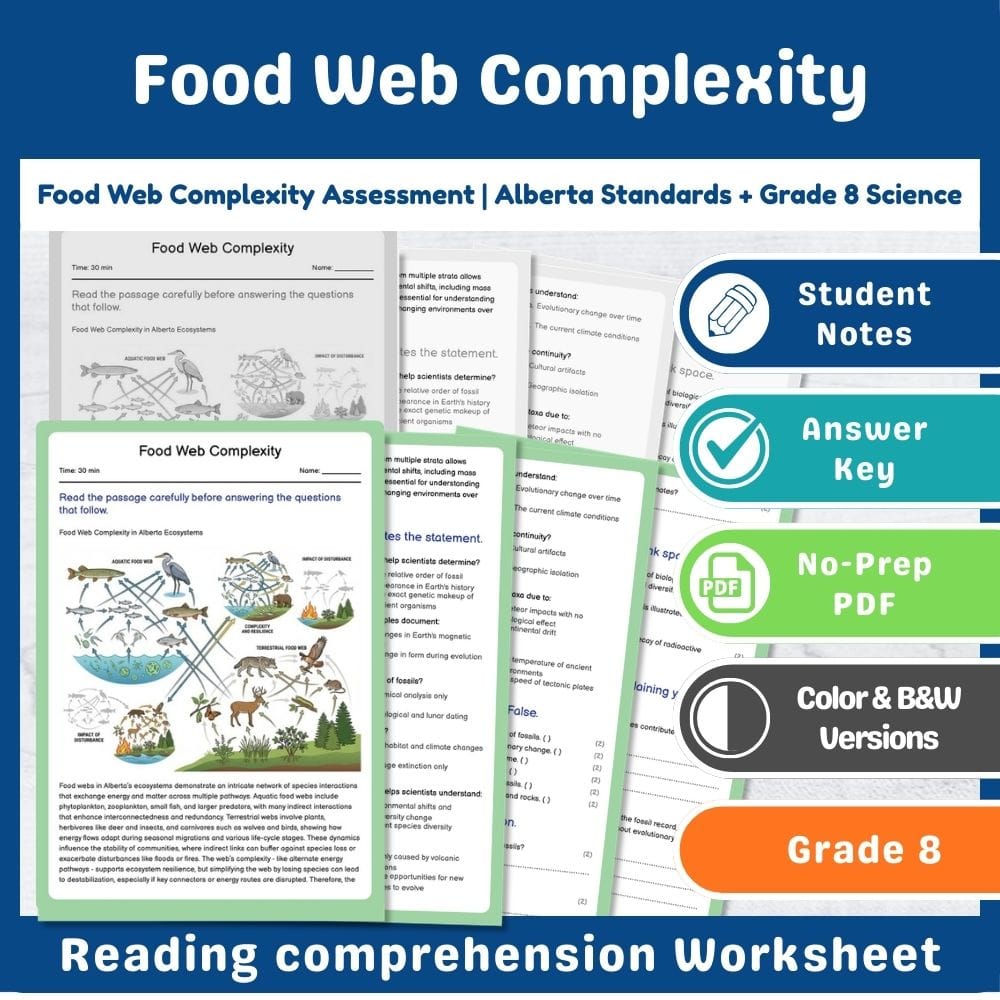
Food Web Complexity Assessment | Alberta Standards + Grade 8 Science
Created byPrism Point LearningLearning Objectives
- Explain the structure and function of food webs in aquatic and terrestrial systems.
- Identify how species interactions impact ecosystem stability and energy flow.
- Assess the effects of species loss, migration, and life-cycle changes on food web dynamics.
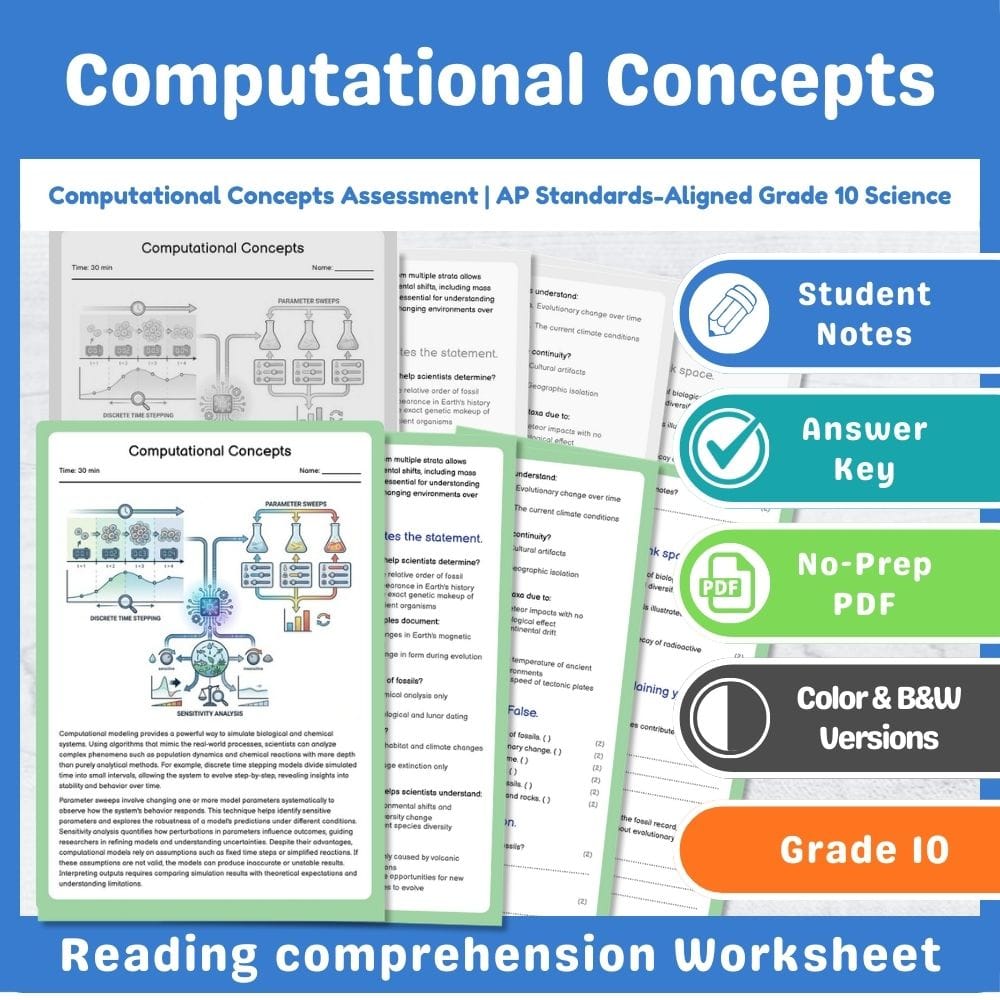
Computational Concepts Assessment | AP Standards-Aligned Grade 10 Science
Created byPrism Point LearningLearning Objectives
- Understand basic computational approaches used in modeling dynamic systems.
- Identify methods such as discrete time stepping, parameter sweeps, and sensitivity analysis.
- Recognize assumptions, stability concerns, and interpretation of simulation outputs.
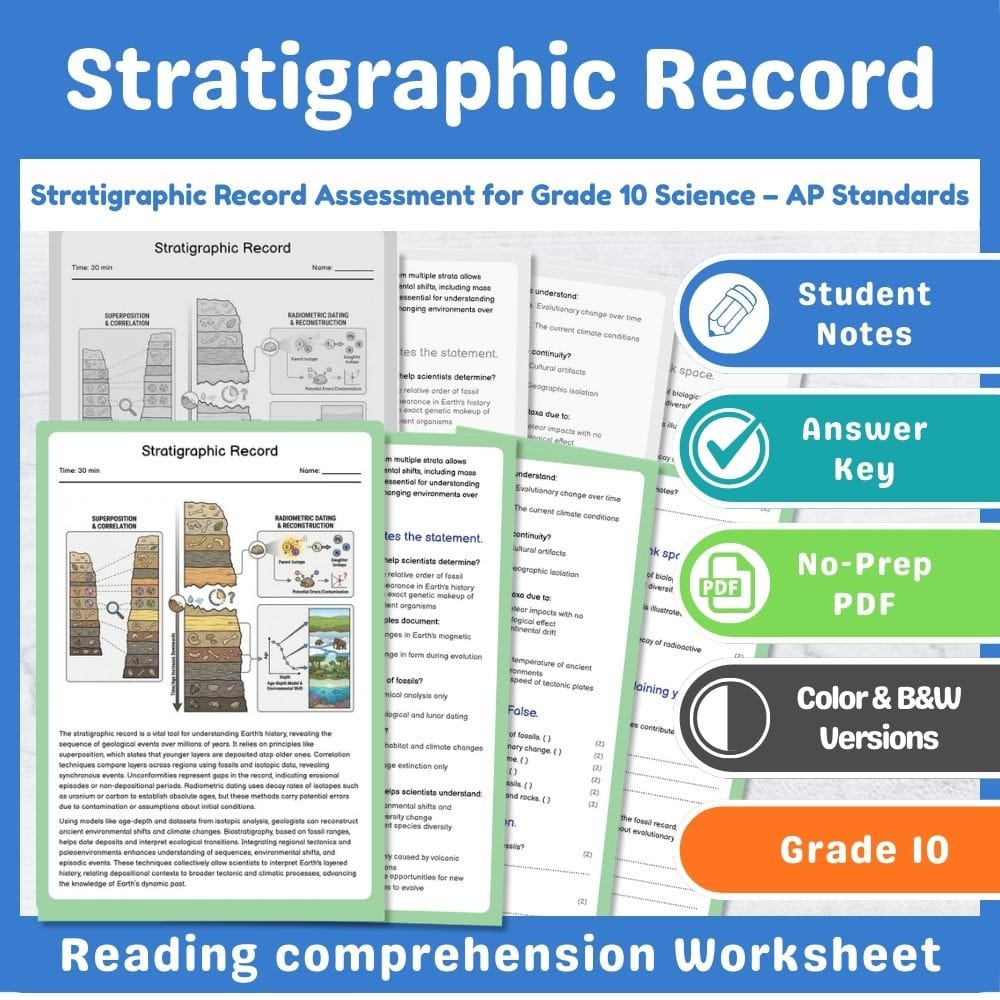
Stratigraphic Record Assessment for Grade 10 Science – AP Standards
Created byPrism Point LearningLearning Objectives
- Interpret stratigraphic sequences and fossil assemblages to infer Earth's historical timeline.
- Understand principles such as superposition, correlation, and unconformities.
- Evaluate radiometric decay methods and error considerations in determining absolute ages.
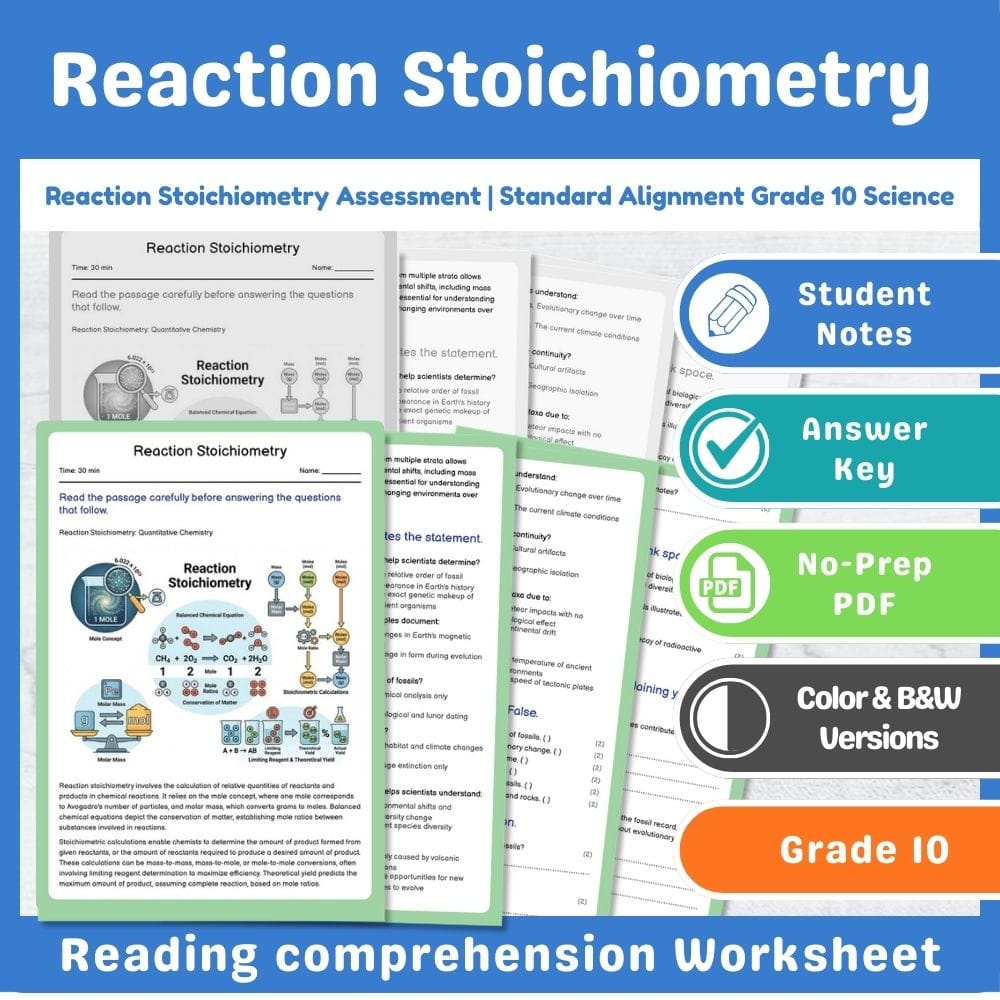
Reaction Stoichiometry Assessment | Standard Alignment Grade 10 Science
Created byPrism Point LearningLearning Objectives
- Understand the mole concept and how it relates to quantitative chemical calculations.
- Apply balanced chemical equations to determine mass, mole ratios, and theoretical yields.
- Interpret reaction equations to analyze gas volume relationships and concentration data.
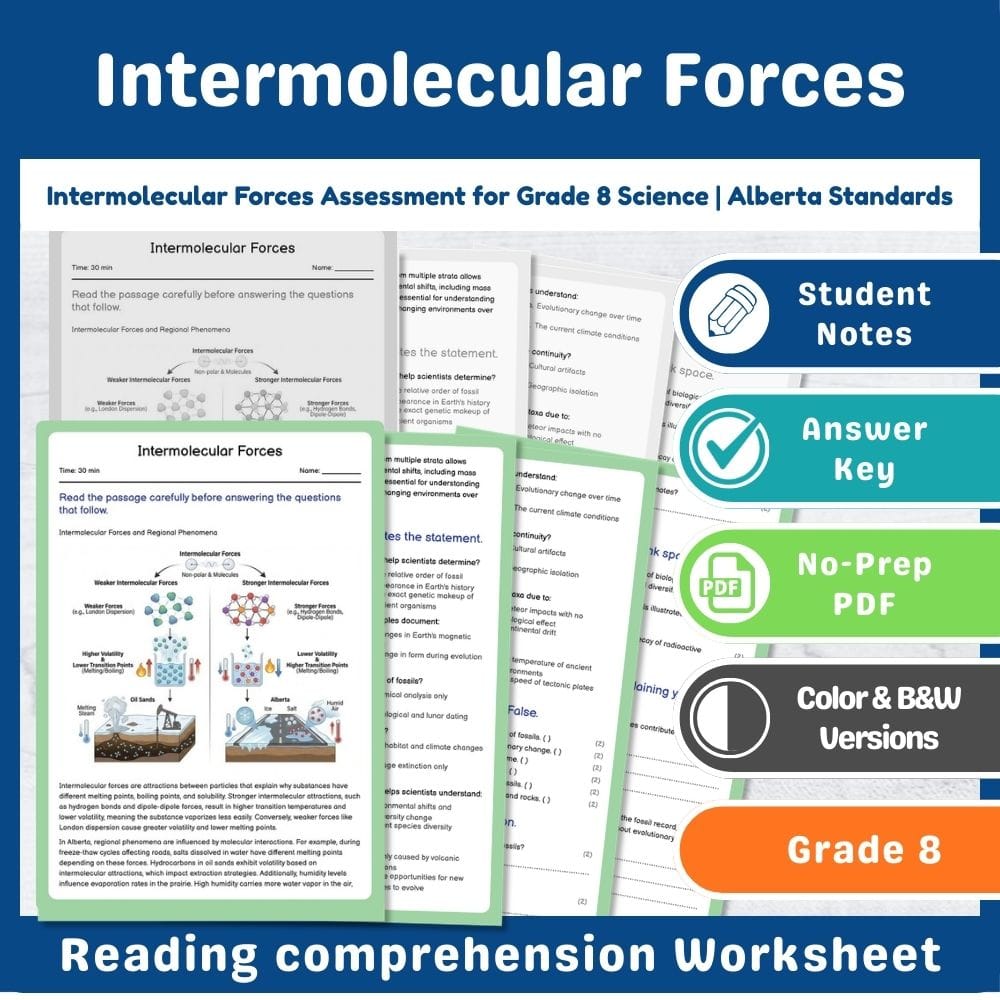
Intermolecular Forces Assessment for Grade 8 Science | Alberta Standards
Created byPrism Point LearningLearning Objectives
- Explain how intermolecular forces affect melting and boiling points.
- Describe the regional effects of molecular interactions, like freeze–thaw cycles and vapor pressures in Alberta.
- Relate intermolecular forces to regional phenomena such as humidity influence on evaporation rates.
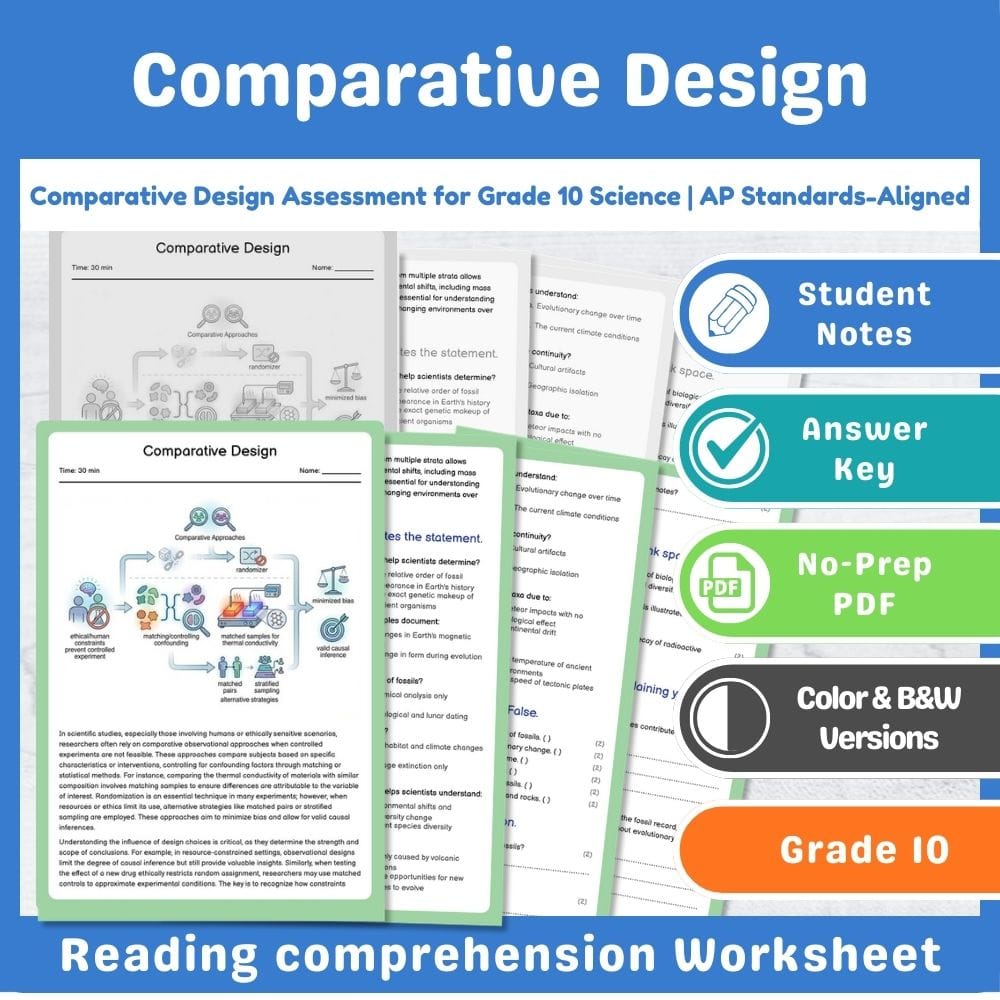
Comparative Design Assessment for Grade 10 Science | AP Standards-Aligned
Created byPrism Point LearningLearning Objectives
- Understand principles of comparative observational approaches and controlled trials.
- Identify independent and dependent variables in experimental designs.
- Recognize strategies for matching, randomization, and minimizing bias.
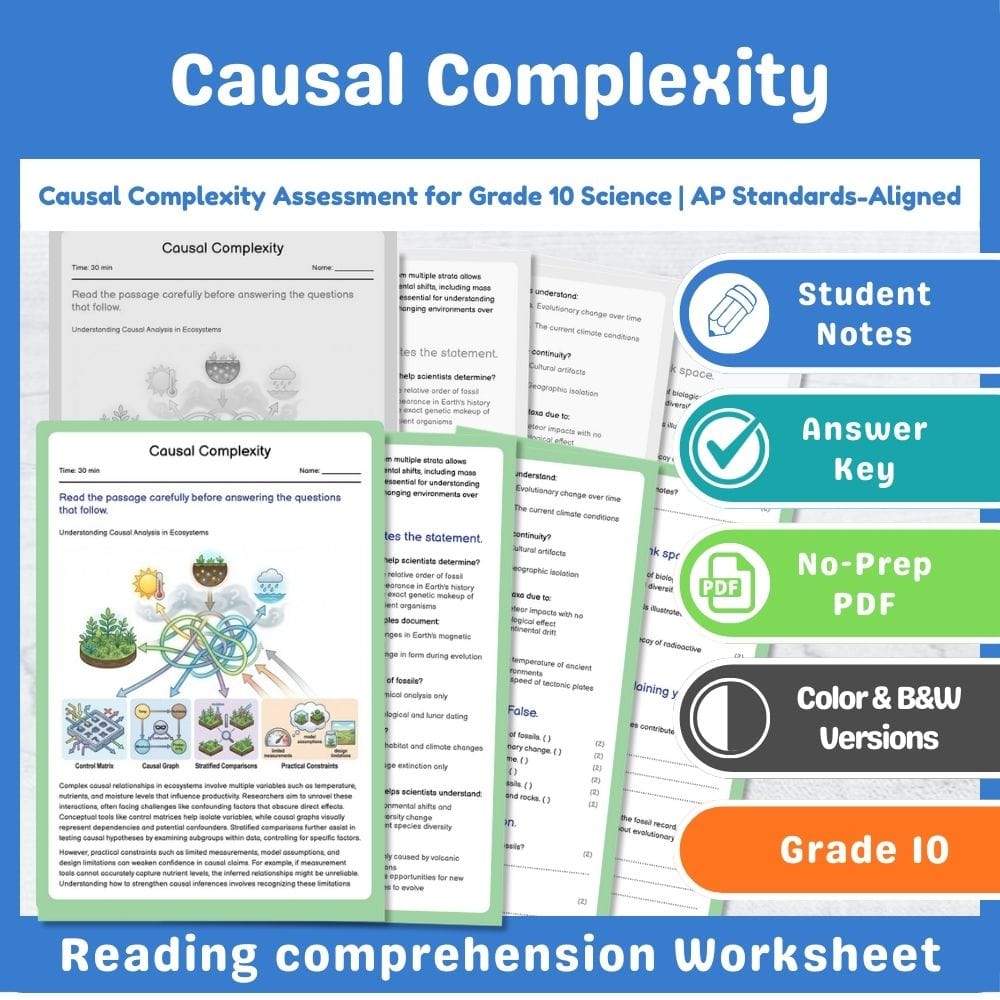
Causal Complexity Assessment for Grade 10 Science | AP Standards-Aligned
Created byPrism Point LearningLearning Objectives
- Understand methods for disentangling multivariable causal relationships in complex systems.
- Apply conceptual frameworks like control matrices, causal graphs, and stratified comparisons.
- Identify confounding factors and interaction effects in ecological and environmental contexts.
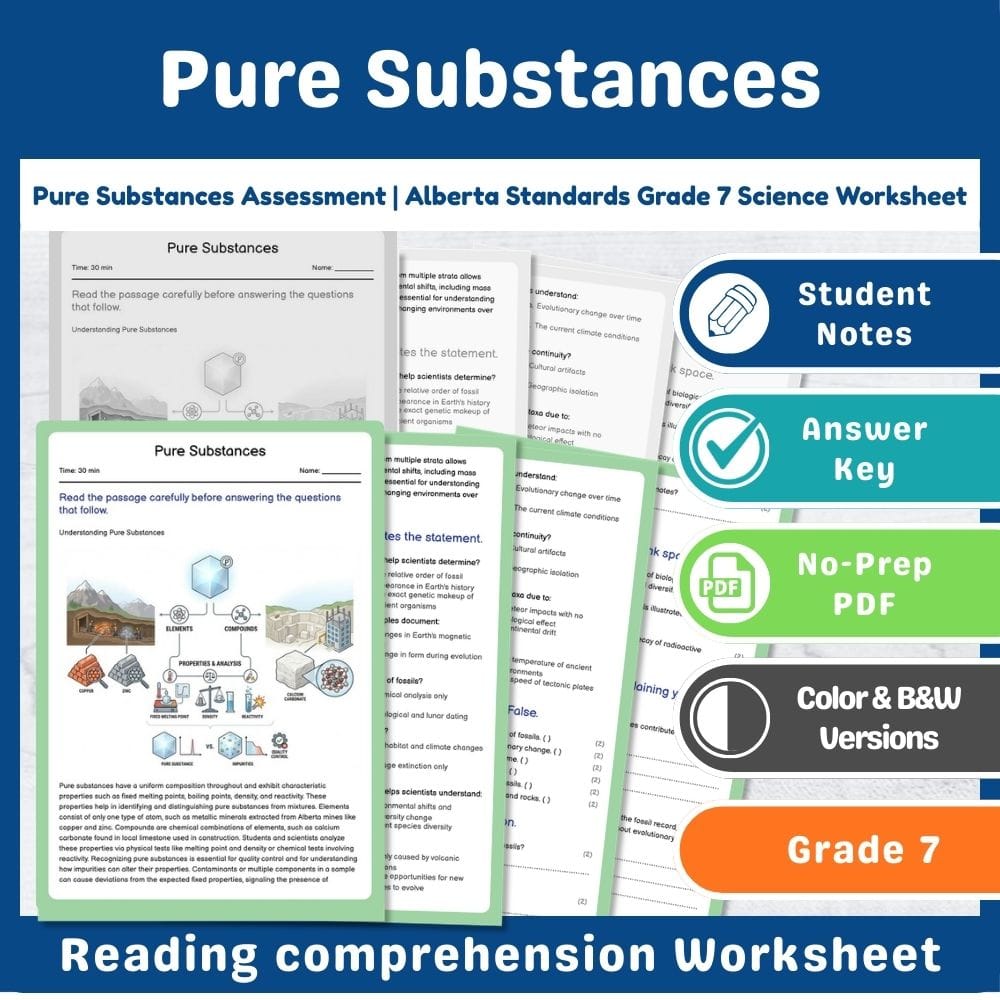
Pure Substances Assessment | Alberta Standards Grade 7 Science Worksheet
Created byPrism Point LearningLearning Objectives
- Understand the defining properties of pure substances such as fixed melting points, density, and reactivity.
- Differentiate between elements and compounds through physical and chemical tests.
- Identify real-world examples of pure substances from local sources and common compounds.
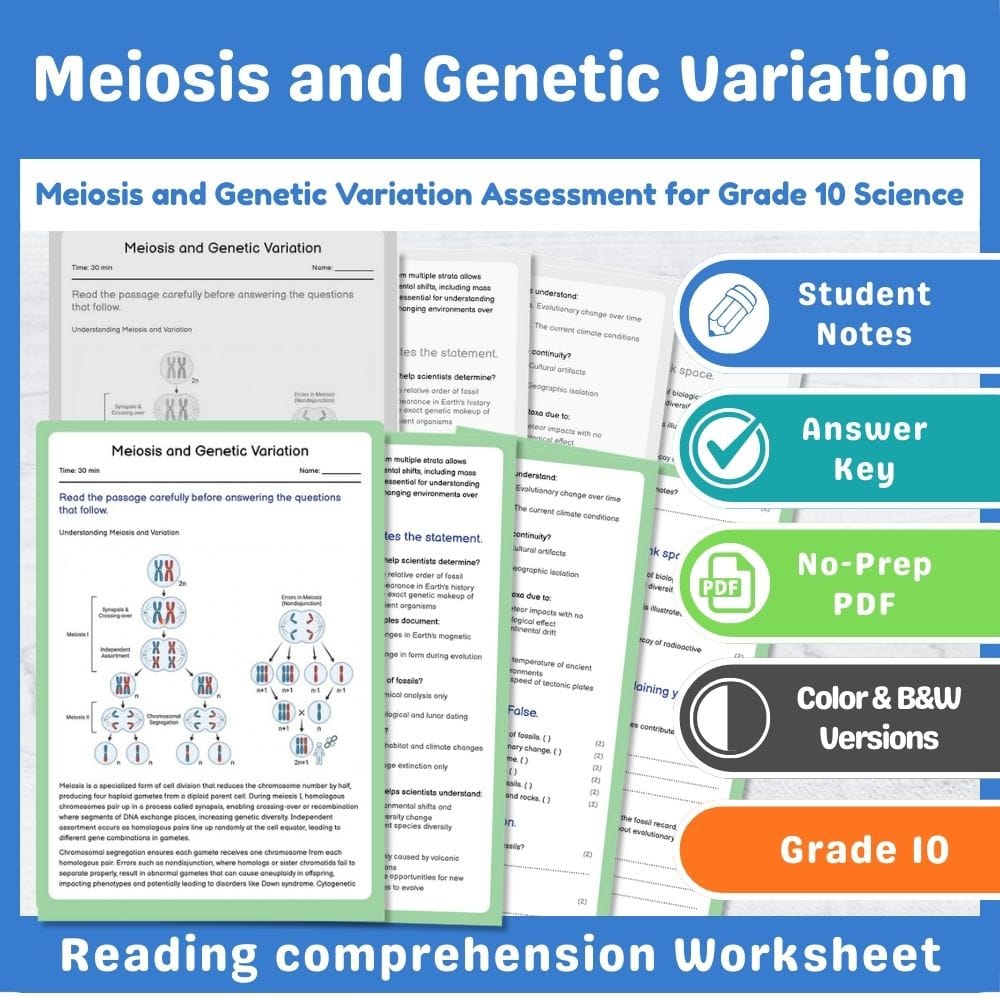
Meiosis and Genetic Variation Assessment for Grade 10 Science
Created byPrism Point LearningLearning Objectives
- Understand key concepts related to Science
- Apply knowledge through practice questions
- Demonstrate comprehension of the material
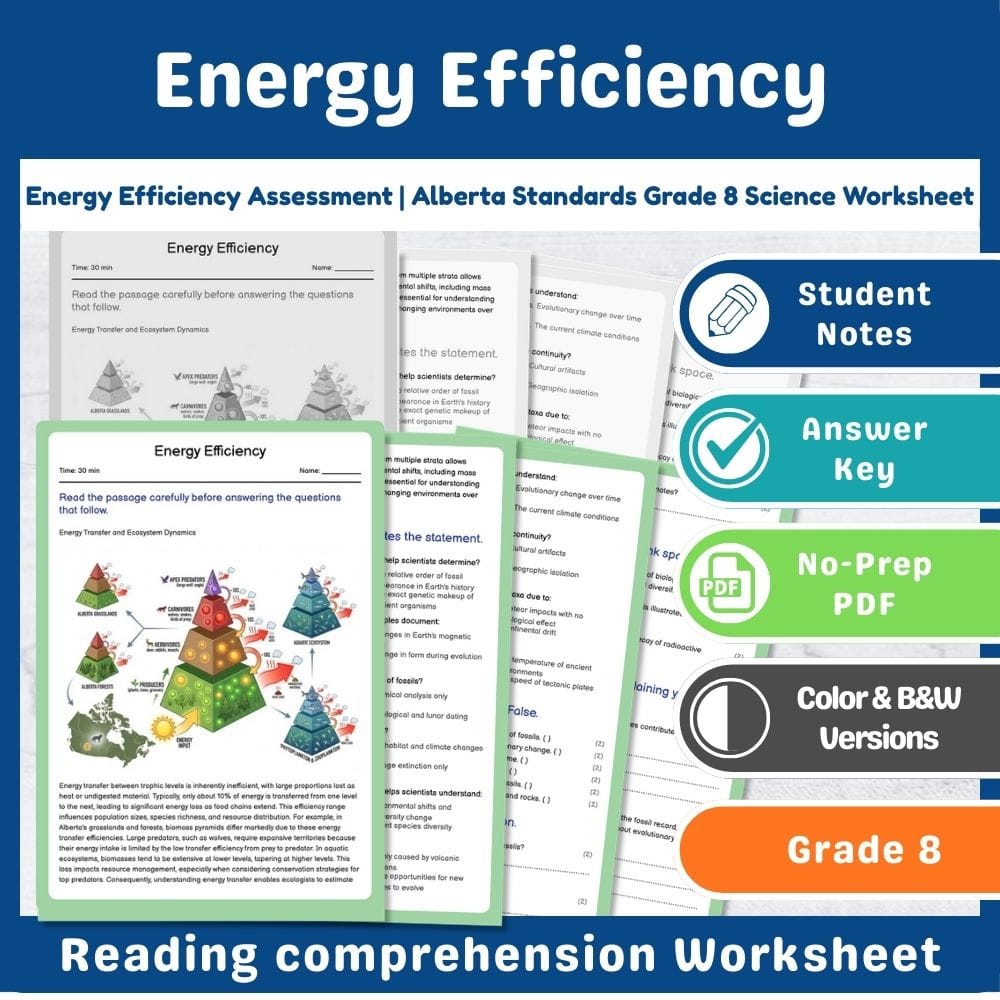
Energy Efficiency Assessment | Alberta Standards Grade 8 Science Worksheet
Created byPrism Point LearningLearning Objectives
- Understand the concept of energy transfer efficiency between trophic levels.
- Quantify typical energy transfer efficiencies and apply them to ecosystems.
- Explain why predators require large territories based on energy limitations.
Energy Currency Assessment for Grade 10 Science Standards-Aligned
Created byPrism Point LearningLearning Objectives
- Understand the role of adenosine triphosphate (ATP) in biological energy transfer.
- Compare different types of biochemical reactions, including redox and energy changes.
- Explain how energy currency maintains cellular functions and organization.
Biotic Abiotic Assessment | Alberta Standards Grade 7 Science Worksheet
Created byPrism Point LearningLearning Objectives
- Understand how sunlight, soil, water, temperature, and topography influence ecosystems.
- Identify the relationships between living organisms and non-living environmental factors.
- Explain how cause-and-effect links shape community patterns in Alberta landscapes.

Modeling Earth Assessment | AP Standard Grade 12 Science
Created byPrism Point LearningLearning Objectives
- Understand the role of conceptual, statistical, and numerical models in representing Earth processes.
- Evaluate the limitations of model resolution and parameter selection in Earth system modeling.
- Analyze how models are validated and used for hypothesis testing and scenario analysis.
Work Concepts Grade 10 Science Assessment | AP Standards-Aligned Assessment
Created byPrism Point LearningLearning Objectives
- Define work as the product of force component along displacement.
- Explain the scalar nature of work in various contexts.
- Connect work to changes in kinetic energy via the work-energy relationship.
Electromagnetic Induction Assessment | Alberta Grade 8 Science Standards
Created byPrism Point LearningLearning Objectives
- Explain the principle of electromagnetic induction and how changing magnetic flux induces current.
- Identify applications of electromagnetic induction in power generation and renewable energy.
- Describe the factors affecting the magnitude of induced electromotive force in coils.
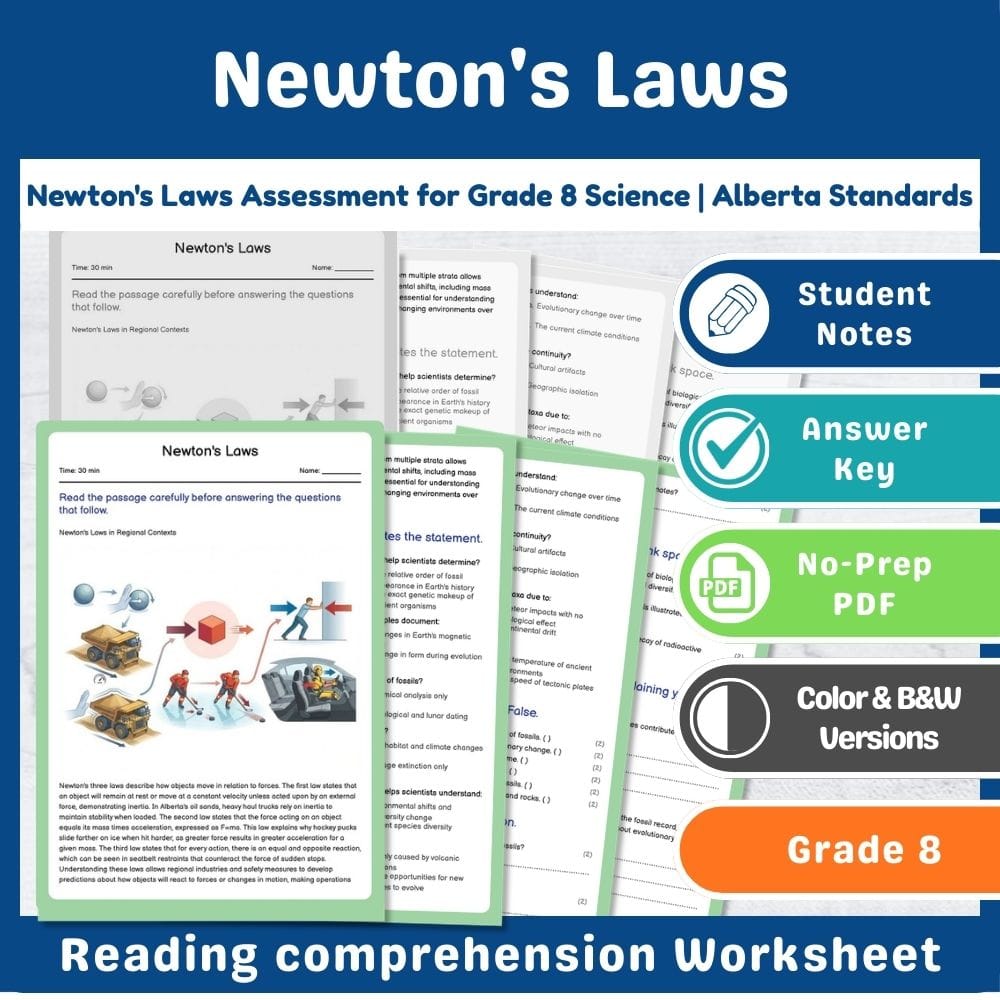
Newton's Laws Assessment for Grade 8 Science | Alberta Standards
Created byPrism Point LearningLearning Objectives
- Explain Newton's three laws of motion and how they relate to force, mass, and acceleration.
- Apply Newton's laws to regional scenarios such as heavy haul trucks, hockey puck motion, and seatbelt restraints.
- Predict the direction and magnitude of objects' motion based on applied forces.

Cellular Respiration Assessment | BC Standards Grade 11 Science
Created byPrism Point LearningLearning Objectives
- Describe the stages of cellular respiration, including glycolysis, the citric acid cycle, and oxidative phosphorylation.
- Explain how electrons pass through carrier molecules in the electron transport chain to generate ATP.
- Understand the role of oxygen as the final electron acceptor and its importance in linking cellular metabolism to organismal energy demands.
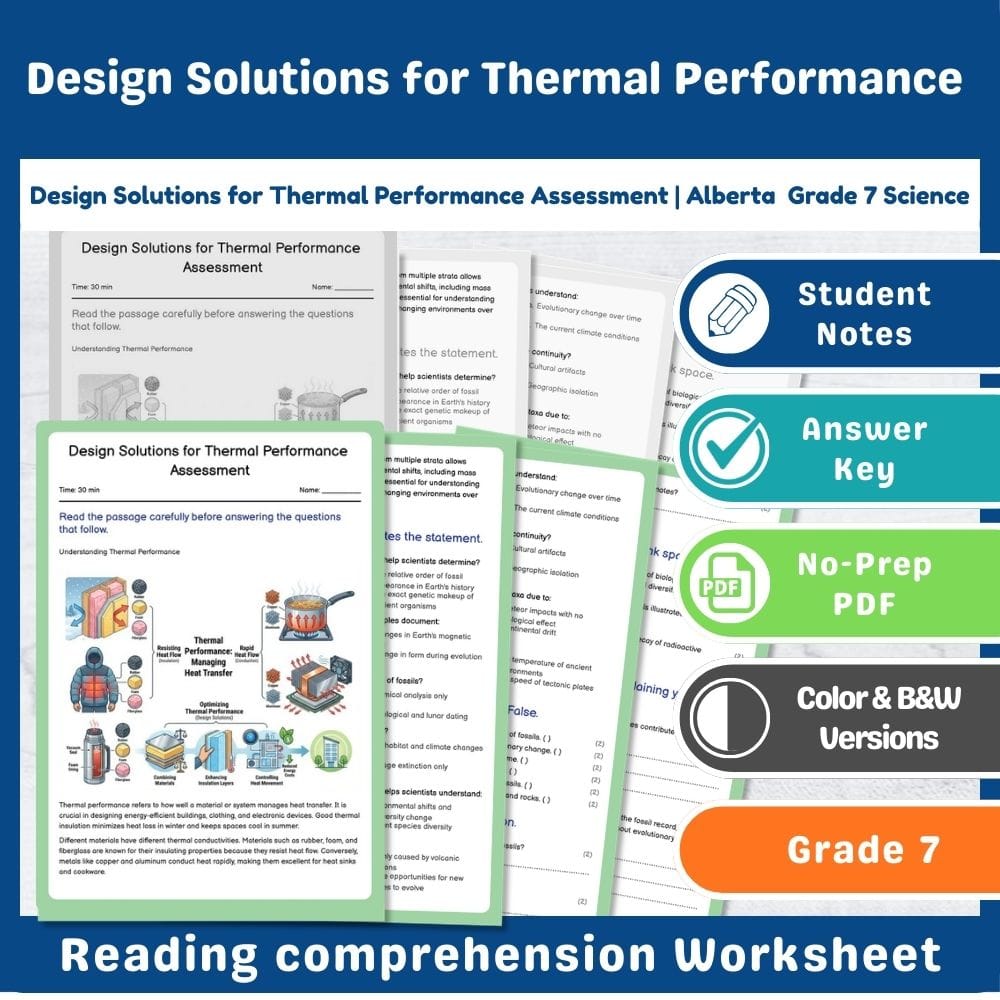
Design Solutions for Thermal Performance Assessment | Alberta Assessment Grade 7 Science
Created byPrism Point LearningLearning Objectives
- Understand key factors affecting thermal performance of materials.
- Analyze different design solutions to optimize thermal performance.
- Evaluate the effectiveness of various insulation and cooling techniques.
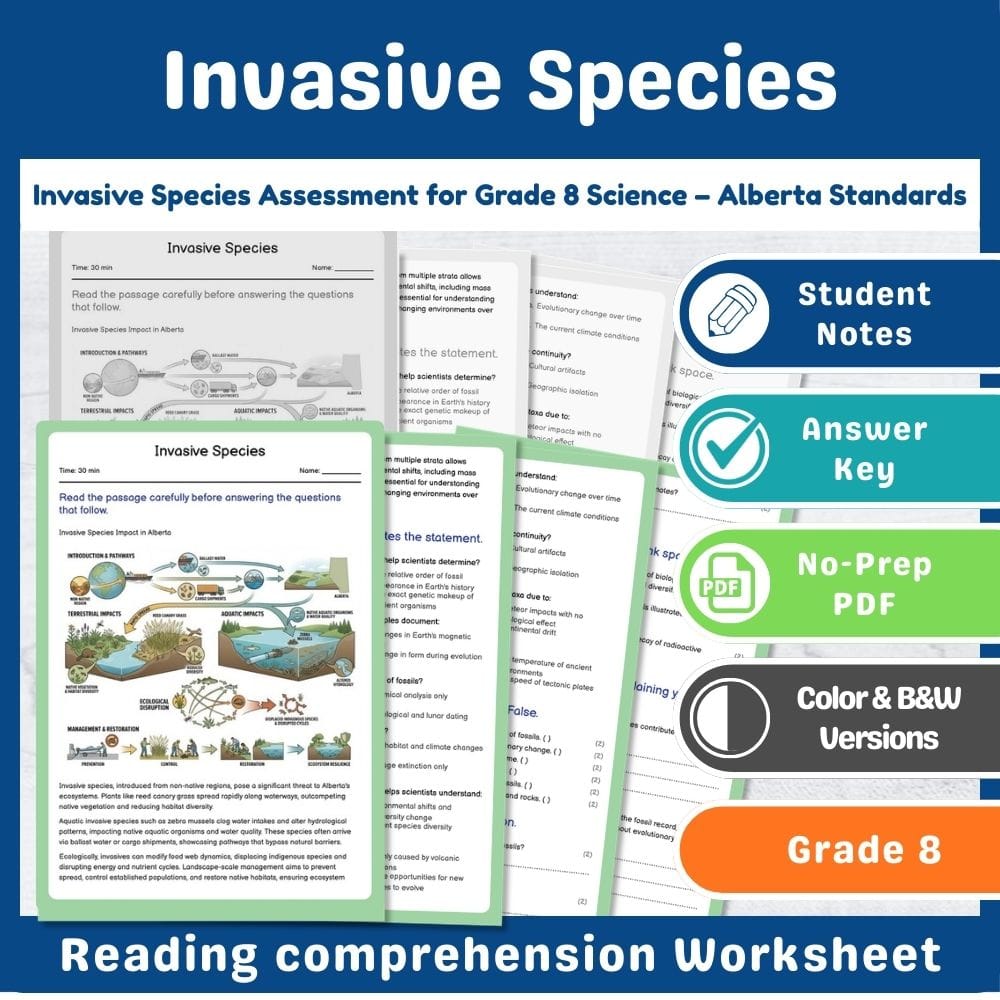
Invasive Species Assessment for Grade 8 Science – Alberta Standards
Created byPrism Point LearningLearning Objectives
- Understand the impacts of invasive species on native biodiversity and ecosystem functions.
- Identify pathways and ecological consequences of invasive plant and aquatic species in Alberta.
- Evaluate management strategies to mitigate invasive species effects on ecosystems.
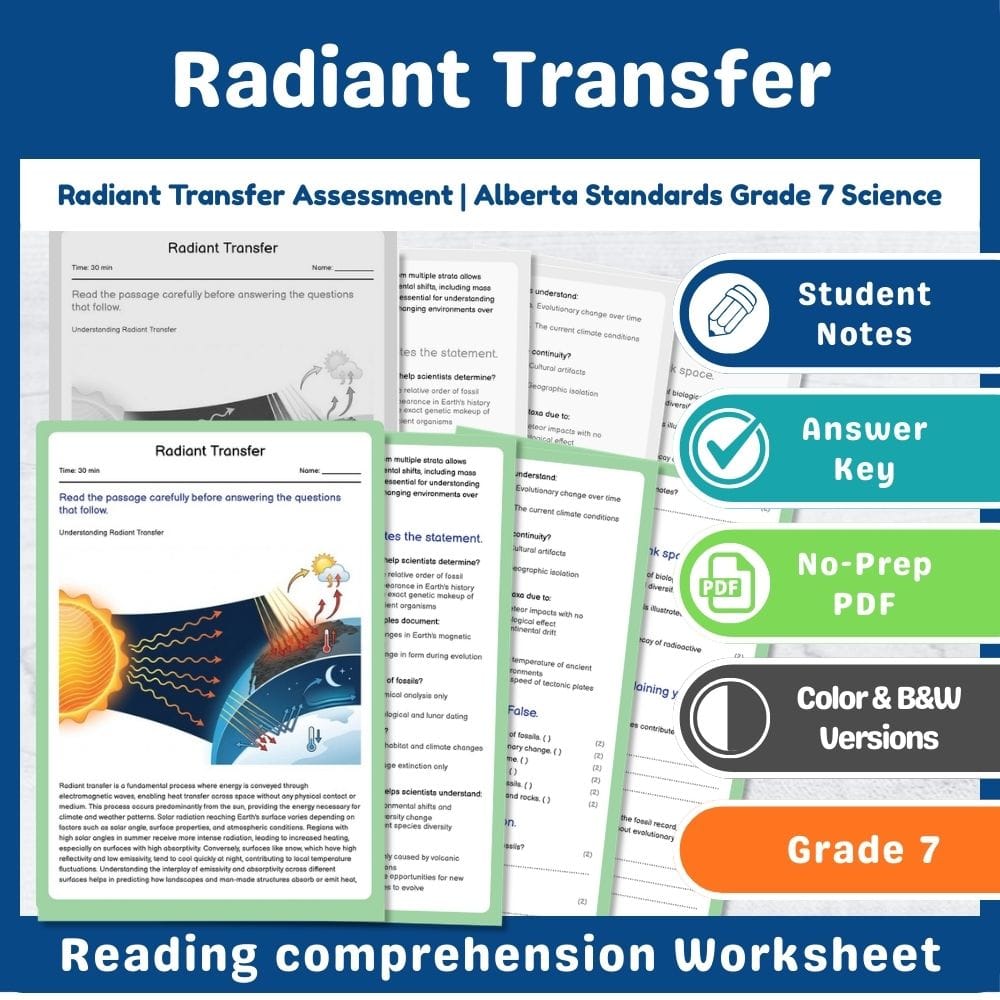
Radiant Transfer Assessment | Alberta Standards Grade 7 Science
Created byPrism Point LearningLearning Objectives
- Explain the concept of radiant transfer and how energy moves through electromagnetic waves without needing a medium.
- Identify factors such as solar radiation intensity, surface absorptivity, and emissivity that influence radiative heating.
- Describe how seasonal variations and surface types affect radiative balances and microclimates.
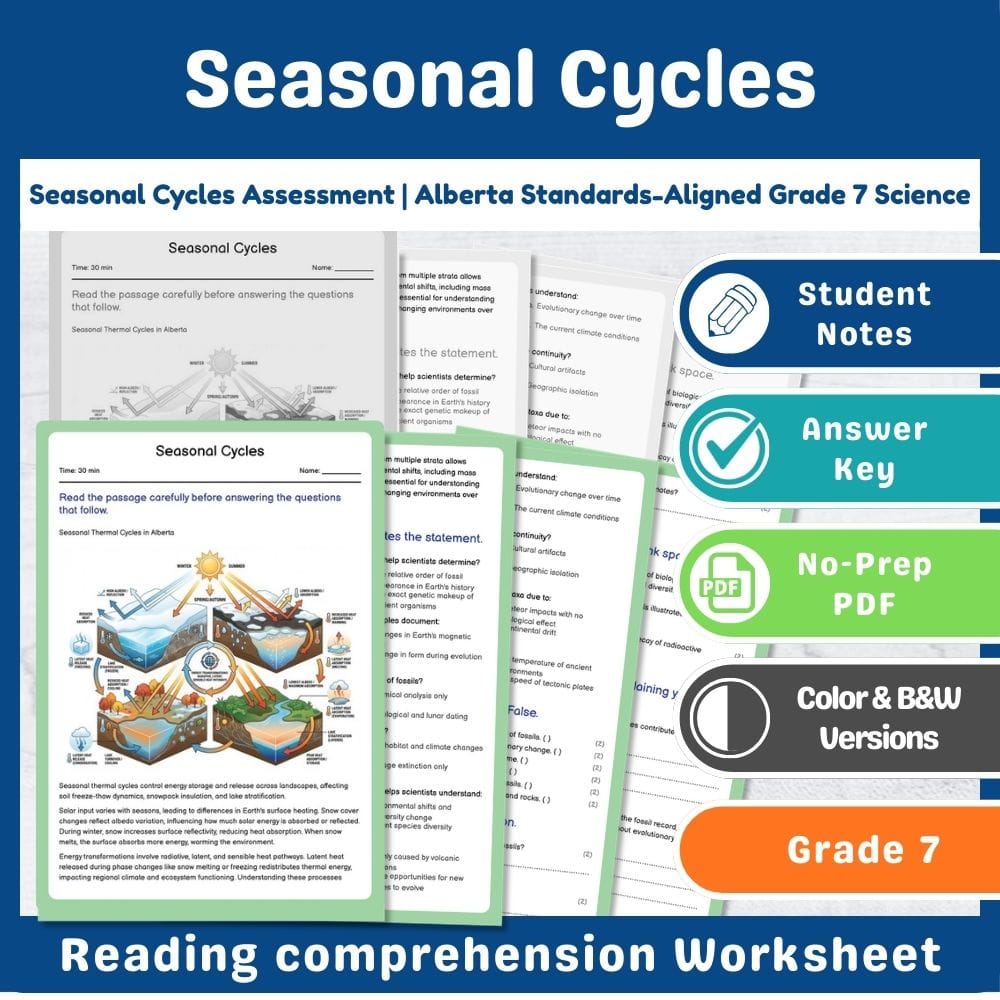
Seasonal Cycles Assessment | Alberta Standards-Aligned Grade 7 Science
Created byPrism Point LearningLearning Objectives
- Understand how seasonal thermal cycles influence energy storage and release in landscapes.
- Identify the main factors driving seasonal energy fluxes, including solar input and albedo changes.
- Describe the pathways of energy transformation such as radiative, latent, and sensible heat processes.
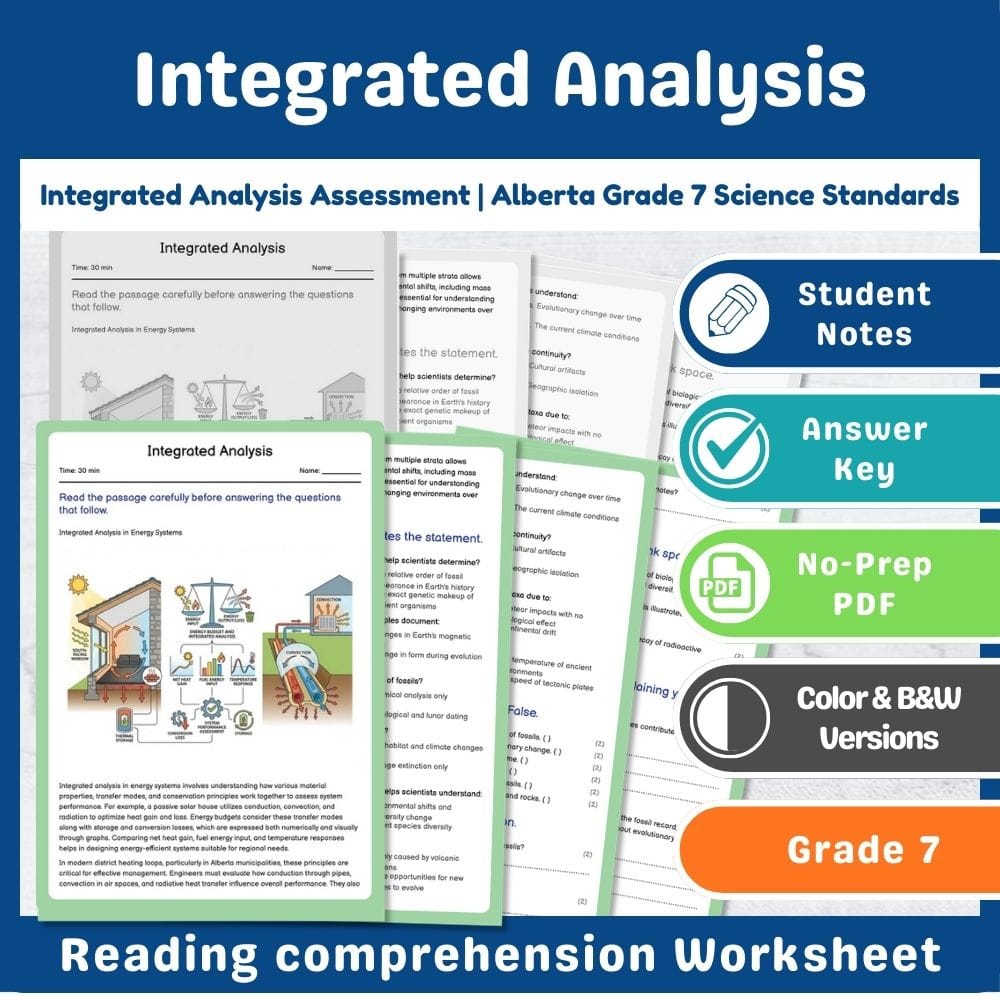
Integrated Analysis Assessment | Alberta Grade 7 Science Standards
Created byPrism Point LearningLearning Objectives
- Understand principles of energy transfer modes and conservation in system analysis.
- Apply properties and mechanisms of conduction, convection, and radiation to real-world systems.
- Interpret energy budgets through numerical data and graphical representations.
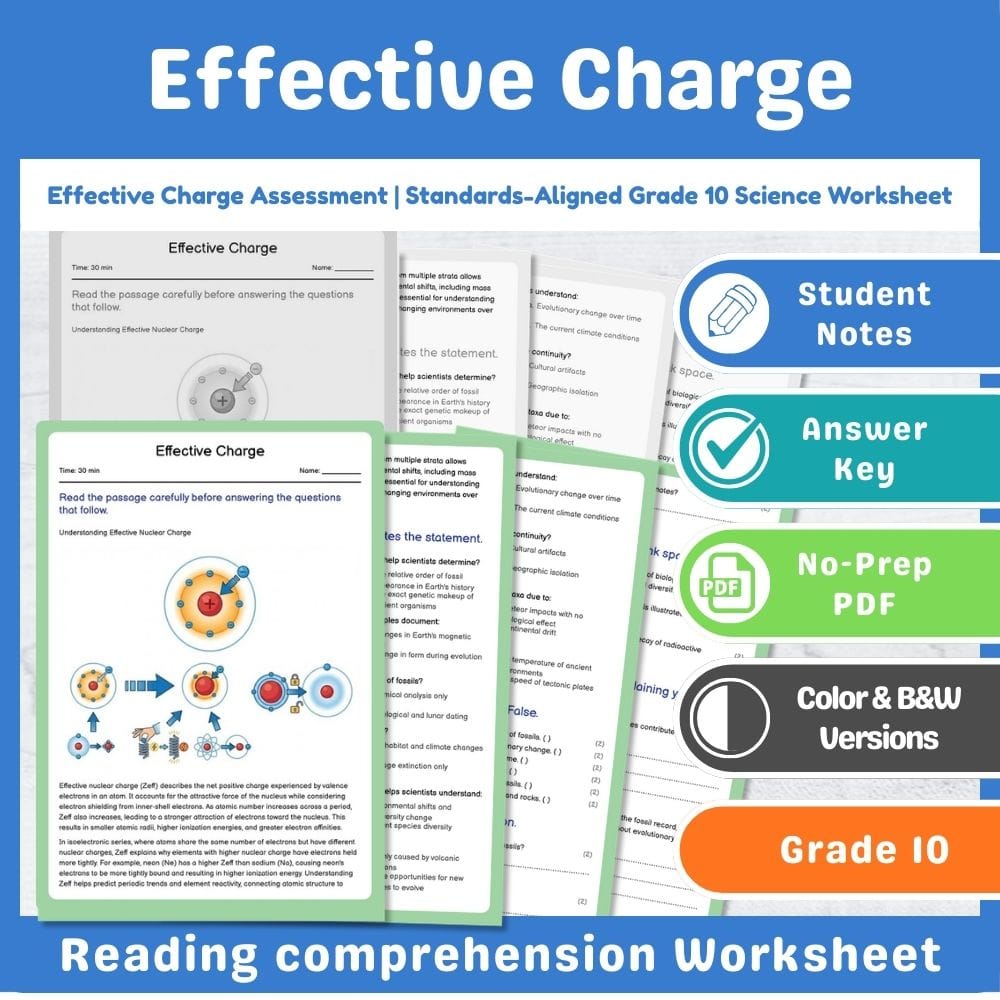
Effective Charge Assessment | Standards-Aligned Grade 10 Science Worksheet
Created byPrism Point LearningLearning Objectives
- Understand the concept of effective nuclear charge (Zeff) and its role in atomic structure.
- Analyze periodic trends such as atomic radius, ionization energy, and electron affinity in relation to Zeff.
- Compare isoelectronic series to see how nuclear charge and shielding affect valence electrons.
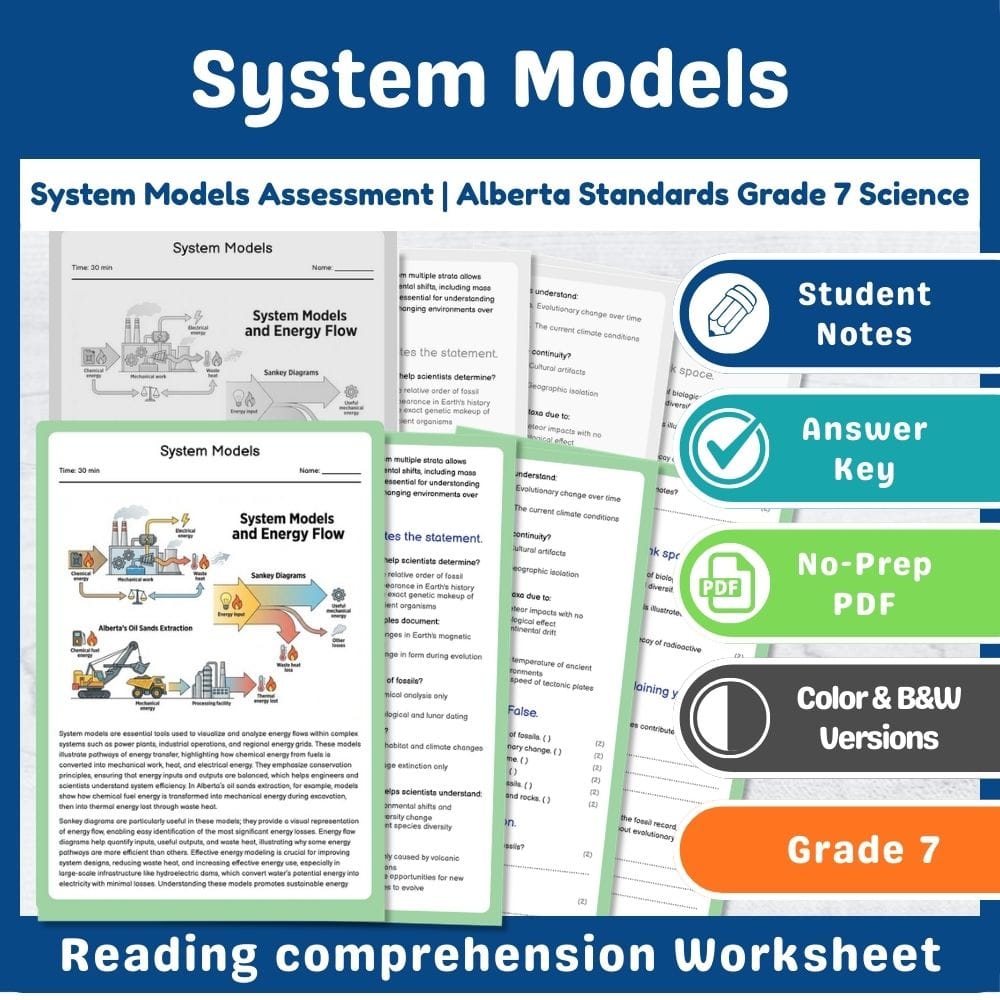
System Models Assessment | Alberta Standards Grade 7 Science
Created byPrism Point LearningLearning Objectives
- Understand how energy pathways are traced and represented in system models.
- Analyze energy transformations and identify loss mechanisms in regional energy systems.
- Utilize diagrams such as Sankey diagrams and energy flow charts to interpret energy data.
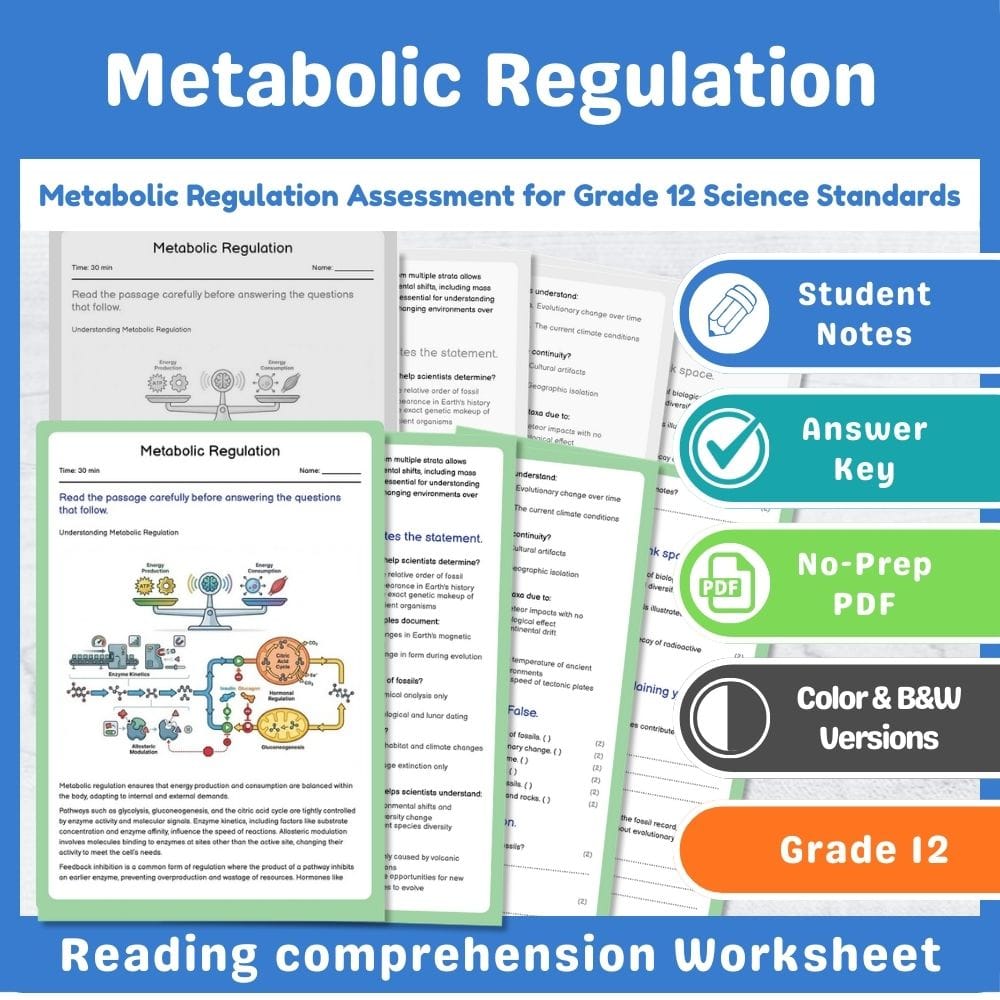
Metabolic Regulation Assessment for Grade 12 Science Standards
Created byPrism Point LearningLearning Objectives
- Explain principles of metabolic pathway control including enzyme kinetics and allosteric modulation.
- Describe feedback inhibition and hormonal regulation mechanisms maintaining homeostasis.
- Distinguish regulation at transcriptional, translational, and post-translational levels.
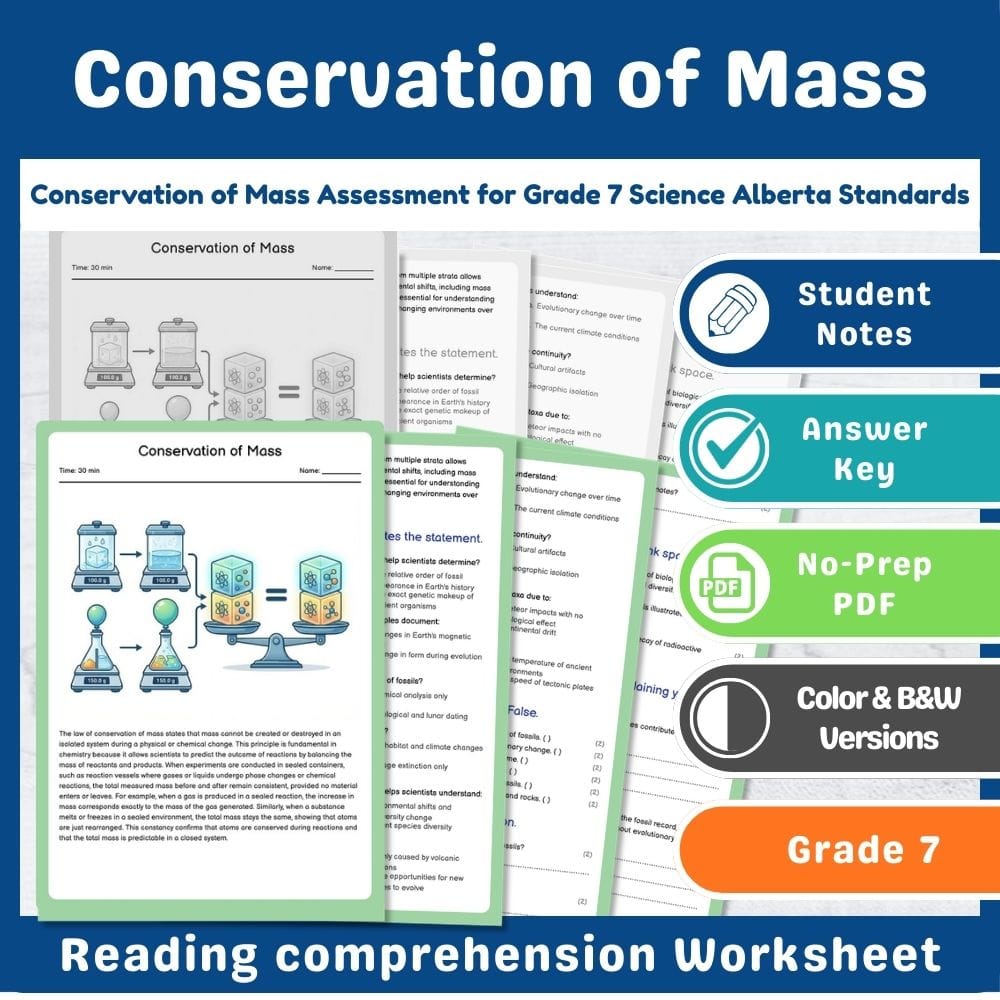
Conservation of Mass Assessment for Grade 7 Science Alberta Standards
Created byPrism Point LearningLearning Objectives
- Understand the principle of conservation of mass in physical and chemical changes.
- Describe how mass remains constant in a sealed system during reactions.
- Explain observations of sealed-container reactions that demonstrate mass conservation.
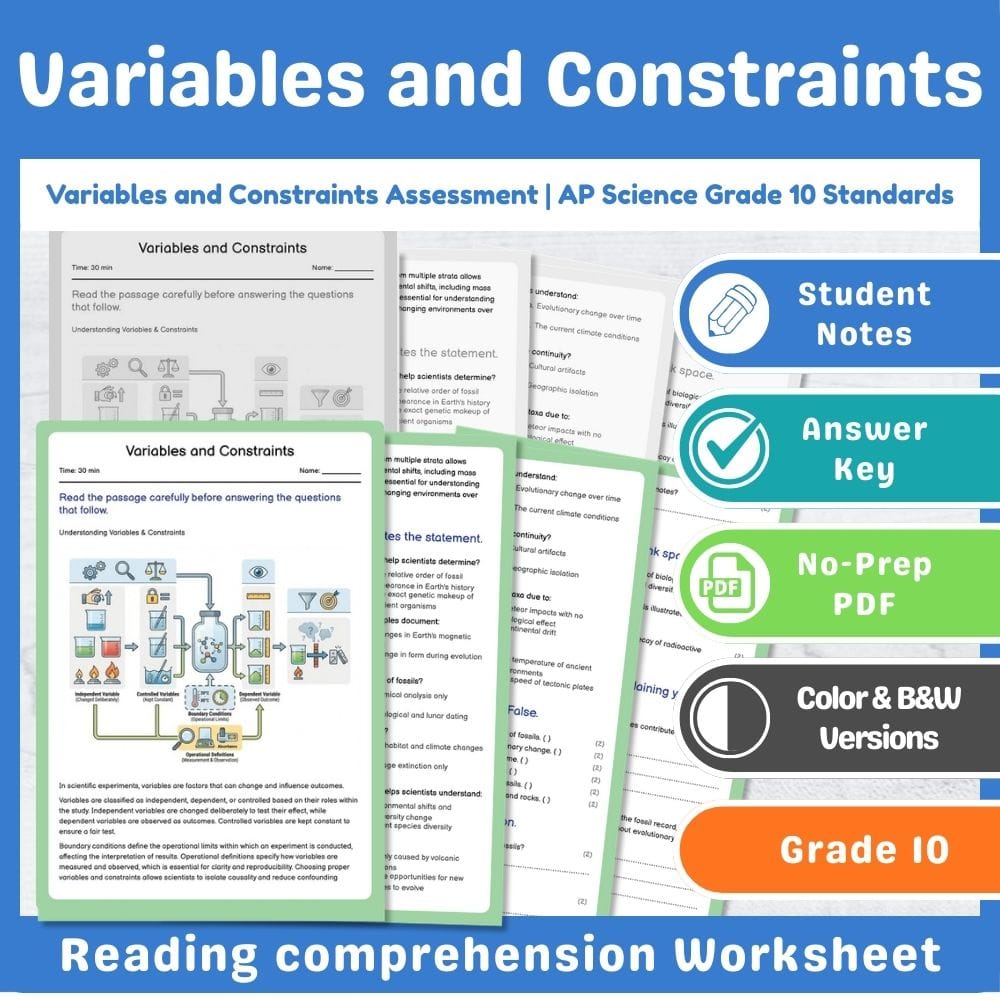
Variables and Constraints Assessment | AP Science Grade 10 Standards
Created byPrism Point LearningLearning Objectives
- Identify and classify variables as independent, dependent, or controlled in experimental scenarios.
- Explain the role of boundary conditions and operational definitions in scientific investigations.
- Discuss strategies for selecting variables and controls to produce meaningful and interpretable results.
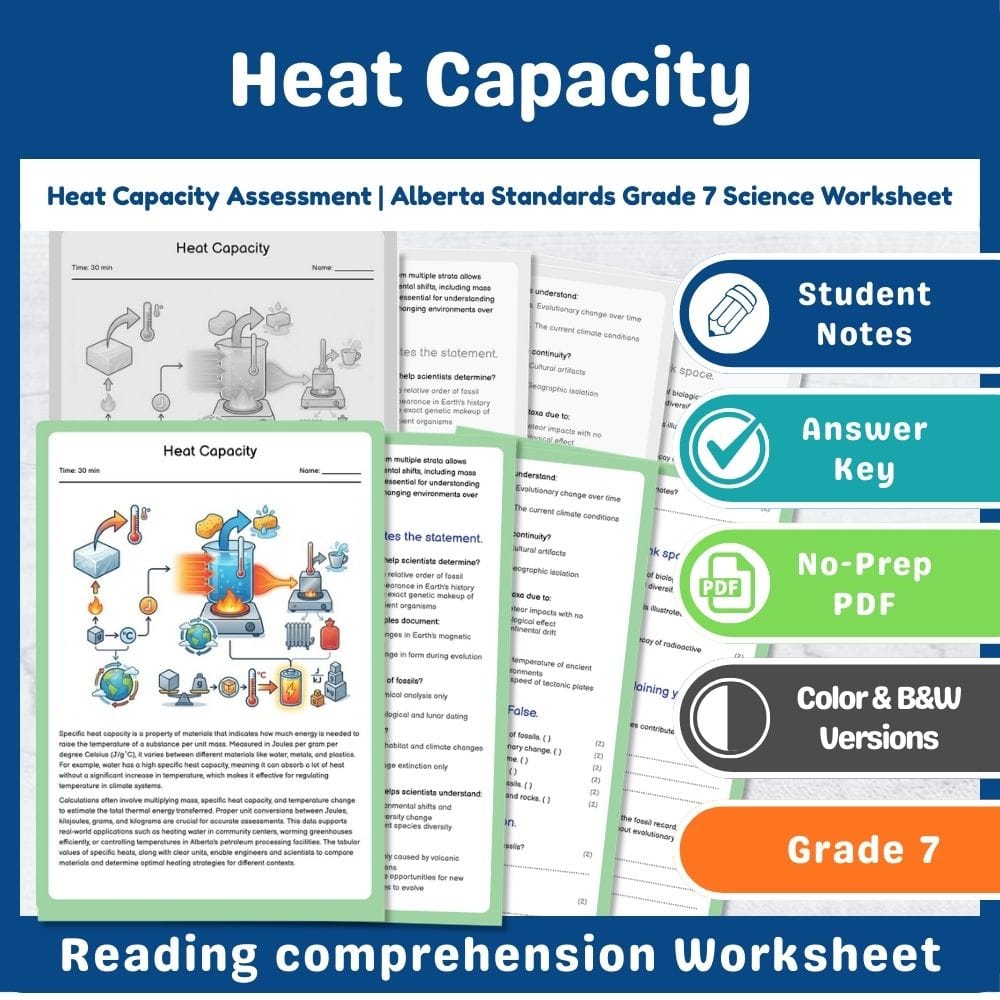
Heat Capacity Assessment | Alberta Standards Grade 7 Science Worksheet
Created byPrism Point LearningLearning Objectives
- Understand the concept of specific heat capacity and its units.
- Perform calculations involving mass, specific heat, and temperature change to find energy in Joules or kilojoules.
- Interpret tabular data of thermal properties for different materials.
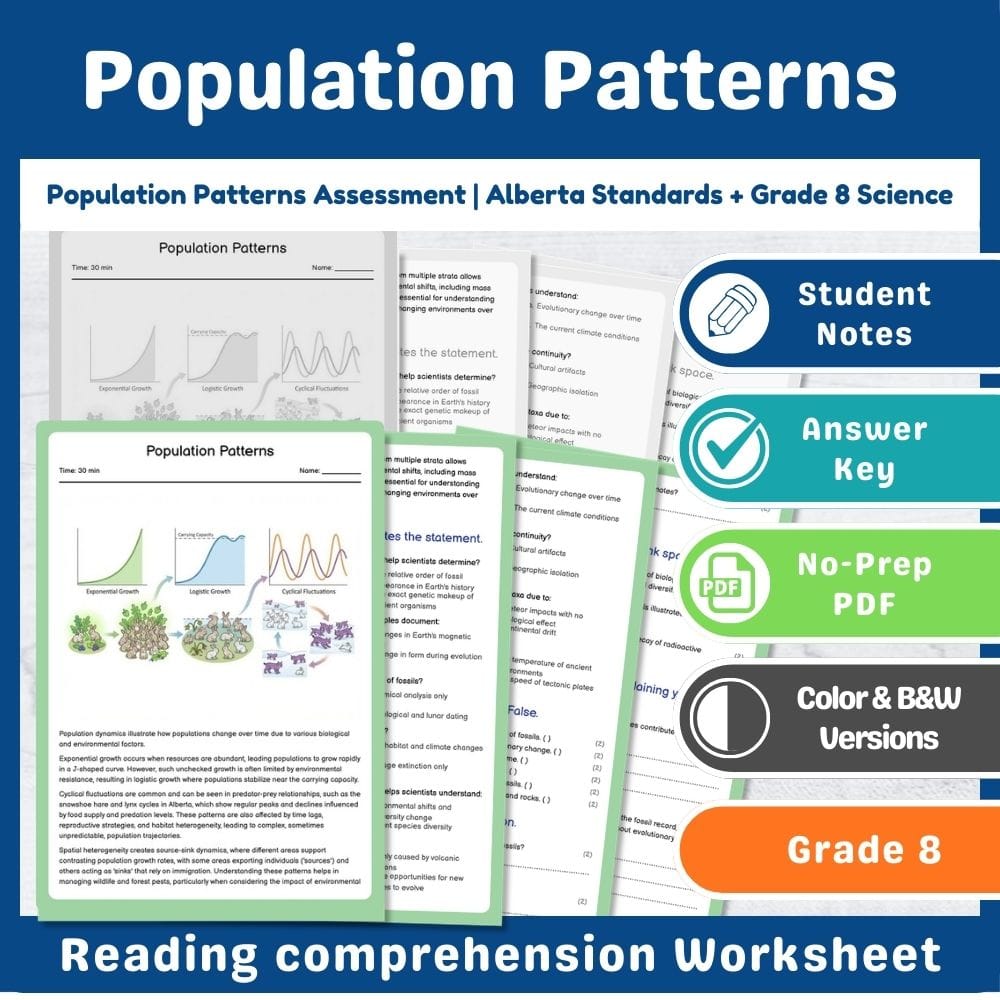
Population Patterns Assessment | Alberta Standards + Grade 8 Science
Created byPrism Point LearningLearning Objectives
- Describe the different types of population growth and regulation patterns such as exponential, logistic, and cyclical.
- Explain how factors like food supply, predation, and habitat heterogeneity influence population trajectories.
- Link theoretical population curves to real-world case studies, including Alberta's snowshoe hare–lynx cycles and forest insect outbreaks.
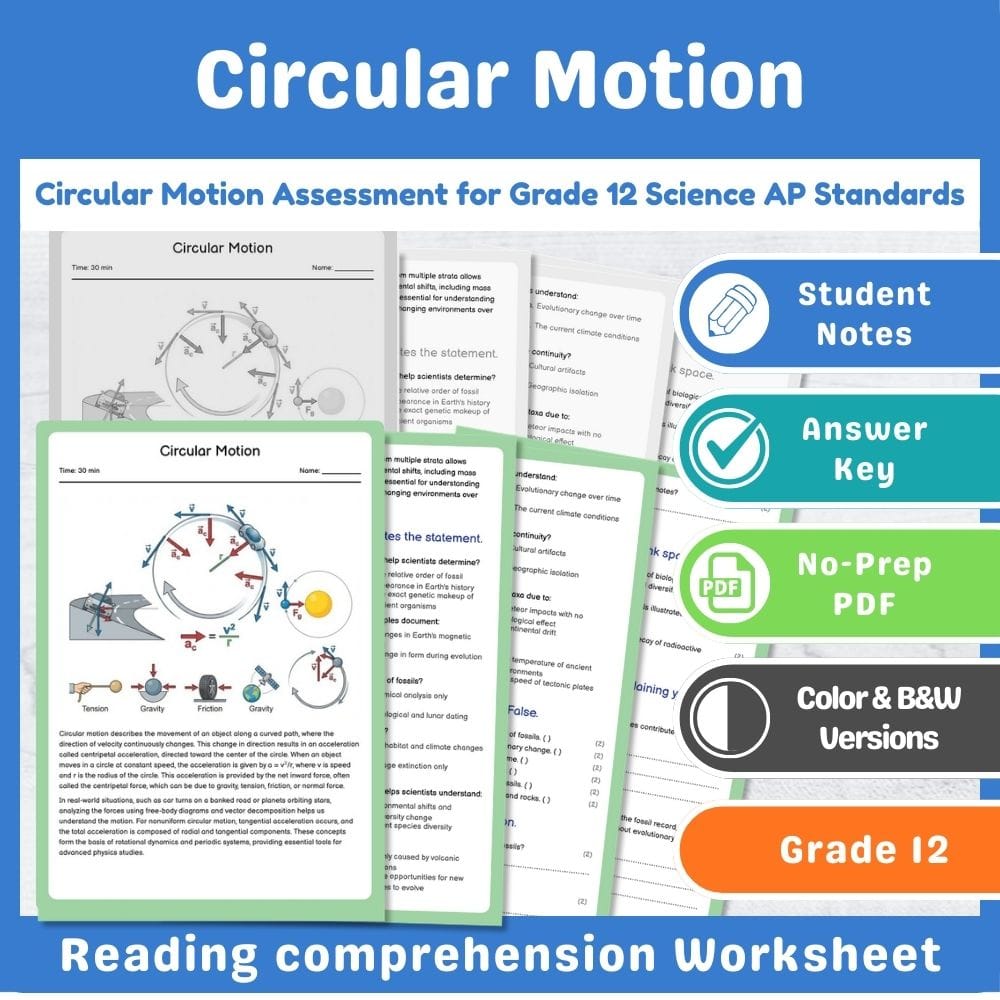
Circular Motion Assessment for Grade 12 Science AP Standards
Created byPrism Point LearningLearning Objectives
- Explain the concept of centripetal acceleration and the forces involved in uniform circular motion.
- Calculate the velocity, acceleration, and force for objects in circular paths.
- Analyze real-world examples such as banked turns and orbital motion using vector and polar-coordinate methods.
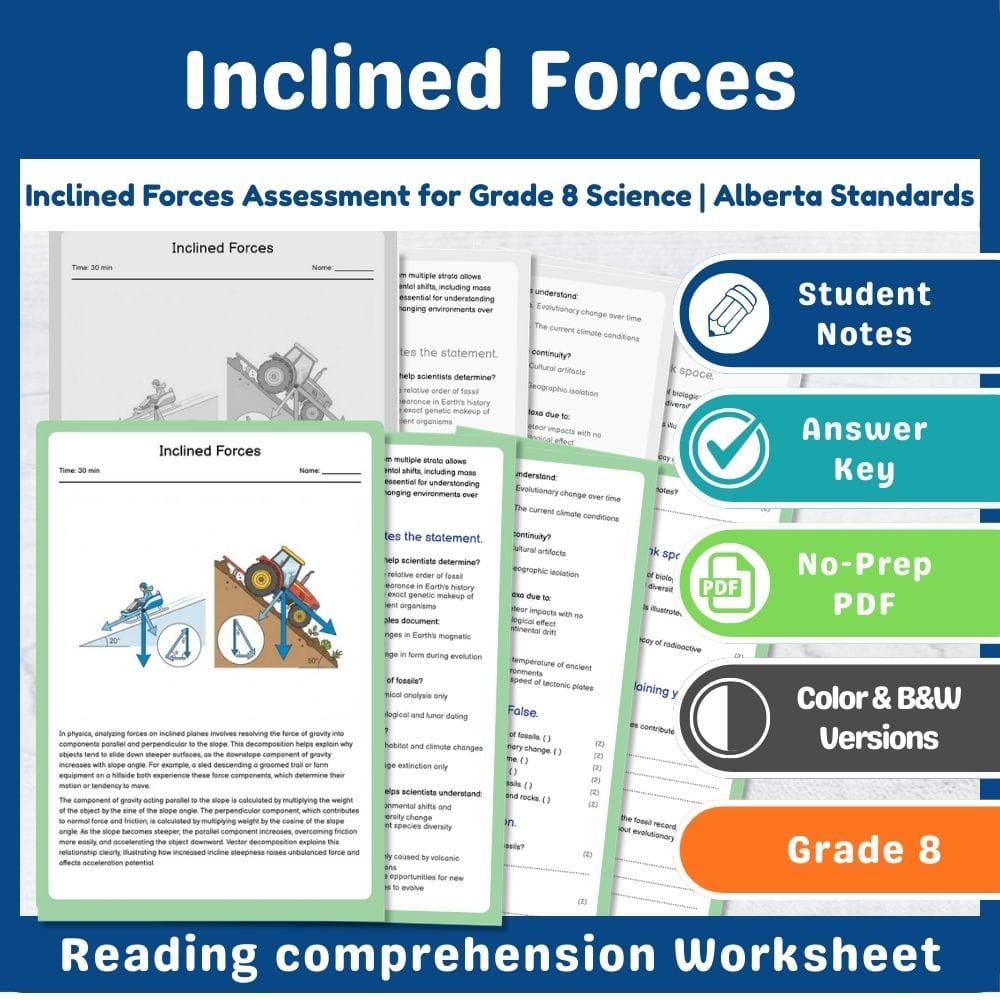
Inclined Forces Assessment for Grade 8 Science | Alberta Standards
Created byPrism Point LearningLearning Objectives
- Understand how to resolve gravitational force into components on an inclined plane.
- Analyze the effect of slope steepness on unbalanced forces and potential acceleration.
- Apply vector decomposition to real-world inclined force scenarios and analyze frictional resistance.
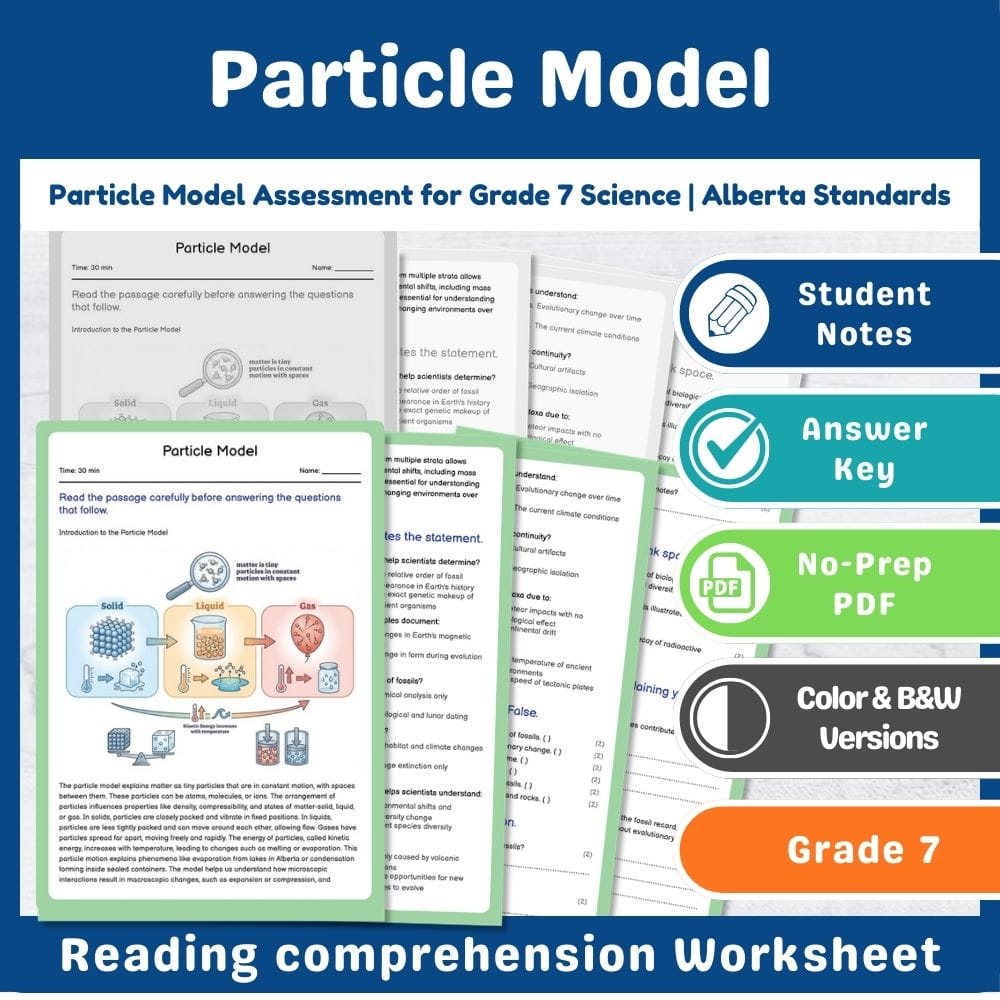
Particle Model Assessment for Grade 7 Science | Alberta Standards
Created byPrism Point LearningLearning Objectives
- Describe the particle model as a representation of matter with particles in constant motion.
- Explain how particle arrangement and kinetic energy determine states of matter, diffusion, and density.
- Relate microscopic particle motion to observable phenomena such as evaporation and condensation.
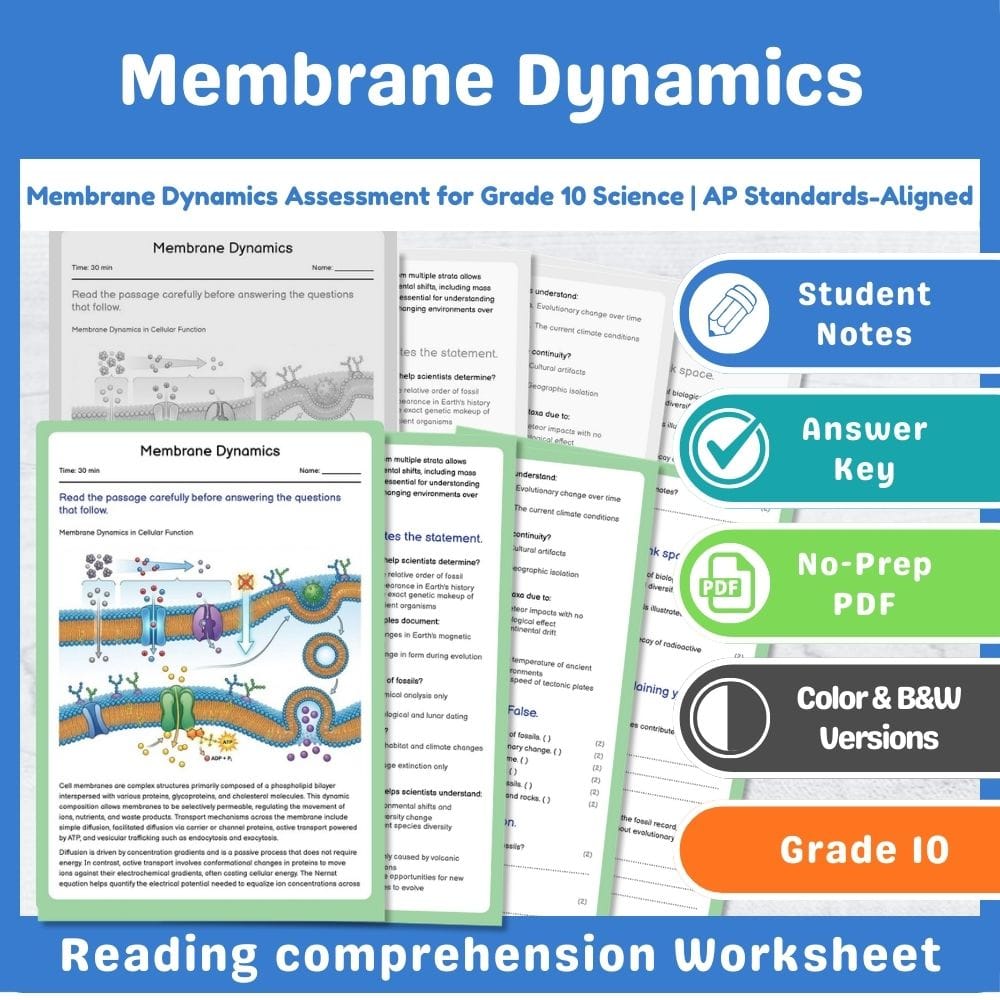
Membrane Dynamics Assessment for Grade 10 Science | AP Standards-Aligned
Created byPrism Point LearningLearning Objectives
- Understand key concepts related to Science
- Apply knowledge through practice questions
- Demonstrate comprehension of the material
Browse more categories
About Science Worksheets
Find Science worksheets spanning core skills, practice, and review. All 42,685 resources are instant PDF downloads for the classroom or home.
Every worksheet on MyTeachingSheets is created by independent teacher-authors and reviewed before publication. All resources download as printable PDFs for classroom, homework, or at-home practice, and many include answer keys. Preview any worksheet free before buying.