
Science Worksheets
42,685 subject resources
Insulation Principles Worksheet | Grade 7 Science Activities
 Created byPrism Point Learning
Learning Objectives
- Explain how insulation reduces heat transfer between inside and outside environments.
- Relate R-value, thickness, and construction details to thermal resistance and comfort.
- Describe how thermal bridges and air leaks can increase heat flow even when insulation is present.

Integrated Analysis Worksheet Pack | Grade 7 Science Activities
Created byPrism Point LearningLearning Objectives
- Use an energy budget to connect conduction, convection, and radiation to system energy performance
- Apply conservation of energy to compare net heat gain and required fuel energy in building or district heating systems
- Interpret how storage and conversion losses affect predicted temperature responses

Forces Introduction Worksheet | Grade 7 Science Activities
Created byPrism Point LearningLearning Objectives
- Explain how push and pull interactions create forces that can change an object's motion
- Differentiate between contact forces and non-contact forces using examples
- Describe how net force influences acceleration (speeding up, slowing down, or changing direction)

Material Properties Worksheet Pack | Grade 7 Science Activities
Created byPrism Point LearningLearning Objectives
- Explain how thermal conductivity and specific heat capacity affect heat flow through common building materials
- Use material properties such as density and porosity to predict how moisture and temperature change in building assemblies
- Compare trade-offs between insulation performance and structural considerations for Alberta climates

Quantitative Heat Worksheet Pack | Grade 7 Science Activities
Created byPrism Point LearningLearning Objectives
- Use specific heat, mass, and temperature change to quantify energy transfer in Joules and kilojoules.
- Explain how thermal energy calculations connect to practical situations and energy budgets.
- Interpret basic claims about heating, melting, and energy units using quantitative reasoning.

Graphing Motion Worksheet | Grade 7 Science Activities
Created byPrism Point LearningLearning Objectives
- Interpret distance–time and speed–time graphs by relating graph features to motion in real situations.
- Explain how slope and area under a speed–time graph connect to instantaneous and average rates.
- Translate tabulated measurements into graphs and make quantitative conclusions from them.

Net Force Diagrams Worksheet | Grade 7 Science Practice
Created byPrism Point LearningLearning Objectives
- Draw and interpret free-body diagrams to represent forces acting on an object
- Determine net force direction and magnitude by combining perpendicular force components
- Identify how friction, normal force, and gravity affect motion on an incline

Truss Analysis Worksheet | Grade 7 Science Activities
Created byPrism Point LearningLearning Objectives
- Explain how truss members form internal force paths of tension and compression
- Use the method of joints concept to reason about forces in individual truss members
- Compare common truss forms (e.g., king post, queen post, and Pratt) by their structural efficiency and redundancy

Seasonal Cycles Worksheet | Grade 7 Science Activities
Created byPrism Point LearningLearning Objectives
- Explain how seasonal solar energy input and surface properties (like snow cover) affect temperatures and energy budgets.
- Describe how energy transformations (radiative, sensible, and latent heat) drive freeze-thaw dynamics, snowpack insulation, and lake stratification.
- Interpret how energy storage and release during the seasons influences ecosystems in different regions.

Adaptation Traits Worksheet Pack | Grade 7 Science Activities
Created byPrism Point LearningLearning Objectives
- Explain how adaptations (structural, physiological, and behavioural) help organisms survive in specific environments.
- Identify examples of adaptation traits related to temperature, water availability, and seasonal change.
- Describe trade-offs in resource allocation and how they affect which traits are favored by natural selection.

Ecological Inquiry Worksheet | Grade 7 Science Activities
Created byPrism Point LearningLearning Objectives
- Explain how ecological inquiry uses questions, evidence, and clear conclusions to evaluate relationships in the environment.
- Identify measurable variables and describe how observations and data help test or revise a hypothesis.
- Interpret ecological data while accounting for natural variability and human impacts.

Levels Of Organization Worksheet Pack | Grade 7 Science Activities
Created byPrism Point LearningLearning Objectives
- Explain the ecological levels of organization from individual organisms to ecosystems
- Identify examples of individual, population, community, and ecosystem using Alberta-style scenarios
- Describe why patterns at higher levels cannot always be predicted from single organisms

Motion Quantities Worksheet | Grade 7 Science Practice
Created byPrism Point LearningLearning Objectives
- Describe motion using distance, time, and speed, including correct units
- Calculate average speed using distance and time and interpret results
- Identify common sources of measurement error and explain how they affect motion data

Solution Concentration Worksheet | Grade 7 Science Practice
Created byPrism Point LearningLearning Objectives
- Explain what solution concentration means and identify the roles of solute and solvent.
- Use mass percent and grams per litre to describe how concentrated a solution is.
- Predict how concentration can affect boiling point and freezing point.

Convection Systems Worksheet | Grade 7 Science Activities
Created byPrism Point LearningLearning Objectives
- Explain how convection transports heat through fluid motion caused by temperature and density differences.
- Distinguish natural convection from forced convection and describe real-world examples.
- Use boundary-layer and buoyancy ideas to predict how heat transfer patterns can change with conditions.

Conservation Applications Worksheet Pack | Grade 7 Science Activities
Created byPrism Point LearningLearning Objectives
- Use mass conservation to build simple mass budgets for closed or near-closed science systems.
- Explain how reaction stoichiometry and waste/environmental accounting apply conservation of mass.
- Analyze measured versus expected masses and suggest plausible reasons for differences.

Particle Motion Worksheet | Grade 7 Science Activities
Created byPrism Point LearningLearning Objectives
- Explain how average particle kinetic energy is related to temperature.
- Describe how thermal energy depends on both particle motion and number of particles.
- Use the particle model to connect microscopic motion to pressure and thermal changes.

Inclined Planes Worksheet | Grade 7 Science Activities
Created byPrism Point LearningLearning Objectives
- Explain how inclined planes reduce the required input force by increasing the distance over which the force acts.
- Identify and interpret force components parallel to and perpendicular to the slope.
- Calculate and compare mechanical advantage using input force and load.

Indigenous Knowledge Worksheet | Grade 7 Science Activities
Created byPrism Point LearningLearning Objectives
- Explain how traditional ecological knowledge uses long-term observation to understand ecological relationships and seasonal cycles.
- Describe how oral histories and place-based information can serve as habitat indicators for species and ecosystems.
- Compare Indigenous knowledge with other knowledge systems and explain why both can support environmental understanding.

Conservation Mass Worksheet | Grade 7 Science Activities
Created byPrism Point LearningLearning Objectives
- Explain conservation of mass in terms of atoms being conserved in a closed system.
- Predict whether total mass changes by comparing masses of reactants and products when nothing enters or leaves.
- Use sealed-container observations to support claims about conservation of mass during physical or chemical changes.

Simple Machines Overview Worksheet | Grade 7 Science Activities
Created byPrism Point LearningLearning Objectives
- Explain how simple machines change the magnitude or direction of a force to make work easier
- Describe the roles of levers, pulleys, wedges, screws, inclined planes, and wheel-and-axles in everyday tools
- Calculate mechanical advantage from input and output forces and interpret what the result means

Separation Methods Worksheet Grade 7 Science Practice
Created byPrism Point LearningLearning Objectives
- Explain how physical properties (particle size, solubility, magnetism, boiling point) can be used to separate mixtures without changing chemical identity
- Match common separation techniques to the physical property differences they exploit
- Interpret separation efficiency by linking observations (what remains vs. what is removed) to the type of material in a mixture

Levers and Pulleys Worksheet | Grade 7 Science Practice
Created byPrism Point LearningLearning Objectives
- Explain how a lever changes force and direction of a push or pull using fulcrum placement and lever arms.
- Describe how pulley systems can increase mechanical advantage and change the direction of force.
- Calculate and compare input (effort) and output (load) forces using simple mechanical advantage relationships.

Wetland Functions Worksheet | Grade 7 Science Activities
Created byPrism Point LearningLearning Objectives
- Explain how wetlands provide hydrological, chemical, and biological functions in an ecosystem
- Describe how wetlands support water storage, nutrient cycling, and habitat for wildlife
- Compare functional roles of different wetland types (e.g., peatlands and marsh complexes)

Saturation Concepts Worksheet Pack | Grade 7 Science Activities
Created byPrism Point LearningLearning Objectives
- Explain what it means for a solution to be saturated at a specific temperature and pressure
- Describe how solubility limits determine whether solute stays dissolved or forms a solid
- Differentiate saturated and supersaturated conditions and predict what happens when conditions change

Solubility Factors Worksheet | Grade 7 Science Activities
Created byPrism Point LearningLearning Objectives
- Explain how solubility depends on the nature of the solute and solvent.
- Describe how temperature, pressure (for gases), and surface area affect dissolving.
- Connect particle size and agitation to the rate and extent of dissolution.

Balanced Forces Worksheet | Grade 7 Science Activities
Created byPrism Point LearningLearning Objectives
- Explain equilibrium as the condition where net force is zero and motion does not change
- Distinguish static equilibrium from dynamic equilibrium using examples from structures and motion
- Identify balanced and unbalanced force pairs and describe how they affect safety and design

Biodiversity Measures Worksheet | Grade 7 Science Practice
Created byPrism Point LearningLearning Objectives
- Describe how biodiversity includes genetic, species, and ecosystem diversity.
- Explain how richness, evenness, and habitat heterogeneity are used to measure regional biodiversity.
- Interpret what biodiversity metrics can suggest about ecosystem resilience and function.

Integrated Design Worksheet | Grade 7 Science Practice
Created byPrism Point LearningLearning Objectives
- Use integrated systems analysis to compare design options using mechanical advantage, materials, and structural safety.
- Connect force and motion data to machine function and structural evaluation in real-world scenarios (wind, snow, and load).
- Justify a design choice using evidence from mechanical calculations and safety criteria.

Energy Relationships Worksheet | Grade 7 Science Practice
Created byPrism Point LearningLearning Objectives
- Explain how kinetic and potential energy are related to motion using elevation, mass, and speed.
- Describe energy transfer and conservation in mechanical systems without creating or destroying energy.
- Use qualitative reasoning to predict how changing height or speed affects mechanical energy.

Structural Basics Worksheet Pack Grade 7 Science Alberta Standards
Created byPrism Point LearningLearning Objectives
- Explain how supports and foundations help buildings resist loads through load paths.
- Identify how compression, tension, and shear influence different structural members.
- Describe how stiffness, strength, and durability are used to judge structural safety under wind and snow loads.

Reaction Observations Worksheet Pack | Grade 7 Science Activities
Created byPrism Point LearningLearning Objectives
- Identify common observable indicators of chemical reactions, such as gas production, heat exchange, colour changes, and precipitate formation.
- Describe reaction evidence using clear scientific language and connect observations to possible particle interactions and mass changes.
- Interpret qualitative evidence to make reasonable predictions about reaction types and the extent of a reaction.

Kinematics Distinctions Worksheet | Grade 8 Science Activities
Created byPrism Point LearningLearning Objectives
- Differentiate speed, velocity, and acceleration using correct scientific definitions.
- Identify whether a quantity is scalar or vector based on its definition.
- Interpret changes in motion from simple distance/position and time information.

Homogeneous Mixtures Worksheet | Grade 8 Science Activities
Created byPrism Point LearningLearning Objectives
- Identify homogeneous mixtures and distinguish them from heterogeneous mixtures using particle-level reasoning and macroscopic observations.
- Explain how solubility and concentration affect the behavior of solutions and alloys.
- Interpret examples of homogeneous mixtures in environmental and transportation contexts.

Nutrient Cycling Worksheet | Grade 8 Science Practice
Created byPrism Point LearningLearning Objectives
- Explain how matter cycles through ecosystems using decomposition, mineralization, nitrogen fixation, and sedimentation.
- Describe how carbon and nitrogen move between biotic and abiotic pools in soil and wetlands.
- Analyze how environmental factors (temperature and moisture) and human activities can change nutrient availability and productivity.

Measuring Electricity Worksheet | Grade 8 Science Activities
Created byPrism Point LearningLearning Objectives
- Describe how voltage, current, and resistance are measured using common meters in an electrical circuit.
- Choose correct meter ranges and connections to avoid inaccurate readings.
- Explain how meter impedance (resistance of the meter) can affect measured values.

Substance Sorting Worksheet | Grade 8 Science Activities
Created byPrism Point LearningLearning Objectives
- Classify substances and mixtures as elements, compounds, or mixtures based on particle-level composition.
- Distinguish between pure substances and mixtures using observable properties and reasoning.
- Use classification to explain real-world examples such as groundwater minerals and oil-sands crude oil.
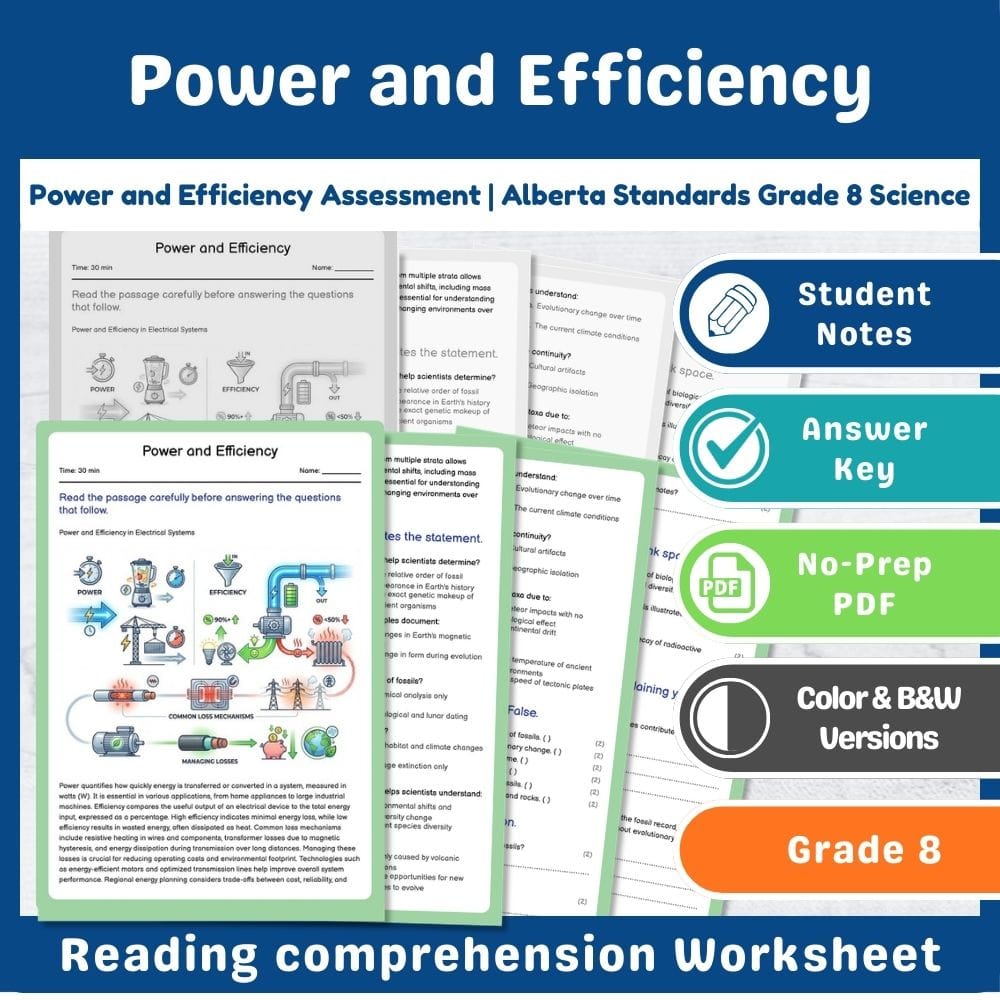
Power and Efficiency Assessment | Alberta Standards Grade 8 Science
Created byPrism Point LearningLearning Objectives
- Understand the concept of power as energy transfer per unit time.
- Identify factors affecting the efficiency of electrical devices.
- Analyze mechanisms of power loss such as resistive heating and transmission dissipation.
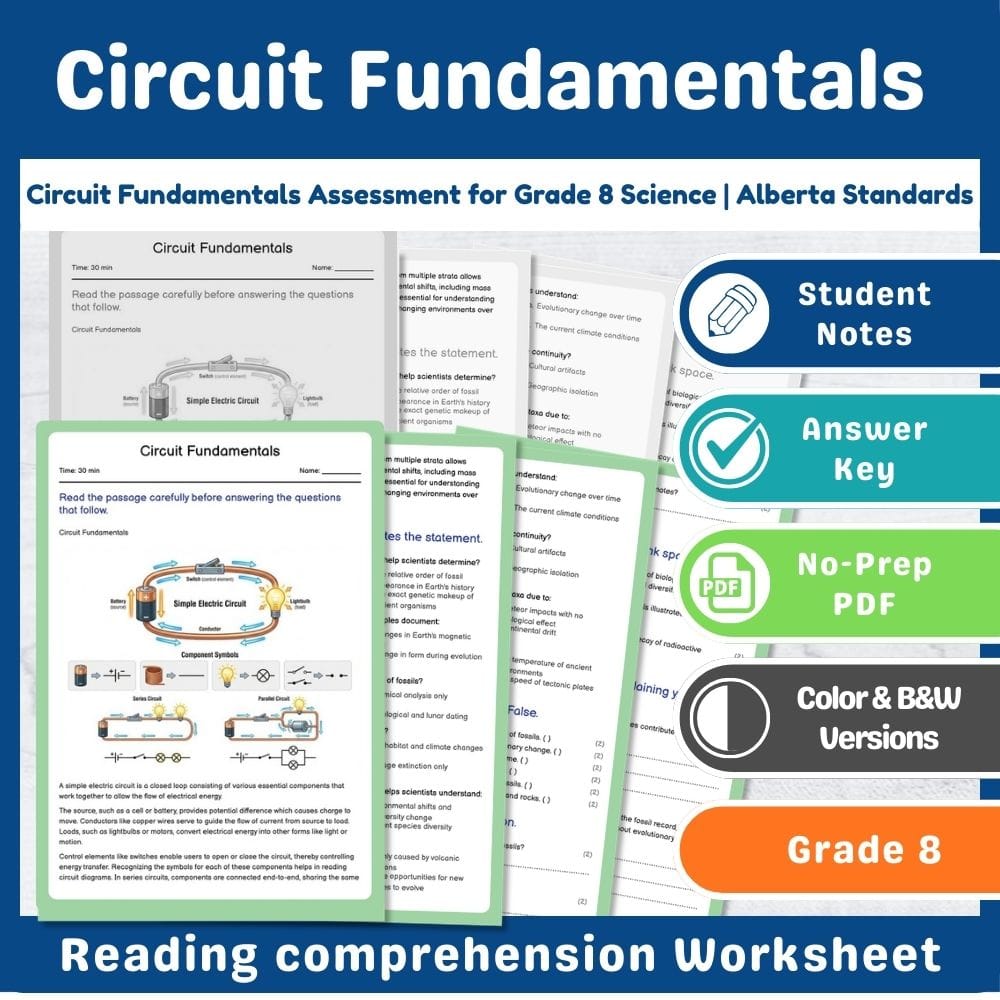
Circuit Fundamentals Assessment for Grade 8 Science | Alberta Standards
Created byPrism Point LearningLearning Objectives
- Identify the main components of a simple electric circuit.
- Explain the functions of sources, conductors, loads, and control elements.
- Recognize schematic symbols for common circuit components.
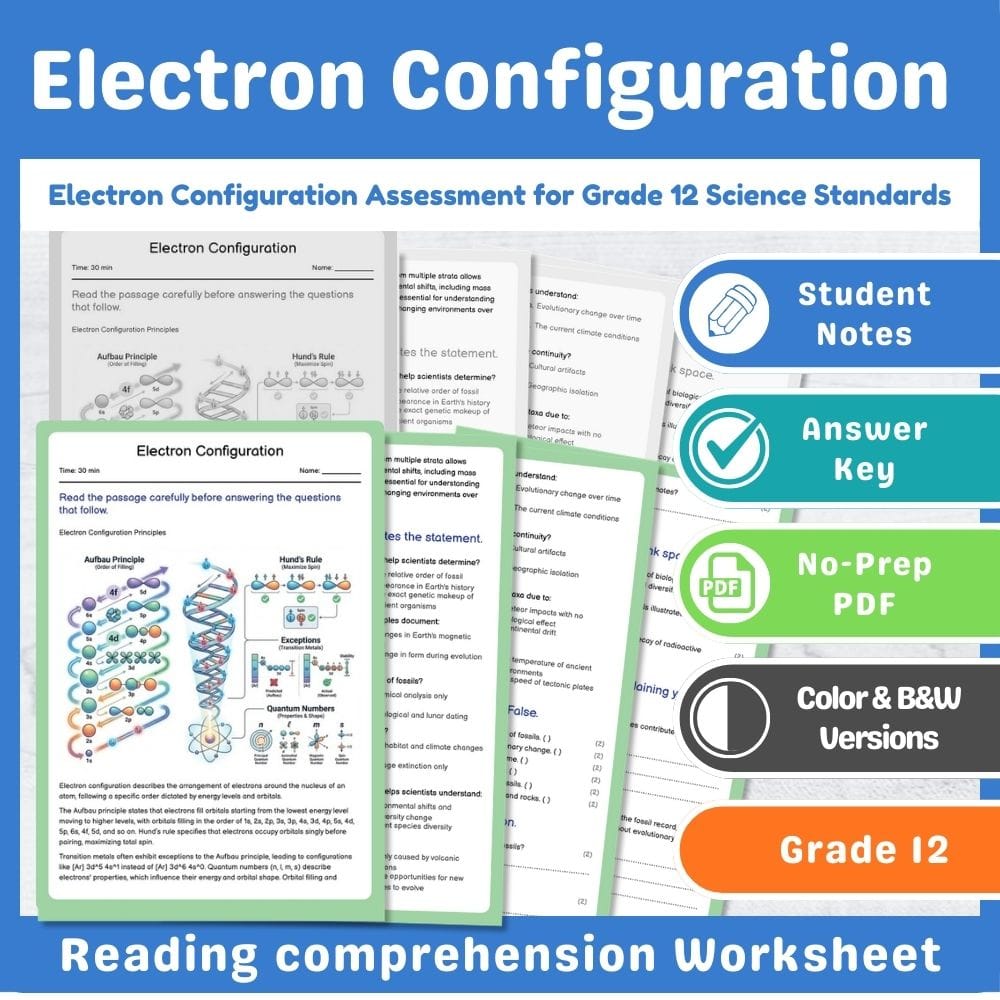
Electron Configuration Assessment for Grade 12 Science Standards
Created byPrism Point LearningLearning Objectives
- Explain the principles and procedures for assigning electron configurations to elements
- Understand orbital filling order, Hund’s rule, and exceptions in transition metals
- Relate quantum numbers to electron orbital occupancy and periodic trends
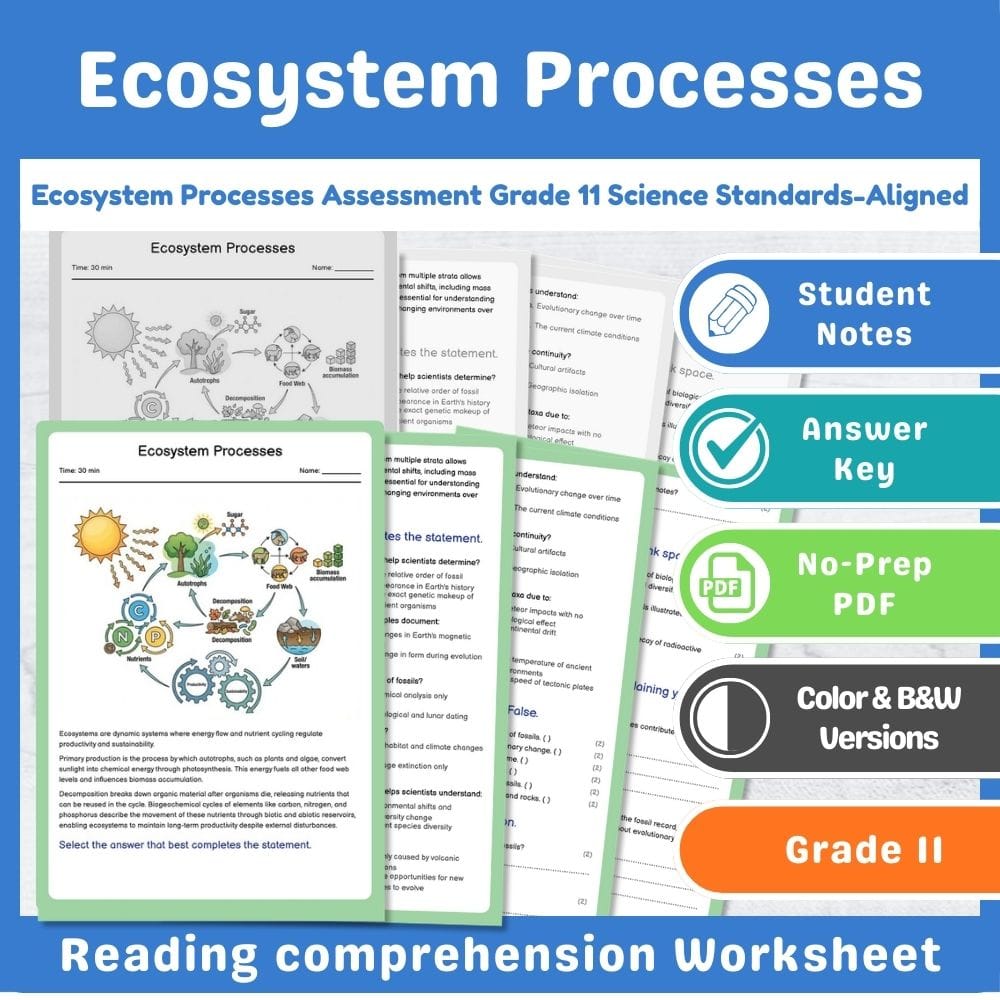
Ecosystem Processes Assessment Grade 11 Science Standards-Aligned
Created byPrism Point LearningLearning Objectives
- Explain the key processes that regulate energy flow and material cycling within ecosystems.
- Describe the roles of primary production, decomposition, and biogeochemical cycles of carbon, nitrogen, and phosphorus.
- Analyze how land-use change, nutrient inputs, and climate variability alter ecosystem cycle rates and affect ecosystem health.
Genetic Molecules Assessment for Grade 12 Science | AP Standards
Created byPrism Point LearningLearning Objectives
- Understand the structure and function of nucleic acids.
- Explain the mechanisms of DNA replication and repair pathways.
- Describe how mutations and sequence variation influence heritable traits.
Energy Transformations Assessment | Alberta Standards-Aligned Grade 8 Science
Created byPrism Point LearningLearning Objectives
- Understand how electrical energy is transferred and transformed into thermal, radiant, and mechanical energy.
- Identify examples of energy conversions in domestic and industrial systems.
- Explain the concepts of power and efficiency in energy systems.
Bonding Basics Assessment for Grade 12 Science | AP Standards-Aligned
Created byPrism Point LearningLearning Objectives
- Explain the principal types of chemical bonds: ionic, covalent, and metallic.
- Describe how charge distribution and lattice structures influence bonding.
- Identify how different bonding types affect properties such as conductivity, melting point, and solubility.
Probabilistic Reasoning Assessment | AP Standards-Aligned Grade 12 Science
Created byPrism Point LearningLearning Objectives
- Understand the differences between frequentist and Bayesian probability perspectives.
- Explain how prior beliefs and likelihood functions combine to form posterior probabilities.
- Apply probabilistic reasoning to phenomena like radioactive decay and epidemiology.
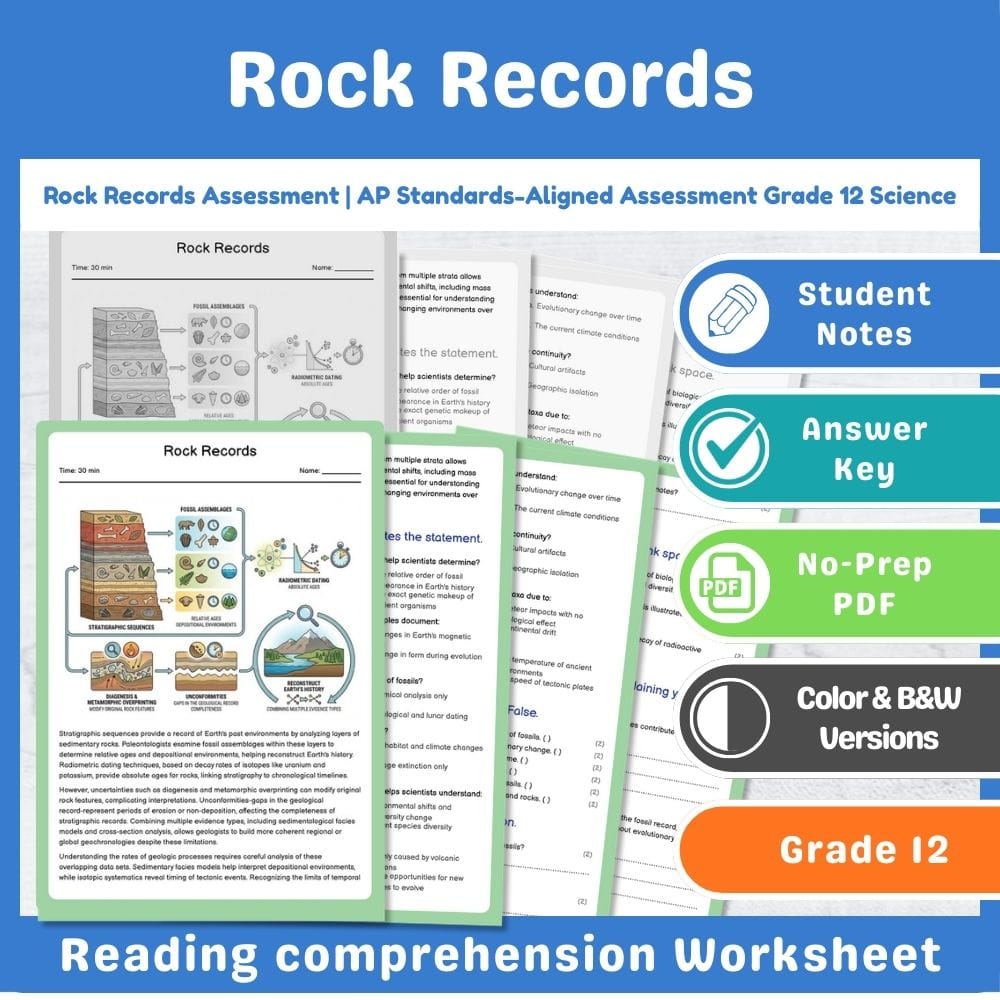
Rock Records Assessment | AP Standards-Aligned Assessment Grade 12 Science
Created byPrism Point LearningLearning Objectives
- Interpret stratigraphic sequences, fossil assemblages, and radiometric age data to understand Earth history.
- Explain how sedimentary facies models and cross-section interpretations relate to Earth's geologic processes.
- Assess limitations of temporal resolution, unconformities, and integrate multiple data types for regional and global chronologies.
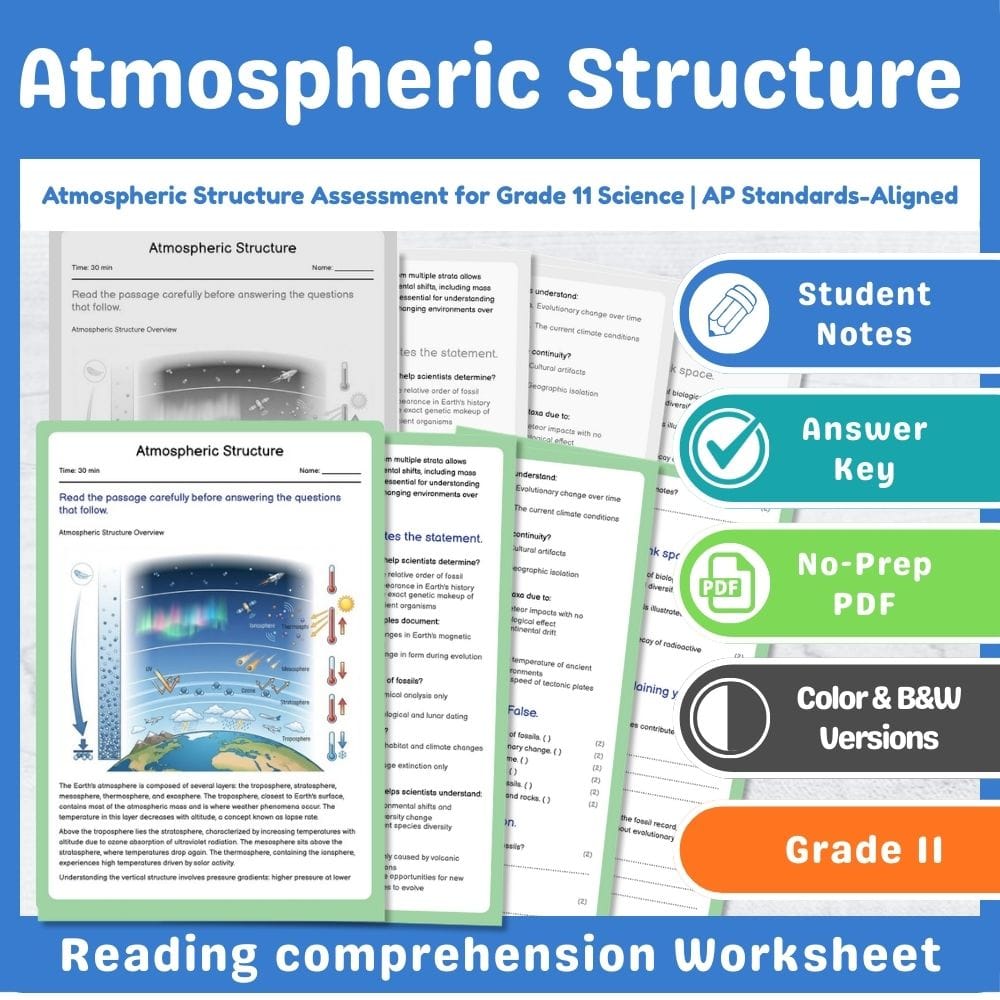
Atmospheric Structure Assessment for Grade 11 Science | AP Standards-Aligned
Created byPrism Point LearningLearning Objectives
- Describe the vertical and horizontal layers of the atmosphere and their characteristics.
- Explain pressure gradients, temperature profiles, and their role in atmospheric circulation.
- Interpret sounding profiles, pressure maps, and radiative diagrams to understand weather patterns.
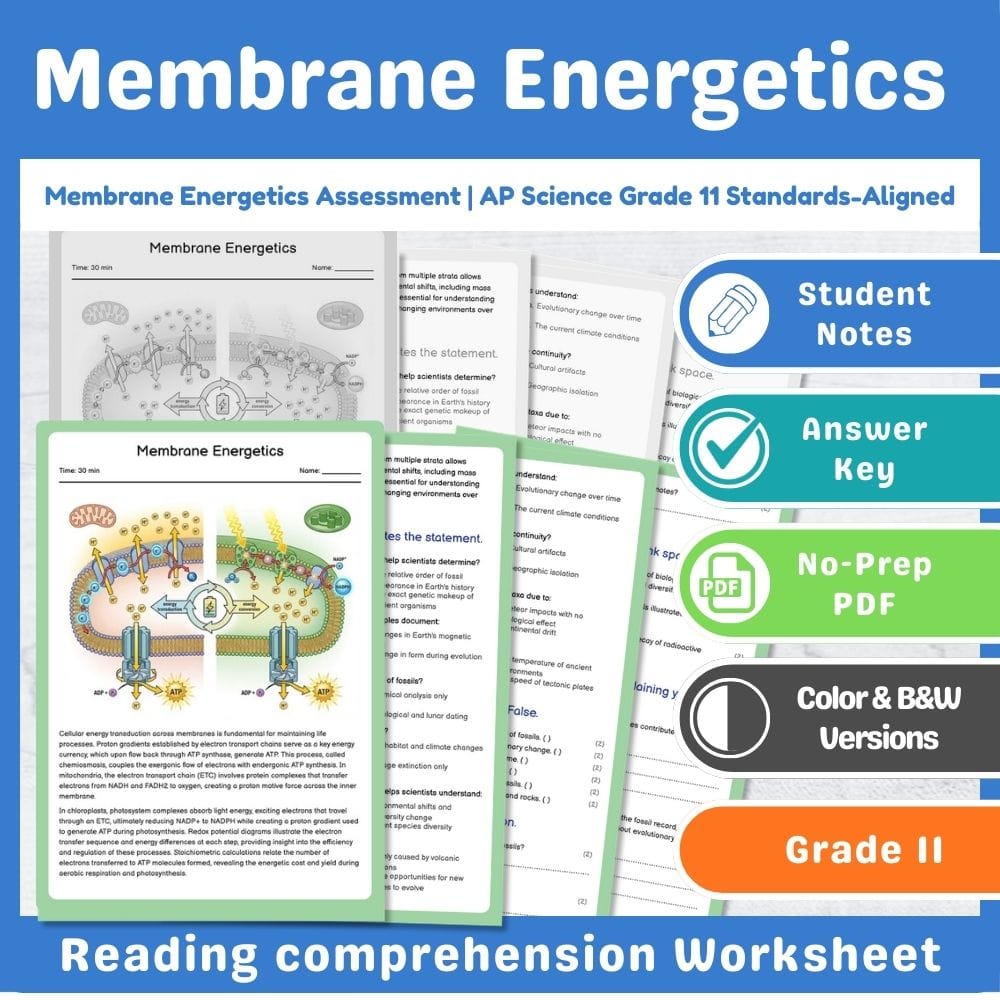
Membrane Energetics Assessment | AP Science Grade 11 Standards-Aligned
Created byPrism Point LearningLearning Objectives
- Explain the principles of membrane-associated energy transduction including proton gradients and chemiosmosis.
- Analyze electron transport chains in aerobic and photosynthetic systems using redox potential diagrams.
- Calculate ATP yield based on electron flow and proton gradients.
Browse more categories
About Science Worksheets
Find Science worksheets spanning core skills, practice, and review. All 42,685 resources are instant PDF downloads for the classroom or home.
Every worksheet on MyTeachingSheets is created by independent teacher-authors and reviewed before publication. All resources download as printable PDFs for classroom, homework, or at-home practice, and many include answer keys. Preview any worksheet free before buying.