
Grade 10 Science Worksheets
7,038 worksheets
Particle Interactions worksheet | NGSS Grade 10 Science printable PDF assessment
Learning Objectives
- Explain how crystal structure and molecular arrangement influence bulk physical properties.
- Compare ionic, metallic, and molecular solids using particle interactions and electrical conductivity.
- Use particle-level forces (lattice energy, dispersion forces, and hydrogen bonding) to predict melting points and solubility trends.
Also included in: Matter and Its Interactions Lesson Bundle | Grade 10 Science | NGSS
Instant download

Land Use Effects Worksheet Practice Test | Grade 10 Science NGSS
 Created byPrism Point Learning
Learning Objectives
- Explain how land-cover change from human activities affects ecosystem function, hydrologic cycles, and biodiversity.
- Use empirical indicators (e.g., soil erosion, habitat fragmentation, nutrient loading, and sediment runoff) to connect land use to ecological outcomes.
- Interpret how different land-use types can increase or decrease risks such as eutrophication and biodiversity loss.
Instant download

Grade 10 Science – Friction and Resistance Worksheet (Ontario Standard) (PDF)
 Created byEvergreen Desk Education
Learning Objectives
- Distinguish between static friction and kinetic friction and explain how each affects motion.
- Use coefficients of friction to relate frictional force to the normal force on different surfaces.
- Qualitatively describe how air resistance and viscous drag depend on velocity, including the idea of terminal speed.
Also included in: Grade 10 Kinematics Forces & Mechanics Science Lesson Bundle Ontario Worksheets +1 more
Instant download
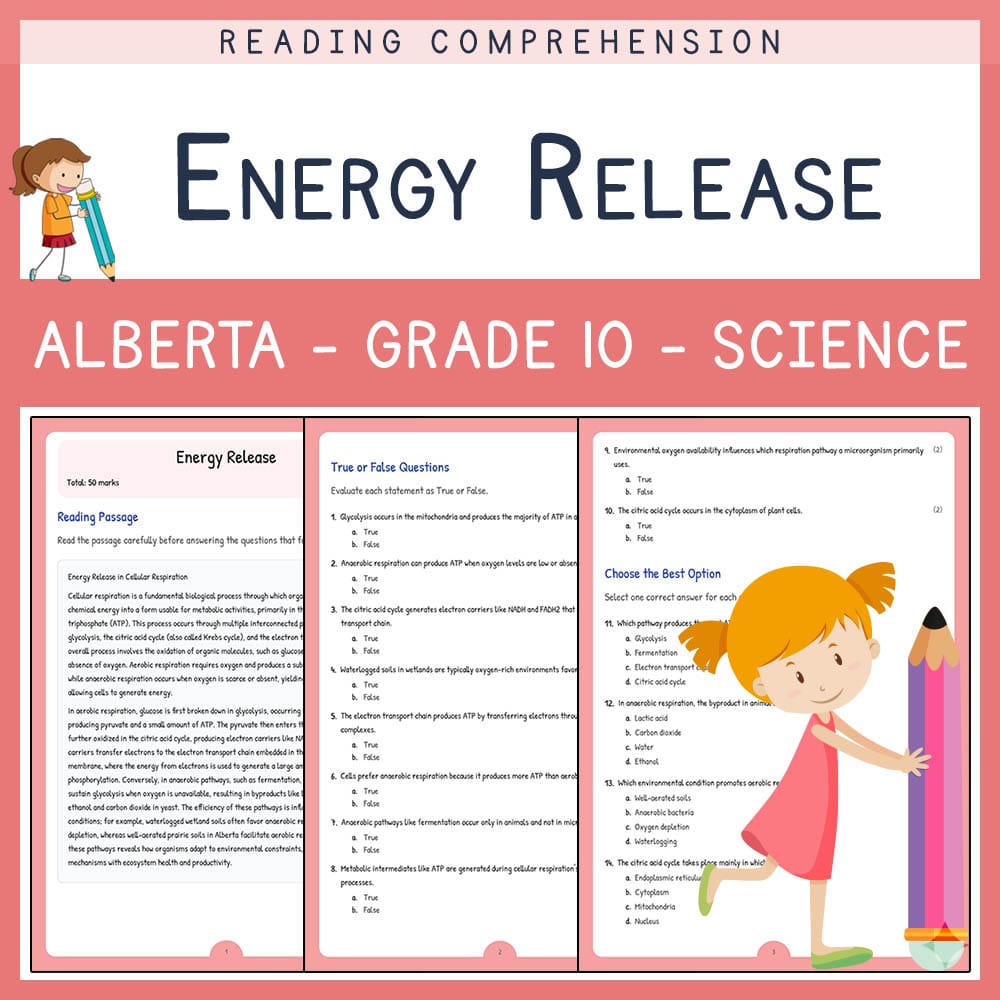
Grade 10 Science | Energy Release Worksheet | Alberta Standards
 Created byLumora Learning
Learning Objectives
- Explain the pathways of aerobic and anaerobic respiration and their roles in energy production.
- Identify environmental factors that influence the dominance of respiration pathways in ecosystems.
- Describe the processes of glycolysis, citric acid cycle, and electron transport in cellular respiration.
Also included in: Grade 10 Science | Cells and Systems Custom Bundle Worksheets | Alberta
Instant download
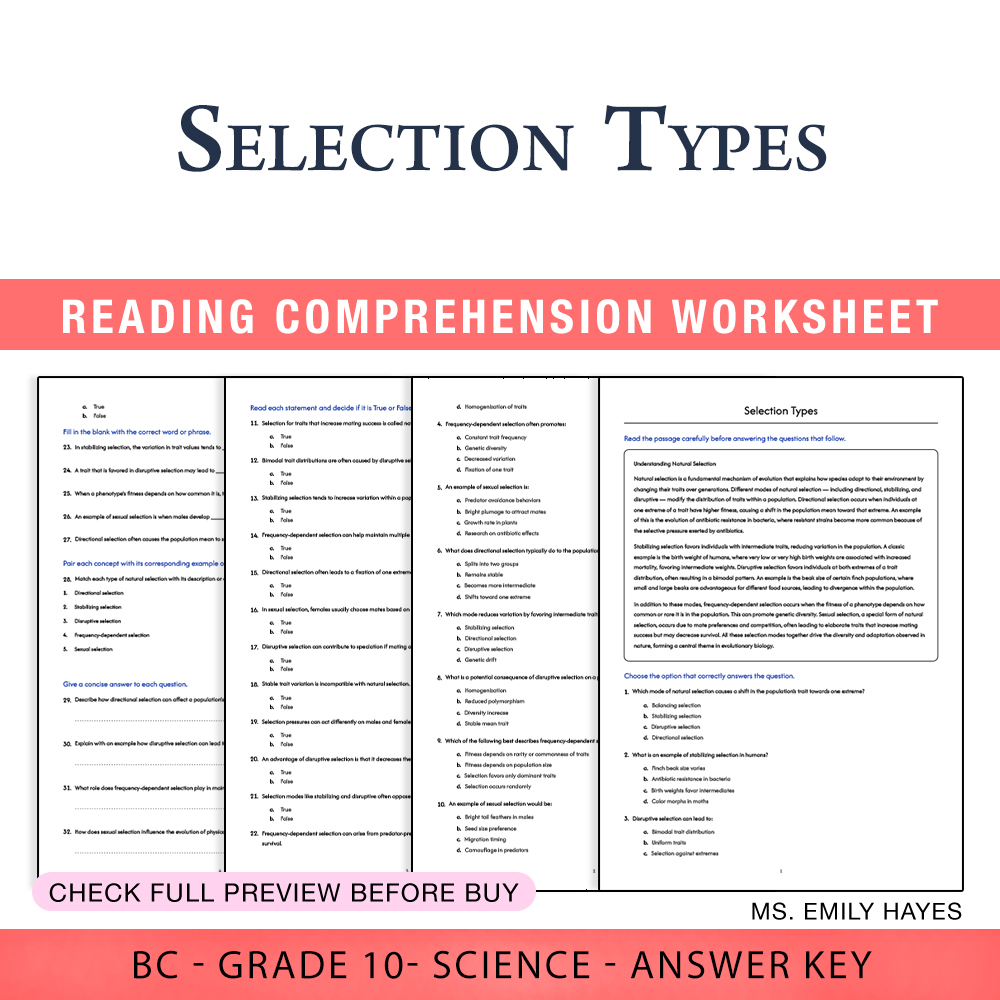
Grade 10 Science | Selection Types Worksheet (PDF+ Answer Key)
 Created byCopper Leaf Classroom
Learning Objectives
- Understand the different modes of natural selection and how they affect trait distributions in populations.
- Identify examples and characteristics of directional, stabilizing, and disruptive selection.
- Explain how frequency-dependent and sexual selection influence evolutionary processes.
Also included in: Grade 10 Science BC | Evolution, Biodiversity & Ecology (PDF + Answer Key) +1 more
Instant download

Induction Principles Worksheet | Alberta Grade 10 Science | Assessment
JCreated byJ.S SheetsLearning Objectives
- Understand the fundamental concepts of electromagnetic induction, including Faraday’s law and flux change.
- Explain how mechanical motion converts to electrical energy in generators and turbines.
- Identify the physical principles behind transformers and energy conversion devices.
Also included in: Grade 10 Science Practice Worksheets: Alberta Science Full-Year Bundle
Instant download

Grade 10 Science | Sphere Connections Worksheet | AP Aligned
Created byLumora LearningLearning Objectives
- Understand how the geosphere, hydrosphere, atmosphere, and biosphere interact through coupled processes.
- Identify examples of systems thinking and flow diagrams in Earth systems.
- Explain how perturbations propagate across Earth's spheres and affect observable indicators.
Instant download

Grade 10 ATP and Cellular Energy Worksheet | Cellular Respiration Ontario
 Created byChalk and Compass
Learning Objectives
- Explain why ATP is a central energy carrier and describe the role of high-energy phosphate bonds.
- Distinguish endergonic and exergonic processes and describe how ATP couples energy to cellular work.
- Identify two conceptual ways ATP is regenerated and explain ATP turnover in maintaining cellular processes.
Also included in: Cells, Photosynthesis, Respiration & Microbes Lesson Bundle – Grade 10 Science +1 more
Instant download

Grade 10 Science — Worksheet MCQ Paper for Human Footprints
 Created byThe Resource Hub
Learning Objectives
- Understand how human activities alter Earth's land, water, and atmospheric systems.
- Identify key indicators used to assess environmental changes caused by humans.
- Analyze the relationships between land-use change, greenhouse gas emissions, and environmental impacts.
Also included in: Grade 10 Earth and Space Sciences Lesson Bundle | AP Curriculum +1 more
Instant download

Quantitative Communication Worksheet | AP Science Grade 10 Practice
JCreated byJ.S SheetsLearning Objectives
- Understand conventions and strategies for communicating quantitative results effectively.
- Explain the use of uncertainty notation, significant digits, and graphical annotations.
- Demonstrate how numerical summaries, confidence intervals, and visual aids support credible conclusions.
Instant download

Grade 10 Science – Tension & Normal Forces | Daily Reading Worksheet
 Created byBright Mind Resources
Learning Objectives
- Identify and describe tension forces in ropes and connectors.
- Explain the concept of normal force and its role in supporting objects.
- Apply the concepts of tension and normal force to analyze forces on inclined surfaces.
Also included in: Grade 10 Forces & Motion Science Daily Reading Worksheets Lesson Bundle | BC +1 more
Instant download

Grade 10 Science | Adaptation Strategies Worksheet (AP Standards) (PDF)
Created byEvergreen Desk EducationLearning Objectives
- Evaluate how adaptation strategies can reduce climate and Earth-system risks while creating trade-offs for carbon management, ecosystems, and land-use decisions.
- Use systems thinking to compare scenarios and explain how interventions can produce unintended consequences.
- Apply cost-benefit reasoning and uncertainty analysis to judge which resilience measures are scalable and effective over time.
Also included in: Grade 10 Earth and Climate Systems Science Lesson Bundle Worksheets (AP) +1 more
Instant download

Grade 10 Balancing Chemical Equations Worksheet | Ontario Science Activity
Created byChalk and CompassLearning Objectives
- Distinguish chemical equation subscripts from stoichiometric coefficients when balancing equations.
- Explain why balanced equations satisfy conservation of mass by matching atom counts on both sides.
- Describe a systematic approach to balancing multi-step chemical equations conceptually.
Also included in: Chemistry Foundations & Chemical Reactions Lesson Bundle: Grade 10 Science +1 more
Instant download

Grade 10 Science | Model Foundations Worksheet (AP Standards) (PDF)
Created byEvergreen Desk EducationLearning Objectives
- Define the core purposes of scientific models and distinguish between model components and observable features.
- Compare how conceptual, mathematical, and physical analogue models represent the same system and where they may fail.
- Explain how assumptions and parameter calibration bound a model’s applicability and prediction accuracy.
Also included in: Grade 10 Scientific Modeling & Quantitative Reasoning Science Lesson Bundle (AP) +1 more
Instant download

Grade 10 Laboratory Protocols Safety PPE Worksheet | Ontario Science
Created byChalk and CompassLearning Objectives
- Identify appropriate personal protective equipment (PPE) for common laboratory tasks.
- Apply laboratory safety principles to glove choice, eyewear protection, and ventilation needs.
- Explain how to label, store, and segregate reagents and handle lab waste safely.
Also included in: Grade 10 Science Variables & Control Data Analysis Lesson Bundle | Ontario +1 more
Instant download

Grade 10 Science – Friction & Resistance | Daily Reading Worksheet
 Created byQuiet Forest Education
Learning Objectives
- Understand the difference between static and kinetic friction
- Learn about coefficients of friction and their significance
- Explore how surface properties affect friction
Also included in: Motion and Forces Grade 10 Science Daily Reading Worksheets Bundle | Ontario +1 more
Instant download

Genetic Drift Assessment Grade 10 Science | TEKS Standards-Aligned
Created byPrism Point LearningLearning Objectives
- Understand the concept of genetic drift and its impact on small populations.
- Differentiate between genetic drift and natural selection.
- Identify factors that influence genetic drift such as founder effects and bottlenecks.
Also included in: Grade 10 Evolution and Heredity Science Lesson Bundle for TEKS Standards
Instant download

Grade 10 Science | Design Tradeoffs Worksheet Elena | California Standards
Created byLumora LearningLearning Objectives
- Explain how optimization requires balancing competing criteria under engineering constraints.
- Identify common design tradeoffs in structural and materials decisions (e.g., stiffness vs. mass or cost).
- Use tradeoff reasoning to justify why a feasible design can be better or worse overall than another.
Instant download
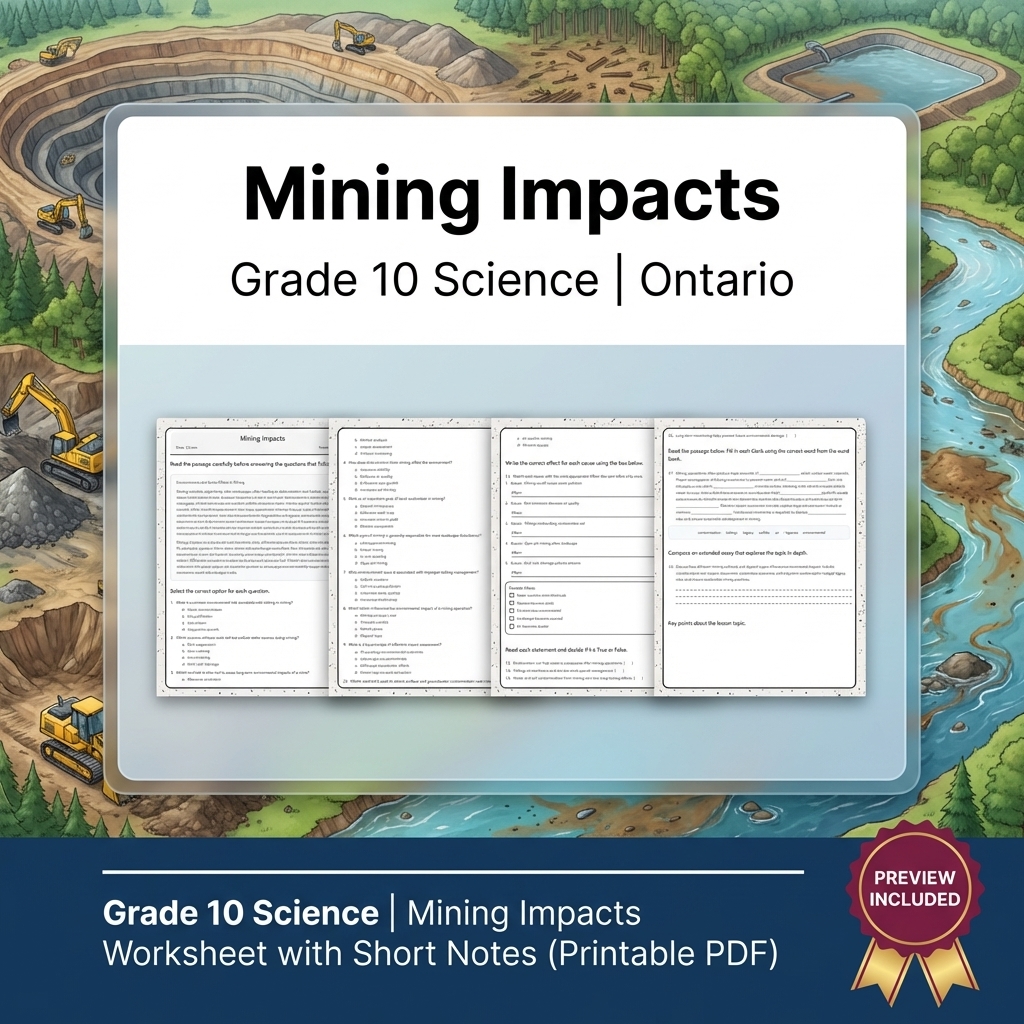
Grade 10 Science | Mining Impacts Worksheet with Short Notes (Printable PDF)
 Created byMeadowlark Worksheets
Learning Objectives
- Understand the environmental consequences of mineral extraction, including landscape changes, water, and soil contamination.
- Recognize methods for impact assessment, reclamation, and monitoring in mining operations.
- Identify how deposit type and extraction method influence environmental outcomes.
Also included in: Grade 10 Science Lesson Group Bundle | Ontario Curriculum and STEM Topics +1 more
Instant download

Grade 10 Membrane Dynamics Worksheet | Practice & Assessment PDF
 Created byClear Sky Classroom
Learning Objectives
- Explain how membrane composition and protein transport mechanisms create electrochemical gradients and compartmentalization
- Compare diffusion, carrier-mediated transport, and vesicular trafficking using flux-rate and energetics ideas
- Interpret how selective permeability influences ion distribution and signal propagation
Also included in: Grade 10 Population, Genetics, and Cellular Processes Science Lesson Bundle AP +1 more
Instant download

Grade 10 AP Science Meiosis & Variation Worksheet | Practice Pack
Created byPrism Point LearningLearning Objectives
- Explain how homologous pairing, crossing-over, and independent assortment create genetic variation during meiosis.
- Describe how chromosomal segregation affects the genotype and phenotype of offspring, including nondisjunction outcomes.
- Use cytogenetic and molecular representations to connect meiotic events with inheritance patterns and population data.
Also included in: Grade 10 AP Science Life Systems Lesson Bundle | Worksheet Pack
Instant download

Grade 10 Solar Context Worksheet | Practice & Assessment PDF
Created byClear Sky ClassroomLearning Objectives
- Explain how Earth’s tilt and orbit change solar angle and length of daylight to produce seasons and diurnal energy input.
- Describe how solar irradiance influences surface temperatures, ecosystems, and atmospheric circulation.
- Connect gravity-driven motions (Earth–Moon–Sun) to natural patterns such as tides and climate-relevant energy changes.
Instant download

Grade 10 Science – Selective Mechanisms & Evolution | Daily Reading Worksheet
Created byBright Mind ResourcesLearning Objectives
- Understand the concept of natural selection and how variation affects survival
- Identify examples of selective pressures such as antibiotic resistance and industrial melanism
- Explain how traits become more or less common in populations over generations
Also included in: Evolution Grade 10 Science Daily Reading Worksheets Lesson Bundle | NGSS +2 more
Instant download

Hazard Risk Reduction Worksheet | Grade 10 Science | California Standards
Created byPrism Point LearningLearning Objectives
- Explain how natural hazards form through Earth processes and how human actions affect risk
- Compare risk-reduction strategies by linking them to hazard type, exposure, and vulnerability
- Evaluate tradeoffs among early warning, land-use planning, engineered barriers, and drought/flood management
Instant download

Grade 10 Science – Understanding Orbits & Energy | Daily Reading Worksheet
Created byBright Mind ResourcesLearning Objectives
- Explain the concept of gravitational attraction and how it influences orbital motion.
- Identify the differences between circular and elliptical orbits.
- Describe how orbital speed relates to central mass and orbital radius.
Also included in: Grade 10 Forces & Motion Science Daily Reading Worksheets Lesson Bundle | BC +1 more
Instant download

Grade 10 Science – Motion in a Plane & Velocity Analysis | Reading Worksheet
Created byBright Mind ResourcesLearning Objectives
- Describe the components of two-dimensional motion, including horizontal and vertical parts.
- Explain how projectile trajectories are analyzed under uniform gravity neglecting air resistance.
- Decompose initial velocity into orthogonal components using trigonometry.
Also included in: Grade 10 Force & Motion Science Daily Reading Lesson Bundle – Ontario +1 more
Instant download

Negative Feedback Assessment | TEKS Grade 10 Science Standards
Created byPrism Point LearningLearning Objectives
- Define negative feedback as a regulatory process that maintains internal stability.
- Explain how sensors, control centers, and effectors work together in negative feedback mechanisms.
- Identify physiological variables regulated by negative feedback, such as temperature, blood glucose, and blood pressure.
Also included in: Grade 10 Homeostasis and Feedback Science Lesson Bundle | TEKS
Instant download

Grade 10 Science – Cell Architecture & Function | Daily Reading Worksheet
Created byBright Mind ResourcesLearning Objectives
- Identify key organelles within a cell and describe their functions.
- Understand the structural differences between prokaryotic and eukaryotic cells.
- Explain how cellular structures support specific physiological roles.
Also included in: Grade 10 AP Science Daily Reading Lesson Bundle: Ecology, Genetics & Cells +2 more
Instant download

Grade 10 Science – Mechanisms of Evolution & Daily Reading Worksheet
Created byBright Mind ResourcesLearning Objectives
- Understand the key mechanisms driving evolution: natural selection, genetic drift, gene flow, and mutation.
- Describe how these mechanisms influence allele frequencies within populations.
- Explain the role of natural selection in adaptation and evolution.
Also included in: Grade 10 Evolution & Genetics Science Daily Reading Lesson Bundle | BC +1 more
Instant download
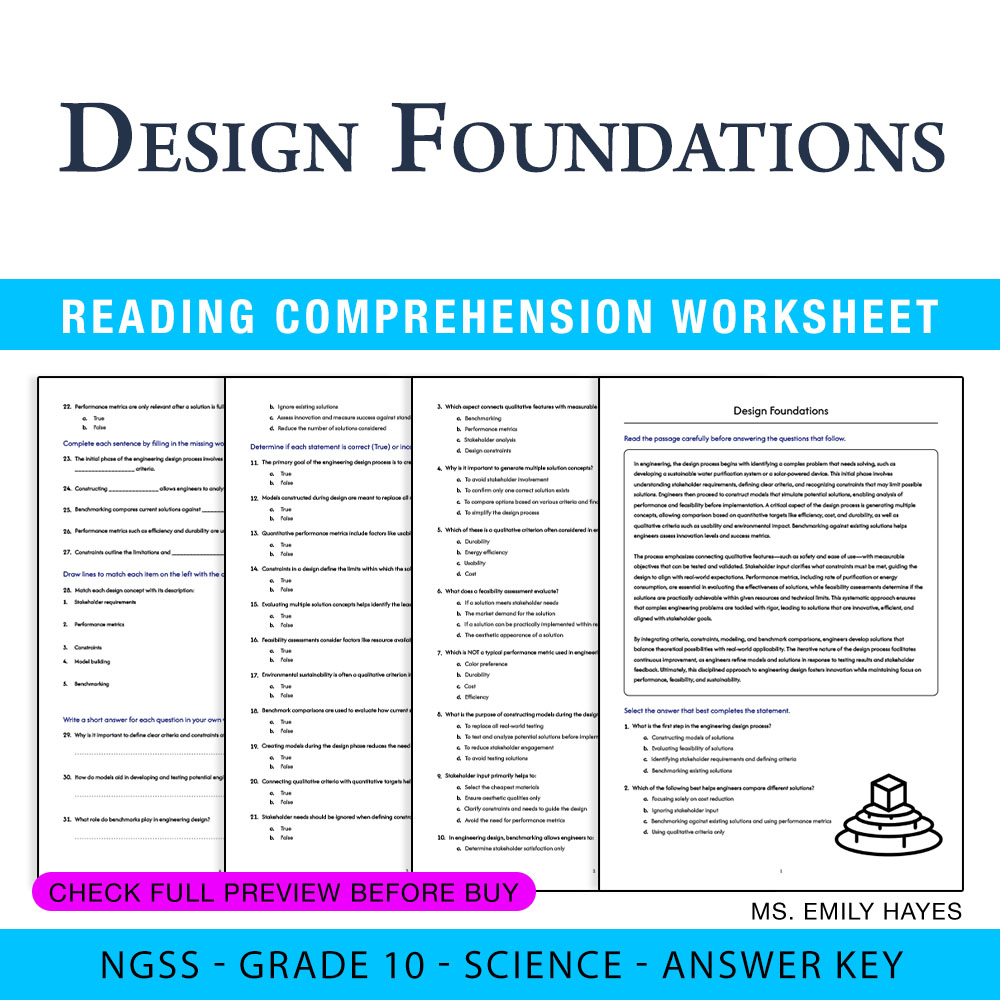
Grade 10 Science | Design Foundations Worksheet (PDF+ Answer Key)
Created byCopper Leaf ClassroomLearning Objectives
- Understand the engineering design process and its key steps.
- Apply criteria and constraints to develop feasible solutions for complex problems.
- Construct models and generate multiple solution concepts based on stakeholder needs.
Instant download

Grade 10 Science | Energy Forms Worksheet | BC Standards
Created byLumora LearningLearning Objectives
- Identify different forms of energy such as kinetic, potential, thermal, chemical, radiant, and nuclear.
- Explain how systems store and transfer energy during various processes.
- Recognize examples of energy transformation in physical and biological systems.
Instant download

Grade 10 Science | Statistical Reasoning Worksheet (Ontario Standard) (PDF)
Created byEvergreen Desk EducationLearning Objectives
- Identify and interpret measures of central tendency and spread to describe variability in classroom science data
- Distinguish statistical significance from practical significance when drawing conclusions from samples
- Explain how confidence intervals and comparative tests provide evidence while accounting for assumptions and limits
Also included in: Grade 10 Scientific Inquiry & Data Reasoning Science Lesson Bundle: Ontario +1 more
Instant download

Grade 10 Particle Interactions Worksheet | NGSS Chemistry Science Activity
 Created byBRIGHT PATH RESOURCES
Learning Objectives
- Understand key concepts related to Science
- Apply knowledge through practice questions
- Demonstrate comprehension of the material
Also included in: Matter and Its Interactions Grade 10 Science Lesson Bundle | NGSS +1 more
Instant download

Grade 10 Science Worksheet Periodic Trends | Standards-Aligned Practice
JCreated byJ.S SheetsLearning Objectives
- Explain how effective nuclear charge and electron shielding influence atomic size, ionization energy, and ion formation
- Describe periodic trends across periods and down groups using changes in electron arrangements
- Predict typical ion charges and bonding tendencies based on valence electrons
Also included in: Grade 10 Matter, Energy, and Waves Science Lesson Bundle – Florida (NGSSS) +1 more
Instant download

Population Growth Worksheet | Science Grade 10 Assessment & Student Practice
Learning Objectives
- Use birth rate and death rate ideas to explain how populations increase or decrease over time.
- Compare exponential growth and logistic growth models, including the role of carrying capacity.
- Identify density-dependent and density-independent limiting factors and connect them to changes in population abundance.
Also included in: Grade 10 Ecosystem Dynamics Lesson Bundle | NGSS Science Ecology
Instant download

Grade 10 Trophic Relationships in Ecosystems Worksheet | NGSS Science
Created byBRIGHT PATH RESOURCESLearning Objectives
- Identify different trophic levels in terrestrial ecosystems.
- Understand energy transfer in food chains and food webs.
- Describe the roles of keystone species and trophic cascades.
Also included in: Grade 10 Ecology Lesson Bundle | Daily Reading | ngss Science +1 more
Instant download

Nutrient Cycles Worksheet | Grade 10 Science NGSSS | Ecosystems Practice + Key
Created byEvergreen Desk EducationLearning Objectives
- Explain how nutrients (e.g., nitrogen and carbon) move through ecosystems via biotic and abiotic pathways
- Compare nutrient cycling with one-way energy flow through trophic levels
- Describe the roles of decomposers, soil, and water in returning elements to producers
Instant download

Design Tradeoffs Worksheet for Grade 10 Science | Standards-Aligned Practice
JCreated byJ.S SheetsLearning Objectives
- Understand the concept of tradeoffs in engineering design and optimization.
- Identify how balancing competing criteria impacts structural design decisions.
- Analyze different design features to determine which tradeoffs matter most for specific requirements.
Also included in: Grade 10 Engineering Design Optimization Science Lesson Bundle +1 more
Instant download

Science Worksheet Nutrient Cycles | Standards-Aligned Grade 10 Assessment
JCreated byJ.S SheetsLearning Objectives
- Explain how key nutrients cycle through ecosystems as organisms take in and release chemical elements.
- Describe the roles of decomposers, soil, and water in nutrient cycling.
- Compare the direction of energy flow with the cycling of matter and nutrients.
Also included in: Grade 10 Life Science Evolution, Genetics & Cells Lesson Bundle – Florida NGSSS +1 more
Instant download

Grade 10 Worksheet B: Hazard Influence (Grade 10 Science) Worksheet | NGSS
Created byClear Sky ClassroomLearning Objectives
- Analyze how freshwater availability, natural hazards, and climate variability influence where people live and how they use land.
- Explain relationships among resource distribution, hazard occurrence, and societal responses using spatial and temporal evidence.
- Evaluate how data sources (paleoclimate records, flood frequency, and historical migration) support claims about human–environment interactions.
Also included in: Grade 10 Climate & Natural Hazards Science Lesson Bundle (NGSS) +1 more
Instant download
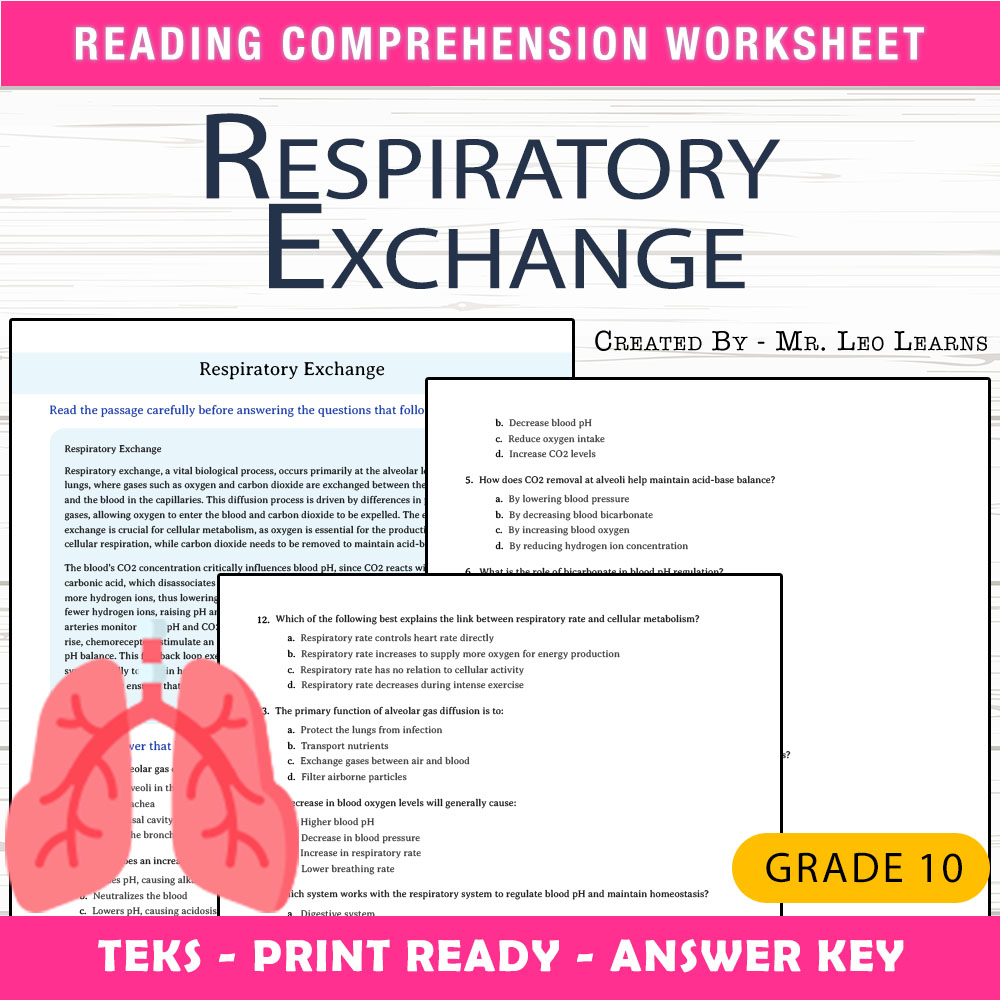
Grade 10 Science – Respiratory Exchange Worksheet for Mastery
Created byThe Resource HubLearning Objectives
- Explain the process of alveolar gas diffusion involving oxygen and carbon dioxide.
- Describe how changes in CO2 concentration affect blood pH and respiratory rate.
- Understand the relationship between respiratory function, cellular metabolism, and homeostasis.
Also included in: Grade 10 Science Worksheet Bundle – Cellular, Genetics & Ecology Mastery
Instant download

Microscopic Thermal Model Worksheet | Grade 10 Science Practice
Created byPrism Point LearningLearning Objectives
- Explain temperature using a microscopic model of particle motion and average kinetic energy.
- Use the microscopic thermal model to describe how heat transfers between objects.
- Predict how energy moving into or out of a system changes particle motion and observable temperature.
Instant download

Gene Regulation Worksheet | Grade 10 Science Activities
Created byPrism Point LearningLearning Objectives
- Explain how promoters, enhancers, and transcription factors control transcriptional initiation.
- Describe how post-transcriptional mechanisms such as alternative splicing and RNA interference affect mRNA outcomes.
- Connect epigenetic modifications to changes in chromatin accessibility and long-term gene expression.
Also included in: Genetics & Molecular Biology Lesson Bundle | Grade 10 Science | TEKS
Instant download

Grade 10 Science | Inheritance Patterns - Daily Reading Comprehension
 Created byCoral Reef Learning
Learning Objectives
- Understand the principles of Mendelian inheritance.
- Identify dominant and recessive alleles using Punnett squares.
- Explain the concepts of linkage and chromosomal inheritance.
Also included in: Biology and Ecosystems Lesson Bundle – Grade 10 Science Advanced Placement +1 more
Instant download

Grade 10 Science – The Rock Cycle & Earth's Surface | Daily Reading Worksheet
Created byQuiet Forest EducationLearning Objectives
- Identify the main types of rocks: igneous, sedimentary, and metamorphic.
- Describe the processes involved in the formation and transformation of rocks.
- Understand how plate tectonics influences the rock cycle.
Also included in: Earth Science Grade 10 Daily Reading Worksheets Bundle | Ontario Framework +1 more
Instant download

Climate Feedbacks Assessment for Grade 10 Science | Standards-Aligned
Created byPrism Point LearningLearning Objectives
- Understand the concept of climate feedbacks and their impact on global warming.
- Identify different types of feedback mechanisms such as water vapor, ice albedo, and cloud feedbacks.
- Explain how aerosols influence climate patterns and temperature changes.
Also included in: Grade 10 Climate Systems Science Lesson Bundle Assessments – General
Instant download

Grade 10 Science | Ecosystem Stability Worksheet (NGSS10 PDF)
 Created bySilver Birch Teaching
Learning Objectives
- Understand the concepts of resilience, thresholds, and stability landscapes in ecosystems.
- Analyze how natural and human disturbances affect ecosystem recovery and stability.
- Evaluate management strategies for restoring ecosystems and maintaining services under changing disturbance regimes.
Also included in: Grade 10 Ecosystem Stability and Biodiversity Science Lesson Bundle NGSS +1 more
Instant download

Periodic Trends Assessment | NGSSS Assessment Grade 10 Science
Created byPrism Point LearningLearning Objectives
- Explain how effective nuclear charge and electron shielding influence atomic size across a period and down a group
- Predict trends in ion formation by relating electron configuration to typical ion charges
- Use periodic trends to reason about changes in ionization energy across periods and groups
Also included in: Grade 10 Waves Energy Forces Science Lesson Mini Bundle | Florida NGSSS +1 more
Instant download
About Grade 10 Science Worksheets
Find Science worksheets built for Grade 10. All 7,038 cover core skills, practice, and review, each an instant PDF download.
Every worksheet on MyTeachingSheets is created by independent teacher-authors and reviewed before publication. All resources download as printable PDFs for classroom, homework, or at-home practice, and many include answer keys. Preview any worksheet free before buying.