
Grade 10 Science Worksheets
7,038 worksheets
Grade 10 Science | Projectile Motion Worksheet | AP Aligned
 Created byLumora Learning
Learning Objectives
- Explain the components of projectile motion and how they are independent under gravity.
- Use vector decomposition to calculate range, time of flight, and maximum height of projectiles.
- Apply parametric equations to link initial conditions with projectile trajectories.
Instant download

Grade 10 Science – Charge & Fields | Daily Reading Worksheet
 Created byBright Mind Resources
Learning Objectives
- Understand the properties of electric charge and the difference between positive and negative charges.
- Describe how electric fields are represented and how they influence other charges.
- Apply Coulomb's law to calculate the force between two charges.
Also included in: Grade 10 Daily Reading Science Full-Year Bundle for Alberta
Instant download

Understanding Measurement Uncertainty Assessment | Standards-Aligned Grade 10 Science
 Created byPrism Point Learning
Learning Objectives
- Explain how measurement uncertainty affects data interpretation.
- Identify factors contributing to measurement uncertainty.
- Evaluate whether differences in measurements are meaningful considering their uncertainty ranges.
Instant download

Grade 10 Science – Introduction to Motion Graphs Daily Reading Worksheet
Created byBright Mind ResourcesLearning Objectives
- Understand the basic features of position-time graphs
- Connect graphical features to the concepts of velocity and acceleration
- Learn to extract kinematic information from motion graphs
Also included in: Motion, Energy & Electricity Grade 10 Science Reading Worksheets Bundle | AP +2 more
Instant download
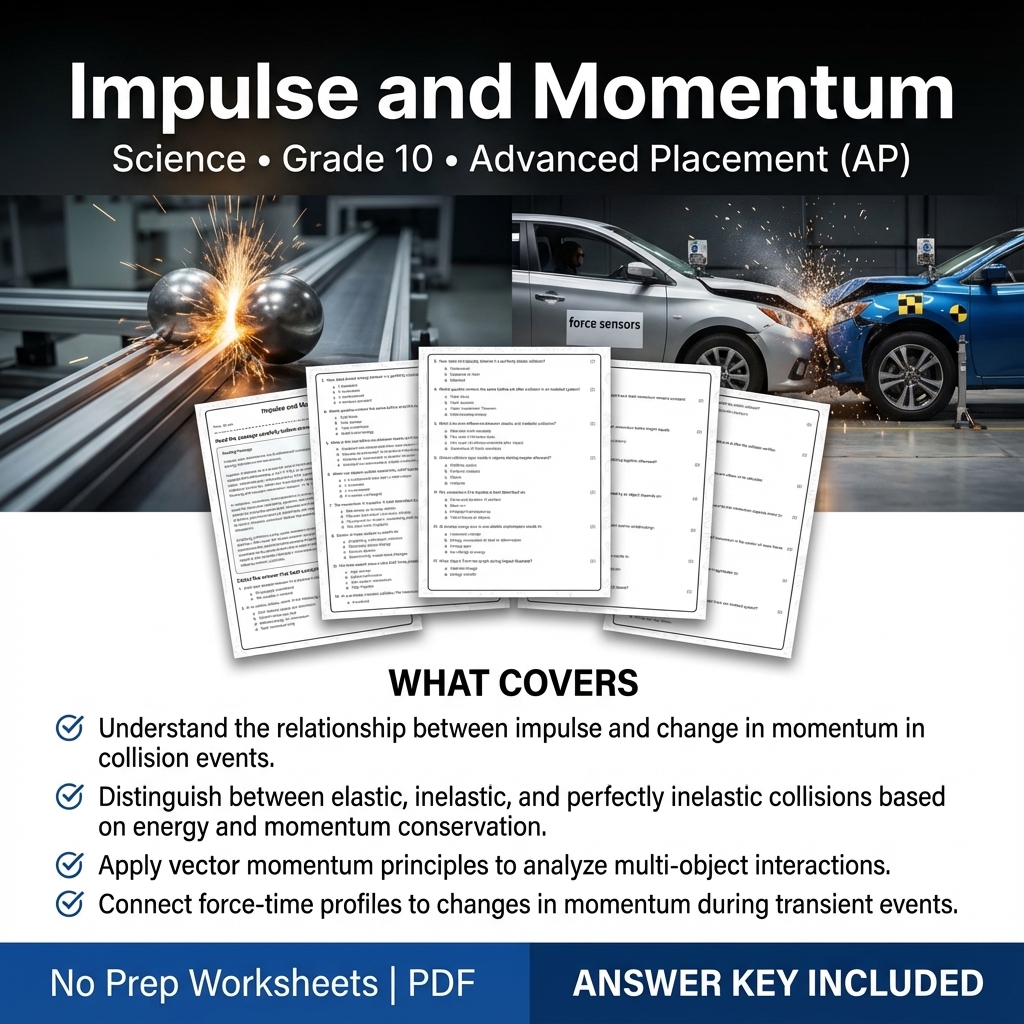
Grade 10 Science | Impulse and Momentum Worksheet (Printable PDF + Answer Key)
 Created byCoral Reef Learning
Learning Objectives
- Understand the relationship between impulse and change in momentum in collision events.
- Distinguish between elastic, inelastic, and perfectly inelastic collisions based on energy and momentum conservation.
- Apply vector momentum principles to analyze multi-object object interactions.
Also included in: Grade 10 Science Unit Worksheet Bundle – Motion, Energy & Forces (PDF Answers) +1 more
Instant download

Speciation Processes worksheet | Assessment Grade 10 Science printable PDF
Learning Objectives
- Explain how reproductive isolation arises through allopatric, sympatric, polyploidy, and behavioral mechanisms
- Use evidence from phylogeny and reproductive barriers to describe how new species form over time
- Compare ecological divergence and geographic separation as drivers of lineage splitting
Instant download

Grade 10 Science | Adaptation Strategies - Daily Reading Comprehension
Created byCoral Reef LearningLearning Objectives
- Understand various adaptation strategies used in Earth systems
- Evaluate the trade-offs of different mitigation and adaptation approaches
- Analyze systems diagrams, scenario comparisons, and cost-benefit data
Also included in: Earth and Space Sciences Lesson Bundle: Grade 10 Science Advanced Placement +1 more
Instant download

Membrane Structure Worksheet | Grade 10 Science Activities
Created byPrism Point LearningLearning Objectives
- Explain how the fluid mosaic model describes the plasma membrane as a dynamic structure of lipids and proteins.
- Describe how phospholipid bilayer asymmetry and cholesterol influence membrane function and fluidity.
- Compare membrane protein roles, including receptors and transporters, and relate them to signaling and transport.
Instant download

Enzymes and Transport Grade 10 Science Worksheet | Standards-Aligned Practice
JCreated byJ.S SheetsLearning Objectives
- Explain how enzymes increase reaction rates and provide specificity in biochemical pathways.
- Describe how membrane structure affects diffusion, osmosis, and selective transport (channels and pumps).
- Connect cell signaling to changes in reaction rates and gene expression for coordinated regulation.
Also included in: Grade 10 Genetics, Evolution, and Cell Science Lesson Bundle: General +2 more
Instant download
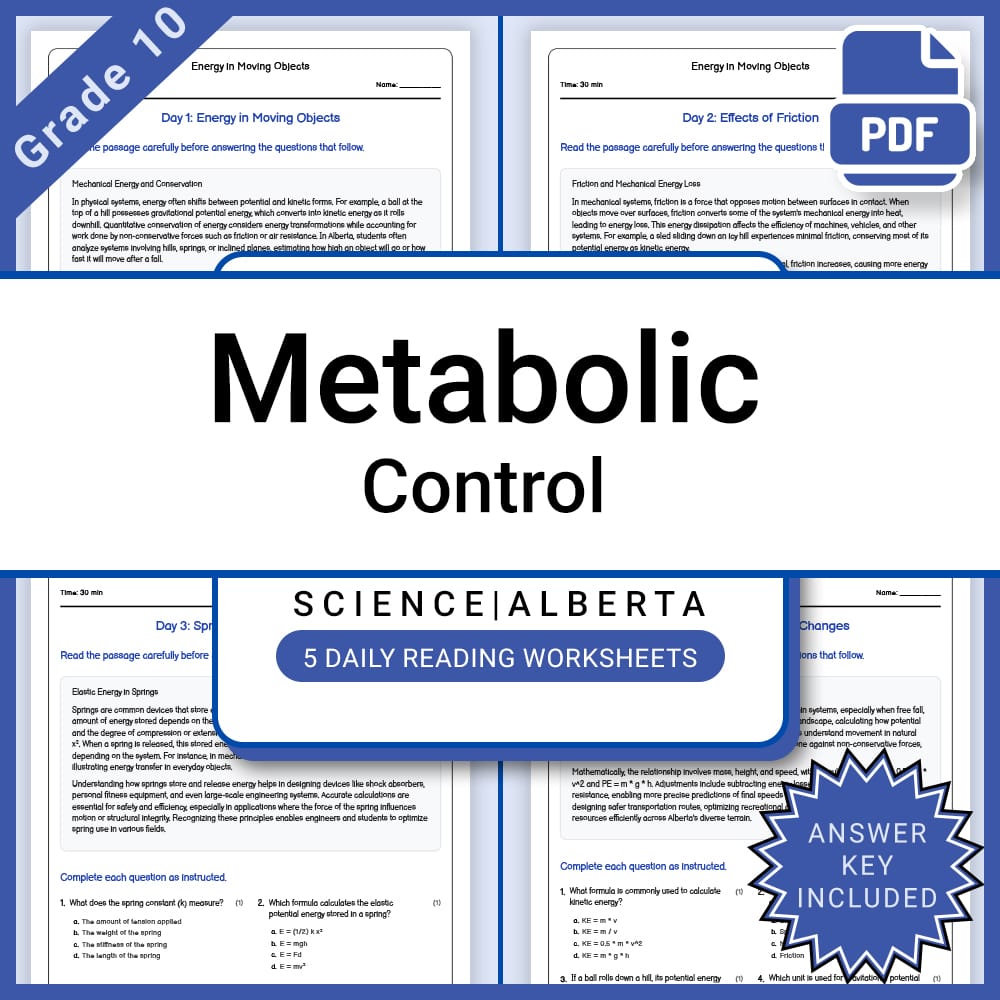
Grade 10 Science – Metabolic Control Daily Reading Worksheet + Answer Key
JCreated byJ.S SheetsLearning Objectives
- Understand how enzymes regulate cellular metabolism
- Identify feedback inhibition mechanisms
- Explain how compartmentalization affects metabolic pathways
Also included in: Grade 10 Science Lesson Group: Alberta Curriculum — Daily Reading Worksheets +1 more
Instant download

Stoichiometry & Limiting Reagents Worksheets: Grade 10 Science
 Created byBRIGHT PATH RESOURCES
Learning Objectives
- Explain why chemical equations must be balanced
- Interpret stoichiometric coefficients as whole-number particle ratios
- Predict relative reactant and product amounts
Also included in: Grade 10 Physical Science Worksheets Bundle | Forces, Energy & More +1 more
Instant download

Grade 10 Science – Computational Concepts & Dynamic Systems | Reading Worksheet
Created byBright Mind ResourcesLearning Objectives
- Understand basic computational approaches for modeling dynamic systems.
- Recognize the assumptions and limitations of numerical simulation methods.
- Describe how computational models assist in hypothesis generation and prediction.
Also included in: Grade 10 Scientific Reasoning Science Lesson Bundle | AP Daily Reading +2 more
Instant download
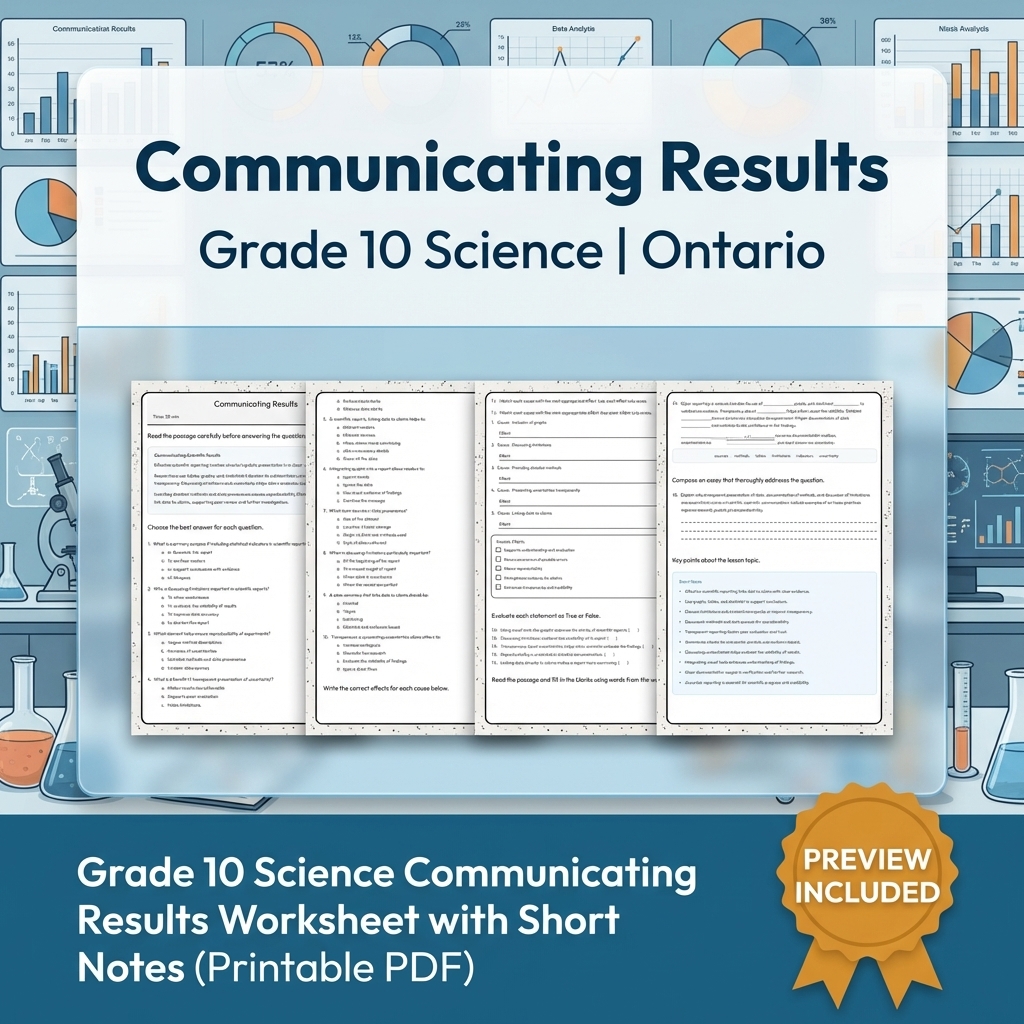
Grade 10 Science Communicating Results Worksheet with Short Notes
 Created byMeadowlark Worksheets
Learning Objectives
- Understand the conventions for clear and evidence-based reporting of scientific data.
- Learn how to structure summaries that link data to claims, discuss limitations, and present uncertainties transparently.
- Identify how to integrate tables, graphs, and statistical indicators to support conclusions.
Also included in: Grade 10 Science Lesson Group Bundle | Ontario Curriculum Worksheets +1 more
Instant download

Genetic Variation Sources and Consequences Worksheet | Grade 10 Science
JCreated byJ.S SheetsLearning Objectives
- Explain how random assortment, crossing over, and independent segregation create new allele combinations during meiosis.
- Describe how mutations and gene flow introduce genetic variation within and between populations.
- Connect genetic variation to the ability of populations to change over generations through natural selection.
Also included in: Grade 10 Genetics, Evolution, and Cell Science Lesson Bundle: General +2 more
Instant download

Grade 10 Science | Reaction Stoichiometry - Daily Reading Comprehension
Created byCoral Reef LearningLearning Objectives
- Understand the concept of the mole and its relation to particles and mass
- Learn to interpret and write balanced chemical equations
- Perform mass-to-mass stoichiometric calculations
Also included in: Chemistry Foundations Lesson Bundle: Grade 10 Science Advanced Placement (AP) +1 more
Instant download
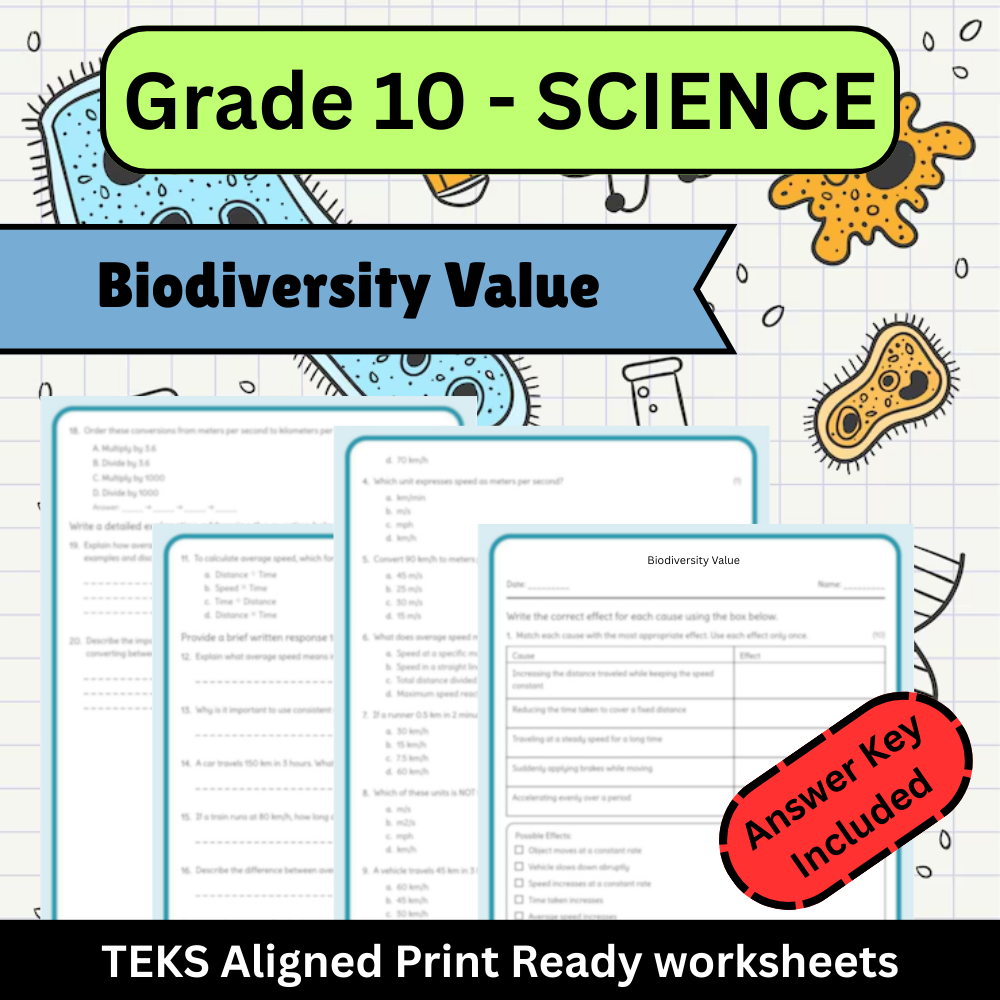
Grade 10 Science | Biodiversity Value Worksheet (Worksheet + Answer Key) – TEKS Aligned
Created byBright Mind ResourcesLearning Objectives
- Understand the different levels of biodiversity and their importance
- Explain how biodiversity contributes to ecosystem resilience and services
- Identify threats to biodiversity and conservation strategies
Also included in: Grade 10 Science | Ecosystems & Biodiversity Unit Worksheet Bundle(TEKS-Aligned) +5 more
Instant download

Carbon Cycling Between Air and Living Things Worksheet | Grade 10 TEKS
Created byBRIGHT PATH RESOURCESLearning Objectives
- Identify the main idea of a text about carbon cycling.
- Define key terms related to carbon reservoirs and processes.
- Explain how carbon moves between the atmosphere and living organisms.
Also included in: Grade 10 Metabolism & Energy Processes Science Worksheets Bundle | TEKS +1 more
Instant download

Motion Graphs Worksheet Grade 10 Science Activities | NGSSS Practice
Created byPrism Point LearningLearning Objectives
- Interpret slope on position-time and velocity-time graphs to determine velocity and acceleration.
- Use graph features (sign, curvature, and flat sections) to reason about changing direction and acceleration.
- Connect motion graph representations to how forces affect an object over time.
Also included in: Grade 10 Physical Science Lesson Bundle | Florida NGSSS
Instant download

Atmospheric Processes Worksheet | Science Practice for Grade 10 Alberta
JCreated byJ.S SheetsLearning Objectives
- Understand how pressure patterns, moisture transport, and thermal gradients influence weather and climate.
- Identify regional phenomena such as Chinook winds, frontal systems, and convective storms and their impacts.
- Explain how atmospheric composition, aerosols, and surface albedo modulate energy balance.
Also included in: Grade 10 Earth Systems & Climate Science Lesson Bundle – Alberta Framework +1 more
Instant download

Surface Processes Worksheet | Grade 10 AP Science Practice Activities
Created byPrism Point LearningLearning Objectives
- Differentiate weathering, erosion, sediment transport, and deposition and describe how each reshapes landforms over time.
- Interpret how climate drivers, lithology, and human modification influence rates and observable signatures of surface change.
- Use conceptual and graphical ideas (channel profiles, sediment grain size, and sediment budgets) to explain morphological change.
Also included in: Earth Systems, Climate & Adaptation Lesson Bundle: Grade 10 Science AP
Instant download

Modeling Evidence Test Prep Worksheet | Grade 10 Science Ontario
Created byPrism Point LearningLearning Objectives
- Construct conceptual and quantitative models to represent observed phenomena using theory and data.
- Estimate parameters and evaluate model fit using residuals and patterns in residual plots.
- Validate models against independent data and communicate predictive limits and uncertainty.
Also included in: Grade 10 Evidence-Based Science Data Analysis Lesson Bundle: Ontario
Instant download

Grade 10 Science — Worksheet MCQ Paper for Mastering Molecular Geometry
 Created byThe Resource Hub
Learning Objectives
- Explain the concept of molecular geometry using electron-domain models.
- Predict the three-dimensional shape of molecules based on electron pair arrangements.
- Describe how molecular shape influences polarity and intermolecular forces.
Also included in: Grade 10 Science Chemistry Foundations Lesson Bundle for AP Curriculum +1 more
Instant download

Grade 10 Reaction Stoichiometry Worksheet | AP Practice & PDF
 Created byClear Sky Classroom
Learning Objectives
- Use the mole concept and molar mass to convert between grams and moles in chemical reactions
- Apply balanced chemical equations to perform mass-to-mass stoichiometric calculations using mole ratios
- Identify the limiting reagent and estimate theoretical yield from balanced equations
Also included in: Grade 10 Chemistry Foundations Science Lesson Bundle: AP Worksheet Set +1 more
Instant download
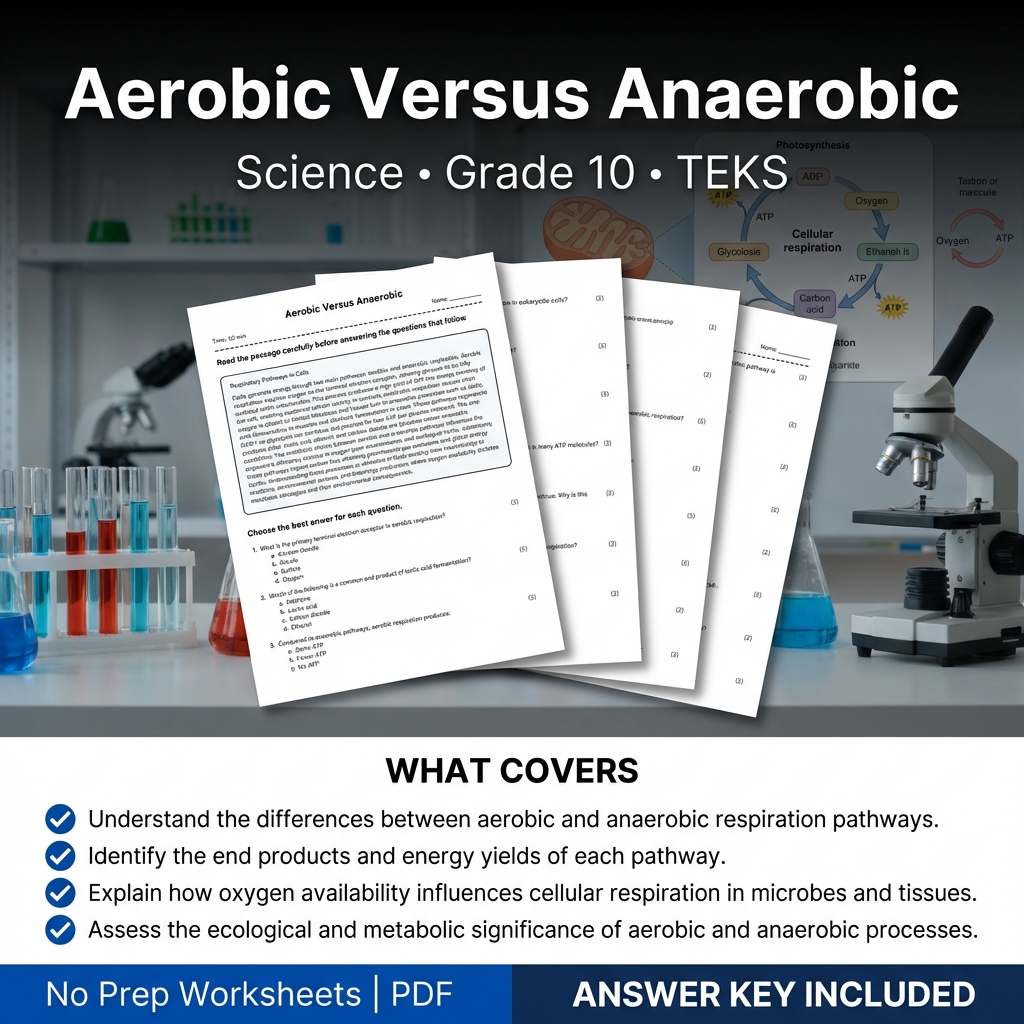
Grade 10 Science Worksheet on Aerobic vs Anaerobic Respiration | TEKS
Created byCoral Reef LearningLearning Objectives
- Understand the differences between aerobic and anaerobic respiration pathways.
- Identify the end products and energy yields of each pathway.
- Explain how oxygen availability influences cellular respiration in microbes and tissues.
Instant download

Grade 10 Science | Mutations and Traits Worksheet | NGSSS Aligned
Created byLumora LearningLearning Objectives
- Explain how mutations can change gene function or gene regulation and influence traits
- Identify common sources of mutations and distinguish among types by scale
- Analyze how environment can affect whether a mutation increases or decreases fitness
Instant download

Grade 10 Science – Measurement Uncertainty & Error | Daily Reading Worksheet
Created byBright Mind ResourcesLearning Objectives
- Define uncertainty and error in measurement
- Differentiate between systematic and random errors
- Interpret measurement uncertainty using concepts such as precision and accuracy
Also included in: Nature of Science Grade 10 Science Worksheets Lesson Bundle | Florida NGSSS +1 more
Instant download

Grade 10 Science | Limiting Reagent Worksheet | BC Aligned
Created byLumora LearningLearning Objectives
- Understand the concept of limiting reagent in chemical reactions.
- Learn how to compare stoichiometric ratios and available amounts in moles.
- Identify the limiting reactant in a chemical process.
Instant download

Science Worksheet Measurement and Interpretation | Standards-Aligned Grade 10
JCreated byJ.S SheetsLearning Objectives
- Select appropriate measurement units, instruments, and calibration methods to produce meaningful data.
- Interpret graphs and data tables by identifying trends, patterns, and the impact of outliers.
- Use significant figures and scale to compare measurements accurately and justify conclusions with evidence.
Also included in: Grade 10 Scientific Reasoning, Models & Evidence Science Lesson Bundle +1 more
Instant download

Grade 10 Science | Particle Interactions Worksheet (NGSS 10) (PDF)
 Created bySilver Birch Teaching
Learning Objectives
- Analyze how crystal structures, molecular interactions, and electrical forces influence macroscopic material properties.
- Differentiate between ionic lattices and molecular solids based on properties like melting point, solubility, and conductivity.
- Explain how lattice energy, dispersion forces, and hydrogen bonding affect phase transitions and physical properties.
Also included in: Grade 10 Chemical Reactions & Equilibrium Science Lesson Bundle NGSS +1 more
Instant download

Atmospheric Patterns Worksheet | AP Science Grade 10 Practice
JCreated byJ.S SheetsLearning Objectives
- Understand the structure and circulation of atmospheric pressure systems.
- Identify and explain the role of circulation cells in regional climate and weather phenomena.
- Interpret hypsometric, wind-field, and pressure-surface representations related to frontal systems and storm tracks.
Instant download

RNA Types and Protein Translation Worksheet | TEKS Grade 10 Science
Created byBRIGHT PATH RESOURCESLearning Objectives
- Identify the roles of mRNA, tRNA, and rRNA in translating genetic information into proteins.
- Explain how RNA differs from DNA in basic structure and pairing rules during transcription.
- Distinguish the functions of RNA types by matching them to steps in protein synthesis.
Also included in: Grade 10 Genetics & Molecular Biology Science Worksheets Bundle | TEKS +1 more
Instant download

Grade 10 Science – Membrane Transport & Cell Function | Daily Reading Worksheet
Created byBright Mind ResourcesLearning Objectives
- Understand the structure and function of cell membranes
- Identify mechanisms of membrane transport such as diffusion, osmosis, and facilitated transport
- Relate membrane properties to cellular functions like nutrient uptake and waste removal
Also included in: Grade 10 Science Daily Reading: Cells & Systems Lesson Bundle | Alberta +1 more
Instant download

Science Worksheet Wave Properties Grade 10 | Standards-Aligned Practice
JCreated byJ.S SheetsLearning Objectives
- Explain how waves transfer energy without transporting matter overall.
- Use amplitude, wavelength, frequency, and wave speed to describe wave behavior.
- Apply the relationship v = fλ to predict how frequency and wavelength change for waves traveling at the same speed.
Also included in: Grade 10 Matter, Energy, and Waves Science Lesson Bundle – Florida (NGSSS) +1 more
Instant download

Grade 10 Science – Properties of Metals & Nonmetals | Daily Reading Worksheet
 Created byQuiet Forest Education
Learning Objectives
- Understand the concept of physical properties and how they are measured.
- Differentiate between intensive and extensive properties.
- Identify measurable attributes such as density, melting point, and conductivity.
Also included in: Matter and Chemical Change Grade 10 Science Daily Reading Bundle | Ontario +1 more
Instant download

Net Force Motion Worksheet | NGSS Physics Activity with Answer Key
Learning Objectives
- Explain how net force determines acceleration using Newton’s second law (F = ma).
- Use vector addition to calculate net force when multiple forces act on an object.
- Interpret constant-acceleration motion using kinematics and motion graphs.
Instant download

Grade 10 AP Science Wave Behavior Worksheet Activities Physics
Created byPrism Point LearningLearning Objectives
- Differentiate transverse and longitudinal waves using amplitude, wavelength, frequency, and wave speed
- Explain how reflection, refraction, and interference affect wave behavior at boundaries
- Use superposition to reason about standing-wave formation and energy transfer
Instant download

Grade 10 Science – Signal Transmission & Modulation | Daily Reading Worksheet
Created byBright Mind ResourcesLearning Objectives
- Understand the basic concepts of signal modulation techniques.
- Identify different types of modulation such as amplitude, frequency, and phase.
- Recognize the factors affecting signal transmission like bandwidth, noise, attenuation, and dispersion.
Also included in: Signal Modulation Grade 10 Science Daily Reading Worksheets Bundle | NGSS +2 more
Instant download
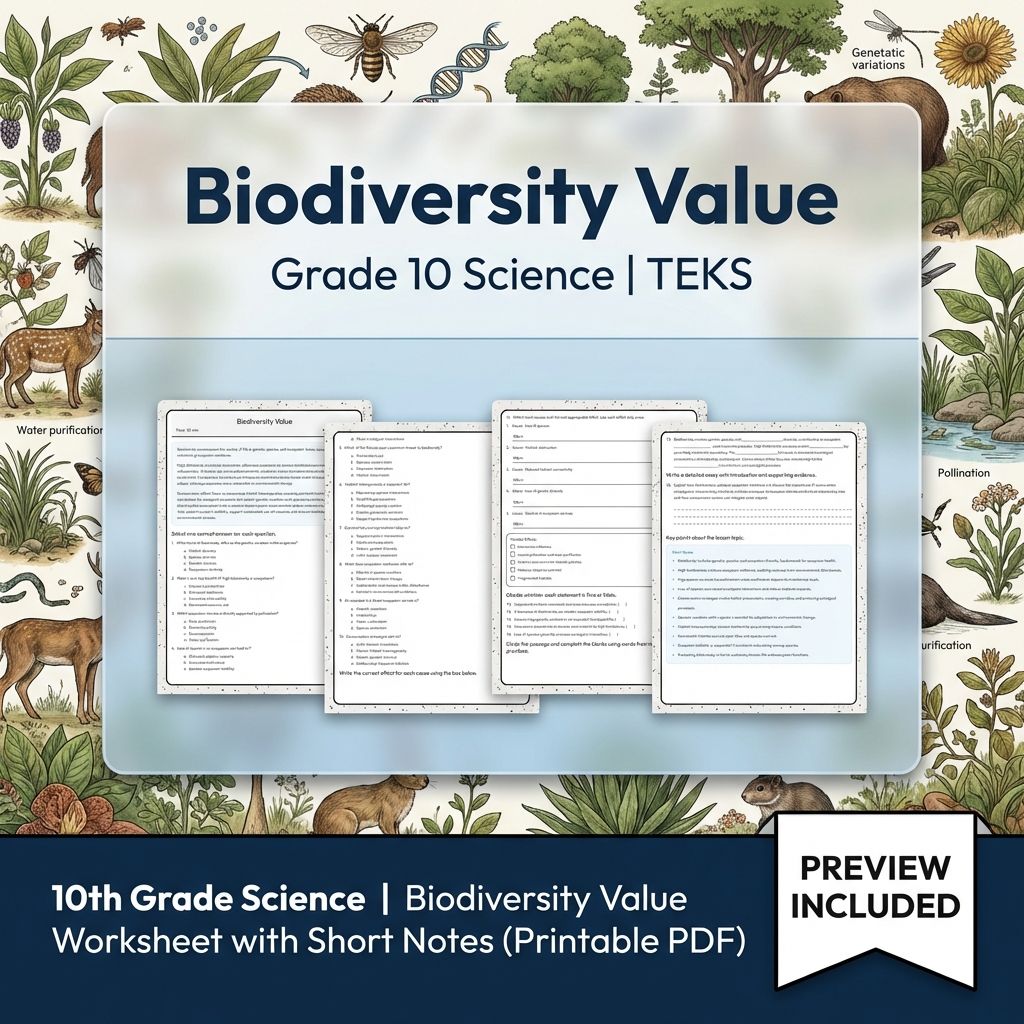
10th Grade Science | Biodiversity Value Worksheet with Short Notes (PDF)
Created byMeadowlark WorksheetsLearning Objectives
- Understand the components of biodiversity and their importance for ecosystem resilience.
- Explain how biodiversity contributes to ecosystem services such as pollination and water purification.
- Identify threats to biodiversity and their impacts.
Instant download

Grade 10 Science – Reaction Particles & Collision Concepts | Reading Worksheet
Created byBright Mind ResourcesLearning Objectives
- Understand how particle collisions influence chemical reactions
- Explain the role of energy in overcoming reaction barriers
- Describe how factors like temperature and catalysts affect reaction rates
Also included in: Stoichiometry Forces and Energy Lesson Bundle Grade 10 Science | General +1 more
Instant download

Directional Energy Flow in Food Chains Worksheet | TEKS Grade 10 Science
Created byBRIGHT PATH RESOURCESLearning Objectives
- Explain how energy moves through a food chain from producers to consumers.
- Identify which organisms receive energy at each trophic level.
- Describe the role of decomposers in recycling matter.
Also included in: Grade 10 Ecology & Environmental Interactions Science Worksheets | TEKS +1 more
Instant download

Grade 10 Worksheet B: Wave Properties Worksheet | NGSS Practice PDF
Created byClear Sky ClassroomLearning Objectives
- Use amplitude, wavelength, frequency, and propagation speed to characterize sinusoidal waves.
- Apply the relationship v = fλ to predict wave speed from frequency and wavelength.
- Interpret superposition and interference, including standing waves, using phase and trigonometric ideas.
Also included in: Grade 10 Wave Properties & Communication Science Lesson Bundle | NGSS +1 more
Instant download
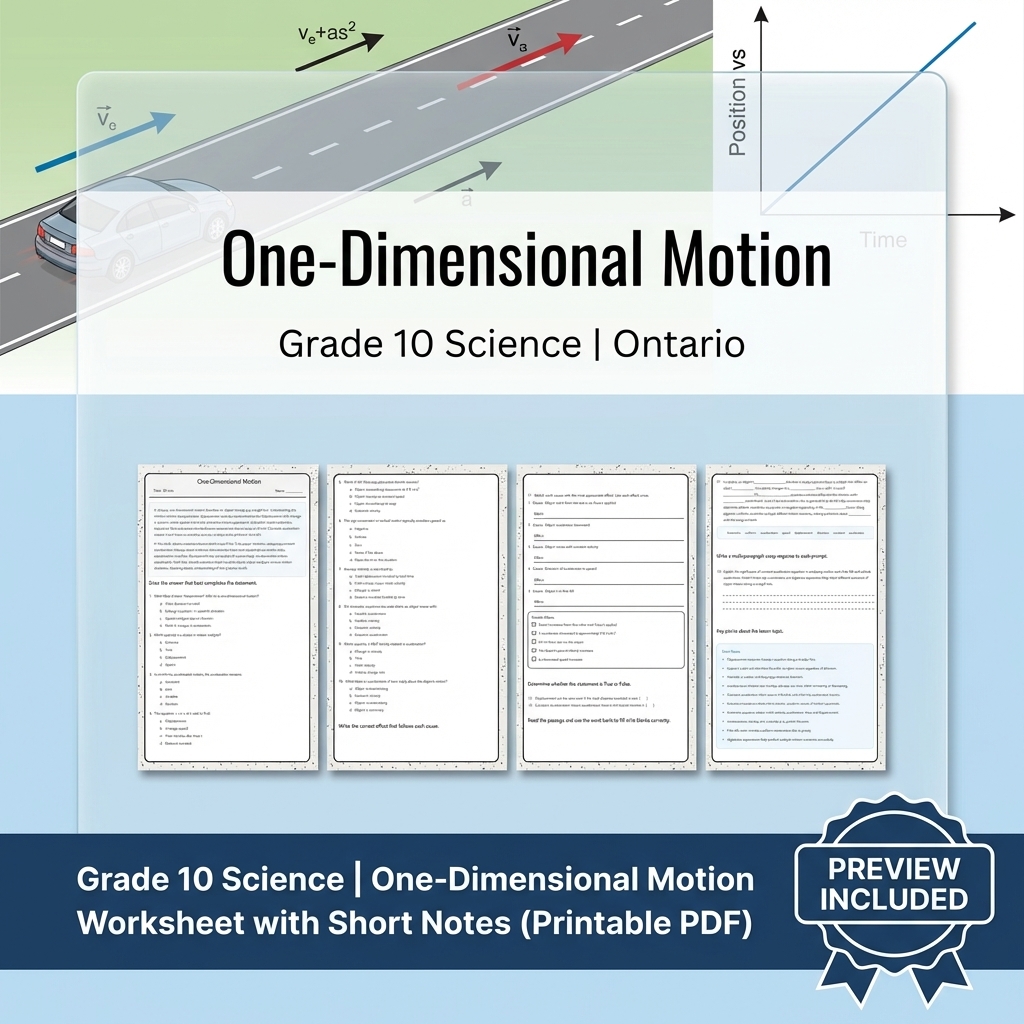
Grade 10 Science | One-Dimensional Motion Worksheet with Short Notes
Created byMeadowlark WorksheetsLearning Objectives
- Define and relate key kinematic quantities such as displacement, speed, velocity, and acceleration.
- Understand the concepts of average and instantaneous motion in one dimension.
- Apply constant-acceleration equations to scenarios like free-fall and uniformly accelerated motion.
Also included in: Grade 10 Science Lesson Group: Motion & Forces Ontario Curriculum Bundle +1 more
Instant download

Gravitation Fields Practice Worksheet | NGSS Grade 10 Science
JCreated byJ.S SheetsLearning Objectives
- Understand the concept of gravitational fields and how they relate to point-source inverse-square behavior.
- Apply Newtonian gravitational force equations to calculate orbital velocities and periods.
- Describe how gravitational field vectors represent the strength and direction of the field around masses.
Also included in: Grade 10 Forces, Momentum & Collisions Science Lesson Bundle – NGSS
Instant download

Gravitation Fields Worksheet | NGSS Physics Activity with Answer Key
Learning Objectives
- Explain how Newton’s law of gravitation leads to an inverse-square gravitational field for a point mass.
- Calculate gravitational field strength and gravitational potential energy changes near Earth and for other mass distributions (using the point-mass approximation).
- Use gravitational field and force ideas to reason about orbital motion and tidal effects qualitatively and quantitatively.
Instant download

Biodiversity Change Practice Worksheet | Grade 10 Science NGSS Review
Created byPrism Point LearningLearning Objectives
- Explain how human activities can cause biodiversity loss through habitat fragmentation, invasive species, and climate-driven changes.
- Compare evidence sources for biodiversity change, including fossil extinctions, population monitoring, and genetic diversity metrics.
- Describe how phylogenetic analysis and conservation planning support recovery and ecosystem resilience.
Also included in: Grade 10 Evolution & Speciation Science Lesson Bundle (NGSS)
Instant download

Grade 10 Science | Spheres Overview - Daily Reading Comprehension
Created byCoral Reef LearningLearning Objectives
- Identify the four main Earth's spheres: geosphere, hydrosphere, atmosphere, and biosphere.
- Describe the basic properties of each sphere.
- Explain how matter and energy flow among the Earth's spheres.
Also included in: Earth and Space Systems Lesson Bundle – Grade 10 Science Alberta +1 more
Instant download

Grade 10 Reaction Rates Worksheet | AP Practice & Assessment PDF
Created byClear Sky ClassroomLearning Objectives
- Explain how collision frequency, collision orientation, and activation energy affect reaction rates
- Interpret qualitative rate laws and concentration–time graphs to infer reaction order
- Describe how temperature and catalysts change reaction rates by changing reaction pathways
Also included in: Grade 10 Chemistry Foundations Science Lesson Bundle: AP Worksheet Set +1 more
Instant download

Science Worksheet Mutations and Traits Grade 10 | Standards-Aligned Practice
JCreated byJ.S SheetsLearning Objectives
- Explain how mutations can change DNA and influence gene function or regulation.
- Describe how environmental conditions affect whether a mutation increases or decreases fitness.
- Connect mutations to natural selection and the evolution of traits over generations.
Also included in: Grade 10 Life Science Evolution, Genetics & Cells Lesson Bundle – Florida NGSSS +1 more
Instant download
About Grade 10 Science Worksheets
Find Science worksheets built for Grade 10. All 7,038 cover core skills, practice, and review, each an instant PDF download.
Every worksheet on MyTeachingSheets is created by independent teacher-authors and reviewed before publication. All resources download as printable PDFs for classroom, homework, or at-home practice, and many include answer keys. Preview any worksheet free before buying.