
Grade 10 Science Worksheets
7,038 worksheets
Electromagnetic Induction Worksheet for Grade 10 Science | Practice
 Created byPrism Point Learning
Learning Objectives
- Explain electromagnetic induction using magnetic flux change and induced voltage
- Apply Faraday’s law and Lenz’s law to predict how induced current acts
- Describe how mechanical motion is converted into electrical energy in generators and transformers
Also included in: Grade 10 Work, Energy & Electricity Lesson Bundle | Alberta Science
Instant download

Grade 10 Science – Ecosystem Basics & Interactions | Daily Reading Worksheet
 Created byBright Mind Resources
Learning Objectives
- Define what an ecosystem is.
- Identify the main components of ecosystems.
- Understand the interactions among producers, consumers, and decomposers.
Also included in: Grade 10 Ecosystems Science Lesson Bundle Daily Reading | TEKS +2 more
Instant download

Grade 10 Constructing Claims Worksheet | Practice & Assessment PDF
 Created byClear Sky Classroom
Learning Objectives
- Explain the differences between a claim, evidence, and reasoning in an evidence-based scientific argument.
- Describe how a warrant connects data to an explanation and strengthens (or weakens) a claim.
- Evaluate claim strength by considering uncertainty in measurements and possible alternative explanations.
Also included in: Grade 10 Science Practices in Science: Lesson Bundle for Advanced Placement (AP) +1 more
Instant download
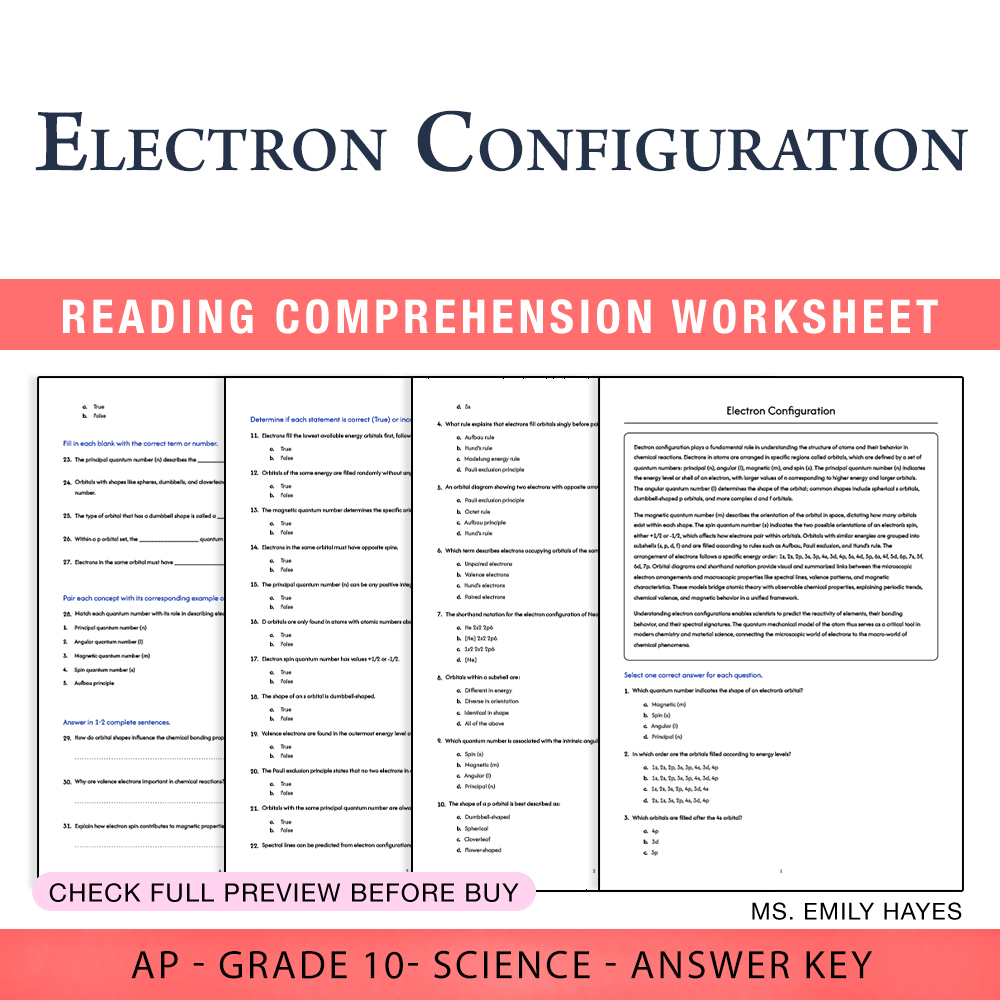
10th Grade Science | Electron Configuration Worksheet (PDF+ Answer Key)
 Created byCopper Leaf Classroom
Learning Objectives
- Explain the quantum numbers that describe electron positions in atoms.
- Understand how orbital shapes and energies are arranged in atoms.
- Use orbital diagrams and configuration shorthand to represent electron arrangements.
Also included in: Grade 10 Science -Atomic Structure & Chemical Reactions (PDF+ Answer Key) +1 more
Instant download

Chromosomes and Inheritance Worksheet Grade 10 Science Genetics Activity
Created byPrism Point LearningLearning Objectives
- Explain how chromosome number and arrangement determine which alleles are passed from parents to offspring.
- Describe how genes at specific loci on chromosomes influence inheritance patterns and trait outcomes.
- Differentiate simple dominance relationships from more complex, multi-gene inheritance that produces varied phenotypes.
Instant download

Science & Society: Technology And Society Grade 10 Worksheet | NGSSS
JCreated byJ.S SheetsLearning Objectives
- Explain how technological development and scientific progress influence each other through social priorities and public values.
- Analyze examples of technology in medicine, communication, and environmental monitoring and identify potential societal trade-offs.
- Evaluate how scientific findings can affect policy, risk management, and ethical decision-making.
Also included in: Grade 10 Scientific Reasoning, Models & Evidence Science Lesson Bundle +1 more
Instant download

Grade 10 TEKS Intercellular Communication Signals & Receptors Worksheet
 Created byBRIGHT PATH RESOURCES
Learning Objectives
- Identify the main parts of intercellular signaling: signal, receptor, and response
- Explain how receptor–ligand specificity helps cells produce the correct response
- Describe how signals are converted into cellular responses through signal transduction
Also included in: Grade 10 Cell Structure & Function Science Worksheets Bundle | TEKS Biology +1 more
Instant download

Carbon Cycling Worksheet Practice | Grade 10 Science NGSS
Created byPrism Point LearningLearning Objectives
- Explain major carbon fluxes among the atmosphere, terrestrial biosphere, ocean, and lithosphere.
- Identify sources and sinks of atmospheric CO2 and describe important feedbacks that affect climate forcing.
- Use conceptual and quantitative ideas (flux magnitude, residence time) to reason about changes in atmospheric CO2.
Instant download

Grade 10 Science – Causal Complexity & Ecosystems | Daily Reading Worksheet
Created byBright Mind ResourcesLearning Objectives
- Interpret causal diagrams such as control matrices and causal graphs.
- Identify relationships between environmental factors like temperature, nutrients, and moisture.
- Distinguish confounding factors and interaction effects in ecological data.
Also included in: Grade 10 Scientific Reasoning Science Lesson Bundle | AP Daily Reading +2 more
Instant download

Grade 10 Science Reference Frames Worksheet (AP) – Motion & Position Practice
 Created byEvergreen Desk Education
Learning Objectives
- Use a chosen reference frame to define position and displacement for 1D motion.
- Relate position-time, velocity-time, and acceleration-time ideas using algebraic expressions.
- Distinguish constant-velocity and constant-acceleration models and state their assumptions and limits.
Also included in: Grade 10 Motion & Forces Science Lesson Bundle (AP) Worksheet Set +1 more
Instant download

Grade 10 Science – Forces & Acceleration | Daily Reading Worksheet
Created byBright Mind ResourcesLearning Objectives
- Identify different types of forces such as gravity, normal force, friction, and tension.
- Understand how forces influence the motion and acceleration of objects.
- Interpret free-body diagrams to analyze the net force acting on an object.
Also included in: Grade 10 Forces & Motion Science Daily Reading Worksheets Lesson Bundle | BC +1 more
Instant download

Grade 10 Science – Carrying Capacity in Ecosystems | Worksheet + Answer Key
JCreated byJ.S SheetsLearning Objectives
- Define carrying capacity and explain its importance in ecology.
- Identify factors that influence carrying capacity of environments.
- Analyze how environmental changes affect population sizes.
Also included in: Grade 10 Science Lesson Group – Ecosystems and Environmental Impact Worksheets +1 more
Instant download

Comparative Anatomy Assessment for Grade 10 Science | TEKS Standards
Created byPrism Point LearningLearning Objectives
- Understand the concept of homologous and analogous structures in organisms.
- Identify vestigial organs and their significance in evolutionary biology.
- Analyze the importance of integrating anatomical, embryological, and molecular data in evolutionary studies.
Also included in: Grade 10 Evolution and Heredity Science Lesson Bundle for TEKS Standards
Instant download

Grade 10 Science | Constructing Claims in Science - Daily Reading Comprehension
 Created byCoral Reef Learning
Learning Objectives
- Understand the structure of evidence-based scientific claims.
- Identify components such as claim, evidence, reasoning, and warrants.
- Analyze how evidence supports or refutes a scientific claim.
Also included in: Science Practices Reading Comprehension Lesson Bundle: Grade 10 Science AP +1 more
Instant download

Process Comparison Worksheet | Grade 10 Science Activities
Created byPrism Point LearningLearning Objectives
- Compare photosynthesis and cellular respiration by identifying their inputs and outputs.
- Explain how carbon moves through biological systems in a reciprocal cycle.
- Connect energy transformations (light energy to ATP/chemical energy) across cellular and ecosystem scales.
Also included in: Metabolism & Energy Processes Lesson Bundle — Grade 10 Science TEKS
Instant download

Selective Mechanisms Worksheet for Grade 10 Science | NGSS Aligned Assessment
JCreated byJ.S SheetsLearning Objectives
- Understand how natural selection operates through variation, differential reproduction, and environmental pressures.
- Identify empirical examples of natural selection such as antibiotic resistance, industrial melanism, and beak variation.
- Explain the relationship between trait frequency changes and allele dynamics over generations.
Also included in: Grade 10 Evolution and Speciation Science Lesson Bundle – NGSS Framework
Instant download

Grade 10 Science – Metabolic Regulation Daily Reading Worksheet with Answer Key
JCreated byJ.S SheetsLearning Objectives
- Understand how enzyme activity is regulated in metabolic pathways
- Identify factors that activate or inhibit enzymes involved in metabolism
- Explain the role of cellular signaling and covalent modifications in enzyme regulation
Also included in: Grade 10 Science Lesson Bundle: Photosynthesis & Cellular Respiration TEKS +1 more
Instant download

Grade 10 Science | Physical Properties Worksheet (Ontario) PDF
Created byEvergreen Desk EducationLearning Objectives
- Distinguish intensive and extensive physical properties and identify examples of each.
- Classify physical changes by explaining how matter’s form or state can change without forming new substances.
- Use quantitative data (tabulated values or trends) to compare substances and support material identification and selection.
Also included in: Grade 10 Chemistry Fundamentals Science Lesson Bundle Worksheets: Ontario +1 more
Instant download

Reaction Rates Worksheet | Assessment for Grade 10 Science printable PDF
Learning Objectives
- Explain reaction rates using collision theory, including effective collisions and activation energy.
- Use rate laws and qualitative relationships to predict how temperature, concentration, surface area, and catalysts affect reaction speed.
- Interpret empirical rate data by connecting collision frequency, energy distribution, and observed rate constants.
Also included in: Matter and Its Interactions Lesson Bundle | Grade 10 Science | NGSS
Instant download

Endothermic and Exothermic Reactions Assessment | General Grade 10 Science
Created byPrism Point LearningLearning Objectives
- Understand the energy flow in endothermic and exothermic reactions.
- Identify qualitative signs of energy absorption or release during chemical reactions.
- Explain how energy profiles relate to bond formation and breaking.
Also included in: Grade 10 Physical Science Science Lesson Bundle: General Framework
Instant download

Science Worksheet DNA and Genes Grade 10 | Standards-Aligned Practice
JCreated byJ.S SheetsLearning Objectives
- Explain how genetic information is stored in DNA and organized into genes and chromosomes.
- Describe how gene information is expressed through transcription and translation into proteins or functional RNA.
- Connect inherited traits to DNA passed from parents and to sources of genetic variation.
Also included in: Grade 10 Life Science Evolution, Genetics & Cells Lesson Bundle – Florida NGSSS +1 more
Instant download

Grade 10 Science | Wave Behavior - Daily Reading Comprehension
Created byCoral Reef LearningLearning Objectives
- Identify and distinguish between transverse and longitudinal waves
- Understand key parameters of wave motion such as wavelength, frequency, amplitude, and wave speed
- Explain how waves transfer energy and information
Also included in: Physics Principles Reading Lesson Bundle Grade 10 Science Advanced placement +1 more
Instant download

Grade 10 Science | Cell Division Worksheet with Short Notes (Printable PDF)
 Created byMeadowlark Worksheets
Learning Objectives
- Understand the processes of mitosis and meiosis and their roles in growth and reproduction.
- Describe cell cycle checkpoints and mechanisms of apoptosis in maintaining cellular health.
- Explain the significance of chromosomal segregation and cyclin-dependent control in cell division.
Also included in: Grade 10 Science NGSS Bundle | Molecules to Organisms Structures & Processes +1 more
Instant download

Grade 10 Science Worksheet Multiple Evidence Lines Standards Aligned
JCreated byJ.S SheetsLearning Objectives
- Understand how different lines of empirical evidence support common ancestry and evolution.
- Identify examples of fossil, molecular, and biogeographic evidence for evolution.
- Explain how converging evidence strengthens scientific explanations of biodiversity.
Also included in: Grade 10 Genetic Variation and Evolution Science Lesson Bundle +1 more
Instant download

Organelles Worksheet Pack | Grade 10 Science Activities
Created byPrism Point LearningLearning Objectives
- Explain how membrane-bound and non-membrane-bound organelles carry out specialized cell functions.
- Describe how compartmentalization improves efficiency in cellular processes.
- Match specific organelles to their roles in energy conversion, protein production, and genetic control.
Instant download

Biodiversity Drivers Worksheet | NGSS Grade 10 Science Practice
JCreated byJ.S SheetsLearning Objectives
- Identify key factors that influence species richness and community composition.
- Explain the impacts of habitat fragmentation, invasive species, land-use change, and climate shifts on ecosystems.
- Analyze mechanisms like genetic diversity, metapopulation dynamics, and connectivity in species survival.
Instant download

Groundwater Systems Worksheets: Aquifers, Flow & Contamination Grade 10
Created byPrism Point LearningLearning Objectives
- Describe how porosity and permeability influence groundwater movement
- Compare unconfined and confined aquifer characteristics
- Explain how recharge and discharge affect groundwater systems
Also included in: Earth and Space Systems Grade 10 Science Ontario Bundle
Instant download

Grade 10 Science | Plate Boundaries Worksheet (NGSS) PDF
 Created bySilver Birch Teaching
Learning Objectives
- Understand the different types of plate boundaries and their geological features.
- Analyze processes such as seafloor spreading, subduction, and mountain formation.
- Explain the mechanisms of mantle convection and stress accumulation leading to earthquakes and volcanic activity.
Also included in: Grade 10 Earth Systems Science Lesson Bundle for NGSS ngss10 Worksheets +1 more
Instant download
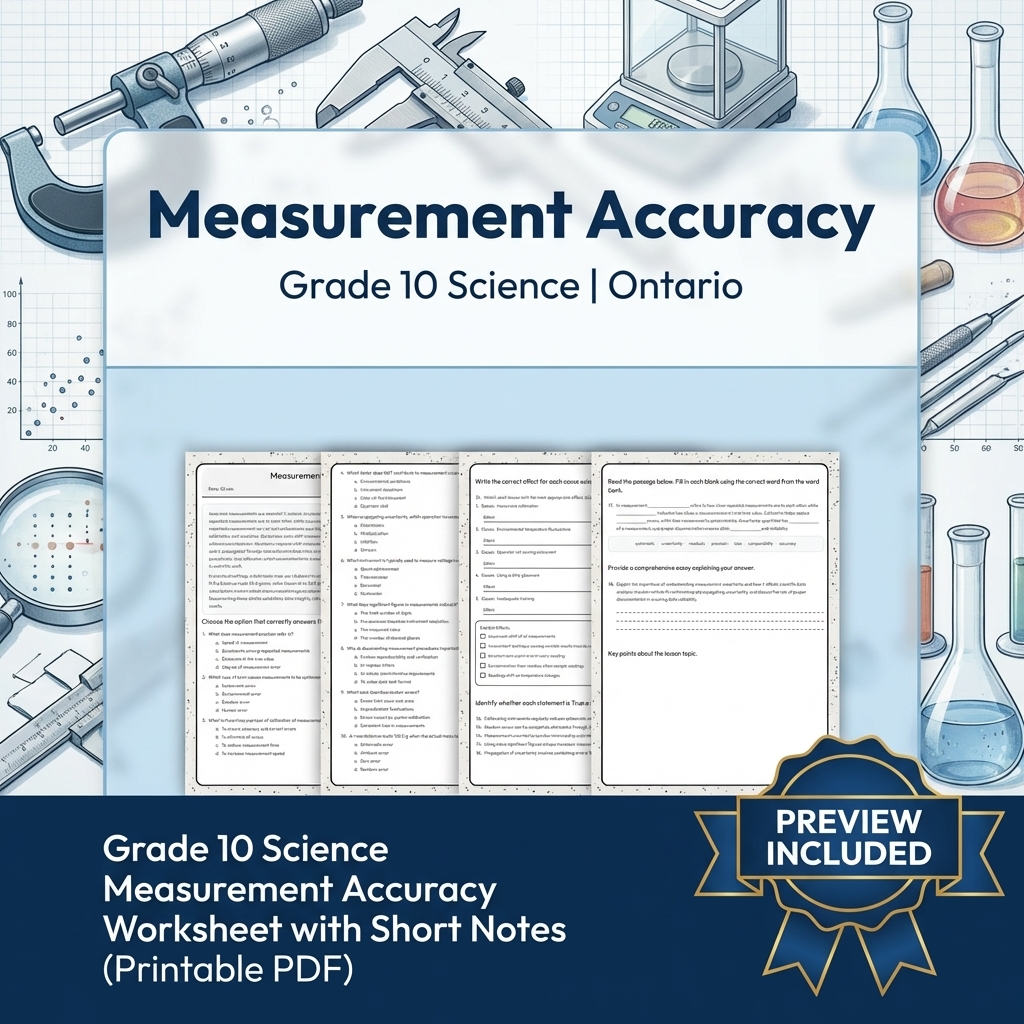
Grade 10 Science Measurement Accuracy Worksheet with Short Notes (Printable PDF)
Created byMeadowlark WorksheetsLearning Objectives
- Understand the principles of measurement precision and accuracy.
- Distinguish between systematic and random errors in measurements.
- Learn to estimate and propagate measurement uncertainty in calculations.
Also included in: Grade 10 Science Lesson Group Bundle | Ontario Curriculum Worksheets +1 more
Instant download

Grade 10 Science | Equilibrium Systems Reading Worksheet (PDF & Rubric)
JCreated byJ.S SheetsLearning Objectives
- Understand the conditions for static equilibrium through vector analysis of forces and moments.
- Describe the significance of the conditions ΣF = 0 and their implications for rigid bodies.
- Interpret the concepts of tension distribution, support reactions, and equilibrium as absence of net acceleration.
Also included in: Grade 10 Science Unit Bundle – Motion, Forces & Mechanics (Answer Keys Included) +1 more
Instant download

Grade 10 Science – Predator-Prey Dynamics & Ecosystems | Daily Reading Worksheet
Created byBright Mind ResourcesLearning Objectives
- Understand the roles of predators and prey within ecosystems
- Identify examples of predator-prey relationships
- Explain how predator and prey populations influence each other
Also included in: Grade 10 Genetics & Evolution Science Lesson Bundle | California Standards +1 more
Instant download

Grade 10 Uniform Circular Motion Worksheet | Angular & Radial Motion Ontario
 Created byChalk and Compass
Learning Objectives
- Explain how angular speed relates to linear speed in uniform circular motion using v = rω.
- Determine the centripetal acceleration and required inward net force for motion on a circular path.
- Interpret why a net inward force is necessary to keep an object moving along a curved trajectory.
Also included in: Grade 10 Science Motion, Forces & Momentum Lesson Bundle – Ontario Framework +1 more
Instant download

Ionic Solids Worksheet | AP Grade 10 Chemistry Practice Pack
Created byPrism Point LearningLearning Objectives
- Explain how ionic solids form crystal lattices and how ion charge and packing affect coordination number.
- Describe how lattice energy and Coulombic attraction influence melting point and solubility.
- Relate ionic motion in solids and molten states to electrical conductivity.
Instant download
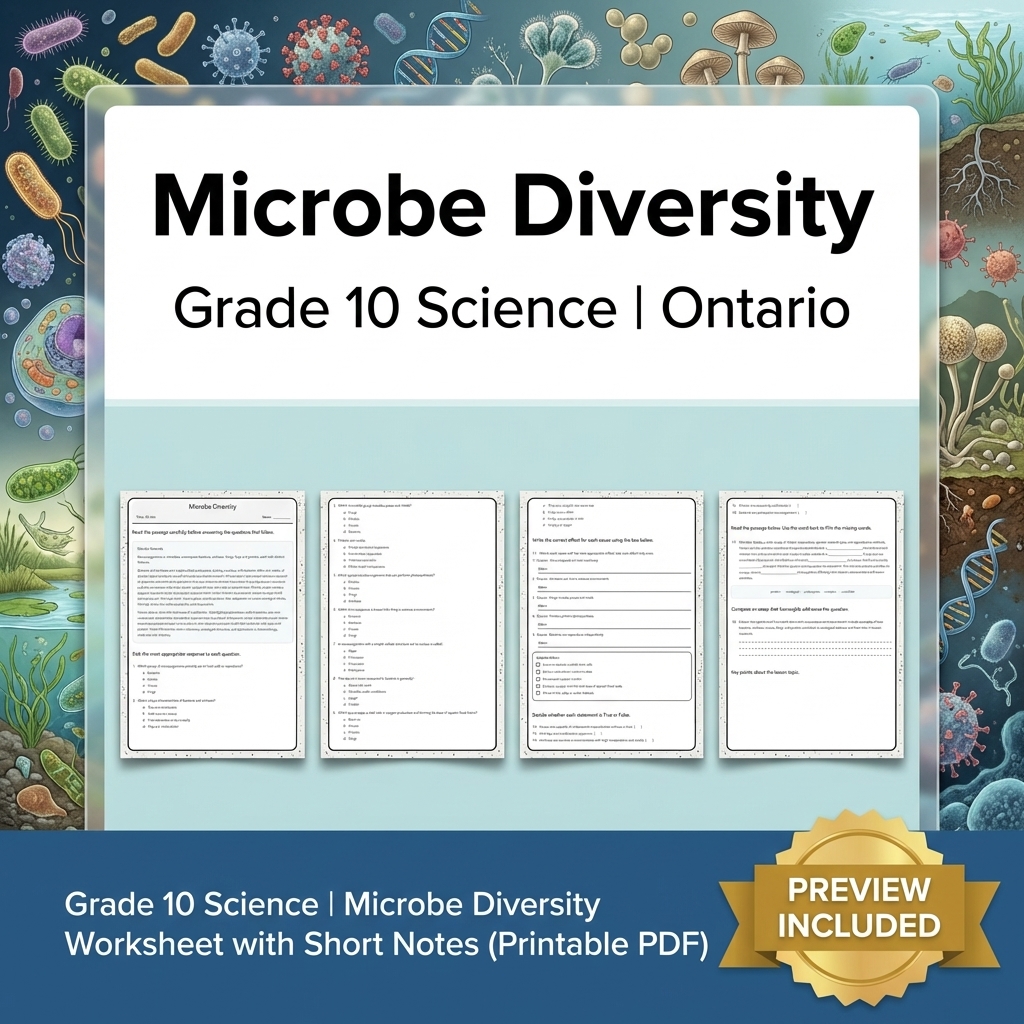
Grade 10 Science | Microbe Diversity Worksheet with Short Notes (Printable PDF)
Created byMeadowlark WorksheetsLearning Objectives
- Understand the major groups of microorganisms: bacteria, archaea, viruses, fungi, and protists.
- Compare cellular organization, genetic material, and reproductive strategies of different microbes.
- Recognize ecological roles and distinctions among microbial groups in ecosystems and human environments.
Also included in: Grade 10 Science Lesson Group Bundle | Ontario Curriculum +1 more
Instant download

Grade 10 Science | Model Evaluation Worksheet (NGSS 10) (PDF)
Created bySilver Birch TeachingLearning Objectives
- Understand how to compare computational models with empirical data using statistical methods.
- Analyze prototype performance datasets to identify failure modes and assess reliability.
- Evaluate the accuracy of models through validation techniques and uncertainty quantification.
Also included in: Grade 10 NGSS Science: Models, Systems, and Trade-Off Design Lesson Bundle +1 more
Instant download

Grade 10 Science – Homeostatic Balance & Regulation | Daily Reading Worksheet
Created byBright Mind ResourcesLearning Objectives
- Understand the concept of homeostasis and its significance in maintaining internal stability.
- Identify examples of homeostatic processes in mammals and aquatic life.
- Recognize the mechanisms involved in regulating internal conditions despite external changes.
Also included in: Grade 10 Science Daily Reading: Cells & Systems Lesson Bundle | Alberta +1 more
Instant download

Grade 10 Science Cosmic Origins Big Bang Evidence Worksheet | NGSS Activity
Created byBRIGHT PATH RESOURCESLearning Objectives
- Understand the key observational evidence supporting the Big Bang theory
- Learn about cosmic microwave background radiation and its significance
- Identify how redshift and elemental abundances provide insights into the universe's expansion
Also included in: Next Generation Science Standards Space Science Daily Reading Bundle | Grade 10 +1 more
Instant download

Grade 10 Science – Chemical Equilibrium Worksheet (NGSS10 PDF)
Created bySilver Birch TeachingLearning Objectives
- Understand how changes in pressure, concentration, and temperature shift chemical equilibria.
- Describe the role of catalysts in reaching equilibrium faster.
- Explain the significance of equilibrium constants as quantitative descriptors.
Also included in: Grade 10 Chemical Reactions & Equilibrium Science Lesson Bundle NGSS +1 more
Instant download

Nutrient Cycling Worksheet | NGSS Grade 10 Science Practice PDF
JCreated byJ.S SheetsLearning Objectives
- Explain the major biogeochemical cycles, including carbon and nitrogen fluxes among Earth's spheres.
- Identify key processes such as photosynthesis, respiration, nitrification, denitrification, and decomposition.
- Analyze how human activities like fossil fuel combustion and agriculture alter nutrient reservoirs and flux rates.
Instant download

Resource Tradeoffs Worksheet for Grade 10 Science | NGSS Practice
JCreated byJ.S SheetsLearning Objectives
- Analyze the environmental, economic, and sustainability trade-offs involved in resource development and management.
- Compare different energy and mineral resource extraction methods based on lifecycle emissions, ecosystem impacts, and resource depletion.
- Evaluate case studies of fossil fuels, renewable energy deployment, and mining practices to understand their long-term implications.
Also included in: Grade 10 Climate Change Science Lesson Bundle | NGSS Practice Worksheets
Instant download

Grade 10 Science – Mechanics Applications & Forces | Daily Reading Worksheet
 Created byQuiet Forest Education
Learning Objectives
- Understand the forces acting on objects on inclined planes
- Relate gravity, friction, and normal force to motion
- Apply Newtonian dynamics to analyze inclined plane scenarios
Also included in: Motion and Forces Grade 10 Science Daily Reading Worksheets Bundle | Ontario +1 more
Instant download

Grade 10 Science | Computational Concepts in Science - Reading Comprehension
Created byCoral Reef LearningLearning Objectives
- Understand the basic principles of discrete time stepping in simulations.
- Learn how to model population growth using simple computational methods.
- Recognize the assumptions and limitations associated with numerical simulations.
Also included in: Science Practices Reading Comprehension Lesson Bundle: Grade 10 Science AP +1 more
Instant download

Grade 10 Science — Worksheet MCQ Paper for Mastering Metabolic Pathways
 Created byThe Resource Hub
Learning Objectives
- Understand the key stages of glycolysis, the tricarboxylic acid cycle, and oxidative phosphorylation.
- Identify the flow of electrons and energy transfer during cellular respiration.
- Recognize the regulation points and pathway branching that adapt to cellular needs.
Also included in: Grade 10 Biology and Ecosystems Lesson Bundle | AP Science +1 more
Instant download

Grade 10 Science – Speciation Processes | Daily Reading Worksheet + Answer Key
JCreated byJ.S SheetsLearning Objectives
- Define speciation and identify its causes.
- Explain various reproductive barriers and their roles in speciation.
- Differentiate between allopatric, sympatric, and parapatric speciation.
Also included in: Grade 10 Science Lesson Bundle: Evolution and Genetics TEKS Framework +1 more
Instant download

Grade 10 Science Modeling Evidence Worksheet with Short Notes | PDF
Created byMeadowlark WorksheetsLearning Objectives
- Understand how to construct and evaluate both conceptual and quantitative models to explain observed phenomena.
- Analyze residuals and validate models using independent data.
- Experience exemplars such as projectile motion fits and population growth curves to learn model selection and uncertainty communication.
Also included in: Grade 10 Science Lesson Group Bundle | Ontario Curriculum Worksheets +1 more
Instant download

Wave Properties Worksheet Grade 10 Science NGSS with Answer Key
Created byBRIGHT PATH RESOURCESLearning Objectives
- Understand and identify basic wave features such as amplitude, wavelength, frequency, and speed.
- Learn the mathematical relationship v = fλ and apply it to real-world wave phenomena.
- Explore interference patterns, standing waves, and phase relationships.
Also included in: Wave & Communication Grade 10 Science Daily Reading Lesson Bundle | NGSS +1 more
Instant download

Energy Conversion Worksheet for Grade 10 Science | NGSS Aligned Assessment
JCreated byJ.S SheetsLearning Objectives
- Understand different forms of energy and how they convert from one to another in practical devices.
- Identify the efficiency metrics and common loss channels in energy conversion systems.
- Analyze pathways of energy flow in devices like photovoltaic cells, electric motors, and engines.
Also included in: Grade 10 Energy Conservation and Conversion Science Lesson Bundle: NGSS
Instant download

Genetic Drift and Random Allele Frequency Changes Worksheet | Grade 10
Created byBRIGHT PATH RESOURCESLearning Objectives
- Explain genetic drift as a random change in allele frequencies.
- Define key vocabulary: allele, allele frequency, and drift.
- Identify how chance events in small populations can alter genetic diversity.
Also included in: Grade 10 Evolution & Classification Science Worksheets Bundle | TEKS Biology +1 more
Instant download
About Grade 10 Science Worksheets
Find Science worksheets built for Grade 10. All 7,038 cover core skills, practice, and review, each an instant PDF download.
Every worksheet on MyTeachingSheets is created by independent teacher-authors and reviewed before publication. All resources download as printable PDFs for classroom, homework, or at-home practice, and many include answer keys. Preview any worksheet free before buying.