
Grade 12 Science Worksheets
4,240 worksheets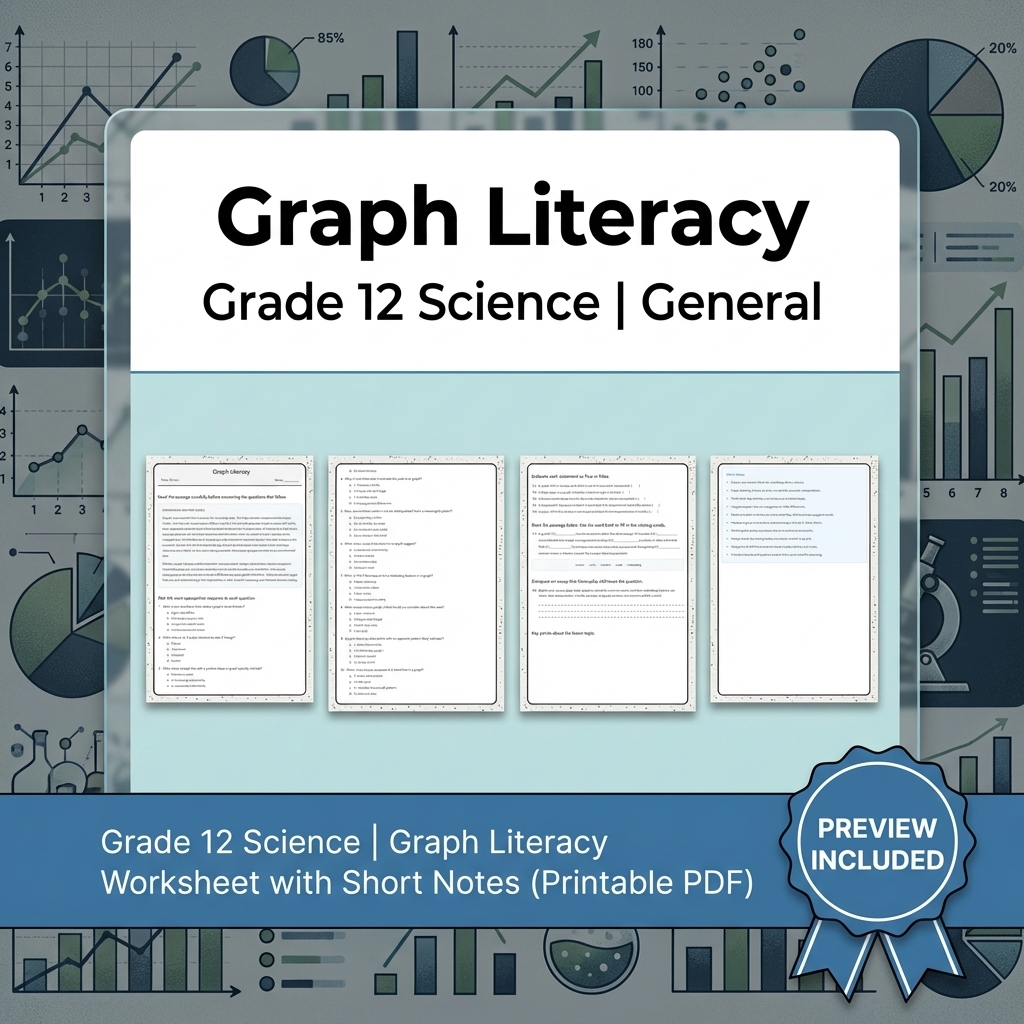
Grade 12 Science | Graph Literacy Worksheet with Short Notes (Printable PDF)
 Created byMeadowlark Worksheets
Learning Objectives
- Interpret axes, scales, and units on scientific graphs.
- Identify trend lines, slopes, and intercepts to evaluate data claims.
- Distinguish between meaningful patterns and random scatter in data visuals.
Also included in: Grade 12 Scientific Reasoning and Data Literacy Science Lesson Bundle +1 more
Instant download

Kinematic Foundations Worksheet Pack AP Physics Grade 12 Practice
 Created byPrism Point Learning
Learning Objectives
- Describe one-dimensional motion using displacement, velocity, and acceleration with correct sign conventions.
- Interpret position–time and velocity–time graphs by relating slope and area to physical quantities.
- Apply constant-acceleration kinematic equations to predict motion from initial conditions.
Also included in: AP Physics Grade 12 Science Mechanics & Electricity Lesson Bundle | AP
Instant download
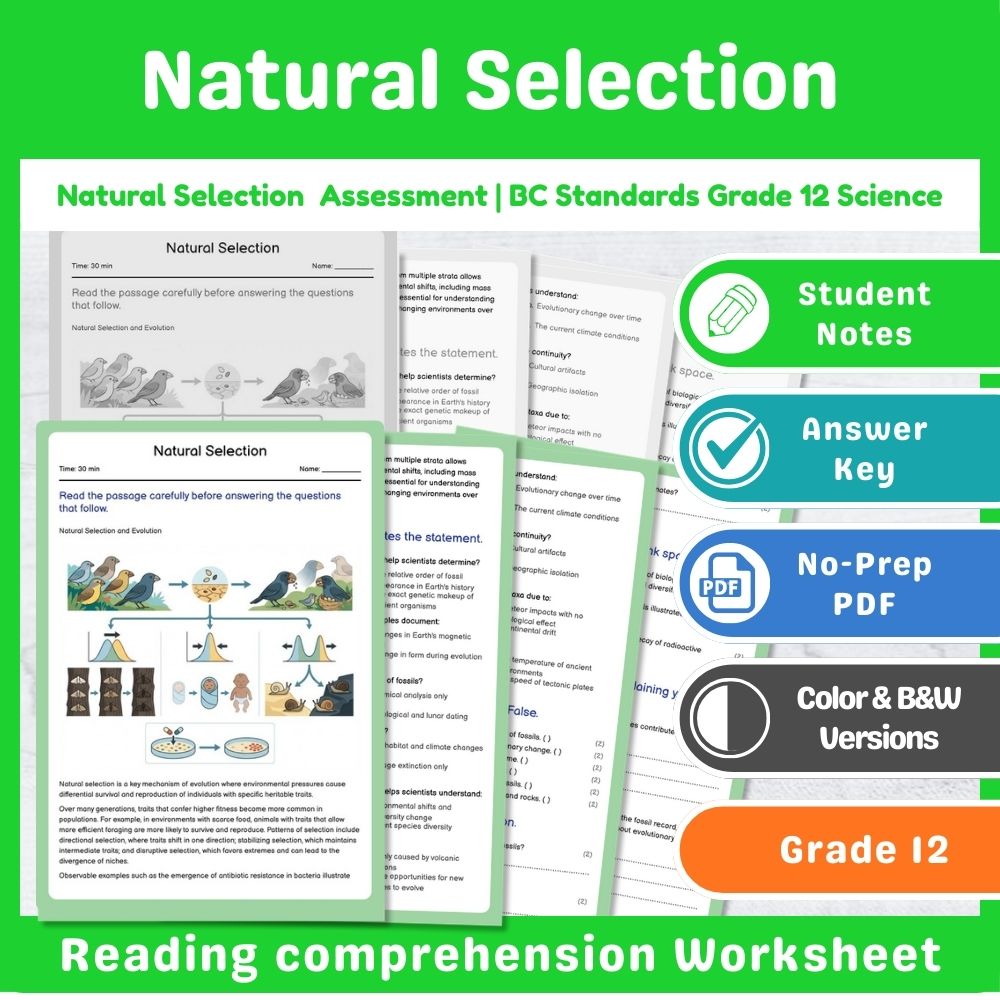
Natural Selection Assessment | BC Standards Grade 12 Science
Created byPrism Point LearningLearning Objectives
- Understand the fundamental principles of natural selection and how environmental pressures influence evolution.
- Identify different patterns of selection such as directional, stabilizing, and disruptive selection.
- Explain observable examples of natural selection, including antibiotic resistance and adaptation.
Also included in: Grade 12 Science Mini Bundle – Genetics & Evolution Assessment Pack
Instant download

Energy Transformation Assessment for Grade 12 Science | Florida NGSSS
Created byPrism Point LearningLearning Objectives
- Explain how energy transforms between kinetic, potential (gravitational), and thermal forms in physical systems.
- Use observable evidence (speed, height, and temperature change) to infer energy transfers.
- Apply the conservation of energy concept to predict outcomes when mechanical energy and thermal energy are involved.
Also included in: Grade 12 Momentum, Energy, and Reactions Science Assessment Lesson Bundle – Florida NGSSS +1 more
Instant download
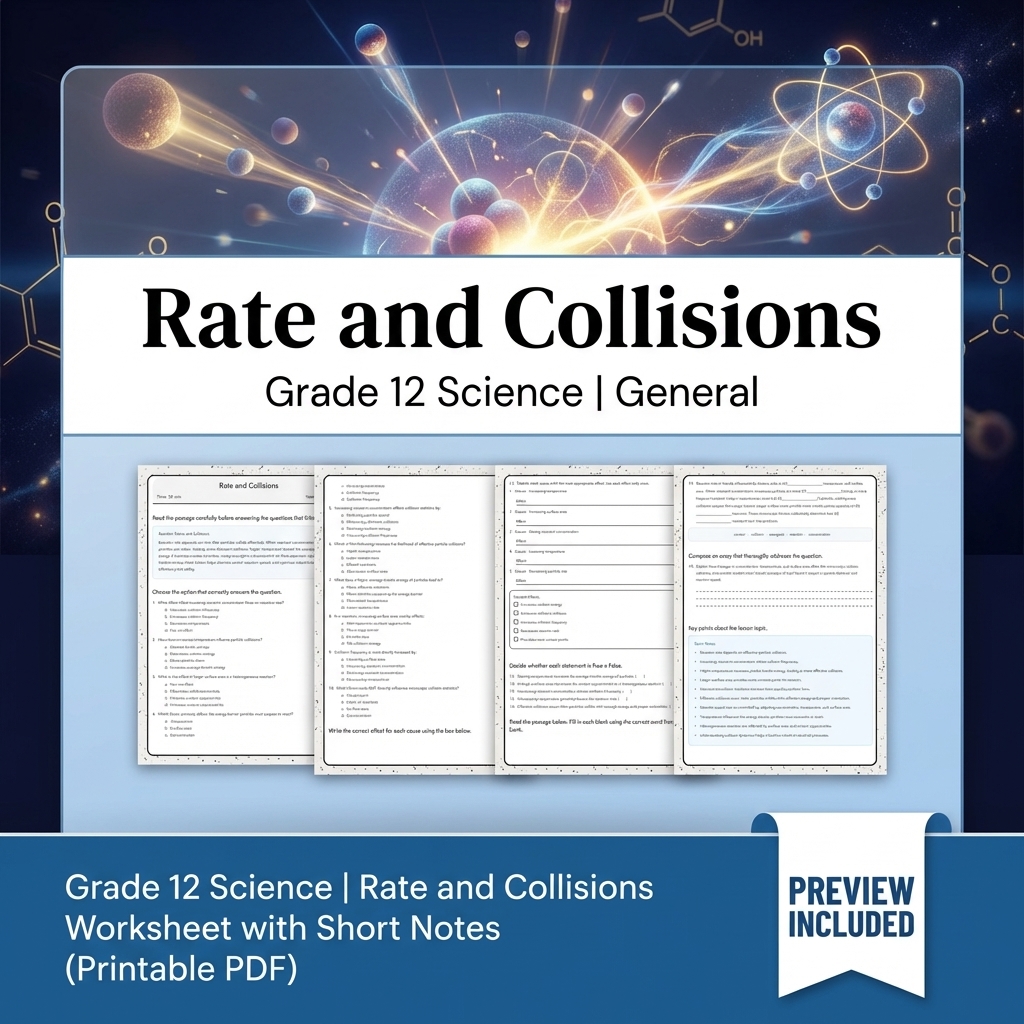
Grade 12 Science | Rate and Collisions Worksheet with Short Notes
Created byMeadowlark WorksheetsLearning Objectives
- Understand how reaction rate is influenced by particle collisions.
- Explain the effect of concentration, temperature, and surface area on collision frequency.
- Describe how microscopic collision statistics determine the rate of product formation.
Instant download
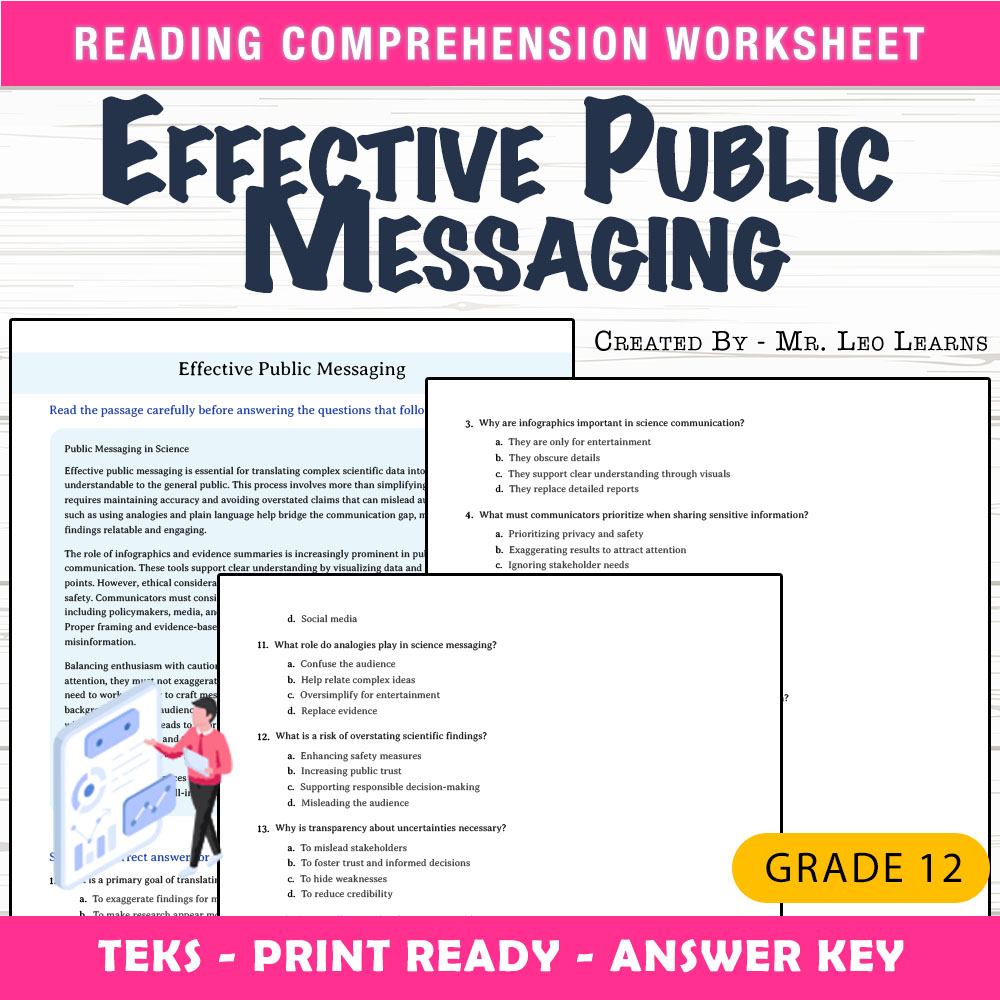
Grade 12 Science – Effective Public Messaging Worksheet for Mastery
 Created byThe Resource Hub
Learning Objectives
- Understand the principles of translating scientific findings into accessible formats for the general public.
- Identify ethical considerations and framing techniques in science communication.
- Describe the role of evidence summaries and infographics in supporting public understanding.
Also included in: Grade 12 Science Worksheet Bundle | Scientific Communication & Data Skills +1 more
Instant download
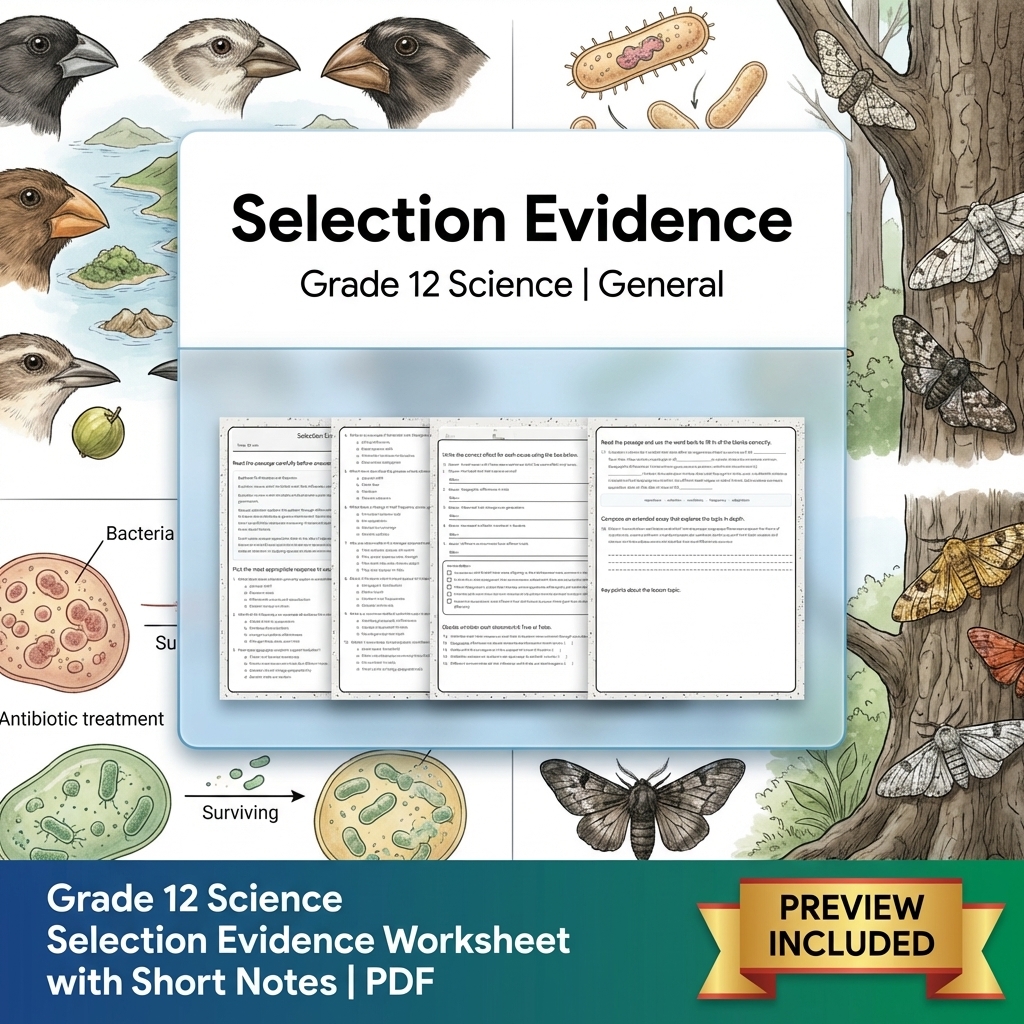
Grade 12 Science Selection Evidence Worksheet with Short Notes | PDF
Created byMeadowlark WorksheetsLearning Objectives
- Understand how heritable traits influence evolution through natural selection.
- Identify different types of evidence supporting evolution, such as trait changes over time and geographic variation.
- Analyze population data to interpret evidence of selection acting on heritable variation.
Also included in: Grade 12 Evolution & Genetics Science Lesson Bundle (General Framework) +1 more
Instant download

Grade 12 Science | Seismic Patterns Worksheet | BC-Aligned
 Created byLumora Learning
Learning Objectives
- Understand how seismic patterns reveal active tectonic structures and stress regimes.
- Identify the relationship between earthquake depth and tectonic boundary types.
- Explain the role of seismic tomography and moment tensors in imaging subsurface features.
Also included in: Grade 12 Science | Earth Science Custom Bundle | BC Aligned
Instant download

Chemical Fate Worksheet Grade 12 Science Assessment | Alberta
Created byPrism Point LearningLearning Objectives
- Explain how dissolution, sorption, volatilization, and biodegradation control chemical fate in soil and water systems
- Use kinetic vs. equilibrium ideas to predict contaminant distribution and long-term persistence
- Apply partitioning concepts to reason about monitoring and remediation strategies
Also included in: Grade 12 Science Lesson Bundle | Alberta STSE, Systems & Design
Instant download
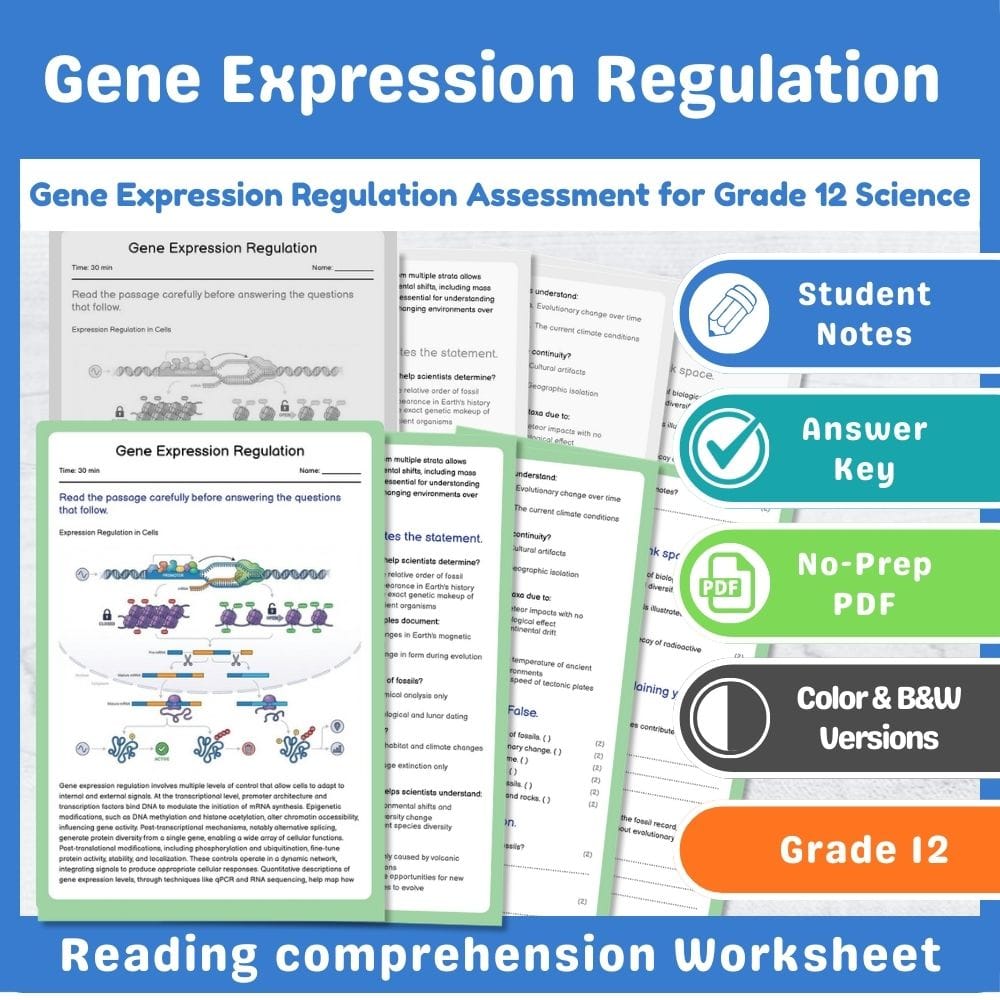
Gene Expression Regulation Assessment for Grade 12 Science
Created byPrism Point LearningLearning Objectives
- Describe molecular mechanisms controlling gene transcription and translation.
- Explain the roles of promoter architecture, transcription factors, and epigenetic modifications.
- Analyze how alternative splicing and post-translational modifications regulate protein function.
Also included in: Grade 12 Science Mini Bundle | Biology and Ecosystems AP Standards
Instant download

Grade 12 Science – Resource Management & Sustainability | Reading Worksheet
 Created byBright Mind Resources
Learning Objectives
- Understand the concepts of renewable and nonrenewable resources.
- Evaluate methods for sustainable resource use.
- Analyze water budgeting and energy portfolio choices.
Also included in: Sustainability Grade 12 Science Daily Reading Worksheets Bundle | TEKS +2 more
Instant download

Grade 12 Science | Oscillator Energy Worksheet Elena | AP Aligned
Created byLumora LearningLearning Objectives
- Explain the energy exchange between potential and kinetic energy in simple harmonic oscillators.
- Describe how amplitude affects energy in oscillatory systems.
- Analyze the effect of damping on energy dissipation over multiple cycles.
Instant download
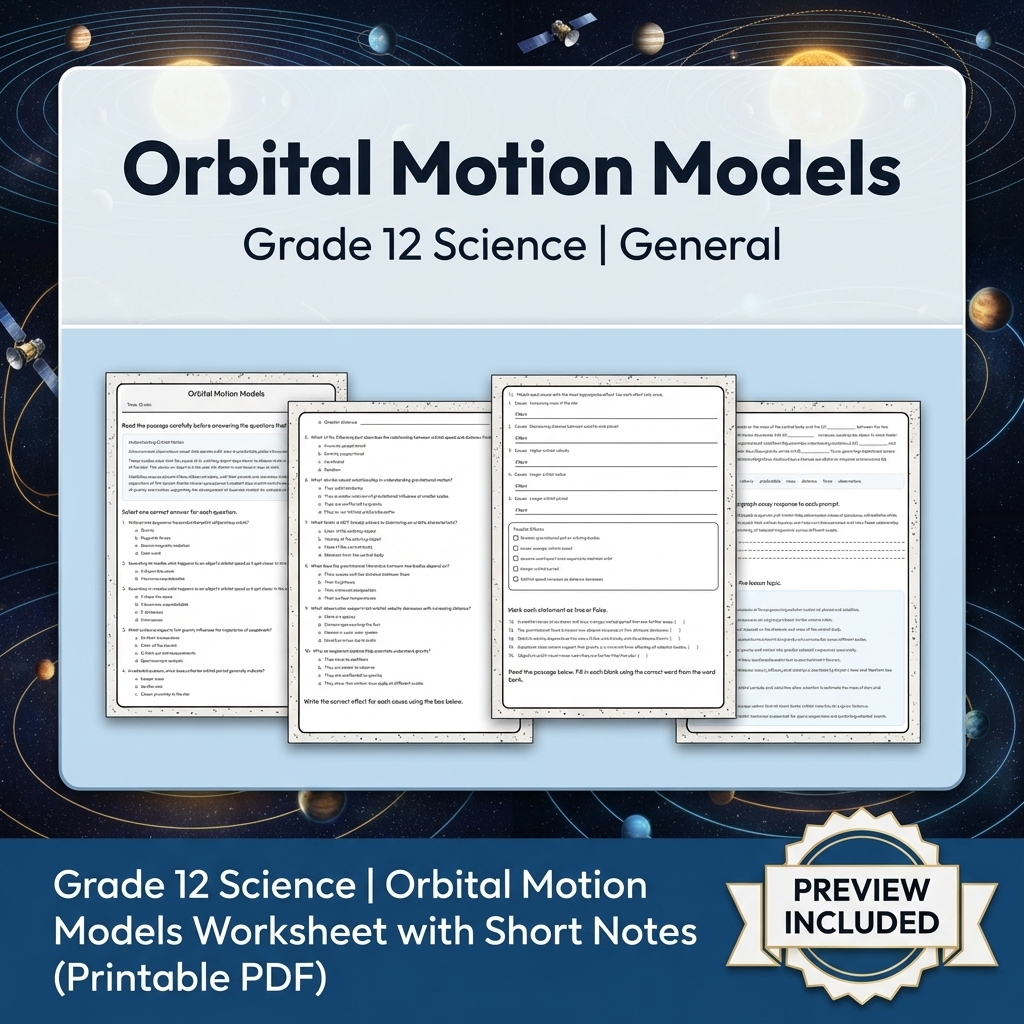
Grade 12 Science | Orbital Motion Models Worksheet with Short Notes
Created byMeadowlark WorksheetsLearning Objectives
- Understand how gravity influences planetary and satellite orbits.
- Interpret observational data related to orbital periods and velocities.
- Explain the relationship between mass, distance, and orbital speed in celestial systems.
Also included in: Grade 12 Earth and Space Systems Science Lesson Bundle: General Framework +1 more
Instant download

Grade 12 Science – Quantum Photons & Light | Daily Reading Worksheet
Created byBright Mind ResourcesLearning Objectives
- Understand the concept of photons and their properties.
- Learn about the photoelectric effect and its significance in quantum theory.
- Grasp the relationship E=hf and the roles of work function and threshold frequency.
Also included in: Grade 12 Physics Energy & Fields Science Lesson Bundle: Daily Reading | BC +1 more
Instant download

Grade 12 Science | Evolutionary Genetics - Daily Reading Comprehension
 Created byCoral Reef Learning
Learning Objectives
- Interpret allele and genotype frequencies in populations.
- Understand the principles of Hardy-Weinberg equilibrium.
- Apply models to predict evolutionary change.
Also included in: Biology and Ecosystems Lesson Bundle | Grade 12 Science | AP +1 more
Instant download
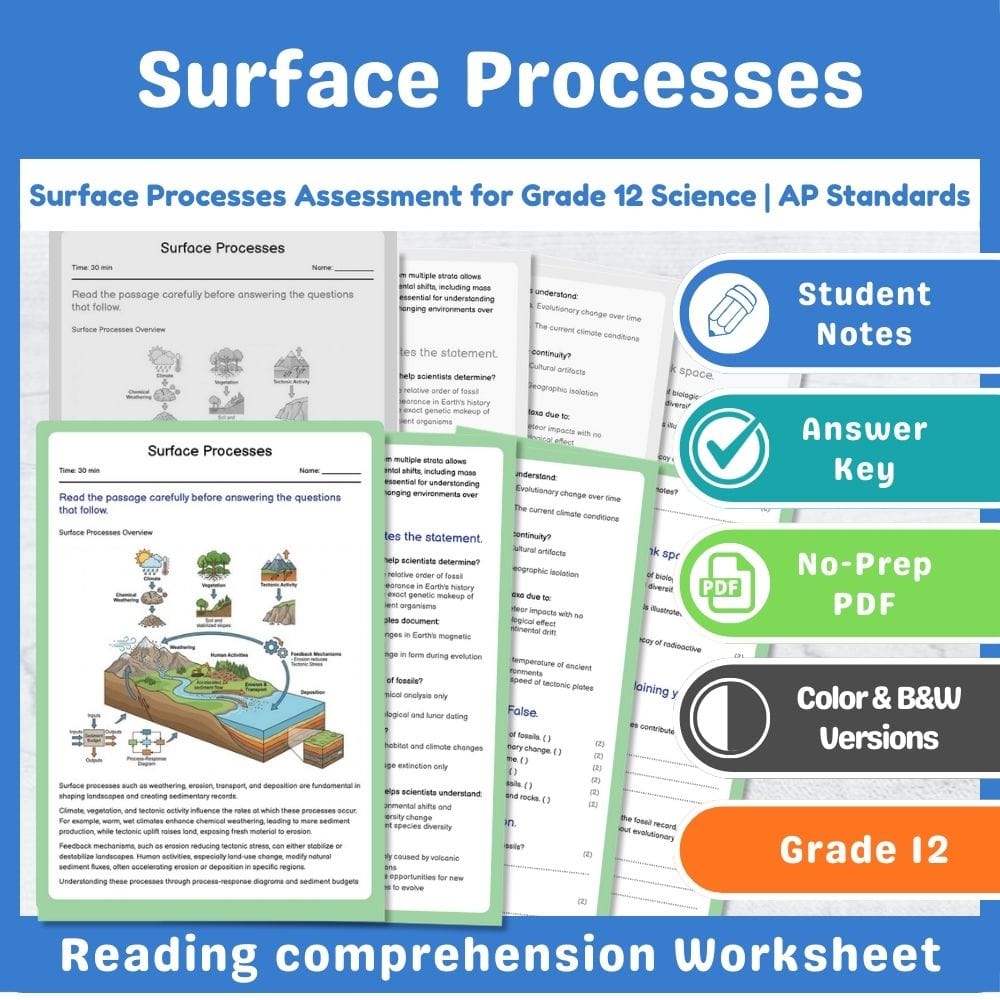
Surface Processes Assessment for Grade 12 Science | AP Standards
Created byPrism Point LearningLearning Objectives
- Understand the roles of weathering, erosion, transport, and deposition in landscape development.
- Interpret process-response diagrams and sediment budgets to relate climate and tectonic influences.
- Evaluate feedback mechanisms between surface processes and rock uplift, landscape stability, and stratigraphy.
Instant download

Grade 12 Science – Ethical Review & Research Ethics | Daily Reading Worksheet
Created byBright Mind ResourcesLearning Objectives
- Understand the principles of research ethics and responsible conduct in science.
- Identify key components of ethical review processes, including conflicts of interest and data management.
- Analyze case studies of ethical breaches to recognize standards for accountability and trustworthiness.
Also included in: Grade 12 Scientific Inquiry & Data Analysis Science Lesson Bundle | TEKS +2 more
Instant download

Particle Reaction Model Worksheet for Grade 12 Science
JCreated byJ.S SheetsLearning Objectives
- Explain the particle reaction model in terms of collisions, activation energy, bond breaking, and bond forming.
- Connect macroscopic observations (color change, gas formation, temperature change) to microscopic particle changes.
- Use conservation of matter to describe reactions as rearrangements of particles and redistribution of energy.
Also included in: Grade 12 Matter and Energy Science Lesson Bundle: General Framework +1 more
Instant download

Electron Configuration Assessment for Grade 12 Science – TEKS Standards
Created byPrism Point LearningLearning Objectives
- Understand the quantum mechanical model of electrons and the significance of quantum numbers.
- Apply the Aufbau principle, Pauli exclusion principle, and Hund's rule to determine electron configurations and orbital diagrams.
- Analyze how electron configurations influence chemical properties and periodic table block structures.
Also included in: Lesson Bundle Grade 12 Chemistry and Reactions Science Assessment TEKS
Instant download

Grade 12 Science – Energy Pathways & Climate Systems | Daily Reading Worksheet
Created byBright Mind ResourcesLearning Objectives
- Understand the key mechanisms of radiative balance, conduction, convection, and latent heat processes
- Relate energy transfer mechanisms to weather patterns, ocean currents, and tectonic heat flow
- Use simple energy budgets and flux diagrams to connect microscale processes to macroscopic phenomena
Also included in: Earth Systems Grade 12 Science Daily Reading Worksheets Lesson Bundle | AP +2 more
Instant download

Grade 12 Science | Balancing Reactions Worksheet | TEKS-Aligned
Created byLumora LearningLearning Objectives
- Understand how to represent chemical change through symbolic equations.
- Apply the law of conservation of mass to balance chemical equations.
- Classify different types of chemical reactions including synthesis, decomposition, single and double replacement, and combustion.
Also included in: Grade 12 Science | Matter and Energy Lesson Bundle | TEKS Aligned
Instant download
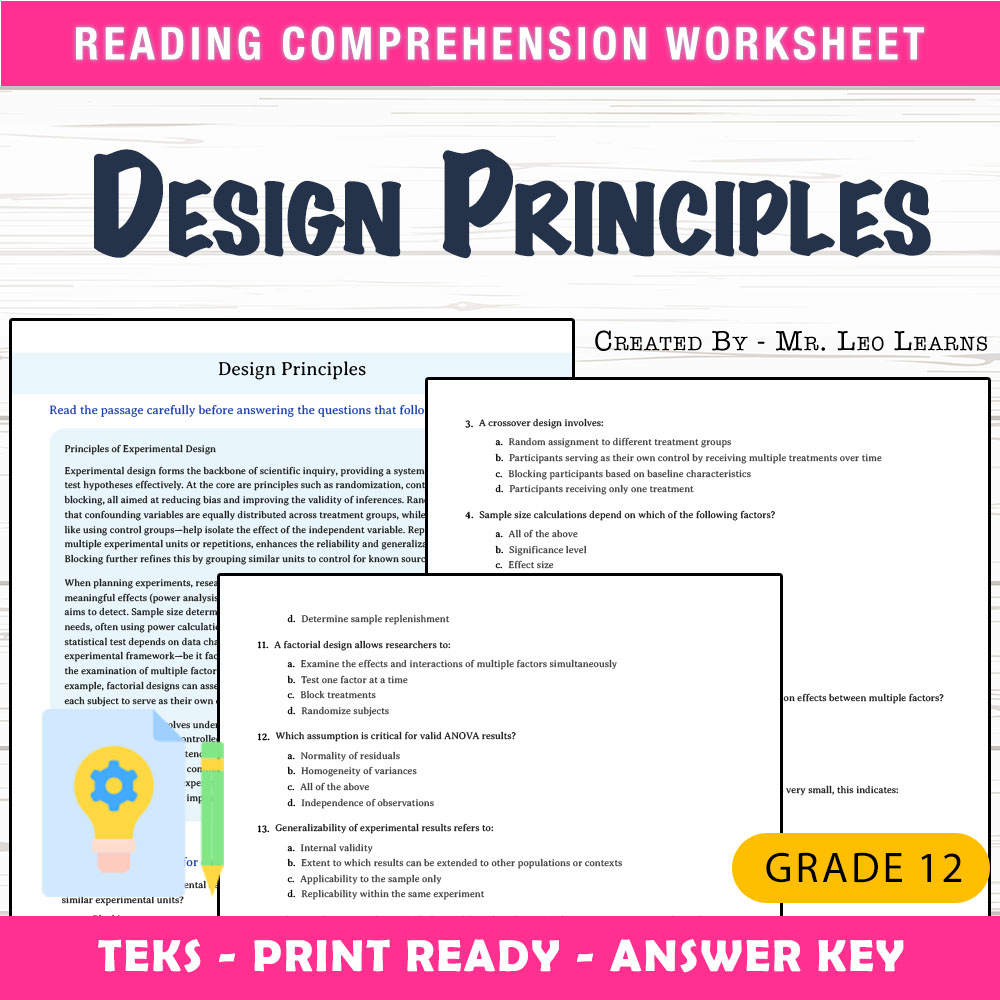
Grade 12 Science | Design Principles Worksheet
Created byThe Resource HubLearning Objectives
- Understand key aspects of experimental design including selection of measures, control strategies, and replication.
- Analyze statistical planning such as sample size, power, effect size, and choice of tests.
- Interpret design frameworks like factorial and crossover designs, ANOVA, and regression analysis.
Also included in: Grade 12 Science Worksheet Bundle | Scientific Inquiry & Data Analysis Mastery +1 more
Instant download

Atomic Models Assessment | Alberta Standards Grade 12 Science
Created byPrism Point LearningLearning Objectives
- Describe the evolution of atomic models from Dalton to quantum mechanics.
- Explain how subatomic particles influence atomic mass and behavior.
- Discuss real-world applications of isotopes in geological dating and resource management.
Also included in: Grade 12 Chemistry Science Lesson Bundle Assessments | Alberta Framework +1 more
Instant download

Resource Competition Worksheet | Ecology & Natural Selection Grade 12
Created byPrism Point LearningLearning Objectives
- Explain how competition for limited resources affects survival and reproduction in interacting populations.
- Describe feedback effects that occur when resource scarcity changes per-capita success over time.
- Use ecological models to predict how changes in one population can influence others through shared limitations.
Instant download

Grade 12 Science | Atmospheric Dynamics Worksheet | TEKS-Aligned
Created byLumora LearningLearning Objectives
- Understand the fundamental components and forces driving large-scale atmospheric circulation.
- Explain the roles of the Coriolis force, pressure gradients, and thermal structure in weather systems.
- Describe the formation and function of Hadley and Ferrel cells, jet streams, and frontal systems.
Also included in: Grade 12 Science | Earth and Space Science Lesson Bundle | TEKS Aligned
Instant download

Population Dynamics Worksheet | Standard-Aligned Science Practice for Grade 12
JCreated byJ.S SheetsLearning Objectives
- Understand the key factors influencing population growth and decline.
- Differentiate between exponential and logistic growth models.
- Analyze real-world examples of population changes in Alberta.
Also included in: Grade 12 Genetics & Evolution Science Lesson Bundle – Alberta Framework
Instant download

Grade 12 Science | Mendelian Patterns Worksheet | TEKS Aligned
Created byLumora LearningLearning Objectives
- Understand Mendelian inheritance ratios and dominance hierarchies.
- Identify and interpret patterns like incomplete dominance, codominance, and polygenic inheritance.
- Analyze pedigree charts, linkage maps, and recombination frequencies to predict trait inheritance.
Also included in: Grade 12 Science | Biological Concepts Lesson Bundle | TEKS Aligned
Instant download
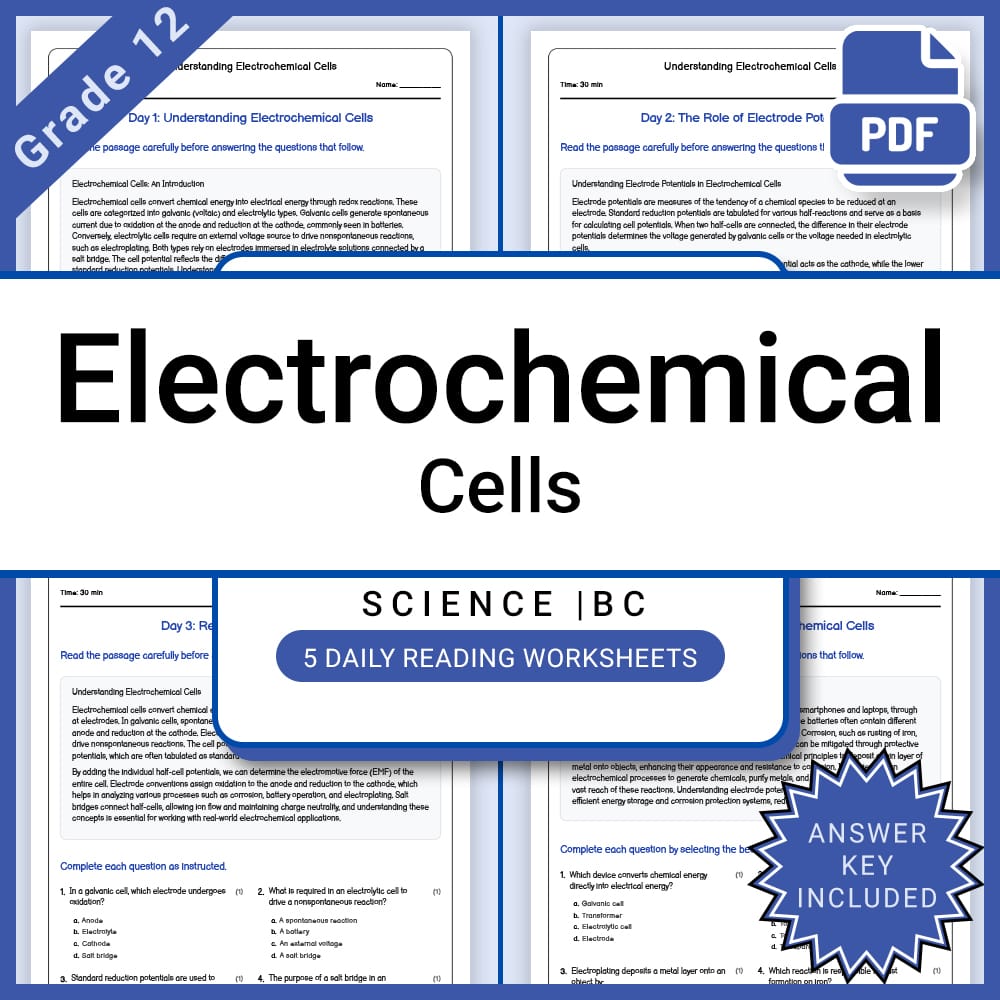
Grade 12 Science – Electrochemical Cells Daily Reading Worksheet with Answer Key
JCreated byJ.S SheetsLearning Objectives
- Identify the key components of galvanic and electrolytic cells
- Explain how redox reactions facilitate electrical energy transfer
- Differentiate between spontaneous and nonspontaneous electrochemical reactions
Also included in: Grade 12 Science Lesson Bundle BC Framework | Daily Reading Worksheets +1 more
Instant download

Grade 12 Science | Magnetic Applications Worksheet | BC-Aligned
Created byLumora LearningLearning Objectives
- Explain how Lorentz forces enable torque in electric motors.
- Describe how magnetic field gradients are used in imaging techniques like magnetic resonance.
- Summarize the principles of magnetic storage, induction sensing, and the Hall effect.
Also included in: Grade 12 Science | Physics Custom Bundle | BC-Aligned Worksheet Set
Instant download

Grade 12 Science | Molecular Geometry - Daily Reading Comprehension
Created byCoral Reef LearningLearning Objectives
- Understand valence-shell electron-pair repulsion theory to predict molecular shapes
- Identify hybridization models and their influence on molecular geometry
- Relate molecular shape to polarity and molecular symmetry
Also included in: Chemistry Foundations Lesson Bundle | Grade 12 Science AP +1 more
Instant download

Rotational Dynamics Worksheet Pack AP Physics Grade 12 Practice
Created byPrism Point LearningLearning Objectives
- Explain rotational analogs of linear quantities and define torque, moment of inertia, and angular momentum for rigid bodies.
- Use rotational kinematics and dynamics to relate net torque to angular acceleration.
- Apply conservation of energy and conservation of angular momentum to rolling and compound rotational systems.
Also included in: AP Physics Grade 12 Science Mechanics & Electricity Lesson Bundle | AP
Instant download

Grade 12 Science – Forces & Equilibrium | Daily Reading Worksheet
Created byBright Mind ResourcesLearning Objectives
- Understand the concept of equilibrium and net force
- Identify when forces are balanced in static objects
- Recognize the conditions for forces to be in equilibrium
Also included in: Physical Science Grade 12 Science Worksheets Lesson Bundle | Florida NGSSS +1 more
Instant download

Gene Expression Worksheet | Grade 12 Science Activities
Created byPrism Point LearningLearning Objectives
- Explain how gene expression involves transcription and translation to produce functional proteins.
- Describe how promoters, enhancers, and transcription factors regulate when and where genes are expressed.
- Analyze how epigenetic modifications and regulatory networks affect tissue specificity and timing of expression.
Also included in: Grade 12 Evolution & Genetics Lesson Bundle | Alberta Science Framework
Instant download

Grade 12 Science — Worksheet MCQ Paper for Climate Drivers
Created byThe Resource HubLearning Objectives
- Understand the key forcings that influence climate variability and change.
- Analyze the roles of greenhouse gases, volcanic aerosols, solar irradiance, and land surface changes in climate forcing.
- Evaluate feedback mechanisms such as ice-albedo and water vapor feedbacks.
Also included in: Grade 12 Science AP Custom Bundle: Earth Systems, Climate, and Tectonics +1 more
Instant download

Evolution By Probability Worksheet | Standards-Aligned Grade 12 Science
JCreated byJ.S SheetsLearning Objectives
- Understand how genetic drift and selection influence allele frequencies in populations.
- Analyze the role of probability models in explaining evolutionary mechanisms.
- Differentiate between random processes and selective pressures in evolution.
Also included in: Grade 12 Evolution and Speciation Science lesson bundle: California Standards +1 more
Instant download

Orbital Mechanics Worksheet | Grade 12 Science Practice TEKS
Created byPrism Point LearningLearning Objectives
- Explain how gravity produces Keplerian orbits and how orbital parameters (semimajor axis, eccentricity, inclination) shape motion
- Use conservation of energy and angular momentum to interpret escape velocity and changes in orbital energy
- Describe how perturbations, tides, and resonances alter orbital trajectories and long-term evolution
Also included in: Grade 12 Earth & Space Science Lesson Bundle: TEKS Framework
Instant download

Grade 12 Science | Cycle Dynamics Worksheet | TEKS Aligned
Created byLumora LearningLearning Objectives
- Describe the pathways and fluxes of carbon and nitrogen among Earth's atmosphere, biosphere, hydrosphere, and lithosphere.
- Apply steady-state and reservoir exchange concepts to environmental systems.
- Analyze the impact of human activities such as fossil fuel combustion and fertilizer runoff on natural cycles.
Instant download

Bond Types Worksheet | Grade 12 Science Practice
Created byPrism Point LearningLearning Objectives
- Compare ionic, covalent, and metallic bonding based on particle interactions and electron behavior
- Use bond type concepts to predict properties such as melting point, conductivity, and solubility
- Explain how electron sharing or electron transfer relates to macroscopic behavior of materials
Instant download
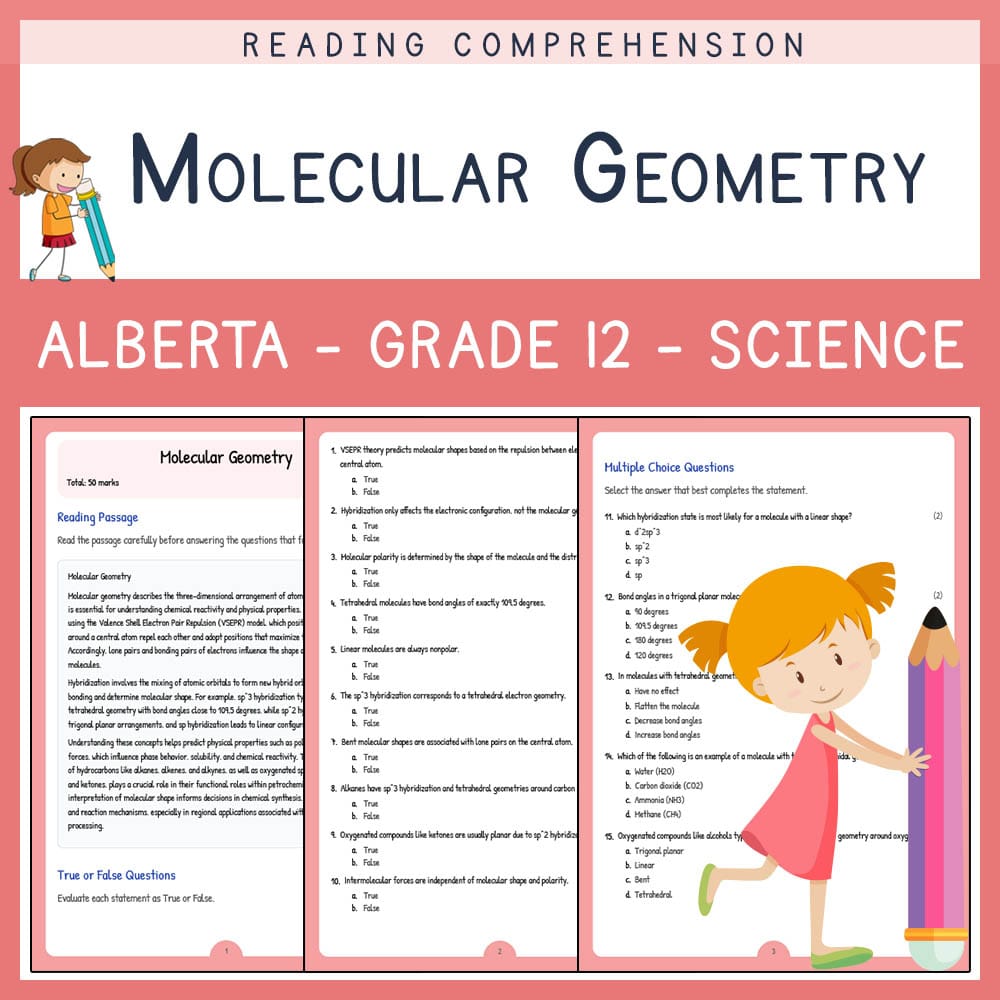
Grade 12 Science | Molecular Geometry Worksheet | Alberta Standards
Created byLumora LearningLearning Objectives
- Understand the principles of VSEPR theory and how electron-pair repulsion determines molecular shape.
- Apply hybridization concepts to predict molecular geometry and bond angles.
- Analyze how molecular geometry influences physical properties, polarity, and reactivity.
Instant download
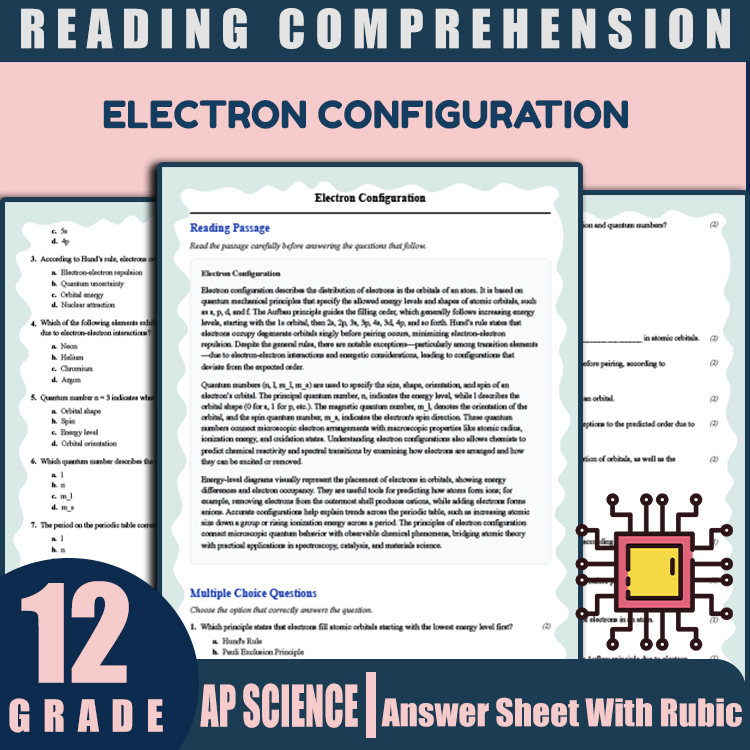
Grade 12 Science | Electron Configuration Reading Worksheet with Answer Key
JCreated byJ.S SheetsLearning Objectives
- Understand the principles of electron filling order in atomic orbitals.
- Connect quantum numbers to orbital occupancy and periodic trends.
- Apply Hund's rule and recognize exceptions in transition metals.
Also included in: Grade 12 Science Unit Bundle | Atomic Structure & Chemical Reactions Worksheets +1 more
Instant download

Grade 12 Science | Chemical Fate - Daily Reading Comprehension
Created byCoral Reef LearningLearning Objectives
- Understand the process of dissolution and its impact on contaminant transport.
- Identify how dissolution influences contaminant mobility in soil and water systems.
- Analyze case studies involving chemical dissolution in environmental scenarios.
Also included in: Science 30 Reading Comprehension Skills Lesson Bundle | Grade 12 Science Alberta +1 more
Instant download

Grade 12 Science– Representation in Science Modeling & Visualization | Worksheet
Created byBright Mind ResourcesLearning Objectives
- Understand different types of scientific models and their purposes
- Identify the strengths and limitations of various models
- Learn how models are used to map physical phenomena
Also included in: Grade 12 Science Data Analysis Daily Reading Worksheets Lesson Bundle | AP +2 more
Instant download

Grade 12 Science — Worksheet MCQ Paper for Mastering Paleoclimate Evidence
Created byThe Resource HubLearning Objectives
- Understand the types of proxy records used in paleoclimatology and their indicators.
- Interpret how isotopic, chemical, and biological signals relate to past climate conditions.
- Recognize calibration approaches and age-model construction in climate proxies.
Also included in: Grade 12 Science AP Custom Bundle: Earth Systems, Climate, and Tectonics +2 more
Instant download
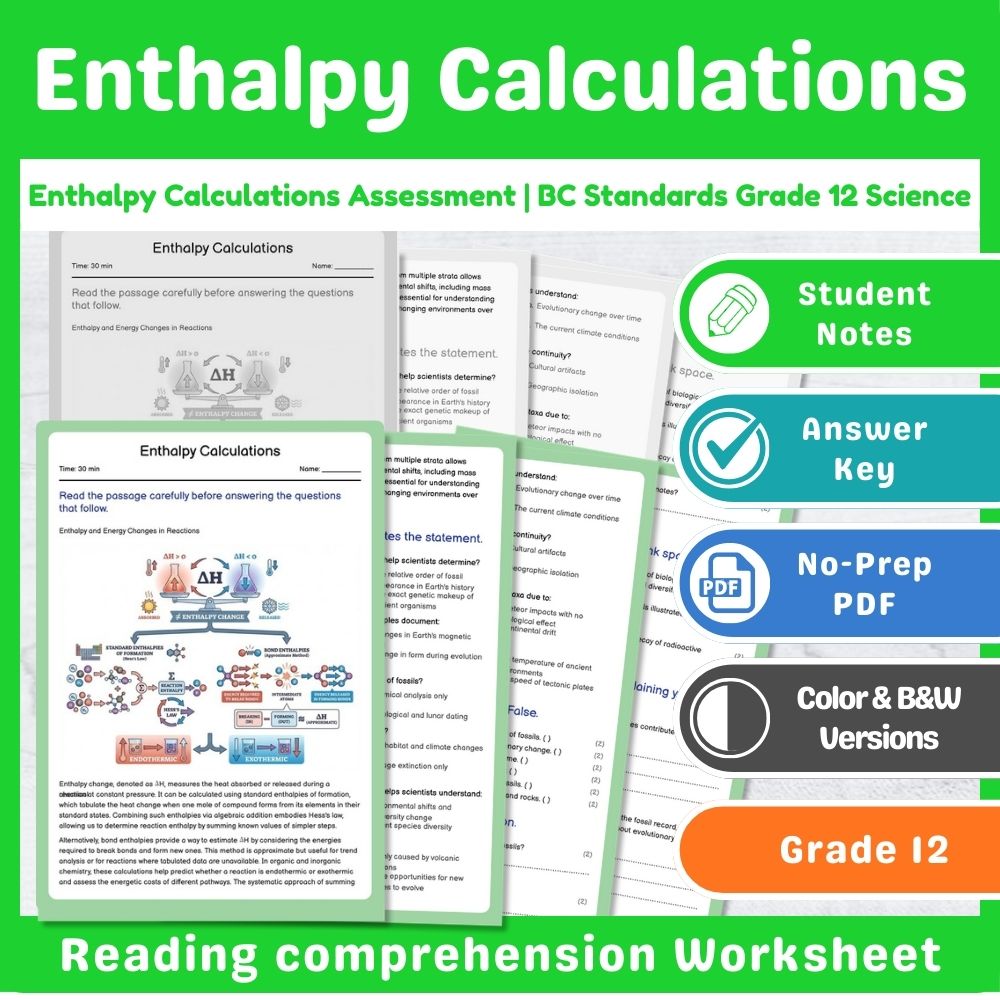
Enthalpy Calculations Assessment | BC Standards Grade 12 Science
Created byPrism Point LearningLearning Objectives
- Understand the concept of enthalpy and its role in heat change calculations.
- Apply standard enthalpies of formation and combustion to compute reaction enthalpies.
- Use algebraic methods reflecting Hess's law to combine enthalpy terms.
Also included in: Grade 12 Science Mini Bundle – Thermochemistry & Equilibrium Assessment
Instant download

Modeling Under Constraints Assessment for Grade 12 Science | Standards-Aligned
Created byPrism Point LearningLearning Objectives
- Explain how models help predict outcomes when constraints limit geometry, materials, power, or time
- Use simplified relationships to reason about how changes in inputs affect outputs in scientific/engineering systems
- Evaluate uncertainty and assumptions when interpreting model predictions for reliability and design tolerances
Instant download
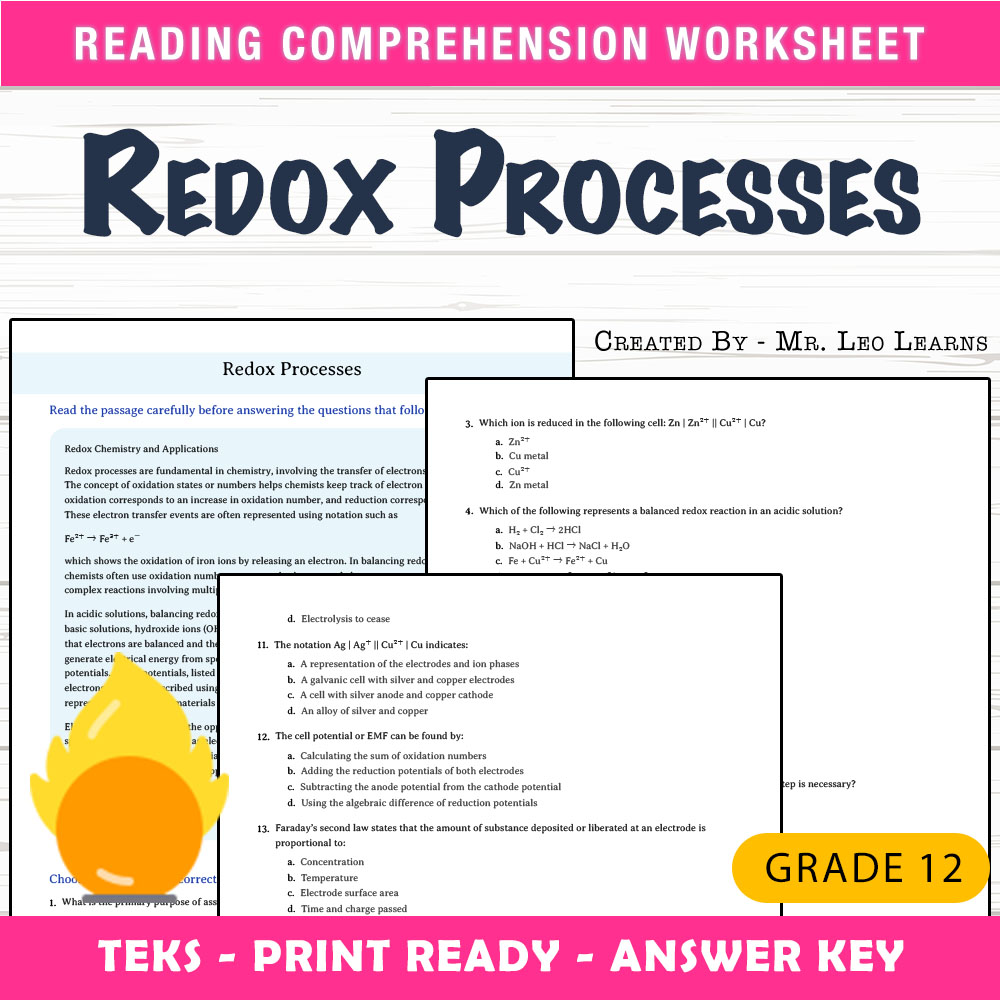
Grade 12 Science – Redox Processes Worksheet for Mastery
Created byThe Resource HubLearning Objectives
- Understand the concept of oxidation numbers and electron transfer notation.
- Learn how to balance redox equations in acidic and basic solutions.
- Explore galvanic and electrolytic cells through standard reduction potentials and cell notation.
Also included in: Grade 12 Science Worksheet Bundle | Chemistry & Chemical Reactions Mastery +1 more
Instant download

Grade 12 Science – Radiometric Dating & Earth’s History | Reading Worksheet
Created byBright Mind ResourcesLearning Objectives
- Understand the concept of isotopes and nuclear decay.
- Identify different radiometric dating methods and their applications.
- Explain key concepts such as half-life, closure temperature, and isotope systematics.
Also included in: Grade 12 Earth Systems Science Daily Reading Worksheets Lesson Bundle | BC +1 more
Instant download

Grade 12 Science | Periodic Patterns - Daily Reading Comprehension
Created byCoral Reef LearningLearning Objectives
- Understand and describe periodic trends such as atomic radius, ionization energy, electronegativity, and effective nuclear charge.
- Relate electronic structure to observable properties like metallic character and chemical reactivity.
- Interpret graphical and tabular data to predict element properties based on periodic table position.
Also included in: Chemistry Foundations Lesson Bundle | Grade 12 Science AP +1 more
Instant download
About Grade 12 Science Worksheets
Explore Grade 12 Science worksheets for classwork, homework, or review. Our 4,240 printables download instantly as PDFs.
MyTeachingSheets worksheets are made by real teacher-authors and checked before they go live. Download any as a print-ready PDF for lessons, homework, or independent practice — most include answer keys, and previews are always free.