
Grade 12 Science Worksheets
4,240 worksheets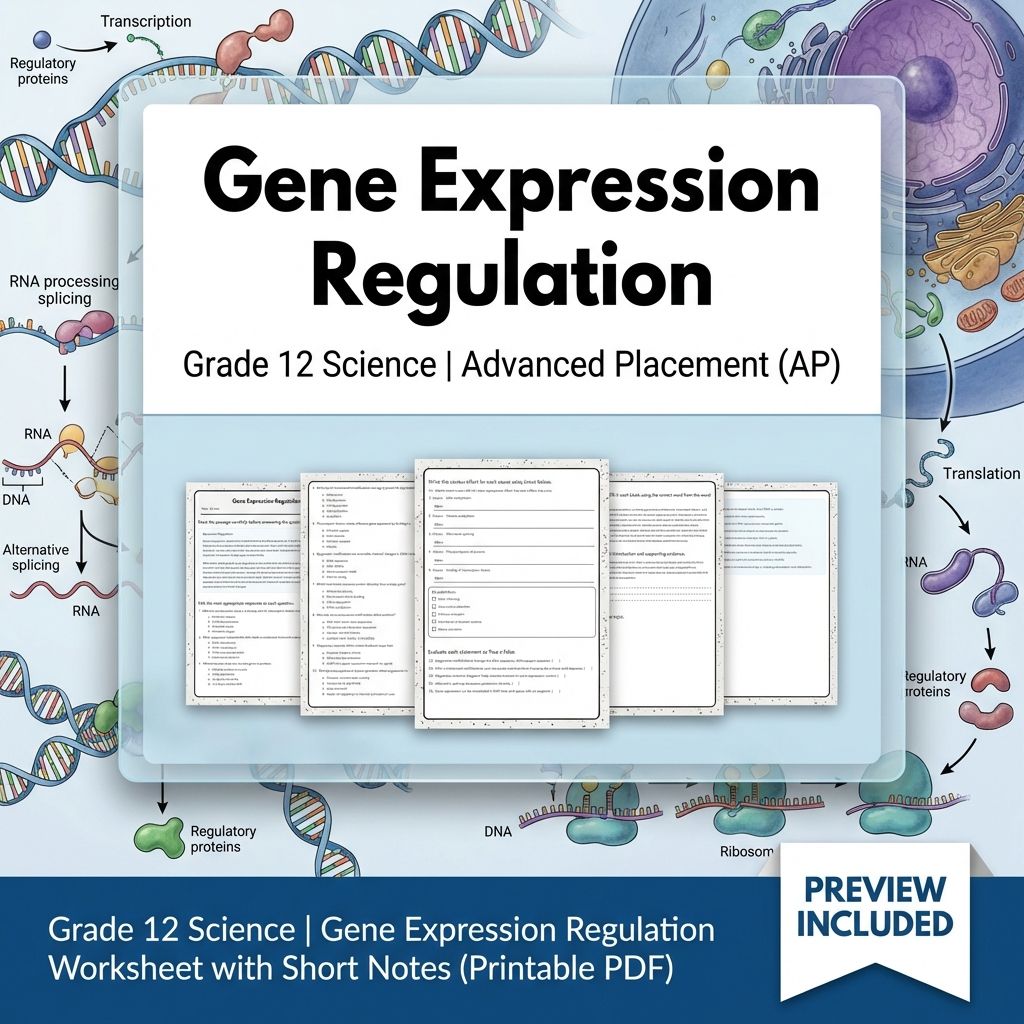
Grade 12 Science | Gene Expression Regulation Worksheet with Short Notes (PDF)
 Created byMeadowlark Worksheets
Learning Objectives
- Understand molecular mechanisms controlling gene expression, including transcription and translation.
- Identify roles of promoter architecture, transcription factors, epigenetic modifications, alternative splicing, and post-translational regulation.
- Analyze how regulatory networks modulate gene expression in time and space.
Also included in: Grade 12 Science Unit Worksheet Pack – Molecular Biology & Ecosystems (PDF) +1 more
Instant download
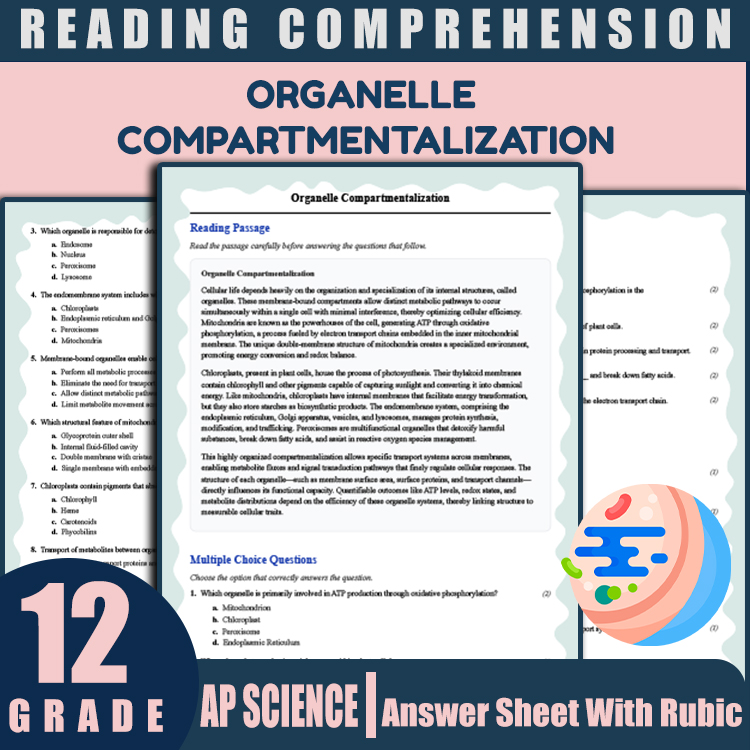
Grade 12 Science | Organelle Compartmentalization Reading Worksheet + Answer Key
JCreated byJ.S SheetsLearning Objectives
- Describe the structure and functions of different organelles involved in cellular compartmentalization.
- Compare the roles of mitochondria, chloroplasts, endomembrane system, and peroxisomes in energy transformation, biosynthesis, and catabolism.
- Explain how organelle structure influences metabolic efficiency and measurable outputs such as ATP production and metabolite distribution.
Also included in: Grade 12 Science Unit Worksheet Pack | Molecular Biology, Genetics & Ecosystems +1 more
Instant download
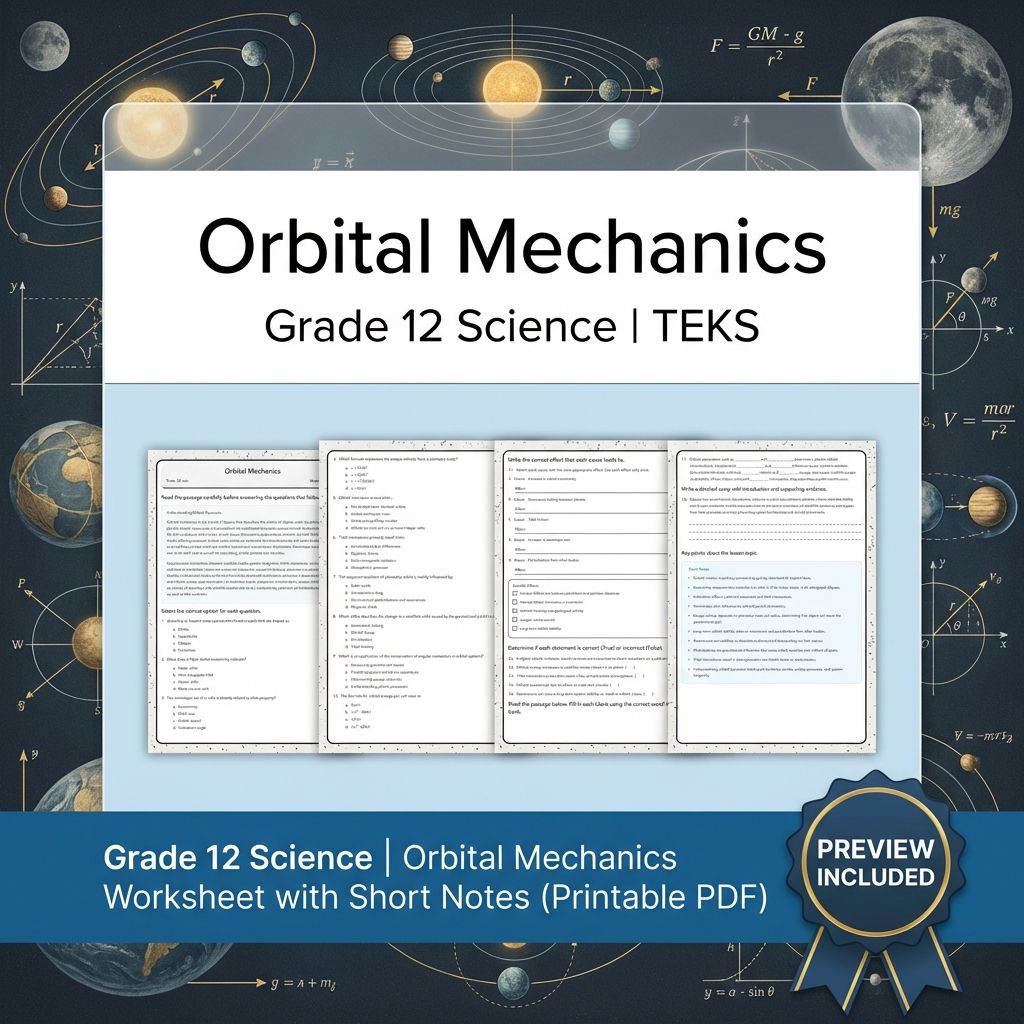
Grade 12 Science | Orbital Mechanics Worksheet with Short Notes (Printable PDF)
Created byMeadowlark WorksheetsLearning Objectives
- Explain the principles of gravitational dynamics and Keplerian motion governing orbital trajectories.
- Identify how orbital eccentricity, inclination, and semimajor axis influence planetary and satellite systems.
- Apply formulas for escape velocity, orbital energy, and analyze perturbation effects in orbital systems.
Also included in: Grade 12 Science Unit Bundle – Earth Systems & Space Topics (Worksheets) +2 more
Instant download

Community Interactions Worksheet | Science Practice for Grade 12 Alberta
JCreated byJ.S SheetsLearning Objectives
- Understand different types of community interactions such as competition, predation, parasitism, mutualism, and commensalism.
- Explain how energy flow and trophic relationships shape ecosystems.
- Analyze examples of community interactions in Alberta ecosystems and their effects on biodiversity and stability.
Also included in: Grade 12 Genetics & Evolution Science Lesson Bundle – Alberta Framework
Instant download
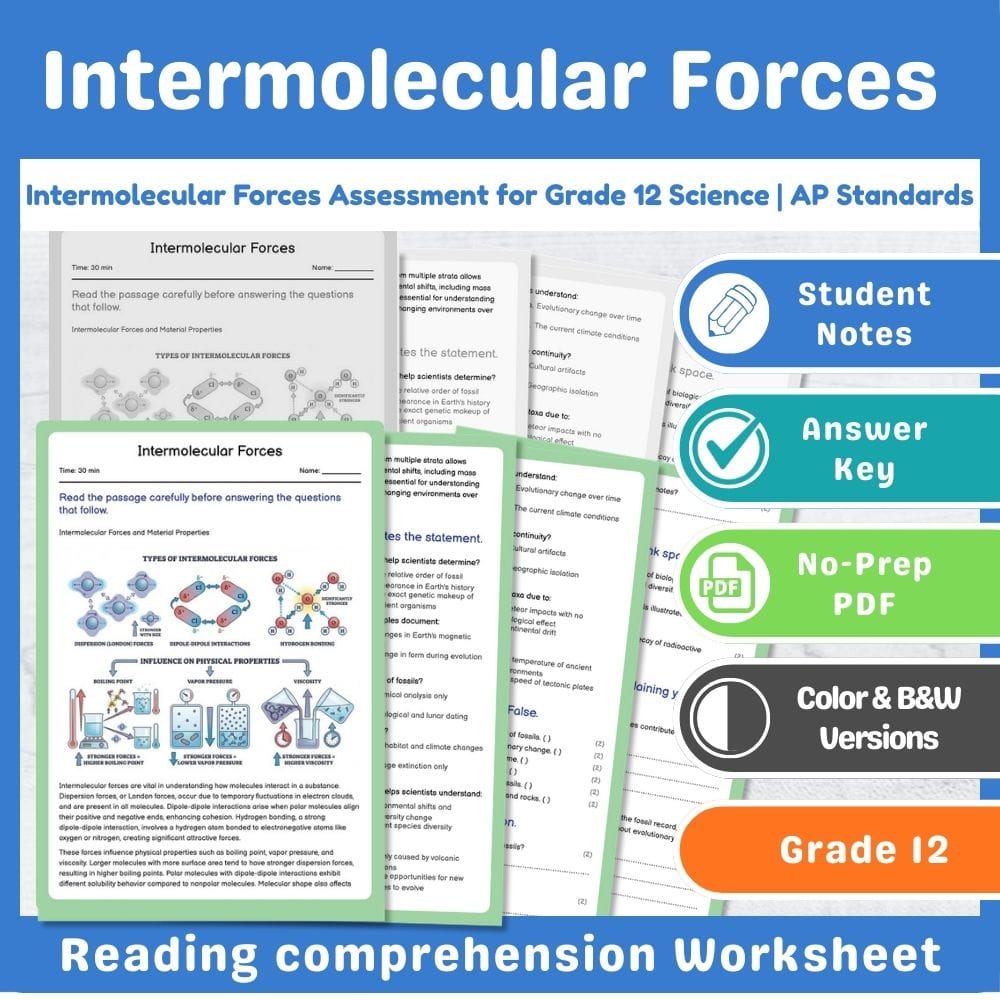
Intermolecular Forces Assessment for Grade 12 Science | AP Standards
 Created byPrism Point Learning
Learning Objectives
- Describe the differences between dispersion forces, dipole–dipole interactions, and hydrogen bonding.
- Explain how molecular size, shape, and polarity influence intermolecular forces.
- Relate intermolecular forces to macroscopic properties such as boiling point, vapor pressure, viscosity, and solubility.
Instant download

Grade 12 Cell Architecture Worksheet | Practice & Assessment PDF
 Created byClear Sky Classroom
Learning Objectives
- Explain how cytoskeletal networks and filament dynamics contribute to cell shape and mechanical resilience.
- Describe how membrane–extracellular matrix (ECM) interactions regulate force transmission and mechanotransduction.
- Evaluate how intercellular junctions and molecular motor-driven transport influence cellular function and compartmentalization.
Also included in: Grade 12 Cell, Genetics, and Ecosystems Science AP Lesson Bundle Worksheet B +1 more
Instant download

Grade 12 Science – Resource Sustainability & Water Ecosystems | Worksheet
 Created byBright Mind Resources
Learning Objectives
- Understand the water cycle and its importance to ecosystems.
- Recognize human impacts on water resources and ecosystems.
- Identify conservation strategies to promote water sustainability.
Also included in: Earth Grade 12 Science Daily Reading Worksheets Bundle | California Standards +1 more
Instant download
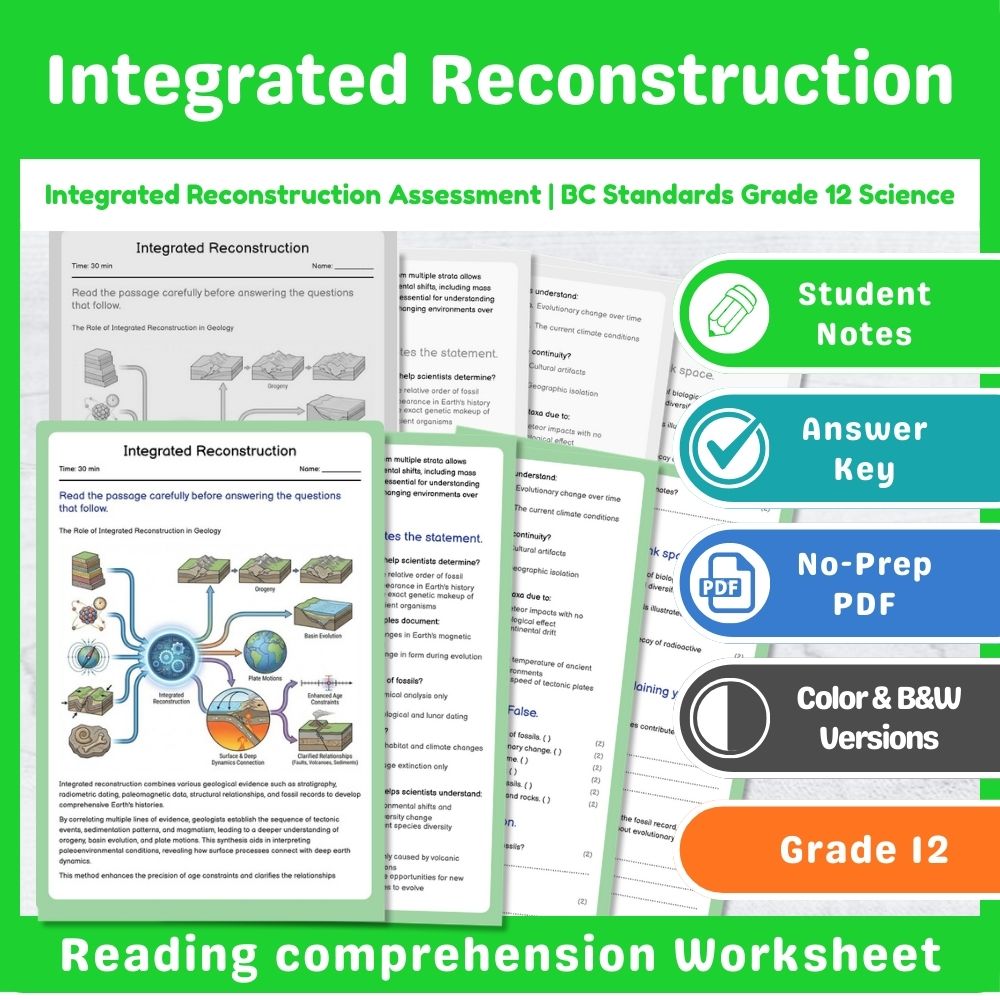
Integrated Reconstruction Assessment | BC Standards Grade 12 Science
Created byPrism Point LearningLearning Objectives
- Understand the various evidence types used in integrated geological reconstruction.
- Analyze how stratigraphy, radiometric data, paleomagnetic records, structural relationships, and fossils are synthesized to interpret Earth's history.
- Evaluate the significance of multiple evidence correlation in constraining tectonic and paleoenvironments.
Also included in: Grade 12 Science Mini Bundle – Plate Tectonics & Geoscience Assessment
Instant download

Grade 12 Science – Societal Tradeoffs in Scientific and Technological Decisions
JCreated byJ.S SheetsLearning Objectives
- Understand the societal implications of energy choices.
- Analyze case examples related to public health, environment, and economics.
- Evaluate trade-offs among benefits, harms, and distributional effects.
Also included in: Grade 12 Science Lesson Group TEKS Bundle | Daily Reading Worksheets +1 more
Instant download

Grade 12 Electromagnetic Induction Worksheet | Practice & PDF
Created byClear Sky ClassroomLearning Objectives
- Explain Faraday’s law and Lenz’s law in terms of changing magnetic flux and the direction of induced emf or current.
- Use quantitative relationships to compare induced emf for different rates of flux change and transformer configurations.
- Apply electromagnetic induction concepts to real-world power systems, including generators, transformers, and safety considerations.
Instant download

Acid Base Reactions Worksheet | Grade 12 Science Practice
Created byPrism Point LearningLearning Objectives
- Compare the Arrhenius, Brønsted–Lowry, and Lewis definitions of acids and bases using correct examples.
- Use conjugate acid–base pairs to explain changes in pH and relate pH to pOH.
- Interpret titration curves and equivalence points and connect them to reaction stoichiometry and equilibria.
Instant download

Earth Systems Worksheet | Grade 12 Science Practice TEKS Standards
Created byPrism Point LearningLearning Objectives
- Explain how energy transfer and matter cycling connect the atmosphere, hydrosphere, lithosphere, and cryosphere.
- Interpret radiative balance and albedo effects to predict how changes in Earth’s surface alter climate.
- Analyze hydrologic cycle processes and ocean–atmosphere coupling as mechanisms that drive climate variability and steady states.
Also included in: Grade 12 Earth & Space Science Lesson Bundle: TEKS Framework
Instant download

Enthalpy Calculations Worksheet | Science Assessment Grade 12 BC
JCreated byJ.S SheetsLearning Objectives
- Understand how to calculate reaction enthalpies using standard enthalpies of formation and combustion.
- Apply Hess's law to combine enthalpy terms algebraically for complex reactions.
- Estimate reaction enthalpies using bond enthalpies and analyze energetic trends in chemical reactions.
Instant download
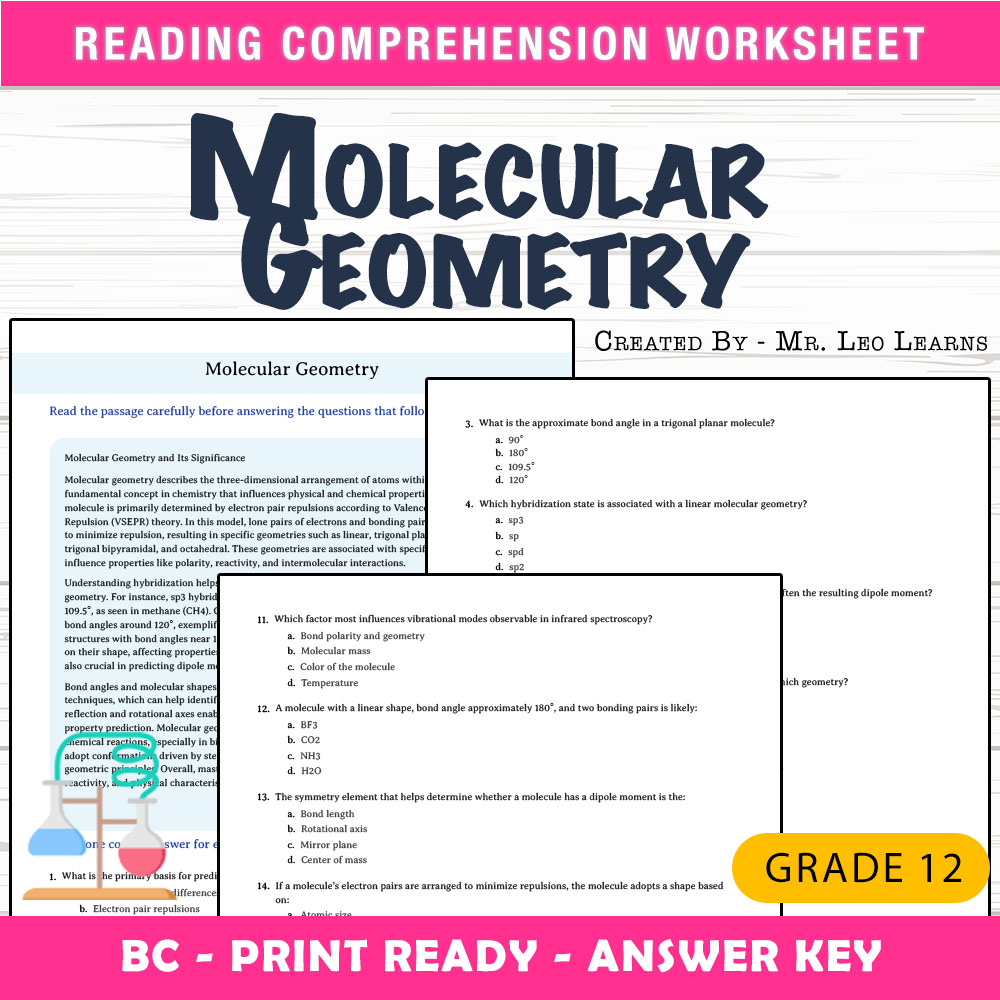
Grade 12 Science — Worksheet MCQ Paper for Mastering Molecular Geometry
 Created byThe Resource Hub
Learning Objectives
- Explain the principles of VSEPR theory and how it determines molecular shape.
- Identify various molecular geometries based on electron pair repulsion models.
- Analyze the relationship between molecular shape, bond angles, and polarity.
Also included in: Grade 12 Science | Chemistry 12 MCQ Worksheet Bundle – BC Curriculum Review Pack +1 more
Instant download
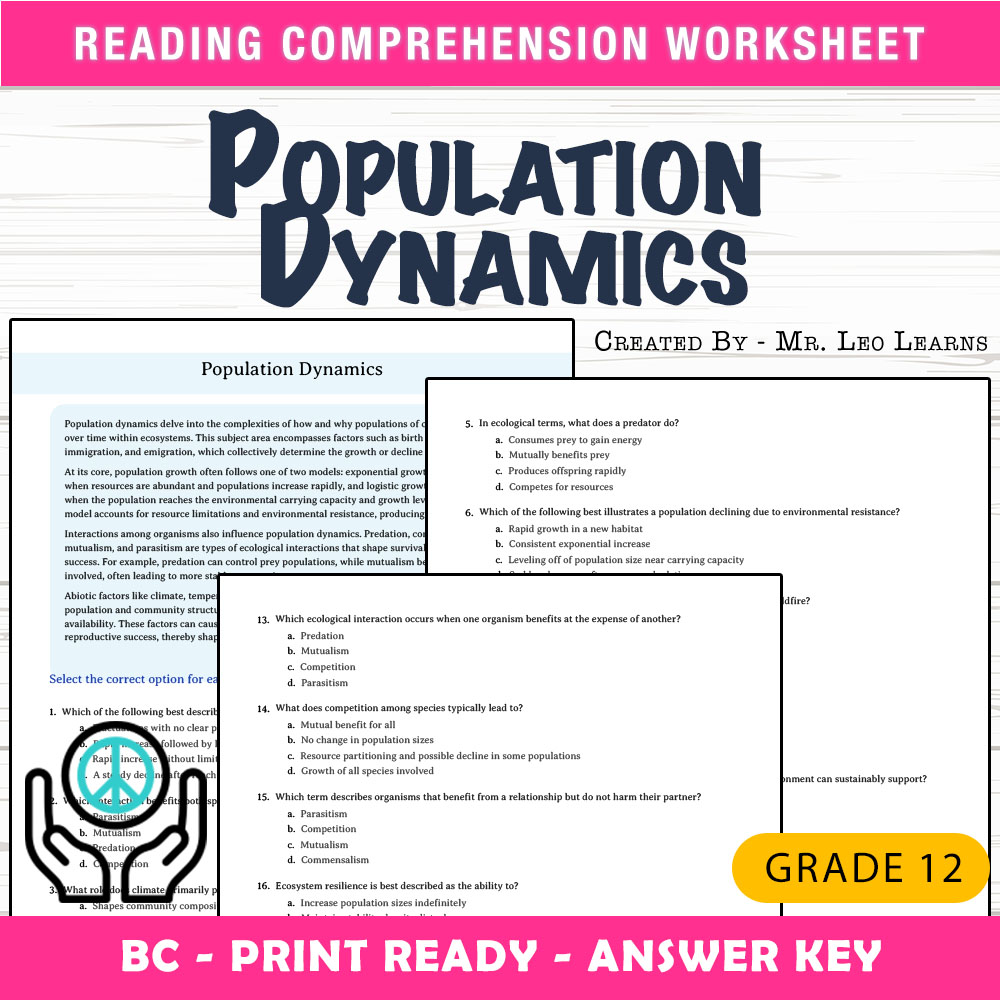
Grade 12 Science — Worksheet MCQ Paper for Mastering Population Dynamics
Created byThe Resource HubLearning Objectives
- Understand the key factors that influence changes in population size and structure.
- Identify patterns of population growth, including exponential and logistic models.
- Recognize different types of interactions within ecosystems and their effects on populations.
Also included in: Grade 12 Science BC | Biology Unit Worksheet Pack with MCQs (15 Worksheets) +1 more
Instant download

Grade 12 Science – Energy & Matter Flow in Ecosystems | Daily Reading Worksheet
Created byBright Mind ResourcesLearning Objectives
- Understand how nutrients cycle through ecosystems among producers, consumers, and decomposers.
- Explain the concept of energy flow in ecosystems and why it is unidirectional.
- Recognize the role of food webs and trophic levels in energy transfer and biomass distribution.
Also included in: Grade 12 Evolution Science Daily Reading Lesson Bundle | California Standards +1 more
Instant download

Grade 12 Electric Circuits Worksheet | Practice & Assessment PDF
Created byClear Sky ClassroomLearning Objectives
- Apply Ohm’s law to solve for voltage, current, and resistance in circuit scenarios
- Analyze series and parallel circuits using Kirchhoff’s rules and equivalent resistance
- Calculate electrical power and energy transfer in resistive elements and interpret efficiency
Instant download

Balancing Reactions Worksheet | Grade 12 Science Practice
Created byPrism Point LearningLearning Objectives
- Use chemical equations to represent chemical change and balance them using the law of conservation of mass
- Identify and classify common reaction types (synthesis, decomposition, single and double replacement, combustion)
- Apply stoichiometric coefficients and mole ratios to make quantitative relationships between reactants and products
Instant download
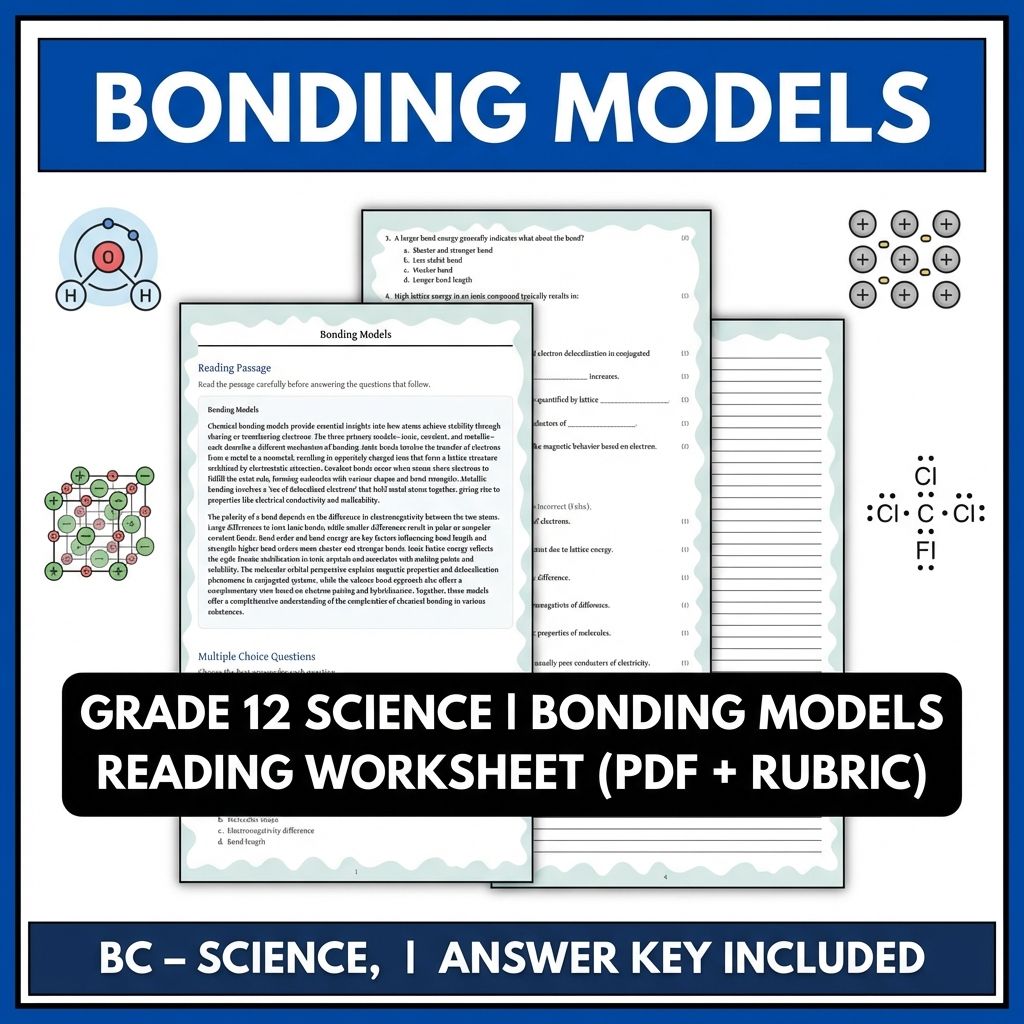
Grade 12 Science | Bonding Models Reading Worksheets (PDF & Answer Key)
JCreated byJ.S SheetsLearning Objectives
- Describe the main types of chemical bonding: ionic, covalent, and metallic.
- Explain how electronegativity differences influence bond polarity.
- Relate bond order and bond energy to bond length and strength.
Instant download

Grade 12 Science | Genetic Molecules Worksheet | AP Aligned
 Created byLumora Learning
Learning Objectives
- Explain how complementary base pairing in DNA underlies accurate nucleic acid replication
- Compare sources of replication errors with the role of DNA repair pathways in maintaining replication fidelity
- Describe how sequence variation (substitutions, insertions, deletions, and rearrangements) can change genetic information flow
Instant download

Grade 12 Science | Genomic Technologies Worksheet | TEKS Alignment
Created byLumora LearningLearning Objectives
- Describe fundamental molecular techniques used in analyzing and manipulating genetic material.
- Explain the mechanisms underlying PCR, DNA sequencing, recombinant DNA, and CRISPR–Cas systems.
- Identify applications of genomic technologies in diagnostics, trait modification, and ethical considerations.
Also included in: Grade 12 Science | Biological Concepts Lesson Bundle | TEKS Aligned
Instant download
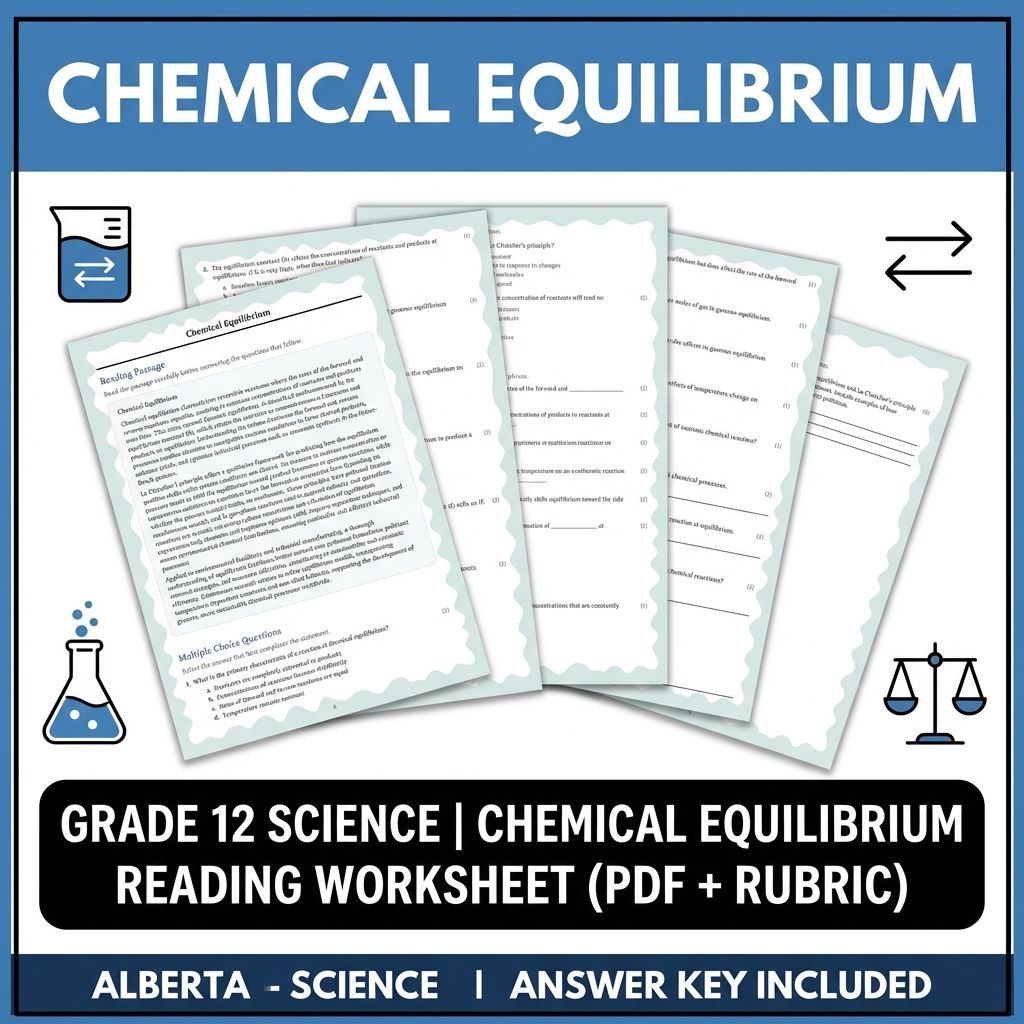
Grade 12 Science | Chemical Equilibrium Reading Worksheet (PDF + Rubric)
JCreated byJ.S SheetsLearning Objectives
- Understand the concept of chemical equilibrium in reversible reactions.
- Describe how Le Chatelier’s principle predicts shifts in equilibrium due to changes in concentration, pressure, or temperature.
- Apply equilibrium expressions to optimize reaction yield and separation strategies.
Also included in: Grade 12 Science | Atomic Spectra to Chemical Equilibria (PDF + Rubric) +1 more
Instant download
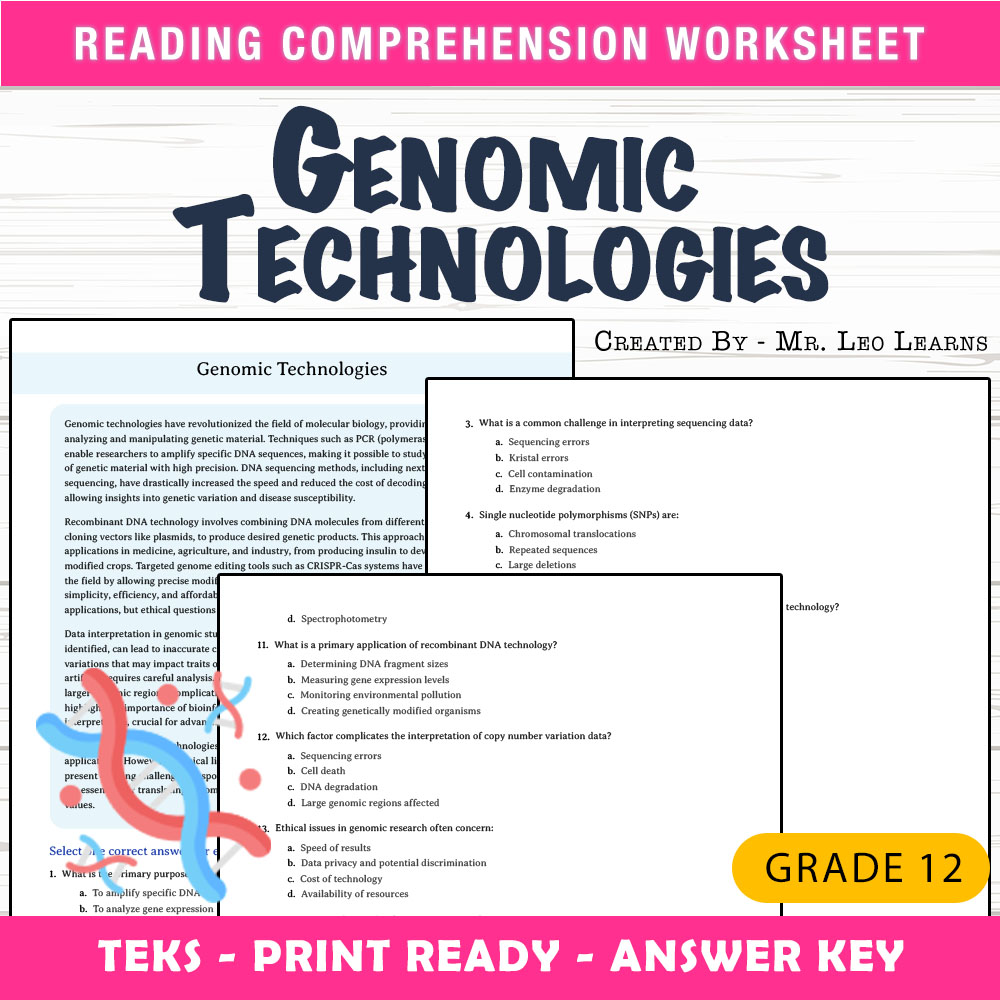
Grade 12 Science — Genomic Technologies Worksheet for Mastery
Created byThe Resource HubLearning Objectives
- Understand key molecular techniques used in genomic analysis.
- Describe applications of recombinant DNA and genome editing methods.
- Identify data interpretation issues in genomic studies.
Also included in: Grade 12 Science Worksheet Bundle – Genetics, Evolution & Biodiversity Mastery +1 more
Instant download
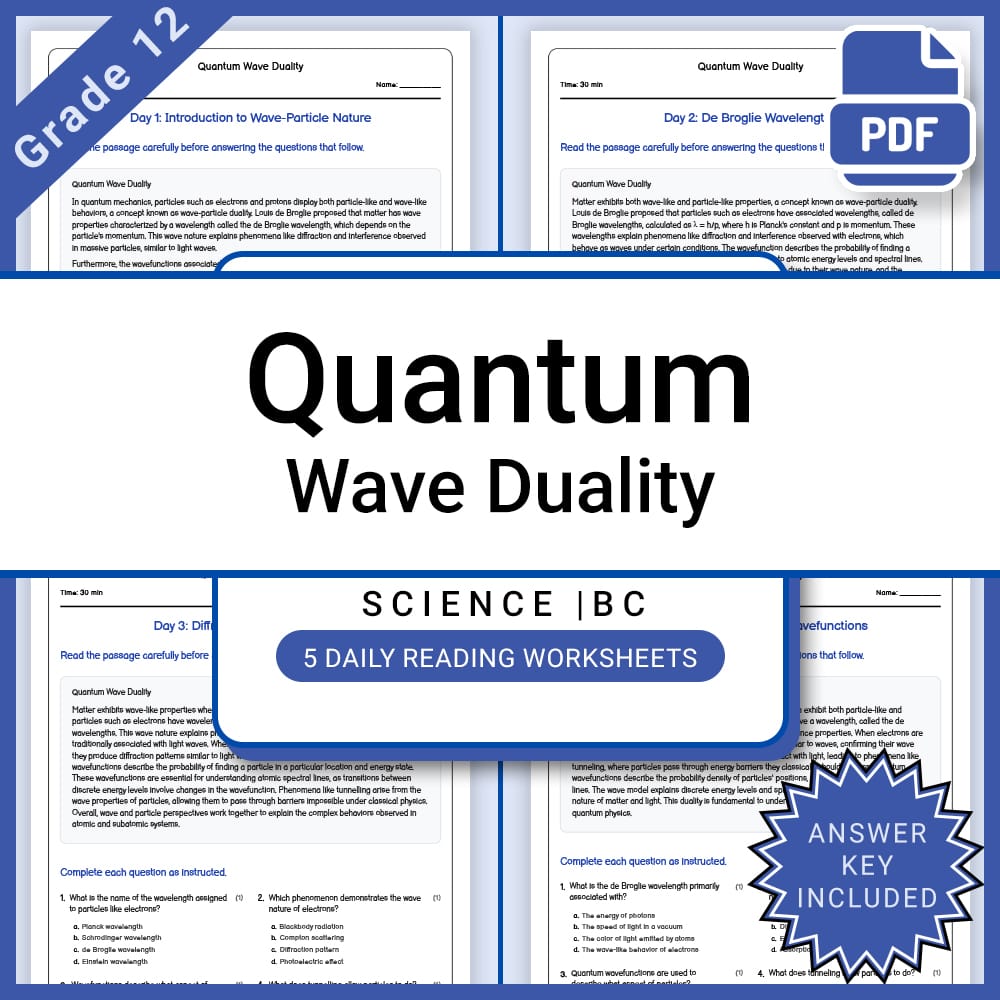
Grade 12 Science – Quantum Wave Duality Daily Reading Worksheet with Answer Key
JCreated byJ.S SheetsLearning Objectives
- Explain the concept of wave-particle duality in quantum mechanics.
- Describe how matter exhibits wave behavior through de Broglie wavelengths.
- Understand the connection between wavefunctions and atomic spectral lines.
Also included in: Grade 12 Science Lesson Group | Physics, Energy, Waves & Electromagnetism +1 more
Instant download

Grade 12 Science | Periodic Predictions Worksheet (AP Standards) (Practice Set)
 Created byEvergreen Desk Education
Learning Objectives
- Explain how effective nuclear charge and electron shielding drive periodic trends in ionization energy, electron affinity, and atomic radius.
- Use subshell filling and penetration to rationalize anomalies in predicted periodic behavior.
- Interpret quantitative and graphical comparisons to justify classifications and reactivity patterns.
Also included in: Grade 12 Chemistry Foundations Science Lesson Bundle for Advanced Placement (AP) +1 more
Instant download

Atomic Structure Worksheet | Grade 12 Science Activities
Created byPrism Point LearningLearning Objectives
- Explain how protons, neutrons, and electrons are arranged in an atom using nucleus and electron cloud ideas.
- Use quantum numbers to describe electron energy levels, subshells, orbitals, and electron configurations.
- Predict trends in ionization energy and atomic radius using effective nuclear charge and valence electrons.
Instant download

Energy Pathways Worksheet | Grade 12 AP Science Energy Systems Activity
Created byPrism Point LearningLearning Objectives
- Explain how energy transfers through radiation, conduction, convection, and phase change within Earth systems.
- Apply conservation of energy to simple energy budgets that connect microscopic processes to large-scale weather and ocean patterns.
- Interpret relationships between sea-surface temperature gradients, ocean currents, and geothermal heat flow.
Instant download

Gene Expression Assessment | Alberta Standards Grade 12 Science Worksheet
Created byPrism Point LearningLearning Objectives
- Explain the processes of transcription and translation in gene expression.
- Identify key regulatory elements like promoters, enhancers, and transcription factors.
- Describe how epigenetic modifications influence gene expression patterns.
Also included in: Grade 12 Biology 30 Evolution Genetics Science Lesson Bundle – Alberta Framework +1 more
Instant download

Grade 12 Science Biogeochemical Cycles Worksheet | NGSSS Aligned Assessment
JCreated byJ.S SheetsLearning Objectives
- Explain how matter moves through ecosystems via biogeochemical cycles connecting atmospheric, aquatic, and soil reservoirs.
- Describe the carbon cycle using photosynthesis, respiration, and decomposition.
- Describe key steps in the nitrogen cycle: nitrogen fixation, nitrification, assimilation, and denitrification.
Also included in: Grade 12 Genetics, Evolution & Ecosystems Science Lesson Bundle | Florida NGSSS +1 more
Instant download
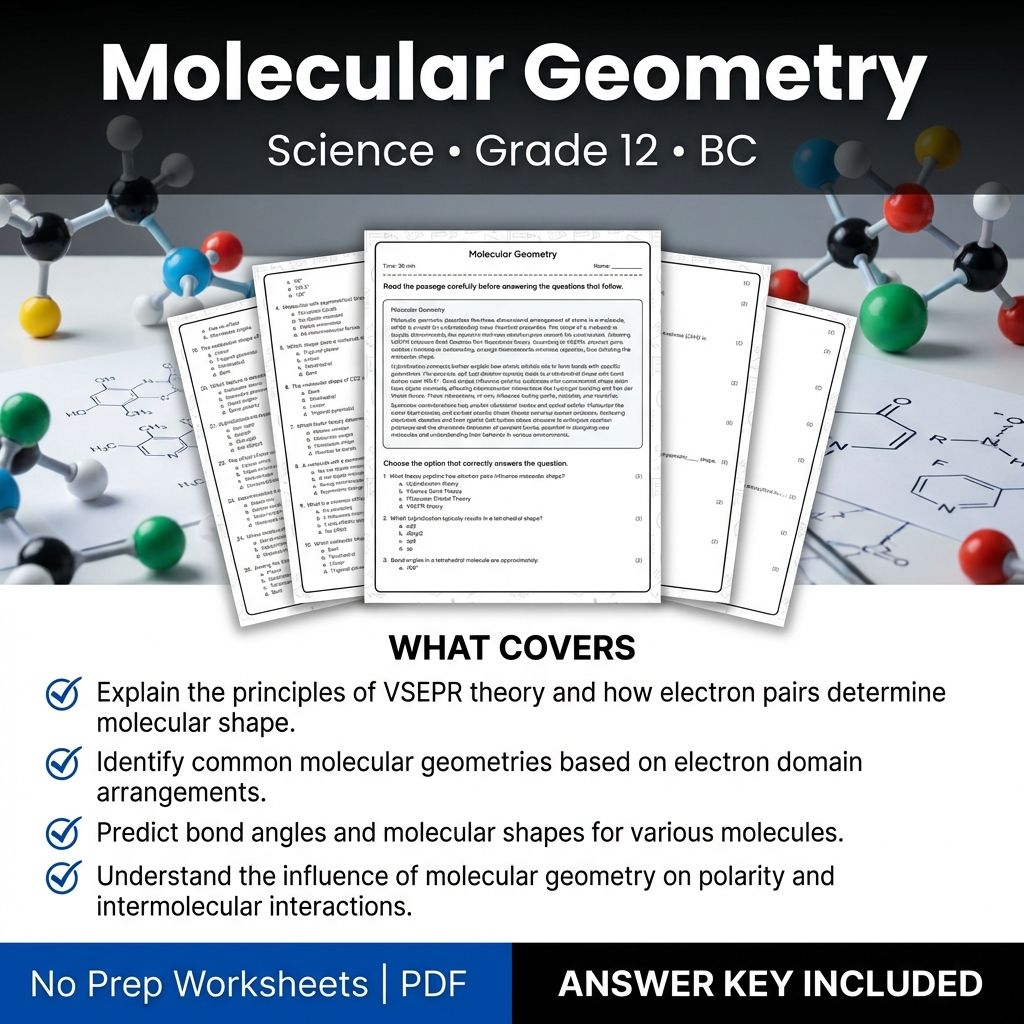
Grade 12 Science Worksheet on Molecular Geometry | BC Standards Practice
 Created byCoral Reef Learning
Learning Objectives
- Explain the principles of VSEPR theory and how electron pairs determine molecular shape.
- Identify common molecular geometries based on electron domain arrangements.
- Predict bond angles and molecular shapes for various molecules.
Instant download

Grade 12 Science | Atomic Structure Worksheet | BC-Aligned
Created byLumora LearningLearning Objectives
- Understand the components and structure of the atom, including protons, neutrons, and electrons.
- Describe electron configurations, energy levels, and orbitals in atoms.
- Explain how valence electrons affect element reactivity and periodic trends.
Also included in: Grade 12 Science | Chemistry Custom Bundle Worksheets | BC-Aligned
Instant download
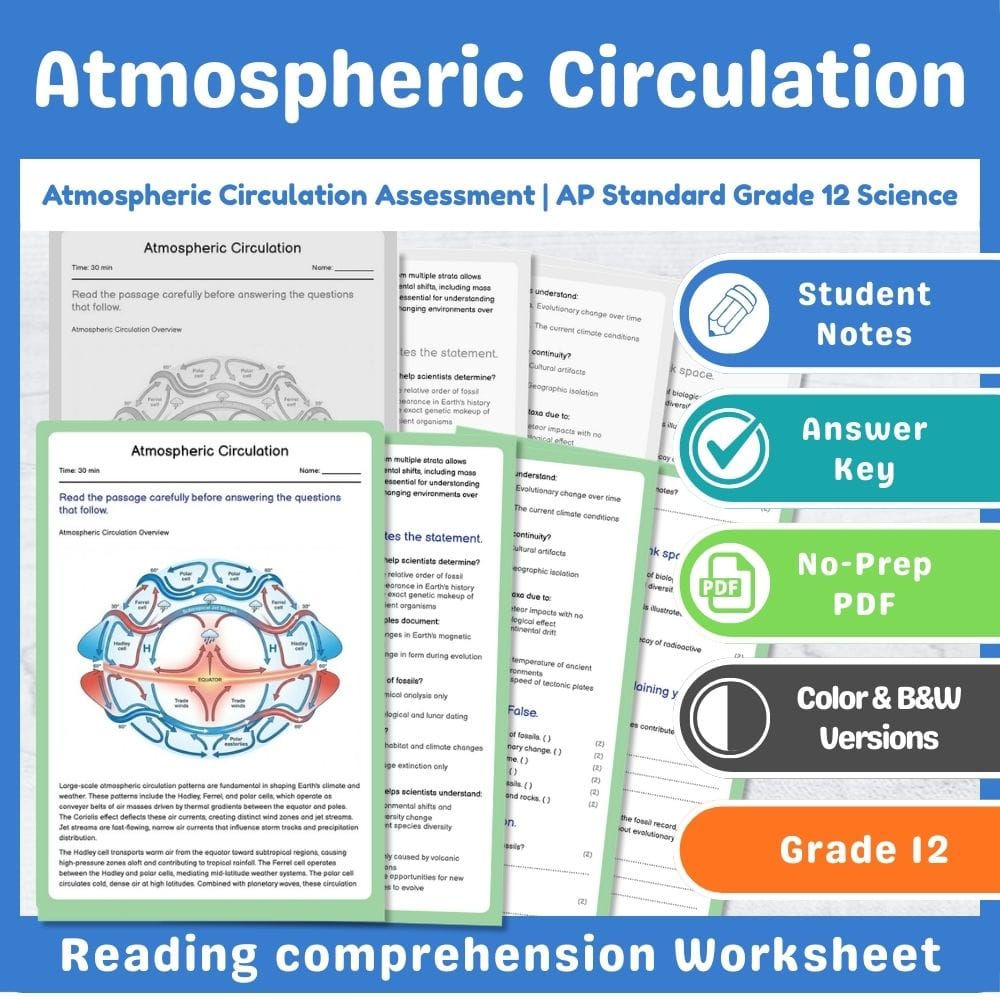
Atmospheric Circulation Assessment | AP Standard Grade 12 Science
Created byPrism Point LearningLearning Objectives
- Explain the global-scale atmospheric circulation patterns including Hadley, Ferrel, and polar cells.
- Describe the influence of thermal gradients and the Coriolis effect on pressure systems and storm tracks.
- Interpret circulation diagrams, pressure maps, and potential vorticity to understand weather regimes and climate shifts.
Instant download

Grade 12 Molecular Geometry Worksheet | Alberta Chemistry VSEPR Practice
Created byEvergreen Desk EducationLearning Objectives
- Use VSEPR electron-domain counting to predict molecular shapes and approximate bond angles
- Connect orbital hybridization (sp, sp2, sp3) to molecular geometry and predicted bond angles
- Evaluate how molecular geometry affects polarity, steric effects, and intermolecular interactions
Instant download

Grade 12 Science | Plate Tectonics Worksheet (AP Standards) (PDF)
Created byEvergreen Desk EducationLearning Objectives
- Explain lithospheric motion and deformation at convergent, divergent, and transform boundaries using plate-tectonic mechanisms.
- Interpret how earthquakes, volcanic distributions, and mantle convection models support past and present plate configurations.
- Use plate reconstructions and bathymetric/earthquake focal information to infer relative crustal evolution rates and styles over geologic time.
Also included in: Grade 12 Earth and Space Sciences Science Lesson Bundle | Advanced Placement (AP) +1 more
Instant download

Grade 12 Science – Matter Cycles in the Earth System | Daily Reading Worksheet
Created byBright Mind ResourcesLearning Objectives
- Describe the stages of the water cycle and how water moves through different Earth spheres.
- Understand the role of the water cycle in weather and ecosystems.
- Identify the processes involved in the movement and transformation of water in the environment.
Also included in: Earth and Space Science Grade 12 Worksheets Lesson Bundle | FL NGSSS +1 more
Instant download
Grade 12 Science Energy System Efficiency Worksheet with Short Notes PDF
Created byMeadowlark WorksheetsLearning Objectives
- Understand the concept of energy system efficiency and how it is measured.
- Identify common loss pathways such as heat dissipation in energy systems.
- Explain the role of insulation, surface area, and control systems in improving efficiency.
Also included in: Grade 12 Engineering Design & Technology Impacts Science Lesson Bundle +1 more
Instant download

Grade 12 Science | Tools And Instrumentation in Science- Comprehension
Created byCoral Reef LearningLearning Objectives
- Understand the purpose and function of DNA sequencing tools
- Identify various scientific instruments used in research and their applications
- Explain measurement precision and calibration in scientific instruments
Also included in: Grade 12 Science Daily Reading Worksheets Full-Year Bundle | TEKS
Instant download

Matter Cycles Worksheet | Grade 12 Earth Science NGSSS Practice
Created byPrism Point LearningLearning Objectives
- Explain how matter cycles through the atmosphere, hydrosphere, biosphere, and geosphere.
- Describe how carbon moves through photosynthesis, respiration, and ocean-atmosphere exchange.
- Connect changes in matter cycling to effects on weathering rates, ecosystem function, and climate-relevant gas levels.
Also included in: Earth and Space Science Lesson Bundle | Grade 12 Science | Florida NGSSS
Instant download

Modeling and Prediction Assessment | Alberta Grade 12 Science Standards
Created byPrism Point LearningLearning Objectives
- Understand the role of mathematical and computational models in hydrological and climate forecasting.
- Identify key concepts such as sensitivity analysis, boundary conditions, and model limitations.
- Evaluate the assumptions and sources of uncertainty in various modeling approaches.
Also included in: Grade 12 Science 30 Lesson Bundle: Alberta Science Assessment Pack +1 more
Instant download
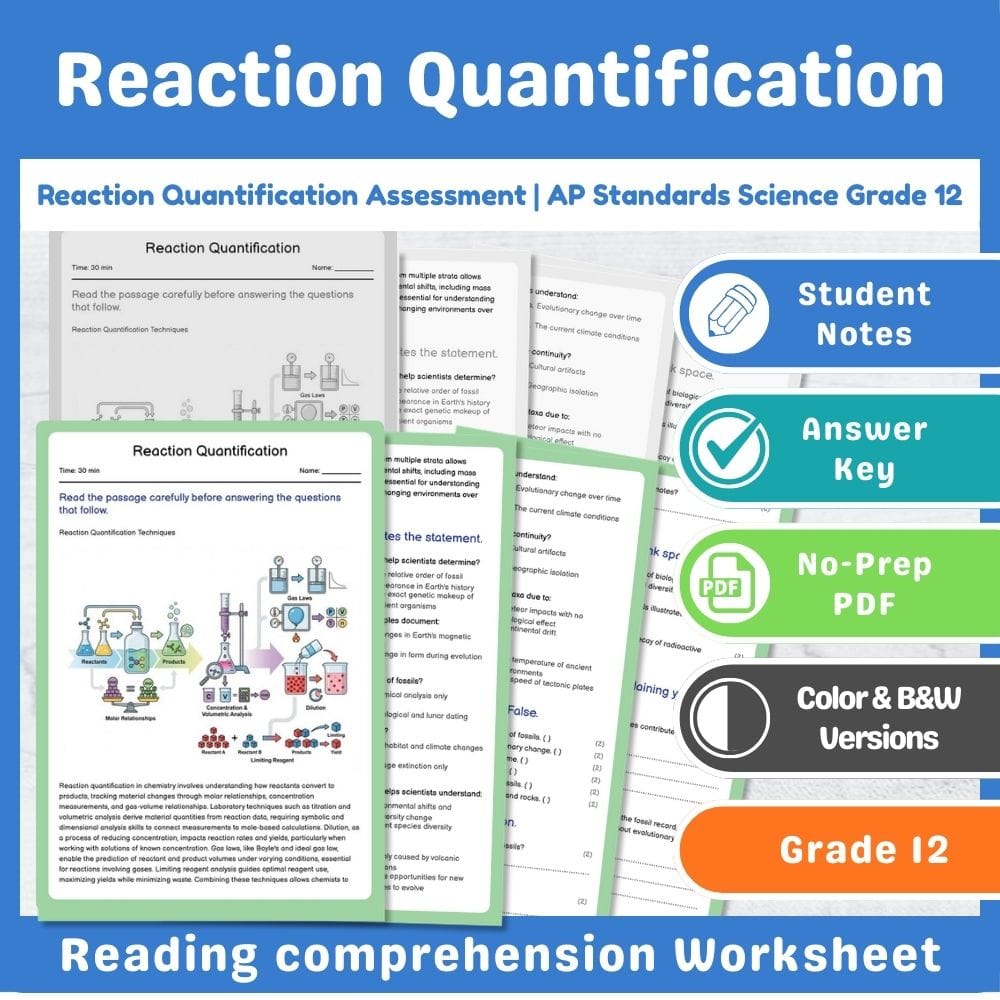
Reaction Quantification Assessment | AP Standards Science Grade 12
Created byPrism Point LearningLearning Objectives
- Understand advanced stoichiometric calculations involving concentration, molarity, and dilution.
- Apply gas-phase relationships under standard and nonstandard conditions to reaction analysis.
- Integrate limiting reagent analysis with titration and volumetric data to quantify reaction extent.
Instant download

Ecosystem Networks AP Science Worksheet Grade 12 Practice Pack
Created byPrism Point LearningLearning Objectives
- Explain how energy flows through trophic levels and how matter cycles via decomposition and nutrient fluxes in ecosystems
- Use simple mass-balance ideas to quantify how nutrients move among producers, consumers, and decomposers
- Describe how network representations and trophic interactions help predict resilience and stability under environmental change
Also included in: AP Biology Cells, Genetics & Ecology Lesson Bundle | Grade 12 Science
Instant download

Grade 12 Science – Argument Construction & Writing | Daily Reading Worksheet
Created byBright Mind ResourcesLearning Objectives
- Understand the structure of evidence-based scientific arguments
- Identify claims, warrants, and backing in scientific discussions
- Analyze case studies of scientific explanations for validity
Also included in: Grade 12 Science Data Analysis Daily Reading Worksheets Lesson Bundle | AP +2 more
Instant download
Grade 12 Science | Instrumentation Use Worksheet with Short Notes (PDF)
Created byMeadowlark WorksheetsLearning Objectives
- Understand the principles of sensor selection and calibration in measurement systems.
- Describe the signal processing techniques and resolution limits in instrumentation.
- Explain sampling rates, aliasing effects, and interfacing methods for accurate data acquisition.
Also included in: Grade 12 Science Unit Bundle | Data Analysis, Modeling & Ethics Worksheets +2 more
Instant download

Grade 12 Science – Human Biodiversity & Environmental Impacts | Worksheet
Created byBright Mind ResourcesLearning Objectives
- Understand how land use change affects biodiversity
- Identify cause-and-effect relationships in ecological systems
- Analyze human actions and their ecological consequences
Also included in: Grade 12 Evolution Science Daily Reading Lesson Bundle | California Standards +1 more
Instant download
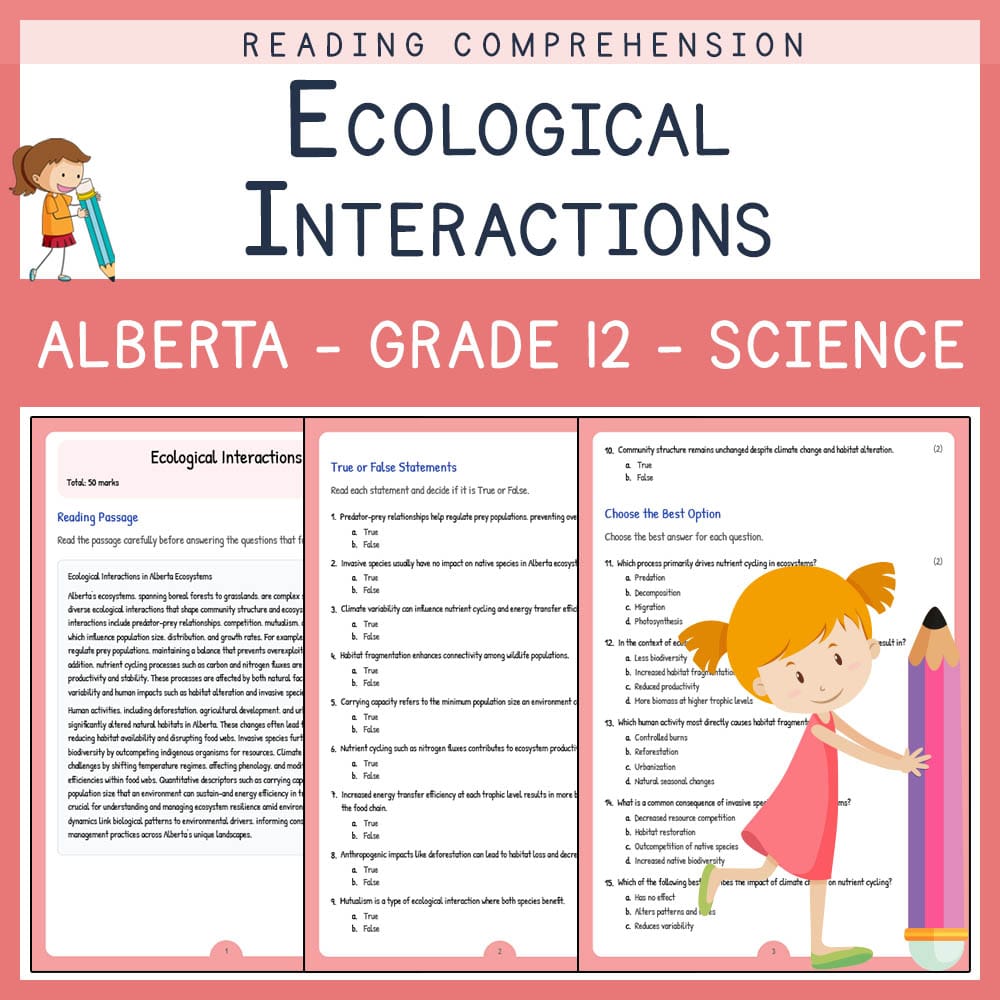
Grade 12 Science | Ecological Interactions Worksheet | Alberta Standards
Created byLumora LearningLearning Objectives
- Understand the various types of ecological interactions and their effects on population dynamics.
- Analyze trophic relationships and nutrient cycling within Alberta ecosystems.
- Evaluate how human activities and climate variability influence community structure and ecosystem services.
Also included in: Grade 12 Science | Science Custom Bundle | Alberta Standards Worksheets
Instant download

Grade 12 Science | Phylogenetic Trees Worksheet | BC-Aligned
Created byLumora LearningLearning Objectives
- Understand the concept and purpose of phylogenetic trees in evolutionary biology.
- Identify features used to construct phylogenetic trees, including morphological and molecular data.
- Differentiate between homologous and analogous traits in evolutionary analysis.
Also included in: Grade 12 | Biology 12 Science Custom Bundle (BC)| Genetics & Evolution
Instant download
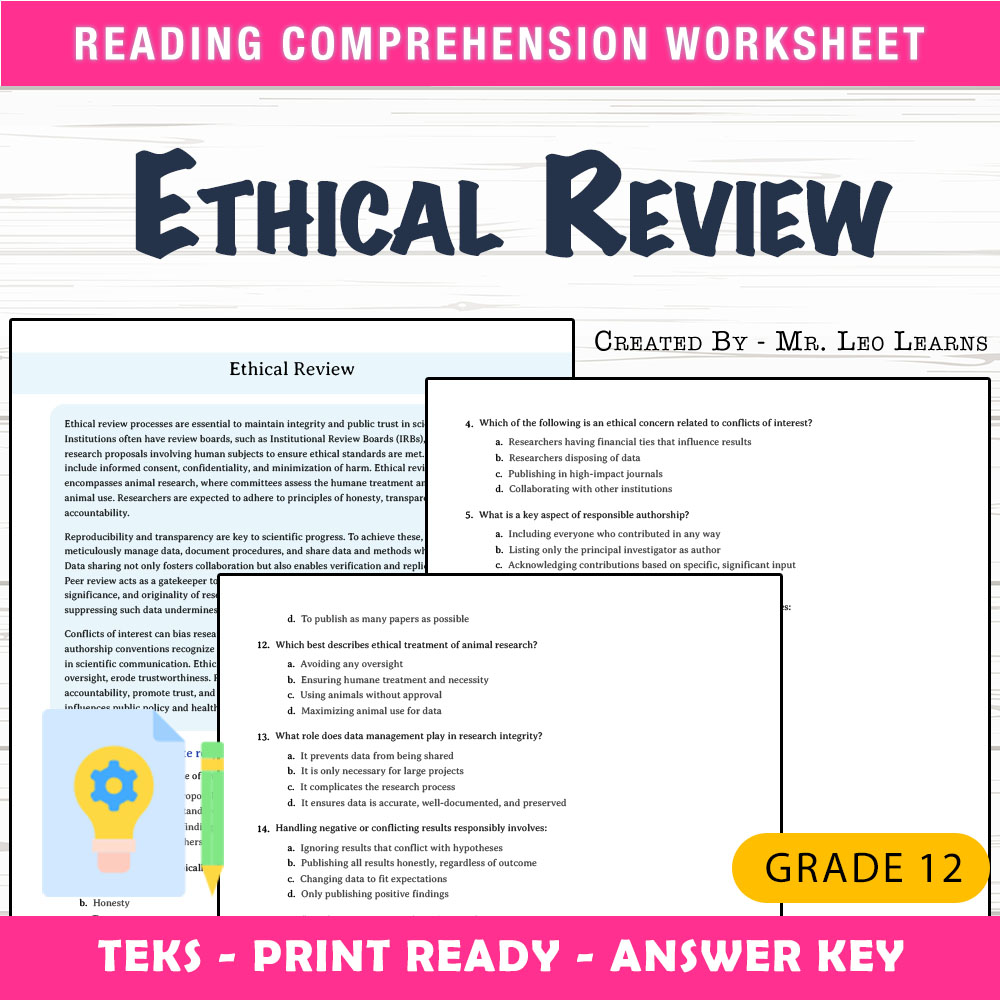
Grade 12 Science — Ethical Review MCQ Worksheet for Mastery
Created byThe Resource HubLearning Objectives
- Understand the principles of responsible conduct in research.
- Identify conflicts of interest and their impact on research integrity.
- Learn proper data management and sharing practices.
Also included in: Grade 12 Science Worksheet Bundle | Scientific Inquiry & Data Analysis Mastery +1 more
Instant download

Grade 12 Science – Bonding Basics Worksheet (AP Standards) (PDF)
Created byEvergreen Desk EducationLearning Objectives
- Distinguish ionic, covalent, and metallic bonding by electron transfer, sharing, and charge-delocalization models.
- Use Lewis structures and formal charge to evaluate bonding possibilities and predict likely molecular structures.
- Explain how bond type affects bulk properties such as conductivity, melting point, and solubility.
Also included in: Grade 12 Chemistry Foundations Science Lesson Bundle for Advanced Placement (AP) +1 more
Instant download
About Grade 12 Science Worksheets
Explore Grade 12 Science worksheets for classwork, homework, or review. Our 4,240 printables download instantly as PDFs.
MyTeachingSheets worksheets are made by real teacher-authors and checked before they go live. Download any as a print-ready PDF for lessons, homework, or independent practice — most include answer keys, and previews are always free.