
Grade 6 Worksheets
8,582 grade resources
Grade 6 Earth System Spheres Worksheet | NGSS Practice PDF
 Created byClear Sky Classroom
Learning Objectives
- Identify the four Earth system spheres: geosphere, hydrosphere, atmosphere, and biosphere.
- Explain how matter and energy move between Earth spheres using examples such as weathering and evaporation.
- Describe how gravity influences the movement of materials within and between spheres.
Instant download

Clarifying Questions Practice Worksheet | Grade 6 ELA Review & Assessment
 Created byMeadowlark Worksheets
Learning Objectives
- Ask clarifying questions that target confusion by requesting definitions, examples, or reasons behind a claim.
- Use active listening strategies such as brief restatements to check whether you understood a speaker correctly.
- Interpret tone and implied meaning to distinguish evidence, opinion, and hypothesis.
Also included in: Grade 6 Listening & Discussion Explanation ELA Lesson Bundle (Alberta) +1 more
Instant download
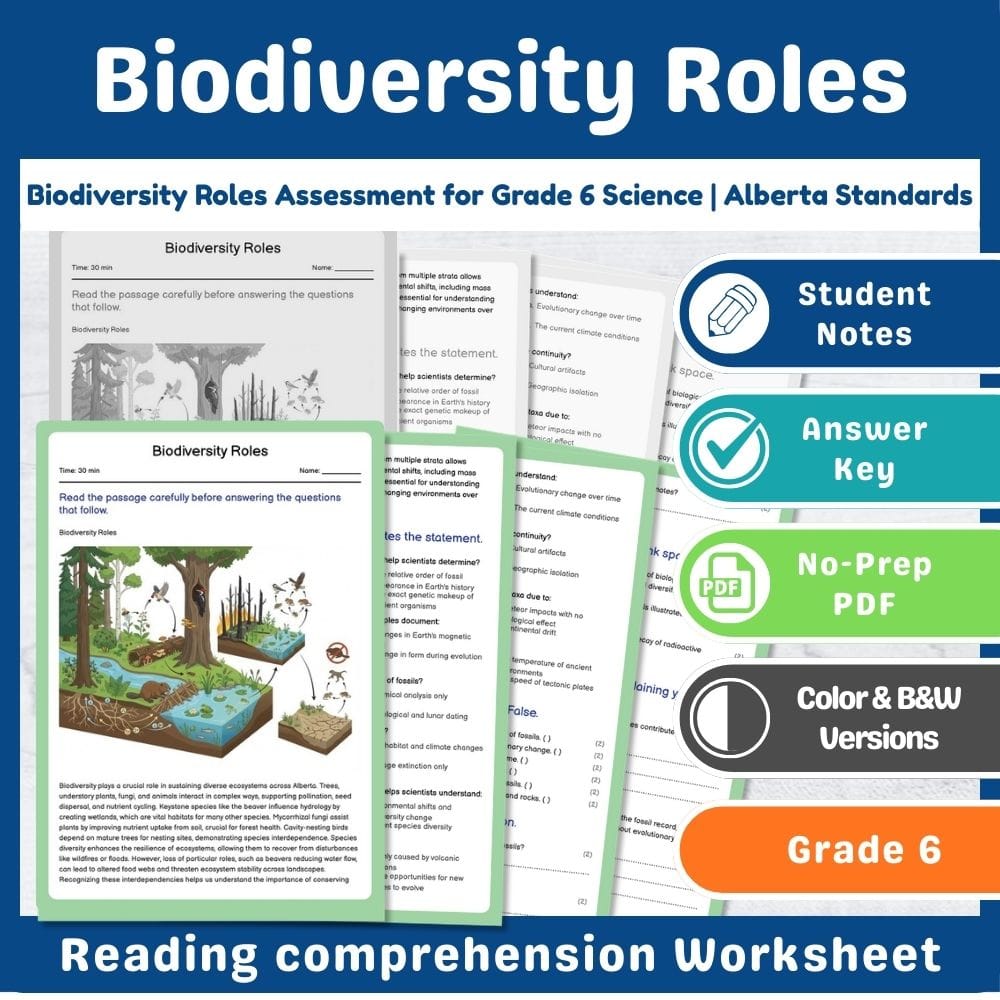
Biodiversity Roles Assessment for Grade 6 Science | Alberta Standards
 Created byPrism Point Learning
Learning Objectives
- Understand how different species contribute to ecosystem functions like pollination, seed dispersal, and nutrient cycling.
- Identify the roles of keystone and indicator species within Alberta ecosystems.
- Explain how species diversity impacts ecosystem resilience and stability.
Also included in: Lesson Grade 6 Science Mini Bundle Trees and Forests Alberta Standards
Instant download

Grade 6 ELA – Analyzing Visuals & Supporting Text in Ecosystems |Daily Worksheet
 Created byQuiet Forest Education
Learning Objectives
- Understand key concepts related to ELA
- Apply knowledge through practice questions
- Demonstrate comprehension of the material
Also included in: Theme, Evidence & Author’s Purpose Daily Lesson Bundle | Grade 6 ELA | TEKS +1 more
Instant download

Meaningful Punctuation Worksheet | Standards-Aligned Grade 6 ELA Practice
JCreated byJ.S SheetsLearning Objectives
- Explain how commas help readers understand pauses, lists, and clause boundaries in grade-appropriate writing.
- Use quotation marks correctly to show direct speech and quoted text.
- Apply apostrophes for possession and contractions to keep meaning precise.
Instant download

Science Worksheet: Decomposers and Nutrient Return | Standards Grade 6
JCreated byJ.S SheetsLearning Objectives
- Explain how decomposers break down dead matter and waste to return nutrients to ecosystems.
- Describe the role of fungi and bacteria in releasing chemical components into soil and water.
- Use nutrient cycling ideas to predict how decomposer activity can affect producer growth and ecosystem productivity.
Also included in: Grade 6 Life Processes & Ecosystems Science lesson bundle: General Framework +1 more
Instant download

6th Grade Science Worksheet – Cell Structure & Organelles (PDF)
 Created byEvergreen Desk Education
Learning Objectives
- Identify major cell parts (cell membrane, cytoplasm, nucleus, and organelles) and describe their functions.
- Explain how cell structure helps life processes happen in an organized way.
- Compare the roles of shared cell parts and how specialized organelles support controlled chemical reactions.
Also included in: Grade 6 Life Processes & Ecosystem Interactions Science Lesson Bundle: General +1 more
Instant download

Grade 6 ELA – Daily Reading Worksheet & Quotation Marks | Ontario Standards
Created byQuiet Forest EducationLearning Objectives
- Understand key concepts related to ELA
- Apply knowledge through practice questions
- Demonstrate comprehension of the material
Also included in: Grade 6 Language Mechanics ELA Daily Reading Worksheets: Lesson Bundle | Ontario +1 more
Instant download

Grade 6 Maths Worksheet | Decimal To Percent Standard CCSS
 Created byElena Brooks
Learning Objectives
- Understand that converting a decimal to a percent means multiplying by 100
- Convert decimals (including decimals greater than 1) into percents
- Relate the size of a decimal to the size of its percent value
Also included in: Grade 6 Rational Numbers, Percents & Inequalities Maths Bundle: Common Core +1 more
Instant download

Author's Purpose Worksheet Grade 6 ELA TEKS Reading Comprehension
 Created byGolden Apple Studio
Learning Objectives
- Determine an author’s likely purpose (to inform, explain, persuade, or entertain) by using evidence from the text.
- Identify which details, examples, and transitions the author uses to support that purpose.
- Explain how word choice and organization reveal an intended message for the reader.
Also included in: Grade 6 ELA Text Analysis & Author Craft Lesson Bundle | TEKS +1 more
Instant download

Surface Change Worksheet for Grade 6 Science NGSS Standards | Assessment
JCreated byJ.S SheetsLearning Objectives
- Understand the geologic processes that modify Earth's surface over different time scales.
- Identify evidence such as rock strata, fossils, and landforms that indicate landscape evolution.
- Differentiate between rapid events like volcanic eruptions and slow processes like weathering.
Also included in: Grade 6 Earth System Interactions Climate Science Lesson Bundle – NGSS +1 more
Instant download

Grade 6 Science – Decomposer Matter Return & Ecosystem Processes | Worksheet
 Created byBright Mind Resources
Learning Objectives
- Understand the role of decomposers in ecosystems.
- Identify how decomposers recycle matter and nutrients.
- Explain the importance of decomposition for ecosystem health.
Also included in: Grade 6 Ecosystems and Energy Science Lesson Bundle | California Standards +1 more
Instant download

Simple Media Product Worksheet Pack | Grade 6 ELA Practice
 Created bySunny Desk Resources
Learning Objectives
- Explain how purpose and audience guide the format and content of a simple media product
- Use the idea of coherence to select supporting details that match the main message
- Describe ethical representation by avoiding distortion and using accurate, contextual information
Also included in: Grade 6 Media Literacy Lesson Bundle: ELA Alberta Framework +1 more
Instant download

Adaptation Overview Test Prep Printable | Grade 6 Science
Created byPrism Point LearningLearning Objectives
- Explain what adaptations are and how they help organisms survive in different environments
- Distinguish structural and physiological adaptations using real examples
- Describe how natural selection can favor traits that improve survival, feeding, defense, or reproduction
Also included in: Multicellular Systems & Functions Lesson Bundle | Grade 6 Science | BC +1 more
Instant download

Grade 6 ELA – Supporting Evidence & Text Analysis | Daily Reading Worksheet
Created byQuiet Forest EducationLearning Objectives
- Understand key concepts related to ELA
- Apply knowledge through practice questions
- Demonstrate comprehension of the material
Also included in: Reading: Informational Text Grade 6 ELA Daily Reading Worksheets Bundle | CCSS +1 more
Instant download

Purpose and Audience Worksheet for Grade 6 ELA | Standards-Aligned Practice
JCreated byJ.S SheetsLearning Objectives
- Explain how a writer’s purpose shapes word choice, organization, and evidence.
- Describe how audience expectations affect formality, background knowledge, and the selection of details.
- Distinguish between writing that informs, persuades, and narrates by using purpose-specific language and evidence.
Instant download

Grade 6 Social Studies — Settlement Patterns Worksheet MCQ Paper
 Created byThe Resource Hub
Learning Objectives
- Compare how transportation and resource distribution influence where different communities develop
- Explain causes and consequences of migration, urbanization, and economic change
- Identify continuity and change in economic roles across urban, prairie, coastal, and northern settlements
Also included in: Grade 6 People and Environments Social Studies Custom Bundle: Ontario
Instant download

Grade 6 Biodiversity Patterns Worksheet | Ontario Science PDF & Key
Created byClear Sky ClassroomLearning Objectives
- Explain how species richness, abundance, and evenness describe biodiversity patterns across ecosystems.
- Use sampling ideas such as transects and quadrats to collect data on biodiversity.
- Interpret spatial patterns of biodiversity and connect them to habitat heterogeneity and ecosystem stability.
Instant download

6th Grade Social Studies | Roman Expansion Worksheet (PDF) – California Standards
Created bySunny Desk ResourcesLearning Objectives
- Describe how Rome expanded its territory using conquests, alliances, and colonization.
- Explain how Roman expansion changed citizenship laws and civic participation.
- Identify ways Roman expansion transformed economic systems through trade and resources.
Also included in: Grade 6 Ancient Greece and Rome Social Studies Lesson Bundle (California) +1 more
Instant download

Grade 6 Science | Reflection and Refraction Worksheet (PDF) BC Standards
Created byEvergreen Desk EducationLearning Objectives
- Explain how reflection follows angle relationships when light meets a surface
- Describe how refraction changes the direction of light as it moves between media
- Use ideas about refractive index and lenses to predict what happens to images and light paths
Instant download

Grade 6 Particle Models Worksheet | NGSS Practice PDF
Created byClear Sky ClassroomLearning Objectives
- Describe matter as composed of tiny particles and explain their behavior.
- Relate particle motion, collisions, and spacing to phases and changes of state.
- Understand how temperature and thermal energy affect particle behavior in gases.
Also included in: Grade 6 Matter & Chemical Reactions Science Lesson Bundle—NGSS Worksheets +1 more
Instant download

Grade 6 Science | System Integration in the Human Body - Reading Comprehension
 Created byCoral Reef Learning
Learning Objectives
- Understand how muscles generate heat to help maintain body temperature.
- Identify feedback mechanisms that regulate internal conditions.
- Explain how muscles interact with other systems to preserve homeostasis.
Instant download

Grade 6 ELA – Integrating Knowledge in Nature & Environment | Daily Worksheet
Created byQuiet Forest EducationLearning Objectives
- Compare perspectives across multiple informational texts.
- Synthesize key insights from different sources.
- Develop analytical reading skills to understand complex topics.
Also included in: Reading: Informational Text Grade 6 ELA Daily Reading Worksheets Bundle | CCSS +1 more
Instant download

Grade 6 Social Studies — Trade and Resources Worksheet MCQ Paper
Created byThe Resource HubLearning Objectives
- Understand the role of trade in ancient Egyptian and Kushite civilizations.
- Identify key resources exchanged between Egypt and Kush.
- Analyze how trade influenced cultural and political relationships.
Also included in: Grade 6 Ancient Egypt Trade Resources Social Studies Lesson Bundle California +1 more
Instant download

Grade 6 ELA – Inferences from Clues & Reading Comprehension | Daily Worksheet
Created byQuiet Forest EducationLearning Objectives
- Identify clues in text that suggest characters' motives and feelings
- Make logical inferences based on descriptive language and actions
- Use evidence from the passage to support conclusions about outcomes
Also included in: Theme, Evidence & Author’s Purpose Daily Lesson Bundle | Grade 6 ELA | TEKS +1 more
Instant download

Grade 6 ELA Worksheet on Context Clues | Practice and Mastery
JCreated byJ.S SheetsLearning Objectives
- Identify how surrounding sentences help determine the meaning of unfamiliar words and phrases.
- Distinguish between different types of context clues such as definitions, restatements, comparisons, examples, and tone.
- Use clues from headings, captions, and adjacent sentences to infer meaning accurately.
Instant download

Natural Hazards Data Analysis Worksheets for Risk Grade 6
 Created byTeachers Club
Learning Objectives
- Identify patterns in observational and instrumental data related to natural hazards.
- Explain how recurrence intervals help estimate when hazards may occur again.
- Use hazard clues to estimate likely event locations and likely magnitudes for risk assessment.
Also included in: Earth's Systems Grade 6 Science Worksheets | NGSS Unit Bundle +2 more
Instant download

Grade 6 ELA – Daily Worksheet & Vocabulary Refinement Exercises | BC Standards
Created byQuiet Forest EducationLearning Objectives
- Understand key concepts related to ELA
- Apply knowledge through practice questions
- Demonstrate comprehension of the material
Also included in: Grade 6 Language ELA Daily Reading Worksheets & Editing Lesson Bundle | BC +1 more
Instant download

Grade 6 Social Studies — Reciprocal Responsibilities Worksheet MCQ Paper
Created byThe Resource HubLearning Objectives
- Understand the principles of reciprocal responsibilities in relationships with territory and community.
- Explain Indigenous concepts of stewardship and mutual obligation.
- Identify community practices that demonstrate respectful exchanges and shared accountability.
Also included in: Grade 6 Social Studies BC: Indigenous Relationships & Knowledge Systems Bundle +1 more
Instant download

Grade 6 TEKS Conduction Daily Science Reading Energy Transfer Worksheet
 Created byBRIGHT PATH RESOURCES
Learning Objectives
- Identify evidence of thermal conduction in a real-life example.
- Explain how temperature changes when heat moves through a solid.
- Compare how different materials transfer heat using the idea of thermal conductivity.
Also included in: Energy, Matter & Change Grade 6 Science Lesson Bundle | TEKS Daily Reading +1 more
Instant download

Genre Techniques Worksheet Grade 6 ELA TEKS Narrative Expository Argument
Created bySunny Desk ResourcesLearning Objectives
- Identify genre techniques that help shape meaning in narrative, expository, and argumentative writing
- Explain how sentence style and pacing support a writer’s purpose
- Distinguish between time order, classification/compare/contrast/cause-effect, and claim-reason argument structure
Instant download

Science: System Interactions on Earth Worksheet | NGSS Grade 6 Science
 Created bySkylark Worksheets
Learning Objectives
- Explain how Earth’s geosphere, hydrosphere, atmosphere, and biosphere interact through transfers of matter and energy.
- Use cause-and-effect reasoning to describe feedbacks (e.g., albedo changes, sediment transport, nutrient cycling).
- Identify energy sources, energy sinks, and phase-change energy transfers in system models over time.
Also included in: Grade 6 Earth & Climate Systems Science Lesson Bundle | NGSS Worksheets +1 more
Instant download

Grade 6 ELA | Building Conversations Worksheet | BC Assessments
 Created byLumora Learning
Learning Objectives
- Use sentence frames and transitional language to build on others’ ideas in a conversation.
- Practice constructive rephrasing and respectful disagreement to support shared understanding.
- Extend claims with relevant reasons or details and connect ideas to earlier points.
Instant download

Grade 6 Science – Renewable Transformations & Solar Power | Reading Worksheet
Created byBright Mind ResourcesLearning Objectives
- Understand how sunlight is converted into electrical energy using photovoltaic cells
- Identify different renewable energy sources and their transformation processes
- Recognize the importance of renewable energy for sustainable development
Also included in: Grade 6 Daily Reading Science Worksheets | Lesson Bundle | BC Framework +1 more
Instant download

Grade 6 Science | Hydrologic Cycle - Daily Reading Comprehension
Created byCoral Reef LearningLearning Objectives
- Understand the stages of the hydrologic cycle, including evaporation, condensation, precipitation, runoff, infiltration, and groundwater discharge.
- Identify the processes controlling water movement within watersheds and aquifers.
- Learn how surface and groundwater interact and their importance for water availability.
Instant download

Grade 6 Science | Energy Forms - Daily Reading Comprehension
Created byCoral Reef LearningLearning Objectives
- Identify different forms of energy such as kinetic, potential, thermal, chemical, and electrical.
- Relate specific forms of energy to everyday phenomena.
- Describe how energy is associated with motion, position, and internal activity of molecules.
Instant download

6th Grade Science | Evidence Communication Worksheet (Alberta) (PDF)
 Created bySilver Birch Teaching
Learning Objectives
- Explain how scientists turn analyzed observations into evidence-based claims.
- Summarize patterns in data using descriptive statistics and clear wording.
- Choose and justify appropriate visuals (bar, line, or scatter plots) for common Alberta contexts.
Also included in: Grade 6 Scientific Inquiry & Data Analysis Science Lesson Bundle: Alberta +1 more
Instant download

Grade 6 Context Clues Meaning Worksheet | ELA Vocabulary Skills Practice
Created bySunny Desk ResourcesLearning Objectives
- Use surrounding sentences to figure out the meaning of unfamiliar words and phrases.
- Identify clue types such as definitions, restatements, comparisons, and examples.
- Explain how tone or perspective in a text can limit or broaden a term’s meaning.
Also included in: Reading Informational Grade 6 ELA Lesson Bundle | General ELA +1 more
Instant download

Grade 6 Science | Competition for Survival in the Forest - Reading Comprehension
Created byCoral Reef LearningLearning Objectives
- Understand what competition means in nature
- Identify how resource availability affects organism survival
- Learn about direct and indirect competition among species
Instant download

Grade 6 | World Ocean Day Worksheet for Protecting Oceans | PDF + Answer Key
 Created byShaNova Worksheets
Learning Objectives
- Explain major threats to ocean health, including pollution and overfishing.
- Identify ways individuals and communities can protect ocean ecosystems.
- Describe how different cultures may value and care for the sea.
Instant download

Grade 6 Science | Mass Wasting Worksheet | General Standard
Created byLumora LearningLearning Objectives
- Explain how gravity drives mass wasting and how materials become unstable on slopes.
- Identify triggers of mass wasting such as heavy rainfall, freeze-thaw, earthquakes, and erosion.
- Describe how deposition at the bottom can change drainage and lead to later erosion and transport.
Instant download

Synthesis of Meanings Worksheet | Grade 6 ELA | Standards-Aligned Practice
JCreated byJ.S SheetsLearning Objectives
- Synthesize information from multiple parts of a text to form a coherent interpretation.
- Use main ideas, inferred implications, and structural/feature details to support claims about meaning.
- Explain how changes in character or ideas across the text connect to the author’s message.
Instant download

Resource Distribution Practice Worksheets | Grade 6 Science NGSS Review Test Prep
Created byPrism Point LearningLearning Objectives
- Explain how past geoscience processes affect where mineral ores, petroleum, and groundwater are found.
- Describe how hydrologic flow and recharge influence groundwater availability.
- Evaluate trade-offs in resource extraction by considering demand, extraction impacts, and technology limits.
Instant download

Electric Current Worksheets: Electricity Grade 6 Science
Created byPrism Point LearningLearning Objectives
- Describe electric current as organized charge movement through a conductor
- Distinguish conventional current direction from electron flow in metals
- Explain potential difference as the driving force for current flow
Also included in: Grade 6 Electricity Lesson Bundle | Ontario Science Framework
Instant download
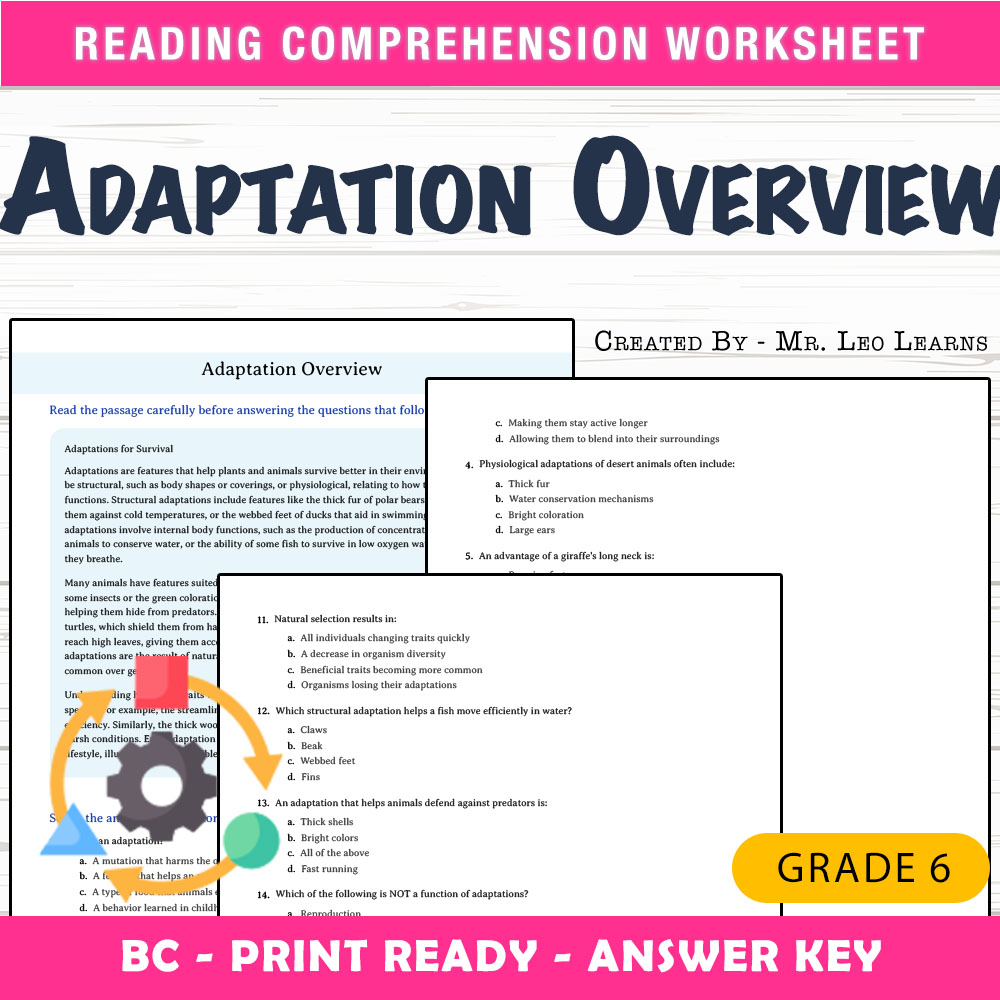
Grade 6 Science — Adaptation Overview Worksheet for Mastery
Created byThe Resource HubLearning Objectives
- Understand the concept of structural and physiological adaptations in organisms.
- Identify examples of adaptations that enhance survival.
- Link specific structural features to their advantages in different environments.
Also included in: Grade 6 Science Unit | Multicellular Systems & Functions Worksheet Bundle +1 more
Instant download

Grade 6 ELA | Revision for Focus Worksheet Elena | Alberta Standard
Created byLumora LearningLearning Objectives
- Revise writing to strengthen a clear central message and supporting details
- Improve coherence by reorganizing ideas and adding logical transitions
- Check for consistency in point of view, tense, and terminology
Also included in: Writing with Evidence & Clarity Lesson Bundle | Grade 6 ELA | Alberta
Instant download

Pure Mixtures Assessment | General Grade 6 Science Standards
Created byPrism Point LearningLearning Objectives
- Understand what constitutes a mixture and recognize different types of mixtures.
- Identify observable properties that distinguish mixtures from pure substances.
- Learn different separation techniques based on mixture properties.
Also included in: Grade 6 Physical Science Science Lesson Bundle: General Framework
Instant download

Grade 6 ELA – Understanding Context Clues & Affixes | Daily Reading Worksheet
Created byQuiet Forest EducationLearning Objectives
- Identify the meaning of unknown words using surrounding context
- Apply knowledge of prefixes and suffixes to infer word meanings
- Analyze how context and affixes connect to the author's purpose
Also included in: Grade 6 Language ELA Lesson Bundle for Daily Reading | General ELA +2 more
Instant download
Browse more categories
About Grade 6 Worksheets
Browse 8,582 printable Grade 6 worksheets across math, ELA, science, and social studies — each a ready-to-print PDF with optional answer keys.
MyTeachingSheets worksheets are made by real teacher-authors and checked before they go live. Download any as a print-ready PDF for lessons, homework, or independent practice — most include answer keys, and previews are always free.