
Grade 6 Worksheets
8,582 grade resources
Drafting Development Worksheet | Standards-Aligned Grade 6 ELA Practice
JCreated byJ.S SheetsLearning Objectives
- Explain how focus statements and elaboration strengthen a draft in a grade-appropriate report.
- Use purposeful sequencing so paragraphs connect logically and contribute to a central message.
- Identify and apply transitions to guide readers between ideas within a draft.
Instant download

Grade 6 Science | Digital Sources Worksheet (PDF) Alberta Standards
 Created byEvergreen Desk Education
Learning Objectives
- Identify examples of digital sources used for local environmental inquiry.
- Explain how to verify key dataset details such as metadata, time resolution, and spatial coverage.
- Describe why licensing and standardized formats matter when combining data from multiple providers.
Instant download
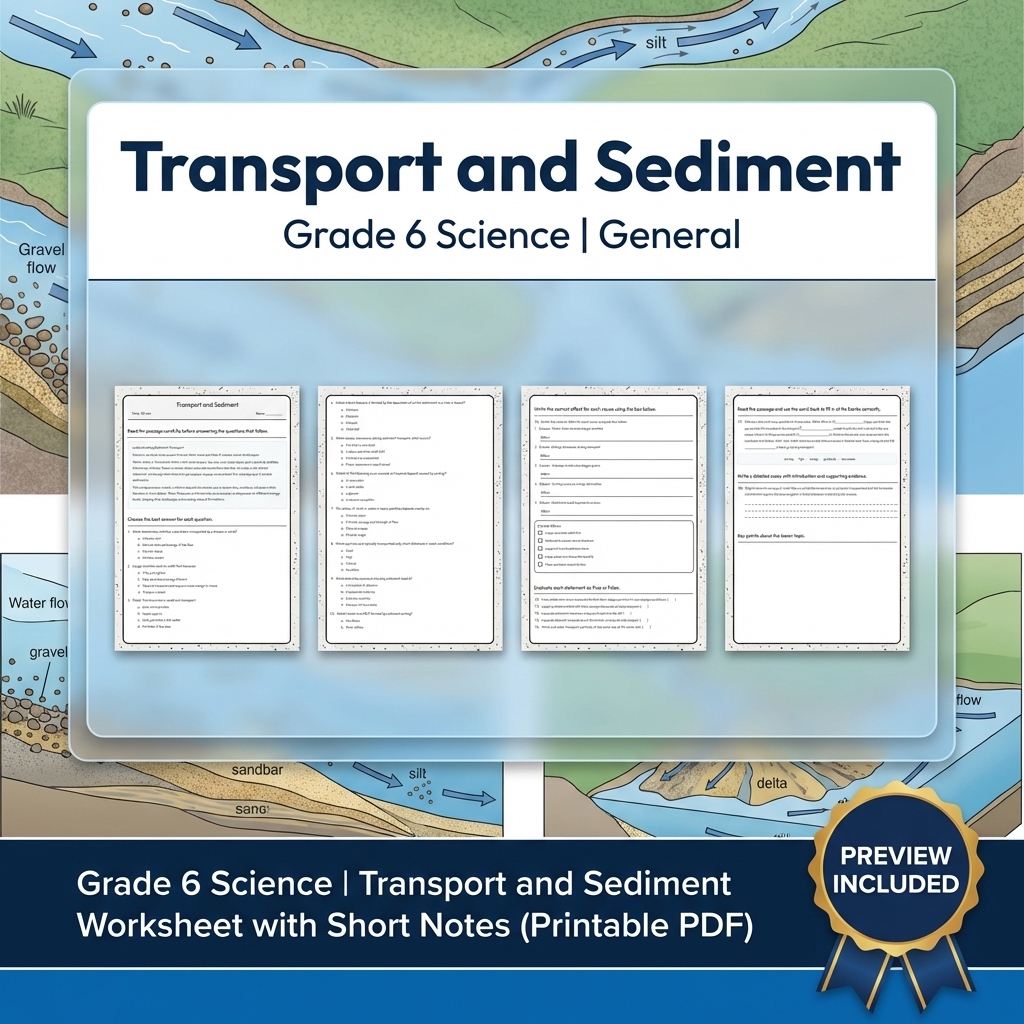
Grade 6 Science | Transport and Sediment Worksheet with Short Notes
 Created byMeadowlark Worksheets
Learning Objectives
- Understand how streams and wind transport particles of different sizes based on energy and strength.
- Explain the process of sorting sediments during transportation.
- Identify natural structures formed by sediment deposition, such as sandbars and deltas.
Also included in: Grade 6 Science Lesson Group Weather, Water, Space, Erosion & Climate +1 more
Instant download

Grade 6 ELA – Figurative Language Mastery | Daily Reading Worksheet
 Created byQuiet Forest Education
Learning Objectives
- Identify metaphors in a given passage.
- Interpret the meaning of metaphors within context.
- Differentiate between literal and figurative language.
Also included in: Grade 6 Language ELA Lesson Bundle for Daily Reading | General ELA +2 more
Instant download

Explanatory Details Worksheet Grade 6 ELA with Answer Key & Guide
 Created bySunny Desk Resources
Learning Objectives
- Explain how accurate, relevant details support clear explanatory writing
- Use text relationships such as cause and effect, comparison, and process steps to improve explanations
- Distinguish definitions, examples, and factual details from unrelated information
Also included in: Grade 6 Writing Lesson Bundle | General ELA | Editing, Narrative, Argument +1 more
Instant download

Grade 6 ELA – Proofreading Skills & Daily Reading Worksheet | BC Standards
Created byQuiet Forest EducationLearning Objectives
- Identify common spelling errors in writing.
- Apply strategies to check and correct unfamiliar words.
- Recognize repeated mistakes that impact the clarity of writing.
Also included in: Grade 6 Language ELA Daily Reading Worksheets & Editing Lesson Bundle | BC +1 more
Instant download

Grade 6 Fossil Patterns in Earth's History Worksheet | NGSS Science Activity
 Created byBRIGHT PATH RESOURCES
Learning Objectives
- Understand how fossils record Earth's past environments and life forms.
- Identify different fossil patterns and their significance in geological studies.
- Analyze the evidence fossils provide for understanding species evolution and extinction.
Also included in: Biological Evolution: Unity & Diversity Grade 6 Science Lesson Bundle | ngss +2 more
Instant download

Digital Publishing Worksheet Grade 6 ELA with Answer Key & Guide
Created bySunny Desk ResourcesLearning Objectives
- Explain how digital tools support drafting, revising, formatting, and sharing writing
- Identify how headings, paragraphs, and spacing improve readability on a screen
- Use editing and attribution conventions to improve clarity and cite sources appropriately
Also included in: Grade 6 Writing Lesson Bundle | General ELA | Editing, Narrative, Argument +1 more
Instant download

Grade 6 ELA | Drafting Development Worksheet | BC Assessments
 Created byLumora Learning
Learning Objectives
- Explain how focus statements help organize a draft by setting the main point of a paragraph.
- Use elaboration (explanations, examples, and relevant details) to strengthen ideas in writing.
- Apply transitions to show how ideas connect and guide the reader through a report.
Instant download

Chemical Reactions Indicators of New Substances Worksheet | NGSS Grade 6 Science
 Created bySkylark Worksheets
Learning Objectives
- Identify evidence of chemical reactions using qualitative indicators such as color change, gas formation, and precipitate formation.
- Use quantitative data (mass, temperature, and measurements of reactants/products) to determine whether a new substance forms.
- Interpret before-and-after observations from common reactions such as acid–carbonate reactions and metal oxidation.
Also included in: Grade 6 Matter and Chemical Reactions Science Lesson Bundle NGSS Worksheets +1 more
Instant download

Grade 6 Science | Sustainability Strategies - Daily Reading Comprehension
 Created byCoral Reef Learning
Learning Objectives
- Understand the concept of sustainability and its importance.
- Identify different strategies for sustainable resource use.
- Recognize the impact of population trends and resource consumption on earth systems.
Instant download

Grade 6 Scale of Space Worksheet | NGSS Earth Science Activity & Answer Key
 Created byNorthstar Worksheets
Learning Objectives
- Use astronomical units (AU) to compare the Earth–Sun distance to other distances in the solar system.
- Compare relative planetary sizes (such as Earth vs. Jupiter) using radii or diameter ratios.
- Interpret tables and charts using orders of magnitude to describe large-scale solar system relationships.
Also included in: Grade 6 Earth Science Scale of Space & Moon Seasons Lesson Bundle – NGSS +1 more
Instant download

Grade 6 Making Inferences Worksheet | Ontario ELA Reading Comprehension Skills
Created bySunny Desk ResourcesLearning Objectives
- Identify clues in text (words, tone, and events) that support an inference.
- Distinguish between what a text directly states and what can be logically implied.
- Explain how evidence from the passage supports an inference.
Instant download

Science Worksheet Parallel Characteristics Grade 6 | Standards-Aligned
JCreated byJ.S SheetsLearning Objectives
- Explain how parallel circuits split current into multiple branching pathways
- Describe why each parallel branch has the same potential difference (voltage)
- Use the idea that total current equals the sum of branch currents
Instant download

Grade 6 Molecular Processes Worksheet | NGSS Science Activity & Notes
 Created byAmber Owl Education
Learning Objectives
- Explain how monomers assemble into polymers through condensation reactions.
- Describe how hydrolysis breaks polymers into smaller building blocks.
- Connect the structure of macromolecules (proteins, nucleic acids, lipids, carbohydrates) to their functions in cells.
Also included in: Cells & Scientific Evidence Lesson Bundle – Grade 6 Science NGSS +1 more
Instant download

Graphic Integration Worksheet for Grade 6 ELA | Standards-Aligned Practice
JCreated byJ.S SheetsLearning Objectives
- Explain how titles, labels, legends, scales, and captions help readers understand graphics.
- Use information from visuals to support or extend ideas stated in the written text.
- Connect details from a chart, map, timeline, or diagram to the author’s explanation when answering a question.
Instant download

Grade 6 ELA – Understanding the Structure of Explanatory Texts | Daily Worksheet
Created byQuiet Forest EducationLearning Objectives
- Understand key concepts related to ELA
- Apply knowledge through practice questions
- Demonstrate comprehension of the material
Also included in: Reading Grade 6 ELA Daily Reading Worksheets Lesson Bundle | General ELA +2 more
Instant download

Thoughtful Discussion Worksheets: Evidence & Responses | Grade 6 ELA
 Created byGolden Apple Studio
Learning Objectives
- Rephrase a speaker's idea to show shared understanding
- Use relevant evidence when responding to another viewpoint
- Demonstrate respectful tone during classroom discussions
Also included in: Grade 6 ELA Accountable Discussion Worksheets & Activities | Ontario +1 more
Instant download
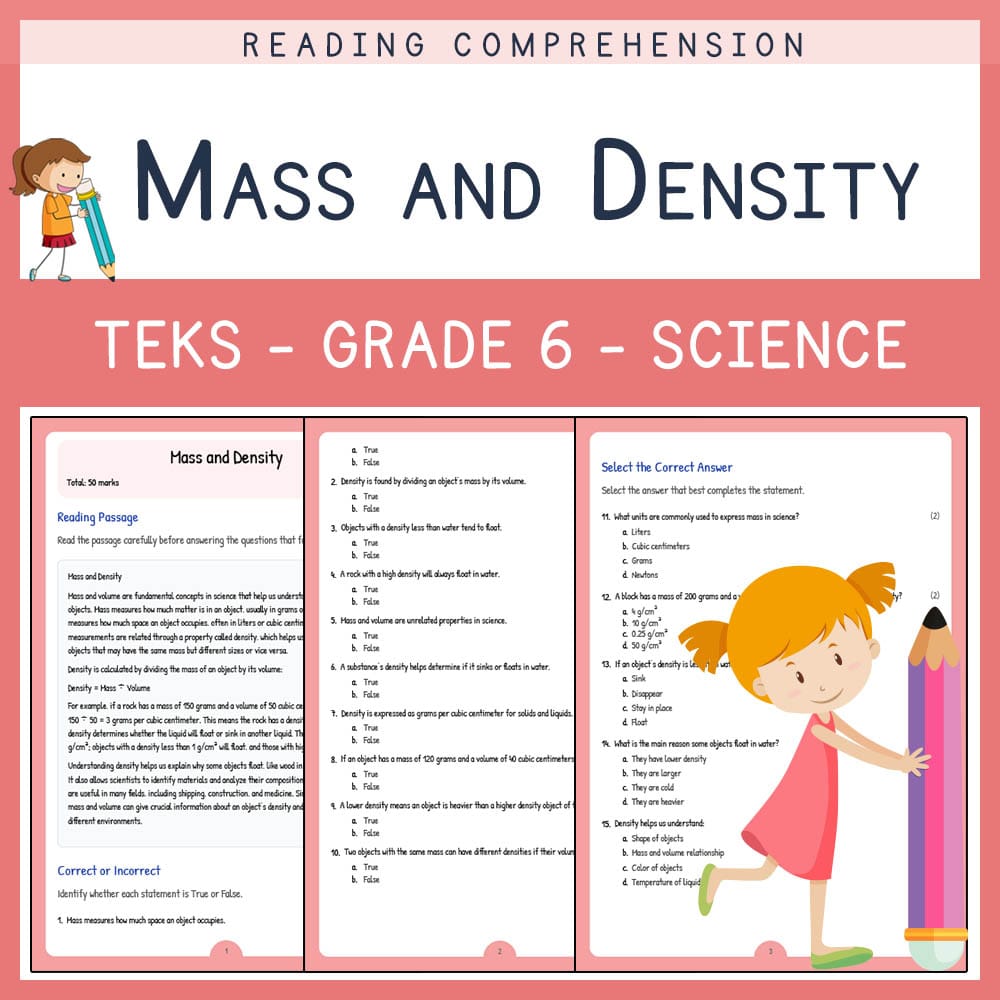
Grade 6 Science | Mass and Density Worksheet | TEKS Aligned
Created byLumora LearningLearning Objectives
- Define mass and volume, and distinguish between them.
- Explain density as the ratio of mass to volume.
- Calculate density for simple solids and liquids using whole-number values.
Also included in: Grade 6 Science | Matter and Energy Lesson Bundle | TEKS Aligned
Instant download

Grade 6 ELA Thoughtful Responses Writing Worksheet Ontario Reading Skills
Created byLumora LearningLearning Objectives
- Listen to a speaker’s viewpoint and identify the specific idea being raised before responding.
- Use relevant evidence and accurate references when adding to or revising a discussion.
- Practice respectful tone, timely turn-taking, and rephrasing/summarizing to support shared understanding.
Instant download

Grade 6 Day and Night Cycle & Earth’s Rotation Worksheet | Alberta Science
Created byBRIGHT PATH RESOURCESLearning Objectives
- Explain how Earth’s rotation causes day and night for different locations.
- Identify cause-and-effect relationships in a science text about Earth and sunlight.
- Use accurate vocabulary to describe how the Sun’s light creates changes in what we observe.
Also included in: Sun-Earth-Moon Patterns Lesson Bundle Grade 6 Science Alberta Daily Reading +1 more
Instant download

Human Impacts Worksheet Pack 6th Grade Science Activities
 Created byPrism Point Learning
Learning Objectives
- Describe major human impacts on forests (land conversion, extraction, fragmentation, pollution, and invasive species).
- Explain how these impacts can change habitat connectivity, soil and water quality, and species composition.
- Identify cumulative effects and why they matter for landscape-level planning.
Also included in: Trees and Forests Lesson Bundle | Grade 6 Science | Alberta Framework
Instant download

6th Grade Health Worksheet | Complex Influences & NHES Standards (PDF)
Created bySunny Desk ResourcesLearning Objectives
- Explain how social, media, and environmental factors can influence health behaviors in interconnected ways.
- Use examples to describe how positive and negative influences can work together or cancel out.
- Apply cause-and-effect thinking to propose balanced health choices in real-life situations.
Also included in: Grade 6 Analyze Influences on Health Health Lesson Bundle for NHES +1 more
Instant download

Grade 6 ELA – Complex Sentences & Subordinating Conjunctions | Daily Worksheet
Created byQuiet Forest EducationLearning Objectives
- Understand key concepts related to ELA
- Apply knowledge through practice questions
- Demonstrate comprehension of the material
Also included in: Grade 6 Language Mechanics ELA Daily Reading Worksheets: Lesson Bundle | Ontario +1 more
Instant download

Building Conversations Worksheet | BC Standards Grade 6 ELA Practice
JCreated byJ.S SheetsLearning Objectives
- Explain how to contribute to a conversation by building on others’ ideas instead of replacing them.
- Use sentence-level language that connects ideas to earlier points, adds reasons or details, and signals relationships between viewpoints.
- Practice productive discussion strategies such as respectful disagreement, constructive rephrasing, and clear transitions.
Instant download
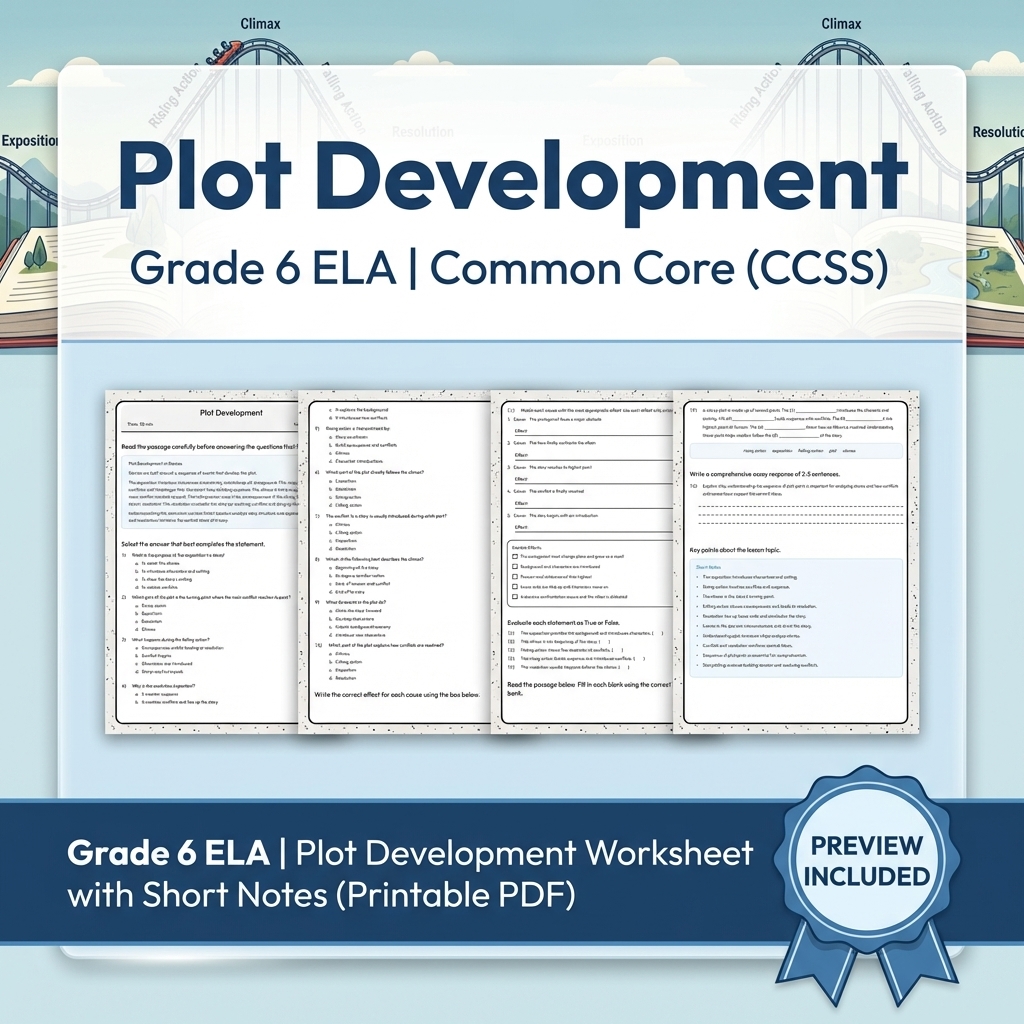
Grade 6 ELA | Plot Development Worksheet with Short Notes (Printable PDF)
Created byMeadowlark WorksheetsLearning Objectives
- Understand the structure of plot, including exposition, rising action, climax, falling action, and resolution.
- Identify how events are interconnected and drive the story forward.
- Recognize how conflict and resolution reinforce central ideas.
Also included in: Grade 6 Theme & Textual Evidence ELA Lesson Bundle – CCSS +1 more
Instant download
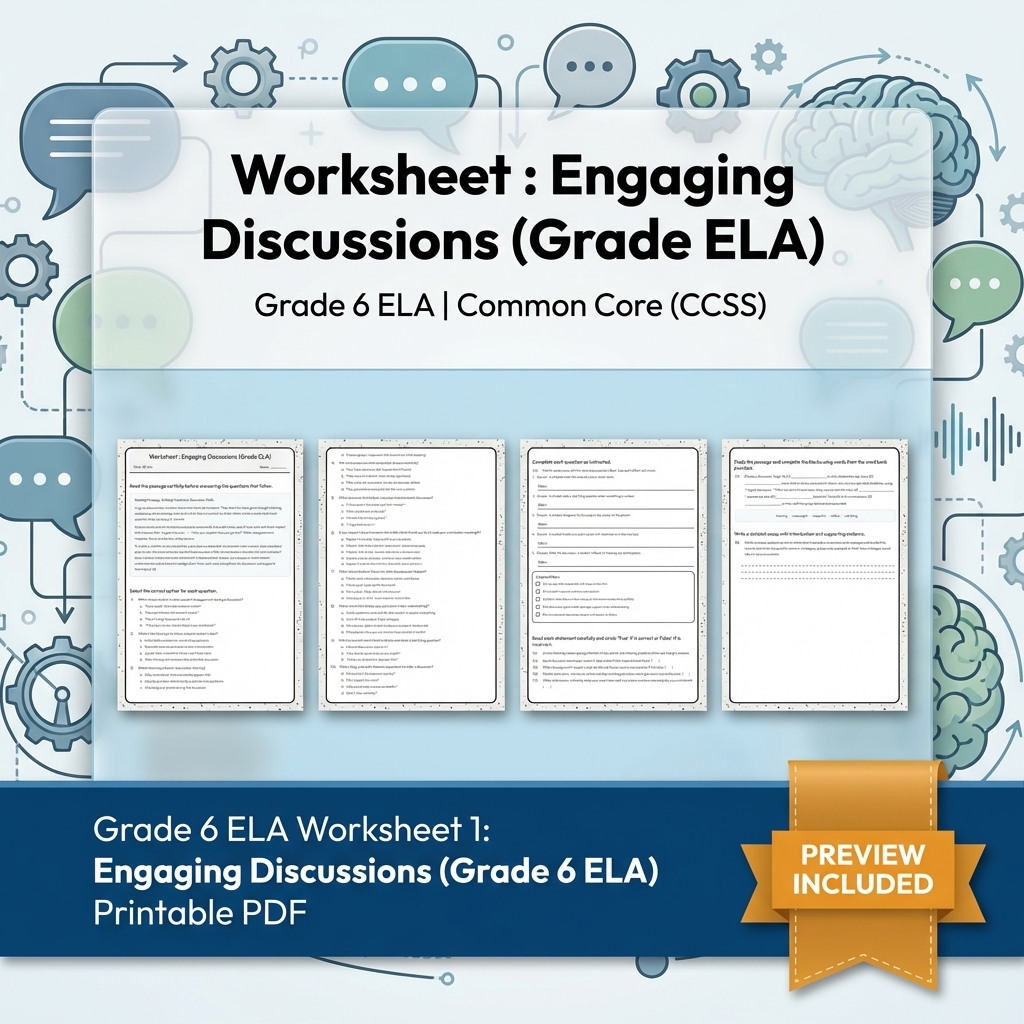
Grade 6 ELA Worksheet Engaging Discussions Printable PDF
Created byMeadowlark WorksheetsLearning Objectives
- Identify and explain discussion norms that support respectful group conversations
- Practice building on others’ ideas by adding evidence, clarifying questions, and meaningful comments
- Use active listening strategies to improve understanding during collaborative discussions
Also included in: Grade 6 Presenting Ideas & Listening ELA lesson bundle: CCSS +1 more
Instant download

Resource Limits and Carrying Capacity Worksheets | Grade 6 Science
 Created byTeachers Club
Learning Objectives
- Explain how limited resources affect population size over time
- Interpret quantitative data (counts and measurements) to identify limiting resources
- Describe how carrying capacity relates to population fluctuations
Also included in: Grade 6 Science Full Year Bundle | NGSS Worksheets & Printables +1 more
Instant download

Grade 6 ELA – Understanding the Main Idea & Key Details | Daily Worksheet
Created byQuiet Forest EducationLearning Objectives
- Understand key concepts related to ELA
- Apply knowledge through practice questions
- Demonstrate comprehension of the material
Also included in: Reading: Informational Text Grade 6 ELA Daily Reading Worksheets Bundle | CCSS +1 more
Instant download

6th Grade Science | Stem Transport Worksheet (Alberta Standards) (PDF)
 Created bySilver Birch Teaching
Learning Objectives
- Explain how xylem and phloem transport water, minerals, and sugars through a plant stem.
- Describe how freeze–thaw cycles, drought, and pests can affect sap flow and plant survival.
- Connect stem and bark structure to how trees protect transport tissues and respond to environmental change.
Also included in: Grade 6 Ecosystem Interactions Science Lesson Bundle: Alberta Framework +1 more
Instant download

Thoughtful Responses Grade 6 ELA Writing Worksheet Ontario
Created bySunny Desk ResourcesLearning Objectives
- Listen to a peer’s viewpoint and respond to the specific idea they raised
- Use relevant evidence and accurate references when adding or revising claims
- Rephrase or summarize to confirm shared understanding before introducing new ideas
Instant download

Population Dynamics Growth Limits Monitoring Worksheet | Ontario Grade 6 Science
JCreated byJ.S SheetsLearning Objectives
- Explain how birth rate, death rate, immigration, and emigration affect population size.
- Compare exponential growth with logistic growth using carrying capacity and limiting factors.
- Identify density-dependent and density-independent influences in terrestrial and aquatic systems.
Instant download

Grade 6 ELA | Caption Meanings Worksheet | Alberta Standard
Created byLumora LearningLearning Objectives
- Explain how captions help readers interpret images, diagrams, and photographs accurately.
- Identify the purpose of caption details such as definitions, context, limitations, and sources.
- Use caption meanings to avoid misreading and connect visuals to an author’s main point.
Instant download

Grade 6 Science | Groundwater and Baseflow Worksheet | California Standards
Created byLumora LearningLearning Objectives
- Explain how groundwater forms and moves through pore spaces in the geosphere
- Describe how infiltration and percolation recharge aquifers
- Connect groundwater discharge to stream baseflow during dry periods
Instant download

Grade 6 ELA – Text Structure & Nonfiction Passage Practice | Daily Worksheet
Created byQuiet Forest EducationLearning Objectives
- Understand key concepts related to ELA
- Apply knowledge through practice questions
- Demonstrate comprehension of the material
Also included in: Theme & Inferences Grade 6 ELA Daily Reading Worksheets Lesson Bundle | BC +1 more
Instant download

Grade 6 Science | Synthetic Materials - Daily Reading Comprehension
Created byCoral Reef LearningLearning Objectives
- Understand the sources of synthetic materials
- Identify properties of common synthetic materials
- Compare natural and synthetic materials based on their uses
Instant download

Cell Evidence Microscopy Worksheet | NGSS Grade 6 Science Assessment
Created bySkylark WorksheetsLearning Objectives
- Identify evidence from microscopy and preserved specimens that supports the claim that cells are the basic unit of life.
- Differentiate single-celled organisms from multicellular organisms using observable traits such as size, compartments, and organization.
- Explain how characteristics seen in cells and tissues provide evidence for relationships among cells, tissues, organs, and whole organisms.
Also included in: Grade 6 Cell Systems and Energy Pathways Science Lesson Bundle NGSS +1 more
Instant download

Personal Meaning ELA Worksheet | Master Critical Thinking Grade 6 BC Standards
JCreated byJ.S SheetsLearning Objectives
- Connect a media message to personal experiences, prior knowledge, and commonly held ideas.
- Explain how personal meaning supports interpretation without replacing evidence-based analysis.
- Evaluate how context, values, and emotion can shape why a message feels convincing or relevant to different audiences.
Instant download

Grade 6 Dialogue Punctuation Worksheet | Ontario ELA Grammar & Writing Skills
Created bySunny Desk ResourcesLearning Objectives
- Use quotation marks correctly to show spoken words in narratives and plays.
- Place punctuation inside quotation marks when it belongs to the quoted speech.
- Use commas with dialogue tags (said, asked, replied) appropriately when tags connect to quotations.
Instant download

Grade 6 ELA Comparing Claims Worksheet – Alberta Standards
Created byGolden Apple StudioLearning Objectives
- Compare multiple versions of a claim by examining differences in evidence, context, and sourcing
- Identify sponsorship labels and evaluate how they affect credibility judgments
- Assess whether statistics are defined and sourced, and detect contradictions between accounts
Also included in: Grade 6 Media Literacy ELA Lesson Bundle: Alberta Standards Worksheets +1 more
Instant download

Grade 6 Pattern Rules in Sequences Worksheet | Ontario Math Algebra
Created byBRIGHT PATH RESOURCESLearning Objectives
- Identify and describe numeric patterns using a rule (addition, multiplication, or algebraic expression).
- Generate terms of a pattern and extend it to find the next term.
- Solve simple equations that come from pattern rules to find the pattern position or missing values.
Instant download

Grade 6 ELA – Sentence-Level Control & Pronouns Daily Worksheet
Created byQuiet Forest EducationLearning Objectives
- Understand key concepts related to ELA
- Apply knowledge through practice questions
- Demonstrate comprehension of the material
Also included in: Grade 6 Language ELA Lesson Bundle for Daily Reading | General ELA +2 more
Instant download

Grade 6 Event Development Worksheet | ELA Narrative Analysis Activity
Created bySunny Desk ResourcesLearning Objectives
- Use purposeful sequencing to arrange narrative events from beginning to end.
- Create meaningful cause-and-effect connections that explain how choices and obstacles change the situation over time.
- Strengthen key moments with specific details, sensory information, and brief dialogue.
Also included in: Grade 6 Writing Lesson Bundle | General ELA | Editing, Narrative, Argument +1 more
Instant download

Pressure Maps Worksheet | Ontario Grade 6 Science PDF Assessment
 Created byCedar Grove Learning
Learning Objectives
- Explain how surface pressure varies across a wing using pressure-map ideas such as stagnation points and suction peaks.
- Connect pressure-coefficient patterns to lift and pitching moment trends.
- Describe how changing camber or angle of attack shifts pressure minima and changes the pressure distribution.
Also included in: Grade 6 Aerodynamics | Flight - Science Lesson Bundle – Ontario Framework +1 more
Instant download
Grade 6 Science — Pressure Patterns Worksheet for Mastery | PDF + Answer Key
 Created byThe Resource Hub
Learning Objectives
- Understand how pressure differences form low and high pressure zones.
- Identify the impact of topography and uneven heating on regional pressure patterns.
- Explain how pressure gradients drive wind and weather changes.
Also included in: Grade 6 Science | Air and Aerodynamics UNIT Worksheet Bundle (Alberta Framework) +1 more
Instant download

Patriot Day 9/11 Remembrance Worksheets | Grade 6 Holiday Activity
 Created byShaNova Worksheets
Learning Objectives
- Describe how communities commemorate people who served and those who were lost during 9/11
- Explain the difference between personal reflection and public memorial traditions
- Identify ways civic responsibility connects to acts of remembrance
Also included in: Patriot Day 9/11 Remembrance Lesson Bundle | Grade 6 Holiday | September
Instant download

Local Transformations Worksheet | Ontario Grade 6 Social Studies Practice
JCreated byJ.S SheetsLearning Objectives
- Explain how technological innovations and migration can reshape a community’s economy, transportation, and labor patterns.
- Describe how changes in transportation and industry can alter social organization and the physical landscape.
- Compare continuities and changes in community life by using documentary and oral evidence.
Instant download

Grade 6 ELA – Purposeful Presenting & Reading Comprehension | Daily Worksheet
Created byQuiet Forest EducationLearning Objectives
- Identify main ideas and supporting details in a presentation.
- Recognize how purpose influences content organization and tone.
- Apply signposting language to guide understanding.
Also included in: Grade 6 ELA Daily Reading Comprehension Worksheets Lesson Bundle | BC +1 more
Instant download
Browse more categories
About Grade 6 Worksheets
Browse 8,582 printable Grade 6 worksheets across math, ELA, science, and social studies — each a ready-to-print PDF with optional answer keys.
MyTeachingSheets worksheets are made by real teacher-authors and checked before they go live. Download any as a print-ready PDF for lessons, homework, or independent practice — most include answer keys, and previews are always free.