
Grade 6 Science Worksheets
5,969 worksheets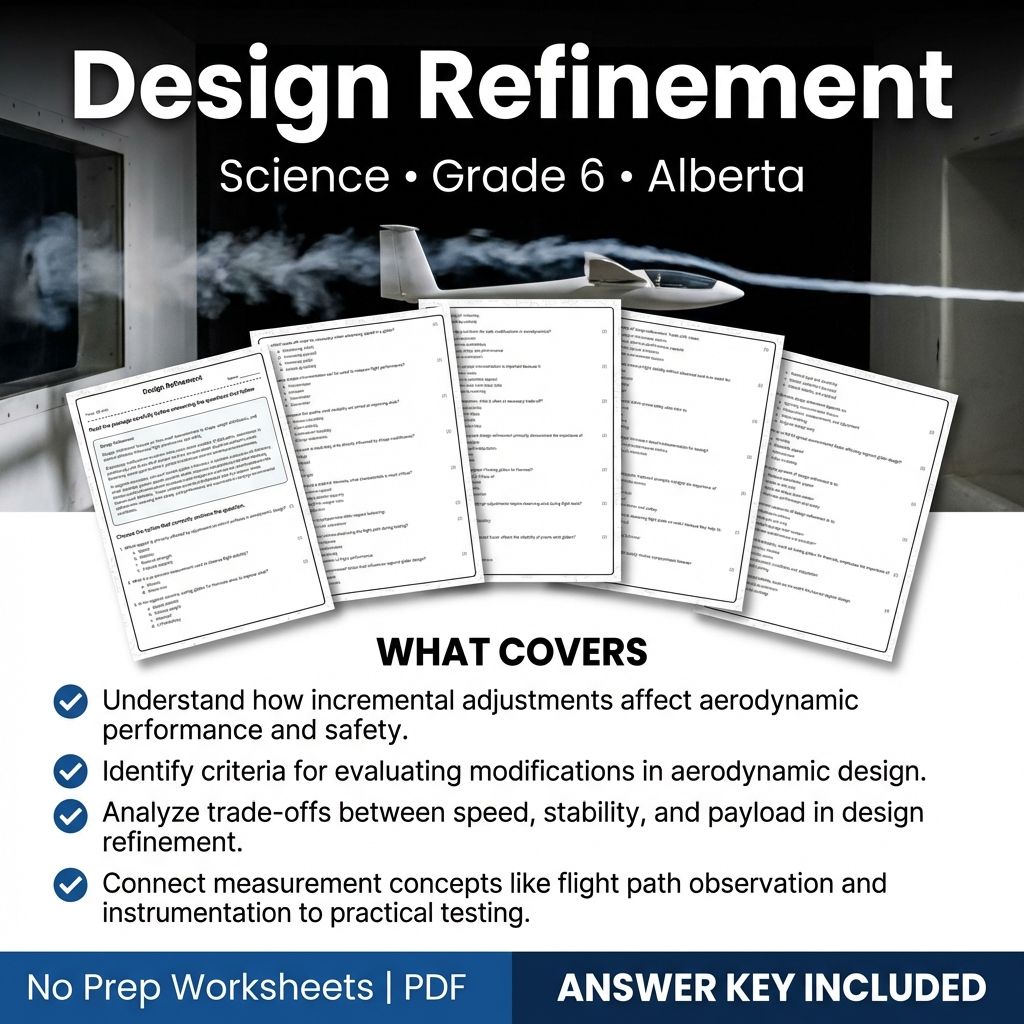
Design Refinement Worksheet for Grade 6 Science | Alberta Standards Practice
 Created byCoral Reef Learning
Learning Objectives
- Understand how incremental adjustments affect aerodynamic performance and safety.
- Identify criteria for evaluating modifications in aerodynamic design.
- Analyze trade-offs between speed, stability, and payload in design refinement.
Instant download

Grade 6 Science – Pattern From Graphs Daily Reading Worksheet
 Created byBright Mind Resources
Learning Objectives
- Identify steady or constant trends in graphs.
- Describe patterns such as increasing, decreasing, and steady lines.
- Analyze graph shapes to understand relationships between variables.
Also included in: Variables & Experiments Data Grade 6 Science Worksheets Lesson Bundle | General +1 more
Instant download
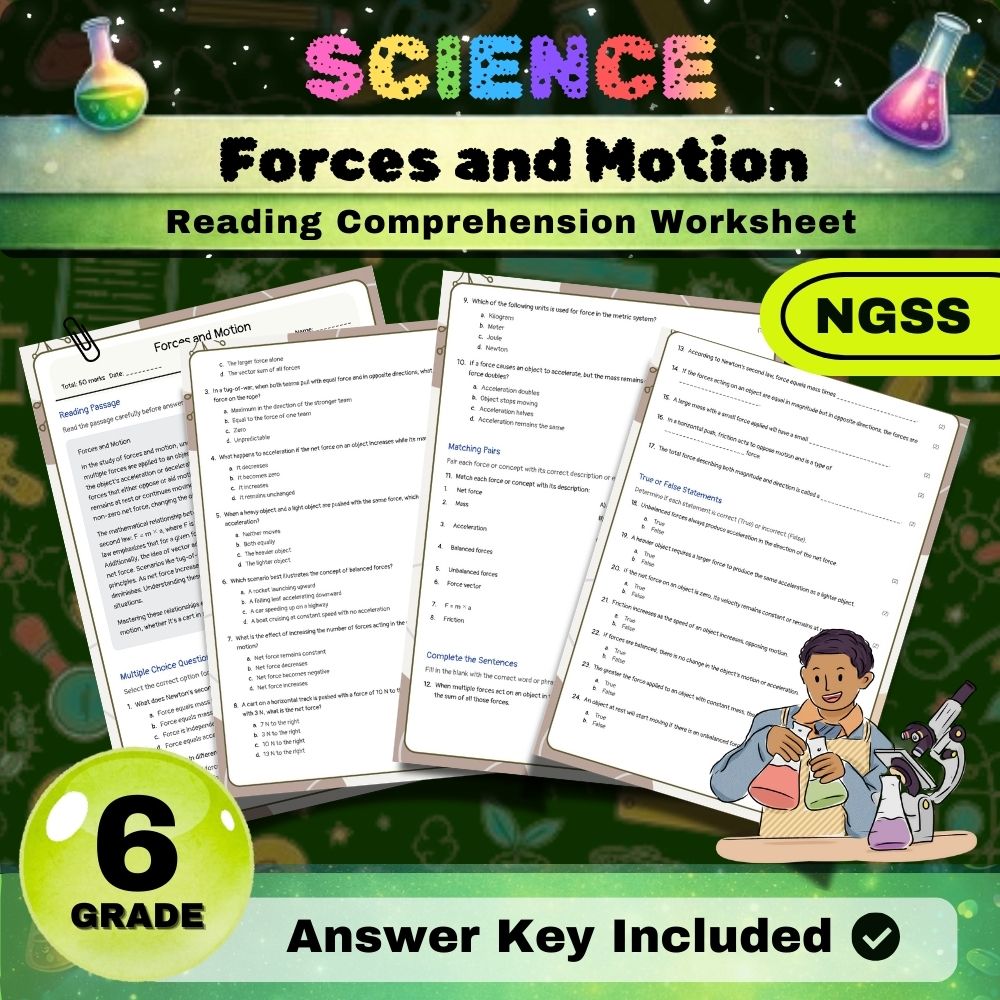
6th Grade Science | Forces and Motion NGSS Worksheet (PDF)
 Created byMaple Path Learning
Learning Objectives
- Explain how net force affects the motion of objects based on mass and force vectors.
- Use the equation net force equals mass times acceleration to analyze different scenarios.
- Identify and describe how multiple forces combine to produce net force.
Also included in: Grade 6 Science Forces & Motion Unit Bundle (NGSS Worksheets + Answer Keys) +1 more
Instant download
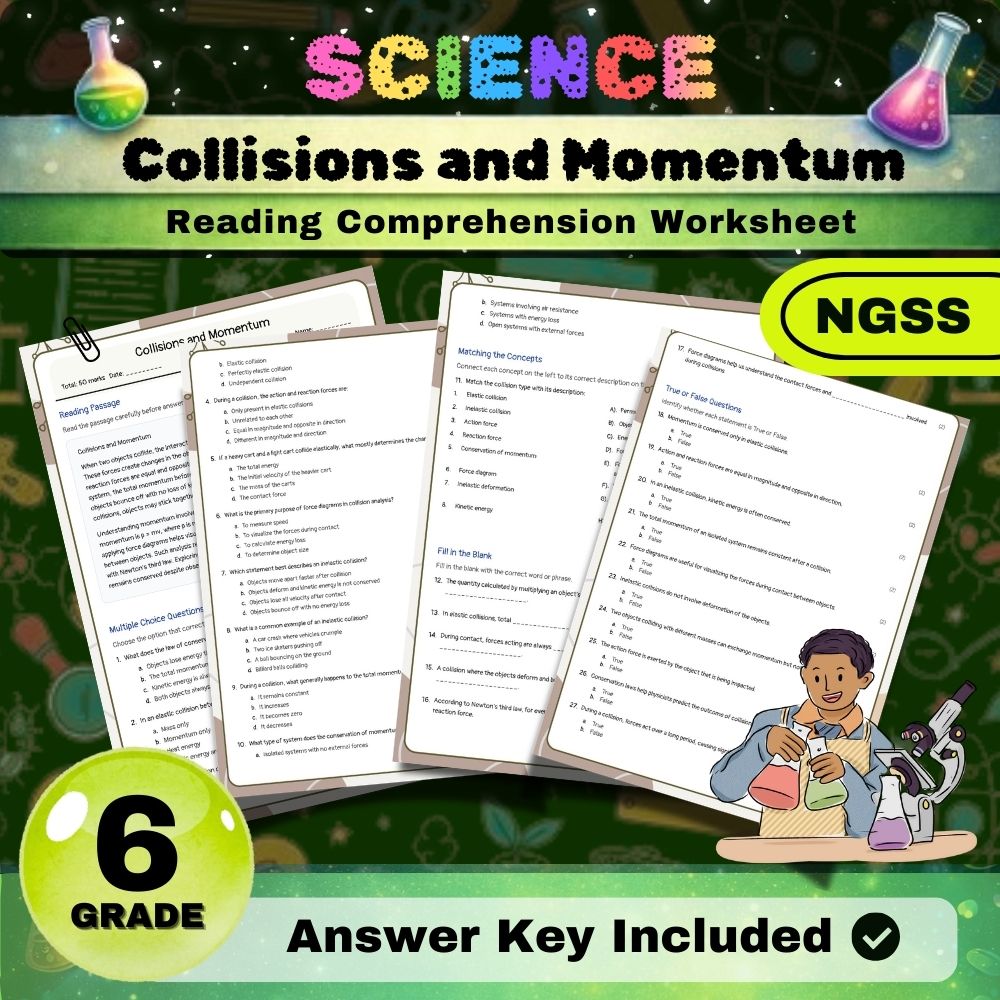
Grade 6 Science – Collisions and Momentum Worksheet + Answer Key ( NGSS )
Created byMaple Path LearningLearning Objectives
- Explain the law of conservation of momentum during two-object collisions.
- Distinguish between elastic and inelastic collisions through examples and calculations.
- Identify the forces involved during collisions using force diagrams.
Also included in: Grade 6 Science Forces & Motion Unit Bundle (NGSS Worksheets + Answer Keys) +1 more
Instant download

Grade 6 Science | Ecosystem Components - Daily Reading Comprehension
Created byCoral Reef LearningLearning Objectives
- Understand the definition of ecosystems and their components
- Identify biotic and abiotic factors in different habitats
- Recognize examples of ecosystems like ponds, prairies, and forests
Instant download

Grade 6 Science – Interdependence in Ecosystems | Daily Reading Worksheet
Created byBright Mind ResourcesLearning Objectives
- Understand predator-prey relationships in ecosystems
- Identify how predators control prey populations
- Recognize mutualistic relationships and competition among organisms
Also included in: Ecosystems Grade 6 Science Daily Reading Worksheets Lesson Bundle |Florida NGSSS +1 more
Instant download
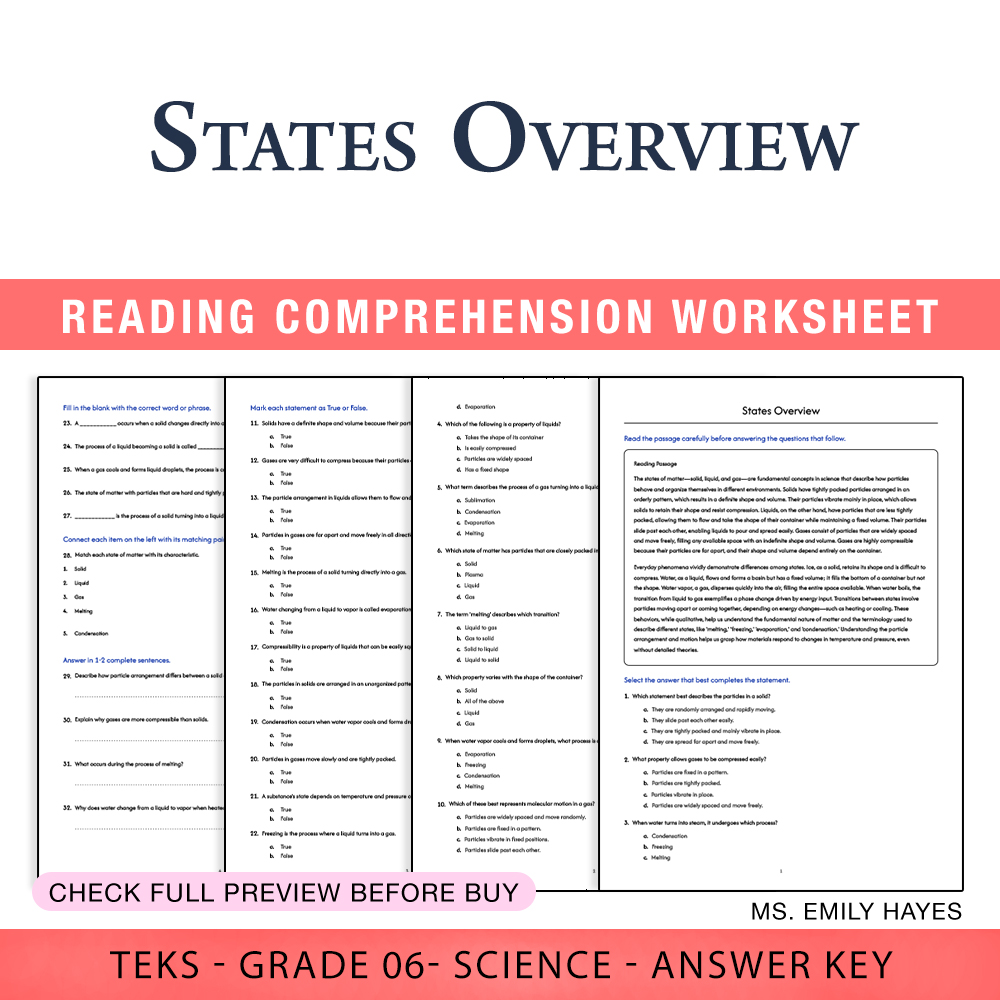
6th Grade Science | States of Matter Worksheet (PDF+ Answer Key)
 Created byCopper Leaf Classroom
Learning Objectives
- Describe the three major states of matter: solid, liquid, and gas.
- Compare particle arrangement, motion, and properties of each state.
- Explain how everyday phenomena illustrate differences between states.
Instant download

Grade 6 Synthetic Materials Worksheet | NGSS Science Activity & Practice
 Created byBRIGHT PATH RESOURCES
Learning Objectives
- Understand how plastics are made from natural resources
- Identify the origins of common synthetic materials
- Learn about properties and uses of different synthetic substances
Also included in: Matter and Its Interactions Grade 6 Science Lesson Bundle | NGSS +2 more
Instant download
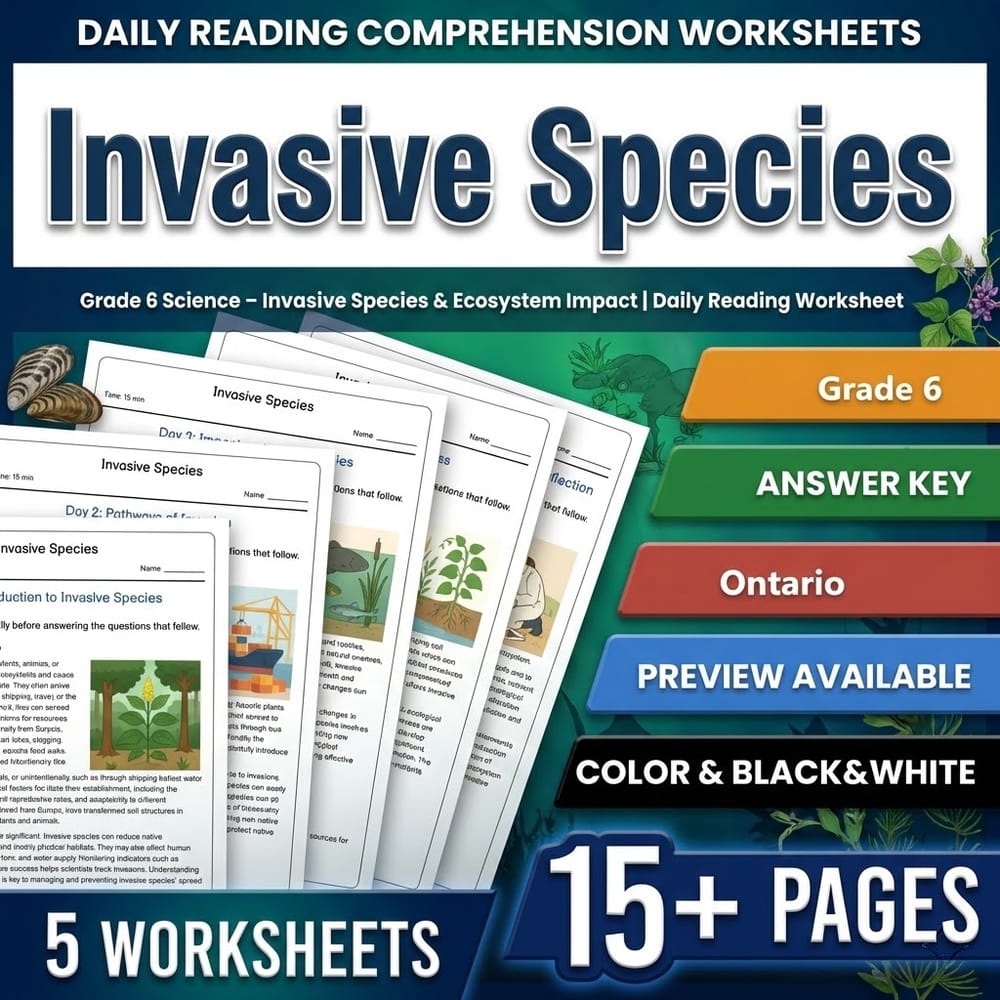
Grade 6 Science – Invasive Species & Ecosystem Impact | Daily Reading Worksheet
 Created byQuiet Forest Education
Learning Objectives
- Understand what invasive species are.
- Identify how invasive species enter new ecosystems.
- Learn about the environmental impacts caused by invasive species.
Also included in: Ecosystems and Environment Grade 6 Science Daily Worksheets Bundle | Ontario +1 more
Instant download

Natural Hazards Worksheet | NGSS Grade 6 Science Assessment
JCreated byJ.S SheetsLearning Objectives
- Analyze observational data related to natural hazards such as earthquakes, storms, and floods.
- Interpret instrumental records to identify patterns and recurrence intervals of hazards.
- Assess potential locations and magnitudes of natural events for risk management.
Also included in: Grade 6 Earth System Interactions Climate Science Lesson Bundle – NGSS +1 more
Instant download
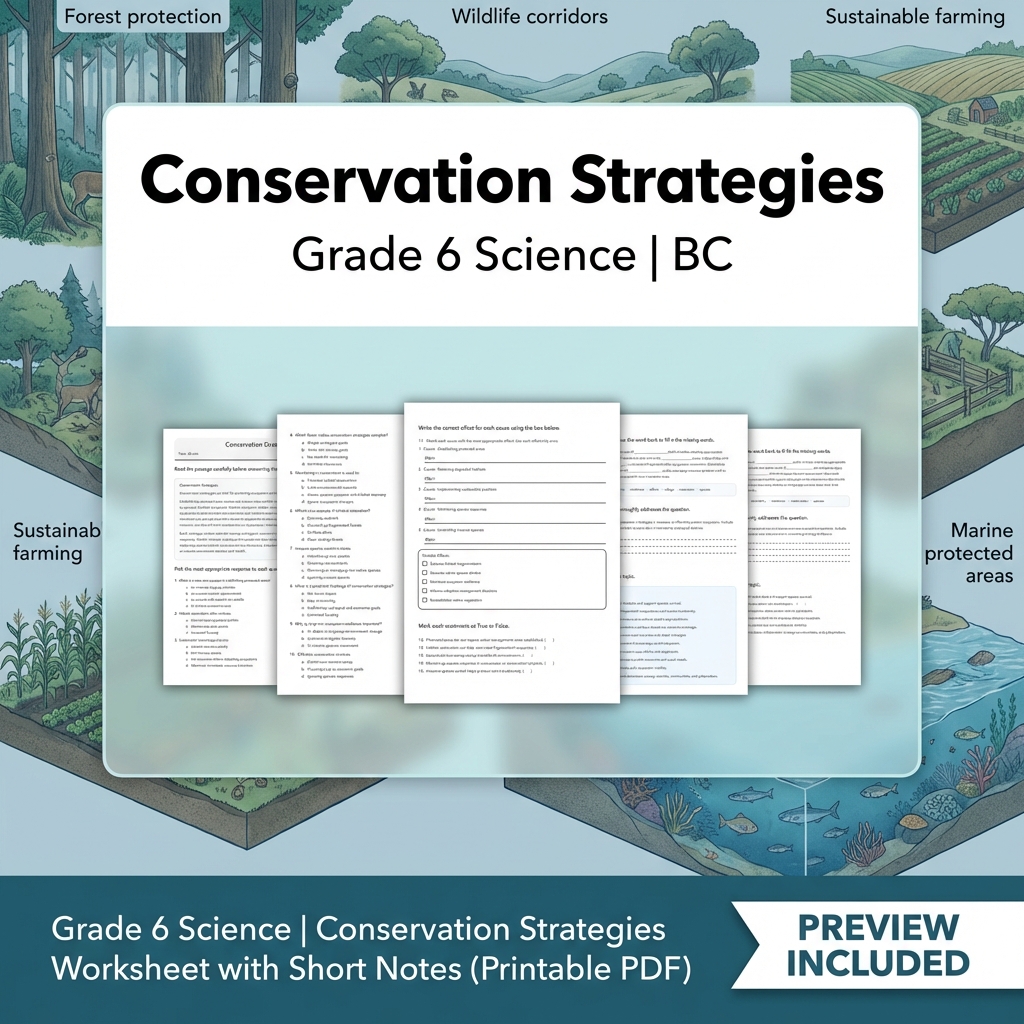
Grade 6 Science | Conservation Strategies Worksheet with Short Notes (PDF)
 Created byMeadowlark Worksheets
Learning Objectives
- Understand different conservation strategies used to maintain ecosystems.
- Identify the purpose and components of protected areas and habitat restoration.
- Explain the concept of sustainable harvesting and its benefits.
Also included in: Grade 6 Science | Ecosystems & Interdependence UNIT Worksheet Bundle +1 more
Instant download
6th Grade Science | Habitat Fragmentation Worksheet (PDF) – BC Standards
Created byBright Mind ResourcesLearning Objectives
- Understand what habitat fragmentation is and how it affects ecosystems.
- Identify causes and effects of habitat fragmentation.
- Recognize strategies to mitigate habitat fragmentation impacts.
Instant download
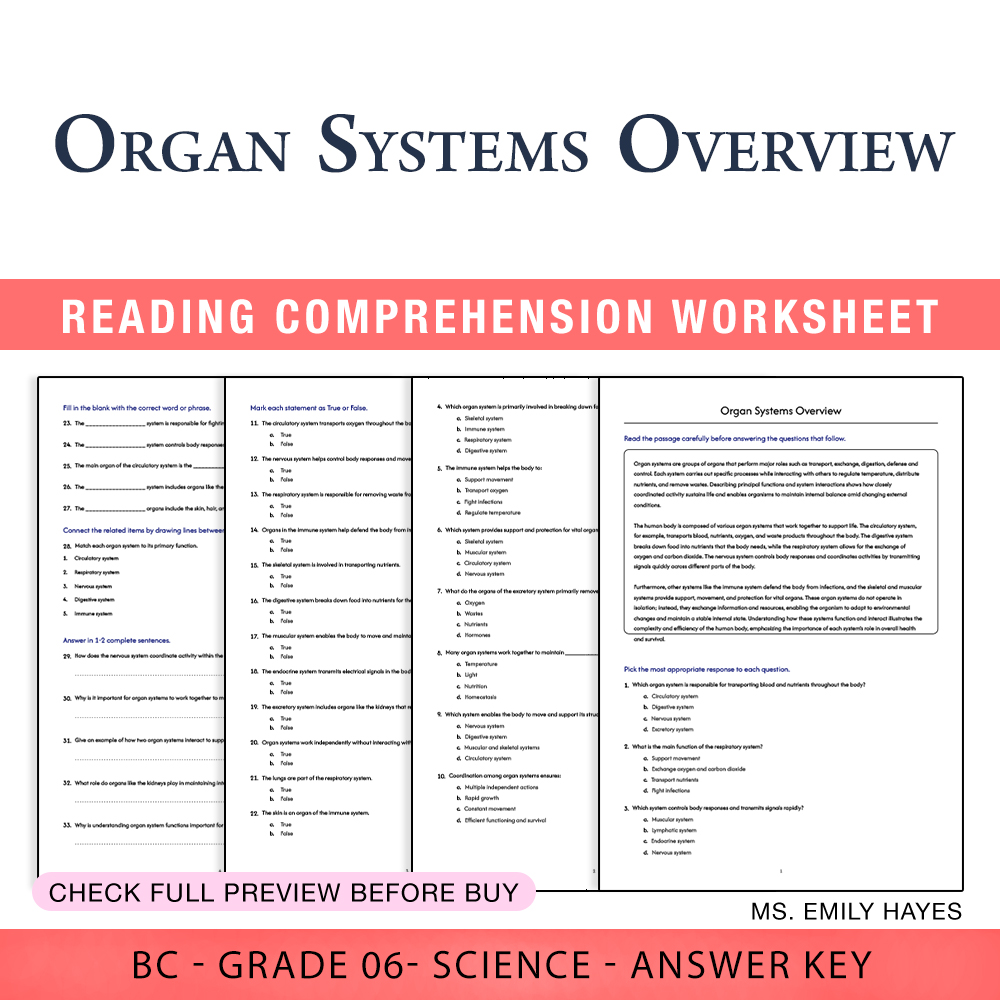
6th Grade Science | Organ Systems Overview Worksheet (PDF+ Answer Key)
Created byCopper Leaf ClassroomLearning Objectives
- Understand the principal functions of different human organ systems.
- Explain how multiple organ systems interact to maintain homeostasis.
- Describe examples of how organ systems work together to sustain life.
Also included in: Grade 6 Science BC | Human Body Systems & Adaptations (PDF+ Answer Keys) +1 more
Instant download
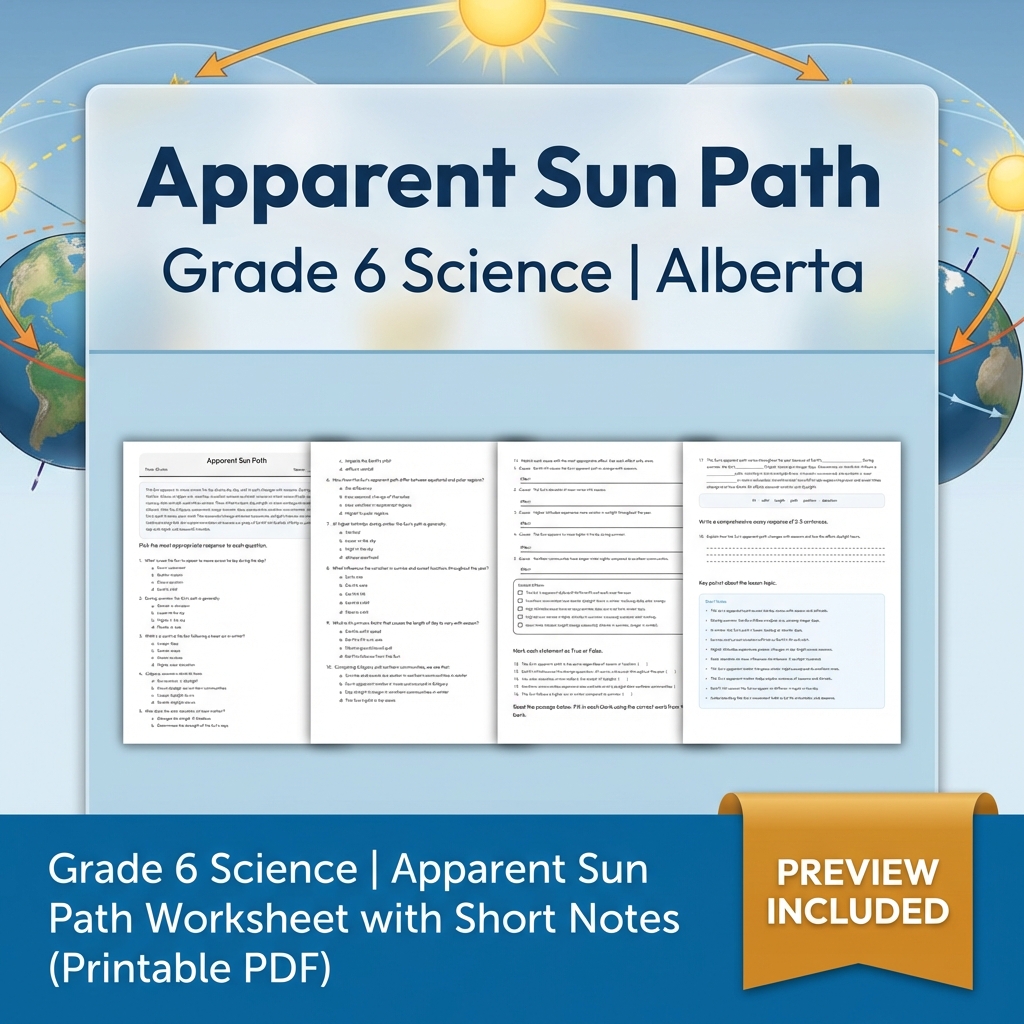
Grade 6 Science | Apparent Sun Path Worksheet with Short Notes (Printable PDF)
Created byMeadowlark WorksheetsLearning Objectives
- Understand how the Sun's apparent path varies with season and location.
- Describe how sunrise and sunset positions change throughout the year.
- Explain the variation of solar elevation at noon in different seasons and locations.
Also included in: Grade 6 Science Sky Science Unit Bundle | Alberta Curriculum Worksheets +1 more
Instant download

Grade 6 Science – Recrystallization & Purifying Solids Daily Reading Worksheet
Created byBright Mind ResourcesLearning Objectives
- Understand the process of recrystallization and its purpose in purifying solids.
- Learn how temperature changes affect solubility and crystal formation.
- Recognize the importance of controlled cooling in producing pure crystals.
Also included in: Matter & Change Grade 6 Science Daily Reading Worksheets Lesson Bundle | BC +1 more
Instant download
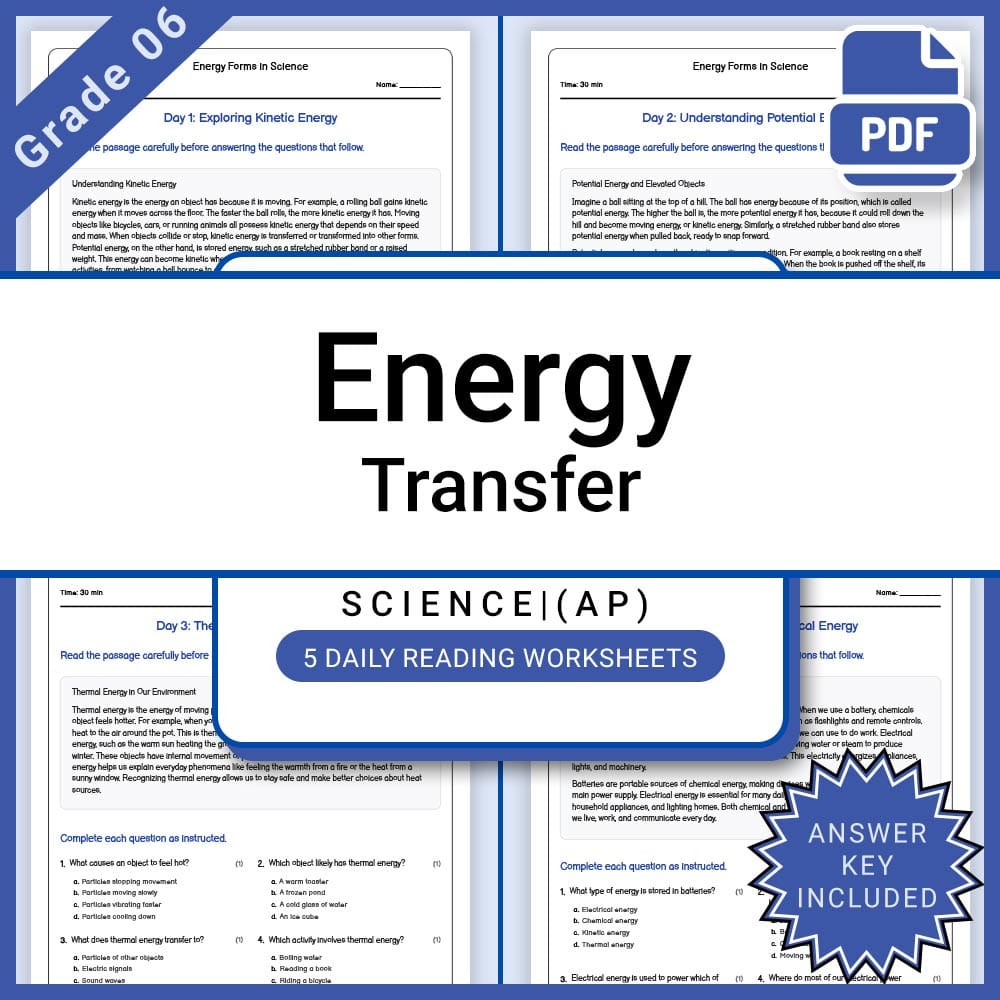
Grade 6 Science – Energy Transfer Daily Reading Worksheet with Answer Key
JCreated byJ.S SheetsLearning Objectives
- Understand the mechanism of conduction as a method of heat transfer.
- Identify examples of conduction in everyday life.
- Explain how materials differ in thermal conductivity.
Also included in: Grade 6 Science Lesson Bundle | States of Matter, Energy, and More +1 more
Instant download

Grade 6 Weather Patterns Worksheet | NGSS Practice PDF
 Created byClear Sky Classroom
Learning Objectives
- Describe atmospheric processes that produce local and regional weather.
- Interpret data from surface maps, temperature, and pressure measurements.
- Identify features of fronts, pressure systems, and radar observations related to weather events.
Also included in: Grade 6 Earth's Systems Science Lesson Bundle (NGSS-Aligned) Worksheets +1 more
Instant download
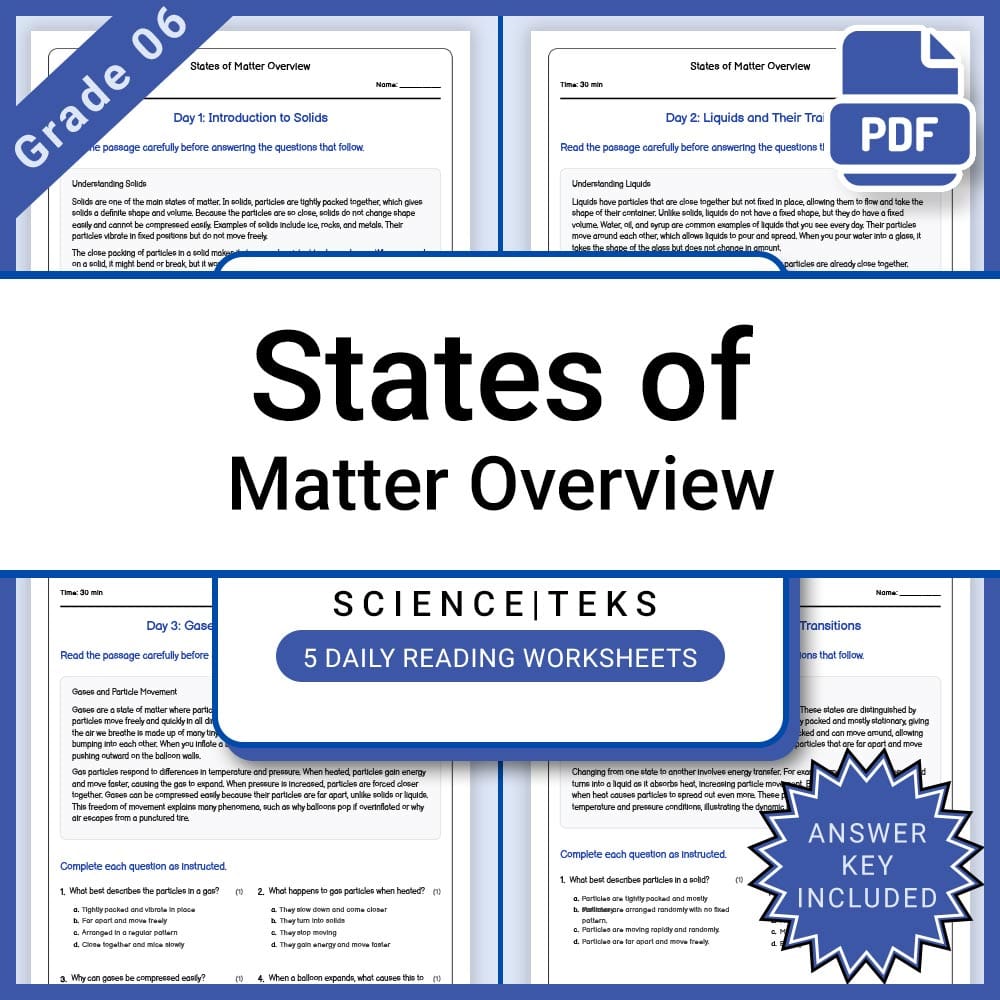
Grade 6 Science – States of Matter Daily Reading Worksheet + Answer Key
JCreated byJ.S SheetsLearning Objectives
- Describe the major states of matter: solid, liquid, and gas.
- Identify and compare particle arrangements in solids.
- Understand properties such as shape retention and density.
Also included in: Grade 6 Science Lesson Bundle | States of Matter, Energy, and More +1 more
Instant download
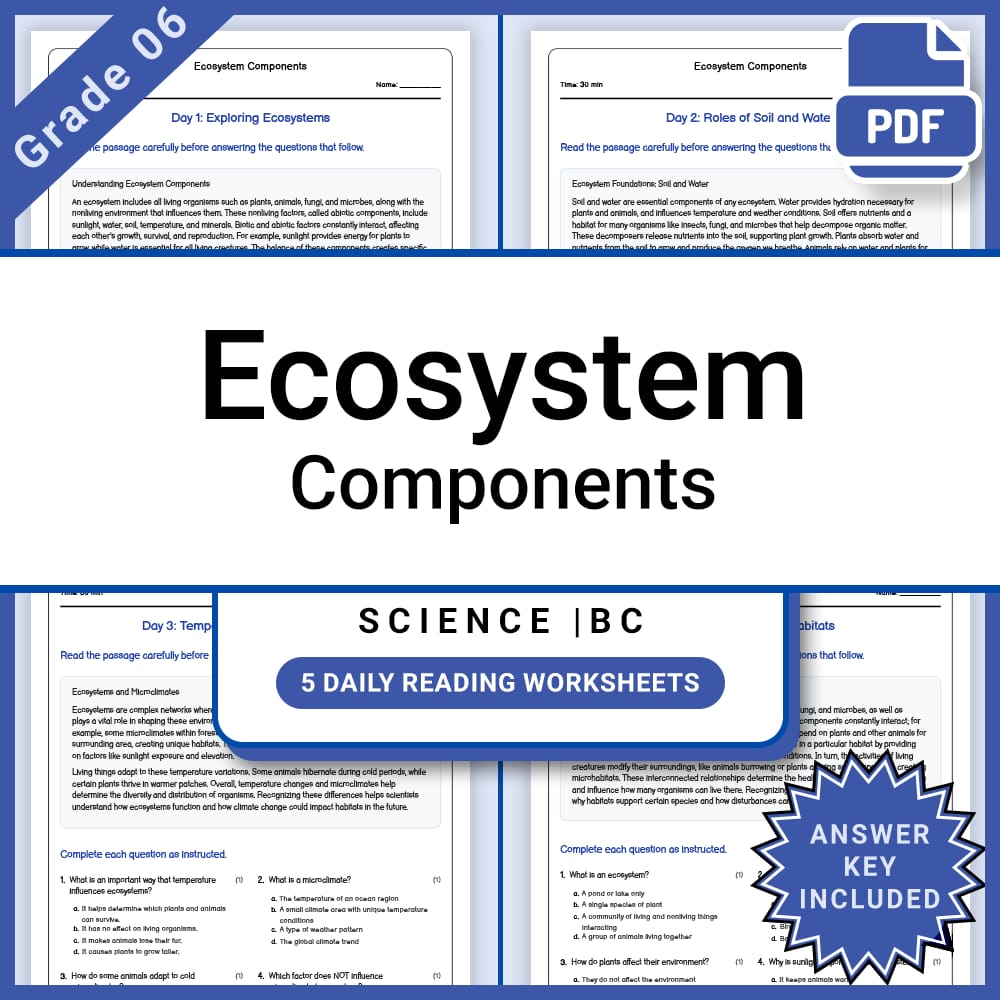
Grade 6 Science – Ecosystem Components Daily Reading Worksheet with Answer Key
JCreated byJ.S SheetsLearning Objectives
- Identify biotic and abiotic components of an ecosystem
- Understand how living organisms interact with nonliving factors
- Recognize the importance of sunlight, water, soil, and temperature in ecosystems
Also included in: Grade 6 Science Lesson Group Bundle on Ecosystems and Ecology +1 more
Instant download

Grade 6 Decomposers And Nutrients Worksheet | BC Practice PDF
Created byClear Sky ClassroomLearning Objectives
- Explain how decomposers (fungi, bacteria, and detritivores) break down dead organic matter and return nutrients to ecosystems.
- Describe how environmental conditions (temperature, moisture, and oxygen) affect the rate of decomposition and nutrient cycling.
- Connect decomposition to nutrient availability for plants and to long-term ecosystem balance.
Instant download

Grade 6 Science | Trait Heritability - Daily Reading Comprehension
Created byCoral Reef LearningLearning Objectives
- Understand the concept of heritability and how it relates to genetic traits.
- Distinguish between heritable and environmental influences on organisms.
- Learn about mechanisms of inheritance and how traits are passed through generations.
Instant download
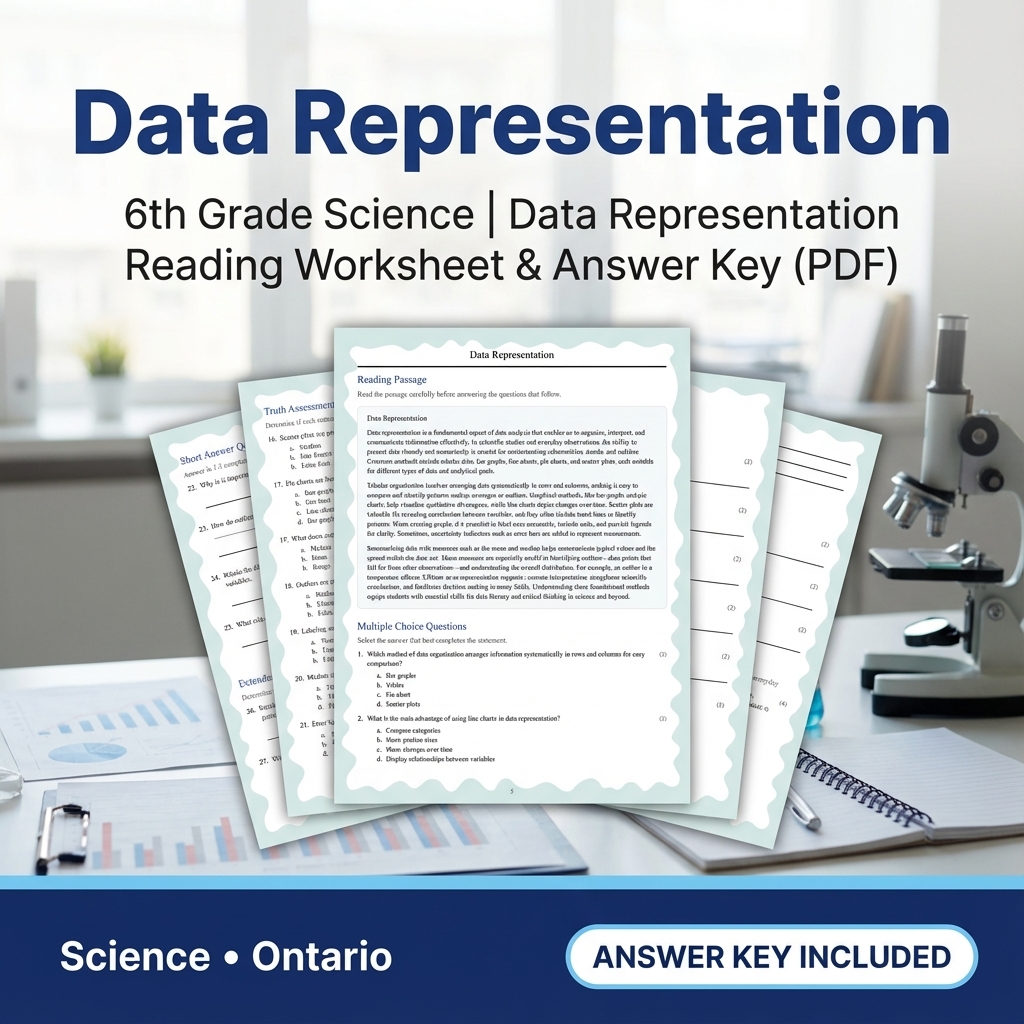
6th Grade Science | Data Representation Reading Worksheet & Answer Key (PDF)
JCreated byJ.S SheetsLearning Objectives
- Understand various methods of data collection and organization.
- Learn to select appropriate graphs and charts for visualizing data.
- Interpret trends, outliers, and patterns from graphical and tabular data.
Also included in: Grade 6 Science Unit | Inquiry, Data, & Ethical Practices Worksheet Pack +1 more
Instant download
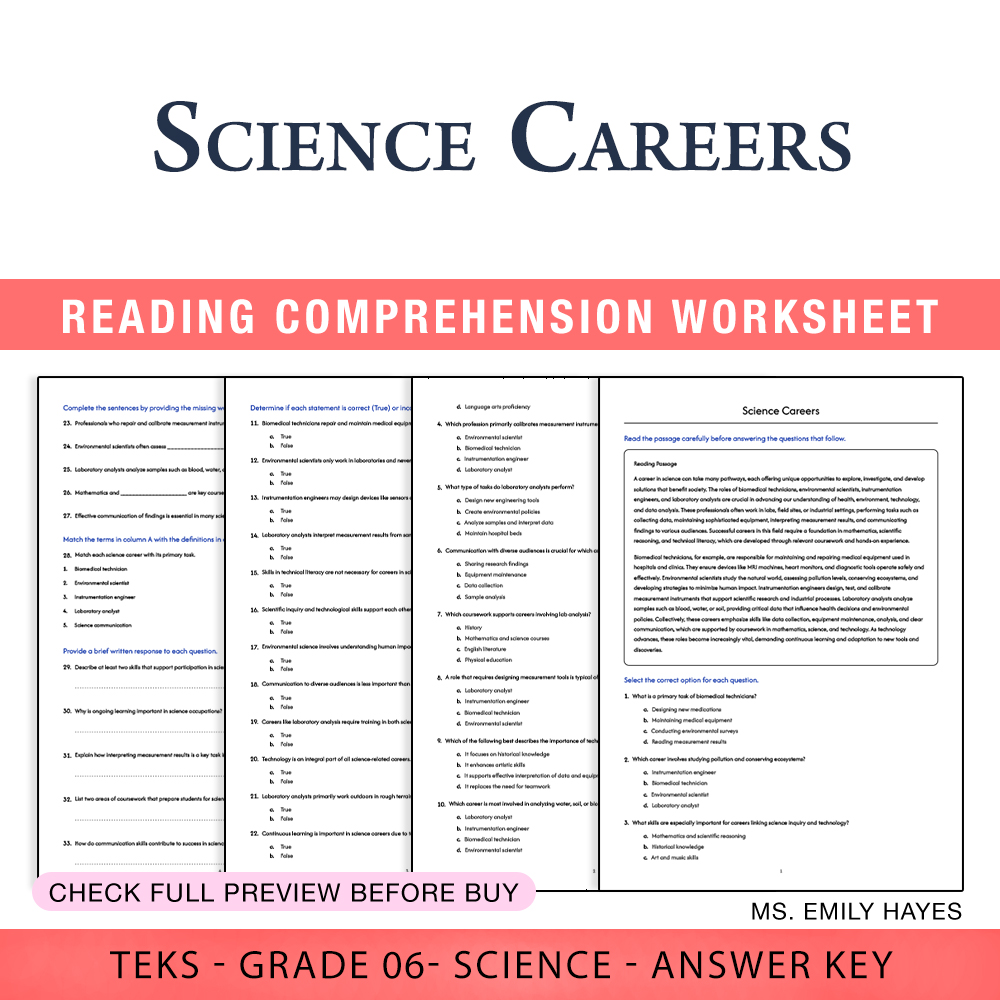
6th Grade Science | Careers in Science Worksheet (PDF+ Answer Key)
Created byCopper Leaf ClassroomLearning Objectives
- Identify various science-related careers and their typical tasks.
- Understand the skills and coursework necessary for science occupations.
- Describe how scientific inquiry and technological skills are linked in careers.
Instant download

Grade 6 Science | Trade-off Decisions - Daily Reading Comprehension
Created byCoral Reef LearningLearning Objectives
- Understand what trade-offs are in design choices
- Identify trade-offs in simple real-life scenarios
- Recognize how improving one feature can impact others
Instant download

Grade 6 Scientific Models Worksheet | NGSS Practice PDF
Created byClear Sky ClassroomLearning Objectives
- Explain how scientific models represent systems that are too large, too small, or too complex to study directly
- Identify how models connect observable evidence to underlying ideas and state what a model can and cannot represent
- Use comparisons between model outputs and real measurements to evaluate model limitations and suggest improvements
Instant download
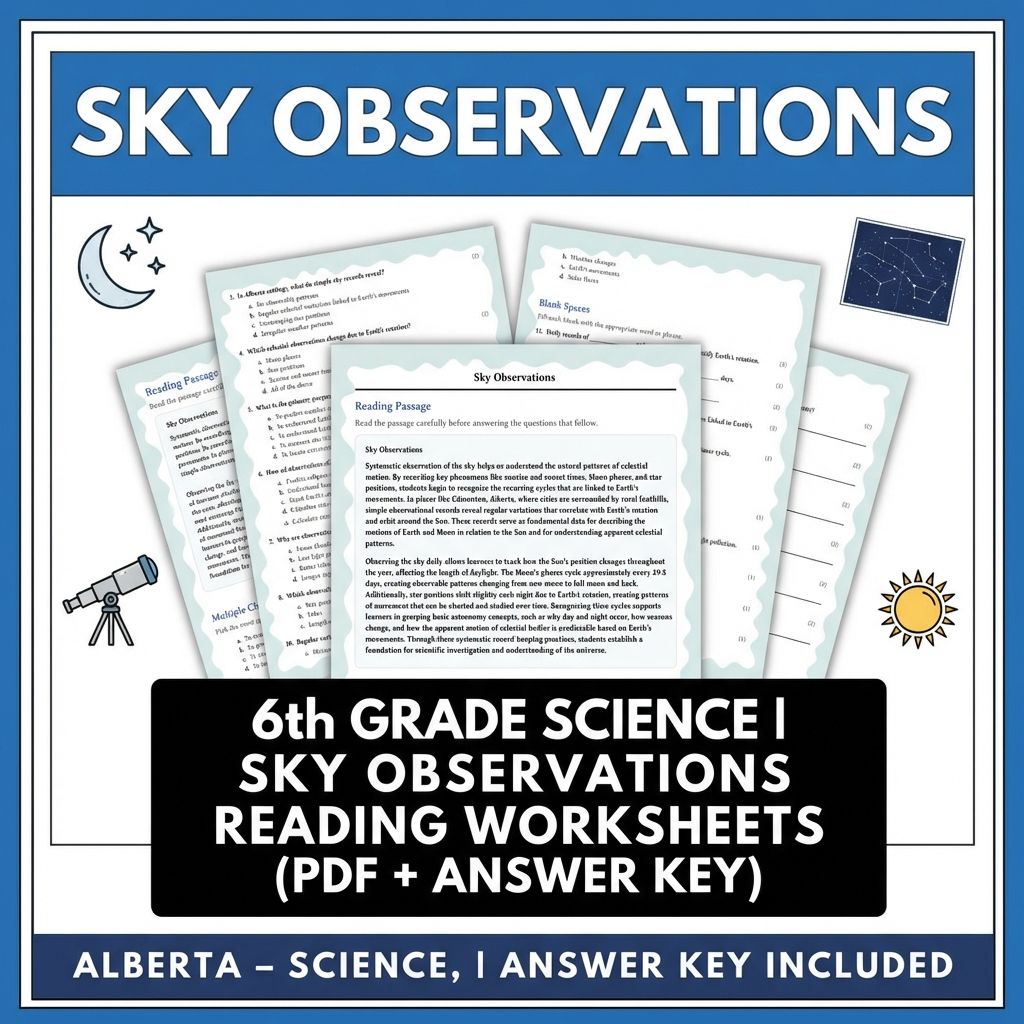
6th Grade Science | Sky Observations Reading Worksheets (PDF + Answer Key)
JCreated byJ.S SheetsLearning Objectives
- Understand the importance of systematic sky observations in identifying patterns.
- Learn how to record sunrise, sunset, Moon phases, and star positions.
- Recognize how Earth's movements influence observable sky patterns.
Also included in: Grade 6 Science | Celestial Motion & Sky Observation Worksheets Bundle +1 more
Instant download
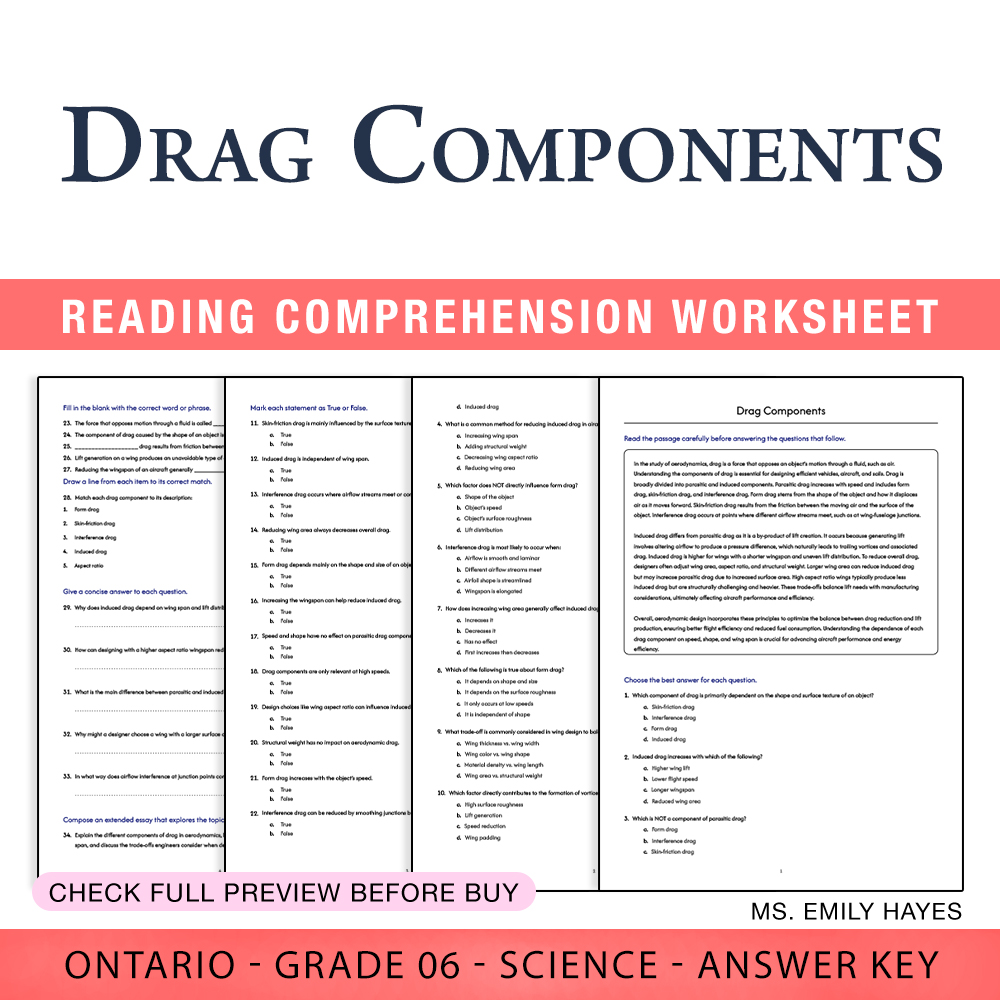
6th Grade Science | Drag Components Worksheet (PDF + Answer Key)
Created byCopper Leaf ClassroomLearning Objectives
- Understand the different components of drag and their causes
- Explain the dependence of parasitic and induced drag on aerodynamic factors
- Identify various forms of parasitic drag and how design influences drag reduction
Instant download

Grade 6 Science | Claim Evaluation Worksheet (Alberta Standards) (PDF)
 Created byEvergreen Desk Education
Learning Objectives
- Explain how to judge whether a claim follows from data, methods, and results.
- Use criteria such as evidence relevance, consistency, uncertainty, and alternative explanations to evaluate conclusions.
- Match the scope of a claim to the strength and limits of a dataset.
Instant download

Grade 6 Root Adaptations & Water Uptake Worksheet | Alberta Science
Created byBRIGHT PATH RESOURCESLearning Objectives
- Summarize the main idea and key details about how roots help trees get water.
- Identify specific root jobs that support tree health.
- Explain how root traits and relationships help trees in different environments.
Also included in: Forest Ecosystem Adaptations Grade 6 Science Worksheets Lesson Bundle | Alberta +1 more
Instant download
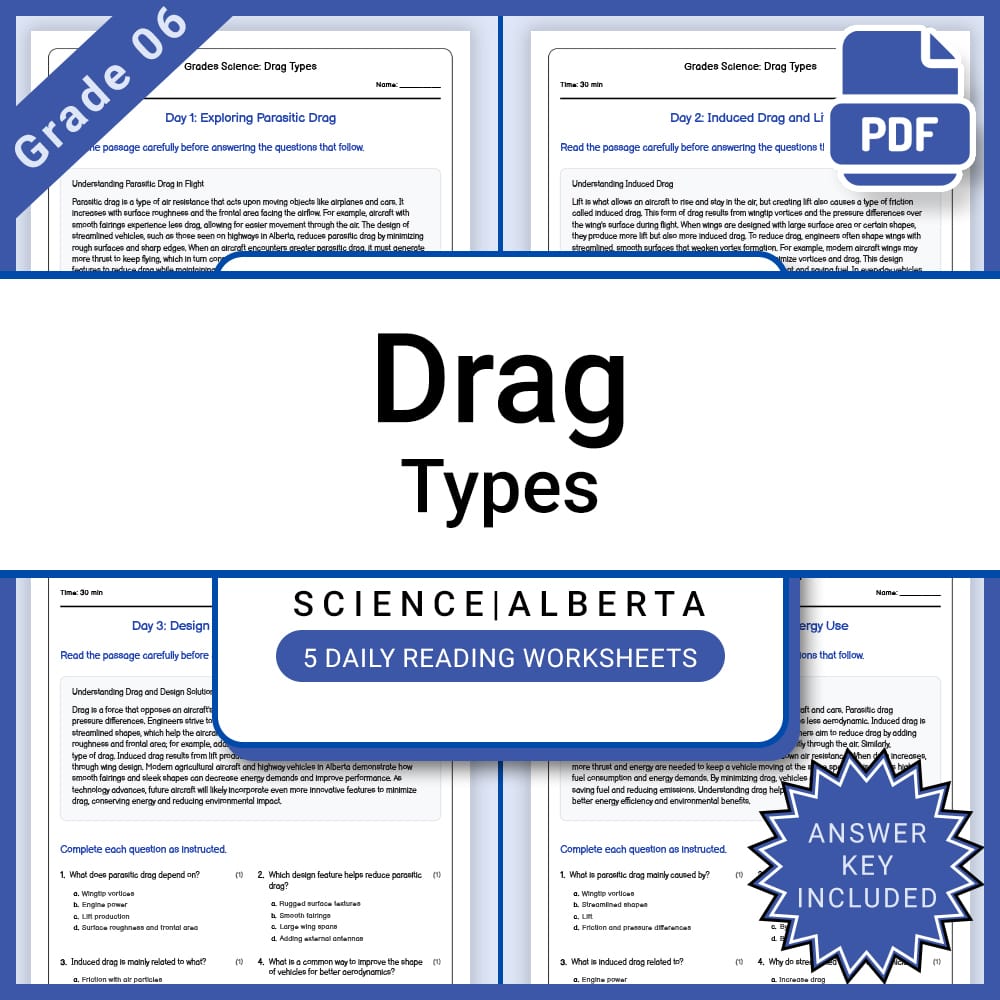
Grade 6 Science – Drag Types Daily Reading Worksheet with Answer Key
JCreated byJ.S SheetsLearning Objectives
- Understand what parasitic drag is and its causes.
- Identify how surface smoothness reduces drag.
- Explore different design features that minimize drag in aircraft and vehicles.
Also included in: Grade 6 Science Lesson Bundle: Flight, Weather, and Aerodynamics +1 more
Instant download
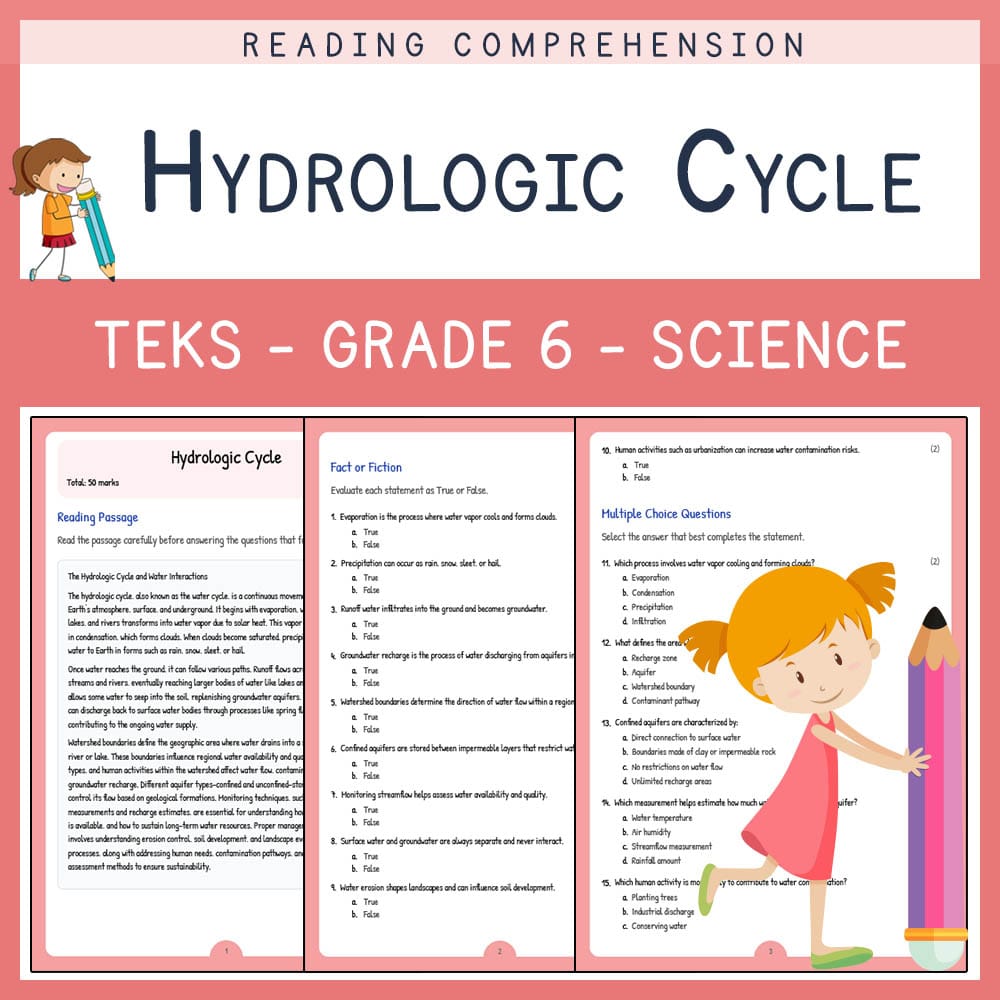
Grade 6 Science | Hydrologic Cycle Worksheet | TEKS-Aligned
 Created byLumora Learning
Learning Objectives
- Describe the processes involved in the hydrologic cycle, including evaporation, condensation, and precipitation.
- Explain the interactions between surface water, groundwater, and soil in watershed regions.
- Identify human impacts on water systems and methods used to monitor water quality.
Also included in: Grade 6 Science | Earth and Space Science Unit Bundle | TEKS Standard
Instant download
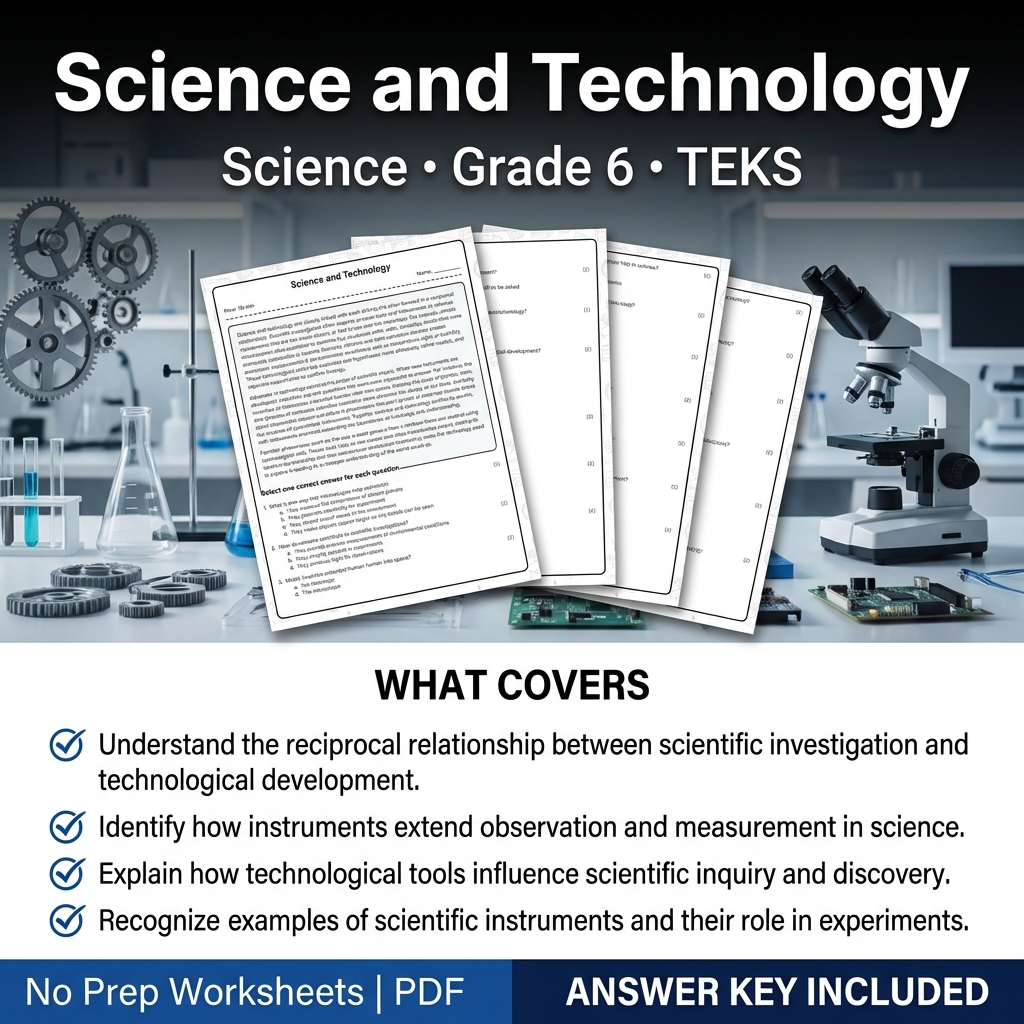
Grade 6 Science Worksheet on Science and Technology | TEKS-Aligned Assessment
Created byCoral Reef LearningLearning Objectives
- Understand the reciprocal relationship between scientific investigation and technological development.
- Identify how instruments extend observation and measurement in science.
- Explain how technological tools influence scientific inquiry and discovery.
Instant download
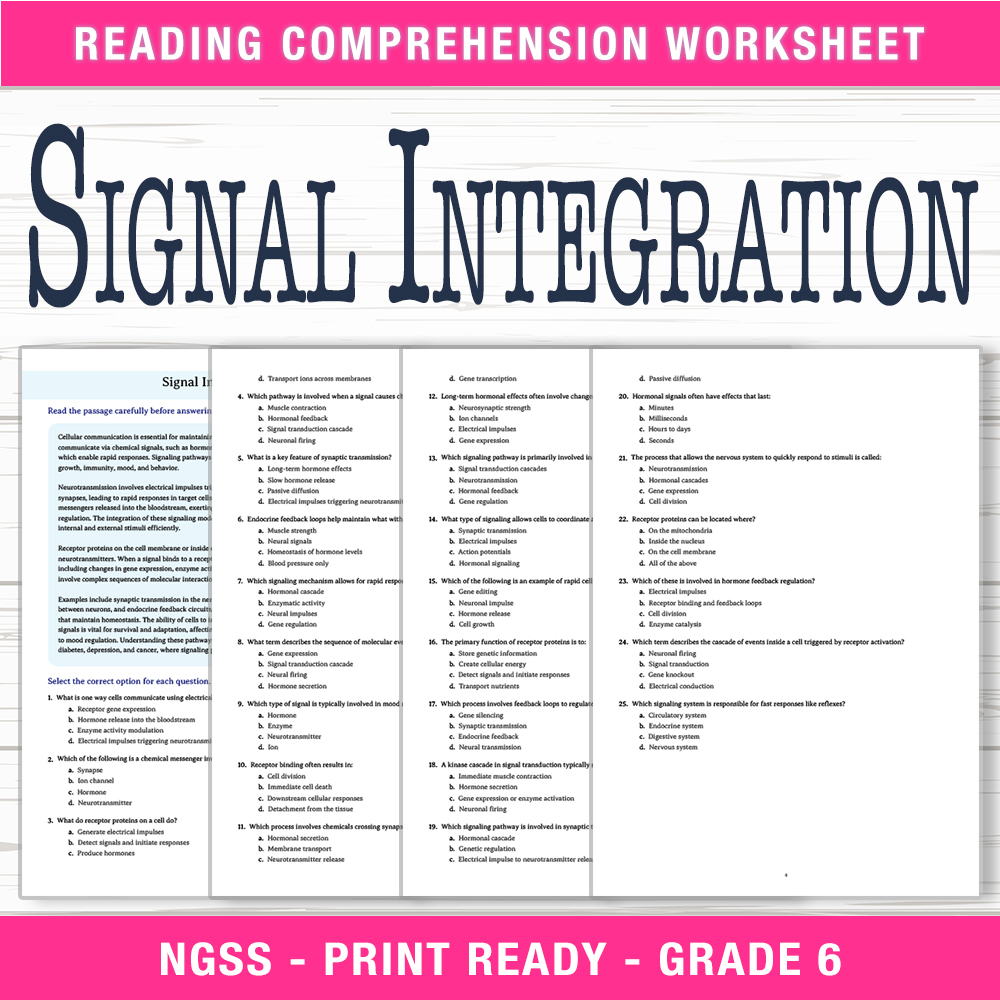
6th Grade Science | Signal Integration Worksheet (PDF + Answer Key)
 Created byRiverstone Classroom
Learning Objectives
- Explain how cells communicate through chemical and electrical signals.
- Differentiate between rapid nervous responses and longer-term hormonal effects.
- Describe key signaling pathways such as synaptic transmission and endocrine feedback.
Instant download
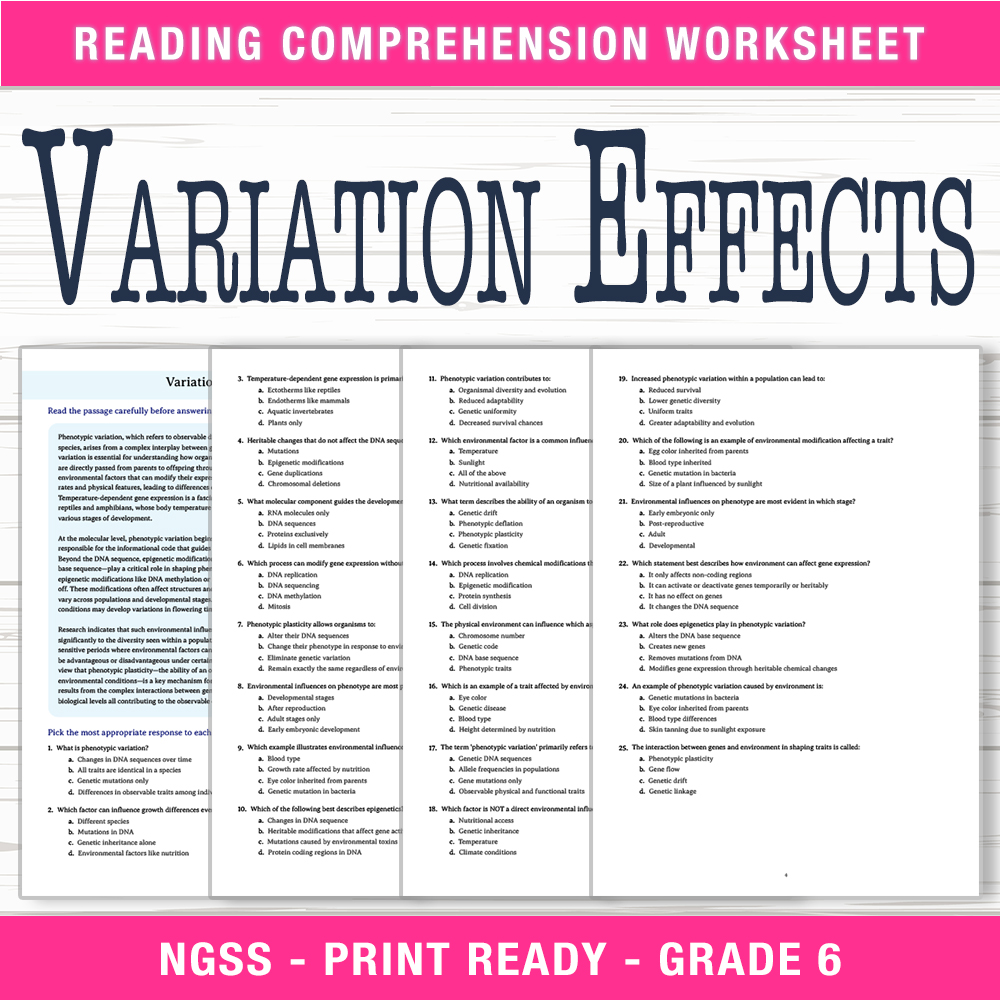
6th Grade Science | Variation Effects Worksheet (PDF + Answer Key)
Created byRiverstone ClassroomLearning Objectives
- Understand how phenotypic variation arises from genetic and environmental interactions.
- Identify examples of phenotypic variation such as inherited traits, growth differences, and temperature-dependent genes.
- Explain the connection between DNA, epigenetics, and observable differences in organisms.
Instant download
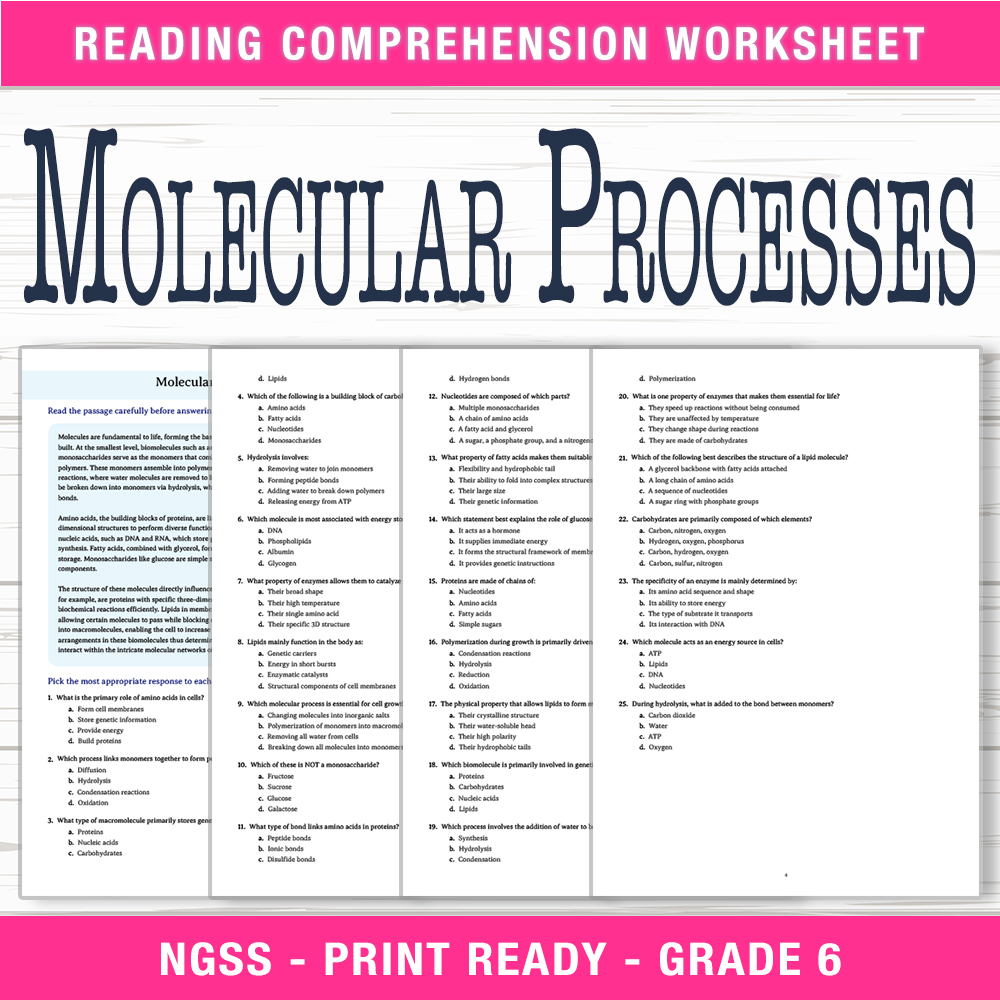
6th Grade Science | Molecular Processes Worksheet (PDF + Answer Key)
Created byRiverstone ClassroomLearning Objectives
- Identify the basic building blocks of biomolecules such as amino acids, nucleotides, fatty acids, and monosaccharides.
- Describe how monomers polymerize into macromolecules through condensation reactions and are broken down via hydrolysis.
- Explain the relationship between molecular structures and their functions, including enzyme activity, membrane transport, and polymerization.
Instant download
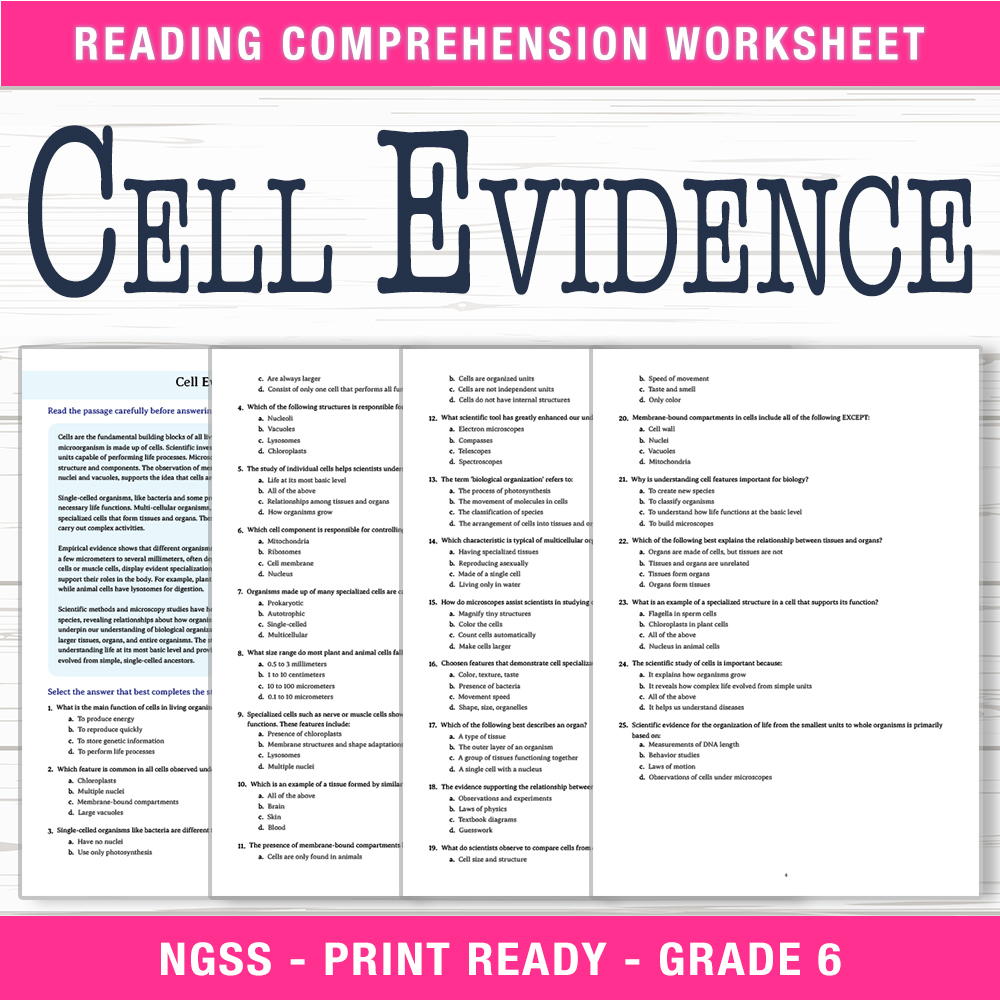
6th Grade Science | Cell Evidence Worksheet (PDF + Answer Key)
Created byRiverstone ClassroomLearning Objectives
- Understand that cells are the basic units of life and can be observed using microscopy.
- Identify different types of cells and distinguish between single-celled and multicellular organisms.
- Recognize empirical features such as membrane-bound compartments, cell size ranges, and specialization in various organisms.
Instant download
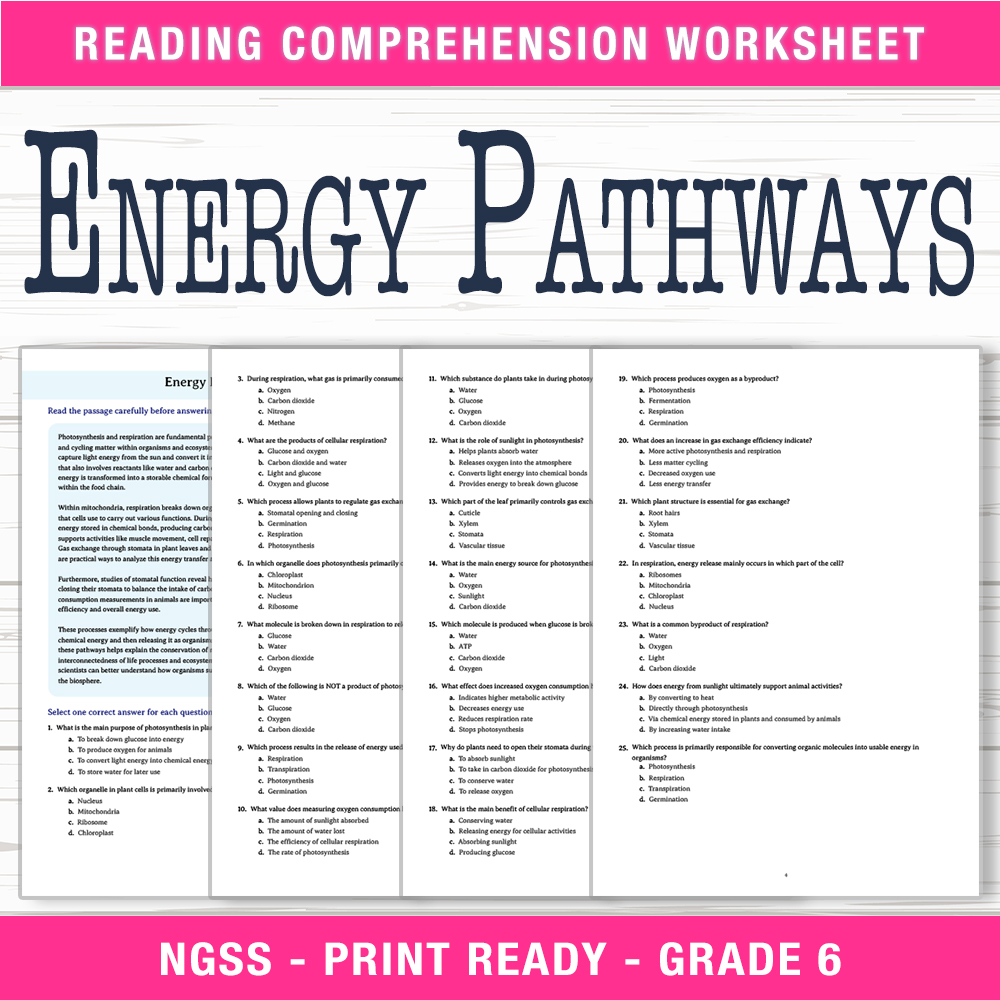
6th Grade Science | Energy Pathways Worksheet (PDF + Answer Key)
Created byRiverstone ClassroomLearning Objectives
- Describe how photosynthesis converts light energy into chemical energy in plants.
- Explain how respiration breaks down organic molecules to release usable energy.
- Identify key processes involved in energy transfer and mass conservation in biological systems.
Instant download
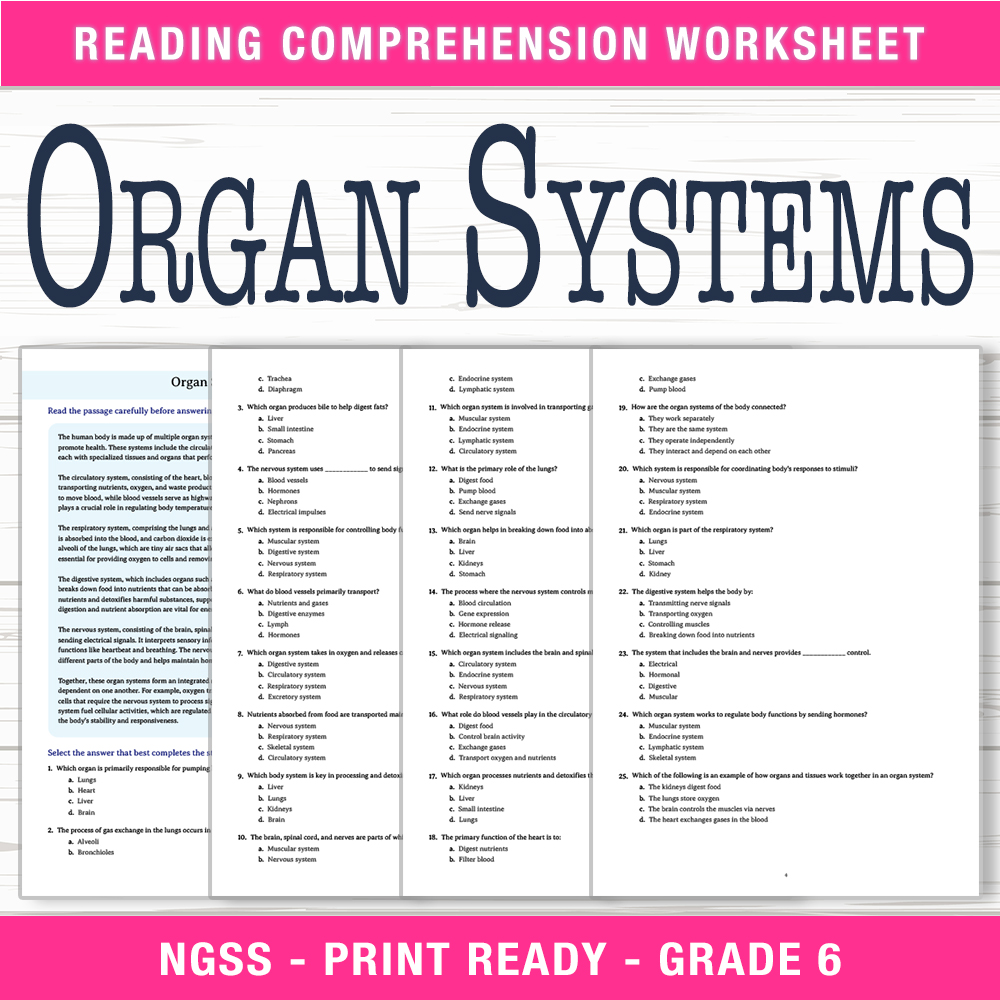
6th Grade Science | Organ Systems Worksheet (PDF + Answer Key)
Created byRiverstone ClassroomLearning Objectives
- Describe the major human organ systems involved in circulation, respiration, digestion, and nervous function.
- Explain how tissues and organs interact within each organ system to support body functions.
- Connect cellular activities to system-level processes such as nutrient transport, gas exchange, and coordination.
Instant download
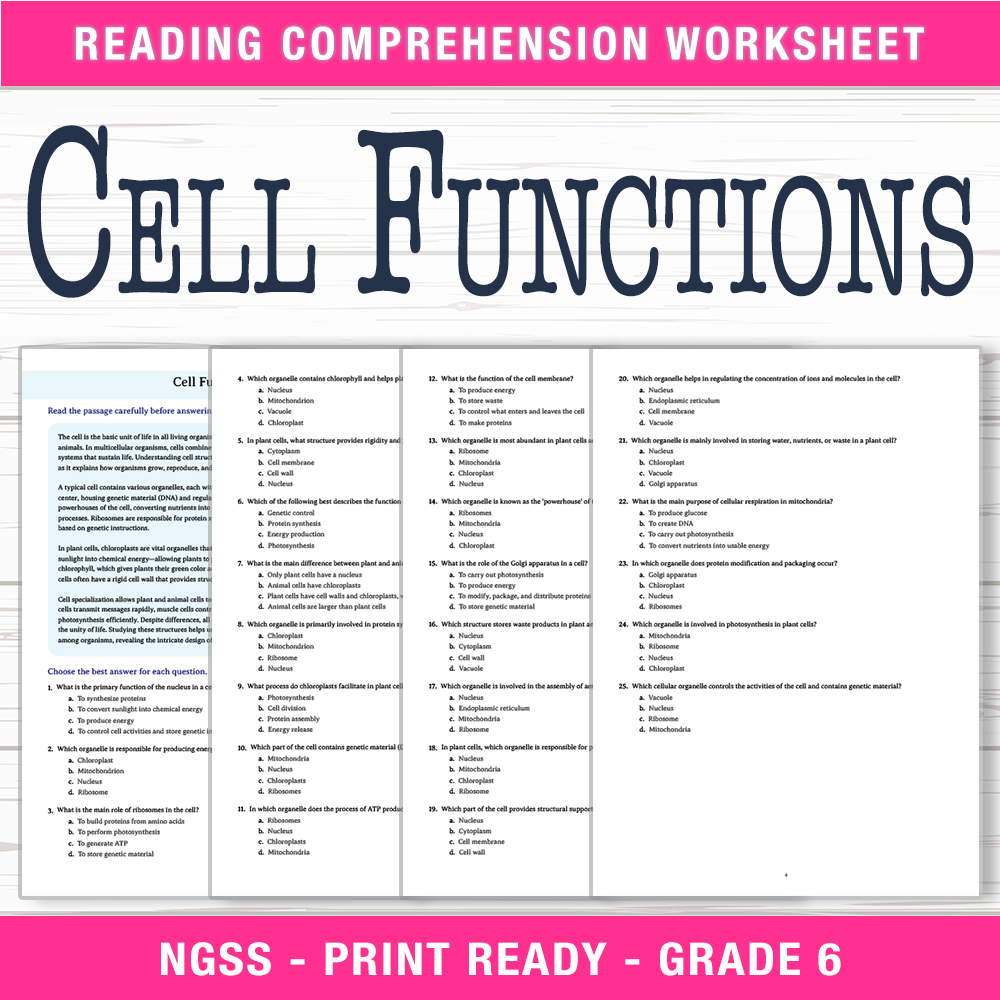
6th Grade Science | Cell Functions Worksheet (PDF + Answer Key)
Created byRiverstone ClassroomLearning Objectives
- Identify the structure and function of major organelles in plant and animal cells.
- Explain how organelles work together to perform essential cellular functions.
- Compare and contrast plant and animal cell components related to cell specialization.
Instant download
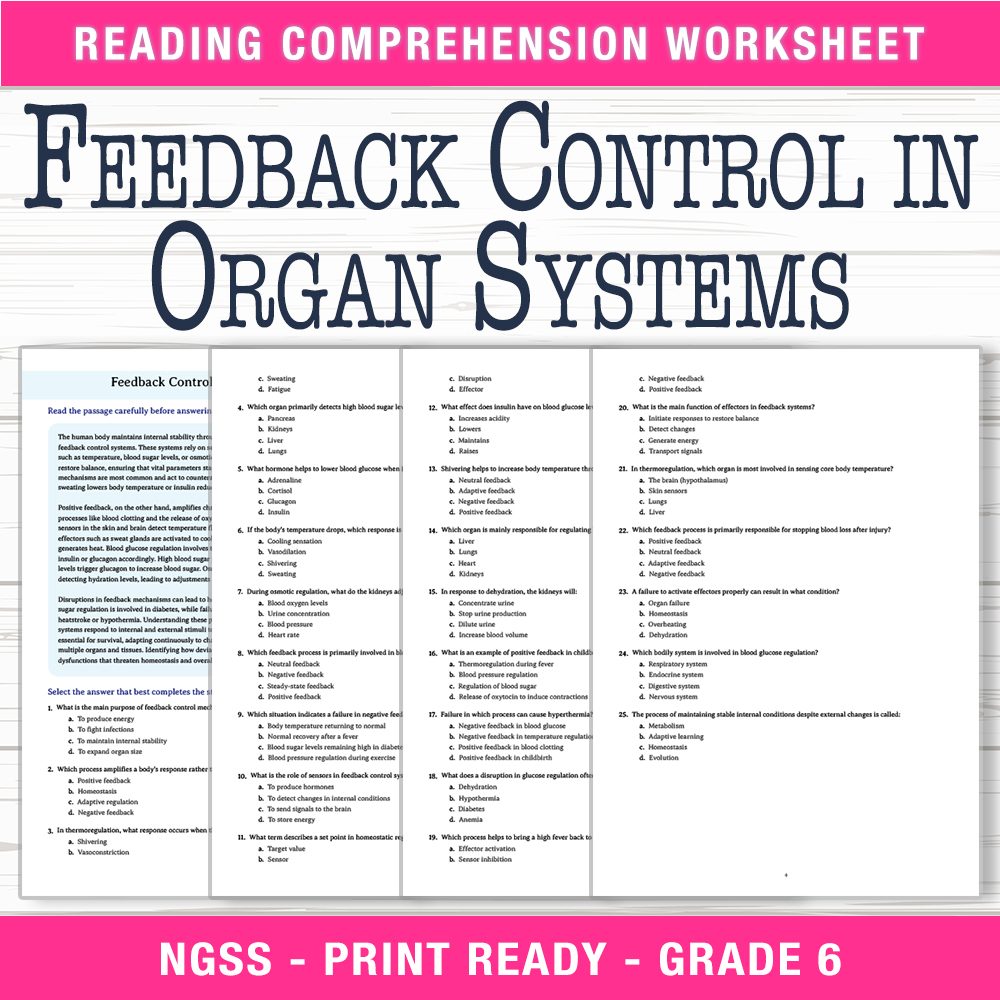
6th Grade Science | Feedback Control in Organ Systems Worksheet (PDF)
Created byRiverstone ClassroomLearning Objectives
- Explain the concept of feedback control mechanisms in maintaining internal stability.
- Identify examples of negative and positive feedback processes in the human body.
- Describe the roles of sensors, effectors, and set points in physiological regulation.
Instant download

Grade 6 Adaptation and Speciation Worksheet | NGSS Science Activity
 Created byAmber Owl Education
Learning Objectives
- Explain how adaptations can change survival and reproduction in different environments
- Describe how populations can diverge and form new species through speciation
- Identify evidence of speciation using morphology, reproductive compatibility, and biogeography
Also included in: Grade 6 Science Natural Selection & Biodiversity Lesson Bundle | NGSS +1 more
Instant download
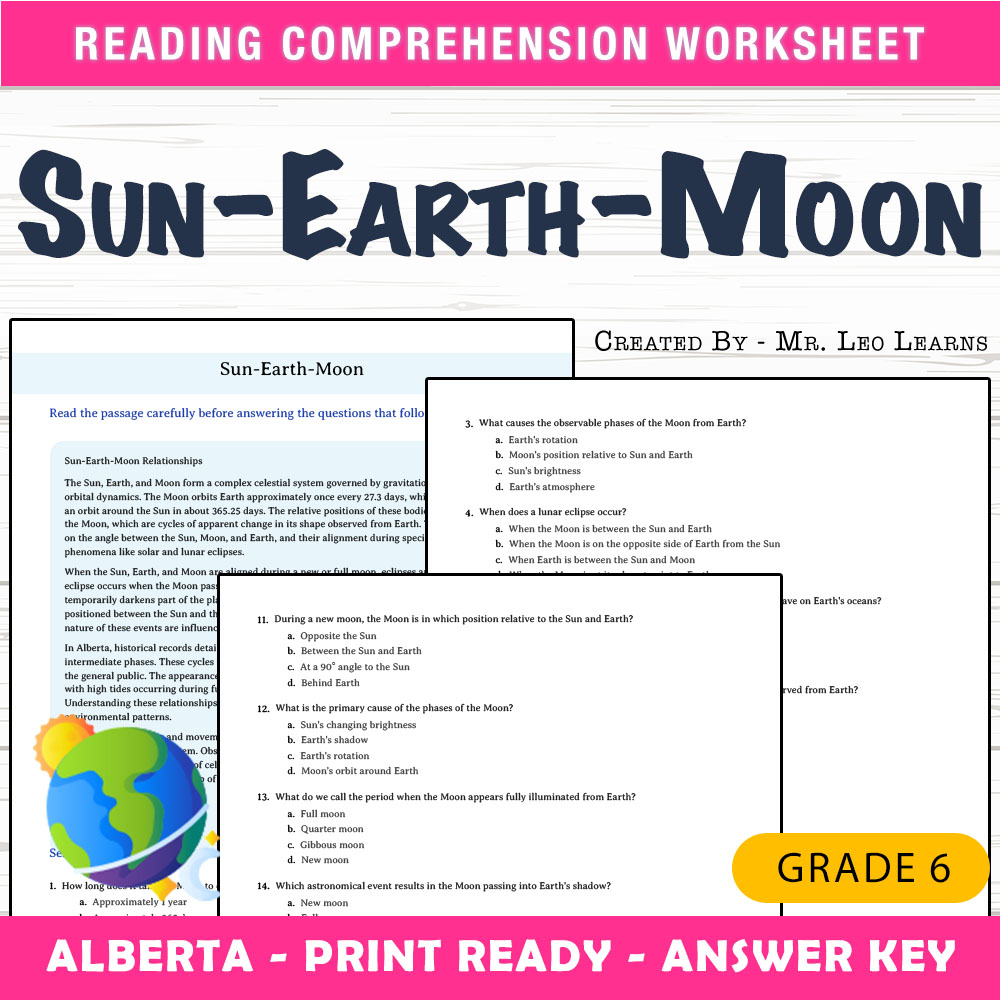
Grade 6 Science — Sun–Earth–Moon Worksheet MCQ Paper for Mastery
 Created byThe Resource Hub
Learning Objectives
- Understand the relative positions and relationships among the Sun, Earth, and Moon.
- Identify how gravitational interactions influence lunar phases, eclipses, and tides.
- Explain how celestial alignments produce observable phenomena such as solar and lunar eclipses.
Also included in: Grade 6 Science Sky Science Unit Bundle – Celestial Motion & Earth-Sun Relations +1 more
Instant download

Observational Instruments & Wavelengths Worksheets Grade 6 Science
 Created byPrism Point Learning
Learning Objectives
- Describe how optical and radio telescopes observe the solar system
- Explain how spectrometers reveal information from incoming light
- Interpret spectral patterns as evidence of composition and motion
Also included in: Grade 6 Space Science Lesson Bundle | Ontario Science Framework
Instant download

Grade 6 Niche Dynamics Worksheet | Ontario Science Ecosystems Activity
 Created byChalk and Compass
Learning Objectives
- Differentiate between a species’ fundamental niche and realized niche.
- Explain how abiotic factors and biotic interactions influence where organisms can live and what resources they use.
- Describe how temporal and spatial partitioning can reduce competition among similar species.
Also included in: Grade 6 Science Ecosystems, Adaptations & Biodiversity Lesson Bundle | Ontario +1 more
Instant download

Grade 6 Genetics Trait Heritability Worksheet | Doodle Notes & Ontario
Created byChalk and CompassLearning Objectives
- Explain what heritability means and how genetic variation contributes to differences in traits among individuals
- Distinguish heritable (genetic) influences from environmental influences on traits
- Describe how heritable traits can change allele frequencies and shift trait distributions over generations
Also included in: Grade 6 Science Ecosystems, Adaptations & Biodiversity Lesson Bundle | Ontario +1 more
Instant download

Grade 6 Food Webs Worksheet | Ontario Science Activity & Doodle Notes
Created byChalk and CompassLearning Objectives
- Identify producers, consumers, and decomposers in food webs
- Explain how energy flows through trophic levels and why energy decreases at each step
- Describe how removing or adding a species can affect other organisms in interconnected food webs
Also included in: Grade 6 Science Ecosystems, Adaptations & Biodiversity Lesson Bundle | Ontario +1 more
Instant download

Classification Genetics Worksheet Grade 6 Science Ontario + Doodle Notes
Created byChalk and CompassLearning Objectives
- Explain how DNA barcoding and sequence comparison help identify species when morphology is unclear
- Use basic ideas from phylogenetic trees to describe relationships among organisms
- Compare morphological keys with genetic markers and describe how cryptic species can be discovered using DNA
Also included in: Grade 6 Science Ecosystems, Adaptations & Biodiversity Lesson Bundle | Ontario +1 more
Instant download
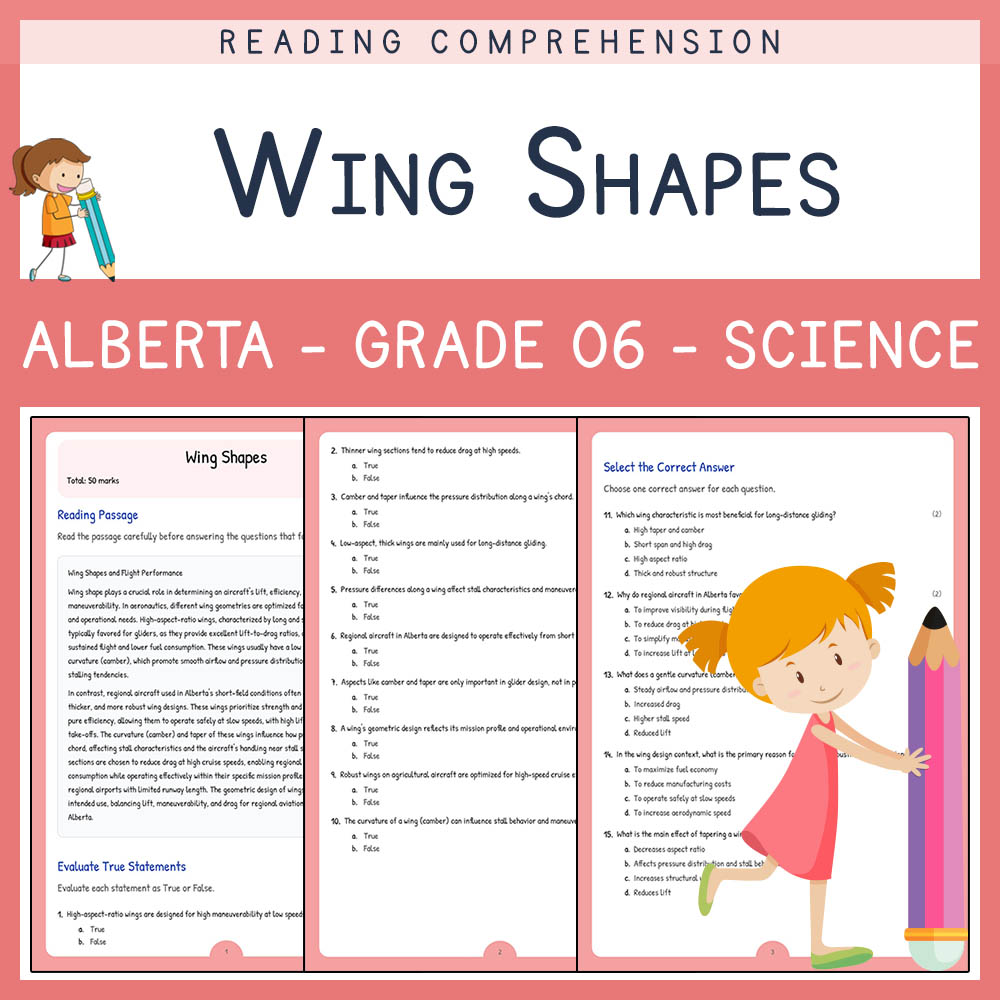
Grade 6 Science Assessment | Wing Shapes Worksheet Elena | Alberta
Created byLumora LearningLearning Objectives
- Understand how wing shape influences lift, stall behavior, and maneuverability.
- Compare high-aspect-ratio wings used on gliders with low-aspect, robust wings on agricultural aircraft.
- Explain how curvature and taper affect pressure distribution and performance.
Also included in: Grade 6 Science | Air and Aerodynamics Science Lesson Bundle | Alberta
Instant download
About Grade 6 Science Worksheets
Explore Grade 6 Science worksheets for classwork, homework, or review. Our 5,969 printables download instantly as PDFs.
MyTeachingSheets worksheets are made by real teacher-authors and checked before they go live. Download any as a print-ready PDF for lessons, homework, or independent practice — most include answer keys, and previews are always free.