
Grade 6 Science Worksheets
5,969 worksheets
Grade 6 Science – Drag Components Worksheet (Ontario Standards PDF)
 Created byEvergreen Desk Education
Learning Objectives
- Categorize aerodynamic drag into parasitic drag and induced drag
- Explain how form drag, skin-friction drag, and interference drag contribute to parasitic drag
- Describe why induced drag is tied to lift production and wing span
Also included in: Grade 6 Flight & Aerodynamics Science Lesson Bundle Worksheets (Ontario) +1 more
Instant download
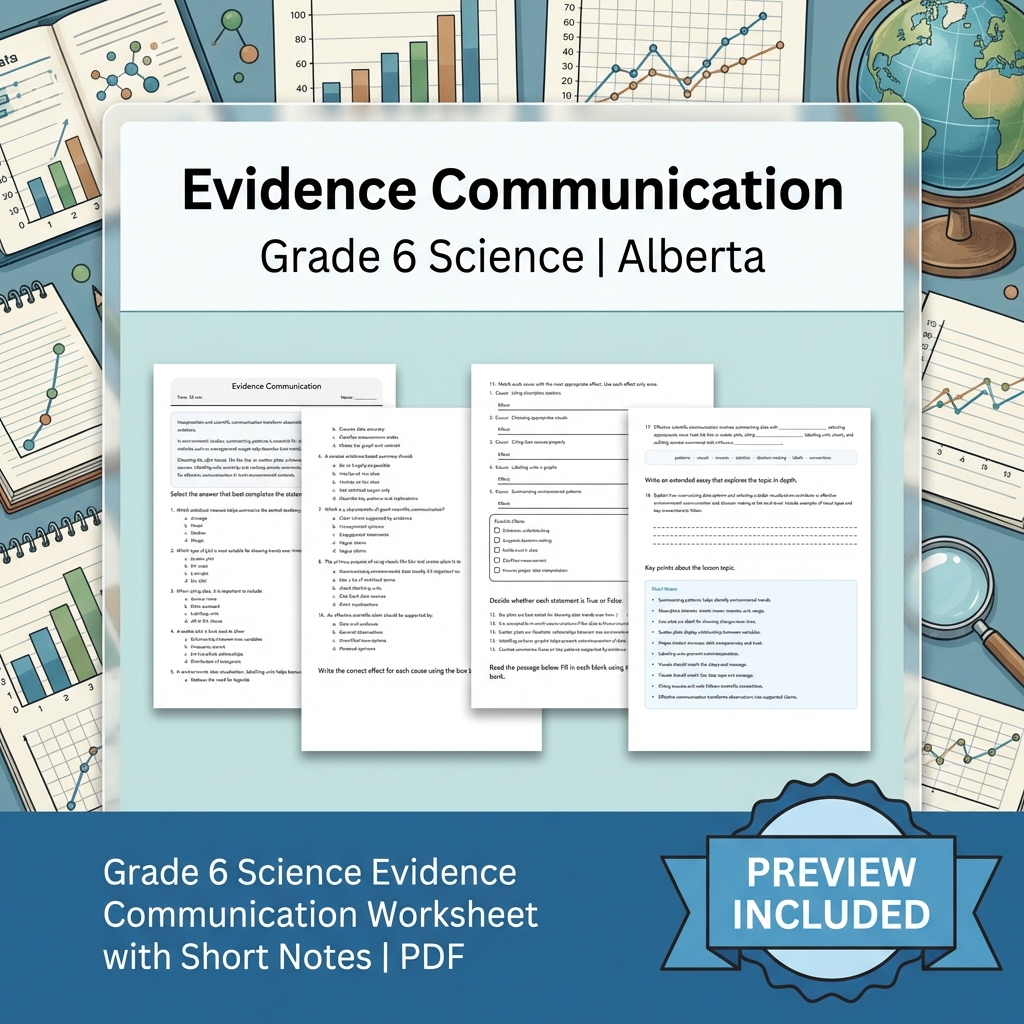
Grade 6 Science Evidence Communication Worksheet with Short Notes | PDF
 Created byMeadowlark Worksheets
Learning Objectives
- Understand methods for summarizing patterns using descriptive statistics.
- Learn how to select appropriate visual representations like bar, line, and scatter plots.
- Recognize conventions for citing data sources and labelling units.
Also included in: Grade 6 Science | Evidence & Investigation Unit Worksheet Bundle +1 more
Instant download
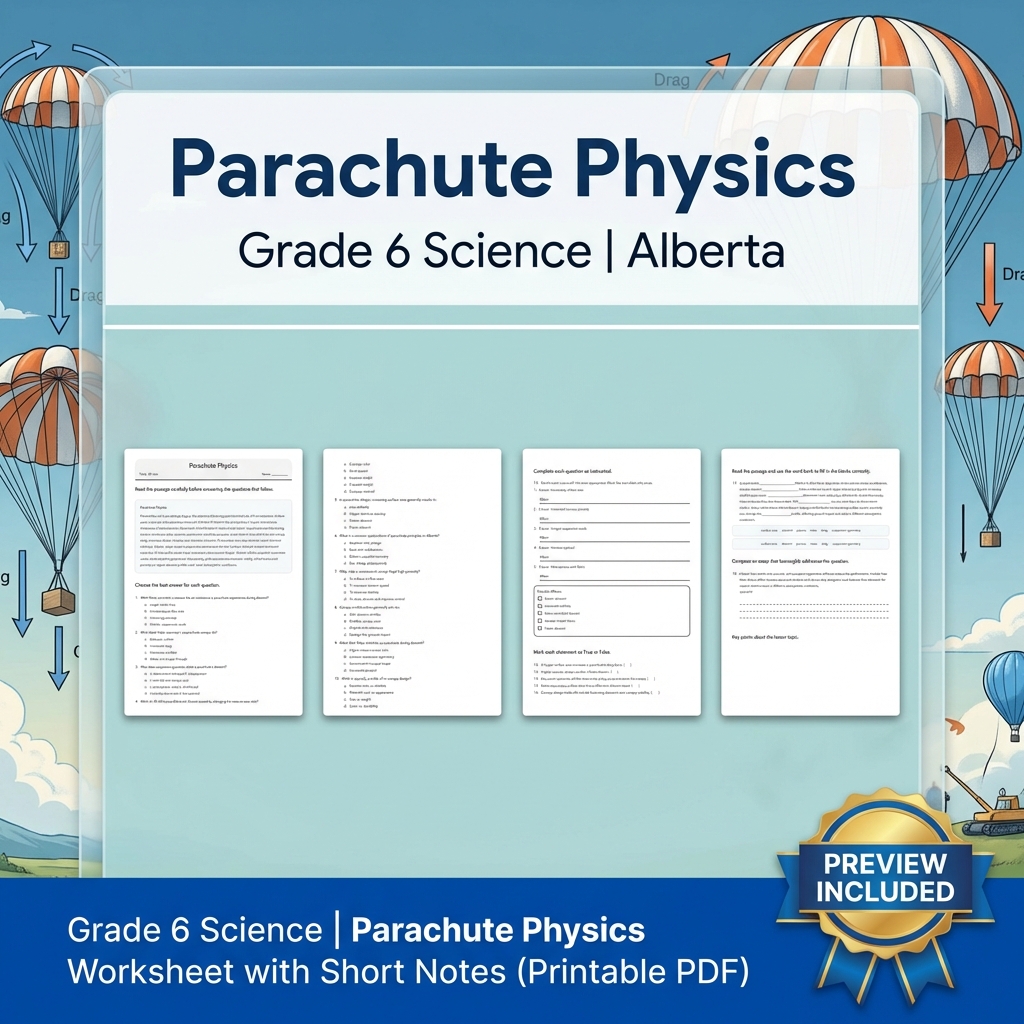
Grade 6 Science | Parachute Physics Worksheet with Short Notes (Printable PDF)
Created byMeadowlark WorksheetsLearning Objectives
- Explain how surface area, porosity, and suspension geometry affect parachute drag.
- Describe the concept of terminal velocity and how mass-to-area ratio influences descent speed.
- Analyze how canopy design trade-offs impact stability and descent in different atmospheric conditions.
Also included in: Grade 6 Science – Air and Aerodynamics UNIT Bundle | Alberta Curriculum Resources +1 more
Instant download
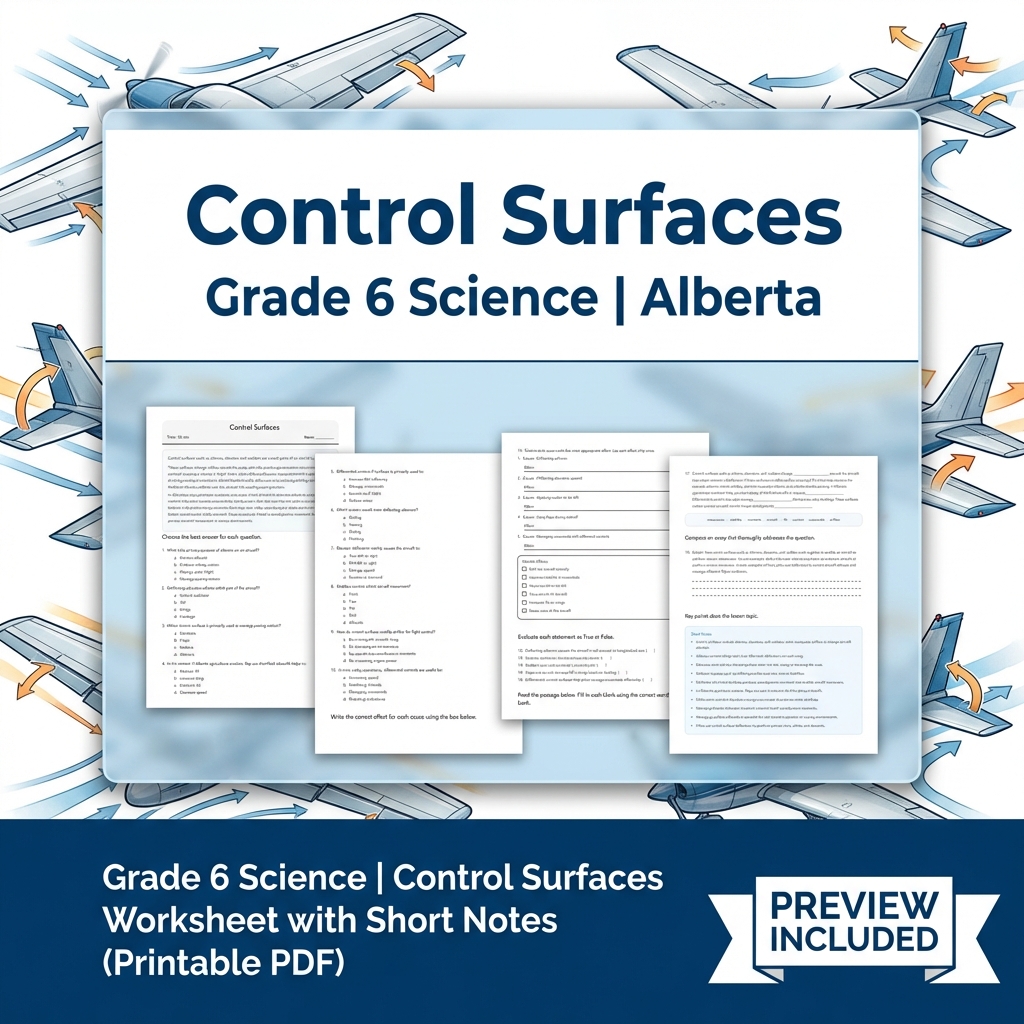
Grade 6 Science | Control Surfaces Worksheet with Short Notes (Printable PDF)
Created byMeadowlark WorksheetsLearning Objectives
- Define different control surfaces such as ailerons, elevators, and rudders.
- Explain how deflection of control surfaces modifies airflow to produce aircraft attitude changes.
- Describe the aerodynamic moments generated by control surface deflections.
Also included in: Grade 6 Science – Air and Aerodynamics UNIT Bundle | Alberta Curriculum Resources +1 more
Instant download
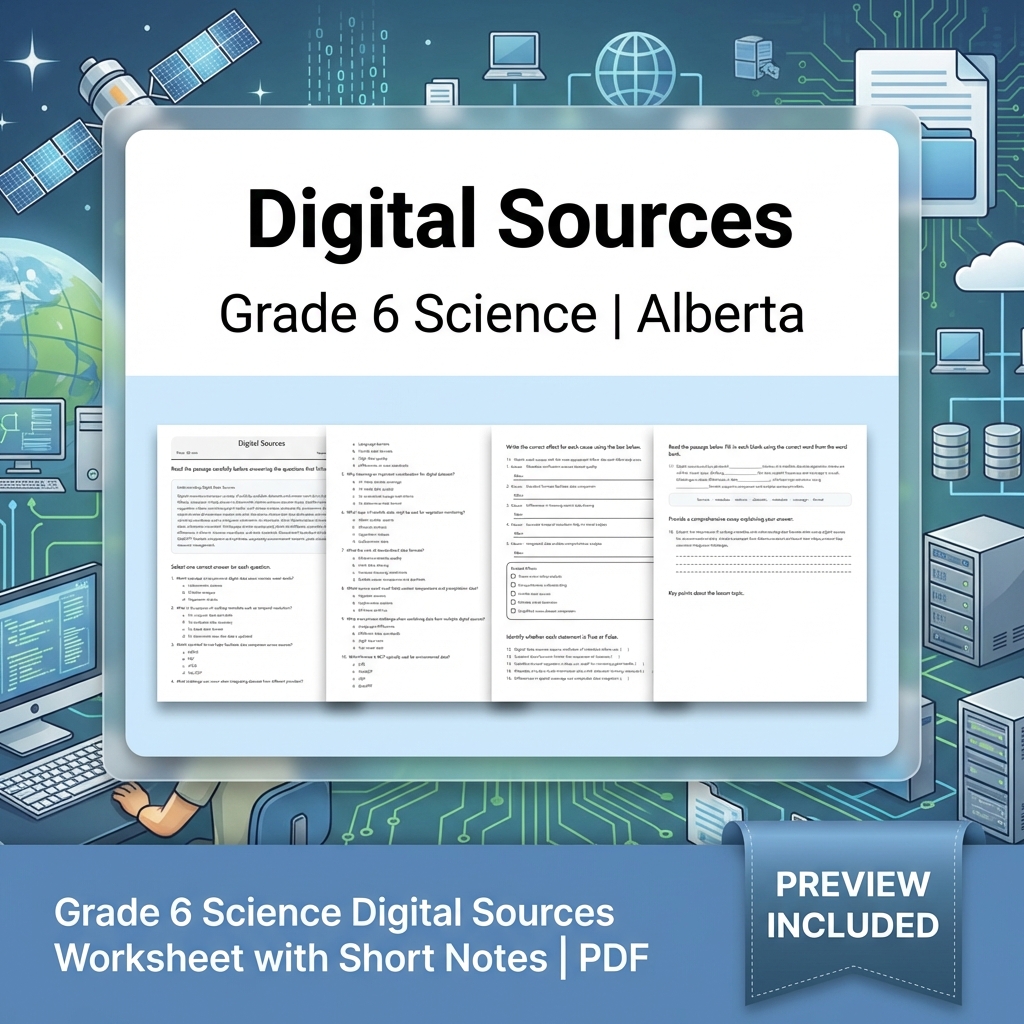
Grade 6 Science Digital Sources Worksheet with Short Notes | PDF
Created byMeadowlark WorksheetsLearning Objectives
- Understand various types of digital sources related to environmental data.
- Learn how to verify metadata, resolution, and coverage of digital datasets.
- Recognize challenges in integrating data from multiple sources.
Also included in: Grade 6 Science | Evidence & Investigation Unit Worksheet Bundle +1 more
Instant download

Grade 6 Science | Species Classification Worksheet with Short Notes (PDF)
Created byMeadowlark WorksheetsLearning Objectives
- Understand the main groups of organisms in species classification, including producers, consumers, and decomposers.
- Identify examples of native and invasive species within local ecosystems.
- Describe how functional classification helps predict energy flow and ecosystem dynamics.
Also included in: Grade 6 Science | Trees and Forests Unit Worksheet Bundle – Alberta Curriculum +1 more
Instant download
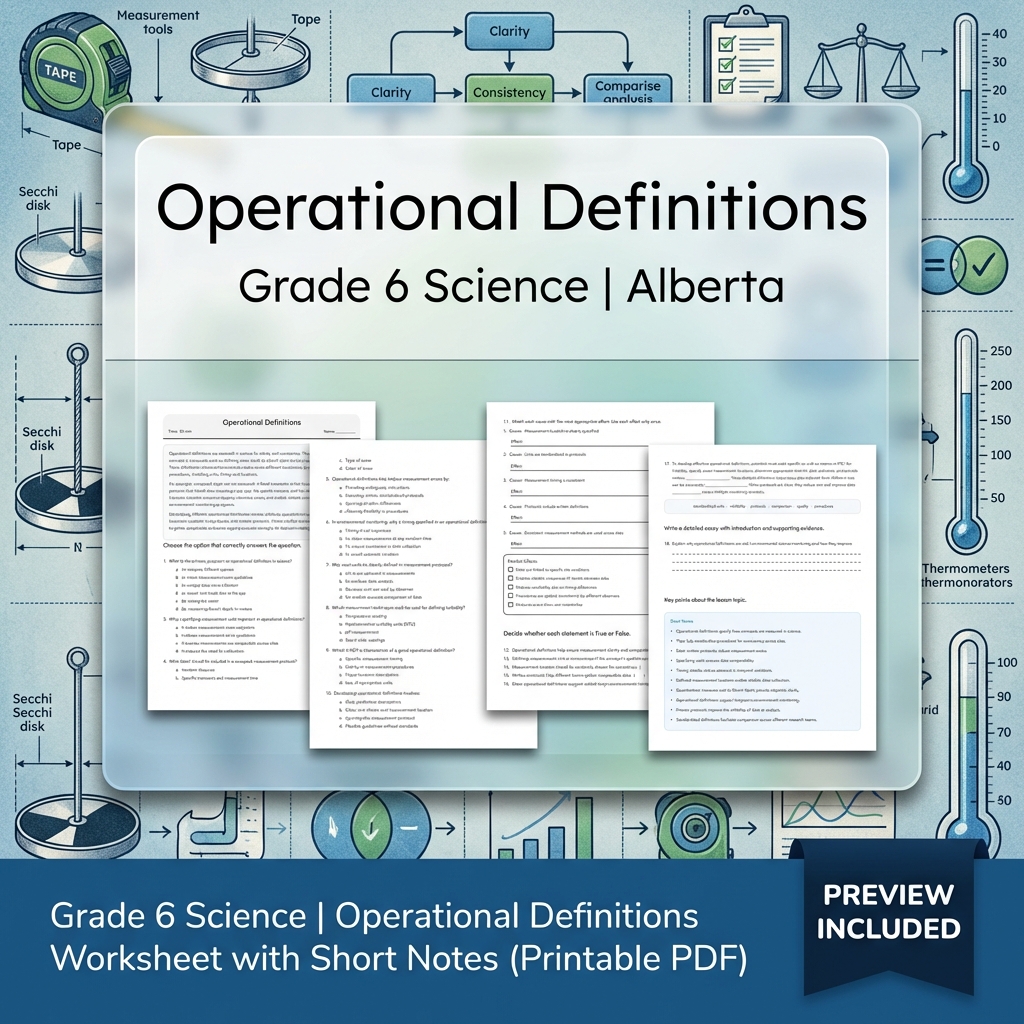
Grade 6 Science | Operational Definitions Worksheet with Short Notes (PDF)
Created byMeadowlark WorksheetsLearning Objectives
- Understand the purpose and importance of operational definitions in scientific measurement.
- Learn how to convert qualitative observations into quantitative data.
- Identify methods for specifying measurement protocols, units, and locations.
Also included in: Grade 6 Science | Evidence & Investigation Unit Worksheet Bundle +1 more
Instant download
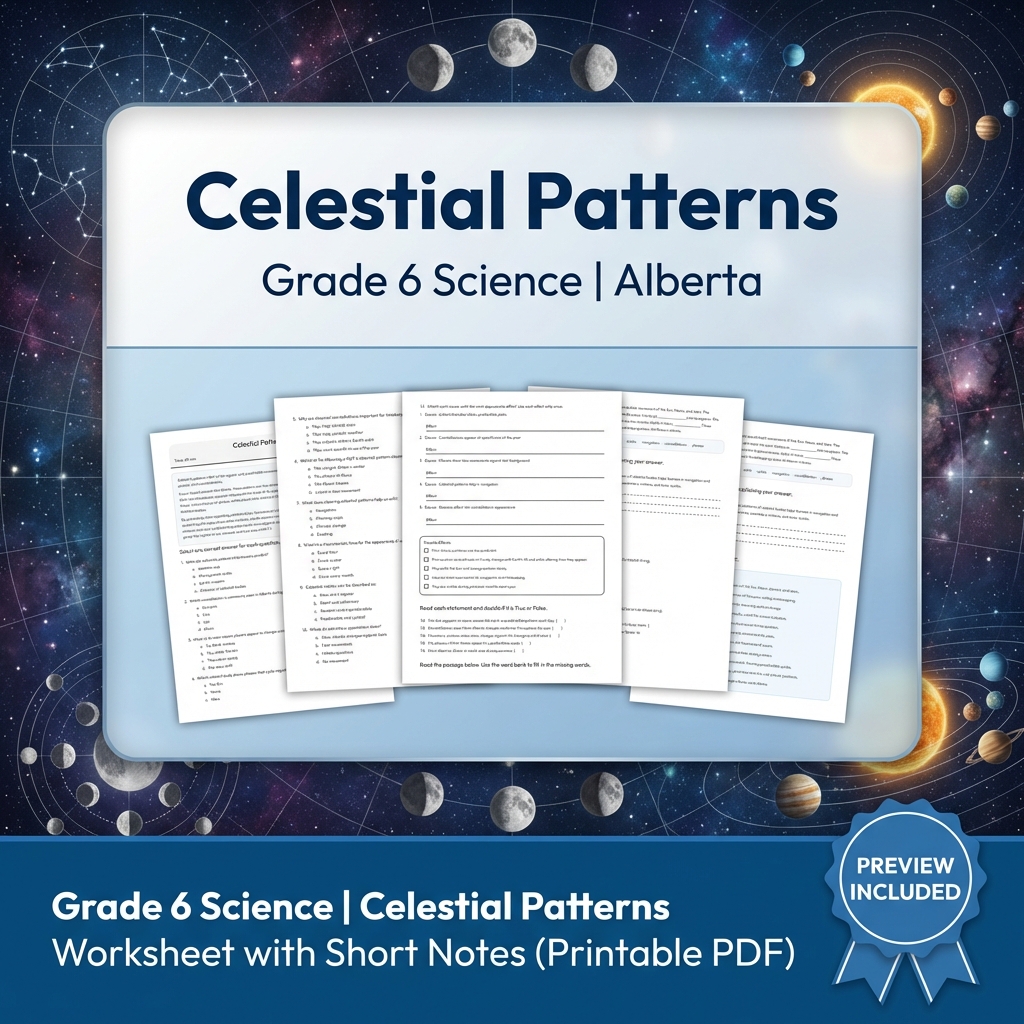
Grade 6 Science | Celestial Patterns Worksheet with Short Notes (Printable PDF)
Created byMeadowlark WorksheetsLearning Objectives
- Describe the predictable paths of the Sun, Moon, and planets as seen from a fixed location.
- Explain the significance of seasonal constellations and planetary apparitions in timekeeping and navigation.
- Identify common celestial patterns and their characteristic times.
Also included in: Grade 6 Science Sky Science Unit Bundle | Alberta Curriculum Worksheets +1 more
Instant download

Grade 6 Science | Lunar Motion Worksheet with Short Notes (Printable PDF)
Created byMeadowlark WorksheetsLearning Objectives
- Understand the orbital pattern of the Moon around Earth.
- Describe how lunar phases change over time.
- Explain the relationship between the Sun, Earth, and Moon during different lunar phases.
Also included in: Grade 6 Science Sky Science Unit Bundle | Alberta Curriculum Worksheets +1 more
Instant download

Grade 6 Science | Graph Selection Worksheet with Short Notes (Printable PDF)
Created byMeadowlark WorksheetsLearning Objectives
- Understand which type of graph is appropriate for different data types.
- Identify how to label axes and choose scales to accurately represent data.
- Learn when to use line graphs, bar charts, and scatter plots with Alberta examples.
Also included in: Grade 6 Science | Evidence & Investigation Unit Worksheet Bundle +1 more
Instant download

Grade 6 Science | Wing Shapes Worksheet with Short Notes (Printable PDF)
Created byMeadowlark WorksheetsLearning Objectives
- Understand how wing shape influences lift, stall behavior, and maneuverability.
- Identify features such as camber, aspect ratio, and taper that affect wing performance.
- Compare high-aspect-ratio glider wings with low-aspect, robust agricultural wings.
Also included in: Grade 6 Science – Air and Aerodynamics UNIT Bundle | Alberta Curriculum Resources +1 more
Instant download

Grade 6 Science Measurement Tools Worksheet with Short Notes PDF
Created byMeadowlark WorksheetsLearning Objectives
- Understand the various instruments used in data collection, such as thermometers and pH probes.
- Learn how calibration of measurement tools ensures accurate data recording.
- Identify best practices for consistent observation and measurement in scientific experiments.
Also included in: Grade 6 Science | Evidence & Investigation Unit Worksheet Bundle +1 more
Instant download
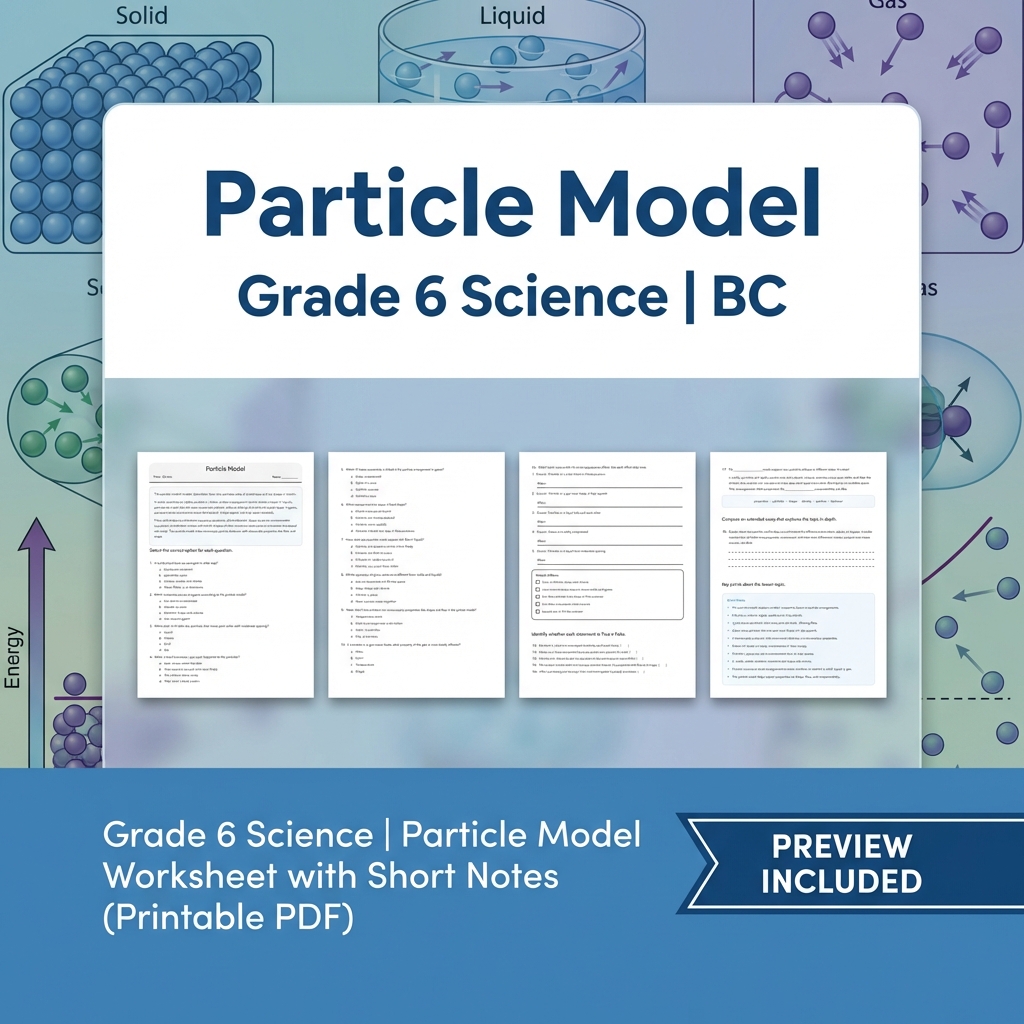
Grade 6 Science | Particle Model Worksheet with Short Notes (Printable PDF)
Created byMeadowlark WorksheetsLearning Objectives
- Understand the basic idea of the particle model and how it explains states of matter.
- Identify differences in particle arrangements in solids, liquids, and gases.
- Describe how microscopic particle behaviour relates to macroscopic properties like shape, volume, and flow.
Also included in: Grade 6 Science | Matter, Properties & Change UNIT Worksheet Bundle +1 more
Instant download
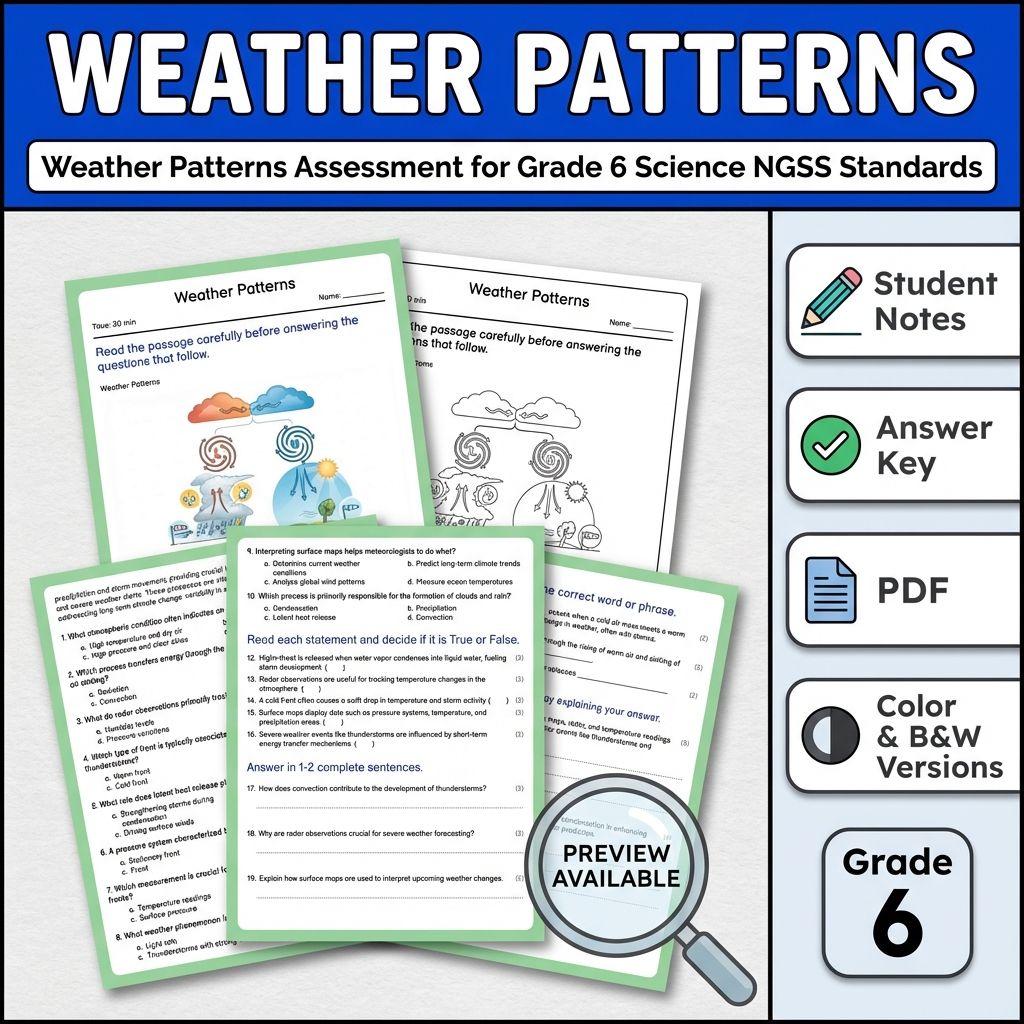
Weather Patterns Assessment for Grade 6 Science NGSS Standards
 Created byPrism Point Learning
Learning Objectives
- Understand atmospheric processes that influence local and regional weather.
- Interpret surface maps, temperature, and pressure data to analyze weather events.
- Identify and describe different types of weather fronts, wind shifts, and precipitation patterns.
Also included in: Grade 6 Science Mini Bundle – Earth's Systems NGSS Standards-Aligned +1 more
Instant download
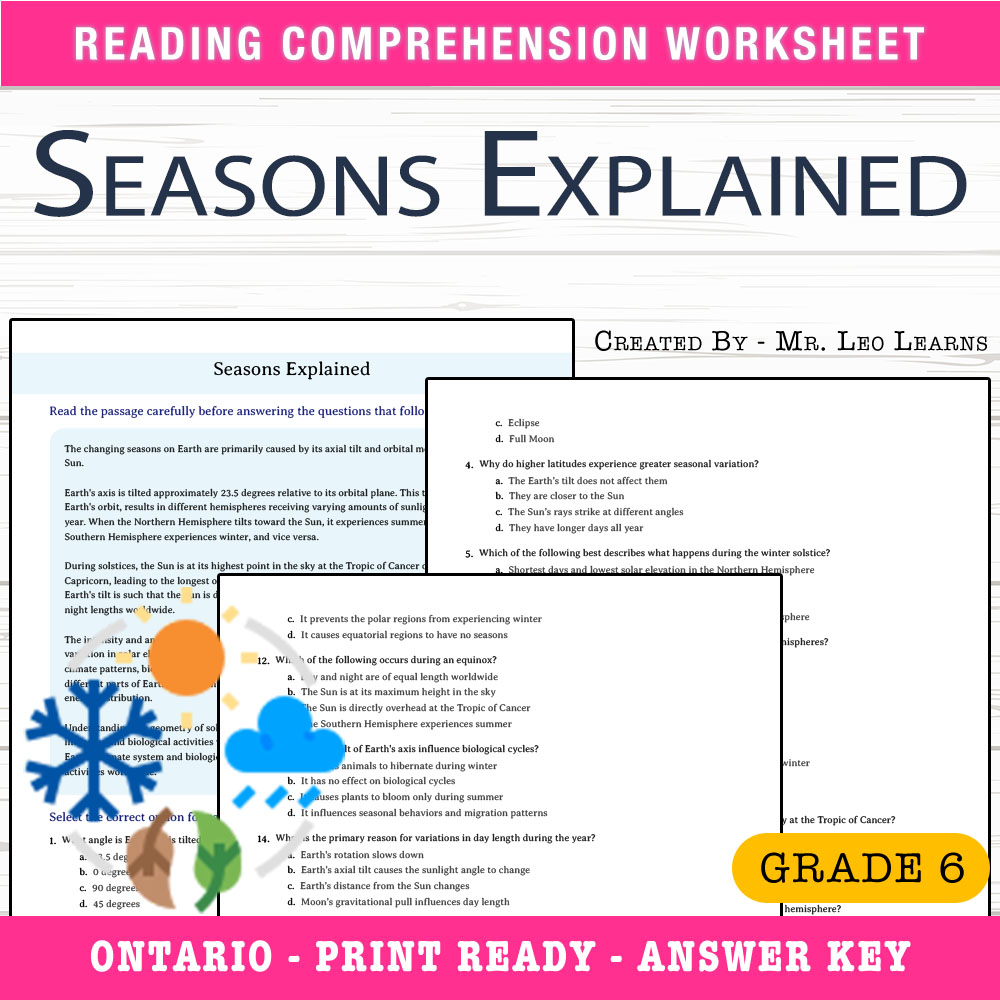
Grade 6 Science – Seasons Explained Worksheet for Mastery
 Created byThe Resource Hub
Learning Objectives
- Explain how Earth's axial tilt and orbital motion cause seasonal changes.
- Identify the differences in sunlight angle and day length during solstices and equinoxes.
- Describe why hemispheres experience opposite seasons and how these variations affect climate and biological cycles.
Also included in: Grade 6 Science Unit | Space Systems & Orbital Mechanics Worksheet Pack +1 more
Instant download

Grade 6 Science | Series Characteristics - Daily Reading Comprehension
 Created byCoral Reef Learning
Learning Objectives
- Understand key concepts related to Science
- Apply knowledge through practice questions
- Demonstrate comprehension of the material
Instant download
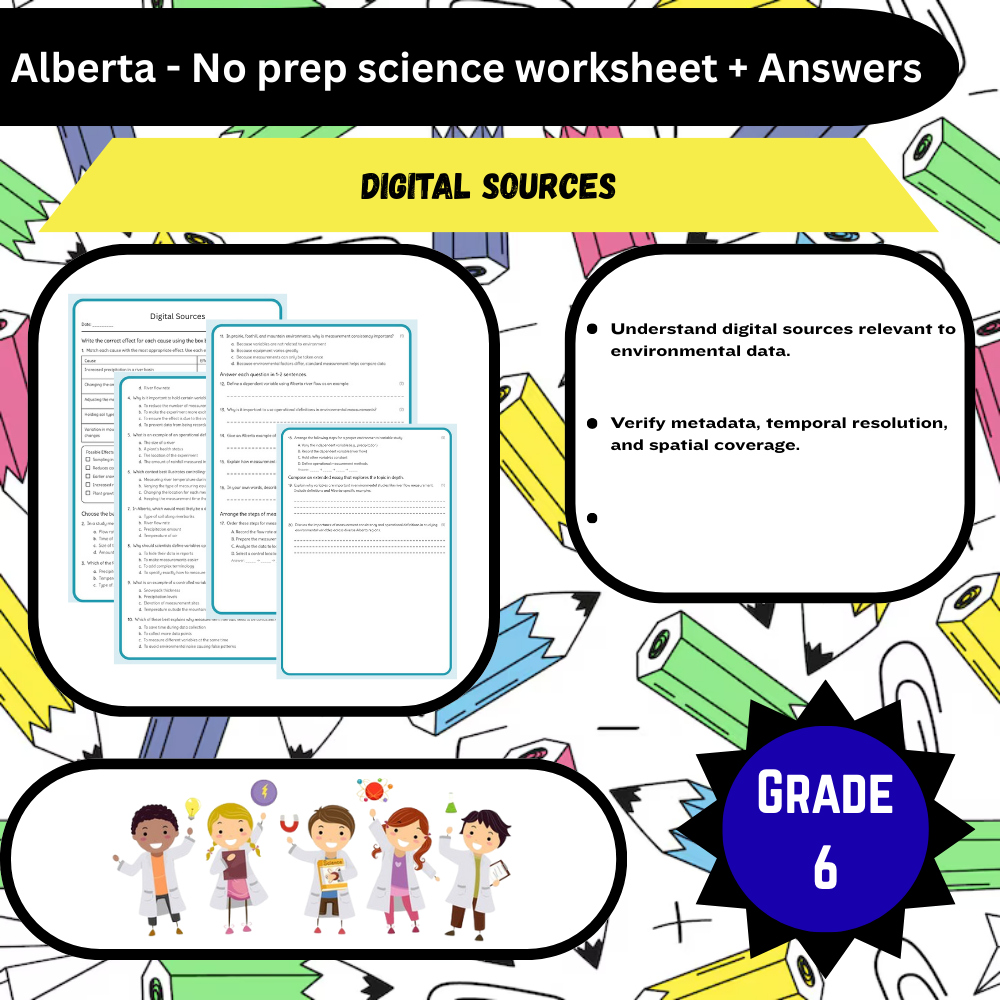
Grade 6 Science – Digital Sources & Data Verification Worksheet (PDF)
 Created byBright Mind Resources
Learning Objectives
- Understand the concept of digital sources and examples relevant to environmental data.
- Learn how to verify metadata, temporal resolution, and spatial coverage of digital datasets.
Instant download

Grade 6 Science | Classifying Matter - Daily Reading Comprehension
Created byCoral Reef LearningLearning Objectives
- Understand the difference between elements, compounds, and mixtures.
- Identify examples of each type of matter based on observable characteristics.
- Learn basic separation techniques like filtration and distillation.
Instant download
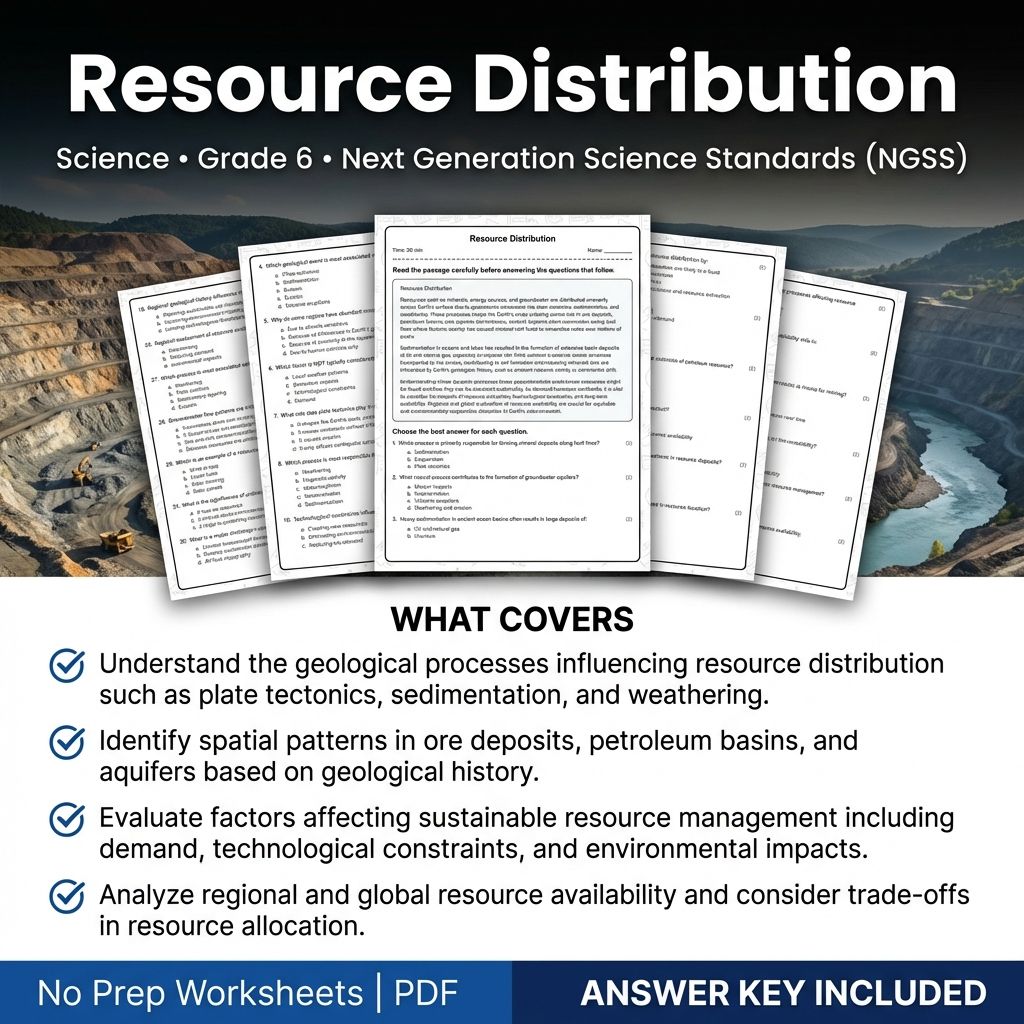
Grade 6 Science Worksheet | Resource Distribution & Earth's Resources (PDF + Answer Key)
Created byCoral Reef LearningLearning Objectives
- Understand the geological processes influencing resource distribution such as plate tectonics, sedimentation, and weathering.
- Identify spatial patterns in ore deposits, petroleum basins, and aquifers based on geological history.
- Evaluate factors affecting sustainable resource management including demand, technological constraints, and environmental impacts.
Instant download

Grade 6 Biodiversity Patterns Worksheet | Richness, Abundance & Sampling
 Created byTeacher's Corner
Learning Objectives
- Describe biodiversity patterns using species richness, abundance, and evenness.
- Identify how transects and quadrats help scientists sample ecosystems.
- Compare ecosystems by interpreting simple diversity indices and habitat heterogeneity.
Instant download
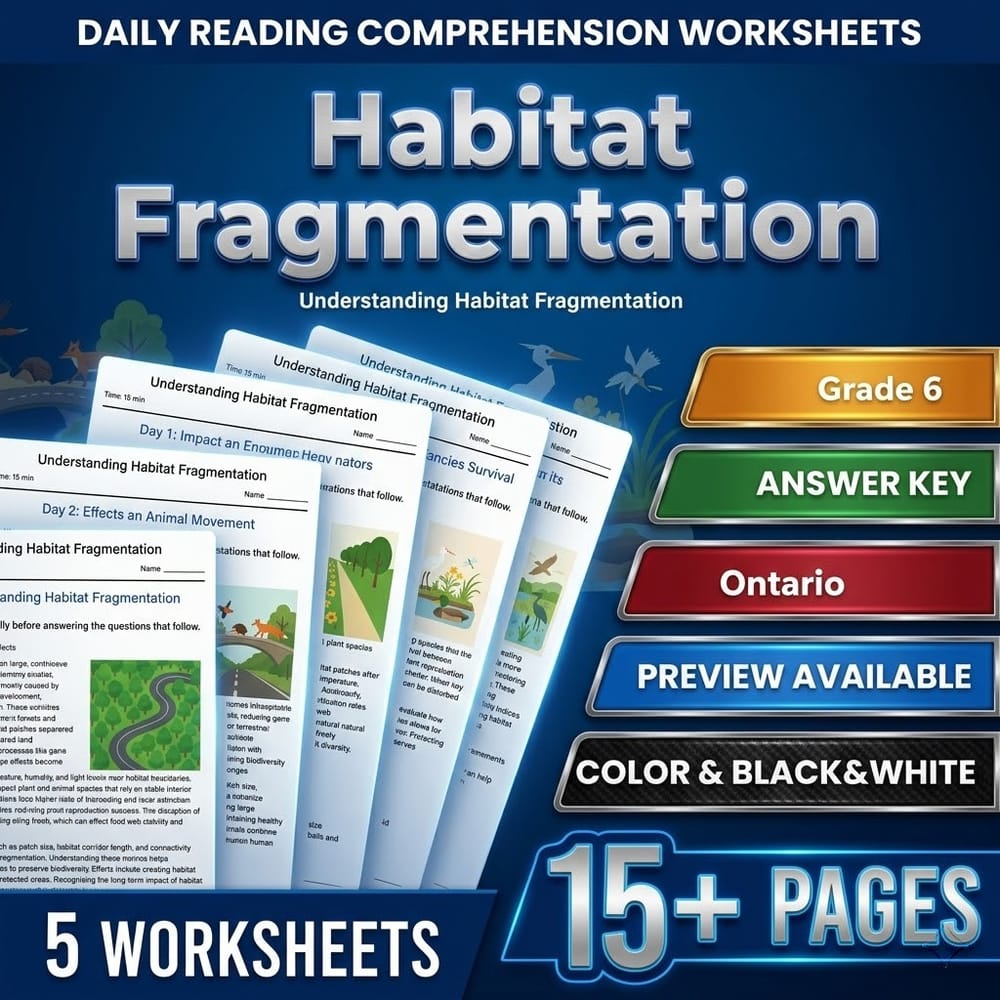
Grade 6 Science – Habitat Fragmentation & Effects | Daily Reading Worksheet
 Created byQuiet Forest Education
Learning Objectives
- Define habitat fragmentation and identify its causes.
- Explain how landscape division impacts species and ecosystems.
- Recognize the effects of edge habitats and isolation on wildlife.
Also included in: Ecosystems and Environment Grade 6 Science Daily Worksheets Bundle | Ontario +1 more
Instant download
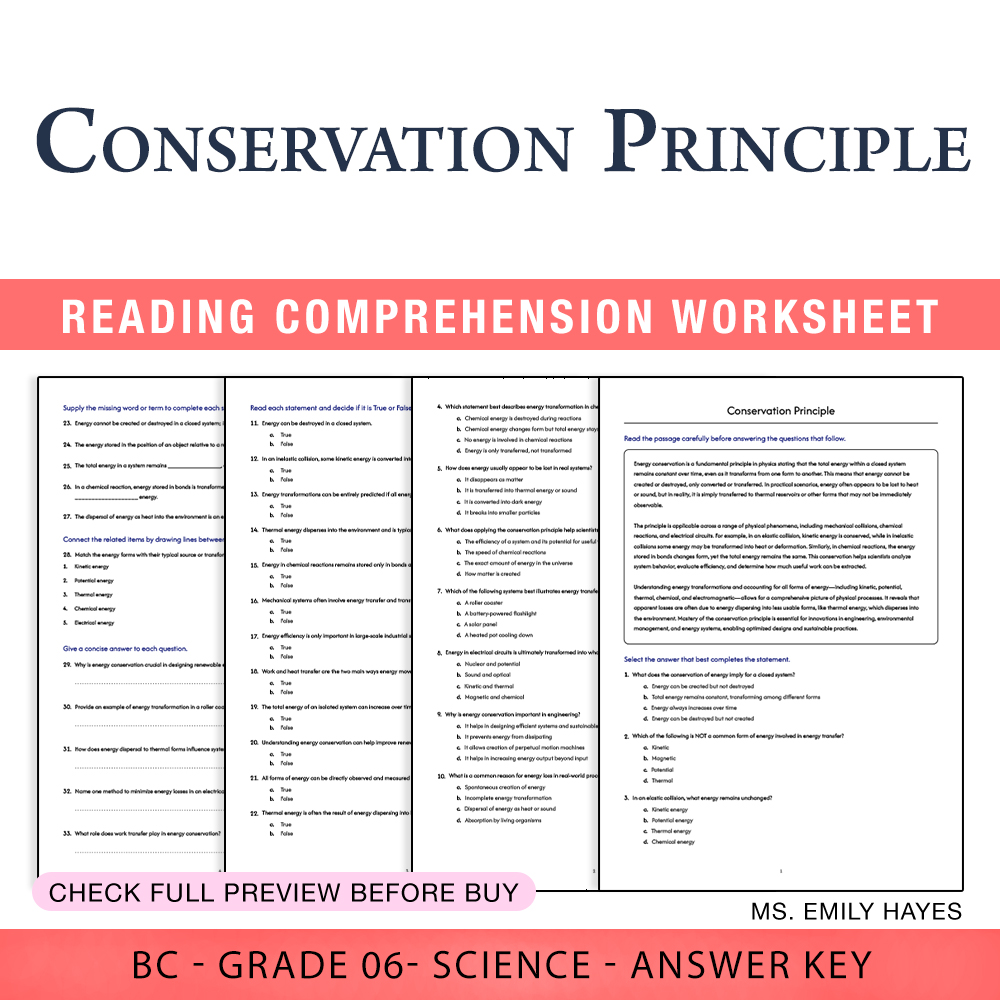
6th Grade Science | Conservation Principle Worksheet (PDF+ Answer Key)
 Created byCopper Leaf Classroom
Learning Objectives
- Explain the concept of energy conservation within closed systems.
- Identify the different forms of energy and how they transform and transfer in various physical scenarios.
- Describe how the conservation principle applies in mechanical, chemical, and electrical systems.
Also included in: Grade 6 Science BC | Waves, Sound, Light & Energy Worksheets (PDF + Answer Key) +1 more
Instant download
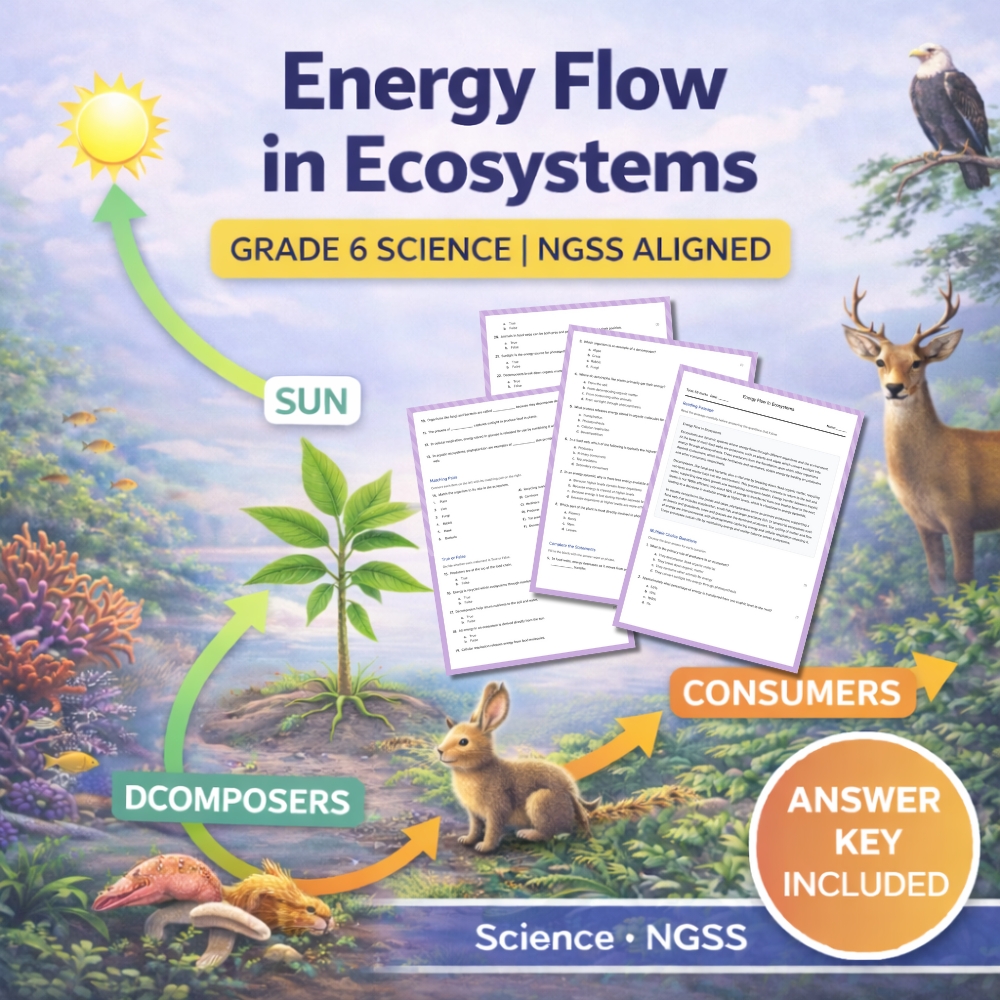
Grade 6 Science | Energy Flow in Ecosystems | NGSS (Worksheet + Answer Key)
 Created byCedar Grove Learning
Learning Objectives
- Describe the components of food webs and energy flow within terrestrial and aquatic ecosystems.
- Explain how energy diminishes across trophic levels in food pyramids.
- Identify the roles of producers, consumers, and decomposers in energy and matter cycling.
Also included in: Grade 6 Science | Ecosystem Interactions & Population Dynamics Worksheet Bundle +1 more
Instant download
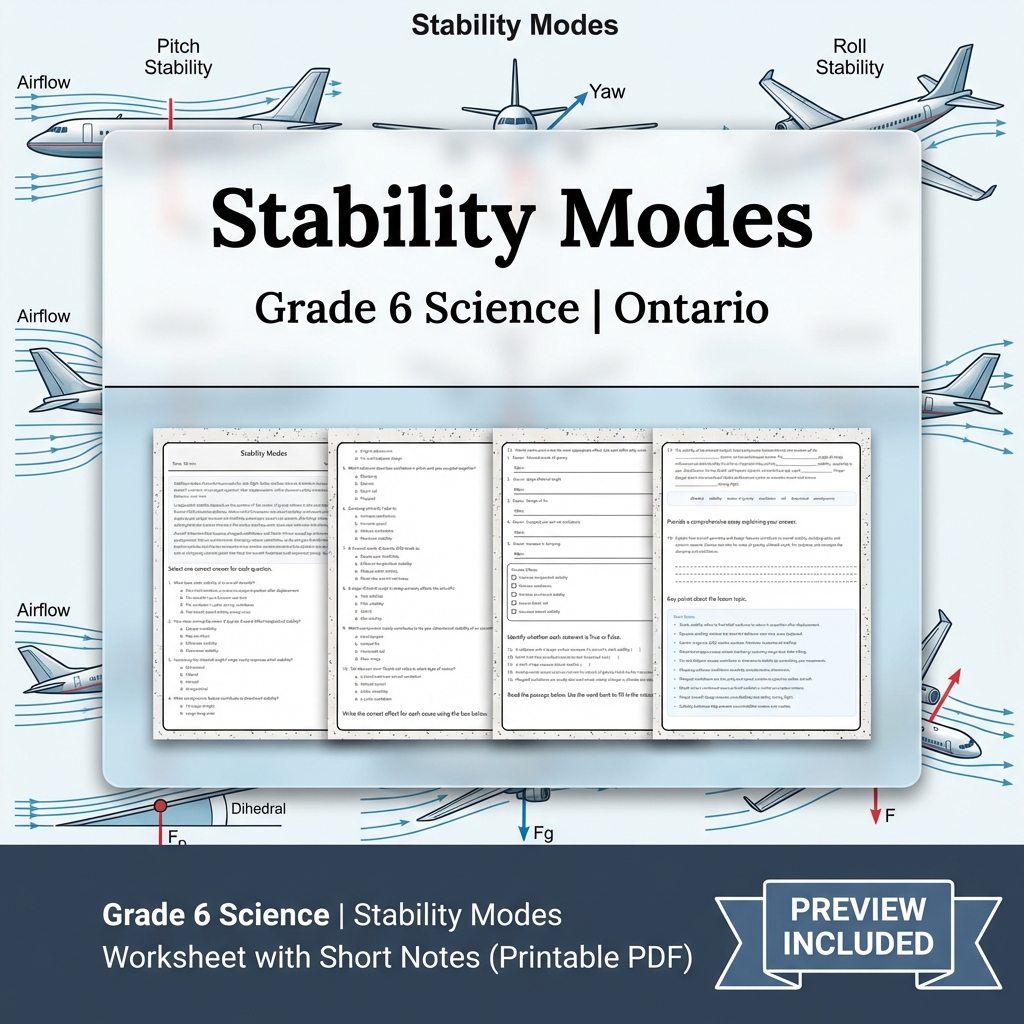
Grade 6 Science | Stability Modes Worksheet with Short Notes (Printable PDF)
Created byMeadowlark WorksheetsLearning Objectives
- Understand static and dynamic stability types in aircraft.
- Explain how aircraft geometry influences longitudinal, lateral, and directional stability.
- Identify the effects of center of gravity location, dihedral angle, and fin design on stability.
Also included in: Grade 6 Science Lesson Group Bundle – Ontario Framework Worksheets +1 more
Instant download

Grade 6 Science – Space Cycles & Earth Movements | Daily Reading Worksheet
Created byBright Mind ResourcesLearning Objectives
- Understand the Earth's rotation and its effect on day and night.
- Identify how Earth's tilt and orbit cause seasons.
- Explain the Moon's phases and why they change monthly.
Also included in: Earth Systems Grade 6 Science Daily Reading Worksheets Lesson Bundle | General +1 more
Instant download

Grade 6 Science – Climate Data Patterns & Trends | Daily Reading Worksheet
Created byBright Mind ResourcesLearning Objectives
- Understand how to interpret temperature and precipitation graphs
- Identify daily and seasonal temperature trends
- Analyze patterns in climate data over time
Also included in: Earth Systems Grade 6 Science Daily Reading Worksheets Lesson Bundle | General +1 more
Instant download

Grade 6 Science | Materials for Performance Worksheet | General Standard
 Created byLumora Learning
Learning Objectives
- Explain how material properties (strength, water resistance, and conductivity) match design demands in real-world situations.
- Use evidence and property tradeoffs (cost, availability, and ease of shaping) to justify material choices.
- Describe how filtration performance depends on membrane thickness, pore size, and durability over time.
Instant download

Grade 6 Day Night Seasons Worksheet | NGSS Practice PDF
 Created byClear Sky Classroom
Learning Objectives
- Explain Earth's rotation and its effect on day and night.
- Describe Earth's orbit and axial tilt causing seasons.
- Identify key points of solstices and equinoxes.
Also included in: Grade 6 Earth's Place in the Universe Science Lesson Bundle: NGSS +1 more
Instant download
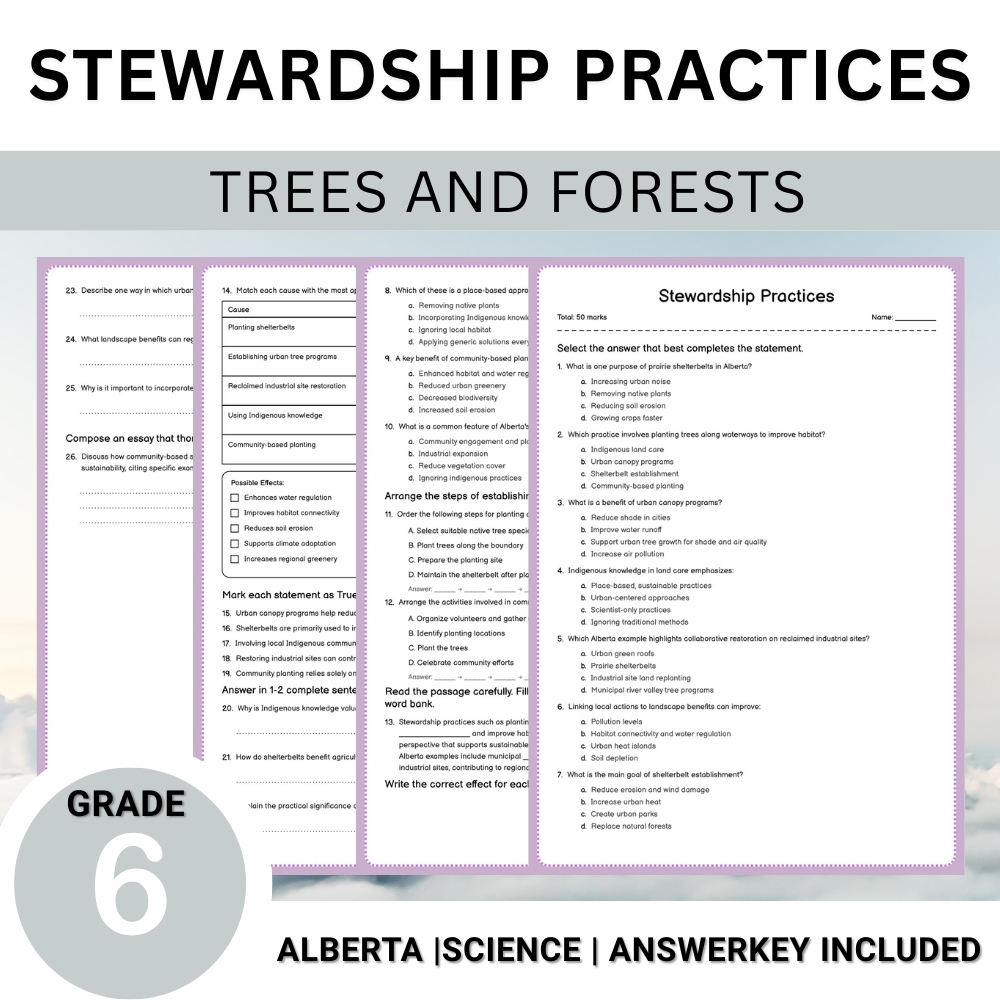
Grade 6 Science | Stewardship Practices Worksheet (Printable PDF + Answer Key)
Learning Objectives
- Identify key stewardship practices such as planting, shelterbelt establishment, and urban canopy programs.
- Understand the benefits of land care practices, including habitat connectivity and water regulation.
- Explore local examples of stewardship activities in Alberta.
Also included in: Grade 6 Science | Tree Anatomy, Ecology & Conservation Unit Worksheet Bundle +1 more
Instant download

Cell Specialization Practice Worksheet | Grade 6 Science Review Assessment
Created byPrism Point LearningLearning Objectives
- Explain how cell specialization develops structures suited to specific functions.
- Describe how differentiation changes gene expression to produce functional proteins and organelles.
- Connect specialized cells to tissues and how tissues enable organs to perform complex tasks.
Also included in: Multicellular Systems & Functions Lesson Bundle | Grade 6 Science | BC +1 more
Instant download
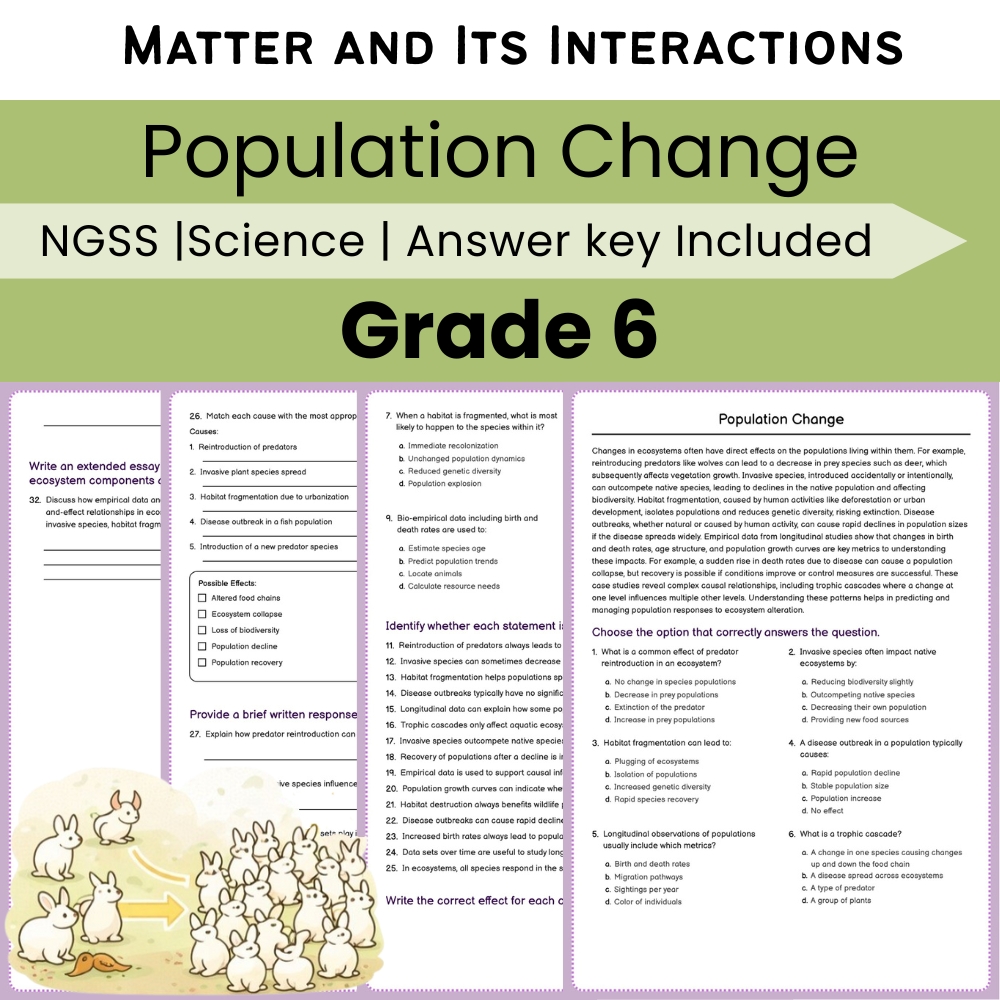
Grade 6 Science | Population Change Worksheet (Printable PDF & Assessment)
Learning Objectives
- Construct evidence-based arguments linking ecosystem component changes to population increases or decreases.
- Analyze case studies such as predator reintroduction, invasive species, habitat fragmentation, and disease outbreaks.
- Interpret empirical data sets and longitudinal observations to infer causality in population responses.
Also included in: Grade 6 Science | Ecosystems: Interactions, Energy & Dynamics NGSS Unit Bundle +1 more
Instant download

Grade 6 Science – Cycles of Matter & Ecosystems | Daily Reading Worksheet
Created byBright Mind ResourcesLearning Objectives
- Define the concept of matter cycles in ecosystems.
- Identify key elements involved in matter cycles, such as carbon and water.
- Describe how matter moves among air, soil, water, and living organisms.
Also included in: Life Processes Grade 6 Science Daily Reading Worksheets Lesson Bundle | General +1 more
Instant download

Erosion Pathways Assessment for Grade 6 Science | Standards-Aligned
Created byPrism Point LearningLearning Objectives
- Understand the processes of erosion and deposition and how they shape Earth's surface.
- Identify agents responsible for erosion such as water, wind, ice, and gravity.
- Explain how deposition occurs and the features it creates like deltas and dunes.
Also included in: Grade 6 Life Science Science Lesson Bundle – General Framework Unit
Instant download

Grade 6 Science – Gravity & Friction | Daily Reading Worksheet
 Created byElena Brooks
Learning Objectives
- Understand how gravity depends on mass and distance.
- Recognize different examples of gravitational interactions.
- Describe how contact forces like friction oppose motion.
Also included in: Grade 6 Science Motion and Stability Bundle | NGSS Forces and Interactions +1 more
Instant download
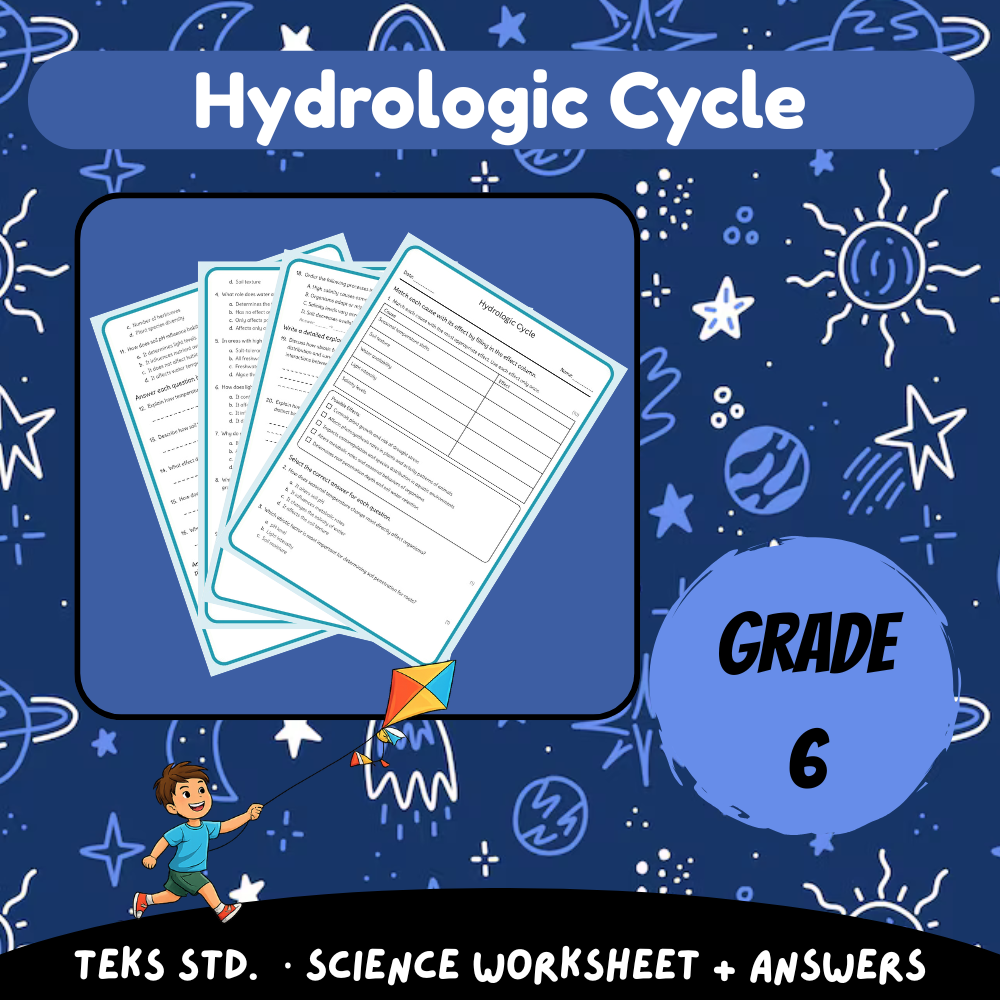
6th Grade Science – Hydrologic Cycle Worksheet (Worksheet + Answer Key) TEKS
Created byBright Mind ResourcesLearning Objectives
- Describe the processes of evaporation, condensation, and precipitation in the water cycle.
- Explain surface-groundwater interactions such as runoff, infiltration, and groundwater discharge.
- Identify watershed boundaries, aquifer types, and the processes controlling regional water availability.
Instant download

Classification Genetics Worksheet | Ontario Grade 6 Science Assessment
Created byCedar Grove LearningLearning Objectives
- Explain how DNA barcoding and sequence comparison help identify species.
- Describe how genetic markers can reveal cryptic species that look similar.
- Interpret a basic idea of phylogenetic trees to understand relationships.
Also included in: Grade 6 Biodiversity and Adaptations Science Lesson Bundle Ontario +1 more
Instant download
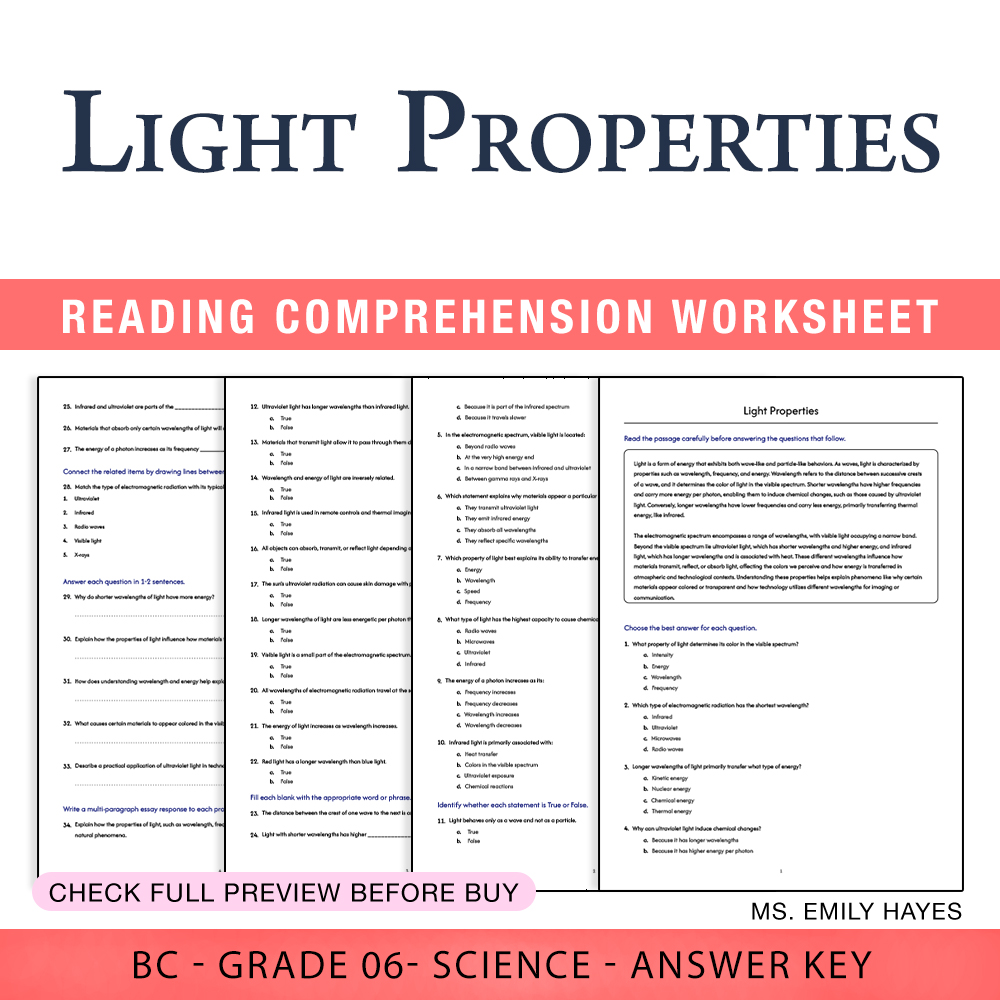
6th Grade Science | Light Properties Worksheet (PDF+ Answer Key)
Created byCopper Leaf ClassroomLearning Objectives
- Describe how light behaves as both waves and particles, including key properties such as wavelength, frequency, and energy.
- Identify the different regions of the electromagnetic spectrum, including visible, ultraviolet, and infrared light, and explain their characteristics.
- Explain how the wavelength of light relates to its energy and capacity to cause chemical changes or transfer thermal energy.
Also included in: Grade 6 Science BC | Waves, Sound, Light & Energy Worksheets (PDF + Answer Key) +1 more
Instant download

Optimizing Designs Worksheet | NGSS Grade 6 Science + Doodle Notes
 Created byAmber Owl Education
Learning Objectives
- Use comparative test data to identify which design performs best under a specific goal and set of constraints
- Interpret graphs and averages to explain performance differences and trade-offs among design alternatives
- Discuss sources of error and how they affect the confidence you have in design conclusions
Also included in: Grade 6 Science Engineering Design Lesson Bundle | NGSS +1 more
Instant download
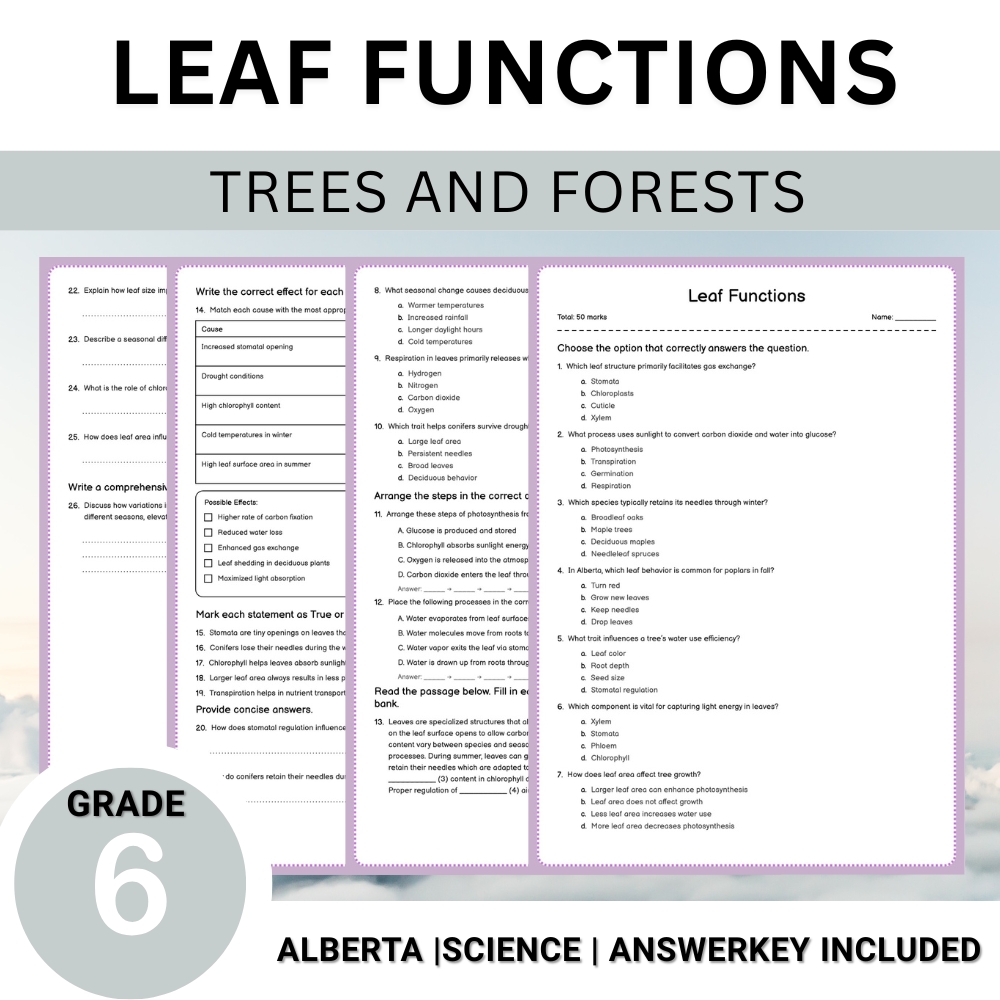
Grade 6 Science | Leaf Functions Worksheet & Assessment (Printable PDF)
Learning Objectives
- Describe the main structures of leaves and their functions in gas exchange, photosynthesis, and transpiration.
- Compare needlelike conifers and broadleaf deciduous species in seasonal leaf behaviors.
- Explain how stomatal regulation, leaf area, and chlorophyll content influence plant growth and water efficiency.
Also included in: Grade 6 Science | Tree Anatomy, Ecology & Conservation Unit Worksheet Bundle +1 more
Instant download
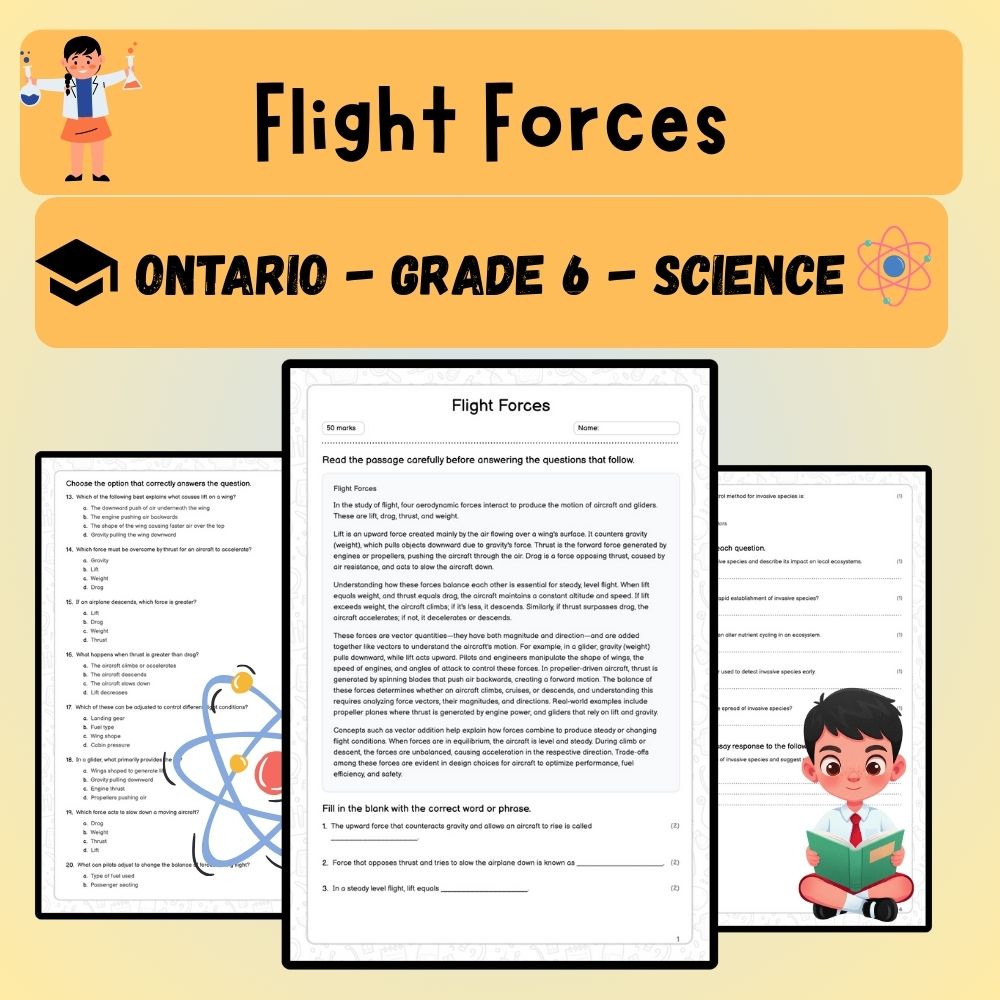
6th Grade Science | Flight Forces Worksheet (PDF ) - Ontario Standards
Created byPrism Point LearningLearning Objectives
- Describe the four main aerodynamic forces: lift, drag, thrust, and weight.
- Explain how these forces interact to produce steady level flight.
- Identify examples of flight forces in real-world contexts like gliders and propellers.
Instant download
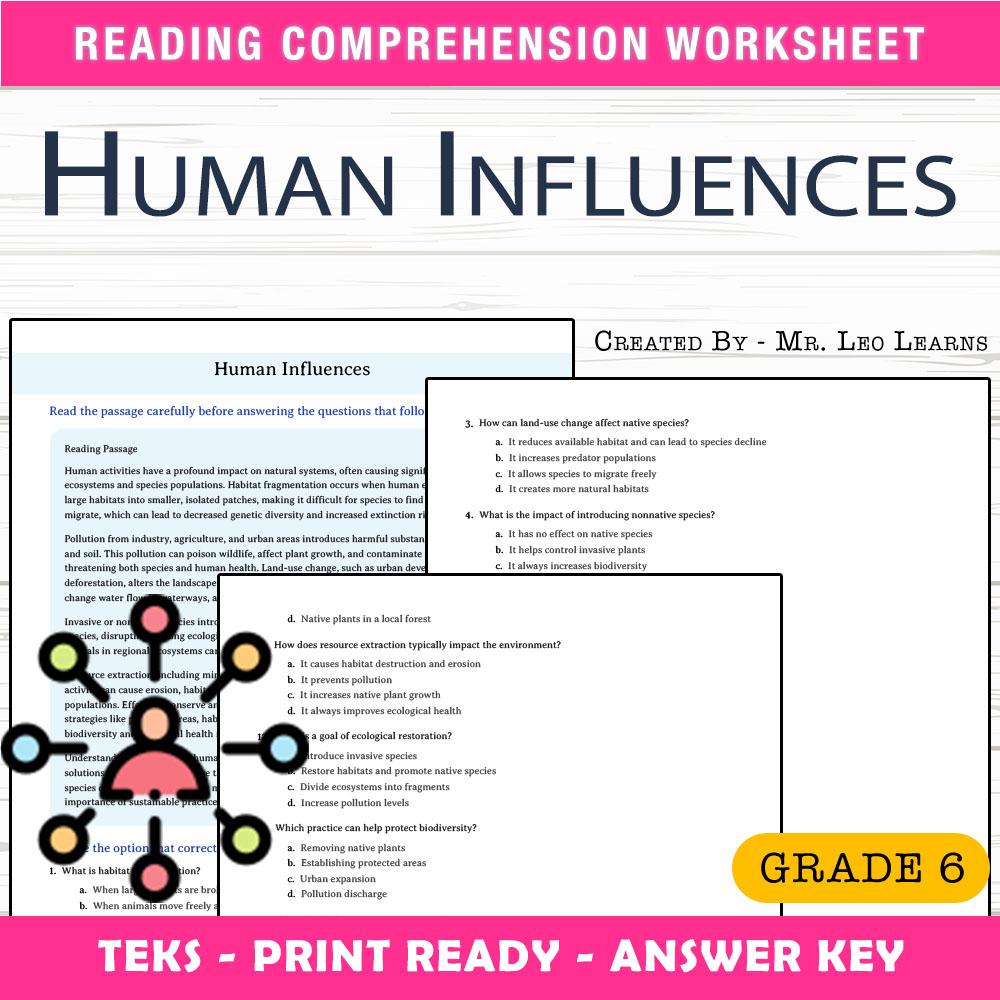
Grade 6 Science — Human Influences Worksheet for Mastery
Created byThe Resource HubLearning Objectives
- Understand human activities that affect natural ecosystems.
- Identify examples of habitat fragmentation, pollution, and resource extraction.
- Describe strategies for conservation and restoration to mitigate environmental impacts.
Also included in: Grade 6 Science Unit Bundle | Ecosystems & Environmental Relationships
Instant download
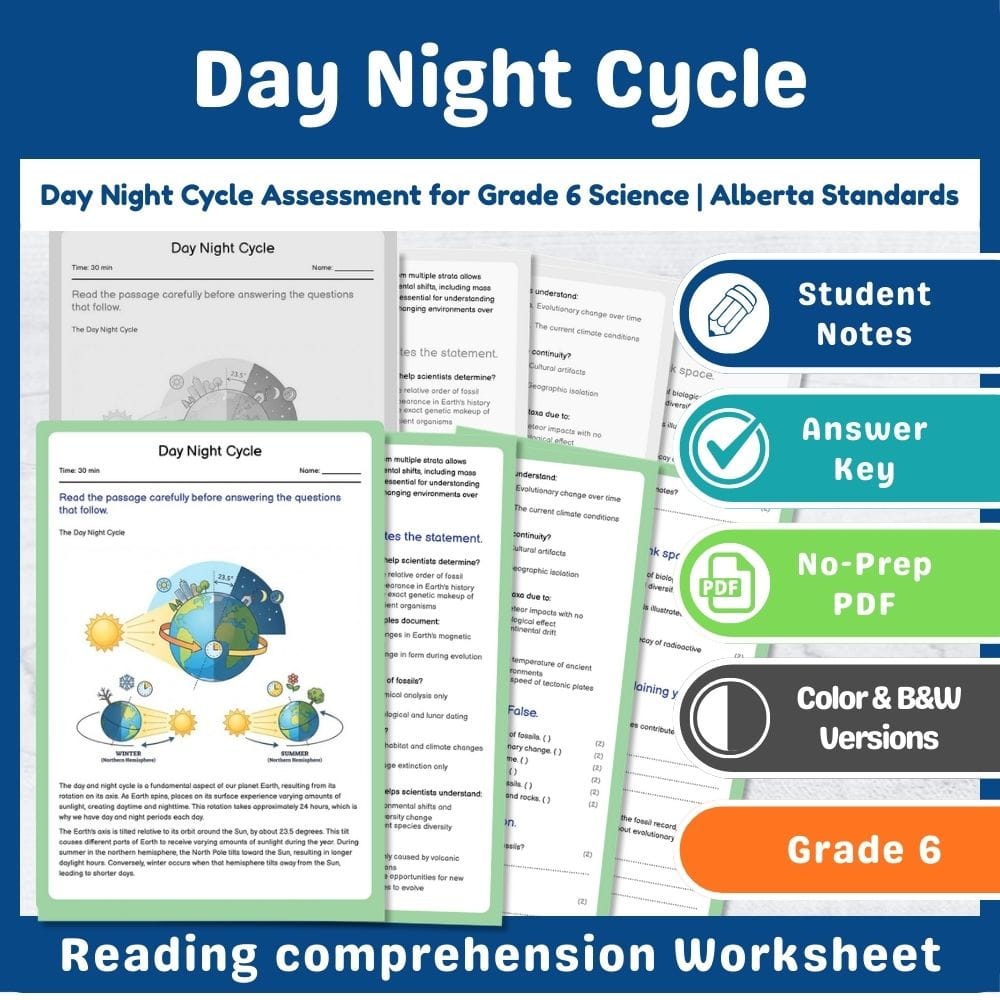
Day Night Cycle Assessment for Grade 6 Science | Alberta Standards
Created byPrism Point LearningLearning Objectives
- Explain how Earth's rotation causes day and night.
- Describe the effect of Earth's axial tilt on daylight duration throughout the year.
- Relate observed day length patterns in Alberta to Earth's position and movement around the Sun.
Also included in: Lesson Grade 6 Science Assessment | Celestial & Earth Movements
Instant download
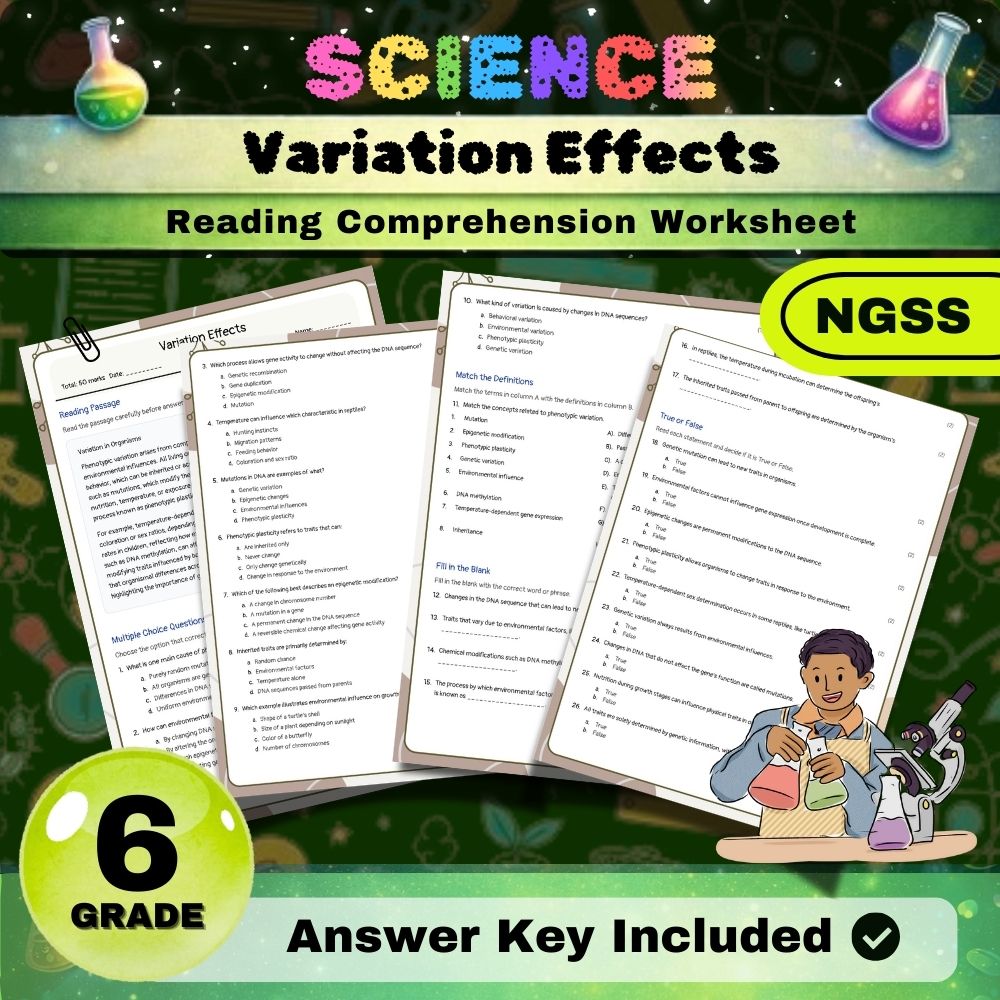
6th Grade Science – Variation Effects SCIENCE NGSS Worksheet (PDF)
 Created byMaple Path Learning
Learning Objectives
- Understand how genetic and environmental factors influence phenotypic variation in organisms.
- Explain the link between DNA sequence variation, gene expression, and observable traits.
- Identify examples of phenotypic variation caused by environmental influences such as temperature and nutrition.
Also included in: Grade 6 Science Unit Bundle – Cell Functions, Energy & Organ Systems Worksheets +1 more
Instant download

Grade 6 Population Change Worksheet | NGSS Practice PDF
Created byClear Sky ClassroomLearning Objectives
- Explain how birth rate, death rate, and resource availability affect population size over time
- Use population data patterns to infer whether a population is increasing or decreasing
- Describe how seasonal changes in resources can change survival and reproduction
Instant download

Grade 6 Science | Electrostatic Phenomena - Daily Reading Comprehension
Created byCoral Reef LearningLearning Objectives
- Understand the basic principles of static electricity and charge transfer
- Identify materials that tend to gain or lose electrons
- Describe phenomena such as attraction, repulsion, and sparks caused by static electricity
Instant download

Grade 6 Evidence and Reasoning Worksheet | NGSSS Science CER Practice
Created byEvergreen Desk EducationLearning Objectives
- Explain how evidence supports a scientific claim using relevant observations, measurements, and data patterns.
- Differentiate correlation from causation when interpreting relationships in data.
- Use consistent units and clear reasoning to evaluate how well evidence supports a conclusion.
Instant download
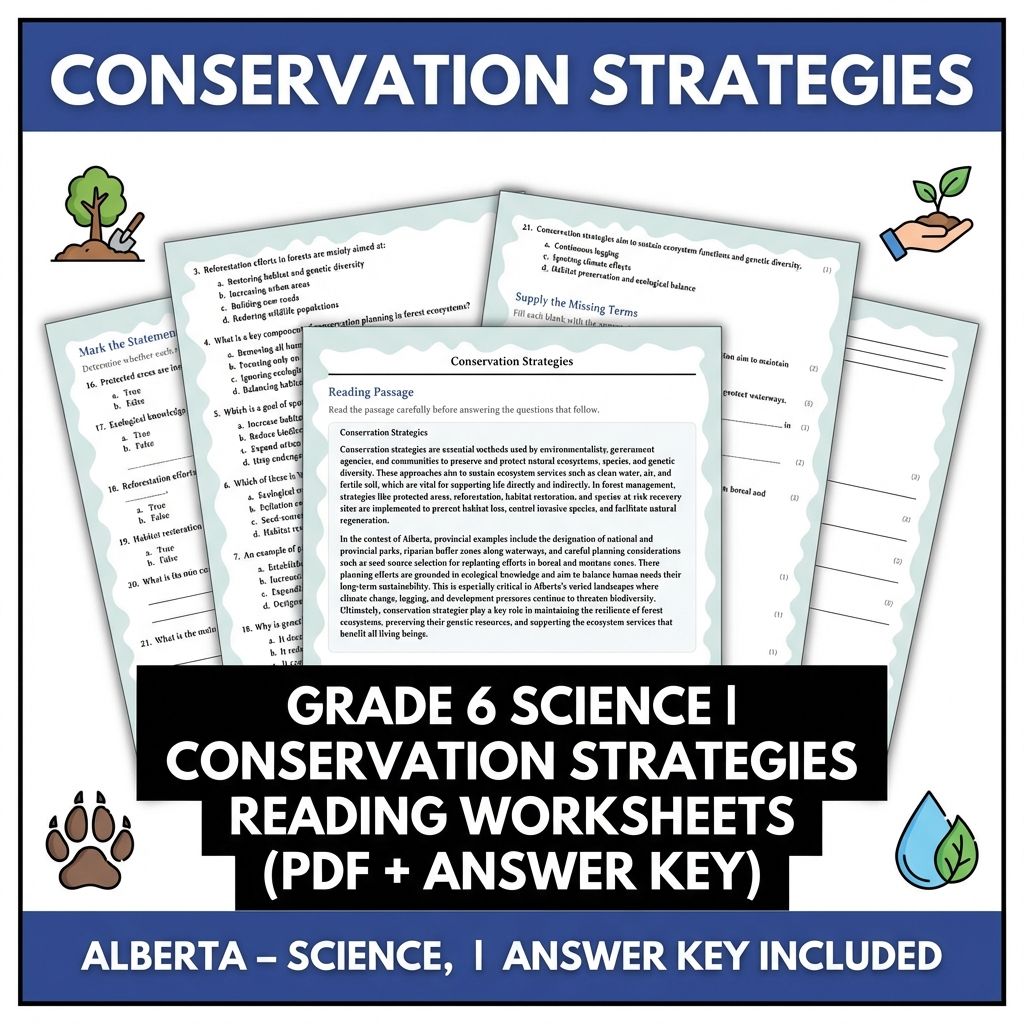
Grade 6 Science | Conservation Strategies Reading Worksheets (PDF + Answer Key)
JCreated byJ.S SheetsLearning Objectives
- Understand different conservation strategies used to maintain forest biodiversity.
- Identify provincial examples of conservation approaches in Alberta.
- Explain how ecological knowledge is integrated into conservation planning.
Also included in: Grade 6 Science Unit Bundle | Ecosystems and Biodiversity (Answer Keys Included) +1 more
Instant download

Mass Wasting Assessment for Grade 6 Science | Standards-Aligned
Created byPrism Point LearningLearning Objectives
- Understand the processes involved in mass wasting such as rockfalls, landslides, and slumps.
- Identify factors that trigger surface movements like rainfall, freeze-thaw cycles, and earthquakes.
- Explain how debris deposition affects drainage and erosion patterns.
Also included in: Grade 6 Life Science Science Lesson Bundle – General Framework Unit
Instant download
About Grade 6 Science Worksheets
Explore Grade 6 Science worksheets for classwork, homework, or review. Our 5,969 printables download instantly as PDFs.
MyTeachingSheets worksheets are made by real teacher-authors and checked before they go live. Download any as a print-ready PDF for lessons, homework, or independent practice — most include answer keys, and previews are always free.