
Grade 6 Science Worksheets
5,969 worksheets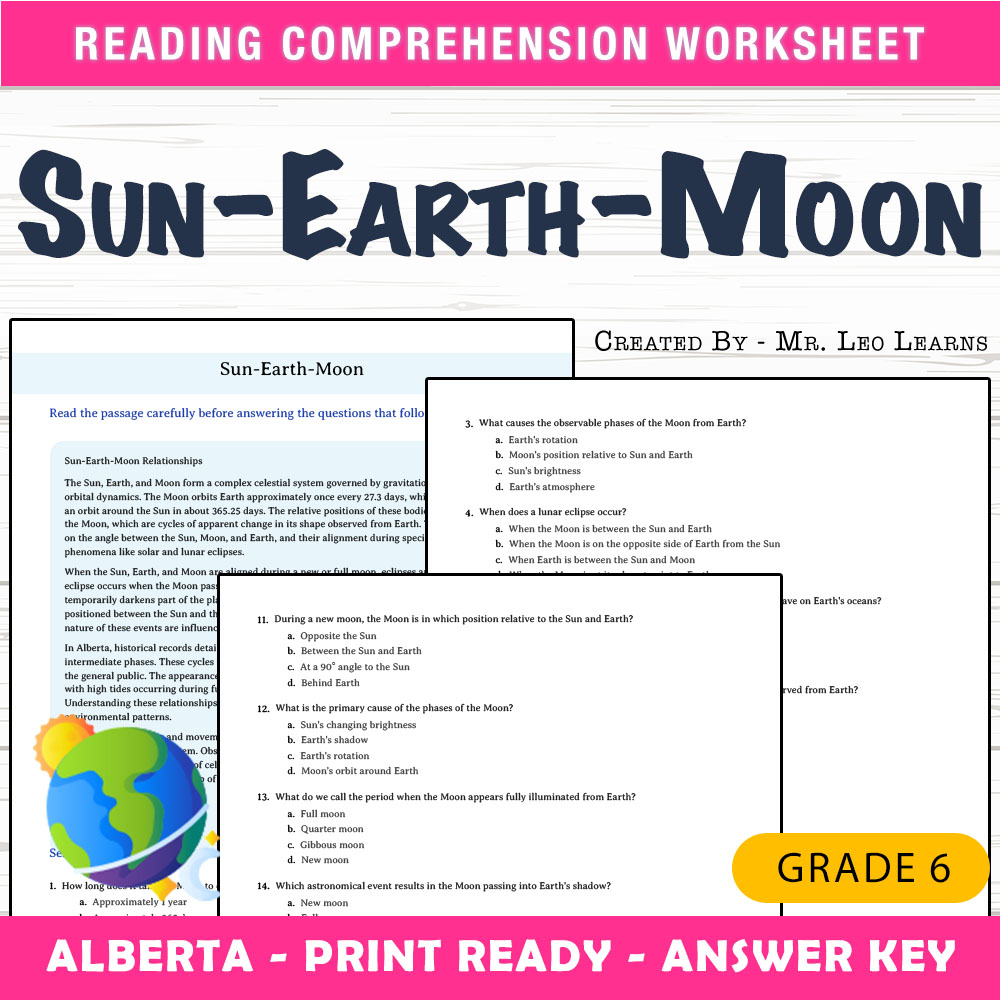
Grade 6 Science — Sun–Earth–Moon Worksheet MCQ Paper for Mastery
 Created byThe Resource Hub
Learning Objectives
- Understand the relative positions and relationships among the Sun, Earth, and Moon.
- Identify how gravitational interactions influence lunar phases, eclipses, and tides.
- Explain how celestial alignments produce observable phenomena such as solar and lunar eclipses.
Also included in: Grade 6 Science Sky Science Unit Bundle – Celestial Motion & Earth-Sun Relations +1 more
Instant download

Observational Instruments & Wavelengths Worksheets Grade 6 Science
 Created byPrism Point Learning
Learning Objectives
- Describe how optical and radio telescopes observe the solar system
- Explain how spectrometers reveal information from incoming light
- Interpret spectral patterns as evidence of composition and motion
Also included in: Grade 6 Space Science Lesson Bundle | Ontario Science Framework
Instant download

Grade 6 Niche Dynamics Worksheet | Ontario Science Ecosystems Activity
 Created byChalk and Compass
Learning Objectives
- Differentiate between a species’ fundamental niche and realized niche.
- Explain how abiotic factors and biotic interactions influence where organisms can live and what resources they use.
- Describe how temporal and spatial partitioning can reduce competition among similar species.
Also included in: Grade 6 Science Ecosystems, Adaptations & Biodiversity Lesson Bundle | Ontario +1 more
Instant download

Grade 6 Genetics Trait Heritability Worksheet | Doodle Notes & Ontario
Created byChalk and CompassLearning Objectives
- Explain what heritability means and how genetic variation contributes to differences in traits among individuals
- Distinguish heritable (genetic) influences from environmental influences on traits
- Describe how heritable traits can change allele frequencies and shift trait distributions over generations
Also included in: Grade 6 Science Ecosystems, Adaptations & Biodiversity Lesson Bundle | Ontario +1 more
Instant download

Grade 6 Food Webs Worksheet | Ontario Science Activity & Doodle Notes
Created byChalk and CompassLearning Objectives
- Identify producers, consumers, and decomposers in food webs
- Explain how energy flows through trophic levels and why energy decreases at each step
- Describe how removing or adding a species can affect other organisms in interconnected food webs
Also included in: Grade 6 Science Ecosystems, Adaptations & Biodiversity Lesson Bundle | Ontario +1 more
Instant download

Classification Genetics Worksheet Grade 6 Science Ontario + Doodle Notes
Created byChalk and CompassLearning Objectives
- Explain how DNA barcoding and sequence comparison help identify species when morphology is unclear
- Use basic ideas from phylogenetic trees to describe relationships among organisms
- Compare morphological keys with genetic markers and describe how cryptic species can be discovered using DNA
Also included in: Grade 6 Science Ecosystems, Adaptations & Biodiversity Lesson Bundle | Ontario +1 more
Instant download
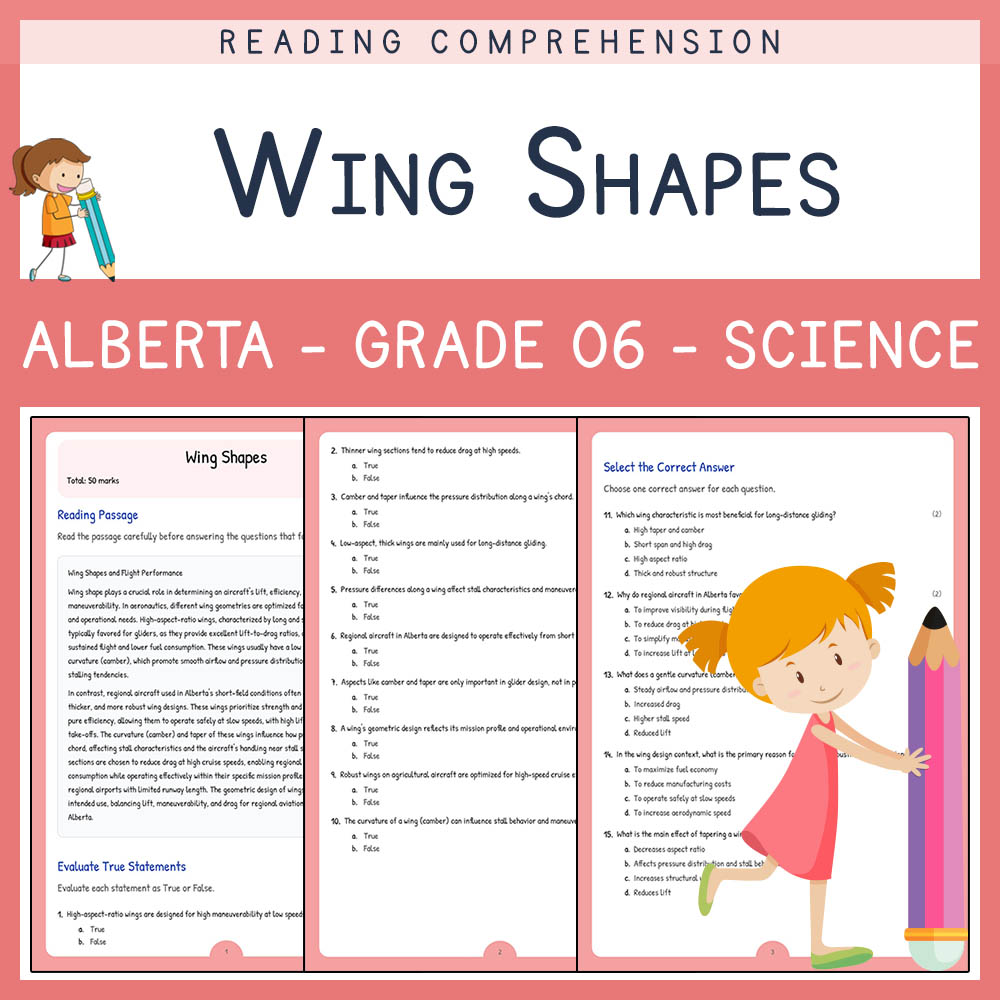
Grade 6 Science Assessment | Wing Shapes Worksheet Elena | Alberta
 Created byLumora Learning
Learning Objectives
- Understand how wing shape influences lift, stall behavior, and maneuverability.
- Compare high-aspect-ratio wings used on gliders with low-aspect, robust wings on agricultural aircraft.
- Explain how curvature and taper affect pressure distribution and performance.
Also included in: Grade 6 Science | Air and Aerodynamics Science Lesson Bundle | Alberta
Instant download

Tissue Types Test Prep Worksheets | Grade 6 Science BC
Created byPrism Point LearningLearning Objectives
- Identify the four main tissue types in multicellular animals (epithelial, connective, muscle, and nervous).
- Describe the main functions of each tissue type and how they help organs work.
- Use tissue types to explain structures and how cells work together in the body.
Also included in: Multicellular Systems & Functions Lesson Bundle | Grade 6 Science | BC +1 more
Instant download
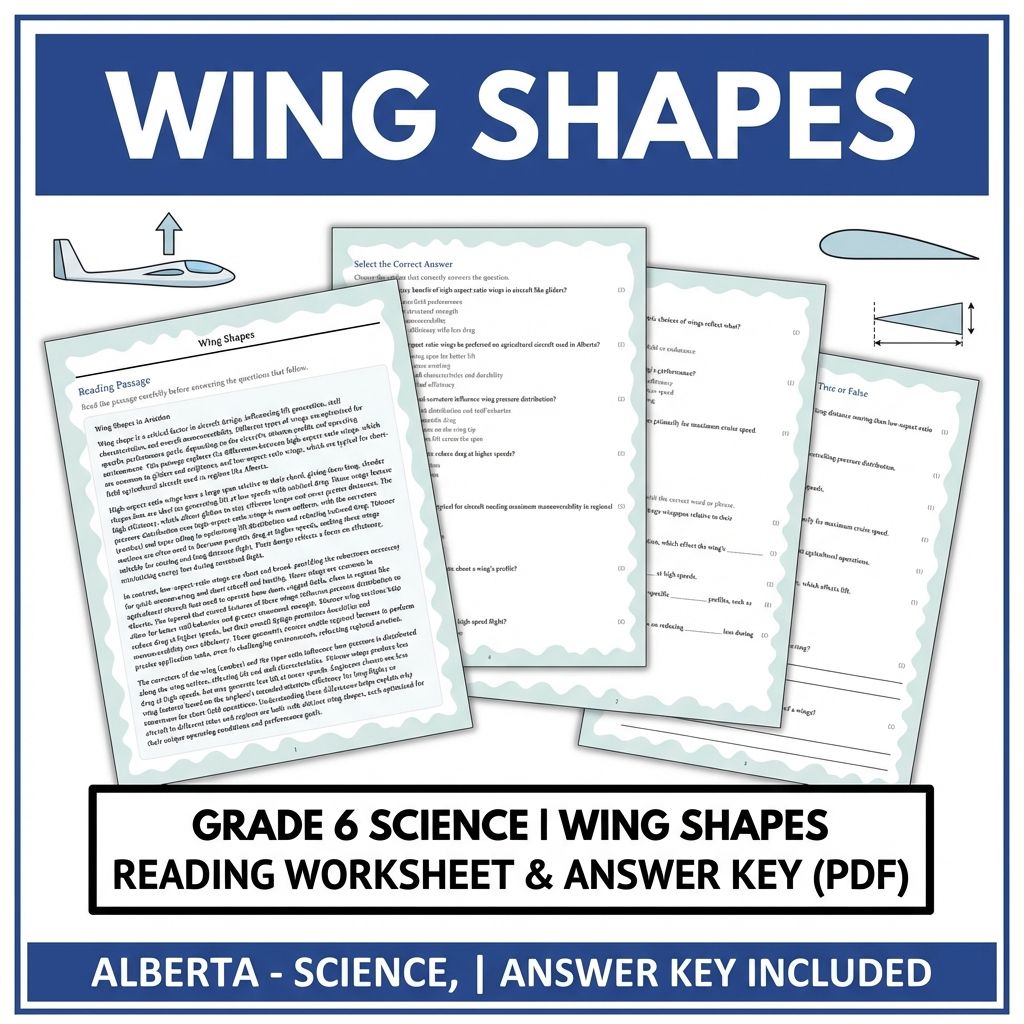
Grade 6 Science | Wing Shapes Reading Worksheet & Answer Key (PDF)
JCreated byJ.S SheetsLearning Objectives
- Understand how wing shape affects lift, stall behavior, and maneuverability.
- Compare high-aspect-ratio wings used in gliders with low-aspect-ratio wings on agricultural aircraft.
- Explain the influence of curvature, taper, and thickness on pressure distribution and drag.
Also included in: Grade 6 Science | Flight Physics & Aerodynamics UNIT Pack (Answer Keys Included) +1 more
Instant download

Grade 6 Science | Measurement Precision Worksheet | Florida NGSSS Aligned
Created byLumora LearningLearning Objectives
- Differentiate between precision and accuracy in scientific measurements
- Choose appropriate tools and correct units for measurement tasks
- Identify common sources of error and describe ways to reduce them
Instant download

Grade 6 Fundamental vs Realized Niche Dynamics Worksheet | Ontario Science
 Created byTeacher's Corner
Learning Objectives
- Distinguish between fundamental niches and realized niches using environmental and biotic factors
- Describe how abiotic conditions and interspecific interactions influence where organisms live
- Use measurable parameters to predict how habitat changes could affect species distribution
Instant download
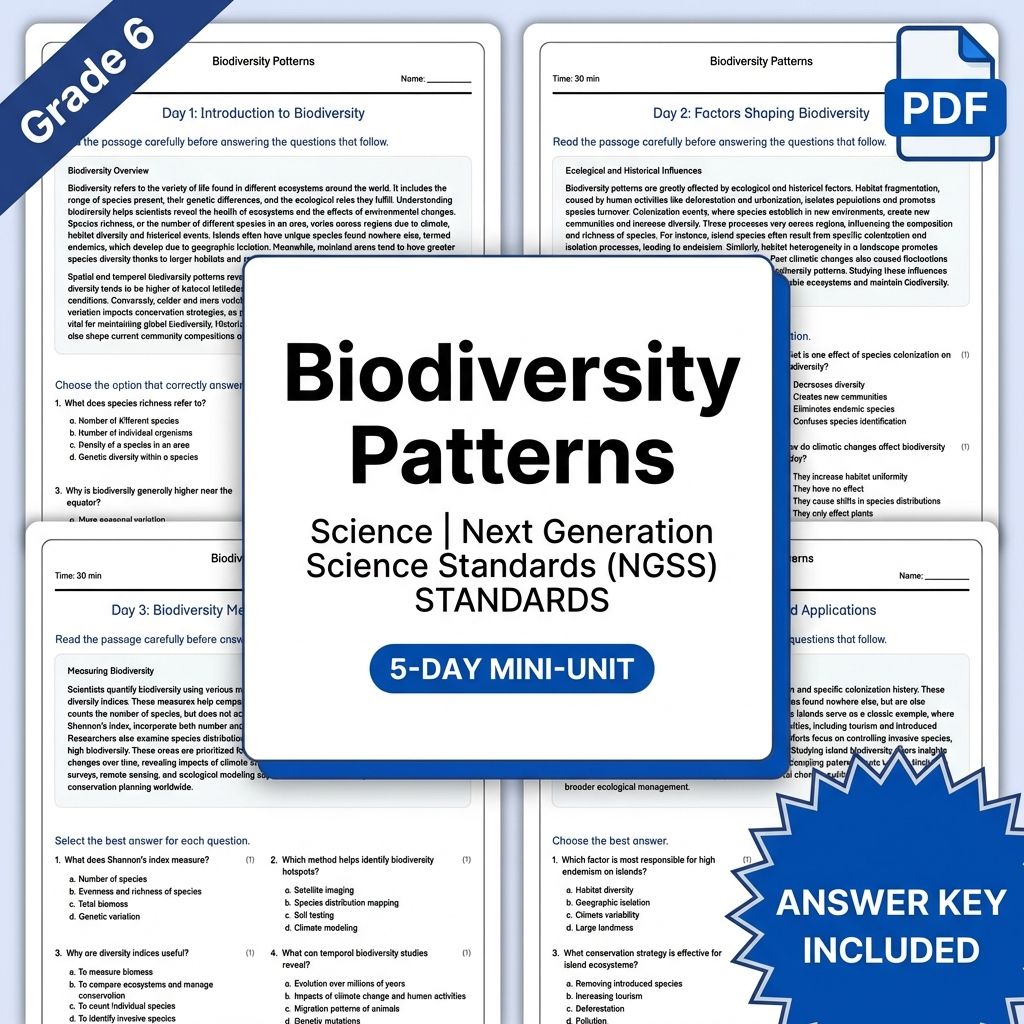
6th Grade Science | Biodiversity Patterns Reading Worksheet (PDF + Answer Key)
 Created byCopper Leaf Classroom
Learning Objectives
- Understand the concept of biodiversity and its spatial patterns.
- Identify factors influencing species distribution across ecosystems.
- Compare biodiversity variations on islands, across latitudes, and due to habitats.
Instant download

Phases Mechanics Test Prep Printable | Grade 6 Science
Created byPrism Point LearningLearning Objectives
- Explain how the relative positions of the Sun, Earth, and Moon determine which parts of the Moon are illuminated from Earth.
- Describe the sequence and timing of lunar phases (new, crescent, quarter, gibbous, full) using illumination geometry rather than measurements.
- Differentiate lunar phases from eclipses by identifying what changes in each event.
Also included in: Grade 6 Space Systems Science Lesson Bundle for Ontario (10 Worksheets)
Instant download
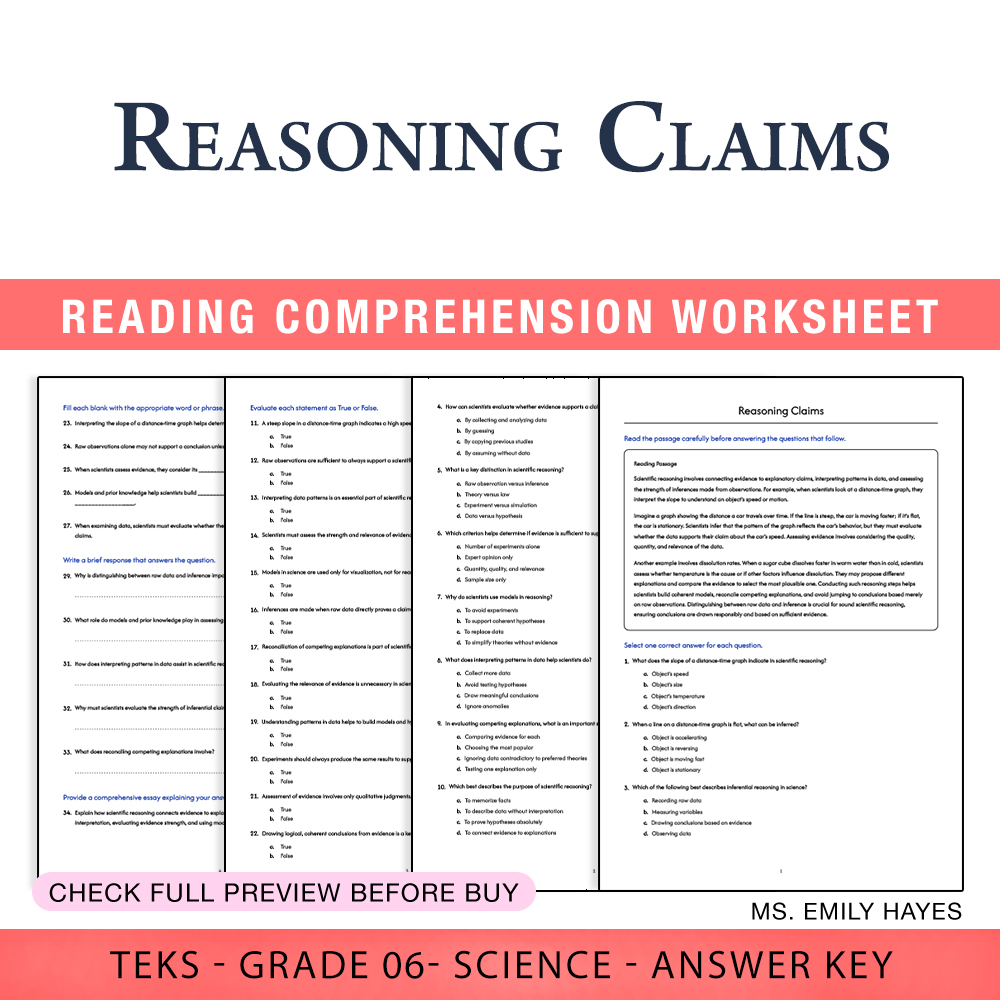
6th Grade Science | Reasoning Claims Worksheet (PDF+ Answer Key)
Created byCopper Leaf ClassroomLearning Objectives
- Understand how evidence connects to explanatory claims in scientific reasoning.
- Interpret patterns in data, such as distance-time graphs, to draw conclusions.
- Distinguish between raw observations and inferences based on evidence.
Instant download

Grade 6 Science | Properties of Substances - Daily Reading Comprehension
 Created byCoral Reef Learning
Learning Objectives
- Identify and describe physical properties of substances before and after chemical reactions
- Understand how atomic rearrangements affect properties such as solubility, conductivity, and melting point
- Compare the properties of reactants and products to determine if a new substance has formed
Instant download

Tree Evidence Worksheet | Grade 6 Science NGSS Review and Practice
Created byPrism Point LearningLearning Objectives
- Explain how homologous structures, vestigial organs, and conserved DNA sequences can support common ancestry.
- Use similarities and differences among traits to interpret branching relationships on a phylogenetic tree.
- Describe how ancestral-form indicators and morphological gradients can help form hypotheses about lineage splitting.
Also included in: Grade 6 Evolution and Biodiversity Science lesson bundle | NGSS
Instant download
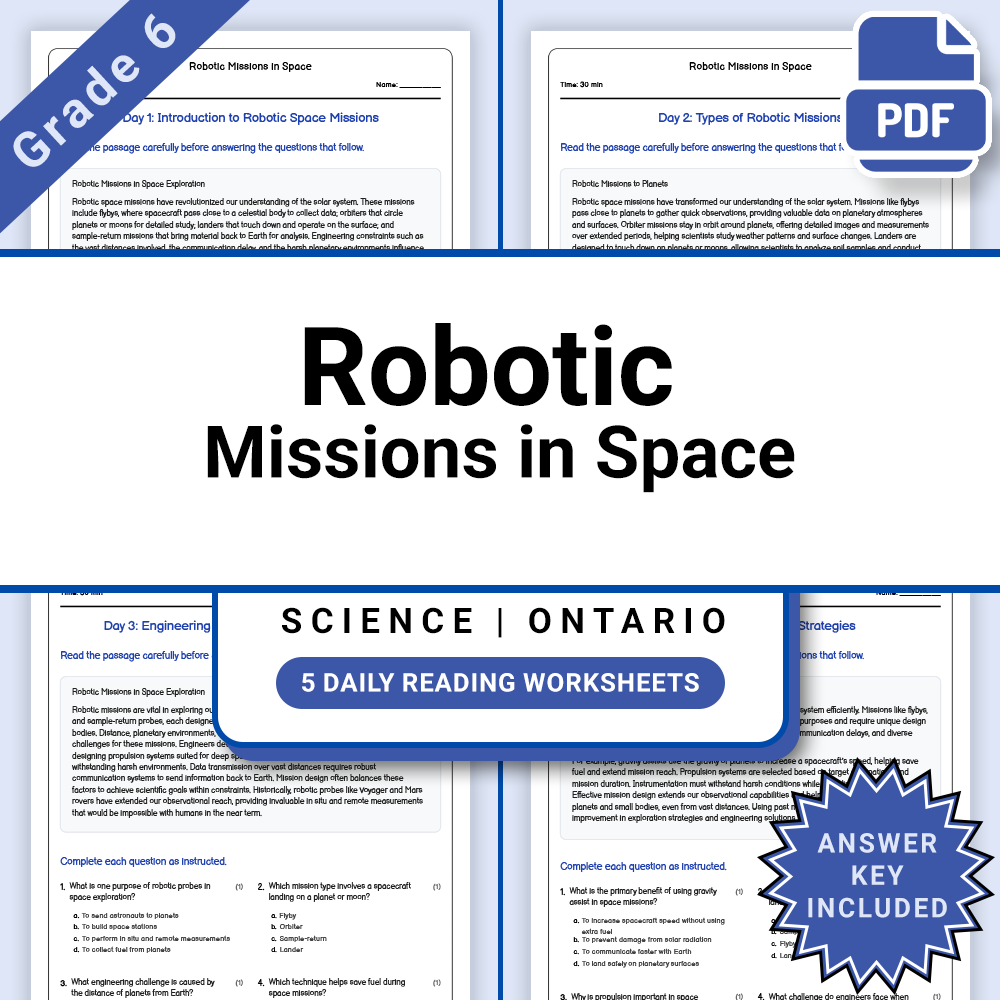
Grade 6 Science – Robotic Missions in Space Daily Reading Worksheet + Answer Key
JCreated byJ.S SheetsLearning Objectives
- Understand the different types of robotic space missions: flyby, orbiter, lander, and sample-return.
- Recognize the engineering constraints in designing robotic missions, including distance, communication delay, and planetary environments.
- Identify how mission design addresses propulsion, instrumentation, and data return.
Also included in: Grade 6 Science Lesson Bundle | Sun, Earth, Moon & Space Concepts +1 more
Instant download
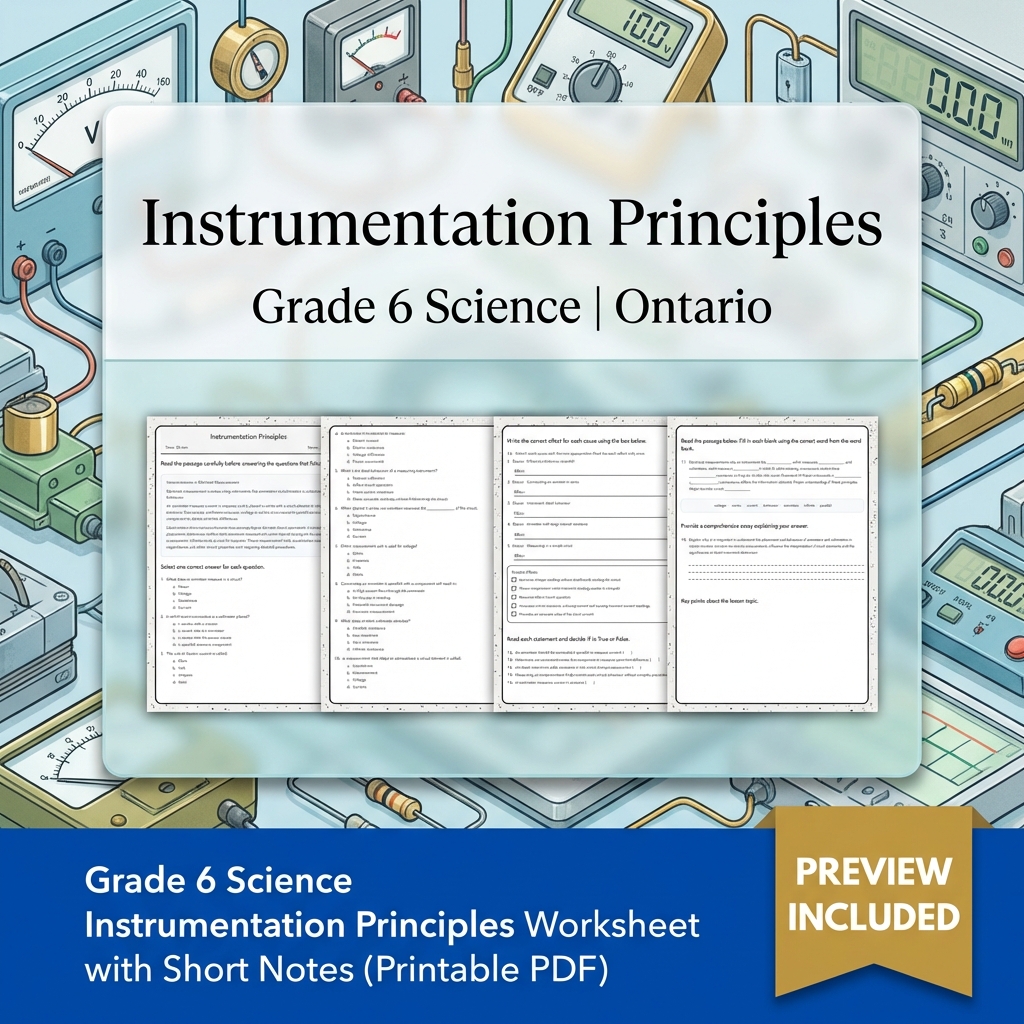
Grade 6 Science Instrumentation Principles Worksheet with Short Notes
 Created byMeadowlark Worksheets
Learning Objectives
- Understand the roles of ammeters and voltmeters in electrical circuits.
- Explain measurement units of amperes and volts and their significance.
- Describe the placement of instruments in series and parallel circuits.
Also included in: Grade 6 Science Lesson Group on Energy, Circuits & Properties +1 more
Instant download
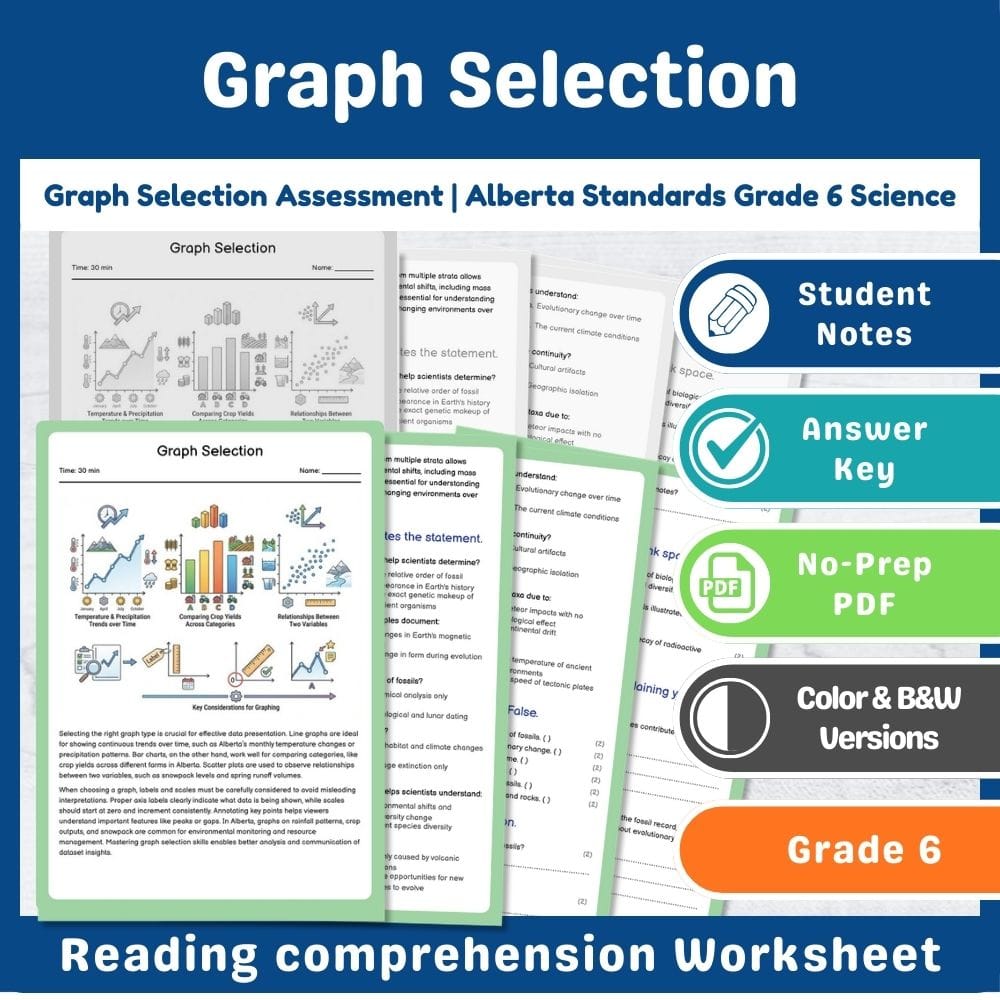
Graph Selection Assessment | Alberta Standards Grade 6 Science
Created byPrism Point LearningLearning Objectives
- Identify appropriate graph types for different data sets.
- Understand how to label axes and choose scales that accurately represent data.
- Learn to interpret graphs including line graphs, bar charts, and scatter plots.
Also included in: Lesson Grade 6 Science Mini Bundle | Evidence and Investigation
Instant download

Error Analysis and Uncertainty in Data Grade 6 Science Worksheets
 Created bySunny Desk Resources
Learning Objectives
- Distinguish systematic error from random error in measurement situations
- Describe how replication and calibration help estimate the impact of errors on conclusions
- Explain how uncertainty can affect confidence in scientific results
Also included in: Evidence & Investigation Grade 6 Science Worksheets | Alberta +1 more
Instant download

Grade 6 Science – Earth Structure & Plate Tectonics | Daily Reading Worksheet
 Created byBright Mind Resources
Learning Objectives
- Understand the layers of the Earth and their properties
- Identify different types of plate boundaries
- Explain the geological processes involved in Earthquakes, volcanic eruptions, and mountain formation
Also included in: Grade 6 Earth and Space Science Lesson Bundle Daily Reading | TEKS +2 more
Instant download
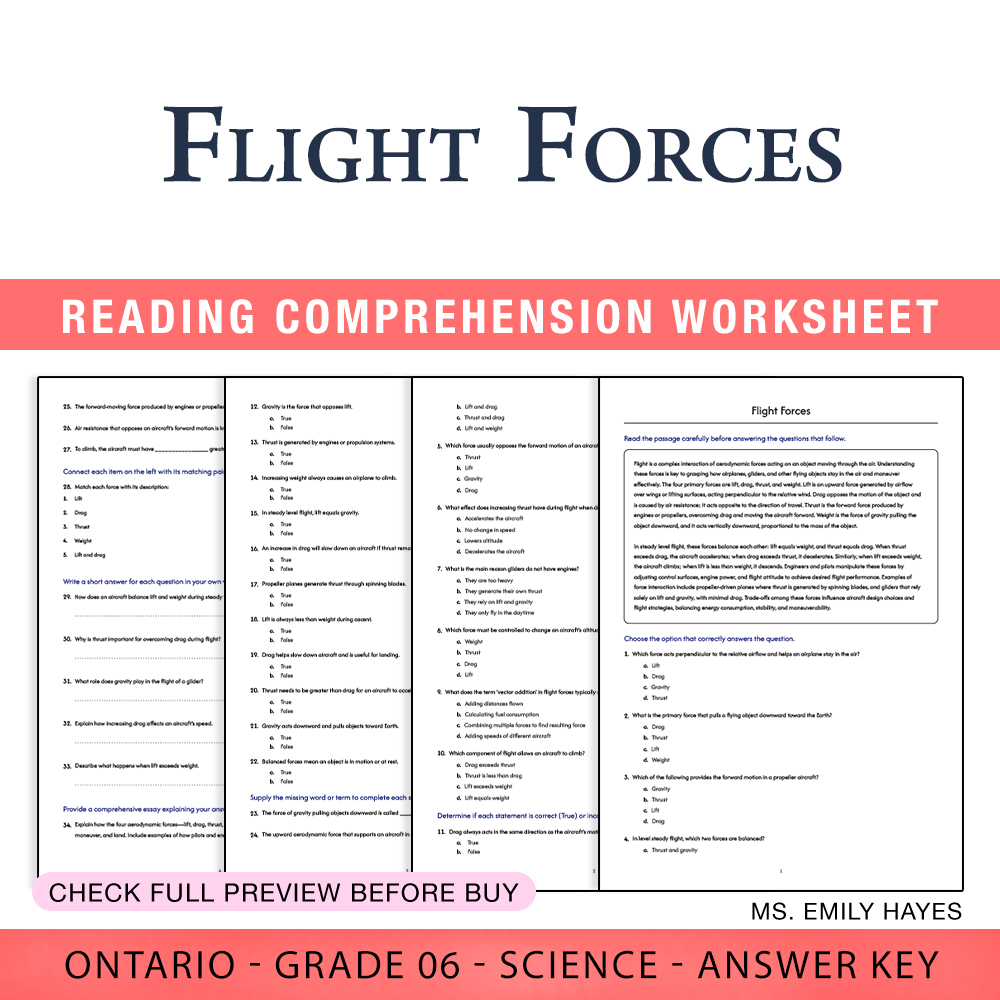
Grade 6 Science | Flight Forces Worksheet (PDF + Answer Key)
Created byCopper Leaf ClassroomLearning Objectives
- Explain the four main aerodynamic forces: lift, drag, thrust, and weight.
- Describe how vectors of different forces interact during flight.
- Analyze how forces affect climb, cruise, and descent.
Instant download
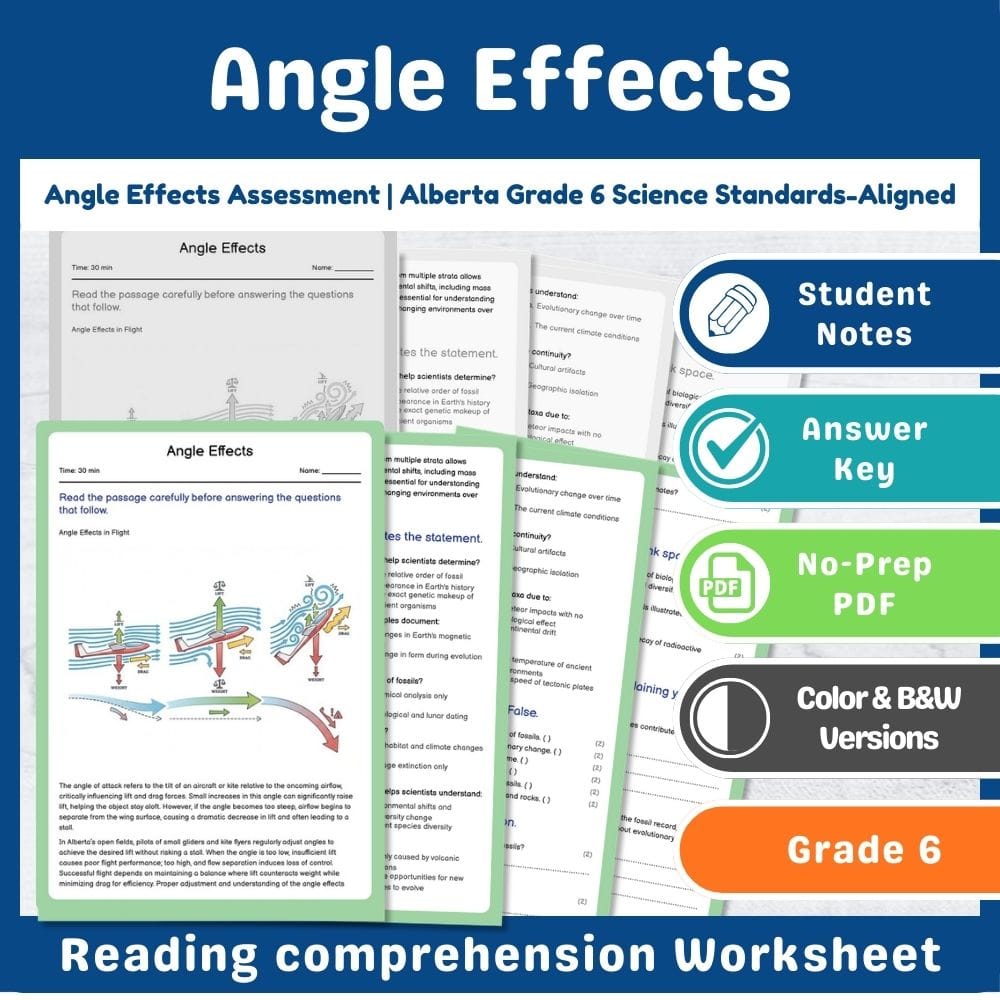
Angle Effects Assessment | Alberta Grade 6 Science Standards-Aligned
Created byPrism Point LearningLearning Objectives
- Understand how the angle of attack affects lift and drag in flight.
- Explain the concept of flow separation and its impact on lift.
- Describe how small adjustments in angle influence flight performance in gliders and kites.
Also included in: Lesson Grade 6 Science Assessment | Alberta Standards and Topics
Instant download
6th Grade Science | Sky Observations Worksheet (PDF) – Alberta Standard
Created byBright Mind ResourcesLearning Objectives
- Understand the importance of systematic sky observations in recognizing patterns of Earth's and Moon's motions.
- Identify different sky phenomena such as sunrise, sunset, Moon phases, and star positions, and describe their significance.
Instant download
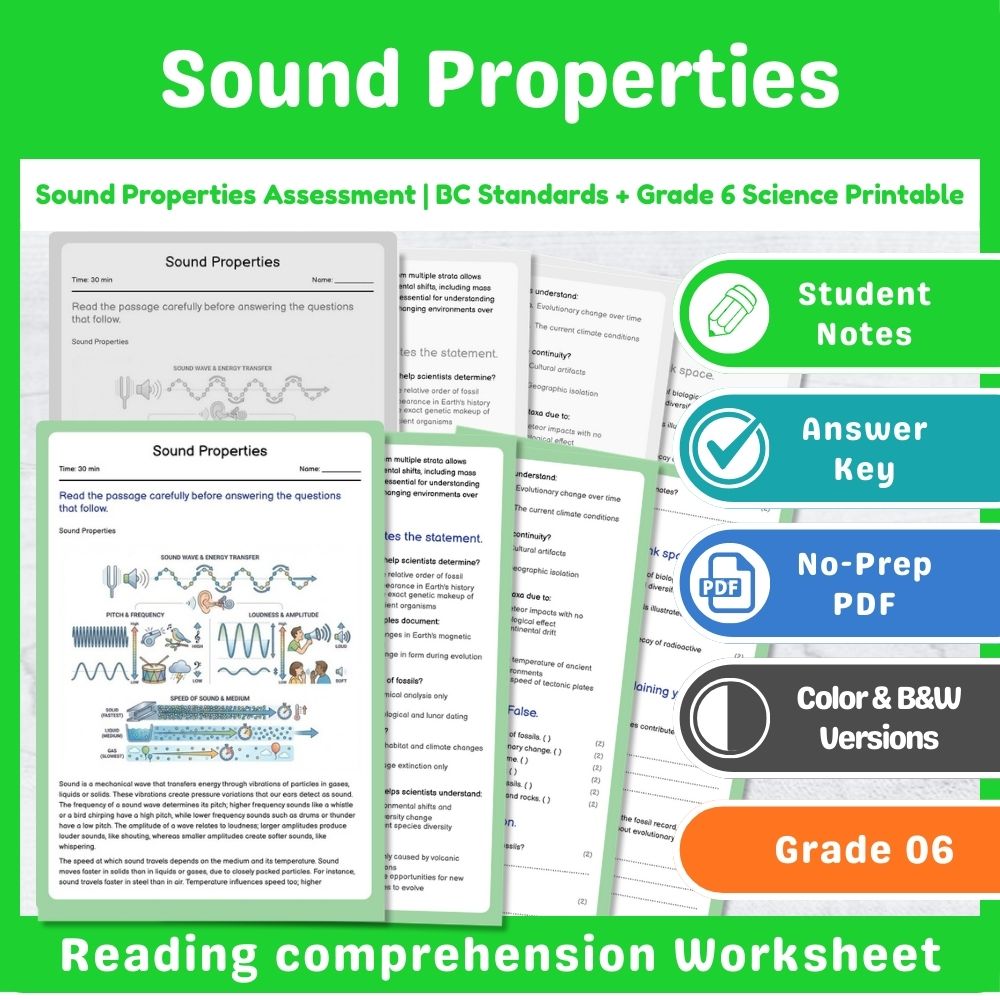
Sound Properties Assessment | BC Standards + Grade 6 Science Printable
Created byPrism Point LearningLearning Objectives
- Understand how sound transfers energy through vibrations in different media.
- Explain the relationship between frequency, amplitude, pitch, and loudness.
- Describe how the speed of sound varies with the medium and temperature.
Instant download
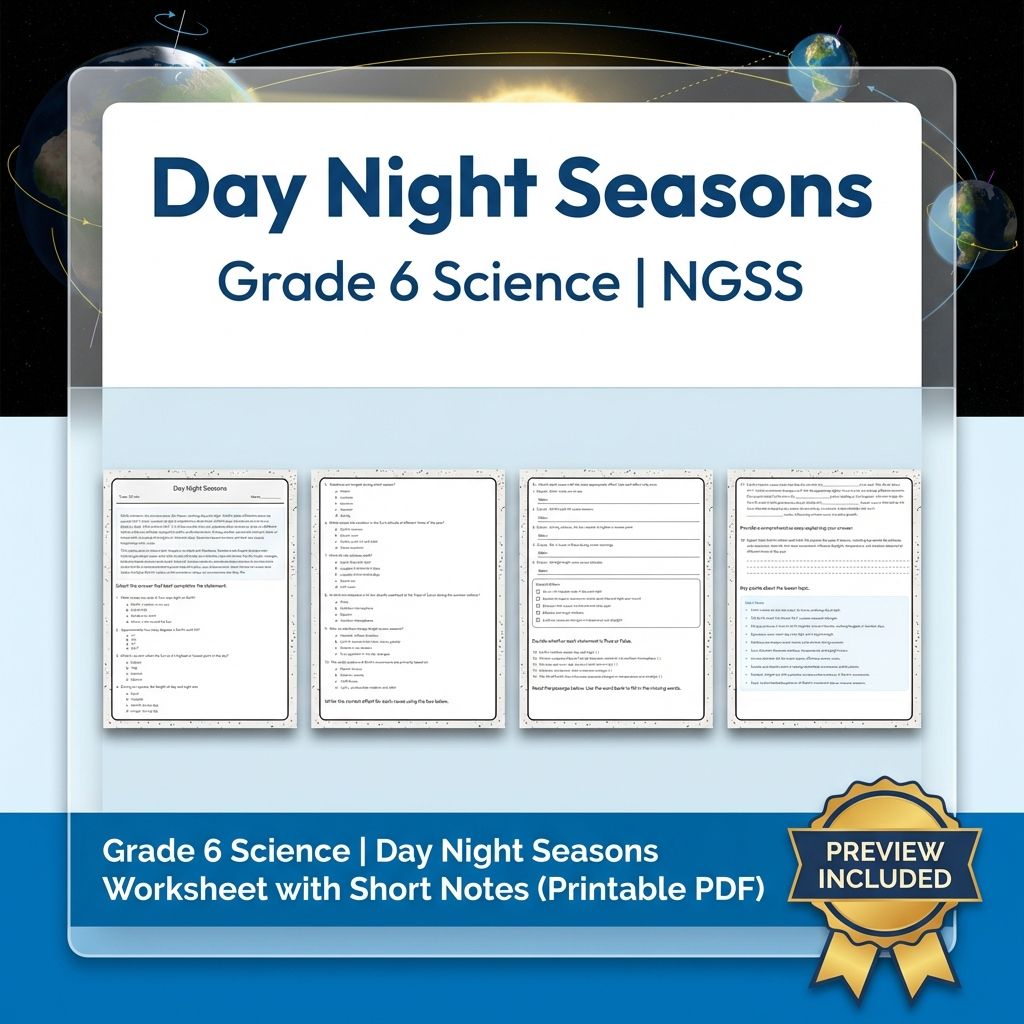
Grade 6 Science | Day Night Seasons Worksheet with Short Notes (Printable PDF)
Created byMeadowlark WorksheetsLearning Objectives
- Explain Earth's rotation and its effect on day and night.
- Describe how Earth's orbit and axial tilt produce seasons.
- Identify key astronomical events like solstices and equinoxes.
Also included in: Grade 6 Science | Earth's Place in the Universe Unit Bundle (NGSS Worksheets) +1 more
Instant download

Grade 6 Pressure Maps for Wings Worksheet | Ontario Science + Teacher Guide
Created byTeacher's CornerLearning Objectives
- Explain how surface pressure changes across a wing chord relate to lift and pitching moments
- Identify the stagnation point and suction peak on a pressure map and describe what they mean
- Describe how camber and angle of attack shift pressure minima and alter pressure coefficient patterns
Instant download

Grade 6 Diffusion Rates Worksheet | Practice & Assessment PDF
 Created byClear Sky Classroom
Learning Objectives
- Explain diffusion as the net movement of particles from higher concentration to lower concentration
- Describe how temperature affects diffusion rates using the particle model
- Compare how particle size and medium properties influence diffusion
Instant download

Grade 6 Airfoil Geometry and Lift Worksheet | Ontario Science Activity PDF
Created byTeacher's CornerLearning Objectives
- Explain how airfoil camber and thickness affect pressure distribution and lift.
- Compare simplified Bernoulli and Newtonian ideas for how lift is produced.
- Describe how chord length, leading-edge curvature, and angle of attack influence lift and stall.
Instant download

Science Worksheet Airfoil Shape and Lift | Grade 6 Ontario Standards
JCreated byJ.S SheetsLearning Objectives
- Explain how airfoil geometry (camber, thickness, chord length, leading-edge curvature) influences airflow and pressure distribution.
- Compare simplified Bernoulli and Newtonian ideas for how lift is generated.
- Describe how angle of attack and the critical angle affect lift and stall behavior.
Instant download
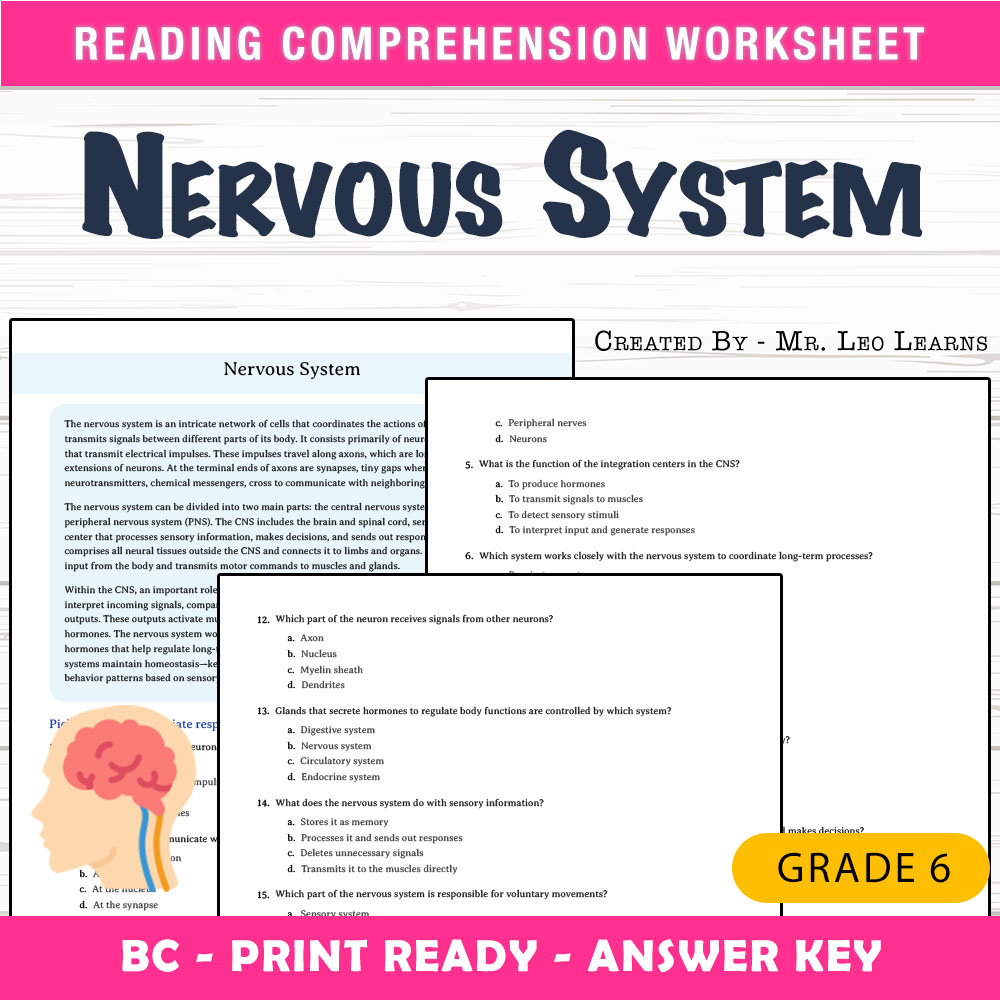
Grade 6 Science | Nervous System MCQ Worksheet for Practice
Created byThe Resource HubLearning Objectives
- Understand the basic components and functions of the nervous system.
- Identify how neurons transmit signals and communicate.
- Describe the roles of different parts of the nervous system in regulating body activities.
Also included in: Grade 6 Science Unit | Multicellular Systems & Functions Worksheet Bundle +1 more
Instant download
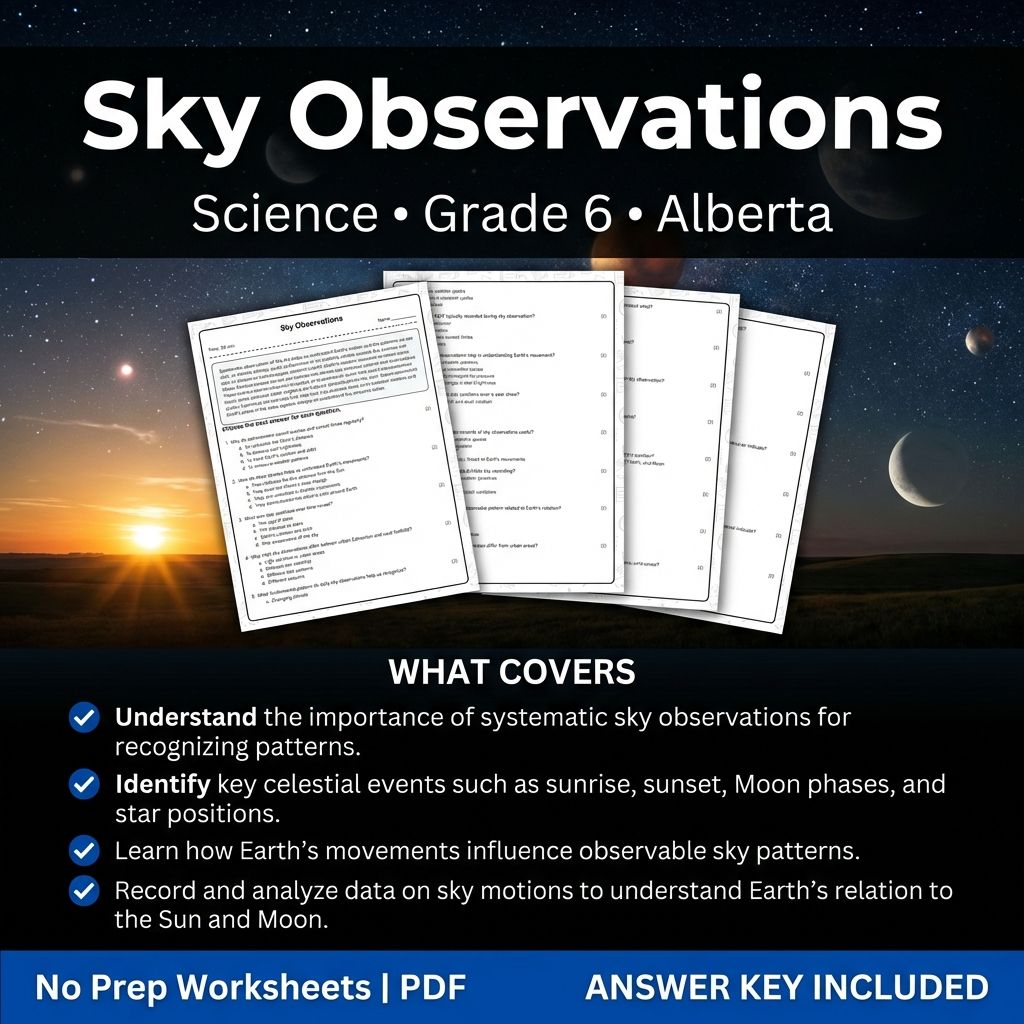
Grade 6 Science Worksheet on Sky Observations | Alberta Standard Practice
Created byCoral Reef LearningLearning Objectives
- Understand the importance of systematic sky observations for recognizing patterns.
- Identify key celestial events such as sunrise, sunset, Moon phases, and star positions.
- Learn how Earth's movements influence observable sky patterns.
Instant download
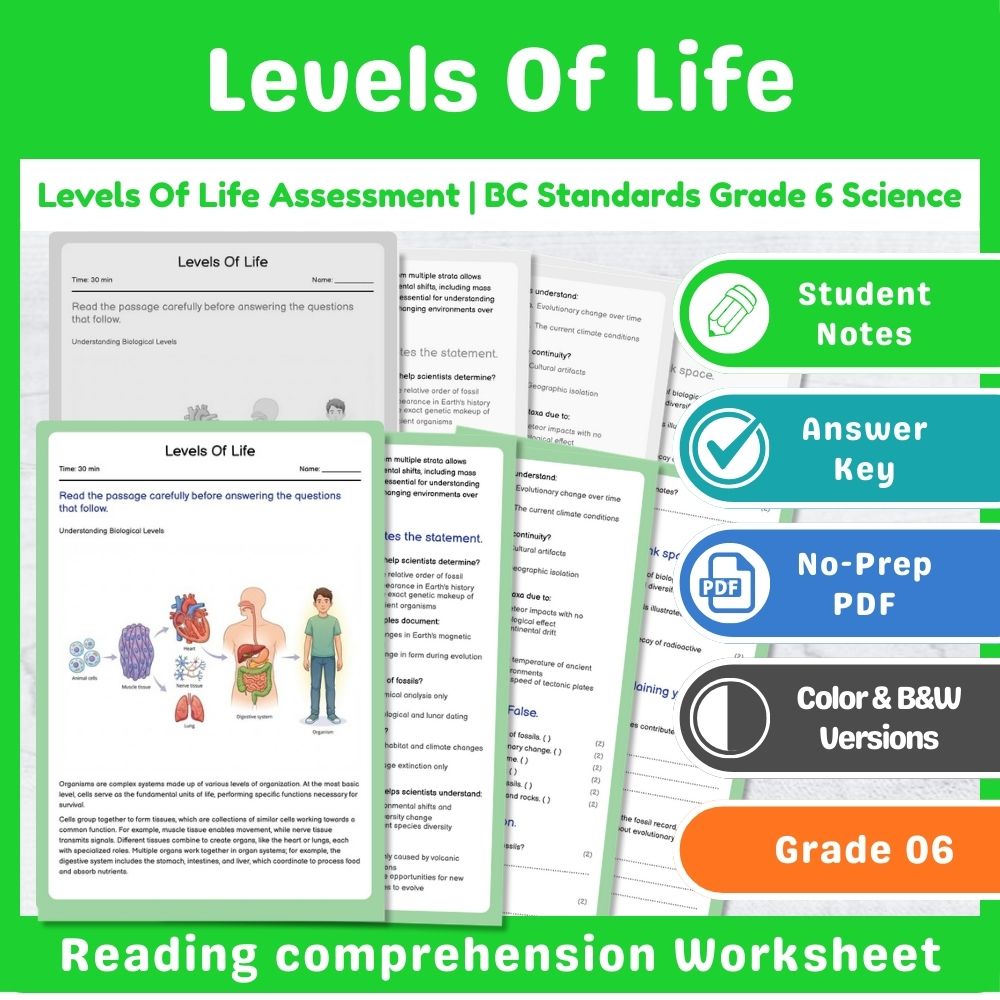
Levels Of Life Assessment | BC Standards Grade 6 Science
Created byPrism Point LearningLearning Objectives
- Understand the hierarchical levels of biological organization from cells to organisms.
- Identify how tissues, organs, and organ systems work together to support life.
- Explain the relationship between cells, tissues, organs, and organisms.
Instant download
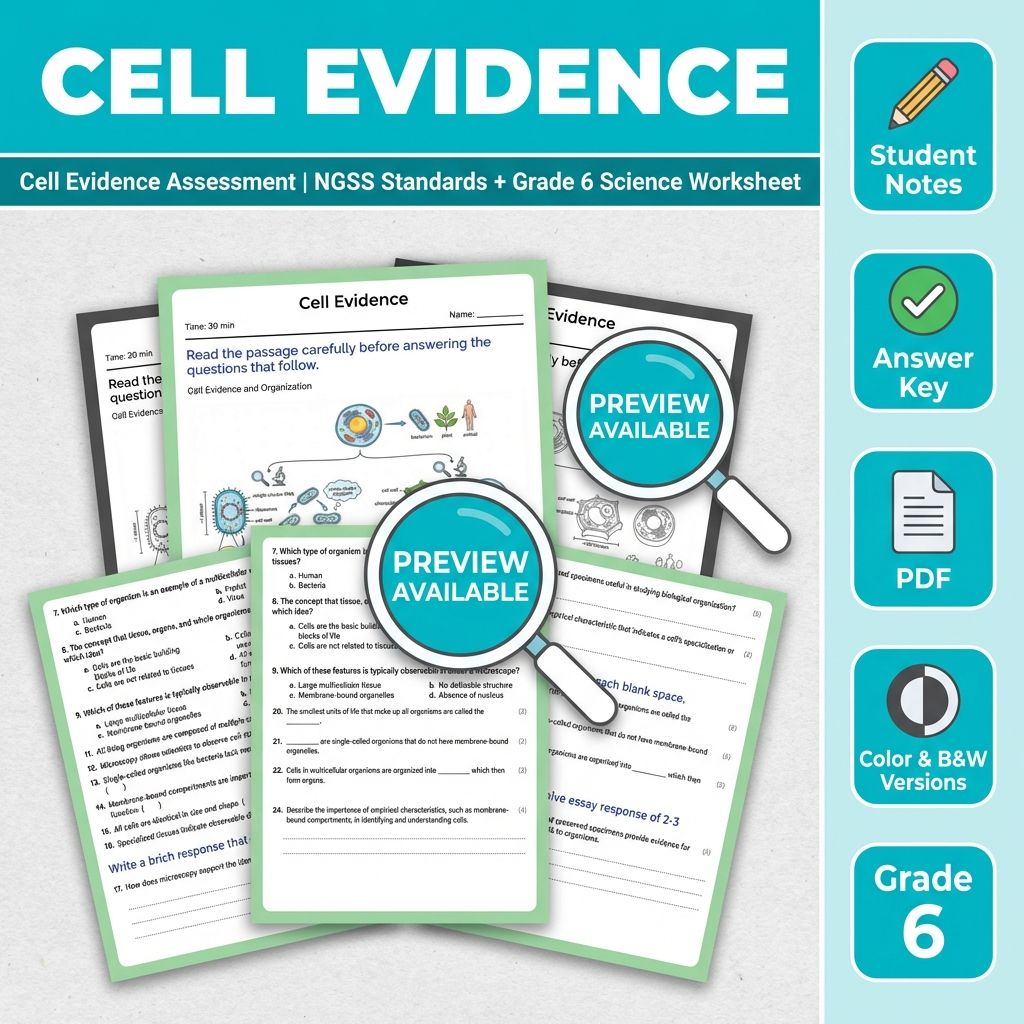
Cell Evidence Assessment | NGSS Standards + Grade 6 Science Worksheet
Created byPrism Point LearningLearning Objectives
- Identify key features of cells as the basic units of life through observational and comparative evidence.
- Distinguish between single-celled and multicellular organisms based on microscopy and specimen observations.
- Understand the relationships among cells, tissues, organs, and organisms in biological organization.
Also included in: Grade 6 Science Mini Bundle | Structures and Processes NGSS Not specified +1 more
Instant download
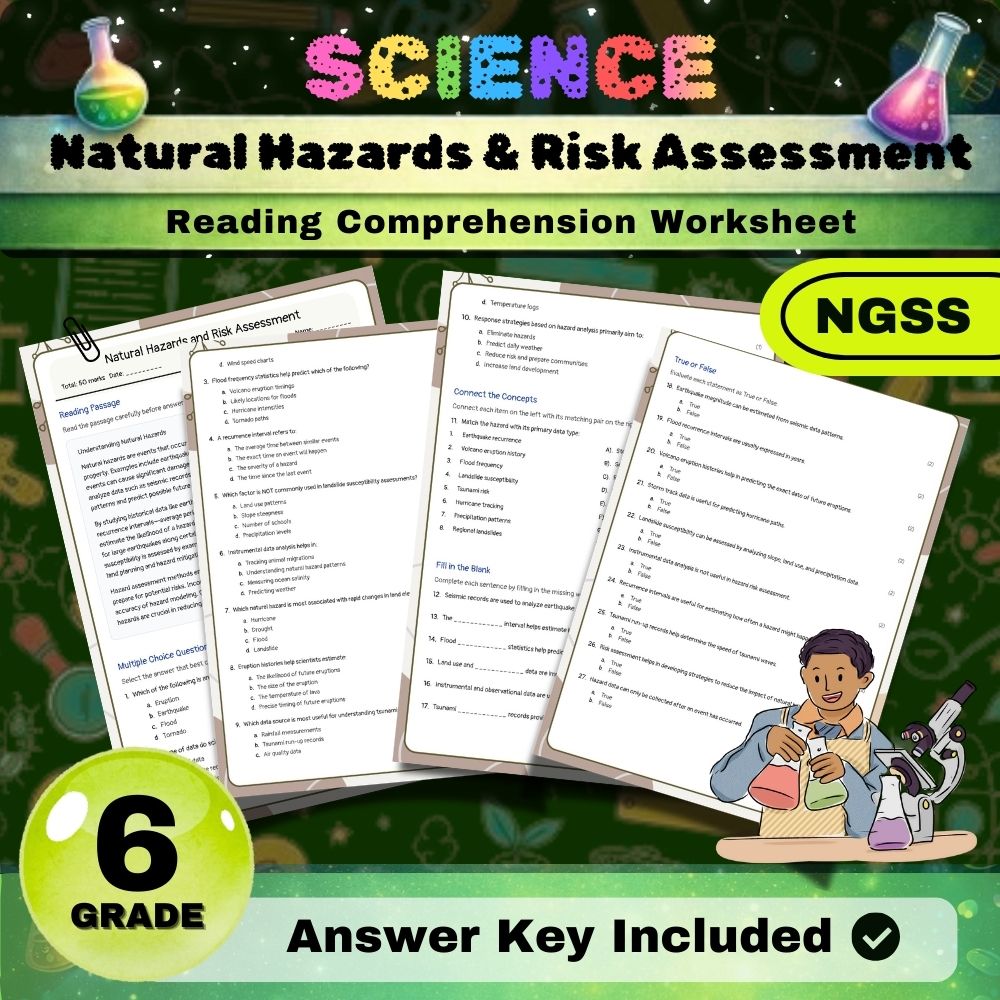
6th Grade Science | Natural Hazards & Risk Assessment NGSS Worksheet (PDF)
 Created byMaple Path Learning
Learning Objectives
- Understand various types of natural hazards and their characteristics.
- Analyze observational and instrumental data related to natural hazard events.
- Interpret patterns, recurrence intervals, and location estimates of hazards.
Also included in: Grade 6 Science | Weather, Water Cycle & Earth Systems NGSS Unit Bundle (PDF) +1 more
Instant download

Integrated Management Worksheet | Alberta Grade 6 Science Practice & Assessment
JCreated byJ.S SheetsLearning Objectives
- Understand the concept of integrated management in forest ecosystems.
- Identify ecological, economic, and social objectives in forest management.
- Describe approaches such as ecosystem-based management and adaptive planning.
Instant download
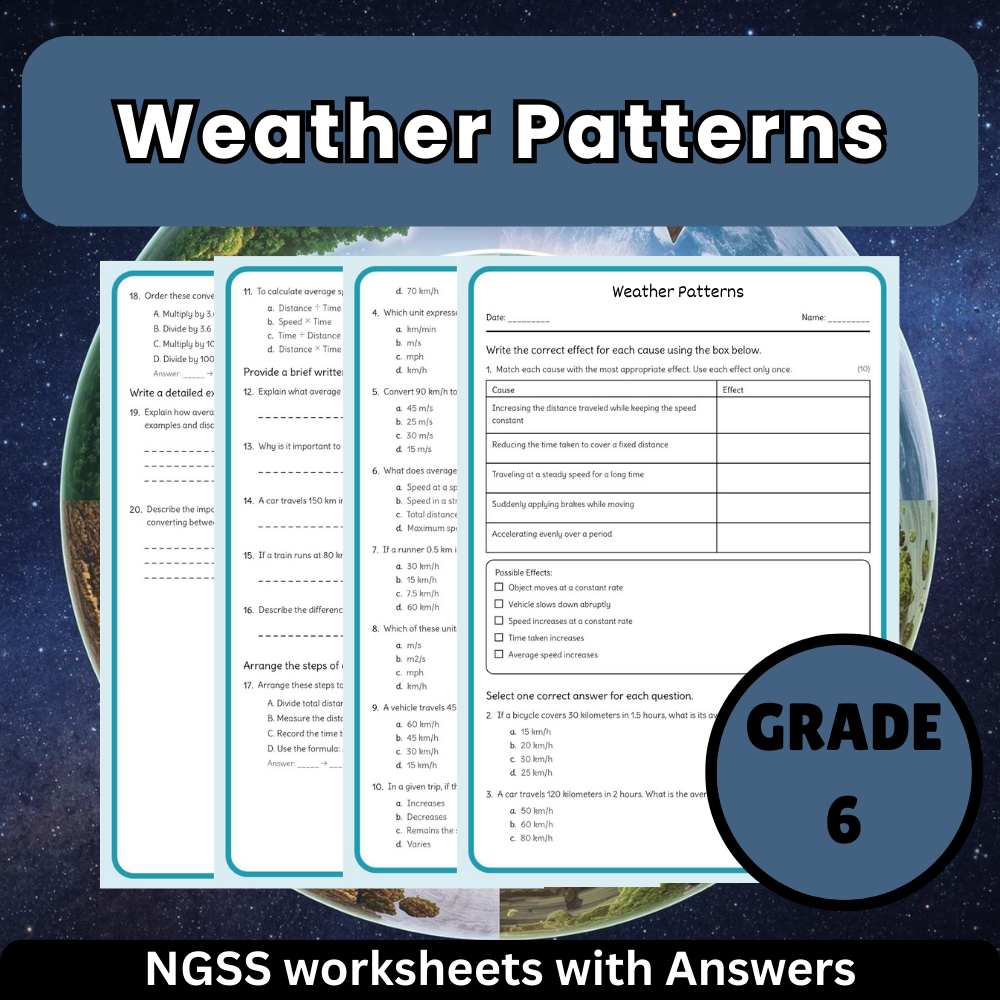
Grade 6 Science – Weather Patterns Worksheet + Answer Key | NGSS Standards
Created byBright Mind ResourcesLearning Objectives
- Understand the atmospheric processes that produce local and regional weather.
- Interpret surface maps, temperature, and pressure data to analyze weather conditions.
- Identify different types of weather fronts and their effects on weather patterns.
Also included in: Grade 6 Science Unit Bundle - Weather, Water Cycle & Climate Systems - NGSS +2 more
Instant download
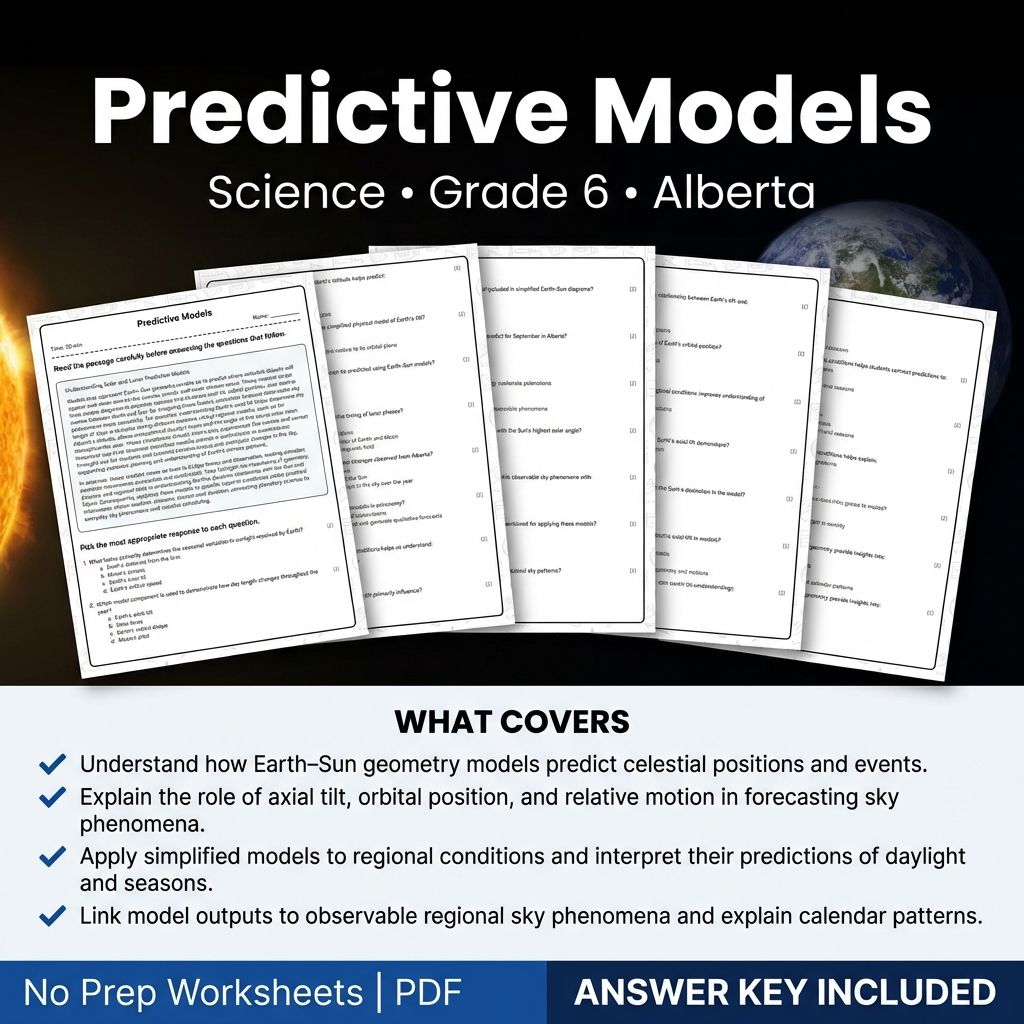
Predictive Models Worksheet | Alberta Grade 6 Science Standard
Created byCoral Reef LearningLearning Objectives
- Understand how Earth–Sun geometry models predict celestial positions and events.
- Explain the role of axial tilt, orbital position, and relative motion in forecasting sky phenomena.
- Apply simplified models to regional conditions and interpret their predictions of daylight and seasons.
Instant download
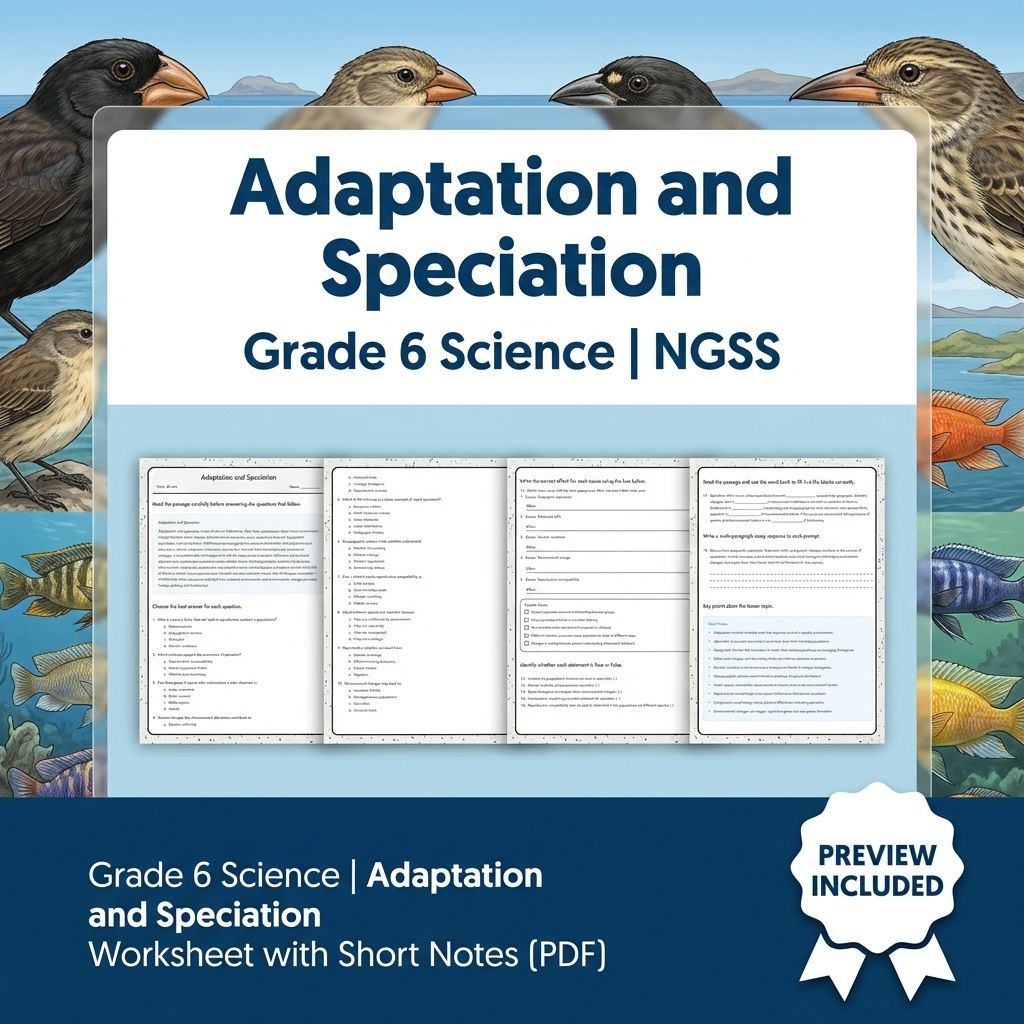
Grade 6 Science | Adaptation and Speciation Worksheet with Short Notes (PDF)
Created byMeadowlark WorksheetsLearning Objectives
- Understand the processes of adaptation and speciation and how they contribute to biodiversity.
- Identify various types of evidence supporting speciation events.
- Explain how geographical and genetic factors lead to lineage divergence.
Also included in: Grade 6 Science | Biological Evolution: Unity and Diversity Unit Bundle +1 more
Instant download
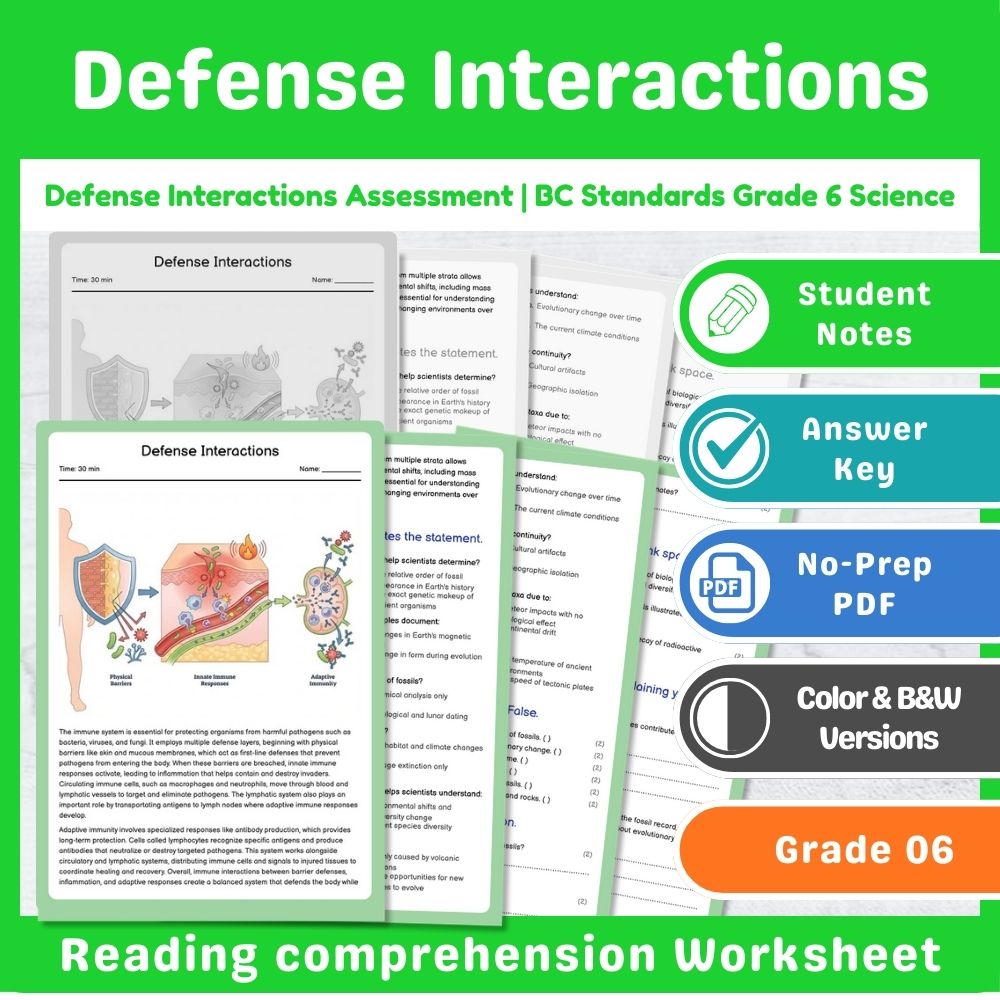
Defense Interactions Assessment | BC Standards Grade 6 Science
Created byPrism Point LearningLearning Objectives
- Describe how the immune system defends organisms through barrier defenses, inflammation, and antibody production.
- Identify the roles of skin, mucous membranes, immune cells, and lymphatic vessels in pathogen defense.
- Explain how immune activity interacts with circulatory and lymphatic systems to maintain health.
Instant download
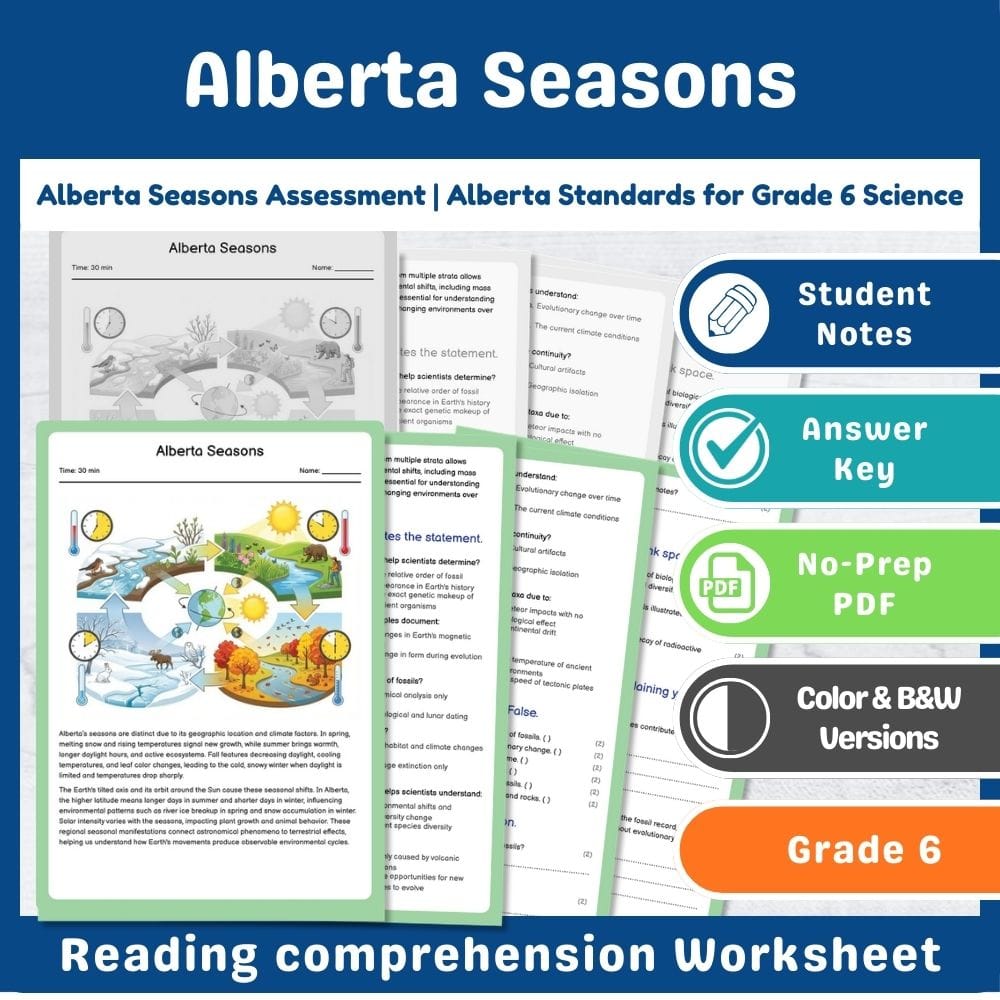
Alberta Seasons Assessment | Alberta Standards for Grade 6 Science
Created byPrism Point LearningLearning Objectives
- Describe the seasonal patterns in Alberta and their causes.
- Explain how Earth's position and solar geometry influence regional climate and environment.
- Identify the effects of seasonal changes on ecosystems, river ice, and agriculture in Alberta.
Also included in: Lesson Grade 6 Science Assessment | Celestial & Earth Movements
Instant download

Grade 6 Science – Energy Transfer & Conduction, Convection | Worksheet
Created byBright Mind ResourcesLearning Objectives
- Identify and describe the three main modes of energy transfer: conduction, convection, and radiation.
- Differentiate between conduction, convection, and radiation based on examples.
- Understand how energy transfer affects temperature changes and environmental systems.
Also included in: Grade 6 Daily Reading Science Worksheets | Lesson Bundle | BC Framework +1 more
Instant download
6th Grade Science | Sustainability Strategies | NGSS Worksheet & Answer Key
 Created byCedar Grove Learning
Learning Objectives
- Evaluate how population trends and resource use impact Earth's systems.
- Compare different sustainable practices and their effects on environment and society.
- Analyze trade-offs among economic, social, and environmental priorities in sustainability policies.
Also included in: Grade 6 Science Bundle | Sustainability, Hazards & Earth Systems NGSS Worksheets +1 more
Instant download
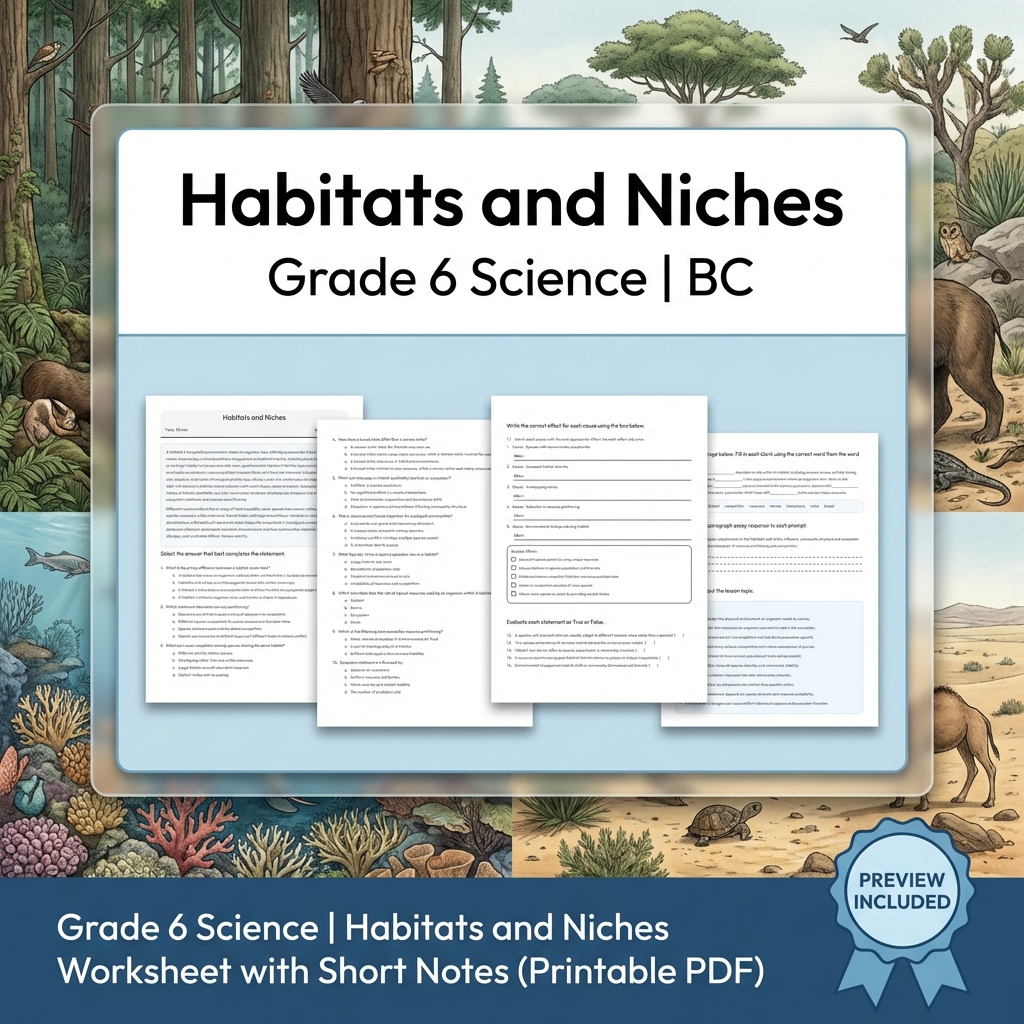
Grade 6 Science | Habitats and Niches Worksheet with Short Notes (Printable PDF)
Created byMeadowlark WorksheetsLearning Objectives
- Define what a habitat and a niche are in ecological terms.
- Explain how overlapping niches cause competition among species.
- Describe resource partitioning and its role in supporting coexistence.
Also included in: Grade 6 Science | Ecosystems & Interdependence UNIT Worksheet Bundle +1 more
Instant download

Climate and Patterns Worksheet | Grade 6 Science Weather & Climate
Created byPrism Point LearningLearning Objectives
- Explain how climate differs from short-term weather patterns
- Identify key factors that influence climate, such as latitude and ocean effects
- Use evidence from climate patterns to describe why different ecosystems form in different regions
Also included in: Grade 6 Weather & Climate Science Lesson Bundle | Florida NGSSS
Instant download

Atmospheric Circulation Worksheet | Grade 6 Science Weather & Climate
Created byPrism Point LearningLearning Objectives
- Explain how uneven solar heating causes air to rise and sink, creating global wind patterns.
- Describe how warm air density changes and how that affects vertical motion in the atmosphere.
- Connect atmospheric circulation to the movement of moisture and the formation of storms.
Also included in: Grade 6 Weather & Climate Science Lesson Bundle | Florida NGSSS
Instant download

Oceans Regulate Climate Worksheet | Grade 6 Weather & Climate Science
Created byPrism Point LearningLearning Objectives
- Explain how oceans absorb, store, and release energy to reduce temperature extremes.
- Describe how ocean heat affects evaporation, water vapor, humidity, and atmospheric stability.
- Connect ocean circulation and changes in ocean heat content to weather patterns near coastlines.
Also included in: Grade 6 Weather & Climate Science Lesson Bundle | Florida NGSSS
Instant download

Earth System Interactions Worksheet | Grade 6 Earth Science Activity
Created byPrism Point LearningLearning Objectives
- Explain how the atmosphere, hydrosphere, geosphere, and biosphere interact through matter and energy flow.
- Describe how heating, cooling, evaporation, and condensation can change water from one form to another and affect weather.
- Give examples of how erosion and deposition change landforms and connect to other Earth spheres.
Also included in: Grade 6 Weather & Climate Science Lesson Bundle | Florida NGSSS
Instant download
About Grade 6 Science Worksheets
Explore Grade 6 Science worksheets for classwork, homework, or review. Our 5,969 printables download instantly as PDFs.
MyTeachingSheets worksheets are made by real teacher-authors and checked before they go live. Download any as a print-ready PDF for lessons, homework, or independent practice — most include answer keys, and previews are always free.