
Grade 6 Science Worksheets
5,969 worksheets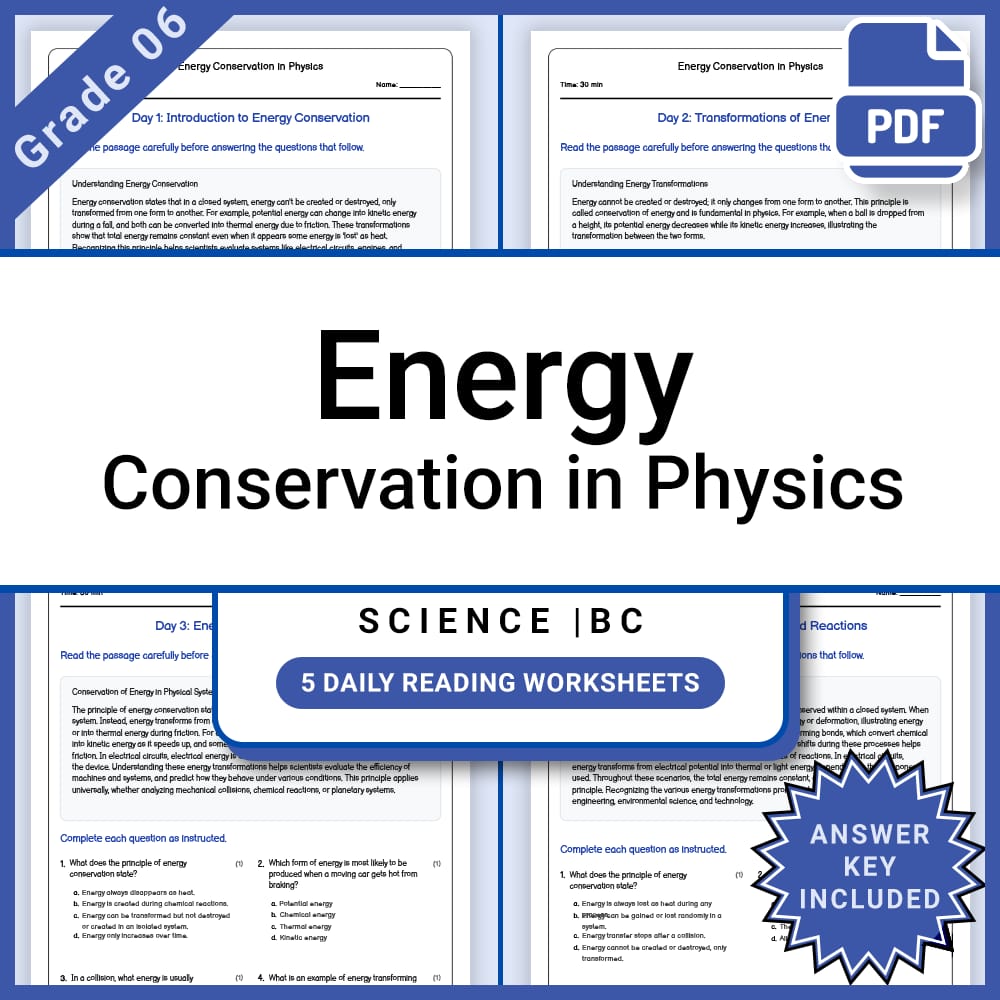
Grade 6 Science – Energy Conservation Daily Reading Worksheet + Answer Key
JCreated byJ.S SheetsLearning Objectives
- Understand the basic concept of energy conservation
- Identify how energy transforms within a system
- Recognize different forms of energy involved in physical processes
Also included in: Grade 6 Science Lesson Group | Waves, Light, Energy, Circuits & Technology +1 more
Instant download
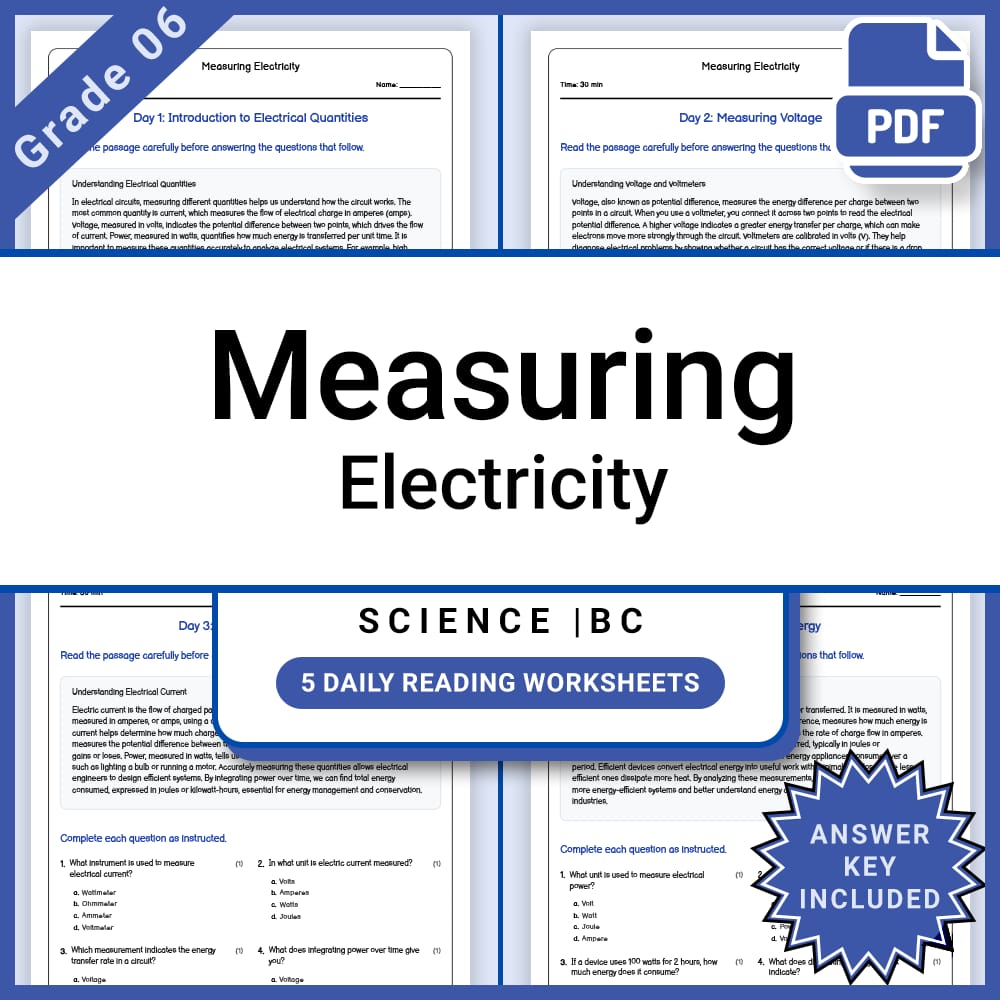
Grade 6 Science – Measuring Electricity Daily Reading Worksheet + Answer Key
JCreated byJ.S SheetsLearning Objectives
- Identify different electrical quantities and their units
- Understand how current, voltage, and power are measured
- Recognize the importance of electrical measurements in circuits
Also included in: Grade 6 Science Lesson Group | Waves, Light, Energy, Circuits & Technology +1 more
Instant download
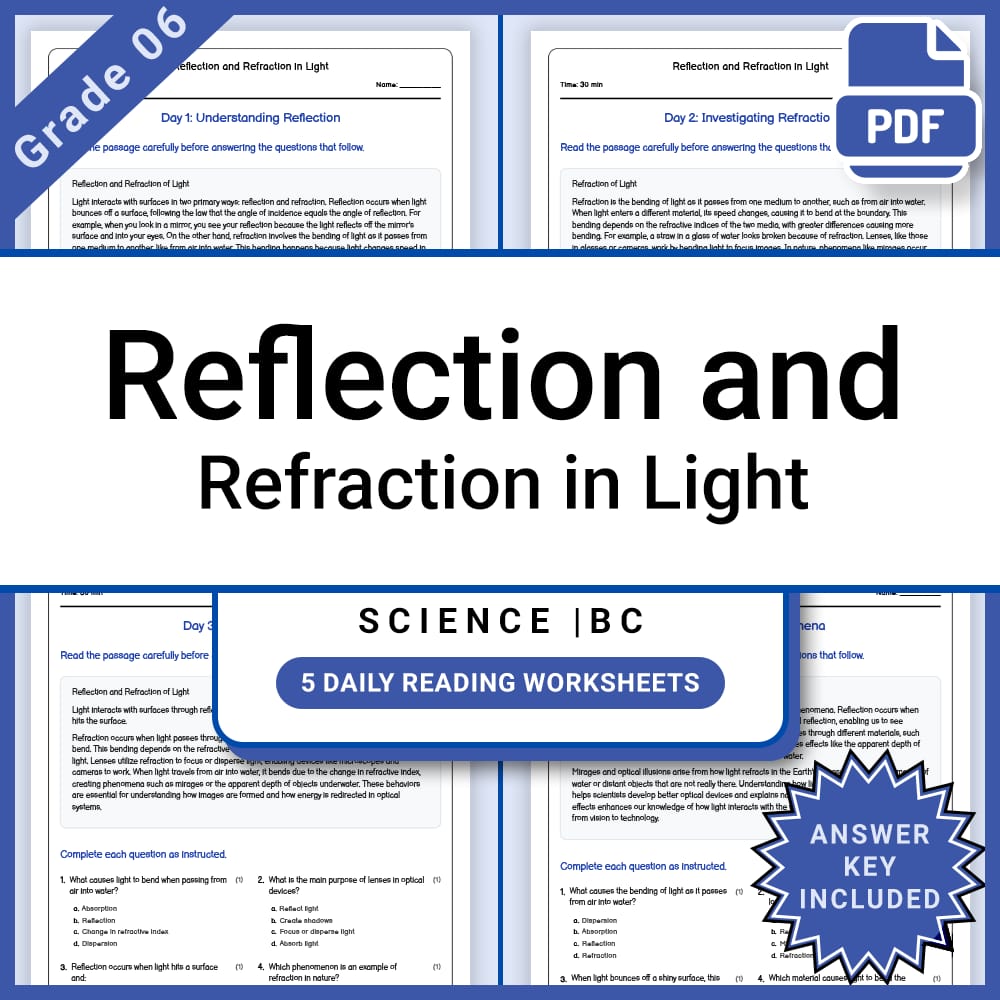
Grade 6 Science Reflection and Refraction in Light Daily Worksheet with Answer Key
JCreated byJ.S SheetsLearning Objectives
- Understand the concepts of reflection and refraction of light
- Identify how light interacts with different surfaces and materials
- Explain how lenses and phenomena like mirages are related to light behavior
Also included in: Grade 6 Science Lesson Group | Waves, Light, Energy, Circuits & Technology +1 more
Instant download
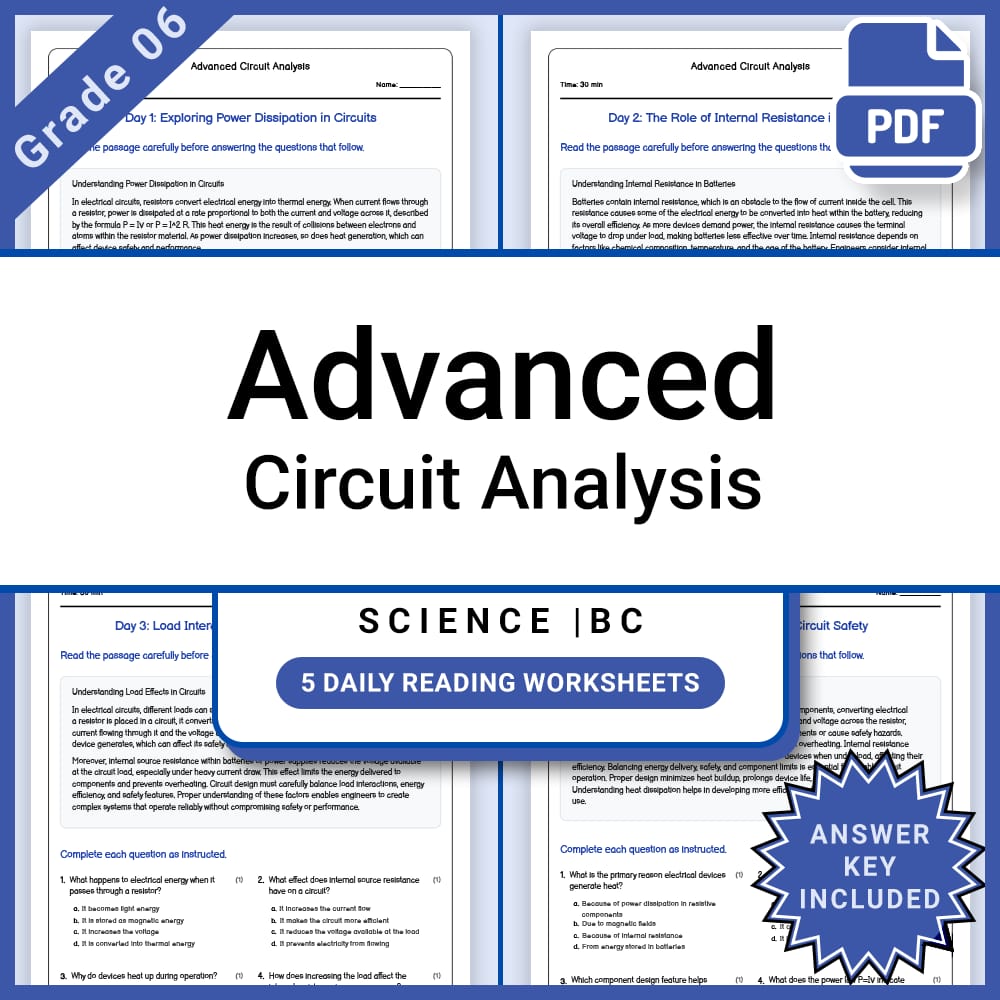
Grade 6 Science – Advanced Circuit Analysis Daily Reading Worksheet + Answer Key
JCreated byJ.S SheetsLearning Objectives
- Understand how electrical power is dissipated as heat in resistors
- Explain the effect of internal source resistance on circuit performance
- Describe how load interactions influence energy distribution in circuits
Also included in: Grade 6 Science Lesson Group | Waves, Light, Energy, Circuits & Technology +1 more
Instant download
Grade 6 Science – Energy Transfer Daily Reading Worksheet with Answer Key
JCreated byJ.S SheetsLearning Objectives
- Recognize different types of energy transfer: conduction, convection, radiation
- Describe how energy moves through conduction, convection, and radiation
Also included in: Grade 6 Science Lesson Group | Waves, Light, Energy, Circuits & Technology +1 more
Instant download
Grade 6 Science – Waves and Technology Daily Reading Worksheet + Answer Key
JCreated byJ.S SheetsLearning Objectives
- Understand how sound waves are converted into electrical signals in microphones and speakers.
- Recognize how light waves are used in cameras to create images.
- Learn about wave properties such as frequency and intensity and their role in device performance.
Also included in: Grade 6 Science Lesson Group | Waves, Light, Energy, Circuits & Technology +1 more
Instant download
Grade 6 Science – Sound Properties Daily Reading Worksheet + Answer Key
JCreated byJ.S SheetsLearning Objectives
- Understand what sound is as a mechanical wave
- Describe how frequency affects pitch
- Explain how amplitude affects loudness
Also included in: Grade 6 Science Lesson Group | Waves, Light, Energy, Circuits & Technology +1 more
Instant download
Grade 6 Science – Light Properties Daily Reading Worksheet + Answer Key
JCreated byJ.S SheetsLearning Objectives
- Understand that light behaves as both a wave and a particle.
- Identify the different types of electromagnetic waves within the light spectrum.
- Explain the relationship between wavelength, energy, and photon behavior.
Also included in: Grade 6 Science Lesson Group | Waves, Light, Energy, Circuits & Technology +1 more
Instant download

Science Series Characteristics Worksheet for Grade 6 | Ontario Standards
JCreated byJ.S SheetsLearning Objectives
- Explain how a series circuit creates a single path for current
- Describe why the current is the same through all elements in a series circuit
- Relate voltage division to brightness changes in series-connected incandescent bulbs
Instant download
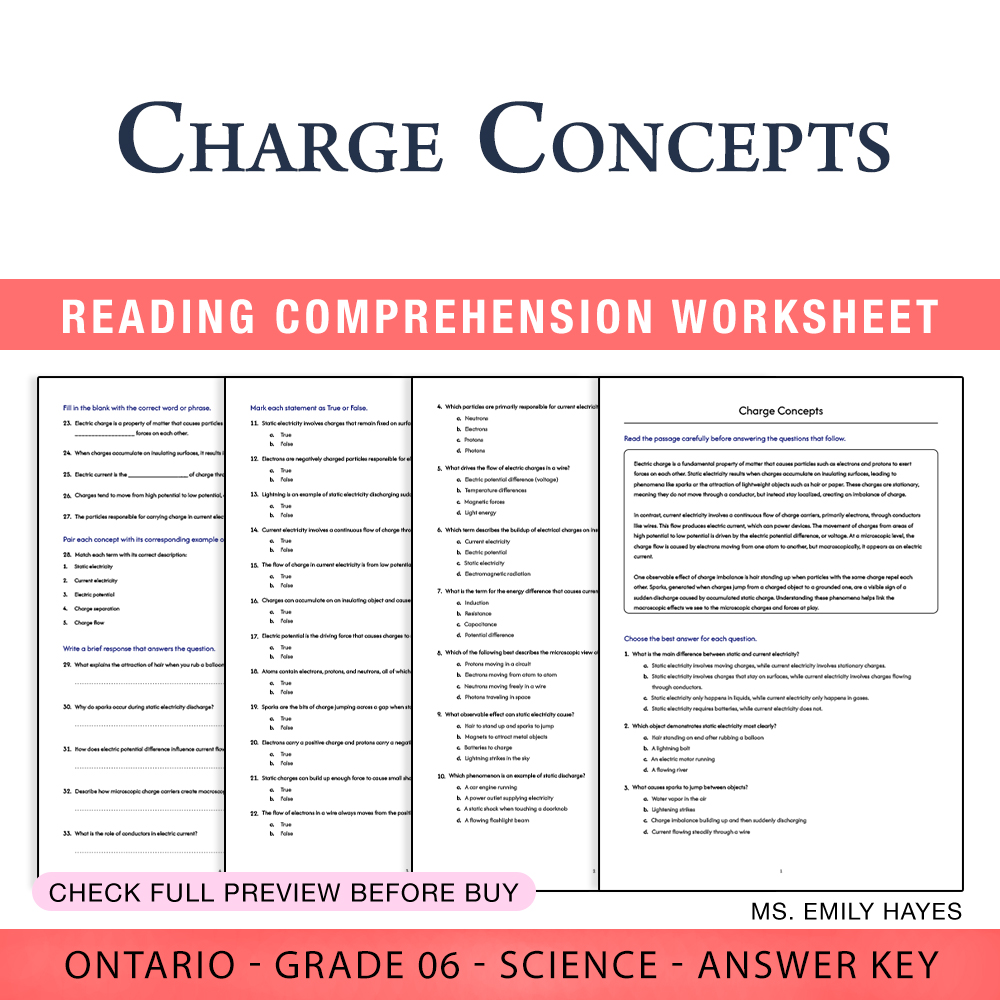
6th Grade Science | Charge Concepts Worksheet (PDF + Answer Key)
 Created byCopper Leaf Classroom
Learning Objectives
- Define electric charge and distinguish between static and current electricity.
- Explain how charge separation leads to observable phenomena like sparks and hair attraction.
- Describe the flow of electric charges in conductors and the concept of electric potential.
Instant download
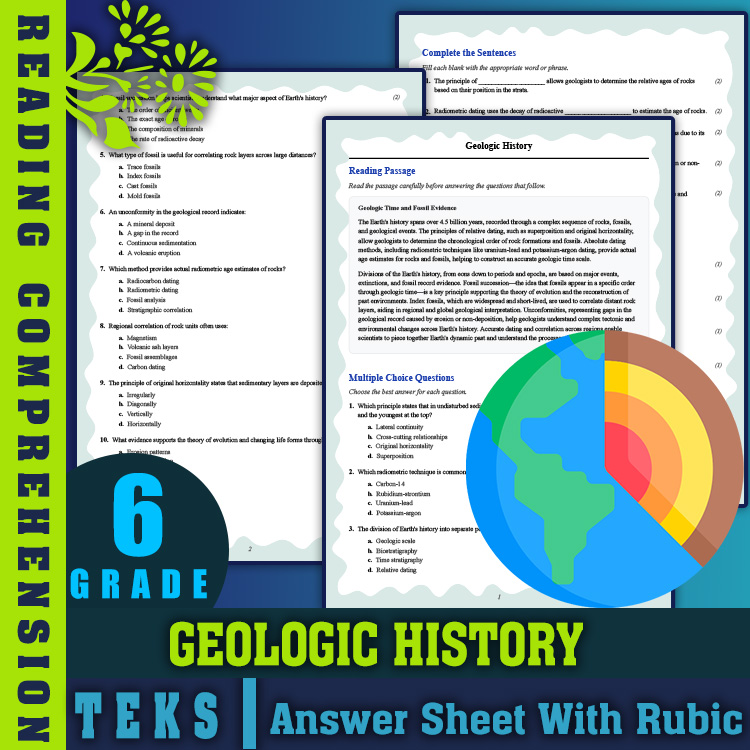
6th Grade Science | Geologic History Reading Worksheet & Answer Key (PDF)
JCreated byJ.S SheetsLearning Objectives
- Understand principles of relative and absolute dating of rocks and fossils.
- Identify key divisions of the geologic time scale and their significance.
- Explain how fossil succession provides evidence for Earth's history.
Instant download
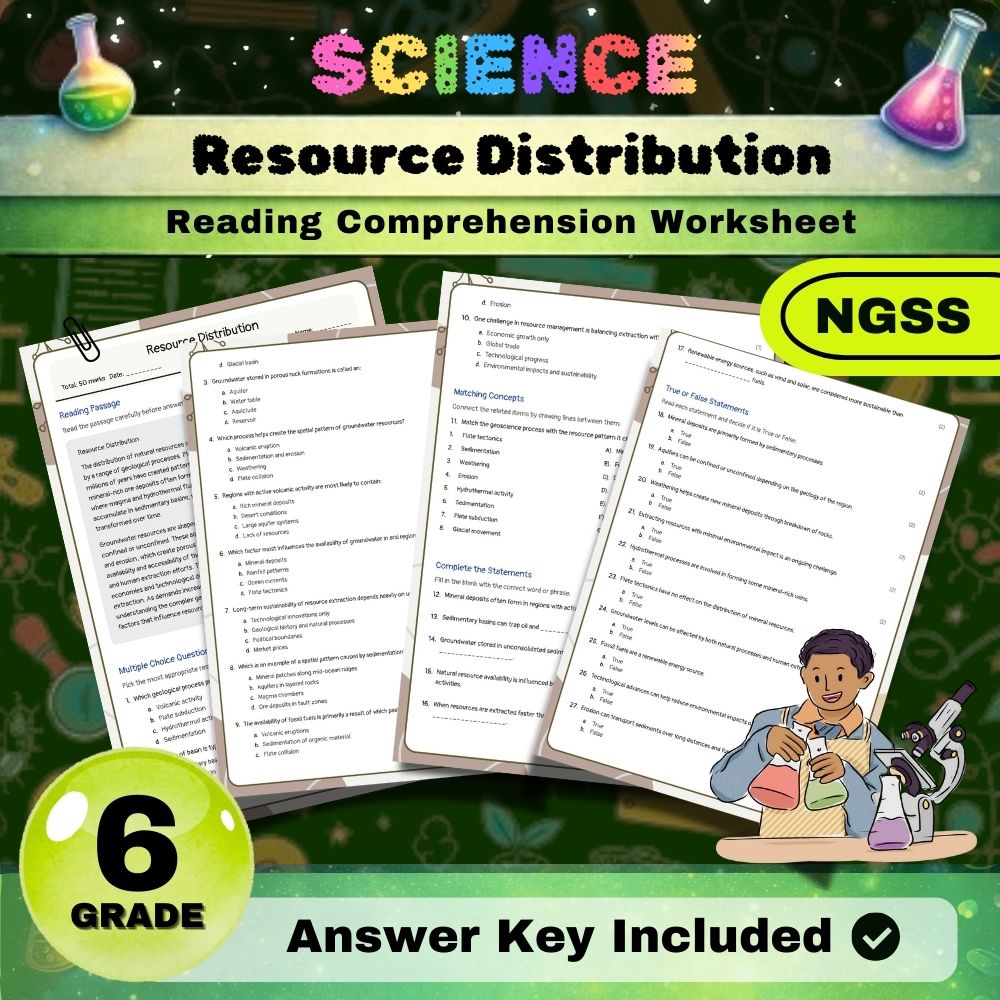
6th Grade Science | Resource Distribution NGSS Worksheet (PDF)
 Created byMaple Path Learning
Learning Objectives
- Understand the geological processes that influence the distribution of mineral, energy, and groundwater resources.
- Analyze how historical and ongoing geoscience processes create spatial patterns in resource deposits and aquifers.
- Evaluate the trade-offs in resource extraction considering demand, environmental impact, and technological constraints.
Also included in: Grade 6 Science | Earth's Systems & Sustainability NGSS Unit Bundle +1 more
Instant download
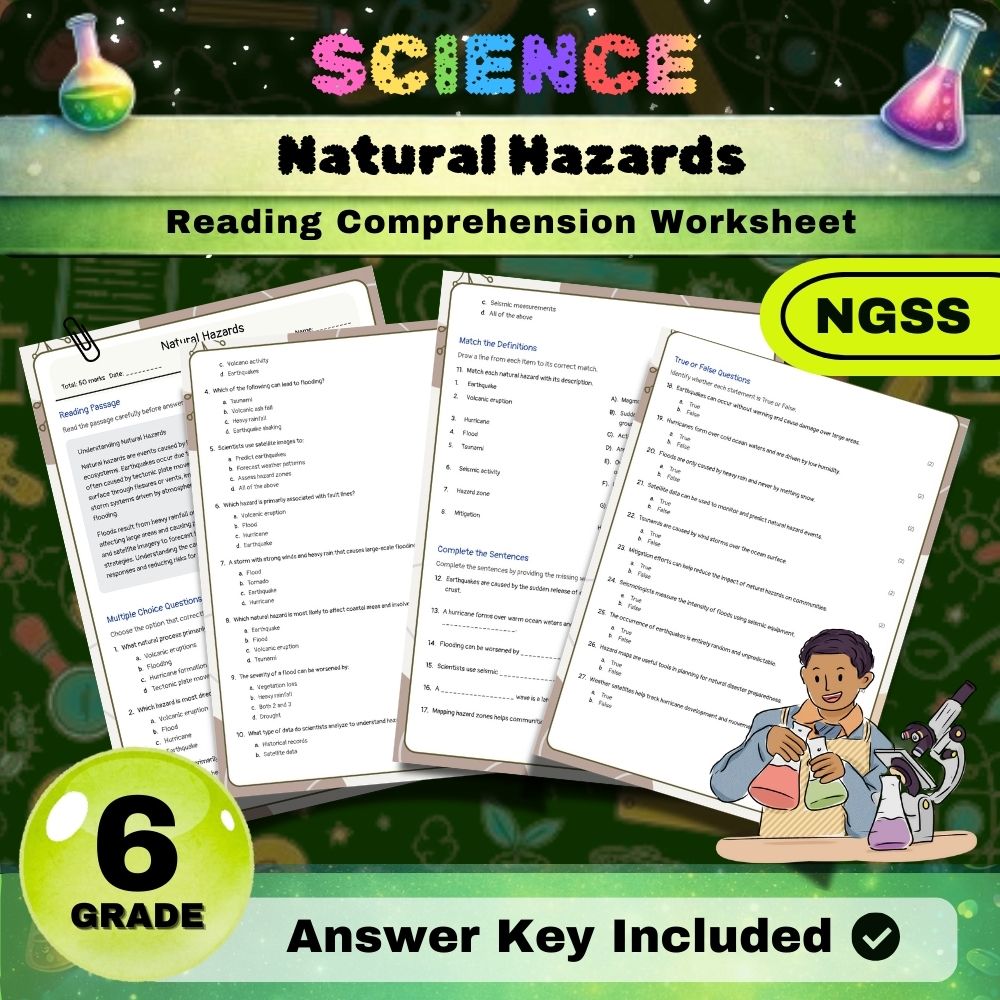
6th Grade Science | Natural Hazards NGSS Worksheet (PDF)
Created byMaple Path LearningLearning Objectives
- Understand the origins and causes of natural hazards such as earthquakes, volcanic eruptions, hurricanes, and floods.
- Analyze the patterns and effects of different natural hazards on communities and infrastructure.
- Evaluate the relationships among tectonic activity, atmospheric processes, and hydrologic cycles in hazard occurrence.
Also included in: Grade 6 Science | Earth's Systems & Sustainability NGSS Unit Bundle +1 more
Instant download
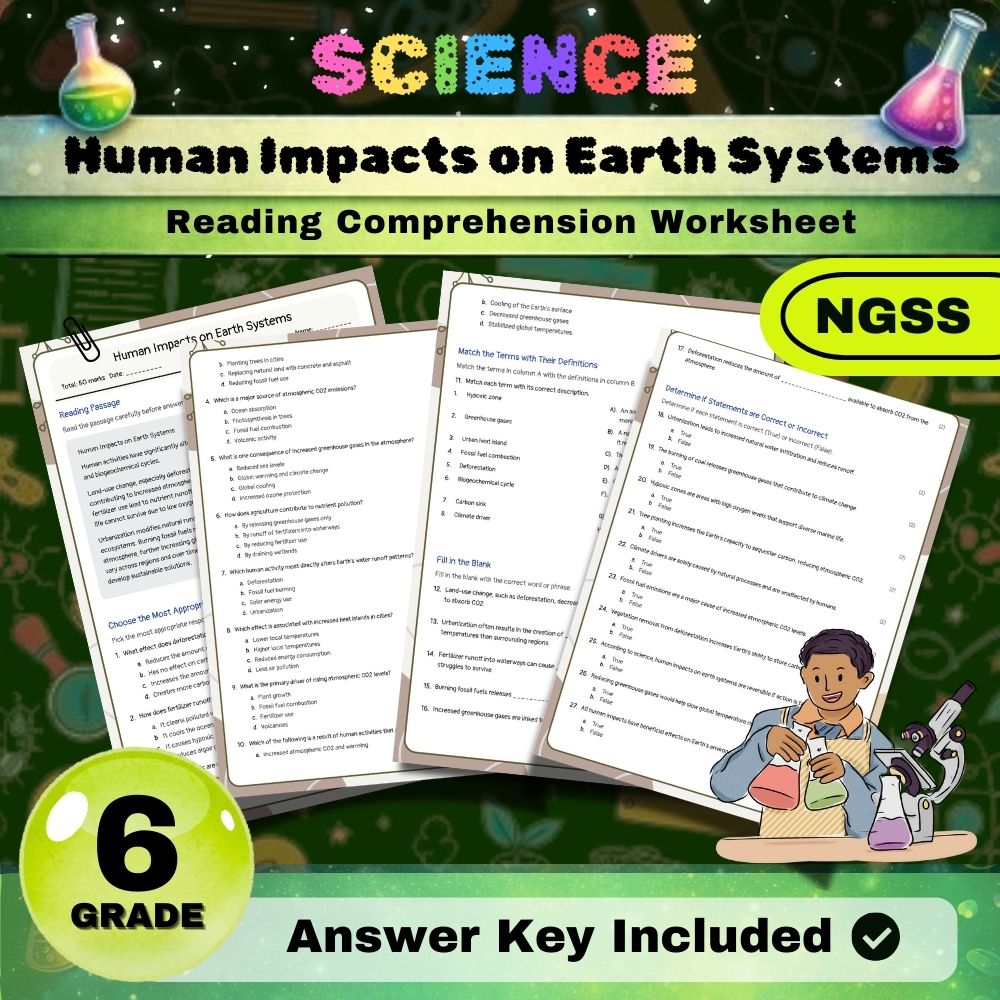
Grade 6 Science | Human Impacts on Earth Systems NGSS Worksheet + Answer Key)
Created byMaple Path LearningLearning Objectives
- Understand how human activities such as land-use change, fossil fuel combustion, agriculture, and waste management impact biogeochemical cycles and ecosystems.
- Identify examples of environmental effects caused by human alterations and analyze their causal links.
- Explain the effects of human impacts on climate drivers and ecosystem structure at different spatial and temporal scales.
Also included in: Grade 6 Science | Earth's Systems & Sustainability NGSS Unit Bundle +1 more
Instant download
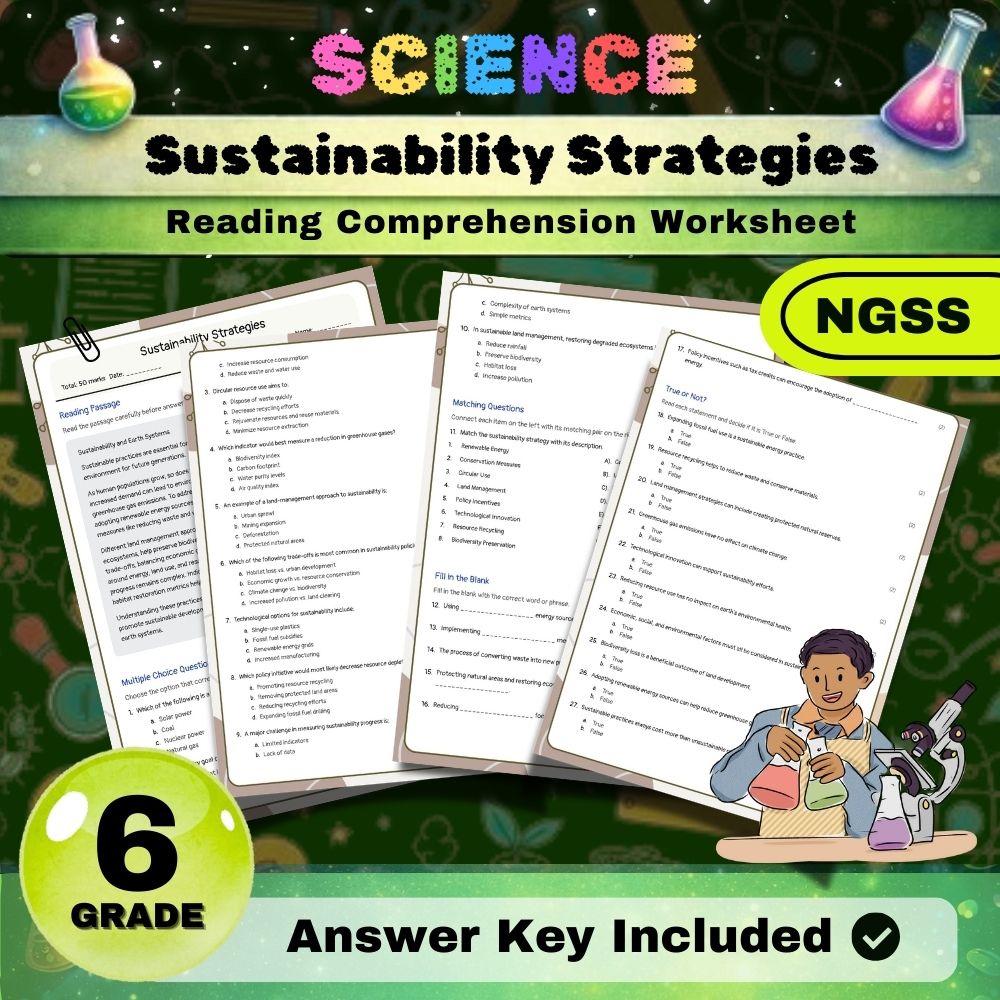
6th Grade Science | Sustainability Strategies NGSS Worksheet (PDF)
Created byMaple Path LearningLearning Objectives
- Understand how population trends and resource use impact earth systems.
- Identify different sustainable practices and their trade-offs.
- Analyze policy and technological options for promoting sustainability.
Also included in: Grade 6 Science | Earth's Systems & Sustainability NGSS Unit Bundle +1 more
Instant download
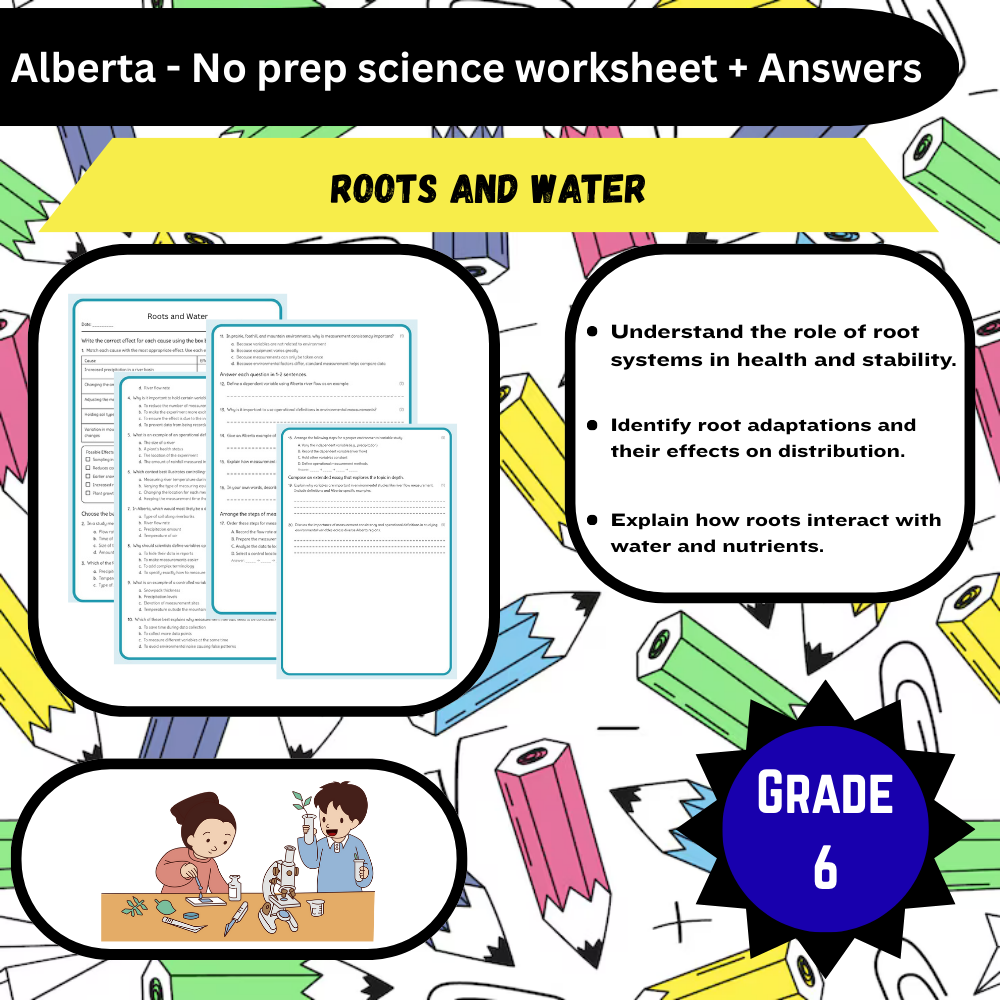
6th Grade Science | Roots and Water Exploration Worksheet (PDF)
 Created byBright Mind Resources
Learning Objectives
- Understand the role of root systems in tree health and stability.
- Identify different root adaptations and their effects on tree distribution and survival.
- Explain how roots interact with water and nutrients in various environments.
Instant download
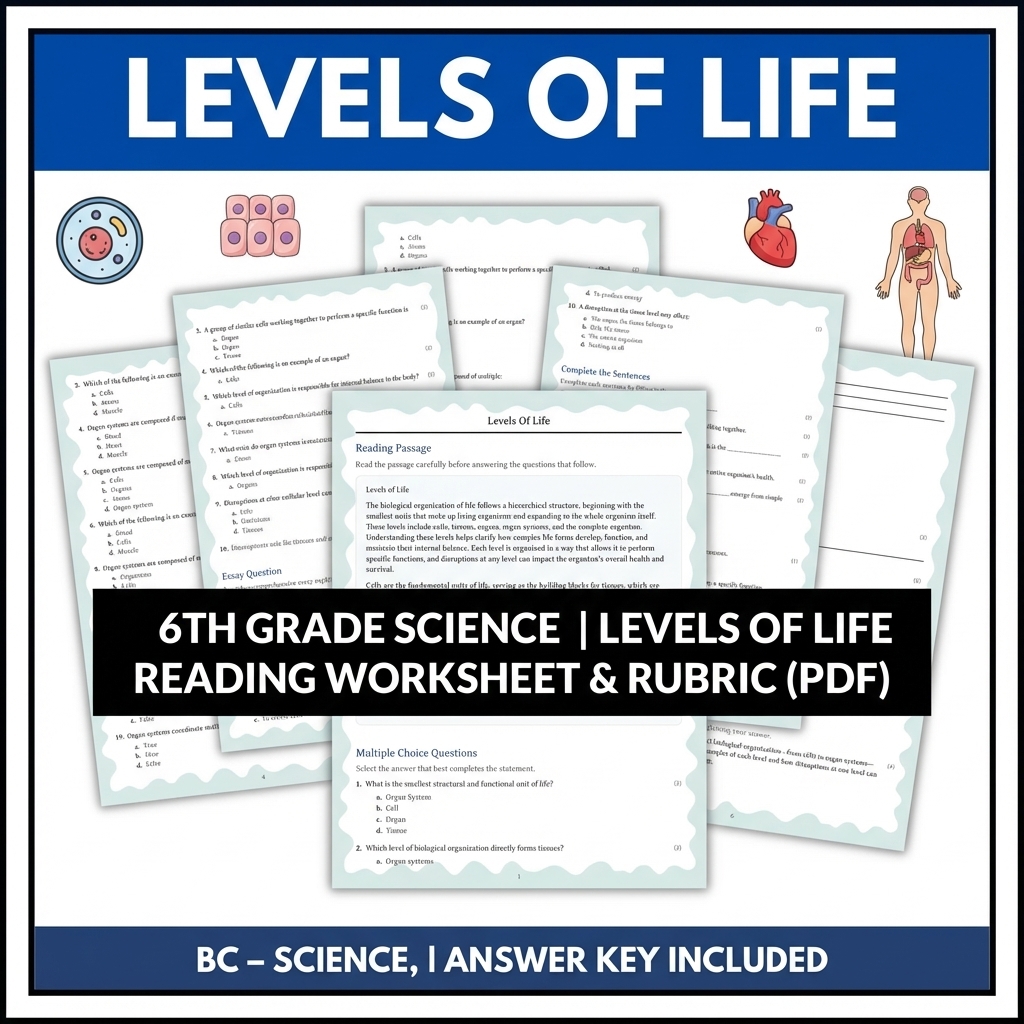
6th Grade Science | Levels of Life Reading Worksheet & Rubric (PDF)
JCreated byJ.S SheetsLearning Objectives
- Understand the hierarchy of biological organization from cells to organisms.
- Identify how cells form tissues, tissues create organs, and organs work together in organ systems.
- Explain how disruptions at any level of biological organization can affect the entire organism.
Instant download
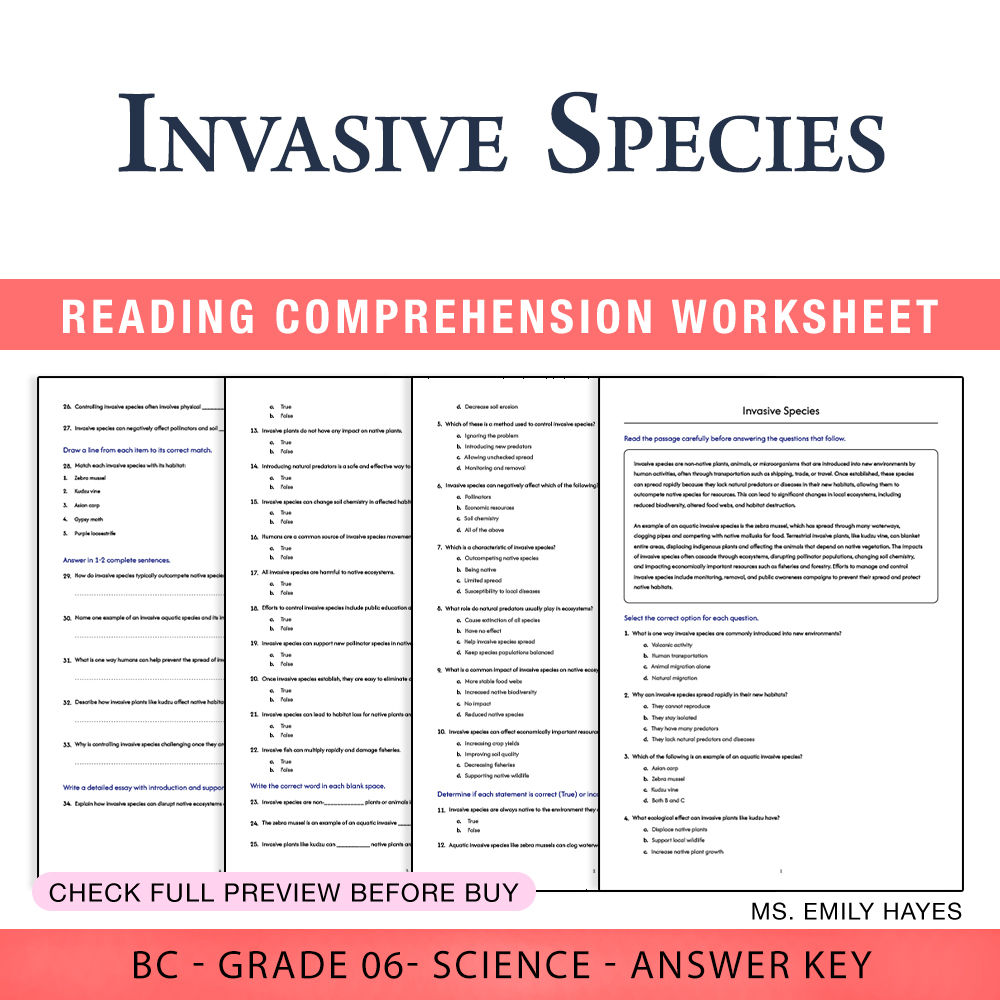
6th Grade Science | Invasive Species Worksheet (PDF+ Answer Key)
Created byCopper Leaf ClassroomLearning Objectives
- Understand what invasive species are and how they affect ecosystems.
- Identify common examples of invasive plants and animals.
- Explain the ecological impacts caused by invasive species.
Also included in: Grade 6 Science BC | Ecosystems and Human Impact Unit (PDF + Answer Keys) +1 more
Instant download

Airfoil Shape Worksheet | Grade 6 Science Ontario Standards
 Created byCedar Grove Learning
Learning Objectives
- Explain how airfoil geometry (camber, thickness, chord length, and leading-edge curvature) affects airflow and pressure distribution.
- Describe how angle of attack and lift generation are connected, including how stall can occur at critical angles.
- Compare simplified Bernoulli and Newtonian explanations for lift and relate them to real aircraft examples.
Also included in: Grade 6 Aerodynamics | Flight - Science Lesson Bundle – Ontario Framework +1 more
Instant download

Grade 6 Science | Combined Circuits Worksheet (Ontario) (PDF)
 Created byEvergreen Desk Education
Learning Objectives
- Explain how mixed (series-parallel) circuits can be decomposed into simpler series and parallel subcircuits.
- Predict how current and voltage distribute in series blocks and parallel branches within a combined circuit.
- Diagnose how component failure or removal affects brightness and meter readings in different parts of a mixed circuit.
Also included in: Grade 6 Electricity Circuits Science Lesson Bundle for Ontario Worksheets +1 more
Instant download

Grade 6 Science | Circuit Diagnosis - Daily Reading Comprehension
 Created byCoral Reef Learning
Learning Objectives
- Understand observable symptoms in electrical circuits related to faults
- Identify and interpret symptoms such as unequal brightness and interrupted continuity
- Apply reasoning to diagnose faults based on circuit behavior and measurements
Instant download

Animals Matter Use Assessment | California Standards Grade 6 Science
 Created byPrism Point Learning
Learning Objectives
- Explain how animals need both matter and energy to live, grow, and function
- Describe how food provides matter that becomes parts of an animal’s body
- Describe how food provides energy that supports life processes such as movement and maintaining body temperature
Also included in: Grade 6 Energy and Matter Cycles Science Lesson Bundle | California Standards +1 more
Instant download
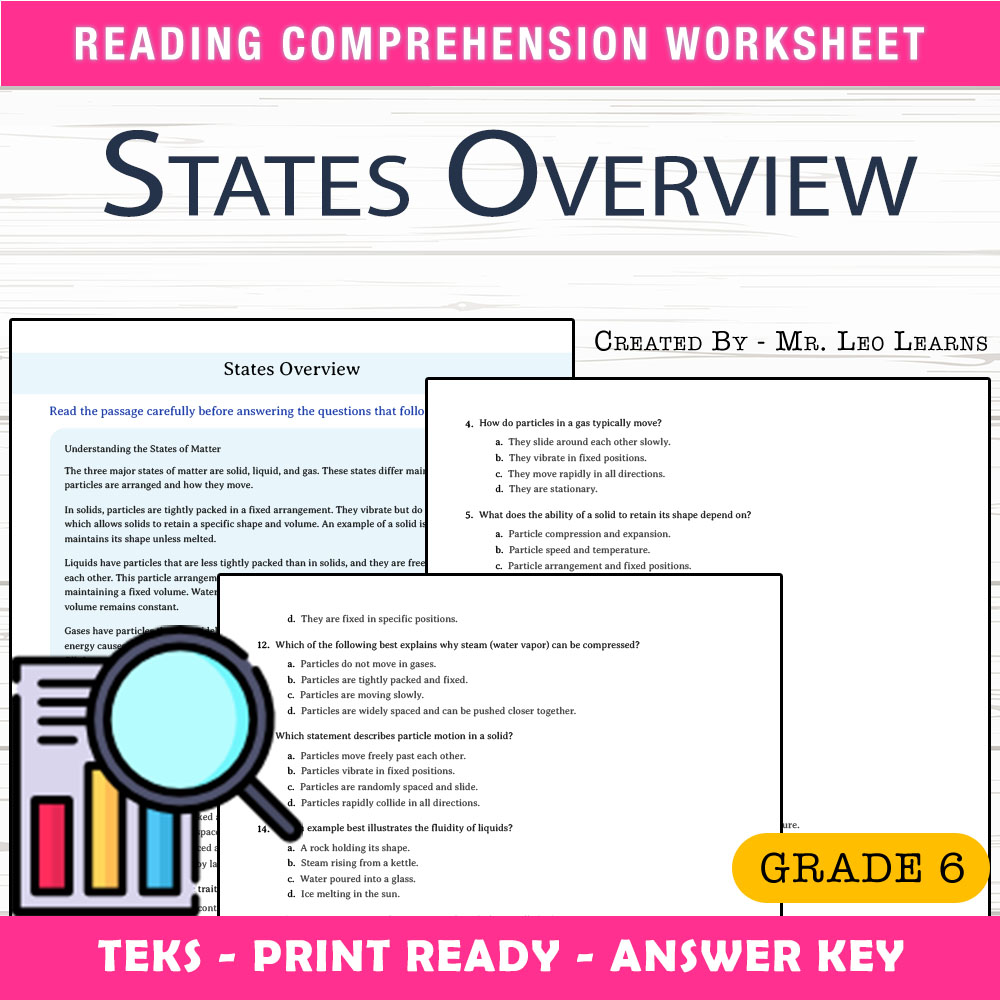
Grade 6 Science — States Overview Worksheet for Mastering States of Matter
 Created byThe Resource Hub
Learning Objectives
- Describe the differences between solid, liquid, and gas in terms of particle arrangement and movement.
- Identify everyday examples of each state of matter and explain their macroscopic traits.
- Understand the concept of phase transitions and how matter changes between states.
Also included in: Grade 6 Science Unit Bundle | States, Matter, Forces & Energy Mastery
Instant download
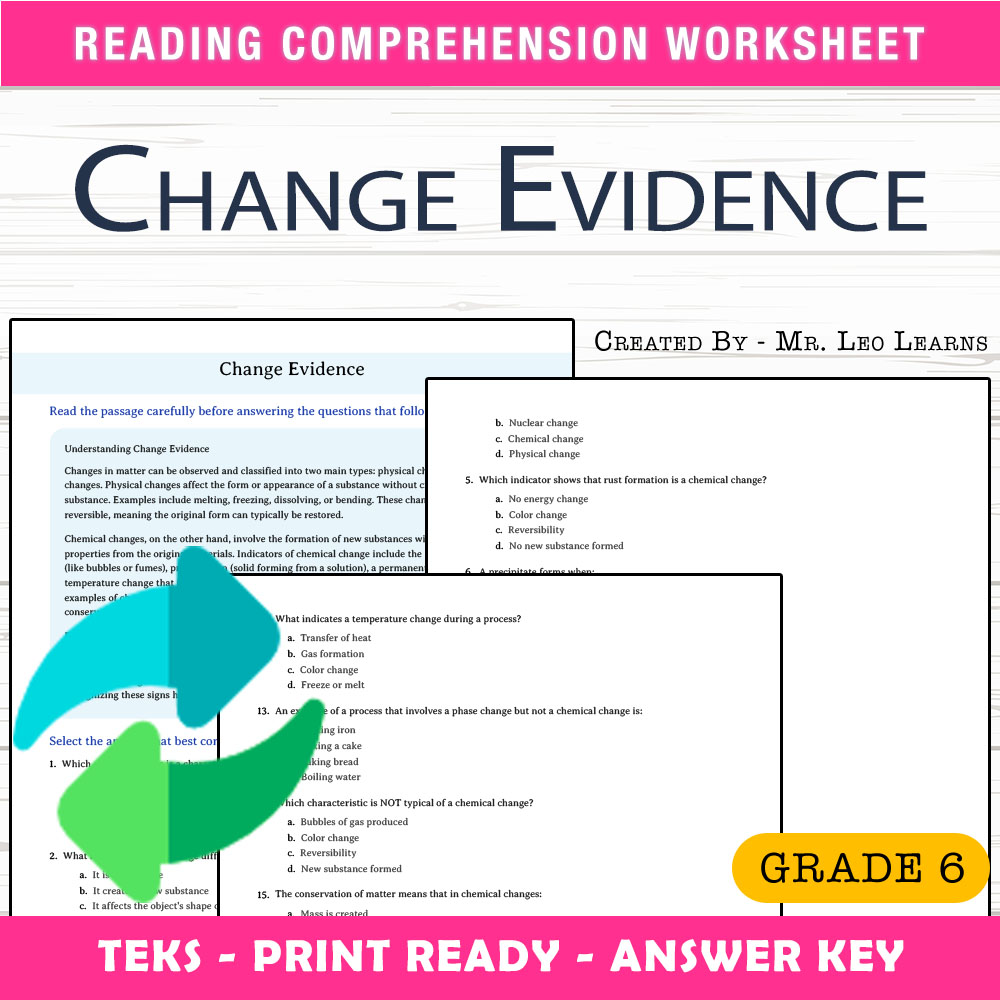
Grade 6 Science – Change Evidence Worksheet for Mastery
Created byThe Resource HubLearning Objectives
- Differentiate between physical and chemical changes based on observable evidence.
- Identify characteristic indicators of chemical changes such as gas formation, precipitate, color change, and temperature change.
- Recognize physical changes like shape or phase reversibility and understand conservation of substances.
Also included in: Grade 6 Science Unit Bundle | States, Matter, Forces & Energy Mastery
Instant download
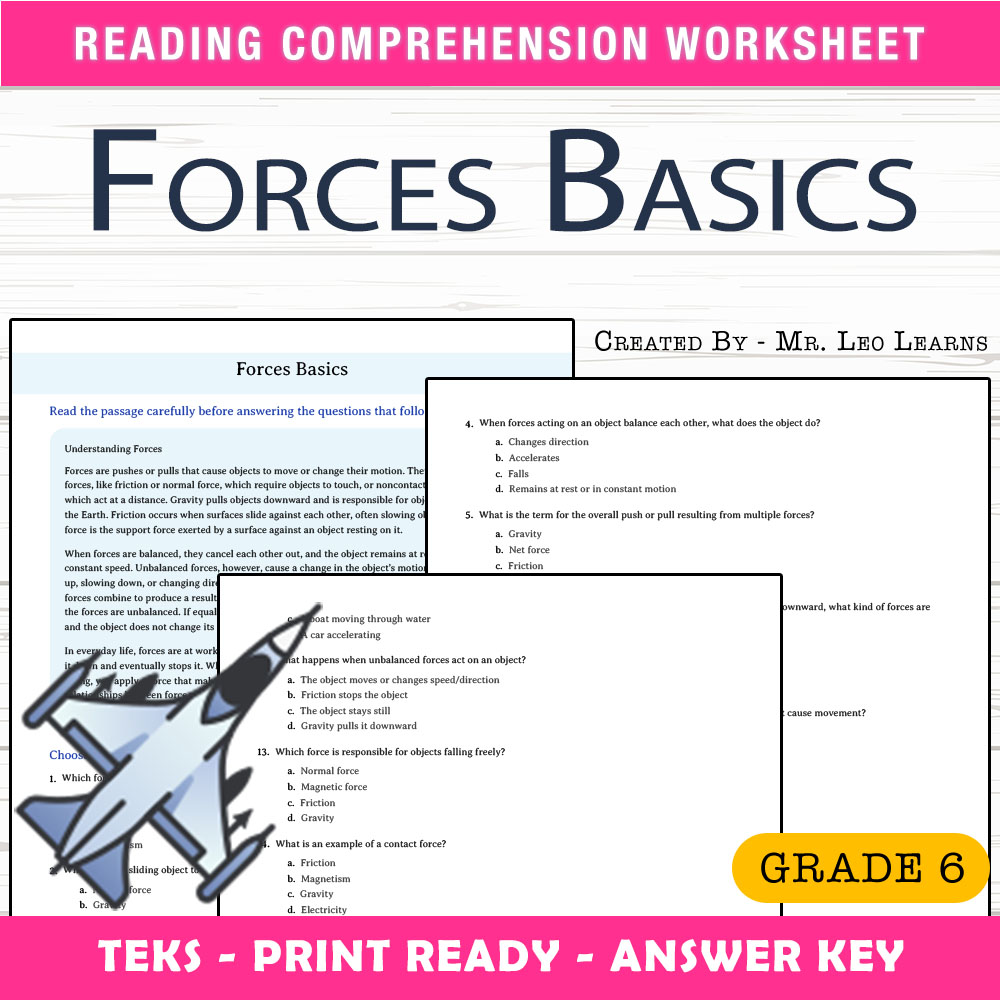
Grade 6 Science – Forces Basics Worksheet for Mastering Forces & Motion
Created byThe Resource HubLearning Objectives
- Identify and describe contact and noncontact forces, including gravity, friction, and normal force.
- Understand the differences between balanced and unbalanced forces and their effects on motion.
- Explain the concept of net force and apply simple real-world examples to illustrate force interactions.
Also included in: Grade 6 Science Unit Bundle | States, Matter, Forces & Energy Mastery
Instant download
Grade 6 Science — Energy Transfer Worksheet for Mastery
Created byThe Resource HubLearning Objectives
- Understand the mechanisms of thermal energy transfer: conduction, convection, and radiation.
- Identify examples of each energy transfer mechanism in real-world situations.
- Relate energy transfer to changes in temperature and material properties such as thermal conductivity.
Also included in: Grade 6 Science Unit Bundle | States, Matter, Forces & Energy Mastery
Instant download
Grade 6 Science – Conservation Principles in Mass Worksheet for Mastery
Created byThe Resource HubLearning Objectives
- Understand the concept of mass conservation in closed systems during physical and chemical changes.
- Identify examples of processes where mass is conserved and recognize limitations in open systems.
- Interpret measurements before and after transformations to draw conclusions about conservation.
Also included in: Grade 6 Science Unit Bundle | States, Matter, Forces & Energy Mastery
Instant download
Grade 6 Science – Matter Properties Worksheet for Mastery
Created byThe Resource HubLearning Objectives
- Understand the physical and chemical properties used to identify substances.
- Describe and compare properties such as density, solubility, magnetism, and conductivity.
- Relate observed properties to real-world examples like iron, salt, oil, and copper.
Also included in: Grade 6 Science Unit Bundle | States, Matter, Forces & Energy Mastery
Instant download
Grade 6 Science – Classifying Matter Worksheet for Mastery
Created byThe Resource HubLearning Objectives
- Understand the different types of matter: elements, compounds, and mixtures.
- Identify observable characteristics that distinguish pure substances from mixtures.
- Explain the concepts of homogeneity and heterogeneity in matter.
Also included in: Grade 6 Science Unit Bundle | States, Matter, Forces & Energy Mastery
Instant download
Grade 6 Science – Energy Forms Worksheet for Mastery
Created byThe Resource HubLearning Objectives
- Identify and describe common forms of energy including kinetic, potential, thermal, chemical, and electrical.
- Relate each form of energy to familiar phenomena such as moving objects, stretched springs, warm objects, and batteries.
- Distinguish between different forms of energy based on their characteristics and everyday examples.
Also included in: Grade 6 Science Unit Bundle | States, Matter, Forces & Energy Mastery
Instant download
6th Grade Science | Celestial Patterns Worksheet (PDF) – Alberta Standards
Created byBright Mind ResourcesLearning Objectives
- Describe the predictable paths of the Sun, Moon, planets, and constellations as seen from Earth.
- Identify seasonal constellations and planetary apparitions in Alberta skies.
- Explain how celestial patterns can be used for timekeeping and navigation.
Instant download
6th Grade Science | Levels Of Life Worksheet (PDF) – BC Standards
Created byBright Mind ResourcesLearning Objectives
- Identify the different levels of biological organization from cells to organisms.
- Explain how cells, tissues, organs, and organ systems work together.
- Describe how disruptions at one level can affect the entire organism.
Instant download
Grade 6 Science | Stewardship Practices Worksheet (PDF) - Alberta Standards
Created byBright Mind ResourcesLearning Objectives
- Identify different stewardship practices used in land and forest management.
- Explain how stewardship activities benefit local communities and the environment.
- Describe examples of stewardship practices in Alberta and their effects.
Instant download
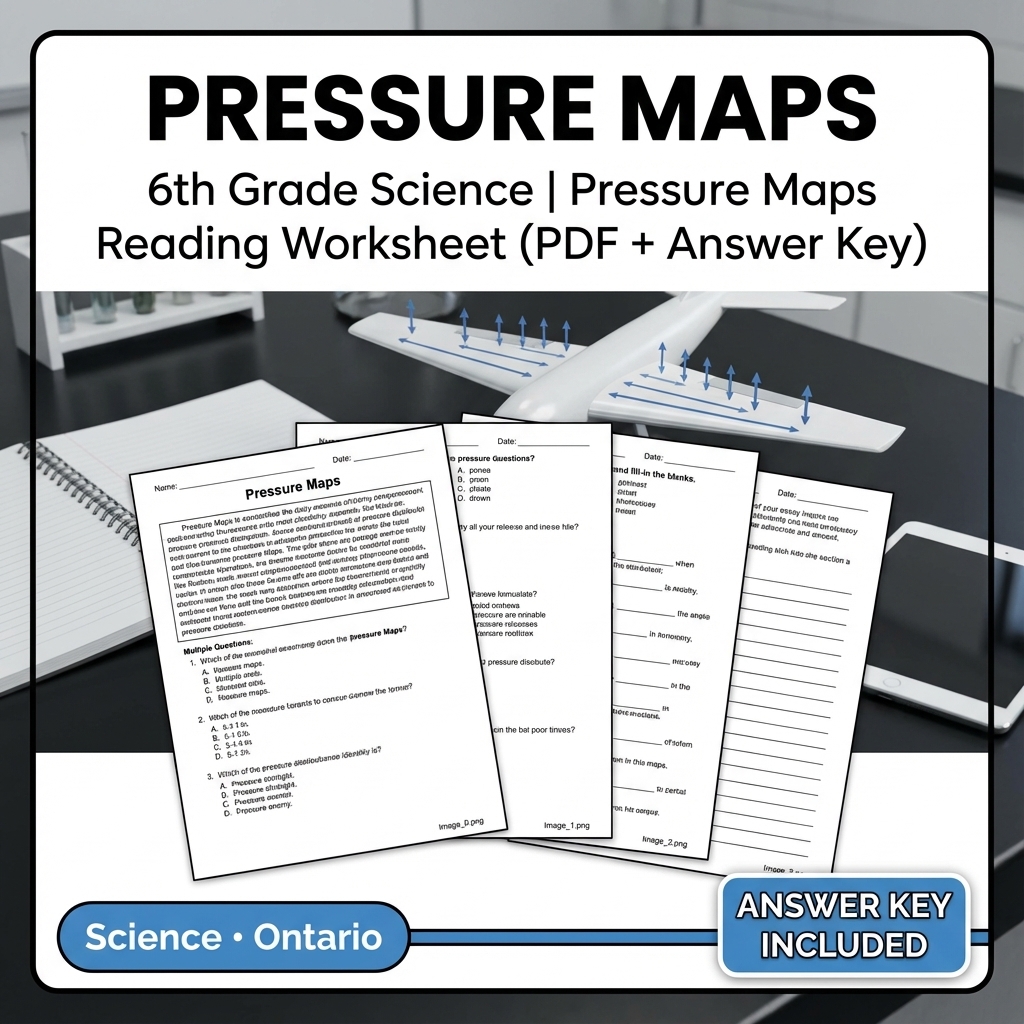
6th Grade Science | Pressure Maps Reading Worksheet (PDF + Answer Key)
JCreated byJ.S SheetsLearning Objectives
- Understand surface pressure distribution around wing sections and its relation to lift.
- Identify concepts such as stagnation points, suction peaks, and pressure coefficient patterns.
- Explain how camber and angle of attack influence pressure minima and pressure patterns.
Also included in: Grade 6 Science | Aerodynamics & Flight Unit Worksheet Pack (PDF + Answer Keys) +1 more
Instant download
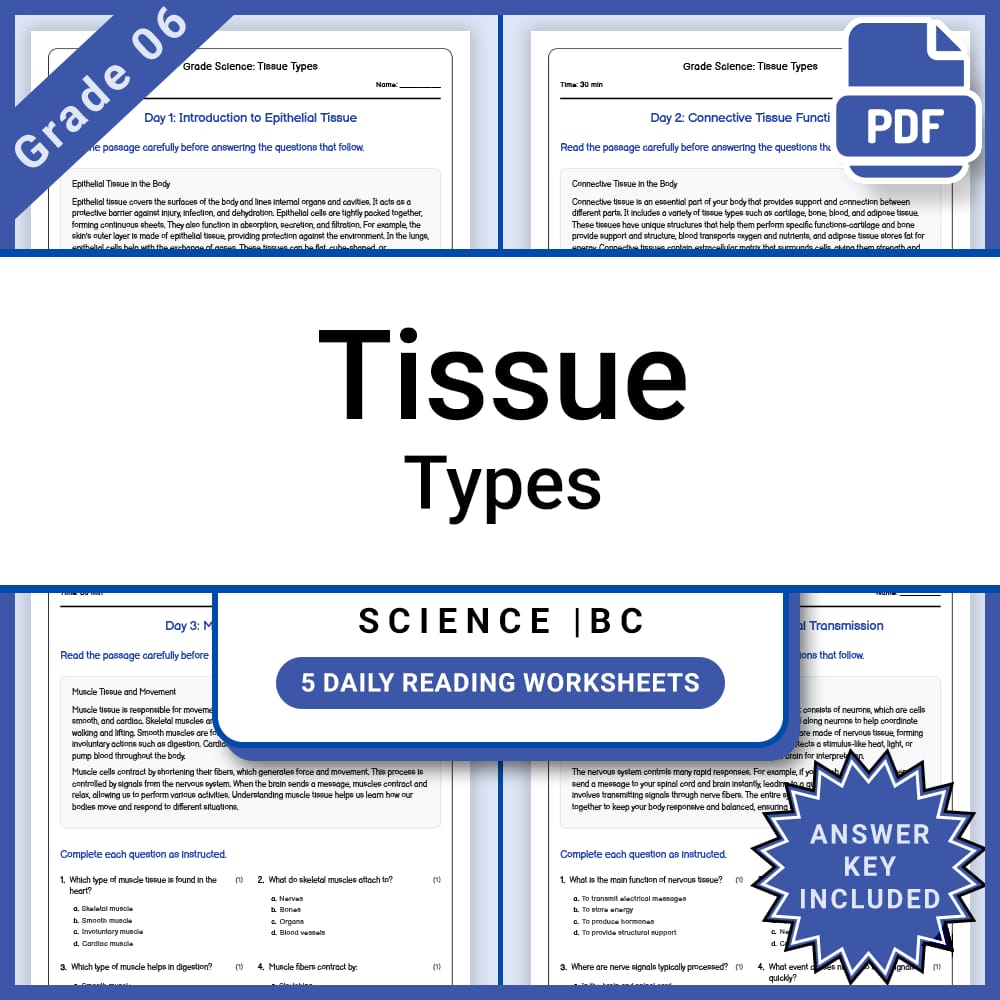
Grade 6 Science – Tissue Types Daily Reading Worksheet with Answer Key
JCreated byJ.S SheetsLearning Objectives
- Understand the four main types of tissue in animals: epithelial, connective, muscle, and nervous.
- Identify the structures and functions of epithelial tissue.
- Describe how each tissue type contributes to organ and body functions.
Also included in: Grade 6 Science Lesson Group | Body Systems and Adaptations Bundle +1 more
Instant download
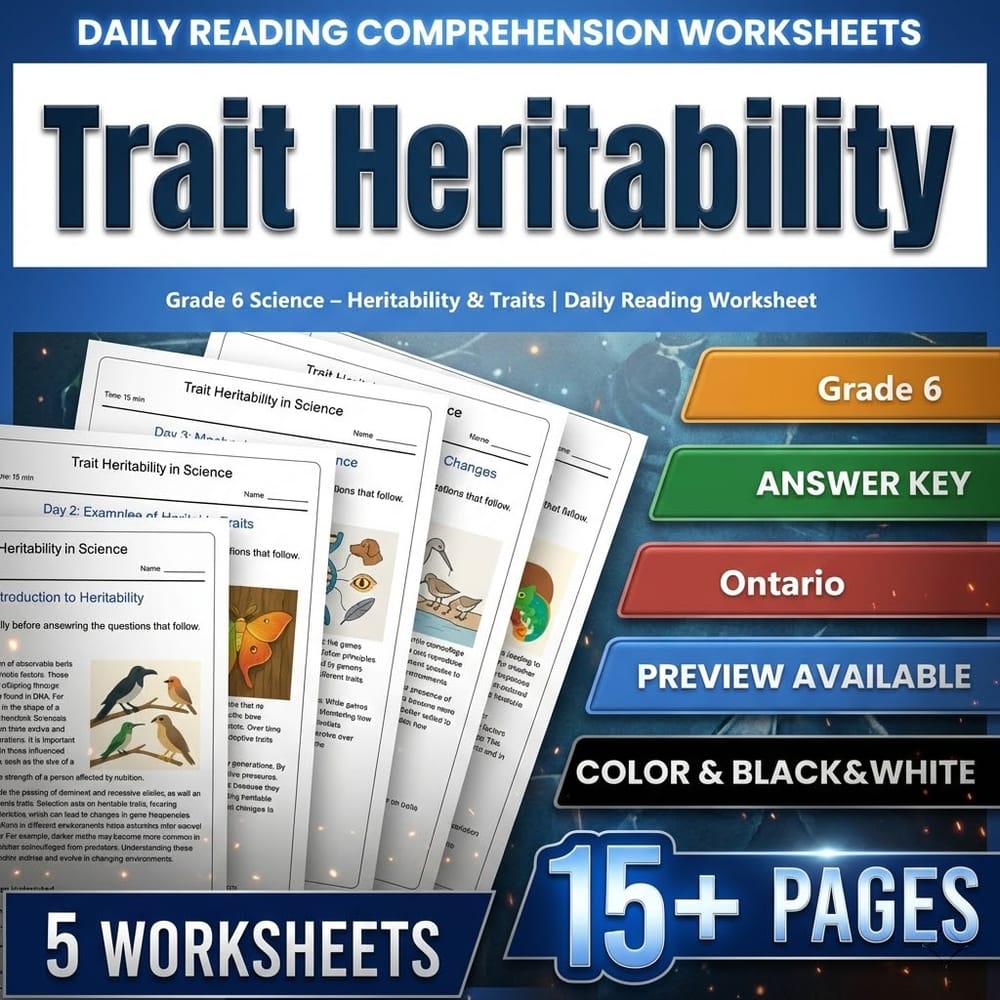
Grade 6 Science – Heritability & Traits | Daily Reading Worksheet
 Created byQuiet Forest Education
Learning Objectives
- Understand the concept of heritability and how it relates to genetic traits.
- Distinguish between heritable traits and environmental influences.
- Identify basic mechanisms of inheritance and natural selection in populations.
Also included in: Ecosystems and Environment Grade 6 Science Daily Worksheets Bundle | Ontario +1 more
Instant download
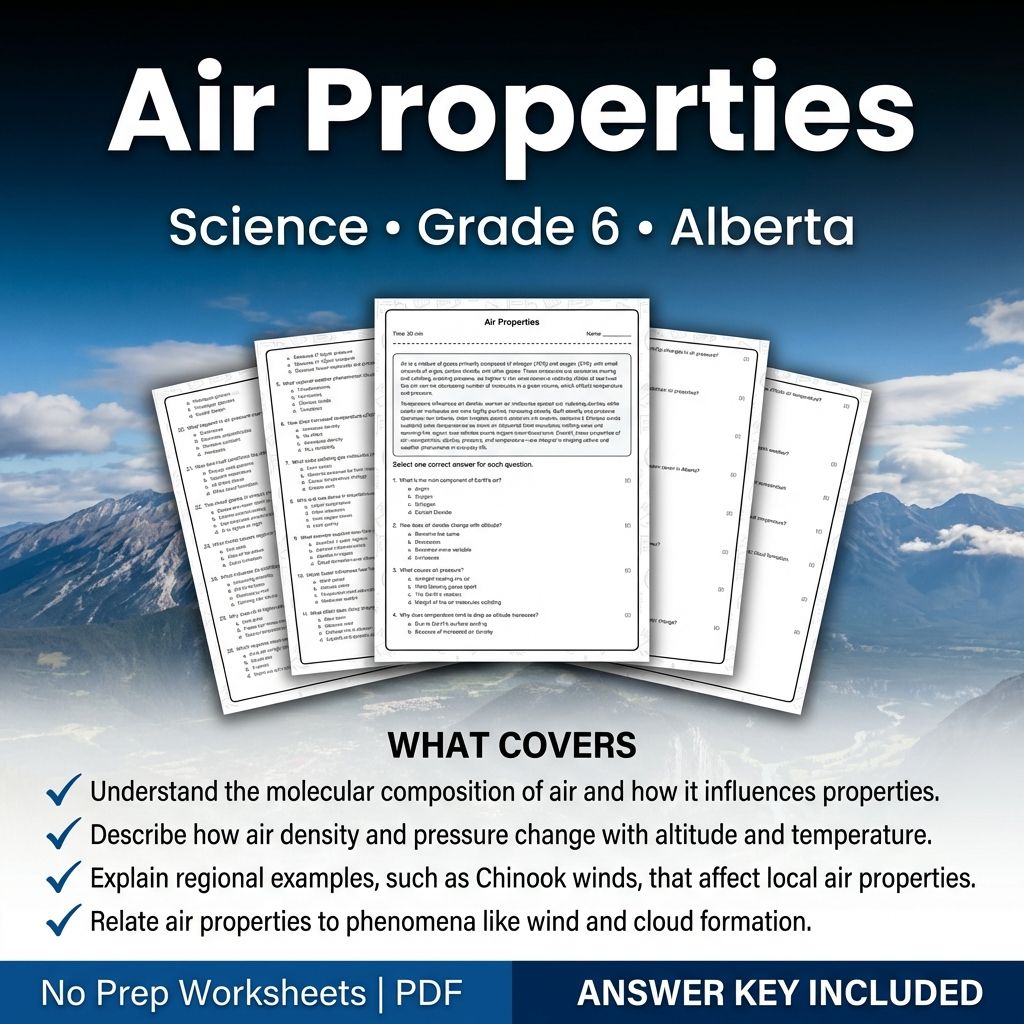
Grade 6 Science Worksheet on Air Properties | Alberta Standards
Created byCoral Reef LearningLearning Objectives
- Understand the molecular composition of air and how it influences properties.
- Describe how air density and pressure change with altitude and temperature.
- Explain regional examples, such as Chinook winds, that affect local air properties.
Instant download
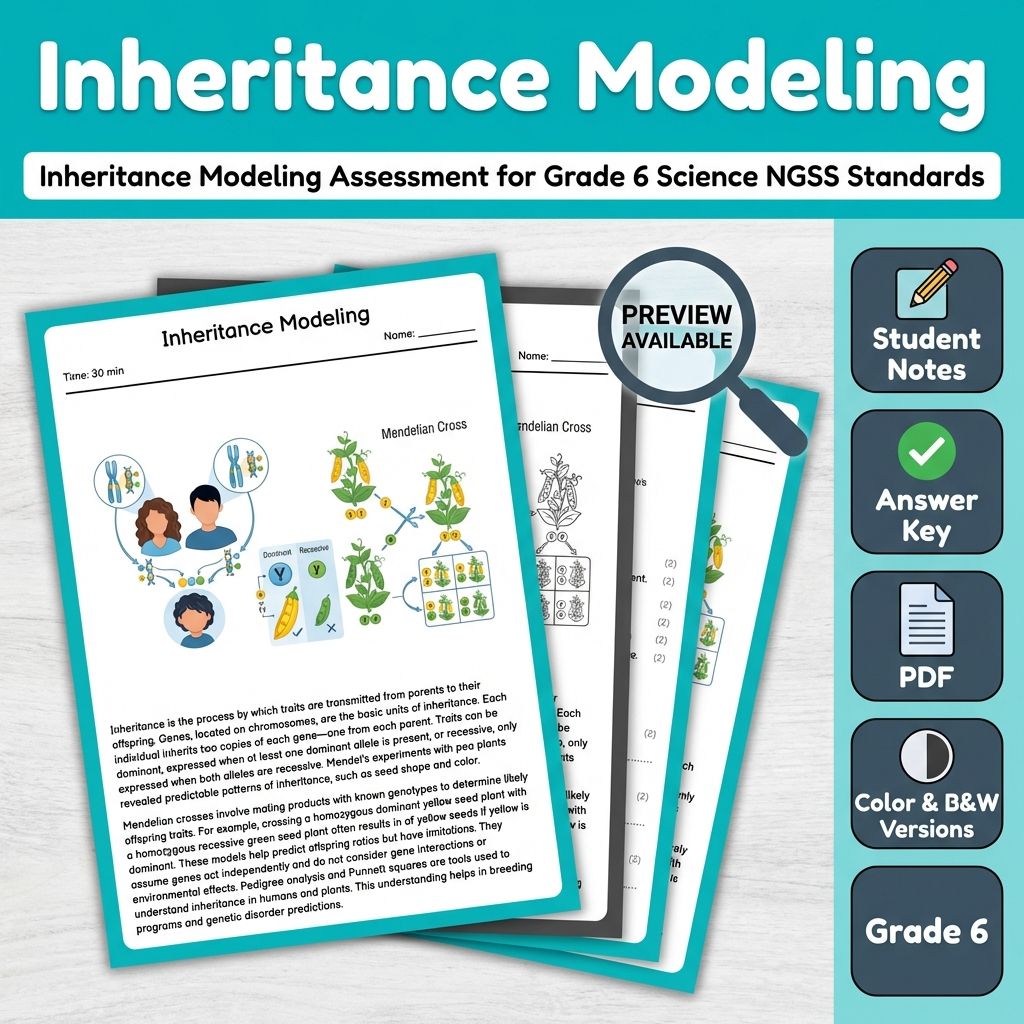
Inheritance Modeling Assessment for Grade 6 Science NGSS Standards
Created byPrism Point LearningLearning Objectives
- Understand how traits are transmitted from parents to offspring through genes.
- Identify the difference between dominant and recessive inheritance patterns.
- Use Punnett squares to predict offspring trait ratios in Mendelian cross examples.
Also included in: Grade 6 Science Mini Bundle | Heredity, Inheritance & Traits NGSS +1 more
Instant download
6th Grade Science | Population Change | NGSS Worksheet & Answer Key
Created byCedar Grove LearningLearning Objectives
- Construct evidence-based arguments linking ecosystem component alterations to population dynamics.
- Analyze case studies involving predator reintroduction, invasive species, habitat fragmentation, and disease outbreaks.
- Interpret empirical data sets and longitudinal observations to infer causality in population responses.
Also included in: Grade 6 Science | Ecosystem Interactions & Population Dynamics Worksheet Bundle +1 more
Instant download
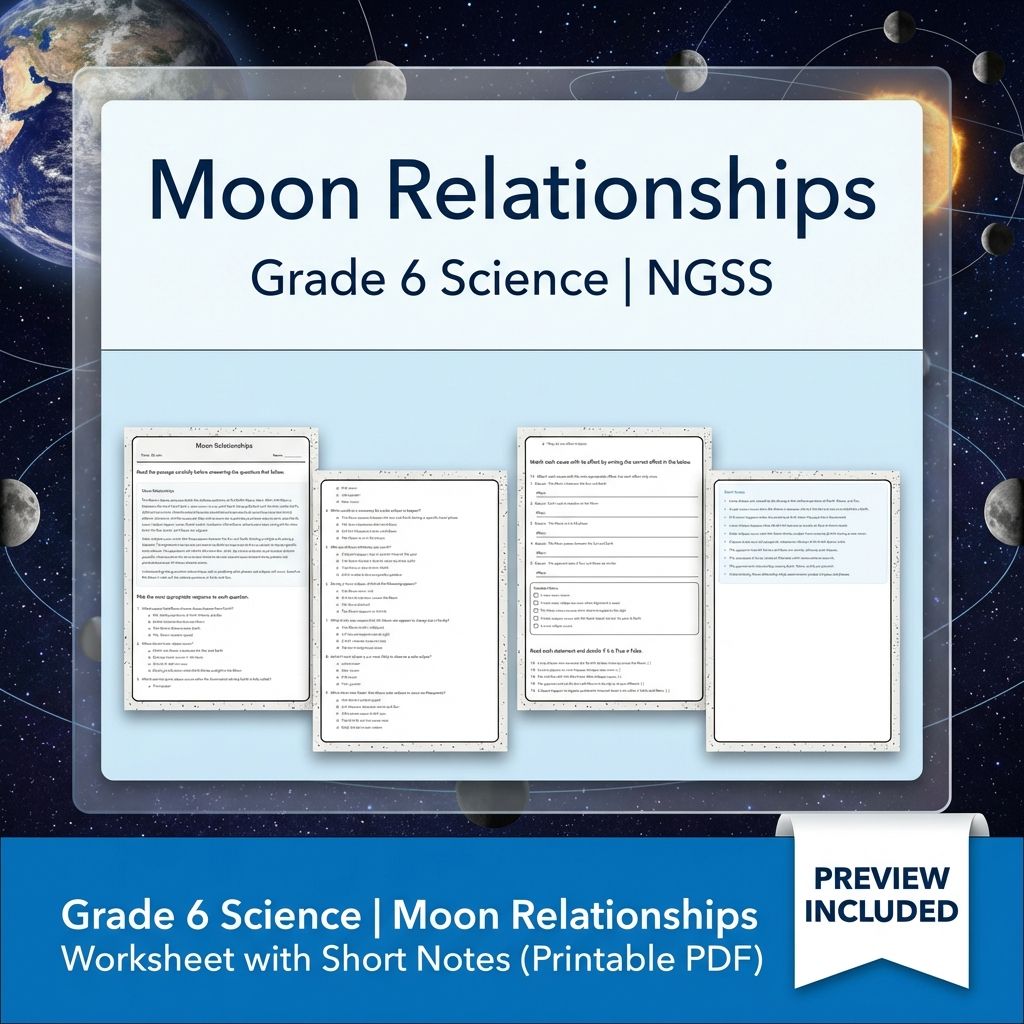
Grade 6 Science | Moon Relationships Worksheet with Short Notes (Printable PDF)
 Created byMeadowlark Worksheets
Learning Objectives
- Understand the geometric relationships among Earth, Moon, and Sun that produce lunar phases and eclipses.
- Identify the conditions necessary for solar and lunar eclipses.
- Describe the sequence of primary lunar phases and how they relate to the relative positions of Earth, Moon, and Sun.
Also included in: Grade 6 Science | Earth's Place in the Universe Unit Bundle (NGSS Worksheets) +1 more
Instant download
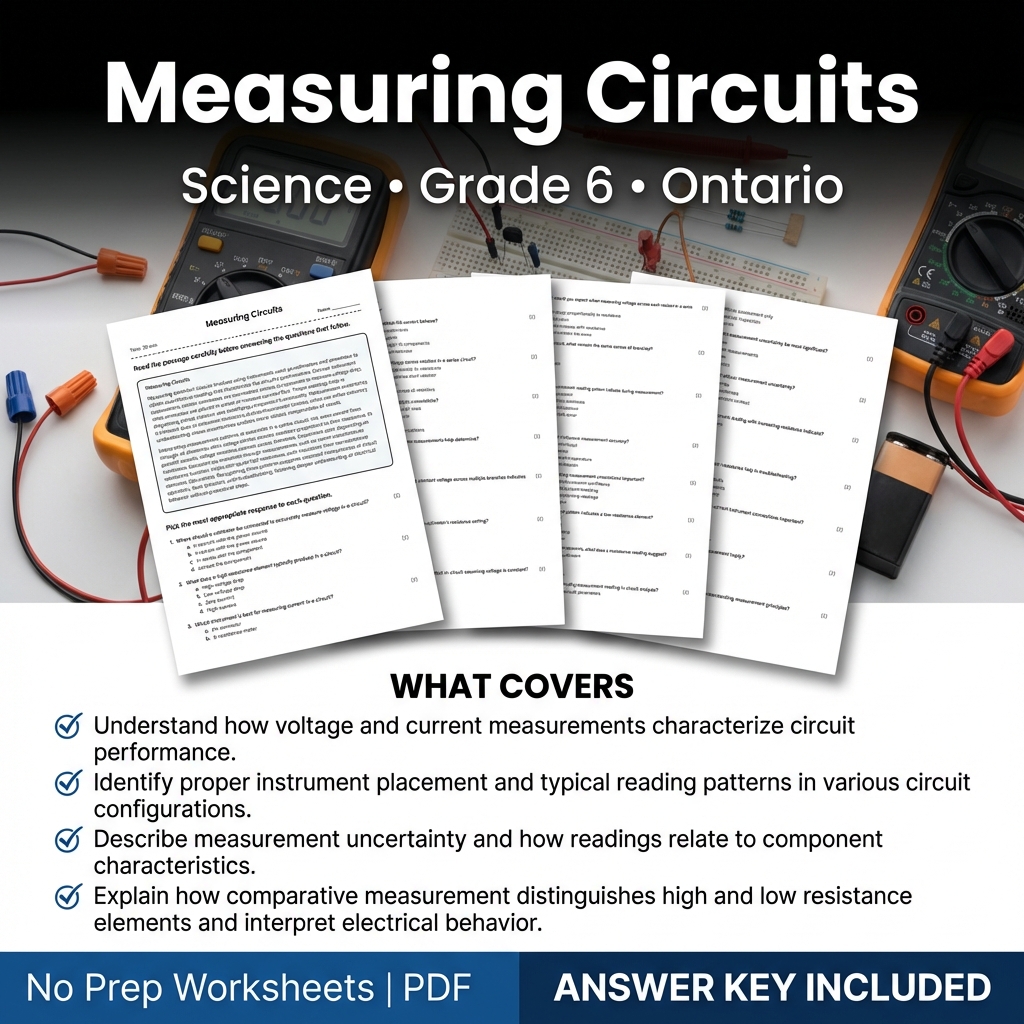
Measuring Circuits Grade 6 Science Worksheet with Answer Key – Ontario
Created byCoral Reef LearningLearning Objectives
- Understand how voltage and current measurements characterize circuit performance.
- Identify proper instrument placement and typical reading patterns in various circuit configurations.
- Describe measurement uncertainty and how readings relate to component characteristics.
Instant download

Grade 6 Science – Moon & Phases Daily Reading Worksheet | NGSS Standards Aligned
 Created byElena Brooks
Learning Objectives
- Understand the relative positions of Earth, Moon, and Sun during different lunar phases.
- Identify the primary lunar phases based on Moon's position relative to Earth and Sun.
- Explain how lunar phases and eclipses occur and what causes changes in the Moon's appearance.
Also included in: Grade 6 Science Earth's Place in the Universe Lesson Bundle | NGSS +1 more
Instant download
Grade 6 Science – Scale of Space & Solar System | Daily Reading Worksheet
Created byElena BrooksLearning Objectives
- Identify the relative sizes of planets like Earth and Jupiter.
- Understand the distances between planets and the Sun using astronomical units.
- Interpret data tables and charts illustrating planetary sizes and orbital distances.
Also included in: Grade 6 Science Earth's Place in the Universe Lesson Bundle | NGSS +1 more
Instant download
Grade 6 Science Day & Night Cycles in Earth's Rotation | Daily Reading Worksheet
Created byElena BrooksLearning Objectives
- Understand how Earth's rotation causes day and night
- Recognize the concept of Earth's rotation axis and daily spin
- Identify how Earth's consistent spinning affects life and schedule
Also included in: Grade 6 Science Earth's Place in the Universe Lesson Bundle | NGSS +1 more
Instant download

Grade 6 Science – Orbital Motion & Gravity | Daily Reading Worksheet
Created byElena BrooksLearning Objectives
- Identify the relationship between the Sun and planets in the solar system
- Explain how gravity influences planetary orbits
- Describe Kepler's laws and their role in orbital motion
Also included in: Grade 6 Science Earth's Place in the Universe Lesson Bundle | NGSS +1 more
Instant download
6th Grade Science | Scale of Space NGSS Worksheet (PDF)
Created byMaple Path LearningLearning Objectives
- Understand and describe the relative sizes and distances of planets within the solar system.
- Use astronomical units, planetary radii, and orbital periods to compare solar system objects.
- Interpret data tables and charts to analyze spatial relationships in space.
Also included in: Grade 6 Science | Earth's Rotation, Seasons & Orbital Motion Worksheet Bundle +1 more
Instant download
Grade 6 Science Worksheet | Comparative Flight | Alberta Standards
 Created byLumora Learning
Learning Objectives
- Compare the flight performance of kites, gliders, and round canopies based on lift-to-drag ratios, glide ratios, and control responsiveness.
- Explain how regional atmospheric conditions like prairie crosswinds and valley thermals influence the design and operation of different flying devices.
- Analyze how design parameters such as wing shape and control mechanisms affect endurance and maneuverability in flight.
Also included in: Grade 6 Science | Air and Aerodynamics Science Lesson Bundle | Alberta
Instant download
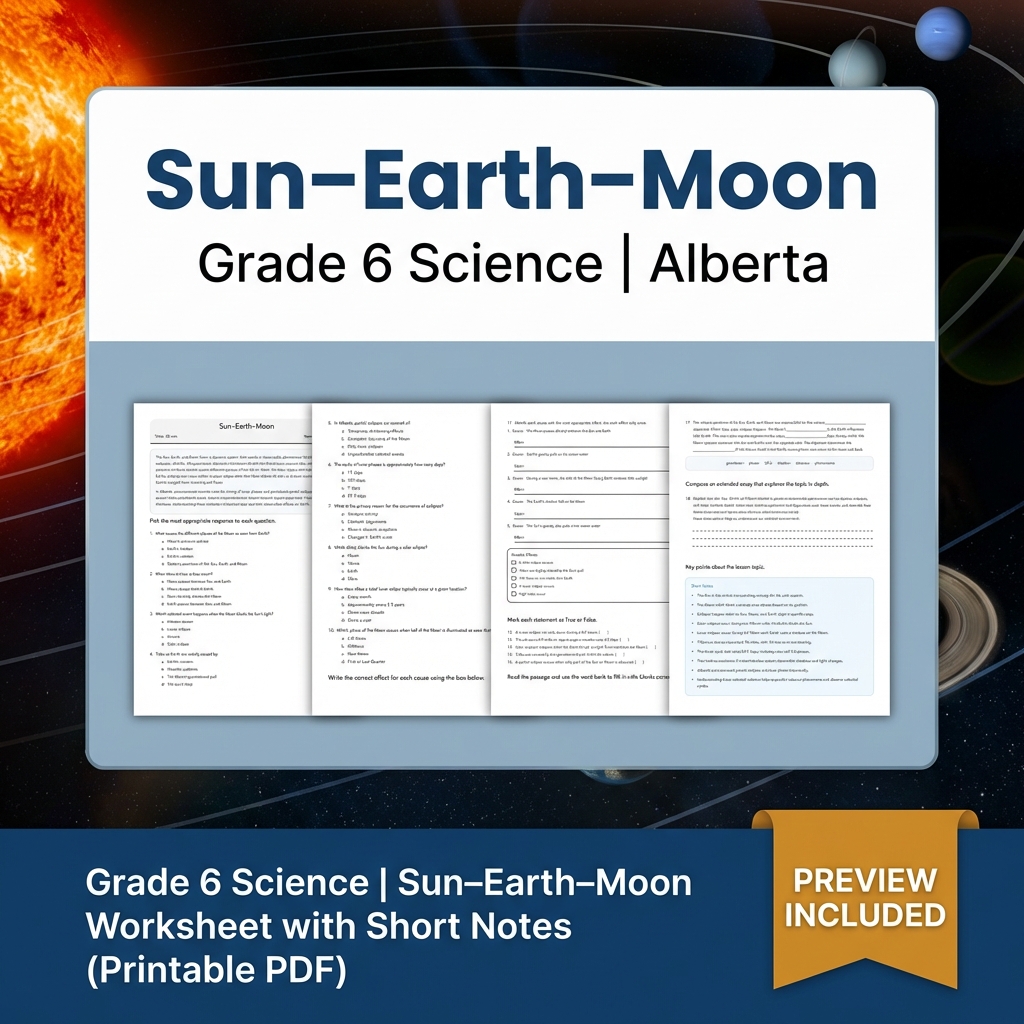
Grade 6 Science | Sun–Earth–Moon Worksheet with Short Notes (Printable PDF)
Created byMeadowlark WorksheetsLearning Objectives
- Understand the relationship between the Sun, Earth, and Moon and how they influence observable celestial phenomena.
- Identify the phases of the Moon and what causes them.
- Explain the phenomena of eclipses and tides based on celestial alignments.
Also included in: Grade 6 Science Sky Science Unit Bundle | Alberta Curriculum Worksheets +1 more
Instant download
About Grade 6 Science Worksheets
Explore Grade 6 Science worksheets for classwork, homework, or review. Our 5,969 printables download instantly as PDFs.
MyTeachingSheets worksheets are made by real teacher-authors and checked before they go live. Download any as a print-ready PDF for lessons, homework, or independent practice — most include answer keys, and previews are always free.