
Grade 6 Science Worksheets
5,969 worksheets
Grade 6 Science – Human Land Impacts | Daily Reading Worksheet + Answer Key
JCreated byJ.S SheetsLearning Objectives
- Understand how land clearing affects habitats and biodiversity
- Identify the consequences of deforestation on ecosystems
- Recognize ways to reduce the negative impacts of land clearing
Also included in: Grade 6 Science Lesson Group Bundle on Ecosystems and Ecology +1 more
Instant download

Science Grade 6 Wind Tunnel Measurements Worksheet | Standards-Aligned Practice
JCreated byJ.S SheetsLearning Objectives
- Explain how wind tunnels measure aerodynamic forces and moments on scaled models.
- Describe how similarity parameters (Reynolds number and Mach number) affect wind-tunnel testing.
- Use measured forces to calculate lift and drag coefficients and interpret flow visualization results.
Instant download
6th Grade Science – Biodiversity Patterns Worksheet (Ontario) PDF
 Created byBright Mind Resources
Learning Objectives
- Understand measures of biodiversity such as species richness, abundance, and evenness.
- Identify sampling methods like transects and quadrats used in ecological surveys.
- Interpret spatial patterns in biodiversity and their implications for ecosystem health.
Instant download

Grade 6 Science – Interpreting Distance-Time Graphs | Daily Reading Worksheet
Created byBright Mind ResourcesLearning Objectives
- Explain the purpose of distance-time graphs in studying motion.
- Interpret patterns and data points on distance-time graphs.
- Differentiate between raw observations and inferred information from graphs.
Also included in: Grade 6 Science Inquiry & Modeling Daily Reading Lesson Bundle | TEKS +2 more
Instant download

Grade 6 Science – Hydrologic Cycle & Water Movement | Daily Reading Worksheet
Created byBright Mind ResourcesLearning Objectives
- Understand the basic processes of the hydrologic cycle, including evaporation, condensation, precipitation, runoff, infiltration, and groundwater discharge.
- Identify surface and groundwater interaction within watersheds.
- Recognize the importance of water movement in landscape evolution and resource sustainability.
Also included in: Grade 6 Earth and Space Science Lesson Bundle Daily Reading | TEKS +2 more
Instant download
Grade 6 Science – Classification Basics Daily Reading Worksheet + Answer Key
JCreated byJ.S SheetsLearning Objectives
- Understand hierarchical classification from kingdom to species.
- Identify observable traits used to group living organisms.
- Learn how dichotomous keys assist in identifying species.
Also included in: Grade 6 Science Biodiversity Lesson Bundle – Ecosystems and Conservation +1 more
Instant download
Grade 6 Science | Sun Earth Moon Worksheet (Ontario Standard) (PDF)
Created byBright Mind ResourcesLearning Objectives
- Describe the relative sizes, masses, and distances among the Sun, Earth, and Moon.
- Explain how gravitational interactions determine the orbital relationships in the Sun-Earth-Moon system.
- Understand the concept of the Earth–Moon barycenter and the Sun's role as the dominant gravitational influence.
Instant download
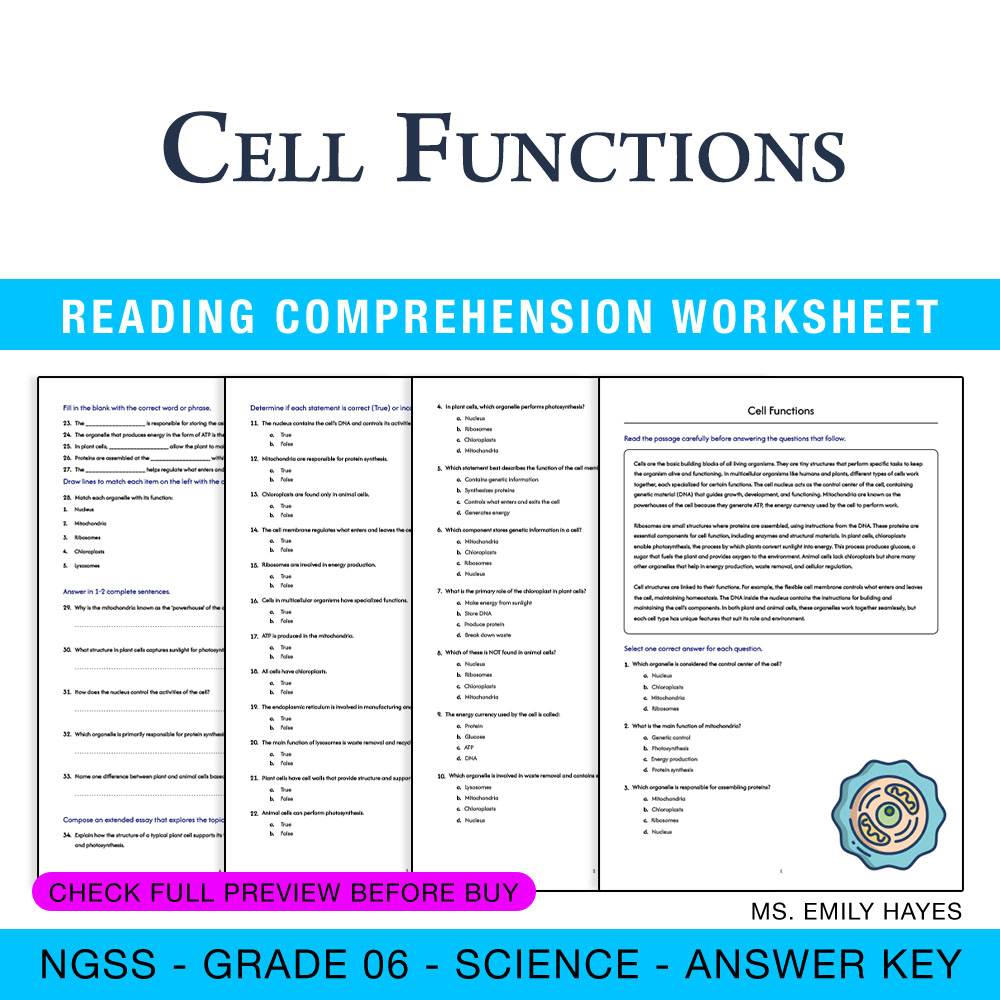
6th Grade Science | Cell Functions Worksheet (PDF + Answer Key)
 Created byCopper Leaf Classroom
Learning Objectives
- Identify the functions of key cell organelles such as the nucleus, mitochondria, ribosomes, and chloroplasts.
- Describe how cell structure relates to its function in plant and animal cells.
- Explain the role of the nucleus in genetic control and protein synthesis.
Instant download
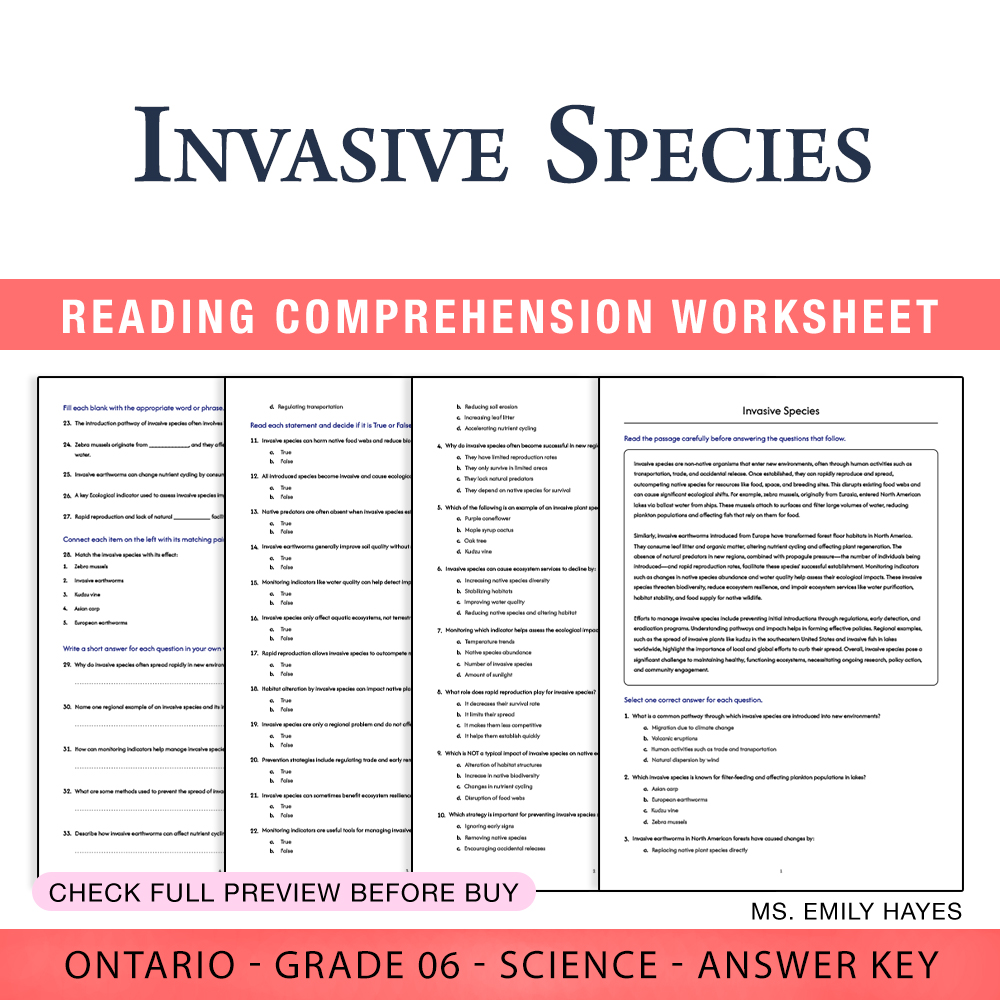
6th Grade Science | Invasive Species Worksheet (PDF+ Answer Key)
Created byCopper Leaf ClassroomLearning Objectives
- Understand what invasive species are and how they affect native ecosystems.
- Identify pathways through which invasive species are introduced.
- Explain the ecological impacts of invasive species such as competition, predation, and habitat changes.
Instant download

Forces and Motion Net Force and Mass Worksheet | NGSS Grade 6 Science
 Created bySkylark Worksheets
Learning Objectives
- Explain how net force (the vector sum of forces) affects an object's motion.
- Use the relationship net force = mass × acceleration to predict changes in motion.
- Distinguish between balanced and unbalanced forces using real-world scenarios.
Also included in: Forces, Motion, and Interactions Grade 6 Science Lesson Bundle NGSS +1 more
Instant download

Sampling Methods Worksheet | Standards-Aligned Grade 6 Science Assessment
JCreated byJ.S SheetsLearning Objectives
- Understand different sampling methods used in ecological surveys.
- Identify advantages and limitations of random, stratified, and systematic sampling.
- Apply sampling concepts to real-world examples such as prairie vegetation surveys and river studies.
Instant download
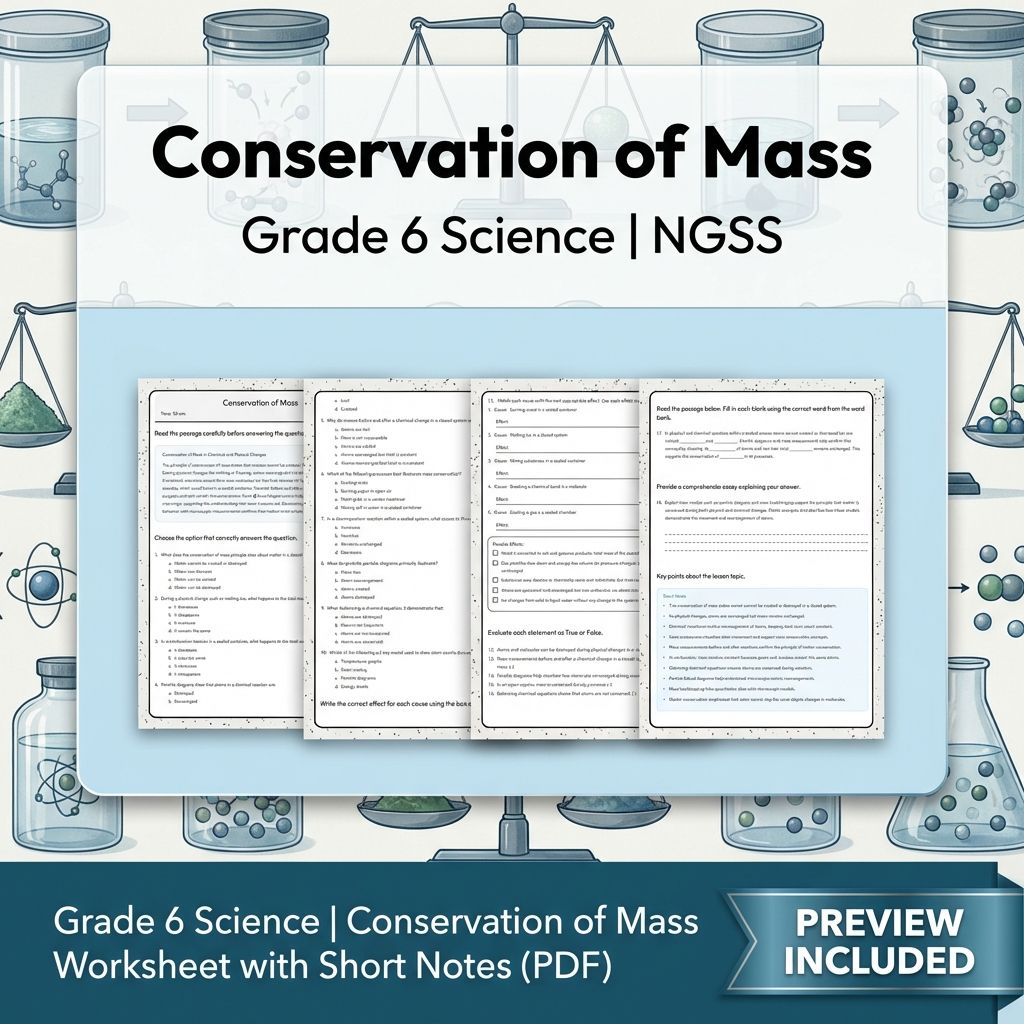
Grade 6 Science | Conservation of Mass Worksheet with Short Notes (PDF)
 Created byMeadowlark Worksheets
Learning Objectives
- Understand how matter is conserved during physical and chemical changes.
- Trace atoms and mass through various reactions and processes.
- Use models and diagrams to illustrate conservation of matter.
Also included in: Grade 6 Science | Matter and Its Interactions NGSS UNIT Bundle (Collection) +1 more
Instant download
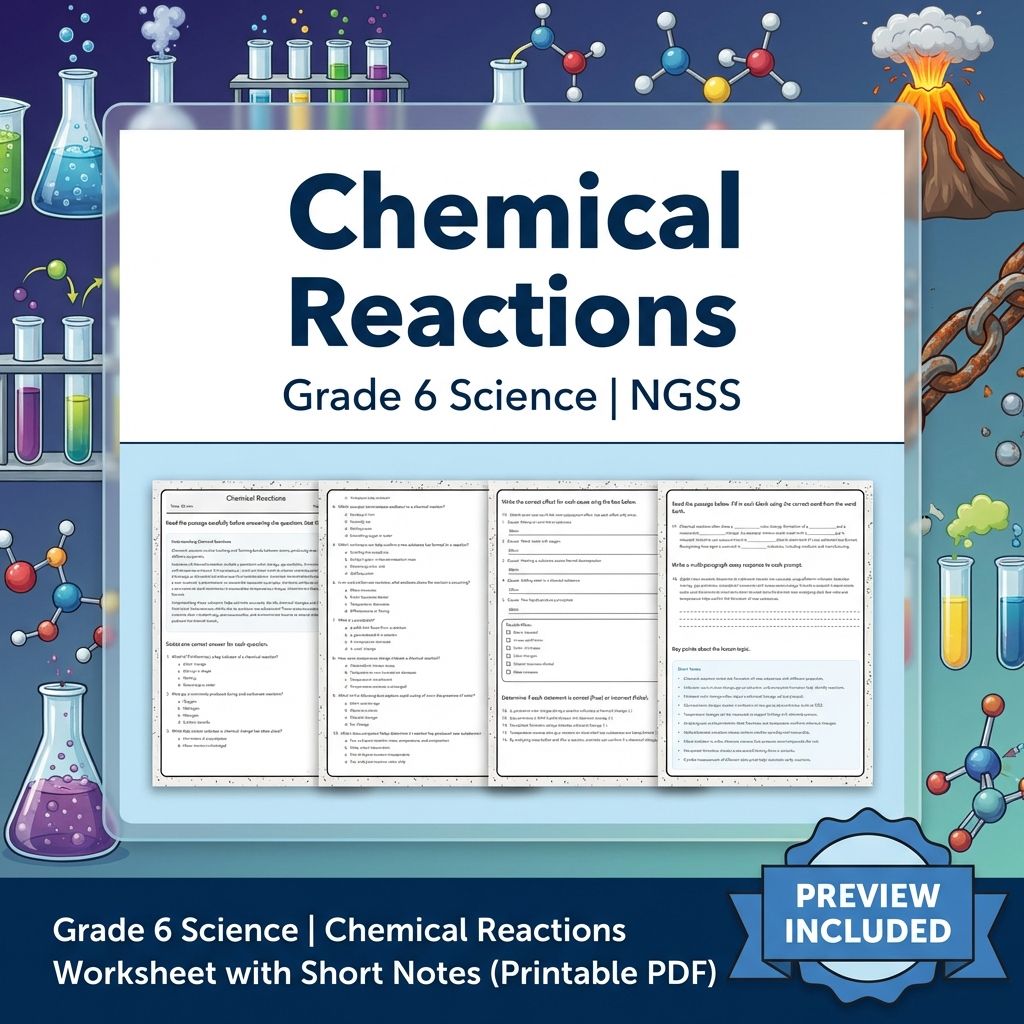
Grade 6 Science | Chemical Reactions Worksheet with Short Notes (Printable PDF)
Created byMeadowlark WorksheetsLearning Objectives
- Identify key indicators that signify a chemical reaction through analysis of qualitative and quantitative data.
- Interpret changes such as color, gas production, temperature, and precipitate formation to determine if a chemical reaction has occurred.
- Examine specific examples like acid–carbonate reactions and metal oxidation to understand how to analyze pre- and post-interaction measurements.
Also included in: Grade 6 Science | Matter and Its Interactions NGSS UNIT Bundle (Collection) +1 more
Instant download
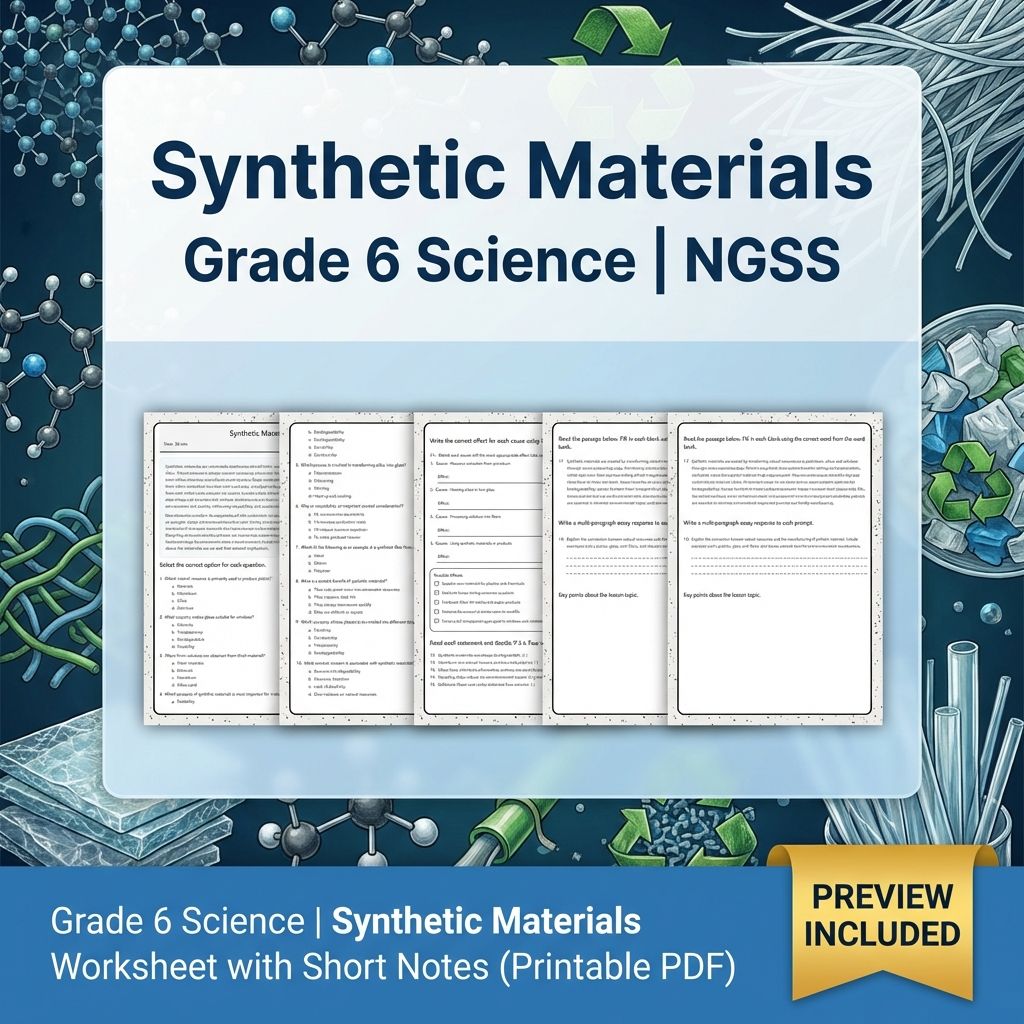
Grade 6 Science | Synthetic Materials Worksheet with Short Notes (Printable PDF)
Created byMeadowlark WorksheetsLearning Objectives
- Understand how natural resources are connected to synthetic materials.
- Compare properties of substances used for specific purposes.
- Explain the processes involved in resource extraction and manufacturing.
Also included in: Grade 6 Science | Matter and Its Interactions NGSS UNIT Bundle (Collection) +1 more
Instant download
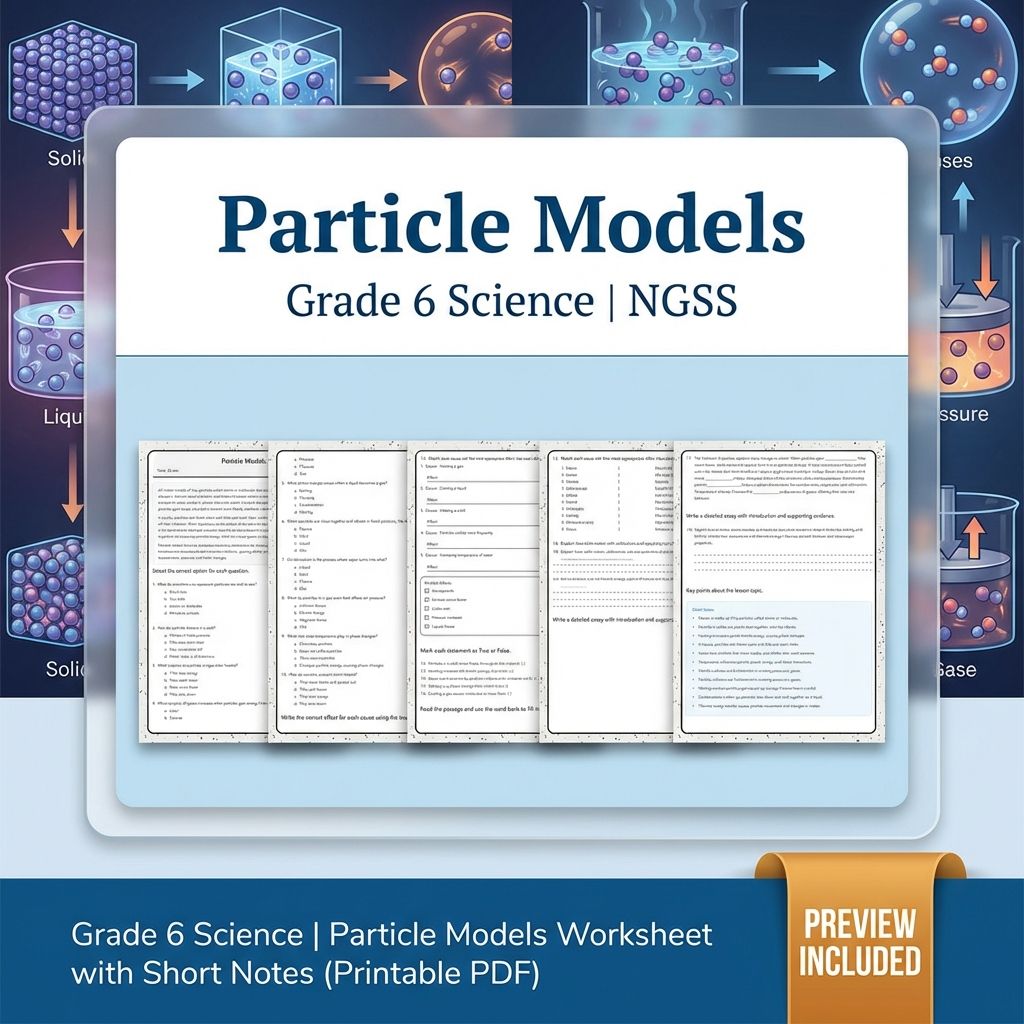
Grade 6 Science | Particle Models Worksheet with Short Notes (Printable PDF)
Created byMeadowlark WorksheetsLearning Objectives
- Explain that matter is made up of tiny particles too small to see directly.
- Describe how particle motion and collisions relate to different states of matter.
- Identify how temperature affects particle energy and state changes.
Also included in: Grade 6 Science | Matter and Its Interactions NGSS UNIT Bundle (Collection) +1 more
Instant download
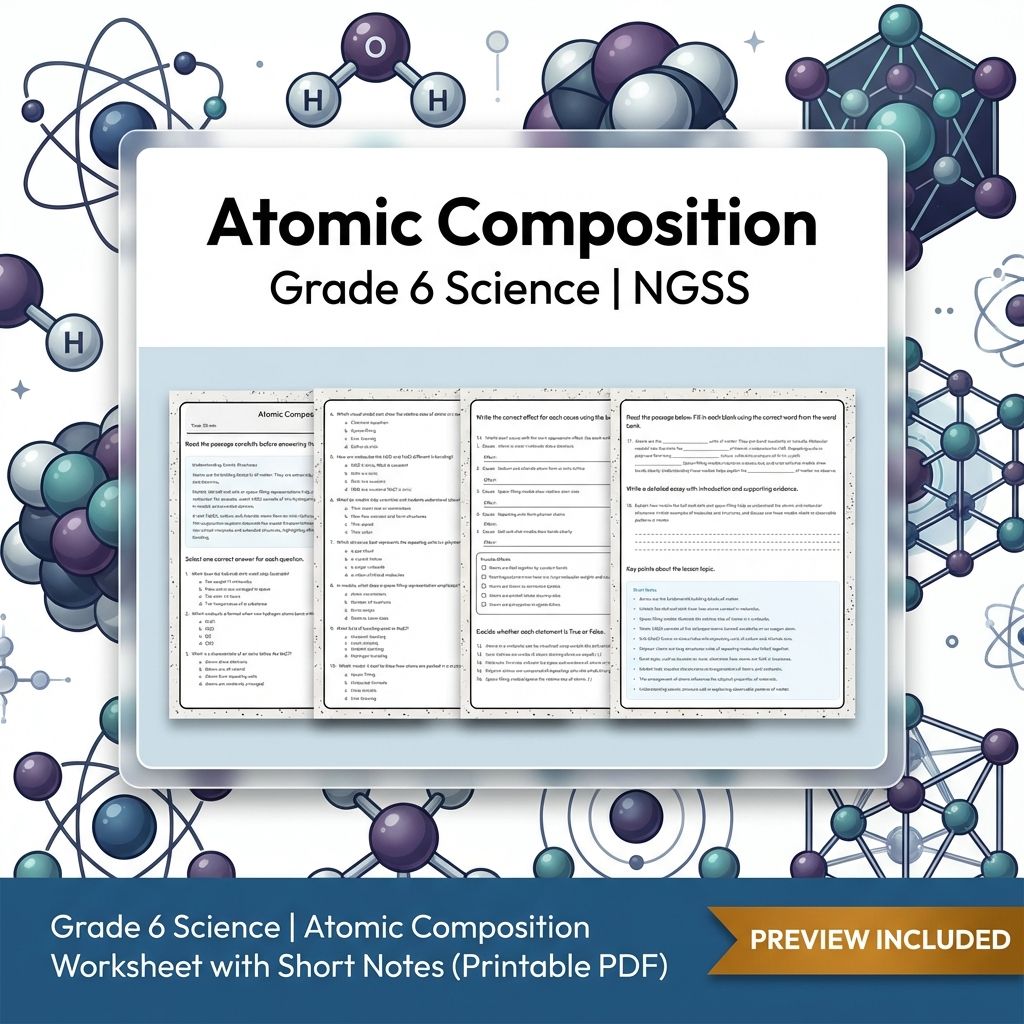
Grade 6 Science | Atomic Composition Worksheet with Short Notes (Printable PDF)
Created byMeadowlark WorksheetsLearning Objectives
- Describe models used to represent simple molecules and extended structures.
- Identify how atoms combine to form molecules like H2O and NaCl.
- Explain the concepts of polymer chains and ionic lattices using visual models.
Also included in: Grade 6 Science | Matter and Its Interactions NGSS UNIT Bundle (Collection) +1 more
Instant download
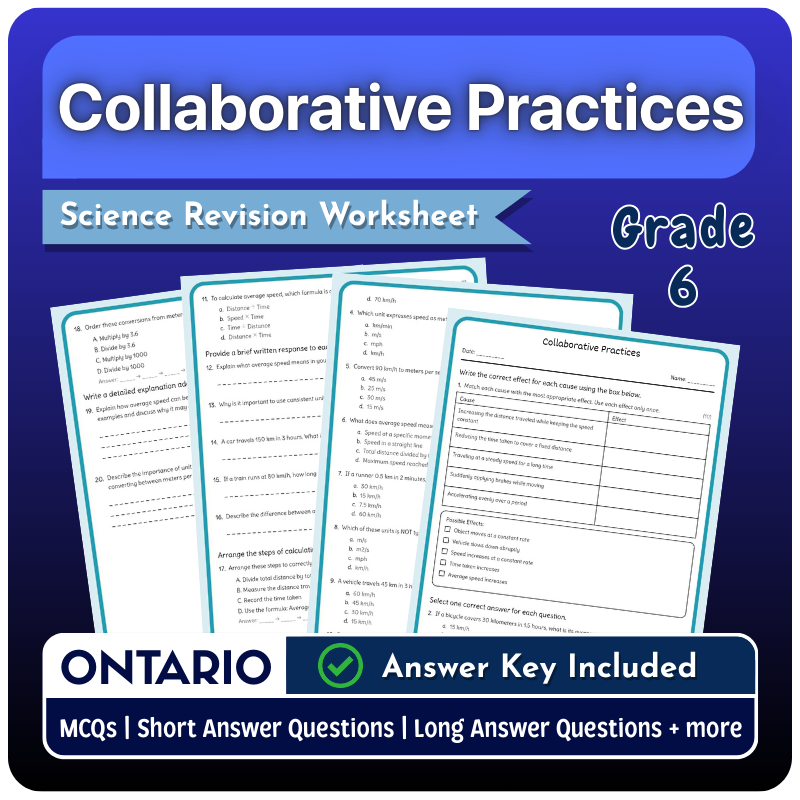
6th Grade Science | Collaborative Practices Worksheet (Ontario PDF)
Created byBright Mind ResourcesLearning Objectives
- Understand principles of team-based organization and communication in scientific projects.
- Identify protocols for versioning, attribution, and peer review to ensure transparency.
- Recognize the importance of diverse perspectives and standardized reporting in collaboration.
Instant download

Grade 6 Energy Transformations Worksheet | NGSS Practice & PDF
 Created byClear Sky Classroom
Learning Objectives
- Explain how energy can change forms (stored, kinetic, thermal, light) while total energy remains conserved
- Use evidence from observations (motion, temperature, brightness) to identify energy transformations
- Describe energy flow in real-world examples such as falling objects, friction, and electrical circuits
Instant download
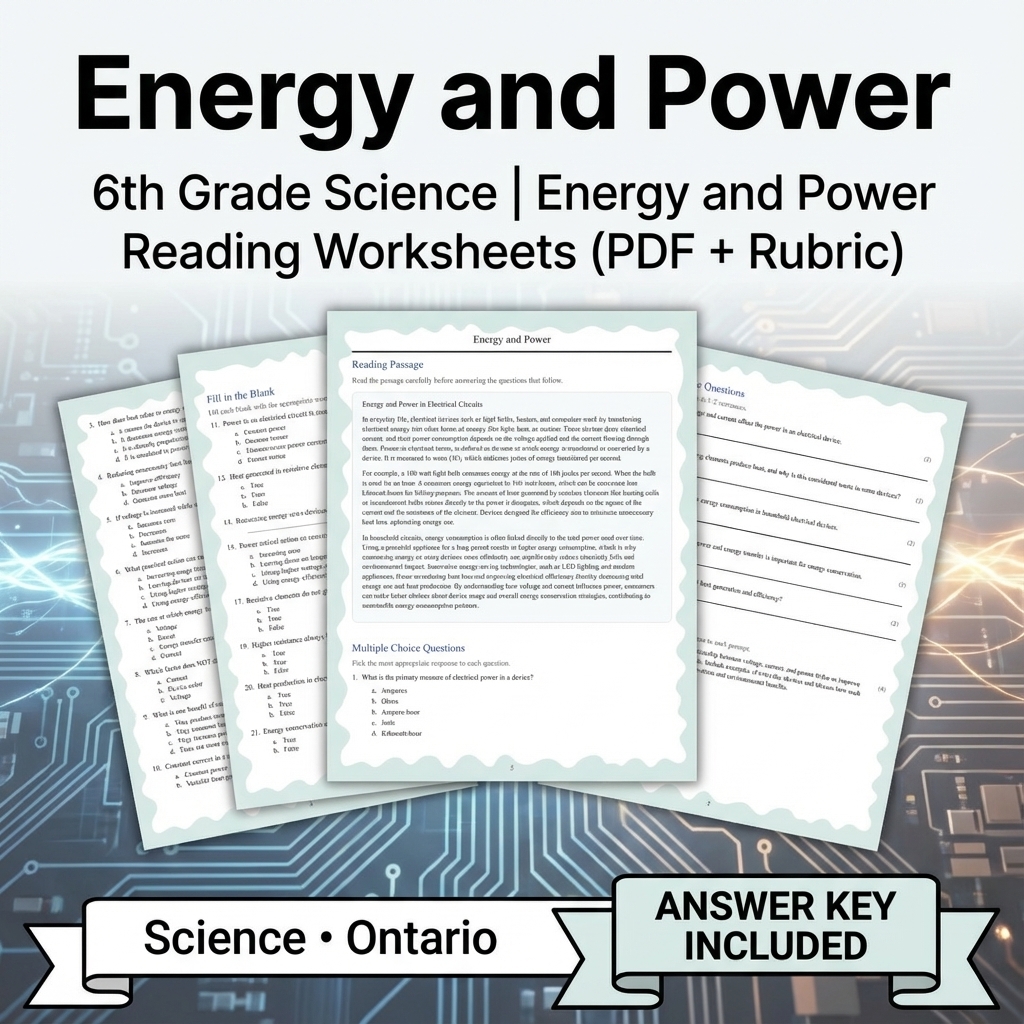
6th Grade Science | Energy and Power Reading Worksheets (PDF + Rubric)
JCreated byJ.S SheetsLearning Objectives
- Explain the concept of electrical power as the rate of energy transfer in circuits.
- Connect power dissipation in resistive elements to voltage and current relationships.
- Describe everyday examples of energy transfer and power use, such as lighting and heating.
Also included in: Grade 6 Science Circuit & Electricity Unit Bundle – Worksheets & Answer Keys +1 more
Instant download
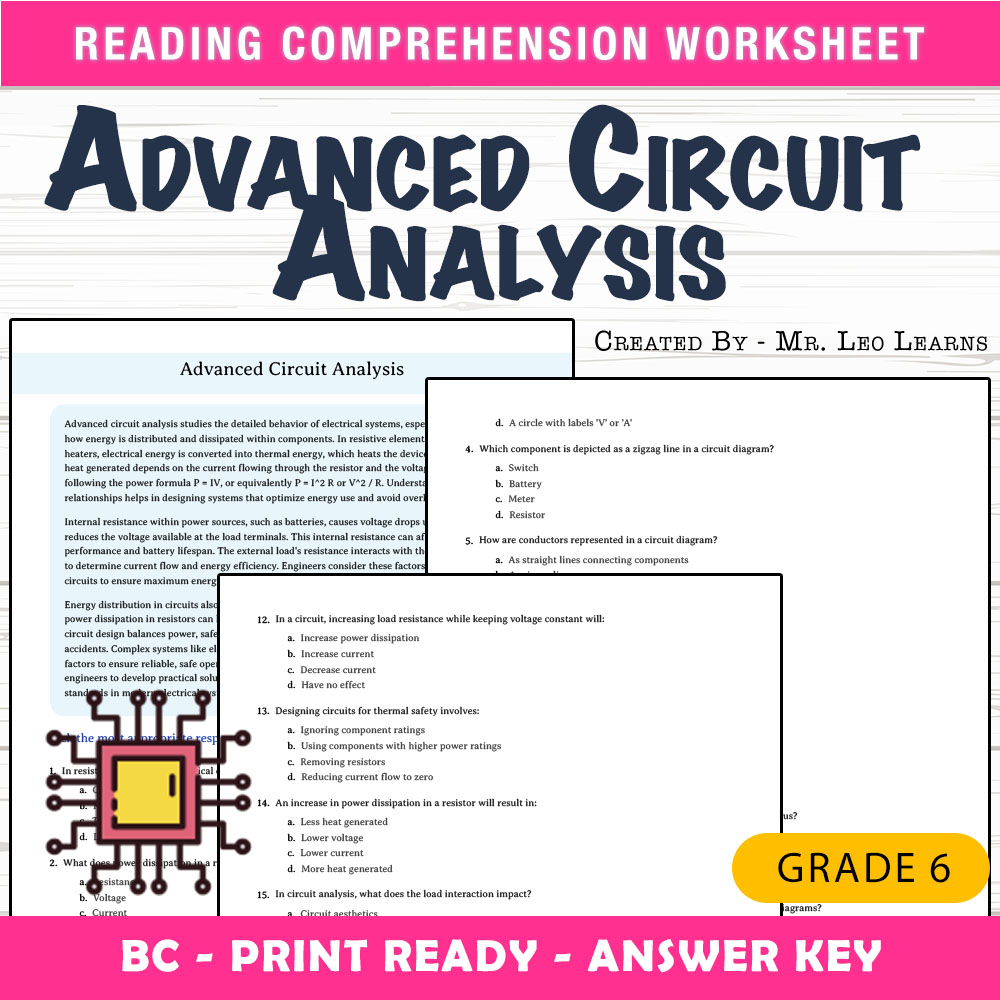
Grade 6 Science — Worksheet MCQ Paper for Mastering Circuit Analysis
 Created byThe Resource Hub
Learning Objectives
- Understand how power dissipation in resistors affects thermal energy generation.
- Analyze the impact of internal resistance on battery voltage supply under load.
- Explain the relationship between circuit design, energy delivery, and safety considerations.
Also included in: Grade 6 Science Energy, Waves & Circuits UNIT Bundle | BC Standards +1 more
Instant download
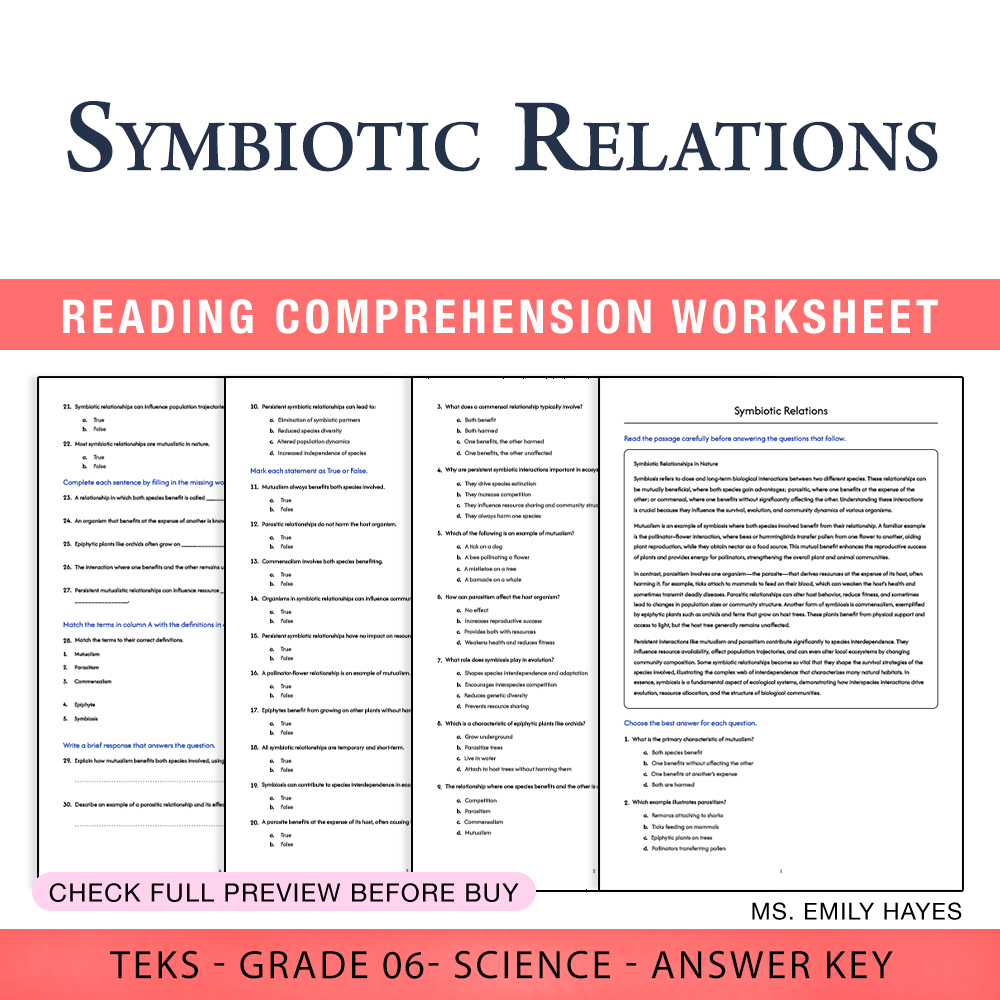
6th Grade Science | Symbiotic Relations Worksheet (PDF+ Answer Key)
Created byCopper Leaf ClassroomLearning Objectives
- Describe different types of symbiotic relationships such as mutualism, commensalism, and parasitism.
- Categorize real-world examples of organism interactions according to their symbiotic type.
- Explain how symbiotic relationships influence organism fitness, resource distribution, and community structure.
Instant download
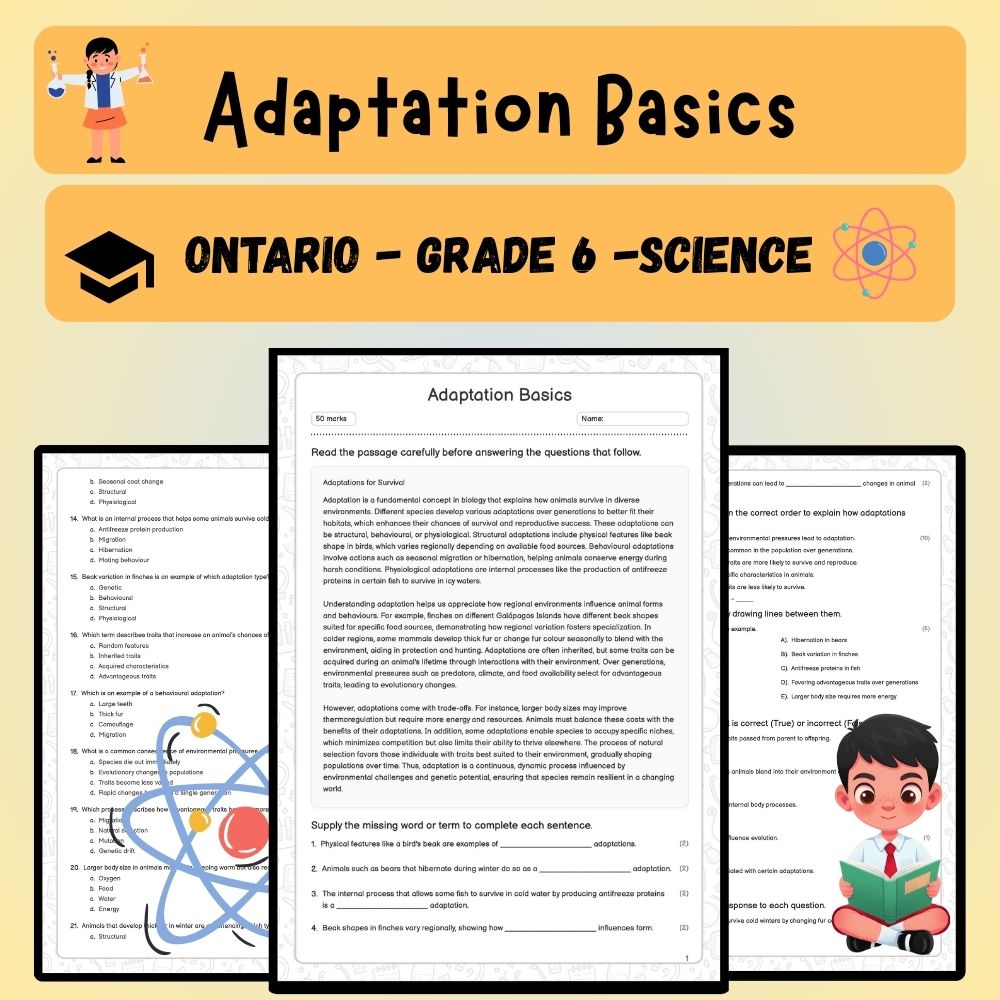
6th Grade Science | Adaptation Basics Worksheet (PDF) – Ontario Standards
 Created byPrism Point Learning
Learning Objectives
- Understand the different types of animal adaptations: structural, behavioural, and physiological.
- Identify regional examples of adaptations such as beak variation, seasonal coat colour change, and hibernation.
- Explain how adaptations help animals survive, reproduce, and occupy specific ecological niches.
Also included in: Grade 6 Science Unit Bundle – Ecology, Classification & Environment
Instant download

Variation Factors Test Prep Printable | Grade 6 Science
Created byPrism Point LearningLearning Objectives
- Explain how genetic differences and environmental factors both contribute to observable variation.
- Use examples to describe how inherited alleles and environmental conditions can interact to affect phenotypes.
- Identify limits of genetic explanations for traits that change with the environment.
Also included in: Grade 6 Inheritance and Variation Science Test Prep Lesson Bundle NGSS
Instant download
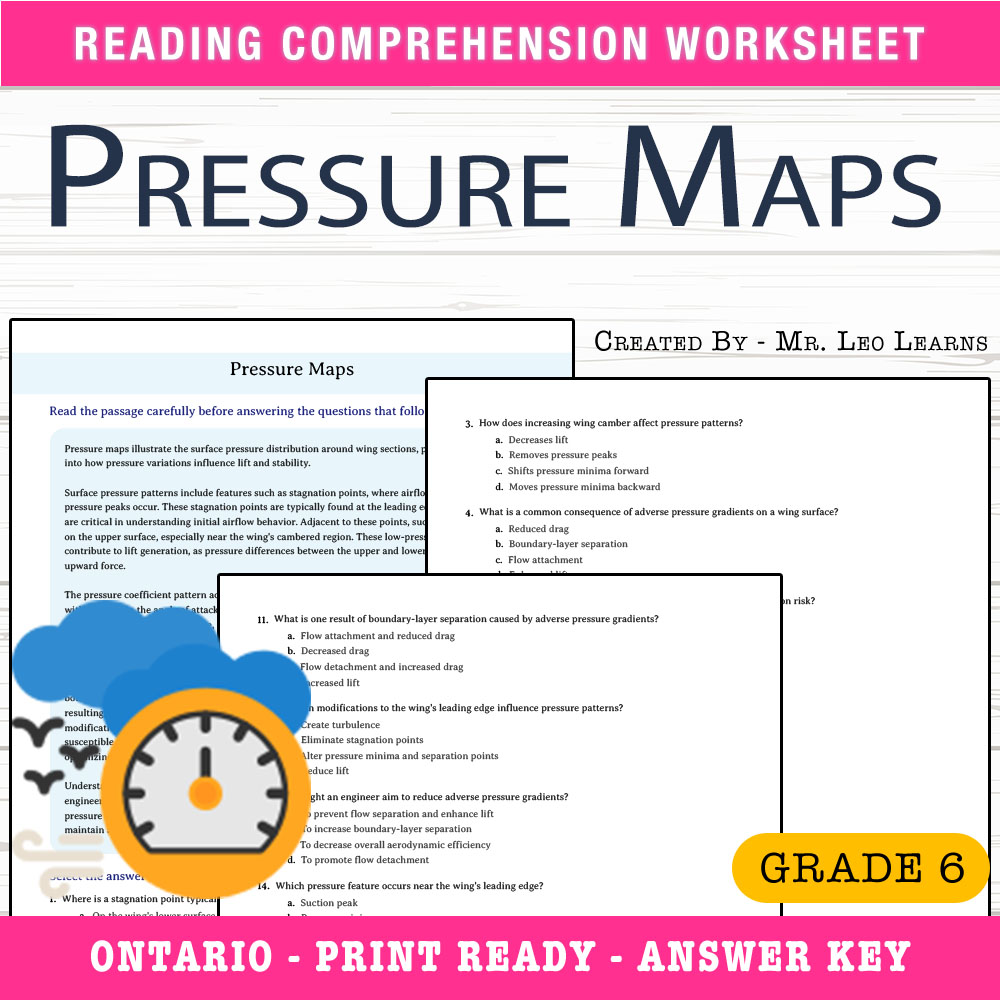
Grade 6 Science — Pressure Maps Worksheet for Mastering Surface Pressure
Created byThe Resource HubLearning Objectives
- Understand the concept of surface pressure distribution around wing sections.
- Explain how pressure variations such as stagnation points and suction peaks affect lift and pitching moments.
- Describe how camber and angle of attack influence pressure minima and pressure patterns.
Also included in: Grade 6 Science | Aerodynamics & Engineering Unit Workbook (Worksheet Pack) +1 more
Instant download

Stewardship Practices Worksheet | Grade 6 Science Assessment
Created byPrism Point LearningLearning Objectives
- Describe key stewardship practices used to care for forests and land in Alberta (e.g., shelterbelts, planting, urban canopy programs, and restoration).
- Explain how stewardship actions help ecosystems by supporting habitat, reducing erosion, and regulating water.
- Connect local land-care choices to broader regional benefits such as carbon storage and healthier landscapes.
Also included in: Trees and Forests Lesson Bundle | Grade 6 Science | Alberta Framework
Instant download
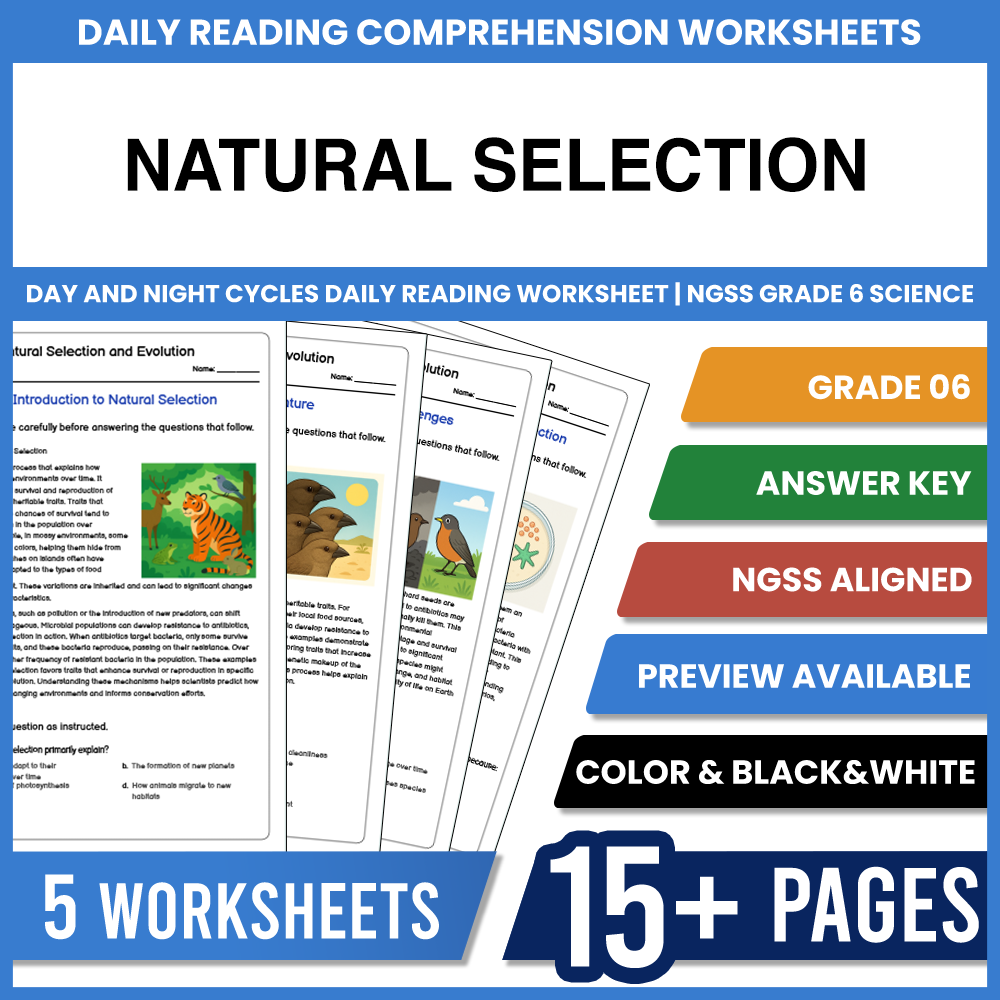
Grade 6 Science – Particle Models & Matter | Daily Reading Worksheet
 Created byElena Brooks
Learning Objectives
- Understand that all matter is made up of tiny particles too small to see.
- Describe how particles behave and move in different states of matter.
- Relate temperature and energy to particle movement.
Also included in: Grade 6 Science Matter and Its Interactions Lesson Bundle | NGSS +1 more
Instant download

Grade 6 Science | Series and Parallel Circuits Worksheet | BC Aligned
 Created byLumora Learning
Learning Objectives
- Understand the differences between series and parallel circuits in electrical systems.
- Explain how current and voltage are distributed in series and parallel arrangements.
- Identify the effects of circuit configurations on energy flow, device brightness, and circuit reliability.
Also included in: Grade 6 Science | Energy, Waves & Circuits | Custom Bundle | BC Aligned
Instant download

Grade 6 Science | Mass Conservation Worksheet | California Standards
Created byLumora LearningLearning Objectives
- Explain mass conservation in a closed system using the idea of conserved atoms
- Connect particle-level rearrangement of atoms to macroscopic mass measurements
- Use balanced chemical equations to support conservation of mass
Instant download

Grade 6 Science | Sustainability Strategies Worksheet & Answer Key |NGSS-Aligned
Created byLumora LearningLearning Objectives
- Understand the impact of population trends and resource use on Earth's systems.
- Identify different sustainable practices and evaluate their benefits and trade-offs.
- Analyze methods to measure progress toward sustainability goals.
Instant download

Food Webs Worksheet | Grade 6 Science | Ontario Standard
 Created byCedar Grove Learning
Learning Objectives
- Identify producers, consumers, and decomposers in food webs and food chains
- Explain how energy moves through trophic levels and decreases at each step
- Use cause-and-effect reasoning to predict how removing or adding a species can change a community
Also included in: Grade 6 Biodiversity and Adaptations Science Lesson Bundle Ontario +1 more
Instant download
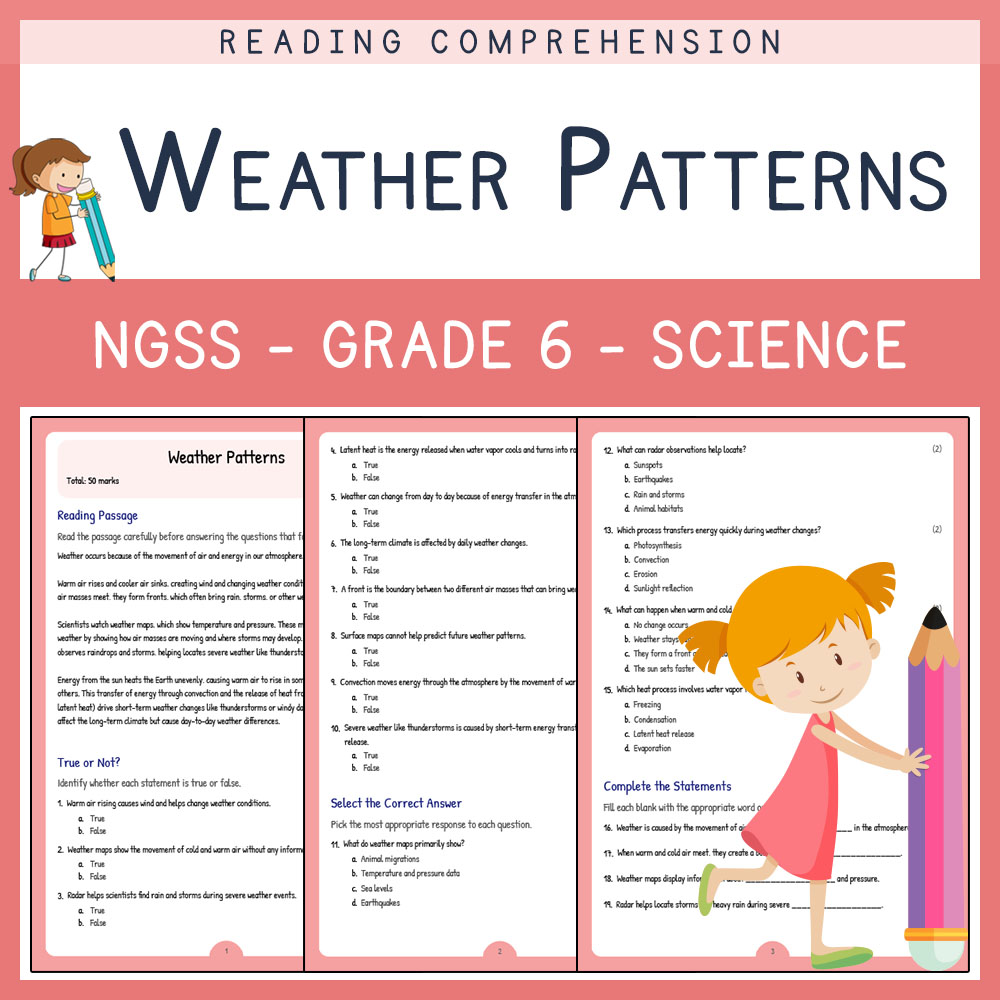
Grade 6 Science | Weather Patterns Worksheet (PDF) | NGSS Aligned
Created byLumora LearningLearning Objectives
- Understand how atmospheric processes influence weather.
- Interpret surface maps, temperature, and pressure data.
- Identify types of weather phenomena such as storms and fronts.
Instant download

Grade 6 Science | Understanding Measurement Errors - Daily Reading Comprehension
 Created byCoral Reef Learning
Learning Objectives
- Understand key concepts related to Science
- Apply knowledge through practice questions
- Demonstrate comprehension of the material
Instant download
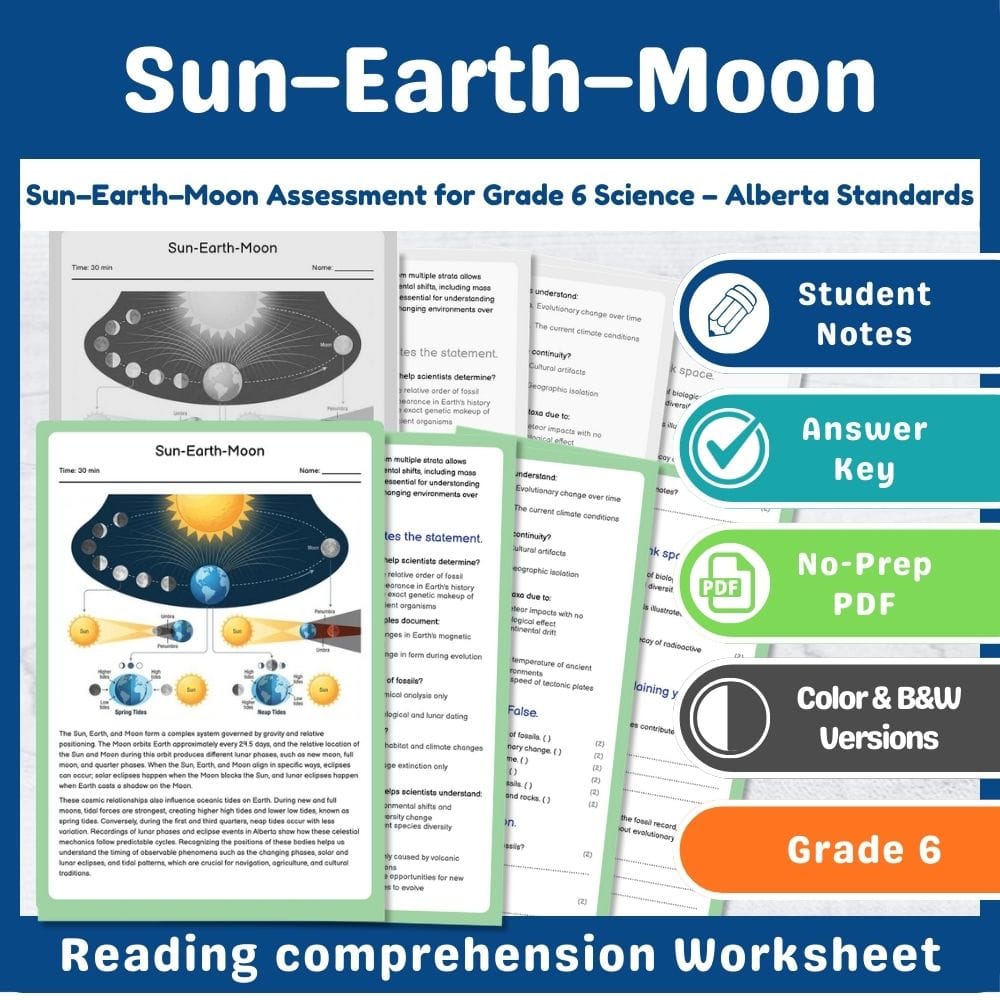
Sun–Earth–Moon Assessment for Grade 6 Science – Alberta Standards
Created byPrism Point LearningLearning Objectives
- Explain the gravitational relationships between the Sun, Earth, and Moon.
- Describe how relative positions of celestial bodies produce phases, eclipses, and tides.
- Identify observable phenomena related to the alignment of the Sun, Earth, and Moon.
Also included in: Lesson Grade 6 Science Assessment | Celestial & Earth Movements
Instant download
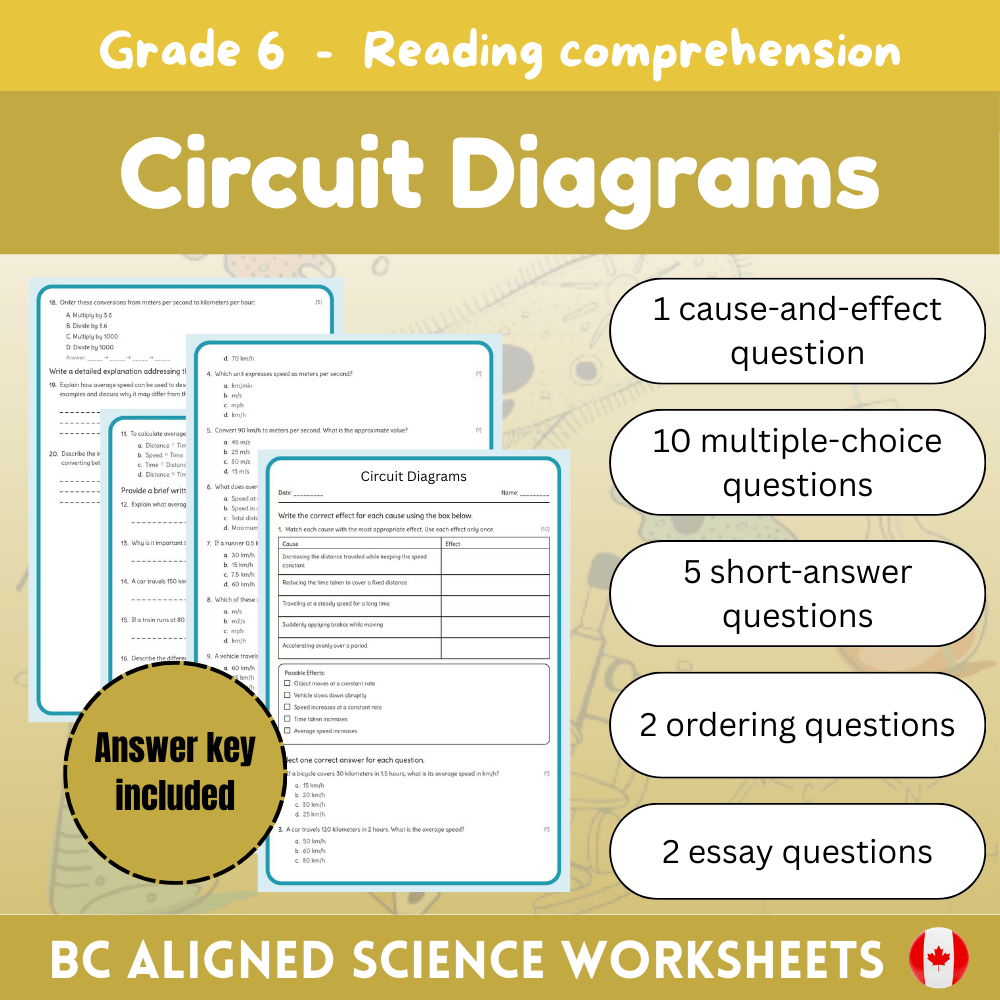
Grade 6 Science – Circuit Diagrams Worksheet (PDF) | BC Standards
Created byBright Mind ResourcesLearning Objectives
- Understand the purpose and components of circuit diagrams.
- Learn standard symbols used to represent sources, conductors, loads, and other components.
- Translate physical electrical systems into circuit diagrams.
Instant download
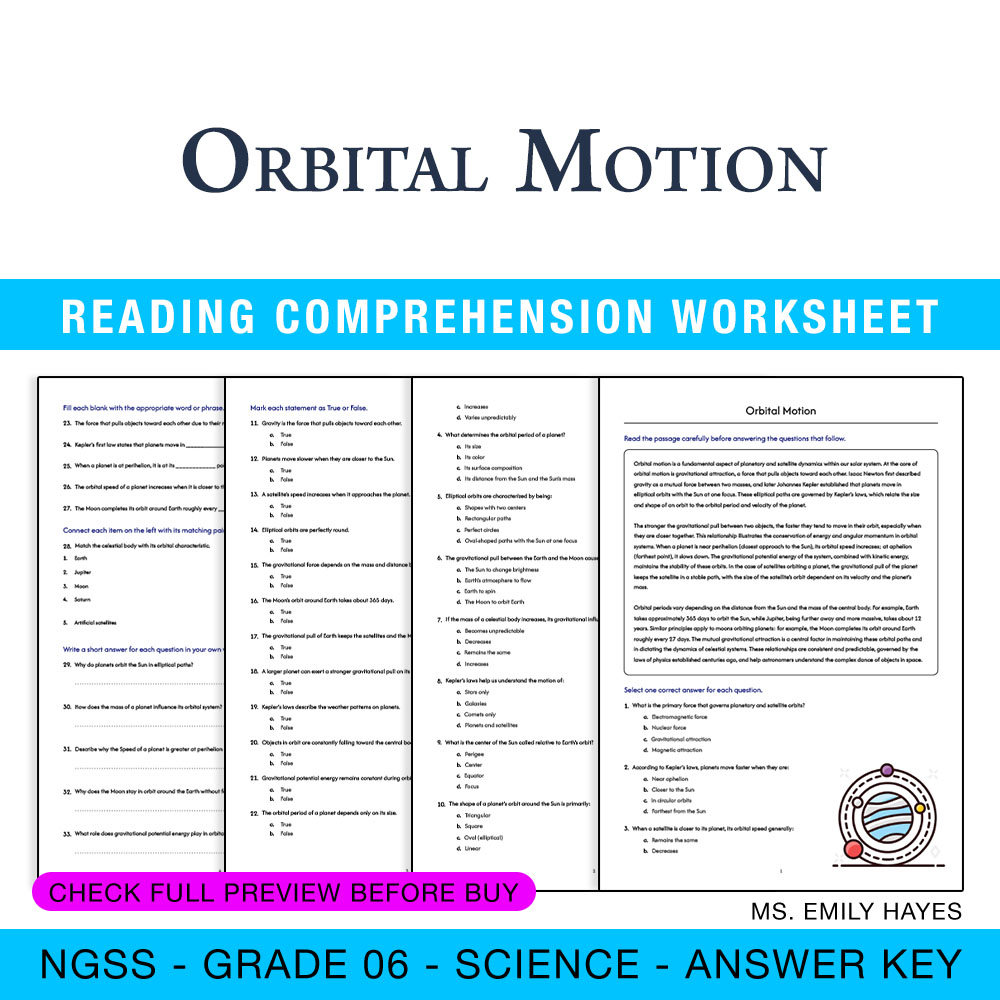
6th Grade Science | Orbital Motion Worksheet (PDF + Answer Key)
Created byCopper Leaf ClassroomLearning Objectives
- Understand gravitational attraction as the primary force governing planetary orbits.
- Describe how mutual gravity between the Sun and planets results in elliptical orbits and orbital periods.
- Explain the role of gravitational potential in maintaining orbital paths and satellite motion.
Also included in: Grade 6 Science Unit Bundle | Space, Moon & Seasons (PDF + Answer Key)
Instant download
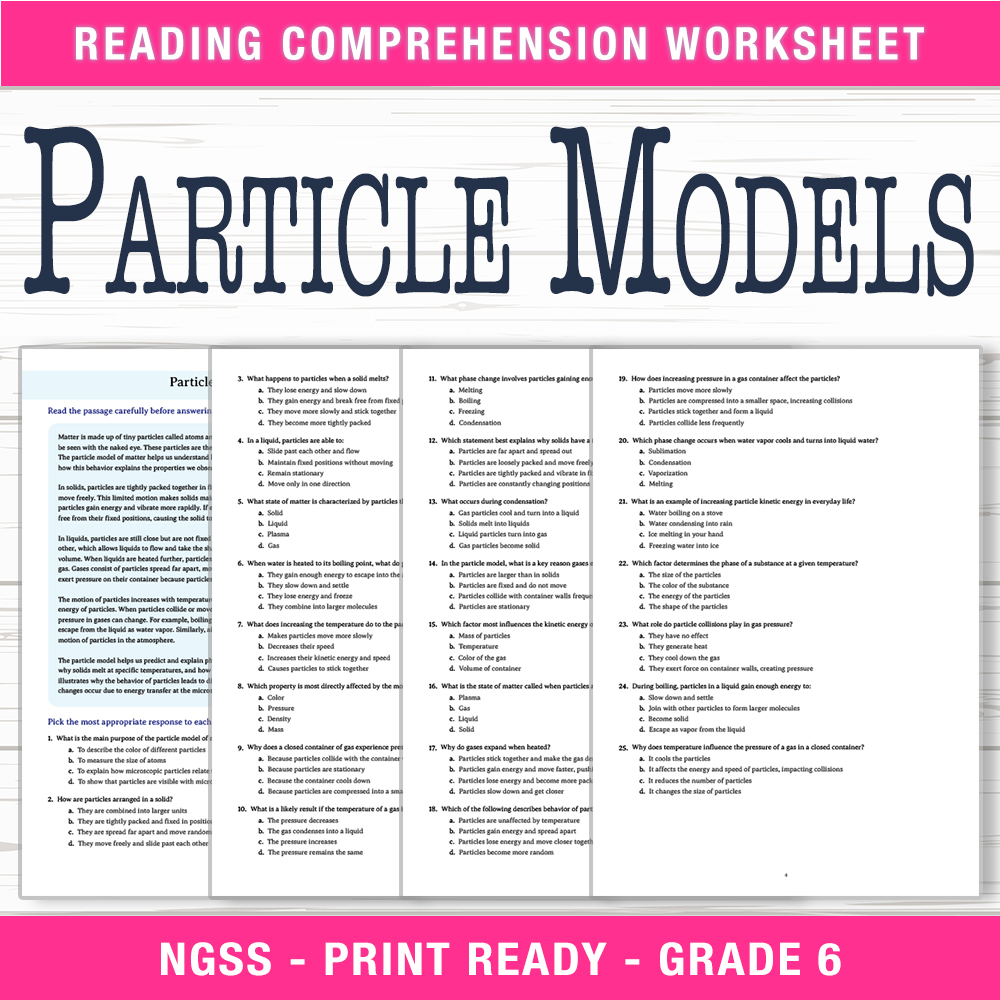
6th Grade Science | Particle Models Worksheet (PDF +Answer Key)
 Created byRiverstone Classroom
Learning Objectives
- Explain how particles make up matter and how their behavior relates to the properties of solids, liquids, and gases.
- Describe how temperature affects particle motion and how this relates to changes of state such as melting, freezing, boiling, and condensation.
- Relate the microscopic behavior of particles to macroscopic phenomena like pressure changes and thermal energy effects.
Instant download

Grade 6 Trait Heritability Worksheet | Ontario Science Practice PDF
Created byClear Sky ClassroomLearning Objectives
- Explain what heritability means and how it relates to genetic variation and observed trait differences.
- Distinguish heritable influences from environmental influences on traits and fitness.
- Describe how natural selection can change allele frequencies and trait distributions over generations.
Instant download
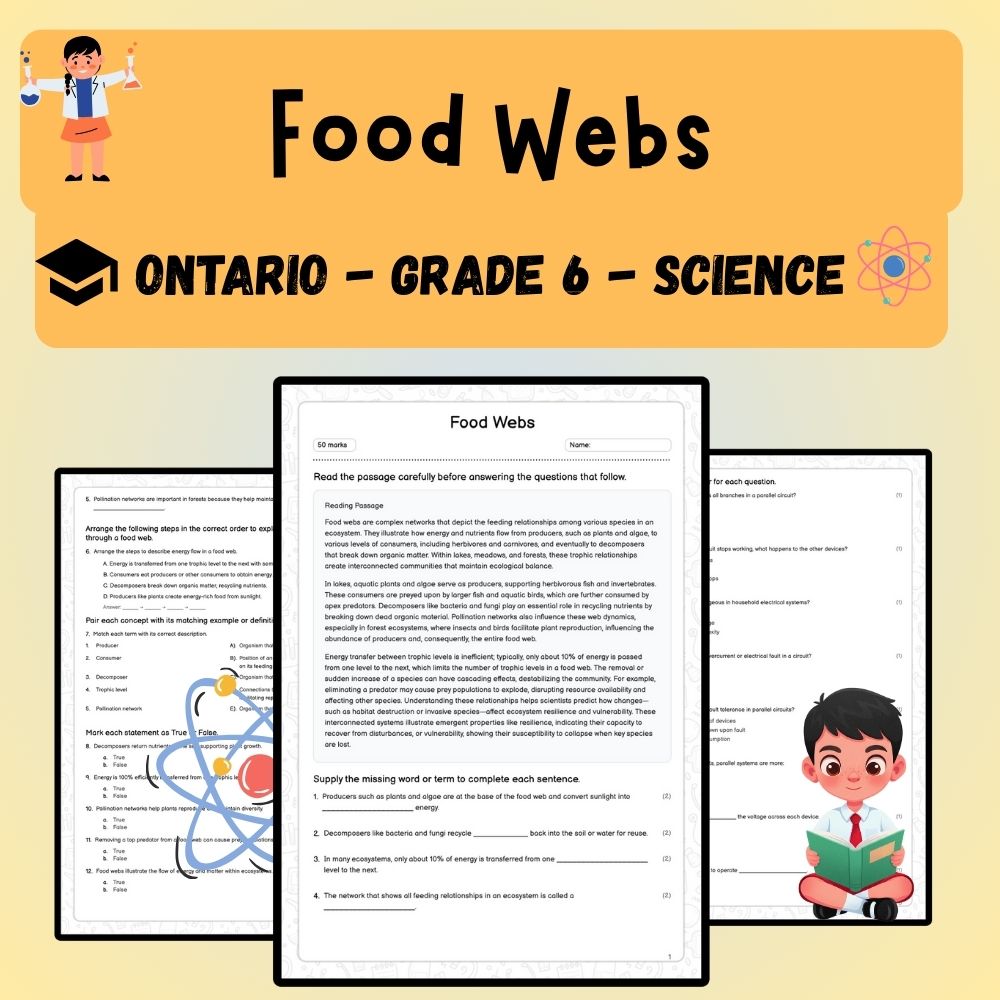
Grade 6 Science | Food Webs Worksheet (PDF ) – Ontario Standards
Created byPrism Point LearningLearning Objectives
- Understand the components and structure of food webs in various ecosystems.
- Identify producers, consumers, and decomposers and explain their roles.
- Analyze energy flow and matter cycling within food chains.
Also included in: Grade 6 Science Unit Bundle – Ecology, Classification & Environment
Instant download
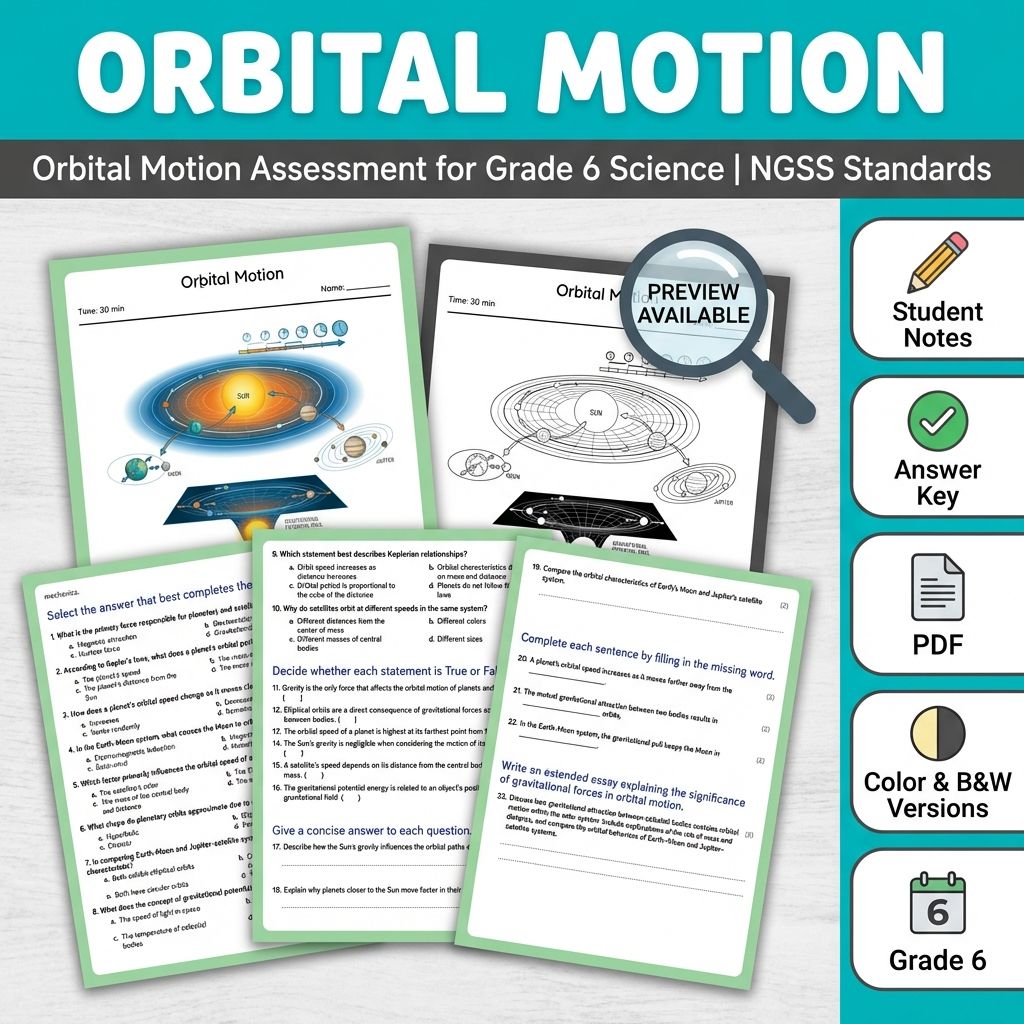
Orbital Motion Assessment for Grade 6 Science | NGSS Standards
Created byPrism Point LearningLearning Objectives
- Explain the role of gravity in planetary and satellite orbits within the solar system.
- Describe how mutual gravitational forces produce elliptical orbits and influence orbital periods and speeds.
- Compare orbital dynamics of Earth–Moon and Jupiter–satellite systems to illustrate the effects of mass and distance.
Also included in: Grade 6 Science Mini Bundle | Earth’s Place in the Universe NGSS Standards +1 more
Instant download
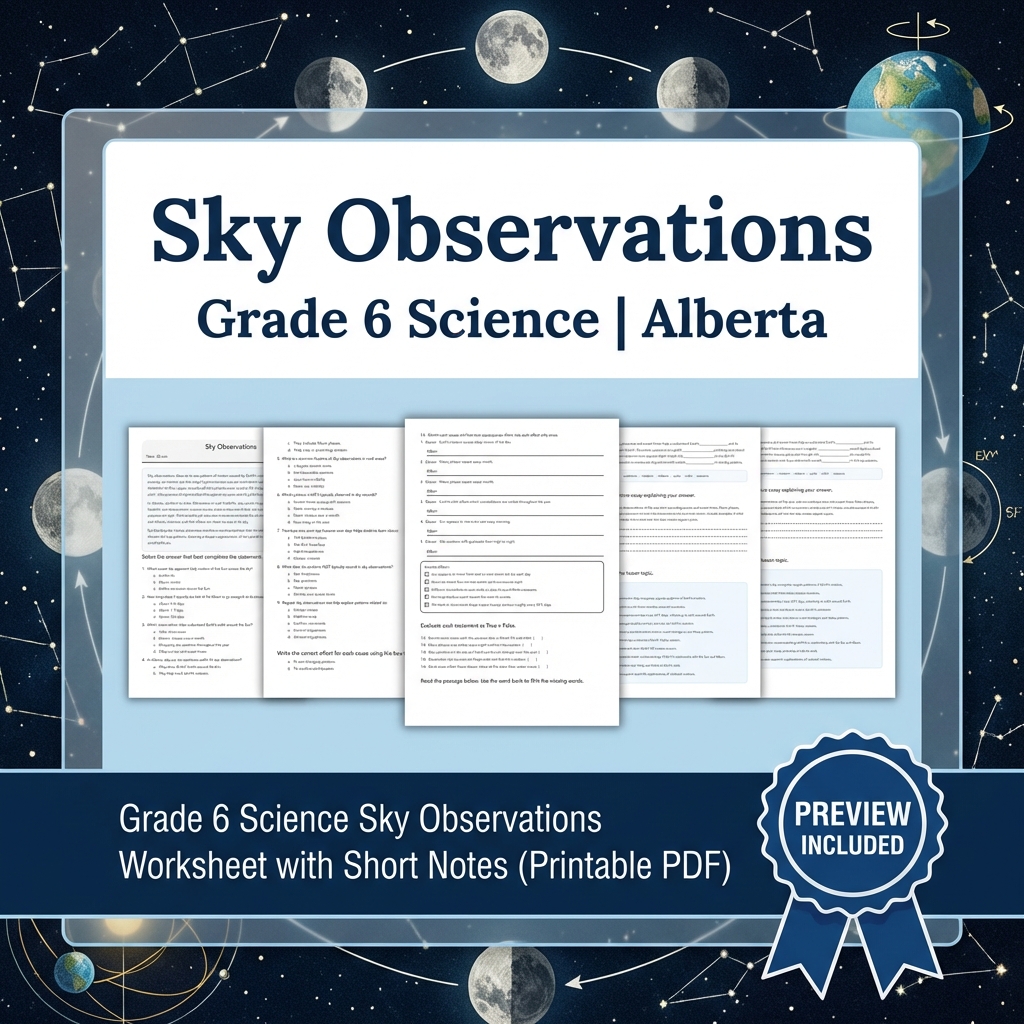
Grade 6 Science Sky Observations Worksheet with Short Notes (Printable PDF)
Created byMeadowlark WorksheetsLearning Objectives
- Understand how systematic sky observations help recognize patterns of motion.
- Record and interpret sunrise, sunset, Moon phases, and star positions.
- Describe the relationship between Earth's movements and observable sky patterns.
Also included in: Grade 6 Science Sky Science Unit Bundle | Alberta Curriculum Worksheets +1 more
Instant download

Grade 6 Science | Speed & Velocity - Daily Reading Comprehension
Created byCoral Reef LearningLearning Objectives
- Understand the difference between speed and velocity.
- Identify how direction affects velocity.
- Calculate average speed using distance and time.
Instant download

Grade 6 Science | Classification Genetics Daily Reading Practice
Created byCoral Reef LearningLearning Objectives
- Understand what DNA barcoding is and how it is used in classifying species.
- Identify the difference between morphological and genetic classification methods.
- Recognize how molecular tools can reveal cryptic species.
Instant download
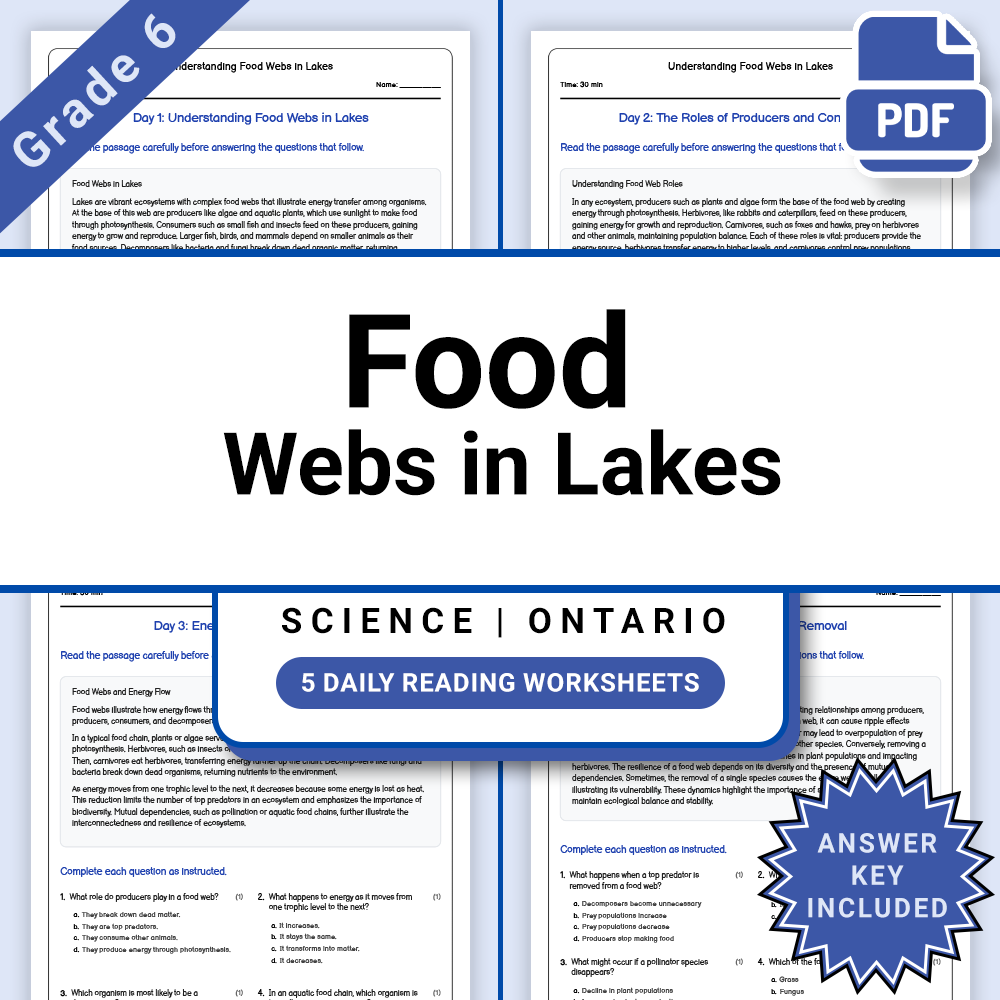
Grade 6 Science – Understanding Food Webs in Lakes Daily Worksheet + Answer Key
JCreated byJ.S SheetsLearning Objectives
- Identify producers, consumers, and decomposers in aquatic environments
- Understand how energy flows through food webs
- Recognize the roles of different organisms in lakes
Also included in: Grade 6 Science Biodiversity Lesson Bundle – Ecosystems and Conservation +1 more
Instant download
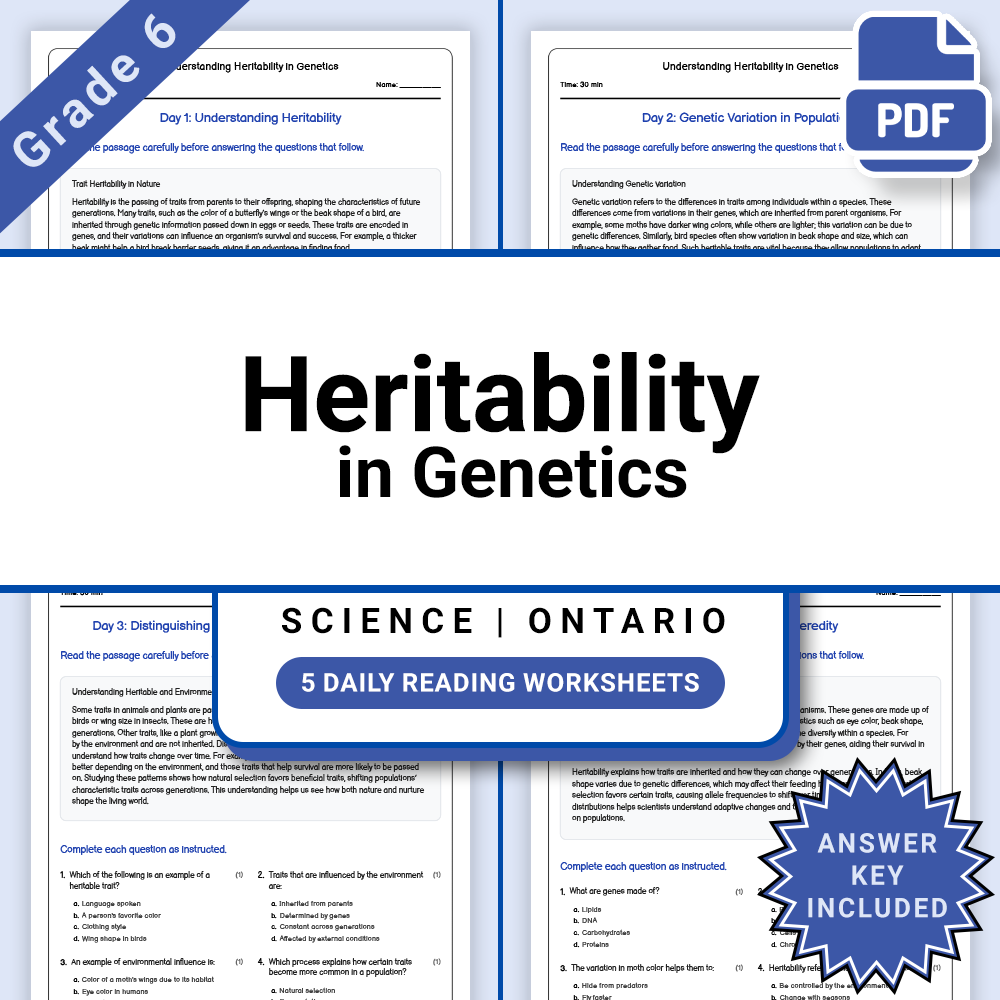
Grade 6 Science – Understanding Heritability Reading Worksheet + Answer Key
JCreated byJ.S SheetsLearning Objectives
- Define heritability and distinguish it from environmental influences.
- Identify examples of heritable traits, such as beak shape and color morphs.
- Explain how traits are passed from parents to offspring and how they change in populations over time.
Also included in: Grade 6 Science Biodiversity Lesson Bundle – Ecosystems and Conservation +1 more
Instant download
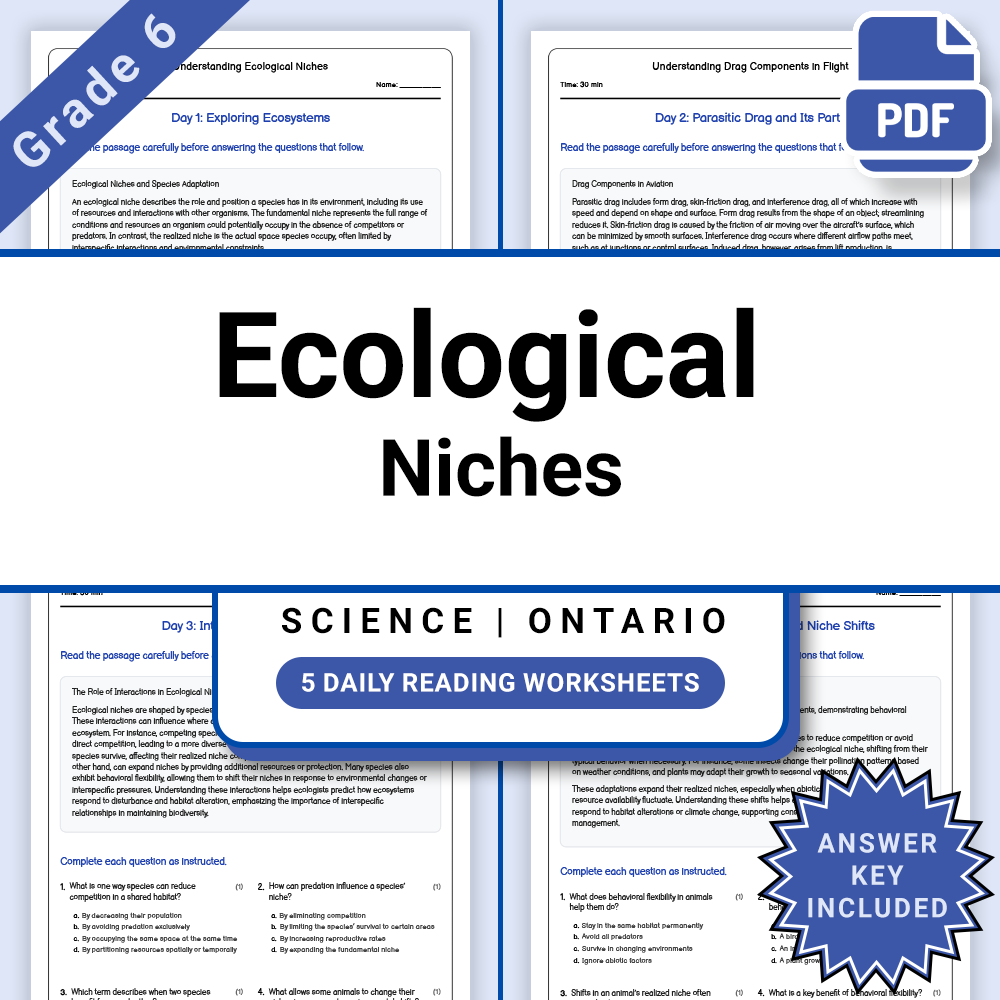
Grade 6 Science – Ecological Niches Daily Reading Worksheet + Answer Key
JCreated byJ.S SheetsLearning Objectives
- Explain the concept of ecological niches and differentiate between fundamental and realized niches.
- Identify how abiotic factors influence species distribution within habitats.
- Describe examples of spatial and temporal partitioning among similar species.
Also included in: Grade 6 Science Biodiversity Lesson Bundle – Ecosystems and Conservation +1 more
Instant download
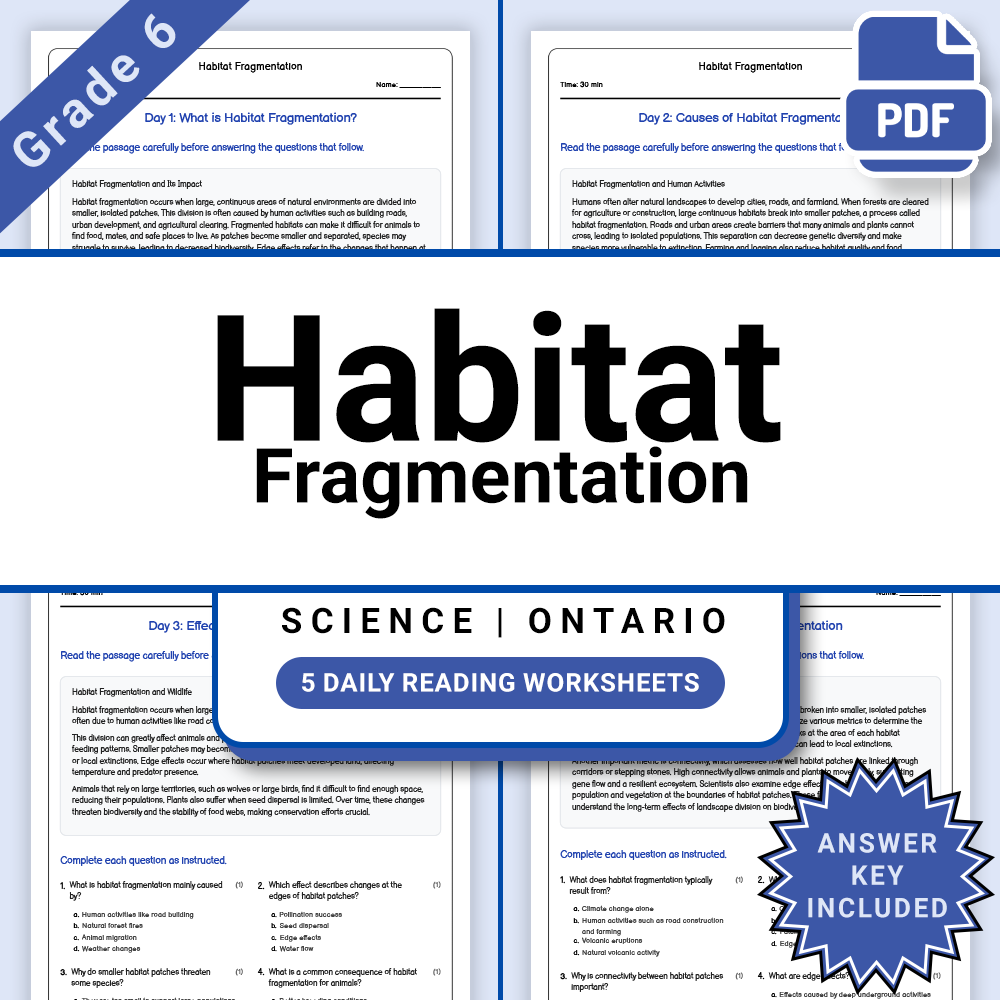
Grade 6 Science – Habitat Fragmentation Daily Reading Worksheet + Answer Key
JCreated byJ.S SheetsLearning Objectives
- Understand the concept of habitat fragmentation.
- Identify causes of habitat division such as roads and agriculture.
- Recognize effects of fragmentation on species and ecosystems.
Also included in: Grade 6 Science Biodiversity Lesson Bundle – Ecosystems and Conservation +1 more
Instant download
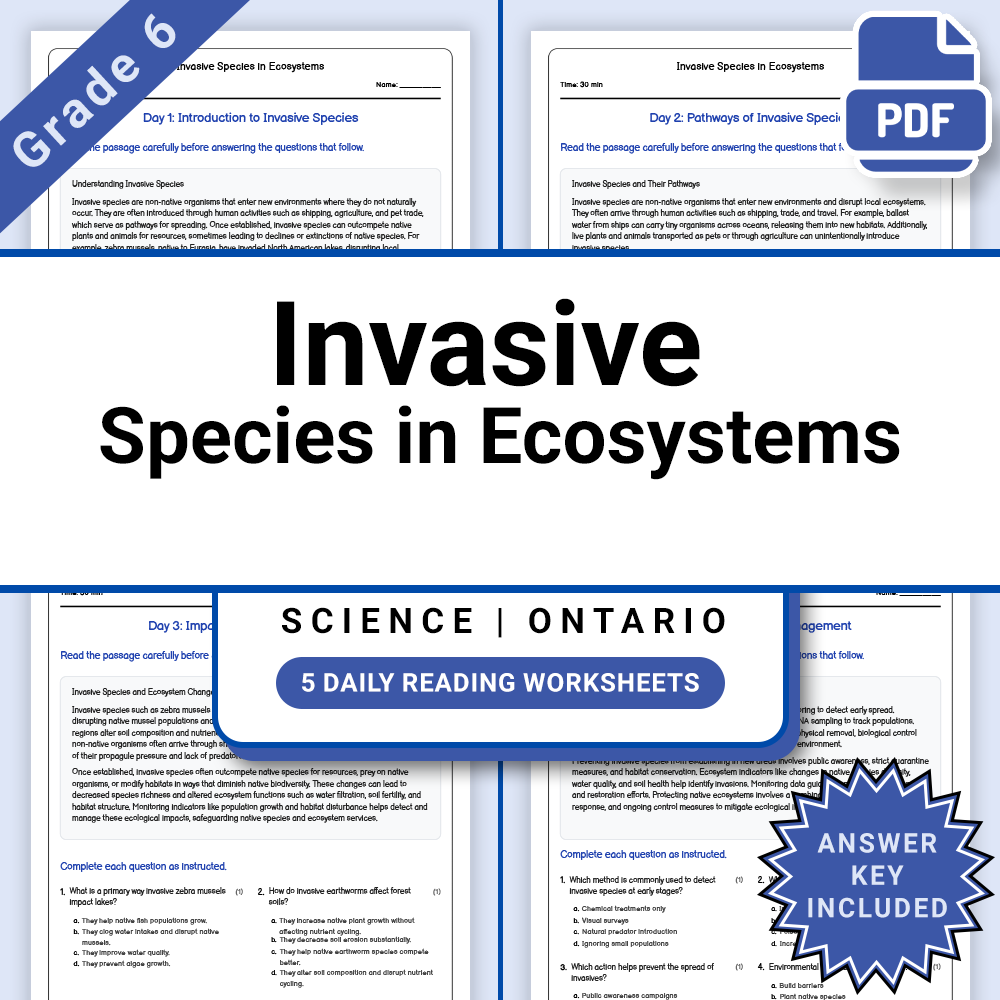
Grade 6 Science – Invasive Species Ecosystems Daily Worksheet + Answer Key
JCreated byJ.S SheetsLearning Objectives
- Define what invasive species are and distinguish them from native species.
- Identify common pathways through which invasive species enter new environments.
- Understand the ecological impacts invasive species can have on native ecosystems.
Also included in: Grade 6 Science Biodiversity Lesson Bundle – Ecosystems and Conservation +1 more
Instant download
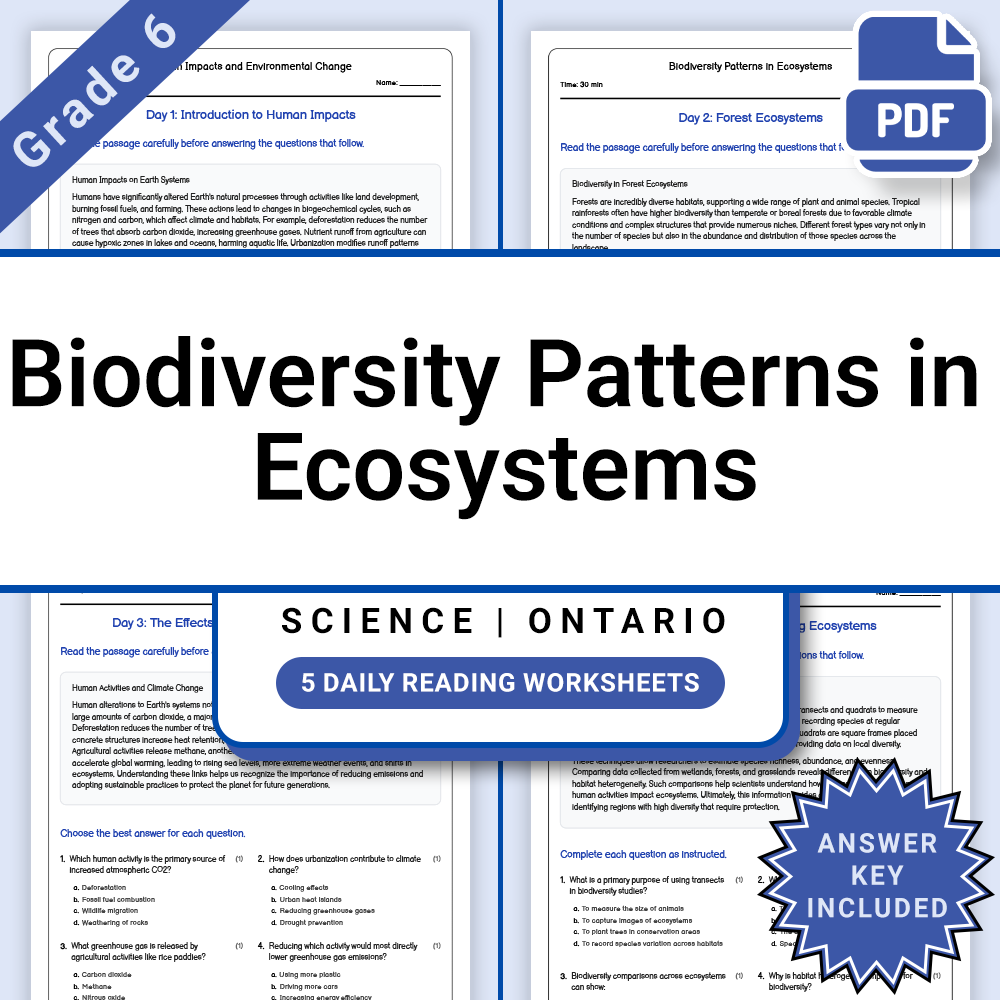
Grade 6 – Biodiversity Patterns in Ecosystems Daily Worksheet + Answer Key
JCreated byJ.S SheetsLearning Objectives
- Understand what species richness, abundance, and evenness mean in ecology.
- Learn about sampling methods like transects and quadrats to measure biodiversity.
- Recognize how habitat heterogeneity influences biodiversity patterns.
Also included in: Grade 6 Science Biodiversity Lesson Bundle – Ecosystems and Conservation +1 more
Instant download
About Grade 6 Science Worksheets
Explore Grade 6 Science worksheets for classwork, homework, or review. Our 5,969 printables download instantly as PDFs.
MyTeachingSheets worksheets are made by real teacher-authors and checked before they go live. Download any as a print-ready PDF for lessons, homework, or independent practice — most include answer keys, and previews are always free.